WO2016080063A1 - 非水電解液電池用電解液及びリチウム非水電解液電池 - Google Patents
非水電解液電池用電解液及びリチウム非水電解液電池 Download PDFInfo
- Publication number
- WO2016080063A1 WO2016080063A1 PCT/JP2015/076383 JP2015076383W WO2016080063A1 WO 2016080063 A1 WO2016080063 A1 WO 2016080063A1 JP 2015076383 W JP2015076383 W JP 2015076383W WO 2016080063 A1 WO2016080063 A1 WO 2016080063A1
- Authority
- WO
- WIPO (PCT)
- Prior art keywords
- electrolyte
- lithium
- aqueous electrolyte
- mass
- battery
- Prior art date
- Legal status (The legal status is an assumption and is not a legal conclusion. Google has not performed a legal analysis and makes no representation as to the accuracy of the status listed.)
- Ceased
Links
Classifications
-
- H—ELECTRICITY
- H01—ELECTRIC ELEMENTS
- H01M—PROCESSES OR MEANS, e.g. BATTERIES, FOR THE DIRECT CONVERSION OF CHEMICAL ENERGY INTO ELECTRICAL ENERGY
- H01M10/00—Secondary cells; Manufacture thereof
- H01M10/05—Accumulators with non-aqueous electrolyte
- H01M10/056—Accumulators with non-aqueous electrolyte characterised by the materials used as electrolytes, e.g. mixed inorganic/organic electrolytes
- H01M10/0564—Accumulators with non-aqueous electrolyte characterised by the materials used as electrolytes, e.g. mixed inorganic/organic electrolytes the electrolyte being constituted of organic materials only
- H01M10/0566—Liquid materials
- H01M10/0567—Liquid materials characterised by the additives
-
- H—ELECTRICITY
- H01—ELECTRIC ELEMENTS
- H01M—PROCESSES OR MEANS, e.g. BATTERIES, FOR THE DIRECT CONVERSION OF CHEMICAL ENERGY INTO ELECTRICAL ENERGY
- H01M10/00—Secondary cells; Manufacture thereof
- H01M10/05—Accumulators with non-aqueous electrolyte
- H01M10/052—Li-accumulators
-
- H—ELECTRICITY
- H01—ELECTRIC ELEMENTS
- H01M—PROCESSES OR MEANS, e.g. BATTERIES, FOR THE DIRECT CONVERSION OF CHEMICAL ENERGY INTO ELECTRICAL ENERGY
- H01M10/00—Secondary cells; Manufacture thereof
- H01M10/05—Accumulators with non-aqueous electrolyte
- H01M10/052—Li-accumulators
- H01M10/0525—Rocking-chair batteries, i.e. batteries with lithium insertion or intercalation in both electrodes; Lithium-ion batteries
-
- H—ELECTRICITY
- H01—ELECTRIC ELEMENTS
- H01M—PROCESSES OR MEANS, e.g. BATTERIES, FOR THE DIRECT CONVERSION OF CHEMICAL ENERGY INTO ELECTRICAL ENERGY
- H01M10/00—Secondary cells; Manufacture thereof
- H01M10/05—Accumulators with non-aqueous electrolyte
- H01M10/056—Accumulators with non-aqueous electrolyte characterised by the materials used as electrolytes, e.g. mixed inorganic/organic electrolytes
- H01M10/0564—Accumulators with non-aqueous electrolyte characterised by the materials used as electrolytes, e.g. mixed inorganic/organic electrolytes the electrolyte being constituted of organic materials only
- H01M10/0566—Liquid materials
- H01M10/0568—Liquid materials characterised by the solutes
-
- H—ELECTRICITY
- H01—ELECTRIC ELEMENTS
- H01M—PROCESSES OR MEANS, e.g. BATTERIES, FOR THE DIRECT CONVERSION OF CHEMICAL ENERGY INTO ELECTRICAL ENERGY
- H01M10/00—Secondary cells; Manufacture thereof
- H01M10/05—Accumulators with non-aqueous electrolyte
- H01M10/056—Accumulators with non-aqueous electrolyte characterised by the materials used as electrolytes, e.g. mixed inorganic/organic electrolytes
- H01M10/0564—Accumulators with non-aqueous electrolyte characterised by the materials used as electrolytes, e.g. mixed inorganic/organic electrolytes the electrolyte being constituted of organic materials only
- H01M10/0566—Liquid materials
- H01M10/0569—Liquid materials characterised by the solvents
-
- H—ELECTRICITY
- H01—ELECTRIC ELEMENTS
- H01M—PROCESSES OR MEANS, e.g. BATTERIES, FOR THE DIRECT CONVERSION OF CHEMICAL ENERGY INTO ELECTRICAL ENERGY
- H01M10/00—Secondary cells; Manufacture thereof
- H01M10/42—Methods or arrangements for servicing or maintenance of secondary cells or secondary half-cells
- H01M10/4235—Safety or regulating additives or arrangements in electrodes, separators or electrolyte
-
- H—ELECTRICITY
- H01—ELECTRIC ELEMENTS
- H01M—PROCESSES OR MEANS, e.g. BATTERIES, FOR THE DIRECT CONVERSION OF CHEMICAL ENERGY INTO ELECTRICAL ENERGY
- H01M2300/00—Electrolytes
- H01M2300/0017—Non-aqueous electrolytes
- H01M2300/0025—Organic electrolyte
-
- H—ELECTRICITY
- H01—ELECTRIC ELEMENTS
- H01M—PROCESSES OR MEANS, e.g. BATTERIES, FOR THE DIRECT CONVERSION OF CHEMICAL ENERGY INTO ELECTRICAL ENERGY
- H01M2300/00—Electrolytes
- H01M2300/0017—Non-aqueous electrolytes
- H01M2300/0025—Organic electrolyte
- H01M2300/0028—Organic electrolyte characterised by the solvent
- H01M2300/0037—Mixture of solvents
-
- Y—GENERAL TAGGING OF NEW TECHNOLOGICAL DEVELOPMENTS; GENERAL TAGGING OF CROSS-SECTIONAL TECHNOLOGIES SPANNING OVER SEVERAL SECTIONS OF THE IPC; TECHNICAL SUBJECTS COVERED BY FORMER USPC CROSS-REFERENCE ART COLLECTIONS [XRACs] AND DIGESTS
- Y02—TECHNOLOGIES OR APPLICATIONS FOR MITIGATION OR ADAPTATION AGAINST CLIMATE CHANGE
- Y02E—REDUCTION OF GREENHOUSE GAS [GHG] EMISSIONS, RELATED TO ENERGY GENERATION, TRANSMISSION OR DISTRIBUTION
- Y02E60/00—Enabling technologies; Technologies with a potential or indirect contribution to GHG emissions mitigation
- Y02E60/10—Energy storage using batteries
-
- Y—GENERAL TAGGING OF NEW TECHNOLOGICAL DEVELOPMENTS; GENERAL TAGGING OF CROSS-SECTIONAL TECHNOLOGIES SPANNING OVER SEVERAL SECTIONS OF THE IPC; TECHNICAL SUBJECTS COVERED BY FORMER USPC CROSS-REFERENCE ART COLLECTIONS [XRACs] AND DIGESTS
- Y02—TECHNOLOGIES OR APPLICATIONS FOR MITIGATION OR ADAPTATION AGAINST CLIMATE CHANGE
- Y02T—CLIMATE CHANGE MITIGATION TECHNOLOGIES RELATED TO TRANSPORTATION
- Y02T10/00—Road transport of goods or passengers
- Y02T10/60—Other road transportation technologies with climate change mitigation effect
- Y02T10/70—Energy storage systems for electromobility, e.g. batteries
Definitions
- the present invention relates to an electrolyte used for a lithium non-aqueous electrolyte battery.
- Lithium non-aqueous electrolyte batteries such as lithium ion batteries, lithium batteries, and lithium ion capacitors have been actively developed as one candidate for an electricity storage system.
- a non-aqueous electrolyte in which a fluorine-containing electrolyte such as LiPF 6 is dissolved in a solvent such as cyclic carbonate, chain carbonate, or ether provides a battery having a high voltage and a high capacity. It is often used because it is suitable.
- a lithium non-aqueous electrolyte battery using such a non-aqueous electrolyte is not always satisfactory in battery characteristics including cycle characteristics and output characteristics.
- Lithium non-aqueous electrolyte batteries that are currently in practical use have remarkable battery characteristics such as, when the environmental temperature exceeds 60 ° C., the decomposition of the electrolyte solution on the electrode surface during charge and discharge is promoted and the battery life is extremely shortened. It could cause a drop.
- Batteries used for electric vehicles, hybrid vehicles, auxiliary power sources for fuel cell vehicles, household power storage systems, etc. have a large capacity and high output, generate a large amount of heat during charging and discharging, and are used outdoors. The environmental temperature tends to be high, and a cooling mechanism is provided to keep the environmental temperature of the battery at 60 ° C. or lower.
- the usable environmental temperature can be higher than 60 ° C., for example, a high temperature of about 80 ° C. so that the energy used for the cooling mechanism can be reduced or the cooling mechanism itself can be eliminated.
- an electrolyte for a lithium non-aqueous electrolyte battery that has little deterioration in battery characteristics even after repeated charging and discharging in an environment.
- Patent Document 1 when lithium difluorophosphate is added to a nonaqueous electrolytic solution in which a fluorine-containing electrolyte such as LiPF 6 is dissolved, lithium difluorophosphate reacts with the electrode on the surface of the electrode during initial charge and discharge, and a good film is formed. It is described that since it is formed on the positive and negative electrodes, the reaction of the electrolyte solvent after film formation is suppressed, and it is effective in maintaining the discharge capacity of the battery after storage at 60 ° C. for 20 days. Patent Document 2 describes that by adding difluorophosphate to an electrolytic solution containing LiPF 6 , the output after repeated charging and discharging in an environment of 60 ° C. is improved. However, the addition of lithium difluorophosphate is certainly effective in improving the cycle characteristics, but has not yet achieved sufficient cycle characteristics in a high temperature environment of about 80 ° C.
- a fluorine-containing electrolyte such as LiPF 6
- Non-Patent Document 1 LiPF 6 used as an electrolyte salt for a lithium ion battery (lithium secondary battery) is decomposed by moisture absorption to HF, POF 3 , H [OPOF 2 ], H 2 [ O 2 POF], H 3 [PO 4 ] and the like are described, and it is disclosed that these acid contents adversely affect battery characteristics.
- Japanese Patent Laid-Open No. 11-67270 Japanese Patent No. 3439085
- JP 2004-031079 A Patent No. 4233819
- An object of the present invention is to provide an electrolyte for a non-aqueous electrolyte battery and a lithium non-aqueous electrolyte battery that can maintain a high discharge capacity even after repeated charging and discharging in a high temperature environment.
- the present inventors have heretofore proposed a battery such as a positive electrode active material in a non-aqueous organic solvent and an electrolyte for a non-aqueous electrolyte battery containing at least lithium hexafluorophosphate as a solute.
- the acidic compounds that were thought to degrade the materials, the phosphorus-containing acidic compounds are contained in a specific concentration range, and further difluorophosphate is added as an additive to improve cycle characteristics in a high temperature environment.
- the present invention has been found.
- the present invention relates to a non-aqueous electrolyte battery electrolyte containing a non-aqueous organic solvent and at least lithium hexafluorophosphate as a solute.
- an electrolyte for a non-aqueous electrolyte battery containing 1000 ppm by mass and further containing 0.01 to 10.0% by mass of a difluorophosphate.
- the phosphorus-containing acidic compound is preferably at least one compound selected from HPF 6 , HPO 2 F 2 , H 2 PO 3 F, and H 3 PO 4 . Moreover, it is preferable that content of hydrogen fluoride in electrolyte solution is less than 10 mass ppm.
- difluorobis (oxalato) lithium phosphate difluoro (oxalato) lithium borate, tris (oxalato) lithium phosphate, tetrafluoro (oxalato) )
- the protective additive is selected from propane sultone, 1,3-propene sultone, methylene methane disulfonate, dimethylene methane disulfonate, and trimethylene methane disulfonate.
- the present invention also provides a lithium non-aqueous electrolyte battery comprising at least a positive electrode, a negative electrode, and the above-described electrolyte for a non-aqueous electrolyte battery.
- non-aqueous electrolyte battery electrolyte and a lithium non-aqueous electrolyte battery that can maintain a high discharge capacity even after repeated charging and discharging in a high temperature environment.
- the electrolyte for a non-aqueous electrolyte battery of the present invention includes a phosphorus-containing acidic compound (hereinafter sometimes simply referred to as “acidic compound”), a difluorophosphate, a solute, and a non-aqueous organic solvent that dissolves the solute. Containing.
- the phosphorus-containing acidic compound used in the electrolyte for a non-aqueous electrolyte battery of the present invention is preferably at least one compound selected from HPF 6 , HPO 2 F 2 , H 2 PO 3 F, and H 3 PO 4 .
- the content is 10 ppm by mass or more, preferably 30 ppm by mass or more, more preferably 50 ppm by mass or more, and 1000 ppm by mass or less, preferably 800 ppm by mass or less, with respect to the electrolyte for nonaqueous electrolyte batteries. More preferably, it is the range of 500 mass ppm or less.
- the amount is less than 10 ppm by mass, the effect of improving the cycle characteristics in a high temperature environment may not be sufficiently obtained.
- the amount exceeds 1000 ppm by mass, the battery material such as the positive electrode active material is deteriorated and the cycle characteristics are adversely affected.
- hydrogen fluoride is not preferable because it significantly deteriorates battery materials such as a positive electrode active material, and the non-aqueous electrolyte of the present invention does not substantially contain hydrogen fluoride. “Not substantially contained” means that the concentration of hydrogen fluoride in the nonaqueous electrolytic solution is less than 10 mass ppm, preferably less than 8 mass ppm, more preferably less than 5 mass ppm. .
- the acidic compound may be added directly to the electrolyte for nonaqueous electrolyte batteries.
- at least one compound selected from HPF 6 , HPO 2 F 2 , H 2 PO 3 F, and H 3 PO 4 it may be added directly, but it may be added to a non-aqueous organic solvent containing LiPF 6.
- a non-aqueous organic solvent in which LiPF 6 is hydrolyzed to form a phosphorus-containing acidic compound by adding a trace amount of water (for example, 1 to 1000 ppm by weight of water) is used as an electrolyte for a non-aqueous electrolyte battery. May be added.
- a trace amount of water for example, 1 to 1000 ppm by weight of water
- hydrogen fluoride is also generated, hydrogen fluoride is degassed from the nonaqueous organic solvent in which LiPF 6 is hydrolyzed to form a phosphorus-containing acidic compound before being added to the electrolyte for the nonaqueous electrolyte battery. It is necessary to remove by such as.
- ⁇ Method for Quantifying Acidic Compound in Electrolyte for Nonaqueous Electrolyte Battery By neutralization titration, the total amount of free acid in the electrolyte for a non-aqueous electrolyte battery can be measured.
- the content of acidic compounds other than HF can be quantified by quantifying HF in the electrolyte for non-aqueous electrolyte batteries by 19 F-NMR and subtracting it from the total free acid amount.
- HPO 2 F 2 and H 2 PO 3 F can be quantified by 19 F-NMR, respectively.
- the 19 F-NMR values (ppm) of HF, HPO 2 F 2 , and H 2 PO 3 F described in various documents published prior to the filing of this patent are shown as follows.
- the content of each substance can be determined from the area of the NMR peak.
- HF -201.0 HPO 2 F 2 : -86.2, -86.0, -85.6 H 2 PO 3 F: -74.3, -74.0
- HPO 2 F 2 , H 2 PO 3 F, and H 3 PO 4 are quantified by measuring the content of each anion contained in the electrolyte for non-aqueous electrolyte batteries using ion chromatography. can do.
- difluorophosphate examples include lithium salt, sodium salt, potassium salt, and quaternary alkyl ammonium salt of difluorophosphoric acid.
- the quaternary alkylammonium ion is not particularly limited, and examples thereof include trimethylpropylammonium ion and 1-butyl-1-methylpyrrolidinium ion.
- the lower limit of the content of difluorophosphate is 0.01% by mass or more, preferably 0.03% by mass or more, and more preferably 0.05% by mass or more with respect to the electrolyte for nonaqueous electrolyte batteries.
- the upper limit is 10.0% by mass or less, preferably 3.0% by mass or less, and more preferably 2.0% by mass or less. If the amount is less than 0.01% by mass, the effect of improving the cycle characteristics of the non-aqueous electrolyte battery is not sufficiently obtained. On the other hand, if the amount exceeds 10.0% by mass, the viscosity of the electrolyte for the non-aqueous electrolyte battery increases. Reduces ionic conductivity and increases internal resistance.
- the reason why the cycle characteristics under a high temperature environment are improved by coexistence of a certain amount of an acidic compound and difluorophosphate is not clear, but is considered as follows. It is done.
- the present invention is not limited to the following operation principle. When difluorophosphate is contained in the electrolyte, difluorophosphate and the electrolyte solvent react with the electrode on the surface of the electrode during initial charge and discharge, and the decomposition product of difluorophosphate and the solvent forms a film on the electrode. It is known that the reaction of the electrolyte solvent after film formation is suppressed and the cycle characteristics are improved.
- LiPF 6 lithium hexafluorophosphate
- lithium salt LiBF 4, LiClO 4, LiAsF 6, LiSbF 6, LiCF 3 SO 3, LiN (SO 2 CF 3) 2, LiN (SO 2 C 2 F 5) 2, LiN (SO 2 CF 3) (SO 2 C 4 F 9), LiC (SO 2 CF 3) 3, LiPF 3 (C 3 F 7) 3, LiB (CF 3) 4, LiBF 3 (C 2 F 5) or the like
- solutes may be used alone or in combination of two or more in any combination and ratio according to the application in addition to LiPF 6 .
- the concentration of these solutes containing at least LiPF 6 is not particularly limited, but the lower limit is 0.5 mol / L or more, preferably 0.7 mol / L or more, more preferably 0.9 mol / L or more, The upper limit is 2.5 mol / L or less, preferably 2.2 mol / L or less, more preferably 2.0 mol / L or less.
- concentration is less than 0.5 mol / L, the ionic conductivity is decreased, thereby reducing the cycle characteristics and output characteristics of the nonaqueous electrolyte battery.
- the concentration exceeds 2.5 mol / L the electrolyte solution for the nonaqueous electrolyte battery is reduced. If the viscosity increases, the ionic conductivity may be lowered, and the cycle characteristics and output characteristics of the nonaqueous electrolyte battery may be degraded.
- Non-aqueous organic solvent is not particularly limited as long as it is an aprotic solvent capable of dissolving the ionic complex of the present invention.
- aprotic solvent capable of dissolving the ionic complex of the present invention.
- carbonates, esters, ethers, lactones, nitriles, imides And sulfones can be used.
- not only a single solvent but 2 or more types of mixed solvents may be sufficient.
- ethyl methyl carbonate dimethyl carbonate, diethyl carbonate, methyl propyl carbonate, ethyl propyl carbonate, methyl butyl carbonate, ethylene carbonate, propylene carbonate, butylene carbonate, methyl acetate, ethyl acetate, methyl propionate, ethyl propionate, Diethyl ether, acetonitrile, propionitrile, tetrahydrofuran, 2-methyltetrahydrofuran, furan, tetrahydropyran, 1,3-dioxane, 1,4-dioxane, dibutyl ether, diisopropyl ether, 1,2-dimethoxyethane, N, N- Examples include dimethylformamide, dimethyl sulfoxide, sulfolane, ⁇ -butyrolactone, and ⁇ -valerolactone.
- the non-aqueous organic solvent contains at least one selected from the group consisting of cyclic carbonates and chain carbonates.
- cyclic carbonate include ethylene carbonate and propylene carbonate
- chain carbonate include ethyl methyl carbonate, dimethyl carbonate, diethyl carbonate, and methyl propyl carbonate.
- the non-aqueous electrolyte battery electrolyte of the present invention contains a specific amount of an acidic compound, a difluorophosphate, and a solute, but as long as the gist of the present invention is not impaired, the non-aqueous electrolyte battery of the present invention You may add the other additive generally used for the electrolyte solution for an arbitrary ratio.
- Specific examples include a negative electrode film forming additive that can be reduced during the first charge to form a film on the surface of the negative electrode, a positive electrode protective additive that forms a film on the positive electrode during the first charge and protects, An overcharge prevention additive that is reduced during charging to stop the reaction is exemplified.
- Negative electrode film-forming additives include lithium difluorobis (oxalato) phosphate, lithium difluoro (oxalato) borate, lithium tris (oxalato) phosphate, lithium tetrafluoro (oxalato) phosphate, sodium difluorobis (oxalato) phosphate , Potassium difluorobis (oxalato) phosphate, vinylene carbonate, vinyl ethylene carbonate, ethynyl ethylene carbonate, fluoroethylene carbonate, dimethyl vinylene carbonate, and the like.
- Examples of the positive electrode protective additive include propane sultone, 1,3-propene sultone, methylene methane disulfonate, dimethylene methane disulfonate, and trimethylene methane disulfonate.
- overcharge preventing additive examples include cyclohexylbenzene, tert-butylbenzene, tert-amylbenzene, biphenyl, o-terphenyl, 4-fluorobiphenyl, fluorobenzene, 2,4-difluorobenzene, difluoroanisole and the like.
- the lithium non-aqueous electrolyte battery of the present invention is characterized by using the above-described electrolyte for a non-aqueous electrolyte battery of the present invention. What is used is used. That is, it comprises a positive electrode and a negative electrode capable of inserting and extracting lithium, a current collector, a separator, a container and the like.
- Lithium metal, an alloy of lithium metal and another metal, or an intermetallic compound and various carbon materials artificial graphite, natural graphite, etc.
- metal oxide, metal nitride, tin (Simple substance), tin compound, silicon (simple substance), silicon compound, activated carbon, conductive polymer, etc. are used.
- the carbon material include graphitizable carbon, non-graphitizable carbon (hard carbon) having a (002) plane spacing of 0.37 nm or more, and graphite having a (002) plane spacing of 0.34 nm or less.
- thermally decomposable carbon there are thermally decomposable carbon, cokes, glassy carbon fiber, organic polymer compound fired body, activated carbon or carbon black.
- coke includes pitch coke, needle coke, petroleum coke, and the like.
- the organic polymer compound fired body is obtained by firing and carbonizing a phenol resin, a furan resin, or the like at an appropriate temperature.
- a carbon material is preferable because a change in crystal structure associated with insertion and extraction of lithium is very small, so that a high energy density and excellent cycle characteristics can be obtained.
- the shape of the carbon material may be any of fibrous, spherical, granular or scale-like.
- amorphous carbon or a graphite material coated with amorphous carbon on the surface is more preferable because the reactivity between the material surface and the electrolytic solution becomes low.
- the positive electrode material is not particularly limited.
- a mixture of lithium-containing transition metal composite oxides such as LiCoO 2 , LiNiO 2 , LiMnO 2 , and LiMn 2 O 4, and a plurality of transition metals of these lithium-containing transition metal composite oxides are mixed.
- oxides such as TiO 2 , V 2 O 5 , MoO 3 , sulfides such as TiS 2 , FeS, etc.
- conductive polymers such as polyacetylene, polyparaphenylene, polyaniline, and polypyrrole, activated carbon, polymers that generate radicals, and carbon materials are used.
- CMC is added as an agent and can be made into an electrode sheet by being molded into a sheet.
- a separator for preventing contact between the positive electrode and the negative electrode a nonwoven fabric or a porous sheet made of polypropylene, polyethylene, paper, glass fiber, or the like is used.
- a lithium non-aqueous electrolyte battery having a coin shape, cylindrical shape, square shape, aluminum laminate sheet type or the like is assembled from the above elements.
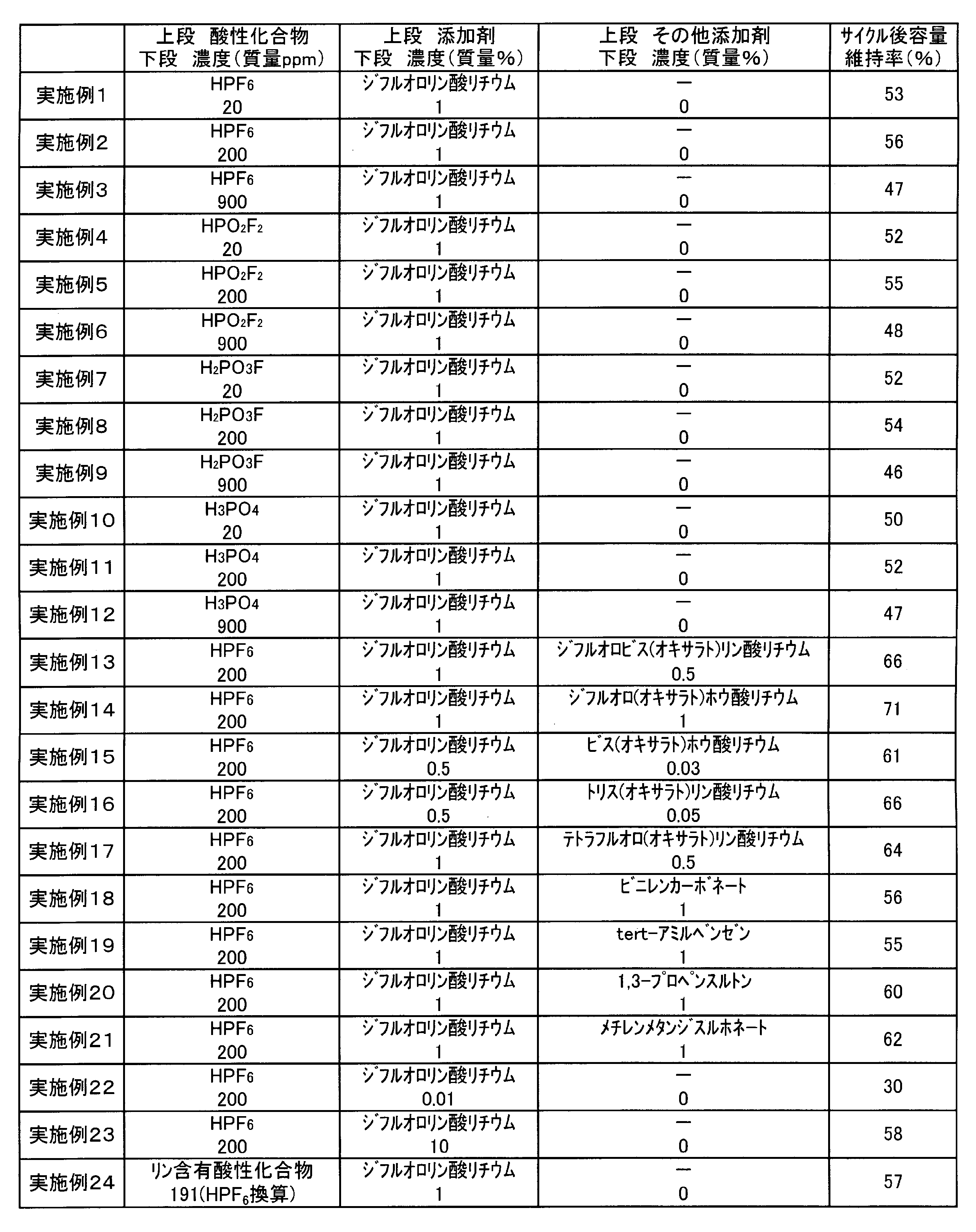
- Example 1 In a mixed solvent of ethylene carbonate and ethyl methyl carbonate in a volume ratio of 1: 2, LiPF 6 as a solute is 1.2 mol / L, lithium difluorophosphate is 1.0 mass%, and HPF 6 is contained as an acidic compound in an amount of 20 mass ppm.
- an electrolyte solution for a non-aqueous electrolyte battery was prepared.
- HPF 6 was used 60 wt% ethyl methyl carbonate solution. It was confirmed by 19 F-NMR that the concentration of hydrogen fluoride in this electrolytic solution was less than 10 ppm by mass.
- Example 2 to 24 Comparative Examples 1 to 4, and Comparative Examples 6 to 16 described later, it was confirmed that the HF concentration was less than 10 ppm by mass.
- a cell was prepared using LiCoO 2 as a positive electrode material and graphite as a negative electrode material, and a battery charge / discharge test was actually performed.
- the test cell was produced as follows. To 90 parts by weight of LiCoO 2 powder, 5 parts by weight of polyvinylidene fluoride (PVDF) as a binder and 5 parts by weight of acetylene black as a conductive material were mixed, and N-methylpyrrolidone was further added to form a paste. The paste was applied on an aluminum foil and dried to obtain a test positive electrode body.
- PVDF polyvinylidene fluoride
- the charge / discharge rate was 3C, and after charging reached 4.2V, 4.2V was maintained for 1 hour, and discharging was performed up to 3.0V, and the charge / discharge cycle was repeated. Then, the degree of deterioration of the cell was evaluated by the discharge capacity maintenance rate after 500 cycles.
- the capacity retention rate is expressed as a percentage of the discharge capacity after 500 cycles with respect to the initial discharge capacity.
- Example 2 A charge / discharge test was conducted in the same manner as in Example 1 except that the HPF 6 concentration was 200 ppm by mass.
- Example 3 A charge / discharge test was performed in the same manner as in Example 1 except that the HPF 6 concentration was 900 mass ppm.
- Example 4 A charge / discharge test was conducted in the same manner as in Example 1 except that the acidic compound was HPO 2 F 2 .
- Example 5 A charge / discharge test was performed in the same manner as in Example 1 except that the acidic compound was HPO 2 F 2 and the concentration was 200 ppm by mass.
- Example 6 A charge / discharge test was performed in the same manner as in Example 1 except that the acidic compound was HPO 2 F 2 and the concentration was 900 mass ppm.
- Example 7 A charge / discharge test was performed in the same manner as in Example 1 except that the acidic compound was changed to H 2 PO 3 F.
- Example 8 A charge / discharge test was carried out in the same manner as in Example 1 except that the acidic compound was H 2 PO 3 F and the concentration was 200 ppm by mass.
- Example 9 A charge / discharge test was performed in the same manner as in Example 1 except that the acidic compound was H 2 PO 3 F and the concentration was 900 mass ppm.
- Example 10 A charge / discharge test was conducted in the same manner as in Example 1 except that the acidic compound was changed to H 3 PO 4 .
- Example 11 A charge / discharge test was conducted in the same manner as in Example 1 except that the acidic compound was H 3 PO 4 and the concentration was 200 ppm by mass.
- Example 12 A charge / discharge test was conducted in the same manner as in Example 1 except that the acidic compound was H 3 PO 4 and the concentration was 900 mass ppm.
- Example 13 A charge / discharge test was conducted in the same manner as in Example 1 except that 0.5% by mass of lithium difluorobis (oxalato) phosphate was further added and the concentration of HPF 6 as an acidic compound was 200 ppm by mass.
- Example 14 A charge / discharge test was conducted in the same manner as in Example 1 except that 1% by mass of lithium difluoro (oxalato) borate was further added and the concentration of HPF 6 as an acidic compound was adjusted to 200 ppm by mass.
- Example 15 In Example 1, the lithium difluorophosphate concentration was 0.5% by mass, 0.03% by mass of lithium bis (oxalato) borate was added, and the concentration of HPF 6 as an acidic compound was 200 ppm by mass. A charge / discharge test was conducted in the same manner except that.
- Example 16 In Example 1, the lithium difluorophosphate concentration was 0.5% by mass, 0.05% by mass of tris (oxalato) lithium phosphate was added, and the concentration of HPF 6 as an acidic compound was 200 ppm by mass. A charge / discharge test was conducted in the same manner except that.
- Example 17 A charge / discharge test was conducted in the same manner as in Example 1 except that 0.5% by mass of lithium tetrafluoro (oxalato) phosphate was further added and the concentration of HPF 6 as an acidic compound was 200 ppm by mass.
- Example 18 A charge / discharge test was conducted in the same manner as in Example 1 except that 1% by mass of vinylene carbonate was further added and the concentration of HPF 6 as an acidic compound was 200 ppm by mass.
- Example 19 A charge / discharge test was conducted in the same manner as in Example 1 except that 1% by mass of tert-amylbenzene was further added and the concentration of HPF 6 as an acidic compound was adjusted to 200 ppm by mass.
- Example 20 A charge / discharge test was conducted in the same manner as in Example 1 except that 1% by mass of 1,3-propene sultone was further added and the concentration of HPF 6 as an acidic compound was adjusted to 200 ppm by mass.
- Example 21 A charge / discharge test was carried out in the same manner as in Example 1 except that 1% by mass of methylenemethane disulfonate was further added and the concentration of HPF 6 as an acidic compound was adjusted to 200 ppm by mass.
- Example 22 A charge / discharge test was conducted in the same manner as in Example 1 except that the concentration of lithium difluorophosphate was 0.01% by mass and the concentration of HPF 6 as an acidic compound was 200 ppm by mass.
- Example 23 A charge / discharge test was conducted in the same manner as in Example 1 except that the lithium difluorophosphate concentration was 10 mass% and the concentration of HPF 6 as an acidic compound was 200 mass ppm.
- Example 24 100 mass ppm of water was added to an ethyl methyl carbonate solution containing 30% by mass of LiPF 6 and left at room temperature for 1 day. Thereafter, at room temperature, the pressure was reduced to 0.06 to 0.08 MPa in absolute pressure for 5 hours to remove HF.
- LiPF 6 solution LiPF 6 is 1.2 mol / L and lithium difluorophosphate is 1.0% by mass as a solute in a mixed solvent of ethylene carbonate and ethyl methyl carbonate in a volume ratio of 1: 2.
- An electrolyte solution was prepared. When the total amount of free acid contained in the electrolytic solution was measured by neutralization titration, it was 213 mass ppm in terms of HPF 6 .
- the concentration of hydrogen fluoride measured by 19 F-NMR was 3 mass ppm. From this, the phosphorus-containing acidic compound produced by hydrolysis of LiPF 6 contained in this electrolytic solution was 191 mass ppm in terms of HPF 6 . A charge / discharge test was conducted in the same manner as in Example 1 except that this electrolytic solution was used.
- lithium difluorobis (oxalato) phosphate lithium difluoro (oxalato) borate, lithium bis (oxalato) borate, lithium tris (oxalato) phosphate, lithium tetrafluoro (oxalato) phosphate, vinylene carbonate, tert-amyl
- the capacity retention rate was improved as compared with Comparative Examples 6 to 14 containing no acidic compound.
Landscapes
- Chemical & Material Sciences (AREA)
- Engineering & Computer Science (AREA)
- Chemical Kinetics & Catalysis (AREA)
- Electrochemistry (AREA)
- General Chemical & Material Sciences (AREA)
- Manufacturing & Machinery (AREA)
- Inorganic Chemistry (AREA)
- Physics & Mathematics (AREA)
- Condensed Matter Physics & Semiconductors (AREA)
- General Physics & Mathematics (AREA)
- Materials Engineering (AREA)
- Secondary Cells (AREA)
Abstract
Description
本発明の非水電解液電池用電解液は、リン含有酸性化合物(以降、単に「酸性化合物と記載することがある」)と、ジフルオロリン酸塩と、溶質及びこれを溶解する非水有機溶媒を含有する。
本発明の非水電解液電池用電解液に用いるリン含有酸性化合物は、HPF6、HPO2F2、H2PO3F、H3PO4から選ばれる少なくとも1つの化合物が好ましく、酸性化合物の含有量は、非水電解液電池用電解液に対して10質量ppm以上、好ましくは30質量ppm以上、さらに好ましくは50質量ppm以上であり、また、1000質量ppm以下、好ましくは800質量ppm以下、さらに好ましくは500質量ppm以下の範囲である。10質量ppmを下回ると高温環境下におけるサイクル特性向上の効果が十分に得られない場合があり、1000質量ppmを越えると、正極活物質等の電池材料を劣化させ、サイクル特性に悪影響がでる場合がある。また、フッ化水素は正極活物質等の電池材料を著しく劣化させるため好ましくなく、本発明の非水電解液中には実質的にフッ化水素が含有されない。実質的に含有されないとは、非水電解液中のフッ化水素の濃度が、10質量ppm未満であることを意味し、好ましくは8質量ppm未満であり、より好ましくは5質量ppm未満である。
非水電解液電池用電解液に酸性化合物を含有させるには、酸性化合物を非水電解液電池用電解液に直接加えても良い。また、HPF6、HPO2F2、H2PO3F、H3PO4から選ばれる少なくとも1つの化合物を含有させる場合には、直接加えても良いが、LiPF6を含む非水有機溶媒に、微量の水分(例えば、1~1000質量ppmの水分)を加えることにより、LiPF6を加水分解させてリン含有酸性化合物を生成させた非水有機溶媒を、非水電解液電池用電解液に加えても良い。この場合、フッ化水素も生成するため、非水電解液電池用電解液に加える前に、LiPF6を加水分解させてリン含有酸性化合物を生成させた非水有機溶媒からフッ化水素を脱気等により除去する必要がある。
中和滴定により、非水電解液電池用電解液中の全遊離酸量を測定することができる。19F-NMRで非水電解液電池用電解液中のHFを定量し、全遊離酸量から引き算することで、HF以外の酸性化合物含有量を定量することができる。
また、HPO2F2、H2PO3Fは19F-NMRでそれぞれ定量することができる。本件特許の出願前に刊行された種々の文献に記載されるHF、HPO2F2、H2PO3Fの19F-NMRの値(ppm)が、以下のとおり示されており、各物質のNMRピークの面積から、各物質の含有量を定量することができる。
HF:-201.0
HPO2F2:-86.2、-86.0、-85.6
H2PO3F:-74.3、-74.0
また、HPO2F2、H2PO3F、H3PO4についてはイオンクロマトグラフィーを用いて、非水電解液電池用電解液中に含まれるそれぞれのアニオンの含有量を測定することで定量することができる。
ジフルオロリン酸塩としては、ジフルオロリン酸のリチウム塩、ナトリウム塩、カリウム塩、四級アルキルアンモニウム塩が挙げられる。四級アルキルアンモニウムイオンとしては、特に限定はされないが、例えばトリメチルプロピルアンモニウムイオンや、1-ブチル-1-メチルピロリジニウムイオンが挙げられる。中でも、リチウム非水電解質電池に用いる際には、ジフルオロリン酸リチウムを用いることが好ましい。
電解液にジフルオロリン酸塩を含有すると、初充放電時に電極表面でジフルオロリン酸塩と電解液溶媒が電極と反応し、ジフルオロリン酸塩と溶媒の分解物が電極に皮膜を形成するため、膜形成後の電解液溶媒の反応が抑制され、サイクル特性が向上することが知られている。
ここで、特定量の酸性化合物を共存させると、ジフルオロリン酸塩と電極の反応を促進することにより、ジフルオロリン酸塩を単独で含有したときよりも、高温環境下で劣化しにくい良質な皮膜が電極に形成されていると考えられる。ここで、酸性化合物としてHFを共存させると、正極活物質等の電池材料を著しく劣化させるため好ましくない。
本発明の非水電解液電池用電解液に用いる溶質は、少なくともヘキサフルオロリン酸リチウム(LiPF6)が用いられるが、必要に応じて他のリチウム塩を本発明の効果を損なわない範囲で、任意の量で含有させることができる。他のリチウム塩の具体例としては、LiBF4、LiClO4、LiAsF6、LiSbF6、LiCF3SO3、LiN(SO2CF3)2、LiN(SO2C2F5)2、LiN(SO2CF3)(SO2C4F9)、LiC(SO2CF3)3、LiPF3(C3F7)3、LiB(CF3)4、LiBF3(C2F5)等が挙げられる。これらの溶質は、LiPF6に加えて、一種類を単独で用いても良く、二種類以上を用途に合わせて任意の組合せ、比率で混合して用いても良い。
非水有機溶媒としては、本発明のイオン性錯体を溶解できる非プロトン性の溶媒であれば特に限定されるものではなく、例えば、カーボネート類、エステル類、エーテル類、ラクトン類、ニトリル類、イミド類、スルホン類等が使用できる。また、単一の溶媒だけでなく、二種類以上の混合溶媒でもよい。具体例としては、エチルメチルカーボネート、ジメチルカーボネート、ジエチルカーボネート、メチルプロピルカーボネート、エチルプロピルカーボネート、メチルブチルカーボネート、エチレンカーボネート、プロピレンカーボネート、ブチレンカーボネート、酢酸メチル、酢酸エチル、プロピオン酸メチル、プロピオン酸エチル、ジエチルエーテル、アセトニトリル、プロピオニトリル、テトラヒドロフラン、2-メチルテトラヒドロフラン、フラン、テトラヒドロピラン、1,3-ジオキサン、1,4-ジオキサン、ジブチルエーテル、ジイソプロピルエーテル、1,2-ジメトキシエタン、N,N-ジメチルホルムアミド、ジメチルスルホキシド、スルホラン、γ-ブチロラクトン、及びγ-バレロラクトン等を挙げることができる。
本発明の非水電解液電池用電解液は、特定量の酸性化合物と、ジフルオロリン酸塩、及び溶質を含有するが、本発明の要旨を損なわない限りにおいて、本発明の非水電解液電池用電解液に一般に用いられるその他の添加剤を任意の比率で添加しても良い。具体例としては、初回の充電時に還元されて負極の表面上に皮膜を形成することのできる負極皮膜形成添加剤、初回の充電時に正極上に皮膜を形成して保護する正極保護添加剤、過充電時に還元されて反応をストップする過充電防止添加剤などが挙げられる。
次に本発明のリチウム非水電解液電池の構成について説明する。本発明のリチウム非水電解液電池は、上記の本発明の非水電解液電池用電解液を用いることが特徴であり、その他の構成部材には一般のリチウム非水電解液電池に使用されているものが用いられる。即ち、リチウムの吸蔵及び放出が可能な正極及び負極、集電体、セパレーター、容器等から成る。
エチレンカーボネートとエチルメチルカーボネートの体積比1:2の混合溶媒中に溶質としてLiPF6が1.2mol/L、ジフルオロリン酸リチウムが1.0質量%、酸性化合物としてHPF6が20質量ppm含有されるように非水電解液電池用電解液を調製した。ここで、HPF6は60質量%のエチルメチルカーボネート溶液を用いた。19F-NMRで、この電解液中のフッ化水素の濃度が10質量ppm未満であることを確認した。なお、後述の実施例2~24、比較例1~4、比較例6~16においても同様にHF濃度が10質量ppm未満であることを確認した。
この電解液を用いてLiCoO2を正極材料、黒鉛を負極材料としてセルを作製し、実際に電池の充放電試験を実施した。試験用セルは以下のように作製した。
LiCoO2粉末90重量部に、バインダーとして5重量部のポリフッ化ビニリデン(PVDF)、導電材としてアセチレンブラックを5重量部混合し、さらにN-メチルピロリドンを添加し、ペースト状にした。このペーストをアルミニウム箔上に塗布して、乾燥させることにより、試験用正極体とした。また、黒鉛粉末90重量部に、バインダーとして10重量部のポリフッ化ビニリデン(PVDF)を混合し、さらにN-メチルピロリドンを添加し、スラリー状にした。このスラリーを銅箔上に塗布して、150℃で12時間乾燥させることにより、試験用負極体とした。そして、セルロース系セパレーターに電解液を浸み込ませて、CR2032型のコインセルに組み込んで、試験用1.6mAhセルを組み立てた。
以上のような方法で作製したセルを用いて80℃の環境温度で充放電試験を実施した。充放電レートは3Cで行い、充電は、4.2Vに達した後、1時間4.2Vを維持、放電は、3.0Vまで行い、充放電サイクルを繰り返した。そして、500サイクル後の放電容量維持率でセルの劣化の具合を評価した。容量維持率は初期の放電容量に対する500サイクル後の放電容量の百分率で表される。
前記実施例1においてHPF6濃度を200質量ppmにしたこと以外は同様にして充放電試験を実施した。
前記実施例1においてHPF6濃度を900質量ppmにしたこと以外は同様にして充放電試験を実施した。
前記実施例1において酸性化合物をHPO2F2にしたこと以外は同様にして充放電試験を実施した。
前記実施例1において酸性化合物をHPO2F2にしたこと、濃度を200質量ppmにしたこと以外は同様にして充放電試験を実施した。
前記実施例1において酸性化合物をHPO2F2にしたこと、濃度を900質量ppmにしたこと以外は同様にして充放電試験を実施した。
前記実施例1において酸性化合物をH2PO3Fにしたこと以外は同様にして充放電試験を実施した。
前記実施例1において酸性化合物をH2PO3Fにしたこと、濃度を200質量ppmにしたこと以外は同様にして充放電試験を実施した。
前記実施例1において酸性化合物をH2PO3Fにしたこと、濃度を900質量ppmにしたこと以外は同様にして充放電試験を実施した。
前記実施例1において酸性化合物をH3PO4にしたこと以外は同様にして充放電試験を実施した。
前記実施例1において酸性化合物をH3PO4にしたこと、濃度を200質量ppmにしたこと以外は同様にして充放電試験を実施した。
前記実施例1において酸性化合物をH3PO4にしたこと、濃度を900質量ppmにしたこと以外は同様にして充放電試験を実施した。
前記実施例1においてさらにジフルオロビス(オキサラト)リン酸リチウムを0.5質量%添加し、酸性化合物であるHPF6の濃度を200質量ppmにしたこと以外は同様にして充放電試験を実施した。
前記実施例1においてさらにジフルオロ(オキサラト)ホウ酸リチウムを1質量%添加し、酸性化合物であるHPF6の濃度を200質量ppmにしたこと以外は同様にして充放電試験を実施した。
前記実施例1においてジフルオロリン酸リチウム濃度を0.5質量%とし、さらにビス(オキサラト)ホウ酸リチウムを0.03質量%添加したこと、酸性化合物であるHPF6の濃度を200質量ppmにしたこと以外は同様にして充放電試験を実施した。
前記実施例1においてジフルオロリン酸リチウム濃度を0.5質量%とし、さらにトリス(オキサラト)リン酸リチウムを0.05質量%添加したこと、酸性化合物であるHPF6の濃度を200質量ppmにしたこと以外は同様にして充放電試験を実施した。
前記実施例1においてさらにテトラフルオロ(オキサラト)リン酸リチウムを0.5質量%添加し、酸性化合物であるHPF6の濃度を200質量ppmにしたこと以外は同様にして充放電試験を実施した。
前記実施例1においてさらにビニレンカーボネートを1質量%添加し、酸性化合物であるHPF6の濃度を200質量ppmにしたこと以外は同様にして充放電試験を実施した。
前記実施例1においてさらにtert-アミルベンゼンを1質量%添加し、酸性化合物であるHPF6の濃度を200質量ppmにしたこと以外は同様にして充放電試験を実施した。
前記実施例1においてさらに1,3-プロペンスルトンを1質量%添加し、酸性化合物であるHPF6の濃度を200質量ppmにしたこと以外は同様にして充放電試験を実施した。
前記実施例1においてさらにメチレンメタンジスルホネートを1質量%添加し、酸性化合物であるHPF6の濃度を200質量ppmにしたこと以外は同様にして充放電試験を実施した。
前記実施例1においてジフルオロリン酸リチウム濃度を0.01質量%とし、酸性化合物であるHPF6の濃度を200質量ppmにしたこと以外は同様にして充放電試験を実施した。
前記実施例1においてジフルオロリン酸リチウム濃度を10質量%とし、酸性化合物であるHPF6の濃度を200質量ppmにしたこと以外は同様にして充放電試験を実施した。
30質量%のLiPF6を含むエチルメチルカーボネート溶液に水分を100質量ppm添加して、室温で1日放置した。その後、室温で、圧力を絶対圧で0.06~0.08MPaに減圧した状態で5時間維持し、HFを除去した。このLiPF6溶液を用いて、エチレンカーボネートとエチルメチルカーボネートの体積比1:2の混合溶媒中に溶質としてLiPF6が1.2mol/L、ジフルオロリン酸リチウムが1.0質量%となるように電解液を調製した。この電解液に含まれる全遊離酸量を中和滴定により測定したところ、HPF6に換算して213質量ppmであった。また、19F-NMRでフッ化水素の濃度を測定したところ3質量ppmであった。このことから、この電解液に含まれる、LiPF6の加水分解により生じたリン含有酸性化合物はHPF6に換算して191質量ppmであった。この電解液を用いた以外は前記実施例1と同様にして充放電試験を実施した。
前記実施例1においてジフルオロリン酸リチウムを電解液に加えなかったこと、酸性化合物であるHPF6を電解液に加えなかったこと以外は同様にして充放電試験を実施した。
前記実施例1においてジフルオロリン酸リチウムを電解液に加えなかったこと、酸性化合物であるHPF6の濃度を200質量ppmにしたこと以外は同様にして充放電試験を実施した。
前記実施例1において酸性化合物であるHPF6を電解液に加えなかったこと以外は同様にして充放電試験を実施した。
前記実施例1において酸性化合物であるHPF6の濃度を1200質量ppmにしたこと以外は同様にして充放電試験を実施した。
前記実施例1において、HPF6の代わりにHFを濃度100質量ppmとなるように添加したこと以外は同様にして充放電試験を実施した。
前記実施例13において酸性化合物であるHPF6を電解液に加えなかったこと以外は同様にして充放電試験を実施した。
前記実施例14において酸性化合物であるHPF6を電解液に加えなかったこと以外は同様にして充放電試験を実施した。
前記実施例15において酸性化合物であるHPF6を電解液に加えなかったこと以外は同様にして充放電試験を実施した。
前記実施例16において酸性化合物であるHPF6を電解液に加えなかったこと以外は同様にして充放電試験を実施した。
前記実施例17において酸性化合物であるHPF6を電解液に加えなかったこと以外は同様にして充放電試験を実施した。
前記実施例18において酸性化合物であるHPF6を電解液に加えなかったこと以外は同様にして充放電試験を実施した。
前記実施例19において酸性化合物であるHPF6を電解液に加えなかったこと以外は同様にして充放電試験を実施した。
前記実施例20において酸性化合物であるHPF6を電解液に加えなかったこと以外は同様にして充放電試験を実施した。
前記実施例21において酸性化合物であるHPF6を電解液に加えなかったこと以外は同様にして充放電試験を実施した。
前記実施例22において酸性化合物であるHPF6を電解液に加えなかったこと以外は同様にして充放電試験を実施した。
前記実施例23において酸性化合物であるHPF6を電解液に加えなかったこと以外は同様にして充放電試験を実施した。

Claims (5)
- 非水有機溶媒と、溶質として少なくともヘキサフルオロリン酸リチウムを含有する非水電解液電池用電解液において、
リン含有酸性化合物を、非水電解液電池用電解液中に10~1000質量ppm含有し、さらにジフルオロリン酸塩を0.01~10.0質量%含有することを特徴とする非水電解液電池用電解液。 - 前記リン含有酸性化合物が、HPF6、HPO2F2、H2PO3F、H3PO4からなる群より選ばれる少なくとも1つの化合物であることを特徴とする請求項1に記載の非水電解液電池用電解液。
- 前記非水電解液電池用電解液中のフッ化水素の含有量が10質量ppm未満であることを特徴とする請求項1または2に記載の非水電解液電池用電解液。
- さらに、前記非水電解液電池用電解液中に、
負極皮膜形成添加剤として、ジフルオロビス(オキサラト)リン酸リチウム、ジフルオロ(オキサラト)ホウ酸リチウム、トリス(オキサラト)リン酸リチウム、テトラフルオロ(オキサラト)リン酸リチウム、ジフルオロビス(オキサラト)リン酸ナトリウム、ジフルオロビス(オキサラト)リン酸カリウム、ビニレンカーボネート、ビニルエチレンカーボネート、エチニルエチレンカーボネート、フルオロエチレンカーボネート、ジメチルビニレンカーボネートから選ばれる少なくとも一つの化合物、
正極保護添加剤として、プロパンスルトン、1,3-プロペンスルトン、メチレンメタンジスルホネート、ジメチレンメタンジスルホネート、トリメチレンメタンジスルホネートから選ばれる少なくとも一つの化合物、
過充電防止添加剤として、シクロヘキシルベンゼン、tert-ブチルベンゼン、tert-アミルベンゼン、ビフェニル、o-ターフェニル、4-フルオロビフェニル、フルオロベンゼン、2,4-ジフルオロベンゼン、ジフルオロアニソールから選ばれる少なくとも一つの化合物、
からなる群より選ばれる少なくとも一つの化合物を含有することを特徴とする請求項1~3のいずれか1項に記載の非水電解液電池用電解液。 - 少なくとも正極と、負極と、請求項1~4のいずれか1項に記載の非水電解液電池用電解液と、を備えることを特徴とするリチウム非水電解液電池。
Priority Applications (4)
| Application Number | Priority Date | Filing Date | Title |
|---|---|---|---|
| KR1020177013591A KR101947059B1 (ko) | 2014-11-19 | 2015-09-17 | 비수전해액 전지용 전해액 및 리튬 비수전해액 전지 |
| US15/525,309 US10270132B2 (en) | 2014-11-19 | 2015-09-17 | Electrolyte for non-aqueous electrolyte battery and non-aqueous electrolyte lithium battery |
| EP15860161.7A EP3223355B1 (en) | 2014-11-19 | 2015-09-17 | Electrolyte for non-aqueous electrolyte battery and non-aqueous electrolyte lithium battery |
| CN201580063023.XA CN107004903B (zh) | 2014-11-19 | 2015-09-17 | 非水电解液电池用电解液和锂非水电解液电池 |
Applications Claiming Priority (2)
| Application Number | Priority Date | Filing Date | Title |
|---|---|---|---|
| JP2014-234152 | 2014-11-19 | ||
| JP2014234152A JP6520064B2 (ja) | 2014-11-19 | 2014-11-19 | 非水電解液電池用電解液及びリチウム非水電解液電池 |
Publications (1)
| Publication Number | Publication Date |
|---|---|
| WO2016080063A1 true WO2016080063A1 (ja) | 2016-05-26 |
Family
ID=56013623
Family Applications (1)
| Application Number | Title | Priority Date | Filing Date |
|---|---|---|---|
| PCT/JP2015/076383 Ceased WO2016080063A1 (ja) | 2014-11-19 | 2015-09-17 | 非水電解液電池用電解液及びリチウム非水電解液電池 |
Country Status (7)
| Country | Link |
|---|---|
| US (1) | US10270132B2 (ja) |
| EP (1) | EP3223355B1 (ja) |
| JP (1) | JP6520064B2 (ja) |
| KR (1) | KR101947059B1 (ja) |
| CN (1) | CN107004903B (ja) |
| TW (1) | TWI581481B (ja) |
| WO (1) | WO2016080063A1 (ja) |
Families Citing this family (17)
| Publication number | Priority date | Publication date | Assignee | Title |
|---|---|---|---|---|
| JP6520064B2 (ja) | 2014-11-19 | 2019-05-29 | セントラル硝子株式会社 | 非水電解液電池用電解液及びリチウム非水電解液電池 |
| JP6731155B2 (ja) * | 2017-01-20 | 2020-07-29 | トヨタ自動車株式会社 | 非水電解質二次電池 |
| JP6871008B2 (ja) * | 2017-02-13 | 2021-05-12 | 積水化学工業株式会社 | リチウムイオン二次電池用電解質及びそれを用いたリチウムイオン二次電池用電解液並びにリチウムイオン二次電池 |
| JP2018156761A (ja) * | 2017-03-16 | 2018-10-04 | 三井化学株式会社 | 電池用非水電解液及びリチウム二次電池 |
| KR102264735B1 (ko) | 2017-09-21 | 2021-06-15 | 주식회사 엘지에너지솔루션 | 리튬 이차전지용 비수전해액 및 이를 포함하는 리튬 이차전지 |
| WO2019093853A1 (ko) * | 2017-11-13 | 2019-05-16 | 주식회사 엘지화학 | 리튬 이차전지용 비수전해액 및 이를 포함하는 리튬 이차전지 |
| KR102242252B1 (ko) | 2017-11-13 | 2021-04-21 | 주식회사 엘지화학 | 리튬 이차전지용 비수전해액 및 이를 포함하는 리튬 이차전지 |
| EP3713004B1 (en) * | 2018-07-02 | 2023-12-13 | LG Energy Solution, Ltd. | Lithium secondary battery with improved high temperature characteristics |
| CN109449486A (zh) * | 2018-10-15 | 2019-03-08 | 苏州大学 | 一种电解液添加剂的应用 |
| US12009481B2 (en) * | 2020-01-28 | 2024-06-11 | StoreDot Ltd. | Electrolytes for fast charging lithium ion batteries having four-carbon chain esters as linear components |
| JP2021166244A (ja) * | 2020-04-07 | 2021-10-14 | 太陽誘電株式会社 | 電気化学デバイス用電解液および電気化学デバイス |
| CN114075246A (zh) * | 2020-08-18 | 2022-02-22 | 恒大新能源技术(深圳)有限公司 | 双草酸磷酸盐的制备方法、双草酸磷酸盐衍生物及其制备方法、电解质盐 |
| CN112687956A (zh) * | 2020-12-28 | 2021-04-20 | 远景动力技术(江苏)有限公司 | 锂电池的非水电解液及基于其的锂离子电池 |
| CN112713308A (zh) * | 2020-12-28 | 2021-04-27 | 远景动力技术(江苏)有限公司 | 一种非水电解液及基于其的锂离子电池 |
| CN114450834B (zh) * | 2021-05-31 | 2024-12-31 | 宁德新能源科技有限公司 | 一种电化学装置和电子装置 |
| EP4546492A4 (en) * | 2022-12-28 | 2025-12-03 | Lg Energy Solution Ltd | SECONDARY LITHIUM BATTERY INCLUDING AN ELECTROLYTE |
| CN119315107A (zh) * | 2023-07-11 | 2025-01-14 | 宁德时代新能源科技股份有限公司 | 电解液、电池和用电设备 |
Citations (7)
| Publication number | Priority date | Publication date | Assignee | Title |
|---|---|---|---|---|
| JPH1092468A (ja) * | 1996-09-19 | 1998-04-10 | Central Glass Co Ltd | リチウム電池用電解液及びその精製方法並びにそれを用いたリチウム電池 |
| JP2008222484A (ja) * | 2007-03-12 | 2008-09-25 | Central Glass Co Ltd | ジフルオロリン酸リチウムの製造方法及びこれを用いた非水電解液電池 |
| JP2011082182A (ja) * | 2003-04-18 | 2011-04-21 | Mitsubishi Chemicals Corp | ジフルオロリン酸塩の製造方法、二次電池用非水系電解液及び非水系電解液二次電池 |
| WO2011099585A1 (ja) * | 2010-02-12 | 2011-08-18 | 三菱化学株式会社 | 非水系電解液及び非水系電解液二次電池 |
| JP2011181358A (ja) * | 2010-03-02 | 2011-09-15 | Sony Corp | 非水電解液および電池 |
| JP2013534205A (ja) * | 2010-08-04 | 2013-09-02 | ソルヴェイ(ソシエテ アノニム) | POF3またはPF5からのLiPO2F2の製造 |
| JP2014062036A (ja) * | 2012-08-28 | 2014-04-10 | Kanto Denka Kogyo Co Ltd | ジフルオロリン酸リチウムの製造方法 |
Family Cites Families (15)
| Publication number | Priority date | Publication date | Assignee | Title |
|---|---|---|---|---|
| CA2193119C (en) * | 1995-12-14 | 2001-01-30 | Shouichi Tsujioka | Electrolytic solution for lithium cell and method for producing same |
| JP2987397B2 (ja) * | 1995-12-14 | 1999-12-06 | セントラル硝子株式会社 | ヘキサフルオロリン酸リチウムの製造方法 |
| JP3439085B2 (ja) | 1997-08-21 | 2003-08-25 | 三洋電機株式会社 | 非水系電解液二次電池 |
| US6200701B1 (en) | 1999-01-25 | 2001-03-13 | Wilson Greatbatch Ltd. | Phosphonate additives for nonaqueous electrolyte in rechargeable cells |
| US6495285B2 (en) * | 1999-01-25 | 2002-12-17 | Wilson Greatbatch Ltd. | Phosphonate additives for nonaqueous electrolyte in rechargeable electrochemical cells |
| CA2298792C (en) | 1999-06-02 | 2004-04-27 | Wilson Greatbatch Ltd. | Phosphonate additives for nonaqueous electrolyte in rechargeable cells |
| JP4233819B2 (ja) | 2002-06-25 | 2009-03-04 | 三菱化学株式会社 | 非水電解液二次電池 |
| JP4952186B2 (ja) * | 2005-10-20 | 2012-06-13 | 三菱化学株式会社 | 二次電池用非水系電解液及びそれを用いた二次電池 |
| JP4972922B2 (ja) * | 2005-12-14 | 2012-07-11 | セントラル硝子株式会社 | 非水電解液電池用電解液及び非水電解液電池 |
| JP5239119B2 (ja) * | 2005-12-26 | 2013-07-17 | セントラル硝子株式会社 | 非水電解液電池用電解液及び非水電解液電池 |
| JP5471967B2 (ja) * | 2009-08-21 | 2014-04-16 | 三菱化学株式会社 | ジフルオロリン酸塩組成物及びそれからなる非水系電解液用添加剤、並びにそれを用いた二次電池用非水系電解液及び非水系電解液二次電池 |
| JP6113521B2 (ja) * | 2012-02-27 | 2017-04-12 | 株式会社東芝 | 非水電解質電池および電池パック |
| KR102030347B1 (ko) * | 2012-06-19 | 2019-11-18 | 에스케이이노베이션 주식회사 | 첨가제를 포함하는 리튬 이차 전지용 전해질 및 이를 포함하는 리튬 이차 전지 |
| EP2797156B1 (en) * | 2013-02-20 | 2017-06-21 | LG Chem, Ltd. | Electrolyte additive for lithium secondary battery, non-aqueous electrolyte containing said electrolyte additive, and lithium secondary battery |
| JP6520064B2 (ja) | 2014-11-19 | 2019-05-29 | セントラル硝子株式会社 | 非水電解液電池用電解液及びリチウム非水電解液電池 |
-
2014
- 2014-11-19 JP JP2014234152A patent/JP6520064B2/ja active Active
-
2015
- 2015-09-17 US US15/525,309 patent/US10270132B2/en active Active
- 2015-09-17 KR KR1020177013591A patent/KR101947059B1/ko active Active
- 2015-09-17 EP EP15860161.7A patent/EP3223355B1/en active Active
- 2015-09-17 CN CN201580063023.XA patent/CN107004903B/zh active Active
- 2015-09-17 WO PCT/JP2015/076383 patent/WO2016080063A1/ja not_active Ceased
- 2015-11-04 TW TW104136371A patent/TWI581481B/zh not_active IP Right Cessation
Patent Citations (8)
| Publication number | Priority date | Publication date | Assignee | Title |
|---|---|---|---|---|
| JPH1092468A (ja) * | 1996-09-19 | 1998-04-10 | Central Glass Co Ltd | リチウム電池用電解液及びその精製方法並びにそれを用いたリチウム電池 |
| JP2011082182A (ja) * | 2003-04-18 | 2011-04-21 | Mitsubishi Chemicals Corp | ジフルオロリン酸塩の製造方法、二次電池用非水系電解液及び非水系電解液二次電池 |
| JP2011086630A (ja) * | 2003-04-18 | 2011-04-28 | Mitsubishi Chemicals Corp | ジフルオロリン酸塩の製造方法、二次電池用非水系電解液及び非水系電解液二次電池 |
| JP2008222484A (ja) * | 2007-03-12 | 2008-09-25 | Central Glass Co Ltd | ジフルオロリン酸リチウムの製造方法及びこれを用いた非水電解液電池 |
| WO2011099585A1 (ja) * | 2010-02-12 | 2011-08-18 | 三菱化学株式会社 | 非水系電解液及び非水系電解液二次電池 |
| JP2011181358A (ja) * | 2010-03-02 | 2011-09-15 | Sony Corp | 非水電解液および電池 |
| JP2013534205A (ja) * | 2010-08-04 | 2013-09-02 | ソルヴェイ(ソシエテ アノニム) | POF3またはPF5からのLiPO2F2の製造 |
| JP2014062036A (ja) * | 2012-08-28 | 2014-04-10 | Kanto Denka Kogyo Co Ltd | ジフルオロリン酸リチウムの製造方法 |
Also Published As
| Publication number | Publication date |
|---|---|
| EP3223355B1 (en) | 2019-05-01 |
| US10270132B2 (en) | 2019-04-23 |
| US20170317384A1 (en) | 2017-11-02 |
| JP2016100100A (ja) | 2016-05-30 |
| TW201622225A (zh) | 2016-06-16 |
| CN107004903A (zh) | 2017-08-01 |
| KR101947059B1 (ko) | 2019-02-12 |
| TWI581481B (zh) | 2017-05-01 |
| EP3223355A1 (en) | 2017-09-27 |
| JP6520064B2 (ja) | 2019-05-29 |
| CN107004903B (zh) | 2020-11-06 |
| EP3223355A4 (en) | 2018-05-30 |
| KR20170068595A (ko) | 2017-06-19 |
Similar Documents
| Publication | Publication Date | Title |
|---|---|---|
| JP6520064B2 (ja) | 非水電解液電池用電解液及びリチウム非水電解液電池 | |
| KR102469213B1 (ko) | 비수 전해액 전지용 전해액 및 그것을 이용한 비수 전해액 전지 | |
| KR101445283B1 (ko) | 비수전해액 전지용 전해액 및 이것을 사용하는 비수전해액 전지 | |
| CN103797634B (zh) | 非水电解液电池用电解液及非水电解液电池 | |
| JP6665396B2 (ja) | 非水電解液電池用電解液、及びこれを用いた非水電解液電池 | |
| KR102498456B1 (ko) | 비수전해액 전지용 전해액 및 그것을 사용한 비수전해액 전지 | |
| JP2019057356A (ja) | 非水電解液電池用電解液、及びこれを用いた非水電解液電池 | |
| CN113644316A (zh) | 非水电解液电池用电解液及使用其的非水电解液电池 | |
| JP6476611B2 (ja) | 非水電解液電池用電解液、及びこれを用いた非水電解液電池 | |
| JP2007165125A (ja) | 非水電解液電池用電解液及び非水電解液電池 | |
| JP2015005329A (ja) | 非水電解液電池用電解液、及びこれを用いた非水電解液電池 | |
| WO2021015264A1 (ja) | 非水電解液、非水電解液電池、及び化合物 | |
| JP2016131059A (ja) | 非水電解液電池用電解液、及びこれを用いた非水電解液電池 | |
| KR102927720B1 (ko) | 비수전해액 | |
| CN117954689A (zh) | 非水电解液电池用电解液和使用其的非水电解液电池 |
Legal Events
| Date | Code | Title | Description |
|---|---|---|---|
| 121 | Ep: the epo has been informed by wipo that ep was designated in this application |
Ref document number: 15860161 Country of ref document: EP Kind code of ref document: A1 |
|
| WWE | Wipo information: entry into national phase |
Ref document number: 15525309 Country of ref document: US |
|
| ENP | Entry into the national phase |
Ref document number: 20177013591 Country of ref document: KR Kind code of ref document: A |
|
| NENP | Non-entry into the national phase |
Ref country code: DE |
|
| REEP | Request for entry into the european phase |
Ref document number: 2015860161 Country of ref document: EP |