WO2016086710A1 - 一种羧酸的制备方法 - Google Patents
一种羧酸的制备方法 Download PDFInfo
- Publication number
- WO2016086710A1 WO2016086710A1 PCT/CN2015/090740 CN2015090740W WO2016086710A1 WO 2016086710 A1 WO2016086710 A1 WO 2016086710A1 CN 2015090740 W CN2015090740 W CN 2015090740W WO 2016086710 A1 WO2016086710 A1 WO 2016086710A1
- Authority
- WO
- WIPO (PCT)
- Prior art keywords
- group
- nitro
- base
- compound
- alkoxycarbonyl
- Prior art date
- Legal status (The legal status is an assumption and is not a legal conclusion. Google has not performed a legal analysis and makes no representation as to the accuracy of the status listed.)
- Ceased
Links
Classifications
-
- C—CHEMISTRY; METALLURGY
- C07—ORGANIC CHEMISTRY
- C07C—ACYCLIC OR CARBOCYCLIC COMPOUNDS
- C07C51/00—Preparation of carboxylic acids or their salts, halides or anhydrides
- C07C51/16—Preparation of carboxylic acids or their salts, halides or anhydrides by oxidation
- C07C51/285—Preparation of carboxylic acids or their salts, halides or anhydrides by oxidation with peroxy-compounds
-
- C—CHEMISTRY; METALLURGY
- C07—ORGANIC CHEMISTRY
- C07B—GENERAL METHODS OF ORGANIC CHEMISTRY; APPARATUS THEREFOR
- C07B41/00—Formation or introduction of functional groups containing oxygen
- C07B41/08—Formation or introduction of functional groups containing oxygen of carboxyl groups or salts, halides or anhydrides thereof
-
- C—CHEMISTRY; METALLURGY
- C07—ORGANIC CHEMISTRY
- C07C—ACYCLIC OR CARBOCYCLIC COMPOUNDS
- C07C201/00—Preparation of esters of nitric or nitrous acid or of compounds containing nitro or nitroso groups bound to a carbon skeleton
- C07C201/06—Preparation of nitro compounds
- C07C201/12—Preparation of nitro compounds by reactions not involving the formation of nitro groups
-
- C—CHEMISTRY; METALLURGY
- C07—ORGANIC CHEMISTRY
- C07C—ACYCLIC OR CARBOCYCLIC COMPOUNDS
- C07C205/00—Compounds containing nitro groups bound to a carbon skeleton
- C07C205/49—Compounds containing nitro groups bound to a carbon skeleton the carbon skeleton being further substituted by carboxyl groups
- C07C205/57—Compounds containing nitro groups bound to a carbon skeleton the carbon skeleton being further substituted by carboxyl groups having nitro groups and carboxyl groups bound to carbon atoms of six-membered aromatic rings of the carbon skeleton
- C07C205/58—Compounds containing nitro groups bound to a carbon skeleton the carbon skeleton being further substituted by carboxyl groups having nitro groups and carboxyl groups bound to carbon atoms of six-membered aromatic rings of the carbon skeleton the carbon skeleton being further substituted by halogen atoms
-
- C—CHEMISTRY; METALLURGY
- C07—ORGANIC CHEMISTRY
- C07C—ACYCLIC OR CARBOCYCLIC COMPOUNDS
- C07C253/00—Preparation of carboxylic acid nitriles
- C07C253/30—Preparation of carboxylic acid nitriles by reactions not involving the formation of cyano groups
-
- C—CHEMISTRY; METALLURGY
- C07—ORGANIC CHEMISTRY
- C07C—ACYCLIC OR CARBOCYCLIC COMPOUNDS
- C07C315/00—Preparation of sulfones; Preparation of sulfoxides
- C07C315/04—Preparation of sulfones; Preparation of sulfoxides by reactions not involving the formation of sulfone or sulfoxide groups
-
- C—CHEMISTRY; METALLURGY
- C07—ORGANIC CHEMISTRY
- C07C—ACYCLIC OR CARBOCYCLIC COMPOUNDS
- C07C317/00—Sulfones; Sulfoxides
- C07C317/44—Sulfones; Sulfoxides having sulfone or sulfoxide groups and carboxyl groups bound to the same carbon skeleton
-
- C—CHEMISTRY; METALLURGY
- C07—ORGANIC CHEMISTRY
- C07C—ACYCLIC OR CARBOCYCLIC COMPOUNDS
- C07C53/00—Saturated compounds having only one carboxyl group bound to an acyclic carbon atom or hydrogen
- C07C53/08—Acetic acid
-
- C—CHEMISTRY; METALLURGY
- C07—ORGANIC CHEMISTRY
- C07D—HETEROCYCLIC COMPOUNDS
- C07D213/00—Heterocyclic compounds containing six-membered rings, not condensed with other rings, with one nitrogen atom as the only ring hetero atom and three or more double bonds between ring members or between ring members and non-ring members
- C07D213/02—Heterocyclic compounds containing six-membered rings, not condensed with other rings, with one nitrogen atom as the only ring hetero atom and three or more double bonds between ring members or between ring members and non-ring members having three double bonds between ring members or between ring members and non-ring members
- C07D213/04—Heterocyclic compounds containing six-membered rings, not condensed with other rings, with one nitrogen atom as the only ring hetero atom and three or more double bonds between ring members or between ring members and non-ring members having three double bonds between ring members or between ring members and non-ring members having no bond between the ring nitrogen atom and a non-ring member or having only hydrogen or carbon atoms directly attached to the ring nitrogen atom
- C07D213/60—Heterocyclic compounds containing six-membered rings, not condensed with other rings, with one nitrogen atom as the only ring hetero atom and three or more double bonds between ring members or between ring members and non-ring members having three double bonds between ring members or between ring members and non-ring members having no bond between the ring nitrogen atom and a non-ring member or having only hydrogen or carbon atoms directly attached to the ring nitrogen atom with hetero atoms or with carbon atoms having three bonds to hetero atoms with at the most one bond to halogen, e.g. ester or nitrile radicals, directly attached to ring carbon atoms
-
- C—CHEMISTRY; METALLURGY
- C07—ORGANIC CHEMISTRY
- C07D—HETEROCYCLIC COMPOUNDS
- C07D213/00—Heterocyclic compounds containing six-membered rings, not condensed with other rings, with one nitrogen atom as the only ring hetero atom and three or more double bonds between ring members or between ring members and non-ring members
- C07D213/02—Heterocyclic compounds containing six-membered rings, not condensed with other rings, with one nitrogen atom as the only ring hetero atom and three or more double bonds between ring members or between ring members and non-ring members having three double bonds between ring members or between ring members and non-ring members
- C07D213/04—Heterocyclic compounds containing six-membered rings, not condensed with other rings, with one nitrogen atom as the only ring hetero atom and three or more double bonds between ring members or between ring members and non-ring members having three double bonds between ring members or between ring members and non-ring members having no bond between the ring nitrogen atom and a non-ring member or having only hydrogen or carbon atoms directly attached to the ring nitrogen atom
- C07D213/60—Heterocyclic compounds containing six-membered rings, not condensed with other rings, with one nitrogen atom as the only ring hetero atom and three or more double bonds between ring members or between ring members and non-ring members having three double bonds between ring members or between ring members and non-ring members having no bond between the ring nitrogen atom and a non-ring member or having only hydrogen or carbon atoms directly attached to the ring nitrogen atom with hetero atoms or with carbon atoms having three bonds to hetero atoms with at the most one bond to halogen, e.g. ester or nitrile radicals, directly attached to ring carbon atoms
- C07D213/78—Carbon atoms having three bonds to hetero atoms, with at the most one bond to halogen, e.g. ester or nitrile radicals
- C07D213/79—Acids; Esters
-
- C—CHEMISTRY; METALLURGY
- C07—ORGANIC CHEMISTRY
- C07D—HETEROCYCLIC COMPOUNDS
- C07D213/00—Heterocyclic compounds containing six-membered rings, not condensed with other rings, with one nitrogen atom as the only ring hetero atom and three or more double bonds between ring members or between ring members and non-ring members
- C07D213/02—Heterocyclic compounds containing six-membered rings, not condensed with other rings, with one nitrogen atom as the only ring hetero atom and three or more double bonds between ring members or between ring members and non-ring members having three double bonds between ring members or between ring members and non-ring members
- C07D213/04—Heterocyclic compounds containing six-membered rings, not condensed with other rings, with one nitrogen atom as the only ring hetero atom and three or more double bonds between ring members or between ring members and non-ring members having three double bonds between ring members or between ring members and non-ring members having no bond between the ring nitrogen atom and a non-ring member or having only hydrogen or carbon atoms directly attached to the ring nitrogen atom
- C07D213/60—Heterocyclic compounds containing six-membered rings, not condensed with other rings, with one nitrogen atom as the only ring hetero atom and three or more double bonds between ring members or between ring members and non-ring members having three double bonds between ring members or between ring members and non-ring members having no bond between the ring nitrogen atom and a non-ring member or having only hydrogen or carbon atoms directly attached to the ring nitrogen atom with hetero atoms or with carbon atoms having three bonds to hetero atoms with at the most one bond to halogen, e.g. ester or nitrile radicals, directly attached to ring carbon atoms
- C07D213/78—Carbon atoms having three bonds to hetero atoms, with at the most one bond to halogen, e.g. ester or nitrile radicals
- C07D213/79—Acids; Esters
- C07D213/803—Processes of preparation
Definitions
- the present invention relates to a process for the preparation of organic compounds, and more particularly to a process for the preparation of carboxylic acids.
- Carboxylic acid is an important class of organic compounds and is widely used in pesticides, veterinary drugs, and pharmaceutical industries.
- 4-methanesulfonyl-2-nitrobenzoic acid is a key intermediate in the synthesis of mesotrione, a key intermediate in the synthesis of isoxaflutole. .
- Organic acid synthesis methods mainly include hydrolysis of carboxylic acid derivatives, haloform reaction, cyano hydrolysis, alcohol or aldehyde oxidation, alkyl oxidation, carbon dioxide and organic metal salt reaction.
- a carboxylic acid derivative can be prepared by subjecting a carboxylic acid derivative, such as an ester, an amide, an acid chloride or the like, to hydrolysis under basic conditions.
- the preparation method has moderate to excellent yield, the yield is greatly affected by the reaction substrate, and it is necessary to introduce a functional group of the carboxylic acid derivative in advance, which has certain limitations in use.
- the haloform reaction is a reaction of a substrate containing a methyl ketone structure with a halogen to form a trihalomethyl ketone.
- the trihalomethyl ketone is further hydrolyzed to give a carboxylic acid. This preparation method requires a specific structure of the substrate, limits the applicability of the reaction, and produces a large amount of by-products.
- Another method of preparing a carboxylic acid is an alcohol or aldehyde oxidation reaction.
- Tetrahedron Letters, 2008, 49(15), 2457-2460 reports the oxidation of o-nitrobenzyl alcohol with peroxybutanol in acetonitrile solvent catalyzed by cuprous chloride to give o-nitrobenzoic acid.
- WO2003033480 discloses the oxidation of o-nitrobenzoic acid with o-nitrobenzaldehyde as a raw material by oxidation with sodium perborate in an acetic acid solvent. However, this process raw material is difficult to obtain.
- benzoic acid can be carried out by oxidation of an alkyl group on the benzene ring, and the oxidizing agent used is generally air, potassium permanganate or nitric acid.
- US 5,591,890 discloses the use of a cobalt salt as a catalyst, acetaldehyde as an auxiliary, and oxidation of 4-methanesulfonyl-3- with air under high pressure. 4-Methylsulfonyl-3-nitrobenzoic acid was prepared from nitrotoluene.
- a method for preparing a carboxylic acid the compound (II) is reacted in the presence of hydrogen peroxide and a base to obtain a target product (I), which is represented by the following formula:
- R 1 is aryl, pyridyl, pyrimidinyl, pyridazinyl, pyrazinyl, benzothienyl, benzofuranyl, quinolyl, isoquinolinyl, thiadiazolyl, C 1-6 Alkyl, C 3-6 cycloalkyl, C 2-6 alkenyl, C 2-6 alkynyl, hydrogen;
- R 2 is alkoxycarbonyl, alkylaminocarbonyl, aminocarbonyl, alkanocarbonyl, cyano, Sulfonyl, sulfinyl, carbonyl, aldehyde, carboxyl, nitro, alkyl, hydrogen;
- R 3 is alkoxycarbonyl, alkylaminocarbonyl, aminocarbonyl, cyano, sulfonyl, sulfinyl, carbonyl, Carboxyl group, nitro group.
- the R 1 is preferably an aryl group or a pyridyl group, and the R 2 is preferably an alkoxycarbonyl group, an aminocarbonyl group, an aminocarbonyl group or a cyano group, and the R 3 is preferably a cyano group or an alkoxycarbonyl group.
- the R 1 is preferably a C 6 -C 10 aryl group, a pyridyl group, and the R 2 is preferably an alkoxycarbonyl group or an aminocarbonyl group, and the R 3 is preferably a cyano group.
- R 1 is an aryl group or a pyridyl group substituted by an ortho-electron withdrawing group
- R 2 is more preferably an alkoxycarbonyl group.
- the compound (II) is further preferably ethyl 2-nitro-4-trifluoromethylphenylcyanoacetate, ethyl 2-nitro-4-methanesulfonylphenylcyanoacetate, 2-methyl Ethyl sulfonyl-4-trifluoromethylphenylcyanoacetate, methyl 2-nitro-4-trifluoromethylphenylcyanoacetate, 2-nitro-4-methanesulfonylphenylcyano Methyl acetate, methyl 2-methanesulfonyl-4-trifluoromethylphenylcyanoacetate, isopropyl 2-nitro-4-trifluoromethylphenylcyanoacetate, 2-nitro-4 -Isopropyl methanesulfonylphenylcyano
- the base includes an inorganic base and an organic base, and the molar ratio of the base to the compound (II) is preferably 1:1 to 3:1.
- the inorganic base is preferably an alkali metal carbonate, an alkali metal hydroxide, an alkaline earth metal carbonate, an alkaline earth metal hydroxide, an alkali metal acetate, an alkali metal formate, or an alkali metal alkoxide;
- the organic base is preferably a quaternary ammonium base, a quaternary phosphonium base, or an organic amine.
- the inorganic base is preferably potassium carbonate, sodium hydroxide or potassium hydroxide
- the oxidation reaction solvent is water or a water-soluble organic solvent
- the oxidation reaction solvent is further preferably water, DMF, NMP or DMSO.
- the molar ratio of the base to the compound (II) is preferably from 1:1 to 4:1, and the molar ratio of the base to the compound (II) is more preferably from 1:1 to 3:1.
- the molar ratio of the oxidizing agent to the compound (II) is preferably from 2:1 to 8:1, and the molar ratio of the oxidizing agent to the compound (II) is further preferably from 2:1 to 5:1.
- the oxidation reaction temperature is preferably -20 to 80 ° C, and the reaction temperature is further preferably 0 to 60 ° C.
- the product after the reaction is in the form of a carboxylate. In the post-treatment, acidification is required, and after conventional post-treatment, a carboxylic acid compound is obtained.
- the starting compound (II) is readily available and can be produced by various conventional methods.
- the compound (II) is obtained by reacting the compound (III) with the compound (IV) in the presence of a base.
- R 1 , R 2 and R 3 are the same as defined in the compound (II), and X is fluorine, chlorine, bromine, iodine, nitro, methylsulfonyl or methanesulfonyl.
- the base may be a general organic base or an inorganic base, and the base is preferably an alkali metal carbonate, an alkali metal hydroxide, an alkaline earth metal carbonate, an alkaline earth metal hydroxide, an alkali metal acetate, Alkali metal formate, alkali metal organic alkoxide, quaternary ammonium base, quaternary phosphonium base.
- the base is more preferably one or more of potassium carbonate, sodium hydroxide, potassium hydroxide, sodium ethoxide, sodium methoxide, tetraalkylammonium hydroxide or sodium acetate.
- the molar ratio of the base to the compound (III) is preferably 1:1 to 5:1, and the molar ratio of the base to the compound (III) is more preferable. It is 1:1-2.5:1.
- the compound (II) can also be produced by a metal-catalyzed coupling reaction.
- reaction center carbon in the raw material is gently oxidized to carboxylic acid by hydrogen peroxide under alkaline conditions, the reaction is green and safe, the raw materials are cheap and easy to obtain, the yield is high, and the product purity is high.
- a method for preparing a carboxylic acid the compound (II) is reacted in the presence of hydrogen peroxide and a base to obtain a target product
- R 1 is aryl, pyridyl, pyrimidinyl, pyridazinyl, pyrazinyl, benzothienyl, benzofuranyl, quinolyl, isoquinolinyl, thiadiazolyl, C 1-6 Alkyl, C 3-6 cycloalkyl, C 2-6 alkenyl, C 2-6 alkynyl, hydrogen;
- R 2 is alkoxycarbonyl, alkylaminocarbonyl, aminocarbonyl, alkanocarbonyl, cyano, Sulfonyl, sulfinyl, carbonyl, aldehyde, carboxyl, nitro, alkyl, hydrogen;
- R 3 is alkoxycarbonyl, alkylaminocarbonyl, aminocarbonyl, cyano, sulfonyl, sulfinyl, carbonyl, Carboxyl group, nitro group.
- the R 1 is preferably an aryl group or a pyridyl group, and the R 2 is preferably an alkoxycarbonyl group, an aminocarbonyl group, an aminocarbonyl group or a cyano group, and the R 3 is preferably a cyano group or an alkoxycarbonyl group.
- the R 1 is preferably a C 6 -C 10 aryl group, a pyridyl group, and the R 2 is preferably an alkoxycarbonyl group or an aminocarbonyl group, and the R 3 is preferably a cyano group.
- R 1 is an aryl group or a pyridyl group substituted by an ortho-electron withdrawing group
- R 2 is more preferably an alkoxycarbonyl group.
- the compound (II) is further preferably ethyl 2-nitro-4-trifluoromethylphenylcyanoacetate, ethyl 2-nitro-4-methanesulfonylphenylcyanoacetate, 2-methyl Ethyl sulfonyl-4-trifluoromethylphenylcyanoacetate, methyl 2-nitro-4-trifluoromethylphenylcyanoacetate, 2-nitro-4-methanesulfonylphenylcyano Methyl acetate, methyl 2-methanesulfonyl-4-trifluoromethylphenylcyanoacetate, isopropyl 2-nitro-4-trifluoromethylphenylcyanoacetate, 2-nitro-4 -Isopropyl methanesulfonylphenylcyano
- the base includes an inorganic base and an organic base, and the molar ratio of the base to the compound (II) is preferably 1:1 to 3:1.
- the inorganic base is preferably an alkali metal carbonate, an alkali metal hydroxide, an alkaline earth metal carbonate, an alkaline earth metal hydroxide, an alkali metal acetate, an alkali metal formate, or an alkali metal alkoxide;
- the organic base is preferably a quaternary ammonium base, a quaternary phosphonium base, or an organic amine.
- the inorganic base is preferably potassium carbonate, sodium hydroxide or potassium hydroxide
- the oxidation reaction solvent is water or a water-soluble organic solvent
- the oxidation reaction solvent is further preferably water, DMF, NMP or DMSO.
- the molar ratio of the base to the compound (II) is preferably from 1:1 to 4:1, and the molar ratio of the base to the compound (II) is more preferably from 1:1 to 3:1.
- the molar ratio of the oxidizing agent to the compound (II) is preferably from 2:1 to 8:1, and the molar ratio of the oxidizing agent to the compound (II) is further preferably from 2:1 to 5:1.
- the oxidation reaction temperature is preferably -20 to 80 ° C, and the reaction temperature is further preferably 0 to 60 ° C.
- the product after the reaction is in the form of a carboxylate. In the post-treatment, acidification is required, and after conventional post-treatment, a carboxylic acid compound is obtained.
- the starting compound (II) is readily available and can be produced by various conventional methods.
- the compound (II) is obtained by reacting the compound (III) with the compound (IV) in the presence of a base.
- R 1 , R 2 and R 3 are the same as defined in the compound (II), and X is fluorine, chlorine, bromine, iodine, nitro, methylsulfonyl or methanesulfonyl.
- the base may be a general organic base or an inorganic base, and the base is preferably an alkali metal carbonate, an alkali metal hydroxide, an alkaline earth metal carbonate, an alkaline earth metal hydroxide, an alkali metal acetate, Alkali metal formate, alkali metal organic alkoxide, quaternary ammonium base, quaternary phosphonium base.
- the base is more preferably one or more of potassium carbonate, sodium hydroxide, potassium hydroxide, sodium ethoxide, sodium methoxide, tetraalkylammonium hydroxide or sodium acetate.
- the molar ratio of the base to the compound (III) is preferably 1:1 to 5:1, and the molar ratio of the base to the compound (III) is more preferable. It is 1:1-2.5:1.
- the compound (II) can also be produced by a metal-catalyzed coupling reaction.
Landscapes
- Chemical & Material Sciences (AREA)
- Organic Chemistry (AREA)
- Chemical Kinetics & Catalysis (AREA)
- Engineering & Computer Science (AREA)
- Oil, Petroleum & Natural Gas (AREA)
- Organic Low-Molecular-Weight Compounds And Preparation Thereof (AREA)
- Pyridine Compounds (AREA)
Abstract
本发明公开了一种羧酸的制备方法。该方法显著特征是:化合物(II)在双氧水和碱存在下反应得到目标产品(I),用反应式表示如下:其中,R1是芳基、吡啶基、嘧啶基、哒嗪基、吡嗪基、苯并噻吩基、苯并呋喃基、喹啉基、异喹啉基、噻二唑基、C1-6烷基、C3-6环烷基、C2-6烯基、C2-6炔基、氢;R2为烷氧基羰基、烷胺基羰基、氨基羰基、烷巯基羰基、氰基、磺酰基、亚磺酰基、羰基、醛基、羧基、硝基,烷基,氢;R3为烷氧基羰基、烷胺基羰基、氨基羰基、氰基、磺酰基、亚磺酰基、羰基、羧基、硝基。本发明的有益效果主要体现在:原料廉价易得,工艺安全,收率高,产品质量好,利于工业化生产。
Description
本发明涉及有机化合物的制备方法,尤其涉及羧酸的制备方法。
羧酸是一类重要的有机化合物,被广泛应用于农药、兽药、医药等行业。譬如,4-甲磺酰基-2-硝基苯甲酸是合成甲基磺草酮的关键中间体,4-三氟甲基-2-硝基苯甲酸是合成异噁唑草酮的关键中间体。
有机酸合成方法主要包括羧酸衍生物水解,卤仿反应,氰基水解,醇或醛基氧化,烷基氧化,二氧化碳和有机金属盐反应等方法。
羧酸衍生物包括酯、酰胺和酰氯等在碱性条件下进行水解可以制备羧酸。此制备方法收率中等到优良,收率受反应底物影响大,且需要提前引入羧酸衍生物官能团,在使用上有一定的局限性。
卤仿反应是含有甲基酮结构的底物和卤素反应成三卤代甲基酮。三卤代甲基酮再经水解可以得到羧酸。此制备方法因底物需要具备特定的结构,限制了反应的适用性,同时产生大量的副产物。
氰基在碱性或酸性条件下水解制备羧酸的另一种方法。如邻硝基苯氰水解得到邻硝基苯甲酸。US4868333公开了在100℃以上以氢溴酸水解4-三氟甲基-2-硝基苯氰得到4-三氟甲基-2-硝基苯甲酸。CN101575308公开了在乙二醇溶剂中,140℃下以氢氧化钠水解4-三氟甲基-2-硝基苯氰,以较好的收率得到4-三氟甲基-2-硝基苯甲酸。但这两种水解方法所用的原料4-三氟甲基-2-硝基苯腈合成困难,通常是使用氰化钠或氰化亚铜等高毒性的氰化试剂和4-三氟甲基-2-硝基卤代苯反应制得(CN102675151,EP0994099,EP0758643,US5705674)。此制备方法不仅收率低,杂质多,并且高毒性氰化试剂的使用导致后处理工艺危险,成本高,三废多。
另一种制备羧酸的方法是醇或醛氧化反应。Tetrahedron Letters,2008,49(15),2457-2460报道了在氯化亚铜催化下乙腈溶剂中以过氧丁醇氧化邻硝基苯甲醇得到邻硝基苯甲酸。WO2003033480公开了以邻硝基苯甲醛为原料,在乙酸溶剂中以过硼酸钠氧化得到邻硝基苯甲酸。但此工艺原料难以获得。
苯甲酸的制备可以通过苯环上的烷基的氧化制备,所用氧化剂一般为空气,高锰酸钾或硝酸。US5591890公开了以钴盐为催化剂,乙醛为助剂,高压下以空气氧化4-甲磺酰基-3-
硝基甲苯制备4-甲磺酰基-3-硝基苯甲酸。CN1090843公开了另一种制备甲磺酰基苯甲酸的方法,在钒或钴化合物存在下,在130℃-170℃以及硫酸中,用硝酸和空气氧化甲磺酰基甲苯。此工艺原料不易获得,原料中的甲基不容易被氧化,需要较苛刻的氧化条件,导致氧化的选择性差,产率低。
邻取代苯金属盐和二氧化碳反应是制备苯甲酸的另一方法。Chemische Berichte,1986,119(6),1845-56报道了以邻硝基苯基锂在四氢呋喃溶液中和二氧化碳在低温下反应制备邻硝基苯甲酸。该方法由于邻取代基团干扰反应,导致收率低。另外虽有学术价值但不适用于工业化生产。
综上所述,合成羧酸的方法虽然众多,但各种制备方法都存在一定的问题而限制了其应用,尤其是在工业生产领域中的应用。
发明内容
本发明的目的是克服现有技术的不足,提供一种简便,安全,绿色的羧酸制备方法。
一种羧酸的制备方法,化合物(II)在双氧水和碱存在下反应得到目标产品(I),用反应式表示如下:

其中,R1是芳基、吡啶基、嘧啶基、哒嗪基、吡嗪基、苯并噻吩基、苯并呋喃基、喹啉基、异喹啉基、噻二唑基、C1-6烷基、C3-6环烷基、C2-6烯基、C2-6炔基、氢;R2为烷氧基羰基、烷胺基羰基、氨基羰基、烷巯基羰基、氰基、磺酰基、亚磺酰基、羰基、醛基、羧基、硝基,烷基,氢;R3为烷氧基羰基、烷胺基羰基、氨基羰基、氰基、磺酰基、亚磺酰基、羰基、羧基、硝基。所述的R1优选为芳基、吡啶基,所述的R2优选为烷氧基羰基、胺基羰基、氨基羰基、氰基,所述的R3优选为氰基、烷氧基羰基。所述的R1优选为C6-C10芳基、吡啶基,所述的R2优选为烷氧基羰基、氨基羰基,所述的R3优选为氰基。所述的R1更优选为邻位吸电子基团取代的芳基、吡啶基,所述的R2更优选为烷氧基羰基。所述的化合物(II)进一步优选为2-硝基-4-三氟甲基苯基氰基乙酸乙酯、2-硝基-4-甲磺酰基苯基氰基乙酸乙酯、2-甲磺酰基-4-三氟甲基苯基氰基乙酸乙酯、2-硝基-4-三氟甲基苯基氰基乙酸甲酯、2-硝基-4-甲磺酰基苯基氰基乙酸甲酯、2-甲磺酰基-4-三氟甲基苯基氰基乙酸甲酯、2-硝基-4-三氟甲基苯基氰基乙酸异丙酯、2-硝基-4-甲磺酰基苯基氰基乙酸异丙酯、2-甲磺酰基-4-三氟甲基苯基氰基乙酸异丙酯、2-硝基-4-三氟甲基苯基氰基乙酰胺、2-硝基-4-甲磺酰基苯基氰基乙酰胺、2-甲磺酰基-4-三氟甲基苯基氰基乙酰胺。
所述的碱包括无机碱和有机碱,所述的碱与化合物(II)的摩尔比优选为1:1-3:1。所述的无机碱优选为碱金属碳酸盐、碱金属氢氧化物、碱土金属碳酸盐、碱土金属氢氧化物、碱金属醋酸盐、碱金属甲酸盐、碱金属醇盐;所述的有机碱优选为季铵碱、季膦碱、有机胺。所述的无机碱进一步优选为碳酸钾、氢氧化钠、氢氧化钾,所述的氧化反应溶剂为水或水溶性的有机溶剂,所述的氧化反应溶剂进一步优选为水、DMF、NMP、DMSO、甲醇、乙醇、乙腈、THF的一种或多种混合。所述的碱与化合物(II)的摩尔比优选为1:1-4:1,所述的碱与化合物(II)的摩尔比更优选为1:1-3:1。所述的氧化剂与化合物(II)的摩尔比优选为2:1-8:1,氧化剂与化合物(II)的摩尔比进一步优选为2:1-5:1。所述的氧化反应温度优选为-20-80℃,反应温度进一步优选为0-60℃。反应后产物为羧酸盐的形式存在,后处理中需要加入酸酸化,经常规的后处理后得到羧酸化合物。
所述的原料化合物(II)易得,可以通过多种常规的方法制备,例如,化合物(II)由化合物(III)和化合物(IV)在碱存在下反应得到,

其中R1,R2,R3定义与化合物(II)所述相同,X为氟、氯、溴、碘、硝基、甲磺酰基、亚甲磺酰基。
所述的碱可为一般的有机碱或无机碱,所述的碱优选为碱金属碳酸盐、碱金属氢氧化物、碱土金属碳酸盐、碱土金属氢氧化物、碱金属醋酸盐、碱金属甲酸盐、碱金属有机醇盐、季铵碱、季膦碱。所述的碱更优选为碳酸钾、氢氧化钠、氢氧化钾、乙醇钠、甲醇钠、四烷基氢氧化铵、醋酸钠的一种或多种。更优选为碳酸钾、氢氧化钠、氢氧化钾,所述的碱与化合物(III)的摩尔比优选为1:1-5:1,所述的碱与化合物(III)的摩尔比更优选为1:1-2.5:1。
另外,所述的化合物(II)也可由金属催化的偶联反应制备。
本发明与现有技术相比具有的有益效果:
原料中反应中心碳的在碱性条件下经双氧水温和地氧化为羧酸,反应绿色安全,原料廉价易得,收率高,产品纯度高。
一种羧酸的制备方法,化合物(II)在双氧水和碱存在下反应得到目标产品
(I),用反应式表示如下:

其中,R1是芳基、吡啶基、嘧啶基、哒嗪基、吡嗪基、苯并噻吩基、苯并呋喃基、喹啉基、异喹啉基、噻二唑基、C1-6烷基、C3-6环烷基、C2-6烯基、C2-6炔基、氢;R2为烷氧基羰基、烷胺基羰基、氨基羰基、烷巯基羰基、氰基、磺酰基、亚磺酰基、羰基、醛基、羧基、硝基,烷基,氢;R3为烷氧基羰基、烷胺基羰基、氨基羰基、氰基、磺酰基、亚磺酰基、羰基、羧基、硝基。所述的R1优选为芳基、吡啶基,所述的R2优选为烷氧基羰基、胺基羰基、氨基羰基、氰基,所述的R3优选为氰基、烷氧基羰基。所述的R1优选为C6-C10芳基、吡啶基,所述的R2优选为烷氧基羰基、氨基羰基,所述的R3优选为氰基。所述的R1更优选为邻位吸电子基团取代的芳基、吡啶基,所述的R2更优选为烷氧基羰基。所述的化合物(II)进一步优选为2-硝基-4-三氟甲基苯基氰基乙酸乙酯、2-硝基-4-甲磺酰基苯基氰基乙酸乙酯、2-甲磺酰基-4-三氟甲基苯基氰基乙酸乙酯、2-硝基-4-三氟甲基苯基氰基乙酸甲酯、2-硝基-4-甲磺酰基苯基氰基乙酸甲酯、2-甲磺酰基-4-三氟甲基苯基氰基乙酸甲酯、2-硝基-4-三氟甲基苯基氰基乙酸异丙酯、2-硝基-4-甲磺酰基苯基氰基乙酸异丙酯、2-甲磺酰基-4-三氟甲基苯基氰基乙酸异丙酯、2-硝基-4-三氟甲基苯基氰基乙酰胺、2-硝基-4-甲磺酰基苯基氰基乙酰胺、2-甲磺酰基-4-三氟甲基苯基氰基乙酰胺。
所述的碱包括无机碱和有机碱,所述的碱与化合物(II)的摩尔比优选为1:1-3:1。所述的无机碱优选为碱金属碳酸盐、碱金属氢氧化物、碱土金属碳酸盐、碱土金属氢氧化物、碱金属醋酸盐、碱金属甲酸盐、碱金属醇盐;所述的有机碱优选为季铵碱、季膦碱、有机胺。所述的无机碱进一步优选为碳酸钾、氢氧化钠、氢氧化钾,所述的氧化反应溶剂为水或水溶性的有机溶剂,所述的氧化反应溶剂进一步优选为水、DMF、NMP、DMSO、甲醇、乙醇、乙腈、THF的一种或多种混合。所述的碱与化合物(II)的摩尔比优选为1:1-4:1,所述的碱与化合物(II)的摩尔比更优选为1:1-3:1。所述的氧化剂与化合物(II)的摩尔比优选为2:1-8:1,氧化剂与化合物(II)的摩尔比进一步优选为2:1-5:1。所述的氧化反应温度优选为-20-80℃,反应温度进一步优选为0-60℃。反应后产物为羧酸盐的形式存在,后处理中需要加入酸酸化,经常规的后处理后得到羧酸化合物。
所述的原料化合物(II)易得,可以通过多种常规的方法制备,例如,化合物(II)由化合物(III)和化合物(IV)在碱存在下反应得到,
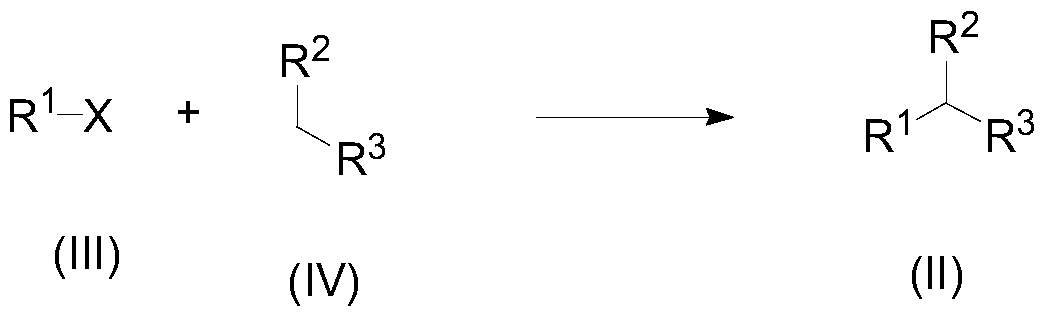
其中R1,R2,R3定义与化合物(II)所述相同,X为氟、氯、溴、碘、硝基、甲磺酰基、亚甲磺酰基。
所述的碱可为一般的有机碱或无机碱,所述的碱优选为碱金属碳酸盐、碱金属氢氧化物、碱土金属碳酸盐、碱土金属氢氧化物、碱金属醋酸盐、碱金属甲酸盐、碱金属有机醇盐、季铵碱、季膦碱。所述的碱更优选为碳酸钾、氢氧化钠、氢氧化钾、乙醇钠、甲醇钠、四烷基氢氧化铵、醋酸钠的一种或多种。更优选为碳酸钾、氢氧化钠、氢氧化钾,所述的碱与化合物(III)的摩尔比优选为1:1-5:1,所述的碱与化合物(III)的摩尔比更优选为1:1-2.5:1。
另外,所述的化合物(II)也可由金属催化的偶联反应制备。
下面的实例进一步举例说明了本发明的一些特征,但本发明所申请保护的内容和范围并不受下述实施例的限制。
实施例1:2-硝基-4-三氟甲基苯甲酸的制备
在装有温度计的100mL三颈烧瓶中,加入10g 3-硝基-4-(硝基甲基)三氟甲苯,11g碳酸钾和40g DMSO,搅拌,加热到70℃,滴加16g双氧水(30%),继续反应1小时。反应完毕后,冷却,加入一定量的水,盐酸酸化,抽滤,水洗涤滤饼,滤饼烘干得2-硝基-4-三氟甲基苯甲酸固体8.3g,得率88%。1H-NMRδppm(DMSO-d6):14.39(br,1H),8.46(s,1H),8.21(d,J=8.0Hz,1H),8.09(d,J=8.0Hz,1H)。
实施例2:2-硝基-4-甲磺酰基苯甲酸的制备
在装有温度计的1000mL三颈烧瓶中,加入100g 2-硝基-4-甲磺酰基苯基丙二酸二乙酯、30g氢氧化钠和500g DMF,搅拌,加热到80℃,滴加105g双氧水(30%),继续反应2小时。反应完毕后,冷却,加入一定量的水,盐酸酸化,抽滤,水洗涤滤饼,滤饼烘干得2-硝基-4-甲磺酰基苯甲酸固体62.4g,得率88%。1H-NMRδppm(DMSO-d6):14.42(br,1H),8.53(d,J=1.6Hz,1H),8.33(dd,J1=1.6Hz J2=8.0Hz,1H),8.12(d,J=8.0Hz,1H),3.39(s,3H)。
实施例3:2-硝基-4-甲磺酰基苯甲酸的制备
在装有温度计的1000mL三颈烧瓶中,加入143g 2-硝基-4-甲磺酰基苯基氰基乙酸甲酯、60g氢氧化钾和500g水,搅拌,加热到40℃,滴加200g双氧水(30%),继续反应2小时。反应完毕后,冷却,盐酸酸化。抽滤,水洗滤饼,滤饼烘干得2-硝基-4-甲磺酰基苯甲酸固体114g,得率97%。
实施例4:2-硝基-4-三氟甲基苯甲酸的制备
在装有温度计的1000mL三颈烧瓶中,加入131g 2-硝基-4-三氟甲基苯基氰基乙酰胺、65g氢氧化钾和400g水,搅拌,加热到70℃,滴加210g双氧水(30%),继续反应2小时。反应完毕后,冷却,盐酸酸化。抽滤,水洗滤饼,滤饼烘干得2-硝基-4-三氟甲基苯甲酸固体107.5g,得率95%。
实施例5:3,5,6-三氯-2-羧酸吡啶的制备
在装有温度计的500mL三颈烧瓶中,加入29.5g 2-(3,5,6-三氯吡啶-2-基)氰基乙酸乙酯、20g醋酸钠和150g水,搅拌,加热到60℃,滴加25g双氧水(30%),继续反应1小时。反应完毕后,冷却,盐酸酸化,过滤,水洗涤滤饼,滤饼烘干得3,5,6-三氯-2-羧酸吡啶固体22.3g,得率98%。1H-NMRδppm(CDCl3):14.30(br,1H),8.61(s,1H)。
实施例6:3-氯-5-三氟甲基-2-羧酸吡啶的制备
在装有温度计的500mL三颈烧瓶中,加入29.5g 2-(3-氯-5-三氟甲基吡啶-2-基)氰基乙酸乙酯、15g氢氧化钠和200g水,搅拌,加热到30℃,滴加30g双氧水(30%),继续反应2小时。反应完毕后,冷却,盐酸酸化,抽滤,水洗涤滤饼,滤饼烘干得3-氯-5-三氟甲基-2-羧酸吡啶固体22.5g,收率99%。1H-NMRδppm(CDCl3):14.40(br,1H),9.01(s,1H),8.65(s,1H)。
实施例7:乙酸的制备
在装有温度计的500mL三颈烧瓶中,加入22.8g 2-氰基丙酸甲酯、28g乙醇钠和200g乙醇,搅拌,冷却到0℃,滴加27g双氧水(50%),继续反应2小时。反应完毕后,蒸出乙醇和水,加入一定量浓硫酸,蒸出11.5g乙酸,收率95%。
实施例8:2-硝基-4-三氟甲基苯基丙二酸二乙酯的制备
在装有温度计的1000mL三颈烧瓶中,加入350g DMF,190g碳酸钾,120g丙二酸二乙酯。加入150g 3-硝基-4-氯-三氟甲苯,控制反应物温度在45℃,滴加完毕后,继续搅拌反应1小时。反应完毕后,脱溶,加水,盐酸酸化,过滤、滤饼用水洗涤,干燥,得到227g 2-硝基-4-三氟甲基苯基丙二酸二乙酯,得率98%。1H-NMRδppm(CDCl3):8.33(s,1H),7.91(d,J=8.0Hz,1H),7.73(d,J=8.0Hz,1H),5.34(s,1H),4.30(q,J=7.2Hz,4H),1.30(t,J=7.2Hz,6H)。
实施例9:2-硝基-4-三氟甲基苯基硝基甲烷的制备
在装有温度计的500mL三颈烧瓶中,加入220g NMP,46g氢氧化钠35g硝基甲烷,在5℃下搅拌30min。慢慢滴入100g 3-硝基-4-氯三氟甲苯,控制反应物温度在5℃,滴加完毕后,继续搅拌反应2小时。反应完毕后,脱溶,加水,浓盐酸酸化,过滤、水洗涤,干燥,得到107g 2-硝基-4-三氟甲基苯基硝基甲烷,得率96%。1H-NMRδppm(CDCl3):8.55(s,1H),8.03(d,J=8.0Hz,1H),7.69(d,J=8.0Hz,1H),5.91(s,2H)。
实施例10:2-硝基-4-甲磺酰基苯基氰基乙酸甲酯的制备
在装有温度计的1000mL三颈烧瓶中,加入400g DMSO,52g氢氧化钠,64g氰基乙酸甲酯。加入150g 4-甲磺酰基-2-硝基氯苯,控制反应物温度在60℃以内,滴加完毕后,继续搅拌反应1小时。反应完毕后,脱溶,加水,盐酸酸化,过滤、滤饼用水洗涤,干燥,得到182g2-硝基-4-甲磺酰基苯基氰基乙酸甲酯,得率96%。1H-NMRδppm(CDCl3):8.77(d,J=1.6Hz,1H),8.33(dd,J1=1.6Hz J2=8.0Hz,1H),8.07(d,J=8.0Hz,1H),5.82(s,1H),3.90(s,3H),3.17(s,3H)。
实施例11:2-硝基-4-三氟甲基苯基氰基乙酸乙酯的制备
在装有温度计的1000mL三颈烧瓶中,加入500g DMF,150g碳酸钾,77g氰基乙酸乙酯加入150g 4-氯-3-硝基三氟甲苯,控制反应物温度在50℃以内,滴加完毕后,继续搅拌反应1小时。反应完毕后,脱溶,加水,盐酸酸化,过滤、水洗涤,干燥,得到195g 2-硝基-4-三氟甲基苯基氰基乙酸乙酯,得率97%。1H-NMRδppm(CDCl3):8.49(s,1H),8.03(d,J=8.0Hz,1H),7.98(d,J=8.0Hz,1H),5.77(s,1H),4.33(q,J=7.2Hz,2H),1.34(t,J=7.2Hz,3H)。
实施例12:2-(3,5,6-三氯吡啶-2-基)氰基乙酸乙酯的制备
在装有温度计的1000mL三颈烧瓶中,加入500g DMF,80g碳酸钾,59g氰基乙酸乙酯。加入109g 2,3,5,6-四氯吡啶和150g的DMF溶液,控制反应物温度在50℃以内,滴加完毕后,继续搅拌反应1小时。反应完毕后,脱溶,加水溶解,盐酸酸化,过滤、滤饼用水洗涤,干燥,得到145g 2-(3,5,6-三氯吡啶-2-基)氰基乙酸乙酯,收率98%。1H-NMRδppm(CDCl3):14.61(br,1H),8.53(s,1H),4.25(d,J=5.6Hz,2H),1.2(t,J=5.6Hz,3H)。
实施例13:2-(3-氯-5-三氟甲基吡啶-2-基)氰基乙酸乙酯的制备
在装有温度计的500mL三颈烧瓶中,加入200g DMSO,25g氢氧化钾,24g氰基乙酸乙酯。加入入44g 2,3-二氯-5三氟甲基吡啶,控制反应物温度在50℃以内,滴加完毕后,继续搅拌反应1小时。反应完毕后,脱溶,加水,盐酸酸化,过滤、滤饼用水洗涤,干燥,得到58g3-氯-5三氟甲基吡啶-2-基氰基乙酸乙酯,得率97%。1H-NMRδppm(CDCl3):8.66(s,1H),6.27(s,1H),4.25(d,J=5.6Hz,2H),3.40(br,1H),1.2(t,J=5.6Hz,3H)。
实施例14:2-硝基-4-三氟甲基苯基氰基乙酰胺制备
在装有温度计的1000mL三颈烧瓶中,加入450g DMF,50g氢氧化钠,45g氰基乙酰胺。加入120g 4-氯-3-硝基三氟甲苯,控制反应物温度在30℃以内,滴加完毕后,继续搅拌反应1小时。反应完毕后,脱溶,加水,盐酸酸化,过滤、水洗涤,干燥,得到142g 2-硝基-4-三氟甲基苯基氰基乙酰胺,得率97%。1H-NMRδppm(CDCl3):8.48(s,1H),8.28(d,J=6.4Hz,
1H),8.09(s,1H),7.99(d,J=6.4Hz,1H),7.83(s,1H),5.80(s,1H)。
Claims (10)
- 一种羧酸的制备方法,其特征在于,化合物(II)在双氧水和碱存在下反应得到目标产品(I),用反应式表示如下:
 其中,R1是芳基、吡啶基、嘧啶基、哒嗪基、吡嗪基、苯并噻吩基、苯并呋喃基、喹啉基、异喹啉基、噻二唑基、C1-6烷基、C3-6环烷基、C2-6烯基、C2-6炔基、氢;R2为烷氧基羰基、烷胺基羰基、氨基羰基、烷巯基羰基、氰基、磺酰基、亚磺酰基、羰基、醛基、羧基、硝基,烷基,氢;R3为烷氧基羰基、烷胺基羰基、氨基羰基、氰基、磺酰基、亚磺酰基、羰基、羧基、硝基。
 - 根据权利要求1所述的方法,其特征在于,所述的R1优选为芳基、吡啶基,所述的R2优选为烷氧基羰基、胺基羰基、氨基羰基、氰基,所述的R3优选为氰基、烷氧基羰基。
- 根据权利要求1所述的方法,其特征在于,所述的R1优选为C6-C10芳基、吡啶基,所述的R2优选为烷氧基羰基、氨基羰基,所述的R3优选为氰基。
- 根据权利要求1所述的方法,其特征在于,所述的R1优选为邻位吸电子基团取代的芳基、吡啶基,所述的R2优选为烷氧基羰基。
- 根据权利要求1所述的方法,其特征在于,所述的化合物(II)进一步优选为2-硝基-4-三氟甲基苯基氰基乙酸乙酯、2-硝基-4-甲磺酰基苯基氰基乙酸乙酯、2-甲磺酰基-4-三氟甲基苯基氰基乙酸乙酯、2-硝基-4-三氟甲基苯基氰基乙酸甲酯、2-硝基-4-甲磺酰基苯基氰基乙酸甲酯、2-甲磺酰基-4-三氟甲基苯基氰基乙酸甲酯、2-硝基-4-三氟甲基苯基氰基乙酸异丙酯、2-硝基-4-甲磺酰基苯基氰基乙酸异丙酯、2-甲磺酰基-4-三氟甲基苯基氰基乙酸异丙酯、2-硝基-4-三氟甲基苯基氰基乙酰胺、2-硝基-4-甲磺酰基苯基氰基乙酰胺、2-甲磺酰基-4-三氟甲基苯基氰基乙酰胺。
- 根据权利要求1所述的方法,其特征在于,所述的碱包括无机碱和有机碱,所述的碱与化合物(II)的摩尔比优选为1:1-3:1。
- 根据权利要求6所述的方法,其特征在于,所述的无机碱优选为碱金属碳酸盐、碱金属氢氧化物、碱土金属碳酸盐、碱土金属氢氧化物、碱金属醋酸盐、碱金属甲酸盐、碱金属醇盐;所述的有机碱优选为季铵碱、季膦碱、有机胺。
- 根据权利要求7所述的方法,其特征在于,所述的无机碱进一步优选为碳酸钾、氢氧化钠、氢氧化钾。
- 根据权利要求1所述的方法,其特征在于,所述的反应在溶剂中进行,溶剂优选为水、DMF、NMP、DMSO、甲醇、乙醇、乙腈、THF的一种或多种混合。
- 根据权利要求1所述的方法,其特征在于,所述的双氧水与化合物(II)的摩尔比优选为2:1-5:1,所述的氧化反应温度优选为0-60℃。
Priority Applications (2)
| Application Number | Priority Date | Filing Date | Title |
|---|---|---|---|
| US15/532,957 US10167246B2 (en) | 2014-12-02 | 2015-09-25 | Preparative method for carboxylic acids |
| EP15864805.5A EP3222606B1 (en) | 2014-12-02 | 2015-09-25 | Carboxylic acid preparation method |
Applications Claiming Priority (2)
| Application Number | Priority Date | Filing Date | Title |
|---|---|---|---|
| CN201410724646.4 | 2014-12-02 | ||
| CN201410724646.4A CN105646120B (zh) | 2014-12-02 | 2014-12-02 | 一种羧酸的制备方法 |
Publications (1)
| Publication Number | Publication Date |
|---|---|
| WO2016086710A1 true WO2016086710A1 (zh) | 2016-06-09 |
Family
ID=56090972
Family Applications (1)
| Application Number | Title | Priority Date | Filing Date |
|---|---|---|---|
| PCT/CN2015/090740 Ceased WO2016086710A1 (zh) | 2014-12-02 | 2015-09-25 | 一种羧酸的制备方法 |
Country Status (4)
| Country | Link |
|---|---|
| US (1) | US10167246B2 (zh) |
| EP (1) | EP3222606B1 (zh) |
| CN (1) | CN105646120B (zh) |
| WO (1) | WO2016086710A1 (zh) |
Families Citing this family (8)
| Publication number | Priority date | Publication date | Assignee | Title |
|---|---|---|---|---|
| CN113004142B (zh) * | 2020-12-28 | 2022-04-19 | 台州达辰药业有限公司 | 一种2,4,5-三氟苯乙酸新型制备方法 |
| CN116693363B (zh) * | 2022-02-24 | 2025-12-23 | 帕潘纳(北京)科技有限公司 | 一种除草剂中间体的制备方法 |
| CN116947714B (zh) * | 2022-04-18 | 2026-01-30 | 帕潘纳(北京)科技有限公司 | 磺草酮中间体的制备方法 |
| CN115433113B (zh) * | 2022-09-28 | 2025-11-21 | 南京正荣医药化学有限公司 | 一种苯甲酸酯类农药和医药中间体及其制备方法 |
| CN115850082B (zh) * | 2022-11-25 | 2025-05-06 | 内蒙古蓝科生物科技有限公司 | 一种2-硝基-4-三氟甲基苯甲酸的制备方法 |
| CN115850083A (zh) * | 2022-11-25 | 2023-03-28 | 南京正荣医药化学有限公司 | 一种羧酸类化合物的制备方法 |
| CN116102473B (zh) * | 2023-01-10 | 2024-08-16 | 启农生物科技(北京)有限公司 | 2-硝基-4-甲砜基-苯甲酸的制备工艺 |
| CN116444452A (zh) * | 2023-03-06 | 2023-07-18 | 启农生物科技(北京)有限公司 | 一种用于合成苯唑草酮的中间体i的制备工艺 |
Citations (2)
| Publication number | Priority date | Publication date | Assignee | Title |
|---|---|---|---|---|
| CN1127246A (zh) * | 1994-09-16 | 1996-07-24 | 罗纳·布朗克化学公司 | 由不饱和脂肪酸和/或其衍生物制备一元和二元羧酸的方法 |
| CN1239092A (zh) * | 1998-06-17 | 1999-12-22 | 浙江省医学科学院 | 1-氨基环丙烷-1-羧酸新型合成方法 |
Family Cites Families (2)
| Publication number | Priority date | Publication date | Assignee | Title |
|---|---|---|---|---|
| DK0388619T3 (da) * | 1989-03-22 | 1994-10-03 | American Cyanamid Co | Fremgangsmåde til fremstilling af substituerede 2,3-pyridindicarboxylsyrer ved sekvensvis oxidation af substituerede quinoliner |
| US5917079A (en) * | 1996-09-24 | 1999-06-29 | Rohm And Haas Company | Process for synthesizing benzoic acids |
-
2014
- 2014-12-02 CN CN201410724646.4A patent/CN105646120B/zh active Active
-
2015
- 2015-09-25 WO PCT/CN2015/090740 patent/WO2016086710A1/zh not_active Ceased
- 2015-09-25 EP EP15864805.5A patent/EP3222606B1/en active Active
- 2015-09-25 US US15/532,957 patent/US10167246B2/en active Active
Patent Citations (2)
| Publication number | Priority date | Publication date | Assignee | Title |
|---|---|---|---|---|
| CN1127246A (zh) * | 1994-09-16 | 1996-07-24 | 罗纳·布朗克化学公司 | 由不饱和脂肪酸和/或其衍生物制备一元和二元羧酸的方法 |
| CN1239092A (zh) * | 1998-06-17 | 1999-12-22 | 浙江省医学科学院 | 1-氨基环丙烷-1-羧酸新型合成方法 |
Also Published As
| Publication number | Publication date |
|---|---|
| US20170369412A1 (en) | 2017-12-28 |
| EP3222606A1 (en) | 2017-09-27 |
| CN105646120B (zh) | 2019-03-19 |
| EP3222606B1 (en) | 2019-08-07 |
| US10167246B2 (en) | 2019-01-01 |
| EP3222606A4 (en) | 2018-01-10 |
| CN105646120A (zh) | 2016-06-08 |
Similar Documents
| Publication | Publication Date | Title |
|---|---|---|
| WO2016086710A1 (zh) | 一种羧酸的制备方法 | |
| CN101945861B (zh) | 一种苯甲酰胺类化合物的制备方法 | |
| KR102522231B1 (ko) | 2-피리딜에틸카복사미드 유도체의 제조 방법 | |
| CN102627573B (zh) | 5-氨基酮戊酸盐酸盐的合成方法 | |
| CN107250102B (zh) | 通过钌催化由偶氮苯制备联苯胺的方法 | |
| JP6771475B2 (ja) | 3−クロロ−2−ビニルフェニルスルホネート類の製造方法 | |
| WO2010122794A1 (ja) | ピラジンカルボン酸誘導体の製造方法及びその中間体 | |
| CN102712593B (zh) | 2-氨基-4-三氟甲基吡啶的生产方法 | |
| CN104447543B (zh) | 3-氨基-7,8-二氟喹啉及其中间体的合成方法 | |
| JP5619761B2 (ja) | 2−[(1−シアノプロピル)カルバモイル]−5−クロロメチルニコチン酸及びイミダゾリノン系除草剤の製造におけるその使用 | |
| WO2010066668A1 (en) | Process for manufacturing 5-formyl-pyridine-2,3-dicarboxylic acid esters | |
| CN106243009B (zh) | 一种3-正丁胺基-4-溴-n-苯基马来酰亚胺的制备方法 | |
| JPWO2018221604A1 (ja) | 3−アリールプロピオンアミド化合物及び3−アリールプロピオン酸エステル化合物の製造方法 | |
| CN101160288B (zh) | 烟酸衍生物或其盐的制造方法 | |
| WO2016086722A1 (zh) | 一种异噁唑类化合物及其中间体的制备方法 | |
| JP5468400B2 (ja) | 4−クロロピリジン−2−カルボン酸クロリドの製造方法 | |
| JP5631741B2 (ja) | ピラジン誘導体類の製造方法及びその中間体類 | |
| JP2011057575A (ja) | 4−ヒドロキシベンゾチオフェン誘導体の製造方法 | |
| CN1447798A (zh) | 吡唑化合物的制备方法 | |
| JPWO2008075468A1 (ja) | 2−イソプロペニル−5−メチル−4−ヘキセン−1−イル3−メチル−2−ブテノアートの製造方法 | |
| CN116635369A (zh) | 制备烟酸衍生物的方法 | |
| WO2018028665A1 (zh) | 6-芳基氨基吡啶酮甲酰胺mek抑制剂化合物的中间体的制备方法 | |
| CN120485299A (zh) | 一种中间体的制备方法 | |
| JP5148836B2 (ja) | ニコチン酸誘導体又はその塩の製造方法 | |
| CN116056700A (zh) | 用于制备取代的吡唑的方法 |
Legal Events
| Date | Code | Title | Description |
|---|---|---|---|
| 121 | Ep: the epo has been informed by wipo that ep was designated in this application |
Ref document number: 15864805 Country of ref document: EP Kind code of ref document: A1 |
|
| NENP | Non-entry into the national phase |
Ref country code: DE |
|
| WWE | Wipo information: entry into national phase |
Ref document number: 15532957 Country of ref document: US |
|
| REEP | Request for entry into the european phase |
Ref document number: 2015864805 Country of ref document: EP |