WO2016103676A1 - Système, dispositif et procédé de distribution de données et support d'enregistrement associé - Google Patents
Système, dispositif et procédé de distribution de données et support d'enregistrement associé Download PDFInfo
- Publication number
- WO2016103676A1 WO2016103676A1 PCT/JP2015/006373 JP2015006373W WO2016103676A1 WO 2016103676 A1 WO2016103676 A1 WO 2016103676A1 JP 2015006373 W JP2015006373 W JP 2015006373W WO 2016103676 A1 WO2016103676 A1 WO 2016103676A1
- Authority
- WO
- WIPO (PCT)
- Prior art keywords
- packet
- rto
- data distribution
- transmission
- delayed
- Prior art date
- Legal status (The legal status is an assumption and is not a legal conclusion. Google has not performed a legal analysis and makes no representation as to the accuracy of the status listed.)
- Ceased
Links
Images


Classifications
-
- H—ELECTRICITY
- H04—ELECTRIC COMMUNICATION TECHNIQUE
- H04L—TRANSMISSION OF DIGITAL INFORMATION, e.g. TELEGRAPHIC COMMUNICATION
- H04L1/00—Arrangements for detecting or preventing errors in the information received
- H04L1/12—Arrangements for detecting or preventing errors in the information received by using return channel
- H04L1/16—Arrangements for detecting or preventing errors in the information received by using return channel in which the return channel carries supervisory signals, e.g. repetition request signals
Definitions
- the present invention relates to a data distribution system, a data distribution device, a data distribution method, and a data distribution recording medium, and in particular, a data distribution system, a data distribution method, and a data distribution recording medium between devices via a base station on a wireless network.
- a data distribution system a data distribution device, a data distribution method, and a data distribution recording medium between devices via a base station on a wireless network.
- W-CDMA Wideband Code Division Multiple Access
- HSPA High Speed Packet Access
- LTE Long Term Evolution
- WCDMA Wideband Code Division Multiple Access
- 3GPP Third Generation Partnership Project
- each mobile terminal Since each mobile terminal communicates with server devices on the Internet, it can communicate with the Internet by exchanging radio signals with base stations installed in various locations and exchanging packets with the base stations as radio signals. To do.
- Each base station manages mobile terminals that are within reach of the radio waves from its own station, and when receiving a packet from each mobile terminal, the mobile network (core network) intervenes between the base station and the Internet. Send to the Internet via Alternatively, communication between the mobile terminal and the Internet is enabled by transmitting a packet received from the Internet via the core network to the mobile terminal.
- the mobile network core network
- the base station schedules in what order each packet is transmitted to the mobile terminal.
- the schedule method a round robin method, a proportional fair method, or the like is used, and the packet transmission order is determined by the packet transmission interval of each terminal and the radio wave quality between the terminal and the base station.
- the communication specifications in the mobile network are defined in 3GPP, and a virtual communication connection called a bearer is formed between the mobile terminal, the base station, and the core network, and each packet passes through this bearer through the mobile terminal and the Internet. Transferred between.
- a priority can be set for each bearer, and when a packet is scheduled at the base station, the order can be controlled according to the priority. Further, since packets are exchanged between the base station and the mobile terminal via radio, the transfer speed depends on the quality of radio waves.
- the base station stores the packets once in the base station buffer when sending packets to the mobile terminal, and converts them into radio waves after being ordered based on the radio wave status and the scheduling described above. And transmitted to the mobile terminal.
- Patent Document 1 proposes a method in which data communication that does not require real-time performance is stopped during the day, and communication is performed during a time zone where the communication load is low, such as at night.
- TCP / IP Transmission Control Protocol / Internet Protocol
- Ack packet Ack packet
- the packet transmission source receives an Ack packet for a time indicated by a timer called RTO (Retransmission Time Out). Wait for.
- RTO Retransmission Time Out
- RTO is calculated by RTT (round trip time) from when a packet is transmitted until the Ack packet of that packet is returned.
- RTT round trip time
- Patent Document 2 when a transmitting terminal sends a packet at a frequency of a certain frequency or more, the receiving terminal does not immediately return an Ack packet, and after a while, the RTT is increased by returning the Ack packet. As a result, the RTO on the transmission side is constantly increased, thereby reducing packet re-transmission due to RTO progress.
- an object of the present invention is to provide a data distribution system, a data distribution device, a data distribution method, and a data distribution recording medium that can effectively use a temporarily generated no communication time.
- a data distribution system relays a server device that distributes data to a mobile terminal, a base station that wirelessly communicates with the mobile terminal, and communication from the server device to the mobile terminal.
- a gateway device The server device is Communication means for transmitting packets; RTO (Retransmission Time) based on information on the size of a packet that can be delayed in transmission among the normally transmitted packet and the packet that can be delayed in transmission relative to the normally transmitted packet.
- RTO calculating means for calculating (Out), and updating the RTO based on the information on the size of the packet whose transmission can be delayed.
- the data distribution device delays the transmission among a communication unit that transmits a packet, a packet that is normally transmitted, and a packet that can delay transmission with respect to the packet that is normally transmitted.
- the size of the packet that can delay the transmission among the normally transmitted packet and the packet that can delay the transmission with respect to the normally transmitted packet is calculated on the basis of the information on the RTO and the RTO is updated.
- a recording medium for data distribution is a computer-readable recording medium in which a program for distributing data to another communication device is recorded via a base station, On the server device, Based on the information regarding the size of the packet that can delay the transmission among the normally transmitted packet and the packet that can delay the transmission with respect to the normally transmitted packet, the RTO (Retransmission RTO calculation processing for calculating (Time Out) and processing for updating the RTO are executed.
- FIG. 1 is a conceptual diagram for explaining data distribution by a high-level data distribution device of the present invention.
- FIG. 2 is a block diagram showing a data distribution system according to an embodiment of the present invention.
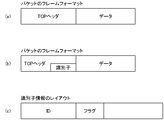
- 3A and 3B are data formats showing an example of a packet according to an embodiment of the present invention
- FIG. 3C is a data format showing an example of a layout of identifier information.
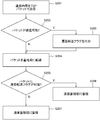
- FIG. 4 is a flowchart for explaining packet transmission processing from the server apparatus 2 to the base station 3 according to the embodiment of the present invention.
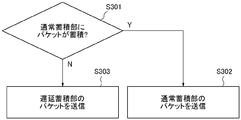
- FIG. 5 is a flowchart for explaining packet transmission processing of the scheduling unit 303 of the base station 3 according to the embodiment of this invention.
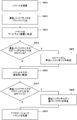
- FIG. 6 is a flowchart for explaining packet transfer processing from the mobile terminal 1 to the server device 2 according to the embodiment of the present invention.
- FIG. 7 is a block diagram showing a data distribution device according to another embodiment of the present invention.
- the direction of the arrow in a drawing shows an example and does not limit the direction of the signal between blocks.
- data that does not need real-time characteristics that need only be transmitted during no-communication time is determined, and a special accumulation unit that accumulates packets related to data that does not require real-time performance is installed, and no communication time occurs.
- the packet stored in the storage unit is transmitted. Thereby, the no-communication time is used effectively.
- it is possible to prevent unnecessary packet retransmission by estimating the time accumulated in the accumulation unit in TCP / IP as needed and appropriately setting the RTO.
- the size of a packet that can delay the transmission is referred to as a “delayed packet size”.
- an example of “delay packet size” is referred to as “delay buffer size”.
- FIG. 1 is a conceptual diagram for explaining data distribution by a data distribution device of a superordinate concept of the present invention.
- the data distribution device 12 in FIG. 1 is, for example, an update data distribution server, identifies a partner that needs updating, and distributes update data to the partner through a wireless network by packet communication.
- the data distribution device 12 in FIG. 1 includes a TCP communication unit 22 as an example of a TCP communication unit that transmits a TCP packet, and an RTO calculation unit 23 as an example of an RTO calculation unit that calculates an RTO.
- the RTO calculating unit 23 is information regarding the size of the packet that can delay the transmission among the normally transmitted packet and the packet that can delay the transmission compared to the normally transmitted packet. RTO is calculated based on the above.
- the data distribution device 12 it is determined whether to transmit a retransmission packet to the mobile terminal 11, which is an example of the other party, based on the RTO calculated by the RTO calculator 23.
- the calculated RTO is large, if a packet is lost, a retransmission packet is not transmitted unless a long time indicated by the RTO has elapsed.
- the calculated RTO is small, if a packet is lost, a retransmission packet is transmitted in a short time indicated by the RTO.
- FIG. 2 is a block diagram showing a data distribution system according to an embodiment of the present invention.
- FIG. 4 is a flowchart for explaining packet transmission processing from the server apparatus 2 to the base station 3 according to the embodiment of the present invention.
- FIG. 5 is a flowchart for explaining packet transmission processing of the scheduling unit 303 of the base station 3 according to the embodiment of this invention.
- FIG. 6 is a flowchart for explaining packet transfer processing from the mobile terminal 1 to the server device 2 according to the embodiment of the present invention.
- the data delivery system of this embodiment performs data delivery to a plurality of mobile terminals 1 operated by a plurality of users.
- the data distribution system according to the present embodiment includes a server device 2 that provides a service to a user in cooperation with the mobile terminal 1, a base station 3 that communicates with the mobile terminal 1 by radio, and a mobile device from the server device 2. And a gateway device 4 that relays communication to the terminal 1.
- a plurality of base stations 3 are arranged according to the reach of radio waves.
- the mobile terminal 1 monitors radio waves from a plurality of base stations 3 and is automatically connected to the base station 3 with good radio quality.
- the gateway device 4 is often installed in a core network and connected to a plurality of base stations 3, but the gateway device 4 and the base station 3 may be mounted on the same device.
- the server apparatus 2 of the data distribution system includes an application unit 201 that provides an arbitrary service, a TCP communication unit 202, and an RTO calculation unit 203.
- the TCP communication unit 202 receives a packet transmission request from the application unit 201 and exchanges it with the mobile terminal 1 as a packet on the TCP / IP protocol.
- the RTO calculation unit 203 determines whether or not a packet sent to the mobile terminal 1 has been lost based on time.
- the RTO calculation unit 203 recalculates the RTO using the delayed packet size added to the header portion of the TCP packet returned from the mobile terminal 1.
- the application unit 201 in the server device 2 may operate on another device connected via a network instead of on the server device 2.
- the base station 3 of the data distribution system includes a normal storage unit 301 as an example of a normal storage unit, a delay storage unit 302 as an example of a delay storage unit, and a scheduling unit 303 as an example of a scheduling unit.
- the normal storage unit 301 stores packets to be transmitted at normal timing.
- the delay accumulation unit 302 accumulates packets that can be delayed in transmission compared to packets transmitted at normal timing accumulated in the normal accumulation unit 301.
- the packets stored in the delay storage unit 302 can be stored until no communication time occurs.
- the packet stored in the delay storage unit 302 may be a packet that rarely requires real-time characteristics, such as application update data.
- the scheduling unit 303 transfers the packet of the normal storage unit 301 when there is a packet in the normal storage unit 301, and extracts the packet from the delay storage unit 302 and transfers it to the mobile terminal 1 when there is no packet in the normal storage unit 301.
- the gateway device 4 of the data distribution system includes a delayed packet identification unit 401 as an example of a delayed packet identification unit, a buffer size transcription unit 402 as an example of a buffer size transcription unit, and a packet transfer unit 403 as an example of a packet transfer unit. And including.
- the delayed packet identification unit 401 determines whether the packet received from the server device 2 is a packet that can be delayed. In other words, the delayed packet identifying unit 401 identifies whether the packet received from the server device 2 is a packet that may be delayed.
- the buffer size transcription unit 402 acquires the buffer size of the base station 3 described in the packet, and confirms the delay buffer size added to the packet.
- the buffer size transfer unit 402 transfers the delay buffer size to the packet by a method defined by the protocol on TCP / IP.
- the buffer size transfer unit 402 transfers the delay buffer size to the header part of the TCP packet.
- the packet transfer unit 403 transfers the packet received from the server device 2 to an appropriate base station 3 and transfers the packet received from the base station 3 to the server device 2.
- the application unit 201 passes the communication content for a specific mobile terminal 1 to the TCP communication unit 202 at an arbitrary timing.
- the communication destination and the communication source are identified by information defined by an IP address and a port number in TCP / IP.
- the TCP communication unit 202 divides the communication content into packets, and transfers the packets to the packet transfer unit 403 of the gateway device 4 via the network. That is, the TCP communication unit 202 transmits the communication content as a TCP packet (step S201).
- the TCP communication unit 202 may set a flag indicating a delayable communication packet in the header of the TCP packet based on an instruction from the application unit 201.
- FIG. 3A and 3B are data formats showing an example of a packet according to an embodiment of the present invention
- FIG. 3C is a data format showing an example of a layout of identifier information
- FIG. 3B is a data format showing an example of a packet to which identifier information indicating that delay is possible is added.
- FIG. 3A is a data format showing an example of a normally transmitted packet to which such identifier information is not added.
- the identifier information shown in FIG. 3B includes an ID (Identifier) area and a flag indicating a communication packet that can be delayed as shown in FIG.
- the packet transfer unit 403 of the gateway device 4 passes the received packet to the delayed packet identification unit 401.
- the delayed packet identification unit 401 determines whether the received packet is a packet that can be delayed (step S202).
- a packet source or destination IP address or a port number may be used.
- a TCP packet with a port number of 20 is FTP (File Transfer Protocol) communication, and it is determined that it may be delayed.
- FTP File Transfer Protocol
- the delayed packet identification unit 401 adds a delay transfer flag indicating that the packet can be delayed (step S203).
- This flag may be a flag using a header portion of an IP packet indicating that a bearer set for transmission / reception of a delayed packet is used, for example.
- a special header may be added to the header portion of the TCP packet for transmission.
- you may add to the protocol uniquely set for communication between the gateway apparatus 4 and the base station 3.
- the packet transfer unit 403 determines the base station 3 to transfer the packet, and transfers the packet to the scheduling unit 303 of the base station 3 via the network (step S204).
- the scheduling unit 303 of the base station 3 that has received the packet determines whether a delayed transfer flag is added to the received packet (step S205). If the delay transfer flag is added, the packet is stored in the delay storage unit 302 (step S206). If the delay transfer flag is not added, the packet is stored in the normal storage unit 301 (step S207).
- the scheduling unit 303 of the base station 3 transmits a packet to the mobile terminal 1 using radio. If a packet is stored in the normal storage unit 301 of the base station 3 (Y in step S301), the packet is extracted from the normal storage unit 301 and transmitted to the mobile terminal 1 (step S302). If no packet is accumulated in the normal accumulation unit 301 of the base station 3 (N in step S301), the packet is extracted from the delay accumulation unit 302 and transmitted to the mobile terminal 1 (step S303).
- the scheduling unit 303 sets the size based on the total size of the packets stored in the delay storage unit 302 in the header of the reply packet.
- the scheduling unit 303 adds the delay buffer size to the reply packet (step S402).
- the added delay buffer size the total size of the packets stored in the delay storage unit 302 is used.
- other information may be added to the delay buffer size.
- the additional information includes a fixed value set in advance separately, the amount of packets received or received by the scheduling unit 303 per unit time, and a value calculated based on those amounts.
- the header part to which the delay buffer size is added may be, for example, an IP packet or a TCP packet header part. Or you may add to the protocol uniquely set for the communication between the gateway apparatus 4 and the base station 3.
- the scheduling unit 303 transfers the packet to the packet transfer unit 403 of the gateway device 4 (step S403).
- the packet transfer unit 403 of the gateway device 4 passes the packet to the buffer size transcription unit 402.
- the buffer size transcription unit 402 confirms the delay buffer size added to the packet. In other words, the buffer size transcription unit 402 confirms whether the delay buffer size is added to other than the header portion of the TCP packet (step S404).
- the delay buffer size is transferred to the header portion of the TCP packet (step S405). ).
- the packet transfer unit 403 transfers the packet to the TCP communication unit 202 of the server device 2 (step S406).
- the TCP communication unit 202 confirms whether or not the delay buffer size is added to the header part of the TCP packet.
- the delay buffer size is passed to the RTO calculation unit 203.
- the RTO calculation unit 203 recalculates the RTO using the passed delay buffer size.
- the RTO is corrected based on the delay buffer size (step S408).
- An example of the RTO calculation method at this time is shown by the following (Equation 1).
- the throughput indicates the size per unit time of the packet transferred from the TCP communication unit 202.
- ⁇ is an arbitrary constant.
- the delay buffer size is small, it indicates that the time until a packet that can be delayed is transmitted to the mobile terminal is short, and thus the RTO is small. In this case, if a packet is lost, a retransmission packet can be transmitted immediately.
- the TCP communication unit 202 passes the packet to the application unit 201, and the application unit 201 performs processing based on the communication content. That is, the application unit 201 processes the packet (step S409).
- the accumulated packet can be transmitted immediately when no communication time occurs.
- the measured RTO is small when the transmission delay is small, so the RTO value is small. Thereafter, when the transmission delay suddenly increases, packet retransmission due to a small RTO frequently occurs.
- the delay buffer size is added to the header of the packet returned from the mobile terminal 1, and the RTO calculation unit 203 uses the RTO (RTO) based on this delay buffer size.
- Retransmission Time Out is calculated. Further, it is determined whether or not to send a retransmission packet to the mobile terminal 1 based on the RTO thus calculated. Whether or not to send a retransmission packet is determined in consideration of the size of the packet stored in the delay storage unit 302. Thereby, it is possible to solve the problem that the retransmission of the packet by RTO occurs a plurality of times and the same packet is transmitted many times. Also, if the storage time is suddenly shortened, the problem that the RTO remains long and the packet is lost, the time until the retransmission is increased and the packet does not arrive at the mobile terminal can be solved.
- Each component of the present invention can also be realized by a function of each component or a program that executes processing by each component.
- the RTO calculation unit 203 and the TCP communication unit 202 of the server device 2 perform an RTO calculation process for calculating the RTO and a determination process for determining whether to send a retransmission packet to the other party based on the calculated RTO. It can also be realized by a program to be executed.
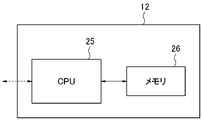
- FIG. 7 is a block diagram showing a data distribution device 12 according to another embodiment of the present invention.
- the data distribution device 12 of FIG. 7 includes a CPU (Central Processing Unit) 25 and a memory 26 as an example of a processing unit.
- the data distribution device 12 in FIG. 7 reads into the memory 26 a program for executing an RTO calculation process for calculating an RTO and a determination process for determining whether or not to transmit a retransmission packet to the other party based on the calculated RTO.
- the CPU 25 executes RTO calculation processing and TCP communication processing.
- This program is a data distribution recording medium, for example, a general-purpose semiconductor recording device such as CF (Compact Flash (registered trademark)) and SD (Secure Digital), a magnetic recording medium such as a flexible disk, or the like. It can be distributed in the form of an optical recording medium such as a CD-ROM (Compact Disc Read Only Memory).
- the functions of the present embodiment may be realized in software by reading a program recorded in such a recording medium and causing the server apparatus 2 to execute an RTO calculation process and a determination process.
- RTO calculation unit calculates the RTO based on information on a size of a packet whose transmission can be delayed.
- a server device that distributes data to a mobile terminal, a base station that wirelessly communicates with the mobile terminal, and a gateway device that relays communication from the server device to the mobile terminal, the server device including: Information on the size of a packet that can delay transmission among communication means for transmitting a packet, a packet that is normally transmitted, and a packet that can delay transmission with respect to the packet that is normally transmitted RTO calculation means for calculating RTO (Retransmission Time Out) based on the data, wherein the server device updates the RTO based on the information on the size of the packet whose transmission can be delayed. Distribution system.
- the base station includes normal storage means for storing the normally transmitted packet, and delay storage means for storing a packet capable of delaying transmission with respect to the normally transmitted packet.
- the RTO calculation means of the server device calculates the RTO based on information on the size of a packet that can be delayed in transmission, accumulated by the delay accumulation means of the base station. Or the data distribution system according to appendix 5.
- the gateway device adds identification information indicating that transmission can be delayed to a packet whose transmission can be delayed, transmits the packet to the base station, and The data distribution system according to any one of appendix 4 to appendix 6, wherein the base station accumulates the received packet in the normal accumulation unit or the delay accumulation unit based on the identification information.
- the gateway device checks the delay buffer size added to the packet, and if the delay buffer size is added to the packet and is not added to the header of the packet, the gateway The data distribution system according to any one of appendix 4 to appendix 7, further comprising buffer size transcribing means for transcribing the size to the header of the packet. (Additional remark 9) Based on the information regarding the size of the packet which can delay transmission among the packet transmitted normally and the packet which can delay transmission with respect to the packet transmitted normally A data delivery method for calculating RTO (Retransmission Time Out) and updating the RTO.
- RTO Retransmission Time Out
- the identification information which shows that transmission can be delayed is added with respect to the packet which can delay transmission,
- the received packet is accumulate
- the delay buffer size added to the packet is confirmed, and if the delay buffer size is added to the packet and is not added to the header of the packet, the delay buffer size is set to the packet header. 14.
- the said RTO calculation process is a computer-readable recording medium of Additional remark 15 which calculates the said RTO based on the information regarding the size of the packet which can delay transmission.
Landscapes
- Engineering & Computer Science (AREA)
- Computer Networks & Wireless Communication (AREA)
- Signal Processing (AREA)
- Data Exchanges In Wide-Area Networks (AREA)
- Mobile Radio Communication Systems (AREA)
- Communication Control (AREA)
Abstract
L'invention concerne un système, un dispositif et un procédé de distribution de données, ainsi qu'un support d'enregistrement pour la distribution de données, permettant une utilisation efficace d'une durée de non-communication se produisant temporairement. Dans le procédé selon l'invention, une temporisation de retransmission (RTO) est calculée en fonction d'informations relatives à la taille d'un paquet dont la transmission peut être retardée par rapport à un paquet devant être transmis normalement, provenant du paquet à transmettre normalement et du paquet dont la transmission peut être retardée, et la RTO est mise à jour.
Priority Applications (1)
| Application Number | Priority Date | Filing Date | Title |
|---|---|---|---|
| JP2016565916A JP6677171B2 (ja) | 2014-12-22 | 2015-12-22 | データ配信システム、データ配信機器、データ配信方法およびデータ配信用記録媒体 |
Applications Claiming Priority (2)
| Application Number | Priority Date | Filing Date | Title |
|---|---|---|---|
| JP2014-259005 | 2014-12-22 | ||
| JP2014259005 | 2014-12-22 |
Publications (1)
| Publication Number | Publication Date |
|---|---|
| WO2016103676A1 true WO2016103676A1 (fr) | 2016-06-30 |
Family
ID=56149738
Family Applications (1)
| Application Number | Title | Priority Date | Filing Date |
|---|---|---|---|
| PCT/JP2015/006373 Ceased WO2016103676A1 (fr) | 2014-12-22 | 2015-12-22 | Système, dispositif et procédé de distribution de données et support d'enregistrement associé |
Country Status (2)
| Country | Link |
|---|---|
| JP (1) | JP6677171B2 (fr) |
| WO (1) | WO2016103676A1 (fr) |
Cited By (1)
| Publication number | Priority date | Publication date | Assignee | Title |
|---|---|---|---|---|
| CN115348252A (zh) * | 2022-06-23 | 2022-11-15 | 浙江大华技术股份有限公司 | 数据传输方法、数据传输系统、终端设备以及存储介质 |
Citations (2)
| Publication number | Priority date | Publication date | Assignee | Title |
|---|---|---|---|---|
| JP2004253934A (ja) * | 2003-02-19 | 2004-09-09 | Nec Corp | 無線通信システム、サーバ、基地局、移動端末及びそれらに用いる再送タイムアウト時間決定方法 |
| JP2011211413A (ja) * | 2010-03-29 | 2011-10-20 | Fujitsu Ltd | 通信装置および通信方法 |
-
2015
- 2015-12-22 JP JP2016565916A patent/JP6677171B2/ja not_active Expired - Fee Related
- 2015-12-22 WO PCT/JP2015/006373 patent/WO2016103676A1/fr not_active Ceased
Patent Citations (2)
| Publication number | Priority date | Publication date | Assignee | Title |
|---|---|---|---|---|
| JP2004253934A (ja) * | 2003-02-19 | 2004-09-09 | Nec Corp | 無線通信システム、サーバ、基地局、移動端末及びそれらに用いる再送タイムアウト時間決定方法 |
| JP2011211413A (ja) * | 2010-03-29 | 2011-10-20 | Fujitsu Ltd | 通信装置および通信方法 |
Cited By (1)
| Publication number | Priority date | Publication date | Assignee | Title |
|---|---|---|---|---|
| CN115348252A (zh) * | 2022-06-23 | 2022-11-15 | 浙江大华技术股份有限公司 | 数据传输方法、数据传输系统、终端设备以及存储介质 |
Also Published As
| Publication number | Publication date |
|---|---|
| JPWO2016103676A1 (ja) | 2017-11-02 |
| JP6677171B2 (ja) | 2020-04-08 |
Similar Documents
| Publication | Publication Date | Title |
|---|---|---|
| EP2204018B1 (fr) | Limitation de la taille de fenêtre rlc dans une commande de flux hsdpa | |
| CN118972325A (zh) | 在适配层的集成接入回程网络中提供与数据流量相反方向的流量控制信息的方法 | |
| JP5075784B2 (ja) | 移動通信システム及び送信側ノード | |
| JP5147983B1 (ja) | 基地局及び通信制御方法 | |
| CN114979839B (zh) | 一种传输控制协议代理方法及通信装置 | |
| JP2016208193A (ja) | 基地局及び通信制御方法 | |
| CN101982951B (zh) | 数据传输控制方法和中间节点 | |
| US10187315B2 (en) | Apparatus and method for optimizing communications at an intermittent communication link | |
| JP2015076845A (ja) | 通信システム、制御方法、及び、制御装置 | |
| US20180048983A1 (en) | Gateway device, and bearer setting control method | |
| CN108370372B (zh) | 一种数据包的传输方法、网络侧设备以及用户设备 | |
| EP2943006B1 (fr) | Procédé et dispositif de mise en cache de données | |
| US7336607B2 (en) | Methods and apparatus for flow control based packet aggregation in a communication network | |
| JP2020507963A (ja) | データ送信方法および装置、ならびに顧客宅内機器 | |
| CN113301605B (zh) | 消息传输方法、系统及相关装置 | |
| US9385931B1 (en) | Determining a reordering timer | |
| JP6677171B2 (ja) | データ配信システム、データ配信機器、データ配信方法およびデータ配信用記録媒体 | |
| US9125109B1 (en) | Determining a reordering timer | |
| WO2019235136A1 (fr) | Dispositif et procédé de transfert | |
| CN101473686B (zh) | 减少移动通信网络中的由网络发起的数据传输中的输入延迟时间的方法 | |
| WO2017012290A1 (fr) | Procédé, appareil et dispositif de transmission de paquets, et support d'enregistrement informatique | |
| CN101273555B (zh) | 发送和接收建立无线承载的请求的方法 | |
| CN114338839B (zh) | 基于tcp的数据传输方法、装置、电子设备及存储介质 | |
| US20060142022A1 (en) | Method of operating a base station of wireless communications network, base station of a wireless communications network and radio network controller | |
| JP6668961B2 (ja) | 通信装置、方法およびプログラム |
Legal Events
| Date | Code | Title | Description |
|---|---|---|---|
| 121 | Ep: the epo has been informed by wipo that ep was designated in this application |
Ref document number: 15872248 Country of ref document: EP Kind code of ref document: A1 |
|
| ENP | Entry into the national phase |
Ref document number: 2016565916 Country of ref document: JP Kind code of ref document: A |
|
| NENP | Non-entry into the national phase |
Ref country code: DE |
|
| 122 | Ep: pct application non-entry in european phase |
Ref document number: 15872248 Country of ref document: EP Kind code of ref document: A1 |