WO2016104394A1 - 抗菌処理用粘着クリーナー - Google Patents
抗菌処理用粘着クリーナー Download PDFInfo
- Publication number
- WO2016104394A1 WO2016104394A1 PCT/JP2015/085616 JP2015085616W WO2016104394A1 WO 2016104394 A1 WO2016104394 A1 WO 2016104394A1 JP 2015085616 W JP2015085616 W JP 2015085616W WO 2016104394 A1 WO2016104394 A1 WO 2016104394A1
- Authority
- WO
- WIPO (PCT)
- Prior art keywords
- pressure
- sensitive adhesive
- adhesive
- dirt
- antibacterial
- Prior art date
- Legal status (The legal status is an assumption and is not a legal conclusion. Google has not performed a legal analysis and makes no representation as to the accuracy of the status listed.)
- Ceased
Links
Images

Classifications
-
- A—HUMAN NECESSITIES
- A47—FURNITURE; DOMESTIC ARTICLES OR APPLIANCES; COFFEE MILLS; SPICE MILLS; SUCTION CLEANERS IN GENERAL
- A47L—DOMESTIC WASHING OR CLEANING; SUCTION CLEANERS IN GENERAL
- A47L25/00—Domestic cleaning devices not provided for in other groups of this subclass
- A47L25/005—Domestic cleaning devices not provided for in other groups of this subclass using adhesive or tacky surfaces to remove dirt, e.g. lint removers
-
- A—HUMAN NECESSITIES
- A61—MEDICAL OR VETERINARY SCIENCE; HYGIENE
- A61L—METHODS OR APPARATUS FOR STERILISING MATERIALS OR OBJECTS IN GENERAL; DISINFECTION, STERILISATION OR DEODORISATION OF AIR; CHEMICAL ASPECTS OF BANDAGES, DRESSINGS, ABSORBENT PADS OR SURGICAL ARTICLES; MATERIALS FOR BANDAGES, DRESSINGS, ABSORBENT PADS OR SURGICAL ARTICLES
- A61L2/00—Disinfection or sterilisation of materials or objects, in general; Accessories therefor
- A61L2/16—Disinfection or sterilisation of materials or objects, in general; Accessories therefor using chemical substances
- A61L2/23—Solid materials, e.g. granules, powders, blocks or tablets
- A61L2/232—Solid materials, e.g. granules, powders, blocks or tablets layered or coated
-
- B—PERFORMING OPERATIONS; TRANSPORTING
- B08—CLEANING
- B08B—CLEANING IN GENERAL; PREVENTION OF FOULING IN GENERAL
- B08B7/00—Cleaning by methods not provided for in a single other subclass or a single group in this subclass
- B08B7/0028—Cleaning by methods not provided for in a single other subclass or a single group in this subclass by adhesive surfaces
-
- C—CHEMISTRY; METALLURGY
- C09—DYES; PAINTS; POLISHES; NATURAL RESINS; ADHESIVES; COMPOSITIONS NOT OTHERWISE PROVIDED FOR; APPLICATIONS OF MATERIALS NOT OTHERWISE PROVIDED FOR
- C09J—ADHESIVES; NON-MECHANICAL ASPECTS OF ADHESIVE PROCESSES IN GENERAL; ADHESIVE PROCESSES NOT PROVIDED FOR ELSEWHERE; USE OF MATERIALS AS ADHESIVES
- C09J11/00—Features of adhesives not provided for in group C09J9/00, e.g. additives
- C09J11/02—Non-macromolecular additives
- C09J11/06—Non-macromolecular additives organic
-
- C—CHEMISTRY; METALLURGY
- C09—DYES; PAINTS; POLISHES; NATURAL RESINS; ADHESIVES; COMPOSITIONS NOT OTHERWISE PROVIDED FOR; APPLICATIONS OF MATERIALS NOT OTHERWISE PROVIDED FOR
- C09J—ADHESIVES; NON-MECHANICAL ASPECTS OF ADHESIVE PROCESSES IN GENERAL; ADHESIVE PROCESSES NOT PROVIDED FOR ELSEWHERE; USE OF MATERIALS AS ADHESIVES
- C09J133/00—Adhesives based on homopolymers or copolymers of compounds having one or more unsaturated aliphatic radicals, each having only one carbon-to-carbon double bond, and at least one being terminated by only one carboxyl radical, or of salts, anhydrides, esters, amides, imides, or nitriles thereof; Adhesives based on derivatives of such polymers
-
- C—CHEMISTRY; METALLURGY
- C09—DYES; PAINTS; POLISHES; NATURAL RESINS; ADHESIVES; COMPOSITIONS NOT OTHERWISE PROVIDED FOR; APPLICATIONS OF MATERIALS NOT OTHERWISE PROVIDED FOR
- C09J—ADHESIVES; NON-MECHANICAL ASPECTS OF ADHESIVE PROCESSES IN GENERAL; ADHESIVE PROCESSES NOT PROVIDED FOR ELSEWHERE; USE OF MATERIALS AS ADHESIVES
- C09J153/00—Adhesives based on block copolymers containing at least one sequence of a polymer obtained by reactions only involving carbon-to-carbon unsaturated bonds; Adhesives based on derivatives of such polymers
-
- A—HUMAN NECESSITIES
- A61—MEDICAL OR VETERINARY SCIENCE; HYGIENE
- A61L—METHODS OR APPARATUS FOR STERILISING MATERIALS OR OBJECTS IN GENERAL; DISINFECTION, STERILISATION OR DEODORISATION OF AIR; CHEMICAL ASPECTS OF BANDAGES, DRESSINGS, ABSORBENT PADS OR SURGICAL ARTICLES; MATERIALS FOR BANDAGES, DRESSINGS, ABSORBENT PADS OR SURGICAL ARTICLES
- A61L2202/00—Aspects relating to methods or apparatus for disinfecting or sterilising materials or objects
- A61L2202/10—Apparatus features
- A61L2202/17—Combination with washing or cleaning means
Definitions
- the present invention relates to an antibacterial pressure-sensitive adhesive cleaner used for removing organic soil adhering to the surface of an article and antibacterially treating the surface.
- portable devices such as portable PCs such as notebook personal computers (PCs), tablet information terminals such as electronic books, mobile phones such as smartphones, portable game machines, and portable terminals such as various PDAs (personal digital assistants).
- a display unit composed of a liquid crystal panel or an organic EL panel. Since such portable devices are used by carrying them on a daily basis, organic dirt such as dust, dirt, cosmetics and sebum tends to adhere to them.
- touch panel portable devices which have been widely used in recent years, include a display unit / input unit whose display unit also functions as an input unit, and are operated by a user directly touching the surface of the display unit / input unit with a fingertip.
- the present invention has been made in view of such circumstances, and the object thereof is for antibacterial treatment capable of removing organic dirt adhering to the surface of an article and imparting antibacterial properties to the surface. It is to provide an adhesive cleaner.
- an antibacterial treatment adhesive cleaner used to remove organic dirt adhering to the surface of an article and to perform antimicrobial treatment on the surface.
- the adhesive cleaner includes a dirt catching unit that catches the organic dirt by contacting the surface of the article.
- acquisition part is equipped with the adhesive which provides antimicrobial property to this surface by contacting the surface of the said article in the part which contacts the surface of the said article.
- the pressure-sensitive adhesive contains a base polymer and an antibacterial agent.
- the above-mentioned adhesive cleaner utilizes a dirt catching part that catches organic dirt on the surface of the article (surface to be cleaned), specifically by bringing the adhesive constituting the dirt catching part into contact with the surface to be cleaned, The anti-bacterial property can be imparted to the surface to be cleaned.
- the portion of the dirt catching portion that contacts the surface exhibits an adhesive strength of 1 N / 25 mm or less.
- the dirt catcher is lightly peelable.
- a cleaner having such a light-peelable dirt catching portion is excellent in dirt removal workability because it requires a small force when the dirt removal work is performed on the surface.
- the surface of the article for example, the display surface of a tablet-type information terminal
- the surface of the article covered with the protective film due to the light peelability described above
- the cleaning that is, the surface of the protective film
- the antibacterial treatment adhesive cleaner disclosed herein can effectively remove organic stains on the surface of an article and has an antibacterial property easily on the surface, despite being lightly peelable as described above. Can be granted.
- the organic soil may contain inorganic substances such as sodium, potassium, and salts thereof, as is apparent from the fact that sebum secreted from the skin is contained as described above.
- the said adhesive force refers to the SUS180 degree peeling adhesive force measured based on the 180 degree peeling test mentioned later.
- the pressure-sensitive adhesive contains the antibacterial agent in a proportion of 2 to 50% by weight.
- the pressure-sensitive adhesive cleaner for antibacterial treatment having the pressure-sensitive adhesive having such a composition it is possible to more suitably achieve both the performance of removing organic dirt adhering to the surface of the article and the performance of imparting antibacterial properties to the surface. .
- the adhesive preferably contains a plasticizer in addition to the base polymer and the antibacterial agent.
- a plasticizer in the pressure-sensitive adhesive, it is possible to more suitably capture organic dirt on the surface to be cleaned. Moreover, since the peeling from the surface to be cleaned is lightened by including a plasticizer in the adhesive, the dirt removal workability can be improved.
- the pressure-sensitive adhesive contains an antibacterial agent so that significant antibacterial properties can be imparted to the surface to be cleaned in a composition containing a plasticizer. By this, the performance which removes the organic stain
- the pressure-sensitive adhesive may contain 5 to 100 parts by weight of the plasticizer with respect to 100 parts by weight of the base polymer.
- the pressure-sensitive adhesive cleaner for antibacterial treatment having the pressure-sensitive adhesive having such a composition, it is possible to more suitably achieve both the performance of removing organic dirt adhering to the surface of the article and the performance of imparting antibacterial properties to the surface. .
- the pressure-sensitive adhesive contains a plasticizer
- the pressure-sensitive adhesive has a ratio (Wa / Wp) of the content Wa of the antibacterial agent to the content Wp of the plasticizer (Wa / Wp) on a weight basis.
- the adhesive cleaner for antibacterial treatment provided with an adhesive containing a plasticizer and an antibacterial agent at such a ratio contains an amount of a plasticizer suitable for light release of the dirt trapping part, and is suitable for the surface to be cleaned. Antibacterial properties can be imparted.
- the pressure-sensitive adhesive preferably contains an acrylic polymer as the base polymer.
- a preferable example of the base polymer includes an acrylic block copolymer having a hard segment (A) and a soft segment (B) in one molecule.
- the pressure-sensitive adhesive having such a composition it is possible to realize an antibacterial treatment pressure-sensitive adhesive cleaner that is compatible with organic soil removal and light release properties and is suitable for imparting antibacterial properties.
- the pressure-sensitive adhesive having the above composition tends to be easy to use as a hot-melt pressure-sensitive adhesive composition (coating property, etc.). This is preferable from the viewpoint of the productivity of the antibacterial treatment adhesive cleaner, the handleability of the adhesive composition, and the like.
- the monomer unit constituting the soft segment (B) preferably contains an alkyl acrylate having 6 or more carbon atoms in the alkyl group.
- an anti-bacterial pressure-sensitive adhesive cleaner for antibacterial treatment with higher performance e.g., excellent organic dirt removal property
- a preferred example of an alkyl acrylate having an alkyl group with 6 or more carbon atoms is 2-ethylhexyl acrylate (2EHA).
- the adhesive cleaner includes a cylindrical rolling member, and the dirt catching portion is disposed on the outer peripheral surface of the rolling member.
- the antibacterial treatment adhesive cleaner having such a configuration, by rolling the rolling member around the axis of the cylinder, the organic dirt adhering to the surface of the article can be efficiently removed by the dirt trapping portion located on the outer peripheral surface thereof. It can be captured and removed from the surface, and the adhesive can be efficiently brought into contact with the surface to impart antibacterial properties to the surface.
- the antibacterial treatment adhesive cleaner disclosed herein may further include a gripping member that supports the rolling member in a freely rollable manner. With this configuration, the user can efficiently remove organic dirt on the surface of the article and efficiently perform antibacterial treatment by gripping the gripping member and rolling the rolling member.
- the antibacterial treatment adhesive cleaner having a predetermined configuration disclosed herein can effectively remove sebum stains (typically animal-derived sebum stains such as human sebum stains). Therefore, a preferred embodiment of the antibacterial treatment adhesive cleaner disclosed herein is an adhesive cleaner used to remove sebum soil as the organic soil.
- the sebum stain refers to a stain containing sebum, and includes a stain due to a mixture of sebum and other organic or inorganic components.
- sebum stains includes, in addition to dirt and fingerprints, for example, a mixture of inorganic components such as pigments contained in the foundation and sebum, a mixture of inorganic components such as sodium chloride contained in sweat and sebum, moisturizing Contamination due to a mixture of organic components such as cream or sunscreen and sebum, etc. may be included.
- the article is a portable device having a display surface (typically a smooth and flat surface) made of glass or synthetic resin. Since the portable device is used by carrying it on a daily basis, organic dirt such as hand dirt, cosmetics, and sebum is likely to adhere to the portable device.
- portable devices having a touch panel type display surface are operated by directly touching the display unit / input unit with a finger, and thus organic stains such as dirt, cosmetics, and sebum are more adhered.
- the adhesive cleaner disclosed herein can easily remove such organic stains and easily impart antibacterial properties to the surface to be cleaned
- the above-described display surface (for example, a touch panel type display surface) is provided. It is particularly preferably used for soil removal and antibacterial treatment of portable devices.
- FIG. 1 is a front view schematically showing an antibacterial treatment adhesive cleaner according to an embodiment.
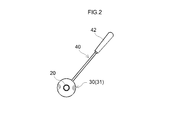
- FIG. 2 is a side view schematically showing an antibacterial treatment adhesive cleaner according to an embodiment.
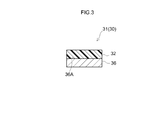
- FIG. 3 is a cross-sectional view schematically showing a dirt trapping portion constituting the antibacterial treatment adhesive cleaner according to the embodiment.
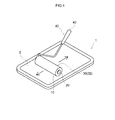
- FIG. 4 is a perspective view schematically showing an example of a usage mode of the antibacterial treatment adhesive cleaner according to the embodiment.
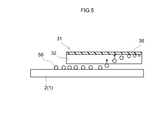
- FIG. 5 is a diagram schematically illustrating the recovery action of the dirt removing ability of the antibacterial treatment adhesive cleaner according to the embodiment.
- the article to be used for the antibacterial treatment adhesive cleaner disclosed herein is not particularly limited.
- Articles having a smooth surface are preferred. Examples of such articles include show window glass, glass tables, showcases, mirrors, water tanks, various displays (such as embedded or stationary types, or portable televisions and PC displays), touch panel display / input units (Such as a cash machine (ATM), an operation terminal of a car navigation system, a stationary or portable device such as a guide plate).
- Organic stains adhering to the smooth surfaces they have are unsightly and should be quickly removed as soon as they are found.
- the antibacterial treatment adhesive cleaner disclosed herein can be a preferred target for use.
- the portable device refers to a portable device, and is not limited to a specific device.
- Portable devices having a smooth surface (typically a smooth and flat surface) on at least a portion of the outer surface are preferred.
- portable PCs such as notebook PCs
- tablet information terminals such as electronic books, smartphones and other mobile phones
- portable game machines PDAs (personal digital assistants)
- electronic notebooks digital cameras
- digital photo frames and hand mirrors Since these are carried and used on a daily basis, dust and organic dirt such as hand dirt, cosmetics, and sebum are likely to adhere to them.
- Some of these portable devices have a smooth surface (typically a glass or synthetic resin surface) as a display surface such as a liquid crystal display or an organic EL display. If dirt is attached, it becomes difficult to see the information displayed on the display surface, which is not convenient. In addition, depending on the degree of organic soiling, it may give an unclean impression.
- a portable device having such a display surface can be a preferable use object of the antibacterial treatment adhesive cleaner disclosed herein.
- the device having a touch panel type display / input unit is directly touched by a user with a finger, the above-mentioned organic contamination is more likely to adhere.
- toe directly in this way a clean feeling and a sense of security can be given to a user by providing antibacterial property. Therefore, it can be a preferred target for use of the antibacterial treatment adhesive cleaner disclosed herein.
- tablet-type information terminals such as electronic books have a relatively large display surface, and are thus recognized as particularly preferred targets for use of the antibacterial treatment adhesive cleaner.
- the antibacterial treatment adhesive cleaner disclosed herein include smartphones and other mobile phones.
- the mobile phone comes into contact with the face when making a call with the mobile phone close to the ear or the mouth, and organic dirt such as sebum and cosmetics on the face tends to adhere.
- organic dirt such as sebum and cosmetics on the face tends to adhere.
- the antibacterial treatment adhesive cleaner is grasped as a particularly preferable target for use.
- an antibacterial treatment adhesive cleaner (hereinafter also simply referred to as a cleaner) 10 includes a cylindrical holding member (core) 20 and an adhesive sheet held on the outer peripheral surface of the holding member 20.
- the holding member 20 and the pressure-sensitive adhesive sheet roll 30 are integrally formed as a cylindrical rolling member.
- the material of the holding member is not particularly limited, and those made of polyolefin or other synthetic resin or paper can be preferably used.
- the cleaner 10 further includes a rod-shaped gripping member 40 that supports the holding member 20 in a rollable manner. Specifically, a central hole (not shown) is formed in the holding member 20 at a position that becomes the central axis of the cylinder, and an end (one end) of the gripping member 40 is inserted into the central hole. Thus, the holding member 20 is attached to the gripping member 40 so as to be rotatable. A handle 42 is attached to the other end of the gripping member 40.
- the material of the grip member and the handle is not particularly limited, and for example, a metal or synthetic resin can be used.
- the pressure-sensitive adhesive sheet roll 30 of the cleaner 10 is formed by winding a pressure-sensitive adhesive sheet 31 serving as a dirt capturing portion.
- the pressure-sensitive adhesive sheet (dirt capturing portion) 31 is arranged on a long sheet-like (band-like) support base material 36 and one surface 36 ⁇ / b> A of the support base material 36.
- a single-sided pressure-sensitive adhesive sheet 31 including the pressure-sensitive adhesive layer 32 is configured.
- the single-sided pressure-sensitive adhesive sheet 31 is formed as a pressure-sensitive adhesive sheet roll 30 by being wound so that the pressure-sensitive adhesive layer 32 is on the outside.
- the cleaner 10 is used for removing organic dirt adhered to the display unit 2 of the portable device 1 and antibacterial treatment of the surface of the display unit 2.
- the display unit 2 of the portable device 1 has a smooth and flat surface.
- the operator places the cleaner 10 on the display unit 2 of the portable device 1, grips the handle 42, and applies a predetermined external force to the cleaner 10. Then, the external force is transmitted from the gripping member 40 to the holding member 20, and the pressure-sensitive adhesive layer 32 of the pressure-sensitive adhesive sheet roll 30 disposed on the outer peripheral surface of the holding member 20 (the portion of the dirt catching portion that contacts the smooth surface) ) Moves on the display unit 2 while rolling.
- FIG. 4 the cleaner 10 is used for removing organic dirt adhered to the display unit 2 of the portable device 1 and antibacterial treatment of the surface of the display unit 2.
- the display unit 2 of the portable device 1 has a smooth and flat surface.
- the operator places the cleaner 10 on the display unit 2 of the portable device 1, grips the handle 42, and applies a predetermined external force
- the adhesive sheet roll 30 moves in the arrow direction on the display unit 2.
- the pressure-sensitive adhesive layer 32 captures dust and dirt present on the display unit 2 and particularly organic dirt (for example, sebum dirt such as hand dirt and fingerprints containing sebum).
- organic dirt for example, sebum dirt such as hand dirt and fingerprints containing sebum.
- cleaning (dirt removal) of the display unit 2 is easily and reliably performed along the rolling direction of the adhesive sheet roll 30 (more specifically, the adhesive sheet (dirt capturing unit) 31).
- at least a part of the antibacterial component (typically an organic antibacterial agent) in the pressure-sensitive adhesive layer 32 is the surface of the pressure-sensitive adhesive layer 32.
- the portable apparatus in this embodiment is a tablet-type information terminal in which the entire display unit is made of tempered glass such as aluminosilicate glass, the present invention is not limited to this, as described above.
- the size of the cylindrical pressure-sensitive adhesive sheet roll is not particularly limited, but when the target of use is a portable device such as a tablet-type information terminal, the diameter (which means a diameter (outer diameter) when not in use; the same applies hereinafter) is 4 mm or more. (More preferably, 10 mm or more, for example, 15 mm or more, typically 20 mm or more). From the viewpoint of operability and portability, the diameter is preferably 50 mm or less (for example, 35 mm or less, typically 30 mm or less).
- the pressure-sensitive adhesive sheet constituting the pressure-sensitive adhesive sheet roll is provided with a cut line (not shown) for each length corresponding to substantially one round of the roll.
- This break is caused by renewing the surface of the adhesive layer (outer surface of the dirt trapping part) whose cleaning (dirt removal) performance and performance to impart antibacterial properties to the surface to be cleaned have deteriorated after using the cleaner several times.
- It is a cutting means for performing efficiently.
- the cut may be, for example, a long hole or corrugated slit arranged, an intermittent slit such as a perforation.
- the cut is preferably provided so as to cross the pressure-sensitive adhesive sheet in the width direction (direction perpendicular to the longitudinal direction).
- the update of the outer surface (outer peripheral surface) of the dirt capturing unit is not limited to the cutting means.
- intermittent slits such as perforations are formed in a spiral shape in a direction that intersects the sheet winding direction of the adhesive sheet roll (typically, a direction that intersects with the width direction at an angle of 30 ° to 60 °). It may be left.
- slits continuous cuts may be made at predetermined intervals in the adhesive sheet constituting the adhesive sheet roll.
- the pressure-sensitive adhesive sheet constituting the pressure-sensitive adhesive sheet roll is completely cut at predetermined intervals in the roll winding direction in advance, so that the outer surface of the pressure-sensitive adhesive sheet roll can be easily peeled off at each predetermined interval.
- the outer surface can be updated.
- the cleaner 10 can be produced by appropriately adopting a conventionally known method.
- the pressure-sensitive adhesive sheet roll 30 of the cleaner 10 can be produced by the same method as that of a conventional roll-shaped cleaner. That is, the pressure-sensitive adhesive layer 32 is formed by applying a pressure-sensitive adhesive composition on the surface 36A of the long sheet-like support base 36 by various conventionally known coating means, and performing a drying treatment or the like as necessary. Form.
- a hot-melt adhesive thermoplastic adhesive
- the adhesive composition is coated with a heat-melted adhesive, and the adhesive is typically allowed to cool to near room temperature. An agent layer can be formed. Therefore, the drying process can be omitted.
- the roll-shaped adhesive sheet roll 30 is formed by winding the adhesive sheet 31 around the holding member 20 so that the adhesive layer 32 may become an outer peripheral surface.
- the cleaner 10 is constructed by attaching the end of the gripping member 40 to the holding member 20 so as to be able to roll.
- the mounting structure itself of the gripping member 40 to the holding member 20 can be the same structure as a conventional roll-shaped cleaner, and does not characterize the present invention, and thus detailed description thereof is omitted.
- the adhesive cleaner is not limited to the one in the above embodiment.
- the adhesive cleaner may be composed of, for example, only a dirt catcher.
- a cleaner composed only of a dirt trapping part such as a spherical shape, a columnar shape, a cylindrical shape, a hexahedral shape (for example, a rectangular parallelepiped shape), a sheet shape, and the like can be mentioned.
- the dirt capturing part is composed of the support base material and the pressure-sensitive adhesive layer, but is not limited to this.
- the dirt capturing part may be formed only from an adhesive (baseless adhesive).
- the shape of the support base material is not particularly limited.
- the dirt trapping part may be one in which an adhesive layer is formed on the outer surface of a spherical support substrate.
- the holding member supported the holding member so that rolling was possible, it is not limited to this.
- the grip member may be connected (connected or detachably connected) directly or indirectly to the dirt capturing unit.
- an adhesive cleaner for example, a stick-shaped gripping member having a columnar or rectangular parallelepiped-shaped adhesive body fixed to one end thereof can be mentioned.
- the gripping member may have a flat portion, and the dirt catching portion may be fixed to one surface of the flat portion.
- the pressure-sensitive adhesive provided in the cleaner disclosed herein is not limited as long as it can capture organic dirt by contacting the surface to be cleaned and can impart antibacterial properties to the surface to be cleaned.
- it may be a pressure-sensitive adhesive formed from a pressure-sensitive adhesive composition in the form of a water-soluble pressure-sensitive adhesive composition, an aqueous pressure-sensitive adhesive composition such as a water-dispersed pressure-sensitive adhesive composition, or a solvent-type pressure-sensitive adhesive composition.
- a solventless pressure-sensitive adhesive formed from an active energy ray (for example, ultraviolet ray) curable pressure-sensitive adhesive composition or a hot-melt pressure-sensitive adhesive composition can also be preferably used.
- a pressure-sensitive adhesive formed from a solvent-based pressure-sensitive adhesive composition or a solventless pressure-sensitive adhesive can be preferably used. From the viewpoint of productivity and handleability of the pressure-sensitive adhesive composition, a hot melt pressure-sensitive adhesive is preferable.
- the pressure-sensitive adhesive can be, for example, an acrylic pressure-sensitive adhesive, a rubber-based pressure-sensitive adhesive (for example, a natural rubber-based pressure-sensitive adhesive), a urethane-based pressure-sensitive adhesive, or a silicone-based pressure-sensitive adhesive.
- a rubber adhesive or an acrylic adhesive can be preferably employed.
- the acrylic pressure-sensitive adhesive refers to a pressure-sensitive adhesive having an acrylic polymer as a base polymer (a main component of polymer components, that is, a component contained in excess of 50% by weight). This also applies to rubber-based and other adhesives.
- the cleaner disclosed herein typically exhibits both the function of removing organic dirt from the surface to be cleaned and the ability to impart antibacterial properties to the surface to be cleaned by the same adhesive. Can be configured.
- the technology disclosed herein can be preferably implemented in an embodiment in which the pressure-sensitive adhesive is an acrylic pressure-sensitive adhesive having an acrylic polymer as a base polymer.
- the acrylic polymer can be synthesized from a monomer raw material containing an alkyl (meth) acrylate having an alkyl group as a main monomer.
- the main monomer refers to a monomer component that accounts for more than 50% by weight of the total monomer components.
- (meth) acrylate” means acrylate and methacrylate comprehensively.
- (meth) acryloyl refers to acryloyl and methacryloyl
- (meth) acryl generically refers to acrylic and methacryl.
- the acrylic polymer may be a random copolymer, a block copolymer, a graft copolymer, or the like. Random copolymers and block copolymers are mentioned as preferred acrylic polymers from the viewpoint of ease of production and handleability.
- An acrylic polymer can be used individually by 1 type or in combination of 2 or more types.
- An acrylic polymer includes an acrylic random copolymer synthesized from a monomer raw material containing an alkyl (meth) acrylate having an alkyl group as a main monomer.
- R 1 in the general formula (1) is a hydrogen atom or a methyl group.
- R 2 is an alkyl group having 1 to 20 carbon atoms (hereinafter, such a range of the number of carbon atoms may be represented as “C 1-20 ”).
- an alkyl (meth) acrylate having a C 1-14 (for example, C 1-10 ) alkyl group is preferable.
- the alkyl group may be a chain (meaning including a straight chain and a branched chain), and may include a cyclic structure.
- alkyl (meth) acrylate having a C 1-20 alkyl group examples include methyl (meth) acrylate, ethyl (meth) acrylate, n-propyl (meth) acrylate, isopropyl (meth) acrylate, n-butyl ( (Meth) acrylate, isobutyl (meth) acrylate, s-butyl (meth) acrylate, t-butyl (meth) acrylate, n-pentyl (meth) acrylate, isoamyl (meth) acrylate, neopentyl (meth) acrylate, n-hexyl ( (Meth) acrylate, cyclohexyl (meth) acrylate, n-heptyl (meth) acrylate, n-octyl (meth) acrylate, isooctyl (meth) acrylate, 2-ethyl
- the monomer raw material preferably contains an alkyl (meth) acrylate having a C 4-14 chain alkyl group as a main monomer.
- an alkyl (meth) acrylate having a C 6-12 chain alkyl group as a main monomer, better organic soil removability tends to be realized.
- alkyl (meth) acrylates include 2-ethylhexyl acrylate (2EHA), isooctyl acrylate (IOA), isononyl acrylate (INA), and lauryl methacrylate. Of these, 2EHA, IOA and INA are preferable, and 2EHA is particularly preferable.
- the ratio of the main monomer in the total monomer components constituting the acrylic random copolymer is preferably 60% by weight or more, more preferably 80% by weight or more, and further preferably 90% by weight or more. preferable.
- the upper limit of the ratio of the main monomer in the total monomer components is not particularly limited, but is usually 99% by weight or less (for example, 98% by weight or less, typically from the viewpoint of easy adjustment of adhesive performance (adhesive strength, cohesive strength, etc.). Specifically, it is preferably 95% by weight or less).
- the acrylic random copolymer may be obtained by polymerizing only the main monomer.
- the monomer raw material used for polymerizing the acrylic random copolymer may be a submonomer (which may be an oligomer) copolymerizable with the main monomer, in addition to the main monomer, for the purpose of adjusting the adhesion performance. May further be included.
- a submonomer include a monomer having a functional group (hereinafter also referred to as a functional group-containing monomer).
- the functional group-containing monomer can be added for the purpose of introducing a crosslinking point into the acrylic polymer and easily adjusting the adhesive performance (adhesive strength, cohesive strength, etc.).
- Such functional group-containing monomers include carboxy group-containing monomers, acid anhydride group-containing monomers, hydroxy group (hydroxyl group) -containing monomers, amide group-containing monomers, amino group-containing monomers, epoxy group (glycidyl group) -containing monomers, alkoxy And group-containing monomers and alkoxysilyl group-containing monomers. These can be used alone or in combination of two or more.
- functional groups such as a carboxy group-containing monomer, a hydroxy group-containing monomer, and an epoxy group-containing monomer can be suitably introduced into the acrylic polymer and the crosslinking density of the pressure-sensitive adhesive can be easily adjusted. Containing monomers are preferable, and carboxy group-containing monomers or hydroxy group-containing monomers are more preferable.
- carboxy group-containing monomer examples include ethylenically unsaturated monocarboxylic acids such as acrylic acid, methacrylic acid, crotonic acid, carboxyethyl (meth) acrylate, carboxypentyl (meth) acrylate, itaconic acid, maleic acid, fumaric acid, And ethylenically unsaturated dicarboxylic acids such as citraconic acid.
- ethylenically unsaturated monocarboxylic acids such as acrylic acid, methacrylic acid, crotonic acid, carboxyethyl (meth) acrylate, carboxypentyl (meth) acrylate, itaconic acid, maleic acid, fumaric acid, And ethylenically unsaturated dicarboxylic acids such as citraconic acid.
- acrylic acid and / or methacrylic acid are preferable, and acrylic acid is particularly preferable.
- Examples of the acid anhydride group-containing monomer include acid anhydrides such as the above-mentioned ethylenically unsaturated dicarboxylic acids such as maleic anhydride and itaconic anhydride.
- Examples of the hydroxy group (hydroxyl group) -containing monomer include 2-hydroxyethyl (meth) acrylate, 2-hydroxypropyl (meth) acrylate, 3-hydroxypropyl (meth) acrylate, 2-hydroxybutyl (meth) acrylate, 4-hydroxy Hydroxyalkyl (meth) acrylates such as butyl (meth) acrylate, and unsaturated alcohols such as N-methylol (meth) acrylamide, vinyl alcohol, allyl alcohol, 2-hydroxyethyl vinyl ether, 4-hydroxybutyl vinyl ether, diethylene glycol monovinyl ether And the like.
- Examples of amide group-containing monomers include (meth) acrylamide, N, N-dimethyl (meth) acrylamide, N-butyl (meth) acrylamide, N-methylol (meth) acrylamide, N-methylolpropane (meth) acrylamide, N- Examples include methoxymethyl (meth) acrylamide and N-butoxymethyl (meth) acrylamide.
- Examples of the amino group-containing monomer include aminoethyl (meth) acrylate, N, N-dimethylaminoethyl (meth) acrylate, t-butylaminoethyl (meth) acrylate, and the like.
- Examples of the epoxy group (glycidyl group) -containing monomer include glycidyl (meth) acrylate, methyl glycidyl (meth) acrylate, and allyl glycidyl ether.
- Examples of the alkoxy group-containing monomer include methoxyethyl (meth) acrylate and ethoxyethyl (meth) acrylate.
- Examples of the alkoxysilyl group-containing monomer include 3- (meth) acryloxypropyltrimethoxysilane, 3- (meth) acryloxypropyltriethoxysilane, 3- (meth) acryloxypropylmethyldimethoxysilane, and 3- (meth). Examples include acryloxypropylmethyldiethoxysilane.
- the functional group-containing monomer preferably a carboxy group-containing monomer
- the functional group-containing monomer is 1 to 10% by weight (for example, 2 to 8%) in all monomer components for polymerizing the acrylic polymer. % By weight (typically 3 to 7% by weight).
- a monomer other than the functional group-containing monomer may be included for the purpose of increasing the cohesive strength of the acrylic polymer.
- examples of such monomers include vinyl ester monomers such as vinyl acetate and vinyl propionate; aromatic vinyl compounds such as styrene, substituted styrene ( ⁇ -methylstyrene and the like), vinyl toluene, and the like.
- the method for synthesizing the acrylic polymer (acrylic random copolymer) from the monomer raw material is not particularly limited, and a conventionally known general polymerization method such as solution polymerization, emulsion polymerization, bulk polymerization, suspension polymerization or the like is appropriately employed. be able to.
- the mode of polymerization is not particularly limited, and a conventionally known monomer supply method, polymerization conditions (temperature, time, pressure, etc.), and use components other than the monomer (polymerization initiator, surfactant, etc.) can be appropriately selected and carried out. it can.
- the polymerization initiator is not particularly limited.
- an azo initiator such as 2,2′-azobisisobutyronitrile, a peroxide initiator such as benzoyl peroxide, and a substituted ethane type such as phenyl substituted ethane.
- examples include initiators, redox initiators in which a peroxide and a reducing agent are combined (for example, a combination of peroxide and sodium ascorbate).
- the amount of the polymerization initiator used can be appropriately selected according to the type of polymerization initiator, the type of monomer (composition of the monomer mixture), and the like.
- the amount of the polymerization initiator used is usually suitably selected from a range of, for example, about 0.005 to 1 part by weight with respect to 100 parts by weight of all monomer components.
- the polymerization temperature can be, for example, about 20 ° C. to 100 ° C. (typically 40 ° C. to 80 ° C.).
- the weight average molecular weight (Mw) of the acrylic random copolymer is not particularly limited.
- an acrylic random copolymer having an Mw of about 300,000 to 1,000,000 can be suitably used as the base polymer.
- the pressure-sensitive adhesive may be formed from a solvent-type pressure-sensitive adhesive composition containing an acrylic random copolymer having a Mw in the above range as a base polymer.
- the acrylic polymer has a hard segment (A) (hereinafter also referred to as “A block”) and a soft segment (B) (hereinafter also referred to as “B block”) in one molecule.
- a block a hard segment
- B block a soft segment
- the hard segment (A) refers to a relatively hard block in relation to the soft segment (B) in the acrylic copolymer in the structure of the acrylic block copolymer.
- the soft segment (B) refers to a relatively soft block in the relationship with the hard segment (A) in the structure of the acrylic block copolymer.
- the acrylic block copolymer may exhibit the properties of a thermoplastic polymer (typically a thermoplastic elastomer).
- the pressure-sensitive adhesive disclosed herein can be a pressure-sensitive adhesive (hot-melt pressure-sensitive adhesive) suitable for coating in a hot-melt format by including the acrylic block copolymer as a base polymer.
- the hot-melt adhesive is preferable from the viewpoint of reducing the environmental load because it can reduce the amount of the organic solvent used compared to a general organic solvent-type acrylic adhesive.
- the acrylic block copolymer is a monomer having at least one (meth) acryloyl group in one molecule (hereinafter referred to as “acrylic monomer”) as a monomer unit (constituent monomer component) constituting the copolymer.
- acrylic monomer a monomer having at least one (meth) acryloyl group in one molecule
- an acrylic block copolymer in which 50% by weight or more of all monomer units are monomer units derived from an acrylic monomer is preferable.
- Such an acrylic block copolymer can be preferably synthesized from, for example, a monomer raw material containing an alkyl (meth) acrylate having an alkyl group as a main monomer.
- the acrylic block copolymer one having at least one acrylate block (hereinafter also referred to as Ac block) and at least one methacrylate block (hereinafter also referred to as MAc block) can be preferably used.
- Ac block acrylate block
- MAc block methacrylate block
- a block copolymer having a structure in which Ac blocks and MAc blocks are alternately arranged is preferable.
- the total number of blocks of Ac blocks and MAc blocks contained in one molecule of polymer can be, for example, about 2.5 to 5 on average (for example, about 2.7 to 3.3, typically about 3).
- the above-mentioned Ac block typically has alkyl acrylate as the main monomer. That is, it is preferable that 50% by weight or more of all monomer units constituting the Ac block are monomer units derived from alkyl acrylate. 75 weight% or more (for example, 90 weight% or more) of the monomer unit may be derived from alkyl acrylate.
- the Ac block contained in the acrylic block copolymer is a polymer substantially composed of one or more (typically one) alkyl acrylate.
- the Ac block may be a copolymer of an alkyl acrylate and another monomer (for example, alkyl methacrylate).
- alkyl acrylate constituting the Ac block examples include alkyl acrylates having an alkyl group having 1 to 20 carbon atoms (preferably 4 to 14, for example, 6 to 12).
- alkyl acrylates having an alkyl group having 1 to 20 carbon atoms preferably 4 to 14, for example, 6 to 12.
- IOA isooctyl acrylate
- 2EHA 2-ethylhexyl acrylate
- INA decyl acrylate
- lauryl acrylate stearyl acrylate
- stearyl acrylate and
- 50% by weight or more of the monomers constituting the Ac block is an alkyl acrylate having 4 to 14 carbon atoms in the alkyl group.
- the proportion of the alkyl acrylate having 4 to 14 carbon atoms in the alkyl group may be 75% by weight or more, or substantially 100% by weight (for example, more than 99% by weight and 100% by weight or less).
- a constitution in which the monomer unit constituting the Ac block is substantially BA alone, a constitution in which 2EHA is alone, a constitution comprising two types of BA and 2EHA, and the like can be preferably employed.
- the weight ratio of BA to 2EHA is not particularly limited and is, for example, 10/90 to 90/10, preferably 80/20 to 20/80, more preferably 30/70 to 70/30, for example 60/40 to 40 / 60.
- the MAc block typically has alkyl methacrylate as the main monomer. Of all the monomer units constituting the MAc, 75% by weight or more (for example, 90% by weight or more) may be derived from alkyl methacrylate.
- the MAc block contained in the acrylic block copolymer is a polymer consisting essentially of one or more (typically one) alkyl methacrylate.
- the MAc block may be a copolymer of alkyl methacrylate and another monomer (for example, alkyl acrylate).
- alkyl methacrylate constituting the MAc block examples include alkyl methacrylates having 1 to 20 (preferably 1 to 14) carbon atoms in the alkyl group. Specific examples thereof include, for example, methyl methacrylate, ethyl methacrylate, n-propyl methacrylate, isopropyl methacrylate, n-butyl methacrylate, isobutyl methacrylate, tert-butyl methacrylate, n-pentyl methacrylate, n-hexyl methacrylate, n-heptyl methacrylate, Examples thereof include n-octyl methacrylate, isooctyl methacrylate, 2-ethylhexyl methacrylate, n-nonyl methacrylate, isononyl methacrylate, decyl methacrylate, lauryl methacrylate, stearyl methacrylate and the like. These can
- 50% by weight or more of the monomers constituting the MAc block is alkyl methacrylate having 1 to 4 (preferably 1 to 3) carbon atoms in the alkyl group.
- the proportion of the alkyl methacrylate having 1 to 4 carbon atoms in the alkyl group may be 75% by weight or more, or substantially 100% by weight (for example, more than 99% by weight and 100% by weight or less).
- preferred alkyl methacrylates include methyl methacrylate (MMA) and ethyl methacrylate (EMA).
- MMA methyl methacrylate
- EMA ethyl methacrylate
- a configuration in which the monomer unit is substantially MMA alone, a configuration in which the monomer unit is EMA alone, a configuration composed of two types of MMA and EMA, and the like can be preferably employed.
- the acrylic block copolymer is composed of an A block (hard segment (A)) made of a polymer having a hard structure excellent in cohesion and elasticity, such as AB type, ABA type, ABAB type, and ABABA type.
- the B block (soft segment (B)) made of a polymer having a soft structure excellent in the structure may be copolymerized so as to be alternately arranged.
- the pressure-sensitive adhesive using the acrylic block copolymer having such a structure as a base polymer can form a pressure-sensitive adhesive layer in which cohesive force, elasticity and viscosity are highly compatible.
- the adhesive of this composition can be preferably used as a hot melt adhesive.
- An acrylic block copolymer (ABA type, ABABA type, etc.) having a structure in which A blocks are arranged at both ends of the molecule can be preferably used.
- An acrylic block copolymer having such a structure is preferable because it tends to have a good balance between cohesiveness and thermoplasticity. From the viewpoint of reducing the melt viscosity, a linear acrylic block copolymer is more advantageous than a star structure or a branched structure.
- the acrylic block copolymer has two or more A blocks
- the monomer composition, molecular weight (degree of polymerization), structure, etc. of these A blocks may be the same or different.
- the MAc block as described above can be preferably used.
- the B block the Ac block as described above can be preferably adopted.
- the acrylic block copolymer is a triblock copolymer having a MAc block-Ac block-MAc block (ABA type) structure.
- ABA type MAc block-Ac block-MAc block
- such a triblock copolymer in which two MAc blocks have substantially the same monomer composition can be preferably employed.
- the acrylic block copolymer in the technology disclosed herein preferably has an Ac block containing an alkyl acrylate having an alkyl group having 6 or more carbon atoms (for example, 6 to 12) as a soft segment (B).
- the proportion of the alkyl acrylate having 6 or more carbon atoms in the alkyl group can be, for example, 10% by weight or more, preferably 20% by weight or more, more preferably 30%. % By weight or more, more preferably 40% by weight or more.
- an acrylic block copolymer having, as a soft segment (B), an Ac block having an alkyl acrylate having an alkyl group having 6 or more carbon atoms (for example, 6 to 12) as a main monomer can be used. That is, it is preferable that 50% by weight or more of the monomer units constituting the Ac block is occupied by one or more alkyl acrylates having 6 or more carbon atoms in the alkyl group.
- the proportion of the alkyl acrylate having 6 or more carbon atoms in the alkyl group can be, for example, 55% by weight or more, and may be 60% by weight or more.
- an acrylic block copolymer having an Ac block whose monomer unit constituting the Ac block is 2EHA alone as the soft segment (B) is preferable.
- alkyl acrylate having 6 or more carbon atoms in the alkyl group include 2-ethylhexyl acrylate (2EHA), n-octyl acrylate, isononyl acrylate, n-hexyl acrylate and the like.
- An acrylic block copolymer having an Ac block containing an alkyl acrylate having 6 or more carbon atoms in the alkyl group as the soft segment (B) can be excellent in organic soil scavenging. Therefore, for example, higher fingerprint removal performance can be realized in the fingerprint removal evaluation described later.
- An acrylic block copolymer having an Ac block containing an alkyl acrylate having an alkyl group with 6 or more carbon atoms as the soft segment (B) can be excellent in compatibility with a plasticizer. This is preferable from the viewpoint of suppressing bleed-out of the plasticizer in the pressure-sensitive adhesive having a composition containing the copolymer and the plasticizer. Moreover, since more plasticizers can be contained appropriately, there are advantages that the degree of freedom in setting the blending amount of the plasticizer is high and the adhesive force can be easily adjusted.
- An acrylic block copolymer having an Ac block composed of monomer units contained in a weight ratio of (2) as a soft segment (B) can be used.
- Such an acrylic block copolymer can be excellent in the balance between organic soil removal and aggregation.
- an acrylic block copolymer having an Ac block composed of monomer units containing 2EHA and BA in the above weight ratio as the soft segment (B) can be preferably used.
- the monomer unit may be a monomer unit consisting only of 2EHA and BA.
- the weight ratio of the hard segment (A) and the soft segment (B) contained in the acrylic block copolymer is not particularly limited.
- the weight ratio (A / B) of the hard segment (A) / soft segment (B) can be in the range of 4/96 to 90/10, and is usually in the range of 7/93 to 70/30. It is preferable that the range is 10/90 to 50/50 (more preferably 15/85 to 40/60, for example, 15/85 to 25/75).
- the weight ratio of the total weight of the hard segments (A) to the soft segments (B) is preferably in the above range. The same applies to an acrylic block copolymer containing two or more soft segments (B).
- the ratio of the hard segment (A) for example, MAc block
- the adhesive strength tends to decrease, and light peelability tends to be obtained.
- the proportion of the soft segment (B) for example, the Ac block
- the organic dirt capturing performance tends to be improved.
- the monomer raw material corresponding to all monomer units constituting the acrylic block copolymer is an alkyl (meth) alkyl group having 1 to 3 carbon atoms.
- the weight ratio (X / Y) of alkyl (meth) acrylate (X) / alkyl (meth) acrylate (Y) can be, for example, 4/96 to 90/10.
- Acrylic block copolymers having a weight ratio of 7/93 to 70/30 are preferred, those having 10/90 to 50/50 are more preferred, and those having 15/85 to 40/60 are more preferred. Those having a ratio of 15/85 to 30/70 (for example, 15/85 to 25/75) are particularly preferable.
- ratios of alkyl (meth) acrylate (X) there exists a tendency for adhesive force to fall and to obtain light peelability easily.
- the ratio of the alkyl (meth) acrylate (Y) is large, the organic dirt capturing performance tends to be improved.
- the alkyl (meth) acrylate (X) is preferably an alkyl methacrylate having an alkyl group having 1 to 3 carbon atoms.
- the alkyl (meth) acrylate (Y) is preferably an alkyl acrylate having an alkyl group with 6 or more carbon atoms (for example, 6 to 12).
- monomer raw materials corresponding to all monomer units constituting the acrylic block copolymer are methyl methacrylate (MMA) and 2-ethylhexyl acrylate (2EHA).
- MMA / 2EHA 2-ethylhexyl acrylate
- the weight ratio of their contents is 4/96 to 90/10.
- Acrylic block copolymers having a weight ratio of 7/93 to 70/30 are preferred, those having 10/90 to 60/40 are more preferred, those having 20/80 to 50/50 are more preferred, Those having 25/75 to 40/60 (for example, 25/75 to 35/65) are particularly preferred.
- the ratio of MMA is large, the adhesive strength is reduced, and light peelability tends to be easily obtained.
- the ratio of 2EHA is large, the organic dirt capturing performance tends to be improved.
- composition of the monomer unit which comprises an acrylic block copolymer can be grasped
- the NMR measurement can be performed under the following conditions using, for example, “AVAVCEIII-600 (with Cryo Probe)” manufactured by Bruker Biospin as an NMR apparatus.
- the weight ratio of 2EHA and MMA contained in the monomer raw material can be calculated based on the peak integrated intensity ratio of 4.0 ppm (2EHA1) and 3.6 ppm (MMA1) in the 1 H NMR spectrum.
- Mw of the acrylic block copolymer is not particularly limited.
- an acrylic block copolymer having an Mw of about 3 ⁇ 10 4 to 30 ⁇ 10 4 can be preferably used.
- the Mw of the acrylic block copolymer is usually preferably in the range of about 3.5 ⁇ 10 4 to 25 ⁇ 10 4 , for example 4 ⁇ 10 4 to 20 ⁇ 10 4 (for example, 4.5 ⁇ 10 4 to 15 ⁇ 10 4 ).
- the range of 4 ) is more preferable.
- Increasing the Mw of the acrylic block copolymer is advantageous from the viewpoints of improving adhesive properties (for example, cohesiveness) and improving organic dirt capturing properties.
- the Mw of the acrylic block copolymer increases, the amount of the plasticizer that can be appropriately contained tends to increase.
- lowering the Mw of the acrylic block copolymer is advantageous from the viewpoint of reducing the viscosity (for example, melt viscosity) of the pressure-sensitive adhesive. Reducing the melt viscosity of the pressure-sensitive adhesive is particularly significant in a hot-melt type pressure-sensitive adhesive.
- the Mw of the acrylic block copolymer referred to here is a polystyrene equivalent value obtained by performing gel permeation chromatography (GPC) measurement on a sample prepared by dissolving the copolymer in tetrahydrofuran (THF).
- GPC gel permeation chromatography
- THF tetrahydrofuran
- the GPC measurement can be performed under the following conditions using, for example, “HLC-8120GPC” manufactured by Tosoh Corporation as a GPC measurement apparatus.
- the acrylic block copolymer in the technology disclosed herein may be copolymerized with monomers other than alkyl acrylate and alkyl methacrylate (other monomers).
- the other monomers include vinyl compounds having functional groups such as alkoxy groups, epoxy groups, hydroxy groups, amino groups, amide groups, cyano groups, carboxy groups, and acid anhydride groups, vinyl esters such as vinyl acetate, styrene, etc.
- aromatic vinyl compounds, vinyl group-containing heterocyclic compounds such as N-vinylpyrrolidone, and the like.
- alkyl acrylates, fluorinated alkyl acrylates and fluorinated alkyl methacrylates having a structure in which a fluorinated alkyl group is bonded to an acryloyl group can be mentioned.
- the other monomer can be used, for example, for the purpose of adjusting the properties (adhesive properties, moldability, etc.) of the pressure-sensitive adhesive layer, and its content is 20% by weight of the total monomer components constituting the acrylic block copolymer. It is appropriate to use the following (for example, 10% by weight or less, typically 5% by weight or less).
- the acrylic block copolymer contains substantially no other monomer.
- an acrylic block copolymer in which the content of the other monomer is less than 1% by weight (typically 0 to 0.5% by weight) of the total monomer components or below the detection limit is preferable.
- Such an acrylic block copolymer can be easily synthesized by a known method (for example, see Japanese Patent Application Publication No. 2001-234146 and Japanese Patent Application Publication No. 11-323072). Or a commercial item can be obtained easily.
- Examples of the above-mentioned commercially available products include Kuraray's product name “Clarity” series (for example, products having product numbers such as LA2140e and LA2250), Kaneka's product name “NABSTAR”, and the like.
- a method for synthesizing the acrylic block copolymer a method utilizing a living polymerization method can be preferably employed.
- the living polymerization method it is possible to synthesize an acrylic block copolymer excellent in thermoplasticity by maintaining the original weather resistance of the acrylic polymer and by controlling the structure unique to the living polymerization method.
- a pressure-sensitive adhesive and hence a pressure-sensitive adhesive sheet (dirt trapping part)
- excellent in light release property can be realized while suppressing the lack of cohesiveness due to the presence of low molecular weight components.
- the acrylic block copolymer can be used alone or in combination of two or more.
- an acrylic block copolymer (H) having a relatively high Mw and an acrylic block copolymer (L) having a lower Mw than the acrylic block copolymer (H) at an appropriate weight ratio. Can be used.
- the acrylic block copolymer (H) / acrylic block is usually used.
- the copolymer (L) is preferably used in a range where the weight ratio (H / L) is 5/95 to 95/5 (preferably 10/90 to 90/10).
- the individual Mw of the acrylic block copolymer used in combination as described above is preferably in the range of 3 ⁇ 10 4 to 30 ⁇ 10 4 .
- a combination with the acrylic block copolymer (L) in the range of 4 and lower than the Mw of the acrylic block copolymer (H) is preferred.
- an acrylic block copolymer (H) having a Mw in the range of 6 ⁇ 10 4 to 15 ⁇ 10 4 (for example, 7 ⁇ 10 4 to 15 ⁇ 10 4 ) and Mw of 4 ⁇ 10 4 to A combination with the acrylic block copolymer (L) in the range of 6 ⁇ 10 4 and lower than the Mw of the acrylic block copolymer (H) is exemplified.
- the weight ratio (H / L) of these acrylic block copolymers can be, for example, 40/60 to 90/10. In a preferred embodiment, the weight ratio (H / L) can be 45/65 to 90/10, 55/45 to 90/10, and 65/35 to 85/15 (for example, 75 / 25 to 85/15).
- the pressure-sensitive adhesive in the technology disclosed herein further contains an antibacterial agent in addition to the base polymer as described above.
- the type of antibacterial agent is not particularly limited, and various antibacterial agents that can exhibit a function of imparting antibacterial properties to the surface to be cleaned can be used by bringing a pressure-sensitive adhesive containing the antibacterial agent into contact with the surface to be cleaned.
- Either an organic antibacterial agent or an inorganic antibacterial agent can be used, and an organic antibacterial agent and an inorganic antibacterial agent may be used in combination.
- inorganic antibacterial agents such as silver, copper, zinc, tin, lead and gold can be used singly or in combination of two or more.
- Zeolite, hydroxyapatite, calcium carbonate, silica gel, calcium aluminum silicate, polysiloxane compound, zirconium phosphate, zirconium sulfate, ion exchanger, zinc oxide, etc. can be used as a carrier for these inorganic antibacterial agents as necessary. .
- organic antibacterial agents examples include known synthetic organic antibacterial agents and natural organic antibacterial agents.
- synthetic organic antibacterial agents include alcohols, phenols, aldehydes, carboxylic acids, esters, ethers, nitriles, peroxides, halogens, pyridine / quinoline, triazines, isothiazolones, Examples thereof include synthetic organic antibacterial agents such as imidazole / thiazole, anilide, biguanide, disulfide, thiocarbamate, surfactant, and organometallic.
- natural organic antibacterial agents include natural organic materials such as hinokithiol, mugwort extract, aloe extract, perilla leaf extract, garlic extract, dokudami, licorice, camellia plant extract, mustard extract, wasabi extract, bamboo extract, etc. Antibacterial agents are included.
- An organic antibacterial agent can be used individually by 1 type or in combination of 2 or more types.
- the technique disclosed herein can be preferably implemented in a mode in which the pressure-sensitive adhesive contains at least an organic antibacterial agent.
- organic antibacterial agents tend to move inside the adhesive more easily than inorganic antibacterial agents. Therefore, the pressure-sensitive adhesive containing at least an organic antibacterial agent as the antibacterial agent can be advantageous from the viewpoint of the transferability of the antibacterial component from the cleaner to the surface to be cleaned and the sustainability of the antibacterial effect of the cleaner.
- the pressure-sensitive adhesive may be a pressure-sensitive adhesive containing only an organic antibacterial agent as the antibacterial agent.
- a surfactant-based organic antibacterial agent can be preferably used as the antibacterial agent contained in the pressure-sensitive adhesive.
- surfactant-based organic antibacterial agents include cationic surfactants that can function as organic antibacterial agents and amphoteric surfactants (for example, alkylpolyaminoethylglycine hydrochloride, sodium alkyldiaminoethylglycine, etc.).
- amphoteric surfactants for example, alkylpolyaminoethylglycine hydrochloride, sodium alkyldiaminoethylglycine, etc.
- the technology disclosed herein can be preferably implemented in an embodiment using a cationic surfactant as the organic antibacterial agent.
- a compound (quaternary ammonium salt) represented by the following general formula (2) can be preferably used.
- R 11 to R 14 in the general formula (2) are each independently selected from hydrocarbon groups having 1 to 18 carbon atoms.
- R 11 is an alkyl group having 8 to 18 carbon atoms, an aryl group or an arylalkyl group
- R 12 is an alkyl group having 1 to 18 carbon atoms
- R 13 and R 14 are 1 to 4 alkyl groups are preferred.
- R 11 to R 14 may be the same or different.
- X ⁇ in the general formula (2) is a counter ion, which may be an organic anion or an inorganic anion.
- organic anion include methanesulfonic acid anion, trifluoromethanesulfonic acid anion, nonafluorobutanesulfonic acid anion, p-toluenesulfonic acid anion, and the like.
- inorganic anions include halide ions such as fluorine ions, chlorine ions and bromine ions, as well as hydroxy ions, nitrate ions, sulfate ions, tetrafluoroborate ions, hexafluorophosphate ions and the like.
- the compound represented by the general formula (2) include didecyldimethylammonium trifluoromethanesulfonate, didecyldimethylammonium chloride, didecyldimethylammonium tetrafluoroborate, benzalkonium chloride, and the like.
- X in the general formula (2) - is a divalent anion, it may be used a compound containing two quaternary ammonium cation as a counter ion as an organic antimicrobial agent. An example of such a compound is didecyldimethylammonium adipate.
- a cationic organic antibacterial agent typically a quaternary ammonium salt type organic antibacterial agent
- a compound represented by the general formula (2) such as hexadecylpyridinium chloride
- the technique disclosed herein can be preferably implemented in an embodiment using didecyldimethylammonium trifluoromethanesulfonate as the organic antibacterial agent.
- an antibacterial agent having low volatility can be preferably employed from the viewpoint of the persistence of the antibacterial effect after moving to the surface to be cleaned.
- a hot-melt adhesive composition containing an antibacterial agent or an adhesive composition in the form of containing an adhesive component in a volatile medium solvent adhesive composition, water-dispersed adhesive composition, etc.
- decomposition start temperature is 150 degreeC or more (more preferably 180 degreeC or more, more preferably 200 degreeC or more, for example, 230 degreeC or more). Those can be preferably employed.
- the decomposition start temperature can be grasped by performing differential scanning calorimetry (DSC) under a temperature rising rate of 10 ° C./min.
- DSC differential scanning calorimetry
- a hot-melt adhesive composition containing an antibacterial agent or an adhesive composition in the form of containing an adhesive component in a volatile medium solvent adhesive composition, water-dispersed adhesive composition, etc.
- the content of the antibacterial agent in the adhesive is not particularly limited.
- the content of the antibacterial agent is determined by bringing the pressure-sensitive adhesive into contact with the surface of the article (for example, a smooth glass surface) (typically in such a manner that the pressure-sensitive adhesive is rubbed in the surface direction of the surface of the article). And can be set so that antibacterial properties can be imparted to the surface (by contact in a mode in which the pressure-sensitive adhesive is lightly pressure-bonded to the surface of the article or in a mode of rolling on the surface).
- the content of the antibacterial agent is such that an amount of antibacterial agent sufficient to impart antibacterial properties to the article surface (surface to be cleaned) is transferred from the adhesive to the article surface by the contact (transferred). To) can be set.
- the degree of antibacterial property imparted to the article surface by the contact can be evaluated by, for example, the antibacterial activity value (R) described in Examples described later.
- the content of the antibacterial agent in the adhesive is an antibacterial in which R is 1.0 or more (more preferably 2.0 or more, more preferably 3.0 or more) for at least one of S. aureus and E. coli (preferably both). It is preferable to set so that the property can be imparted to the surface to be cleaned.
- the content (concentration) of the antibacterial agent in the pressure-sensitive adhesive can be 0.5% by weight or more of the pressure-sensitive adhesive, and usually 1% by weight or more (typically 1% by weight). More than 2% by weight, more preferably 3% by weight or more, still more preferably 5% by weight or more (typically more than 5% by weight).
- concentration of the antibacterial agent increases, higher antibacterial properties tend to be imparted to the surface to be cleaned.
- the durability of the function that imparts antibacterial properties to the surface to be cleaned for example, maintenance of the antibacterial property imparting function against repeated use
- the technique disclosed here can also be suitably implemented in an embodiment in which the concentration of the antibacterial agent in the pressure-sensitive adhesive is 8% by weight or more (further 10% by weight or more, for example, more than 10% by weight).
- the upper limit of the concentration of the antibacterial agent in the adhesive is not particularly limited. From the viewpoint of raw material cost, ease of production, etc., it is usually appropriate that the concentration of the antibacterial agent is 50% by weight or less, preferably 30% by weight or less, more preferably 20% by weight or less. preferable.
- the technique disclosed here can be suitably implemented, for example, in an embodiment in which the concentration of the antibacterial agent in the adhesive is 15% by weight or less (for example, 10% by weight or less, typically less than 10% by weight).
- the component or accessory itself exhibits antibacterial properties by blending an antibacterial agent with a component other than the adhesive (preferably a member made of synthetic resin) or a component of the accessory.
- a component other than the adhesive preferably a member made of synthetic resin
- an antibacterial agent can be contained in the constituent materials of the members such as the holding member (core) 20, the support base 36, and the handle 42.
- the accessory a case configured to store the adhesive sheet roll 30 when the cleaner is not used can be cited.
- an appropriate one can be selected from the known organic antibacterial agents and inorganic antibacterial agents as described above.
- the usage-amount of an antibacterial agent can be set so that the said structural member or accessory may show suitable antibacterial property.
- the antibacterial activity value (R) is 0.5 or more for at least one (preferably both) of Staphylococcus aureus and Escherichia coli. It is preferable to set the antibacterial property to be (more preferably 1.0 or more, further preferably 2.0 or more, particularly preferably 3.0 or more).
- the pressure-sensitive adhesive disclosed herein usually has antibacterial properties (typically higher than the antibacterial properties that can be imparted to the surface to be cleaned by contacting the pressure-sensitive adhesive). ).
- the adhesive in the technique disclosed here contains a plasticizer.
- Light release properties are improved by including a plasticizer in the adhesive.
- coating property improves.
- the organic dirt capturing property on the pressure-sensitive adhesive surface is improved by the inclusion of the plasticizer. By this, for example, higher sebum dirt removal property can be realized.
- the above-described dirt trapping ability recovery action will be described with reference to FIG.
- the adhesive layer 32 of the dirt catching portion (adhesive sheet) 31 is brought into contact with the surface 2 of the article 1 such as a portable device, the adhesive layer 32 is attached to the surface 2.
- the dirt 50 is captured.
- the pressure-sensitive adhesive layer 32 has a property of not only capturing the organic dirt 50 but also transferring it into the layer. Therefore, the organic dirt 50 adhering to the surface of the pressure-sensitive adhesive layer 32 moves into the pressure-sensitive adhesive layer 32 over time, and the organic dirt 50 existing on the surface of the pressure-sensitive adhesive layer 32 decreases, and finally the pressure-sensitive adhesive. On the surface of the layer 32, the organic dirt 50 is hardly present.
- the above-mentioned “recovery action” means that when the adhesive traps organic dirt and the dirt trapping ability temporarily decreases, the dirt is removed after a predetermined time (for example, several minutes, preferably several hours). This means that the trapping ability is restored and the adhesive (for example, the adhesive layer) can trap the dirt again, and includes that the time required for recovery of the dirt trapping ability is short.
- plasticizers include: phthalates such as dioctyl phthalate, diisononyl phthalate, diisodecyl phthalate, dibutyl phthalate; adipates such as dioctyl adipate and diisononyl adipate; trimellitic acids such as trioctyl trimellitic acid Esters; sebacic acid esters; epoxidized vegetable oils such as epoxidized soybean oil and epoxidized linseed oil; epoxidized fatty acid alkyl esters such as epoxidized fatty acid octyl ester; sorbitan monolaurate, sorbitan monostearate, sorbitan monooleate, sorbitan And cyclic fatty acid esters and derivatives thereof such as trioleate and their ethylene oxide adducts.
- phthalates such as dioctyl phthalate, diisononyl phthalate, diisode
- Softeners such as process oil are also included in the plasticizer. These can be used alone or in combination of two or more.
- preferable plasticizers include adipic acid esters, epoxidized vegetable oils, and epoxidized fatty acid alkyl esters. Of these, adipic acid esters are preferred.
- Such a plasticizer is contained in, for example, an acrylic pressure-sensitive adhesive, and can exhibit an effect of reducing the adhesive strength of the pressure-sensitive adhesive and an effect of improving the capturing property of organic dirt at a high level.
- the plasticizer in an acrylic pressure-sensitive adhesive whose base polymer is an acrylic block copolymer, the above effects can be exhibited better.
- the above plasticizer is added to an acrylic pressure-sensitive adhesive containing an acrylic block copolymer having, as a soft segment (B), an Ac block containing an alkyl acrylate having an alkyl group having 6 or more carbon atoms (for example, 6 to 12). It is particularly preferable to contain it.
- the blending amount of the plasticizer is not particularly limited. From the viewpoint of imparting light peelability and improving dirt trapping property, the blending amount of the plasticizer with respect to 100 parts by weight of the base polymer (for example, acrylic polymer) is suitably, for example, 1 part by weight or more.
- the blending amount is preferably 5 parts by weight or more, more preferably 10 parts by weight or more, further preferably 15 parts by weight or more, and particularly preferably 20 parts by weight or more.
- the plasticizer has a low molecular weight, and when the content increases, the plasticizer tends to bleed out on the surface of the pressure-sensitive adhesive. Therefore, for the purpose of transferring the antibacterial component in the pressure-sensitive adhesive to the surface to be cleaned and imparting antibacterial properties to the surface to be cleaned, it is considered that a higher plasticizer content in the pressure-sensitive adhesive is advantageous.
- the present inventors have found that the effect of imparting antibacterial properties (particularly, antibacterial properties against E. coli) to the surface to be cleaned can be hindered by the fact that the adhesive contains a plasticizer (described later). See Example).
- compositions that does not contain an antibacterial agent in order to achieve a high level of antibacterial property imparting effect to the surface to be cleaned by the antibacterial agent, and the effect of imparting light releasability with a plasticizer and improving dirt trapping properties. It is necessary to conduct a study based on a concept different from that of the adhesive.
- the content of the plasticizer in the pressure-sensitive adhesive disclosed herein is preferably 100 parts by weight or less, and 80 parts by weight or less, with respect to 100 parts by weight of the base polymer, from the viewpoint of appropriately exerting the effect of the antibacterial agent. More preferably, it is more preferably 60 parts by weight or less.
- an acrylic block copolymer having, as a soft segment (B), an Ac block containing an alkyl acrylate having an alkyl group having 6 or more carbon atoms (for example, 6 to 12) for example, an Ac block having the alkyl acrylate as a main monomer).
- the compounding amount of the plasticizer with respect to 100 parts by weight of the base polymer is 5 to 100 parts by weight (preferably 10 to 70 parts by weight, more preferably 20 to 60 parts by weight, for example 20 to 50 parts by weight).
- the plasticizer content may be 40 parts by weight or less.
- the content of the antibacterial agent (weight-based content; Wa) in the pressure-sensitive adhesive is in consideration of the relationship with the content of the plasticizer (weight-based content; Wp). It is preferable to set.
- the content of the antibacterial agent and the plasticizer can be set so that Wa / Wp is 0.05 or more, and is usually suitably 0.10 or more, It is preferably 0.15 or more, and more preferably 0.20 or more (for example, 0.25 or more).
- the technique disclosed here can be preferably implemented even in an aspect in which Wa / Wp is 0.30 or more. When the value of Wa / Wp increases, higher antibacterial properties tend to be imparted to the surface to be cleaned.
- the upper limit of Wa / Wp is not particularly limited. Usually, Wa / Wp is suitably 1.0 or less, and preferably 0.80 or less (for example, 0.70 or less).
- the total amount of the antibacterial agent and the plasticizer contained in the pressure-sensitive adhesive is balanced from the viewpoint of achieving a good balance between organic soil removal, light release and antibacterial performance on the surface to be cleaned.
- the pressure-sensitive adhesive in the technique disclosed herein can contain a tackifier as necessary. Incorporating a tackifier can help to improve the thermoplasticity of the adhesive (eg, decrease in melt viscosity).
- a tackifier a well-known tackifier resin etc. in the field of an acrylic adhesive can be used.
- hydrocarbon tackifier resin, terpene tackifier resin, rosin tackifier resin, phenol tackifier resin, epoxy tackifier resin, polyamide tackifier resin, elastomer tackifier resin, ketone tackifier resin Etc can be used alone or in combination of two or more.
- hydrocarbon-based tackifying resins examples include aliphatic hydrocarbon resins, aromatic hydrocarbon resins (xylene resins, etc.), aliphatic cyclic hydrocarbon resins, aliphatic / aromatic petroleum resins (styrene-olefins) And other hydrocarbon resins such as aliphatic / alicyclic petroleum resins, hydrogenated hydrocarbon resins, coumarone resins, coumarone-indene resins, and the like.
- terpene-based tackifier resins include terpene resins such as ⁇ -pinene polymers and ⁇ -pinene polymers; modified terpenes obtained by modifying these terpene resins (phenol modification, aromatic modification, hydrogenation modification, etc.) Resin (for example, terpene phenol resin, styrene-modified terpene resin, hydrogenated terpene resin, hydrogenated terpene phenol resin, etc.);
- rosin tackifier resins include unmodified rosins such as gum rosin and wood rosin (raw rosin); modified rosins modified with hydrogenation, disproportionation, polymerization, etc.
- phenolic tackifying resins include resol-type or novolac-type alkylphenol resins.
- preferable tackifiers include terpene resins, modified terpene resins, and alkylphenol resins.
- the softening point of the tackifier is not particularly limited, it is preferably 160 ° C. or lower and more preferably 140 ° C. or lower from the viewpoint of reducing the melt viscosity. Moreover, from a viewpoint of avoiding the excessive raise of adhesive force, 60 degreeC or more is preferable and 80 degreeC or more is more preferable.
- the softening point of the tackifier is measured based on the softening point test method (ring ball method) defined in JIS K 2207.
- the blending amount of the tackifier is not particularly limited. From the viewpoint of avoiding an excessive increase in adhesive strength, the compounding amount of the tackifier can be, for example, 50 parts by weight or less with respect to 100 parts by weight of the base polymer (for example, acrylic block copolymer). Is suitably 40 parts by weight or less, preferably 30 parts by weight or less. Or the adhesive which does not contain such tackifier substantially may be sufficient. Further, from the viewpoint of better exhibiting the effect (for example, the effect of reducing the melt viscosity) of the tackifier, the amount of the tackifier relative to 100 parts by weight of the base polymer is, for example, 1 part by weight or more. Is preferably 5 parts by weight or more, more preferably 10 parts by weight or more (for example, 12 parts by weight or more). It is good also considering the compounding quantity of the tackifier with respect to 100 weight part of base polymers as 15 weight part or more.
- the pressure sensitive adhesive in the technology disclosed herein is other than the base polymer for the purpose of adjusting the viscosity of the pressure sensitive adhesive (for example, reducing the melt viscosity) and controlling the pressure-sensitive adhesive properties (for example, reducing the adhesive force).
- the polymer or oligomer (hereinafter also referred to as optional polymer) may be contained as necessary.
- an acrylic random copolymer having an Mw of about 500 to 10,000 (typically about 800 to 5000) may be used as the optional polymer. Good.
- the amount of the optional polymer is not particularly limited. Usually, it is appropriate to make it 30% by weight or less of the whole polymer component contained in the pressure-sensitive adhesive, preferably 10% by weight or less, and more preferably 5% by weight or less.
- the pressure-sensitive adhesive can be substantially free of polymers other than the base polymer.
- the content of the polymer other than the base polymer may be less than 1 part by weight (typically 0 to 0.5 part by weight) per 100 parts by weight of the base polymer.
- the pressure-sensitive adhesive may be cross-linked as necessary.
- the adhesive is preferably crosslinked.
- a known crosslinking agent can be used for crosslinking.
- Preferable examples of such crosslinking agents include organic metal salts such as zinc stearate and barium stearate, epoxy crosslinking agents, isocyanate crosslinking agents and the like.
- An oxazoline crosslinking agent, an aziridine crosslinking agent, a metal chelate crosslinking agent, a melamine crosslinking agent, or the like may be used.
- a crosslinking agent can be used individually by 1 type or in combination of 2 or more types.
- the amount of the crosslinking agent used is not particularly limited. From the viewpoint of light release properties, 0.01 to 10 parts by weight (eg 0.05 to 5 parts by weight, typically 0.1 to 5 parts by weight) with respect to 100 parts by weight of the base polymer (eg acrylic polymer). ) Degree. When the epoxy crosslinking agent (C E ) and the isocyanate crosslinking agent (C I ) are used in combination, the weight ratio (C E / C I ) is 0.01 to 1 (for example, 0.05 to 0.5, Typically, 0.1 to 0.4) is preferable.
- the pressure-sensitive adhesive in the technology disclosed herein includes a chain transfer agent, an anti-aging agent, an antioxidant, an ultraviolet absorber, a light stabilizer, an antistatic agent, a colorant (pigment, dye, etc.),
- Various additive components known in the field of pressure-sensitive adhesives can be blended as necessary.
- the types and blending amounts of these additional components that are not essential components may be the same as the normal types and blending amounts of this type of pressure-sensitive adhesive.
- the forming method is not particularly limited.
- a heat-melted pressure-sensitive adhesive thermoplastic pressure-sensitive adhesive
- a conventionally known coating means such as a roll coater, die coater, or gravure coater
- the pressure-sensitive adhesive is brought to about room temperature.
- a method (hot melt coating) of forming a pressure-sensitive adhesive layer by allowing to cool can be preferably applied.
- the pressure-sensitive adhesive is typically applied to the substrate in the form of a pressure-sensitive adhesive substantially free of an organic solvent (that is, a solventless pressure-sensitive adhesive).
- the pressure-sensitive adhesive can be crosslinked by an appropriate means after being applied to the support substrate. Moreover, you may use as a non-crosslinking adhesive (namely, thermoplastic adhesive), without applying a special crosslinking means. This is preferable from the viewpoint of convenience and the like.
- a non-crosslinking adhesive namely, thermoplastic adhesive
- an adhesive layer is typically formed continuously, it is not limited to this shape.
- the pressure-sensitive adhesive layer may be formed in a regular or random pattern such as a spot or stripe.
- the pressure-sensitive adhesive disclosed herein suitably has a melt viscosity at 180 ° C. of 200 Pa ⁇ s or less, preferably 100 Pa ⁇ s or less, and preferably 50 Pa ⁇ s or less ( Typically, it is more preferably 20 Pa ⁇ s or less, for example, 10 Pa ⁇ s or less.
- Such an adhesive is suitable for hot melt coating.
- the lower limit of the melt viscosity at 180 ° C. is not particularly limited, but is usually 0.1 Pa ⁇ s or more and 1 Pa ⁇ s or more in consideration of the balance between coatability and adhesive performance. For example, 5 Pa ⁇ s or more is preferable.
- the melt viscosity can be measured by the following melt viscosity measurement method.
- Measuring method of melt viscosity Measuring instrument: Brookfield, USA, programmable viscometer (DV-II + Pro) Measurement conditions: measurement temperature 180 ° C., rotation speed 2.5 rpm, spindle SC4-27 Measurement procedure: About 14 g of adhesive is put in a sample chamber and heated to 180 ° C. to melt. The spindle is submerged and rotated in the melted adhesive, and the melt viscosity 30 minutes after the start of rotation is read.
- the pressure-sensitive adhesive disclosed herein is applied to a support substrate in the form of an aqueous pressure-sensitive adhesive composition or a solvent-type pressure-sensitive adhesive composition (typically applied at room temperature), and the coated material is dried. It may be formed as an adhesive layer.
- a common organic solvent such as ethyl acetate, toluene, hexane, and ethyl alcohol can be used for the solvent-type pressure-sensitive adhesive composition.
- An organic solvent can be used individually by 1 type or in combination of 2 or more types.
- the pressure-sensitive adhesive composition may contain a solid content (non-volatile content) at a ratio of about 30 to 70% by weight.
- the pressure-sensitive adhesive layer forms a pressure-sensitive adhesive layer on the release surface by applying it to a peelable surface (release surface) and drying it. Further, the pressure-sensitive adhesive layer may be disposed on the supporting base material by bonding it to the non-peelable surface of the supporting base material.
- the thickness of the pressure-sensitive adhesive layer can be appropriately selected according to the purpose and is not particularly limited.
- the thickness of the pressure-sensitive adhesive layer is about 10 ⁇ m from the viewpoint of sufficiently exhibiting the dirt trapping performance, increasing the sustainability of the function of imparting antibacterial properties to the surface to be cleaned, or improving the recoverability of the dirt trapping ability. It is preferable to make the above (for example, 20 ⁇ m or more, preferably 30 ⁇ m or more, typically 40 ⁇ m or more).
- the thickness of the pressure-sensitive adhesive layer is preferably 300 ⁇ m or less (for example, 100 ⁇ m or less, preferably 70 ⁇ m or less, typically 60 ⁇ m or less).
- the pressure-sensitive adhesive layer may be formed over the entire range of one surface of the support substrate, or, for example, the pressure-sensitive adhesive layer is not formed along both ends in the width direction of the support substrate. You may have a non-adhesion part (dry edge).
- the dirt capturing portion disclosed herein includes a support base material as in the above embodiment, for example, a material composed of various synthetic resins, non-woven fabrics, or paper can be used as the support base material.
- the material of the support substrate may be a cloth, a rubber sheet, a foam sheet, a metal foil, a composite thereof, or the like.
- Examples of the synthetic resin include polyolefin (polyethylene, polypropylene, ethylene-propylene copolymer, etc.), polyester (polyethylene terephthalate, etc.), vinyl chloride resin, vinyl acetate resin, polyimide resin, polyamide resin, fluororesin and the like.
- a support substrate made of polyethylene terephthalate (PET) can be suitably used.
- Examples of paper include Japanese paper, craft paper, glassine paper, high-quality paper, synthetic paper, topcoat paper, and the like.
- Examples of the fabric include woven fabrics and non-woven fabrics made of various fibrous substances alone or by blending.
- fibrous material examples include cotton, suf, manila hemp, pulp, rayon, acetate fiber, polyester fiber, polyvinyl alcohol fiber, polyamide fiber, polyolefin fiber and the like.
- rubber sheets include natural rubber sheets and butyl rubber sheets.
- foam sheet examples include a foamed polyurethane sheet, a foamed polyolefin sheet (for example, a foamed polyethylene sheet), a foamed polychloroprene rubber sheet, and the like.
- metal foil examples include aluminum foil and copper foil.
- fillers inorganic fillers, organic fillers, etc.
- anti-aging agents antioxidants, ultraviolet absorbers, light stabilizers, antistatic agents, lubricants, plasticizers, and coloring, if necessary
- additives such as additives (pigments, dyes, etc.) may be blended.
- a silicone-based release agent is formed on the back surface of the support base material (surface where the pressure-sensitive adhesive layer is not formed). It is preferable that a surface treatment (typically, a peeling treatment to prevent the rewinding force from becoming too high) is applied to adjust the rewinding force of the pressure-sensitive adhesive sheet roll to an appropriate range, such as coating. .
- the thickness of the support substrate can be appropriately selected according to the purpose and is not particularly limited. In general, the thickness is preferably about 20 ⁇ m or more (for example, 30 ⁇ m or more, typically 35 ⁇ m or more), 200 ⁇ m or less (more preferably 100 ⁇ m or less, typically 70 ⁇ m or less, for example, 50 ⁇ m or less). It is appropriate to set the degree.
- the dirt catching part (for example, the pressure-sensitive adhesive sheet) is such that the part (for example, the pressure-sensitive adhesive layer side surface) that contacts the surface to be cleaned exhibits an adhesive strength of, for example, 2 N / 25 mm or less (typically 1 N / 25 mm or less). obtain.
- the adhesive strength is preferably less than 1 N / 25 mm.
- a cleaner having such a light-peelable dirt catching portion is excellent in dirt removal workability because it requires a small force when the dirt removal work is performed on the surface. More specifically, the cleaner can be moved more smoothly on the surface (surface to be cleaned) of the article. Further, for example, there is an advantage that the cleaner can be easily separated from the surface after the dirt removal operation.
- the surface of the article for example, the display surface of a tablet-type information terminal
- a peelable protective film for example, a protective film made of a synthetic resin such as silicone or polyester
- the protective film Due to the light releasability, the protective film is difficult to peel off from the article when the surface of the article covered with the protective film (that is, the surface of the protective film) is cleaned using the cleaner. Therefore, there exists an advantage that it is easy to perform cleaning, maintaining the state which the said protective film covered the article
- the surface to be cleaned is the surface of the protective film, but such a surface is also included in the concept of “the surface of the article” here.
- the adhesive force is preferably less than 1 N / 25 mm as described above, more preferably 0.80 N / 25 mm or less, and 0.60 N / 25 mm or less from the viewpoint of workability for removing dirt. Further preferred. From the viewpoint of operability when cleaning the surface of the protective film, the adhesive strength is suitably 0.50 N / 25 mm or less, preferably 0.30 N / 25 mm or less. More preferably, it is 20 N / 25 mm or less. The adhesive strength may be less than 0.10 N / 25 mm.
- the above adhesive strength is usually suitably 0.001 N / 25 mm or more (typically 0.005 N / 25 mm or more), and 0.008 N / 25 mm or more. It is preferable to set it to 0.01 N / 25 mm or more.
- the adhesive strength may be 0.03 N / 25 mm or more.
- the technique disclosed herein can be preferably implemented, for example, in an embodiment in which the adhesive strength is 0.01 to 0.02 N / 25 mm.
- the pressure-sensitive adhesive force can be adjusted by, for example, the composition of the base polymer of the pressure-sensitive adhesive, the presence or absence and cross-linking density of the pressure-sensitive adhesive, the presence or absence and use amount of the plasticizer, the formation pattern of the pressure-sensitive adhesive layer, and the like.
- the adhesive strength refers to 180 ° peel adhesive strength measured based on the following 180 ° peel test using a stainless steel (SUS) plate as an adherend.
- SUS stainless steel
- 180 ° peel test (1) As a test plate (adhered body), a SUS304 steel plate polished with water-resistant abrasive paper is used. The dimensions of the test plate are 2 mm or more in thickness, about 50 mm in width, and about 125 mm in length. The test plate is uniformly polished in the length direction over the entire length using # 360 water-resistant abrasive paper. (2) Before measuring the adhesive strength, the test plate polished with the above water-resistant abrasive paper is washed.
- a reagent-use toluene is infiltrated into a waste cloth to wipe the surface of the test plate, and then the dry surface of the test plate is wiped well with a dry waste cloth until the surface is dried. Such a washing operation is repeated three or more times until it is recognized by visual observation that the surface of the test plate is clean.
- the test plate after washing (SUS plate) is left for 5 minutes or more in an atmosphere having a temperature of 23 ⁇ 2 ° C. and a relative humidity (RH) of 50 ⁇ 5%, and then used for measuring the adhesive strength.
- RH relative humidity
- the test piece is preferably about 100 to 300 mm in length and preferably about 15 to 30 mm in width.
- the adhesive strength [N / 25 mm] peeled off by 180 ° may be calculated (converted) from the ratio between the actual width and 25 mm.
- the thickness of the test piece is not particularly limited. (5)
- the adhesive surface (for example, the adhesive layer side surface) of the obtained test piece is attached to the test plate (SUS plate) by reciprocating a 2 kg roller.
- the test piece When the test piece is in a form having adhesiveness on both sides, such as a double-sided pressure-sensitive adhesive sheet, it is preferable to attach a polyethylene terephthalate (PET) film having a thickness of about 25 ⁇ m on the surface opposite to the measurement surface for backing. .
- PET polyethylene terephthalate
- a tensile tester in accordance with JIS Z 0237, in an environment of 23 ° C. and RH 50%, a peel angle of 180 °, a tensile speed Under the condition of 1000 mm / min, the 180 ° peel adhesion to the SUS plate (vs. SUS 180 ° peel adhesion) [N / 25 mm] is measured.
- the tensile tester is not particularly limited, and a conventionally known tensile tester can be used. For example, it can be measured using “Tensilon” manufactured by Shimadzu Corporation.
- acquisition part for example, adhesive sheet
- the part for example, adhesive surface
- the adhesive force is 1 N / 25mm. Or less (more preferably 0.80 N / 25 mm or less, and still more preferably 0.60 N / 25 mm or less).
- a cleaner having such a lightly peelable dirt catching portion is excellent in dirt removal workability.
- the adhesive strength is suitably 0.50 N / 25 mm or less, preferably 0.30 N / 25 mm or less, more preferably 0.20 N / 25 mm or less, and less than 0.10 N / 25 mm.
- the above adhesive strength is usually suitably 0.001 N / 25 mm or more (typically 0.005 N / 25 mm or more), and 0.01 N / 25 mm or more. Is preferably 0.02 N / 25 mm or more, and more preferably 0.03 N / 25 mm or more.
- the 180 ° peel adhesion to the glass plate was measured except that a glass plate (for example, commercially available float plate glass) was used as the adherend. The measurement may be performed in the same manner as described above.
- acquisition part for example, adhesive sheet
- the part for example, adhesive surface
- 180 degree peeling adhesive force with respect to a polyethylene terephthalate (PET) film May be less than 1 N / 25 mm (more preferably 0.80 N / 25 mm or less, and even more preferably 0.60 N / 25 mm or less).
- PET polyethylene terephthalate
- a cleaner having such a lightly peelable dirt catching portion is excellent in dirt removal workability.
- the adhesive strength is suitably 0.50 N / 25 mm or less, preferably 0.30 N / 25 mm or less, and 0.20 N.
- the above adhesive strength is usually suitably 0.001 N / 25 mm or more (typically 0.005 N / 25 mm or more), and 0.01 N / 25 mm or more. Is preferably 0.02 N / 25 mm or more, and more preferably 0.03 N / 25 mm or more.
- the 180 ° peel adhesion to the PET film may be measured in the same manner as the measurement of the SUS 180 ° peel adhesion except that a PET film is used as the adherend. .
- the adhesive sheet roll is preferably configured to suppress the rail pulling phenomenon.
- the rail pulling phenomenon refers to rolling (rotating) the sheet roll on the surface to be cleaned in the reverse winding direction of the sheet roll (typically the direction in which the wound single-sided adhesive sheet is peeled off). ) Is a phenomenon in which the adhesive sheet adheres to the surface to be cleaned in the form of a belt starting from the end of the outer peripheral surface of the roll.
- the roll can be smoothly rolled without stress on the surface to be cleaned, which is easy to use.
- wasteful use of the pressure-sensitive adhesive sheet due to the occurrence of the rail pulling phenomenon that is, waste of the sheet due to unintentional adhesion of the pressure-sensitive adhesive sheet to the surface to be cleaned) can be prevented.
- the pressure-sensitive adhesive sheet is based on a pressure-sensitive adhesive force (for example, the 180 ° peel test described above) so that occurrence of a rail pulling phenomenon on a surface to be cleaned (for example, a surface made of glass or synthetic resin such as aluminosilicate glass) is suppressed.
- the measured value) and the unwinding force are preferably harmonized.
- the rewinding force refers to the force required to pull out the pressure-sensitive adhesive sheet from the pressure-sensitive adhesive sheet roll (that is, resistance to rewinding).
- the rewinding force can also be grasped as an adhesive force with respect to the back surface of the pressure-sensitive adhesive sheet (typically the back surface of the support base material).
- the unwinding force when the unwinding force is set too low compared to the adhesive force, when the adhesive sheet roll is rolled on the surface to be cleaned, the unwinding force is reduced to the adhesive sheet (typically the adhesive layer) and the surface to be cleaned. There is a risk of causing the rail pulling phenomenon by losing the adhesive force between the two. On the other hand, when the rewinding force is too high, the pressure-sensitive adhesive sheet tends not to be pulled out smoothly.
- Rewind force can be evaluated as follows. That is, the pressure-sensitive adhesive sheet roll is set in a predetermined tensile testing machine, and the outer peripheral side tip of the wound pressure-sensitive adhesive sheet is attached to the chuck of the testing machine in an environment of a temperature of 23 ° C. and RH of 50%. The pressure-sensitive adhesive sheet roll is rewound in the tangential direction by pulling on the sheet, and the unwinding force at this time is obtained by converting the value to a value [N / 150 mm] per width (for example, 150 mm) of the pressure-sensitive adhesive layer of the pressure-sensitive adhesive sheet. Can do. For example, a rewinding force of about 0.5 to 2.5 N / 150 mm is preferable.
- acrylic polymer In the following examples, the following acrylic polymers A and B synthesized by a known living anion polymerization method were used.
- the acrylic polymer A has a triblock structure of poly MMA block-poly 2EHA / BA block-poly MMA block (hereinafter sometimes referred to as "MMA-2EHA / BA-MMA"), and poly 2EHA.
- the weight ratio of 2EHA to BA in the / BA block ie, the copolymerization ratio on a weight basis
- the weight of the polyMMA block relative to the weight of the poly2EHA / BA block (the total weight of the two polyMMA blocks)
- An acrylic block copolymer having a ratio (MMA / (2EHA + BA)) of 18/82 was used.
- Mw of this acrylic polymer A was 10 ⁇ 10 4
- Mn was 8.4 ⁇ 10 4
- Mw / Mn was 1.21.
- the acrylic polymer B has a triblock structure of MMA-2EHA / BA-MMA, the weight ratio of 2EHA to BA in the poly-2EHA / BA block is 50/50, and is based on the weight of the poly-2EHA / BA block.
- An acrylic block copolymer having a ratio (MMA / (2EHA + BA)) of 19/81 of the weight of the polyMMA block (total weight of the two polyMMA blocks) was used.
- Mw of this acrylic polymer B was 5 ⁇ 10 4
- Mn was 4.4 ⁇ 10 4
- Mw / Mn was 1.13.
- Experimental example 1 100 parts of an acrylic polymer, 15 parts of a tackifier and 50 parts of a plasticizer were mixed with toluene to prepare a solvent-type acrylic pressure-sensitive adhesive composition having a solid content of about 50%.
- the acrylic polymer the above-mentioned acrylic polymer A and acrylic polymer B were used in a weight ratio of 80:20.
- the tackifier “UH-115” (hydrogenated terpene phenol resin) manufactured by Yasuhara Chemical Co., Ltd. was used.
- plasticizer trade name “Monocizer W-242” (diisononyl adipate) manufactured by DIC Corporation was used.
- the pressure-sensitive adhesive composition is applied to the surface of a sheet-like support base made of PET (width: about 8 cm) having a thickness of 38 ⁇ m and dried at 100 ° C. for 2 minutes, whereby a pressure-sensitive adhesive layer having a thickness of about 50 ⁇ m is formed.
- a pressure-sensitive adhesive sheet formed on one side of the support substrate was prepared.
- the obtained adhesive sheet was wound around the outer periphery of a synthetic resin cylindrical holding member (diameter 20 mm) to form an adhesive sheet roll. And the cleaner of a structure typically shown to FIG. 1, 2 was produced by mounting
- the pressure-sensitive adhesives in Example 1 and Examples 2 to 10 below include acrylic polymer A: acrylic polymer B: tackifier in a weight ratio of 80:20:15.
- Example 2 The antibacterial agent was added at a concentration of 1.0% in the same manner as in Example 1 except that 1.7 parts of the antibacterial agent was added per 100 parts of the acrylic polymer (total amount of the acrylic polymer A and the acrylic polymer B). A pressure-sensitive adhesive sheet in which the pressure-sensitive adhesive layer contained in 1 was formed on one side of the support substrate was produced.
- As an antibacterial agent didecyldimethylammonium trifluoromethanesulfonate ([(CH 3 ) 2 N (C 10 H 21 ) 2 ] + CF 3 SO 3 ⁇ , Sanyo Chemical Co., Ltd., trade name “Neogermi DFS”) It was used.
- a cleaner according to Example 2 was produced in the same manner as Example 1 except that this adhesive sheet was used.
- the adhesive which comprises the adhesive layer of the cleaner which concerns on Example 2 contains 1.7 parts of antibacterial agents with respect to 50 parts of plasticizers, as shown in Table 1, content Wp of a plasticizer
- the ratio (Wa / Wp) of the content Wa of the antibacterial agent to is calculated as 0.034. Wa / Wp can be similarly calculated for other examples.
- Examples 3 and 4 The amount of the antibacterial agent used for 100 parts of the acrylic polymer was changed so that the concentration in the adhesive would be 5.0% and 10.0%. About the other point, it carried out similarly to Example 2, and produced the cleaner concerning Example 3 and 4.
- Examples 5 and 6 The amount of the antibacterial agent used for 100 parts of the acrylic polymer was adjusted so that the plasticizer was not used and the concentration in the pressure-sensitive adhesive was 5.0% and 10.0%. The other points were the same as in Examples 3 and 4, respectively, to produce cleaners according to Examples 5 and 6.
- the pressure-sensitive adhesive sheet according to each example was cut into a 50 mm ⁇ 50 mm square and attached to a sterile petri dish. One hour after pasting, the pressure-sensitive adhesive sheet was peeled off from the sterilized petri dish. Then, using the portion of the sterilized petri dish to which the adhesive sheet was attached as a test surface, the sterilized petri dish was subjected to an antibacterial test based on JIS Z 2801 “Antimicrobial Processed Products—Antimicrobial Test Method / Antimicrobial Effect”
- the antibacterial activity value (R) was calculated by the following formula.
- the “non-processed test piece” referred to here corresponds to the surface of the sterilized petri dish after the adhesive sheet according to Example 1 was applied and peeled off after 1 hour. It corresponds to the surface of a sterilized petri dish after the pressure-sensitive adhesive sheet is attached and peeled off after 1 hour.
- the initial bacterial concentration was 3.2 ⁇ 10 4 (cfu / mL) for Staphylococcus aureus and 6.1 ⁇ 10 5 (cfu / mL) for E. coli.
- results obtained are: ⁇ (good antibacterial property) when R is 2.0 or more, ⁇ (significant antibacterial property) when R is 1.0 or more and less than 2.0, and R is less than 1.0.
- Table 1 it is shown in Table 1 as x (slightly antibacterial or no antibacterial).
- a smartphone (docomo NEXT series “Xperia (trademark) Z SO-02E”; product of Sony Mobile Communications AB) having a protective film attached to the display surface (smooth surface made of aluminosilicate glass) was prepared.
- the protective film the protective film attached to the above-described smartphone jacket (hard coating / gradation / shell jacket, manufactured by Ray Out Co., Ltd.) was used. The dirt on the surface of the protective film was carefully wiped with a non-woven cloth.
- the surface of the said protective film with the said fingerprint was cleaned with the cleaner which concerns on each example.
- the adhesive sheet roll of the cleaner according to each example was rotated 5 times in one direction along the surface of the protective film.
- the rolling speed was about 0.5 m / second, and the pressing force of the operator when rolling was about 700 g.
- the surface of the protective film was visually observed every time the pressure-sensitive adhesive sheet roll was rotated once, and the fingerprint removability at that time was evaluated in the following five stages. 5 points: The fingerprint trace disappeared completely. 4 points: Fingerprint traces almost disappeared. 3 points: Some fingerprints disappeared. 2 points: The fingerprint traces were thinned but did not disappear. 1 point: No change was observed in the darkness of the fingerprint trace.
- the above test was conducted on the sebum of three examiners A (female, 24 years old), B (male, 26 years old), and C (male, 24 years old).
- the total score of the fingerprint removability during the five rotations of the pressure-sensitive adhesive sheet roll is calculated (for example, for the tester A, the first to fifth fingerprint removability evaluation results are 1 point and 1 point, respectively) 2 points, 3 points, and 4 points, the total score is 11 points.)
- the sum of the total points of the testers A, B, C is added to the fingerprint removal property of the cleaner according to each example. The evaluation value was used.
- the evaluation value of the cleaner according to Example 1 was compared with the evaluation value of the cleaner according to another example (it can be said that the larger the evaluation value, the better the fingerprint removability).
- the result is “ ⁇ ” (good fingerprint removability) when the difference in evaluation value from Example 1 is within 1, and “ ⁇ ” (fingerprint removal) when the evaluation value is 2 or more larger than Example 1. If the evaluation value is 2 or more smaller than Example 1, it is shown in Table 1 as “x” (poor fingerprint removability).
- each of the cleaners according to Examples 3 and 4 exhibits a fingerprint removing property (that is, organic soil removing property) equal to or higher than that of Example 1, and has good antibacterial property at least for Staphylococcus aureus. showed that.
- the cleaner according to Example 4 showed good antibacterial properties for both S. aureus and E. coli.
- the cleaners of Examples 3 and 4 were all lightly peeled and had good soil removal workability.
- Example 5 From the comparison between Example 3 and Example 5, it can be seen that the antibacterial property of the pressure-sensitive adhesive was improved by using a composition containing no plasticizer at the same antibacterial agent concentration. Moreover, regarding the antibacterial property imparted to Escherichia coli, the numerical value of the antibacterial activity value (R) of Example 6 was larger than the numerical value of R of Example 4. That is, by comparing Example 4 and Example 6, an improvement in antibacterial property imparted by the composition containing no plasticizer was recognized. When the plasticizer was removed from the compositions of Examples 2 and 4, fingerprint removability decreased (Examples 5 and 6). The pressure-sensitive adhesive according to Example 5 also had high adhesive strength. The pressure-sensitive adhesive sheet prepared in the same manner using a pressure-sensitive adhesive composition containing the same antibacterial agent at the same concentration as in Example 2 but not including a plasticizer had a high value of 7.9 N / 25 mm. It was.
- Example 7 and 8 The amount of plasticizer used per 100 parts of the acrylic polymer was changed to 30 parts. Moreover, the usage-amount of the antibacterial agent with respect to 100 parts of acrylic polymers was changed so that the density
- Example 9 and 10 The amount of the antibacterial agent used for 100 parts of the acrylic polymer was changed so that the concentration in the adhesive would be 7.5% and 15.0%. Other points were the same as in Example 2, and cleaners according to Examples 9 and 10 were produced.
- the cleaners obtained in Examples 7 to 10 were evaluated for antibacterial property, fingerprint removability, and adhesive strength in the same manner as in Experimental Example 1. However, in the evaluation of antibacterial property, the surface of the sterilized petri dish after the adhesive sheet was peeled off immediately after the adhesive sheet was attached was used as the test surface. As the unprocessed test piece in the calculation of the antibacterial activity value (R), the surface of the sterilized petri dish after the adhesive sheet according to Example 1 was immediately peeled off was used. The initial bacterial concentration was 1.1 ⁇ 10 5 (cfu / mL) for S. aureus and 1.4 ⁇ 10 5 (cfu / mL) for E. coli. The results are shown in Table 2.
- the adhesive sheet according to each example was cut into a 50 mm ⁇ 50 mm square as a test piece (the surface of the adhesive layer was used as a test surface). ) And antibacterial tests were conducted in the same manner.
- the antibacterial activity value (R) of the pressure-sensitive adhesive was calculated using the pressure-sensitive adhesive sheet of Example 1 as an unprocessed test piece and the pressure-sensitive adhesive sheets of Examples 2 to 10 as antibacterial processed test pieces, respectively. As a result, all of the pressure-sensitive adhesives according to Examples 2 to 10 had R of 3.0 or more and exhibited good antibacterial properties.
Landscapes
- Chemical & Material Sciences (AREA)
- Organic Chemistry (AREA)
- Chemical Kinetics & Catalysis (AREA)
- Health & Medical Sciences (AREA)
- Epidemiology (AREA)
- General Chemical & Material Sciences (AREA)
- Medicinal Chemistry (AREA)
- Life Sciences & Earth Sciences (AREA)
- Animal Behavior & Ethology (AREA)
- General Health & Medical Sciences (AREA)
- Public Health (AREA)
- Veterinary Medicine (AREA)
- Adhesives Or Adhesive Processes (AREA)
- Adhesive Tapes (AREA)
- Laminated Bodies (AREA)
Abstract
Description
本出願は、2014年12月22日に出願された日本国特許出願2014-259505号に基づく優先権を主張しており、その出願の全内容は本明細書中に参照として組み入れられている。
ここに開示される技術は、上記粘着剤がアクリル系ポリマーをベースポリマーとするアクリル系粘着剤である態様で好ましく実施され得る。上記アクリル系ポリマーは、アルキル基を有するアルキル(メタ)アクリレートを主モノマーとして含むモノマー原料から合成することができる。ここで主モノマーとは、全モノマー成分の50重量%超を占めるモノマー成分を指す。なお、本明細書中において「(メタ)アクリレート」とは、アクリレートおよびメタクリレートを包括的に指す意味である。同様に、「(メタ)アクリロイル」はアクリロイルおよびメタアクリロイルを、「(メタ)アクリル」はアクリルおよびメタクリルを、それぞれ包括的に指す意味である。
好ましい一態様に係るアクリル系ポリマーは、アルキル基を有するアルキル(メタ)アクリレートを主モノマーとして含むモノマー原料から合成されたアクリル系ランダム共重合体を含む。上記アルキル(メタ)アクリレートとしては、例えば、下記一般式(1):
CH2=CR1COOR2 (1);
で表される化合物を好適に用いることができる。ここで、上記一般式(1)中のR1は水素原子またはメチル基である。また、R2は炭素原子数1~20のアルキル基(以下、このような炭素原子数の範囲を「C1-20」と表すことがある。)である。粘着剤の貯蔵弾性率等の観点から、C1-14(例えばC1-10)のアルキル基を有するアルキル(メタ)アクリレートが好ましい。上記アルキル基は、鎖状(直鎖状および分岐状を包含する意味である)であってもよく、環状構造を含んでいてもよい。
酸無水物基含有モノマーとしては、例えば無水マレイン酸、無水イタコン酸等の、上記エチレン性不飽和ジカルボン酸等の酸無水物等が挙げられる。
ヒドロキシ基(水酸基)含有モノマーとしては、例えば2-ヒドロキシエチル(メタ)アクリレート、2-ヒドロキシプロピル(メタ)アクリレート、3-ヒドロキシプロピル(メタ)アクリレート、2-ヒドロキシブチル(メタ)アクリレート、4-ヒドロキシブチル(メタ)アクリレート等のヒドロキシアルキル(メタ)アクリレート類や、N-メチロール(メタ)アクリルアミド、ビニルアルコール、アリルアルコール、2-ヒドロキシエチルビニルエーテル、4-ヒドロキシブチルビニルエーテル、ジエチレングリコールモノビニルエーテル等の不飽和アルコール類等が挙げられる。
アミド基含有モノマーとしては、例えば(メタ)アクリルアミド、N,N-ジメチル(メタ)アクリルアミド、N-ブチル(メタ)アクリルアミド、N-メチロール(メタ)アクリルアミド、N-メチロールプロパン(メタ)アクリルアミド、N-メトキシメチル(メタ)アクリルアミド、N-ブトキシメチル(メタ)アクリルアミド等が挙げられる。
アミノ基含有モノマーとしては、例えばアミノエチル(メタ)アクリレート、N,N-ジメチルアミノエチル(メタ)アクリレート、t-ブチルアミノエチル(メタ)アクリレート等が挙げられる。
エポキシ基(グリシジル基)含有モノマーとしては、例えばグリシジル(メタ)アクリレート、メチルグリシジル(メタ)アクリレート、アリルグリシジルエーテル等が挙げられる。
アルコキシ基含有モノマーとしては、例えばメトキシエチル(メタ)アクリレート、エトキシエチル(メタ)アクリレート等が挙げられる。
アルコキシシリル基含有モノマーとしては、例えば3-(メタ)アクリロキシプロピルトリメトキシシラン、3-(メタ)アクリロキシプロピルトリエトキシシラン、3-(メタ)アクリロキシプロピルメチルジメトキシシラン、3-(メタ)アクリロキシプロピルメチルジエトキシシラン等が挙げられる。
好ましい他の一態様に係るアクリル系ポリマーは、1分子中にハードセグメント(A)(以下「Aブロック」ともいう。)とソフトセグメント(B)(以下「Bブロック」ともいう。)とを有するアクリル系ブロック共重合体を含む。上記ハードセグメント(A)とは、アクリル系ブロック共重合体の構造のうち、該アクリル系共重合体におけるソフトセグメント(B)との関係で、相対的に硬いブロックを指す。また、上記ソフトセグメント(B)とは、上記アクリル系ブロック共重合体の構造のうち、上記ハードセグメント(A)との関係で、相対的に柔らかいブロックを指す。
また、アルキル基の炭素原子数が6以上のアルキルアクリレートを含むAcブロックをソフトセグメント(B)として有するアクリル系ブロック共重合体は、可塑剤との相溶性に優れたものとなり得る。このことは、該共重合体と可塑剤とを含む組成の粘着剤において、可塑剤のブリードアウトを抑制する観点から好ましい。また、より多くの可塑剤を適切に含有させることができるので、可塑剤の配合量の設定自由度が高く、粘着力を調整しやすいという利点がある。
観測周波数:1H;600MHz
フリップ角:30°
測定溶媒:CDCl3
測定温度:300K
化学シフト基準:測定溶媒(CDCl3,1H:7.25ppm)
・カラム:東ソー社製、TSKgel SuperHZM-H/HZ4000/HZ3000/HZ2000
・カラムサイズ:各6.0mmI.D.×150mm
・溶離液:THF
・流量:0.6mL/min
・検出器:示差屈折計(RI)
・カラム温度(測定温度):40℃
・サンプル濃度:約2.0g/L(THF溶液)
・サンプル注入量:20μL
ここに開示される技術における粘着剤は、上述のようなベースポリマーに加えて、さらに抗菌剤を含む。抗菌剤の種類は特に限定されず、該抗菌剤を含む粘着剤をクリーニング対象面に接触させることで該クリーニング対象面に抗菌性を付与する機能を発揮し得る各種の抗菌剤を用いることができる。有機抗菌剤および無機抗菌剤のいずれも使用可能であり、有機抗菌剤と無機抗菌剤とを組み合わせて用いてもよい。
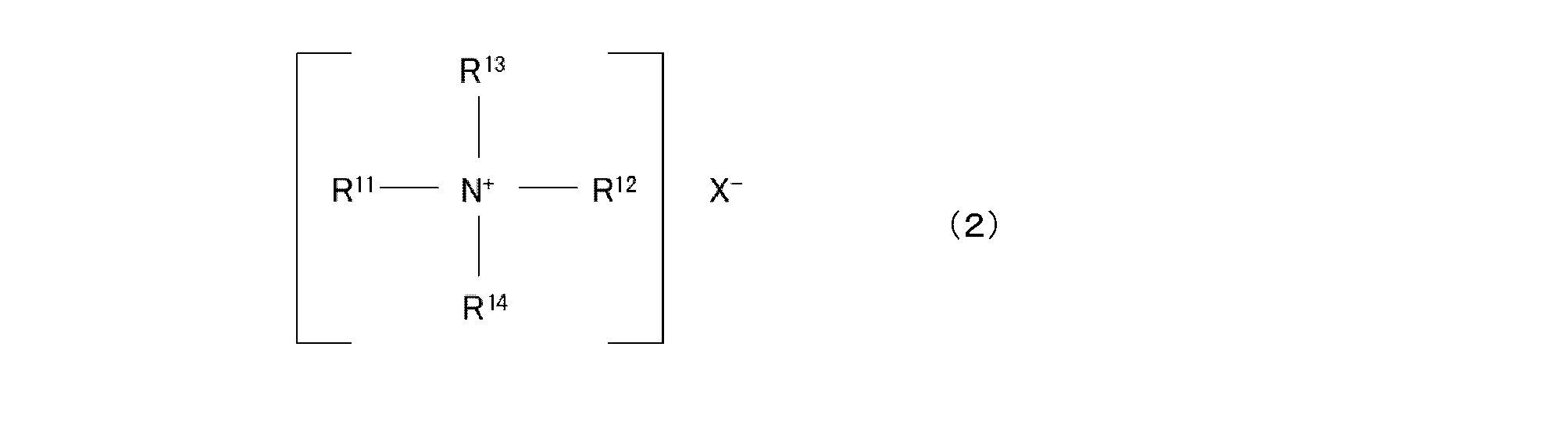
ここに開示される技術における粘着剤は、可塑剤を含むことが好ましい。粘着剤に可塑剤を含有させることにより軽剥離性が向上する。また、粘着剤の溶融粘度が低下するため塗工性が向上する。さらに、可塑剤の含有によって粘着剤表面における有機質汚れの捕捉性が向上するという側面もある。このことによって、例えば、より高い皮脂汚れ除去性が実現され得る。
ここに開示される技術における粘着剤には、必要に応じて粘着付与剤を含ませることができる。粘着付与剤を配合することは、粘着剤の熱可塑性の向上(例えば、溶融粘度の低下)に役立ち得る。粘着付与剤としては、アクリル系粘着剤の分野において公知の粘着付与樹脂等を用いることができる。例えば、炭化水素系粘着付与樹脂、テルペン系粘着付与樹脂、ロジン系粘着付与樹脂、フェノール系粘着付与樹脂、エポキシ系粘着付与樹脂、ポリアミド系粘着付与樹脂、エラストマー系粘着付与樹脂、ケトン系粘着付与樹脂等が挙げられる。これらは1種を単独でまたは2種以上を組み合わせて用いることができる。
ここに開示される技術における粘着剤は、ベースポリマーに加えて、粘着剤の粘度の調整(例えば溶融粘度の低下)や粘着特性の制御(例えば粘着力の低減)等の目的で、ベースポリマー以外のポリマーまたはオリゴマー(以下、任意ポリマーともいう。)を必要に応じて含有してもよい。例えば、アクリル系ブロック共重合体をベースポリマーとする粘着剤において、上記任意ポリマーとして、Mwが500~10000程度(典型的には800~5000程度)のアクリル系ランダム共重合体を使用してもよい。
好ましい一態様において、粘着剤は、ベースポリマー以外のポリマーを実質的に含有しないものであり得る。ベースポリマー以外のポリマーの含有量が、該ベースポリマー100重量部当たり1重量部未満(典型的には0~0.5重量部)であってもよい。
なお、粘着剤層は、典型的には連続的に形成されるが、かかる形状に限定されない。粘着剤層は、例えば、点状、ストライプ状等の規則的あるいはランダムなパターンに形成されていてもよい。
ここで、上記溶融粘度は以下の溶融粘度測定方法により測定することができる。
[溶融粘度測定方法]
測定機:米国ブルックフィールド社製、プログラマブル粘度計(DV-II+Pro)
測定条件:測定温度180℃、回転数2.5rpm、スピンドルSC4-27
測定手順:粘着剤約14gをサンプルチャンバーに入れ、180℃に加熱して溶融させる。その溶融した粘着剤中にスピンドルを沈めて回転させ、回転開始から30分後の溶融粘度を読み取る。
また、上記粘着力は、汚れ捕捉性の観点から、通常は0.001N/25mm以上(典型的には0.005N/25mm以上)とすることが適当であり、0.008N/25mm以上とすることが好ましく、0.01N/25mm以上とすることがより好ましい。上記粘着力が0.03N/25mm以上であってもよい。ここに開示される技術は、例えば、上記粘着力が0.01~0.02N/25mmである態様で好ましく実施され得る。
上記粘着力は、例えば、粘着剤のベースポリマーの組成や、粘着剤の架橋の有無および架橋密度、可塑剤の使用の有無および使用量、粘着剤層の形成パターン等により調節することができる。
[180°剥離試験]
(1)試験板(被着体)としては、SUS304鋼板を耐水研磨紙で磨いたものを用いる。試験板の寸法は、厚さ2mm以上、幅約50mm、長さ約125mmとし、♯360の耐水研磨紙を用いて上記試験板を全長にわたって長さ方向に均一に研磨する。
(2)粘着力を測定する前には、上記耐水研磨紙で磨いた試験板を洗浄する。洗浄の手順としては、試薬用のトルエンをウェスに染込ませて試験板の表面を拭いた後、さらに乾いたウェスを用いて上記試験板の表面を乾燥するまでよく拭く。このような洗浄操作を、目視によって試験板の表面が清浄になったと認められるまで3回以上繰り返して行う。
(3)洗浄後の試験板(SUS板)は、温度23±2℃、相対湿度(RH)50±5%の雰囲気中に5分以上放置した後、粘着力の測定に使用する。
(4)汚れ捕捉部(典型的には粘着シート)を長方形シート状にカットした試験片を用意する。試験片は、長さ100~300mm程度とすることが好ましく、幅は15~30mm程度とすることが好ましい。幅が25mmでない場合、実際の幅と25mmとの比から180°引き剥がし粘着力[N/25mm]を算出(換算)すればよい。試験片の厚さは特に限定されない。
(5)得られた試験片の粘着面(例えば粘着剤層側表面)を上記試験板(SUS板)に、2kgのローラーを一往復させて貼り付ける。試験片が両面粘着シート等のように両面に粘着性を有する形態である場合、測定面とは反対側の表面に厚さ25μm程度のポリエチレンテレフタレート(PET)フィルムを貼り付けて裏打ちすることが好ましい。
(6)これを23℃、RH50%の環境下に30分間保持した後、引張試験機を用い、JIS Z 0237に準拠して、23℃、RH50%の環境下、剥離角度180°、引張速度1000mm/分の条件にて、上記SUS板に対する180°引き剥がし粘着力(対SUS180°引き剥がし粘着力)[N/25mm]を測定する。引張試験機は特に限定されず、従来公知の引張試験機を用いることができる。例えば、島津製作所社製の「テンシロン」を用いて測定することができる。
以下の例では、公知のリビングアニオン重合法により合成された以下のアクリル系ポリマーA,Bを使用した。
アクリル系ポリマーAとしては、ポリMMAブロック-ポリ2EHA/BAブロック-ポリMMAブロック(以下、「MMA-2EHA/BA-MMA」と表記することがある。)のトリブロック構造を有し、ポリ2EHA/BAブロックにおける2EHAとBAとの重量比(すなわち、重量基準の共重合比率)が50/50であり、ポリ2EHA/BAブロックの重量に対するポリMMAブロックの重量(2つのポリMMAブロックの合計重量)の比(MMA/(2EHA+BA))が18/82であるアクリル系ブロック共重合体を使用した。このアクリル系ポリマーAのMwは10×104であり、Mnは8.4×104、Mw/Mnは1.21であった。
アクリル系ポリマーBとしては、MMA-2EHA/BA-MMAのトリブロック構造を有し、ポリ2EHA/BAブロックにおける2EHAとBAとの重量比が50/50であり、ポリ2EHA/BAブロックの重量に対するポリMMAブロックの重量(2つのポリMMAブロックの合計重量)の比(MMA/(2EHA+BA))が19/81であるアクリル系ブロック共重合体を使用した。このアクリル系ポリマーBのMwは5×104であり、Mnは4.4×104、Mw/Mnは1.13であった。
<例1>
アクリル系ポリマー100部、粘着付与剤15部および可塑剤50部をトルエンと混合して、固形分約50%の溶剤型アクリル系粘着剤組成物を調製した。上記アクリル系ポリマーとしては、上述したアクリル系ポリマーAとアクリル系ポリマーBとを80:20の重量比で使用した。上記粘着付与剤としては、ヤスハラケミカル株式会社製「UH-115」(水素添加テルペンフェノール樹脂)を使用した。上記可塑剤としては、DIC株式会社製の商品名「モノサイザーW-242」(アジピン酸ジイソノニル)を使用した。上記粘着剤組成物を厚さ38μmのPET製のシート状支持基材(幅:約8cm)の表面に塗付し、100℃で2分間乾燥させることにより、厚さ約50μmの粘着剤層が上記支持基材の片面に形成された粘着シートを作製した。得られた粘着シートを合成樹脂製の円筒状保持部材(直径20mm)の外周に巻きつけて粘着シートロールを形成した。そして、上記保持部材を把持部材の先端に転動(回転)自在に装着することにより、図1,2に模式的に示すような構成のクリーナーを作製した。
なお、この例1および以下の例2~10における粘着剤は、いずれも、アクリル系ポリマーA:アクリル系ポリマーB:粘着付与剤を80:20:15の重量比で含む。
アクリル系ポリマー(アクリル系ポリマーAとアクリル系ポリマーBとの合計量)100部あたり1.7部の抗菌剤を配合した他は例1と同様にして、上記抗菌剤を1.0%の濃度で含む粘着剤層が上記支持基材の片面に形成された粘着シートを作製した。抗菌剤としては、ジデシルジメチルアンモニウムトリフルオロメタンスルホン酸塩([(CH3)2N(C10H21)2]+ CF3SO3 -、三洋化成株式会社製、商品名「ネオジャーミDFS」)を使用した。この粘着シートを用いた他は例1と同様にして、例2に係るクリーナーを作製した。なお、例2に係るクリーナーの粘着剤層を構成する粘着剤は、表1に示すように、可塑剤50部に対して抗菌剤1.7部を含有することから、可塑剤の含有量Wpに対する抗菌剤の含有量Waの比(Wa/Wp)は0.034と算出される。他の例についても同様にしてそれぞれWa/Wpを算出することができる。
粘着剤中における濃度が5.0%および10.0%になるように、アクリル系ポリマー100部に対する抗菌剤の使用量をそれぞれ変更した。その他の点については例2と同様にして、例3,4に係るクリーナーを作製した。
可塑剤を使用せず、かつ粘着剤中における濃度が5.0%および10.0%になるように、アクリル系ポリマー100部に対する抗菌剤の使用量を調節した。その他の点については例3,4とそれぞれ同様にして、例5,6に係るクリーナーを作製した。
各例に係る粘着シートを50mm×50mmの正方形に切り取り、滅菌シャーレに貼りつけた。貼付けから1時間後に粘着シートを上記滅菌シャーレから剥がした。そして、上記滅菌シャーレのうち上記粘着シートが貼り付けられていた部分を試験面として、該滅菌シャーレをJIS Z 2801「抗菌加工製品-抗菌性試験方法・抗菌効果」に基づく抗菌性試験に供し、以下の式により抗菌活性値(R)を算出した。

表示面(アルミノケイ酸ガラス製の平滑な表面)に保護フィルムが貼り付けられたスマートフォン(docomo NEXT series「Xperia(商標) Z SO-02E」;Sony Mobile Communications AB社製品)を用意した。保護フィルムとしては、上記スマートフォン用のジャケット(ハードコーティング・グラデーション・シェルジャケット、レイ・アウト社製品)に付属の保護フィルムを使用した。上記保護フィルムの表面の汚れを不織布製のウェスで念入りに拭き取った。
5点:指紋の跡が完全に消失した。
4点:指紋の跡が概ね消失した。
3点:指紋の跡が一部消失した。
2点:指紋の跡が薄くなったが消失はしなかった。
1点:指紋の跡の濃さに変化は認められなかった。
上述した180°剥離試験に基づいて、各例に係る粘着シートの180°引き剥がし粘着力を測定した。より具体的には、各例に係る粘着シートを200mm×25mmの帯状にカットして試験片を用意した。上記試験片の粘着面(粘着剤層の表面)をステンレス鋼(SUS304)板に、2kgのローラーを一往復させて貼り付けた。これを23℃、RH50%の環境下に30分間保持した後、引張試験機を用い、JIS Z 0237に準拠して、23℃、RH50%の環境下、剥離角度180°、引張速度1000mm/分の条件にて、対SUS180°引き剥がし粘着力[N/25mm]を測定した。測定は、島津製作所社製の「テンシロン」を用いて行った。結果を表1に示す。
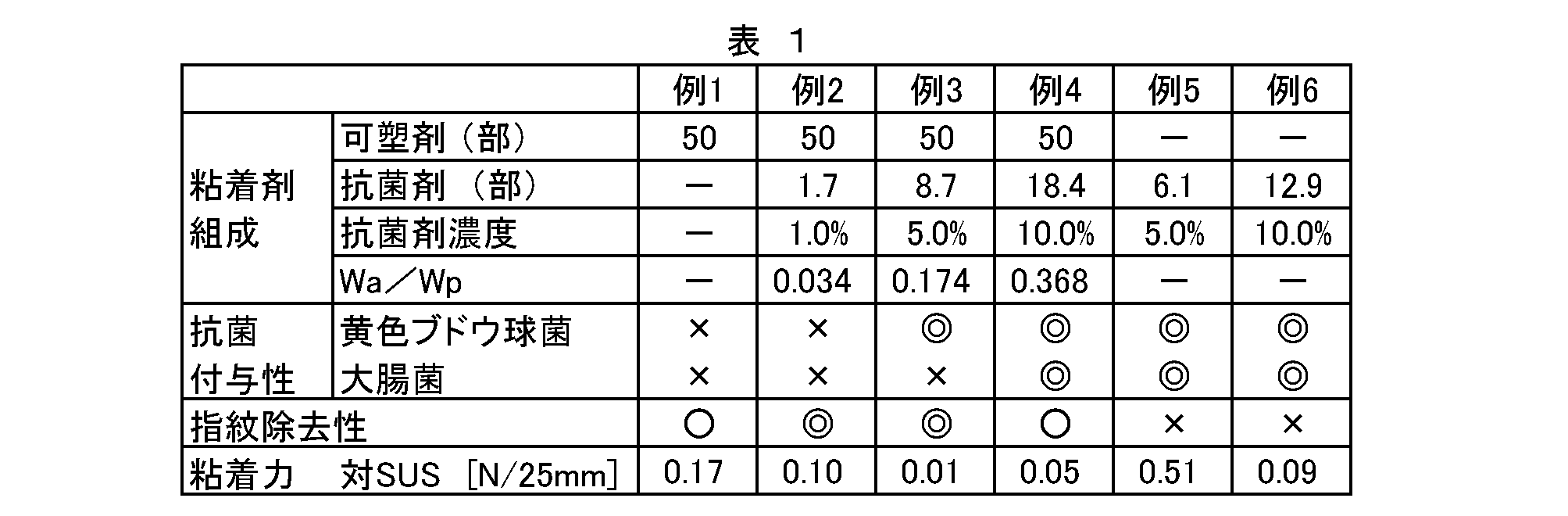
<例7,8>
アクリル系ポリマー100部あたりの可塑剤の使用量を30部に変更した。また、粘着剤中における濃度が5.0%および7.5%になるように、アクリル系ポリマー100部に対する抗菌剤の使用量をそれぞれ変更した。その他の点については例2と同様にして、例7,8に係るクリーナーを作製した。
粘着剤中における濃度が7.5%および15.0%になるように、アクリル系ポリマー100部に対する抗菌剤の使用量をそれぞれ変更した。その他の点については例2と同様にして、例9,10に係るクリーナーを作製した。
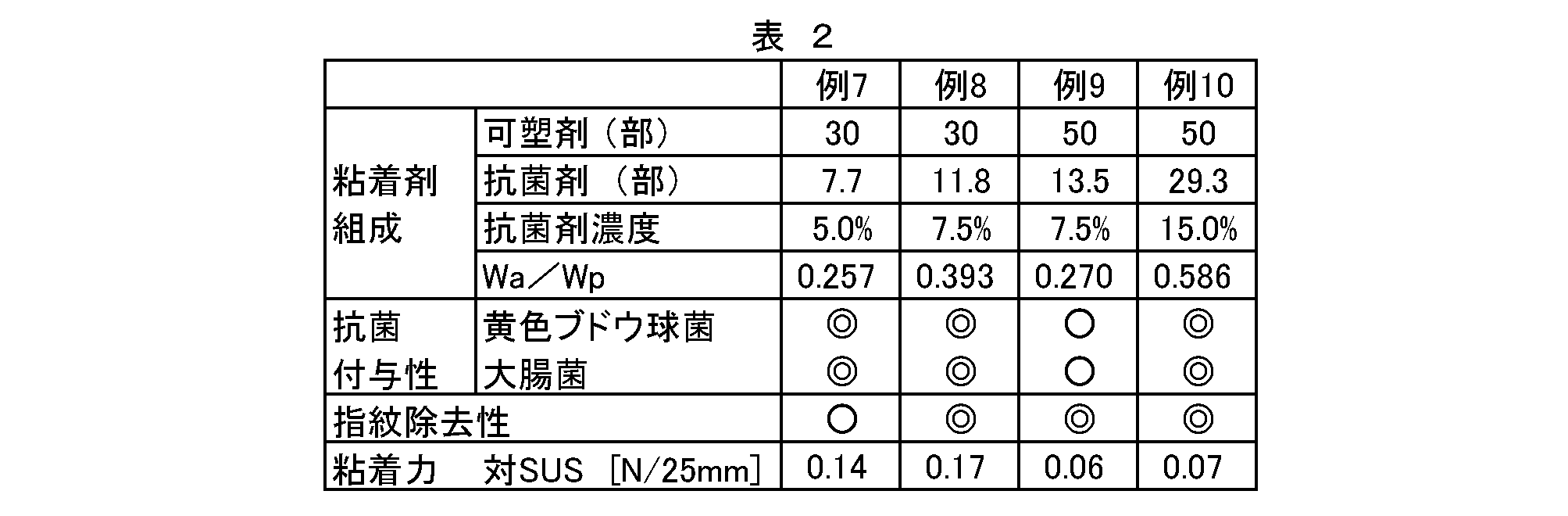
2 表面(表示部)
10 粘着クリーナー
20 保持部材
30 粘着シートロール
31 粘着シート(汚れ捕捉部)
32 粘着剤層
36 支持基材
40 把持部材
42 取っ手
50 有機質汚れ
Claims (11)
- 物品の表面に付着している有機質汚れを除去し、かつ該表面を抗菌処理するために使用される抗菌処理用粘着クリーナーであって、
前記物品の表面に接触することによって前記有機質汚れを捕捉する汚れ捕捉部を備え、
前記汚れ捕捉部は、前記物品の表面と接触する部分に、前記物品の表面に接触することによって該表面に抗菌性を付与する粘着剤を備え、
前記粘着剤は、ベースポリマーおよび抗菌剤を含む、抗菌処理用粘着クリーナー。 - 前記汚れ捕捉部の前記表面に接触する部分は、1N/25mm以下の粘着力を示す、請求項1に記載の粘着クリーナー。
- 前記粘着剤は、前記抗菌剤を2~50重量%の割合で含む、請求項1または2に記載の粘着クリーナー。
- 前記粘着剤は可塑剤をさらに含み、
前記可塑剤の含有量は、前記ベースポリマー100重量部に対して5~100重量部である、請求項1から3のいずれか一項に記載の粘着クリーナー。 - 前記粘着剤は、重量基準で、前記可塑剤の含有量Wpに対する前記抗菌剤の含有量Waの比(Wa/Wp)が0.10~1.0である、請求項4に記載の粘着クリーナー。
- 前記粘着剤は、前記ベースポリマーとしてアクリル系ポリマーを含む、請求項1から5のいずれか一項に記載の粘着クリーナー。
- 前記ベースポリマーは、1分子中にハードセグメント(A)およびソフトセグメント(B)を有するアクリル系ブロック共重合体である、請求項6に記載の粘着クリーナー。
- 前記ソフトセグメント(B)を構成するモノマー単位は、アルキル基の炭素原子数が6以上のアルキルアクリレートを含む、請求項7に記載の粘着クリーナー。
- 円筒状の転動部材を備えており、前記汚れ捕捉部は該転動部材の外周面に配置されている、請求項1から8のいずれか一項に記載の粘着クリーナー。
- 前記有機質汚れとして皮脂汚れを取り除くために使用される、請求項1から9のいずれか一項に記載の粘着クリーナー。
- 前記物品は、ガラス製または合成樹脂製の表示面を有するポータブル機器である、請求項1から10のいずれか一項に記載の粘着クリーナー。
Priority Applications (4)
| Application Number | Priority Date | Filing Date | Title |
|---|---|---|---|
| US15/538,329 US20170347857A1 (en) | 2014-12-22 | 2015-12-21 | Sticky cleaner for antimicrobial treatment |
| KR1020177016936A KR20170099898A (ko) | 2014-12-22 | 2015-12-21 | 항균 처리용 점착 클리너 |
| CN201580070497.7A CN107105963A (zh) | 2014-12-22 | 2015-12-21 | 抗菌处理用粘合清洁器 |
| EP15872962.4A EP3238600A4 (en) | 2014-12-22 | 2015-12-21 | Adhesive cleaner for use in antibacterial treatment |
Applications Claiming Priority (2)
| Application Number | Priority Date | Filing Date | Title |
|---|---|---|---|
| JP2014259505A JP2016116795A (ja) | 2014-12-22 | 2014-12-22 | 抗菌処理用粘着クリーナー |
| JP2014-259505 | 2014-12-22 |
Publications (1)
| Publication Number | Publication Date |
|---|---|
| WO2016104394A1 true WO2016104394A1 (ja) | 2016-06-30 |
Family
ID=56150413
Family Applications (1)
| Application Number | Title | Priority Date | Filing Date |
|---|---|---|---|
| PCT/JP2015/085616 Ceased WO2016104394A1 (ja) | 2014-12-22 | 2015-12-21 | 抗菌処理用粘着クリーナー |
Country Status (7)
| Country | Link |
|---|---|
| US (1) | US20170347857A1 (ja) |
| EP (1) | EP3238600A4 (ja) |
| JP (1) | JP2016116795A (ja) |
| KR (1) | KR20170099898A (ja) |
| CN (1) | CN107105963A (ja) |
| TW (1) | TW201626930A (ja) |
| WO (1) | WO2016104394A1 (ja) |
Families Citing this family (8)
| Publication number | Priority date | Publication date | Assignee | Title |
|---|---|---|---|---|
| JP6305468B2 (ja) * | 2016-07-06 | 2018-04-04 | 株式会社ニトムズ | 粘着クリーナー |
| JP6305610B2 (ja) * | 2017-06-30 | 2018-04-04 | 株式会社ニトムズ | 粘着クリーナー |
| JP6781144B2 (ja) * | 2017-12-26 | 2020-11-04 | 株式会社ニトムズ | 粘着クリーナー |
| US10610280B1 (en) | 2019-02-02 | 2020-04-07 | Ayad K. M. Agha | Surgical method and apparatus for destruction and removal of intraperitoneal, visceral, and subcutaneous fat |
| KR102280533B1 (ko) * | 2021-01-04 | 2021-07-26 | 주식회사 라온티알엠 | 고성능 테이프 클리너 |
| JP2022181120A (ja) * | 2021-05-25 | 2022-12-07 | 株式会社サンエー化研 | 積層フィルム |
| JP7726605B2 (ja) * | 2021-06-18 | 2025-08-20 | リンテック株式会社 | 粘着シートの使用方法および粘着シート |
| JP2024045837A (ja) * | 2022-09-22 | 2024-04-03 | 株式会社Life-do.Plus | 粘着クリーナ |
Citations (3)
| Publication number | Priority date | Publication date | Assignee | Title |
|---|---|---|---|---|
| JPH0824206A (ja) * | 1994-07-19 | 1996-01-30 | Nitto Denko Corp | 粘着クリーナー |
| WO2013015075A1 (ja) * | 2011-07-26 | 2013-01-31 | 株式会社ニトムズ | プレート表面用粘着クリーナー |
| JP2014064833A (ja) * | 2012-09-27 | 2014-04-17 | Osada Corporation:Kk | 粘着クリーナ用ローラと回転式粘着クリーナ |
Family Cites Families (11)
| Publication number | Priority date | Publication date | Assignee | Title |
|---|---|---|---|---|
| JPS6031724Y2 (ja) * | 1981-03-16 | 1985-09-21 | 日東電工株式会社 | 除塵兼抗菌処理用治具 |
| US20030171051A1 (en) * | 2002-03-08 | 2003-09-11 | 3M Innovative Properties Company | Wipe |
| JP4170039B2 (ja) * | 2002-07-25 | 2008-10-22 | 東芝エレベータ株式会社 | 電動機制御装置 |
| US7186207B2 (en) * | 2003-07-31 | 2007-03-06 | The Evercare Company | Roller construction for detritus removal |
| US8539631B2 (en) * | 2004-07-09 | 2013-09-24 | The Procter & Gamble Company | Roller for providing benefits to fabric |
| US8475600B2 (en) * | 2005-10-25 | 2013-07-02 | Nitto Denko Corporation | Cleaning sheet, transfer member provided with cleaning function, and method for cleaning substrate processing apparatus |
| CN102884053B (zh) * | 2010-03-18 | 2016-03-02 | 第一三共株式会社 | 环丙烷甲酸衍生物 |
| CA2809825A1 (en) * | 2010-08-30 | 2012-03-08 | Surmodics Pharmaceuticals, Inc. | Biodegradable terpolymers and terpolymer blends as pressure-sensitive adhesives |
| JP6109142B2 (ja) * | 2011-03-24 | 2017-04-05 | スリーエム イノベイティブ プロパティズ カンパニー | 難燃テープ |
| JP6100539B2 (ja) * | 2013-01-25 | 2017-03-22 | 株式会社ニトムズ | 有機質汚れ除去用粘着クリーナー |
| CN104163884B (zh) * | 2013-05-20 | 2016-12-28 | 3M创新有限公司 | 可固化的丙烯酸类组合物、丙烯酸类胶带、丙烯酸类胶辊以及制备该丙烯酸类胶辊的方法 |
-
2014
- 2014-12-22 JP JP2014259505A patent/JP2016116795A/ja not_active Ceased
-
2015
- 2015-12-21 EP EP15872962.4A patent/EP3238600A4/en not_active Withdrawn
- 2015-12-21 CN CN201580070497.7A patent/CN107105963A/zh active Pending
- 2015-12-21 US US15/538,329 patent/US20170347857A1/en not_active Abandoned
- 2015-12-21 KR KR1020177016936A patent/KR20170099898A/ko not_active Withdrawn
- 2015-12-21 WO PCT/JP2015/085616 patent/WO2016104394A1/ja not_active Ceased
- 2015-12-22 TW TW104143230A patent/TW201626930A/zh unknown
Patent Citations (3)
| Publication number | Priority date | Publication date | Assignee | Title |
|---|---|---|---|---|
| JPH0824206A (ja) * | 1994-07-19 | 1996-01-30 | Nitto Denko Corp | 粘着クリーナー |
| WO2013015075A1 (ja) * | 2011-07-26 | 2013-01-31 | 株式会社ニトムズ | プレート表面用粘着クリーナー |
| JP2014064833A (ja) * | 2012-09-27 | 2014-04-17 | Osada Corporation:Kk | 粘着クリーナ用ローラと回転式粘着クリーナ |
Non-Patent Citations (1)
| Title |
|---|
| See also references of EP3238600A4 * |
Also Published As
| Publication number | Publication date |
|---|---|
| EP3238600A4 (en) | 2018-10-17 |
| TW201626930A (zh) | 2016-08-01 |
| US20170347857A1 (en) | 2017-12-07 |
| EP3238600A1 (en) | 2017-11-01 |
| CN107105963A (zh) | 2017-08-29 |
| KR20170099898A (ko) | 2017-09-01 |
| JP2016116795A (ja) | 2016-06-30 |
Similar Documents
| Publication | Publication Date | Title |
|---|---|---|
| JP6181225B2 (ja) | プレート表面用粘着クリーナー | |
| JP6704729B2 (ja) | 有機質汚れ除去用粘着クリーナー | |
| JP2016116795A (ja) | 抗菌処理用粘着クリーナー | |
| JP6100539B2 (ja) | 有機質汚れ除去用粘着クリーナー | |
| US10478043B2 (en) | Sticky cleaner | |
| JP6894673B2 (ja) | 片面接着性粘着シート | |
| WO2014115633A1 (ja) | 皮脂吸収拡散フィルム |
Legal Events
| Date | Code | Title | Description |
|---|---|---|---|
| 121 | Ep: the epo has been informed by wipo that ep was designated in this application |
Ref document number: 15872962 Country of ref document: EP Kind code of ref document: A1 |
|
| ENP | Entry into the national phase |
Ref document number: 20177016936 Country of ref document: KR Kind code of ref document: A |
|
| WWE | Wipo information: entry into national phase |
Ref document number: 15538329 Country of ref document: US |
|
| NENP | Non-entry into the national phase |
Ref country code: DE |
|
| REEP | Request for entry into the european phase |
Ref document number: 2015872962 Country of ref document: EP |