WO2016104500A1 - Matière active liquide au vanadium, et batterie redox au vanadium - Google Patents
Matière active liquide au vanadium, et batterie redox au vanadium Download PDFInfo
- Publication number
- WO2016104500A1 WO2016104500A1 PCT/JP2015/085827 JP2015085827W WO2016104500A1 WO 2016104500 A1 WO2016104500 A1 WO 2016104500A1 JP 2015085827 W JP2015085827 W JP 2015085827W WO 2016104500 A1 WO2016104500 A1 WO 2016104500A1
- Authority
- WO
- WIPO (PCT)
- Prior art keywords
- vanadium
- active material
- solution
- material liquid
- dispersoid
- Prior art date
- Legal status (The legal status is an assumption and is not a legal conclusion. Google has not performed a legal analysis and makes no representation as to the accuracy of the status listed.)
- Ceased
Links
Images







Classifications
-
- H—ELECTRICITY
- H01—ELECTRIC ELEMENTS
- H01M—PROCESSES OR MEANS, e.g. BATTERIES, FOR THE DIRECT CONVERSION OF CHEMICAL ENERGY INTO ELECTRICAL ENERGY
- H01M8/00—Fuel cells; Manufacture thereof
- H01M8/18—Regenerative fuel cells, e.g. redox flow batteries or secondary fuel cells
- H01M8/184—Regeneration by electrochemical means
- H01M8/188—Regeneration by electrochemical means by recharging of redox couples containing fluids; Redox flow type batteries
-
- H—ELECTRICITY
- H01—ELECTRIC ELEMENTS
- H01M—PROCESSES OR MEANS, e.g. BATTERIES, FOR THE DIRECT CONVERSION OF CHEMICAL ENERGY INTO ELECTRICAL ENERGY
- H01M8/00—Fuel cells; Manufacture thereof
- H01M8/02—Details
-
- H—ELECTRICITY
- H01—ELECTRIC ELEMENTS
- H01M—PROCESSES OR MEANS, e.g. BATTERIES, FOR THE DIRECT CONVERSION OF CHEMICAL ENERGY INTO ELECTRICAL ENERGY
- H01M8/00—Fuel cells; Manufacture thereof
- H01M8/22—Fuel cells in which the fuel is based on materials comprising carbon or oxygen or hydrogen and other elements; Fuel cells in which the fuel is based on materials comprising only elements other than carbon, oxygen or hydrogen
- H01M8/225—Fuel cells in which the fuel is based on materials comprising particulate active material in the form of a suspension, a dispersion, a fluidised bed or a paste
-
- H—ELECTRICITY
- H01—ELECTRIC ELEMENTS
- H01M—PROCESSES OR MEANS, e.g. BATTERIES, FOR THE DIRECT CONVERSION OF CHEMICAL ENERGY INTO ELECTRICAL ENERGY
- H01M2300/00—Electrolytes
- H01M2300/0002—Aqueous electrolytes
- H01M2300/0005—Acid electrolytes
- H01M2300/0011—Sulfuric acid-based
-
- H—ELECTRICITY
- H01—ELECTRIC ELEMENTS
- H01M—PROCESSES OR MEANS, e.g. BATTERIES, FOR THE DIRECT CONVERSION OF CHEMICAL ENERGY INTO ELECTRICAL ENERGY
- H01M8/00—Fuel cells; Manufacture thereof
- H01M8/02—Details
- H01M8/0202—Collectors; Separators, e.g. bipolar separators; Interconnectors
- H01M8/023—Porous and characterised by the material
- H01M8/0234—Carbonaceous material
-
- Y—GENERAL TAGGING OF NEW TECHNOLOGICAL DEVELOPMENTS; GENERAL TAGGING OF CROSS-SECTIONAL TECHNOLOGIES SPANNING OVER SEVERAL SECTIONS OF THE IPC; TECHNICAL SUBJECTS COVERED BY FORMER USPC CROSS-REFERENCE ART COLLECTIONS [XRACs] AND DIGESTS
- Y02—TECHNOLOGIES OR APPLICATIONS FOR MITIGATION OR ADAPTATION AGAINST CLIMATE CHANGE
- Y02E—REDUCTION OF GREENHOUSE GAS [GHG] EMISSIONS, RELATED TO ENERGY GENERATION, TRANSMISSION OR DISTRIBUTION
- Y02E60/00—Enabling technologies; Technologies with a potential or indirect contribution to GHG emissions mitigation
- Y02E60/30—Hydrogen technology
- Y02E60/50—Fuel cells
Definitions
- the present invention relates to a battery active material liquid using a vanadium compound as a solute and a dispersoid (hereinafter referred to as a vanadium active material liquid) and a battery using the active material liquid (hereinafter referred to as a vanadium redox battery). More specifically, the present invention relates to a vanadium active material liquid and a vanadium redox battery that have a high battery capacity and a high energy density accompanying an increase in active material concentration and can be stably maintained over a long period of time.
- Redox batteries are being put to practical use or developed mainly as flow-type batteries or capacitor-type secondary batteries using vanadium compounds, iron compounds, chromium compounds, halogens, etc. as battery active materials.
- the electrode itself does not change due to charge / discharge, and the redox state (valence) of the active material supplied to the electrode changes. For this reason, redox batteries are unlikely to experience a decrease in battery capacity due to electrode deterioration, and are considered to have a longer life than lead batteries, lithium ion batteries, sodium-sulfur batteries, and other batteries. Yes.
- a battery using a vanadium compound as an active material can generate a relatively high electromotive force using a divalent vanadium compound as a negative electrode active material and a pentavalent vanadium compound as a positive electrode active material.
- the energy density can be increased.
- a vanadium redox battery uses an electrolytic cell (cell stack) divided into a positive electrode and a negative electrode by a diaphragm such as an ion exchange membrane, and is composed of vanadium compounds having different valences in the positive electrode chamber and the negative electrode chamber, respectively. .
- the charge / discharge reaction of Formula (1) occurs at the positive electrode
- the charge / discharge reaction of Formula (2) occurs at the negative electrode.
- the reaction is from the right side to the left side during discharging, and the reaction is from the left side to the right side during charging.
- vanadium active material solution used in a vanadium redox battery is prepared from vanadyl sulfate (vanadium oxysulfate: VOSO 4 ⁇ nH 2 O), first, vanadyl sulfate is dissolved in an aqueous sulfuric acid solution to obtain a vanadyl ion solution of tetravalent vanadium. Prepare. Thereafter, the vanadyl ion solution is electrolyzed in an electrolytic solution flow type (flow type) electrolytic cell, and the oxidation-reduction state (valence) is adjusted to obtain a positive electrode solution and a negative electrode solution.
- vanadium active material solution used in a vanadium redox battery is prepared from vanadyl sulfate (vanadium oxysulfate: VOSO 4 ⁇ nH 2 O)
- vanadyl sulfate vanadium oxysulfate: VOSO 4 ⁇ nH 2 O
- the concentration of the vanadium active material was normally suppressed to about 2M (mol) except for a battery of the type that is supported on the electrode without flowing the active material.
- the 2M vanadium active material concentration refers to the concentration of a vanadium active material solution containing several Avogadro's several vanadium elements in 1 L.
- the reason why the concentration of the vanadium active material is suppressed to about 2M is to prevent the vanadium compound from being deposited in the tank for storing the active material in both the positive electrode solution and the negative electrode solution. Such suppression of concentration is the biggest factor that prevents improvement of the energy density of a redox battery, which is generally considered to have a low energy density.
- Capacitor-type vanadium redox batteries have some vanadium active material concentrations up to 3.5M in order to avoid deposition of vanadium compounds in carbon fiber assemblies (felt, cloth, etc.) as electrodes. The possibility is pointed out (refer nonpatent literature 1). However, the vanadium active material is actually used at a concentration of 2M or less (see Non-Patent Document 2).
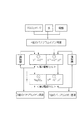
- FIG. 4 is a schematic view showing a conventional method for producing a positive electrode active material liquid and a negative electrode active material liquid.
- FIG. 5 is a schematic diagram for explaining the principle of a conventional general vanadium redox battery.
- the vanadium compound is likely to be deposited in the electrode.
- the precipitation is significant, the precipitate is tightly bound in the carbon fiber aggregate that is the electrode, and the bound portion does not function as an electrode.
- the particle reaction of the particulate vanadium compound increases due to crystal growth, so that the electrode reaction does not proceed. This causes a significant capacity reduction.
- Patent Document 3 proposes a battery having a high energy density using an active material liquid of 2.5 M or more.
- This battery is a battery that charges and discharges while maintaining a liquid property that the suspended active material is not purified.
- a crystalline vanadium compound is produced in such a battery active material solution, crystal growth proceeds, and the proportion of the active material in which electrode reaction (battery reaction) is difficult increases in a relatively short period of time. As a result, there is a problem that the capacity of the redox battery is greatly reduced.
- the vanadium active material liquid in which the electrode capacity is reduced has insufficient affinity between the generated suspended active material (referred to as dispersoid) and the liquid (dispersion medium), and the crystal growth of the dispersoid and / or Aggregation continues.
- dispersoid the dispersoid that continues to grow and / or aggregate has progressed to such a size that the battery reaction with the active material on the electrode surface is virtually impossible.
- Such a dispersoid greatly varies depending on the composition on the liquid side. When a sufficient concentration of sulfuric acid is present, the size of the dispersoid exceeds approximately 100 ⁇ m in diameter.
- the present invention has been made to solve the above problems.
- the object is to provide a vanadium active material liquid in which the vanadium active material contains a dispersoid (suspendable material) and has a vanadium active material concentration of 2.5 M or more in a sulfuric acid acidic solution. It is another object of the present invention to provide a vanadium active material liquid that can stably maintain a high energy density based on the concentration of the vanadium active material and that can also cope with rapid charge / discharge, and a vanadium redox battery using the active material liquid.
- the vanadium active material liquid according to the present invention for solving the above-described problems includes a vanadium compound as an active material as a solute and a dispersoid, and the total vanadium concentration of the active material is 2.5 M or more. It has the characteristics. According to this invention, the density
- the average diameter of the dispersoid is in the range of 1 nm to 100 ⁇ m.
- vanadium active material liquid containing a fine (diameter of 100 ⁇ m or less) dispersoid (suspension material)
- a redox battery can be constructed.
- the vanadium active material liquid according to the present invention is a negative electrode liquid in which the vanadium compound is composed of one or both of bivalent and trivalent vanadium.
- the vanadium compound is a cathode solution composed of one or both of tetravalent and pentavalent vanadium.
- the vanadium active material liquid according to the present invention is an active material liquid in which the vanadium compound is composed of one or both of trivalent and tetravalent vanadium.
- a vanadium redox battery according to the present invention for solving the above problems includes at least a single cell structure in which a positive electrode, a positive electrode solution, a diaphragm, a negative electrode solution, and a negative electrode are arranged in that order.
- the negative electrode solution and the positive electrode solution are vanadium active material liquids containing a vanadium compound as an active material as a solute and a dispersoid, and the total vanadium concentration of the active material is 2.5 M or more. It is characterized by that.
- the average diameter of the dispersoid is in the range of 1 nm to 100 ⁇ m.
- the vanadium compound constituting the negative electrode solution is composed of one or both of bivalent and trivalent vanadium.
- the vanadium compound constituting the positive electrode solution is composed of one or both of tetravalent and pentavalent vanadium.
- the negative electrode liquid may contain tetravalent vanadium. Trivalent vanadium may be included.
- the vanadium redox battery according to the present invention includes a conductive carbon fiber assembly through which the vanadium active material liquid is circulated or injected.
- the conductive carbon fiber aggregate is a carbon fiber having an average diameter of 0.1 ⁇ m or more and 10 ⁇ m or less.
- a vanadium active material liquid having a concentration of 2.5 M or more in a sulfuric acid acidic solution, in which the vanadium active material contains a dispersoid (suspendable material). Furthermore, a vanadium active material liquid that can stably maintain high capacity (Ah) and high energy density (Wh / L) based on the concentration of the vanadium active material, and can also respond to rapid charge and discharge, and the active material liquid A redox battery using can be provided.
- Ah high capacity
- Wh / L high energy density
- the vanadium active material liquid according to the present invention contains a part of the vanadium active material as a dispersoid (suspendable material), and the total concentration of all vanadium active materials is 2.5M or more. Therefore, as in the prior art, there is an advantage that it is not a difficult means to manufacture a clear high-concentration vanadium active material liquid that prevents the precipitation of minute solids and to repeatedly use charging and discharging while maintaining the clear state. . Further, it can be said to be a practical battery in that a higher input / output density can be obtained as compared with a vanadium redox battery composed of an active material having a solid (dispersoid) center of a vanadium compound.
- FIG. 1 It is a typical block diagram which shows an example of the single cell structure which comprises the vanadium redox battery which concerns on this invention. It is a typical perspective view of the vanadium redox battery with which the single cell structure of FIG. 1 was connected in series. It is a system block diagram of a vanadium redox battery. It is a schematic diagram which shows the manufacturing method of the active material liquid for conventional positive electrodes, and the active material liquid for negative electrodes. It is a schematic diagram explaining the principle of the conventional common vanadium redox battery. It is an observation result of the solid substance in a vanadium active material liquid. (A) is a dispersoid suspended in the prepared vanadium active material liquid.
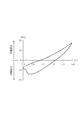
- FIG. 6 is a current-potential curve of Experiment 2-1 measured for a suspended active material solution (3M active material / 3MH 2 SO 4 ) reduced at 900 mA.
- FIG. 6 is a current-potential curve of Experiment 2-1 measured for a suspended active material solution (3M active material / 3MH 2 SO 4 ) reduced at 900 mA.
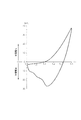
- FIG. 6 is a current-potential curve of Experiment 2-2 measured for a suspended active material liquid (3M active material / 3MH 2 SO 4 ) added with a microcrystalline active material 2M (mol).
- FIG. 6 is a current-potential curve of Experiment 2-3 measured for a non-suspended active material solution diluted 1.5 times (1.5 M active material / 3 MH 2 SO 4 ).
- FIG. 10 is a current-potential curve of Experiment 2-4 measured for an active material liquid obtained by adding 1M HCl to the active material liquid of Experiment 2-1 (3M active material / 3MH 2 SO 4 ). It is a charging / discharging voltage curve of the button-type battery using the ion exchange membrane (diaphragm) which pinched
- ion exchange membrane diaphragm
- the vanadium redox battery 20 includes a single cell (both single batteries) in which a positive electrode 1, a positive electrode solution 2, a diaphragm 3, a negative electrode solution 4, and a negative electrode 5 are arranged in that order. And at least the structure 10 is included.
- the vanadium redox battery 20 has a positive electrode solution 2 and a negative electrode solution 4.
- Both of the positive electrode solution 2 and the negative electrode solution 4 are vanadium active material liquids containing a vanadium compound as a dispersoid (including suspending substances, the same applies hereinafter), and the total concentration of vanadium containing the dispersoids is 2 .5M or more.
- the vanadium compound constituting the negative electrode solution 4 is composed of one or both of bivalent and trivalent vanadium.
- the vanadium compound constituting the cathode solution 2 is composed of one or both of tetravalent and pentavalent vanadium.
- the “dispersoid” is a precipitate of a vanadium compound. This dispersoid is contained in both the positive electrode solution 2 and the negative electrode solution 4.
- the composition of the dispersoid may be the same as or different from the liquid composition of the vanadium active material liquids 2 and 4 in which the dispersoid is suspended. However, the composition of the dispersoid is usually the same as or almost the same as the composition of the vanadium active material liquids 2 and 4.
- composition of the dispersoid contained in the negative electrode solution 4 is the same as or substantially the same as the composition of the negative electrode solution 4.
- composition of the dispersoid contained in the positive electrode solution 2 is the same as or substantially the same as the composition of the positive electrode solution 2.
- Such a vanadium redox battery 20 has a high storage capacity and a high energy density, and can provide a stable battery that can be rapidly charged.
- the positive electrode solution 2 and the negative electrode solution 4 that are vanadium active material liquids contain a vanadium compound as a dispersoid, and the total vanadium concentration including the dispersoid is 2.5 M or more.
- the vanadium active material liquid can be constituted by means that are easy to manufacture and manage, and a vanadium redox battery can be constituted.
- the vanadium redox battery 20 is composed of a positive electrode solution 2 and a negative electrode solution 4 which are vanadium active material liquids.
- the vanadium redox battery 20 is configured with a unit cell structure 10 in which the positive electrode solution 2 and the negative electrode solution 4 are disposed with the diaphragm 3 interposed therebetween.
- These vanadium active material liquids 2 and 4 (the cathode liquid 2 and the anode liquid 4; the same shall apply hereinafter) contain a vanadium compound as a dispersoid, and the total vanadium concentration including the dispersoid is 2.5 M or more. It has become.
- the vanadium active material liquids 2 and 4 contain vanadium having a high concentration of 2.5 M or more, high storage capacity and high energy density can be realized.
- the vanadium active material liquids 2 and 4 are soluble ions (solutes) of vanadium compounds, dispersoids that are suspension fine particles of vanadium compounds, and sulfate ions (actually, hydrogen sulfate ions are mainly).
- An aqueous electrolyte containing at least water referred to as an active material solution. Therefore, “the vanadium concentration including the dispersoid” means the vanadium concentration constituting the dispersoid of the vanadium compound suspended in the active material liquid and the vanadium concentration constituting the vanadium compound dissolved in the active material liquid. And the total.
- the soluble ion (solute) of the vanadium compound is a vanadium compound ion dissolved in the active material. Its solubility ions, for example divalent-pentavalent vanadium hydrated ion, VO 2+, a compound ions coordinated oxygen atom taken-ions or hydrogen sulfate ions as VO 2 + and the like.
- these soluble ions When charged with the cathode solution 2, they become one or both of tetravalent and pentavalent vanadium compound ions.
- the soluble ions become one or both of bivalent and trivalent vanadium compound ions.
- trivalent and tetravalent vanadium compound ions are generated.
- Vanadium compounds as dispersoids The vanadium compound as a dispersoid is present in the active material liquid, and is an undissolved material of the vanadium compound as a raw material and / or a divalent to pentavalent vanadium compound that is not dissolved.
- a battery reaction-active substance Specific examples include vanadium oxides, hydrogen sulfates, and composite compounds thereof.
- Dispersoids having battery reaction activity are fine particles having an average diameter in the range of 10 ⁇ 3 ⁇ m to 100 ⁇ m. Such average diameter particle shapes exhibit good cell reactivity on carbon fiber electrodes.
- the average diameter is the average diameter normally understood by those skilled in the art. For example, in the case of a spherical shape or a substantially spherical shape, it is an average value for the diameter. In the case of other irregular shapes, the average value is the average of the major axis and the minor axis.
- the vanadium concentration is the sum of the vanadium concentration as the vanadium compound ion dissolved in the active material liquid and the vanadium concentration as the dispersoid that is an insoluble vanadium compound.
- the total vanadium concentration is 2.5 M or more, and a battery having a high energy density is obtained by the favorable battery reaction of these compounds (dissolved vanadium compound ions and insoluble vanadium compounds).
- the upper limit of the vanadium concentration is not particularly limited, but it is difficult to exceed 5M in terms of specific volume. Since the vanadium active material liquid having a vanadium concentration within this range contains vanadium effective for a high concentration battery reaction, it has a high storage capacity and a high energy density. In addition, the present invention is not inferior to the battery having the complete solubility in rapid charge / discharge.
- the upper limit is a realistic value that can be obtained by dissolution, and is not necessarily limited to this upper limit, and may be more than that.
- the vanadium concentration particularly preferable for practical use is in the range of 2.5M to 5M.
- a vanadium active material solution having a vanadium concentration within this range is easy to produce and can supply a sufficient amount of active material to the electrode. Therefore, it can be preferably used as an active material liquid for a circulation type flow battery having a high energy density, or as an active material liquid for a battery that is intermittently flowed or stopped.
- the vanadium concentration can be determined from results obtained by fluorescent X-ray analysis, ion chromatography, ICP mass spectrometry, atomic absorption spectrophotometry and the like in addition to electrochemical analysis.
- sulfuric acid When adjusting the active material liquid from vanadyl sulfate, sulfuric acid is added excessively in the range of 1 to 5 M as the sulfate radical concentration relative to the vanadium concentration. This improves the electrode reactivity and makes it difficult to form large crystal grains on the positive electrode active material liquid side, thereby increasing the stability of the liquid.
- water As water, pure water, distilled water, ion-exchanged water or the like is preferably used.
- the vanadium active material liquid may contain an additive in order to improve stability and reduce viscosity.
- an additive for example, an appropriate amount of hydrochloric acid, phosphoric acid or the like may be added.
- Hydrochloric acid has the effect of improving stability and lowering the viscosity, particularly on the cathode solution side, and it can be improved by adding about 1M, depending on the vanadium concentration.
- Phosphoric acid improves the stability on the negative electrode solution side.
- the vanadium active material liquid may contain conductive powder in order to improve electric conductivity.
- conductive powder various materials can be used as long as they are acid-resistant electrically conductive powder.
- preferred examples of the conductive powder include carbon materials such as graphite and graphene.
- the size of the conductive powder may be, for example, a conductive powder having a sieve of 400 mesh or more, or may be a conductive powder having an average particle size in the range of, for example, about 300 ⁇ m to 700 ⁇ m. Can be selected and used.
- a high-concentration active material solution for example, sulfuric acid is added to an aqueous solution of vanadyl sulfate of about 3.5M, and electrolytic reduction or the like is performed to make about 1.75M into a trivalent vanadium compound.
- the active material liquid becomes a liquid having an average oxidation-reduction state of 3.5 valent vanadium, and in the case of a secondary battery, when charging is started from here, the positive electrode liquid side becomes tetravalent vanadium through tetravalent vanadium. To charge the battery.
- the negative electrode solution side becomes trivalent vanadium through trivalent vanadium and becomes a charged state.
- the valence changes, and when the positive electrode solution becomes tetravalent vanadium and the negative electrode solution becomes trivalent vanadium, it is in a completely discharged state.
- the 3.5M vanadyl sulfate aqueous solution is obtained in a completely dissolved state. It can be confirmed that the solution is completely dissolved by allowing an aqueous solution in an absorption cell having a short optical path length (for example, 1 mm) to pass through without scattering light.
- an appropriate amount of sulfuric acid is added to the solution for reduction (electrolytic reduction, etc.)
- the scattered light can be measured from the light irradiated to the absorption cell, and it can be confirmed that the solution has been suspended. .
- This suspension is caused by dispersoids of crystalline active material fine particles, and it is important to prevent excessive crystal growth by performing stirring or the like in a timely manner.
- This active material solution preparation method prepares a high-concentration active material solution by performing electrolytic reduction from a suspended 5M vanadyl sulfate suspension (slurry), even if it is not a solution in which 3.5M vanadyl sulfate is completely dissolved. It can also be preferably performed.
- the temperature rises due to the addition of sulfuric acid to the active material liquid sulfuric acid is added in a short time, or a high current density (for example, the apparent current density per electrode surface is 0.5 to 1.0 A / cm 2 ).
- a suspending active material liquid containing fine particle dispersoids is obtained.
- the diameter of the suspending micro vanadium compound is on the order of nanometer level to 100 micrometer level (approximately 1 nm to 100 ⁇ m), the suspending micro vanadium compound is strongly influenced by the affinity with sulfuric acid aqueous solution. Therefore, precipitation due to aggregation and / or crystal growth is less likely to occur.
- the suspendable fine vanadium compound has reactivity as an active material because of its fine particle size.
- the absorption position of the vanadium compound or ions shifts to the longer wavelength side as the sulfuric acid concentration or halide ion concentration increases. This shift suggests that the suspended microvanadium compound is more stable in the solvent or dispersion medium. Therefore, the temperature rise due to the addition of sulfuric acid and the magnitude of the electrolysis current density are not a big problem in preparing the active material liquid.
- the active material liquid prepared by such a method has a dispersoid diameter of nanometer to submicrometer. Then, by causing the active material liquid to flow at an appropriate interval (for example, about once a day), it is possible to suppress the dispersoid generated in the active material liquid from causing aggregation and / or crystal growth. As a result, it can be used as a stable battery.
- the vanadium active material liquid obtained by the active material liquid preparation as described above has a high concentration of about 2.5M to 5M, the active material liquid utilization rate (relevant to charge / discharge) when used as a secondary battery.
- the ratio of the active material can be, for example, about 80% (charge depth 90%, discharge depth 90%).
- this vanadium active material liquid can maintain high charging / discharging efficiency (high voltage efficiency which suppressed internal resistance small, and high coulomb efficiency which suppressed side reaction) over a long period of time.
- Electrolytic treatment The electrolytic treatment is performed on the active material liquid precursor having a vanadium concentration of 2.5M to 5M as a solution or suspension.
- the average oxidation-reduction state is adjusted to 3.5 by electrolytic reduction using the counter electrode as an oxygen generation reaction or the like.
- the average redox state can be easily confirmed by potentiometry, voltammetry, coulometry, absorptiometry and the like.
- vanadium active material liquid containing dispersoid The effects of the vanadium active material liquid according to the present invention containing the dispersoid will be described below.
- vanadium active material liquid having a high vanadium concentration if the sulfuric acid concentration is not sufficiently high, vanadium oxide (V 2 O 5 ) is likely to precipitate in the cathode solution even in equilibrium. ing.
- the concentration of sulfuric acid can be further increased to increase the solubility, thereby making it difficult to deposit vanadium oxide.
- the solubility of divalent vanadium ions is lowered.
- the vanadium sulfate aqueous solution existing as a tetravalent vanadium ion is subjected to electrolytic reduction by adding sulfuric acid when necessary, the valence changes (tetravalent ⁇ trivalent, bivalent).
- the composition change to a stable complex at each valence may not follow. Therefore, when a liquid that does not follow the composition change to a stable complex is allowed to stand, a precipitate may be generated from the one in which the ligand exchange reaction has been completed.
- the present invention realizes a high energy density even when such a liquid is used, by keeping the precipitates as battery reaction-active fine particles.
- the negative electrode solution can be prepared without causing precipitation.
- the reason for this is considered to be that the vanadyl ion becomes a vanadium active material liquid having a bivalent or trivalent vanadium ion while maintaining the coordination effect of the HSO 4 ⁇ ion.
- a vanadium active material solution is allowed to stand for a long time, it is considered that an acoionized polynuclear complex is formed, the solubility is lowered, and precipitation occurs.
- precipitation occurs as a precipitate from the vanadium active material liquid exceeding the solubility due to the ligand exchange as described above, even if there is a time difference. At this time, if the crystal growth can be prevented and the minute precipitate can be maintained, the fluidity of the electrolytic solution can be maintained. In addition, if a fine precipitate can be deposited in a felt made of carbon fiber, the precipitate can be effectively used as an active material. As a result, it can function as a battery including a high concentration electrolytic solution. The present invention achieves the effects obtained by such a mechanism.
- the vanadium redox battery can be in various forms.
- a vanadium redox battery 10 shown in FIG. 1 has a single cell structure.
- a positive electrode 1, a positive electrode solution 2, a diaphragm 3, a negative electrode solution 4, and a negative electrode 5 are arranged in that order.
- the positive electrode solution 2 and the negative electrode solution 4 are injected into the frame of the cell frames 2a and 4a as shown in the figure.
- the cell frames 2a and 4a are provided with an inlet 7 for injecting an electrolytic solution.
- This injection port 7 is used as a circulation port for the electrolyte as required.
- the material, size, thickness, and the like of the cell frames 2a, 4a are not particularly limited as long as they can be used without any problem.
- a vanadium redox battery 20 shown in FIG. 2 is a battery formed by connecting a plurality of single cell structures 10 shown in FIG. 1 in series. Such a series connection can increase the voltage.
- Reference numerals 8a and 8b are end plates provided at both ends.
- Reference numeral 8c is a fastening jig for fastening the end plates 6a and 6b. However, such a jig is an example for connecting single cell structures in series, and is not limited to the illustrated form.
- Reference numeral 9 denotes current collecting plates provided at both ends of the single cell structure 10.
- the vanadium redox battery can take various forms in addition to the forms shown in FIGS.
- a single cell structure (not shown) in which a paste-like positive electrode solution 2 is applied on the positive electrode 1 and a negative electrode solution 4 is applied on the negative electrode 5 with the diaphragm 3 interposed therebetween may be used.
- a plurality of single cell structures may be stacked to form a battery pack. Further, this single cell structure may be formed in a long strip shape and wound up on a core (for example, a carbon rod) to be like a dry battery.
- the positive electrode solution 2 and the negative electrode solution 4 may be in a liquid state with good fluidity or in a paste state with poor fluidity as long as the electrolyte solution has a vanadium compound dispersoid.
- the vanadium active material liquid is liquid, it can be filled in the cell frames 2a and 4a shown in FIG.
- the positive electrode liquid 2 and the negative electrode liquid 4 can be applied onto the positive electrode 1 and the negative electrode 5, respectively.
- the positive electrode solution 2 and the negative electrode solution 4 may be disposed so as to sandwich the diaphragm 3 in a manner soaked in the conductive carbon fiber aggregate.
- the conductive carbon fiber aggregate include various commercially available ones.
- the conductive carbon fiber aggregate which consists of pitch (pitch) type carbon fiber or PAN (Polycyclic nitrile) type carbon fiber can be mentioned.
- the shape, size, and the like of the conductive carbon fiber aggregate can be the same as those of the cell frames 2a and 4a filled with the electrolytic solution.
- this conductive carbon fiber aggregate is an aggregate of fibers
- the vanadium active material liquid can be circulated through the gaps between the fibers.
- the vanadium active material liquid is used in a distributed, intermittently distributed or stationary state. Further, even when the vanadium active material liquid is stationary, it can be preferably used because it does not hinder the fluidity of the active material liquid and ions therein.
- this conductive carbon fiber aggregate is an aggregate of fibers, a dispersoid of a vanadium compound can be supported thereon.
- the conductive carbon fiber aggregate can uniformly support a fine dispersoid on the entire surface of the aggregate.
- the advantage of uniformly loading is that the dispersoid of the vanadium compound acting as an active material can be charged and discharged with a uniform current density over the entire electrode surface of the battery without variation in the concentration distribution. Such uniformity is naturally uniform if it is a liquid.
- the fibers constituting the conductive carbon fiber assembly may be conductive carbon fibers having an average diameter in the following range.
- the fiber constituting the conductive carbon fiber aggregate may be a carbon fiber that has been fired to reduce its diameter, or may be a fiber coated with a conductive material such as carbon.
- the average diameter is preferably in the range of 10 ⁇ 3 ⁇ m to 10 ⁇ m, and more preferably in the range of 0.1 ⁇ m to 5 ⁇ m.
- the average diameter of the carbon fibers is preferably in the range of 10 ⁇ 3 ⁇ m to 5 ⁇ m.
- the diaphragm 3 is provided between the positive electrode solution 2 and the negative electrode solution 4.
- This diaphragm 3 is an ion exchange membrane having a certain degree of oxidation durability.
- Nafion 117 or Nafion 115 registered trademark, DuPont
- a polyolefin-based film, a polystyrene-based film, and the like can be given.
- the ion species that permeate the ion exchange membrane are mainly protons (hydrates)
- the anion exchange membrane is also preferably used if it is a membrane having sufficient ion exchange capacity because protons easily permeate. Can do.
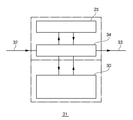
- FIG. 3 is a configuration diagram of the system 31 of the vanadium redox battery.
- Reference numeral 30 denotes a vanadium redox battery.
- Reference numeral 31 denotes the system.
- Reference numeral 32 denotes a charging power source.
- Reference numeral 33 denotes a load power source.
- Reference numeral 34 denotes an AC / DC converter.
- Reference numeral 35 denotes a system controller.
- vanadyl sulfate (IV) hydrate having a purity of 99.5% or more was weighed so that the vanadium concentration was finally 3M.
- sulfuric acid was weighed so that the concentration as a sulfate radical was finally 6M.
- the weighed vanadyl sulfate (IV) hydrate and sulfuric acid were mixed with water. They were then dissolved as much as possible. Thereafter, nitrogen gas was further injected into them, and nitrogen gas was bubbled in the tank for deaeration to prepare a vanadium active material solution.
- the substantial sulfuric acid (added sulfuric acid) except the sulfate ion (3M) which comprises a vanadium compound is 3M. This was electrolyzed and used as a positive electrode solution and a negative electrode solution. This solution was chargeable / dischargeable at a discharge capacity of about 90% of the theoretical value obtained from the vanadium concentration.
- an unfiltered vanadium active material solution is electrolyzed in an electrolytic cell using carbon fiber as a working electrode and the counter electrode as an oxygen generating reaction (apparent current density per unit area of the diaphragm: 900 mA / cm 2 ). Then, it charged / discharged with the redox battery of the single cell.
- the cell frames 2a and 4a were removed, and the dispersoid adhered to the carbon felt was collected.
- the dispersoid was an aggregate of square particles having an average particle size of about 5 to 10 ⁇ m calculated from an electron micrograph.
- V (vanadium): S elemental ratio of (sulfur) is about 1: 1, VOSO 4 because it is crystalline particles, which were also e.g. reprecipitated It was thought that.
- the electron micrograph of the dispersoid adhering to the carbon felt of the negative electrode solution 4 is shown in FIG.
- the component analysis of the dispersoid adhering to the carbon felt of the cathode solution 2 was performed.
- the dispersoid was an aggregate of columnar particles having an average particle size calculated from an electron micrograph of about 100 ⁇ m (major axis size).
- V (vanadium): S (sulfur) is about 2: 1 and its particle form (columnar crystal), vanadium (tetravalent or pentavalent). Of basic sulfate.
- the electron micrograph of the dispersoid adhering to the carbon felt of the positive electrode solution 2 is shown in FIG.
- Example 2 A charge / discharge test was conducted.
- the battery used in the test was a button type battery (1 cm each in length and width) in which the active material liquid was soaked in the conductive carbon fiber assembly electrode, and was evaluated by the voltage sweep method (charged). Measurement of discharge current).
- the button type battery has a thickness of 0.1 mm, a length of 1 cm, and a width of 1 cm, and has a structure in which two conductive carbon fiber aggregate sheets having a thickness of 0.3 mm are stacked and impregnated with an active material solution.
- the charging / discharging test was done using the commercially available potentiostat testing machine, as shown in FIG.7 (B).
- reference numeral 71 denotes a charge / discharge power source.
- Reference numeral 72 denotes a voltage sweeping device.
- Reference numeral 73 denotes an XY recorder.
- the current-potential curve shown in FIG. 8 is a result (Experiment 2-1) measured for a suspended active material liquid (3M active material / 3MH 2 SO 4 ) reduced at 900 mA.
- the current-potential curve shown in FIG. 9 is a result of measurement of a suspended active material liquid (3M active material / 3MH 2 SO 4 ) to which 2M (mol) of the microcrystalline active material is added (Experiment 2-2). ).
- the current-potential curve shown in FIG. 10 is the result of a comparative experiment (Experiment 2-3) measured for a non-suspended active material solution (1.5 M active material / 3 MH 2 SO 4 ) diluted twice.
- the current-potential curve shown in FIG. 11 is the result (Experiment 2-4) measured for the active material liquid obtained by adding 1M HCl to the active material liquid of Experiment 2-1 (3M active material / 3MH 2 SO 4 ).
- the evaluation results are shown in Table 1.
- the suspended active material liquids of Experiments 2-1, 2-3, and 2-4 were high in discharge capacity, coulomb efficiency, and maximum output (current ⁇ voltage: mW).
- the suspension active material liquid (Experiment 2-2) to which 2 M (mol) of the microcrystalline active material was added and the active material liquid to which 1 M HCl was added showed more excellent characteristics.
- Example 3 The acidic 3M vanadium negative electrode solution used in Experiment 2-1 was filtered through a filter paper having a pore size of 0.47 ⁇ m, and the filtration residue on the filter paper was collected. Further, a positive electrode solution of sulfuric acid 2.5M vanadium (charge depth is about 80%) was similarly filtered, and a filtration residue was collected. These filtration residues were mixed with a negative electrode solution and a positive electrode solution before filtration, respectively, and contained in a conductive carbon fiber assembly to produce a battery as a negative electrode and a positive electrode.
- This button type battery has the same configuration as that in FIG.
- FIG. 12 is a charge / discharge voltage curve of a button-type battery using an ion exchange membrane (diaphragm) sandwiched with a solid active material as a positive electrode and a negative electrode, respectively.
- the measurement was performed by 20 mA constant charge / discharge. The results are as shown in FIG. 12.
- the total charge electricity amount was 309.0, the total discharge electricity amount was 285.0, and ⁇ coul. (Charge / discharge coulomb efficiency) was 92.2%.
- the calculated active material concentration obtained from the discharge capacity was 4.9 M, and it was confirmed that the dispersoid worked effectively as an active material.
- the total vanadium concentration of the vanadium active material liquid containing the dispersoid is 2.5M or more, and 4.9M in the experimental example, it has a high storage capacity and a high energy density, and can be stably charged at high speed. And a higher output voltage could be obtained.
Landscapes
- Chemical & Material Sciences (AREA)
- Life Sciences & Earth Sciences (AREA)
- Engineering & Computer Science (AREA)
- Manufacturing & Machinery (AREA)
- Sustainable Development (AREA)
- Sustainable Energy (AREA)
- Chemical Kinetics & Catalysis (AREA)
- Electrochemistry (AREA)
- General Chemical & Material Sciences (AREA)
- Dispersion Chemistry (AREA)
- Fuel Cell (AREA)
- Battery Electrode And Active Subsutance (AREA)
Abstract
L'invention fournit une matière active liquide au vanadium et une batterie redox au vanadium mettant en œuvre cette matière active liquide dans laquelle une matière active contient un dispersoïde (substance dotée de suspensibilité), qui possède une concentration supérieure ou égale à 2,5M dans une solution acide d'acide sulfurique, et qui tout en maintenant de manière stable une densité d'énergie élevée sur la base de cette concentration, peut être adaptée à une charge et une décharge rapides. Dans cet objectif, la matière active liquide au vanadium de l'invention contient, en tant que soluté et dispersoïde, un composé vanadium constituant une matière active, et la concentration totale en vanadium dans ladite matière active, est supérieure ou égale à 2,5M. Dans un liquide d'électrode négative, le composé vanadium est configuré par un vanadium bivalent et/ou trivalent. Dans un liquide d'électrode positive, le composé vanadium est configuré par un vanadium tétravalent et/ou pentavalent. Dans une matière active liquide, le composé vanadium est configuré par un vanadium trivalent et/ou tétravalent. Le diamètre moyen du dispersoïde est compris dans une plage supérieure ou égale à 1nm et inférieure ou égale à 100μm.
Priority Applications (2)
| Application Number | Priority Date | Filing Date | Title |
|---|---|---|---|
| CN201580070985.8A CN107148696A (zh) | 2014-12-25 | 2015-12-22 | 钒活性物质液体以及钒氧化还原电池 |
| US15/538,177 US20170346125A1 (en) | 2014-12-25 | 2015-12-22 | Vanadium active material solution and vanadium redox battery |
Applications Claiming Priority (2)
| Application Number | Priority Date | Filing Date | Title |
|---|---|---|---|
| JP2014261504A JP5860527B1 (ja) | 2014-12-25 | 2014-12-25 | バナジウム活物質液及びバナジウムレドックス電池 |
| JP2014-261504 | 2014-12-25 |
Publications (1)
| Publication Number | Publication Date |
|---|---|
| WO2016104500A1 true WO2016104500A1 (fr) | 2016-06-30 |
Family
ID=55305465
Family Applications (1)
| Application Number | Title | Priority Date | Filing Date |
|---|---|---|---|
| PCT/JP2015/085827 Ceased WO2016104500A1 (fr) | 2014-12-25 | 2015-12-22 | Matière active liquide au vanadium, et batterie redox au vanadium |
Country Status (4)
| Country | Link |
|---|---|
| US (1) | US20170346125A1 (fr) |
| JP (1) | JP5860527B1 (fr) |
| CN (1) | CN107148696A (fr) |
| WO (1) | WO2016104500A1 (fr) |
Families Citing this family (6)
| Publication number | Priority date | Publication date | Assignee | Title |
|---|---|---|---|---|
| WO2017209017A1 (fr) * | 2016-05-31 | 2017-12-07 | 株式会社ギャラキシー | Procédé de fabrication de liquide de matière active pour batterie |
| JP2018029009A (ja) * | 2016-08-17 | 2018-02-22 | 株式会社ギャラキシー | 負極電池活物質液及び負極電池活物質液管理方法 |
| US20190348700A1 (en) * | 2016-12-28 | 2019-11-14 | Showa Denko K.K. | Redox-flow battery system and method of operating redox-flow battery system |
| US11799154B2 (en) | 2019-07-16 | 2023-10-24 | Queen's University At Kingston | Hybrid energy storage device |
| CN113903964B (zh) * | 2021-09-02 | 2023-09-29 | 香港科技大学 | 一种简易的提高钒电池性能的方法及应用 |
| KR102647426B1 (ko) * | 2022-08-24 | 2024-03-14 | 한국지질자원연구원 | 바나듐 레독스 흐름 배터리의 전해액을 제조하는 방법 및 이로부터 제조된 바나듐 레독스 흐름 배터리의 전해액 |
Citations (5)
| Publication number | Priority date | Publication date | Assignee | Title |
|---|---|---|---|---|
| JPH09507950A (ja) * | 1993-11-17 | 1997-08-12 | ユニサーチ リミテッド | 安定電解液およびその製造方法と、レドックス電池の製造方法、および安定した電解液を含む電池 |
| WO2002095855A1 (fr) * | 2001-05-18 | 2002-11-28 | Unisearch Limited | Electrolyte pour batterie redox au vanadium |
| WO2010143634A1 (fr) * | 2009-06-09 | 2010-12-16 | シャープ株式会社 | Batterie à circulation d'oxydoréducteur |
| JP2011524074A (ja) * | 2008-06-12 | 2011-08-25 | マサチューセッツ インスティテュート オブ テクノロジー | 高エネルギー密度レドックスフロー装置 |
| JP2014532284A (ja) * | 2011-10-14 | 2014-12-04 | ディーヤ エナジー,インコーポレーテッド | バナジウムフローセル |
Family Cites Families (6)
| Publication number | Priority date | Publication date | Assignee | Title |
|---|---|---|---|---|
| JP3505918B2 (ja) * | 1996-06-19 | 2004-03-15 | 住友電気工業株式会社 | レドックスフロー電池 |
| ATE448582T1 (de) * | 1999-09-27 | 2009-11-15 | Sumitomo Electric Industries | Redox durchflussbatterie |
| US8291346B2 (en) * | 2006-11-07 | 2012-10-16 | Apple Inc. | 3D remote control system employing absolute and relative position detection |
| RO126941B1 (ro) * | 2011-05-03 | 2013-12-30 | Costin-Marian Frâncu | Procedeu şi instalaţie pentru tratarea termică cu plasmă a unui amestec gazos |
| JP2014157789A (ja) * | 2013-02-18 | 2014-08-28 | Tohoku Techno Arch Co Ltd | バナジウム固体塩電池及びその製造方法 |
| EP2985827B1 (fr) * | 2013-04-11 | 2018-08-15 | Showa Denko K.K. | Élément de carbone ainsi que procédé de fabrication de celui-ci, batterie à flux redox, et pile à combustible |
-
2014
- 2014-12-25 JP JP2014261504A patent/JP5860527B1/ja not_active Expired - Fee Related
-
2015
- 2015-12-22 US US15/538,177 patent/US20170346125A1/en not_active Abandoned
- 2015-12-22 CN CN201580070985.8A patent/CN107148696A/zh active Pending
- 2015-12-22 WO PCT/JP2015/085827 patent/WO2016104500A1/fr not_active Ceased
Patent Citations (5)
| Publication number | Priority date | Publication date | Assignee | Title |
|---|---|---|---|---|
| JPH09507950A (ja) * | 1993-11-17 | 1997-08-12 | ユニサーチ リミテッド | 安定電解液およびその製造方法と、レドックス電池の製造方法、および安定した電解液を含む電池 |
| WO2002095855A1 (fr) * | 2001-05-18 | 2002-11-28 | Unisearch Limited | Electrolyte pour batterie redox au vanadium |
| JP2011524074A (ja) * | 2008-06-12 | 2011-08-25 | マサチューセッツ インスティテュート オブ テクノロジー | 高エネルギー密度レドックスフロー装置 |
| WO2010143634A1 (fr) * | 2009-06-09 | 2010-12-16 | シャープ株式会社 | Batterie à circulation d'oxydoréducteur |
| JP2014532284A (ja) * | 2011-10-14 | 2014-12-04 | ディーヤ エナジー,インコーポレーテッド | バナジウムフローセル |
Also Published As
| Publication number | Publication date |
|---|---|
| JP2016122554A (ja) | 2016-07-07 |
| JP5860527B1 (ja) | 2016-02-16 |
| CN107148696A (zh) | 2017-09-08 |
| US20170346125A1 (en) | 2017-11-30 |
Similar Documents
| Publication | Publication Date | Title |
|---|---|---|
| Xin et al. | Metal-organic frameworks with carboxyl functionalized channels as multifunctional ion-conductive interphase for highly reversible Zn anode | |
| JP5860527B1 (ja) | バナジウム活物質液及びバナジウムレドックス電池 | |
| US9780412B2 (en) | Electrode materials for rechargeable zinc cells and batteries produced therefrom | |
| Chen et al. | Recent advances in materials and design of electrochemically rechargeable zinc–air batteries | |
| Kabtamu et al. | Electrocatalytic activity of Nb-doped hexagonal WO 3 nanowire-modified graphite felt as a positive electrode for vanadium redox flow batteries | |
| CN103515641B (zh) | 一种三价钒离子电解液及其制备方法和一种钒电池 | |
| WO2011049103A1 (fr) | Pile au vanadium | |
| JP7219462B2 (ja) | 亜鉛二次電池 | |
| JP2015156356A (ja) | 水溶液電解質ナトリウムイオン二次電池、および、これを含む充放電システム | |
| Kwak et al. | Implementation of stable electrochemical performance using a Fe0. 01ZnO anodic material in alkaline Ni–Zn redox battery | |
| JP2020024819A (ja) | 水系亜鉛イオン電池用正極活物質 | |
| Yang et al. | The controlled construction of a ternary hybrid of monodisperse Ni 3 S 4 nanorods/graphitic C 3 N 4 nanosheets/nitrogen-doped graphene in van der Waals heterojunctions as a highly efficient electrocatalyst for overall water splitting and a promising anode material for sodium-ion batteries | |
| Wang et al. | Realizing an anolyte utilization rate of 99% in low-cost zinc-based flow batteries by rejuvenating dead zinc | |
| Shen et al. | Inducing rapid polysulfide transformation through enhanced interfacial electronic interaction for lithium–sulfur batteries | |
| JP2018186013A (ja) | フロー電池、フロー電池システム及び発電システム | |
| Jaiswal et al. | The combined impact of trimethyloctadecylammonium chloride and sodium fluoride on cycle life and energy efficiency of soluble lead-acid flow battery | |
| JP5864682B2 (ja) | ペースト状バナジウム電解質の製造方法及びバナジウムレドックス電池の製造方法 | |
| Liu et al. | Mesoporous Ti4O7 spheres with enhanced zinc-anchoring effect for high-performance zinc–nickel batteries | |
| Zhou et al. | An in situ reduction strategy toward dendrite-free Zn anodes | |
| KR20190033062A (ko) | 전해액 유통형 전지용 전해액 및 전해액 유통형 전지 시스템 | |
| Wang et al. | In-situ construction of multifunctional protection interface for ultra-stable zinc anodes | |
| Xu et al. | A high-voltage and high-capacity aqueous rechargeable Zn-organic battery using ion-selective membranes | |
| CN107302107A (zh) | 电解液、电池和电池组 | |
| Wang et al. | Freestanding MnO2 composite electrode via an in situ growth method for asymmetric sodium-ion capacitor and hybrid capacitive electrodialysis | |
| Yuan et al. | Metallic Ti4O7 with strong polybromide chemisorption ability as polar host for zinc–bromine batteries |
Legal Events
| Date | Code | Title | Description |
|---|---|---|---|
| 121 | Ep: the epo has been informed by wipo that ep was designated in this application |
Ref document number: 15873068 Country of ref document: EP Kind code of ref document: A1 |
|
| WWE | Wipo information: entry into national phase |
Ref document number: 15538177 Country of ref document: US |
|
| NENP | Non-entry into the national phase |
Ref country code: DE |
|
| 122 | Ep: pct application non-entry in european phase |
Ref document number: 15873068 Country of ref document: EP Kind code of ref document: A1 |