WO2016104528A1 - Plaque d'acier ayant d'excellentes propriétés en termes de ténacité et de résistance à la fissuration sous hydrogène et tube en acier pour tube de canalisation - Google Patents
Plaque d'acier ayant d'excellentes propriétés en termes de ténacité et de résistance à la fissuration sous hydrogène et tube en acier pour tube de canalisation Download PDFInfo
- Publication number
- WO2016104528A1 WO2016104528A1 PCT/JP2015/085871 JP2015085871W WO2016104528A1 WO 2016104528 A1 WO2016104528 A1 WO 2016104528A1 JP 2015085871 W JP2015085871 W JP 2015085871W WO 2016104528 A1 WO2016104528 A1 WO 2016104528A1
- Authority
- WO
- WIPO (PCT)
- Prior art keywords
- slab
- less
- concentration
- steel
- amount
- Prior art date
- Legal status (The legal status is an assumption and is not a legal conclusion. Google has not performed a legal analysis and makes no representation as to the accuracy of the status listed.)
- Ceased
Links
Images


Classifications
-
- C—CHEMISTRY; METALLURGY
- C22—METALLURGY; FERROUS OR NON-FERROUS ALLOYS; TREATMENT OF ALLOYS OR NON-FERROUS METALS
- C22C—ALLOYS
- C22C38/00—Ferrous alloys, e.g. steel alloys
- C22C38/14—Ferrous alloys, e.g. steel alloys containing titanium or zirconium
-
- C—CHEMISTRY; METALLURGY
- C22—METALLURGY; FERROUS OR NON-FERROUS ALLOYS; TREATMENT OF ALLOYS OR NON-FERROUS METALS
- C22C—ALLOYS
- C22C38/00—Ferrous alloys, e.g. steel alloys
- C22C38/18—Ferrous alloys, e.g. steel alloys containing chromium
- C22C38/40—Ferrous alloys, e.g. steel alloys containing chromium with nickel
- C22C38/58—Ferrous alloys, e.g. steel alloys containing chromium with nickel with more than 1.5% by weight of manganese
-
- C—CHEMISTRY; METALLURGY
- C21—METALLURGY OF IRON
- C21C—PROCESSING OF PIG-IRON, e.g. REFINING, MANUFACTURE OF WROUGHT-IRON OR STEEL; TREATMENT IN MOLTEN STATE OF FERROUS ALLOYS
- C21C7/00—Treating molten ferrous alloys, e.g. steel, not covered by groups C21C1/00 - C21C5/00
- C21C7/04—Removing impurities by adding a treating agent
-
- C—CHEMISTRY; METALLURGY
- C21—METALLURGY OF IRON
- C21D—MODIFYING THE PHYSICAL STRUCTURE OF FERROUS METALS; GENERAL DEVICES FOR HEAT TREATMENT OF FERROUS OR NON-FERROUS METALS OR ALLOYS; MAKING METAL MALLEABLE, e.g. BY DECARBURISATION OR TEMPERING
- C21D8/00—Modifying the physical properties of ferrous metals or ferrous alloys by deformation combined with, or followed by, heat treatment
- C21D8/02—Modifying the physical properties of ferrous metals or ferrous alloys by deformation combined with, or followed by, heat treatment during manufacturing of plates or strips
Definitions
- the present invention is suitable for natural gas / crude oil transportation line pipes and storage tanks, and has excellent hydrogen-induced crack resistance and toughness, and excellent hydrogen-induced crack resistance and toughness obtained using the steel sheet.
- the present invention relates to a steel pipe for line pipe.
- sour resistance such as resistance to hydrogen-induced cracking and stress corrosion cracking
- the steel plate having sour resistance may be referred to as “sour-resistant steel plate”.
- Hydrogen-induced cracking Hydrogen-induced cracking (Hydrogen Induced Cracking, hereinafter sometimes referred to as "HIC”) is caused by hydrogen intruding into the steel material due to the corrosion reaction caused by hydrogen sulfide or the like, including MnS and Nb (C, N). It is known that it is a crack that accumulates in non-metallic inclusions and is caused by gasification.
- Patent Document 1 discloses a steel material having improved HIC resistance by suppressing the segregation degree of Mn, Nb, and Ti at the center of the plate thickness.
- Patent Document 2 discloses a method of suppressing HIC starting from MnS or Ca-based oxysulfide by a parameter formula including Ca, O, and S contents.
- the steel sheet is obtained through melting, casting and hot rolling, and then subjected to an HIC test before shipping as a product.
- the HIC test takes several weeks before the results are known.
- the steel sheet cannot be shipped as a product excellent in hydrogen-induced cracking resistance, and the HIC test is performed again on the product obtained by remanufacturing, that is, remelting. There is a need to do. If it does so, a manufacturing period will become long and it will cause a delay in delivery.
- the HIC resistance can be evaluated at the stage of the cast slab after the casting instead of performing the HIC test after the hot rolling, it is considered that the manufacturing period can be greatly shortened.
- HIC occurs starting from the segregation part (center segregation, internal crack) and inclusions such as MnS, if these can be evaluated at the stage of the slab, the HIC resistance can be improved based on the evaluation result. It can be evaluated.
- Step A-2 Casting ⁇ Rolling ⁇ Sample preparation (for HIC test) ⁇ HIC test ⁇ Remelting
- Step B-2 Casting ⁇ Evaluation of HIC resistance ⁇ Remelting
- Patent Document 3 discloses a method for evaluating an internal crack at the stage of a slab. In this method, whether or not HCR (Hot Charge Rolling) operation is possible is determined from the evaluation result of the internal crack.
- HCR Hot Charge Rolling
- Patent Documents 4 to 8 disclose methods for evaluating the quality of a slab before rolling. For example, in Patent Documents 4 to 7, the quality of the slab is evaluated based on the amount of inclusions and the amount of elements in the slab and the molten steel in the tundish. Further, in Patent Document 8, the quality of the slab is evaluated from the analysis result of the molten steel in the tundish (primary determination), and the quality of the slab is determined from the analysis result of the slab sample if this determination accuracy does not satisfy the predetermined accuracy. (Secondary judgment).
- JP 2010-209461 A Japanese Patent Laid-Open No. 06-136440 JP 2006-198649 A JP-A-62-277539 JP 2002-214222 A JP-A-10-122854 Japanese Patent Laid-Open No. 10-249505 JP 2000-292418 A
- Patent Documents 3 to 8 do not evaluate CaO inclusions as described above. However, as a method for evaluating CaO inclusions, the amounts of inclusions and element amounts of slabs and molten steel in tundish as in Patent Documents 3 to 8 are disclosed. It is possible to evaluate from the above.
- the present invention has been made paying attention to the circumstances as described above, and its purpose is to realize a steel plate and steel pipe excellent in hydrogen-induced crack resistance and toughness, and further, without performing an HIC test. It is to realize a steel plate and a steel pipe that can evaluate the HIC resistance from the internal quality of the slab.
- the steel sheet excellent in hydrogen-induced crack resistance and toughness of the present invention that has solved the above problems is % By mass C: 0.02 to 0.15%, Si: 0.02 to 0.50%, Mn: 0.6 to 2.0%, P: more than 0% and 0.030% or less, S: more than 0% and 0.003% or less, Al: 0.010 to 0.08%, Ca: 0.0003 to 0.0060%, N: 0.001 to 0.01%, and O: more than 0% and 0.0045% or less, Including one or more elements selected from the group consisting of REM: more than 0% and 0.02% or less, and Zr: more than 0% and 0.010%, the balance consisting of iron and inevitable impurities,
- the ratio of Ca to S (Ca / S) is 2.0 or more, and Ca, S and O satisfy (Ca-1.25S) /O ⁇ 1.80, Ar gas content in steel is 0.50 ⁇ L / cm 3 or less, Furthermore, the amount of Ca reduction obtained by subtracting the Ca concentration of the
- the threshold value Ca drop ⁇ may be a value obtained in advance by the following methods (i) to (iii).
- the Ca concentration of the molten steel in the tundish and the Ca concentration of the slab are measured, and the amount of Ca decrease is calculated by subtracting the Ca concentration of the slab from the Ca concentration of the molten steel in the tundish.
- a hydrogen-induced cracking test is performed on a steel plate obtained by rolling a slab cast under the same casting conditions as the slab.
- the maximum Ca decrease amount at which no hydrogen induced crack occurs is obtained.
- the slab cast under the same casting conditions as the slab may be a slab obtained by measuring the Ca decrease amount.
- the Ca concentration of the slab may be the minimum Ca concentration of the two or more Ca concentrations obtained by examining the Ca concentration at two or more positions different in the thickness direction in the slab.
- the threshold value Ca drop ⁇ may be 4 ppm (mass ppm).
- the said steel plate may contain any one or more of following (A) and (B) as another element.
- the above steel plate is suitable for line pipes and pressure vessels.
- the present invention also includes a steel pipe for line pipe formed of the steel plate.
- the present invention it is possible to provide a steel plate and a steel pipe that are surely excellent in hydrogen-induced crack resistance and toughness. Furthermore, the steel plate and steel pipe which can evaluate HIC resistance from the internal quality of a slab can be provided, without performing a HIC test. These are suitably used for pressure vessels such as natural gas / crude oil transportation line pipes and storage tanks.
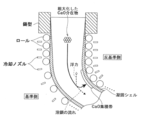
- FIG. 1 is a schematic diagram illustrating the flow of CaO inclusions.
- FIG. 2 is a diagram showing Ca concentration distributions of various slabs.
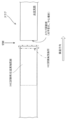
- FIG. 3A is a cross-sectional view of a slab
- FIG. 3B is a cross-sectional view of a product.
- FIG. 4 is a cross-sectional view of the slab.
- FIG. 5 is a diagram for explaining the investigation surface of the slab.
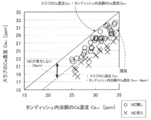
- FIG. 6 shows the threshold value determination results of the first embodiment in the examples, and is a diagram showing the relationship between the Ca concentration Ca TD1 of the tundish molten steel and the Ca concentration Ca S1 of the slab, and the HIC test results.
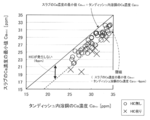
- FIG. 7 shows the threshold value determination result of the second embodiment in the example, and shows the relationship between the Ca concentration Ca TD1 of the molten steel in tundish and the minimum value Ca min1 of the Ca concentration of the slab and the HIC test result. It is.
- the inventors of the present invention have made extensive studies to solve the above-mentioned problems.
- the present inventors performed HIC tests prescribed in NACE (National Association of Corrosion and Engineering) TM0284 for various steel sheets, and evaluated HIC resistance.
- the NACE test is a test for evaluating the generation of HIC after 96 hours by saturating hydrogen sulfide gas in a solution of 5% NaCl solution + 0.5% acetic acid, pH 2.7.
- the inventors have investigated the steel sheet surface layer portion (for example, see CAMP-ISIJ Vol. 24 (2011) -P671), which is known to have a particularly high hydrogen concentration during the HIC test, for Charpy after the HIC test. Impact properties were performed according to ASTM A370. As a result, it was found that there was variation in the value of Charpy impact absorption energy.
- the Ar content in the steel material should be 0.50 ⁇ L (microliter) / cm 3 or less.
- the Ar content is preferably 0.30 ⁇ L / cm 3 or less, more preferably 0.25 [mu] L / cm 3 or less.
- it is necessary to blow Ar into the molten steel in the manufacturing process for example, by suppressing clogging of the injection nozzle, refluxing with RH for degassing, stirring in a tundish (TD) for inclusion floating separation, etc. Therefore, it is difficult to suppress the Ar content in the steel material to zero.
- the “Ar gas content in steel” is determined by the method described in the examples described later.
- the present inventors paid attention to the fact that HIC tends to occur starting from MnS inclusions.
- the rare earth element or Zr which is an element having a desulfurizing action, can be added to the steel material to suppress the generation of MnS and enhance the resistance to hydrogen-induced cracking.
- an appropriate content described later has been found.
- the present inventors paid attention to the fact that HIC is likely to be generated starting from a CaO accumulation portion generated during slab production.
- this Ca reduction amount is reduced to a predetermined threshold or less at the slab stage. It was found that a steel plate with high resistance to hydrogen-induced cracking can be obtained if it is contained, and that the product can be shipped early. This point will be described in detail later.
- Component composition [C: 0.02 to 0.15%]
- C is an indispensable element for securing the strength of the base material and the welded portion, and needs to be contained by 0.02% or more.
- the amount of C is preferably 0.03% or more, and more preferably 0.05% or more.
- the amount of C is too large, the HAZ toughness and weldability deteriorate.
- the amount of C is excessive, NbC and island-shaped martensite that become the starting point of HIC and the fracture propagation path are likely to be generated. Therefore, the C amount needs to be 0.15% or less. Preferably it is 0.12% or less, More preferably, it is 0.10% or less.
- Si 0.02 to 0.50%
- Si is an element that has a deoxidizing action and is effective in improving the strength of the base material and the welded portion.
- the Si content is set to 0.02% or more.
- the amount of Si is preferably 0.05% or more, and more preferably 0.15% or more.
- the amount of Si is preferably 0.45% or less, more preferably 0.35% or less.
- Mn is an element effective for improving the strength of the base material and the welded portion, and is contained in an amount of 0.6% or more in the present invention.
- the amount of Mn is preferably 0.8% or more, and more preferably 1.0% or more.
- the upper limit of the amount of Mn is set to 2.0%.
- the amount of Mn is preferably 1.8% or less, more preferably 1.5% or less, and still more preferably 1.2% or less.
- P more than 0% and 0.030% or less
- P is an element inevitably contained in the steel material. If the amount of P exceeds 0.030%, the toughness of the base material and the HAZ part is significantly deteriorated, and the resistance to hydrogen-induced cracking is also deteriorated. Therefore, in the present invention, the amount of P is suppressed to 0.030% or less.
- the amount of P is preferably 0.020% or less, more preferably 0.010% or less.
- the upper limit of the amount of S is set to 0.003%.
- the amount of S is preferably 0.002% or less, more preferably 0.0015% or less, and still more preferably 0.0010% or less. Thus, the smaller one is desirable from the viewpoint of improving hydrogen-induced crack resistance.
- Al is a strong deoxidizing element.
- the amount of Al is small, the Ca concentration in the oxide increases, that is, Ca inclusions are easily formed in the surface layer portion of the steel sheet and fine HIC is generated. Therefore, in the present invention, Al needs to be 0.010% or more.
- the amount of Al is preferably 0.020% or more, more preferably 0.030% or more.
- the oxide of Al will produce
- the amount of Al is preferably 0.06% or less, and more preferably 0.05% or less.
- Ca has the effect
- the Ca content needs to be 0.0003% or more.
- the Ca content is preferably 0.0005% or more, and more preferably 0.0010% or more.
- the upper limit of the Ca amount is set to 0.0060%.
- the Ca content is preferably 0.0045% or less, more preferably 0.0035% or less, and still more preferably 0.0025% or less.
- N is an element that precipitates as TiN in the steel structure, suppresses coarsening of the austenite grains in the HAZ part, further promotes ferrite transformation, and improves the toughness of the HAZ part.
- the N amount is preferably 0.003% or more, and more preferably 0.0040% or more.
- the amount of N is too large, the HAZ toughness deteriorates due to the presence of solute N, so the amount of N needs to be 0.01% or less.
- it is 0.008% or less, More preferably, it is 0.0060% or less.
- O oxygen
- oxygen oxygen
- the amount of O needs to be 0.0045% or less, preferably 0.0030% or less, more preferably 0.0020% or less.
- Ca / S (mass ratio): 2.0 or more]
- S forms MnS as sulfide inclusions, and HIC is generated starting from the MnS.
- Ca is added to control the form of the sulfide inclusions in the steel as CaS, thereby detoxifying S against HIC resistance.
- Ca / S needs to be 2.0 or more.
- Ca / S is preferably 2.5 or more, more preferably 3.0 or more.
- the upper limit of Ca / S is about 17 from the Ca amount and S amount specified in the present invention.
- (Ca-1.25S) / O must be 1.80 or less.
- (Ca-1.25S) / O is preferably 1.40 or less, more preferably 1.30 or less, still more preferably 1.20 or less, and particularly preferably 1.00 or less.
- the lower limit of (Ca-1.25S) / O is about 0.1 from the viewpoint of suppressing Al 2 O 3 which is likely to form an aggregated coal like CaO.
- REM Rare Earth Metal
- MnS MnS
- REM is an element effective for suppressing the generation of MnS by the desulfurization action and enhancing the resistance to hydrogen-induced cracking.
- the amount of REM is more preferably 0.0005% or more, and further preferably 0.0010% or more.
- the effect is saturated even if a large amount of REM is contained. Therefore, the upper limit of the REM amount needs to be 0.02%.
- the REM content is preferably 0.015% or less, more preferably 0.010% or less, and still more preferably 0.0050% or less. is there.
- the REM means a lanthanoid element (15 elements from La to Lu), Sc (scandium) and Y.
- Zr is an element that contributes to the improvement of HAZ toughness by improving HIC resistance by desulfurization and forming oxides and finely dispersing them.
- the Zr content is preferably 0.0003% or more.
- the amount of Zr is more preferably 0.0005% or more, still more preferably 0.0010% or more, and still more preferably 0.0015% or more.
- the amount of Zr needs to be 0.010% or less.
- the amount of Zr is preferably 0.0070% or less, more preferably 0.0050% or less, and still more preferably 0.0030% or less.
- the components of the steel material (steel plate, steel pipe) of the present invention are as described above, and the balance consists of iron and inevitable impurities.
- the balance consists of iron and inevitable impurities.
- (A) By including one or more elements selected from the group consisting of B, V, Cu, Ni, Cr, Mo, and Nb in the following amounts, the strength and toughness can be further increased.
- (B) By containing one or more elements selected from the group consisting of Ti and Mg in the following amounts, improvement in HAZ toughness and desulfurization can be promoted to further improve HIC resistance.
- these elements will be described in detail.
- B enhances hardenability, enhances the strength of the base metal and the welded part, and bonds with N during the process of cooling the heated HAZ part during welding, thereby precipitating BN and causing ferrite transformation from within the austenite grains.
- HAZ toughness is improved.
- the amount of B is more preferably 0.0005% or more, and further preferably 0.0010% or more.
- the B content is preferably 0.005% or less.
- the amount of B is more preferably 0.004% or less, and still more preferably 0.0030% or less.
- V is an element effective for improving the strength.
- V is preferably contained in an amount of 0.003% or more. More preferably, it is 0.010% or more.
- the V amount is preferably 0.1% or less, and more preferably 0.08% or less.
- Cu is an element effective for improving the hardenability and increasing the strength. In order to acquire this effect, it is preferable to contain 0.01% or more of Cu.
- the amount of Cu is more preferably 0.05% or more, and still more preferably 0.10% or more. However, if the Cu content exceeds 1.5%, the toughness deteriorates, so it is preferable to set it to 1.5% or less.
- the amount of Cu is more preferably 1.0% or less, still more preferably 0.50% or less.
- Ni is an element effective for improving the strength and toughness of the base material and the welded portion.
- the Ni content is preferably 0.01% or more.
- the amount of Ni is more preferably 0.05% or more, and still more preferably 0.10% or more.
- the Ni content is preferably 1.5% or less from an economical viewpoint.
- the amount of Ni is more preferably 1.0% or less, and still more preferably 0.50% or less.
- Cr more than 0% and 1.5% or less
- Cr is an element effective for improving the strength, and in order to obtain this effect, it is preferable to contain 0.01% or more.
- the amount of Cr is more preferably 0.05% or more, and still more preferably 0.10% or more.
- the Cr content is preferably 1.5% or less.
- the amount of Cr is more preferably 1.0% or less, and still more preferably 0.50% or less.
- Mo more than 0% and 1.5% or less
- Mo is an element effective for improving the strength and toughness of the base material.
- the Mo amount is preferably 0.01% or more.
- the amount of Mo is more preferably 0.05% or more, and still more preferably 0.10% or more.
- the Mo amount is preferably 1.5% or less, more preferably 1.0% or less, and still more preferably 0.50% or less.
- Nb is an element effective for increasing strength and base metal toughness without degrading weldability.
- the Nb content is preferably 0.002% or more.
- the Nb amount is more preferably 0.010% or more, and still more preferably 0.020% or more.
- the upper limit of the Nb amount is preferably 0.06%.
- the Nb amount is more preferably 0.050% or less, still more preferably 0.040% or less, and still more preferably 0.030% or less.
- Ti more than 0% and 0.03% or less
- Ti is an element effective for improving the toughness of the HAZ part because it precipitates as TiN in the steel to prevent coarsening of austenite grains in the HAZ part during welding and promote ferrite transformation.
- Ti is an element effective for improving the HIC resistance since it exhibits a desulfurization action. In order to obtain these effects, it is preferable to contain 0.003% or more of Ti.
- the amount of Ti is more preferably 0.005% or more, and still more preferably 0.010% or more.
- the Ti content is excessive, the toughness of the base material and the HAZ part deteriorates due to an increase in solid solution Ti or an increase in TiC precipitation, so 0.03% or less is preferable.
- the amount of Ti is more preferably 0.02% or less.
- Mg is an element effective for improving toughness through refinement of crystal grains, and is an element effective for improving HIC resistance since it exhibits a desulfurization action.
- the amount of Mg is more preferably 0.001% or more.
- the upper limit of the amount of Mg is preferably 0.01%.
- the amount of Mg is more preferably 0.005% or less.
- the steel plate of the present invention is a steel plate having a high hydrogen-induced cracking resistance with a Ca reduction amount obtained by subtracting the Ca concentration of the slab from the Ca concentration of the molten steel in the tundish being equal to or less than the threshold value Ca drop ⁇ .
- the threshold value Ca drop ⁇ means the maximum amount of Ca decrease that is obtained in advance and does not cause hydrogen-induced cracking in the steel sheet obtained by rolling the slab.
- the present inventors paid attention to MnS inclusions and advanced research on adding Ca to molten steel by secondary refining in order to suppress the formation of MnS.
- CaO—Al 2 O 3 inclusions are generated in the molten steel. Since CaO—Al 2 O 3 has good wettability with molten steel, it does not agglomerate in the molten steel, remains fine, and does not adversely affect the HIC resistance.
- the molten steel contains CaO—Al.
- pure CaO inclusions are also produced. Pure CaO inclusions tend to agglomerate in molten steel because of poor wettability with molten steel. Aggregated and coalesced CaO becomes coarse inclusions and induces HIC.
- the CaO accumulation zone is the starting point of HIC.
- an appropriate amount of Ca added to the molten steel can be determined in advance, generation of HIC due to CaO inclusions can be suppressed.
- the Ca addition amount is set to a sufficient amount for suppressing MnS generation. As a result, the Ca addition amount tends to be excessive, and a CaO accumulation zone is likely to be formed.
- the accumulation degree of CaO inclusions can be grasped by analyzing the Ca concentration at that position. Further, it can be estimated from the degree of CaO accumulation whether a CaO accumulation band is generated in the slab.
- the position where the CaO accumulation band is generated varies in the thickness direction of the slab depending on the casting conditions (the casting speed and the angle of the discharge hole of the immersion nozzle, etc.). For example, as shown in FIG. 2, in the three slabs (A to C) having different casting conditions (casting speed and angle of the discharge hole of the submerged nozzle), the position (ac) where the accumulation band is generated (ac) Are different. Since the position of the CaO accumulation band cannot be predicted in this way, it is difficult to evaluate whether the CaO accumulation band is generated from the degree of accumulation (Ca concentration).
- the present inventors changed the viewpoint on the survey position of the Ca concentration and focused on the position where the Ca concentration becomes low.
- the CaO accumulation band is generated, it is considered that the Ca concentration is high in the CaO accumulation band, while the Ca concentration is relatively low in the position where the CaO accumulation band is not generated.
- the relationship between “Ca concentration at an arbitrary position in the thickness direction of the slab” and “Ca concentration of molten steel in tundish” when a CaO accumulation zone occurs was examined.
- Ca reduction amount a value obtained by subtracting “Ca concentration of slab” from “Ca concentration of molten steel in tundish” related to presence / absence of CaO accumulation zone. It was decided to evaluate the HIC property.
- the threshold value Ca drop ⁇ of the Ca reduction amount for judging whether the obtained steel plate exhibits excellent HIC resistance that is, the maximum Ca reduction that does not generate HIC in the steel plate obtained by rolling the slab.
- the threshold value Ca drop ⁇ is obtained in advance, but the method is not particularly limited. As a method for obtaining the threshold value Ca drop ⁇ , the following methods (i) to (iii) may be used in advance.
- the Ca concentration of the molten steel in the tundish and the Ca concentration of the slab are measured, and the amount of Ca decrease is calculated by subtracting the Ca concentration of the slab from the Ca concentration of the molten steel in the tundish.
- a hydrogen-induced cracking test is performed on a steel plate obtained by rolling a slab cast under the same casting conditions as the slab.
- From the Ca decrease amount measured in (i) above and the hydrogen induced crack test result of (ii) above, the maximum Ca decrease amount at which no hydrogen induced crack occurs is obtained.
- the Ca concentration (Ca S1 ) of the slab is investigated.
- a sample is taken from a region R4 in the D / 2 range in the thickness direction from the reference side surface of the slab (hereinafter referred to as “reference side region R4”), and the Ca concentration Ca S1 is determined. analyse.
- the “reference side region R4” is a range from D / 2 to D in the thickness direction of the slab from the non-reference side surface.
- the CaO inclusion in the molten steel floats due to buoyancy caused by the density difference with the molten steel.
- FIG. 1 in a continuous casting machine in which a bent portion and a horizontal portion are formed, when CaO inclusions float, they are captured by the solidified shell on the anti-reference side, so the CaO accumulation zone is generated on the anti-reference side of the slab. Does not occur on the reference side.
- the “D / 2 in the thickness direction from the reference side surface (reference side region R4)” where no CaO accumulation band is generated that is, in the embodiment described later.
- the Ca concentration Ca S1 is examined in the range from the center of the thickness D to ⁇ 0.50 D from the reference side surface. Since the “Ca reduction amount” at a position where no CaO accumulation band is generated can be calculated from the Ca concentration Ca S1 of the reference side region R4, the presence or absence of the CaO accumulation band can be accurately evaluated.
- Ca drop1 Ca TD1 -Ca S1
- a slab cast under the same casting conditions as the slab in which the Ca concentration Ca S1 is measured is hot-rolled to produce a steel plate for threshold measurement.
- rolling is performed under the following conditions. That is, after the slab is heated to 1050 to 1250 ° C., the steel sheet surface temperature is 900 ° C. or higher, the steel sheet average temperature obtained by calculation as described below is 1000 ° C. or higher, and the cumulative rolling reduction is 40% or higher. Hot rolling is performed so that a pass with a reduction rate of 10% or more per pass becomes 2 passes or more, and then hot rolling is performed so that a cumulative reduction rate of 700 ° C. or more and less than 900 ° C. becomes 20% or more.
- the rolling finish temperature is set to be 700 ° C.
- the steel sheet average temperature is determined as follows. That is, based on data such as a rolling pass schedule during rolling and a cooling method (water cooling or air cooling) between passes, the temperature at an arbitrary position in the plate thickness direction is calculated using a method suitable for calculation such as a difference method, Let the average value of the temperature from the surface of the calculated
- HIC test Then, an HIC test is performed on the steel sheet to examine whether or not HIC is generated.
- the HIC test can be performed by a method defined in NACE standard TM0284-2003, as shown in Examples described later.
- the target region of the HIC test is a region R41 excluding the vicinity of the thickness center portion in the product region R40 corresponding to the anti-reference side region.
- the coarse CaO integrated band is easily formed on the anti-reference side of the slab, and the HIC caused by CaO is likely to occur in the region corresponding to the vicinity of the anti-reference side surface.
- HIC due to segregation is likely to occur at the center of thickness, it cannot be evaluated as HIC due to CaO. Therefore, it is examined whether or not HIC is generated in the region R41 excluding the vicinity of the thickness center portion.
- a threshold value Ca drop ⁇ of a Ca drop amount at which no HIC is generated is determined from the “Ca drop amount Ca drop1 ” and the “HIC test result”.
- the maximum Ca reduction amount when no HIC is generated is defined as “threshold Ca drop ⁇ ”.
- Ca decrease amount Ca drop11 is calculated using a value obtained by subtracting “minimum Ca concentration Ca min1 of slab” from “Ca concentration Ca TD1 in tundish ”.
- Ca drop11 is expressed by the following equation.
- Ca drop11 Ca TD1 -Ca min1
- the survey position of the Ca concentration is one in the entire range in the thickness direction of the slab, and if the position is an accumulation zone, a significantly high Ca concentration is detected. Since the amount of Ca decrease calculated from the high Ca concentration is small, it is determined that no CaO accumulation band has occurred, and it is evaluated that no HIC has occurred. However, an integrated band is actually generated, and it is considered that HIC can be generated due to this.
- the Ca concentration is examined at two or more positions different in the thickness direction of the slab. Since the CaO accumulation band exists at a specific position in the thickness direction determined by casting conditions, a position where no CaO accumulation band is generated can be included in the investigation object by changing the investigation position in the thickness direction.
- the two or more Ca concentrations (Ca S1 , Ca S2 ) Include the Ca concentration in the accumulation band and the Ca concentration at the position where the accumulation band is not generated.
- (Ca min1 ) it is possible to select the Ca concentration at a position where no accumulation band is generated. Since the amount of Ca decrease at a position where no accumulation band is generated can be calculated from this concentration, the presence or absence of the CaO accumulation band can be accurately evaluated.
- the generation mechanism of the CaO accumulation band is the same for CaO inclusions and Al 2 O 3 inclusions, and the thickness of the accumulation band of Al 2 O 3 inclusions is reported to be 10 mm (reference: ISIJ). International, Vol. 43 (2003), No. 10, pp. 1548-1555). From this report, the thickness of the accumulation zone of CaO inclusions can be estimated to be 10 mm. Then, as shown in FIG. 4, when each Ca concentration investigation position is separated from the thickness direction by more than 10 mm, even if one of the investigation positions is an accumulation band, no accumulation band is generated at the other investigation positions. Position. For this reason, it is preferable that the two or more survey positions are separated by more than 10 mm in the thickness direction. Note that FIG. 4 shows a case where there are two survey positions and the thickness direction distance l between the two survey positions exceeds 10 mm (thickness direction distance l between the two survey positions> 10 mm).
- the Ca concentration investigation position is a region R3 having a width WD excluding D / 2 from both ends in the width direction, which is mainly cooled only from the wide surface side.
- HIC test Then, an HIC test is performed on the steel sheet, and the presence or absence of HIC occurrence in the “region R41 corresponding to the vicinity of the anti-reference side surface” is examined.
- the HIC test can be performed by a method defined in NACE standard TM0284-2003, as shown in Examples described later.
- a threshold value Ca drop ⁇ of the Ca reduction amount at which HIC does not occur is determined from “Ca reduction amount Ca drop11 ” and “HIC test result”.
- the maximum Ca decrease amount when no HIC occurs is defined as “threshold Ca drop ⁇ ”.
- the Ca concentration Ca TD11 of the molten steel in the tundish of the determination target charge is investigated.
- the Ca concentration is investigated at two or more different locations in the thickness direction, and the minimum is determined from two or more Ca concentrations (Ca S11 , Ca S12 ).
- the Ca concentration (Ca min11 ) is selected. It is preferable that two or more investigation positions are spaced apart from each other by more than 10 mm in the thickness direction.
- Ca drop Ca TD11 -Ca min11
- the stationary position (survey surface) of the slab is preferably a stationary part, but may be an unsteady part.
- the “unsteady portion” is a portion cast when a casting condition is changed, and includes a portion cast at an early stage of casting such as when the casting speed is increased, or a portion cast at the end of casting such as when the casting speed is decreased.
- the steel plate of the present invention satisfies the above Ca drop ⁇ threshold Ca drop ⁇ , and it is considered that no CaO accumulation band is generated in the slab, so that no HIC is generated.
- “amount of decrease in Ca concentration from tundish to slab” is used for evaluation of HIC resistance. Since the internal quality of the slab (accumulation degree of CaO inclusions) can be accurately evaluated from this, the HIC resistance can be evaluated at the stage of the slab based on this evaluation result. Thereby, since the HIC test which requires several weeks can be omitted, the period from manufacture to shipment can be greatly shortened.
- the method for producing the steel sheet of the present invention is not particularly limited as long as it is a method for obtaining a steel sheet in which the Ar gas content in the steel material satisfies the above rules.
- the following method is recommended as a method for easily obtaining the steel sheet specified above.
- the number density of inclusions having a major axis of 3 ⁇ m or more with a melting point of 1550 ° C. or more is preferably 3 pieces / cm 2 or more in the mold. Is recommended.
- Inclusions with a melting point of 1550 ° C. or higher are present as solids in the mold, so that the wettability with molten steel is poor, the inclusions aggregate together, and float due to volume expansion by involving Ar gas in the inclusions. Becomes easy.
- relatively coarse inclusions having a major axis of 3 ⁇ m or more come into contact with each other in the mold and become coarser, and involve Ar bubbles, thereby promoting the floating separation of Ar bubbles in the mold.
- the Ar gas content in the steel material can be reduced.
- Ar gas tends to remain in the steel material, so that the floating separation by the inclusions is effective.
- inclusions having a melting point of 1550 ° C. or higher include Al 2 O 3 and CaO, and composite inclusions thereof. If the melting point is unknown for composite inclusions, etc., quantitative analysis of the inclusions is performed by energy dispersive X-ray spectroscopy (EDX), etc., artificial inclusions simulating the composition are created, The melting point can be determined by measuring the temperature at which the dissolution of the artificial inclusion starts. More simply, by utilizing the fact that liquid inclusions in a mold are observed in a spherical shape after solidification, inclusions having an aspect ratio of 1.3 or more can be handled as inclusions having a temperature of 1550 ° C. or more. Good.
- EDX energy dispersive X-ray spectroscopy
- the number density of the inclusions is more preferably 5 pieces / cm 2 or more, and even more preferably 10 pieces / cm 2 or more.
- the toughness of the base material and the HAZ part even if the number density of the inclusions is excessive. Therefore, the upper limit of the number density of the inclusions is approximately 100 / cm 2 .
- the recirculation time in RH in the refining process is 45 minutes or less, and after 15 minutes or more have elapsed from the addition of Ca in the RH, (A) In a continuous casting machine using a hot reuse tundish, casting is performed using a tundish that has passed 30 minutes or more after the completion of the pre-charge casting; and / or (B) Metal Al can be added to the molten steel in the hot reuse tundish, for example, 0.04 kg / ton or more (for example, about 0.2 kg / ton. The upper limit is about 0.50 kg / ton or less, preferably 0.40 kg / ton or less) and then casting.
- Another means of reducing the Ar gas content in the steel material is to suppress and stop the use of Ar in the injection nozzle, RH, and tundish.
- it is effective to blow Ar from a position of 50 mm or more from the upper part of the discharge hole of the injection nozzle.
- the Ar blowing amount (flow rate) in the injection nozzle is preferably 9.0 L (liter) / t (tons) or less (more preferably 6.0 L / t).
- the nitrogen gas is not preferable because the N amount of the steel sheet cannot be controlled and the toughness tends to deteriorate.
- the process after casting as described above is not particularly limited, and the steel sheet can be manufactured by performing hot rolling according to a conventional method. Moreover, the steel pipe for line pipes can be manufactured by the method generally performed using this steel plate. The steel pipe for line pipes obtained using the steel sheet of the present invention is also excellent in HIC resistance and toughness.
- Casting Tables 1-1 to 4 and FIGS. 6 and 7 show experimental conditions and experimental results for determining the threshold.
- a slab having a slab thickness D of 280 mm and a slab width W of 2100 mm was obtained.
- the casting conditions of the first embodiment are shown in Table 1-1 and Table 1-2, and the casting conditions of the second embodiment are shown in Table 2-1 and Table 2-2, respectively.
- 25 charges were manufactured to obtain API (The American Petroleum Institute) X65 grade steel plate and APIX70 grade steel plate.
- Test No. 58 to 64 are 3 to 8 locations, respectively, and test No. 65 to 68 investigated 10 places. And the minimum Ca density
- the 2 to 10 positions are positions separated by more than 10 mm in the thickness direction.
- the surface temperature of the steel plate is 900 ° C. or higher
- the average steel plate temperature calculated by calculation is 1000 ° C. or higher
- the cumulative rolling reduction is 40% or higher.
- hot rolling is performed so that a pass having a reduction rate of 10% or more per pass becomes 2 passes or more
- hot rolling is performed so that a cumulative reduction rate of 700 ° C. or more and less than 900 ° C. becomes 20% or more.
- the surface temperature at the end of rolling was set to 850 ° C. Thereafter, the cooling is started from the cooling start surface temperature: 950 ° C.
- a steel sheet having a size of 9 to 50 mm, plate thickness x 2000 to 3500 mm width x 12000 to 35000 mm length was obtained.
- HIC test In order to determine the threshold value t ⁇ , in this example, an HIC test was performed after rolling.
- a sample was cut out from each steel sheet after rolling, and an HIC test was performed. The HIC test was performed according to the method specified in NACE standard TM0284-2003.
- B After the HIC test, the sample was cut at three locations, and each cross section (three cross sections) was observed with a microscope to confirm the presence or absence of HIC. The observation region was a region R41 excluding the range of ⁇ 5.3% of the plate thickness from the product thickness center in the “product region R40 corresponding to the anti-reference side region” shown in FIG.
- FIG. 6 shows the threshold value determination result of the first embodiment.
- the relationship between the “IC concentration Ca S1 of the slab” in Table 1-2 and the HIC test results is shown.
- FIG. 7 shows the threshold value determination result of the second embodiment.
- “Ca concentration Ca TD1 of molten steel in tundish” investigated in the above (2) and Tables 3-1, 3-2 and 4 The relationship between the minimum Ca density
- steel having the component composition shown in Table 5 was melted, and a steel piece (slab) was obtained by continuous casting.
- the casting was performed so that the number of inclusions having a major axis of 3 ⁇ m or more in the mold was 3 / cm 2 or more.
- the number of inclusions was controlled such that the reflux time in RH was 5 minutes to 45 minutes, Ca was added after RH reflux, and then 15 minutes to 45 minutes were passed. .
- the molten steel is filled with the tundish that has passed 30 minutes or more and 60 minutes or less after the completion of the casting of the precharge, and then 0.04 kg / Casting was performed by adding metallic Al of ton or more (upper limit is about 0.50 kg / ton). The inclusion number density was measured using a sample taken from the mold 10 minutes after casting.
- the number of inclusions in the mold was obtained by collecting a molten steel sample from the mold and observing it with a scanning electron microscope (SEM) (magnification: 400 times, number of fields: 30 fields of view). The number density was determined by regarding inclusions having a melting point of 1.3 or more as inclusions having a melting point of 1550 ° C. or more. Table 6 shows “OK” when the number density of the inclusions is 3 / cm 2 or more in the mold by the above method, and “NG” otherwise.
- TMCP or “QT” in the column of “Hot rolling / cooling method” in Table 6, two patterns of hot rolling / cooling.
- steel sheets having various component compositions (9 to 90 mm plate thickness ⁇ 2000 to 3500 mm width ⁇ 12000 to 35000 mm length) were obtained.
- the “TMCP” has a steel sheet surface temperature of 900 ° C. or higher, a calculated steel plate average temperature of 1000 ° C. or higher, a cumulative rolling reduction of 40% or higher, and a rolling reduction per pass of 10% or higher.
- Hot rolling is performed so that there are two or more passes. Thereafter, hot rolling is performed so that the cumulative rolling reduction of 700 ° C.
- the rolling end surface temperature is set to 850 ° C.
- the cooling start surface temperature average cooling from 950 ° C.
- Speed Cooling is started at 10 ° C./s, stopped at a temperature of 350 to 600 ° C., and then cooled to room temperature.
- the “QT” is hot-rolled so that the surface temperature at the end of rolling is 850 ° C. or higher, then air-cooled to room temperature, reheated to a temperature of 850 ° C. or higher and 950 ° C. or lower, quenched, and then 600-700 ° C. This is a method of performing a tempering process.
- the gas component in the steel is extracted by drilling from the steel plate surface to 5 mm below the surface using a diameter D1: 3.0 mm, groove length L3: 32 mm, full length: 71 mm, blade diameter: 3.0 mm, Gas components were quantitatively analyzed using a quadrupole mass spectrometer (M-101QA-TDM type) (mass number measurement range: 1 to 100 amu) manufactured by Anerva. And ratio (microliter / cm ⁇ 3 >) of Ar amount with respect to the volume of the steel materials drilled by the said drill process was calculated
- HIC test The HIC test was implemented using the said steel plate. The HIC test was performed according to the method specified in NACE standard TM0284-2003.
- Steel type no. 1 to 4, 6, 7, and 10 to 12 are steel plates of the present invention that satisfy the prescribed component composition and have a reduced amount of Ca in the slab that is less than or equal to a threshold value, and are excellent in HIC resistance. Moreover, since these steel plates are restrained in Ar gas content in steel materials in the regulation range, they are excellent in HIC resistance and excellent toughness is obtained stably.
- steel grade no. 9 is an example in which the chemical composition of the steel sheet deviates from the definition of the present invention. That is, the steel type No. Steel plate No. 9 had REM and Zr of 0%, and the value of (Ca-1.25S) / O was out of specification, resulting in poor HIC resistance and a large variation in toughness. Steel type no. No.
- Steel type no. 8 and 13 are examples in which the chemical component composition of the steel sheet deviated from the definition of the present invention, although the amount of Ca decrease in the slab was suppressed to be smaller than the threshold value. That is, no. No. 8 was inferior in HIC resistance because REM and Zr were 0% and the value of (Ca / S) was out of specification. Steel type no. No. 13 was inferior in HIC resistance because the value of (Ca / S) was not specified. Steel type No. In No. 5, since the Ar gas content in the steel material was excessive, variation in toughness became large.
- the period from casting start to shipment of the product steel plate, that is, the sour steel plate (casting ⁇ rolling ⁇ shipping) was 19 days.
- the period from casting start to shipping is as long as 28 days. It took a period.
- the period from the start of casting to shipment could be greatly shortened from 28 days to 19 days.
- the period from the start of casting to the shipment of the product steel plate, that is, the sour steel plate (casting ⁇ Remelting ⁇ rolling ⁇ shipping) was 54 days.
- the evaluation is NG
- remelting was started after the HIC test was performed.
- the period from the start of casting to the shipment of the steel sheet as a product (casting ⁇ rolling ⁇ HIC test ⁇ remelting ⁇ rolling ⁇ HIC test ⁇ shipping) required 72 days.
- the HIC test after rolling could be omitted, even when remelting was necessary, the period from the start of casting to shipment could be greatly shortened from 72 days to 54 days.
- the determination method of the present invention is highly accurate because the HIC test for determining the threshold for evaluating the HIC resistance of the slab and the HIC test for confirmation are the same.
Landscapes
- Chemical & Material Sciences (AREA)
- Engineering & Computer Science (AREA)
- Materials Engineering (AREA)
- Mechanical Engineering (AREA)
- Metallurgy (AREA)
- Organic Chemistry (AREA)
- Heat Treatment Of Steel (AREA)
Abstract
L'invention concerne une plaque d'acier et un tube en acier ayant d'excellentes propriétés en termes de ténacité et de résistance à la fissuration sous hydrogène. L'invention concerne également une plaque d'acier et un tube en acier permettant d'évaluer la résistance à la fissuration sous hydrogène à partir de la qualité interne d'une pièce coulée, sans effectuer d'essai de fissuration sous hydrogène après le laminage. Cette plaque d'acier ayant d'excellentes propriétés en termes de ténacité et de résistance à la fissuration sous hydrogène satisfait à une quantité prescrite de C, Si, Mn, P, S, Al, Ca, N et O et comprend au moins un type d'élément choisi dans le groupe constitué par les terres rares prescrites et le Zr, le reste étant constitué de fer et des impuretés inévitables ; le rapport (Ca/S) entre lesdits éléments Ca et S étant égal ou supérieur à 2,0 ; lesdits éléments Ca, S, et O satisfaisant à la relation (Ca - 1,25 x S)/O ≤ 1,80 ; la teneur en Ar gazeux dans le matériau d'acier étant de 0,50 µL/cm3 ou moins ; la quantité de réduction de Ca obtenue en soustrayant la concentration en Ca d'une brame de la concentration en Ca de l'acier fondu dans un panier de coulée étant égale ou inférieure à un seuil Cadropθ ; le seuil Cadropθ étant la quantité de réduction maximale de Ca à laquelle aucune fissuration sous hydrogène ne survient dans une plaque d'acier obtenue par laminage de la brame.
Priority Applications (3)
| Application Number | Priority Date | Filing Date | Title |
|---|---|---|---|
| KR1020177019233A KR20170093961A (ko) | 2014-12-26 | 2015-12-22 | 내수소유기균열성과 인성이 우수한 강판 및 라인 파이프용 강관 |
| EP15873096.0A EP3239333A4 (fr) | 2014-12-26 | 2015-12-22 | Plaque d'acier ayant d'excellentes propriétés en termes de ténacité et de résistance à la fissuration sous hydrogène et tube en acier pour tube de canalisation |
| CN201580069989.4A CN107109595A (zh) | 2014-12-26 | 2015-12-22 | 抗氢致裂纹性和韧性优异的钢板和管线管用钢管 |
Applications Claiming Priority (4)
| Application Number | Priority Date | Filing Date | Title |
|---|---|---|---|
| JP2014-266492 | 2014-12-26 | ||
| JP2014266492 | 2014-12-26 | ||
| JP2015-208022 | 2015-10-22 | ||
| JP2015208022A JP2016125140A (ja) | 2014-12-26 | 2015-10-22 | 耐水素誘起割れ性と靭性に優れた鋼板およびラインパイプ用鋼管 |
Publications (1)
| Publication Number | Publication Date |
|---|---|
| WO2016104528A1 true WO2016104528A1 (fr) | 2016-06-30 |
Family
ID=56150544
Family Applications (1)
| Application Number | Title | Priority Date | Filing Date |
|---|---|---|---|
| PCT/JP2015/085871 Ceased WO2016104528A1 (fr) | 2014-12-26 | 2015-12-22 | Plaque d'acier ayant d'excellentes propriétés en termes de ténacité et de résistance à la fissuration sous hydrogène et tube en acier pour tube de canalisation |
Country Status (1)
| Country | Link |
|---|---|
| WO (1) | WO2016104528A1 (fr) |
Cited By (3)
| Publication number | Priority date | Publication date | Assignee | Title |
|---|---|---|---|---|
| WO2024117085A1 (fr) * | 2022-11-29 | 2024-06-06 | Jfeスチール株式会社 | Tôle d'acier, son procédé de production et tube d'acier |
| WO2024117082A1 (fr) * | 2022-11-29 | 2024-06-06 | Jfeスチール株式会社 | Tôle d'acier, son procédé de production et tuyau en acier |
| WO2024117083A1 (fr) * | 2022-11-29 | 2024-06-06 | Jfeスチール株式会社 | Tôle d'acier, son procédé de production et tube d'acier |
Citations (7)
| Publication number | Priority date | Publication date | Assignee | Title |
|---|---|---|---|---|
| JP2012036462A (ja) * | 2010-08-09 | 2012-02-23 | Nippon Steel Corp | 耐水素誘起割れ性に優れた鋼材 |
| JP2013124398A (ja) * | 2011-12-15 | 2013-06-24 | Jfe Steel Corp | 高強度耐サワーラインパイプ用鋼板及びその素材 |
| JP2013190319A (ja) * | 2012-03-14 | 2013-09-26 | Jfe Steel Corp | 鋼材の耐hic性の評価方法およびそれを利用したラインパイプ用高強度厚鋼板の製造方法 |
| JP2014077642A (ja) * | 2012-10-09 | 2014-05-01 | Jfe Steel Corp | 鋼材のhic感受性の評価方法およびそれを用いた耐hic性に優れたラインパイプ用高強度厚鋼板の製造方法 |
| WO2014157215A1 (fr) * | 2013-03-29 | 2014-10-02 | 株式会社神戸製鋼所 | Plaque en acier présentant une excellente résistance à la fissuration induite par l'hydrogène et une excellente ténacité de la zone exposée à la chaleur de soudage, et tube en acier destiné à être utilisé comme tube de canalisation |
| WO2014157165A1 (fr) * | 2013-03-29 | 2014-10-02 | 株式会社神戸製鋼所 | Plaque en acier présentant une résistance à la fissuration induite par l'hydrogène et une ténacité excellentes, et tube de canalisation en acier |
| WO2015002046A1 (fr) * | 2013-07-01 | 2015-01-08 | 株式会社神戸製鋼所 | Tôle d'acier présentant une excellente résistance aux fissurations induites par l'hydrogène et une excellente ténacité ainsi que tube d'acier pour un tube de canalisation |
-
2015
- 2015-12-22 WO PCT/JP2015/085871 patent/WO2016104528A1/fr not_active Ceased
Patent Citations (7)
| Publication number | Priority date | Publication date | Assignee | Title |
|---|---|---|---|---|
| JP2012036462A (ja) * | 2010-08-09 | 2012-02-23 | Nippon Steel Corp | 耐水素誘起割れ性に優れた鋼材 |
| JP2013124398A (ja) * | 2011-12-15 | 2013-06-24 | Jfe Steel Corp | 高強度耐サワーラインパイプ用鋼板及びその素材 |
| JP2013190319A (ja) * | 2012-03-14 | 2013-09-26 | Jfe Steel Corp | 鋼材の耐hic性の評価方法およびそれを利用したラインパイプ用高強度厚鋼板の製造方法 |
| JP2014077642A (ja) * | 2012-10-09 | 2014-05-01 | Jfe Steel Corp | 鋼材のhic感受性の評価方法およびそれを用いた耐hic性に優れたラインパイプ用高強度厚鋼板の製造方法 |
| WO2014157215A1 (fr) * | 2013-03-29 | 2014-10-02 | 株式会社神戸製鋼所 | Plaque en acier présentant une excellente résistance à la fissuration induite par l'hydrogène et une excellente ténacité de la zone exposée à la chaleur de soudage, et tube en acier destiné à être utilisé comme tube de canalisation |
| WO2014157165A1 (fr) * | 2013-03-29 | 2014-10-02 | 株式会社神戸製鋼所 | Plaque en acier présentant une résistance à la fissuration induite par l'hydrogène et une ténacité excellentes, et tube de canalisation en acier |
| WO2015002046A1 (fr) * | 2013-07-01 | 2015-01-08 | 株式会社神戸製鋼所 | Tôle d'acier présentant une excellente résistance aux fissurations induites par l'hydrogène et une excellente ténacité ainsi que tube d'acier pour un tube de canalisation |
Non-Patent Citations (1)
| Title |
|---|
| See also references of EP3239333A4 * |
Cited By (10)
| Publication number | Priority date | Publication date | Assignee | Title |
|---|---|---|---|---|
| WO2024117085A1 (fr) * | 2022-11-29 | 2024-06-06 | Jfeスチール株式会社 | Tôle d'acier, son procédé de production et tube d'acier |
| WO2024117084A1 (fr) * | 2022-11-29 | 2024-06-06 | Jfeスチール株式会社 | Tôle d'acier, son procédé de production et tuyau en acier |
| WO2024117082A1 (fr) * | 2022-11-29 | 2024-06-06 | Jfeスチール株式会社 | Tôle d'acier, son procédé de production et tuyau en acier |
| WO2024117083A1 (fr) * | 2022-11-29 | 2024-06-06 | Jfeスチール株式会社 | Tôle d'acier, son procédé de production et tube d'acier |
| JP7533816B1 (ja) * | 2022-11-29 | 2024-08-14 | Jfeスチール株式会社 | 鋼板及びその製造方法並びに鋼管 |
| JP7533818B1 (ja) * | 2022-11-29 | 2024-08-14 | Jfeスチール株式会社 | 鋼板及びその製造方法並びに鋼管 |
| JP7533817B1 (ja) * | 2022-11-29 | 2024-08-14 | Jfeスチール株式会社 | 鋼板及びその製造方法並びに鋼管 |
| JP7533815B1 (ja) * | 2022-11-29 | 2024-08-14 | Jfeスチール株式会社 | 鋼板及びその製造方法並びに鋼管 |
| EP4596740A4 (fr) * | 2022-11-29 | 2025-12-17 | Jfe Steel Corp | Tôle d'acier, son procédé de production et tuyau en acier |
| EP4596739A4 (fr) * | 2022-11-29 | 2025-12-24 | Jfe Steel Corp | Tôle d'acier, son procédé de production et tube d'acier |
Similar Documents
| Publication | Publication Date | Title |
|---|---|---|
| JP6316548B2 (ja) | 耐水素誘起割れ性と靭性に優れた鋼板およびラインパイプ用鋼管 | |
| JP2016125140A (ja) | 耐水素誘起割れ性と靭性に優れた鋼板およびラインパイプ用鋼管 | |
| US9068253B2 (en) | Steel plate with excellent hydrogen induced cracking resistance, and manufacturing method of the same | |
| KR101709034B1 (ko) | 내수소유기균열성과 인성이 우수한 강판 및 라인 파이프용 강관 | |
| CN101855378A (zh) | 管道钢管用钢板及钢管 | |
| CN109072382B (zh) | 高张力钢和海洋构造物 | |
| CN105838992A (zh) | 抗氢致开裂性优异的高强度管线管用钢板和高强度管线管用钢管 | |
| JP6584912B2 (ja) | 耐水素誘起割れ性に優れた鋼板およびラインパイプ用鋼管 | |
| JP2006063351A (ja) | 耐水素誘起割れ性に優れた高強度鋼板および製造方法、並びにラインパイプ用鋼管 | |
| CN116752044A (zh) | 钢材及其制造方法 | |
| KR20170083158A (ko) | 후육 고강도 내사우어 라인 파이프 | |
| CN102421926A (zh) | 抗hic厚钢板及uoe钢管 | |
| JP2016125139A (ja) | 耐水素誘起割れ性に優れた鋼板およびラインパイプ用鋼管 | |
| JP4725437B2 (ja) | 厚鋼板用連続鋳造鋳片及びその製造方法並びに厚鋼板 | |
| JP2016125137A (ja) | 耐水素誘起割れ性に優れた鋼板およびラインパイプ用鋼管 | |
| CN109952387A (zh) | 钢板和管线管用钢管及其制造方法 | |
| JP6126503B2 (ja) | 耐サワーラインパイプ鋼スラブの品質判定による向け先変更方法 | |
| JP7230454B2 (ja) | 継目無鋼管用鋼材 | |
| WO2016104526A1 (fr) | Tôle d'acier présentant une excellente résistance à la fissuration induite par l'hydrogène et tube d'acier pour tuyau de canalisation | |
| JP6086036B2 (ja) | 溶接熱影響部靱性に優れた厚板鋼材とその溶製方法 | |
| WO2016104527A1 (fr) | Tôle d'acier présentant une excellente résistance à la fissuration induite par l'hydrogène et tube d'acier pour tube de canalisation | |
| WO2016104529A1 (fr) | Plaque d'acier ayant une excellente résistance à la fissuration sous hydrogène et tube en acier pour tube de canalisation |
Legal Events
| Date | Code | Title | Description |
|---|---|---|---|
| 121 | Ep: the epo has been informed by wipo that ep was designated in this application |
Ref document number: 15873096 Country of ref document: EP Kind code of ref document: A1 |
|
| NENP | Non-entry into the national phase |
Ref country code: DE |
|
| ENP | Entry into the national phase |
Ref document number: 20177019233 Country of ref document: KR Kind code of ref document: A |
|
| REEP | Request for entry into the european phase |
Ref document number: 2015873096 Country of ref document: EP |