WO2016111923A1 - Led-curable low migration photoinitiators - Google Patents
Led-curable low migration photoinitiators Download PDFInfo
- Publication number
- WO2016111923A1 WO2016111923A1 PCT/US2016/012035 US2016012035W WO2016111923A1 WO 2016111923 A1 WO2016111923 A1 WO 2016111923A1 US 2016012035 W US2016012035 W US 2016012035W WO 2016111923 A1 WO2016111923 A1 WO 2016111923A1
- Authority
- WO
- WIPO (PCT)
- Prior art keywords
- acrylate
- methacrylate
- group
- moiety
- nitrogen
- Prior art date
- Legal status (The legal status is an assumption and is not a legal conclusion. Google has not performed a legal analysis and makes no representation as to the accuracy of the status listed.)
- Ceased
Links
- WXEANJGEMOJGSH-UHFFFAOYSA-N CCCC(CN)CO Chemical compound CCCC(CN)CO WXEANJGEMOJGSH-UHFFFAOYSA-N 0.000 description 2
- 0 C*(C)(*)CCC(**)=N Chemical compound C*(C)(*)CCC(**)=N 0.000 description 1
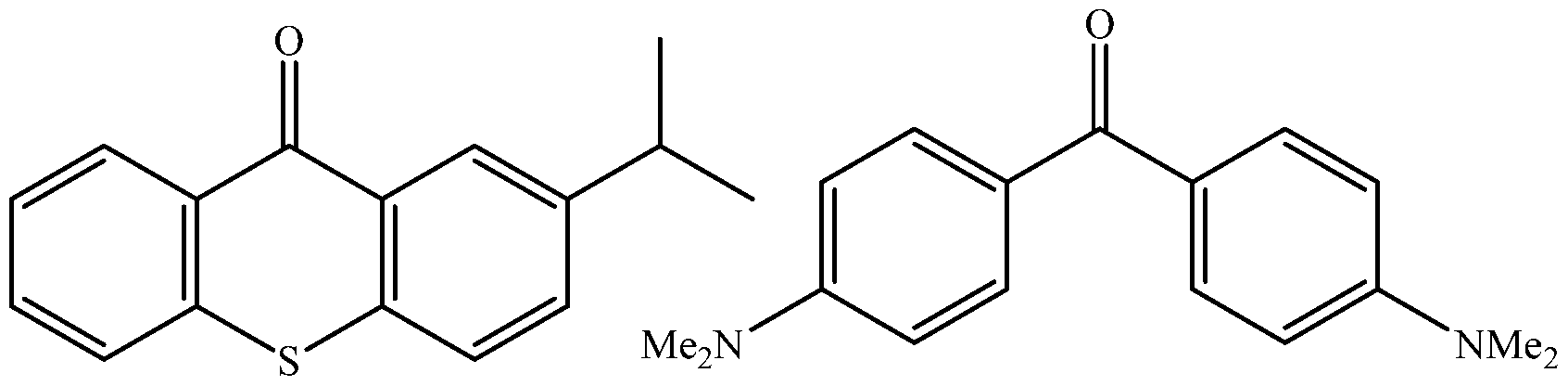
- KTALPKYXQZGAEG-UHFFFAOYSA-N CC(C)c(cc12)ccc1Sc1ccccc1C2=O Chemical compound CC(C)c(cc12)ccc1Sc1ccccc1C2=O KTALPKYXQZGAEG-UHFFFAOYSA-N 0.000 description 1
- CBJMPSOJRWRFCY-UHFFFAOYSA-N CCC(COC(CCN(CC1)CCN1c(cc1)ccc1C(c(cc1)ccc1N1CCN(CCC(OCC(CC)(COC(C=C)=O)COC(C=C)=O)=O)CC1)=O)=O)(COC(C=C)=O)COC(C=C)=O Chemical compound CCC(COC(CCN(CC1)CCN1c(cc1)ccc1C(c(cc1)ccc1N1CCN(CCC(OCC(CC)(COC(C=C)=O)COC(C=C)=O)=O)CC1)=O)=O)(COC(C=C)=O)COC(C=C)=O CBJMPSOJRWRFCY-UHFFFAOYSA-N 0.000 description 1
- VVBLNCFGVYUYGU-UHFFFAOYSA-N CN(C)c(cc1)ccc1C(c(cc1)ccc1N(C)C)=O Chemical compound CN(C)c(cc1)ccc1C(c(cc1)ccc1N(C)C)=O VVBLNCFGVYUYGU-UHFFFAOYSA-N 0.000 description 1
Classifications
-
- C—CHEMISTRY; METALLURGY
- C07—ORGANIC CHEMISTRY
- C07D—HETEROCYCLIC COMPOUNDS
- C07D241/00—Heterocyclic compounds containing 1,4-diazine or hydrogenated 1,4-diazine rings
- C07D241/02—Heterocyclic compounds containing 1,4-diazine or hydrogenated 1,4-diazine rings not condensed with other rings
- C07D241/04—Heterocyclic compounds containing 1,4-diazine or hydrogenated 1,4-diazine rings not condensed with other rings having no double bonds between ring members or between ring members and non-ring members
-
- C—CHEMISTRY; METALLURGY
- C07—ORGANIC CHEMISTRY
- C07D—HETEROCYCLIC COMPOUNDS
- C07D295/00—Heterocyclic compounds containing polymethylene-imine rings with at least five ring members, 3-azabicyclo [3.2.2] nonane, piperazine, morpholine or thiomorpholine rings, having only hydrogen atoms directly attached to the ring carbon atoms
- C07D295/04—Heterocyclic compounds containing polymethylene-imine rings with at least five ring members, 3-azabicyclo [3.2.2] nonane, piperazine, morpholine or thiomorpholine rings, having only hydrogen atoms directly attached to the ring carbon atoms with substituted hydrocarbon radicals attached to ring nitrogen atoms
- C07D295/14—Heterocyclic compounds containing polymethylene-imine rings with at least five ring members, 3-azabicyclo [3.2.2] nonane, piperazine, morpholine or thiomorpholine rings, having only hydrogen atoms directly attached to the ring carbon atoms with substituted hydrocarbon radicals attached to ring nitrogen atoms substituted by carbon atoms having three bonds to hetero atoms with at the most one bond to halogen, e.g. ester or nitrile radicals
- C07D295/145—Heterocyclic compounds containing polymethylene-imine rings with at least five ring members, 3-azabicyclo [3.2.2] nonane, piperazine, morpholine or thiomorpholine rings, having only hydrogen atoms directly attached to the ring carbon atoms with substituted hydrocarbon radicals attached to ring nitrogen atoms substituted by carbon atoms having three bonds to hetero atoms with at the most one bond to halogen, e.g. ester or nitrile radicals with the ring nitrogen atoms and the carbon atoms with three bonds to hetero atoms attached to the same carbon chain, which is not interrupted by carbocyclic rings
- C07D295/15—Heterocyclic compounds containing polymethylene-imine rings with at least five ring members, 3-azabicyclo [3.2.2] nonane, piperazine, morpholine or thiomorpholine rings, having only hydrogen atoms directly attached to the ring carbon atoms with substituted hydrocarbon radicals attached to ring nitrogen atoms substituted by carbon atoms having three bonds to hetero atoms with at the most one bond to halogen, e.g. ester or nitrile radicals with the ring nitrogen atoms and the carbon atoms with three bonds to hetero atoms attached to the same carbon chain, which is not interrupted by carbocyclic rings to an acyclic saturated chain
-
- C—CHEMISTRY; METALLURGY
- C08—ORGANIC MACROMOLECULAR COMPOUNDS; THEIR PREPARATION OR CHEMICAL WORKING-UP; COMPOSITIONS BASED THEREON
- C08F—MACROMOLECULAR COMPOUNDS OBTAINED BY REACTIONS ONLY INVOLVING CARBON-TO-CARBON UNSATURATED BONDS
- C08F122/00—Homopolymers of compounds having one or more unsaturated aliphatic radicals each having only one carbon-to-carbon double bond, and at least one being terminated by a carboxyl radical and containing at least one other carboxyl radical in the molecule; Salts, anhydrides, esters, amides, imides or nitriles thereof
- C08F122/10—Esters
- C08F122/1006—Esters of polyhydric alcohols or polyhydric phenols, e.g. ethylene glycol dimethacrylate
-
- C—CHEMISTRY; METALLURGY
- C08—ORGANIC MACROMOLECULAR COMPOUNDS; THEIR PREPARATION OR CHEMICAL WORKING-UP; COMPOSITIONS BASED THEREON
- C08F—MACROMOLECULAR COMPOUNDS OBTAINED BY REACTIONS ONLY INVOLVING CARBON-TO-CARBON UNSATURATED BONDS
- C08F2/00—Processes of polymerisation
- C08F2/46—Polymerisation initiated by wave energy or particle radiation
- C08F2/48—Polymerisation initiated by wave energy or particle radiation by ultraviolet or visible light
- C08F2/50—Polymerisation initiated by wave energy or particle radiation by ultraviolet or visible light with sensitising agents
-
- C—CHEMISTRY; METALLURGY
- C08—ORGANIC MACROMOLECULAR COMPOUNDS; THEIR PREPARATION OR CHEMICAL WORKING-UP; COMPOSITIONS BASED THEREON
- C08F—MACROMOLECULAR COMPOUNDS OBTAINED BY REACTIONS ONLY INVOLVING CARBON-TO-CARBON UNSATURATED BONDS
- C08F20/00—Homopolymers and copolymers of compounds having one or more unsaturated aliphatic radicals, each having only one carbon-to-carbon double bond, and only one being terminated by only one carboxyl radical or a salt, anhydride, ester, amide, imide or nitrile thereof
- C08F20/02—Monocarboxylic acids having less than ten carbon atoms, Derivatives thereof
- C08F20/10—Esters
- C08F20/12—Esters of monohydric alcohols or phenols
- C08F20/16—Esters of monohydric alcohols or phenols of phenols or of alcohols containing two or more carbon atoms
- C08F20/18—Esters of monohydric alcohols or phenols of phenols or of alcohols containing two or more carbon atoms with acrylic or methacrylic acids
-
- C—CHEMISTRY; METALLURGY
- C08—ORGANIC MACROMOLECULAR COMPOUNDS; THEIR PREPARATION OR CHEMICAL WORKING-UP; COMPOSITIONS BASED THEREON
- C08K—Use of inorganic or non-macromolecular organic substances as compounding ingredients
- C08K5/00—Use of organic ingredients
- C08K5/16—Nitrogen-containing compounds
- C08K5/17—Amines; Quaternary ammonium compounds
- C08K5/175—Amines; Quaternary ammonium compounds containing COOH-groups; Esters or salts thereof
-
- C—CHEMISTRY; METALLURGY
- C08—ORGANIC MACROMOLECULAR COMPOUNDS; THEIR PREPARATION OR CHEMICAL WORKING-UP; COMPOSITIONS BASED THEREON
- C08K—Use of inorganic or non-macromolecular organic substances as compounding ingredients
- C08K5/00—Use of organic ingredients
- C08K5/16—Nitrogen-containing compounds
- C08K5/34—Heterocyclic compounds having nitrogen in the ring
- C08K5/3412—Heterocyclic compounds having nitrogen in the ring having one nitrogen atom in the ring
- C08K5/3432—Six-membered rings
-
- C—CHEMISTRY; METALLURGY
- C08—ORGANIC MACROMOLECULAR COMPOUNDS; THEIR PREPARATION OR CHEMICAL WORKING-UP; COMPOSITIONS BASED THEREON
- C08K—Use of inorganic or non-macromolecular organic substances as compounding ingredients
- C08K5/00—Use of organic ingredients
- C08K5/16—Nitrogen-containing compounds
- C08K5/34—Heterocyclic compounds having nitrogen in the ring
- C08K5/3442—Heterocyclic compounds having nitrogen in the ring having two nitrogen atoms in the ring
- C08K5/3462—Six-membered rings
-
- C—CHEMISTRY; METALLURGY
- C09—DYES; PAINTS; POLISHES; NATURAL RESINS; ADHESIVES; COMPOSITIONS NOT OTHERWISE PROVIDED FOR; APPLICATIONS OF MATERIALS NOT OTHERWISE PROVIDED FOR
- C09D—COATING COMPOSITIONS, e.g. PAINTS, VARNISHES OR LACQUERS; FILLING PASTES; CHEMICAL PAINT OR INK REMOVERS; INKS; CORRECTING FLUIDS; WOODSTAINS; PASTES OR SOLIDS FOR COLOURING OR PRINTING; USE OF MATERIALS THEREFOR
- C09D11/00—Inks
- C09D11/02—Printing inks
- C09D11/10—Printing inks based on artificial resins
- C09D11/101—Inks specially adapted for printing processes involving curing by wave energy or particle radiation, e.g. with UV-curing following the printing
-
- C—CHEMISTRY; METALLURGY
- C09—DYES; PAINTS; POLISHES; NATURAL RESINS; ADHESIVES; COMPOSITIONS NOT OTHERWISE PROVIDED FOR; APPLICATIONS OF MATERIALS NOT OTHERWISE PROVIDED FOR
- C09D—COATING COMPOSITIONS, e.g. PAINTS, VARNISHES OR LACQUERS; FILLING PASTES; CHEMICAL PAINT OR INK REMOVERS; INKS; CORRECTING FLUIDS; WOODSTAINS; PASTES OR SOLIDS FOR COLOURING OR PRINTING; USE OF MATERIALS THEREFOR
- C09D4/00—Coating compositions, e.g. paints, varnishes or lacquers, based on organic non-macromolecular compounds having at least one polymerisable carbon-to-carbon unsaturated bond ; Coating compositions, based on monomers of macromolecular compounds of groups C09D183/00 - C09D183/16
-
- C—CHEMISTRY; METALLURGY
- C09—DYES; PAINTS; POLISHES; NATURAL RESINS; ADHESIVES; COMPOSITIONS NOT OTHERWISE PROVIDED FOR; APPLICATIONS OF MATERIALS NOT OTHERWISE PROVIDED FOR
- C09D—COATING COMPOSITIONS, e.g. PAINTS, VARNISHES OR LACQUERS; FILLING PASTES; CHEMICAL PAINT OR INK REMOVERS; INKS; CORRECTING FLUIDS; WOODSTAINS; PASTES OR SOLIDS FOR COLOURING OR PRINTING; USE OF MATERIALS THEREFOR
- C09D4/00—Coating compositions, e.g. paints, varnishes or lacquers, based on organic non-macromolecular compounds having at least one polymerisable carbon-to-carbon unsaturated bond ; Coating compositions, based on monomers of macromolecular compounds of groups C09D183/00 - C09D183/16
- C09D4/06—Organic non-macromolecular compounds having at least one polymerisable carbon-to-carbon unsaturated bond in combination with a macromolecular compound other than an unsaturated polymer of groups C09D159/00 - C09D187/00
-
- C—CHEMISTRY; METALLURGY
- C09—DYES; PAINTS; POLISHES; NATURAL RESINS; ADHESIVES; COMPOSITIONS NOT OTHERWISE PROVIDED FOR; APPLICATIONS OF MATERIALS NOT OTHERWISE PROVIDED FOR
- C09D—COATING COMPOSITIONS, e.g. PAINTS, VARNISHES OR LACQUERS; FILLING PASTES; CHEMICAL PAINT OR INK REMOVERS; INKS; CORRECTING FLUIDS; WOODSTAINS; PASTES OR SOLIDS FOR COLOURING OR PRINTING; USE OF MATERIALS THEREFOR
- C09D7/00—Features of coating compositions, not provided for in group C09D5/00; Processes for incorporating ingredients in coating compositions
- C09D7/40—Additives
- C09D7/60—Additives non-macromolecular
- C09D7/63—Additives non-macromolecular organic
-
- C—CHEMISTRY; METALLURGY
- C08—ORGANIC MACROMOLECULAR COMPOUNDS; THEIR PREPARATION OR CHEMICAL WORKING-UP; COMPOSITIONS BASED THEREON
- C08F—MACROMOLECULAR COMPOUNDS OBTAINED BY REACTIONS ONLY INVOLVING CARBON-TO-CARBON UNSATURATED BONDS
- C08F222/00—Copolymers of compounds having one or more unsaturated aliphatic radicals, each having only one carbon-to-carbon double bond, and at least one being terminated by a carboxyl radical and containing at least one other carboxyl radical in the molecule; Salts, anhydrides, esters, amides, imides, or nitriles thereof
- C08F222/10—Esters
- C08F222/1006—Esters of polyhydric alcohols or polyhydric phenols
- C08F222/103—Esters of polyhydric alcohols or polyhydric phenols of trialcohols, e.g. trimethylolpropane tri(meth)acrylate
Definitions
- the present technology is generally related to photoinitiators for polymerizations. More specifically it is related to photoinitiators that may be bound to a resulting polymer upon photoinitiation by LED light sources.
- UV curable printing inks and coatings is changing from the use of mercury light sources to light emitting diode (LED) light sources.
- LED light emitting diode
- the current commercial photoinitiators used in these formulations are optimized for the short wavelength emissions from mercury lamps, and are very inefficient at the longer wavelengths associated with LED light sources.
- photoinitiators such as isopropylthioxanthone (ITX) and Michler's ketone that are effective at longer wavelengths.
- ITX and Michler's Ketone are low molecular weight materials that can migrate out of food and beverage packaging materials, which have prepared with these photoinitiators, and into the food and beverages.
- polymeric versions of ITX available, but these are less effective than ITX itself. There is therefore a need in the marketplace for a photoinitiator which functions well under LED illumination, and which does not migrate from products after curing.
- a photoinitiator which includes a benzophenone moiety, a nitrogen-containing moiety covalently bonded to the benzophenone moiety, and an unsaturated polymerizable moiety covalently bonded to the nitrogen-containing moiety.
- a method of polymerization including mixing a photoinitiator with a polymerization composition to form a polymerizable mixture, and illuminating the polymerizable mixture with light from a light source, wherein the polymerization composition includes an acrylate, a methacrylate, or a styrenic monomer, and the photoinitiator includes a benzophenone moiety, a nitrogen-containing moiety covalently bonded to the benzophenone moiety, and an unsaturated polymerizable moiety covalently bonded to the nitrogen-containing moiety.
- a method of curing a photocurable coating composition includes illuminating the photocurable coating composition with light from a light emitting diode, wherein the photocurable coating composition includes an acrylate, a methacrylate, or a styrenic monomer; and a photoinitiator.
- the photoinitiator includes a benzophenone moiety, a nitrogen-containing moiety covalently bonded to the benzophenone moiety, and an unsaturated polymerizable moiety covalently bonded to the nitrogen-containing moiety.
- a photocurable composition which includes an acrylate, a methacrylate, or a styrenic monomer and a photoinitiator, wherein the photoinitiator includes a benzophenone moiety, a nitrogen-containing moiety covalently bonded to the photoinitiator
- benzophenone moiety and an unsaturated polymerizable moiety covalently bonded to the nitrogen-containing moiety.
- substituted refers to a group in which one or more bonds to a hydrogen atom contained therein is replaced by a bond to a non-hydrogen or non-carbon atom.
- Substituted groups also include groups in which one or more bonds to a carbon(s) or hydrogen(s) atom are replaced by one or more bonds, including double or triple bonds, to a heteroatom.
- a substituted group will be substituted with one or more substituents, unless otherwise specified.
- a substituted group is substituted with 1, 2, 3, 4, 5, or 6 substituents.
- substituent groups include: halogens (i.e., F, CI, Br, and I); hydroxyls; alkoxy, alkenoxy, alkynoxy, aryloxy, aralkyloxy, heterocyclyloxy, and heterocyclylalkoxy groups; carbonyls (oxo); carboxyls; esters; urethanes; oximes;
- cyanates cyanates; thiocyanates; imines; nitro groups; nitriles (i.e., CN); and the like.
- Alkyl groups include straight chain and branched alkyl groups having from 1 to 20 carbon atoms or, in some embodiments, from 1 to 12, 1 to 8, 1 to 6, or 1 to 4 carbon atoms. Alkyl groups further include cycloalkyl groups. Examples of straight chain alkyl groups include those with from 1 to 8 carbon atoms such as methyl, ethyl, n-propyl, n-butyl, n- pentyl, n-hexyl, n-heptyl, and n-octyl groups.
- branched alkyl groups include, but are not limited to, isopropyl, iso-butyl, sec-butyl, tert-butyl, neopentyl, isopentyl, and 2,2- dimethylpropyl groups.
- Representative substituted alkyl groups may be substituted one or more times with substituents such as those listed above.
- substituents such as those listed above.
- haloalkyl is used, the alkyl group is substituted with one or more halogen atoms.
- Cycloalkyl groups are cyclic alkyl groups such as, but not limited to, cyclopropyl, cyclobutyl, cyclopentyl, cyclohexyl, cycloheptyl, and cyclooctyl groups.
- the cycloalkyl group has 3 to 8 ring members, whereas in other embodiments the number of ring carbon atoms range from 3 to 5, 3 to 6, or 3 to 7.
- Cycloalkyl groups further include mono-, bicyclic and polycyclic ring systems, such as, for example bridged cycloalkyl groups as described below, and fused rings, such as, but not limited to, decalinyl, and the like.
- polycyclic cycloalkyl groups have three rings.
- Substituted cycloalkyl groups may be substituted one or more times with, non-hydrogen and non-carbon groups as defined above. However, substituted cycloalkyl groups also include rings that are substituted with straight or branched chain alkyl groups as defined above. Representative substituted cycloalkyl groups may be mono-substituted or substituted more than once, such as, but not limited to, 2,2-, 2,3-, 2,4- 2,5- or 2, 6-di substituted cyclohexyl groups, which may be substituted with substituents such as those listed above.
- Alkenyl groups include straight and branched chain and cycloalkyl groups as defined above, except that at least one double bond exists between two carbon atoms.
- alkenyl groups have from 2 to about 20 carbon atoms, and typically from 2 to 12 carbons or, in some embodiments, from 2 to 8, 2 to 6, or 2 to 4 carbon atoms.
- alkenyl groups include cycloalkenyl groups having from 4 to 20 carbon atoms, 5 to 20 carbon atoms, 5 to 10 carbon atoms, or even 5, 6, 7, or 8 carbon atoms.
- Representative substituted alkenyl groups may be mono- substituted or substituted more than once, such as, but not limited to, mono-, di- or tri- substituted with substituents such as those listed above.
- Alkynyl groups include straight and branched chain alkyl groups, except that at least one triple bond exists between two carbon atoms.
- alkynyl groups have from 2 to about 20 carbon atoms, and typically from 2 to 12 carbons or, in some embodiments, from 2 to 8, 2 to 6, or 2 to 4 carbon atoms. Examples include, but are not limited to -C ⁇ CH, -C ⁇ C(CH 3 ), -C ⁇ C(CH 2 CH 3 ), -CH 2 C ⁇ CH, -CH 2 C ⁇ C(CH 3 ), and -CH 2 C ⁇ C(CH 2 CH 3 ), among others.
- substituted alkynyl groups may be mono- substituted or substituted more than once, such as, but not limited to, mono-, di- or tri- substituted with substituents such as those listed above.
- aryl or "aromatic,” groups are cyclic aromatic hydrocarbons that do not contain heteroatoms.
- Aryl groups include monocyclic, bicyclic and polycyclic ring systems.
- aryl groups include, but are not limited to, phenyl, azulenyl, heptalenyl, biphenylenyl, indacenyl, fluorenyl, phenanthrenyl, triphenylenyl, pyrenyl, naphthacenyl, chrysenyl, biphenyl, anthracenyl, indenyl, indanyl, pentalenyl, and naphthyl groups.
- aryl groups contain 6-14 carbons, and in others from 6 to 12 or even 6-10 carbon atoms in the ring portions of the groups.
- aryl groups includes groups containing fused rings, such as fused aromatic-aliphatic ring systems (e.g., indanyl, tetrahydronaphthyl, and the like). Aryl groups may be substituted or unsubstituted.
- Heterocyclyl or heterocycle refers to both aromatic and nonaromatic ring compounds including monocyclic, bicyclic, and polycyclic ring compounds containing 3 or more ring members of which one or more is a heteroatom such as, but not limited to, N, O, and S.
- heterocyclyl groups include, but are not limited to: unsaturated 3 to 8 membered rings containing 1 to 4 nitrogen atoms such as, but not limited to pyrrolyl, pyrrolinyl, imidazolyl, pyrazolyl, pyridinyl, dihydropyridinyl, pyrimidinyl, pyrazinyl, pyridazinyl, triazolyl (e.g.
- unsaturated 3 to 8 membered rings containing 1 to 3 sulfur atoms and 1 to 3 nitrogen atoms such as, but not limited to, thiazolyl, isothiazolyl, thiadiazolyl (e.g.
- unsaturated condensed rings containing 1 to 2 sulfur atoms such as benzothienyl
- heterocyclyl group also include those described above in which one or more S atoms in the ring is double-bonded to one or two oxygen atoms (sulfoxides and sulfones).
- heterocyclyl groups include tetrahydrothiophene oxide and tetrahydrothiophene 1, 1 -dioxide. Typical heterocyclyl groups contain 5 or 6 ring members.
- heterocyclyl groups include morpholinyl, piperazinyl, piperidinyl, pyrrolidinyl, imidazolyl, pyrazolyl, 1,2,3-triazolyl, 1,2,4-triazolyl, tetrazolyl, thiophenyl, thiomorpholinyl, thiomorpholinyl in which the S atom of the thiomorpholinyl is bonded to one or more O atoms, pyrrolyl, pyridinyl homopiperazinyl, oxazolidin-2-onyl, pyrrolidin-2-onyl, oxazolyl, quinuclidinyl, thiazolyl, isoxazolyl, furanyl, and
- Heterocyclyl or heterocycles may be substituted.
- acrylates or “methacrylates” refers to acrylic or methacrylic acid, esters of acrylic or methacrylic acid, and salts, amides, and other suitable derivatives of acrylic or methacrylic acid, and mixtures thereof.
- acrylic-containing group or “methacrylate-containing group” refers to a compound that has a polymerizable acrylate or methacrylate group.
- solvent refers to any inert fluid which does not react with the monomers or reactants during reaction such as polymerization.
- styrenic monomers refers to aryl vinyl monomers such as styrene, substituted styrenes and ring-substituted styrenes.
- exemplary styrenic monomers include styrene, a-m ethyl styrene, vinyl toluene, a-m ethyl styrene, o-methyl styrene, m- methyl styrene, p-methylstyrene, t-butyl styrene, vinyl pyridine, ring- a- or ⁇ -substituted bromostyrene, o-chlorostyrene, and p-chlorostyrene.
- epoxy-functional includes both epoxides and functional equivalents of such materials, such as oxazolines.
- examples of epoxy-functional monomers include, but are not limited to, those containing 1,2-epoxy groups such as glycidyl acrylate and glycidyl methacrylate.
- Other suitable epoxy-functional monomers include allyl glycidyl ether, glycidyl ethacrylate, glycidyl itoconate, and other glycidyl(meth)acrylates
- Described herein are compounds that have a moiety that is a UV-active initiator covalently bonded to a monomeric moiety, such that upon activation by UV light the initiator is then tied into a resulting polymer.
- the compounds described are activatable under suitable light sources, e.g., LED (light emitting diode) light sources, thus providing for light-curable polymers and resins.
- a LED-curable, low migration photoinitiator includes a benzophenone moiety, a nitrogen-containing moiety covalently bonded to the benzophenone moiety, and an unsaturated polymerizable moiety covalently bonded to the nitrogen-containing moiety (NCM).
- NCM nitrogen-containing moiety
- the unsaturated polymerizable moiety may include, an acrylate group or a methacrylate group.
- the unsaturated polymerizable moiety includes an acrylate-containing group having two or more acrylate moieties, or a methacrylate- containing group having two or more methacrylate moieties. Suitable acrylate or
- methacrylate moieties include, but are not limited to, methyl acrylate, ethyl acrylate, n-propyl acrylate, isopropyl acrylate, n-butyl acrylate (BA), n-decyl acrylate, isobutyl acrylate, n-amyl acrylate, n-hexyl acrylate, isoamyl acrylate, 2-hydroxyethyl acrylate, 2-hydroxypropyl acrylate, ⁇ , ⁇ -dimethylaminoethyl acrylate, ⁇ , ⁇ -diethylaminoethyl acrylate, t- butylaminoethyl acrylate, 2-sulfoethyl acrylate, trifluoroethyl acrylate, glycidyl acrylate, benzyl acrylate, allyl acrylate, 2-n-butoxyethyl acrylate, 2-chloroethy
- acrylic and methaciylic moieties include, but are not limited to hydroxyalkyl acrylates and methacrylates, acrylic acid and its salts, acrylonitrile, acrylamide, methyl ocelli oroacry late, methyl 2-cyanoacrylate, N-ethyl acrylamide, N,N-diethylacrylamide, acrolein, methaciylic acid and its salts, methaciylonitrile, methaciylamide, N-methylmethacrylamide, N-ethylmethacrylamide, N,N-diethylmethacrylamide, N,N-dimethylmethacrylamide, N- phenylmethacrylamide, methacrolein and acrylic or methaciylic acid derivatives containing cross-linkable functional groups, such as hydroxy, carboxyl, amino, isocyanate, glycidyl, epoxy, allyl, and the like.
- cross-linkable functional groups such as hydroxy, carboxyl, amino,
- Suitable polymerizable moieties may include, but are not limited to,
- TMPTA trimethylolpropane triacrylate
- GPTA propoxylated glycerol triacrylate
- PETA pentaerythritol triaacrylate
- PETTA pentaerythritol tetraacrylate
- ETMPTA ethoxylated trimethylolpropane triacrylate
- DiTMPTTA ditrimethylolpropane tetra-acrylate
- DPHA phenoxy ethyleneglycol acrylate
- AMP-IOG phenoxy ethyleneglycol acrylate
- A-BPE-10 2,2-bis[4-(acryloxypolyethoxy) phenyljpropane
- the unsaturated polymerizable moiety is selected from the group consisting of trimethylolpropane triacrylate, propoxylated glyceryl triacrylate, tripropylene glycol diacrylate, pentaerythritol triacrylate, pentaerythritol tetraacrylate, and ethoxylated trimethylolpropane triacrylate.
- the unsaturated polymerizable moiety is covalently bonded to both the
- nitrogen-containing moieties include, for example, nitrogen-containing heterocycles or hetereoaryls, and aliphatic amines.
- nitrogen-containing heterocycles include, but are not limited to, azepanyl, azetidinyl, aziridinyl, azocanyl, morpholinyl, piperazinyl, piperidinyl, pyrrolidinyl, pyrrolinyl, dihydrothiazolyl, imidazolyl, dihydropyridinyl, and thiomorpholinyl.
- aliphatic amines include primary and secondary amines.
- the nitrogen-containing moiety is an azetidinyl, pyrrolidinyl, piperazinyl, piperidinyl, azepanyl, azocanyl, or a group of formula -RNHR', where R is an alkylenyl group joining the nitrogen atom to the benzophenone, and R' is an alkyl group.
- R is an C 1 -C 12 alkylenyl group. In some embodiments, R' is an C 1 -C 12 alkyl group. In some embodiments, R is Ci-C 6 alkylenyl group. In some embodiments, R' is Ci-C 6 alkyl group. In some embodiments, R is methylene, ethylene, propylene, or butylene. In some embodiments, R' is methyl, ethyl, n-propyl, isopropyl, n- butyl, tert butyl, isobutyl, or sec-butyl.
- the nitrogen-containing moiety is a nitrogen-containing heterocycle. In some embodiments, the nitrogen-containing moiety is a piperazinyl based moiety. [0033] In one aspect a photoinitiator is provided, which is represented by the formula (I):
- NCM 1 is a first nitrogen-containing moiety where the nitrogen is
- NCM 2 is a bond, H, or a second nitrogen-containing moiety where the nitrogen is covalently bonded to a second phenyl group of the benzophenone;
- PG 1 is an acrylate-containing group or a methacrylate-containing
- PG 2 is absent, H, an acrylate-containing group or a methacrylate- containing group.
- PG 1 and PG 2 are an acrylate-containing group or a methacrylate-containing group.
- PG1 and PG2 are individually an acrylate-containing group having two or more acrylate moieties, or a methacrylate-containing group having two or more methacrylate moieties. Suitable acrylate- or methacrylate- containing groups are as described herein.
- the acrylate- or methacrylate-containing groups include an unsaturated polymerizable moiety selected from the group consisting of trimethylolpropane triacrylate, propoxylated glyceryl triacrylate, tripropylene glycol diacrylate, pentaerythritol triacrylate, pentaerythritol tetraacrylate, and ethoxylated trimethylolpropane triacrylate.
- NCM 1 and NCM 2 each represent a nitrogen-containing moiety. Suitable nitrogen- containing moieties are as described herein. NCM 1 and NCM 2 may be the same or different nitrogen-containing moiety. In some embodiments, at least one of NCM 1 and NCM 2 is an azetidinyl, pyrrolidinyl, piperazinyl, piperidinyl, azepanyl, azocanyl, or a group of formula - RNR'H, where R is an alkylenyl group joining the nitrogen atom to the benzophenone, and R' is an alkyl group. In some embodiments, at least one of NCM 1 and NCM 2 is a piperazine- based moiety.
- PG 1 and PG 2 are an acrylate-containing group or a methacrylate-containing group.
- PG 1 and PG 2 are individually an acrylate-containing group having two or more acrylate moieties, or a methacrylate-containing group having two or more methacrylate moieties. Suitable acrylate- or methacrylate-containing groups are as described herein.
- the acrylate- or methacrylate-containing groups include an unsaturated polymerizable moiety selected from the group consisting of trimethylolpropane triacrylate, propoxylated glyceryl triacrylate, tripropylene glycol diacrylate, pentaerythritol triacrylate, pentaerythritol tetraacrylate, and ethoxylated trimethylolpropane triacrylate.
- PG 1 and PG 2 are selected from the group consisting of:
- PG 1 and PG 2 are selected from the group consisting of:
- PG 1 and PG 2 are:
- a reaction product of 4,4'-dihalobenzophenone, piperazine, and a multifunctional UV monomer is provided.
- Illustrative multifunctional UV monomers that may be used include, but are not limited to trimethylolpropane triacrylate (TMPTA), propoxylated glyceryl triacrylate (GPTA), tripropylene glycol diacrylate (TPGDA), pentaerythritol triacrylate (PETA), pentaerythritol tetraacrylate (PETTA), and ethoxylated trimethylolpropane triacrylate (EOTMPTA).
- TMPTA trimethylolpropane triacrylate
- GPTA propoxylated glyceryl triacrylate
- TPGDA tripropylene glycol diacrylate
- PETA pentaerythritol triacrylate
- PETTA pentaerythritol tetraacrylate
- ETMPTA ethoxylated trimethyl
- the linkage of the piperazine, or other nitrogen-containing moiety, to the benzophenone moiety provides at least three functional advantages.
- the piperazine is an electron donor to the benzophenone chromophore. This shifts the maximum absorption wavelength from 250 nm to a region from about 340 to 390 nm. This higher nanometer region is better-suited for LED-initiated chemistries.
- the benzophenone is a Norrish type-2 initiator. The benzophenone reacts by abstracting a hydrogen from another molecule, typically a carbon which is alpha to a nitrogen.
- the third function is that the intermediate has two disubstituted nitrogens that may be used for additional chemical reactions.
- the free amine groups of the piperazines on the benzophenone are available for Michael addition reaction with multifunctional materials having more than one unsaturated site.
- Connecting a multifunctional material to the benzophenone-NCM provides for the photoinitiator itself to become part of the cross-linked polymer matrix that is formed, thus keeping the initiator sequestered within the product, and not available for ready extraction from the polymer matrix.
- the photoinitiator is used in applications such as a coating, packaging, or ink, migration of the photoinitiator from the coating, packaging, or ink is prevented, or at least minimized.
- the functionalization increases the molecular weight of the material, and increases the cross-linking in products formed therefrom.
- polymers which includes the photoinitiators described herein are provided.
- a polymer which includes a monomeric unit including the compound of formula (I).
- a polymer which includes a monomeric unit including the compound of formula (II).
- the polymer may include mixtures of two or more monomers.
- a method of polymerization includes mixing a photoinitiator with a polymerization composition to form a polymerizable mixture and illuminating the polymerizable mixture with light from a light source.
- the polymerization composition may include an acrylate, a methacrylate, or a styrenic monomer, as well as a mixture of any two or more thereof, and a hydroxylated acrylic or hydroxylated methacrylic monomer, allyl alcohol, or mixture of any two or more thereof.
- Illustrative (meth)acrylic monomers include, but are not limited to, (meth)acrylic acid, methyl (meth)acrylate, ethyl (meth)acrylate, n-propyl (meth)acrylate, n-butyl (meth) acrylate, isopropyl (meth)acrylate, isobutyl (meth)acrylate, isobornyl (meth)acrylate, cyclohexyl (meth)acrylate, and 2-ethylhexyl (meth)acrylate.
- Illustrative styrenic monomers include, but are not limited to, styrene and a-methylstyrene. Mixtures of any two more acrylic monomers, methacrylic monomers, or styrenic monomers may also be used.
- hydroxyl functionality is supplied by hydroxylated acrylic or hydroxylated methacrylic monomers, or even allyl alcohol. Examples of hydroxy-functional
- (meth)acrylates include, but are not limited to, 2-hydroxyethyl acrylate, 2-hydroxyethyl methacrylate, hydroxypropyl acrylate, hydroxypropyl methacrylate, and hydroxybutyl acrylate.
- the polymerization composition includes acrylic, methacrylic, or styrenic monomer selected from the group consisting of acrylic acid, methacrylic acid, methyl methacrylate, ethyl acrylate, ethyl methacrylate, n-propyl acrylate, n-propyl methacrylate, n-butyl acrylate, n-butyl methacrylate, isopropyl acrylate, isopropyl methacrylate, isobutyl acrylate, isobutyl methacrylate, n-amyl acrylate, n-amyl methacrylate, n-hexyl acrylate, n-hexyl methacrylate, isoamyl acrylate, isoamyl methacrylate, trifluoroethyl acrylate, trifluoroethyl methacrylate, benzyl acrylate, benzyl meth
- the polymerization composition may include from about 1 wt% to about 99 wt% of the at least one acrylic monomer, based upon the total weight of monomers in the
- composition This includes from about 3 wt% to about 90 wt%, from about 10 wt% to about 80 wt%, from about 20 wt% to about 70 wt%, from about 30 wt% to about 60 wt%, or from about 40 wt% to about 50 wt%, of the at least one acrylic monomer, based upon the total weight of monomers in the composition, and ranges between any two of these values or less than any one of these values.
- the polymerization composition may include from about 1 wt% to about 99 wt% of the at least one methacrylic monomer, based upon the total weight of monomers in the composition.
- the polymerization composition may include from 0 wt% to about 30 wt% of a styrenic monomer, based upon the total weight of monomers in the composition.
- the photoinitiator used in the methods is described herein and includes a benzophenone moiety, a nitrogen-containing moiety covalently bonded to the benzophenone moiety, and an unsaturated polymerizable moiety covalently bonded to the nitrogen- containing moiety.
- the polymerizable mixture may include from about 1 wt% to about 70 wt% of the photoinitiator, based upon the total weight of monomers in the mixture.
- the polymerizable mixture may further include suitable additives depending upon the desired end use.
- suitable additives include solvents, diluents, initiators, catalysts, resins, binders, plasticizers, pigments, dyes, fillers, pigments, dyes, antioxidants, thixotropic agents, indicators, stabilizers, inhibitors, UV absorbers, and the like.
- the additives may be incorporated for example, at a concentration in the range of about 0.001 wt%, about 0.01 wt%, about 0.02 wt%, about 0.05 wt%, about 0.1 wt%, about 0.5 wt%, about 1.0 wt%, about 2 wt%, about 5 wt%, about 10.0 wt%, about 15.0 wt%, about 20.0 wt%, about 30.0 wt%, based upon the total weight of the polymerizable mixture, and ranges between any two of these values or less than any one of these values.
- the polymerizable mixture is illuminated with light from a light source.
- the mixture may be illuminated using a variety of light sources.
- the mixture may be illuminated using light sources that emit ultraviolet (UV) or visible light such as quartz halogen lamps, tungsten-halogen lamps, mercury lamps, xenon and mercury/xenon lamps, plasma arcs, light emitting diodes, and lasers, or a combination of any two or more thereof.
- Devices that do not depend on light emission e.g., electron beam (EB) irradiation may also be used to illuminate the compositions.
- EB electron beam
- a combination of light emitting methods and non-light emitting methods, e.g., UV-EB may be used.
- the light source is a source of visible light. In other embodiments, the light source is a source of ultraviolet light. In some embodiments, the light source is a light emitting diode, a mercury lamp, a laser, or a combination of any two or more thereof. In some embodiments, the light source is a light emitting diode.
- a method for polymerizing unsaturated polymerizable composition to provide a photocurable composition includes mixing a
- the photoinitiator with a polymerization mixture to form polymerizable composition and subjecting the composition to polymerization.
- the polymerizable composition includes an acrylate, a methacrylate, or a styrenic monomer.
- the photoinitiator includes a benzophenone moiety, a nitrogen-containing moiety covalently bonded to the benzophenone moiety, and an unsaturated polymerizable moiety covalently bonded to the nitrogen-containing moiety.
- the polymerization may include photopolymerization.
- the polymerization may include illuminating the polymerizable composition with light from a light source.
- a method of curing a photocurable coating includes illuminating the photocurable coating with light from a light emitting diode.
- the photocurable coating includes an acrylate, a methacrylate, or a styrenic monomer and a photoinitiator. Suitable acrylate, methacrylate, and styrenic monomers are described herein.
- the photoinitiator used in the curing method is described herein and includes a benzophenone moiety, a nitrogen-containing moiety covalently bonded to the benzophenone moiety, and an unsaturated polymerizable moiety covalently bonded to the nitrogen-containing moiety.
- Suitable light sources are described herein and include visible light, ultraviolet light, light emitting diode, a mercury lamp, a laser, or a combination of any two or more thereof.
- heat or an inert atmosphere is used to accelerate the curing process.
- the temperature and time used may be sufficient to effect
- the temperature may be 130 °C or greater. This includes, in some embodiments, the temperature being from about 130 °C to about 240 °C, inclusive. In other embodiments, the temperature is about 150 °C to about 160 °C. In further embodiments, the temperature is about 130 °C or greater.
- the temperature is about 160 °C to about 200 °C.
- the curing is conducted at room temperature. With regard to the time of the curing, it may be from about 2 seconds to about 120 minutes. In some embodiments, this includes from about 10 seconds to about 90 min, from about 30 seconds to about 60 min, from about 1 min to about 45 min, from about 10 min to about 30 min, or from about 15 min to about 20 min, and ranges between any two of these values or less than any one of these values.
- the method further includes applying the photocurable coating to a substrate.
- the photocurable substrate may be applied to the substrate before or after curing.
- the photocurable coating may be applied onto a variety of substrates, including, for example, metal, paper, packaging materials, cloth, paperboard, foils, glass, fiber glass, plastics, dental inserts, rubber, cellophane, and wood, and the like or any other substrate which can adhere to the coating.
- the substrate includes paper.
- the substrate includes metal sheets.
- the substrate includes plastic films and sheets, such as those derived from polyethylene terephthalate, polystyrene, rubber hydrochloride, polyvinyl chloride, and polyvinylidene chloride or the like.
- the method may including adding additives to the photocurable coating. Suitable additives include, but are not limited to, adhesives, solvents, fillers, binders, inhibitors, dispersants, pigments, dyes, resins, thixotropic agents, drying agents, stabilization agent, plasticizer, other photoinitiators, and the like or a combination of two or more thereof.
- the substrate is paper. In other embodiments, the substrate is plastic.
- the substrate is packaging material, e.g., laminate substrates, vinyl, plastic film or foils, metal film or foils, and paper.
- the substrate includes paper, an aluminum foil, a polyester film, or a polypropylene film.
- a photocurable composition is provided.
- the composition includes an acrylate, a methacrylate, or a styrenic monomer and a photoinitiator.
- Suitable acrylate, methacrylate, and styrenic monomers are described herein.
- the photoinitiator is as described herein and includes a benzophenone moiety, a nitrogen- containing moiety covalently bonded to the benzophenone moiety, and an unsaturated polymerizable moiety covalently bonded to the nitrogen-containing moiety.
- the photocurable composition may include other additives such as adhesives, solvents, fillers, binders, inhibitors, dispersants, pigments, dyes, resins, thixotropic agents, drying agents, stabilization agent, plasticizer, other photoinitiators, adhesion promoters, waxes, conductive materials, antistatic agents, surface active agents, antimicrobials and materials intended to affect permeability to moisture, oxygen, or other migratory liquids, gases, or vapors.
- the photocurable composition further includes at least one of a pigment, a resin, a stabilization agent, a plasticizer, or an additional photoinitiator.
- the photocurable compositions have a number of applications. These applications include, but are not limited to, binders for use for UV/EB cure markets, hot-melt/pressure sensitive adhesives, in-mold coatings, and low cure temperature powder coatings.
- the compositions described herein may be used as coatings or coating compositions, such as for example, a clear coating or a pigmented coating such as an ink or paint.
- the coatings or coating compositions are inks, or ink compositions.
- the photocurable compositions may be used in UV and EB curable ink and coating compositions.
- the photocurable composition make also be used in additive manufacturing processes such as stereolithography, for optical fibre coatings, and for automotive applications.
- the photocurable composition is a coating composition, a packaging composition, or an ink composition.
- the photocurable composition is a curable ink for packaging printing applications. In some embodiments, the photocurable composition is a curable ink for food packaging applications.
- a photoinitiator including a benzophenone moiety, a nitrogen-containing moiety covalently bonded to the benzophenone moiety, and an unsaturated polymerizable moiety covalently bonded to the nitrogen-containing moiety
- Para. B The photoinitiator of Para. A, wherein the unsaturated polymerizable moiety includes an acrylate group or a methacrylate group.
- Para. C The photoinitiator of Para. A or B, wherein the nitrogen-containing moiety is an azetidinyl, pyrrolidinyl, piperazinyl, piperidinyl, azepanyl, azocanyl, or a group of formula -RNR'H, where R is an alkylenyl group joining the nitrogen atom to the
- R' is an alkyl group.
- Para. D The photoinitiator of any one of Paras. A-C, wherein the nitrogen- containing moiety is a piperazinyl based moiety.
- NCM1 is a first nitrogen-containing moiety where the nitrogen is covalently bonded to a first phenyl group of the benzophenone;
- NCM2 is a bond, H, or a second nitrogen-containing moiety where the nitrogen is covalently bonded to a second phenyl group of the benzophenone;
- PG1 is an acrylate-containing group or a methacrylate-containing group
- PG2 is absent, H, an acrylate-containing group or a methacrylate-containing group.
- Para. F The photoinitiator of Para. E, wherein PG 1 and PG 2 are an acrylate- containing group or a methacrylate-containing group.
- Para. G The photoinitiator of any one of Paras. E-F, wherein the at least one of NCM 1 and NCM 2 is an azetidinyl, pyrrolidinyl, piperazinyl, piperidinyl, azepanyl, azocanyl, or a group of formula -RNR'H, where R is an alkylenyl group joining the nitrogen atom to the benzophenone, and R' is an alkyl group.
- Para. H The photoinitiator of any one of Paras. E-G, wherein the at least one of NCM 1 and NCM 2 is a piperazine-based moiety.
- Para. J The photoinitiator of Para. I, wherein PG 1 and PG 2 are an acrylate- containing group or a methacry late-containing group.
- Para. K The photoinitiator of any one of Paras. E-J, wherein PG 1 and PG 2 are individually an acrylate-containing group having two or more acrylate moieties, or a methacrylate-containing group having two or more methacrylate moieties.
- Para. L The photoinitiator of any one of Paras. E-K, wherein PG 1 and PG 2 are selected from the group consisting of:
- the photoinitiator with a polymerization composition to form a polymerizable mixture; and illuminating the polymerizable mixture with light from a light source; wherein: the polymerization composition includes an acrylate, a methacrylate, or a styrenic monomer; and the photoinitiator includes:a benzophenone moiety; a nitrogen-containing moiety covalently bonded to the benzophenone moiety; and an unsaturated polymerizable moiety covalently bonded to the nitrogen-containing moiety.
- Para. N The method of Para. M, wherein the light source is a source of visible light or ultraviolet light.
- Para. O The method of Para. M, wherein the light source is a light emitting diode, a mercury lamp, a laser, or combination of any two or more thereof.
- a method of curing a photocurable coating composition including illuminating the photocurable coating composition with light from a light emitting diode; wherein the photocurable coating composition includes an acrylate, a methacrylate, or a styrenic monomer; and a photoinitiator; and the photoinitiator includes a benzophenone moiety, a nitrogen-containing moiety covalently bonded to the benzophenone moiety, and an unsaturated polymerizable moiety covalently bonded to the nitrogen-containing moiety.
- Para. Q The method of any one of Paras. M-P, wherein the acrylic, methacrylic, or styrenic monomer includes acrylic acid, methacrylic acid, methyl methacrylate, ethyl acrylate, ethyl methacrylate, n-propyl acrylate, n-propyl methacrylate, n-butyl acrylate, n- butyl methacrylate, isopropyl acrylate, isopropyl methacrylate, isobutyl acrylate, isobutyl methacrylate, n-amyl acrylate, n-amyl methacrylate, n-hexyl acrylate, n-hexyl methacrylate, isoamyl acrylate, isoamyl methacrylate, trifluoroethyl acrylate, trifluoroethyl methacrylate, benzyl acrylate, benzyl acrylate
- Para. R The method of any one of Paras. M-Q, wherein the unsaturated
- polymerizable moiety includes an acrylate group or a methacrylate group.
- Para. S The method of any one of Paras. M-R, wherein the nitrogen-containing moiety is an azetidinyl, pyrrolidinyl, piperazinyl, piperidinyl, azepanyl, azocanyl, or a group of formula -RNR'H, where R is an alkylenyl group joining the nitrogen atom to the benzophenone, and R' is an alkyl group.
- Para. T The method of any one of Paras. M-S, wherein the nitrogen-containing moiety is a piperazinyl based moiety.
- Para. U The method of any one of Paras. M-T, wherein the photoinitiator is represented by the following formula (I):
- NCM 1 is a first nitrogen-containing moiety where the nitrogen is covalently bonded to a first phenyl group of the benzophenone;
- NCM 2 is a bond, H, or a second nitrogen-containing moiety where the
- PG 1 is an acrylate-containing group or a methacrylate-containing group
- PG 2 is absent, H, an acrylate-containing group or a methacrylate-containing group.
- Para. V The method of Para. U, wherein PG 1 and PG 2 are an acrylate-containing group or a methacrylate-containing group.
- Para. W The method of any one of Paras. U-V, wherein the at least one of NCM 1 and NCM 2 is an azetidinyl, pyrrolidinyl, piperazinyl, piperidinyl, azepanyl, azocanyl, or a group of formula -RNR'H, where R is an alkylenyl group joining the nitrogen atom to the benzophenone, and R' is an alkyl group.
- Para. X The method of any one of Paras. U-W, wherein the at least one of NCM 1 and NCM 2 is a piperazine-based moiety.
- Para. Y The method of any one of Paras. M-X, wherein the photoinitiator is represented by the formula (II):
- Para. Z The method of Para. Y, wherein PG 1 and PG 2 are an acrylate-containing group or a methacrylate-containing group.
- Para. AA The method of any one of Paras. M-Z, wherein PG 1 and PG 2 are individually an acrylate-containing group having two or more acrylate moieties, or a methacrylate-containing group having two or more methacrylate moieties.
- Para. BB The method of any one of Paras. M-AA, wherein PG 1 and PG 2 are selected from the group consisting of:
- Para. CC The method of any one of Paras. P-BB, further including applying the photocurable coating to a substrate prior to curing.
- Para. DD The method of Para. CC, wherein the substrate includes paper, an aluminum foil, a polyester film, or a polypropylene film.
- a photocurable composition which includes an acrylate, a methacrylate, or a styrenic monomer; and a photoinitiator; wherein the photoinitiator comprises a benzophenone moiety, a nitrogen-containing moiety covalently bonded to the benzophenone moiety, and an unsaturated polymerizable moiety covalently bonded to the nitrogen- containing moiety.
- Para. FF The photocurable composition of Para. EE, wherein the acrylic, methacrylic, or styrenic monomer includes acrylic acid, methacrylic acid, methyl
- Para. GG The photocurable composition of any one of Paras. EE-FF, wherein the unsaturated polymerizable moiety includes an acrylate group or a methacrylate group.
- Para. HH The photocurable composition of any one of Paras. EE-GG, wherein the nitrogen-containing moiety is an azetidinyl, pyrrolidinyl, piperazinyl, piperidinyl, azepanyl, azocanyl, or a group of formula -RNR'H, where R is an alkylenyl group joining the nitrogen atom to the benzophenone, and R' is an alkyl group.
- Para. II The photocurable composition of any one of Paras. EE-HH, wherein the nitrogen-containing moiety is a piperazinyl based moiety.
- NCM 1 is a first nitrogen-containing moiety where the nitrogen is covalently bonded to a first phenyl group of the benzophenone;
- NCM 2 is a bond, H, or a second nitrogen-containing moiety where the
- PG 1 is an acrylate-containing group or a methacrylate-containing group
- PG 2 is absent, H, an acrylate-containing group or a methacrylate-containing group.
- Para. KK The photocurable composition of Para. JJ, wherein PG 1 and PG 2 are an acrylate-containing group or a methacrylate-containing group.
- Para. LL The photocurable composition of any one of Paras. JJ-KK, wherein the at least one of NCM 1 and NCM 2 is an azetidinyl, pyrrolidinyl, piperazinyl, piperidinyl, azepanyl, azocanyl, or a group of formula -RNR'H, where R is an alkylenyl group joining the nitrogen atom to the benzophenone, and R' is an alkyl group.
- Para. MM The photocurable composition of any one of Paras. JJ-LL, wherein the at least one of NCM 1 and NCM 2 is a piperazine-based moiety.
- Para. NN The photocurable composition of any one of Paras. EE-MM, wherein the photoinitiator is represented by the formula (II):
- Para. OO The photocurable composition of Para. NN, wherein PG 1 and PG 2 are an acrylate-containing group or a methacrylate-containing group.
- Para. PP The photocurable composition of any one of Paras. JJ-OO, wherein PG 1 and PG 2 are individually an acrylate-containing group having two or more acrylate moieties, or a methacrylate-containing group having two or more methacrylate moieties.
- Para. QQ The photocurable composition of any one of Paras. JJ-PP, wherein PG 1 and PG 2 are selected from the group consisting of:
- Example 1 Synthesis of a low-migration photoinitiator. Step 1 : synthesis of bis- (4-(piperazin-l-yl)phenyl)methanone ("MK(pipaz) 2 ", where "MK” is an abbreviation for Michler's Ketone)"
- Step 2 synthesis of an acrylate functional photoinitiator:
- MK(pipaz) 2 (5.00 g) was added to trimethylolpropane triacrylate (TMPTA, 8.75) in a flask with ethanol (5.00 g) and the mixture was heated on a hot plate until the MK(pipaz) 2 dissolved, with stirring. The mixture was heated at 100 °C for 1 h to evaporate the ethanol from the mixture to provide a viscous, tacky yellow material.
- TMPTA trimethylolpropane triacrylate
- Example 2 Curing of the acrylate functional photoinitiator from Example 1.
- a drop of the acrylate functional photoinitiator from Example 1 was put onto a microscope slide and drawn into a film with the flat end of another glass slide to form a smear.
- the smear was placed under a Phoseon RX10 LED-curing lamp with about 1 ⁇ 2 inch of clearance from the surface to the lamp.
- the material had cured onto the microscope slide as a yellow-flexible film that could be peeled off the glass surface with a little force from a metal spatula.
Landscapes
- Chemical & Material Sciences (AREA)
- Organic Chemistry (AREA)
- Health & Medical Sciences (AREA)
- Chemical Kinetics & Catalysis (AREA)
- Medicinal Chemistry (AREA)
- Polymers & Plastics (AREA)
- Life Sciences & Earth Sciences (AREA)
- Engineering & Computer Science (AREA)
- Materials Engineering (AREA)
- Wood Science & Technology (AREA)
- Polymerisation Methods In General (AREA)
- Addition Polymer Or Copolymer, Post-Treatments, Or Chemical Modifications (AREA)
- Paints Or Removers (AREA)
Abstract
Description


Claims


Priority Applications (9)
| Application Number | Priority Date | Filing Date | Title |
|---|---|---|---|
| EP16735253.3A EP3242898A4 (en) | 2015-01-05 | 2016-01-04 | Led-curable low migration photoinitiators |
| BR112017014352A BR112017014352A2 (en) | 2015-01-05 | 2016-01-04 | photoinitiator, polymerization and curing methods of a photocurable coating composition, photocurable composition, compound, and polymer. |
| US15/541,115 US10301399B2 (en) | 2015-01-05 | 2016-01-04 | LED-curable low migration photoinitiators |
| EP20200686.2A EP3798238A1 (en) | 2015-01-05 | 2016-01-04 | Led-curable low migration photoinitiators |
| JP2017535803A JP6576454B2 (en) | 2015-01-05 | 2016-01-04 | LED curable low migration photoinitiator |
| KR1020177021391A KR101921013B1 (en) | 2015-01-05 | 2016-01-04 | Led-curable low migration photoinitiators |
| KR1020187023926A KR101942698B1 (en) | 2015-01-05 | 2016-01-04 | Led-curable low migration photoinitiators |
| CN201680012917.0A CN107567466B (en) | 2015-01-05 | 2016-01-04 | LED curable low mobility photoinitiators |
| US16/378,782 US10584188B2 (en) | 2015-01-05 | 2019-04-09 | LED-curable low migration photoinitiators |
Applications Claiming Priority (2)
| Application Number | Priority Date | Filing Date | Title |
|---|---|---|---|
| US201562099728P | 2015-01-05 | 2015-01-05 | |
| US62/099,728 | 2015-01-05 |
Related Child Applications (2)
| Application Number | Title | Priority Date | Filing Date |
|---|---|---|---|
| US15/541,115 A-371-Of-International US10301399B2 (en) | 2015-01-05 | 2016-01-04 | LED-curable low migration photoinitiators |
| US16/378,782 Division US10584188B2 (en) | 2015-01-05 | 2019-04-09 | LED-curable low migration photoinitiators |
Publications (1)
| Publication Number | Publication Date |
|---|---|
| WO2016111923A1 true WO2016111923A1 (en) | 2016-07-14 |
Family
ID=56356333
Family Applications (1)
| Application Number | Title | Priority Date | Filing Date |
|---|---|---|---|
| PCT/US2016/012035 Ceased WO2016111923A1 (en) | 2015-01-05 | 2016-01-04 | Led-curable low migration photoinitiators |
Country Status (8)
| Country | Link |
|---|---|
| US (2) | US10301399B2 (en) |
| EP (2) | EP3798238A1 (en) |
| JP (2) | JP6576454B2 (en) |
| KR (2) | KR101921013B1 (en) |
| CN (2) | CN107567466B (en) |
| BR (1) | BR112017014352A2 (en) |
| TW (1) | TW201632993A (en) |
| WO (1) | WO2016111923A1 (en) |
Cited By (3)
| Publication number | Priority date | Publication date | Assignee | Title |
|---|---|---|---|---|
| CN110928139A (en) * | 2018-09-19 | 2020-03-27 | 北京鼎材科技有限公司 | High-efficiency polymerizable photoinitiator for photoresist |
| US10954183B2 (en) | 2017-06-23 | 2021-03-23 | Fujifilm Corporation | Curable composition, semi-cured product, cured product, optical member, lens, and compound |
| US11945967B2 (en) | 2020-07-02 | 2024-04-02 | Behr Process Corporation | Dirt pick up resistant latex resin |
Families Citing this family (4)
| Publication number | Priority date | Publication date | Assignee | Title |
|---|---|---|---|---|
| CN112469739A (en) * | 2018-04-30 | 2021-03-09 | 巴斯夫欧洲公司 | High molecular weight polymers from continuous processes |
| CN109851572A (en) * | 2019-01-23 | 2019-06-07 | 安庆北化大科技园有限公司 | A kind of materials of bone tissue methacrylate monomers and preparation method thereof |
| KR102867795B1 (en) * | 2023-07-10 | 2025-10-14 | 서울대학교산학협력단 | Ultraviolet Detachable Adhesive Composition, Adhesive Film Prepared by Using Same and Method for Peeling the Adhesive Film |
| CN119285579A (en) * | 2024-11-07 | 2025-01-10 | 浙江工业大学 | A polymerizable benzophenone photoinitiator and its synthesis method and application |
Citations (8)
| Publication number | Priority date | Publication date | Assignee | Title |
|---|---|---|---|---|
| US4147604A (en) * | 1977-07-08 | 1979-04-03 | Basf Aktiengesellschaft | Photopolymerizable binders containing diaminobenzophenones |
| EP0143201B1 (en) * | 1983-09-01 | 1987-08-12 | BASF Aktiengesellschaft | Photopolymerisable blends with special diaminobenzophenone compounds |
| EP0554005A1 (en) | 1992-01-21 | 1993-08-04 | Du Pont (UK) Limited | Photopolymerisable components of radiation-sensitive compositions |
| US20050037277A1 (en) * | 2001-10-18 | 2005-02-17 | Herlihy Shaun Lawrence | Multi-functional photoinitiators |
| US20050261388A1 (en) * | 2004-04-21 | 2005-11-24 | Gould Michael L | Radiation curable michael addition resins having built-in photoinitiators |
| US20070244210A1 (en) * | 2004-01-29 | 2007-10-18 | Sun Chemical Corporation | Piperazino Sensitisers |
| JP2013025194A (en) | 2011-07-22 | 2013-02-04 | Jsr Corp | Colorant, coloring composition, color filter and display element |
| WO2013176383A1 (en) | 2012-05-23 | 2013-11-28 | (주)경인양행 | Triarylmethane blue dye compound, blue resin composition for color filter including same, and color filter using same |
Family Cites Families (14)
| Publication number | Priority date | Publication date | Assignee | Title |
|---|---|---|---|---|
| JPS58181982A (en) | 1982-04-19 | 1983-10-24 | 株式会社大井製作所 | Door holding apparatus in automatic door opening and closing apparatus |
| GB8806527D0 (en) * | 1988-03-18 | 1988-04-20 | Ward Blenkinsop & Co Ltd | Benzophenone derivatives |
| JPH02166102A (en) * | 1988-12-19 | 1990-06-26 | Kao Corp | Production of crosslinked hydrophilic polymer particle |
| US5900472A (en) * | 1996-12-23 | 1999-05-04 | Sartomer Technology | Copolymerizable benzophenone photoinitiators |
| JP3984804B2 (en) * | 2001-07-17 | 2007-10-03 | 光洋機械工業株式会社 | Centerless grinding method and centerless grinding apparatus for bar workpiece |
| US20070024421A1 (en) * | 2001-08-28 | 2007-02-01 | Bearbox, Ltd. | Secure unattended delivery system |
| AT413102B (en) * | 2004-06-29 | 2005-11-15 | Univ Wien Tech | METHOD FOR PRODUCING POLYMERIC SUPPORT MATERIALS BASED ON CARBOHYDRATE BIS (METH) ACRYLAMIDES |
| ES2559061T3 (en) * | 2008-06-05 | 2016-02-10 | Agfa Graphics Nv | Type II polymerizable photoinitiators and curable compositions |
| DE102009001775A1 (en) | 2009-03-24 | 2010-09-30 | Evonik Röhm Gmbh | (Meth) acrylate polymers and their use as polymer-bound UV initiators or addition to UV-curable resins |
| JP2011236276A (en) * | 2010-05-07 | 2011-11-24 | Toyo Ink Sc Holdings Co Ltd | Active energy ray-curable ink and printed matter |
| WO2013010575A1 (en) * | 2011-07-18 | 2013-01-24 | Abb Research Ltd | A method and a control system for controlling a melting process |
| JP5919886B2 (en) | 2012-02-29 | 2016-05-18 | 東洋インキScホールディングス株式会社 | Polymerizable composition for UV-LED and method for producing polymer using the same |
| ITVA20120015A1 (en) | 2012-06-08 | 2013-12-09 | Lamberti Spa | COPOLYMERIZATION PHOTOSWITCHES |
| KR101707908B1 (en) * | 2013-08-02 | 2017-02-17 | 제일모직 주식회사 | Photosensitive resin composition and color filter using the same |
-
2016
- 2016-01-04 CN CN201680012917.0A patent/CN107567466B/en active Active
- 2016-01-04 BR BR112017014352A patent/BR112017014352A2/en not_active IP Right Cessation
- 2016-01-04 US US15/541,115 patent/US10301399B2/en active Active
- 2016-01-04 KR KR1020177021391A patent/KR101921013B1/en active Active
- 2016-01-04 JP JP2017535803A patent/JP6576454B2/en active Active
- 2016-01-04 KR KR1020187023926A patent/KR101942698B1/en active Active
- 2016-01-04 EP EP20200686.2A patent/EP3798238A1/en active Pending
- 2016-01-04 TW TW105100109A patent/TW201632993A/en unknown
- 2016-01-04 CN CN201910599700.XA patent/CN110229253B/en active Active
- 2016-01-04 EP EP16735253.3A patent/EP3242898A4/en active Pending
- 2016-01-04 WO PCT/US2016/012035 patent/WO2016111923A1/en not_active Ceased
-
2019
- 2019-04-09 US US16/378,782 patent/US10584188B2/en active Active
- 2019-08-15 JP JP2019149050A patent/JP6771626B2/en active Active
Patent Citations (8)
| Publication number | Priority date | Publication date | Assignee | Title |
|---|---|---|---|---|
| US4147604A (en) * | 1977-07-08 | 1979-04-03 | Basf Aktiengesellschaft | Photopolymerizable binders containing diaminobenzophenones |
| EP0143201B1 (en) * | 1983-09-01 | 1987-08-12 | BASF Aktiengesellschaft | Photopolymerisable blends with special diaminobenzophenone compounds |
| EP0554005A1 (en) | 1992-01-21 | 1993-08-04 | Du Pont (UK) Limited | Photopolymerisable components of radiation-sensitive compositions |
| US20050037277A1 (en) * | 2001-10-18 | 2005-02-17 | Herlihy Shaun Lawrence | Multi-functional photoinitiators |
| US20070244210A1 (en) * | 2004-01-29 | 2007-10-18 | Sun Chemical Corporation | Piperazino Sensitisers |
| US20050261388A1 (en) * | 2004-04-21 | 2005-11-24 | Gould Michael L | Radiation curable michael addition resins having built-in photoinitiators |
| JP2013025194A (en) | 2011-07-22 | 2013-02-04 | Jsr Corp | Colorant, coloring composition, color filter and display element |
| WO2013176383A1 (en) | 2012-05-23 | 2013-11-28 | (주)경인양행 | Triarylmethane blue dye compound, blue resin composition for color filter including same, and color filter using same |
Non-Patent Citations (4)
| Title |
|---|
| HONGYU WANG ET AL., POLYMER INTERNATIONAL, vol. 55, no. 8, 2006, pages 930 - 937 |
| KHALIL FAGHIH, MARCOMOLECULAR RESEARCH, vol. 18, no. 5, 2010, pages 412 - 428 |
| ONEN AYSEN ET AL., POLYMER ELSEVIER SCIENCE PUBLISHERS B. Y., vol. 42, no. 16, 2001, pages 6681 - 6685 |
| See also references of EP3242898A4 |
Cited By (4)
| Publication number | Priority date | Publication date | Assignee | Title |
|---|---|---|---|---|
| US10954183B2 (en) | 2017-06-23 | 2021-03-23 | Fujifilm Corporation | Curable composition, semi-cured product, cured product, optical member, lens, and compound |
| CN110928139A (en) * | 2018-09-19 | 2020-03-27 | 北京鼎材科技有限公司 | High-efficiency polymerizable photoinitiator for photoresist |
| CN110928139B (en) * | 2018-09-19 | 2023-09-01 | 北京鼎材科技有限公司 | A kind of high-efficiency polymerizable photoinitiator for photoresist |
| US11945967B2 (en) | 2020-07-02 | 2024-04-02 | Behr Process Corporation | Dirt pick up resistant latex resin |
Also Published As
| Publication number | Publication date |
|---|---|
| JP2019214735A (en) | 2019-12-19 |
| US10584188B2 (en) | 2020-03-10 |
| JP6771626B2 (en) | 2020-10-21 |
| KR101942698B1 (en) | 2019-01-25 |
| US10301399B2 (en) | 2019-05-28 |
| KR20170104151A (en) | 2017-09-14 |
| CN110229253B (en) | 2021-11-02 |
| EP3242898A4 (en) | 2018-10-24 |
| CN107567466A (en) | 2018-01-09 |
| US20180016364A1 (en) | 2018-01-18 |
| CN110229253A (en) | 2019-09-13 |
| CN107567466B (en) | 2020-10-09 |
| EP3242898A1 (en) | 2017-11-15 |
| US20190233550A1 (en) | 2019-08-01 |
| JP2018510920A (en) | 2018-04-19 |
| EP3798238A1 (en) | 2021-03-31 |
| BR112017014352A2 (en) | 2018-03-27 |
| JP6576454B2 (en) | 2019-09-18 |
| KR20180096821A (en) | 2018-08-29 |
| KR101921013B1 (en) | 2018-11-21 |
| TW201632993A (en) | 2016-09-16 |
Similar Documents
| Publication | Publication Date | Title |
|---|---|---|
| US10584188B2 (en) | LED-curable low migration photoinitiators | |
| JP5697992B2 (en) | Photolatent amidine base for redox curing of radical curable formulations | |
| JP5290796B2 (en) | Polymer composition | |
| JP5818879B2 (en) | Polymerizable ionic liquids containing aromatic carboxylate anions | |
| JP5345537B2 (en) | Photolatent bases for systems based on blocked isocyanates. | |
| BR0309389B1 (en) | Processes for curing a composition, coated substrate, coating thus obtained, as well as a process for producing composite material moldings | |
| JP2013231182A (en) | In-can stabilizer blend | |
| Ullrich et al. | Phenylglycine derivatives as coinitiators for the radical photopolymerization of acidic aqueous formulations | |
| WO2019214121A1 (en) | Polyacrylate macromolecular photoinitiator, synthesis method therefor and use thereof | |
| KR20220065777A (en) | Photocurable (meth)acrylate composition | |
| Karasu et al. | 2‐Mercapto thioxanthone as a chain transfer agent in free‐radical polymerization: A versatile route to incorporate thioxanthone moieties into polymer chain‐ends | |
| JP7743705B2 (en) | Photoradical polymerizable composition | |
| WO2024034590A1 (en) | Photoinitiator composition, photocurable composition, photocurable composition kit, and photocurable resin composition | |
| US6730765B1 (en) | Release layer and method of preparation | |
| KR20150132457A (en) | Ring opening of oxazolines at high temperature in a continuous process | |
| US12049531B2 (en) | Curable compositions for production of reaction induced phase separated compositions with improved properties | |
| CN118620207A (en) | Composition for preparing basic curing resin and application thereof, basic curing resin and preparation method and application thereof | |
| JPH1053629A (en) | Curable liquid resin composition | |
| JPH0391753A (en) | Photopolymerization initiator |
Legal Events
| Date | Code | Title | Description |
|---|---|---|---|
| 121 | Ep: the epo has been informed by wipo that ep was designated in this application |
Ref document number: 16735253 Country of ref document: EP Kind code of ref document: A1 |
|
| WWE | Wipo information: entry into national phase |
Ref document number: 15541115 Country of ref document: US |
|
| ENP | Entry into the national phase |
Ref document number: 2017535803 Country of ref document: JP Kind code of ref document: A |
|
| NENP | Non-entry into the national phase |
Ref country code: DE |
|
| REG | Reference to national code |
Ref country code: BR Ref legal event code: B01A Ref document number: 112017014352 Country of ref document: BR |
|
| REEP | Request for entry into the european phase |
Ref document number: 2016735253 Country of ref document: EP |
|
| ENP | Entry into the national phase |
Ref document number: 20177021391 Country of ref document: KR Kind code of ref document: A |
|
| ENP | Entry into the national phase |
Ref document number: 112017014352 Country of ref document: BR Kind code of ref document: A2 Effective date: 20170630 |