WO2016114352A1 - Faisceau de fibres de renforcement et article moulé de résine thermoplastique renforcé de fibres de carbone, et procédé de fabrication de faisceau de fibres de renforcement - Google Patents
Faisceau de fibres de renforcement et article moulé de résine thermoplastique renforcé de fibres de carbone, et procédé de fabrication de faisceau de fibres de renforcement Download PDFInfo
- Publication number
- WO2016114352A1 WO2016114352A1 PCT/JP2016/050992 JP2016050992W WO2016114352A1 WO 2016114352 A1 WO2016114352 A1 WO 2016114352A1 JP 2016050992 W JP2016050992 W JP 2016050992W WO 2016114352 A1 WO2016114352 A1 WO 2016114352A1
- Authority
- WO
- WIPO (PCT)
- Prior art keywords
- fiber bundle
- reinforcing fiber
- carbon fiber
- modified polyolefin
- polyolefin
- Prior art date
- Legal status (The legal status is an assumption and is not a legal conclusion. Google has not performed a legal analysis and makes no representation as to the accuracy of the status listed.)
- Ceased
Links
Images


Classifications
-
- D—TEXTILES; PAPER
- D06—TREATMENT OF TEXTILES OR THE LIKE; LAUNDERING; FLEXIBLE MATERIALS NOT OTHERWISE PROVIDED FOR
- D06M—TREATMENT, NOT PROVIDED FOR ELSEWHERE IN CLASS D06, OF FIBRES, THREADS, YARNS, FABRICS, FEATHERS OR FIBROUS GOODS MADE FROM SUCH MATERIALS
- D06M15/00—Treating fibres, threads, yarns, fabrics, or fibrous goods made from such materials, with macromolecular compounds; Such treatment combined with mechanical treatment
- D06M15/19—Treating fibres, threads, yarns, fabrics, or fibrous goods made from such materials, with macromolecular compounds; Such treatment combined with mechanical treatment with synthetic macromolecular compounds
- D06M15/21—Macromolecular compounds obtained by reactions only involving carbon-to-carbon unsaturated bonds
- D06M15/227—Macromolecular compounds obtained by reactions only involving carbon-to-carbon unsaturated bonds of hydrocarbons, or reaction products thereof, e.g. afterhalogenated or sulfochlorinated
-
- C—CHEMISTRY; METALLURGY
- C08—ORGANIC MACROMOLECULAR COMPOUNDS; THEIR PREPARATION OR CHEMICAL WORKING-UP; COMPOSITIONS BASED THEREON
- C08J—WORKING-UP; GENERAL PROCESSES OF COMPOUNDING; AFTER-TREATMENT NOT COVERED BY SUBCLASSES C08B, C08C, C08F, C08G or C08H
- C08J5/00—Manufacture of articles or shaped materials containing macromolecular substances
- C08J5/04—Reinforcing macromolecular compounds with loose or coherent fibrous material
- C08J5/0405—Reinforcing macromolecular compounds with loose or coherent fibrous material with inorganic fibres
- C08J5/042—Reinforcing macromolecular compounds with loose or coherent fibrous material with inorganic fibres with carbon fibres
-
- C—CHEMISTRY; METALLURGY
- C08—ORGANIC MACROMOLECULAR COMPOUNDS; THEIR PREPARATION OR CHEMICAL WORKING-UP; COMPOSITIONS BASED THEREON
- C08J—WORKING-UP; GENERAL PROCESSES OF COMPOUNDING; AFTER-TREATMENT NOT COVERED BY SUBCLASSES C08B, C08C, C08F, C08G or C08H
- C08J5/00—Manufacture of articles or shaped materials containing macromolecular substances
- C08J5/04—Reinforcing macromolecular compounds with loose or coherent fibrous material
- C08J5/06—Reinforcing macromolecular compounds with loose or coherent fibrous material using pretreated fibrous materials
-
- C—CHEMISTRY; METALLURGY
- C08—ORGANIC MACROMOLECULAR COMPOUNDS; THEIR PREPARATION OR CHEMICAL WORKING-UP; COMPOSITIONS BASED THEREON
- C08K—Use of inorganic or non-macromolecular organic substances as compounding ingredients
- C08K3/00—Use of inorganic substances as compounding ingredients
- C08K3/28—Nitrogen-containing compounds
-
- C—CHEMISTRY; METALLURGY
- C08—ORGANIC MACROMOLECULAR COMPOUNDS; THEIR PREPARATION OR CHEMICAL WORKING-UP; COMPOSITIONS BASED THEREON
- C08K—Use of inorganic or non-macromolecular organic substances as compounding ingredients
- C08K5/00—Use of organic ingredients
- C08K5/16—Nitrogen-containing compounds
- C08K5/17—Amines; Quaternary ammonium compounds
-
- C—CHEMISTRY; METALLURGY
- C08—ORGANIC MACROMOLECULAR COMPOUNDS; THEIR PREPARATION OR CHEMICAL WORKING-UP; COMPOSITIONS BASED THEREON
- C08K—Use of inorganic or non-macromolecular organic substances as compounding ingredients
- C08K9/00—Use of pretreated ingredients
- C08K9/08—Ingredients agglomerated by treatment with a binding agent
-
- C—CHEMISTRY; METALLURGY
- C08—ORGANIC MACROMOLECULAR COMPOUNDS; THEIR PREPARATION OR CHEMICAL WORKING-UP; COMPOSITIONS BASED THEREON
- C08L—COMPOSITIONS OF MACROMOLECULAR COMPOUNDS
- C08L23/00—Compositions of homopolymers or copolymers of unsaturated aliphatic hydrocarbons having only one carbon-to-carbon double bond; Compositions of derivatives of such polymers
- C08L23/02—Compositions of homopolymers or copolymers of unsaturated aliphatic hydrocarbons having only one carbon-to-carbon double bond; Compositions of derivatives of such polymers not modified by chemical after-treatment
- C08L23/04—Homopolymers or copolymers of ethene
- C08L23/06—Polyethylene
-
- C—CHEMISTRY; METALLURGY
- C08—ORGANIC MACROMOLECULAR COMPOUNDS; THEIR PREPARATION OR CHEMICAL WORKING-UP; COMPOSITIONS BASED THEREON
- C08L—COMPOSITIONS OF MACROMOLECULAR COMPOUNDS
- C08L23/00—Compositions of homopolymers or copolymers of unsaturated aliphatic hydrocarbons having only one carbon-to-carbon double bond; Compositions of derivatives of such polymers
- C08L23/02—Compositions of homopolymers or copolymers of unsaturated aliphatic hydrocarbons having only one carbon-to-carbon double bond; Compositions of derivatives of such polymers not modified by chemical after-treatment
- C08L23/10—Homopolymers or copolymers of propene
-
- C—CHEMISTRY; METALLURGY
- C08—ORGANIC MACROMOLECULAR COMPOUNDS; THEIR PREPARATION OR CHEMICAL WORKING-UP; COMPOSITIONS BASED THEREON
- C08L—COMPOSITIONS OF MACROMOLECULAR COMPOUNDS
- C08L23/00—Compositions of homopolymers or copolymers of unsaturated aliphatic hydrocarbons having only one carbon-to-carbon double bond; Compositions of derivatives of such polymers
- C08L23/02—Compositions of homopolymers or copolymers of unsaturated aliphatic hydrocarbons having only one carbon-to-carbon double bond; Compositions of derivatives of such polymers not modified by chemical after-treatment
- C08L23/10—Homopolymers or copolymers of propene
- C08L23/12—Polypropene
-
- C—CHEMISTRY; METALLURGY
- C08—ORGANIC MACROMOLECULAR COMPOUNDS; THEIR PREPARATION OR CHEMICAL WORKING-UP; COMPOSITIONS BASED THEREON
- C08L—COMPOSITIONS OF MACROMOLECULAR COMPOUNDS
- C08L23/00—Compositions of homopolymers or copolymers of unsaturated aliphatic hydrocarbons having only one carbon-to-carbon double bond; Compositions of derivatives of such polymers
- C08L23/02—Compositions of homopolymers or copolymers of unsaturated aliphatic hydrocarbons having only one carbon-to-carbon double bond; Compositions of derivatives of such polymers not modified by chemical after-treatment
- C08L23/10—Homopolymers or copolymers of propene
- C08L23/14—Copolymers of propene
-
- C—CHEMISTRY; METALLURGY
- C08—ORGANIC MACROMOLECULAR COMPOUNDS; THEIR PREPARATION OR CHEMICAL WORKING-UP; COMPOSITIONS BASED THEREON
- C08L—COMPOSITIONS OF MACROMOLECULAR COMPOUNDS
- C08L23/00—Compositions of homopolymers or copolymers of unsaturated aliphatic hydrocarbons having only one carbon-to-carbon double bond; Compositions of derivatives of such polymers
- C08L23/26—Compositions of homopolymers or copolymers of unsaturated aliphatic hydrocarbons having only one carbon-to-carbon double bond; Compositions of derivatives of such polymers modified by chemical after-treatment
-
- C—CHEMISTRY; METALLURGY
- C08—ORGANIC MACROMOLECULAR COMPOUNDS; THEIR PREPARATION OR CHEMICAL WORKING-UP; COMPOSITIONS BASED THEREON
- C08L—COMPOSITIONS OF MACROMOLECULAR COMPOUNDS
- C08L23/00—Compositions of homopolymers or copolymers of unsaturated aliphatic hydrocarbons having only one carbon-to-carbon double bond; Compositions of derivatives of such polymers
- C08L23/26—Compositions of homopolymers or copolymers of unsaturated aliphatic hydrocarbons having only one carbon-to-carbon double bond; Compositions of derivatives of such polymers modified by chemical after-treatment
- C08L23/36—Compositions of homopolymers or copolymers of unsaturated aliphatic hydrocarbons having only one carbon-to-carbon double bond; Compositions of derivatives of such polymers modified by chemical after-treatment by reaction with nitrogen-containing compounds, e.g. by nitration
-
- D—TEXTILES; PAPER
- D06—TREATMENT OF TEXTILES OR THE LIKE; LAUNDERING; FLEXIBLE MATERIALS NOT OTHERWISE PROVIDED FOR
- D06M—TREATMENT, NOT PROVIDED FOR ELSEWHERE IN CLASS D06, OF FIBRES, THREADS, YARNS, FABRICS, FEATHERS OR FIBROUS GOODS MADE FROM SUCH MATERIALS
- D06M13/00—Treating fibres, threads, yarns, fabrics or fibrous goods made from such materials, with non-macromolecular organic compounds; Such treatment combined with mechanical treatment
- D06M13/322—Treating fibres, threads, yarns, fabrics or fibrous goods made from such materials, with non-macromolecular organic compounds; Such treatment combined with mechanical treatment with compounds containing nitrogen
- D06M13/325—Amines
- D06M13/328—Amines the amino group being bound to an acyclic or cycloaliphatic carbon atom
-
- C—CHEMISTRY; METALLURGY
- C08—ORGANIC MACROMOLECULAR COMPOUNDS; THEIR PREPARATION OR CHEMICAL WORKING-UP; COMPOSITIONS BASED THEREON
- C08J—WORKING-UP; GENERAL PROCESSES OF COMPOUNDING; AFTER-TREATMENT NOT COVERED BY SUBCLASSES C08B, C08C, C08F, C08G or C08H
- C08J2323/00—Characterised by the use of homopolymers or copolymers of unsaturated aliphatic hydrocarbons having only one carbon-to-carbon double bond; Derivatives of such polymers
- C08J2323/02—Characterised by the use of homopolymers or copolymers of unsaturated aliphatic hydrocarbons having only one carbon-to-carbon double bond; Derivatives of such polymers not modified by chemical after treatment
- C08J2323/04—Homopolymers or copolymers of ethene
- C08J2323/06—Polyethene
-
- C—CHEMISTRY; METALLURGY
- C08—ORGANIC MACROMOLECULAR COMPOUNDS; THEIR PREPARATION OR CHEMICAL WORKING-UP; COMPOSITIONS BASED THEREON
- C08J—WORKING-UP; GENERAL PROCESSES OF COMPOUNDING; AFTER-TREATMENT NOT COVERED BY SUBCLASSES C08B, C08C, C08F, C08G or C08H
- C08J2323/00—Characterised by the use of homopolymers or copolymers of unsaturated aliphatic hydrocarbons having only one carbon-to-carbon double bond; Derivatives of such polymers
- C08J2323/02—Characterised by the use of homopolymers or copolymers of unsaturated aliphatic hydrocarbons having only one carbon-to-carbon double bond; Derivatives of such polymers not modified by chemical after treatment
- C08J2323/10—Homopolymers or copolymers of propene
- C08J2323/12—Polypropene
-
- C—CHEMISTRY; METALLURGY
- C08—ORGANIC MACROMOLECULAR COMPOUNDS; THEIR PREPARATION OR CHEMICAL WORKING-UP; COMPOSITIONS BASED THEREON
- C08J—WORKING-UP; GENERAL PROCESSES OF COMPOUNDING; AFTER-TREATMENT NOT COVERED BY SUBCLASSES C08B, C08C, C08F, C08G or C08H
- C08J2323/00—Characterised by the use of homopolymers or copolymers of unsaturated aliphatic hydrocarbons having only one carbon-to-carbon double bond; Derivatives of such polymers
- C08J2323/02—Characterised by the use of homopolymers or copolymers of unsaturated aliphatic hydrocarbons having only one carbon-to-carbon double bond; Derivatives of such polymers not modified by chemical after treatment
- C08J2323/10—Homopolymers or copolymers of propene
- C08J2323/14—Copolymers of propene
-
- C—CHEMISTRY; METALLURGY
- C08—ORGANIC MACROMOLECULAR COMPOUNDS; THEIR PREPARATION OR CHEMICAL WORKING-UP; COMPOSITIONS BASED THEREON
- C08J—WORKING-UP; GENERAL PROCESSES OF COMPOUNDING; AFTER-TREATMENT NOT COVERED BY SUBCLASSES C08B, C08C, C08F, C08G or C08H
- C08J2323/00—Characterised by the use of homopolymers or copolymers of unsaturated aliphatic hydrocarbons having only one carbon-to-carbon double bond; Derivatives of such polymers
- C08J2323/02—Characterised by the use of homopolymers or copolymers of unsaturated aliphatic hydrocarbons having only one carbon-to-carbon double bond; Derivatives of such polymers not modified by chemical after treatment
- C08J2323/18—Homopolymers or copolymers of hydrocarbons having four or more carbon atoms
- C08J2323/20—Homopolymers or copolymers of hydrocarbons having four or more carbon atoms having four to nine carbon atoms
-
- C—CHEMISTRY; METALLURGY
- C08—ORGANIC MACROMOLECULAR COMPOUNDS; THEIR PREPARATION OR CHEMICAL WORKING-UP; COMPOSITIONS BASED THEREON
- C08J—WORKING-UP; GENERAL PROCESSES OF COMPOUNDING; AFTER-TREATMENT NOT COVERED BY SUBCLASSES C08B, C08C, C08F, C08G or C08H
- C08J2423/00—Characterised by the use of homopolymers or copolymers of unsaturated aliphatic hydrocarbons having only one carbon-to-carbon double bond; Derivatives of such polymers
- C08J2423/26—Characterised by the use of homopolymers or copolymers of unsaturated aliphatic hydrocarbons having only one carbon-to-carbon double bond; Derivatives of such polymers modified by chemical after-treatment
-
- C—CHEMISTRY; METALLURGY
- C08—ORGANIC MACROMOLECULAR COMPOUNDS; THEIR PREPARATION OR CHEMICAL WORKING-UP; COMPOSITIONS BASED THEREON
- C08J—WORKING-UP; GENERAL PROCESSES OF COMPOUNDING; AFTER-TREATMENT NOT COVERED BY SUBCLASSES C08B, C08C, C08F, C08G or C08H
- C08J2451/00—Characterised by the use of graft polymers in which the grafted component is obtained by reactions only involving carbon-to-carbon unsaturated bonds; Derivatives of such polymers
- C08J2451/06—Characterised by the use of graft polymers in which the grafted component is obtained by reactions only involving carbon-to-carbon unsaturated bonds; Derivatives of such polymers grafted on to homopolymers or copolymers of aliphatic hydrocarbons containing only one carbon-to-carbon double bond
-
- C—CHEMISTRY; METALLURGY
- C08—ORGANIC MACROMOLECULAR COMPOUNDS; THEIR PREPARATION OR CHEMICAL WORKING-UP; COMPOSITIONS BASED THEREON
- C08L—COMPOSITIONS OF MACROMOLECULAR COMPOUNDS
- C08L2205/00—Polymer mixtures characterised by other features
- C08L2205/14—Polymer mixtures characterised by other features containing polymeric additives characterised by shape
- C08L2205/16—Fibres; Fibrils
Definitions
- the present invention relates to a reinforcing fiber bundle used as a reinforcing material for a thermoplastic resin, a carbon fiber reinforced thermoplastic resin molded article using the reinforcing fiber bundle, and a method for producing the reinforcing fiber bundle.
- CFRP Carbon fiber composite material
- CFRP using a thermosetting resin has been adopted in earnest as an aircraft fuselage material.
- productivity is not so high because a special molding method (autoclave molding method or RTM method) is required. Therefore, for example, application of CFRP using a thermosetting resin to automobiles is limited to luxury cars. Therefore, recently, in order to promote the application to mass-produced vehicles, attention has been focused on CFRP using a thermoplastic resin, particularly a polypropylene matrix resin, which can be molded at high speed such as stamping molding and can be easily recycled.
- polyolefins represented by polypropylene have poor adhesion to carbon fibers. Therefore, for example, in CFRP using a polypropylene-based matrix resin, a method for improving adhesiveness using an emulsion in which acid-modified PP graft-modified with maleic anhydride or the like is dispersed in water is disclosed (Patent Document). 1 and Patent Document 2).
- Patent Document 3 a method of adding a specific alcohol such as polyvinyl alcohol in an emulsion in which water-dispersible polymer particles such as acid-modified PP are dispersed
- Patent Document 4 a method of adding a polyimine resin
- JP-A-6-107442 International Publication No. 2006/101269 JP 2013-177705 A JP 2012-184377 A
- an object of the present invention is to improve the adhesion between a fiber bundle (reinforcing material) and a matrix resin in a carbon fiber reinforced thermoplastic resin molded article, and to provide a sufficient reinforcing effect even with a smaller amount of fibers.
- An object of the present invention is to provide a bundle, a carbon fiber reinforced thermoplastic resin molded article using the bundle, and a method for producing the reinforced fiber bundle.
- the present inventors have found that a specific amine compound (B) is contained in the modified polyolefin (A1) -containing emulsion used for the treatment (sizing treatment etc.) for preparing the reinforcing fiber bundle. ) was found to be very effective, and the present invention was completed. That is, the gist of the present invention is as follows.
- Modified polyolefin (A1) containing at least a carboxylic acid metal salt bonded to a polymer chain, and an amine represented by the following general formula (1) with respect to 1 mol of carboxylate groups in the modified polyolefin (A1)
- a reinforcing fiber bundle comprising a carbon fiber bundle treated with an emulsion containing 0.1 to 5,000 mol of compound (B).
- R-NH 2 (1) In the general formula (1), R represents a hydrogen atom or a hydrocarbon group having 1 to 10 carbon atoms)
- the reinforcing fiber bundle according to [1] obtained by immersing the carbon fiber bundle in an emulsion and then drying the carbon fiber bundle.
- the adhesion amount of the modified polyolefin (A1) occupying the reinforcing fiber bundle, and when the unmodified polyolefin (A2) is included, the total adhesion amount of the modified polyolefin (A1) and the unmodified polyolefin (A2) occupying the reinforcing fiber bundle is The reinforcing fiber bundle according to [1], which is 0.1 to 5.0% by mass.
- Unmodified polyolefin (C2) is polypropylene (C2-1) having a melting point Tm of 120 to 165 ° C.
- a method for producing a reinforcing fiber bundle comprising immersing the carbon fiber bundle in an emulsion containing 0.1 to 5,000 moles of the compound (B) and then drying.
- R-NH 2 (1) In the general formula (1), R represents a hydrogen atom or a hydrocarbon group having 1 to 10 carbon atoms
- the modified polyolefin (A1) as a sizing agent uniformly adheres to the fiber surface, the adhesion between the fiber and the matrix resin in the carbon fiber reinforced thermoplastic resin molding can be improved. As a result, a sufficient reinforcing effect is exhibited even with a smaller amount of fibers.
- the carbon fiber reinforced thermoplastic resin molded article using the reinforcing fiber bundle of the present invention is very useful for the use of structural composite materials for parts that require particularly rigidity and durability, such as automobile parts and aircraft parts. is there.
- Example 4 is a SEM photograph of the unidirectional material obtained in Example 6.
- 6 is a SEM photograph of a random stampable sheet obtained in Example 6.
- 6 is a SEM photograph of the unidirectional material obtained in Comparative Example 4.
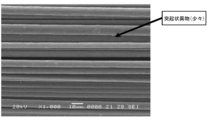
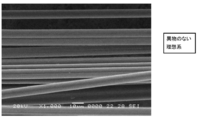
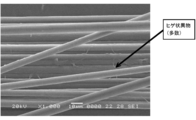
- 6 is a SEM photograph of the unidirectional material obtained in Comparative Example 5. It is a SEM photograph of the surface part of the reinforcing fiber bundle which was immersed for 5 hours in Example 8 and then dried. It is a SEM photograph of the surface part of the reinforcing fiber bundle which was immersed for 18 hours in Example 9 and then dried. It is a SEM photograph of the surface part of the reinforcing fiber bundle which was immersed for 48 hours continuously in Example 10 and then dried.
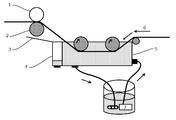
- FIG. 6 is a schematic diagram showing sizing baths used in Examples 8 to 10 and Comparative Example 7.
- 2 is a SEM photograph of the unidirectional material obtained in Example 11.
- the reinforcing fiber bundle of the present invention comprises a carbon fiber bundle treated with an emulsion containing a specific component.
- the carbon fiber bundle before the treatment include polyacrylonitrile (PAN) -based, petroleum / coal pitch-based, rayon-based, and lignin-based carbon fiber bundles.
- PAN-based carbon fibers are particularly preferable from the viewpoint of productivity on an industrial scale and mechanical properties.
- the average diameter of the single yarn of the carbon fiber bundle is not particularly limited, but is preferably 1 to 20 ⁇ m, more preferably 4 to 10 ⁇ m from the viewpoint of mechanical properties and surface appearance.
- the number of single yarns of the carbon fiber bundle is not particularly limited, but is preferably 100 to 100,000, more preferably 1,000 to 50,000 in terms of productivity and characteristics.
- the carbon fiber bundle before treatment preferably has an oxygen-containing functional group introduced on the fiber surface for the purpose of improving the adhesion between the fiber and the matrix resin.
- the amount of oxygen-containing functional group introduced is specified by, for example, the surface oxygen concentration ratio [O / C], which is the ratio of the number of oxygen (O) and carbon (C) atoms on the fiber surface measured by X-ray photoelectron spectroscopy. it can.
- the surface oxygen concentration ratio is preferably 0.05 to 0.5, more preferably 0.08 to 0.4, and particularly preferably 0.1 to 0.3. If the surface oxygen concentration ratio is 0.05 or more, the amount of functional groups on the surface of the carbon fiber can be secured and the matrix resin can be firmly bonded. On the other hand, if the surface oxygen concentration ratio is 0.5 or less, it is possible to balance the handleability and productivity of carbon fibers.
- the modified polyolefin (A1) used in the present invention is a modified polyolefin containing at least a carboxylic acid metal salt bonded to a polymer chain.
- this modified polyolefin (A1) has a carboxylate group represented by the following formula (2) constituting a carboxylic acid metal salt.
- the total amount of the carboxylate groups is preferably 0.05 to 5 mmol equivalent, more preferably 0.1 to 4 mmol equivalent, particularly preferably 0.3 to 3 mmol equivalent per gram of resin.
- Q + represents an alkali metal ion, an ammonium ion or an analog thereof.
- alkali metal ion examples include lithium ion, sodium ion, potassium ion and rubidium ion. Of these, potassium ions are preferred.
- ammonium ions or analogs thereof include ammonium ions themselves, primary ammonium ions, secondary ammonium ions, tertiary ammonium ions, and quaternary ammonium ions. Among these, ammonium ions (NH 4 + ), quaternary ammonium ions (NR 1 R 2 R 3 R 4+ ; R 1 to R 4 may be the same or different from each other, and carbon atoms having 1 to 10 carbon atoms may be the same or different. Hydrogen group) is preferred.
- Examples of the raw material of the modified polyolefin (A1) include, for example, an ethylene polymer having a skeleton content exceeding 50 mol% and a propylene polymer having a skeleton content exceeding 50 mol% derived from propylene.
- Examples of the ethylene polymer include an ethylene homopolymer and a copolymer of ethylene and an ⁇ -olefin having 3 to 10 carbon atoms.
- Examples of the propylene polymer include a propylene homopolymer and a copolymer of propylene and ethylene and / or an ⁇ -olefin having 4 to 10 carbon atoms.
- suitable raw material polyolefin (A0) include homopolypropylene, homopolyethylene, ethylene / propylene copolymer, propylene / 1-butene copolymer, ethylene / propylene / 1-butene copolymer and the like.
- the modified polyolefin (A1) for example, a carboxylic acid group, a carboxylic acid anhydride group or a carboxylic acid ester group is grafted into the polymer chain of the raw material polyolefin (A0) as described above, and the group is a salt with a cation. It is the modified resin converted into the state.
- the carboxylic acid group, carboxylic anhydride group or carboxylic ester group introduced into the polymer chain may be collectively referred to as a graft carboxylic acid group.
- a monomer having a carboxylic acid group, a carboxylic anhydride group or a carboxylic ester group can be used as a modifier.
- Each functional group of these monomers may or may not be neutralized or saponified.
- an ethylenically unsaturated carboxylic acid, its anhydride, and its ester are preferable.
- carboxylic acid monomers having an unsaturated vinyl group other than the ethylenically unsaturated carboxylic acid can also be used.
- ethylenically unsaturated carboxylic acid used for the production of the modified polyolefin (A1) include (meth) acrylic acid, maleic acid, fumaric acid, tetrahydrophthalic acid, itaconic acid, citraconic acid, crotonic acid, and isocrotonic acid. It is done.
- Specific examples of the anhydride include nadic acid (endocis-bicyclo [2.2.1] hept-5-ene-2,3-dicarboxylic acid), maleic anhydride, and citraconic anhydride.
- Specific examples of the esters include methyl, ethyl or propyl monoesters or diesters of ethylenically unsaturated carboxylic acids. Two or more of these monomers may be used in combination. Among these, an ethylenically unsaturated carboxylic acid anhydride is preferable, and maleic anhydride is particularly preferable.
- a desired grafted carboxylic acid group can be introduced into the polymer chain.
- Specific methods include, for example, a method in which a raw material polyolefin (A0) and the monomer are grafted in an organic solvent in the presence of a polymerization initiator and then desolvated; the raw material polyolefin (A0) is heated and melted.
- a method of mixing and stirring the melt, the monomer, and the polymerization initiator to perform a graft reaction supplying a raw material polyolefin (A0), the mixture of the monomer and the polymerization initiator to an extruder, and heating and kneading And a graft reaction method.
- the polymerization initiator used in these methods is not particularly limited, and any known polymerization initiator can be used without limitation. Specific examples thereof include benzoyl peroxide, dichlorobenzoyl peroxide, dicumyl peroxide, di-tert-butyl peroxide, 2,5-dimethyl-2,5-di (peroxybenzoate) hexyne-3, 1, 4-bis (tert-butylperoxyisopropyl) benzene is mentioned. Two or more polymerization initiators may be used in combination.
- the organic solvent is not particularly limited, and specific examples thereof include aromatic hydrocarbons such as xylene and toluene; aliphatic hydrocarbons such as hexane and heptane; alicyclic hydrocarbons such as cyclohexane; methyl ethyl ketone, methyl isobutyl ketone, and the like. Ketone-based solvents. Two or more organic solvents may be mixed and used. Among these, aromatic hydrocarbons, aliphatic hydrocarbons, and alicyclic hydrocarbons are preferable, and aliphatic hydrocarbons and alicyclic hydrocarbons are more preferable.
- the modified polyolefin (A1) which contains at least is obtained. Specifically, for example, when preparing an emulsion containing the polyolefin, neutralization or saponification may be performed as necessary.
- the modified polyolefin (A1) may contain a polyolefin that is not modified depending on the modification conditions. In the present invention, a modified product including such an unmodified polyolefin is defined as a modified polyolefin.
- an unmodified polyolefin (A2) containing neither a grafted carboxylic acid group nor its carboxylic acid metal salt may be used in combination as desired.
- the content of the modified polyolefin (A2) is 1 to 50% by mass, preferably 3 to 40%, based on the total amount of the modified polyolefin (A1) and the unmodified polyolefin (A2). % By mass, more preferably 5 to 30% by mass. By being within this range, the mechanical strength of the carbon fiber reinforced thermoplastic resin molded article of the present invention can be improved.
- the raw material polyolefin (A0) for preparing the modified polyolefin (A1) described above can be used without limitation.
- the unmodified polyolefin (A2) may be the raw material polyolefin (A0) itself for preparing the modified polyolefin (A1), or may be a polyolefin different from the raw material polyolefin (A0).
- the modified polyolefin (A1) and the raw material polyolefin (A0) have different properties.
- the unmodified polyolefin (A2) includes, for example, homopolypropylene, propylene / ethylene copolymer (ethylene-derived skeleton content; 3 to 95 mol%), propylene / 1-butene copolymer. (1-butene-derived skeleton content; 5 to 95 mol%), propylene / ethylene / 1-butene copolymer (ethylene-derived skeleton content; 10 to 25 mol%, 1-butene-derived skeleton content; 1 to 30 Mol%), ethylene / vinyl acetate copolymer (vinyl acetate-derived skeleton content; 25 to 50% by mass) and two or more different blends selected from these polymers.
- the amine compound (B) used in the present invention is a primary amine compound represented by the following general formula (1).
- R represents a hydrogen atom or a hydrocarbon group having 1 to 10 carbon atoms
- R is a hydrocarbon group having 11 or more carbon atoms because the amine compound may not be sufficiently removed in the drying process of the carbon fiber after being immersed in the emulsion as described later.
- the hydrocarbon group may be an aromatic hydrocarbon, an aliphatic hydrocarbon group, or an alicyclic hydrocarbon group. From the viewpoint of occupational health, an aliphatic hydrocarbon group or an alicyclic hydrocarbon group is preferable.
- the preferred amine compound (B) include ammonia (aqueous ammonia), methylamine, ethylamine, n-butylamine, isobutylamine, sec-butylamine, n-pentylamine, isoamylamine, n-hexylamine, cyclohexylamine, Examples include heptylamine, octylamine and decylamine. Among these, ammonia (ammonia water) is preferable from the viewpoint of easy removal during the drying step and easy availability.
- the emulsion used in the present invention contains at least the modified polyolefin (A1) and the amine compound (B) described above, and is a liquid in which a dispersoid (mainly modified polyolefin (A1)) is dispersed in a dispersion medium (water or the like). It is.
- the emulsion is in a form in which the particulate modified polyolefin (A1) is dispersed in an aqueous solution containing the amine compound (B).
- the mass ratio of the modified polyolefin (A1) in the emulsion is 0.001 to 10 mass%, preferably 0.01 to 5 mass%.
- the amount of the amine compound (B) in the emulsion is 0.1 to 5,000 moles, preferably 0.5 to 3,000 moles per mole of carboxylate groups in the modified polyolefin (A1). More preferably, it is 1 to 1,000 mol.
- the surfactant (D) may be added to the emulsion within a range not impairing the present invention. By using the surfactant (D), aggregation of the polymer particles in the emulsion can be more effectively prevented.
- the amount of the surfactant (D) in the emulsion is preferably 5 parts by mass or less with respect to 100 parts by mass of the modified polyolefin (A1). When it exceeds 5 mass parts, adhesiveness may fall.
- the type of surfactant (D) is not particularly limited.
- a surfactant having an ionic (cationic / anionic / zwitter) hydrophilic portion or a nonionic surfactant (nonionic surfactant) can be used.
- nonionic surfactants that do not contain counter ions such as metals and halogens that promote the decomposition of the thermoplastic resin are preferable.
- the nonionic surfactant also attaches the surfactant at the same time, and improves the opening property of the carbon fiber bundle in the opening step.
- a nonionic surfactant that is liquid at least at 20 ° C. is effective in improving the openability of the carbon fiber bundle.
- the surfactant (D) is used in combination with a compound having a function of reducing the surface tension of the emulsion.
- a compound having a function of reducing the surface tension of the emulsion include lower aliphatic alcohols, alicyclic alcohols, glycols, and polyvinyl alcohol.
- the amount of this compound may be about the same as that of the surfactant.
- the carbon fiber bundle is processed using the emulsion described above.
- This treatment is a treatment for attaching at least the modified polyolefin (A1) to the fiber surface (and preferably inside the fiber), and is typically a sizing treatment.
- a specific amount of the amine compound (B) coexists with the modified polyolefin (A1), so that aggregation of the modified polyolefin (A1) is effectively suppressed, and the modified polyolefin (A1) is formed on the fiber surface. It adheres uniformly and, as a result, adhesion improves.
- the total adhesion amount of the modified polyolefin (A1) and the unmodified polyolefin (A2) used as necessary in the reinforcing fiber bundle is preferably 0.1 to 5.0% by mass, more preferably 0.5 to 2. 0% by mass.
- this treatment is preferably performed by immersing the carbon fiber bundle in the emulsion and then drying.
- the roller dipping method is preferable from the viewpoint of productivity and uniformity.
- Adjustment of the total adhesion amount of the modified polyolefin (A1) to the carbon fiber bundle and the unmodified polyolefin (A2) used as necessary is, for example, the mass ratio of the modified polyolefin (A1) or the unmodified polyolefin (A2) in the emulsion, This can be done by adjusting the squeeze roller.
- low-boiling components such as moisture and amine compound (B) are removed as necessary by a drying process of the carbon fiber bundle.
- a reinforcing fiber bundle in which at least the modified polyolefin (A1) adheres to the fiber surface (and preferably the inside of the fiber) is obtained. It is preferable to completely remove low-boiling components such as moisture and amine compound (B), but some of them may remain in some cases.
- the drying method is not particularly limited, and methods such as heat treatment, air drying, and centrifugation can be used. Among these, heat treatment is preferable from the viewpoint of cost.
- a heating means for example, hot air, a hot plate, a roller, or an infrared heater can be used.
- the temperature of the drying treatment is preferably in the range of the surface temperature of the carbon fiber bundle of 50 to 200 ° C. to remove moisture and alcohol components.
- the reinforcing fiber bundle of the present invention described above is very useful as a reinforcing material for a thermoplastic resin molded body. That is, the carbon fiber reinforced thermoplastic resin molding of the present invention is a molding in which the reinforcing fiber bundle of the present invention is combined with the matrix resin (C).
- the volume ratio of the reinforcing fiber bundle in the molded body is 10 to 70%, preferably 25 to 55%. Since the reinforcing fiber bundle of the present invention has good adhesiveness with the matrix resin, a sufficient reinforcing effect is exhibited even with a smaller amount of fibers.
- the matrix resin (C) is not particularly limited, and a known resin can be used.
- Specific examples of the matrix resin (C) include thermoplastic resins such as polyolefin resins, polyamide resins, polyester resins, polycarbonate resins, polyacetal resins, polyether ketone resins, polyether ether ketone resins, and polysulfone resins.
- polyolefin resins are preferable from the viewpoint of high-speed moldability, light weight, mechanical properties of molded products, and material recyclability, and modified polyolefin (C1) and / or unmodified polyolefin (C2) are particularly preferable.
- the modified polyolefin (C1) is blended in a modified polyolefin having a maleic anhydride graft modification rate of 0.1 to 7% by mass per 100 parts by mass of the unmodified polyolefin (C2).
- (C1) is added in an amount of preferably 0.1 to 30 parts by mass, more preferably 1 to 20 parts by mass, the adhesive strength between the fiber and the resin is further improved.
- the preparation method of modified polyolefin (C1) can be performed according to the preparation method of above-described modified polyolefin (A1).
- the unmodified polypropylene (C2) and / or modified polypropylene (C1) such as a propylene homopolymer or a propylene / ⁇ -olefin random copolymer as the matrix resin (C).
- the unmodified polyolefin (C2) is composed of polypropylene (C2-1) having a melting point Tm of 120 to 165 ° C. measured by differential scanning calorimetry (DSC) and polyethylene (C2 ⁇ 2) having a density of 890 to 960 kg / m 3. It is preferable that it is 1 or more types chosen from 2).
- the content of the modified polyolefin (C1) in the matrix resin (C) is preferably 0 to 50% by mass.
- the reinforcing fiber bundle is preferably opened as necessary before being combined with the matrix resin (C).
- the matrix resin (C) is sufficiently impregnated into the reinforcing fiber bundle, and a high-quality molded body with less unevenness in physical properties such as strength can be obtained.
- Examples of the form of the carbon fiber reinforced thermoplastic resin molding include a unidirectional material, a unidirectional laminated material, and a random stampable sheet (pseudo isotropic material). Moreover, the form of a cross-ply laminated material, a long fiber containing pellet, or a textile material may be sufficient.
- the unidirectional material (UD material) is typically a molded body including fibers in a state where the opened fiber bundles are aligned on one side.
- a unidirectional carbon fiber reinforced thermoplastic resin molded body can be obtained by bringing the opened fiber bundles into contact with the molten matrix resin (C).
- C molten matrix resin
- the unidirectional laminate is typically a laminate such as a unidirectional laminate in which an arbitrary number (n) of a plurality of unidirectional materials are laminated in the same direction (0 °) n.
- Random stampable seat Random stampable sheet (pseudo-isotropic material) shows isotropic physical properties when viewed in a certain size (for example, 5 times the fiber length) and is formed into a complicated shape by stamping or press molding. It is a sheet that can. Typically, it is a sheet-like molded body obtained by cutting a unidirectional material into small pieces (for example, 10 ⁇ 10 mm to 100 ⁇ 100 mm), placing the laminate in an arbitrary direction, laminating, and compressing.
- Random stampable sheets include, for example, those in which the anisotropy of mechanical properties due to fiber orientation is minimized, those in which a fiber bundle is cut to a length of 5 to 50 mm and impregnated with a matrix resin, A sheet formed between films formed from a resin can be used.
- the cross-ply laminate is a laminate in which a plurality of unidirectional carbon fiber reinforced thermoplastic resin moldings are laminated in two different directions and integrated, for example, 0 ° / 90 ° / 0 ° / 90 ° / 90.
- Examples include non-target laminates such as 90 ° / 0 ° / 90 ° / 0 ° / 90 ° / 0 ° / 90 ° / 0 °, and laminates in which a woven fabric is further laminated on the surface of these laminates.
- the specific method for producing the unidirectional carbon fiber-containing thermoplastic resin molded body is not particularly limited.
- a molded body in which fibers are sufficiently impregnated with the matrix resin (C) can be obtained.
- the reinforcing fiber bundle is aligned in one direction on the sheet made of the matrix resin (C). Then, it may be heated and pressed as necessary.
- the long fiber-containing pellet is a molded body in the form of a pellet as a molding material for use in various molding methods.
- a reinforcing fiber bundle is impregnated with a modified polyolefin (A1) in an extruder or an impregnation die to obtain a strand, and the strand is cut into a desired length, thereby forming a core made of carbon fiber and a thermoplastic resin.
- a sheath-type long fiber-containing pellet can be obtained.
- the length of the long fiber-containing pellet is preferably 3 to 100 mm, more preferably 5 to 50 mm.
- a desired molded product can be obtained by performing injection molding or press molding using the pellet.
- a method called direct molding method that is, a matrix resin and continuous fibers are supplied to a molding machine, and long fibers are cut and dispersed in the matrix resin at the same time inside the molding machine, and this is directly injection molded or press molded. Methods can also be used.
- a molded product obtained by press molding or cutting a unidirectional material, a unidirectional laminated material, a random stampable sheet (pseudo isotropic material), a cross-ply laminated material or a woven material is also useful.
- This mixture was supplied to a 30 mm ⁇ twin screw extruder whose temperature was adjusted to 190 ° C., and the strand obtained by melt-kneading at 200 rpm was cooled in a water bath to obtain maleic anhydride-modified polypropylene.
- this maleic anhydride-modified polypropylene was vacuum-dried at 40 ° C. for 2 hours.
- the maleic acid content of the obtained maleic anhydride-modified polypropylene was 4.5% by mass.
- the graft ratio was measured as follows: 200 mg of polymer and 4800 mg of chloroform were placed in a 10 ml sample bottle and heated at 50 ° C. for 30 minutes to completely dissolve. Chloroform was placed in a liquid cell having a material NaCl and an optical path length of 0.5 mm as a background. Next, the dissolved polymer solution was placed in a liquid cell, and an infrared absorption spectrum was measured using a photometer (manufactured by JASCO Corporation, apparatus name: FT-IR460plus) at a total number of 32 times. Regarding the graft ratio of maleic anhydride, a calibration curve was prepared by measuring the absorption of carbonyl groups in a solution of maleic anhydride dissolved in chloroform.
- the acid component content in the polymer is calculated based on the previously prepared calibration curve.
- the graft ratio (mass%) was used.
- Examples 2 to 4 and Comparative Example 1 An emulsion was prepared in the same manner as in Example 1 except that the blending composition was changed so that the concentration of ammonia (NH 3 ) in the emulsion was the value shown in Table 1, and a reinforcing fiber bundle was produced. A carbon fiber reinforced thermoplastic resin molded article was prepared.
- Example 5 A blending composition was prepared so that the concentration of ammonia (NH 3 ) in the emulsion was 2.8% by mass, and this emulsion was mixed with a commercially available carbon fiber (trade name TC-, manufactured by Formosa Plastics) using a roller impregnation method. 35 (12K)). Next, the fiber was dried online at 130 ° C. for 2 minutes to remove low-boiling components, and a reinforcing fiber bundle was produced.
- a commercially available carbon fiber trade name TC-, manufactured by Formosa Plastics
- reinforcing fiber bundle and matrix resin (C) As the reinforcing fiber bundle and matrix resin (C), commercially available unmodified propylene resin (manufactured by Prime Polymer Co., Ltd., trade name Prime Polypro J105G) and commercially available acid-modified propylene resin (manufactured by Mitsui Chemicals, registered trademark Admer QE800) A carbon fiber reinforced thermoplastic resin molded article was produced using the mixture (mass ratio 90/10).
- Table 1 shows the evaluation results of Examples 1 to 5 and Comparative Examples 1 to 3. Each measurement was performed by the following method.
- ⁇ Total adhesion amount of component (A1) and component (A2)> About 5 g of the reinforcing fiber bundle was dried at 120 ° C. for 3 hours, and its mass W 1 (g) was measured. Next, the reinforcing fiber bundle was heated in a nitrogen atmosphere at 450 ° C. for 15 minutes, then cooled to room temperature, and mass W 2 (g) was measured. The adhesion amount was calculated by the following formula. Adhesion amount (%) [(W 1 ⁇ W 2 ) / W 2 ] ⁇ 100
- test piece having a thickness of 0.2 mm, a width of 5 mm, and a length of 30 mm in which a single fiber was buried in the center. Furthermore, a total of 5 test pieces were produced by the same method.
- test pieces were subjected to a tensile test under the conditions of a test length of 14 mm and a strain rate of 0.3 mm / min using a normal tensile test jig, and the average break fiber when no fiber breakage occurred.
- the length (l) was measured using a transmission optical microscope.
- the interfacial shear strength ( ⁇ ) (MPa) by the fragmentation method was obtained from the following equation.
- Lc is the critical fiber length
- L is the average value of the final fiber break length ( ⁇ m)
- ⁇ f is the fiber tensile strength (MPa)
- d is the fiber diameter ( ⁇ m).
- ⁇ f was determined by the following method assuming that the tensile strength distribution of the fiber follows the Weibull distribution. That is, using a single fiber, a relational expression between the sample length and the average tensile strength is obtained from the average tensile strength obtained at a sample length of 5 mm, 25 mm, and 50 mm by the least square method, and the average tensile strength at the sample length Lc is obtained. Was calculated.
- Example 6 (Unidirectional material) Using the reinforcing fiber bundle obtained in Example 5, a sheet of unidirectional material was prepared by the following procedure using an apparatus described in JP2013-227695A and an apparatus in which an extruder for melting resin was combined. As the matrix resin (C) at that time, the same resin as that used in Example 5 was used. Specifically, the reinforcing fiber bundle is opened by the opening device described in JP2013-227695A, and the heated reinforcing fiber bundle and the matrix resin (C) melted by the extruder are formed into a film shape by a T die.
- the matrix fiber (C) was impregnated into the reinforcing fiber bundle by being sandwiched between release papers and heated and pressurized with a pressure roller, and then cooled and solidified to obtain a sheet of unidirectional material.
- the temperature of the extruder and the T-die was 250 ° C.
- the temperature of the pressure roll was 275 ° C.
- the thickness of the obtained sheet of unidirectional material was 130 ⁇ m, and the fiber volume fraction Vf was 0.4.
- observation was performed using an SEM (scanning electron microscope) (manufactured by JEOL Ltd., apparatus name JSM7001F, acceleration voltage 10 kV, reflected electron image).
- the unidirectional material was embedded in an epoxy resin, the surface was polished by a polishing machine to produce a smooth cross section, and SEM observation was performed.
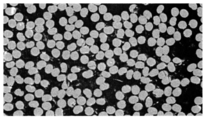
- FIG. 1 is an SEM photograph (500 times) of which a white portion is a filament of a reinforcing fiber bundle and a black portion is a matrix resin (C). As is apparent from this SEM photograph, the reinforcing fiber bundle was very well impregnated with the matrix resin (C), and no unimpregnated portions or voids were observed.
- the fiber content test method of the carbon fiber reinforced plastic is described in JIS K7075.
- a sample sheet was cut into a 50 mm ⁇ 50 mm square, and the mass Wc (g) was measured.
- the cut sample was heated at 480 ° C. for 1 hour, the resin was thermally degraded and removed, the mass Wf (g) of only the carbon fiber was measured, and the fiber deposition fraction Vf was determined by the following formula.
- ⁇ c is the density (g / cm 3 ) of the sample
- ⁇ f is the density (g / cm 3 ) of the carbon fibers used in the sample.
- the obtained unidirectional laminate was cut out to produce four test pieces (250 mm ⁇ 15 mm), and a tensile test was performed at a speed of 2 mm / min using a tensile tester (manufactured by Zwick, device name Z100).
- the elastic modulus and breaking strength were measured (according to ASTM D3039), and the average value of four test pieces was taken. As a result, the elastic modulus was 96.6 GPa and the breaking strength was 935 MPa.
- the interlaminar shear stress (ILSS) was measured using a short span bending test apparatus (manufactured by Shimadzu Corporation, apparatus name: Shimadzu Autograph AG-5KNX) (according to ASTM D2344). As a result, ILSS was 28.9 MPa.
- the unidirectional sheet is cut into small pieces of 30 to 50 mm ⁇ 30 to 50 mm, and these small pieces are arranged in a random direction so as to overlap with 8 to 9 layers at any location (random orientation) Body) was compressed and compressed at 200 ° C. and 10 MPa for 3 minutes using the same apparatus as that used for producing the unidirectional laminate, and then immediately cooled in the pressurized state to obtain a 1.0 mm thick random sheet. A stampable sheet was obtained.
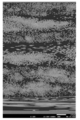
- FIG. 2 is an SEM photograph (150 times). As is apparent from this SEM photograph, eight layers of fibers arranged in the same direction were laminated in an arbitrary fiber orientation.
- Comparative Example 4 (Unidirectional material) Except for using the commercially available carbon fiber bundle used in Comparative Example 2 (manufactured by Formosa Plastics, a standard brand with an epoxy sizing agent attached to the trade name TC-35 (12K)), the same as in Example 6. A sheet of unidirectional material was prepared and observed by SEM.
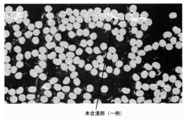
- FIG. 3 is an SEM photograph (500 times). As is clear from this SEM photograph, there was a part peeled at the interface between the filament of the reinforcing fiber bundle and the matrix resin (C).
- ILSS interlaminar shear stress
- FIG. 4 is an SEM photograph (500 times). As is apparent from this SEM photograph, there was an unimpregnated portion (white portion) of the matrix resin (C) with respect to the reinforcing fiber bundle.
- ILSS interlaminar shear stress
- Example 6 The evaluation results of Example 6 and Comparative Examples 4 to 5 are shown in Table 2.
- Example 7 (Preparation of emulsion) 10 parts by mass of maleic anhydride-modified polyethylene obtained in Production Example 2, 100 parts by mass of an ethylene / propylene random copolymer (Tafmer P manufactured by Mitsui Chemicals, Inc.), potassium oleate 1.5 as a surfactant (D) Mass parts were mixed, and an emulsion containing the component (A) and the component (B) was obtained by the same method as in Example 1. The obtained emulsion (aqueous dispersion) had a solid content concentration of 45% by mass, and an acid value of 5.0 mg KOH / solid content converted to 1 g.
- the carbon fiber reinforced thermoplastic resin molded article of the present invention was prepared using a mixture (mass ratio 98.75 / 1.25) having a melt flow rate of 1.8 g / 10 min measured at 190 ° C. .
- the evaluation results are shown in Table 3.
- Example 8 Four carbon fiber bundles (trade name TC35R-12K) manufactured by Formosa Plastics Co., Ltd. were used in the sizing bath shown in FIG. 9 to modify the potassium carboxylate-containing modified polypropylene / propylene / 1-butene / ethylene used in Example 1.
- the continuous dipping / drying apparatus has a mechanism in which a sizing agent that decreases by dipping is continuously supplied into the dipping tank 5 by a supply pump 7 installed in a separately prepared sizing agent reserve tank. Yes.
- This continuous immersion experiment was carried out for a maximum of 48 hours after the start of supplying the carbon fiber bundle.
- Arbitrary nine places of four dry carbon fiber bundles were selected every predetermined time, and the adhesion amount of the component (A), its variation coefficient, and the SEM photograph of the fiber bundle surface were measured.
- Component (A) adhesion amount measurement is as described above.
- the SEM photograph was measured under the condition of an acceleration voltage of 20 kV (JEOLOJSM-5600) manufactured by JEOL Ltd. (1000 times magnification). As the measurement sample, one deposited by gold sputtering by vacuum sputtering before SEM measurement was used.
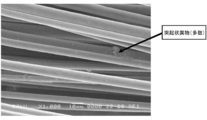
- the coefficient of variation of the amount of component (A) attached increased at 3 hours. Further, according to the SEM photograph at 5 hours (FIG. 5), a large amount of protruding foreign matters were observed on the carbon fiber surface.
- the surface tension measured separately was 44.2 mN / m.
- Example 9 In Example 8, the same continuous immersion experiment as in Example 8 was performed except that the ammonia concentration was changed to the values shown in Table 4. Up to 12 hours after supplying the carbon fiber bundle to the immersion tank, the amount of component (A) deposited and its coefficient of variation remained stable, but the coefficient of variation doubled at 18 hours. According to the 18-hour SEM photograph (FIG. 6), it was found that slight protrusions were observed on the carbon fiber surface. In addition, about the sizing liquid used in Example 9, the surface tension measured separately (the surface tension measuring device K100 made by KRUSS was used. Measurement by the ring method) was 43.4 mN / m.
- Example 10 In Example 8, the same continuous immersion experiment as in Example 8 was performed except that the ammonia concentration was changed to the values shown in Table 4. It was confirmed that the amount of component (A) attached and its coefficient of variation remained stable up to 24 hours after the carbon fiber bundle was supplied to the immersion tank. In the SEM photograph at 48 hours (FIG. 7), it was found that no protruding foreign matter was observed on the carbon fiber surface. In addition, about the sizing liquid used in Example 10, the separately measured surface tension (using a surface tension measuring device K100 manufactured by KRUSS, measured by the ring method) was 43.2 mN / m.
- Example 7 In Example 8, a continuous immersion experiment was performed in the same manner as in Example 8 except that ammonia was not used. It was confirmed that agglomerates were formed 1 hour after supplying the carbon fiber bundle to the immersion tank, and the coefficient of variation of the component (A) adhesion amount increased rapidly. According to the SEM photograph at 1 hour (FIG. 6), it was found that a large amount of bearded foreign matter was observed on the carbon fiber surface. In addition, about the sizing liquid used in Comparative Example 7, the separately measured surface tension (using a surface tension measuring device K100 manufactured by KRUSS, measured by the ring method) was 50.0 mN / m.
- sizing was performed on carbon fibers by adding ammonia to a modified polyolefin resin containing a carboxylic acid potassium salt in a known polymer chain in a sizing solution. It can be seen that the agent adheres stably. The cause of this is thought to be that the sizing agent molecules can easily penetrate into the surface of the finely structured carbon fiber by lowering the surface tension of the sizing liquid. Further, it is considered that the addition of ammonia increases the particle stability of the dispersion containing the sizing agent, which is one of the causes for the effects of the present invention.
- Example 11 (Unidirectional material) Using the reinforcing fiber bundle obtained in Example 10, a sheet of unidirectional material was prepared by the following procedure using an apparatus described in JP2013-227695A and an apparatus in which an extruder for melting resin was combined. As the matrix resin (C) at that time, the same resin as that used in Example 5 was used. Specifically, the reinforcing fiber bundle is opened by the opening device described in JP2013-227695A, and the heated reinforcing fiber bundle and the matrix resin (C) melted by the extruder are formed into a film shape by a T die.
- the matrix fiber (C) was impregnated into the reinforcing fiber bundle by being sandwiched between release papers and heated and pressurized with a pressure roller, and then cooled and solidified to obtain a sheet of unidirectional material.
- the temperature of the extruder and the T die was 260 ° C.
- the temperature of the pressure roll was 270 ° C.
- the thickness of the obtained sheet of unidirectional material was 150 ⁇ m, and the fiber volume fraction Vf was 0.356.
- observation was performed using an SEM (scanning electron microscope) (manufactured by JEOL Ltd., apparatus name JSM7001F, acceleration voltage 10 kV, reflected electron image).
- the unidirectional material was embedded in an epoxy resin, the surface was polished by a polishing machine to produce a smooth cross section, and SEM observation was performed.
- FIG. 10 is an SEM photograph (500 times), in which the white portion is the filament of the reinforcing fiber bundle and the black portion is the matrix resin (C). As is apparent from this SEM photograph, the reinforcing fiber bundle was very well impregnated with the matrix resin (C), and no unimpregnated portions or voids were observed.
- the obtained unidirectional laminate was cut out to produce four test pieces (250 mm ⁇ 15 mm), and a tensile test was performed at a speed of 2 mm / min using a tensile tester (manufactured by Zwick, device name Z100).
- the elastic modulus and breaking strength were measured (according to ASTM D3039), and the average value of four test pieces was taken. As a result, the elastic modulus was 83.0 GPa and the breaking strength was 1180 MPa.
- the interlaminar shear stress (ILSS) was measured using a short span bending test apparatus (manufactured by Shimadzu Corporation, apparatus name: Shimadzu Autograph AG-5KNX) (according to ASTM D2344). As a result, ILSS was 27.2 MPa.
Landscapes
- Chemical & Material Sciences (AREA)
- Chemical Kinetics & Catalysis (AREA)
- Medicinal Chemistry (AREA)
- Polymers & Plastics (AREA)
- Organic Chemistry (AREA)
- Health & Medical Sciences (AREA)
- Engineering & Computer Science (AREA)
- Materials Engineering (AREA)
- Manufacturing & Machinery (AREA)
- Textile Engineering (AREA)
- General Chemical & Material Sciences (AREA)
- Inorganic Chemistry (AREA)
- Reinforced Plastic Materials (AREA)
- Compositions Of Macromolecular Compounds (AREA)
- Treatments For Attaching Organic Compounds To Fibrous Goods (AREA)
Abstract
Priority Applications (6)
| Application Number | Priority Date | Filing Date | Title |
|---|---|---|---|
| BR112017015199-5A BR112017015199B1 (pt) | 2015-01-16 | 2016-01-14 | Feixe de fibras de reforço e corpo moldado de resina termoplástica reforçada com fibras de carbono ao usar o mesmo, e método para a produção do feixe de fibras de reforço |
| JP2016569504A JP6450778B2 (ja) | 2015-01-16 | 2016-01-14 | 強化繊維束及びそれを用いた炭素繊維強化熱可塑性樹脂成形体、並びに強化繊維束の製造方法 |
| KR1020177022852A KR102004068B1 (ko) | 2015-01-16 | 2016-01-14 | 강화 섬유속 및 그것을 이용한 탄소 섬유 강화 열가소성 수지 성형체, 및 강화 섬유속의 제조 방법 |
| US15/543,959 US20180002500A1 (en) | 2015-01-16 | 2016-01-14 | Reinforcing fiber bundle and carbon fiber reinforced thermoplastic resin molded body using the same, and method for producing reinforcing fiber bundle |
| EP16737423.0A EP3246460B1 (fr) | 2015-01-16 | 2016-01-14 | Faisceau de fibres de renforcement et article moulé de résine thermoplastique renforcé de fibres de carbone, et procédé de fabrication de faisceau de fibres de renforcement |
| CN201680005627.3A CN107614785B (zh) | 2015-01-16 | 2016-01-14 | 增强纤维束和使用其的碳纤维增强热塑性树脂成型体、以及增强纤维束的制造方法 |
Applications Claiming Priority (4)
| Application Number | Priority Date | Filing Date | Title |
|---|---|---|---|
| JP2015006559 | 2015-01-16 | ||
| JP2015-006559 | 2015-01-16 | ||
| JP2015-188579 | 2015-09-25 | ||
| JP2015188579 | 2015-09-25 |
Publications (1)
| Publication Number | Publication Date |
|---|---|
| WO2016114352A1 true WO2016114352A1 (fr) | 2016-07-21 |
Family
ID=56405892
Family Applications (1)
| Application Number | Title | Priority Date | Filing Date |
|---|---|---|---|
| PCT/JP2016/050992 Ceased WO2016114352A1 (fr) | 2015-01-16 | 2016-01-14 | Faisceau de fibres de renforcement et article moulé de résine thermoplastique renforcé de fibres de carbone, et procédé de fabrication de faisceau de fibres de renforcement |
Country Status (8)
| Country | Link |
|---|---|
| US (1) | US20180002500A1 (fr) |
| EP (1) | EP3246460B1 (fr) |
| JP (1) | JP6450778B2 (fr) |
| KR (1) | KR102004068B1 (fr) |
| CN (1) | CN107614785B (fr) |
| BR (1) | BR112017015199B1 (fr) |
| TW (1) | TWI703246B (fr) |
| WO (1) | WO2016114352A1 (fr) |
Cited By (7)
| Publication number | Priority date | Publication date | Assignee | Title |
|---|---|---|---|---|
| WO2017078167A1 (fr) * | 2015-11-06 | 2017-05-11 | 古河電気工業株式会社 | Matériau composite thermoplastique et corps moulé |
| JP2018172809A (ja) * | 2017-03-31 | 2018-11-08 | 三井化学株式会社 | 強化繊維束、成型材料及び成形体 |
| WO2020189268A1 (fr) | 2019-03-19 | 2020-09-24 | 三井化学株式会社 | Article en résine renforcée par des fibres, procédé pour la fabrication de celui-ci et stratifié comprenant celui-ci |
| JP2021041713A (ja) * | 2017-01-20 | 2021-03-18 | 三井化学株式会社 | テープワインディングパイプ及びその製造方法 |
| JP2021133538A (ja) * | 2020-02-25 | 2021-09-13 | 三井化学株式会社 | 炭素繊維強化樹脂成形体の製造方法 |
| US20210363313A1 (en) * | 2017-08-07 | 2021-11-25 | Zoltek Corporation | Polyvinyl alcohol-sized fillers for reinforcing plastics |
| JP2023539692A (ja) * | 2020-08-28 | 2023-09-15 | トウレ アドバンスト コンポジッツ | 改善された加工性を有するudテープおよびその製造方法 |
Families Citing this family (6)
| Publication number | Priority date | Publication date | Assignee | Title |
|---|---|---|---|---|
| EP3095818B1 (fr) * | 2015-05-22 | 2019-05-01 | Borealis AG | Composite de fibre de carbone - polypropylène |
| KR20200112985A (ko) * | 2018-02-02 | 2020-10-05 | 바스프 에스이 | 인발성형 공정과 동시적인 섬유 사이징 인-라인의 최적화 |
| ES2962144T3 (es) * | 2018-04-25 | 2024-03-15 | Asahi Chemical Ind | Moldeado de resina reforzado con fibra continua y método para la fabricación de la misma |
| WO2020158233A1 (fr) * | 2019-01-29 | 2020-08-06 | 日信工業株式会社 | Feuille multicouche et procédé de production de feuille multicouche |
| US20230063313A1 (en) * | 2020-03-31 | 2023-03-02 | Mitsui Chemicals, Inc. | Thin film-shaped fiber-reinforced resin and resin molded body, and method for producing the same |
| TWI767811B (zh) * | 2021-07-30 | 2022-06-11 | 臺灣塑膠工業股份有限公司 | 碳纖維束的處理方法 |
Citations (9)
| Publication number | Priority date | Publication date | Assignee | Title |
|---|---|---|---|---|
| JPH06107442A (ja) * | 1991-12-17 | 1994-04-19 | Sanyo Chem Ind Ltd | 無機繊維用集束剤 |
| JP2006233346A (ja) * | 2005-02-22 | 2006-09-07 | Teijin Techno Products Ltd | 熱可塑性樹脂強化用炭素繊維ストランド |
| WO2007037260A1 (fr) * | 2005-09-29 | 2007-04-05 | Toray Industries, Inc. | Composition de résine thermoplastique renforcée par des fibres, son procédé de production et fibre de carbone pour résine thermoplastique |
| WO2011030784A1 (fr) * | 2009-09-09 | 2011-03-17 | 三菱レイヨン株式会社 | Faisceau de fibres de carbone et procédé pour sa production |
| WO2012017877A1 (fr) * | 2010-08-05 | 2012-02-09 | 松本油脂製薬株式会社 | Colle pour fibres de renforcement, fil de base de fibres synthétiques, et matériau composite de renforcement de fibres |
| JP2012046850A (ja) * | 2010-08-27 | 2012-03-08 | Unitika Ltd | ピールプライ及びその製造方法 |
| CN102828416A (zh) * | 2012-09-20 | 2012-12-19 | 金发科技股份有限公司 | 一种乳液型碳纤维上浆剂及其制备方法与应用 |
| JP2013032600A (ja) * | 2011-08-01 | 2013-02-14 | Dic Corp | 炭素繊維集束剤、炭素繊維及び成形材料 |
| JP2015180785A (ja) * | 2014-03-05 | 2015-10-15 | 三菱レイヨン株式会社 | 樹脂強化用炭素繊維束、並びに、樹脂強化用炭素繊維束、炭素繊維強化熱可塑性樹脂組成物及び成形体の製造方法 |
Family Cites Families (8)
| Publication number | Priority date | Publication date | Assignee | Title |
|---|---|---|---|---|
| JPS58147317A (ja) * | 1982-02-26 | 1983-09-02 | Nhk Spring Co Ltd | Frp製湾曲部材の成形方法 |
| JPWO2006101269A1 (ja) | 2005-03-25 | 2008-09-04 | 帝人テクノプロダクツ株式会社 | 熱可塑性樹脂強化用炭素繊維ストランド及びその製造方法 |
| ATE480653T1 (de) * | 2005-04-18 | 2010-09-15 | Teijin Ltd | Pechbasierte carbonfasern sowie sie enthaltende matte und formkörper |
| US20110257325A1 (en) * | 2008-12-05 | 2011-10-20 | Mitsui Chemicals, Inc. | Aqueous dispersion for fiber treatment |
| EP2371897B1 (fr) * | 2008-12-25 | 2014-04-09 | Toray Industries, Inc. | Composition de résine propylène renforcée par des fibres |
| CN102482466B (zh) * | 2009-09-09 | 2014-06-25 | 普瑞曼聚合物株式会社 | 碳纤维增强树脂组合物 |
| JP2012184377A (ja) | 2011-03-08 | 2012-09-27 | Mitsubishi Rayon Co Ltd | 炭素繊維束及びその製造方法、並びに熱可塑性樹脂組成物及びその製造方法 |
| JP5905740B2 (ja) | 2012-02-28 | 2016-04-20 | 帝人株式会社 | 炭素繊維束およびこの炭素繊維束を用いた繊維強化熱可塑性樹脂成形体 |
-
2016
- 2016-01-14 WO PCT/JP2016/050992 patent/WO2016114352A1/fr not_active Ceased
- 2016-01-14 BR BR112017015199-5A patent/BR112017015199B1/pt active IP Right Grant
- 2016-01-14 JP JP2016569504A patent/JP6450778B2/ja active Active
- 2016-01-14 KR KR1020177022852A patent/KR102004068B1/ko active Active
- 2016-01-14 CN CN201680005627.3A patent/CN107614785B/zh active Active
- 2016-01-14 EP EP16737423.0A patent/EP3246460B1/fr active Active
- 2016-01-14 US US15/543,959 patent/US20180002500A1/en not_active Abandoned
- 2016-01-15 TW TW105101282A patent/TWI703246B/zh active
Patent Citations (9)
| Publication number | Priority date | Publication date | Assignee | Title |
|---|---|---|---|---|
| JPH06107442A (ja) * | 1991-12-17 | 1994-04-19 | Sanyo Chem Ind Ltd | 無機繊維用集束剤 |
| JP2006233346A (ja) * | 2005-02-22 | 2006-09-07 | Teijin Techno Products Ltd | 熱可塑性樹脂強化用炭素繊維ストランド |
| WO2007037260A1 (fr) * | 2005-09-29 | 2007-04-05 | Toray Industries, Inc. | Composition de résine thermoplastique renforcée par des fibres, son procédé de production et fibre de carbone pour résine thermoplastique |
| WO2011030784A1 (fr) * | 2009-09-09 | 2011-03-17 | 三菱レイヨン株式会社 | Faisceau de fibres de carbone et procédé pour sa production |
| WO2012017877A1 (fr) * | 2010-08-05 | 2012-02-09 | 松本油脂製薬株式会社 | Colle pour fibres de renforcement, fil de base de fibres synthétiques, et matériau composite de renforcement de fibres |
| JP2012046850A (ja) * | 2010-08-27 | 2012-03-08 | Unitika Ltd | ピールプライ及びその製造方法 |
| JP2013032600A (ja) * | 2011-08-01 | 2013-02-14 | Dic Corp | 炭素繊維集束剤、炭素繊維及び成形材料 |
| CN102828416A (zh) * | 2012-09-20 | 2012-12-19 | 金发科技股份有限公司 | 一种乳液型碳纤维上浆剂及其制备方法与应用 |
| JP2015180785A (ja) * | 2014-03-05 | 2015-10-15 | 三菱レイヨン株式会社 | 樹脂強化用炭素繊維束、並びに、樹脂強化用炭素繊維束、炭素繊維強化熱可塑性樹脂組成物及び成形体の製造方法 |
Cited By (14)
| Publication number | Priority date | Publication date | Assignee | Title |
|---|---|---|---|---|
| JPWO2017078167A1 (ja) * | 2015-11-06 | 2018-08-23 | 古河電気工業株式会社 | 熱可塑性複合材料および成形体 |
| WO2017078167A1 (fr) * | 2015-11-06 | 2017-05-11 | 古河電気工業株式会社 | Matériau composite thermoplastique et corps moulé |
| US11203673B2 (en) | 2015-11-06 | 2021-12-21 | Furukawa Electric Co., Ltd. | Thermoplastic composite material and formed body |
| JP7042321B2 (ja) | 2017-01-20 | 2022-03-25 | 三井化学株式会社 | テープワインディングパイプ及びその製造方法 |
| JP2021041713A (ja) * | 2017-01-20 | 2021-03-18 | 三井化学株式会社 | テープワインディングパイプ及びその製造方法 |
| JP2018172809A (ja) * | 2017-03-31 | 2018-11-08 | 三井化学株式会社 | 強化繊維束、成型材料及び成形体 |
| US12104024B2 (en) * | 2017-08-07 | 2024-10-01 | Zoltek Corporation | Polyvinyl alcohol-sized fillers for reinforcing plastics |
| US20210363313A1 (en) * | 2017-08-07 | 2021-11-25 | Zoltek Corporation | Polyvinyl alcohol-sized fillers for reinforcing plastics |
| WO2020189268A1 (fr) | 2019-03-19 | 2020-09-24 | 三井化学株式会社 | Article en résine renforcée par des fibres, procédé pour la fabrication de celui-ci et stratifié comprenant celui-ci |
| US11951724B2 (en) | 2019-03-19 | 2024-04-09 | Mitsui Chemicals, Inc. | Fiber-reinforced resin article, method for manufacturing same, and laminate including same |
| JP7433083B2 (ja) | 2020-02-25 | 2024-02-19 | 三井化学株式会社 | 炭素繊維強化樹脂成形体の製造方法 |
| JP2021133538A (ja) * | 2020-02-25 | 2021-09-13 | 三井化学株式会社 | 炭素繊維強化樹脂成形体の製造方法 |
| JP2023539692A (ja) * | 2020-08-28 | 2023-09-15 | トウレ アドバンスト コンポジッツ | 改善された加工性を有するudテープおよびその製造方法 |
| JP7644242B2 (ja) | 2020-08-28 | 2025-03-11 | トウレ アドバンスト コンポジッツ | 改善された加工性を有するudテープおよびその製造方法 |
Also Published As
| Publication number | Publication date |
|---|---|
| TW201634771A (zh) | 2016-10-01 |
| CN107614785A (zh) | 2018-01-19 |
| US20180002500A1 (en) | 2018-01-04 |
| KR102004068B1 (ko) | 2019-07-25 |
| JP6450778B2 (ja) | 2019-01-09 |
| BR112017015199B1 (pt) | 2022-03-22 |
| EP3246460B1 (fr) | 2020-08-26 |
| TWI703246B (zh) | 2020-09-01 |
| JPWO2016114352A1 (ja) | 2017-08-10 |
| BR112017015199A2 (pt) | 2018-03-13 |
| EP3246460A4 (fr) | 2018-09-05 |
| KR20180101996A (ko) | 2018-09-14 |
| CN107614785B (zh) | 2021-08-06 |
| EP3246460A1 (fr) | 2017-11-22 |
Similar Documents
| Publication | Publication Date | Title |
|---|---|---|
| JP6450778B2 (ja) | 強化繊維束及びそれを用いた炭素繊維強化熱可塑性樹脂成形体、並びに強化繊維束の製造方法 | |
| CN109070390B (zh) | 增强纤维束及成型材料 | |
| CN104066783B (zh) | 纤维增强聚丙烯树脂组合物、成型材料及预浸料坯 | |
| TWI532767B (zh) | Fiber-reinforced acrylic resin composition | |
| Wu et al. | Water-resistant hemp fiber-reinforced composites: In-situ surface protection by polyethylene film | |
| CN104603351A (zh) | 树脂增强用碳纤维束及其制造方法、以及碳纤维增强热塑性树脂组合物及其成型品 | |
| CN110062780A (zh) | 含接枝共聚物的固体物质及其用途 | |
| JP2012007280A (ja) | 炭素繊維束及びその製造方法、ならびにそれからの成形品 | |
| CA2938874C (fr) | Differenciation differee de composites renforces | |
| CN111587265B (zh) | 用于smc模塑的热塑性复合材料的应用的液体组合物 | |
| CN115059809B (zh) | 带缠绕管 | |
| JP2010235774A (ja) | 炭素長繊維強化ポリプロピレン複合材料 | |
| JP2014234509A (ja) | 炭素繊維熱可塑性樹脂プリプレグおよび炭素繊維強化複合材料 | |
| JP2018154773A (ja) | 繊維強化複合樹脂シートおよび成形品 | |
| JP2014024969A (ja) | 繊維強化複合材料 | |
| JP2012202002A (ja) | 熱可塑性樹脂強化用繊維および繊維強化熱可塑性樹脂組成物 | |
| JPH05228928A (ja) | 熱可塑性複合材料前駆体および熱可塑性複合材料 | |
| JP2020158581A (ja) | プリプレグおよび成型体の製造方法 |
Legal Events
| Date | Code | Title | Description |
|---|---|---|---|
| 121 | Ep: the epo has been informed by wipo that ep was designated in this application |
Ref document number: 16737423 Country of ref document: EP Kind code of ref document: A1 |
|
| ENP | Entry into the national phase |
Ref document number: 2016569504 Country of ref document: JP Kind code of ref document: A |
|
| REEP | Request for entry into the european phase |
Ref document number: 2016737423 Country of ref document: EP |
|
| WWE | Wipo information: entry into national phase |
Ref document number: 15543959 Country of ref document: US |
|
| NENP | Non-entry into the national phase |
Ref country code: DE |
|
| REG | Reference to national code |
Ref country code: BR Ref legal event code: B01A Ref document number: 112017015199 Country of ref document: BR |
|
| ENP | Entry into the national phase |
Ref document number: 20177022852 Country of ref document: KR Kind code of ref document: A |
|
| WWE | Wipo information: entry into national phase |
Ref document number: 1020177022852 Country of ref document: KR |
|
| ENP | Entry into the national phase |
Ref document number: 112017015199 Country of ref document: BR Kind code of ref document: A2 Effective date: 20170714 |