WO2016121747A1 - 含硫黄化合物除去用の組成物 - Google Patents
含硫黄化合物除去用の組成物 Download PDFInfo
- Publication number
- WO2016121747A1 WO2016121747A1 PCT/JP2016/052157 JP2016052157W WO2016121747A1 WO 2016121747 A1 WO2016121747 A1 WO 2016121747A1 JP 2016052157 W JP2016052157 W JP 2016052157W WO 2016121747 A1 WO2016121747 A1 WO 2016121747A1
- Authority
- WO
- WIPO (PCT)
- Prior art keywords
- sulfur
- composition
- group
- hydrocarbon
- hydrogen sulfide
- Prior art date
- Legal status (The legal status is an assumption and is not a legal conclusion. Google has not performed a legal analysis and makes no representation as to the accuracy of the status listed.)
- Ceased
Links
Images
Classifications
-
- C—CHEMISTRY; METALLURGY
- C10—PETROLEUM, GAS OR COKE INDUSTRIES; TECHNICAL GASES CONTAINING CARBON MONOXIDE; FUELS; LUBRICANTS; PEAT
- C10G—CRACKING HYDROCARBON OILS; PRODUCTION OF LIQUID HYDROCARBON MIXTURES, e.g. BY DESTRUCTIVE HYDROGENATION, OLIGOMERISATION, POLYMERISATION; RECOVERY OF HYDROCARBON OILS FROM OIL-SHALE, OIL-SAND, OR GASES; REFINING MIXTURES MAINLY CONSISTING OF HYDROCARBONS; REFORMING OF NAPHTHA; MINERAL WAXES
- C10G29/00—Refining of hydrocarbon oils, in the absence of hydrogen, with other chemicals
- C10G29/20—Organic compounds not containing metal atoms
- C10G29/22—Organic compounds not containing metal atoms containing oxygen as the only hetero atom
-
- B—PERFORMING OPERATIONS; TRANSPORTING
- B01—PHYSICAL OR CHEMICAL PROCESSES OR APPARATUS IN GENERAL
- B01D—SEPARATION
- B01D53/00—Separation of gases or vapours; Recovering vapours of volatile solvents from gases; Chemical or biological purification of waste gases, e.g. engine exhaust gases, smoke, fumes, flue gases, aerosols
- B01D53/14—Separation of gases or vapours; Recovering vapours of volatile solvents from gases; Chemical or biological purification of waste gases, e.g. engine exhaust gases, smoke, fumes, flue gases, aerosols by absorption
-
- B—PERFORMING OPERATIONS; TRANSPORTING
- B01—PHYSICAL OR CHEMICAL PROCESSES OR APPARATUS IN GENERAL
- B01D—SEPARATION
- B01D53/00—Separation of gases or vapours; Recovering vapours of volatile solvents from gases; Chemical or biological purification of waste gases, e.g. engine exhaust gases, smoke, fumes, flue gases, aerosols
- B01D53/14—Separation of gases or vapours; Recovering vapours of volatile solvents from gases; Chemical or biological purification of waste gases, e.g. engine exhaust gases, smoke, fumes, flue gases, aerosols by absorption
- B01D53/1456—Removing acid components
- B01D53/1468—Removing hydrogen sulfide
-
- B—PERFORMING OPERATIONS; TRANSPORTING
- B01—PHYSICAL OR CHEMICAL PROCESSES OR APPARATUS IN GENERAL
- B01J—CHEMICAL OR PHYSICAL PROCESSES, e.g. CATALYSIS OR COLLOID CHEMISTRY; THEIR RELEVANT APPARATUS
- B01J20/00—Solid sorbent compositions or filter aid compositions; Sorbents for chromatography; Processes for preparing, regenerating or reactivating thereof
- B01J20/22—Solid sorbent compositions or filter aid compositions; Sorbents for chromatography; Processes for preparing, regenerating or reactivating thereof comprising organic material
- B01J20/26—Synthetic macromolecular compounds
-
- C—CHEMISTRY; METALLURGY
- C07—ORGANIC CHEMISTRY
- C07C—ACYCLIC OR CARBOCYCLIC COMPOUNDS
- C07C7/00—Purification; Separation; Use of additives
- C07C7/11—Purification; Separation; Use of additives by absorption, i.e. purification or separation of gaseous hydrocarbons with the aid of liquids
-
- C—CHEMISTRY; METALLURGY
- C10—PETROLEUM, GAS OR COKE INDUSTRIES; TECHNICAL GASES CONTAINING CARBON MONOXIDE; FUELS; LUBRICANTS; PEAT
- C10G—CRACKING HYDROCARBON OILS; PRODUCTION OF LIQUID HYDROCARBON MIXTURES, e.g. BY DESTRUCTIVE HYDROGENATION, OLIGOMERISATION, POLYMERISATION; RECOVERY OF HYDROCARBON OILS FROM OIL-SHALE, OIL-SAND, OR GASES; REFINING MIXTURES MAINLY CONSISTING OF HYDROCARBONS; REFORMING OF NAPHTHA; MINERAL WAXES
- C10G29/00—Refining of hydrocarbon oils, in the absence of hydrogen, with other chemicals
- C10G29/02—Non-metals
-
- C—CHEMISTRY; METALLURGY
- C10—PETROLEUM, GAS OR COKE INDUSTRIES; TECHNICAL GASES CONTAINING CARBON MONOXIDE; FUELS; LUBRICANTS; PEAT
- C10L—FUELS NOT OTHERWISE PROVIDED FOR; NATURAL GAS; SYNTHETIC NATURAL GAS OBTAINED BY PROCESSES NOT COVERED BY SUBCLASSES C10G OR C10K; LIQUIFIED PETROLEUM GAS; USE OF ADDITIVES TO FUELS OR FIRES; FIRE-LIGHTERS
- C10L3/00—Gaseous fuels; Natural gas; Synthetic natural gas obtained by processes not covered by subclass C10G, C10K; Liquefied petroleum gas
- C10L3/06—Natural gas; Synthetic natural gas obtained by processes not covered by C10G, C10K3/02 or C10K3/04
- C10L3/10—Working-up natural gas or synthetic natural gas
-
- C—CHEMISTRY; METALLURGY
- C10—PETROLEUM, GAS OR COKE INDUSTRIES; TECHNICAL GASES CONTAINING CARBON MONOXIDE; FUELS; LUBRICANTS; PEAT
- C10L—FUELS NOT OTHERWISE PROVIDED FOR; NATURAL GAS; SYNTHETIC NATURAL GAS OBTAINED BY PROCESSES NOT COVERED BY SUBCLASSES C10G OR C10K; LIQUIFIED PETROLEUM GAS; USE OF ADDITIVES TO FUELS OR FIRES; FIRE-LIGHTERS
- C10L3/00—Gaseous fuels; Natural gas; Synthetic natural gas obtained by processes not covered by subclass C10G, C10K; Liquefied petroleum gas
- C10L3/06—Natural gas; Synthetic natural gas obtained by processes not covered by C10G, C10K3/02 or C10K3/04
- C10L3/10—Working-up natural gas or synthetic natural gas
- C10L3/101—Removal of contaminants
-
- C—CHEMISTRY; METALLURGY
- C23—COATING METALLIC MATERIAL; COATING MATERIAL WITH METALLIC MATERIAL; CHEMICAL SURFACE TREATMENT; DIFFUSION TREATMENT OF METALLIC MATERIAL; COATING BY VACUUM EVAPORATION, BY SPUTTERING, BY ION IMPLANTATION OR BY CHEMICAL VAPOUR DEPOSITION, IN GENERAL; INHIBITING CORROSION OF METALLIC MATERIAL OR INCRUSTATION IN GENERAL
- C23F—NON-MECHANICAL REMOVAL OF METALLIC MATERIAL FROM SURFACE; INHIBITING CORROSION OF METALLIC MATERIAL OR INCRUSTATION IN GENERAL; MULTI-STEP PROCESSES FOR SURFACE TREATMENT OF METALLIC MATERIAL INVOLVING AT LEAST ONE PROCESS PROVIDED FOR IN CLASS C23 AND AT LEAST ONE PROCESS COVERED BY SUBCLASS C21D OR C22F OR CLASS C25
- C23F11/00—Inhibiting corrosion of metallic material by applying inhibitors to the surface in danger of corrosion or adding them to the corrosive agent
- C23F11/08—Inhibiting corrosion of metallic material by applying inhibitors to the surface in danger of corrosion or adding them to the corrosive agent in other liquids
- C23F11/10—Inhibiting corrosion of metallic material by applying inhibitors to the surface in danger of corrosion or adding them to the corrosive agent in other liquids using organic inhibitors
- C23F11/12—Oxygen-containing compounds
- C23F11/122—Alcohols; Aldehydes; Ketones
-
- C—CHEMISTRY; METALLURGY
- C10—PETROLEUM, GAS OR COKE INDUSTRIES; TECHNICAL GASES CONTAINING CARBON MONOXIDE; FUELS; LUBRICANTS; PEAT
- C10G—CRACKING HYDROCARBON OILS; PRODUCTION OF LIQUID HYDROCARBON MIXTURES, e.g. BY DESTRUCTIVE HYDROGENATION, OLIGOMERISATION, POLYMERISATION; RECOVERY OF HYDROCARBON OILS FROM OIL-SHALE, OIL-SAND, OR GASES; REFINING MIXTURES MAINLY CONSISTING OF HYDROCARBONS; REFORMING OF NAPHTHA; MINERAL WAXES
- C10G2300/00—Aspects relating to hydrocarbon processing covered by groups C10G1/00 - C10G99/00
- C10G2300/20—Characteristics of the feedstock or the products
- C10G2300/201—Impurities
- C10G2300/207—Acid gases, e.g. H2S, COS, SO2, HCN
-
- C—CHEMISTRY; METALLURGY
- C10—PETROLEUM, GAS OR COKE INDUSTRIES; TECHNICAL GASES CONTAINING CARBON MONOXIDE; FUELS; LUBRICANTS; PEAT
- C10G—CRACKING HYDROCARBON OILS; PRODUCTION OF LIQUID HYDROCARBON MIXTURES, e.g. BY DESTRUCTIVE HYDROGENATION, OLIGOMERISATION, POLYMERISATION; RECOVERY OF HYDROCARBON OILS FROM OIL-SHALE, OIL-SAND, OR GASES; REFINING MIXTURES MAINLY CONSISTING OF HYDROCARBONS; REFORMING OF NAPHTHA; MINERAL WAXES
- C10G2300/00—Aspects relating to hydrocarbon processing covered by groups C10G1/00 - C10G99/00
- C10G2300/80—Additives
-
- C—CHEMISTRY; METALLURGY
- C10—PETROLEUM, GAS OR COKE INDUSTRIES; TECHNICAL GASES CONTAINING CARBON MONOXIDE; FUELS; LUBRICANTS; PEAT
- C10G—CRACKING HYDROCARBON OILS; PRODUCTION OF LIQUID HYDROCARBON MIXTURES, e.g. BY DESTRUCTIVE HYDROGENATION, OLIGOMERISATION, POLYMERISATION; RECOVERY OF HYDROCARBON OILS FROM OIL-SHALE, OIL-SAND, OR GASES; REFINING MIXTURES MAINLY CONSISTING OF HYDROCARBONS; REFORMING OF NAPHTHA; MINERAL WAXES
- C10G29/00—Refining of hydrocarbon oils, in the absence of hydrogen, with other chemicals
- C10G29/20—Organic compounds not containing metal atoms
- C10G29/22—Organic compounds not containing metal atoms containing oxygen as the only hetero atom
- C10G29/24—Aldehydes or ketones
Definitions
- the present invention relates to a composition for removing or reducing the concentration of sulfur-containing compounds in hydrocarbons, typically hydrogen sulfide, compounds containing —SH groups, or mixtures thereof.
- the present invention includes, for example, natural gas, liquefied natural gas, sour gas, crude oil, naphtha, heavy aromatic naphtha, gasoline, kerosene, diesel oil, light oil, heavy oil, FCC slurry, asphalt, oilfield concentrate, etc.
- Natural gas liquefied natural gas, sour gas, crude oil, naphtha, heavy aromatic naphtha, gasoline, kerosene, diesel oil, light oil, heavy oil, FCC slurry, asphalt, hydrocarbons such as refined petroleum products such as oilfield concentrate Often contain sulfur-containing compounds such as various compounds containing hydrogen sulfide and —SH groups (typically various mercaptans).
- sulfur-containing compounds such as various compounds containing hydrogen sulfide and —SH groups (typically various mercaptans).
- the toxicity of hydrogen sulfide is well known and in the industry dealing with fossil fuels and refined petroleum products, considerable costs and efforts are made to reduce the hydrogen sulfide content to safe levels. For example, for pipeline gas, it is required as a general regulation value that the content of hydrogen sulfide does not exceed 4 ppm.
- various compounds containing hydrogen sulfide and —SH groups tend to be released into the vapor space due to their volatility, in which case their malodors are stored in the storage area. And / or surrounding areas, as well as pipelines and shipping systems used to transport the hydrocarbons.
- systems for treating hydrocarbons or hydrocarbon streams containing hydrogen sulfide are usually installed in large-scale facilities that handle fossil fuels and refined petroleum products. These systems contact hydrocarbons or hydrocarbon streams and absorb sulfur-containing compounds such as hydrogen sulfide and various compounds containing -SH groups (typically various mercaptans), and possibly carbon dioxide.
- An absorption tower filled with alkanolamine, polyethylene glycol, hindered amine and the like is provided.
- Patent Document 1 discloses a reaction between an aldehyde compound and hydrogen sulfide, particularly a reaction between an aqueous formaldehyde solution and hydrogen sulfide, in an aqueous solution having a pH in the range of 2 to 12. Since then, many reports have been made on the use of aldehyde compounds to remove hydrogen sulfide.
- Patent Document 2 a water-soluble aldehyde such as formaldehyde, glyoxal, or glutaraldehyde is used as an aqueous solution to sulfidize hydrocarbons. Used as a hydrogen scavenger. Simply adding an aqueous hydrogen sulfide removing agent to a hydrocarbon requires improvement from the viewpoint of mixing.
- Patent Document 3 an emulsifying agent such as sorbitan sesquiolate is added to the aldehydes. Therefore, it is said that the removal efficiency of hydrogen sulfide can be improved.
- water-soluble aldehyde when used as a hydrogen sulfide removing agent in the form of an aqueous solution, there is a concern about metal corrosion of the apparatus due to the presence of organic carboxylic acid in the aqueous solution due to oxidation of formaldehyde, glyoxal, and glutaraldehyde. Is done.
- aqueous solutions of glyoxal have strong metal corrosivity.
- Patent Document 7 and Patent Document 8 phosphates such as LiH 2 PO 4 , NaH 2 PO 4 , Na 2 HPO 4 , KH 2 PO 4 , and K 2 HPO 4 , phosphate esters, thiophosphates, It has been proposed to use thioamine or the like together as a corrosion inhibitor.
- formaldehyde is a mutagenic substance, and glutaraldehyde can be used only in a diluted state because it causes self-polymerization at a high concentration, which is problematic from the viewpoint of volume efficiency.
- Patent Document 2 discloses that not only the above-mentioned water-soluble aldehyde but also a higher organic acrolein is used as a hydrogen sulfide removing agent. From October 30 to November 2, 2011 in the US SPE Annual Technical Conference and Exhibition SPE146080 in Denver, Colorado, also made a presentation on hydrogen sulfide removal with acrolein as an active ingredient.
- acrolein is highly toxic and is a compound whose concentration is strictly regulated in terms of occupational safety and environmental safety, and there is a problem that it requires careful handling.
- an object of the present invention is to provide a composition that can safely and efficiently remove sulfur-containing compounds contained in hydrocarbons, particularly hydrogen sulfide, compounds containing —SH groups, or a mixture thereof, and does not cause metal corrosion of equipment. To provide things.
- the present invention is as follows. [1] A composition for removing sulfur-containing compounds in hydrocarbons, wherein the sulfur-containing compound is hydrogen sulfide, a compound containing an —SH group, or a mixture thereof, and the composition has 6 to 6 carbon atoms. A composition comprising 16 dialdehydes and polyalkylene glycol. [2] The composition according to [1], wherein the dialdehyde is at least one selected from the group consisting of 3-methylglutaraldehyde, 1,9-nonanediar and 2-methyl-1,8-octanediar.
- Hydrocarbons for which sulfur-containing compounds are to be removed are natural gas, liquefied natural gas, sour gas, crude oil, naphtha, heavy aromatic naphtha, gasoline, kerosene, diesel oil, light oil, heavy oil, FCC slurry, asphalt And [1] to [3], which is at least one selected from the group consisting of oil field concentrates.
- [5] A method for removing a sulfur-containing compound in a hydrocarbon by bringing the composition according to any one of [1] to [4] into contact with the hydrocarbon, wherein the sulfur-containing compound contains hydrogen sulfide and an —SH group A compound or a mixture thereof.
- the hydrocarbon is selected from the group consisting of natural gas, liquefied natural gas, sour gas, crude oil, naphtha, heavy aromatic naphtha, gasoline, kerosene, diesel oil, light oil, heavy oil, FCC slurry, asphalt and oilfield concentrate.
- the method of [5] which is at least one of the following.
- the composition of the present invention contains a dialdehyde having 6 to 16 carbon atoms, such as 1,9-nonane dial and / or 2-methyl-1,8-octane dial and polyalkylene glycol, so that It is excellent in removing performance of sulfur-containing compounds, particularly hydrogen sulfide, compounds containing —SH groups or mixtures thereof.
- a dialdehyde having 6 to 16 carbon atoms such as 1,9-nonane dial and / or 2-methyl-1,8-octane dial and polyalkylene glycol
- sulfur-containing compounds particularly hydrogen sulfide, compounds containing —SH groups or mixtures thereof.
- the composition of the present invention has a low metal corrosiveness in the apparatus and is industrially advantageous.
- the hydrocarbon to which the composition of the present invention is used can be in a gaseous state, a liquid state, a solid state, or a mixed state thereof, and is typically natural gas, liquefied natural gas, Fossil fuels such as sour gas, crude oil, naphtha, heavy aromatic naphtha, gasoline, kerosene, diesel oil, light oil, heavy oil, FCC slurry, asphalt, oilfield concentrate, refined petroleum products, etc., and any combination thereof However, it is not limited to these.
- the sulfur-containing compound that can be contained in the hydrocarbon to be removed using the composition of the present invention is hydrogen sulfide, a compound containing an —SH group, or a mixture thereof.
- a sulfur-containing compound represented by the chemical formula “R—SH” and classified as a mercaptan, for example, methyl mercaptan, ethyl mercaptan, propyl mercaptan, isopropyl mercaptan in which R is an alkyl group is used.
- N-butyl mercaptan isobutyl mercaptan, sec-butyl mercaptan, tert-butyl mercaptan, n-amyl mercaptan; phenyl mercaptan where R is an aryl group; benzyl mercaptan where R is an aralkyl group; It is not limited.
- the composition of the present invention is characterized by containing a dialdehyde having 6 to 16 carbon atoms.
- the sulfur-containing compound in the hydrocarbon is removed from the hydrocarbon by the addition reaction of the sulfur-containing compound in the hydrocarbon with the dialdehyde.
- the sulfur-containing compound is a compound having a —SH group
- a —SH group is added to the formyl group (R′—CH ⁇ O) of the dialdehyde to produce a thioacetal (R′—CH (OH) SR ) And dithioacetals (R′—CH (SR) 2 )
- the —SH group is removed.
- the dialdehyde having 6 to 16 carbon atoms is preferably an aliphatic dialdehyde, such as methyl glutaraldehyde, 1,6-hexane dial, ethylpentane dial, 1,7-heptane dial, methyl hexane dial.
- 1,8-octane dial methyl heptane dial, dimethylhexane dial, ethylhexane dial, 1,9-nonane dial, methyloctane dial, ethyl heptane dial, 1,10-decandial, dimethyloctane dial , Ethyloctane dial, dodecandial, hexadecandial, 1,2-cyclohexanedicarbaldehyde, 1,3-cyclohexanedicarbaldehyde, 1,4-cyclohexanedicarbaldehyde, 1,2-cyclooctanedicarbaldehyde 1, - cyclooctane dicarbaldehyde, 1,4 octane dicarboxylic carbaldehyde, 1,5-octane dicarboxylic carbaldehyde and the like.
- At least one selected from the group consisting of 3-methylglutaraldehyde, 1,9-nonane dial and 2-methyl-1,8-octane dial is preferable, and has low toxicity, biodegradability, and safety in handling. From the viewpoints of properties and heat resistance, it is more preferable to contain at least one of 1,9-nonane dial and 2-methyl-1,8-octane dial.
- the active ingredient is 1,9-nonanedial alone or 2-methyl-1
- 8-octane dial may be used alone, it is particularly preferably in the form of a mixture of 1,9-nonane dial and 2-methyl-1,8-octane dial from the viewpoint of industrial availability.
- the mixing ratio of such a mixture of 1,9-nonanedial and 2-methyl-1,8-octanediar is not particularly limited, but is usually 1,9-nonanedial / 2-methyl-1,8-octanediar.
- the mass ratio is preferably from 99/1 to 1/99, more preferably from 95/5 to 5/95, still more preferably from 90/10 to 45/55, and more preferably from 90/10 to 55/55. Particularly preferred is 45.
- 3-Methylglutaraldehyde, 1,9-nonanedial and 2-methyl-1,8-octanedial are all known substances, and known methods (for example, Organic Synthesis, Vol. 34 for 3-methylglutaraldehyde). , P. 29 (1954), and Organic Syntheses, Vol. 34, p. 71 (1954), etc., and 1,9-nonanedial and 2-methyl-1,8-octanediar are patents. No. 2857055, the method described in JP-B-62-61577, etc.) or a method analogous thereto. Moreover, these may use a commercial item.
- the composition of the present invention is characterized by further containing a polyalkylene glycol in addition to the above-mentioned C6-C16 dialdehyde.
- a polyalkylene glycol examples include polyethylene glycol, polypropylene glycol, polybutylene glycol, polyoxetane, and polytetramethylene ether glycol.
- polyethylene glycol, polypropylene glycol, and polybutylene glycol are preferable from the viewpoint of price and affinity for dialdehyde. These may be used alone or in combination of two or more.
- the number average molecular weight of the polyalkylene glycol to be used is not particularly limited, but is usually 100 to 20,000, preferably 100 to 4,000, and more preferably 150 to 600. When the number average molecular weight exceeds 20,000, the viscosity becomes high and the fluidity is lowered, so the burden on the apparatus increases. If it is less than 100, the concentration of the hydroxyl group becomes high, which may induce an unexpected reaction with dialdehyde.
- polyalkylene glycol a commercially available product may be used, or it may be produced by a known method, for example, ring-opening polymerization of alkylene oxide.
- the total content of dialdehyde and polyalkylene glycol in the composition of the present invention can be appropriately set according to the use mode, but is usually 1 to 100% by mass, preferably 5 from the viewpoint of cost effectiveness. -100 mass%, more preferably 5-95 mass%.
- the method for producing the composition of the present invention is not particularly limited, and a method known per se or a method analogous thereto can be used.
- composition of the present invention is preferably a liquid, but depending on the form used to remove sulfur-containing compounds in hydrocarbons, solids such as powders and granules in a form that is appropriately supported on a carrier or the like It may be in the shape.
- the effect of the present invention can be further increased or a nitrogen-containing compound can be further added within a range not impairing.
- nitrogen-containing compounds include N, N′-oxybis (methylene) bis (N, N-dibutylamine), N, N ′-(methylenebis (oxy) bis (methylene)) bis (N, N-dibutylamine).
- the composition of the present invention is added to a hydrocarbon in an amount sufficient to remove a sulfur-containing compound (hydrogen sulfide, a compound containing an —SH group, or a mixture thereof), or The treatment is performed by circulating gaseous hydrocarbons containing these sulfur-containing compounds in a container filled with the composition liquid of the present invention.
- the amount of dialdehyde contained in the composition of the present invention is 1 mol of sulfur-containing compounds in hydrocarbons. Usually, it is added in an amount of 0.1 to 100 mol, preferably 1 to 100 mol.
- the amount of dialdehyde added is 1 mol of sulfur-containing compound in the flowing hydrocarbons.
- the addition amount of the composition of the present invention is adjusted so as to be within the above range.
- the temperature at which the composition of the present invention is added to and brought into contact with the hydrocarbon to carry out the treatment is usually in the range of 0 ° C. to 200 ° C., preferably 20 ° C. to 120 ° C.
- composition of the present invention is dissolved in a suitable solvent such as cyclohexane, toluene, xylene, heavy aromatic naphtha, petroleum distillate; monoalcohol or diol having 1 to 10 carbon atoms such as methanol, ethanol, ethylene glycol; May be used.
- a suitable solvent such as cyclohexane, toluene, xylene, heavy aromatic naphtha, petroleum distillate; monoalcohol or diol having 1 to 10 carbon atoms such as methanol, ethanol, ethylene glycol; May be used.
- the hydrocarbon in the method for removing sulfur-containing compounds in hydrocarbons using the composition of the present invention, if the hydrocarbon is liquid, its storage tank, pipeline for transportation, distillation for purification It can be added by known means such as pouring into a tower or the like.
- the hydrocarbon is a gas
- the composition of the present invention can be placed in contact with the gas, or the gas can be passed through an absorption tower filled with the composition of the present invention. .
- Example 1 H 2 S standard adjusted to 10,000 ppm by charging 20 mL of PEG-200 (manufactured by Wako Pure Chemical Industries, Ltd.) into a 100 mL autoclave equipped with a thermometer and a stirrer, and adjusting the temperature to 25 ° C. while stirring at 800 rpm. The gas was circulated at a rate of 16 mL / min. When the inside of the apparatus is sufficiently replaced, the gauge pressure is adjusted to 0.1 MPa, and the measurement of the H 2 S concentration in the off-gas is started using RX-517 (manufactured by Riken Kikai Co., Ltd.). Was added to the autoclave over a period of 4 minutes.
- PEG-200 manufactured by Wako Pure Chemical Industries, Ltd.
- the amount of NL / MOL added at this time was 64.0 mmol.
- the total flow amount of H 2 S was 0.8 mmol, and the total reaction amount of H 2 S calculated from the H 2 S concentration in the off-gas was 0.8 mmol.
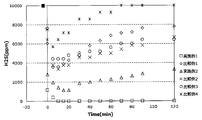
- FIG. 1 shows a plot of H 2 S concentration in off-gas with respect to time in Examples 1 and 2 and Comparative Examples 1 to 4.
- the time when the addition of the composition of the present invention is completed is set to 0 minutes.
- Example 3 After adding 30 mL of crude oil (manufactured by Petroleum Resources Co., Ltd.) collected at Yurihara Mine to a 100 mL autoclave equipped with a thermometer and a stirrer, stirring until the H 2 S concentration in the gas phase becomes constant, RX- When the concentration was measured using 517 (manufactured by Riken Kikai), it was 2,800 ppm. Next, a composition liquid in which PEG-200 and NL / MOL were mixed at a mass ratio of 1: 1 was added to 1% by mass with respect to the crude oil. At this time, the amount of NL / MOL added was 1.0 mmol, and the amount of H 2 S present in the apparatus was 0.05 mmol.
- crude oil manufactured by Petroleum Resources Co., Ltd.
- 517 manufactured by Riken Kikai
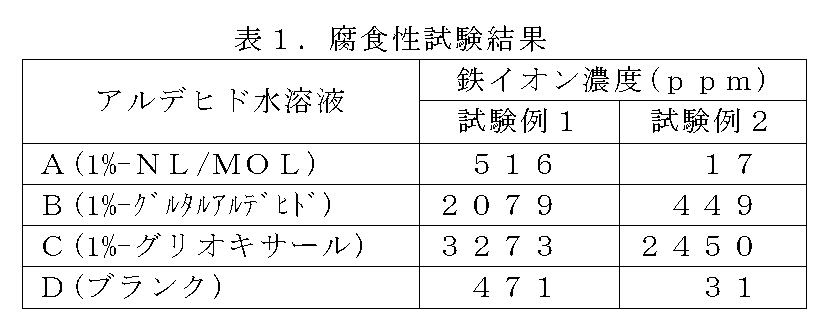
- ⁇ Test Example 1> In order to evaluate the metal corrosivity of the aldehyde aqueous solution, the following aqueous solutions were prepared.
- Table 1 shows the results of taking out the test piece after the storage and measuring the iron ion concentration in the aqueous solution by the atomic absorption method.
- Test Example 2 In Test Example 1, the same procedure as in Test Example 1 was performed except that sealing was performed under nitrogen, and the iron ion concentration in each aqueous solution was measured. The results are shown in Table 1.
Landscapes
- Chemical & Material Sciences (AREA)
- Oil, Petroleum & Natural Gas (AREA)
- Chemical Kinetics & Catalysis (AREA)
- Organic Chemistry (AREA)
- Engineering & Computer Science (AREA)
- General Chemical & Material Sciences (AREA)
- Analytical Chemistry (AREA)
- Metallurgy (AREA)
- Mechanical Engineering (AREA)
- Materials Engineering (AREA)
- Water Supply & Treatment (AREA)
- Production Of Liquid Hydrocarbon Mixture For Refining Petroleum (AREA)
- Gas Separation By Absorption (AREA)
Abstract
Description
炭化水素中の硫化水素を除去するためにアルデヒド化合物を用いることも古くから提案されている。具体的には特許文献1に、pHが2~12の範囲である水溶液中での、アルデヒド化合物と硫化水素との反応、特にホルムアルデヒド水溶液と硫化水素との反応が開示されている。以降、硫化水素を除去するためにアルデヒド化合物を用いることに関して多数の報告がなされており、例えば特許文献2では、ホルムアルデヒド、グリオキサールまたはグルタルアルデヒドなどの水溶性のアルデヒドを水溶液として、炭化水素中の硫化水素除去剤として用いている。
水溶液である硫化水素除去剤を炭化水素に単に添加するだけでは混合の観点から改善が求められ、例えば特許文献3では、上記アルデヒド類に対してソルビタンセスキオレートのようなエマルジョン化剤を添加することで、硫化水素の除去効率を向上できるとされている。また、特許文献4では重質油中の硫化水素を効率的に除去するために、水溶液である硫化水素除去剤と重質油とをスタティックミキサを備えた射出システムでエマルジョン化させている。その他、より効率を上げるために系内にポリアルキレングリコールを添加している例もある(特許文献5、6)。
しかしながら、ホルムアルデヒドは変異原性物質であることがよく知られており、また、グルタルアルデヒドは高濃度で自己重合を起こすため希釈状態でしか使用できず、体積効率の観点から問題がある。
[1]炭化水素中の含硫黄化合物を除去するための組成物であって、含硫黄化合物が硫化水素、-SH基を含有する化合物またはこれらの混合物であり、かつ組成物が炭素数6~16のジアルデヒドとポリアルキレングリコールを含有することを特徴とする、組成物。
[2]前記ジアルデヒドが3-メチルグルタルアルデヒド、1,9-ノナンジアールおよび2-メチル-1,8-オクタンジアールからなる群から選択される少なくとも1つである、[1]の組成物。
[3]前記ポリアルキレングリコールがポリエチレングリコール、ポリプロピレングリコールおよびポリブチレングリコールからなる群から選択される少なくとも1つである、[1]または[2]の組成物。
[4]含硫黄化合物を除去する対象である炭化水素が、天然ガス、液化天然ガス、サワーガス、原油、ナフサ、重質芳香族ナフサ、ガソリン、ケロシン、ディーゼル油、軽油、重油、FCCスラリー、アスファルトおよび油田濃縮物からなる群から選択される少なくとも1つである、[1]~[3]の組成物。
[5][1]~[4]のいずれかの組成物を炭化水素に接触させて炭化水素中の含硫黄化合物を除去する方法であって、含硫黄化合物が硫化水素、-SH基を含有する化合物またはこれらの混合物である、方法。
[6]炭化水素が、天然ガス、液化天然ガス、サワーガス、原油、ナフサ、重質芳香族ナフサ、ガソリン、ケロシン、ディーゼル油、軽油、重油、FCCスラリー、アスファルトおよび油田濃縮物からなる群から選択される少なくとも1つである、[5]の方法。
[7][1]~[4]のいずれかに記載の組成物中に含まれるジアルデヒドを、炭化水素中に含まれる含硫黄化合物1モルに対し0.1~100モル添加する、[5]または[6]の方法。
[8][1]~[4]のいずれかの組成物と炭化水素を0℃~200℃の範囲で接触させることを特徴とする、[5]~[7]のいずれかの方法。
[9]炭化水素中の硫化水素、-SH基を含有する化合物またはこれらの混合物である含硫黄化合物を除去するための、[1]~[4]のいずれかの組成物の使用。
当該ジアルデヒドに対し炭化水素中の含硫黄化合物が付加反応することで、炭化水素中から含硫黄化合物が除去される。
含硫黄化合物が-SH基を有する化合物である場合は、ジアルデヒドのホルミル基(R’-CH=O)に対し-SH基が付加反応し、チオアセタール類(R’-CH(OH)SR)やジチオアセタール類(R’-CH(SR)2)へ変化することで-SH基が除かれる。
一方、含硫黄化合物が硫化水素である場合は、ジアルデヒドのホルミル基(R’-CH=O)に対し硫化水素が付加反応し、R’-CH(OH)SHやR’-CH(SH)2といった-SH基を有する化合物へ変化する。その後は上記と同様の反応機構によって-SH基が除かれる。
本発明の組成物は好適には液状であるが、炭化水素中の含硫黄化合物を除去するために使用する形態に応じて、適宜担体などに担持させる形態での粉体、粒体などの固体状であっても良い。
[1,9-ノナンジアール(NL)および2-メチル-1,8-オクタンジアール(MOL)の混合物の製造]
特許第2857055号公報記載の方法によって、1,9-ノナンジアール(以下、NLと称する)および2-メチル-1,8-オクタンジアール(以下、MOLと称する)の混合物を製造した。該混合物におけるNLとMOLの質量比は、NL/MOL=85/15であった。
温度計、攪拌機を備えた100mLのオートクレーブにPEG-200(和光純薬株式会社製)を20mL仕込み、800rpmで攪拌させながら温度を25℃に調整し、10,000ppmに調整されたH2S標準ガスを16mL/minの速度で流通させた。装置内が充分に置換されたところでゲージ圧を0.1MPaに合わせ、オフガス中のH2S濃度をRX-517(理研機器製)を用いて測定開始し、直後にPEG-200とNL/MOLを質量比で1:1となるように混合した組成液20mLを4分かけてオートクレーブ内へ添加した。このときのNL/MOLの添加量は64.0mmolであった。添加終了後、2時間流通させた結果、H2Sの総流通量は0.8mmolであり、オフガス中のH2S濃度から計算したH2Sの総反応量は0.8mmolであった。
PEG-200をトルエン(和光純薬株式会社製)に変更した以外は実施例1と同様の条件で反応を行ったところ、NL/MOLの添加量は57.4mmolであった。H2Sの総流通量は0.8mmolであり、オフガス中のH2S濃度から計算したH2Sの総反応量は0.3mmolであった。
PEG-200をトルエン:PEG-200=99:1(質量比)の混合液に変更した以外は実施例1と同様の条件で反応を行ったところ、NL/MOLの添加量は57.4mmolであった。H2Sの総流通量は0.8mmolであり、オフガス中のH2S濃度から計算したH2Sの総反応量は0.5mmolであった。
PEG-200をイソプロパノール(IPA,和光純薬株式会社製)に変更した以外は実施例1と同様の条件で反応を行ったところ、NL/MOLの添加量は54.9mmolであった。H2Sの総流通量は0.8mmolであり、オフガス中のH2S濃度から計算したH2Sの総反応量は0.4mmolであった。
PEG-200を酢酸エチル(AcOEt,和光純薬株式会社製)に変更した以外は実施例1と同様の条件で反応を行ったところ、NL/MOLの添加量は58.9mmolであった。H2Sの総流通量は0.8mmolであり、オフガス中のH2S濃度から計算したH2Sの総反応量は0.3mmolであった。
PEG-200とNL/MOLを混合した組成液をPEG-200のみに変更した以外は実施例1と同様の条件で反応を行ったところ、H2Sの総流通量は0.8mmolであり、オフガス中のH2S濃度から計算したH2SのPEG-200に対する溶解量は0.1mmolであった。
温度計、攪拌機を備えた100mLのオートクレーブに由利原鉱場で採取された原油(石油資源株式会社製)を30mL加え、気相部のH2S濃度が一定になるまで攪拌した後、RX-517(理研機器製)を用いて濃度を測定したところ2,800ppmであった。次にPEG-200とNL/MOLを質量比で1:1となるように混合した組成液を原油に対して1質量%となるように添加した。このときのNL/MOLの添加量は1.0mmolであり、装置内のH2Sの存在量は0.05mmolであった。その後、装置内を800rpmで攪拌しながら80℃に昇温し5時間反応させた。反応後に室温まで冷やし、気相部のH2S濃度を測定したところ2ppmであり、除去効率は99.9%であった。
温度計、攪拌機を備えた100mLのオートクレーブに由利原鉱場で採取された原油石油資源株式会社製)を30mL加え、気相部のH2S濃度が一定になるまで攪拌した後、RX-517(理研機器製)を用いて濃度を測定したところ2,600ppmであった。次に40質量%グリオキサール水溶液(和光純薬株式会社製)を原油に対して1質量%となるように添加した。このときのグリオキサールの添加量は1.8mmolであり、装置内のH2Sの存在量は0.04mmolであった。その後、装置内を800rpmで攪拌しながら80℃に昇温し5時間反応させた。反応後に室温まで冷やし、気相部のH2S濃度を測定したところ498ppmであり、除去効率は80.8%であった。
アルデヒド水溶液の金属腐食性を評価するため、下記の水溶液を用意した。
A.1%NL/MOL水溶液:NL/MOLの混合物を蒸留水で希釈
B.1%グルタルアルデヒド水溶液:50%グルタルアルデヒド水溶液(和光純薬工業株式会社製)を蒸留水で希釈
C.1%グリオキサール水溶液:40%グリオキサール水溶液(東京化成工業株式会社製)を蒸留水で希釈
D.蒸留水(ブランク)
試験例1において、窒素下で密閉したこと以外は試験例1と同じ手順を行い、各々の水溶液中の鉄イオン濃度を測定した。結果を表1に示す。
Claims (9)
- 炭化水素中の含硫黄化合物を除去するための組成物であって、含硫黄化合物が硫化水素、-SH基を含有する化合物またはこれらの混合物であり、かつ組成物が炭素数6~16のジアルデヒドとポリアルキレングリコールを含有することを特徴とする、組成物。
- 前記ジアルデヒドが3-メチルグルタルアルデヒド、1,9-ノナンジアールおよび2-メチル-1,8-オクタンジアールからなる群から選択される少なくとも1つである、請求項1に記載の組成物。
- 前記ポリアルキレングリコールがポリエチレングリコール、ポリプロピレングリコールおよびポリブチレングリコールからなる群から選択される少なくとも1つである、請求項1または2に記載の組成物。
- 含硫黄化合物を除去する対象である炭化水素が、天然ガス、液化天然ガス、サワーガス、原油、ナフサ、重質芳香族ナフサ、ガソリン、ケロシン、ディーゼル油、軽油、重油、FCCスラリー、アスファルトおよび油田濃縮物からなる群から選択される少なくとも1つである、請求項1~3に記載の組成物。
- 請求項1~4のいずれかに記載の組成物を炭化水素に接触させて炭化水素中の含硫黄化合物を除去する方法であって、含硫黄化合物が硫化水素、-SH基を含有する化合物またはこれらの混合物である、方法。
- 炭化水素が、天然ガス、液化天然ガス、サワーガス、原油、ナフサ、重質芳香族ナフサ、ガソリン、ケロシン、ディーゼル油、軽油、重油、FCCスラリー、アスファルトおよび油田濃縮物からなる群から選択される少なくとも1つである、請求項5に記載の方法。
- 請求項1~4のいずれかに記載の組成物中に含まれるジアルデヒドを、炭化水素中に含まれる含硫黄化合物1モルに対し0.1~100モル添加する、請求項5または6に記載の方法。
- 請求項1~4のいずれかに記載の組成物と炭化水素を0℃~200℃の範囲で接触させることを特徴とする、請求項5~7のいずれかに記載の方法。
- 炭化水素中の硫化水素、-SH基を含有する化合物またはこれらの混合物である含硫黄化合物を除去するための、請求項1~4のいずれかに記載の組成物の使用。
Priority Applications (7)
| Application Number | Priority Date | Filing Date | Title |
|---|---|---|---|
| EP16743350.7A EP3252129B1 (en) | 2015-01-29 | 2016-01-26 | Composition for removing sulfur-containing compounds |
| CA2974070A CA2974070A1 (en) | 2015-01-29 | 2016-01-26 | Composition for removing sulfur-containing compounds |
| US15/546,091 US10294428B2 (en) | 2015-01-29 | 2016-01-26 | Composition for removing sulfur-containing compounds |
| KR1020177019893A KR20170110079A (ko) | 2015-01-29 | 2016-01-26 | 함황 화합물 제거용의 조성물 |
| JP2016572051A JP6621030B2 (ja) | 2015-01-29 | 2016-01-26 | 含硫黄化合物除去用の組成物 |
| RU2017126366A RU2693494C2 (ru) | 2015-01-29 | 2016-01-26 | Композиция для удаления серосодержащих соединений |
| CN201680007120.1A CN107207974B (zh) | 2015-01-29 | 2016-01-26 | 含硫化合物除去用的组合物 |
Applications Claiming Priority (2)
| Application Number | Priority Date | Filing Date | Title |
|---|---|---|---|
| JP2015-015380 | 2015-01-29 | ||
| JP2015015380 | 2015-01-29 |
Publications (1)
| Publication Number | Publication Date |
|---|---|
| WO2016121747A1 true WO2016121747A1 (ja) | 2016-08-04 |
Family
ID=56543358
Family Applications (1)
| Application Number | Title | Priority Date | Filing Date |
|---|---|---|---|
| PCT/JP2016/052157 Ceased WO2016121747A1 (ja) | 2015-01-29 | 2016-01-26 | 含硫黄化合物除去用の組成物 |
Country Status (9)
| Country | Link |
|---|---|
| US (1) | US10294428B2 (ja) |
| EP (1) | EP3252129B1 (ja) |
| JP (1) | JP6621030B2 (ja) |
| KR (1) | KR20170110079A (ja) |
| CN (1) | CN107207974B (ja) |
| CA (1) | CA2974070A1 (ja) |
| RU (1) | RU2693494C2 (ja) |
| TW (1) | TWI678395B (ja) |
| WO (1) | WO2016121747A1 (ja) |
Cited By (7)
| Publication number | Priority date | Publication date | Assignee | Title |
|---|---|---|---|---|
| WO2018097108A1 (ja) | 2016-11-22 | 2018-05-31 | 株式会社クラレ | 含硫黄化合物除去用の組成物 |
| WO2018207657A1 (ja) | 2017-05-12 | 2018-11-15 | 株式会社クラレ | 含硫黄化合物除去装置および含硫黄化合物除去方法 |
| WO2019004066A1 (ja) * | 2017-06-29 | 2019-01-03 | 株式会社クラレ | アスファルト中の含硫黄化合物除去用の組成物 |
| WO2019167752A1 (ja) * | 2018-02-28 | 2019-09-06 | 株式会社クラレ | 含硫黄化合物除去用の組成物 |
| WO2020027236A1 (ja) * | 2018-08-01 | 2020-02-06 | 独立行政法人石油天然ガス・金属鉱物資源機構 | 生産流体処理システム及び生産流体の処理方法 |
| WO2020129446A1 (ja) * | 2018-12-21 | 2020-06-25 | 株式会社クラレ | 炭化水素の製造方法、精製方法及び精製装置 |
| EA039258B1 (ru) * | 2017-06-21 | 2021-12-23 | Курарей Ко., Лтд. | Композиция для удаления серосодержащего соединения |
Families Citing this family (8)
| Publication number | Priority date | Publication date | Assignee | Title |
|---|---|---|---|---|
| MX2017003609A (es) * | 2014-09-19 | 2017-09-19 | Kuraray Co | Inhibidor de corrosion biologica para metales. |
| US20200017781A1 (en) * | 2016-09-27 | 2020-01-16 | Kuraray Co., Ltd. | Metal corrosion suppressing method |
| US11286433B2 (en) * | 2017-08-01 | 2022-03-29 | Gaps Technology, Llc | Compositions and methods for remediating hydrogen sulfide in hydrocarbon based liquids |
| WO2021076944A1 (en) | 2019-10-17 | 2021-04-22 | Nexgen Oilfield Chemicals, Llc | Methods and compositions for scavenging sulfides from hydrocarbon fluids and aqueous streams |
| EP4093836A1 (en) | 2020-01-23 | 2022-11-30 | ChampionX USA Inc. | Compositions of heterocyclic compounds and uses as sulfidogenesis inhibitors |
| CN114159946B (zh) * | 2022-02-11 | 2022-04-29 | 河北精致科技有限公司 | 一种用于脱除烟气中二氧化硫的吸收剂及其应用 |
| WO2023215440A1 (en) | 2022-05-04 | 2023-11-09 | Nexgen Oilfield Chemicals, Llc | Compositions and methods for scavenging hydrogen sulfide |
| CN118546664B (zh) * | 2024-05-15 | 2024-12-24 | 九江蓝卓新材料科技有限公司 | 一种高效的油田用除总硫剂 |
Citations (6)
| Publication number | Priority date | Publication date | Assignee | Title |
|---|---|---|---|---|
| JPH10235130A (ja) * | 1997-02-25 | 1998-09-08 | Matsushita Electric Works Ltd | フィルタ |
| JP2004168663A (ja) * | 2002-11-15 | 2004-06-17 | Osaka Industrial Promotion Organization | 硫黄化合物の酸化方法および脱硫油の製造方法 |
| US20120241361A1 (en) * | 2011-03-24 | 2012-09-27 | Baker Hughes Incorporated | Synergistic H2S/Mercaptan Scavengers Using Glyoxal |
| US20130004393A1 (en) * | 2011-06-29 | 2013-01-03 | Baker Hughes Incorporated | Synergistic Method for Enhanced H2S/Mercaptan Scavenging |
| JP2013515818A (ja) * | 2009-12-23 | 2013-05-09 | ゼネラル・エレクトリック・カンパニイ | 水性硫化水素スカベンジャーの効果を高めるための炭化水素ガスオイルの乳化 |
| US20150001132A1 (en) * | 2013-06-27 | 2015-01-01 | Ecolab Usa Inc. | Epoxide-based hydrogen sulfide scavengers |
Family Cites Families (16)
| Publication number | Priority date | Publication date | Assignee | Title |
|---|---|---|---|---|
| US1991765A (en) | 1932-01-23 | 1935-02-19 | Dupont Viscoloid Company | Aldehyde-hydrogen sulphide reaction product |
| JPS58157739A (ja) * | 1982-03-12 | 1983-09-19 | Kuraray Co Ltd | 1,9−ノナンジア−ルの製造方法 |
| US4532117A (en) * | 1983-12-20 | 1985-07-30 | Union Oil Company Of California | Method for reconditioning bacteria-contaminated hydrogen sulfide removal systems |
| US4680127A (en) | 1985-12-13 | 1987-07-14 | Betz Laboratories, Inc. | Method of scavenging hydrogen sulfide |
| US5284635A (en) | 1989-09-05 | 1994-02-08 | Societe Francaise Hoechst | Process for the elimination of hydrogen sulfide by using water-in-oil emulsions |
| US5347004A (en) * | 1992-10-09 | 1994-09-13 | Baker Hughes, Inc. | Mixtures of hexahydrotriazines useful as H2 S scavengers |
| US5462721A (en) * | 1994-08-24 | 1995-10-31 | Crescent Holdings Limited | Hydrogen sulfide scavenging process |
| US5688478A (en) * | 1994-08-24 | 1997-11-18 | Crescent Holdings Limited | Method for scavenging sulfides |
| GB2391015B (en) * | 2001-04-25 | 2004-12-22 | Clearwater Int Llc | Treatment of hydrocarbons containing sulfides |
| RU2385180C1 (ru) * | 2008-08-21 | 2010-03-27 | Владимир Сергеевич Арутюнов | Способ очистки углеводородных газов |
| WO2010128523A2 (en) | 2009-05-05 | 2010-11-11 | Dorf Ketal Chemicals (India) Private Limited | Method of scavenging hydrogen sulfide from hydrocarbon stream |
| ES2549530T3 (es) * | 2010-11-22 | 2015-10-29 | Dorf Ketal Chemicals (I) Private Limited | Composición de aditivo y procedimiento para captar sulfuro de hidrógeno en corrientes de hidrocarburos |
| US20130089460A1 (en) | 2011-10-05 | 2013-04-11 | Baker Hughes Incorporated | Inhibiting corrosion caused by aqueous aldehyde solutions |
| AU2013361681B2 (en) * | 2012-12-19 | 2018-03-29 | Championx Llc | Scavenging hydrogen sulfide |
| US9587181B2 (en) * | 2013-01-10 | 2017-03-07 | Baker Hughes Incorporated | Synergistic H2S scavenger combination of transition metal salts with water-soluble aldehydes and aldehyde precursors |
| US10119079B2 (en) * | 2014-03-17 | 2018-11-06 | Kuraray Co., Ltd. | Composition for removal of sulfur-containing compounds |
-
2016
- 2016-01-26 JP JP2016572051A patent/JP6621030B2/ja active Active
- 2016-01-26 CA CA2974070A patent/CA2974070A1/en not_active Abandoned
- 2016-01-26 CN CN201680007120.1A patent/CN107207974B/zh not_active Expired - Fee Related
- 2016-01-26 EP EP16743350.7A patent/EP3252129B1/en active Active
- 2016-01-26 RU RU2017126366A patent/RU2693494C2/ru not_active IP Right Cessation
- 2016-01-26 US US15/546,091 patent/US10294428B2/en active Active
- 2016-01-26 WO PCT/JP2016/052157 patent/WO2016121747A1/ja not_active Ceased
- 2016-01-26 KR KR1020177019893A patent/KR20170110079A/ko not_active Withdrawn
- 2016-01-27 TW TW105102444A patent/TWI678395B/zh not_active IP Right Cessation
Patent Citations (6)
| Publication number | Priority date | Publication date | Assignee | Title |
|---|---|---|---|---|
| JPH10235130A (ja) * | 1997-02-25 | 1998-09-08 | Matsushita Electric Works Ltd | フィルタ |
| JP2004168663A (ja) * | 2002-11-15 | 2004-06-17 | Osaka Industrial Promotion Organization | 硫黄化合物の酸化方法および脱硫油の製造方法 |
| JP2013515818A (ja) * | 2009-12-23 | 2013-05-09 | ゼネラル・エレクトリック・カンパニイ | 水性硫化水素スカベンジャーの効果を高めるための炭化水素ガスオイルの乳化 |
| US20120241361A1 (en) * | 2011-03-24 | 2012-09-27 | Baker Hughes Incorporated | Synergistic H2S/Mercaptan Scavengers Using Glyoxal |
| US20130004393A1 (en) * | 2011-06-29 | 2013-01-03 | Baker Hughes Incorporated | Synergistic Method for Enhanced H2S/Mercaptan Scavenging |
| US20150001132A1 (en) * | 2013-06-27 | 2015-01-01 | Ecolab Usa Inc. | Epoxide-based hydrogen sulfide scavengers |
Cited By (14)
| Publication number | Priority date | Publication date | Assignee | Title |
|---|---|---|---|---|
| CN109952141A (zh) * | 2016-11-22 | 2019-06-28 | 株式会社可乐丽 | 用于去除含硫化合物的组合物 |
| US11434433B2 (en) | 2016-11-22 | 2022-09-06 | Kuraray Co., Ltd. | Composition for removal of sulfur-containing compound |
| WO2018097108A1 (ja) | 2016-11-22 | 2018-05-31 | 株式会社クラレ | 含硫黄化合物除去用の組成物 |
| CN110573232A (zh) * | 2017-05-12 | 2019-12-13 | 株式会社可乐丽 | 含硫化合物去除装置和含硫化合物去除方法 |
| WO2018207657A1 (ja) | 2017-05-12 | 2018-11-15 | 株式会社クラレ | 含硫黄化合物除去装置および含硫黄化合物除去方法 |
| EA039258B1 (ru) * | 2017-06-21 | 2021-12-23 | Курарей Ко., Лтд. | Композиция для удаления серосодержащего соединения |
| WO2019004066A1 (ja) * | 2017-06-29 | 2019-01-03 | 株式会社クラレ | アスファルト中の含硫黄化合物除去用の組成物 |
| WO2019167752A1 (ja) * | 2018-02-28 | 2019-09-06 | 株式会社クラレ | 含硫黄化合物除去用の組成物 |
| JP6589085B1 (ja) * | 2018-02-28 | 2019-10-09 | 株式会社クラレ | 含硫黄化合物除去用の組成物 |
| US11795404B2 (en) | 2018-02-28 | 2023-10-24 | Kuraray Co., Ltd. | Composition for removing sulfur-containing compounds |
| WO2020027236A1 (ja) * | 2018-08-01 | 2020-02-06 | 独立行政法人石油天然ガス・金属鉱物資源機構 | 生産流体処理システム及び生産流体の処理方法 |
| WO2020129446A1 (ja) * | 2018-12-21 | 2020-06-25 | 株式会社クラレ | 炭化水素の製造方法、精製方法及び精製装置 |
| JP6730544B1 (ja) * | 2018-12-21 | 2020-07-29 | 株式会社クラレ | 炭化水素の製造方法、精製方法及び精製装置 |
| US11840669B2 (en) | 2018-12-21 | 2023-12-12 | Kuraray Co., Ltd. | Method for hydrocarbon production, purification method, and purifier |
Also Published As
| Publication number | Publication date |
|---|---|
| RU2017126366A (ru) | 2019-03-01 |
| TW201634579A (zh) | 2016-10-01 |
| JP6621030B2 (ja) | 2019-12-18 |
| US10294428B2 (en) | 2019-05-21 |
| EP3252129A1 (en) | 2017-12-06 |
| TWI678395B (zh) | 2019-12-01 |
| RU2693494C2 (ru) | 2019-07-03 |
| RU2017126366A3 (ja) | 2019-05-21 |
| CA2974070A1 (en) | 2016-08-04 |
| CN107207974A (zh) | 2017-09-26 |
| EP3252129B1 (en) | 2019-08-14 |
| KR20170110079A (ko) | 2017-10-10 |
| US20180010056A1 (en) | 2018-01-11 |
| CN107207974B (zh) | 2019-11-15 |
| JPWO2016121747A1 (ja) | 2017-11-16 |
| EP3252129A4 (en) | 2018-07-25 |
Similar Documents
| Publication | Publication Date | Title |
|---|---|---|
| JP6621030B2 (ja) | 含硫黄化合物除去用の組成物 | |
| JP6446029B2 (ja) | 含硫黄化合物除去用の組成物 | |
| EP3476478B1 (en) | Method for removing a sulfur-containing compound | |
| CN109819658B (zh) | 增效的缩醛组合物以及用于清除硫化物和硫醇的方法 | |
| US9638018B2 (en) | Scavenging hydrogen sulfide | |
| JP2013531728A (ja) | 炭化水素から硫化水素を除去するためのアルファ−アミノエーテルの使用 | |
| KR102166888B1 (ko) | 질소 기반 황화수소 스캐빈저 및 이의 사용 방법 | |
| WO2019124340A1 (ja) | 原油または天然ガスの採掘用処理剤 | |
| RU2591923C1 (ru) | Ингибитор сероводородной коррозии и наводороживания | |
| HK1227916A1 (en) | Composition for removal of sulphur-containing compounds | |
| WO2021076944A1 (en) | Methods and compositions for scavenging sulfides from hydrocarbon fluids and aqueous streams | |
| HK1227916B (en) | Composition for removal of sulphur-containing compounds |
Legal Events
| Date | Code | Title | Description |
|---|---|---|---|
| 121 | Ep: the epo has been informed by wipo that ep was designated in this application |
Ref document number: 16743350 Country of ref document: EP Kind code of ref document: A1 |
|
| ENP | Entry into the national phase |
Ref document number: 2016572051 Country of ref document: JP Kind code of ref document: A |
|
| REEP | Request for entry into the european phase |
Ref document number: 2016743350 Country of ref document: EP |
|
| ENP | Entry into the national phase |
Ref document number: 2974070 Country of ref document: CA Ref document number: 20177019893 Country of ref document: KR Kind code of ref document: A |
|
| WWE | Wipo information: entry into national phase |
Ref document number: 15546091 Country of ref document: US |
|
| NENP | Non-entry into the national phase |
Ref country code: DE |
|
| ENP | Entry into the national phase |
Ref document number: 2017126366 Country of ref document: RU Kind code of ref document: A |