WO2016125878A1 - 貼付剤 - Google Patents
貼付剤 Download PDFInfo
- Publication number
- WO2016125878A1 WO2016125878A1 PCT/JP2016/053456 JP2016053456W WO2016125878A1 WO 2016125878 A1 WO2016125878 A1 WO 2016125878A1 JP 2016053456 W JP2016053456 W JP 2016053456W WO 2016125878 A1 WO2016125878 A1 WO 2016125878A1
- Authority
- WO
- WIPO (PCT)
- Prior art keywords
- patch
- adhesive layer
- mass
- pressure
- sensitive adhesive
- Prior art date
- Legal status (The legal status is an assumption and is not a legal conclusion. Google has not performed a legal analysis and makes no representation as to the accuracy of the status listed.)
- Ceased
Links
Classifications
-
- A—HUMAN NECESSITIES
- A61—MEDICAL OR VETERINARY SCIENCE; HYGIENE
- A61K—PREPARATIONS FOR MEDICAL, DENTAL OR TOILETRY PURPOSES
- A61K9/00—Medicinal preparations characterised by special physical form
- A61K9/70—Web, sheet or filament bases ; Films; Fibres of the matrix type containing drug
- A61K9/7023—Transdermal patches and similar drug-containing composite devices, e.g. cataplasms
- A61K9/703—Transdermal patches and similar drug-containing composite devices, e.g. cataplasms characterised by shape or structure; Details concerning release liner or backing; Refillable patches; User-activated patches
- A61K9/7038—Transdermal patches of the drug-in-adhesive type, i.e. comprising drug in the skin-adhesive layer
- A61K9/7046—Transdermal patches of the drug-in-adhesive type, i.e. comprising drug in the skin-adhesive layer the adhesive comprising macromolecular compounds
- A61K9/7053—Transdermal patches of the drug-in-adhesive type, i.e. comprising drug in the skin-adhesive layer the adhesive comprising macromolecular compounds obtained by reactions only involving carbon to carbon unsaturated bonds, e.g. polyvinyl, polyisobutylene, polystyrene
-
- A—HUMAN NECESSITIES
- A61—MEDICAL OR VETERINARY SCIENCE; HYGIENE
- A61F—FILTERS IMPLANTABLE INTO BLOOD VESSELS; PROSTHESES; DEVICES PROVIDING PATENCY TO, OR PREVENTING COLLAPSING OF, TUBULAR STRUCTURES OF THE BODY, e.g. STENTS; ORTHOPAEDIC, NURSING OR CONTRACEPTIVE DEVICES; FOMENTATION; TREATMENT OR PROTECTION OF EYES OR EARS; BANDAGES, DRESSINGS OR ABSORBENT PADS; FIRST-AID KITS
- A61F13/00—Bandages or dressings; Absorbent pads
- A61F13/00051—Accessories for dressings
- A61F13/00063—Accessories for dressings comprising medicaments or additives, e.g. odor control, PH control, debriding, antimicrobic
-
- A—HUMAN NECESSITIES
- A61—MEDICAL OR VETERINARY SCIENCE; HYGIENE
- A61F—FILTERS IMPLANTABLE INTO BLOOD VESSELS; PROSTHESES; DEVICES PROVIDING PATENCY TO, OR PREVENTING COLLAPSING OF, TUBULAR STRUCTURES OF THE BODY, e.g. STENTS; ORTHOPAEDIC, NURSING OR CONTRACEPTIVE DEVICES; FOMENTATION; TREATMENT OR PROTECTION OF EYES OR EARS; BANDAGES, DRESSINGS OR ABSORBENT PADS; FIRST-AID KITS
- A61F13/00—Bandages or dressings; Absorbent pads
- A61F13/02—Adhesive bandages or dressings
-
- A—HUMAN NECESSITIES
- A61—MEDICAL OR VETERINARY SCIENCE; HYGIENE
- A61F—FILTERS IMPLANTABLE INTO BLOOD VESSELS; PROSTHESES; DEVICES PROVIDING PATENCY TO, OR PREVENTING COLLAPSING OF, TUBULAR STRUCTURES OF THE BODY, e.g. STENTS; ORTHOPAEDIC, NURSING OR CONTRACEPTIVE DEVICES; FOMENTATION; TREATMENT OR PROTECTION OF EYES OR EARS; BANDAGES, DRESSINGS OR ABSORBENT PADS; FIRST-AID KITS
- A61F13/00—Bandages or dressings; Absorbent pads
- A61F13/02—Adhesive bandages or dressings
- A61F13/023—Adhesive bandages or dressings wound covering film layers without a fluid retention layer
- A61F13/0243—Adhesive bandages or dressings wound covering film layers without a fluid retention layer characterised by the properties of the skin contacting layer, e.g. air-vapor permeability
-
- A—HUMAN NECESSITIES
- A61—MEDICAL OR VETERINARY SCIENCE; HYGIENE
- A61F—FILTERS IMPLANTABLE INTO BLOOD VESSELS; PROSTHESES; DEVICES PROVIDING PATENCY TO, OR PREVENTING COLLAPSING OF, TUBULAR STRUCTURES OF THE BODY, e.g. STENTS; ORTHOPAEDIC, NURSING OR CONTRACEPTIVE DEVICES; FOMENTATION; TREATMENT OR PROTECTION OF EYES OR EARS; BANDAGES, DRESSINGS OR ABSORBENT PADS; FIRST-AID KITS
- A61F13/00—Bandages or dressings; Absorbent pads
- A61F13/02—Adhesive bandages or dressings
- A61F13/0246—Adhesive bandages or dressings characterised by the skin-adhering layer
- A61F13/0253—Adhesive bandages or dressings characterised by the skin-adhering layer characterized by the adhesive material
-
- A—HUMAN NECESSITIES
- A61—MEDICAL OR VETERINARY SCIENCE; HYGIENE
- A61K—PREPARATIONS FOR MEDICAL, DENTAL OR TOILETRY PURPOSES
- A61K31/00—Medicinal preparations containing organic active ingredients
- A61K31/045—Hydroxy compounds, e.g. alcohols; Salts thereof, e.g. alcoholates
-
- A—HUMAN NECESSITIES
- A61—MEDICAL OR VETERINARY SCIENCE; HYGIENE
- A61K—PREPARATIONS FOR MEDICAL, DENTAL OR TOILETRY PURPOSES
- A61K31/00—Medicinal preparations containing organic active ingredients
- A61K31/60—Salicylic acid; Derivatives thereof
- A61K31/618—Salicylic acid; Derivatives thereof having the carboxyl group in position 1 esterified, e.g. salsalate
-
- A—HUMAN NECESSITIES
- A61—MEDICAL OR VETERINARY SCIENCE; HYGIENE
- A61K—PREPARATIONS FOR MEDICAL, DENTAL OR TOILETRY PURPOSES
- A61K47/00—Medicinal preparations characterised by the non-active ingredients used, e.g. carriers or inert additives; Targeting or modifying agents chemically bound to the active ingredient
- A61K47/06—Organic compounds, e.g. natural or synthetic hydrocarbons, polyolefins, mineral oil, petrolatum or ozokerite
- A61K47/08—Organic compounds, e.g. natural or synthetic hydrocarbons, polyolefins, mineral oil, petrolatum or ozokerite containing oxygen, e.g. ethers, acetals, ketones, quinones, aldehydes, peroxides
- A61K47/10—Alcohols; Phenols; Salts thereof, e.g. glycerol; Polyethylene glycols [PEG]; Poloxamers; PEG/POE alkyl ethers
-
- A—HUMAN NECESSITIES
- A61—MEDICAL OR VETERINARY SCIENCE; HYGIENE
- A61K—PREPARATIONS FOR MEDICAL, DENTAL OR TOILETRY PURPOSES
- A61K47/00—Medicinal preparations characterised by the non-active ingredients used, e.g. carriers or inert additives; Targeting or modifying agents chemically bound to the active ingredient
- A61K47/06—Organic compounds, e.g. natural or synthetic hydrocarbons, polyolefins, mineral oil, petrolatum or ozokerite
- A61K47/08—Organic compounds, e.g. natural or synthetic hydrocarbons, polyolefins, mineral oil, petrolatum or ozokerite containing oxygen, e.g. ethers, acetals, ketones, quinones, aldehydes, peroxides
- A61K47/14—Esters of carboxylic acids, e.g. fatty acid monoglycerides, medium-chain triglycerides, parabens or PEG fatty acid esters
-
- A—HUMAN NECESSITIES
- A61—MEDICAL OR VETERINARY SCIENCE; HYGIENE
- A61K—PREPARATIONS FOR MEDICAL, DENTAL OR TOILETRY PURPOSES
- A61K47/00—Medicinal preparations characterised by the non-active ingredients used, e.g. carriers or inert additives; Targeting or modifying agents chemically bound to the active ingredient
- A61K47/30—Macromolecular organic or inorganic compounds, e.g. inorganic polyphosphates
- A61K47/32—Macromolecular compounds obtained by reactions only involving carbon-to-carbon unsaturated bonds, e.g. carbomers, poly(meth)acrylates, or polyvinyl pyrrolidone
-
- A—HUMAN NECESSITIES
- A61—MEDICAL OR VETERINARY SCIENCE; HYGIENE
- A61K—PREPARATIONS FOR MEDICAL, DENTAL OR TOILETRY PURPOSES
- A61K47/00—Medicinal preparations characterised by the non-active ingredients used, e.g. carriers or inert additives; Targeting or modifying agents chemically bound to the active ingredient
- A61K47/30—Macromolecular organic or inorganic compounds, e.g. inorganic polyphosphates
- A61K47/34—Macromolecular compounds obtained otherwise than by reactions only involving carbon-to-carbon unsaturated bonds, e.g. polyesters, polyamino acids, polysiloxanes, polyphosphazines, copolymers of polyalkylene glycol or poloxamers
-
- A—HUMAN NECESSITIES
- A61—MEDICAL OR VETERINARY SCIENCE; HYGIENE
- A61L—METHODS OR APPARATUS FOR STERILISING MATERIALS OR OBJECTS IN GENERAL; DISINFECTION, STERILISATION OR DEODORISATION OF AIR; CHEMICAL ASPECTS OF BANDAGES, DRESSINGS, ABSORBENT PADS OR SURGICAL ARTICLES; MATERIALS FOR BANDAGES, DRESSINGS, ABSORBENT PADS OR SURGICAL ARTICLES
- A61L15/00—Chemical aspects of, or use of materials for, bandages, dressings or absorbent pads
- A61L15/16—Bandages, dressings or absorbent pads for physiological fluids such as urine or blood, e.g. sanitary towels, tampons
- A61L15/42—Use of materials characterised by their function or physical properties
- A61L15/58—Adhesives
-
- A—HUMAN NECESSITIES
- A61—MEDICAL OR VETERINARY SCIENCE; HYGIENE
- A61P—SPECIFIC THERAPEUTIC ACTIVITY OF CHEMICAL COMPOUNDS OR MEDICINAL PREPARATIONS
- A61P29/00—Non-central analgesic, antipyretic or antiinflammatory agents, e.g. antirheumatic agents; Non-steroidal antiinflammatory drugs [NSAID]
-
- B—PERFORMING OPERATIONS; TRANSPORTING
- B32—LAYERED PRODUCTS
- B32B—LAYERED PRODUCTS, i.e. PRODUCTS BUILT-UP OF STRATA OF FLAT OR NON-FLAT, e.g. CELLULAR OR HONEYCOMB, FORM
- B32B15/00—Layered products comprising a layer of metal
- B32B15/14—Layered products comprising a layer of metal next to a fibrous or filamentary layer
-
- B—PERFORMING OPERATIONS; TRANSPORTING
- B32—LAYERED PRODUCTS
- B32B—LAYERED PRODUCTS, i.e. PRODUCTS BUILT-UP OF STRATA OF FLAT OR NON-FLAT, e.g. CELLULAR OR HONEYCOMB, FORM
- B32B15/00—Layered products comprising a layer of metal
- B32B15/20—Layered products comprising a layer of metal comprising aluminium or copper
-
- B—PERFORMING OPERATIONS; TRANSPORTING
- B32—LAYERED PRODUCTS
- B32B—LAYERED PRODUCTS, i.e. PRODUCTS BUILT-UP OF STRATA OF FLAT OR NON-FLAT, e.g. CELLULAR OR HONEYCOMB, FORM
- B32B27/00—Layered products comprising a layer of synthetic resin
-
- B—PERFORMING OPERATIONS; TRANSPORTING
- B32—LAYERED PRODUCTS
- B32B—LAYERED PRODUCTS, i.e. PRODUCTS BUILT-UP OF STRATA OF FLAT OR NON-FLAT, e.g. CELLULAR OR HONEYCOMB, FORM
- B32B27/00—Layered products comprising a layer of synthetic resin
- B32B27/12—Layered products comprising a layer of synthetic resin next to a fibrous or filamentary layer
-
- B—PERFORMING OPERATIONS; TRANSPORTING
- B32—LAYERED PRODUCTS
- B32B—LAYERED PRODUCTS, i.e. PRODUCTS BUILT-UP OF STRATA OF FLAT OR NON-FLAT, e.g. CELLULAR OR HONEYCOMB, FORM
- B32B27/00—Layered products comprising a layer of synthetic resin
- B32B27/30—Layered products comprising a layer of synthetic resin comprising vinyl (co)polymers; comprising acrylic (co)polymers
- B32B27/302—Layered products comprising a layer of synthetic resin comprising vinyl (co)polymers; comprising acrylic (co)polymers comprising aromatic vinyl (co)polymers, e.g. styrenic (co)polymers
-
- B—PERFORMING OPERATIONS; TRANSPORTING
- B32—LAYERED PRODUCTS
- B32B—LAYERED PRODUCTS, i.e. PRODUCTS BUILT-UP OF STRATA OF FLAT OR NON-FLAT, e.g. CELLULAR OR HONEYCOMB, FORM
- B32B27/00—Layered products comprising a layer of synthetic resin
- B32B27/30—Layered products comprising a layer of synthetic resin comprising vinyl (co)polymers; comprising acrylic (co)polymers
- B32B27/304—Layered products comprising a layer of synthetic resin comprising vinyl (co)polymers; comprising acrylic (co)polymers comprising vinyl halide (co)polymers, e.g. PVC, PVDC, PVF, PVDF
-
- B—PERFORMING OPERATIONS; TRANSPORTING
- B32—LAYERED PRODUCTS
- B32B—LAYERED PRODUCTS, i.e. PRODUCTS BUILT-UP OF STRATA OF FLAT OR NON-FLAT, e.g. CELLULAR OR HONEYCOMB, FORM
- B32B27/00—Layered products comprising a layer of synthetic resin
- B32B27/32—Layered products comprising a layer of synthetic resin comprising polyolefins
-
- B—PERFORMING OPERATIONS; TRANSPORTING
- B32—LAYERED PRODUCTS
- B32B—LAYERED PRODUCTS, i.e. PRODUCTS BUILT-UP OF STRATA OF FLAT OR NON-FLAT, e.g. CELLULAR OR HONEYCOMB, FORM
- B32B27/00—Layered products comprising a layer of synthetic resin
- B32B27/36—Layered products comprising a layer of synthetic resin comprising polyesters
-
- B—PERFORMING OPERATIONS; TRANSPORTING
- B32—LAYERED PRODUCTS
- B32B—LAYERED PRODUCTS, i.e. PRODUCTS BUILT-UP OF STRATA OF FLAT OR NON-FLAT, e.g. CELLULAR OR HONEYCOMB, FORM
- B32B27/00—Layered products comprising a layer of synthetic resin
- B32B27/40—Layered products comprising a layer of synthetic resin comprising polyurethanes
-
- B—PERFORMING OPERATIONS; TRANSPORTING
- B32—LAYERED PRODUCTS
- B32B—LAYERED PRODUCTS, i.e. PRODUCTS BUILT-UP OF STRATA OF FLAT OR NON-FLAT, e.g. CELLULAR OR HONEYCOMB, FORM
- B32B29/00—Layered products comprising a layer of paper or cardboard
- B32B29/02—Layered products comprising a layer of paper or cardboard next to a fibrous or filamentary layer
-
- B—PERFORMING OPERATIONS; TRANSPORTING
- B32—LAYERED PRODUCTS
- B32B—LAYERED PRODUCTS, i.e. PRODUCTS BUILT-UP OF STRATA OF FLAT OR NON-FLAT, e.g. CELLULAR OR HONEYCOMB, FORM
- B32B5/00—Layered products characterised by the non- homogeneity or physical structure, i.e. comprising a fibrous, filamentary, particulate or foam layer; Layered products characterised by having a layer differing constitutionally or physically in different parts
- B32B5/02—Layered products characterised by the non- homogeneity or physical structure, i.e. comprising a fibrous, filamentary, particulate or foam layer; Layered products characterised by having a layer differing constitutionally or physically in different parts characterised by structural features of a fibrous or filamentary layer
-
- B—PERFORMING OPERATIONS; TRANSPORTING
- B32—LAYERED PRODUCTS
- B32B—LAYERED PRODUCTS, i.e. PRODUCTS BUILT-UP OF STRATA OF FLAT OR NON-FLAT, e.g. CELLULAR OR HONEYCOMB, FORM
- B32B5/00—Layered products characterised by the non- homogeneity or physical structure, i.e. comprising a fibrous, filamentary, particulate or foam layer; Layered products characterised by having a layer differing constitutionally or physically in different parts
- B32B5/02—Layered products characterised by the non- homogeneity or physical structure, i.e. comprising a fibrous, filamentary, particulate or foam layer; Layered products characterised by having a layer differing constitutionally or physically in different parts characterised by structural features of a fibrous or filamentary layer
- B32B5/022—Non-woven fabric
-
- B—PERFORMING OPERATIONS; TRANSPORTING
- B32—LAYERED PRODUCTS
- B32B—LAYERED PRODUCTS, i.e. PRODUCTS BUILT-UP OF STRATA OF FLAT OR NON-FLAT, e.g. CELLULAR OR HONEYCOMB, FORM
- B32B5/00—Layered products characterised by the non- homogeneity or physical structure, i.e. comprising a fibrous, filamentary, particulate or foam layer; Layered products characterised by having a layer differing constitutionally or physically in different parts
- B32B5/22—Layered products characterised by the non- homogeneity or physical structure, i.e. comprising a fibrous, filamentary, particulate or foam layer; Layered products characterised by having a layer differing constitutionally or physically in different parts characterised by the presence of two or more layers which are next to each other and are fibrous, filamentary, formed of particles or foamed
- B32B5/24—Layered products characterised by the non- homogeneity or physical structure, i.e. comprising a fibrous, filamentary, particulate or foam layer; Layered products characterised by having a layer differing constitutionally or physically in different parts characterised by the presence of two or more layers which are next to each other and are fibrous, filamentary, formed of particles or foamed one layer being a fibrous or filamentary layer
- B32B5/26—Layered products characterised by the non- homogeneity or physical structure, i.e. comprising a fibrous, filamentary, particulate or foam layer; Layered products characterised by having a layer differing constitutionally or physically in different parts characterised by the presence of two or more layers which are next to each other and are fibrous, filamentary, formed of particles or foamed one layer being a fibrous or filamentary layer another layer next to it also being fibrous or filamentary
-
- B—PERFORMING OPERATIONS; TRANSPORTING
- B32—LAYERED PRODUCTS
- B32B—LAYERED PRODUCTS, i.e. PRODUCTS BUILT-UP OF STRATA OF FLAT OR NON-FLAT, e.g. CELLULAR OR HONEYCOMB, FORM
- B32B7/00—Layered products characterised by the relation between layers; Layered products characterised by the relative orientation of features between layers, or by the relative values of a measurable parameter between layers, i.e. products comprising layers having different physical, chemical or physicochemical properties; Layered products characterised by the interconnection of layers
- B32B7/04—Interconnection of layers
- B32B7/06—Interconnection of layers permitting easy separation
-
- B—PERFORMING OPERATIONS; TRANSPORTING
- B32—LAYERED PRODUCTS
- B32B—LAYERED PRODUCTS, i.e. PRODUCTS BUILT-UP OF STRATA OF FLAT OR NON-FLAT, e.g. CELLULAR OR HONEYCOMB, FORM
- B32B7/00—Layered products characterised by the relation between layers; Layered products characterised by the relative orientation of features between layers, or by the relative values of a measurable parameter between layers, i.e. products comprising layers having different physical, chemical or physicochemical properties; Layered products characterised by the interconnection of layers
- B32B7/04—Interconnection of layers
- B32B7/12—Interconnection of layers using interposed adhesives or interposed materials with bonding properties
-
- C—CHEMISTRY; METALLURGY
- C09—DYES; PAINTS; POLISHES; NATURAL RESINS; ADHESIVES; COMPOSITIONS NOT OTHERWISE PROVIDED FOR; APPLICATIONS OF MATERIALS NOT OTHERWISE PROVIDED FOR
- C09J—ADHESIVES; NON-MECHANICAL ASPECTS OF ADHESIVE PROCESSES IN GENERAL; ADHESIVE PROCESSES NOT PROVIDED FOR ELSEWHERE; USE OF MATERIALS AS ADHESIVES
- C09J11/00—Features of adhesives not provided for in group C09J9/00, e.g. additives
-
- C—CHEMISTRY; METALLURGY
- C09—DYES; PAINTS; POLISHES; NATURAL RESINS; ADHESIVES; COMPOSITIONS NOT OTHERWISE PROVIDED FOR; APPLICATIONS OF MATERIALS NOT OTHERWISE PROVIDED FOR
- C09J—ADHESIVES; NON-MECHANICAL ASPECTS OF ADHESIVE PROCESSES IN GENERAL; ADHESIVE PROCESSES NOT PROVIDED FOR ELSEWHERE; USE OF MATERIALS AS ADHESIVES
- C09J125/00—Adhesives based on homopolymers or copolymers of compounds having one or more unsaturated aliphatic radicals, each having only one carbon-to-carbon double bond, and at least one being terminated by an aromatic carbocyclic ring; Adhesives based on derivatives of such polymers
- C09J125/02—Homopolymers or copolymers of hydrocarbons
- C09J125/04—Homopolymers or copolymers of styrene
- C09J125/08—Copolymers of styrene
- C09J125/10—Copolymers of styrene with conjugated dienes
-
- C—CHEMISTRY; METALLURGY
- C09—DYES; PAINTS; POLISHES; NATURAL RESINS; ADHESIVES; COMPOSITIONS NOT OTHERWISE PROVIDED FOR; APPLICATIONS OF MATERIALS NOT OTHERWISE PROVIDED FOR
- C09J—ADHESIVES; NON-MECHANICAL ASPECTS OF ADHESIVE PROCESSES IN GENERAL; ADHESIVE PROCESSES NOT PROVIDED FOR ELSEWHERE; USE OF MATERIALS AS ADHESIVES
- C09J7/00—Adhesives in the form of films or foils
- C09J7/20—Adhesives in the form of films or foils characterised by their carriers
- C09J7/21—Paper; Textile fabrics
-
- A—HUMAN NECESSITIES
- A61—MEDICAL OR VETERINARY SCIENCE; HYGIENE
- A61F—FILTERS IMPLANTABLE INTO BLOOD VESSELS; PROSTHESES; DEVICES PROVIDING PATENCY TO, OR PREVENTING COLLAPSING OF, TUBULAR STRUCTURES OF THE BODY, e.g. STENTS; ORTHOPAEDIC, NURSING OR CONTRACEPTIVE DEVICES; FOMENTATION; TREATMENT OR PROTECTION OF EYES OR EARS; BANDAGES, DRESSINGS OR ABSORBENT PADS; FIRST-AID KITS
- A61F13/00—Bandages or dressings; Absorbent pads
- A61F2013/00361—Plasters
- A61F2013/00544—Plasters form or structure
- A61F2013/00646—Medication patches, e.g. transcutaneous
-
- A—HUMAN NECESSITIES
- A61—MEDICAL OR VETERINARY SCIENCE; HYGIENE
- A61F—FILTERS IMPLANTABLE INTO BLOOD VESSELS; PROSTHESES; DEVICES PROVIDING PATENCY TO, OR PREVENTING COLLAPSING OF, TUBULAR STRUCTURES OF THE BODY, e.g. STENTS; ORTHOPAEDIC, NURSING OR CONTRACEPTIVE DEVICES; FOMENTATION; TREATMENT OR PROTECTION OF EYES OR EARS; BANDAGES, DRESSINGS OR ABSORBENT PADS; FIRST-AID KITS
- A61F13/00—Bandages or dressings; Absorbent pads
- A61F2013/00361—Plasters
- A61F2013/00655—Plasters adhesive
- A61F2013/00659—Plasters adhesive polymeric base
-
- A—HUMAN NECESSITIES
- A61—MEDICAL OR VETERINARY SCIENCE; HYGIENE
- A61K—PREPARATIONS FOR MEDICAL, DENTAL OR TOILETRY PURPOSES
- A61K47/00—Medicinal preparations characterised by the non-active ingredients used, e.g. carriers or inert additives; Targeting or modifying agents chemically bound to the active ingredient
- A61K47/06—Organic compounds, e.g. natural or synthetic hydrocarbons, polyolefins, mineral oil, petrolatum or ozokerite
-
- A—HUMAN NECESSITIES
- A61—MEDICAL OR VETERINARY SCIENCE; HYGIENE
- A61K—PREPARATIONS FOR MEDICAL, DENTAL OR TOILETRY PURPOSES
- A61K9/00—Medicinal preparations characterised by special physical form
- A61K9/70—Web, sheet or filament bases ; Films; Fibres of the matrix type containing drug
- A61K9/7023—Transdermal patches and similar drug-containing composite devices, e.g. cataplasms
- A61K9/703—Transdermal patches and similar drug-containing composite devices, e.g. cataplasms characterised by shape or structure; Details concerning release liner or backing; Refillable patches; User-activated patches
- A61K9/7038—Transdermal patches of the drug-in-adhesive type, i.e. comprising drug in the skin-adhesive layer
- A61K9/7076—Transdermal patches of the drug-in-adhesive type, i.e. comprising drug in the skin-adhesive layer the adhesive comprising ingredients of undetermined constitution or reaction products thereof, e.g. rosin or other plant resins
-
- B—PERFORMING OPERATIONS; TRANSPORTING
- B32—LAYERED PRODUCTS
- B32B—LAYERED PRODUCTS, i.e. PRODUCTS BUILT-UP OF STRATA OF FLAT OR NON-FLAT, e.g. CELLULAR OR HONEYCOMB, FORM
- B32B2262/00—Composition or structural features of fibres which form a fibrous or filamentary layer or are present as additives
- B32B2262/02—Synthetic macromolecular fibres
-
- B—PERFORMING OPERATIONS; TRANSPORTING
- B32—LAYERED PRODUCTS
- B32B—LAYERED PRODUCTS, i.e. PRODUCTS BUILT-UP OF STRATA OF FLAT OR NON-FLAT, e.g. CELLULAR OR HONEYCOMB, FORM
- B32B2262/00—Composition or structural features of fibres which form a fibrous or filamentary layer or are present as additives
- B32B2262/02—Synthetic macromolecular fibres
- B32B2262/0223—Vinyl resin fibres
- B32B2262/0238—Vinyl halide, e.g. PVC, PVDC, PVF, PVDF
-
- B—PERFORMING OPERATIONS; TRANSPORTING
- B32—LAYERED PRODUCTS
- B32B—LAYERED PRODUCTS, i.e. PRODUCTS BUILT-UP OF STRATA OF FLAT OR NON-FLAT, e.g. CELLULAR OR HONEYCOMB, FORM
- B32B2262/00—Composition or structural features of fibres which form a fibrous or filamentary layer or are present as additives
- B32B2262/02—Synthetic macromolecular fibres
- B32B2262/0246—Acrylic resin fibres
-
- B—PERFORMING OPERATIONS; TRANSPORTING
- B32—LAYERED PRODUCTS
- B32B—LAYERED PRODUCTS, i.e. PRODUCTS BUILT-UP OF STRATA OF FLAT OR NON-FLAT, e.g. CELLULAR OR HONEYCOMB, FORM
- B32B2262/00—Composition or structural features of fibres which form a fibrous or filamentary layer or are present as additives
- B32B2262/02—Synthetic macromolecular fibres
- B32B2262/0253—Polyolefin fibres
-
- B—PERFORMING OPERATIONS; TRANSPORTING
- B32—LAYERED PRODUCTS
- B32B—LAYERED PRODUCTS, i.e. PRODUCTS BUILT-UP OF STRATA OF FLAT OR NON-FLAT, e.g. CELLULAR OR HONEYCOMB, FORM
- B32B2262/00—Composition or structural features of fibres which form a fibrous or filamentary layer or are present as additives
- B32B2262/02—Synthetic macromolecular fibres
- B32B2262/0261—Polyamide fibres
-
- B—PERFORMING OPERATIONS; TRANSPORTING
- B32—LAYERED PRODUCTS
- B32B—LAYERED PRODUCTS, i.e. PRODUCTS BUILT-UP OF STRATA OF FLAT OR NON-FLAT, e.g. CELLULAR OR HONEYCOMB, FORM
- B32B2262/00—Composition or structural features of fibres which form a fibrous or filamentary layer or are present as additives
- B32B2262/02—Synthetic macromolecular fibres
- B32B2262/0276—Polyester fibres
-
- B—PERFORMING OPERATIONS; TRANSPORTING
- B32—LAYERED PRODUCTS
- B32B—LAYERED PRODUCTS, i.e. PRODUCTS BUILT-UP OF STRATA OF FLAT OR NON-FLAT, e.g. CELLULAR OR HONEYCOMB, FORM
- B32B2262/00—Composition or structural features of fibres which form a fibrous or filamentary layer or are present as additives
- B32B2262/02—Synthetic macromolecular fibres
- B32B2262/0292—Polyurethane fibres
-
- B—PERFORMING OPERATIONS; TRANSPORTING
- B32—LAYERED PRODUCTS
- B32B—LAYERED PRODUCTS, i.e. PRODUCTS BUILT-UP OF STRATA OF FLAT OR NON-FLAT, e.g. CELLULAR OR HONEYCOMB, FORM
- B32B2262/00—Composition or structural features of fibres which form a fibrous or filamentary layer or are present as additives
- B32B2262/04—Cellulosic plastic fibres, e.g. rayon
-
- B—PERFORMING OPERATIONS; TRANSPORTING
- B32—LAYERED PRODUCTS
- B32B—LAYERED PRODUCTS, i.e. PRODUCTS BUILT-UP OF STRATA OF FLAT OR NON-FLAT, e.g. CELLULAR OR HONEYCOMB, FORM
- B32B2262/00—Composition or structural features of fibres which form a fibrous or filamentary layer or are present as additives
- B32B2262/06—Vegetal fibres
- B32B2262/062—Cellulose fibres, e.g. cotton
-
- B—PERFORMING OPERATIONS; TRANSPORTING
- B32—LAYERED PRODUCTS
- B32B—LAYERED PRODUCTS, i.e. PRODUCTS BUILT-UP OF STRATA OF FLAT OR NON-FLAT, e.g. CELLULAR OR HONEYCOMB, FORM
- B32B2262/00—Composition or structural features of fibres which form a fibrous or filamentary layer or are present as additives
- B32B2262/08—Animal fibres, e.g. hair, wool, silk
-
- B—PERFORMING OPERATIONS; TRANSPORTING
- B32—LAYERED PRODUCTS
- B32B—LAYERED PRODUCTS, i.e. PRODUCTS BUILT-UP OF STRATA OF FLAT OR NON-FLAT, e.g. CELLULAR OR HONEYCOMB, FORM
- B32B2307/00—Properties of the layers or laminate
- B32B2307/50—Properties of the layers or laminate having particular mechanical properties
-
- B—PERFORMING OPERATIONS; TRANSPORTING
- B32—LAYERED PRODUCTS
- B32B—LAYERED PRODUCTS, i.e. PRODUCTS BUILT-UP OF STRATA OF FLAT OR NON-FLAT, e.g. CELLULAR OR HONEYCOMB, FORM
- B32B2307/00—Properties of the layers or laminate
- B32B2307/70—Other properties
- B32B2307/732—Dimensional properties
-
- B—PERFORMING OPERATIONS; TRANSPORTING
- B32—LAYERED PRODUCTS
- B32B—LAYERED PRODUCTS, i.e. PRODUCTS BUILT-UP OF STRATA OF FLAT OR NON-FLAT, e.g. CELLULAR OR HONEYCOMB, FORM
- B32B2307/00—Properties of the layers or laminate
- B32B2307/70—Other properties
- B32B2307/748—Releasability
-
- B—PERFORMING OPERATIONS; TRANSPORTING
- B32—LAYERED PRODUCTS
- B32B—LAYERED PRODUCTS, i.e. PRODUCTS BUILT-UP OF STRATA OF FLAT OR NON-FLAT, e.g. CELLULAR OR HONEYCOMB, FORM
- B32B2535/00—Medical equipment, e.g. bandage, prostheses or catheter
Definitions
- the present invention relates to a patch.
- a plaster patch in which an adhesive layer containing a drug such as an anti-inflammatory analgesic is laminated on a support is commercially available.
- a patch using a woven fabric as a support is excellent in stretchability and easy to follow the stretch of the skin, and therefore has excellent adhesion.
- a patch using a woven fabric as the support tends to have a weak so-called “firmness”. Therefore, when the patch is applied to the affected area, the adhesive surfaces may stick together due to unexpected bending, and it tends to be difficult to apply the patch.
- a patch using a nonwoven fabric as a support has also been developed. Compared to the patch using a woven fabric as a support, the patch using a nonwoven fabric as a support tends to improve the “strain” problem, but the so-called cold flow occurs and the adhesive layer is formed from the support. The component tends to ooze out easily.
- An object of the present invention is to provide a patch that is excellent in ease of sticking and that does not allow the components of the pressure-sensitive adhesive layer to exude from the support.
- the present inventors conducted extensive studies. As a result, by combining a support made of spunlace nonwoven fabric with a pressure-sensitive adhesive layer containing styrene-isoprene-styrene block copolymer and liquid paraffin, and setting the bending resistance of the patch to 18-30 mm, The present inventors have found that the above problems can be solved.
- the present invention relates to a patch comprising a support and an adhesive layer laminated on the support, the support comprising a spunlace nonwoven fabric, and the adhesive layer comprising a styrene-isoprene-styrene block copolymer.
- a 45 ° cantilever defined in JIS L 1085: 1998 has a first direction which is a predetermined reference axis direction and a second direction perpendicular to the first direction.
- a patch having a bending resistance in the first direction of 18-30 mm measured by the method is provided.
- the mass ratio of the styrene-isoprene-styrene block copolymer to the liquid paraffin in the pressure-sensitive adhesive layer may be 1 to 1.65: 1.
- the pressure-sensitive adhesive layer may contain methyl salicylate and menthol.
- the pressure-sensitive adhesive layer may contain polyisobutylene.
- the pressure-sensitive adhesive layer may contain a terpene resin.
- the pressure-sensitive adhesive layer may contain 9 to 11% by mass of methyl salicylate and 2.5 to 6.5% by mass of menthol based on the total mass of the pressure-sensitive adhesive layer, and based on the total mass of the pressure-sensitive adhesive layer.
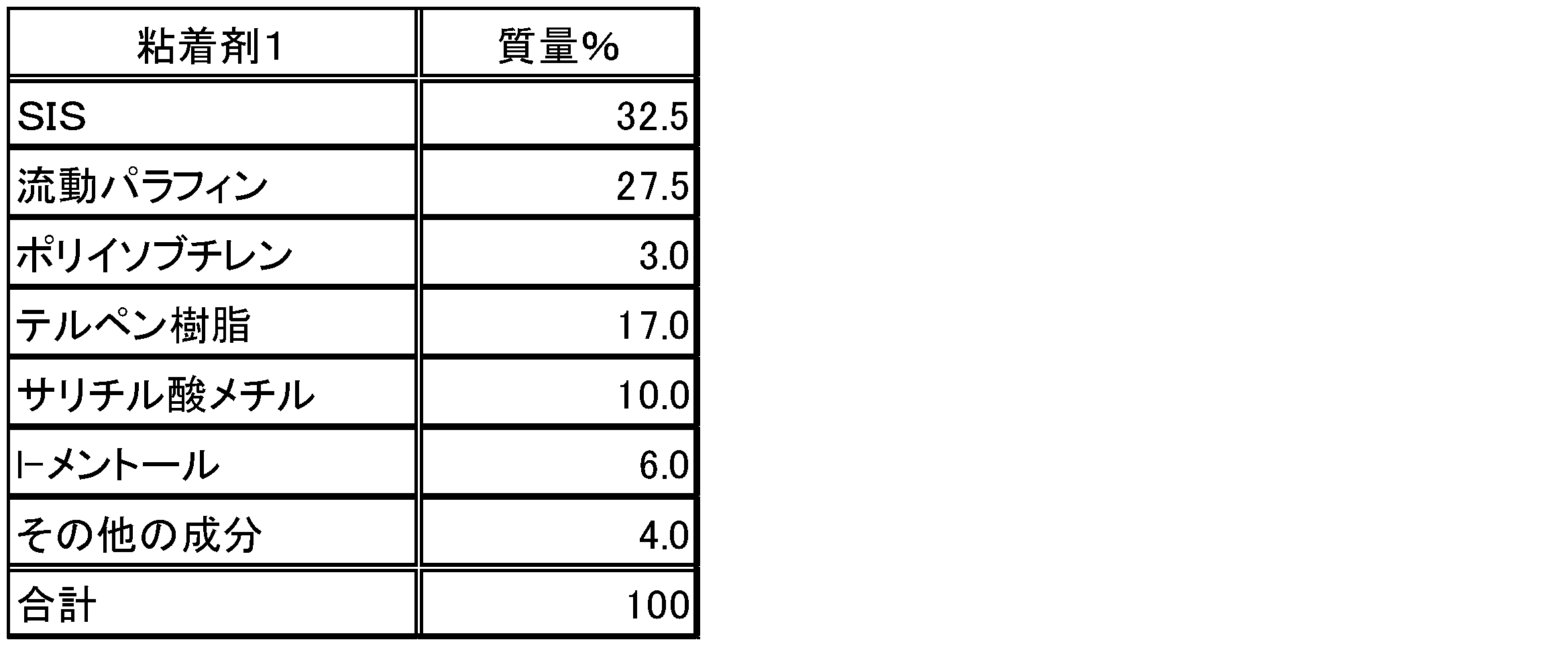
- styrene-isoprene-styrene block copolymer 23.7-32.5% by weight styrene-isoprene-styrene block copolymer, 17.9-27.5% by weight liquid paraffin, 9-11% by weight methyl salicylate, 3-6% by weight menthol 3-12% by weight polyisobutylene and 17-25% by weight terpene resin may be included.
- the basis weight of the nonwoven fabric may be 90 to 110 g / m 2 .
- the nonwoven fabric may have a 20% modulus in the width direction of 3 to 5 N / 50 mm.
- the 50% modulus in the width direction of the nonwoven fabric may be 8 to 15 N / 50 mm.
- the nonwoven fabric may be made of polyester.
- the bending resistance in the first direction of the patch measured by the 45 ° cantilever method defined in JIS L 1085: 1998 may be 18 to 27 mm.
- the patch according to the present invention is easy to apply because there is “strain”. Moreover, the cold flow of the component of an adhesive layer does not arise easily.
- the patch according to the present embodiment has a support and a pressure-sensitive adhesive layer laminated on the support.
- the support is made of a spunlace nonwoven fabric, and the pressure-sensitive adhesive layer contains a styrene-isoprene-styrene block copolymer and liquid paraffin.
- the patch has a first direction which is a predetermined reference axis direction and a second direction perpendicular to the first direction, and the bending resistance of the patch in the first direction is 18 to 30 mm.
- the bending resistance means bending resistance measured by the 45 ° cantilever method defined in JIS L 1085: 1998. That is, the bending resistance means that a test piece (a patch or a support) having a width of 2 cm is placed on a smooth horizontal surface having a slope of 45 ° and having a scale on the upper surface, and its short side. The distance that the specimen moved until the central point of one short side of the specimen touched the slope when the specimen was slid gently in the direction of the slope. Means (mm).
- the bending resistance in the first direction of the patch means bending resistance when the test piece is gently slid along the slope in the first direction.
- the spunlace nonwoven fabric means a nonwoven fabric formed by a so-called hydroentanglement method in which a high-pressure water stream is jetted and entangled with fibers.
- the raw material for spunlace nonwoven fabric is polyester such as polyethylene terephthalate (PET), ethylene-vinyl acetate copolymer (EVA), polyolefin such as vinyl chloride, polyethylene and polypropylene, butadiene-styrene-methyl methacrylate copolymer resin, nylon, Examples thereof include synthetic resins such as polyurethane, alkoxyalkyl (meth) acrylate copolymer, polyvinyl acetal, polyamide and rayon, and natural materials such as cotton, wool and silk.
- the spunlace nonwoven fabric is preferably a spunlace nonwoven fabric made of polyester.
- the diameter of the fiber is preferably 5 to 15 ⁇ m.
- the basis weight of the spunlace nonwoven fabric is, for example, 50 g / m 2 or more, preferably 70 g / m 2 or more, and more preferably 90 g / m 2 or more.
- the basis weight of the spunlace nonwoven fabric is, for example, 200 g / m 2 or less, preferably 150 g / m 2 or less, and more preferably 125 g / m 2 or less.
- the basis weight of the spunlace nonwoven fabric is particularly preferably 90 to 110 g / m 2 or 100 to 110 g / m 2 .
- the spunlace nonwoven fabric has a machine direction (flow direction or vertical direction) and a cross direction (width direction or horizontal direction).
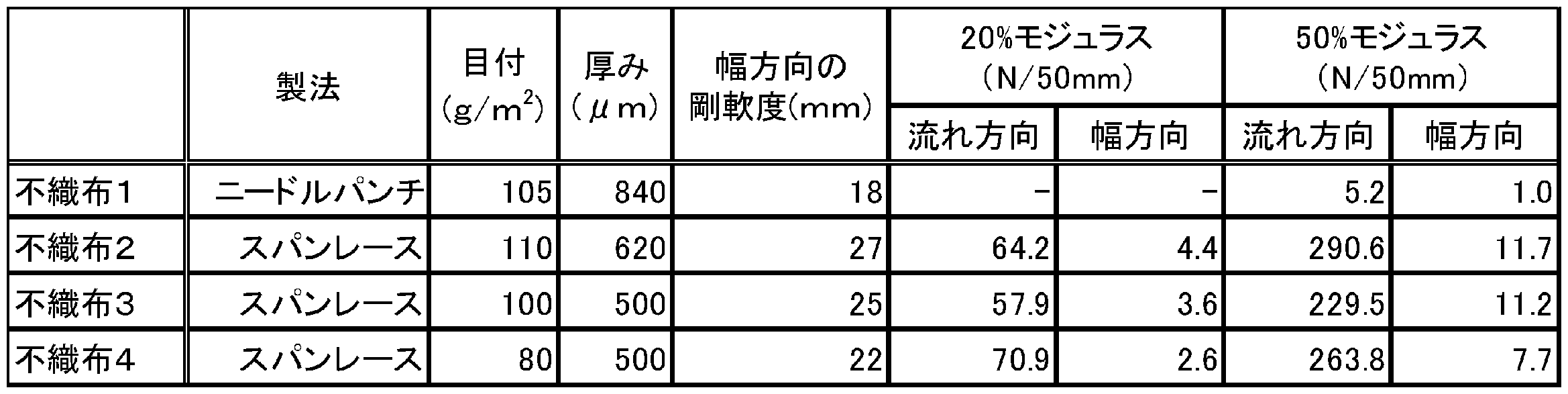
- the stretchability of the spunlace nonwoven fabric has, for example, a 50% modulus in the flow direction of 200 to 400 N / 50 mm and a 50% modulus in the width direction of 5 to 15 N / 50 mm.
- the measurement of stretchability is based on the elongation force at constant elongation specified in JIS L 1096: 2010. When the stretchability of the spunlace nonwoven fabric is within the above range, it becomes easy to follow the stretch of the skin at the patch application site.
- the stretchability of the spunlace nonwoven fabric is preferably 40 to 90 N / 50 mm, more preferably 55 to 75 N / 50 mm, and more preferably 55 to 75 N / 50 mm in the width direction.
- the 20% modulus is preferably 3 to 5 N / 50 mm, more preferably 3.6 to 4.4 N / 50 mm, and the 50% modulus in the flow direction is preferably 150 to 350 N / 50 mm. More preferably, it is 220 to 300 N / 50 mm, and the 50% modulus in the width direction is preferably 8 to 15 N / 50 mm, and preferably 11.2 to 11.7 N / 50 mm. It is preferable that the width direction and the flow direction of the spunlace nonwoven fabric coincide with the first direction and the second direction of the patch, respectively.
- the bending resistance in the width direction of the spunlace nonwoven fabric is preferably 18 to 30 mm.
- the bending softness in the width direction of the spunlace nonwoven fabric is within the above range, when a patch in which an adhesive layer is laminated on a support made of the spunlace nonwoven fabric is produced, the bending resistance in the first direction of the patch is produced.
- the degree can be easily set to a desired range.
- the bending resistance in the first direction of the patch is 18 to 30 mm, and is preferably 18 to 27 mm or 21 to 27 mm from the viewpoint of easy sticking of the patch.
- the support products marketed as spunlace nonwoven fabric can be used.
- examples of such products include Unitika Co., Ltd., Kuraray Laflex Co., Ltd., Yuho Co., Ltd., Daiwabo Polytech Co., Ltd., and Japan Vilene Co., Ltd. It is sold by companies.
- the pressure-sensitive adhesive layer contains styrene-isoprene-styrene block copolymer (hereinafter sometimes referred to as SIS or SIS block copolymer) and liquid paraffin.
- Products commercially available as SIS block copolymers can be used, and such products include Califlex TR-1107, Califlex TR-1111, Califlex TR-1112, Califlex TR-1117 (above, Shell Chemical Co., Ltd.), JSR5000, JSR5002, JSR5100 (above, manufactured by JSR Corporation), and QUINTAC 3570C (manufactured by Zeon Corporation).
- the content of the SIS block copolymer in the pressure-sensitive adhesive layer is, for example, 10% by mass or more, preferably 15% by mass or more, and more preferably 20% by mass or more with respect to the total mass of the pressure-sensitive adhesive layer.
- the patch provided with the pressure-sensitive adhesive layer containing the SIS block copolymer having the lower limit value or more has a sufficient “strain” without causing the patch to peel off from the skin during the necessary application period.
- the content of the SIS block copolymer in the pressure-sensitive adhesive layer is, for example, 50% by mass or less, preferably 40% by mass or less, more preferably 30% by mass or less, with respect to the total mass of the pressure-sensitive adhesive layer.
- a patch provided with a pressure-sensitive adhesive layer containing a SIS block copolymer having an upper limit value of not more than the above upper limit is excellent in usability such as no pain when the patch is peeled off.
- the content of the SIS block copolymer in the pressure-sensitive adhesive layer is particularly preferably 23.7 to 32.5% by mass.
- the content of liquid paraffin in the pressure-sensitive adhesive layer is, for example, 5% by mass or more, preferably 10% by mass or more, and more preferably 15% by mass or more with respect to the total mass of the pressure-sensitive adhesive layer.
- a patch provided with a pressure-sensitive adhesive layer containing liquid paraffin above the lower limit has sufficient adhesiveness.
- the content of liquid paraffin in the pressure-sensitive adhesive layer is, for example, 50% by mass or less, preferably 40% by mass or less, more preferably 30% by mass or less, with respect to the total mass of the pressure-sensitive adhesive layer.
- a patch comprising a pressure-sensitive adhesive layer containing a liquid paraffin having the upper limit value or less is moderately flexible and therefore easy to stick. From the viewpoint of easy application of the patch, the content of liquid paraffin in the adhesive layer is particularly preferably 17.9 to 27.5% by mass.
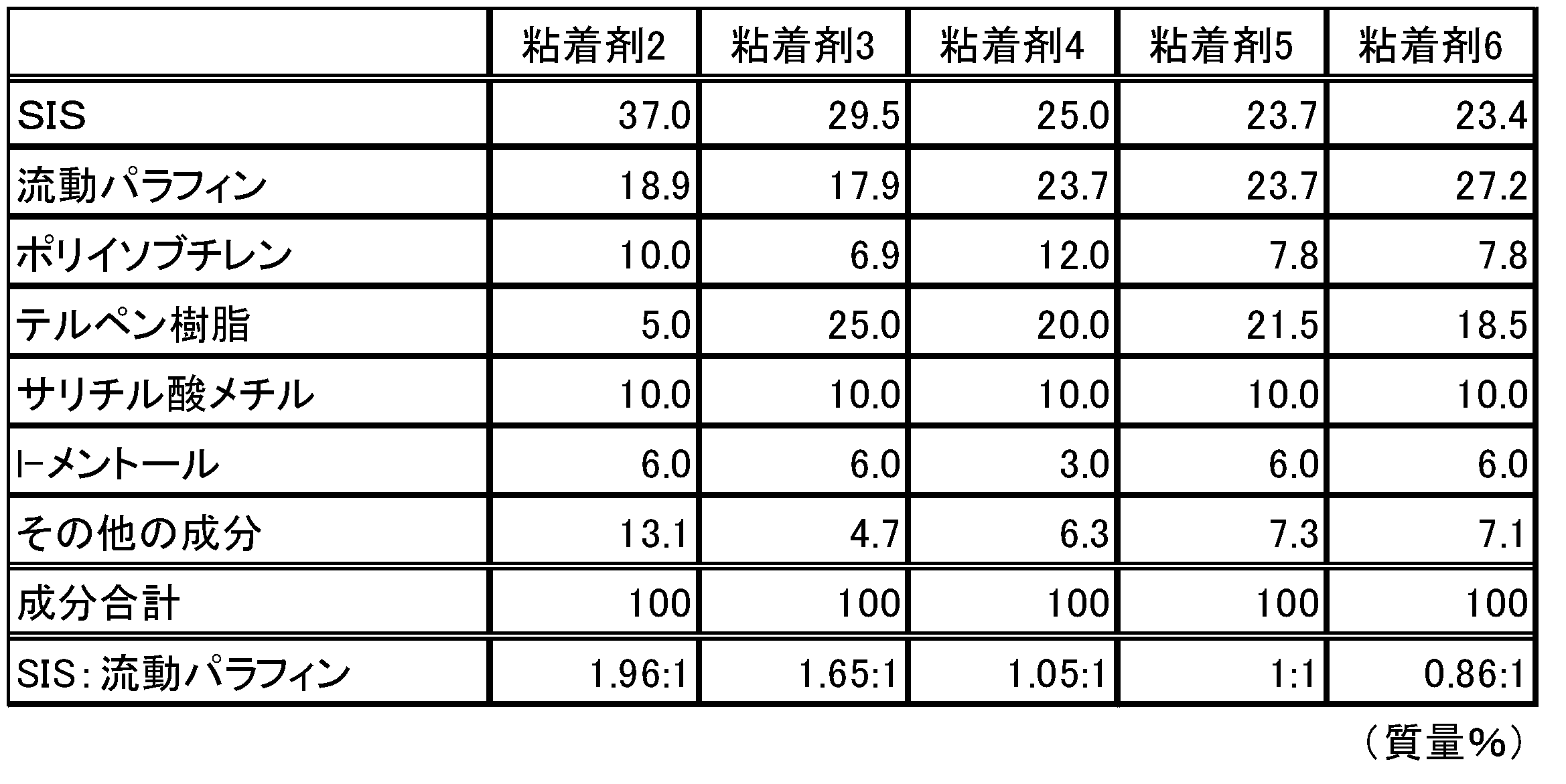
- the mass ratio of the SIS block copolymer to the liquid paraffin in the pressure-sensitive adhesive layer is preferably 1 to 1.65: 1.
- the “strain” of the patch can be strengthened, and the patch can be easily applied.
- blended in this ratio an adhesive layer can be adjusted to moderate hardness, it becomes difficult to produce a bubble in an adhesive layer at the time of manufacture, and it is excellent in manufacture aptitude.
- both are blended in such a ratio it becomes easy to prevent cold flow.
- the pressure-sensitive adhesive layer may contain a pressure-sensitive adhesive other than the SIS block copolymer and a plasticizer other than liquid paraffin, if necessary, and a tackifier, an absorption accelerator, an antioxidant, a filler, a crosslinking agent, and an antiseptic.
- An additive such as an agent, an ultraviolet absorber, a surfactant, a pH adjuster, a pigment and a fragrance may be included.
- Examples of the adhesive other than the SIS block copolymer include natural rubber, synthetic isoprene rubber, polyisobutylene, polyvinyl ether, polyurethane, polyisoprene, polybutadiene, styrene-butadiene copolymer, and styrene-isoprene copolymer.
- the pressure-sensitive adhesive layer preferably contains polyisobutylene. By using polyisobutylene, the adhesive force can be improved.
- the content of polyisobutylene in the pressure-sensitive adhesive layer is, for example, 1 to 20% by mass, preferably 2 to 15% by mass. From the viewpoint of easy application of the patch, the content of polyisobutylene in the pressure-sensitive adhesive layer is particularly preferably 3 to 12% by mass.
- plasticizers other than liquid paraffin include polybutene, liquid polyisobutylene, and animal and vegetable oils.
- tackifiers alicyclic saturated hydrocarbon resins (manufactured by Arakawa Chemical Industry Co., Ltd., trade name: Alcon P-100, etc.), hydrogenated rosin esters (manufactured by Arakawa Chemical Industries, trade names: KE-311, KE-100) Manufactured by Hercules Co., Ltd., trade names: Foral 105, Foral 85, etc.), hydrogenated alicyclic hydrocarbons (produced by Exxon Chemical Co., Ltd., trade name: Escollets 5300, etc.), terpene resins, petroleum resins, and phenol resins.
- terpene resins composed of ⁇ -pinene, ⁇ -pinene, and the like are preferable because they have an excellent effect of increasing the adhesive strength.
- the SIS block copolymer and the liquid paraffin are blended in the pressure-sensitive adhesive layer at a ratio of 1 to 1.65: 1, the pressure-sensitive adhesive strength of the pressure-sensitive adhesive layer tends to decrease.
- the adhesive force can be improved by using a terpene resin.
- the content of the terpene resin in the pressure-sensitive adhesive layer is particularly preferably 17 to 25% by mass.
- Absorption enhancers include isopropyl myristate, diethyl sebacate, sorbitan monolaurate, sodium oleyl phosphate, sodium lauryl sulfate, octylphenyl ether, lauryl ether, sorbitan monolaurate, lauroyl diethanolamide, lauroyl sarcosine, oleoyl sarcosine sugar ester , Lecithin, glycyrrhetinic acid, urea, salicylic acid, calcium thioglycolate, lactic acid, lactic acid ester, olive oil, squalene, lanolin and glycerin.
- antioxidants include tocopherol and its ester derivatives, ascorbic acid, ascorbic acid stearate, nordihydroguaiaretic acid, dibutylhydroxytoluene and butylhydroxyasonyl.
- filler examples include calcium carbonate, magnesium carbonate, silicate (eg, aluminum silicate, magnesium silicate, etc.), silicic acid, barium sulfate, calcium sulfate, calcium zincate, zinc oxide, titanium oxide, and zinc stearate. It is done.
- silicate eg, aluminum silicate, magnesium silicate, etc.
- silicic acid barium sulfate, calcium sulfate, calcium zincate, zinc oxide, titanium oxide, and zinc stearate. It is done.
- thermosetting resins such as amino resins, phenol resins, epoxy resins, alkyd resins, and unsaturated polyesters
- organic crosslinking agents such as isocyanate compounds and blocked isocyanate compounds
- inorganic crosslinking agents such as metals and metal compounds.
- Preservatives include ethyl paraoxybenzoate, propyl paraoxybenzoate and butyl paraoxybenzoate.
- ultraviolet absorbers examples include p-aminobenzoic acid derivatives, anthranilic acid derivatives, salicylic acid derivatives, coumarin derivatives, amine acid compounds, imidazoline derivatives, pyridine derivatives and dioxane derivatives.
- the drug contained in the adhesive layer is not particularly limited.
- Anti-inflammatory analgesics such as flurbiprofen, ketoprofen, ampenac sodium, mepyrazole, indomethacin, piroxicam and felbinac
- steroidal anti-inflammatory agents such as hydrocortisone, triamcinolone, dexamethasone and prednisolone; diltiazem hydrochloride, pentaerythritol tetranitrate, isosorbide nitrate, Taradipil, nicorandil, nitroglycerin, prenylamine lactate, molsidomine, aluminum nit
- the adhesive layer When high concentrations of methyl salicylate and menthol (for example, 1-menthol) are contained in the adhesive layer, the action of these drugs increases the tendency of the adhesive layer to be easily plasticized. It becomes weak and it becomes difficult to apply the patch. However, since the patch according to the present embodiment has a strong “strain” as described above, the patch can be easily applied even if these drugs are contained in a high concentration in the adhesive layer. In particular, when the adhesive layer contains 9 to 11% by mass of methyl salicylate and 2.5 to 6.5% by mass or 3 to 6% by mass of menthol based on the total mass of the adhesive layer, Application of such a patch is suitable.
- the thickness of the pressure-sensitive adhesive layer is preferably 50 to 3000 ⁇ m. When the thickness of the pressure-sensitive adhesive layer is 3000 ⁇ m or less, the release of the drug contained in the pressure-sensitive adhesive layer is good, and when it is 50 ⁇ m or more, the skin adhesiveness is good and the patch is difficult to peel off.
- the thickness of the support is, for example, 300 ⁇ m or more, and preferably 400 ⁇ m or more. When the thickness of the support is not less than the above lower limit value, it is difficult for the components of the pressure-sensitive adhesive layer to ooze out. Moreover, the thickness of a support body is 1200 micrometers or less, for example, and it is preferable that it is 700 micrometers or less. When the thickness of the support is not more than the above upper limit value, the patch is difficult to peel off.
- the total thickness of the support and the pressure-sensitive adhesive layer that is, the thickness of the patch is preferably 300 to 5000 ⁇ m.
- the thickness of the patch is 5000 ⁇ m or less, the end of the patch is hardly caught by clothes or the like, and the patch is difficult to peel off.
- the thickness of the patch is 300 ⁇ m or more, the support of the patch is sufficient, the patch can be reliably attached, and wrinkles are not easily generated in the patch after application.
- the patch according to this embodiment may have a rectangular or rounded rectangular shape with a short side of 4 to 10 cm and a long side of 6 to 15 cm.
- the shape of the patch according to this embodiment is a rectangle or a rounded rectangle
- the long side direction and the short side direction respectively match the width direction and the flow direction of the spunlace nonwoven fabric
- the first patch It is preferable to correspond to the direction and the second direction.
- the patch according to this embodiment may further include a release film for covering and protecting the adhesive layer.
- the material of the release film is unstretched polypropylene (CPP), stretched polypropylene (OPP), polyethylene terephthalate (PET), polybutylene terephthalate (PBT), polyethylene, polyester, polyurethane, polyvinyl chloride, polystyrene, and other plastic films, synthetic resin And silicon processed paper processed with silicon such as synthetic paper and synthetic fiber, aluminum foil, and laminated paper obtained by laminating kraft paper with polyethylene or the like. Among these, PET and processed paper are preferably used.
- the bending resistance of the patch means the bending resistance measured with the patch with the release film peeled off.
- the thickness of the release film is, for example, 10 to 100 ⁇ m, preferably 30 to 90 ⁇ m, more preferably 40 to 85 ⁇ m.
- the thickness of the release film is equal to or more than the above lower limit value, the release film is easily grasped, and when the release film is peeled off, the adhesive layer is hardly entangled.
- the thickness of the release sheet is not more than the above upper limit, cutting during production becomes easy and production suitability is improved.
- the patch according to this embodiment can be produced by a method known to those skilled in the art. For example, using a mixer such as a kneader or mixer, while heating to 120-160 ° C, mix each component of the adhesive layer other than the drug, then add and mix the drug at a temperature that does not thermally decompose to form the adhesive layer Prepare a mixture for use. This mixture is directly spread on the support to form a pressure-sensitive adhesive layer, or is spread on the release film to form a pressure-sensitive adhesive layer, and the support is placed on the pressure-sensitive adhesive layer. May be pressure-transferred onto a support.
- a mixer such as a kneader or mixer
- 1 The state where the patch is not peeled off and is in close contact with the skin 2
- the state where only the end of the surface of the patch is peeled 3 The state where more than 1/4 of the surface of the patch is peeled off (4)
- the penetration of the adhesive into the support (Exudation) Visually observe the presence or absence of oozing (bleeding) of the pressure-sensitive adhesive on the support.
- the evaluation when there is no problem in the use of ⁇ was ⁇ , and the evaluation when the bleeding (bleeding) was recognized and it was not suitable for use as a patch was evaluated as x.
- Formulation suitability The presence or absence of bubbles on the surface of the pressure-sensitive adhesive layer was visually observed.
- the patches of Examples 1 and 2 in which the bending resistance of the patch is 18 or more are easy to stick, have excellent adhesion, and the adhesive spreads onto the support. It was an excellent patch.
- the patch of Comparative Example 1 in which the bending resistance of the patch was less than 18 was inferior in terms of ease of sticking.
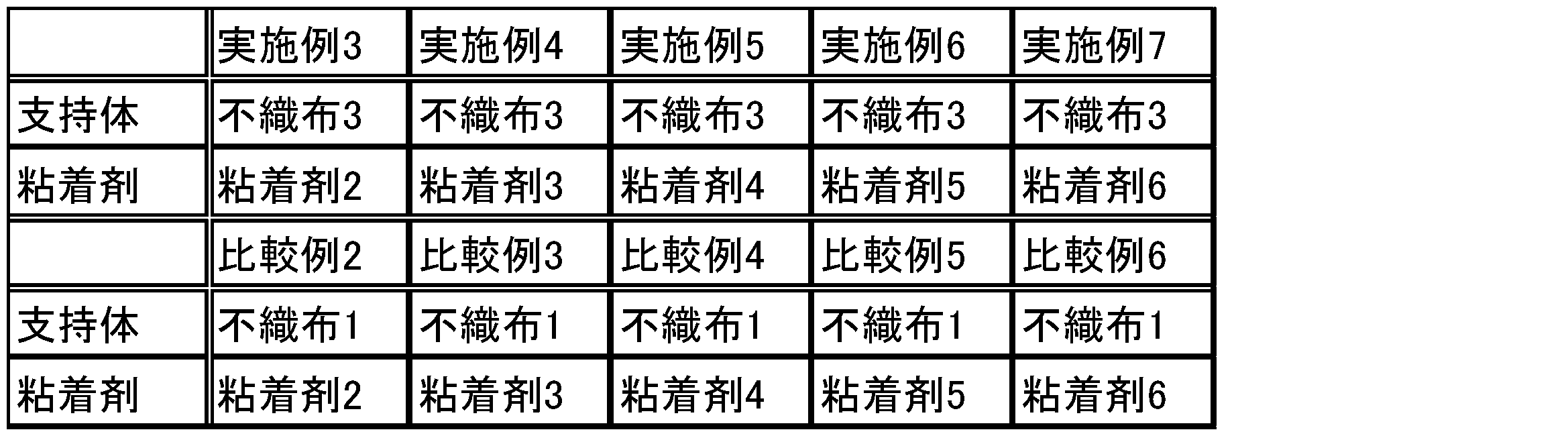
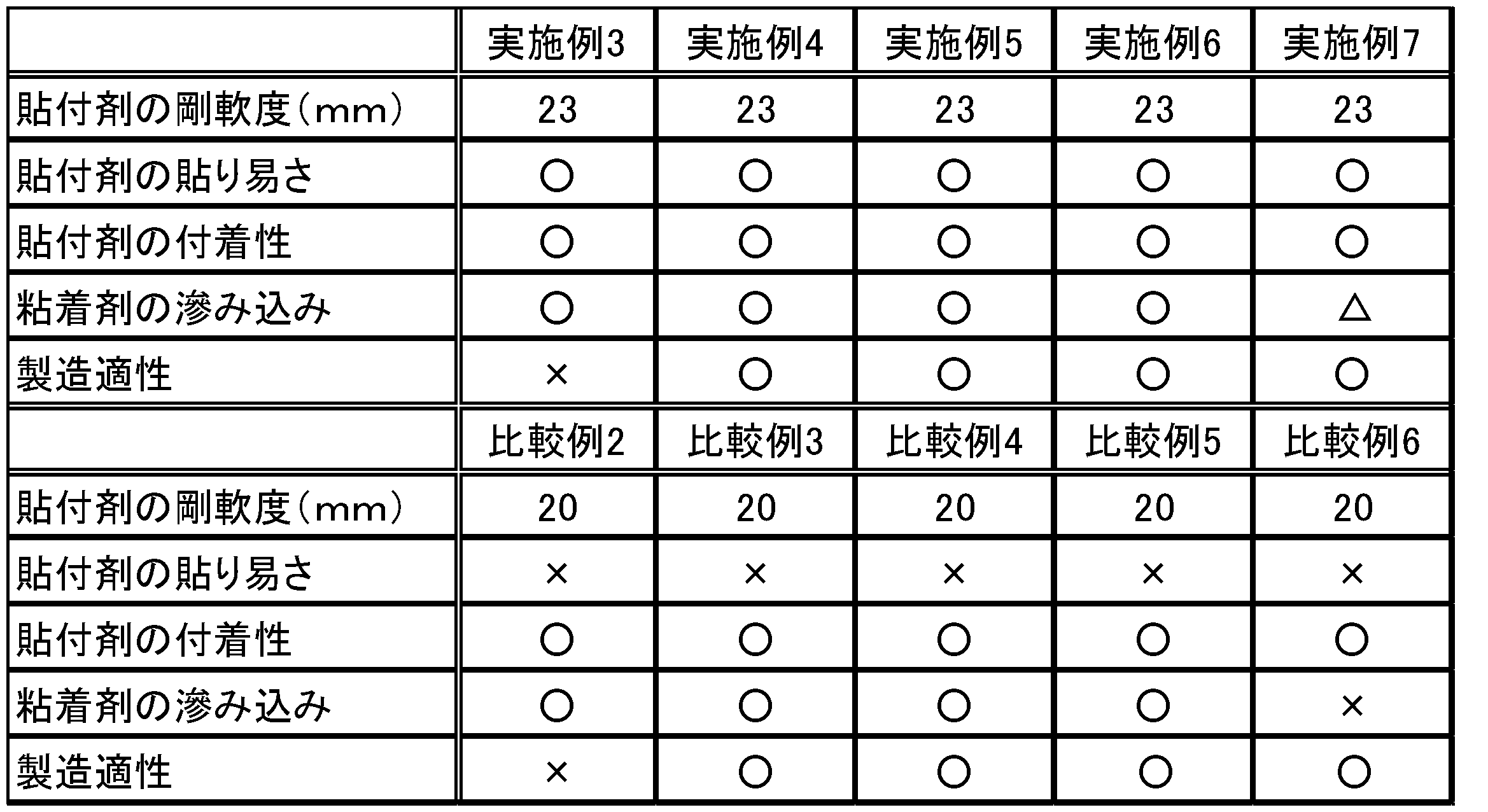
- Evaluation experiment of patch (2) The components shown in Table 5 were heated and kneaded to obtain adhesives 2 to 6. Adhesives 2 to 6 were applied to the nonwoven fabrics 1 (made of polyester) and 3 shown in Table 2 so that the coating amount was 210 g / m 2, and the patches of Examples 3 to 7 and Comparative Examples 2 to 6 were applied. Obtained. About the obtained patch, the same evaluation as evaluation experiment (1) was performed. The results are shown in Table 7.
- the patches of Comparative Examples 2 to 6 using the nonwoven fabric 1 produced by the needle punch method as a support were inferior in terms of ease of sticking.
- the patches of Examples 3 to 7 using the nonwoven fabric 3 produced by the spunlace method as a support were excellent in ease of sticking and adhesion.
- the patches of Examples 4 to 6 in which the mass ratio of SIS to liquid paraffin is in the range of 1 to 1.65: 1 are excellent in terms of difficulty in the penetration of the adhesive into the support and production suitability. It was.
Landscapes
- Health & Medical Sciences (AREA)
- Chemical & Material Sciences (AREA)
- Life Sciences & Earth Sciences (AREA)
- Veterinary Medicine (AREA)
- Animal Behavior & Ethology (AREA)
- General Health & Medical Sciences (AREA)
- Public Health (AREA)
- Engineering & Computer Science (AREA)
- Medicinal Chemistry (AREA)
- Epidemiology (AREA)
- Pharmacology & Pharmacy (AREA)
- Dermatology (AREA)
- Bioinformatics & Cheminformatics (AREA)
- Heart & Thoracic Surgery (AREA)
- Vascular Medicine (AREA)
- Biomedical Technology (AREA)
- Organic Chemistry (AREA)
- Inorganic Chemistry (AREA)
- Chemical Kinetics & Catalysis (AREA)
- General Chemical & Material Sciences (AREA)
- Proteomics, Peptides & Aminoacids (AREA)
- Oil, Petroleum & Natural Gas (AREA)
- Hematology (AREA)
- Textile Engineering (AREA)
- Materials Engineering (AREA)
- Pain & Pain Management (AREA)
- Rheumatology (AREA)
- Nuclear Medicine, Radiotherapy & Molecular Imaging (AREA)
- Medicinal Preparation (AREA)
- Acyclic And Carbocyclic Compounds In Medicinal Compositions (AREA)
- Pharmaceuticals Containing Other Organic And Inorganic Compounds (AREA)
- Laminated Bodies (AREA)
- Adhesives Or Adhesive Processes (AREA)
- Materials For Medical Uses (AREA)
Abstract
Description
表1の各成分を加熱及び練合して粘着剤1を得た。表2に記載のポリエステル製不織布2~4に、塗布量が210g/m2となるように粘着剤1を塗布し、実施例1~2及び比較例1の貼付剤を得た。貼付剤は、短辺の長さが約5cm、長辺の長さが約7cmの長方形の形状である。また、不織布の幅方向と貼付剤の長辺方向は一致する。得られた貼付剤について、下記の評価を行った。結果を表4に示す。

(1)貼付剤の剛軟度
JIS L 1085:1998に規定される45゜カンチレバー法に従い、貼付剤の長辺方向の剛軟度を測定した。
(2)貼付剤の貼り易さ
健常成人30名の肩部に貼付剤を貼付し、貼り易さを下記の3段階の基準でスコア化し、その平均値を求めた。平均値が2未満である場合の評価を○とし、2以上である場合の評価を×とした。
1 貼り易い
2 普通
3 貼り難い
(3)貼付剤の付着性
健常成人30名の肩部に貼付剤を貼付し、8時間後の貼付剤の付着状態を下記の3段階の基準でスコア化し、その平均値を求めた。平均値が2未満である場合の評価を○とし、2以上である場合の評価を×とした。
1 貼付剤が全く剥がれず、皮膚に密着した状態
2 貼付剤面の端部のみが剥離した状態
3 貼付剤面の1/4以上が剥離した状態
(4)粘着剤の支持体への滲み込み(滲み出し)
粘着剤の支持体への滲み込み(滲み出し)の有無を目視観察し、滲み込み(滲み出し)が認められない場合の評価を○、滲み込み(滲み出し)が若干認められるものの貼付剤としての使用に問題がない場合の評価を△、滲み込み(滲み出し)が認められて貼付剤として使用に適さない場合の評価を×とした。
(5)製剤適性
粘着剤層の表面の気泡の有無を目視観察し、気泡がない場合の評価を○とし、気泡がある場合の評価を×とした。

表5の各成分を加熱及び練合して粘着剤2~6を得た。表2に記載の不織布1(ポリエステル製)及び3に、塗布量が210g/m2となるように粘着剤2~6を塗布し、実施例3~7及び比較例2~6の貼付剤を得た。得られた貼付剤について、評価実験(1)と同様の評価を行った。結果を表7に示す。
Claims (12)
- 支持体と、支持体上に積層された粘着剤層とを有する貼付剤であって、
支持体は、スパンレース不織布からなり、
粘着剤層は、スチレン-イソプレン-スチレンブロック共重合体及び流動パラフィンを含み、
貼付剤は所定の基準軸方向である第1の方向と、第1の方向に直角な第2の方向を有し、
JIS L 1085:1998に規定される45゜カンチレバー法で測定した貼付剤の第1の方向の剛軟度は18~30mmである、貼付剤。 - 粘着剤層におけるスチレン-イソプレン-スチレンブロック共重合体と流動パラフィンとの質量比が1~1.65:1である、請求項1に記載の貼付剤。
- 粘着剤層は、サリチル酸メチル及びメントールを含む、請求項2に記載の貼付剤。
- 粘着剤層は、ポリイソブチレンを含む、請求項3に記載の貼付剤。
- 粘着剤層は、テルペン樹脂を含む、請求項4に記載の貼付剤。
- 粘着剤層は、粘着剤層の全質量基準で、9~11質量%のサリチル酸メチル及び2.5~6.5質量%のメントールを含む、請求項5に記載の貼付剤。
- 粘着剤層は、粘着剤層の全質量基準で、23.7~32.5質量%のスチレン-イソプレン-スチレンブロック共重合体、17.9~27.5質量%の流動パラフィン、9~11質量%のサリチル酸メチル、3~6質量%のメントール、3~12質量%のポリイソブチレン及び17~25質量%のテルペン樹脂を含む、請求項5記載の貼付剤。
- 不織布の目付けは90~110g/m2である、請求項1~7のいずれか一項に記載の貼付剤。
- 不織布の幅方向の20%モジュラスが3~5N/50mmである、請求項1~8のいずれか一項に記載の貼付剤。
- 不織布の幅方向の50%モジュラスが8~15N/50mmである、請求項1~9のいずれか一項に記載の貼付剤。
- 不織布はポリエステルからなる、請求項1~10のいずれか一項に記載の貼付剤。
- JIS L 1085:1998に規定される45゜カンチレバー法で測定した貼付剤の第1の方向の剛軟度は18~27mmである、請求項1~11のいずれか一項に記載の貼付剤。
Priority Applications (7)
| Application Number | Priority Date | Filing Date | Title |
|---|---|---|---|
| HK18104665.6A HK1245121B (en) | 2015-02-05 | 2016-02-05 | Adhesive patch |
| EP16746709.1A EP3254677B1 (en) | 2015-02-05 | 2016-02-05 | Adhesive patch |
| US15/547,645 US10292941B2 (en) | 2015-02-05 | 2016-02-05 | Adhesive patch |
| KR1020177024402A KR101939932B1 (ko) | 2015-02-05 | 2016-02-05 | 첩부제 |
| ES16746709T ES2887200T3 (es) | 2015-02-05 | 2016-02-05 | Parche adhesivo |
| BR112017015737-3A BR112017015737B1 (pt) | 2015-02-05 | 2016-02-05 | Emplastro adesivo |
| CN201680008513.4A CN107205957B (zh) | 2015-02-05 | 2016-02-05 | 贴剂 |
Applications Claiming Priority (2)
| Application Number | Priority Date | Filing Date | Title |
|---|---|---|---|
| JP2015021411A JP5767417B1 (ja) | 2015-02-05 | 2015-02-05 | 貼付剤 |
| JP2015-021411 | 2015-02-05 |
Publications (1)
| Publication Number | Publication Date |
|---|---|
| WO2016125878A1 true WO2016125878A1 (ja) | 2016-08-11 |
Family
ID=53888058
Family Applications (1)
| Application Number | Title | Priority Date | Filing Date |
|---|---|---|---|
| PCT/JP2016/053456 Ceased WO2016125878A1 (ja) | 2015-02-05 | 2016-02-05 | 貼付剤 |
Country Status (9)
| Country | Link |
|---|---|
| US (1) | US10292941B2 (ja) |
| EP (1) | EP3254677B1 (ja) |
| JP (1) | JP5767417B1 (ja) |
| KR (1) | KR101939932B1 (ja) |
| CN (1) | CN107205957B (ja) |
| BR (1) | BR112017015737B1 (ja) |
| ES (1) | ES2887200T3 (ja) |
| TW (1) | TWI674115B (ja) |
| WO (1) | WO2016125878A1 (ja) |
Cited By (1)
| Publication number | Priority date | Publication date | Assignee | Title |
|---|---|---|---|---|
| US10292941B2 (en) | 2015-02-05 | 2019-05-21 | Hitsamitsu Pharmaceutical Co., Inc. | Adhesive patch |
Families Citing this family (2)
| Publication number | Priority date | Publication date | Assignee | Title |
|---|---|---|---|---|
| EP3298996B1 (en) * | 2015-05-20 | 2023-04-26 | Nichiban Company Limited | Adhesive skin patch material, and support for adhesive skin patch material which can be used in same |
| JP2021083934A (ja) * | 2019-11-29 | 2021-06-03 | リバテープ製薬株式会社 | 両伸縮パッド及び該両伸縮パッドを用いた創傷保護材 |
Citations (7)
| Publication number | Priority date | Publication date | Assignee | Title |
|---|---|---|---|---|
| JPS61145112A (ja) * | 1984-12-19 | 1986-07-02 | Taisho Pharmaceut Co Ltd | 貼付剤 |
| JPH07215847A (ja) * | 1994-02-04 | 1995-08-15 | Sekisui Chem Co Ltd | 眠気防止用テープ |
| JPH09143059A (ja) * | 1995-11-27 | 1997-06-03 | Japan Vilene Co Ltd | 皮膚貼付剤 |
| JP2001328935A (ja) * | 2000-05-19 | 2001-11-27 | Hisamitsu Pharmaceut Co Inc | 貼付剤 |
| JP2004143052A (ja) * | 2002-10-22 | 2004-05-20 | Nitto Denko Corp | 経皮吸収型貼付製剤 |
| JP2007007062A (ja) * | 2005-06-29 | 2007-01-18 | Daiwabo Co Ltd | 液体含浸用皮膚被覆シートおよびその製造方法、ならびにそれを用いたフェイスマスク |
| JP2010241030A (ja) * | 2009-04-08 | 2010-10-28 | Wavelock Advanced Technology Co Ltd | 貼付剤用支持体、及び、貼付剤 |
Family Cites Families (12)
| Publication number | Priority date | Publication date | Assignee | Title |
|---|---|---|---|---|
| JPH09124463A (ja) * | 1995-10-31 | 1997-05-13 | Nitto Denko Corp | 貼付剤 |
| US6620430B2 (en) * | 1996-12-06 | 2003-09-16 | Hisamitsu Pharmaceutical Co., Inc. | Plaster containing felbinac |
| JP3438814B2 (ja) | 2000-02-29 | 2003-08-18 | 節 李 | 粉薬の楽飲み |
| EP1277466B1 (en) | 2000-04-18 | 2011-07-27 | Hisamitsu Pharmaceutical Co., Inc. | Patch containing anti-inflammatory agent |
| JP4820495B2 (ja) | 2001-05-29 | 2011-11-24 | 株式会社トクホン | プラスター剤 |
| JPWO2006006655A1 (ja) * | 2004-07-14 | 2008-05-01 | マイコール株式会社 | 発熱パッド及びその使用方法 |
| CN101137356B (zh) | 2005-03-10 | 2012-10-10 | 久光制药株式会社 | 粘结剂及贴剂 |
| JP4939113B2 (ja) | 2005-06-01 | 2012-05-23 | ニプロパッチ株式会社 | 貼付剤 |
| JP5542791B2 (ja) * | 2009-02-18 | 2014-07-09 | 久光製薬株式会社 | 経皮吸収製剤 |
| BR112012008892B8 (pt) * | 2009-10-14 | 2021-06-22 | Hisamitsu Pharmaceutical Co | método e aparelho para fabricação de curativo adesivo |
| JP2013184977A (ja) | 2012-03-07 | 2013-09-19 | Km Transderm Ltd | 貼付剤 |
| JP5767417B1 (ja) | 2015-02-05 | 2015-08-19 | 久光製薬株式会社 | 貼付剤 |
-
2015
- 2015-02-05 JP JP2015021411A patent/JP5767417B1/ja active Active
-
2016
- 2016-02-05 US US15/547,645 patent/US10292941B2/en active Active
- 2016-02-05 KR KR1020177024402A patent/KR101939932B1/ko active Active
- 2016-02-05 ES ES16746709T patent/ES2887200T3/es active Active
- 2016-02-05 CN CN201680008513.4A patent/CN107205957B/zh active Active
- 2016-02-05 EP EP16746709.1A patent/EP3254677B1/en active Active
- 2016-02-05 TW TW105104139A patent/TWI674115B/zh active
- 2016-02-05 BR BR112017015737-3A patent/BR112017015737B1/pt active IP Right Grant
- 2016-02-05 WO PCT/JP2016/053456 patent/WO2016125878A1/ja not_active Ceased
Patent Citations (7)
| Publication number | Priority date | Publication date | Assignee | Title |
|---|---|---|---|---|
| JPS61145112A (ja) * | 1984-12-19 | 1986-07-02 | Taisho Pharmaceut Co Ltd | 貼付剤 |
| JPH07215847A (ja) * | 1994-02-04 | 1995-08-15 | Sekisui Chem Co Ltd | 眠気防止用テープ |
| JPH09143059A (ja) * | 1995-11-27 | 1997-06-03 | Japan Vilene Co Ltd | 皮膚貼付剤 |
| JP2001328935A (ja) * | 2000-05-19 | 2001-11-27 | Hisamitsu Pharmaceut Co Inc | 貼付剤 |
| JP2004143052A (ja) * | 2002-10-22 | 2004-05-20 | Nitto Denko Corp | 経皮吸収型貼付製剤 |
| JP2007007062A (ja) * | 2005-06-29 | 2007-01-18 | Daiwabo Co Ltd | 液体含浸用皮膚被覆シートおよびその製造方法、ならびにそれを用いたフェイスマスク |
| JP2010241030A (ja) * | 2009-04-08 | 2010-10-28 | Wavelock Advanced Technology Co Ltd | 貼付剤用支持体、及び、貼付剤 |
Non-Patent Citations (1)
| Title |
|---|
| See also references of EP3254677A4 * |
Cited By (1)
| Publication number | Priority date | Publication date | Assignee | Title |
|---|---|---|---|---|
| US10292941B2 (en) | 2015-02-05 | 2019-05-21 | Hitsamitsu Pharmaceutical Co., Inc. | Adhesive patch |
Also Published As
| Publication number | Publication date |
|---|---|
| ES2887200T3 (es) | 2021-12-22 |
| TWI674115B (zh) | 2019-10-11 |
| HK1245121A1 (en) | 2018-08-24 |
| US20180015049A1 (en) | 2018-01-18 |
| BR112017015737A2 (ja) | 2018-03-13 |
| EP3254677A1 (en) | 2017-12-13 |
| EP3254677A4 (en) | 2018-09-19 |
| KR20170109039A (ko) | 2017-09-27 |
| KR101939932B1 (ko) | 2019-01-17 |
| JP2016141675A (ja) | 2016-08-08 |
| JP5767417B1 (ja) | 2015-08-19 |
| EP3254677B1 (en) | 2021-08-04 |
| BR112017015737B1 (pt) | 2023-01-17 |
| US10292941B2 (en) | 2019-05-21 |
| CN107205957B (zh) | 2020-12-01 |
| CN107205957A (zh) | 2017-09-26 |
| TW201636009A (zh) | 2016-10-16 |
Similar Documents
| Publication | Publication Date | Title |
|---|---|---|
| JP5038576B2 (ja) | 貼付剤 | |
| JP4261911B2 (ja) | 貼付剤 | |
| JP5025268B2 (ja) | 外用製剤及び貼付剤 | |
| JPWO2001095889A1 (ja) | 貼付剤 | |
| JPWO2001043729A1 (ja) | 貼付剤 | |
| JP2003137773A (ja) | 積層支持体を有する貼付剤 | |
| WO2012029325A1 (ja) | 経皮吸収製剤および皮膚貼付用粘着シート | |
| JP5767417B1 (ja) | 貼付剤 | |
| JP2009191038A (ja) | 伸縮性貼付剤 | |
| JP5103053B2 (ja) | 貼付剤及びその製造方法 | |
| JP7349591B1 (ja) | カバー材付き貼付剤 | |
| JP6867210B2 (ja) | 貼付剤 | |
| JP2004256396A (ja) | 低皮膚刺激性硬膏剤 | |
| JPH06327756A (ja) | 通気性粘着テープの製造方法 | |
| JP7641261B2 (ja) | カバー材付き貼付剤 | |
| HK1240505A1 (en) | Adhesive patch | |
| HK1240505B (zh) | 贴剂 | |
| JP4919807B2 (ja) | 外用製剤及び貼付剤 | |
| JP4720312B2 (ja) | ツロブテロール含有貼付剤 | |
| HK1245121B (en) | Adhesive patch | |
| JP2003277255A (ja) | 集合ユニット型貼付剤 | |
| JPH09194349A (ja) | 皮膚貼付用シート |
Legal Events
| Date | Code | Title | Description |
|---|---|---|---|
| 121 | Ep: the epo has been informed by wipo that ep was designated in this application |
Ref document number: 16746709 Country of ref document: EP Kind code of ref document: A1 |
|
| WWE | Wipo information: entry into national phase |
Ref document number: 15547645 Country of ref document: US |
|
| REG | Reference to national code |
Ref country code: BR Ref legal event code: B01A Ref document number: 112017015737 Country of ref document: BR |
|
| NENP | Non-entry into the national phase |
Ref country code: DE |
|
| REEP | Request for entry into the european phase |
Ref document number: 2016746709 Country of ref document: EP |
|
| ENP | Entry into the national phase |
Ref document number: 20177024402 Country of ref document: KR Kind code of ref document: A |
|
| ENP | Entry into the national phase |
Ref document number: 112017015737 Country of ref document: BR Kind code of ref document: A2 Effective date: 20170721 |