WO2016131521A1 - Materialien auf basis von spirobifluorenderivaten für elektronische vorrichtungen - Google Patents
Materialien auf basis von spirobifluorenderivaten für elektronische vorrichtungen Download PDFInfo
- Publication number
- WO2016131521A1 WO2016131521A1 PCT/EP2016/000084 EP2016000084W WO2016131521A1 WO 2016131521 A1 WO2016131521 A1 WO 2016131521A1 EP 2016000084 W EP2016000084 W EP 2016000084W WO 2016131521 A1 WO2016131521 A1 WO 2016131521A1
- Authority
- WO
- WIPO (PCT)
- Prior art keywords
- atoms
- aromatic ring
- groups
- occurrence
- formula
- Prior art date
- Legal status (The legal status is an assumption and is not a legal conclusion. Google has not performed a legal analysis and makes no representation as to the accuracy of the status listed.)
- Ceased
Links
- 0 *Nc(cc1C23c4ccccc4-c4ccccc24)ccc1-c1c3ccc2c1c(cccc1)c1[n]2 Chemical compound *Nc(cc1C23c4ccccc4-c4ccccc24)ccc1-c1c3ccc2c1c(cccc1)c1[n]2 0.000 description 9
- CZHLVJKOMKGBIG-UHFFFAOYSA-N Brc(cc1)cc2c1-c1ccccc1C21c2ccc3[s]c4ccccc4c3c2-c2ccccc12 Chemical compound Brc(cc1)cc2c1-c1ccccc1C21c2ccc3[s]c4ccccc4c3c2-c2ccccc12 CZHLVJKOMKGBIG-UHFFFAOYSA-N 0.000 description 1
- ZQJXYVANNRBVRO-UHFFFAOYSA-N CCC(C1(c2ccccc2-c2ccccc12)O)=C Chemical compound CCC(C1(c2ccccc2-c2ccccc12)O)=C ZQJXYVANNRBVRO-UHFFFAOYSA-N 0.000 description 1
- NNZCSUUXRTVKIT-UHFFFAOYSA-N O=C1c2ccccc2C2=C1CCC=C2 Chemical compound O=C1c2ccccc2C2=C1CCC=C2 NNZCSUUXRTVKIT-UHFFFAOYSA-N 0.000 description 1
- QEFNKOYBRRMIJV-UHFFFAOYSA-N c(cc1)ccc1-c(cc1c2c3cccc2)ccc1[n]3-c(cc1)cc2c1-c1ccccc1C21c2ccc3[s]c(cccc4)c4c3c2-c2ccccc12 Chemical compound c(cc1)ccc1-c(cc1c2c3cccc2)ccc1[n]3-c(cc1)cc2c1-c1ccccc1C21c2ccc3[s]c(cccc4)c4c3c2-c2ccccc12 QEFNKOYBRRMIJV-UHFFFAOYSA-N 0.000 description 1
Classifications
-
- C—CHEMISTRY; METALLURGY
- C07—ORGANIC CHEMISTRY
- C07D—HETEROCYCLIC COMPOUNDS
- C07D307/00—Heterocyclic compounds containing five-membered rings having one oxygen atom as the only ring hetero atom
- C07D307/77—Heterocyclic compounds containing five-membered rings having one oxygen atom as the only ring hetero atom ortho- or peri-condensed with carbocyclic rings or ring systems
-
- C—CHEMISTRY; METALLURGY
- C07—ORGANIC CHEMISTRY
- C07D—HETEROCYCLIC COMPOUNDS
- C07D333/00—Heterocyclic compounds containing five-membered rings having one sulfur atom as the only ring hetero atom
- C07D333/50—Heterocyclic compounds containing five-membered rings having one sulfur atom as the only ring hetero atom condensed with carbocyclic rings or ring systems
- C07D333/78—Heterocyclic compounds containing five-membered rings having one sulfur atom as the only ring hetero atom condensed with carbocyclic rings or ring systems condensed with rings other than six-membered or with ring systems containing such rings
-
- C—CHEMISTRY; METALLURGY
- C09—DYES; PAINTS; POLISHES; NATURAL RESINS; ADHESIVES; COMPOSITIONS NOT OTHERWISE PROVIDED FOR; APPLICATIONS OF MATERIALS NOT OTHERWISE PROVIDED FOR
- C09K—MATERIALS FOR MISCELLANEOUS APPLICATIONS, NOT PROVIDED FOR ELSEWHERE
- C09K11/00—Luminescent materials, e.g. electroluminescent or chemiluminescent
- C09K11/06—Luminescent materials, e.g. electroluminescent or chemiluminescent containing organic luminescent materials
-
- C—CHEMISTRY; METALLURGY
- C07—ORGANIC CHEMISTRY
- C07D—HETEROCYCLIC COMPOUNDS
- C07D307/00—Heterocyclic compounds containing five-membered rings having one oxygen atom as the only ring hetero atom
- C07D307/77—Heterocyclic compounds containing five-membered rings having one oxygen atom as the only ring hetero atom ortho- or peri-condensed with carbocyclic rings or ring systems
- C07D307/91—Dibenzofurans; Hydrogenated dibenzofurans
-
- C—CHEMISTRY; METALLURGY
- C07—ORGANIC CHEMISTRY
- C07D—HETEROCYCLIC COMPOUNDS
- C07D307/00—Heterocyclic compounds containing five-membered rings having one oxygen atom as the only ring hetero atom
- C07D307/94—Heterocyclic compounds containing five-membered rings having one oxygen atom as the only ring hetero atom spiro-condensed with carbocyclic rings or ring systems, e.g. griseofulvins
-
- C—CHEMISTRY; METALLURGY
- C07—ORGANIC CHEMISTRY
- C07D—HETEROCYCLIC COMPOUNDS
- C07D327/00—Heterocyclic compounds containing rings having oxygen and sulfur atoms as the only ring hetero atoms
- C07D327/02—Heterocyclic compounds containing rings having oxygen and sulfur atoms as the only ring hetero atoms one oxygen atom and one sulfur atom
- C07D327/06—Six-membered rings
- C07D327/08—[b,e]-condensed with two six-membered carbocyclic rings
-
- C—CHEMISTRY; METALLURGY
- C07—ORGANIC CHEMISTRY
- C07D—HETEROCYCLIC COMPOUNDS
- C07D333/00—Heterocyclic compounds containing five-membered rings having one sulfur atom as the only ring hetero atom
- C07D333/50—Heterocyclic compounds containing five-membered rings having one sulfur atom as the only ring hetero atom condensed with carbocyclic rings or ring systems
-
- C—CHEMISTRY; METALLURGY
- C07—ORGANIC CHEMISTRY
- C07D—HETEROCYCLIC COMPOUNDS
- C07D339/00—Heterocyclic compounds containing rings having two sulfur atoms as the only ring hetero atoms
- C07D339/08—Six-membered rings
-
- C—CHEMISTRY; METALLURGY
- C07—ORGANIC CHEMISTRY
- C07D—HETEROCYCLIC COMPOUNDS
- C07D405/00—Heterocyclic compounds containing both one or more hetero rings having oxygen atoms as the only ring hetero atoms, and one or more rings having nitrogen as the only ring hetero atom
- C07D405/02—Heterocyclic compounds containing both one or more hetero rings having oxygen atoms as the only ring hetero atoms, and one or more rings having nitrogen as the only ring hetero atom containing two hetero rings
- C07D405/04—Heterocyclic compounds containing both one or more hetero rings having oxygen atoms as the only ring hetero atoms, and one or more rings having nitrogen as the only ring hetero atom containing two hetero rings directly linked by a ring-member-to-ring-member bond
-
- C—CHEMISTRY; METALLURGY
- C07—ORGANIC CHEMISTRY
- C07D—HETEROCYCLIC COMPOUNDS
- C07D405/00—Heterocyclic compounds containing both one or more hetero rings having oxygen atoms as the only ring hetero atoms, and one or more rings having nitrogen as the only ring hetero atom
- C07D405/02—Heterocyclic compounds containing both one or more hetero rings having oxygen atoms as the only ring hetero atoms, and one or more rings having nitrogen as the only ring hetero atom containing two hetero rings
- C07D405/12—Heterocyclic compounds containing both one or more hetero rings having oxygen atoms as the only ring hetero atoms, and one or more rings having nitrogen as the only ring hetero atom containing two hetero rings linked by a chain containing hetero atoms as chain links
-
- C—CHEMISTRY; METALLURGY
- C07—ORGANIC CHEMISTRY
- C07D—HETEROCYCLIC COMPOUNDS
- C07D407/00—Heterocyclic compounds containing two or more hetero rings, at least one ring having oxygen atoms as the only ring hetero atoms, not provided for by group C07D405/00
- C07D407/02—Heterocyclic compounds containing two or more hetero rings, at least one ring having oxygen atoms as the only ring hetero atoms, not provided for by group C07D405/00 containing two hetero rings
- C07D407/12—Heterocyclic compounds containing two or more hetero rings, at least one ring having oxygen atoms as the only ring hetero atoms, not provided for by group C07D405/00 containing two hetero rings linked by a chain containing hetero atoms as chain links
-
- C—CHEMISTRY; METALLURGY
- C07—ORGANIC CHEMISTRY
- C07D—HETEROCYCLIC COMPOUNDS
- C07D409/00—Heterocyclic compounds containing two or more hetero rings, at least one ring having sulfur atoms as the only ring hetero atoms
- C07D409/02—Heterocyclic compounds containing two or more hetero rings, at least one ring having sulfur atoms as the only ring hetero atoms containing two hetero rings
- C07D409/04—Heterocyclic compounds containing two or more hetero rings, at least one ring having sulfur atoms as the only ring hetero atoms containing two hetero rings directly linked by a ring-member-to-ring-member bond
-
- C—CHEMISTRY; METALLURGY
- C07—ORGANIC CHEMISTRY
- C07D—HETEROCYCLIC COMPOUNDS
- C07D409/00—Heterocyclic compounds containing two or more hetero rings, at least one ring having sulfur atoms as the only ring hetero atoms
- C07D409/02—Heterocyclic compounds containing two or more hetero rings, at least one ring having sulfur atoms as the only ring hetero atoms containing two hetero rings
- C07D409/10—Heterocyclic compounds containing two or more hetero rings, at least one ring having sulfur atoms as the only ring hetero atoms containing two hetero rings linked by a carbon chain containing aromatic rings
-
- C—CHEMISTRY; METALLURGY
- C07—ORGANIC CHEMISTRY
- C07D—HETEROCYCLIC COMPOUNDS
- C07D409/00—Heterocyclic compounds containing two or more hetero rings, at least one ring having sulfur atoms as the only ring hetero atoms
- C07D409/02—Heterocyclic compounds containing two or more hetero rings, at least one ring having sulfur atoms as the only ring hetero atoms containing two hetero rings
- C07D409/12—Heterocyclic compounds containing two or more hetero rings, at least one ring having sulfur atoms as the only ring hetero atoms containing two hetero rings linked by a chain containing hetero atoms as chain links
-
- C—CHEMISTRY; METALLURGY
- C07—ORGANIC CHEMISTRY
- C07D—HETEROCYCLIC COMPOUNDS
- C07D411/00—Heterocyclic compounds containing two or more hetero rings, at least one ring having oxygen and sulfur atoms as the only ring hetero atoms
- C07D411/02—Heterocyclic compounds containing two or more hetero rings, at least one ring having oxygen and sulfur atoms as the only ring hetero atoms containing two hetero rings
- C07D411/04—Heterocyclic compounds containing two or more hetero rings, at least one ring having oxygen and sulfur atoms as the only ring hetero atoms containing two hetero rings directly linked by a ring-member-to-ring-member bond
-
- C—CHEMISTRY; METALLURGY
- C09—DYES; PAINTS; POLISHES; NATURAL RESINS; ADHESIVES; COMPOSITIONS NOT OTHERWISE PROVIDED FOR; APPLICATIONS OF MATERIALS NOT OTHERWISE PROVIDED FOR
- C09B—ORGANIC DYES OR CLOSELY-RELATED COMPOUNDS FOR PRODUCING DYES, e.g. PIGMENTS; MORDANTS; LAKES
- C09B57/00—Other synthetic dyes of known constitution
-
- H—ELECTRICITY
- H10—SEMICONDUCTOR DEVICES; ELECTRIC SOLID-STATE DEVICES NOT OTHERWISE PROVIDED FOR
- H10K—ORGANIC ELECTRIC SOLID-STATE DEVICES
- H10K50/00—Organic light-emitting devices
- H10K50/10—OLEDs or polymer light-emitting diodes [PLED]
- H10K50/11—OLEDs or polymer light-emitting diodes [PLED] characterised by the electroluminescent [EL] layers
-
- H—ELECTRICITY
- H10—SEMICONDUCTOR DEVICES; ELECTRIC SOLID-STATE DEVICES NOT OTHERWISE PROVIDED FOR
- H10K—ORGANIC ELECTRIC SOLID-STATE DEVICES
- H10K50/00—Organic light-emitting devices
- H10K50/10—OLEDs or polymer light-emitting diodes [PLED]
- H10K50/14—Carrier transporting layers
- H10K50/15—Hole transporting layers
-
- H—ELECTRICITY
- H10—SEMICONDUCTOR DEVICES; ELECTRIC SOLID-STATE DEVICES NOT OTHERWISE PROVIDED FOR
- H10K—ORGANIC ELECTRIC SOLID-STATE DEVICES
- H10K85/00—Organic materials used in the body or electrodes of devices covered by this subclass
- H10K85/60—Organic compounds having low molecular weight
- H10K85/615—Polycyclic condensed aromatic hydrocarbons, e.g. anthracene
-
- H—ELECTRICITY
- H10—SEMICONDUCTOR DEVICES; ELECTRIC SOLID-STATE DEVICES NOT OTHERWISE PROVIDED FOR
- H10K—ORGANIC ELECTRIC SOLID-STATE DEVICES
- H10K85/00—Organic materials used in the body or electrodes of devices covered by this subclass
- H10K85/60—Organic compounds having low molecular weight
- H10K85/615—Polycyclic condensed aromatic hydrocarbons, e.g. anthracene
- H10K85/626—Polycyclic condensed aromatic hydrocarbons, e.g. anthracene containing more than one polycyclic condensed aromatic rings, e.g. bis-anthracene
-
- H—ELECTRICITY
- H10—SEMICONDUCTOR DEVICES; ELECTRIC SOLID-STATE DEVICES NOT OTHERWISE PROVIDED FOR
- H10K—ORGANIC ELECTRIC SOLID-STATE DEVICES
- H10K85/00—Organic materials used in the body or electrodes of devices covered by this subclass
- H10K85/60—Organic compounds having low molecular weight
- H10K85/631—Amine compounds having at least two aryl rest on at least one amine-nitrogen atom, e.g. triphenylamine
- H10K85/633—Amine compounds having at least two aryl rest on at least one amine-nitrogen atom, e.g. triphenylamine comprising polycyclic condensed aromatic hydrocarbons as substituents on the nitrogen atom
-
- H—ELECTRICITY
- H10—SEMICONDUCTOR DEVICES; ELECTRIC SOLID-STATE DEVICES NOT OTHERWISE PROVIDED FOR
- H10K—ORGANIC ELECTRIC SOLID-STATE DEVICES
- H10K85/00—Organic materials used in the body or electrodes of devices covered by this subclass
- H10K85/60—Organic compounds having low molecular weight
- H10K85/631—Amine compounds having at least two aryl rest on at least one amine-nitrogen atom, e.g. triphenylamine
- H10K85/636—Amine compounds having at least two aryl rest on at least one amine-nitrogen atom, e.g. triphenylamine comprising heteroaromatic hydrocarbons as substituents on the nitrogen atom
-
- H—ELECTRICITY
- H10—SEMICONDUCTOR DEVICES; ELECTRIC SOLID-STATE DEVICES NOT OTHERWISE PROVIDED FOR
- H10K—ORGANIC ELECTRIC SOLID-STATE DEVICES
- H10K85/00—Organic materials used in the body or electrodes of devices covered by this subclass
- H10K85/60—Organic compounds having low molecular weight
- H10K85/649—Aromatic compounds comprising a hetero atom
- H10K85/657—Polycyclic condensed heteroaromatic hydrocarbons
-
- H—ELECTRICITY
- H10—SEMICONDUCTOR DEVICES; ELECTRIC SOLID-STATE DEVICES NOT OTHERWISE PROVIDED FOR
- H10K—ORGANIC ELECTRIC SOLID-STATE DEVICES
- H10K85/00—Organic materials used in the body or electrodes of devices covered by this subclass
- H10K85/60—Organic compounds having low molecular weight
- H10K85/649—Aromatic compounds comprising a hetero atom
- H10K85/657—Polycyclic condensed heteroaromatic hydrocarbons
- H10K85/6572—Polycyclic condensed heteroaromatic hydrocarbons comprising only nitrogen in the heteroaromatic polycondensed ring system, e.g. phenanthroline or carbazole
-
- H—ELECTRICITY
- H10—SEMICONDUCTOR DEVICES; ELECTRIC SOLID-STATE DEVICES NOT OTHERWISE PROVIDED FOR
- H10K—ORGANIC ELECTRIC SOLID-STATE DEVICES
- H10K85/00—Organic materials used in the body or electrodes of devices covered by this subclass
- H10K85/60—Organic compounds having low molecular weight
- H10K85/649—Aromatic compounds comprising a hetero atom
- H10K85/657—Polycyclic condensed heteroaromatic hydrocarbons
- H10K85/6574—Polycyclic condensed heteroaromatic hydrocarbons comprising only oxygen in the heteroaromatic polycondensed ring system, e.g. cumarine dyes
-
- H—ELECTRICITY
- H10—SEMICONDUCTOR DEVICES; ELECTRIC SOLID-STATE DEVICES NOT OTHERWISE PROVIDED FOR
- H10K—ORGANIC ELECTRIC SOLID-STATE DEVICES
- H10K85/00—Organic materials used in the body or electrodes of devices covered by this subclass
- H10K85/60—Organic compounds having low molecular weight
- H10K85/649—Aromatic compounds comprising a hetero atom
- H10K85/657—Polycyclic condensed heteroaromatic hydrocarbons
- H10K85/6576—Polycyclic condensed heteroaromatic hydrocarbons comprising only sulfur in the heteroaromatic polycondensed ring system, e.g. benzothiophene
-
- C—CHEMISTRY; METALLURGY
- C09—DYES; PAINTS; POLISHES; NATURAL RESINS; ADHESIVES; COMPOSITIONS NOT OTHERWISE PROVIDED FOR; APPLICATIONS OF MATERIALS NOT OTHERWISE PROVIDED FOR
- C09K—MATERIALS FOR MISCELLANEOUS APPLICATIONS, NOT PROVIDED FOR ELSEWHERE
- C09K2211/00—Chemical nature of organic luminescent or tenebrescent compounds
- C09K2211/10—Non-macromolecular compounds
- C09K2211/1003—Carbocyclic compounds
- C09K2211/1007—Non-condensed systems
-
- C—CHEMISTRY; METALLURGY
- C09—DYES; PAINTS; POLISHES; NATURAL RESINS; ADHESIVES; COMPOSITIONS NOT OTHERWISE PROVIDED FOR; APPLICATIONS OF MATERIALS NOT OTHERWISE PROVIDED FOR
- C09K—MATERIALS FOR MISCELLANEOUS APPLICATIONS, NOT PROVIDED FOR ELSEWHERE
- C09K2211/00—Chemical nature of organic luminescent or tenebrescent compounds
- C09K2211/10—Non-macromolecular compounds
- C09K2211/1003—Carbocyclic compounds
- C09K2211/1011—Condensed systems
-
- C—CHEMISTRY; METALLURGY
- C09—DYES; PAINTS; POLISHES; NATURAL RESINS; ADHESIVES; COMPOSITIONS NOT OTHERWISE PROVIDED FOR; APPLICATIONS OF MATERIALS NOT OTHERWISE PROVIDED FOR
- C09K—MATERIALS FOR MISCELLANEOUS APPLICATIONS, NOT PROVIDED FOR ELSEWHERE
- C09K2211/00—Chemical nature of organic luminescent or tenebrescent compounds
- C09K2211/10—Non-macromolecular compounds
- C09K2211/1003—Carbocyclic compounds
- C09K2211/1014—Carbocyclic compounds bridged by heteroatoms, e.g. N, P, Si or B
-
- C—CHEMISTRY; METALLURGY
- C09—DYES; PAINTS; POLISHES; NATURAL RESINS; ADHESIVES; COMPOSITIONS NOT OTHERWISE PROVIDED FOR; APPLICATIONS OF MATERIALS NOT OTHERWISE PROVIDED FOR
- C09K—MATERIALS FOR MISCELLANEOUS APPLICATIONS, NOT PROVIDED FOR ELSEWHERE
- C09K2211/00—Chemical nature of organic luminescent or tenebrescent compounds
- C09K2211/10—Non-macromolecular compounds
- C09K2211/1018—Heterocyclic compounds
- C09K2211/1022—Heterocyclic compounds bridged by heteroatoms, e.g. N, P, Si or B
-
- C—CHEMISTRY; METALLURGY
- C09—DYES; PAINTS; POLISHES; NATURAL RESINS; ADHESIVES; COMPOSITIONS NOT OTHERWISE PROVIDED FOR; APPLICATIONS OF MATERIALS NOT OTHERWISE PROVIDED FOR
- C09K—MATERIALS FOR MISCELLANEOUS APPLICATIONS, NOT PROVIDED FOR ELSEWHERE
- C09K2211/00—Chemical nature of organic luminescent or tenebrescent compounds
- C09K2211/10—Non-macromolecular compounds
- C09K2211/1018—Heterocyclic compounds
- C09K2211/1025—Heterocyclic compounds characterised by ligands
- C09K2211/1029—Heterocyclic compounds characterised by ligands containing one nitrogen atom as the heteroatom
-
- C—CHEMISTRY; METALLURGY
- C09—DYES; PAINTS; POLISHES; NATURAL RESINS; ADHESIVES; COMPOSITIONS NOT OTHERWISE PROVIDED FOR; APPLICATIONS OF MATERIALS NOT OTHERWISE PROVIDED FOR
- C09K—MATERIALS FOR MISCELLANEOUS APPLICATIONS, NOT PROVIDED FOR ELSEWHERE
- C09K2211/00—Chemical nature of organic luminescent or tenebrescent compounds
- C09K2211/10—Non-macromolecular compounds
- C09K2211/1018—Heterocyclic compounds
- C09K2211/1025—Heterocyclic compounds characterised by ligands
- C09K2211/1088—Heterocyclic compounds characterised by ligands containing oxygen as the only heteroatom
-
- C—CHEMISTRY; METALLURGY
- C09—DYES; PAINTS; POLISHES; NATURAL RESINS; ADHESIVES; COMPOSITIONS NOT OTHERWISE PROVIDED FOR; APPLICATIONS OF MATERIALS NOT OTHERWISE PROVIDED FOR
- C09K—MATERIALS FOR MISCELLANEOUS APPLICATIONS, NOT PROVIDED FOR ELSEWHERE
- C09K2211/00—Chemical nature of organic luminescent or tenebrescent compounds
- C09K2211/10—Non-macromolecular compounds
- C09K2211/1018—Heterocyclic compounds
- C09K2211/1025—Heterocyclic compounds characterised by ligands
- C09K2211/1092—Heterocyclic compounds characterised by ligands containing sulfur as the only heteroatom
-
- H—ELECTRICITY
- H10—SEMICONDUCTOR DEVICES; ELECTRIC SOLID-STATE DEVICES NOT OTHERWISE PROVIDED FOR
- H10K—ORGANIC ELECTRIC SOLID-STATE DEVICES
- H10K2101/00—Properties of the organic materials covered by group H10K85/00
- H10K2101/10—Triplet emission
-
- H—ELECTRICITY
- H10—SEMICONDUCTOR DEVICES; ELECTRIC SOLID-STATE DEVICES NOT OTHERWISE PROVIDED FOR
- H10K—ORGANIC ELECTRIC SOLID-STATE DEVICES
- H10K50/00—Organic light-emitting devices
- H10K50/10—OLEDs or polymer light-emitting diodes [PLED]
- H10K50/18—Carrier blocking layers
-
- H—ELECTRICITY
- H10—SEMICONDUCTOR DEVICES; ELECTRIC SOLID-STATE DEVICES NOT OTHERWISE PROVIDED FOR
- H10K—ORGANIC ELECTRIC SOLID-STATE DEVICES
- H10K50/00—Organic light-emitting devices
- H10K50/10—OLEDs or polymer light-emitting diodes [PLED]
- H10K50/18—Carrier blocking layers
- H10K50/181—Electron blocking layers
-
- Y—GENERAL TAGGING OF NEW TECHNOLOGICAL DEVELOPMENTS; GENERAL TAGGING OF CROSS-SECTIONAL TECHNOLOGIES SPANNING OVER SEVERAL SECTIONS OF THE IPC; TECHNICAL SUBJECTS COVERED BY FORMER USPC CROSS-REFERENCE ART COLLECTIONS [XRACs] AND DIGESTS
- Y02—TECHNOLOGIES OR APPLICATIONS FOR MITIGATION OR ADAPTATION AGAINST CLIMATE CHANGE
- Y02E—REDUCTION OF GREENHOUSE GAS [GHG] EMISSIONS, RELATED TO ENERGY GENERATION, TRANSMISSION OR DISTRIBUTION
- Y02E10/00—Energy generation through renewable energy sources
- Y02E10/50—Photovoltaic [PV] energy
- Y02E10/549—Organic PV cells
Definitions
- the present application relates to a spirobifluorene derivative of a formula (I) defined below, which is suitable for use in electronic devices, in particular organic
- Electroluminescent devices (OLEDs) is suitable.
- organic electronic devices are understood as meaning so-called organic electronic devices (organic electronic devices) which use organic semiconductor materials
- OLEDs are called electronic
- Devices understood that have one or more layers containing organic compounds and emit light when applying electrical voltage.
- Devices have hole transporting layers such as hole injecting layers, hole transporting layers, electron blocking layers and also emitting layers. For use in these layers, new materials with hole-transporting properties are continuously being sought.
- triarylamines As hole transporting materials in these layers.
- the triarylamines may be mono-triarylamines, such as in JP 1995/053955, WO 2006/123667 and JP 2010/222268, or represent bis- or other oligoamines, such as in
- triarylamine compounds as materials with hole-transporting properties for OLEDs include tris-p-bipheny! Amine, ⁇ , ⁇ '-di-1-naphthyl-N, N'-diphenyl-1, 1'-biphenyl- 4,4'-diamine (NPB) and 4,4 ', 4 "-tris- (3-methylphenyl-phenylamino) -triphenylamine (MTDATA)
- spirobifluorene-arylamino compounds for example as in WO 2012 / 034627 and
- spirobifluorene derivatives having a benzofuran or benzothiophene moiety fused in a certain position to the spirobifluorene backbone and having one or more arylamino groups on the
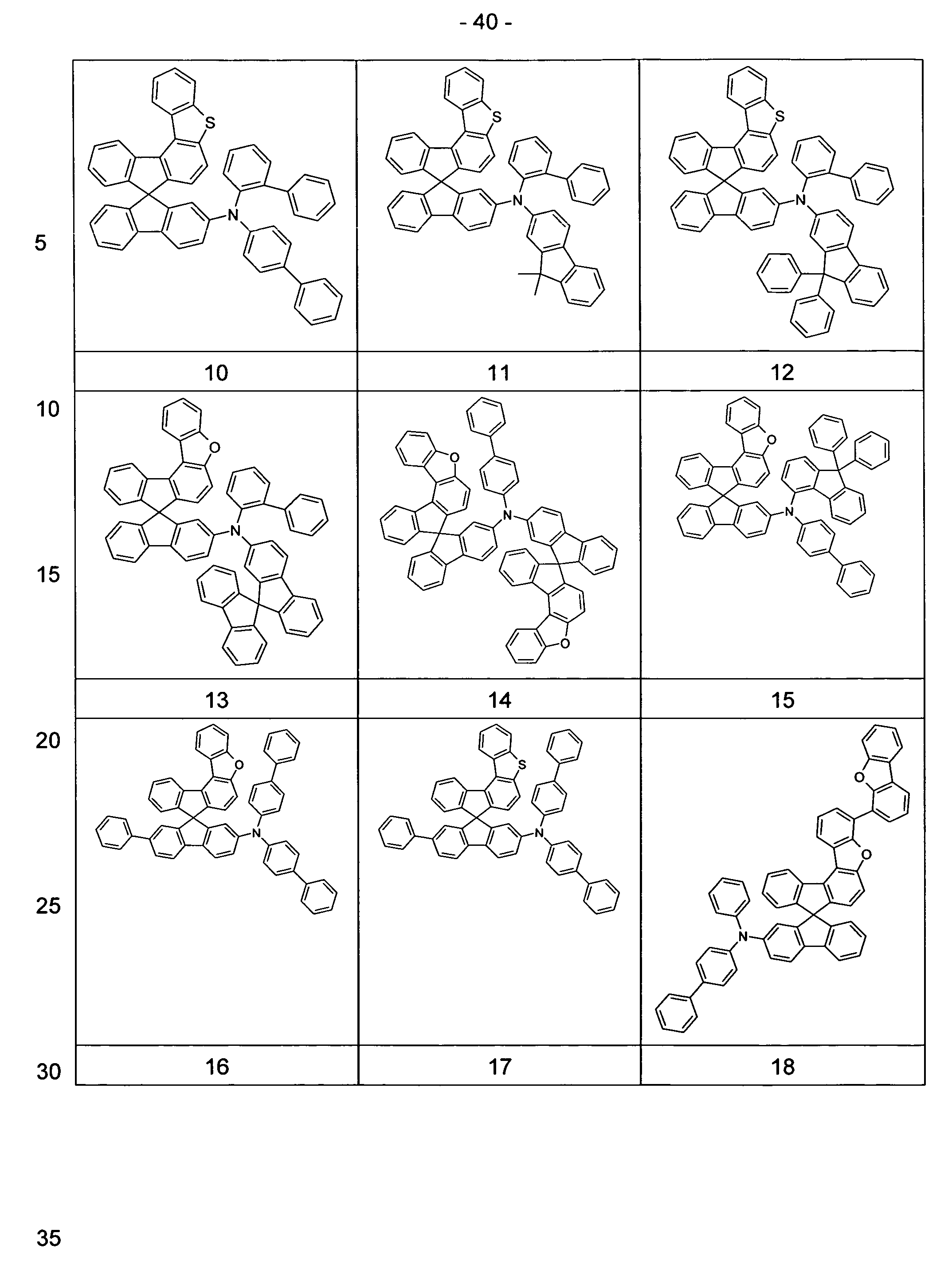
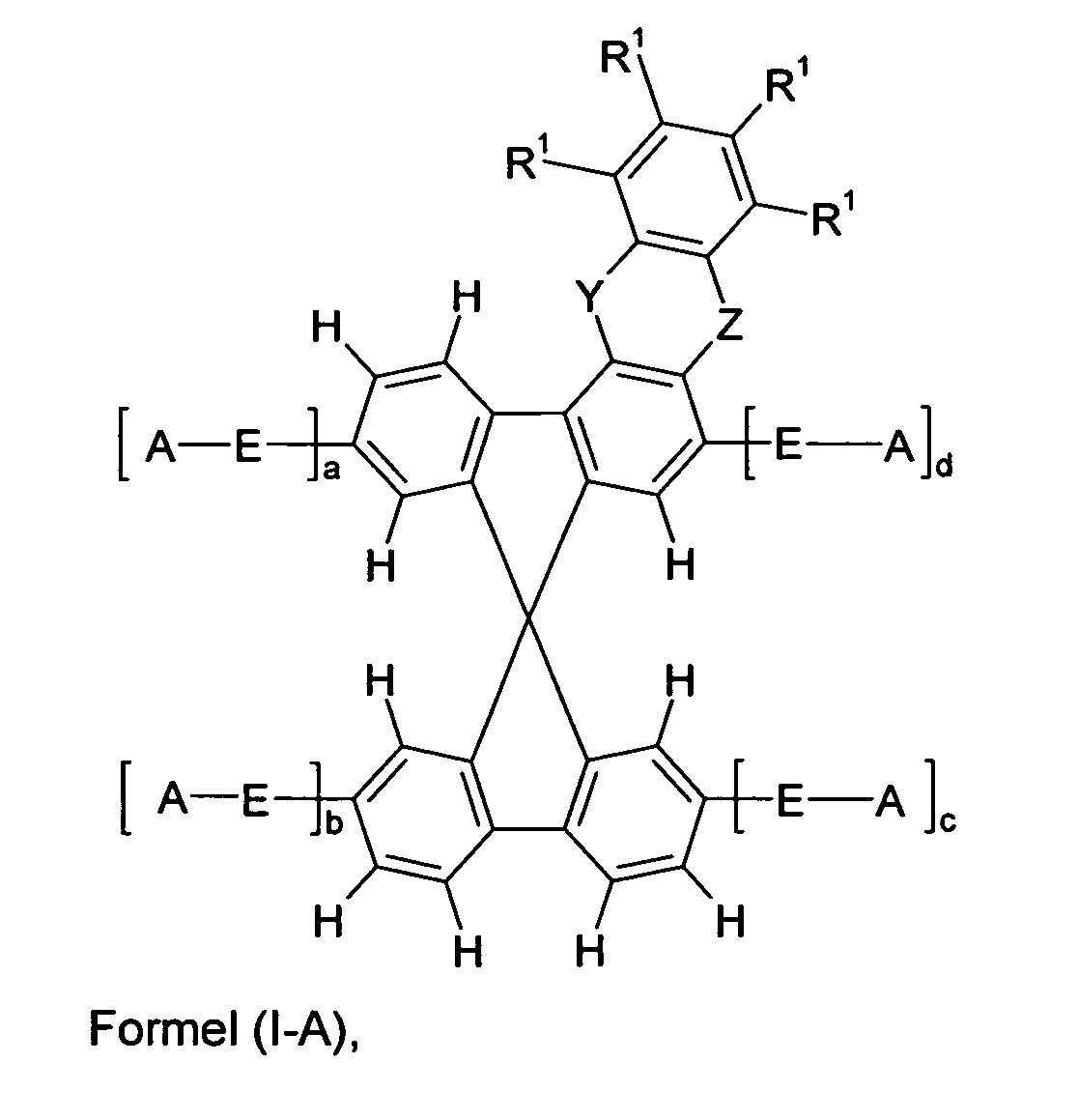
- the present invention therefore relates to a compound of the formula (I)
- Formula (I) which may be substituted at one or more unsubstituted positions on the basic structure according to formula (I) each with a radical R 1 ; and having the following definitions of the variables:
- Y is selected from a single bond, O, S or Se;
- Z is chosen from O, S or Se
- Single bond or an aromatic or heteroaromatic ring system having from 6 to 30 aromatic ring atoms which may be substituted with one or more R 2 radicals;
- A is the same or different on each occurrence and is a group of the formula (A1), (A2) or (A3) which is linked via the bond marked #;
- an aromatic or heteroaromatic ring system having 6 to 30 aromatic ring atoms, which may be substituted with one or more radicals R 2 ; is the same or different at each occurrence
- An aryl group in the context of this invention contains 6 to 40 aromatic ring atoms, none of which represents a heteroatom.
- An aryl group in the context of this invention either becomes a simpler one
- aromatic cycle ie benzene, or a fused aromatic polycycle, for example naphthalene, phenanthrene or anthracene, understood.
- a condensed aromatic polycycle consists in the context of the present application of two or more with each other
- a heteroaryl group in the context of this invention contains from 5 to 40 aromatic ring atoms, of which at least one is a heteroatom represents.
- the heteroatoms of the heteroaryl group are preferred
- a heteroaryl group in the sense of this invention is understood as meaning either a simple heteroaromatic cycle, for example pyridine, pyrimidine or thiophene, or a fused heteroaromatic polycycle, for example quinoline or carbazole.
- a condensed heteroaromatic polycycle consists of two or more simple heteroaromatic rings condensed together. By condensation between cycles it is to be understood that the cycles share at least one edge with each other.
- An aromatic ring system in the sense of this invention contains 6 to 40 C atoms in the ring system and does not comprise any heteroatoms as aromatic ring atoms.
- An aromatic ring system in the sense of this invention therefore contains no heteroaryl groups. Under an aromatic
- Ring system in the context of this invention is to be understood as a system which does not necessarily contain only aryl groups, but in which several aryl groups by a single bond or by a non-aromatic moiety, such as one or more optionally substituted C, Si, N, O - or S-atoms, can be connected.
- the non-aromatic unit preferably comprises less than 10% of the atoms other than H, based on the total number of H atoms
- Systems such as 9,9'-spirobifluorene, 9,9'-diarylfluorene, triarylamine, diaryl ethers and stilbene are understood as aromatic ring systems in the context of this invention, and also systems in which two or more aryl groups, for example by a linear or cyclic Alkyh alkenyl or alkynyl group or by a silyl group. Furthermore, systems in which two or more aryl groups over
- Ringsystems understood in the context of this invention, such as systems such as biphenyl and terphenyl.
- a heteroaromatic ring system in the context of this invention contains 5 to 40 aromatic ring atoms, of which at least one
- heteroatoms of the heteroaromatic Ring systems are preferably selected from N, O and / or S.
- a heteroaromatic ring system corresponds to the abovementioned definition of an aromatic ring system, but has at least one
- Heteroatom as one of the aromatic ring atoms. It differs from an aromatic ring system within the meaning of the definition of the present application, which according to this definition can not contain a heteroatom as an aromatic ring atom.
- An aryl or heteroaryl group is understood in particular to mean groups derived from benzene, naphthalene, anthracene, phenanthrene, pyrene, dihydropyrene, chrysene, perylene, triphenylene, fluoranthene, benzanthracene, benzphenanthrene, tetracene, pentacene, benzpyrene, furan, benzofuran, isobenzofuran , Dibenzofuran, thiophene, benzothiophene, isobenzothiophene, dibenzothiophene, pyrrole, indole, isoindole, carbazole, pyridine, quinoline, isoquinoline, acridine, phenanthridine, benzo-5,6-quinoline, benzo-6,7-quinoline, benzo-7,8 -quinoline, phenothiazine, phenoxazine,
- Ring atoms or a heteroaromatic ring system having 5 to 40 aromatic ring atoms are in particular understood to mean groups which are derived from the groups mentioned above under aryl groups and heteroaryl groups and also from biphenyl, terphenyl, quaterphenyl, fluorene, spirobifluorene, dihydrophenanthrene, dihydropyrene,
- the radicals are methyl, ethyl, n-propyl, i-propyl, n-butyl, i-butyl, s-butyl, t-butyl, 2-methylbutyl, n-pentyl, s-pentyl, cyclopentyl, neo Pentyl, n-hexyl, cyclohexyl, neo-hexyl, n-heptyl,
- the two radicals are linked together by a chemical bond, under the formulation that two or more radicals can form a ring with one another.
- one of the two radicals is hydrogen
- the second radical to form a ring at the position to which the hydrogen atom was bonded binds.
- Y is selected from a
- Single bond O or S. It is further preferred according to the invention that Z is selected from O or S. It is particularly preferred that Y is a single bond and that Z is selected from O or S. According to a further embodiment of the invention preferably that Y is selected from O or S, and that Z is selected from O or S.
- E on each occurrence is the same or different selected from a single bond or a divalent group derived from optionally substituted with R 2 radicals benzene, biphenyl, terphenyl, fluorene, spirobifluorene, indenofluorene, carbazole, dibenzofuran, dibenzothiophene, or a Combination of two or more of these groups, with no more than 30 aromatic ring atoms in the group E.
- Groups E are preferably selected from a single bond or from groups of the following formulas:
- dashed bonds represent the bonds to the rest of the formula and the groups may be substituted at the free positions by one or more radicals R 2 , preferably the free
- R 2 in the groups of the formulas (E-23) and (E-24) is preferably the same or different for an alkyl group having 1 to 10 C atoms, in particular methyl, or a phenyl group having one or more radicals R 3 may be substituted and is preferably unsubstituted.
- Two alkyl groups R 2 can also form a ring to form a spiro group, preferably a cyclohexyl ring or a cyclopentyl ring.
- A is the same or different at each occurrence as a group of the formula (A-1) or (A-3), particularly preferably a group of the formula (A-1).
- a preferred embodiment of the group of forms! (A-3) is a group of the following formula (A-3-1)
- Particularly preferred among the groups of the formulas (A-3-1a) to (A-3-1g) are the groups (A-3-1c) and (A-3-1g).
- each occurrence of Ar 2 is the same or different selected from an aromatic or heteroaromatic ring system having 6 to 25 aromatic ring atoms, which may be substituted by one or more R 2 radicals.
- Particularly preferred are phenyl, biphenyl, terphenyl, fluorenyl, spirobifluorenyl, indenofluorenyl, naphthyl, phenanthrenyl, furanyl, benzofuranyl, dibenzofuranyl, thiophenyl, benzothiophenyl, dibenzothiophenyl, carbazolyl, indolocarbazolyl and indenocarbazolyl, each of which may be substituted by one or more R 2 radicals.
- dashed bond represents the bond to the nitrogen and the groups may be substituted at the free positions by one or more radicals R 2 , but are preferably unsubstituted at the free positions.
- R 2 in the groups of the formulas (Ar 2 -68) to (Ar 2 -82) and (Ar 2 to 85) to (Ar 2 to 87) is preferably identical or different to an alkyl group having 1 to 10 C atoms , in particular methyl, or a phenyl group which may be substituted by one or more radicals R 3 and is preferred unsubstituted.
- Two alkyl groups R 2 can also under
- Forming a spiro group form a ring, preferably one
- R 1 is the same or different at each occurrence as H, D, F, CN, a straight-chain alkyl group having 1 to 10 C atoms or a branched or cyclic alkyl group having 3 to 10 C atoms, or an aromatic or heteroaromatic ring system with 6 to 25 aromatic ring atoms, wherein said alkyl and
- Alkoxy groups and said aromatic or heteroaromatic ring systems may each be substituted with one or more radicals R 3 .
- R 1 is the same or different at each instance and is H, F, CN, methyl, tert-butyl, phenyl, biphenyl, dibenzofuran, dibenzothiophene or carbazole, more preferably equal to H.
- R 2 in each occurrence is identical or different and is H, D, F, CN, a straight-chain alkyl group having 1 to 10 C atoms or a branched or cyclic alkyl group having 3 to 10 C atoms, or an aromatic or heteroaromatic ring system with 6 to 25 aromatic ring atoms, wherein said alkyl and
- Alkoxy groups and said aromatic or heteroaromatic ring systems may each be substituted with one or more radicals R 3 .
- R 2 on each occurrence is the same or different and is H, F, CN, methyl, tert-butyl, phenyl, biphenyl, dibenzofuran, dibenzothiophene or carbazole.
- each occurrence of R 3 is the same or different and is H, D, F, CN, Si (R 4 ) 3, N (R 4 ) 2, a straight chain alkyl or alkoxy group of 1 to 10 carbon atoms, or a branched or cyclic one Alkyl or alkoxy group having 3 to 10 carbon atoms, or an aromatic or heteroaromatic
- R 3 is, identically or differently on each occurrence, H, D, F, CN, N (R 4 ) 2, a straight-chain alkyl group having 1 to 10 C atoms or a branched or cyclic alkyl group having 3 to 10 C atoms, or an aromatic or heteroaromatic ring system having 6 to 25 aromatic ring atoms, wherein said alkyl and Alkyoxy tendency and said aromatic or heteroaromatic ring systems may each be substituted by one or more radicals R 4 .
- the index d is 0, and that one or more, preferably exactly one or exactly two of the indices a, b and c are equal to 1.
- Y is a single bond and Z is O, and the subscript a is 1, at least one of the indices b, c and d is 1. It is particularly preferred that when the index a is 1, at least one of the indices b, c and d is equal to 1.
- R 1 is preferably hydrogen. Also in this case, it is preferable that when Y is a single bond and Z is O, and the index a is 1, at least one of the indices b, c and d is 1. It is particularly preferred that when the index a is 1, at least one of the indices b, c and d is equal to 1.
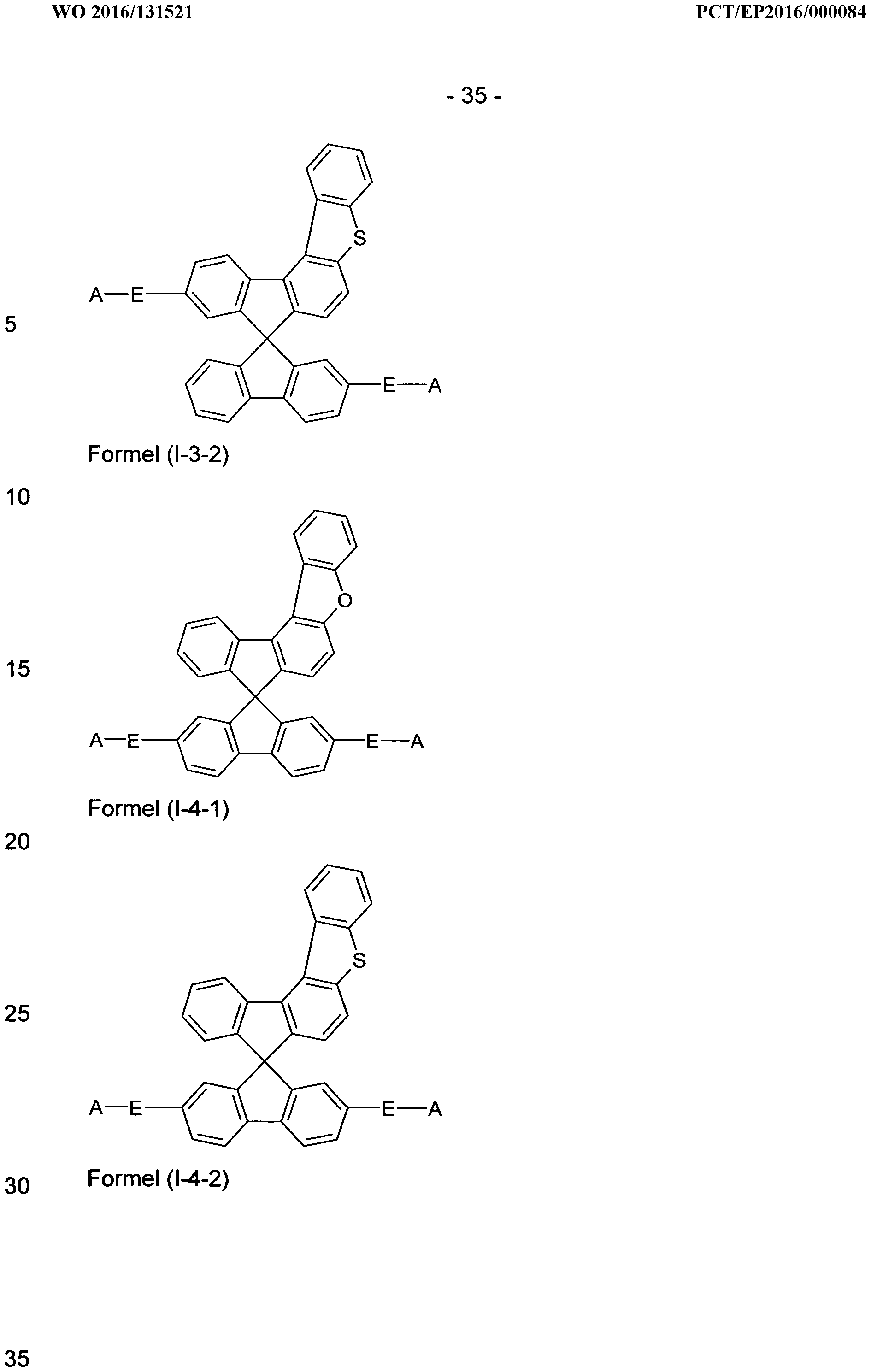
- the formulas (1-1) to (I-6) are preferable, the formulas (1-1) and (I-2) are particularly preferable, and more particularly preferred is the formula (I-2).
- R 1 is preferably hydrogen.
- the formulas (IA-1) to (IA-6) are preferable, and the formulas (IA-1) and (IA-2) are particularly preferable, and most preferably is the formula (IA-2).
- Basic structure according to formula (1-1-1) can be substituted to (I-6-2) at one or more unsubstituted positions shown each with a radical R 1 .
- the formulas (1-1-1) to (I-4-2) are preferable.
- Very particularly preferred embodiments of the compounds of the formula (I) correspond to one of the formulas (I-A-1) to (I-A-6) or one of the formulas (I-1-1) to (I-6-2), where additionally:
- Y if present, is selected from a single bond, O or S;
- Z if present, is selected from O or S;
- E is the same or different on each occurrence selected from a single bond or a divalent group derived from optionally substituted with radicals R 2 benzene, biphenyl, terphenyl, fluorene,
- A is a group of the formula (A-1) or (A-3), preferably a group of the formula (A-1);
- Ar 2 is the same or different at each instance selected from an aromatic or heteroaromatic ring system with 6 to 25
- aromatic ring atoms which may be substituted by one or more radicals R 2 , and is preferably selected from phenyl, biphenyl, terphenyl, fluorenyl, spirobifluorenyl, indenofluorenyl, naphthyl,
- Phenanthrenyl furanyl, benzofuranyl, dibenzofuranyl, thiophenyl, benzothiophenyl, dibenzothiophenyl, carbazolyl, indolocarbazolyl and indenocarbazolyl, each of which may be substituted with one or more R 2 radicals;
- R 1 is the same or different at each occurrence as H, D, F, CN, a straight-chain alkyl group having 1 to 10 C atoms or a branched or cyclic alkyl group having 3 to 10 C atoms, or an aromatic or heteroaromatic ring system having 6 to 25 aromatic ring atoms, wherein said alkyl and alkoxy groups and said aromatic or heteroaromatic ring systems may each be substituted with one or more radicals R 3 , preferably R 1 is the same or different at each occurrence, H, F, CN, methyl, tertiary Butyl, phenyl, biphenyl, dibenzofuran, dibenzothiophene or carbazole, even more preferably equal to H.
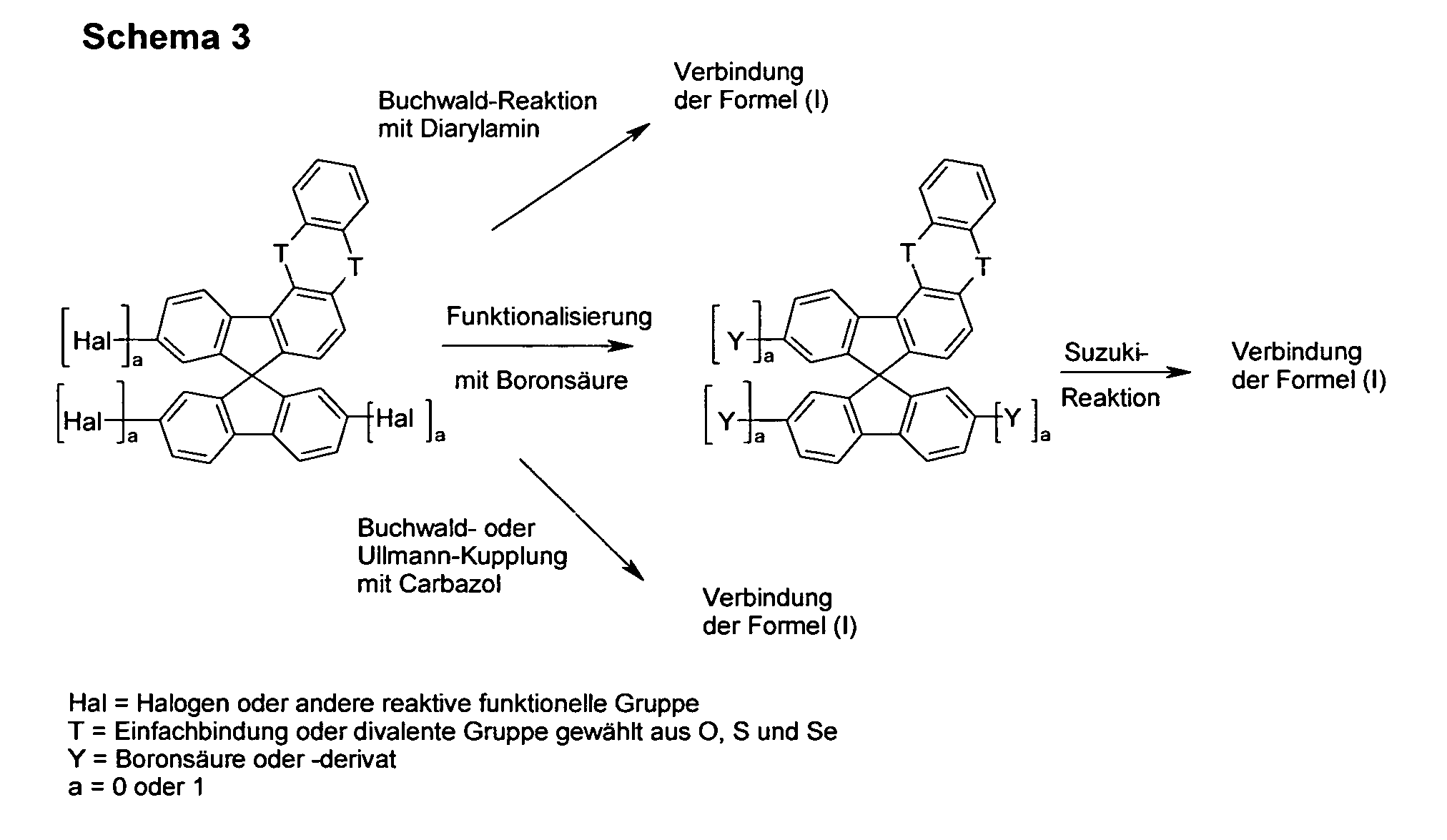
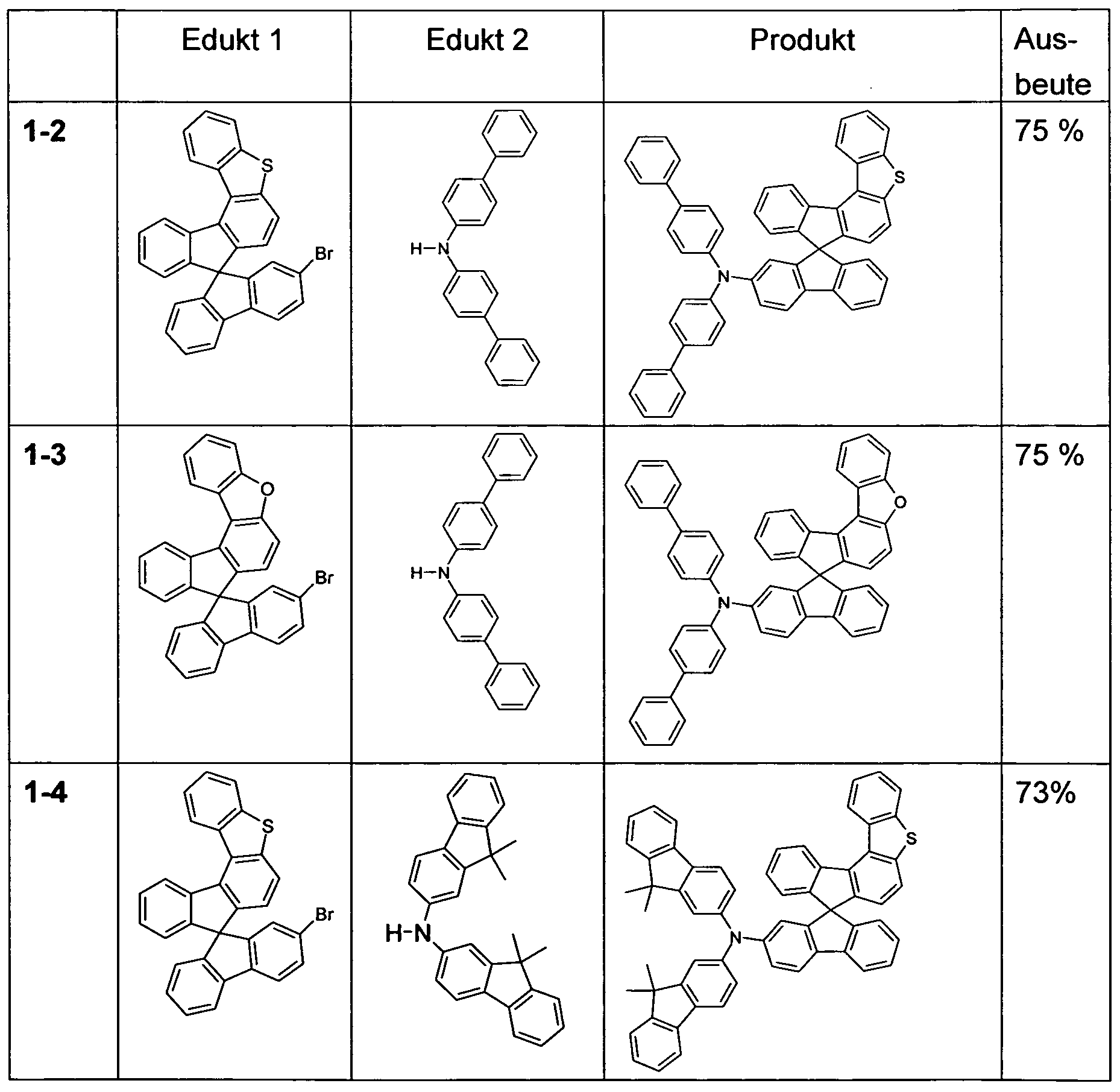
- the synthesis of the compounds of formula (I) may be carried out using methods and reaction types known in the art, for example, halogenation, organometallic addition, Buchwald coupling and Suzuki coupling.
- Schemes 1 to 3 show possible synthetic routes for the preparation of the compounds of the invention. They serve to explain the invention to the person skilled in the art, and are not intended to be restrictive. The person skilled in the art can, within the scope of his general knowledge, modify the synthetic routes shown, or develop other ways, if this appears more advantageous.
- Scheme 1 shows a suitable synthesis for the intermediate of formula (ZI).
- both a Hal-substituted fluorenone component and a phenyl group substituted with three groups Hai are used.
- the intermediates provided with reactive groups Z according to the formulas (ZI) or (Z-II) are versatile building blocks which can be converted into compounds of the formula (I), as shown in the following scheme:
- the present application therefore also provides a process for the preparation of compounds of the formula (I), which comprises first preparing the spirobifluorene skeleton and, in a later step, using an organometallic coupling reaction, an arylamino or a carbazole group or an aryl group. or
- the organometallic coupling reaction is preferably one
- a cycloaddition such as a 1, 3-dipolar cycloaddition
- Another object of the invention are therefore oligomers, polymers or dendrimers containing one or more compounds according to
- Formula (I), wherein the bond (s) to the polymer, oligomer or dendrimer can be located at any, in formula (I) with R 1 or R 2 substituted positions.
- the compound is part of a side chain of the oligomer or polymer or constituent of the main chain.
- An oligomer in the context of this invention is understood as meaning a compound which is composed of at least three monomer units.
- a polymer in the context of the invention is understood as meaning a compound which is composed of at least ten monomer units.
- the polymers, oligomers or dendrimers according to the invention may be conjugated, partially conjugated or non-conjugated.
- the oligomers or polymers of the invention may be linear, branched or dendritic.
- the units of formula (I) may be directly linked together or may be linked together via a divalent group, for example via a substituted or unsubstituted alkylene group, via a heteroatom or via a divalent aromatic or heteroaromatic group.
- three or more units of formula (I) may be linked via a trivalent or higher valent group, for example via a trivalent or higher valent aromatic or heteroaromatic group, to a branched or dendritic oligomer or polymer.
- the monomers according to the invention are homopolymerized or copolymerized with further monomers.
- Suitable and preferred comonomers are selected from fluorenes (eg according to EP 842208 or WO 2000/22026),
- Spirobifluorenes eg according to EP 707020, EP 894107 or WO 2006/061181
- paraphenylenes eg according to WO 1992/18552
- Carbazoles eg according to WO 2004/070772 or WO 2004/113468
- thiophenes eg according to EP 1028136
- dihydrophenanthrenes eg.
- WO 2005/014689 or WO 2007/006383 cis-indenofluorenes (eg according to WO 2004/041901 or WO 2004/113412), ketones (eg according to WO 2005/040302), phenanthrenes ( eg according to WO 2005/104264 or WO 2007/017066) or even more of these units.
- the polymers, oligomers and dendrimers contain
- Vinyltriarylamines for example according to WO 2007/068325
- phosphorescent metal complexes for example according to WO 2006/003000
- charge transport units in particular those based on triarylamines.
- the polymers and oligomers according to the invention are generally prepared by polymerization of one or more types of monomer, of which at least one monomer in the polymer leads to repeat units of the formula (I).
- Suitable polymerization reactions are known in the art and described in the literature.
- Particularly suitable and preferred polymerization reactions which lead to C-C or C-N linkages are the SUZUKI polymerization, the
- formulations of the compounds according to the invention are required. These formulations may be, for example, solutions, dispersions or emulsions. It may be preferable to use mixtures of two or more solvents for this purpose. Suitable and preferred solvents are, for example, toluene, anisole, o-, m- or p-xylene,
- Methyl benzoate mesitylene, tetralin, veratrole, THF, methyl THF, THP, chlorobenzene, dioxane, phenoxytoluene, especially 3-phenoxytoluene, (-) - fenchone, 1, 2,3,5-tetramethylbenzene, 1, 2,4,5 Tetramethylbenzene, 1-methylnaphthalene, 2-methylbenzothiazole, 2-phenoxyethanol, 2-pyrrolidinone, 3-methylanisole, 4-methylanisole, 3,4-dimethylanisole, 3,5-dimethylanisole, Acetophenone, ⁇ -terpineol, benzothiazole, butyl benzoate, cumene,
- Triethylene glycol dimethyl ether diethylene glycol monobutyl ether
- Tripropylene glycol dimethyl ether Tripropylene glycol dimethyl ether, tetraethylene glycol dimethyl ether, 2-isopropylnaphthalene, pentylbenzene, hexylbenzene, heptylbenzene,
- the invention therefore further provides a formulation, in particular a solution, dispersion or emulsion containing at least one compound of the formula (I) and at least one solvent, preferably an organic solvent.
- a formulation in particular a solution, dispersion or emulsion containing at least one compound of the formula (I) and at least one solvent, preferably an organic solvent.
- the compounds according to the invention are suitable for use in electronic devices, in particular in organic electroluminescent devices (OLEDs). Depending on the substitution, the compounds are used in different functions and layers. Another object of the invention is therefore the use of
- the electronic device is preferably selected from the group consisting of organic integrated circuits (OICs), organic field effect transistors (OFETs), organic thin film transistors (OTFTs), organic light emitting transistors (OLETs),
- OICs organic integrated circuits
- OFETs organic field effect transistors
- OTFTs organic thin film transistors
- OLETs organic light emitting transistors
- organic solar cells organic solar cells (OSCs), organic optical detectors, organic photoreceptors, organic field quench devices
- OLEDs organic electroluminescent devices
- the electronic device is preferably selected from the abovementioned devices.
- OLED organic electroluminescent device
- Hole transport layer or another layer at least one compound according to formula (I) contains.
- the organic electroluminescent device may contain further layers. These are, for example, selected from in each case one or more hole injection layers, hole transport layers, hole blocking layers, electron transport layers, electron injection layers, electron blocking layers, exciton blocking layers, intermediate layers
- the sequence of the layers of the organic electroluminescent device containing the compound of the formula (I) is preferably the following:
- the organic electroluminescent device according to the invention may contain a plurality of emitting layers.
- these emission layers particularly preferably have a total of several emission maxima between 380 nm and 750 nm, so that total white emission results, ie, in the emitting layers
- emissive compounds that can fluoresce or phosphoresce and the blue, green, yellow,
- the compounds of the invention are preferably in the
- Hole transport layer hole injection layer or the
- Electron blocking layer present.
- the compound according to formula (I) is used in an electronic device containing one or more phosphorescent emitting compounds.
- the compound in different layers, preferably in a hole transport layer, an electron blocking layer, a
- phosphorescent emissive compounds typically includes compounds in which the light emission occurs through a spin-forbidden transition, for example a transition from an excited triplet state or a state with a higher spin quantum number, for example a quintet state.
- Preferred phosphorescent emissive compounds used are compounds containing copper, molybdenum, tungsten, rhenium, ruthenium, osmium, rhodium, iridium, palladium, platinum, silver, gold or europium, in particular compounds containing iridium, platinum or copper.
- all luminescent iridium, platinum or copper complexes as
- the compound according to formula (I) can also according to the invention in an electronic device containing one or more
- the compounds of the formula (I) are used as hole transport material.
- the compounds are then preferably present in a hole transport layer, an electron blocking layer or a hole injection layer. Particularly preferred is the use in an electron-blocking layer.
- a hole transport layer according to the present application is a hole transporting layer located between the anode and the emissive layer.
- Hole injection layers and electron blocking layers are understood in the sense of the present application as special embodiments of hole transport layers.
- a hole injection layer is a hole transport layer which adjoins directly to the anode or only by a single coating of the anode is separated from her.
- An electron blocking layer is, in the case of a plurality of hole transport layers between the anode and the emitting layer, the hole transport layer which adjoins the emitting layer directly on the anode side.
- the organic layer containing the organic compound i. in a proportion of 100%, be used in the hole transport layer, or it may be used in combination with one or more other compounds.
- the organic layer containing the organic compound i. in a proportion of 100%, be used in the hole transport layer, or it may be used in combination with one or more other compounds.
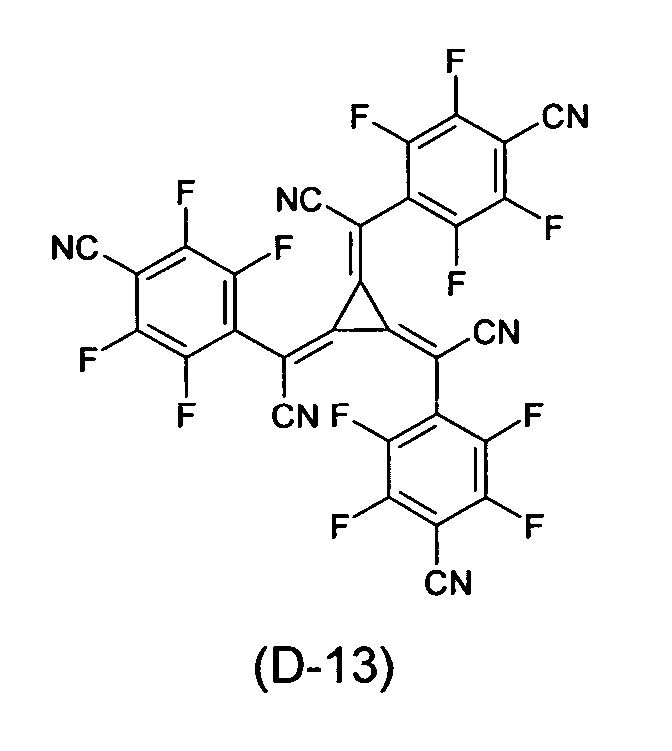
- Compound of formula (I) then additionally one or more p-dopants.
- p-dopants preference is given to using those organic electron acceptor compounds which contain one or more of the other compounds of the
- p-dopants are those described in WO 2011/073149, EP 1968131, EP 2276085, EP 2213662, EP 1722602, EP 2045848, DE 102007031220, US 8044390, US 8057712, WO
- p-dopants are quinodimethane compounds, azaindenofluorendiones, azaphenalens, azatriphenylenes, b,
- Metal halides preferably transition metal halides, metal oxides, preferably metal oxides containing at least one transition metal or a metal of the 3rd main group, and transition metal complexes, preferably complexes of Cu, Co, Ni, Pd and Pt with ligands containing at least one oxygen atom as a binding site. Preference is still given
- Transition metal oxides as dopants preferably oxides of rhenium, molybdenum and tungsten, particularly preferably Re2O7, M0O3, WO3 and ReO3.
- the p-dopants are preferably present largely uniformly distributed in the p-doped layers. This can be achieved, for example, by co-evaporation of the p-dopant and the hole transport material matrix.
- Particularly preferred p-dopants are the following compounds:
- the compound according to formula (I) is used as hole transport material in combination with a hexaazatriphenylene derivative as described in US 2007/0092755.
- a hexaazatriphenylenderivat is used in a separate layer.
- the compound of the formula (I) is employed in an emitting layer as matrix material in combination with one or more emitting compounds, preferably phosphorescent emitting compounds.
- the proportion of the matrix material in the emitting layer is in this case between 50.0 and 99.9% by volume, preferably between 80.0 and 99.5% by volume and particularly preferred for fluorescent emitting layers between 92.0 and 99.5% by volume and for phosphorescent emitting layers between 85.0 and 97.0 vol.%.
- the proportion of the emitting compound is between 0.1 and 50.0% by volume, preferably between 0.5 and 20.0% by volume and particularly preferred for fluorescent emitting layers between 0.5 and 8.0% by volume and for phosphorescent emitting layers between 3.0 and 15.0% by volume .-%.
- An emitting layer of an organic electroluminescent device may also include systems comprising a plurality of matrix materials (Mixed-matrix systems) and / or multiple emitting compounds.
- the emissive compounds are generally those compounds whose proportion in the system is smaller and the matrix materials are those compounds whose proportion in the system is larger. In individual cases, however, the proportion of a single matrix material in the system may be smaller than the proportion of a single emitting compound.
- the mixed-matrix systems preferably comprise two or three different ones
- Matrix materials more preferably two different ones
- Matrix materials In this case, one of the two materials preferably constitutes a material with hole-transporting properties and the other material is a material with electron-transporting properties.
- the compound of formula (I) preferably represents the matrix material with hole-transporting properties
- electron-transporting and hole-transporting properties of the mixed-matrix components may also be mainly or completely combined in a single mixed-matrix component, with the further or the further mixed-matrix components fulfilling other functions.
- the two different matrix materials may be present in a ratio of 1:50 to 1: 1, preferably 1:20 to 1: 1, more preferably 1:10 to 1: 1 and most preferably 1: 4 to 1: 1. Preference is given to mixed-matrix systems in
- the mixed-matrix systems may comprise one or more emitting compounds, preferably one or more
- phosphorescent emitting compounds In general, mixed-matrix systems are preferred in phosphorescent organic
- Electroluminescent devices used.
- Particularly suitable matrix materials which can be used in combination with the compounds according to the invention as matrix components of a mixed-matrix system are selected from the preferred matrix materials given below
- phosphorescent emitting compounds or the preferred matrix materials for fluorescent emitting compounds depending on which type of emitting compound is used in the mixed-matrix system.
- Preferred phosphorescent emitting compounds are those mentioned above.
- Preferred fluorescent emitting compounds are selected from the class of arylamines. Under an arylamine or a
- aromatic amine is understood as meaning a compound which contains three substituted or unsubstituted aromatic or heteroaromatic ring systems bonded directly to the nitrogen. At least one of these aromatic or heteroaromatic ring systems is preferably a fused ring system, more preferably at least 14 aromatic ring atoms. Preferred examples of these are aromatic anthraceneamines, aromatic
- Anthracenediamines aromatic pyrenamines, aromatic pyrenediamines, aromatic chrysenamines or aromatic chrysendiamines.
- aromatic anthracene amine is meant a compound in which a diarylamino group is bonded directly to an anthracene group, preferably in the 9-position.
- aromatic anthracenediamine is meant a compound in which two diarylamino groups are directly attached are attached to an anthracene group, preferably in the 9,10-position.
- Aromatic pyrenamines, pyrenediamines, chrysenamines and chrysenediamines are defined analogously thereto, the diarylamino groups on the pyrene preferably being bonded in the 1-position or in the 1, 6-position.
- Further preferred emitting compounds are indenofluorenamines or -diamines, for example according to WO 2006/108497 or WO 2006/122630, benzoindenofluoreneamines or -diamines, for example according to
- WO 2013/185871 disclosed pyrene-arylamines. Also preferred are the benzoindenofluorene amines disclosed in WO 2014/037077, the benzofluorene amines disclosed in WO 2014/106522, and the benzofluorene amines disclosed in WO 2014/106522
- WO 2014/111269 disclosed extended benzoindenofluorenes.
- matrix materials preferably for fluorescent emitting
- Preferred matrix materials are selected from the classes of the oligoarylenes (for example 2,2 ', 7,7'-tetraphenylspirobifluorene according to EP 676461 or dinaphthylanthracene), in particular the oligoarylenes containing condensed aromatic groups, the oligoarylenevinylenes (for example DPVBi or spiro EP-DPI according to EP 676461), the polypodal metal complexes (eg according to WO 2004/081017), the hole-conducting compounds (eg according to WO 2004/058911), the electron-conducting compounds, in particular ketones, phosphine oxides, sulfoxides, etc. (eg according to
- oligoarylene is to be understood as meaning a compound in which at least three aryl or arylene groups are bonded to one another. Preference is furthermore given to those in WO 2006/097208,
- WO 2011/054442 and EP 1553154 disclosed anthracene derivatives, as well as in EP 1749809, EP 1905754 and US 2012/0187826 disclosed pyrene compounds.
- azacarbazole derivatives eg. B. according to EP 1617710, EP 1617711, EP 1731584, JP 2005/347160, bipolar matrix materials, for. B. according to
- Triphenylene derivatives eg. B. according to WO 2012/048781, or lactams, z. B. according to WO 2011/116865 or WO 2011/137951.
- the OLED according to the invention preferably comprises two or more different hole-transporting layers.
- the compound of formula (I) may be in one or more or all
- hole transporting layers are used.
- the compound of the formula (I) is used in exactly one hole-transporting layer, and in the other hole-transporting layers present, others are used
- aluminum complexes are, for example, Alq3, zirconium, for example Zrq 4, lithium complexes, for example Liq, benzimidazole derivatives, triazine derivatives, pyrimidine derivatives, pyridine derivatives, pyrazine derivatives, quinoxaline derivatives, quinoline derivatives,
- Oxadiazole derivatives aromatic ketones, lactams, boranes,
- Diazaphospholderivate and Phosphinoxidderivate are further suitable materials, as disclosed in JP 2000/053957, WO 2003/060956, WO 2004/028217, WO 2004/080975 and WO 2010/072300.
- the cathode of the electronic device are low workfunction metals, metal alloys or multilayer structures of various metals, such as alkaline earth metals, alkali metals, main group metals or lanthanides (eg Ca, Ba, Mg, Al, In, Mg, Yb, Sm, Etc.). Also suitable are alloys of an alkali or alkaline earth metal and silver, for example an alloy of magnesium and silver.
- further metals which have a relatively high work function, such as, for example, B. Ag or AI, which then usually combinations of metals, such as Ca / Ag, Mg / Ag or Ba / Ag can be used. It may also be preferred to provide a thin intermediate layer of a high material between a metallic cathode and the organic semiconductor
- dielectric constant Suitable examples of these are alkali metal or alkaline earth metal fluorides, but also the corresponding oxides or carbonates (eg LiF, L 12 O, BaF 2, MgO, NaF, CsF, CS 2 CO 3, etc.). Furthermore, lithium quinolinate (LiQ) can be used for this purpose.
- the layer thickness of this layer is preferably between 0.5 and 5 nm.
- materials with a high work function are preferred.
- the anode has a work function greater than 4.5 eV. Vacuum up.
- metals with a high redox potential such as Ag, Pt or Au, are suitable for this purpose.
- metal / metal oxide electrodes eg Al / Ni / NiOx, Al / PtOx
- at least one of the electrodes must be transparent or
- anode materials are conductive mixed metal oxides. Particularly preferred are indium tin oxide (ITO) or indium zinc oxide (IZO). Preference is furthermore given to conductive, doped organic materials, in particular conductive doped polymers.
- the anode can also consist of several layers, for example of an inner layer of ITO and an outer layer of a metal oxide, preferably tungsten oxide,
- Molybdenum oxide or vanadium oxide are examples of Molybdenum oxide or vanadium oxide.
- the device is structured accordingly (depending on the application), contacted and finally sealed to exclude harmful effects of water and air.
- the electronic device is characterized in that one or more layers are coated with a sublimation process.
- the materials in vacuum sublimation systems become smaller at an initial pressure
- 10 5 mbar preferably less than 10 "6 mbar, but it is also possible that the initial pressure is even lower, for example less than 10 "7 mbar.
- Carrier gas sublimation are coated.
- the materials are applied at a pressure between 10 5 mbar and 1 bar.
- a special case of this process is the OVJP (Organic Vapor Jet Printing) process, in which the materials are applied directly through a nozzle and thus structured (for example, BMS Arnold et al., Appl. Phys. Lett., 2008, 92, 053301).
- one or more layers of solution such. B. by spin coating, or with any printing process, such.
- any printing process such.
- screen printing flexographic printing, nozzle printing or offset printing, but particularly preferably LITI (Light Induced Thermal Imaging,
- one or more layers of solution and one or more layers are applied by a sublimation method.
- the electronic devices containing one or more compounds of the formula (I) in displays as
- Compound (3-1) is 13.5 g (58% of theory).
- inventive OLEDs and OLEDs according to the prior art is carried out according to a general method according to WO 04/058911, which is adapted to the conditions described here (for example materials).
- the substrates are glass slides used, which are coated with structured ITO (indium tin oxide) of thickness 50nm.
- the OLEDs have the following general layer structure: substrate / p-doped hole transport layer (HIL) / hole transport layer (HTL) / electron blocking layer (EBL) / emission layer (EML) / electron transport layer (ETL) / electron injection layer (EIL) and finally a cathode.
- HIL substrate / p-doped hole transport layer
- HTL hole transport layer
- EBL electron blocking layer
- EML emission layer
- ETL electron transport layer
- EIL electron injection layer
- the emission layer always consists of at least one matrix material (host material, host material) and an emitting dopant (dopant, emitter), which is admixed to the matrix material or the matrix materials by co-evaporation in a specific volume fraction.
- the electron transport layers or the hole injection layers may consist of a mixture of two or more materials. The number in parentheses after the
- Materials indicates the respective layer thickness in which the aforementioned materials are included.
- the OLEDs are characterized by default.
- the external quantum efficiency (EQE, measured in percent) depends on the
- Luminance calculated from current-voltage-luminance characteristics assuming a Lambertian radiation characteristic and the lifetime determined.
- EQE @ 10mA / cm 2 denotes the external quantum efficiency at a current density of
- LD80 @ 60mA / cm 2 is the lifetime up to which the OLED has dropped to 80% of its initial intensity at a starting current at constant current of 60mA / cm 2 .
- HIM F4TCNQ (5%) (20nm) / HIM (175nm) / HTM1 (20nm) /
- Comparative example is evaporated instead of HTM1 in the relevant layer HTMvl.
- the operating voltage of the OLED with material according to the invention is also significantly lower than the voltage applied to the comparative material at 10 mA / cm 2 at 3.86V. In comparison, this is 4.08V, which is 6% higher.
- HTM2 Another material according to the invention is compared with the direct analog HTMv2 with rotated dibenzofuran unit.
- the OLED component has the following architecture:
- HIM F4TCNQ (5%) (20nm) / HIM (175nm) / HTM2 (20nm) or HTMv2 (20nm) / H1: SEB (5%) (20nm) / ETM: LiQ (50%) (30nm) / LiQ (1 nm).
- HIM F4TCNQ (5%) (20nm) / HIM (175nm) / HTM3 (20nm) / H1: SEB (5%) (20nm) / ETM: LiQ (50%) (30nm) / LiQ (1nm) produced.
- HTM3 is replaced by HTMv3.
- the component with the substance according to the invention in the EBL achieves an external quantum efficiency at 10 mA / cm 2 of 7.3%.
- the component with the comparison substance in the same functional layer reaches only 7.0%.
- HTM4 and HTMv4 are tested in a singlet blue stack: HIM: F4TCNQ (5%) (20nm) / HIM (175nm) / HTM4 (20nm) / H1: SEB (5%) (20nm) / ETM: LiQ (50%) (30nm) / LiQ (1nm).
- HTM4 HTMv4 is introduced into the EBL.
- the substance according to the invention shows an external quantum efficiency at 10 mA / cm 2 of 7.5%.
- the comparative compound achieved only 7.2% EQE at 10mA / cm 2 .
Landscapes
- Chemical & Material Sciences (AREA)
- Organic Chemistry (AREA)
- Engineering & Computer Science (AREA)
- Materials Engineering (AREA)
- Physics & Mathematics (AREA)
- Spectroscopy & Molecular Physics (AREA)
- Optics & Photonics (AREA)
- Electroluminescent Light Sources (AREA)
- Indole Compounds (AREA)
- Plural Heterocyclic Compounds (AREA)
- Heterocyclic Compounds Containing Sulfur Atoms (AREA)
- Furan Compounds (AREA)
- Heterocyclic Carbon Compounds Containing A Hetero Ring Having Oxygen Or Sulfur (AREA)
Abstract
Description











Claims


Priority Applications (6)
| Application Number | Priority Date | Filing Date | Title |
|---|---|---|---|
| CN202410172513.4A CN118126004A (zh) | 2015-02-16 | 2016-01-19 | 用于电子器件的基于螺二芴衍生物的材料 |
| EP16701089.1A EP3259330B1 (de) | 2015-02-16 | 2016-01-19 | Materialien auf basis von spirobifluorenderivaten für elektronische vorrichtungen |
| US15/551,198 US10032989B2 (en) | 2015-02-16 | 2016-01-19 | Spirobifluorene derivative-based materials for electronic devices |
| CN201680010200.2A CN107223122A (zh) | 2015-02-16 | 2016-01-19 | 用于电子器件的基于螺二芴衍生物的材料 |
| KR1020177025213A KR102556584B1 (ko) | 2015-02-16 | 2016-01-19 | 전자 디바이스용 스피로비플루오렌 유도체 계의 재료 |
| JP2017560873A JP6925982B2 (ja) | 2015-02-16 | 2016-01-19 | 電子素子のための材料 |
Applications Claiming Priority (2)
| Application Number | Priority Date | Filing Date | Title |
|---|---|---|---|
| EP15000455 | 2015-02-16 | ||
| EP15000455.4 | 2015-02-16 |
Publications (1)
| Publication Number | Publication Date |
|---|---|
| WO2016131521A1 true WO2016131521A1 (de) | 2016-08-25 |
Family
ID=52544253
Family Applications (1)
| Application Number | Title | Priority Date | Filing Date |
|---|---|---|---|
| PCT/EP2016/000084 Ceased WO2016131521A1 (de) | 2015-02-16 | 2016-01-19 | Materialien auf basis von spirobifluorenderivaten für elektronische vorrichtungen |
Country Status (7)
| Country | Link |
|---|---|
| US (1) | US10032989B2 (de) |
| EP (1) | EP3259330B1 (de) |
| JP (1) | JP6925982B2 (de) |
| KR (1) | KR102556584B1 (de) |
| CN (2) | CN118126004A (de) |
| TW (1) | TWI713491B (de) |
| WO (1) | WO2016131521A1 (de) |
Cited By (41)
| Publication number | Priority date | Publication date | Assignee | Title |
|---|---|---|---|---|
| WO2018069167A1 (de) | 2016-10-10 | 2018-04-19 | Merck Patent Gmbh | Elektronische vorrichtung |
| WO2018083053A1 (de) | 2016-11-02 | 2018-05-11 | Merck Patent Gmbh | Materialien für elektronische vorrichtungen |
| WO2018095839A1 (de) | 2016-11-22 | 2018-05-31 | Merck Patent Gmbh | Verbrückte triarylamine für elektronische vorrichtungen |
| WO2018157981A1 (de) | 2017-03-02 | 2018-09-07 | Merck Patent Gmbh | Materialien für organische elektronische vorrichtungen |
| WO2018197447A1 (de) | 2017-04-25 | 2018-11-01 | Merck Patent Gmbh | Verbindungen für elektronische vorrichtungen |
| WO2018234346A1 (en) | 2017-06-23 | 2018-12-27 | Merck Patent Gmbh | Materials for organic electroluminescent devices |
| WO2019002190A1 (en) | 2017-06-28 | 2019-01-03 | Merck Patent Gmbh | MATERIALS FOR ELECTRONIC DEVICES |
| WO2019020654A1 (en) | 2017-07-28 | 2019-01-31 | Merck Patent Gmbh | SPIROBIFLUORENE DERIVATIVES FOR USE IN ELECTRONIC DEVICES |
| WO2019048443A1 (de) | 2017-09-08 | 2019-03-14 | Merck Patent Gmbh | Materialien für elektronische vorrichtungen |
| WO2019078443A1 (ko) * | 2017-10-19 | 2019-04-25 | 주식회사 엘지화학 | 신규한 화합물 및 이를 이용한 유기발광 소자 |
| KR20190043992A (ko) * | 2017-10-19 | 2019-04-29 | 주식회사 엘지화학 | 신규한 화합물 및 이를 이용한 유기발광 소자 |
| WO2019115577A1 (en) | 2017-12-15 | 2019-06-20 | Merck Patent Gmbh | Substituted aromatic amines for use in organic electroluminescent devices |
| WO2019175149A1 (en) | 2018-03-16 | 2019-09-19 | Merck Patent Gmbh | Materials for organic electroluminescent devices |
| WO2020039708A1 (ja) | 2018-08-23 | 2020-02-27 | 国立大学法人九州大学 | 有機エレクトロルミネッセンス素子 |
| CN113195465A (zh) * | 2018-12-20 | 2021-07-30 | 默克专利有限公司 | 用于电子器件的材料 |
| CN113227105A (zh) * | 2018-11-29 | 2021-08-06 | 默克专利有限公司 | 电子器件 |
| WO2022096172A1 (de) * | 2020-11-03 | 2022-05-12 | Merck Patent Gmbh | Materialien für elektronische vorrichtungen |
| WO2023052275A1 (de) | 2021-09-28 | 2023-04-06 | Merck Patent Gmbh | Materialien für elektronische vorrichtungen |
| WO2023052313A1 (de) | 2021-09-28 | 2023-04-06 | Merck Patent Gmbh | Materialien für elektronische vorrichtungen |
| WO2023052272A1 (de) | 2021-09-28 | 2023-04-06 | Merck Patent Gmbh | Materialien für elektronische vorrichtungen |
| WO2023052314A1 (de) | 2021-09-28 | 2023-04-06 | Merck Patent Gmbh | Materialien für elektronische vorrichtungen |
| WO2023094412A1 (de) | 2021-11-25 | 2023-06-01 | Merck Patent Gmbh | Materialien für elektronische vorrichtungen |
| WO2023117837A1 (de) | 2021-12-21 | 2023-06-29 | Merck Patent Gmbh | Verfahren zur herstellung von deuterierten organischen verbindungen |
| WO2023152346A1 (de) | 2022-02-14 | 2023-08-17 | Merck Patent Gmbh | Materialien für elektronische vorrichtungen |
| WO2023222559A1 (de) | 2022-05-18 | 2023-11-23 | Merck Patent Gmbh | Verfahren zur herstellung von deuterierten organischen verbindungen |
| WO2024013004A1 (de) | 2022-07-11 | 2024-01-18 | Merck Patent Gmbh | Materialien für elektronische vorrichtungen |
| WO2024132993A1 (de) | 2022-12-19 | 2024-06-27 | Merck Patent Gmbh | Materialien für elektronische vorrichtungen |
| WO2024133048A1 (en) | 2022-12-20 | 2024-06-27 | Merck Patent Gmbh | Method for preparing deuterated aromatic compounds |
| WO2024170605A1 (en) | 2023-02-17 | 2024-08-22 | Merck Patent Gmbh | Materials for organic electroluminescent devices |
| WO2024218109A1 (de) | 2023-04-20 | 2024-10-24 | Merck Patent Gmbh | Materialien für elektronische vorrichtungen |
| WO2024240725A1 (de) | 2023-05-25 | 2024-11-28 | Merck Patent Gmbh | Tris[1,2,4]triazolo[1,5-a:1',5'-c:1'',5''-e][1,3,5]triazin-derivate zur verwendung in organischen elektrolumineszenzvorrichtungen |
| WO2025012253A1 (en) | 2023-07-12 | 2025-01-16 | Merck Patent Gmbh | Materials for electronic devices |
| WO2025021855A1 (de) | 2023-07-27 | 2025-01-30 | Merck Patent Gmbh | Materialien für organische lichtemittierende vorrichtungen und organische sensoren |
| WO2025045851A1 (de) | 2023-08-30 | 2025-03-06 | Merck Patent Gmbh | Materialien für organische lichtemittierende vorrichtungen |
| WO2025045842A1 (de) | 2023-08-30 | 2025-03-06 | Merck Patent Gmbh | Materialien für organische lichtemittierende vorrichtungen |
| WO2025045843A1 (de) | 2023-08-30 | 2025-03-06 | Merck Patent Gmbh | Materialien für organische lichtemittierende vorrichtungen |
| WO2025083015A1 (en) | 2023-10-19 | 2025-04-24 | Merck Patent Gmbh | Materials for organic electroluminescent devices |
| WO2025132547A1 (en) | 2023-12-21 | 2025-06-26 | Merck Patent Gmbh | Mechanochemical method for deuterating organic compounds |
| WO2025132551A1 (de) | 2023-12-22 | 2025-06-26 | Merck Patent Gmbh | Materialien für elektronische vorrichtungen |
| WO2025196145A1 (en) | 2024-03-22 | 2025-09-25 | Merck Patent Gmbh | Materials for organic light emitting devices |
| WO2025210013A1 (de) | 2024-04-04 | 2025-10-09 | Merck Patent Gmbh | Verbindungen für elektronische vorrichtungen, insbesondere verbindungen für oleds |
Families Citing this family (15)
| Publication number | Priority date | Publication date | Assignee | Title |
|---|---|---|---|---|
| EP3101088B1 (de) | 2012-02-14 | 2017-11-29 | Merck Patent GmbH | Materialien für organische elektrolumineszenzvorrichtungen |
| EP3238286B1 (de) * | 2014-12-22 | 2024-01-17 | Merck Patent GmbH | Materialien für elektronische vorrichtungen |
| CN107394051B (zh) * | 2017-08-14 | 2019-12-27 | 上海天马有机发光显示技术有限公司 | 一种发光器件及显示装置 |
| CN109970660B (zh) * | 2017-12-21 | 2022-04-05 | 广州华睿光电材料有限公司 | 含稠杂环的螺芴类有机化合物及其应用 |
| CN109232277B (zh) * | 2018-09-17 | 2020-06-05 | 北京鼎材科技有限公司 | 有机化合物及有机电致发光器件 |
| KR102384559B1 (ko) * | 2018-11-19 | 2022-04-08 | 주식회사 엘지화학 | 다환 화합물 및 이를 포함하는 유기 발광 소자 |
| DE102019005700A1 (de) * | 2019-08-15 | 2021-02-18 | Merck Patent Gmbh | Elektronische Vorrichtung |
| TWI720788B (zh) * | 2020-01-20 | 2021-03-01 | 立業精密材料股份有限公司 | 第三丁基螺旋雙芴環化合物與有機發光元件 |
| CN111423460B (zh) * | 2020-03-31 | 2023-04-28 | 武汉天马微电子有限公司 | 一种化合物、显示面板和显示装置 |
| CN112125873B (zh) * | 2020-09-08 | 2023-08-25 | 烟台显华化工科技有限公司 | 一种化合物、空穴传输材料、有机电致发光器件和显示装置 |
| CN112687797B (zh) * | 2020-11-12 | 2023-03-24 | 烟台海森大数据有限公司 | 一种有机电致发光器件及包含该器件的显示装置 |
| KR20220086763A (ko) * | 2020-12-16 | 2022-06-24 | 주식회사 센텀머티리얼즈 | 신규한 스피로플루오렌 화합물 및 이를 포함하는 유기 발광 소자 |
| CN112375053B (zh) * | 2021-01-13 | 2021-04-16 | 南京高光半导体材料有限公司 | 一种化合物及有机电致发光器件 |
| CN112390768B (zh) * | 2021-01-19 | 2021-04-13 | 南京高光半导体材料有限公司 | 一种化合物及有机电致发光器件 |
| CN113845505B (zh) * | 2021-10-20 | 2023-04-28 | 上海钥熠电子科技有限公司 | 螺芴衍生物类胺化合物和包含其的有机电致发光器件 |
Citations (6)
| Publication number | Priority date | Publication date | Assignee | Title |
|---|---|---|---|---|
| WO2012141229A1 (en) * | 2011-04-14 | 2012-10-18 | Canon Kabushiki Kaisha | Novel spiro compound and organic light-emitting device having the same |
| US20130334518A1 (en) * | 2011-02-16 | 2013-12-19 | Duksan High Metal Co., Ltd. | Compound and organic electrical element using same, and electronic device and heat-resistance measuring method therewith |
| WO2014010910A1 (ko) * | 2012-07-13 | 2014-01-16 | 덕산하이메탈(주) | 화합물, 이를 이용한 유기전기소자 및 그 전자 장치 |
| WO2014058232A2 (ko) * | 2012-10-10 | 2014-04-17 | 대주전자재료 주식회사 | 스파이로형 유기 재료 및 이를 이용한 유기 전기발광 소자 |
| EP2799515A1 (de) * | 2011-12-30 | 2014-11-05 | Cheil Industries Inc. | Verbindung für eine organische optoelektronische vorrichtung, organische lichtemittierende diode damit und anzeigevorrichtung mit der organischen lichtemittierenden diode |
| WO2015012618A1 (en) * | 2013-07-25 | 2015-01-29 | Rohm And Haas Electronic Materials Korea Ltd. | Organic electroluminescent compound and organic electroluminescent device comprising the same |
Family Cites Families (13)
| Publication number | Priority date | Publication date | Assignee | Title |
|---|---|---|---|---|
| DE102004031000A1 (de) * | 2004-06-26 | 2006-01-12 | Covion Organic Semiconductors Gmbh | Organische Elektrolumineszenzvorrichtungen |
| WO2006117052A1 (de) * | 2005-05-03 | 2006-11-09 | Merck Patent Gmbh | Organische elektrolumineszenzvorrichtung und in deren herstellung verwendete boronsäure- und borinsäure-derivate |
| DE102009010714A1 (de) * | 2009-02-27 | 2010-09-02 | Merck Patent Gmbh | Vernetzbare und vernetzte Polymere, Verfahren zu deren Herstellung sowie deren Verwendung |
| DE102009032922B4 (de) * | 2009-07-14 | 2024-04-25 | Merck Patent Gmbh | Materialien für organische Elektrolumineszenzvorrichtungen, Verfahren zu deren Herstellung, deren Verwendung sowie elektronische Vorrichtung |
| DE102009053645A1 (de) * | 2009-11-17 | 2011-05-19 | Merck Patent Gmbh | Materialien für organische Elektrolumineszenzvorrichtung |
| DE102010013068A1 (de) * | 2010-03-26 | 2011-09-29 | Merck Patent Gmbh | Verbindungen für elektronische Vorrichtungen |
| US9735385B2 (en) * | 2011-08-22 | 2017-08-15 | Merck Patent Gmbh | Organic electroluminescence device |
| US20140066656A1 (en) * | 2012-09-04 | 2014-03-06 | Basf Se | Spiro compounds and their use in organic electronics applications and devices |
| CN110003155B (zh) * | 2013-08-15 | 2023-11-24 | 默克专利有限公司 | 用于电子器件的材料 |
| KR102030354B1 (ko) * | 2014-05-13 | 2019-10-10 | 에스에프씨주식회사 | 방향족 아민기를 포함하는 헤테로고리 화합물 및 이를 포함하는 유기 발광 소자 |
| WO2015174682A1 (ko) * | 2014-05-13 | 2015-11-19 | 에스에프씨 주식회사 | 방향족아민기를 포함하는 헤테로고리 화합물및 이를 포함하는 유기 발광 소자 |
| WO2016013184A1 (ja) * | 2014-07-25 | 2016-01-28 | 保土谷化学工業株式会社 | 有機エレクトロルミネッセンス素子 |
| KR102030377B1 (ko) * | 2014-07-28 | 2019-10-10 | 에스에프씨주식회사 | 헤테로고리를 포함하는 축합 플루오렌 유도체 |
-
2016
- 2016-01-19 JP JP2017560873A patent/JP6925982B2/ja active Active
- 2016-01-19 KR KR1020177025213A patent/KR102556584B1/ko active Active
- 2016-01-19 WO PCT/EP2016/000084 patent/WO2016131521A1/de not_active Ceased
- 2016-01-19 CN CN202410172513.4A patent/CN118126004A/zh active Pending
- 2016-01-19 CN CN201680010200.2A patent/CN107223122A/zh active Pending
- 2016-01-19 EP EP16701089.1A patent/EP3259330B1/de active Active
- 2016-01-19 US US15/551,198 patent/US10032989B2/en active Active
- 2016-02-15 TW TW105104317A patent/TWI713491B/zh not_active IP Right Cessation
Patent Citations (6)
| Publication number | Priority date | Publication date | Assignee | Title |
|---|---|---|---|---|
| US20130334518A1 (en) * | 2011-02-16 | 2013-12-19 | Duksan High Metal Co., Ltd. | Compound and organic electrical element using same, and electronic device and heat-resistance measuring method therewith |
| WO2012141229A1 (en) * | 2011-04-14 | 2012-10-18 | Canon Kabushiki Kaisha | Novel spiro compound and organic light-emitting device having the same |
| EP2799515A1 (de) * | 2011-12-30 | 2014-11-05 | Cheil Industries Inc. | Verbindung für eine organische optoelektronische vorrichtung, organische lichtemittierende diode damit und anzeigevorrichtung mit der organischen lichtemittierenden diode |
| WO2014010910A1 (ko) * | 2012-07-13 | 2014-01-16 | 덕산하이메탈(주) | 화합물, 이를 이용한 유기전기소자 및 그 전자 장치 |
| WO2014058232A2 (ko) * | 2012-10-10 | 2014-04-17 | 대주전자재료 주식회사 | 스파이로형 유기 재료 및 이를 이용한 유기 전기발광 소자 |
| WO2015012618A1 (en) * | 2013-07-25 | 2015-01-29 | Rohm And Haas Electronic Materials Korea Ltd. | Organic electroluminescent compound and organic electroluminescent device comprising the same |
Cited By (47)
| Publication number | Priority date | Publication date | Assignee | Title |
|---|---|---|---|---|
| EP4113643A1 (de) | 2016-10-10 | 2023-01-04 | Merck Patent GmbH | Elektronische vorrichtung |
| WO2018069167A1 (de) | 2016-10-10 | 2018-04-19 | Merck Patent Gmbh | Elektronische vorrichtung |
| EP4255151A2 (de) | 2016-10-10 | 2023-10-04 | Merck Patent GmbH | Spiro[fluoren-9,9'-(thio)xanthen] verbindungen |
| WO2018083053A1 (de) | 2016-11-02 | 2018-05-11 | Merck Patent Gmbh | Materialien für elektronische vorrichtungen |
| WO2018095839A1 (de) | 2016-11-22 | 2018-05-31 | Merck Patent Gmbh | Verbrückte triarylamine für elektronische vorrichtungen |
| WO2018157981A1 (de) | 2017-03-02 | 2018-09-07 | Merck Patent Gmbh | Materialien für organische elektronische vorrichtungen |
| WO2018197447A1 (de) | 2017-04-25 | 2018-11-01 | Merck Patent Gmbh | Verbindungen für elektronische vorrichtungen |
| WO2018234346A1 (en) | 2017-06-23 | 2018-12-27 | Merck Patent Gmbh | Materials for organic electroluminescent devices |
| WO2019002190A1 (en) | 2017-06-28 | 2019-01-03 | Merck Patent Gmbh | MATERIALS FOR ELECTRONIC DEVICES |
| WO2019020654A1 (en) | 2017-07-28 | 2019-01-31 | Merck Patent Gmbh | SPIROBIFLUORENE DERIVATIVES FOR USE IN ELECTRONIC DEVICES |
| EP4603562A2 (de) | 2017-07-28 | 2025-08-20 | Merck Patent GmbH | Spirobifluorenderivate zur verwendung in elektronischen vorrichtungen |
| WO2019048443A1 (de) | 2017-09-08 | 2019-03-14 | Merck Patent Gmbh | Materialien für elektronische vorrichtungen |
| KR20190043992A (ko) * | 2017-10-19 | 2019-04-29 | 주식회사 엘지화학 | 신규한 화합물 및 이를 이용한 유기발광 소자 |
| CN110494430A (zh) * | 2017-10-19 | 2019-11-22 | 株式会社Lg化学 | 新型化合物及利用其的有机发光元件 |
| KR102109789B1 (ko) | 2017-10-19 | 2020-05-12 | 주식회사 엘지화학 | 신규한 화합물 및 이를 이용한 유기발광 소자 |
| CN110494430B (zh) * | 2017-10-19 | 2022-05-27 | 株式会社Lg化学 | 新型化合物及利用其的有机发光元件 |
| WO2019078443A1 (ko) * | 2017-10-19 | 2019-04-25 | 주식회사 엘지화학 | 신규한 화합물 및 이를 이용한 유기발광 소자 |
| WO2019115577A1 (en) | 2017-12-15 | 2019-06-20 | Merck Patent Gmbh | Substituted aromatic amines for use in organic electroluminescent devices |
| WO2019175149A1 (en) | 2018-03-16 | 2019-09-19 | Merck Patent Gmbh | Materials for organic electroluminescent devices |
| WO2020039708A1 (ja) | 2018-08-23 | 2020-02-27 | 国立大学法人九州大学 | 有機エレクトロルミネッセンス素子 |
| CN113227105A (zh) * | 2018-11-29 | 2021-08-06 | 默克专利有限公司 | 电子器件 |
| CN113195465A (zh) * | 2018-12-20 | 2021-07-30 | 默克专利有限公司 | 用于电子器件的材料 |
| WO2022096172A1 (de) * | 2020-11-03 | 2022-05-12 | Merck Patent Gmbh | Materialien für elektronische vorrichtungen |
| WO2023052313A1 (de) | 2021-09-28 | 2023-04-06 | Merck Patent Gmbh | Materialien für elektronische vorrichtungen |
| WO2023052275A1 (de) | 2021-09-28 | 2023-04-06 | Merck Patent Gmbh | Materialien für elektronische vorrichtungen |
| WO2023052272A1 (de) | 2021-09-28 | 2023-04-06 | Merck Patent Gmbh | Materialien für elektronische vorrichtungen |
| WO2023052314A1 (de) | 2021-09-28 | 2023-04-06 | Merck Patent Gmbh | Materialien für elektronische vorrichtungen |
| WO2023094412A1 (de) | 2021-11-25 | 2023-06-01 | Merck Patent Gmbh | Materialien für elektronische vorrichtungen |
| WO2023117837A1 (de) | 2021-12-21 | 2023-06-29 | Merck Patent Gmbh | Verfahren zur herstellung von deuterierten organischen verbindungen |
| WO2023152346A1 (de) | 2022-02-14 | 2023-08-17 | Merck Patent Gmbh | Materialien für elektronische vorrichtungen |
| WO2023222559A1 (de) | 2022-05-18 | 2023-11-23 | Merck Patent Gmbh | Verfahren zur herstellung von deuterierten organischen verbindungen |
| WO2024013004A1 (de) | 2022-07-11 | 2024-01-18 | Merck Patent Gmbh | Materialien für elektronische vorrichtungen |
| WO2024132993A1 (de) | 2022-12-19 | 2024-06-27 | Merck Patent Gmbh | Materialien für elektronische vorrichtungen |
| WO2024133048A1 (en) | 2022-12-20 | 2024-06-27 | Merck Patent Gmbh | Method for preparing deuterated aromatic compounds |
| WO2024170605A1 (en) | 2023-02-17 | 2024-08-22 | Merck Patent Gmbh | Materials for organic electroluminescent devices |
| WO2024218109A1 (de) | 2023-04-20 | 2024-10-24 | Merck Patent Gmbh | Materialien für elektronische vorrichtungen |
| WO2024240725A1 (de) | 2023-05-25 | 2024-11-28 | Merck Patent Gmbh | Tris[1,2,4]triazolo[1,5-a:1',5'-c:1'',5''-e][1,3,5]triazin-derivate zur verwendung in organischen elektrolumineszenzvorrichtungen |
| WO2025012253A1 (en) | 2023-07-12 | 2025-01-16 | Merck Patent Gmbh | Materials for electronic devices |
| WO2025021855A1 (de) | 2023-07-27 | 2025-01-30 | Merck Patent Gmbh | Materialien für organische lichtemittierende vorrichtungen und organische sensoren |
| WO2025045851A1 (de) | 2023-08-30 | 2025-03-06 | Merck Patent Gmbh | Materialien für organische lichtemittierende vorrichtungen |
| WO2025045842A1 (de) | 2023-08-30 | 2025-03-06 | Merck Patent Gmbh | Materialien für organische lichtemittierende vorrichtungen |
| WO2025045843A1 (de) | 2023-08-30 | 2025-03-06 | Merck Patent Gmbh | Materialien für organische lichtemittierende vorrichtungen |
| WO2025083015A1 (en) | 2023-10-19 | 2025-04-24 | Merck Patent Gmbh | Materials for organic electroluminescent devices |
| WO2025132547A1 (en) | 2023-12-21 | 2025-06-26 | Merck Patent Gmbh | Mechanochemical method for deuterating organic compounds |
| WO2025132551A1 (de) | 2023-12-22 | 2025-06-26 | Merck Patent Gmbh | Materialien für elektronische vorrichtungen |
| WO2025196145A1 (en) | 2024-03-22 | 2025-09-25 | Merck Patent Gmbh | Materials for organic light emitting devices |
| WO2025210013A1 (de) | 2024-04-04 | 2025-10-09 | Merck Patent Gmbh | Verbindungen für elektronische vorrichtungen, insbesondere verbindungen für oleds |
Also Published As
| Publication number | Publication date |
|---|---|
| TWI713491B (zh) | 2020-12-21 |
| KR102556584B1 (ko) | 2023-07-17 |
| EP3259330B1 (de) | 2018-11-14 |
| JP6925982B2 (ja) | 2021-08-25 |
| EP3259330A1 (de) | 2017-12-27 |
| US20180026188A1 (en) | 2018-01-25 |
| CN118126004A (zh) | 2024-06-04 |
| CN107223122A (zh) | 2017-09-29 |
| TW201700466A (zh) | 2017-01-01 |
| KR20170117117A (ko) | 2017-10-20 |
| JP2018507909A (ja) | 2018-03-22 |
| US10032989B2 (en) | 2018-07-24 |
Similar Documents
| Publication | Publication Date | Title |
|---|---|---|
| EP3259330B1 (de) | Materialien auf basis von spirobifluorenderivaten für elektronische vorrichtungen | |
| EP3238286B1 (de) | Materialien für elektronische vorrichtungen | |
| EP3033405B1 (de) | Materialien für elektronische vorrichtungen | |
| EP3114102B1 (de) | Materialien für elektronische vorrichtungen | |
| EP3523834A1 (de) | Elektronische vorrichtung | |
| EP3535240A1 (de) | Materialien für elektronische vorrichtungen | |
| WO2015158411A1 (de) | Materialien für elektronische vorrichtungen | |
| EP3017016A1 (de) | Materialien für elektronische vorrichtungen | |
| EP4066289A1 (de) | Verbindungen für elektronische vorrichtungen | |
| WO2015049022A1 (de) | Triarylamin-substituierte benzo[h]chinolin-derivate als materialien für elektronische vorrichtungen | |
| WO2014090368A1 (de) | Materialien für elektronische vorrichtungen | |
| EP3411455A1 (de) | Materialien für elektronische vorrichtungen | |
| EP3589624A1 (de) | Materialien für organische elektronische vorrichtungen | |
| EP3544986A1 (de) | Verbrückte triarylamine für elektronische vorrichtungen | |
| EP3615542A1 (de) | Verbindungen für elektronische vorrichtungen | |
| EP3679023A1 (de) | Materialien für elektronische vorrichtungen | |
| WO2019101719A1 (de) | Materialien für elektronische vorrichtungen | |
| WO2022096172A1 (de) | Materialien für elektronische vorrichtungen | |
| WO2024013275A1 (de) | Materialien für elektronische vorrichtungen | |
| EP4423073A2 (de) | Verbindungen für elektronische vorrichtungen | |
| WO2024126322A1 (de) | Materialien für elektronische vorrichtungen | |
| EP4555040A1 (de) | Materialien für elektronische vorrichtungen | |
| WO2023072975A1 (de) | Verbindungen für elektronische vorrichtungen | |
| EP3394036A1 (de) | Materialien für elektronische vorrichtungen |
Legal Events
| Date | Code | Title | Description |
|---|---|---|---|
| 121 | Ep: the epo has been informed by wipo that ep was designated in this application |
Ref document number: 16701089 Country of ref document: EP Kind code of ref document: A1 |
|
| REEP | Request for entry into the european phase |
Ref document number: 2016701089 Country of ref document: EP |
|
| WWE | Wipo information: entry into national phase |
Ref document number: 15551198 Country of ref document: US |
|
| ENP | Entry into the national phase |
Ref document number: 2017560873 Country of ref document: JP Kind code of ref document: A |
|
| NENP | Non-entry into the national phase |
Ref country code: DE |
|
| ENP | Entry into the national phase |
Ref document number: 20177025213 Country of ref document: KR Kind code of ref document: A |