WO2016132597A1 - Composition de résine et corps moulé - Google Patents
Composition de résine et corps moulé Download PDFInfo
- Publication number
- WO2016132597A1 WO2016132597A1 PCT/JP2015/079337 JP2015079337W WO2016132597A1 WO 2016132597 A1 WO2016132597 A1 WO 2016132597A1 JP 2015079337 W JP2015079337 W JP 2015079337W WO 2016132597 A1 WO2016132597 A1 WO 2016132597A1
- Authority
- WO
- WIPO (PCT)
- Prior art keywords
- group
- atom
- aromatic
- hydrogen atom
- alkyl group
- Prior art date
- Legal status (The legal status is an assumption and is not a legal conclusion. Google has not performed a legal analysis and makes no representation as to the accuracy of the status listed.)
- Ceased
Links
- 0 C*1CO*2(*3=C(*)c(cccc4)c4C3=*C3=C(C=CC=C4)C4=C(C)*23)OC*C1 Chemical compound C*1CO*2(*3=C(*)c(cccc4)c4C3=*C3=C(C=CC=C4)C4=C(C)*23)OC*C1 0.000 description 14
- NWMLDFAXLFSAHQ-ZHACJKMWSA-N CC(C)(C)OC(/C(/C#N)=C1/N=C(C)C=C(C)N1)=O Chemical compound CC(C)(C)OC(/C(/C#N)=C1/N=C(C)C=C(C)N1)=O NWMLDFAXLFSAHQ-ZHACJKMWSA-N 0.000 description 1
- YEKGTZIROYLCEZ-UHFFFAOYSA-N CC(C)(C)c(cc1)cc2c1[o]c(CC#N)n2 Chemical compound CC(C)(C)c(cc1)cc2c1[o]c(CC#N)n2 YEKGTZIROYLCEZ-UHFFFAOYSA-N 0.000 description 1
- RPJUVNYXHUCRMG-UHFFFAOYSA-N CC(C)(C)c(cc1N)ccc1O Chemical compound CC(C)(C)c(cc1N)ccc1O RPJUVNYXHUCRMG-UHFFFAOYSA-N 0.000 description 1
- OWDGGOGUYBUCHE-UHFFFAOYSA-N CCCCC(CC)COc(cc1)ccc1C#N Chemical compound CCCCC(CC)COc(cc1)ccc1C#N OWDGGOGUYBUCHE-UHFFFAOYSA-N 0.000 description 1
- AICTVNMOVSKBCO-JMDSNDFTSA-N CCCCC(CC)COc(cc1)ccc1C(N(B(c1ccccc1)c1ccccc1)/C1=C(\c2nc3cc(C(C)(C)C)ccc3[o]2)/C#N)=C2C1=C(c(cc1)ccc1OCC(CC)CCCC)N([B](c1ccccc1)(c1ccccc1)=C)/C2=C(\c1nc(cc(C(C)(C)C)cc2)c2[o]1)/C#N Chemical compound CCCCC(CC)COc(cc1)ccc1C(N(B(c1ccccc1)c1ccccc1)/C1=C(\c2nc3cc(C(C)(C)C)ccc3[o]2)/C#N)=C2C1=C(c(cc1)ccc1OCC(CC)CCCC)N([B](c1ccccc1)(c1ccccc1)=C)/C2=C(\c1nc(cc(C(C)(C)C)cc2)c2[o]1)/C#N AICTVNMOVSKBCO-JMDSNDFTSA-N 0.000 description 1
- JVPCJFYFZDGAMX-WEKROIFJSA-N CCCCC(CC)COc(cc1)ccc1C(N/C1=C(\c2nc3cc(C(C)(C)C)ccc3[o]2)/C#N)=C2C1=C(c(cc1)ccc1OCC(CC)CCCC)N/C2=C(\c1nc(cc(C(C)(C)C)cc2)c2[o]1)/C#N Chemical compound CCCCC(CC)COc(cc1)ccc1C(N/C1=C(\c2nc3cc(C(C)(C)C)ccc3[o]2)/C#N)=C2C1=C(c(cc1)ccc1OCC(CC)CCCC)N/C2=C(\c1nc(cc(C(C)(C)C)cc2)c2[o]1)/C#N JVPCJFYFZDGAMX-WEKROIFJSA-N 0.000 description 1
- CGTGCBXBHINKOX-UHFFFAOYSA-N CCCCC(CC)COc(cc1)ccc1C(NC(C1=C(c(cc2)ccc2OCC(CC)CCCC)N2)=O)=C1C2=O Chemical compound CCCCC(CC)COc(cc1)ccc1C(NC(C1=C(c(cc2)ccc2OCC(CC)CCCC)N2)=O)=C1C2=O CGTGCBXBHINKOX-UHFFFAOYSA-N 0.000 description 1
- RZVPFDOTMFYQHR-UHFFFAOYSA-N Cc1nc(Cl)nc(C)c1 Chemical compound Cc1nc(Cl)nc(C)c1 RZVPFDOTMFYQHR-UHFFFAOYSA-N 0.000 description 1
- CVNOWLNNPYYEOH-UHFFFAOYSA-N N#Cc(cc1)ccc1O Chemical compound N#Cc(cc1)ccc1O CVNOWLNNPYYEOH-UHFFFAOYSA-N 0.000 description 1
Images






Classifications
-
- A—HUMAN NECESSITIES
- A61—MEDICAL OR VETERINARY SCIENCE; HYGIENE
- A61L—METHODS OR APPARATUS FOR STERILISING MATERIALS OR OBJECTS IN GENERAL; DISINFECTION, STERILISATION OR DEODORISATION OF AIR; CHEMICAL ASPECTS OF BANDAGES, DRESSINGS, ABSORBENT PADS OR SURGICAL ARTICLES; MATERIALS FOR BANDAGES, DRESSINGS, ABSORBENT PADS OR SURGICAL ARTICLES
- A61L29/00—Materials for catheters, medical tubing, cannulae, or endoscopes or for coating catheters
-
- A—HUMAN NECESSITIES
- A61—MEDICAL OR VETERINARY SCIENCE; HYGIENE
- A61L—METHODS OR APPARATUS FOR STERILISING MATERIALS OR OBJECTS IN GENERAL; DISINFECTION, STERILISATION OR DEODORISATION OF AIR; CHEMICAL ASPECTS OF BANDAGES, DRESSINGS, ABSORBENT PADS OR SURGICAL ARTICLES; MATERIALS FOR BANDAGES, DRESSINGS, ABSORBENT PADS OR SURGICAL ARTICLES
- A61L31/00—Materials for other surgical articles, e.g. stents, stent-grafts, shunts, surgical drapes, guide wires, materials for adhesion prevention, occluding devices, surgical gloves, tissue fixation devices
-
- C—CHEMISTRY; METALLURGY
- C08—ORGANIC MACROMOLECULAR COMPOUNDS; THEIR PREPARATION OR CHEMICAL WORKING-UP; COMPOSITIONS BASED THEREON
- C08K—Use of inorganic or non-macromolecular organic substances as compounding ingredients
- C08K3/00—Use of inorganic substances as compounding ingredients
-
- C—CHEMISTRY; METALLURGY
- C08—ORGANIC MACROMOLECULAR COMPOUNDS; THEIR PREPARATION OR CHEMICAL WORKING-UP; COMPOSITIONS BASED THEREON
- C08K—Use of inorganic or non-macromolecular organic substances as compounding ingredients
- C08K5/00—Use of organic ingredients
- C08K5/55—Boron-containing compounds
-
- C—CHEMISTRY; METALLURGY
- C08—ORGANIC MACROMOLECULAR COMPOUNDS; THEIR PREPARATION OR CHEMICAL WORKING-UP; COMPOSITIONS BASED THEREON
- C08L—COMPOSITIONS OF MACROMOLECULAR COMPOUNDS
- C08L101/00—Compositions of unspecified macromolecular compounds
-
- C—CHEMISTRY; METALLURGY
- C09—DYES; PAINTS; POLISHES; NATURAL RESINS; ADHESIVES; COMPOSITIONS NOT OTHERWISE PROVIDED FOR; APPLICATIONS OF MATERIALS NOT OTHERWISE PROVIDED FOR
- C09B—ORGANIC DYES OR CLOSELY-RELATED COMPOUNDS FOR PRODUCING DYES, e.g. PIGMENTS; MORDANTS; LAKES
- C09B57/00—Other synthetic dyes of known constitution
- C09B57/10—Metal complexes of organic compounds not being dyes in uncomplexed form
-
- C—CHEMISTRY; METALLURGY
- C09—DYES; PAINTS; POLISHES; NATURAL RESINS; ADHESIVES; COMPOSITIONS NOT OTHERWISE PROVIDED FOR; APPLICATIONS OF MATERIALS NOT OTHERWISE PROVIDED FOR
- C09K—MATERIALS FOR MISCELLANEOUS APPLICATIONS, NOT PROVIDED FOR ELSEWHERE
- C09K11/00—Luminescent materials, e.g. electroluminescent or chemiluminescent
- C09K11/06—Luminescent materials, e.g. electroluminescent or chemiluminescent containing organic luminescent materials
Definitions
- the present invention relates to a resin composition that emits fluorescence or phosphorescence, and a molded body obtained from the resin composition.
- Luminescent substances and radiopaque substances are used as marking substances for product identification, foreign matter contamination, and internal conditions, and forgery prevention applications such as securities, certificates, credit cards, electronic devices, personal authentication media, It is used in various industrial applications such as product inspection and medical devices.
- As the light-emitting substance there are a fluorescent material and a phosphorescent material.
- a method for visualizing a medical device in a living body a method in which a radiopaque substance is contained in the medical device is used (see, for example, Patent Documents 1 and 2).
- a medical device formed of a resin containing a radiopaque substance can confirm a position in a living body based on an X-ray image captured by X-ray emission.
- a medical device contains a near-infrared fluorescent material which is one of luminescent substances.
- a feature of the near-infrared wavelength region that it cannot be seen with the human naked eye, has little influence on the living body, and has high permeability to living bodies such as skin.
- Such a feature can be utilized by including a near-infrared fluorescent material in the medical device itself.
- a system for confirming the position of a medical device embedded in a living body by irradiating near-infrared light from outside the living body by including a near-infrared fluorescent material in a medical device such as a shunt tube is disclosed.
- Near-infrared light has a smaller influence on the living body than X-rays, and thus medical devices in the living body can be visualized more safely.
- Near-infrared fluorescent materials include inorganic fluorescent materials and organic fluorescent materials.
- inorganic near-infrared fluorescent materials have a relatively long Stokes shift, but rare earths such as rare and expensive rare earths and nanoparticles with uniform particle sizes are required.
- various organic near-infrared fluorescent materials have been developed in recent years because organic near-infrared fluorescent materials can be synthesized relatively easily and the wavelength can be easily adjusted.
- Patent Document 4 shows azo-boron that exhibits particularly excellent light absorption characteristics in the visible light region and good light emission characteristics in the near infrared region, is excellent in light resistance and heat resistance, and is easy to manufacture. Complex compounds are disclosed.
- a boron complex of a ⁇ -conjugated compound is known.
- a boron dipyrromethene skeleton in which a disubstituted boron atom and dipyrromethene (or a derivative thereof) form a complex is known.
- BODIPY dyes having the same are known (for example, see Non-Patent Document 1).
- Patent Document 5 discloses BODIPY dyes having a heterocycle in the BODIPY skeleton.
- Non-Patent Document 2 discloses a near-infrared fluorescent material of a DPP-based boron complex having two boron complex units in the molecule, obtained by complexing a diketopyrrolopyrrole (DPP) derivative with boron. .
- DPP diketopyrrolopyrrole
- BODIPY dyes and DPP-based boron complexes are mainly used as biomarkers for labeling biomolecules such as nucleic acids and proteins and tumor tissues, and contain BODIPY dyes and DPP-based boron complexes. There is almost no report about the resin.
- Patent Document 7 discloses a composition that emits fluorescence in the visible light region mixed with a polymer together with a solvent in order to enhance the compatibility of the visible light emitting BODIPY dye.
- Patent Document 8 discloses an optical filter containing BODIPY dyes having at least one electron-withdrawing group and a resin and having high light absorption in the visible light region. Discloses a color conversion material that contains BODIPY pigments and a resin and converts low-wavelength light into long-wavelength light.
- Patent Document 10 includes a DPP-based boron complex as a compound that has absorption in the infrared region and does not have absorption in the visible light region.
- An infrared absorbing composition comprising a hydrophobic polymer is disclosed.
- luminescent substances are also used in anti-counterfeiting applications such as securities, certificates, credit cards, electronic devices, and personal authentication media, and materials with higher security levels are required to improve anti-counterfeiting effects. ing.
- JP 2000-060975 A Special table 2008-541987 JP 2012-115535 A JP 2011-162445 A Japanese Patent No. 5177427 JP 2013-060399 A US Patent Application Publication No. 2013/0249137 US Patent Application Publication No. 2013/0252000 JP 2011-241160 A Japanese Patent No. 5380019 JP 2010-090313 A
- Patent Document 5 discloses BODIPY dyes that emit near-infrared fluorescence, but does not describe whether these can be contained in a resin.
- the siloxane-containing BODIPY dye described in Patent Document 6 has good compatibility with the silicone monomer solution before curing, and a silicone resin in which the dye is uniformly dispersed can be obtained by curing, but other resins and resins There is a problem that the compatibility with the solution is low.
- the resin composition described in Patent Document 7 has a problem in safety because a solvent may remain in the resin.
- Patent Document 6 Patent Document 7, Patent Document 8, and Patent Document 9 do not describe a BODIPY dye that emits near-infrared fluorescence in the first place, nor does it describe application to medical use.
- Patent Document 10 and Patent Document 11 do not describe a DPP-based boron complex that emits near-infrared light, and do not report application to medical use.
- Medical devices that contain only near-infrared fluorescent materials do not require large-scale equipment and have a low burden on the living body, so they are expected as an intraoperative navigation system, but they are sensitive to detect positions in the deep part of the living body. Sometimes it is insufficient.
- the anti-counterfeiting material using the light emitting substance has a defect that the anti-counterfeiting level is low while the authenticity can be easily discriminated by the excitation light. If the anti-counterfeiting material is combined with the detection by the luminescent substance and the detection by the X-ray, it can be expected that the security level becomes higher. However, there is no report that such a resin composition is produced by a simple method such as melt-kneading, and there is no report on the luminescent properties of the luminescent material when it is combined.
- an object of the present invention is to provide a resin composition in which light emission by a luminescent substance is sensitized and has radiopacity, and a molded body obtained from the resin composition.
- the resin composition and molded product according to the present invention are the following [1] to [18].
- a resin composition comprising a luminescent substance, a radiopaque substance, and a resin, wherein the content of the radiopaque substance is 2% by mass or more and 80% by mass or less.
- the resin composition according to [1] or [2], wherein the content of the light-emitting substance is 0.001% by mass or more and 0.5% by mass or less.
- the near-infrared fluorescent material is represented by the following general formula (II 1 )
- R a and R b are an aromatic 5-membered ring, aromatic 6-membered ring, or 2 to 3 5-membered or 6-membered ring, together with a nitrogen atom to which R a is bonded and a carbon atom to which R b is bonded.
- R c and R d together with the nitrogen atom to which R c is bonded and the carbon atom to which R d is bonded, are an aromatic 5-membered ring, an aromatic 6-membered ring, or 2 to 3 5-membered rings or 6-membered rings.
- R e and R f represent a halogen atom or an oxygen atom
- R g represents a hydrogen atom or an electron withdrawing group.
- R e and R f are oxygen atoms
- a boron atom bonded to R e , R e , a nitrogen atom bonded to R a , and R a may form a ring together
- R f A boron atom bonded to R f , R c , and a nitrogen atom bonded to R c may form a ring together.
- R e is an oxygen atom and does not form a ring
- R e is an oxygen atom having a substituent
- R f is an oxygen atom having a substituent
- a compound represented by The following general formula (II 3 ) [In the formula (II 3 ) R h and R i , together with the nitrogen atom to which R h is bonded and the carbon atom to which R i is bonded, are an aromatic 5-membered ring, an aromatic 6-membered ring, or 2 to 3 5-membered rings or 6-membered rings. Forming a condensed aromatic ring formed by condensation; R j and R k together with the nitrogen atom to which R j is bonded and the carbon atom to which R k are bonded together are an aromatic 5-membered ring, an aromatic 6-membered ring, or 2 to 3 5-membered rings or 6-membered rings.
- R 1 , R m , R n , and R o each independently represent a halogen atom, a C 1-20 alkyl group, a C 1-20 alkoxy group, an aryl group, or a heteroaryl group
- R p and R q each independently represent a hydrogen atom, a halogen atom, a C 1-20 alkyl group, a C 1-20 alkoxy group, an aryl group, or a heteroaryl group
- R r and R s each independently represent a hydrogen atom or an electron withdrawing group.
- R h to R q are the same as those in the formula (II 3 ).
- R 101 , R 102 , and R 103 are (P1) represents each independently a hydrogen atom, a halogen atom, a C 1-20 alkyl group, a C 1-20 alkoxy group, an aryl group, or a heteroaryl group, (P2) R 101 and R 102 together form an aromatic 5-membered ring or an aromatic 6-membered ring, and R 103 represents a hydrogen atom, a halogen atom, a C 1-20 alkyl group, a C 1-20 alkoxy group, an aryl Represents a group or a heteroaryl group, or (p3) R 102 and R 103 together form an aromatic 5-membered ring or an aromatic 6-membered ring, and R 101 represents a hydrogen atom, a halogen atom, a C 1-20 alkyl A group, a C 1-20 alkoxy group, an aryl
- R 107 and R 108 are oxygen atoms
- a boron atom bonded to R 107 , R 107 , a nitrogen atom bonded to the boron atom, R 101 , and a carbon atom bonded to R 101 together form a ring.
- R 108 , a boron atom bonded to R 108 , a nitrogen atom bonded to the boron atom, R 104 , and a carbon atom bonded to R 104 may form a ring together.
- R 107 is an oxygen atom and does not form a ring
- R 107 is an oxygen atom having a substituent
- R 108 is an oxygen atom having a substituent
- a compound represented by the following general formula (II 2 -0) [In the formula (II 2 -0), R 101 to R 108 are the same as those in the formula (II 1 -0). ]
- the resin composition of said [5] containing 1 type, or 2 or more types of compounds selected from the group which consists of a compound represented by this.
- R 101 and R 102 form a ring
- R 104 and R 105 form a ring
- R 102 and R 103 form a ring
- R 105 and R 106 form a ring
- the ring is represented by the following general formulas (C-1) to (C-9):
- Y 1 to Y 8 each independently represent a sulfur atom, an oxygen atom, a nitrogen atom, or a phosphorus atom, and R 11 to R 22 are independently A hydrogen atom or any group that does not inhibit the fluorescence of the compound.
- the resin composition of said [6] represented by either. [8] The following general formulas (II 1 -1-1) to (II 1 -1-6), (II 1 -2-1) to (II 1 -12-12), (II 2 -1-1) To (II 2 -1-6) and (II 2 -2-1) to (II 2 -12-12)
- Y 11 and Y 12 each independently represent an oxygen atom or a sulfur atom; Y 21 and Y 22 each independently represent a carbon atom or a nitrogen atom; Q 11 represents a hydrogen atom or an electron withdrawing group; X represents independently of each other a halogen atom, a C 1-20 alkoxy group, an aryloxy group, or an acyloxy group; P 11 to P 14 and P 17 each independently represent a halogen atom, a C 1-20 alkyl group, a C 1-20 alkoxy group, an amino group, a monoalkylamino group, or a dialkylamino group; A 11 to A 14 are each independently selected from the group consisting of a halogen atom, a C 1-20 alkyl group, a C 1-20 alkoxy group, an amino group, a monoalkylamino group, and a dialkylamino group.
- Y 23 and Y 24 each independently represent a carbon atom or a nitrogen atom
- Y 13 and Y 14 each independently represent an oxygen atom or a sulfur atom
- Y 25 and Y 26 each independently represent a carbon atom or a nitrogen atom
- R 47 and R 48 each independently represent a hydrogen atom or an electron withdrawing group
- R 43 , R 44 , R 45 and R 46 represent a halogen atom or an aryl group which may have a substituent
- P 15 and P 16 each independently represent a halogen atom, a C 1-20 alkyl group, a C 1-20 alkoxy group, an amino group, a monoalkylamino group, or a dialkylamino group
- n15 and n16 each independently represent an integer of 0 to 3
- a 15 and A 16 are independently selected from the group consisting of a hydrogen atom, a halogen atom, a C 1-20 alkyl group, a C 1-20 alkoxy group, an
- R 23 , R 24 , R 25 , and R 26 each independently represent a halogen atom, a C 1-20 alkyl group, a C 1-20 alkoxy group, an aryl group, or a heteroaryl group
- R 27 and R 28 each independently represent a hydrogen atom, a halogen atom, a C 1-20 alkyl group, a C 1-20 alkoxy group, an aryl group, or a heteroaryl group
- R 29 and R 30 each independently represent a hydrogen atom or an electron withdrawing group
- Y 9 and Y 10 each independently represent a sulfur atom, an oxygen atom, a nitrogen atom, or a phosphorus atom
- R 31 and R 32 are (P4) represents each independently a hydrogen atom, a halogen atom, a C 1-20 alkyl group, a C 1-20 alkoxy group, an aryl group, or a heteroaryl group, or (p5) R 31 and R 32 are both Form
- R 23 to R 30 are the same as those in the formula (II 3 -1);
- X 1 and X 2 each independently represent a nitrogen atom or a phosphorus atom;
- R 35 , R 36 , R 37 , and R 38 are (P6) independently of each other, represents a hydrogen atom, a halogen atom, a C 1-20 alkyl group, a C 1-20 alkoxy group, an aryl group, or a heteroaryl group,
- R 35 and R 36 together form an optionally substituted aromatic 5-membered ring or optionally substituted aromatic 6-membered ring, and
- R 37 and R 38 are Each independently represents a hydrogen atom, a halogen atom, a C 1-20 alkyl group, a C 1-20 alkoxy group, an aryl group, or a heteroaryl group
- R 36 and R 37 together form an optionally substituted aromatic 5-membered ring or optionally
- R 39 and R 40 together form an optionally substituted aromatic 5-membered ring or an optionally substituted aromatic 6-membered ring
- R 41 and R 42 are Each independently represents a hydrogen atom, a halogen atom, a C 1-20 alkyl group, a C 1-20 alkoxy group, an aryl group, or a heteroaryl group
- R 40 and R 41 together form an optionally substituted aromatic 5-membered ring or an optionally substituted aromatic 6-membered ring
- R 39 and R 42 are Each independently represents a hydrogen atom, a halogen atom, a C 1-20 alkyl group, a C 1-20 alkoxy group, an aryl group, or a heteroaryl group
- R 41 and R 42 both represent a substituent.
- R 39 and R 40 are each independently a hydrogen atom, a halogen atom, C 1- 20 represents an alkyl group, a C 1-20 alkoxy group, an aryl group, or a heteroaryl group.
- X ′ represents an aryl group which may have a substituent, or a heteroaryl group which may have a substituent;
- R 1 represents a C 1-12 alkyl group, an aryl group, an aryl ethenyl group, an aryl ethynyl group, a C 1-12 alkoxy group, an aryloxy group or a halogen atom, or one R 1 represents the above X Represents a —O—C ( ⁇ O) — group bonded to “, and forms a 6-membered ring, and the other R 1 is independently a C 1-12 alkyl group, aryl group, aryl Represents an ethenyl group, an arylethynyl group, a C 1-12 alkoxy group, an aryloxy group or a halogen atom; R 2 and R 3 together form an —O— group, an —S— group or an —N (R 8 )
- R 4 and R 5 represent a hydrogen atom group, or R 4 and R 5 together represent an —O— group, an —S— group, or an —N (R 8 ) — group (R 8 is as defined above, and R 2 and R 3 represent a hydrogen atom group;
- R 6 and R 7 independently represent a hydrogen atom group, a C 1-12 alkyl group, an aryl group which may have a substituent, or a heteroaryl group which may have a substituent;
- the substituent of the aryl group or heteroaryl group includes a C 1-12 alkyl group, a mono (C 1-12 alkyl) amino group, a di (C 1-12 alkyl) amino group, a hydroxyl group, and a C 1-12 alkoxy group.
- an azo-boron complex compound represented by The resin composition according to [4], wherein the maximum absorption wavelength is 650 nm or more and the Stokes shift is 50 nm or more.
- the azo - boron complex compounds in the following formulas (I 1) [Formula (I 1), Y which may have an optionally substituted aryl group, or a substituent hetero an aryl group, R 1 ⁇ R 7 represents a same meaning as R 1 ⁇ R 7 in the formula (I). ]
- radiopaque substance comprises barium sulfate, bismuth oxide, bismuth subcarbonate, calcium carbonate, aluminum hydroxide, tungsten, zinc oxide, zirconium oxide, zirconium, titanium, platinum, bismuth subnitrate, and bismuth. Any one or more selected from [1] to [12].
- resin composition according to any one of [1] to [13], wherein the resin is a thermoplastic resin.
- the resin is at least one selected from the group consisting of urethane resins, olefin resins, polystyrene resins, polyester resins, and vinyl chloride resins. Any one resin composition.
- the resin composition according to the present invention contains a radiopaque substance and a luminescent substance, it can be detected by X-rays or luminescence as necessary. Furthermore, since the emission intensity in the direction of the excitation light source with respect to the amount of the added luminescent substance is stronger than that of the resin composition that does not contain a radiopaque substance, luminescence can be detected with high sensitivity even with weaker excitation light. For this reason, the molded product obtained from the resin composition according to the present invention is particularly suitable as a medical device used in a living body or a member thereof, and also as a security application such as an identification marker for preventing so-called forgery. preferable.
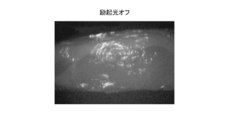
- Test example 9 it is the photograph which image
- the film produced in Example 8 is a photograph taken with a near-infrared imaging camera by irradiating a pork having a thickness of 2 mm with excitation light having a center wavelength of 740 nm.
- the film produced in Example 8 is a photograph taken with a near-infrared imaging camera by irradiating a pork having a thickness of 15 mm with excitation light having a center wavelength of 740 nm.
- the present invention is a resin composition comprising a luminescent substance, a radiopaque substance, and a resin, wherein the content of the radiopaque substance is 2% by mass or more and 80% by mass or less.
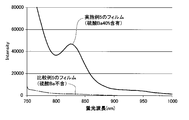
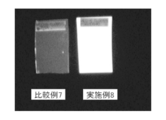
- the resin composition according to the present invention has clearly higher emission intensity in the direction of the excitation light source and higher sensitivity for emission detection than the resin composition containing the same kind of luminescent substance.
- the resin composition according to the present invention containing both a fluorescent material and a radiopaque substance has a maximum fluorescence wavelength and the vicinity thereof than a resin composition containing only the same kind of fluorescent material.
- the fluorescence intensity can be enhanced by 30% or more, preferably 100% or more, more preferably 150% or more, further preferably 200% or more, particularly preferably 300% or more, and most preferably 2000% or more.
- the reason why the effect of enhancing the emission intensity (sensitization effect) by the radiopaque substance is not clear, but is presumed as follows. For example, (1) since it contains a radiopaque material, the excitation light hits the opaque material, does not pass through the resin, and is scattered near the surface, resulting in local enhancement of the excitation light.
- the fluorescence In the transparent smooth film, the fluorescence easily emits light at the end face by the law of total reflection, but the smoothness is lost due to the radiopaque material, the total reflection is reduced, and the fluorescence is scattered inside, and the excitation light source (3)
- the coexistence with the radiopaque material improves the dispersibility of the luminescent material (the interaction between the luminescent materials decreases, quenching decreases, and the luminous efficiency increases. )).
- the reasons described above act synergistically and a sensitizing effect appears. Since 2% by mass or more of the radiopaque substance is contained, the sensitizing effect on the luminescent substance can be sufficiently exhibited.
- the light-emitting substance contained in the resin composition according to the present invention is appropriately selected and used in consideration of the product quality required for a molded body obtained from the resin composition, the kind of resin component to be mixed, and the like. be able to.
- the fluorescent material may be one having a fluorescent maximum wavelength in the visible light region (visible light fluorescent material), or one having a fluorescent maximum wavelength in the near infrared region (near infrared fluorescent material).
- the fluorescent maximum wavelength may be in the infrared region (infrared fluorescent material).
- an inorganic substance may be sufficient and an organic compound may be sufficient.
- visible light fluorescent materials examples include coumarin dyes, cyanine dyes, quinol dyes, rhodamines, oxazole dyes, phenazine dyes, azo-hydrazone dyes, violanthrone dyes, vilantron dyes, and flavantron dyes. , Fluoresceins, xanthene dyes, pyrenes, naphthalimide dyes, anthraquinone dyes, thioindigo dyes, perinone dyes, perylene dyes, azo-boron dyes, boron dimers described in International Publication No.
- Examples thereof include compounds such as pyromethene (BODIPY) dyes and porphyrin dyes.
- ZnS Ag
- (ZnCd) S Cu
- (ZnCd) S Ag
- Zn 2 SiO 4 Mn
- Cd 2 B 2 O 5 Mn
- (SrMg) 3 (PO 4 ) 2 Mn
- YVO 3 Inorganic phosphors such as En and CaWO 4 are also available.
- near-infrared fluorescent materials and infrared fluorescent materials include polymethine dyes, anthraquinone dyes, dithiol metal salt dyes, cyanine dyes, phthalocyanine dyes, indophenol dyes, thiamine dyes, and styryl.
- examples of phosphorescent materials include iridium complexes, osmium complexes, platinum complexes, europium complexes, copper complex and other organometallic complexes, porphycene complexes, and the like.
- the resin composition according to the present invention when used as a raw material for a medical device or a security device used in a living body, it is preferable to contain a near-infrared fluorescent material or an infrared fluorescent material.
- the near-infrared fluorescent material, the resin composition containing the infrared fluorescent material, and the molded product obtained therefrom can be excited and detected by invisible near-infrared light. Can be detected without changing the color tone.
- the near-infrared fluorescent material contained in the resin composition according to the present invention includes cyanine dyes, azo-boron dyes, boron dipyrromethene (BODIPY) dyes, diketopyrrolopyrrole (DPP).
- -Based boron complexes, phthalocyanine-based dyes, or squalium-based dyes are preferable from the viewpoint of luminous efficiency, and in particular, azo-boron complex compounds represented by the following general formula (I), the following general formula (II 1 ), or the following general A BODIPY dye represented by the formula (II 2 ), a DPP boron complex represented by the following general formula (II 3 ) or the following general formula (II 4 ) is preferable from the viewpoint of heat resistance. This is because when the luminous efficiency is high, sufficient luminous intensity can be obtained, and when the heat resistance is high, the material does not decompose or is difficult to knead with the resin.
- X ′ represents an aryl group which may have a substituent, or a heteroaryl group which may have a substituent;
- R 1 represents a C 1-12 alkyl group, an aryl group, an aryl ethenyl group, an aryl ethynyl group, a C 1-12 alkoxy group, an aryloxy group or a halogen atom, or one R 1 represents the above X Represents a —O—C ( ⁇ O) — group bonded to “, and forms a 6-membered ring, and the other R 1 is independently a C 1-12 alkyl group, aryl group, aryl Represents an ethenyl group, an arylethynyl group, a C 1-12 alkoxy group, an aryloxy group or a halogen atom; R 2 and R 3 together form an —O— group, an —S— group or an —N (R 8 )
- R 4 and R 5 represent a hydrogen atom group, or R 4 and R 5 together represent an —O— group, an —S— group, or an —N (R 8 ) — group (R 8 is as defined above, and R 2 and R 3 represent a hydrogen atom group;
- R 6 and R 7 independently represent a hydrogen atom group, a C 1-12 alkyl group, an aryl group which may have a substituent, or a heteroaryl group which may have a substituent;
- the substituent of the aryl group or heteroaryl group includes a C 1-12 alkyl group, a mono (C 1-12 alkyl) amino group, a di (C 1-12 alkyl) amino group, a hydroxyl group, and a C 1-12 alkoxy group.
- the “aryl group” means an aromatic hydrocarbon group.
- a phenyl group, a naphthyl group, an indenyl group, a biphenyl group, etc. preferably a C 6-10 aryl group, more preferably a phenyl group.
- Heteroaryl group means an aromatic heterocyclyl group having a 5-membered ring, 6-membered ring or condensed ring having at least one heteroatom such as a nitrogen atom, oxygen atom or sulfur atom.
- the “heteroaryl group” includes a pyrrolyl group, an imidazolyl group, a pyrazolyl group, a thienyl group, a furanyl group, an oxazolyl group, an isoxazolyl group, a thiazolyl group, an isothiazolyl group, a thiadiazole group and the like; a pyridinyl group, a pyrazinyl group Groups, 6-membered heteroaryl groups such as pyrimidinyl group, pyridazinyl group; indolyl group, isoindolyl group, indazolyl group, quinolidinyl group, quinolinyl group, isoquinoliny
- C 1-12 alkyl group means a linear or branched monovalent aliphatic hydrocarbon group having 1 to 12 carbon atoms.
- R 6 to R 7 are preferably a C 2-12 alkyl group, more preferably a C 2-10 alkyl group, and particularly preferably an nC 2-8 alkyl group. In other cases, a C 1-6 alkyl group is preferred, a C 1-4 alkyl group is more preferred, a C 1-2 alkyl group is more preferred, and a methyl group is more preferred.
- arylethenyl group refers to a —CH ⁇ CH— group substituted with the above aryl group, which may be trans or cis, but is preferably a trans type from the viewpoint of stability.
- arylethynyl group refers to a —C ⁇ C— group substituted with the above aryl group.
- C 1-12 alkoxy group means a C 1-12 alkyloxy group, preferably a C 1-6 alkoxy group, more preferably a C 1-4 alkoxy group, more preferably a C 1-2 alkoxy group, A methoxy group is more preferred.
- the hydrocarbon groups when two R 1 are alkoxy groups, the hydrocarbon groups may be bonded to each other to form a cyclic structure together with the boron atom.
- halogen atom examples include a fluorine atom, a chlorine atom, a bromine atom and an iodine atom, preferably a fluorine atom, a chlorine atom and a bromine atom, and more preferably a fluorine atom.
- “Mono (C 1-12 alkyl) amino group” means an amino group substituted by one of the above C 1-12 alkyls, for example, methylamino group, ethylamino group, propylamino group, isopropylamino group, Examples thereof include a butylamino group, an isobutylamino group, a t-butylamino group, a pentylamino group, and a hexylamino group, preferably a mono C 1-6 alkylamino group, more preferably a mono C 1-4 alkyl group. An amino group, more preferably a mono C 1-2 alkylamino group.
- Di (C 1-12 alkyl) amino group means an amino group substituted with two of the above C 1-12 alkyl. In the group, the two alkyl groups may be the same as or different from each other.
- Examples of the di-C 1-12 alkylamino group include a dimethylamino group, a diethylamino group, a dipropylamino group, a diisopropylamino group, a dibutylamino group, a diisobutylamino group, a dipentylamino group, a dihexylamino group, an ethylmethylamino group, Examples thereof include a methylpropylamino group, a butylmethylamino group, an ethylpropylamino group, and a butylethylamino group, preferably a di (C 1-6 alkyl) amino group, more preferably a di (C 1-4). Alkyl) amino group, and more preferably a
- one R 1 represents a —O—C ( ⁇ O) — group bonded to the above X ′, and forms a 6-membered ring.
- the other R 1 independently represents a C 1-12 alkyl group, an aryl group, an arylethenyl group, an arylethynyl group, a C 1-12 alkoxy group, an aryloxy group or a halogen atom, and
- the compounds represented by the following formulas (I 1 ) to (I 3 ) are preferable. Among these, a compound represented by the formula (I 1 ) is more preferable.
- Y represents an aryl group which may have a substituent, or a heteroaryl group which may have a substituent
- R 1 to R 7 in formula (I) Are the same as R 1 to R 7 in the formula.
- the formula (I 2) and (I 3) in, X 'and R 1 ⁇ R 7 is, X in the formula (I)' indicates a and R 1 ⁇ R 7 synonymous.
- the azo-boron complex compound represented by the formula (I) can be synthesized by, for example, reacting a boron compound with a hydrazone compound (II) represented by the following formula (II) (see, for example, Patent Document 2) .)
- X 'and R 1 ⁇ R 7 is X in the formula (I)' indicates a and R 1 ⁇ R 7 synonymous.
- R 9 is C 1-12 alkyl group, an aryl group, Arirueparu group, aryl ethynyl group, C 1-12 alkoxy group, an aryloxy group or a halogen atom, or R 1 is identical to R 1 A group that is more easily eliminated.
- a compound represented by general formula (II 3 ) or general formula (II 4 ) is also preferable.
- these compounds may be referred to as “DPP-based boron complexes used in the present invention”.
- R a and R b form an aromatic ring consisting of 1 to 3 rings together with the nitrogen atom to which R a is bonded and the carbon atom to which R b is bonded.
- R c and R d are aromatics composed of 1 to 3 rings together with the nitrogen atom to which R c is bonded and the carbon atom to which R d is bonded. Form a ring.
- Each of the aromatic ring formed by R a and R b and the aromatic ring formed by R c and R d is a 5-membered ring or a 6-membered ring.
- the aromatic ring formed by R a and R b and the aromatic ring formed by R c and R d are bonded to two nitrogen atoms. Having a ring structure condensed with a ring containing a boron atom. That is, the compound represented by the general formula (II 1 ) or the general formula (II 2 ) has a robust condensed ring structure composed of a wide conjugate plane.
- R h and R i form an aromatic ring composed of 1 to 3 rings together with the nitrogen atom to which R h is bonded and the carbon atom to which R i is bonded.
- R j and R k are aromatics composed of 1 to 3 rings together with the nitrogen atom to which R j is bonded and the carbon atom to which R k is bonded. Form a ring.
- Each of the aromatic ring formed by R h and R i and the aromatic ring formed by R j and R k is a 5-membered ring or a 6-membered ring.
- the compound represented by the general formula (II 3 ) or the general formula (II 4 ) includes an aromatic ring formed by R h and R i , a ring containing a boron atom bonded to two nitrogen atoms, and one nitrogen atom.
- a five-membered heterocycle containing a 5-ring heterocycle, an aromatic ring formed by R j and R k , a ring containing a boron atom bonded to two nitrogen atoms, and a five-membered ring containing one nitrogen atom It has a ring structure in which a 3-ring condensed with a heterocycle is condensed between 5-membered heterocycles, that is, a ring structure in which at least 6 rings are condensed.
- the compound represented by the general formula (II 3 ) or the general formula (II 4 ) has a robust condensed ring structure composed of a very wide conjugate plane.
- the aromatic ring formed by R a and R b , the aromatic ring formed by R c and R d , the aromatic ring formed by R h and R i, and the aromatic ring formed by R j and R k are aromatic. If it has, it will not specifically limit.
- the aromatic ring include pyrrole ring, imidazole ring, pyrazole ring, oxazole ring, thiazole ring, pyridine ring, pyrimidine ring, pyridazine ring, isoindole ring, indole ring, indazole ring, purine ring, perimidine ring, thienopyrrole ring, and fluropyrrole.
- the number of condensed rings is 2 or 3 because the maximum fluorescence wavelength becomes longer to the near infrared region. It is preferably 2, and more preferably 2 from the viewpoint of complexity of synthesis.
- the wavelength can be increased by devising a substituent on the ring or a substituent on boron.
- the wavelength can be increased to the near infrared region only by bonding a substituted aryl group or a heteroaryl group.
- the aromatic ring formed by R a and R b , the aromatic ring formed by R c and R d , the aromatic ring formed by R h and R i, and the aromatic ring formed by R j and R k include a substituent. It may not have, and may have one or a plurality of substituents.
- the substituent of the aromatic ring may be “any group that does not inhibit the fluorescence of the compound”.
- the resin composition according to the present invention is used as a medical material (raw material of a medical device), as a near-infrared fluorescent material to be contained, in a necessary biological safety test, mutagenicity, cytotoxicity, Those having negative sensitization and skin irritation are preferred. From the viewpoint of safety, it is preferable that the near-infrared fluorescent material does not elute from the molded body obtained by processing the resin composition according to the present invention with body fluid such as blood or tissue fluid. For this reason, it is preferable that the near-infrared fluorescent material used in the present invention has low solubility in biological components such as blood.
- the resin component itself in the resin composition according to the present invention hardly elutes in body fluids and the near-infrared fluorescent material.
- the content of the resin composition itself is very small, the molded article of the resin composition according to the present invention can be used while avoiding elution of the near-infrared fluorescent material even in vivo.
- mutagenicity and the like are difficult to express as a substituent that the aromatic ring formed by R a and R b or the aromatic ring formed by R c and R d has. It is preferable to select those that reduce water solubility.
- the aromatic ring formed by R h and R i or the aromatic ring formed by R j and R k does not easily exhibit mutagenicity or the like. It is preferable to select those that reduce water solubility.
- substituents examples include a halogen atom, nitro group, cyano group, hydroxy group, carboxyl group, aldehyde group, sulfonic acid group, alkylsulfonyl group, halogenosulfonyl group, thiol group, alkylthio group, isocyanate group, and thioisocyanate group.
- Alkyl group alkenyl group, alkynyl group, alkoxy group, alkoxycarbonyl group, alkylamidocarbonyl group, alkylcarbonylamide group, acyl group, amino group, monoalkylamino group, dialkylamino group, silyl group, monoalkylsilyl group, Examples thereof include a dialkylsilyl group, a trialkylsilyl group, a monoalkoxysilyl group, a dialkoxysilyl group, a trialkoxysilyl group, an aryl group, and a heteroaryl group.
- the aromatic ring formed by R a and R b, the substituent of the aromatic ring formed by R c and R d , the aromatic ring formed by R h and R i , or the aromatic ring formed by R j and R k include A cyano group, hydroxy group, carboxyl group, alkylthio group, alkyl group, alkoxy group, alkoxycarbonyl group, amide group, alkylsulfonyl group, fluorine, chlorine, aryl group, or heteroaryl group from the viewpoint of safety to living bodies It is preferable that these substituents may further have a substituent. However, the substituents other than these substituents are not limited to these substituents because the safety can be improved by further introducing appropriate substituents.
- halogen atom examples include a fluorine atom, a chlorine atom, a bromine atom and an iodine atom, preferably a fluorine atom, a chlorine atom and a bromine atom, and more preferably a fluorine atom.
- the alkyl group, alkenyl group, and alkynyl group may be linear, branched, or cyclic (aliphatic cyclic group). These groups preferably have 1 to 20 carbon atoms, more preferably 1 to 12, more preferably 1 to 8, and further preferably 1 to 6.
- alkyl group examples include methyl group, ethyl group, propyl group, isopropyl group, n-butyl group, isobutyl group, t-butyl group (tert-butyl group), pentyl group, isoamyl group, hexyl group, heptyl group, Examples include octyl group, nonyl group, decyl group, undecyl group, dodecyl group and the like.
- alkenyl group examples include a vinyl group, an allyl group, a 1-propenyl group, an isopropenyl group, a 2-butenyl group, a 1,3-butadienyl group, a 2-pentenyl group, and a 2-hexenyl group.
- alkynyl group examples include ethynyl group, 1-propynyl group, 2-propynyl group, isopropynyl group, 1-butynyl group, isobutynyl group and the like.
- alkyl group moiety in the group, dialkoxysilyl group, and trialkoxysilyl group include the same alkyl groups as those described above.
- the alkoxy group includes methoxy group, ethoxy group, propyloxy group, isopropyloxy group, n-butyloxy group, isobutyloxy group, t-butyloxy group, pentyloxy group, isoamyloxy group, hexyloxy group, heptyloxy group Octyloxy group, nonyloxy group, decyloxy group, undecyloxy group, dodecyloxy group and the like.
- dialkylamino group examples include dimethylamino group, diethylamino group, dipropylamino group, diisopropylamino group, dibutylamino group, diisobutylamino group, dipentylamino group, dihexylamino group, ethylmethylamino group, and methylpropyl group.
- examples thereof include an amino group, a butylmethylamino group, an ethylpropylamino group, and a butylethylamino group.
- Examples of the aryl group include a phenyl group, a naphthyl group, an indenyl group, and a biphenyl group.
- a phenyl group is preferred.
- Examples of the heteroaryl group include a pyrrolyl group, an imidazolyl group, a pyrazolyl group, a thienyl group, a furanyl group, an oxazolyl group, an isoxazolyl group, a thiazolyl group, an isothiazolyl group, and a thiadiazole group; a pyridinyl group and a pyrazinyl group Groups, 6-membered heteroaryl groups such as pyrimidinyl group, pyridazinyl group; indolyl group, isoindolyl group, indazolyl group, quinolidinyl group, quinolinyl group, isoquinolinyl group, benzofuranyl group,
- the alkyl group, alkenyl group, alkynyl group, aryl group, and heteroaryl group may be an unsubstituted group, and one or more hydrogen atoms may be substituted with a substituent.
- substituents include a halogen atom, alkyl group, alkoxy group, nitro group, cyano group, hydroxy group, amino group, thiol group, carboxyl group, aldehyde group, sulfonic acid group, isocyanate group, thioisocyanate group, and aryl group.
- heteroaryl groups include a halogen atom, alkyl group, alkoxy group, nitro group, cyano group, hydroxy group, amino group, thiol group, carboxyl group, aldehyde group, sulfonic acid group, isocyanate group, thioisocyanate group, and aryl group.
- heteroaryl groups include a halogen atom, alkyl group, al
- the absorption wavelength and fluorescence wavelength of fluorescent materials depend on the surrounding environment. Therefore, the absorption wavelength of the fluorescent material in the resin may be shorter or longer than that in the solution.
- the absorption wavelength of the BODIPY dye or DPP-based boron complex used in the present invention is increased, the maximum absorption wavelength is in the near infrared region among various resins.
- the maximum absorption wavelength of the fluorescent material can be obtained by introducing the electron donating group and the electron withdrawing group at appropriate positions in the molecule, thereby reducing the band gap between the highest occupied orbital (HOMO) and the lowest unoccupied orbit (LUMO). Narrower and longer wavelength can be achieved.
- an electron donating group is introduced into the aromatic ring formed by R a and R b and the aromatic ring formed by R c and R d, and an electron is introduced into R g .
- an attractive group By introducing an attractive group, the maximum absorption wavelength and the maximum fluorescence wavelength of the compound can be made longer.
- an electron donating group is introduced into the aromatic ring formed by R h and R i and the aromatic ring formed by R j and R k , R p And when R q has an aromatic ring, by introducing an electron donating group into the aromatic ring, or by introducing an electron withdrawing group into R r and R s , the maximum absorption wavelength and the maximum The fluorescence wavelength can be made longer. By combining these designs, it is possible to adjust to the target wavelength.
- the compound represented by the general formula (II 2 ) having an aza-BODIPY skeleton has a relatively long wavelength even if the aromatic ring formed by R a and R b and the aromatic ring formed by R c and R d are unsubstituted. Is a skeleton having absorption.
- the pyrrole cross-linked portion is a nitrogen atom, a substituent cannot be introduced on the nitrogen, but the pyrrole portion (R a and R b By introducing an electron donating group into the aromatic ring formed by R c and R d formed by R c and R d ), the maximum absorption wavelength and the maximum fluorescence wavelength of the compound can be made longer.
- an electron donating group is introduced into the pyrrole moiety (the aromatic ring formed by R h and R i and the aromatic ring formed by R j and R k ).
- R p and R q have an aromatic ring, the maximum absorption wavelength and the maximum fluorescence wavelength of the compound can be made longer by introducing an electron donating group into the aromatic ring.
- the aromatic ring formed by R a and R b , the aromatic ring formed by R c and R d , the aromatic ring formed by R h and R i, and the aromatic ring formed by R j and R k have As the group, among “any group that does not inhibit the fluorescence of the compound”, a group that functions as an electron-donating group for the aromatic ring is preferable. By introducing an electron donating group into the aromatic ring, fluorescence of the compound represented by the general formula (II 1 ), the general formula (II 2 ), the general formula (II 3 ), or the general formula (II 4 ) Becomes longer wavelength side.
- Examples of the group that functions as an electron donating group include alkyl groups; alkoxy groups such as methoxy groups; aryl groups such as phenyl groups, p-alkoxyphenyl groups, p-dialkylaminophenyl groups, dialkoxyphenyl groups (aromatic rings). Group); heteroaryl groups (heteroaromatic ring groups) such as 2-thienyl group and 2-furanyl group.
- alkyl group the alkyl group in the substituent of the phenyl group, and the alkyl group portion in the alkoxy group, a linear or branched alkyl group having 1 to 10 carbon atoms is preferable.
- the carbon number of an alkyl group part is 6 or more or that it is branched.
- Examples of the substituent that the aromatic ring formed by R a and R b , the aromatic ring formed by R c and R d , the aromatic ring formed by R h and R i, and the aromatic ring formed by R j and R k include A C 1-6 alkyl group, a C 1-6 alkoxy group, an aryl group, or a heteroaryl group, preferably a methyl group, an ethyl group, a methoxy group, a phenyl group, a p-methoxyphenyl group, a p-ethoxyphenyl group, p -A dimethylaminophenyl group, a dimethoxyphenyl group, a thienyl group, or a furanyl group is more preferable, and a methyl group, an ethyl group, a methoxy group, a phenyl group, or a p-methoxyphenyl group is more preferable.
- the BODIPY skeleton and the DPP skeleton have high planarity, molecules are easily aggregated by ⁇ - ⁇ stacking.
- an aryl group or heteroaryl group having a bulky substituent into the BODIPY skeleton or DPP skeleton, aggregation of molecules can be suppressed and the emission quantum yield of the resin composition according to the present invention can be increased.
- the aromatic ring formed by R a and R b and the aromatic ring formed by R c and R d may be different or the same. May be.
- the aromatic ring formed by R h and R i may be different from the aromatic ring formed by R j and R k. May be.
- the aromatic ring formed by R a and R b and R c and aromatic ring R d form, or an aromatic ring which R h and R i is an aromatic ring and R j and R k to be formed is formed is preferably the same type.
- R e and R f each independently represent a halogen atom or an oxygen atom.
- R e and R f are halogen atoms, a fluorine atom, a chlorine atom, a bromine atom, or an iodine atom is preferable, a fluorine atom or a chlorine atom is more preferable, and a fluorine atom is particularly preferable because it has a strong bond with a boron atom.
- a compound in which R e and R f are fluorine atoms has high heat resistance, and thus is advantageous when melt kneaded with a resin at a high temperature.
- R e and R f are not a halogen atom or an oxygen atom but a substituent containing an atom that can be bonded to a boron atom. Even if it exists, it can be made to contain in resin similarly to the BODIPY pigment
- a ring formed by a boron atom bonded to R e , R e and a nitrogen atom bonded to R a is condensed with an aromatic ring formed by R a and R b
- R A ring formed by a boron atom bonded to f 1 , R f , and a nitrogen atom bonded to R c is condensed with an aromatic ring formed by R c and R d .
- the ring formed by R e and the like and the ring formed by R f and the like are preferably 6-membered rings.
- R e when R e is an oxygen atom and R e does not form a ring, R e is an oxygen atom having a substituent (substituted) Oxygen atom bonded to the group).
- substituent include a C 1-20 alkyl group, an aryl group, a heteroaryl group, an alkylcarbonyl group, an arylcarbonyl group, and a heteroarylcarbonyl group.
- R f when R f is an oxygen atom and R f does not form a ring, R f represents oxygen having a substituent.
- An atom (an oxygen atom bonded to a substituent).
- substituents include a C 1-20 alkyl group, an aryl group, a heteroaryl group, an alkylcarbonyl group, an arylcarbonyl group, and a heteroarylcarbonyl group.
- R e and R f are oxygen atoms having a substituent, the substituent that R e has and the substituent that R f has may be the same or different.
- R e and R f are oxygen atoms
- R e , R f , and a boron atom bonded to R e and R f together form a ring.
- the ring structure include a structure in which R e and R f are connected to the same aryl ring or heteroaryl ring, and a structure in which R e and R f are connected by an alkylene group.
- R 1 , R m , R n , and R o are each independently a halogen atom, a C 1-20 alkyl group, or a C 1-20 alkoxy group. Represents an aryl group or a heteroaryl group.
- R 1 , R m , R n , or Ro is a halogen atom, a fluorine atom, a chlorine atom, a bromine atom, or an iodine atom is preferable, a fluorine atom or a chlorine atom is more preferable, and a strong bond with a boron atom is provided. Therefore, a fluorine atom is particularly preferable.
- a compound in which R l , R m , R n , and R o are fluorine atoms has high heat resistance, and therefore is advantageous when melt kneaded with a resin at a high temperature.
- C 1-20 alkyl group means an alkyl group having 1 to 20 carbon atoms
- C 1-20 alkoxy group means an alkoxy group having 1 to 20 carbon atoms.
- the alkyl group may be linear, branched, or cyclic (aliphatic ring) Group).
- the alkyl group include a methyl group, an ethyl group, a propyl group, an isopropyl group, an n-butyl group, an isobutyl group, a t-butyl group, a pentyl group, an isoamyl group, a hexyl group, a heptyl group, an octyl group, and a nonyl group. Decyl group, undecyl group, dodecyl group and the like.
- R 1 , R m , R n , or R o is a C 1-20 alkoxy group
- the alkyl group portion of the alkoxy group may be linear, branched, or cyclic (Aliphatic cyclic group) may be used.
- alkoxy group examples include methoxy group, ethoxy group, propyloxy group, isopropyloxy group, n-butyloxy group, isobutyloxy group, t-butyloxy group, pentyloxy group, isoamyloxy group, hexyloxy group, heptyloxy group, Examples include octyloxy group, nonyloxy group, decyloxy group, undecyloxy group, dodecyloxy group and the like.
- R 1 , R m , R n , or Ro is an aryl group
- examples of the aryl group include a phenyl group, a naphthyl group, an indenyl group, and a biphenyl group.
- R 1 , R m , R n , or Ro is a heteroaryl group
- examples of the heteroaryl group include pyrrolyl group, imidazolyl group, pyrazolyl group, thienyl group, furanyl group, oxazolyl group, isoxazolyl group, thiazolyl group, 5-membered ring heteroaryl groups such as isothiazolyl group and thiadiazole group; 6-membered ring heteroaryl groups such as pyridinyl group, pyrazinyl group, pyrimidinyl group and pyridazinyl group; indolyl group, isoindolyl group, indazolyl group, quinolidinyl group, quinolinyl group, isoquinolinyl group And a condensed heteroaryl group such as a benzofuranyl group, an isobenzofuranyl group, a chromenyl group, a benzoxazoly
- the C 1-20 alkyl group, C 1-20 alkoxy group, aryl group, and heteroaryl group represented by R 1 , R m , R n , or R o may be an unsubstituted group or one or more
- the hydrogen atom may be substituted with a substituent.
- substituents include a halogen atom, alkyl group, alkoxy group, nitro group, cyano group, hydroxy group, amino group, thiol group, carboxyl group, aldehyde group, sulfonic acid group, isocyanate group, thioisocyanate group, and aryl group. And heteroaryl groups.
- R 1 , R m , R n , and R o are a halogen atom, an unsubstituted aryl group, or an aryl group having a substituent.
- Preferred is a fluorine atom, a chlorine atom, a bromine atom, an unsubstituted phenyl group, or a phenyl group substituted with a C 1-20 alkyl group or a C 1-20 alkoxy group.
- a fluorine atom, a chlorine atom, an unsubstituted A phenyl group or a phenyl group substituted with a C 1-10 alkyl group or a C 1-10 alkoxy group is more preferred, and a fluorine atom or an unsubstituted phenyl group is particularly preferred.
- R p and R q each independently represent a hydrogen atom, a halogen atom, a C 1-20 alkyl group, a C 1-20 alkoxy group, an aryl group, Or represents a heteroaryl group.
- Examples of the halogen atom, C 1-20 alkyl group, C 1-20 alkoxy group, aryl group, and heteroaryl group represented by R p and R q include R 1 , R m , R n in the general formula (II 3 ). Or the same as R o .
- R p and R q are a hydrogen atom or an aryl group are preferable, and a hydrogen atom, an unsubstituted phenyl group, or C 1
- a phenyl group substituted with a -20 alkyl group or a C 1-20 alkoxy group is preferred, and a phenyl group substituted with a hydrogen atom, an unsubstituted phenyl group, or a C 1-20 alkoxy group is more preferred.
- a hydrogen atom, an unsubstituted phenyl group, or a phenyl group substituted with a C 1-10 alkoxy group is particularly preferable.
- R g represents a hydrogen atom or an electron withdrawing group.
- R r and R s each independently represent a hydrogen atom or an electron withdrawing group.
- the electron withdrawing group include a halogenated methyl group such as a trifluoromethyl group, a nitro group, a cyano group, an aryl group, a heteroaryl group, an alkynyl group, an alkenyl group, a carboxyl group, an acyl group, and a carbonyl group.
- Substituents having a carbonyl group such as an oxy group, an amide group, and an aldehyde group; sulfoxide groups; sulfonyl groups; alkoxymethyl groups; aminomethyl groups and the like, and aryl groups having these electron-withdrawing groups as substituents;
- a heteroaryl group or the like can also be used.
- these electron withdrawing groups a trifluoromethyl group, a nitro group, a cyano group, a sulfonyl group and the like that can function as a strong electron withdrawing group are preferable from the viewpoint of increasing the maximum fluorescence wavelength.
- the BODIPY dye used in the present invention a compound represented by the following general formula (II 1 -0) or the general formula (II 2 -0) are preferred.
- a compound having a boron dipyrromethene skeleton is preferable because the maximum fluorescence wavelength becomes longer, and particularly, the pyrrole ring satisfying the following (p2), (p3), (q2), or (q3) is an aromatic ring or
- a compound condensed with a heteroaromatic ring is preferable as the near-infrared fluorescent material used in the present invention because the maximum wavelength becomes a longer wavelength.
- R 101 , R 102 , and R 103 satisfy any of the following (p1) to (p3).
- P1 represents each independently a hydrogen atom, a halogen atom, a C 1-20 alkyl group, a C 1-20 alkoxy group, an aryl group, or a heteroaryl group
- P2 R 101 and R 102 together form an aromatic 5-membered ring or an aromatic 6-membered ring
- R 103 represents a hydrogen atom, a halogen atom, a C 1-20 alkyl group, a C 1-20 alkoxy group, an aryl Represents a group or a heteroaryl group, or
- R 102 and R 103 together form an aromatic 5-membered ring or an aromatic 6-membered ring
- R 101 represents a hydrogen atom, a halogen atom, a C 1-20 alkyl A group, a C 1-20 alk
- R 104 , R 105 , and R 106 satisfy any of the following (q1) to (q3).
- (Q1) represents each independently a hydrogen atom, a halogen atom, a C 1-20 alkyl group, a C 1-20 alkoxy group, an aryl group, or a heteroaryl group
- (Q2) R 104 and R 105 together form an aromatic 5-membered ring or an aromatic 6-membered ring
- R 106 represents a hydrogen atom, a halogen atom, a C 1-20 alkyl group, a C 1-20 alkoxy group, an aryl Represents a group or a heteroaryl group, or
- R 105 and R 106 together form an aromatic 5-membered ring or an aromatic 6-membered ring
- R 104 represents a hydrogen atom, a halogen atom, a C 1-20 alkyl A group, a
- halogen atom C 1-20 alkyl group, C 1-20 alkoxy group, aryl group and heteroaryl group in the above (p1) to (p3) or (q1) to (q3), R a and R What was illustrated as "any group which does not inhibit the fluorescence of a compound" in b can be used.
- those represented by any of the following general formulas (C-1) to (C-9) are preferred, and the following general formulas (C-1), (C-2), or (C-9) Those represented by any of the above are more preferred.
- Y 1 to Y 8 each independently represent a sulfur atom, an oxygen atom, a nitrogen atom, or a phosphorus atom.
- Y 1 to Y 8 are preferably independently a sulfur atom, an oxygen atom, or a nitrogen atom, and more preferably a sulfur atom or an oxygen atom independently of each other.
- R 11 to R 22 each independently represent a hydrogen atom or an arbitrary group that does not inhibit the fluorescence of the compound.
- an arbitrary group that does not inhibit the fluorescence of the compound those exemplified in “an arbitrary group that does not inhibit the fluorescence of the compound” in R a and R b can be used.
- R 11 to R 22 are preferably each independently a hydrogen atom, an unsubstituted aryl group, an aryl group having a substituent, an unsubstituted heteroaryl group, or a heteroaryl group having a substituent,
- a hydrogen atom, an (unsubstituted) phenyl group, a p-methoxyphenyl group, a p-ethoxyphenyl group, a p-dimethylaminophenyl group, a dimethoxyphenyl group, a thienyl group, or a furanyl group is more preferred, and a hydrogen atom, (unsubstituted) A phenyl group or a p-methoxyphenyl group is more preferable.
- the compound includes at least one of the above-described unsubstituted aryl group, aryl group having a substituent, and unsubstituted heteroaryl group. Or a heteroaryl group having a substituent is particularly preferred.
- R 101 and R 104, R 102 and R 105, and R 103 and R 106 which may be different from each It is preferable that they are the same kind of group. That is, when R 101 , R 102 , and R 103 satisfy (p1), R 104 , R 105 , and R 106 preferably satisfy (q1), and R 101 , R 102 , And R 103 satisfy (p2), R 104 , R 105 , and R 106 preferably satisfy (q2), and R 101 , R 102 , and R 103 satisfy (p3). R 104 , R 105 , and R 106 preferably satisfy the above (q3).
- R 101 and R 102 form a ring
- R 104 and R 105 form a ring
- R 102 And R 103 forms a ring
- R 105 and R 106 preferably form a ring. That is, it is preferable that R 101 , R 102 , and R 103 satisfy (p2) or (p3), and R 104 , R 105 , and R 106 satisfy (q2) or (q3). This is because when the aromatic ring or heteroaromatic ring is further condensed to the boron dipyrromethene skeleton, the maximum fluorescence wavelength becomes longer.
- R 107 and R 108 represent a halogen atom or an oxygen atom.
- R 107 and R 108 are oxygen atoms
- a boron atom bonded to R 107 , R 107 , a nitrogen atom bonded to the boron atom, R 101 , and a carbon atom bonded to R 101 together form a ring.
- the boron atom bonded to the R 108, R 108, nitrogen atom to boron atom bonded, R 104, and carbon atoms may together form a ring bonded with R 104.
- ring and ring R 107 boron atoms and R 101 or the like is formed, the R 108 and the boron atom and R 104 or the like is formed are both condensed with boron dipyrromethene backbone.
- the ring formed by R 107 , boron atom, R 101 and the like, and the ring formed by R 108 , boron atom, R 104 and the like are preferably 6-membered rings.
- R 107 is an oxygen atom, and if does not form a ring, R 107 is an oxygen atom (substituent group having a substituent Oxygen atoms bonded to each other). Examples of the substituent include a C 1-20 alkyl group, an aryl group, and a heteroaryl group.
- R 108 when R 108 is an oxygen atom, and do not form a ring, R 108 is an oxygen atom having a substituent group (Oxygen atom bonded to a substituent).
- substituents examples include a C 1-20 alkyl group, an aryl group, and a heteroaryl group. Note that when both R 107 and R 108 are oxygen atoms having a substituent, the substituent that R 107 has and the substituent that R 108 have may be the same or different.
- R 109 represents a hydrogen atom or an electron-withdrawing group.
- the electron withdrawing group include the same groups as those described above for R g .
- a fluoroalkyl group, a nitro group, a cyano group, an aryl group, and a sulfonyl group that can function as a strong electron-attracting group are preferable.
- a trifluoromethyl group, a nitro group, and a cyano group are preferable.
- R 101 and R 102 are both the general formulas (C-1 ), Any one of R 11 and R 12 is a hydrogen atom, and the remaining one is a hydrogen atom, a C 1-20 alkyl group, or a C 1 1-3 hydrogen atom.
- R 20 forms a ring that may be substituted with an alkoxy group, a phenyl group, a thienyl group, or a furanyl group, and R 104 and R 105 together form a ring of the same type as the ring formed by R 101 and R 102 ;
- R 103 and R 106 are hydrogen atoms and R 107 and R 108 are halogen atoms;
- R 101 and R 102 are both R 13 and R among the rings represented by the general formula (C-2)
- R 1 Any one of 4 is a hydrogen atom, and the other is a phenyl group in which 1 to 3 hydrogen atoms may be substituted with a halogen atom, a C 1-20 alkyl group, or a C 1-20 alkoxy group,
- a ring that is a thienyl group or a furanyl group is formed, R 104 and R 105 together form a ring that is the same as the ring that R 101 and R 102
- R 109 is a trifluoromethyl group, a cyano group, more preferably those which are nitro group, or a phenyl group, a trifluoromethyl group or a phenyl Those which are groups are particularly preferred.
- Preferred compounds of the BODIPY dye used in the present invention include the following general formulas (II 1 -1), (II 1 -2), (II 1 -3), (II 2 -1), (II 2 -2) And compounds represented by (II 2 -3).
- R 101 , R 103 , R 104 , and R 106 to R 108 are as defined above, ED represents an electron donating group, and EW represents an electron withdrawing group.
- Z 1 to Z 4 rings each independently represents a 5-membered or 6-membered aryl group, or a 5-membered or 6-membered heteroaryl group.
- the following general formula (II 1 -1 ) compounds represented by the following general formulas (II 1 -1-1) to (II 1 -1-6) are preferable, and the following general formula (II 1 -2) is preferable. is preferably a compound represented by the following general formula (II 1 -2-1) ⁇ (II 1 -2-12), as the following general formula (II 2 -1), the following general formula (II 2 -1 -1) to (II 2 -1-6) are preferred, and the following general formulas (II 2 -2) include the following general formulas (II 2 -2-1) to (II 2 -2-) The compound represented by 12) is preferred.
- Y 11 and Y 12 each independently represent an oxygen atom or a sulfur atom
- Y 21 and Y 22 each independently represent a carbon atom or a nitrogen atom.
- Y 11 and Y 12 are preferably the same kind of atoms
- Y 21 and Y 22 are preferably the same kind of atoms.
- Q 11 represents a hydrogen atom or an electron withdrawing property. Represents a group. Examples of the electron withdrawing group include the same groups as those described above for R g .
- a compound in which Q 11 is a trifluoromethyl group, a cyano group, a nitro group, or a phenyl group which may have a substituent is preferable.
- a compound which is a trifluoromethyl group or a phenyl group which may have a substituent is more preferable.
- X is independently of each other a halogen atom, a C 1-20 alkoxy group, an aryloxy group, or an acyloxy group. Represents a group.
- the alkyl group portion of the alkoxy group may be linear, branched, or cyclic (aliphatic ring group).
- the alkoxy group include methoxy group, ethoxy group, propyloxy group, isopropyloxy group, n-butyloxy group, isobutyloxy group, t-butyloxy group, pentyloxy group, isoamyloxy group, hexyloxy group, heptyloxy group, Examples include octyloxy group, nonyloxy group, decyloxy group, undecyloxy group, dodecyloxy group and the like.
- aryloxy group examples include a phenyloxy group, a naphthyloxy group, an indenyloxy group, and a biphenyloxy group.
- the acyloxy group is preferably an alkylcarbonyloxy group or an arylcarbonyloxy group.
- alkylcarbonyloxy group include a methylcarbonyloxy group (acetoxy group), an ethylcarbonyloxy group, a propylcarbonyloxy group, an isopropylcarbonyloxy group, an n-butylcarbonyloxy group, an isobutylcarbonyloxy group, and a t-butylcarbonyl group.
- Examples of the arylcarbonyloxy group include a phenylcarbonyloxy group (benzoyloxy group), a naphthylcarbonyloxy group, an indenylcarbonyloxy group, and a biphenylcarbonyloxy group.
- X is preferably a halogen atom, and X is particularly preferably a fluorine atom.
- P 11 to P 14 and P 17 are each independently a halogen atom, C 1 And represents a -20 alkyl group, a C 1-20 alkoxy group, an amino group, a monoalkylamino group, and a dialkylamino group.
- C 1-20 alkyl group C 1-20 alkoxy group, monoalkylamino group, or dialkylamino group in P 11 to P 14 , R g and (p1) to (p3), (q1) The same as those described in (q3).
- P 11 to P 14 are C 1-20 alkyl group, C 1-20 alkoxy group, (unsubstituted) phenyl group, p-methoxyphenyl group, p-ethoxyphenyl group, p-dimethylaminophenyl group, dimethoxy It is preferably a phenyl group, a thienyl group, or a furanyl group.
- a C 1-20 alkyl group, a C 1-20 alkoxy group, a phenyl group, a p-methoxyphenyl group, a p-ethoxyphenyl group , A dimethoxyphenyl group, a thienyl group, or a furanyl group, and these substituents may further have a substituent.
- the substituents other than these substituents are not limited to these substituents because the safety can be improved by further introducing appropriate substituents.
- n11 to n14 and n17 each independently represent an integer of 0 to 3.
- a 11 to A 14 are independently of each other a halogen atom, a C 1-20 alkyl group, a C 1-20 alkoxy group, an amino group, a monoalkylamino group, and A phenyl group optionally having 1 to 3 substituents selected from the group consisting of dialkylamino groups, or a halogen atom, a C 1-20 alkyl group, a C 1-20 alkoxy group, an amino group, a monoalkyl Having 1 to 3 substituents selected from the group consisting of an amino group and a dialkylamino group
- heteroaryl group examples include those similar to R 1 , R m , R n , or Ro in the general formula (II 3 ), and a thienyl group or a furanyl group is preferable.
- C 1-20 alkyl group C 1-20 alkoxy group, monoalkylamino group, or dialkylamino group in the substituent that the phenyl group or the heteroaryl group may have, each of R g and Examples are the same as those described in (p1) to (p3) and (q1) to (q3).
- a 11 to A 14 are preferably an unsubstituted phenyl group, a phenyl group having 1 or 2 C 1-20 alkoxy groups as a substituent, or an unsubstituted heteroaryl group, an unsubstituted phenyl group, or More preferred is a phenyl group having one C 1-20 alkoxy group as a substituent, and more preferred is an unsubstituted phenyl group or a phenyl group having one C 1-10 alkoxy group as a substituent. Even more preferred is a phenyl group or a phenyl group having one C 1-6 alkoxy group as a substituent.
- a 11 to A 14 are all preferably the same functional group.
- the BODIPY dye used in the present invention in particular, the following general formulas (1-1) to (1-37), (2-1) to (2-7), (3-1) to (3-37) , (4-1) to (4-7), (5-1) to (5-2) are preferred, and the following general formulas (1-1) to (1-12), A compound represented by any one of (1-25) to (1-31), (2-1) to (2-7), and (3-25) to (3-31) is more preferable.
- P 1 to P 4 and P 18 are independently of each other a halogen atom, a C 1-20 alkyl group, a C 1-20 alkoxy group, an amino group, or a monoalkyl.
- An amino group and a dialkylamino group are represented.
- the C 1-20 alkyl group, C 1-20 alkoxy group, monoalkylamino group, or dialkylamino group in P 1 to P 4 R g and (p1) to (p3), (q1) The same as those described in (q3).
- P 1 to P 4 and P 18 include C 1-20 alkyl group, C 1-20 alkoxy group, (unsubstituted) phenyl group, p-methoxyphenyl group, p-ethoxyphenyl group, p-dimethylaminophenyl.
- Group, dimethoxyphenyl group, thienyl group, or furanyl group and C 1-20 alkyl group, C 1-20 alkoxy group, phenyl group, p-methoxyphenyl group, p- More preferably, it is an ethoxyphenyl group, a dimethoxyphenyl group, a thienyl group, or a furanyl group, and these substituents may further have a substituent.
- the substituents other than these substituents are not limited to these substituents because the safety can be improved by further introducing appropriate substituents.
- n1 to n4 and n18 each independently represent an integer of 0 to 3.
- all of the plurality of P 1 may be the same or different functional groups. Also good. The same applies to P 2 to P 4 and P 18 .
- Q is a trifluoromethyl group, a cyano group, a nitro group, or a substituent. It is preferably a trifluoromethyl group or a phenyl group which may have a substituent, and more preferably a trifluoromethyl group or an unsubstituted phenyl group.
- substituent that the phenyl group may have include a halogen atom, a C 1-20 alkyl group, a C 1-20 alkoxy group, an amino group, a monoalkylamino group, and a dialkylamino group.
- X is the same as in general formula (II 1 -1-1).
- X is a halogen atom
- a fluorine atom is particularly preferable.
- m2 is 0 or 1. In the compound represented by the general formula (1-32), m2 is preferably 1.
- the compounds represented by the general formulas (3-1) to (3-37), (4-1) to (4-7), (5-2) include P 1 to P 4 and P 18 are independently of each other a C 1-20 alkyl group, a C 1-20 alkoxy group, a (unsubstituted) phenyl group, a p-methoxyphenyl group, a p-ethoxyphenyl group, a p-dimethylaminophenyl group, a dimethoxyphenyl group.
- the compound represented by any one of the following general formulas (II 3 -1) to (II 3 -6), or A compound represented by any one of formulas (II 4 -1) to (II 4 -6) is also preferred.
- R 23 , R 24 , R 25 , and R 26 are independent of each other.
- Examples of the halogen atom, C 1-20 alkyl group, C 1-20 alkoxy group, aryl group, and heteroaryl group represented by R 23 , R 24 , R 25 , or R 26 include R in the general formula (II 3 ). l, R m, R n, or are the same as those of the R o.
- R 23 , R 24 , R 25 and R 26 are preferably a halogen atom, an unsubstituted aryl group, or an aryl group having a substituent, specifically, a fluorine atom, A chlorine atom, a bromine atom, an unsubstituted phenyl group, or a phenyl group substituted with a C 1-20 alkyl group or a C 1-20 alkoxy group is preferred, and a fluorine atom, a chlorine atom, an unsubstituted phenyl group, or C 1 A phenyl group substituted with a -10 alkyl group or a C 1-10 alkoxy group is more preferable, and a compound having high luminous efficiency and thermal
- R 27 and R 28 are each independently a hydrogen atom or a halogen atom.
- Examples of the halogen atom, C 1-20 alkyl group, C 1-20 alkoxy group, aryl group, and heteroaryl group represented by R 27 or R 28 are the same as those for R p or R q in the general formula (II 3 ). Things.
- R 27 and R 28 are preferably a hydrogen atom or an aryl group, and a compound having high luminous efficiency can be obtained. Therefore, a hydrogen atom, an unsubstituted phenyl group, a C 1-20 alkyl group or a C 1-20 alkoxy group is obtained.
- a phenyl group substituted with a group more preferred is a hydrogen atom, an unsubstituted phenyl group, or a phenyl group substituted with a linear or branched C 1-20 alkoxy group, with high emission efficiency, since the compounds have excellent compatibility with the resin is obtained, a hydrogen atom, an unsubstituted phenyl group, or a full substituted with linear or branched C 1-10 alkoxy group What is sulfonyl group are particularly preferred.
- R 29 and R 30 each independently represent a hydrogen atom or an electron withdrawing group.
- Examples of the electron withdrawing group represented by R 29 or R 30 include the same groups as those described above for R r or R s in the general formula (II 3 ).
- R 29 and R 30 are strong electron withdrawing groups.
- a compound having a trifluoromethyl group or a cyano group is more preferable because a compound having high luminous efficiency and excellent compatibility with the resin can be obtained.
- Y 9 and Y 10 each independently represent a sulfur atom, an oxygen atom, a nitrogen atom, or a phosphorus atom.
- Y 9 and Y 10 are each independently a sulfur atom, Those which are oxygen atoms or nitrogen atoms are preferable, those which are sulfur atoms or oxygen atoms independently of each other are more preferable, and since a compound having high luminous efficiency and thermal stability is obtained, both are sulfur atoms or More preferably, both are oxygen atoms.
- X 1 and X 2 each independently represent a nitrogen atom or a phosphorus atom.
- X 1 and X 2 are Since both compounds are nitrogen atoms or phosphorus atoms, compounds that are both nitrogen atoms or phosphorus atoms are preferable, and since compounds that have both high luminous efficiency and thermal stability are obtained, those that are both nitrogen atoms are more preferable.
- R 31 and R 32 satisfy the following (p4) or (p5).
- P4 Independently of each other, a hydrogen atom, a halogen atom, a C 1-20 alkyl group, a C 1-20 alkoxy group, an aryl group, or a heteroaryl group is represented.
- P5 R 31 and R 32 together form an aromatic 5-membered ring which may have a substituent or an aromatic 6-membered ring which may have a substituent.
- R 33 and R 34 satisfy the following (q4) or (q5).
- (Q4) represents each independently a hydrogen atom, a halogen atom, a C 1-20 alkyl group, a C 1-20 alkoxy group, an aryl group, or a heteroaryl group, or (q5)
- R 33 and R 34 are both An aromatic 5-membered ring which may have a substituent or an aromatic 6-membered ring which may have a substituent is formed.
- R 35 , R 36 , R 37 , and R 38 are represented by the following (p6 ) To (p9) are satisfied.
- (P6) represents a hydrogen atom, a halogen atom, a C 1-20 alkyl group, a C 1-20 alkoxy group, an aryl group, or a heteroaryl group, independently of each other.
- R 35 and R 36 together form an optionally substituted aromatic 5-membered ring or optionally substituted aromatic 6-membered ring
- R 37 and R 38 are Independently of each other, a hydrogen atom, a halogen atom, a C 1-20 alkyl group, a C 1-20 alkoxy group, an aryl group, or a heteroaryl group is represented.
- R 36 and R 37 together form an optionally substituted aromatic 5-membered ring or optionally substituted aromatic 6-membered ring, and R 35 and R 38 are Independently of each other, a hydrogen atom, a halogen atom, a C 1-20 alkyl group, a C 1-20 alkoxy group, an aryl group, or a heteroaryl group is represented.
- R 37 and R 38 together form an optionally substituted aromatic 5-membered ring or optionally substituted aromatic 6-membered ring, and R 35 and R 36 are Independently of each other, a hydrogen atom, a halogen atom, a C 1-20 alkyl group, a C 1-20 alkoxy group, an aryl group, or a heteroaryl group is represented.
- R 39 , R 40 , R 41 , and R 42 are represented by the following (q6 ) To (q9) are satisfied.
- (Q6) independently of each other, represents a hydrogen atom, a halogen atom, a C 1-20 alkyl group, a C 1-20 alkoxy group, an aryl group, or a heteroaryl group.
- R 39 and R 40 together form an optionally substituted aromatic 5-membered ring or an optionally substituted aromatic 6-membered ring
- R 41 and R 42 are Independently of each other, a hydrogen atom, a halogen atom, a C 1-20 alkyl group, a C 1-20 alkoxy group, an aryl group, or a heteroaryl group is represented.
- R 40 and R 41 together form an optionally substituted aromatic 5-membered ring or an optionally substituted aromatic 6-membered ring
- R 39 and R 42 are Independently of each other, a hydrogen atom, a halogen atom, a C 1-20 alkyl group, a C 1-20 alkoxy group, an aryl group, or a heteroaryl group is represented.
- R 41 and R 42 together form an optionally substituted aromatic 5-membered ring or optionally substituted aromatic 6-membered ring
- R 39 and R 40 are Independently of each other, a hydrogen atom, a halogen atom, a C 1-20 alkyl group, a C 1-20 alkoxy group, an aryl group, or a heteroaryl group is represented.
- C 1-20 alkyl group, C 1-20 alkoxy group, aryl group, and heteroaryl group in the above (p4), (p6) to (p9) and (q4), (q6) to (q9) May be those exemplified as “any group that does not inhibit the fluorescence of the compound” in R a and R b , respectively.
- R 23 , R 24 , R 25 and R 26 are all halogen atoms, unsubstituted phenyl groups, C 1-10 alkyl groups or C 1-10.
- R 27 and R 28 are both a hydrogen atom, an unsubstituted phenyl group, or a phenyl group substituted with a C 1-20 alkyl group or a C 1-20 alkoxy group;
- R 29 and R 30 are both a trifluoromethyl group, a nitro group, a cyano group, or a phenyl group;
- Y 9 and Y 10 are both a sulfur atom or an oxygen atom;
- R 31 and R 32 are independently hydrogen.
- R 31 and R 32 together form a phenyl group which may have a substituent
- R 33 and R 34 independently of one another Is a hydrogen atom or a C 1-20 alkyl group, or a compound R 33 and R 34 together form a phenyl group which may have a substituent is preferable
- R 23, R 24, R 25, and R 26 Are both halogen atoms or unsubstituted phenyl groups
- R 27 and R 28 are both hydrogen atoms, unsubstituted phenyl groups, or phenyl groups substituted with linear or branched C 1-20 alkoxy groups
- R 29 and R 30 are both a trifluoromethyl group, a nitro group, or a cyano group
- Y 9 and Y 10 are both a sulfur atom or an oxygen atom
- R 31 and R 32 are each independently hydrogen.
- R 31 and R 32 together form an unsubstituted phenyl group or a phenyl group substituted with a C 1-10 alkyl group
- R 33 and R 34 are each independently a hydrogen atom or a C 1-20 alkyl group, or R 33 and R 34 together form a phenyl group substituted with an unsubstituted phenyl group or a C 1-10 alkyl group.
- the compound is more preferable because it has high luminous efficiency and excellent compatibility with the resin.
- Examples of the compound represented by (II 3 -2) include that R 23 , R 24 , R 25 , and R 26 are all halogen atoms, unsubstituted phenyl groups, C 1-10 alkyl groups, or C 1-10.
- R 27 and R 28 are both a hydrogen atom, an unsubstituted phenyl group, or a phenyl group substituted with a C 1-20 alkyl group or a C 1-20 alkoxy group;
- R 29 and R 30 are both a trifluoromethyl group, a nitro group, a cyano group, or a phenyl group;
- R 35 , R 36 , R 37 , and R 38 are each independently a hydrogen atom or a C 1-20 alkyl group
- R 35 and R 36 together form a phenyl group which may have a substituent
- R 37 and R 38 are each independently a hydrogen atom or a C 1-20 alkyl group
- R 36 and R 37 together form an optionally substituted phenyl group
- R 35 and R 38 are each independently a hydrogen atom or a C 1-20 alkyl group, or R 37 And R 38 together form an optionally substituted phenyl group,
- R 35 and R 38 are each independently
- R 37 and R 38 are each independently a hydrogen atom or a C 1-20 alkyl group, and R 36 and R 37 are both substituted with an unsubstituted phenyl group or a C 1-10 alkyl group.
- R 35 and R 38 are each independently a hydrogen atom or a C 1-20 alkyl group, or R 37 and R 38 are both an unsubstituted phenyl group or a C 1-10 alkyl group.
- R 35 and R 36 are each independently a hydrogen atom or a C 1-20 alkyl group;
- R 39 , R 40 , R 41 , and R 42 are independently hydrogen is an atom or a C 1-20 alkyl group, form a phenyl group which R 39 and R 40 are both substituted with an unsubstituted phenyl group or a C 1-10 alkyl group, 41 and R 42 are each independently of the other hydrogen or C 1-20 alkyl group, to form a phenyl group substituted by R 40 and R 41 are both unsubstituted phenyl group or a C 1-10 alkyl group,
- R 39 and R 42 are each independently a hydrogen atom or a C 1-20 alkyl group, or R 41 and R 42 together form a phenyl group substituted with an unsubstituted phenyl group or a C 1-10 alkyl group
- R 23 , R 24 , R 25 , and R 26 are all halogen atoms, unsubstituted phenyl groups, C 1-10 alkyl groups, or C 1-10.
- R 27 and R 28 are both a hydrogen atom, an unsubstituted phenyl group, or a phenyl group substituted with a C 1-20 alkyl group or a C 1-20 alkoxy group;
- R 29 and R 30 are both a trifluoromethyl group, a nitro group, a cyano group, or a phenyl group;
- X 1 and X 2 are both nitrogen atoms;
- R 36 , R 37 , and R 38 are independently of each other is a hydrogen atom or a C 1-20 alkyl group, and R 36 and R 37 are have both substituents form a well phenyl group,
- R 38 is a hydrogen atom or a C 1-20
- Examples of the compound represented by (II 3 -4) include that R 23 , R 24 , R 25 and R 26 are all halogen atoms, unsubstituted phenyl groups, C 1-10 alkyl groups or C 1-10.
- R 27 and R 28 are both a hydrogen atom, an unsubstituted phenyl group, or a phenyl group substituted with a C 1-20 alkyl group or a C 1-20 alkoxy group;
- R 29 and R 30 are both a trifluoromethyl group, a nitro group, a cyano group, or a phenyl group;
- X 1 and X 2 are both nitrogen atoms;
- R 35 , R 36 , and R 37 are independently from each other is a hydrogen atom or a C 1-20 alkyl group, to form a phenyl group optionally R 35 and R 36 are have together substituent,
- R 37 is
- R 23 , R 24 , R 25 , and R 26 are all halogen atoms, unsubstituted phenyl groups, C 1-10 alkyl groups, or C 1-10.
- R 27 and R 28 are both a hydrogen atom, an unsubstituted phenyl group, or a phenyl group substituted with a C 1-20 alkyl group or a C 1-20 alkoxy group;
- R 29 and R 30 are both a trifluoromethyl group, a nitro group, a cyano group, or a phenyl group;
- X 1 and X 2 are both nitrogen atoms;
- R 35 , R 36 , and R 38 are independently of each other is a hydrogen atom or a C 1-20 alkyl group, or R 35 and R 36 also form a phenyl group optionally both have a substituent,
- R 38 is a hydrogen atom or a C
- R 23 , R 24 , R 25 , and R 26 are all halogen atoms, unsubstituted phenyl groups, C 1-10 alkyl groups, or C 1-10.
- R 27 and R 28 are both a hydrogen atom, an unsubstituted phenyl group, or a phenyl group substituted with a C 1-20 alkyl group or a C 1-20 alkoxy group;
- R 29 and R 30 are both a trifluoromethyl group, a nitro group, a cyano group, or a phenyl group;
- X 1 and X 2 are both nitrogen atoms;
- R 35 , R 37 , and R 38 are independently of each other is a hydrogen atom or a C 1-20 alkyl group, or R 37 and R 38 also form a phenyl group optionally both have a substituent,
- R 35 is a hydrogen atom or a C 1
- R 23 , R 24 , R 25 , and R 26 are all halogen atoms, unsubstituted phenyl groups, C 1-10 alkyl groups, or C 1-10.
- R 27 and R 28 are both a hydrogen atom, an unsubstituted phenyl group, or a phenyl group substituted with a C 1-20 alkyl group or a C 1-20 alkoxy group;
- Y 9 and Y 10 are both a sulfur atom or an oxygen atom;
- R 31 and R 32 are each independently a hydrogen atom or a C 1-20 alkyl group, or R 31 and R 32 both have a substituent.
- R 33 and R 34 are each independently of the other hydrogen or C 1-20 alkyl group, or R 33 and R 34 together have a substituent It is preferably a compound that forms a phenyl group which may, R 23, R 24, R 25, and R 26 are are both a halogen atom or an unsubstituted phenyl group; R 27 and R 28 are both hydrogen atoms, unsubstituted A phenyl group, or a phenyl group substituted with a linear or branched C 1-20 alkoxy group; Y 9 and Y 10 are both sulfur atoms or oxygen atoms; R 31 and R 32 are independent of each other A hydrogen atom or a C 1-20 alkyl group, or R 31 and R 32 together form an unsubstituted phenyl group or a phenyl group substituted with a C 1-10 alkyl group; R 33 and R 34 are is a hydrogen atom or a C 1-20 alkyl group
- Examples of the compound represented by (II 4 -2) include that R 23 , R 24 , R 25 , and R 26 are all halogen atoms, unsubstituted phenyl groups, C 1-10 alkyl groups, or C 1-10.
- a phenyl group substituted with an alkoxy group R 27 and R 28 are both a hydrogen atom, an unsubstituted phenyl group, or a phenyl group substituted with a C 1-20 alkyl group or a C 1-20 alkoxy group; R 35 , R 36 , R 37 , and R 38 are each independently a hydrogen atom or a C 1-20 alkyl group, and R 35 and R 36 together form a phenyl group that may have a substituent.
- R 37 and R 38 are each independently a hydrogen atom or a C 1-20 alkyl group, R 36 and R 37 together form an optionally substituted phenyl group, and R 35 And R 38 are each independently a hydrogen atom or a C 1-20 alkyl group, or R 37 and R 38 together form an optionally substituted phenyl group, and R 35 and R 36 are Independently a hydrogen atom or a C 1-20 alkyl group;
- R 39 , R 40 , R 41 , and R 42 are independently a hydrogen atom or a C 1-20 alkyl group, R 39 and R 40 are Both form an optionally substituted phenyl group, R 41 and R 42 are each independently a hydrogen atom or a C 1-20 alkyl group, R 40 and R 41 both have a substituent also form a phenyl group optionally, a hydrogen atom or a C 1-20 alkyl group independently R 39 and R 42 each other, or R 41 and R 42 is optionally both have a substituent Fe Forming
- R 23 , R 24 , R 25 , and R 26 are all halogen atoms, unsubstituted phenyl groups, C 1-10 alkyl groups, or C 1-10.
- R 27 and R 28 are both a hydrogen atom, an unsubstituted phenyl group, or a phenyl group substituted with a C 1-20 alkyl group or a C 1-20 alkoxy group;
- X 1 and X 2 are both nitrogen atoms;
- R 36 , R 37 , and R 38 are each independently a hydrogen atom or a C 1-20 alkyl group, R 36 and R 37 both have a substituent.
- R 38 is a hydrogen atom or a C 1-20 alkyl group, or R 37 and R 38 also form a phenyl group optionally both have a substituent
- 36 is hydrogen atom or a C 1-20 alkyl group
- R 40, R 41, and R 42 are each independently of the other hydrogen or C 1-20 alkyl group, the R 40 and R 41 are both substituents
- An optionally substituted phenyl group, R 42 is a hydrogen atom or a C 1-20 alkyl group, or R 41 and R 42 together form an optionally substituted phenyl group
- a compound in which R 40 is a hydrogen atom or a C 1-20 alkyl group is preferred, and R 23 , R 24 , R 25 , and R 26 are both halogen atoms or unsubstituted phenyl groups; and R 27 and R 28 are both hydrogen atom, an unsubstituted phenyl group, or a linear or branched C 1-20
- R 23 , R 24 , R 25 and R 26 are all halogen atoms, unsubstituted phenyl groups, C 1-10 alkyl groups or C 1-10.
- R 27 and R 28 are both a hydrogen atom, an unsubstituted phenyl group, or a phenyl group substituted with a C 1-20 alkyl group or a C 1-20 alkoxy group;
- X 1 and X 2 are both nitrogen atoms;
- R 35 , R 36 , and R 37 are each independently a hydrogen atom or a C 1-20 alkyl group, R 35 and R 36 both have a substituent.
- R 37 is a hydrogen atom or a C 1-20 alkyl group, or R 36 and R 37 together form a phenyl group which may have a substituent
- 35 is hydrogen atom or a C 1-20 alkyl group
- R 39, R 40, and R 41 are each independently of the other hydrogen or C 1-20 alkyl group, the R 39 and R 40 are both substituents Forming an optionally substituted phenyl group
- R 41 is a hydrogen atom or a C 1-20 alkyl group, or R 40 and R 41 together form an optionally substituted phenyl group
- a compound in which R 39 is a hydrogen atom or a C 1-20 alkyl group is preferred, and R 23 , R 24 , R 25 , and R 26 are both halogen atoms or unsubstituted phenyl groups;
- R 27 and R 28 are both A hydrogen atom, an unsubstituted phenyl group, or a phenyl group substituted with
- R 37 is a hydrogen atom or a C 1-20 alkyl group, or R 36 and R 37 together form a phenyl group substituted with an unsubstituted phenyl group or a C 1-10 alkyl group, and R 35 Is a hydrogen atom or a C 1-20 alkyl group;
- R 39 , R 40 , and R 41 are each independently a hydrogen atom or a C 1-20 alkyl group, R 39 and R 40 are both unsubstituted phenyl form a phenyl group substituted with a group or a C 1-10 alkyl group, R 41 is a hydrogen atom or a C 1-20 alkyl group, or R 40 and R 41 is Substituted phenyl group to form unsubstituted phenyl group or a C 1-10 alkyl group, the compound R 39 is a hydrogen atom or a C 1-20 alkyl group, the emission efficiency is high, compatibility with resin Since it is excellent, it is more
- R 23 , R 24 , R 25 , and R 26 are all halogen atoms, unsubstituted phenyl groups, C 1-10 alkyl groups, or C 1-10.
- R 27 and R 28 are both a hydrogen atom, an unsubstituted phenyl group, or a phenyl group substituted with a C 1-20 alkyl group or a C 1-20 alkoxy group;
- X 1 and X 2 are both nitrogen atoms;
- R 35 , R 36 , and R 38 are each independently a hydrogen atom or a C 1-20 alkyl group, or R 35 and R 36 both have a substituent.
- R 38 is hydrogen atom or a C 1-20 alkyl group
- R 39, R 40, and R 42 are each independently of the other hydrogen or C 1- 0 is an alkyl group, or R 39 and R 40 together form a phenyl group which may have a substituent
- the compound R 42 is a hydrogen atom or a C 1-20 alkyl group is preferable
- R 23, R 24 , R 25 , and R 26 are both halogen atoms or unsubstituted phenyl groups
- R 27 and R 28 are both hydrogen atoms, unsubstituted phenyl groups, or linear or branched C 1-
- X 1 and X 2 are both nitrogen atoms
- R 35 , R 36 , and R 38 are each independently a hydrogen atom or a C 1-20 alkyl group, or R 35 and R 36 form a phenyl group substituted both with unsubstituted
- Examples of the compound represented by (II 4 -6) include that R 23 , R 24 , R 25 , and R 26 are all halogen atoms, unsubstituted phenyl groups, C 1-10 alkyl groups, or C 1-10.
- a phenyl group substituted with an alkoxy group R 27 and R 28 are both a hydrogen atom, an unsubstituted phenyl group, or a phenyl group substituted with a C 1-20 alkyl group or a C 1-20 alkoxy group;
- X 1 and X 2 are both nitrogen atoms;
- R 35 , R 37 , and R 38 are each independently a hydrogen atom or a C 1-20 alkyl group, or R 37 and R 38 both have a substituent.
- R 35 is hydrogen atom or a C 1-20 alkyl group
- R 39, R 41, and R 42 are each independently of the other hydrogen or C 1- 0 is an alkyl group, or R 41 and R 42 together form a phenyl group which may have a substituent
- the compound R 39 is a hydrogen atom or a C 1-20 alkyl group is preferable
- R 23, R 24 , R 25 , and R 26 are both halogen atoms or unsubstituted phenyl groups
- R 27 and R 28 are both hydrogen atoms, unsubstituted phenyl groups, or linear or branched C 1-
- X 1 and X 2 are both nitrogen atoms
- R 35 , R 37 , and R 38 are each independently a hydrogen atom or a C 1-20 alkyl group, or R 37 and R 38 are taken together form an unsubstituted phenyl group or a
- Examples of the compound represented by any one of (II 3 -1) to (II 3 -6) include compounds represented by any one of the following general formulas (II 3 -7) to (II 3 -9).
- the compound represented by any one of (II 4 -1) to (II 4 -6) is represented by any one of the following general formulas (II 4 -7) to (II 4 -9) Compounds are preferred.
- Y 23 and Y 24 each independently represent a carbon atom or a nitrogen atom.
- Y 23 and Y 24 are preferably the same kind of atoms.
- Y 13 and Y 14 each independently represent an oxygen atom or a sulfur atom.
- Y 23 and Y 24 are preferably the same kind of atoms.
- Y 25 and Y 26 each independently represent a carbon atom or a nitrogen atom.
- Y 25 and Y 26 are preferably the same kind of atoms.
- R 47 and R 48 independently of each other represent a hydrogen atom or an electron withdrawing group, and the fluorescence intensity becomes high. It is preferably a group, a cyano group, a nitro group, a sulfonyl group, or a phenyl group, and particularly preferably a trifluoromethyl group or a cyano group.
- R 47 and R 48 are preferably the same functional group.
- R 43 , R 44 , R 45 , and R 46 are halogen atoms or substituted
- An aryl group which may have a group is represented.
- the aryl group those exemplified as “any group that does not inhibit the fluorescence of the compound” in R a and R b can be used.
- the substituent that the aryl group may have is any “any group that does not inhibit the fluorescence of the compound”, and examples thereof include a C 1-6 alkyl group, a C 1-6 alkoxy group, an aryl Group, heteroaryl group, and the like.
- R 43 to R 46 may be different from each other, but they are all the same.
- the group is preferably.
- R 43 to R 46 are all of the same type. Those that are halogen atoms or are all phenyl groups that may have the same type of substituent are preferred, those that are all fluorine atoms or unsubstituted phenyl groups are more preferred, and those that are all fluorine atoms are particularly preferred. .
- P 15 to P 16 are each independently a halogen atom
- C 1-20 represents an alkyl group, a C 1-20 alkoxy group, an amino group, a monoalkylamino group or a dialkylamino group
- R g and (p1) to (p3), (q1) The same as those described in (q3).
- P 15 to P 16 include C 1-20 alkyl group, C 1-20 alkoxy group, (unsubstituted) phenyl group, p-methoxyphenyl group, p-ethoxyphenyl group, p-dimethylaminophenyl group, dimethoxy It is preferably a phenyl group, a thienyl group, or a furanyl group.
- a C 1-20 alkyl group, a C 1-20 alkoxy group, a phenyl group, a p-methoxyphenyl group, a p-ethoxyphenyl group , A dimethoxyphenyl group, a thienyl group, or a furanyl group, and these substituents may further have a substituent.
- the substituents other than these substituents are not limited to these substituents because the safety can be improved by further introducing appropriate substituents.
- n15 to n16 each independently represent an integer of 0 to 3.
- the plurality of P 15 may be the same functional group or different functional groups. Also good. The same is true for P 16.
- a 15 to A 16 are independently of each other a hydrogen atom, a halogen atom,
- C represents a phenyl group optionally having 1 to 3 substituents selected from the group consisting of a 1-20 alkyl group, a C 1-20 alkoxy group, an amino group, a monoalkylamino group, and a dialkylamino group .
- C 1-20 alkyl group C 1-20 alkoxy group, monoalkylamino group, or dialkylamino group in the substituent that the phenyl group may have, each of R g and (p1) to (p p3) and the same as those mentioned in (q1) to (q3).
- a 15 to A 16 are preferably an unsubstituted phenyl group, a phenyl group having 1 or 2 C 1-20 alkoxy groups as a substituent, an unsubstituted phenyl group, or one C 1-20 alkoxy A phenyl group having a group as a substituent is more preferable, and an unsubstituted phenyl group or a phenyl group having one C 1-10 alkoxy group as a substituent is more preferable.
- the general formula (II 3 -7) a compound represented by like, it is preferable either A 15 ⁇ A 16 is a functional group of the same type.
- Examples of the compound represented by any one of (II 3 -1) to (II 3 -6) include the following general formulas (6-1) to (6-12), (7-1) to (7-12). ).
- Ph represents an unsubstituted phenyl group.
- the general formulas (6-4), (6-5), (6-7), (6-8), (7-4), (7-5) ), (7-7), and (7-8) are preferred, represented by general formulas (6-4), (6-5), (6-7), and (6-8) Compounds are more preferred.
- P 5 to P 8 are each independently a halogen atom, a C 1-20 alkyl group, C 1-20 represents an alkoxy group, an amino group, a monoalkylamino group or a dialkylamino group.
- C 1-20 alkyl group C 1-20 alkoxy group, monoalkylamino group, or dialkylamino group in P 5 to P 8 , R g and (p1) to (p3), (q1) The same as those described in (q3).
- P 5 to P 8 include C 1-20 alkyl group, C 1-20 alkoxy group, (unsubstituted) phenyl group, p-methoxyphenyl group, p-ethoxyphenyl group, p-dimethylaminophenyl group, dimethoxy It is preferably a phenyl group, a thienyl group, or a furanyl group.
- n5 to n8 each independently represents an integer of 0 to 3.
- all of the plurality of P 5 may be the same or different functional groups. Also good. The same applies to P 6 to P 8 .
- P 5 to P 8 are each independently a C 1-20 alkyl group or A C 1-20 alkoxy group in which n5 to n8 are independently 0 to 2, P 5 and P 6 are independently C 1-20 alkyl groups, and n5 and n6 are More preferably, it is independently 0 to 2, P 7 and P 8 are each independently a C 1-20 alkoxy group, and n7 and n8 are each independently 0 to 1, and P 5 and P 8 6 is independently a C 1-20 alkyl group, n5 and n6 are independently 1 to 2, P 7 and P 8 are independently C 1-20 alkoxy groups, n7 and More preferably, n8 is 1.
- Specific examples of the compounds represented by the general formulas (6-1) to (6-12) include compounds represented by the following formulas (6-1-1) to (6-12-1). Can be mentioned. “ ⁇ ” is the peak wavelength of the absorption spectrum in the solution of each compound, and “Em” is the peak wavelength of the fluorescence spectrum.
- Radiopaque substances As the radiopaque substance contained in the resin composition according to the present invention, those having lower radiation permeability than those of skin, muscle, fat and the like are preferable, and those having lower permeability than bone, calcium and the like are more preferable.
- a radiopaque material include non-metal atoms such as barium sulfate, calcium carbonate, aluminum hydroxide, bromine, bromide, iodine, and iodide, and include metal atoms.
- metal powders and oxides of metals such as titanium, zinc, zirconium, rhodium, palladium, silver, tin, tantalum, tungsten, rhenium, iridium, platinum, gold, and bismuth.
- mica, talc, etc. can also be used as a radiopaque substance.
- the resin composition according to the present invention when used as a material for a medical device used in a living body, it preferably contains a radiopaque substance having high biocompatibility.
- a radiopaque substance having high biocompatibility examples include barium sulfate, bismuth oxide, bismuth hypocarbonate, calcium carbonate, aluminum hydroxide, tungsten, zinc oxide, zirconium oxide, zirconium, titanium, platinum, bismuth subnitrate, Bismuth etc. are mentioned.
- the radiopaque substance used in the present invention is more preferably barium sulfate, calcium carbonate, bismuth subcarbonate or bismuth oxide from the viewpoint of safety and the like, and barium sulfate is preferred from the viewpoint of the sensitizing effect on the luminescent substance. Particularly preferred.
- the resin composition according to the present invention may contain one kind of radiopaque substance or may contain two or more kinds. In the resin composition which concerns on this invention, what contains the 1 type (s) or 2 or more types of the radiopaque substance mentioned above is preferable.
- the shape of the radiopaque substance used in the present invention is not particularly limited as long as it can impart radiopacity to the blended resin composition, and any of particulate, filamentous, and irregular shapes can be used. It may be.
- the radiopaque substance used in the present invention is preferably in the form of particles from the viewpoint of dispersibility in a resin, radiolucency, and the light emission intensity of the luminescent substance.
- the resin component contained in the resin composition according to the present invention is not particularly limited, and considers the type of luminescent material and radiopaque material to be blended, product quality required when forming a molded body, and the like. And it can select from a well-known resin composition and its improvement suitably, and can use it.
- the resin component may be a thermoplastic resin or a thermosetting resin. When used in a molded article, the thermosetting resin may be cured during melt-kneading, so the resin component contained in the resin composition according to the present invention is preferably a thermoplastic resin.
- a resin component used in this invention only 1 type may be used and 2 or more types may be mixed and used. When two or more types are mixed, it is preferable to use a combination of highly compatible resins.
- urethane resins such as polyurethane (PU) and thermoplastic polyurethane (TPU); polycarbonate (PC); polyvinyl chloride (PVC), vinyl chloride-vinyl acetate copolymer resin, and the like.
- Vinyl chloride resins acrylic resins such as polyacrylic acid, polymethacrylic acid, polymethyl acrylate, polymethyl methacrylate (PMMA), polyethyl methacrylate; polyethylene terephthalate (PET), polybutylene terephthalate -Polyester resins such as polytrimethylene terephthalate, polyethylene naphthalate, polybutylene naphthalate; polyamide resins such as nylon (registered trademark); polystyrene (PS), imide-modified polystyrene, acrylonitrile ⁇ Butadiene styrene (A S) resin, imide-modified ABS resin, styrene / acrylonitrile copolymer (SAN) resin, polystyrene resin such as acrylonitrile / ethylene-propylene-diene / styrene (AES) resin, polyethylene (PE) resin, polypropylene (PP) resin, Olefin resins such as
- the resin composition according to the present invention contains the azo-boron complex compound represented by the above formula (I) as the light emitting substance, the dispersibility of the azo-boron complex compound is high.
- PU, TPU, PET, PVC, PC, PMMA, PS are preferable, and TPU, PET, PS are more preferable. In addition, these may mix and use 2 or more types.
- the resin composition according to the present invention contains a compound represented by the general formula (II 1 ), the general formula (II 2 ), the general formula (II 3 ), or the general formula (II 4 ) as a luminescent substance.
- the resin component includes fluorine resin, silicone resin, urethane resin, olefin resin, vinyl chloride resin, polyester resin, polystyrene resin, polycarbonate resin, polyamide Resin or acrylic resin is preferable, and urethane resin, olefin resin, polystyrene resin, polyester resin, and vinyl chloride resin are more preferable.
- PTFE Teflon (Teflon) is considered in view of low solubility in body fluids such as blood and difficulty in elution in a use environment and biocompatibility.
- silicone, PU, TPU, PP, PE, PC, PET, PS, polyamide, PVC are preferable, TPU, PU, PP, PE, PET, PS are more preferable, and TPU, PP, PET, PS are preferable. Further preferred. In addition, these may mix and use 2 or more types.
- the resin component when the resin composition according to the present invention is a thermoplastic resin composition, the resin component may be a thermoplastic resin as a whole resin component, and may contain a small amount of a non-thermoplastic resin.
- the resin component when the resin composition according to the present invention is a thermosetting resin composition, the resin component may be a thermosetting resin as a whole resin component and contains a small amount of a non-thermosetting resin. Also good.
- the resin composition according to the present invention can be produced by mixing and dispersing a luminescent substance and a radiopaque substance in a resin component.
- the light-emitting substance according to the present invention contained in the resin composition according to the present invention may be only one type, or may contain two or more types.
- the content of the luminescent substance in the resin composition is not particularly limited as long as the luminescent substance can be mixed with the resin, but from the viewpoint of emission intensity and its detection sensitivity, it is 0.0001% by mass or more. Preferably, it is preferably 5% by mass or less, more preferably in the range of 0.0001 to 1% by mass, and still more preferably in the range of 0.001 to 0.5% by mass from the viewpoint of detection sensitivity due to concentration quenching and reabsorption of luminescence. A range of 0.005 to 0.05 mass% is particularly preferable.
- the content of the near-infrared fluorescent material in the resin composition according to the present invention is particularly limited as long as the near-infrared fluorescent material can be mixed with the resin.
- it is preferably 0.0001% by mass or more from the viewpoint of fluorescence intensity and its detection sensitivity, and is preferably 5% by mass or less from the viewpoint of detection sensitivity by concentration quenching or fluorescence reabsorption, from 0.001 to The range of 0.5% by mass is more preferable, and the range of 0.005 to 0.05% by mass is more preferable.
- the near-infrared fluorescent material used in the present invention has a high molar extinction coefficient and a high quantum yield in the resin, even if the concentration of the near-infrared fluorescent material in the resin is relatively low.
- the light emission can be sufficiently visually confirmed with a camera or the like.
- Low near-infrared fluorescent material concentration reduces the possibility of elution, reduces the possibility of bleeding out from a molded product processed from a resin composition, and processes a molded product that requires transparency It is desirable from the point of being possible.
- the content of the radiopaque substance in the resin composition is 2% by mass or more from the viewpoint of obtaining a sensitizing effect on the luminescent substance, and 5% from the viewpoint of obtaining a more remarkable sensitizing effect on the luminescent substance. % Or more is preferable, and since it has a radiation shielding ability and both detection by X-ray radiation and detection by light emission are possible, 10% by mass or more is more preferable. Moreover, content of the radiopaque substance in a resin composition is 80 mass% or less from a viewpoint of the mechanical strength of a resin composition, and 50 mass% or less is preferable.
- it is usually 2% by mass or more and 80% by mass or less, more preferably 5% by mass or more and 50% by mass or less, further preferably 10% by mass or more and 50% by mass or less, and more preferably 20 to 40% by mass. Is particularly preferred.
- the mixing ratio of the luminescent substance and the radiopaque substance is not particularly limited, but from the viewpoint of increasing the emission intensity, the mixing ratio (the mass of the luminescent substance / the mass of the radiopaque substance) is 0.00001 to The range of 2.5 is preferable, the range of 0.00025 to 0.2 is more preferable, and the range of 0.00025 to 0.001 is more preferable.
- the method of mixing and dispersing the luminescent substance and the radiopaque substance in the resin component is not particularly limited, and any known method may be used, and an additive may be used in combination.
- a luminescent substance and a radiopaque substance may be added and dispersed in a resin composition solution dissolved in a suitable solvent. Even when no solvent is used, the resin composition according to the present invention can be obtained by adding a luminescent substance and a radiopaque substance to the resin composition and melt-kneading them. Thus, a resin composition in which the light emitting substance and the radiopaque substance are uniformly dispersed in the resin is obtained.
- the type and kneading of the resin and the fluorescent material are performed even when melt-kneading is performed at a temperature lower than the decomposition point of the fluorescent material.
- fluorescence may not be emitted due to causes such as poor dispersion or decomposition of the fluorescent material. Whether or not the fluorescent material can be dispersed in the thermoplastic resin or the like is difficult to predict from the thermophysical properties of the fluorescent material.
- the compound represented by the general formula (II 1 ), the general formula (II 2 ), the general formula (II 3 ), or the general formula (II 4 ) is uniformly mixed with various resin components. It can be dispersed and can emit fluorescence with high quantum yield even in the resin. The reason is not clear, but can be inferred as follows.
- the fluorescent material is dispersed by a method such as melt-kneading, if the aggregation or the like occurs, it is considered that the fluorescence quantum yield decreases due to concentration quenching. Therefore, in order for the fluorescent material to emit fluorescence efficiently, it is desirable that the fluorescent material has high compatibility with the resin and can be uniformly dispersed.
- the compatibility is high. If the difference between the SP value of the fluorescent material and the SP value of the resin is small, it is highly compatible and can be dispersed uniformly. On the other hand, even when the SP value is different, it can be explained by other physical property parameters.
- the compatibility with the resin can be explained from calculated values such as solubility, distribution coefficient, relative dielectric constant, polarizability, etc. of the fluorescent material, or measured values.
- the compatibility between the resin and the fluorescent material may differ depending on the crystallinity of the resin.
- the compatibility between the resin and the fluorescent material can be controlled by the functional group of the fluorescent material molecule itself.
- the fluorescent material molecule when dispersed in a fat-soluble (hydrophobic) polyolefin-based resin such as polypropylene or polyethylene, the fluorescent material molecule preferably has a hydrophobic group.
- compatibility with the resin can be improved by introducing a hydrophobic group such as an alicyclic alkyl group, a long-chain alkyl group, a halogenated alkyl group, or an aromatic ring into the fluorescent material molecule.
- a hydrophobic group such as an alicyclic alkyl group, a long-chain alkyl group, a halogenated alkyl group, or an aromatic ring into the fluorescent material molecule.
- the fluorescent material molecule when dispersed in a highly polar resin such as polyurethane or polyamide, the fluorescent material molecule has a hydrophilic group such as a carboxyl group, a hydroxyl group, an amino group, an alkoxy group, an aryloxy group, an alkylamino group, an ester or an amide. It is preferable. However, it is not limited to these.
- the partition coefficient and SP value which are indicators of compatibility, can be estimated as the water / octanol partition coefficient and the Hildebrand SP value from the “Hansen solubility parameter” obtained by calculation from commercially available software.
- the following compounds (8-1) to (8- The distribution coefficient and SP value of the compound represented by 8) are as follows.
- the near-infrared fluorescent material used in the present invention can be melt-kneaded and uniformly dispersed and mixed with a resin component such as PP, and the kneaded resin composition or molded from the resin composition.
- the body can stably emit near-infrared fluorescence with a high emission quantum yield.
- the near-infrared fluorescent material used in the present invention is different from many other organic near-infrared fluorescent materials, the reason why it exhibits high emission characteristics even when melt-kneaded with the resin composition is not clear, but it is used in the present invention. It is presumed that the near-infrared fluorescent material obtained has a robust skeleton composed of a wide conjugate plane, and therefore has high heat resistance and excellent compatibility with the resin.
- the resin composition according to the present invention contains a light emitting substance having a high quantum yield (number of emitted photons / number of absorbed photons) of 20% or more, there is no particular problem, but the quantum yield is low. In the case of containing a low light emitting substance, it is also important to understand the Stokes shift (difference between the maximum absorption wavelength and the maximum emission wavelength) of the resin composition according to the present invention.
- the resin composition according to the present invention preferably has a Stokes shift (difference between the maximum absorption wavelength and the maximum emission wavelength) of 10 nm or more, and more preferably has a Stokes shift of 20 nm or more. The larger the Stokes shift, the more sensitive it is to detect light emitted from the molded body even when using a general detector equipped with a filter for noise reduction by excitation light. is there.
- near-infrared fluorescence from the resin composition according to the present invention can be detected with high sensitivity under the following conditions. For example, if excitation can be performed with light having a wavelength shorter than the maximum absorption wavelength, fluorescence can be detected even if noise is cut. In addition, when the fluorescence spectrum is broad, it is possible to sufficiently detect fluorescence even if noise is cut. On the other hand, some fluorescent materials have a plurality of fluorescent peaks. In that case, even if the Stokes shift is small, if there is a fluorescence peak (second peak) on the longer wavelength side, detection should be performed with high sensitivity even when a detector equipped with a filter by noise cut is used. Is possible.
- the fluorescence peak wavelength on the long wavelength side may have a difference from the maximum absorption wavelength of 30 nm or more, and preferably 50 nm or more.
- an excitation light source, a cut filter, etc. are selected appropriately, it will not be limited to the conditions mentioned above.
- the resin composition according to the present invention does not change color in the visual state even when excited by excitation light in the near-infrared region, and is invisible. It emits fluorescence in the near infrared region and can be detected by a detector. Therefore, it is sufficient that the maximum absorption wavelength is 600 nm or more for the excitation light in the near infrared region. However, from the viewpoint of absorption efficiency, the maximum absorption wavelength is preferably close to the wavelength of the excitation light, and more than 650 nm is more preferable. Preferably, it is more preferably 665 nm or more, and particularly preferably 680 nm or more. Furthermore, when used as a medical device such as an implant, 700 nm or more is preferable.
- the resin composition according to the present invention and the molded product obtained from the composition do not change the color of the irradiated object, and the detection sensitivity is considered. Then, if the maximum fluorescence wavelength is 650 nm or more, there is no practical problem, but 700 nm or more is preferable, and 720 nm or more is more preferable. In the case of having a plurality of fluorescence peaks, even if the wavelength of the maximum fluorescence peak is 720 nm or less, it is sufficient if there is a fluorescence peak having sufficient detection sensitivity at 740 nm or more. In that case, the intensity of the fluorescence peak (second peak) on the long wavelength side is preferably 5% or more and more preferably 10% or more with respect to the intensity of the maximum fluorescence wavelength.
- the resin composition according to the present invention and the molded product obtained from the composition have strong absorption in the range of 650 nm to 1500 nm, and preferably emit strong fluorescence in this range.
- Light of 650 nm or more is not easily affected by hemoglobin, and light of 1500 nm or less is hardly affected by water.
- light within the range of 650 nm to 1500 nm has high skin permeability and is not easily affected by contaminants in the living body. Therefore, the wavelength of light used for visualizing medical implants implanted under the skin or the like. It is suitable as a region.
- the resin composition according to the present invention and the molded product obtained from the composition are suitable for detection by light in the range of 650 nm to 1500 nm, It is suitable as a medical device used in vivo.
- the resin composition according to the present invention may contain components other than the resin component, the luminescent material, and the radiopaque material as long as the effects of the present invention are not impaired.
- the other components include an ultraviolet absorber, a heat stabilizer, a light stabilizer, an antioxidant, a flame retardant, a flame retardant aid, a crystallization accelerator, a plasticizer, an antistatic agent, a colorant, and a release agent. Is mentioned.
- a molded body capable of both emission detection and radiation detection is obtained.
- the molding method is not particularly limited, and examples thereof include casting (casting method), injection molding using a mold, compression molding, extrusion molding using a T die, blow molding, and the like.
- the molded body may be formed only from the resin composition according to the present invention, or the resin composition according to the present invention and other resin compositions may be used as raw materials.
- the entire molded body may be molded with the resin composition according to the present invention, or only a part of the molded body may be molded with the resin composition according to the present invention.
- the resin composition according to the present invention is preferably used as a raw material constituting the surface portion of the molded body.
- the distal end portion of the catheter is molded with the resin composition according to the present invention, and the remaining portion is molded with a resin composition containing no near-infrared fluorescent material.
- the molded object which emits near-infrared fluorescence in stripe form can be manufactured by alternately laminating
- surface coating for improving the visibility of the molded body may be performed.
- Radiation detection can be performed by a conventional method using a commercially available X-ray apparatus or the like.
- Luminescence detection can also be performed by a conventional method using a commercially available fluorescence or phosphorescence detection device or the like.
- excitation light used for fluorescence or phosphorescence detection an arbitrary light source can be used, and in addition to a near-infrared lamp having a long wavelength width, a laser, LED, or the like having a narrow wavelength width can be used.
- a molded product obtained from a near-infrared fluorescent material or a resin composition containing an infrared fluorescent material does not change its color even when irradiated with light in the near-infrared region, and can be detected with higher sensitivity than before.
- the molded body is particularly suitable for a medical device that is inserted into or placed in the body of a patient.
- Examples of the medical device include a stent, a coil embolus, a catheter tube, an injection needle, an indwelling needle, a port, a shunt tube, a drain tube, and an implant.
- the dichloromethane layer was separated, washed with water, and concentrated under reduced pressure.
- compound (a-1) (3.39 g, 16.8 mmol) and ethyl azidoacetate (8.65 g, 67.0 mmol) were dissolved in ethanol (300 mL) in a 1 L three-necked flask under a stream of argon. Thereafter, a 20% by mass sodium ethoxide ethanol solution (22.8 g, 67.0 mmol) was slowly added dropwise to the obtained solution in an ice bath at 0 ° C. and stirred for 2 hours.
- compound (a-3) (1.90 g, 6.66 mmol) was placed in a 300 mL flask, and ethanol (60 mL) and sodium hydroxide (3.90 g, 97.5 mmol) were dissolved in water (30 mL). Aqueous solution was added and stirred at reflux for 1 hour.
- compound (a-4) (327 mg, 5.52 mmol) and trifluoroacetic acid (16.5 mL) were placed in a 200 mL three-necked flask and stirred at 45 ° C. After the compound (a-4) was dissolved, the mixture was stirred for 15 minutes until the firing stopped. To the stirred solution, trifluoroacetic anhydride (3.3 mL) was added and reacted at 80 ° C. for 1 hour. After completion of the reaction, a saturated aqueous sodium hydrogen carbonate solution and ice were added to neutralize the solution, followed by suction filtration. The filtrate was dried under vacuum to obtain a black solid of compound (a-5) (yield: 320 mg). Compound (a-5) was directly used in the next reaction without purification.
- compound (a-5) (320 mg) was placed in a 200 mL three-necked flask, and toluene (70 mL), triethylamine (1.0 mL), and boron trifluoride diethyl ether complex (1.5 mL) were added dropwise. Heated to reflux for 30 minutes. After completion of the reaction, a saturated aqueous sodium hydrogen carbonate solution was added, and the organic phase was recovered. The organic phase was washed with water and saturated brine, dried over anhydrous magnesium sulfate, the desiccant was filtered off, and the solvent was concentrated under reduced pressure.
- tert-butyloxypotassium (25.18 g, 224.4 mmol) and tert-amyl alcohol (160 mL) were placed in a 500 mL four-necked flask under an argon stream, and the compound (b- 1)
- a solution prepared by mixing (14.8 g, 64 mmol) with tert-amyl alcohol (7 mL) was added and heated to reflux.
- a solution prepared by mixing succinic acid diisopropyl ester (6.5 g, 32 mmol) with tert-amyl alcohol (10 mL) was added dropwise over about 3 hours under reflux with heating, and the mixture was heated to reflux for 6 hours after completion of the addition.
- acetic acid (872 mg, 14.5 mmol) and acetonitrile (30 mL) were placed in a 100 mL three-necked flask, and the inside of the system was placed in an argon atmosphere. Under an argon atmosphere, malononitrile (2.4 g, 36.3 mmol) and compound (b-4) (2.39 g, 13.2 mmol) were added, and the mixture was heated to reflux for 2 hours. Acetonitrile was removed under reduced pressure, the residue was dissolved in ethyl acetate, and the organic layer was washed with water and saturated brine, and treated with anhydrous magnesium sulfate.
- precursor (b-6) (1.52 g, 1.57 mmol
- toluene 45 mL
- triethylamine 4.35 mL, 31.4 mmol
- boron trifluoride Diethyl ether complex 7.88 mL, 62.7 mmol
- the reaction solution was ice-cooled, the precipitated solid was filtered off, and the solid was washed with water, saturated aqueous sodium hydrogen carbonate solution, 50% aqueous methanol solution and methanol, and dried under reduced pressure.
- the obtained residue was dissolved in toluene, and methanol was added for precipitation to obtain a dark green solid of near-infrared fluorescent dye B (yield: 1.25 g, yield: 75%).
- compound (c-2) (4.7 g, 20 mmol), sodium cyanide (1.47 g, 30 mmol), a small amount of sodium iodide and DMF (50 mL) were placed in a 100 mL three-necked flask, and the mixture was stirred at 60 ° C. Reacted for hours.
- the reaction mixture was cooled and extracted with water (200 mL) / ethyl acetate (300 mL), and the resulting ethyl acetate layer was further washed with water.
- dichloromethane 40 mL
- saturated aqueous sodium hydrogen carbonate solution 40 mL
- the organic layer was treated with anhydrous magnesium sulfate, the magnesium sulfate was filtered off, the solvent was removed under reduced pressure, and the residue was roughly removed by silica gel column chromatography (eluent: hexane / ethyl acetate).
- a precursor (d-3) (522 mg, 0.65 mmol), N, N-diisopropylethylamine (258 mg, 2.0 mmol), dichloromethane (20 mL) was placed in a 100 mL two-necked flask under an argon stream. Chlorodiphenylborane (600 mg, 3.0 mmol) was added under reflux, and the reaction was continued overnight. The reaction solution was washed with water, and the organic layer was dried over anhydrous magnesium sulfate and concentrated.
- a precursor (e-4) (973 mg, 1.0 mmol), N, N-diisopropylethylamine (387 mg, 3.0 mmol), and dichloromethane (30 mL) were placed in a 100 mL two-necked flask under an argon stream.
- Chlorodiphenylborane (900 mg, 4.5 mmol) was added while refluxing, and the reaction was continued overnight.
- the reaction solution was washed with water, and the organic layer was dried over anhydrous magnesium sulfate and concentrated.
- the residue was washed with methanol and purified by column chromatography (eluent: dichloromethane) to obtain a green solid of near-infrared fluorescent dye E (yield: 0.42 g, yield: 35%).
- N-Butyllithium (68.8 mL, 1.6 mol / L hexane solution) was added dropwise to this solution, and the mixture was stirred at the same temperature for 1 hour, and then ethyl chloroformate (10.9 mL, 120 mmol) in dehydrated THF (50 mL). Was added dropwise and the mixture was further stirred for 1 hour.
- the reaction solution was returned to room temperature, saturated aqueous ammonium chloride solution (110 mL) was added, and the mixture was extracted with dichloromethane. The organic phase was washed with water and then saturated brine, dried over anhydrous magnesium sulfate and concentrated.
- compound (f-1) (15.0 g, 81.5 mmol) and ethanol (40 mL) were added to a 200 mL four-necked flask, and hydrazine monohydrate (12.2 g, 244 mmol) was added dropwise to this solution. And stirred at reflux for 12 hours. After cooling the reaction solution, the solvent was distilled off under reduced pressure. The residue was dissolved in dichloromethane, washed with water and then saturated brine, dried over anhydrous magnesium sulfate, and concentrated.
- compound (f-5) (2.0 g, 3.8 m2 mol) and dichloromethane (250 mL) were added to a 2 L flask under an argon stream, and the mixture was stirred at room temperature for 5 minutes.
- N, N-diisopropylethylamine (1.48 g, 11.5 mmol) and boron trifluoride diethyl ether complex (3.27 g, 23 mmol) were added dropwise, and the mixture was stirred at room temperature for 1 hour.
- reaction solution was concentrated, and the residue was separated and purified by silica gel column chromatography (eluent: dichloromethane) to obtain a dark green solid of near-infrared fluorescent dye F (yield: 1.66 g, yield: 76%).
- 2-azido-3- (5-bromo-thiophen-2-yl) -acrylic acid ethyl ester (18.1 g, 60 mmol) was placed in a 500 mL eggplant flask and dissolved in o-xylene (200 mL). Then, the mixture was stirred at reflux for 1.5 hours.
- compound (g-1) (6.0 g, 22 mmol) was placed in a 500 mL flask, and an aqueous solution in which ethanol (200 mL) and sodium hydroxide (12.4 g, 310 mmol) were dissolved in water (100 mL) was added. Stir at reflux for 1 hour. The solution after stirring under reflux was allowed to cool and then adjusted to acidity by adding 6 mol / L hydrochloric acid, then water was added and suction filtration was performed, and the obtained filtrate was vacuum-dried to give 2-bromo-4H. -A gray solid of thieno [3.2-b] pyrrole-5-carboxylic acid (g-2) was obtained (yield: 4.1 g, yield: 75.8%).
- compound (g-2) (4.0 g, 16.3 mmol) and trifluoroacetic acid (100 mL) were placed in a 300 mL three-necked flask and stirred at 40 ° C. After the compound (d-2) was dissolved, the mixture was stirred for 15 minutes until foaming stopped. To the stirred solution, trifluoroacetic anhydride (36 mL) was added and reacted at 80 ° C. for 4 hours. After completion of the reaction, the reaction solution was added to a saturated aqueous sodium hydrogen carbonate solution containing ice, and the solution was neutralized. Then, suction filtration was performed, followed by vacuum drying to obtain a crude product of compound (g-3).
- Example 1 TPU pellet (product name: EG-60D-B40, manufactured by Lubrizol) 55 g containing 40% by mass of barium sulfate and Coumarin 6 (reagent commercially available from Tokyo Chemical Industry Co., Ltd., visible fluorescent material) 5 mg was mixed to attach the fluorescent material to the pellet surface. Subsequently, the pellets were put into a lab plast mill (manufactured by Toyo Seiki Seisakusho Co., Ltd.), and melt-kneaded at a preset temperature of 190 ° C. for 10 minutes. Thereafter, the kneaded fluorescent material-containing resin was taken out and formed into a film.
- a lab plast mill manufactured by Toyo Seiki Seisakusho Co., Ltd.
- Filming was performed as follows. First, the melt-kneaded fluorescent material-containing resin was heated for 5 minutes while being sandwiched between iron plates heated to 200 ° C., and pressed at 5 to 10 mPa while cooling the iron plates. At that time, the thickness of the film was about 300 ⁇ m, and the pigment concentration was 0.03% by mass. The mixing ratio of the fluorescent material and the radiopaque substance (the mass of the fluorescent material / the mass of the radiopaque substance) was 0.00075.
- the absorption spectrum of the obtained film was measured with an ultraviolet-visible near-infrared spectrophotometer “UV3600” manufactured by SHIMADZU, and the emission spectrum was measured with an absolute PL quantum yield measuring device “Quantaurus-QY C11347” manufactured by Hamamatsu Photonics. As a result, it was confirmed that the maximum absorption wavelength was 444 nm, the maximum fluorescence wavelength was around 516 nm, and yellow-green fluorescence was emitted.
- the film could be detected by X-ray photography, and the radiopacity was comparable to the film obtained from TPU before containing the fluorescent material. From these results, it is clear that the resin composition according to the present invention containing a fluorescent material and a radiopaque substance can be visualized by an X-ray detection device and a fluorescence detection device. The results are summarized in Table 1.
- Example 1 A film was produced in the same manner as in Example 1 except that the pellet containing barium sulfate was replaced with a TPU pellet containing no barium sulfate (product name: EG-65D, manufactured by Lubrizol). Evaluation was performed. As a result, it was confirmed that the obtained film emitted yellowish green fluorescence, but it was not detected by the X-ray detection device because there was no X-ray opacity. The results are summarized in Table 1.
- Example 2 A dye concentration of 0.03% by mass was obtained in the same manner as in Example 1 except that the fluorescent material used was changed from Coumarin 6 to Lumogen (registered trademark) F Red 305 (visible fluorescent material manufactured by BASF, perylene dye).
- a film was prepared and evaluated in the same manner as in Example 1. The obtained film had a maximum absorption wavelength of 534 nm and a maximum fluorescence wavelength of around 627 nm. The mixing ratio of the fluorescent material and the radiopaque substance was 0.00075.
- Example 2 A film was produced in the same manner as in Example 2 except that the pellet containing barium sulfate was replaced with a TPU pellet containing no barium sulfate (product name: EG-65D, manufactured by Lubrizol). Evaluation was performed. As a result, it was confirmed that the obtained film emits red fluorescence, but it was not detected by the X-ray detection device because there was no X-ray opacity. The results are summarized in Table 1.
- Example 3 A film having a dye concentration of 0.03% by mass was prepared in the same manner as in Example 1 except that the fluorescent material used was changed from coumarin 6 to the azo-boron complex (near-infrared light fluorescent material) synthesized in Production Example 1. The same evaluation as in Example 1 was performed. The obtained film had a maximum absorption wavelength of 683 nm and a maximum fluorescence wavelength near 820 nm. The mixing ratio of the fluorescent material and the radiopaque substance was 0.00075.
- Example 3 A film was produced in the same manner as in Example 3 except that the pellet containing barium sulfate was replaced with a TPU pellet containing no barium sulfate (product name: EG-65D, manufactured by Lubrizol). Evaluation was performed. As a result, it was confirmed that the obtained film emitted near-infrared fluorescence, but it was not detected by the X-ray detection apparatus because there was no X-ray opacity.
- the resin composition according to the present invention and the molded product obtained from the composition are radiopaque and contain a luminescent material, detection by X-ray imaging and detection by luminescence are possible. Both are possible.
- the resin composition according to the present invention has a higher emission intensity with respect to the amount of the added luminescent substance than a resin composition that does not contain a radiopaque substance, it detects luminescence with high sensitivity even with weaker excitation light. It can be considered as an industrially useful resin composition. The results are summarized in Table 1.
- Example 4 A film having a dye concentration of 0.03% by mass was prepared in the same manner as in Example 1 except that the fluorescent material used was replaced with the near-infrared fluorescent dye A (near-infrared fluorescent material) synthesized in Production Example 2 from coumarin 6. The same evaluation as in Example 1 was performed. The obtained film had a maximum absorption wavelength of 730 nm, a maximum fluorescence wavelength of 765 nm, and a fluorescence peak was observed at 824 nm. The mixing ratio of the fluorescent material and the radiopaque substance was 0.00075. Moreover, when the said film was radiographed, the radiopacity was comparable with the film obtained from TPU before containing a fluorescent material. From these results, it is clear that the resin composition according to the present invention containing a fluorescent material and a radiopaque substance can be visualized by an X-ray detection device and a fluorescence detection device. The results are summarized in Table 1.
- Example 4 A film was produced in the same manner as in Example 4 except that the pellet containing barium sulfate was replaced with a TPU pellet containing no barium sulfate (product name: EG-65D, manufactured by Lubrizol). Evaluation similar to Example 1 was made. Went. As a result, it was confirmed that the obtained film emitted near-infrared fluorescence, but it was not detected by the X-ray detection apparatus because there was no X-ray opacity. The results are summarized in Table 1.
- Example 5 110 g of TPU pellets (product name: EG-60D-B40, manufactured by Lubrizol) containing 40% by mass of barium sulfate and 5.5 mg of near-infrared fluorescent dye A synthesized in Production Example 2 were mixed, and the pellet surface was fluorescent. Material was deposited. Next, the pellets were put into a lab plast mill and melt kneaded at a preset temperature of 190 ° C. for 10 minutes. Thereafter, the kneaded fluorescent material-containing resin was taken out, and a film having a pigment concentration of 0.005% by mass was produced in the same manner as in Example 1. The mixing ratio of the fluorescent material and the radiopaque substance was 0.000125.
- the absorption spectrum of the obtained film was measured with an ultraviolet-visible near-infrared spectrophotometer “UV3600” manufactured by SHIMADZU, and the emission spectrum was measured with a spectrofluorophotometer “FP-8600” manufactured by JASCO Corporation. (Excitation wavelength: 740 nm)
- the obtained film had a maximum absorption wavelength of 738 nm, a strong fluorescence tail at 750 nm or more, and fluorescence with a peak at 827 nm was observed.
- Example 5 A film was produced in the same manner as in Example 5 except that the used pellet was changed from a pellet containing barium sulfate to a TPU pellet containing no barium sulfate (product name: EG-65D, manufactured by Lubrizol). The same evaluation was performed. As a result, it was confirmed that the obtained film emitted near-infrared fluorescence, but it was not detected by the X-ray detection apparatus because there was no X-ray opacity. The results are summarized in Table 1.
- Example 6 A dye concentration of 0.005% by mass was obtained in the same manner as in Example 5 except that the used fluorescent material was changed from the near-infrared fluorescent dye A synthesized in Production Example 2 to the near-infrared fluorescent dye B synthesized in Production Example 3.
- a film was prepared and evaluated in the same manner as in Example 5. The results are summarized in Table 1. The obtained film had a maximum absorption wavelength of 738 nm, a maximum fluorescence wavelength of 757 nm, and a fluorescence peak was observed at 832 nm. Moreover, the mixing ratio of the fluorescent material and the radiopaque substance was 0.000125.
- Example 6 A film was produced in the same manner as in Example 6 except that the pellets used were changed from pellets containing barium sulfate to TPU pellets containing no barium sulfate (product name: EG-65D, manufactured by Lubrizol). Evaluation similar to 6 was performed. As a result, it was confirmed that the obtained film emitted near-infrared fluorescence, but it was not detected by the X-ray detection apparatus because there was no X-ray opacity. The results are summarized in Table 1.
- Example 7 Example 5 except that the amount of pellets used was changed from 110 g to 440 g, and the used fluorescent material was changed from the near infrared fluorescent dye A synthesized in Production Example 2 to the near infrared fluorescent dye C synthesized in Production Example 4. Similarly, a film having a pigment concentration of 0.00125% by mass was prepared and evaluated in the same manner as in Example 5. The results are summarized in Table 1. The obtained film had a maximum absorption wavelength of 762 nm, a maximum fluorescence wavelength of 772 nm, and a fluorescence peak was observed at 864 nm. The mixing ratio of the fluorescent material and the radiopaque substance was 0.0000313.
- Example 8 A dye concentration of 0.005% by mass was obtained in the same manner as in Example 5 except that the used fluorescent material was changed from the near-infrared fluorescent dye A synthesized in Production Example 2 to the near-infrared fluorescent dye C synthesized in Production Example 4.
- a film was prepared and evaluated in the same manner as in Example 5. The results are summarized in Table 1. The obtained film had a maximum absorption wavelength of 762 nm, a maximum fluorescence wavelength of 784 nm, and a fluorescence peak was observed at 864 nm. Moreover, the mixing ratio of the fluorescent material and the radiopaque substance was 0.000125.
- Example 7 A film was produced in the same manner as in Example 8 except that the used pellet was changed from a pellet containing barium sulfate to a TPU pellet containing no barium sulfate (product name: EG-65D, manufactured by Lubrizol). Evaluation similar to 8 was performed. As a result, it was confirmed that the obtained film emitted near-infrared fluorescence, but it was not detected by the X-ray detection apparatus because there was no X-ray opacity. The results are summarized in Table 1.
- Example 9 The dye concentration was the same as in Example 5 except that the near-infrared fluorescent dye A synthesized in Production Example 2 was replaced with 5.5 mg of the near-infrared fluorescent dye A synthesized in Production Example 2 to 44 mg.
- a 0.04% by mass film was produced and evaluated in the same manner as in Example 5. The results are summarized in Table 1. The obtained film had a maximum absorption wavelength of 759 nm, a maximum fluorescence wavelength of 809 nm, and a fluorescence peak was observed at 864 nm. Further, the mixing ratio of the fluorescent material and the radiopaque substance was 0.001.
- Example 10 A dye concentration of 0.005% by mass was obtained in the same manner as in Example 5 except that the used fluorescent material was changed from the near-infrared fluorescent dye A synthesized in Production Example 2 to the near-infrared fluorescent dye D synthesized in Production Example 5.
- a film was prepared and evaluated in the same manner as in Example 5. The results are summarized in Table 1. The obtained film had a maximum absorption wavelength of 743 nm, a maximum fluorescence wavelength of 760 nm, and a fluorescence peak was observed at 852 nm. Moreover, the mixing ratio of the fluorescent material and the radiopaque substance was 0.000125.
- Example 11 A dye concentration of 0.005% by mass was obtained in the same manner as in Example 5 except that the used fluorescent material was replaced with the near-infrared fluorescent dye E synthesized in Production Example 6 from the near-infrared fluorescent dye A synthesized in Production Example 2.
- a film was prepared and evaluated in the same manner as in Example 5. The results are summarized in Table 1. The obtained film had a maximum absorption wavelength of 754 nm, a maximum fluorescence wavelength of 776 nm, and a fluorescence peak was observed at 872 nm. Moreover, the mixing ratio of the fluorescent material and the radiopaque substance was 0.000125.
- Example 12 A dye concentration of 0.005% by mass was obtained in the same manner as in Example 5 except that the used fluorescent material was changed from the near-infrared fluorescent dye A synthesized in Production Example 2 to the near-infrared fluorescent dye F synthesized in Production Example 7.
- a film was prepared and evaluated in the same manner as in Example 5. The results are summarized in Table 1. In the obtained film, a fluorescence peak was observed at a maximum absorption wavelength of 744 nm and a maximum fluorescence wavelength of 787 nm. Moreover, the mixing ratio of the fluorescent material and the radiopaque substance was 0.000125.
- Example 13 The dye concentration was the same as in Example 5 except that the near-infrared fluorescent dye A synthesized in Production Example 2 was replaced with 5.5 mg of the near-infrared fluorescent dye A synthesized in Production Example 8 by 33 mg.
- a 0.03% by mass film was prepared and evaluated in the same manner as in Example 5. The results are summarized in Table 1. In the obtained film, a fluorescence peak was observed at a maximum absorption wavelength of 741 nm and a maximum fluorescence wavelength of 771 nm. Moreover, the mixing ratio of the fluorescent material and the radiopaque substance was 0.00075.
- Example 14 A dye concentration of 0.03 mass% was obtained in the same manner as in Example 13 except that the used fluorescent material was replaced with the near-infrared fluorescent dye H synthesized in Production Example 9 from the near-infrared fluorescent dye G synthesized in Production Example 8.
- a film was prepared and evaluated in the same manner as in Example 13, and the results are summarized in Table 1.
- a fluorescence peak was observed at a maximum absorption wavelength of 744 nm and a maximum fluorescence wavelength of 776 nm.
- the mixing ratio of the fluorescent material and the radiopaque substance was 0.00075.
- Example 15 88 g of TPU pellets (product name: EG-60D, manufactured by Lubrizol), 22 g of bismuth oxide (manufactured by Aldrich), and 5.5 mg of near-infrared fluorescent dye B synthesized in Production Example 3 are mixed, and a fluorescent material is formed on the pellet surface.
- the pellets were put into a lab plast mill and melt kneaded at a preset temperature of 190 ° C. for 10 minutes. Thereafter, the kneaded fluorescent material-containing resin was taken out, and a film having a pigment concentration of 0.005 mass% and a bismuth oxide content of 20 mass% was produced in the same manner as in Example 5.
- the mixing ratio of the fluorescent material and the radiopaque substance was 0.00025.
- This film was evaluated in the same manner as in Example 5, and the results are summarized in Table 2. The obtained film had a maximum absorption wavelength of 738 nm, a maximum fluorescence wavelength of 756 nm, and a fluorescence peak was observed at 830 nm.
- Example 16 Mix 104.5 g of TPU pellet (product name: EG-60D, manufactured by Lubrizol), 5.5 g of calcium carbonate (manufactured by Aldrich), and 5.5 mg of near-infrared fluorescent dye B synthesized in Production Example 3, and pellet A fluorescent material was attached to the surface. Next, the pellets were put into a lab plast mill and melt kneaded at a preset temperature of 190 ° C. for 10 minutes. Thereafter, the kneaded fluorescent material-containing resin was taken out, and a film having a pigment concentration of 0.005 mass% and a calcium carbonate content of 5 mass% was produced in the same manner as in Example 5.
- the mixing ratio of the fluorescent material and the radiopaque substance was 0.001.
- This film was evaluated in the same manner as in Example 5, and the results are summarized in Table 2.
- the obtained film had a maximum absorption wavelength of 738 nm, a maximum fluorescence wavelength of 756 nm, and a fluorescence peak was observed at 830 nm.
- Example 17 A film having a dye concentration of 0.005% by mass was prepared in the same manner as in Example 15 except that the near-infrared fluorescent dye C synthesized in Production Example 4 was used instead of the near-infrared fluorescent dye B synthesized in Production Example 3. Then, the same evaluation as in Example 15 was performed, and the results are summarized in Table 2. The obtained film had a maximum absorption wavelength of 762 nm, a maximum fluorescence wavelength of 783 nm, and a fluorescence peak was observed at 859 nm. The mixing ratio of the fluorescent material and the radiopaque substance was 0.00025.
- Example 18 A film having a dye concentration of 0.005% by mass was prepared in the same manner as in Example 16 except that the near-infrared fluorescent dye C synthesized in Production Example 4 was used instead of the near-infrared fluorescent dye B synthesized in Production Example 3. Then, the same evaluation as in Example 16 was performed, and the results are summarized in Table 2. The obtained film had a maximum absorption wavelength of 762 nm, a maximum fluorescence wavelength of 779 nm, and a fluorescence peak was observed at 858 nm. The mixing ratio of the fluorescent material and the radiopaque substance was 0.00025.
- Example 19 PP pellet (product name: B221WA, manufactured by Prime Polymer Co., Ltd.) 88 g, barium sulfate (manufactured by Wako Pure Chemical Industries, Ltd.) 22 g, and near-infrared fluorescent dye B 5.5 mg synthesized in Production Example 3 were mixed, and the pellet surface was fluorescent. Material was deposited. Next, the pellets were put into a lab plast mill and melt kneaded at a preset temperature of 180 ° C. for 10 minutes.
- Example 5 Thereafter, the kneaded fluorescent material-containing resin was taken out, and a PP film having a pigment concentration of 0.005 mass% and a barium sulfate content of 20 mass% was produced in the same manner as in Example 5. At this time, the mixing ratio of the fluorescent material and the radiopaque substance was 0.00025. This film was evaluated in the same manner as in Example 5, and the results are summarized in Table 3. The obtained film had a maximum absorption wavelength of 737 nm, a maximum fluorescence wavelength of around 750 nm, and a fluorescence peak was observed at 827 nm.
- Example 8 A film was produced in the same manner as in Example 19 except that the pellet to be used was replaced with PP pellets containing no barium sulfate (product name: B221WA, manufactured by Prime Polymer Co., Ltd.) without using barium sulfate. Similar evaluations were made. As a result, it was confirmed that the obtained film emitted near-infrared fluorescence, but it was not detected by the X-ray detection apparatus because there was no X-ray opacity.
- Example 20 The near-infrared fluorescent dye A synthesized in Production Example 2 was used in place of the near-infrared fluorescent dye B synthesized in Production Example 3, and polystyrene (Dick Styrene (trademark) LP-6000, manufactured by DIC Corporation) was used instead of the PP pellet. And a polystyrene film having a dye concentration of 0.005% by mass was prepared in the same manner as in Example 19 except that the kneading temperature was changed to 230 ° C., and the same evaluation as in Example 19 was performed. I summarized it.
- the obtained film had a maximum absorption wavelength of 736 nm, had a strong fluorescence tail at 750 nm or more, and fluorescence with a peak at 830 nm was observed.
- the mixing ratio of the fluorescent material and the radiopaque substance was 0.00025.
- Example 21 The near-infrared fluorescent dye A synthesized in Production Example 2 was used instead of the near-infrared fluorescent dye B synthesized in Production Example 3, and PET (Byron (trademark) SI-173C, manufactured by Toyobo Co., Ltd.) was used instead of the PP pellet.
- a PET film having a pigment concentration of 0.005% by mass was prepared in the same manner as in Example 19 except that the kneading temperature was changed to 210 ° C., and the same evaluation as in Example 19 was performed. I summarized it.
- the obtained film had a maximum absorption wavelength of 738 nm, had a strong fluorescence tail above 750 nm, and fluorescence with a peak at 827 nm was observed.
- the mixing ratio of the fluorescent material and the radiopaque substance was 0.00025.
- Example 22 A film having a pigment concentration of 0.005% by mass was prepared in the same manner as in Example 15 except that the bismuth oxide used in Example 15 was changed to barium sulfate and adjusted so as to contain 5%. Evaluation was performed and the results are summarized in Table 4. The obtained film had a maximum absorption wavelength of 762 nm, a maximum fluorescence wavelength of 781 nm, and a fluorescence peak was also observed in the vicinity of 860 nm. Further, the mixing ratio of the fluorescent material and the radiopaque substance was 0.001.
- Example 9 A film was produced in the same manner as in Example 15 except that the content of barium sulfate used in Example 22 was adjusted to 1%, and the same evaluation as in Example 15 was performed. The mixing ratio of the fluorescent material and the radiopaque substance was 0.005. As a result, it was confirmed that the obtained film emitted near-infrared fluorescence, but the sensitizing effect was insufficient and the X-ray impermeability was also insufficient. The results are summarized in Table 4.
- Example 10 A film was produced in the same manner as in Example 15 except that the content of bismuth oxide used in Example 15 was adjusted to 1%, and the same evaluation as in Example 15 was performed. The mixing ratio of the fluorescent material and the radiopaque substance was 0.005. As a result, it was confirmed that the obtained film emitted near-infrared fluorescence, but the sensitizing effect was insufficient and the X-ray impermeability was also insufficient. The results are summarized in Table 4.
- the film obtained from the resin composition according to the present invention contains a fluorescent material and a radiopaque substance (barium sulfate), and therefore can be confirmed by both near-infrared fluorescence and X-rays.
- the film of the comparative example could not be confirmed by X-ray.
- radiopaque material that can be used in the resin composition according to the present invention is not limited to barium sulfate, and various materials having radiopaque properties are effective.
- the resin that can be used in the resin composition according to the present invention is not limited to TPU, and various resins are effective.
- Example 1 The film (1) produced in Example 1 was cut to a size of 1 cm square and wrapped with aluminum foil (2) whose inner side was black so that a 5 mm square opening (2a) was formed on one side, and the opening (2a ) Were shielded from light except for the exposed surface (1a) (FIG. 1). As a result, light can be absorbed only from the exposed surface (1a), and fluorescence can be emitted only from the exposed surface (1a), and a case where detection is actually performed by a detector such as a camera can be assumed. .
- the luminous efficiency was 0.17 for the film of Example 1, 0.07 for the film of Comparative Example 1, and the luminous efficiency of Example 1 was higher. Therefore, it was clarified that the film containing barium sulfate has higher fluorescence intensity and can be easily detected by a detector.
- Example 2 Regarding the films produced in Example 2 and Comparative Example 2, the fluorescence spectrum was measured when the film partially exposed in the same manner as in Test Example 1 was irradiated with excitation light of 582 nm. As a result, the intensity of 627 nm, which is near the maximum fluorescence wavelength, was 95, which was about 118% stronger than the intensity of the maximum fluorescence wavelength of the film of Comparative Example 2. Therefore, it was clarified that the film containing barium sulfate has higher fluorescence intensity and can be easily detected by a detector.
- Example 4 The film produced in Example 3 and Comparative Example 3 was irradiated with an LED ring illuminator having excitation light with a center wavelength of 740 nm, and observed with a near-infrared imaging camera having a detection sensitivity of 800 nm or more. As a result, it was confirmed that the film of Example 3 emitted light strongly as compared with the film containing no barium sulfate prepared in Comparative Example 3. As described above, it can be seen that in a resin containing a radiopaque material typified by barium sulfate, light is emitted more strongly than in a resin not containing a radiopaque material. And a luminescent substance are considered to be industrially useful resin compositions.
- Example 6 With respect to the films prepared in Example 5 and Comparative Example 5, the spectrum at an excitation wavelength of 740 nm was measured with a spectrofluorometer “FP-8600” manufactured by JASCO Corporation. The measurement results are shown in FIG. As a result, the film of Example 5 has a fluorescence peak on the long wavelength side, the intensity of 827 nm near the wavelength of the fluorescence peak is 47000, and the intensity around the maximum fluorescence wavelength of the film of Comparative Example 5. The strength was about 3200%.
- Example 7 The films produced in Example 6 and Comparative Example 6 were photographed with a near-infrared imaging camera in the same manner as in Test Example 4. As a result, the film of Example 6 clearly emitted light stronger than the film of Comparative Example 6. It was. A photograph of both is shown in FIG. From these results, it was clarified that the film containing barium sulfate has higher fluorescence intensity and can be easily detected by a detector.
- Example 9 Using the film produced in Example 8, placing pork with a thickness of 2 mm or 15 mm on the film, and irradiating with an LED ring illuminator having excitation light with a center wavelength of 740 nm, has a detection sensitivity of 800 nm or more. Photographed with a near-infrared imaging camera. When filming without irradiating the excitation light, the film under the pork could not be confirmed (FIG. 6A). The fluorescence from the film could be clearly observed (FIG. 6B), and the fluorescence from the film could be observed even with a 15 mm thick pork (FIG. 6C). From these results, it is clear that the film can be visualized when inserted into the body or placed because the luminescence from the film has passed through pork.
- the strengths were 3.03 times and 3.96 times stronger, respectively. Furthermore, from the change in the magnification of the fluorescence intensity, it was observed that the fluorescence intensity saturates when the concentration of the radiopaque substance exceeds 40%. From the above results, almost no increase in fluorescence intensity was observed in the film containing 1% or less of the radiopaque substance, but the increase in fluorescence intensity was observed in the film containing 5 to 40% of the radiopaque substance. The sensitizing effect was confirmed.
- Example 8 when the film produced in Example 8 and Comparative Example 7 was photographed with a near-infrared imaging camera in the same manner as in Test Example 4, the film of Example 8 was clearly stronger than the film of Comparative Example 7. It was emitting light. A photograph of both is shown in FIG. From these results, it was clarified that the film containing barium sulfate has higher fluorescence intensity and can be easily detected by a detector.
- the resin composition according to the present invention and the molded product obtained from the composition are radiopaque and contain a luminescent material. Both detection by light emission and detection by light emission are possible. Further, the resin composition according to the present invention has a sensitizing effect that the emission intensity with respect to the amount of the added luminescent substance is stronger than that of the resin composition not containing the radiopaque substance, so that the weaker excitation light However, it can detect luminescence with high sensitivity and is an industrially useful resin composition.
Landscapes
- Chemical & Material Sciences (AREA)
- Health & Medical Sciences (AREA)
- Organic Chemistry (AREA)
- Chemical Kinetics & Catalysis (AREA)
- Medicinal Chemistry (AREA)
- Polymers & Plastics (AREA)
- Animal Behavior & Ethology (AREA)
- Life Sciences & Earth Sciences (AREA)
- Epidemiology (AREA)
- General Health & Medical Sciences (AREA)
- Public Health (AREA)
- Veterinary Medicine (AREA)
- Engineering & Computer Science (AREA)
- Materials Engineering (AREA)
- Heart & Thoracic Surgery (AREA)
- Surgery (AREA)
- Vascular Medicine (AREA)
- Compositions Of Macromolecular Compounds (AREA)
Abstract
L'invention concerne une composition de résine caractérisée en ce qu'elle contient une résine, une substance émettant de la lumière et une substance radio-opaque, la teneur en substance radio-opaque étant de 2 % en masse à 80 % en masse. L'invention concerne également l'une quelconque des compositions de résine susmentionnées, la teneur de la substance émettant de la lumière étant de 0,001 % en masse à 0,5 % en masse. L'invention concerne également l'une quelconque des compositions de résine susmentionnées, la substance émettant de la lumière étant un matériau fluorescent ou phosphorescent dans l'infrarouge proche. L'invention concerne également l'une quelconque des compositions de résine susmentionnées, la substance radio-opaque étant le sulfate de baryum, l'oxyde de bismuth, un sous-carbonate de bismuth, le carbonate de calcium, l'hydroxyde d'aluminium, le tungstène, l'oxyde de zinc, l'oxyde de zirconium, le zirconium, le titane, le platine, un sous-nitrate de bismuth ou le bismuth. L'invention concerne également un corps moulé obtenu par transformation de l'une quelconque des compositions de résine susmentionnées.
Applications Claiming Priority (2)
| Application Number | Priority Date | Filing Date | Title |
|---|---|---|---|
| JP2015-030083 | 2015-02-18 | ||
| JP2015030083 | 2015-02-18 |
Publications (1)
| Publication Number | Publication Date |
|---|---|
| WO2016132597A1 true WO2016132597A1 (fr) | 2016-08-25 |
Family
ID=56692126
Family Applications (1)
| Application Number | Title | Priority Date | Filing Date |
|---|---|---|---|
| PCT/JP2015/079337 Ceased WO2016132597A1 (fr) | 2015-02-18 | 2015-10-16 | Composition de résine et corps moulé |
Country Status (1)
| Country | Link |
|---|---|
| WO (1) | WO2016132597A1 (fr) |
Cited By (3)
| Publication number | Priority date | Publication date | Assignee | Title |
|---|---|---|---|---|
| WO2018117073A1 (fr) * | 2016-12-19 | 2018-06-28 | 富士フイルム株式会社 | Composition de résine luminescente de conversion de longueur d'onde, procédé de production de composition de résine luminescente de conversion de longueur d'onde, élément de conversion de longueur d'onde et élément électroluminescent |
| JPWO2022044894A1 (fr) * | 2020-08-24 | 2022-03-03 | ||
| CN116283791A (zh) * | 2023-03-31 | 2023-06-23 | 南京工业大学 | 一种利用微通道反应装置合成2,4,6-三取代嘧啶类化合物的方法 |
Citations (11)
| Publication number | Priority date | Publication date | Assignee | Title |
|---|---|---|---|---|
| JPS63281660A (ja) * | 1987-05-06 | 1988-11-18 | バイオマトリックス インコーポレーテッド | 塞栓形成用組成物およびその用途 |
| WO2007126052A1 (fr) * | 2006-04-28 | 2007-11-08 | Keio University | Composé fluorescent et agent de marquage comprenant ledit composé |
| JP2008031190A (ja) * | 2006-07-26 | 2008-02-14 | Shin Etsu Chem Co Ltd | Led用蛍光物質入り硬化性シリコーン組成物およびその組成物を使用するled発光装置。 |
| JP2008541987A (ja) * | 2005-06-07 | 2008-11-27 | アボット、カーディオバスキュラー、システムズ、インコーポレーテッド | 医療装置に用いる高いx線不透過性を有したポリマ製マーカ |
| JP2009263614A (ja) * | 2008-03-30 | 2009-11-12 | Fujifilm Corp | 赤外線吸収性化合物および該化合物からなる微粒子 |
| JP2010090313A (ja) * | 2008-10-09 | 2010-04-22 | Fujifilm Corp | 近赤外線吸収組成物、及び近赤外線吸収塗布物 |
| JP2011162445A (ja) * | 2010-02-04 | 2011-08-25 | Kochi Univ | アゾ−ホウ素錯体化合物およびその製造方法 |
| WO2012073774A1 (fr) * | 2010-12-02 | 2012-06-07 | 国立大学法人高知大学 | Outil médical qui émet une fluorescence infrarouge proche et système de confirmation de la position de l'outil médical |
| JP2013060399A (ja) * | 2011-09-14 | 2013-04-04 | Shin-Etsu Chemical Co Ltd | 蛍光性化合物及び蛍光性樹脂組成物 |
| WO2015022977A1 (fr) * | 2013-08-13 | 2015-02-19 | Dic株式会社 | Composition de résine, et article moulé |
| WO2015056779A1 (fr) * | 2013-10-17 | 2015-04-23 | Dic株式会社 | Composition de résine et article moulé |
-
2015
- 2015-10-16 WO PCT/JP2015/079337 patent/WO2016132597A1/fr not_active Ceased
Patent Citations (11)
| Publication number | Priority date | Publication date | Assignee | Title |
|---|---|---|---|---|
| JPS63281660A (ja) * | 1987-05-06 | 1988-11-18 | バイオマトリックス インコーポレーテッド | 塞栓形成用組成物およびその用途 |
| JP2008541987A (ja) * | 2005-06-07 | 2008-11-27 | アボット、カーディオバスキュラー、システムズ、インコーポレーテッド | 医療装置に用いる高いx線不透過性を有したポリマ製マーカ |
| WO2007126052A1 (fr) * | 2006-04-28 | 2007-11-08 | Keio University | Composé fluorescent et agent de marquage comprenant ledit composé |
| JP2008031190A (ja) * | 2006-07-26 | 2008-02-14 | Shin Etsu Chem Co Ltd | Led用蛍光物質入り硬化性シリコーン組成物およびその組成物を使用するled発光装置。 |
| JP2009263614A (ja) * | 2008-03-30 | 2009-11-12 | Fujifilm Corp | 赤外線吸収性化合物および該化合物からなる微粒子 |
| JP2010090313A (ja) * | 2008-10-09 | 2010-04-22 | Fujifilm Corp | 近赤外線吸収組成物、及び近赤外線吸収塗布物 |
| JP2011162445A (ja) * | 2010-02-04 | 2011-08-25 | Kochi Univ | アゾ−ホウ素錯体化合物およびその製造方法 |
| WO2012073774A1 (fr) * | 2010-12-02 | 2012-06-07 | 国立大学法人高知大学 | Outil médical qui émet une fluorescence infrarouge proche et système de confirmation de la position de l'outil médical |
| JP2013060399A (ja) * | 2011-09-14 | 2013-04-04 | Shin-Etsu Chemical Co Ltd | 蛍光性化合物及び蛍光性樹脂組成物 |
| WO2015022977A1 (fr) * | 2013-08-13 | 2015-02-19 | Dic株式会社 | Composition de résine, et article moulé |
| WO2015056779A1 (fr) * | 2013-10-17 | 2015-04-23 | Dic株式会社 | Composition de résine et article moulé |
Cited By (8)
| Publication number | Priority date | Publication date | Assignee | Title |
|---|---|---|---|---|
| WO2018117073A1 (fr) * | 2016-12-19 | 2018-06-28 | 富士フイルム株式会社 | Composition de résine luminescente de conversion de longueur d'onde, procédé de production de composition de résine luminescente de conversion de longueur d'onde, élément de conversion de longueur d'onde et élément électroluminescent |
| CN110114701A (zh) * | 2016-12-19 | 2019-08-09 | 富士胶片株式会社 | 波长转换用发光性树脂组合物及其制造方法、以及波长转换部件及发光元件 |
| JPWO2018117073A1 (ja) * | 2016-12-19 | 2019-10-24 | 富士フイルム株式会社 | 波長変換用発光性樹脂組成物及びその製造方法、並びに波長変換部材及び発光素子 |
| US11186769B2 (en) | 2016-12-19 | 2021-11-30 | Fujifilm Corporation | Wavelength conversion luminescent resin composition, method for producing wavelength conversion luminescent resin composition, wavelength conversion member, and light-emitting element |
| JPWO2022044894A1 (fr) * | 2020-08-24 | 2022-03-03 | ||
| JP7826210B2 (ja) | 2020-08-24 | 2026-03-09 | テルモ株式会社 | カテーテル組立体及びカテーテルシステム |
| CN116283791A (zh) * | 2023-03-31 | 2023-06-23 | 南京工业大学 | 一种利用微通道反应装置合成2,4,6-三取代嘧啶类化合物的方法 |
| CN116283791B (zh) * | 2023-03-31 | 2025-03-18 | 南京工业大学 | 一种利用微通道反应装置合成2,4,6-三取代嘧啶类化合物的方法 |
Similar Documents
| Publication | Publication Date | Title |
|---|---|---|
| JP6057486B2 (ja) | 樹脂組成物、成形体及び製造方法 | |
| JP5943530B2 (ja) | 樹脂組成物及び成形体 | |
| JP6255529B2 (ja) | 樹脂組成物及びその製造方法、並びに成形体 | |
| Singh et al. | Synthesis of a new series of organic solid-state near-infrared emitters: The role of crystal packing and weak intermolecular interactions and application in latent fingerprint detection | |
| WO2016132597A1 (fr) | Composition de résine et corps moulé | |
| Wang et al. | Current development of lanthanide complexes for biomedical applications | |
| WO2010075003A1 (fr) | Complexes d'ion lanthanide et procédé d'imagerie | |
| CN116261578B (zh) | 树脂组合物及成形体 | |
| KR101718867B1 (ko) | 생체적합성 형광 나노입자 및 이의 용도 | |
| JP7598065B2 (ja) | 粉末状色素組成物、粉末状色素組成物の製造方法、樹脂組成物及び成形体 | |
| WO2023182121A1 (fr) | Mélange maître, composition de résine le comprenant et procédé de production d'objet moulé | |
| JP2024089482A (ja) | 樹脂組成物 | |
| JP2024144206A (ja) | 樹脂組成物 | |
| EP3959290B1 (fr) | Matériau luminescent constitué d'une matrice polymère comprenant un composé organique luminescent et des grappes métalliques luminescentes | |
| JP2024089481A (ja) | 樹脂組成物及びその製造方法 | |
| Madhukar | Study on Sensitized Luminescence from Lanthanide (III) Ion Hybridized with Nanospherical Systems | |
| Nikitin et al. | Luminophores Based on Compounds of Groups 13, 14, and 15 Elements and Their Biomedical Applications |
Legal Events
| Date | Code | Title | Description |
|---|---|---|---|
| 121 | Ep: the epo has been informed by wipo that ep was designated in this application |
Ref document number: 15882698 Country of ref document: EP Kind code of ref document: A1 |
|
| NENP | Non-entry into the national phase |
Ref country code: DE |
|
| 122 | Ep: pct application non-entry in european phase |
Ref document number: 15882698 Country of ref document: EP Kind code of ref document: A1 |
|
| NENP | Non-entry into the national phase |
Ref country code: JP |