WO2016139957A1 - Électrode positive pour batteries rechargeables lithium-ion, son procédé de fabrication et batterie rechargeable lithium-ion - Google Patents
Électrode positive pour batteries rechargeables lithium-ion, son procédé de fabrication et batterie rechargeable lithium-ion Download PDFInfo
- Publication number
- WO2016139957A1 WO2016139957A1 PCT/JP2016/001184 JP2016001184W WO2016139957A1 WO 2016139957 A1 WO2016139957 A1 WO 2016139957A1 JP 2016001184 W JP2016001184 W JP 2016001184W WO 2016139957 A1 WO2016139957 A1 WO 2016139957A1
- Authority
- WO
- WIPO (PCT)
- Prior art keywords
- positive electrode
- ion secondary
- lithium ion
- carbon
- battery
- Prior art date
- Legal status (The legal status is an assumption and is not a legal conclusion. Google has not performed a legal analysis and makes no representation as to the accuracy of the status listed.)
- Ceased
Links
Images



Classifications
-
- H—ELECTRICITY
- H01—ELECTRIC ELEMENTS
- H01M—PROCESSES OR MEANS, e.g. BATTERIES, FOR THE DIRECT CONVERSION OF CHEMICAL ENERGY INTO ELECTRICAL ENERGY
- H01M4/00—Electrodes
- H01M4/02—Electrodes composed of, or comprising, active material
- H01M4/36—Selection of substances as active materials, active masses, active liquids
- H01M4/58—Selection of substances as active materials, active masses, active liquids of inorganic compounds other than oxides or hydroxides, e.g. sulfides, selenides, tellurides, halogenides or LiCoFy; of polyanionic structures, e.g. phosphates, silicates or borates
- H01M4/5825—Oxygenated metallic salts or polyanionic structures, e.g. borates, phosphates, silicates, olivines
-
- H—ELECTRICITY
- H01—ELECTRIC ELEMENTS
- H01M—PROCESSES OR MEANS, e.g. BATTERIES, FOR THE DIRECT CONVERSION OF CHEMICAL ENERGY INTO ELECTRICAL ENERGY
- H01M10/00—Secondary cells; Manufacture thereof
- H01M10/05—Accumulators with non-aqueous electrolyte
- H01M10/052—Li-accumulators
-
- H—ELECTRICITY
- H01—ELECTRIC ELEMENTS
- H01M—PROCESSES OR MEANS, e.g. BATTERIES, FOR THE DIRECT CONVERSION OF CHEMICAL ENERGY INTO ELECTRICAL ENERGY
- H01M10/00—Secondary cells; Manufacture thereof
- H01M10/05—Accumulators with non-aqueous electrolyte
- H01M10/056—Accumulators with non-aqueous electrolyte characterised by the materials used as electrolytes, e.g. mixed inorganic/organic electrolytes
- H01M10/0564—Accumulators with non-aqueous electrolyte characterised by the materials used as electrolytes, e.g. mixed inorganic/organic electrolytes the electrolyte being constituted of organic materials only
- H01M10/0566—Liquid materials
-
- H—ELECTRICITY
- H01—ELECTRIC ELEMENTS
- H01M—PROCESSES OR MEANS, e.g. BATTERIES, FOR THE DIRECT CONVERSION OF CHEMICAL ENERGY INTO ELECTRICAL ENERGY
- H01M4/00—Electrodes
- H01M4/02—Electrodes composed of, or comprising, active material
- H01M4/36—Selection of substances as active materials, active masses, active liquids
- H01M4/362—Composites
- H01M4/364—Composites as mixtures
-
- H—ELECTRICITY
- H01—ELECTRIC ELEMENTS
- H01M—PROCESSES OR MEANS, e.g. BATTERIES, FOR THE DIRECT CONVERSION OF CHEMICAL ENERGY INTO ELECTRICAL ENERGY
- H01M4/00—Electrodes
- H01M4/02—Electrodes composed of, or comprising, active material
- H01M4/36—Selection of substances as active materials, active masses, active liquids
- H01M4/362—Composites
- H01M4/366—Composites as layered products
-
- H—ELECTRICITY
- H01—ELECTRIC ELEMENTS
- H01M—PROCESSES OR MEANS, e.g. BATTERIES, FOR THE DIRECT CONVERSION OF CHEMICAL ENERGY INTO ELECTRICAL ENERGY
- H01M4/00—Electrodes
- H01M4/02—Electrodes composed of, or comprising, active material
- H01M4/36—Selection of substances as active materials, active masses, active liquids
- H01M4/38—Selection of substances as active materials, active masses, active liquids of elements or alloys
- H01M4/386—Silicon or alloys based on silicon
-
- H—ELECTRICITY
- H01—ELECTRIC ELEMENTS
- H01M—PROCESSES OR MEANS, e.g. BATTERIES, FOR THE DIRECT CONVERSION OF CHEMICAL ENERGY INTO ELECTRICAL ENERGY
- H01M4/00—Electrodes
- H01M4/02—Electrodes composed of, or comprising, active material
- H01M4/36—Selection of substances as active materials, active masses, active liquids
- H01M4/48—Selection of substances as active materials, active masses, active liquids of inorganic oxides or hydroxides
- H01M4/50—Selection of substances as active materials, active masses, active liquids of inorganic oxides or hydroxides of manganese
- H01M4/505—Selection of substances as active materials, active masses, active liquids of inorganic oxides or hydroxides of manganese of mixed oxides or hydroxides containing manganese for inserting or intercalating light metals, e.g. LiMn2O4 or LiMn2OxFy
-
- H—ELECTRICITY
- H01—ELECTRIC ELEMENTS
- H01M—PROCESSES OR MEANS, e.g. BATTERIES, FOR THE DIRECT CONVERSION OF CHEMICAL ENERGY INTO ELECTRICAL ENERGY
- H01M4/00—Electrodes
- H01M4/02—Electrodes composed of, or comprising, active material
- H01M4/36—Selection of substances as active materials, active masses, active liquids
- H01M4/48—Selection of substances as active materials, active masses, active liquids of inorganic oxides or hydroxides
- H01M4/52—Selection of substances as active materials, active masses, active liquids of inorganic oxides or hydroxides of nickel, cobalt or iron
- H01M4/525—Selection of substances as active materials, active masses, active liquids of inorganic oxides or hydroxides of nickel, cobalt or iron of mixed oxides or hydroxides containing iron, cobalt or nickel for inserting or intercalating light metals, e.g. LiNiO2, LiCoO2 or LiCoOxFy
-
- H—ELECTRICITY
- H01—ELECTRIC ELEMENTS
- H01M—PROCESSES OR MEANS, e.g. BATTERIES, FOR THE DIRECT CONVERSION OF CHEMICAL ENERGY INTO ELECTRICAL ENERGY
- H01M4/00—Electrodes
- H01M4/02—Electrodes composed of, or comprising, active material
- H01M4/62—Selection of inactive substances as ingredients for active masses, e.g. binders, fillers
- H01M4/624—Electric conductive fillers
- H01M4/625—Carbon or graphite
-
- H—ELECTRICITY
- H01—ELECTRIC ELEMENTS
- H01M—PROCESSES OR MEANS, e.g. BATTERIES, FOR THE DIRECT CONVERSION OF CHEMICAL ENERGY INTO ELECTRICAL ENERGY
- H01M4/00—Electrodes
- H01M4/02—Electrodes composed of, or comprising, active material
- H01M2004/026—Electrodes composed of, or comprising, active material characterised by the polarity
- H01M2004/027—Negative electrodes
-
- H—ELECTRICITY
- H01—ELECTRIC ELEMENTS
- H01M—PROCESSES OR MEANS, e.g. BATTERIES, FOR THE DIRECT CONVERSION OF CHEMICAL ENERGY INTO ELECTRICAL ENERGY
- H01M4/00—Electrodes
- H01M4/02—Electrodes composed of, or comprising, active material
- H01M2004/026—Electrodes composed of, or comprising, active material characterised by the polarity
- H01M2004/028—Positive electrodes
-
- Y—GENERAL TAGGING OF NEW TECHNOLOGICAL DEVELOPMENTS; GENERAL TAGGING OF CROSS-SECTIONAL TECHNOLOGIES SPANNING OVER SEVERAL SECTIONS OF THE IPC; TECHNICAL SUBJECTS COVERED BY FORMER USPC CROSS-REFERENCE ART COLLECTIONS [XRACs] AND DIGESTS
- Y02—TECHNOLOGIES OR APPLICATIONS FOR MITIGATION OR ADAPTATION AGAINST CLIMATE CHANGE
- Y02E—REDUCTION OF GREENHOUSE GAS [GHG] EMISSIONS, RELATED TO ENERGY GENERATION, TRANSMISSION OR DISTRIBUTION
- Y02E60/00—Enabling technologies; Technologies with a potential or indirect contribution to GHG emissions mitigation
- Y02E60/10—Energy storage using batteries
-
- Y—GENERAL TAGGING OF NEW TECHNOLOGICAL DEVELOPMENTS; GENERAL TAGGING OF CROSS-SECTIONAL TECHNOLOGIES SPANNING OVER SEVERAL SECTIONS OF THE IPC; TECHNICAL SUBJECTS COVERED BY FORMER USPC CROSS-REFERENCE ART COLLECTIONS [XRACs] AND DIGESTS
- Y02—TECHNOLOGIES OR APPLICATIONS FOR MITIGATION OR ADAPTATION AGAINST CLIMATE CHANGE
- Y02P—CLIMATE CHANGE MITIGATION TECHNOLOGIES IN THE PRODUCTION OR PROCESSING OF GOODS
- Y02P70/00—Climate change mitigation technologies in the production process for final industrial or consumer products
- Y02P70/50—Manufacturing or production processes characterised by the final manufactured product
Definitions
- the present invention relates to a positive electrode for a lithium ion secondary battery having a positive electrode active material, a method for producing the same, and a lithium ion secondary battery.
- Lithium ion secondary batteries have been developed as high-capacity secondary batteries that meet this demand.
- Examples of the positive electrode active material of the lithium ion secondary battery include lithium metal oxides such as LiNi 0.5 Co 0.2 Mn 0.3 O 2 and LiMn 2 O 4 .
- Lithium metal oxide has a high energy density but low thermal stability.
- an olivine-type phosphate compound such as LiFePO 4 is given as a positive electrode active material of a lithium ion secondary battery.
- the olivine-type phosphate compound does not readily release oxygen even at high temperatures and has excellent thermal stability (Patent Documents 1 to 4).
- Patent Document 5 proposes to mix and use a lithium metal oxide and an olivine-type phosphate compound at an appropriate mass ratio as a positive electrode active material.
- the thermal stability of the positive electrode varies greatly depending on the properties of both.
- the inventor of the present application diligently searched for factors that have a great influence on the thermal stability of the positive electrode in order to further increase the thermal stability of the battery.
- the present invention has been made in view of such circumstances, and an object of the present invention is to provide a positive electrode for a lithium ion secondary battery excellent in thermal stability, a manufacturing method thereof, and a lithium ion secondary battery.
- the positive electrode for a lithium ion secondary battery of the present invention is a carbon phosphate composite comprising a lithium metal oxide having a layered rock salt structure containing nickel, cobalt, and manganese, and an olivine-type phosphate compound at least partially coated with carbon.
- the olivine-type phosphate compound has a general formula: LiM h PO 4 (M is Mn, Fe, Co, Ni, Cu, Mg, Zn, V, Ca, Sr, Ba, Ti, Al, Si, B, Te and Represented by at least one element selected from Mo, 0 ⁇ h ⁇ 2),
- M is Mn, Fe, Co, Ni, Cu, Mg, Zn, V, Ca, Sr, Ba, Ti, Al, Si, B, Te and Represented by at least one element selected from Mo, 0 ⁇ h ⁇ 2
- the ratio of the volume resistivity of the carbon phosphate composite to the volume resistivity of the lithium metal oxide is 0.034 or less, When the total mass of the lithium metal oxide and the carbon phosphate composite is 100% by mass, the content of the carbon phosphate composite is 15% by mass to 35% by mass.
- the method for producing a positive electrode for a lithium ion secondary battery of the present invention is a method for producing the positive electrode for a lithium ion secondary battery described above, It has the confirmation process which confirms that the ratio of the volume resistivity of the said carbon phosphate composite with respect to the volume resistivity of the said lithium metal oxide is 0.034 or less.
- the lithium ion secondary battery of the present invention is characterized by comprising the positive electrode for a lithium ion secondary battery described above, a negative electrode, and a non-aqueous electrolyte.
- the present invention has the above-described configuration, it is possible to provide a positive electrode for a lithium ion secondary battery excellent in thermal stability, a manufacturing method thereof, and a lithium ion secondary battery.
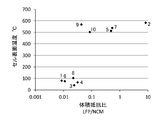
- FIG. 6 is a graph showing the relationship between the LP / LO volume resistance ratio of batteries 1 to 10 and the battery surface temperature.
- FIG. 6 is a graph showing the relationship between the LP / LO volume resistance ratio of batteries 11 to 17 and the battery surface temperature.
- FIG. 6 is a diagram showing the relationship between the LP / LO volume resistance ratio of batteries 18 to 20 and the battery surface temperature.
- the positive electrode for a lithium ion secondary battery according to an embodiment of the present invention a method for producing the same, and a lithium ion secondary battery will be described in detail.
- the positive electrode for a lithium ion secondary battery of this embodiment has a lithium metal oxide and a carbon phosphate composite.
- the carbon phosphate composite is composed of an olivine-type phosphate compound that is at least partially coated with carbon.
- the ratio of the volume resistivity of the carbon phosphate composite to the volume resistivity of the lithium metal oxide is 0.034 or less.
- Volume resistivity refers to the electrical resistance per unit volume of each component.
- the ratio of the volume resistivity of the carbon phosphate composite to the volume resistivity of the lithium metal oxide is also referred to as an LP / LO volume resistivity ratio.
- the volume resistivity of the lithium metal oxide is preferably in the range of 200 to 3000, and more preferably in the range of 247 to 1000. If the volume resistivity of the lithium metal oxide is greater than 3000, the resistance of the lithium metal oxide increases, and there is a risk that sufficient output as a battery that requires output may be difficult. If the volume resistivity of the lithium metal oxide is smaller than 247, the ratio of the volume resistivity of the carbon phosphate composite to the volume resistivity of the lithium metal oxide may not be 0.034 or less.
- the volume resistivity of the carbon phosphate composite is preferably 100 or less, more preferably 50 or less. If the volume resistivity of the carbon phosphate composite is greater than 100, the thermal stability of the positive electrode may not be sufficient.
- the current collector 2 when a current flows through the current collector 2 to the positive electrode active material layer 1, the current flows through both the lithium metal oxide 11 and the carbon phosphate composite 12.
- the positive electrode active material layer 1 includes the conductive additive 15
- the current flows through both the lithium metal oxide 11 and the carbon phosphate composite 12 via the conductive additive 15.
- the mixed electrode including the lithium metal oxide 11 and the carbon phosphate composite 12 can be represented by a parallel circuit of the lithium metal oxide 11 and the carbon phosphate composite 12.
- the carbon phosphate composite 12 is made to have a lower volume resistivity than the lithium metal oxide 11.
- the ratio of the volume resistivity of the carbon phosphate composite to the volume resistivity of the lithium metal oxide (LP / LO volume resistivity ratio) is set to 0.034 or less.
- the LP / LO volume resistance ratio is preferably 0.032 or less, more preferably 0.029 or less, and preferably 0.027 or less. In this case, the thermal stability of the positive electrode can be further improved.
- the thermal stability of the positive electrode may be reduced.
- the selection of the type of lithium metal oxide, the selection of the type of olivine-type phosphate compound, and the coating state and the coating amount of carbon covering the olivine-type phosphate compound may be changed.
- Japanese Patent Application Laid-Open No. 2014-194879 shows that the volume resistivity of a carbon phosphate composite decreases when the amount of carbon coating is increased.
- the positive electrode for a lithium ion secondary battery of this embodiment has a lithium metal oxide and a carbon phosphate composite.
- the lithium metal oxide is a lithium-nickel-cobalt-manganese composite oxide having a layered rock salt structure and containing nickel, cobalt, and manganese.
- the compound represented hereinafter sometimes referred to as “NCM”) is preferred.
- 0 ⁇ b ⁇ 1, 0 ⁇ c ⁇ 1, 0 ⁇ d ⁇ 1, and at least one of b, c, d is 0 ⁇ b ⁇ 80 /
- the ranges are 100, 0 ⁇ c ⁇ 70/100, 10/100 ⁇ d ⁇ 1, 10/100 ⁇ b ⁇ 68/100, 12/100 ⁇ c ⁇ 60/100, 20/100 ⁇ d.
- ⁇ 68/100 is more preferable, 25/100 ⁇ b ⁇ 60/100, 15/10 ⁇ C ⁇ 50/100, 20/100 ⁇ d ⁇ 60/100 are more preferable, and 1/3 ⁇ b ⁇ 50/100, 20/100 ⁇ c ⁇ 1/3, 20/100 ⁇ d. A range of ⁇ 1/3 is particularly preferable.
- A is preferably within the range of 0.5 ⁇ a ⁇ 1.5, more preferably within the range of 0.7 ⁇ a ⁇ 1.3, and even more preferably within the range of 0.9 ⁇ a ⁇ 1.2.
- lithium metal oxide having a layered rock salt structure examples include LiNi 0.5 Co 0.2 Mn 0.3 O 2 , LiNi 0.5 Co 0.3 Mn 0.2 O 2 , LiNi 1/3 Co 1/3 Mn 1/3 O 2 , LiNi 0.5 Mn 0.5 O 2 , LiNi 0.75 Co 0.1 Mn 0.15 O 2 , LiMnO 2 , LiNiO 2 , and LiCoO 2 It is good that it is.
- lithium metal oxide a solid solution composed of a mixture of a layered rock salt structure and a spinel structure can also be used.
- a lithium metal oxide having a spinel structure mixed with a lithium metal composite oxide having a layered rock salt structure a general formula: Li x (A y Mn 2-y ) O 4 (A is Ca, Mg, S, Si, Represented by at least one element selected from Na, K, Al, P, Ga and Ge, and at least one metal element selected from transition metal elements, 0 ⁇ x ⁇ 2.2, 0 ⁇ y ⁇ 1) Good.
- the transition metal element that can constitute A in the general formula is, for example, at least one element selected from Fe, Cr, Cu, Zn, Zr, Ti, V, Mo, Nb, W, La, Ni, and Co.
- the shape of the lithium metal oxide is not particularly limited, but is preferably 100 ⁇ m or less, more preferably 0.1 ⁇ m or more and 50 ⁇ m or less, and most preferably 1 ⁇ m or more and 10 ⁇ m or less in terms of average particle diameter. If the thickness is less than 0.1 ⁇ m, there may be a problem that, when the electrode is manufactured, the adhesion to the current collector is easily impaired. If it exceeds 100 ⁇ m, problems such as affecting the size of the electrode and damaging the separator constituting the secondary battery may occur.
- the average particle diameter in this specification means the value of D50 at the time of measuring with a general laser diffraction type particle size distribution measuring apparatus.
- the carbon phosphate composite is composed of an olivine-type phosphate compound that is at least partially coated with carbon.
- the olivine-type phosphate compound has an olivine structure and has a general formula: LiM h PO 4 (M is Mn, Fe, Co, Ni, Cu, Mg, Zn, V, Ca, Sr, Ba, Ti, Al, Si) , B, Te and Mo, represented by 0 ⁇ h ⁇ 2).
- Examples of the olivine-type phosphate compound include LiFePO 4 , LiCoPO 4 , LiNiPO 4 , and LiMnPO 4 .
- LiFePO 4 is preferable from the viewpoint of thermal stability. The reason is as follows. LiFePO 4 exhibits a relatively flat discharge curve during discharge.
- the average particle size of the carbon phosphate composite is preferably 0.8 to 18 ⁇ m, more preferably 0.8 to 4.0 ⁇ m, and most preferably 1.5 to 3.5 ⁇ m.
- the average particle size of the carbon phosphate composite is too small, there is a possibility that the particles are likely to aggregate and difficult to mix with the lithium metal oxide.
- the average particle size of the carbon phosphate composite is excessive, there may be a problem in that the presence of LiFePO 4 in the electrode is small and an effect of suppressing heat generation cannot be obtained when mixed with the lithium metal oxide.
- the average particle diameter of the carbon phosphate composite refers to D50 of the carbon phosphate composite.
- the olivine-type phosphate compound may be present as primary particles in the positive electrode, or the primary particles may be aggregated and exist as secondary particles.
- the shape of the olivine-type phosphate compound is not particularly limited.
- the average particle size of the olivine-type phosphate compound is preferably 100 ⁇ m or less, more preferably 0.01 ⁇ m or more and 10 ⁇ m or less, and most preferably 0.1 ⁇ m or more and 10 ⁇ m or less.
- the average particle diameter of the olivine-type phosphate compound refers to the average particle diameter D50 of secondary particles of the olivine-type phosphate compound that is not coated with carbon.
- the average particle size of the olivine-type phosphate compound is preferably smaller than the average particle size of the lithium metal oxide.
- the olivine-type phosphate compound is at least partially coated with carbon as described above.
- the carbon only needs to cover a part of the surface of the olivine-type phosphate compound, may cover the entire surface, or a part of the surface may enter the inside of the particle.
- an olivine-type phosphate compound can be coated with carbon using a conventional carbon coating method.
- a carbon phosphate composite having an arbitrary volume resistivity can be obtained.
- the following carbon coating method is disclosed.
- Japanese Patent Application Laid-Open No. 2014-194879 discloses Li x A y PO 4 (where A is one or two selected from the group of Mn and Co, 0 ⁇ x ⁇ 4, 0 ⁇ y ⁇ 1.5).
- the surface of the resulting particle is coated with a coating layer containing one or two selected from the group of phosphorus-containing compounds and sulfur-containing compounds, and the surface of the coating layer is a second layer containing a carbonaceous electron conductive material. It is disclosed to coat with a coating layer.
- the composition is Li x (Mn 1-y M 1 y ) 1-z M 2 z PO 4 (wherein x, y, z are 0.9 ⁇ x ⁇ 1.3, 0 ⁇ y ⁇ 1, 0 ⁇ z ⁇ 0.3, M 1 is at least one metal element selected from the group consisting of Fe, Co and Ni, and M 2 is And at least one metal element selected from the group consisting of Zn, Mo, and Al.).
- a phosphorus oxide, a lithium source, a carbon source, an oxide of a metal element M 2, and phosphorus oxide or hydroxide, and adjusting the slurry containing a solvent, contained in the slurry A step of pulverizing the particles to be obtained, a step of spray-drying the pulverized slurry to form a precursor, and a step of heat-treating the precursor at 500 to 800 ° C. in an inert atmosphere.
- the carbon source of the raw material saccharides such as glucose, sucrose and lactose, and organic compounds such as glycerin, ascorbic acid, lauric acid and stearic acid can be used.
- the carbon content of the olivine-type phosphoric acid compound is preferably 0.2% by weight or more and 10% by weight or less, and the carbon is preferably present in the secondary particles or on the surface.
- the carbon content is less than 0.2% by weight, the electric resistance of the olivine-type phosphate compound is increased. Further, when the carbon content exceeds 10% by weight, the discharge capacity per weight of the olivine type phosphoric acid compound becomes small.
- a raw material solution of LiFePO 4 composed of a Li source, a Fe source, and a PO 4 source in a solvent containing 50% by mass or more of water, and a graphene oxide aqueous dispersion as a carbon source are used.
- the mixed reaction solution is heated in a pressure vessel at a temperature of 150 to 400 ° C. and a pressure of 22 to 40 MPa to cause a hydrothermal reaction.
- a carbon phosphate composite containing 0.01 to 1 part by mass of graphite particles with respect to 100 parts by mass of LiFePO 4 is obtained.
- a non-functionalized fibrous carbon material for example, carbon nanotube
- a surface functionalized fibrous carbon material for example, carbon nanotube
- olivine-type phosphate compound particles are dispersed to form a surface functionalized fibrous material.
- the step of producing a mixture in which the weight of the carbon material is larger than the weight of the non-functionalized fibrous carbon material and the step of drying and granulating the mixture are performed.
- the aggregate of primary particles of the olivine-type phosphate compound and the fibrous carbon material are contained, and the fibrous carbon material is present more densely in the surface portion of the aggregate than in the interior of the aggregate.
- a carbon phosphate composite is obtained.
- LiFePO 4 which is a kind of olivine type phosphoric acid compound, and the surface of LiFePO 4 is coated with carbon.
- LiFePO 4 particles and a carbon precursor that forms a conductive carbon coating layer by thermal decomposition are mixed and fired at a temperature and atmosphere at which the thermal decomposition of the carbon precursor proceeds.
- the mixture obtained in the mixing step is subjected to a firing step.
- the firing step is performed by raising the furnace temperature to 550 to 750 ° C. in a firing furnace in an inert gas atmosphere such as nitrogen gas.
- a layer thickness part having a thickness of 2 nm or more and a layer thin part having a thickness of less than 2 nm are formed on the surface of the LiFePO 4 particles, and a carbon phosphate carbon composite having a small amount of carbon and good electron conductivity is obtained.
- the content of the carbon phosphate composite is 15 mass% or more and 35 mass% or less.
- the mass% is preferably 30% by mass or less and particularly preferably 15% by mass or more and 25% by mass or less.
- the content of the carbon phosphate composite is excessive, the content of the lithium metal oxide is relatively reduced, and the battery capacity may be reduced.
- the content of the carbon phosphate composite is too small, the content of the lithium metal oxide is relatively large, and the thermal stability of the positive electrode may be lowered.
- the positive electrode for a lithium ion secondary battery of the present embodiment has a current collector and a positive electrode active material layer that covers the surface of the current collector.
- the positive electrode active material layer includes a positive electrode active material composed of the lithium metal oxide and the carbon phosphate composite.
- the mixing ratio of the positive electrode active material composed of the lithium metal oxide and the carbon phosphate composite is preferably in the range of 50 to 99% by mass, and 60 to 98%. It is more preferably in the range of mass%, particularly preferably in the range of 70 to 97 mass%.
- the positive electrode active material layer may further contain the following additives in addition to the positive electrode active material.
- additives examples include a conductive aid, a binder, and a dispersant.
- Conductive aid is added to increase the conductivity of the electrode. Therefore, the conductive auxiliary agent may be added arbitrarily when the electrode conductivity is insufficient, and may not be added when the electrode conductivity is sufficiently excellent.
- a conductive additive is added to the positive electrode, current easily flows through both the lithium metal oxide and the carbon phosphate composite. For this reason, an excessive current is likely to flow even in a lithium metal oxide having poor thermal stability at the time of a short circuit.
- the positive electrode of this embodiment is excellent in thermal stability even if a conductive additive is included.
- the conductive auxiliary agent may be any chemically inert electronic high conductor, such as carbon black, graphite, acetylene black, ketjen black (registered trademark), or vapor grown carbon fiber (Vapor Grown Carbon). Fiber: VGCF) and various metal particles are exemplified. These conductive assistants can be added to the positive electrode active material layer alone or in combination of two or more.
- the shape of the conductive auxiliary agent is not particularly limited, but it is preferable that the average particle diameter is small in view of its role.
- a preferable average particle diameter of the conductive auxiliary agent is preferably 10 ⁇ m or less, and more preferably in the range of 0.01 to 1 ⁇ m.
- the blending amount of the conductive auxiliary agent is not particularly limited, but when the blending amount of the conductive auxiliary agent in the positive electrode active material layer is given, it is preferably in the range of 0.5 to 10% by mass, and 1 to 7% by mass. Is preferably within the range of 2 to 5% by mass.
- the binder serves to bind the positive electrode active material and the conductive additive to the surface of the current collector.
- the binder include fluorine-containing resins such as polyvinylidene fluoride, polytetrafluoroethylene, and fluororubber, thermoplastic resins such as polypropylene and polyethylene, imide resins such as polyimide and polyamideimide, and alkoxysilyl group-containing resins. be able to.
- hydrophilic group of the polymer having a hydrophilic group examples include a carboxyl group, a sulfo group, a silanol group, an amino group, a hydroxyl group, and a phosphate group.
- Specific examples of the polymer having a hydrophilic group include polyacrylic acid, carboxymethylcellulose, polymethacrylic acid, and poly (p-styrenesulfonic acid).
- the amount of the binder is not particularly limited, but the amount of the binder in the positive electrode active material layer is preferably in the range of 0.5 to 10% by mass, preferably in the range of 1 to 7% by mass. More preferred is the range of 2 to 5% by mass. If the blending amount of the binder is too small, the moldability of the positive electrode active material layer may be lowered. Moreover, when there are too many compounding quantities of a binder, since the quantity of the positive electrode active material in a positive electrode active material layer reduces relatively, it is unpreferable.
- additives can be used as additives such as a dispersant other than the conductive auxiliary agent and the binder.
- a current collector refers to a chemically inert electronic high conductor that keeps a current flowing through an electrode during discharge or charging of a lithium ion secondary battery.
- the current collector at least one selected from silver, copper, gold, aluminum, magnesium, tungsten, cobalt, zinc, nickel, iron, platinum, tin, indium, titanium, ruthenium, tantalum, chromium, molybdenum, and stainless steel Examples of such a metal material can be given.
- the current collector may be covered with a known protective layer.
- the current collector can take the form of a foil, a sheet, a film, a line, a bar, or the like. Therefore, metal foils, such as copper foil, nickel foil, aluminum foil, stainless steel foil, can be used suitably as a collector.
- the thickness is preferably in the range of 10 ⁇ m to 100 ⁇ m.
- the ratio of the volume resistivity of the carbon phosphate composite to the volume resistivity of the lithium metal oxide is 0.034 or less. It has a confirmation process to confirm that there is.
- the volume resistivity of the lithium metal oxide and the volume resistivity of the carbon phosphate composite are measured.
- the volume resistivity can be measured by, for example, the method described in the examples.
- the volume resistivity of the lithium metal oxide and the volume resistivity of the carbon phosphate composite are adjusted so as to be 0.034 or less. adjust.
- a lithium metal oxide, a carbon phosphate composite, an additive, and a solvent are mixed to produce a dispersion.
- the solvent include N-methyl-2-pyrrolidone (hereinafter sometimes abbreviated as “NMP”), dimethylformamide, dimethylacetamide, methanol, acetone, methyl ethyl ketone, methyl isobutyl ketone, cyclohexanone, methyl acetate, acetic acid. Examples thereof include ethyl and tetrahydrofuran. These solvents may be used alone or in combination of two or more.
- the dispersion liquid of a) process consists of solid content other than a solvent and a solvent.
- Solid content other than a solvent means additives, such as a lithium metal oxide, a carbon phosphate composite, and a binder used as needed, a conductive support agent, and a dispersing agent.
- the solid content other than the solvent is preferably in the range of 30 to 90% by mass, more preferably in the range of 50 to 80% by mass, particularly in the range of 60 to 70% by mass. preferable.
- the dispersion produced in the step a) is applied to a current collector, and the solvent contained in the dispersion is removed to form a positive electrode active material layer.
- Specific methods for applying the dispersion to the current collector include conventionally known methods such as a roll coating method, a dip coating method, a doctor blade method, a spray coating method, and a curtain coating method.
- As a specific method for removing the solvent contained in the dispersion liquid there is a method of drying the dispersion liquid under a heating condition and / or a reduced pressure condition and removing the solvent contained in the dispersion liquid as a gas. it can.
- the positive electrode active material layer obtained in the step b) is compressed by the compression device.
- a conventionally known compressor may be used as the compression device.
- a lithium ion secondary battery can be produced by employing the positive electrode for a lithium ion secondary battery of the present invention.
- the lithium ion secondary battery includes a positive electrode, a negative electrode, a separator, and an electrolytic solution as battery components.
- the negative electrode has a current collector and a negative electrode active material layer bound to the surface of the current collector.
- the negative electrode active material layer includes a negative electrode active material and, if necessary, a binder and / or a conductive aid.
- As the current collector, the binder, and the conductive additive those described for the positive electrode may be adopted. Further, styrene-butadiene rubber may be employed as a binder for the negative electrode active material layer.
- Examples of the negative electrode active material include a carbon-based material capable of inserting and extracting lithium, an element that can be alloyed with lithium, a compound having an element that can be alloyed with lithium, a polymer material, and the like.
- the carbon-based material examples include non-graphitizable carbon, natural graphite, artificial graphite, coke, graphite, glassy carbon, organic polymer compound fired body, carbon fiber, activated carbon, or carbon black.
- the organic polymer compound fired body refers to a material obtained by firing and carbonizing a polymer material such as phenols and furans at an appropriate temperature.
- Specific examples of the polymer material include polyacetylene and polypyrrole.
- elements that can be alloyed with lithium include Na, K, Rb, Cs, Fr, Be, Mg, Ca, Sr, Ba, Ra, Ti, Ag, Zn, Cd, Al, Ga, In, Si. , Ge, Sn, Pb, Sb, Bi can be exemplified, and Si or Sn is particularly preferable.
- Examples of compounds having elements that can be alloyed with lithium include ZnLiAl, AlSb, SiB 4 , SiB 6 , Mg 2 Si, Mg 2 Sn, Ni 2 Si, TiSi 2 , MoSi 2 , CoSi 2 , NiSi 2 , CaSi 2, CrSi 2, Cu 5 Si, FeSi 2, MnSi 2, NbSi 2, TaSi 2, VSi 2, WSi 2, ZnSi 2, SiC, Si 3 N 4, Si 2 N 2 O, SiO v (0 ⁇ v ⁇ 2), SnO w (0 ⁇ w ⁇ 2), SnSiO 3 , LiSiO or LiSnO can be exemplified, and SiO x (0.3 ⁇ x ⁇ 1.6) is particularly preferable.
- examples of the compound having an element capable of alloying with lithium include tin compounds such as tin alloys (Cu—Sn alloy, Co—Sn alloy, etc.).
- the above silicon oxide composed of SiO v (0 ⁇ v ⁇ 2) is obtained by heat-treating SiO, which is an amorphous silicon oxide obtained using silicon dioxide (SiO 2 ) and simple silicon (Si) as raw materials. Can be obtained by disproportionation.
- the disproportionation reaction is a reaction in which SiO is decomposed into a Si phase and a SiO 2 phase. In general, when oxygen is turned off, it is said that almost all SiO is disproportionated and separated into two phases at 800 ° C. or higher.
- non-crystalline SiO powder is subjected to heat treatment at 800 to 1200 ° C. for 1 to 5 hours in an inert atmosphere such as in a vacuum or in an inert gas. A silicon oxide powder containing two phases of two phases and a crystalline Si phase is obtained.
- the average particle size of the silicon oxide powder is preferably 4 ⁇ m or more.
- the average particle diameter is a median diameter and can be obtained based on a volume-based particle size distribution by a laser diffraction method.
- the average particle size of the silicon oxide powder is preferably 20 ⁇ m or less, and preferably 15 ⁇ m or less. If the average particle size is too small, there are many active sites, so that SEI (SolidSElectrolyte Interphase) is often generated and the cycle characteristics may be deteriorated. On the other hand, if the average particle diameter is too large, the conductivity of the silicon oxide is poor, so that the conductivity of the entire electrode becomes non-uniform, and the resistance may increase or the output may decrease.
- International Publication No. 2014/080608 discloses a silicon material.
- the silicon material is manufactured by synthesizing a layered silicon compound mainly composed of layered polysilane obtained by reacting CaSi 2 and an acid to remove Ca, and heating the layered silicon compound at 300 ° C. or higher to release hydrogen.
- CaSi 2 generally has a structure in which a Ca layer and a Si layer are laminated.
- CaSi 2 may be synthesized by a known production method, or a commercially available one may be adopted.
- CaSi 2 used in the method for producing a layered silicon compound is preferably pulverized in advance. Then, CaSi 2 for use in the present invention include crystalline silicon as an impurity.
- Acids include hydrogen fluoride, hydrogen chloride, hydrogen bromide, hydrogen iodide, sulfuric acid, nitric acid, phosphoric acid, formic acid, acetic acid, methanesulfonic acid, tetrafluoroboric acid, hexafluorophosphoric acid, hexafluoroarsenic acid, fluoro Examples include antimonic acid, hexafluorosilicic acid, hexafluorogermanic acid, hexafluorotin (IV) acid, trifluoroacetic acid, hexafluorotitanic acid, hexafluorozirconic acid, trifluoromethanesulfonic acid, and fluorosulfonic acid. These acids may be used alone or in combination.
- the acid is used as an aqueous solution from the viewpoint of easy work and safety, and removal of by-products.
- Acid used in the reaction step may be used in an amount capable of providing 2 or more equivalents of protons relative CaSi 2. Therefore, if it is a monovalent acid, it may be used in an amount of 2 mol or more per 1 mol of CaSi 2 .
- the reaction conditions of the reaction step are preferably reduced pressure conditions such as vacuum or an inert gas atmosphere, and are preferably temperature conditions of room temperature or lower such as an ice bath. What is necessary is just to set the reaction time of the same process suitably.
- reaction formula when hydrogen chloride is used as the acid is as follows. 3CaSi 2 + 6HCl ⁇ Si 6 H 6 + 3CaCl 2
- Si 6 H 6 which is polysilane corresponds to an ideal layered silicon compound. This reaction can also be considered to form a Si—H bond while Ca in the layered CaSi 2 is substituted with 2H.
- the layered silicon compound has a layer shape because the basic skeleton of the Si layer in the raw material CaSi 2 is maintained.
- the acid is preferably used as an aqueous solution as described above.
- the layered silicon compound is rarely obtained only with a compound of Si 6 H 6 , and contains an element derived from oxygen or an acid.
- the layered silicon compound may be heated to release hydrogen or the like, thereby forming a silicon material.
- the method for producing a silicon material includes a step of heating the layered silicon compound at 300 ° C. or higher (hereinafter sometimes referred to as a silicon material production step).
- the silicon material manufacturing process is represented by an ideal reaction formula as follows. Si 6 H 6 ⁇ 6Si + 3H 2 ⁇
- the layered silicon compound actually used in the silicon material manufacturing process contains elements derived from oxygen and acid, and also contains inevitable impurities, so the silicon material actually obtained also contains elements derived from oxygen and acid, Further, inevitable impurities are also contained.
- the molar amount of silicon when the molar amount of silicon is 100, the molar amount of oxygen element is preferably 50 or less, and particularly preferably 40 or less. Further, when the molar amount of silicon is 100, the molar amount of the acid-derived element is preferably 8 or less, and particularly preferably 5 or less.
- the silicon material production process is preferably performed in a non-oxidizing atmosphere having a lower oxygen content than in normal air.
- the non-oxidizing atmosphere include a reduced pressure atmosphere including a vacuum and an inert gas atmosphere.
- the heating temperature is preferably in the range of 350 ° C. to 1200 ° C., more preferably in the range of 400 ° C. to 1200 ° C. If the heating temperature is too low, hydrogen may not be released sufficiently. On the other hand, if the heating temperature is too high, energy is wasted. What is necessary is just to set a heating time suitably according to heating temperature, and it is also preferable to determine a heating time, measuring the quantity of hydrogen etc. which escapes out of a reaction system.
- the heating temperature and the heating time By appropriately selecting the heating temperature and the heating time, the ratio of amorphous silicon and silicon crystallites contained in the silicon material to be manufactured, and the size of the silicon crystallites can be adjusted.
- the shape and size of a nano-level layer including amorphous silicon and silicon crystallites included in the silicon material can also be adjusted.
- the size of the silicon crystallite is preferably nano-sized.
- the silicon crystallite size is preferably in the range of 0.5 nm to 300 nm, more preferably in the range of 1 nm to 100 nm, further preferably in the range of 1 nm to 50 nm, and particularly in the range of 1 nm to 10 nm. preferable.
- the silicon crystallite size is calculated from the Scherrer equation using X-ray diffraction measurement (XRD measurement) on the silicon material and using the half-value width of the diffraction peak of the Si (111) plane of the obtained XRD chart.
- a silicon material having a structure in which a plurality of plate-like silicon bodies are laminated in the thickness direction can be obtained by the silicon material manufacturing process. This structure can be confirmed by observation with a scanning electron microscope or the like.
- the plate-like silicon body has a thickness in the range of 10 nm to 100 nm for efficient insertion and removal of lithium ions. Are preferred, and those in the range of 20 nm to 50 nm are more preferred.
- the length of the plate-like silicon body in the major axis direction is preferably in the range of 0.1 ⁇ m to 50 ⁇ m. Further, the plate-like silicon body preferably has a (length in the long axis direction) / (thickness) range of 2 to 1000.
- the silicon material may be pulverized and classified to be particles having a certain particle size distribution.
- D50 can be exemplified within a range of 1 to 30 ⁇ m when measured with a general laser diffraction type particle size distribution measuring apparatus.
- the silicon material can be used as a negative electrode active material for a secondary battery such as a lithium ion secondary battery. In that case, it is preferable to use a silicon material coated with carbon.
- the separator separates the positive electrode and the negative electrode and allows lithium ions to pass through while preventing a short circuit of current due to contact between the two electrodes.
- the separator include a porous film using one or more synthetic resins such as polytetrafluoroethylene, polypropylene, and polyethylene, or a ceramic porous film.
- the electrolytic solution contains a nonaqueous solvent and an electrolyte dissolved in the nonaqueous solvent.
- cyclic esters examples include ethylene carbonate, propylene carbonate, butylene carbonate, gamma butyrolactone, vinylene carbonate, 2-methyl-gamma butyrolactone, acetyl-gamma butyrolactone, and gamma valerolactone.
- chain esters include dimethyl carbonate, diethyl carbonate, dibutyl carbonate, dipropyl carbonate, methyl ethyl carbonate, propionic acid alkyl ester, malonic acid dialkyl ester, and acetic acid alkyl ester.
- ethers examples include tetrahydrofuran, 2-methyltetrahydrofuran, 1,4-dioxane, 1,2-dimethoxyethane, 1,2-diethoxyethane, and 1,2-dibutoxyethane. These nonaqueous solvents may be used alone or in combination with the electrolyte.
- Examples of the electrolyte include lithium salts such as LiClO 4 , LiAsF 6 , LiPF 6 , LiBF 4 , LiCF 3 SO 3 , and LiN (CF 3 SO 2 ) 2 .
- a lithium salt such as LiClO 4 , LiPF 6 , LiBF 4 , LiCF 3 SO 3 in a nonaqueous solvent such as ethylene carbonate, dimethyl carbonate, propylene carbonate, and dimethyl carbonate.
- a solution dissolved at a concentration of about / L can be exemplified.
- a separator is sandwiched between a positive electrode and a negative electrode to form an electrode body.
- the electrode body may be either a stacked type in which the positive electrode, the separator and the negative electrode are stacked, or a wound type in which the positive electrode, the separator and the negative electrode are sandwiched.
- the lithium ion secondary battery can be mounted on a vehicle. Since a lithium ion secondary battery maintains a large charge / discharge capacity and has excellent cycle performance, a vehicle equipped with the lithium ion secondary battery is a high-performance vehicle.
- the vehicle may be a vehicle that uses electric energy from a battery as a whole or a part of a power source.
- a vehicle that uses electric energy from a battery as a whole or a part of a power source.
- an electric vehicle a hybrid vehicle, a plug-in hybrid vehicle, a hybrid railway vehicle, an electric forklift, an electric wheelchair, and an electric assist.
- Bicycles and electric motorcycles are examples.
- Batteries 1, 3, 4, 6, 8, 11-14, 17, 19-23 correspond to the examples of the present invention, and batteries 2, 5, 7, 9, 10, 15, 16, 18 are of the present invention. It corresponds to a reference example. The present invention is not limited to these.
- “part” means part by mass
- “%” means mass%.
- LiNi 5/10 Co 3/10 Mn 2/10 O 2 having an average particle diameter of 5 ⁇ m, LiNi 5/10 Co 2/10 Mn 3/10 O 2 having an average particle diameter of 5 ⁇ m, and an average particle diameter of 5 ⁇ m LiNi 1/3 Co 1/3 Mn 1/3 O 2 was prepared.
- LiNi 5/10 Co 3/10 Mn 2/10 O 2 , LiNi 5/10 Co 2/10 Mn 3/10 O 2 and LiNi 1/3 Co 1/3 Mn 1/3 O 2 were each NCM-1 NCM-2 and NCM-3.
- Each carbon phosphate complex was produced by a known method.
- the average particle size of the eight types of carbon phosphate composites was 0.4 to 25 ⁇ m.
- the eight types of carbon phosphate composites were, in order, LFP-1, LFP-2, LFP-3, LFP-4, LFP-5, LFP-6, LFP-7, and LFP-8.
- the carbon coverage of the eight types of carbon phosphate composites was 1 to 3.5% by mass. Among them, the carbon coating amount of LFP-1 was 2% by mass, and the carbon coating amount of LFP-5 was 1.6% by mass.
- the volume resistivity of the above lithium metal oxide and carbon phosphate composite was measured.
- 2 g of each component was placed in a cylindrical tube having a diameter of 2 cm.
- Each component was compressed with a load of 20 kN.
- the volume resistivity of each component was determined using a resistance measurement device (trade name MCP-PD51) manufactured by Mitsubishi Chemical Analytech. The measurement results are shown in Table 1.
- Step a) Using a planetary stirring and degassing apparatus, 71 parts of NCM-2 as a lithium metal oxide, 23 parts of LFP-1 as a carbon phosphate composite, and an average particle size of 0.05 to 0 as a conductive assistant 3 parts of 1 ⁇ m acetylene black, 3 parts of polyvinylidene fluoride as a binder, and about 54 parts of NMP as a solvent were mixed to prepare a dispersion.
- the content of the lithium metal oxide was 76% and the content of the carbon phosphate composite was 24%.
- Step b) An aluminum foil having a thickness of 20 ⁇ m was prepared as a current collector.
- the dispersion produced in step a) was placed on the surface of the aluminum foil, and applied using a doctor blade so that the dispersion became a film.
- the aluminum foil coated with the dispersion was dried at 80 ° C. for 20 minutes, whereby NMP was removed by volatilization, and a positive electrode active material layer was formed on the aluminum foil surface.
- the negative electrode 1 was produced as follows.
- SiO x (0.3 ⁇ x ⁇ 1.6) and natural graphite were used as the negative electrode active material.
- SiO x (0.3 ⁇ x ⁇ 1.6) is obtained by subjecting SiO to disproportionation treatment. Polyimide and polyamideimide were used as the binder. Acetylene black was used as a conductive aid.
- a rectangular sheet (50 ⁇ 90 mm, thickness 25 ⁇ m) made of a resin film having a three-layer structure of polypropylene / polyethylene / polypropylene as a separator was sandwiched between the positive electrode and the negative electrode to form an electrode plate group.
- the electrode plate group was covered with a set of two laminated films, and the three sides were sealed, and then an electrolyte solution was injected into the bag-like laminated film.
- the electrolytic solution a solution obtained by dissolving LiPF 6 in a solvent obtained by mixing ethylene carbonate, methyl ethyl carbonate, and dimethyl carbonate at a volume ratio of 3: 3: 4 so as to be 1 mol / L was used.
- the obtained lithium ion secondary battery was designated as battery 1.
- the positive electrode 2 used in the battery 2 is the same as the positive electrode 1 except that LFP-8 is used as the carbon phosphate composite.
- the ratio of the volume resistivity of LFP-8 to the volume resistivity of NCM-2 was 8.3838.
- the positive electrode 3 used in the battery 3 is the same as the positive electrode 1 except that LFP-4 is used as the carbon phosphate composite.
- the ratio of the volume resistivity of LFP-4 to the volume resistivity of NCM-2 was 0.0240.
- a lithium ion secondary battery was produced in the same manner as the battery 1.
- the obtained lithium ion secondary battery was designated as battery 3.
- the positive electrode 4 used in the battery 4 is the same as the positive electrode 1 except that LFP-5 is used as the carbon phosphate composite.
- the ratio of the volume resistivity of LFP-5 to the volume resistivity of NCM-2 was 0.0315.
- a lithium ion secondary battery was produced in the same manner as the battery 1. The obtained lithium ion secondary battery was designated as battery 4.
- the positive electrode 5 used in the battery 5 is the same as the positive electrode 1 except that LFP-6 is used as the carbon phosphate composite.
- the ratio of the volume resistivity of LFP-6 to the volume resistivity of NCM-2 was 0.4893.
- a lithium ion secondary battery was produced in the same manner as the battery 1.
- the obtained lithium ion secondary battery was designated as battery 5.
- the positive electrode 6 used in the battery 6 is the same as the positive electrode 1 except that LFP-2 is used as the carbon phosphate composite.
- the ratio of the volume resistivity of LFP-2 to the volume resistivity of NCM-2 was 0.0110.
- a lithium ion secondary battery was produced in the same manner as the battery 1. The obtained lithium ion secondary battery was designated as battery 6.
- the positive electrode 7 used in the battery 7 is the same as the positive electrode 1 except that LFP-7 is used as the carbon phosphate composite.
- the ratio of the volume resistivity of LFP-7 to the volume resistivity of NCM-2 was 0.5438.
- a lithium ion secondary battery was produced in the same manner as the battery 1.
- the obtained lithium ion secondary battery was designated as battery 7.
- the positive electrode 8 used in the battery 8 is the same as the positive electrode 1 except that LFP-3 is used as the carbon phosphate composite.
- the ratio of the volume resistivity of LFP-3 to that of NCM-2 was 0.0220.
- a lithium ion secondary battery was produced in the same manner as the battery 1.
- the obtained lithium ion secondary battery was designated as battery 8.
- the positive electrode 9 used in the battery 9 is the same as the positive electrode 1 except that NCM-1 is used as the lithium metal oxide and LFP-2 is used as the carbon phosphate composite.
- the ratio of the volume resistivity of LFP-2 to the volume resistivity of NCM-1 was 0.0430.
- a lithium ion secondary battery was produced in the same manner as the battery 1.
- the obtained lithium ion secondary battery was designated as battery 9.
- the positive electrode 10 used in the battery 10 is the same as the positive electrode 1 except that NCM-1 is used as the lithium metal oxide and LFP-3 is used as the carbon phosphate composite.
- the ratio of the volume resistivity of LFP-3 to the volume resistivity of NCM-1 was 0.0860.
- a lithium ion secondary battery was produced in the same manner as battery 1 using positive electrode 10. The obtained lithium ion secondary battery was designated as battery 10.
- Each battery was charged at a constant voltage until stable at a potential of 4.5V.
- the battery after charging (the discharge capacity is expected to be about 4 Ah) was placed on a constraining plate having a hole with a diameter of 20 mm.
- a restraint plate was placed on a press machine with a nail attached to the top. Until the nail penetrates the battery on the restraining plate and the tip of the nail is located inside the hole of the restraining plate, the nail is moved from the upper part to the lower part at 20 mm / sec. Moved at a speed of.
- the surface temperature of the battery after penetrating the nail was measured. Table 1 shows the maximum temperature among the observed surface temperatures.
- the nail used had a diameter of 8 mm and a tip angle of 60 °, and the nail material was S45C defined by JIS G 4051.
- the LP / LO volume resistance ratio and battery surface temperature of various positive electrodes are shown in FIG.
- the battery surface temperature was as low as 150 ° C. or less.
- the LP / LO volume resistance ratio was 0.0430 or more
- the battery surface temperature was remarkably high at 400 ° C. or more. From this, it was found that when the ratio of the volume resistivity of the carbon phosphate composite to the volume resistivity of the lithium metal oxide is 0.0315 or less, the thermal stability of the positive electrode is increased.
- ⁇ Battery 11> In preparing the positive electrode of the battery 11, 67 parts of NCM-2 as a lithium metal oxide, 27 parts of LFP-2 as a carbon phosphate composite, and acetylene having an average particle diameter of 0.05 to 0.1 ⁇ m as a conductive auxiliary agent 3 parts of black, 3 parts of polyvinylidene fluoride as a binder, and about 54 parts of NMP as a solvent in total were mixed to prepare a dispersion.
- the steps b) and c) were performed in the same manner as the positive electrode 1 to obtain a positive electrode.
- the obtained positive electrode was designated as positive electrode 11.
- a lithium ion secondary battery was produced in the same manner as the battery 1 manufacturing method.
- the obtained lithium ion secondary battery was designated as battery 11.
- a lithium ion secondary battery was produced in the same manner as the battery 11 except that a silicon material was used as the negative electrode.
- the silicon material manufacturing method will be described below.
- the silicon material had a structure in which a plurality of plate-like silicon bodies were laminated in the thickness direction.
- the above silicon material: natural graphite: acetylene black: polyamideimide was mixed at a mass ratio of 70: 15: 8: 10, and NMP was added to obtain a slurry-like negative electrode mixture preparation solution.
- a negative electrode was produced in the same manner as the battery 11 using the negative electrode mixture preparation solution.
- the obtained negative electrode was designated as negative electrode 2.
- a lithium ion secondary battery was produced using the negative electrode 2 and the positive electrode 11 in the same manner as the battery 11.
- the obtained lithium ion secondary battery was designated as battery 12.
- the initial discharge capacities of the batteries 11 and 12 were measured.
- the initial discharge capacity was measured as follows. After performing CC charge (constant current charge) to 0.33C rate and voltage 4.5V at room temperature, CV charge (constant voltage charge) was performed at voltage 4.5V for 1.5 hours. Then, CC discharge (constant current discharge) was performed at a 0.33 C rate up to a voltage of 2.5 V to obtain an initial discharge capacity.
- the initial discharge capacity of the battery 11 was 4.1 Ah / g, and the initial discharge capacity of the battery 12 was 3.8 Ah / g.
- the battery surface temperature of the battery 11 was 28 ° C., and the battery surface temperature of the battery 12 was 56.7 ° C.
- the negative electrode active material is SiOx (negative electrode 1) and the above silicon material (negative electrode 2)
- the nail penetration cell surface temperature was lower in the case of the above silicon material.
- the positive electrode 13 used in the battery 13 is the same as the positive electrode 1 except that the LFP-1 content is 27% by mass when the total mass of NCM-2 and LFP-1 is 100% by mass.
- the ratio of the volume resistivity of LFP-1 to the volume resistivity of NCM-2 was 0.0085.
- a lithium ion secondary battery was produced using the positive electrode 13 in the same manner as the battery 1. The obtained lithium ion secondary battery was designated as battery 13.
- the positive electrode 14 used in the battery 14 is the same as the positive electrode 13 except that LFP-2 is used as the carbon phosphate composite.
- the ratio of the volume resistivity of LFP-2 to the volume resistivity of NCM-2 was 0.0110.
- a lithium ion secondary battery was produced using the positive electrode 14 in the same manner as the battery 1. The obtained lithium ion secondary battery was designated as battery 14.
- the positive electrode 15 used in the battery 15 is the same as the positive electrode 13 except that NCM-1 is used as the lithium metal oxide and LFP-2 is used as the carbon phosphate composite.
- the ratio of the volume resistivity of LFP-2 to the volume resistivity of NCM-1 was 0.0430.
- a lithium ion secondary battery was produced in the same manner as the battery 1.
- the obtained lithium ion secondary battery was designated as battery 15.
- the positive electrode 16 used in the battery 16 is the same as the positive electrode 13 except that NCM-1 is used as the lithium metal oxide and LFP-3 is used as the carbon phosphate composite.
- the ratio of the volume resistivity of LFP-3 to the volume resistivity of NCM-1 was 0.0860.
- a lithium ion secondary battery was produced in the same manner as the battery 1.
- the obtained lithium ion secondary battery was designated as battery 16.
- the positive electrode 17 used in the battery 17 is the same as the positive electrode 13 except that NCM-1 is used as the lithium metal oxide.
- the ratio of the volume resistivity of LFP-1 to the volume resistivity of NCM-1 was 0.0331.
- a lithium ion secondary battery was produced in the same manner as battery 1 using positive electrode 17. The obtained lithium ion secondary battery was designated as battery 17.
- the content of the carbon phosphate composite is 27 mass%.
- the battery surface temperature was as low as 150 ° C. or less.
- the LP / LO volume resistance ratio was 0.0430 or more, the battery surface temperature was remarkably high at 400 ° C. or more.
- the positive electrode 18 used in the battery 18 is the same as the positive electrode 1 except that the content of LFP-1 is 9.4% by mass when the total mass of NCM-2 and LFP-1 is 100% by mass.
- the ratio of the volume resistivity of LFP-1 to the volume resistivity of NCM-2 was 0.0085.
- a lithium ion secondary battery was produced using the positive electrode 18 in the same manner as the battery 1. The obtained lithium ion secondary battery was designated as battery 18.
- the positive electrode 19 used in the battery 19 uses LFP-2 as the carbon phosphate composite, and the content of LFP-2 is 18.8% by mass when the total mass of NCM-2 and LFP-2 is 100% by mass. Except for the above, it is the same as the positive electrode 18.
- the ratio of the volume resistivity of LFP-2 to the volume resistivity of NCM-2 was 0.0110.
- a lithium ion secondary battery was produced in the same manner as the battery 1. The obtained lithium ion secondary battery was designated as battery 19.
- the positive electrode 20 used in the battery 20 is the same as the positive electrode 19 except that LFP-4 is used as the carbon phosphate composite.
- the ratio of the volume resistivity of LFP-4 to the volume resistivity of NCM-2 was 0.0240.
- a lithium ion secondary battery was produced in the same manner as battery 1 using positive electrode 20. The obtained lithium ion secondary battery was named battery 20.
- the positive electrode 21 used in the battery 21 is the same as the positive electrode 19 except that NCM-3 is used as the lithium metal oxide and LFP-1 is used as the carbon phosphate composite.
- the ratio of the volume resistivity of LFP-1 to the volume resistivity of NCM-3 was 0.0029.
- a lithium ion secondary battery was produced in the same manner as the battery 1. The obtained lithium ion secondary battery was designated as battery 21.
- the battery surface temperature was as low as 150 ° C. or less.
- the LP / LO volume resistance ratio is Even when it was 0.0085, the battery surface temperature was markedly higher than 400 ° C.
- the positive electrode used in the battery 22 is the same as the positive electrode 11 used in the battery 11.
- the negative electrode used in the battery 22 was manufactured as follows.
- As a negative electrode active material 98 parts by mass of spherical graphite, 1 part by mass of styrene butadiene rubber as a binder and 1 part by mass of carboxymethyl cellulose were mixed. This mixture was dispersed in an appropriate amount of ion-exchanged water to prepare a slurry.
- a copper foil having a thickness of 10 ⁇ m was prepared as a negative electrode current collector. The slurry was applied in a film form on the surface of the copper foil using a doctor blade.
- the copper foil coated with the slurry was dried to remove water, and then the copper foil was pressed to obtain a bonded product.
- the obtained joined product was dried by heating at 100 ° C. for 6 hours with a vacuum dryer to obtain a copper foil on which a negative electrode active material layer was formed. This was designated as negative electrode 3.
- a lithium ion secondary battery was produced using the negative electrode 3 and the positive electrode 11 in the same manner as the battery 11.
- the obtained lithium ion secondary battery was designated as battery 22.
- the positive electrode used in the battery 23 is the same as the positive electrode 11 used in the battery 22 except that NCM-3 is used as the lithium metal composite oxide.
- the negative electrode used in the battery 23 is the same as the negative electrode 3 of the battery 22.
- the volume resistance ratio (LP) of the carbon phosphate composite and lithium metal oxide contained in the positive electrode / LO volume resistance ratio) was 0.034 or less, and when the LFP content was 15 mass% or more and 35 mass% or less, the nail penetration cell surface temperature was relatively low. Further, comparing the results of Table 3 and Table 6, when the negative electrode active material has Si (negative electrodes 1 and 2), the nail penetration cell is more than when the negative electrode active material is a carbon-based material (negative electrode 3). The surface temperature was low.
Landscapes
- Chemical & Material Sciences (AREA)
- Chemical Kinetics & Catalysis (AREA)
- Electrochemistry (AREA)
- General Chemical & Material Sciences (AREA)
- Composite Materials (AREA)
- Inorganic Chemistry (AREA)
- Manufacturing & Machinery (AREA)
- Engineering & Computer Science (AREA)
- Crystallography & Structural Chemistry (AREA)
- Physics & Mathematics (AREA)
- Condensed Matter Physics & Semiconductors (AREA)
- General Physics & Mathematics (AREA)
- Battery Electrode And Active Subsutance (AREA)
- Inorganic Compounds Of Heavy Metals (AREA)
- Secondary Cells (AREA)
Abstract
Priority Applications (2)
| Application Number | Priority Date | Filing Date | Title |
|---|---|---|---|
| JP2017503359A JP6673331B2 (ja) | 2015-03-04 | 2016-03-04 | リチウムイオン二次電池用正極及びその製造方法並びにリチウムイオン二次電池 |
| US15/555,104 US10270099B2 (en) | 2015-03-04 | 2016-03-04 | Positive electrode for lithium-ion secondary battery, production process for the same, and lithium-ion secondary battery |
Applications Claiming Priority (2)
| Application Number | Priority Date | Filing Date | Title |
|---|---|---|---|
| JP2015-042747 | 2015-03-04 | ||
| JP2015042747 | 2015-03-04 |
Publications (1)
| Publication Number | Publication Date |
|---|---|
| WO2016139957A1 true WO2016139957A1 (fr) | 2016-09-09 |
Family
ID=56848501
Family Applications (1)
| Application Number | Title | Priority Date | Filing Date |
|---|---|---|---|
| PCT/JP2016/001184 Ceased WO2016139957A1 (fr) | 2015-03-04 | 2016-03-04 | Électrode positive pour batteries rechargeables lithium-ion, son procédé de fabrication et batterie rechargeable lithium-ion |
Country Status (3)
| Country | Link |
|---|---|
| US (1) | US10270099B2 (fr) |
| JP (1) | JP6673331B2 (fr) |
| WO (1) | WO2016139957A1 (fr) |
Cited By (8)
| Publication number | Priority date | Publication date | Assignee | Title |
|---|---|---|---|---|
| CN109273684A (zh) * | 2018-09-07 | 2019-01-25 | 北京泰丰先行新能源科技有限公司 | 一种锂离子电池复合正极材料及其制备方法 |
| JP2019091638A (ja) * | 2017-11-15 | 2019-06-13 | 株式会社豊田自動織機 | 正極及びリチウムイオン二次電池 |
| JPWO2018062079A1 (ja) * | 2016-09-29 | 2019-07-25 | Tdk株式会社 | 活物質及び全固体リチウムイオン二次電池 |
| JP2020053390A (ja) * | 2018-09-25 | 2020-04-02 | 東レ株式会社 | リチウムイオン二次電池用正極材料 |
| WO2020065832A1 (fr) * | 2018-09-27 | 2020-04-02 | 株式会社村田製作所 | Substance électroconductrice, électrode positive et batterie secondaire |
| JP2021051851A (ja) * | 2019-09-24 | 2021-04-01 | 株式会社スリーダム | リチウムイオン二次電池用正極及びリチウムイオン二次電池 |
| US11532812B2 (en) | 2016-09-29 | 2022-12-20 | Tdk Corporation | All-solid lithium ion secondary battery |
| JP2024137679A (ja) * | 2023-03-21 | 2024-10-07 | 台湾立凱電能科技股▲ふん▼有限公司 | 炭素被覆リン酸鉄リチウム材料の製造方法 |
Families Citing this family (7)
| Publication number | Priority date | Publication date | Assignee | Title |
|---|---|---|---|---|
| CN111952550B (zh) * | 2019-05-16 | 2024-12-03 | 贝特瑞新材料集团股份有限公司 | 一种核壳型复合负极材料、其制备方法及应用 |
| CN112151773B (zh) * | 2019-06-26 | 2022-05-24 | 中国科学院物理研究所 | 一种正极活性材料及其制备方法和锂电池 |
| CN113764673B (zh) * | 2021-11-09 | 2022-01-07 | 中航锂电科技有限公司 | 电极浆料组合物及其制法、涂有它的极片和包括该极片的锂离子电池 |
| US11881583B2 (en) * | 2021-12-15 | 2024-01-23 | Samsung Electronics Co., Ltd. | Positive electrode active material and electrochemical cell comprising the positive electrode active material |
| CN115465849B (zh) * | 2022-09-26 | 2024-05-10 | 佛山市德方纳米科技有限公司 | 一种磷酸盐系正极材料及其制备方法与应用 |
| WO2024197517A1 (fr) * | 2023-03-27 | 2024-10-03 | 宁德时代新能源科技股份有限公司 | Composition de matériau d'électrode positive, batterie secondaire et dispositif électrique |
| CN118231643B (zh) * | 2023-12-28 | 2025-10-31 | 比亚迪股份有限公司 | 补锂组件、正极、二次电池和用电设备 |
Citations (4)
| Publication number | Priority date | Publication date | Assignee | Title |
|---|---|---|---|---|
| JP2000323143A (ja) * | 1999-04-30 | 2000-11-24 | Dowa Mining Co Ltd | 正極活物質と該正極活物質を用いたリチウム二次電池 |
| WO2010053174A1 (fr) * | 2008-11-06 | 2010-05-14 | 株式会社ジーエス・ユアサコーポレーション | Électrode positive pour batterie secondaire au lithium et batterie secondaire au lithium |
| JP2010517238A (ja) * | 2007-01-24 | 2010-05-20 | エルジー・ケム・リミテッド | 安全性に優れた二次電池 |
| JP2011228293A (ja) * | 2010-03-31 | 2011-11-10 | Gs Yuasa Corp | 非水電解質二次電池 |
Family Cites Families (10)
| Publication number | Priority date | Publication date | Assignee | Title |
|---|---|---|---|---|
| JP2003203628A (ja) | 2001-12-28 | 2003-07-18 | Sanyo Electric Co Ltd | 非水電解質電池及びその製造方法 |
| JP4187524B2 (ja) | 2002-01-31 | 2008-11-26 | 日本化学工業株式会社 | リチウム鉄リン系複合酸化物炭素複合体、その製造方法、リチウム二次電池正極活物質及びリチウム二次電池 |
| KR101103606B1 (ko) | 2010-12-22 | 2012-01-09 | 한화케미칼 주식회사 | 전극 활물질인 전이금속화합물과 섬유형 탄소물질의 복합체 및 이의 제조방법 |
| US20120231341A1 (en) | 2011-03-09 | 2012-09-13 | Jun-Sik Kim | Positive active material, and electrode and lithium battery containing the positive active material |
| JP2012204079A (ja) | 2011-03-24 | 2012-10-22 | Nichia Chem Ind Ltd | オリビン型リチウム遷移金属酸化物及びその製造方法 |
| JP5851707B2 (ja) | 2011-04-01 | 2016-02-03 | 三井造船株式会社 | リン酸鉄リチウム正極材料およびその製造方法 |
| TW201311547A (zh) | 2011-08-03 | 2013-03-16 | Murata Manufacturing Co | 磷酸鋰鐵之製造方法、電極活性物質及二次電池 |
| DE112013005568T5 (de) | 2012-11-21 | 2015-09-17 | Kabushiki Kaisha Toyota Jidoshokki | Nanokristallines Siliciummaterial, Aktivmaterial für eine negative Elektrode, Herstellungsverfahren für das Material und elektrisches Speichergerät |
| JP2014179176A (ja) | 2013-03-13 | 2014-09-25 | Mitsubishi Gas Chemical Co Inc | 電極材料およびその製造法 |
| JP2014194879A (ja) | 2013-03-28 | 2014-10-09 | Sumitomo Osaka Cement Co Ltd | 電極活物質及び電極並びにリチウムイオン電池 |
-
2016
- 2016-03-04 WO PCT/JP2016/001184 patent/WO2016139957A1/fr not_active Ceased
- 2016-03-04 JP JP2017503359A patent/JP6673331B2/ja active Active
- 2016-03-04 US US15/555,104 patent/US10270099B2/en active Active
Patent Citations (4)
| Publication number | Priority date | Publication date | Assignee | Title |
|---|---|---|---|---|
| JP2000323143A (ja) * | 1999-04-30 | 2000-11-24 | Dowa Mining Co Ltd | 正極活物質と該正極活物質を用いたリチウム二次電池 |
| JP2010517238A (ja) * | 2007-01-24 | 2010-05-20 | エルジー・ケム・リミテッド | 安全性に優れた二次電池 |
| WO2010053174A1 (fr) * | 2008-11-06 | 2010-05-14 | 株式会社ジーエス・ユアサコーポレーション | Électrode positive pour batterie secondaire au lithium et batterie secondaire au lithium |
| JP2011228293A (ja) * | 2010-03-31 | 2011-11-10 | Gs Yuasa Corp | 非水電解質二次電池 |
Cited By (16)
| Publication number | Priority date | Publication date | Assignee | Title |
|---|---|---|---|---|
| JPWO2018062079A1 (ja) * | 2016-09-29 | 2019-07-25 | Tdk株式会社 | 活物質及び全固体リチウムイオン二次電池 |
| US10879560B2 (en) | 2016-09-29 | 2020-12-29 | Tdk Corporation | Active material and all-solid-state lithium-ion secondary battery |
| US11532812B2 (en) | 2016-09-29 | 2022-12-20 | Tdk Corporation | All-solid lithium ion secondary battery |
| JP7127540B2 (ja) | 2016-09-29 | 2022-08-30 | Tdk株式会社 | 全固体リチウムイオン二次電池 |
| JP7039945B2 (ja) | 2017-11-15 | 2022-03-23 | 株式会社豊田自動織機 | 正極及びリチウムイオン二次電池 |
| JP2019091638A (ja) * | 2017-11-15 | 2019-06-13 | 株式会社豊田自動織機 | 正極及びリチウムイオン二次電池 |
| CN109273684A (zh) * | 2018-09-07 | 2019-01-25 | 北京泰丰先行新能源科技有限公司 | 一种锂离子电池复合正极材料及其制备方法 |
| JP2020053390A (ja) * | 2018-09-25 | 2020-04-02 | 東レ株式会社 | リチウムイオン二次電池用正極材料 |
| JP7371388B2 (ja) | 2018-09-25 | 2023-10-31 | 東レ株式会社 | リチウムイオン二次電池用正極材料 |
| WO2020065832A1 (fr) * | 2018-09-27 | 2020-04-02 | 株式会社村田製作所 | Substance électroconductrice, électrode positive et batterie secondaire |
| JPWO2020065832A1 (ja) * | 2018-09-27 | 2021-08-30 | 株式会社村田製作所 | 導電性物質、正極および二次電池 |
| WO2021060242A1 (fr) * | 2019-09-24 | 2021-04-01 | 株式会社スリーダム | Électrode positive de batterie secondaire au lithium-ion et batterie secondaire au lithium-ion |
| JP2021051851A (ja) * | 2019-09-24 | 2021-04-01 | 株式会社スリーダム | リチウムイオン二次電池用正極及びリチウムイオン二次電池 |
| JP7429001B2 (ja) | 2019-09-24 | 2024-02-07 | 株式会社スリーダムアライアンス | リチウムイオン二次電池用正極及びリチウムイオン二次電池 |
| JP2024137679A (ja) * | 2023-03-21 | 2024-10-07 | 台湾立凱電能科技股▲ふん▼有限公司 | 炭素被覆リン酸鉄リチウム材料の製造方法 |
| JP7690556B2 (ja) | 2023-03-21 | 2025-06-10 | 台湾立凱電能科技股▲ふん▼有限公司 | 炭素被覆リン酸鉄リチウム材料の製造方法 |
Also Published As
| Publication number | Publication date |
|---|---|
| JPWO2016139957A1 (ja) | 2017-12-07 |
| US20180053936A1 (en) | 2018-02-22 |
| US10270099B2 (en) | 2019-04-23 |
| JP6673331B2 (ja) | 2020-03-25 |
Similar Documents
| Publication | Publication Date | Title |
|---|---|---|
| JP6673331B2 (ja) | リチウムイオン二次電池用正極及びその製造方法並びにリチウムイオン二次電池 | |
| US10833323B2 (en) | Negative electrode active material for non-aqueous electrolyte secondary battery, non-aqueous electrolyte secondary battery, and method for producing negative electrode material for non-aqueous electrolyte secondary battery | |
| JP5255138B2 (ja) | 蓄電デバイス及び蓄電デバイス用正極 | |
| EP3471178B1 (fr) | Substance active d'électrode négative, matériau de substance active d'électrode négative mixte et procédé de fabrication de substance active d'électrode négative | |
| JP5757148B2 (ja) | リチウムイオン二次電池用負極活物質及びその負極活物質を用いたリチウムイオン二次電池 | |
| US20160099463A1 (en) | Composite negative active material and method of preparing the same, negative electrode including composite negative active material, and lithium secondary battery including negative electrode | |
| WO2017013827A1 (fr) | Accumulateur lithium-ion | |
| JP6288285B2 (ja) | MSix(Mは第3〜9族元素から選択される少なくとも一元素。ただし、1/3≦x≦3)含有シリコン材料およびその製造方法 | |
| US20170200948A1 (en) | Nano silicon material, method for producing same, and negative electrode of secondary battery | |
| JP2019029297A (ja) | 非水電解質二次電池用負極活物質及び非水電解質二次電池、並びに非水電解質二次電池用負極材の製造方法 | |
| US20170200949A1 (en) | Copper-containing silicon material, method for producing same, negative electrode active material, and secondary battery | |
| JP7026433B2 (ja) | 正極及びリチウムイオン二次電池 | |
| CN1985391B (zh) | 锂二次电池用电极活性材料 | |
| JP2018037372A (ja) | リチウムイオン二次電池 | |
| JP7039945B2 (ja) | 正極及びリチウムイオン二次電池 | |
| JP6519796B2 (ja) | リチウム複合金属酸化物部とホウ素含有部とを有する材料及びその製造方法 | |
| WO2014112329A1 (fr) | Électrode positive pour batteries secondaires au lithium-ion et batteries secondaires au lithium-ion | |
| JP2017027772A (ja) | リチウムイオン二次電池及びその製造方法 | |
| JP7135673B2 (ja) | 複合粒子の製造方法 | |
| JP6094372B2 (ja) | 複合金属酸化物、並びにこれを用いたリチウムイオン二次電池用正極、及びリチウムイオン二次電池 | |
| JP2020053308A (ja) | 複合粒子 | |
| JP6252864B2 (ja) | シリコン材料の製造方法 | |
| JP2018032602A (ja) | 負極材料の製造方法 | |
| JPWO2017073063A1 (ja) | シリコン材料の製造方法 | |
| US10217990B2 (en) | Silicon material and negative electrode of secondary battery |
Legal Events
| Date | Code | Title | Description |
|---|---|---|---|
| 121 | Ep: the epo has been informed by wipo that ep was designated in this application |
Ref document number: 16758653 Country of ref document: EP Kind code of ref document: A1 |
|
| ENP | Entry into the national phase |
Ref document number: 2017503359 Country of ref document: JP Kind code of ref document: A |
|
| WWE | Wipo information: entry into national phase |
Ref document number: 15555104 Country of ref document: US |
|
| NENP | Non-entry into the national phase |
Ref country code: DE |
|
| 122 | Ep: pct application non-entry in european phase |
Ref document number: 16758653 Country of ref document: EP Kind code of ref document: A1 |