WO2016143405A1 - Dispositif de récupération, procédé de récupération, programme et support d'enregistrement - Google Patents
Dispositif de récupération, procédé de récupération, programme et support d'enregistrement Download PDFInfo
- Publication number
- WO2016143405A1 WO2016143405A1 PCT/JP2016/052664 JP2016052664W WO2016143405A1 WO 2016143405 A1 WO2016143405 A1 WO 2016143405A1 JP 2016052664 W JP2016052664 W JP 2016052664W WO 2016143405 A1 WO2016143405 A1 WO 2016143405A1
- Authority
- WO
- WIPO (PCT)
- Prior art keywords
- node
- leaf
- bit
- transition destination
- vector
- Prior art date
- Legal status (The legal status is an assumption and is not a legal conclusion. Google has not performed a legal analysis and makes no representation as to the accuracy of the status listed.)
- Ceased
Links
Images






Classifications
-
- H—ELECTRICITY
- H04—ELECTRIC COMMUNICATION TECHNIQUE
- H04L—TRANSMISSION OF DIGITAL INFORMATION, e.g. TELEGRAPHIC COMMUNICATION
- H04L49/00—Packet switching elements
- H04L49/25—Routing or path finding in a switch fabric
-
- G—PHYSICS
- G06—COMPUTING OR CALCULATING; COUNTING
- G06F—ELECTRIC DIGITAL DATA PROCESSING
- G06F16/00—Information retrieval; Database structures therefor; File system structures therefor
- G06F16/20—Information retrieval; Database structures therefor; File system structures therefor of structured data, e.g. relational data
- G06F16/22—Indexing; Data structures therefor; Storage structures
- G06F16/2228—Indexing structures
- G06F16/2246—Trees, e.g. B+trees
-
- G—PHYSICS
- G06—COMPUTING OR CALCULATING; COUNTING
- G06F—ELECTRIC DIGITAL DATA PROCESSING
- G06F16/00—Information retrieval; Database structures therefor; File system structures therefor
- G06F16/90—Details of database functions independent of the retrieved data types
- G06F16/901—Indexing; Data structures therefor; Storage structures
- G06F16/9027—Trees
-
- G—PHYSICS
- G06—COMPUTING OR CALCULATING; COUNTING
- G06F—ELECTRIC DIGITAL DATA PROCESSING
- G06F9/00—Arrangements for program control, e.g. control units
- G06F9/06—Arrangements for program control, e.g. control units using stored programs, i.e. using an internal store of processing equipment to receive or retain programs
- G06F9/30—Arrangements for executing machine instructions, e.g. instruction decode
- G06F9/30003—Arrangements for executing specific machine instructions
- G06F9/30007—Arrangements for executing specific machine instructions to perform operations on data operands
- G06F9/30036—Instructions to perform operations on packed data, e.g. vector, tile or matrix operations
-
- G—PHYSICS
- G06—COMPUTING OR CALCULATING; COUNTING
- G06F—ELECTRIC DIGITAL DATA PROCESSING
- G06F9/00—Arrangements for program control, e.g. control units
- G06F9/06—Arrangements for program control, e.g. control units using stored programs, i.e. using an internal store of processing equipment to receive or retain programs
- G06F9/30—Arrangements for executing machine instructions, e.g. instruction decode
- G06F9/30003—Arrangements for executing specific machine instructions
- G06F9/30007—Arrangements for executing specific machine instructions to perform operations on data operands
- G06F9/30036—Instructions to perform operations on packed data, e.g. vector, tile or matrix operations
- G06F9/30038—Instructions to perform operations on packed data, e.g. vector, tile or matrix operations using a mask
Definitions
- the present invention relates to a search technique for acquiring desired data by searching for search target data expressed in a tree structure.
- a device such as a router
- processing for searching a routing table based on a destination address of a received packet and determining a transfer destination of the packet is performed.
- the longest match search is performed.
- a Patricia trie Trie
- a Radix tree Radix tree
- binary trees have been the mainstream, and the performance was several Mlps (Mega Lookup per second) at the highest.
- Mlps Mega Lookup per second
- a multi-story tree N-ary / Multiway
- TCAM hardware that achieves several hundred Mlps has become the de facto standard. TCAM has difficulties in economy, integration / scale, power consumption / heat generation.
- a problem that the search performance deteriorates when the data size of the search target data becomes large or the key data length becomes long is not limited to the route search.
- the present invention has been made in view of the above points, and an object of the present invention is to provide a technique that enables high-speed search of search target data expressed in a tree structure even when general-purpose hardware is used.
- storage means storing search target data;
- a search device comprising a calculation means for performing search processing on the search target data based on key data
- the search target data stored in the storage means is multi-ary tree structure data having an internal node array and a leaf node array, Each internal node in the search target data includes a bit vector representing in bits whether the transition destination is an internal node or a leaf node,
- the computing means is A chunk having a predetermined bit length is obtained from the key data, and based on the bit corresponding to the value of the chunk in the bit vector of the accessing internal node, whether the transition destination from the internal node is an internal node or a leaf node
- a search device characterized by repeatedly determining whether or not a node is a transition destination and accessing a transition destination node until the transition destination becomes a leaf node.
- a search method executed by a search device including a storage unit storing search target data and a calculation unit that performs a search process on the search target data based on key data.
- the search target data stored in the storage means is multi-ary tree structure data having an internal node array and a leaf node array, Each internal node in the search target data includes a bit vector representing in bits whether the transition destination is an internal node or a leaf node,
- the search method is: A chunk having a predetermined bit length is obtained from the key data, and based on the bit corresponding to the value of the chunk in the bit vector of the accessing internal node, whether the transition destination from the internal node is an internal node or a leaf node
- a search method characterized by having a step of determining whether or not and accessing a transition destination node repeatedly until the transition destination becomes a leaf node.
- FIG. It is a figure for demonstrating the multiway base number search method. It is a lineblock diagram of search device 10 concerning an embodiment of the invention. It is a figure showing search device 20 concerning an embodiment of the invention. 4 is a diagram illustrating an example of search target data stored in a storage unit 12.
- FIG. It is a figure for demonstrating the structure of the search object data in this Embodiment, and the outline
- a router searches a routing table (more specifically, a forwarding table) with the longest match using a destination address of a received packet as a key.
- a process for acquiring next hop information as a transfer destination of the packet is not limited to this, and the present invention is not limited to the longest match, and can be applied to various types of searches such as a perfect match.
- data to be searched searched
- key data data serving as a search key such as a destination address
- the multiway radix search method represented by a multi-ary tree is used as a method for searching for data to be searched.
- key data is divided into a predetermined number of multiple bits (hereinafter referred to as chunks) from the top, and tree transition is performed for each of the multiple bits.
- FIG. 1 shows an example in which each bit is chunked. Since each chunk can take four types of values (represented as a, b, c, and d in FIG. 1), each node in the tree branches in four directions.
- the branch destination is an internal node (a node indicated by a circle in FIG. 1) or a leaf node (a node indicated by a square in FIG. 1).
- the search starts at the first node from the first chunk in the key data, branches to the child node of the corresponding value, advances the key to the next chunk, and sequentially searches, and when the leaf node is reached, the search ends. Become.
- the leaf node indicated by 5 is reached.
- the leaf node indicated by 6 is reached.
- information eg, address, IF information, etc.
- information on the next hop corresponding to the key data can be acquired.
- each of the chunk lengths is set to 6 bits in order to make the operation efficient by making the bit width the same.
- a tree data structure with 64 branches at the node can be used.
- each node In the multiway radix search method as described above, each node generally has a pointer for pointing to a child node (address for storing the child node, etc.) for the number of branches, but each pointer is, for example, 64 bits. Since child nodes are specified, there is a problem that the data amount of the entire tree becomes very large. Therefore, in such a configuration using pointers, there is a problem that the search speed is reduced because the data of the tree cannot be completely stored in the cache of the general-purpose CPU and must be stored in the memory outside the CPU.
- the data amount of each internal node can be greatly reduced and the nodes having the same data can be compressed as compared with the above-described technology. It is possible to store the tree data in the cache of the general-purpose CPU for processing. Therefore, even when general-purpose hardware such as a general-purpose CPU is used, high-speed search processing can be performed.
- general-purpose hardware such as a general-purpose CPU
- FIG. 2 is a diagram illustrating a configuration example of the search device 10 according to the present embodiment.
- the search device 10 includes a calculation unit 11, a storage unit 12, an input unit 13, and an output unit 14.
- the calculation unit 11 is a functional unit that executes search processing for search target data using key data by a method described later.
- the storage unit 12 is a functional unit that stores search target data.
- the input unit 13 is a functional unit that inputs key data.
- the output unit 14 is a functional unit that outputs search results.
- the search device 10 is a general-purpose computer, and the calculation unit 11 and the storage unit 12 constitute a CPU.
- the storage unit 12 corresponds to a cache in the CPU. Further, a part of the storage unit 12 may be a memory outside the CPU.
- the CPU operates in accordance with a program having processing logic according to the present embodiment.
- the program is stored in the storage unit 12. Further, the program may be stored in a storage unit such as a memory other than the storage unit 12.
- the program can be used as the search device 10 by storing the program in a recording medium such as a portable memory and loading the program from the portable memory to a general-purpose computer.
- calculation unit 11 and the storage unit 12 can be configured as a device in which the logic of processing according to the present embodiment is incorporated as a hardware circuit.
- FIG. 3 shows a search device 20 which is another example of the search device according to the present embodiment.
- the search device 20 is a device that functions as a router, for example.
- the search device 20 includes a packet processing unit 21, a destination determination unit 22, and a plurality of interfaces (IF).
- the packet processing unit 21 receives a packet via the IF, and outputs the packet from the IF corresponding to the destination (next hop) determined by the destination determination unit 22.
- FIG. 3 shows an example in which a packet is received from IF-A and output from IF-B.
- the destination determination unit 22 includes a storage unit that stores a routing table (forwarding table).
- the destination determination unit 22 receives a packet destination address from the packet processing unit 21 as key data, and searches the forwarding table based on the key data to search for the packet. The next hop is determined, and information on the next hop is output to the packet processing unit 21.
- the search device 10 shown in FIG. 2 can be used.
- FIG. 4 shows an example of search target data stored in the storage unit 12 of the search device 10.
- FIG. 4 is common to the first to fourth embodiments.
- search processing based on the multiway radix search method is performed, so that the search target data is a node array (node array) that holds data of each internal node in the tree, and It has a leaf array (leaf array) which is data of each leaf node in the tree.
- the data of each node stored as an array can be accessed by designating the index of each array.
- the search target data composed of the leaf array and the node array is stored in a recording medium such as a portable memory, and loaded into the search device 10 from the portable memory, for example.
- a recording medium such as a portable memory
- the search target data can be loaded into the search device 10 from a certain computer via a network.
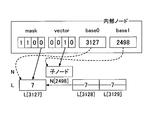
- FIG. 5 shows an example where the bit length of the chunk is 2, that is, a case where the branch is made in four directions from each node of the tree, but the structure is the same regardless of the bit length of the chunk.
- the internal nodes include vector, base0, and base1.
- a vector is a bit vector composed of bits corresponding to the number of branches from the internal node.
- the chunk of the key data is 2 bits, four types of values of 00, 01, 10, and 11 can be taken.
- Each bit of the vector corresponds to each of the above four types of values in order from the right end.
- “from the right end” is an example, and “from the left end” may be used. For example, counting from the right end when using a little endian CPU, counting from the left end when using a big endian CPU.
- the rightmost (0th) bit of the vector corresponds to the chunk 00
- the first bit corresponds to the chunk 01
- the second bit corresponds to the chunk 10
- the third bit corresponds to chunk 11.
- Each bit of the vector indicates whether the transition destination (child node) from the internal node is an internal node or a leaf node.
- 1 indicates an internal node and 0 indicates a leaf node.
- 1 may indicate a leaf node and 0 may indicate an internal node.
- the calculation unit 11 refers to the first bit (1) counted from the 0th of the vector. By doing so, it is understood that the next node is an internal node.
- the arithmetic unit 11 refers to the 0th bit (0) of the vector, and the next node is a leaf node. Grasp that.
- the calculation unit 11 can grasp whether the transition destination node is an internal node or a leaf node by using the vector.
- the node array / I don't know which index element in the leaf array should be accessed. Therefore, in the present embodiment, the internal nodes hold base0 and base1.
- Base1 holds the storage start index of the child internal node corresponding to bit 1 of the vector of the internal node in the node array.
- the base 0 holds the storage start index of the child leaf node corresponding to the bit 0 of the vector of the internal node in the leaf array.
- the node array for each internal node, data of internal nodes that are children of the internal node are stored in the order of Index. For example, when there are three child internal nodes for a certain internal node, the three data of the child internal node are stored as three consecutive data in the node array. Of these three pieces of data, the index of the data whose index is the head (minimum) is base1.
- the data of leaf nodes that are children of the internal node are stored in the order of Index.
- the three pieces of data of the child leaf node are stored as three pieces of data having consecutive indexes in the leaf array.
- the index of the data having the index at the head is base0.
- the Index used in the present embodiment is an index indicating a storage location, and this may be rephrased as an “address”.
- the calculation unit 11 accesses the data of the child internal node / leaf node using the base 0 / base 1 as follows.
- the calculation unit 11 calculates (counts) the number of 1 in the bit position from the 0th to the vth of the vector. ) That is, the number of 1 in (v + 1) bits is calculated from the right end of the vector. If this number is bc (bit count), the calculation unit 11 accesses the index of the corresponding internal node by accessing the index (bc + base1-1) obtained by subtracting 1 from the value obtained by adding base1 to bc in the node array. Can be obtained.
- the calculation unit 11 calculates (counts) the number of 0s of bit positions from 0th to v-th of vector. ) That is, the number of 0s in (v + 1) bits is calculated from the right end of the vector.
- this number is bc (bit count)
- the calculation unit 11 accesses the index of the leaf node by accessing the index (bc + base0-1) obtained by subtracting 1 from the value obtained by adding base0 to bc in the leaf array. Can be obtained.
- FIG. 5 shows that a child internal node (Index: 2498) and a leaf node (Index: 3127 to 3129) are accessed by the above method.
- the CPU is provided with a function called popcnt that calculates the number of bits at high speed.
- this function can be used effectively and a search can be performed at high speed.
- popcnt is an example, and it is good also as not using popcnt.
- FIG. 5 shows an example in which the chunk length is 2 bits, that is, the vector is 4 bits, but this is an example, and the chunk length / vector may be another length.
- FIG. 6 shows an example in which the chunk length is 6 bits, that is, the vector is 64 (2 6 ) bits.
- FIG. 6 shows that the internal node has vector and base0 / base1, and the child internal node / leaf node can be accessed by the bit count and base0 / base1 as described above.
- the internal node only needs to have a bit vector and two bases, and the amount of data of each node can be greatly reduced as compared with a method having a pointer for each branch. Data volume can be reduced.
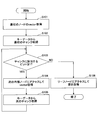
- FIG. 7 shows an example in which the search process ends when the leaf node is reached.
- the calculation unit 11 acquires the vector from the first internal node in the node array (step 101), and acquires the first chunk from the key data (step 102).
- the calculation unit 11 reads the bit at the position of the vector corresponding to the chunk and determines whether or not the bit is 1 (step 103). If the bit is 1, as described above, the bit count bc is calculated, the internal node stored in the index of (bc + base1-1) is accessed, and the vector of the internal node is acquired (step 104). ).
- the calculation unit 11 acquires the next chunk from the key data (step 105), and executes the determination in step 103 again.
- step 106 the arithmetic unit 11 calculates the bit count bc, accesses the leaf node stored in the index (bc + base0-1), and acquires the value of the leaf node.
- the prefix prefix length tends to be concentrated in a specific range (eg, / 11 to / 24). Can be reached. This is called direct pointing.
- FIG. 8A is an example in which direct pointing is not performed.
- search is performed in 6-bit chunks.
- FIG. 8B shows an example of direct pointing in which a search is first performed in 12-bit chunks. Even in the case of FIG. 8B, when a leaf node cannot be reached in the chunk, a search is performed in chunks of 6 bits, for example, in the same manner as in the above-described method in the first embodiment.
- Direct pointing can also be applied to other embodiments.
- Example 2 a scheme capable of compressing leaf data with respect to the scheme described in the first embodiment will be described.
- the method of the first embodiment when the method of the first embodiment is applied to the search of the forwarding table, it can be considered that many leaf nodes having overlapping values (next hops) are generated.
- the second embodiment is based on the method of the first embodiment, and can compress and hold leaf nodes. In the following, differences from the first embodiment will be mainly described.
- FIG. 9 is a diagram illustrating internal nodes in the second embodiment. As illustrated in FIG. 9, in the second embodiment, leafvec is added in addition to the vector, base0, and base1 described in the first embodiment. leafvec has the same bit length as that of the vector.
- leaf nodes that are children of each internal node in the leaf array that is, leaf nodes at each stage
- only the first leaf node at which continuation starts is retained as the consecutive leaf nodes having the same value.
- all the leaf nodes whose indexes are 3127, 3128, and 3129 are the same and are 7, and in this case, only the leaf node whose index is 3127 is retained.
- a plurality of leaf nodes having the same value are not included, and each has a different value.
- the element of leafvec is 0 or 1 bit, and 1 is set to the bit corresponding to the position where the continuation of the leaf node before compression starts from the right end. For example, in the example of FIG. 9, since continuation starts from the first leaf node, 1 is set in the first (0th) bit corresponding to the first leaf node. Further, when the continuation ends and another value leaf node starts (if the leaf node changes), 1 is set at that position. When the leaf node changes, the first leaf node is included.
- “continuous” includes one case. That is, when all the data of the leaf nodes are different, all 1 are set in the leafvec bit positions corresponding to the leaf nodes. The method of using leafvec is as follows.
- the arithmetic unit 11 When the arithmetic unit 11 detects that the bit of the vector corresponding to the chunk (the vth bit counted from the 0th) is 0, it grasps that the child is a leaf node. The calculation unit 11 calculates the number of 1 bits in the vth bit (v + 1 bits) counting from 0th at the right end in leafvec. Assuming that the number is bc, as in the case of the vector, the calculation unit 11 accesses the leaf node of the index (bc + base0-1).
- FIG. 10 shows an example of data of internal nodes and leaf nodes in the second embodiment.
- the calculation unit 11 detects that the first bit counted from the 0th of the vector in the internal node shown in (a) is 1 based on the chunk, and corresponds to that of (c) Access to internal nodes is shown. For example, in the internal node of (a), when the chunk corresponds to the second (0) counted from the 0th, the calculation unit 11 calculates the number of 1s in the 3 bits up to the second in leafvec. , Base0 is used to access the leaf node (L (0)) corresponding to the number.
- the compression of leaf nodes may be realized by a method other than using leafvec as described above.
- another method related to compression of leaf nodes will be described as a third embodiment.
- the method of the third embodiment is substantially the same as the method using leafvec.
- FIG. 11 is a diagram illustrating internal nodes according to the third embodiment. As shown in FIG. 11, in the third embodiment, a mask is added in addition to the vector, base0, and base1 described in the first embodiment. mask has the same bit length as the bit length of the vector.
- leaf nodes that are children of each internal node in the leaf array that is, leaf nodes at each stage
- only the first leaf node at which continuation starts is retained as the consecutive leaf nodes having the same value.
- the leaf nodes with Index 3127, 3128, and 3129 the values are all the same and are 7, and in this case, only the leaf node with Index 3127 is retained.
- the element of mask is a bit of 0 or 1, and from the right end, 0 is set to the bit corresponding to the position where the continuation of the leaf node before compression starts, and from the start position to the position of the continuous leaf node having the same value. 1 (mask) is set. In addition, when the continuation ends and another value leaf node starts (if the leaf node changes), 0 is set at that position. When the leaf node changes, the first leaf node is included.
- the position corresponding to the internal node may be 1 or 0, but is 0 in this example.
- 0 is set at the bit position corresponding to the first leaf node
- 1 which is a mask is set at the bit position corresponding to the subsequent leaf node.
- the method of using mask is as follows.
- the calculation unit 11 When the arithmetic unit 11 detects that the bit of the vector corresponding to the chunk (the vth bit counted from the 0th) is 0, it grasps that the child is a leaf node. In the third embodiment, the calculation unit 11 performs an OR operation on the vector and the mask, and calculates 0 of the 0th bit (v + 1 bits) from the rightmost 0th in the vector after the OR operation. Calculate the number of bits. If the number is bc, the calculation unit 11 accesses the leaf node of the index (bc + base0-1).
- FIG. 12 shows an example of data of internal nodes and leaf nodes in the third embodiment.
- the arithmetic unit 11 detects that the first bit counted from the 0th of the vector in the internal node shown in (a) is 1 based on the chunk, and corresponding to (c) Access to internal nodes is shown. For example, in the internal node of (a), when the chunk corresponds to the second (0) counted from the 0th, the calculation unit 11 counts the number of 0s in the 3 bits up to the second in the vector after the mask. And the leaf node (L (0)) corresponding to the number is accessed using base0.
- mask can also be applied to compression of internal nodes.
- An example in which mask is applied to compression of an internal node will be described with reference to FIG.
- FIG. 13 shows an example where the chunk length is 6 bits, that is, the vector is 64 (2 6 ) bits, as in FIG.
- mask is added in addition to the vector, base0, and base1 described in the first embodiment. mask has the same bit length as the bit length of the vector.
- the mask element is a bit of 0 or 1. From the right end, 1 is set to the bit corresponding to the position where the continuation of the internal node before compression starts, and from the start position to the position of the continuous internal node of the same value. 0 (mask) is set. Further, when the continuation ends and another value of the internal node starts (when the internal node changes), 1 is set at that position.
- the computing unit 11 When the computing unit 11 detects that the bit of the vector corresponding to the chunk (the vth bit counted from the 0th) is 1, it grasps that the child is an internal node.
- the calculation unit 11 performs an AND operation of the vector and the mask, and calculates the number of 1 bits in the vth bit (v + 1 bits) counted from the 0th right end of the vector after the AND operation. To do.
- the calculation unit 11 accesses the internal node of the index (bc + base1-1).
- Example 4 is a scheme that can compress the leaf nodes further than the second and third embodiments.
- FIG. 14 shows the structure of internal data in the fourth embodiment. As illustrated in FIG. 14, the internal data of the fourth embodiment is obtained by adding a leaf mask and a masked leaf as indicated by “A” in addition to the previously described vector, leafvec, base0, and base1.
- the storage unit 12 stores a node array and a leaf array.
- the leaf mask is data composed of 0/1 bits having the same bit length as that of the vector.
- Masked leaf is data of a certain leaf node.
- FIG. 15 is for specifically explaining a part of the processing different from the first and second embodiments.
- step 201 the arithmetic unit 11 detects that the corresponding bit in the vector of the current chunk (the 0th bit from the 0th bit is 0) is 0, thereby detecting the transition to the leaf node. .
- step 202 the calculation unit 11 determines whether or not the v-th bit counted from 0 in the leaf mask is 1. When this is 1 (Yes in Step 202), the value of masked leaf is acquired as the value of leaf data (Step 203).
- step 202 when the v-th bit is not 1 (No in step 202), the calculation unit 11 calculates the number (bc) of 1 from 0 to the v-th of leafvec in the same manner as in the second embodiment. , (Bc + base0-1) index leaf nodes are accessed to obtain values (step 204).
- the data described below may be created by the search device 10 or by another device (computer).
- a device that creates data is referred to as a creation device.
- the creation device is the search device 10 or another device.
- the creation data is stored in the storage unit 12 of the search device 10 after the data creation.
- the creation device calculates a leaf array without compression.
- a leaf array without compression.
- the maximum number of leaf array items is 64 for each parent internal node.
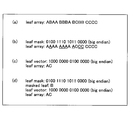
- the leaf information is three types of A, B, and C, the leaf information is in the leaf array as shown in FIG. 16A, for example, ABAA BBBA BCBB CCCC. Lined up.
- the creation device selects the leaf information to be masked.
- B is masked and omitted.
- the creating apparatus determines to mask B having the largest number of consecutive fragments.
- the “continuous fragment” includes one case like B in ABA.
- the masked leaf information B is stored in the masked leaf.
- the creation apparatus stores the slot in which the leaf information to be masked appears in the leaf mask.
- the slot in which the masked leaf information appears corresponds to a bit position corresponding to the leaf in the vector. For example, when the vector is 0010, when masking the leaf corresponding to the second bit 0 counting from the left end as the first, 0100 is stored in the leaf mask.
- the creation device makes the slot of the leaf information to be masked the same as the previous value.
- “leaf mask: 0100 1110 1011 0000” is obtained from the leaf information shown in FIG. 16 (a)
- “leaf array: AAAA AAAA ACCC CCCC” is obtained.
- this example since this example is big endian, it counts from the left end.
- the underlined portion is a masked portion, which is the same value as the previous value (left value) in the counting direction.
- one mask for example, 64 bits
- one leaf are added, but some discontinuous leaves can be omitted, and further compression of the leaf array can be realized. This is especially true when the leaf array is heavily fragmented by some next hop value (in a striped state), or when the size of one leaf (the size of one entry in the leaf array) is as large as 16 bytes. It becomes effective.
- leaf nodes are compressed.
- internal nodes having the same data can be compressed in the same manner as in the case of leaf nodes.
- both compression of leaf nodes and compression of internal nodes may be performed.
- the amount of data in the tree can be greatly reduced.
- the search target data is stored in a cache of a general-purpose CPU (eg, L1, L2, L3 cache) and search processing is performed. It can be implemented and high-speed search processing can be realized.
- the search target data is a route table as an example, the problem that the performance deteriorates when the number of routes in the route table becomes large is solved. Further, since the processing is speeded up, it is possible to solve the problem that the performance deteriorates when the address length becomes long.
- the memory efficiency is good because the presence / absence of a subtree is expressed in bits at each level of the tree.
- the presence / absence (child array) of a subtree is expressed by 64 bits, so that the processing efficiency of a 64-bit CPU is good.
- the number of 1 bits is counted and the corresponding child in the array can be jumped in one step, so that high-speed processing can be realized and memory efficiency is good.
- the number of 1 bits is counted and the corresponding child in the array can be jumped in one step, so that high-speed processing can be realized and memory efficiency is good.
- popcnt CPU instruction can be used, and high-speed processing can be realized.
- the amount of search target data can be reduced, and further speedup can be realized.
- a route table that holds 500,000 IPv4 full route routes is about 240 Mlps with a single core, with 4 cores. About 910 Mlps can be realized.
- a general-purpose CPU can exhibit the same or several times the performance of TCAM.
- a search device including a storage unit that stores search target data and a calculation unit that performs a search process on the search target data based on key data.
- the search target data stored in the means is multi-ary tree structure data having an internal node array and a leaf node array, and each internal node in the search target data is a leaf node or a transition destination.
- a bit vector representing whether there is a bit the computing means obtains a chunk of a predetermined bit length from the key data, and based on the bit corresponding to the value of the chunk in the bit vector of the accessing internal node Determine whether the transition destination from the internal node is an internal node or a leaf node, and assign to the transition destination node.
- the processing processes for the search apparatus is provided which transition destination, characterized in that the repeatedly executed until the leaf node.
- Each internal node in the search target data includes first base information indicating the storage position of one internal node of the transition destination, and second base information indicating the storage position of one leaf node of the transition destination,
- the arithmetic means accesses the internal node of the transition destination using the first base information, and the transition destination is a leaf
- the second base information may be used to access the transition destination leaf node.
- the internal node that is the transition destination is stored continuously in the internal node array, and the leaf node that is the transition destination is the storage position in the leaf node array.
- the calculation means calculates the first base information and the internal node in the bit vector.
- the internal node of the transition destination is accessed using the number of bits indicated, and when the transition destination is a leaf node, the second base information and the number of bits indicating the leaf node in the bit vector are used. Then, the transition destination leaf node may be accessed.
- each internal node in the search target data includes a leaf vector having a bit indicating a storage position where the value of the leaf node before compression has changed, and the computing means includes: When the transition destination determined based on the bit value of the bit vector is a leaf node, the second base information and the number of bits indicating the storage position in the leaf vector are used. It is good also as accessing a leaf node.
- the calculation means may check the bit vector of the bit vector and the leaf vector first, and use the leaf vector based on a bit value of the bit vector.
- each internal node in the search target data includes a mask vector having a bit indicating a storage position where the value of the leaf node before compression has changed, and the computing means includes: When the transition destination determined based on the bit value of the bit vector is a leaf node, the second base information and the number of bits indicating the leaf node in the bit vector masked by the mask vector are used. Then, the transition destination leaf node may be accessed.
- each internal node in the search target data For each internal node in the search target data, the internal node that is the transition destination is stored in the internal node array in a continuous storage position, internal nodes having the same value are compressed, and a plurality of internal nodes are A plurality of internal nodes having the same value, each internal node in the search target data includes a mask vector having a bit indicating a storage position where the value of the internal node before compression has changed, When the transition destination determined based on the bit value of the bit vector is an internal node, the first base information and the number of bits indicating the internal node in the bit vector masked by the mask vector are used. It is also possible to access the internal node of the transition destination.
- a predetermined value in a leaf node as a transition destination is masked, and after the masked value is changed to another value, a leaf node having the same value is compressed.
- the plurality of leaf nodes do not include a plurality of leaf nodes having the same value, the storage positions are continuously stored in the leaf node array, and each internal node in the search target data is masked.
- a leaf mask having a bit indicating a position before compression of the leaf vector having the predetermined value, and a leaf vector including a bit indicating a storage position where the value of the leaf node before compression has changed.
- the arithmetic means when the transition destination determined based on the bit value of the bit vector is a leaf node, It is determined whether or not a bit is set in the leaf mask at the same position as the bit in the frame. If the bit is set, the predetermined value is acquired as the value of the leaf node of the transition destination, If not, the transition destination leaf node may be accessed using the second base information and the number of bits indicating the storage position in the leaf vector.
- the calculation means may calculate the number of bits using a popcnt instruction of a CPU constituted by the calculation means.
- calculation means and the storage means may be configured on a 64-bit CPU.
- the chunk may be 6 bits long, and the bit vector may be 64 bits long.
- the computing means and the storage means are configured on a 64-bit CPU, the chunk is 6 bits long, the bit vector is 64 bits long, and the computing means is the 64-bit CPU.
- the number of bits may be calculated using a popcnt instruction, and the transition destination node may be accessed using an offset based on the number of bits from the base information.
- the calculation means may obtain a chunk having a bit length longer than the predetermined bit length from the key data and perform a search using the chunk to directly reach the leaf node.
- storage means may be replaced with any of a storage unit, a storage circuit, and a storage device.
- calculation means described above may be replaced with any one of a calculation unit, a calculation circuit, and a calculation device.
- the search method is a search method for performing search processing on search target data based on key data, wherein the search target data has a multi-ary tree structure having an internal node array and a leaf node array.
- Each internal node in the search target data includes a bit vector that represents whether the transition destination is an internal node or a leaf node, and the search method includes chunks of a predetermined bit length from the key data. Based on the bit corresponding to the value of the chunk in the bit vector of the accessing internal node, it is determined whether the transition destination from the internal node is an internal node or a leaf node.
- a search method including a step of repeatedly executing a process of accessing a destination node until a transition destination becomes a leaf node It may be configured by.
Landscapes
- Engineering & Computer Science (AREA)
- Theoretical Computer Science (AREA)
- Software Systems (AREA)
- Physics & Mathematics (AREA)
- General Engineering & Computer Science (AREA)
- General Physics & Mathematics (AREA)
- Databases & Information Systems (AREA)
- Mathematical Physics (AREA)
- Data Mining & Analysis (AREA)
- Computer Networks & Wireless Communication (AREA)
- Signal Processing (AREA)
- Information Retrieval, Db Structures And Fs Structures Therefor (AREA)
- Data Exchanges In Wide-Area Networks (AREA)
Abstract
Priority Applications (5)
| Application Number | Priority Date | Filing Date | Title |
|---|---|---|---|
| US15/556,527 US11762826B2 (en) | 2015-03-11 | 2016-01-29 | Search apparatus, search method, program and recording medium |
| ES16761377T ES2830746T3 (es) | 2015-03-11 | 2016-01-29 | Dispositivo de recuperación, método de recuperación, programa y medio de registro |
| AU2016230539A AU2016230539B2 (en) | 2015-03-11 | 2016-01-29 | Retrieval device, retrieval method, program, and recording medium |
| CN201680014265.4A CN107431660B (zh) | 2015-03-11 | 2016-01-29 | 检索装置、检索方法及记录介质 |
| EP16761377.7A EP3270551B1 (fr) | 2015-03-11 | 2016-01-29 | Dispositif de récupération, procédé de récupération, programme et support d'enregistrement |
Applications Claiming Priority (2)
| Application Number | Priority Date | Filing Date | Title |
|---|---|---|---|
| JP2015-048657 | 2015-03-11 | ||
| JP2015048657A JP5960863B1 (ja) | 2015-03-11 | 2015-03-11 | 検索装置、検索方法、プログラム、及び記録媒体 |
Publications (1)
| Publication Number | Publication Date |
|---|---|
| WO2016143405A1 true WO2016143405A1 (fr) | 2016-09-15 |
Family
ID=56550536
Family Applications (1)
| Application Number | Title | Priority Date | Filing Date |
|---|---|---|---|
| PCT/JP2016/052664 Ceased WO2016143405A1 (fr) | 2015-03-11 | 2016-01-29 | Dispositif de récupération, procédé de récupération, programme et support d'enregistrement |
Country Status (7)
| Country | Link |
|---|---|
| US (1) | US11762826B2 (fr) |
| EP (1) | EP3270551B1 (fr) |
| JP (1) | JP5960863B1 (fr) |
| CN (1) | CN107431660B (fr) |
| AU (1) | AU2016230539B2 (fr) |
| ES (1) | ES2830746T3 (fr) |
| WO (1) | WO2016143405A1 (fr) |
Families Citing this family (11)
| Publication number | Priority date | Publication date | Assignee | Title |
|---|---|---|---|---|
| US10464500B2 (en) | 2017-05-29 | 2019-11-05 | Aamp Of Florida, Inc. | Aftermarket head unit interface and protocol converter cartridge |
| CN111373389B (zh) * | 2017-11-20 | 2023-11-17 | 华为技术有限公司 | 数据存储系统以及用于提供数据存储系统的方法 |
| CN108008728B (zh) * | 2017-12-12 | 2020-01-17 | 深圳市银星智能科技股份有限公司 | 清洁机器人以及基于清洁机器人的最短路径规划方法 |
| JP2020004132A (ja) * | 2018-06-28 | 2020-01-09 | エヌ・ティ・ティ・コミュニケーションズ株式会社 | 検索装置、検索方法、プログラム、及び記録媒体 |
| JP7088868B2 (ja) * | 2019-03-22 | 2022-06-21 | エヌ・ティ・ティ・コミュニケーションズ株式会社 | 通信装置、通信方法及びプログラム |
| US11288244B2 (en) * | 2019-06-10 | 2022-03-29 | Akamai Technologies, Inc. | Tree deduplication |
| US11652791B2 (en) * | 2019-08-07 | 2023-05-16 | Cisco Technology, Inc. | Consolidated routing table for extranet virtual networks |
| KR20220128791A (ko) | 2021-03-15 | 2022-09-22 | 삼성전자주식회사 | 비휘발성 메모리를 포함하는 전자 장치 및 그것의 비휘발성 메모리 관리 방법 |
| US11683039B1 (en) | 2021-03-31 | 2023-06-20 | DreamBig Semiconductor Inc. | TCAM-based not logic |
| CN115328366B (zh) * | 2022-08-11 | 2023-09-19 | 北京智慧星光信息技术有限公司 | 基于全路径计算的千万级树形节点搜索展示方法和系统 |
| US12177180B2 (en) | 2023-05-23 | 2024-12-24 | Centripetal Networks, Llc | Methods and systems for efficient cybersecurity policy enforcement on network communications |
Citations (2)
| Publication number | Priority date | Publication date | Assignee | Title |
|---|---|---|---|---|
| JP2001517024A (ja) * | 1997-09-15 | 2001-10-02 | エフィシャント ネットワーキング アクティエボラーグ | 高速ルーティング・ルックアップのための方法とシステム |
| JP2004537921A (ja) * | 2001-07-31 | 2004-12-16 | ノース・キャロライナ・ステイト・ユニヴァーシティ | 高速パケット転送のための方法及びシステム |
Family Cites Families (29)
| Publication number | Priority date | Publication date | Assignee | Title |
|---|---|---|---|---|
| IL100987A (en) * | 1991-02-27 | 1995-10-31 | Digital Equipment Corp | Method and apparatus for compiling code |
| US5664172A (en) * | 1994-07-19 | 1997-09-02 | Oracle Corporation | Range-based query optimizer |
| US6266706B1 (en) | 1997-09-15 | 2001-07-24 | Effnet Group Ab | Fast routing lookup system using complete prefix tree, bit vector, and pointers in a routing table for determining where to route IP datagrams |
| US6522632B1 (en) * | 1998-05-06 | 2003-02-18 | Avici Systems | Apparatus and method for efficient prefix search |
| JP3547625B2 (ja) | 1998-09-03 | 2004-07-28 | 三菱電機株式会社 | データ検索装置およびデータ検索方法 |
| US6829695B1 (en) * | 1999-09-03 | 2004-12-07 | Nexql, L.L.C. | Enhanced boolean processor with parallel input |
| US6675163B1 (en) * | 2000-04-06 | 2004-01-06 | International Business Machines Corporation | Full match (FM) search algorithm implementation for a network processor |
| US20030208488A1 (en) * | 2000-09-20 | 2003-11-06 | North Dakota State University | System and method for organizing, compressing and structuring data for data mining readiness |
| US6931418B1 (en) * | 2001-03-26 | 2005-08-16 | Steven M. Barnes | Method and system for partial-order analysis of multi-dimensional data |
| US7523218B1 (en) * | 2002-04-30 | 2009-04-21 | University Of Florida Research Foundation, Inc. | O(log n) dynamic router tables for prefixes and ranges |
| US7444318B2 (en) * | 2002-07-03 | 2008-10-28 | University Of Florida Research Foundation, Inc. | Prefix partitioning methods for dynamic router tables |
| US6934252B2 (en) * | 2002-09-16 | 2005-08-23 | North Carolina State University | Methods and systems for fast binary network address lookups using parent node information stored in routing table entries |
| US8886677B1 (en) * | 2004-07-23 | 2014-11-11 | Netlogic Microsystems, Inc. | Integrated search engine devices that support LPM search operations using span prefix masks that encode key prefix length |
| JP4271214B2 (ja) * | 2006-07-07 | 2009-06-03 | 株式会社エスグランツ | ビット列検索装置、検索方法及びプログラム |
| JP4973101B2 (ja) * | 2006-09-29 | 2012-07-11 | 日本電気株式会社 | 自動合成装置 |
| US8086641B1 (en) * | 2006-11-27 | 2011-12-27 | Netlogic Microsystems, Inc. | Integrated search engine devices that utilize SPM-linked bit maps to reduce handle memory duplication and methods of operating same |
| US7831626B1 (en) * | 2006-11-27 | 2010-11-09 | Netlogic Microsystems, Inc. | Integrated search engine devices having a plurality of multi-way trees of search keys therein that share a common root node |
| KR101127267B1 (ko) * | 2007-05-01 | 2012-07-10 | 인터내셔널 비지네스 머신즈 코포레이션 | 유사 스트링 정합을 위한 방법 및 시스템 |
| JP4567754B2 (ja) * | 2008-01-17 | 2010-10-20 | 株式会社エスグランツ | ビット列検索装置、検索方法及びプログラム |
| CN101577662B (zh) * | 2008-05-05 | 2012-04-04 | 华为技术有限公司 | 一种基于树形数据结构的最长前缀匹配方法和装置 |
| US9438413B2 (en) * | 2010-01-08 | 2016-09-06 | Novell, Inc. | Generating and merging keys for grouping and differentiating volumes of files |
| US8522348B2 (en) * | 2009-07-29 | 2013-08-27 | Northwestern University | Matching with a large vulnerability signature ruleset for high performance network defense |
| US8669977B2 (en) * | 2009-10-01 | 2014-03-11 | Intel Corporation | Hierarchical mesh quantization that facilitates efficient ray tracing |
| EP2515245A1 (fr) | 2009-11-30 | 2012-10-24 | S. Grants Co., Ltd. | Dispositif d'extraction de train binaire, procédé d'extraction et programme |
| CN102739551B (zh) * | 2012-07-17 | 2015-03-18 | 中山大学 | 多存储器流水路由体系结构 |
| US20140188885A1 (en) * | 2012-12-27 | 2014-07-03 | Broadcom Corporation | Utilization and Power Efficient Hashing |
| CN104052669B (zh) * | 2013-03-12 | 2018-12-07 | 凯为公司 | 用于处理交替配置的最长前缀匹配表的装置 |
| EP2973039B1 (fr) * | 2013-03-15 | 2020-09-16 | Factual Inc. | Appareils, systèmes et procédés de regroupement d'enregistrements de données |
| US9842132B2 (en) * | 2015-10-23 | 2017-12-12 | International Business Machines Corporation | Bloom filter index for device discovery |
-
2015
- 2015-03-11 JP JP2015048657A patent/JP5960863B1/ja active Active
-
2016
- 2016-01-29 AU AU2016230539A patent/AU2016230539B2/en active Active
- 2016-01-29 WO PCT/JP2016/052664 patent/WO2016143405A1/fr not_active Ceased
- 2016-01-29 US US15/556,527 patent/US11762826B2/en active Active
- 2016-01-29 CN CN201680014265.4A patent/CN107431660B/zh active Active
- 2016-01-29 ES ES16761377T patent/ES2830746T3/es active Active
- 2016-01-29 EP EP16761377.7A patent/EP3270551B1/fr active Active
Patent Citations (2)
| Publication number | Priority date | Publication date | Assignee | Title |
|---|---|---|---|---|
| JP2001517024A (ja) * | 1997-09-15 | 2001-10-02 | エフィシャント ネットワーキング アクティエボラーグ | 高速ルーティング・ルックアップのための方法とシステム |
| JP2004537921A (ja) * | 2001-07-31 | 2004-12-16 | ノース・キャロライナ・ステイト・ユニヴァーシティ | 高速パケット転送のための方法及びシステム |
Also Published As
| Publication number | Publication date |
|---|---|
| JP2016170526A (ja) | 2016-09-23 |
| EP3270551A4 (fr) | 2018-07-18 |
| ES2830746T3 (es) | 2021-06-04 |
| JP5960863B1 (ja) | 2016-08-02 |
| CN107431660A (zh) | 2017-12-01 |
| EP3270551A1 (fr) | 2018-01-17 |
| EP3270551B1 (fr) | 2020-10-14 |
| US11762826B2 (en) | 2023-09-19 |
| AU2016230539A1 (en) | 2017-10-05 |
| US20180039662A1 (en) | 2018-02-08 |
| AU2016230539B2 (en) | 2018-08-16 |
| CN107431660B (zh) | 2020-08-18 |
Similar Documents
| Publication | Publication Date | Title |
|---|---|---|
| JP5960863B1 (ja) | 検索装置、検索方法、プログラム、及び記録媒体 | |
| CN104904167B (zh) | 通信网络中对于分组处理的高性能基于哈希的查找 | |
| US8880507B2 (en) | Longest prefix match using binary search tree | |
| KR100962653B1 (ko) | 블룸 필터 및 복수 해싱 구조를 사용한 ip 주소 검색방법 및 장치 | |
| KR100586461B1 (ko) | 파이프라인 이진 트리를 이용한 ip 어드레스 검색 방법,하드웨어 구조 및 기록매체 | |
| CN105141525B (zh) | IPv6路由查找方法及装置 | |
| JP2013515430A (ja) | 高速ipルックアップのためのシストリック・アレイ・アーキテクチャ | |
| CN106416152B (zh) | 一种查找装置、查找配置方法和查找方法 | |
| JP4995125B2 (ja) | 固定長データの検索方法 | |
| US9729447B2 (en) | Apparatus and method for processing alternately configured longest prefix match tables | |
| KR20020059238A (ko) | 다중탐색 트리의 노드 생성 방법, 및 그에 따라 생성된다중탐색 트리 구조의 자료를 탐색하는 방법 | |
| CN116319555A (zh) | 一种面向虚拟专用网络的路由转发方法 | |
| WO2014047863A1 (fr) | Génération d'un graphe de forme pour une table de routage | |
| CN107729053B (zh) | 一种实现高速缓存表的方法 | |
| CN104780101A (zh) | 内容中心网络转发平面fib表结构及其检索方法 | |
| CN102904812A (zh) | 路由表项的存储方法、查找方法、装置及系统 | |
| CN118282943A (zh) | 一种查找路由表项的方法及装置 | |
| CN105227468A (zh) | 一种查找装置、查找方法和配置方法 | |
| JP6205463B2 (ja) | 検索装置、検索方法、プログラム、及び記録媒体 | |
| Bahrambeigy et al. | Bloom-Bird: A scalable open source router based on Bloom filter | |
| CN107204926B (zh) | 预处理cache的路由快速查找方法 | |
| Bahrambeigy et al. | Towards Accelerating IP Lookups on Commodity PC Routers using Bloom Filter: Proposal of Bloom-Bird | |
| JP2018196075A (ja) | 検索装置、検索プログラム、及び検索方法 | |
| JP2020004132A (ja) | 検索装置、検索方法、プログラム、及び記録媒体 | |
| JP3754043B2 (ja) | データ検索装置 |
Legal Events
| Date | Code | Title | Description |
|---|---|---|---|
| 121 | Ep: the epo has been informed by wipo that ep was designated in this application |
Ref document number: 16761377 Country of ref document: EP Kind code of ref document: A1 |
|
| WWE | Wipo information: entry into national phase |
Ref document number: 15556527 Country of ref document: US |
|
| NENP | Non-entry into the national phase |
Ref country code: DE |
|
| REEP | Request for entry into the european phase |
Ref document number: 2016761377 Country of ref document: EP |
|
| ENP | Entry into the national phase |
Ref document number: 2016230539 Country of ref document: AU Date of ref document: 20160129 Kind code of ref document: A |