WO2016143456A1 - Composé diazadiényle, matière première pour former un film mince, procédé pour produire un film mince et composé de type diazadiène - Google Patents
Composé diazadiényle, matière première pour former un film mince, procédé pour produire un film mince et composé de type diazadiène Download PDFInfo
- Publication number
- WO2016143456A1 WO2016143456A1 PCT/JP2016/054116 JP2016054116W WO2016143456A1 WO 2016143456 A1 WO2016143456 A1 WO 2016143456A1 JP 2016054116 W JP2016054116 W JP 2016054116W WO 2016143456 A1 WO2016143456 A1 WO 2016143456A1
- Authority
- WO
- WIPO (PCT)
- Prior art keywords
- thin film
- compound
- raw material
- diazadienyl
- mass
- Prior art date
- Legal status (The legal status is an assumption and is not a legal conclusion. Google has not performed a legal analysis and makes no representation as to the accuracy of the status listed.)
- Ceased
Links
Images

Classifications
-
- C—CHEMISTRY; METALLURGY
- C07—ORGANIC CHEMISTRY
- C07C—ACYCLIC OR CARBOCYCLIC COMPOUNDS
- C07C251/00—Compounds containing nitrogen atoms doubly-bound to a carbon skeleton
- C07C251/02—Compounds containing nitrogen atoms doubly-bound to a carbon skeleton containing imino groups
- C07C251/04—Compounds containing nitrogen atoms doubly-bound to a carbon skeleton containing imino groups having carbon atoms of imino groups bound to hydrogen atoms or to acyclic carbon atoms
- C07C251/06—Compounds containing nitrogen atoms doubly-bound to a carbon skeleton containing imino groups having carbon atoms of imino groups bound to hydrogen atoms or to acyclic carbon atoms to carbon atoms of a saturated carbon skeleton
- C07C251/08—Compounds containing nitrogen atoms doubly-bound to a carbon skeleton containing imino groups having carbon atoms of imino groups bound to hydrogen atoms or to acyclic carbon atoms to carbon atoms of a saturated carbon skeleton being acyclic
-
- C—CHEMISTRY; METALLURGY
- C23—COATING METALLIC MATERIAL; COATING MATERIAL WITH METALLIC MATERIAL; CHEMICAL SURFACE TREATMENT; DIFFUSION TREATMENT OF METALLIC MATERIAL; COATING BY VACUUM EVAPORATION, BY SPUTTERING, BY ION IMPLANTATION OR BY CHEMICAL VAPOUR DEPOSITION, IN GENERAL; INHIBITING CORROSION OF METALLIC MATERIAL OR INCRUSTATION IN GENERAL
- C23C—COATING METALLIC MATERIAL; COATING MATERIAL WITH METALLIC MATERIAL; SURFACE TREATMENT OF METALLIC MATERIAL BY DIFFUSION INTO THE SURFACE, BY CHEMICAL CONVERSION OR SUBSTITUTION; COATING BY VACUUM EVAPORATION, BY SPUTTERING, BY ION IMPLANTATION OR BY CHEMICAL VAPOUR DEPOSITION, IN GENERAL
- C23C16/00—Chemical coating by decomposition of gaseous compounds, without leaving reaction products of surface material in the coating, i.e. chemical vapour deposition [CVD] processes
- C23C16/06—Chemical coating by decomposition of gaseous compounds, without leaving reaction products of surface material in the coating, i.e. chemical vapour deposition [CVD] processes characterised by the deposition of metallic material
- C23C16/18—Chemical coating by decomposition of gaseous compounds, without leaving reaction products of surface material in the coating, i.e. chemical vapour deposition [CVD] processes characterised by the deposition of metallic material from metallo-organic compounds
-
- C—CHEMISTRY; METALLURGY
- C23—COATING METALLIC MATERIAL; COATING MATERIAL WITH METALLIC MATERIAL; CHEMICAL SURFACE TREATMENT; DIFFUSION TREATMENT OF METALLIC MATERIAL; COATING BY VACUUM EVAPORATION, BY SPUTTERING, BY ION IMPLANTATION OR BY CHEMICAL VAPOUR DEPOSITION, IN GENERAL; INHIBITING CORROSION OF METALLIC MATERIAL OR INCRUSTATION IN GENERAL
- C23C—COATING METALLIC MATERIAL; COATING MATERIAL WITH METALLIC MATERIAL; SURFACE TREATMENT OF METALLIC MATERIAL BY DIFFUSION INTO THE SURFACE, BY CHEMICAL CONVERSION OR SUBSTITUTION; COATING BY VACUUM EVAPORATION, BY SPUTTERING, BY ION IMPLANTATION OR BY CHEMICAL VAPOUR DEPOSITION, IN GENERAL
- C23C16/00—Chemical coating by decomposition of gaseous compounds, without leaving reaction products of surface material in the coating, i.e. chemical vapour deposition [CVD] processes
- C23C16/44—Chemical coating by decomposition of gaseous compounds, without leaving reaction products of surface material in the coating, i.e. chemical vapour deposition [CVD] processes characterised by the method of coating
- C23C16/455—Chemical coating by decomposition of gaseous compounds, without leaving reaction products of surface material in the coating, i.e. chemical vapour deposition [CVD] processes characterised by the method of coating characterised by the method used for introducing gases into reaction chamber or for modifying gas flows in reaction chamber
- C23C16/45523—Pulsed gas flow or change of composition over time
- C23C16/45525—Atomic layer deposition [ALD]
-
- C—CHEMISTRY; METALLURGY
- C23—COATING METALLIC MATERIAL; COATING MATERIAL WITH METALLIC MATERIAL; CHEMICAL SURFACE TREATMENT; DIFFUSION TREATMENT OF METALLIC MATERIAL; COATING BY VACUUM EVAPORATION, BY SPUTTERING, BY ION IMPLANTATION OR BY CHEMICAL VAPOUR DEPOSITION, IN GENERAL; INHIBITING CORROSION OF METALLIC MATERIAL OR INCRUSTATION IN GENERAL
- C23C—COATING METALLIC MATERIAL; COATING MATERIAL WITH METALLIC MATERIAL; SURFACE TREATMENT OF METALLIC MATERIAL BY DIFFUSION INTO THE SURFACE, BY CHEMICAL CONVERSION OR SUBSTITUTION; COATING BY VACUUM EVAPORATION, BY SPUTTERING, BY ION IMPLANTATION OR BY CHEMICAL VAPOUR DEPOSITION, IN GENERAL
- C23C16/00—Chemical coating by decomposition of gaseous compounds, without leaving reaction products of surface material in the coating, i.e. chemical vapour deposition [CVD] processes
- C23C16/44—Chemical coating by decomposition of gaseous compounds, without leaving reaction products of surface material in the coating, i.e. chemical vapour deposition [CVD] processes characterised by the method of coating
- C23C16/455—Chemical coating by decomposition of gaseous compounds, without leaving reaction products of surface material in the coating, i.e. chemical vapour deposition [CVD] processes characterised by the method of coating characterised by the method used for introducing gases into reaction chamber or for modifying gas flows in reaction chamber
- C23C16/45523—Pulsed gas flow or change of composition over time
- C23C16/45525—Atomic layer deposition [ALD]
- C23C16/45553—Atomic layer deposition [ALD] characterized by the use of precursors specially adapted for ALD
-
- C—CHEMISTRY; METALLURGY
- C23—COATING METALLIC MATERIAL; COATING MATERIAL WITH METALLIC MATERIAL; CHEMICAL SURFACE TREATMENT; DIFFUSION TREATMENT OF METALLIC MATERIAL; COATING BY VACUUM EVAPORATION, BY SPUTTERING, BY ION IMPLANTATION OR BY CHEMICAL VAPOUR DEPOSITION, IN GENERAL; INHIBITING CORROSION OF METALLIC MATERIAL OR INCRUSTATION IN GENERAL
- C23C—COATING METALLIC MATERIAL; COATING MATERIAL WITH METALLIC MATERIAL; SURFACE TREATMENT OF METALLIC MATERIAL BY DIFFUSION INTO THE SURFACE, BY CHEMICAL CONVERSION OR SUBSTITUTION; COATING BY VACUUM EVAPORATION, BY SPUTTERING, BY ION IMPLANTATION OR BY CHEMICAL VAPOUR DEPOSITION, IN GENERAL
- C23C16/00—Chemical coating by decomposition of gaseous compounds, without leaving reaction products of surface material in the coating, i.e. chemical vapour deposition [CVD] processes
- C23C16/44—Chemical coating by decomposition of gaseous compounds, without leaving reaction products of surface material in the coating, i.e. chemical vapour deposition [CVD] processes characterised by the method of coating
- C23C16/455—Chemical coating by decomposition of gaseous compounds, without leaving reaction products of surface material in the coating, i.e. chemical vapour deposition [CVD] processes characterised by the method of coating characterised by the method used for introducing gases into reaction chamber or for modifying gas flows in reaction chamber
- C23C16/45523—Pulsed gas flow or change of composition over time
- C23C16/45525—Atomic layer deposition [ALD]
- C23C16/45555—Atomic layer deposition [ALD] applied in non-semiconductor technology
-
- C—CHEMISTRY; METALLURGY
- C07—ORGANIC CHEMISTRY
- C07F—ACYCLIC, CARBOCYCLIC OR HETEROCYCLIC COMPOUNDS CONTAINING ELEMENTS OTHER THAN CARBON, HYDROGEN, HALOGEN, OXYGEN, NITROGEN, SULFUR, SELENIUM OR TELLURIUM
- C07F15/00—Compounds containing elements of Groups 8, 9, 10 or 18 of the Periodic Table
- C07F15/06—Cobalt compounds
- C07F15/065—Cobalt compounds without a metal-carbon linkage
Definitions
- the present invention relates to a novel diazadienyl compound, a raw material for forming a thin film containing the compound, a method for producing a thin film using the raw material for forming a thin film, and a novel diazadiene compound.
- Thin film materials containing metal elements are applied to various applications because they exhibit electrical and optical properties.
- copper and copper-containing thin films have been applied as LSI wiring materials because of their high conductivity, high electromigration resistance, and high melting point.
- Nickel and nickel-containing thin films are mainly used for members of electronic parts such as resistance films and barrier films, members for recording media such as magnetic films, and members for thin film solar cells such as electrodes.
- Cobalt and cobalt-containing thin films are used for electrode films, resistance films, adhesive films, magnetic tapes, carbide tool members, and the like.
- Examples of the method for producing the thin film include a sputtering method, an ion plating method, a coating pyrolysis method, a metal organic compound decomposition method (MOD method) using a sol-gel method, a chemical vapor deposition method, and the like. Above all, it has many advantages such as excellent composition controllability and step coverage, suitable for mass production, and capable of hybrid integration, so chemical vapor deposition including ALD (Atomic Layer Deposition) method ( Hereinafter, the method may be simply referred to as CVD) is the optimum manufacturing process.
- ALD Atomic Layer Deposition
- Patent Document 1 discloses a diazadienyl complex that can be used as a raw material for forming a thin film by an ALD method.
- Patent Document 2 discloses a diazadiene metal compound that can be used in chemical vapor deposition or atomic layer deposition. Patent Document 1 and Patent Document 2 do not specifically describe the diazadiene compound of the present invention.
- the vapor pressure is high, there is no pyrophoric property, the melting point is low, and the thin film is formed by thermal decomposition at a low temperature.
- materials that can be made In particular, a material having a high vapor pressure, no spontaneous ignition, and a low melting point has been strongly desired.
- the present invention provides a diazadienyl compound represented by the following general formula (I), a raw material for forming a thin film containing the compound, and a method for producing a thin film using the raw material.
- a diazadienyl compound represented by the following general formula (I) a raw material for forming a thin film containing the compound, and a method for producing a thin film using the raw material.
- R 1 and R 2 each independently represents a linear or branched alkyl group having 1 to 6 carbon atoms
- R 3 represents a hydrogen atom or a linear or branched alkyl group having 1 to 6 carbon atoms.
- M represents a metal atom or a silicon atom
- n represents a valence of the metal atom or silicon atom represented by M.
- the substrate is provided with a raw material for forming a thin film containing the diazadienyl compound represented by the general formula (I) and a vapor containing the diazadienyl compound represented by the general formula (I).
- a thin film which is introduced into a formed film forming chamber and decomposes and / or chemically reacts with the diazadienyl compound to form a thin film containing at least one atom selected from metal atoms and silicon atoms on the surface of the substrate.
- a method is provided.
- the present invention also provides a diazadiene compound represented by the following general formula (II).
- R 4 represents a linear or branched alkyl group having 1 to 6 carbon atoms.
- the present invention it is possible to obtain a diazadienyl compound having a high vapor pressure, no spontaneous ignition, and a low melting point that becomes liquid at normal pressure of 30 ° C. or slight heating.
- the diazadienyl compound is particularly suitable as a thin film forming raw material for forming a metal thin film by a CVD method.
- a novel diazadiene compound can be provided.
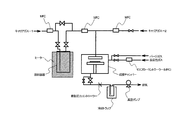
- FIG. 1 is a schematic view showing an example of an apparatus for chemical vapor deposition used in the method for producing a thin film according to the present invention.
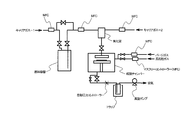
- FIG. 2 is a schematic diagram showing another example of a chemical vapor deposition apparatus used in the thin film manufacturing method according to the present invention.
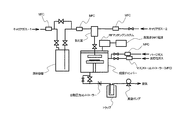
- FIG. 3 is a schematic view showing another example of the chemical vapor deposition apparatus used in the method for producing a thin film according to the present invention.
- FIG. 4 is a schematic diagram showing another example of a chemical vapor deposition apparatus used in the thin film manufacturing method according to the present invention.
- the diazadienyl compound of the present invention is represented by the above general formula (I), is suitable as a precursor for a thin film production method having a vaporization step such as a CVD method, and forms a thin film using the ALD method. You can also.
- the diazadienyl compound of the present invention has a low melting point and is a liquid that becomes a liquid at normal pressure of 30 ° C. or becomes a liquid by slight heating. Since a compound having a low melting point has good transportability, the diazadienyl compound of the present invention is suitable as a precursor for a thin film production method having a vaporization step such as a CVD method.
- R 1 and R 2 each independently represents a linear or branched alkyl group having 1 to 6 carbon atoms
- R 3 represents a hydrogen atom or a straight chain having 1 to 6 carbon atoms. It represents a chain or branched alkyl group
- M represents a metal atom or a silicon atom
- n represents the valence of the metal atom or silicon atom represented by M.
- Examples of the linear or branched alkyl group having 1 to 6 carbon atoms represented by R 1 , R 2 and R 3 include methyl, ethyl, propyl, isopropyl, butyl, isobutyl, sec-butyl, tert-butyl, Examples include pentyl, isopentyl and hexyl.
- M represents a metal atom or a silicon atom.
- the metal atom is not particularly limited.
- R 2 and R 3 when R 2 and R 3 are different, the melting point is low, which is preferable. Further, when R 3 is hydrogen, it is preferable because the vapor pressure is high and the melting point is low, and particularly when R 2 is a methyl group and R 3 is hydrogen, the vapor pressure is particularly high and the melting point is low. preferable. Moreover, when R ⁇ 1 > is an ethyl group, it is preferable from vapor pressure being high. In the case of a method for producing a thin film by the MOD method that does not involve a vaporization step, R 1 , R 2, and R 3 can be appropriately selected depending on the solubility in the solvent used, the thin film formation reaction, and the like.
- Preferred examples of the diazadienyl compound represented by the general formula (I) include, for example, the following chemical formula No. 1 when M is cobalt. 1-No.
- the compound represented by 18 is mentioned.
- diazadienyl compound represented by the general formula (I) include, for example, the following chemical formula No. 1 when M is copper. 19-No. And a compound represented by 36.
- the following chemical formula No. 19-No. 36 “Me” represents a methyl group, “Et” represents an ethyl group, “Pr” represents a propyl group, “iPr” represents isopropyl, “sBu” represents a secondary butyl group, “tBu” "Represents a tert-butyl group.
- diazadienyl compound represented by the general formula (I) include, for example, the following chemical formula No. 1 when M is iron. 37-No.
- the compound represented by 54 is mentioned.
- the following chemical formula No. 37-No. 54 “Me” represents a methyl group, “Et” represents an ethyl group, “Pr” represents a propyl group, “iPr” represents isopropyl, “sBu” represents a secondary butyl group, “tBu” "Represents a tert-butyl group.
- Preferred examples of the diazadienyl compound represented by the general formula (I) include, for example, the following chemical formula No. 1 when M is nickel. 55-No. And a compound represented by 72.
- the following chemical formula No. 55-No. 72 “Me” represents a methyl group, “Et” represents an ethyl group, “Pr” represents a propyl group, “iPr” represents isopropyl, “sBu” represents a secondary butyl group, “tBu” "Represents a tert-butyl group.
- Preferred examples of the diazadienyl compound represented by the general formula (I) include, for example, the following chemical formula No. 1 when M is manganese. 73-No.
- the compound represented by 90 is mentioned.
- the following chemical formula No. 73-No. 90 “Me” represents a methyl group, “Et” represents an ethyl group, “Pr” represents a propyl group, “iPr” represents isopropyl, “sBu” represents a secondary butyl group, “tBu” "Represents a tert-butyl group.
- the diazadienyl compound of the present invention is not particularly limited by its production method, and is produced by applying a known reaction.
- a cobalt diazadienyl compound for example, an inorganic salt such as a cobalt halide or nitrate, or a hydrate thereof, and the corresponding diazadiene compound are mixed with sodium, lithium, sodium hydride, sodium amide, water.
- a base such as sodium oxide, sodium methylate, ammonia or amine, an inorganic salt such as cobalt halide or nitrate, or a hydrate thereof
- a sodium complex, lithium complex or potassium of the corresponding diazadiene compound examples include a method of reacting a complex and the like.
- the diazadiene compound used here is not specifically limited by the manufacturing method, It can manufacture by applying a well-known reaction.
- a diazadiene compound used for producing a diazadienyl compound in which R 3 is hydrogen is obtained by extracting a reaction product of an alkylamine and an alkylglyoxal in a solvent such as trichloromethane with a suitable solvent and subjecting it to dehydration treatment.
- the diazadiene compound used for producing a diazadienyl compound in which R 3 is a linear or branched alkyl group having 1 to 6 carbon atoms is an alkylamine and a diketone (R 2 —C Examples include a method in which ( ⁇ O) C ( ⁇ O) —R 3 ) reacted in a solvent such as trichloromethane is extracted with a suitable solvent and dehydrated.
- the raw material for forming a thin film of the present invention is a thin film precursor made of the diazadienyl compound of the present invention described above, and its form varies depending on the production process to which the raw material for forming a thin film is applied. For example, when producing a thin film containing only one kind of metal or silicon, the raw material for forming a thin film of the present invention does not contain a metal compound and a semimetal compound other than the diazadienyl compound.
- the raw material for forming a thin film of the present invention is a compound containing a desired metal and / or a metalloid in addition to the diazadienyl compound. (Hereinafter also referred to as other precursors).
- the thin film forming raw material of the present invention may further contain an organic solvent and / or a nucleophilic reagent.
- the raw material for forming a thin film of the present invention is suitable for the chemical vapor deposition material (hereinafter sometimes referred to as a CVD raw material) because the physical properties of the diazadienyl compound that is a precursor are suitable for the CVD method and the ALD method. ) Is useful.
- CVD raw material chemical vapor deposition material
- the raw material for forming a thin film of the present invention is a raw material for chemical vapor deposition
- the form is appropriately selected depending on the method such as the transport and supply method of the CVD method used.
- the raw material for CVD is vaporized by heating and / or depressurizing in a container in which the raw material is stored (hereinafter sometimes simply referred to as a raw material container), and is necessary.
- a carrier gas such as argon, nitrogen, helium or the like
- the diazadienyl compound itself represented by the above general formula (I) can be used as a raw material for CVD.
- the diazadienyl compound itself represented by the above general formula (I) or a solution obtained by dissolving the compound in an organic solvent can be used as a raw material for CVD.
- These CVD raw materials may further contain other precursors, nucleophilic reagents, and the like.
- the CVD raw material is vaporized and supplied independently for each component (hereinafter sometimes referred to as a single source method), and the multi-component raw material is mixed in advance with a desired composition.
- a method of vaporizing and supplying a mixed raw material hereinafter, sometimes referred to as a cocktail sauce method.
- a cocktail sauce method a mixture of the diazadienyl compound of the present invention and another precursor or a mixed solution obtained by dissolving the mixture in an organic solvent can be used as a raw material for CVD.
- This mixture or mixed solution may further contain a nucleophilic reagent and the like.
- the organic solvent is not particularly limited and a known general organic solvent can be used.
- the organic solvent include acetates such as ethyl acetate, butyl acetate and methoxyethyl acetate; ethers such as tetrahydrofuran, tetrahydropyran, ethylene glycol dimethyl ether, diethylene glycol dimethyl ether, triethylene glycol dimethyl ether, dibutyl ether and dioxane; Ketones such as butyl ketone, methyl isobutyl ketone, ethyl butyl ketone, dipropyl ketone, diisobutyl ketone, methyl amyl ketone, cyclohexanone, methylcyclohexanone; hexane, cyclohexane, methylcyclohexane, dimethylcyclohexane, ethylcyclohexane, heptane, octan
- the total amount of the precursor in the CVD raw material which is a solution obtained by dissolving the precursor in the organic solvent, is 0.01 to 2.0 mol / liter, particularly 0.05 to 1.0 mol / liter. It is preferable to make it liter.
- the amount of the entire precursor is the amount of the diazadienyl compound of the present invention when the thin film forming raw material of the present invention does not contain a metal compound and a semimetal compound other than the diazadienyl compound of the present invention.
- the forming raw material contains a compound containing another metal and / or a compound containing a metalloid in addition to the diazadienyl compound, this is the total amount of the diazadienyl compound of the present invention and the other precursor.
- hydrides hydroxides, halides, azides, alkyls, alkenyls, cycloalkyls, aryls, alkynyls, aminos, dialkylaminoalkyls, monoalkylaminos, dialkylaminos, diamines, di (silyls) -Alkyl) amino, di (alkyl-silyl) amino, disilylamino, alkoxy, alkoxyalkyl, hydrazide, phosphide, nitrile, dialkylaminoalkoxy, alkoxyalkyldialkylamino, siloxy, diketonate, cyclopentadienyl, silyl, pyrazolate, guanidinate, A group consisting of compounds having phosphoguanidinate, amidinate, phosphoamidinate, ketoiminate, diketiminate, carbonyl and phosphoamidinate as ligands Compounds of one kind or two kinds
- the precursor metal species include magnesium, calcium, strontium, barium, radium, scandium, yttrium, titanium, zirconium, hafnium, vanadium, niobium, tantalum, chromium, molybdenum, tungsten, manganese, iron, osmium, cobalt, rhodium, iridium.
- precursors described above are known in the art, and their manufacturing methods are also known.
- the inorganic salt of metal or its hydrate described above is reacted with the alkali metal alkoxide of the alcohol compound.
- a precursor can be manufactured.
- the metal inorganic salt or hydrate include metal halides and nitrates
- examples of the alkali metal alkoxide include sodium alkoxide, lithium alkoxide, and potassium alkoxide.
- the other precursor is preferably a compound similar in heat and / or oxidative decomposition behavior to the diazadienyl compound of the present invention.
- the other precursor is preferably a compound that does not cause alteration due to a chemical reaction or the like during mixing, in addition to the similar behavior of heat and / or oxidative decomposition.
- examples of the precursor containing titanium, zirconium or hafnium include compounds represented by the following formulas (II-1) to (II-5).
- M 1 represents titanium, zirconium or hafnium, and R a and R b each independently may be substituted with a halogen atom, and may have an oxygen atom in the chain.
- R c represents an alkyl group having 1 to 8 carbon atoms
- R d represents an alkylene group having 2 to 18 carbon atoms which may be branched
- R e and R f each independently represents a hydrogen atom.
- each of R g , R h , R k and R j independently represents a hydrogen atom or an alkyl group having 1 to 4 carbon atoms, and p represents an integer of 0 to 4 Q represents 0 or 2, r represents an integer of 0 to 3, s represents an integer of 0 to 4, and t represents an integer of 1 to 4.
- an alkyl having 1 to 20 carbon atoms which may be substituted with a halogen atom and may contain an oxygen atom in the chain represented by R a and R b Groups include methyl, ethyl, propyl, isopropyl, butyl, sec-butyl, tert-butyl, isobutyl, pentyl, isopentyl, neopentyl, tert-pentyl, hexyl, cyclohexyl, 1-methylcyclohexyl, heptyl, 3-heptyl, isoheptyl , Tertiary heptyl, n-octyl, isooctyl, tertiary octyl, 2-ethylhexyl, trifluoromethyl, perfluorohexyl, 2-methoxyethyl, 2-ethoxy
- Examples of the alkyl group having 1 to 8 carbon atoms represented by R c include methyl, ethyl, propyl, isopropyl, butyl, sec-butyl, tert-butyl, isobutyl, pentyl, isopentyl, neopentyl, tert-pentyl, and hexyl.
- the alkylene group having 2 to 18 carbon atoms which may be branched and represented by R d is a group given by glycol, and examples of the glycol include 1,2-ethanediol, 1,2- Propanediol, 1,3-propanediol, 1,3-butanediol, 2,4-hexanediol, 2,2-dimethyl-1,3-propanediol, 2,2-diethyl-1,3-propanediol, 2,2-diethyl-1,3-butanediol, 2-ethyl-2-butyl-1,3-propanediol, 2,4-pentanediol, 2-methyl-1,3-propanediol, 1-methyl- 2,4-pentanediol and the like can be mentioned.
- Examples of the alkyl group having 1 to 3 carbon atoms represented by R e and R f include methyl, ethyl, propyl, 2-propyl and the like, represented by R g , R h , R j and R k.
- Examples of the alkyl group having 1 to 4 carbon atoms include methyl, ethyl, propyl, isopropyl, butyl, sec-butyl, tert-butyl and isobutyl.
- Examples of the precursor containing rare earth elements include compounds represented by the following formulas (III-1) to (III to 3).
- R a and R b each independently represents an alkyl group having 1 to 20 carbon atoms which may be substituted with a halogen atom and may contain an oxygen atom in the chain
- R c represents an alkyl group having 1 to 8 carbon atoms
- R e and R f each independently represents a hydrogen atom or an alkyl group having 1 to 3 carbon atoms
- R g and R j each independently represent (It represents an alkyl group having 1 to 4 carbon atoms, p ′ represents an integer of 0 to 3, and r ′ represents an integer of 0 to 2.
- the rare earth atom represented by M 2 includes scandium, yttrium, lanthanum, cerium, praseodymium, neodymium, promethium, samarium, europium, gadolinium, terbium, dysprosium, holmium, erbium, thulium, Examples thereof include ytterbium and lutetium, and examples of the group represented by R a , R b , R c , R e , R f , R g, and R j include the groups exemplified for the precursor containing titanium.
- the raw material for forming a thin film of the present invention may contain a nucleophilic reagent as necessary in order to improve the stability of the diazadienyl compound of the present invention and other precursors.
- a nucleophilic reagent include ethylene glycol ethers such as glyme, diglyme, triglyme and tetraglyme, 18-crown-6, dicyclohexyl-18-crown-6, 24-crown-8, dicyclohexyl-24-crown-8.
- Crown ethers such as dibenzo-24-crown-8, ethylenediamine, N, N′-tetramethylethylenediamine, diethylenetriamine, triethylenetetramine, tetraethylenepentamine, pentaethylenehexamine, 1,1,4,7,7- Polyamines such as pentamethyldiethylenetriamine, 1,1,4,7,10,10-hexamethyltriethylenetetramine and triethoxytriethyleneamine, cyclic polyamines such as cyclam and cyclen, pyridine, pyrrolidine and pipette Heterocyclic compounds such as gin, morpholine, N-methylpyrrolidine, N-methylpiperidine, N-methylmorpholine, tetrahydrofuran, tetrahydropyran, 1,4-dioxane, oxazole, thiazole, oxathiolane, methyl acetoacetate, ethyl acetoacetate, ⁇ -ketoest
- the raw material for forming a thin film according to the present invention should contain as little impurities metal elements as possible, impurities halogen such as impurity chlorine, and impurities organic components as much as possible.
- the impurity metal element content is preferably 100 ppb or less for each element, more preferably 10 ppb or less, and the total amount is preferably 1 ppm or less, more preferably 100 ppb or less.
- the impurity halogen content is preferably 100 ppm or less, more preferably 10 ppm or less, and most preferably 1 ppm or less.
- the impurity organic content is preferably 500 ppm or less in total, more preferably 50 ppm or less, and most preferably 10 ppm or less.
- metal compounds, organic solvents, and nucleophilic reagents are used to reduce their respective moisture content. In addition, it is better to remove moisture as much as possible before use.
- the water content of each of the metal compound, organic solvent and nucleophilic reagent is preferably 10 ppm or less, more preferably 1 ppm or less.
- the raw material for forming a thin film of the present invention contains as few particles as possible in order to reduce or prevent particle contamination of the formed thin film.
- the number of particles larger than 0.3 ⁇ m is preferably 100 or less in 1 ml of the liquid phase, and larger than 0.2 ⁇ m.
- the number of particles is more preferably 1000 or less in 1 ml of the liquid phase, and the number of particles larger than 0.2 ⁇ m is most preferably 100 or less in 1 ml of the liquid phase.
- a vapor obtained by vaporizing the thin film forming raw material of the present invention and a reactive gas used as necessary are used as a substrate.
- the film is introduced into a film forming chamber in which is deposited, and then a precursor is decomposed and / or chemically reacted on the substrate to grow and deposit a metal-containing thin film on the surface of the substrate.
- a precursor is decomposed and / or chemically reacted on the substrate to grow and deposit a metal-containing thin film on the surface of the substrate.
- Examples of the reactive gas used as necessary include oxygen, ozone, nitrogen dioxide, nitric oxide, water vapor, hydrogen peroxide, formic acid, acetic acid, acetic anhydride, etc.
- Examples of reducing substances include hydrogen, and examples of nitrides that can be used include organic amine compounds such as monoalkylamines, dialkylamines, trialkylamines, and alkylenediamines, hydrazine, and ammonia. Can be used alone or in combination of two or more.
- examples of the transport and supply method include the gas transport method, the liquid transport method, the single source method, and the cocktail sauce method described above.
- the above deposition methods include thermal CVD in which a raw material gas or a raw material gas and a reactive gas are reacted only by heat to deposit a thin film, plasma CVD using heat and plasma, photo CVD using heat and light, In addition, optical plasma CVD using light and plasma, and ALD in which the deposition reaction of CVD is divided into elementary processes and deposition is performed stepwise at the molecular level.
- Examples of the material of the substrate include silicon; ceramics such as silicon nitride, titanium nitride, tantalum nitride, titanium oxide, titanium nitride, ruthenium oxide, zirconium oxide, hafnium oxide, and lanthanum oxide; glass; metals such as metal ruthenium.
- Examples of the shape of the substrate include a plate shape, a spherical shape, a fiber shape, and a scale shape, and the surface of the substrate may be a flat surface or a three-dimensional structure such as a trench structure.
- reaction temperature base
- reaction pressure a deposition rate, etc.
- the reaction temperature is preferably 100 ° C. or higher, which is the temperature at which the diazadienyl compound of the present invention sufficiently reacts, and more preferably 150 ° C. to 400 ° C. Since the diazadienyl compound of the present invention can be thermally decomposed at less than 250 ° C., 150 ° C. to 250 ° C. is particularly preferable.
- the reaction pressure is preferably atmospheric pressure to 10 Pa in the case of thermal CVD or photo CVD, and preferably 2000 Pa to 10 Pa in the case of using plasma.
- the deposition rate can be controlled by the raw material supply conditions (vaporization temperature, vaporization pressure), reaction temperature, and reaction pressure.
- the deposition rate is large, the properties of the obtained thin film may be deteriorated.
- productivity may be problematic. Therefore, 0.01 to 100 nm / min is preferable, and 1 to 50 nm / min is more preferable.
- the number of cycles is controlled so as to obtain a desired film thickness.
- the above production conditions include temperature and pressure at which the thin film forming raw material is vaporized into steam.
- the step of vaporizing the raw material for forming a thin film to form a vapor may be performed in a raw material container or in a vaporization chamber.
- the thin film forming raw material of the present invention is preferably evaporated at 0 to 150 ° C.
- the pressure in the raw material container and the pressure in the vaporizing chamber are both preferably 1 to 10,000 Pa.
- the thin film production method of the present invention employs the ALD method, and in addition to the raw material introduction step of vaporizing the thin film forming raw material into vapor by the above transport and supply method, and introducing the vapor into the film forming chamber, A precursor thin film forming step for forming a precursor thin film on the surface of the substrate by the diazadienyl compound in the vapor, an exhausting step for exhausting unreacted diazadienyl compound gas, and the precursor thin film as a reactive gas and a chemistry
- substrate may have the metal containing thin film formation process of making it react and forming the thin film containing the said metal on the surface of this base
- substrate a precursor thin film formation process for making it react and forming the thin film containing the said metal on the surface of this base
- substrate a precursor thin film formation process for making it react and forming the thin film containing the said metal on the
- the metal oxide thin film is formed by the ALD method
- the raw material introduction step described above is performed.
- Preferred temperatures and pressures when the thin film forming raw material is steam are the same as those described above.
- a precursor thin film is formed on the substrate surface by the diazadienyl compound introduced into the deposition reaction part (precursor thin film forming step). At this time, heat may be applied by heating the substrate or heating the deposition reaction part.
- the precursor thin film formed in this step is a metal oxide thin film or a thin film formed by decomposition and / or reaction of a part of the diazadienyl compound, and has a composition different from that of the target metal oxide thin film.
- the substrate temperature when this step is performed is preferably from room temperature to 500 ° C, more preferably from 150 to 350 ° C.
- the pressure of the system (in the film forming chamber) when this step is performed is preferably 1 to 10,000 Pa, and more preferably 10 to 1000 Pa.
- unreacted diazadienyl compound gas and by-product gas are exhausted from the deposition reaction part (exhaust process).
- exhaust process Ideally, unreacted diazadienyl compound gas or by-produced gas is completely exhausted from the deposition reaction part, but it is not always necessary to exhaust completely.
- the exhaust method include a method of purging the system with an inert gas such as nitrogen, helium, and argon, a method of exhausting by reducing the pressure in the system, and a method combining these.
- the degree of pressure reduction is preferably 0.01 to 300 Pa, more preferably 0.01 to 100 Pa.
- an oxidizing gas is introduced into the deposition reaction part, and a metal oxide thin film is formed from the precursor thin film obtained in the precursor thin film forming step by the action of the oxidizing gas or the action of the oxidizing gas and heat.
- Form (metal oxide-containing thin film forming step) The temperature when heat is applied in this step is preferably room temperature to 500 ° C., more preferably 150 to 350 ° C.
- the pressure of the system (in the film forming chamber) when this step is performed is preferably 1 to 10,000 Pa, and more preferably 10 to 1000 Pa.
- the diazadienyl compound of the present invention has good reactivity with an oxidizing gas, and a metal oxide thin film can be obtained.
- the method for producing a thin film of the present invention when the ALD method is employed as described above, a series of operations including the above-described raw material introduction step, precursor thin film formation step, exhaust step, and metal oxide-containing thin film formation step
- the thin film deposition according to 1 may be set as one cycle, and this cycle may be repeated a plurality of times until a thin film having a required thickness is obtained.
- the unreacted diazadienyl compound gas and reactive gas oxidizing gas when forming a metal oxide thin film
- energy such as plasma, light, or voltage may be applied, or a catalyst may be used.
- the timing of applying the energy and the timing of using the catalyst are not particularly limited. For example, when introducing a diazadienyl compound gas in the raw material introduction step, heating in the precursor thin film formation step or the metal oxide-containing thin film formation step, It may be at the time of exhausting the system in the exhaust process, at the time of introducing the oxidizing gas in the metal oxide-containing thin film forming process, or between the above processes.
- annealing may be performed in an inert atmosphere, an oxidizing atmosphere, or a reducing atmosphere in order to obtain better electrical characteristics.
- a reflow process may be provided.
- the temperature in this case is 200 to 1000 ° C., preferably 250 to 500 ° C.
- a known chemical vapor deposition apparatus can be used as the apparatus for producing a thin film using the thin film forming raw material of the present invention.
- the apparatus include an apparatus that can perform a precursor as shown in FIG. 1 by bubbling supply, and an apparatus that has a vaporization chamber as shown in FIG.
- an apparatus capable of performing plasma treatment on a reactive gas can be used.
- the present invention is not limited to the single-wafer type apparatus as shown in FIGS. 1 to 4, and an apparatus capable of simultaneously processing a large number of sheets using a batch furnace can also be used.
- a thin film manufactured using the raw material for forming a thin film of the present invention can be selected from other precursors, reactive gases, and manufacturing conditions as appropriate, so that a desired type of metal, oxide ceramics, nitride ceramics, glass, etc. It can be a thin film.
- the thin film is known to exhibit various electric characteristics and optical characteristics, and is applied to various uses.
- copper and copper-containing thin films are applied as LSI wiring materials because of their high conductivity, high electromigration resistance, and high melting point.
- Nickel and nickel-containing thin films are mainly used for members of electronic parts such as resistance films and barrier films, members for recording media such as magnetic films, and members for thin film solar cells such as electrodes.
- Cobalt and cobalt-containing thin films are used for electrode films, resistance films, adhesive films, magnetic tapes, carbide tool members, and the like.
- the diazadiene compound of the present invention is represented by the following general formula (II), and is a particularly suitable compound as a ligand used as a compound suitable as a precursor for a thin film production method having a vaporization step such as a CVD method. is there.
- R 4 represents a linear or branched alkyl group having 1 to 6 carbon atoms.
- R 4 represents a linear or branched alkyl group having 1 to 6 carbon atoms.
- Examples of the linear or branched alkyl group having 1 to 6 carbon atoms represented by R 4 include methyl, ethyl, propyl, isopropyl, butyl, isobutyl, sec-butyl, tert-butyl, pentyl, isopentyl and hexyl. Can be mentioned.
- the diazadiene compound represented by the general formula (II) include, for example, the following chemical formula No. 91-No.
- the compound represented by 96 is mentioned.
- the following chemical formula No. 91-No. 96 “Me” represents a methyl group, “Et” represents an ethyl group, “Pr” represents a propyl group, “iPr” represents isopropyl, “sBu” represents a secondary butyl group, “tBu” "Represents a tert-butyl group.
- the diazadiene compound of the present invention is not particularly limited by its production method, and can be produced by applying a known reaction.
- a known reaction for example, there can be mentioned a method obtained by subjecting ethylamine and alkylglyoxal to a reaction in a solvent such as trichloromethane and extracting with a suitable solvent, followed by dehydration.
- the diazadiene compound of the present invention can be used as a ligand for a metal compound used as a raw material for forming a thin film.
- the diazadiene compound of the present invention can also be used for applications such as synthetic raw materials such as solvents, fragrances, agricultural chemicals, pharmaceuticals, and various polymers.
- Example 1 Compound No. Production of 91
- a 2 L four-necked flask was charged with 530.9 g (3.89 mol) of an ethylamine 33% aqueous solution and 398 g (3.33 mol) of trichloromethane, and cooled to around 6 ° C.
- 200 g (1.11 mol) of 1-methylglyoxal (pyruvaldehyde) 40% aqueous solution was added dropwise at a liquid temperature of 6-8 ° C. for 1.5 hours. After completion of dropping, the mixture was stirred at a liquid temperature of 6 to 8 for 3.5 hours. Then, the reaction liquid was left still and the organic layer was liquid-separated.
- the aqueous layer was extracted twice with trichloromethane (100 g) to recover the organic layer. All the organic layers were combined, dehydrated with sodium sulfate (appropriate amount), filtered, and then desolvated at an oil bath temperature of 60 to 70 ° C. under slightly reduced pressure. Thereafter, distillation was performed under reduced pressure at an oil bath temperature of 70 ° C. The obtained fraction was a pale yellow transparent liquid, and the yield was 67.0 g and the yield was 47.8%.
- Example 2 Compound No. Production of 2]
- the compound No. obtained above was added.
- 91 was charged with 19.4 g (154 mmol) and dehydrated tetrahydrofuran (111 g), and cooled to ⁇ 10 ° C. with an isopropanol bath cooled with dry ice.
- 1.07 g (154 mmol) of metallic lithium piece was added little by little and reacted at ⁇ 20 to ⁇ 10 ° C.
- This solution was added dropwise to a suspension of 10.0 g (77.0 mmol) of cobalt chloride and 83.3 g of dehydrated tetrahydrofuran at around 0 ° C.
- the aqueous layer was extracted twice with trichloromethane (100 g) to recover the organic layer. All the organic layers were combined, dehydrated with sodium sulfate (appropriate amount), filtered, and then desolvated at an oil bath temperature of 60 to 70 ° C. under slightly reduced pressure. Thereafter, distillation was performed under reduced pressure at an oil bath temperature of 100 ° C. The obtained fraction was a pale yellow transparent liquid, and the yield was 26.7 g and the yield was 62.4%.
- Example 3 Compound No. Production of 3] In a 300 mL three-necked flask, 23.8 g (154 mmol) of N, N′-dipropyl-propane-1,2-diimine obtained above and dehydrated tetrahydrofuran (111 g) were charged, and ⁇ 35 ° C. on a dry ice / IPA bath. Until cooled. Into this, 1.07 g (154 mmol) of metallic lithium piece was added little by little and reacted at ⁇ 35 ° C.
- the reaction liquid was left still and the organic layer was liquid-separated. Furthermore, the aqueous layer was extracted twice with trichloromethane (100 g) to recover the organic layer. All organic layers were combined, dehydrated with sodium sulfate, filtered, and then desolvated at an oil bath temperature of 60 to 70 ° C. under slightly reduced pressure. Thereafter, distillation was performed under reduced pressure at an oil bath temperature of 64 ° C. The obtained fraction was a pale yellow transparent liquid, and the yield was 95.5 g and the yield was 74.0%.
- Example 4 Compound No. Production of 4] Into a 200 mL three-necked flask was charged 15.4 g (49.9 mmol) of N, N′-diisopropyl-propane-1,2-diimine obtained above and dehydrated tetrahydrofuran (110 g), and the dry ice / IPA bath was used. Cooled to 20 ° C. Into this, 0.69 g (99.8 mmol) of metal lithium piece was added little by little and reacted at ⁇ 20 to ⁇ 15 ° C.
- the reaction liquid was left still and the organic layer was liquid-separated. Furthermore, the aqueous layer was extracted twice with trichloromethane (100 g) to recover the organic layer. All the organic layers were combined, dehydrated with sodium sulfate (appropriate amount), filtered, and then desolvated at an oil bath temperature of 60 to 70 ° C. under slightly reduced pressure. Thereafter, distillation was performed under reduced pressure at an oil bath temperature of 70 ° C. The obtained fraction was a pale yellow transparent liquid, and the yield was 68.7 g and the yield was 40.1%.
- Example 5 Compound No. 14 Production
- a 300 mL three-necked flask was charged with 18.9 g (123 mmol) of N, N′-diethyl-pentane-2,3-diimine obtained above and dehydrated tetrahydrofuran (180 g), and ⁇ 30 ° C. with a dry ice / IPA bath. Until cooled.
- 0.851 g (122.6 mmol) of metallic lithium piece was added little by little and reacted at ⁇ 10 ° C.
- This solution was dropped into a suspension of 10.0 g (6.13 mmol) of cobalt chloride and 180 g of dehydrated tetrahydrofuran at around ⁇ 3 ° C., and then reacted for 12 hours under ice cooling. Thereafter, the solvent was removed at a bath temperature of 76 ° C. and slightly reduced pressure. After standing to cool, it was redissolved with dehydrated hexane and filtered through a membrane filter. The obtained filtrate was desolvated and dried at a bath temperature of 70 ° C. under slightly reduced pressure. The obtained residue was distilled at a bath temperature of 120 ° C. and 65 Pa to obtain a target product which was a dark black viscous liquid. The yield was 5.0 g, and the yield was 22.0. When the obtained object was left in the atmosphere to check for the presence or absence of spontaneous ignition, there was no spontaneous ignition.
- Comparative Example 1 is a compound having a melting point of 171 ° C.
- Evaluation Examples 1-1 to 1-4 are all liquids under normal pressure of 30 ° C. Since the raw material for forming a thin film having a low melting point is easy to transport, the raw material for forming a thin film can improve productivity. Further, from the results of TG-DTA, it was found that evaluation examples 1-1 to 1-4 had a lower temperature when the reduced pressure was reduced by 50% by mass than comparative example 1. From this, it was found that Evaluation Examples 1-1 to 1-4 showed a vapor pressure superior to that of Comparative Example 1. Among them, it was found that Evaluation Example 1-1 and Evaluation Example 1-4 show particularly excellent vapor pressure.
- Example 6 Production of metallic cobalt thin film by ALD method 2, 3 and 4 were used as chemical vapor deposition raw materials, and a metallic cobalt thin film was produced on a Cu substrate by the ALD method under the following conditions using the ALD apparatus shown in FIG.
- the obtained thin film was measured for film thickness by X-ray reflectivity method, confirmed by X-ray diffraction method and X-ray photoelectron spectroscopy, and the film structure and composition were confirmed to be 3 to 6 nm. Is metallic cobalt (confirmed by Co2p peak by XPS analysis), and the carbon content was less than 0.1 atom% which is the lower limit of detection.
- the film thickness obtained per cycle was 0.02 to 0.04 nm.
- Reaction temperature (substrate temperature): 230 ° C.
- reactive gas hydrogen gas
- (2) Unreacted raw materials are removed by argon purging for 5 seconds.
- a reactive gas is introduced and reacted at a system pressure of 100 Pa for 30 seconds.
- Unreacted raw materials are removed by argon purging for 5 seconds.
- Example 7 Production of metallic cobalt thin film by ALD method A metal cobalt thin film was produced on a Cu substrate by ALD using the ALD apparatus shown in FIG. The obtained thin film was measured for film thickness by X-ray reflectivity method, confirmed by X-ray diffraction method and X-ray photoelectron spectroscopy, and was confirmed to have a film thickness of 6 to 9 nm.
- Example 7 Production of metallic cobalt thin film by A metal cobalt thin film by ALD method A metal cobalt thin film was produced on a Cu substrate by ALD using the ALD apparatus shown in FIG. The obtained thin film was measured for film thickness by X-ray reflectivity method, confirmed by X-ray diffraction method and X-ray photoelectron spectroscopy, and was confirmed to have a film thickness of 6 to 9 nm.
- Was metallic cobalt confirmeded by Co2p peak by XPS analysis
- the film thickness obtained per cycle was 0.04 to 0.06 nm.
- Reaction temperature (substrate temperature): 210 ° C.
- reactive gas hydrogen gas
- (2) Unreacted raw materials are removed by argon purging for 5 seconds.
- a reactive gas is introduced and reacted at a system pressure of 100 Pa for 30 seconds.
- Unreacted raw materials are removed by argon purging for 5 seconds.
- Comparative Example 3 Production of metallic cobalt thin film by ALD method Using comparative compound 2 as a raw material for chemical vapor deposition, the ALD method shown in FIG. Although production was attempted, a smooth thin film could not be obtained.
- the carbon content in the Co-containing material formed on the Cu substrate was 10 atom% or more.
- Reaction temperature (substrate temperature): 230 ° C.
- reactive gas hydrogen gas
- (2) Unreacted raw materials are removed by argon purging for 5 seconds.
- a reactive gas is introduced and reacted at a system pressure of 100 Pa for 30 seconds.
- Unreacted raw materials are removed by argon purging for 5 seconds.
- Example 6 and Example 7 From the results of Example 6 and Example 7, a good-quality metallic cobalt thin film could be obtained.
- compound no When manufactured using 2, 3 and 4, the metal cobalt thin film was able to obtain a metal cobalt thin film having a very low carbon content.
- Comparative Example 3 a smooth thin film could not be formed on the Cu substrate, and small lumps were scattered on the substrate.
- the carbon content in the Co-containing material formed on the Cu substrate was 10 atom% or more, it was found that a high-quality metallic cobalt thin film could not be obtained.
Landscapes
- Chemical & Material Sciences (AREA)
- Organic Chemistry (AREA)
- Metallurgy (AREA)
- Engineering & Computer Science (AREA)
- Materials Engineering (AREA)
- Mechanical Engineering (AREA)
- Chemical Kinetics & Catalysis (AREA)
- General Chemical & Material Sciences (AREA)
- Chemical Vapour Deposition (AREA)
- Electrodes Of Semiconductors (AREA)
- Organic Low-Molecular-Weight Compounds And Preparation Thereof (AREA)
- Inorganic Compounds Of Heavy Metals (AREA)
- Chemically Coating (AREA)
Abstract
Priority Applications (5)
| Application Number | Priority Date | Filing Date | Title |
|---|---|---|---|
| KR1020177027683A KR102441169B1 (ko) | 2015-03-06 | 2016-02-12 | 디아자디에닐 화합물, 박막 형성용 원료, 박막의 제조 방법 및 디아자디엔 화합물 |
| US15/555,215 US20180037540A1 (en) | 2015-03-06 | 2016-02-12 | Diazadienyl compound, raw material for forming thin film, method for producing thin film, and diazadiene compound |
| CN201680013777.9A CN107428677B (zh) | 2015-03-06 | 2016-02-12 | 二氮杂二烯基化合物、薄膜形成用原料、薄膜的制造方法和二氮杂二烯化合物 |
| EP16761428.8A EP3266763B1 (fr) | 2015-03-06 | 2016-02-12 | Composé diazadiényle, matière première pour former un film mince, procédé pour produire un film mince et composé de type diazadiène |
| IL254192A IL254192B (en) | 2015-03-06 | 2017-08-28 | Diazadianyl compound, raw material for forming a thin layer, method for producing a thin layer and diazadiane compound |
Applications Claiming Priority (2)
| Application Number | Priority Date | Filing Date | Title |
|---|---|---|---|
| JP2015044993A JP6465699B2 (ja) | 2015-03-06 | 2015-03-06 | ジアザジエニル化合物、薄膜形成用原料、薄膜の製造方法及びジアザジエン化合物 |
| JP2015-044993 | 2015-03-06 |
Publications (1)
| Publication Number | Publication Date |
|---|---|
| WO2016143456A1 true WO2016143456A1 (fr) | 2016-09-15 |
Family
ID=56876492
Family Applications (1)
| Application Number | Title | Priority Date | Filing Date |
|---|---|---|---|
| PCT/JP2016/054116 Ceased WO2016143456A1 (fr) | 2015-03-06 | 2016-02-12 | Composé diazadiényle, matière première pour former un film mince, procédé pour produire un film mince et composé de type diazadiène |
Country Status (8)
| Country | Link |
|---|---|
| US (1) | US20180037540A1 (fr) |
| EP (1) | EP3266763B1 (fr) |
| JP (1) | JP6465699B2 (fr) |
| KR (1) | KR102441169B1 (fr) |
| CN (1) | CN107428677B (fr) |
| IL (1) | IL254192B (fr) |
| TW (1) | TWI678355B (fr) |
| WO (1) | WO2016143456A1 (fr) |
Cited By (4)
| Publication number | Priority date | Publication date | Assignee | Title |
|---|---|---|---|---|
| WO2018042871A1 (fr) * | 2016-08-29 | 2018-03-08 | 株式会社Adeka | Composé de diazadiényle, matière première pour la formation de couche mince et procédé de production de couche mince |
| US10697060B2 (en) | 2017-04-07 | 2020-06-30 | Applied Materials, Inc. | Iridium precursors for ALD and CVD thin film deposition and uses thereof |
| US10752649B2 (en) | 2017-04-07 | 2020-08-25 | Applied Materials, Inc. | Metal precursors with modified diazabutadiene ligands for CVD and ALD and methods of use |
| WO2022177884A1 (fr) * | 2021-02-16 | 2022-08-25 | Applied Materials, Inc. | Agents réducteurs pour dépôt de couche atomique |
Families Citing this family (18)
| Publication number | Priority date | Publication date | Assignee | Title |
|---|---|---|---|---|
| JP6735163B2 (ja) | 2016-06-22 | 2020-08-05 | 株式会社Adeka | バナジウム化合物、薄膜形成用原料及び薄膜の製造方法 |
| US10573522B2 (en) | 2016-08-16 | 2020-02-25 | Lam Research Corporation | Method for preventing line bending during metal fill process |
| KR102474876B1 (ko) * | 2017-06-15 | 2022-12-07 | 삼성전자주식회사 | 텅스텐 전구체 및 이를 이용한 텅스텐 함유막의 형성 방법 |
| US10174423B2 (en) * | 2017-06-28 | 2019-01-08 | L'Air Liquide, Société Anonyme pour l'Etude et l'Exploitation des Procédés Georges Claude | Niobium-containing film forming compositions and vapor deposition of Niobium-containing films |
| SG11202008268RA (en) * | 2018-03-19 | 2020-10-29 | Applied Materials Inc | Methods for depositing coatings on aerospace components |
| US11440929B2 (en) * | 2018-06-19 | 2022-09-13 | Versum Materials Us, Llc | Bis(diazadiene)cobalt compounds, method of making and method of use thereof |
| TWI911141B (zh) * | 2018-06-30 | 2026-01-11 | 美商應用材料股份有限公司 | 含錫之前驅物及沉積含錫薄膜之方法 |
| EP3599240A1 (fr) | 2018-07-27 | 2020-01-29 | Umicore Ag & Co. Kg | Composés organométalliques |
| KR102792797B1 (ko) | 2018-11-19 | 2025-04-07 | 램 리써치 코포레이션 | 텅스텐을 위한 몰리브덴 템플릿들 |
| US11473198B2 (en) | 2019-01-25 | 2022-10-18 | Applied Materials, Inc. | Homoleptic lanthanide deposition precursors |
| SG11202108217UA (en) | 2019-01-28 | 2021-08-30 | Lam Res Corp | Deposition of metal films |
| US11821071B2 (en) * | 2019-03-11 | 2023-11-21 | Lam Research Corporation | Precursors for deposition of molybdenum-containing films |
| JP7819096B2 (ja) | 2019-09-03 | 2026-02-24 | ラム リサーチ コーポレーション | モリブデン堆積 |
| WO2021076636A1 (fr) | 2019-10-15 | 2021-04-22 | Lam Research Corporation | Remplissage de molybdène |
| CN111254412A (zh) * | 2020-03-27 | 2020-06-09 | 江苏迈纳德微纳技术有限公司 | 一种用于制备铱薄膜的原子层沉积技术及方法 |
| WO2022182590A1 (fr) | 2021-02-23 | 2022-09-01 | Lam Research Corporation | Incorporation non métallique dans du molybdène sur des surfaces diélectriques |
| US12553131B2 (en) | 2021-04-14 | 2026-02-17 | Lam Research Corporation | Deposition of molybdenum |
| CN115702474A (zh) | 2021-05-14 | 2023-02-14 | 朗姆研究公司 | 高选择性掺杂硬掩模膜 |
Citations (6)
| Publication number | Priority date | Publication date | Assignee | Title |
|---|---|---|---|---|
| WO2011123675A1 (fr) * | 2010-04-01 | 2011-10-06 | President And Fellows Of Harvard College | Amides métalliques cycliques et dépôt en phase vapeur faisant appel à ceux-ci |
| JP2013189696A (ja) * | 2012-03-15 | 2013-09-26 | Ube Industries Ltd | コバルト膜形成用原料及び当該原料を用いたコバルト含有薄膜の製造方法 |
| JP2013204048A (ja) * | 2012-03-27 | 2013-10-07 | Ube Industries Ltd | コバルト含有薄膜の製造方法 |
| US20130295298A1 (en) * | 2012-05-01 | 2013-11-07 | L'air Liquide, Societe Anonyme Pour I'etude Et I'exploitation Des Procedes Georges Claude | Titanium-aluminum alloy deposition with titanium-tetrahydroaluminate bimetallic molecules |
| JP2013545755A (ja) * | 2010-11-17 | 2013-12-26 | ユーピー ケミカル カンパニー リミテッド | ジアザジエン系金属化合物、これの製造方法及びこれを利用した薄膜形成方法 |
| WO2015065823A1 (fr) * | 2013-10-28 | 2015-05-07 | Sigma-Aldrich Co. Llc | Complexes métalliques contenant des ligands amidoimine |
Family Cites Families (4)
| Publication number | Priority date | Publication date | Assignee | Title |
|---|---|---|---|---|
| KR20140067147A (ko) * | 2011-09-27 | 2014-06-03 | 레르 리키드 쏘시에떼 아노님 뿌르 레?드 에렉스뿔라따시옹 데 프로세데 조르즈 클로드 | 텅스텐 디아자부타디엔 전구체, 그들의 합성, 및 텅스텐 함유 필름 침착을 위한 그들의 용도 |
| KR20140085461A (ko) * | 2011-09-27 | 2014-07-07 | 레르 리키드 쏘시에떼 아노님 뿌르 레?드 에렉스뿔라따시옹 데 프로세데 조르즈 클로드 | 니켈 비스 디아자부타디엔 전구체, 그들의 합성, 및 니켈 함유 필름 침착을 위한 그들의 용도 |
| JP5901327B2 (ja) | 2012-02-09 | 2016-04-06 | キヤノン株式会社 | 現像装置、プロセスカートリッジ、および画像形成装置 |
| US9236292B2 (en) * | 2013-12-18 | 2016-01-12 | Intel Corporation | Selective area deposition of metal films by atomic layer deposition (ALD) and chemical vapor deposition (CVD) |
-
2015
- 2015-03-06 JP JP2015044993A patent/JP6465699B2/ja active Active
-
2016
- 2016-02-12 US US15/555,215 patent/US20180037540A1/en not_active Abandoned
- 2016-02-12 EP EP16761428.8A patent/EP3266763B1/fr active Active
- 2016-02-12 CN CN201680013777.9A patent/CN107428677B/zh active Active
- 2016-02-12 KR KR1020177027683A patent/KR102441169B1/ko active Active
- 2016-02-12 WO PCT/JP2016/054116 patent/WO2016143456A1/fr not_active Ceased
- 2016-02-23 TW TW105105312A patent/TWI678355B/zh active
-
2017
- 2017-08-28 IL IL254192A patent/IL254192B/en active IP Right Grant
Patent Citations (6)
| Publication number | Priority date | Publication date | Assignee | Title |
|---|---|---|---|---|
| WO2011123675A1 (fr) * | 2010-04-01 | 2011-10-06 | President And Fellows Of Harvard College | Amides métalliques cycliques et dépôt en phase vapeur faisant appel à ceux-ci |
| JP2013545755A (ja) * | 2010-11-17 | 2013-12-26 | ユーピー ケミカル カンパニー リミテッド | ジアザジエン系金属化合物、これの製造方法及びこれを利用した薄膜形成方法 |
| JP2013189696A (ja) * | 2012-03-15 | 2013-09-26 | Ube Industries Ltd | コバルト膜形成用原料及び当該原料を用いたコバルト含有薄膜の製造方法 |
| JP2013204048A (ja) * | 2012-03-27 | 2013-10-07 | Ube Industries Ltd | コバルト含有薄膜の製造方法 |
| US20130295298A1 (en) * | 2012-05-01 | 2013-11-07 | L'air Liquide, Societe Anonyme Pour I'etude Et I'exploitation Des Procedes Georges Claude | Titanium-aluminum alloy deposition with titanium-tetrahydroaluminate bimetallic molecules |
| WO2015065823A1 (fr) * | 2013-10-28 | 2015-05-07 | Sigma-Aldrich Co. Llc | Complexes métalliques contenant des ligands amidoimine |
Non-Patent Citations (3)
| Title |
|---|
| J. REINHOLD ET AL.: "CNDO/2-Berechnungen zur elektronischen Struktur von Mono-Diimin-Cobalt (III)-Systemen", Z. PHYS. CHEMIE, vol. 261, no. 5, 1980, Leipzig, pages 989 - 994, XP009505920 * |
| SANG BOK KIM ET AL.: "Synthesis of N-Heterocyclic Stannylene (Sn(II)) and Germylene (Ge(II)) and a Sn(II) Amidinate and Their Application as Precursors for Atomic Layer Deposition", CHEMISTRY OF MATERIALS, vol. 26, no. 10, 2014, pages 3065 - 3073, XP055308910 * |
| See also references of EP3266763A4 * |
Cited By (8)
| Publication number | Priority date | Publication date | Assignee | Title |
|---|---|---|---|---|
| WO2018042871A1 (fr) * | 2016-08-29 | 2018-03-08 | 株式会社Adeka | Composé de diazadiényle, matière première pour la formation de couche mince et procédé de production de couche mince |
| US10920313B2 (en) | 2016-08-29 | 2021-02-16 | Adeka Corporation | Diazadienyl compound, raw material for forming thin film, and method for manufacturing thin film |
| US10697060B2 (en) | 2017-04-07 | 2020-06-30 | Applied Materials, Inc. | Iridium precursors for ALD and CVD thin film deposition and uses thereof |
| US10752649B2 (en) | 2017-04-07 | 2020-08-25 | Applied Materials, Inc. | Metal precursors with modified diazabutadiene ligands for CVD and ALD and methods of use |
| US11306394B2 (en) | 2017-04-07 | 2022-04-19 | Applied Materials, Inc. | Iridium precursors for ALD and CVD thin film deposition and uses thereof |
| US11332488B2 (en) | 2017-04-07 | 2022-05-17 | Applied Materials, Inc. | Metal precursors with modified diazabutadiene ligands for CVD and ALD and methods of use |
| WO2022177884A1 (fr) * | 2021-02-16 | 2022-08-25 | Applied Materials, Inc. | Agents réducteurs pour dépôt de couche atomique |
| US12031209B2 (en) | 2021-02-16 | 2024-07-09 | Applied Materials, Inc. | Reducing agents for atomic layer deposition |
Also Published As
| Publication number | Publication date |
|---|---|
| IL254192B (en) | 2020-07-30 |
| US20180037540A1 (en) | 2018-02-08 |
| IL254192A0 (en) | 2017-10-31 |
| CN107428677A (zh) | 2017-12-01 |
| CN107428677B (zh) | 2022-04-05 |
| TWI678355B (zh) | 2019-12-01 |
| JP6465699B2 (ja) | 2019-02-06 |
| EP3266763A1 (fr) | 2018-01-10 |
| JP2016164131A (ja) | 2016-09-08 |
| KR20170127492A (ko) | 2017-11-21 |
| EP3266763A4 (fr) | 2018-11-07 |
| EP3266763B1 (fr) | 2020-01-01 |
| KR102441169B1 (ko) | 2022-09-06 |
| TW201704200A (zh) | 2017-02-01 |
Similar Documents
| Publication | Publication Date | Title |
|---|---|---|
| JP6465699B2 (ja) | ジアザジエニル化合物、薄膜形成用原料、薄膜の製造方法及びジアザジエン化合物 | |
| US10882874B2 (en) | Vanadium compound | |
| JP6184030B2 (ja) | アルミニウム化合物、薄膜形成用原料及び薄膜の製造方法 | |
| JP6200429B2 (ja) | 金属アルコキシド化合物、薄膜形成用原料、薄膜の製造方法及びアルコール化合物 | |
| KR102541122B1 (ko) | 신규 화합물, 박막 형성용 원료 및 박막의 제조 방법 | |
| US11618762B2 (en) | Compound, raw material for forming thin film, method for manufacturing thin film, and amidine compound | |
| JP6343481B2 (ja) | 薄膜形成用原料、薄膜の製造方法及びアルコール化合物 | |
| EP3505511B1 (fr) | Composé de diazadiényle, matière première pour la formation de couche mince et procédé de production de couche mince | |
| JP6662779B2 (ja) | アルコキシド化合物、薄膜形成用原料、薄膜の形成方法及びアルコール化合物 | |
| JP6408178B2 (ja) | アルコキシド化合物 |
Legal Events
| Date | Code | Title | Description |
|---|---|---|---|
| 121 | Ep: the epo has been informed by wipo that ep was designated in this application |
Ref document number: 16761428 Country of ref document: EP Kind code of ref document: A1 |
|
| WWE | Wipo information: entry into national phase |
Ref document number: 254192 Country of ref document: IL |
|
| WWE | Wipo information: entry into national phase |
Ref document number: 15555215 Country of ref document: US |
|
| NENP | Non-entry into the national phase |
Ref country code: DE |
|
| ENP | Entry into the national phase |
Ref document number: 20177027683 Country of ref document: KR Kind code of ref document: A |
|
| REEP | Request for entry into the european phase |
Ref document number: 2016761428 Country of ref document: EP |