WO2016143507A1 - Élément de conversion photoélectrique, cellule solaire à colorant, colorant au complexe métallique et solution de colorant - Google Patents
Élément de conversion photoélectrique, cellule solaire à colorant, colorant au complexe métallique et solution de colorant Download PDFInfo
- Publication number
- WO2016143507A1 WO2016143507A1 PCT/JP2016/055237 JP2016055237W WO2016143507A1 WO 2016143507 A1 WO2016143507 A1 WO 2016143507A1 JP 2016055237 W JP2016055237 W JP 2016055237W WO 2016143507 A1 WO2016143507 A1 WO 2016143507A1
- Authority
- WO
- WIPO (PCT)
- Prior art keywords
- group
- ring
- dye
- substituent
- formula
- Prior art date
- Legal status (The legal status is an assumption and is not a legal conclusion. Google has not performed a legal analysis and makes no representation as to the accuracy of the status listed.)
- Ceased
Links
- JBPUYZNHYOKALE-UHFFFAOYSA-N CNCC(NCC(N=[IH])I)I Chemical compound CNCC(NCC(N=[IH])I)I JBPUYZNHYOKALE-UHFFFAOYSA-N 0.000 description 1
Images

Classifications
-
- C—CHEMISTRY; METALLURGY
- C09—DYES; PAINTS; POLISHES; NATURAL RESINS; ADHESIVES; COMPOSITIONS NOT OTHERWISE PROVIDED FOR; APPLICATIONS OF MATERIALS NOT OTHERWISE PROVIDED FOR
- C09B—ORGANIC DYES OR CLOSELY-RELATED COMPOUNDS FOR PRODUCING DYES, e.g. PIGMENTS; MORDANTS; LAKES
- C09B57/00—Other synthetic dyes of known constitution
- C09B57/10—Metal complexes of organic compounds not being dyes in uncomplexed form
-
- C—CHEMISTRY; METALLURGY
- C09—DYES; PAINTS; POLISHES; NATURAL RESINS; ADHESIVES; COMPOSITIONS NOT OTHERWISE PROVIDED FOR; APPLICATIONS OF MATERIALS NOT OTHERWISE PROVIDED FOR
- C09B—ORGANIC DYES OR CLOSELY-RELATED COMPOUNDS FOR PRODUCING DYES, e.g. PIGMENTS; MORDANTS; LAKES
- C09B57/00—Other synthetic dyes of known constitution
-
- C—CHEMISTRY; METALLURGY
- C09—DYES; PAINTS; POLISHES; NATURAL RESINS; ADHESIVES; COMPOSITIONS NOT OTHERWISE PROVIDED FOR; APPLICATIONS OF MATERIALS NOT OTHERWISE PROVIDED FOR
- C09B—ORGANIC DYES OR CLOSELY-RELATED COMPOUNDS FOR PRODUCING DYES, e.g. PIGMENTS; MORDANTS; LAKES
- C09B67/00—Influencing the physical, e.g. the dyeing or printing properties of dyestuffs without chemical reactions, e.g. by treating with solvents grinding or grinding assistants, coating of pigments or dyes; Process features in the making of dyestuff preparations; Dyestuff preparations of a special physical nature, e.g. tablets, films
- C09B67/0071—Process features in the making of dyestuff preparations; Dehydrating agents; Dispersing agents; Dustfree compositions
- C09B67/0083—Solutions of dyes
-
- H—ELECTRICITY
- H01—ELECTRIC ELEMENTS
- H01G—CAPACITORS; CAPACITORS, RECTIFIERS, DETECTORS, SWITCHING DEVICES, LIGHT-SENSITIVE OR TEMPERATURE-SENSITIVE DEVICES OF THE ELECTROLYTIC TYPE
- H01G9/00—Electrolytic capacitors, rectifiers, detectors, switching devices, light-sensitive or temperature-sensitive devices; Processes of their manufacture
- H01G9/20—Light-sensitive devices
- H01G9/2059—Light-sensitive devices comprising an organic dye as the active light absorbing material, e.g. adsorbed on an electrode or dissolved in solution
-
- H—ELECTRICITY
- H10—SEMICONDUCTOR DEVICES; ELECTRIC SOLID-STATE DEVICES NOT OTHERWISE PROVIDED FOR
- H10K—ORGANIC ELECTRIC SOLID-STATE DEVICES
- H10K85/00—Organic materials used in the body or electrodes of devices covered by this subclass
- H10K85/30—Coordination compounds
- H10K85/341—Transition metal complexes, e.g. Ru(II)polypyridine complexes
- H10K85/344—Transition metal complexes, e.g. Ru(II)polypyridine complexes comprising ruthenium
-
- H—ELECTRICITY
- H01—ELECTRIC ELEMENTS
- H01G—CAPACITORS; CAPACITORS, RECTIFIERS, DETECTORS, SWITCHING DEVICES, LIGHT-SENSITIVE OR TEMPERATURE-SENSITIVE DEVICES OF THE ELECTROLYTIC TYPE
- H01G9/00—Electrolytic capacitors, rectifiers, detectors, switching devices, light-sensitive or temperature-sensitive devices; Processes of their manufacture
- H01G9/20—Light-sensitive devices
- H01G9/2027—Light-sensitive devices comprising an oxide semiconductor electrode
- H01G9/2031—Light-sensitive devices comprising an oxide semiconductor electrode comprising titanium oxide, e.g. TiO2
-
- Y—GENERAL TAGGING OF NEW TECHNOLOGICAL DEVELOPMENTS; GENERAL TAGGING OF CROSS-SECTIONAL TECHNOLOGIES SPANNING OVER SEVERAL SECTIONS OF THE IPC; TECHNICAL SUBJECTS COVERED BY FORMER USPC CROSS-REFERENCE ART COLLECTIONS [XRACs] AND DIGESTS
- Y02—TECHNOLOGIES OR APPLICATIONS FOR MITIGATION OR ADAPTATION AGAINST CLIMATE CHANGE
- Y02E—REDUCTION OF GREENHOUSE GAS [GHG] EMISSIONS, RELATED TO ENERGY GENERATION, TRANSMISSION OR DISTRIBUTION
- Y02E10/00—Energy generation through renewable energy sources
- Y02E10/50—Photovoltaic [PV] energy
- Y02E10/542—Dye sensitized solar cells
-
- Y—GENERAL TAGGING OF NEW TECHNOLOGICAL DEVELOPMENTS; GENERAL TAGGING OF CROSS-SECTIONAL TECHNOLOGIES SPANNING OVER SEVERAL SECTIONS OF THE IPC; TECHNICAL SUBJECTS COVERED BY FORMER USPC CROSS-REFERENCE ART COLLECTIONS [XRACs] AND DIGESTS
- Y02—TECHNOLOGIES OR APPLICATIONS FOR MITIGATION OR ADAPTATION AGAINST CLIMATE CHANGE
- Y02E—REDUCTION OF GREENHOUSE GAS [GHG] EMISSIONS, RELATED TO ENERGY GENERATION, TRANSMISSION OR DISTRIBUTION
- Y02E10/00—Energy generation through renewable energy sources
- Y02E10/50—Photovoltaic [PV] energy
- Y02E10/549—Organic PV cells
Definitions
- the present invention relates to a photoelectric conversion element, a dye-sensitized solar cell, a metal complex dye, and a dye solution.
- Photoelectric conversion elements are used in various photosensors, photocopiers, photoelectrochemical cells such as solar cells, and the like.
- Various methods such as a method using a metal, a method using a semiconductor, a method using an organic pigment or a dye, or a combination of these have been put to practical use for this photoelectric conversion element.
- a solar cell using non-depleting solar energy does not require fuel, and full-scale practical use is highly expected as it uses inexhaustible clean energy.
- silicon-based solar cells have been researched and developed for a long time, and are spreading due to national policy considerations.
- silicon is an inorganic material, there is a limit to improving throughput and cost.
- Patent Document 1 specifically discloses a dye (Compound 1) having a terpyridine ligand having a 5′-carboxy-2,2′-bithiophenyl group in the central pyridine ring and three monodentate ligands. (Page 8 of the same document).
- Patent Document 2 describes a dye having at least one specific ligand having a substituent such as an alkyl group at a specific position of a cyclic group.
- Patent Document 3 discloses a terpyridine ligand or bipyridine ligand having a substituent Q (general formula (4) in the same document) containing a specific group Y 1 such as ethenylene, a monodentate ligand or a bidentate.
- Q general formula (4) in the same document
- a layer (also referred to as a semiconductor layer) formed of semiconductor fine particles supporting a metal complex dye is usually formed in a layer having a thickness of 10 to several hundred ⁇ m.
- the photoelectric conversion efficiency varies depending on the film thickness of the semiconductor layer, and the photoelectric conversion efficiency tends to decrease as the film thickness decreases. It has been newly found that with conventional metal complex dyes, the photoelectric conversion efficiency is not always satisfactory when the film thickness of the semiconductor layer is from 10 to several hundred ⁇ m and when it is thinner than this. So far, improvement of the photoelectric conversion efficiency has been actively studied, but there is almost no knowledge about the relationship between the film thickness of the semiconductor layer and the photoelectric conversion efficiency, and it is not described in the above patent document.
- the present invention has a small effect on the thickness of the semiconductor layer, in particular, a photoelectric conversion element and a dye-sensitized solar cell that exhibit excellent photoelectric conversion efficiency even when the film thickness is reduced, and metal complex dyes used in these It is an object to provide a dye solution.
- the present inventors have made various studies on metal complex dyes used in photoelectric conversion elements and dye-sensitized solar cells.
- a metal of a metal complex dye is used as a ligand adsorbed on semiconductor fine particles (also referred to as an acceptor ligand).
- a tridentate ligand that coordinates to ions by a lone pair of ring atoms and a ligand (also referred to as a donor ligand) that does not adsorb to semiconductor fine particles are coordinated by a monodentate ligand or at least one anion.
- M (LA) (Z) nZ ⁇ CI mY
- M represents a metal ion.
- LA represents a tridentate ligand represented by the following formula (AL-1).
- Za and Zb each independently represents a group of nonmetallic atoms necessary to complete a 5-membered or 6-membered ring. However, at least one of the rings formed by Za and Zb has one or more acidic groups.
- L W each independently represents a nitrogen atom or CR W, R W represents a hydrogen atom or a substituent.
- R V3 represents an aryl group or a heteroaryl group.
- Z is an acyloxy group, acylthio group, thioacyloxy group, thioacylthio group, acylaminooxy group, thiocarbamate group, dithiocarbamate group, thiocarbonate group, dithiocarbonate group, trithiocarbonate group, acyl group, thiocyanate group , Isothiocyanate group, cyanate group, isocyanate group, selenocyanate group, isoselenocyanate group, cyano group, isocyano group, alkylthio group, arylthio group, alkoxy group, aryloxy group, halogen atom, carbonyl, dialkyl ketone, 1,3 -Represents a ligand selected from the group consisting of diketone, carbonamide, thiocarbonamide and thiourea.
- nZ represents 2 or 3.
- CI represents the counter ion when the counter ion is required to neutralize the charge.
- the ring formed by Za is a pyridine ring, pyrimidine ring, pyrazine ring, pyridazine ring, triazine ring, tetrazine ring, quinoline ring, isoquinoline ring, pyrazole ring, imidazole ring, triazole ring, thiazole ring, oxazole ring, benzo At least one selected from the group consisting of an imidazole ring, a benzotriazole ring, a benzoxazole ring and a benzothiazole ring,
- the ring formed by Zb is a pyridine ring, pyrimidine ring, pyrazine ring, pyridazine ring, triazine ring, tetrazine ring, quinoline ring, isoquinoline ring, imidazole ring, triazole ring, thiazole ring, oxazole ring,
- LA is a tridentate ligand represented by the following formula (AL-2).
- A represents an acidic group.
- R V3 has the same meaning as R V3 of formula (AL-1).
- ⁇ 4> The photoelectric conversion device according to any one of ⁇ 1> to ⁇ 3>, wherein the acidic group is a carboxy group or a salt thereof.
- the photoelectric conversion element according to any one of ⁇ 1> to ⁇ 4>, which has a substituent on at least one of sp 2 carbon atoms at the ⁇ -position and the ⁇ -position with respect to the ring-constituting atoms.
- ⁇ 6> Any one of ⁇ 1> to ⁇ 5>, wherein the aryl group or heteroaryl group of R V3 is a group represented by any one of the following formulas (V-1) to (V-3): The photoelectric conversion element as described in one.
- T represents —O—, —S—, —NR T —, —C (R T ) 2 — or —Si (R T ) 2 —
- R T represents a hydrogen atom or a substituent, respectively.
- R AA represents a substituent
- R AB and R AC each independently represent a hydrogen atom or a substituent.
- R BA to R BE each independently represent a hydrogen atom or a substituent, and at least one of R BA , R BB , R BD and R BE represents a substituent.
- R CA to R CC each independently represents a hydrogen atom or a substituent, and at least one of R CA and R CC represents a substituent.
- Z is a thiocyanate group, an isothiocyanate group, a halogen atom, a cyano group, a cyanate group, an isocyanate group, an alkylthio group, an arylthio group, an alkoxy group, an aryloxy group, a compound represented by the following formula (XA-1)
- V xa1 to V xa4 each independently represents a sulfur atom or an oxygen atom.
- R xa1 to R xa3 each independently represents a hydrogen atom or a substituent.
- Z Xa represents a group of nonmetallic atoms necessary to complete a 5-membered or 6-membered ring.
- T xa represents a substituent, and nT represents an integer of 0 to 4.
- a broken line represents a joint portion with the metal ion M.
- Z is an isothiocyanate group, a ligand represented by the following formula (XA-1b), or a ligand represented by the following formula (XA-2b) ⁇ 1> to ⁇ 8>
- XA-1b a ligand represented by the following formula (XA-1b)
- XA-2b a ligand represented by the following formula (XA-2b)
- R xa1 to R xa3 each independently represent a hydrogen atom or a substituent.
- T xa2 represents a substituent, and nT represents an integer of 0 to 4.
- a broken line represents a joint portion with the metal ion M.
- M represents a metal ion.
- LA represents a tridentate ligand represented by the following formula (AL-1).
- Za and Zb each independently represents a group of nonmetallic atoms necessary to complete a 5-membered or 6-membered ring. However, at least one of the rings formed by Za and Zb has one or more acidic groups.
- L W each independently represents a nitrogen atom or CR W, R W represents a hydrogen atom or a substituent.
- R V3 represents an aryl group or a heteroaryl group.
- Z is an acyloxy group, acylthio group, thioacyloxy group, thioacylthio group, acylaminooxy group, thiocarbamate group, dithiocarbamate group, thiocarbonate group, dithiocarbonate group, trithiocarbonate group, acyl group, thiocyanate group , Isothiocyanate group, cyanate group, isocyanate group, selenocyanate group, isoselenocyanate group, cyano group, isocyano group, alkylthio group, arylthio group, alkoxy group, aryloxy group, halogen atom, carbonyl, dialkyl ketone, 1,3 -Represents a ligand selected from the group consisting of diketone, carbonamide, thiocarbonamide and thiourea.
- nZ represents 2 or 3.
- CI represents the counter ion when the counter ion is required to neutralize the charge.
- mY represents an integer of 0 to 3.
- the double bond may be either E-type or Z-type in the molecule, or a mixture thereof.
- substituents linking groups, ligands, etc. (hereinafter referred to as substituents, etc.) indicated by a specific code, or when simultaneously defining a plurality of substituents, etc., unless otherwise specified,
- the substituents and the like may be the same as or different from each other. The same applies to the definition of the number of substituents and the like.
- a plurality of substituents and the like are close to each other (especially when they are adjacent to each other), they may be connected to each other to form a ring unless otherwise specified.
- a ring such as an alicyclic ring, an aromatic ring, or a heterocyclic ring may be further condensed to form a condensed ring.
- the display of a compound is used to mean not only the compound itself but also its salt and its ion.
- a compound that does not clearly indicate substitution or non-substitution means that it may have an arbitrary substituent within a range that exhibits a desired effect. The same applies to substituents, linking groups and ligands.
- a numerical range expressed using “to” means a range including numerical values described before and after “to” as a lower limit value and an upper limit value.
- the photoelectric conversion element and the dye-sensitized solar cell of the present invention have a metal complex dye using a tridentate ligand LA represented by the formula (AL-1) and a specific ligand Z in combination.
- the effect of the layer thickness is small, and excellent photoelectric conversion efficiency is exhibited. Therefore, according to the present invention, the influence of the film thickness of the semiconductor layer is small, and in particular, a photoelectric conversion element and a dye-sensitized solar cell that exhibit excellent photoelectric conversion efficiency even when the film thickness is reduced, and metal complexes used in these Dyes and dye solutions can be provided.
- FIG. 1 is a cross-sectional view schematically showing an enlarged view of a circular portion in a layer in a system in which the photoelectric conversion element according to the first aspect of the present invention is applied to a battery.
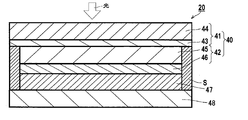
- FIG. 2 is a cross-sectional view schematically showing a dye-sensitized solar cell including the photoelectric conversion element according to the second aspect of the present invention.
- the photoelectric conversion element of the present invention has a conductive support, a photoreceptor layer containing an electrolyte, a charge transfer body layer containing an electrolyte, and a counter electrode (counter electrode).
- the photosensitive layer, the charge transfer layer, and the counter electrode are provided on the conductive support in this order.
- the semiconductor fine particles forming the photoreceptor layer carries a metal complex dye represented by the formula (1) described later as a sensitizing dye.
- the aspect in which the metal complex dye is supported on the surface of the semiconductor fine particle includes an aspect in which the metal complex dye is adsorbed on the surface of the semiconductor fine particle, an aspect in which the metal complex dye is deposited on the surface of the semiconductor fine particle, and an aspect in which these are mixed.
- the adsorption includes chemical adsorption and physical adsorption, and chemical adsorption is preferable.
- the semiconductor fine particles may carry another metal complex dye together with the metal complex dye of the formula (1) described later.
- the photoreceptor layer contains an electrolyte.
- the electrolyte contained in the photoreceptor layer may be the same as or different from the electrolyte of the charge transfer layer, but is preferably the same.
- the photoelectric conversion element of the present invention is not particularly limited in structure other than the structure defined in the present invention, and a known structure relating to the photoelectric conversion element can be adopted.
- Each of the layers constituting the photoelectric conversion element of the present invention is designed according to the purpose, and may be formed in a single layer or multiple layers, for example. Moreover, you may have layers other than said each layer if needed.
- the dye-sensitized solar cell of the present invention uses the photoelectric conversion element of the present invention.
- preferred embodiments of the photoelectric conversion element and the dye-sensitized solar cell of the present invention will be described.
- a system 100 shown in FIG. 1 is an application of the photoelectric conversion element 10 according to the first aspect of the present invention to a battery application in which an operation means M (for example, an electric motor) is caused to work by an external circuit 6.
- the photoelectric conversion element 10 includes a conductive support 1, semiconductor fine particles 22 sensitized by supporting a dye (metal complex dye) 21, and a photoreceptor layer 2 including an electrolyte between the semiconductor fine particles 22, It consists of a charge transfer layer 3 that is a hole transport layer and a counter electrode 4.
- the light receiving electrode 5 includes the conductive support 1 and the photoreceptor layer 2, and functions as a working electrode.
- the light incident on the photoreceptor layer 2 excites the metal complex dye 21.
- the excited metal complex dye 21 has high energy electrons, and these electrons are transferred from the metal complex dye 21 to the conduction band of the semiconductor fine particles 22 and reach the conductive support 1 by diffusion.
- the metal complex dye 21 is an oxidant (cation). Electrons that have reached the conductive support 1 work in the external circuit 6, reach the oxide of the metal complex dye 21 via the counter electrode 4 and the charge transfer layer 3, and reduce this oxide.
- the system 100 functions as a solar cell.
- the dye-sensitized solar cell 20 shown in FIG. 2 is configured by the photoelectric conversion element of the second aspect of the present invention.
- the photoelectric conversion element used as the dye-sensitized solar cell 20 differs with respect to the photoelectric conversion element shown in FIG. 1 by the structure of the electroconductive support body 41 and the photoreceptor layer 42, and the point which has the spacer S, those photoelectric conversion elements are different.
- the photoelectric conversion element 10 is configured in the same manner as the photoelectric conversion element 10 shown in FIG. That is, the conductive support 41 has a two-layer structure including a substrate 44 and a transparent conductive film 43 formed on the surface of the substrate 44.
- the photoreceptor layer 42 has a two-layer structure including a semiconductor layer 45 and a light scattering layer 46 formed adjacent to the semiconductor layer 45.
- a spacer S is provided between the conductive support 41 and the counter electrode 48.
- reference numeral 40 denotes a light receiving electrode
- 47 denotes a charge transfer body layer.
- the dye-sensitized solar cell 20 functions as a solar cell when light enters the photoreceptor layer 42 as in the system 100 to which the photoelectric conversion element 10 is applied.
- the photoelectric conversion element and the dye-sensitized solar cell of the present invention are not limited to the above-described preferred embodiments, and the configurations and the like of each embodiment can be appropriately combined between the respective embodiments without departing from the gist of the present invention.
- materials and members used for the photoelectric conversion element or the dye-sensitized solar cell can be prepared by a conventional method.
- the metal complex dye used in the present invention is represented by the following formula (1).
- the metal complex dye of the present invention has both the following ligand LA and the following ligand Z, so that the photoelectric conversion element and the dye-sensitized solar cell have high photoelectric conversion efficiency regardless of the film thickness of the semiconductor layer. Can be granted. Therefore, the metal complex dye of the present invention is preferably used as a sensitizing dye in a dye-sensitized solar cell.
- M represents a metal ion.
- LA represents a tridentate ligand represented by the following formula (AL-1).
- Za and Zb each independently represents a group of nonmetallic atoms necessary to complete a 5-membered or 6-membered ring. However, at least one of the rings formed by Za and Zb has one or more acidic groups.
- L W each independently represents a nitrogen atom or CR W, R W represents a hydrogen atom or a substituent.
- R V3 represents an aryl group or a heteroaryl group.
- Z is an acyloxy group, acylthio group, thioacyloxy group, thioacylthio group, acylaminooxy group, thiocarbamate group, dithiocarbamate group, thiocarbonate group, dithiocarbonate group, trithiocarbonate group, acyl group, thiocyanate group , Isothiocyanate group, cyanate group, isocyanate group, selenocyanate group, isoselenocyanate group, cyano group, isocyano group, alkylthio group, arylthio group, alkoxy group, aryloxy group, halogen atom, carbonyl, dialkyl ketone, 1,3 -Represents a ligand selected from the group consisting of diketone, carbonamide, thiocarbonamide and thiourea.
- nZ represents 2 or 3.
- CI represents a counter ion when a counter ion is required to neutralize the charge.
- mY represents an integer of 0 to 3, preferably 0 or 1.
- -Metal ion M- M is a central metal of the metal complex dye, and examples thereof include ions of each element of Groups 6 to 12 on the long periodic table.
- metal ions include Ru, Fe, Os, Cu, W, Cr, Mo, Ni, Pd, Pt, Co, Ir, Rh, Re, Mn, and Zn ions.
- the metal ion M may be one kind of ion or two or more kinds of ions.
- the metal ion M is preferably Os 2+ , Ru 2+ or Fe 2+ , more preferably Os 2+ or Ru 2+ , and particularly preferably Ru 2+ .
- the valence of M may change due to an oxidation-reduction reaction with surrounding materials.
- the ligand LA is a tridentate ligand or compound represented by the above formula (AL-1) and coordinated to the metal ion M by three nitrogen atoms in the above formula (AL-1).
- the ligand LA has one or more acidic groups (also referred to as adsorption groups) on at least one of a ring formed by Za and a ring formed by Zb described later.
- the ligand LA is a ligand for supporting the metal complex dye of the present invention on semiconductor fine particles.
- Za and Zb each independently represent a nonmetallic atom group necessary for forming a 5-membered ring or a 6-membered ring.
- Za and Zb are preferably a nonmetallic atom group selected from a carbon atom and the above hetero atom, and more preferably a nonmetallic atom group selected from a carbon atom, a nitrogen atom, an oxygen atom, a sulfur atom and a phosphorus atom. preferable.
- the ring formed by Za and Zb is preferably a 5-membered aromatic ring or a 6-membered aromatic ring.
- the 5-membered aromatic ring is preferably at least one of a pyrazole ring, an imidazole ring, a triazole ring, a thiazole ring, an oxazole ring, a benzimidazole ring, a benzotriazole ring, a benzoxazole ring, and a benzothiazole ring.
- the 6-membered aromatic ring is preferably at least one of pyridine ring, pyrimidine ring, pyrazine ring, pyridazine ring, triazine ring, tetrazine ring, quinoline ring and isoquinoline ring.
- the rings formed by Za and Zb are aromatic groups compatible with the structure of each ring represented by the formula (AL-1) from the group of 5-membered aromatic rings and the group of 6-membered aromatic rings, respectively.
- a family ring is preferably selected.
- the ring formed by Za is a pyridine ring, pyrimidine ring, pyrazine ring, pyridazine ring, triazine ring, tetrazine ring, quinoline ring, isoquinoline ring, pyrazole ring, imidazole ring, triazole ring, thiazole ring, oxazole ring, benzimidazole ring, It is preferably at least one selected from the group consisting of a benzotriazole ring, a benzoxazole ring and a benzothiazole ring.
- the ring formed by Zb is a pyridine ring, pyrimidine ring, pyrazine ring, pyridazine ring, triazine ring, tetrazine ring, quinoline ring, isoquinoline ring, imidazole ring, triazole ring, thiazole ring, oxazole ring, benzimidazole ring, benzotriazole ring And at least one selected from the group consisting of a benzoxazole ring and a benzothiazole ring.
- the rings formed by Za and Zb are each more preferably an imidazole ring, a pyridine ring or a quinoline ring, and particularly preferably all are pyridine rings.
- the ring formed by Za and Zb has one or more acidic groups in at least one, and preferably has one or more acidic groups in each ring.
- the number of acidic groups that each of the rings formed by Za and Zb has is preferably 1 to 3, more preferably 1 or 2, and still more preferably 1. More preferably, each of these rings has one acidic group.
- the rings formed by Za and Zb may or may not have a substituent other than an acidic group, and may be monocyclic or condensed. Examples of the substituent which may be included include groups selected from the substituent group T described later (excluding acidic groups).
- an acidic group is a substituent having a dissociative proton, and a pKa of 11 or less.
- the pKa of the acidic group is determined by J.M. Phys. Chem. A2011, 115, p. It can be determined according to the “SMD / M05-2X / 6-31G * ” method described in 6641-6645.
- the acidic group include acid groups exhibiting acidity such as a carboxy group, a phosphonyl group, a phosphoryl group, a sulfo group, and a boric acid group, or groups having these acid groups.
- Examples of the group having an acid group include a group having an acid group and a linking group.
- the linking group is not particularly limited, and examples thereof include a divalent group, and preferable examples include an alkylene group, an alkenylene group, an alkynylene group, an arylene group, and a heteroarylene group.
- This linking group may have a group selected from the substituent group T described later as a substituent.
- the acidic group having an acid group and a linking group for example, carboxymethyl, carboxyvinylene, dicarboxyvinylene, cyanocarboxyvinylene, 2-carboxy-1-propenyl, 2-carboxy-1-butenyl, carboxyphenyl and the like are preferable. Can be cited as a thing.
- the acidic group is preferably a carboxy group or a group having a carboxy group, and more preferably a carboxy group.
- the acidic group may be an anion dissociated by releasing a proton when incorporated into the metal complex dye represented by the formula (1), or may be a salt. Although it does not specifically limit as a counter ion when an acidic group turns into a salt, For example, the example of the positive ion in the following counter ion CI is mentioned.
- the acidic group may be esterified as described later.
- the substitution position of the acidic group is not particularly limited.
- it is preferably a ring constituent atom that is farthest from the nitrogen atom coordinated to the metal ion M.
- the ring is a 6-membered ring, it is preferably the 4-position relative to the nitrogen atom.
- a ring formed by a nitrogen atom, a carbon atom and L W (also referred to as a ring containing L W or the like) has the following R V3 , and preferably has no acidic group.
- the ring containing LW or the like may be monocyclic or condensed.
- L W represents a nitrogen atom, or CR W.
- R W represents a hydrogen atom or a substituent (monovalent) is preferably a hydrogen atom.
- Substituents R W may take it is not particularly limited, a group selected from the later-described Substituent Group T (preferably the acidic group, more but see below R V3.) And the like.
- the plurality of R W may be the same or different, may form a ring by bonding R W together.
- Ring containing L W or the like from among the aromatic ring of 6-membered ring described as rings Za and Zb form, fit ring to the ring structure in formula (AL-1) is preferably selected. More preferably, it is preferably at least one of a pyridine ring, a pyrimidine ring, a pyridazine ring, a triazine ring, a tetrazine ring and a quinoline ring, and particularly preferably a pyridine ring.
- Ligands LA used in combination with the following ligand Z in the metal complex dye, the ring containing L W or the like, to the 4-position ring-constituting carbon atom with respect to coordinating ring-constituting nitrogen atom to the metal ion M , —C ⁇ C—R V3 group can contribute to improvement of photoelectric conversion efficiency.
- R V3 represents an aryl group or a heteroaryl group.
- the aryl group may be a monocyclic hydrocarbon ring group exhibiting aromaticity, or a ring group composed of a hydrocarbon ring exhibiting aromaticity formed by condensation of two or more rings (condensed polycyclic aromatic ring group). But you can.
- the monocyclic hydrocarbon ring group is preferably a 6-membered ring, and examples thereof include a benzene ring group.
- the condensed polycyclic aromatic ring group is preferably a hydrocarbon ring formed by condensing two or more 5-membered or 6-membered rings.
- a monocyclic hydrocarbon ring (benzene ring) showing aromaticity ) And the like are exemplified by hydrocarbon ring groups.
- Examples of such a condensed polycyclic aromatic ring group include a ring group formed by condensing two or more benzene rings and further a cyclopentadiene ring.
- naphthalene ring For example, naphthalene ring, anthracene ring, phenanthrene ring, tetracene ring , Pentacene ring, hexacene ring, heptacene ring, chrysene ring, picene ring, pyrene ring, perylene ring, coronene ring, ovalen ring, fluorene ring or triphenylene ring.
- the number of condensed hydrocarbon rings is not particularly limited, and is preferably 2 to 10, for example, more preferably 2 to 5, and further preferably 2 or 3. preferable.
- the aryl group is preferably a benzene ring, naphthalene ring, anthracene ring, phenanthrene ring, triphenylene ring, pyrene ring or fluorene ring, more preferably a benzene ring, naphthalene ring, pyrene ring or fluorene ring. More preferred are a ring, a naphthalene ring or a fluorene ring.
- the heteroaryl group includes a monocyclic heterocyclic group exhibiting aromaticity and a condensed polycyclic heterocyclic group in which a plurality of cyclic groups including a heterocyclic ring are condensed.
- the monocyclic heterocyclic group is preferably a 5-membered or 6-membered ring group containing a hetero atom as a ring constituent atom.
- a hetero atom For example, a nitrogen atom, an oxygen atom, a sulfur atom, a silicon atom, a selenium atom, or a phosphorus atom is mentioned.
- Examples of the 5-membered ring group include thiophene ring, furan ring, pyrrole ring, selenophene ring, thiazole ring, oxazole ring, isothiazole ring, isoxazole ring, imidazole ring, pyrazole ring, thiadiazole ring, oxadiazole ring, Examples of the group include a silole ring and a triazole ring.
- 6-membered ring group examples include groups such as a pyridine ring, a pyrazine ring, a pyrimidine ring, a pyridazine ring, a triazine ring, and a tetrazine ring.
- Examples of the condensed polycyclic heterocyclic group include a ring group formed by condensing a plurality of monocyclic heterocycles, and a ring group formed by condensing a plurality of monocyclic heterocycles and hydrocarbon rings.
- the number of rings to be condensed is not particularly limited, and is preferably 2 to 10, for example, more preferably 2 to 5, and still more preferably 2 or 3.
- the condensed polycyclic heterocyclic group include benzofuran ring, dibenzofuran ring, isobenzofuran ring, benzothiophene ring, dibenzothiophene ring, benzoisothiophene ring, benzimidazole ring, dibenzopyrrole ring, and silafluorene ring (dibenzosilole ring).
- heteroaryl groups include thiophene ring group, furan ring group, pyrrole ring group, selenophene ring group, thiazole ring group, benzothiophene ring group, benzofuran ring group, thieno [3,2-b] thiophene ring group, thieno [3 , 4-b] thiophene ring group is more preferable, thiophene ring group, furan ring group, thiazole ring group, thieno [3,2-b] thiophene ring group, and thieno [3,4-b] thiophene ring group are more preferable.
- R V3 is more preferably a ring group having a large electron donating property, a condensed polycyclic aromatic ring group and a heteroaryl group are more preferable, and a heteroaryl group is particularly preferable in that the effect of improving the photoelectric conversion efficiency is high.
- R V3 one kind of ring group (monocycle) selected from the group consisting of each ring group of benzene ring, thiophene ring, furan ring, pyrrole ring, selenophene ring and thiazole ring, or the same kind selected from the above group
- a ring group formed by condensing a plurality of different rings is preferable, a benzene ring, a thiophene ring or a furan ring is more preferable, and a thiophene ring is particularly preferable.
- the aryl group and heteroaryl group of R V3 may each independently have a substituent.
- the substituent is a group selected from the substituent group T described later (excluding an acidic group). Is mentioned.
- substituents described in later-described R AA are preferably exemplified.
- adjacent groups may be connected to each other to form a ring.
- Rve represents an alkylene group, and examples thereof include ethylene and propylene. Examples of such a group include a monocyclic heterocyclic group having a —O—R ve —O— group, and more specifically, alkylenedioxythiophene.
- R V3 has a substituent
- the atom (substitution position) to which the substituent is bonded is not particularly limited.
- R V3 may be of any ring-constituting atoms, may be atoms constituting the other substituents R V3 has.
- the aryl group and heteroaryl group of R V3 are each independently selected from the ring-constituting atoms constituting a single ring bonded to the ethynylene group in the formula (AL-1). It is preferable that the sp 2 carbon atom has a substituent.
- R V3 is a monocycle bonded to the ethynylene group in formula (AL-1) or an aryl group or heteroaryl group containing this monocycle as a condensed ring, and this monocycle is a 5-membered ring
- this monocycle is a 5-membered ring
- at least one of sp 2 carbon atoms in the ⁇ -position (adjacent position) to the ring-constituting atom bonded to the ethynylene group is an aryl group or heteroaryl group having a substituent.
- the monocycle is a 6-membered ring
- an aryl group or heteroaryl group in which at least one of sp 2 carbon atoms at the ⁇ -position (adjacent position) and ⁇ -position with respect to the ring-constituting atom bonded to the ethynylene group has a substituent
- the ⁇ -position ring-constituting atom in the 5-membered ring and the ⁇ -position and ⁇ -position ring-constituting atoms in the 6-membered ring are not sp 2 carbon atoms, they may or may not have a substituent.
- the substituent having a specific sp 2 carbon atoms is not particularly limited, substituents described later for R AA.
- substituents that the specific sp 2 carbon atom has at least one of the substituents alone or a substituent that does not form a condensed ring with a single ring by being bonded to another adjacent substituent.
- the remaining substituents may be substituents that form a condensed ring with a single ring.
- R V3 having the above substituent is preferably a group represented by any one of the following formulas (V-1) to (V-3), represented by formula (V-1) or formula (V— 2)
- V-1) is more preferred, and a group represented by formula (V-1) is more preferred.
- T represents —O—, —S—, —NR T —, —C (R T ) 2 — or —Si (R T ) 2 —
- R T represents a hydrogen atom or a substituent, respectively.
- R AA represents a substituent
- R AB and R AC each independently represent a hydrogen atom or a substituent.
- R BA to R BE each independently represent a hydrogen atom or a substituent, and at least one of R BA , R BB , R BD and R BE represents a substituent.
- R CA to R CC each independently represents a hydrogen atom or a substituent, and at least one of R CA and R CC represents a substituent.
- * represents a bond part with an ethynylene group in the formula (AL-1).
- R T is preferably —O— or —S— and more preferably —S— among the above.
- -NR T -, - C ( R T) 2 - and -Si (R T) 2 - of R T each represent a hydrogen atom or a substituent, preferably a hydrogen atom.
- substituent that R T can adopt include a group selected from the substituent group T described later.
- R AA represents a substituent.
- the substituent that can be adopted as R AA is not particularly limited, and examples thereof include a group selected from substituent group T described later.
- R AA is more preferably an alkyl group, a cycloalkyl group, an alkoxy group, a cycloalkoxy group, an alkylthio group, a cycloalkylthio group, an amino group, an alkylamino group, a cycloalkylamino group, or an arylamino group, an alkyl group, It is more preferably a cycloalkyl group, an alkoxy group, a cycloalkoxy group, an alkylamino group, a cycloalkylamino group or an arylamino group, particularly preferably an alkyl group, an alkoxy group or an alkylamino group, and an alkyl group or an alkoxy group.
- R AA is preferably bonded to a thiophene ring (when T is —S—) in terms of photoelectric conversion efficiency.
- the above-mentioned substituent which R AA can take may be further substituted with a group selected from the substituent group T described later.
- the alkyl group includes a linear alkyl group and a branched alkyl group.
- the alkyl group preferably has 1 to 30 carbon atoms, more preferably 4 to 30, more preferably 5 to 26, and particularly preferably 6 to 20.
- Examples of the alkyl group include methyl, ethyl, n-butyl, t-butyl, n-pentyl, n-hexyl, n-octyl, 2-ethylhexyl, n-decyl, 3,7-dimethyloctyl, isodecyl, s- Examples include decyl, n-dodecyl, 2-butyloctyl, n-hexadecyl, isohexadecyl, n-eicosyl, n-hexacosyl, isooctacosyl, trifluoromethyl or pentafluoroethyl.
- the carbon number of the cycloalkyl group is preferably 3 to 30, more preferably 5 to 30, further preferably 6 to 26, and particularly preferably 6 to 20.
- Examples of the cycloalkyl group include cyclopropyl, cyclopentyl, cyclohexyl, cycloheptyl, and cyclooctyl.
- the cycloalkyl group may be condensed with an alicyclic ring, an aromatic ring, or a heterocyclic ring.
- the alkoxy group includes a straight-chain alkoxy group and a branched alkoxy group.
- the alkyl part of the alkoxy group has the same meaning as the above alkyl group, and preferred ones are also the same.
- Examples of the alkoxy group include methoxy, ethoxy, n-propoxy, i-propoxy, n-butoxy, t-butoxy, n-pentoxy, n-hexyloxy, n-octyloxy, 2-ethylhexyloxy, 3,7- Dimethyloctyloxy, n-decyloxy, isodecyloxy, s-decyloxy, 2-butyloctyloxy, n-dodecyloxy, n-hexadecyloxy, isohexadecyloxy, n-eicosyloxy, n-hexacosyloxy or An example is isooctacosyloxy.
- the cycloalkyl part of the cycloalkoxy group has the same meaning as the above cycloalkyl group, and preferred ones are also the same.
- Examples of the cycloalkoxy group include cyclopropyloxy, cyclopentyloxy, cyclohexyloxy, cycloheptyloxy, and cyclooctyloxy.
- the aryloxy group includes a hydrocarbon ring aryloxy group in which the aryl group is a hydrocarbon ring and a heteroaryloxy group in which the aryl group is a heterocyclic group.
- the aryloxy group preferably has 3 to 30 carbon atoms, more preferably 3 to 25 carbon atoms, still more preferably 3 to 20 carbon atoms, and particularly preferably 3 to 16 carbon atoms.
- Examples of the aryloxy group include phenoxy, naphthoxy, imidazolyloxy, benzimidazolyloxy, pyridin-4-yloxy, pyrimidinyloxy, quinazolinyloxy, purinyloxy and thiophen-3-yloxy.
- a thiophene ring is preferred as the heterocycle of the heteroaryloxy group.
- the alkylthio group includes a linear alkylthio group and a branched alkylthio group.
- the alkyl part of the alkylthio group has the same meaning as the above alkyl group, and preferred ones are also the same.
- Examples of the alkylthio group include methylthio, ethylthio, n-propylthio, i-propylthio, n-butylthio, t-butylthio, n-pentylthio, n-hexylthio, n-octylthio, 2-ethylhexylthio, 3,7-dimethyloctyl.
- thio n-decylthio, isodecylthio, s-decylthio, n-dodecylthio, 2-butyloctylthio, n-hexadecylthio, isohexadecylthio, n-eicosylthio, n-hexacosylthio or isooctacosylthio.
- the cycloalkyl part of the cycloalkylthio group has the same meaning as the above cycloalkyl group, and preferred ones are also the same.
- Examples of the cycloalkylthio group include cyclopropylthio, cyclopentylthio, cyclohexylthio, cycloheptylthio, and cyclooctylthio.
- the arylthio group includes a hydrocarbon ring arylthio group in which the aryl group is a hydrocarbon ring, and a heteroarylthio group in which the aryl group is a heterocyclic group.
- the arylthio group preferably has 3 to 30 carbon atoms, more preferably 3 to 25 carbon atoms, still more preferably 3 to 20 carbon atoms, and particularly preferably 3 to 16 carbon atoms.
- arylthio group examples include phenylthio, naphthylthio, imidazolylthio, benzimidazolylthio, pyridin-4-ylthio, pyrimidinylthio, quinazolinylthio, purinylthio, thiophen-3-ylthio and the like.
- a thiophene ring is preferred as the heterocycle of the heteroarylthio group.
- the alkylamino group includes an N-alkylamino group and an N, N-dialkylamino group, and the alkyl group preferably has 1 to 30 carbon atoms, and more preferably 2 to 30 carbon atoms.
- Examples of the alkylamino group include ethylamino, diethylamino, 2-ethylhexylamino, bis (2-ethylhexyl) amino, and n-octadecylamino.
- the cycloalkylamino group includes an N-cycloalkylamino group and an N, N-dicycloalkylamino group.
- the cycloalkyl part of the cycloalkylamino group has the same meaning as the above cycloalkyl group, and the preferred ones are also the same.
- cycloalkylamino group examples include cyclopropylamino, dicyclopropylamino, N-cyclopropyl-N-ethylamino, cyclopentylamino, dicyclopentylamino, N-cyclopentyl-N-methylamino, cyclohexylamino, dicyclohexylamino, And cycloheptylamino or cyclooctylamino.
- the arylamino group includes a hydrocarbon ring system arylamino group in which the aryl group is a hydrocarbon ring and a heteroarylamino group in which the aryl group is a heterocyclic group.
- the hydrocarbon ring system arylamino group includes an N-arylamino group, an N-alkyl-N-arylamino group, and an N, N-diarylamino group.
- the heteroarylamino group includes an N-heteroarylamino group, an N-alkyl-N-heteroarylamino group, an N-aryl-N-heteroarylamino group and an N, N-diheteroarylamino group.
- the number of carbon atoms of the arylamino group is preferably 3 to 30, more preferably 3 to 25, still more preferably 3 to 20, and particularly preferably 3 to 16.
- the arylamino group include phenylamino, N-phenyl-N-ethylamino, naphthylamino, imidazolylamino, benzimidazolylamino, pyridin-4-ylamino, pyrimidinylamino, quinazolinylamino, purinylamino, and thiophene-3- Ilamino and the like can be mentioned.
- the heterocyclic amino group is a heterocyclic amino group (aliphatic heterocyclic amino group) other than a heteroarylamino group.
- the carbon number is preferably 0 to 30, more preferably 1 to 25, still more preferably 2 to 20, and particularly preferably 2 to 16.
- the heterocycle those in which the ring-forming heteroatom is selected from an oxygen atom, a sulfur atom, and a nitrogen atom are preferable, and the number of ring members is preferably a 5 to 7 membered ring, and more preferably a 5 or 6 membered ring.
- heterocyclic amino group examples include pyrrolidin-3-ylamino, imidazolidinylamino, benzimidazolidinylamino, piperidin-4-ylamino, and tetrahydrothiophen-3-ylamino.
- the silyl group includes an alkylsilyl group, a cycloalkylsilyl group, an arylsilyl group, an alkyloxysilyl group, a cycloalkyloxysilyl group, and an aryloxysilyl group.
- Preferred silyl groups are alkylsilyl groups, cycloalkylsilyl groups, or arylsilyl groups.
- the carbon number of the silyl group is preferably 3 to 30, more preferably 3 to 24, still more preferably 3 to 20, and particularly preferably 3 to 18.
- silyl group examples include trimethylsilyl, triethylsilyl, t-butyldimethylsilyl, cyclohexyldimethylsilyl, triisopropylsilyl, t-butyldiphenylsilyl, methyldimethoxysilyl, phenyldimethoxysilyl, and phenoxydimethylsilyl.
- the silyloxy group includes an alkylsilyloxy group, a cycloalkylsilyloxy group, and an arylsilyloxy group.
- the carbon number of the silyloxy group is preferably 3 to 30, more preferably 3 to 24, still more preferably 3 to 20, and particularly preferably 3 to 18.
- Examples of the silyloxy group include trimethylsilyloxy, triethylsilyloxy, t-butyldimethylsilyloxy, triisopropylsilyloxy, cyclohexyldimethylsilyloxy, and t-butyldiphenylsilyloxy.
- R AB represents a hydrogen atom or a substituent, and is preferably a hydrogen atom.
- R AC represents a hydrogen atom or a substituent.
- the substituents that R AB and R AC can take are the same as R AA described above, and preferred ones are also the same.
- R AB or R AC is a substituent, each substituent of R AA to R AC may be the same as or different from each other.
- R AA is a substituent that does not form a condensed ring with a single ring (a ring containing T in the formula (V-1)), and R AB and R AC may be a substituent that forms a condensed ring with this single ring.
- the ring group represented by the above formula (V-1) is any one of the following formulas (V-1a) to (V-1e):
- the following formulas (V-1a) to (V-1c) are more preferable, and the following formulas (V-1a) or (V-1b) are more preferable.
- T S is the same meaning as T in Formula (V-1), it is preferred also the same, the two T S in each formula may be the same or different from each other.
- R DA represents a substituent.
- R DA has the same meaning as R AA in formula (V-1), and preferred ones are also the same.
- R S represents a substituent.
- R S is synonymous with the substituent that R AB and R AC in Formula (V-1) can adopt, and preferred ones are also the same.
- R S may be bonded to a ring containing Q or a benzene ring.
- r1 is an integer of 0 to 2, and more preferably 0 or 1.
- r2 is an integer of 0 to 4, preferably 0 to 2, and more preferably 0 or 1.
- Q represents —O—, —S—, —NR X2c , —C (R X2c ) 2 —, — (R X2c ) C ⁇ C (R X2c ) —, or —Si (R X2c ) 2 —.
- Q is, -O -, - S -, - C (R X2c) 2 - are preferred, -C (R X2c) 2 - are more preferable.
- R X2c represents a hydrogen atom or a substituent. This substituent is synonymous with the above RT . * Represents a bond part with an ethynylene group in the formula (AL-1).
- R BA to R BE each independently represents a hydrogen atom or a substituent.
- the substituents that can be adopted by each of R BA to R BE are the same as R AA described above, and preferred ones are also the same. However, at least one of R BA , R BB , R BD and R BE is a substituent. At least one or both of R BA and R BE are substituents, and R BB , R BC and R BD are all hydrogen atoms, or at least one or both of R BB and R BD are substituents, and R BA , R BC and R BE are particularly preferably all hydrogen atoms.
- At least one substituent of R BA , R BB , R BD and R BE is a substituent that does not form a condensed ring with a single ring (the benzene ring in formula (V-2)), and the other substituents are It may be a substituent that forms a condensed ring with this single ring.
- the two or more substituents may be the same as or different from each other.
- R CA to R CC each independently represents a hydrogen atom or a substituent.
- the substituent that each of R CA to R CC can take is synonymous with R AA described above, and preferred ones are also the same.
- at least one of R CA and R CC is a substituent.
- At least one of these substituents is a substituent that does not form a condensed ring with a single ring (a ring containing T in formula (V-3)).
- the other substituent may be a substituent that forms a condensed ring with this single ring.
- the two or more substituents may be the same as or different from each other.
- the ligand LA is preferably a tridentate ligand (terpyridine compound) represented by the following formula (AL-2).
- terpyridine compound is excellent in a photoelectric conversion element or a dye-sensitized solar cell by being used in combination with a ligand Z described later as a ligand of a metal complex dye used in a photoelectric conversion element or a dye-sensitized solar cell. Photoelectric conversion efficiency can be imparted. Therefore, this terpyridine compound is preferably used as a ligand for a dye-sensitized solar cell.
- A represents an acidic group, which has the same meaning as the acidic group in the formula (AL-1), and the preferred ones are also the same.
- R V3 has the same meaning as R V3 in formula (AL-1), and preferred ones are also the same.
- the terpyridine compound is the ligand LA itself, but in the present invention, the ligand LA can be used as a precursor compound of the ligand LA as described later. Therefore, in the present invention, the ligand LA includes a precursor compound of the ligand LA in addition to the ligand LA itself (the terpyridine compound).
- Preferable precursor compounds include ester bodies in which at least one acidic group of the terpyridine compound is esterified (also referred to as an esterified product of a terpyridine compound). This esterified compound is a compound in which the acidic group is protected and can be regenerated to an acidic group by hydrolysis or the like, and is not particularly limited.
- alkyl esterified products examples thereof include alkyl esterified products, aryl esterified products, and heteroaryl esterified products of the above acidic group.
- alkyl esterified products are preferable.
- the alkyl group forming the alkyl esterified product is not particularly limited, but is preferably an alkyl group having 1 to 10 carbon atoms, more preferably an alkyl group having 1 to 6 carbon atoms, and further preferably an alkyl group having 1 to 4 carbon atoms.
- Heteroaryl groups which form an aryl group and heteroaryl esterified to form an aryl ester, respectively is not particularly limited, and exemplified in later-described Substituent Group Z R. These groups may have one or more substituents selected from the substituent group Z R which will be described later.
- Two acidic groups are preferably esterified. In this case, the two esters may be the same or different.
- the ligand LA can be synthesized with reference to various methods.
- the ligand LA represented by the formula (L1-6) comprises a compound represented by the formula (L1-3) and a compound represented by the formula (L1-4) as shown in the following scheme. It can be synthesized by a coupling reaction and hydrolyzing the ester group of the precursor compound represented by the formula (L1-5).
- an esterified product of a carboxy group is shown as a precursor compound.
- the precursor compound is not limited to this and may be any precursor compound obtained by esterifying any of the acidic groups.
- the coupling reaction at this time is, for example, “Suzuki coupling reaction” or “Still coupling reaction” described in “Chemical Chemistry Course 5th Edition” edited by The Chemical Society of Japan, Maruzen Co., Ltd., Volume 13, p92-117. Etc. or according to these.
- Hydrolysis can be carried out according to the method described in, for example, the Chemical Society of Japan, “Experimental Chemistry Course 5th Edition”, Maruzen Co., Ltd., Volume 16, p10-15.
- the metal complex dye of the present invention can be synthesized using the ligand LA synthesized by hydrolyzing the precursor compound. Moreover, after converting into a metal complex dye using a precursor compound like Example 1 mentioned later, an ester group is hydrolyzed according to the said method, and the metal complex dye of this invention can also be synthesize
- L V has the same meaning as the “—C ⁇ C—R V3 ” group in the above formula (AL-1).
- Y 1 represents a trialkyltin group, a boronic acid group, a boronic acid ester group, a halogen atom or a perfluoroalkylsulfonyloxy group.
- Y 2 represents a halogen atom or a perfluoroalkylsulfonyloxy group when Y 1 in formula (L1-3) is a trialkyltin group, a boronic acid group or a boronic ester group, When Y 1 in the formula (L1-3) is a halogen atom or a perfluoroalkylsulfonyloxy group, it represents a trialkyltin group, a boronic acid group or a boronic ester group.
- R represents an alkyl group, an aryl group, or a heteroaryl group.
- ligand LA Specific examples of the ligand LA are shown below. Moreover, the ligand LA in the metal complex dye mentioned later is also mentioned as the ligand LA. Also included are compounds in which at least one of —COOH is a carboxy group salt with respect to the ligand LA in the following specific examples and specific examples of metal complex dyes. In this compound, examples of a counter cation that forms a salt of a carboxy group include positive ions described in the following CI. Furthermore, examples of the esterified product of a terpyridine compound include compounds obtained by esterifying at least one acidic group with respect to the ligand LA in the following specific examples and specific examples of the metal complex dye. The present invention is not limited to these ligands LA, salts or esterified products thereof. Me in the specific examples represents methyl.
- nZ represents the number of ligands Z and represents 2 or 3. However, nZ is appropriately determined in consideration of the number of coordination sites (monodentate or bidentate) of the ligand Z so that the total coordination number of “(Z) nZ ” is 3. . For example, nZ represents 3 when all the ligands Z coordinate in monodentate. When one of the ligands is bidentate, nZ represents 2 (the remaining ligands are coordinated monodentate).
- the ligand Z does not necessarily have to be coordinated to the metal ion at all, and it may be coordinated to the metal ion at at least one coordination site.
- a bidentate ligand may be a monodentate ligand by liganding to a metal ion at one coordination site.
- Two or three ligands Z may be the same or different from each other.
- the some ligand Z may couple
- Ligand Z is an acyloxy group, an acylthio group, a thioacyloxy group, a thioacylthio group, an acylaminooxy group, a thiocarbamate group, a dithiocarbamate group, a thiocarbonate group, a dithiocarbonate group, a trithiocarbonate group, an acyl group , Thiocyanate group, isothiocyanate group, cyanate group, isocyanate group, selenocyanate group, isoselenocyanate group, cyano group, isocyano group, alkylthio group, arylthio group, alkoxy group, aryloxy group, halogen atom, carbonyl, dialkyl ketone, It represents a ligand selected from the group consisting of 1,3-diketone, carbonamide, thiocarbonamide and thiourea.
- the ligand selected from the above group includes an embodiment in which each of the above-described groups is a monodentate ligand coordinated to a metal ion alone (as an anion), and each of the above-described groups, etc.
- the included alkyl group, aryl group, and the like also include embodiments that are bidentate ligands coordinated to metal ions.
- bidentate ligand the picolinic acid compound which is 1 type of an acyloxy group is mentioned, for example.
- the COO group and the ring-constituting nitrogen atom of the pyridine ring can be coordinated to a metal ion.
- the acyloxy group is not particularly limited, but preferably has 1 to 20 carbon atoms.
- a group in which an acyloxy group is bonded to a 5-membered or 6-membered nitrogen-containing ring such as acetyloxy group and pyridinylcarbonyloxy
- examples include benzoyloxy group, salicylic acid group, glycyloxy group, N, N-dimethylglycyloxy group, oxalylene group (—OC (O) C (O) O—) and the like.
- the acylthio group is not particularly limited, but preferably has 1 to 20 carbon atoms, and examples thereof include an acetylthio group, a benzoylthio group, and a group in which an acylthio group is bonded to a 5-membered or 6-membered nitrogen-containing ring.
- the thioacyloxy group is not particularly limited, but preferably has 1 to 20 carbon atoms.
- a thioacyloxy group (CH 3 C (S) O—) has a thioacyloxy group attached to a 5- or 6-membered nitrogen-containing ring. Examples include a group to which a group is bonded.
- the thioacylthio group is not particularly limited, but preferably has 1 to 20 carbon atoms.
- a thioacetylthio group CH 3 C (S) S—
- a thiobenzoylthio group PhC (S) S—
- Examples include a group in which a thioacylthio group is bonded to a 5-membered or 6-membered nitrogen-containing ring.
- the acylaminooxy group is not particularly limited, but preferably has 1 to 20 carbon atoms.
- N-methylbenzoylaminooxy group PhC (O) N (CH 3 ) O—
- acetylaminooxy group CH 3 C (O) NHO—
- the thiocarbamate group is not particularly limited, but preferably has 1 to 20 carbon atoms, and examples thereof include an N, N-diethylthiocarbamate group.
- the dithiocarbamate group is not particularly limited, but preferably has 1 to 20 carbon atoms.
- the thiocarbonate group is not particularly limited, but preferably has 1 to 20 carbon atoms, and examples thereof include an ethylthiocarbonate group.
- the dithiocarbonate group is not particularly limited, but preferably has 1 to 20 carbon atoms, and examples thereof include an ethyl dithiocarbonate group (C 2 H 5 OC (S) S—).
- the trithiocarbonate group is not particularly limited, but preferably has 1 to 20 carbon atoms, and examples thereof include an ethyl trithiocarbonate group (C 2 H 5 SC (S) S—).
- the acyl group is not particularly limited, but preferably has 1 to 20 carbon atoms, and examples thereof include an acetyl group and a benzoyl group.
- the alkylthio group is not particularly limited, but preferably has 1 to 20 carbon atoms, and examples thereof include a methanethio group and an ethylenedithio group.
- the arylthio group is not particularly limited, but preferably has 6 to 20 carbon atoms, and examples thereof include a phenylthio group and a 1,2-phenylenedithio group.
- the alkoxy group is not particularly limited, but preferably has 1 to 20 carbon atoms, and examples thereof include a methoxy group.
- the aryloxy group is not particularly limited, but preferably has 6 to 20 carbon atoms, and examples thereof include a phenoxy group and a quinoline-8-hydroxyl group.
- the dialkyl ketone is not particularly limited, but preferably has 3 to 20 carbon atoms, and examples thereof include acetone ((CH 3 ) 2 CO ).
- the 1,3-diketone is not particularly limited, but preferably has 3 to 20 carbon atoms.
- acetylacetone CH 3 C (O%) CH ⁇ C (O—) CH 3
- dipivaloylmethane t-C 4 H 9 C (O ...)
- CH C (O-) t-C 4 H 9
- the 1,3-diketone includes those in which at least one of carbonyl oxygens is substituted with a sulfur atom.
- the carbonamide is not particularly limited, but preferably has 1 to 20 carbon atoms, and examples thereof include CH 3 N ⁇ C (CH 3 ) O—, —OC ( ⁇ NH) —C ( ⁇ NH) O—, and the like. Can be mentioned.
- the thiourea is not particularly limited, but preferably has 1 to 20 carbon atoms.
- NH leading C (S-) NH 2
- CH 3 N C (S-) NHCH 3 , (CH 3 ) 2 N—C (S...) N (CH 3 ) 2 and the like.
- “...” Represents a coordinate bond with the metal atom M.
- the ligand Z is a thiocyanate group, an isothiocyanate group, a halogen atom, a cyano group, a cyanate group, an isocyanate group, an alkylthio group, an arylthio group, an alkoxy group, an aryloxy group, the following formula (XA-1)
- a broken line represents a bonding portion with the metal ion M.
- V xa1 to V xa4 each independently represents a sulfur atom or an oxygen atom, preferably an oxygen atom.
- R xa1 to R xa3 each independently represents a hydrogen atom or a substituent.
- T xa represents a substituent.
- nT represents an integer of 0 to 4, preferably 0 or 1.
- the substituent that R xa1 to R xa3 and T xa can take is not particularly limited, and examples thereof include a group selected from substituent group T.
- R xa1 to R xa3 are each an alkyl group (aryl group), an alkyl group substituted with an aryl group, a heterocyclic group, an alkenyl group, an alkynyl group, an amino group, a halogen atom, or a halogen atom (preferably a fluorine atom).
- a group formed by bonding two or more (preferably two) groups is preferred.
- the alkyl group preferably has 1 to 20 carbon atoms.
- the halogenated alkyl group preferably has 1 to 30 carbon atoms in the alkyl moiety, more preferably 1 to 6 carbon atoms, still more preferably 1 carbon atom, and particularly preferably a trifluoromethyl group.
- the halogenated aryl group is preferably a phenyl group substituted with 1 to 5 halogen atoms, more preferably a phenyl group substituted with 1 to 4 halogen atoms, and a phenyl group substituted with 1 halogen atom is preferred.
- the aryl group substituted with a halogenated alkyl group is preferably a phenyl group substituted with 1 to 5 halogenated alkyl groups.
- Z Xa represents a group of nonmetallic atoms necessary to complete a 5-membered or 6-membered ring.
- Z Xa is preferably a nonmetallic atom group selected from a carbon atom, a nitrogen atom, an oxygen atom, a sulfur atom and a phosphorus atom.
- the ring formed by Z Xa is preferably a 5-membered aromatic ring or a 6-membered aromatic ring.
- the aromatic rings mentioned for the ring formed by Za are preferable.
- the ring formed by Z Xa is a pyridine ring, pyrimidine ring, pyrazine ring, pyridazine ring, triazine ring, tetrazine ring, quinoline ring, isoquinoline ring, pyrazole ring, imidazole ring, triazole ring, thiazole ring, oxazole. It is preferably at least one selected from the group consisting of a ring, a benzimidazole ring, a benzotriazole ring, a benzoxazole ring, and a benzothiazole ring.
- the ring formed by Z Xa is more preferably a pyridine ring or a pyrimidine ring, and particularly preferably a pyridine ring.
- Z Xa position T xa is bound in the ring form is not particularly limited, Z Xa can be mentioned 2-4-position to the nitrogen atom in the ring formed, 3- or 4-position is preferred.
- T xa is preferably an aryl group, a heterocyclic group or an amino group having a substituent, and more preferably an aromatic heterocyclic group (heteroaryl group).
- the aryl group and heteroaryl group having a substituent are a single ring bonded to a ring formed by Z Xa in formula (XA-2), or a polycyclic group containing this single ring as a condensed ring.
- this monocycle is a 5-membered ring
- an aryl group or heteroaryl group in which at least one of the sp 2 carbon atoms in the ⁇ -position with respect to the ring member atom bonded to the ring formed by Z Xa has a substituent
- An aryl group is preferred.
- T xa is more preferably a group represented by the formula (V-1) in R V3 .
- amino group include the amino groups described in the substituent group T described later.
- the ligand represented by the formula (XA-1) includes, for example, a preferred embodiment of the 1,3-diketone.
- the ligands represented by the above formula include those in which at least one carbonyl oxygen of 1,3-diketone is substituted with a sulfur atom in addition to those described above.
- V xa1 is an oxygen atom.
- V xa2 is a sulfur atom,
- V xa1 is a sulfur atom,
- V xa2 is an oxygen atom, or
- V xa1 is a sulfur atom and V xa2 is a sulfur atom (thioacylthio group), etc. Is mentioned.
- the ligand represented by the formula (XA-2) includes, for example, a preferred embodiment of the acyloxy group.
- the ligand represented by the above formula, other than those described above may, for example, V xa3 is a sulfur atom, V XA4 can be cited such embodiments is a sulfur atom (Chioashiruchio group).
- the ligand Z is more preferably an isothiocyanate group, a ligand represented by the following formula (XA-1b), or a ligand represented by the following formula (XA-2b).
- a broken line represents a bonding portion with the metal ion M.
- R xa1 to R xa3 each independently represents a hydrogen atom or a substituent.
- T xa2 represents a substituent, and nT represents an integer of 0 to 4.
- R xa1 to R xa3 , T xa2 and nT have the same meanings as R xa1 to R xa3 , T xa and nT in formulas (XA-1) and (XA-2), respectively, and preferred ones are also the same.
- Examples of the ligand represented by the formula (XA-1b) include, in addition to those described above, the ligands shown below, the following examples of metal complex dyes, and the ligands shown in Examples. The present invention is not limited to these ligands.
- Examples of the ligand represented by the formula (XA-2b) include, in addition to those described above, the ligands shown below, the following examples of metal complex dyes, and the ligands shown in Examples. The present invention is not limited to these ligands.
- the wavy line represents the bond with the metal ion M (carboxy group oxygen atom and pyridine ring ring nitrogen atom).
- the combination thereof is not particularly limited.
- specific examples of metal complex dyes described later or combinations of ligands included in the metal complex dyes used in the examples are mentioned.
- the ligand Z contains an alkyl group, an alkenyl group, an alkynyl group, an alkylene group or the like, these may be linear or branched and may be substituted. Moreover, when an aryl group, a heterocyclic group, a cycloalkyl group, etc. are included, they may be substituted and may be monocyclic or condensed.
- a commercially available product can be used as the ligand Z, and it can also be appropriately synthesized.
- the ligands represented by (XA-2) picolinic acid derivatives are described in Journal of Medicinal Chemistry, 2011, vol. 54, no. 13, p. No. 4721-4734.
- the synthesis method of 45 for example, it can be synthesized by the following scheme.
- -Charge neutralization counter ion CI- CI represents the counter ion when the counter ion is required to neutralize the charge.
- a metal complex dye is a cation or an anion or has a net ionic charge depends on the metal, ligand and substituent in the metal complex dye.
- the metal complex dye may be dissociated and have a negative charge because the substituent has a dissociable group. In this case, the entire charge of the metal complex dye is electrically neutralized by CI.
- the counter ion CI is a positive counter ion
- the counter ion CI is an inorganic or organic ammonium ion (for example, tetraalkylammonium ion, pyridinium ion, etc.), phosphonium ion (for example, tetraalkylphosphonium ion, alkyltriphenylphosphonium ion). Etc.), alkali metal ions (Li ion, Na ion, K ion, etc.), alkaline earth metal ions, metal complex ions or protons.
- inorganic or organic ammonium ions tetraethylammonium ion, tetrabutylammonium ion, tetrahexylammonium ion, tetraoctylammonium ion, tetradecylammonium ion, etc.
- alkali metal ions alkali metal ions, and protons are preferable.
- the counter ion CI may be an inorganic anion or an organic anion.
- hydroxide ion, halogen anion for example, fluoride ion, chloride ion, bromide ion, iodide ion, etc.
- substituted or unsubstituted alkylcarboxylate ion acetate ion, trifluoroacetate ion, etc.
- Substituted or unsubstituted arylcarboxylate ions (benzoate ions, etc.), substituted or unsubstituted alkylsulfonate ions (methanesulfonate ions, trifluoromethanesulfonate ions, etc.), substituted or unsubstituted arylsulfonate ions (for example, p-toluenesulfonate ion, p-chlor
- an ionic polymer or another dye having a charge opposite to that of the dye may be used as the charge balance counter ion, and a metal complex ion (for example, bisbenzene-1,2-dithiolatonickel (III)) can also be used. is there.
- Negative counter ions include halogen anions, substituted or unsubstituted alkyl carboxylate ions, substituted or unsubstituted alkyl sulfonate ions, substituted or unsubstituted aryl sulfonate ions, aryl disulfonate ions, perchlorate ions , Hexafluorophosphate ions are preferred, and halogen anions and hexafluorophosphate ions are more preferred.
- the metal complex dye of the present invention is represented by the formula (1) as described above.
- the ligand LA and the ligand Z are as described above, and the combination of these ligands is not particularly limited.
- a preferred combination of ligands is a combination of a preferred ligand LA and a preferred ligand Z.
- This metal complex dye is, for example, the method described in JP2013-084594A, the method described in Japanese Patent No. 4298799, US Patent Application Publication No. 2013 / 0018189A1, US Patent Application Publication No. 2012 / 0073660A1, US Patent A method described in each specification of Japanese Patent Application Publication No. 2012 / 0111410A1 and US Patent Application Publication No. 2010 / 0258175A1, Angew. Chem. Int. Ed. , 2011, 50, 2054-2058, the method described in the reference cited in this document, the above-mentioned patent document relating to solar cells, a known method, or a method according to these methods. it can.
- the metal complex dye represented by the formula (1) has a maximum absorption wavelength in a solution of preferably 300 to 1000 nm, more preferably 350 to 950 nm, and particularly preferably 370 to 900 nm. is there.
- substituents include groups selected from the following substituent group T.
- this substituent group T when only described as a substituent, this substituent group T is referred to, and each group, for example, an alkyl group, is only described. The preferred ranges and specific examples in the corresponding group of the substituent group T are applied.
- an alkyl group is described separately from a cycloalkyl group, the alkyl group is used to include a straight-chain alkyl group and a branched alkyl group.
- an alkyl group is not described separately from a cycloalkyl group (when simply described as an alkyl group), and unless otherwise specified, an alkyl group is a linear alkyl group or a branched alkyl group And cycloalkyl group.
- a group containing a group that can take a cyclic structure alkyl group, alkenyl group, alkynyl group, etc.
- a group containing a group that can take a cyclic structure the above alkyl ester.
- substituent group for example, in order to clarify a linear or branched group and a cyclic group such as an alkyl group and a cycloalkyl group, they may be described separately. is there.
- the group included in the substituent group T includes the following groups or groups formed by combining a plurality of the following groups.
- An alkyl group preferably having 1 to 20 carbon atoms, more preferably 1 to 12 carbon atoms such as methyl, ethyl, isopropyl, t-butyl, pentyl, heptyl, 1-ethylpentyl, benzyl, 2-ethoxyethyl, 1-carboxymethyl; Or trifluoromethyl
- an alkenyl group preferably having 2 to 20 carbon atoms, more preferably 1 to 12, such as vinyl, allyl or oleyl
- an alkynyl group preferably having 2 to 20 carbon atoms, more preferably 1 to 12 carbon atoms.
- ethynyl, butynyl or phenylethynyl a cycloalkyl group (preferably having 3 to 20 carbon atoms), a cycloalkenyl group (preferably having 5 to 20 carbon atoms), an aryl group (preferably having 6 to 26 carbon atoms).
- the heterocyclic ring includes an aromatic ring and an aliphatic ring, and examples of the aromatic heterocyclic group (for example, heteroaryl group) include the following groups: 2-pyridyl, 4-pyridyl, 2-imidazolyl, 2- Benzimidazolyl, 2-thiazolyl or 2-oxazolyl), an alkoxy group (preferably having 1 to 20 carbon atoms, more preferably 1 to 12, for example, methoxy, ethoxy, isopropyloxy or benzyloxy), an alkenyloxy group (preferably carbon 2-20, more preferably 1-12
- An alkoxycarbonyl group (preferably having a carbon number of 2 to 20), a cycloalkoxycarbonyl group (preferably having a carbon number of 4 to 20), an aryloxycarbonyl group (preferably having a carbon number of 6 to 20), an amino group (preferably having a carbon number of 0 to 20 includes an alkylamino group, an alkenylamino group, an alkynylamino group, a cycloalkylamino group, a cycloalkenylamino group, an arylamino group, a heterocyclic amino group, such as amino, N, N-dimethylamino, N, N -Diethylamino, N-ethylamino, N-allylamino, N- (2-propynyl) amino, N-cyclohexylamino, N-cyclohexenylamino, anilino, pyridylamino, imidazolylamino, benzoimidazo
- An acylamino group (preferably having a carbon number of 1 to 20), a sulfonamide group (preferably having a carbon number of 0 to 20 and preferably an alkyl, cycloalkyl or aryl sulfonamide group), an alkylthio group (preferably having a carbon number of 1 to 20, More preferably 1 to 12, for example, methylthio, ethylthio, isopropylthio or benzylthio), a cycloalkylthio group (preferably having 3 to 20 carbon atoms), an arylthio group (preferably having 6 to 26 carbon atoms), alkyl, cycloalkyl or An arylsulfonyl group (preferably having 1 to 20 carbon atoms),
- a silyl group preferably a silyl group having 1 to 20 carbon atoms and substituted by alkyl, aryl, alkoxy and aryloxy
- a silyloxy group preferably having 1 to 20 carbon atoms, alkyl, aryl, alkoxy and aryloxy are A substituted silyloxy group is preferred
- a hydroxy group preferably a silyl group having 1 to 20 carbon atoms and substituted by alkyl, aryl, alkoxy and aryloxy
- a silyloxy group preferably having 1 to 20 carbon atoms, alkyl, aryl, alkoxy and aryloxy are A substituted silyloxy group is preferred
- a hydroxy group preferably a silyl group having 1 to 20 carbon atoms and substituted by alkyl, aryl, alkoxy and aryloxy
- a halogen atom eg, fluorine atom, chlorine atom, bromine atom or iodine
- the group selected from the substituent group T is more preferably an alkyl group, alkenyl group, cycloalkyl group, aryl group, heterocyclic group, alkoxy group, cycloalkoxy group, aryloxy group, alkoxycarbonyl group, cycloalkoxycarbonyl group, An amino group, an acylamino group, a cyano group or a halogen atom, particularly preferably an alkyl group, an alkenyl group, a heterocyclic group, an alkoxy group, an alkoxycarbonyl group, an amino group, an acylamino group or a cyano group.
- a compound or a substituent when a compound or a substituent includes an alkyl group, an alkenyl group, etc., these may be substituted or unsubstituted.
- an aryl group, a heterocyclic group, or the like when included, they may be monocyclic or condensed, and may be substituted or unsubstituted.
- metal complex dyes represented by the formula (1) are shown.
- metal complex dyes in which at least one of —COOH is a salt of a carboxy group are also exemplified.
- examples of the counter cation that forms a salt of a carboxy group include positive ions described in the above CI.
- the present invention is not limited to these metal complex dyes.
- These metal complex dyes may be any of these isomers or a mixture of these isomers when optical isomers and geometric isomers are present.
- the following specific examples also show specific examples of the ligand LA and the ligand Z independently of the specific combination of the ligands LA and Z in each specific example.
- the conductive support is not particularly limited as long as it has conductivity and can support the photoreceptor layer 2 and the like.
- the conductive support includes the conductive support 1 made of a conductive material, for example, a metal, or a glass or plastic substrate 44 and a transparent conductive film 43 formed on the surface of the substrate 44.
- a conductive support 41 is preferred.
- the electroconductive support body 41 which has the transparent conductive film 43 of a metal oxide on the surface of the board
- substrate 44 is still more preferable.
- a conductive support 41 is obtained by applying a conductive metal oxide to the surface of the substrate 44 to form a transparent conductive film 43.
- the substrate 44 made of plastic include a transparent polymer film described in paragraph No. 0153 of JP-A-2001-291534.
- ceramic Japanese Patent Laid-Open No. 2005-135902
- conductive resin Japanese Patent Laid-Open No. 2001-160425
- tin oxide As the metal oxide, tin oxide (TO) is preferable, and fluorine-doped tin oxide such as indium-tin oxide (tin-doped indium oxide; ITO) and fluorine-doped tin oxide (FTO) is particularly preferable.
- the coating amount of the metal oxide at this time is preferably 0.1 to 100 g per 1 m 2 of the surface area of the substrate 44.
- light is preferably incident from the substrate 44 side.
- Conductive supports 1 and 41 are preferably substantially transparent. “Substantially transparent” means that the transmittance of light (wavelength 300 to 1200 nm) is 10% or more, preferably 50% or more, and particularly preferably 80% or more. .
- the thickness of the conductive supports 1 and 41 is not particularly limited, but is preferably 0.05 ⁇ m to 10 mm, more preferably 0.1 ⁇ m to 5 mm, and particularly preferably 0.3 ⁇ m to 4 mm. .
- the thickness of the transparent conductive film 43 is preferably 0.01 to 30 ⁇ m, more preferably 0.03 to 25 ⁇ m, and particularly preferably 0.05 to 20 ⁇ m. .
- the conductive supports 1 and 41 may have a light management function on the surface.
- a light management function on the surface.
- an antireflection film in which high refractive films and low refractive index oxide films described in JP-A-2003-123859 are alternately laminated may be provided on the surface, as described in JP-A-2002-260746.
- the light guide function may be provided.
- Photoreceptor layer Other configurations are not particularly limited as long as the photoreceptor layer includes the semiconductor fine particles 22 on which the dye 21 is supported and an electrolyte.
- the photoreceptor layer 2 and the photoreceptor layer 42 are used.
- the semiconductor fine particles 22 are preferably fine particles of a metal chalcogenide (eg, oxide, sulfide, selenide, etc.) or a compound having a perovskite crystal structure.
- a metal chalcogenide eg, oxide, sulfide, selenide, etc.
- the metal chalcogenide include titanium, tin, zinc, tungsten, zirconium, hafnium, strontium, indium, cerium, yttrium, lanthanum, vanadium, niobium or tantalum oxide, cadmium sulfide, and cadmium selenide.
- Preferred examples of the compound having a perovskite crystal structure include strontium titanate and calcium titanate. Of these, titanium oxide (titania), zinc oxide, tin oxide, and tungsten oxide are particularly preferable.
- titania examples include anatase type, brookite type, and rutile type, and anatase type and brookite type are preferable. Titania nanotubes, nanowires, and nanorods can be used alone or mixed with titania fine particles.
- the particle diameters of the semiconductor fine particles 22 are 0.001 to 1 ⁇ m as primary particles and 0.01 to 100 ⁇ m as the average particle diameter of the dispersion in terms of the average particle diameter when the projected area is converted into a circle. Is preferred.
- Examples of a method for coating the semiconductor fine particles 22 on the conductive support 1 or 41 include a wet method, a dry method, and other methods.
- the semiconductor fine particles 22 preferably have a large surface area so that a large amount of the dye 21 can be adsorbed.
- the surface area thereof is preferably 10 times or more, more preferably 100 times or more the projected area.
- it is about 5000 times.
- the greater the thickness of the layer (photoreceptor layer) formed by semiconductor fine particles the higher the amount of dye 21 that can be carried per unit area and the higher the light absorption efficiency, but the longer the diffusion distance of the generated electrons, the higher the charge. Loss due to recombination also increases.
- the photoelectric conversion element and the dye-sensitized solar cell As described above, in the photoelectric conversion element and the dye-sensitized solar cell, the shorter the diffusion distance of the excited electrons, the higher the electron transport efficiency can be expected. However, if the thickness of the layer formed by the semiconductor fine particles is reduced, the photoelectric conversion efficiency may be lowered.
- the photoelectric conversion element and the dye-sensitized solar cell of the present invention have the metal complex dye of the present invention in which the ligand LA and the ligand Z are used in combination. As a result, excellent photoelectric conversion efficiency is exhibited both when the layer formed by the semiconductor fine particles has the conventional thickness and when the layer is thinner than the conventional thickness. Thus, according to the present invention, the influence of the film thickness of the layer formed by the semiconductor fine particles is small, and excellent photoelectric conversion efficiency is exhibited.
- the preferred thickness of the layer formed by the semiconductor fine particles is not unambiguous depending on the use of the photoelectric conversion element, but is typically 0.1 to 100 ⁇ m. When used as a dye-sensitized solar cell, the thickness is more preferably 1 to 50 ⁇ m, further preferably 3 to 30 ⁇ m. In the present invention, since the metal complex dye represented by the above formula (1) is used, the thickness of the layer formed by the semiconductor fine particles can be reduced. For example, within the above preferable range, it can be 8 ⁇ m or less, and further 6 ⁇ m or less.
- the semiconductor fine particles 22 are preferably applied to the conductive support 1 or 41 and then baked at a temperature of 100 to 800 ° C. for 10 minutes to 10 hours to bring the particles into close contact with each other.
- the film forming temperature is preferably 60 to 600 ° C. when glass is used as the material of the conductive support 1 or the substrate 44.
- the coating amount of the semiconductor fine particles 22 per 1 m 2 of the surface area of the conductive support 1 or 41 is preferably 0.5 to 500 g, more preferably 5 to 100 g.
- the light scattering layer is different from the semiconductor layer 45 in that it has a function of scattering incident light.
- the light scattering layer 46 preferably contains rod-like or plate-like metal oxide fine particles.
- the metal oxide used in the light scattering layer 46 include the chalcogenide (oxide) of the metal described as the compound that forms the semiconductor fine particles.
- the thickness of the light scattering layer is preferably 10 to 50% of the thickness of the photoreceptor layer.
- the light scattering layer 46 is preferably a light scattering layer described in JP-A No. 2002-289274, and the description of JP-A No. 2002-289274 is preferably incorporated in the present specification as it is.
- a short-circuit prevention layer In order to prevent contact between the light receiving electrode 5 or 40 and the counter electrode 4 or 48, it is preferable to use a spacer S (see FIG. 2) or a separator.
- At least one metal complex dye represented by the above formula (1) is used as a sensitizing dye.
- the metal complex dye represented by the formula (1) is as described above.
- examples of the dye that can be used in combination with the metal complex dye of the above formula (1) include a Ru complex dye, a squarylium cyanine dye, an organic dye, a porphyrin dye, and a phthalocyanine dye.
- the dye that can be used in combination is preferably a Ru complex dye, a squarylium cyanine dye, or an organic dye.
- the total amount of the dye used is preferably 0.01 to 100 mmol, more preferably 0.1 to 50 mmol, particularly preferably 0.1 to 10 mmol per 1 m 2 of the surface area of the conductive support 1 or 41. is there.
- the amount of the dye 21 adsorbed on the semiconductor fine particles 22 is preferably 0.001 to 1 mmol, more preferably 0.1 to 0.5 mmol, with respect to 1 g of the semiconductor fine particles 22. By using such a dye amount, the sensitizing effect in the semiconductor fine particles 22 can be sufficiently obtained.
- the ratio of the mass of the metal complex dye represented by the formula (1) / the mass of the other dye is 95/5 to 10/90. Is preferred, 95/5 to 50/50 is more preferred, 95/5 to 60/40 is more preferred, 95/5 to 65/35 is particularly preferred, and 95/5 to 70/30 is most preferred.
- the surface of the semiconductor fine particles 22 may be treated with an amine compound.
- Preferable amine compounds include pyridine compounds (for example, 4-t-butylpyridine, polyvinylpyridine) and the like. In the case of a liquid, these may be used as they are, or may be used after being dissolved in an organic solvent.
- a co-adsorbent In the present invention, it is preferable to use a co-adsorbent together with the metal complex dye represented by the formula (1) or the dye used in combination if necessary.
- a co-adsorbent a co-adsorbent having at least one acidic group (preferably, a carboxy group or a salt thereof) is preferable, and examples thereof include a compound having a fatty acid or a steroid skeleton.
- the fatty acid may be a saturated fatty acid or an unsaturated fatty acid, and examples thereof include butanoic acid, hexanoic acid, octanoic acid, decanoic acid, hexadecanoic acid, dodecanoic acid, palmitic acid, stearic acid, oleic acid, linoleic acid, and linolenic acid.
- Examples of the compound having a steroid skeleton include cholic acid, glycocholic acid, chenodeoxycholic acid, hyocholic acid, deoxycholic acid, lithocholic acid, ursodeoxycholic acid and the like. Preferred are cholic acid, deoxycholic acid, and chenodeoxycholic acid, and more preferred is deoxycholic acid.
- Preferable coadsorbents include compounds represented by the formula (CA) described in paragraph numbers 0125 to 0129 of JP 2014-82187 A, and descriptions of paragraph numbers 0125 to 0129 of JP 2014-82187 A. Are preferably incorporated in the present specification as they are.
- the co-adsorbent has an effect of suppressing inefficient association of the metal complex dye by adsorbing to the semiconductor fine particles 22 and an effect of preventing reverse electron transfer from the surface of the semiconductor fine particles to the redox system in the electrolyte.
- the amount of the co-adsorbent used is not particularly limited, but from the viewpoint of effectively expressing the above action, it is preferably 1 to 200 mol, more preferably 10 to 150 mol, relative to 1 mol of the metal complex dye. Particularly preferred is 20 to 50 mol.
- the charge transfer layer 3 and 47 used in the photoelectric conversion element of the present invention is a layer having a function of replenishing electrons to the oxidant of the dye 21, and between the light receiving electrode 5 or 40 and the counter electrode 4 or 48. Provided.
- the charge transfer layer 3 and 47 contains an electrolyte.
- “the charge transfer layer contains an electrolyte” means to include both modes of the mode in which the charge transfer layer is made of only an electrolyte and the mode containing an electrolyte and a substance other than the electrolyte.
- the charge transfer body layers 3 and 47 may be solid, liquid, gel, or a mixed state thereof.
- Electrolytes examples include a liquid electrolyte in which a redox couple is dissolved in an organic solvent, a molten salt containing a redox couple, and a so-called gel electrolyte in which a polymer matrix is impregnated with a liquid in which a redox couple is dissolved in an organic solvent. .
- a liquid electrolyte is preferable at the point of photoelectric conversion efficiency.
- iodine and iodide As an oxidation-reduction pair, for example, iodine and iodide (iodide salt, ionic liquid is preferable, lithium iodide, tetrabutylammonium iodide, tetrapropylammonium iodide, methylpropylimidazolium iodide are preferable)
- iodine and iodide iodide salt, ionic liquid is preferable
- lithium iodide, tetrabutylammonium iodide, tetrapropylammonium iodide, methylpropylimidazolium iodide are preferable
- a combination of an alkyl viologen eg, methyl viologen chloride, hexyl viologen bromide, benzyl viologen tetrafluoroborate
- polyhydroxybenzene e
- the cobalt complex is preferably a complex represented by the formula (CC) described in paragraphs 0144 to 0156 of JP2014-82189A, and described in paragraphs 0144 to 0156 of JP2014-82189A. It is preferably incorporated in the present specification as it is.
- iodine and iodide When a combination of iodine and iodide is used as the electrolyte, it is preferable to further use an iodine salt of a 5-membered or 6-membered nitrogen-containing aromatic cation.
- the organic solvent used for the liquid electrolyte and the gel electrolyte is not particularly limited, but an aprotic polar solvent (for example, acetonitrile, propylene carbonate, ethylene carbonate, dimethylformamide, dimethyl sulfoxide, sulfolane, 1,3-dimethylimidazolinone, 3 -Methyloxazolidinone etc.) are preferred.
- the organic solvent used for the liquid electrolyte is preferably a nitrile compound, an ether compound, an ester compound, more preferably a nitrile compound, and particularly preferably acetonitrile or methoxypropionitrile.
- molten salt or gel electrolyte those described in paragraph No. 0205 and paragraph Nos. 0208-0213 of JP-A No. 2014-139931 are preferable, and those of paragraph No. 0205 and paragraph Nos. 0208-0213 of JP-A No. 2014-139931 are preferable.
- the description is preferably incorporated herein as it is.
- electrolytes include aminopyridine compounds, benzimidazole compounds, aminotriazole compounds and aminothiazole compounds, imidazole compounds, aminotriazine compounds, urea compounds, amide compounds, and pyrimidines. It may contain a compound or a nitrogen-free heterocycle.
- Preferred methods for controlling moisture include a method for controlling the concentration and a method in which a dehydrating agent is allowed to coexist. It is preferable to adjust the water content (content ratio) of the electrolytic solution to 0 to 0.1% by mass.
- Iodine can also be used as an inclusion compound of iodine and cyclodextrin. Cyclic amidine may be used, and an antioxidant, hydrolysis inhibitor, decomposition inhibitor, and zinc iodide may be added.
- a solid charge transport layer such as a p-type semiconductor or a hole transport material, for example, CuI, CuNCS or the like can be used. Also, Nature, vol. 486, p. The electrolyte described in 487 (2012) or the like may be used.
- An organic hole transport material may be used as the solid charge transport layer.
- the organic hole transport material the material described in paragraph No. 0214 of JP-A No. 2014-139931 is preferable, and the description of paragraph No. 0214 of JP-A No. 2014-139931 is preferably incorporated into the present specification as it is.
- the redox couple becomes an electron carrier, it is preferably contained at a certain concentration.
- a preferable concentration is 0.01 mol / L or more in total, more preferably 0.1 mol / L or more, and particularly preferably 0.3 mol / L or more.
- the upper limit in this case is not particularly limited, but is usually about 5 mol / L.
- the counter electrodes 4 and 48 preferably function as positive electrodes of the dye-sensitized solar cell.
- the counter electrodes 4 and 48 can usually have the same configuration as that of the conductive support 1 or 41, but the substrate 44 is not necessarily required in a configuration in which the strength is sufficiently maintained.
- As the structure of the counter electrodes 4 and 48 a structure having a high current collecting effect is preferable.
- At least one of the conductive support 1 or 41 and the counter electrode 4 or 48 must be substantially transparent.
- the conductive support 1 or 41 is preferably transparent, and sunlight is preferably incident from the conductive support 1 or 41 side.
- the counter electrodes 4 and 48 have a property of reflecting light.
- a glass or plastic on which a metal or conductive oxide is vapor-deposited is preferable, and a glass on which platinum is vapor-deposited is particularly preferable.
- the photoelectric conversion element and the dye-sensitized solar cell of the present invention are preferably produced using a dye solution (the dye solution of the present invention) containing the metal complex dye of the present invention and a solvent.
- the metal complex dye of the present invention is dissolved in a solvent, and may contain other components such as the co-adsorbent as necessary.
- Examples of the solvent to be used include, but are not limited to, the solvents described in JP-A No. 2001-291534.
- an organic solvent is preferable, and an alcohol solvent, an amide solvent, a nitrile solvent, a ketone solvent, a hydrocarbon solvent, and a mixed solvent of two or more of these are more preferable.
- a mixed solvent of an alcohol solvent and a solvent selected from an amide solvent, a nitrile solvent, a ketone solvent, or a hydrocarbon solvent is preferable.
- it is a mixed solvent of an alcohol solvent and an amide solvent, a mixed solvent of an alcohol solvent and a hydrocarbon solvent, a mixed solvent of an alcohol solvent and a nitrile solvent, particularly preferably a mixed solvent of an alcohol solvent and an amide solvent, It is a mixed solvent of nitrile solvents.
- a mixture of at least one of methanol, ethanol, propanol and butanol and at least one of dimethylformamide and dimethylacetamide, at least one of methanol, ethanol, propanol and t-butanol and acetonitrile A solvent is preferred.
- the dye solution preferably contains a co-adsorbent, and the co-adsorbent is preferably the above-mentioned co-adsorbent.
- the dye solution of the present invention is a dye solution in which the concentration of the metal complex dye or coadsorbent is adjusted so that the solution can be used as it is when producing a photoelectric conversion element or a dye-sensitized solar cell. Is preferred.
- the dye solution of the present invention preferably contains 0.001 to 0.1% by mass of the metal complex dye of the present invention. The amount of coadsorbent used is as described above.
- the water content of the dye solution is preferably adjusted.
- the water content is preferably adjusted to 0 to 0.1% by mass.
- the photoreceptor layer is preferably formed by applying the above dye solution (including a dip method) to semiconductor fine particles provided on a conductive support, and drying or curing.
- the photoelectric conversion element of the present invention can be obtained by further providing a charge transfer layer, a counter electrode, and the like on the light-receiving electrode provided with the photoreceptor layer thus prepared.
- the dye-sensitized solar cell is manufactured by connecting the external circuit 6 to the conductive support 1 and the counter electrode 4 of the photoelectric conversion element manufactured as described above.
- Example 1 Synthesis of metal complex dye
- the metal complex dyes (D-1) to (D-23) synthesized in this example are shown below.
- Metal complex dyes (D-2) to (D-15) and (D-17) to (D-23) were respectively synthesized in the same manner as the synthesis of metal complex dye (D-1). Further, the metal complex dyes (D-17) to (D-20) and the metal complex dyes (D-17TBA) to (D-20TBA) are respectively converted into the metal complex dye (D-16) and the metal complex dye (D- 16TBA) was synthesized in the same manner.
- the synthesized metal complex dyes were confirmed from the data shown in Table 1 below.
- the synthesized metal complex dyes (D-16TBA) to (D-20TBA) are protonated and electrically neutral (the acidic group becomes a carboxy group) in the MS measurement. (D-20) Since these have the same mass as each, the results of MS measurement are omitted for these TBA salts.
- Example 2 (Production of dye-sensitized solar cell) Using the metal complex dye synthesized in Example 1 or each of the following comparative compounds (C1) to (C3), the dye-sensitized solar cell 20 (5 mm ⁇ 5 mm scale) shown in FIG. The following performance was evaluated. The results are shown in Table 2.
- a conductive support 41 having a fluorine-doped SnO 2 conductive film (transparent conductive film 43, film thickness: 500 nm) formed on a glass substrate (substrate 44, thickness 4 mm) was prepared. Then, a titania paste “18NR-T” (manufactured by DyeSol) is screen-printed on this SnO 2 conductive film, dried at 120 ° C., and then the titania paste “18NR-T” is screen-printed again at 120 ° C. And dried for 1 hour. Thereafter, the dried titania paste was baked at 500 ° C. to form a semiconductor layer 45 (film thickness: 10 ⁇ m).
- a titania paste “18NR-AO” (manufactured by DyeSol) was screen-printed on the semiconductor layer 45 and dried at 120 ° C. for 1 hour, and then the dried titania paste was baked at 500 ° C.
- a light scattering layer 46 (film thickness: 5 ⁇ m) was formed.
- the photoreceptor layer 42 (light receiving surface area: 5 mm ⁇ 5 mm, film thickness: 15 ⁇ m, metal complex dye not supported) is formed on the SnO 2 conductive film, and the metal complex dye is not supported.
- a light receiving electrode precursor A was prepared.
- a conductive support 41 having a fluorine-doped SnO 2 conductive film (transparent conductive film 43, film thickness: 500 nm) formed on a glass substrate (substrate 44, thickness 4 mm) was prepared.
- titania paste “18NR-T” manufactured by DyeSol was screen printed on the SnO 2 conductive film and dried at 120 ° C. Thereafter, the dried titania paste was baked at 500 ° C. to form a semiconductor layer 45 (light receiving surface area: 5 mm ⁇ 5 mm, film thickness: 6 ⁇ m, no metal complex dye supported).
- the photoreceptor layer 42 (light receiving surface area: 5 mm ⁇ 5 mm, film thickness: 6 ⁇ m, metal complex dye not supported) is formed on the SnO 2 conductive film, and the metal complex dye is not supported.
- a light receiving electrode precursor B was prepared.
- each of the metal complex dyes ((D-1) to (D-23) and the metal complex dyes (D-16TBA) to (D) synthesized in Example 1 on the photoreceptor layer 42 not supporting the metal complex dye. -20TBA)) was supported as follows. First, each of the metal complex dyes is dissolved in a 1: 1 (volume ratio) mixed solvent of t-butanol and acetonitrile so as to have a concentration of 2 ⁇ 10 ⁇ 4 mol / L, and the coadsorbent is further dissolved therein. 30 mol of deoxycholic acid was added to 1 mol of the above metal complex dye to prepare each dye solution. Next, the light-receiving electrode precursor A was immersed in each dye solution at 25 ° C. for 20 hours, dried and then dried to prepare the light-receiving electrodes 40 each carrying the metal complex dye on the light-receiving electrode precursor A.
- Each metal complex dye was similarly supported on the light receiving electrode precursor B, and light receiving electrodes 40 each having the metal complex dye supported on the light receiving electrode precursor B were produced.
- a platinum electrode (Pt thin film thickness: 100 nm) having the same shape and size as the conductive support 41 was prepared.
- an electrolytic solution iodine 0.1M (mol / L), lithium iodide 0.1M, 4-t-butylpyridine 0.5M and 1,2-dimethyl-3-propylimidazolium iodide 0.6M were used.
- a liquid electrolyte was prepared by dissolving in acetonitrile.
- a spacer S (trade name: “Surlin”) manufactured by DuPont having a shape matching the size of the photoreceptor layer 42 was prepared.
- Each of the light-receiving electrodes 40 and the counter electrode 48 manufactured as described above are thermocompression-bonded so as to face each other via the spacer S, and then the electrolyte solution injection port is interposed between the photoreceptor layer 42 and the counter electrode 48.
- the charge transfer layer 47 was formed by filling the liquid electrolyte.
- the outer periphery of the battery thus prepared and the electrolyte injection port were sealed and cured using Resin XNR-5516 manufactured by Nagase Chemtech to produce each dye-sensitized solar cell (sample numbers 1 to 23). .
- the dye-sensitized solar cells of Sample Nos. 1 to 15 and 21 to 23 manufactured as described above are respectively dye-sensitized solar cells manufactured using the light-receiving electrode precursor A (sample number is given “A”). And a dye-sensitized solar cell manufactured using the light-receiving electrode precursor B (the sample number may be marked with “B”).
- the dye-sensitized solar cells of Sample Nos. 16 to 20 further include those using electrically neutral metal complex dyes (D-16 to D-20) and TBA salt metal complex dyes (D- 16 TBA to D-20 TBA), and a total of four types including those using the light receiving electrode precursors A and B, respectively.
- the dye-sensitized solar cell was used except that the following metal complex dyes (C1) to (C3) for comparison were used instead of the metal complex dye synthesized in Example 1.
- a dye-sensitized solar cell for comparison (sample numbers c1 to c3) was manufactured in the same manner as in the manufacture of
- the metal complex dye (C1) is a dye (Compound 1) described in Examples of Patent Document 1.
- the metal complex dye (C2) was synthesized according to the method for synthesizing the metal complex dye.
- the metal complex dye (C3) is a dye described in [0042] of Patent Document 3.
- Conversion efficiency (A) Among the dye-sensitized solar cells of each sample number, the obtained photoelectric conversion efficiency (conversion efficiency (conversion efficiency (conversion efficiency)) for each of the dye-sensitized solar cells (sample numbers 1A to 23A and c1A to c3A) manufactured using the light receiving electrode precursor A A) was evaluated according to the following criteria for the conversion efficiency (A c1A ) of a dye-sensitized solar cell (sample number c1A) for comparison. In the evaluation of the conversion efficiency (A), A and B are acceptable levels of this test, and preferably A. Conversion efficiency (A) with respect to conversion efficiency (A c1A ) A: More than 1.2 times B: More than 1.1 times and less than 1.2 times C: More than 1.0 times and less than 1.1 times D: Less than 1.0 times
- conversion efficiency (B) Of the dye-sensitized solar cells of the respective sample numbers, the dye-sensitized solar cells (sample numbers 1B to 23B and c1B to c3B) manufactured using the light-receiving electrode precursor B are also similar to the conversion efficiency (A).
- the photoelectric conversion efficiency (referred to as conversion efficiency (B)) was obtained.
- the obtained conversion efficiency (B) was evaluated according to the following criteria for the conversion efficiency (A c1A ) of a dye-sensitized solar cell (sample number c1A) for comparison.
- S, A and B are acceptable levels of this test, preferably S and A.
- the metal complex dye represented by the above formula (1) using a combination of the tridentate ligand LA represented by the above formula (AL-1) and the ligand Z is supported on semiconductor fine particles.
- Both the photoelectric conversion element and the dye-sensitized solar cell (sample numbers 1 to 23) had high conversion efficiency (A) and conversion efficiency (B). Therefore, by using together the ligand LA and the ligand Z as the ligand of the metal complex dye, the photoelectric conversion element and the dye-sensitized solar cell are less affected by the film thickness of the semiconductor layer. It has been found that even if the thickness is made thin, excellent photoelectric conversion efficiency is exhibited.
- R v3 in the formula (AL-1) has an alkyl group or an alkoxy group having 3 or more carbon atoms on a specific sp 2 carbon atom of a single ring that is bonded to the ethynylene group in the formula (AL-1).
- the conversion efficiency (A) and (B) were all improved.
- the metal complex dye of the present invention having the ligand LA and the ligand Z could be suitably used as a sensitizing dye for the photoelectric conversion element and the dye-sensitized solar cell of the present invention.
- the dye solution of the present invention containing a metal complex dye having a ligand LA and a ligand Z and a solvent can be suitably used for the preparation of semiconductor fine particles carrying the metal complex dye of the present invention. It was.
- a photoelectric conversion element and a dye-sensitized solar cell in which a metal complex dye not used in combination with the ligand LA and the ligand Z is supported on the semiconductor fine particles.
- c3 was not sufficient in terms of conversion efficiency (A) and conversion efficiency (B).
- the metal complex dyes c1 and c3 having the ligand Z but not the ligand LA had low conversion efficiency (A) and conversion efficiency (B).
- the metal complex dye c2 having neither the ligand LA nor the ligand Z also had low conversion efficiency (A) and conversion efficiency (B).
Landscapes
- Chemical & Material Sciences (AREA)
- Engineering & Computer Science (AREA)
- Organic Chemistry (AREA)
- Materials Engineering (AREA)
- Power Engineering (AREA)
- Microelectronics & Electronic Packaging (AREA)
- Crystallography & Structural Chemistry (AREA)
- Inorganic Chemistry (AREA)
- Chemical Kinetics & Catalysis (AREA)
- Hybrid Cells (AREA)
- Photovoltaic Devices (AREA)
Abstract
L'invention concerne : un élément de conversion photoélectrique ayant un support conducteur, une couche photosensible comprenant un électrolyte, une couche de transfert de charge électrique comprenant un électrolyte et une contre-électrode, la couche photosensible ayant de fines particules semi-conductrices portant un colorant au complexe métallique représenté par une formule spécifique ; une cellule solaire à colorant ; le colorant au complexe métallique et une solution de colorant utilisés pour l'élément de conversion photoélectrique et la cellule solaire à colorant.
Priority Applications (2)
| Application Number | Priority Date | Filing Date | Title |
|---|---|---|---|
| EP16761479.1A EP3270391A4 (fr) | 2015-03-09 | 2016-02-23 | Élément de conversion photoélectrique, cellule solaire à colorant, colorant au complexe métallique et solution de colorant |
| JP2017504954A JP6379274B2 (ja) | 2015-03-09 | 2016-02-23 | 光電変換素子、色素増感太陽電池、金属錯体色素および色素溶液 |
Applications Claiming Priority (2)
| Application Number | Priority Date | Filing Date | Title |
|---|---|---|---|
| JP2015046442 | 2015-03-09 | ||
| JP2015-046442 | 2015-03-09 |
Publications (1)
| Publication Number | Publication Date |
|---|---|
| WO2016143507A1 true WO2016143507A1 (fr) | 2016-09-15 |
Family
ID=56880428
Family Applications (1)
| Application Number | Title | Priority Date | Filing Date |
|---|---|---|---|
| PCT/JP2016/055237 Ceased WO2016143507A1 (fr) | 2015-03-09 | 2016-02-23 | Élément de conversion photoélectrique, cellule solaire à colorant, colorant au complexe métallique et solution de colorant |
Country Status (4)
| Country | Link |
|---|---|
| EP (1) | EP3270391A4 (fr) |
| JP (1) | JP6379274B2 (fr) |
| TW (1) | TW201632503A (fr) |
| WO (1) | WO2016143507A1 (fr) |
Cited By (1)
| Publication number | Priority date | Publication date | Assignee | Title |
|---|---|---|---|---|
| CN114502163A (zh) * | 2019-07-22 | 2022-05-13 | 安吉昂生物医药公司 | 作为rho相关卷曲螺旋激酶(rock)抑制剂的乙炔基杂环 |
Citations (6)
| Publication number | Priority date | Publication date | Assignee | Title |
|---|---|---|---|---|
| JP2001060468A (ja) * | 1999-06-18 | 2001-03-06 | Fuji Photo Film Co Ltd | 光電変換素子および光電池ならびに金属錯体色素 |
| WO2014168165A1 (fr) * | 2013-04-12 | 2014-10-16 | 富士フイルム株式会社 | Élément de conversion photoélectrique, cellule solaire sensibilisée par colorant, colorant de complexe métallique, solution de colorant, électrode à colorant adsorbé et procédé permettant de fabriquer une cellule solaire sensibilisée par colorant |
| JP2014209588A (ja) * | 2013-03-25 | 2014-11-06 | 富士フイルム株式会社 | 光電変換素子、色素増感太陽電池およびこれに用いる金属錯体色素 |
| JP2015029074A (ja) * | 2013-07-05 | 2015-02-12 | 富士フイルム株式会社 | 光電変換素子、色素増感太陽電池、金属錯体色素、配位子、色素溶液、色素吸着電極および色素増感太陽電池の製造方法 |
| WO2015190466A1 (fr) * | 2014-06-11 | 2015-12-17 | 富士フイルム株式会社 | Élément de conversion photoélectrique, cellule solaire à colorant, pigment complexe métallique, et solution de pigment |
| WO2015190467A1 (fr) * | 2014-06-11 | 2015-12-17 | 富士フイルム株式会社 | Élément de conversion photoélectrique, cellule solaire à colorant, pigment de complexe de métal, solution de pigment, et composé de terpyridine ou composé de terpyridine estérifiée |
Family Cites Families (2)
| Publication number | Priority date | Publication date | Assignee | Title |
|---|---|---|---|---|
| JP5972849B2 (ja) * | 2012-11-16 | 2016-08-17 | 富士フイルム株式会社 | 金属錯体、金属錯体色素、光電変換素子、色素増感太陽電池、色素溶液、色素吸着電極および色素増感太陽電池の製造方法 |
| JP6033144B2 (ja) * | 2013-03-25 | 2016-11-30 | 富士フイルム株式会社 | 光電変換素子、色素増感太陽電池、金属錯体、金属錯体色素、色素溶液、色素吸着電極の製造方法および色素増感太陽電池の製造方法 |
-
2016
- 2016-02-23 JP JP2017504954A patent/JP6379274B2/ja not_active Expired - Fee Related
- 2016-02-23 EP EP16761479.1A patent/EP3270391A4/fr not_active Withdrawn
- 2016-02-23 WO PCT/JP2016/055237 patent/WO2016143507A1/fr not_active Ceased
- 2016-02-25 TW TW105105589A patent/TW201632503A/zh unknown
Patent Citations (6)
| Publication number | Priority date | Publication date | Assignee | Title |
|---|---|---|---|---|
| JP2001060468A (ja) * | 1999-06-18 | 2001-03-06 | Fuji Photo Film Co Ltd | 光電変換素子および光電池ならびに金属錯体色素 |
| JP2014209588A (ja) * | 2013-03-25 | 2014-11-06 | 富士フイルム株式会社 | 光電変換素子、色素増感太陽電池およびこれに用いる金属錯体色素 |
| WO2014168165A1 (fr) * | 2013-04-12 | 2014-10-16 | 富士フイルム株式会社 | Élément de conversion photoélectrique, cellule solaire sensibilisée par colorant, colorant de complexe métallique, solution de colorant, électrode à colorant adsorbé et procédé permettant de fabriquer une cellule solaire sensibilisée par colorant |
| JP2015029074A (ja) * | 2013-07-05 | 2015-02-12 | 富士フイルム株式会社 | 光電変換素子、色素増感太陽電池、金属錯体色素、配位子、色素溶液、色素吸着電極および色素増感太陽電池の製造方法 |
| WO2015190466A1 (fr) * | 2014-06-11 | 2015-12-17 | 富士フイルム株式会社 | Élément de conversion photoélectrique, cellule solaire à colorant, pigment complexe métallique, et solution de pigment |
| WO2015190467A1 (fr) * | 2014-06-11 | 2015-12-17 | 富士フイルム株式会社 | Élément de conversion photoélectrique, cellule solaire à colorant, pigment de complexe de métal, solution de pigment, et composé de terpyridine ou composé de terpyridine estérifiée |
Non-Patent Citations (3)
| Title |
|---|
| See also references of EP3270391A4 * |
| VELIKS, JANIS ET AL.: "Three Steps in One Pot: Synthesis of Linear Bilateral Extended 2,2':6',2''-Terpyridineruthenium (II) Complexes", INORGANIC CHEMISTRY, vol. 53, no. 22, 17 November 2014 (2014-11-17), pages 12122 - 12126, XP055310066 * |
| WANG, CUN-HUAN ET AL.: "Modulation of the Second-Order Nonlinear Optical Properties of the Two-Dimensional Pincer Ru(II) Complexes: Substituent Effect and Proton Abstraction Switch", JOURNAL OF PHYSICAL CHEMISTRY A, vol. 116, no. 43, November 2012 (2012-11-01), pages 10496 - 10506, XP055310063 * |
Cited By (1)
| Publication number | Priority date | Publication date | Assignee | Title |
|---|---|---|---|---|
| CN114502163A (zh) * | 2019-07-22 | 2022-05-13 | 安吉昂生物医药公司 | 作为rho相关卷曲螺旋激酶(rock)抑制剂的乙炔基杂环 |
Also Published As
| Publication number | Publication date |
|---|---|
| JPWO2016143507A1 (ja) | 2018-01-25 |
| EP3270391A1 (fr) | 2018-01-17 |
| JP6379274B2 (ja) | 2018-08-22 |
| EP3270391A4 (fr) | 2018-04-11 |
| TW201632503A (zh) | 2016-09-16 |
Similar Documents
| Publication | Publication Date | Title |
|---|---|---|
| JP6047513B2 (ja) | 金属錯体色素、光電変換素子、色素増感太陽電池および金属錯体色素を含有する色素溶液 | |
| JP6311204B2 (ja) | 光電変換素子、色素増感太陽電池、金属錯体色素、色素溶液、およびターピリジン化合物またはそのエステル化物 | |
| JP6204591B2 (ja) | 光電変換素子、色素増感太陽電池、金属錯体色素、色素溶液、およびターピリジン化合物またはそのエステル化物 | |
| JP6175564B2 (ja) | 光電変換素子、色素増感太陽電池、金属錯体色素および色素溶液 | |
| JP6310558B2 (ja) | 光電変換素子、色素増感太陽電池、金属錯体色素、色素溶液、およびターピリジン化合物またはそのエステル化物 | |
| JP6379274B2 (ja) | 光電変換素子、色素増感太陽電池、金属錯体色素および色素溶液 | |
| JP6300334B2 (ja) | 光電変換素子、色素増感太陽電池、金属錯体色素および色素溶液 | |
| JP6300333B2 (ja) | 光電変換素子、色素増感太陽電池、金属錯体色素、色素溶液、およびターピリジン化合物またはそのエステル化物 | |
| JP6351118B2 (ja) | 光電変換素子、色素増感太陽電池、金属錯体色素および色素溶液 | |
| WO2016052196A1 (fr) | Élément de conversion photoélectrique, cellule solaire à colorant, colorant à complexe métallique, solution de colorant, et composé terpyridine ou produit d'estérification de celui-ci | |
| JP6304612B2 (ja) | 光電変換素子、色素増感太陽電池、金属錯体色素および色素溶液 | |
| JP2016072394A (ja) | 光電変換素子、色素増感太陽電池、金属錯体色素および色素溶液 |
Legal Events
| Date | Code | Title | Description |
|---|---|---|---|
| 121 | Ep: the epo has been informed by wipo that ep was designated in this application |
Ref document number: 16761479 Country of ref document: EP Kind code of ref document: A1 |
|
| ENP | Entry into the national phase |
Ref document number: 2017504954 Country of ref document: JP Kind code of ref document: A |
|
| NENP | Non-entry into the national phase |
Ref country code: DE |
|
| REEP | Request for entry into the european phase |
Ref document number: 2016761479 Country of ref document: EP |