WO2016143751A1 - Poumon artificiel et procédé de production de poumon artificiel - Google Patents
Poumon artificiel et procédé de production de poumon artificiel Download PDFInfo
- Publication number
- WO2016143751A1 WO2016143751A1 PCT/JP2016/057027 JP2016057027W WO2016143751A1 WO 2016143751 A1 WO2016143751 A1 WO 2016143751A1 JP 2016057027 W JP2016057027 W JP 2016057027W WO 2016143751 A1 WO2016143751 A1 WO 2016143751A1
- Authority
- WO
- WIPO (PCT)
- Prior art keywords
- hollow fiber
- polymer
- fiber membrane
- blood
- artificial lung
- Prior art date
- Legal status (The legal status is an assumption and is not a legal conclusion. Google has not performed a legal analysis and makes no representation as to the accuracy of the status listed.)
- Ceased
Links
Images



Classifications
-
- A—HUMAN NECESSITIES
- A61—MEDICAL OR VETERINARY SCIENCE; HYGIENE
- A61M—DEVICES FOR INTRODUCING MEDIA INTO, OR ONTO, THE BODY; DEVICES FOR TRANSDUCING BODY MEDIA OR FOR TAKING MEDIA FROM THE BODY; DEVICES FOR PRODUCING OR ENDING SLEEP OR STUPOR
- A61M1/00—Suction or pumping devices for medical purposes; Devices for carrying-off, for treatment of, or for carrying-over, body-liquids; Drainage systems
- A61M1/14—Dialysis systems; Artificial kidneys; Blood oxygenators ; Reciprocating systems for treatment of body fluids, e.g. single needle systems for hemofiltration or pheresis
- A61M1/16—Dialysis systems; Artificial kidneys; Blood oxygenators ; Reciprocating systems for treatment of body fluids, e.g. single needle systems for hemofiltration or pheresis with membranes
- A61M1/1698—Blood oxygenators with or without heat-exchangers
-
- A—HUMAN NECESSITIES
- A61—MEDICAL OR VETERINARY SCIENCE; HYGIENE
- A61M—DEVICES FOR INTRODUCING MEDIA INTO, OR ONTO, THE BODY; DEVICES FOR TRANSDUCING BODY MEDIA OR FOR TAKING MEDIA FROM THE BODY; DEVICES FOR PRODUCING OR ENDING SLEEP OR STUPOR
- A61M1/00—Suction or pumping devices for medical purposes; Devices for carrying-off, for treatment of, or for carrying-over, body-liquids; Drainage systems
- A61M1/14—Dialysis systems; Artificial kidneys; Blood oxygenators ; Reciprocating systems for treatment of body fluids, e.g. single needle systems for hemofiltration or pheresis
- A61M1/16—Dialysis systems; Artificial kidneys; Blood oxygenators ; Reciprocating systems for treatment of body fluids, e.g. single needle systems for hemofiltration or pheresis with membranes
- A61M1/1621—Constructional aspects thereof
-
- A—HUMAN NECESSITIES
- A61—MEDICAL OR VETERINARY SCIENCE; HYGIENE
- A61M—DEVICES FOR INTRODUCING MEDIA INTO, OR ONTO, THE BODY; DEVICES FOR TRANSDUCING BODY MEDIA OR FOR TAKING MEDIA FROM THE BODY; DEVICES FOR PRODUCING OR ENDING SLEEP OR STUPOR
- A61M1/00—Suction or pumping devices for medical purposes; Devices for carrying-off, for treatment of, or for carrying-over, body-liquids; Drainage systems
- A61M1/36—Other treatment of blood in a by-pass of the natural circulatory system, e.g. temperature adaptation, irradiation ; Extra-corporeal blood circuits
- A61M1/3621—Extra-corporeal blood circuits
- A61M1/3623—Means for actively controlling temperature of blood
-
- B—PERFORMING OPERATIONS; TRANSPORTING
- B01—PHYSICAL OR CHEMICAL PROCESSES OR APPARATUS IN GENERAL
- B01D—SEPARATION
- B01D67/00—Processes specially adapted for manufacturing semi-permeable membranes for separation processes or apparatus
- B01D67/0081—After-treatment of organic or inorganic membranes
- B01D67/0088—Physical treatment with compounds, e.g. swelling, coating or impregnation
-
- B—PERFORMING OPERATIONS; TRANSPORTING
- B01—PHYSICAL OR CHEMICAL PROCESSES OR APPARATUS IN GENERAL
- B01D—SEPARATION
- B01D69/00—Semi-permeable membranes for separation processes or apparatus characterised by their form, structure or properties; Manufacturing processes specially adapted therefor
- B01D69/02—Semi-permeable membranes for separation processes or apparatus characterised by their form, structure or properties; Manufacturing processes specially adapted therefor characterised by their properties
-
- A—HUMAN NECESSITIES
- A61—MEDICAL OR VETERINARY SCIENCE; HYGIENE
- A61M—DEVICES FOR INTRODUCING MEDIA INTO, OR ONTO, THE BODY; DEVICES FOR TRANSDUCING BODY MEDIA OR FOR TAKING MEDIA FROM THE BODY; DEVICES FOR PRODUCING OR ENDING SLEEP OR STUPOR
- A61M2205/00—General characteristics of the apparatus
- A61M2205/75—General characteristics of the apparatus with filters
- A61M2205/7536—General characteristics of the apparatus with filters allowing gas passage, but preventing liquid passage, e.g. liquophobic, hydrophobic, water-repellent membranes
-
- A—HUMAN NECESSITIES
- A61—MEDICAL OR VETERINARY SCIENCE; HYGIENE
- A61M—DEVICES FOR INTRODUCING MEDIA INTO, OR ONTO, THE BODY; DEVICES FOR TRANSDUCING BODY MEDIA OR FOR TAKING MEDIA FROM THE BODY; DEVICES FOR PRODUCING OR ENDING SLEEP OR STUPOR
- A61M2207/00—Methods of manufacture, assembly or production
-
- B—PERFORMING OPERATIONS; TRANSPORTING
- B01—PHYSICAL OR CHEMICAL PROCESSES OR APPARATUS IN GENERAL
- B01D—SEPARATION
- B01D2315/00—Details relating to the membrane module operation
- B01D2315/22—Membrane contactor
-
- B—PERFORMING OPERATIONS; TRANSPORTING
- B01—PHYSICAL OR CHEMICAL PROCESSES OR APPARATUS IN GENERAL
- B01D—SEPARATION
- B01D2325/00—Details relating to properties of membranes
- B01D2325/04—Characteristic thickness
Definitions
- the present invention relates to an artificial lung and a method for producing an artificial lung. More specifically, the present invention relates to a hollow fiber membrane oxygenator for removing carbon dioxide in blood and adding oxygen to blood in extracorporeal blood circulation, particularly a hollow fiber membrane external blood perfusion oxygenator and its production Regarding the method.
- a hollow fiber membrane oxygenator using a porous membrane is generally widely used as an extracorporeal circulation device or a cardiopulmonary device for assisting circulation in open heart surgery.
- a membrane oxygenator mainly uses a hollow fiber membrane, and performs blood gas exchange through the hollow fiber membrane.
- blood flows inside the hollow fiber membrane and gas flows outside the hollow fiber membrane, and conversely, blood flows outside the hollow fiber membrane and gas flows into the hollow fiber.
- the inner surface or outer surface of the hollow fiber membrane comes into contact with blood, so the inner surface or outer surface of the hollow fiber membrane in contact with blood has an effect on platelet adhesion (adhesion) and activation. There is a risk of giving.
- an external perfusion type artificial lung in which the outer surface of the hollow fiber membrane is in contact with blood tends to affect the adhesion (adhesion) and activation of the platelet system because it disturbs the blood flow.
- alkoxyalkyl (meth) acrylate has been conventionally used as an external perfusion oxygenator hollow fiber by utilizing the platelet adhesion and activation inhibiting / preventing effects of alkoxyalkyl (meth) acrylate.
- Used to coat the membrane For example, in Patent Document 1, after coating the outer surface or outer surface layer of a hollow fiber membrane with a coating solution in which a polymer mainly composed of alkoxyalkyl (meth) acrylate is dissolved in a mixed solvent of water, methanol and ethanol. It is described to be dried.
- an object of the present invention is to provide an artificial lung capable of suppressing leakage of plasma components (plasma leak) even for a thin hollow fiber membrane.
- Another object of the present invention is to provide an artificial lung capable of suppressing elution of a coating (particularly a polymer) on blood.
- the above objects are artificial lungs having a plurality of gas exchange porous hollow fiber membranes made of a hydrophobic polymer material, the hollow fiber membranes comprising an inner surface that forms a lumen, an outer surface, And either the inner surface or the outer surface is represented by the following formula (I):
- the above objects are a method for producing an artificial lung having a plurality of gas exchange porous hollow fiber membranes made of a hydrophobic polymer material, wherein the hollow fiber membrane has an inner surface forming a lumen;
- the above objects are artificial lungs having a plurality of gas exchange porous hollow fiber membranes made of a hydrophobic polymer material, the hollow fiber membranes comprising an inner surface that forms a lumen, an outer surface,
- the wall thickness between the inner surface and the outer surface is 20 ⁇ m or more and less than 50 ⁇ m, and either the inner surface or the outer surface is an alkoxy represented by the formula (I)
- an artificial lung which is covered with a coating containing a polymer having a structural unit derived from an alkyl (meth) acrylate and has a plasma leakage resistance of 15 mmHg or less.
- FIG. 1 is a cross-sectional view showing an embodiment of a hollow fiber membrane external blood perfusion oxygenator of the present invention.
- 1 is a hollow fiber membrane external blood perfusion type artificial lung
- 2 is a housing
- 3 is a hollow fiber membrane
- 4, 5 is a septum
- 6 is a blood inlet
- 7 is a blood outlet
- Reference numeral 12 denotes a blood chamber.
- FIG. 2 is an enlarged cross-sectional view of a hollow fiber membrane used in the hollow blood membrane external blood perfusion oxygenator of the present invention.
- 3a indicates an outer surface layer
- 3b indicates an inner layer
- 3c indicates an inner surface layer
- 18 indicates a polymer.
- FIG. 3 is a cross-sectional view showing another embodiment of the hollow fiber membrane external blood perfusion oxygenator of the present invention.
- 17 is a blood chamber; 20 is a hollow fiber membrane external blood perfusion type artificial lung; 22 is a cylindrical hollow fiber membrane bundle; 23 is a housing; 24 is a gas inlet; 27 indicates a gas outlet; 28 indicates a blood inlet; 29 indicates a blood outlet; 31 indicates an inner cylindrical member; and 32 indicates a blood flow opening.
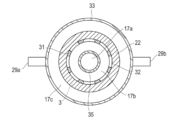
- 4 is a cross-sectional view taken along line AA in FIG.
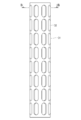
- FIG. 5 is a front view showing an example of an inner cylindrical member used in the hollow fiber membrane external blood perfusion oxygenator of the present invention.
- 31 indicates an inner cylindrical member; 32 indicates a blood flow opening.
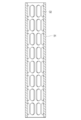
- FIG. 6 is a central longitudinal sectional view of the inner cylindrical member shown in FIG.
- 31 indicates an inner cylindrical member; 32 indicates a blood circulation opening.
- 7 is a cross-sectional view taken along line BB in FIG. In FIG. 7, 31 indicates an inner cylindrical member; 32 indicates a blood flow opening.
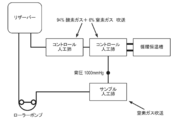
- FIG. 8 is a diagram showing a test system of a plasma leakage resistance performance test in Experiment 1.
- the present invention is an artificial lung having a plurality of gas exchange porous hollow fiber membranes made of a hydrophobic polymer material, the hollow fiber membrane having an inner surface forming a lumen and an outer surface Either the inner surface or the outer surface is represented by the following formula (I):
- R 3 represents a hydrogen atom or a methyl group
- R 1 represents an alkylene group having 1 to 4 carbon atoms
- R 2 represents an alkyl group having 1 to 4 carbon atoms
- a polymer having a structural unit derived from (meth) acrylate (a repeating unit derived from alkoxyalkyl (meth) acrylate) (hereinafter also referred to as “polymer according to the present invention” or “alkoxyalkyl (meth) acrylate polymer”);
- the present invention relates to an artificial lung coated with a polymer-containing solution having a surface tension containing a solvent of 40 to 55 dyn / cm. According to the artificial lung having the above configuration, leakage of plasma components (plasma leak) can be suppressed / prevented even with a thin hollow fiber membrane.
- the present invention also relates to a method for producing an artificial lung having a plurality of gas exchange porous hollow fiber membranes made of a hydrophobic polymer material, wherein the hollow fiber membrane includes an inner surface forming a lumen, an outer surface, and an outer surface.
- the present invention relates to a manufacturing method including covering an inner surface or an outer surface forming a lumen of the hollow fiber membrane. According to the above method, an artificial lung capable of suppressing and preventing leakage of plasma components (plasma leak) can be produced even with a thin hollow fiber membrane.
- the artificial lung of the present invention has a coating (coating) formed by applying a polymer-containing solution having a specific surface tension on the outer surface or inner surface of the hollow fiber membrane on the outer surface or inner surface of the hollow fiber membrane. It is characterized by that.
- the artificial lung using the hollow fiber membrane having the coating can suppress / prevent leakage of plasma components (plasma leak) after circulation even with a thin hollow fiber membrane.
- the mechanism for exerting the above-described effects by the configuration of the present invention is presumed as follows. The present invention is not limited to the following mechanism.
- a polymer-containing solution obtained by dissolving polymethoxyethyl acrylate in a water / methanol / ethanol mixed solvent (6: 1: 3) is used as an outer surface of a hollow fiber membrane having a thickness of 50 ⁇ m
- the artificial lung was manufactured by covering the entire blood contact portion of the artificial lung with a synthetic polymer.
- the oxygenator produced by such a method certainly has little leakage of plasma components.
- the present inventors examined the hollow fiber membrane with a thinner thickness for the purpose of reducing the size of the artificial lung (reducing the burden on the patient). Alternatively, the frequency of plasma component leakage (plasma leak) from the artificial lung (hollow fiber membrane) after circulation increased.
- the polymer coating (coating) is on the entire pore inner wall (the hollow fiber membrane on the side where no coating is formed) Since it was not completely formed (to the surface), there was little or no plasma component leaking into the lumen (causing plasma leakage) through the polymer coating.
- the polymer coating (coating) is applied to the entire pore inner wall (up to the hollow fiber membrane surface on the side where no coating is formed). Since it is easy to form completely, plasma components are likely to leak into the lumen through the pores (Comparative Example 1 below), so it was assumed that the problem of a decrease in gas exchange ability is likely to occur.
- the inner layer of the gas exchange porous hollow fiber membrane in the case of a hollow fiber membrane external blood perfusion oxygenator or the outer layer (
- the hollow fiber membrane internal blood perfusion type artificial lung maintains the hydrophobic state of the forming material, and has a high plasma leakage prevention effect. Therefore, the artificial lung of the present invention can effectively suppress and prevent leakage (plasma leak) of blood (for example, plasma component) to the side opposite to the blood circulation side even with a thin hollow fiber membrane.
- the present invention is an artificial lung having a plurality of gas exchange porous hollow fiber membranes made of a hydrophobic polymer material, the hollow fiber membrane comprising an inner surface forming a lumen, an outer surface, The wall thickness between the inner surface and the outer surface is 20 ⁇ m or more and less than 50 ⁇ m, and either the inner surface or the outer surface is an alkoxy represented by the above formula (I)
- an artificial lung which is covered with a coating containing a polymer having a structural unit derived from alkyl (meth) acrylate and has a plasma leakage performance of 15 mmHg or less.
- the polymer of the present invention has antithrombotic biocompatibility (platelet adhesion / adhesion suppression / prevention effect and platelet activation suppression / prevention effect), particularly platelet adhesion / adhesion. Excellent suppression / prevention effect. Therefore, the oxygenator of the present invention has antithrombotic biocompatibility (platelet adhesion / adhesion suppression / prevention effect and platelet activation suppression / prevention effect), particularly platelet adhesion / adhesion suppression / prevention effect. Excellent.
- a hollow fiber membrane external blood perfusion oxygenator will be described below as a preferred embodiment, but the oxygenator of the present invention may be a hollow fiber membrane internal blood perfusion oxygenator.
- the oxygenator of the present invention may be a hollow fiber membrane internal blood perfusion oxygenator.
- the dimensional ratios in the drawings are exaggerated for convenience of explanation, and may be different from the actual ratios.
- X to Y indicating a range includes X and Y, and means “X or more and Y or less”. Unless otherwise specified, measurement of operation and physical properties is performed under conditions of room temperature (20 to 25 ° C.) / Relative humidity 40 to 50%.
- FIG. 1 is a cross-sectional view of an embodiment of a hollow fiber membrane external blood perfusion oxygenator of the present invention.
- FIG. 2 is an enlarged cross-sectional view of a porous hollow fiber membrane for gas exchange used in the external blood perfusion type artificial lung of the hollow fiber membrane of the present invention.
- FIG. 3 is a cross-sectional view of another embodiment of the oxygenator of the present invention.
- an oxygenator 1 of the present invention houses a large number of gas exchange porous hollow fiber membranes 3 in a housing 2, blood flows on the outer surface side of the hollow fiber membranes 3, and inside the hollow fiber membranes 3.
- This type of oxygenator flows oxygen-containing gas.
- the polymer (alkoxyalkyl (meth) acrylate polymer) according to the present invention is formed on the outer surface (outer surface 3a ′, or outer surface 3a ′ and outer surface layer 3a) of the hollow fiber membrane 3 serving as a blood contact portion. 18) is coated.
- FIG. 2 shows a form in which a coating (film) of the polymer 18 according to the present invention is formed on the outer surface 3a 'of a hollow fiber membrane used for a hollow fiber membrane external blood perfusion type artificial lung.
- a hollow fiber membrane used for a hollow fiber membrane external blood perfusion type artificial lung.
- blood contacts the outer surface 3a 'side, and an oxygen-containing gas flows through the inner surface 3c' side.
- a hollow fiber membrane internal blood perfusion oxygenator may be used. Therefore, the hollow fiber membrane may have a configuration opposite to the above-described configuration, that is, a configuration in which the coating (film) of the polymer 18 according to the present invention is formed on the inner surface 3c ′.
- the polymer coats the outer surface of the hollow fiber membrane means that the polymer coating (coating) is the outer surface (the surface on the blood flow side) of the hollow fiber membrane or the outer surface and the outer surface. Intended to be formed into layers.
- the polymer coats the outer surface of the hollow fiber membrane means that the polymer coating (coating) is formed on the outer surface of the hollow fiber membrane (the surface on which blood flows).
- Polymer covers the outer surface layer of the hollow fiber membrane means that the polymer partially penetrates into the outer surface layer (near the outer surface of the pore) of the hollow fiber membrane to form a coating (film). I intend to.
- the polymer is not substantially present on the inner surface (inner surface) of the hollow fiber membrane (the surface on the side where the oxygen-containing gas flows). That is, the polymer coating (coating) according to the present invention is selectively formed on the blood contact portion (outer surface) of the hollow fiber membrane.
- the polymer coating (coating) according to the present invention may be formed on at least a part of the blood contact portion (outer surface) of the hollow fiber membrane, but it is antithrombotic biocompatible (platelet adhesion / adhesion). From the viewpoints of the suppression / prevention effect and the suppression / prevention effect of platelet activation, it is preferably formed on the entire blood contact portion (outer surface) of the hollow fiber membrane. That is, the polymer according to the present invention preferably covers the entire blood contact portion (outer surface) of the artificial lung.
- the polymer according to the present invention may be present in the inner layer 3b or the inner surface layer 3c of the hollow fiber membrane 3, but in the inner layer 3b or the inner surface layer 3c of the hollow fiber membrane 3, It is preferable that it does not exist substantially.
- “the polymer according to the present invention is not substantially present in the inner layer 3b or the inner surface layer 3c of the hollow fiber membrane 3” means that the inner surface of the hollow fiber membrane (the side on which the oxygen-containing gas flows). This means that the permeation of the polymer according to the present invention is not observed in the vicinity of the surface.
- a hollow fiber membrane type artificial lung 1 includes a housing 2 having a blood inlet 6 and a blood outlet 7 and a number of gas exchange porous hollow fiber membranes 3 housed in the housing 2.
- the blood chamber 12 is formed in the inside, the gas chamber formed inside the hollow fiber membrane 3, and the gas inlet 8 and the gas outlet 9 communicating with the gas chamber.
- the hollow fiber membrane oxygenator 1 of the present embodiment includes a cylindrical housing 2, an aggregate of gas exchange hollow fiber membranes 3 housed in the cylindrical housing 2, and a hollow fiber membrane 3. Both ends of the housing 2 are liquid-tightly held in the housing 2, and the inside of the cylindrical housing 2 is partitioned into a blood chamber 12 as a first fluid chamber and a gas chamber as a second fluid chamber.
- the cylindrical housing 2 is provided with a blood inlet 6 and a blood outlet 7 that communicate with the blood chamber 12.
- a cap-like gas inflow having a gas inlet 8 that is a second fluid inlet that communicates with a gas chamber that is an internal space of the hollow fiber membrane 3 is provided above the partition wall 4 that is an end of the cylindrical housing 2.
- a side header 10 is attached. Therefore, the gas inflow chamber 13 is formed by the outer surface of the partition wall 4 and the inner surface of the gas inflow side header 10.
- the gas inflow chamber 13 communicates with a gas chamber formed by the internal space of the hollow fiber membrane 3.
- a cap-like gas outflow side header 11 having a gas outflow port 9 provided as a second fluid outflow port provided below the partition wall 5 and communicating with the internal space of the hollow fiber membrane 3 is attached. Therefore, the gas outflow chamber 14 is formed by the outer surface of the partition wall 5 and the inner surface of the gas outflow side header 11.
- the hollow fiber membrane 3 is a porous membrane made of a hydrophobic polymer material, and the same hollow fiber membrane used for known artificial lungs is used and is not particularly limited. As described above, the hollow fiber membrane (particularly the inner surface of the hollow fiber membrane) is made of a hydrophobic polymer material, so that leakage of plasma components can be suppressed.
- the inner diameter of the hollow fiber membrane is not particularly limited, but is preferably 50 to 300 ⁇ m, more preferably 80 to 200 ⁇ m.
- the outer diameter of the hollow fiber membrane is not particularly limited, but is preferably 100 to 400 ⁇ m, more preferably 130 to 200 ⁇ m.
- the wall thickness (film thickness) of the hollow fiber membrane is preferably 20 ⁇ m or more and less than 50 ⁇ m, more preferably 25 ⁇ m or more and less than 50 ⁇ m, even more preferably 25 to 45 ⁇ m, still more preferably 25 to 40 ⁇ m, still more preferably 25 to 35 ⁇ m, particularly Preferably, it is 25 to 30 ⁇ m.
- the “thickness (film thickness) of the hollow fiber membrane” means the thickness between the inner surface and the outer surface of the hollow fiber membrane, and the formula: [(outside of the hollow fiber membrane (Diameter) ⁇ (inner diameter of hollow fiber membrane)] / 2. That is, the wall thickness between the inner surface and the outer surface of the hollow fiber membrane is preferably 20 ⁇ m or more and less than 50 ⁇ m, 25 ⁇ m or more and less than 50 ⁇ m, 25 to 45 ⁇ m, 25 to 40 ⁇ m, 25 to 35 ⁇ m, 25 to 30 ⁇ m. It is further preferable in this order.
- the lower limit of the thickness of the hollow fiber membrane as described above, sufficient strength of the hollow fiber membrane can be secured.
- the porosity of the hollow fiber membrane is preferably 5 to 90% by volume, more preferably 10 to 80% by volume, and particularly preferably 30 to 60% by volume.
- the pore diameter of the hollow fiber membrane is preferably 0.01 to 5 ⁇ m, more preferably 0.05 to 1 ⁇ m.
- the material similar to the hollow fiber membrane used for a well-known artificial lung can be used. Specific examples include polyolefin resins such as polypropylene and polyethylene, and hydrophobic polymer materials such as polysulfone, polyacrylonitrile, polytetrafluoroethylene, and cellulose acetate.
- polyolefin resins are preferably used, and polypropylene is more preferable.
- the method for producing the hollow fiber membrane is not particularly limited, and a known method for producing a hollow fiber membrane can be applied in the same manner or appropriately modified.
- the hollow fiber membrane is preferably formed by forming micropores in the wall by a stretching method or a solid-liquid phase separation method.
- the material constituting the cylindrical housing 2 can also be the same material as that used for a known artificial lung housing.
- Specific examples include hydrophobic synthetic resins such as polycarbonate, acrylic / styrene copolymer, and acrylic / butylene / styrene copolymer.
- the shape of the housing 2 is not particularly limited, but is preferably, for example, a cylindrical shape and a transparent body. By forming it with a transparent body, the inside can be easily confirmed.
- the accommodation amount of the hollow fiber membrane in the present embodiment is not particularly limited, and the same amount as that of a known artificial lung can be applied.
- about 5,000 to 100,000 porous hollow fiber membranes 3 are accommodated in the housing 2 in parallel in the axial direction.
- the hollow fiber membrane 3 is fixed in a liquid-tight state by the partition walls 4 and 5 with both ends of the hollow fiber membrane 3 being opened at both ends of the housing 2.
- the partition walls 4 and 5 are made of a potting agent such as polyurethane or silicone rubber. A portion sandwiched between the partition walls 4 and 5 in the housing 2 is partitioned into a gas chamber inside the hollow fiber membrane 3 and a blood chamber 12 outside the hollow fiber membrane 3.
- a gas inflow side header 10 having a gas inflow port 8 and a gas outflow side header 11 having a gas outflow port 9 are liquid-tightly attached to the housing 2.
- These headers may be formed of any material, but may be formed of, for example, a hydrophobic synthetic resin used for the housing described above.
- the header may be attached by any method.
- the header 2 may be bonded to the housing 2 by fusing using ultrasonic waves, high frequency, induction heating or the like, bonding using an adhesive, or mechanically fitting. Attached to. Further, a tightening ring (not shown) may be used. It is preferable that all the blood contact portions (the inner surface of the housing 2 and the outer surface of the hollow fiber membrane 3) of the hollow fiber membrane-type artificial lung 1 are made of a hydrophobic material.
- the polymer 18 according to the invention is coated.
- the polymer is not substantially present in the inner layer 3b or the inner surface layer 3c of the hollow fiber membrane. Since the polymer is not substantially present, the hydrophobic properties of the inner layer or inner surface layer of the hollow fiber membrane are maintained as they are, and leakage of plasma components can be effectively prevented. .
- the polymer according to the present invention is not substantially present in both the inner layer 3b and the inner surface layer 3c of the hollow fiber membrane.
- the hollow fiber membrane 3 includes a passage (inner lumen) 3d that forms a gas chamber at the center.
- the hollow fiber membrane 3 has an opening 3e that communicates the outer surface 3a 'and the inner surface 3c'.
- the hollow fiber membrane having such a configuration is such that blood is in contact with the outer surface 3a ′ side coated with the polymer 18 according to the present invention, while oxygen-containing gas is circulated on the inner surface 3 ′ side. used.
- the hollow fiber membrane 3 has an inner surface 3c ′ that forms a lumen through which an oxygen-containing gas flows, and an outer surface 3a ′ that contacts blood, and the outer surface 3a 'Is a form coated with a polymer according to the present invention (ie, external perfusion type).
- the hollow fiber membrane 3 has an inner surface 3c ′ that forms a lumen through which oxygen-containing gas flows, and an outer surface 3a ′ that comes into contact with blood, and the outer surface 3a.
- 'Is a form coated with a coating containing a polymer according to the present invention (ie, external perfusion type).
- the polymer coating is selectively formed on the outer surface (external perfusion type) or inner surface (internal perfusion type) of the hollow fiber membrane. For this reason, blood (particularly plasma components) does not easily penetrate into the pores of the hollow fiber membrane or does not penetrate. Therefore, leakage of blood (particularly plasma components) from the hollow fiber membrane can be effectively suppressed / prevented.
- the inner layer 3b of the hollow fiber membrane and the inner layer 3c of the hollow fiber membrane are: Since the hydrophobic state of the material is maintained, leakage (leak) of high blood (particularly plasma components) can be more effectively suppressed / prevented. Therefore, the oxygenator of the present invention can maintain a high gas exchange capacity over a long period of time.
- the polymer coating can be uniformly formed on the outer surface or the inner surface of the hollow fiber membrane. For this reason, there is little adhesion / adhesion and activation of platelets at the blood contact portion of the hollow fiber membrane. In addition, it is possible to suppress / prevent the peeling of the coating from the hollow fiber membrane.
- the polymer coating according to the present embodiment is essentially formed on the outer surface or inner surface of the hollow fiber membrane of the artificial lung, but in addition to the outer surface or inner surface, other constituent members (for example, blood contact portions) May be formed as a whole). With this configuration, platelet adhesion / adhesion and activation can be more effectively suppressed / prevented in the entire blood contact portion of the artificial lung. Moreover, since the contact angle of the blood contact surface is lowered, the priming operation is facilitated.
- the coating of the polymer according to the present invention is preferably formed on other constituent members that come into contact with blood, but the hollow fiber membrane other than the blood contact portion or other part of the hollow fiber membrane ( For example, the polymer embedded in the portion embedded in the partition wall may not be covered. Since such a portion does not come into contact with blood, there is no particular problem even if the polymer is not coated.
- FIG. 3 is a cross-sectional view showing another embodiment of the oxygenator according to the present invention.
- 4 is a cross-sectional view taken along line AA in FIG.
- the artificial lung 20 is a cylinder composed of an inner cylindrical member 31 having a blood circulation opening 32 on its side surface and a large number of gas exchange porous hollow fiber membranes 3 wound around the outer surface of the inner cylindrical member 31.
- a gas outlet 27 is a cylinder composed of an inner cylindrical member 31 having a blood circulation opening 32 on its side surface and a large number of gas exchange porous hollow fiber membranes 3 wound around the outer surface of the inner cylindrical member 31.
- the oxygenator 20 of the present embodiment includes an outer cylindrical member 33 that houses an inner cylindrical member 31, and the cylindrical hollow fiber membrane bundle 22 is an inner cylinder.
- the housing 23 is housed between the outer cylindrical member 33 and the outer cylindrical member 33, and the housing 23 is blood connected to one of the blood inlet or the blood outlet communicating with the inside of the inner cylindrical member and the inside of the outer cylindrical member. The other of the inlet or the blood outlet.
- the housing 23 is housed in the outer cylindrical member 33 and the inner cylindrical member 31, and the inner cylindrical body 35 whose front end opens in the inner cylindrical member 31.
- a blood inlet 28 is formed at one end (lower end) of the inner cylinder 35, and two blood outlets 29 a and 29 b extending outward are formed on the side surface of the outer cylindrical member 33. There may be one or more blood outlets.
- the cylindrical hollow fiber membrane bundle 22 is wound around the outer surface of the inner cylindrical member 31. That is, the inner cylindrical member 31 is the core of the cylindrical hollow fiber membrane bundle 22.
- the inner cylindrical body 35 housed inside the inner cylindrical member 31 has a tip that is open near the first partition wall 25.
- a blood inflow port 28 is formed at the lower end protruding from the inner cylindrical member 31.
- the inner cylindrical member 35, the inner cylindrical member 31 with the hollow fiber membrane bundle 22 wound around the outer surface, and the outer cylindrical member 33 are arranged substantially concentrically. Then, one end (upper end) of the inner cylindrical member 31 and the one end (upper end) of the outer cylindrical member 33 around which the hollow fiber membrane bundle 22 is wound on the outer surface are concentrically positioned by the first partition wall 25. While being maintained, the space formed between the inside of the inner cylindrical member and the outer cylindrical member 33 and the outer surface of the hollow fiber membrane is in a liquid-tight state that does not communicate with the outside.
- the partition walls 25 and 26 are formed of a potting agent such as polyurethane or silicone rubber.
- the blood inflow part 17a formed by the inside of the inner cylinder 35 and the substantially cylindrical space formed between the inner cylinder 35 and the inner cylinder member are formed.
- the first blood chamber 17b is provided with a second blood chamber 17c that is formed between the hollow fiber membrane bundle 22 and the outer cylindrical member 33 and is substantially a cylindrical space. Is formed.
- the blood flowing in from the blood inlet 28 flows into the blood inflow portion 17a, rises in the inner cylinder 35 (blood inflow portion 17a), and flows out from the upper end 35a (open end) of the inner cylinder 35. , Flows into the first blood chamber 17b, passes through the opening 32 formed in the inner cylindrical member 31, contacts the hollow fiber membrane, and after gas exchange, flows into the second blood chamber 17c. The blood flows out from the blood outlets 29a and 29b.
- a gas inflow member 41 having a gas inlet 24 is fixed to one end of the outer cylindrical member 33, and similarly, a gas having a gas outlet 27 is provided to the other end of the outer cylindrical member 33.
- An outflow member 42 is fixed.
- the blood inlet 28 of the inner cylindrical body 35 protrudes outside through the gas outflow member 42.
- the outer cylindrical member 33 is not particularly limited, but a cylindrical body, a polygonal cylinder, an elliptical cross section, or the like can be used. A cylindrical body is preferable.
- the inner diameter of the outer cylindrical member is not particularly limited and may be the same as the inner diameter of the outer cylindrical member used for a known artificial lung, but is preferably about 32 to 164 mm.
- the effective length of the outer cylindrical member is not particularly limited, and is the same as the effective length of the outer cylindrical member used for a known artificial lung. However, about 10 to 730 mm is preferable.
- the shape of the inner cylindrical member 31 is not particularly limited, but for example, a cylindrical body, a polygonal cylinder, an elliptical cross section, or the like can be used. A cylindrical body is preferable.
- the outer diameter of the inner cylindrical member is not particularly limited, and may be the same as the outer diameter of the inner cylindrical member used for a known artificial lung, but is preferably about 20 to 100 mm.
- the effective length of the inner cylindrical member (the length of the portion of the total length that is not buried in the partition wall) is not particularly limited, and is the same as the effective length of the inner cylindrical member used for a known artificial lung. However, about 10 to 730 mm is preferable.
- the inner cylindrical member 31 includes a large number of blood circulation openings 32 on the side surface.
- the size of the opening 32 is preferably large in total area as long as the necessary strength of the tubular member is maintained.
- FIG. 5 is a front view
- FIG. 6 is a central longitudinal sectional view of FIG. 5
- FIG. 7 is a sectional view taken along the line BB of FIG.
- an annular arrangement opening in which a plurality of openings 32 (for example, 4 to 24 pieces, 8 pieces in the longitudinal direction in the figure) are provided on the outer peripheral surface of the cylindrical member at equal angular intervals is provided at equal intervals in the axial direction of the cylindrical member
- a plurality of sets (8 sets / circumference in the figure) are preferable.
- the opening shape may be a circle, a polygon, an ellipse or the like, but an oval shape as shown in FIG. 5 is preferable.
- the shape of the inner cylindrical body 35 is not particularly limited, but for example, a cylindrical body, a polygonal cylinder, an elliptical cross section, or the like can be used. A cylindrical body is preferable.
- the distance between the distal end opening of the inner cylinder 35 and the first partition wall 25 is not particularly limited, and a distance similar to that used for a known artificial lung can be applied, but about 20 to 50 mm is preferable. is there.
- the inner diameter of the inner cylinder 35 is not particularly limited, and may be the same as the inner diameter of the inner cylinder used for a known artificial lung, but is preferably about 10 to 30 mm.
- the thickness of the cylindrical hollow fiber membrane bundle 22 is not particularly limited and may be the same as the thickness of the cylindrical hollow fiber membrane bundle used for known artificial lungs, but is preferably 5 to 35 mm, and particularly 10 mm to 28 mm. It is preferable that Further, the filling rate of the hollow fiber membrane to the cylindrical space formed between the outer surface and the inner surface of the cylindrical hollow fiber membrane bundle 22 is not particularly limited, and the filling rate in a known artificial lung is similarly applied. However, it is preferably 40 to 85%, particularly preferably 45 to 80%.
- the outer diameter of the hollow fiber membrane bundle 22 may be the same as the outer diameter of a hollow fiber membrane bundle used for known artificial lungs, but is preferably 30 to 170 mm, and particularly preferably 70 to 130 mm. As the gas exchange membrane, those described above are used.
- the hollow fiber membrane bundle 22 is formed by winding a hollow fiber membrane around the inner cylindrical member 31, specifically, by forming a hollow fiber membrane bobbin with the inner cylindrical member 31 as a core, and forming the hollow fiber membrane. Both ends of the bobbin can be formed by cutting both ends of the hollow fiber membrane bobbin together with the inner cylindrical member 31 as the core after fixing with the partition walls. In addition, by this cutting
- the formation method of a hollow fiber membrane is not limited to the said method, You may use the formation method of other well-known hollow fiber membranes similarly or suitably modified.
- one or a plurality of hollow fiber membranes are wound around the inner cylindrical member 31 so that the hollow fiber membranes that are substantially parallel and adjacent to each other have a substantially constant interval. Thereby, the drift of blood can be suppressed more effectively.
- the distance between adjacent hollow fiber membranes of the hollow fiber membrane is not limited to the following, but is preferably 1/10 to 1/1 of the outer diameter of the hollow fiber membrane. Furthermore, the distance between adjacent hollow fiber membranes is preferably 30 to 200 ⁇ m, particularly preferably 50 to 180 ⁇ m.
- the hollow fiber membrane bundle 22 has one or more (preferably 2 to 16) hollow fiber membranes at the same time, and all the adjacent hollow fiber membranes have a substantially constant interval.
- n which is the relationship between the number of rotations of the winding rotary body and the number of rewinds of the winder, is not particularly limited, but is usually 1 to 5, and preferably 2 to 4.
- the oxygenator 20 After blood flows from the inside of the cylindrical hollow fiber membrane bundle 22 and the blood that has passed through the hollow fiber membrane bundle 22 flows to the outside of the hollow fiber membrane bundle 22, although it is of the type that flows out from the oxygenator 20, it is not limited to this. Contrary to the other embodiments described above, blood flows from the outside of the cylindrical hollow fiber membrane bundle 22, and after the blood passing through the hollow fiber membrane bundle 22 flows inside the hollow fiber membrane bundle 22, the oxygenator 20 It may be of a more outflow type.
- the hollow fiber membrane type artificial lung 20 As shown in FIG. 2, at least the outer surface 3a ′ (and further the outer layer 3a) of the hollow fiber membrane 3 of the hollow fiber membrane type artificial lung 1 is applied to the present invention. It is preferable that the polymer 18 is coated.
- the polymer according to the present invention may be present in the inner layer 3b or the inner surface layer 3c of the hollow fiber membrane 3, but is substantially present in the inner layer 3b or the inner surface layer 3c of the hollow fiber membrane 3.
- the hollow fiber membrane 3 includes a passage 3d that forms a gas chamber in the center.
- preferred forms (inner diameter, outer diameter, wall thickness, porosity, etc.) of the hollow fiber membrane are not particularly limited, but the same form as described in FIG. 1 can be adopted.
- the hollow fiber membranes 3 are in the form of a so-called bobbin that is in contact with each other and stacked in layers.
- the polymer coating is selectively formed uniformly on the outer surface or inner surface of the hollow fiber membrane. For this reason, leakage of blood (particularly plasma components) to the inner surface layer of the hollow fiber membrane can also be suppressed / prevented. That is, the outer surface 3a ′ (and the outer surface layer 3a) of the hollow fiber membrane 3 that is a blood contact portion is selectively covered with a polymer, thereby effectively preventing leakage of blood (particularly plasma components). Can be suppressed and prevented.
- the inner layer 3b of the hollow fiber membrane and the inner layer 3c of the hollow fiber membrane are: Since the hydrophobic state of the material is maintained, leakage (leak) of high blood (particularly plasma components) can be more effectively suppressed / prevented.
- the blood flow path is complicated and has many narrow portions, and is excellent in gas exchange ability.
- an external blood perfusion type artificial body that is not a bobbin type is used. May be inferior to lungs.
- the polymer coating is uniform, there is little adhesion / adhesion and activation of platelets at the blood contact portion of the hollow fiber membrane. Further, it is possible to suppress / prevent the coating (particularly, the coating uneven portion) from peeling from the hollow fiber membrane.
- the polymer coating according to the present embodiment is essentially formed on the outer surface or inner surface of the hollow fiber membrane of the artificial lung, but in addition to the outer surface or inner surface, other constituent members (for example, blood The entire contact portion may be formed.
- other constituent members for example, blood
- the entire contact portion may be formed.
- the coating of the polymer according to the present invention is preferably formed on other constituent members that come into contact with blood, but the hollow fiber membrane other than the blood contact portion or other part of the hollow fiber membrane (for example, the polymer embedded in the portion buried in the partition wall and the contact portion between the hollow fibers may not be coated. Since such a portion does not come into contact with blood, there is no particular problem even if the polymer is not coated.
- polymer (alkoxyalkyl (meth) acrylate polymer) according to the present invention has the following formula (I):
- alkoxyalkyl (meth) acrylate The structural unit derived from the alkoxyalkyl (meth) acrylate represented by these.
- the polymer according to the present invention is excellent in antithrombogenicity and biocompatibility.
- (meth) acrylate means “acrylate and / or methacrylate”. That is, “alkoxyalkyl (meth) acrylate” includes the case of only alkoxyalkyl acrylate, only alkoxyalkyl methacrylate, and all of alkoxyalkyl acrylate and alkoxyalkyl methacrylate.
- R 1 represents an alkylene group having 1 to 4 carbon atoms.
- the alkylene group having 1 to 4 carbon atoms is not particularly limited, and includes a linear or branched alkylene group such as a methylene group, an ethylene group, a trimethylene group, a tetramethylene group, and a propylene group.
- an ethylene group and a propylene group are preferable, and an ethylene group is particularly preferable in consideration of further improvement effects of antithrombogenicity and biocompatibility.
- R 2 represents an alkyl group having 1 to 4 carbon atoms.
- the alkyl group having 1 to 4 carbon atoms is not particularly limited, and is a straight chain of methyl group, ethyl group, propyl group, isopropyl group, butyl group, isobutyl group, sec-butyl group, or tert-butyl group. Or there is a branched alkyl group. Among these, a methyl group and an ethyl group are preferable, and a methyl group is particularly preferable in view of further improving effects of antithrombogenicity and biocompatibility.
- R 3 represents a hydrogen atom or a methyl group.
- each structural unit may be the same or may differ.
- alkoxyalkyl (meth) acrylate examples include methoxymethyl acrylate, methoxyethyl acrylate, methoxypropyl acrylate, ethoxymethyl acrylate, ethoxyethyl acrylate, ethoxypropyl acrylate, ethoxybutyl acrylate, propoxymethyl acrylate, butoxyethyl acrylate, Examples include methoxybutyl acrylate, methoxymethyl methacrylate, methoxyethyl methacrylate, ethoxymethyl methacrylate, ethoxyethyl methacrylate, propoxymethyl methacrylate, butoxyethyl methacrylate.
- methoxyethyl (meth) acrylate and methoxybutyl acrylate are preferred, and methoxyethyl acrylate (MEA) is particularly preferred from the viewpoint of further improving the antithrombogenicity and biocompatibility.
- the polymer according to the present invention is preferably polymethoxyethyl acrylate (PMEA).
- the alkoxyalkyl (meth) acrylate may be used alone or as a mixture of two or more.
- the polymer according to the present invention essentially has a constituent unit derived from alkoxyalkyl (meth) acrylate, and is a polymer composed of one or more constituent units derived from alkoxyalkyl (meth) acrylate ( Homopolymer) or one or two or more types of constituent units derived from alkoxyalkyl (meth) acrylate and one or more types of monomers that can be copolymerized with the alkoxyalkyl (meth) acrylate
- the polymer (copolymer) comprised from these structural units (other structural units) may be sufficient.
- the structure of the polymer (copolymer) is not particularly limited, and a random copolymer, an alternating copolymer, a periodic copolymer, Either a copolymer or a block copolymer may be used.
- the terminal of the polymer is not particularly limited and is appropriately defined depending on the type of raw material used, but is usually a hydrogen atom.
- the monomer (copolymerizable) that can be copolymerized with alkoxyalkyl (meth) acrylate is not particularly limited.
- the copolymerizable monomer those having no hydroxyl group or cationic group in the molecule are preferable.
- the copolymer may be any of a random copolymer, a block copolymer, and a graft copolymer, and can be synthesized by a known method such as radical polymerization, ionic polymerization, or polymerization using a macromer.
- the ratio of the structural unit derived from the copolymerizable monomer in all the structural units of the copolymer is not particularly limited, but in consideration of antithrombogenicity and biocompatibility, the copolymerizable monomer It is preferable that the structural unit derived from (other structural unit) is more than 0 mol% and 50 mol% or less in all the structural units of the copolymer. If it exceeds 50 mol%, the effect of alkoxyalkyl (meth) acrylate may be reduced.
- the weight average molecular weight of the polymer according to the present invention is not particularly limited, but is preferably 80,000 or more. If the polymer having the weight average molecular weight is used, leakage of plasma components (plasma leak) can be sufficiently suppressed even for a thin hollow fiber membrane. On the other hand, as described above, by increasing the molecular weight of the polymer, the content of the low molecular weight polymer in the coating (coating film) can be reduced. Depending on the molecular weight, elution of the coating (particularly a low molecular weight polymer) into the blood can be suppressed / prevented.
- the weight average molecular weight of the polymer according to the present invention is more preferably 250,000 to 600,000, It is preferably 300,000 to 500,000.
- elution of the coating (particularly a low molecular weight polymer) into blood can be more effectively suppressed / prevented. Therefore, even an artificial lung having a hollow fiber membrane whose surface is coated with a coating containing such a polymer at a low concentration can exhibit and maintain excellent antithrombogenicity. Moreover, it is preferable also from the point of antithrombogenicity and biocompatibility.
- the “low molecular weight polymer” means a polymer having a weight average molecular weight of less than 100,000.
- weight average molecular weight is a value measured by gel permeation chromatography (Gel permeation chromatography, GPC) using polystyrene as a standard substance and tetrahydrofuran (THF) as a mobile phase. . Specifically, the polymer is dissolved in tetrahydrofuran (THF) to a concentration of 10 mg / ml to prepare a sample. For the sample prepared in this manner, GPC column LF-804 (manufactured by Shodex) was attached to GPC system LC-20 (manufactured by Shimadzu Corporation), THF was flowed as a mobile phase, and polystyrene was used as a standard substance. Measure the GPC of the molecule. After preparing a calibration curve with standard polystyrene, the weight average molecular weight of the polymer is calculated based on this curve.
- GPC gel permeation chromatography
- the polymer according to the present invention can be produced by a known method. Specifically, the following formula (II):
- one or more monomers (copolymerizable monomers) copolymerizable with the alkoxyalkyl (meth) acrylate in a polymerization solvent stir together with a polymerization initiator to prepare a monomer solution, and the monomer solution is heated to obtain an alkoxyalkyl (meth) acrylate or alkoxyalkyl (meth) acrylate and, if necessary, a copolymerizable monomer.
- a method of (co) polymerizing the body is preferably used.
- the substituents R 1 , R 2 and R 3 are the same as those defined in the above formula (I), and thus the description thereof is omitted here.
- the polymerization solvent that can be used in the preparation of the monomer solution is not particularly limited as long as it can dissolve the alkoxyalkyl (meth) acrylate of the formula (II) used and, if necessary, the copolymerizable monomer.
- water alcohols such as methanol, ethanol, propanol and isopropanol, aqueous solvents such as polyethylene glycols; aromatic solvents such as toluene, xylene and tetralin; and halogens such as chloroform, dichloroethane, chlorobenzene, dichlorobenzene and trichlorobenzene System solvents and the like.
- the monomer concentration in the monomer solution is not particularly limited, but the weight average molecular weight of the resulting polymer can be increased by setting the concentration relatively high. Therefore, in consideration of the ease of obtaining a polymer having a weight average molecular weight as described above, the monomer concentration in the monomer solution is preferably 15 to 60% by weight, more preferably 20 to 50%. % By weight, particularly preferably 25 to 45% by weight.
- concentration means the total density
- the polymerization initiator is not particularly limited, and a known one may be used.
- it is a radical polymerization initiator from the viewpoint of excellent polymerization stability.
- a persulfate such as potassium persulfate (KPS), sodium persulfate, ammonium persulfate; hydrogen peroxide, t-butyl persulfate.
- Peroxides such as oxide and methyl ethyl ketone peroxide; azobisisobutyronitrile (AIBN), 2,2′-azobis (4-methoxy-2,4-dimethylvaleronitrile), 2,2′-azobis (2, 4-dimethylvaleronitrile), 2,2′-azobis [2- (2-imidazolin-2-yl) propane] dihydrochloride, 2,2′-azobis [2- (2-imidazolin-2-yl) propane] Disulfate dihydrate, 2,2′-azobis (2-methylpropionamidine) dihydrochloride, 2,2′-azobis [N- (2- Ruboxyethyl) -2-methylpropionamidine)] hydrate, 3-hydroxy-1,1-dimethylbutylperoxyneodecanoate, ⁇ -cumylperoxyneodecanoate, 1,1,3,3-tetrabutyl Peroxyneodecanoate, t-butylperoxyn
- a reducing agent such as sodium sulfite, sodium hydrogen sulfite, or ascorbic acid may be combined with the radical polymerization initiator and used as a redox initiator.
- the blending amount of the polymerization initiator is preferably 0.0001 to 1 mol% with respect to the total amount of monomers.
- the blending amount of the polymerization initiator is preferably 0.005 to 2 parts by weight, more preferably 100 parts by weight of the monomer (the whole when plural kinds of monomers are used). Is 0.05 to 0.5 parts by weight. With such a blending amount of the polymerization initiator, a polymer having a desired weight average molecular weight can be produced more efficiently.
- the polymerization initiator may be mixed as it is with a monomer (alkoxyalkyl (meth) acrylate or alkoxyalkyl (meth) acrylate and copolymerizable monomer; hereinafter the same) and a polymerization solvent.
- You may mix with a monomer and a polymerization solvent as it is with the form of the solution melt
- the other solvent is not particularly limited as long as it can dissolve the polymerization initiator, and examples thereof include the same solvents as the above polymerization solvent.
- the other solvent may be the same as or different from the polymerization solvent, but considering the ease of controlling the polymerization, it is preferable to use the same solvent as the polymerization solvent.
- the concentration of the polymerization initiator in the other solvent is not particularly limited.
- the addition amount of the polymerization initiator is preferably relative to 100 parts by weight of the other solvent. Is 0.1 to 10 parts by weight, more preferably 0.5 to 5 parts by weight.
- the polymerization initiator When the polymerization initiator is used in the form of a solution, a solution in which a monomer (alkoxyalkyl (meth) acrylate or alkoxyalkyl (meth) acrylate and copolymerizable monomer) is dissolved in a polymerization solvent, deaeration treatment may be performed in advance.
- a methanol solution may be bubbled with an inert gas such as nitrogen gas or argon gas for about 0.5 to 5 hours.
- the methanol solution may be adjusted to a temperature of about 30 ° C. to 80 ° C., preferably the polymerization temperature in the polymerization step described below.
- the monomer solution is heated to (co) polymerize alkoxyalkyl (meth) acrylate or alkoxyalkyl (meth) acrylate and another monomer.
- the polymerization method for example, known polymerization methods such as radical polymerization, anionic polymerization, and cationic polymerization can be employed, and preferably radical polymerization that is easy to manufacture is used.
- Polymerization conditions are not particularly limited as long as the above monomers (alkoxyalkyl (meth) acrylate or alkoxyalkyl (meth) acrylate and copolymerizable monomer) can be polymerized.
- the polymerization temperature is preferably 30 to 80 ° C., more preferably 40 ° C. to 55 ° C.
- the polymerization time is preferably 1 to 24 hours, and preferably 5 to 12 hours. Under the conditions as described above, a polymer having a high molecular weight as described above can be produced more efficiently. In addition, gelation in the polymerization process can be effectively suppressed and prevented, and high production efficiency can be achieved.
- a chain transfer agent e.g., a polymerization rate adjusting agent, a surfactant, and other additives may be appropriately used in the polymerization.
- the atmosphere in which the polymerization reaction is performed is not particularly limited, and may be performed in an air atmosphere or an inert gas atmosphere such as nitrogen gas or argon gas. Further, the reaction solution may be stirred during the polymerization reaction.
- the polymer after polymerization can be purified by a general purification method such as a reprecipitation method, a dialysis method, an ultrafiltration method, or an extraction method.
- the polymer after purification can be dried by any method such as freeze drying, reduced pressure drying, spray drying, or heat drying. However, from the viewpoint of little influence on the physical properties of the polymer, freeze drying or reduced pressure drying is performed. Is preferred.
- the present invention relates to a method for producing an artificial lung having a plurality of gas exchange porous hollow fiber membranes made of a hydrophobic polymer material, the hollow fiber membrane comprising an inner surface forming a lumen, an outer surface, and an outer surface. And the following formula (I):
- R 3 represents a hydrogen atom or a methyl group
- R 1 represents an alkylene group having 1 to 4 carbon atoms
- R 2 represents an alkyl group having 1 to 4 carbon atoms
- a manufacturing method comprising coating an outer surface.
- the present invention is not limited to the following preferred forms except that the outer surface or inner surface of the hollow fiber membrane is coated with a polymer-containing solution having a surface tension of 40 to 55 dyn / cm.
- the solvent is applied to the blood flow side of the artificial lung so that the surface tension is 40 to 55 dyn / cm.
- the outer surface or the inner surface of the hollow fiber membrane that is, the blood contact portion
- the hollow fiber membrane may be coated with the polymer-containing solution before assembling the oxygenator.
- the surface tension of the polymer-containing solution is 40 to 55 dyn / cm.
- the surface tension is less than 40 dyn / cm, the polymer penetrates to the inner surface of the pores of the hollow fiber membrane (the surface on the side where the oxygen-containing gas flows). The probability of plasma leaks will increase.
- the surface tension exceeds 55 dyn / cm, the dispersibility of the polymer in the coating solvent is lowered, and aggregation is likely to occur, which is also not preferable.
- the surface tension of the polymer-containing solution is preferably 42 to 53 dyn / cm, more preferably 45 to 50 dyn / cm. It is.
- the surface tension of the polymer-containing solution is a value measured according to the following method.
- the surface tension of the polymer-containing solution is not particularly limited as long as it is within the above range.
- concentration of the polymer according to the present invention in the polymer-containing solution is controlled within an appropriate range;
- the solvent is appropriately selected; and a method of appropriately combining (a) and (b) above. It can be preferably applied.
- the above (a) and (b) are preferable, and the method (b) is particularly preferable.
- the concentration of the polymer according to the present invention in the polymer-containing solution is not particularly limited. Considering the ease of forming a coating and the effect of reducing coat unevenness, it is preferably 0.01 to 5.0% by weight, more preferably 0.05 to 1.0% by weight.
- concentration of the polymer in the polymer-containing solution is as low as 0.5% by weight or less, the amount of the polymer is small and the polymer hardly acts as a surfactant. For this reason, with such a low concentration polymer, the surface tension of the polymer-containing solution (coating solution) does not substantially change.
- the hollow fiber membrane may be covered with the polymer-containing solution before assembling the artificial lung.
- the solvent used for the preparation of the polymer-containing solution can dissolve the polymer according to the present invention and can control the surface tension of the polymer-containing solution to 40 to 55 dyn / cm. If it is, it will not be restrict
- the solvent more effectively prevents penetration of the polymer-containing solution up to the surface (inner surface or outer surface) of the pores of the hollow fiber membrane through which oxygen-containing gas flows, preferably to the center of the pores. Therefore, the solvent preferably contains water.
- the solvent other than water used for the preparation of the polymer-containing solution is not particularly limited, but considering the ease of controlling the solubility of the polymer according to the present invention and the surface tension of the polymer-containing solution, Methanol, acetone and ethanol are preferred. Solvents other than water may be used alone or in the form of a mixture of two or more. Of these, methanol is preferable in consideration of further improvement in solubility of the polymer according to the present invention and ease of further control of the surface tension of the polymer-containing solution. That is, the solvent is preferably composed of water and methanol.
- the mixing ratio of water and methanol is not particularly limited, but considering the further improvement in solubility of the polymer according to the present invention and the ease of further control of the surface tension of the polymer-containing solution, water: methanol
- the mixing ratio (volume ratio) is preferably 5 to 99: 1, more preferably 6 to 49: 1, and particularly preferably 7 to 30: 1. That is, the solvent is preferably composed of water and methanol at a mixing ratio (volume ratio) of 5 to 99: 1, and is composed of water and methanol at a mixing ratio (volume ratio) of 6 to 49: 1. More preferably, it is particularly preferably composed of water and methanol at a mixing ratio (volume ratio) of 7 to 30: 1.
- the outer surface or inner surface of the hollow fiber membrane is brought into contact with the polymer-containing solution (circulation of the polymer-containing solution to the blood circulation side of the artificial lung) to increase the outer surface or inner surface of the hollow fiber membrane.
- the coating amount of the polymer-containing solution on the outer surface or inner surface of the hollow fiber membrane is not particularly limited.
- the polymer coating method is not particularly limited, but filling, dip coating (dipping method), spraying, spin coating, dripping, doctor blade, brush coating, roll coater, air knife coating, curtain coating, wire bar coating, Conventionally known methods such as gravure coating and mixed solution-impregnated sponge coating can be applied.
- the conditions for forming the polymer coating film are not particularly limited.
- the contact time between the polymer-containing solution and the hollow fiber membrane (the circulation time of the polymer-containing solution to the blood circulation side of the artificial lung) is considered in consideration of the ease of forming a coating film, the effect of reducing coat unevenness, etc. 1 to 5 minutes is preferable, and 1 to 3 minutes is more preferable.
- the contact temperature between the polymer-containing solution and the hollow fiber membrane (the circulation temperature of the polymer-containing solution to the blood circulation side of the artificial lung) is considered considering the ease of forming a coating film, the effect of reducing coat unevenness, etc. 5 to 40 ° C is preferable, and 15 to 30 ° C is more preferable.
- the coating film is dried to form a coating (coating film) with the polymer according to the present invention on the outer surface or inner surface of the hollow fiber membrane.
- the drying conditions are conditions that allow the coating (film) with the polymer according to the present invention to be formed on the outer surface or inner surface (and further the outer surface layer) of the hollow fiber membrane, or the inner surface (and further the inner surface layer).
- the drying temperature is preferably 5 to 50 ° C, more preferably 15 to 40 ° C.
- the drying time is preferably 60 to 300 minutes, more preferably 120 to 240 minutes.
- the coating film may be dried by allowing a gas of preferably 5 to 40 ° C., more preferably 15 to 30 ° C., to flow continuously or stepwise through the hollow fiber membrane.
- a gas of preferably 5 to 40 ° C., more preferably 15 to 30 ° C. is not particularly limited as long as it does not affect the coating film and can dry the coating film.
- Specific examples include air and inert gases such as nitrogen gas and argon gas.
- the amount of gas flow is not particularly limited as long as the coating film can be sufficiently dried, but is preferably 5 to 150 L, more preferably 30 to 100 L.
- a coating (film) is formed on the outer surface side of the hollow fiber membrane, it is possible to effectively prevent the antithrombogenic material from penetrating to the inner layer and further to the inner surface of the hollow fiber membrane.
- the antithrombogenic material is preferentially retained on the outer surface of the hollow fiber membrane.
- a coating (coating) is formed on the inner surface side of the hollow fiber membrane, it effectively suppresses / prevents the penetration of the antithrombotic material to the inner layer and further to the outer surface of the hollow fiber membrane, thereby providing an antithrombogenic property.
- the material preferentially remains on the inner surface of the hollow fiber membrane.
- the oxygenator of the present invention has a plasma leakage resistance of preferably 15 mmHg or less, more preferably 10 mmHg or less, and particularly preferably 8 mmHg or less.
- a plasma leak-proof performance is so preferable that it is low, a minimum in particular is not restrict
- the present invention is an artificial lung having a plurality of gas exchange porous hollow fiber membranes made of a hydrophobic polymer material, the hollow fiber membrane comprising an inner surface forming a lumen and an outer surface. And the thickness between the inner surface and the outer surface is 20 ⁇ m or more and less than 50 ⁇ m, and either the inner surface or the outer surface is represented by the following formula (I):
- R 3 represents a hydrogen atom or a methyl group
- R 1 represents an alkylene group having 1 to 4 carbon atoms
- R 2 represents an alkyl group having 1 to 4 carbon atoms
- an artificial lung having a plasma leakage resistance of 15 mmHg or less, which is coated with a coating containing a polymer having a structural unit derived from alkoxyalkyl (meth) acrylate.
- the value measured in the following examples is adopted as the plasma leakage resistance.
- the elution amount of the polymer is preferably 20% or less, more preferably 10% or less, and particularly preferably 5% or less (lower limit: 0%). In the present specification, the value measured in the following examples is adopted as the elution amount of the polymer.
- the polymer according to the present invention is antithrombotic biocompatible (inhibition / prevention effect on platelet adhesion / adhesion, and inhibition / prevention effect on platelet activation), particularly, inhibition / prevention of platelet adhesion / attachment. Excellent effect. Therefore, the oxygenator of the present invention has an antithrombotic biocompatibility (platelet adhesion / adhesion suppression / prevention effect and platelet activation suppression / prevention effect), particularly platelet adhesion / adhesion suppression / prevention effect. Excellent.
- Production Example 1 Synthesis of PMEA having a weight average molecular weight of 310,000 60 g (0.46 mol) of 2-methoxyethyl acrylate (MEA) was dissolved in 135 g of methanol, placed in a four-necked flask, and N 2 bubbling was performed at 50 ° C. for 1 hour. The monomer solution (1) was prepared. Separately, 0.06 g of 2,2′-azobis (4-methoxy-2,4-dimethylvaleronitrile) (V-70, manufactured by Wako Pure Chemical Industries, Ltd.) was dissolved in 5 g of methanol to obtain a polymerization initiator solution. (1) was prepared.
- V-70 2,2′-azobis (4-methoxy-2,4-dimethylvaleronitrile
- this polymerization initiator solution (1) was added to the monomer solution (1), and a polymerization reaction was performed at 50 ° C. for 5 hours. After polymerization for a predetermined time, the polymerization solution was dropped into ethanol, and the precipitated polymer (PMEA (1)) was recovered. In addition, it was 310,000 when the weight average molecular weight of the collect
- Production Example 2 Synthesis of PMEA having a weight average molecular weight of 420,000 2-methoxyethyl acrylate (MEA) 80 g (0.61 mol) was dissolved in 115 g of methanol, placed in a four-necked flask, and N 2 bubbling was performed at 50 ° C. for 1 hour. The monomer solution (2) was prepared. Separately, 0.08 g of 2,2′-azobis (4-methoxy-2,4-dimethylvaleronitrile) (V-70, manufactured by Wako Pure Chemical Industries, Ltd.) was dissolved in 5 g of methanol to obtain a polymerization initiator solution. (2) was prepared.
- V-70 2,2′-azobis (4-methoxy-2,4-dimethylvaleronitrile
- this polymerization initiator solution (2) was added to the monomer solution (2), and a polymerization reaction was performed at 50 ° C. for 5 hours. After polymerization for a predetermined time, the polymerization solution was added dropwise to ethanol, and the precipitated polymer (PMEA (2)) was recovered. The weight average molecular weight of the recovered polymer (PMEA (2)) was measured and found to be 420,000.
- Production Example 3 Synthesis of PMEA having a weight average molecular weight of 490,000 80 g (0.61 mol) of 2-methoxyethyl acrylate (MEA) was dissolved in 115 g of methanol, placed in a four-necked flask, and N 2 bubbling was performed at 43 ° C. for 1 hour. The monomer solution (3) was prepared. Separately, 0.08 g of 2,2′-azobis (4-methoxy-2,4-dimethylvaleronitrile) (V-70, manufactured by Wako Pure Chemical Industries, Ltd.) was dissolved in 5 g of methanol to obtain a polymerization initiator solution. (3) was prepared.
- V-70 2,2′-azobis (4-methoxy-2,4-dimethylvaleronitrile
- this polymerization initiator solution (3) was added to the monomer solution (3), and a polymerization reaction was performed at 43 ° C. for 8 hours. After polymerization for a predetermined time, the polymerization solution was added dropwise to ethanol, and the precipitated polymer (PMEA (3)) was recovered. In addition, it was 490,000 when the weight average molecular weight of the collect
- Production Example 4 Synthesis of PMEA having a weight average molecular weight of 85,000 2-methoxyethyl acrylate (MEA) 20 g (0.16 mol) was dissolved in 75 g of toluene, placed in a four-necked flask, and N 2 bubbling was performed at 80 ° C. This was carried out for 1 hour to prepare a monomer solution (4). Separately, 0.02 g of 2,2-azobisisobutyronitrile (AIBN, manufactured by Wako Pure Chemical Industries, Ltd.) was dissolved in 5 g of toluene to prepare a polymerization initiator solution (4).
- AIBN 2,2-azobisisobutyronitrile
- this polymerization initiator solution (4) was added to the monomer solution (4), and a polymerization reaction was performed at 80 ° C. for 8 hours. After polymerization for a predetermined time, the polymerization solution was dropped into normal hexane, and the precipitated polymer (PMEA (4)) was recovered. In addition, it was 85,000 when the weight average molecular weight of the collect
- Production Example 5 Synthesis of PMEA having a weight average molecular weight of 410,000 Melt 15 g (0.115 mol) of methoxyethyl acrylate (MEA) in 25 g of methanol, put in a four-necked flask, perform N 2 bubbling at 50 ° C. for 1 hour, A monomer solution (5) was prepared. Separately, 0.015 g of 2,2′-azobis (4-methoxy-2,4-dimethylvaleronitrile) (V-70, manufactured by Wako Pure Chemical Industries, Ltd.) was dissolved in 3 g of methanol to obtain a polymerization initiator solution. (5) was prepared.
- V-70 2,2′-azobis (4-methoxy-2,4-dimethylvaleronitrile
- this polymerization initiator solution (5) was added to the monomer solution (5), and a polymerization reaction was performed at 50 ° C. for 5 hours in a nitrogen gas atmosphere. After polymerization for a predetermined time, the polymerization solution was added dropwise to ethanol, and the precipitated polymer (PMEA (5)) was recovered. In addition, it was 410,000 when the weight average molecular weight of the collect
- porous hollow fiber membranes for gas exchange made of porous polypropylene having an inner diameter of 120 ⁇ m, an outer diameter of 170 ⁇ m, a wall thickness of 25 ⁇ m, and a porosity of about 40% by volume are housed in a housing.
- the coating liquid (1) prepared above is filled in the blood flow path of the artificial lung (a) and allowed to stand at 25 ° C. for 120 seconds. Then, the coating liquid is removed and air with a flow rate of 80 L is flowed. Then, the hollow fiber membrane was dried to produce a blood external perfusion type hollow fiber membrane artificial lung (1) having a hollow fiber membrane having a coating formed on the outer surface.
- the blood external perfusion type hollow fiber artificial lung (1) thus obtained is also referred to as an artificial lung (1).
- Example 1 a blood external perfusion-type hollow fiber membrane oxygenator was replaced with an oxygenator (2) in the same manner as in Example 1 except that the above-mentioned coating solution (2) was used instead of the coating solution (1). Manufactured.
- the blood external perfusion type hollow fiber artificial lung (2) thus obtained is also referred to as an artificial lung (2).
- Example 1 a blood external perfusion type hollow fiber membrane oxygenator was replaced with an oxygenator (3) in the same manner as in Example 1 except that the above coating solution (3) was used instead of the coating solution (1). Manufactured.
- the blood external perfusion-type hollow fiber artificial lung (3) thus obtained is also referred to as an artificial lung (3).
- Example 1 the blood external perfusion type hollow fiber membrane oxygenator was replaced with the oxygenator (4) in the same manner as in Example 1 except that the above-described coating solution (4) was used instead of the coating solution (1). Manufactured.
- the blood external perfusion type hollow fiber artificial lung (4) thus obtained is also referred to as an artificial lung (4).
- the coating liquid (5) having a surface tension of 46 dyn / cm was prepared by dispersing at a mixing ratio of 95: 5 (volume ratio).
- Example 1 a blood external perfusion type hollow fiber membrane oxygenator was replaced with an oxygenator (5) in the same manner as in Example 1 except that the above-mentioned coating solution (5) was used instead of the coating solution (1). Manufactured.
- the blood external perfusion type hollow fiber artificial lung (5) thus obtained is also referred to as an artificial lung (5).
- Example 1 instead of the coating solution (1), the blood external perfusion type hollow fiber membrane oxygenator was replaced with the artificial lung (6) in the same manner as in Example 1 except that the coating solution (6) was used. Manufactured.
- the blood external perfusion type hollow fiber artificial lung (6) thus obtained is also referred to as an artificial lung (6).
- porous hollow fiber membranes for gas exchange made of porous polypropylene having an inner diameter of 195 ⁇ m, an outer diameter of 295 ⁇ m, a wall thickness of 50 ⁇ m, and a porosity of about 35% are used in the housing.
- External blood perfusion type hollow fiber described in FIG. 1 of JP-A-11-114056 (equivalent to EP 0 908 191 A1 or US Pat. No. 6,495,101 B1) having a membrane area of 1.8 m 2
- a membrane oxygenator (b) was prepared.
- the coating liquid (7) prepared above is filled in the blood flow path of the artificial lung (b) and allowed to stand at 25 ° C. for 120 seconds. Then, the coating liquid is removed and air with a flow rate of 80 L is allowed to flow. Then, the hollow fiber membrane was dried to produce a blood external perfusion type hollow fiber membrane artificial lung (7).
- the blood external perfusion type hollow fiber artificial lung (7) thus obtained is also referred to as an artificial lung (7).
- FIG. 8 is a diagram showing a test system for a plasma leakage resistance test. As shown in FIG. 8, this test system is composed of a reservoir, a roller pump, and a heat exchanger built-in oxygenator that is not an evaluation sample (hereinafter also referred to as “control oxygenator”). Among these, the reservoir is a soft bag type. The test circuit is a closed circuit that is not open to the atmosphere.
- Bovine plasma is used as the working fluid, and the fluid concentrated (water-removed) with a hemoconcentrator to a surface tension of 43 ⁇ 2 dyn / cm is used as the working fluid in order to accelerate plasma leakage.
- This bovine plasma (working fluid) is circulated in the circuit by a roller pump, and the temperature is controlled to 37 ⁇ 0.5 ° C. by a heat exchanger.
- oxygen gas 94 vol% oxygen gas, 6 vol% nitrogen gas
- sample oxygenator oxygenator
- bovine plasma having a high oxygen partial pressure of about 650 ⁇ 50 mmHg is introduced.
- nitrogen gas (100% by volume nitrogen gas) By blowing nitrogen gas (100% by volume nitrogen gas) into the sample oxygenator, the oxygen partial pressure of the plasma at the sample oxygenator outlet is reduced as compared with the sample oxygenator inlet.
- the gas exchange performance can be continuously measured by the difference in oxygen partial pressure.
- the experiment is conducted for 9 hours, and the difference in oxygen partial pressure between the start of the experiment (0 hour) and the 9th hour after the start of the experiment is evaluated as plasma leakage resistance. Therefore, the smaller the oxygen partial pressure difference, the higher the plasma leakage resistance.
- the back pressure (outlet pressure) of the sample oxygenator is set to 1000 mmHg.
- the artificial lungs (1), (2) and (5) of the present invention are the artificial lungs of Comparative Example 1 in which the hollow fiber membrane is coated with a coating solution whose surface tension is outside the scope of the present invention ( Compared with 6), it can be seen that plasma leakage can be significantly suppressed (plasma leakage resistance is significantly low).
- the artificial lung of the present invention can effectively suppress plasma leakage after circulation to a hollow fiber membrane with a small thickness, to the same extent as in Reference Example 1 with a large thickness.
- the oxygenator (7) of Reference Example 1 has low plasma leakage resistance (it can suppress plasma leakage). This is because the hollow fiber membrane is thick, so that plasma is in the pores of the hollow fiber membrane. Even if it penetrates, it does not pass to the lumen of the hollow fiber, so it is considered that the plasma leakage resistance performance is low (plasma leakage can be suppressed).
- a biaxially stretched polypropylene film (weight before application a (g)) having a thickness of 50 ⁇ m and a size of 7.5 cm ⁇ 7.5 cm is prepared in advance. Each coating solution is applied onto the polypropylene film. After application, the coating is dried at room temperature (25 ° C.) for 72 hours to form a PMEA coating on the polypropylene film. The weight of the film on which the PMEA coating thus obtained was formed (weight after coating and drying b (g)) is measured. Next, the film on which this PMEA coating is formed is immersed in physiological saline and placed in an incubator set at 37 ° C. for 5 days.
- the film After soaking for a predetermined time, the film is taken out from the physiological saline, washed with distilled water, and dried at 50 ° C. for 48 hours. And the weight of the film after drying (weight after immersion (c (g)) was measured.
- the coating formed with the coating liquids (8) to (10) of Examples 6 to 8 has a PMEA coating amount as compared with the coating formed with the coating liquid (11) of Example 9.
- the rate of decline is shown to be significantly lower. From these results, it is considered that the coatings of PMEA (1) to (3) in Examples 6 to 8 are more stable than the coating of PMEA (4) having a lower molecular weight in Example 9.
- the coating liquid (12) prepared above is filled in the blood flow path of the artificial lung (a) and allowed to stand at 25 ° C. for 120 seconds. Then, the coating liquid is removed and the coating liquid is removed at room temperature (25 ° C.) for 240 minutes.
- the hollow fiber membrane was dried by blowing air to dry the hollow fiber membrane to produce a blood external perfusion type hollow fiber membrane artificial lung (8) having a hollow fiber membrane having a coating formed on the outer surface.
- the blood external perfusion type hollow fiber artificial lung (8) thus obtained is also referred to as an artificial lung (8).
- Experiment 3 Blood circulation test The artificial lung (8) obtained in Example 10 was evaluated for antithrombogenicity according to the following method. That is, the artificial lung (8) is incorporated into an extracorporeal circuit (blood circulation circuit), diluted human fresh blood (heparin: 0) in which 90 ml of human fresh blood supplemented with heparin (0.45 units / ml) and 110 ml of physiological saline are mixed. .2 units / ml). Diluted human fresh blood was circulated in the artificial lung (8) at a rate of 500 ml / min at room temperature (25 ° C.).
- heparin diluted human fresh blood
- Diluted human fresh blood was circulated in the artificial lung (8) at a rate of 500 ml / min at room temperature (25 ° C.).
- the platelet count maintenance rate was 91%.
- the artificial lung of the present invention can maintain platelets at a high maintenance rate. That is, it can be confirmed that it has excellent antithrombotic properties with little decrease in the number of platelets due to aggregation of platelets starting from the activation of the coagulation system and platelet system, adhesion to the substrate, and the like.
Landscapes
- Health & Medical Sciences (AREA)
- Heart & Thoracic Surgery (AREA)
- Urology & Nephrology (AREA)
- Engineering & Computer Science (AREA)
- Vascular Medicine (AREA)
- Emergency Medicine (AREA)
- Biomedical Technology (AREA)
- Veterinary Medicine (AREA)
- Public Health (AREA)
- Anesthesiology (AREA)
- General Health & Medical Sciences (AREA)
- Hematology (AREA)
- Life Sciences & Earth Sciences (AREA)
- Animal Behavior & Ethology (AREA)
- Chemical & Material Sciences (AREA)
- Chemical Kinetics & Catalysis (AREA)
- Manufacturing & Machinery (AREA)
- Inorganic Chemistry (AREA)
- Cardiology (AREA)
- External Artificial Organs (AREA)
Abstract
La présente invention concerne un poumon artificiel qui peut supprimer la fuite de composants du plasma (fuites de plasma sanguin) après circulation, même à travers de minces fibres creuses. Ce procédé permet la production d'un poumon artificiel qui comporte de multiples membranes à fibres creuses poreuses pour un échange de gaz qui comprennent un matériau polymère hydrophobe. Les membranes à fibres creuses ont une surface interne formant une lumière interne, et une surface externe. La surface externe et la surface interne formant une lumière de la membrane à fibres creuses sont enrobées par une solution contenant un polymère et qui contient un solvant et un polymère ayant une unité constituante dérivée de méthacrylate d'alcoxyalkyle représentée dans la formule (I) et qui a une tension superficielle de 40 à 55 dyn/cm.
Priority Applications (2)
| Application Number | Priority Date | Filing Date | Title |
|---|---|---|---|
| JP2017505332A JP6883511B2 (ja) | 2015-03-10 | 2016-03-07 | 人工肺および人工肺の製造方法 |
| US15/699,284 US10758657B2 (en) | 2015-03-10 | 2017-09-08 | Artificial lung and method for manufacturing artificial lung |
Applications Claiming Priority (4)
| Application Number | Priority Date | Filing Date | Title |
|---|---|---|---|
| JP2015-047600 | 2015-03-10 | ||
| JP2015047600 | 2015-03-10 | ||
| JP2015-150084 | 2015-07-29 | ||
| JP2015150084 | 2015-07-29 |
Related Child Applications (1)
| Application Number | Title | Priority Date | Filing Date |
|---|---|---|---|
| US15/699,284 Continuation US10758657B2 (en) | 2015-03-10 | 2017-09-08 | Artificial lung and method for manufacturing artificial lung |
Publications (1)
| Publication Number | Publication Date |
|---|---|
| WO2016143751A1 true WO2016143751A1 (fr) | 2016-09-15 |
Family
ID=56880201
Family Applications (1)
| Application Number | Title | Priority Date | Filing Date |
|---|---|---|---|
| PCT/JP2016/057027 Ceased WO2016143751A1 (fr) | 2015-03-10 | 2016-03-07 | Poumon artificiel et procédé de production de poumon artificiel |
Country Status (3)
| Country | Link |
|---|---|
| US (1) | US10758657B2 (fr) |
| JP (1) | JP6883511B2 (fr) |
| WO (1) | WO2016143751A1 (fr) |
Cited By (4)
| Publication number | Priority date | Publication date | Assignee | Title |
|---|---|---|---|---|
| EP3639912A4 (fr) * | 2017-06-14 | 2020-09-16 | Mitsubishi Chemical Cleansui Corporation | Module à membranes à fibres creuses du type à circulation externe |
| WO2021177095A1 (fr) * | 2020-03-02 | 2021-09-10 | テルモ株式会社 | Poumon artificiel et son procédé de fabrication |
| WO2022185962A1 (fr) * | 2021-03-05 | 2022-09-09 | テルモ株式会社 | Procédé de fabrication de poumon artificiel |
| JPWO2022185963A1 (fr) * | 2021-03-04 | 2022-09-09 |
Families Citing this family (4)
| Publication number | Priority date | Publication date | Assignee | Title |
|---|---|---|---|---|
| JP7315653B2 (ja) * | 2018-08-16 | 2023-07-26 | テルモ株式会社 | 細胞培養基材 |
| US12324876B2 (en) | 2018-11-01 | 2025-06-10 | Cvd Equipment Corporation | Fluid reactors |
| US12553123B2 (en) | 2022-09-19 | 2026-02-17 | Cvd Equipment Corporation | High throughput powder treatment systems |
| USD1098444S1 (en) * | 2023-10-25 | 2025-10-14 | Abiomed, Inc. | Medical device |
Citations (4)
| Publication number | Priority date | Publication date | Assignee | Title |
|---|---|---|---|---|
| JPS573652A (en) * | 1980-06-06 | 1982-01-09 | Kanegafuchi Chemical Ind | Artificial lung using minute hole diameter film |
| JP3908839B2 (ja) * | 1997-10-09 | 2007-04-25 | テルモ株式会社 | 中空糸膜外部血液灌流型人工肺 |
| JP4317183B2 (ja) * | 2005-12-01 | 2009-08-19 | テルモ株式会社 | 中空糸膜外部血液灌流型人工肺 |
| US20140231333A1 (en) * | 2013-02-15 | 2014-08-21 | Maher Isaac Kelada | Hollow fiber membrane element and methods of making same |
Family Cites Families (3)
| Publication number | Priority date | Publication date | Assignee | Title |
|---|---|---|---|---|
| JPH064713B2 (ja) * | 1988-07-22 | 1994-01-19 | テルモ株式会社 | 生体適合性材料 |
| US5244578A (en) * | 1989-09-28 | 1993-09-14 | Terumo Kabushiki Kaisha | Blood plasma-separating membrane and blood plasma separator using the membrane |
| JP4046146B1 (ja) * | 2007-04-23 | 2008-02-13 | 東洋紡績株式会社 | 中空糸膜型人工肺および処理方法 |
-
2016
- 2016-03-07 JP JP2017505332A patent/JP6883511B2/ja active Active
- 2016-03-07 WO PCT/JP2016/057027 patent/WO2016143751A1/fr not_active Ceased
-
2017
- 2017-09-08 US US15/699,284 patent/US10758657B2/en active Active
Patent Citations (4)
| Publication number | Priority date | Publication date | Assignee | Title |
|---|---|---|---|---|
| JPS573652A (en) * | 1980-06-06 | 1982-01-09 | Kanegafuchi Chemical Ind | Artificial lung using minute hole diameter film |
| JP3908839B2 (ja) * | 1997-10-09 | 2007-04-25 | テルモ株式会社 | 中空糸膜外部血液灌流型人工肺 |
| JP4317183B2 (ja) * | 2005-12-01 | 2009-08-19 | テルモ株式会社 | 中空糸膜外部血液灌流型人工肺 |
| US20140231333A1 (en) * | 2013-02-15 | 2014-08-21 | Maher Isaac Kelada | Hollow fiber membrane element and methods of making same |
Cited By (10)
| Publication number | Priority date | Publication date | Assignee | Title |
|---|---|---|---|---|
| EP3639912A4 (fr) * | 2017-06-14 | 2020-09-16 | Mitsubishi Chemical Cleansui Corporation | Module à membranes à fibres creuses du type à circulation externe |
| US11701620B2 (en) | 2017-06-14 | 2023-07-18 | Mitsubishi Chemical Cleansui Corporation | External circulation-type hollow fiber membrane module |
| WO2021177095A1 (fr) * | 2020-03-02 | 2021-09-10 | テルモ株式会社 | Poumon artificiel et son procédé de fabrication |
| JPWO2022185963A1 (fr) * | 2021-03-04 | 2022-09-09 | ||
| WO2022185963A1 (fr) * | 2021-03-04 | 2022-09-09 | テルモ株式会社 | Procédé d'évaluation pour l'état de recouvrement d'un composé de silicone |
| JP7792393B2 (ja) | 2021-03-04 | 2025-12-25 | テルモ株式会社 | シリコーン化合物の被覆状態の評価方法 |
| WO2022185962A1 (fr) * | 2021-03-05 | 2022-09-09 | テルモ株式会社 | Procédé de fabrication de poumon artificiel |
| JPWO2022185962A1 (fr) * | 2021-03-05 | 2022-09-09 | ||
| JP7774037B2 (ja) | 2021-03-05 | 2025-11-20 | テルモ株式会社 | 人工肺の製造方法 |
| US12544718B2 (en) | 2021-03-05 | 2026-02-10 | Terumo Kabushiki Kaisha | Method for manufacturing oxygenator |
Also Published As
| Publication number | Publication date |
|---|---|
| US20180036468A1 (en) | 2018-02-08 |
| JPWO2016143751A1 (ja) | 2017-12-21 |
| JP6883511B2 (ja) | 2021-06-09 |
| US10758657B2 (en) | 2020-09-01 |
Similar Documents
| Publication | Publication Date | Title |
|---|---|---|
| JP6883511B2 (ja) | 人工肺および人工肺の製造方法 | |
| JP6711815B2 (ja) | 人工肺および人工肺の製造方法 | |
| JP3908839B2 (ja) | 中空糸膜外部血液灌流型人工肺 | |
| US20260042067A1 (en) | Oxygenator and method for manufacturing same | |
| US11779690B2 (en) | Oxygenator antithrombotic coating and method of manufacture | |
| US12544718B2 (en) | Method for manufacturing oxygenator | |
| JP7424873B2 (ja) | 人工肺およびその製造方法 | |
| JP2015136383A (ja) | 中空糸膜外部血液灌流型人工肺 | |
| JP2021142162A (ja) | 人工肺およびその製造方法 | |
| JP2020141901A (ja) | 人工肺 | |
| JP4162931B2 (ja) | 人工心肺回路システム | |
| JP7595644B2 (ja) | 人工肺の製造方法 | |
| JP4317183B2 (ja) | 中空糸膜外部血液灌流型人工肺 | |
| US12016979B2 (en) | Method for producing artificial lung and artificial lung | |
| JP6956169B2 (ja) | 人工肺の製造方法 | |
| JP6956170B2 (ja) | 人工肺の製造方法 | |
| JP2018149270A (ja) | 抗血栓性コーティング材 | |
| JP2017136166A (ja) | 医療用具およびその製造方法 |
Legal Events
| Date | Code | Title | Description |
|---|---|---|---|
| 121 | Ep: the epo has been informed by wipo that ep was designated in this application |
Ref document number: 16761719 Country of ref document: EP Kind code of ref document: A1 |
|
| ENP | Entry into the national phase |
Ref document number: 2017505332 Country of ref document: JP Kind code of ref document: A |
|
| NENP | Non-entry into the national phase |
Ref country code: DE |
|
| 122 | Ep: pct application non-entry in european phase |
Ref document number: 16761719 Country of ref document: EP Kind code of ref document: A1 |