WO2016146497A1 - Zusammensetzung enthaltend peptidase und biotensid. - Google Patents

Zusammensetzung enthaltend peptidase und biotensid. Download PDF

Info

Publication number
WO2016146497A1
WO2016146497A1 PCT/EP2016/055226 EP2016055226W WO2016146497A1 WO 2016146497 A1 WO2016146497 A1 WO 2016146497A1 EP 2016055226 W EP2016055226 W EP 2016055226W WO 2016146497 A1 WO2016146497 A1 WO 2016146497A1
Authority
WO
WIPO (PCT)
Prior art keywords
sodium
weight
sulfosuccinates
optionally alkoxylated
sulfates
Prior art date
Legal status (The legal status is an assumption and is not a legal conclusion. Google has not performed a legal analysis and makes no representation as to the accuracy of the status listed.)
Ceased
Application number
PCT/EP2016/055226
Other languages
English (en)
French (fr)
Inventor
Martin Schilling
Ilona DAVIDS
Monica Desiree VAN LOGCHEM
Hans Henning Wenk
Current Assignee (The listed assignees may be inaccurate. Google has not performed a legal analysis and makes no representation or warranty as to the accuracy of the list.)
Evonik Operations GmbH
Original Assignee
Evonik Degussa GmbH
Priority date (The priority date is an assumption and is not a legal conclusion. Google has not performed a legal analysis and makes no representation as to the accuracy of the date listed.)
Filing date
Publication date
Family has litigation
First worldwide family litigation filed litigation Critical https://patents.darts-ip.com/?family=52686215&utm_source=google_patent&utm_medium=platform_link&utm_campaign=public_patent_search&patent=WO2016146497(A1) "Global patent litigation dataset” by Darts-ip is licensed under a Creative Commons Attribution 4.0 International License.
Application filed by Evonik Degussa GmbH filed Critical Evonik Degussa GmbH
Priority to EP16709437.4A priority Critical patent/EP3271448B1/de
Priority to EP21175950.1A priority patent/EP3907272A1/de
Priority to ES16709437T priority patent/ES2894883T3/es
Priority to BR112017018276-9A priority patent/BR112017018276B1/pt
Priority to US15/548,602 priority patent/US10988713B2/en
Priority to CN202410017914.2A priority patent/CN117844578A/zh
Priority to CN201680016532.1A priority patent/CN107429199A/zh
Publication of WO2016146497A1 publication Critical patent/WO2016146497A1/de
Anticipated expiration legal-status Critical
Ceased legal-status Critical Current

Links

Classifications

    • C—CHEMISTRY; METALLURGY
    • C12—BIOCHEMISTRY; BEER; SPIRITS; WINE; VINEGAR; MICROBIOLOGY; ENZYMOLOGY; MUTATION OR GENETIC ENGINEERING
    • C12N—MICROORGANISMS OR ENZYMES; COMPOSITIONS THEREOF; PROPAGATING, PRESERVING, OR MAINTAINING MICROORGANISMS; MUTATION OR GENETIC ENGINEERING; CULTURE MEDIA
    • C12N9/00—Enzymes; Proenzymes; Compositions thereof; Processes for preparing, activating, inhibiting, separating or purifying enzymes
    • C12N9/14—Hydrolases (3)
    • C12N9/48—Hydrolases (3) acting on peptide bonds (3.4)
    • C—CHEMISTRY; METALLURGY
    • C11—ANIMAL OR VEGETABLE OILS, FATS, FATTY SUBSTANCES OR WAXES; FATTY ACIDS THEREFROM; DETERGENTS; CANDLES
    • C11D—DETERGENT COMPOSITIONS; USE OF SINGLE SUBSTANCES AS DETERGENTS; SOAP OR SOAP-MAKING; RESIN SOAPS; RECOVERY OF GLYCEROL
    • C11D3/00—Other compounding ingredients of detergent compositions covered in group C11D1/00
    • C11D3/16—Organic compounds
    • C11D3/38—Products with no well-defined composition, e.g. natural products
    • C11D3/386—Preparations containing enzymes, e.g. protease or amylase
    • C—CHEMISTRY; METALLURGY
    • C11—ANIMAL OR VEGETABLE OILS, FATS, FATTY SUBSTANCES OR WAXES; FATTY ACIDS THEREFROM; DETERGENTS; CANDLES
    • C11D—DETERGENT COMPOSITIONS; USE OF SINGLE SUBSTANCES AS DETERGENTS; SOAP OR SOAP-MAKING; RESIN SOAPS; RECOVERY OF GLYCEROL
    • C11D1/00—Detergent compositions based essentially on surface-active compounds; Use of these compounds as a detergent
    • C11D1/66—Non-ionic compounds
    • C11D1/83—Mixtures of non-ionic with anionic compounds
    • C—CHEMISTRY; METALLURGY
    • C11—ANIMAL OR VEGETABLE OILS, FATS, FATTY SUBSTANCES OR WAXES; FATTY ACIDS THEREFROM; DETERGENTS; CANDLES
    • C11D—DETERGENT COMPOSITIONS; USE OF SINGLE SUBSTANCES AS DETERGENTS; SOAP OR SOAP-MAKING; RESIN SOAPS; RECOVERY OF GLYCEROL
    • C11D3/00—Other compounding ingredients of detergent compositions covered in group C11D1/00
    • C11D3/16—Organic compounds
    • C11D3/38—Products with no well-defined composition, e.g. natural products
    • C11D3/386—Preparations containing enzymes, e.g. protease or amylase
    • C11D3/38663—Stabilised liquid enzyme compositions
    • C—CHEMISTRY; METALLURGY
    • C12—BIOCHEMISTRY; BEER; SPIRITS; WINE; VINEGAR; MICROBIOLOGY; ENZYMOLOGY; MUTATION OR GENETIC ENGINEERING
    • C12N—MICROORGANISMS OR ENZYMES; COMPOSITIONS THEREOF; PROPAGATING, PRESERVING, OR MAINTAINING MICROORGANISMS; MUTATION OR GENETIC ENGINEERING; CULTURE MEDIA
    • C12N9/00—Enzymes; Proenzymes; Compositions thereof; Processes for preparing, activating, inhibiting, separating or purifying enzymes
    • C12N9/96—Stabilising an enzyme by forming an adduct or a composition; Forming enzyme conjugates
    • C—CHEMISTRY; METALLURGY
    • C11—ANIMAL OR VEGETABLE OILS, FATS, FATTY SUBSTANCES OR WAXES; FATTY ACIDS THEREFROM; DETERGENTS; CANDLES
    • C11D—DETERGENT COMPOSITIONS; USE OF SINGLE SUBSTANCES AS DETERGENTS; SOAP OR SOAP-MAKING; RESIN SOAPS; RECOVERY OF GLYCEROL
    • C11D1/00—Detergent compositions based essentially on surface-active compounds; Use of these compounds as a detergent
    • C11D1/02—Anionic compounds
    • C11D1/04—Carboxylic acids or salts thereof
    • C11D1/06—Ether- or thioether carboxylic acids
    • C—CHEMISTRY; METALLURGY
    • C11—ANIMAL OR VEGETABLE OILS, FATS, FATTY SUBSTANCES OR WAXES; FATTY ACIDS THEREFROM; DETERGENTS; CANDLES
    • C11D—DETERGENT COMPOSITIONS; USE OF SINGLE SUBSTANCES AS DETERGENTS; SOAP OR SOAP-MAKING; RESIN SOAPS; RECOVERY OF GLYCEROL
    • C11D1/00—Detergent compositions based essentially on surface-active compounds; Use of these compounds as a detergent
    • C11D1/02—Anionic compounds
    • C11D1/12—Sulfonic acids or sulfuric acid esters; Salts thereof
    • C11D1/22—Sulfonic acids or sulfuric acid esters; Salts thereof derived from aromatic compounds
    • C—CHEMISTRY; METALLURGY
    • C11—ANIMAL OR VEGETABLE OILS, FATS, FATTY SUBSTANCES OR WAXES; FATTY ACIDS THEREFROM; DETERGENTS; CANDLES
    • C11D—DETERGENT COMPOSITIONS; USE OF SINGLE SUBSTANCES AS DETERGENTS; SOAP OR SOAP-MAKING; RESIN SOAPS; RECOVERY OF GLYCEROL
    • C11D1/00—Detergent compositions based essentially on surface-active compounds; Use of these compounds as a detergent
    • C11D1/66—Non-ionic compounds
    • C11D1/662—Carbohydrates or derivatives
    • C—CHEMISTRY; METALLURGY
    • C11—ANIMAL OR VEGETABLE OILS, FATS, FATTY SUBSTANCES OR WAXES; FATTY ACIDS THEREFROM; DETERGENTS; CANDLES
    • C11D—DETERGENT COMPOSITIONS; USE OF SINGLE SUBSTANCES AS DETERGENTS; SOAP OR SOAP-MAKING; RESIN SOAPS; RECOVERY OF GLYCEROL
    • C11D1/00—Detergent compositions based essentially on surface-active compounds; Use of these compounds as a detergent
    • C11D1/66—Non-ionic compounds
    • C11D1/667—Neutral esters, e.g. sorbitan esters

Definitions

  • composition containing peptidase and biosurfactant.
  • the invention relates to compositions containing at least one
  • Peptidase and at least one biosurfactant in particular selected from rhamnolipids and sophorolipids.
  • Proteases are used in detergents, cleansers and dishwashing detergents and, as a result of the biocatalytic degradation, contribute to the dissolution of the dirt and thus to the
  • surfactants contribute to the denaturation of proteins and thus the
  • Enzyme manufacturers use the methods of protein engineering to develop enzymes with increased stability against surfactants. However, this is laborious, not successful for all enzymes, and may result in reduced specific activity due to the altered protein structure.
  • enzymes can be stabilized by the use of mild surfactants.
  • mild surfactants For example, sodium lauryl ether sulfate and / or fatty alcohol ethoxylates are among the
  • betaines can also be used for stabilizing proteases in relation to anionic surfactants.
  • DE102007005419 discloses nitrogen-containing but in a wide range non-ionic amine oxides as enzyme-stabilizing.
  • EP0499434, EP2787065 and EP2410039 disclose rhamnolipids and sophorolipids, alone or in combination with other anionic surfactants, and their good
  • Formulations used which additionally contain another anionic surfactant.
  • care must be taken that the
  • Protease activity in the formulation is inhibited by suitable additives, otherwise it comes to the self-digestion of proteases, or for the digestion of other enzymes in the formulation.
  • Polyols e.g., 1, 2 propanediol
  • borates and other inhibitors are used for this purpose.
  • the borates have fallen into disrepute in recent years for toxicological reasons, and there is still the need for a cost-effective, toxicologically safe replacement.
  • protease inhibitor can be reduced, or it can even completely dispense with protease inhibitor.
  • composition according to the invention is that the proportion of surfactants present in it which are based on renewable raw materials, preferably more than 50 wt .-% based on the total amount in the
  • Composition contained surfactants.
  • composition according to the invention is that sugar or sugar and glycerides and / or fatty acids can be used as raw materials for the biosurfactants.
  • composition according to the invention is that it is very mild.
  • Another advantage of the present invention is that in the compositions according to the invention, the required amount of protease inhibitor can be reduced or even completely eliminated protease inhibitor.
  • Another advantage over the prior art is the increased stability of the enzymes during the washing process, and the associated improved
  • a further advantage of the present invention is that it is also possible to use proteases in the compositions according to the invention whose stability has hitherto not been sufficient for use in detergent formulations.
  • Chelating agents (builders) must be used to ensure adequate
  • compositions according to the invention and their uses are described below by way of example, without the invention being restricted to these exemplary embodiments. If ranges, general formulas or classes of compounds are given below, these should not only be the
  • composition according to the invention contains as component A) at least one peptidase.
  • Peptidases are enzymes of the enzyme class ("EC") 3.4.
  • the peptidases contained are selected from the group of proteases.
  • Suitable proteases are all known proteases of the prior art, including the chemically or genetically modified proteases. These include
  • serine proteases of EC 3.4.21 and metalloproteases of EC 3.4.24 Preferred contained peptidases are the trypsins and the chymotrypsin-like proteases of EC 3.4.21.1, EC 3.4.21.2 and EC 3.4.21.4 and most preferably the subtilisins of EC 3.4.21.62. Particularly preferably included
  • Metalloproteases are selected from the group of thermolysins of EC 3.4.24.27 and the bacillolysins of EC 3.4.24.28.
  • proteases examples include Kannase TM, Everlase TM, Esperase TM, Alcalase TM, Neutrase TM, Durazym TM, Savinase TM, Ovozyme TM,
  • Liquanase TM Ceronase TM, Polarzyme TM, Pyrase TM, Pancreatic Trypsin NOVO (PTN), Bio-Feed TM Pro, and Clear-Lens TM Pro (all from Novozymes A S, Bagsvaerd,
  • proteases include Ronozyme TM Pro, Maxatase TM, Maxacal TM, Maxapem TM, Opticlean TM, Properase TM, Purafect TM, Purafect Ox TM, Purafact Prime TM, Excellase TM, FN2 TM, FN 3 TM, and FN4 TM ( Genencor International Inc., Gist-Brocades, BASF, DSM). Henkel / Kemira proteases are also suitable, e.g.
  • BLAP (sequence in Figure 29 of US 5,352,604 with the following point mutations: S99D + S101R + S103A + V104I + G159S, hereinafter called BLAP), BLAP R (BLAP S3T + V4I + V199M + V205I + L217D), BLAP X (BLAP with following point mutations: S3T + V4I + V205I) and BLAP F49 (BLAP with the following point mutations: S3T + V4I + A194P + V199M + V205I + L217D) and KAP ⁇ Bacillus alkalophilus subtilisin with the following point mutations: A230V + S256G + S259N from Kao.
  • glycolipids understood.
  • carbohydrates in particular sugars such as glucose and / or lipophilic carbon sources such as fats, oils, partial glycerides, fatty acids, fatty alcohols, long-chain saturated or unsaturated hydrocarbons can be used.
  • sugars such as glucose and / or lipophilic carbon sources
  • fats, oils, partial glycerides, fatty acids, fatty alcohols, long-chain saturated or unsaturated hydrocarbons can be used.
  • no biosurfactants are present which are not produced by fermentation of glycolipids, such.
  • B. lipoproteins are not produced by fermentation of glycolipids, such.
  • the composition according to the invention contains as component B) at least one biosurfactant rhamnolipids, sophorolipids, glucoselipids, celluloselipids, mannosylerythritolollipids and / or trehaloselipids, preferably rhamnolipids and / or sophorolipids.
  • the biosurfactants in particular glycolipid surfactants may, for. As in EP 0 499 434, US Pat. No.
  • Suitable biosurfactants may, for. B. from the company Soliance, France.
  • composition according to the invention preferably has biosurfactants
  • Rhamnolipids in particular mono-, di- or Polyrhamnolipide and / or sophorolipids.
  • the composition according to the invention particularly preferably has one or more of the rhamnolipids or sophorolipids described in EP 1 445 302 A with the formulas (I), (II) or (III).
  • rhamnolipid in connection with the present invention is understood in particular to mean compounds of the general formula (I) or their salts,
  • n 1 or 0,
  • the nomenclature used does not distinguish between "CXCY” and "CYCX”.
  • the rhamnolipids contained in the compositions according to the invention are present at least partly as salt due to the given pH.
  • the cations of the contained rhamnolipid salts selected from the group consisting of, preferably, Li + , Na + , K + , Mg 2+ , Ca 2+ , Al 3+ , Nh, primary ammonium ions, are secondary Ammonium ions, tertiary ammonium ions and quaternary
  • ammonium ions are tetramethylammonium, tetraethylammonium, tetrapropylammonium, tetrabutylammonium and [(2-hydroxyethyl) trimethylammonium] (choline) and the cations of 2-aminoethanol (ethanolamine, MEA), diethanolamine (DEA), 2,2 ', 2 " Nitrilotriethanol (triethanolamine, TEA), 1-aminopropan-2-ol (monoisopropanolamine), ethylenediamine, diethylenetriamine, triethylenetetramine, tetraethylenepentamine, 1, 4-diethylenediamine (piperazine),
  • Particularly preferred cations are selected from the group comprising, preferably consisting of Na + , K + , Nh and the triethanolammonium cation.
  • a preferred composition according to the invention is characterized in that it contains a mixture of rhamnolipids, wherein in the mixture the weight ratio of di-rhamnolipids to mono-rhamnolipids greater than 51: 49, preferably greater than 75:25, particularly preferably 97: 3, in particular greater 98: 2 is.
  • Composition preferred according to the invention is characterized in that the rhamnolipid mixture
  • composition preferred according to the invention is characterized in that the rhamnolipid mixture contains, in addition to the abovementioned diRL-C10C10 and monoRL-C10C10 contents
  • composition preferred according to the invention is characterized in that the rhamnolipid mixture contains, in addition to the abovementioned diRL-C10C10 and monoRL-C10C10 contents
  • the rhamnolipid mixture contained in the composition according to the invention may contain, in addition to the abovementioned diRL-C10C10 and monoRL-C10C10 contents
  • rhamnolipid mixture is in addition to the diRL-C10C10 and monoRL-C10C10 mentioned above
  • diRL-C 10 C 12 From 0.5% to 15% by weight, preferably from 3% to 12% by weight, more preferably from 5% to 10% by weight, of diRL-C 10 C 12: 1,
  • 0.1 wt .-% to 5 wt .-% preferably 0.5 wt .-% to 3 wt .-%, particularly preferably 0.5 wt .-% to 2 wt .-%, monoRL-C10C12 and
  • the mixture composition according to the invention preferably contains
  • wt .-% 0 wt .-% to 5 wt .-%, preferably 0.001 wt .-% to 3 wt .-%, particularly preferably 0.01 wt .-% to 1 wt .-%, diRLCI O, wherein the percentages by weight on the Refer to the sum of all contained rhamnolipids, and the term "0 wt .-%" no detectable amount is to be understood.
  • Sophorolipids can be used according to the invention in their acid form or their lactone form.
  • acid form of sophorolipids reference is made to the general formula (Ia) of EP2501813
  • lactone form of sophorolipids reference is made to the general formula (Ib) of EP2501813.
  • content of sophorolipids in the acid or lactone form in a formulation reference is made to EP 1 41 1 1 1 B1, page 8, paragraph [0053].
  • Preferred formulations according to the invention comprise, as component B), a sophorolipid in which the weight ratio of lactone form to acid form is in the range from 20:80 to 80:20, most preferably in the ranges from 30:70 to 40:60.
  • composition according to the invention preferably contains component C) at least one anionic surfactant.
  • Anionic surfactants preferably present in the composition according to the invention are selected from the group comprising, preferably consisting of, alkyl sulfates, alkyl ether sulfates, optionally alkoxylated sulfosuccinates, optionally alkoxylated methyl sulfosuccinates, optionally alkoxylated sulfonates, optionally alkoxylated glycinates, optionally alkoxylated glutamates, optionally alkoxylated isethionates, optionally alkoxylated carboxylates optionally alkoxylated anisates, optionally alkoxylated levulinates, optionally alkoxylated tartrates, optionally alkoxylated lactylates, optionally alkoxylated taurates, optionally alkoxylated alaninates, optionally alkoxylated phosphates, optionally alkoxylated sulfoacetates, optionally alkoxyl
  • Sarcosinates and optionally alkoxylated phosphonates are optionally alkoxylated phosphonates.
  • Alkyl sulphates or alkyl ether sulphates contained as anionic surfactant in the composition according to the invention are preferably selected from the group consisting of C.sub.4- to C.sub.24-, preferably C.sub.6- to C.sub.18-, more preferably C.sub.8- to C.sub.14-, alkyl sulphates and alkyl ether sulphates.
  • the alkyl radicals may be linear or branched, with linear ones being preferred. Suitable branched alkyl radicals include
  • Methyldecyl groups, methylundecyl groups, methyldodecyl groups, ethyldecyl groups, ethylundecyl groups and ethyldodecyl groups such as 1-methyldecyl, 1-methylundecyl, 1-methyldodecyl, 1-ethyldecyl, 1-ethylundecyl and 1-ethyldodecyl.
  • alkyl or alkenyl group with the suffix "eth” generally describes the addition of one or more ethylene oxide units, for example, trideceth refers to an ethoxylated tridecyl group, and the suffix "-n", where n is an integer, Number of such ethylene oxide units per group,
  • trideceth-3 refers to a group of ethoxylated tridecyl alcohol having 3 ethylene oxide units per tridecyl group.
  • alkyl sulfate or alkyl ether sulfate is selected from
  • Capryleth Sulfates Ammonium Cocomonoglycerides Sulfates, Ammonium Coco Sulfates, Ammonium C12-15 Pareth Sulfates, Ammonium Laureth Sulfates, Ammonium Laureth-5 Sulfates, Ammonium Laureth-7 Sulfates, Ammonium Laureth-9 Sulfates, Ammonium Laureth-12 Sulfates, Ammonium Lauryl Sulfates , Ammonium Myreth Sulfates, Ammonium Myristyl Sulfates, Ammonium Nonoxynol-4 Sulfates, Ammonium Nonoxynol-30 Sulfates, Ammonium Palm Kernel Sulfates, Ammonium Trideceth Sulfates, DEA-C12-13 Alkyl Sulfates, DEA-C12-15 Alkyl Sulfates, DEA-Cetyl Sulfates , DEA-C12-13 Pareth-3 Sulfates, DEA-Laureth
  • alkoxylated sulfosuccinates and / or methylsulfosuccinates contained as anionic surfactant in the composition according to the invention are selected from the group consisting of optionally alkoxylated C 4 to C 24, preferably C 6 to C 18, particularly preferably C 8 to C 14, sulfosuccinates and / or Methylsulfosuccinaten.
  • the sulfosuccinates and / or methylsulfosuccinates may contain one or two alkyl radicals, monoalkylsulfosuccinates and
  • Monomethyl sulfosuccinates are preferred.
  • the alkyl radicals may be linear or branched, with linear ones being preferred.
  • methylsulfosuccinates may have an alkoxylation degree between 1 and 10, more preferably between 2 and 5.
  • the alkoxy group is preferably selected from ethoxy.
  • alkoxylated sulfosuccinates selected from the group consisting of disodium laureth sulfosuccinates,
  • Sulfosuccinates magnesium laureth-3 sulfosuccinates, monoethanolamines laureth-2 sulfosuccinates, diammonium C12-14 pareth-1 sulfosuccinates, diammonium C12-14 pareth-2 sulfosuccinates, diammonium C12-14 sec-pareth-12 sulfosuccinates,
  • Sulfosuccinates disodium isostearamido MEA sulfosuccinates, disodium isostearamido MIPA sulfosuccinates, disodium isostearyl sulfosuccinates, disodium lauramido MEA sulfosuccinates, disodium lauramido MIPA glycol sulfosuccinates, disodium lauryl sulfosuccinates, disodium myristamido MEA sulfosuccinates, disodium oleamido MEA sulfosuccinates, disodium oleamido MIPA- Sulfosuccinates, disodium oleyl
  • Sulfosuccinates disodium polyglyceryl-3 caprate / caprylates sulfosuccinates, disodium ricinoleamido MEA sulfosuccinates,
  • Sulfosuccinates Dioctyl Sodium Sulfosuccinate, diheptyl Sodium Sulfosuccinate, dihexyl Sodium Sulfosuccinate, dineopentyl Sodium Sulfosuccinate, diisoamyl Sodium Sulfosuccinate, dipentyl Sodium Sulfosuccinate, diamyl Sodium Sulfosuccinate, dibutyl Sodium Sulfosuccinate, diisobutyl Sodium Sulfosuccinate, Dicapryl Sodium Sulfosuccinate, didecyl Sodium Sulfosuccinate, Diundecyl Sodium Sulfosuccinate, Dilauryl Sodium Sulfosuccinate, Dicocoyl Sodium Sulfosuccinate, Ditridecyl Sodium Sulfosuccinate, Dipropylheptyl Sodium Sulfosuccinate, Dicyclo
  • Sulfosuccinates ammonium dineopentyl sulfosuccinates, ammonium diisoamyl sulfosuccinates, ammonium dipentyl sulfosuccinates, ammonium diamyl
  • Methyl sulfosuccinates dibutyl sodium methyl sulfosuccinate, diisobutyl sodium
  • Methylsulfosuccinates Dicapryl Sodium Methylsulfosuccinates, Didecyl Sodium
  • Methylsulfosuccinates Diundecyl Sodium Methylsulfosuccinates, Dilauryl Sodium
  • Methylsulfosuccinates Dicocoyl Sodium Methylsulfosuccinates, Ditridecyl Sodium
  • Methyl sulfosuccinates dipropylheptyl sodium methylsulfosuccinates, dicyclohexyl sodium methylsulfosuccinates, with disodium laureth sulfosuccinates being most preferred.
  • alkoxylated sulfonates contained as anionic surfactant in the composition according to the invention are selected from the group consisting of
  • Cocomonoglycerides Sulfonates, Sodium C12-14 Olefin Sulfonates, Sodium C14-16 Olefin Sulfonates, Sodium C14-18 Olefin Sulfonates, Sodium C16-18 Olefin Sulfonates, Sodium C14-15 Pareth-PG Sulfonates, Sodium C12-15 Pareth-3 Sulfonates, Sodium C12-15 Pareth-7 Sulfonate, Sodium C12-15 Pareth-15 Sulfonate, Sodium Decylbenzenesulfonates, sodium decylglucosides hydroxypropylsulfonates, sodium dodecylbenzene sulfonates, sodium hydroxypropyl palm kernelate sulfonates, sodium lauroyl hydroxypropyl sulfonates, sodium lauryl glucosides
  • alkoxylated glycinates contained as anionic surfactant in the composition according to the invention are selected from the group consisting of
  • alkoxylated glutamates contained as anionic surfactant in the composition according to the invention are selected from the group consisting of
  • alkoxylated isethionates contained as anionic surfactant in the composition according to the invention are selected from the group consisting of Sodium Lauroyl Methyl Isethionate, Sodium Cocoyl Isethionate, Ammonium Cocoyl Isethionate, Sodium Cocoyl Isethionate, Sodium Hydrogenated Cocoyl Methyl
  • alkoxylated carboxylates contained as anionic surfactant in the composition according to the invention are selected from the group consisting of
  • Carboxylic Acid Laureth-3 Carboxylic Acid, Laureth-4 Carboxylic Acid, Laureth-5 Carboxylic Acid, Laureth-6 Carboxylic Acid, Laureth-8 Carboxylic Acid, Laureth-10 Carboxylic Acid, Laureth-1, Carboxylic Acid, Laureth-12 Carboxylic Acid, Laureth-13 Carboxylic Acid, Laureth-14 Carboxylic Acid, Laureth-17 Carboxylic Acid, Magnesium Laureth-1 1 Carboxylates, MEA-Laureth-6 Carboxylates, MEA PPG-6 Laureth-7
  • Carboxylates Sodium C12-15 Pareth-8 Carboxylates, Sodium C12-15 Pareth-12 Carboxylates, Sodium C14-15 Pareth-8 Carboxylates, Sodium C12-14 Sec-Pareth-8 Carboxylates, Sodium Deceth-2 Carboxylates, Sodium Hexeth-4 Carboxylates, Sodium Isosteareth-6 Carboxylates, Sodium Isosteareth-1 1 Carboxylates, Sodium Laureth-3 Carboxylates, Sodium Laureth-4 Carboxylates, Sodium Laureth-5 Carboxylates,
  • Trideceth-3 Carboxylates Sodium Trideceth-4 Carboxylates, Sodium Trideceth-6 Carboxylates, Sodium Trideceth-7 Carboxylates, Sodium Trideceth-8 Carboxylates, Sodium Trideceth-12 Carboxylates, Sodium Trideceth-15 Carboxylates, Sodium
  • Trideceth-19 Carboxylates Sodium Undeceth-5 Carboxylates, Trideceth-3 Carboxylic Acid, Trideceth-4 Carboxylic Acid, Trideceth-7 Carboxylic Acid, Trideceth-8 Carboxylic Acid, Trideceth-15 Carboxylic Acid, Trideceth-19 Carboxylic Acid and undeceth-5 Carboxylic acid.
  • alkoxylated sarcosinates contained as anionic surfactant in the composition according to the invention are selected from the group consisting of
  • anionic surfactant may be included in the group consisting of Sodium Anisate, Sodium Levulinate, Sodium Coco-Glucoside Tartrate, Sodium Lauroyl Lactylate, Sodium Methyl Cocoyl Taurate, Sodium Methyl Lauroyl Taurate, Sodium Methyl Oleoyl Taurate, Sodium Cocoyl Alaninate, Sodium Laureth -4
  • Particularly preferably contained anionic surfactants are in particular the
  • compositions are used in detergents
  • further ingredients may be included which further enhance the performance and / or aesthetics of the detergent formulation.
  • these include nonionic surfactants, e.g. Fatty alcohol ethoxylates, amine oxides and
  • Alkylpolyglucosides as well as zwitterionic surfactants, e.g. Betaine, which can further increase the stability of the enzymes.
  • these include substances from the group of builders, bleaching agents, bleach activators, perfumes, perfume carriers, fluorescers, dyes, foam inhibitors, silicone oils, anti redeposition agents, optical brighteners, grayness inhibitors, anti-shrinkage agents, anti-crease agents, color transfer inhibitors, antimicrobial agents, germicides, fungicides, antioxidants, preservatives, Corrosion inhibitors, antistatic agents, bittering agents, ironing aids, repellents and impregnating agents, swelling and anti-slip agents, neutral filler salts and UV absorbers.
  • WO 2007/1 15872 examples of builders, builders, bleaches, bleach activators, bleach catalysts are described in WO 2007/1 15872, page 22, line 7 to page 25, line 26, the explicit disclosure of which in this regard becomes part of this disclosure by this reference.
  • Anti redeposition agents, optical brighteners, grayness inhibitors, color transfer inhibitors are described by way of example in WO 2007/1 15872 on page 26, line 15 to page 28, line 2, whose this explicit reference content becomes part of this disclosure by this reference.
  • anti-crease agents examples include anti-crease agents, antimicrobial agents, germicides, fungicides, antioxidants, preservatives, antistatic agents, ironing auxiliaries, UV absorbers are described by way of example in WO 2007/1 15872 on pages 28, line 14 to page 30, line 22, whose explicit disclosure content in this regard this reference will become part of this disclosure.
  • compositions may optionally contain other enzymes which are also stabilized by the glycolipids, e.g. (Poly) esterases, lipases or lipolytic enzymes, amylases, cellulases or other glycosyl hydrolases,
  • compositions of 0.1 to 50 wt .-%, preferably 1 to 25 wt .-%, preferably 5 to 20 wt .-% and particularly preferably 10 to 20 wt .-%, wherein the percentages are based on the total composition ,
  • the proportion of biosurfactant in the total surfactant is preferably from 5% by weight to 99% by weight, preferably from 20% by weight to 95% by weight, particularly preferably 25% by weight.
  • compositions according to the invention contain water as a component D).
  • Composition Water in an amount of 0.001 wt .-% to 5 wt .-%, preferably 0.01 wt .-% to 3 wt .-%, preferably 0.1 wt .-% to 2 wt .-%
  • This embodiment covers, for example, storage-stable
  • composition according to the invention contains water in an amount of 10% by weight to 95% by weight,
  • This alternative embodiment covers, for example, storage-stable
  • compositions according to the invention preferably have a pH of from 4 to 12.5, preferably from 5 to 10, particularly preferably from 5.5 to 9.0.
  • compositions of the invention When the compositions of the invention are incorporated into e.g. Laundry detergent used, they preferably have a pH of 7 to 12.5 preferably from 7.5 to 12, particularly preferably from 8 to 12.
  • compositions of the invention When the compositions of the invention are incorporated into e.g. Hand dishwashing detergents used, they have alternatively preferably a pH of 4 to 8, preferably from 4.5 to 7.5, particularly preferably from 5 to 6.5.
  • pH in the context of the present invention is defined as the value measured for corresponding substance at 25 ° C after five minutes of stirring with a pH electrode calibrated according to ISO 4319 (1977).
  • compositions according to the invention comprise as a component E) at least one protease inhibitor.
  • protease inhibitors are selected from the list of reversible protease inhibitors.
  • benzamidine hydrochloride, borax, boric acids, boronic acids or their salts or esters are frequently used, including, in particular, derivatives with aromatic groups, for example ortho, meta or para-substituted
  • Phenylboronic in particular 4-formylphenyl-boronic acid, or the salts or esters of said compounds.
  • peptide aldehydes that is oligopeptides with reduced C-terminus, especially those from 2 to 50
  • Monomers are used for this purpose.
  • peptidic reversible protease inhibitors include ovomucoid and leupeptin. Also specific, reversible peptide inhibitors for the subtilisin protease as well
  • Fusion proteins from proteases and specific peptide inhibitors are suitable for this purpose.
  • polyols are additionally present. These additionally stabilize the peptidase activity in the formulation in interaction with the boric acid and / or its salts and the biosurfactants.
  • polyols are 1, 2-propanediol, ethylene glycol, erythritol, glycerol, sorbitol, mannitol, glucose,
  • polyols are in a range from 1: 0.1 to 1: 10, preferably from 1: 0.3 to 1: 5.
  • compositions according to the invention contain
  • the petidase is selected from the group of bacillolysins of EC 3.4.24.28, the group of thermolysins of EC 3.4.24.27 and the group of subtilisins of EC 3.4.21 .62,
  • the biosurfactant is selected from the group comprising rhamnolipids and
  • the anionic surfactant is selected from the group comprising optionally alkoxylated sulfonates, the group of alkyl sulfates and the group of
  • the protease inhibitor is selected from the group comprising boric acid and its salts,
  • E from 0.001% to 10%, preferably 0.01% to 5%, preferably 0.1% to 3%, by weight.
  • Another object of the present invention is a method for
  • Stabilization of peptidases comprising the method steps: a) providing at least one peptidase and
  • the method according to the invention is preferably carried out in such a way that preferred compositions according to the invention are obtained as peptidase-stabilized compositions according to the invention.
  • Another object of the present invention is the use of at least one biosurfactant for stabilizing the enzymatic activity of at least one peptidase, in particular in the inventive
  • a particularly preferred use according to the invention is characterized in that the petidase is selected from the group comprising
  • Bacillolysins of EC 3.4.24.28, subtilisins of EC 3.4.21 .62 and thermolysins of EC 3.4.24.27, and the biosurfactant used is selected from the group comprising rhamnolipids and sophorolipids.
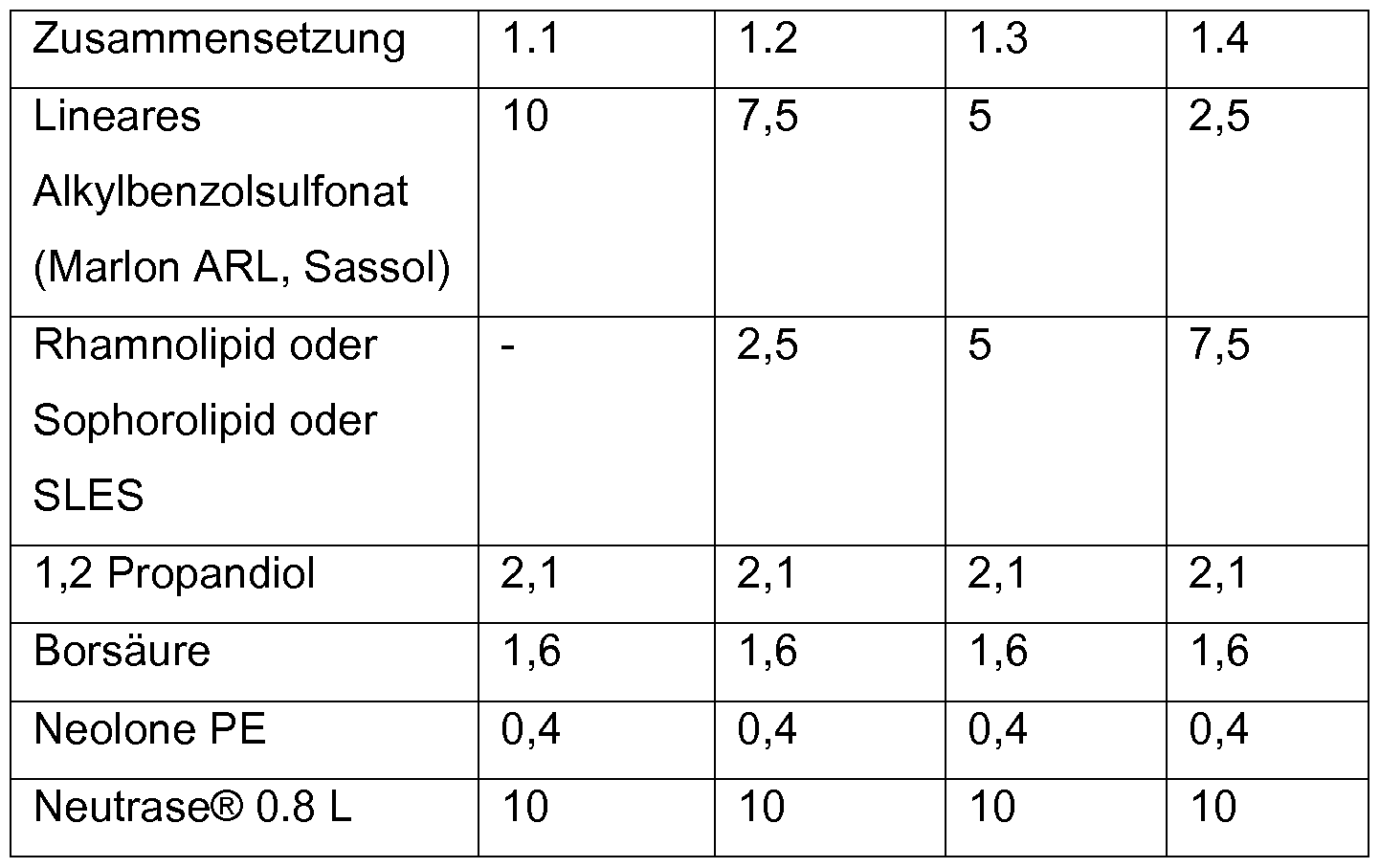
  • Neutrase® 0.8 L in a formulation with LAS see Table 1. Indication of activity in Compared to stored in the refrigerator enzyme. By adding rhamnolipid, the stability of the enzyme can be dramatically increased.
  • Neutrase® 0.8 L in a formulation with LAS see Table 1. Indication of the activity compared to stored in the refrigerator enzyme. By adding sophorolipid, the stability of the enzyme can be drastically increased.
  • Alcalase® 2.4 L FG in a formulation with LAS see Table 2. Indication of the activity compared to stored in the refrigerator enzyme. The stabilization of the enzyme by the rhamnolipid is even more effective than with the addition of SLES (cf.
  • Alcalase® 2.4 L FG in a formulation with LAS see Table 2. Indication of the activity compared to stored in the refrigerator enzyme. The stabilization of the enzyme by the sophorolipid is even more effective than with the addition of SLES (cf.
  • Figure 7 Storage stability of the protease Alcalase® 2.4 L FG in the presence and in the absence of inhibitors in a formulation with LAS and in a formulation with LAS with rhamnolipid (see Table 3). Without inhibitor, in the system with only LAS, a complete self-digestion of the protease occurs. In the presence of the
  • Rhamnolipids is the activity decrease even without inhibitor significantly lower.
  • Figure 8 Storage stability of the protease Alcalase® 2.4 L FG in the presence and in the absence of inhibitors in a formulation with LAS and in a formulation with LAS with sophorolipid (see Table 3). Without inhibitor, in the system with only LAS, a complete self-digestion of the protease occurs. In the presence of the
  • Sophorolipids is observed without inhibitor almost no loss of activity.
  • FIG. 9 Example 4. Influence of LAS, RL and mixtures of the two surfactants on the solubilization of zein. Measurements of the optical density at 600 nm over time compared to zein without surfactant. The lower the optical density, the higher the solubilized zein content. The total surfactant concentration was always 0.05% by weight. The weight percentages of LAS and RL were 100: 0, 75:25, 50:50, 25:75 and 0: 100.
  • Figure 10 Example 4. Influence of LAS, SL and mixtures of the two surfactants on the solubilization of zein. Measurements of the optical density at 600 nm over time compared to zein without surfactant. The lower the optical density, the higher the solubilized zein content. The total surfactant concentration was always 0.05% by weight. The weight percentages of LAS and SL were 100: 0, 75:25, 50:50, 25:75 and 0: 100.
  • Figure 1 1 Example 4. Influence of LAS, RL and mixtures of the two surfactants on the solubilization of zein in combination with a protease. Measurements of the optical density at 600 nm over time compared to the enzymatic
  • Solubilization of zein without surfactant The lower the optical density, the higher the solubilized zein content.
  • the total surfactant concentration was always 0.05% by weight.
  • the weight percentages of LAS to RL were 100: 0, 75:25, 50:50, 25:75 and 0: 100.
  • Figure 12 Example 4. Influence of LAS, SL and mixtures of the two surfactants on the solubilization of zein in combination with a protease. Measurements of the optical density at 600 nm over time compared to the enzymatic
  • Solubilization of zein without surfactant The lower the optical density, the higher the solubilized zein content.
  • the total surfactant concentration was always 0.05% by weight.
  • the weight percentages of LAS to SL were 100: 0, 75:25, 50:50, 25:75 and 0: 100.
  • Example 1 Comparison of the storage stability of a protease in linear alkyl benzene sulphonate (LAS), mixtures of LAS with sodium lauryl ether sulphate (SLES), mixtures of LAS with rhamnolipid and mixtures of LAS with sophorolipid
  • HPLC-proven rhamnolipid species were:
  • sophorolipids used in all examples were a soporolipid from E
  • compositions were prepared in which the protease inhibitors 1, 2-propanediol and boric acid were not added.
  • Example 4 Improved protein solubilization by adding anionic surfactant to biosurfactant.
  • Detergent formulations the activity of peptidases or proteases in the application of crucial importance. In interaction with the surfactants, they contribute to the solubilization of non-water-soluble proteins or water-insoluble protein soil.
  • Zein is a mixture of storage proteins from the corn kernel.
  • Weight percentages of linear LAS and biosurfactant were 100: 0, 75:25, 50:50, 25:75 and 0: 100, respectively.
  • Surfactant, enzyme and zein stock solutions were mixed in microtiter plates (220 ⁇ total liquid volume) and turbidity at 600 nm (OD 600) in a microtiter plate reader (Tecan, Infitite® M200 Pro). The following concentrations were set: 0.25% by weight of zein, 0.05% by weight of surfactant (mixture), 0.45% Alcalase® 2.4 L FG. First, surfactant mixture and enzyme were presented, then the reaction started by adding the zeindispersion. All
  • Solubilization compared to the enzyme without surfactant.
  • LAS proportion based on the total amount of surfactant
  • a mixture of LAS and biosurfactant is thus optimal in order to achieve a rapid protein solubilization in combination with a protease and at the same time to obtain the highest possible storage stability of the protease in the surfactant mixture. This relationship is additionally described in Table 4.
  • Table 4 Influence of different LAS: biosurfactant mixture ratios on the storage stability of a protease and the solubilization of protein soil by the surfactant mixture in combination with a protease.
  • Biosurfactant contributes to the storage stability of the solubilization of total surfactant protease in the protein soil

Landscapes

  • Chemical & Material Sciences (AREA)
  • Life Sciences & Earth Sciences (AREA)
  • Engineering & Computer Science (AREA)
  • Wood Science & Technology (AREA)
  • Organic Chemistry (AREA)
  • Chemical Kinetics & Catalysis (AREA)
  • Oil, Petroleum & Natural Gas (AREA)
  • Health & Medical Sciences (AREA)
  • Bioinformatics & Cheminformatics (AREA)
  • Genetics & Genomics (AREA)
  • Zoology (AREA)
  • Biotechnology (AREA)
  • Molecular Biology (AREA)
  • Biomedical Technology (AREA)
  • Microbiology (AREA)
  • Medicinal Chemistry (AREA)
  • Biochemistry (AREA)
  • General Engineering & Computer Science (AREA)
  • General Health & Medical Sciences (AREA)
  • Detergent Compositions (AREA)
  • Cosmetics (AREA)
  • Enzymes And Modification Thereof (AREA)
  • Medicines That Contain Protein Lipid Enzymes And Other Medicines (AREA)

Abstract

Gegenstand der Erfindung sind Zusammensetzungen enthaltend mindestens eine Protease und mindestens ein Biotensid, insbesondere ausgewählt aus Rhamnolipiden und Sophorolipiden.

Description

Zusammensetzung enthaltend Peptidase und Biotensid.
Gebiet der Erfindung
Gegenstand der Erfindung sind Zusammensetzungen enthaltend mindestens eine
Peptidase und mindestens ein Biotensid, insbesondere ausgewählt aus Rhamnolipiden und Sophorolipiden.
Stand der Technik
Proteasen werden in Wasch-, Reinigungs- und Spülmitteln eingesetzt und tragen durch den biokatalytischen Abbau zur Auflösung des Schmutzes und damit zur
Reinigungsleistung bei. Die Stabilität der Proteasen in den zumeist anionischen Tensidsystemen ist nach wie vor eine Herausforderung für den Formulierer, insbesondere wenn flüssige Formulierungen hergestellt werden sollen, die über einen langen Zeitraum lagerstabil sein und ihre enzymatische Aktivität behalten sollen.
Grundsätzlich tragen Tenside zur Denaturierung von Proteinen und somit der
Enzymstruktur bei und bewirken damit eine Inaktivierung der Enzymaktivität.
Enzymhersteller nutzen die Methoden des Protein Engineerings, um Enzyme mit einer erhöhten Stabilität gegen Tenside zu entwickeln. Allerdings ist dies aufwändig, nicht für alle Enzyme erfolgreich und kann aufgrund der veränderten Proteinstruktur zu einer verringerten spezifischen Aktivität führen.
Alternativ können Enzyme durch den Einsatz milder Tenside stabilisiert werden. So wird etwa Natriumlaurylethersulfat und/oder Fettalkoholethoxylaten zu den als
Haupttensid eingesetzten linearen Alkylbenzolsulfonaten zugesetzt, vgl. Kravetz et al. 1985, Lund et al. 2012.
Laut US5156773 können auch Betaine zur Stabilisierung von Proteasen gegenüber anionischen Tensiden eingesetzt werden.
Die DE102007005419 offenbart stickstoffhaltige, aber in einem weiten Bereich nichtionische Aminoxide als enzymstabilisierend.
EP0499434, EP2787065 und EP2410039 offenbaren Rhamnolipide und Sophorolipide, alleine oder in Kombination mit anderen anionischen Tensiden, und deren gute
Reinigungswirkung auf Wäsche. Eine gute Reinigungswirkung von Rhamnolipiden in Kombination mit Lipasen wird in den Beispielen von WO2012010406 beschrieben. Hierbei werden keine
Formulierungen eingesetzt, die zusätzlich ein weiteres anionisches Tensid enthalten. Bei der Formulierung von flüssigen Tensidsystemen mit Enzymen, die auch eine Proteaseaktivität enthalten, muss weiterhin darauf geachtet werden, dass die
Proteaseaktivität in der Formulierung durch geeignete Additive inhibiert wird, da es ansonsten zum Selbstverdau der Proteasen, bzw. auch zum Verdau anderer Enyzme in der Formulierung kommt. Für diesen Zweck kommen Polyole (z.B. 1 ,2 Propandiol), Borate und andere Inhibitoren zum Einsatz. Insbesondere die Borate sind in den letzten Jahren aus toxikologischen Gründen in Verruf geraten, und es besteht nach wie vor der Bedarf an einem kostengünstigen, toxikologisch unbedenklichen Ersatz.
Beschreibung der Erfindung
Überraschenderweise wurde gefunden, dass die Stabilität von Peptidasen
insbesondere in anionischen Tensidsystemen durch den Zusatz von Biotensiden, insbesondere Rhamnolipiden und Sophorolipiden, erhöht werden kann. Weiterhin kann die ansonsten benötigte Menge an Proteaseinhibitor reduziert werden, oder es kann gar vollständig auf Proteaseinhibitor verzichtet werden.
Gegenstand der vorliegenden Erfindung sind daher Zusammensetzungen enthaltend
A) mindestens eine Peptidase,
B) mindestens ein Biotensid, und gegebenenfalls
C) mindestens ein anionisches Tensid.
Ein Vorteil der erfindungsgemäßen Zusammensetzung besteht darin, dass der Anteil an in ihr vorhandenen Tensiden, die auf nachwachsenden Rohstoffen basieren, vorzugsweise mehr als 50 Gew.-% bezogen auf die Gesamtmenge der in der
Zusammensetzung enthaltenen Tenside beträgt.
Ein weiterer Vorteil der erfindungsgemäßen Zusammensetzung besteht darin, dass als Rohstoffe für die Biotenside Zucker oder Zucker und Glyceride und/oder Fettsäuren verwendet werden können.
Ein weiterer Vorteil der erfindungsgemäßen Zusammensetzung ist, dass diese sehr mild ist. Noch ein Vorteil der vorliegenden Erfindung ist es, dass in den erfindungsgemäßen Zusammensetzungen die benötigte Menge an Proteaseinhibitor reduziert werden oder gar vollständig auf Proteaseinhibitor verzichtet werden kann.
Ein weiterer Vorteil gegenüber dem Stand der Technik ist die erhöhte Stabilität der Enzyme während des Waschvorgangs, und die damit verbundene verbesserte
Reinigungsleistung, zum Beispiel auf Wäsche.
Noch ein Vorteil der vorliegenden Erfindung ist es, dass in den erfindungsgemäßen Zusammensetzungen auch Proteasen eingesetzt werden können, deren Stabilität bisher für den Einsatz in Waschmittelformulierungen nicht ausreichend war.
Noch ein Vorteil der vorliegenden Erfindung ist, dass keine oder weniger
Komplexbildner (Builder) eingesetz werden müssen, um eine ausreichende
Waschleistung in hartem Wasser zu gewährleisten.
Die erfindungsgemäßen Zusammensetzungen sowie deren Verwendungen werden nachfolgend beispielhaft beschrieben, ohne dass die Erfindung auf diese beispielhaften Ausführungsformen beschränkt sein soll. Sind nachfolgend Bereiche, allgemeine Formeln oder Verbindungsklassen angegeben, so sollen diese nicht nur die
entsprechenden Bereiche oder Gruppen von Verbindungen umfassen, die explizit erwähnt sind, sondern auch alle Teilbereiche und Teilgruppen von Verbindungen, die durch Herausnahme von einzelnen Werten (Bereichen) oder Verbindungen erhalten werden können. Werden im Rahmen der vorliegenden Beschreibung Dokumente zitiert, so soll deren Inhalt, insbesondere bezüglich der in Bezug genommenen
Sachverhalte vollständig zum Offenbarungsgehalt der vorliegenden Erfindung gehören. Wenn im nachfolgenden Mittelwerte angegeben sind, so handelt es sich, wenn nicht anders angegeben, um zahlengemittelte Mittelwerte. Bei Prozentangaben handelt es sich, wenn nicht anders angegeben um Angaben in Gewichtsprozent. Werden nachfolgend Messwerte angegeben so wurden diese, wenn nicht anders angegeben, bei einer Temperatur von 25 °C und einem Druck von 1013 mbar bestimmt.
Unter dem Begriff„anionisches Tensid" wird im Zusammenhang mit der vorliegenden Erfindung ein Tensid verstanden, bei welchem bei einem pH-Wert von 7 und 20 °C mindestens 90 mol-% der Moleküle mindestens eine negativ geladene Gruppe aufweisen. Bevorzugt weisen sie keinen isolelektrischen Punkt von PHEP=2-12 bei 25°C auf, wobei in einer wässrigen 10 millimolaren Kaliumchloridlösung als
Hintergrundelektrolyt gemessen wird.
Unter dem Begriff„Stabilisierung einer enzymatischen Aktivität" wird im
Zusammenhang mit der vorliegenden Erfindung insbesondere verstanden, dass das betrachtete Enzyme, wenn so lange über einen Zeitraum bei 30 °C gelagert, dass ein Aktivitätsverlust eintritt, weniger Aktivität in Anwesenheit des Stabilisators, vorliegend das Biotensid, verliert, verglichen zu der verlorenen Aktivität unter sonst gleichen Bedingungen unter der Abwesenheit des Stabilisators.
Die erfindungsgemäße Zusammensetzung enthält als Komponente A) mindestens eine Peptidase. Peptidasen sind Enzyme der Enzymklasse („EC") 3.4.
Bevorzugt sind die enthaltenen Peptidasen ausgewählt aus der Gruppe der Proteasen. Als Proteasen sind alle bekannten Proteasen des Standes der Technik, inklusive der chemisch oder genetisch veränderten Proteasen, geeignet. Hierzu gehören
insbesondere Serinproteasen der EC 3.4.21 und Metalloproteasen der EC 3.4.24. Bevorzugte enthaltene Peptidasen sind die Trypsine und die Chymotrypsin ähnlichen Proteasen der EC 3.4.21.1 , EC 3.4.21.2 und EC 3.4.21.4 und ganz besonders bevorzugt die Subtilisine der EC 3.4.21 .62. Besonders bevorzugt enthaltene
Metalloproteasen sind ausgewählt aus der Gruppe der Thermolysine der EC 3.4.24.27 und der Bacillolysine der EC 3.4.24.28 .
Beispiele kommerziell verfügbarer Proteasen umfassen Kannase™, Everlase™, Esperase™, Alcalase™, Neutrase™, Durazym™, Savinase™, Ovozyme™,
Liquanase™, Co- ronase™, Polarzyme™, Pyrase™, Pancreatic Trypsin NOVO (PTN), Bio-Feed™ Pro and Clear- Lens™ Pro (alle von Novozymes A S, Bagsvaerd,
Denmark). Weitere kommerziell verfügbare Proteasen umfassen Ronozyme™ Pro, Maxatase™, Maxacal™, Maxapem™, Optic- lean™, Properase™, Purafect™, Purafect Ox™, Purafact Prime™, Excellase™, FN2™, FN 3™ und FN4™ (Genencor International Inc., Gist-Brocades, BASF, DSM). Auch Henkel/ Kemira Proteasen sind geeignet, wie z.B. BLAP (Sequenz in Abbildung 29 von US 5,352,604 mit folgenden Punktmutationen: S99D + S101 R + S103A + V104I + G159S, im Folgenden BLAP genannt), BLAP R (BLAP S3T + V4I + V199M + V205I + L217D), BLAP X (BLAP mit folgenden Punktmutationen: S3T + V4I + V205I) und BLAP F49 (BLAP mit folgenden Punktmutationen: S3T + V4I + A194P + V199M + V205I + L217D) und KAP {Bacillus alkalophilus Subtilisin mit folgenden Punktmutationen: A230V + S256G + S259N von Kao.
Im Rahmen der vorliegenden Erfindung werden unter Biotensiden alle durch
Fermentation hergestellten Glycolipide verstanden. Als Rohstoffe für die Herstellung der Biotenside können Kohlenhydrate, insbesondere Zucker wie z.B. Glucose und/oder lipophile Kohlenstoff-Quellen wie Fette, Öle, Partialglyceride, Fettsäuren, Fettalkohole, langkettige gesättigte oder ungesättigte Kohlenwasserstoffe eingesetzt werden. Vorzugsweise sind in den erfindungsgemäßen Zusammensetzungen keine Biotenside vorhanden, die nicht durch Fermentation von Glycolipiden hergestellt werden, wie z. B. Lipoproteine.
Bevorzugt enthält die erfindungsgemäße Zusammensetzung als Komponente B) mindestens ein Biotensid Rhamnolipide, Sophorolipide, Glucoselipide, Celluloselipide, Mannosylerythritollipide und/oder Trehaloselipide, bevorzugt Rhamnolipide und/oder Sophorolipide. Die Biotenside, insbesondere Glykolipidtenside können z. B. wie in EP 0 499 434, US 7,985 722, WO 03/006146, JP 60-183032, DE 19648439, DE 19600743, JP 01 -304034, CN 1337439, JP 2006-274233, KR 2004033376, JP 2006-083238, JP 2006-070231 , WO 03/002700, FR 2740779, DE 2939519, US 7,556,654, FR 2855752, EP 1445302, JP 2008-062179 und JP 2007-181789 oder den dort zitierten Schriften hergestellt werden. Geeignete Biotenside können z. B. von der Firma Soliance, France bezogen werden.
Bevorzugt weist die erfindungsgemäße Zusammensetzung als Biotenside
Rhamnolipide, insbesondere Mono-, Di- oder Polyrhamnolipide und/oder Sophorolipide auf. Besonders bevorzugt weist die erfindungsgemäße Zusammensetzung eines oder mehrere der in EP 1 445 302 A mit den Formeln (I), (II) bzw. (III) beschriebenen Rhamnolipide bzw. Sophorolipide auf. Unter dem Begriff„Rhamnolipid" im Zusammenhang mit der vorliegenden Erfindung werden insbesondere Verbindungen der allgemeinen Formel (I) oder deren Salze verstanden,
Figure imgf000007_0001
Formel (I)
wobei
m = 2, 1 oder 0,
n = 1 oder 0,
R1 und R2 = unabhängig voneinander gleicher oder verschiedener organischer Rest mit 2 bis 24, bevorzugt 5 bis 13 Kohlenstoffatomen, insbesondere gegebenenfalls verzweigter, gegebenenfalls substituierter, insbesondere hydroxy-substituierter, gegebenenfalls ungesättigter, insbesondere gegebenenfalls einfach, zweifach oder dreifach ungesättigter, Alkylrest, bevorzugt solcher ausgewählt aus der Gruppe bestehend aus Pentenyl, Heptenyl, Nonenyl, Undecenyl und Tridecenyl und (CH2)0- CH3 mit o = 1 bis 23, bevorzugt 4 bis 12.
Unter dem Begriff„di-Rhamnolipid" im Zusammenhang mit der vorliegenden Erfindung werden Verbindungen der allgemeinen Formel (I) oder deren Salze verstanden, bei denen n =1 .
Unter dem Begriff„mono-Rhamnolipid" im Zusammenhang mit der vorliegenden Erfindung werden Verbindungen der allgemeinen Formel (I) oder deren Salze verstanden, bei denen n =0.
Distinkte Rhamnolipide werden gemäß folgender Nomenklatur abgekürzt:
Unter„diRL-CXCY" werden di-Rhamnolipide der allgemeinen Formel (I) verstanden, bei denen einer der Reste R1 und R2 = (CH2)0-CH3 mit o = X-4 und der verbleibende Rest R1 oder R2 = (CH2)0-CH3 mit o = Y-4.
Unter„monoRL-CXCY" werden mono-Rhamnolipide der allgemeinen Formel (I) verstanden, bei denen einer der Reste R1 und R2 = (CH2)0-CH3 mit o = X-4 und der verbleibende Rest R1 oder R2 = (CH2)o-CH3 mit o = Y-4. Die verwendete Nomenklatur unterscheidet somit nicht zwischen„CXCY" und„CYCX". Für Rhamnolipide mit m=0 wird entsprechend monoRL-CX bzw. diRL-CX verwendet. Ist einer der oben genannten Indices X und/oder Y mit„:Z" versehen, so bedeutet dies, dass der jeweilige Rest R1 und/oder R2 = ein unverzweigter, unsubstituierter
Kohlenwasserstoffrest mit X-3 bzw. Y-3 Kohlenstoffatomen aufweisend Z
Doppelbindungen darstellt.
Zur Bestimmung des Gehaltes an Rhamnolipiden im Zusammenhang mit der vorliegenden Erfindung wird lediglich die Masse des Rhamnolipid-Anions, somit „allgemeinen Formel (I) abzüglich ein Wasserstoff" berücksichtigt.
Zur Bestimmung des Gehaltes an Rhamnolipiden im Zusammenhang mit der vorliegenden Erfindung werden alle Rhamnolipide durch Ansäuern in die protonierte Form (vgl. allgemeine Formel (I)) überführt und mittels HPLC quantifiziert.
Die in den erfindungsgemäßen Zusammensetzungen enthaltenen Rhamnolipide liegen aufgrund des gegebenen pH-Wertes mindestens teilweise als Salz vor.
In erfindungsgemäß bevorzugten Zusammensetzungen sind die Kationen der enthaltenen Rhamnolipid-Salze, ausgewählt aus der Gruppe umfassend, bevorzugt bestehend aus, Li+, Na+, K+, Mg2+, Ca2+, Al3+, Nh , primäre Ammoniumionen, sekundäre Ammoniumionen, tertiäre Ammoniumionen und quaternäre
Ammoniumionen.
Beispielhafte Vertreter von geeigneten Ammoniumionen sind Tetramethylammonium, Tetraethylammonium , Tetrapropylammonium, Tetrabutylammonium und [(2- Hydroxyethyl)trimethylammonium] (Cholin) sowie die Kationen von 2-Aminoethanol (Ethanolamin, MEA), Diethanolamin (DEA), 2,2',2"-Nitrilotriethanol (Triethanolamin, TEA), 1 -Aminopropan-2-ol (Monoisopropanolamin), Ethylendiamin, Diethylentriamin, Triethylentetramin, Tetraethylenepentamine, 1 ,4-Diethylendiamin (Piperazin),
Aminoethylpiperazin und Aminoethylethanolamin.
Es können auch Mischungen der vorgenannten Kationen als Kationen der enthaltenen Rhamnolipid-Salze erfindungsgemäß vorliegen.
Besonders bevorzugte Kationen, sind ausgewählt aus der Gruppe umfassend, bevorzugt bestehend aus Na+, K+, Nh und das Triethanolammonium-Kation.
Eine erfindungsgemäß bevorzugte Zusammensetzung ist dadurch gekennzeichnet, dass sie eine Mischung von Rhamnolipiden enthält, wobei in der Mischung das Gewichtsverhältnis von di-Rhamnolipiden zu mono-Rhamnolipiden größer als 51 :49, bevorzugt größer 75:25, besonders bevorzugt 97:3, insbesondere größer 98:2 ist. Erfindungsgemäß bevorzugte Zusammensetzung ist dadurch gekennzeichnet, dass die Rhamnolipid-Mischung
51 Gew.-% bis 95 Gew.-%, bevorzugt 70 Gew.-% bis 90 Gew.-%, besonders bevorzugt 75 Gew.-% bis 85 Gew.-%, diRL-C10C10 und
0,5 Gew.-% bis 9 Gew.-%, bevorzugt 0,5 Gew.-% bis 3 Gew.-%, besonders bevorzugt 0,5 Gew.-% bis 2 Gew.-%, monoRL-C10C10
enthält,
wobei sich die Gewichtsprozente auf die Summe aller enthaltenen Rhamnolipide beziehen,
Erfindungsgemäß bevorzugte Zusammensetzung ist dadurch gekennzeichnet, dass die Rhamnolipid-Mischung neben den oben genannten diRL-C10C10- und monoRL- C10C10 Gehalten
0,5 Gew.-% bis 15 Gew.-%, bevorzugt 3 Gew.-% bis 12 Gew.-%, besonders bevorzugt 5 Gew.-% bis 10 Gew.-%, diRL-C10C12:1
enthält,
wobei sich die Gewichtsprozente auf die Summe aller enthaltenen Rhamnolipide beziehen. Erfindungsgemäß bevorzugte Zusammensetzung ist dadurch gekennzeichnet, dass die Rhamnolipid-Mischung neben den oben genannten diRL-C10C10- und monoRL- C10C10 Gehalten
0,1 Gew.-% bis 5 Gew.-%, bevorzugt 0,5 Gew.-% bis 3 Gew.-%, besonders bevorzugt 0,5 Gew.-% bis 2 Gew.-%, monoRL-C10C12 und/oder, bevorzugt und
0,1 Gew.-% bis 5 Gew.-%, bevorzugt 0,5 Gew.-% bis 3 Gew.-%, besonders bevorzugt 0,5 Gew.-% bis 2 Gew.-%, monoRL-C10C12:1 ,
enthält,
wobei sich die Gewichtsprozente auf die Summe aller enthaltenen Rhamnolipide beziehen.
Es kann vorteilhaft sein und ist daher bevorzugt, wenn die in der erfindungsgemäßen Zusammensetzung enthaltene Rhamnolipid-Mischung neben den oben genannten diRL-C10C10- und monoRL-C10C10 Gehalten
0,1 Gew.-% bis 25 Gew.-%, bevorzugt 2 Gew.-% bis 10 Gew.-%, besonders bevorzugt 4 Gew.-% bis 8 Gew.-%, diRL-C8C10,
enthält, wobei sich die Gewichtsprozente auf die Summe aller enthaltenen Rhamnolipide beziehen.
Erfindungsgemäß besonders bevorzugte Zusammensetzung ist dadurch
gekennzeichnet, dass die Rhamnolipid-Mischung neben den oben genannten diRL- C10C10- und monoRL-C10C10 Gehalten
0,5 Gew.-% bis 15 Gew.-%, bevorzugt 3 Gew.-% bis 12 Gew.-%, besonders bevorzugt 5 Gew.-% bis 10 Gew.-%, diRL-C10C12:1 ,
0,5 bis 25 Gew.-%, bevorzugt 5 Gew.-% bis 15 Gew.-%, besonders bevorzugt 7 Gew.- % bis 12 Gew.-%, diRL-C10C12,
0,1 Gew.-% bis 5 Gew.-%, bevorzugt 0,5 Gew.-% bis 3 Gew.-%, besonders bevorzugt 0,5 Gew.-% bis 2 Gew.-%, monoRL-C10C12 und
0,1 Gew.-% bis 5 Gew.-%, bevorzugt 0,5 Gew.-% bis 3 Gew.-%, besonders bevorzugt 0,5 Gew.-% bis 2 Gew.-%, monoRL-C10C12:1 ,
enthält,
wobei sich die Gewichtsprozente auf die Summe aller enthaltenen Rhamnolipide beziehen.
Es ist überdies hinaus bevorzugt, wenn die in der erfindungsgemäßen
Zusammensetzung enthaltene Rhamnolipid-Mischung Rhamnolipide der Formel monoRL-CX bzw. diRL-CX in nur kleinen Mengen enthält. Insbesondere enthält die erfindungsgemäße Mischungszusammensetzung bevorzugt
0 Gew.-% bis 5 Gew.-%, bevorzugt 0,001 Gew.-% bis 3 Gew.-%, besonders bevorzugt 0,01 Gew.-% bis 1 Gew.-%, diRLCI O, wobei sich die Gewichtsprozente auf die Summe aller enthaltenen Rhamnolipide beziehen, und unter dem Begriff„0 Gew.-%" keine nachweisbare Menge zu verstehen ist.
Verfahren zur Herstellung der entsprechenden Rhamnolipid-Mischungen werden zum Beispiel in der EP2786743 und EP2787065 offenbart.
Sophorolipide können erfindungsgemäß in ihrer Säureform oder ihrer Lactonform eingesetzt werden. Zum Begriff„Säureform" von Sophorolipiden wird auf die allgemeine Formel (la) der EP2501813 verwiesen, zum Begriff„Lactonform" von Sophorolipiden wird auf die allgemeine Formel (Ib) der EP2501813 verwiesen. Zu Bestimmung des Gehaltes an Sophorolipiden in der Säure- bzw. Lactonform in einer Formulierung sei auf die EP 1 41 1 1 1 1 B1 , Seite 8, Absatz [0053] verwiesen.
Bevorzugte erfindungsgemäße Formulierungen enthalten als Komponente B) ein Sophorolipid, bei dem das Gewichtsverhältnis von Lactonform zur Säureform in dem Bereich von 20 zu 80 bis 80 zu 20, ganz besonders bevorzugt in den Bereichen von 30 zu 70 bis 40 zu 60, liegt.
Bevorzugt enthält die erfindungsgemäße Zusammensetzung die Komponente C) mindestens ein anionisches Tensid.
Bevorzugt in der erfindungsgemäßen Zusammensetzung enthaltene anionische Tenside sind ausgewählt aus der Gruppe umfassend, bevorzugt bestehend aus, Alkylsulfaten, Alkylethersulfaten, gegebenenfalls alkoxylierte Sulfosuccinaten, gegebenenfalls alkoxylierte Methylsulfosuccinaten, gegebenenfalls alkoxylierte Sulfonaten, gegebenenfalls alkoxylierte Glycinaten, gegebenenfalls alkoxylierte Glutamaten, gegebenenfalls alkoxylierte Isethionaten, gegebenenfalls alkoxylierte Carboxylaten, gegebenenfalls alkoxylierte Anisate, gegebenenfalls alkoxylierte Levulinate, gegebenenfalls alkoxylierte Tartrate, gegebenenfalls alkoxylierte Lactylate, gegebenenfalls alkoxylierte Taurate, gegebenenfalls alkoxylierte Alaninate, gegebenenfalls alkoxylierte Phosphate, gegebenenfalls alkoxylierte Sulfoacetate, gegebenenfalls alkoxylierte Sulfosuccinamate, gegebenenfalls alkoxylierte
Sarcosinaten und gegebenenfalls alkoxylierte Phosphonaten.
Bevorzugt in der erfindungsgemäßen Zusammensetzung als anionisches Tensid enthaltene Alkylsulfate oder Alkylethersulfate sind ausgewählt aus der Gruppe bestehend aus C4- bis C24-, bevorzugt C6- bis C18-, besonders bevorzugt C8- bis C14-, Alkylsulfaten und Alkylethersulfaten. Die Alkylreste können linear oder verzweigt sein, wobei lineare bevorzugt sind. Geeignete verzweigte Alkylreste umfassen
Methyldecyl Gruppen, Methylundecyl-Gruppen, Methyldodecyl-Gruppen Ethyldecyl- Gruppen, Ethylundecyl-Gruppen und Ethyldodecyl-Gruppen, wie beispielsweise 1 - Methyldecyl-, 1 -Methylundecyl, 1 -Methyldodecyl-, 1 -Ethyldecyl, 1 -Ethylundecyl und 1 - Ethyldodecyl. Der Zusatz einer Alkyl-oder Alkenylgruppe mit dem Suffix "eth" beschreibt allgemein die Zugabe von einem oder mehreren Ethylenoxid-Einheiten, beispielsweise bezieht sich Trideceth auf eine ethoxylierte Tridecylgruppe, und das Suffix "-n", wobei n eine ganze Zahl ist, die Anzahl von solchen Ethylenoxideinheiten pro Gruppe,
beispielsweise "Trideceth-3" bezeichnet eine Gruppe ethoxylierter Tridecylalkohol mit 3 Ethylenoxid-Einheiten pro Tridecylgruppe.
In einer bevorzugten Ausführungsform ist das Alkylsulfat oder Alkylethersulfat ausgewählt aus,
Ammonium C12-15 Alkyl Sulfate, Ammonium C12-16 Alkyl Sulfate, Ammonium
Capryleth Sulfate, Ammonium Cocomonoglyceride Sulfate, Ammonium Coco-Sulfate, Ammonium C12-15 Pareth Sulfate, Ammonium Laureth Sulfate, Ammonium Laureth-5 Sulfate, Ammonium Laureth-7 Sulfate, Ammonium Laureth-9 Sulfate, Ammonium Laureth-12 Sulfate, Ammonium Lauryl Sulfate, Ammonium Myreth Sulfate, Ammonium Myristyl Sulfate, Ammonium Nonoxynol-4 Sulfate, Ammonium Nonoxynol-30 Sulfate, Ammonium Palm Kernel Sulfate, Ammonium Trideceth Sulfate, DEA-C12-13 Alkyl Sulfate, DEA-C12-15 Alkyl Sulfate, DEA-Cetyl Sulfate, DEA-C12-13 Pareth-3 Sulfate, DEA-Laureth Sulfate, DEA-Lauryl Sulfate, DEA-Myreth Sulfate, DEA-Myristyl Sulfate, DEA-Trideceth Sulfate, Diethylamine Laureth Sulfate, Magnesium Coceth Sulfate, Magnesium Coco-Sulfate, Magnesium Laureth Sulfate, Magnesium Laureth-5 Sulfate, Magnesium Laureth-8 Sulfate, Magnesium Laureth-16 Sulfate, Magnesium Lauryl Sulfate, Magnesium Myreth Sulfate, Magnesium Oleth Sulfate, Magnesium PEG-3 Cocamide Sulfate, Magnesium/TEA-Coco-Sulfate, MEA-Laureth Sulfate, MEA-Lauryl Sulfate, MEA-Trideceth Sulfate, MIPA C12-15 Pareth Sulfate, MIPA-Laureth Sulfate, MIPA-Lauryl Sulfate, MIPA-Trideceth Sulfate, Mixed Isopropanolamines Lauryl Sulfate, Potassium Laureth Sulfate, Potassium Lauryl Sulfate, Sodium C8-10 Alkyl Sulfate, Sodium C10-16 Alkyl Sulfate, Sodium C1 1 -15 Alkyl Sulfate, Sodium C12-13 Alkyl Sulfate, Sodium C12-15 Alkyl Sulfate, Sodium C12-18 Alkyl Sulfate, Sodium C16-20 Alkyl Sulfate, Sodium Caprylyl Sulfate, Sodium Cetearyl Sulfate, Sodium Cetyl Sulfate, Sodium Cholesteryl Sulfate, Sodium Coceth Sulfate, Sodium Coceth-30 Sulfate, Sodium Coco/Hydrogenated Tallow Sulfate, Sodium Cocomonoglyceride Sulfate,
Sodium Coco-Sulfate, Sodium C9-15 Pareth-3 Sulfate, Sodium C10-15 Pareth Sulfate, Sodium C10-16 Pareth-2 Sulfate, Sodium C12-13 Pareth Sulfate, Sodium C12-14 Pareth-3 Sulfate, Sodium C12-15 Pareth Sulfate, Sodium C12-15 Pareth-3 Sulfate, Sodium C13-15 Pareth-3 Sulfate, Sodium C12-14 Sec-Pareth-3 Sulfate, Sodium Deceth Sulfate, Sodium Decyl Sulfate, Sodium Ethylhexyl Sulfate, Sodium Laneth
Sulfate, Sodium Laureth Sulfate, Sodium Laureth-5 Sulfate, Sodium Laureth-7 Sulfate, Sodium Laureth-8 Sulfate, Sodium Laureth-12 Sulfate, Sodium Laureth-40 Sulfate, Sodium Lauryl Sulfate, Sodium/MEA-PEG-3 Cocamide Sulfate, Sodium Myreth Sulfate, Sodium Myristyl Sulfate, Sodium Nonoxynol-1 Sulfate, Sodium Nonoxynol-3 Sulfate, Sodium Nonoxynol-4 Sulfate, Sodium Nonoxynol-6 Sulfate, Sodium Nonoxynol-8 Sulfate, Sodium Nonoxynol-10 Sulfate, Sodium Nonoxynol-25 Sulfate, Sodium
Octoxynol-2 Sulfate, Sodium Octoxynol-6 Sulfate, Sodium Octoxynol-9 Sulfate, Sodium Oleth Sulfate, Sodium Oleyl Sulfate, Sodium PEG-4 Cocamide Sulfate, Sodium PEG-4 Lauramide Sulfate, Sodium Stearyl Sulfate, Sodium Tallow Sulfate, Sodium/TEA C12- 13 Pareth-3 Sulfate, Sodium Trideceth Sulfate, Sodium Tridecyl Sulfate, Sulfated Castor Oil, Sulfated Coconut Oil, Sulfated Glyceryl Oleate, Sulfated Olive Oil, Sulfated Peanut Oil, TEA-C10-15 Alkyl Sulfate, TEA-C1 1 -15 Alkyl Sulfate, TEA-C12-13 Alkyl Sulfate, TEA-C12-14 Alkyl Sulfate, TEA-C12-15 Alkyl Sulfate, TEA-Coco-Sulfate, TEA- C1 1 -15 Pareth Sulfate, TEA-C12-13 Pareth-3 Sulfate, TEA-Laneth-5 Sulfate, TEA- Laureth Sulfate, TEA-Lauryl Sulfate, TEA-Oleyl Sulfate, TEA-PEG-3 Cocamide Sulfate, TEA-Trideceth Sulfate, TIPA-Laureth Sulfate, TIPA-Lauryl Sulfate, wobei Sodium Laureth Sulfate ganz besonders bevorzugt ist.
Bevorzugt in der erfindungsgemäßen Zusammensetzung als anionisches Tensid enthaltene gegebenenfalls alkoxylierte Sulfosuccinate und/oder Methylsulfosuccinate sind ausgewählt aus der Gruppe bestehend aus gegebenenfalls alkoxylierten C4- bis C24-, bevorzugt C6- bis C18-, besonders bevorzugt C8- bis C14-, Sulfosuccinaten und/oder Methylsulfosuccinaten. Die Sulfosuccinate und/oder Methylsulfosuccinate können eine oder zwei Alkylreste enthalten, Monoalkylsulfosuccinate und
Monomethylsulfosuccinate sind bevorzugt.Die Alkylreste können linear oder verzweigt sein, wobei lineare bevorzugt sind. Alkoxylierte Sulfosuccinate und/oder
Methylsulfosuccinate können insbesondere einen Alkoxylierungsgrad zwischen 1 und 10, besonders bevorzugt zwischen 2 und 5 aufweisen.
Die Alkoxygruppe ist bevorzugt ausgewählt aus ethoxy.
Besonders bevorzugt enthaltene gegebenenfalls alkoxylierte Sulfosuccinate sind ausgewählt aus der Gruppe bestehend aus Disodium Laureth Sulfosuccinate,
Disodium C12-14 Pareth-1 Sulfosuccinate, Disodium C12-14 Pareth-2 Sulfosuccinate, Disodium C12-14 Sec-pareth-12 Sulfosuccinate, Disodium C12-14 Sec-pareth-3 Sulfosuccinate, Disodium C12-14 Sec-pareth-5 Sulfosuccinate, Disodium C12-14 Sec- pareth-7 Sulfosuccinate, Disodium C12-14 Sec-pareth-9 Sulfosuccinate, Disodium C12-14 Pareth Sulfosuccinate, Di-Triethanolamine Oleamido PEG-2 Sulfosuccinate, Disodium Oleamido PEG-2 Sulfosuccinate, Disodium Cocamido
Monoisopropanolamine PEG-4 Sulfosuccinate, Disodium Cocamido PEG-4
Sulfosuccinate, Disodium Coceth-3 Sulfosuccinate, Disodium Cocoyl Butyl Gluceth-10 Sulfosuccinate, Disodium Deceth-5 Sulfosuccinate, Disodium Deceth-6 Sulfosuccinate, Disodium Laneth-5 Sulfosuccinate, Disodium Lauramido PEG-2 Sulfosuccinate, Disodium Lauramido PEG-5 Sulfosuccinate, Disodium Laureth Sulfosuccinate, Disodium Laureth-12 Sulfosuccinate, Disodium Laureth-6 Sulfosuccinate, Disodium Laureth-9 Sulfosuccinate, Disodium Oleamido PEG-2 Sulfosuccinate, Disodium Oleth- 3 Sulfosucciante, Disodium Palmitamido PEG-2 Sulfosuccinate, Disodium PEG-5 Laurylcitrate Sulfosuccinate, Disodium PEG-8 Palm Glycerides Sulfosuccinate, Disodium Sitostereth-14 Sulfosuccinate, Disodium Undecylenamide PEG-2
Sulfosuccinate, Magnesium Laureth-3 Sulfosuccinate, Monoethanolamine Laureth-2 sulfosuccinate, Diammonium C12-14 Pareth-1 Sulfosuccinate, Diammonium C12-14 Pareth-2 Sulfosuccinate, Diammonium C12-14 Sec-pareth-12 Sulfosuccinate,
Diammonium C12-14 Sec-pareth-3 Sulfosuccinate, Diammonium C12-14 Sec-pareth-5 Sulfosuccinate, Diammonium C12-14 Sec-pareth-7 Sulfosuccinate, Diammonium C12- 14 Sec-pareth-9 Sulfosuccinate, Diammonium C12-14 Pareth Sulfosuccinate, Di- Triethanolamine Oleamido PEG-2 Sulfosuccinate, Diammonium Oleamido PEG-2 Sulfosuccinate, Diammonium Cocamido Monoisopropanolamine PEG-4
Sulfoscuccinate, Diammonium Cocamido PEG-4 Sulfoscuccinate, Diammonium Coceth-3 Sulfosucciante, Diammonium Cocoyl Butyl Gluceth-10 Sulfosuccinate, Diammonium Deceth-5 Sulfosuccinate, Diammonium Deceth-6 Sulfosuccinate, Diammonium Laneth-5 Sulfosuccinate, Diammonium Lauramido PEG-2
Sulfosuccinate, Diammonium Lauramido PEG-5 Sulfosuccinate, Diammonium Laureth Sulfosuccinate, Diammonium Laureth-12 Sulfosuccinate, Diammonium Laureth-6 Sulfosuccinate, Diammonium Laureth-9 Sulfosuccinate, Diammonium Oleamido PEG-2 Sulfosuccinate, Diammonium Oleth-3 Sulfosucciante, Diammonium Palmitamido PEG- 2 Sulfosuccinate, Diammonium PEG-5 Laurylcitrate Sulfosuccinate, Disodium PEG-8 Palm Glycerides Sulfosuccinate, Diammonium Sitostereth-14 Sulfosuccinate,
Diammonium Undecylenamide PEG-2 Sulfosuccinate, Ammonium Lauryl
Sulfosuccinate, Diammonium Lauramido-MEA Sulfosuccinate, Diammonium Lauryl Sulfosuccinate, Dipotassium Lauryl Sulfosuccinate, Disodium Babassuamido MEA- Sulfosuccinate, Disodium Cetearyl Sulfosuccinate, Disodium Cetyl Sulfosuccinate, Disodium Cocamido MEA-Sulfosuccinate, Disodium Cocamido MIPA-Sulfosuccinate, Disodium Coco-Glucoside Sulfosuccinate, Disodium Coco-Sulfosuccinate, Disodium Hydrogenated Cottonseed Glyceride Sulfosuccinate, Disodium Isodecyl
Sulfosuccinate, Disodium Isostearamido MEA-Sulfosuccinate, Disodium Isostearamido MIPA-Sulfosuccinate, Disodium Isostearyl Sulfosuccinate, Disodium Lauramido MEA- Sulfosuccinate, Disodium Lauramido MIPA Glycol Sulfosuccinate, Disodium Lauryl Sulfosuccinate, Disodium Myristamido MEA-Sulfosuccinate, Disodium Oleamido MEA- Sulfosuccinate, Disodium Oleamido MIPA-Sulfosuccinate, Disodium Oleyl
Sulfosuccinate, Disodium Polyglyceryl-3 Caprate/Caprylate Sulfosuccinate, Disodium Ricinoleamido MEA-Sulfosuccinate,
Disodium Stearamido MEA-Sulfosuccinate, Disodium Stearyl Sulfosuccinate, Disodium Tallamido MEA-Sulfosuccinate, Disodium Tallowamido MEA-Sulfosuccinate, Disodium Tridecylsulfosuccinate, Disodium Undecylenamido MEA-Sulfosuccinate, Diethylhexyl Sodium Sulfosuccinate, Dinonyl Sodium Sulfosuccinate, Diisononyl Sodium
Sulfosuccinate, Dioctyl Sodium Sulfosuccinate, Diheptyl Sodium Sulfosuccinate, Dihexyl Sodium Sulfosuccinate, Dineopentyl Sodium Sulfosuccinate, Diisoamyl Sodium Sulfosuccinate, Dipentyl Sodium Sulfosuccinate, Diamyl Sodium Sulfosuccinate, Dibutyl Sodium Sulfosuccinate, Diisobutyl Sodium Sulfosuccinate, Dicapryl Sodium Sulfosuccinate, Didecyl Sodium Sulfosuccinate, Diundecyl Sodium Sulfosuccinate, Dilauryl Sodium Sulfosuccinate, Dicocoyl Sodium Sulfosuccinate, Ditridecyl Sodium Sulfosuccinate, Dipropylheptyl Sodium Sulfosuccinate, Dicyclohexyl Sodium
Sulfosuccinate, Ammonium Diethylhexyl Sulfosuccinate, Ammonium Dinonyl
Sulfosuccinate, Ammonium Diisononyl Sulfosuccinate, Ammonium Dioctyl Sodium Sulfosuccinate, Ammonium Diheptyl Sulfosuccinate, Ammonium Dihexyl
Sulfosuccinate, Ammonium Dineopentyl Sulfosuccinate, Ammonium Diisoamyl Sulfosuccinate, Ammonium Dipentyl Sulfosuccinate, Ammonium Diamyl
Sulfosuccinate, Ammonium Dibutyl Sulfosuccinate, Ammonium Diisobutyl
Sulfosuccinate, Ammonium Dicapryl Sulfosuccinate, Ammonium Didecyl
Sulfosuccinate, Ammonium Diundecyl Sulfosuccinate, Ammonium Dilauryl
Sulfosuccinate, Ammonium Dicocoyl Sulfosuccinate, Ammonium Ditridecyl
Sulfosuccinate, Ammonium Dipropylheptyl Sulfosuccinate, Ammonium Dicyclohexyl Sulfosuccinate, Diethylhexyl Potassium Sulfosuccinate, Dinonyl Potassium
Sulfosuccinate, Diisononyl Potassium Sulfosuccinate, Dioctyl Potassium
Sulfosuccinate, Diheptyl Potassium Sulfosuccinate, Dihexyl Potassium Sulfosuccinate, Dineopentyl Potassium Sulfosuccinate, Diisoamyl Potassium Sulfosuccinate, Dipentyl Potassium Sulfosuccinate, Diamyl Potassium Sulfosuccinate, Dibutyl Potassium Sulfosuccinate, Diisobutyl Potassium Sulfosuccinate, Dicapryl Potassium
Sulfosuccinate, Didecyl Potassium Sulfosuccinate, Diundecyl Potassium Sulfosuccinate, Dilauryl Potassium Sulfosuccinate, Dicocoyl Potassium Sulfosuccinate, Ditridecyl Potassium Sulfosuccinate, Dipropylheptyl Potassium Sulfosuccinate, Dicyclohexyl Potassium Sulfosuccinate, Diethylhexyl Sodium Methylsulfosuccinate, Dinonyl Sodium Methylsulfosuccinate, Diisononyl Sodium Methylsulfosuccinate, Dioctyl Sodium Methylsulfosuccinate, Diheptyl Sodium Methylsulfosuccinate, Dihexyl Sodium Methylsulfosuccinate, Dineopentyl Sodium Methylsulfosuccinate, Diisoamyl Sodium Methylsulfosuccinate, Dipentyl Sodium Methylsulfosuccinate, Diamyl Sodium
Methylsulfosuccinate, Dibutyl Sodium Methylsulfosuccinate, Diisobutyl Sodium
Methylsulfosuccinate, Dicapryl Sodium Methylsulfosuccinate, Didecyl Sodium
Methylsulfosuccinate, Diundecyl Sodium Methylsulfosuccinate, Dilauryl Sodium
Methylsulfosuccinate, Dicocoyl Sodium Methylsulfosuccinate, Ditridecyl Sodium
Methylsulfosuccinate, Dipropylheptyl Sodium Methylsulfosuccinate, Dicyclohexyl Sodium Methylsulfosuccinate wobei Disodium Laureth Sulfosuccinate ganz besonders bevorzugt ist.
Bevorzugt in der erfindungsgemäßen Zusammensetzung als anionisches Tensid enthaltene gegebenenfalls alkoxylierte Sulfonate sind ausgewählt aus der Gruppe bestehend aus
Sodium C14-16 Olefin Sulfonate, Sodium C12-15 Pareth-15 Sulfonate, Sodium C14 - 17 Alkyl sec. Sulfonate, Sodium C14 Olefin Sulfonate, Ammonium Cumenesulfonate, Ammonium Dodecylbenzenesulfonate, Calcium Dodecylbenzenesulfonate, DEA- Dodecylbenzenesulfonate, DEA-Methyl Myristate Sulfonate, Disodium Decyl Phenyl Ether Disulfonate, Disodium Lauriminobishydroxypropylsulfonate, Disodium Lauryl Phenyl Ether Disulfonate, Isopropylamine Dodecylbenzenesulfonate, Magnesium Isododecylbenzenesulfonate, Magnesium Lauryl Hydroxypropyl Sulfonate, MEA-C10- 13 Alkyl Benzenesulfonate, MIPA-Dodecylbenzenesulfonate, Potassium
Dodecylbenzenesulfonate, Potassium Lauryl Hydroxypropyl Sulfonate, Sodium C13-17 Alkane Sulfonate, Sodium C14-18 Alkane Sulfonate, Sodium C10-13 Alkyl
Benzenesulfonate, Sodium C9-22 Alkyl Sec Sulfonate, Sodium C14-17 Alkyl Sec Sulfonate, Sodium Caproylethylformyl Benzenesulfonate, Sodium Caprylyl PG- Sulfonate, Sodium Caprylyl Sulfonate, Sodium Cocoglucosides
Hydroxypropylsulfonate, Sodium Cocoglyceryl Ether Sulfonate, Sodium
Cocomonoglyceride Sulfonate, Sodium C12-14 Olefin Sulfonate, Sodium C14-16 Olefin Sulfonate, Sodium C14-18 Olefin Sulfonate, Sodium C16-18 Olefin Sulfonate, Sodium C14-15 Pareth-PG Sulfonate, Sodium C12-15 Pareth-3 Sulfonate, Sodium C12-15 Pareth-7 Sulfonate, Sodium C12-15 Pareth-15 Sulfonate, Sodium Decylbenzenesulfonate, Sodium Decylglucosides Hydroxypropylsulfonate, Sodium Dodecylbenzenesulfonate, Sodium Hydroxypropyl Palm Kernelate Sulfonate, Sodium Lauroyl Hydroxypropyl Sulfonate, Sodium Laurylglucosides
Hydroxypropylsulfonate, Sodium Methyl Laurate Sulfonate, Sodium Methyl Myristate Sulfonate, Sodium Methyl Palmitate Sulfonate, Sodium Methyl Stearate Sulfonate, Sodium Palm Glyceride Sulfonate, Sodium Phenylnonanoate Sulfonate, Sodium Tridecylbenzenesulfonate, TEA C14-17 Alkyl See Sulfonate, TEA- Dodecylbenzenesulfonate, TEA-Tridecylbenzenesulfonate. Bevorzugt in der erfindungsgemäßen Zusammensetzung als anionisches Tensid enthaltene gegebenenfalls alkoxylierte Glycinate sind ausgewählt aus der Gruppe bestehend aus
Sodium Cocoyl Glycinate, Potassium Cocoyl Glycinate, Sodium Lauroyl Glycinate, Sodium Lauryl Diethylenediaminoglycinate, TEA-Cocoyl Glycinate.
Bevorzugt in der erfindungsgemäßen Zusammensetzung als anionisches Tensid enthaltene gegebenenfalls alkoxylierte Glutamate sind ausgewählt aus der Gruppe bestehend aus
Sodium Cocoyl Glutamate, Disodium Cocoyl Glutamate, Sodium Lauroyl Glutamate, Sodium Cocoyl Hydrolyzed Wheat Protein Glutamate, Dipotassium Capryloyl
Glutamate, Dipotassium Undecylenoyl Glutamate, Disodium Capryloyl Glutamate, Disodium Cocoyl Glutamate, Disodium Hydrogenated Tallow Glutamate, Disodium Lauroyl Glutamate, Disodium Stearoyl Glutamate, Disodium Undecylenoyl Glutamate, Potassium Capryloyl Glutamate, Potassium Cocoyl Glutamate, Potassium Lauroyl Glutamate, Potassium Myristoyl Glutamate, Potassium Stearoyl Glutamate, Potassium Undecylenoyl Glutamate, Sodium Capryloyl Glutamate, Sodium Cocoyl Glutamate, Sodium Cocoyl/Hydrogenated Tallow Glutamate, Sodium Cocoyl Hydrolyzed Wheat Protein Glutamate, Sodium Cocoyl/Palmoyl/Sunfloweroyl Glutamate, Sodium
Hydrogenated Tallowoyl Glutamate, Sodium Lauroyl Glutamate, Sodium Myristoyl Glutamate, Sodium Olivoyl Glutamate, Sodium Palmoyl Glutamate, Sodium Stearoyl Glutamate, Sodium Undecylenoyl Glutamate, TEA-Cocoyl Glutamate, TEA- Hydrogenated Tallowoyl Glutamate, TEA-Lauroyl Glutamate.
Bevorzugt in der erfindungsgemäßen Zusammensetzung als anionisches Tensid enthaltene gegebenenfalls alkoxylierte Isethionate sind ausgewählt aus der Gruppe bestehend aus Sodium Lauroyl Methyl Isethionate, Sodium Cocoyl Isethionate, Ammonium Cocoyl Isethionate, Sodium Cocoyl Isethionate, Sodium Hydrogenated Cocoyl Methyl
Isethionate, Sodium Lauroyl Isethionate, Sodium Lauroyl Methyl Isethionate, Sodium Myristoyl Isethionate, Sodium Oleoyl Isethionate, Sodium Oleyl Methyl Isethionate, Sodium Palm Kerneloyl Isethionate, Sodium Stearoyl Methyl Isethionate.
Bevorzugt in der erfindungsgemäßen Zusammensetzung als anionisches Tensid enthaltene gegebenenfalls alkoxylierte Carboxylate sind ausgewählt aus der Gruppe bestehend aus
C12-C22 gesättigten und ungesättigten Fettsäuren und ihren Salzen, sowie Trideceth- 7 Carboxylic Acid, Sodium Laureth-13 Carboxylate, Sodium Laureth-4 Carboxylate, Laureth-1 1 Carboxylic Acid, Laureth-5 Carboxylic Acid, Sodium Laureth-5 Carboxylate, Ammonium Laureth-6 Carboxylate, Ammonium Laureth-8 Carboxylate, Capryleth-4 Carboxylic Acid, Capryleth-6 Carboxylic Acid, Capryleth-9 Carboxylic Acid,
Ceteareth-25 Carboxylic Acid, Cetyl C12-15 Pareth-8 Carboxylate, Cetyl C12-15- Pareth-9 Carboxylate, Cetyl PPG-2 lsodeceth-7 Carboxylate, Coceth-7 Carboxylic Acid, C9-1 1 Pareth-6 Carboxylic Acid, C9-1 1 Pareth-8 Carboxylic Acid, C1 1 -15 Pareth- 7 Carboxylic Acid, C12-13 Pareth-5 Carboxylic Acid, C12-13 Pareth-7 Carboxylic Acid, C12-13 Pareth-8 Carboxylic Acid, C12-13 Pareth-12 Carboxylic Acid, C12-15 Pareth-7 Carboxylic Acid, C12-15 Pareth-8 Carboxylic Acid, C12-15 Pareth-12 Carboxylic Acid, C14-15 Pareth-8 Carboxylic Acid, Deceth-7 Carboxylic Acid, Ethylhexeth-3 Carboxylic Acid, Hexeth-4 Carboxylic Acid, Isopropyl C12-15-Pareth-9 Carboxylate, Isopropyl PPG-2 lsodeceth-7 Carboxylate, lsosteareth-6 Carboxylic Acid, lsosteareth-1 1
Carboxylic Acid, Laureth-3 Carboxylic Acid, Laureth-4 Carboxylic Acid, Laureth-5 Carboxylic Acid, Laureth-6 Carboxylic Acid, Laureth-8 Carboxylic Acid, Laureth-10 Carboxylic Acid, Laureth-1 1 Carboxylic Acid, Laureth-12 Carboxylic Acid, Laureth-13 Carboxylic Acid, Laureth-14 Carboxylic Acid, Laureth-17 Carboxylic Acid, Magnesium Laureth-1 1 Carboxylate, MEA-Laureth-6 Carboxylate, MEA PPG-6 Laureth-7
Carboxylate, MEA-PPG-8-Steareth-7 Carboxylate, Myreth-3 Carboxylic Acid,
Myreth-5 Carboxylic Acid, Oleth-3 Carboxylic Acid, Oleth-6 Carboxylic Acid, Oleth-10 Carboxylic Acid, PEG-2 Stearamide Carboxylic Acid, PEG-9 Stearamide Carboxylic Acid, Potassium Laureth-3 Carboxylate, Potassium Laureth-4 Carboxylate, Potassium Laureth-5 Carboxylate, Potassium Laureth-6 Carboxylate, Potassium Laureth-10 Carboxylate, Potassium Trideceth-3 Carboxylate, Potassium Trideceth-4 Carboxylate, Potassium Trideceth-7 Carboxylate, Potassium Trideceth-15 Carboxylate, Potassium Trideceth-19 Carboxylate, PPG-3-Deceth-2 Carboxylic Acid, Propyl C12-15 Pareth-8 Carboxylate, Sodium Capryleth-2 Carboxylate, Sodium Capryleth-9 Carboxylate, Sodium Ceteareth-13 Carboxylate, Sodium Ceteth-13 Carboxylate, Sodium C9-1 1 Pareth-6 Carboxylate, Sodium C1 1 -15 Pareth-7 Carboxylate, Sodium C12-13 Pareth-5 Carboxylate, Sodium C12-13 Pareth-8 Carboxylate, Sodium C12-13 Pareth-12 Carboxylate, Sodium C12-15 Pareth-6 Carboxylate, Sodium C12-15 Pareth-7
Carboxylate, Sodium C12-15 Pareth-8 Carboxylate, Sodium C12-15 Pareth-12 Carboxylate, Sodium C14-15 Pareth-8 Carboxylate, Sodium C12-14 Sec-Pareth-8 Carboxylate, Sodium Deceth-2 Carboxylate, Sodium Hexeth-4 Carboxylate, Sodium lsosteareth-6 Carboxylate, Sodium lsosteareth-1 1 Carboxylate, Sodium Laureth-3 Carboxylate, Sodium Laureth-4 Carboxylate, Sodium Laureth-5 Carboxylate,
Sodium Laureth-6 Carboxylate, Sodium Laureth-8 Carboxylate, Sodium Laureth-1 1 Carboxylate, Sodium Laureth-12 Carboxylate, Sodium Laureth-13 Carboxylate, Sodium Laureth-14 Carboxylate, Sodium Laureth-16 Carboxylate, Sodium Laureth-17 Carboxylate, Sodium Lauryl Glucose Carboxylate, Sodium Lauryl Glycol Carboxylate, Sodium PEG-6 Cocamide Carboxylate, Sodium PEG-8 Cocamide Carboxylate, Sodium PEG-3 Lauramide Carboxylate, Sodium PEG-4 Lauramide Carboxylate, Sodium PEG- 7 Olive Oil Carboxylate, Sodium PEG-8 Palm Glycerides Carboxylate, Sodium
Trideceth-3 Carboxylate, Sodium Trideceth-4 Carboxylate, Sodium Trideceth-6 Carboxylate, Sodium Trideceth-7 Carboxylate, Sodium Trideceth-8 Carboxylate, Sodium Trideceth-12 Carboxylate, Sodium Trideceth-15 Carboxylate, Sodium
Trideceth-19 Carboxylate, Sodium Undeceth-5 Carboxylate, Trideceth-3 Carboxylic Acid, Trideceth-4 Carboxylic Acid, Trideceth-7 Carboxylic Acid, Trideceth-8 Carboxylic Acid, Trideceth-15 Carboxylic Acid, Trideceth-19 Carboxylic Acid und Undeceth-5 Carboxylic Acid.
Bevorzugt in der erfindungsgemäßen Zusammensetzung als anionisches Tensid enthaltene gegebenenfalls alkoxylierte Sarcosinate sind ausgewählt aus der Gruppe bestehend aus
Sodium Lauroyl Sarcosinate, Sodium Cocoyl Sarcosinate, Sodium Myristoyl
Sarcosinate, TEA-Cocoyl Sarcosinate, Ammonium Cocoyl Sarcosinate, Ammonium Lauroyl Sarcosinate, Dimer Dilinoleyl Bis-Lauroylglutamate/Lauroylsarcosinate, Disodium Lauroamphodiacetate Lauroyl Sarcosinate, Isopropyl Lauroyl Sarcosinate, Potassium Cocoyl Sarcosinate, Potassium Lauroyl Sarcosinate, Sodium Cocoyl Sarcosinate, Sodium Lauroyl Sarcosinate, Sodium Myristoyl Sarcosinate, Sodium Oleoyl Sarcosinate, Sodium Palmitoyl Sarcosinate, TEA-Cocoyl Sarcosinate, TEA- Lauroyl Sarcosinate, TEA-Oleoyl Sarcosinate, TEA-Palm Kernel Sarcosinate.
Weitere Substanzen, die in der erfindungsgemäßen Zusammensetzung als
anionisches Tensid enthalten sein können, sind ausgewählt aus der Gruppe bestehend aus Sodium Anisate, Sodium Levulinate, Sodium Coco-Glucoside Tartrate, Sodium Lauroyl Lactylate, Sodium Methyl Cocoyl Taurate, Sodium Methyl Lauroyl Taurate, Sodium Methyl Oleoyl Taurate, Sodium Cocoyl Alaninate, Sodium Laureth-4
Phosphate, Laureth-1 Phosphate, Laureth-3 Phosphate, Potassium Laureth-1
Phosphate, Sodium Lauryl Sulfoacetate und Sodium Coco Sulfoacetate, Disodium Stearyl Sulfosuccinamate, Disodium Tallow Sulfosuccinamate, Tetrasodium
Dicarboxyethyl Stearyl Sulfosuccinamate, sowie deren alkoxylierte Varianten und Mischungen davon. Besonders bevorzugt enthaltene anionische Tenside sind insbesondere die
vorgenannten gegebenenfalls alkoxylierte Sulfonate, Alkylsulfate und Alkylethersulfate.
Kommen die Zusammensetzungen in Waschmitteln zum Einsatz, können weitere Inhaltsstoffe enthalten sein, die die anwendungstechnischen und/oder ästhetischen Eigenschaften der Waschmittelformulierung weiter verbessern. Insbesondere zählen hierzu nicht-ionische Tenside, wie z.B. Fettalkoholethoxylate, Aminoxide und
Alkylpolyglucoside (APGs), sowie zwitterionische Tenside, wie z.B. Betaine, die die Stabilität der Enzyme weiter erhöhen können. Weiterhin zählen hierzu Stoffe aus der Gruppe der Gerüststoffe, Bleichmittel, Bleichaktivatoren, Parfüme, Parfümträger, Fluoreszenzmittel, Farbstoffe, Schauminhibitoren, Silikonöle, Antiredepositionsmittel, optischen Aufheller, Vergrauungsinhibitoren, Einlaufverhinderer, Knitterschutzmittel, Farbübertragungsinhibitoren, antimikrobiellen Wirkstoffe, Germizide, Fungizide, Antioxidantien, Konservierungsmittel, Korrosionsinhibitoren, Antistatika, Bittermittel, Bügelhilfsmittel, Phobier- und Imprägniermittel, Quell-und Schiebefestmittel, neutrale Füllsalze sowie UV-Absorber.
Beispiele für Gerüststoffe, Builder, Bleichmittel, Bleichaktivatoren, Bleichkatalysatoren werden in der WO 2007/1 15872, Seite 22, Zeile 7 bis Seite 25, Zeile 26 beschrieben, deren diesbezüglicher expliziter Offenbarungsgehalt durch diese Bezugnahme Teil dieser Offenbarung wird. Antiredepositionsmittel, optischen Aufheller, Vergrauungsinhibitoren, Farbübertragungsinhibitoren werden beispielhaft in der WO 2007/1 15872 auf Seite 26, Zeile 15 bis Seite 28, Zeile 2 beschrieben, deren diesbezüglicher expliziter Offenbarungsgehalt durch diese Bezugnahme Teil dieser Offenbarung wird. Beispiele von Knitterschutzmittel, antimikrobiellen Wirkstoffe, Germizide, Fungizide, Antioxidantien, Konservierungsmittel, Antistatika, Bügelhilfsmittel, UV-Absorber werden in der WO 2007/1 15872 auf den Seiten 28, Zeile 14 bis Seite 30, Zeile 22 beispielhaft beschrieben, deren diesbezüglicher expliziter Offenbarungsgehalt durch diese Bezugnahme Teil dieser Offenbarung wird.
Die Zusammensetzungen können optional weitere Enzyme enthalten, die ebenfalls durch die Glycolipide stabilisiert werden, z.B. (Poly)Esterasen, Lipasen bzw. lipolytisch wirkende Enzyme, Amylasen, Cellulasen bzw. andere Glykosylhydrolasen,
Hemicellulase, Cutinasen, ß-Glucanasen, Oxidasen, Peroxidasen, Mannanasen, Perhydrolasen, Oxireduktasen und/oder Laccasen.
Die erfindungsgemäßen Zusammensetzungen zeichnen sich bevorzugt dadurch aus, dass der Anteil der Summe aller Tenside in den erfindungsgemäßen
Zusammensetzungen von 0,1 bis 50 Gew.-%, vorzugsweise 1 bis 25 Gew.-%, bevorzugt 5 bis 20 Gew.-% und besonders bevorzugt 10 bis 20 Gew.-% beträgt, wobei sich die Gewichtsprozente auf die gesamte Zusammensetzung beziehen.
Der Anteil an Biotensid am Gesamttensid beträgt bevorzugt von 5 Gew.-% bis 99 Gew.-%, bevorzugt von 20 Gew.-% bis 95 Gew.-%, besonders bevorzugt von 25 Gew.-
% bis 80 Gew.-%, bezogen auf die Gesamttensidmenge in der erfindungsgemäßen
Zusammensetzung.
Bevorzugte erfindungsgemäße Zusammensetzungen enthalten als eine Komponente D) Wasser.
In einer bevorzugten Ausführungsform enthält die erfindungsgemäße
Zusammensetzung Wasser in einer Menge von 0,001 Gew.-% bis 5 Gew.-%, vorzugsweise 0,01 Gew.-% bis 3 Gew.-%, bevorzugt 0,1 Gew.-% bis 2 Gew.-%
Wasser. Diese Ausführungsform deckt beispielsweise lagerstabile
Trockenreinigungsmittel, zum Beispiel in Pulver-, Granulat- oder Tablettenform, ab. In einer alternativen bevorzugten Ausführungsform enthält die erfindungsgemäße Zusammensetzung Wasser in einer Menge von 10 Gew.-% bis 95 Gew.-%,
vorzugsweise 20 Gew.-% bis 9 0Gew.-%, bevorzugt 30 Gew.-% bis 80 Gew.-%
Wasser. Diese alternative Ausführungsform deckt beispielsweise lagerstabile
Flüssigreinigungsmittel ab. Die erfindungsgemäßen Zusammensetzungen weisen bevorzugt einen pH-Wert von 4 bis 12,5 bevorzugt von 5 bis 10, besonders bevorzugt von 5,5 bis 9,0, auf.
Werden die erfindungsgemäßen Zusammensetzungen in z.B. Wäschewaschmittel eingesetzt, so weisen sie bevorzugt einen pH-Wert von 7 bis 12,5 bevorzugt von 7,5 bis 12, besonders bevorzugt von 8 bis 12 auf.
Werden die erfindungsgemäßen Zusammensetzungen in z.B. Handgeschirrspülmittel eingesetzt, so weisen sie alternativ bevorzugt einen pH-Wert von 4 bis 8 bevorzugt von 4,5 bis 7,5, besonders bevorzugt von 5 bis 6,5 auf.
Der„pH-Wert" im Zusammenhang mit der vorliegenden Erfindung ist definiert als der Wert, welcher für entsprechenden Stoff bei 25 °C nach fünf Minuten Rühren mit einer gemäß ISO 4319 (1977) kalibrierten pH-Elektrode gemessen wird.
Bevorzugte erfindungsgemäße Zusammensetzungen enthalten als eine Komponente E) mindestens einen Proteaseinhibtor.
Bevorzugt enthaltene Proteaseinhibitoren sind ausgewählt aus der Liste der reversiblen Proteaseinhibitoren.
Als reversible Proteaseinhibitoren werden häufig Benzamidin-Hydrochlorid, Borax, Borsäuren, Boronsäuren oder deren Salze oder Ester eingesetzt, darunter vor allem Derivate mit aromatischen Gruppen, etwa ortho-, meta- oder para-substituierte
Phenylboronsäuren, insbesondere 4-Formylphenyl-Boronsäure, beziehungsweise die Salze oder Ester der genannten Verbindungen. Auch Peptidaldehyde, das heißt Oligopeptide mit reduziertem C-Terminus, insbesondere solche aus 2 bis 50
Monomeren werden zu diesem Zweck eingesetzt. Zu den peptidischen reversiblen Proteaseinhibitoren gehören unter anderem Ovomucoid und Leupeptin. Auch spezifische, reversible Peptid-Inhibitoren für die Protease Subtilisin sowie
Fusionsproteine aus Proteasen und spezifischen Peptid-Inhibitoren sind hierfür geeignet.
Besonders bevorzugt wird als Komponente E) Borsäure und/oder ihre Salze eingesetzt.
Es ist erfindungsgemäß bevorzugt, dass, wenn als Komponente E) Borsäure und/oder ihre Salze enthalten ist, zusätzlich Polyole enthalten sind. Diese stabilisieren in Wechselwirkung mit der Borsäure und/oder ihren Salzen sowie den Biotensiden die Peptidaseaktivität in der Formulierung zusätzlich. Bevorzugt eingesetzte Polyole sind 1 ,2-Propanediol, Ethyleneglycol, Erythritan, Glycerol, Sorbitol, Mannitol, Glucose,
Fructose, und Lactose. Das Gewichtsverhältnis von Borsäure und/oder ihren Salzen zu Polyolen liegt erfindungsgemäß in einem Bereich von 1 zu 0,1 bis 1 zu 10, bevorzugt von 1 zu 0,3 bis 1 zu 5.
Besonders bevorzugte erfindungsgemäße Zusammensetzungen enthalten
A) mindestens eine Peptidase,
B) mindestens ein Biotensid,
C) mindestens ein anionisches Tensid,
D) Wasser, und
E) mindestens einen Proteaseinhibtor,
wobei
die Petidase ausgewählt ist aus der Gruppe der Bacillolysine der EC 3.4.24.28, der Gruppe der Thermolysine der EC 3.4.24.27 und der Gruppe der Subtilisine der EC 3.4.21 .62,
das Biotensid ausgewählt ist aus der Gruppe umfassend Rhamnolipide und
Sophorolipide,
das anionische Tensid ausgewählt ist aus der Gruppe umfassend gegebenenfalls alkoxylierte Sulfonate, der Gruppe der Alkylsulfate und der Gruppe der
Alkylethersulfate,
der Proteaseinhibtor ausgewählt ist aus der Gruppe umfassend Borsäure und ihre Salze,
und die Komponenten enthalten sind in einer Menge bezogen auf die
Gesamtzusammensetzung von
A) von 0,001 Gew.-% bis 10 Gew.-%, vorzugsweise 0,05 Gew.-% bis 5 Gew.-%, bevorzugt 0,1 Gew.-% bis 3 Gew.-%
B) von 0,5 Gew.-% bis 50 Gew.-%, vorzugsweise 2 Gew.-% bis 40 Gew.-%, bevorzugt 5 Gew.-% bis 30 Gew.-%
C) von 0,1 Gew.-% bis 40 Gew.-%, vorzugsweise 1 Gew.-% bis 35 Gew.-%, bevorzugt 2 Gew.-% bis 30 Gew.-%
D) von 0,001 Gew.-% bis 95 Gew.-%, vorzugsweise 1 Gew.-% bis 90 Gew.-%, bevorzugt 10 Gew.-% bis 60 Gew.-%
E) von 0,001 Gew.-% bis 10 Gew.-%, vorzugsweise 0,01 Gew.-% bis 5 Gew.-%, bevorzugt 0,1 Gew.-% bis 3 Gew.-%.
Ein weiterer Gegenstand der vorliegenden Erfindung ist ein Verfahren zur
Stabilisierung von Peptidasen, umfassend die Verfahrensschritte: a) Bereitstellen mindestens einer Peptidase und
b) Hinzufügen mindestens eines Biotensides,
unter Erhalt einer petidase-stabilisierten Zusammensetzung. Das erfindungsgemäße Verfahren wird bevorzugt derart durchgeführt, dass als peptidase-stabilisierte Zusammensetzungen erfindungsgemäß bevorzugte, erfindungsgemäße Zusammensetzungen erhalten werden.
Ein weiterer Gegenstand der vorliegenden Erfindung ist die Verwendung von mindestens einem Biotensid zur Stabilisierung der enzymatischen Aktivität von mindestens einer Peptidase, insbesondere in den erfindungsgemäßen
Zusammensetzungen.
Bei der erfindungsgemäßen Verwendung werden insbesondere bevorzugte
Ausführungsformen der erfindungsgemäßen Zusammensetzungen und deren bevorzugten Komponenten in den bevorzugten Mengen eingesetzt.
Somit ist eine erfindungsgemäß besonders bevorzugte Verwendung dadurch gekennzeichnet, dass die Petidase ausgewählt ist aus der Gruppe umfassend
Bacillolysine der EC 3.4.24.28, Subtilisine der EC 3.4.21 .62 und Thermolysine der EC 3.4.24.27, und das verwendete Biotensid ausgewählt ist aus der Gruppe umfassend Rhamnolipide und Sophorolipide.
In den nachfolgend aufgeführten Beispielen wird die vorliegende Erfindung beispielhaft beschrieben, ohne dass die Erfindung, deren Anwendungsbreite sich aus der gesamten Beschreibung und den Ansprüchen ergibt, auf die in den Beispielen genannten Ausführungsformen beschränkt sein soll.
Folgende Abbildungen sind Bestandteil der Beispiele:
Abbildung 1 : Einfluss der Natriumlaurylethersulfat (SLES) Zugabe auf die
Lagerstabilität von Neutrase® 0.8 L in einer Formulierung mit linearem
Alkylbenzolsulfonat (LAS) (vgl. Tabelle 1 ). Angabe der Aktivität im Vergleich zu im Kühlschrank gelagertem Enzym. SLES trägt kaum zur Stabilisierung des Enzyms bei. Abbildung 2: Einfluss der Rhamnolipid (RL) Zugabe auf die Lagerstabilität von
Neutrase® 0.8 L in einer Formulierung mit LAS (vgl. Tabelle 1 ). Angabe der Aktivität im Vergleich zu im Kühlschrank gelagertem Enzym. Durch die Rhamnolipidzugabe, kann die Stabiliät des Enzyms drastisch erhöht werden.
Abbildung 3: Einfluss der Sophorolipid (SL) Zugabe auf die Lagerstabilität von
Neutrase® 0.8 L in einer Formulierung mit LAS (vgl. Tabelle 1 ). Angabe der Aktivität im Vergleich zu im Kühlschrank gelagertem Enzym. Durch die Sophorolipidzugabe, kann die Stabiliät des Enzyms drastisch erhöht werden.
Abbildung 4: Einfluss der Natriumlaurylethersulfat (SLES) Zugabe auf die
Lagerstabilität von Alcalase® 2.4 L FG in einer Formulierung mit LAS (vgl. Tabelle 2). Angabe der Aktivität im Vergleich zu im Kühlschrank gelagertem Enzym. SLES trägt deutlich zur Stabilisierung des Enzyms bei.
Abbildung 5: Einfluss der Rhamnolipid (RL) Zugabe auf die Lagerstabilität von
Alcalase® 2.4 L FG in einer Formulierung mit LAS (vgl. Tabelle 2). Angabe der Aktivität im Vergleich zu im Kühlschrank gelagertem Enzym. Die Stabilisierung des Enzyms durch das Rhamnolipid ist noch wirksamer als bei der Zugabe von SLES (Vgl.
Abbildung 4).
Abbildung 6: Einfluss der Sophorolipid (SL) Zugabe auf die Lagerstabilität von
Alcalase® 2.4 L FG in einer Formulierung mit LAS (vgl. Tabelle 2). Angabe der Aktivität im Vergleich zu im Kühlschrank gelagertem Enzym. Die Stabilisierung des Enzyms durch das Sophorolipid ist noch wirksamer als bei der Zugabe von SLES (Vgl.
Abbildung 4).
Abbildung 7: Lagerstabilität der Protease Alcalase® 2.4 L FG in Gegenwart und in Abwesenheit von Inhibitoren in einer Formulierung mit LAS und in einer Formulierung mit LAS mit Rhamnolipid (vgl. Tabelle 3). Ohne Inhibitor kommt es im System mit nur LAS zu einem vollständigen Selbstverdau der Protease. In Gegenwart des
Rhamnolipids ist der Aktivitätsabfall auch ohne Inhibitor deutlich geringer.
Abbildung 8: Lagerstabilität der Protease Alcalase® 2.4 L FG in Gegenwart und in Abwesenheit von Inhibitoren in einer Formulierung mit LAS und in einer Formulierung mit LAS mit Sophorolipid (vgl. Tabelle 3). Ohne Inhibitor kommt es im System mit nur LAS zu einem vollständigen Selbstverdau der Protease. In Gegenwart des
Sophorolipids ist auch ohne Inhibitor kaum ein Aktivitätsabfall zu beobachten.
Abbildung 9: Zu Beispiel 4. Einfluss von LAS, RL und Mischungen der beiden Tenside auf die Solubilisierung von Zein. Messungen der optischen Dichte bei 600 nm über die Zeit im Vergleich zu Zein ohne Tensid. Je geringer die optische Dichte, desto höher der Anteil an solubilisiertem Zein. Die Gesamttensidkonzentration betrug immer 0,05 Gew.- %. Die Gewichtsanteile von LAS und RL betrugen hierbei 100:0, 75:25, 50:50, 25:75 und 0:100. Abbildung 10: Zu Beispiel 4. Einfluss von LAS, SL und Mischungen der beiden Tenside auf die Solubilisierung von Zein. Messungen der optischen Dichte bei 600 nm über die Zeit im Vergleich zu Zein ohne Tensid. Je geringer die optische Dichte, desto höher der Anteil an solubilisiertem Zein. Die Gesamttensidkonzentration betrug immer 0,05 Gew.- %. Die Gewichtsanteile von LAS und SL betrugen hierbei 100:0, 75:25, 50:50, 25:75 und 0:100.
Abbildung 1 1 : Zu Beispiel 4. Einfluss von LAS, RL und Mischungen der beiden Tenside auf die Solubilisierung von Zein in Kombination mit einer Protease. Messungen der optischen Dichte bei 600 nm über die Zeit im Vergleich zur enzymatischen
Solubilisierung von Zein ohne Tensid. Je geringer die optische Dichte, desto höher der Anteil an solubilisiertem Zein. Die Gesamttensidkonzentration betrug immer 0,05 Gew.- %. Die Gewichtsanteile von LAS zu RL betrugen hierbei 100:0, 75:25, 50:50, 25:75 und 0:100.
Abbildung 12: Zu Beispiel 4. Einfluss von LAS, SL und Mischungen der beiden Tenside auf die Solubilisierung von Zein in Kombination mit einer Protease. Messungen der optischen Dichte bei 600 nm über die Zeit im Vergleich zur enzymatischen
Solubilisierung von Zein ohne Tensid. Je geringer die optische Dichte, desto höher der Anteil an solubilisiertem Zein. Die Gesamttensidkonzentration betrug immer 0,05 Gew.- %. Die Gewichtsanteile von LAS zu SL betrugen hierbei 100:0, 75:25, 50:50, 25:75 und 0:100.
Beispiele:
Beispiel 1: Vergleich der Lagerstabilität einer Protease in linearem Alkylbenzolsulfonat (LAS), Mischungen von LAS mit Natriumlaurylethersulfat (SLES), Mischungen von LAS mit Rhamnolipid und Mischungen von LAS mit Sophorolipid
Die Untersuchungen sollten die stabilisierende Wirkung von SLES, Rhamnolipid und Sophorolipid auf die Proteasen Neutrase und Alcalase in Gegenwart von LAS zeigen. Für Untersuchungen zur Lagerstabilität wurden Tensidgemische in einem 0,1 M Triethanolaminpuffer (TEA), pH = 8 hergestellt. Weiterhin wurden die
Proteaseinhibitoren 1 ,2 Propandiol und Borsäure zugegeben. Bei Bedarf wurden die Mischungen durch Zugabe von Säure oder Lauge auf pH = 8 gestellt. Zu den entsprechenden Mischungen wurden Proteasen aus flüssigen Präparationen hinzugegeben, gemischt und die Gemische bei 30 °C gelagert (vgl. Tabelle 1 und 2). Bei den Proteasen handelte es sich um die Produkte Neutrase® 0.8 L und Alcalase® 2.4 L FG (ein Subtilisin). Aus diesen Zusammensetzungen wurden zu verschiedenen Zeiten Proben entnommen und mit 0,1 M Phosphatpuffer, pH = 7, 100-fach verdünnt. Je 100 μΙ dieser verdünnten Lösungen wurden in die Kavitäten einer 96-well
Mikrotiterplatte pipetiert. Dann wurden 100 μΙ einer 0,4 mg/ml Lösung des Substrates N-Succinyl-ALA-ALA-Pro-PHE-P-Nitroanilide (Sigma Aldrich) in 0,1 M Phosphatpuffer, pH = 7, dazugegeben, und die Enzymaktivität über die Hydrolyse des Substrates bei 37 °C in einem Mikrotiterplattenreader (Tecan, Infitite® M200 Pro) bei 410 nm gemessen. Die Aktivität wurde aus der Anfangssteigung berechnet und auf die Enzymaktivität des im Kühlschrank gelagerten Enzyms bezogen.
Als Rhamnolipide wurde in allen Beispielen folgende Mischung eingesetzt:
Mittels HPLC nachgewiesene Rhamnolipidspezies waren:
RL gesamt [%] (HPLC) 91
diRL-C8C10 13.9
monoRL-C8C10 0.51
diRL-C10C10 61.4
monoRL -C10C10 1 .4
diRL-C10C12:1 5.9
diRL-C10C12 5.5
other RL 2.2
Als Sophorolipide wurde in allen Beispielen ein Soporolipid der Firma E
eingesetzt, welches ein Säure zu Lacton Verhältnis von 60:40 besitzt. Tabelle 1 : Zusammensetzungen in Gew.-% der Anteile in 0,1 M TEA Puffer. Der pH Wert der Zusammensetzungen wurde auf pH = 8 eingestellt.
Figure imgf000028_0001
Tabelle 2: Zusammensetzungen aus LAS mit und ohne verschiedenen stabilisierenden Tensiden und Alcalase® 2.4 L FG. Angaben in Gew.-% der Anteile in 0,1 M TEA Puffer. Der pH Wert der Zusammensetzungen wurde auf pH = 8 eingestellt.
Zusammensetzung 2.1 2.2 2.3 2.4
Lineares 10 7,5 5 2,5
Alkylbenzolsulfonat
(Marlon ARL, Sassol)
Rhamnolipid oder 2,5 5 7,5
Sophorolipid oder
SLES
1 ,2 Propandiol 2,1 2,1 2,1 2,1
Borsäure 1 ,6 1 ,6 1 ,6 1 ,6
Neolone PE 0,4 0,4 0,4 0,4
Alcalase® 2.4 L FG 0,1 0,1 0,1 0,1 Beispiel 2: Erhöhte Enzymstabilität in Abwesenheit eines Proteaseinhibitors
Die Lagerstabiliätstests und Aktivitätsmessungen wurden analog zu Beispiel 1 durchgeführt. Zusätzlich wurden Zusammensetzungen angesetzt, bei denen die Proteaseinhibitoren 1 ,2-Propandiol und Borsäure nicht zugegeben wurden.
Tabelle 3: Zusammensetzungen aus LAS mit und ohne verschiedenen stabilisierenden Tensiden, Polyol, Inhibitor und Alcalase® 2.4 L FG. Angaben in Gew.-% der Anteile in 0,1 M TEA Puffer. Der pH Wert der Zusammensetzungen wurde auf pH = 8 eingestellt.
Zusammensetzung 3.1 3.2 3.3 3.4
Lineares 10 10 2,5 2,5
Alkylbenzolsulfonat
(Marlon ARL, Sassol)
Rhamnolipid oder 7,5 7,5
Sophorolipid
1 ,2 Propandiol 2,1 - 2,1 -
Borsäure 1 ,6 - 1 ,6 -
Neolone PE 0,4 0,4 0,4 0,4
Alcalase® 2.4 L FG 0,1 0,1 0,1 0,1
Beispiel 3: Beispielformulierungen
3.1 Pulverwaschmittel 1
Sophorolipid 12,0
Lineares Natriumalkylbenzolsulfonat 5,3 %
Fettalkoholethoxylat C12-18 (7 EO) 2,0 %
Natriumsalze von Fettsäuren 2,1 %
Antifoam DC2-4248S 5,0 %
Zeolit 4A 36,3 %
Natriumcarbonat 14,9 %
Natriumsalz Acryl-Maleinsäure-Copolymer 3,1 %
(Sokalan CP5)
Natrium Silikat 3,8 %
Carboxymethylcellulose 1 ,5 %
Dequest 2066 (Phosphonat) 3,6 %
Optische Aufheller 0,3 %
Protease (Savinase 8.0) 0,5 %
Natriumperborat Monohydrate 1 ,0 %
Natriumsulfat Rest
3.2 Pulverwaschmittel 2
Rhamnolipid 12,0
Lineares Natriumalkylbenzolsulfonat 5,3 %
Fettalkoholethoxylat C12-18 (7 EO) 2,0 %
Natriumsalze von Fettsäuren 2,1 %
Antifoam DC2-4248S 5,0 %
Zeolit 4A 36,3 %
Natriumcarbonat 14,9 %
Natriumsalz Acryl-Maleinsäure-Copolymer 3,1 % (Sokalan CP5)
Natrium Silikat 3,8 %
Carboxymethylcellulose 1 ,5 %
Dequest 2066 (Phosphonat) 3,6 %
Optische Aufheller 0,3 %
Protease (Savinase 8.0) 0,5 %
Natriumperborat Monohydrate 1 ,0 %
Natriumsulfat Rest .3. Flüssigwaschmittel 1
Sophorolipid 6,0 %
Lineares Natriumalkylbenzolsulfonat 4,0 %
Fettalkoholethoxylat C12-18 (7 EO) 5.0 %
Fettsäure 1 ,0 %
Phosphonate 0.5 %
Propandiol 5,0 %
Protease (Alcalase® 2.4 L FG) 1 %
1 ,2-Benzisothiazoline-3-on (.BIT', z.B.„Proxel") 100 ppm
Natriumhydroxid --> pH 8.5
VE Wasser Rest .4. Flüssigwaschmittel 2
Rhamnolipid 6.0 %
Lineares Natriumalkylbenzolsulfonat 4.0 %
Fettalkoholethoxylat C12-18 (7 EO) 5.0 %
Fettsäure 1 ,0 %
Phosphonate 0,5 %
Propandiol 5.0 %
Protease (Alcalase® 2.4 L FG) 1 %
1 ,2-Benzisothiazoline-3-on (,ΒΙΤ', z.B.„Proxel") 100 ppm
Natriumhydroxid --> pH 8.5
VE Wasser Rest .5. Flüssigwaschmittelkonzentrat 1
Rhamnolipid 30,0 %
Natriumlaurylethersulfat 10,0 %
Lineares Natriumalkylbenzolsulfonat 5,0 %
Phosphonate 0,5 %
Natriummetaborat 1 ,0 %
Propandiol 2,0 %
Protease (Alcalase® 2.4 L FG) 1 %
Lipase 1 %
Amylase 1 %
Duftstoffe 0.5 %
1 ,2-Benzisothiazoline-3-on (,ΒΙΤ', eg„Proxel") 100 ppm
Natriumhydroxid --> pH 8.5
VE Wasser Rest 3.6. Flüssigwaschmittelkonzentrat 2
Figure imgf000032_0001
Beispiel 4: Verbesserte Proteinsolublisierung durch Zugabe von anionischem Tensid zu Biotensid.
Neben der ausreichenden Lagerstabilität der Enzyme in flüssigen
Waschmittelformulierungen, ist die Aktivität von Peptidasen bzw. Proteasen in der Anwendung von entscheidender Bedeutung. Im Zusammenspiel mit den Tensiden tragen sie zur Solubilisierung von nicht wasserlöslichen Proteinen bzw. nicht wasserlöslichem Proteinschmutz bei.
Es wurden verschiedenen Tensidgemische alleine und in Kombination mit einer Protease eingesetzt, um die Solubilisierung des nicht wasserlöslichen, aber wasserdispergierbaren Modellproteins Zein zu untersuchen. Zein ist eine Mischung von Speicherproteinen aus dem Maiskorn.
Alle Lösungen/Dispersionen wurden in 0,1 M TEA Puffer, pH = 8 angesetzt. Eine Stammdispersion von 0,5 Gew- % Zein (Sigma-Aldrich) wurde durch Beschallen im Ultraschallbad für 30 min hergestellt und auf einem Magnetrührer weitergerührt, um die Zeinpartikel in homogener Dispersion für die Probenahme zu halten. Eine 10 Gew.-% Alcalase® 2.4 L FG Stammlösung wurde ebenfalls hergestellt. Tensidstammlösungen bestehend aus linearem Alkylbenzolsulfonat (LAS, Marlon ARL, Sassol) und Biotensid mit einem Gesamttensidgehalt von 0,1 1 Gew. % wurden hergestellt. Die
Gewichtsanteile von linearem LAS und Biotensid betrugen hierbei 100:0, 75:25, 50:50, 25:75 und 0:100. Tensid-, Enzym- und Zeinstammlösungen wurden in Mikrotiterplatten gemischt (220 μΙ Gesamtflüssigkeisvolumen) und die Trübung bei 600 nm (OD 600) in einem Mikrotiterplattenreader (Tecan, Infitite® M200 Pro) gemessen. Es wurden folgende Konzentrationen eingestellt: 0,25 Gew. % Zein, 0,05 Gew. % Tensid(- mischung), 0,45 % Alcalase® 2.4 L FG. Zunächst wurden Tensidmischung und Enzym vorgelegt, dann die Reaktion durch Zugabe der Zeindispersion gestartet. Alle
Lösungen sowie die Messungen im Mikrotiterplattenreader wurden auf 25 °C temperiert. Die Veränderung der Trübung wurde einmal pro Minute über einen
Zeitraum von 80 Minuten gemessen. Zwischen den einzelnen Messungen wurde die Platte für 10 Sekunden im Reader geschüttelt. Die abnehmende Trübung läßt sich auf eine Solubilisierung des Zeins zurückführen.
Die Zugabe der Tenside alleine führte zu einer teilweisen Solubilisierung der
Zeindispersion. (Abbildung 9 und 10). Die Zugabe von Protease ohne Tensid führte zu einer langsamen, aber beinahe vollständigen Solubilisierung (Abbildung 10 und 1 1 ). Die Zugabe von Biotensid und Protease führte zu einer leicht beschleunigten
Solubilisierung im Vergleich zum Enzym ohne Tensid. Mit steigendem LAS (Anteil bezogen auf die Gesamttensidmenge) wurde die Solubilisierung zunehmend beschleunigt. Es kommt zu einer synergistischen Effekt zwischen Protease und Tensid(mischung) bei der Proteinsolubilisierung. Eine Mischung aus LAS und Biotensid ist also optimal, um eine schnelle Protein-Solubilisierung in Kombination mit einer Protease zu erzielen und gleichzeitig eine möglichst hohe Lagerstabilität der Protease in der Tensidmischung zu erhalten. Dieser Zusammenhang wird zusätzlich in Tabelle 4 beschrieben.
Tabelle 4: Einfluss von verschiedenen LAS:Biotensid Mischungsverhältnissen auf die Lagerstabilität einer Protease und die Solubilisierung von Proteinschmutz durch das Tensidgemisch in Kombination mit einer Protease.
LAS:Biotensid Anteil am Lagerstabilität der Solubilisierung von Gesamttensid Protease im Proteinschmutz durch
Tensid(gemisch) Tensidgemisch und
Protease
100:0 (nicht Schlecht Sehr schnell erfindungsgemäß)
75:25 Besser Sehr schnell
50:50 Gut Schnell
25:75 Sehr gut Schnell
0:100 (nicht Sehr gut Langsam
erfindungsgemäß)

Claims

Ansprüche
1 . Zusammensetzung enthaltend
A) mindestens eine Peptidase,
B) mindestens ein Biotensid, und gegebenenfalls
C) mindestens ein anionisches Tensid.
2. Zusammensetzung gemäß Anspruch 1 , dadurch gekennzeichnet, dass die
Peptidase ausgewählt ist aus der Gruppe der Proteasen, insbesondere der Gruppe der Serinproteasen der EC 3.4.21 und Metalloproteasen der EC 3.4.24.
3. Zusammensetzung gemäß Anspruch 1 oder 2, dadurch gekennzeichnet, dass das Biotensid ausgewählt ist aus der Gruppe umfassend Rhamnolipide und Sophorolipide.
4. Zusammensetzung gemäß mindestens einem der vorherigen Ansprüche,
dadurch gekennzeichnet, dass das enthaltene anionische Tensid ausgewählt ist aus der Gruppe umfassend, bevorzugt bestehend aus, Alkylsulfaten,
Alkylethersulfaten, gegebenenfalls alkoxylierte Sulfosuccinaten, gegebenenfalls alkoxylierte Methylsulfosuccinaten, gegebenenfalls alkoxylierte Sulfonaten, gegebenenfalls alkoxylierte Glycinaten, gegebenenfalls alkoxylierte Glutamaten, gegebenenfalls alkoxylierte Isethionaten, gegebenenfalls alkoxylierte
Carboxylaten, gegebenenfalls alkoxylierte Anisate, gegebenenfalls alkoxylierte Levulinate, gegebenenfalls alkoxylierte Tartrate, gegebenenfalls alkoxylierte Lactylate, gegebenenfalls alkoxylierte Taurate, gegebenenfalls alkoxylierte Alaninate, gegebenenfalls alkoxylierte Phosphate, gegebenenfalls alkoxylierte Sulfoacetate, gegebenenfalls alkoxylierte Sulfosuccinamate, gegebenenfalls alkoxylierte Sarcosinaten und gegebenenfalls alkoxylierte Phosphonaten.
insbesondere gegebenenfalls alkoxylierte Sulfonate, Alkylsulfate und
Alkylethersulfate.
5. Zusammensetzung gemäß mindestens einem der vorherigen Ansprüche,
dadurch gekennzeichnet, dass der Anteil der Summe aller Tenside von 0,1 Gew.- % bis 50 Gew.-%, vorzugsweise 1 Gew.-% bis 25 Gew.-%, bevorzugt 5 Gew.-% bis 20 Gew.-% und besonders bevorzugt 10 Gew.-% bis 20 Gew.-% beträgt, wobei sich die Gewichtsprozente auf die Gesamtzusammensetzung beziehen.
6. Zusammensetzung gemäß mindestens einem der vorherigen Ansprüche, dadurch gekennzeichnet, dass der Anteil an Biotensid am Gesamttensid von 5 Gew.-% bis 99 Gew.-%, bevorzugt von 20 Gew.-% bis 95 Gew.-%, besonders bevorzugt von 25 Gew.-% bis 80 Gew.-%, bezogen auf die Gesamttensidmenge in der Zusammensetzung, beträgt.
7. Zusammensetzung gemäß mindestens einem der vorherigen Ansprüche
enthaltend
D) Wasser.
8. Zusammensetzung gemäß mindestens einem der vorherigen Ansprüche
enthaltend
E) mindestens einen Proteaseinhibtor.
9. Zusammensetzung gemäß Anspruch 8 als Proteaseinhibtor enthaltend Borsäure und/oder ihre Salze.
10. Verwendung von mindestens einem Biotensid zur Stabilisierung der
enzymatischen Aktivität von mindestens einer Peptidase.
PCT/EP2016/055226 2015-03-18 2016-03-11 Zusammensetzung enthaltend peptidase und biotensid. Ceased WO2016146497A1 (de)

Priority Applications (7)

Application Number Priority Date Filing Date Title
EP16709437.4A EP3271448B1 (de) 2015-03-18 2016-03-11 Zusammensetzung enthaltend peptidase und biotensid
EP21175950.1A EP3907272A1 (de) 2015-03-18 2016-03-11 Zusammensetzung enthaltend peptidase und biotensid
ES16709437T ES2894883T3 (es) 2015-03-18 2016-03-11 Composición que contiene peptidasa y biotensioactivo
BR112017018276-9A BR112017018276B1 (pt) 2015-03-18 2016-03-11 Composição que compreende peptidase e biotensoativo e seu uso
US15/548,602 US10988713B2 (en) 2015-03-18 2016-03-11 Composition containing peptidase and biosurfactant
CN202410017914.2A CN117844578A (zh) 2015-03-18 2016-03-11 包含肽酶和生物表面活性剂的组合物
CN201680016532.1A CN107429199A (zh) 2015-03-18 2016-03-11 包含肽酶和生物表面活性剂的组合物

Applications Claiming Priority (2)

Application Number Priority Date Filing Date Title
EP15159546.9 2015-03-18
EP15159546.9A EP3070155A1 (de) 2015-03-18 2015-03-18 Zusammensetzung enthaltend peptidase und biotensid

Publications (1)

Publication Number Publication Date
WO2016146497A1 true WO2016146497A1 (de) 2016-09-22

Family

ID=52686215

Family Applications (1)

Application Number Title Priority Date Filing Date
PCT/EP2016/055226 Ceased WO2016146497A1 (de) 2015-03-18 2016-03-11 Zusammensetzung enthaltend peptidase und biotensid.

Country Status (6)

Country Link
US (1) US10988713B2 (de)
EP (3) EP3070155A1 (de)
CN (2) CN117844578A (de)
BR (1) BR112017018276B1 (de)
ES (1) ES2894883T3 (de)
WO (1) WO2016146497A1 (de)

Cited By (5)

* Cited by examiner, † Cited by third party
Publication number Priority date Publication date Assignee Title
EP3290500A1 (de) * 2016-08-29 2018-03-07 Richli, Remo Wasch-, pflege- und reinigungsmittel mit polyoxyalkylen carboxylat
EP3686265A1 (de) 2019-01-23 2020-07-29 BlueSun Consumer Brands, S.L. Waschmittelzusammensetzung mit sophorolipiden
CN112513236A (zh) * 2018-07-17 2021-03-16 联合利华知识产权控股有限公司 鼠李糖脂在表面活性剂体系中的用途
WO2024251401A1 (de) * 2023-06-05 2024-12-12 Henkel Ag & Co. Kgaa Neue tensidkombination und wasch- und reinigungsmittel, welche diese enthalten
EP4632053A1 (de) 2025-04-15 2025-10-15 Evonik Operations GmbH Verfahren zur behandlung einer metalloberfläche

Families Citing this family (37)

* Cited by examiner, † Cited by third party
Publication number Priority date Publication date Assignee Title
CN108699096B (zh) 2016-02-22 2021-11-26 赢创运营有限公司 用于头发香味保留的鼠李糖脂酰胺
US10676495B2 (en) 2016-02-22 2020-06-09 Evonik Operations Gmbh Rhamnolipid esters as nonionic surfactants for cosmetic use
US11254896B2 (en) * 2016-03-18 2022-02-22 Evonik Operations Gmbh Granulate comprising an inorganic solid carrier with at least one biosurfactant contained thereon
EP3478655B1 (de) 2016-06-29 2020-09-30 Evonik Operations GmbH Verfahren zur herstellung von tensiden
ES2795627T3 (es) 2016-07-19 2020-11-24 Evonik Degussa Gmbh Empleo de ésteres de poliol para la producción de revestimientos de material sintético porosos
EP3522707A1 (de) 2016-10-07 2019-08-14 Evonik Degussa GmbH Zusammensetzung enthaltend glykolipide und konservierungsmittel
JP7271431B2 (ja) 2017-02-10 2023-05-11 エボニック オペレーションズ ゲーエムベーハー 少なくとも1種のバイオサーファクタント及びフッ化物を含有するオーラルケア組成物
EP3615646B1 (de) 2017-04-27 2024-01-24 Evonik Operations GmbH Biologisch abbaubare reinigungszusammensetzung
WO2019038125A1 (de) 2017-08-24 2019-02-28 Evonik Degussa Gmbh Rhamnolipidderivate als emulgatoren und dispergierhilfsmittel
ES3006475T3 (en) 2017-08-30 2025-03-18 Evonik Operations Gmbh Use of polyol ethers for producing porous plastic coatings
JP7411557B2 (ja) 2018-02-09 2024-01-11 エボニック オペレーションズ ゲーエムベーハー グルコリピドを含有する混合組成物
CH714724B1 (de) * 2018-03-06 2023-05-15 Perfect Ideas Gmbh Wasch- und Reinigungsmittelzusammensetzung.
US11155842B2 (en) 2018-03-29 2021-10-26 Evonik Operations Gmbh Process for preparing sphingolipids
US20210171864A1 (en) * 2019-09-29 2021-06-10 Tianjin Zhongtian Jingke Technology Co., Ltd. Soaping Agent And Preparation Method And Application Thereof
US12478928B2 (en) 2019-12-27 2025-11-25 Saraya Co., Ltd. Ultrafine bubble generator and ultrafine bubble generation method
BR112022018009A2 (pt) 2020-03-11 2022-11-08 Evonik Operations Gmbh Composição, método para preparar uma formulação e uso de trietil citrato
CN116249706B (zh) 2020-07-22 2025-08-01 赢创运营有限公司 鼠李糖脂低聚酯
CN114106807B (zh) * 2020-08-27 2023-05-05 中国石油化工股份有限公司 一种改性槐糖脂组合物、其制备方法及应用
CN114479866B (zh) * 2020-10-23 2024-02-09 中国石油化工股份有限公司 一种生物型淋洗剂、其制备方法及应用
EP4284906A1 (de) * 2021-01-29 2023-12-06 Danisco US Inc. Zusammensetzungen zur reinigung und zugehörige verfahren
WO2022260090A1 (ja) * 2021-06-08 2022-12-15 サラヤ株式会社 バイオフィルム除去剤、及びバイオフィルム除去方法
WO2022261635A1 (en) * 2021-06-08 2022-12-15 The Procter & Gamble Company Blends of n-acyl alaninates and other n-acyl amino acid surfactants and derivatives thereof
CN117858937A (zh) * 2021-08-26 2024-04-09 联合利华知识产权控股有限公司 浓缩的清洁组合物
EP4234664A1 (de) * 2022-02-24 2023-08-30 Evonik Operations GmbH Zusammensetzung mit glucolipiden und enzymen
PL4269531T3 (pl) * 2022-04-28 2025-01-27 Evonik Operations Gmbh Wielofunkcyjny dyspergator wosku do podziemnych zastosowań chemicznych
KR20250033238A (ko) 2022-06-28 2025-03-07 에보닉 오퍼레이션스 게엠베하 생물계면활성제 및 페르시코마이신을 포함하는 조성물
WO2024118749A1 (en) * 2022-11-29 2024-06-06 Locus Solutions Ipco, Llc Methods for producing bio-derivatized linear sophorolipids
CN115856319B (zh) * 2022-11-30 2023-07-28 中拓生物有限公司 一种可溶性生长刺激表达基因2蛋白测定试剂盒及其制备方法和应用
CN115777745B (zh) * 2022-12-16 2024-01-12 江苏爸爸糖食品科技有限公司 一种吐司的制备方法及一种吐司
WO2024132679A1 (en) 2022-12-21 2024-06-27 Evonik Dr. Straetmans Gmbh Compositions containing biosurfactants and desferrioxamines
CN120882843A (zh) 2023-03-21 2025-10-31 诺维信公司 基于生物表面活性剂的洗涤剂组合物
JP2026513409A (ja) * 2023-04-26 2026-04-24 ランクセス・コーポレーション カチオン性抗菌物質および酸性糖脂質を含有する抗菌組成物
CN117243837B (zh) * 2023-06-07 2026-05-05 长沙黛西生物科技有限公司 一种洗护用组合物及其应用、一种洗发水的制备方法
WO2025036643A1 (en) 2023-08-15 2025-02-20 Evonik Operations Gmbh Biosurfactant for washing wool
WO2025222373A1 (en) * 2024-04-23 2025-10-30 L'oreal Composition for cleansing and/or removing makeups from keratin materials
EP4692292A1 (de) 2024-08-06 2026-02-11 Evonik Operations GmbH Verbessertes verfahren zur keimung von bakteriensporen
WO2026032785A1 (en) 2024-08-06 2026-02-12 Evonik Operations Gmbh Bacillus licheniformis strains in cleaning and animal feeding

Citations (33)

* Cited by examiner, † Cited by third party
Publication number Priority date Publication date Assignee Title
DE2939519A1 (de) 1978-09-28 1980-04-10 Kao Corp Kosmetikpraeparat
JPS60183032A (ja) 1984-03-02 1985-09-18 Shiseido Co Ltd 乳化組成物
JPH01304034A (ja) 1988-05-30 1989-12-07 Agency Of Ind Science & Technol 金属セッケン
EP0499434A1 (de) 1991-02-12 1992-08-19 Unilever Plc Waschmittelzusammensetzungen
US5156773A (en) 1989-12-12 1992-10-20 Novo Nordisk A/S Stabilized enzymatic liquid detergent composition
US5352604A (en) 1989-08-25 1994-10-04 Henkel Research Corporation Alkaline proteolytic enzyme and method of production
FR2740779A1 (fr) 1995-11-08 1997-05-09 Rhone Poulenc Chimie Composition a base d'enzyme et de sophorolipide sous forme lactone et son utilisation dans les formulations detergentes pour le lavage du linge
DE19600743A1 (de) 1996-01-11 1997-07-24 Henkel Kgaa Verwendung von Mischungen aus Glycolipiden und Tensiden
DE19648439A1 (de) 1996-11-22 1998-05-28 Henkel Kgaa Verwendung von Mischungen aus Glycolipiden und Tensiden
US5998344A (en) * 1993-05-04 1999-12-07 Novo Nordisk A/S Detergent composition comprising a glycolipid and anionic surfactant for cleaning hard surfaces
CN1337439A (zh) 2000-08-09 2002-02-27 大庆油田有限责任公司勘探开发研究院 一种驱油剂及其应用
WO2003002700A1 (en) 2001-06-27 2003-01-09 Saraya Co., Ltd. Low-foaming detergent compositions
WO2003006146A1 (de) 2001-07-13 2003-01-23 Cognis France S.A. Wässrige zubereitungen
KR20040033376A (ko) 2002-10-14 2004-04-28 주식회사 엘지생활건강 소포로리피드를 포함하는 화장료 조성물
EP1445302A1 (de) 2003-01-28 2004-08-11 Ecover Belgium Reinigungsmittelzusammensetzungen
FR2855752A1 (fr) 2003-06-03 2004-12-10 Lvmh Rech Utilisation cosmetique des sophorolipides comme agents regulateurs de la masse adipeuse sous-cutanee et application a l'amincissement
JP2006070231A (ja) 2004-09-06 2006-03-16 Saraya Kk 生分解性の液体洗浄剤組成物
JP2006083238A (ja) 2004-09-14 2006-03-30 Saraya Kk 洗浄剤組成物
JP2006274233A (ja) 2005-03-29 2006-10-12 Saraya Kk 漂白剤組成物
JP2007181789A (ja) 2006-01-10 2007-07-19 National Institute Of Advanced Industrial & Technology 乳化剤又は可溶化剤
WO2007115872A1 (de) 2006-04-06 2007-10-18 Henkel Ag & Co. Kgaa Feste, textil-pflegende zusammensetzung mit einem wasserlöslichen polymer
JP2008062179A (ja) 2006-09-07 2008-03-21 National Institute Of Advanced Industrial & Technology W/o型マイクロエマルジョン
DE102007005419A1 (de) 2007-01-30 2008-07-31 Henkel Ag & Co. Kgaa Enzym-haltiges Wasch- oder Reinigungsmittel mit verbesserter Stabilität
US7556654B1 (en) 2004-10-15 2009-07-07 Naturell Methods for cleaning materials
US7985722B2 (en) 2006-07-27 2011-07-26 Aurora Advanced Beauty Labs Rhamnolipid-based formulations
US20110201536A1 (en) * 2008-08-20 2011-08-18 Henkel Ag & Co. Kgaa Method for improving the cleaning action of a detergent or cleaning agent
EP2410039A1 (de) 2010-07-22 2012-01-25 Unilever PLC Rhamnolipide mit verbesserter Reinigung
WO2012010406A1 (en) 2010-07-22 2012-01-26 Unilever Plc Combinations of rhamnolipids and enzymes for improved cleaning
EP2501813A2 (de) 2009-11-18 2012-09-26 Evonik Degussa GmbH Zellen, nukleinsäuren, enzyme und deren verwendung sowie verfahren zur herstellung von sophorolipiden
US20130072414A1 (en) * 2011-09-20 2013-03-21 The Procter & Gamble Company Detergent compositions comprising sustainable surfactant systems comprising isoprenoid-derived surfactants
WO2014118095A2 (en) * 2013-01-30 2014-08-07 Unilever Plc Compositions with improved aesthetic and sensorial properties
EP2787065A1 (de) 2013-04-02 2014-10-08 Evonik Industries AG Waschmittelformulierung für Textilien enthaltend Rhamnolipide mit einem überwiegenden Gehalt an di-Rhamnolipiden
EP2786743A1 (de) 2013-04-02 2014-10-08 Evonik Industries AG Mischungszusammensetzung enthaltend Rhamnolipide

Family Cites Families (11)

* Cited by examiner, † Cited by third party
Publication number Priority date Publication date Assignee Title
US3553139A (en) * 1966-04-25 1971-01-05 Procter & Gamble Enzyme containing detergent composition and a process for conglutination of enzymes and detergent composition
US4261868A (en) 1979-08-08 1981-04-14 Lever Brothers Company Stabilized enzymatic liquid detergent composition containing a polyalkanolamine and a boron compound
JP2624859B2 (ja) * 1988-01-07 1997-06-25 ノボ‐ノルディスク アクティーゼルスカブ 酵素洗剤
US5340735A (en) * 1991-05-29 1994-08-23 Cognis, Inc. Bacillus lentus alkaline protease variants with increased stability
AU677166B2 (en) * 1991-10-07 1997-04-17 Genencor International, Inc. Coated enzyme containing granule
US7332320B2 (en) * 2001-12-31 2008-02-19 Genencor International, Inc. Protease producing an altered immunogenic response and methods of making and using the same
KR20040008986A (ko) 2002-07-20 2004-01-31 씨제이 주식회사 알칼리성 액체 세제 조성물
DE102006022224A1 (de) 2006-05-11 2007-11-15 Henkel Kgaa Subtilisin aus Bacillus pumilus und Wasch- und Reinigungsmittel enthaltend dieses neue Subtilisin
WO2011120776A1 (en) 2010-03-31 2011-10-06 Unilever Plc Mild to the skin, foaming detergent composition
ES2609023T3 (es) * 2010-07-22 2017-04-18 Unilever N.V. Composiciones detergentes que comprenden biotensioactivo y enzima
CN102964083B (zh) 2012-10-26 2014-05-07 安徽艾柯泡塑股份有限公司 一种改性大豆蛋白混凝土发泡剂

Patent Citations (34)

* Cited by examiner, † Cited by third party
Publication number Priority date Publication date Assignee Title
DE2939519A1 (de) 1978-09-28 1980-04-10 Kao Corp Kosmetikpraeparat
JPS60183032A (ja) 1984-03-02 1985-09-18 Shiseido Co Ltd 乳化組成物
JPH01304034A (ja) 1988-05-30 1989-12-07 Agency Of Ind Science & Technol 金属セッケン
US5352604A (en) 1989-08-25 1994-10-04 Henkel Research Corporation Alkaline proteolytic enzyme and method of production
US5156773A (en) 1989-12-12 1992-10-20 Novo Nordisk A/S Stabilized enzymatic liquid detergent composition
EP0499434A1 (de) 1991-02-12 1992-08-19 Unilever Plc Waschmittelzusammensetzungen
US5998344A (en) * 1993-05-04 1999-12-07 Novo Nordisk A/S Detergent composition comprising a glycolipid and anionic surfactant for cleaning hard surfaces
FR2740779A1 (fr) 1995-11-08 1997-05-09 Rhone Poulenc Chimie Composition a base d'enzyme et de sophorolipide sous forme lactone et son utilisation dans les formulations detergentes pour le lavage du linge
DE19600743A1 (de) 1996-01-11 1997-07-24 Henkel Kgaa Verwendung von Mischungen aus Glycolipiden und Tensiden
DE19648439A1 (de) 1996-11-22 1998-05-28 Henkel Kgaa Verwendung von Mischungen aus Glycolipiden und Tensiden
CN1337439A (zh) 2000-08-09 2002-02-27 大庆油田有限责任公司勘探开发研究院 一种驱油剂及其应用
WO2003002700A1 (en) 2001-06-27 2003-01-09 Saraya Co., Ltd. Low-foaming detergent compositions
EP1411111B1 (de) 2001-06-27 2008-09-10 Saraya Co., Ltd. Schaumarme waschmittel
WO2003006146A1 (de) 2001-07-13 2003-01-23 Cognis France S.A. Wässrige zubereitungen
KR20040033376A (ko) 2002-10-14 2004-04-28 주식회사 엘지생활건강 소포로리피드를 포함하는 화장료 조성물
EP1445302A1 (de) 2003-01-28 2004-08-11 Ecover Belgium Reinigungsmittelzusammensetzungen
FR2855752A1 (fr) 2003-06-03 2004-12-10 Lvmh Rech Utilisation cosmetique des sophorolipides comme agents regulateurs de la masse adipeuse sous-cutanee et application a l'amincissement
JP2006070231A (ja) 2004-09-06 2006-03-16 Saraya Kk 生分解性の液体洗浄剤組成物
JP2006083238A (ja) 2004-09-14 2006-03-30 Saraya Kk 洗浄剤組成物
US7556654B1 (en) 2004-10-15 2009-07-07 Naturell Methods for cleaning materials
JP2006274233A (ja) 2005-03-29 2006-10-12 Saraya Kk 漂白剤組成物
JP2007181789A (ja) 2006-01-10 2007-07-19 National Institute Of Advanced Industrial & Technology 乳化剤又は可溶化剤
WO2007115872A1 (de) 2006-04-06 2007-10-18 Henkel Ag & Co. Kgaa Feste, textil-pflegende zusammensetzung mit einem wasserlöslichen polymer
US7985722B2 (en) 2006-07-27 2011-07-26 Aurora Advanced Beauty Labs Rhamnolipid-based formulations
JP2008062179A (ja) 2006-09-07 2008-03-21 National Institute Of Advanced Industrial & Technology W/o型マイクロエマルジョン
DE102007005419A1 (de) 2007-01-30 2008-07-31 Henkel Ag & Co. Kgaa Enzym-haltiges Wasch- oder Reinigungsmittel mit verbesserter Stabilität
US20110201536A1 (en) * 2008-08-20 2011-08-18 Henkel Ag & Co. Kgaa Method for improving the cleaning action of a detergent or cleaning agent
EP2501813A2 (de) 2009-11-18 2012-09-26 Evonik Degussa GmbH Zellen, nukleinsäuren, enzyme und deren verwendung sowie verfahren zur herstellung von sophorolipiden
EP2410039A1 (de) 2010-07-22 2012-01-25 Unilever PLC Rhamnolipide mit verbesserter Reinigung
WO2012010406A1 (en) 2010-07-22 2012-01-26 Unilever Plc Combinations of rhamnolipids and enzymes for improved cleaning
US20130072414A1 (en) * 2011-09-20 2013-03-21 The Procter & Gamble Company Detergent compositions comprising sustainable surfactant systems comprising isoprenoid-derived surfactants
WO2014118095A2 (en) * 2013-01-30 2014-08-07 Unilever Plc Compositions with improved aesthetic and sensorial properties
EP2787065A1 (de) 2013-04-02 2014-10-08 Evonik Industries AG Waschmittelformulierung für Textilien enthaltend Rhamnolipide mit einem überwiegenden Gehalt an di-Rhamnolipiden
EP2786743A1 (de) 2013-04-02 2014-10-08 Evonik Industries AG Mischungszusammensetzung enthaltend Rhamnolipide

Cited By (5)

* Cited by examiner, † Cited by third party
Publication number Priority date Publication date Assignee Title
EP3290500A1 (de) * 2016-08-29 2018-03-07 Richli, Remo Wasch-, pflege- und reinigungsmittel mit polyoxyalkylen carboxylat
CN112513236A (zh) * 2018-07-17 2021-03-16 联合利华知识产权控股有限公司 鼠李糖脂在表面活性剂体系中的用途
EP3686265A1 (de) 2019-01-23 2020-07-29 BlueSun Consumer Brands, S.L. Waschmittelzusammensetzung mit sophorolipiden
WO2024251401A1 (de) * 2023-06-05 2024-12-12 Henkel Ag & Co. Kgaa Neue tensidkombination und wasch- und reinigungsmittel, welche diese enthalten
EP4632053A1 (de) 2025-04-15 2025-10-15 Evonik Operations GmbH Verfahren zur behandlung einer metalloberfläche

Also Published As

Publication number Publication date
CN117844578A (zh) 2024-04-09
EP3070155A1 (de) 2016-09-21
EP3271448B1 (de) 2021-09-08
US20180023040A1 (en) 2018-01-25
EP3907272A1 (de) 2021-11-10
US10988713B2 (en) 2021-04-27
CN107429199A (zh) 2017-12-01
EP3271448A1 (de) 2018-01-24
BR112017018276B1 (pt) 2022-11-29
ES2894883T3 (es) 2022-02-16
BR112017018276A2 (pt) 2018-04-10

Similar Documents

Publication Publication Date Title
EP3271448A1 (de) Zusammensetzung enthaltend peptidase und biotensid.
DE69417755T3 (de) Milde, flüssige oder gelförmige, protease enthaltende geschirrspülmittelzusammensetzungen
DE69813368T2 (de) Gelförmiges oder flüssiges, mildes Geschirrspülmittel auf der Basis von Mikroemulsionen mit vorteilhaftem Lösevermögen für fettige Speisereste und Schaumverhalten
JP2002507239A (ja) 望ましい食物汚れ除去性、流動学的性質、及び起泡性をもつ、pHの調節された液状もしくはゲル状軽質食器洗浄用洗剤組成物
CH632007A5 (de) Fluessiges, als wasch- und reinigungsmittel verwendbares, enzymhaltiges konzentrat.
DD270721A5 (de) Fluessige detergentienzubereitung
KR20190110434A (ko) 의료용 액체 세정제 조성물
CN102471741B (zh) 衣物用液体洗涤剂组合物
DE2038107A1 (de) Fluessige,gegebenenfalls als Wasch- oder Reinigungsmittel brauchbare stabilisierte Enzympraeparate
JP2001525870A (ja) 調節されたpH、および所望の食物汚れ除去及び泡立ち性を有する軽質液状又はゲル状皿洗い洗剤組成物
DE69200612T2 (de) Polyphosphonatkomplexbildner enthaltende flüssige, konzentrierte Waschmittelzusammensetzung.
JP2004204084A (ja) 洗剤組成物
KR101240698B1 (ko) 의료용 액체 세정제 조성물
DE60014941T2 (de) Geschirrspülmittel enthaltend farbstabilisierende phosphonate
HK40105210A (en) Composition containing peptidase and biosurfactant
US12612578B2 (en) Laundry detergent compositions
DE102007028310A1 (de) Tensidmischungen mit synergistischen Eigenschaften
KR20200100583A (ko) 의료용 액체 세정제 조성물
DE10063427A1 (de) Antibakterielles Reinigungsmittel
DE102017120042A1 (de) Waschmittel, Verwendung des Waschmittels und Waschverfahren
JP5253712B2 (ja) 衣料用液体洗浄剤組成物
DE4312010A1 (de) Enzymatisches Waschmittel
JP4991199B2 (ja) 衣料用液体洗浄剤組成物
WO2017072111A1 (de) Enzymstabilisatoren
JPH09279181A (ja) 液体洗浄組成物

Legal Events

Date Code Title Description
121 Ep: the epo has been informed by wipo that ep was designated in this application

Ref document number: 16709437

Country of ref document: EP

Kind code of ref document: A1

WWE Wipo information: entry into national phase

Ref document number: 15548602

Country of ref document: US

REEP Request for entry into the european phase

Ref document number: 2016709437

Country of ref document: EP

REG Reference to national code

Ref country code: BR

Ref legal event code: B01A

Ref document number: 112017018276

Country of ref document: BR

NENP Non-entry into the national phase

Ref country code: DE

ENP Entry into the national phase

Ref document number: 112017018276

Country of ref document: BR

Kind code of ref document: A2

Effective date: 20170825