WO2016148045A1 - Tôle d'acier pour formage à chaud à la presse et son procédé de production - Google Patents
Tôle d'acier pour formage à chaud à la presse et son procédé de production Download PDFInfo
- Publication number
- WO2016148045A1 WO2016148045A1 PCT/JP2016/057710 JP2016057710W WO2016148045A1 WO 2016148045 A1 WO2016148045 A1 WO 2016148045A1 JP 2016057710 W JP2016057710 W JP 2016057710W WO 2016148045 A1 WO2016148045 A1 WO 2016148045A1
- Authority
- WO
- WIPO (PCT)
- Prior art keywords
- steel sheet
- less
- hot pressing
- steel
- hot
- Prior art date
- Legal status (The legal status is an assumption and is not a legal conclusion. Google has not performed a legal analysis and makes no representation as to the accuracy of the status listed.)
- Ceased
Links
Images
Classifications
-
- B—PERFORMING OPERATIONS; TRANSPORTING
- B21—MECHANICAL METAL-WORKING WITHOUT ESSENTIALLY REMOVING MATERIAL; PUNCHING METAL
- B21D—WORKING OR PROCESSING OF SHEET METAL OR METAL TUBES, RODS OR PROFILES WITHOUT ESSENTIALLY REMOVING MATERIAL; PUNCHING METAL
- B21D22/00—Shaping without cutting, by stamping, spinning, or deep-drawing
- B21D22/20—Deep-drawing
-
- C—CHEMISTRY; METALLURGY
- C21—METALLURGY OF IRON
- C21D—MODIFYING THE PHYSICAL STRUCTURE OF FERROUS METALS; GENERAL DEVICES FOR HEAT TREATMENT OF FERROUS OR NON-FERROUS METALS OR ALLOYS; MAKING METAL MALLEABLE, e.g. BY DECARBURISATION OR TEMPERING
- C21D1/00—General methods or devices for heat treatment, e.g. annealing, hardening, quenching or tempering
- C21D1/18—Hardening; Quenching with or without subsequent tempering
-
- C—CHEMISTRY; METALLURGY
- C21—METALLURGY OF IRON
- C21D—MODIFYING THE PHYSICAL STRUCTURE OF FERROUS METALS; GENERAL DEVICES FOR HEAT TREATMENT OF FERROUS OR NON-FERROUS METALS OR ALLOYS; MAKING METAL MALLEABLE, e.g. BY DECARBURISATION OR TEMPERING
- C21D9/00—Heat treatment, e.g. annealing, hardening, quenching or tempering, adapted for particular articles; Furnaces therefor
-
- C—CHEMISTRY; METALLURGY
- C21—METALLURGY OF IRON
- C21D—MODIFYING THE PHYSICAL STRUCTURE OF FERROUS METALS; GENERAL DEVICES FOR HEAT TREATMENT OF FERROUS OR NON-FERROUS METALS OR ALLOYS; MAKING METAL MALLEABLE, e.g. BY DECARBURISATION OR TEMPERING
- C21D9/00—Heat treatment, e.g. annealing, hardening, quenching or tempering, adapted for particular articles; Furnaces therefor
- C21D9/46—Heat treatment, e.g. annealing, hardening, quenching or tempering, adapted for particular articles; Furnaces therefor for sheet metals
-
- C—CHEMISTRY; METALLURGY
- C22—METALLURGY; FERROUS OR NON-FERROUS ALLOYS; TREATMENT OF ALLOYS OR NON-FERROUS METALS
- C22C—ALLOYS
- C22C38/00—Ferrous alloys, e.g. steel alloys
-
- C—CHEMISTRY; METALLURGY
- C22—METALLURGY; FERROUS OR NON-FERROUS ALLOYS; TREATMENT OF ALLOYS OR NON-FERROUS METALS
- C22C—ALLOYS
- C22C38/00—Ferrous alloys, e.g. steel alloys
- C22C38/14—Ferrous alloys, e.g. steel alloys containing titanium or zirconium
-
- C—CHEMISTRY; METALLURGY
- C22—METALLURGY; FERROUS OR NON-FERROUS ALLOYS; TREATMENT OF ALLOYS OR NON-FERROUS METALS
- C22C—ALLOYS
- C22C38/00—Ferrous alloys, e.g. steel alloys
- C22C38/18—Ferrous alloys, e.g. steel alloys containing chromium
- C22C38/40—Ferrous alloys, e.g. steel alloys containing chromium with nickel
- C22C38/58—Ferrous alloys, e.g. steel alloys containing chromium with nickel with more than 1.5% by weight of manganese
Definitions
- the present invention relates to a steel plate for hot pressing and a manufacturing method thereof.
- high strength of steel parts can be ensured stably, blanking before hot pressing can be performed satisfactorily, and oxidation and galvanized layer on the steel sheet surface during hot pressing
- the present invention relates to a steel sheet for hot pressing capable of suppressing disappearance of the metal and a method for producing the same.
- hot stamp As a so-called hot stamp as a technique for manufacturing a high-strength member by heating a steel plate and then hot pressing and cooling.
- a steel plate used for the hot pressing that is, a steel plate for hot pressing, a steel plate having a relatively small amount of alloy elements and a tensile strength of the steel plate before heating of about 500 MPa to 700 MPa is not so high. Has been used.
- Patent Document 1 proposes a method of manufacturing a high-strength steel member having a tensile strength of 980 MPa or more and low residual stress, which is manufactured by performing post-processing such as trimming or piercing after hot pressing. ing.
- Patent Document 2 proposes a steel sheet that contains Cr, Mn, Cu, Ni, or the like and can shorten the mold cooling time after forming. Such a steel sheet can increase the press productivity of hot pressing, and enables hot multi-step forming.
- the steel sheet for hot pressing is heated to a high temperature before hot pressing in order to obtain a high-strength shaped steel member.
- the heating temperature is high, oxidation of the steel sheet surface tends to occur.
- the galvanized layer tends to disappear. Therefore, from the viewpoint of suppressing oxidation of the steel sheet surface and disappearance of the galvanized layer, it is desired that the heating temperature be as low as possible.
- the present invention has been made paying attention to the circumstances as described above, and the purpose thereof is blanking before hot pressing even if an alloy element is included in order to stably secure the high strength of the member.
- the characteristic that “the blanking process before hot pressing is performed satisfactorily” may be referred to as “blanking property”.
- the hot-press steel sheet of the present invention that has solved the above-mentioned problems is in mass%, C: 0.15% or more, 0.40% or less, Si: 1.00% or more, 2.00% or less, Mn: 1.50% or more, 3.00% or less, Ti: (N ⁇ 48/14)% or more, 0.10% or less, B: 0.0005% or more, 0.0050% or less, Al: more than 0%, 0.10% or less, P: more than 0%, 0.05% or less, S: more than 0%, 0.01% or less, and N: more than 0%, 0.010% or less, the balance consisting of iron and inevitable impurities,
- the dislocation density is 10 ⁇ 10 14 / m 2 or more, the area ratio of pearlite in the entire structure is 30% or more, and the tensile strength is 1100 MPa or less.
- the steel sheet may further contain one or more of the following (i) to (iii) by mass%.
- At least one element of Mo and Cr in total exceeding 0% and 0.50% or less At least one element in Cu and Ni totaling more than 0% , 0.50% or less
- the steel plate may have a zinc plating layer or an aluminum plating layer on at least one side of the steel plate.
- the present invention also includes a method for producing the hot-press steel sheet.
- the manufacturing method includes a step of hot-rolling steel satisfying the component composition of the steel sheet at a finish rolling temperature of 890 to 950 ° C. and then winding it at 550 ° C. or higher; and cold rolling at a cold rolling rate of 20% or higher.
- an annealing temperature a temperature range of 500 ° C. or higher and 640 ° C. or lower and 500 ° C. or higher.
- Dwell time characterized in that it includes a step of annealing under conditions of 500 seconds or less.
- the present invention also includes a method for manufacturing a steel part, wherein the hot pressing steel plate is used and heated at a heating temperature of 700 to 900 ° C. and then hot pressed.
- a steel part obtained by performing hot pressing using the steel sheet for hot pressing according to the present invention may be referred to as “member”.
- a steel plate for hot pressing that can suppress oxidation of the steel plate surface and disappearance of the galvanized layer during hot pressing can be provided.
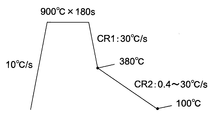
- FIG. 1 is a diagram showing a heat treatment pattern in the example.
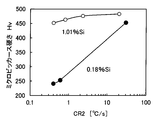
- FIG. 2 is a diagram showing the relationship between the average cooling rate CR2 and the micro Vickers hardness in each example according to the amount of Si in the steel sheet.
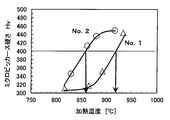
- FIG. 3 is a diagram showing a method for obtaining the minimum heating temperature necessary for the micro Vickers hardness of 400 Hv from the relationship between the heating temperature and the micro Vickers hardness.
- the inventors of the present invention have made extensive studies to solve the above-mentioned problems. First, attention was paid to Si in the steel sheet in order to stably secure the high strength of the member. Details will be described below.
- martensite is generated in the microstructure of the member by cooling the material once austenitized and then achieving high strength. It is well known that the strength of a member depends on the presence of carbon in steel. Si is an important element for controlling the deposition state of this carbon. Specifically, Si is an element that suppresses martensite generated in the hot pressing process from being tempered and softened during cooling.
- the mold holding time can be shortened or the die Omitting the holding causes a difference in mold contact time between the parts of the member, and even when a difference in the degree of cooling occurs as a result, it is possible to obtain a stable strength regardless of the part.
- the said% means the mass% in a chemical component composition.
- the amount of Si is preferably 1.05% or more, more preferably 1.15% or more.
- Si is also an element that raises the Ac 3 point, which is the austenitizing temperature of the steel sheet. When the amount of Si becomes excessive, this Ac 3 point increases, and it is necessary to increase the heating temperature in hot pressing, and as a result, oxidation of the steel sheet surface and disappearance of the galvanized layer are likely to occur. Therefore, the Si amount is 2.00% or less.
- the amount of Si is preferably 1.80% or less, more preferably 1.60% or less.
- the present inventors have conducted intensive research to perform blanking before hot pressing satisfactorily even when a large amount of alloy elements such as Si are contained as described above.
- the tensile strength of the hot-press steel sheet is set to 1100 MPa or less.
- the tensile strength is preferably 1000 MPa or less, more preferably 950 MPa or less.
- the lower limit of the tensile strength of the steel sheet is approximately 440 MPa or more in the component range of the present invention.
- the “tensile strength of the steel plate” may be referred to as “steel plate strength”.
- the above tensile strength may be measured by a tensile test.
- the shape of the test piece is not particularly specified, but for example, it is desirable to have a JIS No. 5 or JIS No. 13 B shape as shown in Examples described later.
- the present inventors conducted intensive research to obtain a steel sheet with a reduced tensile strength. As a result, it was found that it is important to generate pearlite in the microstructure of the steel sheet as shown below.
- the area ratio of pearlite in the entire structure is 30% or more.
- the member strength can be stably obtained.
- the hard microstructure such as martensite and bainite tends to increase, and the steel sheet strength increases.
- the present inventors need to make the area ratio of pearlite in the entire structure 30% or more.
- the area ratio of the pearlite is preferably 35% or more, more preferably 40% or more.
- generation of hard phases such as martensite and bainite and ferrite can be suppressed.
- the hard phase can be reduced.
- an unnecessarily increase in the pearlite fraction is disadvantageous in terms of steel sheet production, such as a longer holding time after hot rolling.
- the upper limit of the area ratio of the pearlite is about 90%. It is desirable that the structure other than pearlite is mainly ferrite. However, a hard phase such as bainite and martensite may also be present as long as it is 10 area% or less in the entire structure.
- the method for measuring the area ratio of the pearlite is obtained by the method described in the examples below.
- the finish rolling temperature is set to a certain level or more, as described in detail in the production method described below, and For example, increasing the coiling temperature during the production of hot-rolled steel sheets.
- the steel sheet used for the hot pressing may have a dislocation density of a certain level or more as shown below.
- the dislocation density of the steel sheet is 10 ⁇ 10 14 / m 2 or more.
- austenitization during heating can be promoted. If the austenitization at the time of heating can be promoted, the heating temperature for securing the member strength can be lowered, and as a result, the oxidation of the steel sheet surface and the disappearance of the galvanized layer can be suppressed.
- the strength after hot pressing that is, the strength of the member, as shown in the examples to be described later, for the purpose of achieving at least 400 Hv in micro Vickers hardness, heating temperature during hot pressing: 900 ° C. or less
- the dislocation density for realizing the above hardness was studied.
- the dislocation density of the steel sheet may be 10 ⁇ 10 14 / m 2 or more.
- the dislocation density is preferably 15 ⁇ 10 14 / m 2 or more, more preferably 20 ⁇ 10 14 / m 2 or more.
- the dislocation density is preferably 30 ⁇ 10 14 / m 2 or less, more preferably 28 ⁇ 10 14 / m 2 or less.
- the measurement method of the dislocation density is obtained by the method shown in the examples below.
- the steel sheet satisfying the dislocation density: 10 ⁇ 10 14 / m 2 or more can be obtained by performing cold rolling under the conditions described later during the production of the steel sheet. After cold rolling, annealing may be performed for imparting plating to the steel sheet or adjusting the steel sheet strength. However, since the dislocation density introduced into the steel sheet tends to decrease due to the annealing, it is necessary to appropriately control the annealing conditions, particularly the annealing temperature, to maintain the dislocation density. Details are shown in the manufacturing method described later.
- the Si amount, microstructure, and dislocation density of the steel sheet which are the features of the present invention, have been described. Next, elements other than Si will be described.
- the component composition of steel parts including Si mentioned above is the same as a steel plate.
- C 0.15% or more and 0.40% or less C is an important element for securing the strength of a member obtained by hot pressing.
- the C content needs to be 0.15% or more.
- the amount of C is preferably 0.18% or more, more preferably 0.20% or more.
- the amount of C exceeds 0.40%, the strength of the welded portion decreases.
- the amount of C is preferably 0.38% or less, more preferably 0.35% or less.
- Mn 1.50% or more and 3.00% or less
- Mn is an element effective for obtaining stable member strength. Specifically, Mn suppresses the formation of a soft layer such as ferrite during the hot press to the start of hot press, or the like during the cooling process during and after the hot press. It is an effective element for obtaining a stable member strength by suppressing the formation of a soft layer or a bainite phase. In order to exhibit this effect, it is necessary to make the amount of Mn 1.50% or more.
- the amount of Mn is preferably 1.60% or more, more preferably 1.80% or more, and still more preferably 2.00% or more.
- the amount of Mn is set to 3.00% or less.
- the amount of Mn is preferably 2.50% or less, more preferably 2.30% or less.
- Ti (N ⁇ 48/14)% or more and 0.10% or less Ti is an important element for securing N in the steel sheet and ensuring hardenability by B. Therefore, at least the amount of Ti is required to fix all N in the steel plate as TiN. Ti also has the effect of refining the microstructure and has the effect of improving the toughness of the member. From these viewpoints, the Ti amount is set to (N ⁇ 48/14)% or more. Said N means the amount of N in the mass% in a steel plate. The amount of Ti is preferably 0.02% or more, more preferably 0.03% or more. On the other hand, if the Ti amount is excessive, the steel sheet strength is remarkably increased, so the Ti amount is 0.10% or less. The amount of Ti is preferably 0.08% or less, more preferably 0.06% or less.
- B 0.0005% or more and 0.0050% or less B is an important element for improving the hardenability of the steel sheet.
- the strength of the member can be stably obtained by containing B and improving the hardenability.
- the amount of B is preferably 0.0010% or more, more preferably 0.0015% or more.
- the B content is 0.0050% or less.
- the amount of B is preferably 0.0040% or less, more preferably 0.0035% or less.
- Al more than 0% and 0.10% or less
- Al is an element necessary for deoxidation. In this respect, it may contain more than 0%, further 0.01% or more.
- the amount of Al becomes excessive, the Ac 3 point of the steel plate rises.
- the Al content is 0.10% or less.
- the amount of Al is preferably 0.08% or less, more preferably 0.06% or less.
- the P amount is 0.05% or less, preferably 0.02% or less
- the S amount is 0.01% or less, preferably 0.008% or less
- the N amount is 0.010% or less, preferably It shall be 0.0006% or less.
- O which is an inevitable impurity, is preferably suppressed to 0.001% or less from the same viewpoint as described above. Since any element is difficult to be zero, the lower limit is more than 0%.
- the components of the steel plate of the present invention and the steel parts obtained using the steel plate are as described above, and the balance consists of iron and inevitable impurities.
- the hardenability and the like can be further improved by adding an appropriate amount of the following selective elements. Hereinafter, these elements will be described in detail.
- At least one element of Mo and Cr in total, more than 0% and 0.50% or less Mo and Cr are elements that contribute to the improvement of hardenability. In order to exert the effect, it is preferable to contain at least one element of Mo and Cr in total exceeding 0%, and more preferably 0.01% or more in total.
- the above “in total” means a single amount when used alone, and means a total amount when plural elements are included. The same applies hereinafter.
- the content of at least one element of Mo and Cr is preferably 0.50% or less in total, more preferably Is 0.30% or less in total.
- At least one element of Cu and Ni in total, more than 0% and 0.50% or less Cu and Ni are elements that contribute to the improvement of delayed fracture resistance of the member, and are included as necessary be able to.
- at least one element of Cu and Ni is preferably 0.50% or less in total, and more preferably 0.30% or less in total.
- a total of at least one element selected from the group consisting of Nb, V and Zr is more than 0% and not more than 0.10%.
- Nb, V and Zr have the effect of refining the microstructure like Ti. Have. Therefore, for example, the content of Ti can be made the minimum necessary for fixing N, and refinement of the microstructure can be realized with these elements. In particular, these elements are more effective in suppressing the growth of austenite grains at high temperatures.
- at least one element selected from the group consisting of Nb, V and Zr is preferably contained in a total amount of 0.005% or more, and more preferably in a total of 0.010% or more.
- the content of at least one element selected from the group consisting of Nb, V and Zr is preferably 0.10% or less in total, and more preferably 0.050% or less in total.
- the steel plate of the present invention may be subjected to zinc plating or aluminum plating on at least one side of the steel plate.
- zinc-based plating it is possible to obtain a plating adhesion amount of about 10 to 90 g / m 2 per side.
- the process up to winding is not particularly limited.
- steel satisfying the above component composition is melted and cast by an ordinary method to obtain a slab or other slab.
- the slab is heated in performing hot rolling, but the heating conditions are not particularly limited, and for example, heating at a temperature of about 1100 to 1300 ° C. can be mentioned.
- hot rolling is performed to obtain a hot rolled steel sheet.
- the finish rolling temperature is in the range of 890 to 950 ° C.
- the finish rolling temperature is preferably 900 ° C. or higher.
- the temperature is set to 950 ° C. or lower. Preferably it is 930 degrees C or less.
- Step of winding at 550 ° C. or higher A specified amount of pearlite can be secured by setting the temperature at which the steel sheet is wound around the coil to 550 ° C. or higher. By increasing the coiling temperature in this way, the strength of the hot-rolled steel sheet can be reduced and the cold rolling rate described later can be increased.
- the winding temperature is preferably 580 ° C. or higher, more preferably 630 ° C. or higher.
- the upper limit of coiling temperature is about 750 degreeC from a viewpoint of deterioration by the oxidation of the steel plate surface.
- the pearlite fraction can be further increased by adding a step of holding for 3 hours or more in a temperature range of 500 ° C. or higher.
- a coil is put into a heat insulation box, the heat insulation temperature: 500 ° C. or higher, preferably 550 ° C. or higher, the upper limit is about 650 ° C., and the heat insulation time: 1 hour or longer, preferably 2 hours or longer, Keep the temperature up to about 4 hours.
- the cold rolling rate can be further increased by the following cold rolling.
- the dislocation density of the steel sheet can be increased, and this has an advantage in reducing the heating temperature during hot pressing.
- Cold rolling is an effective means for introducing dislocations into a steel sheet.
- the cold rolling rate that is, the cold rolling rate is set to 20% or more.
- the cold rolling rate is preferably 25% or more, more preferably 30% or more.
- the upper limit of the cold rolling rate may be determined as appropriate according to the equipment specifications, and may be, for example, 80% or less.
- the tensile strength of the steel sheet is set to 1100 MPa or less. In order to suppress the tensile strength to a lower value of 1000 MPa or less, the cold rolling rate is set to less than 60%.
- the steel sheet for hot pressing according to the present invention includes the cold-rolled steel sheet and the steel sheet that has been annealed after cold rolling.
- the tensile strength after the cold rolling is 1100 MPa or less, the cold rolling may be maintained.
- dislocations can be introduced, but the tensile strength of the steel sheet tends to increase. Therefore, when the steel sheet after the cold rolling, that is, when the tensile strength of the cold rolled steel sheet exceeds 1100 MPa, after the cold rolling, further through an annealing process under the conditions shown in the following (c), Reduce the tensile strength.
- (C) Annealing temperature 500 ° C. or more and 640 ° C. or less, and a residence time in a temperature range of 500 ° C. or more: An annealing process performed under the condition of 500 seconds or less. The strength of the steel sheet after hot rolling can be reduced.
- the annealing temperature is preferably 550 ° C. or higher.
- annealing temperature shall be 640 degrees C or less.
- An annealing temperature becomes like this. Preferably it is 620 degrees C or less, More preferably, it is 600 degrees C or less.
- the residence time in the temperature range of 500 ° C. or higher is set to 500 seconds or shorter.
- This residence time is preferably 450 seconds or shorter, more preferably 400 seconds or shorter, and even more preferably 350 seconds or shorter.
- the staying time is preferably 10 seconds or longer, more preferably 20 seconds or longer.
- the heating method for the annealing furnace heating, electric heating, induction heating, etc. can be adopted.
- the annealing atmosphere is not particularly limited, but is preferably a non-oxidizing atmosphere or a reducing atmosphere.
- Zinc-based plating or aluminum-based plating may be applied to at least one surface of the steel plate.
- the formation method of the zinc-based plating or aluminum-based plating is not particularly limited. However, when galvanizing is applied to the steel sheet, after cooling to about 460 ° C. after the annealing, the plating layer is formed by immersing in a plating bath. Good. If necessary, the plating layer may be further alloyed. In this case, the alloying is preferably performed at a lower temperature of 500 ° C. or less from the viewpoint of suppressing the reduction of the dislocation density.
- an alloying treatment step that is, raising the temperature to the alloying temperature ⁇ holding at the alloying temperature as necessary ⁇ cooling step; temperature range from 500 ° C. to 640 ° C.
- the alloying conditions and the cooling conditions after alloying may be set so that the dwell time is 500 seconds or less.
- Hot pressing In the present invention, the conditions of hot pressing, that is, hot stamping are not particularly limited, and a generally performed method can be employed.
- the hot press includes a heating process, a stamping process, and a cooling process. Hereinafter, each step will be described.
- Heating process Heating temperature Hot pressing is performed after heating to 700 to 900 ° C.
- furnace heating, energization heating, induction heating, or the like can be employed.
- the heating temperature is set to 700 ° C. or higher in order to sufficiently achieve austenitization. Preferably it is 750 degreeC or more.
- the heating temperature is set to 900 ° C. or lower. Preferably it is 880 degrees C or less.
- the holding time at the above heating temperature is preferably 30 minutes or less, more preferably 15 minutes or less, and even more preferably 7 minutes or less. By controlling the holding time in this way, austenite grain growth is suppressed, and characteristics such as hot drawability and toughness of a hot stamped product can be improved.
- the lower limit of the holding time is not particularly limited as long as it reaches the above temperature range. However, in reality, it is difficult to strictly control, so in the case of furnace heating, it is 1 minute or more, in the case of electric heating or induction heating, several seconds or more. If it is.
- stamping process In the stamping process, the steel sheet heated by the heating process is stamped, that is, pressed.
- the starting temperature of the stamping is not particularly limited.
- Cooling step In the cooling step, the steel plate heated by the heating step and a steel part obtained by stamping the steel plate are cooled.
- the cooling here includes natural cooling, and cooling of the steel sheet starts immediately after the heating step.
- the hot stamping process for example, after the steel sheet is heated to 700 to 900 ° C., for example, a method of completing the forming at a temperature of about 550 ° C. or higher can be mentioned.
- the “completion of molding” refers to the time when the mold reaches the bottom dead center position. In normal hot press, the entire steel sheet is hardened and hardened, but only a part of the steel sheet is hardened and strengthened by limiting the area to be heated and the contact area with the mold to a part of the steel sheet. it can.
- automotive steel parts can be obtained by performing cutting such as trimming or drilling on the steel parts obtained by hot pressing.
- Steel parts can be used as automobile steel parts as they are or after being subjected to the above processing.
- automotive steel parts include impact bars, bumpers, reinforcements, center pillars, and the like.
- Example 1 In Example 1, the influence of the amount of Si in the steel sheet on the relationship between the cooling rate during hot pressing and the hardness of the steel sheet was examined.
- a 50 kg steel ingot satisfying the composition shown in Table 1 was melted, and the steel ingot was heated to 1150 ° C. and roughly rolled to produce a steel plate having a thickness of 30 mm.
- “sol.Al amount” means the Al amount specified in the present invention.
- “ ⁇ ” is shown in the column of the element not added.
- the steel plate was heated again to 1250 ° C. and hot-rolled to produce a hot-rolled steel plate having a thickness of 2.3 mm.
- the finish rolling temperature is set to 920 ° C., and after cooling to 650 ° C. after the hot rolling is finished, in order to simulate the cooling state after winding in the actual production line, the furnace temperature is set to 650 ° C.
- the pattern shown in FIG. 1 was heat-treated using a heat treatment reproduction apparatus manufactured by Vacuum Riko Co., Ltd.
- This heat treatment simulates the heat history when hot pressing is performed to obtain a high-strength member.
- press molding is performed up to 380 ° C., but in this example, molding is not performed, and CR 1:30 up to 380 ° C. as shown in FIG. It was cooled at 0 ° C./s and then cooled to 100 ° C. at CR2: 0.4-30 ° C./s. In addition, it was left to cool from 100 ° C. to room temperature.
- the average cooling rate from CR2 to 380 ° C. to 100 ° C. was changed as described above. This simulates that the degree of contact with the mold differs depending on the part of the steel sheet during hot pressing, that is, the cooling rate differs depending on the part of the steel sheet.
- the hardness of the steel sheet after the heat treatment was measured.
- the hardness was determined by measuring the micro Vickers hardness at any five locations under the condition of a measurement load of 9.8 N at the plate thickness / 4 position of the cross section in the plate thickness direction of the steel plate. And the relationship between the above-mentioned various CR2 and micro Vickers hardness simulating the uneven cooling between the parts after forming was arranged according to the amount of Si in the steel sheet. The result is shown in FIG.
- Example 2 the influence of the dislocation density of the steel sheet on the heating temperature during hot pressing was examined. Specifically, the influence of the dislocation density of the steel sheet on the heating temperature necessary for ensuring a certain level of strength by hot pressing, that is, the minimum heating temperature was examined.
- cold rolled steel sheets were prepared as follows. A hot-rolled steel sheet of steel type A shown in Table 1 and having a thickness of 3.2 mm was produced under the same conditions as in Example 1. After removing the oxide scale generated during hot-rolling with hydrochloric acid, the cold-rolled steel shown in Table 2 was used. Cold-rolled steel sheets having various dislocation densities were prepared by performing cold rolling at a rolling ratio. In Table 2, No. Nos. 3 to 7 are the same methods as in Example 3 described later, hot rolling at a finish rolling temperature of 920 ° C., winding at a winding temperature of 650 ° C., and changing the cold rolling rate as shown in Table 2, A cold rolled steel sheet having a dislocation density was prepared. No. 3 to 5 and 7 are No. 3 in Table 4 of Example 3 described later. Same as 7-10.
- the dislocation density of the steel sheet was determined by the X-ray diffraction method. Details are as follows.
- the measuring apparatus used was an X-ray diffractometer RINT-1500 manufactured by Rigaku Corporation. Specifically, Co was used as the X-ray source target, the radiation source output was set to 40 kV-200 mA, and the radiation source was monochromatic using a light-receiving monochromator.
- the slit conditions are a divergence angle of 1 °, a scattering angle of 1 °, a slit width of 0.15 mm, a rotation speed of the measurement sample (X-ray scanning speed) of 1.2 ° / min, and a sampling width of 0. .012 ° increments.
- the diffraction peak widths (half-value widths) of the (110), (211) and (220) planes which are the crystal diffraction planes of ⁇ -Fe are calculated. It was determined by peak fitting. Since this peak width includes both the intrinsic value of the measuring device itself and the apparent peak width change due to 2 ⁇ , these effects are corrected by the measurement result of the Si standard powder sample (NIST rod number 640c), Using this correction value, the dislocation density of each sample was calculated by the Williamson-Hall method. The Williamson-Hall method may be referred to the document “Materials and Processes Vol. 17 (2004) P396-P399”.
- the minimum heating temperature necessary for securing a certain level of strength by hot pressing is determined as follows. It was. That is, as a heat treatment simulating the heating in the hot pressing process, the cold-rolled steel sheet was heated to various heating temperatures, and after reaching the heating temperature, the steel sheet was naturally allowed to cool to room temperature without holding to obtain a test steel sheet. . The heat treatment was carried out using a hot working reproduction apparatus “Thermomaster Z” manufactured by Fuji Electric Koki Co., Ltd. The average heating rate from room temperature to the heating temperature was 100 ° C./s.
- the thickness of the obtained cold rolled steel sheet is various.
- the heat treatment was performed by grinding the cold-rolled steel plate and unifying it to a plate thickness of 1.4 mm.
- the micro Vickers hardness was measured at five points for each steel plate at each heating temperature at the thickness t / 4 position of the test steel plate, and the average value was obtained.
- FIG. 1 and No. As illustrated for 2, a curve indicating the relationship between the heating temperature and the micro Vickers hardness was obtained.
- ⁇ indicates a No. with a cold rolling rate of 39%.
- 2 indicates the data of No. 2 with a cold rolling rate of 0%. 1 data is shown.
- the heating temperature at the intersection of the micro Vickers hardness 400Hv line and each curve was determined as the minimum heating temperature.
- Table 2 shows the results of dislocation density and minimum heating temperature.
- Table 2 shows the following. No. When the dislocation density was very small as shown in 1 and 4, the minimum heating temperature was high. In contrast, no. When the dislocation density was high as in 2, 3 and 5-7, the minimum heating temperature was kept low. That is, by performing cold rolling with a cold rolling rate of a certain level or more, a dislocation density of a certain level or more is introduced, and by using a steel sheet into which this dislocation density of a certain level or more is used for hot pressing, a strength of a certain level or more is obtained. The heating temperature at the time of hot pressing necessary for securing can be greatly suppressed. Thus, if the heating temperature at the time of hot pressing can be significantly suppressed, oxidation of the steel sheet surface and disappearance of the galvanized layer at the time of hot pressing can be suppressed.
- Example 3 In Example 3, the influence of the manufacturing conditions of the steel sheet on the microstructure, dislocation density, and consequently the tensile strength and minimum heating temperature of the steel sheet was examined.
- the composition is almost the same as the composition of steel type A in Table 1 and steel type C in Table 3, and the component composition is mass%, C: 0.22%, Si: 1.14%, Mn: 2.25%, P: 0.00. 010%, S: 0.005%, sol.
- Steel ingot of steel type AA including Al: 0.038%, N: 0.0035%, B: 0.0022%, and Ti: 0.021%, the balance being iron and inevitable impurities, and steel types in Table 3 C to J steel ingots were used, and in an actual machine, the heating temperature was 1200 ° C., the hot rolling was performed at the finishing rolling temperature shown in Table 4, and the winding was performed at the winding temperature shown in Table 4.
- a coil of hot-rolled steel sheet having a thickness was manufactured. No. in Table 4
- Reference numeral 1 denotes a hot-rolled steel plate.
- the annealing is performed by using a heat treatment reproduction apparatus (CAL simulator) manufactured by Vacuum Riko Co., Ltd., changing the conditions shown in Table 4, that is, the annealing temperature and holding time shown in Table 4, and the residence time of 500 ° C. or more. went.
- CAL simulator heat treatment reproduction apparatus
- microstructure observation is performed by observing a 1/4 position of the thickness of the steel sheet at a magnification of 1000 times by SEM (Scanning Electron Microscope), and calculating the area ratio of pearlite in the field of view by a point calculation method. Calculated.
- the size of one field of view of the SEM photograph is 90 ⁇ m ⁇ 120 ⁇ m.
- the mesh size in the point calculation method was implemented by dividing one field of view into 20 vertical and 20 horizontal points. That is, 400 points per field of view were measured to determine the area ratio of pearlite, and the average value of a total of three fields of view was determined.
- the pearlite in the present invention includes pseudo pearlite.
- the observation of the microstructure may be performed at the 1/4 position in the coil width direction when the steel sheet is a product coil, and at the 1/4 position of the thickness of the steel sheet as described above.
- the microstructure may be observed at an arbitrary position on the steel sheet after blanking and before hot pressing.
- test piece having a JIS No. 5 shape was cut out from a steel plate as a test piece for a tensile test. Then, using an AG-IS 250 kN autograph tensile tester manufactured by Shimadzu Corporation, the tensile strength of the steel sheet was determined by the method specified in JIS Z 2241 with a strain rate of 10 mm / min.
- Table 3 and Table 4 show the following. No. As shown in FIG. 1, the steel sheet as hot-rolled can achieve a tensile strength of 1100 MPa or less, but it cannot secure a specified amount of dislocation density and is the minimum heating for obtaining a certain strength or more during hot pressing. The temperature has risen. In the steel sheet, it is difficult to sufficiently suppress oxidation of the steel sheet surface and disappearance of the galvanized layer during hot pressing.
- No. 2 is the above-mentioned No.2. 1 is further subjected to cold rolling with a cold rolling rate of 39%.
- the cold rolled steel sheet obtained in 2 has a high dislocation density, a low minimum heating temperature, and a tensile strength of 1100 MPa or less.
- no. 3 is the above-mentioned No.3. No. 1 above. This is an example in which cold rolling is performed at a cold rolling rate higher than 2. This No. When the cold rolling rate was increased as shown in 3, the dislocation density was sufficiently high and the minimum heating temperature was low, but the tensile strength exceeded 1100 MPa. When blanking is performed on a steel sheet having a high tensile strength in this way, the tool used for the blanking is likely to be damaged or worn.
- No. Nos. 4 to 6 are Nos. It is the example which annealed on the various conditions with respect to the 3 cold-rolled steel plate. Of these, No. Since No. 4 was annealed under appropriate conditions, it was possible to reduce the tensile strength of the steel sheet while ensuring the necessary dislocation density.
- No. No. 5 had an annealing temperature of 665 ° C., which exceeded the upper limit of the specified temperature range, so that the decrease in dislocation density secured by cold rolling was remarkable and the minimum heating temperature was high.
- the annealing temperature was appropriate, but the residence time of 500 ° C. or more exceeded the specified range, so the dislocation density decreased and the minimum heating temperature increased.
- No. 7 to 21 are examples using the steel types shown in Table 3.
- No. Nos. 7 to 14 are examples in which a steel sheet C was used and a cold rolled steel sheet was produced by changing the finish rolling temperature, the coiling temperature, and the cold rolling rate.
- the tensile strength of the steel sheet was low because of the large amount of ferrite, but the minimum heating temperature was high because of the lack of pearlite.
- the steel sheet for hot pressing specified in the present invention can perform blanking work well and can reduce the heating temperature of the hot press, so that the heating of the hot press can be performed. Oxidation of the steel plate surface and disappearance of the galvanized layer that can sometimes occur can be suppressed.
Landscapes
- Chemical & Material Sciences (AREA)
- Engineering & Computer Science (AREA)
- Mechanical Engineering (AREA)
- Materials Engineering (AREA)
- Metallurgy (AREA)
- Organic Chemistry (AREA)
- Physics & Mathematics (AREA)
- Thermal Sciences (AREA)
- Crystallography & Structural Chemistry (AREA)
- Heat Treatment Of Sheet Steel (AREA)
Abstract
Priority Applications (9)
| Application Number | Priority Date | Filing Date | Title |
|---|---|---|---|
| RU2017134364A RU2683994C1 (ru) | 2015-03-18 | 2016-03-11 | Стальной лист для горячего прессования и способ его производства |
| MX2017011993A MX2017011993A (es) | 2015-03-18 | 2016-03-11 | Lamina de acero para prensado en caliente y metodo para producir la misma. |
| BR112017019947-5A BR112017019947A2 (pt) | 2015-03-18 | 2016-03-11 | chapa de aço para prensagem a quente e método para produção da mesma |
| KR1020197035180A KR20190135551A (ko) | 2015-03-18 | 2016-03-11 | 열간 프레스용 강판 및 그의 제조 방법 |
| KR1020177027729A KR20170120180A (ko) | 2015-03-18 | 2016-03-11 | 열간 프레스용 강판 및 그의 제조 방법 |
| CN201680015603.6A CN107429342A (zh) | 2015-03-18 | 2016-03-11 | 热压用钢板及其制造方法 |
| CA2977346A CA2977346C (fr) | 2015-03-18 | 2016-03-11 | Tole d'acier pour formage a chaud a la presse et son procede de production |
| US15/553,053 US20180029102A1 (en) | 2015-03-18 | 2016-03-11 | Steel sheet for hot pressing and method for producing same |
| EP16764875.7A EP3272895A4 (fr) | 2015-03-18 | 2016-03-11 | Tôle d'acier pour formage à chaud à la presse et son procédé de production |
Applications Claiming Priority (4)
| Application Number | Priority Date | Filing Date | Title |
|---|---|---|---|
| JP2015-054873 | 2015-03-18 | ||
| JP2015054873 | 2015-03-18 | ||
| JP2015-234099 | 2015-11-30 | ||
| JP2015234099A JP6082451B2 (ja) | 2015-03-18 | 2015-11-30 | 熱間プレス用鋼板およびその製造方法 |
Publications (1)
| Publication Number | Publication Date |
|---|---|
| WO2016148045A1 true WO2016148045A1 (fr) | 2016-09-22 |
Family
ID=56918826
Family Applications (1)
| Application Number | Title | Priority Date | Filing Date |
|---|---|---|---|
| PCT/JP2016/057710 Ceased WO2016148045A1 (fr) | 2015-03-18 | 2016-03-11 | Tôle d'acier pour formage à chaud à la presse et son procédé de production |
Country Status (1)
| Country | Link |
|---|---|
| WO (1) | WO2016148045A1 (fr) |
Cited By (5)
| Publication number | Priority date | Publication date | Assignee | Title |
|---|---|---|---|---|
| EP3867058A1 (fr) * | 2018-10-18 | 2021-08-25 | SMS Group GmbH | Procédé de fabrication d'un produit en acier plat thermofaçonné |
| CN113490759A (zh) * | 2019-04-01 | 2021-10-08 | 日本制铁株式会社 | 热冲压成形品及其制造方法 |
| CN113924379A (zh) * | 2019-07-02 | 2022-01-11 | 日本制铁株式会社 | 热压用镀锌钢板、热压用镀锌钢板的制造方法和热压成形体 |
| WO2023047991A1 (fr) * | 2021-09-22 | 2023-03-30 | Jfeスチール株式会社 | Feuille d'acier pour pressage à chaud, son procédé de production, élément pressé à chaud et son procédé de production |
| JP2023045975A (ja) * | 2021-09-22 | 2023-04-03 | Jfeスチール株式会社 | 熱間プレス用鋼板、その製造方法、熱間プレス部材およびその製造方法 |
Citations (4)
| Publication number | Priority date | Publication date | Assignee | Title |
|---|---|---|---|---|
| JP2005126733A (ja) * | 2003-10-21 | 2005-05-19 | Nippon Steel Corp | 高温加工性にすぐれた熱間プレス用鋼板及び自動車用部材 |
| US20090238715A1 (en) * | 2008-03-24 | 2009-09-24 | Posco | Steel sheet for hot press forming having low-temperature heat treatment property, method of manufacturing the same, method of manufacturing parts using the same, and parts manufactured by the same |
| WO2012053637A1 (fr) * | 2010-10-22 | 2012-04-26 | 新日本製鐵株式会社 | Feuille d'acier et procédé de production de la feuille d'acier |
| JP2014224311A (ja) * | 2013-04-26 | 2014-12-04 | 株式会社神戸製鋼所 | ホットスタンプ用合金化溶融亜鉛めっき鋼板 |
-
2016
- 2016-03-11 WO PCT/JP2016/057710 patent/WO2016148045A1/fr not_active Ceased
Patent Citations (4)
| Publication number | Priority date | Publication date | Assignee | Title |
|---|---|---|---|---|
| JP2005126733A (ja) * | 2003-10-21 | 2005-05-19 | Nippon Steel Corp | 高温加工性にすぐれた熱間プレス用鋼板及び自動車用部材 |
| US20090238715A1 (en) * | 2008-03-24 | 2009-09-24 | Posco | Steel sheet for hot press forming having low-temperature heat treatment property, method of manufacturing the same, method of manufacturing parts using the same, and parts manufactured by the same |
| WO2012053637A1 (fr) * | 2010-10-22 | 2012-04-26 | 新日本製鐵株式会社 | Feuille d'acier et procédé de production de la feuille d'acier |
| JP2014224311A (ja) * | 2013-04-26 | 2014-12-04 | 株式会社神戸製鋼所 | ホットスタンプ用合金化溶融亜鉛めっき鋼板 |
Non-Patent Citations (1)
| Title |
|---|
| See also references of EP3272895A4 * |
Cited By (8)
| Publication number | Priority date | Publication date | Assignee | Title |
|---|---|---|---|---|
| EP3867058A1 (fr) * | 2018-10-18 | 2021-08-25 | SMS Group GmbH | Procédé de fabrication d'un produit en acier plat thermofaçonné |
| CN113490759A (zh) * | 2019-04-01 | 2021-10-08 | 日本制铁株式会社 | 热冲压成形品及其制造方法 |
| CN113924379A (zh) * | 2019-07-02 | 2022-01-11 | 日本制铁株式会社 | 热压用镀锌钢板、热压用镀锌钢板的制造方法和热压成形体 |
| WO2023047991A1 (fr) * | 2021-09-22 | 2023-03-30 | Jfeスチール株式会社 | Feuille d'acier pour pressage à chaud, son procédé de production, élément pressé à chaud et son procédé de production |
| JP2023045975A (ja) * | 2021-09-22 | 2023-04-03 | Jfeスチール株式会社 | 熱間プレス用鋼板、その製造方法、熱間プレス部材およびその製造方法 |
| JP7302756B1 (ja) * | 2021-09-22 | 2023-07-04 | Jfeスチール株式会社 | 熱間プレス用鋼板、その製造方法、熱間プレス部材およびその製造方法 |
| CN117957337A (zh) * | 2021-09-22 | 2024-04-30 | 杰富意钢铁株式会社 | 热压用钢板、其制造方法、热压构件及其制造方法 |
| JP7512987B2 (ja) | 2021-09-22 | 2024-07-09 | Jfeスチール株式会社 | 熱間プレス用鋼板、その製造方法、熱間プレス部材およびその製造方法 |
Similar Documents
| Publication | Publication Date | Title |
|---|---|---|
| JP6082451B2 (ja) | 熱間プレス用鋼板およびその製造方法 | |
| TWI592500B (zh) | 冷軋鋼板及其製造方法 | |
| CN113840934B (zh) | 高强度构件、高强度构件的制造方法和高强度构件用钢板的制造方法 | |
| CN104114731B (zh) | 钢板、镀敷钢板和它们的制造方法 | |
| EP3868909A1 (fr) | Tôle d'acier mince, et procédé de fabrication de celle-ci | |
| JP5488129B2 (ja) | 冷延鋼板およびその製造方法 | |
| WO2018026014A1 (fr) | Tôle d'acier, et tôle d'acier plaquée | |
| JPWO2018011978A1 (ja) | 溶融亜鉛めっき鋼板 | |
| JP2017048412A (ja) | 溶融亜鉛めっき鋼板、合金化溶融亜鉛めっき鋼板、およびそれらの製造方法 | |
| CN103168106A (zh) | 钢板及钢板制造方法 | |
| EP2801636A1 (fr) | Tôle d'acier laminée à chaud à forte teneur en carbone et son procédé de production | |
| JP6065121B2 (ja) | 高炭素熱延鋼板およびその製造方法 | |
| WO2013180180A1 (fr) | Plaque d'acier laminé à froid à résistance élevée et son procédé de fabrication | |
| CN105378133B (zh) | 高碳热轧钢板及其制造方法 | |
| TWI548755B (zh) | 氮化處理用鋼板及其製造方法 | |
| JP6264861B2 (ja) | 加工性に優れた高ヤング率冷延鋼鈑、電気亜鉛系めっき冷延鋼板、溶融亜鉛めっき冷延鋼板、合金化溶融亜鉛めっき冷延鋼板、及び、それらの製造方法 | |
| EP2801635B1 (fr) | Tôle d'acier laminée à chaud à haute teneur en carbone avec une excellente trempabilité et une anisotropie minimale dans le plan et son procédé de production | |
| JP5860345B2 (ja) | 機械的特性ばらつきの小さい高強度冷延鋼板およびその製造方法 | |
| JP6252709B2 (ja) | 温間加工用高強度鋼板およびその製造方法 | |
| JP2009144239A (ja) | 伸びおよび伸びフランジ性に優れた高強度冷延鋼板 | |
| KR101736634B1 (ko) | 연성과 구멍가공성이 우수한 고강도 냉연강판, 용융아연도금강판 및 이들의 제조방법 | |
| WO2019093429A1 (fr) | Tôle d'acier | |
| CN117616144A (zh) | 冷轧钢板及其制造方法 | |
| JP6687171B1 (ja) | 鋼板 | |
| JP7239072B1 (ja) | 高強度熱延鋼板及び高強度熱延鋼板の製造方法 |
Legal Events
| Date | Code | Title | Description |
|---|---|---|---|
| 121 | Ep: the epo has been informed by wipo that ep was designated in this application |
Ref document number: 16764875 Country of ref document: EP Kind code of ref document: A1 |
|
| ENP | Entry into the national phase |
Ref document number: 2977346 Country of ref document: CA |
|
| REEP | Request for entry into the european phase |
Ref document number: 2016764875 Country of ref document: EP |
|
| WWE | Wipo information: entry into national phase |
Ref document number: MX/A/2017/011993 Country of ref document: MX |
|
| NENP | Non-entry into the national phase |
Ref country code: DE |
|
| ENP | Entry into the national phase |
Ref document number: 20177027729 Country of ref document: KR Kind code of ref document: A |
|
| WWE | Wipo information: entry into national phase |
Ref document number: 2017134364 Country of ref document: RU |
|
| REG | Reference to national code |
Ref country code: BR Ref legal event code: B01A Ref document number: 112017019947 Country of ref document: BR |
|
| ENP | Entry into the national phase |
Ref document number: 112017019947 Country of ref document: BR Kind code of ref document: A2 Effective date: 20170918 |