WO2016148185A1 - Électrode négative de cellule secondaire à électrolyte non aqueux, et cellule secondaire à électrolyte non aqueux faisant appel à ladite électrode négative - Google Patents
Électrode négative de cellule secondaire à électrolyte non aqueux, et cellule secondaire à électrolyte non aqueux faisant appel à ladite électrode négative Download PDFInfo
- Publication number
- WO2016148185A1 WO2016148185A1 PCT/JP2016/058310 JP2016058310W WO2016148185A1 WO 2016148185 A1 WO2016148185 A1 WO 2016148185A1 JP 2016058310 W JP2016058310 W JP 2016058310W WO 2016148185 A1 WO2016148185 A1 WO 2016148185A1
- Authority
- WO
- WIPO (PCT)
- Prior art keywords
- negative electrode
- active material
- secondary battery
- positive electrode
- graphite
- Prior art date
- Legal status (The legal status is an assumption and is not a legal conclusion. Google has not performed a legal analysis and makes no representation as to the accuracy of the status listed.)
- Ceased
Links
Images
Classifications
-
- H—ELECTRICITY
- H01—ELECTRIC ELEMENTS
- H01M—PROCESSES OR MEANS, e.g. BATTERIES, FOR THE DIRECT CONVERSION OF CHEMICAL ENERGY INTO ELECTRICAL ENERGY
- H01M4/00—Electrodes
- H01M4/02—Electrodes composed of, or comprising, active material
- H01M4/36—Selection of substances as active materials, active masses, active liquids
- H01M4/362—Composites
- H01M4/364—Composites as mixtures
-
- C—CHEMISTRY; METALLURGY
- C01—INORGANIC CHEMISTRY
- C01B—NON-METALLIC ELEMENTS; COMPOUNDS THEREOF; METALLOIDS OR COMPOUNDS THEREOF NOT COVERED BY SUBCLASS C01C
- C01B32/00—Carbon; Compounds thereof
- C01B32/20—Graphite
- C01B32/21—After-treatment
-
- H—ELECTRICITY
- H01—ELECTRIC ELEMENTS
- H01M—PROCESSES OR MEANS, e.g. BATTERIES, FOR THE DIRECT CONVERSION OF CHEMICAL ENERGY INTO ELECTRICAL ENERGY
- H01M10/00—Secondary cells; Manufacture thereof
- H01M10/05—Accumulators with non-aqueous electrolyte
- H01M10/052—Li-accumulators
-
- H—ELECTRICITY
- H01—ELECTRIC ELEMENTS
- H01M—PROCESSES OR MEANS, e.g. BATTERIES, FOR THE DIRECT CONVERSION OF CHEMICAL ENERGY INTO ELECTRICAL ENERGY
- H01M10/00—Secondary cells; Manufacture thereof
- H01M10/05—Accumulators with non-aqueous electrolyte
- H01M10/052—Li-accumulators
- H01M10/0525—Rocking-chair batteries, i.e. batteries with lithium insertion or intercalation in both electrodes; Lithium-ion batteries
-
- H—ELECTRICITY
- H01—ELECTRIC ELEMENTS
- H01M—PROCESSES OR MEANS, e.g. BATTERIES, FOR THE DIRECT CONVERSION OF CHEMICAL ENERGY INTO ELECTRICAL ENERGY
- H01M4/00—Electrodes
- H01M4/02—Electrodes composed of, or comprising, active material
- H01M4/04—Processes of manufacture in general
- H01M4/043—Processes of manufacture in general involving compressing or compaction
-
- H—ELECTRICITY
- H01—ELECTRIC ELEMENTS
- H01M—PROCESSES OR MEANS, e.g. BATTERIES, FOR THE DIRECT CONVERSION OF CHEMICAL ENERGY INTO ELECTRICAL ENERGY
- H01M4/00—Electrodes
- H01M4/02—Electrodes composed of, or comprising, active material
- H01M4/13—Electrodes for accumulators with non-aqueous electrolyte, e.g. for lithium-accumulators; Processes of manufacture thereof
- H01M4/133—Electrodes based on carbonaceous material, e.g. graphite-intercalation compounds or CFx
-
- H—ELECTRICITY
- H01—ELECTRIC ELEMENTS
- H01M—PROCESSES OR MEANS, e.g. BATTERIES, FOR THE DIRECT CONVERSION OF CHEMICAL ENERGY INTO ELECTRICAL ENERGY
- H01M4/00—Electrodes
- H01M4/02—Electrodes composed of, or comprising, active material
- H01M4/36—Selection of substances as active materials, active masses, active liquids
- H01M4/362—Composites
- H01M4/366—Composites as layered products
-
- H—ELECTRICITY
- H01—ELECTRIC ELEMENTS
- H01M—PROCESSES OR MEANS, e.g. BATTERIES, FOR THE DIRECT CONVERSION OF CHEMICAL ENERGY INTO ELECTRICAL ENERGY
- H01M4/00—Electrodes
- H01M4/02—Electrodes composed of, or comprising, active material
- H01M4/36—Selection of substances as active materials, active masses, active liquids
- H01M4/58—Selection of substances as active materials, active masses, active liquids of inorganic compounds other than oxides or hydroxides, e.g. sulfides, selenides, tellurides, halogenides or LiCoFy; of polyanionic structures, e.g. phosphates, silicates or borates
- H01M4/583—Carbonaceous material, e.g. graphite-intercalation compounds or CFx
- H01M4/587—Carbonaceous material, e.g. graphite-intercalation compounds or CFx for inserting or intercalating light metals
-
- H—ELECTRICITY
- H01—ELECTRIC ELEMENTS
- H01M—PROCESSES OR MEANS, e.g. BATTERIES, FOR THE DIRECT CONVERSION OF CHEMICAL ENERGY INTO ELECTRICAL ENERGY
- H01M4/00—Electrodes
- H01M4/02—Electrodes composed of, or comprising, active material
- H01M2004/026—Electrodes composed of, or comprising, active material characterised by the polarity
- H01M2004/027—Negative electrodes
-
- Y—GENERAL TAGGING OF NEW TECHNOLOGICAL DEVELOPMENTS; GENERAL TAGGING OF CROSS-SECTIONAL TECHNOLOGIES SPANNING OVER SEVERAL SECTIONS OF THE IPC; TECHNICAL SUBJECTS COVERED BY FORMER USPC CROSS-REFERENCE ART COLLECTIONS [XRACs] AND DIGESTS
- Y02—TECHNOLOGIES OR APPLICATIONS FOR MITIGATION OR ADAPTATION AGAINST CLIMATE CHANGE
- Y02E—REDUCTION OF GREENHOUSE GAS [GHG] EMISSIONS, RELATED TO ENERGY GENERATION, TRANSMISSION OR DISTRIBUTION
- Y02E60/00—Enabling technologies; Technologies with a potential or indirect contribution to GHG emissions mitigation
- Y02E60/10—Energy storage using batteries
Definitions
- the present invention relates to a negative electrode for a non-aqueous secondary battery and a non-aqueous secondary battery using the negative electrode.
- Carbon materials such as graphite and amorphous carbon are often used as negative electrode materials for lithium ion secondary batteries.
- the carbon material When a carbon material is used as the negative electrode active material, the carbon material has a lower theoretical capacity than that of a metal-based negative electrode active material such as Si-based or Sn-based material.
- Graphite has a problem that if the active material layer containing the negative electrode material is densified to increase the capacity, the irreversible capacity of charge / discharge during the initial cycle increases due to material destruction, and as a result, the capacity cannot be increased. It was.
- Patent Document 1 a composite carbon material (A) produced from spherical natural graphite and a carbonized precursor by a specific method and a carbon material composed of natural graphite particles (B) are used as a negative electrode active material. It has been proposed to be used as a substance.
- Patent Document 2 carbon used for a negative electrode in a non-aqueous electrolyte secondary battery is known.
- the negative electrode active material made of a porous material is formed by mixing first graphite particles having an average particle diameter of 5 to 25 ⁇ m and second graphite particles having an average particle diameter of 20 to 45 ⁇ m, and the first graphite particles Has fine pores with a pore diameter of 0.1 to 10 ⁇ m in the particles.
- the first graphite particles when the first and second graphite particles are filled in a mold and compressed at 2.0 N / cm 2 , the first graphite particles have a packing density of 1.60 g / cm 3 or more. That is, when the particles are soft and the second graphite particles are graphite having a packing density of 1.20 g / cm 3 or less, that is, when the particles are hard, the particles are mixed and filled. Since the first graphite particles having a small particle size and soft particles enter between the second graphite particles having a large particle size and hard particles, the particles can be prevented from being destroyed by the compressive force. In addition, it is said that the liquid absorbency can be improved.
- Patent Documents 1 and 2 the characteristic value of the initial cycle and the characteristic value after several cycles are shown, but in an actual battery, a characteristic value of several hundred cycles, for example, 500 cycles or more is important.
- the battery is often exposed to a temperature higher than room temperature due to heat generation, and it is important to improve the high-temperature life characteristics.
- an object of the present invention is to improve the high-temperature life characteristics by suppressing cracking of amorphous carbon-coated graphite in a negative electrode for non-aqueous secondary batteries formed by high-pressure press molding using amorphous carbon-coated graphite. It is in.
- the negative electrode active material has an amorphous carbon-coated graphite active material A having a density of 1.50 g / cm 3 or less when pelletized by pressing at 2 kN / cm 2 , and the density is 1.65 g / cm 3 or more.
- a negative electrode for a non-aqueous secondary battery in which the carbon-based active material B is mixed so that the mass ratio of A: B is 90:10 to 99: 1.
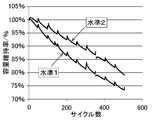
- the negative electrode for a non-aqueous secondary battery according to one embodiment of the present invention can achieve a high capacity retention rate up to 500 cycles, particularly a high capacity retention rate at high temperatures.
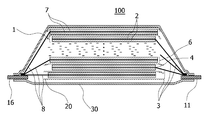
- 1 is a schematic cross-sectional view showing a cross-sectional structure of a laminated lithium ion secondary battery 100 that is an embodiment of the present invention.
- active material A at the time of negative electrode pressing is obtained by combining a relatively hard amorphous carbon-coated graphite material A (referred to as active material A) and soft carbon material B (referred to as active material B) at a predetermined mass ratio.
- active material A relatively hard amorphous carbon-coated graphite material A
- active material B soft carbon material B
- the high temperature life characteristics are improved by suppressing cracking of the resin and consequently suppressing the reaction with the electrolyte.
- the combination of a hard carbon material and a soft carbon material is also shown in Patent Document 2, but the applied pressure specified in Patent Document 2 is 2 N / cm 2, which is a thousandth of 2 kN / cm 2 in the present invention.
- 1 of Patent Document 2 describes that the second graphite particles may be natural graphite coated with carbon, but the evaluated second graphite particles ( ⁇ ) are not coated with carbon. It is.
- the pressurizing force defined in Patent Document 2 serves as an index of the degree of closest packing of the carbon material, while the pressurizing force defined in the present invention is an index of packing density accompanied by plastic deformation of the carbon material. Become.
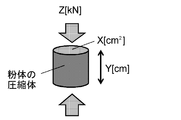
- the density in the pelletization is such that each powder of the active materials A and B is filled in a cylindrical cylinder and uniaxially compressed with a piston at a predetermined load Z (kN). It is calculated from the cross-sectional area (area X) of the compressed body, the volume (area X ⁇ height Y: cm 3 ) of the compressed body and the amount (g) of the powder used.
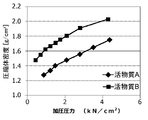
- FIG. 2 shows an example of the relationship between the pressurizing pressure and the compressed body density.
- the active material A amorphous carbon-coated natural graphite was used, and as the active material B, artificial graphite was used.
- the compressed material density of the active material A is 1.47 g / cm 3 (1.50 g / cm 3 or less), and the compressed material density of the active material B is 1.78 g / cm 3 (1.65 g). / Cm 3 or more).
- this active material B is already less than 1.60 g / cm 3 at 1 kN / cm 2 , it does not correspond to the first graphite particles in Patent Document 2.
- the active material A is graphite and any of natural graphite and artificial graphite may be used as long as it satisfies the above-mentioned compressed body density, but natural graphite which is a carbon material having a relatively high degree of graphitization may be used. preferable.
- any carbon material can be used as long as it satisfies the above-described compressed body density, and artificial graphite having a relatively high degree of graphitization can be used.
- the graphitization degree of the active material B is represented by an Id / Ig ratio in a Raman spectrum, and this value is preferably 0.2 or less.
- the crystal structure of the active material B is examined by X-ray diffraction, it is preferable interlayer distance d 002 of the graphite structure is not more than 0.3365 nm. By d 002 is less than 0.3365 nm, even when the active material B is deformed during negative press, it is possible to reduce the reactivity with a liquid electrolyte.
- the active material A is further coated with amorphous carbon.
- the active material B may be coated with amorphous carbon as long as the density of the compressed body is satisfied. However, if the active material B is artificial graphite, the reactivity with the electrolytic solution is lower than that of natural graphite. In addition, since the active material B is used less than the active material A, there is no problem even if it is not coated with amorphous carbon.
- the average particle diameter (D50) of the active material A and the active material B is preferably selected so that the active material A is larger than the active material B.
- the average particle size (D50) of the active material A is preferably selected from the range of 10 ⁇ m to 30 ⁇ m
- the average particle size (D50) of the active material B is preferably selected from the range of 5 ⁇ m to 15 ⁇ m.
- a binder is used in order to bind the particles to a current collector as a base material.
- the binder is not particularly limited, and conventionally known binders can be used.
- PVdF polyvinylidene fluoride
- PTFE polytetrafluoroethylene
- CMC carboxymethylcellulose
- SBR styrene-butadiene copolymer
- a conductive support agent etc. can be added suitably to a negative electrode, and 1 type, or 2 or more types, such as carbon black, carbon fiber, or graphite, can be combined as a conductive support agent.
- the graphite of the conductive additive is different from the graphite of the negative electrode active material.
- the conductive auxiliary graphite has a large specific surface area and has no or little contribution to the capacity.
- Carbon black can be suitably used as the conductive assistant.
- the negative electrode current collector copper, stainless steel, nickel, titanium, or an alloy thereof can be used, and copper is particularly preferable.
- the negative electrode is formed by mixing the active materials A and B according to the present invention at a predetermined ratio, and adding an additive such as a binder or a conductive aid to the mixture to form a mixture, which is dispersed in an appropriate solvent.
- Examples of the slurry application method include a doctor blade method and a die coater method.
- a negative electrode may be produced by forming a thin film of nickel, copper or an alloy thereof on the negative electrode active material layer by a method such as vapor deposition or sputtering.
- the active material A and the active material B are mixed so that the ratio of the active material A to the active material B is 90:10 to 99: 1.
- the mixing ratio A: B is preferably 92: 8 to 98: 2.
- the negative electrode active material can be used in the negative electrode active material layer in an amount of 80% by mass or more, preferably 90% by mass or more, and more preferably 93% by mass or more.
- the binder can be used in the dried negative electrode active material layer in an amount of 0.1 to 10% by mass, preferably 0.5 to 5% by mass.
- the amount thereof is not limited.
- the total amount in the negative electrode active material layer after drying is 0.1 to It can be used in an amount of 10% by weight, preferably 0.1-5% by weight.
- the negative electrode active material layer may be formed on one side or both sides of the negative electrode current collector.
- the positive electrode is opposed to the negative electrode formed in this way through a separator to form an electrode laminate, and the electrode laminate is enclosed with a non-aqueous electrolyte (electrolyte) in a container serving as a battery exterior.
- a non-aqueous electrolyte electrolyte
- a positive electrode active material layer containing a positive electrode active material can be formed on the positive electrode current collector in the same manner as the negative electrode.
- the positive electrode active material is not particularly limited, and conventionally known materials can be used.
- known oxide particles such as LiNi-based composite oxide and LiMn-based composite oxide can be used.
- the positive electrode current collector aluminum, stainless steel, nickel, titanium, or an alloy thereof can be used, and aluminum is particularly preferable.
- the positive electrode active material layer may be formed on one side or both sides of the positive electrode current collector.
- the active material layer non-formation region of the positive electrode current collector and the negative electrode current collector can be connected to the positive electrode terminal and the negative electrode terminal as respective electrode tabs and drawn out to the outside.
- the separator examples include a resin porous film, a woven fabric, a non-woven fabric, and the like.
- a polyolefin resin such as polypropylene or polyethylene, a polyester resin, an acrylic resin, a styrene resin, or a nylon resin can be used as the resin component.
- a polyolefin-based microporous membrane is preferable because of its excellent ion permeability and physical separation between the positive electrode and the negative electrode.
- An electrode laminated body can combine a multilayer from 1 layer of each of a positive electrode and a negative electrode.
- cyclic carbonates such as ethylene carbonate, propylene carbonate, vinylene carbonate, butylene carbonate, ethyl methyl carbonate (EMC), diethyl carbonate (DEC), dimethyl carbonate (DMC), dipropyl carbonate (DPC), etc.
- Organic solvents such as chain carbonates, aliphatic carboxylic acid esters, ⁇ -lactones such as ⁇ -butyrolactone, chain ethers, and cyclic ethers may be used singly or in combination. The lithium salt which dissolves in these organic solvents can be dissolved.
- these electrolytes may contain additives such as propane sultone, disulfonic acid ester, vinyl ethylene carbonate, vinylene carbonate, and the like that form an SEI film (Solid Electrolyte Interface) on the surface of the negative electrode and other flame retardants.
- additives such as propane sultone, disulfonic acid ester, vinyl ethylene carbonate, vinylene carbonate, and the like that form an SEI film (Solid Electrolyte Interface) on the surface of the negative electrode and other flame retardants.
- a flexible film, a can case, or the like can be used for the container that accommodates the electrode laminate, and a flexible film is preferably used from the viewpoint of reducing the weight of the battery.
- a laminate film in which a resin layer is provided on the front and back surfaces of a metal layer serving as a base material can be used.
- a metal layer having a barrier property such as preventing leakage of the electrolytic solution or entry of moisture from the outside can be selected, and aluminum, stainless steel, or the like can be used. Aluminum is particularly preferable.
- At least one surface of the metal layer is provided with a heat-fusible resin layer such as a modified polyolefin, and the heat-fusible resin layers of the flexible film are opposed to each other and around the portion for housing the electrode laminate Is heat-sealed to form an exterior body.
- a resin layer such as a nylon film or a polyester film can be provided on the surface of the exterior body that is the surface opposite to the surface on which the heat-fusible resin layer is formed.
- the positive electrode terminal can be made of aluminum or an aluminum alloy, and the negative electrode terminal can be copper, copper alloy, nickel, nickel plated on them, or the like. Each terminal is pulled out to the outside of the flexible film. However, a heat-sealable resin can be provided in advance on each terminal at a position located at a portion where the periphery of the exterior body is thermally welded.
- FIG. 4 schematically shows a cross-sectional structure of a laminated lithium ion secondary battery 100 according to an embodiment of the present invention.
- the positive electrode 1 is provided with an application part (positive electrode active material layer) 2 in which a slurry containing a positive electrode active material is applied and dried, and an uncoated part where no slurry is applied, on the front and back of the positive electrode current collector.
- an application part (negative electrode active material layer) 7 in which a slurry containing a negative electrode active material is applied and dried, and an uncoated part where no slurry is applied, on the front and back of the negative electrode current collector 8.
- the non-coated portion of the positive electrode active material in the positive electrode current collector is used as the positive electrode tab 3 for connecting to the positive electrode terminal 11
- the non-coated portion of the negative electrode active material in the negative electrode current collector is the negative electrode terminal.
- 16 is a negative electrode tab 8 for connection to 16.
- the positive electrode active material application part 2 and the negative electrode active material application part 7 are laminated to face each other with a separator 20 therebetween.
- the positive electrode tabs 3 are grouped on the positive electrode terminal 11 and connected to each other by ultrasonic welding or the like together with the positive electrode terminal 11, and the negative electrode tabs 8 are grouped on the negative electrode terminal 16 and connected to each other by ultrasonic welding or the like together with the negative electrode terminal 16. Is done.
- one end of the positive electrode terminal 11 is drawn out of the flexible film 30, and one end of the negative electrode terminal 16 is also drawn out of the flexible film 30.
- An insulating member for preventing a short circuit with the negative electrode terminal may be formed at the boundary portion 4 between the coated portion 2 and the uncoated portion of the positive electrode active material.
- the external dimensions of the negative electrode active material application portion 7 are preferably larger than the external dimensions of the positive electrode active material application portion 2 and smaller than the external dimensions of the separator 20.
- CMC carboxymethyl cellulose
- binder styrene / butadiene copolymer
- carbon black as a conductive additive
- the negative electrode formed in this manner is overlapped with the positive electrode through a separator made of porous polypropylene having a thickness of 25 ⁇ m to form an electrode laminate, and the negative electrode tab, the positive electrode tab, the negative electrode terminal, and the positive electrode terminal are respectively connected.
Landscapes
- Chemical & Material Sciences (AREA)
- Electrochemistry (AREA)
- General Chemical & Material Sciences (AREA)
- Chemical Kinetics & Catalysis (AREA)
- Composite Materials (AREA)
- Engineering & Computer Science (AREA)
- Manufacturing & Machinery (AREA)
- Inorganic Chemistry (AREA)
- Organic Chemistry (AREA)
- Materials Engineering (AREA)
- Life Sciences & Earth Sciences (AREA)
- Geology (AREA)
- General Life Sciences & Earth Sciences (AREA)
- Battery Electrode And Active Subsutance (AREA)
- Secondary Cells (AREA)
Abstract
Priority Applications (4)
| Application Number | Priority Date | Filing Date | Title |
|---|---|---|---|
| JP2017506583A JP6779859B2 (ja) | 2015-03-19 | 2016-03-16 | 非水系二次電池用負極及び該負極を用いた非水系二次電池 |
| US15/558,369 US10886527B2 (en) | 2015-03-19 | 2016-03-16 | Negative electrode for non-aqueous secondary battery and non-aqueous secondary battery using the negative electrode |
| EP16765014.2A EP3273511B1 (fr) | 2015-03-19 | 2016-03-16 | Électrode négative de cellule secondaire à électrolyte non aqueux, et cellule secondaire à électrolyte non aqueux faisant appel à ladite électrode négative |
| CN201680016759.6A CN107431190B (zh) | 2015-03-19 | 2016-03-16 | 非水二次电池用负极及使用该负极的非水二次电池 |
Applications Claiming Priority (2)
| Application Number | Priority Date | Filing Date | Title |
|---|---|---|---|
| JP2015056185 | 2015-03-19 | ||
| JP2015-056185 | 2015-03-19 |
Publications (1)
| Publication Number | Publication Date |
|---|---|
| WO2016148185A1 true WO2016148185A1 (fr) | 2016-09-22 |
Family
ID=56919820
Family Applications (1)
| Application Number | Title | Priority Date | Filing Date |
|---|---|---|---|
| PCT/JP2016/058310 Ceased WO2016148185A1 (fr) | 2015-03-19 | 2016-03-16 | Électrode négative de cellule secondaire à électrolyte non aqueux, et cellule secondaire à électrolyte non aqueux faisant appel à ladite électrode négative |
Country Status (5)
| Country | Link |
|---|---|
| US (1) | US10886527B2 (fr) |
| EP (1) | EP3273511B1 (fr) |
| JP (1) | JP6779859B2 (fr) |
| CN (1) | CN107431190B (fr) |
| WO (1) | WO2016148185A1 (fr) |
Cited By (2)
| Publication number | Priority date | Publication date | Assignee | Title |
|---|---|---|---|---|
| EP3553854A4 (fr) * | 2016-12-06 | 2020-06-03 | Contemporary Amperex Technology Co., Limited | Batterie au lithium-ion et son matériau d'électrode négative |
| JP2022020568A (ja) * | 2020-07-20 | 2022-02-01 | 中鋼炭素化学股▲ふん▼有限公司 | リチウムイオン電池の極板材料 |
Families Citing this family (1)
| Publication number | Priority date | Publication date | Assignee | Title |
|---|---|---|---|---|
| WO2022162950A1 (fr) * | 2021-02-01 | 2022-08-04 | 昭和電工マテリアルズ株式会社 | Matériau d'électrode négative pour batterie secondaire au lithium-ion, procédé d'évaluation de matériau d'électrode négative, son procédé de fabrication, électrode négative pour batterie secondaire au lithium-ion et batterie secondaire au lithium-ion |
Citations (2)
| Publication number | Priority date | Publication date | Assignee | Title |
|---|---|---|---|---|
| JP2010251314A (ja) * | 2009-03-27 | 2010-11-04 | Mitsubishi Chemicals Corp | 非水電解液二次電池用負極材料及びこれを用いた非水電解液二次電池 |
| JP2015038862A (ja) * | 2013-07-18 | 2015-02-26 | 三菱化学株式会社 | 非水系二次電池負極用炭素材、それを用いた非水系二次電池用負極及び非水系二次電池 |
Family Cites Families (11)
| Publication number | Priority date | Publication date | Assignee | Title |
|---|---|---|---|---|
| JP3152226B2 (ja) * | 1998-08-27 | 2001-04-03 | 日本電気株式会社 | 非水電解液二次電池、その製造法および炭素材料組成物 |
| JP2005108611A (ja) | 2003-09-30 | 2005-04-21 | Sanyo Electric Co Ltd | 非水電解質二次電池 |
| KR20130090913A (ko) * | 2005-10-20 | 2013-08-14 | 미쓰비시 가가꾸 가부시키가이샤 | 리튬 2 차 전지 및 그것에 사용하는 비수계 전해액 |
| KR100881637B1 (ko) * | 2006-05-01 | 2009-02-04 | 주식회사 엘지화학 | 저온 출력 특성이 개선된 리튬 이차전지 |
| KR101084847B1 (ko) * | 2006-10-16 | 2011-11-21 | 오사까 가스 가부시키가이샤 | 비수 전해질 2차 전지용 복합 음극 활물질 및 그 제조법, 및 그것을 이용한 비수 전해질 2차 전지 |
| JP4579892B2 (ja) * | 2006-12-04 | 2010-11-10 | 関西熱化学株式会社 | リチウムイオン二次電池用負極材料およびその製造方法 |
| KR101498328B1 (ko) | 2008-07-17 | 2015-03-03 | 쥬오 덴끼 고교 가부시키가이샤 | 혼합 탄소 재료 및 비수계 2차 전지용 음극 |
| JP2012033375A (ja) | 2010-07-30 | 2012-02-16 | Mitsubishi Chemicals Corp | 非水系二次電池用炭素材料 |
| US8748036B2 (en) * | 2011-12-27 | 2014-06-10 | Hitachi, Ltd. | Non-aqueous secondary battery |
| WO2014046144A1 (fr) | 2012-09-19 | 2014-03-27 | 三菱化学株式会社 | Particules de graphite composite pour électrode négative de cellule secondaire non aqueuse, électrode négative pour cellule secondaire non aqueuse, et cellule secondaire non aqueuse |
| JP5709024B2 (ja) * | 2012-12-17 | 2015-04-30 | トヨタ自動車株式会社 | 非水電解液二次電池および該二次電池用集電体 |
-
2016
- 2016-03-16 WO PCT/JP2016/058310 patent/WO2016148185A1/fr not_active Ceased
- 2016-03-16 JP JP2017506583A patent/JP6779859B2/ja active Active
- 2016-03-16 CN CN201680016759.6A patent/CN107431190B/zh active Active
- 2016-03-16 EP EP16765014.2A patent/EP3273511B1/fr active Active
- 2016-03-16 US US15/558,369 patent/US10886527B2/en active Active
Patent Citations (2)
| Publication number | Priority date | Publication date | Assignee | Title |
|---|---|---|---|---|
| JP2010251314A (ja) * | 2009-03-27 | 2010-11-04 | Mitsubishi Chemicals Corp | 非水電解液二次電池用負極材料及びこれを用いた非水電解液二次電池 |
| JP2015038862A (ja) * | 2013-07-18 | 2015-02-26 | 三菱化学株式会社 | 非水系二次電池負極用炭素材、それを用いた非水系二次電池用負極及び非水系二次電池 |
Cited By (3)
| Publication number | Priority date | Publication date | Assignee | Title |
|---|---|---|---|---|
| EP3553854A4 (fr) * | 2016-12-06 | 2020-06-03 | Contemporary Amperex Technology Co., Limited | Batterie au lithium-ion et son matériau d'électrode négative |
| JP2022020568A (ja) * | 2020-07-20 | 2022-02-01 | 中鋼炭素化学股▲ふん▼有限公司 | リチウムイオン電池の極板材料 |
| JP7368423B2 (ja) | 2020-07-20 | 2023-10-24 | 中鋼炭素化学股▲ふん▼有限公司 | リチウムイオン電池の極板材料 |
Also Published As
| Publication number | Publication date |
|---|---|
| CN107431190A (zh) | 2017-12-01 |
| US20180083270A1 (en) | 2018-03-22 |
| CN107431190B (zh) | 2021-06-22 |
| EP3273511B1 (fr) | 2019-12-25 |
| US10886527B2 (en) | 2021-01-05 |
| EP3273511A1 (fr) | 2018-01-24 |
| JP6779859B2 (ja) | 2020-11-04 |
| EP3273511A4 (fr) | 2018-10-10 |
| JPWO2016148185A1 (ja) | 2017-12-28 |
Similar Documents
| Publication | Publication Date | Title |
|---|---|---|
| JP6903260B2 (ja) | リチウムイオン二次電池用負極及びリチウムイオン二次電池 | |
| US10840509B2 (en) | Positive electrode active material, and lithium secondary battery using same | |
| JP6841971B2 (ja) | リチウムイオン二次電池用正極材料、正極活物質層、及びリチウムイオン二次電池 | |
| KR102831004B1 (ko) | 리튬 이차 전지용 양극, 리튬 이차 전지용 음극, 및 이를 포함하는 리튬 이차 전지 | |
| KR102230042B1 (ko) | 리튬 이차 전지 | |
| KR20200106963A (ko) | 마이크로 캡슐을 포함하는 언더코트층을 구비한 양극 및 리튬이온 이차전지 | |
| WO2015111710A1 (fr) | Batterie secondaire non aqueuse | |
| KR20150070971A (ko) | 리튬 이온 2차 전지 | |
| CN106463727A (zh) | 基于石墨的负电极活性材料、负电极和锂离子二次电池 | |
| JP4752574B2 (ja) | 負極及び二次電池 | |
| JP5157222B2 (ja) | 電極及び電気化学デバイス | |
| WO2013051416A1 (fr) | Dispositif électrique | |
| US10305108B2 (en) | Graphite-based active material, negative electrode, and lithium ion secondary battery | |
| JP2013246900A (ja) | 二次電池 | |
| JP2019164967A (ja) | 負極活物質、負極およびリチウムイオン二次電池 | |
| JP2020071959A (ja) | 二次電池及び二次電池の製造方法 | |
| JP2020053282A (ja) | リチウムイオン二次電池用負極及びリチウムイオン二次電池 | |
| JP6779859B2 (ja) | 非水系二次電池用負極及び該負極を用いた非水系二次電池 | |
| JP7003775B2 (ja) | リチウムイオン二次電池 | |
| WO2015132845A1 (fr) | Batterie tout solide | |
| JP5626273B2 (ja) | 非水電解質二次電池及び非水電解質二次電池の製造方法 | |
| JP2020140895A (ja) | リチウムイオン二次電池用電極及びリチウムイオン二次電池 | |
| JP6832474B2 (ja) | リチウムイオン二次電池用正極材料、正極活物質層、及びリチウムイオン二次電池 | |
| CN118044020A (zh) | 锂离子二次电池 | |
| US20200220171A1 (en) | Positive electrode for lithium ion secondary battery and lithium ion secondary battery |
Legal Events
| Date | Code | Title | Description |
|---|---|---|---|
| 121 | Ep: the epo has been informed by wipo that ep was designated in this application |
Ref document number: 16765014 Country of ref document: EP Kind code of ref document: A1 |
|
| WWE | Wipo information: entry into national phase |
Ref document number: 15558369 Country of ref document: US |
|
| ENP | Entry into the national phase |
Ref document number: 2017506583 Country of ref document: JP Kind code of ref document: A |
|
| NENP | Non-entry into the national phase |
Ref country code: DE |
|
| REEP | Request for entry into the european phase |
Ref document number: 2016765014 Country of ref document: EP |