WO2016152491A1 - 粘性水系組成物 - Google Patents
粘性水系組成物 Download PDFInfo
- Publication number
- WO2016152491A1 WO2016152491A1 PCT/JP2016/057077 JP2016057077W WO2016152491A1 WO 2016152491 A1 WO2016152491 A1 WO 2016152491A1 JP 2016057077 W JP2016057077 W JP 2016057077W WO 2016152491 A1 WO2016152491 A1 WO 2016152491A1
- Authority
- WO
- WIPO (PCT)
- Prior art keywords
- group
- less
- carbon atoms
- mass
- aqueous composition
- Prior art date
- Legal status (The legal status is an assumption and is not a legal conclusion. Google has not performed a legal analysis and makes no representation as to the accuracy of the status listed.)
- Ceased
Links
Classifications
-
- C—CHEMISTRY; METALLURGY
- C09—DYES; PAINTS; POLISHES; NATURAL RESINS; ADHESIVES; COMPOSITIONS NOT OTHERWISE PROVIDED FOR; APPLICATIONS OF MATERIALS NOT OTHERWISE PROVIDED FOR
- C09K—MATERIALS FOR MISCELLANEOUS APPLICATIONS, NOT PROVIDED FOR ELSEWHERE
- C09K8/00—Compositions for drilling of boreholes or wells; Compositions for treating boreholes or wells, e.g. for completion or for remedial operations
- C09K8/02—Well-drilling compositions
- C09K8/04—Aqueous well-drilling compositions
- C09K8/06—Clay-free compositions
- C09K8/08—Clay-free compositions containing natural organic compounds, e.g. polysaccharides, or derivatives thereof
- C09K8/10—Cellulose or derivatives thereof
-
- A—HUMAN NECESSITIES
- A61—MEDICAL OR VETERINARY SCIENCE; HYGIENE
- A61K—PREPARATIONS FOR MEDICAL, DENTAL OR TOILETRY PURPOSES
- A61K8/00—Cosmetics or similar toiletry preparations
- A61K8/02—Cosmetics or similar toiletry preparations characterised by special physical form
- A61K8/0241—Containing particulates characterized by their shape and/or structure
- A61K8/027—Fibers; Fibrils
-
- A—HUMAN NECESSITIES
- A61—MEDICAL OR VETERINARY SCIENCE; HYGIENE
- A61K—PREPARATIONS FOR MEDICAL, DENTAL OR TOILETRY PURPOSES
- A61K8/00—Cosmetics or similar toiletry preparations
- A61K8/18—Cosmetics or similar toiletry preparations characterised by the composition
- A61K8/72—Cosmetics or similar toiletry preparations characterised by the composition containing organic macromolecular compounds
- A61K8/73—Polysaccharides
- A61K8/731—Cellulose; Quaternized cellulose derivatives
-
- A—HUMAN NECESSITIES
- A61—MEDICAL OR VETERINARY SCIENCE; HYGIENE
- A61L—METHODS OR APPARATUS FOR STERILISING MATERIALS OR OBJECTS IN GENERAL; DISINFECTION, STERILISATION OR DEODORISATION OF AIR; CHEMICAL ASPECTS OF BANDAGES, DRESSINGS, ABSORBENT PADS OR SURGICAL ARTICLES; MATERIALS FOR BANDAGES, DRESSINGS, ABSORBENT PADS OR SURGICAL ARTICLES
- A61L9/00—Disinfection, sterilisation or deodorisation of air
- A61L9/01—Deodorant compositions
-
- A—HUMAN NECESSITIES
- A61—MEDICAL OR VETERINARY SCIENCE; HYGIENE
- A61Q—SPECIFIC USE OF COSMETICS OR SIMILAR TOILETRY PREPARATIONS
- A61Q19/00—Preparations for care of the skin
-
- C—CHEMISTRY; METALLURGY
- C08—ORGANIC MACROMOLECULAR COMPOUNDS; THEIR PREPARATION OR CHEMICAL WORKING-UP; COMPOSITIONS BASED THEREON
- C08K—Use of inorganic or non-macromolecular organic substances as compounding ingredients
- C08K5/00—Use of organic ingredients
- C08K5/16—Nitrogen-containing compounds
-
- C—CHEMISTRY; METALLURGY
- C08—ORGANIC MACROMOLECULAR COMPOUNDS; THEIR PREPARATION OR CHEMICAL WORKING-UP; COMPOSITIONS BASED THEREON
- C08L—COMPOSITIONS OF MACROMOLECULAR COMPOUNDS
- C08L1/00—Compositions of cellulose, modified cellulose or cellulose derivatives
- C08L1/02—Cellulose; Modified cellulose
- C08L1/04—Oxycellulose; Hydrocellulose, e.g. microcrystalline cellulose
-
- C—CHEMISTRY; METALLURGY
- C09—DYES; PAINTS; POLISHES; NATURAL RESINS; ADHESIVES; COMPOSITIONS NOT OTHERWISE PROVIDED FOR; APPLICATIONS OF MATERIALS NOT OTHERWISE PROVIDED FOR
- C09K—MATERIALS FOR MISCELLANEOUS APPLICATIONS, NOT PROVIDED FOR ELSEWHERE
- C09K8/00—Compositions for drilling of boreholes or wells; Compositions for treating boreholes or wells, e.g. for completion or for remedial operations
- C09K8/40—Spacer compositions, e.g. compositions used to separate well-drilling from cementing masses
-
- C—CHEMISTRY; METALLURGY
- C09—DYES; PAINTS; POLISHES; NATURAL RESINS; ADHESIVES; COMPOSITIONS NOT OTHERWISE PROVIDED FOR; APPLICATIONS OF MATERIALS NOT OTHERWISE PROVIDED FOR
- C09K—MATERIALS FOR MISCELLANEOUS APPLICATIONS, NOT PROVIDED FOR ELSEWHERE
- C09K8/00—Compositions for drilling of boreholes or wells; Compositions for treating boreholes or wells, e.g. for completion or for remedial operations
- C09K8/58—Compositions for enhanced recovery methods for obtaining hydrocarbons, i.e. for improving the mobility of the oil, e.g. displacing fluids
- C09K8/588—Compositions for enhanced recovery methods for obtaining hydrocarbons, i.e. for improving the mobility of the oil, e.g. displacing fluids characterised by the use of specific polymers
-
- C—CHEMISTRY; METALLURGY
- C09—DYES; PAINTS; POLISHES; NATURAL RESINS; ADHESIVES; COMPOSITIONS NOT OTHERWISE PROVIDED FOR; APPLICATIONS OF MATERIALS NOT OTHERWISE PROVIDED FOR
- C09K—MATERIALS FOR MISCELLANEOUS APPLICATIONS, NOT PROVIDED FOR ELSEWHERE
- C09K8/00—Compositions for drilling of boreholes or wells; Compositions for treating boreholes or wells, e.g. for completion or for remedial operations
- C09K8/60—Compositions for stimulating production by acting on the underground formation
- C09K8/84—Compositions based on water or polar solvents
- C09K8/86—Compositions based on water or polar solvents containing organic compounds
- C09K8/88—Compositions based on water or polar solvents containing organic compounds macromolecular compounds
- C09K8/90—Compositions based on water or polar solvents containing organic compounds macromolecular compounds of natural origin, e.g. polysaccharides, cellulose
-
- C—CHEMISTRY; METALLURGY
- C09—DYES; PAINTS; POLISHES; NATURAL RESINS; ADHESIVES; COMPOSITIONS NOT OTHERWISE PROVIDED FOR; APPLICATIONS OF MATERIALS NOT OTHERWISE PROVIDED FOR
- C09K—MATERIALS FOR MISCELLANEOUS APPLICATIONS, NOT PROVIDED FOR ELSEWHERE
- C09K8/00—Compositions for drilling of boreholes or wells; Compositions for treating boreholes or wells, e.g. for completion or for remedial operations
- C09K8/60—Compositions for stimulating production by acting on the underground formation
- C09K8/92—Compositions for stimulating production by acting on the underground formation characterised by their form or by the form of their components, e.g. encapsulated material
-
- E—FIXED CONSTRUCTIONS
- E21—EARTH OR ROCK DRILLING; MINING
- E21B—EARTH OR ROCK DRILLING; OBTAINING OIL, GAS, WATER, SOLUBLE OR MELTABLE MATERIALS OR A SLURRY OF MINERALS FROM WELLS
- E21B43/00—Methods or apparatus for obtaining oil, gas, water, soluble or meltable materials or a slurry of minerals from wells
- E21B43/16—Enhanced recovery methods for obtaining hydrocarbons
- E21B43/20—Displacing by water
-
- E—FIXED CONSTRUCTIONS
- E21—EARTH OR ROCK DRILLING; MINING
- E21B—EARTH OR ROCK DRILLING; OBTAINING OIL, GAS, WATER, SOLUBLE OR MELTABLE MATERIALS OR A SLURRY OF MINERALS FROM WELLS
- E21B43/00—Methods or apparatus for obtaining oil, gas, water, soluble or meltable materials or a slurry of minerals from wells
- E21B43/25—Methods for stimulating production
-
- A—HUMAN NECESSITIES
- A61—MEDICAL OR VETERINARY SCIENCE; HYGIENE
- A61K—PREPARATIONS FOR MEDICAL, DENTAL OR TOILETRY PURPOSES
- A61K2800/00—Properties of cosmetic compositions or active ingredients thereof or formulation aids used therein and process related aspects
- A61K2800/10—General cosmetic use
-
- A—HUMAN NECESSITIES
- A61—MEDICAL OR VETERINARY SCIENCE; HYGIENE
- A61K—PREPARATIONS FOR MEDICAL, DENTAL OR TOILETRY PURPOSES
- A61K2800/00—Properties of cosmetic compositions or active ingredients thereof or formulation aids used therein and process related aspects
- A61K2800/20—Chemical, physico-chemical or functional or structural properties of the composition as a whole
- A61K2800/26—Optical properties
- A61K2800/262—Transparent; Translucent
-
- A—HUMAN NECESSITIES
- A61—MEDICAL OR VETERINARY SCIENCE; HYGIENE
- A61K—PREPARATIONS FOR MEDICAL, DENTAL OR TOILETRY PURPOSES
- A61K2800/00—Properties of cosmetic compositions or active ingredients thereof or formulation aids used therein and process related aspects
- A61K2800/40—Chemical, physico-chemical or functional or structural properties of particular ingredients
- A61K2800/41—Particular ingredients further characterized by their size
- A61K2800/412—Microsized, i.e. having sizes between 0.1 and 100 microns
-
- A—HUMAN NECESSITIES
- A61—MEDICAL OR VETERINARY SCIENCE; HYGIENE
- A61Q—SPECIFIC USE OF COSMETICS OR SIMILAR TOILETRY PREPARATIONS
- A61Q1/00—Make-up preparations; Body powders; Preparations for removing make-up
- A61Q1/02—Preparations containing skin colorants, e.g. pigments
- A61Q1/04—Preparations containing skin colorants, e.g. pigments for lips
- A61Q1/06—Lipsticks
-
- A—HUMAN NECESSITIES
- A61—MEDICAL OR VETERINARY SCIENCE; HYGIENE
- A61Q—SPECIFIC USE OF COSMETICS OR SIMILAR TOILETRY PREPARATIONS
- A61Q5/00—Preparations for care of the hair
- A61Q5/02—Preparations for cleaning the hair
-
- A—HUMAN NECESSITIES
- A61—MEDICAL OR VETERINARY SCIENCE; HYGIENE
- A61Q—SPECIFIC USE OF COSMETICS OR SIMILAR TOILETRY PREPARATIONS
- A61Q5/00—Preparations for care of the hair
- A61Q5/10—Preparations for permanently dyeing the hair
-
- C—CHEMISTRY; METALLURGY
- C09—DYES; PAINTS; POLISHES; NATURAL RESINS; ADHESIVES; COMPOSITIONS NOT OTHERWISE PROVIDED FOR; APPLICATIONS OF MATERIALS NOT OTHERWISE PROVIDED FOR
- C09K—MATERIALS FOR MISCELLANEOUS APPLICATIONS, NOT PROVIDED FOR ELSEWHERE
- C09K2208/00—Aspects relating to compositions of drilling or well treatment fluids
- C09K2208/08—Fiber-containing well treatment fluids
Definitions
- the present invention relates to a viscous aqueous composition. More specifically, it is suitably used for various industrial applications such as thickeners used in pile driving and oil and other underground recovery operations, cosmetic applications, and other applications that require product stability at high temperatures.
- the present invention relates to a viscous aqueous composition.
- polymeric materials have been used to maintain thickening and dispersion stability.
- water-soluble cellulose derivatives such as methylcellulose and carboxymethylcellulose salts
- synthetic polymers such as polyvinyl alcohol, polyvinylpyrrolidone, carboxyvinyl polymer, and polyethylene glycol
- natural polymer polysaccharides such as quince seed, bee gum, xanthan gum, and hyaluronate Etc.
- cellulose fibers are naturally present in a large amount and have good biodegradability, so that they are expected to be microfibrillated and applied to a wide range of fields.
- a viscous composition prepared by mixing fine cellulose fibers in which the C6 hydroxyl group of a glucose unit in a cellulose molecule is oxidized to be modified with an aldehyde group and a carboxy group with water is a cosmetic base. It is disclosed that it is used for materials and toiletry article base materials. Since the fine cellulose fiber is reacted with sodium hydroxide after oxidation in the examples, it is suggested that the aldehyde group and the carboxy group form a sodium salt.
- Patent Document 2 it is possible to use fine cellulose fibers in which the C6 hydroxyl group of a glucose unit in a cellulose molecule is modified to a carboxy group and the carboxy group is a monoamine salt in the same application as in Patent Document 1. It is disclosed.
- the present invention relates to the following [1] to [7].
- [1] (A) Fine cellulose having a number average fiber diameter of 0.5 nm or more and 200 nm or less, a carboxy group content of 0.1 mmol / g or more, and the carboxy group being a salt with an alkali metal Fiber, and (B) an additive containing one or more compounds having carbon atoms and nitrogen atoms, the ratio of which per molecule (number of carbon atoms / number of nitrogen atoms) is 3 or more and 45 or less.
- [3] Use of the aqueous composition of [1] as a household product selected from a fragrance, a shampoo, and a hair dye.
- [4] Use of the aqueous composition according to [1] as an industrial product selected from a foaming agent, paint, and concrete.
- [5] From the group consisting of drilling fluid, spacer fluid, pressurizing fluid for well stimulation, and boosting fluid for recovery enhancement, which can be used for pile driving, oil recovery work, or oil well drilling Use of the aqueous composition according to [1] as any one of fluids selected.
- [6] A method for treating an underground layer, comprising treating the underground layer with the aqueous composition according to [1].
- [7] A method for recovering earth and sand and rocks produced by excavation, wherein the aqueous composition according to [1] is sent to the tip of an underground excavation hole and earth and sand and rocks produced by excavation are collected on the ground.
- the present invention relates to an aqueous composition containing fine cellulose fibers in which a decrease in viscosity at high temperatures is suppressed.
- the aqueous composition of the present invention exhibits an excellent effect that the operability is good because it is highly thixotropic while exhibiting high viscosity even at high temperatures.
- the aqueous composition of fine cellulose fibers exhibits excellent viscosity, the viscosity decreases at high temperatures as in the case of conventional thickeners, and further improvement is necessary. Therefore, as a result of the study by the present inventors, surprisingly, by combining a specific fine cellulose fiber with a specific nitrogen-containing hydrocarbon compound having a specific ratio of carbon atoms and nitrogen atoms, a decrease in viscosity at a high temperature can be achieved. It was found to be suppressed and excellent in thixotropy. Although the detailed reason is unknown, it is guessed that the addition of a compound having a specific atomic composition can form a relatively strong and recombinable pseudo-crosslinked structure between fine cellulose fibers.
- the viscosity reduction refers to the ratio of the viscosity at high temperature to the viscosity at normal temperature, and it can be evaluated that the viscosity decrease at high temperature is larger as the value is smaller. It can be described as the ratio of the viscosity at 80 ° C to the viscosity at 80 ° C (80 ° C viscosity / 25 ° C viscosity).
- the aqueous composition of the present invention contains specific fine cellulose fibers and specific additives.
- the fine cellulose fiber used in the present invention is not particularly limited as long as the number average fiber diameter and carboxy group content are specific and the carboxy group is a salt with an alkali metal.
- the fine cellulose fiber in the present invention has a number average fiber diameter of 0.5 nm or more and 200 nm or less, but preferably 0.8 nm or more, more preferably 1 from the viewpoint of maintaining thermal stability by imparting crystallinity. 0.0 nm or more. Moreover, from the viewpoint of expressing structural viscosity by forming a fine structure, it is preferably 100 nm or less, more preferably 50 nm or less, still more preferably 20 nm or less, still more preferably 10 nm or less, and even more preferably 5 nm or less.
- the number average fiber diameter of a cellulose fiber can be measured using an atomic force microscope (AFM), and is specifically measured by the method as described in the below-mentioned Example.
- AFM atomic force microscope
- the smallest unit of cellulose nanofibers prepared from higher plants is a 6 ⁇ 6 molecular chain packed in a nearly square shape, so the height analyzed by AFM images is regarded as the fiber width. Can do.
- the fine cellulose fiber in the present invention has a carboxy group content of 0.1 mmol / g or more, but is preferably 0.4 mmol / g or more, more preferably from the viewpoint of stability and thickening effect in an aqueous composition. 0.6 mmol / g or more, more preferably 0.8 mmol / g or more. Further, from the viewpoint of handling and cost, it is preferably 3.0 mmol / g or less, more preferably 2.7 mmol / g or less, still more preferably 2.5 mmol / g or less, and still more preferably 2.0 mmol / g or less. is there.
- a fine cellulose fiber having a carboxy group content outside this range may be unintentionally contained as an impurity.
- the “carboxy group content” means the total amount of carboxy groups in the cellulose constituting the fine cellulose fiber, and is specifically measured by the method described in Examples described later.
- the carboxy group is a salt with an alkali metal.
- the carboxy group of the fine cellulose fiber being an alkali metal salt means that the alkali metal is directly ion-bonded to the carboxy group on the surface of the fine cellulose fiber. Thereby, the effect that a fine cellulose fiber expresses high water dispersibility and structural viscosity is produced.
- the alkali metal is preferably Li, Na, K, or Rb from the viewpoint of cost, more preferably Na or K, and still more preferably Na.
- the introduction of the alkali metal can be obtained, for example, by performing an oxidation treatment using the reaction system as an alkaline region when a carboxy group is present on the surface of the fine cellulose fiber.
- the alkali used include alkali metal hydroxides such as sodium hydroxide, potassium hydroxide and lithium hydroxide. From the viewpoint of cost, sodium hydroxide or potassium hydroxide is preferable, and sodium hydroxide is more preferable. A method for the oxidation treatment will be described later.
- the fine cellulose fiber in the present invention has an average aspect ratio (fiber length / fiber diameter) of preferably 10 or more, more preferably 20 or more, still more preferably 50 or more, and still more preferably from the viewpoint of developing structural viscosity. Is 100 or more, more preferably 200 or more. Moreover, from a viewpoint of cost and handleability, Preferably it is 1000 or less, More preferably, it is 500 or less, More preferably, it is 400 or less, More preferably, it is 350 or less.
- the average aspect ratio is obtained by calculating back the aspect ratio of the cellulose fiber by the following formula (1) from the relationship between the concentration of the cellulose fiber in the dispersion and the specific viscosity of the dispersion with respect to water.
- Numerical formula (1) is The Theory of Polymer Dynamics, M. DOI and D.D. F.
- ⁇ SP is the specific viscosity
- ⁇ is the circumference ratio
- ln is the natural logarithm
- P is the aspect ratio (L / b)
- ⁇ 0.8
- ⁇ S is the density of the dispersion medium (kg / m 3 )
- ⁇ 0 represents the density of the cellulose crystals (kg / m 3 )
- the crystallinity of the fine cellulose fibers is preferably 30% or more, more preferably 35% or more, still more preferably 40% or more, and still more preferably 45% or more, from the viewpoint of developing viscosity at high temperatures. Moreover, from a viewpoint of the cellulose raw material cost to be used, Preferably it is 95% or less, More preferably, it is 90% or less, More preferably, it is 85% or less, More preferably, it is 80% or less.
- the crystallinity of cellulose is the cellulose I-type crystallinity calculated by the Segal method from the diffraction intensity value by the X-ray diffraction method, and is defined by the following calculation formula (A).
- the fine cellulose fiber used in the present invention can be produced according to a known method without any particular limitation.
- a reaction for introducing an alkali metal into fine cellulose fibers prepared in advance may be performed, or a reaction for introducing an alkali metal may be performed when preparing fine cellulose fibers.
- the fine cellulose fiber can be produced by a known method, for example, a method described in JP 2011-140632 A.
- natural cellulose fibers are oxidized in the presence of an N-oxyl compound to obtain alkali metal salt-type carboxy group-containing cellulose fibers (oxidation treatment step), and the resulting fibers are refined. It can be obtained by a production method including a process (a miniaturization process).
- a slurry in which natural cellulose fibers are dispersed in water is prepared.
- the slurry is added with about 10 to 1000 times (mass basis) of water as a raw material natural cellulose fiber (absolute drying basis: mass of natural cellulose fiber after being heated and dried at 150 ° C. for 30 minutes) It is obtained by processing with a mixer or the like.
- natural cellulose fibers include wood pulp such as softwood pulp and hardwood pulp; cotton pulp such as cotton linter and cotton lint; non-wood pulp such as straw pulp and bagasse pulp; bacterial cellulose and the like. These 1 type can be used individually or in combination of 2 or more types.
- the natural cellulose fiber may be subjected to a treatment for increasing the surface area such as beating. Further, the cellulose I type crystallinity of the commercially available pulp is usually 80% or more.
- the natural cellulose fiber is oxidized in the presence of an N-oxyl compound to obtain a carboxy group-containing cellulose fiber (hereinafter sometimes simply referred to as “oxidation treatment”).
- N-oxyl compound one or more heterocyclic N-oxyl compounds selected from piperidine oxyl compounds having 1 or 2 carbon atoms, pyrrolidine oxyl compounds, imidazoline oxyl compounds, and azaadamantane compounds are preferable. .
- a piperidineoxyl compound having an alkyl group having 1 or 2 carbon atoms is preferable, and 2,2,6,6-tetraalkylpiperidine-1-oxyl (TEMPO), 4-hydroxy- 2,2,6,6-tetraalkylpiperidine-1-oxyl, 4-alkoxy-2,2,6,6-tetraalkylpiperidine-1-oxyl, 4-benzoyloxy-2,2,6,6-tetra Di-tert-alkylnitroxyl compounds such as alkylpiperidine-1-oxyl and 4-amino-2,2,6,6-tetraalkylpiperidine-1-oxyl, 4-acetamido-TEMPO, 4-carboxy-TEMPO, 4 -Phosphonoxy-TEMPO and the like.
- TEMPO 2,2,6,6-tetraalkylpiperidine-1-oxyl
- 4-hydroxy- 2,2,6,6-tetraalkylpiperidine-1-oxyl 4-alkoxy-2,2,6,6-tetraalkyl
- piperidine oxyl compounds 2,2,6,6-tetramethylpiperidine-1-oxyl (TEMPO), 4-hydroxy-2,2,6,6-tetramethylpiperidine-1-oxyl, 4- Methoxy-2,2,6,6-tetramethylpiperidine-1-oxyl is more preferred, and 2,2,6,6 tetramethylpiperidine-1-oxyl (TEMPO) is even more preferred.
- TEMPO 2,2,6,6 tetramethylpiperidine-1-oxyl
- the amount of the N-oxyl compound may be a catalytic amount, and is preferably 0.001 to 10% by mass, more preferably 0.01 to 9% by mass, and still more preferably relative to the natural cellulose fiber (absolute dry basis). Is 0.1 to 8% by mass, more preferably 0.5 to 5% by mass.
- An oxidizing agent can be used in the oxidation treatment of natural cellulose fibers.
- the oxidizing agent from the viewpoint of solubility and reaction rate when the solvent is adjusted to an alkaline region, oxygen or air, peroxides; halogens, hypohalous acids, halous acids, perhalogen acids and their alkali metals Salt or alkaline earth metal salt; halogen oxide, nitrogen oxide and the like.
- alkali metal hypohalites are preferable, and specific examples include sodium hypochlorite and sodium hypobromite.
- the amount of the oxidizing agent used may be selected according to the degree of carboxy group substitution (oxidation degree) of the natural cellulose fiber, and the oxidation reaction yield varies depending on the reaction conditions. The range is preferably about 1 to 100% by mass with respect to the cellulose fiber (absolute dry basis).
- bromides such as sodium bromide and potassium bromide and iodides such as sodium iodide and potassium iodide can be used as a co-catalyst.
- the amount of the promoter is not particularly limited as long as it is an effective amount that can exhibit its function.
- the reaction temperature in the oxidation treatment is preferably 50 ° C. or less, more preferably 40 ° C. or less, further preferably 20 ° C. or less, from the viewpoint of reaction selectivity and side reaction suppression, and the lower limit thereof is preferably ⁇ 5. °C or more.
- alkali metal hydroxides such as sodium hydroxide, potassium hydroxide, and lithium hydroxide can be used in the present invention, and preferably from the viewpoint of cost.
- sodium hydroxide or potassium hydroxide more preferably sodium hydroxide.
- the pH of the reaction system is preferably set to the alkali side using sodium hydroxide, preferably pH 7 to 13, more preferably pH 10 to 13. .
- the reaction time is preferably 1 to 240 minutes.
- a carboxy group-containing cellulose fiber having a carboxy group content of 0.1 mmol / g or more in which the carboxy group is an alkali metal salt is obtained.
- the carboxy group-containing cellulose fiber obtained by the oxidation reaction contains an N-oxyl compound such as TEMPO or a by-product salt used as a catalyst.
- the next step may be carried out as it is, but purification can also be carried out to obtain a highly purified carboxy group-containing cellulose fiber.
- the purification method an optimum method can be employed depending on the type of solvent in the oxidation reaction, the degree of oxidation of the product, and the degree of purification.
- a step of refining the obtained carboxy group-containing cellulose fiber is performed.
- the solvent as the dispersion medium is water, alcohol having 1 to 6 carbon atoms, preferably 1 to 3 carbon atoms such as methanol, ethanol and propanol; ketone having 3 to 6 carbon atoms such as acetone, methyl ethyl ketone and methyl isobutyl ketone.
- water alcohol having 1 to 6 carbon atoms, ketone having 3 to 6 carbon atoms, carbon number 2
- polar solvents such as lower alkyl ethers of 5 to 5, N, N-dimethylformamide, N, N-dimethylacetamide, dimethyl sulfoxide, succinic acid methyltriglycol diester, and water is more preferable from the viewpoint of reducing environmental burden.
- the amount of the solvent used is not particularly limited as long as it is an effective amount capable of dispersing the carboxy group-containing cellulose fiber, but is preferably 1 to 500 times by mass, more preferably 2 to 200 times the carboxy group-containing cellulose fiber. It is more preferable to use mass times.
- a known disperser is preferably used as an apparatus used in the miniaturization process.
- a disaggregator, a beater, a low-pressure homogenizer, a high-pressure homogenizer, a grinder, a cutter mill, a ball mill, a jet mill, a short screw extruder, a twin screw extruder, an ultrasonic stirrer, a domestic juicer mixer, and the like can be used.
- the solid content concentration of the reactant fiber in the miniaturization treatment is preferably 50% by mass or less.
- the solid content concentration is adjusted as required (sustainedly colorless transparent or opaque liquid), or dried powder (however, Or a powder form in which fine cellulose fibers are aggregated, and does not mean cellulose particles).
- a suspension only water may be used as a dispersion medium, and a mixed solvent of water and other organic solvents (for example, alcohols such as ethanol), surfactants, acids, bases, etc. May be used.
- the hydroxyl group at the C6 position of the cellulose constituent unit is selectively oxidized to a carboxy group via an aldehyde group, and the carboxy group content is 0.1 mmol / It is possible to obtain cellulose fibers having a number average fiber diameter of 0.5 nm or more and 200 nm or less and having a crystallinity of preferably 30% or more, which is composed of g or more of cellulose.
- the said carboxy-group containing fine cellulose fiber has a cellulose I type crystal structure.
- the carboxy group-containing fine cellulose fiber used in the present invention is a fiber obtained by surface-oxidizing and refining a naturally-derived cellulose solid raw material having an I-type crystal structure.
- an additive containing one or more compounds having carbon atoms and nitrogen atoms and having a ratio (number of carbon atoms / number of nitrogen atoms) per molecule of 3 or more and 45 or less is used.
- the nitrogen-containing compound having the above ratio an effect of forming a relatively strong and recombinable cross-linked structure between the fine cellulose fibers is exhibited.
- Specific examples of the compound having the above ratio include quaternary ammonium salts, amines and amides.
- the quaternary ammonium salt used in the present invention is a salt of quaternary ammonium having a ratio of carbon atoms to nitrogen atoms (number of carbon atoms / number of nitrogen atoms) per molecule of 3 or more and 45 or less.
- the ratio of the quaternary ammonium is preferably 4 or more, more preferably 6 or more, and still more preferably 20 or more, from the viewpoint of a thickening assisting effect and thermal stability. Moreover, from a viewpoint of a thickening auxiliary
- the number of carbon atoms per molecule of the quaternary ammonium compound is preferably 4 or more, more preferably 6 or more, still more preferably 12 or more, and still more preferably 18 or more, from the viewpoint of developing a thickening assisting effect and thermal stability. It is. Moreover, from a water-soluble viewpoint, Preferably it is 45 or less, More preferably, it is 35 or less, More preferably, it is 30 or less, More preferably, it is 25 or less.
- the number of nitrogen atoms per molecule of the quaternary ammonium compound is preferably 1 or more and 2 or less, more preferably 1 from the viewpoint of developing a thickening assisting effect and thermal stability.
- the quaternary ammonium counter ion there is no particular limitation on the quaternary ammonium counter ion.
- it is preferably a halogen atom, more preferably Br, Cl, or I, and still more preferably Br or Cl.
- the molecular weight of the quaternary ammonium salt is preferably 70 or more, more preferably 100 or more, still more preferably 200 or more, still more preferably 300 or more, and still more preferably 350, from the viewpoint of developing a thickening assisting effect and thermal stability. From the same viewpoint, it is preferably 500 or less, more preferably 400 or less.
- R 1 , R 2 , R 3 and R 4 are the same or different and each represents an alkyl group having 1 to 20 carbon atoms, an aryl group having 6 to 20 carbon atoms, or an aralkyl group having 7 to 20 carbon atoms.
- X represents F, Br, Cl, or I
- the alkyl group in the general formula (1) preferably has 1 to 20 carbon atoms, more preferably 5 to 18 carbon atoms, and still more preferably 8 to 16 carbon atoms.
- the aryl group in the general formula (1) preferably has 6 to 20 carbon atoms, more preferably 6 to 14 carbon atoms, and still more preferably 6 to 10 carbon atoms.
- Specific examples include a phenyl group, a naphthyl group, an anthryl group, a phenanthryl group, a biphenyl group, and a group in which these groups are substituted with a substituent described later.
- the aralkyl group in the general formula (1) preferably has 7 to 20 carbon atoms, more preferably 7 to 14 carbon atoms, and still more preferably 7 to 10 carbon atoms.
- substituent those in which the total number of carbon atoms of the entire functional group including the substituent is within the above range are preferable.
- R 1 , R 2 , R 3 , and R 4 in the general formula (1) may be any of the above-described alkyl group, aryl group, or aralkyl group as long as the total carbon number is within the above range. .
- X in the general formula (1) includes F, Br, Cl, or I, preferably Br, Cl, I, and more preferably Br, Cl.
- Specific examples of the compound represented by the general formula (1) include Tetramethylammonium halide, tetraethylammonium halide, tetrapropylammonium halide, tetrabutylammonium halide, tetrapentylammonium halide, tetrahexylammonium halide, tetraphenylammonium halide, tetrabenzylammonium halide, Ethyltrimethylammonium halide, propyltrimethylammonium halide, butyltrimethylammonium halide, pentyltrimethylammonium halide, hexyltrimethylammonium halide, octyltrimethylammonium halide, decyltrimethylammonium halide, dodecyltrimethylammonium halide, tetradecyltrimethylammonium halide, hexadecyltrimethyl
- Tetramethylammonium halide Tetramethylammonium halide, tetraethylammonium halide, tetrapropylammonium halide, tetrabutylammonium halide, Pentyltrimethylammonium halide, hexyltrimethylammonium halide, octyltrimethylammonium halide, decyltrimethylammonium halide, dodecyltrimethylammonium halide, tetradecyltrimethylammonium halide, hexadecyltrimethylammonium halide, octadecyltrimethylammonium halide, phenyltrimethylammonium halide, benzyltrimethylammonium Halide, phenyltripropylammonium chloride, Dioctyldimethylammonium halide, didecyld
- amine As the amine in the present invention, a monoamine, diamine, or polyvalent amine having a ratio of carbon atom to nitrogen atom (number of carbon atoms / number of nitrogen atoms) per molecule of 3 to 45 can be used. Below, each amine is demonstrated.
- R 5 , R 6 and R 7 are the same or different and each represents a hydrogen atom, an alkyl group having 1 to 10 carbon atoms or a hydroxyalkyl group, an aryl group having 6 to 20 carbon atoms, or an aralkyl group having 7 to 20 carbon atoms.
- Group or heteroaromatic ring group The compound represented by these can be mentioned.
- alkyl group and hydroxyalkyl group in the general formula (2) include those having 1 to 10 carbon atoms among those exemplified as the alkyl group in the general formula (1), and these alkyl groups. Is a group substituted with a hydroxy group.
- the aryl group in the general formula (2) preferably has 6 to 20, more preferably 6 to 14, and still more preferably 6 to 10 carbon atoms, and examples thereof are the same as the aryl group in the general formula (1). Is done.
- the aralkyl group in the general formula (2) preferably has 7 to 20, more preferably 7 to 14, and still more preferably 7 to 10 carbon atoms, and examples thereof are the same as the aralkyl group in the general formula (1). Is done.
- heteroaromatic ring group in the general formula (2) examples include a pyrrole group, an imidazole group, a pyrazole group, an indole group, a pyridine group, a benzimidazole group, and a phenothiazine group.
- R 5 , R 6 and R 7 in the general formula (2) are the same or different from the viewpoint of developing a thickening assisting effect and thermal stability, and are a hydrogen atom, an alkyl having 1 to 10 carbon atoms.
- Group, a hydroxyalkyl group and a heteroaromatic ring group are preferable, and a hydrogen atom and an alkyl group having 1 to 10 carbon atoms are more preferable.
- the ratio (number of carbon atoms / number of nitrogen atoms) of the monoamine is preferably 3 or more, more preferably 4 or more, and still more preferably 5 or more, from the viewpoint of thickening assisting effect, thermal stability, and water solubility.
- assistant effect, heat stability, and water solubility Preferably it is 16 or less, More preferably, it is 12 or less, More preferably, it is 10 or less, More preferably, it is 8 or less.
- the number of carbon atoms per molecule of a monoamine compound is preferably 3 or more, more preferably 4 or more, and still more preferably 5 or more, from the viewpoint of developing a thickening assisting effect and thermal stability. Moreover, from a water-soluble viewpoint, Preferably it is 16 or less, More preferably, it is 12 or less, More preferably, it is 10 or less, More preferably, it is 8 or less.
- the number of nitrogen atoms per molecule of monoamine compound is preferably 1 or more from the viewpoint of developing a thickening assisting effect and thermal stability. Moreover, from a viewpoint of expressing a thickening auxiliary effect and thermal stability, it is preferably 4 or less, more preferably 3 or less, and still more preferably 2 or less.
- the molecular weight of the monoamine is preferably 60 or more, more preferably 80 or more, and still more preferably 100 or more, from the viewpoint of developing a thickening assisting effect and thermal stability. Moreover, from a viewpoint of expressing a thickening auxiliary effect and thermal stability, it is preferably 650 or less, more preferably 300 or less, and still more preferably 150 or less.
- the monoamine used in the present invention may be any of primary amine, secondary amine, and tertiary amine.
- Specific examples of the compound represented by the general formula (2) include Primary monoamines: propylamine, butylamine, pentylamine, hexylamine, octylamine, decylamine, dodecylamine, polyoxyethyleneamine (polymerization degree 1 to 6), polyoxypropyleneamine (polymerization degree 1 to 4), polyoxyethylene / Propyleneamine (degree of polymerization 1-5) Secondary monoamine: diethylamine, dipropylamine, dibutylamine, dipentylamine, dihexylamine, dioctylamine, didecylamine, diethanolamine Tertiary monoamine: trimethylamine, triethylamine, tripropylamine, tributylamine, tripentylamine, trihexylamine, trioctyl Examples include amine, triethanolamine, dimethylaminoethanol, dimethylaminopropanol, dimethylaminobutanol, dimethylaminopentano
- Primary monoamine pentylamine, hexylamine, octylamine Secondary monoamine: diethylamine, dipropylamine, dibutylamine Tertiary monoamine: triethylamine, tripropylamine, dimethylaminohexanol, N, N-dimethyl-4-aminopyridine are preferred , More preferred are hexylamine, dipropylamine, triethylamine, dimethylaminohexanol, N, N-dimethyl-4-aminopyridine, More preferred is dimethylaminohexanol.
- diamine used in the present invention include, for example, the general formula (3):
- R 8 represents a (cyclo) alkylene group having 3 to 18 carbon atoms or a polyoxyalkylene group having 3 to 24 carbon atoms
- R 9 , R 10 , R 11 and R 12 are the same or different, (Represents a hydrogen atom or a methyl group)
- the compound represented by these can be mentioned.
- the (cyclo) alkylene group in the general formula (3) is preferably an alkylene group or cycloalkylene group having 3 to 18 carbon atoms. Specifically, propylene, cyclopropylene, butylene, cyclobutylene, pentylene, cyclopentylene, hexylene, cyclohexylene, heptylene, octylene, nonylene, decylene, undecylene, dodecylene Group, a tridecylene group, a tetradecylene group, a hexadecylene group, an octadecylene group, and a group in which an alkylene group is substituted with the same functional group as the functional group in the general formula (1).
- the polyoxyalkylene group in the general formula (3) preferably has 3 to 24 carbon atoms, more preferably 5 to 14 carbon atoms. Specifically, among those exemplified as the polyoxyalkylene group in the general formula (2), those having 3 to 24 carbon atoms are exemplified.
- the ratio of the diamine is preferably 5 or more, more preferably 6 or more, from the viewpoint of thickening assisting effect, thermal stability, and water solubility.
- it is 16 or less, More preferably, it is 12 or less, More preferably, it is 10 or less, More preferably, it is 8 or less.
- the number of carbon atoms per molecule of the diamine compound is preferably 3 or more, more preferably 5 or more, and still more preferably 8 or more, from the viewpoint of developing a thickening assisting effect and thermal stability. Moreover, from a water-soluble viewpoint, Preferably it is 30 or less, More preferably, it is 20 or less, More preferably, it is 14 or less.
- the number of nitrogen atoms per molecule of the diamine compound is preferably 2 or more from the viewpoint of developing a thickening assisting effect and thermal stability. Moreover, from a viewpoint of expressing a thickening auxiliary effect and thermal stability, it is preferably 5 or less, more preferably 4 or less, and still more preferably 3 or less.
- the molecular weight of the diamine is preferably 70 or more, more preferably 100 or more, from the viewpoint of developing a thickening assisting effect and thermal stability. Moreover, from a viewpoint which expresses a thickening auxiliary
- the diamine used in the present invention may be any of primary diamine, secondary diamine and tertiary diamine, but primary diamine or tertiary diamine is preferable from the viewpoint of availability.
- Specific examples of the compound represented by the general formula (3) include Primary diamine: 1,4-cyclohexanediamine, 1,6-hexanediamine, 1,7-heptanediamine, 1,8-octanediamine, 1,9-nonanediamine, 1,10-decanediamine, 1,11-undecane Diamine, 1,12-dodecanediamine, 1,13-tridecanediamine, 1,14-tetradecanediamine, polyoxyethylenediamine (degree of polymerization 1-15, 2-10, 3-8), polyoxypropylenediamine (degree of polymerization) 1-10, 2-7), polyoxyethylene / propylenediamine (degree of polymerization 1-12, 2-8, 3-7) Tertiary diamine: N, N, N, N-tetramethyl-1,2-ethanediamine, N, N, N, N-tetramethyl-1,3-propanediamine, N, N, N, N-tetramethyl -1,4-butanediamine, N, N, N,
- Primary diamine 1,4-cyclohexanediamine, 1,6-hexanediamine, 1,7-heptanediamine, 1,8-octanediamine, 1,9-nonanediamine, 1,10-decanediamine, 1,11-undecane Diamine, 1,12-dodecanediamine, 1,13-tridecanediamine, 1,14-tetradecanediamine, polyoxypropylenediamine (degree of polymerization 1 to 10, 2 to 7)
- Tertiary diamine N, N, N, N-tetramethyl-1,5-pentanediamine, N, N, N-tetramethyl-1,6-hexanediamine, N, N, N-tetramethyl -1,8-octanediamine, N, N, N, N-tetramethyl-1,10-decanediamine, N, N, N, N-tetramethyl-1,12-do
- polyvalent amine used in the present invention include, for example, the general formula (4):
- n, n and o each independently represent the average number of moles of oxypropylene group added, and m + n + o is a number satisfying 1 or more and 12 or less
- the triamine represented by these is mentioned.
- M, n and o in the general formula (4) each independently represent an average addition mole number of the oxypropylene group, and m + n + o is preferably 1 or more, more preferably 3 or more, still more preferably 4 or more, Is a number satisfying 12 or less, more preferably 8 or less, and still more preferably 6 or less.
- the ratio (the number of carbon atoms / the number of nitrogen atoms) of the compound of the general formula (4) is preferably 5 or more, more preferably 6 or more, from the viewpoint of thickening assisting effect, thermal stability, and water solubility. Moreover, from a viewpoint of a thickening auxiliary
- the number of carbon atoms per molecule of the compound of the general formula (4) compound is preferably 9 or more, more preferably 15 or more, and still more preferably 18 or more, from the viewpoint of developing a thickening assisting effect and thermal stability. Moreover, from a viewpoint of expressing a thickening auxiliary effect and thermal stability, it is preferably 42 or less, more preferably 30 or less, and still more preferably 24 or less.
- the molecular weight of the compound of the general formula (4) is preferably 180 or more, more preferably 300 or more, and still more preferably 350 or more, from the viewpoint of developing a thickening assisting effect and thermal stability. Moreover, from a viewpoint which expresses a thickening auxiliary
- Specific examples of the compound represented by the general formula (4) include polyoxypropylene triamine (degree of polymerization 2 to 14, degree of polymerization 3 to 10, degree of polymerization 3 to 8). These can be used singly or in combination of two or more, and those manufactured according to known methods and commercial products can be used.
- polyoxypropylene triamine degree of polymerization 2 to 14, degree of polymerization 3 to 10, degree of polymerization 3 to 8.
- Jeffamine T-403 manufactured by Mitsui Chemicals, Inc.
- the polyvalent amine in the present invention is represented by the general formula (5):
- R 13 represents a hydrogen atom, a hydroxy group, or an alkyl or hydroxyalkyl group having 1 to 10 carbon atoms
- R 14 represents an alkylene group having 1 to 8 carbon atoms
- R 15 represents a hydrogen atom, hydroxy group, Group, or an alkyl or hydroxyalkyl group having 1 to 6 carbon atoms
- R 16 represents a hydrogen atom or a hydroxy group
- p represents 3 to 6
- R 13 in the general formula (5) represents a hydrogen atom, a hydroxy group, an alkyl group having 1 to 10 carbon atoms or a hydroxyalkyl group.
- alkyl group or hydroxyalkyl group having 1 to 10 carbon atoms include those similar to the alkyl group or hydroxyalkyl group in formula (2), but those having 4 to 8 carbon atoms are preferable.
- R 13 is preferably a hydroxyalkyl group having 1 to 10 carbon atoms.
- R 14 in the general formula (5) represents an alkylene group having 1 to 8 carbon atoms.
- Specific examples include a methylene group, an ethylene group, a propylene group, a butylene group, a pentylene group, a hexylene group, a heptylene group, an octylene group, and a group in which these are substituted with a substituent in the general formula (1). Of these, those having 4 to 6 carbon atoms are preferred.
- R 15 in the general formula (5) represents a hydrogen atom, a hydroxy group, an alkyl group having 1 to 6 carbon atoms or a hydroxyalkyl group.
- alkyl group or hydroxyalkyl group having 1 to 6 carbon atoms include those having 1 to 6 carbon atoms among those exemplified as the alkyl group or hydroxyalkyl group in the general formula (2). ⁇ 3 are preferred.
- R 16 in the general formula (5) represents a hydrogen atom or a hydroxy group.
- p is preferably 3 to 6, more preferably 3 to 5, and still more preferably 3 to 4.
- the ratio (the number of carbon atoms / the number of nitrogen atoms) of the compound of the general formula (5) is preferably 5 or more, more preferably 6 or more, and still more preferably, from the viewpoint of thickening assisting effect, thermal stability, and water solubility. 8 or more.
- assistant effect, heat stability, and water solubility Preferably it is 16 or less, More preferably, it is 12 or less, More preferably, it is 9 or less.
- the number of carbon atoms per molecule of the compound of the general formula (5) is preferably 10 or more, more preferably 15 or more, still more preferably 20 or more, and still more, from the viewpoint of developing the thickening assisting effect and the thermal stability. Preferably it is 25 or more. Moreover, from a viewpoint of expressing a thickening auxiliary effect and thermal stability, it is preferably 50 or less, more preferably 45 or less, still more preferably 42 or less, and still more preferably 30 or less.
- the number of nitrogen atoms per molecule of the compound of general formula (5) is 3 or more, but from the viewpoint of availability, it is preferably 6 or less, more preferably 5 or less, and even more preferably 4 or less.
- the molecular weight of the compound of the general formula (5) is preferably 70 or more, more preferably 100 or more, and still more preferably 130 or more, from the viewpoint of developing a thickening assisting effect and thermal stability. Moreover, from a viewpoint of availability, Preferably it is 2000 or less, More preferably, it is 1500 or less, More preferably, it is 1000 or less.
- Specific examples of the compound represented by the general formula (5) include mono tertiary amine glycol, di tertiary amine glycol, tri tertiary amine glycol, tetra tertiary amine glycol, penta tertiary amine glycol, hexa tertiary amine. Glycol. These can be used singly or in combination of two or more, and those manufactured according to known methods and commercial products can be used. For example, as a tertiary tertiary amine glycol, Kao Riser P-200 manufactured by Kao Corporation can be used.
- the amide used in the present invention has a carbon atom to nitrogen atom ratio (number of carbon atoms / number of nitrogen atoms) per molecule of the compound of 3 or more and 45 or less, for example, the general formula (6):
- R 17 represents an alkyl group having 6 to 18 carbon atoms
- R 18 and R 19 are the same or different and each represents a hydrogen atom, or an alkyl group or hydroxyalkyl group having 1 to 8 carbon atoms
- the compound represented by these can be mentioned.
- Examples of the alkyl group having 6 to 18 carbon atoms in the general formula (6) include those having 6 to 18 carbon atoms among those exemplified in the alkyl group in the general formula (1), and among them, those having 8 to 16 carbon atoms. Those having 10 to 14 carbon atoms are more preferred.
- Examples of the alkyl group or hydroxyalkyl group having 1 to 8 carbon atoms in the general formula (6) include those having 1 to 8 carbon atoms among those exemplified in the alkyl group or hydroxyalkyl group in the general formula (2), Of these, those having 1 to 5 carbon atoms are preferred.
- the ratio (the number of carbon atoms / the number of nitrogen atoms) of the compound of the general formula (6) is preferably 4 or more, more preferably 6 or more, and still more preferably 10 or more, from the viewpoint of thickening assisting effect and thermal stability. .
- it is 40 or less, More preferably, it is 35 or less, More preferably, it is 30 or less, More preferably, it is 25 or less.
- the number of carbon atoms per molecule of the compound of the general formula (6) compound is preferably 3 or more, more preferably 10 or more, and still more preferably 14 or more, from the viewpoint of developing a thickening assisting effect and thermal stability. Moreover, from a viewpoint of expressing a thickening auxiliary effect and thermal stability, it is preferably 25 or less, more preferably 20 or less, and still more preferably 18 or less.
- the molecular weight of the compound of the general formula (6) is preferably 70 or more, more preferably 100 or more, and still more preferably 150 or more, from the viewpoint of developing a thickening assisting effect and thermal stability. Moreover, from a viewpoint of expressing a thickening assisting effect and thermal stability, it is preferably 500 or less, more preferably 350 or less, and still more preferably 300 or less.
- Specific examples of the compound represented by the general formula (6) include Octyl monoethanolamide, decyl monoethanolamide, lauryl monoethanolamide, myristyl monoethanolamide, palmityl monoethanolamide, stearyl monoethanolamide, oleyl monoethanolamide octyl diethanolamide, decyl diethanolamide, lauryl diethanolamide, myristyl diethanolamide , Palmityl diethanolamide, stearyl diethanolamide, oleyl diethanolamide, octylmethylethanolamide, decylmethylethanolamide, laurylmethylethanolamide, myristylmethylethanolamide, palmitylmethylethanolamide, stearylmethylethanolamide, oleylmethylethanolamide Can be mentioned. These can be used singly or in combination of two or more, and those manufactured according to known methods and commercial products can be used.
- Myristyl monoethanolamide, palmityl monoethanolamide, stearyl monoethanolamide, oleyl monoethanolamide decyl diethanolamide, lauryl diethanolamide, myristyl diethanolamide are preferred, Lauryl diethanolamide is more preferred.
- the content of the amide in the component (B) is preferably 50% by mass or more, more preferably 80% by mass or more, still more preferably 90% by mass or more, from the viewpoint of developing a thickening assisting effect and thermal stability. Preferably, it is substantially 100% by mass.
- the contents of the quaternary ammonium salt, amine, and amide constituting the additive mean the total content when a plurality of compounds are contained.
- the aqueous composition of the present invention contains clay minerals, anti-collapse agents, specific gravity adjusters, water-soluble polymers, ultraviolet rays, as long as the effects of the present invention are not impaired, other than containing the components (A) and (B).
- a protective agent, a humectant, an antifoaming agent, a dispersant, an alcohol, a surfactant, an antiseptic, an antioxidant, a chelating agent, a pH adjuster, and the like can be contained. Their content is not particularly limited.
- the content of the component (A) in the aqueous composition of the present invention is 0.2% by mass or more and 10% by mass or less, preferably 0.3% by mass or more, more preferably from the viewpoint of the thickening effect. 0.4% by mass or more. Moreover, from a viewpoint of handleability and cost, Preferably it is 5 mass% or less, More preferably, it is 3 mass% or less, More preferably, it is 1 mass% or less, More preferably, it is 0.7 mass% or less.
- the content of the component (B) in the aqueous composition of the present invention is preferably 0.02% by mass or more, more preferably 0.05% by mass or more, from the viewpoint of developing a thickening assisting effect and thermal stability. More preferably, it is 0.07 mass% or more, More preferably, it is 0.09 mass% or more. Further, from the viewpoint of thickening assisting effect, thermal stability, and cost, it is preferably 1% by mass or less, more preferably 0.5% by mass or less, still more preferably 0.3% by mass or less, and further preferably 0.2% by mass. It is not more than mass%, more preferably not more than 0.15 mass%.
- content of the said (B) component is 3 mass parts or more and 150 mass parts or less with respect to 100 mass parts of (A) component, it is preferable from a viewpoint of expressing a thickening auxiliary
- the aqueous composition of the present invention can be prepared according to a known method as long as it contains the components (A) and (B). For example, it can be obtained by dispersing the components in an aqueous medium with a stirrer.
- the aqueous medium refers to a liquid medium containing at least 10% by mass of water, and the content of the aqueous medium in the aqueous composition is not particularly limited, but is preferably 30% by mass or more from the viewpoint of developing viscosity. Is 40% by mass or more, more preferably 50% by mass or more, further preferably 70% by mass or more, more preferably 80% by mass or more, and further preferably 90% by mass or more.
- the upper limit is not particularly limited, but preferably 99% 0.7 mass% or less.
- the obtained aqueous composition of the present invention has a viscosity of 80 mPa ⁇ s or higher at 80 ° C. and a rotation speed of 30 rpm. From the viewpoint of obtaining a viscous liquid, it is preferably 90 mPa ⁇ s or higher, more preferably 100 mPa ⁇ s. It is above, More preferably, it is 120 mPa * s or more. From the viewpoint of handling properties, it is preferably 100,000 mPa ⁇ s or less, more preferably 50,000 mPa ⁇ s or less, still more preferably 30,000 mPa ⁇ s or less, and still more preferably 10,000 mPa ⁇ s. -S or less. In the present specification, the viscosity is a value measured using a B-type viscometer.
- the aqueous composition of the present invention exhibits high viscosity even at high temperatures, that is, there is little variation in viscosity in the temperature range from room temperature to high temperature.
- the viscosity ratio (80 ° C./25° C.) is preferably 0.6 to 3.5, more preferably 0.7 to 2.0, and still more preferably 0.8 to 1.5.
- the aqueous composition of the present invention is also excellent in thixotropy, for example, at a temperature of 25 ° C.
- the ratio of the viscosity at a rotation speed of 3 rpm and the viscosity at a rotation speed of 30 rpm (3 rpm / 30 rpm) is preferably 2 or more. More preferably, it is 2.5 or more, More preferably, it is 3 or more.
- the upper limit is not particularly limited, and is about 10.
- the aqueous composition of the present invention has good processability and is excellent in viscosity and heat resistance, cosmetics such as creams, emulsions and lipsticks, household products such as fragrances, shampoos and hair dyes, foaming agents and paints. It can be suitably used for industrial products such as concrete.
- the aqueous composition of the present invention has good processability and excellent heat resistance, it can be suitably used in the case of pile driving work or recovery work from the ground such as oil. Specifically, it is preferably used as any fluid selected from the group consisting of a drilling fluid, a spacer fluid, a press-fitting fluid for well stimulation, and a boosting fluid for recovery enhancement.
- the present invention also provides, for example, the following methods 1 and 2 as embodiments using the aqueous composition of the present invention because the aqueous composition of the present invention exhibits good viscosity even at high temperatures.
- Aspect 1 A method for treating an underground layer, comprising treating the underground layer with the aqueous composition of the present invention.
- Aspect 2 A method for collecting earth and sand and rocks produced by excavation, wherein the aqueous composition of the present invention is sent to the tip of an underground excavation hole, and earth and sand and rocks produced by excavation are collected on the ground.
- the aqueous composition of the present invention is used as any fluid selected from the group consisting of, for example, drilling fluid, spacer fluid, press-fitting fluid for well stimulation, and boosting fluid for recovery enhancement.
- drilling fluid spacer fluid
- press-fitting fluid for well stimulation and boosting fluid for recovery enhancement.
- boosting fluid for recovery enhancement the aqueous composition of the present invention can be applied as it is to conventional applications such as drilling fluid, spacer fluid, press-fitting fluid for well stimulation, boosting fluid for recovery enhancement, and the like.
- the aqueous composition of the present invention is excellent in heat resistance, there is an effect that workability is improved.
- the earth and sand generated by the excavation are dispersed in the water-based composition of the present invention, so that the viscous effect on the ground.
- recover is show
- it is suitably used for oil field drilling.
- the present invention further discloses the following aqueous composition and use thereof.
- the number average fiber diameter of the fine cellulose fibers is preferably 0.8 nm or more, more preferably 1.0 nm or more, preferably 100 nm or less, more preferably 50 nm or less, still more preferably 20 nm or less, still more preferably.
- the aqueous composition according to ⁇ 1> which is 10 nm or less, more preferably 5 nm or less.
- the carboxy group content of the fine cellulose fiber is preferably 0.4 mmol / g or more, more preferably 0.6 mmol / g or more, still more preferably 0.8 mmol / g or more, preferably 3.0 mmol / g.
- the alkali metal salt in the fine cellulose fiber is preferably Li, Na, K, Rb, more preferably Na, K, and further preferably Na, any of the above ⁇ 1> to ⁇ 3> Or an aqueous composition.
- the average aspect ratio (fiber length / fiber diameter) of the fine cellulose fibers is preferably 10 or more, more preferably 20 or more, still more preferably 50 or more, still more preferably 100 or more, and still more preferably 200 or more.
- Fine cellulose fibers oxidize natural cellulose fibers in the presence of an N-oxyl compound to obtain alkali metal salt-type carboxy group-containing cellulose fibers (oxidation treatment step) and refine the resulting fibers.
- N-oxyl compound one or more heterocyclic N-oxyls selected from piperidine oxyl compounds having 1 or 2 carbon atoms, pyrrolidine oxyl compounds, imidazoline oxyl compounds, and azaadamantane compounds Compounds are preferred, piperidineoxyl compounds having an alkyl group having 1 or 2 carbon atoms are more preferred, 2,2,6,6-tetramethylpiperidine-1-oxyl (TEMPO), 4-hydroxy-2,2,6,6 More preferred are 6-tetramethylpiperidine-1-oxyl and 4-methoxy-2,2,6,6-tetramethylpiperidine-1-oxyl, and 2,2,6,6 tetramethylpiperidine-1-oxyl (TEMPO) Is more preferable, The aqueous composition as described in said ⁇ 6>.
- TEMPO 2,2,6,6 tetra
- ⁇ 8> The quaternary ammonium salt, amine, wherein the component (B) has a carbon atom and a nitrogen atom, and the ratio (number of carbon atoms / number of nitrogen atoms) per molecule of the compound is 3 or more and 45 or less.
- the ratio of carbon atoms to nitrogen atoms (number of carbon atoms / number of nitrogen atoms) per molecule of the compound in the quaternary ammonium salt is preferably 4 or more, more preferably 6 or more, still more preferably 20 or more, Preferably it is 40 or less, more preferably 35 or less, still more preferably 30 or less, still more preferably 25 or less, and the number of carbon atoms per molecule of the compound is preferably 4 or more, more preferably 6 or more, and further Preferably it is 12 or more, more preferably 18 or more, preferably 45 or less, more preferably 35 or less, still more preferably 30 or less, still more preferably 25 or less, and the number of nitrogen atoms per molecule of the compound is preferably
- the aqueous composition according to ⁇ 8> which is 1 or more and 2 or less, more preferably 1.
- the molecular weight of the quaternary ammonium salt is preferably 70 or more, more preferably 100 or more, still more preferably 200 or more, still more preferably 300 or more, still more preferably 350 or more, preferably 500 or less, more preferably.
- the general formula (1) As the quaternary ammonium salt, the general formula (1):
- R 1 , R 2 , R 3 and R 4 are the same or different and each represents an alkyl group having 1 to 20 carbon atoms, an aryl group having 6 to 20 carbon atoms, or an aralkyl group having 7 to 20 carbon atoms.
- X represents F, Br, Cl, or I
- amine a monoamine, a diamine, or a polyvalent amine having a ratio of carbon atoms to nitrogen atoms (number of carbon atoms / number of nitrogen atoms) per molecule of 3 to 45 can be used.
- monoamine general formula (2):
- R 5 , R 6 and R 7 are the same or different and each represents a hydrogen atom, an alkyl group having 1 to 10 carbon atoms or a hydroxyalkyl group, an aryl group having 6 to 20 carbon atoms, or an aralkyl group having 7 to 20 carbon atoms.
- Group or heteroaromatic ring group The aqueous composition as described in said ⁇ 13> whose compound represented by these is preferable.
- the ratio of carbon atoms to nitrogen atoms per molecule of compound in monoamine is preferably 3 or more, more preferably 4 or more, still more preferably 5 or more, and preferably 16
- the number of carbon atoms per molecule of the compound is preferably 3 or more, more preferably 4 or more, and still more preferably 5 or less.
- the molecular weight of the monoamine is preferably 60 or more, more preferably 80 or more, still more preferably 100 or more, preferably 650 or less, more preferably 300 or less, and even more preferably 150 or less, ⁇ 13> ⁇ ⁇ 15> Any one of the aqueous compositions.
- Primary monoamines propylamine, butylamine, pentylamine, hexylamine, octylamine, decylamine, dodecylamine, polyoxyethyleneamine (polymerization degree 1 to 6), polyoxypropyleneamine (polymerization degree 1 to 4), polyoxyethylene / Propyleneamine (degree of polymerization 1-5)
- Secondary monoamine diethylamine, dipropylamine, dibutylamine, dipentylamine, dihexylamine, dioctylamine, didecylamine, diethanolamine
- Tertiary monoamine trimethylamine, triethylamine, tripropylamine, tributylamine, tripentylamine, trihexylamine, trioctyl Amine, triethanolamine, dimethylaminoethanol, dimethylaminopropanol, dimethylaminobutanol, dimethylaminopentanol
- R 8 represents a (cyclo) alkylene group having 3 to 18 carbon atoms or a polyoxyalkylene group having 3 to 24 carbon atoms
- R 9 , R 10 , R 11 and R 12 are the same or different, (Represents a hydrogen atom or a methyl group)
- the ratio of carbon atoms to nitrogen atoms (number of carbon atoms / number of nitrogen atoms) per molecule of the compound in the diamine is preferably 5 or more, more preferably 6 or more, preferably 16 or less, more preferably 12
- the number of carbon atoms per molecule of the compound is preferably 3 or more, more preferably 5 or more, still more preferably 8 or more, more preferably 10 or less, still more preferably 8 or less. 30 or less, more preferably 20 or less, still more preferably 14 or less, and the number of nitrogen atoms per molecule is preferably 2 or more, preferably 5 or less, more preferably 4 or less, still more preferably 3 or less.
- the molecular weight of the diamine is preferably 70 or more, more preferably 100 or more, preferably 1000 or less, more preferably 600 or less, and still more preferably 400 or less, ⁇ 13>, ⁇ 18> to ⁇ 18 19>
- the ratio of carbon atoms to nitrogen atoms is preferably 5 or more, more preferably 6 or more, and preferably 16 or less.
- the number of carbon atoms per molecule of the compound is preferably 9 or more, more preferably 15 or more, still more preferably 18 or more, and preferably 42 or less.
- the molecular weight of the compound of the general formula (4) is preferably 180 or more, more preferably 300 or more, still more preferably 350 or more, preferably 850 or less, more preferably 600 or less, still more preferably 500 or less.
- polyoxypropylene triamine polymerization degree 2 to 14, polymerization degree 3 to 10, polymerization degree 3 to 8 can be used.
- polyoxypropylene triamine polymerization degree 2 to 14, polymerization degree 3 to 10, polymerization degree 3 to 8
- R 13 represents a hydrogen atom, a hydroxy group, or an alkyl or hydroxyalkyl group having 1 to 10 carbon atoms
- R 14 represents an alkylene group having 1 to 8 carbon atoms
- R 15 represents a hydrogen atom, hydroxy group, Group, or an alkyl or hydroxyalkyl group having 1 to 6 carbon atoms
- R 16 represents a hydrogen atom or a hydroxy group
- p represents 3 to 6
- the ratio of carbon atoms to nitrogen atoms (number of carbon atoms / number of nitrogen atoms) per molecule in the compound of the general formula (5) is preferably 5 or more, more preferably 6 or more, and still more preferably 8 or more.
- Yes, preferably 16 or less, more preferably 12 or less, still more preferably 9 or less, and the number of carbon atoms per molecule of the compound is preferably 10 or more, more preferably 15 or more, still more preferably 20 or more, More preferably, it is 25 or more, preferably 50 or less, more preferably 45 or less, still more preferably 42 or less, still more preferably 30 or less, and the number of nitrogen atoms per molecule of the compound is 3 or more.
- the aqueous composition according to ⁇ 26> preferably 6 or less, more preferably 5 or less, and still more preferably 4 or less.
- the molecular weight of the compound of the general formula (5) is preferably 70 or more, more preferably 100 or more, still more preferably 130 or more, preferably 2000 or less, more preferably 1500 or less, and still more preferably 1000 or less.
- the compound represented by the general formula (5) includes mono tertiary amine glycol, di tertiary amine glycol, tri tertiary amine glycol, tetra tertiary amine glycol, penta tertiary amine glycol, hexa tertiary amine.
- the aqueous composition according to any one of ⁇ 26> to ⁇ 28>, wherein the glycol can be used alone or in combination of two or more.
- amide general formula (6):
- R 17 represents an alkyl group having 6 to 18 carbon atoms
- R 18 and R 19 are the same or different and each represents a hydrogen atom, or an alkyl group or hydroxyalkyl group having 1 to 8 carbon atoms
- the ratio of carbon atoms to nitrogen atoms (number of carbon atoms / number of nitrogen atoms) per molecule of the compound in the compound of general formula (6) is preferably 4 or more, more preferably 6 or more, and still more preferably 10 or more.
- the molecular weight of the compound of the general formula (6) is preferably 70 or more, more preferably 100 or more, still more preferably 150 or more, preferably 500 or less, more preferably 350 or less, and still more preferably 300 or less.
- % By mass or more, more preferably 50% by mass or more, more preferably 70% by mass or more, further preferably 80% by mass or more, more preferably 90% by mass or more, and preferably 99.7% by mass or less, ⁇ 1> to ⁇ 33> Any one of the aqueous compositions.
- the content of the component (A) is preferably 0.3% by mass or more, more preferably 0.4% by mass or more, preferably 5% by mass or less, more preferably 3%.
- the content of the component (B) is preferably 0.02% by mass or more, more preferably 0% by mass or less, further preferably 1% by mass or less, and still more preferably 0.7% by mass or less.
- the aqueous composition according to any one of ⁇ 1> to ⁇ 34> which is 3% by mass or less, more preferably 0.2% by mass or less, and still more preferably 0.15% by mass or less.
- the content of the component (B) is preferably 5 parts by mass or more, more preferably 10 parts by mass or more, and still more preferably 15 parts by mass or more, with respect to 100 parts by mass of the component (A).
- ⁇ 37> The viscosity at 80 ° C.
- the rotation speed of 30 rpm is preferably 90 mPa ⁇ s or more, more preferably 100 mPa ⁇ s or more, still more preferably 120 mPa ⁇ s or more, preferably 100,000 mPa ⁇ s or less, more preferably
- ⁇ 38> The ratio of the viscosity at 80 ° C. to the viscosity at 25 ° C.
- the ratio of the viscosity at a rotation speed of 3 rpm and the viscosity at a rotation speed of 30 rpm (3 rpm / 30 rpm) is preferably 2 or more, more preferably 2.5 or more, and even more preferably 3 or more.
- ⁇ 40> Use of the aqueous composition according to any one of the above ⁇ 1> to ⁇ 39> as cosmetics such as creams, emulsions and lipsticks.
- ⁇ 41> Use of the aqueous composition according to any one of ⁇ 1> to ⁇ 39> as a household product such as a fragrance, a shampoo, and a hair dye.
- ⁇ 42> Use of the aqueous composition according to any one of ⁇ 1> to ⁇ 39> as an industrial product such as a foaming agent, paint, or concrete.
- ⁇ 43> It can be suitably used in the operation of collecting from underground such as pile driving work or oil, or in the case of oil well drilling in an oil field, a drilling fluid, a spacer fluid, a press-fitting fluid for well stimulation, and Use of the aqueous composition according to any one of ⁇ 1> to ⁇ 39>, as any fluid selected from the group consisting of boosting fluids for recovery enhancement.
- a method for treating an underground layer comprising treating the underground layer with the aqueous composition according to any one of ⁇ 1> to ⁇ 45>.
- ⁇ 45> The water-based composition according to any one of ⁇ 1> to ⁇ 45>, selected from the group consisting of a drilling fluid, a spacer fluid, a press-fitting fluid for well stimulation, and a boosting fluid for recovery enhancement
- the method according to ⁇ 44> wherein natural gas or crude oil in the underground layer is collected by using as a fluid.
- ⁇ 46> Recovery of sediment and rocks generated by excavation by feeding the aqueous composition according to any one of ⁇ 1> to ⁇ 45> above to the tip of the underground excavation hole and recovering the sediment and rock generated by excavation to the ground Method.
- Preparation Example 1 of Fine Cellulose Fiber (Dispersion of carboxy group-containing fine cellulose fiber obtained by allowing N-oxyl compound to act on natural cellulose) Conifer bleached kraft pulp (Fletcher Challenge Canada, trade name “Machenzie”, CSF 650 ml) was used as natural cellulose fiber.
- Conifer bleached kraft pulp (Fletcher Challenge Canada, trade name “Machenzie”, CSF 650 ml) was used as natural cellulose fiber.
- TEMPO a commercially available product (ALDRICH, Free radical, 98% by mass) was used.
- sodium hypochlorite a commercially available product (manufactured by Wako Pure Chemical Industries, Ltd.) was used.
- a commercially available product (manufactured by Wako Pure Chemical Industries, Ltd.) was used as sodium bromide.
- oxidized pulp and 296.1 g of ion-exchanged water were subjected to a refining treatment twice at 245 MPa using a high-pressure homogenizer (manufactured by Sugino Machine Co., Ltd., Starburst Laboratories HJP-255005), and carboxy group-containing fine cellulose fibers A dispersion (solid content concentration 1.3% by mass) was obtained.
- the number average fiber diameter of the fine cellulose fibers was 3.3 nm
- the carboxy group content was 1.8 mmol / g
- the aspect ratio was 320
- crystallinity was 57%.
- the obtained carboxy group-containing fine cellulose fiber is referred to as Na-type fine cellulose fiber (Na-type CSNF).
- Preparation Example 2 of Fine Cellulose Fiber H-type Carboxy Group-Containing Fine Cellulose Fiber Dispersion Obtained by Acid Treatment
- the mixture was stirred at room temperature (25 ° C.) for 30 minutes. Subsequently, 245 g of 1M hydrochloric acid aqueous solution was added and reacted at room temperature for 1 hour.
- H-type carboxy group-containing fine cellulose fiber dispersion solid content concentration: 0.5% by mass.
- the number average fiber diameter of the fine cellulose fibers is 3.3 nm
- the carboxy group content is 1.8 mmol / g
- the aspect ratio and crystallinity are the same as the carboxy group-containing fine cellulose fibers obtained in Preparation Example 1. there were.
- surface the obtained carboxy group containing fine cellulose fiber is described as an H-type fine cellulose fiber (H-type CSNF).
- Examples 1 to 24 and Comparative Examples 1 to 10 A carboxy group-containing fine cellulose fiber dispersion (solid content: 1.3% by mass) shown in Table 1 or 2 is charged into 61.5 g of ion-exchanged water in a 120 mL standard bottle (manufactured by ASONE, No. 11), and an ultrasonic homogenizer. By carrying out the treatment (Nippon Seiki Seisakusho Co., Ltd., US-300E, output 300 W, 40 second treatment repeated 3 times), the carboxy group-containing fine cellulose fiber dispersion having a solid content concentration shown in Table 1 or 2 uniformly mixed Was prepared.
- the component (B) of the type shown in Table 1 or 2 is added to the amount shown in Table 1 or 2 with respect to 100 parts by mass of the carboxy group-containing fine cellulose fiber, and a magnetic stirrer is used. After stirring at room temperature for 3 hours, the mixture was allowed to stand overnight at room temperature to obtain an aqueous composition. The composition obtained was allowed to stand in water adjusted to 25 ° C.
- Tables 1 and 2 show the measured viscosity at 80 ° C. (mPa ⁇ s) and the ratio of the measured viscosity at 80 ° C. to the measured viscosity at 25 ° C. ( ⁇ 80 ° C./ ⁇ 25° C.).
- Comparative Example 11 The same treatment as in Example 3 was performed except that an aqueous solution (solid content concentration of 0.5% by mass) of Guar gum (GRINSTED GUAR175) (Guar) manufactured by Sansho Co., Ltd. was used instead of the carboxy group-containing fine cellulose fiber dispersion. It was. The results are shown in Table 2.
- Comparative Example 12 The same treatment as in Example 3 except that an aqueous solution of carboxymethyl cellulose (F350HC) (Na type CMC) manufactured by Nippon Paper Industries Co., Ltd. was used instead of the carboxy group-containing fine cellulose fiber dispersion. Went. The results are shown in Table 2.
- F350HC carboxymethyl cellulose
- Na type CMC Na type CMC
- Reference example 1 An aqueous solution (solid content concentration of 0.5% by mass) of Sanshin Co., Ltd. guar gum (GRINSTED GUAR175) (Guar) was evaluated in the same manner as in Example 1. The results are shown in Table 2.
- Reference example 2 An aqueous solution of carboxymethyl cellulose (F350HC) (Na-type CMC) (solid content concentration 0.5% by mass) manufactured by Nippon Shokubai Co., Ltd. was evaluated in the same manner as in Example 1. The results are shown in Table 2.
- F350HC carboxymethyl cellulose
- Na-type CMC solid content concentration 0.5% by mass
- Myristylbenzyldimethylammonium chloride was added to the obtained dispersion so as to be 20 parts by mass with respect to 100 parts by mass of the carboxy group-containing fine cellulose fiber, and after stirring for 3 hours at room temperature using a magnetic stirrer, overnight.
- a gel-like fragrance composition can be prepared by allowing to stand at room temperature.
- the resulting gel-like fragrance composition can be suitably used even in an environment where the temperature changes remarkably, such as the interior of a car in summer, because a decrease in viscosity at high temperatures is suppressed.
- An aqueous pigment-dispersed paste can be prepared by stirring and mixing 20 g of titanium dioxide, 14 g of calcium carbonate, and 20 g of talc with 46 g of the viscous aqueous composition prepared in Example 3 according to a conventional method. Since the obtained aqueous pigment dispersion paste suppresses a decrease in viscosity at a high temperature, it can be suitably used even during the outdoor pigment application work in summer.
- Myristylbenzyldimethylammonium chloride was added to the obtained dispersion so as to be 20 parts by mass with respect to 100 parts by mass of the carboxy group-containing fine cellulose fiber, and after stirring for 3 hours at room temperature using a magnetic stirrer, overnight.
- the adjustment agent for drilling mud can be prepared by leaving still at room temperature. Since the obtained adjustment agent for drilling mud is prevented from lowering viscosity at high temperature, it can be suitably used even in a high temperature environment caused by friction or geothermal heat during drilling.
- the fine cellulose fiber / salt composite of the present invention retains high viscosity even at high temperatures, various industrial applications such as thickeners for gas / oil drilling, cosmetic applications, and other products at high temperatures. It can be preferably used in applications where stability is required.
Landscapes
- Chemical & Material Sciences (AREA)
- Life Sciences & Earth Sciences (AREA)
- Health & Medical Sciences (AREA)
- Engineering & Computer Science (AREA)
- Organic Chemistry (AREA)
- General Life Sciences & Earth Sciences (AREA)
- Materials Engineering (AREA)
- Public Health (AREA)
- General Health & Medical Sciences (AREA)
- Veterinary Medicine (AREA)
- Animal Behavior & Ethology (AREA)
- Epidemiology (AREA)
- Geology (AREA)
- Mining & Mineral Resources (AREA)
- Birds (AREA)
- Chemical Kinetics & Catalysis (AREA)
- Polymers & Plastics (AREA)
- Medicinal Chemistry (AREA)
- Fluid Mechanics (AREA)
- Environmental & Geological Engineering (AREA)
- Physics & Mathematics (AREA)
- Geochemistry & Mineralogy (AREA)
- Oil, Petroleum & Natural Gas (AREA)
- Dermatology (AREA)
- Compositions Of Macromolecular Compounds (AREA)
- Mechanical Engineering (AREA)
- Cosmetics (AREA)
Abstract
(A)数平均繊維径が0.5nm以上200nm以下であり、カルボキシ基含有量が0.1mmol/g以上であり、該カルボキシ基がアルカリ金属との塩となっている、微細セルロース繊維、及び(B)炭素原子と窒素原子を有し、化合物1分子あたりのその比率(炭素原子数/窒素原子数)が3以上45以下である化合物を1種又は2種以上含む添加剤を含有し、前記(A)成分の含有量が0.2質量%以上10質量%以下であり、前記(B)成分の含有量が(A)成分100質量部に対して3質量部以上150質量部以下であり、80℃、回転速度30rpmにおける組成物の粘度が80mPa・s以上である、水系組成物。本発明の微細セルロース繊維・塩複合体は、高温下でも高粘度を保持することから、ガス・オイル掘削時の増粘剤を代表とする様々な工業用途、化粧品用途、その他高温下での製品安定性が求められる用途において、好適に使用することができる。
Description
本発明は、粘性水系組成物に関する。更に詳しくは、打杭工事や石油等の地中からの回収作業時に用いる増粘剤を代表とする様々な工業用途、化粧品用途、その他高温下での製品安定性が求められる用途に好適に使用し得る粘性水系組成物に関する。
従来、増粘性や分散安定性を維持するために、高分子材料が用いられている。例えば、メチルセルロース、カルボキシメチルセルロース塩等の水溶性のセルロース誘導体、ポリビニルアルコール、ポリビニルピロリドン、カルボキシビニルポリマー、ポリエチレングリコール等の合成高分子、クインスシード、ビーガム、キサンタンガム、ヒアルロン酸塩等の天然高分子多糖類等が挙げられる。これらのなかでも、セルロース繊維は天然に多量に存在し、生分解性が良好なことから、ミクロフィブリル化して幅広い分野へ応用することが期待されている。
例えば、特許文献1では、セルロース分子中のグルコースユニットのC6位水酸基が酸化されてアルデヒド基及びカルボキシ基に変性された微細セルロース繊維を、水と混合して調製した粘稠な組成物が化粧品基材やトイレタリー用品基材に利用されることが開示されている。前記微細セルロース繊維は、実施例では酸化後に水酸化ナトリウムと反応させているので、アルデヒド基及びカルボキシ基はナトリウム塩を形成していると示唆される。
特許文献2では、セルロース分子中のグルコースユニットのC6位水酸基がカルボキシ基に変性され、かつ、カルボキシ基がモノアミンの塩となっている微細セルロース繊維を特許文献1と同様の用途に使用することが開示されている。
また、石油や天然ガスを産生するオイルフィールドの分野においても、微細セルロース繊維を用いる試みがある。当該分野においては、従来、掘削・汲み出しを行う際に前記したような高分子材料を粘度調整剤として用い、掘削された穴の壁面に膜を形成して安定化させたり、生産性向上のために地層に注入して膨潤させることで人工的な割れ目(フラクチャー)を形成しているが、特許文献3では、微細セルロース繊維を水に分散したものが、掘削用の流体やフラクチャリング流体、分配用流体等に用いられることが開示されている。
本発明は、下記〔1〕~〔7〕に関する。
〔1〕 (A)数平均繊維径が0.5nm以上200nm以下であり、カルボキシ基含有量が0.1mmol/g以上であり、該カルボキシ基がアルカリ金属との塩となっている、微細セルロース繊維、及び
(B)炭素原子と窒素原子を有し、化合物1分子あたりのその比率(炭素原子数/窒素原子数)が3以上45以下である化合物を1種又は2種以上含む添加剤
を含有し、前記(A)成分の含有量が0.2質量%以上10質量%以下であり、前記(B)成分の含有量が(A)成分100質量部に対して3質量部以上150質量部以下であり、80℃、回転速度30rpmにおける組成物の粘度が80mPa・s以上である、水系組成物
〔2〕 クリーム、乳液、及び口紅から選ばれる化粧品としての、前記〔1〕記載の水系組成物の使用。
〔3〕 芳香剤、シャンプー、及び染髪剤から選ばれる家庭用品としての、前記〔1〕記載の水系組成物の使用。
〔4〕 発泡剤、ペンキ、及びコンクリートから選ばれる工業製品としての、前記〔1〕記載の水系組成物の使用。
〔5〕 打杭工事、石油回収作業、又は油田の油井掘削の際に用いることができる、掘削用流体、スペーサー流体、坑井刺激用の圧入流体、及び回収増進用の後押し流体からなる群より選ばれるいずれかの流体としての、前記〔1〕記載の水系組成物の使用。
〔6〕 前記〔1〕記載の水系組成物を用いて地下層を処理することを特徴とする、地下層の処理方法。
〔7〕 前記〔1〕記載の水系組成物を地中の掘削穴先端に送り込み、掘削により生じた土砂や岩石を地上に回収する、掘削により生じた土砂や岩石の回収方法。
〔1〕 (A)数平均繊維径が0.5nm以上200nm以下であり、カルボキシ基含有量が0.1mmol/g以上であり、該カルボキシ基がアルカリ金属との塩となっている、微細セルロース繊維、及び
(B)炭素原子と窒素原子を有し、化合物1分子あたりのその比率(炭素原子数/窒素原子数)が3以上45以下である化合物を1種又は2種以上含む添加剤
を含有し、前記(A)成分の含有量が0.2質量%以上10質量%以下であり、前記(B)成分の含有量が(A)成分100質量部に対して3質量部以上150質量部以下であり、80℃、回転速度30rpmにおける組成物の粘度が80mPa・s以上である、水系組成物
〔2〕 クリーム、乳液、及び口紅から選ばれる化粧品としての、前記〔1〕記載の水系組成物の使用。
〔3〕 芳香剤、シャンプー、及び染髪剤から選ばれる家庭用品としての、前記〔1〕記載の水系組成物の使用。
〔4〕 発泡剤、ペンキ、及びコンクリートから選ばれる工業製品としての、前記〔1〕記載の水系組成物の使用。
〔5〕 打杭工事、石油回収作業、又は油田の油井掘削の際に用いることができる、掘削用流体、スペーサー流体、坑井刺激用の圧入流体、及び回収増進用の後押し流体からなる群より選ばれるいずれかの流体としての、前記〔1〕記載の水系組成物の使用。
〔6〕 前記〔1〕記載の水系組成物を用いて地下層を処理することを特徴とする、地下層の処理方法。
〔7〕 前記〔1〕記載の水系組成物を地中の掘削穴先端に送り込み、掘削により生じた土砂や岩石を地上に回収する、掘削により生じた土砂や岩石の回収方法。
微細セルロース繊維を増粘効果を要する用途に適用する試みが見られるが、本発明者らが検討したところ、微細セルロース繊維を含有する水系組成物も、従来の増粘剤と同様に高温下での粘性低下が認められ、さらなる改良が必要であることが示唆された。
本発明は、高温下での粘性低下が抑制される、微細セルロース繊維を含有する水系組成物に関する。
本発明の水系組成物は、高温下においても高い粘性を示しながらも、チキソ性にも優れることから操作性が良好になるという優れた効果を奏する。
微細セルロース繊維の水系組成物は、優れた粘性を示すものであるが、従来の増粘剤と同様に高温下では粘性が低下するため、更なる改良が必要である。そこで、本発明者らが検討した結果、驚くべきことに、特定の微細セルロース繊維に、炭素原子と窒素原子の割合が特定の含窒素炭化水素化合物を組み合わせることで、高温下での粘性低下が抑制され、かつ、チキソ性にも優れるものとなることが判明した。その詳細な理由は不明であるが、特定の原子組成を有する化合物を添加することで微細セルロース繊維間に比較的強固でかつ組み換え可能な疑似架橋構造を形成できるためと推察される。但し、これらの推測は、本発明を限定するものではない。なお、本明細書において、粘性低下とは、常温下での粘度に対する高温下での粘度の割合を調べ、値が小さいほど高温下での粘性低下が大きいと評価することができ、例えば、25℃での粘度に対する80℃の粘度の割合(80℃粘度/25℃粘度)として記載することができる。
本発明の水系組成物は、特定の微細セルロース繊維と特定の添加剤を含有する。
〔水系組成物〕
[(A)微細セルロース繊維]
本発明で用いられる微細セルロース繊維としては、数平均繊維径とカルボキシ基含有量が特定のものであって、該カルボキシ基がアルカリ金属との塩となっているのであれば特に限定はない。
[(A)微細セルロース繊維]
本発明で用いられる微細セルロース繊維としては、数平均繊維径とカルボキシ基含有量が特定のものであって、該カルボキシ基がアルカリ金属との塩となっているのであれば特に限定はない。
(数平均繊維径)
本発明における微細セルロース繊維は、数平均繊維径が0.5nm以上200nm以下であるが、結晶性を持たせることで熱安定性を維持する観点から、好ましくは0.8nm以上、より好ましくは1.0nm以上である。また、微細構造にすることで構造粘性を発現する観点から、好ましくは100nm以下、より好ましくは50nm以下、更に好ましくは20nm以下、更に好ましくは10nm以下、より更に好ましくは5nm以下である。なお、本明細書において、セルロース繊維の数平均繊維径は、原子間力顕微鏡(AFM)を用いて測定することができ、具体的には後述の実施例に記載の方法により測定される。一般に、高等植物から調製されるセルロースナノファイバーの最小単位は6×6の分子鎖がほぼ正方形の形でパッキングされていることから、AFMによる画像で分析される高さを繊維の幅と見なすことができる。
本発明における微細セルロース繊維は、数平均繊維径が0.5nm以上200nm以下であるが、結晶性を持たせることで熱安定性を維持する観点から、好ましくは0.8nm以上、より好ましくは1.0nm以上である。また、微細構造にすることで構造粘性を発現する観点から、好ましくは100nm以下、より好ましくは50nm以下、更に好ましくは20nm以下、更に好ましくは10nm以下、より更に好ましくは5nm以下である。なお、本明細書において、セルロース繊維の数平均繊維径は、原子間力顕微鏡(AFM)を用いて測定することができ、具体的には後述の実施例に記載の方法により測定される。一般に、高等植物から調製されるセルロースナノファイバーの最小単位は6×6の分子鎖がほぼ正方形の形でパッキングされていることから、AFMによる画像で分析される高さを繊維の幅と見なすことができる。
(カルボキシ基含有量)
本発明における微細セルロース繊維は、カルボキシ基含有量が0.1mmol/g以上であるが、水系組成物での安定性及び増粘効果の観点から、好ましくは0.4mmol/g以上、より好ましくは0.6mmol/g以上、更に好ましくは0.8mmol/g以上である。また、取り扱い性及びコストの観点から、好ましくは3.0mmol/g以下、より好ましくは2.7mmol/g以下、更に好ましくは2.5mmol/g以下、より更に好ましくは2.0mmol/g以下である。本発明で用いられる微細セルロース繊維に、カルボキシ基含有量がかかる範囲外である微細セルロース繊維が、意図せずに不純物として含まれることもあり得る。なお、「カルボキシ基含有量」とは、微細セルロース繊維を構成するセルロース中のカルボキシ基の総量を意味し、具体的には後述の実施例に記載の方法により測定される。
本発明における微細セルロース繊維は、カルボキシ基含有量が0.1mmol/g以上であるが、水系組成物での安定性及び増粘効果の観点から、好ましくは0.4mmol/g以上、より好ましくは0.6mmol/g以上、更に好ましくは0.8mmol/g以上である。また、取り扱い性及びコストの観点から、好ましくは3.0mmol/g以下、より好ましくは2.7mmol/g以下、更に好ましくは2.5mmol/g以下、より更に好ましくは2.0mmol/g以下である。本発明で用いられる微細セルロース繊維に、カルボキシ基含有量がかかる範囲外である微細セルロース繊維が、意図せずに不純物として含まれることもあり得る。なお、「カルボキシ基含有量」とは、微細セルロース繊維を構成するセルロース中のカルボキシ基の総量を意味し、具体的には後述の実施例に記載の方法により測定される。
(カルボキシ基の修飾)
本発明における微細セルロース繊維は、前記カルボキシ基がアルカリ金属との塩となっている。なお、本明細書において、微細セルロース繊維のカルボキシ基がアルカリ金属の塩になっているとは、微細セルロース繊維表面のカルボキシ基にアルカリ金属が直接イオン結合している状態のことを意味する。これにより、微細セルロース繊維が高い水分散性および構造粘性を発現する効果が奏される。アルカリ金属としては、コストの観点から、好ましくはLi、Na、K、Rbであり、より好ましくはNa、Kであり、更に好ましくはNaである。
本発明における微細セルロース繊維は、前記カルボキシ基がアルカリ金属との塩となっている。なお、本明細書において、微細セルロース繊維のカルボキシ基がアルカリ金属の塩になっているとは、微細セルロース繊維表面のカルボキシ基にアルカリ金属が直接イオン結合している状態のことを意味する。これにより、微細セルロース繊維が高い水分散性および構造粘性を発現する効果が奏される。アルカリ金属としては、コストの観点から、好ましくはLi、Na、K、Rbであり、より好ましくはNa、Kであり、更に好ましくはNaである。
前記アルカリ金属の導入は、例えば、微細セルロース繊維表面にカルボキシ基を存在させる際に反応系をアルカリ性域として酸化処理を行うことにより得られる。用いられるアルカリとしては、水酸化ナトリウム、水酸化カリウム、水酸化リチウム等のアルカリ金属水酸化物が挙げられる。コストの観点から、このうち水酸化ナトリウムまたは水酸化カリウムが好ましく、水酸化ナトリウムがより好ましい。なお、酸化処理の方法については後述する。
(平均アスペクト比)
また、本発明における微細セルロース繊維は、平均アスペクト比(繊維長/繊維径)が、構造粘性を発現する観点から、好ましくは10以上、より好ましくは20以上、さらに好ましくは50以上、よりさらに好ましくは100以上、よりさらに好ましくは200以上である。また、コストおよび取扱い性の観点から、好ましくは1000以下、より好ましくは500以下、さらに好ましくは400以下、よりさらに好ましくは350以下である。なお、本明細書において、平均アスペクト比は、分散液中のセルロース繊維濃度と分散液の水に対する比粘度との関係から、下記数式(1)によりセルロース繊維のアスペクト比を逆算して求める。なお、下記数式(1)は、The Theory of Polymer Dynamics,M.DOI and D.F.EDWARDS,CLARENDON PRESS・OXFORD,1986,P312に記載の剛直棒状分子の粘度式(8.138)と、Lb2×ρ=M/NAの関係〔式中、Lは繊維長、bは繊維幅(セルロース繊維断面は正方形とする)、ρはセルロース繊維の濃度(kg/m3)、Mは分子量、NAはアボガドロ数を表す〕から導き出されるものである。また、上記の粘度式(8.138)において、剛直棒状分子をセルロース繊維とする。下記数式(1)中、ηSPは比粘度、πは円周率、lnは自然対数、Pはアスペクト比(L/b)、γ=0.8、ρSは分散媒の密度(kg/m3)、ρ0はセルロース結晶の密度(kg/m3)、Cはセルロースの質量濃度(C=ρ/ρS)を表す。
また、本発明における微細セルロース繊維は、平均アスペクト比(繊維長/繊維径)が、構造粘性を発現する観点から、好ましくは10以上、より好ましくは20以上、さらに好ましくは50以上、よりさらに好ましくは100以上、よりさらに好ましくは200以上である。また、コストおよび取扱い性の観点から、好ましくは1000以下、より好ましくは500以下、さらに好ましくは400以下、よりさらに好ましくは350以下である。なお、本明細書において、平均アスペクト比は、分散液中のセルロース繊維濃度と分散液の水に対する比粘度との関係から、下記数式(1)によりセルロース繊維のアスペクト比を逆算して求める。なお、下記数式(1)は、The Theory of Polymer Dynamics,M.DOI and D.F.EDWARDS,CLARENDON PRESS・OXFORD,1986,P312に記載の剛直棒状分子の粘度式(8.138)と、Lb2×ρ=M/NAの関係〔式中、Lは繊維長、bは繊維幅(セルロース繊維断面は正方形とする)、ρはセルロース繊維の濃度(kg/m3)、Mは分子量、NAはアボガドロ数を表す〕から導き出されるものである。また、上記の粘度式(8.138)において、剛直棒状分子をセルロース繊維とする。下記数式(1)中、ηSPは比粘度、πは円周率、lnは自然対数、Pはアスペクト比(L/b)、γ=0.8、ρSは分散媒の密度(kg/m3)、ρ0はセルロース結晶の密度(kg/m3)、Cはセルロースの質量濃度(C=ρ/ρS)を表す。
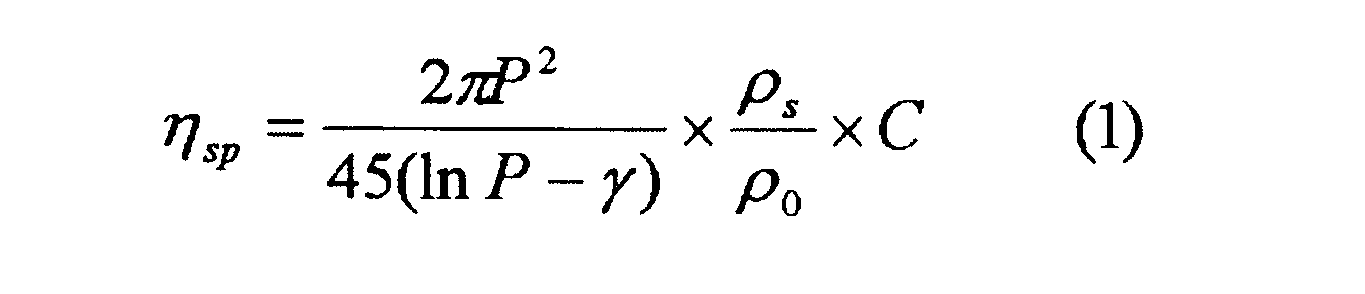
(結晶化度)
微細セルロース繊維の結晶化度は、高温時の粘性発現の観点から、好ましくは30%以上、より好ましくは35%以上、さらに好ましくは40%以上、よりさらに好ましくは45%以上である。また、使用するセルロース原料コストの観点から、好ましくは95%以下、より好ましくは90%以下、さらに好ましくは85%以下、よりさらに好ましくは80%以下である。なお、本明細書において、セルロースの結晶化度は、X線回折法による回折強度値からSegal法により算出したセルロースI型結晶化度であり、下記計算式(A)により定義される。
セルロースI型結晶化度(%)=[(I22.6-I18.5)/I22.6]×100 (A)
〔式中、I22.6は、X線回折における格子面(002面)(回折角2θ=22.6°)の回折強度、I18.5は,アモルファス部(回折角2θ=18.5°)の回折強度を示す〕
なお、セルロースI型とは天然セルロースの結晶形のことであり、セルロースI型結晶化度とは、セルロース全体のうち結晶領域量の占める割合のことを意味する。
微細セルロース繊維の結晶化度は、高温時の粘性発現の観点から、好ましくは30%以上、より好ましくは35%以上、さらに好ましくは40%以上、よりさらに好ましくは45%以上である。また、使用するセルロース原料コストの観点から、好ましくは95%以下、より好ましくは90%以下、さらに好ましくは85%以下、よりさらに好ましくは80%以下である。なお、本明細書において、セルロースの結晶化度は、X線回折法による回折強度値からSegal法により算出したセルロースI型結晶化度であり、下記計算式(A)により定義される。
セルロースI型結晶化度(%)=[(I22.6-I18.5)/I22.6]×100 (A)
〔式中、I22.6は、X線回折における格子面(002面)(回折角2θ=22.6°)の回折強度、I18.5は,アモルファス部(回折角2θ=18.5°)の回折強度を示す〕
なお、セルロースI型とは天然セルロースの結晶形のことであり、セルロースI型結晶化度とは、セルロース全体のうち結晶領域量の占める割合のことを意味する。
<製造方法>
本発明で用いられる微細セルロース繊維は、特に限定なく公知の方法に従って製造することができる。例えば、予め調製された微細セルロース繊維にアルカリ金属を導入する反応を行ってもよいし、微細セルロース繊維を調製する際にアルカリ金属を導入する反応を行ってもよい。なお、微細セルロース繊維は、公知の方法、例えば、特開2011-140632号公報に記載の方法により製造することができる。
本発明で用いられる微細セルロース繊維は、特に限定なく公知の方法に従って製造することができる。例えば、予め調製された微細セルロース繊維にアルカリ金属を導入する反応を行ってもよいし、微細セルロース繊維を調製する際にアルカリ金属を導入する反応を行ってもよい。なお、微細セルロース繊維は、公知の方法、例えば、特開2011-140632号公報に記載の方法により製造することができる。
具体的には、例えば、天然セルロース繊維をN-オキシル化合物存在下で酸化して、アルカリ金属塩型のカルボキシ基含有セルロース繊維を得る工程(酸化処理工程)と得られた繊維を微細化処理する工程(微細化工程)を含む製造方法により得ることができる。
(酸化処理工程)
まず、水中に天然セルロース繊維を分散させたスラリーを調製する。スラリーは、原料となる天然セルロース繊維(絶対乾燥基準:150℃にて30分間加熱乾燥させた後の天然セルロース繊維の質量)に対して約10~1000倍量(質量基準)の水を加え、ミキサー等で処理することにより得られる。天然セルロース繊維としては、例えば、針葉樹系パルプ、広葉樹系パルプ等の木材パルプ;コットンリンター、コットンリントのような綿系パルプ;麦わらパルプ、バガスパルプ等の非木材系パルプ;バクテリアセルロース等が挙げられ、これらの1種を単独で又は2種以上を組み合わせて用いることができる。天然セルロース繊維は、叩解等の表面積を高める処理が施されていてもよい。また、前記市販のパルプのセルロースI型結晶化度は、通常80%以上である。
まず、水中に天然セルロース繊維を分散させたスラリーを調製する。スラリーは、原料となる天然セルロース繊維(絶対乾燥基準:150℃にて30分間加熱乾燥させた後の天然セルロース繊維の質量)に対して約10~1000倍量(質量基準)の水を加え、ミキサー等で処理することにより得られる。天然セルロース繊維としては、例えば、針葉樹系パルプ、広葉樹系パルプ等の木材パルプ;コットンリンター、コットンリントのような綿系パルプ;麦わらパルプ、バガスパルプ等の非木材系パルプ;バクテリアセルロース等が挙げられ、これらの1種を単独で又は2種以上を組み合わせて用いることができる。天然セルロース繊維は、叩解等の表面積を高める処理が施されていてもよい。また、前記市販のパルプのセルロースI型結晶化度は、通常80%以上である。
次に、上記天然セルロース繊維を、N-オキシル化合物の存在下で酸化処理して、カルボキシ基含有セルロース繊維を得る(以下、単に「酸化処理」と称する場合がある)。
N-オキシル化合物としては、炭素数1又は2のアルキル基を有するピペリジンオキシル化合物、ピロリジンオキシル化合物、イミダゾリンオキシル化合物、及びアザアダマンタン化合物から選ばれる1種以上の複素環式のN-オキシル化合物が好ましい。これらの中では、反応性の観点から、炭素数1又は2のアルキル基を有するピペリジンオキシル化合物が好ましく、2,2,6,6-テトラアルキルピペリジン-1-オキシル(TEMPO)、4-ヒドロキシ-2,2,6,6-テトラアルキルピペリジン-1-オキシル、4-アルコキシ-2,2,6,6-テトラアルキルピペリジン-1-オキシル、4-ベンゾイルオキシ-2,2,6,6-テトラアルキルピペリジン-1-オキシル、4-アミノ-2,2,6,6-テトラアルキルピペリジン-1-オキシル等のジ-tert-アルキルニトロキシル化合物、4-アセトアミド-TEMPO、4-カルボキシ-TEMPO、4-ホスフォノキシ-TEMPO等が挙げられる。これらのピペリジンオキシル化合物の中では、2,2,6,6-テトラメチルピペリジン-1-オキシル(TEMPO)、4-ヒドロキシ-2,2,6,6-テトラメチルピペリジン-1-オキシル、4-メトキシ-2,2,6,6-テトラメチルピペリジン-1-オキシルがより好ましく、2,2,6,6テトラメチルピペリジン-1-オキシル(TEMPO)がさらに好ましい。
N-オキシル化合物の量は、触媒量であればよく、天然セルロース繊維(絶対乾燥基準)に対して、好ましくは0.001~10質量%、より好ましくは0.01~9質量%、さらに好ましくは0.1~8質量%、よりさらに好ましくは0.5~5質量%である。
天然セルロース繊維の酸化処理においては、酸化剤を使用することができる。酸化剤としては、溶媒をアルカリ性域に調整した場合の溶解度や反応速度等の観点から、酸素又は空気、過酸化物;ハロゲン、次亜ハロゲン酸、亜ハロゲン酸、過ハロゲン酸及びそれらのアルカリ金属塩又はアルカリ土類金属塩;ハロゲン酸化物、窒素酸化物等が挙げられる。これらの中でも、アルカリ金属次亜ハロゲン酸塩が好ましく、具体的には、次亜塩素酸ナトリウムや次亜臭素酸ナトリウムが例示される。酸化剤の使用量は、天然セルロース繊維のカルボキシ基置換度(酸化度)に応じて選択すればよく、また反応条件によって酸化反応収率が異なるため一概には決められないが、原料である天然セルロース繊維(絶対乾燥基準)に対し、好ましくは約1~100質量%となる範囲である。
また、酸化反応をより一層効率よく行うため、助触媒として、臭化ナトリウム、臭化カリウム等の臭化物や、ヨウ化ナトリウム、ヨウ化カリウム等のヨウ化物等を用いることができる。助触媒の量は、その機能を発揮できる有効量であればよく、特に制限はない。
酸化処理における反応温度は、反応の選択性、副反応の抑制の観点から、好ましくは50℃以下、より好ましくは40℃以下、更に好ましくは20℃以下であり、その下限は、好ましくは-5℃以上である。
また、反応系のpHは酸化剤の性質に合わせる観点から、本発明においては、水酸化ナトリウム、水酸化カリウム、水酸化リチウム等のアルカリ金属水酸化物を用いることができ、好ましくはコストの観点から水酸化ナトリウムまたは水酸化カリウム、より好ましくは水酸化ナトリウムを用いてアルカリ性域に調整する。具体的には、例えば、酸化剤として次亜塩素酸ナトリウムを用いる場合、反応系のpHは水酸化ナトリウムを用いてアルカリ側とすることが好ましく、pH7~13が好ましく、pH10~13がより好ましい。また、反応時間は1~240分間が望ましい。
上記酸化処理を行うことにより、カルボキシ基がアルカリ金属の塩となっている、カルボキシ基含有量が0.1mmol/g以上の、カルボキシ基含有セルロース繊維が得られる。
(精製工程)
前記酸化反応で得られるカルボキシ基含有セルロース繊維は、触媒として用いるTEMPO等のN-オキシル化合物や副生塩を含む。そのまま次工程を行ってもよいが、精製を行って純度の高いカルボキシ基含有セルロース繊維を得ることもできる。精製方法としては、酸化反応における溶媒の種類、生成物の酸化の程度、精製の程度により最適な方法を採用することができる。例えば、良溶媒として水、貧溶媒としてメタノール、エタノール、アセトン等を用いた再沈殿、ヘキサン等の水と相分離する溶媒へのTEMPO等の抽出、透析等による精製等が挙げられる。
前記酸化反応で得られるカルボキシ基含有セルロース繊維は、触媒として用いるTEMPO等のN-オキシル化合物や副生塩を含む。そのまま次工程を行ってもよいが、精製を行って純度の高いカルボキシ基含有セルロース繊維を得ることもできる。精製方法としては、酸化反応における溶媒の種類、生成物の酸化の程度、精製の程度により最適な方法を採用することができる。例えば、良溶媒として水、貧溶媒としてメタノール、エタノール、アセトン等を用いた再沈殿、ヘキサン等の水と相分離する溶媒へのTEMPO等の抽出、透析等による精製等が挙げられる。
(微細化工程)
前記精製工程後、得られたカルボキシ基含有セルロース繊維を微細化する工程を行う。微細化工程では、前記精製工程を経たカルボキシ基含有セルロース繊維を溶媒中に分散させ、微細化処理を行うことが好ましい。この微細化工程を行うことにより、数平均繊維径及び平均アスペクト比がそれぞれ前記範囲にある微細セルロース繊維が得られる。
前記精製工程後、得られたカルボキシ基含有セルロース繊維を微細化する工程を行う。微細化工程では、前記精製工程を経たカルボキシ基含有セルロース繊維を溶媒中に分散させ、微細化処理を行うことが好ましい。この微細化工程を行うことにより、数平均繊維径及び平均アスペクト比がそれぞれ前記範囲にある微細セルロース繊維が得られる。
分散媒としての溶媒は、水の他、メタノール、エタノール、プロパノール等の炭素数1~6、好ましくは炭素数1~3のアルコール;アセトン、メチルエチルケトン、メチルイソブチルケトン等の炭素数3~6のケトン;直鎖又は分岐状の炭素数1~6の飽和炭化水素又は不飽和炭化水素;ベンゼン、トルエン等の芳香族炭化水素;塩化メチレン、クロロホルム等のハロゲン化炭化水素;炭素数2~5の低級アルキルエーテル;N,N-ジメチルホルムアミド、N,N-ジメチルアセトアミド、ジメチルスルホキシド、コハク酸とトリエチレングリコールモノメチルエーテルとのジエステル等の極性溶媒等が例示される。これらは、単独で又は2種以上を混合して用いることができるが、微細化処理の操作性の観点から、水、炭素数1~6のアルコール、炭素数3~6のケトン、炭素数2~5の低級アルキルエーテル、N,N-ジメチルホルムアミド、N,N-ジメチルアセトアミド、ジメチルスルホキシド、コハク酸メチルトリグリコールジエステル等の極性溶媒が好ましく、環境負荷低減の観点から、水がより好ましい。溶媒の使用量は、カルボキシ基含有セルロース繊維を分散できる有効量であればよく、特に制限はないが、カルボキシ基含有セルロース繊維に対して、好ましくは1~500質量倍、より好ましくは2~200質量倍使用することがより好ましい。
また、微細化処理で使用する装置としては公知の分散機が好適に使用される。例えば、離解機、叩解機、低圧ホモジナイザー、高圧ホモジナイザー、グラインダー、カッターミル、ボールミル、ジェットミル、短軸押出機、2軸押出機、超音波攪拌機、家庭用ジューサーミキサー等を用いることができる。また、取扱い性の観点から、微細化処理における反応物繊維の固形分濃度は50質量%以下が好ましい。
微細化工程後に得られるカルボキシ基含有微細セルロース繊維の形態としては、必要に応じ、固形分濃度を調整した懸濁液状(目視的に無色透明又は不透明な液)、あるいは乾燥処理した粉末状(但し、微細セルロース繊維が凝集した粉末状であり、セルロース粒子を意味するものではない)とすることもできる。なお、懸濁液状にする場合、分散媒として水のみを使用してもよく、水と他の有機溶媒(例えば、エタノール等のアルコール類)や界面活性剤、酸、塩基等との混合溶媒を使用してもよい。
このような天然セルロース繊維の酸化処理及び微細化処理により、セルロース構成単位のC6位の水酸基がアルデヒド基を経由してカルボキシ基へと選択的に酸化され、前記カルボキシ基含有量が0.1mmol/g以上のセルロースからなる、数平均繊維径0.5nm以上200nm以下の微細化された、好ましくは30%以上の結晶化度を有するセルロース繊維を得ることができる。ここで、前記カルボキシ基含有微細セルロース繊維は、セルロースI型結晶構造を有している。これは、本発明で用いるカルボキシ基含有微細セルロース繊維が、I型結晶構造を有する天然由来のセルロース固体原料が表面酸化され微細化された繊維であることを意味する。
[(B)添加物]
本発明においては、炭素原子と窒素原子を有し、化合物1分子あたりのその比率(炭素原子数/窒素原子数)が3以上45以下である化合物を1種又は2種以上含む添加剤を用いる。前記比率を有する含窒素化合物を用いることにより、微細セルロース繊維間に比較的強固でかつ組み換え可能な架橋構造を形成する効果が奏される。
本発明においては、炭素原子と窒素原子を有し、化合物1分子あたりのその比率(炭素原子数/窒素原子数)が3以上45以下である化合物を1種又は2種以上含む添加剤を用いる。前記比率を有する含窒素化合物を用いることにより、微細セルロース繊維間に比較的強固でかつ組み換え可能な架橋構造を形成する効果が奏される。
前記比率を有する化合物としては、具体的には、4級アンモニウム塩、アミン、アミドを用いることができる。
(4級アンモニウム塩)
本発明で用いられる4級アンモニウム塩としては、化合物1分子あたりの炭素原子と窒素原子の比率(炭素原子数/窒素原子数)が3以上45以下の4級アンモニウムの塩である。
本発明で用いられる4級アンモニウム塩としては、化合物1分子あたりの炭素原子と窒素原子の比率(炭素原子数/窒素原子数)が3以上45以下の4級アンモニウムの塩である。
4級アンモニウムの前記比率は、増粘補助効果及び熱安定性の観点から、好ましくは4以上、より好ましくは6以上、更に好ましくは20以上である。また、増粘補助効果及び熱安定性、水溶解性の観点から、好ましくは40以下、より好ましくは35以下、更に好ましくは30以下、より更に好ましくは25以下である。
4級アンモニウムの化合物1分子あたりの炭素原子数は、増粘補助効果及び熱安定性を発現する観点から、好ましくは4以上、より好ましくは6以上、更に好ましくは12以上、更に好ましくは18以上である。また、水溶性の観点から、好ましくは45以下、より好ましくは35以下、更に好ましくは30以下、更に好ましくは25以下である。
4級アンモニウムの化合物1分子あたりの窒素原子数は、増粘補助効果及び熱安定性を発現する観点から、好ましくは1以上2以下であり、より好ましくは1である。
4級アンモニウムの対イオンとしては、特に限定はない。例えば、水溶性の観点から、好ましくはハロゲン原子であり、より好ましくはBr、Cl、Iであり、更に好ましくはBr、Clである。
4級アンモニウム塩の分子量は、増粘補助効果及び熱安定性を発現する観点から、好ましくは70以上、より好ましくは100以上、更に好ましくは200以上、更に好ましくは300以上、より更に好ましくは350以上であり、同様の観点から、好ましくは500以下、より好ましくは400以下である。
かかる4級アンモニウム塩化合物としては、例えば、一般式(1):
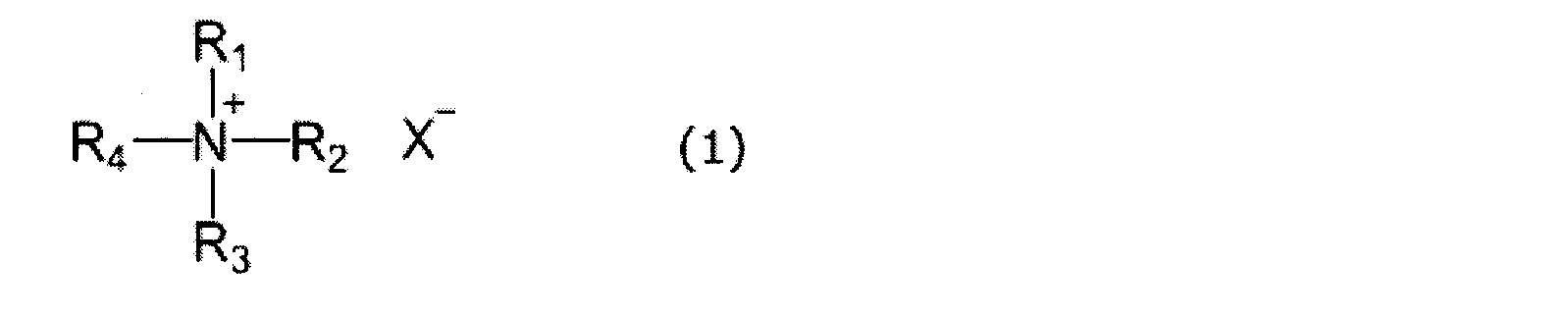
(式中、R1、R2、R3、R4は、同一又は異なって、炭素数1~20のアルキル基、炭素数6~20のアリール基、又は炭素数7~20のアラルキル基を示し、Xは、F、Br、Cl、又はIを示す)
で表される化合物を挙げることができる。
で表される化合物を挙げることができる。
一般式(1)におけるアルキル基としては、炭素数が好ましくは1~20であり、より好ましくは5~18であり、更に好ましくは8~16である。具体的には、メチル基、エチル基、プロピル基、イソプロピル基、ブチル基、イソブチル基、sec-ブチル基、tert-ブチル基、ペンチル基、イソペンチル基、ヘキシル基、ヘプチル基、オクチル基、ノニル基、デシル基、ウンデシル基、ドデシル基、トリデシル基、テトラデシル基、ペンタデシル基、ヘキサデシル基、ヘプタデシル基、オクタデシル基、ノナデシル基、イコシル基、及びこれらの基が後述する置換基で置換された基が挙げられる。R1、R2、R3、R4の総炭素数が前記範囲内となるのであれば、いずれであってもよい。
一般式(1)におけるアリール基としては、炭素数が好ましくは6~20であり、より好ましくは6~14であり、更に好ましくは6~10である。具体的には、フェニル基、ナフチル基、アントリル基、フェナントリル基、ビフェニル基、及びこれらの基が後述する置換基で置換された基が挙げられる。
一般式(1)におけるアラルキル基としては、炭素数が好ましくは7~20であり、より好ましくは7~14であり、更に好ましくは7~10である。具体的には、ベンジル基、フェネチル基、フェニルプロピル基、フェニルペンチル基、フェニルヘキシル基、フェニルヘプチル基、フェニルオクチル基、及びこれらの基の芳香族基が後述する置換基で置換された基などが挙げられる。
前記置換基としては、置換基を含めた官能基全体の総炭素数が前記範囲内となるものが好ましく、例えば、メチル基、エチル基、プロピル基、イソプロピル基、ブチル基、イソブチル基、sec-ブチル基、tert-ブチル基、ペンチル基、イソペンチル基、ヘキシル基等の炭素数1~6のアルキル基;メトキシ基、エトキシ基、プロポキシ基、イソプロポキシ基、ブトキシ基、イソブトキシ基、sec-ブトキシ基、tert-ブトキシ基、ペンチルオキシ基、イソペンチルオキシ基、ヘキシルオキシ基等の炭素数1~6のアルコキシ基;メトキシカルボニル基、エトキシカルボニル基、プロポキシカルボニル基、イソプロポキシカルボニル基、ブトキシカルボニル基、イソブトキシカルボニル基、sec-ブトキシカルボニル基、tert-ブトキシカルボニル基、ペンチルオキシカルボニル基、イソペンチルオキシカルボニル基等のアルコキシ基の炭素数が1~6のアルコキシ-カルボニル基;フッ素原子、塩素原子、臭素原子、ヨウ素原子等のハロゲン原子;アセチル基、プロピオニル基等の炭素数1~6のアシル基;アラルキル基;アラルキルオキシ基;炭素数1~6のアルキルアミノ基;アルキル基の炭素数が1~6のジアルキルアミノ基が挙げられる。なお、前記したアリール基、アラルキル基そのものが置換基として結合していてもよい。
一般式(1)におけるR1、R2、R3、R4は、総炭素数が前記範囲内となるのであれば、前記したアルキル基、アリール基、又はアラルキル基のいずれであってもよい。
一般式(1)におけるXは、F、Br、Cl、又はIが挙げられ、好ましくはBr、Cl、Iであり、より好ましくはBr、Clである。
一般式(1)で表される化合物の具体例としては、
テトラメチルアンモニウムハライド、テトラエチルアンモニウムハライド、テトラプロピルアンモニウムハライド、テトラブチルアンモニウムハライド、テトラペンチルアンモニウムハライド、テトラヘキシルアンモニウムハライド、テトラフェニルアンモニウムハライド、テトラベンジルアンモニウムハライド、
エチルトリメチルアンモニウムハライド、プロピルトリメチルアンモニウムハライド、ブチルトリメチルアンモニウムハライド、ペンチルトリメチルアンモニウムハライド、ヘキシルトリメチルアンモニウムハライド、オクチルトリメチルアンモニウムハライド、デシルトリメチルアンモニウムハライド、ドデシルトリメチルアンモニウムハライド、テトラデシルトリメチルアンモニウムハライド、ヘキサデシルトリメチルアンモニウムハライド、オクタデシルトリメチルアンモニウムハライド、フェニルトリメチルアンモニウムハライド、ベンジルトリメチルアンモニウムハライド、
ペンチルトリプロピルアンモニウムクロリド、ヘキシルトリプロピルアンモニウムクロリド、オクチルトリプロピルアンモニウムクロリド、デシルトリプロピルアンモニウムクロリド、フェニルトリプロピルアンモニウムクロリド、ベンジルトリプロピルアンモニウムクロリド、
ジオクチルジメチルアンモニウムハライド、ジデシルジメチルアンモニウムハライド、ジドデシルジメチルアンモニウムハライド、ジミリスチルジメチルアンモニウムハライド、ブチルベンジルジメチルアンモニウムクロリド、ペンチルベンジルジメチルアンモニウムクロリド、ヘキシルベンジルジメチルアンモニウムクロリド、オクチルベンジルジメチルアンモニウムクロリド、デシルベンジルジメチルアンモニウムクロリド、ドデシルベンジルジメチルアンモニウムクロリド、ミリスチルベンジルジメチルアンモニウムクロリド、パルミチルベンジルジメチルアンモニウムクロリド、ステアリルベンジルジメチルアンモニウムクロリド
が挙げられる。これらは単独で又は2種以上組み合わせて用いることができ、公知の方法に従って製造したものや市販品を用いることができる。
テトラメチルアンモニウムハライド、テトラエチルアンモニウムハライド、テトラプロピルアンモニウムハライド、テトラブチルアンモニウムハライド、テトラペンチルアンモニウムハライド、テトラヘキシルアンモニウムハライド、テトラフェニルアンモニウムハライド、テトラベンジルアンモニウムハライド、
エチルトリメチルアンモニウムハライド、プロピルトリメチルアンモニウムハライド、ブチルトリメチルアンモニウムハライド、ペンチルトリメチルアンモニウムハライド、ヘキシルトリメチルアンモニウムハライド、オクチルトリメチルアンモニウムハライド、デシルトリメチルアンモニウムハライド、ドデシルトリメチルアンモニウムハライド、テトラデシルトリメチルアンモニウムハライド、ヘキサデシルトリメチルアンモニウムハライド、オクタデシルトリメチルアンモニウムハライド、フェニルトリメチルアンモニウムハライド、ベンジルトリメチルアンモニウムハライド、
ペンチルトリプロピルアンモニウムクロリド、ヘキシルトリプロピルアンモニウムクロリド、オクチルトリプロピルアンモニウムクロリド、デシルトリプロピルアンモニウムクロリド、フェニルトリプロピルアンモニウムクロリド、ベンジルトリプロピルアンモニウムクロリド、
ジオクチルジメチルアンモニウムハライド、ジデシルジメチルアンモニウムハライド、ジドデシルジメチルアンモニウムハライド、ジミリスチルジメチルアンモニウムハライド、ブチルベンジルジメチルアンモニウムクロリド、ペンチルベンジルジメチルアンモニウムクロリド、ヘキシルベンジルジメチルアンモニウムクロリド、オクチルベンジルジメチルアンモニウムクロリド、デシルベンジルジメチルアンモニウムクロリド、ドデシルベンジルジメチルアンモニウムクロリド、ミリスチルベンジルジメチルアンモニウムクロリド、パルミチルベンジルジメチルアンモニウムクロリド、ステアリルベンジルジメチルアンモニウムクロリド
が挙げられる。これらは単独で又は2種以上組み合わせて用いることができ、公知の方法に従って製造したものや市販品を用いることができる。
なかでも、増粘補助効果及び熱安定性を発現する観点から、
テトラメチルアンモニウムハライド、テトラエチルアンモニウムハライド、テトラプロピルアンモニウムハライド、テトラブチルアンモニウムハライド、
ペンチルトリメチルアンモニウムハライド、ヘキシルトリメチルアンモニウムハライド、オクチルトリメチルアンモニウムハライド、デシルトリメチルアンモニウムハライド、ドデシルトリメチルアンモニウムハライド、テトラデシルトリメチルアンモニウムハライド、ヘキサデシルトリメチルアンモニウムハライド、オクタデシルトリメチルアンモニウムハライド、フェニルトリメチルアンモニウムハライド、ベンジルトリメチルアンモニウムハライド、フェニルトリプロピルアンモニウムクロリド、
ジオクチルジメチルアンモニウムハライド、ジデシルジメチルアンモニウムハライド、ジドデシルジメチルアンモニウムハライド、ジミリスチルジメチルアンモニウムハライド、オクチルベンジルジメチルアンモニウムクロリド、デシルベンジルジメチルアンモニウムクロリド、ドデシルベンジルジメチルアンモニウムクロリド、ミリスチルベンジルジメチルアンモニウムクロリド、パルミチルベンジルジメチルアンモニウムクロリド、ステアリルベンジルジメチルアンモニウムクロリドが好ましく、
ミリスチルベンジルジメチルアンモニウムクロリド、テトラメチルアンモニウムブロミド、テトラエチルアンモニウムブロミド、ヘキシルトリメチルアンモニウムブロミド、フェニルトリプロピルアンモニウムクロリドがより好ましく、
ミリスチルベンジルジメチルアンモニウムクロリドが更に好ましい。
テトラメチルアンモニウムハライド、テトラエチルアンモニウムハライド、テトラプロピルアンモニウムハライド、テトラブチルアンモニウムハライド、
ペンチルトリメチルアンモニウムハライド、ヘキシルトリメチルアンモニウムハライド、オクチルトリメチルアンモニウムハライド、デシルトリメチルアンモニウムハライド、ドデシルトリメチルアンモニウムハライド、テトラデシルトリメチルアンモニウムハライド、ヘキサデシルトリメチルアンモニウムハライド、オクタデシルトリメチルアンモニウムハライド、フェニルトリメチルアンモニウムハライド、ベンジルトリメチルアンモニウムハライド、フェニルトリプロピルアンモニウムクロリド、
ジオクチルジメチルアンモニウムハライド、ジデシルジメチルアンモニウムハライド、ジドデシルジメチルアンモニウムハライド、ジミリスチルジメチルアンモニウムハライド、オクチルベンジルジメチルアンモニウムクロリド、デシルベンジルジメチルアンモニウムクロリド、ドデシルベンジルジメチルアンモニウムクロリド、ミリスチルベンジルジメチルアンモニウムクロリド、パルミチルベンジルジメチルアンモニウムクロリド、ステアリルベンジルジメチルアンモニウムクロリドが好ましく、
ミリスチルベンジルジメチルアンモニウムクロリド、テトラメチルアンモニウムブロミド、テトラエチルアンモニウムブロミド、ヘキシルトリメチルアンモニウムブロミド、フェニルトリプロピルアンモニウムクロリドがより好ましく、
ミリスチルベンジルジメチルアンモニウムクロリドが更に好ましい。
(アミン)
本発明におけるアミンとしては、化合物1分子あたりの炭素原子と窒素原子の比率(炭素原子数/窒素原子数)が3以上45以下の、モノアミン、ジアミン、又は多価アミンを用いることができる。以下に、各アミンについて説明する。
本発明におけるアミンとしては、化合物1分子あたりの炭素原子と窒素原子の比率(炭素原子数/窒素原子数)が3以上45以下の、モノアミン、ジアミン、又は多価アミンを用いることができる。以下に、各アミンについて説明する。
本発明で用いられるモノアミンとしては、具体的には、例えば、一般式(2):

(式中、R5、R6、R7は、同一又は異なって、水素原子、炭素数1~10のアルキル基もしくはヒドロキシアルキル基、炭素数6~20のアリール基、炭素数7~20アラルキル基、又はヘテロ芳香環基を示す)
で表される化合物を挙げることができる。
で表される化合物を挙げることができる。
一般式(2)におけるアルキル基及びヒドロキシアルキル基としては、具体的には、一般式(1)におけるアルキル基として例示されたものののうち、炭素数が1~10のもの、及びこれらのアルキル基がヒドロキシ基で置換された基が挙げられる。
一般式(2)におけるアリール基としては、炭素数が好ましくは6~20、より好ましくは6~14、更に好ましくは6~10であり、一般式(1)におけるアリール基と同様のものが例示される。
一般式(2)におけるアラルキル基としては、炭素数が好ましくは7~20、より好ましくは7~14、更に好ましくは7~10であり、一般式(1)におけるアラルキル基と同様のものが例示される。
一般式(2)におけるヘテロ芳香環基としては、ピロール基、イミダゾール基、ピラゾール基、インドール基、ピリジン基、ベンズイミダゾール基、フェノチアジン基等が挙げられる。
これらのなかでも、増粘補助効果及び熱安定性を発現する観点から、一般式(2)におけるR5、R6、R7は、同一又は異なって、水素原子、炭素数1~10のアルキル基もしくはヒドロキシアルキル基、ヘテロ芳香環基が好ましく、水素原子、炭素数1~10のアルキル基がより好ましい。
モノアミンの前記比率(炭素原子数/窒素原子数)は、増粘補助効果及び熱安定性、水溶解性の観点から、好ましくは3以上、より好ましくは4以上、更に好ましくは5以上である。また、増粘補助効果及び熱安定性、水溶解性の観点から、好ましくは16以下、より好ましくは12以下、更に好ましくは10以下、より更に好ましくは8以下である。
モノアミンの化合物1分子あたりの炭素原子数は、増粘補助効果及び熱安定性を発現する観点から、好ましくは3以上、より好ましくは4以上、更に好ましくは5以上である。また、水溶性の観点から好ましくは16以下、より好ましくは12以下、更に好ましくは10以下、より更に好ましくは8以下である。
モノアミンの化合物1分子あたりの窒素原子数は、増粘補助効果及び熱安定性を発現する観点から、好ましくは1以上である。また、増粘補助効果及び熱安定性を発現する観点から、好ましくは4以下、より好ましくは3以下、更に好ましくは2以下である。
モノアミンの分子量は、増粘補助効果及び熱安定性を発現する観点から、好ましくは60以上、より好ましくは80以上、更に好ましくは100以上である。また、増粘補助効果及び熱安定性を発現する観点から、好ましくは650以下、より好ましくは300以下、更に好ましくは150以下である。
本発明で用いられるモノアミンとしては、第1級アミン、第2級アミン、第3級アミンのいずれでもよい。
一般式(2)で表される化合物の具体例としては、
1級モノアミン:プロピルアミン、ブチルアミン、ペンチルアミン、ヘキシルアミン、オクチルアミン、デシルアミン、ドデシルアミン、ポリオキシエチレンアミン(重合度1~6)、ポリオキシプロピレンアミン(重合度1~4)、ポリオキシエチレン/プロピレンアミン(重合度1~5)
2級モノアミン:ジエチルアミン、ジプロピルアミン、ジブチルアミン、ジペンチルアミン、ジヘキシルアミン、ジオクチルアミン、ジデシルアミン、ジエタノールアミン
3級モノアミン:トリメチルアミン、トリエチルアミン、トリプロピルアミン、トリブチルアミン、トリペンチルアミン、トリヘキシルアミン、トリオクチルアミン、トリエタノールアミン、ジメチルアミノエタノール、ジメチルアミノプロパノール、ジメチルアミノブタノール、ジメチルアミノペンタノール、ジメチルアミノヘキサノール、ジメチルアミノオクタノール、ジメチルアミノデカノール、N,N-ジメチル-4-アミノピリジン
が挙げられる。これらは単独で又は2種以上組み合わせて用いることができ、公知の方法に従って製造したものや市販品を用いることができる。
1級モノアミン:プロピルアミン、ブチルアミン、ペンチルアミン、ヘキシルアミン、オクチルアミン、デシルアミン、ドデシルアミン、ポリオキシエチレンアミン(重合度1~6)、ポリオキシプロピレンアミン(重合度1~4)、ポリオキシエチレン/プロピレンアミン(重合度1~5)
2級モノアミン:ジエチルアミン、ジプロピルアミン、ジブチルアミン、ジペンチルアミン、ジヘキシルアミン、ジオクチルアミン、ジデシルアミン、ジエタノールアミン
3級モノアミン:トリメチルアミン、トリエチルアミン、トリプロピルアミン、トリブチルアミン、トリペンチルアミン、トリヘキシルアミン、トリオクチルアミン、トリエタノールアミン、ジメチルアミノエタノール、ジメチルアミノプロパノール、ジメチルアミノブタノール、ジメチルアミノペンタノール、ジメチルアミノヘキサノール、ジメチルアミノオクタノール、ジメチルアミノデカノール、N,N-ジメチル-4-アミノピリジン
が挙げられる。これらは単独で又は2種以上組み合わせて用いることができ、公知の方法に従って製造したものや市販品を用いることができる。
なかでも、増粘補助効果及び熱安定性を発現する観点から、
1級モノアミン:ペンチルアミン、ヘキシルアミン、オクチルアミン
2級モノアミン:ジエチルアミン、ジプロピルアミン、ジブチルアミン
3級モノアミン:トリエチルアミン、トリプロピルアミン、ジメチルアミノヘキサノール、N,N-ジメチル-4-アミノピリジン
が好ましく、
ヘキシルアミン、ジプロピルアミン、トリエチルアミン、ジメチルアミノヘキサノール、N,N-ジメチル-4-アミノピリジンがより好ましく、
ジメチルアミノヘキサノールが更に好ましい。
1級モノアミン:ペンチルアミン、ヘキシルアミン、オクチルアミン
2級モノアミン:ジエチルアミン、ジプロピルアミン、ジブチルアミン
3級モノアミン:トリエチルアミン、トリプロピルアミン、ジメチルアミノヘキサノール、N,N-ジメチル-4-アミノピリジン
が好ましく、
ヘキシルアミン、ジプロピルアミン、トリエチルアミン、ジメチルアミノヘキサノール、N,N-ジメチル-4-アミノピリジンがより好ましく、
ジメチルアミノヘキサノールが更に好ましい。
本発明で用いられるジアミンとしては、具体的には、例えば、一般式(3):

(式中、R8は炭素数3~18の(シクロ)アルキレン基又は炭素数3~24のポリオキシアルキレン基を示し、R9、R10、R11、R12は、同一又は異なって、水素原子又はメチル基を示す)
で表される化合物を挙げることができる。
で表される化合物を挙げることができる。
一般式(3)における(シクロ)アルキレン基としては、炭素数が好ましくは3~18のアルキレン基又はシクロアルキレン基である。具体的には、プロピレン基、シクロプロピレン基、ブチレン基、シクロブチレン基、ペンチレン基、シクロペンチレン基、ヘキシレン基、シクロヘキシレン基、ヘプチレン基、オクチレン基、ノニレン基、デシレン基、ウンデシレン基、ドデシレン基、トリデシレン基、テトラデシレン基、ヘキサデシレン基、オクタデシレン基、及びこれらにおけるアルキレン基が前記一般式(1)における官能基と同じ官能基で置換された基が挙げられる。
一般式(3)におけるポリオキシアルキレン基としては、炭素数が好ましくは3~24であり、より好ましくは5~14である。具体的には、一般式(2)におけるポリオキシアルキレン基として例示されたもののうち、炭素数が3~24のものが例示される。
ジアミンの前記比率(炭素原子数/窒素原子数)は、増粘補助効果及び熱安定性、水溶解性の観点から、好ましくは5以上、より好ましくは6以上である。また、増粘補助効果及び熱安定性、水溶解性の観点から、好ましくは16以下、より好ましくは12以下、更に好ましくは10以下、より更に好ましくは8以下である。
ジアミンの化合物1分子あたりの炭素原子数は、増粘補助効果及び熱安定性を発現する観点から、好ましくは3以上、より好ましくは5以上、更に好ましくは8以上である。また、水溶性の観点から、好ましくは30以下、より好ましくは20以下、更に好ましくは14以下である。
ジアミンの化合物1分子あたりの窒素原子数は、増粘補助効果及び熱安定性を発現する観点から、好ましくは2以上である。また、増粘補助効果及び熱安定性を発現する観点から、好ましくは5以下、より好ましくは4以下、更に好ましくは3以下である。
ジアミンの分子量は、増粘補助効果及び熱安定性を発現する観点から、好ましくは70以上、より好ましくは100以上である。また、増粘補助効果及び熱安定性を発現する観点から、好ましくは1000以下、より好ましくは600以下、更に好ましくは400以下である。
本発明で用いられるジアミンとしては、第1級ジアミン、第2級ジアミン、第3級ジアミンのいずれでもよいが、入手性の観点から、第1級ジアミン又は第3級ジアミンが好ましい。
一般式(3)で表される化合物の具体例としては、
1級ジアミン:1,4-シクロヘキサンジアミン、1,6-ヘキサンジアミン、1,7-ヘプタンジアミン、1,8-オクタンジアミン、1,9-ノナンジアミン、1,10-デカンジアミン、1,11-ウンデカンジアミン、1,12-ドデカンジアミン、1,13-トリデカンジアミン、1,14-テトラデカンジアミン、ポリオキシエチレンジアミン(重合度1~15、2~10、3~8)、ポリオキシプロピレンジアミン(重合度1~10、2~7)、ポリオキシエチレン/プロピレンジアミン(重合度1~12、2~8、3~7)
3級ジアミン:N,N,N,N-テトラメチル-1,2-エタンジアミン、N,N,N,N-テトラメチル-1,3-プロパンジアミン、N,N,N,N-テトラメチル-1,4-ブタンジアミン、N,N,N,N-テトラメチル-1,5-ペンタンジアミン、N,N,N,N-テトラメチル-1,6-ヘキサンジアミン、N,N,N,N-テトラメチル-1,8-オクタンジアミン、N,N,N,N-テトラメチル-1,10-デカンジアミン、N,N,N,N-テトラメチル-1,12-ドデカンジアミン
が挙げられる。これらは単独で又は2種以上組み合わせて用いることができ、公知の方法に従って製造したものや市販品を用いることができる。例えば、トリオキシプロピレンジアミンとしては、三井化学社製のジェファーミン D-230を、ヘキサオキシプロピレンジアミンとしては、三井化学社製のジェファーミン D-400を用いることが出来る。
1級ジアミン:1,4-シクロヘキサンジアミン、1,6-ヘキサンジアミン、1,7-ヘプタンジアミン、1,8-オクタンジアミン、1,9-ノナンジアミン、1,10-デカンジアミン、1,11-ウンデカンジアミン、1,12-ドデカンジアミン、1,13-トリデカンジアミン、1,14-テトラデカンジアミン、ポリオキシエチレンジアミン(重合度1~15、2~10、3~8)、ポリオキシプロピレンジアミン(重合度1~10、2~7)、ポリオキシエチレン/プロピレンジアミン(重合度1~12、2~8、3~7)
3級ジアミン:N,N,N,N-テトラメチル-1,2-エタンジアミン、N,N,N,N-テトラメチル-1,3-プロパンジアミン、N,N,N,N-テトラメチル-1,4-ブタンジアミン、N,N,N,N-テトラメチル-1,5-ペンタンジアミン、N,N,N,N-テトラメチル-1,6-ヘキサンジアミン、N,N,N,N-テトラメチル-1,8-オクタンジアミン、N,N,N,N-テトラメチル-1,10-デカンジアミン、N,N,N,N-テトラメチル-1,12-ドデカンジアミン
が挙げられる。これらは単独で又は2種以上組み合わせて用いることができ、公知の方法に従って製造したものや市販品を用いることができる。例えば、トリオキシプロピレンジアミンとしては、三井化学社製のジェファーミン D-230を、ヘキサオキシプロピレンジアミンとしては、三井化学社製のジェファーミン D-400を用いることが出来る。
なかでも、増粘補助効果及び熱安定性を発現する観点から、
1級ジアミン:1,4-シクロヘキサンジアミン、1,6-ヘキサンジアミン、1,7-ヘプタンジアミン、1,8-オクタンジアミン、1,9-ノナンジアミン、1,10-デカンジアミン、1,11-ウンデカンジアミン、1,12-ドデカンジアミン、1,13-トリデカンジアミン、1,14-テトラデカンジアミン、ポリオキシプロピレンジアミン(重合度1~10、2~7)
3級ジアミン:N,N,N,N-テトラメチル-1,5-ペンタンジアミン、N,N,N,N-テトラメチル-1,6-ヘキサンジアミン、N,N,N,N-テトラメチル-1,8-オクタンジアミン、N,N,N,N-テトラメチル-1,10-デカンジアミン、N,N,N,N-テトラメチル-1,12-ドデカンジアミン
が好ましく、
シクロヘキサンジアミン、テトラメチルヘキサンジアミン、トリオキシプロピレンジアミン、ドデカンジアミン、ヘキサオキシプロピレンジアミンがより好ましく、
トリオキシプロピレンジアミン、ドデカンジアミンが更に好ましい。
1級ジアミン:1,4-シクロヘキサンジアミン、1,6-ヘキサンジアミン、1,7-ヘプタンジアミン、1,8-オクタンジアミン、1,9-ノナンジアミン、1,10-デカンジアミン、1,11-ウンデカンジアミン、1,12-ドデカンジアミン、1,13-トリデカンジアミン、1,14-テトラデカンジアミン、ポリオキシプロピレンジアミン(重合度1~10、2~7)
3級ジアミン:N,N,N,N-テトラメチル-1,5-ペンタンジアミン、N,N,N,N-テトラメチル-1,6-ヘキサンジアミン、N,N,N,N-テトラメチル-1,8-オクタンジアミン、N,N,N,N-テトラメチル-1,10-デカンジアミン、N,N,N,N-テトラメチル-1,12-ドデカンジアミン
が好ましく、
シクロヘキサンジアミン、テトラメチルヘキサンジアミン、トリオキシプロピレンジアミン、ドデカンジアミン、ヘキサオキシプロピレンジアミンがより好ましく、
トリオキシプロピレンジアミン、ドデカンジアミンが更に好ましい。
本発明で用いられる多価アミンとしては、具体的には、例えば、一般式(4):
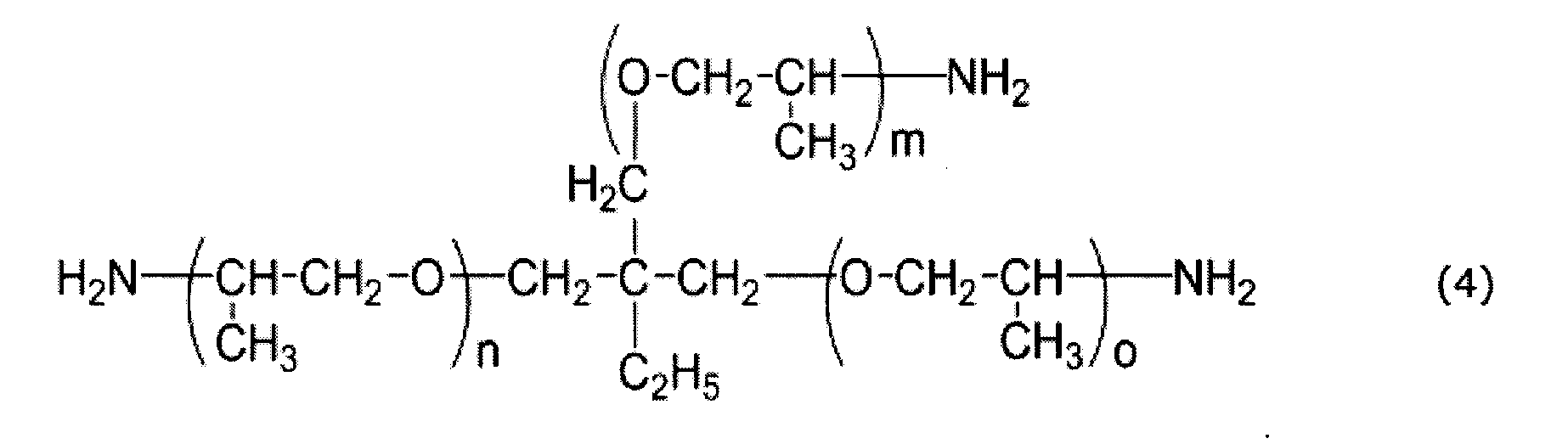
(式中、m、n、oはそれぞれ独立してオキシプロピレン基の平均付加モル数を示し、m+n+oが1以上12以下を満足する数である)
で表されるトリアミンが挙げられる。
で表されるトリアミンが挙げられる。
一般式(4)におけるm、n、oは、それぞれ独立してオキシプロピレン基の平均付加モル数を示し、m+n+oが好ましくは1以上、より好ましくは3以上、更に好ましくは4以上であり、好ましくは12以下、より好ましくは8以下、更に好ましくは6以下を満足する数である。
一般式(4)化合物の前記比率(炭素原子数/窒素原子数)は、増粘補助効果及び熱安定性、水溶解性の観点から、好ましくは5以上、より好ましくは6以上である。また、増粘補助効果及び熱安定性、水溶解性の観点から、好ましくは16以下、より好ましくは12以下、更に好ましくは9以下である。
一般式(4)化合物の化合物1分子あたりの炭素原子数は、増粘補助効果及び熱安定性を発現する観点から、好ましくは9以上、より好ましくは15以上、更に好ましくは18以上である。また、増粘補助効果及び熱安定性を発現する観点から、好ましくは42以下、より好ましくは30以下、更に好ましくは24以下である。
一般式(4)化合物の分子量は、増粘補助効果及び熱安定性を発現する観点から、好ましくは180以上、より好ましくは300以上、更に好ましくは350以上である。また、増粘補助効果及び熱安定性を発現する観点から、好ましくは850以下、より好ましくは600以下、更に好ましくは500以下である。
一般式(4)で表される化合物の具体例としては、ポリオキシプロピレントリアミン(重合度2~14、重合度3~10、重合度3~8)が挙げられる。これらは単独で又は2種以上組み合わせて用いることができ、公知の方法に従って製造したものや市販品を用いることができる。例えば、ペンタオキシプロピレントリアミンとしては、三井化学社製のジェファーミン T-403を用いることが出来る。
また、本発明における多価アミンとしては、一般式(5):

(式中、R13は水素原子、ヒドロキシ基、又は炭素数1~10のアルキル基もしくはヒドロキシアルキル基を示し、R14は炭素数1~8のアルキレン基を示し、R15は水素原子、ヒドロキシ基、又は炭素数1~6のアルキル基もしくはヒドロキシアルキル基を示し、R16は水素原子又はヒドロキシ基を示し、pは3~6を示す)
で表される化合物を挙げることができる。
で表される化合物を挙げることができる。
一般式(5)におけるR13は水素原子、ヒドロキシ基、又は炭素数1~10のアルキル基もしくはヒドロキシアルキル基を示す。炭素数1~10のアルキル基もしくはヒドロキシアルキル基としては、一般式(2)におけるアルキル基もしくはヒドロキシアルキル基と同様のものが挙げられるが、炭素数が4~8のものが好ましい。これらのなかでも、R13は炭素数1~10のヒドロキシアルキル基が好ましい。
一般式(5)におけるR14は炭素数1~8のアルキレン基を示す。具体的には、メチレン基、エチレン基、プロピレン基、ブチレン基、ペンチレン基、ヘキシレン基、ヘプチレン基、オクチレン基、及びこれらが一般式(1)における置換基で置換された基が例示される。なかでも炭素数4~6のものが好ましい。
一般式(5)におけるR15は水素原子、ヒドロキシ基、又は炭素数1~6のアルキル基もしくはヒドロキシアルキル基を示す。炭素数1~6のアルキル基もしくはヒドロキシアルキル基としては、一般式(2)におけるアルキル基もしくはヒドロキシアルキル基において例示されるもののうち、炭素数1~6のものが例示され、なかでも炭素数1~3のものが好ましい。
一般式(5)におけるR16は水素原子又はヒドロキシ基を示す。
一般式(5)におけるpは3~6が好ましく、3~5がより好ましく、3~4が更に好ましい。
一般式(5)化合物の前記比率(炭素原子数/窒素原子数)は、増粘補助効果及び熱安定性、水溶解性の観点から、好ましくは5以上、より好ましくは6以上、更に好ましくは8以上である。また、増粘補助効果及び熱安定性、水溶解性の観点から、好ましくは16以下、より好ましくは12以下、更に好ましくは9以下である。
一般式(5)化合物の化合物1分子あたりの炭素原子数は、増粘補助効果及び熱安定性を発現する観点から、好ましくは10以上、より好ましくは15以上、更に好ましくは20以上、より更に好ましくは25以上である。また、増粘補助効果及び熱安定性を発現する観点から、好ましくは50以下、より好ましくは45以下、更に好ましくは42以下、より更に好ましくは30以下である。
一般式(5)化合物の化合物1分子あたりの窒素原子数は、3以上であるが、入手性の観点から、好ましくは6以下、より好ましくは5以下、更に好ましくは4以下である。
一般式(5)化合物の分子量は、増粘補助効果及び熱安定性を発現する観点から、好ましくは70以上、より好ましくは100以上、更に好ましくは130以上である。また、入手性の観点から、好ましくは2000以下、より好ましくは1500以下、更に好ましくは1000以下である。
一般式(5)で表される化合物の具体例としては、モノ3級アミングリコール、ジ3級アミングリコール、トリ3級アミングリコール、テトラ3級アミングリコール、ペンタ3級アミングリコール、ヘキサ3級アミングリコールが挙げられる。これらは単独で又は2種以上組み合わせて用いることができ、公知の方法に従って製造したものや市販品を用いることができる。例えば、トリ3級アミングリコールとしては、花王社製のカオーライザー P-200を用いることが出来る。
(アミド)
本発明で用いられるアミドとしては、化合物1分子あたりの炭素原子と窒素原子の比率(炭素原子数/窒素原子数)が3以上45以下の、例えば、一般式(6):
本発明で用いられるアミドとしては、化合物1分子あたりの炭素原子と窒素原子の比率(炭素原子数/窒素原子数)が3以上45以下の、例えば、一般式(6):

(式中、R17は炭素数6~18のアルキル基を示し、R18、R19は、同一又は異なって、水素原子、又は炭素数1~8のアルキル基もしくはヒドロキシアルキル基を示す)
で表される化合物を挙げることができる。
で表される化合物を挙げることができる。
一般式(6)における炭素数6~18のアルキル基としては、一般式(1)におけるアルキル基において例示されるもののうち炭素数6~18のものが例示され、なかでも炭素数8~16のものが好ましく、炭素数10~14のものがより好ましい。
一般式(6)における炭素数1~8のアルキル基もしくはヒドロキシアルキル基としては、一般式(2)におけるアルキル基もしくはヒドロキシアルキル基において例示されるもののうち炭素数1~8のものが例示され、なかでも炭素数1~5のものが好ましい。
一般式(6)化合物の前記比率(炭素原子数/窒素原子数)は、増粘補助効果及び熱安定性の観点から、好ましくは4以上、より好ましくは6以上、更に好ましくは10以上である。また、増粘補助効果及び熱安定性の観点から、好ましくは40以下、より好ましくは35以下、更に好ましくは30以下、より更に好ましくは25以下である。
一般式(6)化合物の化合物1分子あたりの炭素原子数は、増粘補助効果及び熱安定性を発現する観点から、好ましくは3以上、より好ましくは10以上、更に好ましくは14以上である。また、増粘補助効果及び熱安定性を発現する観点から、好ましくは25以下、より好ましくは20以下、更に好ましくは18以下である。
一般式(6)化合物の分子量は、増粘補助効果及び熱安定性を発現する観点から、好ましくは70以上、より好ましくは100以上、更に好ましくは150以上である。また、増粘補助効果及び熱安定性を発現する観点から、好ましくは500以下、より好ましくは350以下、更に好ましくは300以下である。
一般式(6)で表される化合物の具体例としては、
オクチルモノエタノールアミド、デシルモノエタノールアミド、ラウリルモノエタノールアミド、ミリスチルモノエタノールアミド、パルミチルモノエタノールアミド、ステアリルモノエタノールアミド、オレイルモノエタノールアミド
オクチルジエタノールアミド、デシルジエタノールアミド、ラウリルジエタノールアミド、ミリスチルジエタノールアミド、パルミチルジエタノールアミド、ステアリルジエタノールアミド、オレイルジエタノールアミド、オクチルメチルエタノールアミド、デシルメチルエタノールアミド、ラウリルメチルエタノールアミド、ミリスチルメチルエタノールアミド、パルミチルメチルエタノールアミド、ステアリルメチルエタノールアミド、オレイルメチルエタノールアミド
が挙げられる。これらは単独で又は2種以上組み合わせて用いることができ、公知の方法に従って製造したものや市販品を用いることができる。
オクチルモノエタノールアミド、デシルモノエタノールアミド、ラウリルモノエタノールアミド、ミリスチルモノエタノールアミド、パルミチルモノエタノールアミド、ステアリルモノエタノールアミド、オレイルモノエタノールアミド
オクチルジエタノールアミド、デシルジエタノールアミド、ラウリルジエタノールアミド、ミリスチルジエタノールアミド、パルミチルジエタノールアミド、ステアリルジエタノールアミド、オレイルジエタノールアミド、オクチルメチルエタノールアミド、デシルメチルエタノールアミド、ラウリルメチルエタノールアミド、ミリスチルメチルエタノールアミド、パルミチルメチルエタノールアミド、ステアリルメチルエタノールアミド、オレイルメチルエタノールアミド
が挙げられる。これらは単独で又は2種以上組み合わせて用いることができ、公知の方法に従って製造したものや市販品を用いることができる。
なかでも、増粘補助効果及び熱安定性を発現する観点から、
ミリスチルモノエタノールアミド、パルミチルモノエタノールアミド、ステアリルモノエタノールアミド、オレイルモノエタノールアミド
デシルジエタノールアミド、ラウリルジエタノールアミド、ミリスチルジエタノールアミド
が好ましく、
ラウリルジエタノールアミドがより好ましい。
ミリスチルモノエタノールアミド、パルミチルモノエタノールアミド、ステアリルモノエタノールアミド、オレイルモノエタノールアミド
デシルジエタノールアミド、ラウリルジエタノールアミド、ミリスチルジエタノールアミド
が好ましく、
ラウリルジエタノールアミドがより好ましい。
本発明では、前記比率を有する化合物として、これらの4級アンモニウム塩、アミン、及びアミドからなる群より選ばれる1種又は2種以上を用いることが好ましく、前記した4級アンモニウム塩、アミン、及びアミドの(B)成分中の含有量は、増粘補助効果及び熱安定性を発現する観点から、好ましくは50質量%以上、より好ましくは80質量%以上、更に好ましくは90質量%以上、更に好ましくは実質的に100質量%である。なお、本明細書において、前記添加剤を構成する前記した4級アンモニウム塩、アミン、及びアミドの含有量とは、複数の化合物が含有される場合には、総含有量のことを意味する。
本発明の水系組成物は、前記(A)、(B)成分を含有する以外に、本発明の効果を損なわない範囲で、粘土鉱物、崩壊防止剤、比重調整剤、水溶性高分子、紫外線防御剤、保湿剤、消泡剤、分散剤、アルコール、界面活性剤、防腐剤、酸化防止剤、キレート剤、pH調整剤等を含有することができる。それらの含有量は特に限定されない。
本発明の水系組成物における前記(A)成分の含有量は、0.2質量%以上10質量%以下であるが、増粘効果の観点から、好ましくは0.3質量%以上、より好ましくは0.4質量%以上である。また、取扱い性及びコストの観点から、好ましくは5質量%以下、より好ましくは3質量%以下、更に好ましくは1質量%以下、より更に好ましくは0.7質量%以下である。
本発明の水系組成物における前記(B)成分の含有量は、増粘補助効果及び熱安定性を発現する観点から、好ましくは0.02質量%以上、より好ましくは0.05質量%以上、更に好ましくは0.07質量%以上、より更に好ましくは0.09質量%以上である。また、増粘補助効果、熱安定性、及びコストの観点から、好ましくは1質量%以下、より好ましくは0.5質量%以下、更に好ましくは0.3質量%以下、更に好ましくは0.2質量%以下、より更に好ましくは0.15質量%以下である。
また、前記(B)成分の含有量は、(A)成分100質量部に対して、3質量部以上150質量部以下であるが、増粘補助効果及び熱安定性を発現する観点から、好ましくは5質量部以上、より好ましくは10質量部以上、更に好ましくは15質量部以上である。また、増粘補助効果、熱安定性、及びコストの観点から、好ましくは100質量部以下、より好ましくは50質量部以下、更に好ましくは40質量部以下、より更に好ましくは30質量部以下である。
本発明の水系組成物は、前記(A)、(B)成分を含有するのであれば、公知の方法に従って調製することができる。例えば、前記成分を水性媒体中に攪拌機で分散することにより得られる。水性媒体としては、水分を少なくとも10質量%以上含有する液状媒体を指し、水系組成物中の水性媒体の含有量は特に限定されないが、粘性発現の観点から、好ましくは30質量%以上、より好ましくは40質量%以上、更に好ましくは50質量%以上、更に好ましくは70質量%以上、更に好ましくは80質量%以上、更に好ましくは90質量%以上であり、上限は特に限定されないが、好ましくは99.7質量%以下である。
得られた本発明の水系組成物は、80℃、回転速度30rpmにおける粘度が80mPa・s以上を示すが、粘性液体を得る観点から、好ましくは90mPa・s以上であり、より好ましくは100mPa・s以上であり、更に好ましくは120mPa・s以上である。また、ハンドリング性の観点から、好ましくは100,000mPa・s以下であり、より好ましくは50,000mPa・s以下であり、更に好ましくは30,000mPa・s以下であり、より更に好ましくは10,000mPa・s以下である。なお、本明細書において、粘度はB型粘度計を用いて測定した値のことである。
また、本発明の水系組成物は高温下においても高い粘性を示す、即ち、常温から高温にかけての温度領域での粘性変動が少ないことから、例えば、回転速度30rpmにおける80℃における粘度と25℃における粘度の比(80℃/25℃)が、好ましくは0.6~3.5、より好ましくは0.7~2.0、更に好ましくは0.8~1.5である。
また更に、本発明の水系組成物はチキソ性にも優れることから、例えば、温度25℃において、回転速度3rpmにおける粘度と回転速度30rpmにおける粘度の比(3rpm/30rpm)が、好ましくは2以上、より好ましくは2.5以上、更に好ましくは3以上である。また、上限は特に限定されず、10程度である。
本発明の水系組成物は、加工性が良好で、かつ、増粘性や耐熱性に優れるため、クリームや乳液、口紅などの化粧品、芳香剤やシャンプー、染髪剤などの家庭用品、発泡剤やペンキ、コンクリートなどの工業製品に好適に用いることができる。
本発明の水系組成物は、加工性が良好で、かつ、耐熱性に優れるため、打杭工事や石油等の地中からの回収作業の際に好適に用いることができる。具体的には、掘削用流体、スペーサー流体、坑井刺激用の圧入流体、及び回収増進用の後押し流体からなる群より選ばれるいずれかの流体として用いることが好ましい。
本発明はまた、本発明の水系組成物が高温下においても良好な粘性を発揮することから、本発明の水系組成物を用いる態様として、例えば、以下の態様1及び態様2の方法を提供する。
態様1:本発明の水系組成物を用いて地下層を処理することを特徴とする、地下層の処理方法。
態様2:本発明の水系組成物を地中の掘削穴先端に送り込み、掘削により生じた土砂や岩石を地上に回収する、掘削により生じた土砂や岩石の回収方法。
態様1:本発明の水系組成物を用いて地下層を処理することを特徴とする、地下層の処理方法。
態様2:本発明の水系組成物を地中の掘削穴先端に送り込み、掘削により生じた土砂や岩石を地上に回収する、掘削により生じた土砂や岩石の回収方法。
態様1においては、本発明の水系組成物を、例えば、掘削用流体、スペーサー流体、坑井刺激用の圧入流体、及び回収増進用の後押し流体からなる群より選ばれるいずれかの流体として用いることで、地下層における天然ガス又は原油を採取することが可能となる。ここで、本発明の水系組成物は、従来の、掘削用流体、スペーサー流体、坑井刺激用の圧入流体、回収増進用の後押し流体等への適用と何ら変わりなく適用することが可能でありながら、本発明の水系組成物は耐熱性に優れることから、作業性が向上するという効果が奏される。
態様2においては、本発明の水系組成物を地中の掘削穴先端に送り込むことで、掘削により生じた土砂や岩石を本発明の水系組成物中に分散させることで、その粘性効果により地上に回収しやすくなるという効果が奏される。例えば、油田の油井掘削の際に好適に用いられる。
上述した実施形態に関し、本発明は、さらに、以下の水系組成物、及びその使用を開示する。
<1> (A)数平均繊維径が0.5nm以上200nm以下であり、カルボキシ基含有量が0.1mmol/g以上であり、該カルボキシ基がアルカリ金属との塩となっている、微細セルロース繊維、及び
(B)炭素原子と窒素原子を有し、化合物1分子あたりのその比率(炭素原子数/窒素原子数)が3以上45以下である化合物を1種又は2種以上含む添加剤
を含有し、前記(A)成分の含有量が0.2質量%以上10質量%以下であり、前記(B)成分の含有量が(A)成分100質量部に対して3質量部以上150質量部以下であり、80℃、回転速度30rpmにおける組成物の粘度が80mPa・s以上である、水系組成物。
(B)炭素原子と窒素原子を有し、化合物1分子あたりのその比率(炭素原子数/窒素原子数)が3以上45以下である化合物を1種又は2種以上含む添加剤
を含有し、前記(A)成分の含有量が0.2質量%以上10質量%以下であり、前記(B)成分の含有量が(A)成分100質量部に対して3質量部以上150質量部以下であり、80℃、回転速度30rpmにおける組成物の粘度が80mPa・s以上である、水系組成物。
<2> 微細セルロース繊維の数平均繊維径が、好ましくは0.8nm以上、より好ましくは1.0nm以上であり、好ましくは100nm以下、より好ましくは50nm以下、更に好ましくは20nm以下、更に好ましくは10nm以下、より更に好ましくは5nm以下である、前記<1>記載の水系組成物。
<3> 微細セルロース繊維のカルボキシ基含有量が、好ましくは0.4mmol/g以上、より好ましくは0.6mmol/g以上、更に好ましくは0.8mmol/g以上であり、好ましくは3.0mmol/g以下、より好ましくは2.7mmol/g以下、更に好ましくは2.5mmol/g以下、より更に好ましくは2.0mmol/g以下である、前記<1>又は<2>記載の水系組成物。
<4> 微細セルロース繊維におけるアルカリ金属の塩が、好ましくはLi、Na、K、Rbであり、より好ましくはNa、Kであり、更に好ましくはNaである、前記<1>~<3>いずれか記載の水系組成物。
<5> 微細セルロース繊維の平均アスペクト比(繊維長/繊維径)が、好ましくは10以上、より好ましくは20以上、さらに好ましくは50以上、よりさらに好ましくは100以上、よりさらに好ましくは200以上であり、好ましくは1000以下、より好ましくは500以下、さらに好ましくは400以下、よりさらに好ましくは350以下である、前記<1>~<4>いずれか記載の水系組成物。
<6> 微細セルロース繊維が、天然セルロース繊維をN-オキシル化合物存在下で酸化して、アルカリ金属塩型のカルボキシ基含有セルロース繊維を得る工程(酸化処理工程)と得られた繊維を微細化処理する工程(微細化工程)を含む製造方法により得ることができる、前記<1>~<5>いずれか記載の水系組成物。
<7> N-オキシル化合物としては、炭素数1又は2のアルキル基を有するピペリジンオキシル化合物、ピロリジンオキシル化合物、イミダゾリンオキシル化合物、及びアザアダマンタン化合物から選ばれる1種以上の複素環式のN-オキシル化合物が好ましく、炭素数1又は2のアルキル基を有するピペリジンオキシル化合物がより好ましく、2,2,6,6-テトラメチルピペリジン-1-オキシル(TEMPO)、4-ヒドロキシ-2,2,6,6-テトラメチルピペリジン-1-オキシル、4-メトキシ-2,2,6,6-テトラメチルピペリジン-1-オキシルが更に好ましく、2,2,6,6テトラメチルピペリジン-1-オキシル(TEMPO)が更に好ましい、前記<6>記載の水系組成物。
<8> (B)成分が、炭素原子と窒素原子を有し、化合物1分子あたりのその比率(炭素原子数/窒素原子数)が3以上45以下である、4級アンモニウム塩、アミン、及びアミドからなる群より選ばれる1種又は2種以上を含む、前記<1>~<7>いずれか記載の水系組成物。
<9> 4級アンモニウム塩における化合物1分子あたりの炭素原子と窒素原子の比率(炭素原子数/窒素原子数)が、好ましくは4以上、より好ましくは6以上、更に好ましくは20以上であり、好ましくは40以下、より好ましくは35以下、更に好ましくは30以下、より更に好ましくは25以下であり、また、化合物1分子あたりの炭素原子数は、好ましくは4以上、より好ましくは6以上、更に好ましくは12以上、更に好ましくは18以上であり、好ましくは45以下、より好ましくは35以下、更に好ましくは30以下、更に好ましくは25以下であり、化合物1分子あたりの窒素原子数は、好ましくは1以上2以下であり、より好ましくは1である、前記<8>記載の水系組成物。
<10> 4級アンモニウム塩の分子量は、好ましくは70以上、より好ましくは100以上、更に好ましくは200以上、更に好ましくは300以上、より更に好ましくは350以上であり、好ましくは500以下、より好ましくは400以下である、前記<8>又は<9>記載の水系組成物。
<11> 4級アンモニウム塩としては、一般式(1):
<3> 微細セルロース繊維のカルボキシ基含有量が、好ましくは0.4mmol/g以上、より好ましくは0.6mmol/g以上、更に好ましくは0.8mmol/g以上であり、好ましくは3.0mmol/g以下、より好ましくは2.7mmol/g以下、更に好ましくは2.5mmol/g以下、より更に好ましくは2.0mmol/g以下である、前記<1>又は<2>記載の水系組成物。
<4> 微細セルロース繊維におけるアルカリ金属の塩が、好ましくはLi、Na、K、Rbであり、より好ましくはNa、Kであり、更に好ましくはNaである、前記<1>~<3>いずれか記載の水系組成物。
<5> 微細セルロース繊維の平均アスペクト比(繊維長/繊維径)が、好ましくは10以上、より好ましくは20以上、さらに好ましくは50以上、よりさらに好ましくは100以上、よりさらに好ましくは200以上であり、好ましくは1000以下、より好ましくは500以下、さらに好ましくは400以下、よりさらに好ましくは350以下である、前記<1>~<4>いずれか記載の水系組成物。
<6> 微細セルロース繊維が、天然セルロース繊維をN-オキシル化合物存在下で酸化して、アルカリ金属塩型のカルボキシ基含有セルロース繊維を得る工程(酸化処理工程)と得られた繊維を微細化処理する工程(微細化工程)を含む製造方法により得ることができる、前記<1>~<5>いずれか記載の水系組成物。
<7> N-オキシル化合物としては、炭素数1又は2のアルキル基を有するピペリジンオキシル化合物、ピロリジンオキシル化合物、イミダゾリンオキシル化合物、及びアザアダマンタン化合物から選ばれる1種以上の複素環式のN-オキシル化合物が好ましく、炭素数1又は2のアルキル基を有するピペリジンオキシル化合物がより好ましく、2,2,6,6-テトラメチルピペリジン-1-オキシル(TEMPO)、4-ヒドロキシ-2,2,6,6-テトラメチルピペリジン-1-オキシル、4-メトキシ-2,2,6,6-テトラメチルピペリジン-1-オキシルが更に好ましく、2,2,6,6テトラメチルピペリジン-1-オキシル(TEMPO)が更に好ましい、前記<6>記載の水系組成物。
<8> (B)成分が、炭素原子と窒素原子を有し、化合物1分子あたりのその比率(炭素原子数/窒素原子数)が3以上45以下である、4級アンモニウム塩、アミン、及びアミドからなる群より選ばれる1種又は2種以上を含む、前記<1>~<7>いずれか記載の水系組成物。
<9> 4級アンモニウム塩における化合物1分子あたりの炭素原子と窒素原子の比率(炭素原子数/窒素原子数)が、好ましくは4以上、より好ましくは6以上、更に好ましくは20以上であり、好ましくは40以下、より好ましくは35以下、更に好ましくは30以下、より更に好ましくは25以下であり、また、化合物1分子あたりの炭素原子数は、好ましくは4以上、より好ましくは6以上、更に好ましくは12以上、更に好ましくは18以上であり、好ましくは45以下、より好ましくは35以下、更に好ましくは30以下、更に好ましくは25以下であり、化合物1分子あたりの窒素原子数は、好ましくは1以上2以下であり、より好ましくは1である、前記<8>記載の水系組成物。
<10> 4級アンモニウム塩の分子量は、好ましくは70以上、より好ましくは100以上、更に好ましくは200以上、更に好ましくは300以上、より更に好ましくは350以上であり、好ましくは500以下、より好ましくは400以下である、前記<8>又は<9>記載の水系組成物。
<11> 4級アンモニウム塩としては、一般式(1):
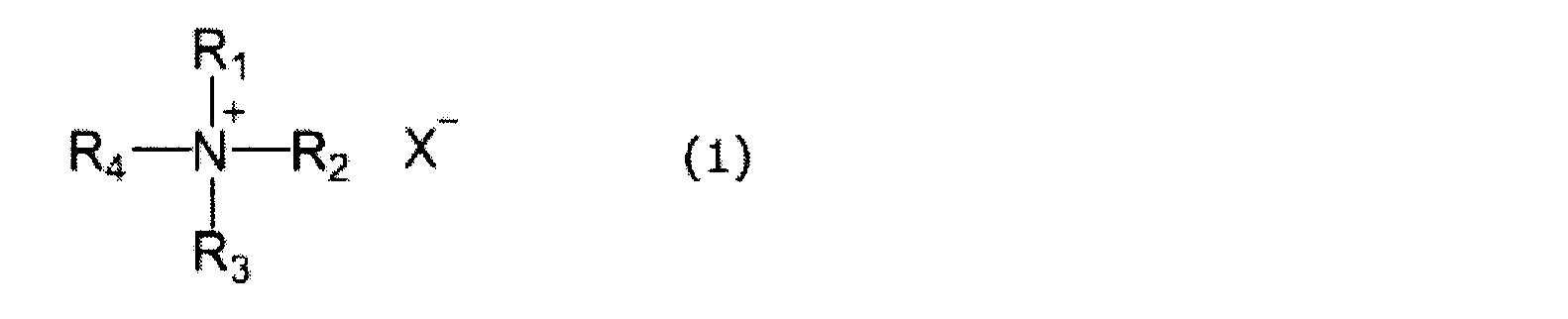
(式中、R1、R2、R3、R4は、同一又は異なって、炭素数1~20のアルキル基、炭素数6~20のアリール基、又は炭素数7~20のアラルキル基を示し、Xは、F、Br、Cl、又はIを示す)
で表される化合物が好ましい、前記<8>~<10>いずれか記載の水系組成物。
<12> 一般式(1)で表される化合物としては、
テトラメチルアンモニウムハライド、テトラエチルアンモニウムハライド、テトラプロピルアンモニウムハライド、テトラブチルアンモニウムハライド、テトラペンチルアンモニウムハライド、テトラヘキシルアンモニウムハライド、テトラフェニルアンモニウムハライド、テトラベンジルアンモニウムハライド、
エチルトリメチルアンモニウムハライド、プロピルトリメチルアンモニウムハライド、ブチルトリメチルアンモニウムハライド、ペンチルトリメチルアンモニウムハライド、ヘキシルトリメチルアンモニウムハライド、オクチルトリメチルアンモニウムハライド、デシルトリメチルアンモニウムハライド、ドデシルトリメチルアンモニウムハライド、テトラデシルトリメチルアンモニウムハライド、ヘキサデシルトリメチルアンモニウムハライド、オクタデシルトリメチルアンモニウムハライド、フェニルトリメチルアンモニウムハライド、ベンジルトリメチルアンモニウムハライド、
ペンチルトリプロピルアンモニウムクロリド、ヘキシルトリプロピルアンモニウムクロリド、オクチルトリプロピルアンモニウムクロリド、デシルトリプロピルアンモニウムクロリド、フェニルトリプロピルアンモニウムクロリド、ベンジルトリプロピルアンモニウムクロリド、
ジオクチルジメチルアンモニウムハライド、ジデシルジメチルアンモニウムハライド、ジドデシルジメチルアンモニウムハライド、ジミリスチルジメチルアンモニウムハライド
ブチルベンジルジメチルアンモニウムクロリド、ペンチルベンジルジメチルアンモニウムクロリド、ヘキシルベンジルジメチルアンモニウムクロリド、オクチルベンジルジメチルアンモニウムクロリド、デシルベンジルジメチルアンモニウムクロリド、ドデシルベンジルジメチルアンモニウムクロリド、ミリスチルベンジルジメチルアンモニウムクロリド、パルミチルベンジルジメチルアンモニウムクロリド、ステアリルベンジルジメチルアンモニウムクロリド
が挙げられ、なかでも、
テトラメチルアンモニウムハライド、テトラエチルアンモニウムハライド、テトラプロピルアンモニウムハライド、テトラブチルアンモニウムハライド、
ペンチルトリメチルアンモニウムハライド、ヘキシルトリメチルアンモニウムハライド、オクチルトリメチルアンモニウムハライド、デシルトリメチルアンモニウムハライド、ドデシルトリメチルアンモニウムハライド、テトラデシルトリメチルアンモニウムハライド、ヘキサデシルトリメチルアンモニウムハライド、オクタデシルトリメチルアンモニウムハライド、フェニルトリメチルアンモニウムハライド、ベンジルトリメチルアンモニウムハライド、
フェニルトリプロピルアンモニウムクロリド、
ジオクチルジメチルアンモニウムハライド、ジデシルジメチルアンモニウムハライド、ジドデシルジメチルアンモニウムハライド、ジミリスチルジメチルアンモニウムハライド
オクチルベンジルジメチルアンモニウムクロリド、デシルベンジルジメチルアンモニウムクロリド、ドデシルベンジルジメチルアンモニウムクロリド、ミリスチルベンジルジメチルアンモニウムクロリド、パルミチルベンジルジメチルアンモニウムクロリド、ステアリルベンジルジメチルアンモニウムクロリド
が好ましく、
ミリスチルベンジルジメチルアンモニウムクロリド、テトラメチルアンモニウムブロミド、テトラエチルアンモニウムブロミド、ヘキシルトリメチルアンモニウムブロミド、フェニルトリプロピルアンモニウムクロリドがより好ましく、
ミリスチルベンジルジメチルアンモニウムクロリドが更に好ましい、前記<11>記載の水系組成物。
<13> アミンとしては、化合物1分子あたりの炭素原子と窒素原子の比率(炭素原子数/窒素原子数)が3以上45以下の、モノアミン、ジアミン、又は多価アミンを用いることができる、前記<8>記載の水系組成物。
<14> モノアミンとしては、一般式(2):
で表される化合物が好ましい、前記<8>~<10>いずれか記載の水系組成物。
<12> 一般式(1)で表される化合物としては、
テトラメチルアンモニウムハライド、テトラエチルアンモニウムハライド、テトラプロピルアンモニウムハライド、テトラブチルアンモニウムハライド、テトラペンチルアンモニウムハライド、テトラヘキシルアンモニウムハライド、テトラフェニルアンモニウムハライド、テトラベンジルアンモニウムハライド、
エチルトリメチルアンモニウムハライド、プロピルトリメチルアンモニウムハライド、ブチルトリメチルアンモニウムハライド、ペンチルトリメチルアンモニウムハライド、ヘキシルトリメチルアンモニウムハライド、オクチルトリメチルアンモニウムハライド、デシルトリメチルアンモニウムハライド、ドデシルトリメチルアンモニウムハライド、テトラデシルトリメチルアンモニウムハライド、ヘキサデシルトリメチルアンモニウムハライド、オクタデシルトリメチルアンモニウムハライド、フェニルトリメチルアンモニウムハライド、ベンジルトリメチルアンモニウムハライド、
ペンチルトリプロピルアンモニウムクロリド、ヘキシルトリプロピルアンモニウムクロリド、オクチルトリプロピルアンモニウムクロリド、デシルトリプロピルアンモニウムクロリド、フェニルトリプロピルアンモニウムクロリド、ベンジルトリプロピルアンモニウムクロリド、
ジオクチルジメチルアンモニウムハライド、ジデシルジメチルアンモニウムハライド、ジドデシルジメチルアンモニウムハライド、ジミリスチルジメチルアンモニウムハライド
ブチルベンジルジメチルアンモニウムクロリド、ペンチルベンジルジメチルアンモニウムクロリド、ヘキシルベンジルジメチルアンモニウムクロリド、オクチルベンジルジメチルアンモニウムクロリド、デシルベンジルジメチルアンモニウムクロリド、ドデシルベンジルジメチルアンモニウムクロリド、ミリスチルベンジルジメチルアンモニウムクロリド、パルミチルベンジルジメチルアンモニウムクロリド、ステアリルベンジルジメチルアンモニウムクロリド
が挙げられ、なかでも、
テトラメチルアンモニウムハライド、テトラエチルアンモニウムハライド、テトラプロピルアンモニウムハライド、テトラブチルアンモニウムハライド、
ペンチルトリメチルアンモニウムハライド、ヘキシルトリメチルアンモニウムハライド、オクチルトリメチルアンモニウムハライド、デシルトリメチルアンモニウムハライド、ドデシルトリメチルアンモニウムハライド、テトラデシルトリメチルアンモニウムハライド、ヘキサデシルトリメチルアンモニウムハライド、オクタデシルトリメチルアンモニウムハライド、フェニルトリメチルアンモニウムハライド、ベンジルトリメチルアンモニウムハライド、
フェニルトリプロピルアンモニウムクロリド、
ジオクチルジメチルアンモニウムハライド、ジデシルジメチルアンモニウムハライド、ジドデシルジメチルアンモニウムハライド、ジミリスチルジメチルアンモニウムハライド
オクチルベンジルジメチルアンモニウムクロリド、デシルベンジルジメチルアンモニウムクロリド、ドデシルベンジルジメチルアンモニウムクロリド、ミリスチルベンジルジメチルアンモニウムクロリド、パルミチルベンジルジメチルアンモニウムクロリド、ステアリルベンジルジメチルアンモニウムクロリド
が好ましく、
ミリスチルベンジルジメチルアンモニウムクロリド、テトラメチルアンモニウムブロミド、テトラエチルアンモニウムブロミド、ヘキシルトリメチルアンモニウムブロミド、フェニルトリプロピルアンモニウムクロリドがより好ましく、
ミリスチルベンジルジメチルアンモニウムクロリドが更に好ましい、前記<11>記載の水系組成物。
<13> アミンとしては、化合物1分子あたりの炭素原子と窒素原子の比率(炭素原子数/窒素原子数)が3以上45以下の、モノアミン、ジアミン、又は多価アミンを用いることができる、前記<8>記載の水系組成物。
<14> モノアミンとしては、一般式(2):

(式中、R5、R6、R7は、同一又は異なって、水素原子、炭素数1~10のアルキル基もしくはヒドロキシアルキル基、炭素数6~20のアリール基、炭素数7~20アラルキル基、又はヘテロ芳香環基を示す)
で表される化合物が好ましい、前記<13>記載の水系組成物。
<15> モノアミンにおける化合物1分子あたりの炭素原子と窒素原子の比率(炭素原子数/窒素原子数)は、好ましくは3以上、より好ましくは4以上、更に好ましくは5以上であり、好ましくは16以下、より好ましくは12以下、更に好ましくは10以下、より更に好ましくは8以下であり、また、化合物1分子あたりの炭素原子数は、好ましくは3以上、より好ましくは4以上、更に好ましくは5以上であり、好ましくは16以下、より好ましくは12以下、更に好ましくは10以下、より更に好ましくは8以下であり、化合物1分子あたりの窒素原子数は、好ましくは1以上であり、好ましくは4以下、より好ましくは3以下、更に好ましくは2以下である、前記<13>又は<14>記載の水系組成物。
<16> モノアミンの分子量は、好ましくは60以上、より好ましくは80以上、更に好ましくは100以上であり、好ましくは650以下、より好ましくは300以下、更に好ましくは150以下である、前記<13>~<15>いずれか記載の水系組成物。
<17> 一般式(2)で表される化合物としては、
1級モノアミン:プロピルアミン、ブチルアミン、ペンチルアミン、ヘキシルアミン、オクチルアミン、デシルアミン、ドデシルアミン、ポリオキシエチレンアミン(重合度1~6)、ポリオキシプロピレンアミン(重合度1~4)、ポリオキシエチレン/プロピレンアミン(重合度1~5)
2級モノアミン:ジエチルアミン、ジプロピルアミン、ジブチルアミン、ジペンチルアミン、ジヘキシルアミン、ジオクチルアミン、ジデシルアミン、ジエタノールアミン
3級モノアミン:トリメチルアミン、トリエチルアミン、トリプロピルアミン、トリブチルアミン、トリペンチルアミン、トリヘキシルアミン、トリオクチルアミン、トリエタノールアミン、ジメチルアミノエタノール、ジメチルアミノプロパノール、ジメチルアミノブタノール、ジメチルアミノペンタノール、ジメチルアミノヘキサノール、ジメチルアミノオクタノール、ジメチルアミノデカノール、N,N-ジメチル-4-アミノピリジン
が挙げられ、なかでも、
1級モノアミン:ペンチルアミン、ヘキシルアミン、オクチルアミン
2級モノアミン:ジエチルアミン、ジプロピルアミン、ジブチルアミン
3級モノアミン:トリエチルアミン、トリプロピルアミン、ジメチルアミノヘキサノール、N,N-ジメチル-4-アミノピリジン
が好ましく、
ヘキシルアミン、ジプロピルアミン、トリエチルアミン、ジメチルアミノヘキサノール、N,N-ジメチル-4-アミノピリジンがより好ましく、
ジメチルアミノヘキサノールが更に好ましい、前記<14>~<16>いずれか記載の水系組成物。
<18> ジアミンとしては、一般式(3):
で表される化合物が好ましい、前記<13>記載の水系組成物。
<15> モノアミンにおける化合物1分子あたりの炭素原子と窒素原子の比率(炭素原子数/窒素原子数)は、好ましくは3以上、より好ましくは4以上、更に好ましくは5以上であり、好ましくは16以下、より好ましくは12以下、更に好ましくは10以下、より更に好ましくは8以下であり、また、化合物1分子あたりの炭素原子数は、好ましくは3以上、より好ましくは4以上、更に好ましくは5以上であり、好ましくは16以下、より好ましくは12以下、更に好ましくは10以下、より更に好ましくは8以下であり、化合物1分子あたりの窒素原子数は、好ましくは1以上であり、好ましくは4以下、より好ましくは3以下、更に好ましくは2以下である、前記<13>又は<14>記載の水系組成物。
<16> モノアミンの分子量は、好ましくは60以上、より好ましくは80以上、更に好ましくは100以上であり、好ましくは650以下、より好ましくは300以下、更に好ましくは150以下である、前記<13>~<15>いずれか記載の水系組成物。
<17> 一般式(2)で表される化合物としては、
1級モノアミン:プロピルアミン、ブチルアミン、ペンチルアミン、ヘキシルアミン、オクチルアミン、デシルアミン、ドデシルアミン、ポリオキシエチレンアミン(重合度1~6)、ポリオキシプロピレンアミン(重合度1~4)、ポリオキシエチレン/プロピレンアミン(重合度1~5)
2級モノアミン:ジエチルアミン、ジプロピルアミン、ジブチルアミン、ジペンチルアミン、ジヘキシルアミン、ジオクチルアミン、ジデシルアミン、ジエタノールアミン
3級モノアミン:トリメチルアミン、トリエチルアミン、トリプロピルアミン、トリブチルアミン、トリペンチルアミン、トリヘキシルアミン、トリオクチルアミン、トリエタノールアミン、ジメチルアミノエタノール、ジメチルアミノプロパノール、ジメチルアミノブタノール、ジメチルアミノペンタノール、ジメチルアミノヘキサノール、ジメチルアミノオクタノール、ジメチルアミノデカノール、N,N-ジメチル-4-アミノピリジン
が挙げられ、なかでも、
1級モノアミン:ペンチルアミン、ヘキシルアミン、オクチルアミン
2級モノアミン:ジエチルアミン、ジプロピルアミン、ジブチルアミン
3級モノアミン:トリエチルアミン、トリプロピルアミン、ジメチルアミノヘキサノール、N,N-ジメチル-4-アミノピリジン
が好ましく、
ヘキシルアミン、ジプロピルアミン、トリエチルアミン、ジメチルアミノヘキサノール、N,N-ジメチル-4-アミノピリジンがより好ましく、
ジメチルアミノヘキサノールが更に好ましい、前記<14>~<16>いずれか記載の水系組成物。
<18> ジアミンとしては、一般式(3):

(式中、R8は炭素数3~18の(シクロ)アルキレン基又は炭素数3~24のポリオキシアルキレン基を示し、R9、R10、R11、R12は、同一又は異なって、水素原子又はメチル基を示す)
で表される化合物が好ましい、前記<13>記載の水系組成物。
<19> ジアミンにおける化合物1分子あたりの炭素原子と窒素原子の比率(炭素原子数/窒素原子数)は、好ましくは5以上、より好ましくは6以上であり、好ましくは16以下、より好ましくは12以下、更に好ましくは10以下、より更に好ましくは8以下であり、また、化合物1分子あたりの炭素原子数は、好ましくは3以上、より好ましくは5以上、更に好ましくは8以上であり、好ましくは30以下、より好ましくは20以下、更に好ましくは14以下であり、化合物1分子あたりの窒素原子数は、好ましくは2以上であり、好ましくは5以下、より好ましくは4以下、更に好ましくは3以下である、前記<13>又は<18>記載の水系組成物。
<20> ジアミンの分子量は、好ましくは70以上、より好ましくは100以上であり、好ましくは1000以下、より好ましくは600以下、更に好ましくは400以下である、前記<13>、<18>~<19>いずれか記載の水系組成物。
<21> 一般式(3)で表される化合物としては、
1級ジアミン:1,4-シクロヘキサンジアミン、1,6-ヘキサンジアミン、1,7-ヘプタンジアミン、1,8-オクタンジアミン、1,9-ノナンジアミン、1,10-デカンジアミン、1,11-ウンデカンジアミン、1,12-ドデカンジアミン、1,13-トリデカンジアミン、1,14-テトラデカンジアミン、ポリオキシエチレンジアミン(重合度1~15、2~10、3~8)、ポリオキシプロピレンジアミン(重合度1~10、2~7)、ポリオキシエチレン/プロピレンジアミン(重合度1~12、2~8、3~7)
3級ジアミン:N,N,N,N-テトラメチル-1,2-エタンジアミン、N,N,N,N-テトラメチル-1,3-プロパンジアミン、N,N,N,N-テトラメチル-1,4-ブタンジアミン、N,N,N,N-テトラメチル-1,5-ペンタンジアミン、N,N,N,N-テトラメチル-1,6-ヘキサンジアミン、N,N,N,N-テトラメチル-1,8-オクタンジアミン、N,N,N,N-テトラメチル-1,10-デカンジアミン、N,N,N,N-テトラメチル-1,12-ドデカンジアミン
が挙げられ、なかでも、
1級ジアミン:1,4-シクロヘキサンジアミン、1,6-ヘキサンジアミン、1,7-ヘプタンジアミン、1,8-オクタンジアミン、1,9-ノナンジアミン、1,10-デカンジアミン、1,11-ウンデカンジアミン、1,12-ドデカンジアミン、1,13-トリデカンジアミン、1,14-テトラデカンジアミン、ポリオキシプロピレンジアミン(重合度1~10、2~7)
3級ジアミン:N,N,N,N-テトラメチル-1,5-ペンタンジアミン、N,N,N,N-テトラメチル-1,6-ヘキサンジアミン、N,N,N,N-テトラメチル-1,8-オクタンジアミン、N,N,N,N-テトラメチル-1,10-デカンジアミン、N,N,N,N-テトラメチル-1,12-ドデカンジアミン
が好ましく、
シクロヘキサンジアミン、テトラメチルヘキサンジアミン、トリオキシプロピレンジアミン、ドデカンジアミン、ヘキサオキシプロピレンジアミンがより好ましく、
トリオキシプロピレンジアミン、ドデカンジアミンが更に好ましい、前記<18>~<20>いずれか記載の水系組成物。
<22> 多価アミンとしては、一般式(4):
で表される化合物が好ましい、前記<13>記載の水系組成物。
<19> ジアミンにおける化合物1分子あたりの炭素原子と窒素原子の比率(炭素原子数/窒素原子数)は、好ましくは5以上、より好ましくは6以上であり、好ましくは16以下、より好ましくは12以下、更に好ましくは10以下、より更に好ましくは8以下であり、また、化合物1分子あたりの炭素原子数は、好ましくは3以上、より好ましくは5以上、更に好ましくは8以上であり、好ましくは30以下、より好ましくは20以下、更に好ましくは14以下であり、化合物1分子あたりの窒素原子数は、好ましくは2以上であり、好ましくは5以下、より好ましくは4以下、更に好ましくは3以下である、前記<13>又は<18>記載の水系組成物。
<20> ジアミンの分子量は、好ましくは70以上、より好ましくは100以上であり、好ましくは1000以下、より好ましくは600以下、更に好ましくは400以下である、前記<13>、<18>~<19>いずれか記載の水系組成物。
<21> 一般式(3)で表される化合物としては、
1級ジアミン:1,4-シクロヘキサンジアミン、1,6-ヘキサンジアミン、1,7-ヘプタンジアミン、1,8-オクタンジアミン、1,9-ノナンジアミン、1,10-デカンジアミン、1,11-ウンデカンジアミン、1,12-ドデカンジアミン、1,13-トリデカンジアミン、1,14-テトラデカンジアミン、ポリオキシエチレンジアミン(重合度1~15、2~10、3~8)、ポリオキシプロピレンジアミン(重合度1~10、2~7)、ポリオキシエチレン/プロピレンジアミン(重合度1~12、2~8、3~7)
3級ジアミン:N,N,N,N-テトラメチル-1,2-エタンジアミン、N,N,N,N-テトラメチル-1,3-プロパンジアミン、N,N,N,N-テトラメチル-1,4-ブタンジアミン、N,N,N,N-テトラメチル-1,5-ペンタンジアミン、N,N,N,N-テトラメチル-1,6-ヘキサンジアミン、N,N,N,N-テトラメチル-1,8-オクタンジアミン、N,N,N,N-テトラメチル-1,10-デカンジアミン、N,N,N,N-テトラメチル-1,12-ドデカンジアミン
が挙げられ、なかでも、
1級ジアミン:1,4-シクロヘキサンジアミン、1,6-ヘキサンジアミン、1,7-ヘプタンジアミン、1,8-オクタンジアミン、1,9-ノナンジアミン、1,10-デカンジアミン、1,11-ウンデカンジアミン、1,12-ドデカンジアミン、1,13-トリデカンジアミン、1,14-テトラデカンジアミン、ポリオキシプロピレンジアミン(重合度1~10、2~7)
3級ジアミン:N,N,N,N-テトラメチル-1,5-ペンタンジアミン、N,N,N,N-テトラメチル-1,6-ヘキサンジアミン、N,N,N,N-テトラメチル-1,8-オクタンジアミン、N,N,N,N-テトラメチル-1,10-デカンジアミン、N,N,N,N-テトラメチル-1,12-ドデカンジアミン
が好ましく、
シクロヘキサンジアミン、テトラメチルヘキサンジアミン、トリオキシプロピレンジアミン、ドデカンジアミン、ヘキサオキシプロピレンジアミンがより好ましく、
トリオキシプロピレンジアミン、ドデカンジアミンが更に好ましい、前記<18>~<20>いずれか記載の水系組成物。
<22> 多価アミンとしては、一般式(4):
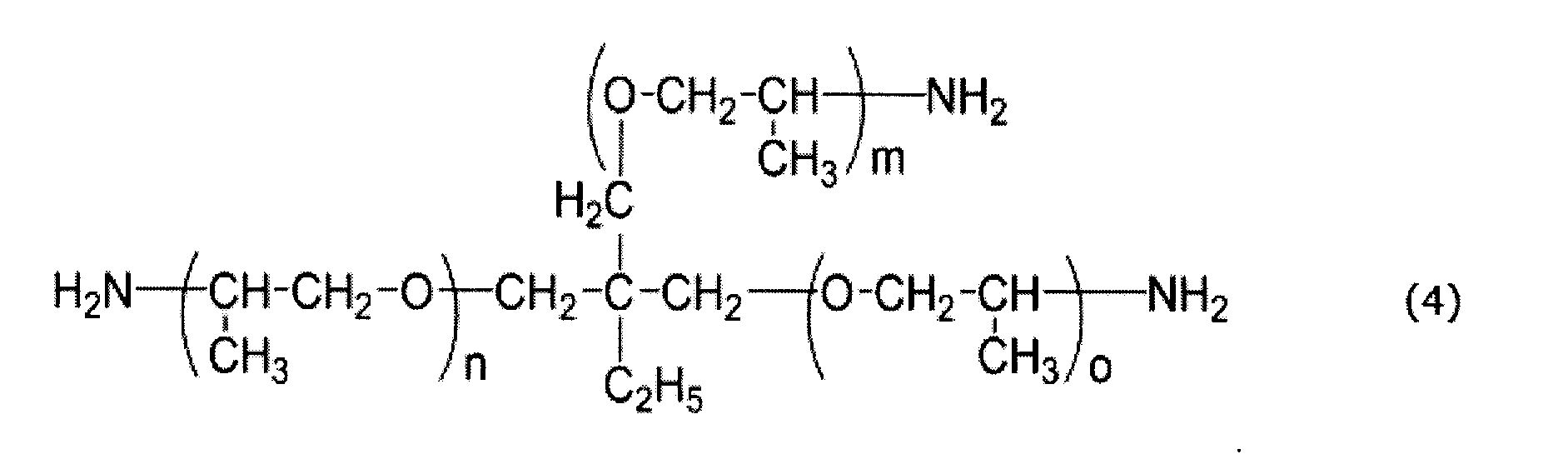
(式中、m、n、oはそれぞれ独立してオキシプロピレン基の平均付加モル数を示し、m+n+oが1以上12以下を満足する数である)
で表されるトリアミンが好ましい、前記<13>記載の水系組成物。
<23> 一般式(4)化合物における化合物1分子あたりの炭素原子と窒素原子の比率(炭素原子数/窒素原子数)は、好ましくは5以上、より好ましくは6以上であり、好ましくは16以下、より好ましくは12以下、更に好ましくは9以下であり、また、化合物1分子あたりの炭素原子数は、好ましくは9以上、より好ましくは15以上、更に好ましくは18以上であり、好ましくは42以下、より好ましくは30以下、更に好ましくは24以下である、前記<22>記載の水系組成物。
<24> 一般式(4)化合物の分子量は、好ましくは180以上、より好ましくは300以上、更に好ましくは350以上であり、好ましくは850以下、より好ましくは600以下、更に好ましくは500以下である、前記<22>又は<23>記載の水系組成物。
<25> 一般式(4)で表される化合物としては、ポリオキシプロピレントリアミン(重合度2~14、重合度3~10、重合度3~8)を用いることができる、前記<22>~<24>いずれか記載の水系組成物。
<26> 多価アミンとしては、一般式(5):
で表されるトリアミンが好ましい、前記<13>記載の水系組成物。
<23> 一般式(4)化合物における化合物1分子あたりの炭素原子と窒素原子の比率(炭素原子数/窒素原子数)は、好ましくは5以上、より好ましくは6以上であり、好ましくは16以下、より好ましくは12以下、更に好ましくは9以下であり、また、化合物1分子あたりの炭素原子数は、好ましくは9以上、より好ましくは15以上、更に好ましくは18以上であり、好ましくは42以下、より好ましくは30以下、更に好ましくは24以下である、前記<22>記載の水系組成物。
<24> 一般式(4)化合物の分子量は、好ましくは180以上、より好ましくは300以上、更に好ましくは350以上であり、好ましくは850以下、より好ましくは600以下、更に好ましくは500以下である、前記<22>又は<23>記載の水系組成物。
<25> 一般式(4)で表される化合物としては、ポリオキシプロピレントリアミン(重合度2~14、重合度3~10、重合度3~8)を用いることができる、前記<22>~<24>いずれか記載の水系組成物。
<26> 多価アミンとしては、一般式(5):

(式中、R13は水素原子、ヒドロキシ基、又は炭素数1~10のアルキル基もしくはヒドロキシアルキル基を示し、R14は炭素数1~8のアルキレン基を示し、R15は水素原子、ヒドロキシ基、又は炭素数1~6のアルキル基もしくはヒドロキシアルキル基を示し、R16は水素原子又はヒドロキシ基を示し、pは3~6を示す)
で表される化合物が好ましい、前記<13>記載の水系組成物。
<27> 一般式(5)化合物における化合物1分子あたりの炭素原子と窒素原子の比率(炭素原子数/窒素原子数)は、好ましくは5以上、より好ましくは6以上、更に好ましくは8以上であり、好ましくは16以下、より好ましくは12以下、更に好ましくは9以下であり、また、化合物1分子あたりの炭素原子数は、好ましくは10以上、より好ましくは15以上、更に好ましくは20以上、より更に好ましくは25以上であり、好ましくは50以下、より好ましくは45以下、更に好ましくは42以下、より更に好ましくは30以下であり、化合物1分子あたりの窒素原子数は、3以上であるが、好ましくは6以下、より好ましくは5以下、更に好ましくは4以下である、前記<26>記載の水系組成物。
<28> 一般式(5)化合物の分子量は、好ましくは70以上、より好ましくは100以上、更に好ましくは130以上であり、好ましくは2000以下、より好ましくは1500以下、更に好ましくは1000以下である、前記<26>又は<27>記載の水系組成物。
<29> 一般式(5)で表される化合物としては、モノ3級アミングリコール、ジ3級アミングリコール、トリ3級アミングリコール、テトラ3級アミングリコール、ペンタ3級アミングリコール、ヘキサ3級アミングリコールを単独で又は2種以上組み合わせて用いることができる、前記<26>~<28>いずれか記載の水系組成物。
<30> アミドとしては、一般式(6):
で表される化合物が好ましい、前記<13>記載の水系組成物。
<27> 一般式(5)化合物における化合物1分子あたりの炭素原子と窒素原子の比率(炭素原子数/窒素原子数)は、好ましくは5以上、より好ましくは6以上、更に好ましくは8以上であり、好ましくは16以下、より好ましくは12以下、更に好ましくは9以下であり、また、化合物1分子あたりの炭素原子数は、好ましくは10以上、より好ましくは15以上、更に好ましくは20以上、より更に好ましくは25以上であり、好ましくは50以下、より好ましくは45以下、更に好ましくは42以下、より更に好ましくは30以下であり、化合物1分子あたりの窒素原子数は、3以上であるが、好ましくは6以下、より好ましくは5以下、更に好ましくは4以下である、前記<26>記載の水系組成物。
<28> 一般式(5)化合物の分子量は、好ましくは70以上、より好ましくは100以上、更に好ましくは130以上であり、好ましくは2000以下、より好ましくは1500以下、更に好ましくは1000以下である、前記<26>又は<27>記載の水系組成物。
<29> 一般式(5)で表される化合物としては、モノ3級アミングリコール、ジ3級アミングリコール、トリ3級アミングリコール、テトラ3級アミングリコール、ペンタ3級アミングリコール、ヘキサ3級アミングリコールを単独で又は2種以上組み合わせて用いることができる、前記<26>~<28>いずれか記載の水系組成物。
<30> アミドとしては、一般式(6):

(式中、R17は炭素数6~18のアルキル基を示し、R18、R19は、同一又は異なって、水素原子、又は炭素数1~8のアルキル基もしくはヒドロキシアルキル基を示す)
で表される化合物が好ましい、前記<8>記載の水系組成物。
<31> 一般式(6)化合物における化合物1分子あたりの炭素原子と窒素原子の比率(炭素原子数/窒素原子数)は、好ましくは4以上、より好ましくは6以上、更に好ましくは10以上であり、好ましくは40以下、より好ましくは35以下、更に好ましくは30以下、より更に好ましくは25以下であり、また、化合物1分子あたりの炭素原子数は、好ましくは3以上、より好ましくは10以上、更に好ましくは14以上であり、好ましくは25以下、より好ましくは20以下、更に好ましくは18以下である、前記<30>記載の水系組成物。
<32> 一般式(6)化合物の分子量は、好ましくは70以上、より好ましくは100以上、更に好ましくは150以上であり、好ましくは500以下、より好ましくは350以下、更に好ましくは300以下である、前記<30>又は<31>記載の水系組成物。
<33> 一般式(6)で表される化合物としては、
オクチルモノエタノールアミド、デシルモノエタノールアミド、ラウリルモノエタノールアミド、ミリスチルモノエタノールアミド、パルミチルモノエタノールアミド、ステアリルモノエタノールアミド、オレイルモノエタノールアミド
オクチルジエタノールアミド、デシルジエタノールアミド、ラウリルジエタノールアミド、ミリスチルジエタノールアミド、パルミチルジエタノールアミド、ステアリルジエタノールアミド、オレイルジエタノールアミド、オクチルメチルエタノールアミド、デシルメチルエタノールアミド、ラウリルメチルエタノールアミド、ミリスチルメチルエタノールアミド、パルミチルメチルエタノールアミド、ステアリルメチルエタノールアミド、オレイルメチルエタノールアミド
が挙げられ、なかでも、
ミリスチルモノエタノールアミド、パルミチルモノエタノールアミド、ステアリルモノエタノールアミド、オレイルモノエタノールアミド
デシルジエタノールアミド、ラウリルジエタノールアミド、ミリスチルジエタノールアミド
が好ましく、
ラウリルジエタノールアミドがより好ましい、前記<30>~<32>いずれか記載の水系組成物。
<34> さらに、粘土鉱物、崩壊防止剤、比重調整剤、水溶性高分子、紫外線防御剤、保湿剤、消泡剤、分散剤、アルコール、界面活性剤、防腐剤、酸化防止剤、キレート剤、及びpH調整剤からなる群から選ばれる1種又は2種以上を含有することができ、また、水分を少なくとも10質量%以上含有する液状媒体を、好ましくは30質量%以上、より好ましくは40質量%以上、更に好ましくは50質量%以上、更に好ましくは70質量%以上、更に好ましくは80質量%以上、更に好ましくは90質量%以上であり、好ましくは99.7質量%以下含有する、前記<1>~<33>いずれか記載の水系組成物。
<35> 水系組成物中、前記(A)成分の含有量は、好ましくは0.3質量%以上、より好ましくは0.4質量%以上であり、好ましくは5質量%以下、より好ましくは3質量%以下、更に好ましくは1質量%以下、より更に好ましくは0.7質量%以下であり、また、前記(B)成分の含有量は、好ましくは0.02質量%以上、より好ましくは0.05質量%以上、更に好ましくは0.07質量%以上、より更に好ましくは0.09質量%以上であり、好ましくは1質量%以下、より好ましくは0.5質量%以下、更に好ましくは0.3質量%以下、更に好ましくは0.2質量%以下、より更に好ましくは0.15質量%以下である、前記<1>~<34>いずれか記載の水系組成物。
<36> 前記(B)成分の含有量は、(A)成分100質量部に対して、好ましくは5質量部以上、より好ましくは10質量部以上、更に好ましくは15質量部以上であり、好ましくは100質量部以下、より好ましくは50質量部以下、更に好ましくは40質量部以下、より更に好ましくは30質量部以下である、前記<1>~<35>いずれか記載の水系組成物。
<37> 80℃、回転速度30rpmにおける粘度が、好ましくは90mPa・s以上、より好ましくは100mPa・s以上、更に好ましくは120mPa・s以上であり、好ましくは100,000mPa・s以下、より好ましくは50,000mPa・s以下、更に好ましくは30,000mPa・s以下、より更に好ましくは10,000mPa・s以下である、前記<1>~<36>いずれか記載の水系組成物。
<38> 回転速度30rpmにおける80℃における粘度と25℃における粘度の比(80℃/25℃)が、好ましくは0.6~3.5、より好ましくは0.7~2.0、更に好ましくは0.8~1.5である、前記<1>~<37>いずれか記載の水系組成物。
<39> 温度25℃において、回転速度3rpmにおける粘度と回転速度30rpmにおける粘度の比(3rpm/30rpm)が、好ましくは2以上、より好ましくは2.5以上、更に好ましくは3以上であり、上限は10程度である、前記<1>~<38>いずれか記載の水系組成物。
<40> クリームや乳液、口紅などの化粧品としての、前記<1>~<39>いずれか記載の水系組成物の使用。
<41> 芳香剤やシャンプー、染髪剤などの家庭用品としての、前記<1>~<39>いずれか記載の水系組成物の使用。
<42> 発泡剤やペンキ、コンクリートなどの工業製品としての、前記<1>~<39>いずれか記載の水系組成物の使用。
<43> 打杭工事や石油等の地中からの回収作業の際、又は油田の油井掘削の際に好適に用いることができ、掘削用流体、スペーサー流体、坑井刺激用の圧入流体、及び回収増進用の後押し流体からなる群より選ばれるいずれかの流体としての、前記<1>~<39>いずれか記載の水系組成物の使用。
<44> 前記<1>~<45>いずれか記載の水系組成物を用いて地下層を処理することを特徴とする、地下層の処理方法。
<45> 前記<1>~<45>いずれか記載の水系組成物を、掘削用流体、スペーサー流体、坑井刺激用の圧入流体、及び回収増進用の後押し流体からなる群より選ばれるいずれかの流体として用いることで、地下層における天然ガス又は原油を採取することを特徴とする、前記<44>記載の方法。
<46> 前記<1>~<45>いずれか記載の水系組成物を地中の掘削穴先端に送り込み、掘削により生じた土砂や岩石を地上に回収する、掘削により生じた土砂や岩石の回収方法。
<47> 前記<1>~<45>いずれか記載の水系組成物を、地中の掘削穴先端に送り込み、掘削により生じた土砂や岩石を前記水系組成物中に分散させることを特徴とする、前記<46>記載の方法。
で表される化合物が好ましい、前記<8>記載の水系組成物。
<31> 一般式(6)化合物における化合物1分子あたりの炭素原子と窒素原子の比率(炭素原子数/窒素原子数)は、好ましくは4以上、より好ましくは6以上、更に好ましくは10以上であり、好ましくは40以下、より好ましくは35以下、更に好ましくは30以下、より更に好ましくは25以下であり、また、化合物1分子あたりの炭素原子数は、好ましくは3以上、より好ましくは10以上、更に好ましくは14以上であり、好ましくは25以下、より好ましくは20以下、更に好ましくは18以下である、前記<30>記載の水系組成物。
<32> 一般式(6)化合物の分子量は、好ましくは70以上、より好ましくは100以上、更に好ましくは150以上であり、好ましくは500以下、より好ましくは350以下、更に好ましくは300以下である、前記<30>又は<31>記載の水系組成物。
<33> 一般式(6)で表される化合物としては、
オクチルモノエタノールアミド、デシルモノエタノールアミド、ラウリルモノエタノールアミド、ミリスチルモノエタノールアミド、パルミチルモノエタノールアミド、ステアリルモノエタノールアミド、オレイルモノエタノールアミド
オクチルジエタノールアミド、デシルジエタノールアミド、ラウリルジエタノールアミド、ミリスチルジエタノールアミド、パルミチルジエタノールアミド、ステアリルジエタノールアミド、オレイルジエタノールアミド、オクチルメチルエタノールアミド、デシルメチルエタノールアミド、ラウリルメチルエタノールアミド、ミリスチルメチルエタノールアミド、パルミチルメチルエタノールアミド、ステアリルメチルエタノールアミド、オレイルメチルエタノールアミド
が挙げられ、なかでも、
ミリスチルモノエタノールアミド、パルミチルモノエタノールアミド、ステアリルモノエタノールアミド、オレイルモノエタノールアミド
デシルジエタノールアミド、ラウリルジエタノールアミド、ミリスチルジエタノールアミド
が好ましく、
ラウリルジエタノールアミドがより好ましい、前記<30>~<32>いずれか記載の水系組成物。
<34> さらに、粘土鉱物、崩壊防止剤、比重調整剤、水溶性高分子、紫外線防御剤、保湿剤、消泡剤、分散剤、アルコール、界面活性剤、防腐剤、酸化防止剤、キレート剤、及びpH調整剤からなる群から選ばれる1種又は2種以上を含有することができ、また、水分を少なくとも10質量%以上含有する液状媒体を、好ましくは30質量%以上、より好ましくは40質量%以上、更に好ましくは50質量%以上、更に好ましくは70質量%以上、更に好ましくは80質量%以上、更に好ましくは90質量%以上であり、好ましくは99.7質量%以下含有する、前記<1>~<33>いずれか記載の水系組成物。
<35> 水系組成物中、前記(A)成分の含有量は、好ましくは0.3質量%以上、より好ましくは0.4質量%以上であり、好ましくは5質量%以下、より好ましくは3質量%以下、更に好ましくは1質量%以下、より更に好ましくは0.7質量%以下であり、また、前記(B)成分の含有量は、好ましくは0.02質量%以上、より好ましくは0.05質量%以上、更に好ましくは0.07質量%以上、より更に好ましくは0.09質量%以上であり、好ましくは1質量%以下、より好ましくは0.5質量%以下、更に好ましくは0.3質量%以下、更に好ましくは0.2質量%以下、より更に好ましくは0.15質量%以下である、前記<1>~<34>いずれか記載の水系組成物。
<36> 前記(B)成分の含有量は、(A)成分100質量部に対して、好ましくは5質量部以上、より好ましくは10質量部以上、更に好ましくは15質量部以上であり、好ましくは100質量部以下、より好ましくは50質量部以下、更に好ましくは40質量部以下、より更に好ましくは30質量部以下である、前記<1>~<35>いずれか記載の水系組成物。
<37> 80℃、回転速度30rpmにおける粘度が、好ましくは90mPa・s以上、より好ましくは100mPa・s以上、更に好ましくは120mPa・s以上であり、好ましくは100,000mPa・s以下、より好ましくは50,000mPa・s以下、更に好ましくは30,000mPa・s以下、より更に好ましくは10,000mPa・s以下である、前記<1>~<36>いずれか記載の水系組成物。
<38> 回転速度30rpmにおける80℃における粘度と25℃における粘度の比(80℃/25℃)が、好ましくは0.6~3.5、より好ましくは0.7~2.0、更に好ましくは0.8~1.5である、前記<1>~<37>いずれか記載の水系組成物。
<39> 温度25℃において、回転速度3rpmにおける粘度と回転速度30rpmにおける粘度の比(3rpm/30rpm)が、好ましくは2以上、より好ましくは2.5以上、更に好ましくは3以上であり、上限は10程度である、前記<1>~<38>いずれか記載の水系組成物。
<40> クリームや乳液、口紅などの化粧品としての、前記<1>~<39>いずれか記載の水系組成物の使用。
<41> 芳香剤やシャンプー、染髪剤などの家庭用品としての、前記<1>~<39>いずれか記載の水系組成物の使用。
<42> 発泡剤やペンキ、コンクリートなどの工業製品としての、前記<1>~<39>いずれか記載の水系組成物の使用。
<43> 打杭工事や石油等の地中からの回収作業の際、又は油田の油井掘削の際に好適に用いることができ、掘削用流体、スペーサー流体、坑井刺激用の圧入流体、及び回収増進用の後押し流体からなる群より選ばれるいずれかの流体としての、前記<1>~<39>いずれか記載の水系組成物の使用。
<44> 前記<1>~<45>いずれか記載の水系組成物を用いて地下層を処理することを特徴とする、地下層の処理方法。
<45> 前記<1>~<45>いずれか記載の水系組成物を、掘削用流体、スペーサー流体、坑井刺激用の圧入流体、及び回収増進用の後押し流体からなる群より選ばれるいずれかの流体として用いることで、地下層における天然ガス又は原油を採取することを特徴とする、前記<44>記載の方法。
<46> 前記<1>~<45>いずれか記載の水系組成物を地中の掘削穴先端に送り込み、掘削により生じた土砂や岩石を地上に回収する、掘削により生じた土砂や岩石の回収方法。
<47> 前記<1>~<45>いずれか記載の水系組成物を、地中の掘削穴先端に送り込み、掘削により生じた土砂や岩石を前記水系組成物中に分散させることを特徴とする、前記<46>記載の方法。
以下、実施例及び比較例を示して本発明を具体的に説明するが、本発明は下記実施例に制限されるものではない。使用した薬品は断りのない限り和光純薬製のものを用いた。
〔微細セルロース繊維の数平均繊維径〕
微細セルロース繊維に水を加えて、その濃度が0.0001質量%の分散液を調製し、該分散液をマイカ(雲母)上に滴下して乾燥したものを観察試料として、原子間力顕微鏡(AFM、Nanoscope III Tapping mode AFM、Digital instrument社製、プローブはナノセンサーズ社製Point Probe(NCH)を使用)を用いて、該観察試料中のセルロース繊維の繊維高さを測定する。その際、該セルロース繊維が確認できる顕微鏡画像において、微細セルロース繊維を5本以上抽出し、それらの繊維高さから数平均繊維径を算出する。
微細セルロース繊維に水を加えて、その濃度が0.0001質量%の分散液を調製し、該分散液をマイカ(雲母)上に滴下して乾燥したものを観察試料として、原子間力顕微鏡(AFM、Nanoscope III Tapping mode AFM、Digital instrument社製、プローブはナノセンサーズ社製Point Probe(NCH)を使用)を用いて、該観察試料中のセルロース繊維の繊維高さを測定する。その際、該セルロース繊維が確認できる顕微鏡画像において、微細セルロース繊維を5本以上抽出し、それらの繊維高さから数平均繊維径を算出する。
〔微細セルロース繊維及び微細セルロース繊維複合体のカルボキシ基含有量〕
乾燥質量0.5gの微細セルロース繊維又は微細セルロース繊維複合体を100mLビーカーにとり、イオン交換水もしくはメタノール/水=2/1の混合溶媒を加えて全体で55mLとし、そこに0.01M塩化ナトリウム水溶液5mLを加えて分散液を調製し、微細セルロース繊維又は微細セルロース繊維複合体が十分に分散するまで該分散液を攪拌する。この分散液に0.1M塩酸を加えてpHを2.5~3に調整し、自動滴定装置(東亜ディーケーケー社製、商品名「AUT-50」)を用い、0.05M水酸化ナトリウム水溶液を待ち時間60秒の条件で該分散液に滴下し、1分ごとの電導度及びpHの値を測定し、pH11程度になるまで測定を続け、電導度曲線を得る。この電導度曲線から、水酸化ナトリウム滴定量を求め、次式により、微細セルロース繊維又は微細セルロース繊維複合体のカルボキシ基含有量を算出する。
カルボキシ基含有量(mmol/g)=水酸化ナトリウム滴定量×水酸化ナトリウム水溶液濃度(0.05M)/セルロース繊維の質量(0.5g)
乾燥質量0.5gの微細セルロース繊維又は微細セルロース繊維複合体を100mLビーカーにとり、イオン交換水もしくはメタノール/水=2/1の混合溶媒を加えて全体で55mLとし、そこに0.01M塩化ナトリウム水溶液5mLを加えて分散液を調製し、微細セルロース繊維又は微細セルロース繊維複合体が十分に分散するまで該分散液を攪拌する。この分散液に0.1M塩酸を加えてpHを2.5~3に調整し、自動滴定装置(東亜ディーケーケー社製、商品名「AUT-50」)を用い、0.05M水酸化ナトリウム水溶液を待ち時間60秒の条件で該分散液に滴下し、1分ごとの電導度及びpHの値を測定し、pH11程度になるまで測定を続け、電導度曲線を得る。この電導度曲線から、水酸化ナトリウム滴定量を求め、次式により、微細セルロース繊維又は微細セルロース繊維複合体のカルボキシ基含有量を算出する。
カルボキシ基含有量(mmol/g)=水酸化ナトリウム滴定量×水酸化ナトリウム水溶液濃度(0.05M)/セルロース繊維の質量(0.5g)
微細セルロース繊維の調製例1(天然セルロースにN-オキシル化合物を作用させて得られるカルボキシ基含有微細セルロース繊維の分散液)
針葉樹の漂白クラフトパルプ(フレッチャー チャレンジ カナダ社製、商品名「Machenzie」、CSF650ml)を天然セルロース繊維として用いた。TEMPOとしては、市販品(ALDRICH社製、Free radical、98質量%)を用いた。次亜塩素酸ナトリウムとしては、市販品(和光純薬工業社製)を用いた。臭化ナトリウムとしては、市販品(和光純薬工業社製)を用いた。
針葉樹の漂白クラフトパルプ(フレッチャー チャレンジ カナダ社製、商品名「Machenzie」、CSF650ml)を天然セルロース繊維として用いた。TEMPOとしては、市販品(ALDRICH社製、Free radical、98質量%)を用いた。次亜塩素酸ナトリウムとしては、市販品(和光純薬工業社製)を用いた。臭化ナトリウムとしては、市販品(和光純薬工業社製)を用いた。
まず、針葉樹の漂白クラフトパルプ繊維100gを9900gのイオン交換水で十分に攪拌した後、該パルプ質量100gに対し、TEMPO1.25質量%、臭化ナトリウム12.5質量%、次亜塩素酸ナトリウム28.4質量%をこの順で添加した。pHスタッドを用い、0.5M水酸化ナトリウムを滴下してpHを10.5に保持した。反応を120分(20℃)行った後、水酸化ナトリウムの滴下を停止し、酸化パルプを得た。イオン交換水を用いて得られた酸化パルプを十分に洗浄し、次いで脱水処理を行った。その後、酸化パルプ3.9gとイオン交換水296.1gを高圧ホモジナイザー(スギノマシン社製、スターバーストラボ HJP-2 5005)を用いて245MPaで微細化処理を2回行い、カルボキシ基含有微細セルロース繊維分散液(固形分濃度1.3質量%)を得た。この微細セルロース繊維の数平均繊維径は3.3nm、カルボキシ基含有量は1.8mmol/g、アスペクト比は320、結晶化度は57%であった。なお、後述の表中では、得られたカルボキシ基含有微細セルロース繊維のことをNa型微細セルロース繊維(Na型CSNF)と記載する。
微細セルロース繊維の調製例2(酸処理して得られるH型カルボキシ基含有微細セルロース繊維分散液)
ビーカーに調製例1で得られたカルボキシ基含有微細セルロース繊維分散液4088.75g(固形分濃度1.3質量%)にイオン交換水4085gを加え0.5質量%の水溶液とし、メカニカルスターラーにて室温下(25℃)、30分攪拌した。続いて1M塩酸水溶液を245g仕込み室温下、1時間反応させた。反応終了後、大量のイオン交換水でろ過洗浄を行い、塩酸及び塩を除去することで、H型カルボキシ基含有微細セルロース繊維分散液(固形分濃度0.5質量%)を得た。この微細セルロース繊維の数平均繊維径は3.3nm、カルボキシ基含有量は1.8mmol/gであり、アスペクト比及び結晶化度は調製例1で得られたカルボキシ基含有微細セルロース繊維と同じであった。なお、後述の表中では、得られたカルボキシ基含有微細セルロース繊維のことをH型微細セルロース繊維(H型CSNF)と記載する。
ビーカーに調製例1で得られたカルボキシ基含有微細セルロース繊維分散液4088.75g(固形分濃度1.3質量%)にイオン交換水4085gを加え0.5質量%の水溶液とし、メカニカルスターラーにて室温下(25℃)、30分攪拌した。続いて1M塩酸水溶液を245g仕込み室温下、1時間反応させた。反応終了後、大量のイオン交換水でろ過洗浄を行い、塩酸及び塩を除去することで、H型カルボキシ基含有微細セルロース繊維分散液(固形分濃度0.5質量%)を得た。この微細セルロース繊維の数平均繊維径は3.3nm、カルボキシ基含有量は1.8mmol/gであり、アスペクト比及び結晶化度は調製例1で得られたカルボキシ基含有微細セルロース繊維と同じであった。なお、後述の表中では、得られたカルボキシ基含有微細セルロース繊維のことをH型微細セルロース繊維(H型CSNF)と記載する。
実施例1~24及び比較例1~10
120mL容規格ビン(アズワン社製、No11)に表1又は2に示すカルボキシ基含有微細セルロース繊維分散液(固形分濃度1.3質量%)をイオン交換水61.5gに投入し、超音波ホモジナイザー処理(日本精機製作所社製、US-300E、出力300W、40秒処理を3回繰り返し)を行うことで、均一に混ざった表1又は2に示す固形分濃度のカルボキシ基含有微細セルロース繊維分散液を調製した。得られた分散液に、表1又は2に示す種類の(B)成分をカルボキシ基含有微細セルロース繊維100質量部に対して表1又は2に示す量となるように添加し、マグネティックスターラーを用いて室温で3h攪拌を行った後、一晩室温で静置して水系組成物を得た。得られた組成物は25℃に調整した水中に5h静置した後に、2分以内にB型粘度計を用いて粘度測定を行った(東機産業社製、TVB10型粘度計を使用、ローターはM1:計測粘度≦100mPa・s、M2:計測粘度≦500mPa・s、M3:計測粘度≦2000mPa・s、M4:計測粘度>2000mPa・sを適宜使用、回転数30rpm、計測時間60秒)。その後、80℃のオーブン中で5h静置した後に取り出し、再度上記と同じ条件で粘度測定を行った。80℃での計測粘度(mPa・s)、および80℃での計測粘度と25℃での計測粘度の比(η80℃/η25℃)を表1及び2に示す。
120mL容規格ビン(アズワン社製、No11)に表1又は2に示すカルボキシ基含有微細セルロース繊維分散液(固形分濃度1.3質量%)をイオン交換水61.5gに投入し、超音波ホモジナイザー処理(日本精機製作所社製、US-300E、出力300W、40秒処理を3回繰り返し)を行うことで、均一に混ざった表1又は2に示す固形分濃度のカルボキシ基含有微細セルロース繊維分散液を調製した。得られた分散液に、表1又は2に示す種類の(B)成分をカルボキシ基含有微細セルロース繊維100質量部に対して表1又は2に示す量となるように添加し、マグネティックスターラーを用いて室温で3h攪拌を行った後、一晩室温で静置して水系組成物を得た。得られた組成物は25℃に調整した水中に5h静置した後に、2分以内にB型粘度計を用いて粘度測定を行った(東機産業社製、TVB10型粘度計を使用、ローターはM1:計測粘度≦100mPa・s、M2:計測粘度≦500mPa・s、M3:計測粘度≦2000mPa・s、M4:計測粘度>2000mPa・sを適宜使用、回転数30rpm、計測時間60秒)。その後、80℃のオーブン中で5h静置した後に取り出し、再度上記と同じ条件で粘度測定を行った。80℃での計測粘度(mPa・s)、および80℃での計測粘度と25℃での計測粘度の比(η80℃/η25℃)を表1及び2に示す。
比較例11
カルボキシ基含有微細セルロース繊維分散液の代わりに三晶社製グアーガム(GRINSTED GUAR175)(Guar)の水溶液(固形分濃度0.5質量%)を利用した以外は、実施例3と同様の処理を行った。結果を表2に示す。
カルボキシ基含有微細セルロース繊維分散液の代わりに三晶社製グアーガム(GRINSTED GUAR175)(Guar)の水溶液(固形分濃度0.5質量%)を利用した以外は、実施例3と同様の処理を行った。結果を表2に示す。
比較例12
カルボキシ基含有微細セルロース繊維分散液の代わりに日本製紙社製カルボキシメチルセルロース(F350HC)(Na型CMC)の水溶液(固形分濃度0.5質量%)を利用した以外は、実施例3と同様の処理を行った。結果を表2に示す。
カルボキシ基含有微細セルロース繊維分散液の代わりに日本製紙社製カルボキシメチルセルロース(F350HC)(Na型CMC)の水溶液(固形分濃度0.5質量%)を利用した以外は、実施例3と同様の処理を行った。結果を表2に示す。
参考例1
三晶社製グアーガム(GRINSTED GUAR175)(Guar)の水溶液(固形分濃度0.5質量%)を実施例1と同様の手法で評価した。結果を表2に示す。
三晶社製グアーガム(GRINSTED GUAR175)(Guar)の水溶液(固形分濃度0.5質量%)を実施例1と同様の手法で評価した。結果を表2に示す。
参考例2
日本社製カルボキシメチルセルロース(F350HC)(Na型CMC)の水溶液(固形分濃度0.5質量%)を実施例1と同様の手法で評価した。結果を表2に示す。
日本社製カルボキシメチルセルロース(F350HC)(Na型CMC)の水溶液(固形分濃度0.5質量%)を実施例1と同様の手法で評価した。結果を表2に示す。
表1及び2に示す添加剤のうち、和光純薬製以外のものについて以下に示す。
*1 トリオキシプロピレンジアミン:三井化学ファイン社製 ジェファーミン D-230
*2 ヘキサオキシプロピレンジアミン:三井化学ファイン社製 ジェファーミン D-400
*3 ペンタオキシプロピレントリアミン:三井化学ファイン社製 ジェファーミン T-403
*4 トリ3級アミングリコール:花王社製 カオーライザー P-200
*5 ポリオキシプロピレンジアミン:三井化学ファイン社製 ジェファーミン D-2000 平均33量体
*6 ポリオキシエチレン・プロピレンアミン:三井化学ファイン社製 ジェファーミン M-2070 平均42量体
*1 トリオキシプロピレンジアミン:三井化学ファイン社製 ジェファーミン D-230
*2 ヘキサオキシプロピレンジアミン:三井化学ファイン社製 ジェファーミン D-400
*3 ペンタオキシプロピレントリアミン:三井化学ファイン社製 ジェファーミン T-403
*4 トリ3級アミングリコール:花王社製 カオーライザー P-200
*5 ポリオキシプロピレンジアミン:三井化学ファイン社製 ジェファーミン D-2000 平均33量体
*6 ポリオキシエチレン・プロピレンアミン:三井化学ファイン社製 ジェファーミン M-2070 平均42量体
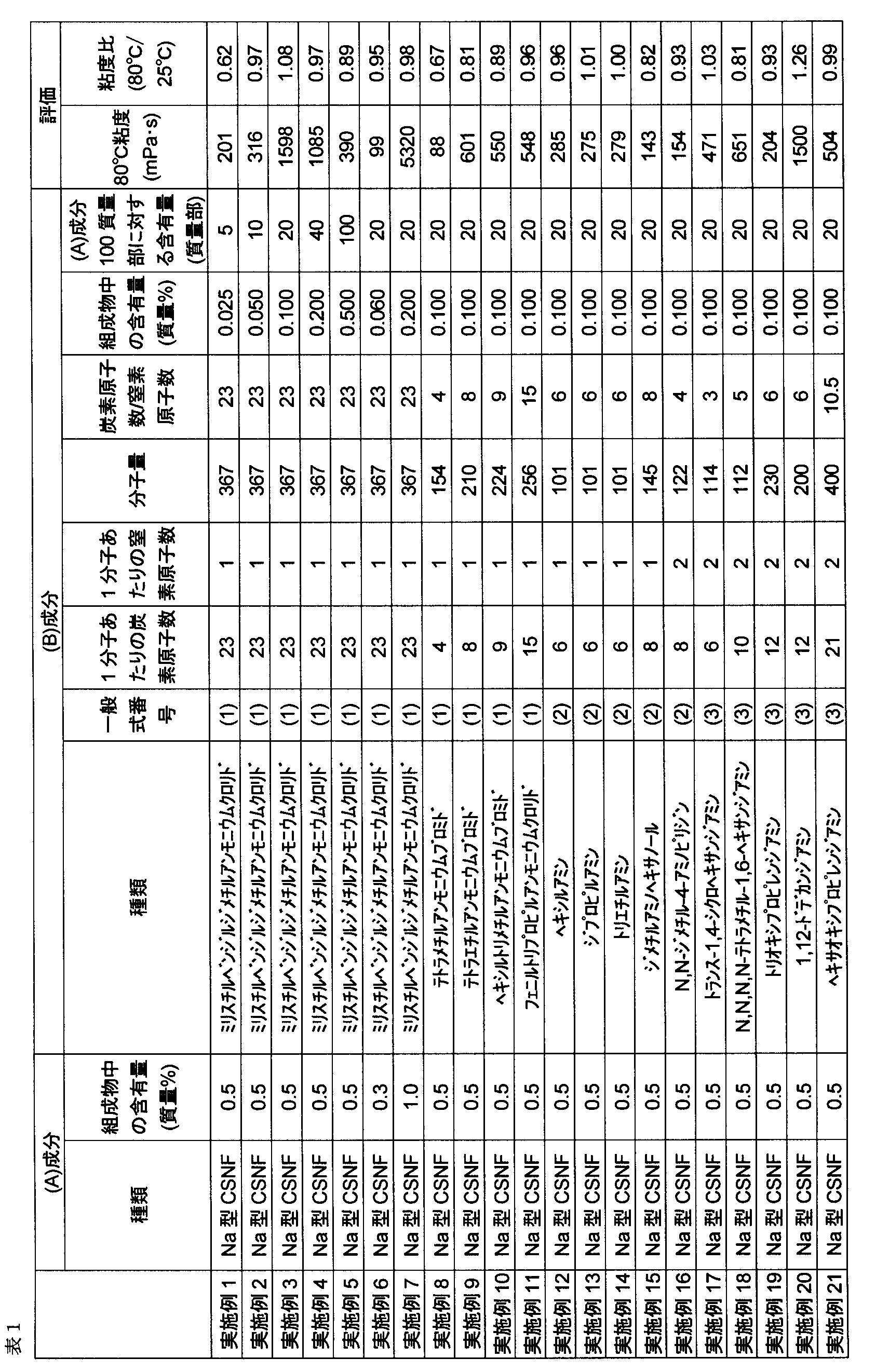

表1及び2より、特定のカルボキシ基含有微細セルロース繊維分散液に、化合物1分子あたりの炭素原子数と窒素原子数の比率(炭素原子数/窒素原子数)が特定である化合物を添加することで、高温条件でも減粘しない特徴的な増粘組成物が得られることが明らかになった。一方、アルカリ金属との塩になっていないカルボキシ基含有微細セルロース繊維を用いた比較例10は(B)成分の添加効果が発揮されず、高温下での粘度が低いものであった。
以下、本発明の水系組成物の具体的処方を例示する。
[製造例1:化粧品(乳液)]
ステアリルアルコール1.5g、セチルアルコール1.5g、ステアリン酸2g、グリセリン10g、1,3-ブチレングリコール5g、ワセリン1g、重質流動イソパラフィン2g、メチルポリシロキサン5g、香料0.6g、及び実施例3で調製した粘性の水系組成物71.4gを常法に従い攪拌混合することで皮膚化粧料を好適に調製できる。得られる皮膚化粧料は高温時の粘性低下が抑制されるため、夏場の室外においても好適に使用できる。
ステアリルアルコール1.5g、セチルアルコール1.5g、ステアリン酸2g、グリセリン10g、1,3-ブチレングリコール5g、ワセリン1g、重質流動イソパラフィン2g、メチルポリシロキサン5g、香料0.6g、及び実施例3で調製した粘性の水系組成物71.4gを常法に従い攪拌混合することで皮膚化粧料を好適に調製できる。得られる皮膚化粧料は高温時の粘性低下が抑制されるため、夏場の室外においても好適に使用できる。
[製造例2:家庭用品(芳香剤)]
香料(フローラル調合香料:小川香料社製)2g及びカルボキシ基含有微細セルロース繊維分散液(固形分濃度1.3質量%)38.5gをイオン交換水61.3gに投入し、実施例1と同様の超音波ホモジナイザー処理を行うことで、香料が均一に混ざった固形分濃度0.5質量%のカルボキシ基含有微細セルロース繊維分散液100gを調製する。得られた分散液にミリスチルベンジルジメチルアンモニウムクロリドをカルボキシ基含有微細セルロース繊維100質量部に対して20質量部となるように添加し、マグネティックスターラーを用いて室温で3h攪拌を行った後、一晩室温で静置することで、ゲル状芳香剤組成物を調製できる。得られるゲル状芳香剤組成物は高温時の粘性低下が抑制されるため、夏場の車内などの温度変化の著しい環境下においても好適に使用できる。
香料(フローラル調合香料:小川香料社製)2g及びカルボキシ基含有微細セルロース繊維分散液(固形分濃度1.3質量%)38.5gをイオン交換水61.3gに投入し、実施例1と同様の超音波ホモジナイザー処理を行うことで、香料が均一に混ざった固形分濃度0.5質量%のカルボキシ基含有微細セルロース繊維分散液100gを調製する。得られた分散液にミリスチルベンジルジメチルアンモニウムクロリドをカルボキシ基含有微細セルロース繊維100質量部に対して20質量部となるように添加し、マグネティックスターラーを用いて室温で3h攪拌を行った後、一晩室温で静置することで、ゲル状芳香剤組成物を調製できる。得られるゲル状芳香剤組成物は高温時の粘性低下が抑制されるため、夏場の車内などの温度変化の著しい環境下においても好適に使用できる。
[製造例3:工業製品(ペンキ)]
実施例3で調製した粘性の水系組成物46gに二酸化チタン20g、炭酸カルシウム14g、タルク20gを常法に従い攪拌混合することで水性顔料分散ペーストを調製できる。得られる水性顔料分散ペーストは高温時の粘性低下が抑制されるため、夏場の室外の顔料塗布作業時においても好適に使用できる。
実施例3で調製した粘性の水系組成物46gに二酸化チタン20g、炭酸カルシウム14g、タルク20gを常法に従い攪拌混合することで水性顔料分散ペーストを調製できる。得られる水性顔料分散ペーストは高温時の粘性低下が抑制されるため、夏場の室外の顔料塗布作業時においても好適に使用できる。
[製造例4:掘削泥水用調整剤]
ベントナイト2g及びカルボキシ基含有微細セルロース繊維分散液(固形分濃度1.3質量%)38.5gをイオン交換水61.3gに投入し、実施例1と同様の超音波ホモジナイザー処理を行うことで、ベントナイトが均一に混ざった固形分濃度0.5質量%のカルボキシ基含有微細セルロース繊維分散液100gを調製する。得られた分散液にミリスチルベンジルジメチルアンモニウムクロリドをカルボキシ基含有微細セルロース繊維100質量部に対して20質量部となるように添加し、マグネティックスターラーを用いて室温で3h攪拌を行った後、一晩室温で静置することで、掘削泥水用調整剤を調製できる。得られる掘削泥水用調整剤は高温時の粘性低下が抑制されるため、掘削時の摩擦や地熱による高温環境下においても好適に使用できる。
ベントナイト2g及びカルボキシ基含有微細セルロース繊維分散液(固形分濃度1.3質量%)38.5gをイオン交換水61.3gに投入し、実施例1と同様の超音波ホモジナイザー処理を行うことで、ベントナイトが均一に混ざった固形分濃度0.5質量%のカルボキシ基含有微細セルロース繊維分散液100gを調製する。得られた分散液にミリスチルベンジルジメチルアンモニウムクロリドをカルボキシ基含有微細セルロース繊維100質量部に対して20質量部となるように添加し、マグネティックスターラーを用いて室温で3h攪拌を行った後、一晩室温で静置することで、掘削泥水用調整剤を調製できる。得られる掘削泥水用調整剤は高温時の粘性低下が抑制されるため、掘削時の摩擦や地熱による高温環境下においても好適に使用できる。
<掘削泥水用調整剤の使用>
上記製造例4で調製した掘削泥水用調整剤を実際の掘削工程に使用することで、掘削時の高温条件下においても好適な粘性を発現することにより掘削工事の作業性を向上させることが出来る。
上記製造例4で調製した掘削泥水用調整剤を実際の掘削工程に使用することで、掘削時の高温条件下においても好適な粘性を発現することにより掘削工事の作業性を向上させることが出来る。
本発明の微細セルロース繊維・塩複合体は、高温下でも高粘度を保持することから、ガス・オイル掘削時の増粘剤を代表とする様々な工業用途、化粧品用途、その他高温下での製品安定性が求められる用途において、好適に使用することができる。
Claims (16)
- (A)数平均繊維径が0.5nm以上200nm以下であり、カルボキシ基含有量が0.1mmol/g以上であり、該カルボキシ基がアルカリ金属との塩となっている、微細セルロース繊維、及び
(B)炭素原子と窒素原子を有し、化合物1分子あたりのその比率(炭素原子数/窒素原子数)が3以上45以下である化合物を1種又は2種以上含む添加剤
を含有し、前記(A)成分の含有量が0.2質量%以上10質量%以下であり、前記(B)成分の含有量が(A)成分100質量部に対して3質量部以上150質量部以下であり、80℃、回転速度30rpmにおける組成物の粘度が80mPa・s以上である、水系組成物。 - 微細セルロース繊維が、天然セルロース繊維をN-オキシル化合物存在下で酸化する工程を含む製造方法により得られたものである、請求項1記載の水系組成物。
- 微細セルロース繊維のカルボキシ基含有量が、0.4mmol/g以上2.0mmol/g以下である、請求項1又は2記載の水系組成物。
- (B)成分が、4級アンモニウム塩、アミン、及びアミドからなる群より選ばれる1種又は2種以上を含む、請求項1~3いずれか記載の水系組成物。
- (B)成分が、4級アンモニウム塩を含む、請求項1~4いずれか記載の水系組成物。
- (B)成分が、下記一般式(1)~(6)で表される化合物からなる群より選ばれる1種又は2種以上を含む、請求項1~4いずれか記載の水系組成物。





- 水系組成物中、(A)成分の含有量が0.3質量%以上5質量%以下である、請求項1~6いずれか記載の水系組成物。
- 水系組成物中、(B)成分の含有量が0.02質量%以上1質量%以下である、請求項1~7いずれか記載の水系組成物。
- クリーム、乳液、及び口紅から選ばれる化粧品としての、請求項1~8いずれか記載の水系組成物の使用。
- 芳香剤、シャンプー、及び染髪剤から選ばれる家庭用品としての、請求項1~8いずれか記載の水系組成物の使用。
- 発泡剤、ペンキ、及びコンクリートから選ばれる工業製品としての、請求項1~8いずれか記載の水系組成物の使用。
- 打杭工事、石油回収作業、又は油田の油井掘削の際に用いることができる、掘削用流体、スペーサー流体、坑井刺激用の圧入流体、及び回収増進用の後押し流体からなる群より選ばれるいずれかの流体としての、請求項1~8いずれか記載の水系組成物の使用。
- 請求項1~8いずれか記載の水系組成物を用いて地下層を処理することを特徴とする、地下層の処理方法。
- 請求項1~8いずれか記載の水系組成物を、掘削用流体、スペーサー流体、坑井刺激用の圧入流体、及び回収増進用の後押し流体からなる群より選ばれるいずれかの流体として用いることで、地下層における天然ガス又は原油を採取することを特徴とする、請求項13記載の方法。
- 請求項1~8いずれか記載の水系組成物を地中の掘削穴先端に送り込み、掘削により生じた土砂や岩石を地上に回収する、掘削により生じた土砂や岩石の回収方法。
- 請求項1~8いずれか記載の水系組成物を、地中の掘削穴先端に送り込み、掘削により生じた土砂や岩石を前記水系組成物中に分散させることを特徴とする、請求項15記載の方法。
Priority Applications (3)
| Application Number | Priority Date | Filing Date | Title |
|---|---|---|---|
| US15/561,454 US10961425B2 (en) | 2015-03-26 | 2016-03-08 | Viscous water-based composition |
| EP16768394.5A EP3275931B1 (en) | 2015-03-26 | 2016-03-08 | Viscous water-based composition |
| CN201680018259.6A CN107531941B (zh) | 2015-03-26 | 2016-03-08 | 粘性水系组合物 |
Applications Claiming Priority (2)
| Application Number | Priority Date | Filing Date | Title |
|---|---|---|---|
| JP2015-064319 | 2015-03-26 | ||
| JP2015064319 | 2015-03-26 |
Publications (1)
| Publication Number | Publication Date |
|---|---|
| WO2016152491A1 true WO2016152491A1 (ja) | 2016-09-29 |
Family
ID=56978865
Family Applications (1)
| Application Number | Title | Priority Date | Filing Date |
|---|---|---|---|
| PCT/JP2016/057077 Ceased WO2016152491A1 (ja) | 2015-03-26 | 2016-03-08 | 粘性水系組成物 |
Country Status (5)
| Country | Link |
|---|---|
| US (1) | US10961425B2 (ja) |
| EP (1) | EP3275931B1 (ja) |
| JP (1) | JP6860291B2 (ja) |
| CN (1) | CN107531941B (ja) |
| WO (1) | WO2016152491A1 (ja) |
Cited By (4)
| Publication number | Priority date | Publication date | Assignee | Title |
|---|---|---|---|---|
| JP2020018363A (ja) * | 2018-07-30 | 2020-02-06 | エステー株式会社 | 薬剤揮散具及び薬剤揮散具に使用する薬剤 |
| WO2020045533A1 (ja) * | 2018-08-30 | 2020-03-05 | 王子ホールディングス株式会社 | 繊維状セルロース含有組成物、液状組成物及び成形体 |
| JP2021116518A (ja) * | 2020-01-28 | 2021-08-10 | 王子ホールディングス株式会社 | 微細繊維状セルロース・微細無機層状化合物含有物の製造方法及び微細繊維状セルロース・微細無機層状化合物含有物 |
| JP2024144678A (ja) * | 2020-10-29 | 2024-10-11 | パナソニックIpマネジメント株式会社 | 電解コンデンサおよびその製造方法 |
Families Citing this family (15)
| Publication number | Priority date | Publication date | Assignee | Title |
|---|---|---|---|---|
| JP6723632B2 (ja) * | 2015-07-24 | 2020-07-15 | 第一工業製薬株式会社 | 配管摩擦抵抗低減剤及び輸送媒体 |
| JP6105139B1 (ja) * | 2016-09-16 | 2017-03-29 | 第一工業製薬株式会社 | 油性インク組成物 |
| JP6874329B2 (ja) * | 2016-11-01 | 2021-05-19 | 凸版印刷株式会社 | ホルムアルデヒド除去組成物およびその製造方法、ホルムアルデヒド除去シート |
| WO2018116661A1 (ja) * | 2016-12-21 | 2018-06-28 | 日本製紙株式会社 | 酸型カルボキシル化セルロースナノファイバー |
| US11578142B2 (en) | 2016-12-21 | 2023-02-14 | Nippon Paper Industries Co., Ltd. | Acid type carboxylated cellulose nanofiber |
| JP6229090B1 (ja) * | 2017-02-08 | 2017-11-08 | 日本製紙株式会社 | H型カルボキシル化セルロースナノファイバー |
| JP6921597B2 (ja) * | 2017-04-13 | 2021-08-18 | 花王株式会社 | ゲル膜 |
| JP6988269B2 (ja) * | 2017-08-29 | 2022-01-05 | 王子ホールディングス株式会社 | 繊維状セルロース含有組成物及び塗料 |
| JP7101332B2 (ja) * | 2017-12-26 | 2022-07-15 | 株式会社パイロットコーポレーション | 固形筆記体 |
| JP7450419B2 (ja) * | 2019-03-19 | 2024-03-15 | 花王株式会社 | 改質セルロース繊維を含有する組成物 |
| WO2020235669A1 (ja) * | 2019-05-22 | 2020-11-26 | 国立大学法人 東京大学 | 新規なセルロースナノファイバーおよびその乾燥体の製造方法 |
| JP2021120498A (ja) * | 2020-01-30 | 2021-08-19 | 花王株式会社 | セルロース繊維複合体 |
| JP6915140B1 (ja) | 2020-10-07 | 2021-08-04 | 第一工業製薬株式会社 | 粘性水系組成物および皮膚外用剤 |
| CN112694307B (zh) * | 2020-12-30 | 2021-10-01 | 广东新南方基础工程有限公司 | 一种地基基础工程用的组合桩及其制备方法 |
| WO2025187576A1 (ja) * | 2024-03-04 | 2025-09-12 | 花王株式会社 | 改質セルロース繊維及び重合性化合物を含有する組成物の製造方法 |
Citations (8)
| Publication number | Priority date | Publication date | Assignee | Title |
|---|---|---|---|---|
| JP2008536959A (ja) * | 2005-03-02 | 2008-09-11 | ハーキュリーズ・インコーポレーテッド | 水溶性、低い置換度のヒドロキシエチルセルロース、それらの誘導体、それらの製造方法および使用 |
| JP2010037348A (ja) * | 2008-07-31 | 2010-02-18 | Dai Ichi Kogyo Seiyaku Co Ltd | ゲル状組成物 |
| WO2011071156A1 (ja) * | 2009-12-11 | 2011-06-16 | 花王株式会社 | 複合材料 |
| WO2011089709A1 (ja) * | 2010-01-22 | 2011-07-28 | 第一工業製薬株式会社 | 粘稠な組成物 |
| WO2011089323A1 (en) * | 2010-01-25 | 2011-07-28 | Upm-Kymmene Corporation | Agent and composition for oilfield applications |
| JP2012126788A (ja) * | 2010-12-14 | 2012-07-05 | Dai Ichi Kogyo Seiyaku Co Ltd | 粘性水系組成物 |
| JP2014105114A (ja) * | 2012-11-22 | 2014-06-09 | Nippon Paper Industries Co Ltd | セメント用増粘剤 |
| JP2016065116A (ja) * | 2014-09-24 | 2016-04-28 | 第一工業製薬株式会社 | セルロースナノファイバー水分散体組成物、それを用いた食品および化粧料。 |
Family Cites Families (12)
| Publication number | Priority date | Publication date | Assignee | Title |
|---|---|---|---|---|
| DK0912653T3 (da) | 1996-07-15 | 2002-03-25 | Rhodia Chimie Sa | Væske omfattende cellulose-nanofibriller og anvendelse heraf til udnyttelse af oliefelter |
| CN1922363B (zh) | 2004-02-19 | 2011-04-13 | 东丽株式会社 | 纳米纤维配合溶液、乳液和凝胶状物及其制造方法,以及纳米纤维合成纸及其制造方法 |
| JP2010202856A (ja) | 2009-02-06 | 2010-09-16 | Kao Corp | セルロース繊維の懸濁液とその製造方法 |
| JP2011047084A (ja) | 2009-08-28 | 2011-03-10 | Sumitomo Bakelite Co Ltd | 有機化繊維、樹脂組成物及びその製造方法 |
| JP5944098B2 (ja) | 2009-12-11 | 2016-07-05 | 花王株式会社 | 微細セルロース繊維複合体、微細セルロース繊維分散液及び複合材料 |
| JP5855337B2 (ja) | 2010-10-07 | 2016-02-09 | 北越紀州製紙株式会社 | 多孔質体及びその製造方法 |
| JP5722021B2 (ja) * | 2010-12-14 | 2015-05-20 | 第一工業製薬株式会社 | 粘性水系組成物およびその製法、並びにそれに用いるセルロース繊維 |
| US10995257B2 (en) * | 2012-06-18 | 2021-05-04 | Nouryon Chemicals International B.V. | Process to produce oil or gas from a subterranean formation using a chelating agent |
| NO343138B1 (no) | 2013-03-20 | 2018-11-19 | Elkem Materials | Viskositetsøkende middel for borefluider |
| US9803128B2 (en) | 2013-08-30 | 2017-10-31 | Dai-Ichi Kogyo Seiyaku Co., Ltd. | Additive for drilling mud |
| RU2016105773A (ru) * | 2013-08-30 | 2017-10-05 | Дай-Ити Когио Сейяку Ко., Лтд. | Добавка для извлечения сырой нефти |
| US10703955B2 (en) * | 2014-06-30 | 2020-07-07 | Oji Holdings Corporation | Composition comprising ultrafine cellulose fibers |
-
2016
- 2016-03-08 JP JP2016044115A patent/JP6860291B2/ja active Active
- 2016-03-08 US US15/561,454 patent/US10961425B2/en not_active Expired - Fee Related
- 2016-03-08 WO PCT/JP2016/057077 patent/WO2016152491A1/ja not_active Ceased
- 2016-03-08 CN CN201680018259.6A patent/CN107531941B/zh not_active Expired - Fee Related
- 2016-03-08 EP EP16768394.5A patent/EP3275931B1/en not_active Not-in-force
Patent Citations (8)
| Publication number | Priority date | Publication date | Assignee | Title |
|---|---|---|---|---|
| JP2008536959A (ja) * | 2005-03-02 | 2008-09-11 | ハーキュリーズ・インコーポレーテッド | 水溶性、低い置換度のヒドロキシエチルセルロース、それらの誘導体、それらの製造方法および使用 |
| JP2010037348A (ja) * | 2008-07-31 | 2010-02-18 | Dai Ichi Kogyo Seiyaku Co Ltd | ゲル状組成物 |
| WO2011071156A1 (ja) * | 2009-12-11 | 2011-06-16 | 花王株式会社 | 複合材料 |
| WO2011089709A1 (ja) * | 2010-01-22 | 2011-07-28 | 第一工業製薬株式会社 | 粘稠な組成物 |
| WO2011089323A1 (en) * | 2010-01-25 | 2011-07-28 | Upm-Kymmene Corporation | Agent and composition for oilfield applications |
| JP2012126788A (ja) * | 2010-12-14 | 2012-07-05 | Dai Ichi Kogyo Seiyaku Co Ltd | 粘性水系組成物 |
| JP2014105114A (ja) * | 2012-11-22 | 2014-06-09 | Nippon Paper Industries Co Ltd | セメント用増粘剤 |
| JP2016065116A (ja) * | 2014-09-24 | 2016-04-28 | 第一工業製薬株式会社 | セルロースナノファイバー水分散体組成物、それを用いた食品および化粧料。 |
Non-Patent Citations (1)
| Title |
|---|
| See also references of EP3275931A4 * |
Cited By (8)
| Publication number | Priority date | Publication date | Assignee | Title |
|---|---|---|---|---|
| JP2020018363A (ja) * | 2018-07-30 | 2020-02-06 | エステー株式会社 | 薬剤揮散具及び薬剤揮散具に使用する薬剤 |
| JP7229693B2 (ja) | 2018-07-30 | 2023-02-28 | エステー株式会社 | 薬剤揮散具 |
| WO2020045533A1 (ja) * | 2018-08-30 | 2020-03-05 | 王子ホールディングス株式会社 | 繊維状セルロース含有組成物、液状組成物及び成形体 |
| JPWO2020045533A1 (ja) * | 2018-08-30 | 2021-08-12 | 王子ホールディングス株式会社 | 繊維状セルロース含有組成物、液状組成物及び成形体 |
| JP7351305B2 (ja) | 2018-08-30 | 2023-09-27 | 王子ホールディングス株式会社 | 繊維状セルロース含有組成物、液状組成物及び成形体 |
| JP2021116518A (ja) * | 2020-01-28 | 2021-08-10 | 王子ホールディングス株式会社 | 微細繊維状セルロース・微細無機層状化合物含有物の製造方法及び微細繊維状セルロース・微細無機層状化合物含有物 |
| JP7703857B2 (ja) | 2020-01-28 | 2025-07-08 | 王子ホールディングス株式会社 | 微細繊維状セルロース・微細無機層状化合物含有物の製造方法及び微細繊維状セルロース・微細無機層状化合物含有物 |
| JP2024144678A (ja) * | 2020-10-29 | 2024-10-11 | パナソニックIpマネジメント株式会社 | 電解コンデンサおよびその製造方法 |
Also Published As
| Publication number | Publication date |
|---|---|
| CN107531941B (zh) | 2021-03-12 |
| US10961425B2 (en) | 2021-03-30 |
| JP2016183329A (ja) | 2016-10-20 |
| EP3275931A1 (en) | 2018-01-31 |
| US20180118991A1 (en) | 2018-05-03 |
| EP3275931A4 (en) | 2018-11-07 |
| EP3275931B1 (en) | 2020-10-14 |
| CN107531941A (zh) | 2018-01-02 |
| JP6860291B2 (ja) | 2021-04-14 |
Similar Documents
| Publication | Publication Date | Title |
|---|---|---|
| JP6860291B2 (ja) | 粘性水系組成物 | |
| RU2410403C2 (ru) | Замещенная в массе гидроксиэтилцеллюлоза, ее производные, способ ее получения и применение | |
| RU2415160C2 (ru) | Водорастворимая низкозамещенная гидроксиэтилцеллюлоза, ее производные, способ ее получения и применение | |
| US8198220B2 (en) | Wellbore treatment compositions comprising hydrophilically modified polymers and nonionic surfactants | |
| EP3041585B1 (en) | Cosmetic and household care compositions | |
| JP6615507B2 (ja) | 皮膚化粧料 | |
| JP2017110085A (ja) | 粘性水系組成物およびその製造方法 | |
| CA2547252A1 (en) | Non-damaging fracturing fluids and methods for their use | |
| WO2020149733A1 (en) | Composition with foaming properties | |
| US10844140B2 (en) | Phosphonated polysaccharides and gels and process for making same | |
| Dong et al. | Influence of degree of molar etherification on critical liquid crystal behavior of hydroxypropyl chitosan | |
| Ye et al. | Study on the rheological behavior of the hydrophobically modified hydroxyethyl cellulose with 1, 2‐epoxyhexadecane | |
| KR101818105B1 (ko) | 회합성 공중합체로 표면 개질된 셀룰로오즈 미세섬유 및 이를 포함하는 점증제 조성물 | |
| WO2018186261A1 (ja) | クレンジング化粧料 | |
| JP6932169B2 (ja) | 皮膚化粧料 | |
| JP6765560B1 (ja) | 皮膚外用剤 | |
| JP2026049809A (ja) | 光アップコンバージョン組成物、フィルム及び光アップコンバージョン方法 | |
| EP0719793A1 (de) | Verfahren zur Herstellung von wasserlöslichen Aminoalkylderivaten von Polysacchariden | |
| CN103154039A (zh) | 改性多糖醛酸及其盐 | |
| JP2005314244A (ja) | 水中油型乳化物及びその製造法 | |
| JPWO2018186260A1 (ja) | ヘアオイル、及びその製造方法 | |
| WO1998019534A1 (de) | Thermoplastische polysaccharidsalze | |
| JP2000034474A (ja) | 泥水調整剤 | |
| ITVA20130041A1 (it) | Galattomannani cationic |
Legal Events
| Date | Code | Title | Description |
|---|---|---|---|
| 121 | Ep: the epo has been informed by wipo that ep was designated in this application |
Ref document number: 16768394 Country of ref document: EP Kind code of ref document: A1 |
|
| REEP | Request for entry into the european phase |
Ref document number: 2016768394 Country of ref document: EP |
|
| WWE | Wipo information: entry into national phase |
Ref document number: 15561454 Country of ref document: US |
|
| NENP | Non-entry into the national phase |
Ref country code: DE |