WO2016152828A1 - 甜茶抽出エッセンスおよびその用途 - Google Patents
甜茶抽出エッセンスおよびその用途 Download PDFInfo
- Publication number
- WO2016152828A1 WO2016152828A1 PCT/JP2016/058907 JP2016058907W WO2016152828A1 WO 2016152828 A1 WO2016152828 A1 WO 2016152828A1 JP 2016058907 W JP2016058907 W JP 2016058907W WO 2016152828 A1 WO2016152828 A1 WO 2016152828A1
- Authority
- WO
- WIPO (PCT)
- Prior art keywords
- tea extract
- essence
- bifidobacterium
- lactic acid
- activated carbon
- Prior art date
- Legal status (The legal status is an assumption and is not a legal conclusion. Google has not performed a legal analysis and makes no representation as to the accuracy of the status listed.)
- Ceased
Links
Classifications
-
- A—HUMAN NECESSITIES
- A23—FOODS OR FOODSTUFFS; TREATMENT THEREOF, NOT COVERED BY OTHER CLASSES
- A23F—COFFEE; TEA; THEIR SUBSTITUTES; MANUFACTURE, PREPARATION, OR INFUSION THEREOF
- A23F3/00—Tea; Tea substitutes; Preparations thereof
- A23F3/16—Tea extraction; Tea extracts; Treating tea extract; Making instant tea
-
- A—HUMAN NECESSITIES
- A23—FOODS OR FOODSTUFFS; TREATMENT THEREOF, NOT COVERED BY OTHER CLASSES
- A23C—DAIRY PRODUCTS, e.g. MILK, BUTTER OR CHEESE; MILK OR CHEESE SUBSTITUTES; PREPARATION THEREOF
- A23C9/00—Milk preparations; Milk powder or milk powder preparations
- A23C9/12—Fermented milk preparations; Treatment using microorganisms or enzymes
- A23C9/1203—Addition of, or treatment with, enzymes or microorganisms other than lactobacteriaceae
-
- A—HUMAN NECESSITIES
- A23—FOODS OR FOODSTUFFS; TREATMENT THEREOF, NOT COVERED BY OTHER CLASSES
- A23C—DAIRY PRODUCTS, e.g. MILK, BUTTER OR CHEESE; MILK OR CHEESE SUBSTITUTES; PREPARATION THEREOF
- A23C9/00—Milk preparations; Milk powder or milk powder preparations
- A23C9/12—Fermented milk preparations; Treatment using microorganisms or enzymes
- A23C9/123—Fermented milk preparations; Treatment using microorganisms or enzymes using only microorganisms of the genus lactobacteriaceae; Yoghurt
- A23C9/1234—Fermented milk preparations; Treatment using microorganisms or enzymes using only microorganisms of the genus lactobacteriaceae; Yoghurt characterised by using a Lactobacillus sp. other than Lactobacillus Bulgaricus, including Bificlobacterium sp.
-
- A—HUMAN NECESSITIES
- A23—FOODS OR FOODSTUFFS; TREATMENT THEREOF, NOT COVERED BY OTHER CLASSES
- A23C—DAIRY PRODUCTS, e.g. MILK, BUTTER OR CHEESE; MILK OR CHEESE SUBSTITUTES; PREPARATION THEREOF
- A23C9/00—Milk preparations; Milk powder or milk powder preparations
- A23C9/12—Fermented milk preparations; Treatment using microorganisms or enzymes
- A23C9/13—Fermented milk preparations; Treatment using microorganisms or enzymes using additives
-
- A—HUMAN NECESSITIES
- A23—FOODS OR FOODSTUFFS; TREATMENT THEREOF, NOT COVERED BY OTHER CLASSES
- A23C—DAIRY PRODUCTS, e.g. MILK, BUTTER OR CHEESE; MILK OR CHEESE SUBSTITUTES; PREPARATION THEREOF
- A23C9/00—Milk preparations; Milk powder or milk powder preparations
- A23C9/12—Fermented milk preparations; Treatment using microorganisms or enzymes
- A23C9/13—Fermented milk preparations; Treatment using microorganisms or enzymes using additives
- A23C9/1307—Milk products or derivatives; Fruit or vegetable juices; Sugars, sugar alcohols, sweeteners; Oligosaccharides; Organic acids or salts thereof or acidifying agents; Flavours, dyes or pigments; Inert or aerosol gases; Carbonation methods
-
- A—HUMAN NECESSITIES
- A23—FOODS OR FOODSTUFFS; TREATMENT THEREOF, NOT COVERED BY OTHER CLASSES
- A23F—COFFEE; TEA; THEIR SUBSTITUTES; MANUFACTURE, PREPARATION, OR INFUSION THEREOF
- A23F3/00—Tea; Tea substitutes; Preparations thereof
- A23F3/16—Tea extraction; Tea extracts; Treating tea extract; Making instant tea
- A23F3/20—Removing unwanted substances
- A23F3/205—Using flocculating or adsorbing agents
-
- A—HUMAN NECESSITIES
- A23—FOODS OR FOODSTUFFS; TREATMENT THEREOF, NOT COVERED BY OTHER CLASSES
- A23L—FOODS, FOODSTUFFS OR NON-ALCOHOLIC BEVERAGES, NOT OTHERWISE PROVIDED FOR; PREPARATION OR TREATMENT THEREOF
- A23L5/00—Preparation or treatment of foods or foodstuffs, in general; Food or foodstuffs obtained thereby; Materials therefor
- A23L5/20—Removal of unwanted matter, e.g. deodorisation or detoxification
-
- A—HUMAN NECESSITIES
- A61—MEDICAL OR VETERINARY SCIENCE; HYGIENE
- A61K—PREPARATIONS FOR MEDICAL, DENTAL OR TOILETRY PURPOSES
- A61K35/00—Medicinal preparations containing materials or reaction products thereof with undetermined constitution
- A61K35/66—Microorganisms or materials therefrom
- A61K35/74—Bacteria
- A61K35/741—Probiotics
- A61K35/744—Lactic acid bacteria, e.g. enterococci, pediococci, lactococci, streptococci or leuconostocs
- A61K35/745—Bifidobacteria
-
- C—CHEMISTRY; METALLURGY
- C12—BIOCHEMISTRY; BEER; SPIRITS; WINE; VINEGAR; MICROBIOLOGY; ENZYMOLOGY; MUTATION OR GENETIC ENGINEERING
- C12N—MICROORGANISMS OR ENZYMES; COMPOSITIONS THEREOF; PROPAGATING, PRESERVING, OR MAINTAINING MICROORGANISMS; MUTATION OR GENETIC ENGINEERING; CULTURE MEDIA
- C12N1/00—Microorganisms; Compositions thereof; Processes of propagating, maintaining or preserving microorganisms or compositions thereof; Processes of preparing or isolating a composition containing a microorganism; Culture media therefor
- C12N1/20—Bacteria; Culture media therefor
-
- A—HUMAN NECESSITIES
- A23—FOODS OR FOODSTUFFS; TREATMENT THEREOF, NOT COVERED BY OTHER CLASSES
- A23C—DAIRY PRODUCTS, e.g. MILK, BUTTER OR CHEESE; MILK OR CHEESE SUBSTITUTES; PREPARATION THEREOF
- A23C2240/00—Use or particular additives or ingredients
- A23C2240/15—Use of plant extracts, including purified and isolated derivatives thereof, as ingredient in dairy products
-
- A—HUMAN NECESSITIES
- A23—FOODS OR FOODSTUFFS; TREATMENT THEREOF, NOT COVERED BY OTHER CLASSES
- A23V—INDEXING SCHEME RELATING TO FOODS, FOODSTUFFS OR NON-ALCOHOLIC BEVERAGES AND LACTIC OR PROPIONIC ACID BACTERIA USED IN FOODSTUFFS OR FOOD PREPARATION
- A23V2002/00—Food compositions, function of food ingredients or processes for food or foodstuffs
-
- A—HUMAN NECESSITIES
- A23—FOODS OR FOODSTUFFS; TREATMENT THEREOF, NOT COVERED BY OTHER CLASSES
- A23V—INDEXING SCHEME RELATING TO FOODS, FOODSTUFFS OR NON-ALCOHOLIC BEVERAGES AND LACTIC OR PROPIONIC ACID BACTERIA USED IN FOODSTUFFS OR FOOD PREPARATION
- A23V2250/00—Food ingredients
- A23V2250/02—Acid
- A23V2250/042—Lactic acid
-
- A—HUMAN NECESSITIES
- A23—FOODS OR FOODSTUFFS; TREATMENT THEREOF, NOT COVERED BY OTHER CLASSES
- A23V—INDEXING SCHEME RELATING TO FOODS, FOODSTUFFS OR NON-ALCOHOLIC BEVERAGES AND LACTIC OR PROPIONIC ACID BACTERIA USED IN FOODSTUFFS OR FOOD PREPARATION
- A23V2400/00—Lactic or propionic acid bacteria
- A23V2400/11—Lactobacillus
-
- A—HUMAN NECESSITIES
- A23—FOODS OR FOODSTUFFS; TREATMENT THEREOF, NOT COVERED BY OTHER CLASSES
- A23V—INDEXING SCHEME RELATING TO FOODS, FOODSTUFFS OR NON-ALCOHOLIC BEVERAGES AND LACTIC OR PROPIONIC ACID BACTERIA USED IN FOODSTUFFS OR FOOD PREPARATION
- A23V2400/00—Lactic or propionic acid bacteria
- A23V2400/51—Bifidobacterium
Definitions
- the present invention can enhance the growth of lactic acid bacteria and Bifidobacterium and the survival of Bifidobacterium, does not affect the flavor, and is easy to manufacture and powder. Regarding its use.
- Lactic acid bacteria have various effects such as intestinal flora improvement, fecal improvement, intestinal function improvement, infection protection, immunostimulation, cancer prevention, etc., so the production of lactic acid bacteria preparations as pharmaceuticals, fermented milk, lactic acid bacteria beverages, cheese It is used for food and drinks. When used for these, the cultivation of lactic acid bacteria is most often carried out using animal milk as a medium. However, in general, lactic acid bacteria have different nutritional requirements depending on the type of the lactic acid bacteria, so that they do not grow so much in a medium consisting only of animal milk. In order to obtain a fermented product having sufficient acidity in producing fermented milk, lactic acid bacteria beverages, etc., it is said that culturing for several days must be performed.
- Bifidobacterium which is used in medicines and foods as well as lactic acid bacteria, is generally anaerobic and has poor survival, especially in the presence of oxygen. End up.
- the present applicant has so far electrodialyzed a coconut tea extract with an inorganic salt such as magnesium chloride, found a coconut tea essence obtained as a concentrate, and cultivated lactic acid bacteria in a medium containing the essence of lactic acid bacteria. It has been reported that a culture with good flavor is obtained without the bitterness derived from strawberry tea while the growth is promoted (Patent Document 3).
- Bifidobacterium genus bacteria can also be cultured in a medium containing the above-mentioned strawberry tea essence to improve survival and to obtain a good-tasting culture without bitter tea-derived bitterness. (Patent Document 4).
- the above tea essence requires time and a lot of electricity (energy) because it is necessary to perform electrodialysis for a long time (all day and night).
- an inorganic salt such as magnesium chloride is added for electrodialysis, but the inorganic salt may cause precipitation of milk components, which may hinder the production of the culture.
- magnesium chloride is used as an inorganic salt, the magnesium itself has a strong bitter taste, so if the magnesium remains in the tea essence at a high concentration, the flavor of the culture may be affected by the strong bitter taste. There was sex.
- magnesium chloride has deliquescence, if it remains in the tea essence even if it is a little, when it is pulverized in consideration of transportability and workability, the powder causes deliquescence after opening and becomes liquid. There was a problem of becoming.
- the present invention has the above-mentioned various problems, and the growth of lactic acid bacteria of conventional tea tea extract and tea tea essence, which can be replaced with tea tea essence obtained by electrodialysis of tea tea extract, and the growth of Bifidobacterium genus bacteria. It is an object of the present invention to provide a technique that does not affect the flavor and that is easy to manufacture and pulverize, while maintaining the effect of improving the residual properties and the like.
- the present invention is the following (1) to (16).
- (1) A tea tea extract essence obtained by treating a tea tea extract with activated carbon.
- (2) The tea extract extract according to (1), which is a dry powder.
- (3) The tea extract extract according to (1) or (2), wherein the activated carbon used for the activated carbon treatment is chemical activated charcoal.
- (5) A method for producing an extract essence of strawberry tea, wherein the strawberry tea extract is treated with activated carbon.
- (6) The method for producing a tea extract extract according to (5), wherein the activated carbon used for the activated carbon treatment is chemical activated charcoal.
- a fermented food comprising a lactic acid bacteria culture obtained by culturing lactic acid bacteria in a medium containing the strawberry tea extract essence according to any one of (1) to (4).
- the medium includes a step of blending the essence of tea extract according to any one of (1) to (4) before culturing the lactic acid bacteria.
- the essence of the tea extract according to any one of (1) to (4) is applied to the medium before the culture of the Bifidobacterium bacterium.
- the manufacturing method of the fermented food characterized by including the process mix
- a method for improving the survival of Bifidobacterium comprising the essence of the tea extract according to any one of (1) to (4) as an active ingredient.
- a method for improving the flavor of strawberry tea extract wherein the strawberry tea extract is treated with activated carbon.
- the tea extract extract of the present invention does not affect the flavor while maintaining the effect of enhancing the growth of lactic acid bacteria and the viability of Bifidobacterium of the conventional tea extract or tea tea essence. It also has the effect of increasing the growth of Bifidobacterium which has not been seen in the past.
- the conventional tea tea essence requires day and night electrodialysis, but the tea tea extract essence of the present invention uses activated carbon treatment that requires only about 30 minutes to 2 hours instead of electrodialysis. is there.
- the essence of the tea extract of the present invention does not add inorganic salts such as magnesium chloride, there is no problem of milk precipitation even when it is used for fermented foods.
- the essence extracted from the present invention is pulverized, the problem of liquefaction and liquefaction does not occur, and a powder product excellent in transportability and workability can be stably stored for a long period of time.
- the tea extract essence of the present invention can be suitably used for the production of fermented foods containing lactic acid bacteria or Bifidobacterium bacteria.
- the tea extract essence of the present invention is obtained by treating the tea tea extract with activated carbon.
- the above-mentioned strawberry tea extract is not particularly limited as long as it is obtained by extracting any part of the strawberry genus strawberry genus (scientific name: Rubus suavissimus S. Lee (Rosaceae)) with a solvent.
- examples include leaves, stems, preferably leaves, which are obtained by subjecting them to washing, molting, drying, crushing, and the like as they are or as necessary, followed by extraction with a solvent.
- the solvent used for the production of the above tea extract is not particularly limited, and examples thereof include water, lower alcohols having 1 to 5 carbon atoms such as ethanol, and organic solvents such as ethyl acetate, glycerin and propylene glycol. May be used alone or in combination of two or more. Among these solvents, water or an aqueous solvent such as water-lower alcohol is particularly preferable.
- the extraction method of the tea extract using the above solvent is not particularly limited, but for example, the acid extraction method is preferable.
- the acid extraction is carried out under acidic conditions of pH 4.0 or less, preferably pH 3.0 to 4.0.
- an acidic component can be used without any particular limitation, but preferred are citric acid and malic acid.
- organic acids such as tartaric acid, succinic acid, lactic acid, and acetic acid.
- the extraction conditions of the strawberry tea extract using the above solvent are not particularly limited.
- the extraction is performed at a temperature of 0 ° C. or higher and 100 ° C. or lower, more preferably 10 ° C. or higher and 40 ° C. or lower for about 30 to 60 minutes. I do.
- the tea extract essence of the present invention can be obtained by subjecting the above tea extract to activated carbon to contact with activated carbon.
- activated carbon there are no particular restrictions on the method of bringing the tea extract into contact with the activated carbon.
- the method of bringing the tea extract into contact with the activated carbon there are a batch method in which activated charcoal is poured into the tea tea extract, a column method in which the tea tea extract is passed through the activated carbon column, a cartridge method in which the activated carbon cartridge is passed, and the like.
- the batch method is preferable.
- the type of activated carbon used in the above is not particularly limited, for example, chemical activated charcoal activated by chemical activation with zinc chloride, phosphoric acid, sulfuric acid, calcium chloride, sodium hydroxide, potassium hydroxide, steam, carbon dioxide, Examples include gas activated charcoal using oxygen gas, combustion exhaust gas, and mixed gas thereof.
- chemical activated charcoal by zinc chloride or steam activated charcoal is preferable, and chemical activated charcoal by zinc chloride is particularly preferable.
- commercially available products such as Dazai powder charcoal SA1000-W65 (Futamura Chemical Co., Ltd.) can be used.
- the amount of the activated carbon used for the activated carbon treatment may be appropriately determined according to the concentration of the tea extract (Brix) and the type of the activated carbon.
- the Brix of the tea extract is 0 by dry weight per unit. More than 0.035% by weight (hereinafter simply referred to as “%”), preferably 0.05% to 0.5%, more preferably 0.055% to 0.085% activated carbon is added.
- % 0.035% by weight
- activated carbon is added in an amount of 0.7% or more, preferably 1% to 10%, more preferably 1.1% to 1.7% by dry weight.
- the measuring method of Brix of strawberry tea extract can be measured by, for example, an optical refractometer (digital refractometer such as RX-7000 ⁇ (Atago Co., Ltd.)).
- the conditions for bringing the strawberry tea extract into contact with the activated carbon are not particularly limited.
- the activated carbon may be added and then stirred at room temperature for about 30 minutes to 2 hours.
- the coconut tea extract is treated with activated carbon, followed by centrifugation, diatomaceous earth filtration, microfiltration, concentration, and sterilization, or the coconut tea extract is microfiltered and activated carbon treatment.
- the conditions for the centrifugation are not particularly limited as long as the activated carbon can be removed, but examples include conditions of 10,000 g for 2 minutes.
- the conditions for diatomaceous earth filtration are not particularly limited, and examples include conditions for filtering with standard filter paper No. 131 after adding 0.1% diatomaceous earth.
- the conditions for microfiltration are not particularly limited. For example, filtration with a 0.2 ⁇ m microfilter can be used, and the conditions for concentration can include concentrating Brix to a desired value using an evaporator or the like. .
- the conditions of sterilization are not specifically limited, the conditions of cooling to 50 degrees C or less after reaching 90 degree C are mentioned.
- the tea extract essence obtained as described above is preferably a dry powder for ease of handling.
- this dry powder does not contain magnesium chloride, it does not have deliquescence and can be stored stably. Further, it can be confirmed by the method described in Examples that the dry powder does not have deliquescence.
- the method for obtaining the dry powder is not particularly limited, and examples thereof include spray drying and freeze drying.
- a method for obtaining the dry powder by spray drying is preferred. Drying conditions by spray drying are not particularly limited, and examples include conditions where the inlet temperature is 160 ° C., the outlet temperature is 80 to 100 ° C., and the flow rate is 10 mL / min.
- an excipient filler can be added as needed. Excipients include dextrin, cyclodextrin, starch, maltose and the like, with dextrin being particularly preferred. The amount of the excipient added is not particularly limited.
- the dextrin when used as the excipient, the dextrin is used in an amount of 0.5 to 5% by weight, preferably 1 to 2 with respect to the solid content 1 of the strawberry tea extract essence. A weight ratio, more preferably 1.5 weight ratio is added.
- a lactic acid bacteria culture can be obtained by culturing lactic acid bacteria by blending the tea extract essence of the present invention in a medium, and a fermented food containing it can be obtained.
- the medium for culturing lactic acid bacteria by blending the essence of the tea extract of the present invention includes raw milk such as cow's milk, goat's milk, horse milk, sheep milk, and dairy products such as skim milk powder, whole milk powder, and fresh cream. Examples thereof include a medium, liquid milk derived from plants such as soy milk, and various synthetic media.
- components used in a normal medium for lactic acid bacteria may be added. Examples of such components include sugars such as glucose, vitamins such as vitamin A, vitamin B, vitamin C, and vitamin E, and salts such as various peptides, amino acids, calcium, and magnesium.
- oleic acids may be added to the medium.
- examples of such oleic acids include oleic acid, oleic acid salts such as sodium oleate and potassium oleate, glycerin oleate, polyglycerin oleate, oleate derivatives such as sucrose oleate, etc. Is mentioned.
- These oleic acids may be added so that the concentration in terms of oleic acid is generally 5 to 50 ppm, preferably 5 to 25 ppm in the medium.
- the lactic acid bacterium to be cultured by mixing the essence of the present invention with the tea extract extract is not particularly limited as long as it is a lactic acid bacterium usually used for food production.
- Lactobacillus casei Lactobacillus gasseri, Lactobacillus Acidophilus, Lactobacillus cremolith, Lactobacillus helveticus, Lactobacillus salvarius, Lactobacillus fermentum, Lactobacillus euglety, Lactobacillus delbrukee Subspecies.
- Lactobacillus genus bacteria such as Brookie, Lactobacillus johnsonii, Streptococcus genus bacteria such as Streptococcus thermophilus, Lactococcus lactis subspecies. Vinegar, Lactococcus lactis subsp. Cremoris, can Lactococcus plantarum, Lactococcus bacteria such as Lactococcus Rafinorakuchisu, Enterococcus faecalis, and the like Enterococcus bacteria such as Enterococcus faecium.
- Lactobacillus bacteria Lactobacillus bacteria, Streptococcus bacteria, and Lactococcus bacteria are preferable, and among these, Lactobacillus casei, Lactobacillus gasseri, Lactococcus lactis, Streptococcus thermophilus are preferable, and particularly Lactobacillus.
- Lactobacillus casei Lactobacillus gasseri
- Lactococcus lactis Lactococcus thermophilus
- Streptococcus thermophilus YIT2021 (FERM BP-7537, trust date: November 1, 1996) is preferred.
- the 1 type (s) or 2 or more types of each may be used for the said lactic acid bacteria, and each 1 type (s) or 2 or more types of Bifidobacterium genus bacteria mentioned later may be used
- the amount of the tea extract extracted from the present invention when cultivating lactic acid bacteria is not particularly limited.
- the powdered tea extract essence is converted into dry powder (contains only the tea extract essence without excipient) ) In the range of 0.0004% to 0.12% (0.0035% to 1% in terms of essence of extracted tea with Brix of 11.5), preferably 0.0012% to 0.012% (Brix of 11.5%). From 0.01% to 0.1% in terms of essence extracted from strawberry tea.
- the culture conditions for obtaining the lactic acid bacteria culture are not particularly limited.
- lactic acid bacteria are contained in the medium, and the number of bacteria in the medium is about 1.0 ⁇ 10 3 to 1.0 ⁇ 10 9 cfu / ml. And incubating it at a temperature of about 30 to 40 ° C. for about 1 to 7 days.
- a method suitable for culturing lactic acid bacteria used from standing, stirring, shaking, aeration and the like may be appropriately selected.
- a fermented food containing a lactic acid bacteria culture obtained by blending the essence of tea extract of the present invention into a medium and culturing lactic acid bacteria is a conventionally known fermentation, except that the essence of tea extract is blended into the medium before culturing the lactic acid bacteria. It can manufacture according to the manufacturing method of foodstuffs.
- the fermented food containing a lactic acid bacteria culture includes, for example, fermented milk, dairy lactic acid bacteria beverages, lactic acid bacteria beverages, and the like specified by a ministerial ordinance such as fermented soy milk or milk.
- the fermented foods include foods and drinks using various lactic acid bacteria, such as plain type, flavored type, fruit type, sweet type, soft type, drink type, solid (hard) type, frozen type, etc. , Lactic acid bacteria beverages, kefir and the like.
- fermented foods containing lactic acid bacteria cultures are optionally sweeteners such as syrup and other food materials such as various sugars, thickeners, emulsifiers, various vitamins, etc. It is obtained by blending the components.
- specific examples of these food materials include sugars such as sucrose, glucose, fructose, palatinose, trehalose, lactose, xylose, maltose, sorbitol, xylitol, erythritol, lactitol, palatinit, reduced starch syrup, reduced maltose starch syrup, etc.
- High-sweetness sweeteners such as sugar alcohol, aspartame, thaumatin, sucralose, acesulfame K, stevia, agar, gelatin, carrageenan, guar gum, xanthan gum, pectin, locust bean gum, gellan gum, carboxymethylcellulose, soy polysaccharide, propylene glycol alginate, etc.
- Various thickeners stable), sucrose fatty acid ester, glycerin fatty acid ester, polyglycerin fatty acid ester, sorbitan fatty acid ester, lecithin emulsifier, etc.
- Milk fat such as cream, butter, sour cream
- acidulants such as citric acid, lactic acid, acetic acid, malic acid, tartaric acid, gluconic acid
- various vitamins such as vitamin A, vitamin B, vitamin C, vitamin E, calcium , Magnesium, zinc, iron, manganese and other minerals, yogurt, berry, orange, pear, perilla, citrus, apple, mint, grape, apricot, pair, custard cream, peach, Flavors such as melon, banana, tropical, herbal, tea and coffee can be listed.
- a Bifidobacterium cultivated culture can be obtained by blending the essence of the tea extract of the present invention into a medium and culturing Bifidobacterium bacteria, and a fermented food containing the same can be obtained.
- a medium for culturing Bifidobacterium bacteria by blending the essence of the present invention with the tea extract essence, milk, goat milk, horse milk, sheep as well as the medium for culturing lactic acid bacteria described in paragraph [0027]
- Examples include raw milk such as milk, animal milk medium made of dairy products such as skim milk powder, whole milk powder, and fresh cream, liquid milk derived from plants such as soy milk, and various synthetic media.
- components used in a normal Bifidobacterium bacterium medium may be added.
- examples of such components include sugars such as glucose, vitamins such as vitamin A, vitamin B, vitamin C, and vitamin E, and salts such as various peptides, amino acids, calcium, and magnesium.
- the oleic acids described in paragraph [0028] may be added to the medium for culturing Bifidobacterium, and the amount added is also described in paragraph [0028].
- the concentration when converted to oleic acid is generally 5 to 50 ppm, preferably 5 to 25 ppm in the medium.
- Bifidobacterium genus bacteria to be cultured with the essence extracted from the tea extract of the present invention mixed in the medium are not particularly limited, and examples thereof include Bifidobacterium breve, Bifidobacterium bifidum, Bifidobacterium longum Bifidobacterium infantis, Bifidobacterium addresscentis, Bifidobacterium catenulatum, Bifidobacterium pseudocatenulatum, Bifidobacterium anguratam, Bifidobacterium gallicum, Examples include Bifidobacterium lactis and Bifidobacterium animalis.
- Bifidobacterium breve Bifidobacterium bifidum and Bifidobacterium longum are preferred.
- Bifidobacterium bifidum YIT10347 (FERM BP-10613, trust date: June 23, 2005) is preferable.
- the said Bifidobacterium genus bacteria may use each 1 type (s) or 2 or more types, and may use each 1 type or 2 or more types of lactic acid bacteria mentioned above in combination.
- Bifidobacterium-extracted essence of the present invention when cultivating Bifidobacterium, but for example, when the Bifidobacterium is desired to increase the growth of Bifidobacterium, Brit is 11.5 In terms of extracted essence, it is 0.001% to 1%, preferably 0.35 to 0.55%. In addition, when it is desired to maintain the viability of Bifidobacterium genus bacteria in a high state, it is 0.0004 in terms of a dry powder equivalent of strawberry tea extract essence (in terms of dry powder containing only strawberry tea extract essence without excipients). % To 0.12% (0.0035% to 1% in terms of essence of extracted tea with Brix of 11.5), preferably 0.0001% to 0.012% (in terms of essence of extracted tea with Brix of 11.5) 0.01% to 0.1%).
- the culture conditions for obtaining a Bifidobacterium bacterium culture are not particularly limited.
- a Bifidobacterium bacterium is included in the medium, and the number of bacteria in the medium is 1.0 ⁇ 10 3 to 1.0.
- the condition is that the seed is inoculated so as to be about ⁇ 10 9 cfu / ml and cultured at a temperature of about 30 to 40 ° C. for about 12 hours to 7 days or until the pH reaches about 4 to 5.5.
- the culture conditions at this time may be appropriately selected from methods suitable for culture of Bifidobacterium genus used from standing, stirring, shaking, etc., but are preferably anaerobic conditions.
- a fermented food containing a Bifidobacterium bacterium culture obtained by blending the essence of the present invention with a tea extract extract and culturing a Bifidobacterium bacterium is obtained before culturing the Bifidobacterium bacterium. It can be produced according to a conventionally known method for producing fermented foods, except that the tea extract essence is blended in the medium.
- the fermented food containing the Bifidobacterium cultivated culture is, for example, fermented soymilk or fermented milk specified by a ministerial ordinance such as milk, like the fermented food containing the lactic acid bacteria culture described in paragraph [0032].
- the said fermented food is obtained by mix
- the fermented food containing the lactic acid bacteria culture blended with the tea extract extract of the present invention thus obtained has improved the growth of lactic acid bacteria, and the Bifidobacterium genus blended with the tea tea extract essence of the present invention.
- Fermented foods containing bacterial cultures have improved bifidobacteria growth and survival.
- these fermented foods have good taste without bitter tea-derived bitterness. For this reason, these fermented foods are highly useful and are useful for improving health.
- a survival rate can be calculated
- Reference example 1 Production of strawberry tea extract 1: After crushing the leaves of strawberry tea (scientific name: Rubus suavissimus S. Lee (Rosaceae)), add 15 times the amount of water and citrate equivalent to 5% of strawberry tea leaves to adjust the pH to 3. 8 and stirred at 25 ° C. for 60 minutes to perform extraction to obtain a green tea extract having a Brix of 2.0. Further, the obtained tea extract with a Brix of 2.0 was concentrated about 10.3 times with an evaporator to obtain a tea extract with a Brix of 20.6.
- Example 1 Manufacture of dried tea extract essence dry powder: (1) Selection of activated carbon Since the high Brix value of rubusoside and polyphenol remaining in the tea tea extract and the tea tea extract affects the flavor of the fermented food, the amount of these substances when using each activated carbon was measured. To the tea extract with Brix of 20.6 produced in Reference Example 1 was added in the type and addition amount of activated carbon listed in Table 1, and after stirring for 30 minutes, the Brix of the solution was RX-7000 ⁇ (Atago Co., Ltd.). Measured with digital refraction. Further, rubusoside contained in the solution was measured by HPLC method. The HPLC method was performed under the following conditions.
- Example 2 Production of fermented foods containing lactic acid bacteria: A 10% skim milk powder solution was used as a basic medium, and the dried tea extract essence dry powder produced in Example 1 was added to the basic medium in the amounts shown in Table 2. This medium was inoculated with 0.1% of a starter of Lactobacillus casei YIT9029 (initial number of bacteria: 1.5 ⁇ 10 6 cfu / ml) and cultured at 37 ° C. for 24 hours to obtain a lactic acid bacteria culture, Thereafter, the mixture was cooled to 10 ° C. or lower to obtain fermented milk. The pH, acidity, and viable cell count of this fermented milk were measured. The pH was measured using a pH meter (HORIBA F-52).
- the acidity was determined by measuring the titration value (unit: ml) when 9 g of fermented milk was taken and neutralized with 0.1 N sodium hydroxide until the pH reached 8.5.
- the viable cell count was measured using a BCP medium (Eiken Chemical Co., Ltd.).
- the flavor of the obtained fermented milk was evaluated by three specialist panels according to the following evaluation criteria. The results are shown in Table 2.
- the dried tea extract essence dry powder (dried powder not containing dextrin and containing only the dried tea extract essence dry powder) is 0.0002% to 0.012% (0.01% in terms of the brewed tea extract essence with Brix of 11.5)
- the effect of promoting the cultivation of Lactobacillus casei was remarkable and the flavor was also good.
- Example 3 Production of fermented food containing Bifidobacterium (1): A 20% nonfat dry milk solution was used as the basic medium, and the dried tea extract essence dry powder produced in Example 1 was added to the basic medium in the amounts shown in Table 3. This medium was inoculated with 1% starter of Bifidobacterium breve YIT12272 (number of initial bacteria: 1.0 ⁇ 10 7 cfu / ml) and cultured at 37 ° C. for 24 hours to obtain fermented milk. The fermented milk was filled in a glass container and sealed with a butyl stopper and stored at 10 ° C. for 21 days.
- the number of viable bacteria before and after storage was measured using a TOS medium (manufactured by Yakult Pharmaceutical Co., Ltd.). Further, the flavor after storage was evaluated in the same manner as in Example 2. Furthermore, the survival rate ((viable count after storage / viable count at the time of manufacture) ⁇ 100 (%)) was determined from the viable count before and after storage. The results are shown in Table 3.
- the dried tea extract essence dry powder (dried powder containing only the dried tea extract essence dry powder not containing dextrin) is 0.0002% to 0.012% (0.01% in terms of brewed tea extract essence with Brix of 11.5) 0.1%), the viability improvement effect of Bifidobacterium breve was remarkable and the flavor was also good.
- Example 4 Manufacture of fermented foods containing Bifidobacterium (2) An 18% powdered milk solution (or a powdered milk solution of 14% non-fat milk solids (SNF)) is used as a basic medium, and 0.41% basic medium is extracted from strawberry tea extract with Brix of 11.5 produced in Example 1 (2). What was added and what was not added was prepared. To this medium was added whey peptide (LE80GF-US), and then inoculated with 3% Bifidobacterium bifidum YIT10347 starter (initial number of bacteria: 2.8 ⁇ 10 7 cfu / ml) at 37 ° C. Culturing was carried out until the pH reached 4.9, and then cooled to 10 ° C. or lower to obtain fermented milk. The viable cell count of this fermented milk was measured. The results are shown in Table 4.
- the fermented milk obtained by culturing Bifidobacterium bifidum in a medium supplemented with 0.44% of the tea extract extract with Brix of 11.5 has a pH and Although the conditions of the added whey peptide were the same, the culture time was short and the viable count of fermented milk tended to be high. Up until now, koji tea extract was known to have an effect of slightly shortening the culture time of Bifidobacterium bifidum (an effect of shortening it to about 92%) (Patent Document 2). By adding 44%, the culture time of Bifidobacterium bifidum YIT10347 was shortened to about 73%, and the growth promoting effect was confirmed. Therefore, although the reason is unknown, it has been clarified that the effect of promoting the growth of Bifidobacterium bifidum becomes prominent by treating the tea extract with activated carbon.
- Example 5 Manufacture of dried tea extract essence dry powders A and B: (1) Manufacture of strawberry tea extract essence A The coconut tea extract having a Brix of 2.0 manufactured in Reference Example 1 was microfiltered with a 0.2 ⁇ m microfilter (manufactured by Toyo Roshi Kaisha, Ltd.), Activated charcoal (Dazai powder charcoal SA1000-W65 (Futamura Chemical Co., Ltd.)) was added by 0.14% (dry conversion amount) and stirred for 30 minutes.
- Activated charcoal Dazai powder charcoal SA1000-W65 (Futamura Chemical Co., Ltd.)
- Example 1 After adding dextrin (manufactured by Cargill Japan Co., Ltd.) at a weight ratio of 60 to the solid content 40 of the tea extract essence A obtained above, water is mixed and dissolved, and then a spray dryer (manufactured by Nippon Büch Co., Ltd.) is added. ).
- the powdering conditions were the same as in Example 1 (3).
- the obtained powder was designated as a tea extract essence dry powder A. It was confirmed that the dried tea extract essence dry powder A was not deliquesced visually even when left for 2 hours at room temperature.
- Reference example 2 Manufacture of dried tea extract and dried electrodialyzed powder of tea extract: (1) Manufacture of dry powder of strawberry tea extract The coconut tea extract with Brix of 2.0 produced in Reference Example 1 is concentrated with an evaporator until Brix is 11.5, sterilized by reaching 90 ° C., and below 50 ° C. Cooled to. Add dextrin (manufactured by Cargill Japan Co., Ltd.) at a weight ratio of 60 to the solid content 40 of the tea extract with Brix of 11.5, mix with water and dissolve, then spray dryer (Nippon Büch stock) (Made by company). The powdering conditions were the same as in Example 1 (3). The obtained powder was used as a dried tea extract. It was confirmed that the dried tea extract powder was not deliquesced visually even when left at room temperature for 2 hours.
- the concentrated solution was collected by electrodialysis until the electric conductivity of the desalting chamber reached equilibrium (2 millisiemens per centimeter (mS / cm)). Further, this concentrated solution was concentrated with an evaporator until Brix was 11.5. The concentrated solution with Brix of 11.5 was sterilized by reaching 90 ° C. and cooled to 50 ° C. or lower to obtain an electrodialysate.
- dextrin manufactured by Cargill Japan Co., Ltd.
- the powdering conditions were the same as in Example 1 (3).
- the obtained powder was used as an electrodialysate dry powder. When the electrodialysate dry powder was allowed to stand at room temperature for 2 hours, it was confirmed that the powder partially liquefied and deliquescence occurred visually.
- Example 6 Production of fermented foods containing lactic acid bacteria (1): 15% nonfat dry milk solution containing 4% glucose is used as the basic medium, and the basic tea extract essence dry powders A and B prepared in Example 5 and the green tea extract dry powder and electrodialysate dry powder prepared in Reference Example 2 are used as the basic medium.
- the basic medium was added in an amount of 0.012% in terms of a dry powder not containing dextrin (0.1% in terms of a concentrated solution before pulverization with Brix of 11.5).
- This medium was inoculated with 0.5% starter of Lactobacillus casei YIT9029 (number of initial bacteria: 7.5 ⁇ 10 6 cfu / ml), cultured at 37 ° C.
- the number of viable bacteria in the fermented milk was small (less than 5.0 ⁇ 10 8 cfu / ml), and no promotion of growth was confirmed from pH and acidity.
- the dried tea extract powder, the electrodialysate dried powder, and the dried tea extract essence dried powder A and B had a large number of viable bacteria, and the growth promoting effect was remarkably exhibited also from pH and acidity.
- the flavor of the fermented milk was inferior.
- the electrodialysate dried powder and the dried tea extract essence dried powders A and B had no effect on the flavor. Therefore, it was found that the strawberry tea extract essence dry powders A and B have the same effect of promoting the growth of Lactobacillus casei as the electrodialysate dry powder and do not affect the flavor of fermented milk.
- Example 7 Production of fermented food containing lactic acid bacteria (2): In place of Lactobacillus casei YIT9029, 0.5% inoculation of Lactobacillus gasseri YIT0192 (initial number of bacteria: 4.5 ⁇ 10 6 cfu / ml) was performed under the same conditions as in Example 6. went. The results are shown in Table 6.
- Example 6 Similar to the result of Example 6, when there was no additive, the number of viable bacteria in the fermented milk was small (less than 5.0 ⁇ 10 8 cfu / ml), and the promotion of growth was not confirmed from pH and acidity. However, the dried tea extract powder, electrodialysate dried powder, dried tea extract essence dried powder A and B had a large number of viable bacteria, and the growth promoting effect was remarkably exhibited from the pH and acidity. Moreover, when the dried tea extract was used, the flavor of the fermented milk was inferior. However, the electrodialysate dried powder and the dried tea extract essence dried powders A and B had no effect on the flavor.
- strawberry tea extract essence dry powders A and B are not only Lactobacillus casei as well as electrodialysate dry powder, but also have the effect of promoting the growth of Lactobacillus gasseri and do not affect the flavor of fermented milk It turns out that.
- Example 8 Production of fermented food containing Bifidobacterium (1): 15% non-fat dry milk solution was used as the basic medium, and the dashi tea extract essence dry powders A and B produced in Example 5 and the boiled tea extract dry powder and electrodialysate dry powder produced in Reference Example 2 were added to the basic medium. 0.012% in terms of dry powder not contained (0.1% in terms of concentrate before pulverization with Brix of 11.5) was added.
- Bifidobacterium breve YIT12272 starter 1% (initial number of bacteria: 1.0 ⁇ 10 7 cfu / ml), Lactococcus lactis YIT2027 and Streptococcus thermophilus YIT2021 starter each 0.1% (Initial number of bacteria: 1.0 ⁇ 10 6 cfu / ml each, 1.2 ⁇ 10 6 cfu / ml) Inoculation was carried out at 35 ° C. until pH reached 4.4. 60 parts by weight of a 10% sucrose solution sterilized at 100 ° C. for 5 minutes was added to 40 parts by weight of the culture homogenized at 15 MPa to produce fermented milk.
- the produced fermented milk was filled into a glass container and sealed with a butyl stopper, and then stored under anaerobic conditions at 10 ° C. for 21 days.
- the number of viable bacteria before and after storage was measured in the same manner as in Example 3. Further, the flavor after storage was evaluated in the same manner as in Example 2. Further, the survival rate was determined in the same manner as in Example 3 from the number of viable bacteria before and after storage. The results are shown in Table 7.
- the survival rate of Bifidobacterium breve was low.
- the dried tea extract powder, the electrodialysate dried powder, and the dried tea extract essence dried powder A and B had a high survival rate of Bifidobacterium breve, and the survival improvement effect was remarkably exhibited.
- the flavor of the fermented milk was inferior.
- the electrodialysate dried powder and the dried tea extract essence dried powders A and B had no effect on the flavor. Therefore, the dried tea extract essence dry powders A and B have the same effect of improving the survival of Bifidobacterium breve as the electrodialysate dry powder, and do not affect the flavor of fermented milk. I understood.
- Example 9 Production of fermented food containing Bifidobacterium (2): Instead of Bifidobacterium breve YIT12272 starter 1%, Lactococcus lactis YIT2027 and Streptococcus thermophilus YIT2021 starter 0.1%, Bifidobacterium bifidum YIT10347 starter 2% 0.2 ⁇ 10 7 cfu / ml) and Streptococcus thermophilus YIT2021 starter 0.01% (initial number of bacteria: 1.2 ⁇ 10 5 cfu / ml) The test was conducted. The results are shown in Table 8.
- the survival rate of Bifidobacterium bifidum was low in the absence of additives, but the tea tea extract dry powder, electrodialysate dry powder, tea tea extract essence dry powder A and B In Bifidobacterium bifidum, the survival rate was high, and the survival improvement effect was remarkable. Moreover, when the dried tea extract was used, the flavor of the fermented milk was inferior. However, the electrodialysate dried powder and the dried tea extract essence dried powders A and B had no effect on the flavor.
- the dried tea extract essence dry powders A and B have the effect of improving the survival of Bifidobacterium bifidum as well as the Bifidobacterium breve as well as the electrodialysate dry powder. It was found that it does not affect
- the tea extract extract of the present invention maintains the effects of improving the growth of lactic acid bacteria, the survival of Bifidobacterium, etc. It has the effect of increasing the growth of bacteria belonging to the genus Bacteria and is easy to manufacture and powder.
- the tea extract essence of the present invention can be suitably used for the production of fermented foods containing lactic acid bacteria or Bifidobacterium bacteria.
Landscapes
- Life Sciences & Earth Sciences (AREA)
- Chemical & Material Sciences (AREA)
- Engineering & Computer Science (AREA)
- Health & Medical Sciences (AREA)
- Polymers & Plastics (AREA)
- Food Science & Technology (AREA)
- Microbiology (AREA)
- Biotechnology (AREA)
- Bioinformatics & Cheminformatics (AREA)
- Genetics & Genomics (AREA)
- Wood Science & Technology (AREA)
- Zoology (AREA)
- Organic Chemistry (AREA)
- Medicinal Chemistry (AREA)
- General Health & Medical Sciences (AREA)
- Nutrition Science (AREA)
- General Engineering & Computer Science (AREA)
- Biochemistry (AREA)
- Biomedical Technology (AREA)
- Virology (AREA)
- Tropical Medicine & Parasitology (AREA)
- Mycology (AREA)
- Public Health (AREA)
- Pharmacology & Pharmacy (AREA)
- Epidemiology (AREA)
- Animal Behavior & Ethology (AREA)
- Molecular Biology (AREA)
- Veterinary Medicine (AREA)
- Coloring Foods And Improving Nutritive Qualities (AREA)
- Dairy Products (AREA)
- Tea And Coffee (AREA)
- Micro-Organisms Or Cultivation Processes Thereof (AREA)
- General Preparation And Processing Of Foods (AREA)
- Seasonings (AREA)
- Preparation Of Fruits And Vegetables (AREA)
- Seeds, Soups, And Other Foods (AREA)
Abstract
Description
(1)甜茶エキスを、活性炭処理することにより得られることを特徴とする甜茶抽出エッセンス。
(2)乾燥粉末である(1)記載の甜茶抽出エッセンス。
(3)活性炭処理に使用する活性炭が、薬品賦活炭である(1)または(2)記載の甜茶抽出エッセンス。
(4)活性炭処理における活性炭の添加量が、甜茶エキスのBrixが1あたり乾燥重量で0.035重量%以上である(1)~(3)のいずれか1つに記載の甜茶抽出エッセンス。
(5)甜茶エキスを、活性炭処理することを特徴とする甜茶抽出エッセンスの製造方法。
(6)活性炭処理に使用する活性炭が、薬品賦活炭である(5)記載の甜茶抽出エッセンスの製造方法。
(7)活性炭処理における活性炭の添加量が、甜茶エキスのBrixが1あたり乾燥重量で0.035重量%以上である(5)または(6)記載の甜茶抽出エッセンスの製造方法。
(8)(1)~(4)のいずれか1つに記載の甜茶抽出エッセンスを配合した培地で乳酸菌を培養して得た乳酸菌培養物を含有することを特徴とする発酵食品。
(9)乳酸菌を含有する発酵食品の製造方法において、培地に、(1)~(4)のいずれか1つに記載の甜茶抽出エッセンスを乳酸菌の培養前に配合する工程を含むことを特徴とする発酵食品の製造方法。
(10)(1)~(4)のいずれか1つに記載の甜茶抽出エッセンスを配合した培地でビフィドバクテリウム属細菌を培養して得たビフィドバクテリウム属細菌培養物を含有することを特徴とする発酵食品。
(11)ビフィドバクテリウム属細菌を含有する発酵食品の製造方法において、培地に、(1)~(4)のいずれか1つに記載の甜茶抽出エッセンスをビフィドバクテリウム属細菌の培養前に配合する工程を含むことを特徴とする発酵食品の製造方法。
(12)乳酸菌および/またはビフィドバクテリウム属細菌の培養において、培地に、(1)~(4)のいずれか1つに記載の甜茶抽出エッセンスを乳酸菌および/またはビフィドバクテリウム属細菌の培養前に配合することを特徴とする乳酸菌および/またはビフィドバクテリウム属細菌の増殖促進方法。
(13)(1)~(4)のいずれか1つに記載の甜茶抽出エッセンスを有効成分とする乳酸菌および/またはビフィドバクテリウム属細菌の増殖促進剤。
(14)ビフィドバクテリウム属細菌の培養において、培地に、(1)~(4)のいずれか1つに記載の甜茶抽出エッセンスをビフィドバクテリウム属細菌の培養前に配合することを特徴とするビフィドバクテリウム属細菌の生残性改善方法。
(15)(1)~(4)のいずれか1つに記載の甜茶抽出エッセンスを有効成分とするビフィドバクテリウム属細菌の生残性改善剤。
(16)甜茶エキスを、活性炭処理することを特徴とする甜茶エキスの風味改善方法。
甜茶エキスの製造1:
甜茶(学名:Rubus suavissimus S. Lee(Rosaceae))の葉に粉砕処理を施した後、甜茶葉の15倍量の水と甜茶葉の5%相当量のクエン酸を添加してpHを3.8に調整し、25℃で60分間攪拌し、抽出を行い、Brixが2.0の甜茶エキスを得た。更に、得られたBrixが2.0の甜茶エキスをエバポレーターで約10.3倍に濃縮し、Brixが20.6の甜茶エキスを得た。
甜茶抽出エッセンス乾燥粉末の製造:
(1)活性炭の選択
甜茶エキス中に残存するルブソシドおよびポリフェノールならびに甜茶エキスの高Brix値は発酵食品の風味に影響を与えることから、各活性炭使用時のこれら物質の量を測定した。
参考例1で製造したBrixが20.6の甜茶エキスに、それぞれ表1に記載の活性炭の種類と添加量で添加し、30分攪拌後、溶液のBrixをRX-7000α(株式会社アタゴ)のデジタル屈折形にて測定した。また、溶液中に含まれるルブソシドはHPLC法で測定した。HPLC法は下記条件で行った。
装置:waters alliance 2690
検出器:PDA検出器 W2996
測定波長:210nm
カラム:YMC-Pack ODS-A 150 x 4.6mmI.D. S-5μm
カラム温度:25℃
移動相:Aライン(0.17%リン酸水溶液)、Bライン(0.17%リン酸/アセトニトリル)
送液条件:流速1.0ml/min グラジエント溶出
グラジエント条件:
(時間) (Aライン) (Bライン)
0→5min(組成固定) 75% 25%
5→30min(リニアグラジエント) 30% 70%
なお、溶液中に含まれるポリフェノール量は酒石酸鉄法で測定した。また、ポリフェノール量は没食子酸エチル換算で算出した。更に、各活性炭を使用した際のBrix、ルブソシドおよびポリフェノール含量結果を表1に示した。

活性炭量が多い場合、少ない場合と比べ、活性炭除去工程に時間がかかるため、少ない添加量でこれら物質の量を低下させるものが好ましいことから、活性炭は水蒸気賦活炭よりも塩化亜鉛による薬品賦活炭がよいことが分かった。
参考例1で製造したBrixが2.0の甜茶エキスに薬品賦活炭(太閤粉末炭SA1000-W65(フタムラ化学株式会社))を0.14%添加(ドライ換算量)し、30分間攪拌した。攪拌後、10,000×g、2分間の条件で遠心分離を行い、上澄みに対して珪藻土ろ過(珪藻土(株式会社東京今野製)を0.1%添加した後にNo.131の濾紙にてろ過)を行った。得られた珪藻土ろ過後の溶液を0.2μmのマイクロフィルター(東洋濾紙株式会社製)にて精密ろ過し、ろ液をBrixが11.5になるまでエバポレーターにて濃縮した。濃縮後、90℃に達温させ殺菌し、50℃以下に冷却し、甜茶抽出エッセンスを得た。
(2)で得た甜茶抽出エッセンスの固形分40に対し、デキストリン(株式会社カーギルジャパン製)を60の重量比で添加し、水を混合して溶解させた後にスプレードライヤー(日本ビュッヒ株式会社製)にて粉末化した。粉末化の条件は、入り口160℃、出口80~100℃、流速10mL/分で行った。
得られた甜茶抽出エッセンスの乾燥粉末は、室温で2時間放置した場合でも、目視で潮解を起こしていないことが確認できた。
乳酸菌を含む発酵食品の製造:
10%脱脂粉乳溶液を基本培地とし、実施例1で製造した甜茶抽出エッセンス乾燥粉末を表2に記載の量で基本培地に添加した。この培地に、ラクトバチルス・カゼイ YIT9029のスターターを0.1%接種して(初発菌数:1.5×10⁶cfu/ml)、37℃で24時間培養を行い、乳酸菌培養物を得、その後に10℃以下まで冷却し、発酵乳を得た。この発酵乳のpH、酸度、生菌数を測定した。pHは、pHメーター(HORIBA F-52)を用いて測定した。酸度は、発酵乳9gをとり、0.1N水酸化ナトリウムでpH8.5となるまで中和滴定したときの滴定値(単位:ml)を測定した。また、生菌数は、BCP培地(栄研化学株式会社製)を用いて測定した。更に、得られた発酵乳の風味を以下の評価基準に従って、専門パネル3名で評価した。その結果を表2に示した。

評価 内容
5 :苦みや渋味を全く感じない
4 :苦みや渋味をほとんど感じない
3 :苦みや渋味をやや感じる
2 :苦みや渋味を感じる
1 :苦みや渋味を強く感じる
特に、甜茶抽出エッセンス乾燥粉末(デキストリンを含まず甜茶抽出エッセンス乾燥粉末のみを含有する乾燥粉末)を0.0012%~0.012%(Brixが11.5の甜茶抽出エッセンス換算で0.01%~0.1%)添加した場合に、ラクトバチルス・カゼイの培養促進効果が顕著であり、かつ風味も良好であった。
ビフィドバクテリウム属細菌を含む発酵食品の製造(1):
20%脱脂粉乳溶液を基本培地とし、実施例1で製造した甜茶抽出エッセンス乾燥粉末を表3に記載の量で基本培地に添加した。この培地に、ビフィドバクテリウム・ブレーベ YIT12272のスターターを1%接種して(初発菌数:1.0×10⁷cfu/ml)、37℃で24時間培養を行い、発酵乳を得た。この発酵乳をガラス容器に充填し、ブチル栓で密栓したものを10℃で21日間保存した。保存前後の生菌数をTOS培地(ヤクルト薬品工業株式会社製)を使用して測定した。また、保存後の風味を実施例2と同様にして評価した。更に、保存前後の生菌数から生残率((保存後の生菌数/製造時の生菌数)×100(%))を求めた。それらの結果を表3に示した。

特に甜茶抽出エッセンス乾燥粉末(デキストリンを含まない甜茶抽出エッセンス乾燥粉末のみを含有する乾燥粉末)を0.0012%~0.012%(Brixが11.5の甜茶抽出エッセンス換算で0.01%~0.1%)添加した場合に、ビフィドバクテリウム・ブレーベの生残性改善効果が顕著であり、かつ風味も良好であった。
ビフィドバクテリウム属細菌を含む発酵食品の製造(2)
18%粉乳溶液(または無脂乳固形分(SNF)14%の粉乳溶液)を基本培地とし、実施例1(2)で製造したBrixが11.5の甜茶抽出エッセンスを0.44%基本培地に添加したものと添加していないものを準備した。この培地に、ホエーペプチド(LE80GF-US)を添加した上で、ビフィドバクテリウム・ビフィダム YIT10347のスターター3%(初発菌数:2.8×10⁷cfu/ml)を接種して37℃でpHが4.9になるまで培養を行い、その後に10℃以下まで冷却し、発酵乳を得た。この発酵乳の生菌数を測定した。結果を表4に示した。

これまで、甜茶エキスには、ビフィドバクテリウム・ビフィダムの培養時間をわずかに短縮させる効果(92%程度に短縮させる効果)が知られていた(特許文献2)が、甜茶抽出エッセンスを0.44%添加することでビフィドバクテリウム・ビフィダム YIT10347の培養時間は73%程度まで短縮され、増殖促進効果が確認された。よって、理由は不明であるが、甜茶エキスに活性炭処理を行うことによって、ビフィドバクテリウム・ビフィダムの増殖促進効果が顕著になることが明らかになった。
甜茶抽出エッセンス乾燥粉末AおよびBの製造:
(1)甜茶抽出エッセンスAの製造
参考例1で製造したBrixが2.0の甜茶エキスを0.2μmのマイクロフィルター(東洋濾紙株式会社製)にて精密ろ過し、得られた溶液に、薬品賦活炭(太閤粉末炭SA1000-W65(フタムラ化学株式会社))を0.14%添加(ドライ換算量)し、30分間攪拌した。攪拌後、10,000×g、2分間の条件で遠心分離を行い、上澄みに対して珪藻土ろ過(珪藻土(株式会社東京今野製)を0.1%添加した後にNo.131の濾紙にてろ過)を行った。得られた溶液をBrixが11.5になるまでエバポレーターにて濃縮した。濃縮後、90℃に達温させ殺菌し、50℃以下に冷却し、甜茶抽出エッセンスAを得た。
上記で得られた甜茶抽出エッセンスAの固形分40に対し、デキストリン(株式会社カーギルジャパン製)を60の重量比で添加し、水を混合して溶解させた後にスプレードライヤー(日本ビュッヒ株式会社製)にて粉末化した。粉末化の条件は、実施例1(3)と同様の条件で行った。得られた粉末を甜茶抽出エッセンス乾燥粉末Aとした。
なお、甜茶抽出エッセンス乾燥粉末Aは、室温で2時間放置した場合でも、目視で潮解を起こしていないことが確認できた。
実施例1(2)および(3)と同様の方法で甜茶抽出エッセンス乾燥粉末Bを製造した。
甜茶エキス乾燥粉末および甜茶エキスの電気透析物乾燥粉末の製造:
(1)甜茶エキス乾燥粉末の製造
参考例1で製造したBrixが2.0の甜茶エキスを、エバポレーターでBrixが11.5になるまで濃縮し、90℃に達温させ殺菌し、50℃以下に冷却した。得られたBrixが11.5の甜茶エキスの固形分40に対し、デキストリン(株式会社カーギルジャパン製)を60の重量比で添加し、水を混合して溶解させた後にスプレードライヤー(日本ビュッヒ株式会社製)にて粉末化した。粉末化の条件は、実施例1(3)と同様の条件で行った。得られた粉末を甜茶エキス乾燥粉末とした。
甜茶エキス乾燥粉末は、室温で2時間放置した場合でも、目視で潮解を起こしていないことが確認できた。
参考例1で製造したBrixが2.0の甜茶エキスを0.2μmのマイクロフィルター(東洋濾紙株式会社製)にて精密ろ過し、得られた溶液に塩化マグネシウムが1%となるよう塩化マグネシウム六水和物を添加した。次に、これを電気透析装置(電気透析膜:AC220-50、製品名:マイクロアシライザーS-3、株式会社アストム社製)の脱塩室に入れ、濃縮室に抽出液の17%に相当する水を入れて、脱塩室の電気伝導度が平衡(2ミリジーメンス毎センチメートル(mS/cm))となるまで電気透析処理し、濃縮液を回収した。更に、この濃縮液をエバポレーターでBrixが11.5になるまで濃縮した。Brixが11.5の濃縮液を、90℃に達温させ殺菌し、50℃以下に冷却し、電気透析物を得た。
上記で得られたBrixが11.5の電気透析物の固形分40に対し、デキストリン(株式会社カーギルジャパン製)を60の重量比で添加し、水を混合して溶解させた後にスプレードライヤー(日本ビュッヒ株式会社製)にて粉末化した。粉末化の条件は、実施例1(3)と同様の条件で行った。得られた粉末を電気透析物乾燥粉末とした。
電気透析物乾燥粉末は、室温で2時間放置した場合、粉末が一部液状化し、目視で潮解を起こすことが確認された。
乳酸菌を含有する発酵食品の製造(1):
4%のブドウ糖を含む15%脱脂粉乳溶液を基本培地とし、実施例5で製造した甜茶抽出エッセンス乾燥粉末AおよびBならびに参考例2で製造した甜茶エキス乾燥粉末および電気透析物乾燥粉末を基本培地に対して、デキストリンを含まない乾燥粉末換算で0.012%(Brixが11.5の粉末化前の濃縮液換算で0.1%)添加した。この培地に、ラクトバチルス・カゼイ YIT9029のスターターを0.5%接種して(初発菌数:7.5×10⁶cfu/ml)、37℃で24時間培養を行い、乳酸菌培養物を得、その後に10℃以下まで冷却し、発酵乳を得た。この発酵乳のpH、酸度、生菌数および風味を測定した。各項目の測定方法は、実施例2と同様に行った。それらの結果を表5に示した。
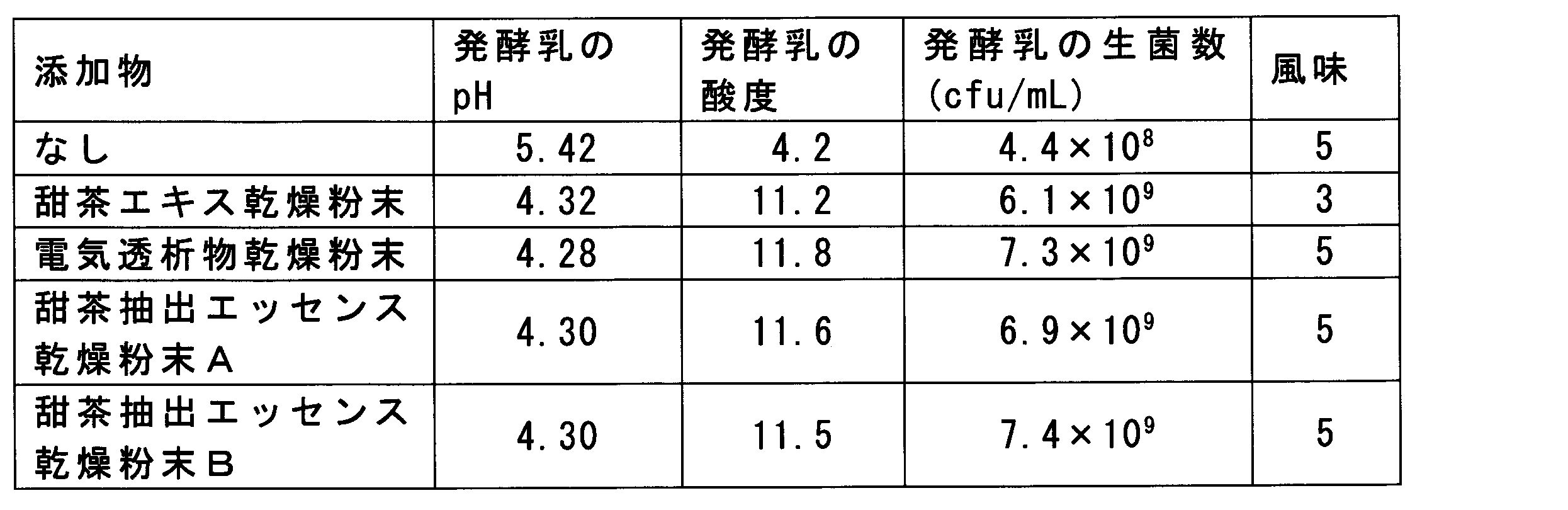
一方、甜茶エキス乾燥粉末、電気透析物乾燥粉末、甜茶抽出エッセンス乾燥粉末AおよびBでは、生菌数が多く、pHおよび酸度からも増殖促進効果が顕著に現れていた。
また、甜茶エキス乾燥粉末を使用した場合、発酵乳の風味が劣っていたが、電気透析物乾燥粉末、甜茶抽出エッセンス乾燥粉末AおよびBでは、風味への影響は認められなかった。
よって、甜茶抽出エッセンス乾燥粉末AおよびBは、電気透析物乾燥粉末と同等のラクトバチルス・カゼイの増殖促進効果を有し、発酵乳の風味に影響を与えないものであることが分かった。
乳酸菌を含有する発酵食品の製造(2):
ラクトバチルス・カゼイ YIT9029に代えて、ラクトバチルス・ガセリ YIT0192を0.5%接種した(初発菌数:4.5×10⁶cfu/ml)こと以外は、実施例6と同様の条件で試験を行った。結果を表6に示した。

また、甜茶エキス乾燥粉末を使用した場合、発酵乳の風味が劣っていたが、電気透析物乾燥粉末、甜茶抽出エッセンス乾燥粉末AおよびBでは、風味への影響は認められなかった。
よって、甜茶抽出エッセンス乾燥粉末AおよびBは、電気透析物乾燥粉末と同等にラクトバチルス・カゼイだけでなく、ラクトバチルス・ガセリの増殖促進効果も有し、発酵乳の風味に影響を与えないものであることが分かった。
ビフィドバクテリウム属細菌を含有する発酵食品の製造(1):
15%脱脂粉乳溶液を基本培地とし、実施例5で製造した甜茶抽出エッセンス乾燥粉末AおよびBならびに参考例2で製造した甜茶エキス乾燥粉末および電気透析物乾燥粉末を基本培地に対して、デキストリンを含まない乾燥粉末換算で0.012%(Brixが11.5の粉末化前の濃縮液換算で0.1%)添加した。この培地に、ビフィドバクテリウム・ブレーベ YIT12272のスターター1%(初発菌数:1.0×10⁷cfu/ml)、ラクトコッカス・ラクチス YIT2027およびストレプトコッカス・サーモフィルス YIT2021のスターターを各0.1%(初発菌数:各々1.0×10⁶cfu/ml、1.2×106cfu/ml)接種して35℃でpHが4.4に到達するまで培養を行った。この培養物を15MPaで均質化したもの40重量部に、10%ショ糖溶液を100℃で5分間殺菌したものを60重量部加えて、発酵乳を製造した。製造した発酵乳をガラス容器に充填し、ブチル栓で密栓した後、10℃、21日間、嫌気条件で保存し、保存前後の生菌数を実施例3と同様にして測定した。また、保存後の風味を実施例2と同様にして評価した。更に、保存前後の生菌数から実施例3と同様にして生残率を求めた。それらの結果を表7に示した。

一方、甜茶エキス乾燥粉末、電気透析物乾燥粉末、甜茶抽出エッセンス乾燥粉末AおよびBでは、ビフィドバクテリウム・ブレーベの生残率が高く、生残性改善効果が顕著に現れていた。
また、甜茶エキス乾燥粉末を使用した場合、発酵乳の風味が劣っていたが、電気透析物乾燥粉末、甜茶抽出エッセンス乾燥粉末AおよびBでは、風味への影響は認められなかった。
よって、甜茶抽出エッセンス乾燥粉末AおよびBは、電気透析物乾燥粉末と同等にビフィドバクテリウム・ブレーベの生残性改善効果を有し、発酵乳の風味に影響を与えないものであることが分かった。
ビフィドバクテリウム属細菌を含有する発酵食品の製造(2):
ビフィドバクテリウム・ブレーベ YIT12272のスターター1%、ラクトコッカス・ラクチス YIT2027およびストレプトコッカス・サーモフィルス YIT2021のスターター0.1%に代えて、ビフィドバクテリウム・ビフィダム YIT10347のスターター2%(初発菌数:2.2×10⁷cfu/ml)およびストレプトコッカス・サーモフィルス YIT2021のスターター0.01%(初発菌数:1.2×10⁵cfu/ml)を接種したこと以外は、実施例8と同様の条件で試験を行った。結果を表8に示した。

また、甜茶エキス乾燥粉末を使用した場合、発酵乳の風味が劣っていたが、電気透析物乾燥粉末、甜茶抽出エッセンス乾燥粉末AおよびBでは、風味への影響は認められなかった。
よって、甜茶抽出エッセンス乾燥粉末AおよびBは、電気透析物乾燥粉末と同等にビフィドバクテリウム・ブレーベだけでなく、ビフィドバクテリウム・ビフィダムの生残性改善効果も有し、発酵乳の風味に影響を与えないものであることが分かった。
Claims (16)
- 甜茶エキスを、活性炭処理することにより得られることを特徴とする甜茶抽出エッセンス。
- 乾燥粉末である請求項1記載の甜茶抽出エッセンス。
- 活性炭処理に使用する活性炭が、薬品賦活炭である請求項1または2記載の甜茶抽出エッセンス。
- 活性炭処理における活性炭の添加量が、甜茶エキスのBrixが1あたり乾燥重量で0.035重量%以上である請求項1~3のいずれか1項記載の甜茶抽出エッセンス。
- 甜茶エキスを、活性炭処理することを特徴とする甜茶抽出エッセンスの製造方法。
- 活性炭処理に使用する活性炭が、薬品賦活炭である請求項5記載の甜茶抽出エッセンスの製造方法。
- 活性炭処理における活性炭の添加量が、甜茶エキスのBrixが1あたり乾燥重量で0.035重量%以上である請求項5または6記載の甜茶抽出エッセンスの製造方法。
- 請求項1~4のいずれか1項記載の甜茶抽出エッセンスを配合した培地で乳酸菌を培養して得た乳酸菌培養物を含有することを特徴とする発酵食品。
- 乳酸菌を含有する発酵食品の製造方法において、培地に、請求項1~4のいずれか1項記載の甜茶抽出エッセンスを乳酸菌の培養前に配合する工程を含むことを特徴とする発酵食品の製造方法。
- 請求項1~4のいずれか1項記載の甜茶抽出エッセンスを配合した培地でビフィドバクテリウム属細菌を培養して得たビフィドバクテリウム属細菌培養物を含有することを特徴とする発酵食品。
- ビフィドバクテリウム属細菌を含有する発酵食品の製造方法において、培地に、請求項1~4のいずれか1項記載の甜茶抽出エッセンスをビフィドバクテリウム属細菌の培養前に配合する工程を含むことを特徴とする発酵食品の製造方法。
- 乳酸菌および/またはビフィドバクテリウム属細菌の培養において、培地に、請求項1~4のいずれか1項記載の甜茶抽出エッセンスを乳酸菌および/またはビフィドバクテリウム属細菌の培養前に配合することを特徴とする乳酸菌および/またはビフィドバクテリウム属細菌の増殖促進方法。
- 請求項1~4のいずれか1項記載の甜茶抽出エッセンスを有効成分とする乳酸菌および/またはビフィドバクテリウム属細菌の増殖促進剤。
- ビフィドバクテリウム属細菌の培養において、培地に、請求項1~4のいずれか1項記載の甜茶抽出エッセンスをビフィドバクテリウム属細菌の培養前に配合することを特徴とするビフィドバクテリウム属細菌の生残性改善方法。
- 請求項1~4のいずれか1項記載の甜茶抽出エッセンスを有効成分とするビフィドバクテリウム属細菌の生残性改善剤。
- 甜茶エキスを、活性炭処理することを特徴とする甜茶エキスの風味改善方法。
Priority Applications (10)
| Application Number | Priority Date | Filing Date | Title |
|---|---|---|---|
| CN201680022437.2A CN107979977A (zh) | 2015-03-23 | 2016-03-22 | 甜茶提取精华及其用途 |
| SG11201707549VA SG11201707549VA (en) | 2015-03-23 | 2016-03-22 | Tien-cha extract essence and application therefor |
| EP16768731.8A EP3275316A4 (en) | 2015-03-23 | 2016-03-22 | Tien-cha extract essence and application therefor |
| MX2017012124A MX391070B (es) | 2015-03-23 | 2016-03-22 | Esencia del extracto de tien-cha y aplicación de la misma. |
| MYPI2017703459A MY183393A (en) | 2015-03-23 | 2016-03-22 | Tien-cha extract essence and application therefor |
| KR1020177029219A KR102675263B1 (ko) | 2015-03-23 | 2016-03-22 | 첨차 추출 에센스 및 그 용도 |
| PH1/2017/501725A PH12017501725B1 (en) | 2015-03-23 | 2016-03-22 | Tien-cha extract essence and application therefor |
| BR112017019544-5A BR112017019544A2 (ja) | 2015-03-23 | 2016-03-22 | Sweet tea extraction essence and its use |
| US15/560,189 US11406113B2 (en) | 2015-03-23 | 2016-03-22 | Tien-cha extract essence and application therefor |
| AU2016237322A AU2016237322B2 (en) | 2015-03-23 | 2016-03-22 | Tien-cha extract essence and application therefor |
Applications Claiming Priority (2)
| Application Number | Priority Date | Filing Date | Title |
|---|---|---|---|
| JP2015-059376 | 2015-03-23 | ||
| JP2015059376A JP6633833B2 (ja) | 2015-03-23 | 2015-03-23 | 甜茶抽出エッセンスおよびその用途 |
Publications (1)
| Publication Number | Publication Date |
|---|---|
| WO2016152828A1 true WO2016152828A1 (ja) | 2016-09-29 |
Family
ID=56978175
Family Applications (1)
| Application Number | Title | Priority Date | Filing Date |
|---|---|---|---|
| PCT/JP2016/058907 Ceased WO2016152828A1 (ja) | 2015-03-23 | 2016-03-22 | 甜茶抽出エッセンスおよびその用途 |
Country Status (13)
| Country | Link |
|---|---|
| US (1) | US11406113B2 (ja) |
| EP (1) | EP3275316A4 (ja) |
| JP (1) | JP6633833B2 (ja) |
| KR (1) | KR102675263B1 (ja) |
| CN (1) | CN107979977A (ja) |
| AU (1) | AU2016237322B2 (ja) |
| BR (1) | BR112017019544A2 (ja) |
| MX (1) | MX391070B (ja) |
| MY (1) | MY183393A (ja) |
| PH (1) | PH12017501725B1 (ja) |
| SG (1) | SG11201707549VA (ja) |
| TW (1) | TWI718134B (ja) |
| WO (1) | WO2016152828A1 (ja) |
Cited By (1)
| Publication number | Priority date | Publication date | Assignee | Title |
|---|---|---|---|---|
| CN113678918A (zh) * | 2020-05-18 | 2021-11-23 | 国立大学法人千叶大学 | 肠道调节用茶发酵组合物及其制造方法 |
Families Citing this family (6)
| Publication number | Priority date | Publication date | Assignee | Title |
|---|---|---|---|---|
| EP3328218B1 (en) * | 2015-07-31 | 2018-12-19 | Unilever NV | Savoury concentrate comprising inorganic salt, fat and carboxymethyl cellulose |
| AU2018369298B2 (en) * | 2017-11-20 | 2021-10-21 | Asahi Kasei Kabushiki Kaisha | System for concentrating solvent-containing articles, and concentrate |
| WO2020170776A1 (ja) | 2019-02-19 | 2020-08-27 | 株式会社ヤクルト本社 | 乳酸菌及び/又はビフィドバクテリウム属細菌培養物の製造方法 |
| JP7602478B2 (ja) | 2019-11-11 | 2024-12-18 | 株式会社ヤクルト本社 | オリゴ糖を含む発酵乳の製造方法 |
| WO2021256476A1 (ja) * | 2020-06-17 | 2021-12-23 | 株式会社ヤクルト本社 | 乳酸菌の胃液・胆汁耐性向上方法 |
| WO2024018950A1 (ja) | 2022-07-19 | 2024-01-25 | 株式会社ヤクルト本社 | 乳酸菌生菌含有酸性乳飲料 |
Citations (7)
| Publication number | Priority date | Publication date | Assignee | Title |
|---|---|---|---|---|
| JPH11103817A (ja) * | 1997-10-02 | 1999-04-20 | Bizen Kasei Kk | 風味の改良されたグアバ葉エキスおよびその製造法 |
| JP2002153211A (ja) * | 2000-11-24 | 2002-05-28 | Api Co Ltd | 茶類抽出液及びその製造方法 |
| JP2007135416A (ja) * | 2005-11-15 | 2007-06-07 | Unitika Ltd | 新規乳酸菌及びこれを用いたγ−アミノ酪酸の製造方法 |
| CN102239983A (zh) * | 2011-05-16 | 2011-11-16 | 向华 | 一种从甜茶叶中提取甜茶素的方法 |
| WO2012043532A1 (ja) * | 2010-10-01 | 2012-04-05 | 株式会社ヤクルト本社 | 発酵食品およびその製造方法 |
| US20130040033A1 (en) * | 2011-08-10 | 2013-02-14 | Purecircle Sdn Bhd | High-Purity Rubusoside And Process For Purification Of The Same |
| WO2013146836A1 (ja) * | 2012-03-27 | 2013-10-03 | 株式会社ヤクルト本社 | 乳酸菌培養物およびその製造方法 |
Family Cites Families (18)
| Publication number | Priority date | Publication date | Assignee | Title |
|---|---|---|---|---|
| JPS5816096B2 (ja) * | 1976-09-17 | 1983-03-29 | 松下電器産業株式会社 | 暖房システムに用いるジエツトポンプ流量制御弁 |
| US4288551A (en) * | 1980-03-10 | 1981-09-08 | The Coca-Cola Company | Process for the purification of sugar syrups |
| US4599403A (en) * | 1985-10-07 | 1986-07-08 | Harold Levy | Method for recovery of stevioside |
| CA2058337C (en) * | 1991-01-16 | 1998-06-23 | Leo Walsh | Column carbon treatment of polysaccharides |
| US6228996B1 (en) * | 1999-02-24 | 2001-05-08 | James H. Zhou | Process for extracting sweet diterpene glycosides |
| US9987217B2 (en) * | 2004-06-18 | 2018-06-05 | Symrise Ag | Blackberry extract |
| TWI468513B (zh) | 2005-05-27 | 2015-01-11 | Yakult Honsha Kk | 乳酸菌發酵物及含其之發酵乳食品 |
| TWI465565B (zh) * | 2005-06-02 | 2014-12-21 | Yakult Honsha Kk | 含有雙叉乳酸桿菌屬細菌之醱酵食品及其製造方法 |
| JP4764784B2 (ja) * | 2006-08-19 | 2011-09-07 | 株式会社ロッテ | 呈味改善された甜茶抽出物の製造方法 |
| US20110039796A1 (en) * | 2009-04-17 | 2011-02-17 | Zhijun Liu | Natural Composition for Anti-Angiogenesis and Anti-Obesity |
| CN102651972B (zh) * | 2009-12-18 | 2015-06-17 | 太阳化学株式会社 | 茶多酚及其制造方法 |
| GB2476819B (en) * | 2010-01-11 | 2014-05-07 | Univ Surrey | Activated charcoal |
| EP2386211B1 (de) * | 2010-05-11 | 2016-08-10 | Symrise AG | Verwendung von rubusosid zum verringern oder unterdrücken von bestimmten unangenehmen geschmackseindrücken |
| US8962698B2 (en) * | 2011-01-28 | 2015-02-24 | Tate & Lyle Ingredients Americas Llc | Rebaudioside-mogroside V blends |
| US20130224839A1 (en) * | 2011-02-02 | 2013-08-29 | Lanzatech New Zealand Limited | Recombinant Microorganism and Methods of Production Thereof |
| US10480019B2 (en) | 2011-08-10 | 2019-11-19 | Purecircle Sdn Bhd | Process for producing high-purity rubusoside |
| ITTV20120052A1 (it) | 2012-04-02 | 2013-10-03 | Dario Toncelli | Macchina per la calibratura di lastre di materiale lapideo naturale o agglomerato |
| CN104262427B (zh) * | 2014-09-30 | 2017-02-01 | 桂林三宝药业有限公司 | 一种从甜茶叶中提取甜茶素的方法 |
-
2015
- 2015-03-23 JP JP2015059376A patent/JP6633833B2/ja active Active
-
2016
- 2016-03-22 MX MX2017012124A patent/MX391070B/es unknown
- 2016-03-22 MY MYPI2017703459A patent/MY183393A/en unknown
- 2016-03-22 EP EP16768731.8A patent/EP3275316A4/en active Pending
- 2016-03-22 KR KR1020177029219A patent/KR102675263B1/ko active Active
- 2016-03-22 SG SG11201707549VA patent/SG11201707549VA/en unknown
- 2016-03-22 AU AU2016237322A patent/AU2016237322B2/en active Active
- 2016-03-22 WO PCT/JP2016/058907 patent/WO2016152828A1/ja not_active Ceased
- 2016-03-22 US US15/560,189 patent/US11406113B2/en active Active
- 2016-03-22 PH PH1/2017/501725A patent/PH12017501725B1/en unknown
- 2016-03-22 CN CN201680022437.2A patent/CN107979977A/zh active Pending
- 2016-03-22 BR BR112017019544-5A patent/BR112017019544A2/ja not_active Application Discontinuation
- 2016-03-23 TW TW105109027A patent/TWI718134B/zh active
Patent Citations (7)
| Publication number | Priority date | Publication date | Assignee | Title |
|---|---|---|---|---|
| JPH11103817A (ja) * | 1997-10-02 | 1999-04-20 | Bizen Kasei Kk | 風味の改良されたグアバ葉エキスおよびその製造法 |
| JP2002153211A (ja) * | 2000-11-24 | 2002-05-28 | Api Co Ltd | 茶類抽出液及びその製造方法 |
| JP2007135416A (ja) * | 2005-11-15 | 2007-06-07 | Unitika Ltd | 新規乳酸菌及びこれを用いたγ−アミノ酪酸の製造方法 |
| WO2012043532A1 (ja) * | 2010-10-01 | 2012-04-05 | 株式会社ヤクルト本社 | 発酵食品およびその製造方法 |
| CN102239983A (zh) * | 2011-05-16 | 2011-11-16 | 向华 | 一种从甜茶叶中提取甜茶素的方法 |
| US20130040033A1 (en) * | 2011-08-10 | 2013-02-14 | Purecircle Sdn Bhd | High-Purity Rubusoside And Process For Purification Of The Same |
| WO2013146836A1 (ja) * | 2012-03-27 | 2013-10-03 | 株式会社ヤクルト本社 | 乳酸菌培養物およびその製造方法 |
Cited By (3)
| Publication number | Priority date | Publication date | Assignee | Title |
|---|---|---|---|---|
| CN113678918A (zh) * | 2020-05-18 | 2021-11-23 | 国立大学法人千叶大学 | 肠道调节用茶发酵组合物及其制造方法 |
| JP2021180619A (ja) * | 2020-05-18 | 2021-11-25 | 国立大学法人千葉大学 | 整腸用茶発酵組成物及びその製造方法 |
| JP7681849B2 (ja) | 2020-05-18 | 2025-05-23 | 国立大学法人千葉大学 | 整腸用茶発酵組成物及びその製造方法 |
Also Published As
| Publication number | Publication date |
|---|---|
| AU2016237322A1 (en) | 2017-10-19 |
| JP6633833B2 (ja) | 2020-01-22 |
| PH12017501725B1 (en) | 2024-07-03 |
| JP2016174589A (ja) | 2016-10-06 |
| MX391070B (es) | 2025-03-21 |
| BR112017019544A2 (ja) | 2018-05-02 |
| TW201701770A (zh) | 2017-01-16 |
| AU2016237322B2 (en) | 2020-11-12 |
| EP3275316A1 (en) | 2018-01-31 |
| MX2017012124A (es) | 2018-02-09 |
| KR102675263B1 (ko) | 2024-06-14 |
| EP3275316A4 (en) | 2018-11-14 |
| KR20170129189A (ko) | 2017-11-24 |
| PH12017501725A1 (en) | 2018-03-12 |
| TWI718134B (zh) | 2021-02-11 |
| SG11201707549VA (en) | 2017-10-30 |
| US20180077947A1 (en) | 2018-03-22 |
| MY183393A (en) | 2021-02-18 |
| CN107979977A (zh) | 2018-05-01 |
| US11406113B2 (en) | 2022-08-09 |
Similar Documents
| Publication | Publication Date | Title |
|---|---|---|
| KR102675263B1 (ko) | 첨차 추출 에센스 및 그 용도 | |
| TWI549613B (zh) | Fermented food and its manufacturing method | |
| JP4746615B2 (ja) | ビフィドバクテリウム属細菌含有発酵食品およびその製造方法 | |
| KR102021802B1 (ko) | 유산균 배양물 및 그 제조 방법 | |
| JP5037547B2 (ja) | 発酵乳製品の酸味及び/又は渋味マスキング剤、該マスキング剤を含有する発酵乳製品並びに該マスキング剤を利用する酸味及び/又は渋味のマスキング方法 | |
| JP2011036220A (ja) | 乳酸菌発酵乳エキス及びこれを含有する発酵乳製品 | |
| JP5329924B2 (ja) | 乳酸菌含有発酵食品およびその製造方法 | |
| JP2018074950A (ja) | 乳酸菌数低下抑制剤およびこれを含有する発酵乳製品 | |
| HK1250605A1 (zh) | 甜茶提取精华及其用途 | |
| WO2025198056A1 (ja) | 発酵組成物及びその製造方法 |
Legal Events
| Date | Code | Title | Description |
|---|---|---|---|
| 121 | Ep: the epo has been informed by wipo that ep was designated in this application |
Ref document number: 16768731 Country of ref document: EP Kind code of ref document: A1 |
|
| WWE | Wipo information: entry into national phase |
Ref document number: 11201707549V Country of ref document: SG |
|
| WWE | Wipo information: entry into national phase |
Ref document number: 12017501725 Country of ref document: PH |
|
| WWE | Wipo information: entry into national phase |
Ref document number: 15560189 Country of ref document: US |
|
| WWE | Wipo information: entry into national phase |
Ref document number: MX/A/2017/012124 Country of ref document: MX |
|
| NENP | Non-entry into the national phase |
Ref country code: DE |
|
| REG | Reference to national code |
Ref country code: BR Ref legal event code: B01A Ref document number: 112017019544 Country of ref document: BR |
|
| REEP | Request for entry into the european phase |
Ref document number: 2016768731 Country of ref document: EP |
|
| ENP | Entry into the national phase |
Ref document number: 20177029219 Country of ref document: KR Kind code of ref document: A |
|
| ENP | Entry into the national phase |
Ref document number: 2016237322 Country of ref document: AU Date of ref document: 20160322 Kind code of ref document: A |
|
| ENP | Entry into the national phase |
Ref document number: 112017019544 Country of ref document: BR Kind code of ref document: A2 Effective date: 20170913 |