WO2016156193A2 - Verfahren zur herstellung von metallorganylen - Google Patents
Verfahren zur herstellung von metallorganylen Download PDFInfo
- Publication number
- WO2016156193A2 WO2016156193A2 PCT/EP2016/056533 EP2016056533W WO2016156193A2 WO 2016156193 A2 WO2016156193 A2 WO 2016156193A2 EP 2016056533 W EP2016056533 W EP 2016056533W WO 2016156193 A2 WO2016156193 A2 WO 2016156193A2
- Authority
- WO
- WIPO (PCT)
- Prior art keywords
- metal
- ether
- group
- alkyl
- hydride
- Prior art date
- Legal status (The legal status is an assumption and is not a legal conclusion. Google has not performed a legal analysis and makes no representation as to the accuracy of the status listed.)
- Ceased
Links
Classifications
-
- C—CHEMISTRY; METALLURGY
- C01—INORGANIC CHEMISTRY
- C01B—NON-METALLIC ELEMENTS; COMPOUNDS THEREOF; METALLOIDS OR COMPOUNDS THEREOF NOT COVERED BY SUBCLASS C01C
- C01B6/00—Hydrides of metals including fully or partially hydrided metals, alloys or intermetallic compounds ; Compounds containing at least one metal-hydrogen bond, e.g. (GeH3)2S, SiH GeH; Monoborane or diborane; Addition complexes thereof
- C01B6/04—Hydrides of alkali metals, alkaline earth metals, beryllium or magnesium; Addition complexes thereof
-
- C—CHEMISTRY; METALLURGY
- C07—ORGANIC CHEMISTRY
- C07F—ACYCLIC, CARBOCYCLIC OR HETEROCYCLIC COMPOUNDS CONTAINING ELEMENTS OTHER THAN CARBON, HYDROGEN, HALOGEN, OXYGEN, NITROGEN, SULFUR, SELENIUM OR TELLURIUM
- C07F1/00—Compounds containing elements of Groups 1 or 11 of the Periodic Table
-
- C—CHEMISTRY; METALLURGY
- C07—ORGANIC CHEMISTRY
- C07F—ACYCLIC, CARBOCYCLIC OR HETEROCYCLIC COMPOUNDS CONTAINING ELEMENTS OTHER THAN CARBON, HYDROGEN, HALOGEN, OXYGEN, NITROGEN, SULFUR, SELENIUM OR TELLURIUM
- C07F1/00—Compounds containing elements of Groups 1 or 11 of the Periodic Table
- C07F1/02—Lithium compounds
-
- C—CHEMISTRY; METALLURGY
- C07—ORGANIC CHEMISTRY
- C07F—ACYCLIC, CARBOCYCLIC OR HETEROCYCLIC COMPOUNDS CONTAINING ELEMENTS OTHER THAN CARBON, HYDROGEN, HALOGEN, OXYGEN, NITROGEN, SULFUR, SELENIUM OR TELLURIUM
- C07F1/00—Compounds containing elements of Groups 1 or 11 of the Periodic Table
- C07F1/04—Sodium compounds
-
- C—CHEMISTRY; METALLURGY
- C07—ORGANIC CHEMISTRY
- C07F—ACYCLIC, CARBOCYCLIC OR HETEROCYCLIC COMPOUNDS CONTAINING ELEMENTS OTHER THAN CARBON, HYDROGEN, HALOGEN, OXYGEN, NITROGEN, SULFUR, SELENIUM OR TELLURIUM
- C07F1/00—Compounds containing elements of Groups 1 or 11 of the Periodic Table
- C07F1/06—Potassium compounds
-
- C—CHEMISTRY; METALLURGY
- C07—ORGANIC CHEMISTRY
- C07F—ACYCLIC, CARBOCYCLIC OR HETEROCYCLIC COMPOUNDS CONTAINING ELEMENTS OTHER THAN CARBON, HYDROGEN, HALOGEN, OXYGEN, NITROGEN, SULFUR, SELENIUM OR TELLURIUM
- C07F3/00—Compounds containing elements of Groups 2 or 12 of the Periodic Table
-
- C—CHEMISTRY; METALLURGY
- C07—ORGANIC CHEMISTRY
- C07F—ACYCLIC, CARBOCYCLIC OR HETEROCYCLIC COMPOUNDS CONTAINING ELEMENTS OTHER THAN CARBON, HYDROGEN, HALOGEN, OXYGEN, NITROGEN, SULFUR, SELENIUM OR TELLURIUM
- C07F3/00—Compounds containing elements of Groups 2 or 12 of the Periodic Table
- C07F3/006—Beryllium compounds
-
- C—CHEMISTRY; METALLURGY
- C07—ORGANIC CHEMISTRY
- C07F—ACYCLIC, CARBOCYCLIC OR HETEROCYCLIC COMPOUNDS CONTAINING ELEMENTS OTHER THAN CARBON, HYDROGEN, HALOGEN, OXYGEN, NITROGEN, SULFUR, SELENIUM OR TELLURIUM
- C07F3/00—Compounds containing elements of Groups 2 or 12 of the Periodic Table
- C07F3/02—Magnesium compounds
-
- C—CHEMISTRY; METALLURGY
- C07—ORGANIC CHEMISTRY
- C07F—ACYCLIC, CARBOCYCLIC OR HETEROCYCLIC COMPOUNDS CONTAINING ELEMENTS OTHER THAN CARBON, HYDROGEN, HALOGEN, OXYGEN, NITROGEN, SULFUR, SELENIUM OR TELLURIUM
- C07F5/00—Compounds containing elements of Groups 3 or 13 of the Periodic Table
- C07F5/06—Aluminium compounds
- C07F5/061—Aluminium compounds with C-aluminium linkage
- C07F5/066—Aluminium compounds with C-aluminium linkage compounds with Al linked to an element other than Al, C, H or halogen (this includes Al-cyanide linkage)
Definitions
- Alkalimetallorganyle are z.T. known for over 100 years, but only the highly soluble and thermally stable alkyl compounds of lithium RLi were able to achieve a wide preparative and industrially significant use.
- the first preparation of organolithium compounds by W. Schlenk was carried out by cleavage of mercury-organic compounds by means of lithium metal (W. Schlenk, J. Holtz, Ber. Dtsch. Chem. Ges. 1917, 50, 262-274). Understandably, this synthesis based on the toxic heavy metal mercury was technically unfeasible. In contrast, the convenient synthesis described by K. Ziegler and H. Colonius for the first time
- a disadvantage of Ziegler's synthesis is that half of the expensive lithium metal produced by fused-salt electrolysis is consumed for the formation of the lithium halide by-product.
- Also functionalized organic compounds having other leaving groups (Ed. Engl A. Maercker, Angew. Chem. Int., 26, (1987) 972), instead of alkyl halides are used as Hai ", for example, ethers and thioethers (CG Screttas, MM Screttas, J. Org Chem 43 (1978) 1064), in which case only a maximum of half of the lithium used is used:
- the superscript asterisk designates a highly reactive variant of the particular metal hydride, and the reaction of ⁇ -olefins with more than stoichiometric amounts of LiH * in tetrahydrofuran (THF) and also superstoichiometric amounts of VCI3
- THF tetrahydrofuran
- VCI3 tetrahydrofuran
- Alkyllithium compounds can be prepared in anhydrous organic solvents, including ethers and hydrocarbons. With the exception of methyllithium, commercial products are marketed exclusively as solutions in hydrocarbons since only these are storage stable. The strong lithium bases attack functionalized solvents, such as ethers, even at room temperature and decompose to form an a- or ß-elimination mechanism to form lithium alcoholates and other secondary products. In the case of cyclic ethers such as tetrahydrofuran, ring opening with lithium enolate formation is added as a decomposition variant.
- Non-cyclic ethers which have no .beta.-H hydrogen can generally only decompose by .alpha.- ⁇ elimination mechanism, as has been demonstrated, for example, for dimethyl ether (A. Maercker, Angew Chem. 99 (1987) 1002-19). This decomposition mechanism takes place for thermodynamic reasons to a lesser extent. Nevertheless, it has been reported that the persistence of lithium organyls, for example, butyllithium in pure dimethyl ether, is worse than that in diethyl ether: the decomposition is about 10-20 times faster (K. Ziegler, H.G. Geliert, Justus Liebigs Ann. Chem. 567 (1950) 185). Similar to the alkali metal organyls, the dialkyl compounds of the
- Alkaline earth elements usually made of elemental alkaline earth metal and alkyl halides:
- magnesium hydride is activated before or during the reaction with an olefin by grinding to a particle size of ⁇ 10 ⁇ m, preferably ⁇ 1 ⁇ m without addition of complex catalysts.
- an ethereal solvent preferably THF or diglyme
- a transition metal halide as described in EP 0014983 B1 is added as catalyst.
- the disadvantage is that the yields of dialkylmagnesium compounds are generally low (25-34%).
- Dialkylmagnesium compounds are predominantly used as a source of magnesium in the production of Ziegler Natta polyolefin catalysts. For various reasons, donor-solvent-free (especially THF-free) products are needed for this application.
- organometallic compound R n M • all active metal M (ie, metal of oxidation level 0) can be converted to the desired organometallic compound R n M without the use of less valuable by-products such as metal halides and the like. arise and
- the organometallic compound should be able to be isolated without decomposition in pure (solvent-free) form or as a solution in a non-donor solvent, especially THF-free.
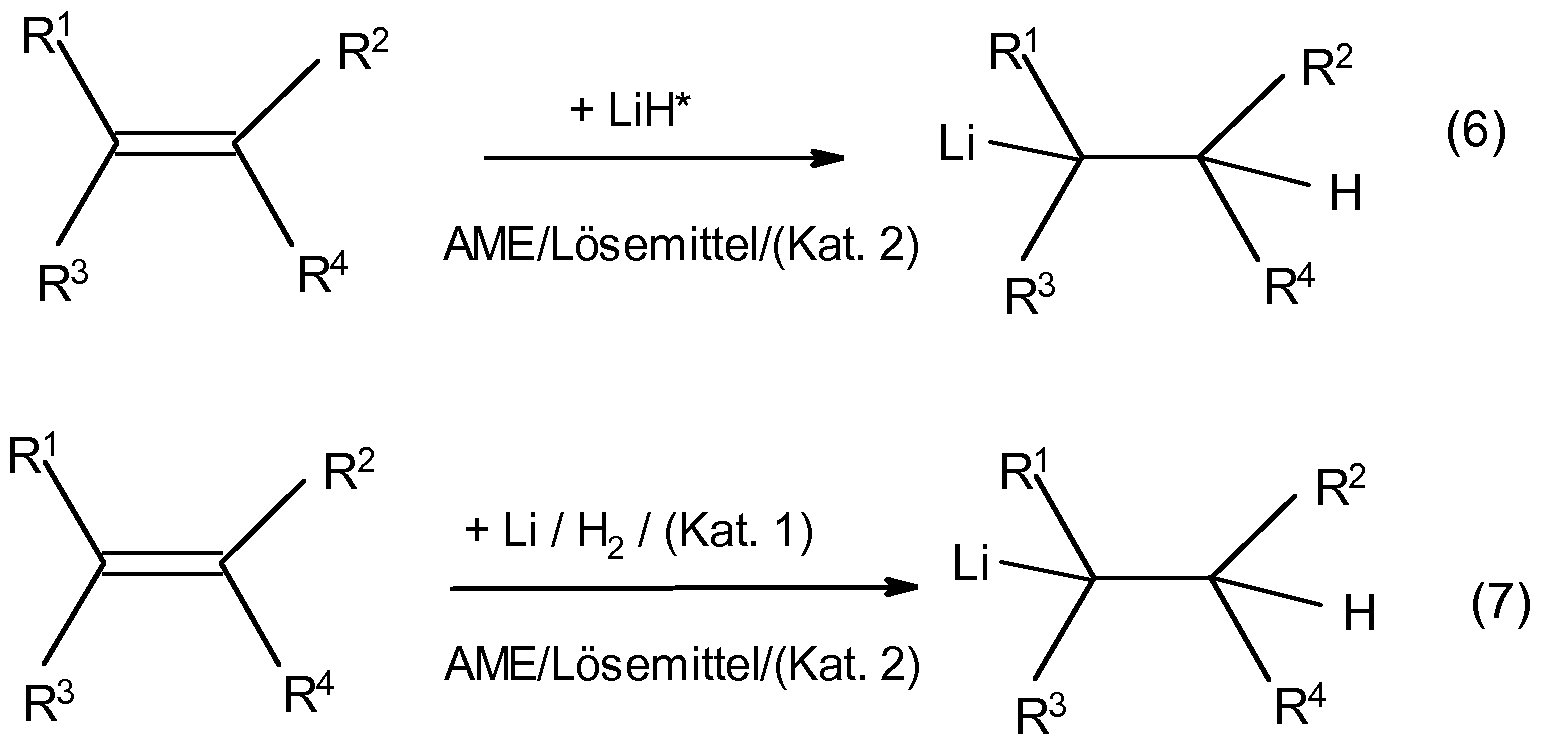
- the object is achieved by reacting olefins by means of preformed MH n * (equation 6) or with in situ formed metal hydride (equation 7) in an aprotic and anhydrous liquid phase containing alkylmethyl ether (AME).
- MH n * MH n *
- equation 7 in situ formed metal hydride
- AME alkylmethyl ether
- Formation of the highly reactive metal hydrides MH n * is the presence of highly reactive metal M 2 * and / or a compound having the general formula M 1 x [M 2 (A 1 yA 2 z ) 3 + x ] b (in Eq. 7 as "Cat. 1") to obtain a sufficiently high rate of formation of the metal hydride MH n *.
- the highly reactive M 2 * must have an average particle size D 50 between 0.01 and 100 ⁇ and must not by prior contact with air, oxygen, moisture or other reactive substances.
- M 2 * is preferably finely divided aluminum powder with the stated mean particle size D50 between 0.01 and 100 ⁇ m.
- M 1 x [M 2 (A 1 y A 2 z ) 3 + x ] b is:
- M 1 an alkali metal (Li, Na, K, Rb, Cs), an alkaline earth metal (Be, Mg, Ca, Sr, Ba) or a rare earth element selected from Sc, Y, La, Ce, Pr, Nd, Pm, Eu, Gd, Tb, Dy, Ho, Er, Tm, Yb, Lu;
- M 2 an element of the 3rd main group of the PSE selected from B, Al, Ga or In;
- a 1 H or an alkyl group, branched or unbranched containing 1-18 C atoms, where the up to four A groups may be the same or different;
- the oligonucleotides according to the invention are also accessible to internalized double bond olefins, for example 2-butene, 2-pentene, 2-hexene, 2-heptene, 2-octene, 2-decene.
- CpTiCb be considered, in particular the chlorides of Ti, Zr, Hf, V, Nb, Ta and metallocene compounds of these metals such as Cp 2 ⁇ n Cl, Cp 2 ZrCl 2 or other complex compounds of said metals. They are added in amounts of 0.001 to 10 mol%, preferably 0.005 to 5 mol%, based on the metal hydride MH n .
- the metal hydride addition according to Eq. (6) or (7) can in the temperature range between -40 and + 150 ° C, preferably -20 and 100 ° C, more preferably 0 to 50 ° C take place.
- RT room temperature
- the most preferred and room temperature (RT) gaseous dimethyl ether is used as the AME, it is indicated by the use of a pressure hold system and / or a reflux condenser system (condenser) operating at low temperatures (e.g., -40 to + 20 ° C, depending on pressure).
- mixtures of hydrocarbons and AME's most preferably mixtures of saturated hydrocarbons such as pentane, hexane, heptane, octane, decane, dodecane or commercially available hydrocarbon mixtures such as technical hexane, technical heptane, or boiling cuts (petroleum ethers) such as those under the brand name "Shellsole” marketed by the company Shell Petroleum ethers, with dimethyl ether.
- the hydrocarbon content can account for up to 95 wt%, preferably up to 80 wt.% Proportion of the reaction mixture.
- the AME content in the reaction mixture depends on the concentration of the metal M or of the metal hydride MH n .
- the molar ratio between AME and M or MH n is at least 0.01: 1 and at most 50: 1, preferably at least 0.1: 1 to 30: 1 and more preferably 0.2: 1 to 20: 1.
- a catalyst "Cat. 1" which is either finely divided, active metal M 2 * and / or there are compounds of the general formula M 1 x [M 2 (A 1 yA 2 z ) 3 + x ] b in stoichiometric or in the presence of a source of hydrogen in
- the molar ratio of catalyst to M or MH n is at least 0.0001: 1 and at most 0.5: 1, preferably at least 0.001: 1 to 0.3: 1 and particularly preferably 0.005: 1 to 0.2:
- the hydrogenation of M in the presence of highly reactive metal M 2 * and / or compounds of the general formula M 1 x [M 2 (A 1 yA 2 z ) 3 + x ] b is preferably carried out under a hydrogen atmosphere It is a prerequisite that the metal M has a more negative standard potential than the metal M 2 or M 2 in M 1 x
- M 1 x [M 2 (A 1 yA 2 z ) 3+ x] b forms elemental M 2 * ; this is extremely reactive (finely divided, partly amorphous form) and it is very reactive towards, for example, hydrogen, ie it is rehydrated in the presence of a hydrogen source.
- M 1 x [M 2 (A 1 y A 2 z ) 3 + x ] b or activated elemental M 2 * in catalytic amounts is sufficient.
- alkali metal alkanes LiAlH and NaAlH, Na [H 2 AIEt 2 ], which are produced on an industrial scale, are particularly suitable.
- Alan (AIH 3 ) and alkylaluminum hydrides such as diisobutylaluminum hydride can also be used with equal success.
- AIH 3 The finely divided AI * readily reacts with hydrogen to form AIH 3 .
- the latter in turn can transfer the hydrogen under mild conditions to base metals M.
- triethylaluminum for example, trimethylaluminum and tributylaluminum are also usable.
- reaction of AICI3 in AME-containing solutions by reaction with, for example, lithium metal in addition to LiAICI 4 forms reactive elemental Aluminum metal.
- the aluminates such as Li [AIEt] can react with hydrogen to hydride-containing species.
- the reaction temperatures in the s / fu metal hydride synthesis according to Eq. 7 can be widely varied, they are usually between -20 and 150 ° C, preferably 0 and 100 ° C and more preferably between 25 and 70 ° C. If a reaction procedure according to Eq. 7 or Eq. 8 is intended, contact with elemental hydrogen must be ensured. Frequently, an overpressure-free driving style suffices; but to achieve the shortest possible reaction times, it is advisable to work under H 2 pressure conditions.
- the H 2 overpressure is preferably 2 to 300 bar, more preferably 10 to 100 bar. It is also possible to use as the source of hydrogen a compound which releases hydrogen under the selected operating conditions. Examples are: 1,3-cyclohexadiene, decalin, N-ethylcarbazole.
- alkylmethyl ethers in particular dimethyl ether
- the low-boiling dimethyl ether can be selectively separated by distillation.
- the alkyl metal compounds MR n are thereby obtained as pure substances or solutions in hydrocarbons with AME residual contents of not more than 20 mol%, preferably not more than 5 mol% and more preferably not more than 1 mol%, based on R n M content and hydrocarbon contents of up to 95% by weight.
- inventive products or product solutions typically contain one Residual content of AME and / or (depending on storage duration and conditions) of non-volatile AME degradation products.
- the products of the invention contain minmal 0.001 to a maximum of 20 mol%, preferably 0.001 up to 5 mol%, particularly preferably 0.001 to a maximum of 1 mol% selected from AME (preferably dimethylether) and / or lithium methylate, based on organometallic compound R n M.
- AME preferably dimethylether
- R n M organometallic compound
Landscapes
- Chemical & Material Sciences (AREA)
- Organic Chemistry (AREA)
- Materials Engineering (AREA)
- Engineering & Computer Science (AREA)
- Inorganic Chemistry (AREA)
- Toxicology (AREA)
- Geology (AREA)
- General Life Sciences & Earth Sciences (AREA)
- Life Sciences & Earth Sciences (AREA)
- Health & Medical Sciences (AREA)
- Organic Low-Molecular-Weight Compounds And Preparation Thereof (AREA)
- Catalysts (AREA)
- Chemical Kinetics & Catalysis (AREA)
Abstract
Description



Claims
Priority Applications (9)
| Application Number | Priority Date | Filing Date | Title |
|---|---|---|---|
| KR1020257026607A KR20250124261A (ko) | 2015-04-02 | 2016-03-24 | 금속 오르가닐을 제조하는 방법 |
| EP16712320.7A EP3277695B1 (de) | 2015-04-02 | 2016-03-24 | Verfahren zur herstellung von metallorganylen |
| KR1020177031569A KR20180008441A (ko) | 2015-04-02 | 2016-03-24 | 금속 오르가닐을 제조하는 방법 |
| AU2016239911A AU2016239911B2 (en) | 2015-04-02 | 2016-03-24 | Method for producing metal organyls |
| CN201680031695.7A CN108012541B (zh) | 2015-04-02 | 2016-03-24 | 生产金属有机物的方法 |
| JP2018502322A JP6968051B2 (ja) | 2015-04-02 | 2016-03-24 | 金属オルガニルを製造するための方法 |
| US15/563,240 US10370390B2 (en) | 2015-04-02 | 2016-03-24 | Method for producing metal organyls |
| CA2983362A CA2983362C (en) | 2015-04-02 | 2016-03-24 | Method for producing alkali or alkaline earth metal organyls |
| US16/175,243 US10640519B2 (en) | 2015-04-02 | 2018-10-30 | Method for producing metal organyls |
Applications Claiming Priority (4)
| Application Number | Priority Date | Filing Date | Title |
|---|---|---|---|
| DE102015206046 | 2015-04-02 | ||
| DE102015206046.2 | 2015-04-02 | ||
| DE102015206897.8 | 2015-04-16 | ||
| DE102015206897 | 2015-04-16 |
Related Child Applications (2)
| Application Number | Title | Priority Date | Filing Date |
|---|---|---|---|
| US15/563,240 A-371-Of-International US10370390B2 (en) | 2015-04-02 | 2016-03-24 | Method for producing metal organyls |
| US16/175,243 Continuation US10640519B2 (en) | 2015-04-02 | 2018-10-30 | Method for producing metal organyls |
Publications (2)
| Publication Number | Publication Date |
|---|---|
| WO2016156193A2 true WO2016156193A2 (de) | 2016-10-06 |
| WO2016156193A3 WO2016156193A3 (de) | 2017-01-12 |
Family
ID=55640728
Family Applications (1)
| Application Number | Title | Priority Date | Filing Date |
|---|---|---|---|
| PCT/EP2016/056533 Ceased WO2016156193A2 (de) | 2015-04-02 | 2016-03-24 | Verfahren zur herstellung von metallorganylen |
Country Status (10)
| Country | Link |
|---|---|
| US (2) | US10370390B2 (de) |
| EP (1) | EP3277695B1 (de) |
| JP (1) | JP6968051B2 (de) |
| KR (2) | KR20180008441A (de) |
| CN (1) | CN108012541B (de) |
| AU (1) | AU2016239911B2 (de) |
| CA (1) | CA2983362C (de) |
| DE (1) | DE102016204940A1 (de) |
| MA (1) | MA41837A (de) |
| WO (1) | WO2016156193A2 (de) |
Citations (4)
| Publication number | Priority date | Publication date | Assignee | Title |
|---|---|---|---|---|
| EP0015541A2 (de) | 1979-03-07 | 1980-09-17 | Studiengesellschaft Kohle mbH | Verfahren zur Herstellung von Organolithiumverbindungen neben Lithiumhydrid; Katalysatoren |
| EP0014983B1 (de) | 1979-02-20 | 1983-12-28 | Studiengesellschaft Kohle mbH | Verfahren zur Herstellung von Diorganomagnesiumverbindungen |
| US4554153A (en) | 1978-02-02 | 1985-11-19 | Studiengesellschaft Kohle Mbh | Process for the production of magnesium hydrides |
| EP0514707B1 (de) | 1991-05-18 | 1995-11-15 | Th. Goldschmidt AG | Verfahren zur Herstellung von Dialkylmagnesiumverbindungen durch Umsetzung von Magnesiumhydrid mit einem Olefin |
Family Cites Families (6)
| Publication number | Priority date | Publication date | Assignee | Title |
|---|---|---|---|---|
| US2959625A (en) * | 1959-01-12 | 1960-11-08 | Ethyl Corp | Manufacture of alkyl magnesium compounds |
| US3706809A (en) | 1970-09-17 | 1972-12-19 | Takasago Perfumery Co Ltd | Process for preparing highly reactive organo-magnesium compounds |
| US3998941A (en) | 1974-10-04 | 1976-12-21 | Ethyl Corporation | Preparation of alkali metal hydrides |
| US4327071A (en) | 1981-05-07 | 1982-04-27 | Mine Safety Appliances Company | Method of preparing potassium hydride |
| US4792620A (en) * | 1983-10-14 | 1988-12-20 | Bp Chemicals Limited | Carbonylation catalysts |
| DE4419456A1 (de) | 1994-06-03 | 1995-12-07 | Goldschmidt Ag Th | Verfahren zur Herstellung von Magnesiumhydrid |
-
2016
- 2016-03-23 MA MA041837A patent/MA41837A/fr unknown
- 2016-03-24 JP JP2018502322A patent/JP6968051B2/ja active Active
- 2016-03-24 AU AU2016239911A patent/AU2016239911B2/en active Active
- 2016-03-24 CA CA2983362A patent/CA2983362C/en active Active
- 2016-03-24 WO PCT/EP2016/056533 patent/WO2016156193A2/de not_active Ceased
- 2016-03-24 DE DE102016204940.2A patent/DE102016204940A1/de active Pending
- 2016-03-24 EP EP16712320.7A patent/EP3277695B1/de active Active
- 2016-03-24 KR KR1020177031569A patent/KR20180008441A/ko not_active Ceased
- 2016-03-24 CN CN201680031695.7A patent/CN108012541B/zh active Active
- 2016-03-24 KR KR1020257026607A patent/KR20250124261A/ko active Pending
- 2016-03-24 US US15/563,240 patent/US10370390B2/en active Active
-
2018
- 2018-10-30 US US16/175,243 patent/US10640519B2/en active Active
Patent Citations (4)
| Publication number | Priority date | Publication date | Assignee | Title |
|---|---|---|---|---|
| US4554153A (en) | 1978-02-02 | 1985-11-19 | Studiengesellschaft Kohle Mbh | Process for the production of magnesium hydrides |
| EP0014983B1 (de) | 1979-02-20 | 1983-12-28 | Studiengesellschaft Kohle mbH | Verfahren zur Herstellung von Diorganomagnesiumverbindungen |
| EP0015541A2 (de) | 1979-03-07 | 1980-09-17 | Studiengesellschaft Kohle mbH | Verfahren zur Herstellung von Organolithiumverbindungen neben Lithiumhydrid; Katalysatoren |
| EP0514707B1 (de) | 1991-05-18 | 1995-11-15 | Th. Goldschmidt AG | Verfahren zur Herstellung von Dialkylmagnesiumverbindungen durch Umsetzung von Magnesiumhydrid mit einem Olefin |
Non-Patent Citations (14)
| Title |
|---|
| A. MAERCKER, ANGEW. CHEM. INT. ED. ENGL., vol. 26, 1987, pages 972 |
| A. MAERCKER, ANGEW. CHEM., vol. 99, 1987, pages 1002 - 19 |
| B. BOGDANOVIC; B. WERMECKES, ANGEW. CHEM., vol. 94, 1981, pages 691 |
| B. BOGDANOVIC; P. BONS; S. KONSTANTINOVIC; M. SCHWICKARDI; U. WESTEPPE, CHEM. BER, vol. 126, 1993, pages 1371 - 83 |
| B. BOGDANOVIC; P. BONS; S. KONSTANTINOVIC; M. SCHWICKARDI; U. WESTEPPE, CHEM. BER., vol. 126, 1993, pages 1371 - 83 |
| C. G. SCRETTAS; M. M. SCRETTAS, J. ORG. CHEM., vol. 43, 1978, pages 1064 |
| D.R. LIDE: "Handbook of Chemistry and Physics", 2002 |
| E.C. ASHBY; S. A. NODING, J. ORG. CHEM., vol. 45, 1980, pages 1041 - 1044 |
| E.J. SETIJADI; C. BOYER, PHYS. CHEM. CHEM. PHYS., vol. 14, 2012, pages 11386 - 97 |
| K. ZIEGLER; H. COLONIUS, JUSTUS LIEBIGS ANN. CHEM., vol. 479, 1930, pages 135 - 149 |
| K. ZIEGLER; H.-G. GELIERT, JUSTUS LIEBIGS ANN. CHEM., vol. 567, 1950, pages 185 |
| K. ZIEGLER; U. GELIERT, LIEBIGS ANN. CHEM., vol. 567, 1950, pages 179 |
| W. SCHLENK; J. HOLTZ, BER. DTSCH. CHEM. GES., vol. 50, 1917, pages 262 - 274 |
| W.E. BECKER; E.C. ASHBY, J. ORG. CHEM., vol. 29, 1964, pages 954 |
Also Published As
| Publication number | Publication date |
|---|---|
| AU2016239911A1 (en) | 2017-11-23 |
| US20180162880A1 (en) | 2018-06-14 |
| CA2983362C (en) | 2024-02-27 |
| CN108012541A (zh) | 2018-05-08 |
| US20190062347A1 (en) | 2019-02-28 |
| US10370390B2 (en) | 2019-08-06 |
| DE102016204940A1 (de) | 2016-10-06 |
| WO2016156193A3 (de) | 2017-01-12 |
| US10640519B2 (en) | 2020-05-05 |
| EP3277695A2 (de) | 2018-02-07 |
| JP6968051B2 (ja) | 2021-11-17 |
| EP3277695B1 (de) | 2022-06-15 |
| CA2983362A1 (en) | 2016-10-06 |
| KR20180008441A (ko) | 2018-01-24 |
| JP2018514584A (ja) | 2018-06-07 |
| AU2016239911B2 (en) | 2020-08-20 |
| CN108012541B (zh) | 2021-06-15 |
| MA41837A (fr) | 2018-02-06 |
| KR20250124261A (ko) | 2025-08-19 |
Similar Documents
| Publication | Publication Date | Title |
|---|---|---|
| EP0490156B1 (de) | Verfahren zur Herstellung aktiver, reversibel H2 aufnehmender Magnesiumhydrid-Magnesium-Wasserstoff-Speichersysteme | |
| DE2405856A1 (de) | Katalytische dimerisierung von konjugierten dienen und katalysator dafuer | |
| DE2755004A1 (de) | In kohlenwasserstoffen loesliche geradkettige di-(niedrigalkyl)-magnesium-verbindungen | |
| US11292804B2 (en) | Highly reactive metal hydrides, process for their preparation and use | |
| DE917006C (de) | Verfahren zur Darstellung organischer Verbindungen des Aluminiums und Berylliums | |
| DD200226A5 (de) | Organomagnesiumloesungen geringer viskoesitaet | |
| EP2443081A1 (de) | Konzentrierte lösungen von erdalkalimetallalkoxiden in aprotischen lösungsmitteln und verfahren zu deren herstellung | |
| EP3277695B1 (de) | Verfahren zur herstellung von metallorganylen | |
| DE3780852T2 (de) | Intermetallische verbindungen, deren hydriden und verfahren zu deren herstellung. | |
| DE3536797A1 (de) | Verfahren zur herstellung von halogen-magnesium-alanat und dessen verwendung | |
| DE1442914A1 (de) | Verfahren zur Herstellung von Polymerisationskatalysatoren | |
| EP4047003A1 (de) | Metallkomplexe mit 4-h-, 6-h- oder 8-h-dihydroazulenyl-liganden und deren verwendung | |
| DE10030535C1 (de) | Ethyllithium in Dibutylether, Verfahren zu ihrer Herstellung sowie deren Verwendung | |
| US2929853A (en) | Process for the preparation of methylene compounds of lithium and magnesium | |
| DE1309526T1 (de) | Verfahren zur herstellung von alkyllithium-verbindungen | |
| AT202566B (de) | Verfahren zur Herstellung von Borverbindungen oder Aluminiumverbindungen | |
| DE1151800B (de) | Verfahren zur Herstellung von bororganischen Verbindungen | |
| AT235858B (de) | Verfahren zur Herstellung von Dialkylaluminiummono-chloriden, -bromiden oder -jodiden | |
| DE2234040A1 (de) | Verfahren zur polymerisation und mischpolymerisation von olefinen | |
| DE1174315B (de) | Verfahren zur Herstellung von Dialkylaluminiumhalogeniden | |
| DE1251323B (de) | Verfahren zur Herstellung von Dichlorcarbenaddukten | |
| DEE0010906MA (de) | ||
| DE1210778B (de) | Verfahren zur Herstellung von Aluminiumhydridchloridaetheraten | |
| DE1137017B (de) | Verfahren zur Herstellung von Organoborverbindungen |
Legal Events
| Date | Code | Title | Description |
|---|---|---|---|
| 121 | Ep: the epo has been informed by wipo that ep was designated in this application |
Ref document number: 16712320 Country of ref document: EP Kind code of ref document: A2 |
|
| ENP | Entry into the national phase |
Ref document number: 2018502322 Country of ref document: JP Kind code of ref document: A |
|
| NENP | Non-entry into the national phase |
Ref country code: DE |
|
| REEP | Request for entry into the european phase |
Ref document number: 2016712320 Country of ref document: EP |
|
| ENP | Entry into the national phase |
Ref document number: 2983362 Country of ref document: CA |
|
| ENP | Entry into the national phase |
Ref document number: 20177031569 Country of ref document: KR Kind code of ref document: A |
|
| ENP | Entry into the national phase |
Ref document number: 2016239911 Country of ref document: AU Date of ref document: 20160324 Kind code of ref document: A |
|
| WWE | Wipo information: entry into national phase |
Ref document number: 15563240 Country of ref document: US |
|
| WWR | Wipo information: refused in national office |
Ref document number: 1020177031569 Country of ref document: KR |
|
| WWD | Wipo information: divisional of initial pct application |
Ref document number: 1020257026607 Country of ref document: KR |
|
| WWP | Wipo information: published in national office |
Ref document number: 1020257026607 Country of ref document: KR |