WO2016157862A1 - 高強度・高靭性鋼板およびその製造方法 - Google Patents
高強度・高靭性鋼板およびその製造方法 Download PDFInfo
- Publication number
- WO2016157862A1 WO2016157862A1 PCT/JP2016/001743 JP2016001743W WO2016157862A1 WO 2016157862 A1 WO2016157862 A1 WO 2016157862A1 JP 2016001743 W JP2016001743 W JP 2016001743W WO 2016157862 A1 WO2016157862 A1 WO 2016157862A1
- Authority
- WO
- WIPO (PCT)
- Prior art keywords
- less
- steel sheet
- strength
- cooling
- temperature
- Prior art date
- Legal status (The legal status is an assumption and is not a legal conclusion. Google has not performed a legal analysis and makes no representation as to the accuracy of the status listed.)
- Ceased
Links
Classifications
-
- C—CHEMISTRY; METALLURGY
- C21—METALLURGY OF IRON
- C21D—MODIFYING THE PHYSICAL STRUCTURE OF FERROUS METALS; GENERAL DEVICES FOR HEAT TREATMENT OF FERROUS OR NON-FERROUS METALS OR ALLOYS; MAKING METAL MALLEABLE, e.g. BY DECARBURISATION OR TEMPERING
- C21D9/00—Heat treatment, e.g. annealing, hardening, quenching or tempering, adapted for particular articles; Furnaces therefor
- C21D9/46—Heat treatment, e.g. annealing, hardening, quenching or tempering, adapted for particular articles; Furnaces therefor for sheet metals
-
- C—CHEMISTRY; METALLURGY
- C21—METALLURGY OF IRON
- C21D—MODIFYING THE PHYSICAL STRUCTURE OF FERROUS METALS; GENERAL DEVICES FOR HEAT TREATMENT OF FERROUS OR NON-FERROUS METALS OR ALLOYS; MAKING METAL MALLEABLE, e.g. BY DECARBURISATION OR TEMPERING
- C21D6/00—Heat treatment of ferrous alloys
- C21D6/002—Heat treatment of ferrous alloys containing Cr
-
- C—CHEMISTRY; METALLURGY
- C21—METALLURGY OF IRON
- C21D—MODIFYING THE PHYSICAL STRUCTURE OF FERROUS METALS; GENERAL DEVICES FOR HEAT TREATMENT OF FERROUS OR NON-FERROUS METALS OR ALLOYS; MAKING METAL MALLEABLE, e.g. BY DECARBURISATION OR TEMPERING
- C21D6/00—Heat treatment of ferrous alloys
- C21D6/005—Heat treatment of ferrous alloys containing Mn
-
- C—CHEMISTRY; METALLURGY
- C21—METALLURGY OF IRON
- C21D—MODIFYING THE PHYSICAL STRUCTURE OF FERROUS METALS; GENERAL DEVICES FOR HEAT TREATMENT OF FERROUS OR NON-FERROUS METALS OR ALLOYS; MAKING METAL MALLEABLE, e.g. BY DECARBURISATION OR TEMPERING
- C21D6/00—Heat treatment of ferrous alloys
- C21D6/008—Heat treatment of ferrous alloys containing Si
-
- C—CHEMISTRY; METALLURGY
- C21—METALLURGY OF IRON
- C21D—MODIFYING THE PHYSICAL STRUCTURE OF FERROUS METALS; GENERAL DEVICES FOR HEAT TREATMENT OF FERROUS OR NON-FERROUS METALS OR ALLOYS; MAKING METAL MALLEABLE, e.g. BY DECARBURISATION OR TEMPERING
- C21D8/00—Modifying the physical properties of ferrous metals or ferrous alloys by deformation combined with, or followed by, heat treatment
- C21D8/02—Modifying the physical properties of ferrous metals or ferrous alloys by deformation combined with, or followed by, heat treatment during manufacturing of plates or strips
-
- C—CHEMISTRY; METALLURGY
- C21—METALLURGY OF IRON
- C21D—MODIFYING THE PHYSICAL STRUCTURE OF FERROUS METALS; GENERAL DEVICES FOR HEAT TREATMENT OF FERROUS OR NON-FERROUS METALS OR ALLOYS; MAKING METAL MALLEABLE, e.g. BY DECARBURISATION OR TEMPERING
- C21D8/00—Modifying the physical properties of ferrous metals or ferrous alloys by deformation combined with, or followed by, heat treatment
- C21D8/02—Modifying the physical properties of ferrous metals or ferrous alloys by deformation combined with, or followed by, heat treatment during manufacturing of plates or strips
- C21D8/0221—Modifying the physical properties of ferrous metals or ferrous alloys by deformation combined with, or followed by, heat treatment during manufacturing of plates or strips characterised by the working steps
- C21D8/0226—Hot rolling
-
- C—CHEMISTRY; METALLURGY
- C21—METALLURGY OF IRON
- C21D—MODIFYING THE PHYSICAL STRUCTURE OF FERROUS METALS; GENERAL DEVICES FOR HEAT TREATMENT OF FERROUS OR NON-FERROUS METALS OR ALLOYS; MAKING METAL MALLEABLE, e.g. BY DECARBURISATION OR TEMPERING
- C21D8/00—Modifying the physical properties of ferrous metals or ferrous alloys by deformation combined with, or followed by, heat treatment
- C21D8/02—Modifying the physical properties of ferrous metals or ferrous alloys by deformation combined with, or followed by, heat treatment during manufacturing of plates or strips
- C21D8/0247—Modifying the physical properties of ferrous metals or ferrous alloys by deformation combined with, or followed by, heat treatment during manufacturing of plates or strips characterised by the heat treatment
- C21D8/0263—Modifying the physical properties of ferrous metals or ferrous alloys by deformation combined with, or followed by, heat treatment during manufacturing of plates or strips characterised by the heat treatment following hot rolling
-
- C—CHEMISTRY; METALLURGY
- C22—METALLURGY; FERROUS OR NON-FERROUS ALLOYS; TREATMENT OF ALLOYS OR NON-FERROUS METALS
- C22C—ALLOYS
- C22C38/00—Ferrous alloys, e.g. steel alloys
-
- C—CHEMISTRY; METALLURGY
- C22—METALLURGY; FERROUS OR NON-FERROUS ALLOYS; TREATMENT OF ALLOYS OR NON-FERROUS METALS
- C22C—ALLOYS
- C22C38/00—Ferrous alloys, e.g. steel alloys
- C22C38/001—Ferrous alloys, e.g. steel alloys containing N
-
- C—CHEMISTRY; METALLURGY
- C22—METALLURGY; FERROUS OR NON-FERROUS ALLOYS; TREATMENT OF ALLOYS OR NON-FERROUS METALS
- C22C—ALLOYS
- C22C38/00—Ferrous alloys, e.g. steel alloys
- C22C38/002—Ferrous alloys, e.g. steel alloys containing In, Mg, or other elements not provided for in one single group C22C38/001 - C22C38/60
-
- C—CHEMISTRY; METALLURGY
- C22—METALLURGY; FERROUS OR NON-FERROUS ALLOYS; TREATMENT OF ALLOYS OR NON-FERROUS METALS
- C22C—ALLOYS
- C22C38/00—Ferrous alloys, e.g. steel alloys
- C22C38/005—Ferrous alloys, e.g. steel alloys containing rare earths, i.e. Sc, Y, Lanthanides
-
- C—CHEMISTRY; METALLURGY
- C22—METALLURGY; FERROUS OR NON-FERROUS ALLOYS; TREATMENT OF ALLOYS OR NON-FERROUS METALS
- C22C—ALLOYS
- C22C38/00—Ferrous alloys, e.g. steel alloys
- C22C38/02—Ferrous alloys, e.g. steel alloys containing silicon
-
- C—CHEMISTRY; METALLURGY
- C22—METALLURGY; FERROUS OR NON-FERROUS ALLOYS; TREATMENT OF ALLOYS OR NON-FERROUS METALS
- C22C—ALLOYS
- C22C38/00—Ferrous alloys, e.g. steel alloys
- C22C38/04—Ferrous alloys, e.g. steel alloys containing manganese
-
- C—CHEMISTRY; METALLURGY
- C22—METALLURGY; FERROUS OR NON-FERROUS ALLOYS; TREATMENT OF ALLOYS OR NON-FERROUS METALS
- C22C—ALLOYS
- C22C38/00—Ferrous alloys, e.g. steel alloys
- C22C38/06—Ferrous alloys, e.g. steel alloys containing aluminium
-
- C—CHEMISTRY; METALLURGY
- C22—METALLURGY; FERROUS OR NON-FERROUS ALLOYS; TREATMENT OF ALLOYS OR NON-FERROUS METALS
- C22C—ALLOYS
- C22C38/00—Ferrous alloys, e.g. steel alloys
- C22C38/08—Ferrous alloys, e.g. steel alloys containing nickel
-
- C—CHEMISTRY; METALLURGY
- C22—METALLURGY; FERROUS OR NON-FERROUS ALLOYS; TREATMENT OF ALLOYS OR NON-FERROUS METALS
- C22C—ALLOYS
- C22C38/00—Ferrous alloys, e.g. steel alloys
- C22C38/12—Ferrous alloys, e.g. steel alloys containing tungsten, tantalum, molybdenum, vanadium, or niobium
-
- C—CHEMISTRY; METALLURGY
- C22—METALLURGY; FERROUS OR NON-FERROUS ALLOYS; TREATMENT OF ALLOYS OR NON-FERROUS METALS
- C22C—ALLOYS
- C22C38/00—Ferrous alloys, e.g. steel alloys
- C22C38/14—Ferrous alloys, e.g. steel alloys containing titanium or zirconium
-
- C—CHEMISTRY; METALLURGY
- C22—METALLURGY; FERROUS OR NON-FERROUS ALLOYS; TREATMENT OF ALLOYS OR NON-FERROUS METALS
- C22C—ALLOYS
- C22C38/00—Ferrous alloys, e.g. steel alloys
- C22C38/16—Ferrous alloys, e.g. steel alloys containing copper
-
- C—CHEMISTRY; METALLURGY
- C22—METALLURGY; FERROUS OR NON-FERROUS ALLOYS; TREATMENT OF ALLOYS OR NON-FERROUS METALS
- C22C—ALLOYS
- C22C38/00—Ferrous alloys, e.g. steel alloys
- C22C38/18—Ferrous alloys, e.g. steel alloys containing chromium
- C22C38/20—Ferrous alloys, e.g. steel alloys containing chromium with copper
-
- C—CHEMISTRY; METALLURGY
- C22—METALLURGY; FERROUS OR NON-FERROUS ALLOYS; TREATMENT OF ALLOYS OR NON-FERROUS METALS
- C22C—ALLOYS
- C22C38/00—Ferrous alloys, e.g. steel alloys
- C22C38/18—Ferrous alloys, e.g. steel alloys containing chromium
- C22C38/22—Ferrous alloys, e.g. steel alloys containing chromium with molybdenum or tungsten
-
- C—CHEMISTRY; METALLURGY
- C22—METALLURGY; FERROUS OR NON-FERROUS ALLOYS; TREATMENT OF ALLOYS OR NON-FERROUS METALS
- C22C—ALLOYS
- C22C38/00—Ferrous alloys, e.g. steel alloys
- C22C38/18—Ferrous alloys, e.g. steel alloys containing chromium
- C22C38/26—Ferrous alloys, e.g. steel alloys containing chromium with niobium or tantalum
-
- C—CHEMISTRY; METALLURGY
- C22—METALLURGY; FERROUS OR NON-FERROUS ALLOYS; TREATMENT OF ALLOYS OR NON-FERROUS METALS
- C22C—ALLOYS
- C22C38/00—Ferrous alloys, e.g. steel alloys
- C22C38/18—Ferrous alloys, e.g. steel alloys containing chromium
- C22C38/28—Ferrous alloys, e.g. steel alloys containing chromium with titanium or zirconium
-
- C—CHEMISTRY; METALLURGY
- C22—METALLURGY; FERROUS OR NON-FERROUS ALLOYS; TREATMENT OF ALLOYS OR NON-FERROUS METALS
- C22C—ALLOYS
- C22C38/00—Ferrous alloys, e.g. steel alloys
- C22C38/18—Ferrous alloys, e.g. steel alloys containing chromium
- C22C38/38—Ferrous alloys, e.g. steel alloys containing chromium with more than 1.5% by weight of manganese
-
- C—CHEMISTRY; METALLURGY
- C22—METALLURGY; FERROUS OR NON-FERROUS ALLOYS; TREATMENT OF ALLOYS OR NON-FERROUS METALS
- C22C—ALLOYS
- C22C38/00—Ferrous alloys, e.g. steel alloys
- C22C38/18—Ferrous alloys, e.g. steel alloys containing chromium
- C22C38/40—Ferrous alloys, e.g. steel alloys containing chromium with nickel
- C22C38/42—Ferrous alloys, e.g. steel alloys containing chromium with nickel with copper
-
- C—CHEMISTRY; METALLURGY
- C22—METALLURGY; FERROUS OR NON-FERROUS ALLOYS; TREATMENT OF ALLOYS OR NON-FERROUS METALS
- C22C—ALLOYS
- C22C38/00—Ferrous alloys, e.g. steel alloys
- C22C38/18—Ferrous alloys, e.g. steel alloys containing chromium
- C22C38/40—Ferrous alloys, e.g. steel alloys containing chromium with nickel
- C22C38/44—Ferrous alloys, e.g. steel alloys containing chromium with nickel with molybdenum or tungsten
-
- C—CHEMISTRY; METALLURGY
- C22—METALLURGY; FERROUS OR NON-FERROUS ALLOYS; TREATMENT OF ALLOYS OR NON-FERROUS METALS
- C22C—ALLOYS
- C22C38/00—Ferrous alloys, e.g. steel alloys
- C22C38/18—Ferrous alloys, e.g. steel alloys containing chromium
- C22C38/40—Ferrous alloys, e.g. steel alloys containing chromium with nickel
- C22C38/46—Ferrous alloys, e.g. steel alloys containing chromium with nickel with vanadium
-
- C—CHEMISTRY; METALLURGY
- C22—METALLURGY; FERROUS OR NON-FERROUS ALLOYS; TREATMENT OF ALLOYS OR NON-FERROUS METALS
- C22C—ALLOYS
- C22C38/00—Ferrous alloys, e.g. steel alloys
- C22C38/18—Ferrous alloys, e.g. steel alloys containing chromium
- C22C38/40—Ferrous alloys, e.g. steel alloys containing chromium with nickel
- C22C38/48—Ferrous alloys, e.g. steel alloys containing chromium with nickel with niobium or tantalum
-
- C—CHEMISTRY; METALLURGY
- C22—METALLURGY; FERROUS OR NON-FERROUS ALLOYS; TREATMENT OF ALLOYS OR NON-FERROUS METALS
- C22C—ALLOYS
- C22C38/00—Ferrous alloys, e.g. steel alloys
- C22C38/18—Ferrous alloys, e.g. steel alloys containing chromium
- C22C38/40—Ferrous alloys, e.g. steel alloys containing chromium with nickel
- C22C38/50—Ferrous alloys, e.g. steel alloys containing chromium with nickel with titanium or zirconium
-
- C—CHEMISTRY; METALLURGY
- C22—METALLURGY; FERROUS OR NON-FERROUS ALLOYS; TREATMENT OF ALLOYS OR NON-FERROUS METALS
- C22C—ALLOYS
- C22C38/00—Ferrous alloys, e.g. steel alloys
- C22C38/18—Ferrous alloys, e.g. steel alloys containing chromium
- C22C38/40—Ferrous alloys, e.g. steel alloys containing chromium with nickel
- C22C38/54—Ferrous alloys, e.g. steel alloys containing chromium with nickel with boron
-
- C—CHEMISTRY; METALLURGY
- C22—METALLURGY; FERROUS OR NON-FERROUS ALLOYS; TREATMENT OF ALLOYS OR NON-FERROUS METALS
- C22C—ALLOYS
- C22C38/00—Ferrous alloys, e.g. steel alloys
- C22C38/18—Ferrous alloys, e.g. steel alloys containing chromium
- C22C38/40—Ferrous alloys, e.g. steel alloys containing chromium with nickel
- C22C38/58—Ferrous alloys, e.g. steel alloys containing chromium with nickel with more than 1.5% by weight of manganese
-
- C—CHEMISTRY; METALLURGY
- C21—METALLURGY OF IRON
- C21D—MODIFYING THE PHYSICAL STRUCTURE OF FERROUS METALS; GENERAL DEVICES FOR HEAT TREATMENT OF FERROUS OR NON-FERROUS METALS OR ALLOYS; MAKING METAL MALLEABLE, e.g. BY DECARBURISATION OR TEMPERING
- C21D2211/00—Microstructure comprising significant phases
- C21D2211/001—Austenite
-
- C—CHEMISTRY; METALLURGY
- C21—METALLURGY OF IRON
- C21D—MODIFYING THE PHYSICAL STRUCTURE OF FERROUS METALS; GENERAL DEVICES FOR HEAT TREATMENT OF FERROUS OR NON-FERROUS METALS OR ALLOYS; MAKING METAL MALLEABLE, e.g. BY DECARBURISATION OR TEMPERING
- C21D2211/00—Microstructure comprising significant phases
- C21D2211/002—Bainite
-
- C—CHEMISTRY; METALLURGY
- C21—METALLURGY OF IRON
- C21D—MODIFYING THE PHYSICAL STRUCTURE OF FERROUS METALS; GENERAL DEVICES FOR HEAT TREATMENT OF FERROUS OR NON-FERROUS METALS OR ALLOYS; MAKING METAL MALLEABLE, e.g. BY DECARBURISATION OR TEMPERING
- C21D2211/00—Microstructure comprising significant phases
- C21D2211/003—Cementite
Definitions
- the present invention relates to a high-strength and high-toughness steel plate and a method for producing the same, and in particular, a high-strength and high-toughness steel plate suitable for a line pipe steel material having high strength, high Charpy impact absorption energy and excellent DWTT performance, and the production thereof. Regarding the method.
- Fracture toughness values in ordinary structural steel indicate resistance to brittle fracture, and are used as an index for designing so that brittle fracture does not occur in the usage environment.
- This unstable ductile fracture is a phenomenon in which ductile fracture propagates in the direction of the pipe axis at a speed of 100 m / s or more in a high-pressure gas line pipe, which may cause a large-scale fracture of several kilometers. Therefore, the Charpy impact absorption energy value and the DWTT (Drop Weight Tear Test) test value required for the suppression of unstable ductile fracture obtained from past actual gas burst test results are specified, and high Charpy impact absorption energy and excellent DWTT characteristics have been required.
- the DWTT test value here is the fracture surface transition temperature at which the ductile fracture surface ratio is 85%.
- Patent Document 1 discloses a bainite whose texture is developed by setting a cumulative reduction amount of 700 ° C. or lower to 30% or more in a component system in which ferrite formation is suppressed in the air cooling process after the end of rolling. Proposed a steel plate material for steel pipe material with high Charpy impact absorption energy and excellent DWTT characteristics and its manufacturing method by making the main structure and the area ratio of ferrite existing in the prior austenite grain boundary to 5% or less Has been.
- Patent Document 2 in the component system in which the carbon equivalent (Ceq) is controlled to 0.36 to 0.60, after the primary rolling in which the rolling reduction is 40% or more in the non-recrystallization temperature range, the recrystallization temperature is exceeded. after heating, it was cooled to Ar 3 below transformation point Ar 3 transformation point -50 ° C. or higher temperatures, the secondary rolling at least 15% cumulative rolling reduction in a two-phase temperature region was carried, Ar 1 transformation point or more of A method for producing a high strength and high toughness steel pipe material having a plate thickness of 20 mm or more having high Charpy impact absorption energy and excellent DWTT characteristics, characterized by accelerated cooling from a temperature to 600 ° C. or less, has been proposed.
- Patent Document 3 by mass%, C: 0.04 to 0.12%, Mn: 1.80 to 2.50%, Cu: 0.01 to 0.8%, Ni: 0.1 to 1.%. 0%, Cr: 0.01 to 0.8%, Mo: 0.01 to 0.8%, Nb: 0.01 to 0.08%, V: 0.01 to 0.10%, Ti: 0 A steel containing 0.005 to 0.025% and B: 0.0005 to 0.0030% is hot-rolled in an austenite non-recrystallized region with a cumulative reduction of 50% or more, and then the Ar 3 transformation point or more.
- the microstructure heated online is a mixed structure of tempered martensite and lower bainite with a volume ratio of 90% or higher.
- High Charpy impact absorption energy and excellent DWT characterized by A method for manufacturing a steel sheet for high-tension line pipe having T characteristics has been proposed.
- Patent Document 4 in mass%, C: 0.03 to 0.1%, Mn: 1.0 to 2.0%, Nb: 0.01 to 0.1%, P ⁇ 0.01%, S After rolling the steel containing ⁇ 0.003% and O ⁇ 0.005% in a temperature range of Ar 3 + 80 ° C. to 950 ° C. so that the cumulative reduction ratio is 50% or more, and then air-cooling for a while Generation of separation using processed ferrite without developing the rolling texture by rolling so that the cumulative reduction amount is 10 to 30% in the temperature range of Ar 3 to Ar 3 -30 ° C.
- the ratio of island martensite in the steel sheet surface layer part is 10% or less, the ratio of the mixed structure of ferrite and bainite inside the surface layer part is 90% or more, and the mixed structure
- the bainite ratio in the bainite is 10% or more, the bainite lath thickness is 1 ⁇ m or less, the lath length is 20 ⁇ m or less, and cementite precipitation in the bainite lath.
- Excellent toughness characterized in that the major axis of the child is 0.5 ⁇ m or less, high-tensile steel plate and a manufacturing method thereof with fast ductile fracture characteristics and weldability has been proposed.
- the tensile strength is 625 MPa or more, and the temperature at ⁇ 40 ° C. It is desired that the Charpy impact absorption energy is 375 J or more and the ductility area ratio obtained by the DWTT test at ⁇ 40 ° C. is 85% or more.
- Patent Document 1 since the Charpy impact test in the example is carried out with a test piece taken from a 1/4 position of the plate thickness, a desired structure cannot be obtained at the plate thickness central portion where the cooling rate after rolling is slow, There is concern about the deterioration of characteristics, and the stopping performance against unstable ductile fracture as a steel pipe material for line pipes may be low.
- Patent Document 2 a reheating step is essential after primary rolling, and an online heating device is required. Therefore, there is a concern about an increase in manufacturing cost and a reduction in rolling efficiency due to an increase in manufacturing steps. Furthermore, since the Charpy impact test in the examples is conducted with test pieces taken from 1/4 position of the plate thickness, there is a concern about deterioration of characteristics at the center of the plate thickness, and unstable ductile fracture as a steel pipe material for line pipes. There is a possibility that the stop performance for is low.
- Patent Document 3 is a technique related to a high-strength steel sheet of TS ⁇ 900 MPa using tempered martensite.
- the strength is very high, the Charpy impact absorption energy is not necessarily high, so it is not suitable as a steel pipe material for line pipes.
- the stopping performance against stable ductile fracture may be low.
- accelerated cooling is performed to a temperature range below the Ms point after rolling, there is a concern about deterioration of the steel plate shape.
- an on-line heating apparatus is required, there is a concern about an increase in manufacturing cost and a reduction in rolling efficiency due to an increase in manufacturing processes.
- Patent Document 4 is a method in which rolling is performed at a temperature range of Ar 3 to Ar 3 -30 ° C after pressing at a cumulative pressing rate of 50% or more in a temperature range of Ar 3 + 80 ° C to 950 ° C or less. Since air cooling is necessary, the rolling time is prolonged, and there is a concern that the rolling efficiency is lowered. Moreover, there is no description regarding the DWTT test, and there is a concern that the propagation stopping performance of brittle fracture is inferior.
- the internal structure from the surface layer portion is substantially a mixed structure of ferrite and bainite.
- the interface between ferrite and bainite is the starting point of ductile cracks and brittle cracks, it cannot be said that it has sufficient Charpy impact absorption energy when a severer use environment such as -40 ° C is assumed.
- the stopping performance against unstable ductile fracture may be insufficient as a steel pipe material for line pipes.
- the tensile strength is 625 MPa or more
- the Charpy impact absorption energy at ⁇ 40 ° C. is 375 J or more
- the ductile fracture obtained by the DWTT test at ⁇ 40 ° C. It has not been possible to stably produce a steel sheet having an area ratio of 85% or more.
- the present invention has a tensile strength of 625 MPa or more, a Charpy impact absorption energy at ⁇ 40 ° C. of 375 J or more, and a ductile fracture surface ratio obtained by a DWTT test at ⁇ 40 ° C. of 85
- An object of the present invention is to provide a high-strength and high-toughness steel sheet that is at least% and a method for producing the same.
- the present inventors diligently studied various factors affecting Charpy impact absorption energy and DWTT characteristics for steel plates for line pipes. As a result, in steel sheets containing C, Mn, Nb, Ti, etc. (1) While controlling the cumulative reduction rate and rolling temperature in the austenite non-recrystallization temperature range, (2) By setting the cooling stop temperature to be just above the Ms point, it is possible to obtain a bainite-based structure in which island-like martensite (hereinafter also referred to as MA) is reduced as much as possible.
- MA island-like martensite
- the gist of the present invention is as follows. [1] By mass%, C: 0.03% to 0.08%, Si: 0.01% to 0.50%, Mn: 1.5% to 2.5%, P: 0.00. 001% to 0.010%, S: 0.0030% or less, Al: 0.01% to 0.08%, Nb: 0.010% to 0.080%, Ti: 0.005% or more 0.025% or less, N: 0.001% to 0.006%, Cu: 0.01% to 1.00%, Ni: 0.01% to 1.00%, Cr : 0.01% to 1.00%, Mo: 0.01% to 1.00%, V: 0.01% to 0.10%, B: 0.0005% to 0.0030%
- [2] In addition to the above-mentioned component composition, Ca: 0.0005% or more and 0.0100% or less, REM: 0.0005% or more and 0.0200% or less, Zr: 0.0005% or more.
- [3] A method for producing a high-strength and high-toughness steel sheet according to the above [1] or [2], wherein the steel slab is heated to 1000 ° C. or more and 1250 ° C. or less, rolled in the austenite recrystallization temperature region, and then austenite-free.
- Rolling at a cumulative reduction ratio of 60% or more is performed in the recrystallization temperature range, and the rolling is finished at a temperature of (Ar 3 points + 50 ° C.) or more and (Ar 3 points + 150 ° C.) or less, and Ar 3 points or more (Ar 3 points + 100 ° C.) ) Accelerated cooling from the following cooling start temperature to a cooling stop temperature not lower than Ms point and not higher than (Ms point + 100 ° C.) at a cooling rate of 10 ° C./s to 80 ° C./s and further cooling stop temperature ⁇ 50 ° C.
- a method for producing a high-strength and high-toughness steel sheet which is held in the temperature range of 50 s or more and less than 300 s and then air-cooled to a temperature range of 100 ° C. or less.
- the temperature under the production conditions is the average steel plate temperature.
- the average steel plate temperature is obtained by simulation calculation or the like from the plate thickness, surface temperature, cooling conditions and the like. For example, the average temperature of a steel plate is calculated
- the microstructure of the steel is mainly bainite, and the average particle size of cementite present in the bainite is 0.5 ⁇ m or less.
- the tensile strength of the base material is 625 MPa or more
- the Charpy impact absorption energy at ⁇ 40 ° C. is 375 J or more
- the ductile fracture surface ratio (SA value) obtained in the DWTT test at ⁇ 40 ° C. ) Of 85% or more is obtained, which is extremely useful in industry.
- the high-strength and high-toughness steel sheet of the present invention is, in mass%, C: 0.03% to 0.08%, Si: 0.01% to 0.50%, Mn: 1.5% to 2. 5% or less, P: 0.001% or more and 0.010% or less, S: 0.0030% or less, Al: 0.01% or more and 0.08% or less, Nb: 0.010% or more and 0.080% or less Ti: 0.005% to 0.025%; N: 0.001% to 0.006%; Cu: 0.01% to 1.00%; Ni: 0.01% 1.00% or less, Cr: 0.01% or more and 1.00% or less, Mo: 0.01% or more and 1.00% or less, V: 0.01% or more and 0.10% or less, B: 0.0.
- the cementite has a microstructure with an average particle size of 0.5 ⁇ m or less.
- C 0.03% or more and 0.08% or less C forms a bainite main structure after accelerated cooling, and effectively acts to increase the strength by transformation strengthening.
- the amount of C is less than 0.03%, ferrite transformation and pearlite transformation are likely to occur during cooling, so that a predetermined amount of bainite cannot be obtained and a desired tensile strength ( ⁇ 625 MPa) may not be obtained.
- the C content exceeds 0.08%, hard martensite is likely to be formed after accelerated cooling, and the Charpy impact absorption energy of the base material may be lowered or the DWTT characteristics may be deteriorated. Therefore, the C content is 0.03% or more and 0.08% or less, preferably 0.03% or more and 0.07% or less.
- Si 0.01% or more and 0.50% or less Si is an element necessary for deoxidation, and further has an effect of improving the strength of the steel material by solid solution strengthening. In order to obtain such an effect, it is necessary to contain 0.01% or more of Si, preferably 0.05% or more, and more preferably 0.10% or more. On the other hand, if the Si content exceeds 0.50%, the weldability and Charpy impact absorption energy of the base material decrease, so the Si content is 0.01% or more and 0.50% or less. In addition, from the viewpoint of preventing softening of the welded portion of the steel pipe and preventing toughness deterioration of the weld heat affected zone, the Si content is preferably 0.01% or more and 0.20% or less.
- Mn 1.5% or more and 2.5% or less Mn, like C, forms a bainite main structure after accelerated cooling, and effectively acts to increase the strength by transformation strengthening.
- the amount of Mn is less than 1.5%, ferrite transformation or pearlite transformation is likely to occur during cooling, so that a predetermined amount of bainite cannot be obtained and a desired tensile strength ( ⁇ 625 MPa) may not be obtained.
- Mn is contained in excess of 2.5%, Mn is concentrated in the segregated part inevitably formed at the time of casting, and this causes the Charpy impact absorption energy to be lowered and the DWTT performance to be inferior.
- the Mn content is 1.5% or more and 2.5% or less. From the viewpoint of improving toughness, the amount of Mn is preferably 1.5% or more and 2.0% or less.
- P 0.001% or more and 0.010% or less
- P is an element effective for increasing the strength of a steel sheet by solid solution strengthening.
- the amount of P is less than 0.001%, not only the effect does not appear, but also the dephosphorization cost may be increased in the steel making process, so the amount of P is made 0.001% or more.
- the amount of P exceeds 0.010%, toughness and weldability are remarkably inferior. Therefore, the P content is 0.001% or more and 0.010% or less.
- S 0.0030% or less
- S is a harmful element that exists as sulfide inclusions in steel and deteriorates toughness and ductility. Therefore, it is preferable to reduce S as much as possible.
- the upper limit of the amount of S is 0.0030%, preferably 0.0015% or less. Although there is no particular lower limit, it is preferable to make it 0.0001% or more because extremely low S increases the steelmaking cost.
- Al 0.01% or more and 0.08% or less
- Al is an element contained as a deoxidizing material. Further, since Al has a solid solution strengthening ability, it effectively acts to increase the strength of the steel sheet. However, if the Al content is less than 0.01%, the above effect cannot be obtained. On the other hand, if the Al content exceeds 0.08%, the raw material cost may be increased and the toughness may be deteriorated. Therefore, the Al content is 0.01% or more and 0.08% or less, preferably 0.01% or more and 0.05% or less.
- Nb 0.010% or more and 0.080% or less Nb is effective in increasing the strength of a steel sheet by precipitation strengthening and hardenability increasing effects.
- Nb has the effect of expanding the non-recrystallization temperature range of austenite during hot rolling, and is effective in improving toughness due to the refinement effect of non-recrystallization austenite region rolling. In order to acquire these effects, it contains 0.010% or more.
- the Nb amount exceeds 0.080%, hard martensite is likely to be generated after accelerated cooling, and the Charpy impact absorption energy of the base material may be lowered or the DWTT characteristics may be deteriorated.
- the toughness of the HAZ part (hereinafter also referred to as a weld heat affected part) is remarkably inferior. Therefore, the Nb content is 0.010% or more and 0.080% or less, preferably 0.010% or more and 0.040% or less.
- Ti forms nitrides (mainly TiN) in steel, and when it contains 0.005% or more in particular, there is an effect of refining austenite grains due to the pinning effect of nitride. This contributes to securing the toughness of the base metal and the toughness of the weld heat affected zone.
- Ti is an element effective for increasing the strength of a steel sheet by precipitation strengthening. To obtain these effects, 0.005% or more of Ti is contained. On the other hand, when Ti is contained in excess of 0.025%, TiN and the like are coarsened and do not contribute to the refinement of austenite grains, and the effect of improving toughness cannot be obtained.
- the Ti content is 0.005% or more and 0.025% or less, preferably 0.008% or more and 0.018% or less.
- N forms a nitride with Ti and suppresses austenite coarsening and contributes to improvement of toughness.
- N is contained by 0.001% or more.
- the amount of N exceeds 0.006%, when TiN decomposes in the weld zone, particularly in the weld heat affected zone heated to 1450 ° C. or more in the vicinity of the melting line, the weld heat affected zone caused by solute N Toughness may be inferior. Therefore, the N amount is 0.001% or more and 0.006% or less, and when the required level for the toughness of the weld heat affected zone is high, the N amount is preferably 0.001% or more and 0.004% or less. .
- one or more selected from Cu, Ni, Cr, Mo, V, and B are further contained as selective elements.
- Cu, Cr, and Mo are all elements for improving hardenability. As with Mn, it obtains a low temperature transformation structure and contributes to increasing the strength of the base metal and the weld heat affected zone. In order to acquire this effect, it is necessary to contain 0.01% or more. On the other hand, when the amount of Cu, Cr, and Mo exceeds 1.00%, the effect of increasing the strength is saturated. Therefore, when Cu, Cr, and Mo are contained, the content is 0.01% or more and 1.00% or less, respectively.
- Ni 0.01% or more and 1.00% or less Ni is also a useful element because it is a hardenability improving element, and even if contained, the toughness is not inferior. In order to acquire this effect, it is necessary to contain 0.01% or more. On the other hand, Ni is very expensive, and when the amount of Ni exceeds 1.00%, the effect is saturated. Therefore, when Ni is contained, the content is made 0.01% to 1.00%.
- V 0.01% or more and 0.10% or less
- V is an element that is effective in increasing the strength of a steel sheet by precipitation strengthening by forming carbides. To obtain this effect, V is contained in an amount of 0.01% or more. is necessary. On the other hand, if the amount of V exceeds 0.10%, the amount of carbide becomes excessive and the toughness may be inferior. Therefore, when it contains V, it is 0.01% or more and 0.10% or less.
- B 0.0005% or more and 0.0030% or less B segregates at the austenite grain boundary and suppresses the ferrite transformation, thereby contributing particularly to prevention of strength reduction in the weld heat affected zone. In order to acquire this effect, it is necessary to contain 0.0005% or more. On the other hand, when the amount of B exceeds 0.0030%, the effect is saturated. Therefore, when B is contained, the content is made 0.0005% or more and 0.0030% or less.
- the balance other than the above components is composed of Fe and unavoidable impurities, but if necessary, Ca: 0.0005% to 0.0100%, REM: 0.0005% to 0.0200%, Zr: 0.00.
- One or more selected from 0005% to 0.0300% and Mg: 0.0005% to 0.0100% can be contained.
- Ca, REM, Zr, and Mg have the function of fixing S in steel and improving the toughness of the steel sheet, and the effect is exhibited by containing 0.0005% or more.
- Ca is contained in an amount of 0.0100%
- REM is 0.0200%
- Zr is 0.0300%
- Mg is contained in an amount exceeding 0.0100%
- inclusions in the steel may increase and the toughness may be deteriorated. . Therefore, when these elements are contained, Ca: 0.0005% to 0.0100%, REM: 0.0005% to 0.0200%, Zr: 0.0005% to 0.0300%, Mg : 0.0005% or more and 0.0100% or less.
- the microstructure of the high-strength and high-toughness steel sheet of the present invention is that the tensile strength of the base material is 625 MPa or more, the Charpy impact absorption energy at ⁇ 40 ° C. is 375 J or more, and the ductility obtained by the DWTT test at ⁇ 40 ° C.
- the island-like martensite has a structure mainly composed of a bainite structure having an area ratio of less than 3%. It is necessary that the average particle diameter of the existing cementite is 0.5 ⁇ m or less.
- the structure mainly composed of bainite means that the area ratio of bainite is substantially composed of a bainite structure of 90% or more.
- island-shaped martensite with an area ratio of less than 3% is allowed, and phases other than bainite such as ferrite, pearlite, and martensite may be included. If it is 10% or less, the effect of the present invention can be exhibited.
- the area ratio of island martensite at 1/2 position in the plate thickness direction is less than 3% Since island martensite has a high hardness and becomes a starting point of ductile cracks and brittle cracks, the area ratio of island martensites is 3 If it exceeds%, Charpy impact absorption energy and DWTT characteristics will be significantly reduced. On the other hand, if the island-like martensite is less than 3% in area ratio, Charpy impact absorption energy is not lowered and the DWTT characteristic is not inferior. Limit site area to less than 3%.
- the area ratio of the island martensite is preferably 2% or less.
- the bainite phase is a hard phase, effective for increasing the strength of the steel sheet by transformation structure strengthening, It is possible to increase the strength while stabilizing Charpy impact absorption energy and DWTT characteristics at a high level.
- the area ratio of bainite is less than 90%, the total area ratio of the remaining structures such as ferrite, pearlite, martensite, and island martensite is 10% or more.
- the heterogeneous interface has ductile cracks and Since it becomes the starting point of the occurrence of brittle cracks, the target Charpy impact absorption energy and DWTT characteristics may not be obtained. Therefore, the area ratio of bainite at the 1/2 position in the plate thickness direction is 90% or more, preferably 95% or more.
- bainite is lath-shaped bainitic ferrite and refers to a structure in which cementite particles are precipitated.
- Average particle diameter of cementite present in bainite at 1/2 position in the plate thickness direction 0.5 ⁇ m or less
- Cementite in bainite may be the starting point of ductile cracks and brittle cracks. When it exceeds 5 ⁇ m, the Charpy impact absorption energy is remarkably lowered, and the DWTT characteristic is remarkably inferior. However, when the average particle size of cementite in bainite is 0.5 ⁇ m or less, these decreases are small and the target characteristics can be obtained. Therefore, the average particle size of cementite is 0.5 ⁇ m or less, preferably 0.2 ⁇ m or less. .
- the area ratio of the above-mentioned bainite is mirror-polished on the L cross section (vertical cross section parallel to the rolling direction) from 1/2 position in the plate thickness direction, then corroded with nital, and using a scanning electron microscope (SEM) It can be obtained by randomly observing 5 fields of view at a magnification of 2000 times, identifying the structure by the photographed structure photograph, and determining the area ratio of each phase such as bainite, martensite, ferrite, pearlite by image analysis. .
- SEM scanning electron microscope
- the island-shaped martensite was made to appear in the same sample using the electrolytic etching method (electrolytic solution: 100 ml distilled water + 25 g sodium hydroxide + 5 g picric acid), and then, at a magnification of 2000 times with a scanning electron microscope (SEM).
- the area ratio of island-like martensite can be obtained by image analysis by randomly observing 5 fields of view and from the taken tissue photographs.
- cementite was extracted using a selective low potential electrolytic etching method (electrolytic solution: 10% by volume acetylacetone + 1% by volume tetramethylammonium croid methyl alcohol), and then the SEM was used at a magnification of 2000 times. It is possible to calculate the average equivalent circle diameter of cementite particles by observing 5 fields of view for the purpose and analyzing the image of the taken tissue photograph.
- the metal structure of a steel plate manufactured by applying accelerated cooling differs depending on the thickness direction of the steel plate, so the cooling rate is slow and the above characteristics from the viewpoint of stably satisfying the target strength and Charpy impact absorption energy.
- the structure of 1/2 position in the plate thickness direction (1 / 2t position of the plate thickness t) is difficult to achieve. That is, if a structure satisfying the above requirements is obtained at a half position in the thickness direction, it can be expected that the above requirements are also satisfied at a quarter position in the thickness direction. Even if a structure satisfying the above requirement is obtained at 1/4 position, it cannot always be expected that the above requirement is satisfied at 1/2 position in the thickness direction.
- the high-strength and high-toughness steel sheet having the high absorption energy of the present invention composed of the above has the following characteristics.
- Tensile strength of base material is 625 MPa or more: For line pipes used for transportation of natural gas, crude oil, etc., high strength is required to improve transportation efficiency by increasing the pressure and to improve the field welding efficiency by reducing the thickness. There is a great demand for conversion. In order to meet these requirements, the tensile strength of the base material is set to 625 MPa in the present invention. Here, the tensile strength can be measured by collecting a full-thickness tensile test piece based on API-5L and having the tensile direction C direction, and performing a tensile test. In the composition and structure of the present invention, the tensile strength of the base material can be produced without problems up to about 850 MPa.
- Charpy impact absorption energy at ⁇ 40 ° C. is 375 J or more:
- high-speed ductile fracture in which ductile cracks generated by an extrinsic accident propagate at a speed of 100 m / s or more in the tube axis direction ( (Unstable ductile fracture) is known to occur, which can cause large-scale fractures of up to several kilometers.
- high absorption energy is effective. Therefore, in the present invention, Charpy impact absorption energy at ⁇ 40 ° C. is set to 375 J or more, preferably 400 J or more.
- the Charpy impact absorption energy at ⁇ 40 ° C. can be measured by performing a Charpy impact test in accordance with ASTM A370 at ⁇ 40 ° C.
- the ductile fracture surface ratio (SA value) obtained by the DWTT test at ⁇ 40 ° C. is 85% or more: In the line pipe used for transportation of natural gas, etc., from the viewpoint of preventing brittle crack propagation, DWTT It is desired that the value of the ductile fracture surface ratio in the test is high.
- the ductile fracture surface ratio (SA value) obtained by the DWTT test at ⁇ 40 ° C. is set to 85% or more.
- the method for producing a high-strength and high-toughness steel sheet of the present invention comprises heating the steel slab having the above-described composition to 1000 ° C. or more and 1250 ° C. or less, rolling in the austenite recrystallization temperature region, and then in the austenite non-recrystallization temperature region. Rolling is performed at a cumulative reduction ratio of 60% or more, and the rolling is finished at a temperature of (Ar 3 points + 50 ° C.) or more and (Ar 3 points + 150 ° C.) or less, and from a temperature of Ar 3 points or more (Ar 3 points + 100 ° C.) or less.
- accelerated cooling is performed to a cooling stop temperature of Ms point or higher (Ms point + 100 ° C. or lower), and further within a temperature range of cooling stop temperature ⁇ 50 ° C. It is obtained by maintaining the temperature below, and then performing air cooling to a temperature range of 100 ° C. or lower.
- the steel slab of the present invention is desirably produced by a continuous casting method to prevent macro segregation of components, and may be produced by an ingot forming method. Also, (1) After manufacturing the steel slab, in addition to the conventional method of once cooling to room temperature and then heating again, (2) Direct feed rolling in which a hot piece is not cooled and charged in a heating furnace and hot rolled, or (3) Direct feed rolling / direct rolling in which hot rolling is performed immediately after performing a slight heat retention, (4) Method of charging a heating furnace in a high temperature state and omitting a part of reheating (hot piece charging) Energy-saving processes such as can be applied without problems.
- the slab heating temperature is 1000 ° C. or higher and 1250 ° C. or lower, preferably 1000 ° C. or higher and 1150 ° C. or lower.
- Cumulative rolling reduction in austenite recrystallization temperature range 50% or more (preferable range)
- the cumulative rolling reduction in the recrystallization temperature range is not particularly defined, but is preferably 50% or more.
- the minimum temperature of austenite recrystallization is about 950 degreeC.
- Cumulative rolling reduction in the austenite non-recrystallization temperature range 60% or more Austenite grains expand by performing rolling reduction of 60% or more in the austenite non-recrystallization temperature range, especially in the thickness direction.
- the Charpy impact absorption energy and DWTT characteristics of steel obtained by accelerated cooling in this state are good.
- the cumulative reduction ratio of the austenite in the non-recrystallization temperature region is preferably 60% or more, and more preferably 70% or more when toughness improvement is required.
- Rolling end temperature (Ar 3 point + 50 ° C) or more (Ar 3 point + 150 ° C) or less
- Large reduction with a high cumulative reduction rate in the non-recrystallization temperature range of austenite is effective in improving Charpy impact absorption energy and DWTT characteristics. Yes, the effect is further increased by reducing the temperature in a lower temperature range.
- rolling in a low temperature range of less than (Ar 3 points + 50 ° C.) develops a texture in austenite grains, and then, when accelerated cooling to a bainite main structure, the texture is partially inherited by the transformation structure. As a result, separation tends to occur, and Charpy impact absorption energy is remarkably reduced.
- the rolling end temperature is set to (Ar 3 points + 50 ° C.) or more and (Ar 3 points + 150 ° C.) or less.
- Cooling start temperature of accelerated cooling Ar 3 points or more (Ar 3 points + 100 ° C.) or less If the cooling start temperature of accelerated cooling is less than Ar 3 points, from the austenite grain boundary in the air cooling process after hot rolling to the start of accelerated cooling Proeutectoid ferrite may be generated, and the base material strength may be lowered. Further, when the amount of pro-eutectoid ferrite increases, the interface between ferrite and bainite, which is the starting point of ductile cracks and brittle cracks, increases, and thus Charpy impact absorption energy decreases and the DWTT characteristics may deteriorate.
- the cooling start temperature of accelerated cooling is set to Ar 3 points or more (Ar 3 points + 100 ° C.).
- Cooling rate of accelerated cooling 10 ° C./s or more and 80 ° C./s or less
- the cooling rate of accelerated cooling is less than 10 ° C./s
- ferrite transformation may occur during cooling, and the base material strength may be lowered.
- the interface between ferrite and bainite which is the starting point of ductile cracks and brittle cracks, increases, resulting in low Charpy impact absorption energy and inferior DWTT characteristics.
- the cooling rate for accelerated cooling is preferably 10 ° C./s or more and 80 ° C./s or less, and preferably 20 ° C./s or more and 60 ° C./s or less.
- the cooling rate refers to an average cooling rate obtained by dividing the difference between the cooling start temperature and the cooling stop temperature by the required time.
- Cooling stop temperature for accelerated cooling Ms point or higher (Ms point + 100 ° C) or lower If the cooling stop temperature for accelerated cooling is lower than Ms point, martensitic transformation occurs and the strength of the base material increases, but the Charpy impact absorption energy of the base material increases. And the DWTT characteristics may be remarkably inferior, especially in the vicinity of the steel sheet surface layer. On the other hand, if the cooling stop temperature exceeds (Ms point + 100 ° C.), coarse cementite and island martensite accompanying bainite transformation are generated in the air cooling process after cooling stop, Charpy impact absorption energy is lowered, and DWTT characteristics are reduced. May be inferior. Therefore, the cooling stop temperature for accelerated cooling is preferably not less than the Ms point (Ms point + 100 ° C. or less) and preferably not less than the Ms point (Ms point + 60 ° C. or less).
- Holding after accelerated cooling 50 s or more and less than 300 s in the temperature range of cooling stop temperature ⁇ 50 ° C.
- the holding condition after accelerated cooling controls the average particle size of cementite present in bainite, high Charpy impact absorption energy and excellent Proper control is required to obtain DWTT performance. If the holding temperature after accelerated cooling is less than the cooling stop temperature of -50 ° C, carbon that is supersaturated in bainite transformed by cooling cannot be sufficiently precipitated as cementite, and the Charpy impact absorption energy of the base material is low. Thus, the DWTT characteristic is inferior.
- the holding temperature after accelerated cooling is set to the cooling stop temperature ⁇ 50 ° C.
- the holding time after accelerated cooling is less than 50 s, the carbon that is supersaturated in the bainite transformed by cooling cannot be sufficiently precipitated as fine cementite, and the base metal toughness becomes low.
- the holding time is 300 s or more, cementite in bainite is aggregated and coarsened, the Charpy impact absorption energy of the base material is remarkably lowered, and the DWTT characteristics are remarkably inferior. Therefore, the holding time after accelerated cooling is set to 50 seconds or more and less than 300 seconds.
- reheat it is preferable not to reheat after the above accelerated cooling. More specifically, it is preferable not to reheat to 350 ° C. or higher.
- Ar 3 point and Ms point are values obtained by calculation using the following formula based on the content of each element in each steel material.
- the element symbol in each formula represents the content (% by mass) of each element in the steel.
- the element not contained is set to 0.
- the steel sheet of the present invention produced by the rolling process described above is suitably used as a material for high-strength line pipes.
- a high-strength line pipe In order to produce a high-strength line pipe using the steel plate of the present invention, it is formed into a substantially cylindrical shape by U-press, O-press, or the like, or a press bend method in which three-point bending is repeated, and welding such as submerged arc welding To make a welded steel pipe and expand it to a predetermined shape.
- the surface of the high-strength line pipe manufactured in this way may be coated as necessary, or may be subjected to heat treatment for the purpose of improving toughness.
- Molten steel consisting of the component composition shown in Table 1 (the balance is Fe and inevitable impurities) is melted in a converter to form a slab having a thickness of 220 mm, and after hot rolling, accelerated cooling, and accelerated cooling shown in Table 2 Holding was performed and air-cooled to a temperature range of 100 ° C. or lower (room temperature) to produce a thick steel plate having a plate thickness of 25 mm.
- a full-thickness tensile test piece with the tensile direction according to API-5L in the C direction is collected, and a tensile test is performed to determine the yield strength (YS) and tensile strength (TS). It was.
- Charpy impact test was performed by collecting Charpy test pieces having a V-notch of 2 mm from the 1/2 position in the plate thickness direction and having a longitudinal direction of C direction at ⁇ 40 ° C. in accordance with ASTM A370. And Charpy impact absorption energy (vE ⁇ 40 ° C. ) was determined.
- press notch type full-thickness DWTT test pieces having a longitudinal direction C direction according to API-5L were collected and subjected to impact bending load due to drop weight at ⁇ 40 ° C., and the ductile fracture surface ratio of fractured surfaces ( SA ⁇ 40 ° C. ).
- tissue observation was extract
- No. Steel sheets 2 to 13 are examples of the invention in which the composition and production method are adapted to the present invention, and the base material has a tensile strength (TS) of 625 MPa or more and Charpy impact absorption energy at ⁇ 40 ° C. (vE ⁇ 40 ° C. ) Has a ductile fracture surface ratio (SA -40 ° C ) of 375 J or higher and a DWTT test at -40 ° C of 85% or higher, resulting in a high-strength, high-toughness steel sheet with high absorbed energy. Yes.
- TS tensile strength
- VE ⁇ 40 ° C. Charpy impact absorption energy at ⁇ 40 ° C.
- No. of the comparative example No. 1 has a C content of No. 1 in the comparative example.
- No. 18 has a Mn amount that is below the range of the present invention, so that a large amount of ferrite and pearlite generated during cooling cannot be obtained, a predetermined amount of bainite cannot be obtained, and a desired tensile strength (TS) can be obtained. Absent. Comparative Example No. No. 14 shows that the Nb amount is No. of the comparative example.
- No. 15 has a C amount of No. in the comparative example. In No.
- Comparative Example No. 17 has an Si content exceeding the range of the present invention, so that a large area ratio of island martensite, which is the starting point of the occurrence of ductile cracks and brittle cracks, is generated, and the desired Charpy impact absorption energy (vE -40 ° C. ) and DWTT Characteristics (SA -40 ° C ) cannot be obtained. Comparative Example No. In No.
- a thick steel plate having a plate thickness of 25 mm was manufactured by performing accelerated cooling, holding after accelerated cooling, and air cooling to a temperature range of 100 ° C. or lower (room temperature).
- the thick steel plate obtained as described above was subjected to a full thickness tensile test, a Charpy impact test, and a press notch type full thickness DWTT test in the same manner as in Example 1, yield strength (YS), tensile strength (TS), Charpy impact absorption energy (vE ⁇ 40 ° C. ) and ductile fracture surface ratio (SA ⁇ 40 ° C. ) were measured.
- Yield strength (YS), tensile strength (TS), Charpy impact absorption energy (vE ⁇ 40 ° C. ) and ductile fracture surface ratio (SA ⁇ 40 ° C. ) were measured. The results obtained are shown in Table 5.
- the steel sheets of 22 to 24, 34 to 36, 39 and 40 are invention examples in which the component composition and the manufacturing method are adapted to the present invention, and the base material has a tensile strength (TS) of 625 MPa or more and Charpy impact at ⁇ 40 ° C.
- TS tensile strength
- the absorption energy (vE ⁇ 40 ° C. ) is 375 J or more
- SA ⁇ 40 ° C. obtained in the DWTT test at ⁇ 40 ° C. is 85% or more.
- Strength and high toughness steel plate Furthermore, no. 23 and no. No.
- Comparative Example No. No. 28 has a rolling end temperature and a cooling start temperature below the range of the present invention, so that a large amount of ferrite is generated during rolling or cooling, a predetermined amount of bainite cannot be obtained, and a desired tensile strength (TS) is obtained. I can't. Further, separation occurs due to the influence of the texture developed during rolling, and a desired Charpy impact absorption energy (vE ⁇ 40 ° C. ) cannot be obtained. Comparative Example No. No.
- Comparative Example 32 and Comparative Example No. No. 37 has a cooling stop temperature exceeding the range of the present invention, so that formation of coarse cementite and island martensite accompanying the upper bainite transformation becomes remarkable in the air cooling process after the cooling stop, and the desired Charpy impact absorption energy (vE ⁇ 40 ° C. ) And DWTT characteristics (SA- 40 ° C. ) cannot be obtained.
Landscapes
- Chemical & Material Sciences (AREA)
- Engineering & Computer Science (AREA)
- Mechanical Engineering (AREA)
- Materials Engineering (AREA)
- Metallurgy (AREA)
- Organic Chemistry (AREA)
- Physics & Mathematics (AREA)
- Thermal Sciences (AREA)
- Crystallography & Structural Chemistry (AREA)
- Heat Treatment Of Steel (AREA)
Abstract
Description
(1)オーステナイト未再結晶温度域での累積圧下率や圧延温度を制御するとともに、
(2)冷却停止温度をMs点直上とすることで島状マルテンサイト(Martensite-Austenite constituent、以下、MAとも記載する。)を極力低減したベイナイト主体の組織とすることが可能となり、
(3)さらに冷却停止温度±50℃の温度で保持することにより、ベイナイト中に存在するセメンタイトの平均粒径を0.5μm以下に抑制することが可能となり、
高いシャルピー衝撃吸収エネルギーや優れたDWTT特性を有する高強度・高靭性鋼板が得られることを知見した。
[1]質量%で、C:0.03%以上0.08%以下、Si:0.01%以上0.50%以下、Mn:1.5%以上2.5%以下、P:0.001%以上0.010%以下、S:0.0030%以下、Al:0.01%以上0.08%以下、Nb:0.010%以上0.080%以下、Ti:0.005%以上0.025%以下、N:0.001%以上0.006%以下を含有し、さらにCu:0.01%以上1.00%以下、Ni:0.01%以上1.00%以下、Cr:0.01%以上1.00%以下、Mo:0.01%以上1.00%以下、V:0.01%以上0.10%以下、B:0.0005%以上0.0030%以下から選ばれる1種以上を含有し、残部がFeおよび不可避的不純物からなる成分組成を有する鋼板であり、該鋼板の板厚方向の1/2位置における島状マルテンサイトの面積率が3%未満であって、さらに前記鋼板の板厚方向の1/2位置におけるベイナイトの面積率が90%以上であり、前記前記鋼板の板厚方向の1/2位置におけるベイナイト中に存在するセメンタイトの平均粒径が0.5μm以下であるミクロ組織を有する高強度・高靭性鋼板。
[2]前記成分組成に加えてさらに、質量%で、Ca:0.0005%以上0.0100%以下、REM:0.0005%以上0.0200%以下、Zr:0.0005%以上0.0300%以下、Mg:0.0005%以上0.0100%以下から選ばれる1種以上を含有する前記[1]に記載の高強度・高靭性鋼板。
[3]前記[1]または[2]に記載の高強度・高靭性鋼板の製造方法であり、鋼スラブを1000℃以上1250℃以下に加熱し、オーステナイト再結晶温度域において圧延後、オーステナイト未再結晶温度域において累積圧下率60%以上の圧延を行い、(Ar3点+50℃)以上(Ar3点+150℃)以下の温度で圧延を終了し、Ar3点以上(Ar3点+100℃)以下の冷却開始温度から10℃/s以上80℃/s以下の冷却速度にて、Ms点以上(Ms点+100℃)以下の冷却停止温度まで加速冷却をし、さらに冷却停止温度±50℃の温度範囲で50s以上300s未満保持し、その後100℃以下の温度域まで空冷を行う高強度・高靭性鋼板の製造方法。
Cは加速冷却後にベイナイト主体組織を形成し、変態強化による高強度化に有効に作用する。しかしながら、C量が0.03%未満では冷却中にフェライト変態やパーライト変態が生じやすくなるため、所定量のベイナイトが得られず、所望の引張強度(≧625MPa)が得られない場合がある。一方、C量が0.08%を超えて含有すると加速冷却後に硬質なマルテンサイトが生成しやすくなり、母材のシャルピー衝撃吸収エネルギーが低くなったり、DWTT特性が劣ったりする場合がある。したがって、C量は0.03%以上0.08%以下とし、好ましくは0.03%以上0.07%以下とする。
Siは脱酸に必要な元素であり、さらに固溶強化により鋼材の強度を向上させる効果を有する。このような効果を得るためにはSiを0.01%以上含有することが必要であり、0.05%以上含有することが好ましく、0.10%以上含有することがさらに好ましい。一方、Si量が0.50%を超えると溶接性および母材のシャルピー衝撃吸収エネルギーが低下するため、Si量は0.01%以上0.50%以下とする。なお、鋼管の溶接部の軟化防止および溶接熱影響部の靭性劣化防止の観点から、Si量は0.01%以上0.20%以下とすることが好ましい。
MnはCと同様に加速冷却後にベイナイト主体組織を形成し、変態強化による高強度化に有効に作用する。しかしながら、Mn量が1.5%未満では冷却中にフェライト変態やパーライト変態が生じやすくなるため、所定量のベイナイトが得られず、所望の引張強度(≧625MPa)が得られない場合がある。一方、Mnを2.5%超えて含有すると鋳造時に不可避的に形成される偏析部にMnが濃化し、その部分でシャルピー衝撃吸収エネルギーが低くなったり、DWTT性能が劣ったりする原因となるため、Mn量は1.5%以上2.5%以下とする。なお、靭性向上の観点から、Mn量は1.5%以上2.0%以下とすることが好ましい。
Pは固溶強化により鋼板の高強度化に有効な元素である。しかしながら、P量が0.001%未満ではその効果が現れないだけでなく、製鋼工程において脱燐コストの上昇を招く場合があるため、P量は0.001%以上とする。一方、P量が0.010%を超えると、靭性や溶接性が顕著に劣る。したがって、P量は0.001%以上0.010%以下とする。
Sは熱間脆性を起こす原因となるほか、鋼中に硫化物系介在物として存在して、靭性や延性を劣らせる有害な元素である。したがって、Sは極力低減するのが好ましく、本発明ではS量の上限は0.0030%とし、好ましくは0.0015%以下とする。下限は特にないが、極低S化は製鋼コストが上昇するため、0.0001%以上とすることが好ましい。
Alは脱酸材として含有する元素である。また、Alは固溶強化能を有するため、鋼板の高強度化に有効に作用する。しかしながら、Al量が0.01%未満では上記効果が得られない。一方、Al量が0.08%を超えると、原料コストの上昇を招くとともに、靭性を劣らせる場合がある。したがって、Al量は0.01%以上0.08%以下とし、好ましくは0.01%以上0.05%以下とする。
Nbは析出強化や焼入れ性増大効果による鋼板の高強度化に有効である。また、Nbは熱間圧延時のオーステナイトの未再結晶温度域を拡大する効果があり、未再結晶オーステナイト域圧延の微細化効果による靭性の向上に有効である。これらの効果を得るために、0.010%以上含有する。一方、Nb量が0.080%を超えると、加速冷却後に硬質なマルテンサイトが生成しやすくなり、母材のシャルピー衝撃吸収エネルギーが低くなったり、DWTT特性が劣ったりする場合がある。また、HAZ部(以下、溶接熱影響部とも記す。)の靭性が著しく劣る。したがって、Nb量は0.010%以上0.080%以下とし、好ましくは0.010%以上0.040%以下とする。
Tiは鋼中で窒化物(主としてTiN)を形成し、特に0.005%以上含有すると窒化物のピンニング効果でオーステナイト粒を微細化する効果があり、母材の靭性確保や溶接熱影響部の靭性確保に寄与する。また、Tiは析出強化による鋼板の高強度化に有効な元素である。これらの効果を得るにはTiを0.005%以上含有する。一方、Tiを0.025%超えて含有すると、TiN等が粗大化し、オーステナイト粒の微細化に寄与しなくなり、靭性向上効果が得られなくなるばかりでなく、粗大なTiNは延性亀裂や脆性亀裂の発生起点となるため、シャルピー衝撃吸収エネルギーが著しく低くなり、DWTT特性が著しく劣る。したがって、Ti量は0.005%以上0.025%以下とし、好ましくは0.008%以上0.018%以下とする。
NはTiと窒化物を形成してオーステナイトの粗大化を抑制し、靭性の向上に寄与する。このようなピンニング効果を得るため、Nを0.001%以上含有する。一方、N量が0.006%を超えると、溶接部、特に溶融線近傍で1450℃以上に加熱された溶接熱影響部でTiNが分解した場合、固溶Nに起因した溶接熱影響部の靭性が劣る場合がある。したがって、N量は0.001%以上0.006%以下とし、溶接熱影響部の靭性に対する要求レベルが高い場合には、N量は0.001%以上0.004%以下とすることが好ましい。
Cu、Cr、Moはいずれも焼入れ性向上元素であり、Mnと同様に低温変態組織を得て、母材や溶接熱影響部の高強度化に寄与する。この効果を得るためには、0.01%以上含有することが必要である。一方、Cu、Cr、Mo量がそれぞれ1.00%を超えると高強度化の効果は飽和する。したがって、Cu、Cr、Moを含有する場合はそれぞれ0.01%以上1.00%以下とする。
Niも焼入れ性向上元素であり、含有しても靭性は劣らないため、有用な元素である。この効果を得るためには0.01%以上含有することが必要である。一方、Niは非常に高価であり、またNi量が1.00%を超えるとその効果が飽和するため、Niを含有する場合は、0.01%以上1.00%以下とする。
Vは炭化物を形成して析出強化による鋼板の高強度化に有効な元素であり、この効果を得るためには0.01%以上含有することが必要である。一方、V量が0.10%を超えると、炭化物量が過剰となり、靭性が劣る場合がある。したがって、Vを含有する場合は0.01%以上0.10%以下とする。
Bはオーステナイト粒界に偏析し、フェライト変態を抑制することで、特に溶接熱影響部の強度低下防止に寄与する。この効果を得るためには0.0005%以上含有することが必要である。一方、B量が0.0030%を超えるとその効果は飽和するため、Bを含有する場合は0.0005%以上0.0030%以下とする。
島状マルテンサイトは硬度が高く、延性亀裂や脆性亀裂の発生起点となるため、島状マルテンサイトの面積率が3%以上ではシャルピー衝撃吸収エネルギーやDWTT特性が著しく低下する。一方、島状マルテンサイトが面積率で3%未満であれば、シャルピー衝撃吸収エネルギーが低くなったり、DWTT特性が劣ったりはしないため、本発明では板厚方向の1/2位置における島状マルテンサイトの面積率を3%未満に限定する。上記の島状マルテンサイトの面積率は、2%以下であることが好ましい。
ベイナイト相は硬質相であり、変態組織強化によって鋼板の強度を増加させるのに有効であり、ベイナイト主体の組織とすることで、シャルピー衝撃吸収エネルギーやDWTT特性を高位で安定化しつつ、高強度化が可能となる。一方、ベイナイトの面積率が90%未満では、フェライト、パーライト、マルテンサイトおよび島状マルテンサイト等の残部組織の合計面積率が10%以上となり、このような複合組織では、異相界面が延性亀裂や脆性亀裂の発生起点となるため、目標とするシャルピー衝撃吸収エネルギーやDWTT特性が得られない場合がある。したがって、板厚方向の1/2位置におけるベイナイトの面積率は90%以上とし、好ましくは95%以上とする。ここで、ベイナイトとは、ラス状のベイニティックフェライトであって、その内部にセメンタイト粒子が析出した組織をいう。
ベイナイト中のセメンタイトは延性亀裂や脆性亀裂の起点となる場合があり、セメンタイトの平均粒径が0.5μmを超えるとシャルピー衝撃吸収エネルギーが著しく低くなり、DWTT特性が著しく劣る。しかしながら、ベイナイト中のセメンタイトの平均粒径が0.5μm以下では、これらの低下は小さく、目標特性が得られるため、セメンタイトの平均粒径は0.5μm以下とし、好ましくは0.2μm以下とする。
本発明の鋼スラブは、成分のマクロ偏析を防止すべく連続鋳造法で製造することが望ましく、造塊法で製造してもよい。また、
(1)鋼スラブを製造した後、一旦室温まで冷却し、その後再度加熱する従来法
に加え、
(2)冷却せず温片のままで加熱炉に装入し熱間圧延する直送圧延、あるいは
(3)わずかの保熱をおこなった後に直ちに熱間圧延する直送圧延・直接圧延、
(4)高温状態のまま加熱炉に装入して再加熱の一部を省略する方法(温片装入)
などの省エネルギープロセスも問題なく適用することができる。
スラブ加熱保持後、オーステナイト再結晶温度域での圧延を行うことで、オーステナイトが再結晶により細粒化し、母材のシャルピー衝撃吸収エネルギーやDWTT特性の向上に寄与する。再結晶温度域での累積圧下率は特に規定しないが、50%以上とすることが好ましい。なお、本発明の鋼の成分範囲においては、オーステナイト再結晶の下限温度はおおよそ950℃である。
オーステナイトの未再結晶温度域にて累積で60%以上の圧下を行うことにより、オーステナイト粒が伸展し、特に板厚方向では細粒となり、この状態で加速冷却して得られる鋼のシャルピー衝撃吸収エネルギーやDWTT特性は良好となる。一方、圧下量が60%未満では細粒化効果が不十分となり目標とするシャルピー衝撃吸収エネルギーやDWTT特性が得られない場合がある。したがって、オーステナイトの未再結晶温度域での累積圧下率は60%以上とし、より靭性向上が必要な場合は70%以上とすることが好ましい。
オーステナイトの未再結晶温度域の高累積圧下率での大圧下は、シャルピー衝撃吸収エネルギーやDWTT特性の向上に有効であり、より低温域で圧下することでその効果はさらに増大する。しかしながら、(Ar3点+50℃)未満の低温域での圧延はオーステナイト粒に集合組織が発達し、その後、加速冷却してベイナイト主体組織とした場合、集合組織が変態組織にも一部受け継がれ、この結果、セパレーションが発生しやすくなり、シャルピー衝撃吸収エネルギーが著しく低くなる。一方、(Ar3点+150℃)を超えると、DWTT特性の向上に有効な微細化効果が十分に得られない場合がある。したがって、圧延終了温度は(Ar3点+50℃)以上(Ar3点+150℃)以下とする。
加速冷却の冷却開始温度がAr3点未満では、熱間圧延後、加速冷却開始までの空冷過程において、オーステナイト粒界から初析フェライトが生成し、母材強度が低くなる場合がある。また、初析フェライトの生成量が増加すると、延性亀裂や脆性亀裂の発生起点となるフェライトとベイナイトの界面が増加するため、シャルピー衝撃吸収エネルギーが低くなり、DWTT特性が劣る場合がある。一方、冷却開始温度が(Ar3点+100℃)を超えると、圧延終了温度も高いため、DWTT特性の向上に有効なミクロ組織微細化効果が十分に得られない場合がある。さらに、冷却開始温度が(Ar3点+100℃)を超えると、圧延終了後、加速冷却開始までの空冷時間がわずかであっても、オーステナイトの回復や粒成長が進行する場合があり、母材靭性が低下する場合がある。したがって、加速冷却の冷却開始温度はAr3点以上(Ar3点+100℃)以下とする。
加速冷却の冷却速度が10℃/s未満では、冷却中にフェライト変態が生じ、母材強度が低下する場合がある。また、フェライトの生成量が増加すると、延性亀裂や脆性亀裂の発生起点となるフェライトとベイナイトの界面が増加するため、シャルピー衝撃吸収エネルギーが低くなり、DWTT特性が劣る場合がある。一方、80℃/sを超えると、特に鋼板表層近傍ではマルテンサイト変態が生じ、母材強度は上昇するものの、母材のシャルピー衝撃吸収エネルギーが著しく低くなり、DWTT特性が著しく劣る。したがって、加速冷却の冷却速度は10℃/s以上80℃/s以下とし、20℃/s以上60℃/s以下とすることが好ましい。なお、冷却速度は冷却開始温度と冷却停止温度との差を所要時間で除した平均冷却速度を指す。
加速冷却の冷却停止温度がMs点未満では、マルテンサイト変態が生じ、母材強度は上昇するものの、母材のシャルピー衝撃吸収エネルギーが著しく低くなり、DWTT特性が著しく劣る場合があり、特に鋼板表層近傍でその傾向は顕著となる。一方、冷却停止温度が(Ms点+100℃)を超えると、冷却停止後の空冷過程で粗大なセメンタイトやベイナイト変態に伴う島状マルテンサイトが生成し、シャルピー衝撃吸収エネルギーが低くなり、DWTT特性が劣る場合がある。したがって、加速冷却の冷却停止温度はMs点以上(Ms点+100℃以下)とし、Ms点以上(Ms点+60℃以下)とすることが好ましい。
加速冷却後の保持条件は、ベイナイト中に存在するセメンタイトの平均粒径を制御し、高いシャルピー衝撃吸収エネルギーや優れたDWTT性能を得るために適正に制御する必要がある。加速冷却後の保持温度が冷却停止温度-50℃未満では、冷却によって変態生成したベイナイト中に過飽和に固溶している炭素がセメンタイトとして十分に析出できず、母材のシャルピー衝撃吸収エネルギーが低くなり、DWTT特性が劣る。一方、保持温度が冷却停止温度+50℃を超えると、ベイナイト中のセメンタイトが凝集・粗大化し、母材のシャルピー衝撃吸収エネルギーが著しく低くなり、DWTT特性が著しく劣る。したがって、加速冷却後の保持温度は冷却停止温度±50℃とする。
上記の加速冷却後、または加速冷却して冷却停止温度±50℃の温度範囲で50s以上300s未満保持した後、100℃以下の温度域(室温)まで空冷を行う。
Ar3(℃)=910-310C-80Mn-20Cu-15Cr-55Ni-80Mo
Ms(℃)=550-361C-39Mn-35V-20Cr-17Ni-10Cu-5(Mo+W)+15Co+30Al
上述の圧延工程により製造された本発明の鋼板は高強度ラインパイプの材料として好適に用いられる。本発明の鋼板を用いて高強度ラインパイプを製造するには、UプレスやOプレス等により、あるいは、3点曲げを繰り返すプレスベンド法により、略円筒状に成形し、サブマージアーク溶接等の溶接を行うことで溶接鋼管とし、所定の形状となるように拡管する。このようにして製造された高強度ラインパイプは必要に応じて表面に塗装を行ってもよく、靭性向上などを目的とした熱処理を行ってもよい。

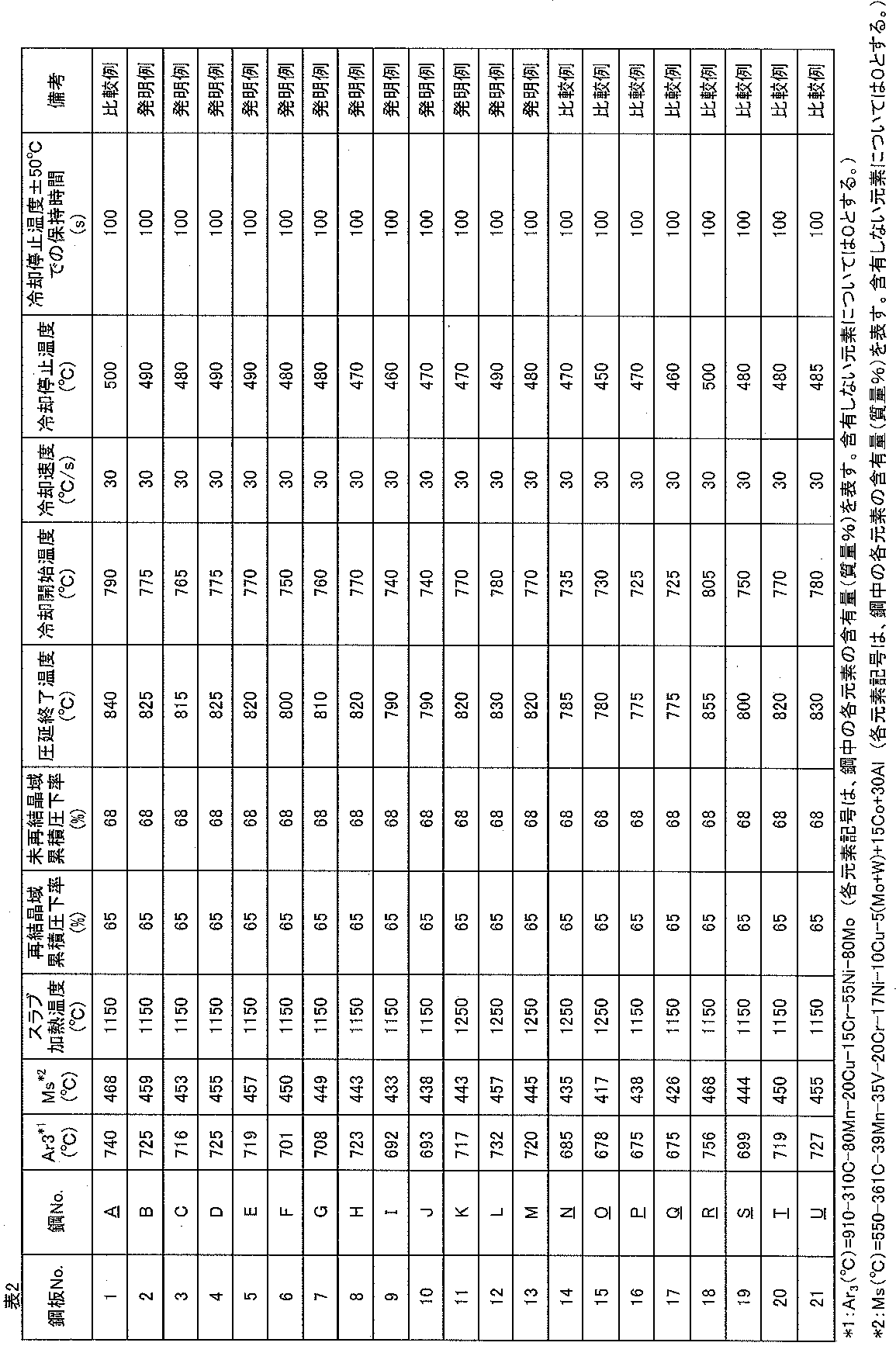
以上により得られた厚鋼板より、API-5Lに準拠した引張方向がC方向となる全厚引張試験片を採取し、引張試験を実施し、降伏強度(YS)、引張強度(TS)を求めた。また、シャルピー衝撃試験は、板厚方向の1/2位置から2mmのVノッチを有する長手方向がC方向となるシャルピー試験片を採取して、-40℃にてASTM A370に準拠したシャルピー衝撃試験を実施し、シャルピー衝撃吸収エネルギー(vE-40℃)を求めた。さらに、API-5Lに準拠した長手方向がC方向となるプレスノッチ型全厚DWTT試験片を採取し、-40℃で落重による衝撃曲げ荷重を加え、破断した破面の延性破面率(SA-40℃)を求めた。そして、板厚方向の1/2位置から組織観察用試験片を採取し、下記方法にて組織の同定、ベイナイト、島状マルテンサイトおよび残部組織の面積率ならびにセメンタイトの平均粒径を求めた。
鋼板の板厚方向の1/2位置から組織観察用試験片を採取し、L断面(圧延方向に平行な垂直断面)を鏡面研磨し、ナイタールで腐食した後、走査型電子顕微鏡(SEM)を用いて倍率2000倍で無作為に5視野観察し、撮影した組織写真により組織を同定し、ベイナイト、マルテンサイト、フェライト、パーライト等の各相の面積率を画像解析にて求めた。
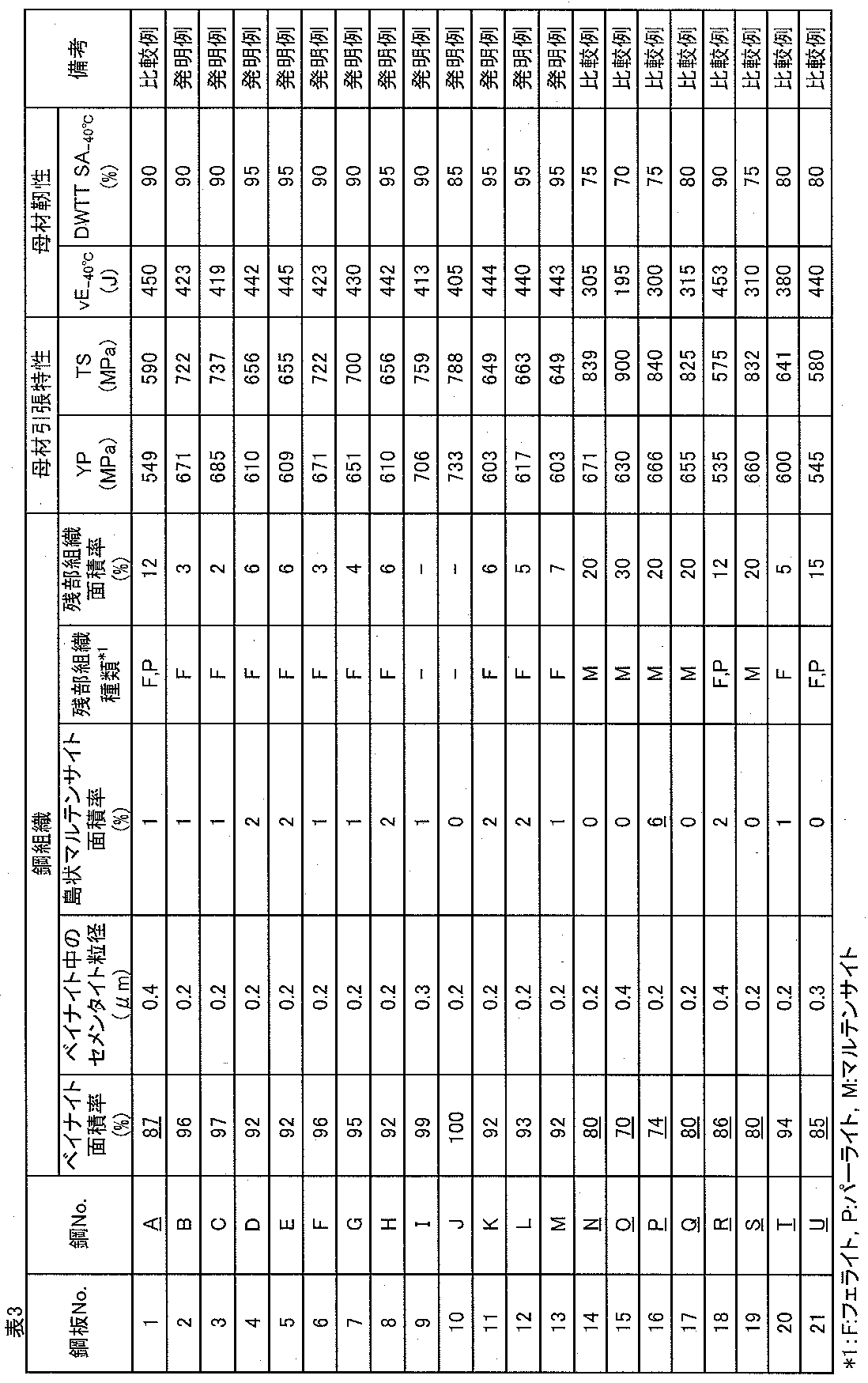
表3より、No.2~13の鋼板は、成分組成および製造方法が本発明に適合した発明例であり、母材の引張強度(TS)が625MPa以上、-40℃でのシャルピー衝撃吸収エネルギー(vE-40℃)が375J以上でかつ、-40℃でのDWTT試験で得られた延性破面率(SA-40℃)が85%以上となっており、高吸収エネルギーを有する高強度・高靭性鋼板となっている。
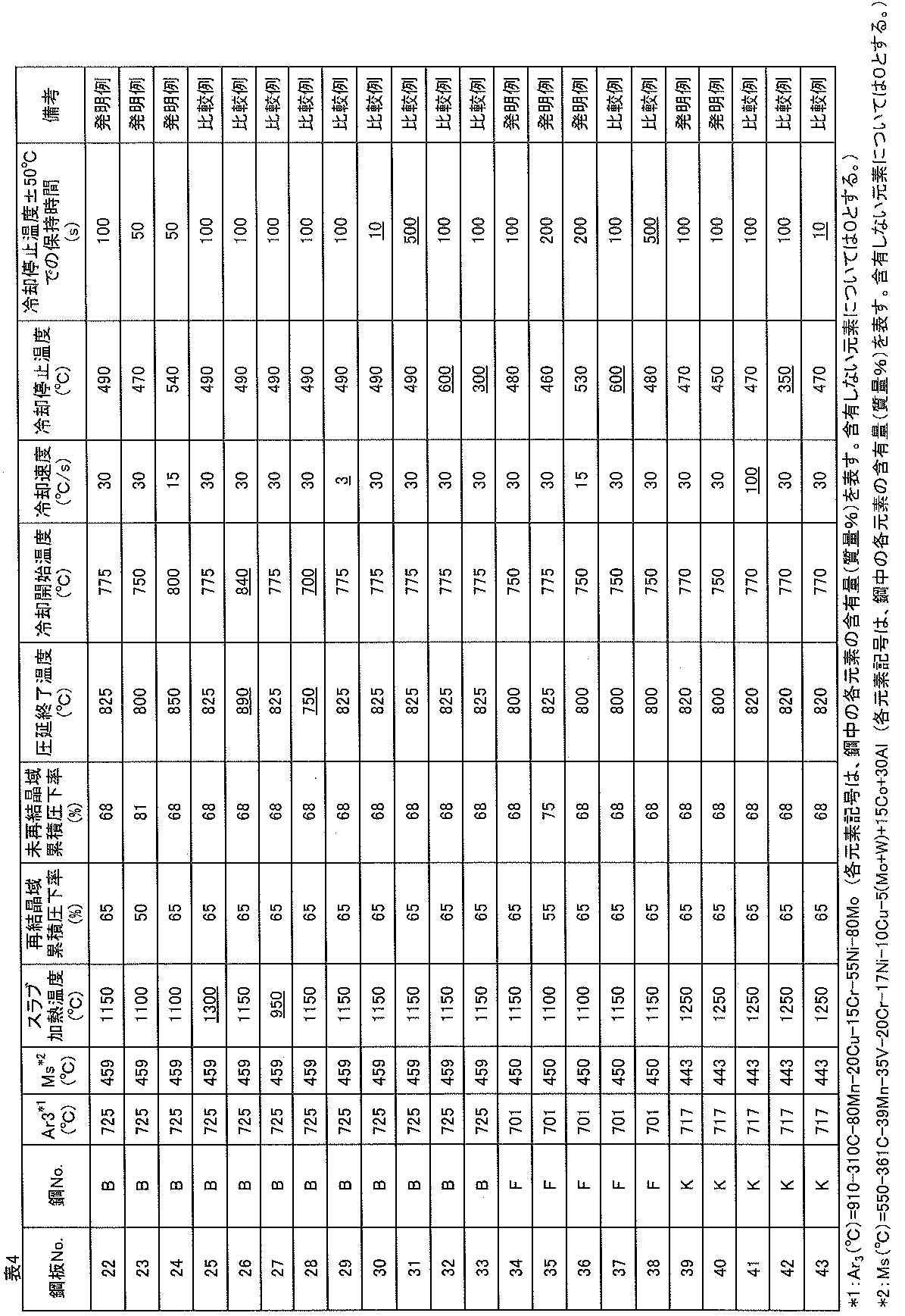
以上により得られた厚鋼板に対して、実施例1と同様に、全厚引張試験、シャルピー衝撃試験、プレスノッチ型全厚DWTT試験を実施し、降伏強度(YS)、引張強度(TS)、シャルピー衝撃吸収エネルギー(vE-40℃)および延性破面率(SA-40℃)を測定した。
得られた結果を表5に示す。
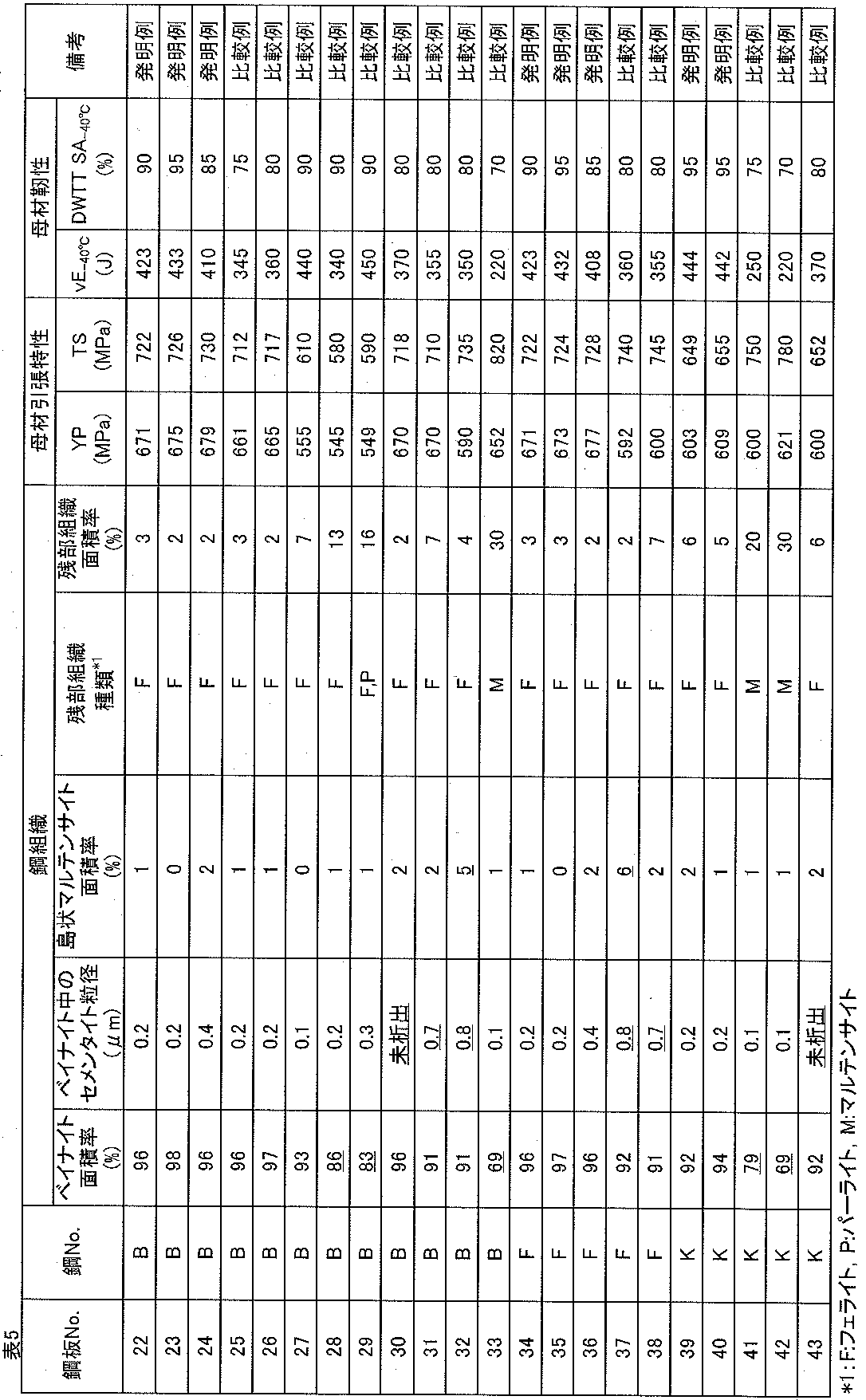
表5から、本発明の製造条件を満たすNo.22~24、34~36、39、40の鋼板は、成分組成および製造方法が本発明に適合した発明例であり、母材の引張強度(TS)が625MPa以上、-40℃でのシャルピー衝撃吸収エネルギー(vE-40℃)が375J以上でかつ、-40℃でのDWTT試験で得られた延性破面率(SA-40℃)が85%以上となっており、高吸収エネルギーを有する高強度・高靭性鋼板となっている。さらに、No.23およびNo.35は未再結晶温度域の累積圧下率が好適範囲であるため、同じ組成の鋼板の中で、オーステナイトの微細化に起因してシャルピー衝撃吸収エネルギー(vE-40℃)やDWTT特性(SA-40℃)がより高位となっている。
Claims (3)
- 質量%で、
C:0.03%以上0.08%以下、
Si:0.01%以上0.50%以下、
Mn:1.5%以上2.5%以下、
P:0.001%以上0.010%以下、
S:0.0030%以下、
Al:0.01%以上0.08%以下、
Nb:0.010%以上0.080%以下、
Ti:0.005%以上0.025%以下、
N:0.001%以上0.006%以下
を含有し、さらに
Cu:0.01%以上1.00%以下、
Ni:0.01%以上1.00%以下、
Cr:0.01%以上1.00%以下、
Mo:0.01%以上1.00%以下、
V:0.01%以上0.10%以下、
B:0.0005%以上0.0030%以下
から選ばれる1種以上を含有し、
残部がFeおよび不可避的不純物からなる成分組成を有する鋼板であり、
該鋼板の板厚方向の1/2位置における島状マルテンサイトの面積率が3%未満であって、さらに前記鋼板の板厚方向の1/2位置におけるベイナイトの面積率が90%以上であり、前記鋼板の板厚方向の1/2位置におけるベイナイト中に存在するセメンタイトの平均粒径が0.5μm以下であるミクロ組織を有する高強度・高靭性鋼板。 - 前記成分組成に加えてさらに、質量%で、
Ca:0.0005%以上0.0100%以下、
REM:0.0005%以上0.0200%以下、
Zr:0.0005%以上0.0300%以下、
Mg:0.0005%以上0.0100%以下
から選ばれる1種以上を含有する請求項1に記載の高強度・高靭性鋼板。 - 請求項1または2に記載の高強度・高靭性鋼板の製造方法であり、
鋼スラブを1000℃以上1250℃以下に加熱し、
オーステナイト再結晶温度域において圧延後、
オーステナイト未再結晶温度域において累積圧下率60%以上の圧延を行い、
(Ar3点+50℃)以上(Ar3点+150℃)以下の温度で圧延を終了し、
Ar3点以上(Ar3点+100℃)以下の冷却開始温度から10℃/s以上80℃/s以下の冷却速度にて、Ms点以上(Ms点+100℃)以下の冷却停止温度まで加速冷却をし、
さらに冷却停止温度±50℃の温度範囲で50s以上300s未満保持し、
その後100℃以下の温度域まで空冷を行う
高強度・高靭性鋼板の製造方法。
Priority Applications (6)
| Application Number | Priority Date | Filing Date | Title |
|---|---|---|---|
| KR1020177027516A KR102051198B1 (ko) | 2015-03-31 | 2016-03-25 | 고강도·고인성 강판 및 그 제조 방법 |
| CA2976750A CA2976750C (en) | 2015-03-31 | 2016-03-25 | High-strength, high-toughness steel plate, and method for producing the same |
| JP2017506419A JP6123972B2 (ja) | 2015-03-31 | 2016-03-25 | 高強度・高靭性鋼板およびその製造方法 |
| EP16771750.3A EP3279351B1 (en) | 2015-03-31 | 2016-03-25 | High strength, high toughness steel plate and method for producing the same |
| CN201680019365.6A CN107406951B (zh) | 2015-03-31 | 2016-03-25 | 高强度和高韧性钢板及其制造方法 |
| US15/562,291 US10544478B2 (en) | 2015-03-31 | 2016-03-25 | High-strength, high-toughness steel plate, and method for producing the same |
Applications Claiming Priority (2)
| Application Number | Priority Date | Filing Date | Title |
|---|---|---|---|
| JP2015-071931 | 2015-03-31 | ||
| JP2015071931 | 2015-03-31 |
Publications (1)
| Publication Number | Publication Date |
|---|---|
| WO2016157862A1 true WO2016157862A1 (ja) | 2016-10-06 |
Family
ID=57006653
Family Applications (1)
| Application Number | Title | Priority Date | Filing Date |
|---|---|---|---|
| PCT/JP2016/001743 Ceased WO2016157862A1 (ja) | 2015-03-31 | 2016-03-25 | 高強度・高靭性鋼板およびその製造方法 |
Country Status (7)
| Country | Link |
|---|---|
| US (1) | US10544478B2 (ja) |
| EP (1) | EP3279351B1 (ja) |
| JP (1) | JP6123972B2 (ja) |
| KR (1) | KR102051198B1 (ja) |
| CN (1) | CN107406951B (ja) |
| CA (1) | CA2976750C (ja) |
| WO (1) | WO2016157862A1 (ja) |
Cited By (6)
| Publication number | Priority date | Publication date | Assignee | Title |
|---|---|---|---|---|
| JP2018168411A (ja) * | 2017-03-29 | 2018-11-01 | Jfeスチール株式会社 | 高強度・高靭性厚鋼板の製造方法 |
| WO2019131100A1 (ja) * | 2017-12-25 | 2019-07-04 | Jfeスチール株式会社 | 熱延鋼板およびその製造方法 |
| CN110177892A (zh) * | 2017-01-06 | 2019-08-27 | 杰富意钢铁株式会社 | 高强度冷轧钢板及其制造方法 |
| JP2023070457A (ja) * | 2021-11-09 | 2023-05-19 | 株式会社神戸製鋼所 | 鋼板およびその製造方法 |
| WO2025177987A1 (ja) * | 2024-02-20 | 2025-08-28 | Jfeスチール株式会社 | 高強度鋼板、鋼管、高強度鋼板の製造方法、および鋼管の製造方法 |
| WO2026070046A1 (ja) * | 2024-09-25 | 2026-04-02 | Jfeスチール株式会社 | 液体及び/又は超臨界co2輸送ラインパイプ用鋼板及びその製造方法 |
Families Citing this family (6)
| Publication number | Priority date | Publication date | Assignee | Title |
|---|---|---|---|---|
| JP6635231B2 (ja) * | 2018-01-30 | 2020-01-22 | Jfeスチール株式会社 | ラインパイプ用鋼材およびその製造方法ならびにラインパイプの製造方法 |
| EP3816318B1 (en) * | 2018-06-27 | 2023-03-29 | JFE Steel Corporation | Clad steel plate and method of producing the same |
| CN109136724B (zh) * | 2018-09-14 | 2021-06-15 | 东北大学 | 一种低屈强比q690f工程机械用钢板及其制造方法 |
| CN113088816B (zh) * | 2021-03-27 | 2021-10-12 | 京泰控股集团有限公司 | 一种家具用钢制材料及其制备方法 |
| CN114182174B (zh) * | 2021-11-26 | 2022-06-28 | 湖南华菱湘潭钢铁有限公司 | 一种高强韧桥梁结构钢板的生产方法 |
| CN114231826B (zh) * | 2021-12-24 | 2022-06-28 | 湖南华菱湘潭钢铁有限公司 | 一种Q420qE桥梁结构钢板的生产方法 |
Citations (11)
| Publication number | Priority date | Publication date | Assignee | Title |
|---|---|---|---|---|
| JP2009242849A (ja) * | 2008-03-31 | 2009-10-22 | Jfe Steel Corp | 高靱性鋼の製造方法 |
| JP2011132601A (ja) * | 2009-11-25 | 2011-07-07 | Jfe Steel Corp | 高圧縮強度高靭性ラインパイプ用溶接鋼管及びその製造方法 |
| JP2011132600A (ja) * | 2009-11-25 | 2011-07-07 | Jfe Steel Corp | 高圧縮強度耐サワーラインパイプ用溶接鋼管及びその製造方法 |
| JP2011195883A (ja) * | 2010-03-19 | 2011-10-06 | Jfe Steel Corp | 引張強度590MPa以上の延靭性に優れた高強度厚鋼板およびその製造方法 |
| JP2012241266A (ja) * | 2011-05-24 | 2012-12-10 | Jfe Steel Corp | 高圧縮強度耐サワーラインパイプ用鋼管及びその製造方法 |
| JP2013095926A (ja) * | 2011-10-28 | 2013-05-20 | Nippon Steel & Sumitomo Metal Corp | 溶接性に優れた高張力鋼板およびその製造方法 |
| WO2013089156A1 (ja) * | 2011-12-15 | 2013-06-20 | 新日鐵住金株式会社 | 低温靭性に優れた高強度h形鋼及びその製造方法 |
| JP2013133476A (ja) * | 2011-12-26 | 2013-07-08 | Jfe Steel Corp | 耐サワー特性と溶接熱影響部靭性に優れたラインパイプ用高強度鋼板及びその製造方法 |
| JP2013204103A (ja) * | 2012-03-29 | 2013-10-07 | Jfe Steel Corp | 耐座屈性能に優れた低温用高強度溶接鋼管とその製造方法および耐座屈性能に優れた低温用高強度溶接鋼管用鋼板の製造方法 |
| JP2013227671A (ja) * | 2012-03-29 | 2013-11-07 | Jfe Steel Corp | 低降伏比高強度鋼板およびその製造方法並びにそれを用いた高強度溶接鋼管 |
| WO2013190750A1 (ja) * | 2012-06-18 | 2013-12-27 | Jfeスチール株式会社 | 厚肉高強度耐サワーラインパイプおよびその製造方法 |
Family Cites Families (12)
| Publication number | Priority date | Publication date | Assignee | Title |
|---|---|---|---|---|
| JP4705287B2 (ja) | 2001-09-20 | 2011-06-22 | 新日本製鐵株式会社 | 高い吸収エネルギーを有する薄手高強度鋼板の非水冷型製造方法 |
| JP5151034B2 (ja) | 2005-02-24 | 2013-02-27 | Jfeスチール株式会社 | 高張力ラインパイプ用鋼板の製造方法および高張力ラインパイプ用鋼板 |
| JP4696615B2 (ja) | 2005-03-17 | 2011-06-08 | 住友金属工業株式会社 | 高張力鋼板、溶接鋼管及びそれらの製造方法 |
| JP4309946B2 (ja) * | 2007-03-05 | 2009-08-05 | 新日本製鐵株式会社 | 脆性き裂伝播停止特性に優れた厚手高強度鋼板およびその製造方法 |
| JP5157386B2 (ja) | 2007-11-21 | 2013-03-06 | Jfeスチール株式会社 | 厚肉高強度高靭性鋼管素材の製造方法 |
| JP5439889B2 (ja) | 2009-03-25 | 2014-03-12 | Jfeスチール株式会社 | 厚肉高靭性鋼管素材用厚鋼板およびその製造方法 |
| CA2775031C (en) | 2009-09-30 | 2015-03-24 | Jfe Steel Corporation | Low yield ratio, high strength and high uniform elongation steel plate and method for manufacturing the same |
| KR101511617B1 (ko) * | 2009-11-25 | 2015-04-13 | 제이에프이 스틸 가부시키가이샤 | 높은 압축 강도를 갖는 라인파이프용 용접 강관의 제조 방법 |
| CN102884217A (zh) * | 2010-05-12 | 2013-01-16 | 株式会社神户制钢所 | 落锤冲击特性优异的高强度厚钢板 |
| JP5126326B2 (ja) | 2010-09-17 | 2013-01-23 | Jfeスチール株式会社 | 耐疲労特性に優れた高強度熱延鋼板およびその製造方法 |
| CN104073744B (zh) * | 2014-05-30 | 2016-08-10 | 武汉钢铁(集团)公司 | 厚度≥18.5mm的高韧性X80管线钢板卷及生产方法 |
| US10640841B2 (en) | 2015-03-31 | 2020-05-05 | Jfe Steel Corporation | High-strength, high-toughness steel plate and method for producing the same |
-
2016
- 2016-03-25 WO PCT/JP2016/001743 patent/WO2016157862A1/ja not_active Ceased
- 2016-03-25 US US15/562,291 patent/US10544478B2/en active Active
- 2016-03-25 KR KR1020177027516A patent/KR102051198B1/ko active Active
- 2016-03-25 CA CA2976750A patent/CA2976750C/en active Active
- 2016-03-25 JP JP2017506419A patent/JP6123972B2/ja active Active
- 2016-03-25 EP EP16771750.3A patent/EP3279351B1/en active Active
- 2016-03-25 CN CN201680019365.6A patent/CN107406951B/zh active Active
Patent Citations (11)
| Publication number | Priority date | Publication date | Assignee | Title |
|---|---|---|---|---|
| JP2009242849A (ja) * | 2008-03-31 | 2009-10-22 | Jfe Steel Corp | 高靱性鋼の製造方法 |
| JP2011132601A (ja) * | 2009-11-25 | 2011-07-07 | Jfe Steel Corp | 高圧縮強度高靭性ラインパイプ用溶接鋼管及びその製造方法 |
| JP2011132600A (ja) * | 2009-11-25 | 2011-07-07 | Jfe Steel Corp | 高圧縮強度耐サワーラインパイプ用溶接鋼管及びその製造方法 |
| JP2011195883A (ja) * | 2010-03-19 | 2011-10-06 | Jfe Steel Corp | 引張強度590MPa以上の延靭性に優れた高強度厚鋼板およびその製造方法 |
| JP2012241266A (ja) * | 2011-05-24 | 2012-12-10 | Jfe Steel Corp | 高圧縮強度耐サワーラインパイプ用鋼管及びその製造方法 |
| JP2013095926A (ja) * | 2011-10-28 | 2013-05-20 | Nippon Steel & Sumitomo Metal Corp | 溶接性に優れた高張力鋼板およびその製造方法 |
| WO2013089156A1 (ja) * | 2011-12-15 | 2013-06-20 | 新日鐵住金株式会社 | 低温靭性に優れた高強度h形鋼及びその製造方法 |
| JP2013133476A (ja) * | 2011-12-26 | 2013-07-08 | Jfe Steel Corp | 耐サワー特性と溶接熱影響部靭性に優れたラインパイプ用高強度鋼板及びその製造方法 |
| JP2013204103A (ja) * | 2012-03-29 | 2013-10-07 | Jfe Steel Corp | 耐座屈性能に優れた低温用高強度溶接鋼管とその製造方法および耐座屈性能に優れた低温用高強度溶接鋼管用鋼板の製造方法 |
| JP2013227671A (ja) * | 2012-03-29 | 2013-11-07 | Jfe Steel Corp | 低降伏比高強度鋼板およびその製造方法並びにそれを用いた高強度溶接鋼管 |
| WO2013190750A1 (ja) * | 2012-06-18 | 2013-12-27 | Jfeスチール株式会社 | 厚肉高強度耐サワーラインパイプおよびその製造方法 |
Cited By (13)
| Publication number | Priority date | Publication date | Assignee | Title |
|---|---|---|---|---|
| US11208704B2 (en) | 2017-01-06 | 2021-12-28 | Jfe Steel Corporation | High-strength cold-rolled steel sheet and method of producing the same |
| CN110177892A (zh) * | 2017-01-06 | 2019-08-27 | 杰富意钢铁株式会社 | 高强度冷轧钢板及其制造方法 |
| CN110177892B (zh) * | 2017-01-06 | 2021-05-28 | 杰富意钢铁株式会社 | 高强度冷轧钢板及其制造方法 |
| JP2018168411A (ja) * | 2017-03-29 | 2018-11-01 | Jfeスチール株式会社 | 高強度・高靭性厚鋼板の製造方法 |
| WO2019131100A1 (ja) * | 2017-12-25 | 2019-07-04 | Jfeスチール株式会社 | 熱延鋼板およびその製造方法 |
| JP2019112676A (ja) * | 2017-12-25 | 2019-07-11 | Jfeスチール株式会社 | 熱延鋼板およびその製造方法 |
| RU2740067C1 (ru) * | 2017-12-25 | 2020-12-31 | ДжФЕ СТИЛ КОРПОРЕЙШН | Горячекатаная толстолистовая сталь и способ ее изготовления |
| US11390931B2 (en) | 2017-12-25 | 2022-07-19 | Jfe Steel Corporation | Hot-rolled steel plate and method for manufacturing same |
| JP2023070457A (ja) * | 2021-11-09 | 2023-05-19 | 株式会社神戸製鋼所 | 鋼板およびその製造方法 |
| JP7535490B2 (ja) | 2021-11-09 | 2024-08-16 | 株式会社神戸製鋼所 | 鋼板およびその製造方法 |
| WO2025177987A1 (ja) * | 2024-02-20 | 2025-08-28 | Jfeスチール株式会社 | 高強度鋼板、鋼管、高強度鋼板の製造方法、および鋼管の製造方法 |
| JP7758256B1 (ja) * | 2024-02-20 | 2025-10-22 | Jfeスチール株式会社 | 高強度鋼板、鋼管、高強度鋼板の製造方法、および鋼管の製造方法 |
| WO2026070046A1 (ja) * | 2024-09-25 | 2026-04-02 | Jfeスチール株式会社 | 液体及び/又は超臨界co2輸送ラインパイプ用鋼板及びその製造方法 |
Also Published As
| Publication number | Publication date |
|---|---|
| KR102051198B1 (ko) | 2019-12-02 |
| CN107406951A (zh) | 2017-11-28 |
| EP3279351B1 (en) | 2019-07-03 |
| CA2976750A1 (en) | 2016-10-06 |
| US10544478B2 (en) | 2020-01-28 |
| EP3279351A4 (en) | 2018-03-07 |
| CA2976750C (en) | 2020-08-18 |
| EP3279351A1 (en) | 2018-02-07 |
| JPWO2016157862A1 (ja) | 2017-06-08 |
| CN107406951B (zh) | 2019-09-24 |
| US20180340238A1 (en) | 2018-11-29 |
| KR20170120176A (ko) | 2017-10-30 |
| JP6123972B2 (ja) | 2017-05-10 |
Similar Documents
| Publication | Publication Date | Title |
|---|---|---|
| JP6123972B2 (ja) | 高強度・高靭性鋼板およびその製造方法 | |
| JP6123973B2 (ja) | 高強度・高靭性鋼板およびその製造方法 | |
| JP4844687B2 (ja) | 低降伏比高強度高靭性鋼板及びその製造方法 | |
| JP5516784B2 (ja) | 低降伏比高強度鋼板およびその製造方法並びにそれを用いた高強度溶接鋼管 | |
| JP5532800B2 (ja) | 耐歪時効特性に優れた低降伏比高強度高一様伸び鋼板及びその製造方法 | |
| JP6299935B2 (ja) | 高強度・高靭性鋼管用鋼板およびその製造方法 | |
| CN111511944B (zh) | 热轧钢板及其制造方法 | |
| WO2013145771A1 (ja) | 耐歪時効特性に優れた低降伏比高強度鋼板およびその製造方法並びにそれを用いた高強度溶接鋼管 | |
| JP6149776B2 (ja) | 高靭性高延性高強度熱延鋼板及びその製造方法 | |
| JP2017115200A (ja) | 低温用h形鋼及びその製造方法 | |
| WO2014175122A1 (ja) | H形鋼及びその製造方法 | |
| JP2015054983A (ja) | 高靭性高延性高強度熱延鋼板及びその製造方法 | |
| JP5157386B2 (ja) | 厚肉高強度高靭性鋼管素材の製造方法 | |
| CN111356779A (zh) | H型钢及其制造方法 | |
| JP6390813B2 (ja) | 低温用h形鋼及びその製造方法 | |
| JP5509654B2 (ja) | 耐pwht特性および一様伸び特性に優れた高強度鋼板並びにその製造方法 | |
| JP5157387B2 (ja) | 高変形能を備えた厚肉高強度高靭性鋼管素材の製造方法 | |
| JP6624145B2 (ja) | 高強度・高靭性厚鋼板の製造方法 | |
| JP5439889B2 (ja) | 厚肉高靭性鋼管素材用厚鋼板およびその製造方法 | |
| JP6354571B2 (ja) | 圧延h形鋼及びその製造方法 | |
| JP2016156032A (ja) | 低温用h形鋼及びその製造方法 | |
| JP2012193446A (ja) | 高延性超高強度溶接鋼管用鋼板および鋼管ならびにその製造方法 |
Legal Events
| Date | Code | Title | Description |
|---|---|---|---|
| 121 | Ep: the epo has been informed by wipo that ep was designated in this application |
Ref document number: 16771750 Country of ref document: EP Kind code of ref document: A1 |
|
| ENP | Entry into the national phase |
Ref document number: 2017506419 Country of ref document: JP Kind code of ref document: A |
|
| ENP | Entry into the national phase |
Ref document number: 2976750 Country of ref document: CA |
|
| ENP | Entry into the national phase |
Ref document number: 20177027516 Country of ref document: KR Kind code of ref document: A |
|
| WWE | Wipo information: entry into national phase |
Ref document number: 15562291 Country of ref document: US |
|
| REEP | Request for entry into the european phase |
Ref document number: 2016771750 Country of ref document: EP |
|
| NENP | Non-entry into the national phase |
Ref country code: DE |