WO2016158705A1 - PROCÉDÉ DE FABRICATION D'UN SUPERALLIAGE À BASE DE Ni ET RÉSISTANT À LA CHALEUR - Google Patents
PROCÉDÉ DE FABRICATION D'UN SUPERALLIAGE À BASE DE Ni ET RÉSISTANT À LA CHALEUR Download PDFInfo
- Publication number
- WO2016158705A1 WO2016158705A1 PCT/JP2016/059509 JP2016059509W WO2016158705A1 WO 2016158705 A1 WO2016158705 A1 WO 2016158705A1 JP 2016059509 W JP2016059509 W JP 2016059509W WO 2016158705 A1 WO2016158705 A1 WO 2016158705A1
- Authority
- WO
- WIPO (PCT)
- Prior art keywords
- hot
- temperature
- phase
- hot working
- solid solution
- Prior art date
- Legal status (The legal status is an assumption and is not a legal conclusion. Google has not performed a legal analysis and makes no representation as to the accuracy of the status listed.)
- Ceased
Links
Images


Classifications
-
- C—CHEMISTRY; METALLURGY
- C22—METALLURGY; FERROUS OR NON-FERROUS ALLOYS; TREATMENT OF ALLOYS OR NON-FERROUS METALS
- C22F—CHANGING THE PHYSICAL STRUCTURE OF NON-FERROUS METALS AND NON-FERROUS ALLOYS
- C22F1/00—Changing the physical structure of non-ferrous metals or alloys by heat treatment or by hot or cold working
- C22F1/10—Changing the physical structure of non-ferrous metals or alloys by heat treatment or by hot or cold working of nickel or cobalt or alloys based thereon
-
- B—PERFORMING OPERATIONS; TRANSPORTING
- B21—MECHANICAL METAL-WORKING WITHOUT ESSENTIALLY REMOVING MATERIAL; PUNCHING METAL
- B21H—MAKING PARTICULAR METAL OBJECTS BY ROLLING, e.g. SCREWS, WHEELS, RINGS, BARRELS, BALLS
- B21H1/00—Making articles shaped as bodies of revolution
- B21H1/06—Making articles shaped as bodies of revolution rings of restricted axial length
-
- B—PERFORMING OPERATIONS; TRANSPORTING
- B21—MECHANICAL METAL-WORKING WITHOUT ESSENTIALLY REMOVING MATERIAL; PUNCHING METAL
- B21J—FORGING; HAMMERING; PRESSING METAL; RIVETING; FORGE FURNACES
- B21J1/00—Preparing metal stock or similar ancillary operations prior, during or post forging, e.g. heating or cooling
- B21J1/06—Heating or cooling methods or arrangements specially adapted for performing forging or pressing operations
-
- B—PERFORMING OPERATIONS; TRANSPORTING
- B21—MECHANICAL METAL-WORKING WITHOUT ESSENTIALLY REMOVING MATERIAL; PUNCHING METAL
- B21J—FORGING; HAMMERING; PRESSING METAL; RIVETING; FORGE FURNACES
- B21J5/00—Methods for forging, hammering, or pressing; Special equipment or accessories therefor
-
- C—CHEMISTRY; METALLURGY
- C22—METALLURGY; FERROUS OR NON-FERROUS ALLOYS; TREATMENT OF ALLOYS OR NON-FERROUS METALS
- C22C—ALLOYS
- C22C19/00—Alloys based on nickel or cobalt
- C22C19/007—Alloys based on nickel or cobalt with a light metal (alkali metal Li, Na, K, Rb, Cs; earth alkali metal Be, Mg, Ca, Sr, Ba, Al Ga, Ge, Ti) or B, Si, Zr, Hf, Sc, Y, lanthanides, actinides, as the next major constituent
-
- C—CHEMISTRY; METALLURGY
- C22—METALLURGY; FERROUS OR NON-FERROUS ALLOYS; TREATMENT OF ALLOYS OR NON-FERROUS METALS
- C22C—ALLOYS
- C22C19/00—Alloys based on nickel or cobalt
- C22C19/03—Alloys based on nickel or cobalt based on nickel
- C22C19/05—Alloys based on nickel or cobalt based on nickel with chromium
-
- C—CHEMISTRY; METALLURGY
- C22—METALLURGY; FERROUS OR NON-FERROUS ALLOYS; TREATMENT OF ALLOYS OR NON-FERROUS METALS
- C22C—ALLOYS
- C22C19/00—Alloys based on nickel or cobalt
- C22C19/03—Alloys based on nickel or cobalt based on nickel
- C22C19/05—Alloys based on nickel or cobalt based on nickel with chromium
- C22C19/051—Alloys based on nickel or cobalt based on nickel with chromium and Mo or W
- C22C19/056—Alloys based on nickel or cobalt based on nickel with chromium and Mo or W with the maximum Cr content being at least 10% but less than 20%
-
- C—CHEMISTRY; METALLURGY
- C22—METALLURGY; FERROUS OR NON-FERROUS ALLOYS; TREATMENT OF ALLOYS OR NON-FERROUS METALS
- C22F—CHANGING THE PHYSICAL STRUCTURE OF NON-FERROUS METALS AND NON-FERROUS ALLOYS
- C22F1/00—Changing the physical structure of non-ferrous metals or alloys by heat treatment or by hot or cold working
Definitions
- the present invention relates to a method for producing a Ni-base superalloy.
- Ni-base superalloys containing a large amount of alloy elements such as Al and Ti are used.
- Ni-base superalloy is mainly, gamma phase is Ni solid solution and (matrix), and a L1 2 type intermetallic compound Ni 3 (Al, Ti) a a gamma 'phase (precipitation phase).
- gamma phase is Ni solid solution and (matrix)
- it is effective to operate the turbine at a high temperature as much as possible. For this purpose, it is necessary to increase the service temperature of each turbine member.
- the addition amount of components that contribute to strengthening such as Al and Ti is generally limited as compared with cast alloys that do not rely on hot working.
- turbine members in which fatigue strength is actually important include turbine disks, turbine cases, and shafts. Since these are large or long members, these materials are typically represented by high-speed forging machines or ring rolling machines depending on the shape of the product in order to produce these materials with high efficiency and high yield. It is desirable to perform hot working by applying a high speed hot working machine. These high-speed hot working machines have a high efficiency and a predetermined shape because hot working is performed with a small number of heating times and a short working time, compared to industrially used free forging press machines. This is because it can be obtained.
- the deformation resistance and hot workability differ depending on the strain rate.
- the strain rate is high, the deformation resistance increases and the hot ductility tends to decrease. This is because the higher the strain rate, the more the heat activation process does not recover, and the work hardening becomes remarkable due to the dislocation density that increases during processing.
- the ⁇ ′ phase inhibits the movement of dislocations, and thus shows a greater work hardening. Accordingly, in the ⁇ 'phase precipitation type super heat resistant alloy, the hot ⁇ ' phase decreases as the ⁇ 'phase increases.
- the surface of the hot work material is in contact with the outside air or a die or roll.
- the surface temperature decreases as the hot working time increases.
- the ⁇ 'phase that precipitates sequentially with the decrease in temperature prevents the movement of dislocations.
- hot ductility is significantly reduced. This is because when the temperature is lowered in the precipitation temperature range of the ⁇ ′ phase, the possible precipitation amount of the ⁇ ′ phase increases from a thermodynamic viewpoint.
- Ni-based superalloys that can be produced are limited to those having a small amount of ⁇ ′.
- Ni-based superalloy As an example, the following can be said.
- Ni super heat resistant alloy which is relatively high strength and excellent in hot workability. Since this alloy has a low ⁇ ′ solid solution temperature and a wide ⁇ single-phase region in the high temperature range, it is relatively easy to hot work in this ⁇ single-phase region and has a high strain rate as described above. It is possible to perform a hot working process.
- Udimet 720Li (Udimet® is a registered trademark of Special Metals Co., Ltd.) may be mentioned as a Ni-based superalloy having higher strength than Waspaloy (Waspalo® is a registered trademark of United Technology Corporation).
- This alloy is counted as one of the Ni-base superalloys having the highest ⁇ ′ precipitation amount and ⁇ ′ solid solution temperature as compared to Waspaloy and the most difficult to hot work. Since such an alloy has many additive elements, the partial melting temperature is also low, and stable hot working cannot be performed in a temperature range equal to or higher than the ⁇ ′ solid solution temperature.
- the Ni-base superalloy having a large amount of ⁇ ′ as described above has a high temperature strength and exhibits excellent performance when used as a turbine member, for example.
- such alloys are usually difficult to perform stable hot working, and cracks are likely to occur inside and on the surface of the material during processing.
- alloy shapes that are expected to be used as turbine members such as long round bars and large-diameter ring materials. When hot working is performed on such shapes, the yield is low. It is desirable to use a high-speed forging machine or a ring rolling machine from the viewpoint of quality.
- Non-Patent Document 1 shows an experimental result that the hot workability of the forged Udimet720Li is improved as the cooling rate after the temperature is raised to 1110 ° C. is decreased.
- the knowledge of improving hot ductility by such a heat treatment process is important, but this test condition is performed at 1 / second, which is a relatively slow strain rate.
- An object of the present invention is to provide a method for producing a Ni-base superalloy having good hot workability even under a high strain rate.
- the inventors of the present invention have studied manufacturing methods for alloys having various compositions capable of achieving high strength sufficient for use in aircraft engines, power generation gas turbines, and the like. It was found that hot workability can be greatly improved even at a high strain rate by selecting and selecting a specific hot working temperature range in which the ⁇ ′ phase, which is a strengthening phase, does not inhibit hot working.
- the present invention is, by mass%, C: 0.001 to 0.050%, Al: 1.0 to 4.0%, Ti: 3.0 to 7.0%, Cr: 12 to 18%, Co : 12 to 30%, Mo: 1.5 to 5.5%, W: 0.5 to 2.5%, B: 0.001 to 0.050%, Zr: 0.001 to 0.100%, Mg: 0 to 0.01%, Fe: 0 to 5%, Ta: 0 to 3%, Nb: 0 to 3%, the balance is composed of Ni and inevitable impurities, and the solid phase of the ⁇ ′ phase Using a hot-work material with a melting temperature of 1050 ° C. or higher, heat for 10 hours or longer in a temperature range of 980 ° C.
- a method for producing a Ni-base superalloy which comprises a hot working step of performing hot working at a strain rate 2.0 / sec or more machining speed at degrees range.
- Ni-base superalloys used in aircraft engines, gas turbines for power generation, etc. high-strength Ni-base alloys with a large amount of ⁇ ′ precipitation, which has been difficult in the past, are stable under high strain rates. Hot working is possible. As a result, various shapes of Ni-based superalloys such as a long shaft and a ring disk that require processing at a high strain rate can be provided at low cost and with high yield.
- a feature of the present invention is that, in a high-strength Ni-base superalloy having a large amount of ⁇ ′ phase, a large amount of ⁇ ′ phase is coarsened by heating for 10 hours or more in a ⁇ / ⁇ ′ coexistence region where a sufficient amount of precipitation can be expected. And after that, by performing hot working in a specific temperature range, it is possible to perform high speed hot working which has been difficult in the past. As a result, with regard to Ni-based superalloys that are conventionally difficult to hot work or require a lot of time and energy for hot working, an appropriate heating process for the hot work material, strain rate in hot working, etc.
- the Ni-base superalloy specified in the present invention is an alloy capable of setting the precipitation amount of the ⁇ ′ phase to 30% or more, and the solid solution temperature of the ⁇ ′ phase is 1050 ° C. or more.
- the solid solution temperature of the ⁇ ′ phase is determined by the alloy components, and the Ni-base superalloy shown below has a solid solution temperature of the ⁇ ′ phase of 1050 ° C. or higher. This is because the present invention for hot working in the ⁇ / ⁇ ′ phase coexistence region works more effectively as the solid solution temperature of the ⁇ ′ phase is higher.
- ⁇ C: 0.001 to 0.050%> C has the effect of increasing the strength of the grain boundaries. This effect appears at 0.001% or more. However, when C is excessively contained, coarse carbides are formed and the strength and hot workability are lowered, so 0.050% is made the upper limit. A preferable range for obtaining the effect of C more reliably is 0.005 to 0.040%, more preferably 0.010 to 0.040%, more preferably 0.010 to 0.030%. is there.
- ⁇ Cr: 12-18%> Cr is an element that improves oxidation resistance and corrosion resistance. In order to obtain the effect, 12% or more is necessary.
- Al is an essential element that forms a ⁇ ′ (Ni 3 Al) phase that is a strengthening phase and improves high-temperature strength. In order to obtain the effect, at least 1.0% is required. However, excessive addition reduces hot workability and causes material defects such as cracks during processing, so 1.0 to 4.0. Limited to%. A preferable range for obtaining the effect of Al more reliably is 1.5 to 3.0%, more preferably 1.8 to 2.7%, and more preferably 1.9 to 2.6%.
- Ti 3.0 to 7.0%> Ti is an essential element that enhances the high-temperature strength by solid solution strengthening of the ⁇ 'phase by substituting the Al site of the ⁇ ' phase.
- the upper limit of Ti is set to 7.0%.
- a preferable range for obtaining the effect of Ti more reliably is 3.5 to 6.7%, further preferably 4.0 to 6.5%, and more preferably 4.5 to 6.5%.
- Mo contributes to solid solution strengthening of the matrix and has the effect of improving the high temperature strength. In order to obtain this effect, 1.5% or more is necessary. However, if Mo is excessive, an embrittled phase such as a ⁇ phase is formed and high temperature strength is impaired, so the upper limit is made 5.5%.
- a preferable range for obtaining the effect of Mo more reliably is 2.0 to 3.5%, more preferably 2.0 to 3.2%, and more preferably 2.5 to 3.0%. It is a range.
- a preferable range for obtaining the effect of Mo more reliably is 0.7 to 2.2%, and more preferably 1.0 to 2.0%.
- B is an element that improves the grain boundary strength and improves the creep strength and ductility. To obtain this effect, a minimum of 0.001% is required. On the other hand, B has a large effect of lowering the melting point, and when coarse boride is formed, workability is hindered. Therefore, it is necessary to control not to exceed 0.050%.
- a preferable range for obtaining the effect of B more reliably is 0.005 to 0.040, more preferably 0.005 to 0.030%, and still more preferably 0.005 to 0.020%. .
- ⁇ Zr 0.001 to 0.100%> Zr has the effect of improving the grain boundary strength like B, and at least 0.001% is necessary to obtain this effect.
- Mg has the effect of improving hot ductility by fixing S, which is an inevitable impurity that segregates at grain boundaries and inhibits hot ductility, as a sulfide. For this reason, you may add as needed. However, if the addition amount increases, excess Mg becomes a factor that inhibits hot ductility, so the upper limit is made 0.01%.
- ⁇ Fe 0-5%> Fe is an inexpensive element, and by allowing the inclusion of this Fe, it is possible to reduce the raw material cost of the material to be hot-worked, so it may be contained as necessary. However, excessive addition of Fe facilitates the precipitation of the ⁇ phase and causes the mechanical properties to deteriorate, so the upper limit is made 5%.
- ⁇ Ta 0 to 3%> Ta, like Ti, is an element that enhances the high-temperature strength by solid solution strengthening of the ⁇ ′ phase by substituting the Al site of the ⁇ ′ phase. Therefore, it is possible to obtain the effect by substituting a part of Al with Ta, so it may be added as necessary.
- Nb is an element which, like Ti and Ta, replaces the Al site of the ⁇ ′ phase, strengthens the ⁇ ′ phase by solid solution strengthening, and increases the high temperature strength. Therefore, the effect can be obtained by substituting a part of Al with Nb. Therefore, it may be added if necessary.
- excessive addition causes the ⁇ ′ phase to become unstable at high temperatures, forming harmful ⁇ phase or ⁇ (delta) phase and impairing hot workability, so the upper limit of Nb is made 3%.
- the hot-work material of the present invention having the above components is preferably produced by vacuum melting in the same manner as other Ni-base superalloys. As a result, oxidation of active elements such as Al and Ti can be suppressed, and inclusions can be reduced. In order to obtain a higher quality ingot, secondary and tertiary melting such as electroslag remelting and vacuum arc remelting may be performed. For the purpose of preparing an ingot with a more homogenized metal structure, an initial ingot may be produced by a powder metallurgy method.
- a metal structure having a crystal grain size of 5 or more in terms of ASTM crystal grain size number as a hot work material by press forging or the like that can be machined at a low strain rate. More preferably, it is ASTM grain size number 8 or more, and further preferably, ASTM grain size number 10 or more.
- ASTM grain size number 8 or more is ASTM grain size number 8 or more
- ASTM grain size number 10 or more is an example of manufacturing the above-mentioned hot work material.
- the workpiece subjected to the homogenization heat treatment is gradually cooled to a temperature at which the ⁇ ′ phase is precipitated at a cooling rate of 0.03 ° C./second or less.
- the growth of the ⁇ ′ phase is promoted, then the temperature is again raised to 950 to 1160 ° C. (however, below the ⁇ ′ phase solid solution temperature), and a heat treatment is performed for 2 hours or more.
- Cooling at a cooling rate of 03 ° C./second or less is preferable to grow a ⁇ ′ phase.
- the average particle diameter of the primary ⁇ ′ phase can be increased to 1 ⁇ m or more, and high hot workability is imparted.
- hot processing such as hot pressing is performed at a low strain rate using the above-described workpiece.
- the hot working is preferably in the range of 800 to 1125 ° C. This is for the purpose of reducing the deformation resistance of the material by partially dissolving the ⁇ ′ phase, which is a strengthening phase, in the matrix phase.
- the reheating treatment is performed in a temperature range higher than the hot working temperature and lower than the ⁇ ′ phase solid solution temperature. By this reheating treatment, recrystallization occurs, distortion is removed, and a coarse cast structure is changed to a fine hot work structure, thereby improving the hot workability.
- This hot working and reheating treatment can be repeated a plurality of times as necessary.
- the preheating step is performed in the temperature range of 980 ° C. to 1050 ° C. and the upper limit of ⁇ 30 ° C. with respect to the ⁇ ′ solid solution temperature.
- This temperature range is a temperature range of the coexistence region of the ⁇ / ⁇ ′ phase, and it is necessary to go through a heating step of at least 10 hours in total.
- This preheating step has an effect of promoting the growth and coarsening of the ⁇ ′ phase. The coarser the ⁇ ′ phase, the easier the plastic deformation, so the hot ductility improves.
- the temperature range of the preheating step is 980 ° C. to 1050 ° C. Is about 960 ° C., the temperature is in the range of 980 to 1030 ° C., and the upper limit temperature of the preheating step varies depending on the ⁇ ′ solid solution temperature.
- the reason for prescribing the upper limit temperature of the preheating process is that, from the viewpoint of thermodynamic equilibrium, the volume fraction of the ⁇ 'phase that equilibrates with the ⁇ phase decreases as the temperature increases, and the hot ductility improvement effect in the next hot working process This is because it cannot be expected.
- the amount of precipitation of the ⁇ ' phase accompanying the decrease in the surface temperature during the next hot working at a high strain rate should be minimized. I can do it.
- the reason why the lower limit temperature is set to 980 ° C. is that it is necessary to secure the growth and coarsening rate of the ⁇ ′ phase to a certain extent.
- the volume fraction of the ⁇ 'phase that equilibrates with the ⁇ phase increases as the temperature decreases, but on the other hand, the diffusion rate of atoms decreases, so the growth and coarsening rate of the ⁇ ' phase decreases and the effect of improving hot ductility This is because it is difficult to obtain.
- the heating time for the hot work material as described above requires a minimum of 10 hours or more, and the upper limit of the heating time is not particularly specified because the purpose is to coarsen the ⁇ ′ phase, In terms of efficiency, it is preferable to be within 60 hours.
- the heating time referred to here is, for example, an elapsed time in a temperature range of 980 ° C. to 1050 ° C. for a hot-worked material having a ⁇ ′ solid solution temperature of about 1160 ° C., an isothermal holding time, Alternatively / further, it is the total time including the time to cool down.
- a hot work material having a ⁇ ′ solid solution temperature of about 1160 ° C. it is held at a heating temperature of 1100 ° C. for 2 hours, then cooled at a cooling rate of 10.0 ° C./hour, and remains at 980 ° C.
- the heating time between 1050 ° C. and 980 ° C. is 7.0 hours.
- a hot work material having a ⁇ ′ solid solution temperature of about 1160 ° C. is held at a heating temperature of 1100 ° C. for 2 hours, and then cooled at a cooling rate of 10.0 ° C./hour, and the temperature becomes 1000 ° C.
- the cooling is stopped once and held for 10 hours at an isothermal temperature of 1000 ° C.
- the cooling is further performed at a cooling rate of 10.0 ° C./hour, and the temperature is lowered to a temperature lower than 980 ° C.
- the elapsed time (heating time) in the temperature range of 980 ° C. to 1050 ° C. is 17 hours.
- the reason for including the temperature lowering time is that the purpose of this heating step is to efficiently grow and coarsen the ⁇ ′ phase having a volume ratio above a certain level. This is because the effect can be obtained not only through the process but also through the temperature lowering process.
- the amount of precipitation of the ⁇ ′ phase increases first through the precipitation process under the isothermal condition. Thereafter, after the amount of precipitation of the ⁇ ′ phase reaches the thermodynamic equilibrium amount under isothermal holding, the coarsening process is performed.
- the temperature becomes lower with the temperature lowering process, so the ⁇ 'phase precipitates and grows while the amount of precipitation in the thermodynamic equilibrium of the ⁇ ' phase increases. Accordingly, in the above temperature range of 980 ° C. to 1050 ° C. (when ⁇ ′ solid solution temperature minus 30 ° C. is 1050 ° C. or less, ⁇ ′ solid solution temperature minus 30 ° C.
- the upper limit temperature is the upper limit temperature
- a total of 10 hours is the upper limit temperature
- ⁇ ′ phase having a volume ratio above a certain level is efficiently grown and coarsened after the above time.
- the reason for not including the temperature raising time is that the ⁇ ′ phase is in the direction of solid solution in the temperature raising process, so that the effect on the above-mentioned aim cannot be expected.
- Hot working is performed on the hot work material that has undergone the preheating process as described above.
- the heating temperature applied in this hot working is a temperature range of 980 ° C. to 1050 ° C. and an upper limit of ⁇ 30 ° C. with respect to the ⁇ ′ solid solution temperature.
- This temperature range is a temperature range in the coexistence region of the ⁇ / ⁇ ′ phase, and it is necessary to perform hot working at a working speed that is at least a strain speed of 2.0 / second or more.
- the strain rate said here is a nominal strain rate with respect to the process per time.
- the range of the heating temperature at the time of hot working is the same as described above.
- the temperature range of hot working is 980 ° C. to 1050 ° C.
- the temperature range is 980 to 1030 ° C.
- the upper limit temperature during hot working varies depending on the ⁇ ′ solid solution temperature. To do.
- the heating temperature exceeds the upper limit of 1050 ° C. (however, when ⁇ ′ solid solution temperature minus 30 ° C. is 1050 ° C. or less, ⁇ ′ solid solution temperature minus 30 ° C.
- the heating temperature is high and the ⁇ ′ phase
- the amount of solid solution increases.
- the surface temperature of the hot work material is different from that of the outside air and the mold.
- the amount of ⁇ ′ phase that precipitates when the surface material temperature is lowered increases. Therefore, the hot ductility drop accompanying heat removal becomes remarkable, and it is difficult to continue the hot working.
- Ni-base superalloys contain a large amount of Al, Ti, and other strengthening elements, so the melting point of the crystal grain boundaries of the matrix tends to decrease and the intragranular strength of the matrix is strong, so the high temperature side The relative grain boundary strength at is low. Therefore, the lack of ductility temperature (so-called zero ductility temperature) based on intergranular fracture that occurs on the high temperature side during hot working is low, especially in deformation at a high strain rate, the work hardening rate is high and the intragranular strength is further increased.
- the relative grain boundary strength is further lowered, and the ductility loss temperature is further lowered.
- the amount of heat generated by processing inside the material is higher than at low strain rates, so that the temperature of the workpiece does not reach the ductility deficient temperature during processing.
- consideration of selecting the heating temperature is extremely important. Appropriately managing the upper limit of the heating temperature suppresses the coarsening of the matrix crystal grain size of the material to be hot-worked and maintains a fine textured state, thus ensuring ductility with fine crystal grains. I can expect.
- the lower limit temperature is 980 ° C.
- the lower limit temperature is 980 ° C.
- the temperature pattern during heating should not exceed 1050 ° C.
- the reason why the strain rate is set to 2.0 / second or more is that, for example, it corresponds to a strain rate in the case of performing hot working at a high strain rate such as a ring mill.
- the hot working at a higher strain rate increases the superiority of the present invention over the conventional method, and therefore no upper limit is specified.
- the strain rate is 2.0 / second or more, preferably 4.0 / second or more, and more preferably 8.0 / second or more.
- Example 1 In order to confirm the effect of the present invention in a Ni-base superalloy having a high ⁇ ′ content, two types of hot work materials A and B were prepared. Further, as a comparative example, a hot work material C of a low ⁇ ′ amount alloy that is not subject to the present invention was prepared.
- the hot-work material A is a Ni-base superheat-resistant alloy corresponding to Udimet 720Li
- the hot-work material B is a Ni-base superheat-resistant alloy corresponding to Patent Document 1.
- the alloy of the hot work material A has a ⁇ ′ solid solution temperature of about 1155 ° C.
- the alloy of the hot work material B has a ⁇ ′ solid solution temperature of about 1170 ° C.
- ⁇ ′ is an alloy having a precipitation amount of about 50%.
- the hot-work material C is a Ni-based superalloy corresponding to Waspaloy, having a ⁇ ′ solid solution temperature of about 1040 ° C. and a ⁇ ′ precipitation amount of about 25%. Therefore, the hot work materials A and B are alloys having a chemical composition that is most difficult to hot work from the viewpoint of the amount of ⁇ ′ phase.
- the amount of ⁇ ′ deposited was calculated using commercially available calculation software JMatPro (Version 8.0.1, product of Senté Software Ltd.).
- the ⁇ ′ precipitation amount is the amount of the ⁇ ′ phase in an equilibrium state at a temperature of 760 ° C., which is a general aging temperature for products.
- the reason why the ⁇ ′ precipitation amount at this temperature is adopted is that the ⁇ ′ precipitation amount after the aging treatment is generally a value that greatly affects the strength as a product.
- the hot work material A is a commercially available billet. Further, the hot work material C is heated to a cylindrical Ni-base superalloy alloy ingot produced using a double melting method of a vacuum induction furnace / vacuum arc remelting method, which is an industrial melting method, by a conventional method. Inter-forging was performed to make a billet.
- the hot-work material B is a cylindrical Ni-base superheat-resistant alloy ingot produced using the triple melting method of vacuum melting furnace, electroslag remelting method, and vacuum arc remelting method, which are industrial melting methods, Hot forged.
- the hot work material B was prepared as follows. The hot working machine used was a press machine capable of working at a low strain rate.
- the forged hot work material is again heated to 1150 ° C. and held for 5 hours to promote recrystallization, and then cooled to 1100 ° C. at a cooling rate of 0.03 ° C./second.
- upsetting forging was performed for the second time at a hot working ratio of 1.33.
- it was reheated to 1150 ° C. and held for 5 hours, then cooled to 1100 ° C. at a cooling rate of 0.03 ° C./second, and then equivalent to ⁇ 440 mm
- the second forging work was performed to return to the diameter. After further heating to 1150 ° C. and holding for 5 hours, it was cooled to 1100 ° C.
- the raw material was cut out by machining and the heat processing used as a preheating process was given about one part.
- the thing of the comparative example which has not performed the preheating process was set to A1 and B1, respectively.
- the thing of the example of this invention which provided the preheating process was set to A2, A3, and B2 for every heating condition.
- the preheating process was not performed about the hot-work material C.
- Table 3 it shows about the pre-heating process given to each hot work material.
- the upper limit of the preheating temperature specified in the present invention is 1050 ° C.
- the hot work material B ( ⁇ ′ solid solution temperature is about 1155 ° C.), and the hot work material B ( ⁇ ′ solid solution temperature is ⁇ ′ solid solution temperature). About 1170 ° C.) is 1050 ° C.
- the preheating treatment was performed in two stages, the temperature was lowered at 5 ° C./hour from the first stage heating, and the temperature reached 1000 ° C. Then, the cooling is stopped once and the temperature is lowered at 108 ° C./hour after the isothermal holding at 1000 ° C. for 2 hours as the second stage heating. Therefore, the time during which the hot-work material B2 stays within the temperature range of 980 ° C. to 1050 ° C. is the time for the preheating step.
- a high-speed tensile test simulating the hot working process under the isothermal condition of an actual large-sized member was performed on the hot-work material subjected to the above-described preheating process.
- the isothermal tensile test simulates the inside of a large member with little temperature drop during hot working.
- the test temperature was 900 ° C. to 1125 ° C.
- the strain rates were 0.1 / sec and 10 / sec.
- the strain rate of 0.1 / second simulates the strain rate of a normal free forging press, and 10 / second simulates high-speed hot working which is the application range of the present invention.
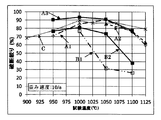
- FIG. 1 shows the relationship between the test temperature of the hot-worked materials A1, B1, and C that have not been subjected to the preheating step and the squeeze drawing as measurement data that falls outside the scope of the present invention.
- the strain rate is as low as 0.1 / second
- the hot work material A1 and B1 both have a wide hot workable temperature range even when the present invention is not applied. Therefore, it is suggested that hot working is relatively easy.
- the strain rate is as high as 10 / sec
- the hot workability A1 and B1 is deteriorated in hot workability as compared with the condition of 0.1 / sec.
- the hot work material B is a Ni-based superalloy having higher strength than A, the tendency is strong, and it can be seen that there is almost no hot workable temperature range.
- the hot work material C exhibits stable hot workability in both the low temperature region and the high temperature region at a strain rate of 10 / second. This is because the hot-work material C has a small amount of precipitation of the ⁇ ′ phase and a low solid solution temperature of the ⁇ ′ phase, and therefore hardly receives deformation inhibition by the ⁇ ′ phase.
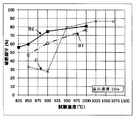
- FIG. 2 shows the fracture drawing at a strain rate of 10 / sec of the hot-worked materials A2, A3 and B2 to which the preheating step has been applied, together with the measurement data of the strain rate of 10 / sec in FIG.
- the hot-work material A2 subjected to the preheating step outside the application range of the present invention is almost the same as A1 not subjected to the preheating step, and no change is observed. It was found that the hot work material A3 subjected to the preheating step within the application range of the present invention has an improved fracture drawing on the low temperature side where the test temperature is 1000 ° C. or lower, as compared with A1 and A2.
- squeezing has improved on the whole in a wide temperature range.
- the reason why the hot work material B2 is improved in the fracture drawing due to the preheating treatment as compared with A3 is because the hot work material B is a high-strength material with more ⁇ 'phases. It is.
- Example 2 Next, a high-speed tensile test was performed on hot-worked materials A1 to A3 and B1, B2, and C, simulating hot working accompanied by a decrease in the surface temperature of an actual large member, assuming work on an actual machine. .
- the surface temperature drop here assumes heat removal caused by contact with outside air and a mold during hot working.
- An alloy having a large amount of precipitation of the ⁇ ′ phase has a remarkable precipitation of the ⁇ ′ phase that occurs as the temperature of the material surface decreases. Therefore, the hot ductility is significantly reduced due to a decrease in material temperature, and it is assumed that actual hot working with large heat removal becomes more difficult.
- the test condition is set to 1000 ° C.
- A3 which has been subjected to a preheating step within the scope of the present invention, exhibits a high fracture drawing up to a low temperature range of minus 100 ° C. with respect to the heating temperature, and has a good hot ductility equivalent to or higher than C. It turns out that it is obtained.
- Ni-base superalloy having a large amount of ⁇ ′ precipitate can provide a manufacturing method capable of hot working at a high strain rate.
- the manufacturing method of the Ni-base superalloy according to the present invention is high in a high-strength Ni-base alloy with a large amount of ⁇ ′ precipitation, which has been difficult in the past, among Ni-base superalloys used in aircraft engines and gas turbines for power generation. Stable hot working at a strain rate is possible.
- various shapes of Ni-base superalloys such as a long shaft and a large ring disk that require hot working at a high strain rate can be provided at low cost and with high yield.
Landscapes
- Chemical & Material Sciences (AREA)
- Engineering & Computer Science (AREA)
- Mechanical Engineering (AREA)
- Materials Engineering (AREA)
- Metallurgy (AREA)
- Organic Chemistry (AREA)
- Physics & Mathematics (AREA)
- Thermal Sciences (AREA)
- Crystallography & Structural Chemistry (AREA)
- Forging (AREA)
Abstract
L'invention concerne un procédé de fabrication d'un superalliage à base de nickel et résistant à la chaleur qui possède une excellente aptitude au façonnage à chaud, même à vitesse de déformation élevée. Le procédé de fabrication d'un superalliage à base de nickel et résistant à la chaleur consiste à : préparer un matériau destiné à être travaillé à chaud, ledit matériau possédant une composition constituée de, en % en masse, de 0,001 à 0.05 % de C, de 1,0 à 4,0 % de Al, de 3,0 à 7,0 % de Ti, de 12 à 18 % de Cr, de 12 à 30 % de Co, de 1,5 à 5,5 % de Mo, de 0,5 à 2,5 % de W, de 0,001 à 0,05 % de B, de 0,001 à 0,1 % de Zr, de 0 à 0,01 % de Mg, de 0 à 5 % de Fe, de 0 à 3 % de Ta, de 0 à 3 % de Nb, le reste étant constitué de Ni et d'impuretés inévitables et comportant une température de solvus de la phase γ' supérieure ou égale à 1050 °C; une étape de préchauffage destinée à chauffer le matériau susmentionné pendant au moins 10 heures dans une plage de température allant de 980 à 1050 °C, la limite supérieure étant une température inférieure de 30 °C à la température du solvus de la phase γ'; et une étape de travail à chaud destinée, après l'étape de préchauffage, à travailler à chaud le matériau destiné à être travaillé à chaud dans une plage de température allant de 980 à 1050 °C, la limite supérieure étant une température inférieure de 30 °C à la température du solvus de phase γ' à une vitesse de travail, en terme de vitesse de déformation, supérieure ou égale à 2,0 /sec.
Priority Applications (4)
| Application Number | Priority Date | Filing Date | Title |
|---|---|---|---|
| EP16772586.0A EP3278901B1 (fr) | 2015-03-30 | 2016-03-24 | Procédé de fabrication d'un superalliage à base de ni et résistant à la chaleur |
| US15/561,304 US10131980B2 (en) | 2015-03-30 | 2016-03-24 | Method of producing Ni-based superalloy |
| CN201680018626.2A CN107427897B (zh) | 2015-03-30 | 2016-03-24 | Ni基超耐热合金的制造方法 |
| JP2016575696A JP6150192B2 (ja) | 2015-03-30 | 2016-03-24 | Ni基超耐熱合金の製造方法 |
Applications Claiming Priority (2)
| Application Number | Priority Date | Filing Date | Title |
|---|---|---|---|
| JP2015-068291 | 2015-03-30 | ||
| JP2015068291 | 2015-03-30 |
Publications (1)
| Publication Number | Publication Date |
|---|---|
| WO2016158705A1 true WO2016158705A1 (fr) | 2016-10-06 |
Family
ID=57005046
Family Applications (1)
| Application Number | Title | Priority Date | Filing Date |
|---|---|---|---|
| PCT/JP2016/059509 Ceased WO2016158705A1 (fr) | 2015-03-30 | 2016-03-24 | PROCÉDÉ DE FABRICATION D'UN SUPERALLIAGE À BASE DE Ni ET RÉSISTANT À LA CHALEUR |
Country Status (5)
| Country | Link |
|---|---|
| US (1) | US10131980B2 (fr) |
| EP (1) | EP3278901B1 (fr) |
| JP (1) | JP6150192B2 (fr) |
| CN (1) | CN107427897B (fr) |
| WO (1) | WO2016158705A1 (fr) |
Cited By (10)
| Publication number | Priority date | Publication date | Assignee | Title |
|---|---|---|---|---|
| JP2017179592A (ja) * | 2016-03-23 | 2017-10-05 | 日立金属株式会社 | Ni基超耐熱合金の製造方法 |
| WO2018155446A1 (fr) * | 2017-02-21 | 2018-08-30 | 日立金属株式会社 | Alliage super-résistant à la chaleur à base de ni et son procédé de fabrication |
| GB2565063A (en) * | 2017-07-28 | 2019-02-06 | Oxmet Tech Limited | A nickel-based alloy |
| EP3441489A1 (fr) * | 2017-08-10 | 2019-02-13 | Mitsubishi Hitachi Power Systems, Ltd. | Procédé de fabrication d'un élément en alliage à base de ni |
| JP2020517821A (ja) * | 2017-04-21 | 2020-06-18 | シーアールエス ホールディングス, インコーポレイテッドCrs Holdings, Incorporated | 析出硬化型コバルト−ニッケル基超合金およびそれから製造された物品 |
| EP3633052A4 (fr) * | 2017-05-22 | 2021-02-17 | Kawasaki Jukogyo Kabushiki Kaisha | Composant à haute température et procédé de production associé |
| JP2023520951A (ja) * | 2021-04-22 | 2023-05-23 | ガオナ アエロ マテリアル カンパニー リミテッド | 低積層欠陥エネルギー超合金、構造部材及びその使用 |
| US12241144B2 (en) | 2019-06-07 | 2025-03-04 | Alloyed Limited | Nickel-based alloy |
| US12319985B2 (en) | 2019-10-02 | 2025-06-03 | Alloyed Limited | Nickel-based alloy |
| WO2026088781A1 (fr) * | 2024-10-25 | 2026-04-30 | 株式会社日本製鋼所 | Procédé de production d'élément forgé |
Families Citing this family (11)
| Publication number | Priority date | Publication date | Assignee | Title |
|---|---|---|---|---|
| JP6733210B2 (ja) * | 2016-02-18 | 2020-07-29 | 大同特殊鋼株式会社 | 熱間鍛造用Ni基超合金 |
| CN110643855A (zh) * | 2018-06-26 | 2020-01-03 | 中南大学 | 一种镍基合金、其制备方法与一种制造物品 |
| US20210340644A1 (en) * | 2018-11-30 | 2021-11-04 | Mitsubishi Power, Ltd. | Ni-Based Alloy Softened Powder and Method for Manufacturing Same |
| US12330215B2 (en) | 2019-09-20 | 2025-06-17 | Proterial, Ltd. | Alloy member production method and alloy member |
| CN111283082A (zh) * | 2020-02-27 | 2020-06-16 | 无锡派克新材料科技股份有限公司 | 一种gh4169低压涡轮机匣均匀化胀形的工艺 |
| WO2021182606A1 (fr) * | 2020-03-13 | 2021-09-16 | 日立金属株式会社 | Procédé de fabrication d'élément forgé à chaud |
| RU2737835C1 (ru) * | 2020-06-03 | 2020-12-03 | Акционерное общество "Объединенная двигателестроительная корпорация (АО "ОДК") | Жаропрочный деформируемый сплав на основе никеля и изделие, выполненное из него |
| US11951528B2 (en) * | 2020-08-20 | 2024-04-09 | Rolls-Royce Corporation | Controlled microstructure for superalloy components |
| CN112746231B (zh) * | 2020-12-29 | 2021-10-15 | 北京钢研高纳科技股份有限公司 | 一种高性能高温合金的γ'相预调增塑的生产工艺 |
| CN116251918B (zh) * | 2023-02-27 | 2024-01-23 | 四川钢研高纳锻造有限责任公司 | 一种难变形高温合金锻件及其锻造方法 |
| CN118321475B (zh) * | 2024-03-26 | 2024-10-18 | 山东煜兴材料科技有限公司 | 一种高温合金的锻造工艺 |
Citations (3)
| Publication number | Priority date | Publication date | Assignee | Title |
|---|---|---|---|---|
| JPH03174938A (ja) * | 1989-12-02 | 1991-07-30 | Kobe Steel Ltd | Ni基超耐熱合金の熱間鍛造方法 |
| JPH09302450A (ja) * | 1996-02-07 | 1997-11-25 | General Electric Co <Ge> | ニッケル基超合金における結晶粒度の制御 |
| WO2006059805A1 (fr) * | 2004-12-02 | 2006-06-08 | National Institute For Materials Science | Superalliage resistant a la chaleur |
Family Cites Families (10)
| Publication number | Priority date | Publication date | Assignee | Title |
|---|---|---|---|---|
| US5360496A (en) * | 1991-08-26 | 1994-11-01 | Aluminum Company Of America | Nickel base alloy forged parts |
| US5649280A (en) * | 1996-01-02 | 1997-07-15 | General Electric Company | Method for controlling grain size in Ni-base superalloys |
| JP2008069379A (ja) | 2006-09-12 | 2008-03-27 | National Institute For Materials Science | Ni基単結晶超合金とその製造法並びにこれを用いたタービン耐熱部品 |
| JP4982324B2 (ja) | 2007-10-19 | 2012-07-25 | 株式会社日立製作所 | Ni基鍛造合金、蒸気タービンプラント用鍛造部品、蒸気タービンプラント用ボイラチューブ、蒸気タービンプラント用ボルト及び蒸気タービンロータ |
| EP2248923A1 (fr) | 2009-04-27 | 2010-11-10 | Siemens Aktiengesellschaft | Superalliage de y/ý à base de nickel avec plusieurs éléments réactifs et utilisation de cet alliage dans des systèmes de matériau complexes |
| CN102433466A (zh) | 2010-09-29 | 2012-05-02 | 中国科学院金属研究所 | 一种含稀土元素的镍钴基高温合金及其制备方法 |
| CN102443721B (zh) | 2010-10-13 | 2013-10-09 | 中国科学院金属研究所 | 一种组织稳定性好、易加工的镍钴基高温合金 |
| CN102312118B (zh) | 2011-09-21 | 2013-04-03 | 北京科技大学 | 一种gh864镍基高温合金组织精确控制的热加工方法 |
| JP5721189B2 (ja) | 2013-03-12 | 2015-05-20 | 株式会社 東北テクノアーチ | 耐熱性Ni基合金及びその製造方法 |
| JP5652730B1 (ja) * | 2013-03-28 | 2015-01-14 | 日立金属株式会社 | Ni基超耐熱合金及びその製造方法 |
-
2016
- 2016-03-24 JP JP2016575696A patent/JP6150192B2/ja active Active
- 2016-03-24 EP EP16772586.0A patent/EP3278901B1/fr active Active
- 2016-03-24 CN CN201680018626.2A patent/CN107427897B/zh active Active
- 2016-03-24 WO PCT/JP2016/059509 patent/WO2016158705A1/fr not_active Ceased
- 2016-03-24 US US15/561,304 patent/US10131980B2/en active Active
Patent Citations (3)
| Publication number | Priority date | Publication date | Assignee | Title |
|---|---|---|---|---|
| JPH03174938A (ja) * | 1989-12-02 | 1991-07-30 | Kobe Steel Ltd | Ni基超耐熱合金の熱間鍛造方法 |
| JPH09302450A (ja) * | 1996-02-07 | 1997-11-25 | General Electric Co <Ge> | ニッケル基超合金における結晶粒度の制御 |
| WO2006059805A1 (fr) * | 2004-12-02 | 2006-06-08 | National Institute For Materials Science | Superalliage resistant a la chaleur |
Cited By (20)
| Publication number | Priority date | Publication date | Assignee | Title |
|---|---|---|---|---|
| JP2017179592A (ja) * | 2016-03-23 | 2017-10-05 | 日立金属株式会社 | Ni基超耐熱合金の製造方法 |
| WO2018155446A1 (fr) * | 2017-02-21 | 2018-08-30 | 日立金属株式会社 | Alliage super-résistant à la chaleur à base de ni et son procédé de fabrication |
| JP6422045B1 (ja) * | 2017-02-21 | 2018-11-14 | 日立金属株式会社 | Ni基超耐熱合金およびその製造方法 |
| JP2020517821A (ja) * | 2017-04-21 | 2020-06-18 | シーアールエス ホールディングス, インコーポレイテッドCrs Holdings, Incorporated | 析出硬化型コバルト−ニッケル基超合金およびそれから製造された物品 |
| US11773470B2 (en) | 2017-05-22 | 2023-10-03 | Kawasaki Jukogyo Kabushiki Kaisha | High temperature component and method for producing same |
| EP3633052A4 (fr) * | 2017-05-22 | 2021-02-17 | Kawasaki Jukogyo Kabushiki Kaisha | Composant à haute température et procédé de production associé |
| US11326230B2 (en) | 2017-05-22 | 2022-05-10 | Kawasaki Jukogyo Kabushiki Kaisha | High temperature component and method for producing same |
| US11634792B2 (en) | 2017-07-28 | 2023-04-25 | Alloyed Limited | Nickel-based alloy |
| GB2565063A (en) * | 2017-07-28 | 2019-02-06 | Oxmet Tech Limited | A nickel-based alloy |
| US12258655B2 (en) | 2017-07-28 | 2025-03-25 | Alloyed Limited | Nickel-based alloy |
| GB2565063B (en) * | 2017-07-28 | 2020-05-27 | Oxmet Tech Limited | A nickel-based alloy |
| RU2698038C1 (ru) * | 2017-08-10 | 2019-08-21 | Мицубиси Хитачи Пауэр Системс, Лтд. | Способ изготовления элемента конструкции из сплава на основе никеля |
| US11566313B2 (en) | 2017-08-10 | 2023-01-31 | Mitsubishi Heavy Industries, Ltd. | Method for manufacturing Ni-based alloy member |
| RU2698038C9 (ru) * | 2017-08-10 | 2020-02-04 | Мицубиси Хитачи Пауэр Системс, Лтд. | Способ изготовления элемента конструкции из сплава на основе никеля |
| EP3441489A1 (fr) * | 2017-08-10 | 2019-02-13 | Mitsubishi Hitachi Power Systems, Ltd. | Procédé de fabrication d'un élément en alliage à base de ni |
| US12241144B2 (en) | 2019-06-07 | 2025-03-04 | Alloyed Limited | Nickel-based alloy |
| US12319985B2 (en) | 2019-10-02 | 2025-06-03 | Alloyed Limited | Nickel-based alloy |
| JP2023520951A (ja) * | 2021-04-22 | 2023-05-23 | ガオナ アエロ マテリアル カンパニー リミテッド | 低積層欠陥エネルギー超合金、構造部材及びその使用 |
| JP7450639B2 (ja) | 2021-04-22 | 2024-03-15 | ガオナ アエロ マテリアル カンパニー リミテッド | 低積層欠陥エネルギー超合金、構造部材及びその使用 |
| WO2026088781A1 (fr) * | 2024-10-25 | 2026-04-30 | 株式会社日本製鋼所 | Procédé de production d'élément forgé |
Also Published As
| Publication number | Publication date |
|---|---|
| CN107427897B (zh) | 2018-12-04 |
| US10131980B2 (en) | 2018-11-20 |
| JPWO2016158705A1 (ja) | 2017-05-25 |
| JP6150192B2 (ja) | 2017-06-21 |
| CN107427897A (zh) | 2017-12-01 |
| US20180100223A1 (en) | 2018-04-12 |
| EP3278901B1 (fr) | 2020-07-22 |
| EP3278901A4 (fr) | 2019-01-09 |
| EP3278901A1 (fr) | 2018-02-07 |
Similar Documents
| Publication | Publication Date | Title |
|---|---|---|
| JP6150192B2 (ja) | Ni基超耐熱合金の製造方法 | |
| JP6252704B2 (ja) | Ni基超耐熱合金の製造方法 | |
| US11566313B2 (en) | Method for manufacturing Ni-based alloy member | |
| JP6422045B1 (ja) | Ni基超耐熱合金およびその製造方法 | |
| JP5652730B1 (ja) | Ni基超耐熱合金及びその製造方法 | |
| US10196724B2 (en) | Method for manufacturing Ni-based super-heat-resistant alloy | |
| CN115156471B (zh) | 一种高强镍基高温合金材料盘、轴类锻件的制备方法 | |
| JP2011012346A (ja) | スーパーソルバス熱処理ニッケル基超合金の最終結晶粒径を制御し改善する方法 | |
| JP2012517524A (ja) | ニッケルをベースとした超合金から作製される部品を製造するための方法、および対応する部品 | |
| CN110050080A (zh) | Ni基锻造合金材料以及使用其的涡轮高温部件 | |
| JP6120200B2 (ja) | Ni基超耐熱合金およびそれを用いたタービンディスク | |
| JP2017179592A (ja) | Ni基超耐熱合金の製造方法 | |
| CN110268078A (zh) | 高温耐损伤超合金、由该合金制造的制品和制造该合金的方法 | |
| JP2017514998A (ja) | 析出硬化ニッケル合金、前記合金でできた部品、及びその製造方法 | |
| WO2017170433A1 (fr) | Procédé destiné à la production d'alliage à base de ni à très haute résistance à la chaleur |
Legal Events
| Date | Code | Title | Description |
|---|---|---|---|
| 121 | Ep: the epo has been informed by wipo that ep was designated in this application |
Ref document number: 16772586 Country of ref document: EP Kind code of ref document: A1 |
|
| ENP | Entry into the national phase |
Ref document number: 2016575696 Country of ref document: JP Kind code of ref document: A |
|
| WWE | Wipo information: entry into national phase |
Ref document number: 15561304 Country of ref document: US |
|
| NENP | Non-entry into the national phase |
Ref country code: DE |