WO2016158861A1 - 鋼板 - Google Patents
鋼板 Download PDFInfo
- Publication number
- WO2016158861A1 WO2016158861A1 PCT/JP2016/059933 JP2016059933W WO2016158861A1 WO 2016158861 A1 WO2016158861 A1 WO 2016158861A1 JP 2016059933 W JP2016059933 W JP 2016059933W WO 2016158861 A1 WO2016158861 A1 WO 2016158861A1
- Authority
- WO
- WIPO (PCT)
- Prior art keywords
- less
- content
- scale
- concentration
- mass
- Prior art date
- Legal status (The legal status is an assumption and is not a legal conclusion. Google has not performed a legal analysis and makes no representation as to the accuracy of the status listed.)
- Ceased
Links
Images

Classifications
-
- C—CHEMISTRY; METALLURGY
- C22—METALLURGY; FERROUS OR NON-FERROUS ALLOYS; TREATMENT OF ALLOYS OR NON-FERROUS METALS
- C22C—ALLOYS
- C22C38/00—Ferrous alloys, e.g. steel alloys
- C22C38/18—Ferrous alloys, e.g. steel alloys containing chromium
- C22C38/28—Ferrous alloys, e.g. steel alloys containing chromium with titanium or zirconium
-
- B—PERFORMING OPERATIONS; TRANSPORTING
- B21—MECHANICAL METAL-WORKING WITHOUT ESSENTIALLY REMOVING MATERIAL; PUNCHING METAL
- B21B—ROLLING OF METAL
- B21B3/00—Rolling materials of special alloys so far as the composition of the alloy requires or permits special rolling methods or sequences ; Rolling of aluminium, copper, zinc or other non-ferrous metals
- B21B3/02—Rolling special iron alloys, e.g. stainless steel
-
- B—PERFORMING OPERATIONS; TRANSPORTING
- B21—MECHANICAL METAL-WORKING WITHOUT ESSENTIALLY REMOVING MATERIAL; PUNCHING METAL
- B21C—MANUFACTURE OF METAL SHEETS, WIRE, RODS, TUBES, PROFILES OR LIKE SEMI-MANUFACTURED PRODUCTS OTHERWISE THAN BY ROLLING; AUXILIARY OPERATIONS USED IN CONNECTION WITH METAL-WORKING WITHOUT ESSENTIALLY REMOVING MATERIAL
- B21C37/00—Manufacture of metal sheets, rods, wire, tubes, profiles or like semi-manufactured products, not otherwise provided for; Manufacture of tubes of special shape
- B21C37/02—Manufacture of metal sheets, rods, wire, tubes, profiles or like semi-manufactured products, not otherwise provided for; Manufacture of tubes of special shape of sheets
-
- C—CHEMISTRY; METALLURGY
- C21—METALLURGY OF IRON
- C21D—MODIFYING THE PHYSICAL STRUCTURE OF FERROUS METALS; GENERAL DEVICES FOR HEAT TREATMENT OF FERROUS OR NON-FERROUS METALS OR ALLOYS; MAKING METAL MALLEABLE, e.g. BY DECARBURISATION OR TEMPERING
- C21D8/00—Modifying the physical properties of ferrous metals or ferrous alloys by deformation combined with, or followed by, heat treatment
- C21D8/02—Modifying the physical properties of ferrous metals or ferrous alloys by deformation combined with, or followed by, heat treatment during manufacturing of plates or strips
-
- C—CHEMISTRY; METALLURGY
- C21—METALLURGY OF IRON
- C21D—MODIFYING THE PHYSICAL STRUCTURE OF FERROUS METALS; GENERAL DEVICES FOR HEAT TREATMENT OF FERROUS OR NON-FERROUS METALS OR ALLOYS; MAKING METAL MALLEABLE, e.g. BY DECARBURISATION OR TEMPERING
- C21D8/00—Modifying the physical properties of ferrous metals or ferrous alloys by deformation combined with, or followed by, heat treatment
- C21D8/02—Modifying the physical properties of ferrous metals or ferrous alloys by deformation combined with, or followed by, heat treatment during manufacturing of plates or strips
- C21D8/0221—Modifying the physical properties of ferrous metals or ferrous alloys by deformation combined with, or followed by, heat treatment during manufacturing of plates or strips characterised by the working steps
- C21D8/0226—Hot rolling
-
- C—CHEMISTRY; METALLURGY
- C21—METALLURGY OF IRON
- C21D—MODIFYING THE PHYSICAL STRUCTURE OF FERROUS METALS; GENERAL DEVICES FOR HEAT TREATMENT OF FERROUS OR NON-FERROUS METALS OR ALLOYS; MAKING METAL MALLEABLE, e.g. BY DECARBURISATION OR TEMPERING
- C21D9/00—Heat treatment, e.g. annealing, hardening, quenching or tempering, adapted for particular articles; Furnaces therefor
- C21D9/46—Heat treatment, e.g. annealing, hardening, quenching or tempering, adapted for particular articles; Furnaces therefor for sheet metals
-
- C—CHEMISTRY; METALLURGY
- C22—METALLURGY; FERROUS OR NON-FERROUS ALLOYS; TREATMENT OF ALLOYS OR NON-FERROUS METALS
- C22C—ALLOYS
- C22C38/00—Ferrous alloys, e.g. steel alloys
-
- C—CHEMISTRY; METALLURGY
- C22—METALLURGY; FERROUS OR NON-FERROUS ALLOYS; TREATMENT OF ALLOYS OR NON-FERROUS METALS
- C22C—ALLOYS
- C22C38/00—Ferrous alloys, e.g. steel alloys
- C22C38/001—Ferrous alloys, e.g. steel alloys containing N
-
- C—CHEMISTRY; METALLURGY
- C22—METALLURGY; FERROUS OR NON-FERROUS ALLOYS; TREATMENT OF ALLOYS OR NON-FERROUS METALS
- C22C—ALLOYS
- C22C38/00—Ferrous alloys, e.g. steel alloys
- C22C38/002—Ferrous alloys, e.g. steel alloys containing In, Mg, or other elements not provided for in one single group C22C38/001 - C22C38/60
-
- C—CHEMISTRY; METALLURGY
- C22—METALLURGY; FERROUS OR NON-FERROUS ALLOYS; TREATMENT OF ALLOYS OR NON-FERROUS METALS
- C22C—ALLOYS
- C22C38/00—Ferrous alloys, e.g. steel alloys
- C22C38/005—Ferrous alloys, e.g. steel alloys containing rare earths, i.e. Sc, Y, Lanthanides
-
- C—CHEMISTRY; METALLURGY
- C22—METALLURGY; FERROUS OR NON-FERROUS ALLOYS; TREATMENT OF ALLOYS OR NON-FERROUS METALS
- C22C—ALLOYS
- C22C38/00—Ferrous alloys, e.g. steel alloys
- C22C38/02—Ferrous alloys, e.g. steel alloys containing silicon
-
- C—CHEMISTRY; METALLURGY
- C22—METALLURGY; FERROUS OR NON-FERROUS ALLOYS; TREATMENT OF ALLOYS OR NON-FERROUS METALS
- C22C—ALLOYS
- C22C38/00—Ferrous alloys, e.g. steel alloys
- C22C38/04—Ferrous alloys, e.g. steel alloys containing manganese
-
- C—CHEMISTRY; METALLURGY
- C22—METALLURGY; FERROUS OR NON-FERROUS ALLOYS; TREATMENT OF ALLOYS OR NON-FERROUS METALS
- C22C—ALLOYS
- C22C38/00—Ferrous alloys, e.g. steel alloys
- C22C38/06—Ferrous alloys, e.g. steel alloys containing aluminium
-
- C—CHEMISTRY; METALLURGY
- C22—METALLURGY; FERROUS OR NON-FERROUS ALLOYS; TREATMENT OF ALLOYS OR NON-FERROUS METALS
- C22C—ALLOYS
- C22C38/00—Ferrous alloys, e.g. steel alloys
- C22C38/18—Ferrous alloys, e.g. steel alloys containing chromium
- C22C38/20—Ferrous alloys, e.g. steel alloys containing chromium with copper
-
- C—CHEMISTRY; METALLURGY
- C22—METALLURGY; FERROUS OR NON-FERROUS ALLOYS; TREATMENT OF ALLOYS OR NON-FERROUS METALS
- C22C—ALLOYS
- C22C38/00—Ferrous alloys, e.g. steel alloys
- C22C38/18—Ferrous alloys, e.g. steel alloys containing chromium
- C22C38/22—Ferrous alloys, e.g. steel alloys containing chromium with molybdenum or tungsten
-
- C—CHEMISTRY; METALLURGY
- C22—METALLURGY; FERROUS OR NON-FERROUS ALLOYS; TREATMENT OF ALLOYS OR NON-FERROUS METALS
- C22C—ALLOYS
- C22C38/00—Ferrous alloys, e.g. steel alloys
- C22C38/18—Ferrous alloys, e.g. steel alloys containing chromium
- C22C38/24—Ferrous alloys, e.g. steel alloys containing chromium with vanadium
-
- C—CHEMISTRY; METALLURGY
- C22—METALLURGY; FERROUS OR NON-FERROUS ALLOYS; TREATMENT OF ALLOYS OR NON-FERROUS METALS
- C22C—ALLOYS
- C22C38/00—Ferrous alloys, e.g. steel alloys
- C22C38/18—Ferrous alloys, e.g. steel alloys containing chromium
- C22C38/26—Ferrous alloys, e.g. steel alloys containing chromium with niobium or tantalum
-
- C—CHEMISTRY; METALLURGY
- C22—METALLURGY; FERROUS OR NON-FERROUS ALLOYS; TREATMENT OF ALLOYS OR NON-FERROUS METALS
- C22C—ALLOYS
- C22C38/00—Ferrous alloys, e.g. steel alloys
- C22C38/18—Ferrous alloys, e.g. steel alloys containing chromium
- C22C38/38—Ferrous alloys, e.g. steel alloys containing chromium with more than 1.5% by weight of manganese
-
- C—CHEMISTRY; METALLURGY
- C22—METALLURGY; FERROUS OR NON-FERROUS ALLOYS; TREATMENT OF ALLOYS OR NON-FERROUS METALS
- C22C—ALLOYS
- C22C38/00—Ferrous alloys, e.g. steel alloys
- C22C38/18—Ferrous alloys, e.g. steel alloys containing chromium
- C22C38/40—Ferrous alloys, e.g. steel alloys containing chromium with nickel
-
- C—CHEMISTRY; METALLURGY
- C22—METALLURGY; FERROUS OR NON-FERROUS ALLOYS; TREATMENT OF ALLOYS OR NON-FERROUS METALS
- C22C—ALLOYS
- C22C38/00—Ferrous alloys, e.g. steel alloys
- C22C38/18—Ferrous alloys, e.g. steel alloys containing chromium
- C22C38/40—Ferrous alloys, e.g. steel alloys containing chromium with nickel
- C22C38/42—Ferrous alloys, e.g. steel alloys containing chromium with nickel with copper
-
- C—CHEMISTRY; METALLURGY
- C22—METALLURGY; FERROUS OR NON-FERROUS ALLOYS; TREATMENT OF ALLOYS OR NON-FERROUS METALS
- C22C—ALLOYS
- C22C38/00—Ferrous alloys, e.g. steel alloys
- C22C38/18—Ferrous alloys, e.g. steel alloys containing chromium
- C22C38/40—Ferrous alloys, e.g. steel alloys containing chromium with nickel
- C22C38/50—Ferrous alloys, e.g. steel alloys containing chromium with nickel with titanium or zirconium
-
- C—CHEMISTRY; METALLURGY
- C22—METALLURGY; FERROUS OR NON-FERROUS ALLOYS; TREATMENT OF ALLOYS OR NON-FERROUS METALS
- C22C—ALLOYS
- C22C38/00—Ferrous alloys, e.g. steel alloys
- C22C38/18—Ferrous alloys, e.g. steel alloys containing chromium
- C22C38/40—Ferrous alloys, e.g. steel alloys containing chromium with nickel
- C22C38/58—Ferrous alloys, e.g. steel alloys containing chromium with nickel with more than 1.5% by weight of manganese
Definitions
- the present invention relates to a high strength steel plate suitable for a relatively long structural member such as a truck frame.
- weight reduction of transport machines such as automobiles and railway vehicles is desired. It is effective to use a thin steel plate as a member of the transportation machine to reduce the weight of the transportation machine, but in order to ensure the desired strength while using a thin steel plate, it is desirable that the steel plate itself has high strength .
- steel plates in which scales (black hides) generated during hot rolling remain may be used as members of transport machines, for example, side frames of trucks.
- the scale may be exfoliated at the time of refining of passing of the leveler equipment or at the time of processing such as bending or pressing performed by the user. Peeling of the scale requires maintenance of the roll and mold on which the scale is attached.
- a scale may be pressed into the steel plate processed after that and a dent pattern may arise in the said steel plate. Therefore, the steel plate on which the scale is left is required to have excellent scale adhesion which prevents the scale from being separated from the base steel.
- An object of the present invention is to provide a steel plate that can achieve both good mechanical properties and excellent scale adhesion.
- Nb 0.001% to 0.10%
- V 0.001% to 0.20%
- B 0.0001% to 0.0050%
- Cu 0.01% to 0.50%
- Ni 0.01% to 0.50%
- Mo 0.01% to 0.50%
- W 0.01% to 0.50%
- FIG. 1 is a view showing an example of the mapping result of the Cr concentration.
- FIG. 2 is a view showing the relationship between the form of scale and the scale adhesion.
- the present inventors examined the effects of scale thickness and subscale morphology on scale adhesion.
- samples having a plane parallel to the rolling direction and the thickness direction as the observation plane are taken from various steel plates, the observation plane is mirror-polished, and observation using an optical microscope is performed at 1000 times.
- the And the average value of the thickness of the scale obtained in ten or more views was made into the thickness of the scale of the said steel plate.
- samples having a plane parallel to the rolling direction and thickness direction as an observation plane are taken from various steel plates, the observation plane is mirror-polished, and an electron probe micro analyzer (EPMA) ) was used to analyze the subscale Cr concentration (mass%).
- EPMA electron probe micro analyzer
- FIG. 1 shows an example of the result of mapping.
- the Cr content of the ground iron of the sample used in this example was 3.9% by mass, the length in the rolling direction was 60 ⁇ m, and the region including the scale and the ground iron was analyzed.
- the portion where the Cr concentration is particularly high is the subscale, the lower portion is the ground iron, and the upper portion is the scale.
- the subscale Cr concentration is higher than that of the ground iron.
- the present inventors performed the following analysis about the mapping result of Cr concentration.
- a measurement area consisting of 10 measurement points arranged in series in the rolling direction was set. Since the distance between the measurement points is 0.1 ⁇ m, the dimension in the rolling direction of the measurement area is 1 ⁇ m. Further, since the length in the rolling direction of the target region of the Cr concentration mapping is 50 ⁇ m or more, the measurement region is 50 or more. Then, the average value and the maximum value Cmax of the Cr concentration are determined for each measurement area, the average value Ave of the maximum values Cmax between 50 or more measurement areas is calculated, and the average value Ave is made the average value of the Cr concentration in the subscale. .
- the concentration ratio R Cr of the other maximum value Cmax to one maximum value Cmax was determined between two adjacent measurement areas. That is, the quotient obtained by dividing the other maximum value Cmax by the one maximum value Cmax was determined.
- which maximum value Cmax is a numerator is arbitrary. For example, when the maximum value Cmax of two measurement areas is 3.90% and 3.30%, the concentration ratio R Cr is 1.18 or 0.85, and the maximum value Cmax of two measurement areas is 1.70% and At 1.62%, the concentration ratio R Cr is 1.05 or 0.95.
- the concentration ratio R Cr is 1.00, and the concentration ratio R Cr in any measurement area is the same if the maximum value Cmax of Cr concentration in the subscale is uniform. It is 1.00.
- the concentration ratio R Cr reflects the dispersion of the maximum value C max of the Cr concentration in the sub scale, and the concentration ratio R Cr closer to 1.00 indicates the maximum value C max of the Cr concentration in the sub scale. Variation is small.
- Scale adhesion assumed the press processing of the side frame of a track, the short strip test piece was extract
- the size of the test piece was 30 mm in width (rolling direction) and 200 mm in length (width direction).
- the bending angle was 90 degrees, and the inner radius was twice the plate thickness.
- a cellophane tape with a width of 18 mm is attached and peeled off along the longitudinal direction of the test piece to the width center part of the bending outside, and the area of the scale attached to the cellophane tape in the range where the steel plate and V block did not contact The rate was calculated.
- the area ratio of the scale adhering to the cellophane tape ie, the area ratio of the scale exfoliated from the steel plate
- the present inventors confirmed that if the area ratio of the scale peeled off from the steel plate in this test is 10% or less, the peeling in practical processing does not substantially occur.
- the thickness of the scale when the relationship between the thickness of the scale and the adhesion of the scale was organized, when the thickness of the scale was more than 10.0 ⁇ m, good scale adhesion could not be obtained regardless of the Cr concentration of the scale. On the other hand, if the thickness of the scale is 10.0 ⁇ m or less, good scale adhesion may or may not be obtained depending on the form of the subscale.
- the present invention averages the average value of the Cr concentration Ave, and the concentration ratio R Cr , the value Rd most deviated from 1.00, and the scale adhesion Arranged the relationship.
- the results are shown in FIG. 2, the horizontal axis shows the average value Ave of Cr concentration, and the ordinate shows the most deviation value Rd from 1.00 Of concentration ratio R Cr.
- mechanical properties suitable for application to the side frame of the track include that the yield strength in the rolling direction is 700 MPa or more and less than 800 MPa, and the yield ratio is 85% or more.
- the precipitation strengthening by Ti-containing carbides and Ti-containing carbonitrides having a particle size of less than 100 nm is extremely effective.
- carbide containing Ti and carbonitride containing Ti may be collectively referred to as Ti carbide.
- the steel sheet according to the embodiment of the present invention and the chemical composition of the steel used for the production thereof will be described.
- the steel plate according to the embodiment of the present invention is manufactured through casting of steel, slab heating, hot rolling, first cooling, winding and second cooling. Therefore, the chemical composition of the steel plate and the steel takes into consideration not only the characteristics of the steel plate but also the treatment thereof.
- “%” which is a unit of content of each element contained in a steel plate and steel means “mass%” unless there is particular notice.
- the steel plate according to the present embodiment and the steel used for the production thereof are, by mass%, C: 0.05% to 0.20%, Si: 0.01% to 1.50%, Mn: 1.50% to 2 .50%, P: 0.05% or less, S: 0.03% or less, Al: 0.005% to 0.10%, N: 0.008% or less, Cr: 0.30% to 1.00 %, Ti: 0.06% to 0.20%, Nb: 0.00% to 0.10%, V: 0.00% to 0.20%, B: 0.0000% to 0.0050%, Cu: 0.00% to 0.50%, Ni: 0.00% to 0.50%, Mo: 0.00% to 0.50%, W: 0.00% to 0.50%, Ca: Chemical composition represented by 0.0000% to 0.0050%, Mg: 0.0000% to 0.0050%, REM: 0.000% to 0.010%, and the balance: Fe and impurities It has.
- the impurities include those contained in raw materials such as ore and scrap, and those contained in the
- C (C: 0.05% to 0.20%) C contributes to the improvement of the strength. If the C content is less than 0.05%, sufficient strength, for example, a yield strength of 700 MPa or more or a yield ratio of 85% or more in the rolling direction can not be obtained. Therefore, the C content is 0.05% or more, preferably 0.08% or more. On the other hand, if the C content is more than 0.20%, the strength is excessive and the ductility is reduced, or the weldability and the toughness are reduced. Therefore, the C content is 0.20% or less, preferably 0.15% or less, and more preferably 0.14% or less.
- Si contributes to the improvement of strength and acts as a deoxidizer. Si also contributes to the improvement of the shape of the weld during arc welding. If the Si content is less than 0.01%, these effects can not be sufficiently obtained. Therefore, the Si content is 0.01% or more, preferably 0.02% or more. On the other hand, when the Si content is more than 1.50%, a large amount of Si scale is generated on the surface of the steel sheet to deteriorate the surface properties or the toughness. Therefore, the Si content is 1.50% or less, preferably 1.20% or less. When the Si content is 1.50% or less, in the present embodiment, the influence of Si on the scale adhesion can be ignored.
- Mn contributes to the improvement of strength through tissue strengthening. If the Mn content is less than 1.50%, these effects can not be sufficiently obtained. For example, in the rolling direction, a yield strength of 700 MPa or more, a yield ratio of 85% or more, or both of them can not be obtained. Therefore, the Mn content is 1.50% or more, preferably 1.60% or more. On the other hand, if the Mn content is more than 2.50%, the strength is excessive and the ductility is reduced, or the weldability and the toughness are reduced. Therefore, the Mn content is 2.50% or less, preferably 2.40% or less, and more preferably 2.30% or less.
- P is not an essential element, and is contained, for example, as an impurity in steel. Since P inhibits ductility and toughness, the lower the P content, the better. In particular, when the P content exceeds 0.05%, the ductility and toughness decrease significantly. Therefore, the P content is 0.05% or less, preferably 0.04% or less, and more preferably 0.03% or less. The reduction of the P content is costly, and if it is attempted to reduce it to less than 0.0005%, the cost rises significantly. Therefore, the P content may be 0.0005% or more, or may be 0.0010% or more from the viewpoint of cost.
- S is not an essential element, and is contained, for example, as an impurity in steel.
- S forms MnS and inhibits ductility, weldability and toughness
- the lower the S content the better.
- the S content is 0.03% or less, preferably 0.01% or less, and more preferably 0.007% or less.
- the reduction of the S content is costly, and if it is attempted to reduce it to less than 0.0005%, the cost rises significantly. Therefore, the S content may be 0.0005% or more, may be 0.0010% or more from the viewpoint of cost, and may be 0.0010% or more from the viewpoint of cost.
- Al acts as a deoxidizer. If the Al content is less than 0.005%, this effect can not be sufficiently obtained. Therefore, the Al content is made 0.005% or more, preferably 0.015% or more. On the other hand, when the Al content exceeds 0.10%, the toughness and the weldability are reduced. Therefore, the Al content is 0.10% or less, preferably 0.08% or less.
- N is not an essential element and, for example, is contained as an impurity in steel. Since N forms TiN to consume Ti and inhibits the formation of fine Ti carbides suitable for precipitation strengthening, the lower the N content, the better. In particular, when the N content is more than 0.008%, the decrease in the precipitation strengthening ability is remarkable. Therefore, the N content is made 0.008% or less, preferably 0.007% or less. The reduction of the N content is costly, and if it is attempted to reduce it to less than 0.0005%, the cost rises significantly. Therefore, the N content may be 0.0005% or more, may be 0.0010% or more from the viewpoint of cost, and may be 0.0010% or more from the viewpoint of cost.
- Cr 0.30% to 1.00% Cr contributes to the improvement of the strength and enhances the scale adhesion through the formation of subscales. If the Cr content is less than 0.30%, these effects can not be sufficiently obtained. Therefore, the Cr content is 0.30% or more, preferably 0.25% or more. On the other hand, if the Cr content is more than 1.00%, the Cr contained in the subscale is excessive and the scale adhesion is reduced. Therefore, the Cr content is 1.00% or less, preferably 0.80% or less.
- Ti suppresses recrystallization and suppresses coarsening of crystal grains, thereby contributing to an improvement in yield strength, or precipitating as Ti carbide and contributing to an improvement in yield strength and yield ratio through precipitation strengthening. Do. If the Ti content is less than 0.06%, these effects can not be sufficiently obtained. Therefore, the Ti content is 0.06% or more, preferably 0.07% or more. On the other hand, if the Ti content exceeds 0.20%, the toughness, weldability and ductility decrease, or the Ti carbide can not be solutionized during slab heating, and the amount of Ti effective for precipitation strengthening is insufficient, and the yield strength is increased. And the yield ratio decreases. Therefore, the Ti content is 0.20% or less, preferably 0.16% or less.
- Nb, V, B, Cu, Ni, Mo, W, Ca, Mg, and REM are not essential elements, and are optional elements which may be suitably contained in the steel plate and steel to a predetermined amount.
- Nb and V precipitate as carbonitrides to contribute to the improvement of strength or to suppress the coarsening of crystal grains.
- the suppression of the coarsening of the crystal grains contributes to the improvement of the yield strength and the improvement of the toughness. Therefore, Nb or V or both of them may be contained.
- the Nb content is preferably 0.001% or more, more preferably 0.010% or more
- the V content is preferably 0.001% or more, more preferably 0. 010% or more.
- the Nb content exceeds 0.10%, toughness and ductility decrease, Nb carbonitrides can not be solutionized during slab heating, and there is a lack of solid solution C effective for securing strength, and yield strength And the yield ratio decreases. Therefore, the Nb content is 0.10% or less, preferably 0.08% or less.
- the V content exceeds 0.20%, the toughness and the ductility decrease. Therefore, the V content is 0.20% or less, preferably 0.16% or less.
- B contributes to the improvement of strength through tissue reinforcement. Therefore, B may be contained.
- the B content is preferably made 0.0001% or more, more preferably made 0.0005% or more.
- the B content is made 0.0050% or less, preferably 0.0030% or less.
- Cu contributes to the improvement of the strength. Therefore, Cu may be contained. In order to sufficiently obtain this effect, the Cu content is preferably 0.01% or more, more preferably 0.03% or more. On the other hand, if the Cu content is more than 0.50%, the toughness and the weldability may be reduced, or the concern of the hot cracking of the slab may be increased. Therefore, the Cu content is 0.50% or less, preferably 0.30% or less.
- Ni contributes to the improvement of the strength, and contributes to the improvement of the toughness and the suppression of the hot cracking of the slab. Therefore, Ni may be contained. In order to sufficiently obtain these effects, the Ni content is preferably 0.01% or more, more preferably 0.03% or more. On the other hand, if the Ni content is more than 0.50%, the cost is increased. Therefore, the Ni content is 0.50% or less, preferably 0.30% or less.
- Mo and W contribute to the improvement of the strength. Therefore, Mo or W or both of them may be contained.
- the Mo content is preferably 0.01% or more, more preferably 0.03% or more, and the W content is preferably 0.01% or more, more preferably 0. More than 03%.
- the Mo content is more than 0.50%, the cost is increased. Therefore, the Mo content is 0.50% or less, preferably 0.35% or less.
- the W content is more than 0.50%, the cost is increased. Therefore, the W content is 0.50% or less, preferably 0.35% or less.
- Nb 0.001% to 0.10%
- V 0.001% to 0.20%
- Nb 0.001% to 0.10%
- B 0.0001% to 0.0050%
- Cu 0.01% to 0.50%
- Ni 0.01% to 0.50%
- Mo 0.01% to 0 .50%
- W 0.01% to 0.50%
- the Ca content is preferably 0.0005% or more, more preferably 0.0010% or more, and the Mg content is preferably 0.0005% or more, more preferably 0.
- the REM content is preferably 0.0005% or more, more preferably 0.0010% or more.
- the Ca content is made 0.0050% or less, preferably 0.0035% or less. If the Mg content is more than 0.0050%, the coarsening of inclusions and the increase in the number of inclusions become remarkable, and the toughness is lowered. Therefore, the Mg content is made 0.0050% or less, preferably 0.0035% or less.
- the REM content exceeds 0.010%, the coarsening of inclusions and the increase in the number of inclusions become remarkable, and the toughness is lowered. Therefore, the REM content is made 0.010% or less, preferably 0.007% or less.
- REM rare earth metal
- REM content means the total content of these 17 elements.
- Lanthanoids are added industrially, for example, in the form of misch metal.
- Ti carbide contributes to the improvement of yield stress and yield ratio through precipitation strengthening, but the amount of Ti contained in Ti carbide with a particle diameter of 100 nm or more, particularly 100 ⁇ m or more and 1 ⁇ m or less with respect to the effective Ti amount, It greatly affects the formation of fine Ti carbides. If the ratio R Ti is more than 30%, the consumption of Ti by the coarse Ti carbide becomes excessive, and the driving force for the formation of fine Ti carbide at the time of winding decreases, so that sufficient yield strength and yield ratio in the rolling direction Can not be obtained. Therefore, the ratio R Ti is 30% or less.
- precipitation Ti does not ask a method, as long as measurement with high accuracy is possible. For example, random observation is performed until at least 50 precipitates are observed by a transmission electron microscope, and the size distribution of the precipitates is derived from the size of the individual precipitates and the total field size, and energy dispersive X analysis It can obtain
- the thickness of the scale is 10.0 ⁇ m or less
- the average value Ave of Cr concentration is 1.50 mass% to 5.00 mass%
- the rolling direction Within the range of 50 ⁇ m in length, there are one or more portions where the concentration ratio R Cr between two adjacent measurement regions separated by 1 ⁇ m is 0.90 or less or 1.11 or more.
- the thickness of the scale is 10.0 ⁇ m or less, preferably 8.0 ⁇ m or less.
- the ratio of concentration ratio R Cr is 0.90 or less or 1.11 or more
- the length in the rolling direction is within the range of 50 ⁇ m, and there are one or more portions where the concentration ratio R Cr between two adjacent measurement regions separated by 1 ⁇ m is 0.90 or less or 1.11 or more. This means that there is a region in the sub-scale where the fluctuation of the Cr concentration is large.
- the scale contains magnetite with good consistency with the base iron, if the Cr concentration is excessively uniform, the contact between the magnetite and the base iron will be inhibited, and it is thought that good scale adhesion can not be obtained. Be On the other hand, if there is a region where the fluctuation of the Cr concentration is large, it is considered that the contact between the magnetite and the base iron can be secured through this region, and excellent scale adhesion can be obtained.
- a yield strength of 700 MPa or more and less than 800 MPa in the rolling direction and a yield ratio of 85% or more in the rolling direction can be obtained.
- the present embodiment is suitable for a long structural member such as a track side frame that requires high yield strength, and can contribute to the reduction of the vehicle weight by thinning the thickness of the member.
- the yield strength is 800 MPa or more, the load required for press working may be excessive.
- the yield strength is less than 800 MPa.
- the yield ratio is preferably 85% or more, more preferably 90% or more.
- the yield strength and the yield ratio can be measured by a tensile test according to JIS Z2241 at room temperature.
- test pieces JIS No. 5 tensile test pieces whose longitudinal direction is the rolling direction are used.
- the strength at the upper yield point is taken as the yield strength
- the 0.2% proof stress is taken as the yield strength.
- the yield ratio is the quotient obtained by dividing the yield strength by the tensile strength.
- a molten steel having the above chemical composition is cast by a conventional method to produce a slab.
- the slab one obtained by forging or rolling a steel ingot may be used, but the slab is preferably manufactured by continuous casting. You may use the slab manufactured with the thin slab caster etc.
- the slab heating temperature is set to 1150 ° C. or more, preferably 1160 ° C. or more.
- the slab heating temperature is less than 1250 ° C., preferably 1245 ° C. or less.
- the slab After slab heating, the slab is descaled and rough rolling is performed.
- a rough bar is obtained by rough rolling.
- the conditions of the rough rolling are not particularly limited.
- a hot rolled steel sheet is obtained by performing finish rolling of the rough bar using a tandem rolling mill. It is preferable to remove the scale formed on the surface of the rough bar by performing descaling using high pressure water or the like between rough rolling and finish rolling.
- the surface temperature of the roughing bar is less than 1050.degree.
- the temperature on the delivery side of finish rolling is 920 ° C. or more, the thickness of the scale becomes more than 10.0 ⁇ m, and the scale adhesion is lowered. Therefore, the outlet temperature is less than 920 ° C.
- the outlet temperature As the outlet temperature is lower, the grains of the steel sheet become finer, and excellent yield strength and toughness can be obtained. Therefore, from the viewpoint of the characteristics of the steel sheet, the lower the outlet temperature, the better. On the other hand, the lower the temperature on the outlet side, the higher the deformation resistance of the rough bar and the higher the rolling load, making it impossible to proceed with finish rolling or making it difficult to control the thickness. For this reason, it is preferable to set the lower limit of the outlet temperature according to the capability of the rolling mill and the accuracy of thickness control. Depending on the rolling mill, when the outlet temperature is less than 800 ° C., the progress of the finish rolling is likely to be impeded. Therefore, the outlet temperature is preferably 800 ° C. or higher.
- Cooling of the hot-rolled steel plate is started on the runout table within 3 seconds from the completion of finish rolling, and in this cooling, an average cooling of over 30 ° C / sec from the temperature at which the cooling was started (cooling start temperature) to 750 ° C Cool at speed.
- the average cooling rate from the cooling start temperature to 750 ° C. is 30 ° C./sec or less, the value Rd which deviates most from 1.00 of the concentration ratio R Cr between two adjacent measurement areas is more than 0.90 And, it becomes less than 1.11, the Cr concentration in the subscale is uniformed, scale adhesion is reduced, coarse Ti carbide is formed in the austenite phase, and strength is reduced. Therefore, the average cooling rate from the cooling start temperature to 750 ° C.
- the time from the completion of finish rolling to the start of cooling is more than 30 ° C./sec.
- the austenitic phase is likely to recrystallize, and along with this recrystallization, coarse Ti carbide is formed, and the amount of Ti effective for the formation of fine Ti carbide Decreases.
- equalization of the Cr concentration in the subscale progresses. And such a tendency is remarkable when this time is over 3 seconds. Therefore, the time from the completion of finish rolling to the start of cooling is within 3 seconds.
- the winding temperature is less than 650 ° C., preferably 600 ° C. or less.
- the coiling temperature is set to 500 ° C. or more, preferably 550 ° C. or more.
- the hot rolled steel sheet After winding the hot rolled steel sheet, the hot rolled steel sheet is cooled to room temperature.
- the cooling method and the cooling rate at this time are not limited. From the viewpoint of production cost, cooling in the air is preferred.
- the steel plate according to the embodiment of the present invention can be manufactured.
- This steel plate can be, for example, passed through a leveler under normal conditions, formed into a flat plate, cut into a predetermined length, and shipped, for example, for a track side frame.
- the coil may be shipped as it is.
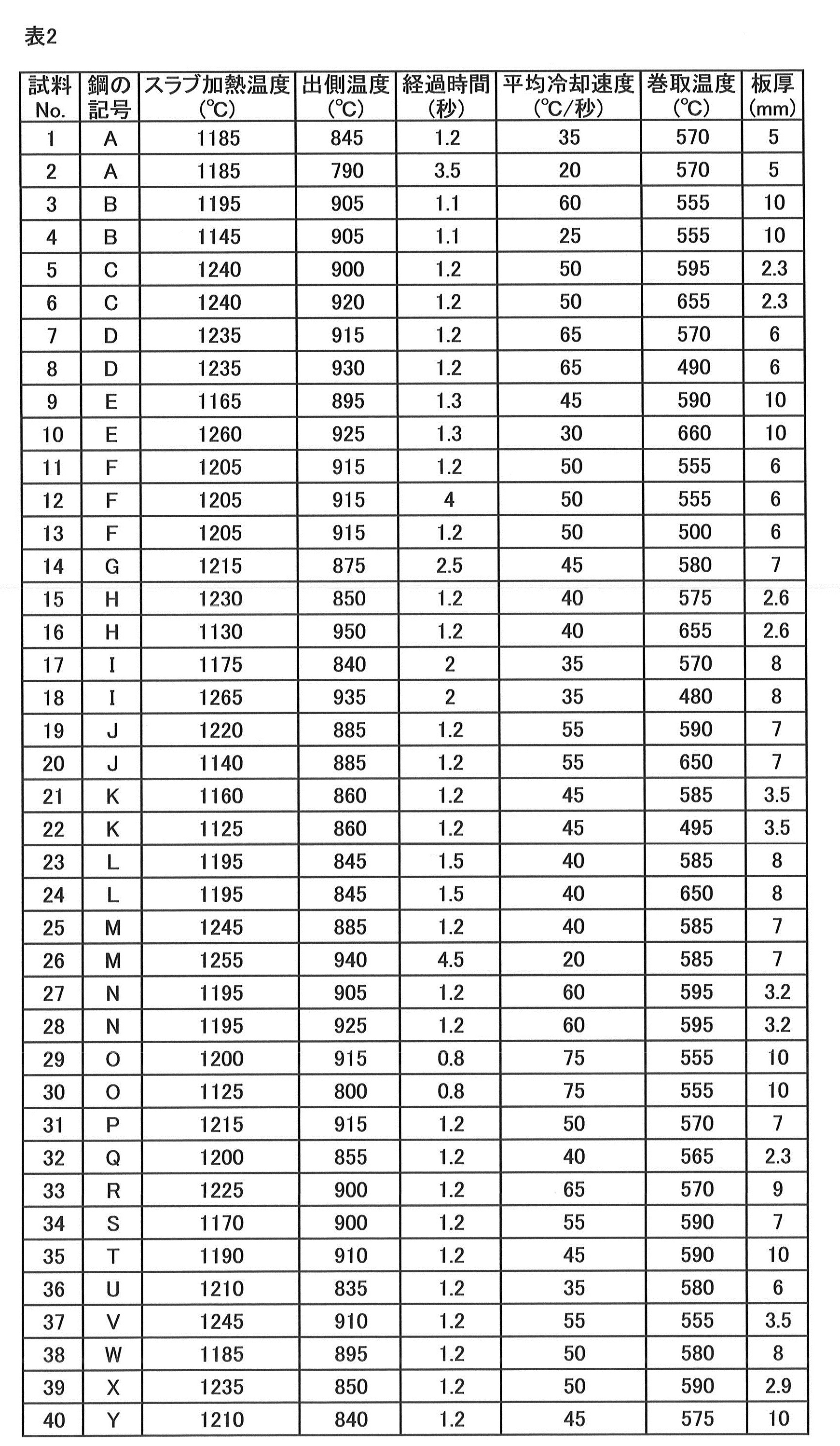
- a steel having the chemical composition shown in Table 1 was melted, a slab was produced by continuous casting, and slab heating, hot rolling, and first cooling and winding were performed under the conditions shown in Table 2. After winding, it was allowed to cool to room temperature as a second cooling.
- the balance of the chemical composition shown in Table 1 is Fe and impurities.
- the underline in Table 1 indicates that the value is out of the scope of the present invention.
- the “outside temperature” in Table 2 is the exit temperature of finish rolling
- the “elapsed time” is the elapsed time from the completion of finish rolling to the start of the first cooling
- the “average cooling rate” is the first
- plate thickness is the thickness of the steel sheet after winding.
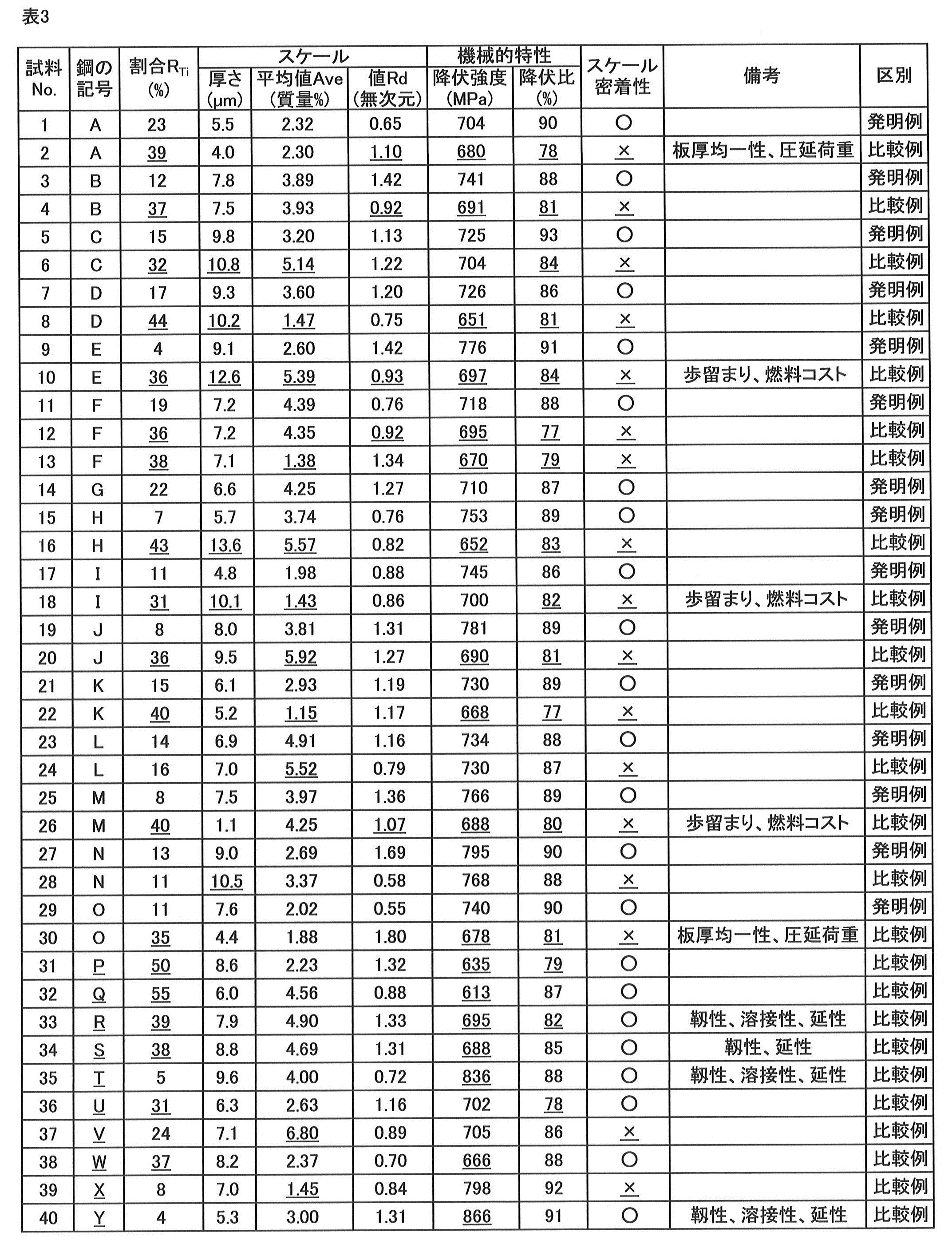
- the test piece for a tensile test was extract
- the underline in Table 3 indicates that the numerical value is out of the desired range.
- the desirable range is a yield strength of 700 MPa or more and less than 800 MPa, a yield ratio of 85% or more, and good scale adhesion (o).
- sample no. In No. 2 since the temperature on the outlet side was too low, the rolling load was large, and the uniformity of the plate thickness was low. In addition, the elapsed time was too long and the average cooling rate was too low. Sample No. In 4, the slab heating temperature was too low and the average cooling rate was too low. Sample No. In 6, the outlet temperature was too high, and the winding temperature was too high. Sample No. In No. 8, the outlet temperature was too high, and the winding temperature was too low. Sample No. In 10, the slab heating temperature was too high, so the yield was low and the fuel cost was high. In addition, the outlet temperature was too high, the average cooling rate was too low, and the winding temperature was too high. Sample No.
- Sample No. 1 to No. No. 30 was evaluated for pickling properties. 1, No. 3, No. 5, no. 7, No. 9, No. 11, No. 14, no. 15, No. 17, no. 19, no. 21, no. 23, no. 25, No. 27, and no. In No. 29, the pickling property was low, and in other samples, the pickling property was high. That is, in the sample having excellent scale adhesion, the scale was not easily removed by pickling, and in the sample having low scale adhesion, the scale was easily removed by pickling.
- the steel plate was immersed in hydrochloric acid having a temperature of 80 ° C. and a concentration of 10% by mass for 30 seconds, washed with water and dried, and then an adhesive tape was attached to the steel plate.
- the pressure-sensitive adhesive tape was peeled off from the steel plate, and it was visually confirmed whether or not there was an adherent substance on the pressure-sensitive adhesive tape.
- the presence of a deposit indicates that scale remains even after immersion in hydrochloric acid, that is, the pickling property is low, and the absence of a deposit indicates that the scale is removed by immersion in hydrochloric acid. That is, it indicates that the pickling property is high.
- the present invention can be used, for example, in the industry related to a steel plate suitable for a member of a transport machine such as a car, a railway vehicle, and the like.
Landscapes
- Chemical & Material Sciences (AREA)
- Engineering & Computer Science (AREA)
- Mechanical Engineering (AREA)
- Materials Engineering (AREA)
- Metallurgy (AREA)
- Organic Chemistry (AREA)
- Physics & Mathematics (AREA)
- Thermal Sciences (AREA)
- Crystallography & Structural Chemistry (AREA)
- Heat Treatment Of Sheet Steel (AREA)
- Heat Treatment Of Steel (AREA)
- Soft Magnetic Materials (AREA)
Abstract
Description
地鉄と、
前記地鉄の表面の厚さが10.0μm以下のスケールと、
前記地鉄と前記スケールとの間のサブスケールと、
を有し、
前記地鉄は、
質量%で、
C :0.05%~0.20%、
Si:0.01%~1.50%、
Mn:1.50%~2.50%、
P :0.05%以下、
S :0.03%以下、
Al:0.005%~0.10%、
N :0.008%以下、
Cr:0.30%~1.00%、
Ti:0.06%~0.20%、
Nb:0.00%~0.10%、
V :0.00%~0.20%、
B :0.0000%~0.0050%、
Cu:0.00%~0.50%、
Ni:0.00%~0.50%、
Mo:0.00%~0.50%、
W :0.00%~0.50%、
Ca:0.0000%~0.0050%、
Mg:0.0000%~0.0050%、
REM:0.000%~0.010%、かつ
残部:Fe及び不純物、
で表される化学組成を有し、
前記サブスケールにおいて、
Cr濃度の平均値が1.50質量%~5.00質量%であり、かつ
圧延方向の長さが50μmの範囲内に、1μm離れて隣り合う2つの測定領域間でのCr濃度の比が0.90以下又は1.11以上の部分が1以上あり、
Ti含有量(質量%)を[Ti]、N含有量(質量%)を[N]としたときに下記の式1で表されるパラメータTieffに対する、粒径が100nm以上1μm以下の炭化物又は炭窒化物に含まれるTiの量の割合が30%以下であることを特徴とする鋼板。
Tieff=[Ti]-48/14[N] (式1)
前記化学組成において、
Nb:0.001%~0.10%、
V :0.001%~0.20%、
B :0.0001%~0.0050%、
Cu:0.01%~0.50%、
Ni:0.01%~0.50%、
Mo:0.01%~0.50%、若しくは
W :0.01%~0.50%、
又はこれらの任意の組み合わせが満たされることを特徴とする(1)に記載の鋼板。
前記化学組成において、
Ca:0.0005%~0.0050%、
Mg:0.0005%~0.0050%、若しくは
REM:0.0005%~0.010%、
又はこれらの任意の組み合わせが満たされることを特徴とする(1)又は(2)に記載の鋼板。
Cは、強度の向上に寄与する。C含有量が0.05%未満では、十分な強度、例えば圧延方向で700MPa以上の降伏強度若しくは85%以上の降伏比又はこれらの両方が得られない。従って、C含有量は0.05%以上とし、好ましくは0.08%以上とする。一方、C含有量が0.20%超では、強度が過剰となって延性が低下したり、溶接性及び靭性が低下したりする。従って、C含有量は0.20%以下とし、好ましくは0.15%以下とし、より好ましくは0.14%以下とする。
Siは、強度の向上に寄与したり、脱酸材として作用したりする。Siはアーク溶接の際に溶接部の形状の改善にも寄与する。Si含有量が0.01%未満では、これら効果が十分に得られない。従って、Si含有量は0.01%以上とし、好ましくは0.02%以上とする。一方、Si含有量が1.50%超では、鋼板の表面にSiスケールが多量に発生して表面性状が低下したり、靱性が低下したりする。従って、Si含有量は1.50%以下とし、好ましくは1.20%以下とする。Si含有量が1.50%以下であれば、本実施形態においては、スケール密着性へのSiの影響は無視できる。
Mnは、組織強化を通じて強度の向上に寄与する。Mn含有量が1.50%未満では、これら効果が十分に得られない。例えば圧延方向で700MPa以上の降伏強度若しくは85%以上の降伏比又はこれらの両方が得られない。従って、Mn含有量は1.50%以上とし、好ましくは1.60%以上とする。一方、Mn含有量が2.50%超では、強度が過剰となって延性が低下したり、溶接性及び靭性が低下したりする。従って、Mn含有量は2.50%以下とし、好ましくは2.40%以下とし、より好ましくは2.30%以下とする。
Pは、必須元素ではなく、例えば鋼中に不純物として含有される。Pは、延性及び靱性を阻害するため、P含有量は低ければ低いほどよい。特に、P含有量が0.05%超で、延性及び靱性の低下が著しい。従って、P含有量は0.05%以下とし、好ましくは0.04%以下とし、より好ましくは0.03%以下とする。P含有量の低減にはコストがかかり、0.0005%未満まで低減しようとすると、コストが著しく上昇する。このため、P含有量は0.0005%以上としてもよく、コストの観点から0.0010%以上としてもよい。
Sは、必須元素ではなく、例えば鋼中に不純物として含有される。Sは、MnSを生成して、延性、溶接性及び靱性を阻害するため、S含有量は低ければ低いほどよい。特に、S含有量が0.03%超で、延性、溶接性及び靱性の低下が著しい。従って、S含有量は0.03%以下とし、好ましくは0.01%以下とし、より好ましくは0.007%以下とする。S含有量の低減にはコストがかかり、0.0005%未満まで低減しようとすると、コストが著しく上昇する。このため、S含有量は0.0005%以上としてもよく、コストの観点から0.0010%以上としてもよく、コストの観点から0.0010%以上としてもよい。
Alは、脱酸材として作用する。Al含有量が0.005%未満では、この効果が十分に得られない。従って、Al含有量は0.005%以上とし、好ましくは0.015%以上とする。一方、Al含有量が0.10%超では、靱性及び溶接性が低下する。従って、Al含有量は0.10%以下とし、好ましくは0.08%以下とする。
Nは、必須元素ではなく、例えば鋼中に不純物として含有される。Nは、TiNを形成してTiを消費し、析出強化に好適な微細なTi炭化物の生成を阻害するため、N含有量は低ければ低いほどよい。特に、N含有量が0.008%超で、析出強化能の低下が著しい。従って、N含有量は0.008%以下とし、好ましくは0.007%以下とする。N含有量の低減にはコストがかかり、0.0005%未満まで低減しようとすると、コストが著しく上昇する。このため、N含有量は0.0005%以上としてもよく、コストの観点から0.0010%以上としてもよく、コストの観点から0.0010%以上としてもよい。
Crは、強度の向上に寄与したり、サブスケールの形成を通じてスケール密着性を高めたりする。Cr含有量が0.30%未満では、これら効果が十分に得られない。従って、Cr含有量は0.30%以上とし、好ましくは0.25%以上とする。一方、Cr含有量が1.00%超では、サブスケールに含まれるCrが過剰となってスケール密着性が低下する。従って、Cr含有量は1.00%以下とし、好ましくは0.80%以下とする。
Tiは、再結晶を抑制し、結晶粒の粗大化を抑制することで、降伏強度の向上に寄与したり、Ti炭化物として析出して析出強化を通じた降伏強度及び降伏比の向上に寄与したりする。Ti含有量が0.06%未満では、これら効果が十分に得られない。従って、Ti含有量は0.06%以上とし、好ましくは0.07%以上とする。一方、Ti含有量が0.20%超では、靱性、溶接性及び延性が低下したり、スラブ加熱中にTi炭化物が溶体化しきれず、析出強化に有効なTiの量が不足して降伏強度及び降伏比が低下したりする。従って、Ti含有量は0.20%以下とし、好ましくは0.16%以下とする。
Nb及びVは、炭窒化物として析出して強度の向上に寄与したり、結晶粒の粗大化の抑制に寄与したりする。結晶粒の粗大化の抑制は、降伏強度の向上及び靱性の向上に寄与する。従って、Nb若しくはV又はこれらの両方が含有されていてもよい。これら効果を十分に得るために、Nb含有量は好ましくは0.001%以上とし、より好ましくは0.010%以上とし、V含有量は好ましくは0.001%以上とし、より好ましくは0.010%以上とする。一方、Nb含有量が0.10%超では、靱性及び延性が低下したり、スラブ加熱中にNb炭窒化物が溶体化しきれず、強度の確保に有効な固溶Cが不足して降伏強度及び降伏比が低下したりする。従って、Nb含有量は0.10%以下とし、好ましくは0.08%以下とする。V含有量が0.20%超では、靱性及び延性が低下する。従って、V含有量は0.20%以下とし、好ましくは0.16%以下とする。
Bは、組織強化を通じて強度の向上に寄与する。従って、Bが含有されていてもよい。この効果を十分に得るために、B含有量は好ましくは0.0001%以上とし、より好ましくは0.0005%以上とする。一方、B含有量が0.0050%超では、靱性が低下したり、強度の向上効果が飽和したりする。従って、B含有量は0.0050%以下とし、好ましくは0.0030%以下とする。
Cuは、強度の向上に寄与する。従って、Cuが含有されていてもよい。この効果を十分に得るために、Cu含有量は好ましくは0.01%以上とし、より好ましくは0.03%以上とする。一方、Cu含有量が0.50%超では、靱性及び溶接性が低下したり、スラブの高温割れの懸念が高くなったりする。従って、Cu含有量は0.50%以下とし、好ましくは0.30%以下とする。
Niは、強度の向上に寄与したり、靱性の向上及びスラブの高温割れの抑制に寄与したりする。従って、Niが含有されていてもよい。これら効果を十分に得るために、Ni含有量は好ましくは0.01%以上とし、より好ましくは0.03%以上とする。一方、Ni含有量が0.50%超では、徒にコストが上昇する。従って、Ni含有量は0.50%以下とし、好ましくは0.30%以下とする。
Mo及びWは、強度の向上に寄与する。従って、Mo若しくはW又はこれらの両方が含有されていてもよい。これら効果を十分に得るために、Mo含有量は好ましくは0.01%以上とし、より好ましくは0.03%以上とし、W含有量は好ましくは0.01%以上とし、より好ましくは0.03%以上とする。一方、Mo含有量が0.50%超では、徒にコストが上昇する。従って、Mo含有量は0.50%以下とし、好ましくは0.35%以下とする。W含有量が0.50%超では、徒にコストが上昇する。従って、W含有量は0.50%以下とし、好ましくは0.35%以下とする。
Ca、Mg及びREMは、非金属介在物を球状化して、靱性の向上及び延性の低下の抑制に寄与する。従って、Ca、Mg若しくはREM又はこれらの任意の組み合わせが含有されていてもよい。これら効果を十分に得るために、Ca含有量は好ましくは0.0005%以上とし、より好ましくは0.0010%以上とし、Mg含有量は好ましくは0.0005%以上とし、より好ましくは0.0010%以上とし、REM含有量は好ましくは0.0005%以上とし、より好ましくは0.0010%以上とする。一方、Ca含有量が0.0050%超では、介在物の粗大化及び介在物の数の増加が顕著になり、靱性が低下する。従って、Ca含有量は0.0050%以下とし、好ましくは0.0035%以下とする。Mg含有量が0.0050%超では、介在物の粗大化及び介在物の数の増加が顕著になり、靱性が低下する。従って、Mg含有量は0.0050%以下とし、好ましくは0.0035%以下とする。REM含有量が0.010%超では、介在物の粗大化及び介在物の数の増加が顕著になり、靱性が低下する。従って、REM含有量は0.010%以下とし、好ましくは0.007%以下とする。
Tieff=[Ti]-48/14[N] (式1)
スケールが厚いほど、鋼板の加工中にスケールに発生する歪みが大きくなり、スケールにき裂が入り、剥離しやすい。そして、上記の実験からも明らかなように、スケールの厚さが10.0μm超では、良好なスケール密着性が得られない。従って、スケールの厚さは10.0μm以下とし、好ましくは8.0μm以下とする。
上記の実験の結果から明らかなように、サブスケールにおけるCr濃度の平均値Aveが1.50質量%未満又は5.00質量%超では、十分なスケール密着性が得られない。従って、平均値Aveは1.50質量%~5.00質量%とする。平均値Aveが1.50質量%未満の場合に十分なスケール密着性が得られない理由として、サブスケールの生成が不十分で、サブスケールと地鉄との密着性が不足していることが考えられる。Cr濃度の平均値Aveが5.00質量%超の場合に十分なスケール密着性が得られない理由として、サブスケールとスケールとの密着力が低下していることが考えられる。
上記の実験の結果から明らかなように、濃度比RCrのうちで1.00から最も乖離した値Rdが0.90超かつ1.11未満の場合、十分なスケール密着性が得られない。従って、圧延方向の長さが50μmの範囲内に、1μm離れて隣り合う2つの測定領域間での濃度比RCrが0.90以下又は1.11以上の部分が1以上あることとする。このことは、サブスケール中に、Cr濃度の変動が大きい領域が存在することを意味する。スケールに地鉄との整合性のよいマグネタイトが含まれているが、Cr濃度が過度に均一である場合、マグネタイトと地鉄との接触が阻害され、良好なスケール密着性が得られないと考えられる。その一方で、Cr濃度の変動が大きい領域が存在すると、この領域を介してマグネタイトと地鉄との接触が確保され、優れたスケール密着性が得られると考えられる。
上記化学組成を有する溶鋼を常法により鋳造してスラブを製造する。スラブとして、鋼塊を鍛造又は圧延したものを用いてもよいが、スラブは連続鋳造により製造することが好ましい。薄スラブキャスターなどで製造したスラブを用いてもよい。
スラブの製造後には、スラブを一旦冷却し、又はそのまま1150℃以上1250℃未満の温度に加熱する。この温度(スラブ加熱温度)が1150℃未満では、スラブ中のTiを含む析出物が十分に溶体化せず、後にTi炭化物が十分に析出せず、十分な強度が得られなくなる。従って、スラブ加熱温度は1150℃以上とし、好ましくは1160℃以上とする。一方、スラブ加熱温度が1250℃以上では、結晶粒が粗大になって降伏応力が低下したり、加熱炉内で生成する1次スケールの生成量が増加して歩留まりが低下したり、燃料コストが増大したりする。従って、スラブ加熱温度は1250℃未満とし、好ましくは1245℃以下とする。
スラブ加熱の後、スラブのデスケーリングを行い、粗圧延を行う。粗圧延により粗バーが得られる。粗圧延の条件は特に限定されない。粗圧延の後、タンデム圧延機を用いて粗バーの仕上げ圧延を行うことにより、熱延鋼板を得る。粗圧延と仕上げ圧延との間に、高圧水等を用いたデスケーリングを行うことで、粗バーの表面に生成したスケールを除去することが好ましい。仕上げ圧延の入側では、粗バーの表面温度を1050℃未満とする。また、仕上げ圧延の出側温度が920℃以上では、スケールの厚さが10.0μm超となり、スケール密着性が低下する。従って、出側温度は920℃未満とする。
仕上げ圧延の完了から3秒以内にランナウトテーブルで熱延鋼板の冷却を開始し、この冷却では、冷却を開始した温度(冷却開始温度)から750℃までの間を30℃/秒超の平均冷却速度で降温する。冷却開始温度から750℃までの間の平均冷却速度が30℃/秒以下では、隣り合う2測定領域間での濃度比RCrのうちで最も1.00から乖離した値Rdが0.90超かつ1.11未満となり、サブスケール中のCr濃度が均一化して、スケール密着性が低下したり、オーステナイト相中に粗大なTi炭化物が生成して、強度が低下したりする。従って、冷却開始温度から750℃までの間の平均冷却速度は30℃/秒超とする。また、仕上げ圧延の完了から冷却開始までの時間が長くなるほど、オーステナイト相が再結晶しやすく、この再結晶に伴って粗大なTi炭化物が形成され、微細なTi炭化物の生成に有効なTiの量が低下する。また、この時間が長くなるほど、サブスケール中のCr濃度の均一化が進行する。そして、このような傾向は、この時間が3秒超で顕著である。従って、仕上げ圧延の完了から冷却開始までの時間は3秒以内とする。
750℃までの冷却の後には、ランナウトテーブルの後端で熱延鋼板を巻き取る。巻き取りの際の熱延鋼板の温度(巻取温度)が650℃以上では、サブスケールにおけるCr濃度の平均値Aveが過剰となり、十分なスケール密着性が得られない。従って、巻取温度は650℃未満とし、好ましくは600℃以下とする。一方、巻取温度が500℃以下では、サブスケールにおけるCr濃度の平均値Aveが過少となって十分なスケール密着性が得られなかったり、Ti炭化物が不足して十分な降伏強度及び降伏比を得ることが困難になったりする。従って、巻取温度は500℃超とし、好ましくは550℃以上とする。
熱延鋼板の巻き取り後には、熱延鋼板を室温まで冷却する。この際の冷却方法及び冷却速度は限定されない。生産コストの観点からは、大気中での放冷が好ましい。

Claims (3)
- 地鉄と、
前記地鉄の表面の厚さが10.0μm以下のスケールと、
前記地鉄と前記スケールとの間のサブスケールと、
を有し、
前記地鉄は、
質量%で、
C :0.05%~0.20%、
Si:0.01%~1.50%、
Mn:1.50%~2.50%、
P :0.05%以下、
S :0.03%以下、
Al:0.005%~0.10%、
N :0.008%以下、
Cr:0.30%~1.00%、
Ti:0.06%~0.20%、
Nb:0.00%~0.10%、
V :0.00%~0.20%、
B :0.0000%~0.0050%、
Cu:0.00%~0.50%、
Ni:0.00%~0.50%、
Mo:0.00%~0.50%、
W :0.00%~0.50%、
Ca:0.0000%~0.0050%、
Mg:0.0000%~0.0050%、
REM:0.000%~0.010%、かつ
残部:Fe及び不純物、
で表される化学組成を有し、
前記サブスケールにおいて、
Cr濃度の平均値が1.50質量%~5.00質量%であり、かつ
圧延方向の長さが50μmの範囲内に、1μm離れて隣り合う2つの測定領域間でのCr濃度の比が0.90以下又は1.11以上の部分が1以上あり、
Ti含有量(質量%)を[Ti]、N含有量(質量%)を[N]としたときに下記の式1で表されるパラメータTieffに対する、粒径が100nm以上1μm以下の炭化物又は炭窒化物に含まれるTiの量の割合が30%以下であることを特徴とする鋼板。
Tieff=[Ti]-48/14[N] (式1) - 前記化学組成において、
Nb:0.001%~0.10%、
V :0.001%~0.20%、
B :0.0001%~0.0050%、
Cu:0.01%~0.50%、
Ni:0.01%~0.50%、
Mo:0.01%~0.50%、若しくは
W :0.01%~0.50%、
又はこれらの任意の組み合わせが満たされることを特徴とする請求項1に記載の鋼板。 - 前記化学組成において、
Ca:0.0005%~0.0050%、
Mg:0.0005%~0.0050%、若しくは
REM:0.0005%~0.010%、
又はこれらの任意の組み合わせが満たされることを特徴とする請求項1又は2に記載の鋼板。
Priority Applications (9)
| Application Number | Priority Date | Filing Date | Title |
|---|---|---|---|
| MX2017010605A MX2017010605A (es) | 2015-03-27 | 2016-03-28 | Lamina de acero. |
| PL16772742T PL3276035T3 (pl) | 2015-03-27 | 2016-03-28 | Blacha stalowa cienka |
| EP16772742.9A EP3276035B1 (en) | 2015-03-27 | 2016-03-28 | Steel sheet |
| CN201680010704.4A CN107250412B (zh) | 2015-03-27 | 2016-03-28 | 钢板 |
| ES16772742T ES2805288T3 (es) | 2015-03-27 | 2016-03-28 | Lámina de acero |
| US15/546,410 US10435772B2 (en) | 2015-03-27 | 2016-03-28 | Steel sheet |
| BR112017016442-6A BR112017016442A2 (ja) | 2015-03-27 | 2016-03-28 | Steel plate |
| JP2017509979A JP6406436B2 (ja) | 2015-03-27 | 2016-03-28 | 鋼板 |
| KR1020177022681A KR101980470B1 (ko) | 2015-03-27 | 2016-03-28 | 강판 |
Applications Claiming Priority (2)
| Application Number | Priority Date | Filing Date | Title |
|---|---|---|---|
| JP2015-067699 | 2015-03-27 | ||
| JP2015067699 | 2015-03-27 |
Publications (1)
| Publication Number | Publication Date |
|---|---|
| WO2016158861A1 true WO2016158861A1 (ja) | 2016-10-06 |
Family
ID=57006089
Family Applications (1)
| Application Number | Title | Priority Date | Filing Date |
|---|---|---|---|
| PCT/JP2016/059933 Ceased WO2016158861A1 (ja) | 2015-03-27 | 2016-03-28 | 鋼板 |
Country Status (11)
| Country | Link |
|---|---|
| US (1) | US10435772B2 (ja) |
| EP (1) | EP3276035B1 (ja) |
| JP (1) | JP6406436B2 (ja) |
| KR (1) | KR101980470B1 (ja) |
| CN (1) | CN107250412B (ja) |
| BR (1) | BR112017016442A2 (ja) |
| ES (1) | ES2805288T3 (ja) |
| MX (1) | MX2017010605A (ja) |
| PL (1) | PL3276035T3 (ja) |
| TW (1) | TWI604070B (ja) |
| WO (1) | WO2016158861A1 (ja) |
Cited By (1)
| Publication number | Priority date | Publication date | Assignee | Title |
|---|---|---|---|---|
| EP3708689A4 (en) * | 2017-11-08 | 2021-08-18 | Nippon Steel Corporation | STEEL SHEET |
Families Citing this family (1)
| Publication number | Priority date | Publication date | Assignee | Title |
|---|---|---|---|---|
| WO2020065372A1 (en) | 2018-09-25 | 2020-04-02 | Arcelormittal | High strength hot rolled steel having excellent scale adhesivness and a method of manufacturing the same |
Citations (7)
| Publication number | Priority date | Publication date | Assignee | Title |
|---|---|---|---|---|
| JPH1036939A (ja) * | 1996-05-24 | 1998-02-10 | Sumitomo Metal Ind Ltd | 熱間圧延鋼材および熱延鋼板の製造方法 |
| JPH1171637A (ja) * | 1997-06-20 | 1999-03-16 | Kawasaki Steel Corp | 耐衝撃特性及び黒皮ままのプレス加工性に優れる高強度高加工性鋼板 |
| JPH11343536A (ja) * | 1998-05-29 | 1999-12-14 | Press Kogyo Co Ltd | トラックフレーム・アクスルケース用高強度熱延鋼板 |
| JP2000045041A (ja) * | 1998-07-28 | 2000-02-15 | Nippon Steel Corp | 打ち抜き加工性が優れた高強度鋼板およびその製造方法 |
| JP2004244680A (ja) * | 2003-02-14 | 2004-09-02 | Nippon Steel Corp | スケール密着性に優れた熱延鋼板およびその製造方法 |
| JP2004346416A (ja) * | 2003-05-26 | 2004-12-09 | Kobe Steel Ltd | スケール密着性に優れた熱延鋼板 |
| JP2010024547A (ja) * | 2008-06-16 | 2010-02-04 | Nippon Steel Corp | 穴広げ性に優れた熱延鋼板及びその製造方法 |
Family Cites Families (15)
| Publication number | Priority date | Publication date | Assignee | Title |
|---|---|---|---|---|
| JPS5459028A (en) | 1977-10-20 | 1979-05-12 | Seiko Epson Corp | Driving system for liquid crystal display unit |
| JPH0734137A (ja) | 1993-07-19 | 1995-02-03 | Sumitomo Metal Ind Ltd | 表面性状の優れた高成形性熱延鋼板の製造法 |
| JPH07118792A (ja) | 1993-10-21 | 1995-05-09 | Sumitomo Metal Ind Ltd | 高強度熱延鋼板及びその製造方法 |
| JP3113490B2 (ja) | 1994-03-29 | 2000-11-27 | 新日本製鐵株式会社 | 極薄スケール鋼板の製造方法 |
| JP2000024547A (ja) * | 1998-07-14 | 2000-01-25 | Ricoh Elemex Corp | 空気清浄機における荷電粒子発生部の清掃装置 |
| JP2000087185A (ja) | 1998-09-07 | 2000-03-28 | Nippon Steel Corp | 表面性状およびスケール密着性に優れた熱延鋼板及びその製造方法 |
| JP5459028B2 (ja) | 2010-04-08 | 2014-04-02 | 新日鐵住金株式会社 | 疲労特性と黒皮上への化成処理性に優れた高強度熱延鋼板およびその製造方法 |
| JP5679112B2 (ja) | 2011-02-08 | 2015-03-04 | Jfeスチール株式会社 | スケール密着性に優れた熱延鋼板およびその製造方法 |
| JP5838708B2 (ja) * | 2011-10-12 | 2016-01-06 | Jfeスチール株式会社 | 表面性状に優れた鋼板およびその製造方法 |
| JP5994356B2 (ja) | 2012-04-24 | 2016-09-21 | Jfeスチール株式会社 | 形状凍結性に優れた高強度薄鋼板およびその製造方法 |
| JP5958113B2 (ja) | 2012-06-25 | 2016-07-27 | Jfeスチール株式会社 | スケール密着性に優れた厚鋼板の製造方法 |
| JP5799913B2 (ja) | 2012-08-02 | 2015-10-28 | 新日鐵住金株式会社 | スケール密着性に優れた熱延鋼板及びその製造方法 |
| JP5846445B2 (ja) | 2012-08-07 | 2016-01-20 | 新日鐵住金株式会社 | 冷延鋼板およびその製造方法 |
| JP6048108B2 (ja) | 2012-12-14 | 2016-12-21 | 新日鐵住金株式会社 | 表面性状に優れ異方性が小さく切断後の形状が良好な熱延鋼板およびその製造方法 |
| JP6149451B2 (ja) | 2013-03-21 | 2017-06-21 | 新日鐵住金株式会社 | 高強度熱延鋼板およびその製造方法 |
-
2016
- 2016-03-28 EP EP16772742.9A patent/EP3276035B1/en not_active Not-in-force
- 2016-03-28 TW TW105109812A patent/TWI604070B/zh not_active IP Right Cessation
- 2016-03-28 PL PL16772742T patent/PL3276035T3/pl unknown
- 2016-03-28 JP JP2017509979A patent/JP6406436B2/ja active Active
- 2016-03-28 ES ES16772742T patent/ES2805288T3/es active Active
- 2016-03-28 KR KR1020177022681A patent/KR101980470B1/ko not_active Expired - Fee Related
- 2016-03-28 US US15/546,410 patent/US10435772B2/en not_active Expired - Fee Related
- 2016-03-28 CN CN201680010704.4A patent/CN107250412B/zh not_active Expired - Fee Related
- 2016-03-28 WO PCT/JP2016/059933 patent/WO2016158861A1/ja not_active Ceased
- 2016-03-28 MX MX2017010605A patent/MX2017010605A/es unknown
- 2016-03-28 BR BR112017016442-6A patent/BR112017016442A2/ja not_active Application Discontinuation
Patent Citations (7)
| Publication number | Priority date | Publication date | Assignee | Title |
|---|---|---|---|---|
| JPH1036939A (ja) * | 1996-05-24 | 1998-02-10 | Sumitomo Metal Ind Ltd | 熱間圧延鋼材および熱延鋼板の製造方法 |
| JPH1171637A (ja) * | 1997-06-20 | 1999-03-16 | Kawasaki Steel Corp | 耐衝撃特性及び黒皮ままのプレス加工性に優れる高強度高加工性鋼板 |
| JPH11343536A (ja) * | 1998-05-29 | 1999-12-14 | Press Kogyo Co Ltd | トラックフレーム・アクスルケース用高強度熱延鋼板 |
| JP2000045041A (ja) * | 1998-07-28 | 2000-02-15 | Nippon Steel Corp | 打ち抜き加工性が優れた高強度鋼板およびその製造方法 |
| JP2004244680A (ja) * | 2003-02-14 | 2004-09-02 | Nippon Steel Corp | スケール密着性に優れた熱延鋼板およびその製造方法 |
| JP2004346416A (ja) * | 2003-05-26 | 2004-12-09 | Kobe Steel Ltd | スケール密着性に優れた熱延鋼板 |
| JP2010024547A (ja) * | 2008-06-16 | 2010-02-04 | Nippon Steel Corp | 穴広げ性に優れた熱延鋼板及びその製造方法 |
Cited By (1)
| Publication number | Priority date | Publication date | Assignee | Title |
|---|---|---|---|---|
| EP3708689A4 (en) * | 2017-11-08 | 2021-08-18 | Nippon Steel Corporation | STEEL SHEET |
Also Published As
| Publication number | Publication date |
|---|---|
| ES2805288T3 (es) | 2021-02-11 |
| EP3276035B1 (en) | 2020-05-06 |
| TWI604070B (zh) | 2017-11-01 |
| TW201702405A (zh) | 2017-01-16 |
| MX2017010605A (es) | 2017-12-07 |
| US20180023172A1 (en) | 2018-01-25 |
| CN107250412A (zh) | 2017-10-13 |
| BR112017016442A2 (ja) | 2018-04-10 |
| KR101980470B1 (ko) | 2019-05-21 |
| KR20170105565A (ko) | 2017-09-19 |
| JP6406436B2 (ja) | 2018-10-17 |
| PL3276035T3 (pl) | 2020-09-21 |
| JPWO2016158861A1 (ja) | 2017-11-02 |
| EP3276035A1 (en) | 2018-01-31 |
| CN107250412B (zh) | 2019-03-29 |
| EP3276035A4 (en) | 2018-09-26 |
| US10435772B2 (en) | 2019-10-08 |
Similar Documents
| Publication | Publication Date | Title |
|---|---|---|
| CN107429349B (zh) | 冷轧钢板及其制造方法 | |
| EP3120941B1 (en) | High toughness and high tensile strength thick steel plate and production method therefor | |
| TWI484050B (zh) | 冷軋鋼板、及其製造方法、以及熱壓印成形體 | |
| EP3214199B1 (en) | High-strength steel sheet, high-strength hot-dip galvanized steel sheet, high-strength hot-dip aluminum-coated steel sheet, and high-strength electrogalvanized steel sheet, and methods for manufacturing same | |
| CA2966476C (en) | High toughness and high tensile strength thick steel plate with excellent material homogeneity and production method for same | |
| CN112930413A (zh) | 高强度钢板及其制造方法 | |
| JP5387073B2 (ja) | 熱間プレス用鋼板およびその製造方法ならびに熱間プレス用鋼板部材の製造方法 | |
| CN104685091B (zh) | 合金化热浸镀锌钢板及其制造方法 | |
| CN109642286B (zh) | 铁素体系不锈钢热轧退火钢板及其制造方法 | |
| CN113840934A (zh) | 高强度构件、高强度构件的制造方法和高强度构件用钢板的制造方法 | |
| WO2014162984A1 (ja) | ホットスタンプ成形体、冷延鋼板、及びホットスタンプ成形体の製造方法 | |
| CN105026596B (zh) | 拉深加工性和加工后的表面硬度优异的热轧钢板 | |
| EP2891727A1 (en) | Steel plate | |
| JP7241889B2 (ja) | 接合部品及びその製造方法 | |
| JP6036756B2 (ja) | 高強度熱延鋼板およびその製造方法 | |
| JP2010229514A (ja) | 冷延鋼板およびその製造方法 | |
| WO2018199062A1 (ja) | フェライト系ステンレス熱延焼鈍鋼板およびその製造方法 | |
| CN106232847B (zh) | 强冷加工性和加工后的硬度优异的热轧钢板 | |
| WO2021125283A1 (ja) | 鋼板及びその製造方法 | |
| JP6406436B2 (ja) | 鋼板 | |
| JP6075339B2 (ja) | 高強度部材の製造方法 | |
| JP7810906B2 (ja) | 熱延鋼板およびその製造方法 | |
| JP2011006765A (ja) | プロジェクション溶接用冷延鋼板およびその製造方法 | |
| TW201704498A (zh) | 應變誘發相變態型複合組織鋼板及其製造方法 | |
| WO2023189174A1 (ja) | ホットスタンプ成形体 |
Legal Events
| Date | Code | Title | Description |
|---|---|---|---|
| 121 | Ep: the epo has been informed by wipo that ep was designated in this application |
Ref document number: 16772742 Country of ref document: EP Kind code of ref document: A1 |
|
| ENP | Entry into the national phase |
Ref document number: 2017509979 Country of ref document: JP Kind code of ref document: A |
|
| WWE | Wipo information: entry into national phase |
Ref document number: 15546410 Country of ref document: US |
|
| REG | Reference to national code |
Ref country code: BR Ref legal event code: B01A Ref document number: 112017016442 Country of ref document: BR |
|
| ENP | Entry into the national phase |
Ref document number: 20177022681 Country of ref document: KR Kind code of ref document: A |
|
| WWE | Wipo information: entry into national phase |
Ref document number: MX/A/2017/010605 Country of ref document: MX |
|
| REEP | Request for entry into the european phase |
Ref document number: 2016772742 Country of ref document: EP |
|
| NENP | Non-entry into the national phase |
Ref country code: DE |
|
| ENP | Entry into the national phase |
Ref document number: 112017016442 Country of ref document: BR Kind code of ref document: A2 Effective date: 20170731 |