WO2016163488A1 - 内燃機関排気ガスの浄化触媒及び該触媒を用いた排気ガス浄化方法 - Google Patents
内燃機関排気ガスの浄化触媒及び該触媒を用いた排気ガス浄化方法 Download PDFInfo
- Publication number
- WO2016163488A1 WO2016163488A1 PCT/JP2016/061462 JP2016061462W WO2016163488A1 WO 2016163488 A1 WO2016163488 A1 WO 2016163488A1 JP 2016061462 W JP2016061462 W JP 2016061462W WO 2016163488 A1 WO2016163488 A1 WO 2016163488A1
- Authority
- WO
- WIPO (PCT)
- Prior art keywords
- cerium
- palladium
- exhaust gas
- catalyst
- oxide
- Prior art date
- Legal status (The legal status is an assumption and is not a legal conclusion. Google has not performed a legal analysis and makes no representation as to the accuracy of the status listed.)
- Ceased
Links
Images


Classifications
-
- B—PERFORMING OPERATIONS; TRANSPORTING
- B01—PHYSICAL OR CHEMICAL PROCESSES OR APPARATUS IN GENERAL
- B01D—SEPARATION
- B01D53/00—Separation of gases or vapours; Recovering vapours of volatile solvents from gases; Chemical or biological purification of waste gases, e.g. engine exhaust gases, smoke, fumes, flue gases, aerosols
- B01D53/34—Chemical or biological purification of waste gases
- B01D53/92—Chemical or biological purification of waste gases of engine exhaust gases
- B01D53/94—Chemical or biological purification of waste gases of engine exhaust gases by catalytic processes
- B01D53/9445—Simultaneously removing carbon monoxide, hydrocarbons or nitrogen oxides making use of three-way catalysts [TWC] or four-way-catalysts [FWC]
-
- B—PERFORMING OPERATIONS; TRANSPORTING
- B01—PHYSICAL OR CHEMICAL PROCESSES OR APPARATUS IN GENERAL
- B01D—SEPARATION
- B01D53/00—Separation of gases or vapours; Recovering vapours of volatile solvents from gases; Chemical or biological purification of waste gases, e.g. engine exhaust gases, smoke, fumes, flue gases, aerosols
- B01D53/34—Chemical or biological purification of waste gases
- B01D53/92—Chemical or biological purification of waste gases of engine exhaust gases
- B01D53/94—Chemical or biological purification of waste gases of engine exhaust gases by catalytic processes
-
- B—PERFORMING OPERATIONS; TRANSPORTING
- B01—PHYSICAL OR CHEMICAL PROCESSES OR APPARATUS IN GENERAL
- B01D—SEPARATION
- B01D53/00—Separation of gases or vapours; Recovering vapours of volatile solvents from gases; Chemical or biological purification of waste gases, e.g. engine exhaust gases, smoke, fumes, flue gases, aerosols
- B01D53/34—Chemical or biological purification of waste gases
- B01D53/92—Chemical or biological purification of waste gases of engine exhaust gases
- B01D53/94—Chemical or biological purification of waste gases of engine exhaust gases by catalytic processes
- B01D53/9445—Simultaneously removing carbon monoxide, hydrocarbons or nitrogen oxides making use of three-way catalysts [TWC] or four-way-catalysts [FWC]
- B01D53/945—Simultaneously removing carbon monoxide, hydrocarbons or nitrogen oxides making use of three-way catalysts [TWC] or four-way-catalysts [FWC] characterised by a specific catalyst
-
- B—PERFORMING OPERATIONS; TRANSPORTING
- B01—PHYSICAL OR CHEMICAL PROCESSES OR APPARATUS IN GENERAL
- B01J—CHEMICAL OR PHYSICAL PROCESSES, e.g. CATALYSIS OR COLLOID CHEMISTRY; THEIR RELEVANT APPARATUS
- B01J21/00—Catalysts comprising the elements, oxides, or hydroxides of magnesium, boron, aluminium, carbon, silicon, titanium, zirconium, or hafnium
- B01J21/02—Boron or aluminium; Oxides or hydroxides thereof
- B01J21/04—Alumina
-
- B—PERFORMING OPERATIONS; TRANSPORTING
- B01—PHYSICAL OR CHEMICAL PROCESSES OR APPARATUS IN GENERAL
- B01J—CHEMICAL OR PHYSICAL PROCESSES, e.g. CATALYSIS OR COLLOID CHEMISTRY; THEIR RELEVANT APPARATUS
- B01J23/00—Catalysts comprising metals or metal oxides or hydroxides, not provided for in group B01J21/00
- B01J23/002—Mixed oxides other than spinels, e.g. perovskite
-
- B—PERFORMING OPERATIONS; TRANSPORTING
- B01—PHYSICAL OR CHEMICAL PROCESSES OR APPARATUS IN GENERAL
- B01J—CHEMICAL OR PHYSICAL PROCESSES, e.g. CATALYSIS OR COLLOID CHEMISTRY; THEIR RELEVANT APPARATUS
- B01J23/00—Catalysts comprising metals or metal oxides or hydroxides, not provided for in group B01J21/00
- B01J23/02—Catalysts comprising metals or metal oxides or hydroxides, not provided for in group B01J21/00 of the alkali- or alkaline earth metals or beryllium
-
- B—PERFORMING OPERATIONS; TRANSPORTING
- B01—PHYSICAL OR CHEMICAL PROCESSES OR APPARATUS IN GENERAL
- B01J—CHEMICAL OR PHYSICAL PROCESSES, e.g. CATALYSIS OR COLLOID CHEMISTRY; THEIR RELEVANT APPARATUS
- B01J23/00—Catalysts comprising metals or metal oxides or hydroxides, not provided for in group B01J21/00
- B01J23/06—Catalysts comprising metals or metal oxides or hydroxides, not provided for in group B01J21/00 of zinc, cadmium or mercury
-
- B—PERFORMING OPERATIONS; TRANSPORTING
- B01—PHYSICAL OR CHEMICAL PROCESSES OR APPARATUS IN GENERAL
- B01J—CHEMICAL OR PHYSICAL PROCESSES, e.g. CATALYSIS OR COLLOID CHEMISTRY; THEIR RELEVANT APPARATUS
- B01J23/00—Catalysts comprising metals or metal oxides or hydroxides, not provided for in group B01J21/00
- B01J23/10—Catalysts comprising metals or metal oxides or hydroxides, not provided for in group B01J21/00 of rare earths
-
- B—PERFORMING OPERATIONS; TRANSPORTING
- B01—PHYSICAL OR CHEMICAL PROCESSES OR APPARATUS IN GENERAL
- B01J—CHEMICAL OR PHYSICAL PROCESSES, e.g. CATALYSIS OR COLLOID CHEMISTRY; THEIR RELEVANT APPARATUS
- B01J23/00—Catalysts comprising metals or metal oxides or hydroxides, not provided for in group B01J21/00
- B01J23/38—Catalysts comprising metals or metal oxides or hydroxides, not provided for in group B01J21/00 of noble metals
- B01J23/54—Catalysts comprising metals or metal oxides or hydroxides, not provided for in group B01J21/00 of noble metals combined with metals, oxides or hydroxides provided for in groups B01J23/02 - B01J23/36
- B01J23/56—Platinum group metals
- B01J23/63—Platinum group metals with rare earths or actinides
-
- B—PERFORMING OPERATIONS; TRANSPORTING
- B01—PHYSICAL OR CHEMICAL PROCESSES OR APPARATUS IN GENERAL
- B01J—CHEMICAL OR PHYSICAL PROCESSES, e.g. CATALYSIS OR COLLOID CHEMISTRY; THEIR RELEVANT APPARATUS
- B01J35/00—Catalysts, in general, characterised by their form or physical properties
- B01J35/19—Catalysts containing parts with different compositions
-
- B—PERFORMING OPERATIONS; TRANSPORTING
- B01—PHYSICAL OR CHEMICAL PROCESSES OR APPARATUS IN GENERAL
- B01J—CHEMICAL OR PHYSICAL PROCESSES, e.g. CATALYSIS OR COLLOID CHEMISTRY; THEIR RELEVANT APPARATUS
- B01J35/00—Catalysts, in general, characterised by their form or physical properties
- B01J35/40—Catalysts, in general, characterised by their form or physical properties characterised by dimensions, e.g. grain size
- B01J35/45—Nanoparticles
-
- B—PERFORMING OPERATIONS; TRANSPORTING
- B01—PHYSICAL OR CHEMICAL PROCESSES OR APPARATUS IN GENERAL
- B01J—CHEMICAL OR PHYSICAL PROCESSES, e.g. CATALYSIS OR COLLOID CHEMISTRY; THEIR RELEVANT APPARATUS
- B01J35/00—Catalysts, in general, characterised by their form or physical properties
- B01J35/60—Catalysts, in general, characterised by their form or physical properties characterised by their surface properties or porosity
- B01J35/61—Surface area
- B01J35/613—10-100 m2/g
-
- B—PERFORMING OPERATIONS; TRANSPORTING
- B01—PHYSICAL OR CHEMICAL PROCESSES OR APPARATUS IN GENERAL
- B01J—CHEMICAL OR PHYSICAL PROCESSES, e.g. CATALYSIS OR COLLOID CHEMISTRY; THEIR RELEVANT APPARATUS
- B01J35/00—Catalysts, in general, characterised by their form or physical properties
- B01J35/60—Catalysts, in general, characterised by their form or physical properties characterised by their surface properties or porosity
- B01J35/61—Surface area
- B01J35/615—100-500 m2/g
-
- B—PERFORMING OPERATIONS; TRANSPORTING
- B01—PHYSICAL OR CHEMICAL PROCESSES OR APPARATUS IN GENERAL
- B01J—CHEMICAL OR PHYSICAL PROCESSES, e.g. CATALYSIS OR COLLOID CHEMISTRY; THEIR RELEVANT APPARATUS
- B01J37/00—Processes, in general, for preparing catalysts; Processes, in general, for activation of catalysts
- B01J37/02—Impregnation, coating or precipitation
- B01J37/03—Precipitation; Co-precipitation
- B01J37/038—Precipitation; Co-precipitation to form slurries or suspensions, e.g. a washcoat
-
- F—MECHANICAL ENGINEERING; LIGHTING; HEATING; WEAPONS; BLASTING
- F01—MACHINES OR ENGINES IN GENERAL; ENGINE PLANTS IN GENERAL; STEAM ENGINES
- F01N—GAS-FLOW SILENCERS OR EXHAUST APPARATUS FOR MACHINES OR ENGINES IN GENERAL; GAS-FLOW SILENCERS OR EXHAUST APPARATUS FOR INTERNAL-COMBUSTION ENGINES
- F01N3/00—Exhaust or silencing apparatus having means for purifying, rendering innocuous, or otherwise treating exhaust
- F01N3/08—Exhaust or silencing apparatus having means for purifying, rendering innocuous, or otherwise treating exhaust for rendering innocuous
- F01N3/10—Exhaust or silencing apparatus having means for purifying, rendering innocuous, or otherwise treating exhaust for rendering innocuous by thermal or catalytic conversion of noxious components of exhaust
-
- B—PERFORMING OPERATIONS; TRANSPORTING
- B01—PHYSICAL OR CHEMICAL PROCESSES OR APPARATUS IN GENERAL
- B01D—SEPARATION
- B01D2255/00—Catalysts
- B01D2255/10—Noble metals or compounds thereof
- B01D2255/102—Platinum group metals
- B01D2255/1023—Palladium
-
- B—PERFORMING OPERATIONS; TRANSPORTING
- B01—PHYSICAL OR CHEMICAL PROCESSES OR APPARATUS IN GENERAL
- B01D—SEPARATION
- B01D2255/00—Catalysts
- B01D2255/20—Metals or compounds thereof
- B01D2255/206—Rare earth metals
- B01D2255/2065—Cerium
-
- B—PERFORMING OPERATIONS; TRANSPORTING
- B01—PHYSICAL OR CHEMICAL PROCESSES OR APPARATUS IN GENERAL
- B01D—SEPARATION
- B01D2255/00—Catalysts
- B01D2255/20—Metals or compounds thereof
- B01D2255/209—Other metals
- B01D2255/2092—Aluminium
-
- B—PERFORMING OPERATIONS; TRANSPORTING
- B01—PHYSICAL OR CHEMICAL PROCESSES OR APPARATUS IN GENERAL
- B01D—SEPARATION
- B01D2258/00—Sources of waste gases
- B01D2258/01—Engine exhaust gases
-
- B—PERFORMING OPERATIONS; TRANSPORTING
- B01—PHYSICAL OR CHEMICAL PROCESSES OR APPARATUS IN GENERAL
- B01J—CHEMICAL OR PHYSICAL PROCESSES, e.g. CATALYSIS OR COLLOID CHEMISTRY; THEIR RELEVANT APPARATUS
- B01J2235/00—Indexing scheme associated with group B01J35/00, related to the analysis techniques used to determine the catalysts form or properties
- B01J2235/15—X-ray diffraction
-
- B—PERFORMING OPERATIONS; TRANSPORTING
- B01—PHYSICAL OR CHEMICAL PROCESSES OR APPARATUS IN GENERAL
- B01J—CHEMICAL OR PHYSICAL PROCESSES, e.g. CATALYSIS OR COLLOID CHEMISTRY; THEIR RELEVANT APPARATUS
- B01J2235/00—Indexing scheme associated with group B01J35/00, related to the analysis techniques used to determine the catalysts form or properties
- B01J2235/30—Scanning electron microscopy; Transmission electron microscopy
-
- B—PERFORMING OPERATIONS; TRANSPORTING
- B01—PHYSICAL OR CHEMICAL PROCESSES OR APPARATUS IN GENERAL
- B01J—CHEMICAL OR PHYSICAL PROCESSES, e.g. CATALYSIS OR COLLOID CHEMISTRY; THEIR RELEVANT APPARATUS
- B01J35/00—Catalysts, in general, characterised by their form or physical properties
- B01J35/40—Catalysts, in general, characterised by their form or physical properties characterised by dimensions, e.g. grain size
-
- Y—GENERAL TAGGING OF NEW TECHNOLOGICAL DEVELOPMENTS; GENERAL TAGGING OF CROSS-SECTIONAL TECHNOLOGIES SPANNING OVER SEVERAL SECTIONS OF THE IPC; TECHNICAL SUBJECTS COVERED BY FORMER USPC CROSS-REFERENCE ART COLLECTIONS [XRACs] AND DIGESTS
- Y02—TECHNOLOGIES OR APPLICATIONS FOR MITIGATION OR ADAPTATION AGAINST CLIMATE CHANGE
- Y02T—CLIMATE CHANGE MITIGATION TECHNOLOGIES RELATED TO TRANSPORTATION
- Y02T10/00—Road transport of goods or passengers
- Y02T10/10—Internal combustion engine [ICE] based vehicles
- Y02T10/12—Improving ICE efficiencies
Definitions
- the present invention relates to an internal combustion engine exhaust gas purification catalyst and an exhaust gas purification method using the catalyst. More specifically, the present invention relates to a technique for suppressing a decrease in the performance of palladium under long-term exposure to internal combustion engine exhaust gas.
- Patent Document 3 a technique comprising an alumina carrier, platinum supported on the alumina carrier, and a cerium oxide layer covering the supported platinum and the alumina carrier.
- Non-patent Document 1 phosphorus poisoning is known to occur when a phosphorus compound derived from a lubricating oil additive such as zinc dialkyldithiophosphate contained in exhaust gas accumulates and penetrates into the catalyst layer. It is known that when this phosphorus poisoning occurs, the catalyst performance decreases (Non-patent Document 1).
- Patent Document 4 In order to suppress phosphorus poisoning, it has been disclosed that in a catalyst using palladium, a reduction in performance can be reduced with respect to cerium alone by using a composite oxide of ceria and zirconia (Patent Document 4).
- an object of the present invention is to suppress sintering of noble metal and suppress deterioration of catalyst performance even when exposed to high temperature exhaust gas containing phosphorus for a long period of time.
- An exhaust gas purification catalyst in which palladium is supported on a cerium-aluminum composite oxide containing 3 to 60% by mass of cerium in terms of cerium oxide.
- the catalyst of the present invention By using the catalyst of the present invention, sintering of noble metal particles can be suppressed even when exposed to a high-temperature phosphorus-containing exhaust gas for a long period of time, without reducing the performance of the catalyst. A high exhaust gas processing capacity can be maintained.
- (A) It is a figure which shows the result of carrying out the line analysis of the particle
- the exhaust gas purifying catalyst according to the present invention is a catalyst for purifying exhaust gas containing a phosphorus compound, which contains palladium and rhodium and contains 3 to 60% by mass of cerium oxide per cerium-aluminum composite oxide. It is formed by supporting palladium on an oxide.
- the exhaust gas purifying catalyst of the present invention having such a structure has excellent catalytic performance (poisoning resistance) and high temperature durability even after being exposed to an exhaust gas containing a phosphorus compound, and has noble metal sintering.
- exhaust gas from the internal combustion engine particularly nitrogen oxide (NOx), carbon monoxide (CO), and hydrocarbon (HC) in the exhaust gas can be efficiently purified.
- the cerium-aluminum composite oxide of this embodiment is one in which cerium in the cerium-aluminum composite oxide is uniformly dispersed in the cerium-aluminum composite oxide on the nanometer order.
- TEM-EDX energy dispersive X-ray spectrum-transmission electron microscope
- TEM-EDS energy dispersive spectroscopic-transmission electron microscope
- Ce Counts indicates the number of counts related to Ce measured by TEM-EDX or TEM-EDS.
- Al counts indicate the number of counts related to Al measured by TEM-EDX or TEM-EDS.
- the method for preparing the cerium-aluminum composite oxide is not particularly limited as long as it shows the above-mentioned uniform state, and a method for preparing a composite oxide that can be used in the field can be appropriately adopted.
- various methods such as a coprecipitation method and a sol-gel method can be used as a method for preparing the composite oxide.
- the coprecipitation method is more preferable for forming a uniform cerium-aluminum composite oxide.
- the cerium starting material (cerium source) used in these preparation methods is not particularly limited, and materials used in the field can be used. Specific examples include cerium; halides such as cerium chloride; inorganic salts such as cerium nitrate, sulfate and ammonium salts; carboxylates such as acetate; and hydroxides, alkoxides and oxides. . Preferably, nitrates, acetates, sulfates and chlorides are used. Of these, nitrate (cerium nitrate) and sulfate (cerium sulfate) are more preferable. In addition, these cerium sources may be used individually by 1 type, and may use 2 or more types together.
- the starting material (aluminum source) of aluminum used in these preparation methods is not particularly limited, and a raw material used in this field can be used.
- a raw material used in this field can be used.
- Specific examples include aluminum; halides such as aluminum chloride; inorganic salts such as nitrates, sulfates and ammonium salts of aluminum; carboxylates such as acetates; and hydroxides, alkoxides and oxides. .
- nitrates, acetates, sulfates and chlorides are used. Of these, nitrate (aluminum nitrate) and sulfate (aluminum sulfate) are more preferable.
- these aluminum sources may be used individually by 1 type, and may use 2 or more types together.
- the cerium in the cerium-aluminum composite oxide is 3 to 60% by mass, preferably 5 to 25% by mass, more preferably 8 to 20% by mass as cerium oxide.
- the content of cerium oxide is 3% or more, palladium particles supported on palladium supported on the cerium-aluminum composite oxide are formed at a high temperature of 800 ° C. or higher to form an aluminum-cerium-palladium composite oxide. It is difficult to move, and palladium can gather together and suppress sintering that becomes giant particles. Further, when it is 60% or less, the heat resistance of alumina can be exhibited, and the heat resistance of the cerium-aluminum composite oxide is exhibited.
- the aluminum-cerium-palladium composite it is considered that the cerium-aluminum composite oxide and palladium form a bond and the movement of the palladium particles is easily suppressed.
- the average particle diameter of the cerium-aluminum composite oxide is preferably 0.5 to 150 ⁇ m, more preferably 1 to 100 ⁇ m, and further preferably 2 to 50 ⁇ m.
- the BET specific surface area is preferably 10 to 300 m 2 / g, more preferably 30 to 200 m 2 / g.
- the palladium-supported cerium-aluminum composite oxide is used by being further supported on a three-dimensional structure. In this case, the amount of the cerium-aluminum composite oxide is not particularly limited. However, when an exhaust gas purification catalyst using a three-dimensional structure is used, it is 5 to 300 g per liter of the catalyst in terms of oxide, More preferably, it is 20 to 200 g.
- palladium functions as a catalyst in a chemical reaction (oxidation / reduction reaction) for purifying harmful substances.
- palladium means “palladium element” or “palladium atom”.
- the amount of palladium supported is 0.005 to 50% by mass, more preferably 0.05 to 50% by mass, and still more preferably 0.5 to 35% by mass with respect to the cerium-aluminum composite oxide. If the amount is less than 0.005% by mass, the amount of Pd is small, the catalyst performance is not significantly lowered by the movement of Pd, and the effect of using the present invention is small. Absent.
- the exhaust gas purifying catalyst of the present invention can use inorganic oxides used in the field of exhaust gas purifying catalysts.
- inorganic oxides used in the field of exhaust gas purifying catalysts.
- refractory inorganic oxides and oxides having oxygen storage ability are used as inorganic oxides. Can do.
- an inorganic oxide having a high melting point more preferably an inorganic oxide having a melting point of 1000 ° C. or higher is preferably used. More preferably, an inorganic oxide having a melting point of 1000 to 3000 ° C., particularly preferably 1500 to 3000 ° C. is used.
- aluminum oxide such as ⁇ -alumina or activated alumina such as ⁇ , ⁇ , ⁇ , ⁇ ; silicon oxide (silica) (SiO 2 ); titanium oxide (titania) (TiO 2 ) 2 ); zirconium oxide (zirconia) (ZrO 2 ); phosphorus oxide (P 2 O 5 ); phosphoric acid zeolite; or composite oxides thereof such as alumina-titania, alumina-zirconia, titania-zirconia, etc. .
- aluminum oxide, zirconium oxide and silicon oxide are preferable, aluminum oxide and zirconium oxide are more preferable, and aluminum oxide is more preferable.
- the refractory inorganic oxide may contain a rare earth metal (excluding Ce).
- the rare earth metal include lanthanum (La), neodymium (Nd), yttrium (Y), scandium (Sc), and praseodymium (Pr). Of these, lanthanum, neodymium, yttrium, and praseodymium are preferable, and lanthanum and praseodymium are more preferable.
- these rare earth metals may be contained independently in a refractory inorganic oxide, and may be contained in combination of 2 or more types.
- the rare earth metal in the refractory inorganic oxide may be in the form of the metal as it is, in the form of an oxide, or in the form of a complex oxide with the refractory inorganic oxide. May be.
- the shape of the refractory inorganic oxide is not particularly limited, and may be, for example, a spherical shape, a cubic shape, a spindle shape, a cylindrical shape, a ring shape, a needle shape, and an indefinite shape.
- the particle size of the inorganic oxide at this time is preferably 0.5 to 150 ⁇ m, more preferably 1 to 100 ⁇ m, still more preferably 2 to 50 ⁇ m.
- the BET specific surface area of the inorganic oxide is not particularly limited, but is preferably 10 to 750 m 2 / g, more preferably 30 to 350 m 2 / g.
- the amount of the refractory inorganic oxide is not particularly limited, but when a three-dimensional structure is used as an exhaust gas purification catalyst, it is 5 to 300 g per liter of the catalyst in terms of oxide, more preferably 10 ⁇ 200 g, more preferably 20 ⁇ 150 g.
- rare earth elements can be used as the oxygen storage material, and lanthanum, cerium, neodymium, yttrium, and praseodymium can be used, and lanthanum, cerium, or praseodymium is preferable.
- the rare earth elements can be used alone, as a mixture or a composite, and can be combined with aluminum oxide, silicon oxide, zirconium oxide, titanium oxide, etc. (except for the combination of cerium and aluminum).
- the shape of the oxygen storage material is not particularly limited, and may be, for example, a spherical shape, a cubic shape, a spindle shape, a cylindrical shape, a ring shape, a needle shape, an indefinite shape, or the like.
- the particle size of the oxygen storage material at this time is preferably 0.5 to 150 ⁇ m, more preferably 1 to 100 ⁇ m, and still more preferably 2 to 50 ⁇ m.
- the BET specific surface area of the oxygen storage material is not particularly limited, but is preferably 10 to 750 m 2 / g, and more preferably 30 to 350 m 2 / g.
- the amount of the oxygen storage material is not particularly limited. However, when an exhaust gas purifying catalyst using a three-dimensional structure is used, it is 5 to 300 g per liter of the catalyst, more preferably 10 to 10 in terms of oxide. 200 g, more preferably 20 to 150 g.
- the catalyst of the present invention may contain an alkali metal and / or an alkaline earth metal.
- the alkali metal include lithium, sodium, potassium, rubidium and cesium, and potassium is preferable.
- the alkaline earth metal include calcium, strontium and barium, and barium is preferred.
- the alkali metal and / or alkaline earth metal may be blended alone or in the form of a mixture of two or more.
- the amount of alkali metal and / or alkaline earth metal used is not particularly limited. However, when an exhaust gas purifying catalyst using a three-dimensional structure is used, the amount is 0. 5 to 40 g, more preferably 1 to 25 g, still more preferably 3 to 18 g.
- the palladium-supported cerium-aluminum composite oxide of the present invention can be used as an exhaust gas purification catalyst for purifying harmful substances in exhaust gas.
- the exhaust gas purifying catalyst contains palladium and rhodium as essential catalyst components, and may contain other noble metals such as platinum as necessary.
- the noble metal other than palladium and rhodium can be present in the same layer.
- the noble metal other than palladium and the noble metal exist in different layers.
- noble metals other than palladium can be included as long as they do not promote the movement of palladium or do not inhibit the resistance to phosphorus poisoning.
- palladium and rhodium are used in combination, it is preferably present in separate layers.
- 50% or more of the amount of palladium used is preferably a layer different from 50% or more of the amount of rhodium used.
- 50% or more of the amount of palladium used is the lower layer, and 50% or more of the rhodium usage is the upper layer.
- the exhaust gas purification catalyst may contain an inorganic oxide such as a refractory inorganic oxide or an oxygen storage material, and these noble metals are supported on the inorganic oxide.
- the amount of the noble metal based on the oxide is 0.005 to 20% by mass, preferably 0.01 to 15% by mass, and more preferably 0.05 to 10% by mass in terms of the total amount of palladium and rhodium.
- the supported amount of the noble metal-supported inorganic oxide with respect to 1 liter of the three-dimensional structure is 15 to 350 g, preferably 30 to 300 g, more preferably 60 to 250 g.
- the mass ratio of palladium to rhodium is 0.005 to 40, preferably 0.01 to 35, more preferably 0.1 to 30.
- the three-dimensional structure used in the catalyst of the present invention is not particularly limited, and a three-dimensional structure usually used in the art can be used without limitation.
- the three-dimensional structure include a heat-resistant carrier such as a honeycomb carrier, but a monolithic honeycomb structure is preferable. Examples thereof include a monolith honeycomb carrier, a metal honeycomb carrier, and a plug honeycomb carrier. Moreover, a pellet carrier etc. can be mentioned as an example of what is not a three-dimensional integrated structure.
- the monolith honeycomb carrier what is usually referred to as a ceramic honeycomb carrier may be used.
- a honeycomb carrier made of magnesium silicate or the like is preferred, and cordierite-type material is particularly preferred.
- an integrated structure using an oxidation-resistant heat-resistant metal such as stainless steel or Fe—Cr—Al alloy is used.
- These monolith carriers are manufactured by an extrusion molding method or a method of winding and solidifying a sheet-like element.
- the shape of the gas passage port (cell shape) may be any of a hexagon, a square, a triangle, and a corrugation.
- a cell density (number of cells / unit cross-sectional area) of 100 to 1000 cells / in 2 is sufficient, and preferably 400 to 900 cells / in 2.
- the structure of the catalyst is not particularly limited, but preferably has a structure in which one or two or more catalyst layers containing the palladium-supported cerium-aluminum composite oxide are laminated on a support.
- the structure of the catalyst of the present invention is not particularly limited as long as it contains at least one catalyst layer containing a palladium-supported cerium-aluminum composite oxide. When two or more catalyst layers are laminated, the palladium composite The catalyst layer containing the particles may be present at any position.
- support cerium-aluminum complex oxide of this invention may contain catalyst components other than palladium carrying
- catalyst components other than palladium-supporting cerium-aluminum composite oxide include, for example, noble metals such as platinum, alkali metals, alkaline earth metals, rare earth metals, refractory inorganic oxides, oxygen storage materials, HC adsorbents, and NOx adsorption.
- Catalyst components that can be used in the art, such as materials, can be used without limitation.
- the method for producing a palladium-supported cerium-aluminum composite oxide of the present invention can be produced by supporting palladium on a cerium-aluminum composite oxide.
- support method used with the manufacturing method of this form can be employ
- various methods such as a kneading method, a coprecipitation method, a sol-gel method, an impregnation method, a reverse micelle method, and an ion exchange method can be used.
- the kneading method, the coprecipitation method and the impregnation method are preferably used, and the kneading method and the coprecipitation method are more preferably used.
- palladium can be supported on the cerium-aluminum composite oxide.
- the starting material (palladium source) of palladium used in these loading methods is not particularly limited, and materials used in the field can be used. Specifically, metal palladium; halides such as palladium chloride; inorganic salts such as nitrates, sulfates, ammonium salts, amine salts, and tetraammine salts of palladium; carboxylates such as acetates; and hydroxides and alkoxides And oxides. Nitrate, acetate, ammonium salt, amine salt, tetraammine salt, chloride and carbonate are preferable.
- nitrates (palladium nitrate), chlorides (palladium chloride), acetates (palladium acetate), and tetraammine salts (tetraammine palladium) are preferable, and palladium nitrate is more preferable.
- these palladium sources may be used individually by 1 type, and may use 2 or more types together.
- the aqueous medium used in the above production method is not particularly limited, and an aqueous medium usually used in the field is used in the same manner.
- Specific examples include water, lower alcohols such as cyclohexanol, methanol, ethanol, 2-propanol, and organic alkaline aqueous solutions.
- water or lower alcohol is used, and water is particularly preferably used.
- the palladium-supported cerium-aluminum composite oxide thus obtained is dried at a temperature of 50 to 250 ° C., preferably 100 to 200 ° C., for 1 minute to 10 hours, preferably 5 minutes to 5 hours. Baked. Calcination is usually performed at a temperature of 300 to 700 ° C., preferably 350 to 600 ° C., for 5 minutes to 10 hours, preferably 10 minutes to 5 hours.
- the method for producing the catalyst of the present invention is not particularly limited, and can be produced by appropriately referring to conventionally known knowledge.
- the palladium-supported cerium-aluminum composite oxide of the present invention is dispersed in a suitable aqueous medium to obtain a palladium-supported cerium-aluminum composite oxide dispersion. obtain.
- a three-dimensional structure for example, a honeycomb carrier
- a catalyst in which a catalyst layer containing a palladium-supporting cerium-aluminum composite oxide is formed on a three-dimensional structure can be produced.
- palladium is supported on a cerium-aluminum composite oxide, and the three-dimensional structure is immersed in the palladium-supported cerium-aluminum composite oxide dispersion without drying and firing the palladium-supported cerium-aluminum composite oxide. After the excess dispersion liquid is removed, drying and firing can be performed.
- palladium is supported on the cerium-aluminum composite oxide, and the dispersion contains catalyst components other than the palladium-supported cerium-aluminum composite oxide of the present invention, such as noble metals, alkali metals, alkaline earth metals. , Rare earth metals, refractory inorganic oxides, oxygen storage materials, HC adsorbents, NOx adsorbents, and the like may be included.
- the aqueous medium used in the above production method is not particularly limited, and an aqueous medium usually used in the field is used in the same manner.
- Specific examples include water, lower alcohols such as cyclohexanol, methanol, ethanol, 2-propanol, and organic alkaline aqueous solutions.
- water or lower alcohol is used, and water is particularly preferably used.
- the dispersion may be wet pulverized if necessary.
- the wet pulverization is usually performed by a known method, and is not particularly limited, but a ball mill or the like is preferably used.
- a conventionally known means such as a homogenizer, an ultrasonic dispersion device, a sand mill, a jet mill, or a bead mill can be used.
- the three-dimensional structure is charged and immersed in the dispersion prepared as described above. Thereafter, the three-dimensional structure is pulled up from the slurry to remove excess slurry. Thereafter, it is dried at 50 to 250 ° C., preferably 100 to 200 ° C. for 1 minute to 10 hours, preferably 5 minutes to 5 hours, and further at a temperature of 300 to 700 ° C., preferably 350 to 600 ° C. for 5 minutes.
- a catalyst in which a catalyst layer containing palladium composite particles is formed on a three-dimensional structure can be obtained.
- the palladium-supported cerium-aluminum composite oxide layer is coated with another noble metal-supported inorganic oxide-containing slurry by the same method.
- the exhaust gas purifying catalyst of the present invention is used for purifying phosphorus-containing exhaust gas discharged from an internal combustion engine or the like.
- the phosphorous compound has high purification ability even in a state where 1 g to 30 g, more preferably 1 g to 15 g, and most preferably 1 g to 10 g are accumulated per liter of the three-dimensional structure as phosphorus oxide (P 2 O 5 ).
- the state containing 1 g or more is a state that can occur after long-term use, and it is necessary to assume 1 g or more to improve long-term durability.
- accumulation of an amount exceeding 30 g is an oil system or engine combustion abnormality and is not considered because it is a state that cannot occur in normal operation.
- the catalyst of this embodiment when palladium is supported on a cerium-aluminum composite oxide under a high temperature condition of 800 ° C. or higher, the catalyst of this embodiment has Al 5.0 Ce at the portion where the cerium-aluminum composite oxide and palladium are in contact. By forming 1.7 Pd 3.3 and suppressing sintering of palladium particles, excellent catalytic performance can be maintained. That is, the present invention also provides an exhaust gas purification method including exposing the above exhaust gas purification catalyst to phosphorus-containing exhaust gas at 800 ° C. or higher.
- exposure to exhaust gas refers to bringing the exhaust gas purifying catalyst into contact with exhaust gas, and is not limited to bringing the entire catalyst surface into contact with exhaust gas, but also a part of the catalyst surface. Is also included in contact with exhaust gas.
- the exhaust gas used in the exhaust gas purification method of the present invention is not particularly limited as long as it is an exhaust gas discharged from an internal combustion engine or the like.
- nitrogen oxide for example, NO, NO 2 , N 2 O
- the temperature of the exhaust gas is 800 ° C. or higher, the effect of the present invention (that is, the sintering suppression effect of palladium particles under a high temperature condition) can be sufficiently exerted. If it is higher, the effect of the present invention can be exhibited more remarkably.
- the temperature of the exhaust gas is preferably 900 ° C. or higher, more preferably 950 ° C. or higher, and further preferably 1000 ° C. or higher.
- a similar or different exhaust gas purification catalyst may be arranged at the front stage (inflow side) or the rear stage (outflow side) of the exhaust gas purification catalyst of the present invention.
- the weight ratio of (Pd): a1 was 4.024: 31.
- the powder (a1) of the cerium-aluminum composite oxide a powder in which cerium was confirmed to be uniformly dispersed in the cerium-aluminum composite oxide as shown in FIG. 1 and Table 1 was used. .
- the powder (a2), the average particle diameter 2.0 ⁇ mCeO 2 -ZrO 2 composite oxide, aluminum oxide and barium hydroxide having an average particle diameter of 38 ⁇ m, a2: CeO 2 -ZrO 2 composite oxide: aluminum oxide: Barium oxide (BaO) was weighed to be 54.024: 31: 15.94: 10.06, and wet pulverized with a ball mill to prepare slurry (a3).
- the prepared slurry (a3) was added to a cordierite carrier having a cell density of 600 cells / square inch of 0.8 liter, and the total of the above components was 111.024 g / liter (hereinafter, the weight per liter of cordierite carrier was g / liter). The amount was expressed as liters), and was wash-coated, dried at 150 ° C. for 15 minutes, and then fired at 500 ° C. for 1 hour.
- aqueous rhodium nitrate solution an aqueous palladium nitrate solution, a CeO 2 —ZrO 2 composite oxide (BET specific surface area of 82 m 2 / g) having an average particle size of 4.3 ⁇ m and an aluminum oxide having an average particle size of 38 ⁇ m are converted into rhodium (Rh): Weigh so that the mass ratio of palladium (Pd): CeO 2 —ZrO 2 composite oxide: aluminum oxide is 0.36: 0.216: 48.7: 34.7, and wet pulverize with a ball mill. Thus, slurry (a4) was produced.
- the prepared slurry (a4) was wash-coated on a cordierite carrier previously coated with the slurry (a3) in an amount such that the total of the above components was 83.976 g / liter, dried at 150 ° C. for 15 minutes, and then heated to 500 ° C. Was then calcined for 1 hour to obtain Catalyst A coated with 4.24 g / liter of palladium and 0.36 g / liter of rhodium.
- a palladium nitrate aqueous solution was supported on alumina by a kneading method, dried at 120 ° C. for 12 hours, and then air baked at 500 ° C. for 1 hour to prepare palladium-supported aluminum oxide powder (b1).
- a result of XRD measurement of the powder (b1) after 10 hours of durability treatment in air at 1000 ° C. Al 5.0 Ce 1.7 Pd 3.3 was not detected.
- the powder (b1), an average particle diameter 2.0 ⁇ mCeO 2 -ZrO 2 composite oxide, aluminum oxide and barium hydroxide having an average particle diameter of 38 ⁇ m, b1: CeO 2 -ZrO 2 composite oxide: aluminum oxide: Barium oxide (BaO) was weighed to be 54.024: 31: 15.94: 10.06, and wet pulverized with a ball mill to prepare slurry (b2).
- the prepared slurry (b2) was wash-coated on a cordierite carrier having a cell density of 600 liters / square inch and a total amount of 111.024 g / liter of the above components, and dried at 150 ° C. for 15 minutes. Then, it baked at 500 degreeC for 1 hour.
- aqueous rhodium nitrate solution, an aqueous palladium nitrate solution, a CeO 2 —ZrO 2 composite oxide (BET specific surface area of 82 m 2 / g) having an average particle size of 4.3 ⁇ m and an aluminum oxide having an average particle size of 38 ⁇ m are converted into rhodium (Rh): Weigh so that the mass ratio of palladium (Pd): CeO 2 —ZrO 2 composite oxide: aluminum oxide is 0.36: 0.216: 48.7: 34.7, and wet pulverize with a ball mill. Thus, slurry (b3) was produced.
- the prepared slurry (b3) was wash-coated on a cordierite carrier previously coated with the slurry (b2) in an amount such that the total of the above components was 83.976 g / liter, dried at 150 ° C. for 15 minutes, and then heated to 500 ° C. Was then calcined for 1 hour to obtain Catalyst B coated with 4.24 g / liter of palladium and 0.36 g / liter of rhodium.
- aqueous palladium nitrate solution is supported on a cerium-alumina composite oxide by kneading, dried at 120 ° C for 12 hours, and then air-fired at 500 ° C for 1 hour to produce a palladium-supported cerium-aluminum composite oxide powder (c1). did.
- XRD measurement of the powder (c1) after 10 hours of durability treatment in air at 1000 ° C. Al 5.0 Ce 1.7 Pd 3.3 was detected.
- the slurry (c2) was prepared by weighing and wet-pulverizing with a ball mill.
- the prepared slurry (c2) was wash-coated on a cordierite carrier having a cell density of 400 cells / square inch of 0.0303 liters so that the total amount of the above components was 114 g / liter, dried at 150 ° C. for 15 minutes, Baked at 500 ° C. for 1 hour.
- aqueous rhodium nitrate solution a CeO 2 —ZrO 2 composite oxide having an average particle diameter of 2.1 ⁇ m, and aluminum oxide having an average particle diameter of 38 ⁇ m are mixed with the mass of rhodium (Rh): CeO 2 —ZrO 2 composite oxide: aluminum oxide.
- the slurry (c3) was produced by weighing each so that the ratio would be 0.3: 40: 40 and wet pulverizing with a ball mill.
- the prepared slurry (c3) was wash-coated on a cordierite carrier previously coated with the slurry (c2) in an amount such that the total of the above components was 80.3 g / liter, dried at 150 ° C. for 15 minutes, and then heated to 500 ° C. Was calcined for 1 hour to obtain catalyst C coated with 4 g / liter of palladium and 0.3 g / liter of rhodium.
- a palladium nitrate aqueous solution is supported on a cerium-alumina composite oxide by a kneading method, dried at 120 ° C. for 12 hours, and then air-fired at 500 ° C. for 1 hour to produce a palladium-supported cerium-aluminum composite oxide powder (d1). did.
- a palladium-supported cerium-aluminum composite oxide powder (d1) did.
- Al 5.0 Ce 1.7 Pd 3.3 was detected.
- the slurry (d2) was prepared by weighing so as to be wet-ground by a ball mill.
- the prepared slurry (d2) was wash-coated on a cordierite carrier having a cell density of 400 cells / square inch of 0.0303 liters so that the total amount of the above components was 114 g / liter, dried at 150 ° C. for 15 minutes, Baked at 500 ° C. for 1 hour.
- aqueous rhodium nitrate solution a CeO 2 —ZrO 2 composite oxide having an average particle diameter of 2.1 ⁇ m, and aluminum oxide having an average particle diameter of 38 ⁇ m are mixed with the mass of rhodium (Rh): CeO 2 —ZrO 2 composite oxide: aluminum oxide.
- the slurry (d3) was produced by weighing each so that the ratio would be 0.3: 40: 40 and wet pulverizing with a ball mill.
- the prepared slurry (d3) was wash-coated on a cordierite carrier previously coated with the slurry (d2) in an amount such that the total of the above components was 80.3 g / liter, dried at 150 ° C. for 15 minutes, and then subjected to 500 ° C. Was calcined for 1 hour to obtain Catalyst D coated with 4 g / liter of palladium and 0.3 g / liter of rhodium.
- a palladium nitrate aqueous solution is supported on a cerium-alumina composite oxide by a kneading method, dried at 120 ° C. for 12 hours, and then air-fired at 500 ° C. for 1 hour to produce a palladium-supported cerium-aluminum composite oxide powder (e1). did.
- a palladium-supported cerium-aluminum composite oxide powder (e1) did.
- Al 5.0 Ce 1.7 Pd 3.3 was detected.
- the slurry (e2) was prepared by weighing so as to be wet-ground by a ball mill.
- the prepared slurry (e2) was wash-coated on a cordierite carrier having a cell density of 400 cells / square inch of 0.0303 liters so that the total amount of the above components was 114 g / liter, dried at 150 ° C. for 15 minutes, Baked at 500 ° C. for 1 hour.
- aqueous rhodium nitrate solution a CeO 2 —ZrO 2 composite oxide having an average particle diameter of 2.1 ⁇ m, and aluminum oxide having an average particle diameter of 38 ⁇ m are mixed with the mass of rhodium (Rh): CeO 2 —ZrO 2 composite oxide: aluminum oxide.
- the slurry (e3) was prepared by weighing each so that the ratio would be 0.3: 40: 40 and wet pulverizing with a ball mill.
- the prepared slurry (e3) was wash-coated on a cordierite carrier previously coated with the slurry (e2) in an amount such that the total of the above components was 80.3 g / liter, dried at 150 ° C. for 15 minutes, and then subjected to 500 ° C. Was then calcined for 1 hour to obtain Catalyst E coated with 4 g / liter of palladium and 0.3 g / liter of rhodium.
- aqueous palladium nitrate solution is supported on a cerium-alumina composite oxide by kneading, dried at 120 ° C for 12 hours, and then air-fired at 500 ° C for 1 hour to produce a palladium-supported cerium-aluminum composite oxide powder (f1). did.
- XRD measurement of the powder (f1) after 10 hours of durability treatment in air at 1000 ° C. Al 5.0 Ce 1.7 Pd 3.3 was detected.
- the slurry (f2) was prepared by weighing so as to be wet-ground by a ball mill.
- the prepared slurry (f2) was applied to a cordierite carrier having a cell density of 400 cells / square inch of 0.0303 liter, and the amount of each of the above components was 114 g / liter, followed by drying at 150 ° C. for 15 minutes. Baked at 500 ° C. for 1 hour.
- aqueous rhodium nitrate solution a CeO 2 —ZrO 2 composite oxide having an average particle diameter of 2.1 ⁇ m, and aluminum oxide having an average particle diameter of 38 ⁇ m are mixed with the mass of rhodium (Rh): CeO 2 —ZrO 2 composite oxide: aluminum oxide.
- the slurry (f3) was produced by weighing each so that the ratio would be 0.3: 40: 40 and wet pulverizing with a ball mill.
- the prepared slurry (f3) was wash-coated on a cordierite carrier previously coated with the slurry (f2) in an amount such that the total of the above components was 80.3 g / liter, dried at 150 ° C. for 15 minutes, and then subjected to 500 ° C. Was then calcined for 1 hour to obtain catalyst F coated with 4 g / liter of palladium and 0.3 g / liter of rhodium.
- a palladium nitrate aqueous solution is supported on a cerium-alumina composite oxide by a kneading method, dried at 120 ° C. for 12 hours, and then air-fired at 500 ° C. for 1 hour to produce a palladium-supported cerium-aluminum composite oxide powder (g1). did.
- a palladium-supported cerium-aluminum composite oxide powder (g1) did.
- Al 5.0 Ce 1.7 Pd 3.3 was detected.
- the slurry (g2) was prepared by weighing and wet-grinding with a ball mill.
- the prepared slurry (g2) was wash-coated on a cordierite carrier having a cell density of 400 cells / square inch of 0.0303 liter, and the total amount of the above components was 114 g / liter, dried at 150 ° C. for 15 minutes, Baked at 500 ° C. for 1 hour.
- aqueous rhodium nitrate solution a CeO 2 —ZrO 2 composite oxide having an average particle diameter of 2.1 ⁇ m, and aluminum oxide having an average particle diameter of 38 ⁇ m are mixed with the mass of rhodium (Rh): CeO 2 —ZrO 2 composite oxide: aluminum oxide.
- Slurries (g3) were prepared by weighing each so that the ratio was 0.3: 40: 40 and wet pulverizing with a ball mill.
- the prepared slurry (g3) was wash-coated on a cordierite carrier previously coated with the slurry (g2) in an amount such that the total of the above components was 80.3 g / liter, dried at 150 ° C. for 15 minutes, and then subjected to 500 ° C. Was then calcined for 1 hour to obtain catalyst G coated with 4 g / liter of palladium and 0.3 g / liter of rhodium.
- CeO 2 : Al 2 O 3 60: 40, the same applies hereinafter
- a palladium nitrate aqueous solution is supported on a cerium-alumina composite oxide by a kneading method, dried at 120 ° C. for 12 hours, and then air-fired at 500 ° C. for 1 hour to produce a palladium-supported cerium-aluminum composite oxide powder (h1). did.
- a palladium-supported cerium-aluminum composite oxide powder (h1) did.
- Al 5.0 Ce 1.7 Pd 3.3 was detected.
- the slurry (h2) was prepared by weighing and wet-pulverizing with a ball mill.
- the prepared slurry (h2) was wash-coated on a cordierite carrier having a cell density of 400 cells / square inch of 0.0303 liters so that the total amount of the above components was 114 g / liter, dried at 150 ° C. for 15 minutes, Baked at 500 ° C. for 1 hour.
- aqueous rhodium nitrate solution a CeO 2 —ZrO 2 composite oxide having an average particle diameter of 2.1 ⁇ m, and aluminum oxide having an average particle diameter of 38 ⁇ m are mixed with the mass of rhodium (Rh): CeO 2 —ZrO 2 composite oxide: aluminum oxide.
- the slurry (h3) was produced by weighing each so that the ratio would be 0.3: 40: 40 and wet pulverizing with a ball mill.
- the prepared slurry (h3) was wash-coated on a cordierite carrier previously coated with the slurry (h2) in an amount such that the total of the above components was 80.3 g / liter, dried at 150 ° C. for 15 minutes, and then heated to 500 ° C. Was then calcined for 1 hour to obtain catalyst H coated with 4 g / liter of palladium and 0.3 g / liter of rhodium.
- aqueous palladium nitrate solution was supported on aluminum oxide by a kneading method, dried at 120 ° C. for 12 hours, and then air baked at 500 ° C. for 1 hour to prepare palladium-supported aluminum oxide powder (i1).
- XRD measurement of the powder (i1) after 10 hours of durability treatment in air at 1000 ° C. Al 5.0 Ce 1.7 Pd 3.3 was not detected.
- the slurry (i1) was prepared by weighing so as to be wet-ground by a ball mill.
- the prepared slurry (i2) was wash-coated on a cordierite carrier with a cell density of 400 cells / square inch of 0.0303 liter, and the total amount of the above components was 114 g / liter, dried at 150 ° C. for 15 minutes, Baked at 500 ° C. for 1 hour.
- aqueous rhodium nitrate solution a CeO 2 —ZrO 2 composite oxide having an average particle diameter of 2.1 ⁇ m, and aluminum oxide having an average particle diameter of 38 ⁇ m are mixed with the mass of rhodium (Rh): CeO 2 —ZrO 2 composite oxide: aluminum oxide.
- Slurry (i3) was produced by weighing each so that the ratio would be 0.3: 40: 40 and wet pulverizing with a ball mill.
- the prepared slurry (i3) was wash-coated on a cordierite carrier previously coated with the slurry (i2) in an amount such that the total of the above components was 80.3 g / liter, dried at 150 ° C. for 15 minutes, and then heated to 500 ° C. Was then calcined for 1 hour to obtain Catalyst I coated with 4 g / liter of palladium and 0.3 g / liter of rhodium.
- a palladium nitrate aqueous solution was supported on cerium oxide by a kneading method, dried at 120 ° C. for 12 hours, and then air baked at 500 ° C. for 1 hour to prepare palladium-supported cerium oxide powder (j1).
- a result of XRD measurement of the powder (j1) after 10 hours durability treatment at 1000 ° C. in air Al 5.0 Ce 1.7 Pd 3.3 was not detected.
- the remaining raw material was wet pulverized with a ball mill to prepare slurry (j1).
- the prepared slurry (j2) was wash-coated on a cordierite carrier having a cell density of 400 cells / square inch of 0.0303 liter so that the total amount of the above components was 114 g / liter, dried at 150 ° C. for 15 minutes, Baked at 500 ° C. for 1 hour.
- aqueous rhodium nitrate solution a CeO 2 —ZrO 2 composite oxide having an average particle diameter of 2.1 ⁇ m, and aluminum oxide having an average particle diameter of 38 ⁇ m are mixed with the mass of rhodium (Rh): CeO 2 —ZrO 2 composite oxide: aluminum oxide.
- the slurry (j3) was produced by weighing each so that the ratio would be 0.3: 40: 40 and wet pulverizing with a ball mill.
- the prepared slurry (j3) was wash-coated on a cordierite carrier previously coated with the slurry (j2) in an amount such that the total of the above components was 80.3 g / liter, dried at 150 ° C. for 15 minutes, and then subjected to 500 ° C. Was then calcined for 1 hour to obtain Catalyst J coated with 4 g / liter of palladium and 0.3 g / liter of rhodium.
- the catalysts A and C to H obtained in Examples 1 to 7 and the catalysts B, I and J obtained in Comparative Examples 1 to 3 are respectively connected to the exhaust ports of a V type 6 cylinder and 3.0 liter engine.
- the heat treatment was performed using oil having a phosphorus (P) concentration of 3000 ppm in the engine oil.
- the temperature of the catalyst bed was set to 1000 ° C.
- the A / F at the catalyst inlet at the time of heat resistance was operated at 14.6 for 25 seconds, and then the fuel supply was stopped and operated for 2.5 seconds.
- the cycle of second operation was repeated for a total of 40 hours.
- the amount of phosphorus deposited on the catalyst was about 3.5 g per liter of the three-dimensional structure.
- ⁇ XRD peak intensity> The catalyst A obtained in Example 1 and the catalyst B obtained in Comparative Example 1 were subjected to the above heat treatment, and then the peak intensity derived from palladium was measured in X-ray diffraction measurement (XRD) using CuK ⁇ rays. did.
- XRD X-ray diffraction measurement
- the X-ray output was measured at 40 mA, 45 kV, and a step angle of 0.017 °.
- Example 1 The catalyst A obtained in Example 1 and the catalyst B obtained in Comparative Example 1 were subjected to the heat resistance treatment and then placed 30 cm downstream from the in-line 6-cylinder, 2.4-liter MPI gasoline engine exhaust port.
- a / F was 14.6, the catalyst inlet temperature was raised from 100 ° C. to 500 ° C., the gas discharged from the catalyst outlet was sampled, and the purification rates of CO, THC and NO were calculated.
- FIG. 4 shows the results when T10 is the temperature at which each purification rate reaches 10%.
- Catalyst performance evaluation test > Catalysts C to H obtained in Examples 2 to 7 and Catalysts I and J obtained in Comparative Examples 2 and 3 were subjected to the heat treatment, so that A / F was 14.6. NO, CO, C 3 H 6 , O 2 , H 2 and CO 2 are mixed, the catalyst inlet temperature is raised from 100 ° C. to 500 ° C., the gas discharged from the catalyst outlet is sampled, CO, THC and Each purification rate of NO was calculated. Table 2 shows the results when T50 is the temperature at which each purification rate reaches 50%.
Landscapes
- Chemical & Material Sciences (AREA)
- Engineering & Computer Science (AREA)
- Chemical Kinetics & Catalysis (AREA)
- Materials Engineering (AREA)
- Organic Chemistry (AREA)
- Combustion & Propulsion (AREA)
- Health & Medical Sciences (AREA)
- Analytical Chemistry (AREA)
- Biomedical Technology (AREA)
- Environmental & Geological Engineering (AREA)
- General Chemical & Material Sciences (AREA)
- Oil, Petroleum & Natural Gas (AREA)
- Mechanical Engineering (AREA)
- General Engineering & Computer Science (AREA)
- Toxicology (AREA)
- Catalysts (AREA)
- Exhaust Gas Treatment By Means Of Catalyst (AREA)
- Exhaust Gas After Treatment (AREA)
Abstract
Description
媒。
本形態のセリウム-アルミニウム複合酸化物は、ナノメートルオーダーでセリウム-アルミニウム複合酸化物中のセリウムがセリウム-アルミニウム複合酸化物中に均一に分散しているものである。均一に分散しているとは、例えば、TEM-EDX(エネルギー分散型X線スペクトル-透過型電子顕微鏡)、TEM-EDS(エネルギー分散型分光-透過型電子顕微鏡)等を用いてエネルギー分散型X線検出器を備えた電子顕微鏡観察の線分析において、セリウム-アルミニウム複合酸化物上の各観測点のセリウムの比率の最大値と最小値の差が10%以内であるとする。セリウムの比率は下記の式(1)で定義される状態を示すものである。

AlのCountsとは、TEM-EDXまたはTEM-EDSで測定したとき、測定されたAlに関するカウント数を示すものである。
本発明において、パラジウムは、有害物質を浄化するための化学反応(酸化・還元反応)において、触媒として機能する。なお、本明細書において、パラジウムとは「パラジウム元素」または「パラジウム原子」を意味する。
本発明の排気ガス浄化用触媒は、排気ガス浄化用触媒分野で用いられる無機酸化物を用いることができ、例えば、耐火性無機酸化物、酸素貯蔵能力を有する酸化物を無機酸化物として用いることができる。
本発明のパラジウム担持セリウム-アルミニウム複合酸化物は、排気ガス中の有害物質を浄化するための排気ガス浄化用触媒として使用できる。
本発明の触媒に使用される三次元構造体は、特に制限はなく、当該分野で通常使用される三次元構造体を制限なく使用することができる。三次元構造体としては、ハニカム担体などの耐熱性担体が挙げられるが、一体成型のハニカム構造体が好ましく、例えば、モノリスハニカム担体、メタルハニカム担体、プラグハニカム担体などが挙げられる。また、三次元一体構造体ではないものの例として、ペレット担体なども挙げることができる。
本発明のパラジウム担持セリウム-アルミニウム複合酸化物の製造方法は、セリウム-アルミニウム複合酸化物に、パラジウムを担持することによって製造されうる。本形態の製造方法で用いられる担持方法は、特に制限はなく、当該分野で使用されうる担持方法を適宜採用することができる。例えば、担持方法として、混練法、共沈法、ゾルゲル法や、含浸法、逆ミセル法およびイオン交換法など各種の方法が用いられうる。このうち、アルミニウム-セリウム-パラジウム複合物形成の観点から、混練法、共沈法および含浸法を用いることが好ましく、混練法および共沈法を用いることがより好ましい。このような担持方法を用いることにより、セリウム-アルミニウム複合酸化物に、パラジウムを担持させることができる。
以下、本発明の触媒の製造方法について説明する。本発明の触媒の製造方法は特に制限はなく、従来公知の知見を適宜参照して製造することができる。当該分野で用いられる触媒の製造方法の一形態によると、まず、本発明のパラジウム担持セリウム-アルミニウム複合酸化物を適当な水性媒体に分散して、パラジウム担持セリウム-アルミニウム複合酸化物の分散液を得る。そして、三次元構造体(例えば、ハニカム担体)を当該分散液に浸し、余剰の分散液を除いた後、乾燥、焼成する。以上の工程によって三次元構造体上にパラジウム担持セリウム-アルミニウム複合酸化物を含む触媒層が形成された触媒を製造することができる。なお、パラジウムをセリウム-アルミニウム複合酸化物に担持し、該パラジウム担持セリウム-アルミニウム複合酸化物を乾燥及び焼成せずに、該パラジウム担持セリウム-アルミニウム複合酸化物分散液へ、三次元構造体を浸し、余剰の分散液を除いた後、乾燥、焼成するを行うことができる。また、パラジウムがセリウム-アルミニウム複合酸化物へ担持されていれば良く、分散液には、本発明のパラジウム担持セリウム-アルミニウム複合酸化物以外の触媒成分、例えば、貴金属、アルカリ金属、アルカリ土類金属、希土類金属、耐火性無機酸化物、酸素貯蔵材、HC吸着材、およびNOx吸着材などが含まれていてもよい。
本発明の排気ガス浄化用触媒は、内燃機関などから排出されるリン含有排気ガスの浄化に使用される。リン化合物が酸化リン(P2O5)として三次元構造体1リットルあたり、好ましくは1g~30g、より好ましくは1g~15g、最も好ましくは1g~10g蓄積した状態においても高い浄化能を有する。1g以上含む状態は長期間使用後に起こり得る状態であり、長期耐久性の向上には1g以上は想定する必要がある。一方、30gを超える量が蓄積することは、オイル系統やエンジン燃焼異常であり、通常運転では起こり得ない状態であるため考慮しない。特に、本形態の触媒は、800℃以上の高温条件下において、セリウム-アルミニウム複合酸化物上にパラジウムを担持すると、セリウム-アルミニウム複合酸化物とパラジウムが接触している部分でAl5.0Ce1.7Pd3.3を形成し、パラジウム粒子のシンタリングが抑制されることで、優れた触媒性能を維持することができる。すなわち、本発明は、上述の排気ガス浄化用触媒を、800℃以上のリン含有排気ガスに曝すことを含む、排気ガス浄化方法をも提供する。なお、本明細書において「排気ガスに曝す」とは、排気ガス浄化用触媒を排気ガスと接触させることをいい、触媒表面の全部分を排気ガスと接触させる場合だけでなく、触媒表面の一部分を排気ガスと接触させる場合も含まれる。
硝酸パラジウム水溶液、平均粒径18.5μmのセリウム-アルミニウム複合酸化物(CeO2:Al2O3=8:92、以下同様)(BET比表面積100m2/g)の粉体(a1)をパラジウム(Pd):a1の質量比が4.024:31、となるように、それぞれ評量した。ここで上記セリウム-アルミニウム複合酸化物の粉体(a1)は、図1及び表1に示すようにセリウムがセリウム-アルミニウム複合酸化物中に均一に分散していることを確認したものを用いた。
硝酸パラジウム水溶液、平均粒径38μmの酸化アルミニウムを、パラジウム(Pd):酸化アルミニウムの質量比が4.024:50となるように、それぞれ評量した。
硝酸パラジウム水溶液、平均粒径59μmのセリウム-アルミニウム複合酸化物(CeO2:Al2O3=3:97、以下同様)(BET比表面積108m2/g)を、パラジウム(Pd):セリウム-アルミニウム複合酸化物の質量比が4:80となるように、それぞれ評量した。
硝酸パラジウム水溶液、平均粒径59μmのセリウム-アルミニウム複合酸化物(CeO2:Al2O3=5:95、以下同様)(BET比表面積108m2/g)を、パラジウム(Pd):セリウム-アルミニウム複合酸化物の質量比が4:80となるように、それぞれ評量した。
硝酸パラジウム水溶液、平均粒径52μmのセリウム-アルミニウム複合酸化物(CeO2:Al2O3=10:90、以下同様)(BET比表面積114m2/g)を、パラジウム(Pd):セリウム-アルミニウム複合酸化物の質量比が4:80となるように、それぞれ評量した。
硝酸パラジウム水溶液、平均粒径32μmのセリウム-アルミニウム複合酸化物(CeO2:Al2O3=20:80、以下同様)(BET比表面積121m2/g)を、パラジウム(Pd):セリウム-アルミニウム複合酸化物の質量比が4:80となるように、それぞれ評量した。
硝酸パラジウム水溶液、平均粒径32μmのセリウム-アルミニウム複合酸化物(CeO2:Al2O3=25:75、以下同様)(BET比表面積120m2/g)を、パラジウム(Pd):セリウム-アルミニウム複合酸化物の質量比が4:80となるように、それぞれ評量した。
硝酸パラジウム水溶液、平均粒径7.3μmのセリウム-アルミニウム複合酸化物(CeO2:Al2O3=60:40、以下同様)(BET比表面積121m2/g)を、パラジウム(Pd):セリウム-アルミニウム複合酸化物の質量比が4:80となるように、それぞれ評量した。
硝酸パラジウム水溶液、平均粒径38μmの酸化アルミニウムを、パラジウム(Pd):酸化アルミニウムの質量比が4:80となるように、それぞれ評量した。
硝酸パラジウム水溶液、酸化セリウムを、パラジウム(Pd):酸化セリウムの質量比が4:80となるように、それぞれ評量した。
酸化アルミニウム、硝酸セリウムを、酸化アルミニウム:酸化セリウムの質量比が92:8となるように、それぞれ評量した。酸化アルミニウムに硝酸セリウムを混練法で担持し、120℃で12時間乾燥後、500℃で1時間焼成することで、酸化セリウム担持酸化アルミニウムの粉体(k1)を得た。ここで上記セリウム-アルミニウム複合酸化物の粉体(k1)は、図2及び表1に示すようにセリウムがセリウム-アルミニウム複合酸化物中に均一に分散していないことを確認した。触媒Aを作成するにあたって、粉体(a1)を粉体(k1)に変えた以外は、同様にして作成する触媒Kは、触媒Aより排ガス浄化性能が低いものである。
上記実施例1~7で得られた触媒A及びC~H、ならびに比較例1~3で得られた触媒B、I及びJを、それぞれ、V型6気筒、3.0リットルエンジンの排気口から25cm下流側に設置し、エンジンオイル中リン(P)濃度が3000ppmのオイルを用いて、耐熱処理を行った。このとき、触媒床部の温度を1000℃とした。また、耐熱時の触媒入口部のA/Fは14.6で25秒運転し、続いて燃料供給を停止して2.5秒運転し、続いてA/Fを12.0で2.5秒運転するサイクルを繰り返し、合計40時間運転を行った。触媒上のリン堆積量は三次元構造体1リットルあたり約3.5gであった。
実施例1に用いているセリウム-アルミニウム複合酸化物(粉体a1)、及び酸化セリウム担持酸化アルミニウム(粉体k1)のTEM-EDS測定(図1(A)および図2(A))において、各粒子の線分析を行い、距離に対してセリウム及びアルミニウムのEDSスペクトル強度をプロットした結果を図1(B)および図2(B)に示す。式(1)で計算した各観測点のセリウムの比率の最大値と最小値、及び最大値と最小値の差を表1に示す。

上記実施例1で得られた触媒Aならびに比較例1で得られた触媒Bを、上記耐熱処理を行った後、CuKα線によるX線回折測定(XRD)において、パラジウムに由来するピーク強度を測定した。XRD装置としてはスペクトリス株式会社製、X‘Pert PROを用いた。X線出力は40mA、45kV、ステップ角度 0.017°で測定した。
得られたX線回析パターンにおいて、回折角2θ=33.5°における酸化パラジウムに由来するピーク強度と、2θ=40.2°におけるパラジウムに由来するピーク強度の比の結果を図3に示す。
上記実施例1で得られた触媒Aならびに比較例1で得られた触媒Bを、上記耐熱処理を行った後、直列6気筒、2.4リットルMPIガソリンエンジン排気口から30cm下流側に設置し、A/Fは14.6で、触媒入口温度を100℃から500℃まで昇温させ、触媒出口から排出されるガスをサンプリングし、CO、THCおよびNOの各浄化率を算出した。各浄化率が10%に達する時の温度をT10として、結果を図4に示す。
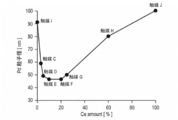
上記実施例2~7で得られた触媒C~H並びに比較例2及び3で得られた触媒I及びJを、上記耐熱処理を行った後、TEM測定においてパラジウム粒子径を測定した。測定したパラジウム粒子径を図5に示す。
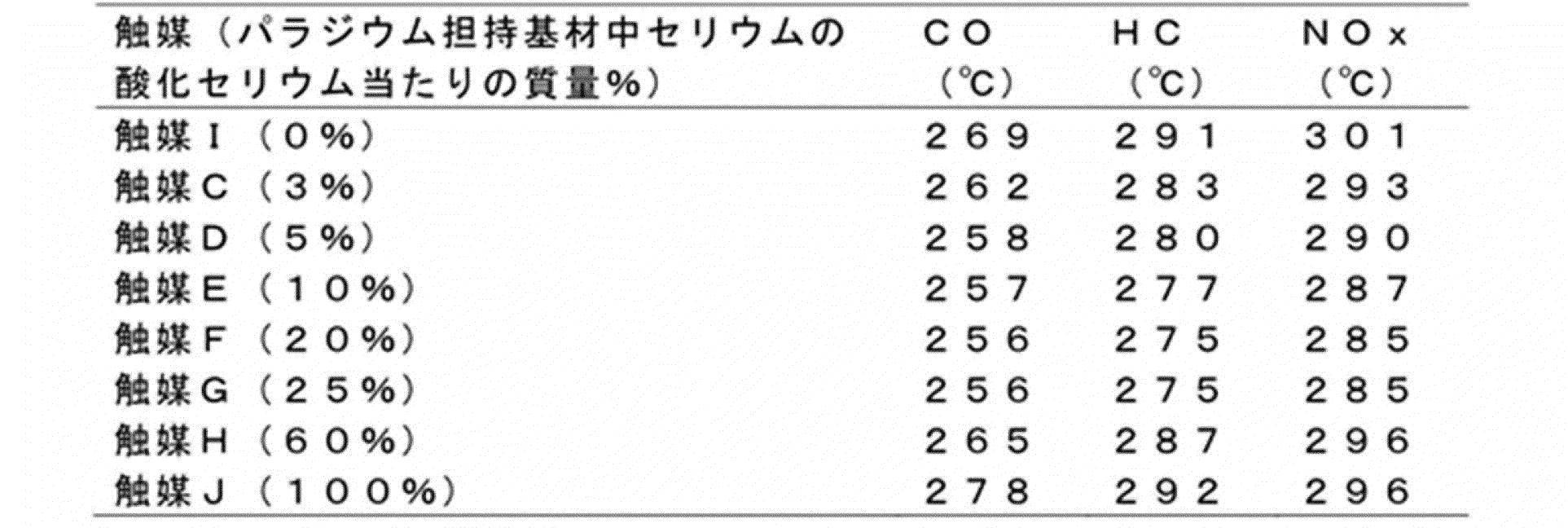
上記実施例2~7で得られた触媒C~Hならびに比較例2及び3で得られた触媒I及びJを、上記耐熱処理を行った後、A/Fは14.6となるように、NO、CO、C3H6、O2、H2およびCO2を混合し、触媒入口温度を100℃から500℃まで昇温させ、触媒出口から排出されるガスをサンプリングし、CO、THCおよびNOの各浄化率を算出した。各浄化率が50%に達する時の温度をT50として、結果を表2に示す。
Claims (10)
- パラジウムが酸化セリウム換算で3~60質量%のセリウムを含有するセリウム-アルミニウム複合酸化物に担持されてなる排気ガス浄化用触媒。
- 該セリウム-アルミニウム複合酸化物中のセリウムが該セリウム-アルミニウム複合酸化物中に均一に分散してなる請求項1記載の排気ガス浄化用触媒。
- 前記排気ガス浄化用触媒が1000℃以上の高温に曝された後、CuKα線によるX線回折測定において、担持されたパラジウムの一部がアルミニウム-セリウム-パラジウム複合物である請求項1または2に記載の排気ガス浄化用触媒。
- 前記アルミニウム-セリウム-パラジウム複合物が、AlxCeyPdz(ただし、x=9~1、y=5~1、z=7~1)である請求項3に記載の排ガス浄化用触媒。
- 前記アルミニウム-セリウム-パラジウム複合物が、Al5.0Ce1.7Pd3.3である請求項3または4に記載の排気ガス浄化用触媒。
- 該触媒が1000℃以上の高温に曝された後、CuKα線によるX線回折測定において、回折角2θ=38.5°に位置するピーク強度と、40.2°に位置するピーク強度の比が、0.18~0.45である請求項1から5のいずれか一つに記載の排気ガス浄化用触媒。
- 白金およびロジウムの少なくとも1種を含む請求項1~6のいずれか一つに記載の排気ガス浄化用触媒。
- 該パラジウムと該ロジウムとの質量比は、0.005~40である請求項7に記載の排気ガス浄化用触媒。
- 該パラジウムの該セリウム-アルミニウム複合酸化物に対する質量比は0.005~50質量%である請求項1~8のいずれか一つに記載の排気ガス浄化用触媒。
- 請求項1~9のいずれか一つに記載の触媒を用いてリン化合物を含有する排気ガスを処理することを特徴とする排気ガスの処理方法。
Priority Applications (4)
| Application Number | Priority Date | Filing Date | Title |
|---|---|---|---|
| CN201680021217.8A CN107530687A (zh) | 2015-04-07 | 2016-04-07 | 内燃机排气的净化催化剂以及使用该催化剂的排气净化方法 |
| EP16776654.2A EP3281697A4 (en) | 2015-04-07 | 2016-04-07 | Purification catalyst for internal combustion engine exhaust gases and exhaust gas purification method using said catalyst |
| JP2017511072A JP6662852B2 (ja) | 2015-04-07 | 2016-04-07 | 内燃機関排気ガスの浄化触媒及び該触媒を用いた排気ガス浄化方法 |
| US15/564,085 US11110396B2 (en) | 2015-04-07 | 2016-04-07 | Catalyst for purification of exhaust gas from internal combustion engine and exhaust gas purifying method using the catalyst |
Applications Claiming Priority (2)
| Application Number | Priority Date | Filing Date | Title |
|---|---|---|---|
| JP2015-078742 | 2015-04-07 | ||
| JP2015078742 | 2015-04-07 |
Publications (1)
| Publication Number | Publication Date |
|---|---|
| WO2016163488A1 true WO2016163488A1 (ja) | 2016-10-13 |
Family
ID=57072470
Family Applications (1)
| Application Number | Title | Priority Date | Filing Date |
|---|---|---|---|
| PCT/JP2016/061462 Ceased WO2016163488A1 (ja) | 2015-04-07 | 2016-04-07 | 内燃機関排気ガスの浄化触媒及び該触媒を用いた排気ガス浄化方法 |
Country Status (5)
| Country | Link |
|---|---|
| US (1) | US11110396B2 (ja) |
| EP (1) | EP3281697A4 (ja) |
| JP (1) | JP6662852B2 (ja) |
| CN (1) | CN107530687A (ja) |
| WO (1) | WO2016163488A1 (ja) |
Cited By (3)
| Publication number | Priority date | Publication date | Assignee | Title |
|---|---|---|---|---|
| CN108126697A (zh) * | 2017-12-19 | 2018-06-08 | 上海纳米技术及应用国家工程研究中心有限公司 | Pd负载二氧化铈-三氧化二铝复合氧化物三元催化剂的制备及产品和应用 |
| WO2018147408A1 (ja) * | 2017-02-13 | 2018-08-16 | エヌ・イーケムキャット株式会社 | 排ガス用浄化触媒組成物及びその製造方法、並びに自動車用排ガス浄化触媒 |
| JP2018171615A (ja) * | 2017-03-31 | 2018-11-08 | 株式会社キャタラー | 排ガス浄化用触媒 |
Families Citing this family (6)
| Publication number | Priority date | Publication date | Assignee | Title |
|---|---|---|---|---|
| GB2545747A (en) * | 2015-12-24 | 2017-06-28 | Johnson Matthey Plc | Gasoline particulate filter |
| EP3756760A4 (en) | 2018-02-21 | 2021-03-31 | Cataler Corporation | EXHAUST GAS PURIFICATION CATALYST DEVICE |
| WO2019163403A1 (ja) * | 2018-02-21 | 2019-08-29 | 株式会社キャタラー | 排ガス浄化触媒装置 |
| US11745169B1 (en) * | 2019-05-17 | 2023-09-05 | Unm Rainforest Innovations | Single atom metal doped ceria for CO oxidation and HC hydrogenation/oxidation |
| WO2022248205A1 (en) | 2021-05-28 | 2022-12-01 | Rhodia Operations | Composition of aluminium oxide and cerium oxide with a particular porosity profile |
| CN118055806A (zh) | 2021-07-30 | 2024-05-17 | 罗地亚经营管理公司 | 氧化铝和氧化铈的组合物 |
Citations (6)
| Publication number | Priority date | Publication date | Assignee | Title |
|---|---|---|---|---|
| JPS56130231A (en) * | 1980-03-17 | 1981-10-13 | Nissan Motor Co Ltd | Catalyst for treatment of exhaust gas |
| JPH09928A (ja) * | 1995-06-23 | 1997-01-07 | Ngk Insulators Ltd | 排ガス浄化用の低温着火性触媒組成物及び低温着火性触媒体並びにこれらを利用した排ガス浄化装置及び排ガス浄化方法 |
| JPH10182155A (ja) * | 1996-10-07 | 1998-07-07 | Toyota Central Res & Dev Lab Inc | 複合酸化物、複合酸化物担体および複合酸化物含有触媒 |
| JP2006167540A (ja) * | 2004-12-14 | 2006-06-29 | Babcock Hitachi Kk | 炭化水素吸着燃焼触媒 |
| WO2007052821A1 (ja) * | 2005-11-04 | 2007-05-10 | Toyota Jidosha Kabushiki Kaisha | 触媒担体粒子、排ガス浄化触媒、及びそれらの製造方法 |
| JP2010505600A (ja) * | 2006-10-05 | 2010-02-25 | 株式会社日本触媒 | 有機酸含有排ガス処理用触媒および有機酸含有排ガス処理方法 |
Family Cites Families (27)
| Publication number | Priority date | Publication date | Assignee | Title |
|---|---|---|---|---|
| US3993572A (en) | 1972-08-04 | 1976-11-23 | Engelhard Minerals & Chemicals Corporation | Rare earth containing catalyst composition |
| US4206087A (en) * | 1977-01-06 | 1980-06-03 | Engelhard Minerals & Chemicals Corporation | Catalyst for reducing pollutants in waste gas streams and process for preparing the catalyst |
| DE3873258D1 (de) | 1987-10-30 | 1992-09-03 | Degussa | Platin-freier dreiweg-katalysator. |
| US4868150A (en) * | 1987-12-22 | 1989-09-19 | Rhone-Poulenc Inc. | Catalyst support material containing lanthanides |
| US4868149A (en) * | 1988-05-23 | 1989-09-19 | Allied-Signal Inc. | Palladium-containing catalyst for treatment of automotive exhaust and method of manufacturing the catalyst |
| JP2581872B2 (ja) | 1992-05-15 | 1997-02-12 | エヌ・イーケムキャット株式会社 | 耐熱性に優れた内燃機関排気ガス浄化用触媒及びその製造方法 |
| JP3375358B2 (ja) | 1993-01-29 | 2003-02-10 | マツダ株式会社 | 排気ガス浄化用触媒 |
| WO1995000235A1 (en) * | 1993-06-25 | 1995-01-05 | Engelhard Corporation | Layered catalyst composite |
| JPH0838898A (ja) | 1994-08-01 | 1996-02-13 | Mazda Motor Corp | 排気ガス浄化用触媒 |
| JPH08131830A (ja) | 1994-11-07 | 1996-05-28 | Toyota Motor Corp | 排ガス浄化用触媒 |
| JPH09313938A (ja) * | 1996-06-03 | 1997-12-09 | Nissan Motor Co Ltd | 排気ガス浄化用触媒 |
| EP0834348B1 (en) | 1996-10-07 | 2004-03-31 | Kabushiki Kaisha Toyota Chuo Kenkyusho | Composite oxide, composite oxide carrier and catalyst |
| EP0842700B1 (de) | 1996-11-11 | 1999-03-24 | Degussa Ag | Abgasreinigungskatalysator mit Verbessertem Umsatz für Kohlenwasserstoffe |
| JP3035247B2 (ja) | 1997-04-26 | 2000-04-24 | 武義 平野 | 木造建築物における軸組構造 |
| JP3688974B2 (ja) | 1999-05-24 | 2005-08-31 | ダイハツ工業株式会社 | 排ガス浄化用触媒 |
| DE10024994A1 (de) | 1999-05-24 | 2001-01-04 | Daihatsu Motor Co Ltd | Katalytischer Umwandler zum Reinigen von Abgasen |
| JP4999331B2 (ja) * | 2005-03-24 | 2012-08-15 | 東京濾器株式会社 | 排気ガス浄化用触媒 |
| US20060217263A1 (en) | 2005-03-24 | 2006-09-28 | Tokyo Roki Co., Ltd | Exhaust gas purification catalyst |
| US7678347B2 (en) * | 2005-07-15 | 2010-03-16 | Basf Catalysts Llc | High phosphorous poisoning resistant catalysts for treating automobile exhaust |
| JP4760625B2 (ja) * | 2006-09-06 | 2011-08-31 | マツダ株式会社 | 排ガス浄化用触媒装置 |
| CN105935590A (zh) * | 2008-08-27 | 2016-09-14 | 优美科催化剂日本有限公司 | 废气净化用催化剂以及使用此催化剂的废气净化方法 |
| JP5428774B2 (ja) | 2009-11-10 | 2014-02-26 | マツダ株式会社 | 排気ガス浄化用触媒 |
| JP5458973B2 (ja) * | 2010-03-09 | 2014-04-02 | マツダ株式会社 | 排気ガス浄化用触媒 |
| JP5376261B2 (ja) | 2011-03-10 | 2013-12-25 | トヨタ自動車株式会社 | 排ガス浄化用触媒 |
| WO2014164876A1 (en) * | 2013-03-13 | 2014-10-09 | Basf Corporation | Nox storage catalyst with improved hydrothermal stability and nox conversion |
| CN103464152B (zh) * | 2013-09-29 | 2015-03-04 | 福州大学 | 一种尾气净化用催化剂及其制备方法 |
| KR101575327B1 (ko) * | 2014-04-24 | 2015-12-21 | 현대자동차 주식회사 | 질소산화물 저감 촉매, 이의 제조 방법, 및 질소산화물 저감 촉매 시스템 |
-
2016
- 2016-04-07 US US15/564,085 patent/US11110396B2/en active Active
- 2016-04-07 WO PCT/JP2016/061462 patent/WO2016163488A1/ja not_active Ceased
- 2016-04-07 EP EP16776654.2A patent/EP3281697A4/en not_active Withdrawn
- 2016-04-07 CN CN201680021217.8A patent/CN107530687A/zh active Pending
- 2016-04-07 JP JP2017511072A patent/JP6662852B2/ja active Active
Patent Citations (6)
| Publication number | Priority date | Publication date | Assignee | Title |
|---|---|---|---|---|
| JPS56130231A (en) * | 1980-03-17 | 1981-10-13 | Nissan Motor Co Ltd | Catalyst for treatment of exhaust gas |
| JPH09928A (ja) * | 1995-06-23 | 1997-01-07 | Ngk Insulators Ltd | 排ガス浄化用の低温着火性触媒組成物及び低温着火性触媒体並びにこれらを利用した排ガス浄化装置及び排ガス浄化方法 |
| JPH10182155A (ja) * | 1996-10-07 | 1998-07-07 | Toyota Central Res & Dev Lab Inc | 複合酸化物、複合酸化物担体および複合酸化物含有触媒 |
| JP2006167540A (ja) * | 2004-12-14 | 2006-06-29 | Babcock Hitachi Kk | 炭化水素吸着燃焼触媒 |
| WO2007052821A1 (ja) * | 2005-11-04 | 2007-05-10 | Toyota Jidosha Kabushiki Kaisha | 触媒担体粒子、排ガス浄化触媒、及びそれらの製造方法 |
| JP2010505600A (ja) * | 2006-10-05 | 2010-02-25 | 株式会社日本触媒 | 有機酸含有排ガス処理用触媒および有機酸含有排ガス処理方法 |
Non-Patent Citations (1)
| Title |
|---|
| See also references of EP3281697A4 * |
Cited By (8)
| Publication number | Priority date | Publication date | Assignee | Title |
|---|---|---|---|---|
| WO2018147408A1 (ja) * | 2017-02-13 | 2018-08-16 | エヌ・イーケムキャット株式会社 | 排ガス用浄化触媒組成物及びその製造方法、並びに自動車用排ガス浄化触媒 |
| JPWO2018147408A1 (ja) * | 2017-02-13 | 2019-12-19 | エヌ・イーケムキャット株式会社 | 排ガス用浄化触媒組成物及びその製造方法、並びに自動車用排ガス浄化触媒 |
| JP7002812B2 (ja) | 2017-02-13 | 2022-01-20 | エヌ・イーケムキャット株式会社 | 排ガス用浄化触媒組成物の製造方法 |
| JP2022061979A (ja) * | 2017-02-13 | 2022-04-19 | エヌ・イーケムキャット株式会社 | 排ガス用浄化触媒組成物、及び自動車用排ガス浄化触媒 |
| JP7187654B2 (ja) | 2017-02-13 | 2022-12-12 | エヌ・イーケムキャット株式会社 | 排ガス用浄化触媒組成物、及び自動車用排ガス浄化触媒 |
| JP2018171615A (ja) * | 2017-03-31 | 2018-11-08 | 株式会社キャタラー | 排ガス浄化用触媒 |
| JP7023770B2 (ja) | 2017-03-31 | 2022-02-22 | 株式会社キャタラー | 排ガス浄化用触媒 |
| CN108126697A (zh) * | 2017-12-19 | 2018-06-08 | 上海纳米技术及应用国家工程研究中心有限公司 | Pd负载二氧化铈-三氧化二铝复合氧化物三元催化剂的制备及产品和应用 |
Also Published As
| Publication number | Publication date |
|---|---|
| EP3281697A4 (en) | 2018-03-21 |
| US11110396B2 (en) | 2021-09-07 |
| US20180133651A1 (en) | 2018-05-17 |
| CN107530687A (zh) | 2018-01-02 |
| JP6662852B2 (ja) | 2020-03-11 |
| EP3281697A1 (en) | 2018-02-14 |
| JPWO2016163488A1 (ja) | 2017-09-14 |
Similar Documents
| Publication | Publication Date | Title |
|---|---|---|
| JP6662852B2 (ja) | 内燃機関排気ガスの浄化触媒及び該触媒を用いた排気ガス浄化方法 | |
| EP2952251B1 (en) | Exhaust-gas purification catalyst and its use | |
| CN108138617B (zh) | 废气净化过滤器 | |
| CN111432928B (zh) | 含有磷化合物的废气净化用催化剂 | |
| JP6616003B2 (ja) | 内燃機関の排気ガスの浄化用触媒および該触媒を用いた排気ガスの浄化方法 | |
| US7745371B2 (en) | Exhaust gas purifying catalyst, metal oxide particle and production process thereof | |
| WO2023143493A1 (en) | Gasoline particulate filter | |
| JP2010227931A (ja) | 排気ガス浄化用触媒及びその製造方法、並びに排気ガス浄化方法 | |
| EP3488927B1 (en) | Catalyst for purifying exhaust gas from internal combustion engine, and exhaust gas purification method using said catalyst | |
| JP5679298B2 (ja) | 排ガス浄化用触媒および当該触媒を用いた排ガス浄化方法 | |
| JP6556376B2 (ja) | 排気ガス浄化用触媒、および排気ガスの浄化方法 | |
| JP7329060B2 (ja) | 排気ガス浄化用触媒、排気ガスの浄化方法、及び排気ガス浄化用触媒の製造方法 | |
| JP2025520337A (ja) | ガソリン微粒子フィルター | |
| JP2009078203A (ja) | 排ガス浄化用触媒材、同触媒材の製造方法、及び同触媒材を用いた触媒 | |
| JP2014000516A (ja) | 触媒担持用担体、排気ガス浄化用担持触媒、及び排気ガス浄化用フィルター | |
| US20240157341A1 (en) | Exhaust gas purification catalyst and exhaust gas purification system | |
| JP2013039552A (ja) | パラジウム複合粒子 | |
| JP5956496B2 (ja) | 排ガス浄化用触媒、それを用いた排ガス浄化フィルタ及び排ガス浄化方法 | |
| WO2023085091A1 (ja) | 排ガス浄化触媒、排ガスの浄化方法、及び排ガス浄化触媒の製造方法 |
Legal Events
| Date | Code | Title | Description |
|---|---|---|---|
| 121 | Ep: the epo has been informed by wipo that ep was designated in this application |
Ref document number: 16776654 Country of ref document: EP Kind code of ref document: A1 |
|
| ENP | Entry into the national phase |
Ref document number: 2017511072 Country of ref document: JP Kind code of ref document: A |
|
| WWE | Wipo information: entry into national phase |
Ref document number: 15564085 Country of ref document: US |
|
| REEP | Request for entry into the european phase |
Ref document number: 2016776654 Country of ref document: EP |
|
| NENP | Non-entry into the national phase |
Ref country code: DE |