WO2016181745A1 - ハニカム構造体及びサンドイッチ構造体ならびにそれらを製造するためのハニカム用基材 - Google Patents
ハニカム構造体及びサンドイッチ構造体ならびにそれらを製造するためのハニカム用基材 Download PDFInfo
- Publication number
- WO2016181745A1 WO2016181745A1 PCT/JP2016/061911 JP2016061911W WO2016181745A1 WO 2016181745 A1 WO2016181745 A1 WO 2016181745A1 JP 2016061911 W JP2016061911 W JP 2016061911W WO 2016181745 A1 WO2016181745 A1 WO 2016181745A1
- Authority
- WO
- WIPO (PCT)
- Prior art keywords
- polyamide
- honeycomb structure
- honeycomb
- aliphatic
- aromatic polyamide
- Prior art date
- Legal status (The legal status is an assumption and is not a legal conclusion. Google has not performed a legal analysis and makes no representation as to the accuracy of the status listed.)
- Ceased
Links
Images


Classifications
-
- B—PERFORMING OPERATIONS; TRANSPORTING
- B32—LAYERED PRODUCTS
- B32B—LAYERED PRODUCTS, i.e. PRODUCTS BUILT-UP OF STRATA OF FLAT OR NON-FLAT, e.g. CELLULAR OR HONEYCOMB, FORM
- B32B3/00—Layered products comprising a layer with external or internal discontinuities or unevennesses, or a layer of non-planar shape; Layered products comprising a layer having particular features of form
- B32B3/10—Layered products comprising a layer with external or internal discontinuities or unevennesses, or a layer of non-planar shape; Layered products comprising a layer having particular features of form characterised by a discontinuous layer, i.e. formed of separate pieces of material
- B32B3/12—Layered products comprising a layer with external or internal discontinuities or unevennesses, or a layer of non-planar shape; Layered products comprising a layer having particular features of form characterised by a discontinuous layer, i.e. formed of separate pieces of material characterised by a layer of regularly- arranged cells, e.g. a honeycomb structure
-
- B—PERFORMING OPERATIONS; TRANSPORTING
- B32—LAYERED PRODUCTS
- B32B—LAYERED PRODUCTS, i.e. PRODUCTS BUILT-UP OF STRATA OF FLAT OR NON-FLAT, e.g. CELLULAR OR HONEYCOMB, FORM
- B32B27/00—Layered products comprising a layer of synthetic resin
- B32B27/34—Layered products comprising a layer of synthetic resin comprising polyamides
-
- B—PERFORMING OPERATIONS; TRANSPORTING
- B32—LAYERED PRODUCTS
- B32B—LAYERED PRODUCTS, i.e. PRODUCTS BUILT-UP OF STRATA OF FLAT OR NON-FLAT, e.g. CELLULAR OR HONEYCOMB, FORM
- B32B7/00—Layered products characterised by the relation between layers; Layered products characterised by the relative orientation of features between layers, or by the relative values of a measurable parameter between layers, i.e. products comprising layers having different physical, chemical or physicochemical properties; Layered products characterised by the interconnection of layers
- B32B7/04—Interconnection of layers
- B32B7/12—Interconnection of layers using interposed adhesives or interposed materials with bonding properties
-
- C—CHEMISTRY; METALLURGY
- C08—ORGANIC MACROMOLECULAR COMPOUNDS; THEIR PREPARATION OR CHEMICAL WORKING-UP; COMPOSITIONS BASED THEREON
- C08L—COMPOSITIONS OF MACROMOLECULAR COMPOUNDS
- C08L77/00—Compositions of polyamides obtained by reactions forming a carboxylic amide link in the main chain; Compositions of derivatives of such polymers
- C08L77/02—Polyamides derived from omega-amino carboxylic acids or from lactams thereof
-
- C—CHEMISTRY; METALLURGY
- C08—ORGANIC MACROMOLECULAR COMPOUNDS; THEIR PREPARATION OR CHEMICAL WORKING-UP; COMPOSITIONS BASED THEREON
- C08L—COMPOSITIONS OF MACROMOLECULAR COMPOUNDS
- C08L77/00—Compositions of polyamides obtained by reactions forming a carboxylic amide link in the main chain; Compositions of derivatives of such polymers
- C08L77/06—Polyamides derived from polyamines and polycarboxylic acids
-
- E—FIXED CONSTRUCTIONS
- E04—BUILDING
- E04C—STRUCTURAL ELEMENTS; BUILDING MATERIALS
- E04C2/00—Building elements of relatively thin form for the construction of parts of buildings, e.g. sheet materials, slabs, or panels
- E04C2/30—Building elements of relatively thin form for the construction of parts of buildings, e.g. sheet materials, slabs, or panels characterised by the shape or structure
- E04C2/34—Building elements of relatively thin form for the construction of parts of buildings, e.g. sheet materials, slabs, or panels characterised by the shape or structure composed of two or more spaced sheet-like parts
- E04C2/36—Building elements of relatively thin form for the construction of parts of buildings, e.g. sheet materials, slabs, or panels characterised by the shape or structure composed of two or more spaced sheet-like parts spaced apart by transversely-placed strip material, e.g. honeycomb panels
- E04C2/365—Building elements of relatively thin form for the construction of parts of buildings, e.g. sheet materials, slabs, or panels characterised by the shape or structure composed of two or more spaced sheet-like parts spaced apart by transversely-placed strip material, e.g. honeycomb panels by honeycomb structures
-
- B—PERFORMING OPERATIONS; TRANSPORTING
- B32—LAYERED PRODUCTS
- B32B—LAYERED PRODUCTS, i.e. PRODUCTS BUILT-UP OF STRATA OF FLAT OR NON-FLAT, e.g. CELLULAR OR HONEYCOMB, FORM
- B32B2250/00—Layers arrangement
- B32B2250/03—3 layers
-
- B—PERFORMING OPERATIONS; TRANSPORTING
- B32—LAYERED PRODUCTS
- B32B—LAYERED PRODUCTS, i.e. PRODUCTS BUILT-UP OF STRATA OF FLAT OR NON-FLAT, e.g. CELLULAR OR HONEYCOMB, FORM
- B32B2250/00—Layers arrangement
- B32B2250/24—All layers being polymeric
-
- B—PERFORMING OPERATIONS; TRANSPORTING
- B32—LAYERED PRODUCTS
- B32B—LAYERED PRODUCTS, i.e. PRODUCTS BUILT-UP OF STRATA OF FLAT OR NON-FLAT, e.g. CELLULAR OR HONEYCOMB, FORM
- B32B2250/00—Layers arrangement
- B32B2250/40—Symmetrical or sandwich layers, e.g. ABA, ABCBA, ABCCBA
-
- B—PERFORMING OPERATIONS; TRANSPORTING
- B32—LAYERED PRODUCTS
- B32B—LAYERED PRODUCTS, i.e. PRODUCTS BUILT-UP OF STRATA OF FLAT OR NON-FLAT, e.g. CELLULAR OR HONEYCOMB, FORM
- B32B2262/00—Composition or structural features of fibres which form a fibrous or filamentary layer or are present as additives
- B32B2262/10—Inorganic fibres
- B32B2262/101—Glass fibres
-
- B—PERFORMING OPERATIONS; TRANSPORTING
- B32—LAYERED PRODUCTS
- B32B—LAYERED PRODUCTS, i.e. PRODUCTS BUILT-UP OF STRATA OF FLAT OR NON-FLAT, e.g. CELLULAR OR HONEYCOMB, FORM
- B32B2305/00—Condition, form or state of the layers or laminate
- B32B2305/02—Cellular or porous
- B32B2305/024—Honeycomb
-
- B—PERFORMING OPERATIONS; TRANSPORTING
- B32—LAYERED PRODUCTS
- B32B—LAYERED PRODUCTS, i.e. PRODUCTS BUILT-UP OF STRATA OF FLAT OR NON-FLAT, e.g. CELLULAR OR HONEYCOMB, FORM
- B32B2307/00—Properties of the layers or laminate
- B32B2307/30—Properties of the layers or laminate having particular thermal properties
- B32B2307/306—Resistant to heat
-
- B—PERFORMING OPERATIONS; TRANSPORTING
- B32—LAYERED PRODUCTS
- B32B—LAYERED PRODUCTS, i.e. PRODUCTS BUILT-UP OF STRATA OF FLAT OR NON-FLAT, e.g. CELLULAR OR HONEYCOMB, FORM
- B32B2307/00—Properties of the layers or laminate
- B32B2307/50—Properties of the layers or laminate having particular mechanical properties
- B32B2307/54—Yield strength; Tensile strength
-
- B—PERFORMING OPERATIONS; TRANSPORTING
- B32—LAYERED PRODUCTS
- B32B—LAYERED PRODUCTS, i.e. PRODUCTS BUILT-UP OF STRATA OF FLAT OR NON-FLAT, e.g. CELLULAR OR HONEYCOMB, FORM
- B32B2307/00—Properties of the layers or laminate
- B32B2307/50—Properties of the layers or laminate having particular mechanical properties
- B32B2307/546—Flexural strength; Flexion stiffness
-
- B—PERFORMING OPERATIONS; TRANSPORTING
- B32—LAYERED PRODUCTS
- B32B—LAYERED PRODUCTS, i.e. PRODUCTS BUILT-UP OF STRATA OF FLAT OR NON-FLAT, e.g. CELLULAR OR HONEYCOMB, FORM
- B32B2307/00—Properties of the layers or laminate
- B32B2307/50—Properties of the layers or laminate having particular mechanical properties
- B32B2307/558—Impact strength, toughness
-
- B—PERFORMING OPERATIONS; TRANSPORTING
- B32—LAYERED PRODUCTS
- B32B—LAYERED PRODUCTS, i.e. PRODUCTS BUILT-UP OF STRATA OF FLAT OR NON-FLAT, e.g. CELLULAR OR HONEYCOMB, FORM
- B32B2307/00—Properties of the layers or laminate
- B32B2307/70—Other properties
- B32B2307/724—Permeability to gases, adsorption
- B32B2307/7242—Non-permeable
-
- B—PERFORMING OPERATIONS; TRANSPORTING
- B32—LAYERED PRODUCTS
- B32B—LAYERED PRODUCTS, i.e. PRODUCTS BUILT-UP OF STRATA OF FLAT OR NON-FLAT, e.g. CELLULAR OR HONEYCOMB, FORM
- B32B2419/00—Buildings or parts thereof
-
- B—PERFORMING OPERATIONS; TRANSPORTING
- B32—LAYERED PRODUCTS
- B32B—LAYERED PRODUCTS, i.e. PRODUCTS BUILT-UP OF STRATA OF FLAT OR NON-FLAT, e.g. CELLULAR OR HONEYCOMB, FORM
- B32B2457/00—Electrical equipment
-
- B—PERFORMING OPERATIONS; TRANSPORTING
- B32—LAYERED PRODUCTS
- B32B—LAYERED PRODUCTS, i.e. PRODUCTS BUILT-UP OF STRATA OF FLAT OR NON-FLAT, e.g. CELLULAR OR HONEYCOMB, FORM
- B32B2509/00—Household appliances
-
- B—PERFORMING OPERATIONS; TRANSPORTING
- B32—LAYERED PRODUCTS
- B32B—LAYERED PRODUCTS, i.e. PRODUCTS BUILT-UP OF STRATA OF FLAT OR NON-FLAT, e.g. CELLULAR OR HONEYCOMB, FORM
- B32B2535/00—Medical equipment, e.g. bandage, prostheses or catheter
-
- B—PERFORMING OPERATIONS; TRANSPORTING
- B32—LAYERED PRODUCTS
- B32B—LAYERED PRODUCTS, i.e. PRODUCTS BUILT-UP OF STRATA OF FLAT OR NON-FLAT, e.g. CELLULAR OR HONEYCOMB, FORM
- B32B2605/00—Vehicles
- B32B2605/08—Cars
-
- B—PERFORMING OPERATIONS; TRANSPORTING
- B32—LAYERED PRODUCTS
- B32B—LAYERED PRODUCTS, i.e. PRODUCTS BUILT-UP OF STRATA OF FLAT OR NON-FLAT, e.g. CELLULAR OR HONEYCOMB, FORM
- B32B2605/00—Vehicles
- B32B2605/12—Ships
-
- B—PERFORMING OPERATIONS; TRANSPORTING
- B32—LAYERED PRODUCTS
- B32B—LAYERED PRODUCTS, i.e. PRODUCTS BUILT-UP OF STRATA OF FLAT OR NON-FLAT, e.g. CELLULAR OR HONEYCOMB, FORM
- B32B2605/00—Vehicles
- B32B2605/18—Aircraft
Definitions
- Honeycomb structures are lightweight and have excellent mechanical properties, so they have been widely used as interior materials and exterior materials for structures in various industrial fields such as automobiles, aircraft, ships, and civil engineering buildings. Yes. Synthetic resin honeycomb structures are also used as shock absorbing parts for automobiles and the like.
- a thermoplastic resin composition comprising a polyamide such as nylon 6 blended with an ethylene-unsaturated carboxylic acid ester copolymer such as a glycidyl methacrylate-modified polyethylene copolymer.
- honeycomb structure and a sandwich structure that are lightweight but have excellent mechanical properties, gas barrier properties, water resistance and heat resistance, and a honeycomb substrate that facilitates the production thereof. It has been demanded.
- an aromatic polyamide containing a xylylene-based diamine unit and an ⁇ , ⁇ -linear aliphatic dicarboxylic acid unit in a predetermined range and an aliphatic polyamide.
- a honeycomb structure composed of a thermoplastic resin composition blended at a predetermined blending ratio is excellent in mechanical properties such as rigidity and toughness as well as gas barrier properties, water resistance and heat resistance while being lightweight. I found it.
- thermoplastic resin composition comprising an aromatic polyamide containing a xylylene-based diamine unit and an ⁇ , ⁇ -linear aliphatic dicarboxylic acid unit in a predetermined range and an aliphatic polyamide in a predetermined mixing ratio.
- the substrate for a honeycomb formed by forming a film or sheet into a honeycomb structure is less likely to cause unevenness such as cracks and wrinkles when formed into a honeycomb structure, and cell members such as adjacent cell side walls are easily welded together, and formability I also found it excellent.
- the mechanical properties and gas barrier properties of the resulting honeycomb structure can be further enhanced by adding stretching to at least a part of the honeycomb substrate. As a result, the present invention has been completed.
- the aliphatic polyamide (B) is a polyamide containing an aliphatic group as a repeating unit, and the total number of carbon atoms constituting the aliphatic group is 10 to 24, A honeycomb structure having a blending ratio of aromatic polyamide (A): aliphatic polyamide (B) in a range of 100: 25 to 400 on a mass basis.
- the aliphatic polyamide (B) is at least one selected from the group consisting of polyamide 11, polyamide 12, polyamide 6,6, polyamide 6,10, polyamide 6,12 and polyamide 10,10.
- the simulated gasoline CE10 transmittance of the thermoplastic resin composition constituting the honeycomb structure is 15 (g ⁇ mm / m 2 ⁇ day) or less, according to any one of [1] to [3] Honeycomb structure.
- a deflection temperature under load (load 1.80 MPa) of the thermoplastic resin composition constituting the honeycomb structure is in a range of 40 to 150 ° C. Structure.
- a honeycomb structure formed of a plurality of cells, the cells being limited by a hexagonal surface layer that continuously or intermittently connects the cells to either one of the upper and lower surfaces, and A three-dimensional structure having cell side walls adjacent to each other in an annular shape, wherein the hexagonal surface layer and the cell side walls are perpendicular to each other, and the honeycomb structure is obtained by plastic deformation of a honeycomb substrate. And a honeycomb structure part having a connection region that becomes the hexagonal surface layer after being folded, and is formed without being cut substantially. [1] to [1] 6] The honeycomb structure according to any one of the above.
- the honeycomb structure according to [7] which has at least a part of a cell side wall and a surface layer surface that are stretched in a horizontal direction with respect to the surface layer surface.
- a sandwich structure in which flat plates made of a material different from the material constituting the honeycomb structure are arranged on the upper and lower surfaces of the honeycomb structure according to any one of [1] to [9].
- the aliphatic polyamide (B) is a polyamide containing an aliphatic group as a repeating unit, and the total number of carbon atoms constituting the aliphatic group is 10 to 24, A substrate for a honeycomb, wherein the blending ratio of aromatic polyamide (A): aliphatic polyamide (B) is in the range of 100: 25 to 400 on a mass basis.
- a lightweight honeycomb structure and a sandwich structure having excellent mechanical properties, gas barrier properties, water resistance and heat resistance, and a honeycomb structure that facilitates the manufacture of the honeycomb structure and the sandwich structure A substrate for use can be obtained.
- 1 is a schematic perspective view showing a partial structure of a honeycomb structure according to an embodiment of the present invention.
- 1 is a schematic perspective view of a honeycomb structure part having a three-dimensional structure and a connection region obtained by plastic deformation of a honeycomb substrate according to an embodiment of the present invention.
- 1 is a schematic cross-sectional view of a honeycomb structure part having a three-dimensional structure and a connection region obtained by plastic deformation of a honeycomb substrate according to an embodiment of the present invention.
- 1 is a schematic perspective view showing a folded shape of a honeycomb structure component according to an embodiment of the present invention. It is explanatory drawing which shows the one aspect
- a polyamide containing The aliphatic polyamide (B) is a polyamide containing an aliphatic group as a repeating unit, and the total number of carbon atoms constituting the aliphatic group is 10 to 24, It is characterized by comprising a thermoplastic resin composition having a blending ratio of aromatic polyamide (A): aliphatic polyamide (B) in the range of 100: 25 to 400 on a mass basis.
- the honeycomb structure of the present invention is manufactured from a thermoplastic resin composition containing a specific aromatic polyamide (A) and an aliphatic polyamide (B) at a predetermined blending ratio.
- a honeycomb structure having excellent mechanical properties, gas barrier properties, water resistance, heat resistance, and moldability while being lightweight is obtained.
- the mechanical properties and gas barrier properties of the resulting honeycomb structure are further enhanced by adding stretching to at least a part of the thermoplastic resin composition when forming into a honeycomb structure. Can do.
- the aromatic polyamide (A) and the aliphatic polyamide (B) in the thermoplastic resin composition are oriented to form a layer structure. It is considered that gas barrier properties are improved and mechanical properties are also improved.
- the aromatic polyamide (A) and the aliphatic polyamide (B) which are components of the thermoplastic resin composition constituting the honeycomb structure of the present invention will be described.
- Aromatic polyamide (A) The aromatic polyamide (A) used in the present invention has a diamine unit containing 70 mol% or more of a xylylenediamine unit represented by the following general formula (I) and a carbon number of 4 to 20 represented by the following general formula (II): A polyamide containing a dicarboxylic acid unit containing 50 mol% or more of an ⁇ , ⁇ -linear aliphatic dicarboxylic acid unit. [In the formula (II), n is an integer of 2 to 18. ]
- the total of the diamine unit and the dicarboxylic acid unit does not exceed 100 mol%.
- the aromatic polyamide (A) may contain a structural unit other than the above as long as the effects of the present invention are not impaired.
- Examples of the compound that can constitute the xylylenediamine unit include orthoxylylenediamine, metaxylylenediamine, and paraxylylenediamine. Among these, it is preferable to use metaxylylenediamine, paraxylylenediamine or a mixture thereof, and it is more preferable to use metaxylylenediamine.
- the honeycomb structure of the present invention can exhibit not only water resistance and heat resistance, but also high strength and high elastic modulus, and excellent gas barrier properties, and the moldability of the thermoplastic resin composition can be improved. Therefore, in the diamine unit, the metaxylylenediamine unit is preferably 70 mol% or more, more preferably 80 mol% or more, and particularly preferably 90 mol% or more.
- the amount of paraxylenediamine and paraxylylenediamine relative to the total amount of metaxylylenediamine and paraxylylenediamine is determined.
- the proportion of xylylenediamine is preferably 90 mol% or less, more preferably 50 mol% or less, and still more preferably 35 mol% or less.
- the aromatic polyamide (A) can be imparted with appropriate heat resistance and crystallinity, and the moldability of the thermoplastic resin composition is improved. be able to.
- Compounds that can constitute diamine units other than xylylenediamine units include aromatic diamines such as paraphenylenediamine; 1,2-bis (aminomethyl) cyclohexane, 1,3-bis (aminomethyl) cyclohexane, and 1, Cycloaliphatic diamines such as 4-bis (aminomethyl) cyclohexane; ethylenediamine, 1,3-propylenediamine, tetramethylenediamine, pentamethylenediamine, hexamethylenediamine, heptamethylenediamine, octamethylenediamine, nonamethylenediamine, deca Aliphatic diamines such as methylenediamine, undecamethylene, dodecamethylenediamine, 2-methyl-1,5-pentanediamine, 1-amino-3-aminomethyl-3,5,5-trimethylcyclohexane; Jeff manufactured by Huntsman Min and Erasutamin can be exemplified a
- the dicarboxylic acid unit in the polyamide (A) contains ⁇ , ⁇ -linear aliphatic dicarboxylic acid unit represented by the general formula (II) in a total of 50 mol% or more in the dicarboxylic acid unit.
- the content of ⁇ , ⁇ -linear aliphatic dicarboxylic acid units in dicarboxylic acid units is preferably 70 mol% or more, and more preferably. Is 80 mol% or more, more preferably 90 mol% or more.
- Examples of compounds that can constitute dicarboxylic acid units other than the dicarboxylic acid unit represented by the general formula (II) include oxalic acid, malonic acid, fumaric acid, maleic acid, 1,3-benzenediacetic acid, and 1,4-benzenediene.
- Examples thereof include, but are not limited to, dicarboxylic acids such as acetic acid, terephthalic acid, isophthalic acid, and 2,6-naphthalenedicarboxylic acid. These can be used alone or in combination of two or more.
- the amount of the component having a number average molecular weight of 1000 or less is preferably 5% by mass or less, more preferably 4% by mass or less, and still more preferably 3% by mass or less.
- the amount of the component having a number average molecular weight of 1000 or less is within the above range, the composition tends to have appropriate fluidity and good vacuum formability.
- Examples of the polycondensation method of the aromatic polyamide (A) include, but are not limited to, a reactive extrusion method, a pressurized salt method, an atmospheric pressure dropping method, and a pressure dropping method.
- the normal pressure dropping method and the pressure dropping method are preferable in terms of cost merit because no solvent is used.
- the one where reaction temperature is as low as possible can suppress the yellowing and gelatinization of an aromatic polyamide (A), and since the stable property aromatic polyamide (A) is obtained, it is preferable.
- the pressurized salt method is a method of performing melt polycondensation under pressure using a nylon salt as a raw material. Specifically, after preparing a nylon salt aqueous solution composed of a diamine component and a dicarboxylic acid component, the aqueous solution is concentrated and then heated under pressure to perform polycondensation while removing condensed water. While gradually returning the inside of the can to normal pressure, the temperature was raised to about the melting point of the aromatic polyamide (A) + 10 ° C. and held, and then the pressure was gradually reduced to 0.02 MPaG and held at the same temperature. Continue polycondensation. When a certain stirring torque is reached, the inside of the can is pressurized to about 0.3 MPaG with nitrogen to recover the aromatic polyamide (A).
- the normal pressure dropping method is a method in which a dicarboxylic acid component is heated and melted under normal pressure, a diamine component is continuously dropped, and polycondensation is performed while removing condensed water. At this time, the polycondensation reaction is performed while raising the temperature of the reaction system so that the reaction temperature does not fall below the melting point of the polyamide compound to be produced.
- the atmospheric pressure dropping method does not use water to dissolve the salt, so the yield per batch is large, and the reaction rate is not required for vaporization / condensation of raw material components. The process time can be shortened.
- the method for adjusting the melt viscosity of the aromatic polyamide (A), that is, the number average molecular weight is not limited to the method for determining the polymerization end point with the stirring torque in the polymerization method described above, but in the monomer charging stage in advance. There is a method of setting the target number average molecular weight by adjusting the offset from 1.
- a phosphorus atom-containing compound examples include phosphinic acid compounds such as dimethylphosphinic acid and phenylmethylphosphinic acid; hypophosphorous acid, sodium hypophosphite, potassium hypophosphite, lithium hypophosphite, magnesium hypophosphite, Diphosphite compounds such as calcium hypophosphite and ethyl hypophosphite; phosphonic acid, sodium phosphonate, potassium phosphonate, lithium phosphonate, potassium phosphonate, magnesium phosphonate, calcium phosphonate, phenylphosphonic acid, ethylphosphone Phosphonic acid compounds such as acid, sodium phenylphosphonate, potassium phenylphosphonate, lithium phenylphosphonate, diethyl phenylphosphonate, sodium
- Phosphonic acid compounds Phosphonic acid compounds; phosphorous acid, sodium hydrogen phosphite, sodium phosphite, lithium phosphite, potassium phosphite, magnesium phosphite, calcium phosphite, triethyl phosphite, triphenyl phosphite, pyro-subite
- Examples thereof include phosphorous acid compounds such as phosphoric acid.
- hypophosphite metal salts such as sodium hypophosphite, potassium hypophosphite, lithium hypophosphite and the like are particularly preferable because they are highly effective in promoting amidation reaction and excellent in anti-coloring effect.
- sodium hypophosphite is preferred.
- Aliphatic polyamide (B) used in the present invention is a polyamide containing an aliphatic group as a repeating unit and having a total of 10 to 24 carbon atoms constituting the aliphatic group.
- Examples of the polyamide having an aliphatic group as a repeating unit and having a total of 10 to 24 carbon atoms constituting the aliphatic group include a structural unit derived from a lactam having 10 to 12 carbon atoms and a carbon number of 10
- the polyamides (B1) and (B2) will be described.
- the polyamide (B1) contains at least one of a structural unit derived from a lactam having 10 to 12 carbon atoms and a structural unit derived from an aminocarboxylic acid having 10 to 12 carbon atoms.
- the number of carbon atoms of the structural unit derived from lactam and the structural unit derived from aminocarboxylic acid is preferably 11 to 12 from the viewpoints of flexibility and availability.
- the structural unit derived from a lactam having 10 to 12 carbon atoms and the structural unit derived from an aminocarboxylic acid having 10 to 12 carbon atoms are usually composed of an ⁇ -aminocarboxylic acid unit represented by the following general formula (B-1).
- p represents an integer of 9 to 11, preferably 10 to 11.
- Specific examples of the compound constituting the structural unit derived from lactam having 10 to 12 carbon atoms include decane lactam, undecane lactam, and dodecane lactam.
- Examples of the compound constituting the structural unit derived from an aminocarboxylic acid having 10 to 12 carbon atoms include 10-aminodecanoic acid, 11-aminoundecanoic acid, and 12-aminododecanoic acid.
- the polyamide (B1) is not limited to those composed of at least one of structural units derived from lactam having 10 to 12 carbon atoms and aminocarboxylic acid having 10 to 12 carbon atoms, and may be any one having these structural units as a main component. Good.
- “main component” is intended to allow other structural units to be included within a range not impeding the effects of the present invention, and is not particularly limited.
- At least one of a lactam structural unit having 10 to 12 carbon atoms and a structural unit derived from an aminocarboxylic acid having 10 to 12 carbon atoms is, for example, 60 mol% or more, preferably 80 to 100, as a monomer. It occupies a range of mol%, more preferably 90 to 100 mol%.
- the other structural unit in the polyamide (B1) is derived from, for example, a lactam other than a lactam having 10 to 12 carbon atoms, an aminocarboxylic acid other than an aminocarboxylic acid having 10 to 12 carbon atoms, or a nylon salt composed of a diamine and a dicarboxylic acid. These structural units are listed.
- lactams other than those having 10 to 12 carbon atoms include lactams having 3 or more members, and specific examples include ⁇ -caprolactam, ⁇ -enantolactam, ⁇ -pyrrolidone, ⁇ -piperidone, and the like.
- lactams having 3 or more members include lactams having 3 or more members, and specific examples include ⁇ -caprolactam, ⁇ -enantolactam, ⁇ -pyrrolidone, ⁇ -piperidone, and the like.
- aminocarboxylic acids other than those having 10 to 12 carbon atoms include 6-aminocaproic acid, 7-aminoheptanoic acid and 9-aminononanoic acid.
- dicarboxylic acid constituting the nylon salt examples include succinic acid, glutaric acid, adipic acid, pimelic acid, suberic acid, azelaic acid, sebacic acid, 1,9-nonanedicarboxylic acid, 1,10-decanedicarboxylic acid, 1,11. -Aliphatic carboxylic acids such as undecanedicarboxylic acid, 1,12-dodecanedicarboxylic acid, 1,3- or 1,4-cyclohexanedicarboxylic acid, dicyclohexanemethane-4,4'-dicarboxylic acid, norbornane dicarboxylic acid, etc. Mention may be made of alicyclic dicarboxylic acids, isophthalic acid, terephthalic acid, aromatic dicarboxylic acids such as 1,4-, 2,6- or 2,7-naphthalenedicarboxylic acid.
- Polyamide (B1) includes, as a main component, at least one of a structural unit derived from undecane lactam and a structural unit derived from 11-aminoundecanoic acid, or a structural unit derived from dodecane lactam and 12-aminododecanoic acid
- Polyamide 12 having at least one of the structural units as a main component, or a mixture of these polyamide 11 and polyamide 12 is preferred.
- polyamide 6T / 12, polyamide 9T / 12, and the like including a structural unit other than the structural unit derived from undecane lactam and the structural unit derived from 11-aminoundecanoic acid are exemplified.
- Polyamide (B1) can be obtained by polymerizing the above constituent monomers. For example, it can be obtained by ring-opening polymerization of lactam or polycondensation of aminocarboxylic acid.
- the polymerization method is not particularly limited, and known methods such as melt polymerization, solution polymerization, and solid phase polymerization can be employed. These polymerization methods can be used alone or in appropriate combination.
- Production equipment includes known polyamides such as batch reaction kettles, single tank or multi-tank continuous reaction apparatuses, tubular continuous reaction apparatuses, kneading reaction extruders such as uniaxial kneading extruders and biaxial kneading extruders, etc. Manufacturing equipment can be used.
- a small amount of monoamine, monocarboxylic acid or the like may be added as a molecular weight regulator.
- a phosphorus atom-containing compound, an alkali metal compound, an alkaline earth metal compound, etc. may be added.
- the melting point Tm of the polyamide (B1) is preferably 160 to 240 ° C., more preferably 165 to 230 ° C., and further preferably 170 to 225 ° C. from the viewpoints of heat resistance and melt moldability.
- the polyamide (B2) includes a structural unit derived from an aliphatic diamine having 6 to 12 carbon atoms and a structural unit derived from an aliphatic dicarboxylic acid having 6 to 12 carbon atoms.
- the compound that can constitute the diamine unit of the polyamide (B2) is an aliphatic diamine having 6 to 12 carbon atoms.
- the aliphatic group of the aliphatic diamine having 6 to 12 carbon atoms is a linear or branched divalent aliphatic hydrocarbon group, and may be a saturated aliphatic group or an unsaturated aliphatic group. Usually, it is a linear saturated aliphatic group.
- Examples of the compound that can constitute the diamine unit of the polyamide (B2) include aliphatic diamines such as hexamethylene diamine, heptamethylene diamine, octamethylene diamine, nonamethylene diamine, decamethylene diamine, undecamethylene diamine, and dodecamethylene diamine. However, it is not limited to these. These can be used alone or in combination of two or more.
- the diamine unit in the polyamide (B2) preferably contains 70 mol% or more, more preferably 80 to 100 mol% of a structural unit derived from an aliphatic diamine having 6 to 12 carbon atoms from the viewpoint of flexibility and the like.
- the content is preferably 90 to 100 mol%.
- the diamine unit in the polyamide (B2) may consist only of a structural unit derived from an aliphatic diamine having 6 to 12 carbon atoms, or a structural unit derived from a diamine other than an aliphatic diamine having 6 to 12 carbon atoms. It may contain.
- the compound that can constitute the dicarboxylic acid unit in the polyamide (B2) is an aliphatic dicarboxylic acid having 6 to 12 carbon atoms, such as adipic acid, pimelic acid, suberic acid, azelaic acid, sebacic acid, 1,9-nonanedicarboxylic acid. Examples include acid and 1,10-decanedicarboxylic acid. These can be used alone or in combination of two or more.
- the dicarboxylic acid unit in the polyamide (B2) preferably contains 70 mol% or more of a structural unit derived from an aliphatic dicarboxylic acid having 6 to 12 carbon atoms, more preferably 80 to 80% from the viewpoint of improving flexibility.
- the dicarboxylic acid unit in the polyamide (B2) may be composed only of a structural unit derived from an aliphatic dicarboxylic acid having 6 to 12 carbon atoms, but a dicarboxylic acid other than an aliphatic dicarboxylic acid having 6 to 12 carbon atoms. You may contain the structural unit derived from.
- examples of the dicarboxylic acid other than the aliphatic dicarboxylic acid having 6 to 12 carbon atoms include succinic acid, glutaric acid, 1,11-undecanedicarboxylic acid, 1,12-dodecanedicarboxylic acid, 1,13-triic acid.
- examples include aliphatic carboxylic acids having 5 or 13 carbon atoms such as decanedicarboxylic acid and 1,14-tetradecanedicarboxylic acid; aromatic dicarboxylic acids such as terephthalic acid, isophthalic acid, and 2,6-naphthalenedicarboxylic acid.
- the polyamide (B2) is obtained by polycondensation of a diamine component and a dicarboxylic acid component.
- polyamide can be produced by a method in which a salt composed of a diamine component and a dicarboxylic acid component is heated in a pressurized state in the presence of water and polymerized in a molten state while removing added water and condensed water.
- the polyamide can also be produced by a method in which a diamine component is directly added to a molten dicarboxylic acid component and polycondensed under normal pressure.
- the diamine component is continuously added to the dicarboxylic acid component, and the reaction system is heated up so that the reaction temperature does not fall below the melting point of the generated oligoamide and polyamide.
- polycondensation proceeds.
- a small amount of monoamine, monocarboxylic acid or the like may be added as a molecular weight regulator.
- a phosphorus atom-containing compound in order to obtain the effect of promoting the amidation reaction and the effect of preventing coloration at the time of polycondensation, a phosphorus atom-containing compound, an alkali metal compound, an alkaline earth metal compound, etc.
- Known additives may be added.
- the melting point Tm of the polyamide (B2) is preferably 160 to 240 ° C., more preferably 165 to 230 ° C., and further preferably 170 to 225 ° C. from the viewpoints of heat resistance and melt moldability.
- aliphatic polyamide (B) used in the present invention include one selected from the group consisting of polyamide 11, polyamide 12, polyamide 6,6, polyamide 6,10, polyamide 6,12 and polyamide 10,10. The above is preferable, and polyamide 11, polyamide 12, polyamide 6,6, polyamide 6,10, polyamide 6,12, polyamide 10,10 or a mixture thereof is more preferable.
- the blending ratio of aromatic polyamide (A): aliphatic polyamide (B) is in the range of 100: 25 to 400, preferably 100: 25 to 200, more preferably 100: 50 to 200, based on mass. : 50 to 150 is more preferable.
- the total amount of the aromatic polyamide (A) and the aliphatic polyamide (B) is preferably 70% by mass or more, more preferably 80% by mass or more, and further preferably 90% by mass or more. It is. Within this range, moldability is not impaired by any component other than the aromatic polyamide (A) and the aliphatic polyamide (B).
- the aromatic polyamide (A) and the aliphatic polyamide (B) may react with the additive.
- the shape of the honeycomb structure of the present invention is not particularly limited as long as it is made of the above-described thermoplastic resin composition. From the viewpoint of ensuring higher strength, it is preferable that a plurality of hexagonal columnar cells are arranged in a row.
- the cells constituting the honeycomb structure are limited by a hexagonal surface layer that continuously or intermittently connects the cells to either one of the upper and lower surfaces, and are adjacent to each other in a ring shape. It has a cell side wall, and it is preferable that the hexagonal surface layer and the cell side wall are perpendicular to each other.
- the honeycomb structure having the above structure has high strength and excellent continuous formability.
- FIG. 1 is a schematic perspective view showing a partial structure of a honeycomb structure which is a preferred embodiment of the present invention.
- the honeycomb structure 100 is composed of a plurality of cells 1a and 1b, and the cells 1a and 1b are each composed of a cell side wall 2 and a surface layer.
- the surface layer is composed of the upper surface member 3a or the lower surface member 3b.
- the cell 1a is composed of the cell side wall 2 and the lower surface member 3b
- the cell 1b is composed of the cell side wall 2 and the upper surface member 3a.
- the cells 1a and 1b are extracted one by one.
- the honeycomb structure 100 is formed by arranging a plurality of hexagonal columnar cells (cell 1a, cell 1b) in a straight line.
- Each cell has a hexagonal surface layer, that is, an upper surface member 3a or a lower surface member 3b on either the upper surface or the lower surface, and the other is open.
- the cell side walls 2 adjacent to each other in a ring shape having six sides of the surface layer as one side are provided, and the surface layer surface and the cell side walls 2 are perpendicular to each other.
- the cell side wall 2 is formed of a rectangular flat plate, and the six cell side walls 2 are formed by connecting the long sides of the six cell side walls 2 to the long sides of the adjacent cell side walls 2 to form a hexagonal columnar body.
- a hexagonal end is formed by the short side.
- the upper end or lower end of this hexagonal columnar body is closed by a hexagonal surface layer (upper surface member 3a or lower surface member 3b).
- the opposite end portions of the upper surface member 3a and the lower surface member 3b are open.
- FIG. 2 is a schematic perspective view of a honeycomb structure part having a three-dimensional structure and a connection region obtained by plastic deformation of a honeycomb substrate according to an embodiment of the present invention.
- FIG. 3 is a schematic cross-sectional view of a honeycomb structure part having a three-dimensional structure and a connection region obtained by plastic deformation of a honeycomb substrate according to an embodiment of the present invention.
- FIG. 4 is a schematic view showing one embodiment of a shape in which the honeycomb structure part of the present invention is folded. First, one honeycomb substrate is plastically deformed to form a honeycomb structure component 12 having the three-dimensional structures 4a and 4b and the connection regions 5a and 5b shown in FIG.
- the sandwich structure of the present invention is configured by arranging flat plates according to the purpose on the upper and lower surfaces of the honeycomb structure described above.
- Additives include lubricants, crystallization nucleating agents, anti-whitening agents, matting agents, heat stabilizers, weathering stabilizers, UV absorbers, plasticizers, flame retardants, antistatic agents, anti-coloring agents, antioxidants, Examples include impact resistance improvers.
- the blending amount of the additive is not particularly limited as long as it does not impair the objects and effects of the present invention, but it is 1 to 50 mass in total with respect to 100 parts by mass of the thermoplastic resin or thermosetting resin. Part is preferred.
- the metal used for the flat plate is not particularly limited.
- iron, copper, aluminum, and stainless steel are preferably used.
- wood there are no particular restrictions on the wood, but examples include solid wood such as zelkova and chestnut, plywood laminated with veneer, and wooden boards made of crushed pieces of wood or fibers hardened with a binding material.
- the fiber is not particularly limited, but includes vegetable fibers such as cotton and hemp, animal fibers composed of silk and wool, chemical fibers composed of nylon and polyester, inorganic fibers such as glass fibers and carbon fibers, and the like. It is done. These fibers may be processed into a cloth or sheet such as a woven fabric or a non-woven fabric, or may be a prepreg impregnated with a thermoplastic resin or a thermosetting resin.
- the thickness of the flat plate is preferably 0.1 to 2 mm, more preferably 0.2 to 1 mm, and still more preferably 0.3 to 0.5 mm.
- a honeycomb board having excellent mechanical properties can be obtained by excellent workability and transferring impact from the outside to the honeycomb core.
- the sandwich structure of the present invention can be manufactured by joining flat plates to the upper and lower surfaces of the honeycomb structure of the present invention.
- the bonding method is not particularly limited, and examples thereof include a method using an adhesive and the like, and a method such as heat welding.
- the honeycomb structure and the sandwich structure of the present invention are lightweight, they have excellent mechanical properties, gas barrier properties, water resistance, and heat resistance, so that they are electric / electronic devices, OA devices, and home appliances. It can be used widely as structural parts such as medical devices, automobile parts, aircraft parts, marine parts and civil engineering parts.
- Examples of the electric / electronic device include a display, an FDD carriage, a chassis, an HDD, an MO, a motor brush holder, a parabolic antenna, a notebook computer, a mobile phone, a digital still camera, a PDA, a portable MD, a liquid crystal display, and a plasma display.
- OA equipment and home appliances include telephones, facsimiles, VTRs, copy machines, TVs, irons, hair dryers, rice cookers, microwave ovens, audio equipment, vacuum cleaners, toiletries, leather discs, compact discs, lighting, refrigerators, air conditioners , Typewriters, word processors, etc.
- Auto parts include undercover, scuff plate, pillar trim, propeller shaft, drive shaft, wheel, wheel cover, fender, door mirror, rear mirror, fascia, bumper, bumper beam, bonnet, trunk hood, aero parts, platform, cowl louver, Examples include roofs, instrument panels, spillers, and various modules.
- Aircraft parts include landing gear pods, wing reds, spoilers, edges, ladders, and failings.
- Ship parts include decks, superstructure parts, walls and the like.
- Civil engineering parts include panels, interior materials, exterior materials, top plates, packing materials, containers, and so on.
- the honeycomb structure and the sandwich structure of the present invention are particularly preferably used as structural members for vehicles such as automobiles, airplanes, and ships.
- the aliphatic polyamide (B) is a polyamide containing an aliphatic group as a repeating unit, and the total number of carbon atoms constituting the aliphatic group is 10 to 24,
- the blending ratio of aromatic polyamide (A): aliphatic polyamide (B) is in the range of 100: 25 to 400 on a mass basis.
- the thermoplastic resin composition containing the aromatic polyamide (A) and the aliphatic polyamide (B) used for the honeycomb substrate of the present invention is as described in the honeycomb structure of the present invention.
- the simulated gasoline CE10 transmittance of the thermoplastic resin composition comprising the aromatic polyamide (A) and the aliphatic polyamide (B) constituting the honeycomb substrate, the honeycomb structure, and the sandwich structure is 15 (g ⁇ mm / m 2 ⁇ day) or less, more preferably 12 (g ⁇ mm / m 2 ⁇ day) or less, and even more preferably 10 (g ⁇ mm / m 2 ⁇ day) or less. It is.
- permeability is measured by the method as described in an Example.
- 80 MPa) is preferably in the range of 40 to 150 ° C., more preferably 45 to 130 ° C., still more preferably 50 to 110 ° C., and particularly preferably 65 to 100 ° C.
- the deflection temperature under load of the thermoplastic resin composition constituting the honeycomb substrate, the honeycomb structure, and the sandwich structure is within the above range, the heat resistance of the honeycomb structure and the sandwich structure is sufficiently high.
- the deflection temperature under load (load 1.80 MPa) of the thermoplastic resin composition constituting the substrate for honeycomb, the honeycomb structure, and the sandwich structure is determined using ISO 75-1 and 2 Measured according to the standard. Details of the measurement method are as described in the examples.
- a solution casting method solution casting method
- a melt extrusion method a calendar method
- a compression molding method can be used.
- the solution casting method (solution casting method) or the melt extrusion method is preferable.
- a thermoplastic resin composition that has been extruded and kneaded in advance may be used, or the aromatic polyamide (A), the aliphatic polyamide (B), and other optional components may be separately used as solvents. After being dissolved into a uniform mixed solution, it may be subjected to a film or sheet forming step of a solution casting method or a melt extrusion method.
- melt extrusion method examples include a T-die method and an inflation method.
- the molding temperature of the film during melt extrusion is preferably 150 ° C. or higher and 350 ° C. or lower, more preferably 200 ° C. or higher and 300 ° C. or lower.
- a T-die is attached to the tip of a known single-screw extruder or twin-screw extruder, and the film extruded into a film is wound to obtain a roll-shaped film. it can. Under the present circumstances, it is also possible to set it as a uniaxial stretching process by adjusting the temperature of a winding roll suitably, and adding extending
- the thickness of the honeycomb substrate is preferably 0.05 to 2 mm, more preferably 0.1 to 1 mm, still more preferably 0.1 to 0.5 mm, and particularly preferably 0.00. 1 to 0.3 mm.
- the thickness of the honeycomb base material may be appropriately determined according to the use of the honeycomb structure or the sandwich structure manufactured using the honeycomb base material.
- the honeycomb substrate of the present invention is made of a thermoplastic resin composition that can be plastically deformed and thermally welded, it can be formed into a desired shape by a simple method. Further, since the honeycomb base material of the present invention is made of a thermoplastic resin composition containing the aromatic polyamide (A) and the aliphatic polyamide (B), it is heated at the time of forming into a honeycomb structure or a sandwich structure. By adding stretching to at least a part of the plastic resin composition, the mechanical properties and gas barrier properties of the resulting honeycomb structure or sandwich structure can be further enhanced.
- the measurement conditions were as follows: the temperature was raised at a rate of 10 ° C./min, held at the melting point of the aromatic polyamide (A) + 35 ° C. for 5 minutes, and then measured to 100 ° C. at a temperature drop rate of ⁇ 5 ° C./min. The temperature at the peak top of was the melting point Tm (° C.) of the thermoplastic resin composition.
- Deflection temperature under load 120 ° C. mixed pellets obtained by dry blending the pellets of aromatic polyamide (A) and aliphatic polyamide (B) prepared in each of the examples and comparative examples at a blending ratio shown in Table 1. For 5 hours. Using the injection molding machine (“J150E-P-2M” manufactured by Nippon Steel Co., Ltd.), the dried mixed pellets were subjected to a cylinder temperature of 250 to 270 ° C., a mold temperature of 80 ° C., a screw rotation speed of 80 rpm, and a back pressure of 0.6 MPa. Under the conditions, an ISO test piece for measuring a deflection temperature under load was prepared.
- the pressure inside the reaction vessel was reduced to 600 mmHg over 10 minutes using an aspirator and a pressure controller while maintaining the internal temperature at 260 ° C.,
- the polycondensation reaction was continued at 600 mmHg. Stirring is stopped when the viscosity of the resin is sufficiently high while observing the torque of the stirrer, the inside of the reaction can is pressurized to 0.2 MPa with nitrogen, and then the resin extraction valve at the bottom of the reaction can be opened to strand the polymer. After being cooled in water and cooled with water, it was pelletized with a pelletizer to obtain about 25 kg of a pellet of metaxylylene group-containing polyamide (MXD6).
- MXD6 metaxylylene group-containing polyamide
- an aromatic polyamide (A1) MXD6
- the relative viscosity of the obtained aromatic polyamide (A1) MXD6
- the amount of components having a number average molecular weight of 1000 or less by GPC measurement was 1.1% by mass.
- the melting point (Tm) of the aromatic polyamide (A1) measured by DSC method was 239 ° C.
- the obtained pellets were dried with dehumidified air at 80 ° C. (dew point ⁇ 40 ° C.) for 1 hour.
- the relative viscosity of the aromatic polyamide (A2) was 2.1.
- the amount of components having a number average molecular weight of 1000 or less by GPC measurement was 2% by mass.
- the melting point (Tm) of the aromatic polyamide (A2) measured by DSC method was 190 ° C.
- the molar ratio of sodium hypophosphite monohydrate / sodium acetate was 0.67.
- 8,335 g (61 mol) of a mixed diamine of 7: 3 (molar ratio) of metaxylylenediamine and paraxylylenediamine was added dropwise with stirring, and the inside of the system was continuously removed while removing the condensed water produced. The temperature was raised to. After completion of the dropwise addition of the mixed xylylenediamine, the melt polymerization reaction was continued for 20 minutes at an internal temperature of 260 ° C. Subsequently, the internal pressure was returned to atmospheric pressure at a rate of 0.01 MPa per minute.
- aromatic polyamide (A3) MPXD10
- the obtained pellets were dried with dehumidified air at 80 ° C. (dew point ⁇ 40 ° C.) for 1 hour.
- the relative viscosity of the aromatic polyamide (A3) was 2.1.
- the amount of components having a number average molecular weight of 1000 or less by GPC measurement was 2% by mass.
- the melting point (Tm) of the aromatic polyamide (A3) measured by DSC method was 213 ° C.
- pellets of metaxylylene group-containing polyamide were charged into a tumble dryer with a jacket provided with a nitrogen gas introduction tube, a vacuum line, a vacuum pump, and a thermocouple for measuring the internal temperature, and the inside of the tumble dryer was rotated while rotating at a constant speed.
- the tumble dryer was heated under the same nitrogen gas stream, and the pellet temperature was raised to 150 ° C. over about 150 minutes.
- the pressure in the system was reduced to 1 torr or less.
- the temperature was further raised, and the pellet temperature was raised to 200 ° C. over about 70 minutes, and then held at 200 ° C. for 70 minutes.
- an aromatic polyamide (A4) was introduced into the system, and the tumble dryer was rotated and cooled to obtain an aromatic polyamide (A4).
- the relative viscosity of the obtained aromatic polyamide (A4) (MXD6I) was 2.65.
- the amount of components having a number average molecular weight of 1000 or less by GPC measurement was 1.0% by mass.
- the melting point (Tm) of the aromatic polyamide (A4) measured by DSC method was 228 ° C.
- the film-like material was extruded through a T-die and solidified on a cooling roll to obtain film-like honeycomb substrates having a thickness of 300 ⁇ m and 100 ⁇ m, respectively.
- vacuum formability and weldability were evaluated.
- Comparative Example 2 A film-shaped honeycomb substrate was formed in the same manner as in Examples 1 to 4 except that a pellet of polyamide 11 (manufactured by Arkema, Rilsan (trademark) BESN P20 TL) was used alone, and was vacuum-formable. And the weldability was evaluated.
- a pellet of polyamide 11 manufactured by Arkema, Rilsan (trademark) BESN P20 TL
- the honeycomb substrate of the present invention produced using a thermoplastic resin composition containing an aromatic polyamide (A) and an aliphatic polyamide (B) at a predetermined blending ratio has gas barrier properties. It has a high balance between rigidity and toughness, and is excellent in water resistance and heat resistance.
- the honeycomb substrate of the present invention is also excellent in terms of vacuum formability and weldability. From these results, it is possible to continuously form a honeycomb structure and a sandwich structure excellent in gas barrier properties, mechanical properties, water resistance and heat resistance by using the honeycomb substrate of the present invention. It is suggested.
Landscapes
- Chemical & Material Sciences (AREA)
- Health & Medical Sciences (AREA)
- Chemical Kinetics & Catalysis (AREA)
- Medicinal Chemistry (AREA)
- Polymers & Plastics (AREA)
- Organic Chemistry (AREA)
- Engineering & Computer Science (AREA)
- Architecture (AREA)
- Civil Engineering (AREA)
- Structural Engineering (AREA)
- Laminated Bodies (AREA)
- Compositions Of Macromolecular Compounds (AREA)
- Polyamides (AREA)
Abstract
Description
例えば、特開2013-237242号公報(特許文献1)では、ナイロン6などのポリアミドにグリシジルメタクリレート変性ポリエチレン共重合体などのエチレン-不飽和カルボン酸エステル共重合体を配合してなる熱可塑性樹脂組成物を用いて、特定のセル形状を有するハニカム構造体を製造することにより、剛性及び衝撃吸収性を両立させることができ、連続成形性にも優れたハニカム構造体を得ることができることが記載されている。
しかし、従来のハニカム構造体は、耐水性が十分ではなく、ハニカム構造体内に水が浸入すると機械的物性が低下してしまい、用途が限られるといった課題があった。また、ガスバリア性及び耐熱性の向上や、さらなる高強度化、高弾性率化による用途拡大が要望されている。
[1]芳香族ポリアミド(A)及び脂肪族ポリアミド(B)を含む熱可塑性樹脂組成物からなるハニカム構造体であって、
芳香族ポリアミド(A)が、キシリレンジアミン単位を70モル%以上含むジアミン単位と、炭素数4~20のα、ω-直鎖脂肪族ジカルボン酸単位を50モル%以上含むジカルボン酸単位とを含むポリアミドであり、
脂肪族ポリアミド(B)が、脂肪族基を繰り返し単位として含むポリアミドであって、脂肪族基を構成する炭素数の合計が10~24であるポリアミドであり、
芳香族ポリアミド(A):脂肪族ポリアミド(B)の配合比が、質量基準で、100:25~400の範囲である、ハニカム構造体。
[2]芳香族ポリアミド(A)のキシリレンジアミン単位が、メタキシリレンジアミン、パラキシリレンジアミンまたはこれらの混合物に由来するものであり、かつ炭素数4~20のα、ω-直鎖脂肪族ジカルボン酸単位が、アジピン酸、セバシン酸またはこれらの混合物に由来するものである、[1]に記載のハニカム構造体。
[3]脂肪族ポリアミド(B)が、ポリアミド11、ポリアミド12、ポリアミド6,6、ポリアミド6,10、ポリアミド6,12及びポリアミド10,10からなる群より選択される1種以上である、[1]または[2]に記載のハニカム構造体。
[4]ハニカム構造体を構成する熱可塑性樹脂組成物の模擬ガソリンCE10透過率が15(g・mm/m2・day)以下である、[1]~[3]のいずれか一項に記載のハニカム構造体。
[5]ハニカム構造体を構成する熱可塑性樹脂組成物の引張弾性率が500~2500MPaの範囲である、[1]~[4]のいずれか一項に記載のハニカム構造体。
[6]ハニカム構造体を構成する熱可塑性樹脂組成物の荷重たわみ温度(荷重1.80MPa)が40~150℃の範囲である、[1]~[5]のいずれか一項に記載のハニカム構造体。
[7]複数のセルから形成されるハニカム構造体であって、前記セルは、セル同士を上下面のいずれか一方で連続的もしくは間欠的に連結する6角形状の表層面によって制限され、かつ互いに環状に隣接したセル側壁を有し、前記6角形状の表層面とセル側壁とは互いに垂直であって、前記ハニカム構造体が、ハニカム用基材を塑性変形することによって得られる3次元構造と、折り畳まれた後に前記6角形状の表層面となる接続領域とを有するハニカム構造体部品を折り畳むことによって形成され、実質的に切られることなく形成されたものである、[1]~[6]のいずれか一項に記載のハニカム構造体。
[8]表層面に対して水平方向に延伸が加えられたセル側壁及び表層面を少なくとも一部に有するものである、[7]に記載のハニカム構造体。
[9]セル側壁の少なくとも一部が完全に、または部分的に互いに接合されたものである、[7]または[8]に記載のハニカム構造体。
[10][1]~[9]のいずれか一項に記載のハニカム構造体の上下面に、ハニカム構造体を構成する素材と同じ素材の平板を配してなるサンドイッチ構造体。
[11][1]~[9]のいずれか一項に記載のハニカム構造体の上下面に、ハニカム構造体を構成する素材と異なる素材の平板を配してなるサンドイッチ構造体。
[12][1]~[9]のいずれか一項に記載のハニカム構造体あるいは[10]又は[11]に記載のサンドイッチ構造体を製造するための芳香族ポリアミド(A)及び脂肪族ポリアミド(B)を含む熱可塑性樹脂組成物からなるハニカム用基材であって、
芳香族ポリアミド(A)が、キシリレンジアミン単位を70モル%以上含むジアミン単位と、炭素数4~20のα、ω-直鎖脂肪族ジカルボン酸単位を50モル%以上含むジカルボン酸単位とを含むポリアミドであり、
脂肪族ポリアミド(B)が、脂肪族基を繰り返し単位として含むポリアミドであって、脂肪族基を構成する炭素数の合計が10~24であるポリアミドであり、
芳香族ポリアミド(A):脂肪族ポリアミド(B)の配合比が、質量基準で、100:25~400の範囲である、ハニカム用基材。
まず、本発明のハニカム構造体について説明する。
本発明のハニカム構造体は、芳香族ポリアミド(A)及び脂肪族ポリアミド(B)を含む熱可塑性樹脂組成物であって、
芳香族ポリアミド(A)が、メタキシリレンジアミン単位を70モル%以上含むジアミン単位と、炭素数4~20のα、ω-直鎖脂肪族ジカルボン酸単位を50モル%以上含むジカルボン酸単位とを含むポリアミドであり、
脂肪族ポリアミド(B)が、脂肪族基を繰り返し単位として含むポリアミドであって、脂肪族基を構成する炭素数の合計が10~24であるポリアミドであり、
芳香族ポリアミド(A):脂肪族ポリアミド(B)の配合比が、質量基準で、100:25~400の範囲である熱可塑性樹脂組成物からなることを特徴としている。
本発明に用いる芳香族ポリアミド(A)は、下記一般式(I)で示されるキシリレンジアミン単位を70モル%以上含むジアミン単位と、下記一般式(II)で示される炭素数4~20のα、ω-直鎖脂肪族ジカルボン酸単位を50モル%以上含むジカルボン酸単位とを含むポリアミドである。

本発明のハニカム構造体が、耐水性及び耐熱性だけでなく、高強度・高弾性率、優れたガスバリア性をも発現させることができ、熱可塑性樹脂組成物の成形性を良好なものとできることから、ジアミン単位中、メタキシリレンジアミン単位を好ましくは70モル%以上、更に好ましくは80モル%以上、特に好ましくは90モル%以上である。
パラキシリレンジアミンの割合が90モル%以下であると、芳香族ポリアミド(A)に適度な耐熱性と結晶性を付与することができ、熱可塑性樹脂組成物の成形性を良好なものとすることができる。
本発明の一実施形態においては、一般式(II)で示されるジカルボン酸単位以外のジカルボン酸単位を含有させることにより、芳香族ポリアミド(A)の融点を調整することができる。例えば、芳香族ポリアミド(A)の融点と脂肪族ポリアミド(B)の融点を近づけることによって成形性をより高めることができる。
また、例えば、一般式(II)で示されるジカルボン酸単位以外のジカルボン酸単位として、イソフタル酸を用いると、結晶化速度が遅くなり真空成形性の点で有利である。この場合、一般式(II)で示されるジカルボン酸単位以外のジカルボン酸単位の含有量は、ジカルボン酸単位中に合計で1~40モル%であることが好ましく、より好ましくは1~20モル%、更に好ましく5~10モル%である。
一般式(II)で示されるジカルボン酸単位以外のジカルボン酸単位の種類及び含有量は適宜選択すればよい。
また、数平均分子量1000以下の成分量は5質量%以下が好ましく、より好ましくは4質量%以下、更に好ましくは3質量%以下である。数平均分子量1000以下の成分量が上記の範囲であると、適度な流動性を有し、真空成形性が良好な傾向がある。
加圧塩法は、ナイロン塩を原料として加圧下にて溶融重縮合を行う方法である。具体的には、ジアミン成分と、ジカルボン酸成分とからなるナイロン塩水溶液を調製した後、該水溶液を濃縮し、次いで加圧下にて昇温し、縮合水を除去しながら重縮合させる。缶内を徐々に常圧に戻しながら、芳香族ポリアミド(A)の融点+10℃程度まで昇温し、保持した後、更に、0.02MPaGまで徐々に減圧しつつ、そのままの温度で保持し、重縮合を継続する。一定の撹拌トルクに達したら、缶内を窒素で0.3MPaG程度に加圧して芳香族ポリアミド(A)を回収する。
加圧滴下法は、まず、重縮合缶にジカルボン酸成分を仕込み加熱溶融し、次いで、缶内を好ましくは0.3~0.4MPaG程度に加圧しながらジアミン成分を連続的に滴下し、縮合水を除去しながら重縮合させる方法である。この際、生成するポリアミド化合物の融点よりも反応温度が下回らないように、反応系を昇温しながら重縮合反応を行う。設定モル比に達したらジアミン成分の滴下を終了し、缶内を徐々に常圧に戻しながら、芳香族ポリアミド(A)の融点+10℃程度まで昇温し、保持した後、更に、0.02MPaGまで徐々に減圧しつつ、そのままの温度で保持し、重縮合を継続する。一定の撹拌トルクに達したら、缶内を窒素で0.3MPaG程度に加圧してポリアミド化合物を回収する。
リン原子含有化合物としては、ジメチルホスフィン酸、フェニルメチルホスフィン酸等のホスフィン酸化合物;次亜リン酸、次亜リン酸ナトリウム、次亜リン酸カリウム、次亜リン酸リチウム、次亜リン酸マグネシウム、次亜リン酸カルシウム、次亜リン酸エチル等のジ亜リン酸化合物;ホスホン酸、ホスホン酸ナトリウム、ホスホン酸カリウム、ホスホン酸リチウム、ホスホン酸カリウム、ホスホン酸マグネシウム、ホスホン酸カルシウム、フェニルホスホン酸、エチルホスホン酸、フェニルホスホン酸ナトリウム、フェニルホスホン酸カリウム、フェニルホスホン酸リチウム、フェニルホスホン酸ジエチル、エチルホスホン酸ナトリウム、エチルホスホン酸カリウム等のホスホン酸化合物;亜ホスホン酸、亜ホスホン酸ナトリウム、亜ホスホン酸リチウム、亜ホスホン酸カリウム、亜ホスホン酸マグネシウム、亜ホスホン酸カルシウム、フェニル亜ホスホン酸、フェニル亜ホスホン酸ナトリウム、フェニル亜ホスホン酸カリウム、フェニル亜ホスホン酸リチウム、フェニル亜ホスホン酸エチル等の亜ホスホン酸化合物;亜リン酸、亜リン酸水素ナトリウム、亜リン酸ナトリウム、亜リン酸リチウム、亜リン酸カリウム、亜リン酸マグネシウム、亜リン酸カルシウム、亜リン酸トリエチル、亜リン酸トリフェニル、ピロ亜リン酸等の亜リン酸化合物等が挙げられる。
これらの中でも特に次亜リン酸ナトリウム、次亜リン酸カリウム、次亜リン酸リチウム等の次亜リン酸金属塩が、アミド化反応を促進する効果が高くかつ着色防止効果にも優れるため好ましく用いられ、特に次亜リン酸ナトリウムが好ましい。なお、本発明で使用できるリン原子含有化合物はこれらの化合物に限定されない。
リン原子含有化合物の添加量は、ポリアミド(A)中のリン原子濃度換算で0.1~1000ppmであることが好ましく、より好ましくは1~600ppmであり、更に好ましくは5~400ppmである。0.1ppm以上であれば、重合中にポリアミド(A)が着色しにくく透明性が高くなる。1000ppm以下であれば、ポリアミド(A)がゲル化しにくく、また、リン原子含有化合物に起因すると考えられるフィッシュアイの成形品中への混入も低減でき、成形品の外観が良好となる。
アルカリ金属化合物としては、アルカリ金属水酸化物やアルカリ金属酢酸塩、アルカリ金属炭酸塩、アルカリ金属アルコキシド等が好ましい。アルカリ金属化合物の具体例としては、水酸化リチウム、水酸化ナトリウム、水酸化カリウム、水酸化ルビジウム、水酸化セシウム、酢酸リチウム、酢酸ナトリウム、酢酸カリウム、酢酸ルビジウム、酢酸セシウム、ナトリウムメトキシド、ナトリウムエトキシド、ナトリウムプロポキシド、ナトリウムブトキシド、カリウムメトキシド、リチウムメトキシド、炭酸ナトリウム等が挙げられるが、これらの化合物に限定されることなく用いることができる。
なお、リン原子含有化合物とアルカリ金属化合物の比率は、重合速度制御の観点や、黄色度を低減する観点から、リン原子含有化合物:アルカリ金属化合物=1.0:0.05~1.5の範囲が好ましく、より好ましくは、1.0:0.1~1.2、更に好ましくは、1.0:0.2~1.1である。
本発明に用いる脂肪族ポリアミド(B)は、脂肪族基を繰り返し単位として含むポリアミドであって、脂肪族基を構成する炭素数の合計が10~24であるポリアミドである。脂肪族基を繰り返し単位として含むポリアミドであって、脂肪族基を構成する炭素数の合計が10~24であるポリアミドとしては、例えば、炭素数10~12のラクタム由来の構成単位及び炭素数10~12のアミノカルボン酸由来の構成単位の少なくとも一方を含むポリアミド(B1)、及び、炭素数6~12の脂肪族ジアミン由来の構成単位及び炭素数6~12の脂肪族ジカルボン酸由来の構成単位を含むポリアミド(B2)からなる群から選ばれる1種又は2種以上である。以下、ポリアミド(B1)及び(B2)について説明する。
ポリアミド(B1)は、炭素数10~12のラクタム由来の構成単位及び炭素数10~12のアミノカルボン酸由来の構成単位の少なくとも一方を含む。
ラクタム由来の構成単位及びアミノカルボン酸由来の構成単位の炭素数は、柔軟性、入手容易性等の観点から11~12が好ましい。
炭素数10~12のラクタム由来の構成単位及び炭素数10~12のアミノカルボン酸由来の構成単位は、通常、下記一般式(B-1)で表されるω-アミノカルボン酸単位からなる。

炭素数10~12のラクタム由来の構成単位を構成する化合物としては、具体的には、デカンラクタム、ウンデカンラクタム、ドデカンラクタムが挙げられる。また、炭素数10~12のアミノカルボン酸由来の構成単位を構成する化合物としては、10-アミノデカン酸、11-アミノウンデカン酸、12-アミノドデカン酸が挙げられる。
ポリアミド(B1)における他の構成単位としては、例えば、炭素数10~12のラクタム以外のラクタム、炭素数10~12のアミノカルボン酸以外のアミノカルボン酸、又はジアミンとジカルボン酸からなるナイロン塩由来の構成単位が挙げられる。
その重合方法は、特に限定されず、溶融重合、溶液重合、固相重合など公知の方法を採用できる。これらの重合方法は単独で、あるいは適宜、組み合わせて用いることができる。製造装置としては、バッチ式反応釜、一槽式ないし多槽式の連続反応装置、管状連続反応装置、一軸型混練押出機、二軸型混練押出機などの混練反応押出機等、公知のポリアミド製造装置を用いることができる。
ポリアミド(B1)の重縮合時には、分子量調整剤として少量のモノアミン、モノカルボン酸等を加えてもよい。
さらに、ポリアミド(B1)の重縮合時には、アミド化反応を促進する効果や、重縮合時の着色を防止する効果を得るために、リン原子含有化合物、アルカリ金属化合物、アルカリ土類金属化合物等の公知の添加剤を添加してもよい。
ポリアミド(B2)は、炭素数6~12の脂肪族ジアミン由来の構成単位及び炭素数6~12の脂肪族ジカルボン酸由来の構成単位を含む。
ポリアミド(B2)のジアミン単位を構成し得る化合物は炭素数6~12の脂肪族ジアミンである。炭素数6~12の脂肪族ジアミンの脂肪族基は、直鎖状又は分岐状の2価の脂肪族炭化水素基であり、飽和脂肪族基であっても、不飽和脂肪族基であってもよいが、通常は、直鎖状の飽和脂肪族基である。
ポリアミド(B2)のジアミン単位を構成しうる化合物は、ヘキサメチレンジアミン、ヘプタメチレンジアミン、オクタメチレンジアミン、ノナメチレンジアミン、デカメチレンジアミン、ウンデカメチレンジアミン、ドデカメチレンジアミン等の脂肪族ジアミンが挙げられるが、これらに限定されない。これらは、単独で、または2種以上を組み合わせて用いることができる。
このように、ポリアミド(B2)におけるジアミン単位は、炭素数6~12の脂肪族ジアミン由来の構成単位のみからなってもよいし、炭素数6~12の脂肪族ジアミン以外のジアミン由来の構成単位を含有してもよい。
ポリアミド(B2)中のジカルボン酸単位は、柔軟性をより良好にできる観点から、炭素数6~12の脂肪族ジカルボン酸由来の構成単位を70モル%以上含むことが好ましく、より好ましくは80~100モル%、更に好ましくは90~100モル%含有する。
このように、ポリアミド(B2)におけるジカルボン酸単位は、炭素数6~12の脂肪族ジカルボン酸由来の構成単位のみからなってもよいが、炭素数6~12の脂肪族ジカルボン酸以外のジカルボン酸由来の構成単位を含有してもよい。
ポリアミド(B2)の重縮合時には、分子量調整剤として少量のモノアミン、モノカルボン酸等を加えてもよい。
さらに、ポリアミド(B2)の重縮合時には、アミド化反応を促進する効果や、重縮合時の着色を防止する効果を得るために、リン原子含有化合物、アルカリ金属化合物、アルカリ土類金属化合物等の公知の添加剤を添加してもよい。
まず1枚のハニカム用基材を塑性変形して図2に示す3次元構造4a、4bと接続領域5a、5bを有するハニカム構造体部品12を成形する。この塑性変形によって、六角柱の半面の断面である台形の脚を構成する面及び接続領域5a及び5bに図3の矢印で示した方向(ハニカム構造体の表層面を構成する接続領域5a及び5bに対して水平方向)に延伸が加わり、ハニカム構造体の成形時に座屈し難く、得られるハニカム構造体の機械的物性及びガスバリア性をより高めることができる。
次に、3次元構造4aと4bの境界線となる軸線6で、3次元構造4aと4bが向かい合い、接続領域5bが平面をなすように谷折りにし、3次元構造4b、4aの境界線となる軸線7で、接続領域5aが平面をなすように山折りにして、折り畳む。折り畳まれた後、3次元構造4a、4bは図1におけるセル1a、1bのセル側壁2を構成し、接続領域5aは軸線7の山折りにより、谷折りが開かれて平面になり、上面部材3aを構成する。また、接続領域5bは軸線6の谷折りにより、山折りが開かれて平面になり、下面部材3bを構成する。なお、図中、軸線6は図1の矢印Yb方向に相当し、軸線7は矢印Yu方向に相当する。
次に、本発明のサンドイッチ構造体について説明する。本発明のサンドイッチ構造体は、前述したハニカム構造体の上下面に、目的に応じた平板を配することにより構成される。
電気・電子機器としては、ディスプレイ、FDDキャリッジ、シャーシ、HDD、MO、モーターブラッシュホルダー、パラボラアンテナ、ノートパソコン、携帯電話、デジタルスチルカメラ、PDA、ポータブルMD、液晶ディスプレイ、プラズマディスプレイなどが挙げられる。
OA機器及び家電機器としては、電話、ファクシミリ、VTR、コピー機、テレビ、アイロン、ヘアドライヤー、炊飯器、電子レンジ、音響機器、掃除機、トイレタリー用品、レザーディスク、コンパクトディスク、照明、冷蔵庫、エアコン、タイプライター、ワードプロセッサーなどが挙げられる。
自動車部品としては、アンダーカバー、スカッフプレート、ピラートリム、プロペラシャフト、ドライブシャフト、ホイール、ホイールカバー、フェンダー、ドアミラー、ルームミラー、フェシャー、バンパー、バンパービーム、ボンネット、トランクフード、エアロパーツ、プラットフォーム、カウルルーバー、ルーフ、インストルメントパネル、スピラーおよび各種モジュールなどが挙げられる。
航空機部品としては、ランディングギアポッド、ウイングレッド、スポイラー、エッジ、ラダー、フェイリングなどが挙げられる。
船舶用部品としては、甲板、上部構造用部品、壁などが挙げられる。
土木建築用部品としては、パネル、内装材、 外装材、天板、梱包材、コンテナなどが挙げられる。
これらの中でも、本発明のハニカム構造体及びサンドイッチ構造体は、自動車、航空機及び船舶などの乗物用構造部材として特に好適に用いられる。
本発明のハニカム用基材は、前述したハニカム構造体又はサンドイッチ構造体を製造するための芳香族ポリアミド(A)及び脂肪族ポリアミド(B)を含む熱可塑性樹脂組成物からなるハニカム用基材であって、
芳香族ポリアミド(A)が、キシリレンジアミン単位を70モル%以上含むジアミン単位と、炭素数4~20のα、ω-直鎖脂肪族ジカルボン酸単位を50モル%以上含むジカルボン酸単位とを含むポリアミドであり、
脂肪族ポリアミド(B)が、脂肪族基を繰り返し単位として含むポリアミドであって、脂肪族基を構成する炭素数の合計が10~24であるポリアミドであり、
芳香族ポリアミド(A):脂肪族ポリアミド(B)の配合比が、質量基準で、100:25~400の範囲であることを特徴としている。
本発明のハニカム用基材に用いる芳香族ポリアミド(A)及び脂肪族ポリアミド(B)を含む熱可塑性樹脂組成物については、本発明のハニカム構造体において説明したとおりである。
また、ハニカム用基材、ハニカム構造体及びサンドイッチ構造体を構成する熱可塑性樹脂組成物の引張破断伸び率は、10~600%の範囲であることが好ましく、より好ましくは10~550%であり、更に好ましくは15~550%であり、特に好ましくは20~520%である。熱可塑性樹脂組成物の引張破断伸び率が上記の範囲であると、ハニカム用基材を用いて得られるハニカム構造体又はサンドイッチ構造体の靭性が十分に高いものとなる。
なお、本明細書において、熱可塑性樹脂組成物の引張弾性率及び引張破断伸び率は、それぞれ、JIS K7161:1994及びJIS K7127:1999に準じて測定して得られた数値である。測定方法の詳細は実施例にて説明したとおりである。
また、芳香族ポリアミド(A)、脂肪族ポリアミド(B)及びその他の任意成分を予め溶融混練して熱可塑性樹脂組成物とした後、得られた熱可塑性樹脂組成物をフィルム又はシート状に成形して本発明のハニカム用基材とすることもできる。
熱可塑性樹脂組成物をフィルム又はシート状に成形する方法は特に制限されない。例えば、溶液キャスト法(溶液流延法)、溶融押出法、カレンダー法及び圧縮成形法などの公知の方法を用いることができる。これらの中でも、溶液キャスト法(溶液流延法)または溶融押出法が好ましい。
溶液キャスト法(溶液流延法)においては、予め押出し混練した熱可塑性樹脂組成物を用いてもよいし、芳香族ポリアミド(A)、脂肪族ポリアミド(B)及びその他の任意成分を別々に溶媒に溶解して均一な混合液とした後、溶液キャスト法または溶融押出法のフィルムまたはシート成形工程に供してもよい。
JIS K-7161:1994およびK-7127:1999に準じて行った。各実施例及び比較例で作製した厚み300μmのフィルム状のハニカム用基材を10mm×100mmに切り出して試験片とした。株式会社東洋精機製作所製ストログラフを用いて、測定温度23℃、湿度50%RH、チャック間距離50mm、引張速度50mm/minの条件で引張試験を実施し、引張弾性率及び引張破断伸び率をそれぞれ求めた。
各実施例及び比較例で作製した厚み100μmのフィルム状のハニカム用基材を10mm×100mmに切り出して試験片とした。試験片を水に浸漬し、23℃で1カ月間静置した後の引張弾性率をJIS K-7161:1994及びJIS K-7127:1999に準じて測定した。得られた弾性率保持率を以下の基準により評価した。なお、弾性率保持率は、式[(水浸漬後の弾性率/水浸漬前の弾性率)×100(%)]により算出した。
<評価基準>
AA:弾性率保持率85%以上
A:弾性率保持率75%以上
C:弾性率保持率75%未満
透過断面積11.34cm2のアルミ製のカップにCE10(イソオクタン:トルエン:エタノール=45:45:10容量%)を15ml入れ、各実施例及び比較例で作製した厚み100μmの熱可塑性樹脂組成物からなるフィルム状のハニカム用基材で開口部を封止し、40℃の雰囲気下に静置した。封止後、300時間後のカップの重量変化を測定した。
示差走査熱量測定により融点を測定した。示差走査熱量の測定はJIS K7121:1987、JIS K7122:1987に準じて行った。測定は示差走査熱量計((株)島津製作所製、商品名:「DSC-60」)を用いて次のとおり行った。
熱可塑性樹脂組成物5mgをDSC測定パンに仕込み、窒素雰囲気下にて、昇温速度10℃/分で芳香族ポリアミド(A)の融点+35℃まで昇温し、ドライアイスに接触させて、降温速度-100℃/秒にて0℃まで急冷する前処理を行った後に測定した。測定条件は、昇温速度10℃/分で昇温し、芳香族ポリアミド(A)の融点+35℃で5分間保持した後、降温速度-5℃/分で100℃まで測定を行い、吸熱ピークのピークトップの温度を熱可塑性樹脂組成物の融点Tm(℃)とした。
各実施例及び比較例で作製した厚み300μmのフィルム状のハニカム用基材を、(株)浅野研究所製圧空真空成形機を用いてIRヒーターで表面が軟化するまで加熱し、次いで、同成形機で真空成形し、図2に示す6角柱の半面を形成するように塑性変形した。得られた6角柱の半面を折り畳んで形成されるセルにおいて、セル側壁の厚みは0.3mmであり、セルサイズは9mmであり、高さ(セル側壁の長辺の長さ)は15mmであった。この塑性変形によって、6角柱の半面の断面である台形の脚を構成する面及び接続領域5a及び5bに図3の矢印で示した方向(ハニカム構造体の表層面を構成する接続領域5a及び5bに対して水平方向)に延伸が加わる。得られた変形フィルムの外観を目視し、以下の評価基準のとおり、目的の塑性変形がなされ、穴やヒビ、シワがない物をA、目的の塑性変形がなされたが、一部穴や、ヒビ、シワなどのムラがある物をB、目的の塑性変形ができなかった物をCとして評価した。
<評価基準>
A:問題なく成形可能
B:成形可能だが、ムラが生じる場合がある
C:成形不可
前記(5)で得られた6角柱の半面が並ぶ変形フィルムを、図4及び5に示すように折り畳み、ハニカム構造体を形成し、上下から加熱プレス機を用いて150℃に加熱して隣り合うセル側壁を溶着させてハニカム構造体を固定化した。以下の評価基準のとおり、問題なく折り畳み可能で、かつ、加熱後に溶着が十分されてハニカム構造が固定化したものをA、折り畳み、溶着したものの、折り畳み時にヒビが生じたり、加熱時にわずかに塑性変形してムラが生じたりした物をB、折り畳み時に破損したり、加熱時に大きく塑性変形した物をCとした。
<評価基準>
A:問題なく溶着可能
B:溶着可能だが、ムラが生じる場合がある
C:成形不可
各実施例及び比較例で作製した芳香族ポリアミド(A)及び脂肪族ポリアミド(B)の各ペレットを表1に記載の配合比でドライブレンドしてなる混合ペレットを120℃で5時間乾燥した。乾燥した混合ペレットを射出成形機(日本製鋼所社製「J150E-P-2M」)を用いて、シリンダー温度250~270℃、金型温度80℃、スクリュー回転数80rpm、背圧0.6MPaの条件で、荷重たわみ温度測定用ISO試験片を作製した。
作製したISO試験片を用い、ISO75-1及び2に従って、荷重1.80MPaの条件(A法)にて荷重たわみ温度を測定した。使用した装置は東洋精機製作所製自動HDT試験装置(型式:3A-2)である。
芳香族ポリアミド(A1)(MXD6)の製造
分縮器、全縮器、圧力計、窒素導入口、液体注入口、樹脂抜き出しバルブ、撹拌機を備えた内容量50リットルの加熱ジャケット付きSUS製反応缶に、アジピン酸15000g(102.6mol)、次亜リン酸ナトリウム17.3g(0.16mol)、酢酸ナトリウム12.1g(0.15mol)を仕込み、反応缶内部を窒素置換した。次いで、窒素を10ml/分の速度で流通させながら、常圧下で反応缶を170℃まで加熱し、アジピン酸を完全に融解させた後、メタキシリレンジアミン13980g(102.6mol)の滴下を開始した。メタキシリレンジアミンの滴下中は重縮合により生成する水を系内から除去しつつ、反応系内が固化しないように連続的に昇温した。100分かけてメタキシリレンジアミンを全量滴下し、かつ反応缶内温を250℃まで昇温した。次いで常圧のまま10分かけて内温を260℃に上げた後、内温を260℃に保持しつつアスピレーターと圧力調節器を使用して反応缶内を600mmHgまで10分かけて減圧し、600mmHgで重縮合反応を継続した。撹拌機のトルクを観察しながら十分に樹脂の粘度が高くなった時点で撹拌を止め、窒素により反応缶内を0.2MPaに加圧してから反応缶底の樹脂抜き出しバルブを開けてポリマーをストランド状にして抜き出し、水冷後ペレタイザーにてペレット化して、約25kgのメタキシリレン基含有ポリアミド(MXD6)のペレットを得た。
得られた芳香族ポリアミド(A1)(MXD6)の相対粘度は3.5であった。また、GPC測定による数平均分子量1000以下の成分量は1.1質量%であった。また、DSC法により測定した芳香族ポリアミド(A1)の融点(Tm)は239℃であった。
芳香族ポリアミド(A2)(MXD10)の製造
撹拌機、分縮器、全縮器、温度計、滴下ロート及び窒素導入管、ストランドダイを備えた反応容器に、精秤したセバシン酸12,135g(60mol)、次亜リン酸ナトリウム一水和物(NaH2PO2・H2O)3.105g(ポリアミド樹脂中のリン原子濃度として50ppm)、酢酸ナトリウム1.61gを入れ、十分に窒素置換した後、窒素を内圧0.4MPaまで充填、さらに少量の窒素気流下で系内を撹拌しながら170℃まで加熱した。次亜リン酸ナトリウム一水和物/酢酸ナトリウムのモル比は0.67とした。
これにメタキシリレンジアミン8,335g(61mol)を撹拌下に滴下し、生成する縮合水を系外へ除きながら系内を連続的に昇温した。混合キシリレンジアミンの滴下終了後、内温を260℃として20分間溶融重合反応を継続した。次いで、1分あたり0.01MPaの速度で内圧を大気圧に戻した。
その後、再び系内を窒素で加圧し、ストランドダイからポリマーを取り出して、これをペレット化し、約24kgの芳香族ポリアミド(A2)(MXD10)を得た。得られたペレットを80℃の除湿エアー(露点-40℃)で1時間乾燥した。
芳香族ポリアミド(A2)の相対粘度は2.1であった。また、GPC測定による数平均分子量1000以下の成分量は2質量%であった。DSC法により測定した芳香族ポリアミド(A2)の融点(Tm)は190℃であった。
芳香族ポリアミド(A3)(MPXD10)の製造
撹拌機、分縮器、全縮器、温度計、滴下ロート及び窒素導入管、ストランドダイを備えた反応容器に、精秤したセバシン酸12,135g(60mol)、次亜リン酸ナトリウム一水和物(NaH2PO2・H2O)3.105g(ポリアミド樹脂中のリン原子濃度として50ppm)、酢酸ナトリウム1.61gを入れ、十分に窒素置換した後、窒素を内圧0.4MPaまで充填、さらに少量の窒素気流下で系内を撹拌しながら170℃まで加熱した。次亜リン酸ナトリウム一水和物/酢酸ナトリウムのモル比は0.67とした。
これにメタキシリレンジアミンとパラキシリレンジアミンの7:3(モル比)の混合ジアミン8,335g(61mol)を撹拌下に滴下し、生成する縮合水を系外へ除きながら系内を連続的に昇温した。混合キシリレンジアミンの滴下終了後、内温を260℃として20分間溶融重合反応を継続した。次いで、1分あたり0.01MPaの速度で内圧を大気圧に戻した。
その後、再び系内を窒素で加圧し、ストランドダイからポリマーを取り出して、これをペレット化し、約24kgの芳香族ポリアミド(A3)(MPXD10)を得た。得られたペレットを80℃の除湿エアー(露点-40℃)で1時間乾燥した。
芳香族ポリアミド(A3)の相対粘度は2.1であった。また、GPC測定による数平均分子量1000以下の成分量は2質量%であった。DSC法により測定した芳香族ポリアミド(A3)の融点(Tm)は213℃であった。
芳香族ポリアミド(A4)(MXD6I)の製造
分縮器、全縮器、圧力計、窒素導入口、液体注入口、樹脂抜き出しバルブ、撹拌機を備えた内容量50リットルの加熱ジャケット付きSUS製反応缶に、アジピン酸14100g(96.4mol)、イソフタル酸1023g(6.16mol)次亜リン酸ナトリウム17.3g(0.16mol)、酢酸ナトリウム12.1g(0.15mol)を仕込み、反応缶内部を窒素置換した。次いで、窒素を10ml/分の速度で流通させながら、常圧下で反応缶を170℃まで加熱し、アジピン酸を完全に融解させた後、メタキシリレンジアミン13980g(102.6mol)の滴下を開始した。メタキシリレンジアミンの滴下中は重縮合により生成する水を系内から除去しつつ、反応系内が固化しないように連続的に昇温した。100分かけてメタキシリレンジアミンを全量滴下し、かつ反応缶内温を250℃まで昇温した。次いで常圧のまま10分かけて内温を260℃に上げた後、内温を260℃に保持しつつアスピレーターと圧力調節器を使用して反応缶内を600mmHgまで10分かけて減圧し、600mmHgで重縮合反応を継続した。撹拌機のトルクを観察しながら十分に樹脂の粘度が高くなった時点で撹拌を止め、窒素により反応缶内を0.2MPaに加圧してから反応缶底の樹脂抜き出しバルブを開けてポリマーをストランド状にして抜き出し、水冷後ペレタイザーにてペレット化して、約25kgのメタキシリレン基含有ポリアミド(MXD6I)のペレットを得た。
次いで、窒素ガス導入管、真空ライン、真空ポンプ、内温測定用の熱伝対を設けたジャケット付きのタンブルドライヤーにメタキシリレン基含有ポリアミドのペレットを仕込み、一定速度で回転させつつ、タンブルドライヤー内部を純度が99容量%以上の窒素ガスで十分に置換した後、同窒素ガス気流下でタンブルドライヤーを加熱し、約150分かけてペレット温度を150℃に昇温した。ペレット温度が150℃に達した時点で系内の圧力を1torr以下に減圧した。さらに昇温を続け、約70分かけてペレット温度を200℃まで昇温した後、200℃で70分保持した。次いで、系内に純度が99容量%以上の窒素ガスを導入して、タンブルドライヤーを回転させたまま冷却して芳香族ポリアミド(A4)を得た。
得られた芳香族ポリアミド(A4)(MXD6I)の相対粘度は2.65であった。また、GPC測定による数平均分子量1000以下の成分量は1.0質量%であった。また、DSC法により測定した芳香族ポリアミド(A4)の融点(Tm)は228℃であった。
製造例1で得られた芳香族ポリアミド(A1)(MXD6)と、ポリアミド11(アルケマ社製、リルサン(商標)BMN O TLD)のペレットを表1に記載の配合比で混合し、シリンダー径30mmのTダイ付き単軸押出機(プラスチック工学研究所社製、PTM-30)に供給した。シリンダー温度を215℃~280℃、スクリュー回転数30rpmの条件で溶融混練を行った。溶融混練した後、Tダイを通じてフィルム状物を押出し、冷却ロール上で固化し、厚み300μmおよび100μmのフィルム状のハニカム用基材をそれぞれ得た。得られたハニカム用基材を用いて真空成形性及び溶着性を評価した。
芳香族ポリアミド(A1)(MXD6)に代えて、製造例2で得られた芳香族ポリアミド(A2)(MXD10)のペレットを表1に記載の配合比で用いたことを除いて、実施例1~4と同様にしてフィルム状のハニカム用基材を成形し、真空成形性及び溶着性を評価した。
芳香族ポリアミド(A1)(MXD6)に代えて、製造例3で得られた芳香族ポリアミド(A3)(MPXD10)のペレットを表1に記載の配合比で用いたことを除いて、実施例1~4と同様にしてフィルム状のハニカム用基材を成形し、真空成形性及び溶着性を評価した。
芳香族ポリアミド(A1)(MXD6)に代えて、製造例4で得られた芳香族ポリアミド(A4)(MXD6I)のペレットを表1に記載の配合比で用いたことを除いて、実施例1~4と同様にしてフィルム状のハニカム用基材を成形し、真空成形性及び溶着性を評価した。
製造例1で得られた芳香族ポリアミド(A1)(MXD6)のペレットを単独で用いたことを除いて、実施例1~4と同様にしてフィルム状のハニカム用基材を成形し、真空成形性及び溶着性を評価した。
ポリアミド11(アルケマ社製、リルサン(商標)BESN P20 TL)のペレットを単独で用いたことを除いて、実施例1~4と同様にしてフィルム状のハニカム用基材を成形し、真空成形性及び溶着性を評価した。
製造例1で得られた芳香族ポリアミド(A1)(MXD6)と、ポリアミド11(アルケマ社製、リルサン(商標)BESN P20 TL)のペレットを表2に記載の配合比で用いたことを除いて、実施例1~4と同様にしてフィルム状のハニカム用基材を成形し、真空成形性及び溶着性を評価した。
製造例1で得られた芳香族ポリアミド(A1)(MXD6)に代えて、ポリアミド6(宇部興産製、ナイロン6、「UBEナイロン」1022B)のペレットを表2に記載の配合比で用いたことを除いて、実施例1~4と同様にしてフィルム状のハニカム用基材を成形し、真空成形性及び溶着性を評価した。
ポリアミド6(宇部興産製、ナイロン6、「UBEナイロン」1022B)及び変性ポリオレフィン(Bondfast BF-7L:住友化学(株)製、グリシジルメタクリレート変性ポリエチレン共重合体、メルトフローレートMFR7g/10分、密度0.96)をポリアミド6:変性ポリオレフィン=100:43の配合比で用いたことを除いて、実施例1~4と同様にしてフィルム状のハニカム用基材を成形し、真空成形性及び溶着性を評価した。
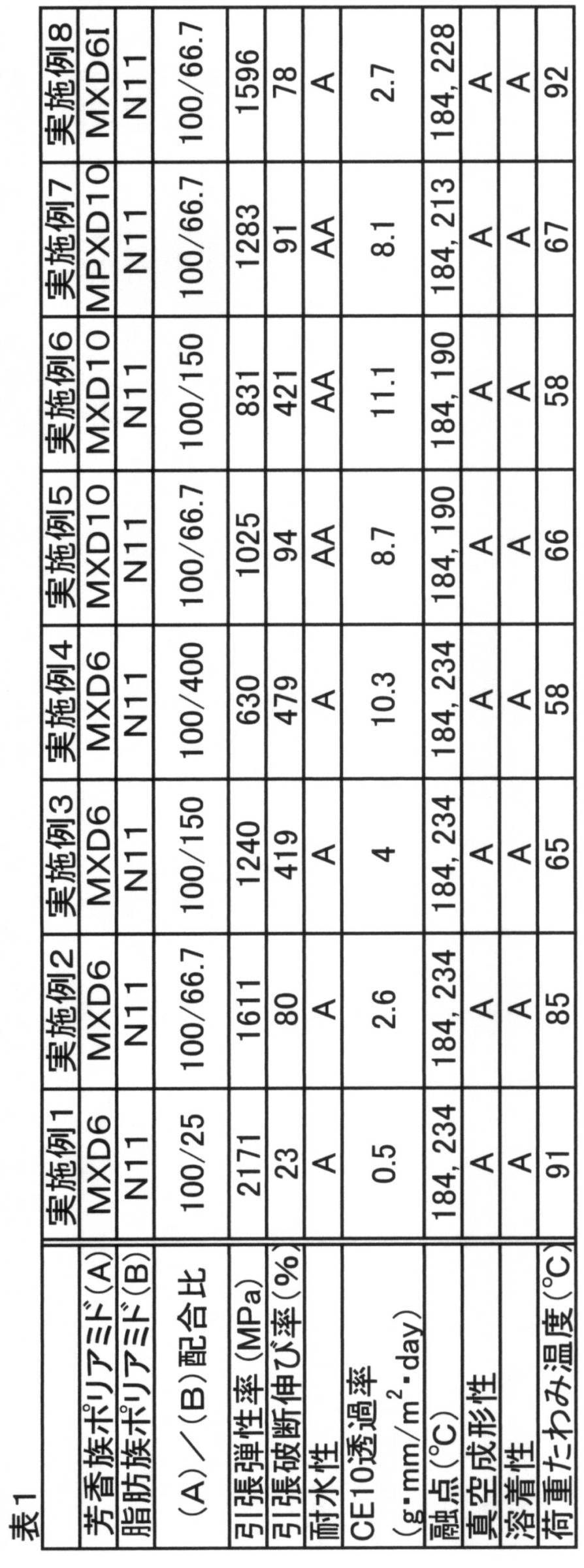
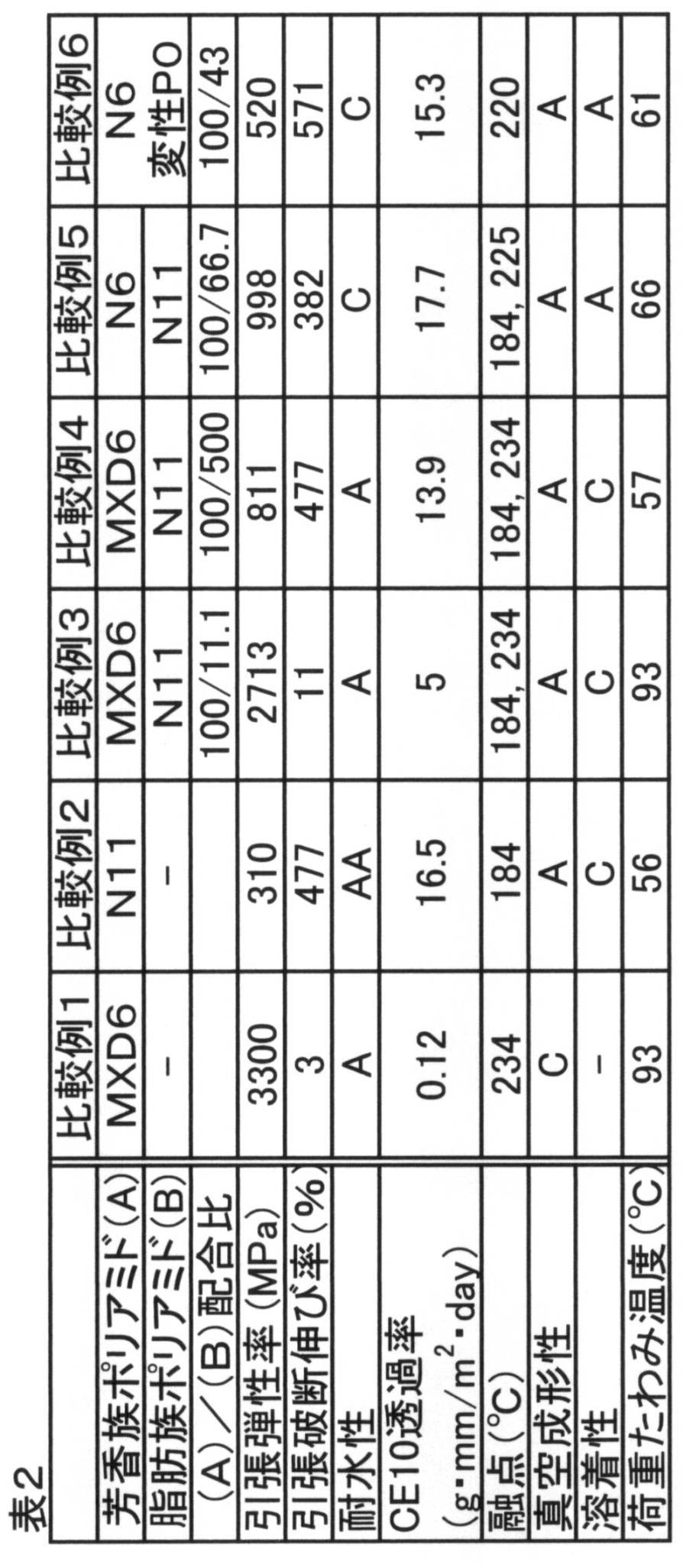
一方、表2に示されるとおり、芳香族ポリアミド(A)のみでハニカム用基材を作製した場合は、剛性が高すぎて折り畳み成形できず、真空成形性及び溶着性が得られなかった(比較例1)。また、脂肪族ポリアミド(B)のみでハニカム用基材を作製した場合は、溶着時に座屈してしまい、成形加工性に劣る(比較例2)。
芳香族ポリアミド(A)及び脂肪族ポリアミド(B)を含む熱可塑性樹脂組成物を用いた場合でも、脂肪族ポリアミド(B)の配合比が低くなりすぎると溶着せず(比較例3)、逆に、脂肪族ポリアミドの配合比が高くなりすぎると、溶着時に座屈してしまい(比較例4)、成形加工性が得られなかった。
芳香族ポリアミド(A)に代えてポリアミド6を脂肪族ポリアミド(B)と組み合わせて用いた場合では、耐水性が得られず、ハニカム構造体及びサンドイッチ構造体の用途が限定されてしまう(比較例5)。
芳香族ポリアミド(A)に代えてポリアミド6を用い、脂肪族ポリアミド(B)に代えて変性ポリオレフィンを用いた場合では、耐水性が得られず、また、ガスバリア性が不十分であった(比較例6)。
2 セル側壁
3a 表層面(上面部材)
3b 表層面(下面部材)
4a 3次元構造
4b 3次元構造
5a 接続領域
5b 接続領域
6 軸線
7 軸線
8 ガイドグリッド
9a 折り畳みガイド
9b 折り畳みガイド
10 供給ロール
11 引取ロール
12 ハニカム構造体部品
100 ハニカム構造体
Claims (12)
- 芳香族ポリアミド(A)及び脂肪族ポリアミド(B)を含む熱可塑性樹脂組成物からなるハニカム構造体であって、
芳香族ポリアミド(A)が、キシリレンジアミン単位を70モル%以上含むジアミン単位と、炭素数4~20のα、ω-直鎖脂肪族ジカルボン酸単位を50モル%以上含むジカルボン酸単位とを含むポリアミドであり、
脂肪族ポリアミド(B)が、脂肪族基を繰り返し単位として含むポリアミドであって、脂肪族基を構成する炭素数の合計が10~24であるポリアミドであり、
芳香族ポリアミド(A):脂肪族ポリアミド(B)の配合比が、質量基準で、100:25~400の範囲である、ハニカム構造体。 - 芳香族ポリアミド(A)のキシリレンジアミン単位が、メタキシリレンジアミン、パラキシリレンジアミンまたはこれらの混合物に由来するものであり、かつ炭素数4~20のα、ω-直鎖脂肪族ジカルボン酸単位が、アジピン酸、セバシン酸またはこれらの混合物に由来するものである、請求項1に記載のハニカム構造体。
- 脂肪族ポリアミド(B)が、ポリアミド11、ポリアミド12、ポリアミド6,6、ポリアミド6,10、ポリアミド6,12及びポリアミド10,10からなる群より選択される1種以上である、請求項1または2に記載のハニカム構造体。
- ハニカム構造体を構成する熱可塑性樹脂組成物の模擬ガソリンCE10透過率が15(g・mm/m2・day)以下である、請求項1~3のいずれか一項に記載のハニカム構造体。
- ハニカム構造体を構成する熱可塑性樹脂組成物の引張弾性率が500~2500MPaの範囲である、請求項1~4のいずれか一項に記載のハニカム構造体。
- ハニカム構造体を構成する熱可塑性樹脂組成物の荷重たわみ温度(荷重1.80MPa)が40~150℃の範囲である、請求項1~5のいずれか一項に記載のハニカム構造体。
- 複数のセルから形成されるハニカム構造体であって、前記セルは、セル同士を上下面のいずれか一方で連続的もしくは間欠的に連結する6角形状の表層面によって制限され、かつ互いに環状に隣接したセル側壁を有し、前記6角形状の表層面とセル側壁とは互いに垂直であって、前記ハニカム構造体が、ハニカム用基材を塑性変形することによって得られる3次元構造と、折り畳まれた後に前記6角形状の表層面となる接続領域とを有するハニカム構造体部品を折り畳むことによって形成され、実質的に切られることなく形成されたものである、請求項1~6のいずれか一項に記載のハニカム構造体。
- 表層面に対して水平方向に延伸が加えられたセル側壁及び表層面を少なくとも一部に有するものである、請求項7に記載のハニカム構造体。
- セル側壁の少なくとも一部が完全に、または部分的に互いに接合されたものである、請求項7または8に記載のハニカム構造体。
- 請求項1~9のいずれか一項に記載のハニカム構造体の上下面に、ハニカム構造体を構成する素材と同じ素材の平板を配してなるサンドイッチ構造体。
- 請求項1~9のいずれか一項に記載のハニカム構造体の上下面に、ハニカム構造体を構成する素材と異なる素材の平板を配してなるサンドイッチ構造体。
- 請求項1~9のいずれか一項に記載のハニカム構造体あるいは請求項10又は11に記載のサンドイッチ構造体を製造するための芳香族ポリアミド(A)及び脂肪族ポリアミド(B)を含む熱可塑性樹脂組成物からなるハニカム用基材であって、
芳香族ポリアミド(A)が、キシリレンジアミン単位を70モル%以上含むジアミン単位と、炭素数4~20のα、ω-直鎖脂肪族ジカルボン酸単位を50モル%以上含むジカルボン酸単位とを含むポリアミドであり、
脂肪族ポリアミド(B)が、脂肪族基を繰り返し単位として含むポリアミドであって、脂肪族基を構成する炭素数の合計が10~24であるポリアミドであり、
芳香族ポリアミド(A):脂肪族ポリアミド(B)の配合比が、質量基準で、100:25~400の範囲である、ハニカム用基材。
Priority Applications (5)
| Application Number | Priority Date | Filing Date | Title |
|---|---|---|---|
| CN201680026375.2A CN107531002B (zh) | 2015-05-08 | 2016-04-13 | 蜂窝结构体及夹层结构体以及用于制造它们的蜂窝用基材 |
| JP2016548321A JP6041077B1 (ja) | 2015-05-08 | 2016-04-13 | ハニカム構造体及びサンドイッチ構造体ならびにそれらを製造するためのハニカム用基材 |
| US15/570,990 US10730262B2 (en) | 2015-05-08 | 2016-04-13 | Honeycomb structure and sandwich structure, and base material for honeycomb for producing honeycomb structure and sandwich structure |
| EP16792470.3A EP3296098B1 (en) | 2015-05-08 | 2016-04-13 | Honeycomb structure, sandwich structure, and use of thermoplastic polyamide resin composition for producing honeycomb structure and sandwich structure |
| KR1020177030065A KR102398803B1 (ko) | 2015-05-08 | 2016-04-13 | 허니콤 구조체 및 샌드위치 구조체 그리고 이것들을 제조하기 위한 허니콤용 기재 |
Applications Claiming Priority (2)
| Application Number | Priority Date | Filing Date | Title |
|---|---|---|---|
| JP2015-095525 | 2015-05-08 | ||
| JP2015095525 | 2015-05-08 |
Publications (1)
| Publication Number | Publication Date |
|---|---|
| WO2016181745A1 true WO2016181745A1 (ja) | 2016-11-17 |
Family
ID=57248126
Family Applications (1)
| Application Number | Title | Priority Date | Filing Date |
|---|---|---|---|
| PCT/JP2016/061911 Ceased WO2016181745A1 (ja) | 2015-05-08 | 2016-04-13 | ハニカム構造体及びサンドイッチ構造体ならびにそれらを製造するためのハニカム用基材 |
Country Status (7)
| Country | Link |
|---|---|
| US (1) | US10730262B2 (ja) |
| EP (1) | EP3296098B1 (ja) |
| JP (1) | JP6041077B1 (ja) |
| KR (1) | KR102398803B1 (ja) |
| CN (1) | CN107531002B (ja) |
| TW (1) | TWI704056B (ja) |
| WO (1) | WO2016181745A1 (ja) |
Cited By (5)
| Publication number | Priority date | Publication date | Assignee | Title |
|---|---|---|---|---|
| US10493903B1 (en) | 2018-05-22 | 2019-12-03 | Ford Global Technologies, Llc | Vehicle lighting assembly and lighting method utilizing an amorphous metal shell |
| JP2022016695A (ja) * | 2018-03-20 | 2022-01-21 | 岐阜プラスチック工業株式会社 | 中空構造体 |
| WO2023026593A1 (ja) * | 2021-08-23 | 2023-03-02 | 三菱瓦斯化学株式会社 | 延伸フィルム、多層フィルムおよび包装材料 |
| US11872944B2 (en) | 2018-09-25 | 2024-01-16 | Kotobukiya Fronte Co., Ltd. | Sound insulating material for vehicle |
| US11959525B2 (en) | 2018-12-25 | 2024-04-16 | Kotobukiya Fronte Co., Ltd. | Damping material |
Families Citing this family (9)
| Publication number | Priority date | Publication date | Assignee | Title |
|---|---|---|---|---|
| US11794670B2 (en) * | 2018-03-29 | 2023-10-24 | Kotobukiya Fronte Co., Ltd. | Automobile component |
| MX2021000473A (es) * | 2018-07-24 | 2021-06-23 | Low & Bonar Germany Gmbh & Co Kg | Estructura plegada de nucleo y procedimiento para proveer una estructura plegada de nucleo. |
| DE112019005629T5 (de) * | 2018-12-13 | 2021-07-29 | Mitsubishi Electric Corporation | Optische Vorrichtung |
| CN114685953A (zh) * | 2020-04-30 | 2022-07-01 | 华润化学材料科技股份有限公司 | 改性聚酯材料及由其制成的复合夹芯板及其制备方法 |
| KR102443715B1 (ko) * | 2020-09-11 | 2022-09-14 | 계명대학교 산학협력단 | 가변 강성 특성을 갖는 메타구조체 제조방법 및 이를 이용한 웨어러블 슈트 |
| JP7371600B2 (ja) * | 2020-10-05 | 2023-10-31 | トヨタ自動車株式会社 | ハニカムコアの製造方法 |
| CN113147107B (zh) * | 2021-03-09 | 2022-12-06 | 哈尔滨工业大学(威海) | C/c复合材料及合金形成的蜂窝夹层结构及其制备方法 |
| CN115593000B (zh) * | 2022-10-19 | 2025-08-08 | 黄山永威塑料机械有限公司 | 一种热塑性蜂窝体生产线 |
| US20240247487A1 (en) * | 2023-01-24 | 2024-07-25 | Boxabl Inc. | Vacuum insulated enclosure components |
Citations (6)
| Publication number | Priority date | Publication date | Assignee | Title |
|---|---|---|---|---|
| JPS56150534A (en) * | 1980-04-23 | 1981-11-21 | Igeta Koban Kk | Manufacture of honeycomb structure |
| JPH08199062A (ja) * | 1995-01-26 | 1996-08-06 | Mitsubishi Chem Corp | ポリアミド成形体 |
| JP2000246818A (ja) * | 1999-01-01 | 2000-09-12 | Kg Pack Kk | ハニカム用シートの製造法 |
| JP2008520456A (ja) * | 2004-11-19 | 2008-06-19 | カー・イュー・ルーベン・リサーチ・アンド・ディベロップメント | 半閉型の熱可塑性ハニカム体、その製造工程および製造装置 |
| JP2013237242A (ja) * | 2012-05-17 | 2013-11-28 | Toray Ind Inc | ハニカム構造体およびサンドイッチ構造体 |
| WO2013180978A1 (en) * | 2012-05-31 | 2013-12-05 | E. I. Du Pont De Nemours And Company | Honeycomb core structure |
Family Cites Families (10)
| Publication number | Priority date | Publication date | Assignee | Title |
|---|---|---|---|---|
| JPH0860588A (ja) | 1994-08-24 | 1996-03-05 | Teijin Ltd | 高弾性率紙の製造方法 |
| JPH08319420A (ja) | 1995-01-17 | 1996-12-03 | Teijin Ltd | ポリアミド溶液組成物及びそれを用いるフィブリッド、紙状シートの製造法 |
| US5723568A (en) | 1995-01-17 | 1998-03-03 | Teijin Limited | Polyamide solution composition and methods for producing fibrids and paper-like sheets using the same |
| JP2006131890A (ja) | 2004-10-04 | 2006-05-25 | Ube Ind Ltd | ポリアミド樹脂組成物及びポリアミドフィルム |
| US7981518B2 (en) * | 2006-10-26 | 2011-07-19 | Mitsubishi Gas Chemical Company, Inc. | Thermoplastic resin composition excellent in barrier property |
| JP4914817B2 (ja) * | 2007-11-30 | 2012-04-11 | 東海ゴム工業株式会社 | 流体封入式防振装置 |
| JP2010248418A (ja) * | 2009-04-17 | 2010-11-04 | Mitsubishi Gas Chemical Co Inc | バリア性に優れた熱可塑性樹脂組成物 |
| JP2010248417A (ja) | 2009-04-17 | 2010-11-04 | Mitsubishi Gas Chemical Co Inc | バリア性に優れた熱可塑性樹脂組成物 |
| BR112014013991A8 (pt) * | 2011-12-16 | 2017-06-13 | Mitsubishi Gas Chemical Co | produto moldado, e, processo para a preparação de um produto moldado |
| EP3187330B1 (en) * | 2014-08-29 | 2019-09-04 | Mitsubishi Gas Chemical Company, Inc. | Honeycomb structure and sandwich structure |
-
2016
- 2016-04-13 US US15/570,990 patent/US10730262B2/en active Active
- 2016-04-13 EP EP16792470.3A patent/EP3296098B1/en active Active
- 2016-04-13 KR KR1020177030065A patent/KR102398803B1/ko active Active
- 2016-04-13 JP JP2016548321A patent/JP6041077B1/ja active Active
- 2016-04-13 WO PCT/JP2016/061911 patent/WO2016181745A1/ja not_active Ceased
- 2016-04-13 CN CN201680026375.2A patent/CN107531002B/zh active Active
- 2016-04-21 TW TW105112357A patent/TWI704056B/zh active
Patent Citations (6)
| Publication number | Priority date | Publication date | Assignee | Title |
|---|---|---|---|---|
| JPS56150534A (en) * | 1980-04-23 | 1981-11-21 | Igeta Koban Kk | Manufacture of honeycomb structure |
| JPH08199062A (ja) * | 1995-01-26 | 1996-08-06 | Mitsubishi Chem Corp | ポリアミド成形体 |
| JP2000246818A (ja) * | 1999-01-01 | 2000-09-12 | Kg Pack Kk | ハニカム用シートの製造法 |
| JP2008520456A (ja) * | 2004-11-19 | 2008-06-19 | カー・イュー・ルーベン・リサーチ・アンド・ディベロップメント | 半閉型の熱可塑性ハニカム体、その製造工程および製造装置 |
| JP2013237242A (ja) * | 2012-05-17 | 2013-11-28 | Toray Ind Inc | ハニカム構造体およびサンドイッチ構造体 |
| WO2013180978A1 (en) * | 2012-05-31 | 2013-12-05 | E. I. Du Pont De Nemours And Company | Honeycomb core structure |
Cited By (8)
| Publication number | Priority date | Publication date | Assignee | Title |
|---|---|---|---|---|
| JP2022016695A (ja) * | 2018-03-20 | 2022-01-21 | 岐阜プラスチック工業株式会社 | 中空構造体 |
| JP7271007B2 (ja) | 2018-03-20 | 2023-05-11 | 岐阜プラスチック工業株式会社 | 中空構造体の製造方法 |
| US10493903B1 (en) | 2018-05-22 | 2019-12-03 | Ford Global Technologies, Llc | Vehicle lighting assembly and lighting method utilizing an amorphous metal shell |
| US11872944B2 (en) | 2018-09-25 | 2024-01-16 | Kotobukiya Fronte Co., Ltd. | Sound insulating material for vehicle |
| US11959525B2 (en) | 2018-12-25 | 2024-04-16 | Kotobukiya Fronte Co., Ltd. | Damping material |
| US12467511B2 (en) | 2018-12-25 | 2025-11-11 | Kotobukiya Fronte Co., Ltd. | Damping material |
| WO2023026593A1 (ja) * | 2021-08-23 | 2023-03-02 | 三菱瓦斯化学株式会社 | 延伸フィルム、多層フィルムおよび包装材料 |
| JPWO2023026593A1 (ja) * | 2021-08-23 | 2023-03-02 |
Also Published As
| Publication number | Publication date |
|---|---|
| EP3296098B1 (en) | 2020-10-07 |
| US10730262B2 (en) | 2020-08-04 |
| KR20180002617A (ko) | 2018-01-08 |
| CN107531002B (zh) | 2019-10-01 |
| KR102398803B1 (ko) | 2022-05-17 |
| JP6041077B1 (ja) | 2016-12-07 |
| EP3296098A1 (en) | 2018-03-21 |
| TW201704028A (zh) | 2017-02-01 |
| EP3296098A4 (en) | 2019-05-01 |
| CN107531002A (zh) | 2018-01-02 |
| JPWO2016181745A1 (ja) | 2017-05-25 |
| TWI704056B (zh) | 2020-09-11 |
| US20180345621A1 (en) | 2018-12-06 |
Similar Documents
| Publication | Publication Date | Title |
|---|---|---|
| JP6041077B1 (ja) | ハニカム構造体及びサンドイッチ構造体ならびにそれらを製造するためのハニカム用基材 | |
| JP5924460B1 (ja) | ハニカム用基材、ハニカム構造体及びサンドイッチ構造体 | |
| CN111094455B (zh) | 树脂组合物、成型品、预浸料及纤维增强成型品,以及它们的制造方法 | |
| CN102918083B (zh) | 具有改善的阻隔性能的磺酸(盐)改性聚酰胺 | |
| JP6066028B1 (ja) | 長繊維強化複合材料および成形品 | |
| WO2017010390A1 (ja) | 延伸フィルム、延伸フィルムの製造方法、および、ポリアミド樹脂組成物 | |
| TW201439156A (zh) | 織物及將其成形而得之成形品 | |
| JP2020200405A (ja) | 延伸フィルムおよび多層体 | |
| JP2011102360A (ja) | 繊維強化ポリアミド樹脂組成物 | |
| JP6443218B2 (ja) | 複合シートの製造方法 | |
| CN110312753A (zh) | 非晶性聚酰胺树脂和成型品 | |
| TW202506820A (zh) | 共聚聚醯胺樹脂 | |
| TW202506819A (zh) | 共聚聚醯胺樹脂和含有該樹脂的組成物、成形品、膜及單絲 | |
| TW202506821A (zh) | 共聚聚醯胺樹脂和含有該樹脂的組成物、成形品、膜及單絲 | |
| JP6136490B2 (ja) | 多層構造体 | |
| TW202528479A (zh) | 複合材料及成形品 | |
| JP2012182316A (ja) | 太陽電池バックフィルム |
Legal Events
| Date | Code | Title | Description |
|---|---|---|---|
| ENP | Entry into the national phase |
Ref document number: 2016548321 Country of ref document: JP Kind code of ref document: A |
|
| 121 | Ep: the epo has been informed by wipo that ep was designated in this application |
Ref document number: 16792470 Country of ref document: EP Kind code of ref document: A1 |
|
| ENP | Entry into the national phase |
Ref document number: 20177030065 Country of ref document: KR Kind code of ref document: A |
|
| NENP | Non-entry into the national phase |
Ref country code: DE |
|
| WWE | Wipo information: entry into national phase |
Ref document number: 2016792470 Country of ref document: EP |