WO2016181799A1 - Composition d'essence à indice d'octane élevé - Google Patents
Composition d'essence à indice d'octane élevé Download PDFInfo
- Publication number
- WO2016181799A1 WO2016181799A1 PCT/JP2016/062857 JP2016062857W WO2016181799A1 WO 2016181799 A1 WO2016181799 A1 WO 2016181799A1 JP 2016062857 W JP2016062857 W JP 2016062857W WO 2016181799 A1 WO2016181799 A1 WO 2016181799A1
- Authority
- WO
- WIPO (PCT)
- Prior art keywords
- group
- carbon atoms
- gasoline
- gasoline composition
- weight
- Prior art date
- Legal status (The legal status is an assumption and is not a legal conclusion. Google has not performed a legal analysis and makes no representation as to the accuracy of the status listed.)
- Ceased
Links
Images


Classifications
-
- C—CHEMISTRY; METALLURGY
- C10—PETROLEUM, GAS OR COKE INDUSTRIES; TECHNICAL GASES CONTAINING CARBON MONOXIDE; FUELS; LUBRICANTS; PEAT
- C10L—FUELS NOT OTHERWISE PROVIDED FOR; NATURAL GAS; SYNTHETIC NATURAL GAS OBTAINED BY PROCESSES NOT COVERED BY SUBCLASSES C10G OR C10K; LIQUIFIED PETROLEUM GAS; USE OF ADDITIVES TO FUELS OR FIRES; FIRE-LIGHTERS
- C10L1/00—Liquid carbonaceous fuels
- C10L1/04—Liquid carbonaceous fuels essentially based on blends of hydrocarbons
- C10L1/06—Liquid carbonaceous fuels essentially based on blends of hydrocarbons for spark ignition
-
- C—CHEMISTRY; METALLURGY
- C10—PETROLEUM, GAS OR COKE INDUSTRIES; TECHNICAL GASES CONTAINING CARBON MONOXIDE; FUELS; LUBRICANTS; PEAT
- C10L—FUELS NOT OTHERWISE PROVIDED FOR; NATURAL GAS; SYNTHETIC NATURAL GAS OBTAINED BY PROCESSES NOT COVERED BY SUBCLASSES C10G OR C10K; LIQUIFIED PETROLEUM GAS; USE OF ADDITIVES TO FUELS OR FIRES; FIRE-LIGHTERS
- C10L1/00—Liquid carbonaceous fuels
- C10L1/10—Liquid carbonaceous fuels containing additives
- C10L1/14—Organic compounds
- C10L1/18—Organic compounds containing oxygen
- C10L1/182—Organic compounds containing oxygen containing hydroxy groups; Salts thereof
-
- C—CHEMISTRY; METALLURGY
- C10—PETROLEUM, GAS OR COKE INDUSTRIES; TECHNICAL GASES CONTAINING CARBON MONOXIDE; FUELS; LUBRICANTS; PEAT
- C10L—FUELS NOT OTHERWISE PROVIDED FOR; NATURAL GAS; SYNTHETIC NATURAL GAS OBTAINED BY PROCESSES NOT COVERED BY SUBCLASSES C10G OR C10K; LIQUIFIED PETROLEUM GAS; USE OF ADDITIVES TO FUELS OR FIRES; FIRE-LIGHTERS
- C10L1/00—Liquid carbonaceous fuels
- C10L1/10—Liquid carbonaceous fuels containing additives
- C10L1/14—Organic compounds
- C10L1/18—Organic compounds containing oxygen
- C10L1/185—Ethers; Acetals; Ketals; Aldehydes; Ketones
-
- C—CHEMISTRY; METALLURGY
- C10—PETROLEUM, GAS OR COKE INDUSTRIES; TECHNICAL GASES CONTAINING CARBON MONOXIDE; FUELS; LUBRICANTS; PEAT
- C10L—FUELS NOT OTHERWISE PROVIDED FOR; NATURAL GAS; SYNTHETIC NATURAL GAS OBTAINED BY PROCESSES NOT COVERED BY SUBCLASSES C10G OR C10K; LIQUIFIED PETROLEUM GAS; USE OF ADDITIVES TO FUELS OR FIRES; FIRE-LIGHTERS
- C10L1/00—Liquid carbonaceous fuels
- C10L1/10—Liquid carbonaceous fuels containing additives
- C10L1/14—Organic compounds
- C10L1/18—Organic compounds containing oxygen
- C10L1/188—Carboxylic acids; metal salts thereof
Definitions
- the present invention relates to a gasoline composition having a high octane number.
- a method of adding a specific additive to form a gasoline composition is known.
- the additive include aromatic hydrocarbons, oxygenated compounds, amines , Branched paraffins and olefins are widely known.
- a high-octane fuel having a research octane number (hereinafter sometimes referred to as RON) of about 100 can be prepared by adding these additives to regular gasoline.
- Patent Document 1 ethyl tertiary butyl ether
- Patent Document 2 ethanol
- Patent Document 3 amine compounds and carboxylic acids
- the present invention has been made in view of the above prior art, and an object thereof is to obtain a high-octane gasoline composition that can be prepared at low cost and is environmentally friendly.
- the present inventor has found that a gasoline composition having a low octane number and a high octane number can be obtained by blending a specific component with a gasoline base material. Moreover, it discovered that the gasoline composition of a high octane number could be easily prepared at low cost by oxidizing a gasoline base material on specific conditions.
- a gasoline composition comprising at least one selected from the group consisting of a ketone having 3 to 10 carbon atoms and an aldehyde having 3 to 10 carbon atoms, and a gasoline base material,
- the content of the ketone having 3 to 10 carbon atoms is 0.1% by weight or more based on the total amount of the composition (100% by weight), or
- a gasoline composition in which the content of aldehydes having 3 to 10 carbon atoms is 0.5% by weight or more based on the total amount of the composition (100% by weight) is provided.
- acetone, 2-heptanone, 3-heptanone, 4-heptanone, 2,3-heptanedione, and 2,4,4-trimethyl-3 are used as the ketone having 3 to 10 carbon atoms.
- at least one of them is included.
- the above gasoline composition preferably further contains an alcohol having 3 to 10 carbon atoms.
- the alcohol having 3 to 10 carbon atoms includes 1-heptanol, 2-heptanol, 3-heptanol, 4-heptanol, 1,2-heptanediol, 1,7-heptanediol, , 2-dimethyl-1-propanol, 2,4,4-trimethyl-2-pentanol, and at least one selected from the group consisting of benzyl alcohol.
- the gasoline composition preferably further contains a carboxylic acid having 3 to 10 carbon atoms.
- the carboxylic acid having 3 to 10 carbon atoms is at least one selected from the group consisting of 2,2-dimethyl-1-propanoic acid, heptanoic acid, heptanedioic acid, and benzoic acid. Preferably including one.
- the research octane number in the spray ignition test is preferably 89 or more.
- a gasoline composition comprising at least one selected from the group consisting of a ketone having 3 to 10 carbon atoms and an aldehyde having 3 to 10 carbon atoms, and a gasoline base material,
- the content of the ketone having 3 to 10 carbon atoms is 0.1% by weight or more based on the total amount of the composition (100% by weight), or
- the gasoline composition according to [1] comprising a ketone having 3 to 10 carbon atoms, an aldehyde having 3 to 10 carbon atoms, and a gasoline base material.
- the ketone having 3 to 10 carbon atoms is selected from the group consisting of acetone, 2-heptanone, 3-heptanone, 4-heptanone, 2,3-heptanedione, and 2,4,4-trimethyl-3-pentanone.
- the gasoline composition according to [1] or [2] comprising at least one of the above.
- the aldehyde having 3 to 10 carbon atoms includes at least one selected from the group consisting of heptanal, 2,2-dimethyl-1-propanal, and benzaldehyde.
- the carboxylic acid having 3 to 10 carbon atoms includes at least one selected from the group consisting of 2,2-dimethyl-1-propanoic acid, heptanoic acid, heptanedioic acid, and benzoic acid [11] or [12]
- the content (total amount) of alcohol having 3 to 10 carbon atoms, ketone having 3 to 10 carbon atoms, and aldehyde having 3 to 10 carbon atoms is 1% by weight or more based on the total amount of the composition (100% by weight)
- Other oxygen-containing hydrocarbons include at least one selected from the group consisting of alcohols having 11 or more carbon atoms, aldehydes having 11 or more carbon atoms, carboxylic acids having 11 or more carbon atoms, and ethers.
- the gasoline composition of the present invention can be prepared at low cost, and a gasoline composition with high fuel consumption characteristics (high octane number) can be obtained. Further, when the obtained gasoline composition is used as fuel, it is environmentally friendly because it does not emit SOx and NOx, and the CO content in the exhaust gas is small. Furthermore, the gasoline composition of the present invention can also be obtained by oxidizing a gasoline base material under specific conditions. In this case, the gasoline composition can be prepared easily and at low cost. Furthermore, since the gasoline composition of the present invention can be prepared in the vehicle by providing the oxidation reaction device in the vehicle, a tank for storing the additive in the engine room is not required.
- FIG. 3 is a correlation diagram between the research octane number of reaction solutions and the conversion rate of raw materials in Examples 1 to 5.
- FIG. 3 is a correlation diagram between the research octane number of reaction liquids in Examples 1 to 5 and the content of alcohol components in gasoline compositions.
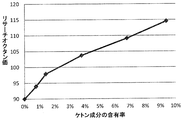
- FIG. 5 is a correlation diagram between the research octane number of reaction solutions in Examples 1 to 5 and the content of ketone components in gasoline compositions.
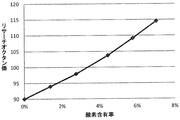
- FIG. 3 is a correlation diagram between the research octane number of reaction liquids in Examples 1 to 5 and the oxygen content in gasoline compositions.
- the gasoline composition of the present invention comprises at least one selected from the group consisting of a specific amount of a ketone having 3 to 10 carbon atoms and an aldehyde having 3 to 10 carbon atoms, and a gasoline base material as essential components. And Further, as a component other than the above, an alcohol having 3 to 10 carbon atoms or a carboxylic acid having 3 to 10 carbon atoms may further be included.
- the gasoline composition of the present invention particularly includes at least one selected from the group consisting of ketones having 3 to 10 carbon atoms and aldehydes having 3 to 10 carbon atoms as components other than the gasoline base. Although not limited, it is preferable that a ketone having 3 to 10 carbon atoms and an aldehyde having 3 to 10 carbon atoms are included from the viewpoint of fuel efficiency characteristics of the obtained gasoline composition.
- it preferably further contains a ketone having 3 to 10 carbon atoms, an aldehyde having 3 to 10 carbon atoms, and an alcohol having 3 to 10 carbon atoms, and includes a ketone having 3 to 10 carbon atoms, an aldehyde having 3 to 10 carbon atoms, carbon Most preferably, it contains an alcohol having 3 to 10 carbon atoms and a carboxylic acid having 3 to 10 carbon atoms.
- the gasoline base used in the present invention is usually a petroleum fraction obtained by subjecting crude oil to various refining treatments.
- light naphtha or heavy naphtha obtained by atmospheric distillation of crude oil
- the light naphtha Desulfurized light naphtha and desulfurized heavy naphtha obtained by desulfurizing and heavy naphtha
- cracked gasoline obtained by catalytic cracking and hydrocracking
- light cracked gasoline obtained by distilling the cracked gasoline and heavy
- hydrocarbons such as cracked gasoline, fractions obtained by removing benzene in reformed gasoline obtained by catalytic reforming (debenzene reformed gasoline), polymerized gasoline obtained by olefin polymerization, and isobutane Obtained alkylate
- isomerate (isomerized gasoline) obtained by isomerization of linear lower paraffinic hydrocarbon, de-N-paraffin oil, Beauty like fractions and aromatic hydrocarbons of these specific ranges and the like.
- isomerate isomerate (isomerized gasoline) obtained by
- the components of the gasoline base material are not particularly limited, and examples thereof include hydrocarbons having 3 to 10 carbon atoms. More specifically, as components contained in the gasoline base, for example, a linear or branched aliphatic hydrocarbon having 3 to 10 carbon atoms, an alicyclic hydrocarbon having 3 to 10 carbon atoms, and a carbon number Examples thereof include 6 to 10 aromatic hydrocarbons.
- linear or branched aliphatic hydrocarbon having 3 to 10 carbon atoms examples include linear alkanes having 3 to 10 carbon atoms such as propane, butane, pentane, hexane, heptane, octane, nonane and decane; 2-methylpropane, 2-methylbutane, 2,2-dimethylpropane, 2-methylpentane, 3-methylpentane, 2,3-dimethylbutane, 2-methylhexane, 3-methylhexane, 3,4-dimethylhexane, C3-C10 branched alkanes such as 3-methyloctane and 2,4,4-trimethylpentane; propylene, isobutylene, 1-pentene, 1-hexene, 2-hexene, 1-heptene, 1-octene, C3-C10 linear or branched alkene such as 1-decene, 1-dodecene, 1-tetradecene,
- Examples of the alicyclic hydrocarbon having 3 to 10 carbon atoms include cycloalkanes having 3 to 10 carbon atoms such as cyclopropane, cyclobutane, cyclopentane, cyclohexane, cycloheptane, cyclooctane, cyclononane, cyclodecane, etc .; cyclopropene, cyclobutene Cycloalkene having 3 to 10 carbon atoms such as cyclopentene, cyclooctene, cyclohexene, cycloheptene, cyclododecaene; cycloalkenyl having 3 to 10 carbon atoms such as cyclopentadiene, 1,3-cyclohexadiene, 1,5-cyclooctadiene, etc. Examples include alkadienes.
- aromatic hydrocarbon having 6 to 10 carbon atoms examples include benzene, toluene, o-xylene, m-xylene, p-xylene, naphthalene and the like.
- the ketone in the gasoline composition of the present invention is not particularly limited as long as it has 3 to 10 carbon atoms.
- the number of carbonyl groups in the ketone molecule is preferably 1 to 6, and more preferably 1 to 3 It is.
- ketone examples include a linear ketone having 3 to 10 carbon atoms, a branched ketone having 3 to 10 carbon atoms, an alicyclic ketone having 3 to 10 carbon atoms, and an aromatic ketone having 7 to 10 carbon atoms. It is done.
- the gasoline composition of the present invention may contain one of these ketones alone or two or more.
- the linear ketone having 3 to 10 carbon atoms is not particularly limited as long as at least one carbon atom of the linear hydrocarbon is substituted with a carbonyl group.
- Ketones C3-C10 linear ketones having two carbonyl groups such as 2,5-hexanedione, 2,3-heptanedione and acetylacetone.
- the branched chain ketone having 3 to 10 carbon atoms is not particularly limited as long as it is a ketone in which at least one carbon atom of the branched chain hydrocarbon is substituted with a carbonyl group, but 2,2-dimethyl-1-propanone, Examples include 2,4,4-trimethyl-3-pentanone and the positional isomer of the carbonyl group.
- the alicyclic ketone having 3 to 10 carbon atoms is not particularly limited as long as at least one carbon atom of the alicyclic hydrocarbon is substituted with a carbonyl group.
- cyclobutanone, cyclopentanone, cyclohexanone Examples include cycloheptanone, cyclooctanone, and positional isomers of the carbonyl group.
- the gasoline composition of the present invention is a ketone having 3 to 10 carbon atoms such as acetone, 2-heptanone, 3-heptanone, 4-heptanone, 2,3-heptanedione, and 2,
- it contains at least one selected from the group consisting of 4,4-trimethyl-3-pentanone, and is selected from the group consisting of acetone, 2-heptanone, and 2,4,4-trimethyl-3-pentanone More preferably, it contains at least one, and more preferably contains at least 2-heptanone.
- At least one selected from the group consisting of a linear ketone having 3 to 10 carbon atoms and a branched ketone having 3 to 10 carbon atoms is used as the ketone having 3 to 10 carbon atoms. And more preferably at least a linear ketone having 3 to 10 carbon atoms.
- the aldehyde in the gasoline composition of the present invention is not particularly limited as long as it is an aldehyde having 3 to 10 carbon atoms.
- a linear aldehyde having 3 to 10 carbon atoms, a branched aldehyde having 3 to 10 carbon atoms, and a carbon number 7-10 aromatic aldehydes are mentioned.
- the gasoline composition of the present invention may contain one of these aldehydes alone or may contain two or more.
- the straight-chain aldehyde having 3 to 10 carbon atoms is not particularly limited as long as the terminal carbon atom of the straight-chain hydrocarbon is substituted with a carbonyl group.
- a carbonyl group For example, butanal, pentanal, hexanal, heptanal, octanal And nonanal.
- the branched aldehyde having 3 to 10 carbon atoms is not particularly limited as long as it is an aldehyde in which the terminal carbon atom of the branched hydrocarbon is substituted with a carbonyl group.
- the aromatic aldehyde is not particularly limited as long as it is an aldehyde in which the carbon atom at the terminal of the hydrocarbon having an aromatic hydrocarbon group is substituted with a carbonyl group, and examples thereof include benzaldehyde.
- the gasoline composition of the present invention is at least one selected from the group consisting of heptanal, 2,2-dimethyl-1-propanal, and benzaldehyde as the aldehyde having 3 to 10 carbon atoms. It is preferable to include one, and it is more preferable to include at least benzaldehyde.
- an aldehyde having 3 to 10 carbon atoms as an aldehyde having 3 to 10 carbon atoms, a linear aldehyde having 3 to 10 carbon atoms, a branched aldehyde having 3 to 10 carbon atoms, and an aromatic aldehyde having 7 to 10 carbon atoms. It is preferable to include at least one selected from the group consisting of, and more preferable to include at least an aromatic aldehyde having 7 to 10 carbon atoms.
- the alcohol in the gasoline composition of the present invention is not particularly limited as long as it is an alcohol having 3 to 10 carbon atoms, but the number of hydroxyl groups in the alcohol molecule is preferably 1 to 6, and more preferably 1 to 3 It is a piece.
- Examples of the alcohol having 3 to 10 carbon atoms include linear or branched alcohols having 3 to 10 carbon atoms, alicyclic alcohols having 3 to 10 carbon atoms, and aromatic alcohols having 6 to 10 carbon atoms.
- the gasoline composition of the present invention may contain one of these alcohols alone or two or more.
- the linear alcohol having 3 to 10 carbon atoms is not particularly limited as long as it is an alcohol in which at least one hydrogen atom of the linear hydrocarbon is substituted with a hydroxyl group.
- 1-propanol, 1-butanol, 1 -Pentanol, 1-hexanol, 1-heptanol, 1-octanol and the positional isomers of its hydroxyl group eg 2-propanol, 2-butanol, 2-pentanol, 3-pentanol, 2-hexanol, 3-hexanol) , 2-heptanol, 3-heptanol, 4-heptanol, 2-octanol, 3-octanol), etc.
- a straight-chain alcohol having 3 to 10 carbon atoms such as 1,2-propanediol, 1,3- Propanediol, 1,3-butanediol, 1,4-butanediol, 1,2-pentane
- isobutyl alcohol, 2,2-dimethyl-1 -Propanol, 2,4,4-trimethyl-2-pentanol and positional isomers of the hydroxyl group thereof for example, tertiary butyl alcohol, 2-ethylhexanol
- the alicyclic alcohol having 3 to 10 carbon atoms is not particularly limited as long as it is an alcohol in which at least one hydrogen atom of the alicyclic hydrocarbon is substituted with a hydroxyl group.
- the aromatic alcohol having 6 to 10 carbon atoms is not particularly limited as long as it is an alcohol in which at least one hydrogen atom of the aromatic hydrocarbon is substituted with a hydroxyl group.
- it relates to phenol, benzyl alcohol, salicyl alcohol and the hydroxyl group thereof. And positional isomers.
- the gasoline composition of the present invention has 1 to heptanol, 2-heptanol, 3-heptanol, 4-heptanol, 1,2-heptanediol, alcohol having 3 to 10 carbon atoms, , 7-heptanediol, 2,2-dimethyl-1-propanol, 2,4,4-trimethyl-2-pentanol, and benzyl alcohol.
- the alcohol having 3 to 10 carbon atoms is a linear alcohol having 3 to 10 carbon atoms, a branched alcohol having 3 to 10 carbon atoms, and an aromatic alcohol having 6 to 10 carbon atoms.
- it contains at least one selected from the group consisting of, and contains at least one selected from the group consisting of branched alcohols having 3 to 10 carbon atoms and aromatic alcohols having 6 to 10 carbon atoms. Is more preferable, and it is more preferable to include at least an aromatic alcohol having 6 to 10 carbon atoms.
- the carboxylic acid in the gasoline composition of the present invention is not particularly limited as long as it is a carboxylic acid having 3 to 10 carbon atoms.
- examples thereof include acids and aromatic carboxylic acids having 7 to 10 carbon atoms.
- the gasoline composition of the present invention may contain one of these carboxylic acids alone or may contain two or more.
- the linear carboxylic acid having 3 to 10 carbon atoms is not particularly limited as long as it is a carboxylic acid in which the terminal carbon atom of the linear hydrocarbon is substituted with a carboxyl group.
- butanoic acid, pentanoic acid, hexane examples thereof include linear monocarboxylic acids having 3 to 10 carbon atoms such as acid, heptanoic acid and octanoic acid, and linear dicarboxylic acids having 3 to 10 carbon atoms such as heptanedioic acid.
- the branched carboxylic acid having 3 to 10 carbon atoms is not particularly limited as long as it is a carboxylic acid in which the terminal carbon atom of the branched hydrocarbon is substituted with a carboxyl group.
- 2,2-dimethyl-1- Examples include propanoic acid (pivalic acid) and isooctanoic acid.
- the aromatic carboxylic acid is not particularly limited as long as it is a carboxylic acid in which the carbon atom at the terminal of the hydrocarbon having an aromatic hydrocarbon group is substituted with a carboxyl group, and examples thereof include benzoic acid and phthalic acid.
- the gasoline composition of the present invention comprises 2,2-dimethyl-1-propanoic acid, heptanoic acid, heptanedioic acid, and benzoic acid as a carboxylic acid having 3 to 10 carbon atoms. It is preferable to include at least one selected from the group, and it is more preferable to include at least benzoic acid. That is, the carboxylic acid having 3 to 10 carbon atoms is at least selected from the group consisting of branched carboxylic acids having 3 to 10 carbon atoms and aromatic carboxylic acids having 7 to 10 carbon atoms from the viewpoint of improving fuel efficiency. 1 is preferable, and at least an aromatic carboxylic acid having 7 to 10 carbon atoms is more preferable.
- oxygen-containing hydrocarbons In the gasoline composition of the present invention, an oxygen-containing hydrocarbon other than an alcohol having 3 to 10 carbon atoms, a ketone having 3 to 10 carbon atoms, an aldehyde having 3 to 10 carbon atoms, and a carboxylic acid having 3 to 10 carbon atoms (hereinafter, (Referred to as “other oxygenated hydrocarbons”).
- oxygen-containing hydrocarbon refers to a compound obtained by oxidizing a hydrocarbon (for example, alcohol, ketone, aldehyde, carboxylic acid, etc.).
- examples of other oxygen-containing hydrocarbons include alcohols having 11 or more carbon atoms, aldehydes having 11 or more carbon atoms, carboxylic acids having 11 or more carbon atoms, and ethers.
- an alcohol having 3 to 10 carbon atoms, a ketone having 3 to 10 carbon atoms, an aldehyde having 3 to 10 carbon atoms, a carboxylic acid having 3 to 10 carbon atoms, and other oxygen-containing hydrocarbons (hereinafter referred to as “carbonic acid”) "Alcohol having 3 to 10 carbon atoms”) may be obtained by oxidizing the gasoline base (or the hydrocarbon in the gasoline base). In this case, it is preferable that it is a thing obtained by making a gasoline base material (or hydrocarbon in a gasoline base material) react on the specific oxidation conditions mentioned later.
- the alcohol having 3 to 10 carbon atoms is obtained by oxidizing a gasoline base material, when a gasoline composition is used as a fuel, it does not emit SOx and NOx, and contains CO in exhaust gas. Since the amount is small, there is no adverse effect on the environment, and the fuel efficiency of the gasoline composition tends to be improved. Furthermore, when the alcohol having 3 to 10 carbon atoms is obtained by reacting hydrocarbons in a gasoline base material under specific oxidation conditions, the fuel consumption characteristics of the gasoline composition tend to be further improved.
- the other oxygen-containing hydrocarbons may be obtained by oxidizing the hydrocarbons in the gasoline base material.
- the hydrocarbon is obtained by reacting hydrocarbons in the gasoline base material under specific oxidation conditions described later.
- the gasoline composition of the present invention may further contain various additives as necessary.
- additives include metal deactivators such as Schiff compounds and thioamide compounds, lubricity improvers such as fatty acids and fatty acid esters, surface ignition inhibitors such as organophosphorus compounds, succinimides, polyalkylamines , Detergents such as polyetheramines, anti-icing agents, alkali metals and alkaline earth metal salts of organic acids, sulfuric acid esters of higher alcohols, anionic surfactants, cationic surfactants, double-sided surfactants, etc.
- gasoline composition of the present invention may contain one of these additives alone or two or more.
- the content (total amount) of the alcohol having 3 to 10 carbon atoms, the ketone having 3 to 10 carbon atoms, and the aldehyde having 3 to 10 carbon atoms is not particularly limited. 100% by weight) is preferably 1% by weight or more (for example, 1 to 80% by weight), more preferably 5 to 60% by weight, and most preferably 10 to 50% by weight.
- 100% by weight is preferably 1% by weight or more (for example, 1 to 80% by weight), more preferably 5 to 60% by weight, and most preferably 10 to 50% by weight.
- the content thereof is not particularly limited. For example, it is 0.1% by weight or more (for example, 0.1% by weight relative to the total amount of the composition (100% by weight)). 1 to 50% by weight), more preferably 0.1 to 20% by weight, and most preferably 0.5 to 15% by weight.
- the content thereof is not particularly limited, but for example, 0.5% by weight or more (for example, 0.8% or more) with respect to the total amount of the composition (100% by weight). 5 to 30% by weight), more preferably 1 to 20% by weight, and most preferably 1 to 10% by weight.
- the content thereof is not particularly limited. For example, it is 1% by weight or more (for example, 1 to 80% by weight) with respect to the total amount of the composition (100% by weight). %), More preferably 1 to 50% by weight, and most preferably 1 to 30% by weight.
- the content is not particularly limited. For example, it is 0.1% by weight or more (for example, 0% with respect to the total amount of the composition (100% by weight)). 0.1 to 30% by weight), more preferably 1 to 25% by weight, and most preferably 2 to 20% by weight.
- the content of the gasoline base is preferably 20 to 99% by weight, more preferably 40 to 95% by weight, most preferably the total amount (100% by weight) of the composition. 50 to 90% by weight.
- the content thereof is not particularly limited. For example, it is 20% by weight or less (for example, 0.00%) with respect to the total amount of the composition (100% by weight). 01 to 20% by weight), preferably 10% by weight or less (0.1 to 10% by weight), and most preferably 5% by weight or less (1 to 5% by weight).
- the research octane number of the gasoline composition of the present invention is preferably 89 or more, more preferably 94 or more, still more preferably 98 or more, and most preferably 104 or more.
- the research octane number is calculated by a spray ignition test.
- the content (content) of the oxygen-containing hydrocarbon in the gasoline composition of the present invention is not particularly limited. For example, it is 1% by weight or more (for example, 1 to 80% by weight) with respect to the total amount of the composition (100% by weight). It is preferably 5 to 60% by weight, most preferably 10 to 50% by weight. By setting it as the said structure, there exists a tendency for RON of a gasoline composition to improve.
- the oxygen content of the gasoline composition of the present invention is not particularly limited. For example, it is preferably 0.1% by weight or more (0.1 to 20% by weight) with respect to the total amount of the composition (100% by weight), More preferably, it is 0.5 to 10% by weight, and further preferably 1 to 10% by weight.
- the “oxygen content” of the gasoline composition means the weight ratio of oxygen atoms (total amount) of components (for example, oxygen-containing hydrocarbons) contained in the gasoline composition to the gasoline composition (total amount).
- the gasoline composition of the present invention has a gasoline base, at least one selected from the group consisting of a specific amount of a ketone having 3 to 10 carbon atoms, and an aldehyde having 3 to 10 carbon atoms, and optionally 3 carbon atoms. It can be prepared by mixing ⁇ 10 alcohol, carboxylic acid having 3 to 10 carbon atoms, and other oxygen-containing hydrocarbons. Moreover, it is good also as a gasoline composition by oxidizing a gasoline base material (or hydrocarbon in a gasoline base material). In addition, when preparing the gasoline composition of this invention by oxidizing a gasoline base material, it is good also as a gasoline composition of this invention by oxidizing a gasoline base material in presence of oxygen. Furthermore, it is good also as a gasoline composition of this invention by mixing a gasoline base material and the oxidized gasoline base material.
- a method for preparing (manufacturing) a gasoline composition by oxidizing a gasoline base material (or a hydrocarbon in the gasoline base material) will be described.
- a method for preparing (manufacturing) a gasoline composition a method of oxidizing a gasoline base material in the presence of oxygen can be mentioned. More specifically, a method of oxidizing a gasoline base material in the presence of oxygen and ozone, and a method of oxidizing a gasoline base material in the presence of oxygen and an imide compound having a cyclic imide skeleton may be mentioned.
- hydrocarbons in a gasoline base material may be oxidized in the presence of oxygen and ozone or in the circulation of oxygen gas and ozone gas to obtain the gasoline composition of the present invention.
- oxygen as an oxidizing agent together with ozone
- reaction pressure normal pressure
- reaction temperature about room temperature to 200 ° C., preferably 50 to 150 ° C., particularly preferably 60 to 120 ° C.
- the amount of ozone gas in the ozone gas-containing oxygen gas is, for example, about 0.1 to 10% by volume of oxygen gas from the viewpoint of reactivity and economy.
- molecular oxygen it is preferable to use molecular oxygen as oxygen.
- molecular oxygen pure oxygen may be used, and oxygen diluted with an inert gas such as nitrogen, helium, argon, carbon dioxide, or air at normal pressure or pressure (1 to 100 atm) is used. May be.
- the above-mentioned ozone has an action as a radical generator. It is preferable to use ozone gas as ozone. Further, the ozone gas may be supplied intermittently or continuously as long as the reaction proceeds smoothly.
- a radical generator is a compound that generates radicals under mild reaction conditions (for example, heating, light irradiation, etc.).
- a radical generator other than ozone an imide compound having a cyclic imide skeleton described later and other radical generators may be used.
- the gasoline base material may be oxidized by oxidizing a gasoline base material in the presence of oxygen (oxygen gas) and an imide compound having a cyclic imide skeleton.
- oxygen oxygen
- molecular oxygen pure oxygen may be used, and oxygen diluted with an inert gas such as nitrogen, helium, argon, carbon dioxide, or air at normal pressure or pressure (1 to 100 atm) is used. May be. This reaction proceeds even under mild conditions (reaction pressure: normal pressure, reaction temperature: for example, room temperature to 200 ° C., preferably 50 to 150 ° C., particularly preferably 60 to 120 ° C.).
- imide compound having a cyclic imide skeleton imide compounds having various known cyclic imide skeletons can be used as an oxidation catalyst.
- imide compound having a cyclic imide skeleton include a cyclic imide skeleton represented by the following formula (I).
- the bond between the nitrogen atom and X is a single bond or a double bond.
- the imide compound may have a plurality of cyclic imide skeletons represented by the formula (I) in the molecule.
- X is an —OR group and R is a protecting group for a hydroxyl group
- Examples of the protecting group for the hydroxyl group represented by R include an alkyl group (eg, a C 1-4 alkyl group such as methyl and t-butyl group), an alkenyl group (eg, an allyl group), a cycloalkyl group, and the like.
- cyclohexyl group aryl group (eg, 2,4-dinitrophenyl group), aralkyl group (eg, benzyl, 2,6-dichlorobenzyl, 3-bromobenzyl, 2-nitrobenzyl, triphenylmethyl)
- a substituted methyl group for example, methoxymethyl, methylthiomethyl, benzyloxymethyl, t-butoxymethyl, 2-methoxyethoxymethyl, 2,2,2-trichloroethoxymethyl, bis (2-chloroethoxy) methyl, 2- (trimethylsilyl) ethoxymethyl group, etc.
- substituted ethyl groups for example, 1-ethoxyethyl, 1-methyl-1-methoxyethyl, 1-isopropoxyethyl, 2,2,2-trichloroethyl, 2-methoxyethyl group, etc.
- tetrahydropyranyl group tetrahydrofuranyl group
- an acyl group for example, Aliphatic saturated or not such as C 1-20 aliphatic acyl group such as formyl, acetyl, propionyl, butyryl, isobutyryl, valeryl, pivaloyl, hexanoyl, heptanoyl, octanoyl, nonanoyl, decanoyl, lauroyl, myristoyl, palmitoyl, stearoyl group, etc.
- an acyl group for example, Aliphatic saturated or not such as C 1-20 aliphatic acyl group such as formyl, acetyl, propionyl, butyryl, isobutyryl, valeryl, pivaloyl, hexanoyl, heptanoyl, octanoyl, nonanoyl, decanoyl, lauroyl, myristoyl, palmitoyl, stearoyl group, etc.
- Saturated reed Group acetoacetyl group; alicyclic acyl group such as cycloalkanecarbonyl group such as cyclopentanecarbonyl, cyclohexanecarbonyl group; aromatic acyl group such as benzoyl, naphthoyl group, etc .; sulfonyl group (methanesulfonyl, ethanesulfonyl, trifluoro) Lomethanesulfonyl, benzenesulfonyl, p-toluenesulfonyl, naphthalenesulfonyl group, etc.), alkoxycarbonyl groups (eg, C 1-4 alkoxy-carbonyl groups such as methoxycarbonyl, ethoxycarbonyl, t-butoxycarbonyl groups, etc.), aralkyloxycarbonyl Groups (eg, benzyloxycarbonyl group, p-
- R in the case where a plurality of cyclic imide skeletons excluding R (N-oxy cyclic imide skeleton) are bonded via R is, for example, oxalyl, malonyl
- Polycarboxylic acid acyl groups such as succinyl, glutaryl, adipoyl, phthaloyl, isophthaloyl, terephthaloyl groups; carbonyl groups; polyvalent hydrocarbon groups such as methylene, ethylidene, isopropylidene, cyclopentylidene, cyclohexylidene, benzylidene groups ( In particular, a group that forms an acetal with two hydroxyl groups).
- Preferred R includes, for example, a hydrogen atom; a group capable of forming an acetal or hemiacetal with a hydroxyl group; an OH group removed from an acid such as carboxylic acid, sulfonic acid, carbonic acid, carbamic acid, sulfuric acid, phosphoric acid, boric acid, etc.
- Hydrolyzable protecting groups that can be removed by hydrolysis of groups (acyl group, sulfonyl group, alkoxycarbonyl group, carbamoyl group, etc.) and the like are included.
- n 0 or 1. That is, Formula (I) represents a 5-membered cyclic imide skeleton when n is 0, and represents a 6-membered cyclic imide skeleton when n is 1.
- a typical example of the imide compound is an imide compound represented by the following formula (1).
- n 0 or 1.
- X represents an oxygen atom or an —OR group (R represents a hydrogen atom or a hydroxyl protecting group).
- R 1 , R 2 , R 3 , R 4 , R 5 , and R 6 are the same or different and each represents a hydrogen atom, a halogen atom, an alkyl group, an aryl group, a cycloalkyl group, a hydroxyl group, an alkoxy group, a carboxyl group, A substituted oxycarbonyl group, an acyl group or an acyloxy group is shown.
- At least two of R 1 , R 2 , R 3 , R 4 , R 5 , and R 6 may be bonded to each other to form a double bond, and form a ring with the carbon atoms constituting the cyclic imide skeleton. May be. R 1 , R 2 , R 3 , R 4 , R 5 , or R 6 , or at least two of R 1 , R 2 , R 3 , R 4 , R 5 , and R 6 are bonded together.
- one or two or more cyclic imide groups represented by the following formula (1) may be bonded to the ring formed together with the carbon atoms constituting the double bond or the cyclic imide skeleton.
- the halogen atoms in the substituents R 1 , R 2 , R 3 , R 4 , R 5 , and R 6 of the imide compound represented by the formula (1) include iodine, bromine, chlorine, and fluorine atoms.
- Alkyl groups include, for example, about 1 to 30 carbon atoms such as methyl, ethyl, propyl, isopropyl, butyl, isobutyl, s-butyl, t-butyl, hexyl, decyl, dodecyl, tetradecyl, hexadecyl groups, etc. 1-20) linear or branched alkyl groups are included.
- Examples of the aryl group include phenyl and naphthyl groups, and examples of the cycloalkyl group include cyclopentyl and cyclohexyl groups.
- Examples of the alkoxy group include about 1 to 30 carbon atoms such as methoxy, ethoxy, isopropoxy, butoxy, t-butoxy, hexyloxy, octyloxy, decyloxy, dodecyloxy, tetradecyloxy, and octadecyloxy groups (particularly, carbon The alkoxy group of the formula 1 to 20) is included.
- Examples of the substituted oxycarbonyl group include C 1-30 alkoxycarbonyl groups such as methoxycarbonyl, ethoxycarbonyl, isopropoxycarbonyl, butoxycarbonyl, t-butoxycarbonyl, hexyloxycarbonyl, decyloxycarbonyl, hexadecyloxycarbonyl groups ( In particular, C 1-20 alkoxy-carbonyl groups); cycloalkyloxycarbonyl groups such as cyclopentyloxycarbonyl and cyclohexyloxycarbonyl groups (particularly 3 to 20-membered cycloalkyloxycarbonyl groups); phenyloxycarbonyl, naphthyloxycarbonyl groups and the like aryloxycarbonyl group (especially, C 6-20 aryloxy - carbonyl group); aralkyloxycarbonyl group such as benzyloxycarbonyl group (particularly, C 7-21 aralkyloxy - carbonyl group).
- Acyl groups include, for example, C 1-30 aliphatic acyl groups such as formyl, acetyl, propionyl, butyryl, isobutyryl, valeryl, pivaloyl, hexanoyl, octanoyl, decanoyl, lauroyl, myristoyl, palmitoyl, stearoyl groups (especially C 1 Aliphatic saturated or unsaturated acyl groups such as -20 aliphatic acyl groups; acetoacetyl groups; alicyclic acyl groups such as cycloalkanecarbonyl groups such as cyclopentanecarbonyl and cyclohexanecarbonyl groups; aromatics such as benzoyl and naphthoyl groups Group acyl group and the like.
- C 1-30 aliphatic acyl groups such as formyl, acetyl, propionyl, butyryl, isobutyryl, valeryl, pi
- Acyloxy groups include, for example, formyloxy, acetyloxy, propionyloxy, butyryloxy, isobutyryloxy, valeryloxy, pivaloyloxy, hexanoyloxy, octanoyloxy, decanoyloxy, lauroyloxy, myristoyloxy, palmitoyloxy, stearoyloxy
- An aliphatic saturated or unsaturated acyloxy group such as a C 1-30 aliphatic acyloxy group (particularly a C 1-20 aliphatic acyloxy group); an acetoacetyloxy group; a cyclopentanecarbonyloxy group, a cyclohexanecarbonyloxy group, etc.
- Examples include alicyclic acyloxy groups such as cycloalkanecarbonyloxy group; aromatic acyloxy groups such as benzoyloxy and naphthoyloxy groups.
- the ring includes a hydrocarbon ring, a heterocyclic ring, and a condensed heterocyclic ring.
- substituents that the ring may have include, for example, an alkyl group, a haloalkyl group, a hydroxyl group, an alkoxy group, a carboxyl group, a substituted oxycarbonyl group, an acyl group, an acyloxy group, a nitro group, a cyano group, and an amino group.
- halogen atoms include, for example, an alkyl group, a haloalkyl group, a hydroxyl group, an alkoxy group, a carboxyl group, a substituted oxycarbonyl group, an acyl group, an acyloxy group, a nitro group, a cyano group, and an amino group.
- halogen atoms include, for example, an alkyl group, a haloalkyl group, a hydroxyl group, an alkoxy group, a carboxyl group, a substituted oxycarbonyl group, an acyl group, an acyloxy
- the cyclic imide group is formed including the double bond. You may do it. Furthermore, at least two of R 1 , R 2 , R 3 , R 4 , R 5 and R 6 may be bonded to each other to form the cyclic imide group together with the carbon atoms constituting the cyclic imide skeleton. .
- Preferred imide compounds include compounds represented by the following formula.
- R 11 to R 16 are the same or different and each represents a hydrogen atom, a halogen atom, an alkyl group, an aryl group, a cycloalkyl group, a hydroxyl group, an alkoxy group, a carboxyl group, a substituted oxycarbonyl group, an acyl group, or an acyloxy group. Indicates a group.
- R 17 to R 26 are the same or different and each represents a hydrogen atom, an alkyl group, a haloalkyl group, a hydroxyl group, an alkoxy group, a carboxyl group, a substituted oxycarbonyl group, an acyl group, an acyloxy group, a nitro group, a cyano group, an amino group, Or a halogen atom is shown.
- R 17 to R 26 are groups in which adjacent groups are bonded to each other to form a 5-membered or 6-membered member represented by the formula (1c), (1d), (1e), (1f), (1h), or (1i)
- the cyclic imide skeleton may be formed.
- A represents a methylene group or an oxygen atom.
- X is the same as above.
- the halogen atom, alkyl group, aryl group, cycloalkyl group, hydroxyl group, alkoxy group, carboxyl group, substituted oxycarbonyl group, acyl group, and acyloxy group are the same as those in R 1 to R 6 . Examples corresponding to the corresponding groups are exemplified.
- halogen atom examples include fluorine, chlorine and bromine atoms.
- the substituents R 17 to R 26 are particularly preferably a hydrogen atom, a lower alkyl group having about 1 to 4 carbon atoms, a carboxyl group, a substituted oxycarbonyl group, a nitro group, or a halogen atom.
- the gasoline base material as a reaction substrate can be oxidized with a very excellent oxidizing power. Therefore, the solubility parameter [SP value; the temperature at which the evaporation energy of the oxygen atom (—O—) constituting the ester bond is 3350 J / mol and the molar volume is 3.8 cm 3 / mol by the Fedors method of the imide compound (25 ° C. )] Exceeds, for example, 26 [(MPa) 1/2 ] (preferably exceeds 26 [(MPa) 1/2 ] and 40 [(MPa) 1/2 ] or less).
- Representative examples of compounds having a 5-membered cyclic imide skeleton among preferable imide compounds include N-hydroxysuccinimide, N-hydroxy- ⁇ -methylsuccinimide, N-hydroxy- ⁇ , ⁇ -dimethylsuccinimide.
- Typical examples of compounds having a 6-membered cyclic imide skeleton among preferred imide compounds include N-hydroxyglutarimide, N-hydroxy- ⁇ , ⁇ -dimethylglutarimide, N-hydroxy- ⁇ , ⁇ -dimethylglutarimide.
Landscapes
- Chemical & Material Sciences (AREA)
- Oil, Petroleum & Natural Gas (AREA)
- Engineering & Computer Science (AREA)
- Chemical Kinetics & Catalysis (AREA)
- General Chemical & Material Sciences (AREA)
- Organic Chemistry (AREA)
- Health & Medical Sciences (AREA)
- Emergency Medicine (AREA)
- Liquid Carbonaceous Fuels (AREA)
Abstract
L'invention concerne une composition d'essence à indice d'octane élevé, laquelle peut être préparée à faible coût et laquelle est respectueuse de l'environnement. Plus spécifiquement, cette composition d'essence contient au moins un élément choisi dans le groupe contenant des cétones avec un nombre d'atomes de carbone compris entre 3 et 10 et des aldéhydes avec un nombre d'atomes de carbone compris entre 3 et 10, ainsi qu'une matière de base d'essence. Cette composition se caractérise en ce que, pour 100% en poids de la composition totale, la teneur en cétones avec un nombre de carbone compris entre 3 et 10 est d'au moins 0,1% en poids ou en ce que la teneur en aldéhydes avec un nombre de carbone compris entre 3 et 10 est d'au moins 0,5% en poids.
Applications Claiming Priority (2)
| Application Number | Priority Date | Filing Date | Title |
|---|---|---|---|
| JP2015-097582 | 2015-05-12 | ||
| JP2015097582A JP2018127503A (ja) | 2015-05-12 | 2015-05-12 | 高オクタン価ガソリン組成物 |
Publications (1)
| Publication Number | Publication Date |
|---|---|
| WO2016181799A1 true WO2016181799A1 (fr) | 2016-11-17 |
Family
ID=57248881
Family Applications (1)
| Application Number | Title | Priority Date | Filing Date |
|---|---|---|---|
| PCT/JP2016/062857 Ceased WO2016181799A1 (fr) | 2015-05-12 | 2016-04-22 | Composition d'essence à indice d'octane élevé |
Country Status (3)
| Country | Link |
|---|---|
| JP (1) | JP2018127503A (fr) |
| TW (1) | TW201704460A (fr) |
| WO (1) | WO2016181799A1 (fr) |
Cited By (3)
| Publication number | Priority date | Publication date | Assignee | Title |
|---|---|---|---|---|
| CN112414815A (zh) * | 2020-11-27 | 2021-02-26 | 青岛赛时检验有限公司 | 一种汽油诱导期的能力验证样品及制备方法和应用 |
| EP3612618B1 (fr) | 2017-04-21 | 2021-03-10 | ENI S.p.A. | Compositions de combustible comprenant des alcools en c3 |
| WO2021048677A1 (fr) * | 2019-09-10 | 2021-03-18 | Chevron Oronite Company Llc | Réduction du frottement dans des moteurs à combustion par l'intermédiaire d'additifs de carburant |
Citations (7)
| Publication number | Priority date | Publication date | Assignee | Title |
|---|---|---|---|---|
| US2132968A (en) * | 1925-09-05 | 1938-10-11 | Ellis Foster Co | Motor fuel |
| JPS56136892A (en) * | 1980-03-24 | 1981-10-26 | Sun Tech Inc | Production of high octane fuel component |
| JPS6357689A (ja) * | 1986-08-28 | 1988-03-12 | Junichi Iwamura | ガソリン機関用燃料組成物 |
| JPH06313178A (ja) * | 1993-04-30 | 1994-11-08 | Tonen Corp | ガソリン組成物 |
| JP2001089774A (ja) * | 1999-09-21 | 2001-04-03 | Kuniaki Hamachi | 低公害燃料組成物 |
| WO2004058926A1 (fr) * | 2002-12-24 | 2004-07-15 | Sangi Co., Ltd. | Carburant liquide pour moteur a combustion interne |
| JP2015503656A (ja) * | 2011-12-30 | 2015-02-02 | ビュータマックス・アドバンスド・バイオフューエルズ・エルエルシー | 含酸素ガソリン用の腐食防止組成物 |
-
2015
- 2015-05-12 JP JP2015097582A patent/JP2018127503A/ja active Pending
-
2016
- 2016-04-22 WO PCT/JP2016/062857 patent/WO2016181799A1/fr not_active Ceased
- 2016-05-11 TW TW105114502A patent/TW201704460A/zh unknown
Patent Citations (7)
| Publication number | Priority date | Publication date | Assignee | Title |
|---|---|---|---|---|
| US2132968A (en) * | 1925-09-05 | 1938-10-11 | Ellis Foster Co | Motor fuel |
| JPS56136892A (en) * | 1980-03-24 | 1981-10-26 | Sun Tech Inc | Production of high octane fuel component |
| JPS6357689A (ja) * | 1986-08-28 | 1988-03-12 | Junichi Iwamura | ガソリン機関用燃料組成物 |
| JPH06313178A (ja) * | 1993-04-30 | 1994-11-08 | Tonen Corp | ガソリン組成物 |
| JP2001089774A (ja) * | 1999-09-21 | 2001-04-03 | Kuniaki Hamachi | 低公害燃料組成物 |
| WO2004058926A1 (fr) * | 2002-12-24 | 2004-07-15 | Sangi Co., Ltd. | Carburant liquide pour moteur a combustion interne |
| JP2015503656A (ja) * | 2011-12-30 | 2015-02-02 | ビュータマックス・アドバンスド・バイオフューエルズ・エルエルシー | 含酸素ガソリン用の腐食防止組成物 |
Cited By (5)
| Publication number | Priority date | Publication date | Assignee | Title |
|---|---|---|---|---|
| EP3612618B1 (fr) | 2017-04-21 | 2021-03-10 | ENI S.p.A. | Compositions de combustible comprenant des alcools en c3 |
| WO2021048677A1 (fr) * | 2019-09-10 | 2021-03-18 | Chevron Oronite Company Llc | Réduction du frottement dans des moteurs à combustion par l'intermédiaire d'additifs de carburant |
| CN114341321A (zh) * | 2019-09-10 | 2022-04-12 | 雪佛龙奥伦耐有限责任公司 | 通过燃料添加剂减少燃烧发动机的摩擦 |
| JP2022546866A (ja) * | 2019-09-10 | 2022-11-09 | シェブロン・オロナイト・カンパニー・エルエルシー | 燃料添加剤による燃焼機関における摩擦の低減 |
| CN112414815A (zh) * | 2020-11-27 | 2021-02-26 | 青岛赛时检验有限公司 | 一种汽油诱导期的能力验证样品及制备方法和应用 |
Also Published As
| Publication number | Publication date |
|---|---|
| JP2018127503A (ja) | 2018-08-16 |
| TW201704460A (zh) | 2017-02-01 |
Similar Documents
| Publication | Publication Date | Title |
|---|---|---|
| Zhou et al. | Alcoholysis of polyethylene terephthalate to produce dioctyl terephthalate using choline chloride-based deep eutectic solvents as efficient catalysts | |
| Qian et al. | Highly selective hydrogenation of CO 2 into C 2+ alcohols by homogeneous catalysis | |
| JP4920024B2 (ja) | 環状アシルウレア系化合物 | |
| Mitsudome et al. | Highly atom-efficient oxidation of electron-deficient internal olefins to ketones using a palladium catalyst. | |
| WO2016181799A1 (fr) | Composition d'essence à indice d'octane élevé | |
| Gorbunov et al. | One-pot synthesis of short-chain cyclic acetals via tandem hydroformylation–acetalization under biphasic conditions | |
| US7741514B2 (en) | Catalyst comprising N-substituted cyclic imide compound and process for producing organic compound using the catalyst | |
| US7759515B2 (en) | Catalyst comprising N-substituted cyclic imide compound and process for producing organic compounds using the catalyst | |
| US1979841A (en) | Nonknocking motor fuel | |
| WO2016031491A1 (fr) | Catalyseur acide solide, et procédé de production d'oxyde | |
| JP6285933B2 (ja) | 酸化物の製造方法 | |
| Suppes et al. | Synthesis and evaluation of alkyl nitrates from triglycerides as cetane improvers | |
| Al-Taher et al. | Aerobic oxidation of hydrocarbons using N-hydroxyphthalimide (NHPI) catalysts for cetane enhancement | |
| JP2018130674A (ja) | 酸化反応用触媒 | |
| JP4436905B2 (ja) | ジカルボン酸の製造方法 | |
| JP5197380B2 (ja) | シクロアルカンの酸化生成物の製造方法 | |
| KR100968681B1 (ko) | 디카르복실산의 제조방법 | |
| JP4095281B2 (ja) | 有機化合物製造用触媒、及びこの触媒を用いた有機化合物の製造法 | |
| JP2004035460A (ja) | 酸化反応系から有機化合物を分離する方法 | |
| Isazade et al. | Description of initial reactions in kinetic modeling of low-temperature oxidation of n-alkanes | |
| Karimova et al. | Synthesis of ethylene glycol diester of synthetic fatty acids C7-C9 in the presence of sulfo-aromatic compounds | |
| JP4885468B2 (ja) | 有機化合物の製造方法 | |
| Suleymanov et al. | Ferrocene and cymantrene nanocomposite solutions. Preparation and use of them as catalysts of exhaust gases for diesel fuels | |
| Puchkov et al. | Reactivity of the CH-bonds of 2-butanol in liquid-phase oxidation | |
| RU2457238C1 (ru) | Унифицированный модификатор моторных топлив |
Legal Events
| Date | Code | Title | Description |
|---|---|---|---|
| 121 | Ep: the epo has been informed by wipo that ep was designated in this application |
Ref document number: 16792524 Country of ref document: EP Kind code of ref document: A1 |
|
| NENP | Non-entry into the national phase |
Ref country code: DE |
|
| 122 | Ep: pct application non-entry in european phase |
Ref document number: 16792524 Country of ref document: EP Kind code of ref document: A1 |
|
| NENP | Non-entry into the national phase |
Ref country code: JP |