WO2016190393A1 - Système médical de manipulation - Google Patents
Système médical de manipulation Download PDFInfo
- Publication number
- WO2016190393A1 WO2016190393A1 PCT/JP2016/065607 JP2016065607W WO2016190393A1 WO 2016190393 A1 WO2016190393 A1 WO 2016190393A1 JP 2016065607 W JP2016065607 W JP 2016065607W WO 2016190393 A1 WO2016190393 A1 WO 2016190393A1
- Authority
- WO
- WIPO (PCT)
- Prior art keywords
- endoscope
- hole
- unit
- type
- manipulator
- Prior art date
- Legal status (The legal status is an assumption and is not a legal conclusion. Google has not performed a legal analysis and makes no representation as to the accuracy of the status listed.)
- Ceased
Links
Images











Classifications
-
- A—HUMAN NECESSITIES
- A61—MEDICAL OR VETERINARY SCIENCE; HYGIENE
- A61B—DIAGNOSIS; SURGERY; IDENTIFICATION
- A61B1/00—Instruments for performing medical examinations of the interior of cavities or tubes of the body by visual or photographical inspection, e.g. endoscopes; Illuminating arrangements therefor
- A61B1/00002—Operational features of endoscopes
- A61B1/00004—Operational features of endoscopes characterised by electronic signal processing
- A61B1/00006—Operational features of endoscopes characterised by electronic signal processing of control signals
-
- A—HUMAN NECESSITIES
- A61—MEDICAL OR VETERINARY SCIENCE; HYGIENE
- A61B—DIAGNOSIS; SURGERY; IDENTIFICATION
- A61B1/00—Instruments for performing medical examinations of the interior of cavities or tubes of the body by visual or photographical inspection, e.g. endoscopes; Illuminating arrangements therefor
- A61B1/00002—Operational features of endoscopes
- A61B1/00059—Operational features of endoscopes provided with identification means for the endoscope
-
- A—HUMAN NECESSITIES
- A61—MEDICAL OR VETERINARY SCIENCE; HYGIENE
- A61B—DIAGNOSIS; SURGERY; IDENTIFICATION
- A61B1/00—Instruments for performing medical examinations of the interior of cavities or tubes of the body by visual or photographical inspection, e.g. endoscopes; Illuminating arrangements therefor
- A61B1/00131—Accessories for endoscopes
- A61B1/00133—Drive units for endoscopic tools inserted through or with the endoscope
-
- A—HUMAN NECESSITIES
- A61—MEDICAL OR VETERINARY SCIENCE; HYGIENE
- A61B—DIAGNOSIS; SURGERY; IDENTIFICATION
- A61B1/00—Instruments for performing medical examinations of the interior of cavities or tubes of the body by visual or photographical inspection, e.g. endoscopes; Illuminating arrangements therefor
- A61B1/00147—Holding or positioning arrangements
- A61B1/00149—Holding or positioning arrangements using articulated arms
-
- A—HUMAN NECESSITIES
- A61—MEDICAL OR VETERINARY SCIENCE; HYGIENE
- A61B—DIAGNOSIS; SURGERY; IDENTIFICATION
- A61B34/00—Computer-aided surgery; Manipulators or robots specially adapted for use in surgery
- A61B34/25—User interfaces for surgical systems
-
- A—HUMAN NECESSITIES
- A61—MEDICAL OR VETERINARY SCIENCE; HYGIENE
- A61B—DIAGNOSIS; SURGERY; IDENTIFICATION
- A61B5/00—Measuring for diagnostic purposes; Identification of persons
- A61B5/68—Arrangements of detecting, measuring or recording means, e.g. sensors, in relation to patient
- A61B5/6801—Arrangements of detecting, measuring or recording means, e.g. sensors, in relation to patient specially adapted to be attached to or worn on the body surface
- A61B5/683—Means for maintaining contact with the body
- A61B5/6835—Supports or holders, e.g., articulated arms
-
- A—HUMAN NECESSITIES
- A61—MEDICAL OR VETERINARY SCIENCE; HYGIENE
- A61B—DIAGNOSIS; SURGERY; IDENTIFICATION
- A61B90/00—Instruments, implements or accessories specially adapted for surgery or diagnosis and not covered by any of the groups A61B1/00 - A61B50/00, e.g. for luxation treatment or for protecting wound edges
- A61B90/36—Image-producing devices or illumination devices not otherwise provided for
- A61B90/37—Surgical systems with images on a monitor during operation
-
- A—HUMAN NECESSITIES
- A61—MEDICAL OR VETERINARY SCIENCE; HYGIENE
- A61B—DIAGNOSIS; SURGERY; IDENTIFICATION
- A61B1/00—Instruments for performing medical examinations of the interior of cavities or tubes of the body by visual or photographical inspection, e.g. endoscopes; Illuminating arrangements therefor
- A61B1/00002—Operational features of endoscopes
- A61B1/00004—Operational features of endoscopes characterised by electronic signal processing
- A61B1/00009—Operational features of endoscopes characterised by electronic signal processing of image signals during a use of endoscope
-
- A—HUMAN NECESSITIES
- A61—MEDICAL OR VETERINARY SCIENCE; HYGIENE
- A61B—DIAGNOSIS; SURGERY; IDENTIFICATION
- A61B1/00—Instruments for performing medical examinations of the interior of cavities or tubes of the body by visual or photographical inspection, e.g. endoscopes; Illuminating arrangements therefor
- A61B1/012—Instruments for performing medical examinations of the interior of cavities or tubes of the body by visual or photographical inspection, e.g. endoscopes; Illuminating arrangements therefor characterised by internal passages or accessories therefor
- A61B1/018—Instruments for performing medical examinations of the interior of cavities or tubes of the body by visual or photographical inspection, e.g. endoscopes; Illuminating arrangements therefor characterised by internal passages or accessories therefor for receiving instruments
-
- A—HUMAN NECESSITIES
- A61—MEDICAL OR VETERINARY SCIENCE; HYGIENE
- A61B—DIAGNOSIS; SURGERY; IDENTIFICATION
- A61B17/00—Surgical instruments, devices or methods
- A61B17/34—Trocars; Puncturing needles
- A61B2017/348—Means for supporting the trocar against the body or retaining the trocar inside the body
- A61B2017/3492—Means for supporting the trocar against the body or retaining the trocar inside the body against the outside of the body
-
- A—HUMAN NECESSITIES
- A61—MEDICAL OR VETERINARY SCIENCE; HYGIENE
- A61B—DIAGNOSIS; SURGERY; IDENTIFICATION
- A61B90/00—Instruments, implements or accessories specially adapted for surgery or diagnosis and not covered by any of the groups A61B1/00 - A61B50/00, e.g. for luxation treatment or for protecting wound edges
- A61B90/06—Measuring instruments not otherwise provided for
- A61B2090/062—Measuring instruments not otherwise provided for penetration depth
-
- A—HUMAN NECESSITIES
- A61—MEDICAL OR VETERINARY SCIENCE; HYGIENE
- A61B—DIAGNOSIS; SURGERY; IDENTIFICATION
- A61B34/00—Computer-aided surgery; Manipulators or robots specially adapted for use in surgery
- A61B34/20—Surgical navigation systems; Devices for tracking or guiding surgical instruments, e.g. for frameless stereotaxis
-
- A—HUMAN NECESSITIES
- A61—MEDICAL OR VETERINARY SCIENCE; HYGIENE
- A61B—DIAGNOSIS; SURGERY; IDENTIFICATION
- A61B34/00—Computer-aided surgery; Manipulators or robots specially adapted for use in surgery
- A61B34/30—Surgical robots
-
- A—HUMAN NECESSITIES
- A61—MEDICAL OR VETERINARY SCIENCE; HYGIENE
- A61B—DIAGNOSIS; SURGERY; IDENTIFICATION
- A61B34/00—Computer-aided surgery; Manipulators or robots specially adapted for use in surgery
- A61B34/70—Manipulators specially adapted for use in surgery
- A61B34/77—Manipulators with motion or force scaling
Definitions
- the present invention relates to a medical manipulator system.
- the endoscope apparatus of Patent Document 1 has a disadvantage that the apparatus main body cannot read the characteristics when an existing endoscope that does not include a memory is mounted.
- the present invention has been made in view of the above-described circumstances, and provides a medical manipulator system that can identify the type of an existing endoscope that does not hold characteristic information. It is aimed.
- One aspect of the present invention is an endoscope including an imaging unit, a manipulator that holds and moves the endoscope at a tip, an operation unit that allows an operator to input an operation command, and an input to the operation unit
- a control unit that controls the manipulator based on an operation command, a member to be inserted having a through-hole into which the endoscope is inserted when the endoscope is used, and a state in which the endoscope is inserted into the through-hole
- a scope type recognition unit for recognizing the type of the endoscope based on an image including the inner surface of the through-hole acquired by the endoscope.
- an image including the inner surface of the through-hole is taken by inserting the endoscope in the activated state into the through-hole of the inserted member. Acquired by the department. And, since the scope type recognition unit recognizes the type of the endoscope based on the acquired image, it is not necessary for the endoscope to hold the characteristic information, and when an existing endoscope is used Even so, the type can be identified.
- Another aspect of the present invention is based on a manipulator that moves an endoscope having an imaging unit held at the tip, an operation unit that allows an operator to input an operation command, and an operation command that is input to the operation unit.
- a control unit that controls the manipulator and a through-hole into which the endoscope is inserted when the endoscope is used, and the radial position of the outer surface of the endoscope that is inserted into the through-hole is sequentially detected.
- the inserted member having an outer surface position detection unit, and the type of the endoscope based on a temporal change in the radial position of the outer surface detected by the outer surface position detection unit when the endoscope is inserted into the through hole.
- a medical manipulator system including a scope type recognition unit for recognizing.
- the outer surface position detection provided in the inserted member is detected when the endoscope in the activated state is inserted into the through hole of the inserted member.
- the radial position of the outer surface of the endoscope inserted into the through hole is sequentially detected by the unit.
- the scope type recognition unit recognizes the type of the endoscope based on the temporal change in the radial position of the outer surface of the endoscope during insertion into the through hole, so that the endoscope holds the characteristic information. Therefore, even if an existing endoscope is used, the type can be identified.
- the image may include an image of a marker on the inner surface of the through hole
- the scope type recognition unit may recognize the type of the endoscope based on the position of the marker in the image.
- the scope type recognition unit can easily recognize the type of the endoscope based on the position of the marker on the inner surface of the through hole included in the image. That is, when a direct-view type endoscope is inserted into the through-hole, the optical axis of the imaging unit is arranged parallel to the axis of the through-hole, so that the acquired image has a center in front of the through-hole.
- the inner surface of the through hole is shown around the opening.
- the optical axis of the imaging unit is arranged to be inclined with respect to the axis of the through hole.
- the opening of is located at a position deviated from the center of the image, and the inner surface of the through hole is reflected around the opening. Therefore, by using the position of the marker on the inner surface of the through-hole including the opening as an index, it is possible to easily recognize the type of endoscope of direct view type or perspective type.
- the marker may be an opening of the through hole.
- the type of endoscope of the direct view type or the perspective type is easily recognized depending on the position of the opening of the through hole as a marker. be able to.
- the scope type recognizing unit may be configured to rotate the endoscope around its longitudinal axis with respect to the through hole in a state where the endoscope is inserted into the through hole.
- the type of the endoscope may be recognized based on the movement trajectory. By doing so, the movement trajectory of the marker obtained by rotating the endoscope around its longitudinal axis is different due to the difference in the optical axis direction between the direct-viewing endoscope and the perspective-type endoscope. Therefore, the endoscope type can be easily recognized based on the difference.
- the insertion member further includes an insertion amount detection unit that detects an insertion amount of the endoscope into the through hole, and the scope type recognition unit detects the insertion amount detected by the insertion amount detection unit.
- the type of the endoscope may be recognized based on the radial position detected corresponding to the insertion amount. In this way, the inclination angle of the distal end when the endoscope is a perspective type is recognized based on the change in the radial position detected by the outer surface position detector with respect to the insertion amount detected by the insertion amount detector. can do.
- the said aspect WHEREIN The holding
- the inserted member may be a trocar that penetrates the body surface tissue of the patient and is attached to the body surface tissue.
- the optical axis of the imaging unit is the same for the same operation command input to the operation unit.
- the control of the manipulator may be switched so as to be operated in the direction. In this way, the manipulator can be operated so as to match the type of endoscope. That is, depending on whether the endoscope type is a direct view type or a perspective type, the direction in which the image acquired by the endoscope changes is different with respect to the direction of movement of the endoscope.
- the subject in the image can be moved in the same direction by the same operation of the operation unit regardless of the type of the endoscope. Therefore, the operator does not have to worry about the type of endoscope, and operability can be improved.
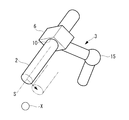
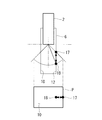
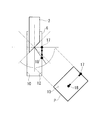
- FIG. 2 is a diagram showing a manipulator equipped with a perspective endoscope probe in the medical manipulator system of FIG. 1. It is a figure which shows the example of an image acquired with the endoscope probe in the medical manipulator system of FIG. In the medical manipulator system of FIG. 1, it is a figure which each shows the manipulator with which the direct-view type endoscope probe was mounted
- FIG. 6C It is a figure at the time of using the perspective type (large inclination
- FIG. 12A It is a figure which shows the output waveform of the distance sensor acquired by the process which inserts the direct view type
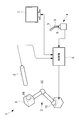
- the medical manipulator system 1 includes an endoscope 2, a manipulator 3 that moves the endoscope 2 while holding the endoscope 2 at the tip, and an operation command input by an operator.
- An operation unit 4 to be operated a control unit 5 for controlling the manipulator 3 based on an operation command input to the operation unit 4, and a holder (inserted member) fixed to the distal end of the manipulator 3 and attached to the endoscope 2 ) 6 and a monitor 7 for displaying an image acquired by the endoscope 2.
- the endoscope 2 has an imaging unit (not shown) at the distal end, and can acquire an image of a subject arranged to face the distal end.
- the endoscope 2 has an elongated shape.
- the types of the endoscope 2 include a direct view type that acquires a front image in front of the longitudinal axis direction and a perspective type that acquires an obliquely forward image. .
- the manipulator 3 has, for example, a multi-joint structure and has a degree of freedom in which the position and posture of the holder 6 fixed to the tip can be set.
- the operation unit 4 also has, for example, a multi-joint structure that is similar or pseudo-similar to the manipulator 3 and operates the angles of the joints 9 to achieve the position and posture of the handle 8 that is gripped and operated by the operator. It is detected as a command and output to the control unit 5.
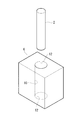
- the holder 6 includes a through hole 10 into which the endoscope 2 is inserted when the endoscope 2 is attached to the manipulator 3, and the endoscope inserted into the through hole 10.
- a fixing mechanism (not shown) for fixing 2 is provided.
- a marker for recognizing the type of the endoscope 2 by a scope type recognizing unit 11 described later is provided on the inner surface of the through hole 10 of the holder 6.
- the marker may have any shape, but the opening 12 itself of the through hole 10 provided in the holder 6 may be used as the marker.
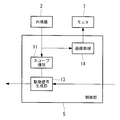
- control unit 5 receives the operation command sent from the operation unit 4, generates a drive command signal for driving each joint 15 of the manipulator 3, and outputs it to the manipulator 3.
- a drive signal generation unit (control unit) 13 a scope type recognition unit 11 that recognizes the type of the endoscope 2 from an image acquired by the imaging unit when the endoscope 2 is inserted into the through hole 10 of the holder 6, and
- an image processing unit 14 that processes an image acquired by the imaging unit and displays the image on the monitor 7.
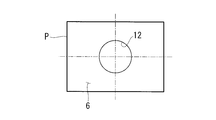
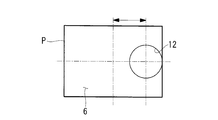
- the scope type recognition unit 11 has an image P acquired by the imaging unit when the endoscope 2 is inserted into the through hole 10 of the holder 6.
- the image P acquired by the imaging unit when the endoscope 2 is inserted into the through hole 10 of the holder 6 is shifted in one direction with respect to the center of the image P as shown in FIGS. 4A and 4C.
- the opening 12 of the through hole 10 is provided at the position, it is recognized that the type of the endoscope 2 is a perspective type.
- the scope type recognizing unit 11 shows that the amount of deviation of the opening 12 of the through hole 10 with respect to the center of the image P when the endoscope 2 is inserted into the through hole 10 of the holder 6 by a predetermined depth is shown in FIGS.
- the inclination angle of the optical axis of the imaging unit with respect to the longitudinal axis of the endoscope 2 increases as the deviation amount increases.
- the inclination angle is 30 °
- the inclination angle is 45 °.
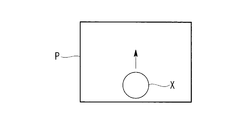
- the drive signal generation unit 13 receives the type information of the endoscope 2 recognized by the scope type recognition unit 11 and switches the operation of the manipulator 3. For example, as shown in FIG. 5A, when the perspective endoscope 2 is fixed to the holder 6 and the image P of the subject X as shown in FIG. 5B is acquired and displayed on the monitor 7, the image In order to move the subject X on P in the direction indicated by the arrow, it is necessary to move the tip of the endoscope 2 in the direction of the arrow perpendicular to the optical axis S in FIG.
- the drive signal generation unit 13 switches the operation of the manipulator 3 according to the type of the endoscope 2, so that the inside of the image P acquired by the endoscope 2 by the same operation performed by the operator via the operation unit 4.
- the manipulator 3 is controlled so that the movement of the subject X is the same.
- the operation of the medical manipulator system 1 according to this embodiment configured as described above will be described below.
- the power of the endoscope 2 is turned on, and the manipulator 3 is set in a state where the image P can be acquired by the imaging unit at the tip.
- the endoscope 2 is inserted by a predetermined amount into the through hole 10 of the holder 6 provided at the distal end.
- the image P including the inner surface of the through hole 10 is acquired by the imaging unit, and the opening 12 of the through hole 10 of the holder 6 is captured in the image P.
- the position of the opening 12 in the image P is calculated by image processing.
- the type of the endoscope 2 is recognized as a direct view type.
- the type of the endoscope 2 is recognized as a perspective type, and the inclination angle is recognized according to the amount of deviation. Is done.
- the recognition result in the scope type recognition unit 11 is sent to the drive signal generation unit 13.
- the control of the manipulator 3 is switched based on the transmitted type information of the endoscope 2. Then, the endoscope 2 inserted into the through-hole 10 of the holder 6 is fixed to the holder 6, and the manipulator 3 is driven when the operator operates the operation unit 4, and is acquired by the endoscope 2 and acquired by the monitor 7. The position of the subject X in the image P displayed on can be changed.
- the control of the manipulator 3 is switched based on the type information of the endoscope 2, the operator can attach the endoscope
- the position of the image P displayed on the monitor 7 can be moved in the same direction by the same operation on the operation unit 4 without being conscious of the type 2.
- the medical manipulator system 1 it is not necessary for the operator to change the operation on the operation unit 4 according to the type of the endoscope 2, so that the operability can be improved. There is an advantage that you can. Further, since the type is recognized by the image P acquired by the endoscope 2 instead of giving the identification information to the endoscope 2, the operability is improved similarly even if the existing endoscope 2 is used. be able to.
- control is switched according to the type of the endoscope 2, but instead, the recognized type of the endoscope 2 is displayed to the operator, and the type is changed. In addition, the operation performed by the operator may be changed.
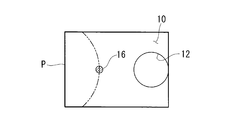
- the opening 12 of the through hole 10 of the holder 6 is used as a marker, but instead of this, other dots are formed on the inner surface of the through hole 10.
- the marker 16 may be attached.
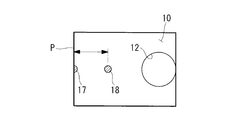
- the type of the endoscope 2 may be recognized such as a direct view type, a 30 ° perspective type, and a 45 ° perspective type. That is, as shown in FIGS. 7A to 7C, the distance between the markers 17 and 18 in the case of the direct-view type endoscope 2 is the smallest, and then the purely the marker 17 of the 30 ° perspective type and the 45 ° perspective type. , 18 becomes large, and by detecting this, the type of the endoscope 2 can be easily recognized.
- the endoscope 2 is rotated around the longitudinal axis of the endoscope 2 in a state where the endoscope 2 is inserted into the through hole 10 of the holder 6.
- the dot-shaped marker 16 on the inner surface of the through-hole 10 moves while drawing an arc-shaped movement locus. Therefore, the type of the endoscope 2 can be easily recognized by detecting the radius of the movement locus.
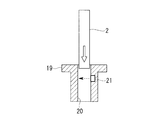
- the holder 6 provided with the through-hole 10 inserted when attaching the endoscope 2 to the manipulator 3 was illustrated as an inserted member into which the endoscope 2 is inserted, instead of this, As shown in FIG. 10, a trocar 19 that penetrates the body surface tissue and is placed in an attached state may be adopted for the body surface tissue of the patient.
- the trocar 19 includes a through hole 20 into which the endoscope 2 is inserted, and measures the distance from the inner surface of the through hole 20 to the outer surface of the endoscope 2 inserted from the inner surface.
- a distance sensor (outer surface position detection unit) 21 is provided. Examples of the distance sensor 21 include an optical sensor that emits light and receives reflected light reflected by the outer surface of the endoscope 2.
- the trocar 19 is provided with an encoder 22 for detecting the insertion amount of the endoscope 2, and the insertion amount detected by the encoder (insertion amount detector) 22 and the distance sensor 21 are provided.
- the tilt angle of the perspective type may be determined from the relationship with the distance detected by. That is, as shown in FIG. 13B, the inclination angle of the perspective endoscope 2 can be directly recognized by the inclination of the graph of the distance with respect to the insertion amount.
Landscapes
- Health & Medical Sciences (AREA)
- Life Sciences & Earth Sciences (AREA)
- Surgery (AREA)
- Engineering & Computer Science (AREA)
- Nuclear Medicine, Radiotherapy & Molecular Imaging (AREA)
- Heart & Thoracic Surgery (AREA)
- Veterinary Medicine (AREA)
- Public Health (AREA)
- General Health & Medical Sciences (AREA)
- Animal Behavior & Ethology (AREA)
- Molecular Biology (AREA)
- Biomedical Technology (AREA)
- Medical Informatics (AREA)
- Pathology (AREA)
- Radiology & Medical Imaging (AREA)
- Physics & Mathematics (AREA)
- Biophysics (AREA)
- Optics & Photonics (AREA)
- Gynecology & Obstetrics (AREA)
- Oral & Maxillofacial Surgery (AREA)
- Signal Processing (AREA)
- Human Computer Interaction (AREA)
- Robotics (AREA)
- Endoscopes (AREA)
Abstract
L'invention a pour objectif d'identifier les types d'endoscope, même pour des endoscopes existants qui ne conservent pas d'informations de caractéristiques. L'invention concerne un système médical de manipulation (1) qui comprend : un endoscope (2) comprenant une unité d'imagerie ; un manipulateur (3) qui retient l'endoscope (2) sur son extrémité distale et le déplace ; une unité d'opération (4) par laquelle l'opérateur envoie des instructions d'opération ; une unité de commande (5) qui contrôle le manipulateur (3) en fonction des instructions d'opération saisies dans l'unité d'opération (4) ; un élément d'insertion (6) comportant un orifice (10) dans lequel l'endoscope (2) est inséré lors de l'utilisation de l'endoscope (2) ; et une unité de reconnaissance de type d'endoscope qui reconnaît le type de l'endoscope (2) en fonction d'une image contenant la face interne de l'orifice (10) acquise par l'endoscope (2) pendant que l'endoscope (2) est inséré dans l'orifice (10).
Priority Applications (4)
| Application Number | Priority Date | Filing Date | Title |
|---|---|---|---|
| CN201680005031.3A CN107105983B (zh) | 2015-05-27 | 2016-05-26 | 医疗用机械手系统 |
| EP16800097.4A EP3305166A4 (fr) | 2015-05-27 | 2016-05-26 | Système médical de manipulation |
| JP2017514593A JP6138407B2 (ja) | 2015-05-27 | 2016-05-26 | 医療用マニピュレータシステム |
| US15/815,974 US20180071034A1 (en) | 2015-05-27 | 2017-11-17 | Medical manipulator system |
Applications Claiming Priority (2)
| Application Number | Priority Date | Filing Date | Title |
|---|---|---|---|
| JP2015107480 | 2015-05-27 | ||
| JP2015-107480 | 2015-05-27 |
Related Child Applications (1)
| Application Number | Title | Priority Date | Filing Date |
|---|---|---|---|
| US15/815,974 Continuation US20180071034A1 (en) | 2015-05-27 | 2017-11-17 | Medical manipulator system |
Publications (1)
| Publication Number | Publication Date |
|---|---|
| WO2016190393A1 true WO2016190393A1 (fr) | 2016-12-01 |
Family
ID=57392929
Family Applications (1)
| Application Number | Title | Priority Date | Filing Date |
|---|---|---|---|
| PCT/JP2016/065607 Ceased WO2016190393A1 (fr) | 2015-05-27 | 2016-05-26 | Système médical de manipulation |
Country Status (5)
| Country | Link |
|---|---|
| US (1) | US20180071034A1 (fr) |
| EP (1) | EP3305166A4 (fr) |
| JP (1) | JP6138407B2 (fr) |
| CN (1) | CN107105983B (fr) |
| WO (1) | WO2016190393A1 (fr) |
Cited By (1)
| Publication number | Priority date | Publication date | Assignee | Title |
|---|---|---|---|---|
| WO2018235389A1 (fr) * | 2017-06-20 | 2018-12-27 | オリンパス株式会社 | Appareil d'affichage médical |
Families Citing this family (3)
| Publication number | Priority date | Publication date | Assignee | Title |
|---|---|---|---|---|
| CN111528762A (zh) * | 2020-04-13 | 2020-08-14 | 珠海明象医用科技有限公司 | 一种无线内窥镜工作站 |
| US20220117673A1 (en) * | 2020-10-19 | 2022-04-21 | Arthur C. McKinley | EndoInspect Apparatus, System and Method |
| CN112402038B (zh) * | 2020-11-20 | 2022-09-13 | 山东威高医疗科技有限公司 | 与电磁导航系统配套使用的器械的自动识别方法 |
Citations (6)
| Publication number | Priority date | Publication date | Assignee | Title |
|---|---|---|---|---|
| JPH07328014A (ja) * | 1994-06-10 | 1995-12-19 | Olympus Optical Co Ltd | 手術装置 |
| JP2003019683A (ja) * | 1993-12-28 | 2003-01-21 | Olympus Optical Co Ltd | 手術ロボット |
| JP2009226029A (ja) * | 2008-03-24 | 2009-10-08 | Terumo Corp | マニピュレータ |
| JP2012019982A (ja) * | 2010-07-15 | 2012-02-02 | Fujifilm Corp | 内視鏡システム |
| WO2014078538A1 (fr) * | 2012-11-15 | 2014-05-22 | Intuitive Surgical Operations, Inc. | Systèmes endoscopiques à faible capacité et/ou faible blindage électromagnétique, et procédés associés |
| US20140163359A1 (en) * | 2011-08-21 | 2014-06-12 | Mordehai Sholev | Device and method for assisting laparoscopic surgery - rule based approach |
Family Cites Families (6)
| Publication number | Priority date | Publication date | Assignee | Title |
|---|---|---|---|---|
| US5876325A (en) * | 1993-11-02 | 1999-03-02 | Olympus Optical Co., Ltd. | Surgical manipulation system |
| JP4754738B2 (ja) * | 2001-08-30 | 2011-08-24 | オリンパス株式会社 | 医療用保持装置及び医療装置 |
| JP3938722B2 (ja) * | 2002-07-03 | 2007-06-27 | オリンパス株式会社 | 内視鏡装置 |
| US8373748B2 (en) * | 2005-12-14 | 2013-02-12 | Stryker Corporation | Automatic endoscope recognition and selection of image processing and display settings |
| US9788906B2 (en) * | 2013-03-15 | 2017-10-17 | Synaptive Medical (Barbados) Inc. | Context aware surgical systems for intraoperatively configuring imaging devices |
| JP6161687B2 (ja) * | 2013-03-28 | 2017-07-12 | オリンパス株式会社 | 内視鏡システムおよび内視鏡システムの作動方法 |
-
2016
- 2016-05-26 WO PCT/JP2016/065607 patent/WO2016190393A1/fr not_active Ceased
- 2016-05-26 JP JP2017514593A patent/JP6138407B2/ja active Active
- 2016-05-26 EP EP16800097.4A patent/EP3305166A4/fr not_active Withdrawn
- 2016-05-26 CN CN201680005031.3A patent/CN107105983B/zh active Active
-
2017
- 2017-11-17 US US15/815,974 patent/US20180071034A1/en not_active Abandoned
Patent Citations (6)
| Publication number | Priority date | Publication date | Assignee | Title |
|---|---|---|---|---|
| JP2003019683A (ja) * | 1993-12-28 | 2003-01-21 | Olympus Optical Co Ltd | 手術ロボット |
| JPH07328014A (ja) * | 1994-06-10 | 1995-12-19 | Olympus Optical Co Ltd | 手術装置 |
| JP2009226029A (ja) * | 2008-03-24 | 2009-10-08 | Terumo Corp | マニピュレータ |
| JP2012019982A (ja) * | 2010-07-15 | 2012-02-02 | Fujifilm Corp | 内視鏡システム |
| US20140163359A1 (en) * | 2011-08-21 | 2014-06-12 | Mordehai Sholev | Device and method for assisting laparoscopic surgery - rule based approach |
| WO2014078538A1 (fr) * | 2012-11-15 | 2014-05-22 | Intuitive Surgical Operations, Inc. | Systèmes endoscopiques à faible capacité et/ou faible blindage électromagnétique, et procédés associés |
Non-Patent Citations (1)
| Title |
|---|
| See also references of EP3305166A4 * |
Cited By (5)
| Publication number | Priority date | Publication date | Assignee | Title |
|---|---|---|---|---|
| WO2018235389A1 (fr) * | 2017-06-20 | 2018-12-27 | オリンパス株式会社 | Appareil d'affichage médical |
| JP6495565B1 (ja) * | 2017-06-20 | 2019-04-03 | オリンパス株式会社 | 医療表示装置 |
| CN110785111A (zh) * | 2017-06-20 | 2020-02-11 | 奥林巴斯株式会社 | 医疗显示装置 |
| US10972705B2 (en) | 2017-06-20 | 2021-04-06 | Olympus Corporation | Medical display apparatus, endoscopic surgery system, and method of displaying medical image |
| CN110785111B (zh) * | 2017-06-20 | 2021-12-21 | 奥林巴斯株式会社 | 医疗显示装置 |
Also Published As
| Publication number | Publication date |
|---|---|
| CN107105983A (zh) | 2017-08-29 |
| JPWO2016190393A1 (ja) | 2017-06-15 |
| EP3305166A4 (fr) | 2019-01-23 |
| EP3305166A1 (fr) | 2018-04-11 |
| JP6138407B2 (ja) | 2017-05-31 |
| US20180071034A1 (en) | 2018-03-15 |
| CN107105983B (zh) | 2019-03-26 |
Similar Documents
| Publication | Publication Date | Title |
|---|---|---|
| JP6284284B2 (ja) | ジェスチャ制御を用いるロボットシステム制御用の制御装置及び方法 | |
| KR102105142B1 (ko) | 입력 장치의 오퍼레이터가 볼 수 있는 디스플레이 영역으로 기구가 진입할 때 기구의 제어를 입력 장치로 전환하는 방법 | |
| JP4744595B2 (ja) | 内視鏡外科手術器具 | |
| CN108348134B (zh) | 内窥镜系统 | |
| JP6138407B2 (ja) | 医療用マニピュレータシステム | |
| JP6177488B2 (ja) | マニピュレータ及び医療システム | |
| CN105407817B (zh) | 医疗系统和医疗用器具控制方法 | |
| CN104023614B (zh) | 立体内窥镜装置、立体内窥镜系统和立体内窥镜机器人 | |
| JP5904750B2 (ja) | 立体内視鏡装置 | |
| CN107847285B (zh) | 输入机构和医疗系统 | |
| US11540699B2 (en) | Medical manipulator system | |
| JP2019506922A (ja) | ロボット手術のために仮想現実デバイスを使用するシステム、コントローラ、及び方法 | |
| WO2017014303A1 (fr) | Système médical et son procédé de fonctionnement | |
| KR20110008189A (ko) | 제어자의 모션을 로봇 매니퓰레이터로부터 부착된 기구로 전달하기 위한 커플러 | |
| CN110934641B (zh) | 手术辅助装置及其控制方法、以及手术辅助系统 | |
| US10694928B2 (en) | Endoscope system | |
| JP6104479B2 (ja) | マニピュレータシステム | |
| JP6286575B2 (ja) | 内視鏡用外科手術装置 | |
| CN106455920B (zh) | 内窥镜系统 | |
| JP2016506762A (ja) | 医療機器 | |
| US10568490B2 (en) | Surgical apparatus for endoscope | |
| JP6893036B2 (ja) | 手術支援装置、その制御方法及びプログラム、並びに手術支援システム | |
| US20180344418A1 (en) | Medical manipulator system and method for controlling a medical manipulator | |
| JP2025151383A (ja) | 内視鏡システム、制御装置、制御方法およびプログラム |
Legal Events
| Date | Code | Title | Description |
|---|---|---|---|
| 121 | Ep: the epo has been informed by wipo that ep was designated in this application |
Ref document number: 16800097 Country of ref document: EP Kind code of ref document: A1 |
|
| ENP | Entry into the national phase |
Ref document number: 2017514593 Country of ref document: JP Kind code of ref document: A |
|
| NENP | Non-entry into the national phase |
Ref country code: DE |