WO2016194380A1 - Dispositif de codage d'images animées, procédé de codage d'images animées et support d'enregistrement pour mémoriser un programme de codage d'images animées - Google Patents
Dispositif de codage d'images animées, procédé de codage d'images animées et support d'enregistrement pour mémoriser un programme de codage d'images animées Download PDFInfo
- Publication number
- WO2016194380A1 WO2016194380A1 PCT/JP2016/002676 JP2016002676W WO2016194380A1 WO 2016194380 A1 WO2016194380 A1 WO 2016194380A1 JP 2016002676 W JP2016002676 W JP 2016002676W WO 2016194380 A1 WO2016194380 A1 WO 2016194380A1
- Authority
- WO
- WIPO (PCT)
- Prior art keywords
- image
- quantization
- encoding
- unit
- quantized
- Prior art date
- Legal status (The legal status is an assumption and is not a legal conclusion. Google has not performed a legal analysis and makes no representation as to the accuracy of the status listed.)
- Ceased
Links
Images





Classifications
-
- H—ELECTRICITY
- H04—ELECTRIC COMMUNICATION TECHNIQUE
- H04N—PICTORIAL COMMUNICATION, e.g. TELEVISION
- H04N19/00—Methods or arrangements for coding, decoding, compressing or decompressing digital video signals
- H04N19/10—Methods or arrangements for coding, decoding, compressing or decompressing digital video signals using adaptive coding
- H04N19/102—Methods or arrangements for coding, decoding, compressing or decompressing digital video signals using adaptive coding characterised by the element, parameter or selection affected or controlled by the adaptive coding
- H04N19/124—Quantisation
- H04N19/126—Details of normalisation or weighting functions, e.g. normalisation matrices or variable uniform quantisers
-
- H—ELECTRICITY
- H04—ELECTRIC COMMUNICATION TECHNIQUE
- H04N—PICTORIAL COMMUNICATION, e.g. TELEVISION
- H04N19/00—Methods or arrangements for coding, decoding, compressing or decompressing digital video signals
- H04N19/10—Methods or arrangements for coding, decoding, compressing or decompressing digital video signals using adaptive coding
- H04N19/134—Methods or arrangements for coding, decoding, compressing or decompressing digital video signals using adaptive coding characterised by the element, parameter or criterion affecting or controlling the adaptive coding
- H04N19/146—Data rate or code amount at the encoder output
-
- H—ELECTRICITY
- H04—ELECTRIC COMMUNICATION TECHNIQUE
- H04N—PICTORIAL COMMUNICATION, e.g. TELEVISION
- H04N19/00—Methods or arrangements for coding, decoding, compressing or decompressing digital video signals
- H04N19/10—Methods or arrangements for coding, decoding, compressing or decompressing digital video signals using adaptive coding
- H04N19/169—Methods or arrangements for coding, decoding, compressing or decompressing digital video signals using adaptive coding characterised by the coding unit, i.e. the structural portion or semantic portion of the video signal being the object or the subject of the adaptive coding
- H04N19/17—Methods or arrangements for coding, decoding, compressing or decompressing digital video signals using adaptive coding characterised by the coding unit, i.e. the structural portion or semantic portion of the video signal being the object or the subject of the adaptive coding the unit being an image region, e.g. an object
- H04N19/176—Methods or arrangements for coding, decoding, compressing or decompressing digital video signals using adaptive coding characterised by the coding unit, i.e. the structural portion or semantic portion of the video signal being the object or the subject of the adaptive coding the unit being an image region, e.g. an object the region being a block, e.g. a macroblock
-
- H—ELECTRICITY
- H04—ELECTRIC COMMUNICATION TECHNIQUE
- H04N—PICTORIAL COMMUNICATION, e.g. TELEVISION
- H04N19/00—Methods or arrangements for coding, decoding, compressing or decompressing digital video signals
- H04N19/42—Methods or arrangements for coding, decoding, compressing or decompressing digital video signals characterised by implementation details or hardware specially adapted for video compression or decompression, e.g. dedicated software implementation
- H04N19/43—Hardware specially adapted for motion estimation or compensation
-
- H—ELECTRICITY
- H04—ELECTRIC COMMUNICATION TECHNIQUE
- H04N—PICTORIAL COMMUNICATION, e.g. TELEVISION
- H04N19/00—Methods or arrangements for coding, decoding, compressing or decompressing digital video signals
- H04N19/42—Methods or arrangements for coding, decoding, compressing or decompressing digital video signals characterised by implementation details or hardware specially adapted for video compression or decompression, e.g. dedicated software implementation
- H04N19/436—Methods or arrangements for coding, decoding, compressing or decompressing digital video signals characterised by implementation details or hardware specially adapted for video compression or decompression, e.g. dedicated software implementation using parallelised computational arrangements
Definitions
- the present invention relates to a moving image encoding apparatus, a moving image encoding method, and a storage medium for recording a moving image encoding program that can execute encoding processing at high speed.
- Video compression encoding technology is widely used.
- Video compression encoding technology is used in a wide range of applications such as digital broadcasting, video content distribution using optical discs, and video distribution via the Internet.
- ITU International Telecommunication Union
- ISO International Organization for Standardization
- MPEG Motion Picture Expert Group
- MPEG-4 SMPTE (Society of Motion Picture and Television Engineers)
- H.261, H.263, MPEG-1, MPEG-2, MPEG-4, and VC-1 are widely used as international standard technologies.
- H.264 / MPEG-4 AVC Advanced Video Coding
- H.264 which has been standardized jointly by ITU and ISO, described in Non-Patent Document 1
- H.265 / MPEG-H HEVC High Efficiency Video Coding
- H.265 was standardized as the latest moving image compression coding standard. It was. H.265 can compress the data size to about half that of H.264 while maintaining the same video quality as H.264. H.265 may be widely used across all fields.
- the above moving image coding technology is a combination of a plurality of elemental technologies such as motion compensated prediction, orthogonal transformation of prediction error image, quantization of orthogonal transformation coefficient, and entropy coding of quantized orthogonal transformation coefficient. Composed. Coding in the moving picture coding technique is called hybrid coding.
- the above-described moving image encoding technique increases the compression rate of moving images by performing inter-frame prediction in which the high correlation of images in the time axis direction, which is one of the characteristics of moving images, is used.
- inter-frame prediction a motion compensated prediction technique is generally used in which a predicted image is generated by correcting the movement and misalignment of a subject or background between images that are temporally close.
- FIG. 11 shows an example of the configuration of a video encoding apparatus that uses inter-frame prediction as a prediction method.
- FIG. 11 is a block diagram illustrating a configuration example of a general moving image encoding apparatus.
- a moving image encoding apparatus 100 illustrated in FIG. 11 includes a subtraction unit 101, a conversion unit 102, a quantization unit 103, an inverse quantization unit 104, an inverse conversion unit 105, an addition unit 106, a filter unit 107, a frame buffer 108, and a scan unit. 109, an entropy encoding unit 110, a rate control unit 111, and a motion prediction unit 112.
- the moving image encoding device 100 When a new image is input to the moving image encoding device 100, the moving image encoding device 100 performs an encoding process in units of image blocks of a predetermined size.
- the moving image encoding device 100 when H.264 is used as the moving image compression encoding method, the moving image encoding device 100 performs encoding processing in units of 16 ⁇ 16 pixel blocks called macroblocks (MB).
- MB macroblocks
- the moving image coding apparatus 100 is called a coding tree unit (CTU), such as 16 ⁇ 16 pixels, 32 ⁇ 32 pixels, or 64 ⁇ 64 pixels. Encoding processing is performed in units of blocks.
- CTU coding tree unit
- the motion prediction unit 112 detects a position change of the image block of the input image corresponding to the image block of the encoded image stored in the frame buffer 108.
- the frame buffer 108 stores image data of an already encoded frame.
- the motion prediction unit 112 obtains motion vector information corresponding to the detected position change. In addition, the motion prediction unit 112 performs a motion compensation prediction process based on the obtained motion vector information, and outputs a motion compensation prediction image.
- the motion compensated prediction image is input from the motion prediction unit 112 to the subtraction unit 101.
- the subtraction unit 101 subtracts the motion compensated prediction image from the input image.
- the subtraction unit 101 sets an image obtained by subtracting the motion compensated prediction image as a prediction error image, and outputs a prediction error image.
- the prediction error image is input from the subtraction unit 101 to the conversion unit 102.
- the transform unit 102 performs orthogonal transform processing similar to DCT (Discrete Cosine Transform) on the input prediction error image.
- the transform unit 102 generates a transform coefficient sequence by performing orthogonal transform processing, and outputs the generated transform coefficient sequence.
- orthogonal transform processing is performed in units of 4 ⁇ 4 pixel or 8 ⁇ 8 pixel blocks.
- orthogonal transform processing is performed in units of blocks of 4 ⁇ 4 pixels, 8 ⁇ 8 pixels, 16 ⁇ 16 pixels, or 32 ⁇ 32 pixels. Done.
- the transform unit 102 may transform the prediction error image by performing other transform processing such as orthogonal transform processing similar to DCT or Wavelet transform.
- the moving image encoding device 100 does not necessarily include a conversion unit that performs conversion processing on a prediction error image.
- the quantizing unit 103 receives a transform coefficient sequence from the transform unit 102 and a quantization parameter (QP) from the rate control unit 111.
- the quantization unit 103 performs a quantization process on the input transform coefficient sequence based on the input quantization parameter, and generates a quantized transform coefficient sequence.
- the quantization unit 103 outputs the generated quantized transform coefficient sequence.
- the inverse quantization unit 104 receives the transform coefficient sequence quantized from the quantization unit 103.
- the inverse quantization unit 104 performs an inverse quantization process on the input quantized transform coefficient sequence to generate a transform coefficient sequence.
- the inverse quantization unit 104 outputs the generated transform coefficient sequence.
- the transform coefficient sequence is input from the inverse quantization unit 104 to the inverse transform unit 105.
- the inverse transform unit 105 performs inverse integer transform processing on the input transform coefficient sequence to generate a prediction error image.
- the inverse transform unit 105 outputs the generated prediction error image.
- the addition unit 106 receives a prediction error image from the inverse conversion unit 105 and a prediction image from the motion prediction unit 112.
- the adding unit 106 adds the input prediction error image and the prediction image, and outputs an image generated by the addition.
- the filter unit 107 receives an image obtained by adding the prediction error image and the prediction image from the addition unit 106.
- the filter unit 107 generates a local decoded image by performing a filtering process on the input image.
- the filter processing performed by the filter unit 107 is processing for reducing distortion generated in an image due to encoding.
- a deblocking filter is used for the filter processing.
- Sample Adaptive Offset is also used for the filter processing.
- the local decoded image generated by the filter unit 107 is stored in the frame buffer 108.
- the local decoded image is used for encoding subsequent frames.
- the quantized transform coefficient sequence from the quantizing unit 103 is input to the scanning unit 109.
- the scanning unit 109 performs a predetermined scan process on the input quantized transform coefficient sequence, and rearranges the quantized transform coefficient sequence.
- the predetermined scan process is, for example, a zigzag scan.
- the scan unit 109 outputs the rearranged transform coefficient sequence.
- the entropy encoding unit 110 receives the transform coefficient sequence rearranged from the scan unit 109.
- the entropy encoding unit 110 performs an entropy encoding process on the input rearranged transform coefficient sequence according to a predetermined rule to generate a bitstream.
- the entropy encoding unit 110 outputs the generated bit stream.
- context adaptive arithmetic coding CABAC: Context Adaptive Binary Arithmetic Coding
- CABAC Context Adaptive Binary Arithmetic Coding
- CAVLC Context-based Adaptive VideoLAN Client
- the bit stream is input from the entropy encoding unit 110 to the rate control unit 111.
- the rate control unit 111 calculates a quantization parameter used for quantization of the subsequent block based on the statistical information of the input bitstream.
- the statistical information of the bitstream used by the rate control unit 111 is, for example, a code amount for each block or a code amount for each context. Specific processing contents of the quantization parameter calculation processing are described in Non-Patent Document 3 or Non-Patent Document 4, for example.
- the moving image encoding apparatus 100 is often required to specify the bit rate of the output bit stream and control the rate so as to match the specified bit rate.
- the rate control unit 111 performs rate control processing for controlling the rate so as to match the designated bit rate.
- Non-Patent Document 4 details of rate control processing in H.265 are described in Non-Patent Document 4.
- the target bit number (TCurrPic) of each frame is calculated based on the importance of each image frame.
- feedback control is performed so that the number of bits of the frame matches TCurrPic.
- a quantization parameter used in the CTU quantization process is calculated.
- a series of image processing and signal processing including motion prediction processing, conversion processing, quantization processing, inverse quantization processing, inverse conversion processing, and filter processing are performed on a large number of images. Done. That is, generally, a huge amount of calculation is required to execute the moving image encoding process.
- a processor that operates at a high operating frequency often does not have a computing capability to process an input moving image simultaneously with the input. Therefore, when a processor operating at a high operating frequency processes a moving image with a high resolution at the same time as input, there arises a problem that the processing time becomes long.
- image processing and signal processing can be performed at high efficiency and high speed by using, as an accelerator, another processor or arithmetic circuit having a structure suitable for moving image coding processing in addition to a general-purpose processor.
- Technology to perform has been developed.
- GPU GraphicsGProcessingGraphUnit
- DSP Digital Signal Processor
- FPGA Field Programmable Gate Array
- GPU is a processor that is originally used for 3D graphics processing.
- the GPU has a large-scale parallel processor structure in which hundreds to thousands of processor cores are integrated. Therefore, a GPU can execute processing several times to several tens of times faster than a general-purpose processor as long as the processing conforms to the characteristics of the GPU.
- the amount of calculation related to the motion vector search process performed by the motion prediction unit 112 of the video encoding device 100 shown in FIG. 11 is large. Therefore, when the motion prediction unit 112 is realized by a GPU or the like, the motion vector search process is executed faster than when the motion prediction unit 112 is realized by a CPU.
- the amount of calculation related to the processing such as conversion processing, quantization processing, and scanning processing is large.
- a more advanced and complicated quantization process including an adaptive QP selection process or an RD optimum quantization process described in Non-Patent Document 4, for example, is performed as the quantization process, the quantization process is performed.
- the amount of calculation related to increases further.
- Patent Document 1 describes an efficient technique for executing a transformation process, a quantization process, and a scan process that require a large amount of computation required for execution in parallel using a GPU.
- the information processing apparatus described in Patent Document 1 performs conversion processing, quantization processing, and scanning processing in parallel on a GPU.
- the GPU inputs intermediate data, which is a processing result of parallel processing, to a CPU that is a general-purpose processor.
- the CPU performs a lossless compression process on the intermediate data.
- the lossless compression process corresponds to the entropy encoding process performed by the entropy encoding unit 110 illustrated in FIG.
- the information processing apparatus described in Patent Document 1 distributes the processing to be executed in a distributed manner to the GPU and CPU. Specifically, transformation processing, quantization processing, and scanning processing that can execute predetermined operations on each block in parallel are assigned to GPUs that are good at parallel computing. In addition, lossless compression processing with variable data size and difficulty in parallel execution is assigned to a CPU that is good at complex bit analysis. If processing is assigned according to the characteristics of the GPU and CPU, the efficiency of processing execution as a whole device increases.
- ITU-T Recommendation H.264 "Advanced video coding for generic audiovisual services", March 2010
- the problem with the information processing apparatus described in Patent Document 1 is that the rate control processing within the frame is not realized.
- the GPU in the information processing apparatus executes quantization processing for a plurality of blocks in parallel, and inputs the execution result to the CPU.
- the CPU executes entropy encoding processing for the plurality of quantized blocks.
- the quantization parameter is adjusted according to the number of generated bits in the encoded block in the frame as described above, and the adjusted quantization parameter is used in the next quantization process. Is required to be fed back.
- the quantization processing by the GPU is executed in parallel before the entropy encoding processing by the CPU. That is, since the encoding process is started after all the quantization processes are completed, the information processing apparatus described in Patent Document 1 cannot feed back the rate controlled as described above to the quantization process.
- the number of bits generated in the frame does not converge to the target number of bits and becomes unstable. If the number of generated bits in the frame becomes unstable, it may cause unintended operations such as degradation of image quality due to fluctuations in image quality between frames, or exceeding the upper limit number of bits per frame. is there.
- Patent Document 2 and Patent Document 3 describe other encoding devices.
- the encoding device described in Patent Literature 2 performs two-pass processing in order to realize both parallel execution of quantization processing and rate control within a frame.
- the encoding device described in Patent Document 2 executes frame encoding processing twice.
- the encoding apparatus performs a frame encoding process using provisional quantization parameters, and records information on the number of generated bits in the encoded block in the frame. To do.
- the encoding apparatus performs appropriate quantization based on the relationship between the provisional quantization parameter used in the first pass and the number of generated bits obtained in the first pass. Estimate the parameters.
- the encoding device performs the frame encoding process again using the estimated quantization parameter.
- the encoding apparatus can also execute a process for forcibly terminating the high-frequency coefficient for each region to be encoded in parallel in order to prevent the upper limit number of generated bits from being exceeded.
- the problem with the encoding device described in Patent Document 2 is that the amount of computation related to the processing is doubled because the encoding is executed twice.
- the coefficient may be censored in the specific area even if the number of bits does not exceed the entire frame. If the coefficient is censored in the specific area, an unnecessary deterioration in image quality occurs.
- the encoding device described in Patent Document 3 is performing encoding based on history information on the relationship between the quantization parameter and the number of generated bits in an encoded frame, and information such as image complexity distribution analysis. Predict the number of bits generated in a frame. The encoding device controls the quantization parameter based on the predicted number of generated bits.
- the problem with the encoding device described in Patent Document 3 is that the number of generated bits used for control is a predicted value, so that the rate control becomes unstable if the error in predicting the number of generated bits increases. It is. For example, if the property of the image of the frame being processed changes greatly from the property of the image of the frame processed in the past, the error in predicting the number of generated bits increases.
- the encoding devices described in Patent Document 2 and Patent Document 3 can realize both parallel execution of quantization processing and rate control within a frame.
- the encoding devices described in Patent Document 2 and Patent Document 3 are used, there arises a problem that the amount of computation related to processing increases and a problem that rate control is not stable.
- the present invention stores a moving picture coding apparatus, a moving picture coding method, and a moving picture coding program that can execute a coding process including a stable rate control process at a high speed without greatly increasing the amount of calculation.
- An object is to provide a recording medium.
- a moving image encoding apparatus includes a quantization unit that quantizes image data constituting an encoding target image for each quantization parameter using a plurality of quantization parameters, and a plurality of quantized images.
- a storage unit that stores the image data in association with the quantization parameter used when each image is quantized, and the storage unit stores a predetermined quantized image using a predetermined quantization parameter.
- An extraction unit that extracts data, an encoding unit that encodes the data of the extracted predetermined quantized image, and the extraction unit is then subjected to predetermined quantization based on the encoding result by the encoding unit And a determining unit that determines a predetermined quantization parameter used when extracting image data.
- the moving image encoding method quantizes image data constituting an encoding target image for each quantization parameter using a plurality of quantization parameters, and converts a plurality of quantized image data. , Each of them is stored in association with the quantization parameter used when quantized, and the predetermined quantized parameter is used to quantize the data from a plurality of stored quantized image data. Used to extract the image data, encode the extracted predetermined quantized image data, and then extract the predetermined quantized image data based on the encoding result A predetermined quantization parameter is determined.
- the recording medium allows a computer to quantize image data constituting an encoding target image using a plurality of quantization parameters for each quantization parameter, and a plurality of quantized images.
- a storage process for storing image data in association with the quantization parameter used when each image is quantized, and using a predetermined quantization parameter from a plurality of stored quantized image data
- a moving picture encoding program for executing a determination process for determining a predetermined quantization parameter used when data of a quantized image is extracted Memory to.
- encoding processing including stable rate control processing can be executed at high speed without greatly increasing the amount of calculation.
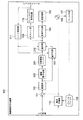
- FIG. 1 is a block diagram showing a configuration example of a first embodiment of a moving picture coding apparatus according to the present invention.
- the moving image encoding apparatus 100 includes a plurality of quantization units 200, an intermediate information buffer 201, and a selection unit 202 as compared to the moving image encoding apparatus 100 illustrated in FIG. 11. Different points are included.
- the configuration of the video encoding device 100 shown in FIG. 1 other than the multiple quantization unit 200, the intermediate information buffer 201, and the selection unit 202 is the same as the configuration of the video encoding device 100 shown in FIG.
- the multiple quantization unit 200 has a function of performing a quantization process on the transform coefficient sequence input from the transform unit 102 using two or more types of quantization parameters.
- the multiple quantization unit 200 quantizes the input transform coefficient sequence for each of different types of quantization parameters. After quantization, the multiple quantization unit 200 stores a plurality of quantized transform coefficient sequences in the intermediate information buffer 201 in association with the quantization parameter used in each quantization process.
- the intermediate information buffer 201 has a function of storing the quantized transform coefficient sequence in association with the quantization parameter used when the transform coefficient sequence is quantized.
- the selection unit 202 uses the quantization parameter input from the rate control unit 111 to select a predetermined quantized transform coefficient sequence from among the quantized transform coefficient sequences stored in the intermediate information buffer 201. It has the function to select and output from.
- the multiple quantization unit 200 can execute a quantization process using all quantization parameters that can be selected in standards such as H.264 and H.265. For example, in the H.264 and H.265 standards, 52 quantization parameters of 0 to 51 are used.
- the multiple quantization unit 200 can execute 52 types of quantization processing corresponding to the respective quantization parameters of 0 to 51.
- the multiple quantization unit 200 stores the quantized transform coefficient sequence and the quantization parameter used for the quantization process in the intermediate information buffer 201 in association with each other.
- the transform coefficient sequence quantized based on the quantization parameter input from the rate control unit 111 is always stored in the intermediate information buffer 201.
- the selection unit 202 selects and outputs a quantized transform coefficient sequence stored in association with the quantization parameter input from the rate control unit 111.
- the multiple quantization unit 200 does not use all selectable quantization parameters, for example, performs quantization processing using every other quantization parameter (0, 2, 4, 8,). May be executed. Further, the multiple quantization unit 200 may perform quantization processing using quantization parameters (0, 3, 6, 9,%) every other two.
- the multiple quantization unit 200 may execute the quantization process using a plurality of quantization parameters within a predetermined range centered on a predetermined quantization parameter.
- the multi-quantization unit 200 may use a plurality of quantization parameters in a range with the quantization parameter 30 as the center, +4 from the center as an upper limit, and -4 from the center as a lower limit.
- the multiple quantization unit 200 executes five types of quantization processing using the five quantization parameters (26, 28, 30, 32, 34).
- a value calculated from information such as the target number of bits of a frame may be set as the quantization parameter that is the center.
- the quantization parameter used by the multiple quantization unit 200 is not limited to the above example, and the multiple quantization unit 200 can use various patterns of quantization parameters. Further, the multiple quantization unit 200 can use various selection procedures other than the quantization parameter selection procedure described above.
- the transform coefficient sequence quantized based on the quantization parameter input from the rate control unit 111 is intermediate information. There is a possibility that it is not stored in the buffer 201.
- the selection unit 202 extracts a transform coefficient sequence corresponding to the input quantization parameter. If a transform coefficient sequence quantized based on the input quantization parameter is not stored, the selection unit 202 may extract another quantized transform coefficient sequence. For example, the selection unit 202 extracts a transform coefficient sequence quantized based on the quantization parameter whose value is closest to the input quantization parameter from the transform coefficient sequences stored in the intermediate information buffer 201. Also good.
- the selection unit 202 selects a transform coefficient sequence corresponding to a quantization parameter different from the quantization parameter input from the rate control unit 111, the number of bits allocated by the rate control unit 111 when determining the quantization parameter An error may occur between the number of output bits. However, even if an error occurs, feedback is immediately made so that no error occurs in the encoding of the next and subsequent image blocks, so that stable rate control is realized for the entire frame.
- the rate control unit 111 can perform the same feedback control as that of the video encoding device 100 shown in FIG. That is, the moving picture coding apparatus according to the present embodiment can also realize stable rate control.
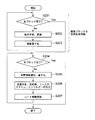
- FIG. 2 is a flowchart illustrating the overall operation of the encoding process performed by the moving image encoding apparatus 100 according to the first embodiment.
- the moving image encoding apparatus 100 When the process is started, the moving image encoding apparatus 100 performs a quantization process on each image block in the frame.
- the moving picture coding apparatus 100 checks whether or not the quantization process has been completed for all the image blocks in the frame (step S101).
- the motion prediction unit 112 When there is an image block that has not been quantized among all image blocks in the frame (No in step S101), the motion prediction unit 112 performs motion compensation prediction on the target image block that has not been quantized. Processing is performed and a motion compensated prediction image is output.
- the subtraction unit 101 performs a subtraction process for subtracting the motion compensated prediction image from the input image, and outputs a prediction error image.
- the conversion unit 102 performs a conversion process on the input prediction error image, and outputs a conversion coefficient sequence (step S102).
- the multiple quantization unit 200 performs a quantization process on the transform coefficient sequence a plurality of times using a plurality of quantization parameters (step S103).
- the multiple quantization unit 200 stores a plurality of quantized transform coefficient sequences generated by the quantization process in the intermediate information buffer 201. After being stored, the moving image encoding apparatus 100 performs the process of step S101 again.
- step S101 the video encoding device 100 determines whether the encoding process is completed for all the image blocks in the frame. Confirm (step S104).
- the intermediate information buffer 201 stores information on the quantized transform coefficient sequences corresponding to the image blocks in the frame for all the image blocks in the frame.
- the selection unit 202 When there is an image block in which the encoding process has not been completed among all the image blocks in the frame (No in step S104), the selection unit 202 performs the quantization corresponding to the target image block that has not been encoded yet. Of the transform coefficient sequences, the obtained quantized transform coefficient sequence is selected from the intermediate information buffer 201 (step S105).
- the obtained quantized transform coefficient sequence is, for example, a transform coefficient sequence quantized based on the quantization parameter input from the rate control unit 111.
- the selection unit 202 outputs the selected quantized transform coefficient sequence.
- the inverse quantization unit 104 performs inverse quantization processing on the input quantized transform coefficient sequence and outputs a transform coefficient sequence.
- the inverse transform unit 105 performs an inverse transform process on the input transform coefficient sequence, and outputs a prediction error image.
- the adding unit 106 performs addition processing for adding the input prediction error image and the prediction image, and outputs an image.
- the filter unit 107 performs a filtering process on the input image to generate a local decoded image.
- the filter unit 107 stores the generated local decoded image in the frame buffer 108.
- the scan unit 109 performs a scan process on the input quantized transform coefficient sequence and outputs the rearranged transform coefficient sequence.
- the entropy encoding unit 110 performs entropy encoding processing on the input rearranged transform coefficient sequence, and outputs a bit stream (step S106).
- the rate control unit 111 updates the content of the rate control using the information of the bit stream output in step S106 (step S107).
- the rate control unit 111 uses, for example, information on the number of bits generated in the encoded image block, and inputs the number of bits allocated to the image block encoded next time and the selection unit 202.
- the information of the quantization parameter to be updated is updated. After the update, the moving image encoding apparatus 100 performs the process of step S104 again.
- step S104 the moving image encoding apparatus 100 ends the entire encoding process.
- steps S102 to S103 are executed in order for each image block.
- the processes in steps S102 to S103 may be executed in parallel for a plurality of image blocks.
- the multiple quantization unit 200 since the multiple quantization unit 200 performs the quantization process a plurality of times using a plurality of quantization parameters, the amount of calculation related to the quantization process increases. However, compared to the method of executing the entire encoding process described in Patent Document 2 twice, the amount of increase in the calculation amount related to the entire process is small.
- a plurality of quantization processes using a plurality of quantization parameters may be executed in parallel. That is, as described in Patent Document 1, an accelerator that is strong in parallel processing, such as a GPU, can execute conversion processing, quantization processing, and the like in parallel.
- an accelerator that is strong in parallel processing such as a GPU
- the processing is executed at a higher speed than when the CPU executes processing for each block. Therefore, the moving picture encoding apparatus according to the present embodiment can easily execute a plurality of quantization processes at high speed by using a GPU or the like.
- the moving image encoding apparatus realizes high-speed processing by assigning transformation processing, quantization processing, and the like to a GPU or the like that is good at parallel calculation, and a stable rate by feeding back the encoding result. Realize control.
- the moving picture encoding apparatus can realize both high-speed execution of the encoding process and stable rate control without increasing the increase in the amount of calculation related to the quantization process.
- the reason is that the intermediate information buffer stores the transform coefficient sequence quantized based on each of the plurality of quantization parameters, and the selection unit corresponds to the quantization parameter based on the encoding result determined by the rate control unit.
- a conversion coefficient string is extracted from the intermediate information buffer.
- the moving picture encoding apparatus since the moving picture encoding apparatus does not need to execute the quantization process again based on the quantization parameter determined by the rate control unit, the entire process is executed as fast as the quantization process that is not executed.
- the entropy encoding unit encodes the extracted transform coefficient sequence, and the process is repeatedly performed on a plurality of image blocks, so that stable rate control is realized for the entire frame.
- FIG. 3 is a block diagram showing a configuration example of the second embodiment of the moving picture coding apparatus according to the present invention.
- the moving image encoding apparatus 100 includes a quantization unit 103 as compared with the moving image encoding apparatus 100 illustrated in FIG. Instead, the selection unit 212 is included.
- the configuration of the video encoding device 100 shown in FIG. 3 other than the quantization unit 103 and the selection unit 212 is the same as the configuration of the video encoding device 100 shown in FIG.
- the quantization unit 103 has the same function as the quantization unit 103 shown in FIG. However, the quantization unit 103 in the present embodiment operates when the multiple quantization unit 200 has not performed the quantization process using the quantization parameter input from the rate control unit 111. Therefore, when the number of quantization parameters used by the multiple quantization unit 200 for the quantization process increases, the amount of computation related to the quantization process performed by the multiple quantization unit 200 increases, and the quantization unit 103 executes the quantization process. The possibility is low.
- a plurality of quantization processes by the plurality of quantization units 200 are executed in parallel.
- the multiple quantization unit 200 is configured with a GPU and the quantization unit 103 is configured with a CPU.
- the quantization unit 103 is configured with a CPU.
- the selection unit 212 operates the quantization unit 103 when a transform coefficient sequence quantized based on the quantization parameter input from the rate control unit 111 is not stored in the intermediate information buffer 201.
- the selection unit 212 operates the quantization unit 103 so as to quantize the transform coefficient sequence using the quantization parameter input from the rate control unit 111. Next, the selection unit 212 selects and outputs the transform coefficient sequence quantized by the quantization unit 103.
- the selection unit 212 When a transform coefficient sequence quantized based on the quantization parameter input from the rate control unit 111 is stored in the intermediate information buffer 201, the selection unit 212 includes the selection unit 202 of the first embodiment. Similarly, a corresponding conversion coefficient sequence is extracted from the intermediate information buffer 201. Therefore, the selection unit 212 in this embodiment can always output a transform coefficient sequence quantized based on the quantization parameter input from the rate control unit 111.
- FIG. 4 is a flowchart illustrating the overall operation of the encoding process performed by the moving image encoding apparatus 100 according to the second embodiment.
- steps S201 to S204 is the same as the processing of steps S101 to S104 of the first embodiment shown in FIG.
- the selection unit 212 When there is an image block for which the encoding process has not been completed among all the image blocks in the frame (No in step S204), the selection unit 212 performs the quantization corresponding to the target image block that has not been encoded yet. Among the transform coefficient sequences, the obtained quantized transform coefficient sequence is selected from the intermediate information buffer 201 (step S205).
- the selection unit 212 selects and outputs a corresponding transform coefficient sequence.
- the selection unit 212 uses the input quantization parameter to convert the transform coefficient sequence.
- the quantization unit 103 is operated so as to quantize the signal.
- the selection unit 212 selects and outputs the transform coefficient sequence quantized by the quantization unit 103.
- steps S206 to S207 is the same as the processing in steps S106 to S107 in the first embodiment shown in FIG.
- the moving picture encoding apparatus can realize quantization processing that utilizes the capabilities of different processors such as GPU and CPU and arithmetic processing units.
- the moving picture coding apparatus can also realize stable rate control by feeding back the coding result.
- the moving picture encoding apparatus can perform the quantization process using the quantization parameter that the multiple quantization unit 200 does not use for the quantization process
- the rate control unit The transform coefficient sequence quantized based on the quantization parameter input from 111 can always be encoded.
- FIG. 5 is a block diagram showing a configuration example of the third embodiment of the moving picture coding apparatus according to the present invention.
- the moving image encoding apparatus 100 includes a multiple quantization scanning unit 210 instead of the multiple quantization unit 200 as compared to the moving image encoding apparatus 100 illustrated in FIG. 1. Is different. Further, the difference is that an intermediate information buffer 211 is included instead of the intermediate information buffer 201 and a selection unit 222 is included instead of the selection unit 202. Another difference is that the scanning unit 109 is not included.
- the configuration of the video encoding device 100 shown in FIG. 5 other than the multiple quantization scanning unit 210, the intermediate information buffer 211, and the selection unit 222 is the same as the configuration of the video encoding device 100 shown in FIG.
- the multi-quantization scan unit 210 performs a plurality of quantization processes using a plurality of quantization parameters, and then performs a scan process on the quantized transform coefficient sequence.
- the scan process performed by the multiple quantization scan unit 210 is the same as the scan process performed by the scan unit 109 of the first and second embodiments.
- the multiple quantization scanning unit 210 stores the quantized transform coefficient sequence and the scan processing result of the quantized transform coefficient sequence in the intermediate information buffer 211 in association with the quantization parameter used in the quantization process. To do.
- the intermediate information buffer 211 stores the scan processing result of the quantized transform coefficient sequence in addition to the quantized transform coefficient sequence.
- the selection unit 222 extracts the transform coefficient sequence quantized based on the quantization parameter input from the rate control unit 111 and the scan processing result of the quantized transform coefficient sequence from the intermediate information buffer 211.
- the extracted scan processing result is a scan processing result stored in the intermediate information buffer 211 in association with the extracted quantized transform coefficient sequence.
- the selection unit 222 inputs the extracted quantized transform coefficient sequence to the inverse quantization unit 104. Further, the selection unit 222 inputs the extracted scan processing result to the entropy encoding unit 110.
- FIG. 6 is a flowchart showing the overall operation of the encoding process performed by the video encoding apparatus 100 according to the third embodiment.
- the processing in steps S301 to S302 is the same as the processing in steps S101 to S102 of the first embodiment shown in FIG.
- the multi-quantization scanning unit 210 performs a quantization process on the transform coefficient sequence a plurality of times using a plurality of quantization parameters. Next, the multiple quantization scan unit 210 performs a scan process on the plurality of quantized transform coefficient sequences generated by the quantization process (step S303).
- the multiple quantization scanning unit 210 stores the quantized transform coefficient sequence and the scan processing result of the quantized transform coefficient sequence in the intermediate information buffer 211. After being stored, the moving image encoding apparatus 100 performs the process of step S301 again.
- step S304 is the same as the processing in step S104 of the first embodiment shown in FIG.
- the selection unit 222 When there is an image block in which the encoding process has not been completed among all the image blocks in the frame (No in step S304), the selection unit 222 performs quantization corresponding to the target image block that has not been encoded yet. Of the transform coefficient sequences, the obtained quantized transform coefficient sequence is selected from the intermediate information buffer 211.
- the selection unit 222 selects the scan processing result of the selected quantized transform coefficient sequence stored in the intermediate information buffer 211 (step S305).
- the selection unit 222 outputs the selected quantized transform coefficient sequence and the scan processing result of the quantized transform coefficient sequence.
- steps S306 to S307 is the same as the processing in steps S106 to S107 in the first embodiment shown in FIG.
- the video encoding apparatus can also execute scan processing for a plurality of transform coefficient sequences quantized based on a plurality of quantization parameters first. Therefore, the video encoding apparatus according to the present embodiment performs the entire encoding process at a higher speed than the video encoding apparatus according to the first embodiment, for example, when the GPU executes a quantization process and a scan process in parallel. it can.
- FIG. 7 is a block diagram showing a configuration example of the fourth embodiment of the video encoding apparatus according to the present invention.
- the moving picture coding apparatuses according to the first to third embodiments perform coding processing (inter coding) using only inter-frame prediction using motion compensated prediction.
- inter coding In addition to inter coding, intra coding that generates and codes a predicted image using information on neighboring pixels in the screen is also used.
- the moving picture coding apparatus according to the present embodiment can perform both inter coding and intra coding.
- the moving picture coding apparatus 100 includes a subtraction unit 101-2 as compared with the moving picture coding apparatus 100 shown in FIG. -2 is included, the intra-screen prediction unit 203 is included, and the intra / inter switching unit 204 is included. Further, the difference is that a selection unit 232 is included instead of the selection unit 212.
- the configuration of the moving picture encoding apparatus 100 shown in FIG. 7 other than the subtracting unit 101-2, the converting unit 102-2, the intra prediction unit 203, the intra / inter switching unit 204, and the selecting unit 232 is the moving picture shown in FIG.
- the configuration is the same as that of the encoding device 100.
- the local decoded image before the filter process is performed is input.
- the intra-screen prediction unit 203 performs intra-screen prediction processing on the input local decoded image, and outputs the intra-screen prediction image generated by the intra-screen prediction processing.
- the intra / inter switching unit 204 selects either the intra-screen prediction image or the motion compensated prediction image based on the designated encoding mode, and outputs the selected image.
- the intra / inter switching unit 204 outputs an intra-screen prediction image.
- the intra / inter switching unit 204 outputs a motion compensated prediction image.
- the intra prediction image is input from the intra prediction unit 203 to the subtraction unit 101-2.
- the subtraction unit 101-2 subtracts the intra prediction image from the input image.
- the subtracting unit 101-2 sets the image obtained by subtracting the intra-screen prediction image as the prediction error image, and outputs the prediction error image.
- the transform unit 102-2 When the intra coding mode is designated, the transform unit 102-2 performs a transform process on the input prediction error image and outputs a transform coefficient sequence.
- the quantization unit 103 When the intra coding mode is designated, the quantization unit 103 performs a quantization process on the transform coefficient sequence input from the transform unit 102-2, and outputs a quantized transform coefficient sequence.
- the selection unit 232 operates in the same manner as the selection unit 202 of the first embodiment when the inter coding mode is designated.
- the selection unit 232 selects and outputs the quantized transform coefficient sequence input from the quantization unit 103.
- the moving image encoding apparatus 100 uses local decoded image information of neighboring image blocks. That is, in the intra coding mode, the moving image coding apparatus 100 cannot execute parallel processing that can be performed for processing such as motion prediction processing and quantization processing for a plurality of blocks in the inter coding mode.
- FIG. 8 is a flowchart showing the overall operation of the encoding process performed by the moving image encoding apparatus 100 according to the fourth embodiment.
- steps S401 to S404 is the same as the processing of steps S101 to S104 of the first embodiment shown in FIG.
- the selection unit 232 determines whether or not the specified encoding mode is the intra encoding mode. Confirmation is made (step S405).
- the conversion unit 102-2 When the designated encoding mode is the intra encoding mode (Yes in step S405), the conversion unit 102-2 performs a conversion process on the intra prediction image input from the intra prediction unit 203, and performs conversion A coefficient sequence is output (step S406).
- the quantization unit 103 performs a quantization process on the transform coefficient sequence input from the transform unit 102-2, and outputs a quantized transform coefficient sequence (step S407).
- the selection unit 232 selects and outputs the quantized transform coefficient sequence input from the quantization unit 103 (step S408).
- the selection unit 232 selects the obtained quantized transform coefficient sequence from the intermediate information buffer 201. (Step S408).
- steps S409 to S410 is the same as the processing of steps S106 to S107 of the first embodiment shown in FIG.
- the moving picture coding apparatus can support both the inter coding system and the intra coding system.
- the moving image encoding apparatus can realize both high-speed processing and stable rate control in inter encoding, as in the first to third embodiments.
- the moving picture encoding apparatus of each of the above embodiments performs encoding according to H.264 or H.265.
- the moving image encoding apparatus according to the present invention is an encoding method that is not included in an encoding method other than the H.264 or H.265 encoding method, such as VC-1, or an international standard moving image encoding method.
- the encoding may be performed according to:
- the moving picture coding apparatus performs coding using motion compensation prediction or intra prediction.
- the moving picture coding apparatus according to the present invention may perform coding using a prediction method other than motion compensation prediction and intra prediction. Further, the moving picture coding apparatus according to the present invention may perform coding without using a prediction method.
- each of the above embodiments can be configured by hardware, it can also be realized by, for example, a computer program recorded on a recording medium.
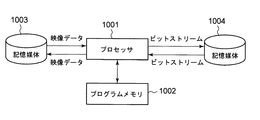
- the information processing apparatus shown in FIG. 9 includes a processor 1001, a program memory 1002, a storage medium (recording medium) 1003 for storing video data, and a storage medium 1004 for storing data such as a bit stream.
- the storage medium 1003 and the storage medium 1004 may be separate storage media, or may be storage areas composed of the same storage medium.
- a magnetic storage medium such as a hard disk can be used as the storage medium.
- In the storage medium 1003, at least an area where a program is stored is a non-transitory tangible storage area (non-transitory tangible media).
- the program memory 1002 stores a program for realizing the function of each block shown in FIG. 1, FIG. 3, FIG. 5, and FIG. Then, the processor 1001 executes the processing according to the program stored in the program memory 1002, thereby realizing the functions of the moving picture encoding device shown in FIG. 1, FIG. 3, FIG. 5, and FIG. To do.
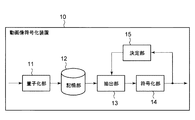
- FIG. 10 is a block diagram showing an outline of a moving picture coding apparatus according to the present invention.
- a moving image encoding apparatus 10 according to the present invention includes a quantization unit 11 (for example, a plurality of quantizers) that quantizes image data constituting an encoding target image for each quantization parameter using a plurality of quantization parameters.
- a quantization unit 11 for example, a plurality of quantizers
- a storage unit 12 for example, intermediate information buffer 201) for storing the data of a plurality of quantized images in association with the quantization parameters used when each of them is quantized
- the extraction unit 13 (for example, the selection unit 202) that extracts data of a predetermined quantized image using a predetermined quantization parameter from the unit 12, and the extracted predetermined quantized image data
- the extraction unit 13 Based on the result of encoding by the encoding unit 14 (for example, the entropy encoding unit 110) to be encoded and the encoding unit 14, the extraction unit 13 then outputs predetermined quantized image data.
- Determining unit 15 for determining the predetermined quantization parameter to be used when output (e.g., the rate control unit 111) and a.
- the moving image encoding apparatus can execute an encoding process including a stable rate control process at a high speed without greatly increasing the amount of calculation.
- the predetermined quantized image data may be quantized image data stored in the storage unit 12 in association with a predetermined quantization parameter.
- the moving picture encoding apparatus can encode the transform coefficient sequence quantized based on the quantization parameter determined by the rate control unit.
- the predetermined quantized image data may be quantized image data stored in the storage unit 12 in association with the quantization parameter whose value is closest to the predetermined quantization parameter.
- the video encoding apparatus can encode a quantized transform coefficient sequence other than the transform coefficient sequence quantized based on the quantization parameter determined by the rate control unit.
- the moving image encoding device 10 uses the quantization parameter other than the plurality of quantization parameters used by the quantization unit 11 to quantize the image data constituting the encoding target image.
- Unit for example, quantization unit 103
- the extraction unit 13 may extract predetermined quantized image data from the second quantization unit instead of the storage unit 12.
- the moving image encoding apparatus can perform the determined quantization even when the transform coefficient sequence quantized based on the quantization parameter determined by the rate control unit does not exist in the intermediate information buffer.
- the transform coefficient sequence quantized based on the parameters can be encoded.
- the quantization unit 11 quantizes the image data, and then scans the quantized image data according to a predetermined procedure.
- the storage unit 12 converts the scanned image data into a quantized image.
- the extraction unit 13 scans data stored in the storage unit 12 in association with the predetermined quantized image data and the predetermined quantized image data.
- the image data may be extracted, and the encoding unit 14 may encode the extracted scanned image data instead of the predetermined quantized image data.
- the moving image encoding apparatus can execute encoding processing at a higher speed.
- the moving image coding apparatus 10 includes a motion prediction unit (for example, the motion prediction unit 112) that generates a motion compensated prediction image by performing a motion compensation prediction process on an image constituting an encoding target image, A subtraction unit (for example, a subtraction unit 101) that generates a prediction error image by subtracting the motion compensated prediction image generated from the above, and a conversion coefficient sequence is generated by performing conversion processing on the generated prediction error image
- the quantizing unit 11 may quantize the generated transform coefficient sequence as image data constituting the encoding target image.
- the moving image encoding apparatus can execute the encoding process in the inter encoding mode.
- the moving image encoding apparatus 10 includes an intra-screen prediction unit (for example, an intra-screen prediction unit 203) that generates an intra-screen prediction image by performing intra-screen prediction processing on an image constituting the encoding target image.
- the subtracting unit may generate the prediction error image by subtracting the intra-screen prediction image generated from the image.
- the moving image encoding apparatus can execute the encoding process in the intra encoding mode.
- the quantization unit 11 may quantize data of a plurality of images constituting the encoding target image in parallel.
- the moving image encoding apparatus can execute encoding processing at a higher speed.
- the quantization unit 11 may quantize the image data for each quantization parameter using all the available quantization parameters.
- the video encoding apparatus can always store the transform coefficient sequence quantized based on the quantization parameter determined by the rate control unit in the intermediate information buffer.
- the extraction unit 13 may extract image data after all the quantized image data constituting the encoding target image is stored in the storage unit 12.
Landscapes
- Engineering & Computer Science (AREA)
- Multimedia (AREA)
- Signal Processing (AREA)
- Computing Systems (AREA)
- Theoretical Computer Science (AREA)
- Compression Or Coding Systems Of Tv Signals (AREA)
Abstract
Priority Applications (2)
| Application Number | Priority Date | Filing Date | Title |
|---|---|---|---|
| JP2017521699A JP6708211B2 (ja) | 2015-06-03 | 2016-06-02 | 動画像符号化装置、動画像符号化方法および動画像符号化プログラムを記憶する記録媒体 |
| US15/579,056 US10536699B2 (en) | 2015-06-03 | 2016-06-02 | Moving image coding device, moving image coding method and recording medium for storing moving image coding program |
Applications Claiming Priority (2)
| Application Number | Priority Date | Filing Date | Title |
|---|---|---|---|
| JP2015-112787 | 2015-06-03 | ||
| JP2015112787 | 2015-06-03 |
Publications (1)
| Publication Number | Publication Date |
|---|---|
| WO2016194380A1 true WO2016194380A1 (fr) | 2016-12-08 |
Family
ID=57441121
Family Applications (1)
| Application Number | Title | Priority Date | Filing Date |
|---|---|---|---|
| PCT/JP2016/002676 Ceased WO2016194380A1 (fr) | 2015-06-03 | 2016-06-02 | Dispositif de codage d'images animées, procédé de codage d'images animées et support d'enregistrement pour mémoriser un programme de codage d'images animées |
Country Status (3)
| Country | Link |
|---|---|
| US (1) | US10536699B2 (fr) |
| JP (1) | JP6708211B2 (fr) |
| WO (1) | WO2016194380A1 (fr) |
Cited By (1)
| Publication number | Priority date | Publication date | Assignee | Title |
|---|---|---|---|---|
| JP7516793B2 (ja) | 2020-03-24 | 2024-07-17 | 日本電気株式会社 | 動画像符号化システムおよび動画像符号化方法 |
Families Citing this family (4)
| Publication number | Priority date | Publication date | Assignee | Title |
|---|---|---|---|---|
| WO2021084679A1 (fr) * | 2019-10-31 | 2021-05-06 | 株式会社ソシオネクスト | Procédé de codage vidéo, procédé de traitement de codage, appareil de codage vidéo et appareil de traitement de codage |
| CN112165618B (zh) * | 2020-09-27 | 2022-08-16 | 北京金山云网络技术有限公司 | 一种视频编码方法、装置、设备和计算机可读存储介质 |
| CN113238987B (zh) * | 2021-06-08 | 2022-11-22 | 中科寒武纪科技股份有限公司 | 量化数据的统计量化器、存储装置、处理装置及板卡 |
| CN119729002B (zh) * | 2023-09-28 | 2026-01-27 | 杭州阿里云飞天信息技术有限公司 | 图像编码方法以及图像解码方法 |
Citations (5)
| Publication number | Priority date | Publication date | Assignee | Title |
|---|---|---|---|---|
| WO1996028937A1 (fr) * | 1995-03-09 | 1996-09-19 | Sony Corporation | Methode et dispositif de codage de signaux-images |
| JP2005348310A (ja) * | 2004-06-07 | 2005-12-15 | Nippon Telegr & Teleph Corp <Ntt> | 動画像符号化方法,動画像符号化装置,動画像符号化プログラムおよびそのプログラムを記録したコンピュータ読み取り可能な記録媒体 |
| JP2006121538A (ja) * | 2004-10-25 | 2006-05-11 | Hitachi Ltd | 画像符号化装置、及び画像符号化方法 |
| JP2011171855A (ja) * | 2010-02-16 | 2011-09-01 | Mega Chips Corp | 画像符号化装置及び画像変換装置 |
| WO2013115572A1 (fr) * | 2012-01-30 | 2013-08-08 | 삼성전자 주식회사 | Procédé et appareil de codage et décodage vidéo basés sur des unités de données hiérarchiques comprenant une prédiction de paramètre de quantification |
Family Cites Families (7)
| Publication number | Priority date | Publication date | Assignee | Title |
|---|---|---|---|---|
| JP2871139B2 (ja) | 1991-03-19 | 1999-03-17 | オリンパス光学工業株式会社 | 画像デ―タの符号化装置および復号化装置 |
| JP2502898B2 (ja) | 1992-09-28 | 1996-05-29 | 松下電器産業株式会社 | 画像符号化装置 |
| KR100579417B1 (ko) * | 2004-04-06 | 2006-05-12 | (주)씨앤에스 테크놀로지 | 고속 영상압축장치 |
| US20060034522A1 (en) * | 2004-08-10 | 2006-02-16 | Nader Mohsenian | Method and system for equalizing video quality using selective re-encoding |
| WO2009157580A1 (fr) * | 2008-06-27 | 2009-12-30 | ソニー株式会社 | Dispositif de traitement d'image et procédé de traitement d'image |
| WO2010041488A1 (fr) | 2008-10-10 | 2010-04-15 | 株式会社東芝 | Dispositif de codage d'image dynamique |
| JP6186429B2 (ja) | 2013-04-12 | 2017-08-23 | 株式会社スクウェア・エニックス・ホールディングス | 情報処理装置、制御方法、プログラム、及び記録媒体 |
-
2016
- 2016-06-02 JP JP2017521699A patent/JP6708211B2/ja active Active
- 2016-06-02 WO PCT/JP2016/002676 patent/WO2016194380A1/fr not_active Ceased
- 2016-06-02 US US15/579,056 patent/US10536699B2/en active Active
Patent Citations (5)
| Publication number | Priority date | Publication date | Assignee | Title |
|---|---|---|---|---|
| WO1996028937A1 (fr) * | 1995-03-09 | 1996-09-19 | Sony Corporation | Methode et dispositif de codage de signaux-images |
| JP2005348310A (ja) * | 2004-06-07 | 2005-12-15 | Nippon Telegr & Teleph Corp <Ntt> | 動画像符号化方法,動画像符号化装置,動画像符号化プログラムおよびそのプログラムを記録したコンピュータ読み取り可能な記録媒体 |
| JP2006121538A (ja) * | 2004-10-25 | 2006-05-11 | Hitachi Ltd | 画像符号化装置、及び画像符号化方法 |
| JP2011171855A (ja) * | 2010-02-16 | 2011-09-01 | Mega Chips Corp | 画像符号化装置及び画像変換装置 |
| WO2013115572A1 (fr) * | 2012-01-30 | 2013-08-08 | 삼성전자 주식회사 | Procédé et appareil de codage et décodage vidéo basés sur des unités de données hiérarchiques comprenant une prédiction de paramètre de quantification |
Cited By (1)
| Publication number | Priority date | Publication date | Assignee | Title |
|---|---|---|---|---|
| JP7516793B2 (ja) | 2020-03-24 | 2024-07-17 | 日本電気株式会社 | 動画像符号化システムおよび動画像符号化方法 |
Also Published As
| Publication number | Publication date |
|---|---|
| US10536699B2 (en) | 2020-01-14 |
| JP6708211B2 (ja) | 2020-06-10 |
| JPWO2016194380A1 (ja) | 2018-04-19 |
| US20180176567A1 (en) | 2018-06-21 |
Similar Documents
| Publication | Publication Date | Title |
|---|---|---|
| KR102426721B1 (ko) | 색차 성분 양자화 매개 변수 결정 방법 및 이러한 방법을 사용하는 장치 | |
| KR20220151140A (ko) | 영상 부호화 방법 및 컴퓨터로 읽을 수 있는 기록 매체 | |
| US10244262B2 (en) | Pixel-based intra prediction for coding in HEVC | |
| JP6164660B2 (ja) | ビデオ符号化での分割ブロック符号化方法、ビデオ復号化での分割ブロック復号化方法及びこれを実現する記録媒体 | |
| CN103931182B (zh) | 帧内预测视频译码中的非正方形变换 | |
| JP7343669B2 (ja) | Vvcにおける色変換のための方法及び機器 | |
| JP2018056685A (ja) | 画像符号化装置、画像符号化方法、及び画像符号化プログラム、並びに、画像復号装置、画像復号方法、及び画像復号プログラム | |
| JP2011024066A (ja) | 画像処理装置および方法 | |
| JP2011130410A (ja) | 符号化方法、復号化方法及び装置 | |
| US10979709B2 (en) | Image encoding method/device, image decoding method/device and recording medium having bitstream stored therein | |
| US12244801B2 (en) | Image encoding method/device, image decoding method/device and recording medium having bitstream stored therein | |
| JP6708211B2 (ja) | 動画像符号化装置、動画像符号化方法および動画像符号化プログラムを記憶する記録媒体 | |
| TW201631967A (zh) | 用於編碼及解碼之使用轉換係數以漸進更新 | |
| KR101646072B1 (ko) | 동영상 데이터 암호화 장치 및 방법 | |
| JP2022093657A (ja) | 符号化装置、復号装置、及びプログラム | |
| JP6528635B2 (ja) | 動画像符号化装置、動画像符号化方法及び動画像符号化用コンピュータプログラム | |
| KR101688085B1 (ko) | 고속 인트라 예측을 위한 영상 부호화 방법 및 장치 | |
| JPWO2017082304A1 (ja) | 情報圧縮装置、情報圧縮方法、情報圧縮プログラム、及び、符号化装置 | |
| JP6402520B2 (ja) | 符号化装置、方法、プログラム及び機器 | |
| WO2018079444A1 (fr) | Dispositif de codage, procédé de codage et support d'enregistrement de programme | |
| JP2007266861A (ja) | 画像符号化装置 | |
| KR20200008537A (ko) | 비디오 복호화에서의 분할 블록 복호화 방법 및 이를 구현하는 기록매체 | |
| KR20170054338A (ko) | 비디오 복호화에서의 분할 블록 복호화 방법 및 이를 구현하는 기록매체 | |
| KR20170051390A (ko) | 비디오 복호화에서의 분할 블록 복호화 방법 및 이를 구현하는 기록매체 | |
| KR20170051389A (ko) | 비디오 복호화에서의 분할 블록 복호화 방법 및 이를 구현하는 기록매체 |
Legal Events
| Date | Code | Title | Description |
|---|---|---|---|
| 121 | Ep: the epo has been informed by wipo that ep was designated in this application |
Ref document number: 16802820 Country of ref document: EP Kind code of ref document: A1 |
|
| ENP | Entry into the national phase |
Ref document number: 2017521699 Country of ref document: JP Kind code of ref document: A |
|
| WWE | Wipo information: entry into national phase |
Ref document number: 15579056 Country of ref document: US |
|
| NENP | Non-entry into the national phase |
Ref country code: DE |
|
| 122 | Ep: pct application non-entry in european phase |
Ref document number: 16802820 Country of ref document: EP Kind code of ref document: A1 |