WO2016194527A1 - Multimère colorant absorbant dans le proche infrarouge, composition, film, filtre optique, procédé et dispositif de formation de motif - Google Patents
Multimère colorant absorbant dans le proche infrarouge, composition, film, filtre optique, procédé et dispositif de formation de motif Download PDFInfo
- Publication number
- WO2016194527A1 WO2016194527A1 PCT/JP2016/063233 JP2016063233W WO2016194527A1 WO 2016194527 A1 WO2016194527 A1 WO 2016194527A1 JP 2016063233 W JP2016063233 W JP 2016063233W WO 2016194527 A1 WO2016194527 A1 WO 2016194527A1
- Authority
- WO
- WIPO (PCT)
- Prior art keywords
- group
- formula
- dye
- infrared absorbing
- absorbing dye
- Prior art date
- Legal status (The legal status is an assumption and is not a legal conclusion. Google has not performed a legal analysis and makes no representation as to the accuracy of the status listed.)
- Ceased
Links
Images




Classifications
-
- C—CHEMISTRY; METALLURGY
- C08—ORGANIC MACROMOLECULAR COMPOUNDS; THEIR PREPARATION OR CHEMICAL WORKING-UP; COMPOSITIONS BASED THEREON
- C08F—MACROMOLECULAR COMPOUNDS OBTAINED BY REACTIONS ONLY INVOLVING CARBON-TO-CARBON UNSATURATED BONDS
- C08F20/00—Homopolymers and copolymers of compounds having one or more unsaturated aliphatic radicals, each having only one carbon-to-carbon double bond, and only one being terminated by only one carboxyl radical or a salt, anhydride, ester, amide, imide or nitrile thereof
- C08F20/02—Monocarboxylic acids having less than ten carbon atoms, Derivatives thereof
- C08F20/10—Esters
- C08F20/34—Esters containing nitrogen, e.g. N,N-dimethylaminoethyl (meth)acrylate
-
- C—CHEMISTRY; METALLURGY
- C08—ORGANIC MACROMOLECULAR COMPOUNDS; THEIR PREPARATION OR CHEMICAL WORKING-UP; COMPOSITIONS BASED THEREON
- C08F—MACROMOLECULAR COMPOUNDS OBTAINED BY REACTIONS ONLY INVOLVING CARBON-TO-CARBON UNSATURATED BONDS
- C08F230/00—Copolymers of compounds having one or more unsaturated aliphatic radicals, each having only one carbon-to-carbon double bond, and containing phosphorus, selenium, tellurium or a metal
- C08F230/04—Copolymers of compounds having one or more unsaturated aliphatic radicals, each having only one carbon-to-carbon double bond, and containing phosphorus, selenium, tellurium or a metal containing a metal
- C08F230/06—Copolymers of compounds having one or more unsaturated aliphatic radicals, each having only one carbon-to-carbon double bond, and containing phosphorus, selenium, tellurium or a metal containing a metal containing boron
-
- C—CHEMISTRY; METALLURGY
- C08—ORGANIC MACROMOLECULAR COMPOUNDS; THEIR PREPARATION OR CHEMICAL WORKING-UP; COMPOSITIONS BASED THEREON
- C08F—MACROMOLECULAR COMPOUNDS OBTAINED BY REACTIONS ONLY INVOLVING CARBON-TO-CARBON UNSATURATED BONDS
- C08F20/00—Homopolymers and copolymers of compounds having one or more unsaturated aliphatic radicals, each having only one carbon-to-carbon double bond, and only one being terminated by only one carboxyl radical or a salt, anhydride, ester, amide, imide or nitrile thereof
- C08F20/02—Monocarboxylic acids having less than ten carbon atoms, Derivatives thereof
- C08F20/10—Esters
- C08F20/38—Esters containing sulfur
-
- C—CHEMISTRY; METALLURGY
- C08—ORGANIC MACROMOLECULAR COMPOUNDS; THEIR PREPARATION OR CHEMICAL WORKING-UP; COMPOSITIONS BASED THEREON
- C08F—MACROMOLECULAR COMPOUNDS OBTAINED BY REACTIONS ONLY INVOLVING CARBON-TO-CARBON UNSATURATED BONDS
- C08F220/00—Copolymers of compounds having one or more unsaturated aliphatic radicals, each having only one carbon-to-carbon double bond, and only one being terminated by only one carboxyl radical or a salt, anhydride ester, amide, imide or nitrile thereof
- C08F220/02—Monocarboxylic acids having less than ten carbon atoms; Derivatives thereof
- C08F220/04—Acids; Metal salts or ammonium salts thereof
- C08F220/06—Acrylic acid; Methacrylic acid; Metal salts or ammonium salts thereof
-
- C—CHEMISTRY; METALLURGY
- C08—ORGANIC MACROMOLECULAR COMPOUNDS; THEIR PREPARATION OR CHEMICAL WORKING-UP; COMPOSITIONS BASED THEREON
- C08F—MACROMOLECULAR COMPOUNDS OBTAINED BY REACTIONS ONLY INVOLVING CARBON-TO-CARBON UNSATURATED BONDS
- C08F220/00—Copolymers of compounds having one or more unsaturated aliphatic radicals, each having only one carbon-to-carbon double bond, and only one being terminated by only one carboxyl radical or a salt, anhydride ester, amide, imide or nitrile thereof
- C08F220/02—Monocarboxylic acids having less than ten carbon atoms; Derivatives thereof
- C08F220/10—Esters
- C08F220/20—Esters of polyhydric alcohols or phenols, e.g. 2-hydroxyethyl (meth)acrylate or glycerol mono-(meth)acrylate
-
- C—CHEMISTRY; METALLURGY
- C08—ORGANIC MACROMOLECULAR COMPOUNDS; THEIR PREPARATION OR CHEMICAL WORKING-UP; COMPOSITIONS BASED THEREON
- C08F—MACROMOLECULAR COMPOUNDS OBTAINED BY REACTIONS ONLY INVOLVING CARBON-TO-CARBON UNSATURATED BONDS
- C08F220/00—Copolymers of compounds having one or more unsaturated aliphatic radicals, each having only one carbon-to-carbon double bond, and only one being terminated by only one carboxyl radical or a salt, anhydride ester, amide, imide or nitrile thereof
- C08F220/02—Monocarboxylic acids having less than ten carbon atoms; Derivatives thereof
- C08F220/10—Esters
- C08F220/34—Esters containing nitrogen, e.g. N,N-dimethylaminoethyl (meth)acrylate
-
- C—CHEMISTRY; METALLURGY
- C08—ORGANIC MACROMOLECULAR COMPOUNDS; THEIR PREPARATION OR CHEMICAL WORKING-UP; COMPOSITIONS BASED THEREON
- C08F—MACROMOLECULAR COMPOUNDS OBTAINED BY REACTIONS ONLY INVOLVING CARBON-TO-CARBON UNSATURATED BONDS
- C08F220/00—Copolymers of compounds having one or more unsaturated aliphatic radicals, each having only one carbon-to-carbon double bond, and only one being terminated by only one carboxyl radical or a salt, anhydride ester, amide, imide or nitrile thereof
- C08F220/02—Monocarboxylic acids having less than ten carbon atoms; Derivatives thereof
- C08F220/10—Esters
- C08F220/34—Esters containing nitrogen, e.g. N,N-dimethylaminoethyl (meth)acrylate
- C08F220/36—Esters containing nitrogen, e.g. N,N-dimethylaminoethyl (meth)acrylate containing oxygen in addition to the carboxy oxygen, e.g. 2-N-morpholinoethyl (meth)acrylate or 2-isocyanatoethyl (meth)acrylate
- C08F220/365—Esters containing nitrogen, e.g. N,N-dimethylaminoethyl (meth)acrylate containing oxygen in addition to the carboxy oxygen, e.g. 2-N-morpholinoethyl (meth)acrylate or 2-isocyanatoethyl (meth)acrylate containing further carboxylic moieties
-
- C—CHEMISTRY; METALLURGY
- C08—ORGANIC MACROMOLECULAR COMPOUNDS; THEIR PREPARATION OR CHEMICAL WORKING-UP; COMPOSITIONS BASED THEREON
- C08F—MACROMOLECULAR COMPOUNDS OBTAINED BY REACTIONS ONLY INVOLVING CARBON-TO-CARBON UNSATURATED BONDS
- C08F220/00—Copolymers of compounds having one or more unsaturated aliphatic radicals, each having only one carbon-to-carbon double bond, and only one being terminated by only one carboxyl radical or a salt, anhydride ester, amide, imide or nitrile thereof
- C08F220/02—Monocarboxylic acids having less than ten carbon atoms; Derivatives thereof
- C08F220/10—Esters
- C08F220/38—Esters containing sulfur
- C08F220/385—Esters containing sulfur and containing nitrogen
-
- C—CHEMISTRY; METALLURGY
- C08—ORGANIC MACROMOLECULAR COMPOUNDS; THEIR PREPARATION OR CHEMICAL WORKING-UP; COMPOSITIONS BASED THEREON
- C08F—MACROMOLECULAR COMPOUNDS OBTAINED BY REACTIONS ONLY INVOLVING CARBON-TO-CARBON UNSATURATED BONDS
- C08F226/00—Copolymers of compounds having one or more unsaturated aliphatic radicals, each having only one carbon-to-carbon double bond, and at least one being terminated by a single or double bond to nitrogen or by a heterocyclic ring containing nitrogen
- C08F226/06—Copolymers of compounds having one or more unsaturated aliphatic radicals, each having only one carbon-to-carbon double bond, and at least one being terminated by a single or double bond to nitrogen or by a heterocyclic ring containing nitrogen by a heterocyclic ring containing nitrogen
-
- C—CHEMISTRY; METALLURGY
- C08—ORGANIC MACROMOLECULAR COMPOUNDS; THEIR PREPARATION OR CHEMICAL WORKING-UP; COMPOSITIONS BASED THEREON
- C08F—MACROMOLECULAR COMPOUNDS OBTAINED BY REACTIONS ONLY INVOLVING CARBON-TO-CARBON UNSATURATED BONDS
- C08F230/00—Copolymers of compounds having one or more unsaturated aliphatic radicals, each having only one carbon-to-carbon double bond, and containing phosphorus, selenium, tellurium or a metal
- C08F230/04—Copolymers of compounds having one or more unsaturated aliphatic radicals, each having only one carbon-to-carbon double bond, and containing phosphorus, selenium, tellurium or a metal containing a metal
-
- C—CHEMISTRY; METALLURGY
- C08—ORGANIC MACROMOLECULAR COMPOUNDS; THEIR PREPARATION OR CHEMICAL WORKING-UP; COMPOSITIONS BASED THEREON
- C08F—MACROMOLECULAR COMPOUNDS OBTAINED BY REACTIONS ONLY INVOLVING CARBON-TO-CARBON UNSATURATED BONDS
- C08F8/00—Chemical modification by after-treatment
- C08F8/30—Introducing nitrogen atoms or nitrogen-containing groups
-
- C—CHEMISTRY; METALLURGY
- C09—DYES; PAINTS; POLISHES; NATURAL RESINS; ADHESIVES; COMPOSITIONS NOT OTHERWISE PROVIDED FOR; APPLICATIONS OF MATERIALS NOT OTHERWISE PROVIDED FOR
- C09B—ORGANIC DYES OR CLOSELY-RELATED COMPOUNDS FOR PRODUCING DYES, e.g. PIGMENTS; MORDANTS; LAKES
- C09B69/00—Dyes not provided for by a single group of this subclass
- C09B69/10—Polymeric dyes; Reaction products of dyes with monomers or with macromolecular compounds
-
- C—CHEMISTRY; METALLURGY
- C09—DYES; PAINTS; POLISHES; NATURAL RESINS; ADHESIVES; COMPOSITIONS NOT OTHERWISE PROVIDED FOR; APPLICATIONS OF MATERIALS NOT OTHERWISE PROVIDED FOR
- C09B—ORGANIC DYES OR CLOSELY-RELATED COMPOUNDS FOR PRODUCING DYES, e.g. PIGMENTS; MORDANTS; LAKES
- C09B69/00—Dyes not provided for by a single group of this subclass
- C09B69/10—Polymeric dyes; Reaction products of dyes with monomers or with macromolecular compounds
- C09B69/101—Polymeric dyes; Reaction products of dyes with monomers or with macromolecular compounds containing an anthracene dye
-
- C—CHEMISTRY; METALLURGY
- C09—DYES; PAINTS; POLISHES; NATURAL RESINS; ADHESIVES; COMPOSITIONS NOT OTHERWISE PROVIDED FOR; APPLICATIONS OF MATERIALS NOT OTHERWISE PROVIDED FOR
- C09B—ORGANIC DYES OR CLOSELY-RELATED COMPOUNDS FOR PRODUCING DYES, e.g. PIGMENTS; MORDANTS; LAKES
- C09B69/00—Dyes not provided for by a single group of this subclass
- C09B69/10—Polymeric dyes; Reaction products of dyes with monomers or with macromolecular compounds
- C09B69/105—Polymeric dyes; Reaction products of dyes with monomers or with macromolecular compounds containing a methine or polymethine dye
-
- C—CHEMISTRY; METALLURGY
- C09—DYES; PAINTS; POLISHES; NATURAL RESINS; ADHESIVES; COMPOSITIONS NOT OTHERWISE PROVIDED FOR; APPLICATIONS OF MATERIALS NOT OTHERWISE PROVIDED FOR
- C09B—ORGANIC DYES OR CLOSELY-RELATED COMPOUNDS FOR PRODUCING DYES, e.g. PIGMENTS; MORDANTS; LAKES
- C09B69/00—Dyes not provided for by a single group of this subclass
- C09B69/10—Polymeric dyes; Reaction products of dyes with monomers or with macromolecular compounds
- C09B69/108—Polymeric dyes; Reaction products of dyes with monomers or with macromolecular compounds containing a phthalocyanine dye
-
- C—CHEMISTRY; METALLURGY
- C09—DYES; PAINTS; POLISHES; NATURAL RESINS; ADHESIVES; COMPOSITIONS NOT OTHERWISE PROVIDED FOR; APPLICATIONS OF MATERIALS NOT OTHERWISE PROVIDED FOR
- C09B—ORGANIC DYES OR CLOSELY-RELATED COMPOUNDS FOR PRODUCING DYES, e.g. PIGMENTS; MORDANTS; LAKES
- C09B69/00—Dyes not provided for by a single group of this subclass
- C09B69/10—Polymeric dyes; Reaction products of dyes with monomers or with macromolecular compounds
- C09B69/109—Polymeric dyes; Reaction products of dyes with monomers or with macromolecular compounds containing other specific dyes
-
- G—PHYSICS
- G02—OPTICS
- G02B—OPTICAL ELEMENTS, SYSTEMS OR APPARATUS
- G02B5/00—Optical elements other than lenses
- G02B5/20—Filters
- G02B5/208—Filters for use with infrared or ultraviolet radiation, e.g. for separating visible light from infrared and/or ultraviolet radiation
-
- G—PHYSICS
- G02—OPTICS
- G02B—OPTICAL ELEMENTS, SYSTEMS OR APPARATUS
- G02B5/00—Optical elements other than lenses
- G02B5/20—Filters
- G02B5/22—Absorbing filters
- G02B5/223—Absorbing filters containing organic substances, e.g. dyes, inks or pigments
-
- G—PHYSICS
- G03—PHOTOGRAPHY; CINEMATOGRAPHY; ANALOGOUS TECHNIQUES USING WAVES OTHER THAN OPTICAL WAVES; ELECTROGRAPHY; HOLOGRAPHY
- G03F—PHOTOMECHANICAL PRODUCTION OF TEXTURED OR PATTERNED SURFACES, e.g. FOR PRINTING, FOR PROCESSING OF SEMICONDUCTOR DEVICES; MATERIALS THEREFOR; ORIGINALS THEREFOR; APPARATUS SPECIALLY ADAPTED THEREFOR
- G03F7/00—Photomechanical, e.g. photolithographic, production of textured or patterned surfaces, e.g. printing surfaces; Materials therefor, e.g. comprising photoresists; Apparatus specially adapted therefor
- G03F7/0005—Production of optical devices or components in so far as characterised by the lithographic processes or materials used therefor
- G03F7/0007—Filters, e.g. additive colour filters; Components for display devices
-
- G—PHYSICS
- G03—PHOTOGRAPHY; CINEMATOGRAPHY; ANALOGOUS TECHNIQUES USING WAVES OTHER THAN OPTICAL WAVES; ELECTROGRAPHY; HOLOGRAPHY
- G03F—PHOTOMECHANICAL PRODUCTION OF TEXTURED OR PATTERNED SURFACES, e.g. FOR PRINTING, FOR PROCESSING OF SEMICONDUCTOR DEVICES; MATERIALS THEREFOR; ORIGINALS THEREFOR; APPARATUS SPECIALLY ADAPTED THEREFOR
- G03F7/00—Photomechanical, e.g. photolithographic, production of textured or patterned surfaces, e.g. printing surfaces; Materials therefor, e.g. comprising photoresists; Apparatus specially adapted therefor
- G03F7/004—Photosensitive materials
-
- G—PHYSICS
- G03—PHOTOGRAPHY; CINEMATOGRAPHY; ANALOGOUS TECHNIQUES USING WAVES OTHER THAN OPTICAL WAVES; ELECTROGRAPHY; HOLOGRAPHY
- G03F—PHOTOMECHANICAL PRODUCTION OF TEXTURED OR PATTERNED SURFACES, e.g. FOR PRINTING, FOR PROCESSING OF SEMICONDUCTOR DEVICES; MATERIALS THEREFOR; ORIGINALS THEREFOR; APPARATUS SPECIALLY ADAPTED THEREFOR
- G03F7/00—Photomechanical, e.g. photolithographic, production of textured or patterned surfaces, e.g. printing surfaces; Materials therefor, e.g. comprising photoresists; Apparatus specially adapted therefor
- G03F7/004—Photosensitive materials
- G03F7/027—Non-macromolecular photopolymerisable compounds having carbon-to-carbon double bonds, e.g. ethylenic compounds
-
- G—PHYSICS
- G03—PHOTOGRAPHY; CINEMATOGRAPHY; ANALOGOUS TECHNIQUES USING WAVES OTHER THAN OPTICAL WAVES; ELECTROGRAPHY; HOLOGRAPHY
- G03F—PHOTOMECHANICAL PRODUCTION OF TEXTURED OR PATTERNED SURFACES, e.g. FOR PRINTING, FOR PROCESSING OF SEMICONDUCTOR DEVICES; MATERIALS THEREFOR; ORIGINALS THEREFOR; APPARATUS SPECIALLY ADAPTED THEREFOR
- G03F7/00—Photomechanical, e.g. photolithographic, production of textured or patterned surfaces, e.g. printing surfaces; Materials therefor, e.g. comprising photoresists; Apparatus specially adapted therefor
- G03F7/004—Photosensitive materials
- G03F7/038—Macromolecular compounds which are rendered insoluble or differentially wettable
- G03F7/0388—Macromolecular compounds which are rendered insoluble or differentially wettable with ethylenic or acetylenic bands in the side chains of the photopolymer
-
- G—PHYSICS
- G03—PHOTOGRAPHY; CINEMATOGRAPHY; ANALOGOUS TECHNIQUES USING WAVES OTHER THAN OPTICAL WAVES; ELECTROGRAPHY; HOLOGRAPHY
- G03F—PHOTOMECHANICAL PRODUCTION OF TEXTURED OR PATTERNED SURFACES, e.g. FOR PRINTING, FOR PROCESSING OF SEMICONDUCTOR DEVICES; MATERIALS THEREFOR; ORIGINALS THEREFOR; APPARATUS SPECIALLY ADAPTED THEREFOR
- G03F7/00—Photomechanical, e.g. photolithographic, production of textured or patterned surfaces, e.g. printing surfaces; Materials therefor, e.g. comprising photoresists; Apparatus specially adapted therefor
- G03F7/004—Photosensitive materials
- G03F7/075—Silicon-containing compounds
- G03F7/0757—Macromolecular compounds containing Si-O, Si-C or Si-N bonds
- G03F7/0758—Macromolecular compounds containing Si-O, Si-C or Si-N bonds with silicon- containing groups in the side chains
-
- G—PHYSICS
- G03—PHOTOGRAPHY; CINEMATOGRAPHY; ANALOGOUS TECHNIQUES USING WAVES OTHER THAN OPTICAL WAVES; ELECTROGRAPHY; HOLOGRAPHY
- G03F—PHOTOMECHANICAL PRODUCTION OF TEXTURED OR PATTERNED SURFACES, e.g. FOR PRINTING, FOR PROCESSING OF SEMICONDUCTOR DEVICES; MATERIALS THEREFOR; ORIGINALS THEREFOR; APPARATUS SPECIALLY ADAPTED THEREFOR
- G03F7/00—Photomechanical, e.g. photolithographic, production of textured or patterned surfaces, e.g. printing surfaces; Materials therefor, e.g. comprising photoresists; Apparatus specially adapted therefor
- G03F7/004—Photosensitive materials
- G03F7/09—Photosensitive materials characterised by structural details, e.g. supports, auxiliary layers
- G03F7/105—Photosensitive materials characterised by structural details, e.g. supports, auxiliary layers having substances, e.g. indicators, for forming visible images
-
- G—PHYSICS
- G03—PHOTOGRAPHY; CINEMATOGRAPHY; ANALOGOUS TECHNIQUES USING WAVES OTHER THAN OPTICAL WAVES; ELECTROGRAPHY; HOLOGRAPHY
- G03F—PHOTOMECHANICAL PRODUCTION OF TEXTURED OR PATTERNED SURFACES, e.g. FOR PRINTING, FOR PROCESSING OF SEMICONDUCTOR DEVICES; MATERIALS THEREFOR; ORIGINALS THEREFOR; APPARATUS SPECIALLY ADAPTED THEREFOR
- G03F7/00—Photomechanical, e.g. photolithographic, production of textured or patterned surfaces, e.g. printing surfaces; Materials therefor, e.g. comprising photoresists; Apparatus specially adapted therefor
- G03F7/20—Exposure; Apparatus therefor
- G03F7/2002—Exposure; Apparatus therefor with visible light or UV light, through an original having an opaque pattern on a transparent support, e.g. film printing, projection printing; by reflection of visible or UV light from an original such as a printed image
- G03F7/2004—Exposure; Apparatus therefor with visible light or UV light, through an original having an opaque pattern on a transparent support, e.g. film printing, projection printing; by reflection of visible or UV light from an original such as a printed image characterised by the use of a particular light source, e.g. fluorescent lamps or deep UV light
-
- G—PHYSICS
- G03—PHOTOGRAPHY; CINEMATOGRAPHY; ANALOGOUS TECHNIQUES USING WAVES OTHER THAN OPTICAL WAVES; ELECTROGRAPHY; HOLOGRAPHY
- G03F—PHOTOMECHANICAL PRODUCTION OF TEXTURED OR PATTERNED SURFACES, e.g. FOR PRINTING, FOR PROCESSING OF SEMICONDUCTOR DEVICES; MATERIALS THEREFOR; ORIGINALS THEREFOR; APPARATUS SPECIALLY ADAPTED THEREFOR
- G03F7/00—Photomechanical, e.g. photolithographic, production of textured or patterned surfaces, e.g. printing surfaces; Materials therefor, e.g. comprising photoresists; Apparatus specially adapted therefor
- G03F7/26—Processing photosensitive materials; Apparatus therefor
- G03F7/30—Imagewise removal using liquid means
- G03F7/32—Liquid compositions therefor, e.g. developers
- G03F7/322—Aqueous alkaline compositions
-
- C—CHEMISTRY; METALLURGY
- C08—ORGANIC MACROMOLECULAR COMPOUNDS; THEIR PREPARATION OR CHEMICAL WORKING-UP; COMPOSITIONS BASED THEREON
- C08F—MACROMOLECULAR COMPOUNDS OBTAINED BY REACTIONS ONLY INVOLVING CARBON-TO-CARBON UNSATURATED BONDS
- C08F2/00—Processes of polymerisation
- C08F2/46—Polymerisation initiated by wave energy or particle radiation
- C08F2/48—Polymerisation initiated by wave energy or particle radiation by ultraviolet or visible light
- C08F2/50—Polymerisation initiated by wave energy or particle radiation by ultraviolet or visible light with sensitising agents
-
- C—CHEMISTRY; METALLURGY
- C08—ORGANIC MACROMOLECULAR COMPOUNDS; THEIR PREPARATION OR CHEMICAL WORKING-UP; COMPOSITIONS BASED THEREON
- C08F—MACROMOLECULAR COMPOUNDS OBTAINED BY REACTIONS ONLY INVOLVING CARBON-TO-CARBON UNSATURATED BONDS
- C08F220/00—Copolymers of compounds having one or more unsaturated aliphatic radicals, each having only one carbon-to-carbon double bond, and only one being terminated by only one carboxyl radical or a salt, anhydride ester, amide, imide or nitrile thereof
- C08F220/02—Monocarboxylic acids having less than ten carbon atoms; Derivatives thereof
- C08F220/10—Esters
- C08F220/38—Esters containing sulfur
- C08F220/387—Esters containing sulfur and containing nitrogen and oxygen
Definitions
- the present invention relates to a near-infrared absorbing dye multimer, a composition, a film, an optical filter, a pattern forming method and an apparatus.
- Video cameras, digital still cameras, mobile phones with camera functions, etc. use CCD (Charge Coupled Device) and CMOS (Complementary Metal Oxide Semiconductor), which are solid-state imaging devices for color images. Since these solid-state imaging devices use silicon photodiodes having sensitivity to infrared rays in their light receiving portions, visual sensitivity correction may be performed using an infrared cut filter.
- CCD Charge Coupled Device
- CMOS Complementary Metal Oxide Semiconductor
- an infrared cut filter there is a film containing a near infrared absorbing dye.
- a pyrrolopyrrole dye or the like is known as a near-infrared absorbing dye (for example, Patent Document 1).
- Patent Document 2 discloses a dye multimer having a dye skeleton derived from a pyromethene metal complex compound.
- Paragraph No. 0044 describes that the maximum absorption wavelength of the dye multimer is preferably 510 nm or more and 590 nm or less.
- Patent Document 1 The pyrrolopyrrole dye described in Patent Document 1 has absorption in the near infrared region and is excellent in invisibility.
- Patent Document 2 is an invention mainly related to a dye multimer for producing a blue color filter, and there is no description or suggestion of a near-infrared absorbing dye.
- an object of the present invention is to provide a near-infrared absorbing dye multimer, a composition, a film, an optical filter, a pattern forming method and an apparatus capable of forming a film with excellent solvent resistance and suppressed color transfer. There is.
- the present invention provides the following. ⁇ 1> A near-infrared absorbing dye multimer having a maximum absorption wavelength in a range of 700 to 1200 nm.
- ⁇ 2> At least one selected from pyrrolopyrrole dyes, polymethine dyes, diimonium dyes, phthalocyanine dyes, naphthalocyanine dyes, rylene dyes, dithiol complex dyes, triarylmethane dyes, pyromethene dyes, azomethine dyes, anthraquinone dyes, and dibenzofuranone dyes
- pyrrolopyrrole dyes polymethine dyes, diimonium dyes, phthalocyanine dyes, naphthalocyanine dyes, rylene dyes, dithiol complex dyes, triarylmethane dyes, pyromethene dyes, azomethine dyes, anthraquinone dyes, and dibenzofuranone dyes
- the near-infrared absorptive pigment multimer according to ⁇ 1> having a near-infrared absorptive pigment structure.
- the near-infrared absorption according to ⁇ 1> which has at least one near-infrared absorbing dye structure selected from a pyrrolopyrrole dye, a cyanine dye, a squarylium dye, a diimmonium dye, a phthalocyanine dye, a naphthalocyanine dye, and an oxonol dye.
- Sex pigment multimers which has at least one near-infrared absorbing dye structure selected from a pyrrolopyrrole dye, a cyanine dye, a squarylium dye, a diimmonium dye, a phthalocyanine dye, a naphthalocyanine dye, and an oxonol dye.
- R 1a and R 1b each independently represents an alkyl group, an aryl group or a heteroaryl group
- R 2 and R 3 each independently represent a hydrogen atom or a substituent
- R 2 And R 3 may combine with each other to form a ring
- R 4 each independently represents a hydrogen atom, an alkyl group, an aryl group, a heteroaryl group, —BR 4A R 4B , or a metal atom.
- R 4 may be covalently or coordinately bonded to at least one selected from R 1a , R 1b and R 3 , and R 4A and R 4B each independently represents a hydrogen atom or a substituent.
- R 1a , R 1b and R 3 each independently represents a hydrogen atom or a substituent.
- R 4A and R 4B each independently represents a hydrogen atom or a substituent.
- the near-infrared absorbing dye multimer includes at least one selected from a repeating unit having a near-infrared absorbing dye structure in the side chain and a repeating unit having a near-infrared absorbing dye structure in the main chain.
- the near-infrared absorbing dye multimer according to any one of ⁇ 1> to ⁇ 4>.
- the near-infrared absorbing dye multimer includes at least one repeating unit represented by the following formula (A), formula (B) and formula (C), or represented by formula (D).
- X 1 represents the main chain of the repeating unit, L 1 represents a single bond or a divalent linking group, DyeI represents a near infrared absorbing dye structure;
- X 2 represents the main chain of the repeating unit, L 2 represents a single bond or a divalent linking group, DyeII represents a near-infrared absorbing dye structure having a group capable of ionic bonding or coordination bonding with Y 2 ;
- Y 2 represents a group capable of ionic bonding or coordination bonding with DyeII;
- L 3 represents a single bond or a divalent linking group, DyeIII represents a near infrared absorbing dye structure, m represents 0 or 1;
- L 4 represents an (n + k) -valent linking group, n represents an integer of 2 to 20, k represents an integer of 0
- ⁇ 8> The near-infrared absorbing dye multimer according to any one of ⁇ 1> to ⁇ 7>, wherein the near-infrared absorbing dye multimer has a curable group.
- ⁇ 9> The near-infrared absorbing dye multimer according to ⁇ 8>, wherein the curable group is a radical polymerizable group.
- ⁇ 10> The near-infrared absorbing dye multimer according to any one of ⁇ 1> to ⁇ 9>, wherein the near-infrared absorbing dye multimer has an acid group.
- a composition comprising the near-infrared absorbing dye multimer according to any one of ⁇ 1> to ⁇ 10> and a solvent.
- composition according to ⁇ 11> further comprising a curable compound and an alkali-soluble resin.
- the curable compound is a radical polymerizable compound and further contains a photopolymerization initiator.
- composition according to any one of ⁇ 11> to ⁇ 13> further comprising a colorant that blocks visible light.
- a film comprising the composition according to any one of ⁇ 11> to ⁇ 14>.
- ⁇ 16> An optical filter having the film according to ⁇ 15>.
- the optical filter according to ⁇ 16> which is an infrared cut filter or an infrared transmission filter.
- ⁇ 18> A pixel of the film according to ⁇ 15>,
- ⁇ 19> A step of forming a composition layer on a support using the composition according to any one of ⁇ 11> to ⁇ 14>, and a photolithography method or a dry etching method on the composition layer Forming a pattern.
- ⁇ 20> A device having the film according to ⁇ 15>, wherein the device is a solid-state imaging device, an infrared sensor, or an image display device.
- the present invention it is possible to provide a near-infrared absorbing dye multimer, a composition, a film, an optical filter, a pattern forming method, and an apparatus capable of forming a film having excellent solvent resistance and suppressed color transfer. became.
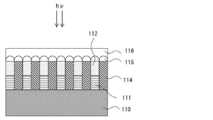
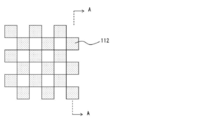
- FIG. 3 is a cross-sectional view taken along line AA in FIG. 2. It is a figure (plan view) showing the formation process of a pattern.
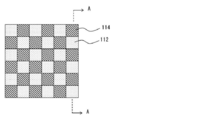
- FIG. 5 is a cross-sectional view taken along the line AA in FIG. 4. It is a figure (plan view) showing the formation process of a pattern.
- FIG. 7 is a cross-sectional view taken along the line AA in FIG. 6.
- total solids refers to the total mass of components excluding the solvent from the total composition.
- solid content refers to a solid content at 25 ° C.
- the “alkyl group” includes not only an alkyl group having no substituent (unsubstituted alkyl group) but also an alkyl group having a substituent (substituted alkyl group).
- exposure includes not only exposure using light, but also drawing using particle beams such as electron beams and ion beams, unless otherwise specified.
- the light used for exposure generally includes active rays or radiation such as an emission line spectrum of a mercury lamp, far ultraviolet rays represented by excimer laser, extreme ultraviolet rays (EUV light), X-rays, and electron beams.
- active rays or radiation such as an emission line spectrum of a mercury lamp, far ultraviolet rays represented by excimer laser, extreme ultraviolet rays (EUV light), X-rays, and electron beams.
- active rays or radiation such as an emission line spectrum of a mercury lamp, far ultraviolet rays represented by excimer laser, extreme ultraviolet rays (EUV light), X-rays, and electron beams.
- EUV light extreme ultraviolet rays
- X-rays extreme ultraviolet rays
- electron beams electron beams.
- (meth) acrylate” represents both and / or acrylate and methacrylate
- (meth) acryl” represents both and / or acrylic and “(meth) acrylic”.
- Acryloyl represents both and
- Me in the chemical formula represents a methyl group
- Et represents an ethyl group
- Pr represents a propyl group
- Bu represents a butyl group
- Ac represents an acetyl group
- Bn represents a benzyl group
- Ph represents a phenyl group.
- the term “process” is not limited to an independent process, and is included in the term if the intended action of the process is achieved even when it cannot be clearly distinguished from other processes.
- a weight average molecular weight and a number average molecular weight are defined as a polystyrene conversion value measured by gel permeation chromatography (GPC).
- the near-infrared absorbing dye multimer of the present invention has a maximum absorption wavelength in the range of 700 to 1200 nm.
- the maximum absorption wavelength of the near infrared absorbing dye multimer is preferably in the range of 750 to 1200 nm, and more preferably in the range of 750 to 1000 nm.
- the near-infrared absorptive pigment multimer of the present invention can improve the solvent resistance of the film even when used in a molecular dispersion state (used as a dye) dissolved in a solvent. Furthermore, the movement of the near infrared absorbing dye multimer in the film can be suppressed, and the color transfer can be effectively suppressed.
- an acid group or a polymerizable group can be introduced into the structure of the near infrared absorbing dye multimer.
- the near-infrared absorbing dye multimer has an acid group
- the developability of the composition can be improved, and a film with few residues and excellent pattern formability can be formed.
- the near-infrared absorbing dye multimer has a polymerizable group
- the solvent resistance of the film can be further improved.
- the near-infrared absorbing dye multimer includes structures such as a dimer, a trimer and a polymer.
- the near infrared absorbing dye multimer of the present invention may be either a pigment or a dye, but is preferably a dye. Even when the near-infrared absorbing dye multimer of the present invention is used as a dye, the effect of the present invention is particularly remarkable because the solvent resistance of the film can be improved and the color transfer can be suppressed. Further, the near infrared absorbing dye multimer of the present invention is preferably a dye used by being dissolved in a solvent, but may form particles, and in the case of particles, it is usually dispersed in a solvent. Used.
- the near-infrared absorbing dye multimer in the particle state can be obtained, for example, by emulsion polymerization, and specific examples thereof include compounds and production methods described in JP-A-2015-214682.
- the near-infrared absorbing dye multimer of the present invention has two or more near-infrared absorbing dye structures in one molecule, and preferably has three or more. The upper limit is not particularly limited, but may be 100 or less.
- the near-infrared-absorbing dye structure in one molecule may be the same dye structure or different dye structures.
- different dye structures include not only dye structures having different dye skeletons but also dye structures having the same dye skeleton and different types of substituents bonded to the dye skeleton. And
- the near-infrared absorbing dye multimer of the present invention has a near-infrared absorbing dye structure (hereinafter also referred to as a dye structure).
- the near-infrared absorbing dye structure means a structure derived from a near-infrared absorbing dye. For example, the structure which removed one or more arbitrary hydrogen atoms which a near-infrared absorptive dye has is mentioned.
- the maximum absorption wavelength of the near-infrared absorbing dye is preferably in the range of 700 to 1200 nm, more preferably in the range of 750 to 1200 nm, and still more preferably in the range of 750 to 1000 nm.
- the dye structure is at least selected from pyrrolopyrrole dyes, polymethine dyes, diimonium dyes, phthalocyanine dyes, naphthalocyanine dyes, rylene dyes, dithiol complex dyes, triarylmethane dyes, pyromethene dyes, azomethine dyes, anthraquinone dyes and dibenzofuranone dyes. It preferably has a structure derived from one kind of near-infrared absorbing dye (dye compound).
- Polymethine dyes include cyanine dyes, merocyanine dyes, squarylium dyes, croconium dyes, oxonol dyes, and the like depending on the type of atomic group to which they are bonded. Of these, cyanine dyes, squarylium dyes and oxonol dyes are preferred, and cyanine dyes and squarylium dyes are more preferred.
- the dye structure has a structure derived from at least one near-infrared absorbing dye selected from a pyrrolopyrrole dye, a cyanine dye, a squarylium dye, a diimmonium dye, a phthalocyanine dye, a naphthalocyanine dye, and an oxonol dye. It is more preferable that it has a structure derived from a pyrrolopyrrole dye.
- the dye structure preferably used in the present invention will be described in detail.
- the dye structure used in the present invention has a structure derived from a pyrrolopyrrole dye (pyrrolopyrrole dye structure).
- the pyrrolopyrrole dye structure is preferably a structure derived from a compound represented by the following formula (PP).
- R 1a and R 1b each independently represents an alkyl group, an aryl group or a heteroaryl group
- R 2 and R 3 each independently represent a hydrogen atom or a substituent
- R 2 And R 3 may combine with each other to form a ring
- R 4 each independently represents a hydrogen atom, an alkyl group, an aryl group, a heteroaryl group, —BR 4A R 4B , or a metal atom.
- R 4 may be covalently or coordinately bonded to at least one selected from R 1a , R 1b and R 3
- R 4A and R 4B each independently represents a hydrogen atom or a substituent.
- the alkyl group represented by R 1a and R 1b preferably has 1 to 40 carbon atoms, more preferably 1 to 30 carbon atoms, and still more preferably 1 to 25 carbon atoms.
- the alkyl group may be linear, branched or cyclic, but is preferably linear or branched, more preferably branched.
- the number of carbon atoms of the aryl group represented by R 1a and R 1b is preferably 6-30, more preferably 6-20, and even more preferably 6-12.
- the aryl group is preferably phenyl.
- the heteroaryl group represented by R 1a and R 1b is preferably a single ring or a condensed ring, more preferably a single ring or a condensed ring having 2 to 8 condensations, and further a single ring or a condensed ring having 2 to 4 condensations. preferable.
- the number of heteroatoms constituting the ring of the heteroaryl group is preferably 1 to 3.
- the hetero atom constituting the ring of the heteroaryl group is preferably a nitrogen atom, an oxygen atom or a sulfur atom.
- the number of carbon atoms constituting the heteroaryl group is preferably 3 to 30, more preferably 3 to 18, still more preferably 3 to 12, and still more preferably 3 to 10.
- the heteroaryl group is preferably a 5-membered ring or a 6-membered ring.
- Specific examples of the heteroaryl group include imidazolyl, pyridyl, quinolyl, furyl, thienyl, benzoxazolyl, benzimidazolyl, benzthiazolyl, naphthothiazolyl, meta-carbazolyl, azepinyl and the like.
- the alkyl group, aryl group, and heteroaryl group may have a substituent or may be unsubstituted. Examples of the substituent include a substituent T described later, a group represented by Formula A, an anionic group, and a cationic group.
- Examples of the anionic group and the cationic group include groups described for Y 2 of the dye multimer (B) described later.
- the groups represented by R 1a and R 1b are preferably aryl groups having an alkoxy group (preferably a branched alkoxy group).
- the alkoxy group preferably has 3 to 30 carbon atoms, and more preferably 3 to 20 carbon atoms.
- R 1a and R 1b in formula (PP) may be the same as or different from each other.
- R 2 and R 3 each independently represents a hydrogen atom or a substituent.
- R 2 and R 3 may combine to form a ring.
- At least one of R 2 and R 3 is preferably an electron withdrawing group.
- R 2 and R 3 preferably each independently represent a cyano group or a heteroaryl group. Examples of the substituent include the following substituent group T.
- a halogen atom for example, fluorine atom, chlorine atom, bromine atom, iodine atom
- a linear or branched alkyl group a linear or branched substituted or unsubstituted alkyl group, preferably an alkyl group having 1 to 30 carbon atoms, such as methyl, ethyl, n-propyl, isopropyl, tert-butyl, n-octyl, 2-chloroethyl, 2-cyanoethyl, 2-ethylhexyl
- a cycloalkyl group preferably a substituted or unsubstituted cycloalkyl group having 3 to 30 carbon atoms, such as cyclohexyl and cyclopentyl, and a multicycloalkyl group such as a bicycloalkyl group (preferably having 5 to 30 carbon atoms).
- Substituted or unsubstituted bicycloalkyl groups such as, for example, polycyclo [1,2,2] heptan-2-yl, bicyclo [2,2,2] octan-3-yl) and tricycloalkyl groups
- a linear or branched alkenyl group a linear or branched substituted or unsubstituted alkenyl group, preferably an alkenyl group having 2 to 30 carbon atoms, such as vinyl, allyl, prenyl, geranyl, oleyl
- a cycloalkenyl group preferably a substituted or unsubstituted cycloalkenyl group having 3 to 30 carbon atoms, such as 2-cyclopenten-1-yl and 2-cyclohexen-1-yl
- An alkynyl group (preferably a substituted or unsubstituted alkynyl group having 2 to 30 carbon atoms, such as ethynyl, propargyl, trimethylsilylethynyl group);
- An aryl group (preferably a substituted or unsubstituted aryl group having 6 to 30 carbon atoms, such as phenyl, para-tolyl, naphthyl, meta-chlorophenyl, ortho-hexadecanoylaminophenyl);
- a heteroaryl group (preferably a 5- to 7-membered substituted or unsubstituted, monocyclic or condensed heteroaryl group, more preferably a ring-constituting atom is selected from a carbon atom, a nitrogen atom and a sulfur atom;
- amino, methylamino, dimethylamino, anilino, N-methyl-anilino, diphenylamino, N-1,3,5-triazin-2-ylamino an acylamino group (preferably a substituted or unsubstituted alkylcarbonylamino group having 1 to 30 carbon atoms, a substituted or unsubstituted arylcarbonylamino group having 6 to 30 carbon atoms, such as formylamino, acetylamino, pivaloylamino, Lauroylamino, benzoylamino, 3,4,5-tri-n-octyloxyphenylcarbonylamino); Aminocarbonylamino group (preferably a substituted or unsubstituted aminocarbonylamino group having 1 to 30 carbon atoms, such as carbamoylamino, N, N-dimethylaminocarbonylamino, N, N-diethylamin
- 2-benzothiazolyl Luthio, 1-phenyltetrazol-5-ylthio Sulfamoyl group (preferably a substituted or unsubstituted sulfamoyl group having 0 to 30 carbon atoms, such as N-ethylsulfamoyl, N- (3-dodecyloxypropyl) sulfamoyl, N, N-dimethylsulfamoyl, N-acetylsulfamoyl, N-benzoylsulfamoyl, N- (N′-phenylcarbamoyl) sulfamoyl); A sulfo group (a hydrogen atom may be dissociated (ie, a sulfonate group) or a salt state); An alkyl or arylsulfinyl group (preferably a substituted or unsubstituted alkylsulfinyl group having 1 to
- substituents include the group described in the substituent group T described above, the group represented by the following formula A, an anionic group, and a cationic group.
- L 1 represents a single bond or a divalent linking group
- X 1 represents a (meth) acryloyl group, an epoxy group, an oxetanyl group, an isocyanate group, a hydroxyl group, an amino group, a carboxyl group, a thiol group, an alkoxy group.
- L 1 represents a divalent linking group
- L 1 represents an alkylene group having 1 to 20 carbon atoms, an arylene group having 6 to 18 carbon atoms, a heteroarylene group having 3 to 18 carbon atoms, —O—, —S A group consisting of —, —C ( ⁇ O) —, or a combination of these groups is preferred.
- X 1 is more preferably at least one selected from a (meth) acryloyl group, a vinyl group, an epoxy group, and an oxetanyl group, and a (meth) acryloyl group is more preferable.
- At least one of R 2 and R 3 is preferably an electron-withdrawing group.
- a substituent having a positive Hammett ⁇ p value acts as an electron withdrawing group.
- a substituent having a Hammett ⁇ p value of 0.2 or more can be exemplified as an electron-withdrawing group.
- the ⁇ p value is preferably 0.25 or more, more preferably 0.3 or more, and further preferably 0.35 or more.
- the upper limit is not particularly limited, but is preferably 0.8 or less.
- cyano group (0.66), carboxyl group (—COOH: 0.45), alkoxycarbonyl group (—COOMe: 0.45), aryloxycarbonyl group (—COOPh: 0.44), carbamoyl.
- a group (—CONH 2 : 0.36), an alkylcarbonyl group (—COMe: 0.50), an arylcarbonyl group (—COPh: 0.43), an alkylsulfonyl group (—SO 2 Me: 0.72), or And arylsulfonyl group (—SO 2 Ph: 0.68).
- Me represents a methyl group
- Ph represents a phenyl group.
- the Hammett's substituent constant ⁇ value for example, paragraph numbers 0017 to 0018 of JP 2011-68731 A can be referred to, and the contents thereof are incorporated herein.
- a 5- to 7-membered ring (preferably a 5- to 6-membered ring) is formed, and the formed ring is usually used as an acidic nucleus with a merocyanine dye.
- a 5- to 7-membered ring preferably a 5- to 6-membered ring
- the formed ring is usually used as an acidic nucleus with a merocyanine dye.
- Specific examples thereof include the structure described in paragraph No. 0026 of JP-A-2009-263614, the contents of which are incorporated in the present specification.
- the ⁇ p values of R 2 and R 3 in the case of forming a ring cannot be defined, but in the present invention, it is considered that R 2 and R 3 are each substituted with a partial structure of the ring. In this case, the ⁇ p value is defined. For example, when a 1,3-indandione ring is formed, it is considered that R 2 and R 3 are each substituted with a benzoyl group.
- the ring formed by combining R 2 and R 3 is preferably a 1,3-dicarbonyl nucleus, a pyrazolinone nucleus, a 2,4,6-triketohexahydropyrimidine nucleus (including a thioketone body), 2- Thio-2,4-thiazolidinedione nucleus, 2-thio-2,4-oxazolidinedione nucleus, 2-thio-2,5-thiazolidinedione nucleus, 2,4-thiazolidinedione nucleus, 2,4-imidazolidinedione nucleus 2-thio-2,4-imidazolidinedione nucleus, 2-imidazolin-5-one nucleus, 3,5-pyrazolidinedione nucleus, benzothiophen-3-one nucleus, or indanone nucleus, more preferably 1,3-dicarbonyl nucleus, 2,4,6-triketohexahydropyrimidine nucleus (
- R 3 is particularly preferably a heteroaryl group.
- the heteroaryl group is preferably a 5-membered ring or a 6-membered ring.
- the heteroaryl group is preferably a single ring or a condensed ring, more preferably a single ring or a condensed ring having 2 to 8 condensations, and further preferably a single ring or a condensed ring having 2 to 4 condensations.
- the number of heteroatoms constituting the heteroaryl group is preferably 1 to 3, more preferably 1 to 2. Examples of the hetero atom include a nitrogen atom, an oxygen atom, and a sulfur atom.
- the heteroaryl group is preferably a quinoline group, a benzothiazole group or a naphthothiazole group, and more preferably a benzothiazole group.
- the heteroaryl group may be unsubstituted or may have a substituent. Examples of the substituent include the substituent T described above.
- Two R 2 in the formula (PP) may be the same or different from each other, and two R 3 may be the same or different from each other.
- R 4 represents an alkyl group, an aryl group or a heteroaryl group
- the alkyl group, the aryl group and the heteroaryl group have the same meanings as described for R 1a and R 1b , and the preferred ranges are also the same.
- R 4 represents —BR 4A R 4B
- R 4A and R 4B each independently represents a hydrogen atom or a substituent, and R 4A and R 4B may be bonded to each other to form a ring. Good.
- Examples of the substituent represented by R 4A and R 4B include the substituent T described above, and a halogen atom, an alkyl group, an alkoxy group, an aryl group, or a heteroaryl group is preferable, and an alkyl group, an aryl group, or a hetero group is preferable.
- An aryl group is more preferable, and an aryl group is particularly preferable.
- Specific examples of the group represented by —BR 4A R 4B include difluoroboron, diphenylboron, dibutylboron, dinaphthylboron, and catecholboron. Of these, diphenylboron is particularly preferred.
- R 4 represents a metal atom
- examples of the metal atom include magnesium, aluminum, calcium, barium, zinc, tin, vanadium, iron, cobalt, nickel, copper, palladium, iridium, and platinum, and aluminum, zinc, vanadium. Iron, copper, palladium, iridium and platinum are particularly preferred.
- R 4 may be covalently bonded or coordinated to at least one of R 1a , R 1b and R 3 , and it is particularly preferable that R 4 is coordinated to R 3 .
- R 4 is preferably a hydrogen atom or a group represented by —BR 4A R 4B (particularly diphenylboron). Two R 4 in the formula (PP) may be the same or different from each other.
- the compound represented by the formula (PP) binds to another site of the near-infrared absorbing dye multimer via any one site of R 1a , R 1b , R 2 , R 3 and R 4. Is preferred.
- Specific examples of the compound represented by the formula (PP) include the compounds described in paragraph Nos. 0049 to 0058 of JP-A-2009-263614, and dye structures possessed by specific examples of near infrared absorbing dye multimers described later. The compound derived from is mentioned.
- the squarylium dye structure is preferably a structure derived from a compound represented by the following formula (SQ).
- SQ squarylium dye
- a 1 and A 2 each independently represent an aryl group, a heterocyclic group or a group represented by the following formula (Ax);
- Ax Z 1 represents a nonmetallic atomic group forming a nitrogen-containing heterocyclic ring
- R 2 represents an alkyl group, an alkenyl group or an aralkyl group
- d represents 0 or 1
- a wavy line represents A connecting hand with the formula (SQ) is represented.
- a 1 and A 2 in the formula (SQ) each independently represent an aryl group, a heterocyclic group, or a group represented by the formula (Ax), and a group represented by the formula (Ax) is preferable.
- the number of carbon atoms of the aryl group represented by A 1 and A 2 is preferably 6 to 48, more preferably 6 to 24, and still more preferably 6 to 12. Specific examples include a phenyl group and a naphthyl group. When the aryl group has a substituent, the carbon number of the aryl group means the number excluding the carbon number of the substituent.
- the heterocyclic group represented by A 1 and A 2 is preferably a 5-membered ring or a 6-membered ring.
- the heterocyclic group is preferably a monocyclic ring or a condensed ring, more preferably a monocyclic ring or a condensed ring having 2 to 8 condensations, further preferably a monocyclic ring or a condensed ring having 2 to 4 condensations, A condensed ring having a condensation number of 2 or 3 is more preferred.
- a hetero atom contained in a heterocyclic group a nitrogen atom, an oxygen atom, and a sulfur atom are illustrated, and a nitrogen atom and a sulfur atom are preferable.
- the number of heteroatoms is preferably 1 to 3, and more preferably 1 to 2.
- a heterocyclic group derived from a monocyclic or polycyclic aromatic ring such as a 5-membered or 6-membered ring containing at least one of a nitrogen atom, an oxygen atom and a sulfur atom.
- the aryl group and heterocyclic group may have a substituent. Examples of the substituent include the group described in the above-described substituent group T, the group represented by the above-described formula A, an anionic group, and a cationic group.
- the substituent that the aryl group and heterocyclic group may have is preferably a halogen atom, an alkyl group, a hydroxy group, an amino group, or an acylamino group.
- the halogen atom is preferably a chlorine atom.
- the alkyl group preferably has 1 to 20 carbon atoms, more preferably 1 to 10, more preferably 1 to 5, and still more preferably 1 to 4.
- the alkyl group is preferably linear or branched.
- the amino group is preferably a group represented by —NR 100 R 101 .
- R 100 and R 101 each independently represents a hydrogen atom or an alkyl group having 1 to 30 carbon atoms.
- the alkyl group preferably has 1 to 30 carbon atoms, more preferably 1 to 20 carbon atoms, still more preferably 1 to 10 carbon atoms, and still more preferably 1 to 8 carbon atoms.
- the alkyl group is preferably linear or branched, and more preferably linear.
- the acylamino group is preferably a group represented by —NR 102 —C ( ⁇ O) —R 103 .
- R102 represents a hydrogen atom or an alkyl group, and preferably a hydrogen atom.
- R 103 represents an alkyl group.
- the number of carbon atoms of the alkyl group represented by R 102 and R 103 is preferably 1-20, more preferably 1-10, still more preferably 1-5, and still more preferably 1-4.
- the aryl group and the heterocyclic group have two or more substituents, the plurality of substituents may be the same or different.
- R 2 represents an alkyl group, an alkenyl group or an aralkyl group, and an alkyl group is preferable.
- the alkyl group preferably has 1 to 30 carbon atoms, more preferably 1 to 20, more preferably 1 to 12, and still more preferably 2 to 8.
- the alkenyl group preferably has 2 to 30 carbon atoms, more preferably 2 to 20 carbon atoms, and still more preferably 2 to 12 carbon atoms.
- the alkyl group and the alkenyl group may be linear, branched or cyclic, and are preferably linear or branched.
- the aralkyl group preferably has 7 to 30 carbon atoms, more preferably 7 to 20 carbon atoms.
- the nitrogen-containing heterocycle formed by Z 1 is preferably a 5-membered ring or a 6-membered ring.
- the nitrogen-containing heterocycle is preferably a single ring or a condensed ring, more preferably a single ring or a condensed ring having 2 to 8 condensations, more preferably a single ring or a condensed ring having 2 to 4 condensations, Is more preferably a fused ring of 2 or 3.
- the nitrogen-containing heterocyclic ring may contain a sulfur atom in addition to the nitrogen atom.
- the nitrogen-containing heterocycle may have a substituent.
- substituents examples include the group described in the substituent group T described above, the group represented by the formula A described above, an anionic group, and a cationic group.
- a halogen atom, an alkyl group, a hydroxy group, an amino group, and an acylamino group are preferable, and a halogen atom and an alkyl group are more preferable.
- the halogen atom is preferably a chlorine atom.
- the alkyl group preferably has 1 to 30 carbon atoms, more preferably 1 to 20 carbon atoms, and still more preferably 1 to 12 carbon atoms.
- the alkyl group is preferably linear or branched.
- the group represented by the formula (Ax) is preferably a group represented by the following formula (Ax-1) or formula (Ax-2).
- R 11 represents an alkyl group, an alkenyl group or an aralkyl group
- R 12 represents a substituent
- R 12 X may represent a nitrogen atom or CR 13 R 14
- R 13 and R 14 each independently represent a hydrogen atom or a substituent
- m represents 0 to The integer of 4 is represented, and a broken line represents a connecting hand with the formula (SQ).
- R 11 in formula (Ax-1) and formula (Ax-2) has the same meaning as R 2 in formula (Ax), and the preferred range is also the same.
- R 12 in Formula (Ax-1) and Formula (Ax-2) represents a substituent.
- the substituent include the group described in the above-described substituent group T, the group represented by the above-described formula A, an anionic group, and a cationic group.
- a halogen atom, an alkyl group, a hydroxy group, an amino group, and an acylamino group are preferable, and a halogen atom and an alkyl group are more preferable.
- the halogen atom is preferably a chlorine atom.
- the alkyl group preferably has 1 to 30 carbon atoms, more preferably 1 to 20 carbon atoms, and still more preferably 1 to 12 carbon atoms.
- the alkyl group is preferably linear or branched.
- R 12 may be linked to form a ring.
- the ring include an alicyclic ring (non-aromatic hydrocarbon ring), an aromatic ring, and a heterocyclic ring.
- the ring may be monocyclic or polycyclic.
- the linking group is a group consisting of —CO—, —O—, —NH—, a divalent aliphatic group, a divalent aromatic group, and combinations thereof.
- R 12 are connected to each other to form a benzene ring.
- X in the formula (Ax-1) represents a nitrogen atom or CR 13 R 14 , and R 13 and R 14 each independently represent a hydrogen atom or a substituent.
- the substituent include the group described in the above-described substituent group T, the group represented by the above-described formula A, an anionic group, and a cationic group.
- an alkyl group is preferable.
- the alkyl group preferably has 1 to 20, preferably 1 to 10, more preferably 1 to 5, still more preferably 1 to 3, and most preferably 1.
- the alkyl group is preferably linear or branched, and more preferably linear.
- m represents an integer of 0 to 4, preferably 0 to 2.
- the compound represented by the formula (SQ) preferably binds to another site of the near-infrared absorbing dye multimer via any one site of A 1 and A 2 .
- Specific examples of the compound represented by the formula (SQ) include compounds derived from a dye structure included in the following compounds and specific examples of near-infrared absorbing dye multimers described below.
- Cyanine dye structure One embodiment of the dye structure used in the present invention has a structure derived from a cyanine dye (cyanine dye structure).
- cyanine dye structure a structure derived from a compound represented by the following formula (Cn) is preferable.
- Z 1 and Z 2 are each independently a non-metallic atomic group forming a 5-membered or 6-membered nitrogen-containing heterocyclic ring which may be condensed, and R 1 and R 2 are Each independently represents an alkyl group, an alkenyl group, an alkynyl group, an aralkyl group or an aryl group, L 1 represents a methine chain composed of an odd number of methine groups, and a and b each independently represent 0 Or 1 and
- X 1 represents an anion
- c represents the number necessary for balancing the charge
- the site represented by Cy in the formula is an anion moiety.
- X 1 represents a cation
- c represents a number necessary to balance the charge, and when the charge at the site represented by Cy in the formula is neutralized in the molecule, c is 0.
- Z 1 and Z 2 each independently represent a nonmetallic atomic group that forms a 5-membered or 6-membered nitrogen-containing heterocyclic ring that may be condensed.
- the nitrogen-containing heterocycle may be condensed with another heterocycle, aromatic ring or aliphatic ring.
- the nitrogen-containing heterocycle is preferably a 5-membered ring. More preferably, a 5-membered nitrogen-containing heterocyclic ring is condensed with a benzene ring or a naphthalene ring.
- nitrogen-containing heterocycle examples include an oxazole ring, an isoxazole ring, a benzoxazole ring, a naphthoxazole ring, an oxazolocarbazole ring, an oxazodibenzobenzofuran ring, a thiazole ring, a benzothiazole ring, a naphthothiazole ring, an indolenine ring, Examples include benzoindolenin ring, imidazole ring, benzimidazole ring, naphthimidazole ring, quinoline ring, pyridine ring, pyrrolopyridine ring, furopyrrole ring, indolizine ring, imidazoquinoxaline ring, quinoxaline ring, quinoline ring, indolenine ring Benzoindolenine ring, benzoxazole ring, benzothiazole ring and benzimi
- the nitrogen-containing heterocyclic ring and the ring condensed thereto may have a substituent.
- substituents include the group described in the above-described substituent group T, the group represented by the above-described formula A, an anionic group, and a cationic group.
- halogen atom cyano group, nitro group, alkyl group, alkenyl group, alkynyl group, aryl group, heteroaryl group, aralkyl group, —OR 10 , —COR 11 , —COOR 12 , —OCOR 13 , — NR 14 R 15 , —NHCOR 16 , —CONR 17 R 18 , —NHCONR 19 R 20 , —NHCOOR 21 , —SR 22 , —SO 2 R 23 , —SO 2 OR 24 , —NHSO 2 R 25 or —SO 2 NR 26 R 27 may be mentioned.
- R 10 to R 27 each independently represents a hydrogen atom, an alkyl group, an alkenyl group, an alkynyl group, an aryl group, a heteroaryl group or an aralkyl group.
- R 12 of —COOR 12 is hydrogen (ie, a carboxyl group)
- the hydrogen atom may be dissociated (ie, a carbonate group) or may be in a salt state.
- R 24 of —SO 2 OR 24 is a hydrogen atom (ie, a sulfo group)
- the hydrogen atom may be dissociated (ie, a sulfonate group) or may be in a salt state.
- R 1 and R 2 each independently represents an alkyl group, an alkenyl group, an alkynyl group, an aralkyl group or an aryl group.
- the alkyl group preferably has 1 to 20 carbon atoms, more preferably 1 to 15 carbon atoms, and still more preferably 1 to 8 carbon atoms.
- the alkyl group may be linear, branched or cyclic, and is preferably linear or branched.
- the alkenyl group preferably has 2 to 20 carbon atoms, more preferably 2 to 12 carbon atoms, and still more preferably 2 to 8 carbon atoms.
- the alkenyl group may be linear, branched or cyclic, and is preferably linear or branched.
- the alkynyl group preferably has 2 to 40 carbon atoms, more preferably 2 to 30 carbon atoms, and still more preferably 2 to 25 carbon atoms.
- the alkynyl group may be linear, branched or cyclic, and is preferably linear or branched.
- the aryl group preferably has 6 to 30 carbon atoms, more preferably 6 to 20 carbon atoms, and still more preferably 6 to 12 carbon atoms.
- the alkyl part of the aralkyl group is the same as the above alkyl group.
- the aryl part of the aralkyl group is the same as the above aryl group.
- the number of carbon atoms in the aralkyl group is preferably 7 to 40, more preferably 7 to 30, and still more preferably 7 to 25.
- the alkyl group, alkenyl group, alkynyl group, aralkyl group and aryl group may have a substituent or may be unsubstituted.
- the substituent include the group described in the substituent group T described above, the group represented by the formula A described above, the anionic group described above, and the cationic group described above.
- a halogen atom, a hydroxyl group, a carboxyl group, a sulfo group, an alkoxy group, an amino group and the like can be mentioned.
- a carboxyl group and a sulfo group are preferable, and a sulfo group is particularly preferable.
- the carboxyl group and the sulfo group may have a hydrogen atom dissociated or a salt state.
- L 1 represents a methine chain composed of an odd number of methine groups.
- L 1 is preferably a methine chain composed of 3, 5 or 7 methine groups.
- the methine group may have a substituent.
- the methine group having a substituent is preferably a central (meso-position) methine group.
- Specific examples of the substituent include a substituent that the nitrogen-containing heterocycle of Z 1 and Z 2 may have, and a group represented by the following formula (a). Further, two substituents of the methine group may be bonded to form a 5- or 6-membered ring.
- * represents a connecting part with a methine chain
- a 1 represents an oxygen atom or a sulfur atom.
- a and b are each independently 0 or 1. When a is 0, the carbon atom and the nitrogen atom are bonded by a double bond, and when b is 0, the carbon atom and the nitrogen atom are bonded by a single bond. Both a and b are preferably 0. When both a and b are 0, the formula (Cn) is expressed as follows. Formula (Cn)
- X 1 represents an anion
- c represents a number necessary for balancing the charge.
- anions include halide ions (Cl ⁇ , Br ⁇ , I ⁇ ), para-toluenesulfonic acid ions, ethyl sulfate ions, PF 6 ⁇ , B (CN) 4 ⁇ , BF 4 ⁇ , B (C 6 F 5 ) 4 ⁇ , ClO 4 ⁇ , tris (halogenoalkylsulfonyl) methide anion (eg (CF 3 SO 2 ) 3 C ⁇ ), di (halogenoalkylsulfonyl) imide anion (eg (CF 3 SO 2 ) 2 N ⁇ ) And tetracyanoborate anion.
- halide ions Cl ⁇ , Br ⁇ , I ⁇
- para-toluenesulfonic acid ions ethyl sulfate ions
- X 1 represents a cation
- c represents a number necessary for balancing electric charges.
- the cation include alkali metal ions (Li + , Na + , K + etc.), alkaline earth metal ions (Mg 2+ , Ca 2+ , Ba 2+ , Sr 2+ etc.), transition metal ions (Ag + , Fe 2+ , Co 2+ , Ni 2+ , Cu 2+ , Zn 2+ ), other metal ions (such as Al 3+ ), ammonium ion, triethylammonium ion, tributylammonium ion, pyridinium ion, tetrabutylammonium Ion, guanidinium ion, tetramethylguanidinium ion, diazabicycloundecenium and the like.
- the compound represented by the formula (Cn) binds to another site of the near-infrared absorbing dye multimer through any one site of Z 1 , Z 2 , R 1 , R 2 and L 1. Is preferred.
- Specific examples of the compound represented by the formula (Cn) include compounds derived from the dye structures of the compounds described below and the specific examples of the near-infrared absorbing dye multimer described below.
- Me represents a methyl group
- Et represents an ethyl group
- Bu represents a butyl group
- Bn represents a benzyl group
- Ph represents a phenyl group
- PRS represents C 3 H 6 SO 3- .
- BUS represents C 4 H 9 SO 3- .
- numerical values appended to structural formulas in the table represent the binding position of V 1, V 2.
- L in the table represents a connection state in the structural formula, and “*” connects to a single bond, and “**” connects to a double bond.
- oxonol dye structure One embodiment of the dye structure used in the present invention is one having a structure derived from an oxonol dye (oxonol dye structure).
- oxonol dye structure a structure derived from a compound represented by the following formula (Ox) is preferable.
- Formula (Ox) In the formula, Za 1 represents an atomic group forming an acidic nucleus, Ma 1 , Ma 2 and Ma 3 each independently represents a methine group, m represents an integer of 0 to 3, and Q represents neutralizing charge. Y represents a number necessary for neutralization of electric charge.
- Za 1 represents an atomic group that forms an acidic nucleus.
- the acidic nucleus is defined by James, The Theory of the Photographic Process, 4th edition, McMillan, 1977, p. 198. Specifically, it is the following acidic nucleus which may be substituted by a substituent.
- pyrazol-5-one pyrazolidine-3,5-dione, imidazolin-5-one, hydantoin, 2 or 4-thiohydantoin, 2-iminooxazolidine-4-one, 2-oxazolin-5-one, 2- Thiooxazoline-2,4-dione, isorhodanine, rhodanine, 5-6 membered carbocycle (eg indan-1,3-dione), thiophen-3-one, thiophen-3-one-1,1-dioxide, indoline -2-one, indoline-3-one, 2-oxoindazolium, 5,7-dioxo-6,7-dihydrothiazolo [3,2-a] pyrimidine, 3,4-dihydroisoquinolin-4-one 1,3-dioxane-4,6-dione, barbituric acid, 2-thiobarbituric acid, coumarin
- 1,3-dioxane-4,6-dione More preferred is 1,3-dioxane-4,6-dione.
- substituent substituted on the acidic nucleus of Za 1 include the group described in the substituent group T described above, the group represented by the formula A described above, the anionic group described above, and the cationic group described above.
- Ma 1 , Ma 2 and Ma 3 each independently represent a substituted or unsubstituted methine group.
- the methine group may have a substituent or may be unsubstituted.
- the substituent which the methine group of the cyanine dye mentioned above may have is mentioned.
- Ma 1 , Ma 2 and Ma 3 are preferably an unsubstituted methine group, or an alkyl group having 1 to 5 carbon atoms, an alkoxy group having 1 to 5 carbon atoms, an aryl group, a heteroaryl group, or a halogen atom, It is a substituted methine group.
- M represents an integer of 0 to 3, preferably 2 or 3.
- Q represents an ion for neutralizing the charge
- y represents a number necessary for neutralizing the charge.
- a compound is a cation, an anion, or has a net ionic charge depends on the substituent of the compound.
- the ion represented by Q may represent a cation or an anion, and Q does not exist when the dye molecule is uncharged.
- the ion which consists of an inorganic compound may be sufficient as the ion which consists of an organic compound.
- the charge of ions represented as Q may be monovalent or multivalent.
- Examples of the cation represented by Q include metal ions such as sodium ion and potassium ion, quaternary ammonium ion, oxonium ion, sulfonium ion, phosphonium ion, selenonium ion, and onium ion such as iodonium ion.
- examples of the anion represented by Q include halogen anions such as chloride ion, bromide ion and fluoride ion, heteropoly acid ions such as sulfate ion, phosphate ion and hydrogen phosphate ion, and oxalate ion.
- organic polyvalent anions such as maleate ion, fumarate ion and aromatic disulfonate ion, tetrafluoroborate ion and hexafluorophosphate ion.
- the cation represented by Q is preferably a hydrogen ion, a metal ion, or an onium ion. When Q is a hydrogen ion, it represents a neutral free form.
- the compound represented by the formula (Ox) preferably binds to another site of the near-infrared absorbing dye multimer via any one site of Za 1 , Ma 1 , Ma 2 and Ma 3 .
- Specific examples of the compound represented by the formula (Ox) include, for example, the structures of the following compounds and specific examples of the near infrared absorbing dye multimer described later.
- Et represents an ethyl group
- Ac represents an acetyl group
- Ph represents a phenyl group
- Py represents a pyridyl group.
- Diimmonium dye structure One aspect of the dye structure used in the present invention is one having a structure derived from a diimmonium dye (diimmonium dye structure).
- diimmonium dye structure a structure derived from a compound represented by the following formula (Im) is preferable.
- R 11 to R 18 each independently represents an alkyl group or an aryl group
- V 11 to V 15 each independently represents an alkyl group, an aryl group, a halogen atom, an alkoxy group or a cyano group
- X represents an anion
- c represents a number necessary for balancing the charge
- n1 to n5 are each independently 0 to 4.
- R 11 to R 18 each independently represents an alkyl group or an aryl group.
- the alkyl group preferably has 1 to 20 carbon atoms, more preferably 1 to 12 carbon atoms, and still more preferably 1 to 8 carbon atoms.
- the alkyl group may be linear, branched or cyclic, but is preferably linear or branched, more preferably linear.
- the aryl group preferably has 6 to 25 carbon atoms, more preferably 6 to 15 carbon atoms, and still more preferably 6 to 12 carbon atoms.
- the alkyl group and aryl group may have a substituent or may be unsubstituted. Examples of the substituent include the group described in the substituent group T described above, the group represented by the formula A described above, the anionic group described above, and the cationic group described above.
- V 11 to V 15 each independently represents an alkyl group, an aryl group, a halogen atom, an alkoxy group or a cyano group.
- the halogen atom include a fluorine atom, a chlorine atom, a bromine atom, and an iodine atom.
- the alkyl group preferably has 1 to 20 carbon atoms, more preferably 1 to 12 carbon atoms, and still more preferably 1 to 8 carbon atoms.
- the alkyl group may be linear, branched or cyclic, but is preferably linear or branched, more preferably linear.
- the aryl group preferably has 6 to 25 carbon atoms, more preferably 6 to 15 carbon atoms, and still more preferably 6 to 12 carbon atoms.
- the number of carbon atoms of the alkoxy group is preferably 1-20, more preferably 1-12, and even more preferably 1-8.
- the alkoxy group may be linear, branched or cyclic, but is preferably linear or branched, more preferably linear.
- N1 to n5 are each independently 0 to 4.
- n1 to n4 are preferably 0 to 2, and more preferably 0 or 1.
- n5 is preferably 0 to 3, and more preferably 0 to 2.
- the compound represented by the formula (Im) preferably binds to another part of the near-infrared absorbing dye multimer via any one part of R 11 to R 18 and V 11 to V 15 .
- Specific examples of the compound represented by the formula (Im) include, for example, the structures of the following compounds and specific examples of near-infrared absorbing dye multimers described below. In the following tables, Me represents a methyl group, Bu represents a butyl group, Bn represents a benzyl group, and Ph represents a phenyl group.
- Phthalocyanine dye structure One aspect of the dye structure used in the present invention is one having a structure derived from a phthalocyanine dye (phthalocyanine dye structure).
- phthalocyanine dye structure a structure derived from a compound represented by the following formula (PC) is preferable.
- X 1 to X 16 each independently represents a hydrogen atom or a substituent, and M 1 represents Cu, V ⁇ O or Ti ⁇ O.
- Examples of the substituent represented by X 1 to X 16 include the groups described in the above-mentioned substituent group T, and include an alkyl group, a halogen atom, an alkoxy group, a phenoxy group, an alkylthio group, a phenylthio group, an alkylamino group, and an anilino group. preferable.
- the above substituents may further have a substituent.
- Examples of the substituent include the group described in the above-described substituent group T, the group represented by the above-described formula A, an anionic group, and a cationic group.
- any of X 1 to X 4 , any of X 5 to X 8 , any of X 9 to X 12 , and any of X 13 to X 16 is an alkoxy group, a phenoxy group, It preferably has at least one substituent selected from an alkylthio group, a phenylthio group, an alkylamino group, and an anilino group, and any one of X 1 to X 4 , any of X 5 to X 8 , and X 9 to X 12
- Any one of X 13 to X 16 preferably has at least one substituent selected from an alkoxy group, a phenoxy group, an alkylthio group, a phenylthio group, an alkylamino group, and an anilino group.
- the compound represented by the formula (PC) preferably binds to another part of the near-infrared absorbing dye multimer via any one part of X 1 to X 16 .
- Specific examples of the compound represented by the formula (PC) include, for example, the dye structure of the compound described in paragraph No. 0093 of JP2012-77153A and specific examples of near infrared absorbing dye multimers described later. The compound derived from is mentioned.
- naphthalocyanine dye structure One aspect of the dye structure used in the present invention is one having a structure derived from a naphthalocyanine dye (a naphthalocyanine dye structure).
- a naphthalocyanine dye structure a structure derived from a compound represented by the following formula (NPC) is preferable.
- NPC naphthalocyanine dye structure
- X 1 to X 24 each independently represents a hydrogen atom or a substituent
- M 1 represents Cu or V ⁇ O.
- Examples of the substituent represented by X 1 to X 24 include the groups described in the above-mentioned substituent group T, and include an alkyl group, a halogen atom, an alkoxy group, a phenoxy group, an alkylthio group, a phenylthio group, an alkylamino group, and an anilino group. preferable.
- the above substituents may further have a substituent.
- Examples of the substituent include the group described in the above-described substituent group T, the group represented by the above-described formula A, an anionic group, and a cationic group.
- the compound represented by the formula (NPC) preferably binds to another site of the near-infrared absorbing dye multimer via any one site of X 1 to X 24 .
- Specific examples of the compound represented by the formula (NPC) include, for example, the dye structure of the compound described in paragraph No. 0093 of JP2012-77153A, and specific examples of near infrared absorbing dye multimers described later. The compound derived from is mentioned.
- the near infrared absorbing dye multimer of the present invention preferably has a structure in which two or more near infrared absorbing dye structures are bonded to a divalent or higher linking group.
- the near-infrared absorbing dye multimer of the present invention comprises at least one selected from a repeating unit having a near-infrared absorbing dye structure in the side chain and a repeating unit having a near-infrared absorbing dye structure in the main chain. It is preferable to include.
- the near-infrared absorptive pigment multimer of the present invention contains at least one repeating unit represented by formula (A), formula (B) and formula (C) described later, or formula (D) described later. ) Is preferable. That is, the near-infrared absorbing dye multimer of the present invention includes a near-infrared absorbing dye multimer (also referred to as a dye multimer (A)) having a repeating unit represented by the formula (A) described later, and a formula (described later) B) a near infrared absorbing dye multimer (also referred to as dye multimer (B)) having a repeating unit represented by B), a near infrared absorbing dye multimer having a repeating unit represented by formula (C) described later ( Dye multimer (C)) and a near infrared absorbing dye multimer represented by formula (D) (also referred to as dye multimer (D)) are preferable.
- the dye multimer (A) preferably contains a repeating unit represented by the formula (A).
- the ratio of the repeating unit represented by the formula (A) is preferably 10 to 100% by mass of the total repeating units constituting the near-infrared absorbing dye multimer.
- the lower limit is more preferably 20% by mass or more, further preferably 30% by mass or more, and further preferably 50% by mass or more.
- the upper limit is more preferably 95% by mass or less.
- the dye multimer (A) preferably contains 5 to 50 mol% of the repeating unit represented by the formula (A) in all repeating units constituting the near infrared absorbing dye multimer.
- X 1 represents the main chain of the repeating unit, and L 1 represents a single bond or a divalent linking group.
- DyeI represents a near infrared absorbing dye structure.
- X 1 represents the main chain of the repeating unit, and usually represents a linking group formed by a polymerization reaction.
- the main chain is preferred.
- An embodiment having a main chain cyclic alkylene group is also preferred.
- X 1 is not particularly limited as long as it is a linking group formed from a known polymerizable monomer.
- linking groups represented by (XX-1) to (XX-25) are preferred, and (XX-1), (XX-2), (XX-10) to (XX-17), (XX-18) , (XX-19), (XX-24) and (XX-25), more preferably (XX-1), (XX-2), (XX-10) to (XX-17) More preferably, it is selected from (XX-24) and (XX-25).
- * represents that it is linked to L 1 at the site indicated by *.
- Me represents a methyl group.
- R in (XX-18) and (XX-19) represents a hydrogen atom, an alkyl group having 1 to 5 carbon atoms, or a phenyl group.
- L 1 represents a single bond or a divalent linking group.
- the divalent linking group include an alkylene group having 1 to 30 carbon atoms, an arylene group having 6 to 30 carbon atoms, a heterocyclic linking group, —CH ⁇ CH—, —O—, —S—, —C ( ⁇ O )-, -COO-, -NR-, -CONR-, -OCO-, -SO-, -SO 2 -and a linking group formed by linking two or more thereof.
- each R independently represents a hydrogen atom, an alkyl group, an aryl group, or a heteroaryl group.
- the alkylene group preferably has 1 to 30 carbon atoms.
- the upper limit is more preferably 25 or less, and still more preferably 20 or less.
- the lower limit is more preferably 2 or more, and further preferably 3 or more.
- the alkylene group may be linear, branched or cyclic.
- the carbon number of the arylene group is more preferably 6-20, and further preferably 6-12.
- the heterocyclic linking group is preferably a 5-membered ring or a 6-membered ring.
- the hetero atom that the heterocyclic linking group has is preferably an oxygen atom, a nitrogen atom, or a sulfur atom.
- the number of heteroatoms contained in the heterocyclic linking group is preferably 1 to 3.
- L 1 is preferably an alkylene group, an arylene group, —NH—, —CO—, —O—, —COO—, —OCO—, —S—, or a linking group obtained by combining two or more of these, an alkylene group, an arylene group A divalent group obtained by combining these with one or more selected from —O—, —COO—, —OCO—, and —S— is more preferable.
- the linking group connecting DyeI and X 1 can also contain —S—.
- the number of atoms constituting the chain connecting DyeI and X 1 is preferably 3 or more, and more preferably 5 or more.
- the upper limit can be set to 30 or less, for example, or can be set to 25 or less.
- the number of atoms constituting the chain connecting X 1 and Dye I is 14.
- the number of atoms constituting the chain connecting X 1 and Dye I is 13.
- the numbers written in the structural formula are the number of atoms constituting the chain connecting X 1 and DyeI.
- DyeI represents a near infrared absorbing dye structure.
- the near-infrared absorbing dye structure represented by DyeI is preferably a structure in which one or more arbitrary hydrogen atoms of the near-infrared absorbing dye (dye compound) are removed. A part of the near infrared absorbing dye (dye compound), preferably bonded to X 1 or L 1.
- the dye multimer containing the repeating unit represented by the formula (A) is (1) a method of synthesizing a near-infrared absorbing dye having a polymerizable group by addition polymerization, (2) an isocyanate group, an acid anhydride group or Reacts a polymer having a highly reactive functional group such as an epoxy group with a near infrared absorbing dye having a functional group (hydroxyl group, primary or secondary amino group, carboxyl group, etc.) capable of reacting with the highly reactive functional group. It can synthesize
- Known addition polymerizations (radical polymerization, anionic polymerization, and cationic polymerization) can be applied to the addition polymerization.
- the dye multimer having a repeating unit represented by the formula (A) is a radical polymer obtained by radical polymerization using a near-infrared absorbing dye having an ethylenically unsaturated bond from the viewpoint of heat resistance. It is preferable.
- repeating unit represented by the formula (A) include the following.
- the dye multimer in the present invention may contain other repeating units in addition to the repeating unit represented by the formula (A).
- Other repeating units may contain a functional group such as a curable group or an acid group. It does not have to contain a functional group.
- the dye multimer preferably has at least one selected from a repeating unit having an acid group and a repeating unit having a curable group.
- Examples of the curable group include a radical polymerizable group, a cyclic ether group (epoxy group, oxetanyl group), an oxazoline group, and a methylol group.
- Examples of the radical polymerizable group include a group containing an ethylenically unsaturated bond such as a vinyl group, a (meth) allyl group, and a (meth) acryloyl group.
- the curable group is preferably a radical polymerizable group.
- the ratio of the repeating unit having a curable group is preferably 0 to 50% by mass with respect to all repeating units constituting the dye multimer.
- the lower limit is more preferably 1% by mass or more, and further preferably 3% by mass or more.
- the upper limit is more preferably 35% by mass or less, and further preferably 30% by mass or less.
- the acid group examples include a carboxyl group, a sulfonic acid group, and a phosphoric acid group. Only one type of acid group may be included, or two or more types of acid groups may be included.
- the ratio of the repeating unit having an acid group is preferably 0 to 50% by mass of all repeating units constituting the dye multimer.
- the lower limit is more preferably 1% by mass or more, and further preferably 3% by mass or more.
- the upper limit is more preferably 35% by mass or less, and further preferably 30% by mass or less.
- Other functional groups include groups consisting of repeating 2 to 20 unsubstituted alkyleneoxy chains, development promoting groups such as lactones, acid anhydrides, amides, cyano groups, long chain and cyclic alkyl groups, aralkyl groups, aryls Groups, polyalkylene oxide groups, hydroxyl groups, maleimide groups, amino group and other hydrophilicity-adjusting groups, and the like, which can be appropriately introduced.
- the number of repeating alkyleneoxy chains is preferably 2 to 15 and more preferably 2 to 10.
- One alkyleneoxy chain is represented by — (CH 2 ) n O—, where n is an integer, n is preferably 1 to 10, more preferably 1 to 5, and even more preferably 2 or 3.
- the dye multimer (B) includes a repeating unit represented by the formula (B).
- the ratio of the repeating unit represented by the formula (B) is preferably 10 to 100% by mass of the total repeating units constituting the near-infrared absorbing dye multimer.
- the lower limit is more preferably 20% by mass or more, further preferably 30% by mass or more, and further preferably 50% by mass or more.
- the upper limit is more preferably 95% by mass or less.
- X 2 represents a linking group formed by polymerization
- L 2 represents a single bond or a divalent linking group
- DyeII has a group capable of ionic bonding or coordination bonding with Y 2.
- Y 2 represents a group capable of ionic bond or coordinate bond with DyeII.
- X 2 has the same meaning as X 1 in formula (A), and the preferred range is also the same.
- L 2 represents a single bond or a divalent linking group.
- the divalent linking group include an alkylene group having 1 to 30 carbon atoms, an arylene group having 6 to 30 carbon atoms, a heterocyclic linking group, —CH ⁇ CH—, —O—, —S—, —C ( ⁇ O )-, -COO-, -NR-, -CONR-, -OCO-, -SO-, -SO 2 -and a linking group formed by linking two or more thereof.
- each R independently represents a hydrogen atom, an alkyl group, an aryl group, or a heteroaryl group.
- L 2 is preferably a single bond, or an alkylene group, an arylene group, —NH—, —CO—, —O—, —COO—, —OCO—, or a divalent linking group in which two or more thereof are combined.
- the number of atoms connecting X 2 and Y 2 is preferably 1-8, more preferably 1-5, and even more preferably 1-3.
- Y 2 may be a group capable of ionic bonding or coordination bonding with Dye II, and may be either an anionic group or a cationic group.
- anionic group examples include —SO 3 ⁇ , —COO ⁇ , —PO 4 ⁇ , —PO 4 H ⁇ , bis (sulfonyl) imide anion, tris (sulfonyl) methide anion and tetraarylborate anion.
- the anionic group is also preferably a group represented by the formula (Z-1), a group represented by the formula (Z-2), or a group represented by the formula (Z-3).
- * represents a bonding site with L 2 in formula (B)
- Y 11 represents a fluorinated alkylene group
- a 1 represents SO 3 — .
- the carbon number of the fluorinated alkylene group represented by Y 11 is preferably 1-20, more preferably 1-10, and even more preferably 1-6. Moreover, it is preferable that it is a perfluoroalkylene group.
- * represents a binding site with L 2 in formula (B).
- Y 12 represents an anion composed of a boron atom, a carbon atom, a nitrogen atom, or a phosphorus atom.
- n is 3
- a 2 represents a halogen atom, a cyano group, an alkyl group containing at least one of a fluorine atom and a cyano group, or at least one of a fluorine atom and a cyano group.
- An aryl group is preferred.
- a 2 is a halogen atom, a cyano group, an alkyl group containing at least one of a fluorine atom and a cyano group, an aryl containing at least one of a fluorine atom and a cyano group
- An alkylsulfonyl group which may contain at least one of a group, a fluorine atom and a cyano group, or an arylsulfonyl group which may contain at least one of a fluorine atom and a cyano group is preferred.
- Two A 2 may be bonded to each other to form a ring.
- a 2 is an alkyl group containing at least one of a fluorine atom and a cyano group, an aryl group containing at least one of a fluorine atom and a cyano group, a fluorine atom and a cyano group
- An alkylsulfonyl group which may contain at least one group or an arylsulfonyl group which may contain at least one of a fluorine atom and a cyano group is preferable.
- Y 12 is a phosphorus atom
- n is 1 or 3
- a 2 is an alkyl group containing at least one of a fluorine atom and a cyano group, an aryl group containing at least one of a fluorine atom and a cyano group, a fluorine atom
- an alkylsulfonyl group which may contain at least one of cyano groups, or an arylsulfonyl group which may contain at least one of a fluorine atom and a cyano group is preferable.
- the plurality of A 2 may be the same or different.
- the proportion of fluorine atoms contained in Y 2 with respect to the total number of atoms constituting the Y 2 is preferably 5 to 80%, 10 ⁇ 70% is more preferable.
- R 1 to R 4 are preferably each independently a cyano group or a fluorinated alkyl group.
- Examples of the cationic group include substituted or unsubstituted onium cations (for example, ammonium, pyridinium, imidazolium, phosphonium and the like), and ammonium cations are particularly preferable.
- An ammonium cation includes —N (R) 3 + .
- R each independently represents a hydrogen atom or an alkyl group, and at least one of R represents an alkyl group.
- the alkyl group preferably has 1 to 10 carbon atoms, and more preferably 1 to 5 carbon atoms.
- the alkyl group may be linear, branched or cyclic, but is preferably linear.
- Dye II represents a near-infrared absorbing dye structure having a group capable of ionic bonding or coordination bonding with Y 2 .
- the Y 2 an ionic bond or a coordination group that can be bonded, for example, described in Y 2, include anionic and cationic groups.
- the balance of the charge of Dye II is biased to either the cation or the anion, it can be bonded to Y 2 at the cation part or the anion part of Dye II.
- repeating unit represented by the formula (B) include the following.
- the dye multimer (B) may contain other repeating units described in the dye multimer (A) in addition to the repeating unit represented by the formula (B). Moreover, the repeating unit represented by Formula (A) mentioned above and the repeating unit represented by Formula (C) mentioned later may further be included.
- the dye multimer (C) preferably contains a repeating unit represented by the formula (C).
- the ratio of the repeating unit represented by the formula (C) is preferably 10 to 100% by mass of the total repeating units constituting the near-infrared absorbing dye multimer.
- the lower limit is more preferably 20% by mass or more, further preferably 30% by mass or more, and further preferably 50% by mass or more.
- the upper limit is more preferably 95% by mass or less.
- L 3 represents a single bond or a divalent linking group.
- DyeIII represents a near-infrared absorbing dye structure. m represents 0 or 1;
- L 3 represents a single bond or a divalent linking group.
- the divalent linking group include an alkylene group having 1 to 30 carbon atoms, an arylene group having 6 to 30 carbon atoms, a heterocyclic linking group, —CH ⁇ CH—, —O—, —S—, —C ( ⁇ O )-, -COO-, -NR-, -CONR-, -OCO-, -SO-, -SO 2 -and a linking group formed by linking two or more thereof.
- R represents a hydrogen atom, an alkyl group, an aryl group, or a heterocyclic group each independently.
- the alkyl group and alkylene group preferably have 1 to 30 carbon atoms.
- the upper limit is more preferably 25 or less, and still more preferably 20 or less.
- the lower limit is more preferably 2 or more, and further preferably 3 or more.
- the alkyl group and alkylene group may be linear, branched or cyclic.
- the number of carbon atoms in the aryl group and arylene group is preferably 6-20, and more preferably 6-12.
- the heterocyclic linking group and the heterocyclic group are preferably a 5-membered ring or a 6-membered ring.
- the hetero atom contained in the heterocyclic linking group and the heterocyclic group is preferably an oxygen atom, a nitrogen atom or a sulfur atom.
- the number of heteroatoms contained in the heterocyclic linking group and the heterocyclic group is preferably 1 to 3.
- the alkylene group, arylene group, heterocyclic linking group, alkyl group, aryl group, and heterocyclic group may be unsubstituted or may have a substituent.
- the substituent include a curable group and an acid group.
- the curable group include a radical polymerizable group such as a group containing an ethylenically unsaturated bond, a cyclic ether group (epoxy group, oxetanyl group), an oxazoline group, and a methylol group.
- Examples of the group containing an ethylenically unsaturated bond include a vinyl group, a (meth) allyl group, and a (meth) acryloyl group.
- Examples of the acid group include a carboxyl group, a sulfonic acid group, and a phosphoric acid group.
- a hydrophilic group such as an oxide group, a hydroxyl group, a maleimide group, an amino group, etc. as a substituent.
- L 3 is preferably an alkylene group, an arylene group, —NH—, —CO—, —O—, —COO—, —OCO—, —S—, or a linking group in which two or more thereof are combined.
- DyeIII represents a near-infrared absorbing dye structure.
- the near-infrared absorbing dye structure represented by DyeIII is preferably a structure in which one or more arbitrary hydrogen atoms of the near-infrared absorbing dye (dye compound) are removed.
- m represents 0 or 1, and 1 is preferable.
- a dye multimer having a repeating unit represented by the formula (C) can be synthesized by sequential polymerization.
- sequential polymerization polyaddition (for example, reaction of diisocyanate compound and diol, reaction of diepoxy compound and dicarboxylic acid, reaction of tetracarboxylic dianhydride and diol, etc.) and polycondensation (for example, dicarboxylic acid) And a diol, a reaction of a dicarboxylic acid and a diamine, and the like.
- synthesis by polyaddition reaction is particularly preferable because the reaction conditions can be moderated and the dye structure is not decomposed.
- Known reaction conditions can be applied to the sequential polymerization.
- repeating unit represented by the formula (C) include the following.
- “any one of X 1 ” and “any two of X 1 ” in the structural formula of C-ph-1 are the following groups in any of X 1 Means that they are connected. The same applies to C-ph-2, C-na-1 and C-na-2.
- the dye multimer (C) may contain other repeating units described in the dye multimer (A) in addition to the repeating unit represented by the formula (C).
- the dye multimer (C) can be synthesized by sequential polymerization.
- sequential polymerization polyaddition (for example, reaction of diisocyanate compound and diol, reaction of diepoxy compound and dicarboxylic acid, reaction of tetracarboxylic dianhydride and diol, etc.) and polycondensation (for example, dicarboxylic acid) And a diol, a reaction of a dicarboxylic acid and a diamine, and the like.
- synthesis by polyaddition reaction is particularly preferable because the reaction conditions can be moderated and the dye skeleton is not decomposed.
- Known reaction conditions can be applied to the sequential polymerization.
- the dye multimer (D) is preferably represented by the formula (D).
- L 4 represents an (n + k) -valent linking group.
- n represents an integer of 2 to 20, and k represents an integer of 0 to 20.
- DyeIV represents a near infrared absorbing dye structure, and P represents a substituent. When n is 2 or more, the plurality of DyeIVs may be different from each other, and when k is 2 or more, the plurality of P may be different from each other.
- n + k represents an integer of 2 to 20.
- n is preferably 2 to 15, more preferably 2 to 14, further preferably 2 to 8, more preferably 2 to 7, and still more preferably 2 to 6.
- the total of n and k is preferably 2 to 20, more preferably 2 to 15, more preferably 2 to 14, still more preferably 2 to 8, still more preferably 2 to 7, and still more preferably 2 to 6 .
- n and k in one dye multimer are integers, respectively, but in the present invention, a plurality of dye multimers in which n and k in formula (D) are different may be included. Therefore, the average value of n and k in the composition of the present invention may not be an integer.
- (N + k) -valent linking groups include 1 to 100 carbon atoms, 0 to 10 nitrogen atoms, 0 to 50 oxygen atoms, 1 to 200 hydrogen atoms, and Groups consisting of 0 to 20 sulfur atoms are included.
- Specific examples of the (n + k) -valent linking group include a group composed of a combination of two or more of the following structural units or the following structural units (which may form a ring structure). it can.
- (n + k) -valent linking groups are shown below. However, the present invention is not limited to these.
- a linking group described in paragraph Nos. 0071 to 0072 of JP-A-2008-222950 and a linking group described in paragraph No. 0176 of JP-A-2013-029760 are also included.
- * represents a bonding position with DyeIV or P.
- P represents a substituent.
- the substituent include an acid group and a curable group.
- the curable group include a radical polymerizable group such as a group containing an ethylenically unsaturated bond, a cyclic ether group (epoxy group, oxetanyl group), an oxazoline group, and a methylol group.
- the group containing an ethylenically unsaturated bond include a vinyl group, a (meth) allyl group, and a (meth) acryloyl group.
- the acid group include a carboxyl group, a sulfonic acid group, and a phosphoric acid group.
- the substituent represented by P may be a monovalent polymer chain having a repeating unit.
- the monovalent polymer chain having a repeating unit is preferably a monovalent polymer chain having a repeating unit derived from a vinyl compound.
- the k Ps may be the same or different.
- P has 2 to 20 repeating units derived from a vinyl compound (preferably 2 to 15, more preferably 2 to 10).
- the average number of repeating units derived from k P vinyl compounds is 2 to 20 (preferably 2 to 15, more preferably 2 to 10).
- the average value of the number of repeating units of P when k is 1 and the number of repeating units of P when k is 2 or more is It can be determined by magnetic resonance (NMR).
- examples of the repeating unit constituting P include other repeating units described in the dye multimer (A) described above. It is preferable that another repeating unit has 1 or more types chosen from the repeating unit which has the acid group mentioned above, and the repeating unit which has a sclerosing
- the ratio of the repeating unit containing an acid group is preferably 10 to 80 mol%, more preferably 10 to 65 mol%, based on all the repeating units of P. preferable.
- the ratio of the repeating unit having a curable group is preferably 10 to 80 mol% with respect to all the repeating units of P, and is preferably 10 to 65 mol%. Is more preferable.
- the color transfer property can be further improved.
- DyeIV represents a near-infrared absorbing dye structure.
- the near-infrared absorbing dye structure represented by DyeIV is a structure in which one or more arbitrary hydrogen atoms possessed by the near-infrared absorbing dye (dye compound) are removed, and a part of the near-infrared absorbing dye (dye compound) May be bonded to L 4 .
- it is a polymer chain containing a repeating unit having a near-infrared absorbing dye structure (a structure in which one or more arbitrary hydrogen atoms possessed by a near-infrared absorbing dye (dye compound) are removed) in the main chain or side chain Good.
- the polymer chain is not particularly defined as long as it contains a near-infrared absorbing dye structure.
- the polymer chain is one selected from (meth) acrylic resins, styrene resins, and (meth) acrylic / styrene resins.
- the repeating unit of the polymer chain is not particularly defined, and examples thereof include the repeating unit represented by the above formula (A) and the repeating unit represented by the above formula (C).
- the total number of repeating units having a near-infrared absorbing dye structure in all repeating units constituting the polymer chain is preferably 5 to 60 mol%, more preferably 10 to 50 mol%, and more preferably 20 to 40 mol%. More preferred is mol%.
- the polymer chain may contain other repeating units described in the dye multimer (A) in addition to the repeating unit having a near-infrared absorbing dye structure.
- the ratio of the repeating unit having a curable group is preferably, for example, 5 to 50 mol with respect to 100 mol of all the repeating units of the polymer chain. More preferred is ⁇ 40 mol.
- the ratio of the repeating unit having an acid group is preferably, for example, 5 to 50 mol with respect to 100 mol of all the repeating units of the polymer chain. Mole is more preferred.
- the dye multimer represented by the above formula (D) can be synthesized by the following method or the like.
- a compound in which a functional group selected from a carboxyl group, a hydroxyl group, an amino group or the like is introduced at the terminal, an acid halide having a near infrared absorbing dye structure, an alkyl halide having a near infrared absorbing dye structure, or a near A method in which an isocyanate having an infrared absorbing dye structure is reacted with a polymer.
- the dye multimer (D) is preferably a structure represented by the formula (D-1). (D 1 -L 42) n -L 4 - (L 41 -P 1) k ⁇ (D-1)
- L 4 represents an (n + k) -valent linking group.
- n represents an integer of 2 to 20, and k represents an integer of 0 to 20.
- D 1 represents a near-infrared absorbing dye structure, and P 1 represents a substituent.
- n + k represents an integer of 2 to 20.
- L 4 , n and k are the same as L 4, n and k of the formula (D), and preferred ranges are also the same.
- L 41 and L 42 each independently represent a single bond or a divalent linking group. When a plurality of L 41 and L 42 are present, they may be the same or different.
- Divalent linking groups include 1 to 100 carbon atoms, 0 to 10 nitrogen atoms, 0 to 50 oxygen atoms, 1 to 200 hydrogen atoms, and 0 To 20 sulfur atoms are included, which may be unsubstituted or may further have a substituent.
- divalent linking group examples include a group constituted by combining two or more of the following structural units or the following structural units.
- L 41 and L 42 are preferably a group containing —S—, more preferably —S—.
- P 1 represents a substituent.
- the substituent include an acid group and a curable group.
- the curable group include a radical polymerizable group such as a group containing an ethylenically unsaturated bond, a cyclic ether group (epoxy group, oxetanyl group), an oxazoline group, and a methylol group.
- the group containing an ethylenically unsaturated bond include a vinyl group, a (meth) allyl group, and a (meth) acryloyl group.
- the acid group include a carboxyl group, a sulfonic acid group, and a phosphoric acid group.
- the substituent represented by P 1 may be a monovalent polymer chain having a repeating unit.
- the monovalent polymer chain having a repeating unit is preferably a monovalent polymer chain having a repeating unit derived from a vinyl compound.
- k P 1 s may be the same or different.
- P 1 is a monovalent polymer chain having a repeating unit and k is 1, P 1 has 2 to 20 repeating units derived from a vinyl compound (preferably 2 to 15, more preferably 2 Monovalent polymer chains having ⁇ 10) are preferred.
- the average number of repeating units derived from k P 1 vinyl compounds is 2 to 20 ( The number is preferably 2 to 15, more preferably 2 to 10.
- examples of the repeating unit constituting P 1 include the other repeating units described in the dye multimer (A) described above. It is preferable that another repeating unit has 1 or more types chosen from the repeating unit which has the acid group mentioned above, and the repeating unit which has a sclerosing
- the ratio of the repeating unit containing an acid group is preferably 10 to 80 mol% with respect to all the repeating units of P 1 , and preferably 10 to 65 mol%. Is more preferable.
- the ratio of the repeating unit having a curable group is preferably 10 to 80 mol% with respect to all the repeating units of P, and preferably 10 to 65 mol. % Is more preferable.
- D 1 represents a near-infrared absorbing dye structure.
- D 1 represents, near-infrared absorbing dye structure may some of the near infrared absorbing dye (dye compound) is bound to L 42, has a near infrared absorbing dye structure in the main chain or side chain It may be a polymer chain containing a repeating unit.
- the polymer chain is not particularly defined as long as it contains a near-infrared absorbing dye structure.
- the polymer chain is one selected from (meth) acrylic resins, styrene resins, and (meth) acrylic / styrene resins. Preferably there is.
- the repeating unit of the polymer chain is not particularly defined, and examples thereof include the repeating unit represented by the above formula (A) and the repeating unit represented by the above formula (C).
- the total number of repeating units having a near-infrared absorbing dye structure in all repeating units constituting the polymer chain is preferably 5 to 60 mol%, more preferably 10 to 50 mol%, and more preferably 20 to 40 mol%. More preferred is mol%.
- the polymer chain may contain other repeating units described in the dye multimer (A) in addition to the repeating unit having a near-infrared absorbing dye structure. As other repeating units, it is preferable to have one or more selected from repeating units having an acid group and repeating units having a curable group.
- the dye multimer (D) is preferably a structure represented by the formula (D-2).
- L 4 represents an (n + k) -valent linking group.
- n represents an integer of 2 to 20, and k represents an integer of 0 to 20.
- D 2 represents a near infrared absorbing dye structure, and P 2 represents a substituent.
- B 1 and B 2 are each independently a single bond, —O—, —S—, —CO—, —NR—, —O 2 C—, —CO 2 —, —NROC—, or —CONR.
- R represents a hydrogen atom, an alkyl group or an aryl group.
- C 1 and C 2 each independently represents a single bond or a divalent linking group.
- S represents a sulfur atom.
- n is 2 or more, the plurality of D 2 may be different from each other, and when k is 2 or more, the plurality of P 2 may be different from each other.
- n + k represents an integer of 2 to 20.
- L 4 , n and k are the same as L 4, n and k of the formula (D), and preferred ranges are also the same.
- B 1 and B 2 are each independently a single bond, —O—, —S—, —CO—, —NR—, —O 2 C—, —CO 2 —, -NROC-, or represents -CONR-, single bond, -O -, - CO -, - O 2 C -, - CO 2 -, - NROC-, or -CONR- is preferred.
- R represents a hydrogen atom, an alkyl group or an aryl group.
- the alkyl group represented by R preferably has 1 to 30 carbon atoms, and more preferably 1 to 10 carbon atoms.
- the alkyl group may be linear, branched or cyclic.
- the number of carbon atoms of the aryl group represented by R is preferably 6-30, and more preferably 6-12.
- R is preferably a hydrogen atom or an alkyl group, more preferably a hydrogen atom.
- C 1 and C 2 each independently represents a single bond or a divalent linking group.
- the divalent linking group is preferably an alkylene group, an arylene group or an oxyalkylene group, more preferably an alkylene group or an oxyalkylene group.
- the number of carbon atoms of the alkylene group or oxyalkylene group is preferably 1-30, and more preferably 1-10.
- the alkyl group and oxyalkylene group may be linear, branched or cyclic.
- the number of carbon atoms in the arylene group is preferably 6-30, and more preferably 6-12.
- P 2 represents a substituent.
- the substituent include an acid group and a curable group.
- the curable group include a radical polymerizable group such as a group containing an ethylenically unsaturated bond, a cyclic ether group (epoxy group, oxetanyl group), an oxazoline group, and a methylol group.
- the group containing an ethylenically unsaturated bond include a vinyl group, a (meth) allyl group, and a (meth) acryloyl group.
- the acid group include a carboxyl group, a sulfonic acid group, and a phosphoric acid group.
- the substituent represented by P 2 may be a monovalent polymer chain having a repeating unit.
- the monovalent polymer chain having a repeating unit is preferably a monovalent polymer chain having a repeating unit derived from a vinyl compound.
- k P 2 s may be the same or different.
- P 2 is a monovalent polymer chain having a repeating unit and k is 1, P 2 contains 2 to 20 repeating units derived from a vinyl compound (preferably 2 to 15 and more preferably 2 Monovalent polymer chains having ⁇ 10) are preferred.
- the average number of repeating units derived from k P 2 vinyl compounds is 2 to 20 ( The number is preferably 2 to 15, more preferably 2 to 10.
- examples of the repeating unit constituting P 2 include the other repeating units described in the dye multimer (A) described above. It is preferable that another repeating unit has 1 or more types chosen from the repeating unit which has the acid group mentioned above, and the repeating unit which has a sclerosing
- the ratio of the repeating unit containing an acid group is preferably 10 to 80 mol% with respect to all the repeating units of P 2 , and 10 to 65 mol%. Is more preferable.
- the ratio of the repeating unit having a curable group is preferably 10 to 80 mol% with respect to all the repeating units of P 2. Mole% is more preferable.
- D 2 represents a near-infrared absorbing dye structure.
- a part of the near-infrared absorbing dye (dye compound) may be bonded to —S—, and the near-infrared absorbing dye structure is formed on the main chain or side chain.
- It may be a polymer chain containing a repeating unit.
- the polymer chain is not particularly defined as long as it contains a near-infrared absorbing dye structure.
- the polymer chain is one selected from (meth) acrylic resins, styrene resins, and (meth) acrylic / styrene resins. Preferably there is.
- the repeating unit of the polymer chain is not particularly defined, and examples thereof include the repeating unit represented by the above formula (A) and the repeating unit represented by the above formula (C).
- the total number of repeating units having a near-infrared absorbing dye structure in all repeating units constituting the polymer chain is preferably 5 to 60 mol%, more preferably 10 to 50 mol%, and more preferably 20 to 40 mol%. More preferred is mol%.
- the polymer chain may contain other repeating units described in the dye multimer (A) in addition to the repeating unit having a near-infrared absorbing dye structure. As other repeating units, it is preferable to have one or more selected from repeating units having an acid group and repeating units having a curable group.
- the weight average molecular weight (Mw) of the near infrared absorbing dye multimer is preferably 2000 to 30000.
- the lower limit is more preferably 3000 or more, and further preferably 4000 or more.
- the upper limit is more preferably 20000 or less, and further preferably 15000 or less.
- dye multimer is the polystyrene conversion value measured by the gel permeation chromatography (GPC), and specifically, it measured by the method as described in the Example mentioned later. Value.
- the acid value of the near infrared absorbing dye multimer is preferably 10 mgKOH / g or more, more preferably 20 mgKOH / g or more, further preferably 30 mgKOH / g or more, and still more preferably 40 mgKOH / g or more.
- the upper limit of the acid value is preferably 400 mgKOH / g or less, more preferably 300 mgKOH / g or less, further preferably 200 mgKOH / g or less, still more preferably 150 mgKOH / g or less, and even more preferably 100 mgKOH / g or less.
- the curable group value of the near-infrared absorbing dye multimer is preferably 0.1 mmol / g or more, more preferably 0.2 mmol / g or more, and further preferably 0.3 mmol / g or more.
- the curable group value is 0.4 mmol / g or more, the solvent resistance of the film can be further improved. Further, the color loss of the film due to the developer or the stripping solution can be more effectively suppressed.
- the upper limit of curable group value is not specifically limited, For example, 2.0 mmol / g or less is preferable and 1.5 mmol / g or less is more preferable.
- the curable group value can be calculated by dividing the number of curable groups introduced into the near infrared absorbing dye multimer by the molecular weight of the near infrared absorbing dye multimer. It can also be actually measured by analysis means such as 1H-NMR (nuclear magnetic resonance).
- the composition of this invention contains the near-infrared absorptive dye multimer of this invention mentioned above and a solvent.
- the near infrared absorbing dye multimer of the present invention described above may be dissolved in a solvent or dispersed in a solvent.
- the near-infrared absorbing dye multimer when it is dispersed in a solvent, it can further contain a dispersant described later.
- the content of the near-infrared absorbing dye multimer is preferably 0.01 to 50% by mass in the total solid content of the composition of the present invention.
- the lower limit is preferably 0.1% by mass or more, and more preferably 0.5% by mass or more.
- the upper limit is preferably 30% by mass or less, and more preferably 15% by mass or less.
- the composition of this invention contains 2 or more types of near-infrared absorptive pigment multimers, it is preferable that the total amount is in the said range.
- the composition of this invention can also contain infrared absorbers (it is also called other infrared absorbers) other than the near-infrared absorptive dye multimer of this invention.
- the infrared absorber means a compound having absorption in the infrared region (preferably, wavelength 650 to 1000 nm).
- the infrared absorber is preferably a compound having a maximum absorption wavelength at a wavelength of 650 nm or longer.
- the maximum absorption wavelength of the infrared absorber is preferably in the range of 650 to 1000 nm, more preferably in the range of 700 to 1000 nm, and still more preferably in the range of 800 to 1000 nm.
- infrared absorbers include, for example, pyrrolopyrrole compounds, copper compounds, cyanine compounds, phthalocyanine compounds, diimmonium compounds, thiol complex compounds, transition metal oxide compounds, squarylium compounds, naphthalocyanine compounds, quatarylene compounds, dithiol metals
- pyrrolopyrrole compounds copper compounds, cyanine compounds, phthalocyanine compounds, diimmonium compounds, thiol complex compounds, transition metal oxide compounds, squarylium compounds, naphthalocyanine compounds, quatarylene compounds, dithiol metals
- a complex compound, a croconium compound, an oxole compound, etc. are mentioned.
- the phthalocyanine compound include oxotitanyl phthalocyanine.
- naphthalocyanine compound include oxovanadyl naphthalocyanine.
- phthalocyanine compound naphthalocyanine compound, diimmonium compound, cyanine compound, squarylium compound and croconium compound
- the compounds disclosed in paragraph numbers 0010 to 0081 of JP2010-11750A may be used. Incorporated in the description.
- the cyanine compound for example, “functional pigment, Shin Okawara / Ken Matsuoka / Kojiro Kitao / Kensuke Hirashima, Kodansha Scientific”, the contents of which are incorporated herein.
- pyrrolopyrrole compound include the following compounds. Further, compounds described in paragraph numbers 0049 to 0058 of JP-A-2009-263614 can be mentioned.
- the content of the other infrared absorber is 0.1 to 50 parts by mass with respect to 100 parts by mass of the near infrared absorbing dye multimer of the present invention. It is preferably 0.5 to 30 parts by mass, more preferably 1.0 to 15 parts by mass. Moreover, it can also be set as the composition which does not contain other infrared absorbers substantially.
- the fact that other infrared absorbers are not substantially contained means, for example, that the content of other infrared absorbers is 0.1 parts by mass or less with respect to 100 parts by mass of the near infrared absorbing dye multimer of the present invention. Preferably, it is 0.05 parts by mass or less, more preferably 0.01 parts by mass or less, and still more preferably not contained.
- the composition of the present invention can contain at least one selected from a chromatic colorant and a black colorant (hereinafter, the chromatic colorant and the black colorant are also referred to as a visible colorant).
- the chromatic colorant means a colorant other than the white colorant and the black colorant.
- the chromatic colorant is preferably a colorant having absorption in a wavelength range of 400 nm or more and less than 650 nm.
- the chromatic colorant may be a pigment or a dye.
- the pigment preferably has an average particle size (r) of preferably 20 nm ⁇ r ⁇ 300 nm, more preferably 25 nm ⁇ r ⁇ 250 nm, and even more preferably 30 nm ⁇ r ⁇ 200 nm.
- the “average particle size” here means the average particle size of secondary particles in which primary particles of the pigment are aggregated.
- the particle size distribution of the secondary particles of the pigment that can be used is such that the secondary particles falling into (average particle size ⁇ 100) nm are 70% by mass or more of the whole, Preferably it is 80 mass% or more.
- the particle size distribution of the secondary particles can be measured using the scattering intensity distribution.
- the average particle diameter of primary particles is observed with a scanning electron microscope (SEM) or a transmission electron microscope (TEM), and 100 particle sizes are measured at a portion where the particles are not aggregated, and an average value is calculated.
- SEM scanning electron microscope
- TEM transmission electron microscope
- the pigment is preferably an organic pigment, and examples thereof include the following. However, the present invention is not limited to these. Color Index (CI) Pigment Yellow 1, 2, 3, 4, 5, 6, 10, 11, 12, 13, 14, 15, 16, 17, 18, 20, 24, 31, 32, 34, 35, 35: 1, 36, 36: 1, 37, 37: 1, 40, 42, 43, 53, 55, 60, 61, 62, 63, 65, 73, 74, 77, 81, 83, 86, 93, 94, 95, 97, 98, 100, 101, 104, 106, 108, 109, 110, 113, 114, 115, 116, 117, 118, 119, 120, 123, 125, 126, 127, 128, 129, 137, 138, 139, 147, 148, 150, 151, 152, 153, 154, 155, 156, 161, 162, 164, 166, 167, 168, 169, 170 171,172,173,174,175,176,177
- C. I. Pigment Red 1, 2, 3, 4, 5, 6, 7, 9, 10, 14, 17, 22, 23, 31, 38, 41, 48: 1, 48: 2, 48: 3, 48: 4 49, 49: 1, 49: 2, 52: 1, 52: 2, 53: 1, 57: 1, 60: 1, 63: 1, 66, 67, 81: 1, 81: 2, 81: 3 83, 88, 90, 105, 112, 119, 122, 123, 144, 146, 149, 150, 155, 166, 168, 169, 170, 171, 172, 175, 176, 177, 178, 179, 184 185, 187, 188, 190, 200, 202, 206, 207, 208, 209, 210, 216, 220, 224, 22
- the dye is not particularly limited, and a known dye can be used.
- the chemical structure includes pyrazole azo, anilino azo, triphenyl methane, anthraquinone, anthrapyridone, benzylidene, oxonol, pyrazolotriazole azo, pyridone azo, cyanine, phenothiazine, pyrrolopyrazole azomethine, Xanthene, phthalocyanine, benzopyran, indigo, and pyromethene dyes can be used. Moreover, you may use the multimer of these dyes. Further, the dyes described in JP-A-2015-028144 and JP-A-2015-34966 can also be used.
- a dye at least one of an acid dye and a derivative thereof may be suitably used.
- at least one of direct dyes, basic dyes, mordant dyes, acid mordant dyes, azoic dyes, disperse dyes, oil-soluble dyes, food dyes, and derivatives thereof can also be used effectively.
- acid dye examples include the following dyes and derivatives of these dyes.
- acid alizarin violet N acid blue 1,7,9,15,18,23,25,27,29,40-45,62,70,74,80,83,86,87,90,92,103,112,113,120, 129, 138, 147, 158, 171, 182, 192, 243, 324: 1, acid chroma violet K, acid Fuchsin; acid green 1,3,5,9,16,25,27,50, acid orange 6, 7, 8, 10, 12, 50, 51, 52, 56, 63, 74, 95, acid red 1,4,8,14,17,18,26,27,29,31,34,35,37,42,44,50,51,52,57,66,73,80,87,88, 91, 92, 94, 97, 103, 111, 114, 129, 133, 134, 138, 143, 145, 150,
- azo, xanthene and phthalocyanine acid dyes are also preferred.
- Solvent Blue 44, 38; C.I. I. Acid dyes such as Solvent orange 45; Rhodamine B, Rhodamine 110, and derivatives of these dyes are also preferably used.
- the dye triarylmethane, anthraquinone, azomethine, benzylidene, oxonol, cyanine, phenothiazine, pyrrolopyrazole azomethine, xanthene, phthalocyanine, benzopyran, indigo, pyrazoleazo
- a colorant selected from anilinoazo, pyrazolotriazole azo, pyridone azo, and anthrapyridone pyromethene is preferable. Further, pigments and dyes may be used in combination.
- the black colorant is preferably an organic black colorant.
- the black colorant as a colorant that blocks visible light means a material that absorbs visible light but transmits at least part of infrared rays. Therefore, in the present invention, the black colorant as a coloring material that blocks visible light does not include carbon black and titanium black.
- a bisbenzofuranone compound, an azomethine compound, a perylene compound, an azo compound, or the like can also be used as the black colorant as a colorant that blocks visible light.
- Examples of the bisbenzofuranone compounds include those described in JP-T 2010-534726, JP-2012-515233, JP-2012-515234, and the like. For example, it is available as “Irgaphor Black” manufactured by BASF. Examples of perylene compounds include C.I. I. Pigment Black 31, 32 and the like.
- Examples of the azomethine compounds include those described in JP-A-1-170601, JP-A-2-34664, etc., and can be obtained, for example, as “Chromofine Black A1103” manufactured by Dainichi Seika Co., Ltd.
- the azo compound is not particularly limited, and preferred examples include a compound represented by the following formula (A-1).
- Coloring material that blocks visible light In the case of producing an infrared transmission filter using the composition of the present invention, it is preferable to include a colorant that blocks visible light.
- the color material that shields visible light preferably exhibits black, gray, or a color close to them by a combination of a plurality of color materials.
- the colorant that blocks visible light is preferably a material that absorbs light in the wavelength range from purple to red.
- the color material that blocks visible light is preferably a color material that blocks light in the wavelength range of 450 to 650 nm.
- the color material that blocks visible light preferably satisfies at least one of the following requirements (1) and (2), and more preferably satisfies the requirement (1).
- the black colorant as a colorant that blocks visible light means a material that absorbs visible light but transmits at least part of infrared rays. Therefore, in the present invention, the organic black colorant as a colorant that blocks visible light does not include a black colorant that absorbs both visible light and infrared rays, such as carbon black and titanium black.
- the colorant that blocks visible light has, for example, an A / B that is a ratio of the minimum absorbance A in the wavelength range of 450 to 650 nm and the minimum absorbance B in the wavelength range of 900 to 1300 nm. It is preferable that it is 4.5 or more.
- the above characteristics may be satisfied by one kind of material, or may be satisfied by a combination of a plurality of materials. For example, in the case of the above aspect (1), it is preferable that a plurality of chromatic colorants are combined to satisfy the spectral characteristics.
- the chromatic colorants are red colorants, green colorants, blue colorants, yellow colorants, purple colorants, and orange colorants. It is preferable that it is a coloring agent chosen from these.
- Examples of combinations of chromatic colorants in the case of forming a color material that shields visible light from a combination of two or more chromatic colorants include the following. (1) An embodiment containing a yellow colorant, a blue colorant, a purple colorant and a red colorant. (2) Embodiment containing yellow colorant, blue colorant and red colorant (3) Embodiment containing yellow colorant, purple colorant and red colorant (4) Embodiment containing yellow colorant and purple colorant (5) Embodiment containing green colorant, blue colorant, purple colorant and red colorant (6) Embodiment containing purple colorant and orange colorant (7) Green colorant, purple colorant and red coloration (8) A mode containing a green colorant and a red colorant.
- Specific examples of the above aspect (1) include C.I. I. Pigment Yellow 139 or 185 and C.I. I. Pigment Blue 15: 6 and C.I. I. Pigment Violet 23 and C.I. I. And an embodiment containing Pigment Red 254 or 224.
- Specific examples of the aspect (2) include C.I. I. Pigment Yellow 139 or 185 and C.I. I. Pigment Blue 15: 6 and C.I. I. And an embodiment containing Pigment Red 254 or 224.
- Specific examples of the above aspect (3) include C.I. I. Pigment Yellow 139 or 185 and C.I. I. Pigment Violet 23 and C.I. I. And an embodiment containing Pigment Red 254 or 224.
- Specific examples of the above aspect (4) include C.I. I.
- Specific examples of the above aspect (5) include C.I. I. Pigment Green 7 or 36 and C.I. I. Pigment Blue 15: 6 and C.I. I. Pigment Violet 23 and C.I. I. And an embodiment containing Pigment Red 254 or 224.
- Specific examples of the above aspect (6) include C.I. I. Pigment Violet 23 and C.I. I. The aspect containing Pigment Orange 71 is mentioned.
- Specific examples of the above (7) include C.I. I. Pigment Green 7 or 36 and C.I. I. Pigment Violet 23 and C.I. I. And an embodiment containing Pigment Red 254 or 224.
- Specific examples of the above (8) include C.I. I. Pigment Green 7 or 36 and C.I. I. And an embodiment containing Pigment Red 254 or 224.
- ratio (mass ratio) of each colorant examples include the following.
- the content of the visible colorant is preferably 0.01 to 50% by mass in the total solid content of the composition of the present invention.
- the lower limit is preferably 0.1% by mass or more, and more preferably 0.5% by mass or more.
- the upper limit is preferably 30% by mass or less, and more preferably 15% by mass or less.
- the content of the visible colorant is preferably 10 to 1000 parts by mass, and preferably 50 to 800 parts by mass with respect to a total of 100 parts by mass of the near infrared absorbing dye multimer of the present invention and the other infrared absorbers described above. More preferred.
- the total amount of the near-infrared-absorbing dye multimer of the present invention, the other infrared absorbers described above, and the visible colorant is 0.01 to 50% by mass in the total solid content of the composition of the present invention. It is preferable to do.
- the lower limit is preferably 0.1% by mass or more, and more preferably 0.5% by mass or more.
- the upper limit is preferably 30% by mass or less, and more preferably 15% by mass or less.
- the composition of the present invention can contain a resin.
- the resin is blended, for example, for the purpose of dispersing a pigment or the like in the composition and the purpose of a binder.
- a resin used mainly for dispersing pigments is also called a dispersant.
- the resin is merely an example, and the resin can be used for other purposes.
- the weight average molecular weight (Mw) of the resin is preferably 2,000 to 2,000,000.
- the upper limit is preferably 1,000,000 or less, and more preferably 500,000 or less.
- the lower limit is preferably 3,000 or more, and more preferably 5,000 or more.
- the content of the resin is preferably 10 to 80% by mass, more preferably 20 to 60% by mass, based on the total solid content of the composition.
- the composition may contain only one type of resin or two or more types of resins. When two or more types are included, the total amount is preferably within the above range.
- Dispersant examples include polymer dispersants [for example, resins having amine groups (polyamideamine and salts thereof), oligoimine resins, polycarboxylic acids and salts thereof, high molecular weight unsaturated acid esters, modified polyurethanes, modified polyesters, Modified poly (meth) acrylate, (meth) acrylic copolymer, naphthalenesulfonic acid formalin condensate] and the like.
- the polymer dispersant can be further classified into a linear polymer, a terminal-modified polymer, a graft polymer, and a block polymer according to the structure.
- a resin having an acid value of 60 mgKOH / g or more (more preferably, an acid value of 60 mgKOH / g or more and 300 mgKOH / g or less) can also be suitably exemplified.
- Examples of the terminal-modified polymer include a polymer having a phosphate group at the terminal end described in JP-A-3-112992 and JP-T-2003-533455, and JP-A-2002-273191.
- Examples thereof include a polymer having a sulfonic acid group at the terminal and a polymer having a partial skeleton of organic dye or a heterocyclic ring described in JP-A-9-77994.
- polymers having two or more pigment surface anchor sites (acid groups, basic groups, organic dye partial skeletons, heterocycles, etc.) introduced at the polymer ends described in JP-A-2007-277514 are also available. It is preferable because of excellent dispersion stability.
- graft polymer examples include reaction products of poly (lower alkyleneimine) and polyester described in JP-A-54-37082, JP-A-8-507960, JP-A-2009-258668, and the like. Copolymers of polyallylamine and polyester reaction products described in JP-A-9-169821 and the like, macromonomers described in JP-A-10-339949, JP-A-2004-37986, etc., and nitrogen atom monomers JP-A-2003-238837, JP-A-2008-9426, JP-A-2008-81732, and the like, graft-type polymers having a partial skeleton or a heterocyclic ring of organic dyes, and JP-A-2010-106268 And the like, and the like.
- Macromonomer AA-6 manufactured by Toagosei Co., Ltd. (polymethacrylic group having a methacryloyl group at its end group) Acid-6), AS-6 (polystyrene whose terminal group is a methacryloyl group), AN-6S (a copolymer of styrene and acrylonitrile whose terminal group is a methacryloyl group), AB-6 (polyester whose terminal group is a methacryloyl group) Butyl acrylate), Placel FM5 (2-hydroxyethyl methacrylate, ⁇ -caprolactone 5 molar equivalent addition product), FA10L (2-hydroxyethyl acrylate, ⁇ -caprolactone 10 molar equivalent addition product) manufactured by Daicel Chemical Industries, Ltd.
- polyesters described in JP-A-2-272009 System macromonomer and the like are particularly preferable from the viewpoint of dispersibility of the pigment dispersion, dispersion stability, and developability exhibited by the composition using the pigment dispersion.
- a polyester macromonomer represented by a polyester macromonomer described in JP-A-2-272009 is most preferable.
- block polymer block polymers described in JP-A Nos. 2003-49110 and 2009-52010 are preferable.
- the resin (dispersant) is also available as a commercial product. Specific examples thereof include “Disperbyk-101 (polyamidoamine phosphate), 107 (carboxylic acid ester), 110, 111 (acid) manufactured by BYK Chemie.
- DA-705, DA-725 “ Demol RN, N (Naphthalenesulfonic acid formalin polycondensate), MS, C, SN-B (aromatic sulfonic acid formalin polycondensate) ”manufactured by Kao Corporation,“ Homogenol L- 18 (polymer polycarboxylic acid) "," Emulgen 920, 930, 935, 985 ( "Reoxyethylene nonylphenyl ether)", “Acetamine 86 (stearylamine acetate)”, “Solsperse 5000 (phthalocyanine derivative), 22000 (azo pigment derivative), 13240 (polyesteramine), 3000, 17000” manufactured by Nippon Lubrizol Co., Ltd.
- Alkali-soluble resins include (meth) acrylic acid copolymer, itaconic acid copolymer, crotonic acid copolymer, maleic acid copolymer, partially esterified maleic acid copolymer, etc., and carboxylic acid in the side chain.
- the acid cellulose derivative include a resin having a hydroxyl group modified with an acid anhydride, and a (meth) acrylic acid copolymer is particularly preferable.
- An alkali-soluble resin containing is also preferred.
- the content of the dispersant is preferably 1 to 80 parts by mass, more preferably 5 to 70 parts by mass, and further preferably 10 to 60 parts by mass with respect to 100 parts by mass of the pigment.
- the composition of the present invention can contain an alkali-soluble resin as a resin. By containing an alkali-soluble resin, developability and pattern formability are improved.
- the alkali-soluble resin can also be used as a dispersant or a binder. In addition, when not forming a pattern, it is not necessary to use alkali-soluble resin.
- the molecular weight of the alkali-soluble resin is not particularly defined, but the weight average molecular weight (Mw) is preferably 5000 to 100,000.
- the number average molecular weight (Mn) is preferably 1000 to 20,000.
- the alkali-soluble resin may be a linear organic polymer, and has at least one alkali-soluble polymer in a molecule (preferably a molecule having an acrylic copolymer or a styrene copolymer as a main chain). It can be suitably selected from alkali-soluble resins having groups to promote.
- the alkali-soluble resin is preferably a polyhydroxystyrene resin, a polysiloxane resin, an acrylic resin, an acrylamide resin, or an acrylic / acrylamide copolymer resin from the viewpoint of heat resistance.
- Acrylic resins, acrylamide resins, and acrylic / acrylamide copolymer resins are preferred.
- Examples of the group that promotes alkali solubility include a carboxyl group, a phosphoric acid group, a sulfonic acid group, and a phenolic hydroxyl group. What can be developed is preferable, and (meth) acrylic acid is particularly preferable. These acid groups may be used alone or in combination of two or more.
- a known radical polymerization method can be applied.
- Polymerization conditions such as temperature, pressure, type and amount of radical initiator, type of solvent, etc. when producing an alkali-soluble resin by radical polymerization can be easily set by those skilled in the art, and the conditions are determined experimentally. It can also be done.
- the alkali-soluble resin a polymer having a carboxylic acid in the side chain is preferable, and a methacrylic acid copolymer, an acrylic acid copolymer, an itaconic acid copolymer, a crotonic acid copolymer, a maleic acid copolymer, and a partial esterification are used.
- examples include maleic acid copolymers, alkali-soluble phenol resins such as novolak resins, acidic cellulose derivatives having a carboxyl group in the side chain, and polymers having a hydroxyl group added with an acid anhydride.
- a copolymer of (meth) acrylic acid and another monomer copolymerizable therewith is suitable as the alkali-soluble resin.
- examples of other monomers copolymerizable with (meth) acrylic acid include alkyl (meth) acrylates, aryl (meth) acrylates, and vinyl compounds.
- alkyl (meth) acrylate and aryl (meth) acrylate methyl (meth) acrylate, ethyl (meth) acrylate, propyl (meth) acrylate, butyl (meth) acrylate, isobutyl (meth) acrylate, pentyl (meth) acrylate, Examples include hexyl (meth) acrylate, octyl (meth) acrylate, phenyl (meth) acrylate, benzyl (meth) acrylate, tolyl (meth) acrylate, naphthyl (meth) acrylate, cyclohexyl (meth) acrylate, and the like.
- Examples of the vinyl compound include styrene, ⁇ -methylstyrene, vinyl toluene, glycidyl methacrylate, acrylonitrile, vinyl acetate, N-vinyl pyrrolidone, tetrahydrofurfuryl methacrylate, polystyrene macromonomer, polymethyl methacrylate macromonomer, and the like.
- Examples of other monomers include N-substituted maleimide monomers described in JP-A-10-300922, such as N-phenylmaleimide and N-cyclohexylmaleimide. In addition, only 1 type may be sufficient as the other monomer copolymerizable with these (meth) acrylic acids, and 2 or more types may be sufficient as it.
- an alkali-soluble resin having a polymerizable group may be used.
- the polymerizable group include a (meth) allyl group and a (meth) acryloyl group.
- the alkali-soluble resin having a polymerizable group an alkali-soluble resin containing a polymerizable group in a side chain is useful.
- the alkali-soluble resin containing a polymerizable group include: Dial NR series (manufactured by Mitsubishi Rayon Co., Ltd.), Photomer 6173 (manufactured by COOH-containing polyurethane acrylic oligomer.
- Diamond Shamrock Co., Ltd. shows a variety of materials that are used for the following reasons: Diamond Shamrock Co., Ltd.), Viscoat R-264, KS resist. 106 (both manufactured by Osaka Organic Chemical Industry Co., Ltd.), Cyclomer P series (for example, ACA230AA), Plaxel CF200 series (both manufactured by Daicel Chemical Industries, Ltd.), Ebecryl 3800 (manufactured by Daicel UCB Co., Ltd.), Acrycure RD- And F8 (manufactured by Nippon Shokubai Co., Ltd.).
- Cyclomer P series for example, ACA230AA
- Plaxel CF200 series both manufactured by Daicel Chemical Industries, Ltd.
- Ebecryl 3800 manufactured by Daicel UCB Co., Ltd.
- Acrycure RD- And F8 manufactured by Nippon Shokubai Co., Ltd.
- alkali-soluble resin examples include benzyl (meth) acrylate / (meth) acrylic acid copolymer, benzyl (meth) acrylate / (meth) acrylic acid / 2-hydroxyethyl (meth) acrylate copolymer, and benzyl (meth) acrylate.
- a multi-component copolymer composed of / (meth) acrylic acid / other monomers can be preferably used.
- the alkali-soluble resin is at least one of a compound represented by the following formula (ED1) and a compound represented by the following general formula (ED2) (hereinafter, these compounds may be referred to as “ether dimers”). It is also preferable that the polymer (a) obtained by polymerizing the monomer component containing is included.
- R 1 and R 2 each independently represent a hydrogen atom or a hydrocarbon group having 1 to 25 carbon atoms which may have a substituent.
- R represents a hydrogen atom or an organic group having 1 to 30 carbon atoms.
- the description in JP 2010-168539 A can be referred to.
- the hydrocarbon group having 1 to 25 carbon atoms which may have a substituent represented by R 1 and R 2 is not particularly limited, and examples thereof include methyl, ethyl, n- Linear or branched alkyl groups such as propyl, isopropyl, n-butyl, isobutyl, tert-butyl, tert-amyl, stearyl, lauryl, 2-ethylhexyl; aryl groups such as phenyl; cyclohexyl, tert-butylcyclohexyl, Alicyclic groups such as dicyclopentadienyl, tricyclodecanyl, isobornyl, adamantyl and 2-methyl-2-adamantyl; alkyl groups substituted with alkoxy such as 1-methoxyethyl and 1-ethoxyethyl; benzyl and the like An alkyl group substituted with an aryl group of
- ether dimer for example, paragraph number 0317 of JP2013-29760A can be referred to, and the contents thereof are incorporated in the present specification. Only one type of ether dimer may be used, or two or more types may be used.
- the polymer (a) may be copolymerized with other monomers.
- the alkali-soluble resin may contain a structural unit derived from a compound represented by the following formula (X).
- R 1 represents a hydrogen atom or a methyl group
- R 2 represents an alkylene group having 2 to 10 carbon atoms
- R 3 represents a hydrogen atom or a benzene ring that may contain a benzene ring.
- n represents an integer of 1 to 15.
- the alkylene group of R 2 preferably has 2 to 3 carbon atoms.
- the alkyl group of R 3 has 1 to 20 carbon atoms, more preferably 1 to 10, and the alkyl group of R 3 may contain a benzene ring.
- Examples of the alkyl group containing a benzene ring represented by R 3 include a benzyl group and a 2-phenyl (iso) propyl group.
- alkali-soluble resin examples include the following.
- the acid value of the alkali-soluble resin is preferably 30 to 500 mgKOH / g.
- the lower limit is more preferably 50 mgKOH / g or more, and further preferably 70 mgKOH / g or more.
- the upper limit is more preferably 400 mgKOH / g or less, further preferably 200 mgKOH / g or less, more preferably 150 mgKOH / g or less, and still more preferably 120 mgKOH / g or less.
- the content of the alkali-soluble resin is preferably 0.1 to 50% by mass with respect to the total solid content of the composition.
- the lower limit is preferably 0.5% by mass or more, more preferably 1% by mass or more, further preferably 2% by mass or more, and further preferably 3% by mass or more.
- the upper limit is more preferably 30% by mass or less, and further preferably 10% by mass or less.
- the composition of the present invention may contain only one kind of alkali-soluble resin, or may contain two or more kinds. When two or more types are included, the total amount is preferably within the above range.
- the composition of the present invention may further include a cyclic olefin resin, an aromatic polyether resin, a polyimide resin, a fluorene polycarbonate resin, a fluorene polyester resin, a polycarbonate resin, a polyamide (aramid) resin, a polyarylate resin, and a polysulfone.
- Resins such as resin, polyethersulfone resin, polyparaphenylene resin, polyamideimide resin, polyethylene naphthalate resin, and fluorinated aromatic resin can be used. These resins can be preferably used as a binder, for example.
- the content of other resins is preferably 0.1 to 50% by mass with respect to the total solid content of the composition.
- the lower limit is more preferably 0.5% by mass or more, and further preferably 1% by mass or more.
- the upper limit is more preferably 45% by mass or less, and still more preferably 40% by mass or less.
- Other resins may be used alone or in combination of two or more. When using 2 or more types together, it is preferable that a total amount becomes the said range.
- the composition of the present invention may contain a pigment derivative.
- the pigment derivative include a compound having a structure in which a part of the pigment is substituted with an acidic group, a basic group, or a phthalimidomethyl group.
- the pigment derivative preferably has an acidic group or a basic group from the viewpoint of dispersibility and dispersion stability.
- Organic pigments for constituting the pigment derivatives include pyrrolopyrrole pigments, quinoline pigments, benzimidazolone pigments, diketopyrrolopyrrole pigments, azo pigments, phthalocyanine pigments, anthraquinone pigments, quinacridone pigments, dioxazine pigments, perinone pigments, perylene pigments Thioindigo pigments, isoindoline pigments, isoindolinone pigments, quinophthalone pigments, selenium pigments, metal complex pigments, and the like.
- a sulfonic acid, carboxylic acid, and its quaternary ammonium salt are preferable, a carboxylic acid group and a sulfonic acid group are more preferable, and a sulfonic acid group is especially preferable.
- the basic group possessed by the pigment derivative is preferably an amino group, particularly preferably a tertiary amino group.
- a pyrrolopyrrole pigment derivative, a quinoline pigment derivative, a benzimidazolone pigment derivative, or an isoindoline pigment derivative is preferable, and a pyrrolopyrrole pigment derivative is particularly preferable.
- the content of the pigment derivative is preferably 1 to 50% by mass, and more preferably 3 to 30% by mass with respect to the total mass of the pigment. Only one pigment derivative may be used, or two or more pigment derivatives may be used in combination.
- the composition of the present invention preferably contains a curable compound.
- a curable compound known compounds that can be cross-linked by radicals, acids, and heat can be used.
- a compound having a group having an ethylenically unsaturated bond, a cyclic ether (epoxy, oxetane) group, a methylol group and the like can be mentioned.
- the group having an ethylenically unsaturated bond include a vinyl group, a (meth) allyl group, and a (meth) acryloyl group.
- the curable compound is preferably a polymerizable compound, and more preferably a radical polymerizable compound.
- the polymerizable compound may be in a chemical form such as a monomer, a prepolymer, that is, a dimer, a trimer and an oligomer, or a mixture thereof and a multimer thereof.
- a monomer is preferable when the polymerizable compound is a radical polymerizable compound.
- the molecular weight of the polymerizable compound is preferably 100 to 3000.
- the upper limit is preferably 2000 or less, and more preferably 1500 or less.
- the lower limit is preferably 150 or more, and more preferably 250 or more.
- the polymerizable compound is preferably a 3 to 15 functional (meth) acrylate compound, more preferably a 3 to 6 functional (meth) acrylate compound.
- Examples of monomers and prepolymers include unsaturated carboxylic acids (eg, acrylic acid, methacrylic acid, itaconic acid, crotonic acid, isocrotonic acid, maleic acid, etc.) and esters, amides, and multimers thereof.
- unsaturated carboxylic acids eg, acrylic acid, methacrylic acid, itaconic acid, crotonic acid, isocrotonic acid, maleic acid, etc.
- esters, amides, and multimers thereof are preferred.
- a dehydration condensation reaction product with a functional carboxylic acid is also preferably used.
- reaction products of unsaturated carboxylic acid esters or amides having electrophilic substituents such as isocyanate groups and epoxy groups with monofunctional or polyfunctional alcohols, amines and thiols, halogen groups and tosyloxy groups
- a reaction product of an unsaturated carboxylic acid ester or amide having a leaving substituent such as monofunctional or polyfunctional alcohols, amines or thiols is also suitable.
- the compounds described in JP-A 2009-288705, paragraphs 0095 to 0108 can also be suitably used in the present invention.
- the polymerizable compound is also preferably a compound having at least one group having an ethylenically unsaturated bond and having a boiling point of 100 ° C. or higher under normal pressure.
- compounds described in paragraph No. 0227 of JP 2013-29760 A and paragraph Nos. 0254 to 0257 of JP 2008-292970 A can be referred to, the contents of which are incorporated herein.
- Examples of the polymerizable compound include dipentaerythritol triacrylate (KAYARAD D-330 as a commercial product; manufactured by Nippon Kayaku Co., Ltd.), dipentaerythritol tetraacrylate (KAYARAD D-320 as a commercial product; manufactured by Nippon Kayaku Co., Ltd.).
- the polymerizable compound may have an acid group such as a carboxyl group, a sulfonic acid group, or a phosphoric acid group.
- an ester of an aliphatic polyhydroxy compound and an unsaturated carboxylic acid is preferable, and a non-aromatic carboxylic acid anhydride is reacted with an unreacted hydroxyl group of the aliphatic polyhydroxy compound.
- a polymerizable compound having a group is more preferable, and in this ester, the aliphatic polyhydroxy compound is at least one of pentaerythritol and dipentaerythritol. Examples of commercially available products include M-305, M-510, and M-520, which are polybasic acid-modified acrylic oligomers manufactured by Toagosei Co., Ltd.
- the preferred acid value of the polymerizable compound having an acid group is 0.1 to 40 mgKOH / g, more preferably 5 to 30 mgKOH / g. If the acid value of the polymerizable compound is 0.1 mgKOH / g or more, the development and dissolution characteristics are good, and if it is 40 mgKOH / g or less, it is advantageous in production and handling. Furthermore, the photopolymerizability is good and the curability is excellent.
- a compound having a caprolactone structure is also a preferred embodiment.
- the compound having a caprolactone structure is not particularly limited as long as it has a caprolactone structure in the molecule.
- trimethylolethane, ditrimethylolethane, trimethylolpropane, ditrimethylolpropane, pentaerythritol, dipentaerythritol Mention is made of ⁇ -caprolactone-modified polyfunctional (meth) acrylate obtained by esterifying (meth) acrylic acid and ⁇ -caprolactone with polyhydric alcohols such as tripentaerythritol, glycerin, diglycerol, trimethylolmelamine Can do.
- a compound having a caprolactone structure represented by the following formula (Z-1) is preferable.
- R 1 represents a hydrogen atom or a methyl group
- m represents a number of 1 or 2
- “*” represents a bond.
- R 1 represents a hydrogen atom or a methyl group
- “*” represents a bond
- each E independently represents — ((CH 2 ) y CH 2 O) — or — ((CH 2 ) y CH (CH 3 ) O. ) —, Each independently represents an integer of 0 to 10, and each X independently represents a (meth) acryloyl group, a hydrogen atom, or a carboxyl group.
- the total number of (meth) acryloyl groups is 3 or 4
- each m independently represents an integer of 0 to 10
- the total of each m is an integer of 0 to 40 .
- the total number of (meth) acryloyl groups is 5 or 6
- each n independently represents an integer of 0 to 10
- the total of each n is an integer of 0 to 60 .
- m is preferably an integer of 0 to 6, and more preferably an integer of 0 to 4.
- the total of each m is preferably an integer of 2 to 40, more preferably an integer of 2 to 16, and further preferably an integer of 4 to 8.
- n is preferably an integer of 0 to 6, and more preferably an integer of 0 to 4.
- the total of each n is preferably an integer of 3 to 60, more preferably an integer of 3 to 24, and particularly preferably an integer of 6 to 12.
- — ((CH 2 ) y CH 2 O) — or — ((CH 2 ) y CH (CH 3 ) O) — represents an oxygen atom side.
- a form in which the terminal of X is bonded to X is preferred.
- the compounds represented by formula (Z-4) or formula (Z-5) may be used alone or in combination of two or more.
- all six Xs are acryloyl groups
- all six Xs are acryloyl groups
- an embodiment in which at least one is a mixture with a compound having a hydrogen atom is preferable. With such a configuration, the developability can be further improved.
- the total content of the compound represented by the formula (Z-4) or the formula (Z-5) in the polymerizable compound is preferably 20% by mass or more, and more preferably 50% by mass or more.
- the compound represented by the formula (Z-4) or the formula (Z-5) is obtained by a ring-opening addition reaction of pentaerythritol or dipentaerythritol with ethylene oxide or propylene oxide, which is a conventionally known process. It can be synthesized from a step of bonding a ring-opening skeleton and a step of introducing a (meth) acryloyl group by reacting, for example, (meth) acryloyl chloride with a terminal hydroxyl group of the ring-opening skeleton. Each step is a well-known step, and a person skilled in the art can easily synthesize a compound represented by formula (Z-4) or formula (Z-5).
- At least one of a pentaerythritol derivative and a dipentaerythritol derivative is preferable.
- Specific examples include compounds represented by formulas (a) to (f) (hereinafter also referred to as “exemplary compounds (a) to (f)”), and among them, exemplary compounds (a) and (b) ), (E), (f) are preferred.
- Examples of commercially available polymerizable compounds represented by formulas (Z-4) and (Z-5) include SR-494, a tetrafunctional acrylate having four ethyleneoxy chains, manufactured by Sartomer, Nippon Kayaku Co., Ltd. Examples thereof include DPCA-60, which is a hexafunctional acrylate having 6 pentyleneoxy chains, and TPA-330, which is a trifunctional acrylate having 3 isobutyleneoxy chains.
- Examples of the polymerizable compound include urethane acrylates described in JP-B-48-41708, JP-A-51-37193, JP-B-2-32293, JP-B-2-16765, Urethane compounds having an ethylene oxide skeleton described in JP-B-58-49860, JP-B-56-17654, JP-B-62-39417, and JP-B-62-39418 are also suitable. Further, addition polymerizable compounds having an amino structure or a sulfide structure in the molecule described in JP-A-63-277653, JP-A-63-260909, and JP-A-1-105238 are used. Thus, it is possible to obtain a composition excellent in the photosensitive speed.
- urethane oligomers UAS-10, UAB-140 (Sanyo Kokusaku Pulp Co., Ltd.), UA-7200 (Shin Nakamura Chemical Co., Ltd.), DPHA-40H (Nippon Kayaku Co., Ltd.), UA-306H, UA -306T, UA-306I, AH-600, T-600, AI-600 (manufactured by Kyoeisha Chemical Co., Ltd.) and the like.
- a compound having an epoxy group can also be used as the curable compound.
- an epoxy group-containing compound is preferably used as the curable compound.
- the compound having an epoxy group one having two or more epoxy groups in one molecule is preferable. By using a compound having two or more epoxy groups in one molecule, the effect of the present invention can be achieved more effectively. It is preferable that 2 to 10 epoxy groups are contained in one molecule, more preferably 2 to 5, and particularly preferably 3.
- the compound having an epoxy group preferably has a structure in which two benzene rings are connected by a hydrocarbon group.
- the hydrocarbon group is preferably an alkylene group having 1 to 6 carbon atoms.
- the epoxy group is connected via a connecting group.
- the linking group include an alkylene group, an arylene group, —O—, —NR ′ — (R ′ represents a hydrogen atom, an alkyl group which may have a substituent, or an aryl group which may have a substituent.
- R ′ represents a hydrogen atom, an alkyl group which may have a substituent, or an aryl group which may have a substituent.
- the compound having an epoxy group may be either a low molecular compound (for example, a molecular weight of less than 1000) or a macromolecule (for example, a molecular weight of 1000 or more, and in the case of a polymer, the weight average molecular weight is 1000 or more).
- the weight average molecular weight of the compound having an epoxy group is preferably 200 to 100,000, more preferably 500 to 50,000.
- the upper limit of the weight average molecular weight is preferably 3000 or less, more preferably 2000 or less, and even more preferably 1500 or less.
- Examples of the compound having an epoxy group include an epoxy resin that is a glycidyl etherified product of a phenol compound, an epoxy resin that is a glycidyl etherified product of various novolak resins, an alicyclic epoxy resin, an aliphatic epoxy resin, a heterocyclic epoxy resin, Glycidyl ester epoxy resin, glycidyl amine epoxy resin, epoxy resin obtained by glycidylation of halogenated phenols, condensate of silicon compound having epoxy group and other silicon compound, polymerizable unsaturated compound having epoxy group Examples thereof include copolymers with other polymerizable unsaturated compounds.
- epoxy resin that is a glycidyl etherified product of a phenol compound
- Examples of epoxy resins that are glycidyl etherification products of novolak resins include phenols, cresols, ethylphenols, butylphenols, octylphenols, bisphenols such as bisphenol A, bisphenol F and bisphenol S, and various phenols such as naphthols. And glycidyl etherified products of various novolak resins such as a novolak resin, a xylylene skeleton-containing phenol novolak resin, a dicyclopentadiene skeleton-containing phenol novolak resin, a biphenyl skeleton-containing phenol novolak resin, and a fluorene skeleton-containing phenol novolak resin.
- Examples of the alicyclic epoxy resin include alicyclic skeletons having an aliphatic ring skeleton such as 3,4-epoxycyclohexylmethyl- (3,4-epoxy) cyclohexylcarboxylate and bis (3,4-epoxycyclohexylmethyl) adipate.
- An epoxy resin is mentioned.
- Examples of the aliphatic epoxy resin include glycidyl ethers of polyhydric alcohols such as 1,4-butanediol, 1,6-hexanediol, polyethylene glycol, and pentaerythritol.
- heterocyclic epoxy resin examples include heterocyclic epoxy resins having a heterocyclic ring such as an isocyanuric ring and a hydantoin ring.
- examples of the glycidyl ester-based epoxy resin include epoxy resins composed of carboxylic acid esters such as hexahydrophthalic acid diglycidyl ester.
- examples of the glycidylamine-based epoxy resin include epoxy resins obtained by glycidylating amines such as aniline and toluidine.
- epoxy resins obtained by glycidylation of halogenated phenols include brominated bisphenol A, brominated bisphenol F, brominated bisphenol S, brominated phenol novolac, brominated cresol novolac, chlorinated bisphenol S, and chlorinated bisphenol A.
- An epoxy resin obtained by glycidylation of halogenated phenols can be mentioned.
- copolymer of a polymerizable unsaturated compound having an epoxy group and another polymerizable unsaturated compound commercially available products include Marproof G-0150M, G-0105SA, G-0130SP, G-0250SP, G-1005S, G-1005SA, G-1010S, G-2050M, G-01100, G-01758 and the like.
- the polymerizable unsaturated compound having an epoxy group include glycidyl acrylate, glycidyl methacrylate, 4-vinyl-1-cyclohexene-1,2-epoxide and the like.
- Examples of the copolymer of other polymerizable unsaturated compounds include methyl (meth) acrylate, benzyl (meth) acrylate, cyclohexyl (meth) acrylate, styrene, vinylcyclohexane and the like, and particularly methyl (meth) acrylate. , Benzyl (meth) acrylate, and styrene are preferable.
- the silicone skeleton epoxy resin is a resin having an epoxy group whose main skeleton is a silicone bond (Si—O bond).
- Si—O bond a silicone bond
- it can be obtained by polymerizing a silicon compound having an epoxy group and another silicon compound. Hydrolysis condensation polymerization of an alkoxysilane compound having an epoxy group and an alkoxysilane having a methyl group or a phenyl group, a condensation polymerization product of an alkoxysilane compound having an epoxy group and a silanol-terminated silicone oil, etc.
- An addition polymer of a silicone resin having a hydrosilyl group (SiH group) and an epoxy compound having an unsaturated hydrocarbon group such as a vinyl group can also be used.
- a silicone skeleton epoxy resin a silanol-terminated silicone oil (a) and a silicon compound (b) having an epoxy group (and an alkoxy silicon compound (f) if necessary) are used as raw materials.
- a silicone skeleton epoxy resin obtained through the above is preferred. Details of the silicone skeleton epoxy resin can be referred to the descriptions in paragraph numbers 0015 to 0072 of JP-A No. 2014-214262, the contents of which are incorporated herein.
- the content of the curable compound is preferably 0.1 to 40% by mass with respect to the total solid content of the composition.
- the lower limit is more preferably 0.5% by mass or more, and further preferably 1% by mass or more.
- the upper limit is more preferably 30% by mass or less, and further preferably 20% by mass or less.
- One curable compound may be used alone, or two or more curable compounds may be used in combination. When using 2 or more types together, it is preferable that a total amount becomes the said range.
- the composition of the present invention preferably contains a photopolymerization initiator.
- the photopolymerization initiator is not particularly limited as long as it has the ability to initiate polymerization of a polymerizable compound, and can be appropriately selected from known photopolymerization initiators. For example, those having photosensitivity to light in the ultraviolet region to the visible region are preferable. Further, it may be an activator that generates some action with a photoexcited sensitizer and generates an active radical, or may be an initiator that initiates cationic polymerization according to the type of monomer. When a radically polymerizable compound is used as the polymerizable compound, the photopolymerization initiator is preferably a photoradical polymerization initiator.
- the photopolymerization initiator preferably contains at least one compound having a molar extinction coefficient of at least about 50 within a range of about 300 nm to 800 nm (more preferably 330 nm to 500 nm).
- the photopolymerization initiator examples include halogenated hydrocarbon derivatives (for example, those having a triazine skeleton, those having an oxadiazole skeleton), acylphosphine compounds such as acylphosphine oxide, hexaarylbiimidazoles, oxime derivatives, etc. Oxime compounds, organic peroxides, thio compounds, ketone compounds, aromatic onium salts, ketoxime ethers, aminoacetophenone compounds, hydroxyacetophenones, and the like.
- halogenated hydrocarbon compound having a triazine skeleton examples include those described in Wakabayashi et al., Bull. Chem. Soc.
- trihalomethyltriazine compounds trihalomethyltriazine compounds, benzyldimethylketal compounds, ⁇ -hydroxyketone compounds, ⁇ -aminoketone compounds, acylphosphine compounds, phosphine oxide compounds, metallocene compounds, oxime compounds, triallylimidazole dimers, oniums
- compounds selected from the group consisting of compounds, benzothiazole compounds, benzophenone compounds, acetophenone compounds and derivatives thereof, cyclopentadiene-benzene-iron complexes and salts thereof, halomethyloxadiazole compounds, and 3-aryl substituted coumarin compounds are preferred.
- trihalomethyltriazine compound More preferred are trihalomethyltriazine compound, ⁇ -aminoketone compound, acylphosphine compound, phosphine oxide compound, oxime compound, triallylimidazole dimer, onium compound, benzophenone compound, acetophenone compound, trihalomethyltriazine compound, ⁇ -aminoketone More preferred is at least one compound selected from the group consisting of a compound, an oxime compound, a triallylimidazole dimer, and a benzophenone compound.
- the film of the present invention when used in a solid-state imaging device, it is necessary to form a fine pattern with a sharp shape. is there. From such a viewpoint, it is particularly preferable to use an oxime compound as the photopolymerization initiator.
- an oxime compound as the photopolymerization initiator.
- stepper exposure is used for curing exposure, but this exposure machine may be damaged by halogen, and the amount of photopolymerization initiator added must be kept low. Therefore, in view of these points, it is particularly preferable to use an oxime compound as a photopolymerization initiator for forming a fine pattern such as a solid-state imaging device. Further, the use of an oxime compound can improve the color transfer.
- paragraph numbers 0265 to 0268 of JP 2013-29760 A can be referred to, and the contents thereof are incorporated in the present specification.
- hydroxyacetophenone compounds As the photopolymerization initiator, hydroxyacetophenone compounds, aminoacetophenone compounds, and acylphosphine compounds can also be suitably used. More specifically, for example, an aminoacetophenone initiator described in JP-A-10-291969 and an acylphosphine initiator described in Japanese Patent No. 4225898 can also be used.
- hydroxyacetophenone-based initiator IRGACURE-184, DAROCUR-1173, IRGACURE-500, IRGACURE-2959, IRGACURE-127 (trade names: all manufactured by BASF) can be used.
- aminoacetophenone-based initiator commercially available products IRGACURE-907, IRGACURE-369, and IRGACURE-379EG (trade names: all manufactured by BASF) can be used.
- aminoacetophenone-based initiator a compound described in JP-A-2009-191179 in which an absorption wavelength is matched with a long wave light source such as 365 nm or 405 nm can also be used.
- acylphosphine initiator commercially available products such as IRGACURE-819 and DAROCUR-TPO (trade names: both manufactured by BASF) can be used.
- More preferred examples of the photopolymerization initiator include oxime compounds.
- Specific examples of the oxime compound include compounds described in JP-A No. 2001-233842, compounds described in JP-A No. 2000-80068, and compounds described in JP-A No. 2006-342166.
- J.H. C. S. Perkin II (1979) pp. 1653-1660
- oxime compounds other than those described above compounds described in JP-A-2009-519904 in which an oxime is linked to the carbazole N-position, compounds described in US Pat. No. 7,626,957 in which a hetero substituent is introduced into the benzophenone moiety, Compounds described in Japanese Patent Application Laid-Open No. 2010-15025 and US Patent Publication No. 2009-292039 in which a nitro group is introduced into the dye moiety, ketoxime compounds described in International Patent Publication No. 2009-131189, the triazine skeleton and the oxime skeleton are the same A compound described in US Pat. No.
- the oxime compound is preferably a compound represented by the following formula (OX-1).
- the oxime compound may be an oxime compound in which the oxime N—O bond is in the (E) form, the oxime N—O bond may be in the (Z) form, or the (E) form. And a mixture of (Z) isomers.
- R and B each independently represent a monovalent substituent
- A represents a divalent organic group
- Ar represents an aryl group.
- the monovalent substituent represented by R is preferably a monovalent nonmetallic atomic group.
- the monovalent nonmetallic atomic group include an alkyl group, an aryl group, an acyl group, an alkoxycarbonyl group, an aryloxycarbonyl group, a heterocyclic group, an alkylthiocarbonyl group, and an arylthiocarbonyl group.
- these groups may have one or more substituents.
- the substituent mentioned above may be further substituted by another substituent.
- the substituent examples include a halogen atom, an aryloxy group, an alkoxycarbonyl group or an aryloxycarbonyl group, an acyloxy group, an acyl group, an alkyl group, and an aryl group.
- the monovalent substituent represented by B is preferably an aryl group, a heterocyclic group, an arylcarbonyl group, or a heterocyclic carbonyl group. These groups may have one or more substituents. Examples of the substituent include the above-described substituents.
- the divalent organic group represented by A is preferably an alkylene group having 1 to 12 carbon atoms, a cycloalkylene group, or an alkynylene group. These groups may have one or more substituents. Examples of the substituent include the above-described substituents.
- a compound represented by the following formula (1) or formula (2) can also be used as a photopolymerization initiator.
- R 1 and R 2 each independently represents an alkyl group having 1 to 20 carbon atoms, an alicyclic hydrocarbon group having 4 to 20 carbon atoms, an aryl group having 6 to 30 carbon atoms, or Represents an arylalkyl group having 7 to 30 carbon atoms, and when R 1 and R 2 are phenyl groups, the phenyl groups may be bonded to each other to form a fluorene group, and R 3 and R 4 are each independently A hydrogen atom, an alkyl group having 1 to 20 carbon atoms, an aryl group having 6 to 30 carbon atoms, an arylalkyl group having 7 to 30 carbon atoms or a heterocyclic group having 4 to 20 carbon atoms, and X is a direct bond Or a carbonyl group.
- R 1, R 2, R 3 and R 4 have the same meanings as R 1, R 2, R 3 and R 4 in the formula (1)
- R 5 is -R 6, -OR 6 , —SR 6 , —COR 6 , —CONR 6 R 6 , —NR 6 COR 6 , —OCOR 6 , —COOR 6 , —SCOR 6 , —OCSR 6 , —COSR 6 , —CSOR 6 , —CN
- halogen R 6 represents an alkyl group having 1 to 20 carbon atoms, an aryl group having 6 to 30 carbon atoms, an arylalkyl group having 7 to 30 carbon atoms or a heterocyclic group having 4 to 20 carbon atoms
- X represents a direct bond or a carbonyl group, and a represents an integer of 0 to 4.
- R 1 and R 2 are preferably each independently a methyl group, ethyl group, n-propyl group, i-propyl, cyclohexyl group or phenyl group.
- R 3 is preferably a methyl group, an ethyl group, a phenyl group, a tolyl group or a xylyl group.
- R 4 is preferably an alkyl group having 1 to 6 carbon atoms or a phenyl group.
- R 5 is preferably a methyl group, an ethyl group, a phenyl group, a tolyl group or a naphthyl group.
- X is preferably a direct bond.
- Specific examples of the compounds represented by formula (1) and formula (2) include, for example, compounds described in paragraph numbers 0076 to 0079 of JP-A No. 2014-137466. This content is incorporated herein.
- an oxime compound having a nitro group can be used as a photopolymerization initiator.
- the oxime compound having a nitro group is also preferably a dimer.
- Specific examples of the oxime compound having a nitro group include paragraphs 0031 to 0047 of JP 2013-114249 A, paragraphs 0008 to 0012 and 0070 to 0079 of JP 2014-137466 A, and Japanese Patent No. 4223071. Examples thereof include compounds described in paragraphs 0007 to 0025, and Adeka Arcles NCI-831 (manufactured by ADEKA Corporation).
- the oxime compound preferably has a maximum absorption wavelength in the wavelength region of 350 nm to 500 nm, more preferably has an absorption wavelength in the wavelength region of 360 nm to 480 nm, and particularly preferably has high absorbance at 365 nm and 405 nm.
- the molar extinction coefficient at 365 nm or 405 nm is preferably from 1,000 to 300,000, more preferably from 2,000 to 300,000, from the viewpoint of sensitivity. More preferably, it is 200,000.
- the molar extinction coefficient of the compound can be measured using a known method. For example, an ultraviolet-visible spectrophotometer (Cary-5 spectrophotometer manufactured by Varian) It is preferable to measure at a concentration of 0.01 g / L using an ethyl acetate solvent.
- an oxime compound having a fluorine atom can also be used as a photopolymerization initiator.
- Specific examples of the oxime compound having a fluorine atom include compounds described in JP 2010-262028 A, compounds 24 and 36 to 40 described in JP-A-2014-500852, and compounds described in JP-A 2013-164471 ( C-3). This content is incorporated herein.
- the content of the photopolymerization initiator is preferably 0.1 to 50% by mass, more preferably 0.5 to 30% by mass, and further preferably 1 to 20% by mass with respect to the total solid content of the composition. . Within this range, better sensitivity and pattern formability can be obtained.
- the said composition may contain only 1 type of photoinitiators, and may contain 2 or more types. When two or more types are included, the total amount is preferably within the above range.
- composition of this invention contains the compound which has an epoxy group, it is preferable to further contain at least 1 sort (s) chosen from an acid anhydride and polyhydric carboxylic acid.
- acid anhydrides include phthalic anhydride, trimellitic anhydride, pyromellitic anhydride, maleic anhydride, tetrahydrophthalic anhydride, methyltetrahydrophthalic anhydride, methyl nadic anhydride, nadic anhydride, hexahydrophthalic anhydride Acid, methylhexahydrophthalic anhydride, glutaric anhydride, 2,4-diethyl glutaric anhydride, 3,3-dimethyl glutaric anhydride, butanetetracarboxylic anhydride, bicyclo [2,2,1] heptane-2, Acid anhydrides such as 3-dicarboxylic acid anhydride, methylbicyclo [2,2,1] heptane-2,3-dicarboxylic acid anhydride, cyclohexane-1,3,4-tricarboxylic acid-3,4-anhydride Is mentioned.
- methyltetrahydrophthalic anhydride methylnadic anhydride, nadic anhydride, hexahydrophthalic anhydride, methylhexahydrophthalic anhydride, 2,4-diethylglutaric anhydride, butanetetracarboxylic anhydride, bicyclo [2,2, 1] heptane-2,3-dicarboxylic anhydride, methylbicyclo [2,2,1] heptane-2,3-dicarboxylic anhydride, cyclohexane-1,3,4-tricarboxylic acid-3,4-anhydride Etc. are preferable from the viewpoint of light resistance, transparency, and workability.
- the polyvalent carboxylic acid is a compound having at least two carboxyl groups.
- a geometric isomer or an optical isomer exists in the following compound, it is not particularly limited.
- the polyvalent carboxylic acid is preferably a bi- to hexafunctional carboxylic acid, such as 1,2,3,4-butanetetracarboxylic acid, 1,2,3-propanetricarboxylic acid, 1,3,5-pentanetricarboxylic acid.
- Alkyltricarboxylic acids such as acid and citric acid; aliphatic cyclic polyvalents such as phthalic acid, hexahydrophthalic acid, methylhexahydrophthalic acid, tetrahydrophthalic acid, methyltetrahydrophthalic acid, cyclohexanetricarboxylic acid, nadic acid, and methylnadic acid Carboxylic acids; Multimers of unsaturated fatty acids such as linolenic acid and oleic acid, and dimer acids that are reduced products thereof; linear alkyl diacids such as malic acid are preferred; hexanedioic acid, pentanedioic acid, heptane Diacid, octanedioic acid, nonanedioic acid and decanedioic acid are preferred.
- the polycarboxylic acid includes a carbinol-modified silicone oil at both ends, a polyhydric alcohol compound having two or more hydroxyl groups in the molecule, a compound having one carboxylic anhydride group in the molecule, and Accordingly, a polyvalent carboxylic acid resin obtained by addition reaction with a compound having two or more carboxylic anhydride groups in the molecule can also be used. Details of the polyvalent carboxylic acid resin can be referred to the descriptions in paragraph numbers 0075 to 0105 of JP-A No. 2014-214262, the contents of which are incorporated herein.
- the content of the acid anhydride and polyvalent carboxylic acid is preferably 0.01 to 20 parts by mass, more preferably 0.01 to 10 parts by mass, and more preferably 0.1 to 6 parts by mass with respect to 100 parts by mass of the compound having an epoxy group. 0.0 part by mass is more preferable.
- the composition of the present invention can contain a solvent.
- the solvent include organic solvents.
- the solvent is basically not particularly limited as long as it satisfies the solubility of each component and the applicability of the composition, but is preferably selected in consideration of the applicability and safety of the composition.
- Examples of the organic solvent include the following.
- Examples of esters include ethyl acetate, n-butyl acetate, isobutyl acetate, cyclohexyl acetate, amyl formate, isoamyl acetate, butyl propionate, isopropyl butyrate, ethyl butyrate, butyl butyrate, methyl lactate, ethyl lactate, alkyl oxyacetate (Eg, methyl oxyacetate, ethyl oxyacetate, butyl oxyacetate (eg, methyl methoxyacetate, ethyl methoxyacetate, butyl methoxyacetate, methyl ethoxyacetate, ethyl ethoxyacetate)), 3-oxypropionic acid alkyl esters ( For example, methyl 3-oxypropionate, ethyl 3-oxypropionate, etc.
- ethers include diethylene glycol dimethyl ether, tetrahydrofuran, ethylene glycol monomethyl ether, ethylene glycol monoethyl ether, methyl cellosolve acetate, ethyl cellosolve acetate, diethylene glycol monomethyl ether, diethylene glycol monoethyl ether, diethylene glycol monobutyl ether, propylene glycol monomethyl ether, propylene glycol Examples thereof include monomethyl ether acetate, propylene glycol monoethyl ether acetate, propylene glycol monopropyl ether acetate and the like.
- ketones include methyl ethyl ketone, cyclohexanone, cyclopentanone, 2-heptanone, and 3-heptanone.
- aromatic hydrocarbons include toluene and xylene.
- An organic solvent may be used individually by 1 type, and may be used in combination of 2 or more type.
- a mixed solution composed of two or more selected from heptanone, cyclohexanone, ethyl carbitol acetate, butyl carbitol acetate, propylene glycol methyl ether, and propylene glycol methyl ether acetate.
- the organic solvent preferably has a peroxide content of 0.8 mmol / L or less, and more preferably contains substantially no peroxide.
- a solvent having a low metal content as the solvent.
- the metal content of the solvent is preferably 10 ppb or less, for example. If necessary, a ppt level solvent may be used, and such a high-purity solvent is provided by Toyo Gosei Co., Ltd. (Chemical Industry Daily, November 13, 2015).
- Examples of methods for removing impurities such as metals from the solvent include distillation (molecular distillation, thin film distillation, etc.) and filtration using a filter.
- the filter pore diameter in filtration using a filter is preferably 10 nm or less, more preferably 5 nm or less, and even more preferably 3 nm or less.
- the filter material is preferably a polytetrafluoroethylene, polyethylene, or nylon filter.
- the solvent may contain isomers (compounds having the same number of atoms and different structures). Moreover, only 1 type may be included and the isomer may be included multiple types.
- the content of the solvent is preferably 10 to 90% by mass, more preferably 20 to 80% by mass, and further preferably 25 to 75% by mass with respect to the total amount of the composition.
- the composition of the present invention may contain a polymerization inhibitor in order to prevent unnecessary thermal polymerization of the polymerizable compound during the production or storage of the composition.
- the polymerization inhibitor include phenolic hydroxyl group-containing compounds, N-oxide compounds, piperidine 1-oxyl free radical compounds, pyrrolidine 1-oxyl free radical compounds, N-nitrosophenylhydroxylamines, diazonium compounds, Examples include cationic dyes, sulfide group-containing compounds, nitro group-containing compounds, phosphorus compounds, lactone compounds, and transition metal compounds (FeCl 3 , CuCl 2, etc.).
- these compounds may be complex compounds in which a plurality of structures that exhibit a polymerization inhibiting function such as a phenol skeleton and a phosphorus-containing skeleton are present in the same molecule.
- a polymerization inhibiting function such as a phenol skeleton and a phosphorus-containing skeleton
- the compounds described in JP-A-10-46035 are also preferably used.
- polymerization inhibitor examples include hydroquinone, para-methoxyphenol, di-tert-butyl-paracresol, pyrogallol, tert-butylcatechol, benzoquinone, 4,4′-thiobis (3-methyl-6-tert-butylphenol ), 2,2′-methylenebis (4-methyl-6-tert-butylphenol), N-nitrosophenylhydroxyamine primary cerium salt, and the like. Of these, para-methoxyphenol is preferred.
- the content of the polymerization inhibitor is preferably 0.01 to 5% by mass with respect to the total solid content of the composition.
- the composition of the present invention can contain a substrate adhesion agent.
- a substrate adhesion agent it is preferable to use a silane coupling agent, a titanate coupling agent, or an aluminum coupling agent.
- silane coupling agents include methyltrimethoxysilane, dimethyldimethoxysilane, methyltriethoxysilane, dimethyldiethoxysilane, phenyltriethoxysilane, n-propyltrimethoxysilane, n-propyltriethoxysilane, hexyltri Methoxysilane, hexyltriethoxysilane, octyltriethoxysilane, decyltrimethoxysilane, 1,6-bis (trimethoxysilyl) hexane, trifluoropropyltrimethoxysilane, hexamethyldisilazane, vinyltrimethoxysilane, vinyltriethoxy Silane, 2- (3,4-epoxycyclohexyl) ethyltrimethoxysilane, 3-glycidoxypropylmethyldimethoxysilane, 3-glycidoxypropylmethyl
- a silane coupling agent Y having at least a silicon atom, a nitrogen atom and a curable functional group in the molecule and having a hydrolyzable group bonded to the silicon atom can also be used.
- the hydrolyzable group refers to a substituent that is directly bonded to a silicon atom and can form a siloxane bond by at least one of a hydrolysis reaction and a condensation reaction.
- Examples of the hydrolyzable group include a halogen atom, an alkoxy group, an acyloxy group, and an alkenyloxy group.
- the hydrolyzable group has a carbon atom, the number of carbon atoms is preferably 6 or less, and more preferably 4 or less. In particular, an alkoxy group having 4 or less carbon atoms or an alkenyloxy group having 4 or less carbon atoms is preferable.
- the silane coupling agent Y has at least one silicon atom in the molecule, and the silicon atom can be bonded to the following atoms and substituents. They may be the same atom or substituent or may be different.
- the atom or substituent that can be bonded to the silicon atom is at least one of a hydrogen atom, a halogen atom, a hydroxyl group, an alkyl group having 1 to 20 carbon atoms, an alkenyl group, an alkynyl group, an aryl group, an alkyl group, and an aryl group.
- Substitutable amino groups, silyl groups, alkoxy groups having 1 to 20 carbon atoms, aryloxy groups and the like can be mentioned.
- substituents are further substituted with at least one of a silyl group, an alkenyl group, an alkynyl group, an aryl group, an alkoxy group, an aryloxy group, a thioalkoxy group, an alkyl group and an aryl group, a halogen atom, It may be substituted with a sulfonamide group, an alkoxycarbonyl group, an amide group, a urea group, an ammonium group, an alkylammonium group, a carboxyl group or a salt thereof, a sulfo group or a salt thereof, and the like. Note that at least one hydrolyzable group is bonded to the silicon atom.
- the definition of the hydrolyzable group is as described above.
- the silane coupling agent Y may contain a group represented by the formula (Z).
- R z1 represents an alkyl group
- R z2 represents a hydrolyzable group
- m represents an integer of 1 to 3.
- the alkyl group represented by R z1 preferably has 1 to 5 carbon atoms, and more preferably 1 to 3 carbon atoms.
- the definition of the hydrolyzable group represented by R z2 is as described above.
- the silane coupling agent Y has at least one nitrogen atom in the molecule, and the nitrogen atom is preferably present in the form of a secondary amino group or a tertiary amino group, that is, the nitrogen atom is at least as a substituent. It preferably has one organic group.
- the amino group structure may exist in the molecule in the form of a partial structure of a nitrogen-containing heterocycle, or may exist as a substituted amino group such as aniline.
- examples of the organic group include an alkyl group, an alkenyl group, an alkynyl group, an aryl group, or a combination thereof.
- substituents may further have a substituent
- substituents that can be introduced include a silyl group, an alkenyl group, an alkynyl group, an aryl group, an alkoxy group, an aryloxy group, a thioalkoxy group, an amino group, a halogen atom, and a sulfonamide.
- the nitrogen atom is couple
- Preferred examples of the organic linking group include the above-described nitrogen atom and a substituent that can be introduced into the organic group bonded thereto.
- the silane coupling agent Y has at least one curable functional group in the molecule, and the curable functional group includes a (meth) acryloyloxy group, an epoxy group, an oxetanyl group, an isocyanate group, a hydroxyl group, an amino group, Preferably, it is at least one selected from the group consisting of a carboxyl group, a thiol group, an alkoxysilyl group, a methylol group, a vinyl group, a (meth) acrylamide group, a styryl group, and a maleimide group, and a (meth) acryloyloxy group , An epoxy group, and an oxetanyl group are more preferably one or more selected from the group consisting of.
- the silane coupling agent Y can also take an embodiment having at least one curable functional group in one molecule and two or more curable functional groups.
- the silane coupling agent Y preferably has 2 to 20 curable functional groups, more preferably 4 to 15 from the viewpoint of sensitivity and stability, and more preferably 6 to 6 curable functional groups in the molecule. 10 is an embodiment.
- Examples of the silane coupling agent Y include compounds represented by the following formula (Y).
- R y1 represents an alkyl group
- R y2 represents a hydrolyzable group
- R y3 represents a curable functional group
- LN represents a (n + 1) -valent linking group having a nitrogen atom
- m is 1 to Represents an integer of 3
- n represents an integer of 1 or more.
- N in the formula (Y) represents an integer of 1 or more.
- the upper limit is preferably 20 or less, more preferably 15 or less, and still more preferably 10 or less.
- LN in the formula (Y) represents a group having a nitrogen atom.
- the group having a nitrogen atom include at least one selected from the following formulas (LN-1) to (LN-4), the following formulas (LN-1) to (LN-4), -CO-, -CO 2 -, - O -, - S- and -SO 2 - groups, which consist of a combination of at least one selected from the like.
- the alkylene group may be linear or branched.
- the alkylene group and the arylene group may be unsubstituted or may have a substituent. Examples of the substituent include a halogen atom and a hydroxyl group.
- * represents a connecting hand.
- silane coupling agent Y examples include the following compounds.
- Et represents an ethyl group.
- compounds described in paragraphs 0018 to 0036 of JP-A-2009-288703 can be mentioned, and the contents thereof are incorporated in the present specification.
- the content of the substrate adhesion agent is preferably 0.1 to 30% by mass, more preferably 0.5 to 20% by mass, and further preferably 1 to 10% by mass with respect to the total solid content of the composition. .
- the composition of the present invention may contain various surfactants from the viewpoint of further improving applicability.
- various surfactants such as a fluorine-based surfactant, a nonionic surfactant, a cationic surfactant, an anionic surfactant, and a silicone-based surfactant can be used.
- the liquid properties (particularly fluidity) when prepared as a coating liquid can be further improved, and the uniformity of coating thickness and liquid saving can be further improved. it can. That is, in the case of forming a film using a coating liquid to which a composition containing a fluorosurfactant is applied, the interfacial tension between the coated surface and the coating liquid decreases, and the wettability to the coated surface is reduced. It improves and the applicability
- the fluorine content in the fluorosurfactant is preferably 3 to 40% by mass, more preferably 5 to 30% by mass, and still more preferably 7 to 25% by mass.
- a fluorine-based surfactant having a fluorine content within this range is effective in terms of uniformity of coating film thickness and liquid-saving properties, and has good solubility in the composition.
- fluorosurfactant examples include surfactants described in paragraph Nos. 0060 to 0064 of JP 2014-41318 A (paragraph Nos. 0060 to 0064 of the corresponding international publication WO 2014/17669 pamphlet) and the like. Examples include surfactants described in paragraph Nos. 0117 to 0132 of No. 132503, the contents of which are incorporated herein.
- fluorosurfactants include, for example, Megafac F171, F172, F173, F176, F177, F141, F142, F143, F144, R30, F437, F475, F479, F482, F554, F780, F780, RS-72-K (above DIC Corporation), Florard FC430, FC431, FC171 (above, Sumitomo 3M Limited), Surflon S-382 SC-101, SC-103, SC-104, SC-105, SC1068, SC-381, SC-383, S393, KH-40 (above, manufactured by Asahi Glass Co., Ltd.) PolyFox PF636, PF656, PF6320, PF6520, PF7002 (manufactured by OMNOVA), and the like.
- a block polymer can also be used as the fluorosurfactant, and specific examples thereof include compounds described in JP-A-2011-89090.
- the fluorine-based surfactant has a repeating unit derived from a (meth) acrylate compound having a fluorine atom and 2 or more (preferably 5 or more) alkyleneoxy groups (preferably ethyleneoxy group or propyleneoxy group) (meth).
- a fluorine-containing polymer compound containing a repeating unit derived from an acrylate compound can also be preferably used, and the following compounds are also exemplified as the fluorine-based surfactant used in the present invention.
- the weight average molecular weight of the above compound is preferably 3,000 to 50,000, for example, 14,000.
- a fluoropolymer having an ethylenically unsaturated group in the side chain can also be used.
- Specific examples thereof include compounds described in paragraph Nos. 0050 to 0090 and paragraph Nos. 0289 to 0295 of JP2010-164965A, for example, Megafac RS-101, RS-102, RS-718K manufactured by DIC Corporation. RS-72-K and the like.
- the fluorine-based surfactant compounds described in paragraph numbers 0015 to 0158 of JP-A No. 2015-117327 can also be used.
- nonionic surfactant examples include glycerol, trimethylolpropane, trimethylolethane, and ethoxylates and propoxylates thereof (for example, glycerol propoxylate, glycerol ethoxylate, etc.), polyoxyethylene lauryl ether, polyoxyethylene Stearyl ether, polyoxyethylene oleyl ether, polyoxyethylene octylphenyl ether, polyoxyethylene nonylphenyl ether, polyethylene glycol dilaurate, polyethylene glycol distearate, sorbitan fatty acid ester, Pluronic L10, L31, L61, L62 manufactured by BASF 10R5, 17R2, 25R2, Tetronic 304, 701, 704, 901, 904, 150R1, Rusupasu 20000 (manufactured by Nippon Lubrizol Corporation), and the like.
- NCW-101, NCW-1001, NCW-1002 manufactured by Wako Pure Chemical Industries, Ltd. can be
- cationic surfactant examples include phthalocyanine derivatives (trade name: EFKA-745, manufactured by Morishita Sangyo Co., Ltd.), organosiloxane polymer KP341 (manufactured by Shin-Etsu Chemical Co., Ltd.), (meth) acrylic acid ( Co) polymer polyflow no. 75, no. 90, no. 95 (manufactured by Kyoeisha Chemical Co., Ltd.), W001 (manufactured by Yusho Co., Ltd.) and the like.
- phthalocyanine derivatives trade name: EFKA-745, manufactured by Morishita Sangyo Co., Ltd.
- organosiloxane polymer KP341 manufactured by Shin-Etsu Chemical Co., Ltd.
- (meth) acrylic acid ( Co) polymer polyflow no. 75, no. 90, no. 95 manufactured by Kyoeisha Chemical Co., Ltd.
- W001 manufactured by Yusho Co., Ltd.
- anionic surfactants include W004, W005, W017 (manufactured by Yusho Co., Ltd.), Sandet BL (manufactured by Sanyo Chemical Co., Ltd.), and the like.
- silicone-based surfactants include Torre Silicone DC3PA, Torre Silicone SH7PA, Torre Silicone DC11PA, Torresilicone SH21PA, Torree Silicone SH28PA, Torree Silicone SH29PA, Torree Silicone SH30PA, Torree Silicone SH8400 (above, Toray Dow Corning Co., Ltd.) )), TSF-4440, TSF-4300, TSF-4445, TSF-4460, TSF-4442 (above, manufactured by Momentive Performance Materials), KP341, KF6001, KF6002 (above, manufactured by Shin-Etsu Silicone Co., Ltd.) , BYK307, BYK323, BYK330 (above, manufactured by BYK Chemie) and the like.
- the surfactant content is preferably 0.001 to 2.0 mass%, more preferably 0.005 to 1.0 mass%, based on the total solid content of the composition.
- the composition of the present invention may contain an ultraviolet absorber.
- Known compounds can be used as the ultraviolet absorber.
- the ultraviolet absorber a conjugated diene compound having an amino group is preferable, and examples thereof include compounds described in paragraph numbers 0038 to 0052 of JP-A-2009-217221. For example, the following compounds are mentioned.
- As a commercial item UV503 (Daito Chemical Co., Ltd.) etc. are mentioned, for example.
- the content of the ultraviolet absorber is preferably from 0.01 to 10% by mass, more preferably from 0.01 to 5% by mass, based on the total solid content of the composition.
- the composition of the present invention comprises a chain transfer agent such as an alkyl ester of N, N-dialkylaminobenzoic acid or 2-mercaptobenzothiazole, a thermal polymerization initiator such as an azo compound or a peroxide compound, Various additives such as a thermal polymerization component, a plasticizer such as dioctyl phthalate, a developability improver such as a low molecular weight organic carboxylic acid, an antioxidant and an aggregation inhibitor can be contained. Further, a thermosetting agent can be added to increase the degree of curing of the film by post-heating after development. Examples of the thermosetting agent include thermal polymerization initiators such as azo compounds and peroxides, novolac resins, resole resins, epoxy compounds, and styrene compounds.
- Metal elements may be contained in the composition depending on the raw materials used, but from the viewpoint of suppressing the occurrence of defects, the content of Group 2 elements (calcium, magnesium, etc.) in the composition may be 50 ppm or less. Preferably, it is more preferably controlled to 0.01 to 10 ppm. Further, the total amount of the inorganic metal salt in the composition is preferably 100 ppm or less, and more preferably controlled to 0.5 to 50 ppm.
- the composition of the present invention can be prepared by mixing the aforementioned components.
- the respective components may be blended together, or may be blended sequentially after each component is dissolved or dispersed in a solvent.
- the composition may be prepared by dissolving or dispersing all the components in a solvent at the same time, and if necessary, each component is appropriately set as at least one of two or more solutions and dispersions. You may mix these at the time of use (at the time of application
- the pigment is dispersed together with other components such as a resin, a solvent, and a pigment derivative to prepare a pigment dispersion, and the resulting pigment dispersion is mixed with the other components. It is preferable to prepare them.
- the process for dispersing the pigment include a process using compression, squeezing, impact, shearing, cavitation and the like as the mechanical force used for dispersion.
- the disperser can be suitably used.
- the pigment may be refined by a salt milling process.
- materials, equipment, processing conditions, etc. used in the salt milling process for example, those described in JP-A-2015-194521 and JP-A-2012-046629 can be used.
- any filter can be used without particular limitation as long as it has been conventionally used for filtration.
- fluororesin such as polytetrafluoroethylene (PTFE), polyamide resin such as nylon (eg nylon-6, nylon-6,6), polyolefin resin such as polyethylene and polypropylene (PP) (high density, ultra high molecular weight) And the like.
- PTFE polytetrafluoroethylene
- nylon eg nylon-6, nylon-6,6)
- polyolefin resin such as polyethylene and polypropylene (PP) (high density, ultra high molecular weight) And the like.
- PP polypropylene
- the filter has a pore size of about 0.01 to 7.0 ⁇ m, preferably about 0.01 to 3.0 ⁇ m, more preferably about 0.05 to 0.5 ⁇ m.
- a fiber-shaped filter medium examples include polypropylene fiber, nylon fiber, glass fiber, and the like. , TPR005, etc.) and SHPX type series (SHPX003 etc.) filter cartridges can be used.
- the filtration with the first filter may be performed only once or may be performed twice or more.
- the pore diameter here can refer to the nominal value of the filter manufacturer.
- select from various filters provided by Nippon Pole Co., Ltd. (DFA4201NXEY, etc.), Advantech Toyo Co., Ltd., Japan Integris Co., Ltd. (formerly Nihon Microlith Co., Ltd.) or KITZ Micro Filter Co., Ltd. can do.
- the second filter a filter formed of the same material as the first filter described above can be used.
- the filtration with the first filter may be performed only with the dispersion, and the second filtration may be performed after mixing other components.
- the film of the present invention is obtained by curing the above-described composition of the present invention.
- the film of the present invention can be used as an infrared cut filter or an infrared transmission filter.
- the film of the present invention may have a pattern, or may be a film without a pattern (flat film).
- the film of the present invention is a filter using a composition containing the near-infrared absorbing dye multimer of the present invention and a colorant that blocks visible light, or a near-infrared ray.
- the filter in which a layer of a color material that blocks visible light is separately present is preferable.
- the near-infrared absorbing dye multimer of the present invention has a role of limiting the infrared region of transmitted light (infrared rays) to the longer wavelength side.
- the infrared cut filter means a filter that transmits light having a wavelength in the visible light range (visible light) and shields light having a wavelength in the infrared region (infrared light).
- the infrared cut filter may transmit all light having a wavelength in the visible light range, and transmits light in a specific wavelength region out of light having a wavelength in the visible light region, and transmits light in a specific wavelength region. It may be light-shielding.
- the infrared transmission filter means a filter that blocks light having a wavelength in the visible light region and transmits light having a wavelength in the infrared region (infrared light).
- the wavelength of infrared rays transmitted by the infrared transmission filter can be appropriately selected depending on the application.
- the infrared cut filter may contain a chromatic colorant and have a function as an infrared cut filter and a color filter.
- the color filter means a filter that transmits a specific wavelength range of visible light and shields the specific wavelength range.
- an infrared cut filter and an infrared transmission filter can be used in combination.
- the filter can be preferably used for an infrared sensor that detects infrared rays having a specific wavelength.
- both the infrared cut filter and the infrared transmission filter may be a film formed using the composition of the present invention (the film of the present invention), and only one of them is the composition of the present invention.
- the formed film (the film of the present invention) may be used, and the other film may be formed using a composition other than the composition of the present invention.
- the infrared cut filter may or may not be adjacent to the color filter in the thickness direction.
- the infrared cut filter may be formed on a base material different from the base material on which the color filter is formed.
- Other members for example, a microlens, a flattening layer, etc. constituting the solid-state imaging device may be interposed between the filter and the filter.
- the film thickness of the film of the present invention can be appropriately adjusted according to the purpose.
- the film thickness is preferably 20 ⁇ m or less, more preferably 10 ⁇ m or less, and even more preferably 5 ⁇ m or less.
- the lower limit of the film thickness is preferably 0.1 ⁇ m or more, more preferably 0.2 ⁇ m or more, and further preferably 0.3 ⁇ m or more.
- the film of the present invention can be used in various devices such as a solid-state imaging device such as a CCD and a CMOS, an infrared sensor, and an image display device.
- the optical filter of the present invention has the above-described film of the present invention.
- the optical filter of the present invention can be preferably used as an infrared cut filter or an infrared transmission filter.
- an aspect in which the optical filter of the present invention includes a pixel using the film of the present invention and a pixel selected from red, green, blue, magenta, yellow, cyan, black, and colorless is also a preferable embodiment.
- the pattern forming method of the present invention includes a step of forming a composition layer on a support using the composition of the present invention, and a step of forming a pattern on the composition layer by photolithography or dry etching. including.
- pattern formation with the infrared cut filter and color filter pattern formation may be performed separately. Further, pattern formation may be performed on the laminate of the infrared cut filter and the color filter (that is, pattern formation of the infrared cut filter and the color filter may be performed simultaneously).
- the case where the pattern formation of the infrared cut filter and the pattern formation of the color filter are separately performed means the following mode.
- a pattern is formed on one of the infrared cut filter and the color filter.
- the other filter layer is formed on the patterned filter layer.
- pattern formation is performed with respect to the filter layer which has not performed pattern formation.
- the pattern forming method may be a pattern forming method by photolithography, or a pattern forming method by dry etching. Since the pattern forming method by photolithography does not require a dry etching process, the number of processes can be reduced. In the pattern forming method by dry etching, since the composition does not need a photolitho function, an effect of increasing the concentration of an infrared absorber or the like can be obtained.
- the pattern formation method of each filter layer may be performed only by the photolithography method or only by the dry etching method.
- one filter layer may be patterned by photolithography, and the other filter layer may be patterned by dry etching.
- pattern formation is performed using both dry etching and photolithography, the first layer pattern is formed by dry etching, and the second and subsequent patterns are formed by photolithography. It is preferable.
- Pattern formation by the photolithography method includes a step of forming a composition layer on a support using each composition, a step of exposing the composition layer in a pattern, and developing and removing unexposed portions to form a pattern. Preferably including the step of forming. If necessary, a step of baking the composition layer (pre-bake step) and a step of baking the developed pattern (post-bake step) may be provided.
- pattern formation by the dry etching method includes forming a composition layer on a support using each composition and curing to form a cured product layer, and forming a photoresist layer on the cured product layer.
- a step of patterning the photoresist layer by exposure and development to obtain a resist pattern and a step of forming a pattern by dry etching the cured product layer using the resist pattern as an etching mask.
- Step of Forming Composition Layer In the step of forming the composition layer, the composition layer is formed on the support using each composition.
- a solid-state image sensor substrate in which a solid-state image sensor (light receiving element) such as a CCD or CMOS is provided on a substrate (for example, a silicon substrate) can be used.
- the pattern in the present invention may be formed on the solid-state image sensor formation surface side (front surface) of the solid-state image sensor substrate, or may be formed on the solid-state image sensor non-formation surface side (back surface).
- an undercoat layer may be provided on the support for improving adhesion with the upper layer, preventing diffusion of substances, or flattening the substrate surface.
- compositions on the support various methods such as slit coating, ink jet method, spin coating, cast coating, roll coating, and screen printing can be used.
- the composition layer formed on the support may be dried (prebaked).
- pre-baking may not be performed.
- the prebaking temperature is preferably 150 ° C. or lower, more preferably 120 ° C. or lower, and even more preferably 110 ° C. or lower.
- the lower limit may be 50 ° C. or higher, and may be 80 ° C. or higher.
- the prebake time is preferably 10 seconds to 300 seconds, more preferably 40 to 250 seconds, and even more preferably 80 to 220 seconds. Drying can be performed with a hot plate, oven, or the like.
- Exposure process When forming a pattern by photolithography, ⁇ Exposure process >> Next, the composition layer is exposed in a pattern (exposure process).
- pattern exposure can be performed by exposing the composition layer through a mask having a predetermined mask pattern using an exposure apparatus such as a stepper. Thereby, an exposed part can be hardened.
- radiation (light) that can be used for exposure ultraviolet rays such as g-line and i-line are preferable (particularly preferably i-line).
- the irradiation amount (exposure amount) is preferably 30 to 5000 mJ / cm 2 , for example.
- the upper limit is more preferably 3000 mJ / cm 2 or less, 2000 mJ / cm 2 more preferably less, 1500 mJ / cm 2 or less is particularly preferred.
- the lower limit is more preferably 50 mJ / cm 2 or more, 80 mJ / cm 2 or more is more preferable.
- the unexposed portion is developed and removed to form a pattern.
- the development removal of the unexposed portion can be performed using a developer.
- the composition layer of the unexposed part in an exposure process elutes in a developing solution, and only the photocured part remains.
- the developer an organic alkali developer that does not damage the underlying solid-state imaging device or circuit is desirable.
- the temperature of the developer is preferably 20 to 30 ° C., for example.
- the development time is preferably 20 to 180 seconds.
- the process of shaking off the developer every 60 seconds and supplying a new developer may be repeated several times.
- alkaline agent used in the developer examples include ammonia water, ethylamine, diethylamine, dimethylethanolamine, tetramethylammonium hydroxide, tetraethylammonium hydroxide, tetrapropylammonium hydroxide, tetrabutylammonium hydroxide, benzyltrimethylammonium hydroxide.
- organic alkaline compounds such as choline, pyrrole, piperidine, 1,8-diazabicyclo- [5,4,0] -7-undecene, dimethylbis (2-hydroxyethyl) ammonium hydroxide.
- the inorganic alkali for example, sodium hydroxide, potassium hydroxide, sodium carbonate, sodium hydrogen carbonate, sodium oxalate, sodium metasuccinate and the like are preferable.
- a surfactant may be used for the developer. Examples of the surfactant include the surfactant described in the above-described composition, and a nonionic surfactant is preferable.
- clean (rinse) with a pure water after image development.
- Post-baking is a heat treatment after development for complete film curing.
- the post-baking temperature is preferably 100 to 240 ° C., for example. From the viewpoint of film curing, 200 to 230 ° C. is more preferable.
- the post-bake temperature is preferably 150 ° C. or lower, more preferably 120 ° C. or lower. Preferably, it is 100 ° C. or lower, and more preferably 90 ° C. or lower.
- the lower limit can be, for example, 50 ° C. or higher.
- Post-baking can be carried out continuously or batchwise using a heating means such as a hot plate, a convection oven (hot air circulation dryer), a high-frequency heater, etc., so that the film after development is in the above-mentioned condition. . Further, when a pattern is formed by a low temperature process, post baking is not necessary.
- the pattern formation by the dry etching method is performed by curing the composition layer formed on the support to form a cured product layer, and then using the patterned photoresist layer as a mask to etch the obtained cured product layer.
- a mode in which heat treatment after exposure and heat treatment after development (post-bake treatment) are desirable.
- a positive radiation sensitive composition sensitive to radiation such as ultraviolet rays (g-rays, h-rays, i-rays), excimer lasers, deep ultraviolet rays, electron beams, ion beams and X-rays. Is preferably used. Of the radiation, g-line, h-line and i-line are preferable, and i-line is particularly preferable.
- the positive radiation sensitive composition a composition containing a quinonediazide compound and an alkali-soluble resin is preferable.
- a positive radiation-sensitive composition containing a quinonediazide compound and an alkali-soluble resin indicates that a quinonediazide group is decomposed by irradiation with light having a wavelength of 500 nm or less to produce a carboxyl group, resulting in alkali-solubility from an alkali-insoluble state. It is what you use. Since this positive photoresist has remarkably excellent resolving power, it is used for manufacturing integrated circuits such as IC (integrated circuit) and LSI (Large Scale Integration). Examples of the quinonediazide compound include a naphthoquinonediazide compound. As a commercial item, "FHi622BC" (made by FUJIFILM Electronics Materials) etc. are mentioned, for example.
- the thickness of the photoresist layer is preferably from 0.1 to 3 ⁇ m, more preferably from 0.2 to 2.5 ⁇ m, still more preferably from 0.3 to 2 ⁇ m.
- coating of a positive radiation sensitive composition can be suitably performed using the application
- the photoresist layer is exposed and developed to form a resist pattern (patterned photoresist layer) provided with resist through-hole groups.
- the formation of the resist pattern is not particularly limited, and can be performed by appropriately optimizing a conventionally known photolithography technique.
- a resist through hole group in the photoresist layer By providing a resist through hole group in the photoresist layer by exposure and development, a resist pattern as an etching mask used in the next etching is provided on the cured product layer.
- the exposure of the photoresist layer is performed by exposing the positive-type or negative-type radiation-sensitive composition with g-line, h-line, i-line, etc., preferably i-line, through a predetermined mask pattern. Can do. After the exposure, the photoresist is removed in accordance with a region where a colored pattern is to be formed by developing with a developer.
- Any developer can be used as long as it does not affect the cured product layer and dissolves the exposed portion of the positive resist and the uncured portion of the negative resist.
- a combination of various solvents or an alkaline aqueous solution can be used.
- an alkaline aqueous solution prepared by dissolving an alkaline compound so as to have a concentration of 0.001 to 10% by mass, preferably 0.01 to 5% by mass is suitable.
- alkaline compounds include sodium hydroxide, potassium hydroxide, sodium carbonate, sodium oxalate, sodium metasuccinate, aqueous ammonia, ethylamine, diethylamine, dimethylethanolamine, tetramethylammonium hydroxide, tetraethylammonium hydroxide, choline, Examples include pyrrole, piperidine, 1,8-diazabicyclo [5,4,0] -7-undecene, dimethylbis (2-hydroxyethyl) ammonium hydroxide, and the like. When an alkaline aqueous solution is used, a washing process with water is generally performed after development.
- patterning is performed by dry etching so that a through hole group is formed in the cured product layer.
- the dry etching is preferably performed in the following manner from the viewpoint of forming the pattern cross section closer to a rectangle and reducing the damage to the support.
- a mixed gas of fluorine-based gas and oxygen gas (O 2 ) the first stage etching is performed up to a region (depth) where the support is not exposed, and after this first stage etching, nitrogen gas ( N 2 ) and oxygen gas (O 2 ), and a second stage etching is preferably performed to the vicinity of the region (depth) where the support is exposed, and over-etching is performed after the support is exposed.
- N 2 nitrogen gas
- O 2 oxygen gas
- a second stage etching is preferably performed to the vicinity of the region (depth) where the support is exposed, and over-etching is performed after the support is exposed.
- the form containing these is preferable.
- a specific method of dry etching and the first stage etching, second stage etching, and over-etching will be described.
- Dry etching is performed by obtaining etching conditions in advance by the following method.
- (1) The etching rate (nm / min) in the first stage etching and the etching rate (nm / min) in the second stage etching are calculated.
- (2) The time for etching the desired thickness in the first stage etching and the time for etching the desired thickness in the second stage etching are respectively calculated.
- (3) The first-stage etching is performed according to the etching time calculated in (2) above.
- the second-stage etching is performed according to the etching time calculated in (2) above. Alternatively, the etching time may be determined by endpoint detection, and the second stage etching may be performed according to the determined etching time.
- (5) The overetching time is calculated with respect to the total time of (3) and (4) described above, and overetching is performed.
- the mixed gas used in the first-stage etching process preferably contains a fluorine-based gas and an oxygen gas (O 2 ) from the viewpoint of processing the organic material that is the film to be etched into a rectangular shape.
- the first stage etching process can avoid damage to the support body by etching to a region where the support body is not exposed.
- the second stage etching process and the over etching process after the etching is performed up to the region where the support is not exposed by the mixed gas of fluorine-based gas and oxygen gas in the first stage etching process, damage to the support is avoided. From the viewpoint, it is preferable to perform the etching process using a mixed gas of nitrogen gas and oxygen gas.
- the ratio of the etching amount in the first stage etching process and the etching amount in the second stage etching process so that the rectangularity is not impaired by the etching process in the first stage etching process. It is.
- the latter ratio in the total etching amount (the sum of the etching amount in the first-stage etching process and the etching amount in the second-stage etching process) is preferably in the range of more than 0% and not more than 50%. 10 to 20% is more preferable.
- the etching amount is an amount calculated from the difference between the remaining film thickness to be etched and the film thickness before etching.
- the etching preferably includes an over-etching process.
- the overetching process is preferably performed by setting an overetching ratio. Moreover, it is preferable to calculate the overetching ratio from the etching process time to be performed first.
- the over-etching ratio can be arbitrarily set, but it is preferably 30% or less of the etching processing time in the etching process, and preferably 5 to 25% from the viewpoint of etching resistance of the photoresist and maintaining the rectangularity of the pattern to be etched. Is more preferably 10 to 15%.
- the resist pattern that is, the etching mask
- the removal of the resist pattern preferably includes a step of applying a stripping solution or a solvent on the resist pattern so that the resist pattern can be removed, and a step of removing the resist pattern using cleaning water.
- Examples of the step of applying a stripping solution or solvent on the resist pattern so that the resist pattern can be removed include, for example, a step of applying a stripping solution or solvent on at least the resist pattern and stagnating for a predetermined time to perform paddle development Can be mentioned.
- time to make stripping solution or a solvent stagnant It is preferable that it is several dozen seconds to several minutes.
- examples of the step of removing the resist pattern using the cleaning water include a step of removing the resist pattern by spraying the cleaning water onto the resist pattern from a spray type or shower type spray nozzle.
- the washing water pure water can be preferably used.
- examples of the injection nozzle include an injection nozzle in which the entire support is included in the injection range, and an injection nozzle that is a movable injection nozzle and in which the movable range includes the entire support. When the spray nozzle is movable, the resist pattern is more effectively removed by moving the support pattern from the center of the support to the end of the support more than twice during the process of removing the resist pattern and spraying the cleaning water. be able to.
- the stripping solution generally contains an organic solvent, but may further contain an inorganic solvent.
- organic solvent include (1) hydrocarbon compounds, (2) halogenated hydrocarbon compounds, (3) alcohol compounds, (4) ether or acetal compounds, (5) ketones or aldehyde compounds, (6) ester compounds, (7) polyhydric alcohol compounds, (8) carboxylic acids or acid anhydride compounds, (9) phenol compounds, (10) nitrogen compounds, (11) sulfur compounds, (12) Fluorine-containing compounds are exemplified.
- the stripping solution preferably contains a nitrogen-containing compound, and more preferably contains a non-cyclic nitrogen-containing compound and a cyclic nitrogen-containing compound.
- the acyclic nitrogen-containing compound is preferably an acyclic nitrogen-containing compound having a hydroxyl group.
- Specific examples include monoisopropanolamine, diisopropanolamine, triisopropanolamine, N-ethylethanolamine, N, N-dibutylethanolamine, N-butylethanolamine, monoethanolamine, diethanolamine, and triethanolamine.
- Preferred are monoethanolamine, diethanolamine, and triethanolamine, and more preferred is monoethanolamine (H 2 NCH 2 CH 2 OH).
- cyclic nitrogen-containing compounds include isoquinoline, imidazole, N-ethylmorpholine, ⁇ -caprolactam, quinoline, 1,3-dimethyl-2-imidazolidinone, ⁇ -picoline, ⁇ -picoline, ⁇ -picoline, 2- Preferred examples include pipecoline, 3-pipecoline, 4-pipecoline, piperazine, piperidine, pyrazine, pyridine, pyrrolidine, N-methyl-2-pyrrolidone, N-phenylmorpholine, 2,4-lutidine, and 2,6-lutidine.
- NMP N-methyl-2-pyrrolidone
- NMP N-methyl-2-pyrrolidone
- the stripping solution preferably contains an acyclic nitrogen-containing compound and a cyclic nitrogen-containing compound.
- acyclic nitrogen-containing compound at least one selected from monoethanolamine, diethanolamine, and triethanolamine, and cyclic
- the nitrogen-containing compound preferably includes at least one selected from N-methyl-2-pyrrolidone and N-ethylmorpholine, and more preferably includes monoethanolamine and N-methyl-2-pyrrolidone.
- a deposit means an etching product deposited and deposited on the side wall of a cured product layer.
- the content of the non-cyclic nitrogen-containing compound is 9 parts by weight or more and 11 parts by weight or less with respect to 100 parts by weight of the stripping solution, and the content of the cyclic nitrogen-containing compound is 100 parts by weight of the stripping solution. On the other hand, what is 65 to 70 mass parts is desirable. Further, the stripping solution is preferably obtained by diluting a mixture of an acyclic nitrogen-containing compound and a cyclic nitrogen-containing compound with pure water.
- the solid-state imaging device of the present invention has the above-described film of the present invention.
- the configuration of the solid-state imaging device of the present invention is not particularly limited as long as it is a configuration having the film of the present invention and functions as a solid-state imaging device, and examples thereof include the following configurations.
- CCD charge coupled device
- CMOS complementary metal oxide semiconductor
- Silicon nitride or the like having a light-shielding film made of tungsten or the like that is opened only on the light-receiving portion of the photodiode on the photodiode and the transfer electrode, and covering the entire surface of the light-shielding film and the photodiode light-receiving portion on the light-shielding film
- a device protective film comprising the film of the present invention such as an infrared cut filter or an infrared transmission filter on the device protective film.
- the device protective film has a condensing means (for example, a microlens, etc., the same applies hereinafter) under the film of the present invention (on the side close to the support), or condensing on the film of the present invention.
- the structure etc. which have a means may be sufficient.
- the color filter may have a structure in which a cured film that forms each color pixel is embedded in a space partitioned by a partition, for example, in a lattice shape.
- the partition in this case preferably has a low refractive index for each color pixel.
- Examples of the image pickup apparatus having such a structure include apparatuses described in JP 2012-227478 A and JP 2014-179577 A.
- the infrared sensor of the present invention has the above-described film of the present invention.
- the configuration of the infrared sensor of the present invention is not particularly limited as long as it is a configuration having the film of the present invention and functions as an infrared sensor.
- reference numeral 110 denotes a solid-state image sensor.
- the imaging region provided on the solid-state imaging device 110 includes an infrared cut filter 111 and an infrared transmission filter 114.
- a color filter 112 is stacked on the infrared cut filter 111.
- a micro lens 115 is disposed on the incident light h ⁇ side of the color filter 112 and the infrared transmission filter 114.
- a planarization layer 116 is formed so as to cover the microlens 115.
- the characteristics of the infrared cut filter 111 are selected according to the emission wavelength of an infrared light emitting diode (infrared LED) described later.
- the infrared cut filter can be formed using a composition containing an infrared absorber.
- an infrared absorber the near-infrared absorptive dye multimer of this invention and the other infrared absorber demonstrated with the composition of this invention mentioned above are mentioned.
- the color filter 112 is a color filter in which pixels that transmit and absorb light of a specific wavelength in the visible light region are formed, and is not particularly limited, and a conventionally known color filter for pixel formation can be used.
- a color filter in which red (R), green (G), and blue (B) pixels are formed is used.
- R red
- G green
- B blue
- paragraph numbers 0214 to 0263 in Japanese Patent Application Laid-Open No. 2014-043556 can be referred to, and the contents thereof are incorporated in the present specification.
- the characteristics of the infrared transmission filter 114 are selected according to the emission wavelength of an infrared LED described later. For example, the following description will be given on the assumption that the emission wavelength of the infrared LED is 830 nm.
- the maximum value of the light transmittance in the thickness direction of the film in the wavelength range of 400 to 650 nm is preferably 30% or less, more preferably 20% or less, and more preferably 10% or less. Is more preferable, and 0.1% or less is particularly preferable. This transmittance preferably satisfies the above conditions throughout the wavelength range of 400 to 650 nm.
- the minimum value of the light transmittance in the thickness direction of the film in the wavelength range of 800 nm or more is preferably 70% or more, more preferably 80% or more. More preferably, it is 90% or more.
- This transmittance preferably satisfies the above condition in a part of the wavelength range of 800 nm or more, and preferably satisfies the above condition at a wavelength corresponding to the emission wavelength of the infrared LED.
- the minimum value of light transmittance in the wavelength range of 900 to 1300 nm is usually 99.9% or less.
- the film thickness of the infrared transmission filter 114 is preferably 100 ⁇ m or less, more preferably 15 ⁇ m or less, further preferably 5 ⁇ m or less, and even more preferably 1 ⁇ m or less.
- the lower limit is preferably 0.1 ⁇ m.
- a method for measuring the spectral characteristics, film thickness, etc. of the infrared transmission filter 114 is shown below.
- the film thickness was measured using a stylus type surface shape measuring instrument (DEKTAK150 manufactured by ULVAC) for the dried substrate having the film.
- the spectral characteristic of the film is a value obtained by measuring the transmittance in the wavelength range of 300 to 1300 nm using an ultraviolet-visible near-infrared spectrophotometer (U-4100, manufactured by Hitachi High-Technologies Corporation).
- the infrared transmission filter 114 having the spectral characteristics described above can be formed using a composition containing the above-described color material that blocks visible light.
- the details of the coloring material that blocks visible light are the same as those described in the above-described composition of the present invention.
- the infrared transmission filter 114 has a maximum light transmittance in the thickness direction of the film in the wavelength range of 450 to 650 nm of 20% or less.
- the transmittance of light having a wavelength of 835 nm is preferably 20% or less
- the minimum value of the transmittance of light in the thickness direction of the film in the wavelength range of 1000 to 1300 nm is preferably 70% or more.
- the infrared transmission filter 114 having the spectral characteristics described above can be manufactured using a composition containing a colorant that blocks visible light and an infrared absorber having a maximum absorption wavelength in the wavelength range of 750 to 950 nm.
- the details of the coloring material that blocks visible light are the same as those described in the above-described composition of the present invention.
- an infrared absorber the near-infrared absorptive dye multimer of this invention and the other infrared absorber demonstrated with the composition of this invention mentioned above are mentioned.
- the pattern of the infrared cut filter, the color filter, and the infrared transmission filter used in the infrared sensor shown in FIG. 1 can be formed as follows, for example.
- an infrared ray absorbing composition layer is formed on a support 151 by applying an infrared cut filter forming composition (infrared ray absorbing composition).
- the infrared absorbing composition layer is patterned.
- the pattern forming method may be either a photolithography method or a dry etching method.
- the infrared absorbing composition layer has a Bayer (lattice) pattern formed thereon, but the shape of the pattern can be appropriately selected depending on the application.
- a color composition forming composition (coloring composition) is applied on the Bayer pattern (infrared cut filter 111) of the infrared absorbing composition layer to form a coloring composition layer.
- the colored composition layer is patterned, and the Bayer pattern (infrared cut filter 111) of the infrared absorbing composition layer is changed to the Bayer pattern (color filter 112) of the colored composition layer.
- the pattern is formed.
- the pattern forming method may be either photolithography or dry etching, but photolithography is preferred.
- a composition layer is formed on the film on which the color filter 112 has been formed by applying an infrared transmission filter forming composition.
- a pattern of the composition layer is formed, and a pattern of the infrared transmission filter 114 is formed in a portion where the Bayer pattern of the infrared cut filter 111 is missing.
- the color filter 112 is provided on the incident light h ⁇ side with respect to the infrared cut filter 111.
- the filter 111 may be provided closer to the incident light h ⁇ than the color filter 112.
- the infrared cut filter 111 and the color filter 112 are stacked adjacent to each other.
- the infrared cut filter 111 may be formed on a support different from the above. If the said support body is a transparent base material, all can be used preferably.
- the transparent base material containing copper, the base material which has a transparent layer containing copper, and the base material in which the band pass filter was formed can also be used.
- the infrared cut filter 111 includes a chromatic colorant and the infrared cut filter 111 further has a function as a color filter, the color filter 112 can be omitted.
- membrane (preferably infrared cut filter) of this invention can also be used for image display apparatuses, such as a liquid crystal display device and an organic electroluminescent (organic EL) display apparatus.
- image display apparatuses such as a liquid crystal display device and an organic electroluminescent (organic EL) display apparatus.
- organic EL organic electroluminescent
- the film of the present invention together with each colored pixel (for example, red, green, blue), the infrared light contained in the backlight (for example, white light emitting diode (white LED)) of the image display device is blocked, It is possible to prevent malfunction of peripheral devices.
- the film of the present invention can be used for the purpose of forming an infrared pixel in addition to each colored pixel.
- image display devices For the definition of image display devices and details of each image display device, refer to, for example, “Electronic Display Device (Akio Sasaki, Kogyo Kenkyukai Co., Ltd., issued in 1990)”, “Display Device (Junsho Ibuki, Sangyo Tosho Co., Ltd.) ) "Issued in 1989”).
- the liquid crystal display device is described, for example, in “Next-generation liquid crystal display technology (edited by Tatsuo Uchida, Industrial Research Co., Ltd., published in 1994)”.
- the liquid crystal display device to which the present invention can be applied is not particularly limited, and can be applied to, for example, various types of liquid crystal display devices described in the “next generation liquid crystal display technology”.
- the image display device may have a white organic EL element.
- the white organic EL element preferably has a tandem structure.
- JP 2003-45676 A supervised by Akiyoshi Mikami, “Frontier of Organic EL Technology Development-High Brightness, High Precision, Long Life, Know-how Collection”, Technical Information Association, 326-328 pages, 2008, etc.
- the spectrum of white light emitted from the organic EL device preferably has a strong maximum emission peak in the blue region (430 nm to 485 nm), the green region (530 nm to 580 nm) and the yellow region (580 nm to 620 nm). In addition to these emission peaks, those having a maximum emission peak in the red region (650 nm to 700 nm) are more preferable.
- the weight average molecular weight (Mw) was measured by the following method. Column type: TSK gel Super HZM-M, TSK gel Super HZ4000, TSK gel Super HZ3000, TSK gel Super HZ2000 (both manufactured by Tosoh) are connected in series.Developing solvent: Tetrahydrofuran Column temperature: 40 ° C Flow rate (sample injection volume): 0.35 ml / min (10 ⁇ l) Device name: HLC-8220GPC (manufactured by Tosoh) Calibration curve base resin: polystyrene
- Synthesis example 1 A monomer (A-ppb-1-M) was synthesized according to the following scheme.
- THF represents tetrahydrofuran
- DMAc represents dimethylacetamide
- V-601 represents 2,2′-azobis (isobutyric acid) dimethyl (manufactured by Wako Pure Chemical Industries, Ltd.).
- N-ppb-1-P1 Near infrared absorbing dye multimers
- A-ppb-1-P2 Near infrared absorbing dye multimers
- V-601 is 2,2′-azobis (isobutyric acid) dimethyl (manufactured by Wako Pure Chemical Industries, Ltd.)
- PGMEA is propylene glycol methyl ether acetate.
- Synthesis example 2 A near-infrared absorbing dye multimer (A-sq-6-P2) was synthesized in the same manner as in Synthesis Example 1 except that the monomer (A-ppb-1-M) used in Synthesis Example 1 was changed to the following monomer. ), (A-cy-10-P2), (A-ox-1-P2), (A-ph-5-P2), (A-na-4-P2), (A-di-1-P2) ) And (A-ppb-1 / sq-6-P2) were synthesized.
- A-sq-6-P2 The following structure Near-infrared absorbing dye multimer (A-sq-6-P2), (A-cy-10-P2), (A-ox-1-P2), (A-ph-5-P2), (A- na-4-P2), (A-di-1-P2), (A-ppb-1 / sq-6-P2):
- Synthesis example 3 A near-infrared absorbing dye multimer (B-ppb-1-P2) was synthesized in the same manner as in Synthesis Example 1 except that the monomer (A-ppb-1-M) used in Synthesis Example 1 was changed to the following monomer. ), (B-sq-5-P2), (B-cy-10-P2), (B-ox-1-P2), (B-ph-1-P2), (B-na-3-P2) ) And (B-di-1-P2) were synthesized.
- B-ppb-1-P2 The following structure Near-infrared absorbing dye multimer (B-ppb-1-P2), (B-sq-5-P2), (B-cy-10-P2), (B-ox-1-P2), (B- (ph-1-P2), (B-na-3-P2), (B-di-1-P2):
- Synthesis example 4 A monomer (C-ppb-1-M) was synthesized according to the following scheme.
- a near infrared absorbing dye multimer (C-ppb-1-P) was synthesized according to the following scheme. Any * part in the formula is linked to any ** part.
- Synthesis example 5 A near-infrared absorbing dye multimer (C-sq-6-P) was prepared in the same manner as in Synthesis Example 4 except that the monomer (C-ppb-1-M) used in Synthesis Example 4 was changed to the following monomer. , (C-cy-8-P), (C-ox-3-P), (C-ph-1-P), (C-na-1-P), (C-di-1-P) was synthesized.
- Synthesis example 7 A near-infrared absorbing dye multimer (D-sq-6-P) was prepared in the same manner as in Synthesis Example 6 except that the monomer (D-ppb-1-M) used in Synthesis Example 6 was changed to the following monomer. , (D-cy-6-P), (D-ox-1-P), (D-ph-8-P), (D-na-2-P), (D-di-1-P) was synthesized.
- composition 1 Each component shown in the following composition 1 was mixed and stirred, and then the mixture was filtered with a nylon filter (manufactured by Nippon Pole Co., Ltd.) having a pore size of 0.45 ⁇ m to prepare a composition.
- Composition 1 Near-infrared absorbing dye multimer (A-ppb-1-P1) ... 3.29 parts by mass Curing compound 1 ... 2.38 parts by mass Resin 1 ... 12.5 parts by mass Photopolymerization initiator 1 ... 2.61 parts by mass Surfactant 1 ... 9.09 parts by mass Polymerization inhibitor 1 ... 0.001 parts by mass Propylene glycol methyl ether acetate (PGMEA) ...
- Example 3 In Example 1, instead of A-ppb-1-P1 as the near infrared absorbing dye multimer, the near infrared absorbing dye multimers described in the following table (the near infrared absorbing dye multimers synthesized in the above synthesis examples) were used. The compositions of Examples 3 to 30 were prepared in the same manner as in Example 1, except that the body) was used. In order from the repeating unit on the left side of each structural formula, the first component, the second component, the third component, and the fourth component are represented.
- Comparative Example 1 the composition of Comparative Example 1 was prepared in the same manner as in Example 1 except that a comparative dye (the following structure) was used instead of the near-infrared absorbing dye multimer A-ppb-1-P1. Prepared.
- the composition for undercoat layer is applied by spin coating to form a coating film, and the formed coating film is heated at 120 ° C. For 120 seconds. Note that the spin coating speed was adjusted so that the thickness of the coating film after the heat treatment was about 0.5 ⁇ m. The coating film after the heat treatment was further treated in an oven at 220 ° C. for 1 hour to cure the coating film to form an undercoat layer. As described above, a glass wafer with an undercoat layer in which an undercoat layer was formed on the glass wafer was obtained.
- composition layer was formed by exposing a Bayer pattern of 2 ⁇ m through a mask at 1000 mJ / cm 2 using an i-line stepper exposure apparatus FPA-3000i5 + (manufactured by Canon Inc.). Next, paddle development was performed at 23 ° C. for 60 seconds using a 0.3% aqueous solution of tetramethylammonium hydroxide (TMAH). Then, it rinsed with the spin shower and further washed with pure water.
- TMAH tetramethylammonium hydroxide
- composition transfer Each composition was applied onto a glass wafer with an undercoat layer using a spin coater so that the film thickness after drying was 1.0 ⁇ m, and then heated at 100 ° C. for 2 minutes using a hot plate. Got. Next, using the i-line stepper exposure apparatus FPA-3000i5 + (manufactured by Canon Inc.), the obtained composition layer is arranged in a 4 mm ⁇ 3 mm area of 7.0 ⁇ m square pixels at 1000 mJ / cm 2. Exposure was made through the mask pattern. Next, paddle development was performed at 23 ° C. for 60 seconds using a 0.3% aqueous solution of tetramethylammonium hydroxide (TMAH).
- TMAH tetramethylammonium hydroxide
- the ratio [%] of the absorbance value of the obtained transparent film was calculated with respect to the absorbance of the pattern measured before heating, and used as an index for evaluating the color transfer.
- -Criteria- Color transfer to adjacent pixels (%) A: Color transfer to adjacent pixels ⁇ 10% B: 10% ⁇ color transfer to adjacent pixel ⁇ 30% C: Color transfer to adjacent pixels> 30%
- Examples 1 to 30 using near-infrared absorbing dye multimers as infrared absorbing agents were able to form films with excellent solvent resistance and suppressed color transfer. Furthermore, there were few development residues. On the other hand, the comparative example was inferior in solvent resistance and color transfer compared to the examples.
- the resulting silicone skeleton epoxy resin (X) had an epoxy equivalent of 491 g / eq, a weight average molecular weight of 2090, a viscosity of 3328 mPa ⁇ s, and an appearance that was colorless and transparent.
- the resulting silicone skeleton epoxy resin (Y) had an epoxy equivalent of 411 g / eq, a weight average molecular weight of 3200, a viscosity of 15140 mPa ⁇ s, and an appearance that was colorless and transparent.
- the obtained polyvalent carboxylic acid resin (Z) was an acid value of 76.7 mgKOH / g, a weight average molecular weight of 3452, a viscosity of 5730 mPa ⁇ s, and the appearance was a colorless and transparent liquid.
- Example 31 The composition of Example 31 was obtained.
- the obtained composition was dropped onto a glass substrate placed on a spin coater, the substrate surface was coated by rotating the substrate at 1000 rpm for 30 seconds, and then dried at 80 ° C. for 10 minutes to remove the solvent, A film was obtained by thermosetting at 150 ° C. for 3 hours.
- Example 31 and Example 32 were evaluated for solvent resistance by the same method as in Example 1. From the above results, the films obtained in Example 31 and Example 32 were excellent in solvent resistance.
- ⁇ Test Example 2> [Preparation of infrared cut filter forming composition] After mixing and stirring each component of the composition shown below, the solution was filtered through a nylon filter (manufactured by Nippon Pole Co., Ltd.) having a pore size of 0.45 ⁇ m to prepare an infrared cut filter forming composition.
- composition 101 Near-infrared absorbing dye multimer (A-ppb-1-P2) ... 3.29 parts by mass Curing compound 1 ... 2.38 parts by mass Resin 1 ... 12.5 parts by mass Photopolymerization initiator DESCRIPTION OF SYMBOLS 1 ... 2.61 mass part Surfactant 1 ... 9.09 mass part Polymerization inhibitor 1 ... 0.001 mass part Propylene glycol methyl ether acetate (PGMEA) ... 70.14 mass part
- composition 102 Pyrrolopyrrole dye ... 3.29 parts by mass Curable compound 1 ... 2.38 parts by mass Resin 1 ... 12.5 parts by mass Photopolymerization initiator 1 ... 2.61 parts by mass Surfactant 1 ⁇ ⁇ ⁇ 9.09 parts by mass Polymerization inhibitor 1 ⁇ ⁇ ⁇ 0.001 parts by mass PGMEA ⁇ ⁇ ⁇ 70.14 parts by mass
- Red Composition Each component having the composition shown below was mixed and stirred, and then the solution was filtered through a nylon filter (manufactured by Nippon Pole Co., Ltd.) having a pore size of 0.45 ⁇ m to prepare a Red composition.
- Green pigment dispersion ... 73.7 parts by mass Resin 2 (40% PGMEA solution) ... 0.3 parts by mass Curable compound 1 ... 1.2 parts by mass Photopolymerization initiator 1 ... 0. 6 parts by mass Surfactant 1 ... 4.2 parts by mass Ultraviolet absorber 1 ... 0.5 parts by mass PGMEA ... 19.5 parts by mass
- composition 201 Near-infrared absorbing dye multimer (A-ppb-1-P2) ... 3.3 parts by weight Red pigment dispersion ⁇ 32.1 parts by weight Blue pigment dispersion ⁇ ⁇ 25.7 parts by weight Resin 2 (40 % PGMEA solution) ... 6.2 parts by mass Curable compound 1 ... 0.6 parts by mass Curable compound 2 ... 1.4 parts by mass Photopolymerization initiator 1 ... 1.0 part by mass Interface Activator 1 ... 4.2 parts by weight Substrate adhesive 1 ... 0.53 parts by weight Polymerization inhibitor 1 ... 0.001 parts by weight PGMEA ... 25.1 parts by weight
- composition 202 Pigment dispersion 1-1 ... 46.5 parts by mass Pigment dispersion 1-2 ... 37.1 parts by mass Curable compound 4 ... 1.8 parts by mass Resin 2 ... 1.1 parts by mass Photopolymerization initiator 2 ... 0.9 parts by mass Surfactant 1 ... 4.2 parts by mass Polymerization inhibitor 1 ... 0.001 parts by mass Substrate adhesion agent ... 0.6 parts by mass PGMEA ..7.8 parts by mass
- Red pigment dispersion C.I. I. Pigment Red 254, 9.6 parts by mass, C.I. I. Pigment Yellow 139, 4.3 parts by mass, a dispersant (BYK-161 (manufactured by BYK)), 6.8 parts by mass, and PGMEA, 79.3 parts by mass, were mixed with a bead mill (zirconia beads 0.3 mm).
- the pigment dispersion was prepared by mixing and dispersing for 3 hours.
- the pigment dispersion was subjected to a dispersion treatment under the condition of a flow rate of 500 g / min under a pressure of 2000 kg / cm 3 using a high-pressure disperser NANO-3000-10 (manufactured by Nippon BEE Co., Ltd.) with a decompression mechanism. This dispersion treatment was repeated 10 times to obtain a Red pigment dispersion.
- Green pigment dispersion C.I. I. 6.4 parts by mass of Pigment Green 36, C.I. I. Pigment A mixed solution consisting of 5.3 parts by weight of Yellow 150, 5.2 parts by weight of a dispersing agent (BYK-161 (manufactured by BYK)), and 83.1 parts by weight of PGMEA was added to a bead mill (0.3 mm diameter of zirconia beads). Was mixed and dispersed for 3 hours to prepare a pigment dispersion.
- a dispersing agent BYK-161 (manufactured by BYK)
- the pigment dispersion was subjected to a dispersion treatment under the condition of a flow rate of 500 g / min under a pressure of 2000 kg / cm 3 using a high-pressure disperser NANO-3000-10 (manufactured by Nippon BEE Co., Ltd.) with a decompression mechanism. This dispersion treatment was repeated 10 times to obtain a Green pigment dispersion.
- Blue pigment dispersion C.I. I. Pigment Blue 15: 6 is 9.7 parts by mass, C.I. I. Pigment Violet 23, 2.4 parts by mass, a dispersant (BYK Chemie, Disperbyk-161) 5.5 parts, and PGMEA 82.4 parts were mixed with a bead mill (zirconia beads 0.3 mm diameter) 3 By mixing and dispersing for a time, a pigment dispersion was prepared.
- the pigment dispersion was subjected to a dispersion treatment under the condition of a flow rate of 500 g / min under a pressure of 2000 kg / cm 3 using a high-pressure disperser NANO-3000-10 (manufactured by Nippon BEE Co., Ltd.) with a decompression mechanism. This dispersion treatment was repeated 10 times to obtain a Blue pigment dispersion.
- Pigment dispersion 1-1 A mixed solution having the following composition was mixed and dispersed for 3 hours using a zirconia bead having a diameter of 0.3 mm in a bead mill (high pressure disperser NANO-3000-10 with a pressure reducing mechanism (manufactured by Nippon BEE Co., Ltd.)). Thus, a pigment dispersion 1-1 was prepared. 8. Mixed pigment composed of red pigment (CI Pigment Red 254) and yellow pigment (CI Pigment Yellow 139) ... 11.8 parts by weight Resin (by BYK Chemie, Disperbyk-111) ... 9. 1 part by mass PGMEA ... 79.1 parts by mass
- Pigment dispersion 1-2 The mixed solution having the following composition was mixed and dispersed for 3 hours using a zirconia bead having a diameter of 0.3 mm in a bead mill (high pressure disperser NANO-3000-10 with a pressure reducing mechanism (manufactured by Nippon BEE Co., Ltd.)). Thus, a pigment dispersion 1-2 was prepared. Mixed pigment composed of blue pigment (CI Pigment Blue 15: 6) and purple pigment (CI Pigment Violet 23) ... 12.6 parts by weight Resin (by BYK Chemie, Disperbyk-111) ... 2.0 parts by mass Resin 10 ... 3.3 parts by mass Cyclohexanone ... 31.2 parts by mass PGMEA ... 50.9 parts
- Curable compound 1 KAYARAD DPHA (manufactured by Nippon Kayaku Co., Ltd.)
- Curing compound 2 NK ester A-DPH-12E (manufactured by Shin-Nakamura Chemical Co., Ltd.)
- Curing compound 3 the following structure
- Curing compound 4 the following structure (a mixture in which the molar ratio of the left compound to the right compound is 7: 3)
- Photopolymerization initiator 1 IRGACURE-OXE01 (manufactured by BASF)
- -Photopolymerization initiator 2 The following structure Surfactant 1: The following mixture (Mw
- composition 101 was applied onto a silicon wafer by spin coating so that the film thickness after film formation was 1.0 ⁇ m, and then heated at 100 ° C. for 2 minutes on a hot plate.
- FPA-3000i5 + manufactured by Canon Inc.
- exposure was performed at 1000 mJ / cm 2 through a mask having a 2 ⁇ m Bayer pattern.
- paddle development was performed at 23 ° C. for 60 seconds using a 0.3% by mass aqueous solution of tetramethylammonium hydroxide (TMAH).
- TMAH tetramethylammonium hydroxide
- the silicon wafer was heated with a hot plate at 200 ° C. for 5 minutes to form a 2 ⁇ m Bayer pattern (infrared cut filter).
- the Red composition was applied onto the Bayer pattern of the infrared cut filter by spin coating so that the film thickness after film formation was 1.0 ⁇ m, and then heated on a hot plate at 100 ° C. for 2 minutes.
- FPA-3000i5 + manufactured by Canon Inc.
- exposure was performed at 1000 mJ / cm 2 through a mask having a 2 ⁇ m dot pattern.
- paddle development was performed at 23 ° C.
- the infrared cut filter is heated on a hot plate at 200 ° C. for 5 minutes to form a red composition on the Bayer pattern of the infrared cut filter.
- the colored layer was patterned.
- patterning was sequentially performed using each of the Green composition and the Blue composition.
- the composition 202 composition for forming an infrared transmission filter
- the film thickness after film formation is 2.0 ⁇ m. Then, it heated at 100 degreeC with the hotplate for 2 minutes.
- composition of composition 102 was applied onto a silicon wafer by spin coating so that the film thickness after film formation was 1.0 ⁇ m, and then heated at 100 ° C. for 2 minutes on a hot plate. Next, the entire surface was exposed at 1000 mJ / cm 2 using an i-line stepper exposure apparatus FPA-3000i5 + (manufactured by Canon Inc.), and then heated on a hot plate at 200 ° C. for 5 minutes. Next, a 2 ⁇ m Bayer pattern (infrared cut filter) was formed by dry etching.
- the Red composition was applied onto the Bayer pattern of the infrared cut filter by spin coating so that the film thickness after film formation was 1.0 ⁇ m, and then heated at 100 ° C. for 2 minutes on a hot plate.
- an i-line stepper exposure apparatus FPA-3000i5 + manufactured by Canon Inc.
- exposure was performed through a mask having a dot pattern of 2 ⁇ m at 1000 mJ / cm 2 .
- paddle development was performed at 23 ° C. for 60 seconds using a 0.3% aqueous solution of tetramethylammonium hydroxide (TMAH).
- TMAH tetramethylammonium hydroxide
- the colored layer of the Red composition was patterned on the Bayer pattern of the infrared cut filter by heating at 200 ° C. for 5 minutes with a hot plate. .
- patterning was sequentially performed using each of the Green composition and the Blue composition.
- the composition 201 infrared transmission filter forming composition was applied by spin coating so that the film thickness after film formation was 2.0 ⁇ m, and then heated at 100 ° C. for 2 minutes on a hot plate. Heated.
- the obtained solid-state imaging device was irradiated with a near-infrared LED light source with a light emission wavelength of 900 nm under a low illumination environment (0.001 Lux) and captured an image, the subject could be clearly recognized on the image, The image performance was good.
- 110 Solid-state imaging device
- 111 Infrared cut filter
- 112 Color filter
- 114 Infrared transmission filter
- 115 Microlens
- 116 Planarization layer
- 151 Support
Landscapes
- Chemical & Material Sciences (AREA)
- Physics & Mathematics (AREA)
- Organic Chemistry (AREA)
- Health & Medical Sciences (AREA)
- General Physics & Mathematics (AREA)
- Polymers & Plastics (AREA)
- Medicinal Chemistry (AREA)
- Chemical Kinetics & Catalysis (AREA)
- Spectroscopy & Molecular Physics (AREA)
- Optics & Photonics (AREA)
- Toxicology (AREA)
- Structural Engineering (AREA)
- Architecture (AREA)
- Engineering & Computer Science (AREA)
- General Chemical & Material Sciences (AREA)
- Optical Filters (AREA)
- Materials For Photolithography (AREA)
- Compositions Of Macromolecular Compounds (AREA)
- Polyurethanes Or Polyureas (AREA)
- Addition Polymer Or Copolymer, Post-Treatments, Or Chemical Modifications (AREA)
- Macromonomer-Based Addition Polymer (AREA)
- Solid State Image Pick-Up Elements (AREA)
- Devices For Indicating Variable Information By Combining Individual Elements (AREA)
Abstract
L'invention concerne un multimère colorant absorbant dans le proche infrarouge ayant une longueur d'onde d'absorption maximale dans la plage de 700 à 1 200 nm. Il est préférable que ce multimère colorant absorbant dans le proche infrarouge présente au moins une structure de colorant absorbant dans le proche infrarouge choisie parmi un colorant pyrrolopyrrole, un colorant cyanine, un colorant squarylium, un colorant diimmonium, un colorant phtalocyanine, un colorant naphtalocyanine, un colorant rylène, un colorant complexe dithiol, un colorant croconium, un colorant oxonol, un colorant triarylméthane, un colorant pyrrométhène, un colorant azométhine, un colorant anthraquinone et un colorant dibenzofuranone.
Priority Applications (3)
| Application Number | Priority Date | Filing Date | Title |
|---|---|---|---|
| JP2017521744A JP6817934B2 (ja) | 2015-05-29 | 2016-04-27 | 近赤外線吸収性色素多量体、組成物、膜、光学フィルタ、パターン形成方法および装置 |
| CN201680028875.XA CN107922751B (zh) | 2015-05-29 | 2016-04-27 | 近红外线吸收性色素多聚物、组合物、膜、滤光片、图案形成方法及装置 |
| US15/803,099 US10711082B2 (en) | 2015-05-29 | 2017-11-03 | Near infrared absorbing colorant polymer, composition, film, optical filter, pattern forming method, and device |
Applications Claiming Priority (4)
| Application Number | Priority Date | Filing Date | Title |
|---|---|---|---|
| JP2015-109887 | 2015-05-29 | ||
| JP2015109887 | 2015-05-29 | ||
| JP2016-033094 | 2016-02-24 | ||
| JP2016033094 | 2016-02-24 |
Related Child Applications (1)
| Application Number | Title | Priority Date | Filing Date |
|---|---|---|---|
| US15/803,099 Continuation US10711082B2 (en) | 2015-05-29 | 2017-11-03 | Near infrared absorbing colorant polymer, composition, film, optical filter, pattern forming method, and device |
Publications (1)
| Publication Number | Publication Date |
|---|---|
| WO2016194527A1 true WO2016194527A1 (fr) | 2016-12-08 |
Family
ID=57440016
Family Applications (1)
| Application Number | Title | Priority Date | Filing Date |
|---|---|---|---|
| PCT/JP2016/063233 Ceased WO2016194527A1 (fr) | 2015-05-29 | 2016-04-27 | Multimère colorant absorbant dans le proche infrarouge, composition, film, filtre optique, procédé et dispositif de formation de motif |
Country Status (5)
| Country | Link |
|---|---|
| US (1) | US10711082B2 (fr) |
| JP (2) | JP6817934B2 (fr) |
| CN (2) | CN111560094A (fr) |
| TW (1) | TWI687489B (fr) |
| WO (1) | WO2016194527A1 (fr) |
Cited By (23)
| Publication number | Priority date | Publication date | Assignee | Title |
|---|---|---|---|---|
| WO2017145637A1 (fr) * | 2016-02-25 | 2017-08-31 | 富士フイルム株式会社 | Composition durcissable, film durci, filtre optique, corps stratifié, élément d'imagerie à semi-conducteurs, dispositif d'affichage d'image et capteur infrarouge |
| WO2018174147A1 (fr) * | 2017-03-24 | 2018-09-27 | 富士フイルム株式会社 | Structure, composition permettant de former une couche de filtre de transmission proche infrarouge, et capteur optique |
| WO2019013108A1 (fr) * | 2017-07-13 | 2019-01-17 | 富士フイルム株式会社 | Composition, film, filtre de transmission infrarouge, élément d'imagerie à semi-conducteurs, dispositif d'affichage d'image et capteur infrarouge |
| WO2019044505A1 (fr) * | 2017-08-31 | 2019-03-07 | 富士フイルム株式会社 | Composition de résine, film, filtre de coupure proche infrarouge, filtre de transmission infrarouge, élément d'imagerie solide, dispositif d'affichage d'image, capteur infrarouge et module de caméra |
| CN110018615A (zh) * | 2018-01-10 | 2019-07-16 | 东友精细化工有限公司 | 绿色感光性树脂组合物、彩色滤光片和图像显示装置 |
| CN110109324A (zh) * | 2018-02-01 | 2019-08-09 | 东友精细化工有限公司 | 红色感光性树脂组合物、包含其的滤色器及图像显示装置 |
| CN110133964A (zh) * | 2018-02-09 | 2019-08-16 | 东友精细化工有限公司 | 绿色感光性树脂组合物、彩色滤光片和图像显示装置 |
| US20190346762A1 (en) * | 2017-02-22 | 2019-11-14 | Fujifilm Corporation | Curable composition, cured film, near infrared cut filter, solid image pickup element, image display device, and infrared sensor |
| JPWO2018142804A1 (ja) * | 2017-02-01 | 2019-12-12 | 富士フイルム株式会社 | 樹脂組成物、樹脂膜、樹脂膜の製造方法、光学フィルタ、固体撮像素子、画像表示装置、および、赤外線センサ |
| WO2020022248A1 (fr) * | 2018-07-26 | 2020-01-30 | 富士フイルム株式会社 | Composition durcissable, film, filtre coloré, procédé de production de filtre coloré, dispositif d'imagerie à semi-conducteurs et dispositif d'affichage d'image |
| CN111095048A (zh) * | 2017-09-21 | 2020-05-01 | 富士胶片株式会社 | 近红外线截止滤光片的制造方法、层叠体及套件 |
| US20200183272A1 (en) * | 2017-08-24 | 2020-06-11 | Fujifilm Corporation | Curable composition, film, near infrared cut filter, solid image pickup element, image display device, and infrared sensor |
| WO2020241537A1 (fr) * | 2019-05-31 | 2020-12-03 | 富士フイルム株式会社 | Composition de résine, film, filtre couleur, élément de prise de vue à l'état solide et dispositif d'affichage d'images |
| JPWO2020241536A1 (fr) * | 2019-05-31 | 2020-12-03 | ||
| JPWO2021039205A1 (fr) * | 2019-08-29 | 2021-03-04 | ||
| WO2021145456A1 (fr) * | 2020-01-15 | 2021-07-22 | 凸版印刷株式会社 | Filtre bloquant les infrarouges, filtre pour élément d'imagerie à semi-conducteurs, élément d'imagerie à semi-conducteurs et procédé de production d'un filtre pour un élément d'imagerie à semi-conducteurs |
| JP2021110888A (ja) * | 2020-01-15 | 2021-08-02 | 凸版印刷株式会社 | 赤外光カットフィルター、固体撮像素子用フィルター、固体撮像素子、および、固体撮像素子用フィルターの製造方法 |
| JP2021124645A (ja) * | 2020-02-06 | 2021-08-30 | 凸版印刷株式会社 | 赤外光カットフィルター、固体撮像素子用フィルター、固体撮像素子、および、赤外光カットフィルターの製造方法 |
| JP2021127336A (ja) * | 2020-02-14 | 2021-09-02 | 住友化学株式会社 | 化合物 |
| JP2021128286A (ja) * | 2020-02-14 | 2021-09-02 | 凸版印刷株式会社 | 赤外光カットフィルター、固体撮像素子用フィルター、固体撮像素子、および、固体撮像素子用フィルターの製造方法 |
| WO2022130774A1 (fr) * | 2020-12-16 | 2022-06-23 | 富士フイルム株式会社 | Composition, film, filtre optique, élément d'imagerie à semi-conducteurs, dispositif d'affichage d'image et capteur ir |
| WO2022138825A1 (fr) * | 2020-12-23 | 2022-06-30 | 凸版印刷株式会社 | Composition de résine colorée, filtre optique et procédé de fabrication de filtre optique |
| JP2025096176A (ja) * | 2023-12-14 | 2025-06-26 | エルエムエス・カンパニー・リミテッド | 吸収剤 |
Families Citing this family (10)
| Publication number | Priority date | Publication date | Assignee | Title |
|---|---|---|---|---|
| US9859312B1 (en) * | 2017-02-08 | 2018-01-02 | Omnivision Technologies, Inc. | Feedback capacitor formed by bonding-via in pixel level bond |
| US20200264354A1 (en) * | 2017-11-07 | 2020-08-20 | 3M Innovative Properties Company | Optical articles and systems including the same |
| JP7008800B2 (ja) * | 2018-03-30 | 2022-01-25 | 富士フイルム株式会社 | 光学素子および導光素子 |
| JP2022002229A (ja) * | 2018-09-05 | 2022-01-06 | ソニーセミコンダクタソリューションズ株式会社 | 撮像装置、および撮像素子 |
| TWI822853B (zh) * | 2018-09-14 | 2023-11-21 | 日商富士軟片股份有限公司 | 近紅外線吸收性組成物、分散液之製造方法、膜、濾光器、圖案形成方法、積層體、固體攝像元件、圖像顯示裝置及紅外線感測器 |
| CN111367005A (zh) * | 2018-12-25 | 2020-07-03 | 张家港康得新光电材料有限公司 | 红外截止滤光片、其制备方法及应用 |
| JP7500967B2 (ja) * | 2019-12-24 | 2024-06-18 | Toppanホールディングス株式会社 | 赤外光カットフィルターの製造方法、固体撮像素子用フィルター、および、固体撮像素子 |
| JP2023128389A (ja) * | 2022-03-03 | 2023-09-14 | 株式会社日本触媒 | ドープ、フィルム、及びフィルムの製造方法 |
| WO2023176610A1 (fr) * | 2022-03-17 | 2023-09-21 | 富士フイルム株式会社 | Composition durcissable, film, filtre optique, élément d'imagerie à semi-conducteurs et dispositif d'affichage d'image |
| JPWO2024009999A1 (fr) * | 2022-07-06 | 2024-01-11 |
Citations (15)
| Publication number | Priority date | Publication date | Assignee | Title |
|---|---|---|---|---|
| JPH07253639A (ja) * | 1994-03-16 | 1995-10-03 | Fuji Photo Film Co Ltd | ハロゲン化銀写真感光材料 |
| JP2003162053A (ja) * | 2001-09-27 | 2003-06-06 | Agfa Gevaert Nv | 感熱性平版印刷版前駆体 |
| JP2004285296A (ja) * | 2003-03-25 | 2004-10-14 | Asahi Denka Kogyo Kk | 色素単量体および該単量体から得られる重合体 |
| JP2004292507A (ja) * | 2003-03-25 | 2004-10-21 | Toppan Printing Co Ltd | 着色組成物及び感光性着色組成物及びカラーフィルタ |
| WO2006098334A1 (fr) * | 2005-03-15 | 2006-09-21 | Fujifilm Corporation | Film de protection électromagnétique laissant passer la lumière, filtre optique et television plasma |
| JP2007134439A (ja) * | 2005-11-09 | 2007-05-31 | Fujifilm Corp | ロール状光学フィルターおよびその製造方法 |
| JP2008138022A (ja) * | 2006-11-30 | 2008-06-19 | Toppan Printing Co Ltd | インクジェット用インクおよびそれを用いたインクジェット法カラーフィルタ |
| JP2008291072A (ja) * | 2007-05-23 | 2008-12-04 | Toyo Ink Mfg Co Ltd | インキ組成物 |
| JP2009263614A (ja) * | 2008-03-30 | 2009-11-12 | Fujifilm Corp | 赤外線吸収性化合物および該化合物からなる微粒子 |
| JP2013503527A (ja) * | 2009-08-25 | 2013-01-31 | アイピーリンク・リミテッド | カラー画像のノイズを低減すること |
| JP2014066987A (ja) * | 2012-09-05 | 2014-04-17 | Fujifilm Corp | 赤外線遮蔽フィルム |
| WO2014061188A1 (fr) * | 2012-10-17 | 2014-04-24 | ソニー株式会社 | Elément et dispositif de capture d'image |
| JP2014116741A (ja) * | 2012-12-07 | 2014-06-26 | Canon Inc | 撮像装置及び撮像システム |
| JP2015068945A (ja) * | 2013-09-27 | 2015-04-13 | 富士フイルム株式会社 | 感光性樹脂組成物、赤外線透過フィルタおよびその製造方法、赤外線センサならびにカラーフィルタ。 |
| WO2015166873A1 (fr) * | 2014-05-01 | 2015-11-05 | 富士フイルム株式会社 | Capteur infrarouge, composition absorbant le proche infrarouge, composition de résine photosensible, composé, filtre absorbant le proche infrarouge, et dispositif d'imagerie |
Family Cites Families (19)
| Publication number | Priority date | Publication date | Assignee | Title |
|---|---|---|---|---|
| JP4072197B2 (ja) | 2001-05-21 | 2008-04-09 | 邦仁 河本 | フォトニック結晶及びその製造方法 |
| US7041427B2 (en) * | 2001-09-27 | 2006-05-09 | Agfa Gevaert | Heat-sensitive lithographic printing plate precursor |
| JP2004012706A (ja) * | 2002-06-05 | 2004-01-15 | Fuji Photo Film Co Ltd | 平版印刷版原版 |
| JPWO2007018065A1 (ja) * | 2005-08-10 | 2009-02-19 | 東洋インキ製造株式会社 | 近赤外線吸収材料およびその用途 |
| WO2007131336A1 (fr) * | 2006-05-17 | 2007-11-22 | American Dye Source Inc. | Nouveaux matériaux pour revêtements de planches lithographiques, planches lithographiques et revêtements contenant ceux-ci, procédés de préparation et utilisation |
| JP2010072575A (ja) | 2008-09-22 | 2010-04-02 | Fujifilm Corp | 赤外光吸収フィルター |
| JP5490475B2 (ja) | 2009-09-24 | 2014-05-14 | 富士フイルム株式会社 | 近赤外吸収性色素を含有する硬化性組成物、インク用組成物および近赤外線吸収フィルタの製造方法 |
| JP5694714B2 (ja) | 2009-10-23 | 2015-04-01 | 富士フイルム株式会社 | 色素多量体、着色硬化性組成物、カラーフィルタ及びその製造方法 |
| KR20110098638A (ko) | 2010-02-26 | 2011-09-01 | 후지필름 가부시키가이샤 | 착색 경화성 조성물, 컬러필터와 그 제조방법, 고체촬상소자 및 액정표시장치 |
| JP5398586B2 (ja) * | 2010-02-26 | 2014-01-29 | 富士フイルム株式会社 | 着色硬化性組成物、カラーフィルタ及びその製造方法、並びに固体撮像素子 |
| JP5551124B2 (ja) * | 2011-07-29 | 2014-07-16 | 富士フイルム株式会社 | 着色硬化性組成物、着色硬化膜、カラーフィルタ、パターン形成方法、カラーフィルタの製造方法、体撮像素子、及び画像表示装置 |
| JP2013151675A (ja) * | 2011-12-27 | 2013-08-08 | Fujifilm Corp | 赤外線吸収性組成物、これを用いた赤外線カットフィルタ及びその製造方法、並びに、カメラモジュール及びその製造方法 |
| CN104487097B (zh) * | 2011-12-30 | 2019-01-18 | 华盛顿大学商业中心 | 具有窄带发射的发色聚合物点 |
| JP6056561B2 (ja) * | 2012-03-12 | 2017-01-11 | Jsr株式会社 | 近赤外線カットフィルターおよびその用途 |
| SG11201504182RA (en) | 2012-11-30 | 2015-06-29 | Fujifilm Corp | Curable resin composition, production method of image sensor chip using the same, and image sensor chip |
| SG11201504205WA (en) * | 2012-11-30 | 2015-07-30 | Fujifilm Corp | Curable resin composition, production method of image sensor chip using the same, and image sensor chip |
| KR101724562B1 (ko) | 2013-02-14 | 2017-04-07 | 후지필름 가부시키가이샤 | 적외선 흡수 조성물 내지는 적외선 흡수 조성물 키트, 이것을 사용한 적외선 커트 필터 및 그 제조방법, 및 카메라 모듈 및 그 제조방법 |
| JP6152074B2 (ja) | 2013-07-05 | 2017-06-21 | 富士フイルム株式会社 | 色素多量体、着色組成物、硬化膜、カラーフィルタ、カラーフィルタの製造方法、固体撮像素子および画像表示装置 |
| JP5775623B2 (ja) * | 2014-05-19 | 2015-09-09 | 富士フイルム株式会社 | 着色硬化性組成物、着色硬化膜、カラーフィルタ、パターン形成方法、カラーフィルタの製造方法、体撮像素子、及び画像表示装置 |
-
2016
- 2016-04-27 JP JP2017521744A patent/JP6817934B2/ja active Active
- 2016-04-27 CN CN202010406931.7A patent/CN111560094A/zh active Pending
- 2016-04-27 CN CN201680028875.XA patent/CN107922751B/zh active Active
- 2016-04-27 WO PCT/JP2016/063233 patent/WO2016194527A1/fr not_active Ceased
- 2016-05-11 TW TW105114484A patent/TWI687489B/zh active
-
2017
- 2017-11-03 US US15/803,099 patent/US10711082B2/en active Active
-
2019
- 2019-04-24 JP JP2019082585A patent/JP2019174813A/ja active Pending
Patent Citations (15)
| Publication number | Priority date | Publication date | Assignee | Title |
|---|---|---|---|---|
| JPH07253639A (ja) * | 1994-03-16 | 1995-10-03 | Fuji Photo Film Co Ltd | ハロゲン化銀写真感光材料 |
| JP2003162053A (ja) * | 2001-09-27 | 2003-06-06 | Agfa Gevaert Nv | 感熱性平版印刷版前駆体 |
| JP2004285296A (ja) * | 2003-03-25 | 2004-10-14 | Asahi Denka Kogyo Kk | 色素単量体および該単量体から得られる重合体 |
| JP2004292507A (ja) * | 2003-03-25 | 2004-10-21 | Toppan Printing Co Ltd | 着色組成物及び感光性着色組成物及びカラーフィルタ |
| WO2006098334A1 (fr) * | 2005-03-15 | 2006-09-21 | Fujifilm Corporation | Film de protection électromagnétique laissant passer la lumière, filtre optique et television plasma |
| JP2007134439A (ja) * | 2005-11-09 | 2007-05-31 | Fujifilm Corp | ロール状光学フィルターおよびその製造方法 |
| JP2008138022A (ja) * | 2006-11-30 | 2008-06-19 | Toppan Printing Co Ltd | インクジェット用インクおよびそれを用いたインクジェット法カラーフィルタ |
| JP2008291072A (ja) * | 2007-05-23 | 2008-12-04 | Toyo Ink Mfg Co Ltd | インキ組成物 |
| JP2009263614A (ja) * | 2008-03-30 | 2009-11-12 | Fujifilm Corp | 赤外線吸収性化合物および該化合物からなる微粒子 |
| JP2013503527A (ja) * | 2009-08-25 | 2013-01-31 | アイピーリンク・リミテッド | カラー画像のノイズを低減すること |
| JP2014066987A (ja) * | 2012-09-05 | 2014-04-17 | Fujifilm Corp | 赤外線遮蔽フィルム |
| WO2014061188A1 (fr) * | 2012-10-17 | 2014-04-24 | ソニー株式会社 | Elément et dispositif de capture d'image |
| JP2014116741A (ja) * | 2012-12-07 | 2014-06-26 | Canon Inc | 撮像装置及び撮像システム |
| JP2015068945A (ja) * | 2013-09-27 | 2015-04-13 | 富士フイルム株式会社 | 感光性樹脂組成物、赤外線透過フィルタおよびその製造方法、赤外線センサならびにカラーフィルタ。 |
| WO2015166873A1 (fr) * | 2014-05-01 | 2015-11-05 | 富士フイルム株式会社 | Capteur infrarouge, composition absorbant le proche infrarouge, composition de résine photosensible, composé, filtre absorbant le proche infrarouge, et dispositif d'imagerie |
Cited By (56)
| Publication number | Priority date | Publication date | Assignee | Title |
|---|---|---|---|---|
| US11236215B2 (en) | 2016-02-25 | 2022-02-01 | Fujifilm Corporation | Curable composition, cured film, optical filter, laminate, solid image pickup element, image display device, and infrared sensor |
| WO2017145637A1 (fr) * | 2016-02-25 | 2017-08-31 | 富士フイルム株式会社 | Composition durcissable, film durci, filtre optique, corps stratifié, élément d'imagerie à semi-conducteurs, dispositif d'affichage d'image et capteur infrarouge |
| JP7049272B2 (ja) | 2017-02-01 | 2022-04-06 | 富士フイルム株式会社 | 樹脂組成物、樹脂膜、樹脂膜の製造方法、光学フィルタ、固体撮像素子、画像表示装置、および、赤外線センサ |
| JPWO2018142804A1 (ja) * | 2017-02-01 | 2019-12-12 | 富士フイルム株式会社 | 樹脂組成物、樹脂膜、樹脂膜の製造方法、光学フィルタ、固体撮像素子、画像表示装置、および、赤外線センサ |
| US20190346762A1 (en) * | 2017-02-22 | 2019-11-14 | Fujifilm Corporation | Curable composition, cured film, near infrared cut filter, solid image pickup element, image display device, and infrared sensor |
| US10991749B2 (en) | 2017-03-24 | 2021-04-27 | Fujifilm Corporation | Structure, composition for forming near-infrared transmitting filter layer, and optical sensor |
| JPWO2018174147A1 (ja) * | 2017-03-24 | 2020-01-16 | 富士フイルム株式会社 | 構造体、近赤外線透過フィルタ層形成用組成物および光センサ |
| KR20190116456A (ko) * | 2017-03-24 | 2019-10-14 | 후지필름 가부시키가이샤 | 구조체, 근적외선 투과 필터층 형성용 조성물 및 광센서 |
| CN110446951A (zh) * | 2017-03-24 | 2019-11-12 | 富士胶片株式会社 | 结构体、近红外线透射滤波器层形成用组合物及光传感器 |
| KR102261468B1 (ko) * | 2017-03-24 | 2021-06-07 | 후지필름 가부시키가이샤 | 구조체, 근적외선 투과 필터층 형성용 조성물 및 광센서 |
| WO2018174147A1 (fr) * | 2017-03-24 | 2018-09-27 | 富士フイルム株式会社 | Structure, composition permettant de former une couche de filtre de transmission proche infrarouge, et capteur optique |
| WO2019013108A1 (fr) * | 2017-07-13 | 2019-01-17 | 富士フイルム株式会社 | Composition, film, filtre de transmission infrarouge, élément d'imagerie à semi-conducteurs, dispositif d'affichage d'image et capteur infrarouge |
| CN110809585A (zh) * | 2017-07-13 | 2020-02-18 | 富士胶片株式会社 | 组合物、膜、红外线透射滤波器、固体摄像元件、图像显示装置及红外线传感器 |
| JPWO2019013108A1 (ja) * | 2017-07-13 | 2020-04-23 | 富士フイルム株式会社 | 組成物、膜、赤外線透過フィルタ、固体撮像素子、画像表示装置および赤外線センサ |
| US11467492B2 (en) | 2017-07-13 | 2022-10-11 | Fujifilm Corporation | Composition, film, infrared transmitting filter, solid image pickup element, image display device, and infrared sensor |
| US20200183272A1 (en) * | 2017-08-24 | 2020-06-11 | Fujifilm Corporation | Curable composition, film, near infrared cut filter, solid image pickup element, image display device, and infrared sensor |
| JPWO2019044505A1 (ja) * | 2017-08-31 | 2020-10-01 | 富士フイルム株式会社 | 樹脂組成物、膜、近赤外線カットフィルタ、赤外線透過フィルタ、固体撮像素子、画像表示装置、赤外線センサおよびカメラモジュール |
| JP7037568B2 (ja) | 2017-08-31 | 2022-03-16 | 富士フイルム株式会社 | 樹脂組成物、膜、近赤外線カットフィルタ、赤外線透過フィルタ、固体撮像素子、画像表示装置、赤外線センサおよびカメラモジュール |
| WO2019044505A1 (fr) * | 2017-08-31 | 2019-03-07 | 富士フイルム株式会社 | Composition de résine, film, filtre de coupure proche infrarouge, filtre de transmission infrarouge, élément d'imagerie solide, dispositif d'affichage d'image, capteur infrarouge et module de caméra |
| US11708479B2 (en) | 2017-08-31 | 2023-07-25 | Fujifilm Corporation | Resin composition, film, near infrared cut filter, infrared transmitting filter, solid image pickup element, image display device, infrared sensor, and camera module |
| CN111095048A (zh) * | 2017-09-21 | 2020-05-01 | 富士胶片株式会社 | 近红外线截止滤光片的制造方法、层叠体及套件 |
| CN110018615A (zh) * | 2018-01-10 | 2019-07-16 | 东友精细化工有限公司 | 绿色感光性树脂组合物、彩色滤光片和图像显示装置 |
| CN110109324A (zh) * | 2018-02-01 | 2019-08-09 | 东友精细化工有限公司 | 红色感光性树脂组合物、包含其的滤色器及图像显示装置 |
| CN110133964A (zh) * | 2018-02-09 | 2019-08-16 | 东友精细化工有限公司 | 绿色感光性树脂组合物、彩色滤光片和图像显示装置 |
| JPWO2020022248A1 (ja) * | 2018-07-26 | 2021-08-02 | 富士フイルム株式会社 | 硬化性組成物、膜、カラーフィルタ、カラーフィルタの製造方法、固体撮像素子および画像表示装置 |
| JP7080325B2 (ja) | 2018-07-26 | 2022-06-03 | 富士フイルム株式会社 | 硬化性組成物、膜、カラーフィルタ、カラーフィルタの製造方法、固体撮像素子および画像表示装置 |
| WO2020022248A1 (fr) * | 2018-07-26 | 2020-01-30 | 富士フイルム株式会社 | Composition durcissable, film, filtre coloré, procédé de production de filtre coloré, dispositif d'imagerie à semi-conducteurs et dispositif d'affichage d'image |
| KR102766251B1 (ko) | 2019-05-31 | 2025-02-13 | 후지필름 가부시키가이샤 | 수지 조성물, 막, 컬러 필터, 고체 촬상 소자 및 화상 표시 장치 |
| JP7271662B2 (ja) | 2019-05-31 | 2023-05-11 | 富士フイルム株式会社 | 樹脂組成物、膜、カラーフィルタ、固体撮像素子および画像表示装置 |
| JPWO2020241537A1 (fr) * | 2019-05-31 | 2020-12-03 | ||
| WO2020241536A1 (fr) * | 2019-05-31 | 2020-12-03 | 富士フイルム株式会社 | Composition de résine, film, filtre couleur, élément de prise de vue à l'état solide et dispositif d'affichage d'images |
| JPWO2020241536A1 (fr) * | 2019-05-31 | 2020-12-03 | ||
| WO2020241537A1 (fr) * | 2019-05-31 | 2020-12-03 | 富士フイルム株式会社 | Composition de résine, film, filtre couleur, élément de prise de vue à l'état solide et dispositif d'affichage d'images |
| KR20210147013A (ko) * | 2019-05-31 | 2021-12-06 | 후지필름 가부시키가이샤 | 수지 조성물, 막, 컬러 필터, 고체 촬상 소자 및 화상 표시 장치 |
| JP7237166B2 (ja) | 2019-08-29 | 2023-03-10 | 富士フイルム株式会社 | 組成物、膜、近赤外線カットフィルタ、パターン形成方法、積層体、固体撮像素子、赤外線センサ、画像表示装置、カメラモジュール、及び、化合物 |
| JPWO2021039205A1 (fr) * | 2019-08-29 | 2021-03-04 | ||
| US12312473B2 (en) | 2019-08-29 | 2025-05-27 | Fujifilm Corporation | Composition, film, near-infrared cut filter, pattern forming method, laminate, solid-state imaging element, infrared sensor, image display device, camera module, and compound |
| KR20220041863A (ko) * | 2019-08-29 | 2022-04-01 | 후지필름 가부시키가이샤 | 조성물, 막, 근적외선 차단 필터, 패턴 형성 방법, 적층체, 고체 촬상 소자, 적외선 센서, 화상 표시 장치, 카메라 모듈, 및, 화합물 |
| KR102724250B1 (ko) * | 2019-08-29 | 2024-11-01 | 후지필름 가부시키가이샤 | 조성물, 막, 근적외선 차단 필터, 패턴 형성 방법, 적층체, 고체 촬상 소자, 적외선 센서, 화상 표시 장치, 카메라 모듈, 및, 화합물 |
| WO2021039205A1 (fr) | 2019-08-29 | 2021-03-04 | 富士フイルム株式会社 | Composition, film, filtre éliminateur d'infrarouge proche, procédé de formation de motif, stratifié, élément d'imagerie à semi-conducteurs, capteur infrarouge, dispositif d'affichage d'image, module de caméra et composé |
| JP7463732B2 (ja) | 2020-01-15 | 2024-04-09 | Toppanホールディングス株式会社 | 赤外光カットフィルター、固体撮像素子用フィルター、固体撮像素子、および、固体撮像素子用フィルターの製造方法 |
| JP2021110888A (ja) * | 2020-01-15 | 2021-08-02 | 凸版印刷株式会社 | 赤外光カットフィルター、固体撮像素子用フィルター、固体撮像素子、および、固体撮像素子用フィルターの製造方法 |
| WO2021145456A1 (fr) * | 2020-01-15 | 2021-07-22 | 凸版印刷株式会社 | Filtre bloquant les infrarouges, filtre pour élément d'imagerie à semi-conducteurs, élément d'imagerie à semi-conducteurs et procédé de production d'un filtre pour un élément d'imagerie à semi-conducteurs |
| JP7415627B2 (ja) | 2020-02-06 | 2024-01-17 | Toppanホールディングス株式会社 | 赤外光カットフィルター、固体撮像素子用フィルター、固体撮像素子、および、赤外光カットフィルターの製造方法 |
| JP2021124645A (ja) * | 2020-02-06 | 2021-08-30 | 凸版印刷株式会社 | 赤外光カットフィルター、固体撮像素子用フィルター、固体撮像素子、および、赤外光カットフィルターの製造方法 |
| JP2021127336A (ja) * | 2020-02-14 | 2021-09-02 | 住友化学株式会社 | 化合物 |
| JP7415639B2 (ja) | 2020-02-14 | 2024-01-17 | Toppanホールディングス株式会社 | 赤外光カットフィルター、固体撮像素子用フィルター、固体撮像素子、および、固体撮像素子用フィルターの製造方法 |
| JP2021128286A (ja) * | 2020-02-14 | 2021-09-02 | 凸版印刷株式会社 | 赤外光カットフィルター、固体撮像素子用フィルター、固体撮像素子、および、固体撮像素子用フィルターの製造方法 |
| JP7728085B2 (ja) | 2020-02-14 | 2025-08-22 | 住友化学株式会社 | 化合物 |
| WO2022130774A1 (fr) * | 2020-12-16 | 2022-06-23 | 富士フイルム株式会社 | Composition, film, filtre optique, élément d'imagerie à semi-conducteurs, dispositif d'affichage d'image et capteur ir |
| JPWO2022130774A1 (fr) * | 2020-12-16 | 2022-06-23 | ||
| JP7727663B2 (ja) | 2020-12-16 | 2025-08-21 | 富士フイルム株式会社 | 組成物、膜、光学フィルタ、固体撮像素子、画像表示装置および赤外線センサ |
| JP2022100141A (ja) * | 2020-12-23 | 2022-07-05 | 凸版印刷株式会社 | 着色樹脂組成物、光学フィルター、および、光学フィルターの製造方法 |
| WO2022138825A1 (fr) * | 2020-12-23 | 2022-06-30 | 凸版印刷株式会社 | Composition de résine colorée, filtre optique et procédé de fabrication de filtre optique |
| JP7646346B2 (ja) | 2020-12-23 | 2025-03-17 | Toppanホールディングス株式会社 | 着色樹脂組成物、光学フィルター、および、光学フィルターの製造方法 |
| JP2025096176A (ja) * | 2023-12-14 | 2025-06-26 | エルエムエス・カンパニー・リミテッド | 吸収剤 |
Also Published As
| Publication number | Publication date |
|---|---|
| JPWO2016194527A1 (ja) | 2018-03-22 |
| JP6817934B2 (ja) | 2021-01-20 |
| US10711082B2 (en) | 2020-07-14 |
| TWI687489B (zh) | 2020-03-11 |
| CN107922751B (zh) | 2020-05-19 |
| US20180118865A1 (en) | 2018-05-03 |
| CN111560094A (zh) | 2020-08-21 |
| TW201700631A (zh) | 2017-01-01 |
| CN107922751A (zh) | 2018-04-17 |
| JP2019174813A (ja) | 2019-10-10 |
Similar Documents
| Publication | Publication Date | Title |
|---|---|---|
| JP6817934B2 (ja) | 近赤外線吸収性色素多量体、組成物、膜、光学フィルタ、パターン形成方法および装置 | |
| JP6721578B2 (ja) | 赤外線吸収組成物、赤外線カットフィルタ、積層体、パターン形成方法、および固体撮像素子 | |
| JP6711866B2 (ja) | 着色感光性組成物、硬化膜、パターン形成方法、遮光膜付き赤外光カットフィルタ、固体撮像素子、画像表示装置および赤外線センサ | |
| JP6147134B2 (ja) | 着色組成物、硬化膜、カラーフィルタ、カラーフィルタの製造方法、固体撮像素子および画像表示装置 | |
| KR101898020B1 (ko) | 컬러 필터용 적색 착색 조성물, 착색막, 컬러 필터, 고체 촬상 소자 | |
| KR101801671B1 (ko) | 컬러 필터용 녹색 착색 조성물, 착색막, 컬러 필터, 고체 촬상 소자 | |
| JP6054824B2 (ja) | 着色組成物、硬化膜、カラーフィルタ、カラーフィルタの製造方法、固体撮像素子および画像表示装置 | |
| WO2016190162A1 (fr) | Composition colorante, film, filtre couleur, procédé de formation d'un motif, procédé de fabrication d'un filtre couleur, dispositif d'imagerie à semi-conducteurs, et capteur infrarouge | |
| WO2016178346A1 (fr) | Film, procédé de production de film, dispositif d'imagerie à semi-conducteurs, et capteur infrarouge | |
| JP6591540B2 (ja) | 硬化性組成物、硬化性組成物の製造方法、膜、赤外線カットフィルタ、赤外線透過フィルタ、パターン形成方法および装置 | |
| JP6147133B2 (ja) | 着色組成物、硬化膜、カラーフィルタ、カラーフィルタの製造方法、固体撮像素子および画像表示装置 | |
| JP6574849B2 (ja) | 着色組成物、カラーフィルタ、パターン形成方法、固体撮像素子、および、画像表示装置 | |
| JP6793799B2 (ja) | ネガ型硬化性着色組成物、硬化膜、カラーフィルタ、パターン形成方法及び装置 |
Legal Events
| Date | Code | Title | Description |
|---|---|---|---|
| 121 | Ep: the epo has been informed by wipo that ep was designated in this application |
Ref document number: 16802964 Country of ref document: EP Kind code of ref document: A1 |
|
| ENP | Entry into the national phase |
Ref document number: 2017521744 Country of ref document: JP Kind code of ref document: A |
|
| NENP | Non-entry into the national phase |
Ref country code: DE |
|
| 122 | Ep: pct application non-entry in european phase |
Ref document number: 16802964 Country of ref document: EP Kind code of ref document: A1 |