WO2016199405A1 - Dispositif d'aide à l'attribution d'étagère, système d'aide à l'attribution d'étagère, procédé d'aide à l'attribution d'étagère, et support d'enregistrement - Google Patents
Dispositif d'aide à l'attribution d'étagère, système d'aide à l'attribution d'étagère, procédé d'aide à l'attribution d'étagère, et support d'enregistrement Download PDFInfo
- Publication number
- WO2016199405A1 WO2016199405A1 PCT/JP2016/002754 JP2016002754W WO2016199405A1 WO 2016199405 A1 WO2016199405 A1 WO 2016199405A1 JP 2016002754 W JP2016002754 W JP 2016002754W WO 2016199405 A1 WO2016199405 A1 WO 2016199405A1
- Authority
- WO
- WIPO (PCT)
- Prior art keywords
- product
- shelf
- shelf allocation
- sales
- products
- Prior art date
- Legal status (The legal status is an assumption and is not a legal conclusion. Google has not performed a legal analysis and makes no representation as to the accuracy of the status listed.)
- Ceased
Links
Images






Classifications
-
- G—PHYSICS
- G06—COMPUTING OR CALCULATING; COUNTING
- G06Q—INFORMATION AND COMMUNICATION TECHNOLOGY [ICT] SPECIALLY ADAPTED FOR ADMINISTRATIVE, COMMERCIAL, FINANCIAL, MANAGERIAL OR SUPERVISORY PURPOSES; SYSTEMS OR METHODS SPECIALLY ADAPTED FOR ADMINISTRATIVE, COMMERCIAL, FINANCIAL, MANAGERIAL OR SUPERVISORY PURPOSES, NOT OTHERWISE PROVIDED FOR
- G06Q10/00—Administration; Management
- G06Q10/08—Logistics, e.g. warehousing, loading or distribution; Inventory or stock management
- G06Q10/087—Inventory or stock management, e.g. order filling, procurement or balancing against orders
- G06Q10/0875—Itemisation or classification of parts, supplies or services, e.g. bill of materials
-
- G—PHYSICS
- G06—COMPUTING OR CALCULATING; COUNTING
- G06Q—INFORMATION AND COMMUNICATION TECHNOLOGY [ICT] SPECIALLY ADAPTED FOR ADMINISTRATIVE, COMMERCIAL, FINANCIAL, MANAGERIAL OR SUPERVISORY PURPOSES; SYSTEMS OR METHODS SPECIALLY ADAPTED FOR ADMINISTRATIVE, COMMERCIAL, FINANCIAL, MANAGERIAL OR SUPERVISORY PURPOSES, NOT OTHERWISE PROVIDED FOR
- G06Q10/00—Administration; Management
- G06Q10/06—Resources, workflows, human or project management; Enterprise or organisation planning; Enterprise or organisation modelling
- G06Q10/063—Operations research, analysis or management
- G06Q10/0631—Resource planning, allocation, distributing or scheduling for enterprises or organisations
- G06Q10/06315—Needs-based resource requirements planning or analysis
-
- G—PHYSICS
- G06—COMPUTING OR CALCULATING; COUNTING
- G06Q—INFORMATION AND COMMUNICATION TECHNOLOGY [ICT] SPECIALLY ADAPTED FOR ADMINISTRATIVE, COMMERCIAL, FINANCIAL, MANAGERIAL OR SUPERVISORY PURPOSES; SYSTEMS OR METHODS SPECIALLY ADAPTED FOR ADMINISTRATIVE, COMMERCIAL, FINANCIAL, MANAGERIAL OR SUPERVISORY PURPOSES, NOT OTHERWISE PROVIDED FOR
- G06Q30/00—Commerce
- G06Q30/02—Marketing; Price estimation or determination; Fundraising
- G06Q30/0241—Advertisements
Definitions
- the present invention relates to a shelf allocation support device, a shelf allocation support system, a shelf allocation support method, and a recording medium.
- the display position of products on the product shelf is frequently changed because the display position of the product greatly affects sales.
- the change of the display position of the product may be performed using information such as a sales forecast based on the display position of the product.
- Patent Document 1 describes a method of performing sales prediction for each shelf based on sales prediction information for each product based on the sales results of the product and sales information for each shelf of each shelf in the store. .
- Patent Literature 2 using the sales order for each product and the sales order for each position of the product shelf, a correspondence condition is set such that a product with good sales is displayed at a position with good sales. It describes that the state in which products are displayed according to the relational conditions is displayed and output.
- Patent Document 3 describes a method of performing a simulation of a product display state using a product and a PI (Purchase Index) value of the product.
- Sales of merchandise may vary depending on the position of the shelf where the merchandise is displayed. Therefore, even if a specific product (for example, a product that the seller desires to sell) is displayed on a shelf with good sales, the sales of this specific product are not always good.
- a specific product for example, a product that the seller desires to sell
- Patent Documents 1 to 3 do not take into consideration at which position it is effective to display this specific product.
- the present invention has been made in view of the above problems, and an object thereof is to provide a technique for generating a recommended shelf allocation indicating a display state of a product, including a state in which a specific product is displayed at a more effective position. There is to do.
- the shelf allocation support device includes a generation unit that generates a plurality of shelf allocation candidates representing a display state in a product shelf of a plurality of products including a specific product, and between the products displayed on the product shelf. Predicting means for predicting the sales of the specific product in the plurality of shelf allocation candidates based on the relationship between the positional relationship of the product and the sales of the product, and selecting means for selecting the shelf allocation candidate based on the prediction result And comprising.
- the shelf allocation support system includes an imaging device that captures a product shelf, an inventory management device that manages inventory in a store in which the product shelf is disposed, and a shelf allocation support device.
- the shelf allocation support device generates a plurality of shelf allocation candidates representing a display state of the plurality of products including the specific product included in the stock on the product shelf, and the product displayed on the product shelf. Selection means for predicting the sales of the specific product in the plurality of shelf allocation candidates based on the relationship between the positional relationship between the products and the sales of the product, and a selection for selecting the shelf allocation candidate based on the prediction result Means.
- the shelf allocation support method generates a plurality of shelf allocation candidates representing a display state in a product shelf of a plurality of products including a specific product, and between the products displayed on the product shelf Based on the relationship between the positional relationship and the sales of the product, the sales of the specific product in the plurality of shelf allocation candidates are predicted, and the shelf allocation candidate is selected based on the prediction result.
- the shelf allocation support method captures the display state of the plurality of products including the specific product included in the stock in the store where the product shelf is photographed by photographing the product shelf. Generating a plurality of shelf allocation candidates to be represented, predicting the sales of the specific product in the plurality of shelf allocation candidates based on the relationship between the positional relationship between the products displayed on the product shelf and the sales of the product, A shelf allocation candidate is selected based on the prediction result.
- a recommended shelf allocation indicating a display state of a product including a state in which a specific product is displayed at a more effective position.
- FIG. 1 is a functional block diagram illustrating an example of a functional configuration of the shelf allocation support device 10 according to the present embodiment.
- the shelf allocation support apparatus 10 according to the present embodiment includes a generation unit 11, a prediction unit 12, and a selection unit 13.
- generation part 11 produces
- the specific product is, for example, a product that the seller desires to sell via an input unit (not shown), a product with a large quantity in stock, a product with a near expiration date such as a shelf life, a expiration date, or an expiration date. is there.
- the specific product may be all stock products.
- the generation unit 11 outputs the generated plurality of shelf allocation candidates to the prediction unit 12.
- the prediction unit 12 receives a plurality of shelf allocation candidates from the generation unit 11. And the production
- the relationship between the positional relationship between the products and the sales of the products is expressed by, for example, a weight in each shelf for each product name.
- the positional relationship between the products and the relationship between the sales of the products include the weight in each shelf for each product type, the weight in each shelf for each adjacent product name, or each shelf for each adjacent product type. It is expressed by the weight in the stage.
- the prediction unit 12 outputs the prediction result to the selection unit 13.
- the selection unit 13 receives the prediction result from the prediction unit 12. Then, the selection unit 13 selects a shelf allocation candidate based on the received prediction result. For example, the selection unit 13 selects a shelf allocation candidate having the largest predicted sales (also referred to as predicted sales) from among a plurality of shelf allocation candidates.
- the predicted sales volume may be the number of predicted sales volumes or the predicted sales amount.
- the selection unit 13 may calculate the total predicted sales of products for each shelf allocation candidate, and may select a shelf allocation candidate AA having a large total. In addition, the selection unit 13 may select a shelf allocation candidate BB that is a shelf allocation candidate that is a prediction target when the 7 items having the largest predicted sales are predicted.
- the shelf allocation support apparatus 10 predicts the sales of a specific product based on the relationship between the positional relationship between the products and the sales of the product, and the shelf allocation based on the prediction result. Select a candidate.
- the shelf allocation support device 10 it is possible to generate a recommended shelf allocation that indicates the display state of the product, including the state in which the specific product is displayed at a more effective position. Further, since the seller can perform the shelf allocation work based on the recommended shelf allocation based on the relationship between the position of the product and the sales, the shelf allocation support apparatus 10 according to the present embodiment performs the shelf allocation operation. Can support efficiently.
- FIG. 2 is a diagram illustrating an example of the overall configuration of the shelf allocation support system 1 according to the present embodiment.
- the shelf allocation support system 1 shown in FIG. 2 includes a shelf allocation support device 100, an inventory management device 200, and a data analysis device 300.
- the shelf allocation support device 100 includes the configuration of the shelf allocation support device 10 described above. Note that the shelf allocation support system 1 shown in FIG. 2 shows a configuration unique to the present invention, and the shelf allocation support system 1 shown in FIG. 2 has a member not shown in FIG. Needless to say, it is good.
- the shelf allocation support device 100, the inventory management device 200, and the data analysis device 300 are communicably connected to each other via a network 400.
- the communication means between the devices may be either wired or wireless communication, and may be any of a mobile communication network, a public line network, a LAN (Local Area Network), or a WAN (Wide Area Network). Communication may be used. As described above, various methods can be considered as a communication method between the devices described above, but detailed description thereof is omitted because it is not related to the essence of the present embodiment.
- the inventory management device 200 manages the inventory of products in the store.
- the inventory management apparatus 200 receives sales data indicating sales for each product name from one or more POS (Point Of Sales) terminals 21, and manages the inventory from the received sales data and order data.
- the order data may be transmitted from an ordering device (not shown).
- FIG. 2 shows a configuration in which the inventory management device 200 is installed in each store
- the inventory management device 200 may be a server provided in a place different from the store.
- the inventory management apparatus 200 manages the inventory of a plurality of stores for each store.
- the inventory management apparatus 200 may be integrated with the POS terminal 21.
- the sales data is, for example, general POS data such as the sales amount and the number of sales of a certain product.
- the information on the inventory managed by the inventory management apparatus 200 includes the product name, the number, the product type, and the like.
- the inventory management apparatus 200 transmits information related to the managed inventory to the shelf allocation support apparatus 100.
- the data analysis device 300 is a device that analyzes the relationship between the positional relationship between products and the sales of the products.
- the analysis method of the relationship between the positional relationship between the products and the sales of the products by the data analysis device 300 is analyzed based on, for example, a photographed image and sales data.
- a method for analyzing the relationship between the positional relationship between the products and the sales of the product by the data analysis apparatus 300 will be described.
- the present embodiment uses a result analyzed by a method other than the analysis method described below. May be.
- the data analysis apparatus 300 in the present embodiment recognizes a product included in the captured image using a captured image obtained by capturing the product shelf as learning data. Then, the data analysis device 300 specifies the arrangement position of the recognized product in the product shelf.
- the data analysis apparatus 300 receives sales data indicating sales for each product name from the POS terminal 21, for example.
- the sales data received by the data analysis apparatus 300 from the POS terminal 21 may be the same as the sales data received by the inventory management apparatus 200, or sales with a date different from the sales data received by the inventory management apparatus 200. It may be data.
- the sales data received by the data analysis device 300 may be data that can be used when analyzing the relationship between the positional relationship between the products and the sales of the products.
- the data analysis device 300 analyzes the relationship between the positional relationship between the products and the sales of the products based on the specified product placement position and the sales data of the products.
- the analysis result analyzed by the data analysis apparatus 300 is also referred to as relationship information.
- f (product A, 1) is described as f A1 .
- the data analysis device 300 performs data analysis for each product name using the feature vector f.
- data analysis for a product whose product name is “product A” will be described.
- Feature amount vector of the product A is described as f A.
- the analysis data used for data analysis are the following (1) and (2).
- Data set containing sales (y A ) 1000 for.
- analysis data is not limited to two sets, and may be a plurality of sets. Further, in the present embodiment, description is given by taking as an example the use of two sets of data at different stores, but a data set generated from sales data at different dates and times at one store may be used.
- the feature vector f A for the product A has components corresponding to the number of stages of the product shelf. As described above, the value of each component indicates the number of products arranged. From (1) above, one product A is placed on the first shelf of the product shelf and not placed on the second and third rows of the product shelf placed in a certain store. It can be seen that two are arranged in the fourth and fifth stages.
- the data analysis apparatus 300 calculates ⁇ A that satisfies the following equation (1) using the analysis data.
- Each component ⁇ Ai of ⁇ A which is the analysis result in the present embodiment, indicates the weight of each shelf of the product shelf in the product A. A component having a larger weight indicates that the product A has a higher sales level. Therefore, in the example of the analysis result, it can be seen that the product A is the highest when placed in the second stage. As described above, the data analysis device 300 identifies the position of the shelf with the highest sales for each product name.
- the product shelf 20 often displays products having a certain product name and other products having the same product name as the product name or a different product name side by side in the vertical or horizontal direction.
- the product shelf 20 includes a plurality of products displayed on each shelf as described above. Therefore, this weight takes into consideration the relationship between the positional relationship between the product displayed on a certain shelf and the product displayed on another shelf and the sales of the product.
- the sales amount is used as the value of y A used for the analysis, but it may be, for example, the number of sales.
- the data analysis apparatus 300 obtains the number of sales by dividing the sales by the unit price. in the number of upper ⁇ it may be used as the value of y a.
- the data analysis apparatus 300 may use a regression analysis method such as a least square method as shown by the equation (1) or a classification method as an analysis method.
- y A described above is a specific value such as the sales amount or the number of sales
- the data analysis apparatus 300 analyze using a regression analysis method.
- a regression analysis method for example, linear regression, maximum likelihood method, Bayesian linear regression, neural network, or the like may be used in addition to the above-described least square method.
- the data analysis apparatus 300 preferably analyzes using a classification method.
- the case of indicating the degree of sales is, for example, the case where y A is a value indicated in 10 levels from 1 to 10 according to sales.
- a classification method for example, a generation model such as naive Bayes, logistic regression, support vector machine, neural network, nearest neighbor classification, decision tree, or the like may be used.
- the data analysis apparatus 300 can appropriately select an analysis method according to the content of the learning data (for example, the type of the y value).
- the analysis result output by the data analysis device 300 indicates the weight in each shelf of the product shelf 20 shown in FIG. 2, for example, for each product name.
- the analysis result output by the data analysis device 300 is not limited to each product name, and may be, for example, the weight of each shelf for each product type, each adjacent product name, and each adjacent product type.
- the analysis result output by the data analysis device 300 may be a weight for an adjacent product adjacent to the product indicated by the product name for each product name.
- the analysis result may be a combination of these.
- the adjacent product is a product adjacent to at least one of the left and right or a product adjacent to at least one of the upper and lower sides within a predetermined range.
- the data analysis device 300 transmits the analysis result to the shelf allocation support device 100 as the relationship information indicating the relationship between the positional relationship between the products and the sales of the products. Note that the data analysis device 300 may be configured to be integrated with the shelf allocation support device 100 as an analysis unit.
- FIG. 3 is a functional block diagram illustrating an example of a functional configuration of the shelf allocation support device 100 of the shelf allocation support system 1 according to the present embodiment.
- FIG. 3 shows a configuration unique to the present invention, and it goes without saying that the shelf allocation support apparatus 100 shown in FIG. 3 may have a member not shown in FIG.
- the shelf allocation support device 100 includes a generation unit 110, a prediction unit 120, a selection unit 130, an inventory information storage unit 140, and a relationship information storage unit 150, as shown in FIG.
- the inventory information storage unit 140 and the relationship information storage unit 150 may be realized by a single storage unit.
- the inventory information storage unit 140 and the relationship information storage unit 150 may each be realized by a storage device that is separate from the shelf allocation support device 100.
- the inventory information storage unit 140 stores information (inventory information) related to inventory transmitted from the inventory management apparatus 200.
- the relationship information storage unit 150 stores the relationship information transmitted from the data analysis device 300.
- the shelf allocation support device 100 may not include the inventory information storage unit 140 and the relationship information storage unit 150. In this case, the shelf allocation support device 100 may be configured to communicate with the inventory management device 200 and the data analysis device 300 and acquire information necessary for processing to be described later.
- the generation unit 110 receives, for example, information related to a product that the seller desires to sell via an input unit (not shown), and specifies the product indicated by the received information as a specific product.
- the generation unit 110 may refer to the inventory information storage unit 140, for example, a product with a large number of stocks or a product with a near expiration date such as a shelf life, a expiration date, or an expiration date as a specific product.
- the specific product may be all stock products.
- the generation unit 110 is a candidate for a product that is placed in a position where the one or more specific products can be placed and can be placed in a placeable position, and indicates a candidate product that includes at least one specific product. Is generated. For example, it is assumed that the product A is a specific product, and the product shelves displaying the products are two-stage product shelves each having two slots. If the first level is a position where the product A can be placed, the generation unit 110 generates a product candidate to be placed at the placeable position as a placement candidate. In the present embodiment, since the specific product is one of the products A, the generation unit 110 includes the product A as an arrangement candidate. At this time, the generation unit 110 generates arrangement candidates for all arrangement possible positions (in a brute force manner).
- the possible placement positions are represented as the first slot of the first stage (hereinafter referred to as (1, 1)) and the second slot of the first stage (hereinafter referred to as (1, 2), as described above. ),
- the generation unit 110 generates arrangement candidates for these two locations.
- the generation unit 110 since there are two positions that can be arranged, there are two products that can be arranged at these positions. Therefore, the generation unit 110 generates the arrangement candidate so that at least one of the two is the product A.
- Fig. 4 shows an example of specific placement candidates.
- the generation unit 110 generates a product placement candidate including the product A to be placed at the placeable position as illustrated in FIG. 4.
- x indicates a product other than the product A.
- merchandise B, merchandise C, and merchandise D x is one of B, C, and D.
- the generation unit 110 generates a placement candidate for a product including a specific product to be placed at the position where the placement is possible.
- generation part 110 produces
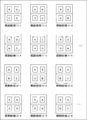
- FIG. For example, when the stock products other than the product A are the product B, the product C, and the product D, the generation unit 110 generates a shelf allocation candidate as illustrated in FIG. As described above, the placement possible position includes the product A, which is a specific product, and therefore the shelf allocation candidate generated by the generation unit 110 includes the product A. Therefore, it can be said that the generation unit 110 generates a shelf allocation candidate representing a state in which a plurality of products including the product A are displayed on the product shelf 20.
- the shelf allocation candidates shown in FIG. 5 are an example of a shelf allocation candidate including the arrangement candidate (1) in FIG. 4 and an example of a shelf allocation candidate including the arrangement candidate (3) in FIG.
- the generation unit 110 combines the display position of the inventory product with respect to a position (second position in FIG. 4) other than the position where the product is arranged (arrangeable position) indicated by the arrangement candidate. Are calculated (by brute force) and shelf allocation candidates are generated based on the obtained combinations.
- the generation unit 110 sets all combinations of the products B to D to be placed in the second slot of the product shelf. Generate for.
- the product to be arranged other than the position where it can be placed may be one type of product or a different type of product.
- the specific product in this case, the product A
- the product A may be included in the product to be arranged at a position other than the arrangement possible position.
- the position where the specific product can be arranged may be all the slots of all the shelves of the product shelf.
- the generation unit 110 outputs the generated arrangement candidate as a shelf allocation candidate.
- the generation unit 110 outputs the generated plurality of shelf allocation candidates to the prediction unit 120 together with specific product information indicating a specific product (product A in the above example).
- the prediction unit 120 receives a plurality of shelf allocation candidates generated by the generation unit 110 from the generation unit 110 together with the specific product information. Based on the relationship information stored in the relationship information storage unit 150, the prediction unit 120 predicts the sales of the product indicated by the received specific product information for each of the plurality of received shelf allocation candidates.
- the relationship information is information as shown in the following (1) to (5).
- relationship information may be a combination of (1) to (5).
- the product adjacent to the right of the product A is the product B.
- This relationship information ⁇ indicates that when the product name of the adjacent product is the product name B, the first-stage weight is 0.3 and the second-stage weight is 0.2.
- the prediction unit 120 predicts the sales of the product A in the shelf allocation candidate (1) -1 using the relationship information ⁇ .
- the adjacent product name is the product B, and the product B is in the first stage, so the sales of the product A is the first stage weight. Predicted using 0.3.
- the relationship information ⁇ A indicates that the weight when the adjacent product of the product A is the product A is 0.5, and the weight when the adjacent product of the product A is the product B is 0.7. ing.
- the weight when the adjacent product of the product A is the product C is 0.3
- the weight when the adjacent product of the product A is the product D is 0.8. It is shown that.
- the sales of the commodity A in the planogram candidates (1) -1 is predicted by using the relationship information theta A. For example, in the case of “shelf allocation candidate (1) -1” shown in FIG. 5, the product adjacent to the right of the product A is the product B, so the sales of the product A is the product B next to the product A. It is predicted using 0.7 as the case weight.
- the prediction unit 120 predicts the sales of the product A for all the shelf allocation candidates.
- the relationship information based on the prediction by the prediction unit 120 may be any one of (1) to (5) described above, or may be plural.
- the prediction unit 120 outputs the predicted sales for each shelf allocation candidate to the selection unit 130 as a prediction result.
- the selection unit 130 receives the prediction result from the prediction unit 120. Then, the selection unit 130 selects the shelf allocation candidate with the largest sales among the plurality of shelf allocation candidates based on the received prediction result. For example, when the sales of the product A in each of “shelf allocation candidate (1) -1”, “shelf allocation candidate (1) -2”, and “shelf allocation candidate (1) -3” is 50, 100, 150 The selection unit 130 selects “shelf allocation candidate (1) -3” having the largest sales. As a result, the more effective display state of the product A in the sales of the product A is that the product A is displayed in the first slot of the first stage of the shelf, the product D is displayed on the right side of the product A, It can be seen that the product C is displayed in the state. The selection unit 130 can output the selected shelf allocation candidate as a recommended shelf allocation indicating a display state of a product including a state where a specific product is displayed at a more effective position.
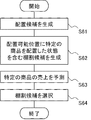
- FIG. 6 is a flowchart illustrating an example of a processing flow in the shelf allocation support apparatus 100 according to the present embodiment.
- the generation unit 110 generates a placement candidate that is a candidate for a product including a specific product to be placed at a placeable position on the product shelf (step S61). And the production
- the prediction unit 120 predicts the sales of a specific product for each of the plurality of shelf allocation candidates generated in step S62 based on the relationship information (step S63).
- the selection unit 130 selects a shelf allocation candidate with the largest sales among the plurality of shelf allocation candidates based on the predicted sales (prediction result) of the specific product for each shelf allocation candidate (step S64).
- the generation unit 110 is a candidate for a product to be arranged at a position where one or more specific products can be arranged, and at least one specific product A placement candidate indicating a candidate including a product is generated.
- generation part 110 displays the display state in the said goods shelf of the some goods containing the specific goods including the state which has arrange
- a shelf allocation candidate to be generated is generated.
- the prediction part 120 is based on the relationship information showing the relationship between the positional relationship between the products displayed on the product shelf and the sales of the product, the specific product in each of the plurality of shelf allocation candidates generated Predict sales. Thereafter, the selection unit 130 selects a shelf allocation candidate with the largest predicted sales among the plurality of shelf allocation candidates based on the prediction result.
- the prediction unit 120 predicts the sales of a specific product based on the relationship information, the prediction result can predict the sales corresponding to the display positions of a plurality of products including the specific product. And it can be said that the shelf allocation candidate with the largest predicted sales has an effect on sales due to the display position relationship between a specific product and another product.
- the shelf allocation support apparatus it is possible to generate a recommended shelf allocation that indicates a display state of a product including a state in which a specific product is displayed at a more effective position. Therefore, the shelf allocation support apparatus 100 according to the present embodiment can efficiently support the shelf allocation work, similarly to the shelf allocation support apparatus 10 in the first embodiment described above.
- the data analysis apparatus 300 may analyze the product based on information such as a product that is about to expire or a product that is being discounted. For example, when the expiration date of another product (adjacent product) that is adjacent to a certain product is near, the data analysis apparatus 300 analyzes the relationship between the position relationship between this certain product and the adjacent product and the sales of the product. You can do it. In addition, the data analysis apparatus 300 may analyze the sales in each shelf for each product whose deadline is close, and output the sales as relationship information.
- the prediction part 120 may perform sales prediction based on the relationship information which the data analysis apparatus 300 output similarly to the prediction part 120 in 2nd Embodiment mentioned above.
- the shelf allocation support device 100 according to the present modification can achieve the same effects as the shelf allocation support device 100 in the second embodiment described above.
- the prediction unit 120 predicts the sales of a specific product, but may calculate the sales of other products. For example, when there are a plurality of shelf allocation candidates with the largest predicted sales, the selection unit 130 may select a shelf allocation candidate with a larger sales of the entire product included in the shelf allocation candidates.
- the shelf allocation support device 100 can generate a recommended shelf allocation indicating the display state of the product, including the state where the specific product is displayed at a more effective position.
- FIG. 7 is a functional block diagram showing a functional configuration of the shelf allocation support apparatus 101 in the shelf allocation support system 1 according to the present embodiment.
- members having the same functions as those included in the drawings described in the second embodiment described above are given the same reference numerals, and descriptions thereof are omitted.
- the overall configuration of the shelf allocation support system 1 according to the present embodiment is the same as the configuration of the shelf allocation support system 1 in the second embodiment shown in FIG.
- the shelf allocation support device 101 includes a generation unit 111, a prediction unit 120, a selection unit 130, an inventory information storage unit 140, a relationship information storage unit 150, and a template storage unit 160. .
- the shelf allocation support apparatus 101 illustrated in FIG. 7 includes an analysis unit 301 corresponding to the data analysis apparatus 300.
- the analysis unit 301 has the same function as that of the data analysis device 300, and thus description thereof is omitted. Since the shelf allocation support apparatus 101 includes an analysis function, it is possible to reduce a network load required for communication of relationship information.
- the inventory information storage unit 140, the relationship information storage unit 150, and the template storage unit 160 may be realized by a single storage unit.
- the stock information storage unit 140, the relationship information storage unit 150, and the template storage unit 160 may be realized by a storage device that is separate from the shelf allocation support device 101, respectively.
- the template storage unit 160 information indicating a product display state in each of a plurality of stores is stored as a template. Further, in the template storage unit 160, for example, information indicating a product display state recommended by the headquarters of the chain store may be stored as a template.
- the generation unit 111 arranges placement candidates including at least one of the specific products to be placed at the placement position indicating the position where the specific product on the product shelf 20 can be placed.
- the generation unit 111 specifies a specific product, similarly to the generation unit 110 described above.
- generation part 111 produces
- the product A is a specific product
- the first level is the position where the product A can be placed.
- the template includes information indicating a state in which (product A, product A), (product A, product B), and (product C, product A) are arranged in each slot in the first row.
- the state in which the above (product C, product A) is arranged is a state in which the product C is arranged in the first slot of the first stage and the product A is arranged in the second slot.
- the generation unit 111 generates an arrangement candidate based on this template.
- the generation unit 111 may set all of the above-described (product A, product A), (product A, product B), and (product C, product A) as placement candidates based on the template. It may be a placement candidate.
- this shelf allocation candidate includes a state in which the product A is arranged in at least one of the slots where the arrangement is possible.
- this shelf allocation candidate includes a state in which at least one specific product is arranged in at least one of the slots where the arrangement is possible.
- the generation unit 111 determines a combination of display positions of inventory products other than the product A based on the templates stored in the template storage unit 160.
- the generation unit 111 may determine the combination of the display positions of inventory products other than the product A in a brute force manner, as in the second embodiment described above. Good. Then, the generation unit 111 generates a shelf allocation candidate based on the determined combination.
- the generation unit 111 obtains placement candidates for all positions where a specific product can be placed (in a brute force manner), and displays stock products other than the specific product.
- a combination of positions may be determined based on a template stored in the template storage unit 160.
- the position where the specific product can be arranged may be all the slots of all the shelves of the product shelf.
- the generation unit 111 outputs the arrangement candidate generated based on the template as a shelf allocation candidate.
- the prediction unit 120 predicts the sales of a specific product for each of the plurality of shelf allocation candidates, and the selection unit 130 calculates the shelf allocation based on the prediction result. Select a candidate.
- the shelf allocation support apparatus 101 according to the present embodiment can obtain the same effects as the shelf allocation support apparatus 100 according to the second embodiment described above. Moreover, the shelf allocation support apparatus 101 according to the present embodiment generates a plurality of shelf allocation candidates using a template prepared in advance as described above. Thereby, compared with the shelf allocation support device 100 according to the second embodiment described above, the processing amount of the shelf allocation candidate generation process, the processing amount of the sales prediction process, and the like can be reduced, and the shelf allocation support is performed. The load applied to the apparatus 101 can be reduced.
- FIG. 8 is a diagram illustrating an example of the overall configuration of the shelf allocation support system 2 according to the present embodiment.
- members having the same functions as the members included in the drawings described in the above-described embodiments are denoted by the same reference numerals and description thereof is omitted.
- the shelf allocation support system 2 shown in FIG. 8 includes a shelf allocation support device 102, an inventory management device 200, a data analysis device 300, and an imaging device 500.
- FIG. 9 is a figure for demonstrating the utilization scene of the shelf allocation assistance system 2 which concerns on this Embodiment.
- FIG. 9 is a functional block diagram illustrating an example of a functional configuration of the shelf allocation support system 2 according to the present embodiment.
- the imaging device 500 captures a product displayed on the product shelf 20 in the store and transmits the captured image to the shelf allocation support device 102.
- the imaging apparatus 500 may be a terminal having an imaging function such as a mobile phone terminal, a smartphone, a digital camera, or a tablet, or may be a surveillance camera installed in a store. Good.
- the shelf allocation support device 102 When there is a place where a product is not displayed in the product shelf 20 photographed by the imaging device 500 (referred to as an empty slot), the shelf allocation support device 102 outputs a recommended shelf allocation for the product shelf 20. Thereby, the worker who displays the product can display the product effective for sales in the empty slot by confirming the recommended shelf allocation with a display device (not shown).
- the shelf allocation support system 2 efficiently supports the shelf allocation operation of selecting products to be displayed in the empty slots.
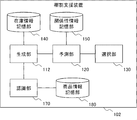
- FIG. 10 is a functional block diagram illustrating an example of a functional configuration of the shelf allocation support apparatus 102 according to the present embodiment.
- the shelf allocation support apparatus 102 according to the present embodiment includes a generation unit 112, a prediction unit 120, a selection unit 130, an inventory information storage unit 140, a relationship information storage unit 150, and a recognition unit. 170 and a product information storage unit 180.
- the inventory information storage unit 140, the relationship information storage unit 150, and the product information storage unit 180 may be realized by a single storage unit.
- the stock information storage unit 140, the relationship information storage unit 150, and the product information storage unit 180 may each be realized by a storage device that is separate from the shelf allocation support device 102.
- the product information storage unit 180 stores information for recognizing a product included in a photographed image photographed by the imaging device 500. Specifically, in the product information storage unit 180, the product image (also referred to as a master image) and / or the feature amount included in the product image contains information for identifying the product (for example, for identifying the product). Are associated with the product identifier, product name, etc.) and stored.
- the recognition unit 170 receives from the imaging device 500 a captured image obtained by the imaging device 500 capturing the product shelf 20. Then, the recognition unit 170 refers to the information for recognizing the product stored in the product information storage unit 180, and recognizes the product included in the captured image from the captured image.
- the method of recognizing the product by the recognition unit 170 may be, for example, using a local feature, template, brightness, edge, outline, shape, color information, depth, or the like, or using other information. May be.
- the method by which the recognition unit 170 recognizes the product is not particularly limited, and may be a general recognition method, and thus detailed description thereof is omitted in this specification.
- the recognition part 170 is information (for example, a product identifier, a product name, etc.) which identifies the recognized goods as a recognition result, and the information (for example, coordinate value in a picked-up image) which shows the position on the picked-up image of goods.
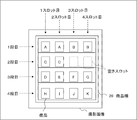
- the generation unit 112. an example of the photographed image is shown in FIG.
- the captured image is, for example, an image as shown in FIG.
- the product shelf 20 included in the photographed image has four shelf levels, and the number of products (number of slots) that can be arranged on each shelf level is four product shelves.
- a plurality of products are displayed in the product shelf 20 of FIG.
- the alphabet in each product shown in FIG. 11 indicates the last character of the product name. In FIG. 11, for example, a product whose product name is “product A” is indicated as “A”.
- the recognition unit 170 recognizes a product from this captured image.
- the recognition unit 170 outputs the recognition result to the generation unit 112 together with the captured image.
- the recognition unit 170 may be realized by a device separate from the shelf allocation support device 102.
- the shelf allocation support device 102 receives the recognition result from the separate device.
- the shelf allocation support apparatus 102 can reduce the processing load applied to the shelf allocation support apparatus 102.
- the shelf allocation support apparatus 102 includes the recognition unit 170, it is possible to reduce a network load related to transmission / reception of the recognition result.
- the generation unit 112 receives the recognition result of the product from the recognition unit 170 together with the photographed image. And the production
- This empty slot is a position where products can be placed. Therefore, the generation unit 112 generates a candidate for a product to be placed in this empty slot and including at least one of one or more specific products.
- FIG. 12 is a diagram for explaining the arrangement candidate generation processing by the generation unit 112. As shown in FIG. 12, in the present embodiment, it is assumed that a specific product is a product that the seller wants to sell, and the product is a product L, a product M, and a product N. The specific product may be all the stock products managed by the stock management apparatus 200.
- the generation unit 112 generates a placement candidate that is a candidate for placing a specific product in this empty slot.
- the arrangement candidates shown in FIG. 12 are shown so as to correspond to two empty slots in the product shelf.
- the generation unit 112 generates any combination of specific products to be arranged as placement candidates for each of the two slots that can be placed.
- FIG. 12 shows nine arrangement candidates.
- the left empty slot indicates the second third slot in FIG. 11, and the right empty slot indicates the second fourth slot in FIG.
- the top left placement candidate is a combination of products placed in the second and third slots of the product shelf 20 (product L, product L). That is, the upper left placement candidate indicates that the product candidates to be placed in the second and third slots of the product shelf 20 are both the product L.
- the placement candidates shown in FIG. 12 are combinations of specific products that are placed in each of the two slots that can be placed, but the present embodiment is not limited to this.
- generation part 112 should just contain a specific goods in the goods arrange
- the generation unit 112 may use (commodity L, commodity A) as a combination of products placed in the second and third slots and the second and fourth slots.
- This product A is a stock product that is not a specific product.
- the generation unit 112 sets any one of the specific products as an arrangement candidate.
- the generation unit 112 may generate the arrangement candidates for all of the arrangement possible positions (in a brute force manner) as in the second embodiment. Further, the generation unit 112 may generate based on a template, as in the third embodiment.
- the shelf allocation support device 102 may be configured to include the template storage unit 160, similarly to the shelf allocation support device 101 in the third embodiment.
- the generation unit 112 arranges at least one of the specific products at the arrangement possible position based on the generated arrangement candidate, and recognizes the recognized product at a position corresponding to the position in the captured image of the recognized product.
- a shelf allocation candidate representing the state in which is placed is generated.
- a product A, a product A, a product B, and a product B are arranged in order from the left in the first row of the product shelf 20 included in the photographed image shown in FIG.
- the recognition unit 170 recognizes these products and their positions from the captured image. Therefore, the generation unit 112 assumes that the first stage state included in the shelf allocation candidate is a state in which the product A, the product A, the product B, and the product B are arranged in order from the left. Similarly, the production
- the generation unit 112 outputs the generated shelf allocation candidate to the prediction unit 120.
- the prediction unit 120 predicts the sales of a specific product for each of the plurality of shelf allocation candidates, and the selection unit 130 calculates the shelf allocation based on the prediction result. Select a candidate.
- FIG. 13 is a flowchart illustrating an example of a processing flow in the shelf allocation support apparatus 102 according to the present embodiment.
- the recognition unit 170 receives a photographed image obtained by photographing the product shelf by the imaging device 500 (step S131). And the recognition part 170 recognizes goods from the received picked-up image (step S132).
- the generation unit 112 generates an arrangement candidate that is a candidate for a product including a specific product to be placed at a position (positioning possible position) where the recognition unit 170 determines that the product is not displayed (Step S133). ). Then, the generation unit 112 places the specific product indicated by the generated placement candidate at the position where it can be placed, and recognizes the product recognized at the position corresponding to the position in the captured image of the product recognized from the captured image. A shelf allocation candidate representing the state in which is placed is generated (step S134).
- the prediction unit 120 predicts the sales of a specific product for each of the plurality of shelf allocation candidates generated in step S134 based on the relationship information (step S135).
- the selection unit 130 selects a shelf allocation candidate with the largest sales among a plurality of shelf allocation candidates based on the predicted sales (prediction result) of a specific product for each shelf allocation candidate (step S136).
- the shelf allocation support system 2 According to the shelf allocation support system 2 according to the present embodiment, the display state of the product including the state in which the specific product is displayed at a more effective position, as in the above-described embodiments. A recommended shelf allocation can be generated. Therefore, the shelf allocation support system 2 according to the present embodiment can efficiently support the shelf allocation task, as in the above-described embodiments.
- shelf allocation support device (10, 100 to 102) may be realized as a dedicated device or may be realized using a computer (information processing device).
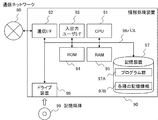
- FIG. 14 is a diagram illustrating a hardware configuration of a computer (information processing apparatus) capable of realizing each embodiment of the present invention.
- the hardware of the information processing apparatus (computer) 90 shown in FIG. 14 includes a CPU (Central Processing Unit) 91, a communication interface (I / F) 92, an input / output user interface 93, a ROM (Read Only Memory) 94, a RAM ( Random Access Memory) 95, a storage device 97, and a drive device 98 of a computer-readable storage medium 99, which are connected via a bus 96.
- the input / output user interface 93 is a man-machine interface such as a keyboard which is an example of an input device and a display as an output device.
- the communication interface 92 is a general communication means for the devices according to the above-described embodiments (FIGS. 1, 3, 7, and 10) to communicate with an external device via the communication network 80.
- the CPU 91 governs the overall operation of the information processing apparatus 90 that realizes the shelf allocation support apparatus (10, 100 to 102) according to each embodiment.
- the present invention described by taking each of the above-described embodiments as an example supplies, for example, a program (computer program) that can realize the processing described in each of the above-described embodiments to the information processing apparatus 90 illustrated in FIG. Later, the program is read out and executed by the CPU 91.
- the program is, for example, the various devices described in the flowcharts (FIGS. 6 and 13) referred to in the description of the above embodiments, or the apparatus shown in the block diagrams shown in FIGS. It may be a program capable of realizing each unit (each block) shown in FIG.
- the program supplied into the information processing apparatus 90 may be stored in a readable / writable temporary storage memory (95) or a non-volatile storage device (97) such as a hard disk drive. That is, in the storage device 97, the program group 97A is, for example, a program that can realize the functions of the units shown in the shelf allocation support devices (10, 100 to 102) in the above-described embodiments.
- the various pieces of stored information 97B are, for example, shelf allocation candidates, relationship information, inventory information, captured images, recognition results, templates, recommended shelf allocations in the above-described embodiments.
- the constituent unit of each program module is not limited to the division of each block shown in the block diagram, and may be appropriately selected by those skilled in the art at the time of implementation.
- the program is supplied to the apparatus via a computer-readable recording medium (99) such as a CD (Compact Disk) -ROM or a flash memory.
- a computer-readable recording medium such as a CD (Compact Disk) -ROM or a flash memory.
- a general procedure can be adopted at present, such as a method and a method of downloading from the outside via a communication line (80) such as the Internet.
- the present invention can be understood to be configured by a code (program group 97A) constituting the computer program or a storage medium (99) in which the code is stored.
- shelf allocation support system 2 shelf allocation support system 10
- shelf allocation support device 101 shelf allocation support device 102
- shelf allocation support device 110 generation unit 111 generation unit 112 generation unit 120 prediction Unit 130 selection unit 140
Landscapes
- Business, Economics & Management (AREA)
- Engineering & Computer Science (AREA)
- Human Resources & Organizations (AREA)
- Economics (AREA)
- Strategic Management (AREA)
- Entrepreneurship & Innovation (AREA)
- Development Economics (AREA)
- General Physics & Mathematics (AREA)
- Theoretical Computer Science (AREA)
- Marketing (AREA)
- Physics & Mathematics (AREA)
- General Business, Economics & Management (AREA)
- Finance (AREA)
- Accounting & Taxation (AREA)
- Operations Research (AREA)
- Quality & Reliability (AREA)
- Tourism & Hospitality (AREA)
- Game Theory and Decision Science (AREA)
- Educational Administration (AREA)
- Management, Administration, Business Operations System, And Electronic Commerce (AREA)
Abstract
Priority Applications (2)
| Application Number | Priority Date | Filing Date | Title |
|---|---|---|---|
| JP2017523108A JP6874680B2 (ja) | 2015-06-09 | 2016-06-07 | 棚割支援装置、棚割支援システム、棚割支援方法、および、プログラム |
| US15/580,948 US20180181913A1 (en) | 2015-06-09 | 2016-06-07 | Shelf allocation assistance device, shelf allocation assistance system, shelf allocation assistance method, and recording medium |
Applications Claiming Priority (2)
| Application Number | Priority Date | Filing Date | Title |
|---|---|---|---|
| JP2015-116477 | 2015-06-09 | ||
| JP2015116477 | 2015-06-09 |
Publications (1)
| Publication Number | Publication Date |
|---|---|
| WO2016199405A1 true WO2016199405A1 (fr) | 2016-12-15 |
Family
ID=57503441
Family Applications (1)
| Application Number | Title | Priority Date | Filing Date |
|---|---|---|---|
| PCT/JP2016/002754 Ceased WO2016199405A1 (fr) | 2015-06-09 | 2016-06-07 | Dispositif d'aide à l'attribution d'étagère, système d'aide à l'attribution d'étagère, procédé d'aide à l'attribution d'étagère, et support d'enregistrement |
Country Status (3)
| Country | Link |
|---|---|
| US (1) | US20180181913A1 (fr) |
| JP (4) | JP6874680B2 (fr) |
| WO (1) | WO2016199405A1 (fr) |
Cited By (14)
| Publication number | Priority date | Publication date | Assignee | Title |
|---|---|---|---|---|
| CN108133346A (zh) * | 2017-12-28 | 2018-06-08 | 创新无限信息技术(武汉)股份有限公司 | bom清单上传系统设置按组销售的方法及系统 |
| WO2018144695A1 (fr) * | 2017-02-03 | 2018-08-09 | Shopper Scientist Llc | Affichage en magasin avec affichage sélectif de produits basé sur une métrique de visibilité |
| JP2019075095A (ja) * | 2017-10-13 | 2019-05-16 | 株式会社プロフィールド | 情報処理装置、学習装置、情報処理方法、学習情報の生産方法、およびプログラム |
| JP2019101861A (ja) * | 2017-12-05 | 2019-06-24 | 株式会社プロフィールド | 情報処理装置、情報処理方法、およびプログラム |
| KR20190141420A (ko) * | 2018-06-14 | 2019-12-24 | 한양대학교 산학협력단 | 상품 배치 방법, 이를 이용하는 컴퓨팅 시스템, 및 프로그램 |
| JP2020119000A (ja) * | 2019-01-18 | 2020-08-06 | 株式会社パン・パシフィック・インターナショナルホールディングス | 情報処理装置、棚管理システム、情報処理方法、及びプログラム |
| JP2020525918A (ja) * | 2017-07-05 | 2020-08-27 | パナソニックIpマネジメント株式会社 | 販売活動の最適化システムおよび方法 |
| JP2021121904A (ja) * | 2020-01-31 | 2021-08-26 | 日本総合システム株式会社 | 棚割パターン自動作成方法、棚割パターン自動作成装置、及び棚割パターン自動作成システム |
| JP2021189703A (ja) * | 2020-05-29 | 2021-12-13 | 富士通株式会社 | 分類制御プログラム、分類制御装置、及び分類制御方法 |
| JP2023526095A (ja) * | 2020-09-01 | 2023-06-20 | 北京沃東天駿信息技術有限公司 | データ処理の方法、装置、機器及びコンピュータ可読記憶媒体 |
| WO2024057387A1 (fr) * | 2022-09-13 | 2024-03-21 | 日本電気株式会社 | Dispositif de génération de données de planogramme, système de génération de données de planogramme, procédé de génération de données de planogramme et support de stockage |
| JP7639205B1 (ja) | 2024-03-07 | 2025-03-04 | 楽天グループ株式会社 | 棚割提案システム、棚割提案方法、及びプログラム |
| WO2025158552A1 (fr) * | 2024-01-24 | 2025-07-31 | 日本電気株式会社 | Dispositif de support d'attribution de tablette, procédé de support d'attribution de tablette et support d'enregistrement |
| WO2025197567A1 (fr) * | 2024-03-21 | 2025-09-25 | 日本電気株式会社 | Dispositif d'inférence d'attribution d'étagère, procédé d'inférence d'attribution d'étagère et support d'enregistrement |
Families Citing this family (6)
| Publication number | Priority date | Publication date | Assignee | Title |
|---|---|---|---|---|
| US20180293596A1 (en) * | 2017-04-10 | 2018-10-11 | International Business Machines Corporation | Shelf image recognition analytics |
| US10885395B2 (en) * | 2018-06-17 | 2021-01-05 | Pensa Systems | Method for scaling fine-grained object recognition of consumer packaged goods |
| US11126961B2 (en) * | 2019-07-02 | 2021-09-21 | Walmart Apollo, Llc | Methods and systems for generating a planogram at a retail facility |
| CN111382974B (zh) * | 2020-03-09 | 2024-01-19 | 北京旷视机器人技术有限公司 | 货架位置的确定方法及装置、仓储系统、计算机设备 |
| JP2023176099A (ja) * | 2022-05-31 | 2023-12-13 | 日本電気株式会社 | 学習用データ生成装置、学習用データ生成方法、及び、記録媒体 |
| CN119816856A (zh) * | 2022-09-06 | 2025-04-11 | 烟台创迹软件有限公司 | 分析方法、分析装置以及分析系统 |
Citations (3)
| Publication number | Priority date | Publication date | Assignee | Title |
|---|---|---|---|---|
| JP2002203021A (ja) * | 2000-10-25 | 2002-07-19 | Rohto Pharmaceut Co Ltd | 棚割提案データ作成システムおよび端末装置 |
| JP2004151955A (ja) * | 2002-10-30 | 2004-05-27 | Toppan Printing Co Ltd | 商品陳列シミュレーションサーバ装置 |
| WO2015059807A1 (fr) * | 2013-10-25 | 2015-04-30 | 株式会社日立製作所 | Système et procédé de traitement d'informations |
Family Cites Families (8)
| Publication number | Priority date | Publication date | Assignee | Title |
|---|---|---|---|---|
| US7734495B2 (en) * | 2002-04-23 | 2010-06-08 | Kimberly-Clark Worldwide, Inc. | Methods and system for allocating shelf space |
| JP2003323539A (ja) * | 2002-04-30 | 2003-11-14 | Fujitsu Ltd | 店舗棚割管理システム及び情報処理装置 |
| US8189855B2 (en) * | 2007-08-31 | 2012-05-29 | Accenture Global Services Limited | Planogram extraction based on image processing |
| US10438084B2 (en) * | 2013-03-04 | 2019-10-08 | Nec Corporation | Article management system, information processing apparatus, and control method and control program of information processing apparatus |
| EP3374947A4 (fr) * | 2015-11-09 | 2019-03-27 | Simbe Robotics, Inc. | Procédé pour suivre un niveau de stock dans un magasin |
| US11087272B2 (en) * | 2016-03-29 | 2021-08-10 | Bossa Nova Robotics Ip, Inc. | System and method for locating, identifying and counting items |
| US10546328B2 (en) * | 2016-08-04 | 2020-01-28 | Walmart Apollo, Llc | In-store navigation systems and methods |
| US10643059B2 (en) * | 2018-01-10 | 2020-05-05 | Trax Technology Solutions Pte Ltd. | Inspecting store shelf capacity |
-
2016
- 2016-06-07 WO PCT/JP2016/002754 patent/WO2016199405A1/fr not_active Ceased
- 2016-06-07 JP JP2017523108A patent/JP6874680B2/ja active Active
- 2016-06-07 US US15/580,948 patent/US20180181913A1/en not_active Abandoned
-
2021
- 2021-04-21 JP JP2021071992A patent/JP7205565B2/ja active Active
-
2022
- 2022-12-15 JP JP2022199861A patent/JP7501605B2/ja active Active
-
2024
- 2024-06-04 JP JP2024090428A patent/JP7715250B2/ja active Active
Patent Citations (3)
| Publication number | Priority date | Publication date | Assignee | Title |
|---|---|---|---|---|
| JP2002203021A (ja) * | 2000-10-25 | 2002-07-19 | Rohto Pharmaceut Co Ltd | 棚割提案データ作成システムおよび端末装置 |
| JP2004151955A (ja) * | 2002-10-30 | 2004-05-27 | Toppan Printing Co Ltd | 商品陳列シミュレーションサーバ装置 |
| WO2015059807A1 (fr) * | 2013-10-25 | 2015-04-30 | 株式会社日立製作所 | Système et procédé de traitement d'informations |
Cited By (20)
| Publication number | Priority date | Publication date | Assignee | Title |
|---|---|---|---|---|
| WO2018144695A1 (fr) * | 2017-02-03 | 2018-08-09 | Shopper Scientist Llc | Affichage en magasin avec affichage sélectif de produits basé sur une métrique de visibilité |
| JP2020525918A (ja) * | 2017-07-05 | 2020-08-27 | パナソニックIpマネジメント株式会社 | 販売活動の最適化システムおよび方法 |
| JP7283042B2 (ja) | 2017-10-13 | 2023-05-30 | 株式会社プロフィールド | 情報処理装置、学習装置、情報処理方法、学習情報の生産方法、およびプログラム |
| JP2019075095A (ja) * | 2017-10-13 | 2019-05-16 | 株式会社プロフィールド | 情報処理装置、学習装置、情報処理方法、学習情報の生産方法、およびプログラム |
| JP2019101861A (ja) * | 2017-12-05 | 2019-06-24 | 株式会社プロフィールド | 情報処理装置、情報処理方法、およびプログラム |
| CN108133346A (zh) * | 2017-12-28 | 2018-06-08 | 创新无限信息技术(武汉)股份有限公司 | bom清单上传系统设置按组销售的方法及系统 |
| KR20190141420A (ko) * | 2018-06-14 | 2019-12-24 | 한양대학교 산학협력단 | 상품 배치 방법, 이를 이용하는 컴퓨팅 시스템, 및 프로그램 |
| KR102249151B1 (ko) * | 2018-06-14 | 2021-05-07 | 한양대학교 산학협력단 | 상품 배치 방법, 이를 이용하는 컴퓨팅 시스템, 및 프로그램 |
| JP2020119000A (ja) * | 2019-01-18 | 2020-08-06 | 株式会社パン・パシフィック・インターナショナルホールディングス | 情報処理装置、棚管理システム、情報処理方法、及びプログラム |
| JP2021121904A (ja) * | 2020-01-31 | 2021-08-26 | 日本総合システム株式会社 | 棚割パターン自動作成方法、棚割パターン自動作成装置、及び棚割パターン自動作成システム |
| JP2021189703A (ja) * | 2020-05-29 | 2021-12-13 | 富士通株式会社 | 分類制御プログラム、分類制御装置、及び分類制御方法 |
| JP2023526095A (ja) * | 2020-09-01 | 2023-06-20 | 北京沃東天駿信息技術有限公司 | データ処理の方法、装置、機器及びコンピュータ可読記憶媒体 |
| JP7518918B2 (ja) | 2020-09-01 | 2024-07-18 | 北京沃東天駿信息技術有限公司 | データ処理の方法、装置、機器及びコンピュータ可読記憶媒体 |
| WO2024057387A1 (fr) * | 2022-09-13 | 2024-03-21 | 日本電気株式会社 | Dispositif de génération de données de planogramme, système de génération de données de planogramme, procédé de génération de données de planogramme et support de stockage |
| JPWO2024057387A1 (fr) * | 2022-09-13 | 2024-03-21 | ||
| JP7798202B2 (ja) | 2022-09-13 | 2026-01-14 | 日本電気株式会社 | 棚割りデータ生成装置、棚割りデータ生成システム、棚割りデータ生成方法およびプログラム |
| WO2025158552A1 (fr) * | 2024-01-24 | 2025-07-31 | 日本電気株式会社 | Dispositif de support d'attribution de tablette, procédé de support d'attribution de tablette et support d'enregistrement |
| JP7639205B1 (ja) | 2024-03-07 | 2025-03-04 | 楽天グループ株式会社 | 棚割提案システム、棚割提案方法、及びプログラム |
| JP2025136467A (ja) * | 2024-03-07 | 2025-09-19 | 楽天グループ株式会社 | 棚割提案システム、棚割提案方法、及びプログラム |
| WO2025197567A1 (fr) * | 2024-03-21 | 2025-09-25 | 日本電気株式会社 | Dispositif d'inférence d'attribution d'étagère, procédé d'inférence d'attribution d'étagère et support d'enregistrement |
Also Published As
| Publication number | Publication date |
|---|---|
| JP2021108209A (ja) | 2021-07-29 |
| JP7715250B2 (ja) | 2025-07-30 |
| US20180181913A1 (en) | 2018-06-28 |
| JP7501605B2 (ja) | 2024-06-18 |
| JP6874680B2 (ja) | 2021-05-19 |
| JPWO2016199405A1 (ja) | 2018-04-12 |
| JP7205565B2 (ja) | 2023-01-17 |
| JP2023030023A (ja) | 2023-03-07 |
| JP2024109982A (ja) | 2024-08-14 |
Similar Documents
| Publication | Publication Date | Title |
|---|---|---|
| JP7205565B2 (ja) | 棚割支援装置、棚割支援システム、棚割支援方法、および、記録媒体 | |
| US11288627B2 (en) | Information processing apparatus, control method, and program | |
| JP6464612B2 (ja) | データ解析装置、データ解析システム、売上予測装置、売上予測システム、データ解析方法、売上予測方法、プログラムおよび記録媒体 | |
| US9940548B2 (en) | Image recognition method for performing image recognition utilizing convolution filters | |
| US9082086B2 (en) | Adaptively learning a similarity model | |
| CA2950801A1 (fr) | Concordance de planogramme | |
| US20190213610A1 (en) | Evaluation device and evaluation method | |
| US11605002B2 (en) | Program, information processing method, and information processing apparatus | |
| US10162879B2 (en) | Label filters for large scale multi-label classification | |
| JP7146759B2 (ja) | 小売環境における人的および非人的リソースの最適化 | |
| JP6031210B1 (ja) | 販売予測装置、販売予測方法、およびプログラム | |
| WO2022157973A1 (fr) | Système et procédé de traitement d'informations et programme informatique | |
| US20230333720A1 (en) | Generating presentation information associated with one or more objects depicted in image data for display via a graphical user interface | |
| Abu Qudeiri | Production simulator system for flexible routing optimization in flexible manufacturing systems | |
| JP6877806B6 (ja) | 情報処理装置、プログラム及び情報処理方法 | |
| Bera et al. | A two-stage novel approach using centre ordering of vectors on agglomerative hierarchical clustering for manufacturing cell formation | |
| KR20240072708A (ko) | 자동 계산대 시스템 및 그 제어방법 | |
| JP2018018384A (ja) | 推定装置、推定方法、及び推定プログラム | |
| JP2018142293A (ja) | 商品判別装置、商品判別プログラム及び商品の判別方法 | |
| JP2018142288A (ja) | 商品判別装置、商品判別プログラム及び商品の判別方法 | |
| US12572877B2 (en) | Systems and methods for end-to-end modular intelligence | |
| JP2018018339A (ja) | 決定装置、決定方法、及び決定プログラム | |
| WO2014099378A1 (fr) | Systèmes et procédés de génération et d'optimisation de contenu à l'aide de facteurs de probabilité | |
| JP7049587B2 (ja) | 画像処理装置、画像処理プログラム、及び画像処理方法 | |
| US20160125436A1 (en) | Computer-readable medium, system and method |
Legal Events
| Date | Code | Title | Description |
|---|---|---|---|
| 121 | Ep: the epo has been informed by wipo that ep was designated in this application |
Ref document number: 16807113 Country of ref document: EP Kind code of ref document: A1 |
|
| ENP | Entry into the national phase |
Ref document number: 2017523108 Country of ref document: JP Kind code of ref document: A |
|
| WWE | Wipo information: entry into national phase |
Ref document number: 15580948 Country of ref document: US |
|
| NENP | Non-entry into the national phase |
Ref country code: DE |
|
| 122 | Ep: pct application non-entry in european phase |
Ref document number: 16807113 Country of ref document: EP Kind code of ref document: A1 |