WO2016199432A1 - Dispositif de commande de service, procédé de commande de service, et support d'enregistrement - Google Patents
Dispositif de commande de service, procédé de commande de service, et support d'enregistrement Download PDFInfo
- Publication number
- WO2016199432A1 WO2016199432A1 PCT/JP2016/002815 JP2016002815W WO2016199432A1 WO 2016199432 A1 WO2016199432 A1 WO 2016199432A1 JP 2016002815 W JP2016002815 W JP 2016002815W WO 2016199432 A1 WO2016199432 A1 WO 2016199432A1
- Authority
- WO
- WIPO (PCT)
- Prior art keywords
- functional element
- execution
- functional
- plan
- activity
- Prior art date
- Legal status (The legal status is an assumption and is not a legal conclusion. Google has not performed a legal analysis and makes no representation as to the accuracy of the status listed.)
- Ceased
Links
Images





Classifications
-
- G—PHYSICS
- G05—CONTROLLING; REGULATING
- G05B—CONTROL OR REGULATING SYSTEMS IN GENERAL; FUNCTIONAL ELEMENTS OF SUCH SYSTEMS; MONITORING OR TESTING ARRANGEMENTS FOR SUCH SYSTEMS OR ELEMENTS
- G05B19/00—Program-control systems
- G05B19/02—Program-control systems electric
- G05B19/04—Program control other than numerical control, i.e. in sequence controllers or logic controllers
- G05B19/041—Function-oriented details
- G05B19/0415—Function-oriented details adapting phase duration according to measured parameters
-
- G—PHYSICS
- G05—CONTROLLING; REGULATING
- G05B—CONTROL OR REGULATING SYSTEMS IN GENERAL; FUNCTIONAL ELEMENTS OF SUCH SYSTEMS; MONITORING OR TESTING ARRANGEMENTS FOR SUCH SYSTEMS OR ELEMENTS
- G05B19/00—Program-control systems
- G05B19/02—Program-control systems electric
- G05B19/04—Program control other than numerical control, i.e. in sequence controllers or logic controllers
- G05B19/042—Program control other than numerical control, i.e. in sequence controllers or logic controllers using digital processors
- G05B19/0426—Programming the control sequence
-
- G—PHYSICS
- G06—COMPUTING OR CALCULATING; COUNTING
- G06F—ELECTRIC DIGITAL DATA PROCESSING
- G06F9/00—Arrangements for program control, e.g. control units
- G06F9/06—Arrangements for program control, e.g. control units using stored programs, i.e. using an internal store of processing equipment to receive or retain programs
- G06F9/46—Multiprogramming arrangements
- G06F9/50—Allocation of resources, e.g. of the central processing unit [CPU]
- G06F9/5005—Allocation of resources, e.g. of the central processing unit [CPU] to service a request
- G06F9/5027—Allocation of resources, e.g. of the central processing unit [CPU] to service a request the resource being a machine, e.g. CPUs, Servers, Terminals
-
- G—PHYSICS
- G05—CONTROLLING; REGULATING
- G05B—CONTROL OR REGULATING SYSTEMS IN GENERAL; FUNCTIONAL ELEMENTS OF SUCH SYSTEMS; MONITORING OR TESTING ARRANGEMENTS FOR SUCH SYSTEMS OR ELEMENTS
- G05B2219/00—Program-control systems
- G05B2219/20—Pc systems
- G05B2219/23—Pc programming
- G05B2219/23287—Executing sequential program concurrently with state machine instructions
-
- G—PHYSICS
- G06—COMPUTING OR CALCULATING; COUNTING
- G06F—ELECTRIC DIGITAL DATA PROCESSING
- G06F2209/00—Indexing scheme relating to G06F9/00
- G06F2209/50—Indexing scheme relating to G06F9/50
- G06F2209/509—Offload
Definitions
- the present invention relates to a service control device, a service control method, and a recording medium.
- edge node Internet of Things
- IoT Internet of Things
- collecting real-world information and finding buried values, and providing services according to the environment and individuals are attracting attention.
- the function of the edge node equipped with the sensing device becomes important.
- the edge node often has limited resources.
- the battery capacity, calculation capability, and data transfer capability of the edge node are low compared to the cloud, and it is difficult to perform the information processing that has been performed on the cloud side as it is in the edge node.
- a device has been devised to perform advanced information processing at an edge node with limited resources by omitting part of the processing or offloading to another node.
- a service is realized by a combination of a plurality of service function elements, and an arrangement or combination of the function elements is selected.
- Japanese Patent Application Laid-Open No. 2004-228561 discloses a method of providing services by arranging processing functions in a plurality of nodes.
- Patent Document 2 discloses a method of offloading a part of the processing function to another node.
- JP 2006-171921 A Special Table 2002-517855 JP 2010-268346 A Japanese Patent Laid-Open No. 07-295917
- Patent Documents 1 and 2 do not consider the degree of necessity of functional elements suitable for the environment of each node. For this reason, depending on the environment of each node, there is a problem that the response time of the provided service is long, and the processing time and resource consumption are large.
- the present invention has been made to solve such problems, and is a service control device, a service control method, and a record that can shorten the response time of a service to be provided and can save processing time and resource consumption.
- the purpose is to provide a medium.
- the service control device receives an external request or an execution result of a functional element, refers to a control list that holds a plan of a combination of functional elements, and designates a functional element to be executed next, and the control Execution means for executing the functional element instructed by the means, monitoring recording means for monitoring and recording the execution status of the functional element, and calculating the activity of the functional element based on the recorded execution status of the functional element, Activity level calculating means for updating the control list based on the activity level.
- a function element to be executed next is determined by referring to a control list that holds a plan of a combination of function elements for an external request or an execution result of the function elements. Execute the functional element to be executed next, monitor and record the execution status of the functional element, calculate the activity of the functional element based on the recorded execution status of the functional element, and based on the activity The control list is updated.
- a service control apparatus a service control method, and a recording medium that can shorten the response time of a service to be provided and can save processing time and resource consumption.
- FIG. 11 is a block diagram illustrating a hardware configuration example of a general computer. It is a figure which shows the example of the plan of the combination of the functional element which the control list concerning embodiment of this invention hold
- the service control apparatus 100 is an apparatus including a sensing device in an edge node, for example.
- the service control apparatus 100 includes a control list 101, a control unit 102, an execution unit 103, a functional element group 104, a monitoring recording unit 105, and an activity calculation unit 106.
- the control list 101 holds a plan for combinations of functional elements.
- the plan of the combination of functional elements held in the control list 101 will be described in detail later.
- the control unit 102 receives an external request and a function element execution result by the execution unit 103.
- the external request is an execution request for a functional element from the outside, or a service execution request made up of a plurality of functional elements from the outside.
- the external request includes an external request generated in the node having the service control apparatus 100 and an external request generated in another node.
- the received external request and the execution result of the functional element by the execution unit 103 are referred to as an input signal to the control unit 102.
- the control unit 102 refers to the control list 101 and determines a functional element to be executed next for an input signal to the control unit 102. A method of determining the functional element to be executed next by the control unit 102 will be described in detail later. Further, the control unit 102 supplies an instruction of a functional element to be executed next to the execution unit 103.
- the execution unit 103 receives an instruction of a functional element to be executed next from the control unit 102.
- the functional element group 104 holds a plurality of functional elements.
- the execution unit 103 selects a functional element to be executed next from the functional element group 104 based on an instruction of the functional element to be executed next. Further, the execution unit 103 executes the selected functional element. Further, the execution unit 103 outputs the execution result of the functional element to the control unit 102.
- the monitoring recording unit 105 monitors and records the execution status of the functional elements by the execution unit 103.
- the execution status of the functional element includes the execution result of the functional element, the execution time of the functional element, information on whether or not a specific functional element has been executed, and the like.
- the execution result of the functional element and the information on whether or not the specific functional element has been executed are information necessary for calculating the execution frequency of the specific functional element, for example, as the activity of the functional element. Either one may be monitored and recorded.
- the monitoring recording unit 105 outputs the recorded execution status of the functional element to the activity calculation unit 106.
- the monitoring and recording of information about whether or not a specific functional element has been executed will be described.
- the monitoring recording unit 105 monitors whether or not a specific functional element has been executed out of a combination of a plurality of functional elements starting when the control unit 102 receives an external request or the execution result of the functional element. Further, the monitoring recording unit 105 records whether or not a specific functional element has been executed in association with an external request.
- the monitoring recording unit 105 may record whether or not a specific functional element has been executed in association with a functional element executed before the specific functional element. In any case, in response to a single external request, information capable of determining whether or not a specific functional element has been executed is recorded as information indicating whether or not the specific functional element has been executed. .
- the monitoring recording unit 105 monitors either the control unit 102 or the execution unit 103 regarding whether the control unit 102 has received an external request or a functional element executed before a specific functional element is executed. You may detect by doing.
- the activity calculation unit 106 receives the execution status of the functional element from the monitoring recording unit 105. In addition, the activity level calculation unit 106 calculates the activity level of the functional element based on the execution status of the functional element. The activity calculation unit 106 calculates, for example, the execution frequency of a specific function element as the activity of the function element.
- the monitoring recording unit 105 records information that can determine whether or not a specific functional element has been executed in response to a single external request as information about whether or not a specific functional element has been executed. is doing.
- the activity calculation unit 106 receives this information and determines whether a specific functional element has been executed or not executed for each external request. Then, the activity level calculation unit 106 calculates the execution frequency of the specific function element from the number of external requests and the number of times the specific function element is executed.
- the monitoring recording unit 105 records the number of external requests and the number of executions of a specific functional element, and the activity calculation unit 106 receives this information and calculates the execution frequency of the specific functional element. Also good.
- the activity calculation unit 106 determines whether to update the control list 101 based on the calculated activity of the functional element.
- the determination as to whether to update the control list 101 may be made, for example, by determining whether the activity level of the functional element exceeds a predetermined threshold.
- the average execution time of the functional element combination plan is calculated using the activity level of the functional elements and the execution time of the functional elements, and it is determined whether or not the average execution time is shortened by updating the control list 101 It may be done by doing.
- the activity level calculation unit 106 updates the control list 101. That is, the plan of the combination of functional elements held in the control list 101 is changed. The processing of the activity calculation unit 106 will be described in detail later.
- the service control apparatus 100 calculates the activity of the function element based on the execution status of the function element, and updates the control list 101 based on the activity level.
- a combination of functional elements suitable for an environment in which nodes having 100 are arranged can be realized, and a response time of a service to be provided can be shortened, and processing time and resource consumption can be saved.
- the control list 101 holds a functional element combination plan indicating which functional element is to be executed in response to an external request or a functional element execution result.
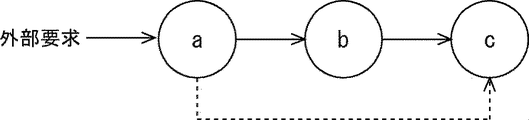
- the control list 101 holds a plan in which functional elements a, b, and c are arranged in series as indicated by solid arrows in FIG. This plan is called plan 1.
- plan 1 when the functional element a is executed, it is determined that the functional element b is executed next.
- a Yes / No judgment is output from the function element b. If Yes, the function element c is executed next. If No, the function element c is determined not to be executed and terminated. .
- control unit 102 When the control unit 102 receives an execution request for the functional element a from the outside or a service execution request made up of the functional elements a, b, and c as an external request, the control unit 102 refers to the control list 101, The functional element to be executed is determined as the functional element a. When the control unit 102 receives the execution result of the functional element a, the control unit 102 refers to the control list 101 and determines the functional element to be executed next as the functional element b. When the control unit 102 receives a Yes result from the functional element b, the control unit 102 refers to the control list 101 and determines the functional element to be executed next as the functional element c.
- the activity calculation unit 106 can update the control list 101. For example, as shown by the dotted arrow in FIG. 2, the function element b can be skipped without being executed, and the function element c can be changed to a plan for executing the function element c. This changed plan is called plan 2.
- control unit 102 When the control unit 102 receives an execution request for the functional element a from the outside or a service execution request made up of the functional elements a, b, and c as an external request, the control unit 102 refers to the control list 101, The functional element to be executed is determined as the functional element a. When the control unit 102 receives the execution result of the functional element a, the control unit 102 refers to the control list 101 and determines the functional element to be executed next as the functional element c.
- the activity level calculation unit 106 changes the plan based on the activity level of the functional element c.
- the activity calculation unit 106 calculates, for example, the execution frequency of the function element c as the activity of the function element c.
- the activity level calculation unit 106 determines whether to change from the plan 1 to the plan 2 based on the execution frequency of the functional element c.
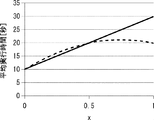
- the activity level calculation unit 106 executes the plan 2 with the average execution time of the plan 1 and the probability of x using the execution frequency of the functional element c and the execution times of the functional elements b and c. Calculate the average execution time.
- the probability of x is the execution frequency of the functional element c.
- the probability of x can be said to be the probability that the functional element b outputs Yes.
- the average execution time for executing the plan 2 with the probability of x is the average execution time when the plan 1 is executed with the probability of 1-x and the plan 2 is executed with the probability of x. Then, when the average execution time for executing the plan 2 with the probability of x is shorter than the average execution time of the plan 1, the plan 1 is changed to the plan 2.
- the monitoring recording unit 105 monitors whether the output of the functional element b is Yes or No as the execution result of the functional element b by the execution unit 103. In addition, the monitoring recording unit 105 records information that can determine whether the output of the functional element b is Yes or No in response to one external request. The activity calculation unit 106 receives this information and determines whether the output of the functional element b is Yes or No for each external request. Then, the activity calculation unit 106 calculates the probability that the functional element b outputs Yes from the number of external requests and the number of times that the output of the functional element b is Yes. Note that the monitoring recording unit 105 records the number of external requests and the number of times that the output of the functional element b is Yes, and the activity calculation unit 106 receives this information and determines the probability that the functional element b outputs Yes. You may make it calculate.
- the solid line in FIG. 3 shows the relationship between x and the average execution time of plan 1. Moreover, the dotted line of FIG. 3 shows the relationship between the average execution time for executing the plan 2 with the probability of x and x.
- the function element b outputs Yes / No according to the environment where the node is arranged.
- T1> T2 is satisfied.
- x> 1-T_b / T_c This is the case. That is, when x exceeds the threshold of 1-T_b / T_c, the average execution time for executing plan 2 with the probability of x is shorter than the average execution time of plan 1. Therefore, in the case of this example, the activity calculation unit 106 changes the plan 1 to the plan 2 when x exceeds a threshold value of 1-T_b / T_c. Thereby, the average execution time can be reduced.
- an external execution request for a functional element or an external execution request for a service composed of a plurality of functional elements is generated (S101).
- the external request may be any request as long as it is a request from the outside of the service control apparatus 100.
- the external request may be an external request generated in the node having the service control apparatus 100 or an external request generated in another node.
- a functional element by initial setting when a node having the service control apparatus 100 is activated may be requested.
- control unit 102 receives the external request or the execution result of the functional element (S102).
- S102 when it is performed following S101, an external request is received. Also, in S102, if it is performed after the execution of the functional element, the execution result of the functional element is received.
- control unit 102 refers to the control list 101 and determines whether to execute the next functional element (S103). If it is determined in S103 that the next functional element is not to be executed, the execution of the service composed of a plurality of functional elements starting from an external request is terminated (S104).
- S103 the next functional element
- S104 the execution of the service composed of a plurality of functional elements starting from an external request.
- examples in which it is determined not to execute the next functional element include a case where the execution result of the functional element c in FIG. 2 is received or a case where the execution result of the functional element b is No.
- the execution unit 103 executes the next functional element (S105).
- the execution of the functional element by the execution unit 103 is performed by receiving an instruction of the functional element to be executed next from the control unit 102.
- the instruction of the functional element to be executed next is performed by the control unit 102 referring to the control list 101 to determine the functional element to be executed next. Further, the execution unit 103 outputs the execution result of the functional element to the control unit 102.
- the monitoring recording unit 105 monitors and records the execution status of the functional elements by the execution unit 103 (S106).
- the execution status of the functional element includes the execution result of the functional element, the execution time of the functional element, information on whether or not a specific functional element has been executed, and the like.
- the execution result of the functional element and the information on whether or not the specific functional element has been executed are information necessary for calculating the execution frequency of the functional element c, for example, as the activity of the functional element. One of them may be monitored and recorded.
- the activity level calculation unit 106 determines whether to calculate the activity level based on the execution status of the functional elements (S107).
- the degree of activity may be calculated every time one functional element is executed, but may be calculated every time a certain number of functional elements are executed or every predetermined time.
- the activity calculation unit 106 calculates the activity of the functional element based on the execution status of the functional element (S108). For example, the execution frequency of the functional element c is calculated as the activity of the functional element. If it is determined in S107 that the activity is not calculated, the process returns to S102, and the control unit 102 performs processing based on the execution result of the functional element output from the execution unit 103 in S105.
- the activity calculation unit 106 determines whether or not to change the plan of the combination of functional elements held in the control list 101 based on the activity of the functional elements (S109). For example, the average execution time of the plan of the combination of functional elements held in the control list 101 is calculated using the execution frequency of the functional element c and the execution time of the functional element. Then, when the average execution time is shortened by changing the plan, it is determined that the plan is changed.
- the activity calculation unit 106 changes the plan for the combination of functional elements held in the control list 101 (S110). If it is determined in S109 that the functional element combination plan is not changed, the process returns to S102, and the control unit 102 performs processing based on the execution result of the functional element output from the execution unit 103 in S105.
- a mobile device such as a smartphone has the service control apparatus according to the present embodiment, and a mobile object such as a person or an animal is detected.
- the mobile device having the service control apparatus according to the present embodiment may be a future phone (for example, a foldable mobile phone terminal) ⁇ a tablet PC (Personal Computer), a notebook PC, or the like. It is also possible to have a service control apparatus according to the present embodiment other than a mobile device.
- the service control apparatus according to the present embodiment may be included in an IoT device, a base station, or an access point.
- Functional element a performs a process of easily sensing a moving object by a low power consumption sensor module such as an infrared sensor or a vibration sensor provided in the mobile device. Although this processing has a short processing time, the detection accuracy is also poor.
- the functional element b extracts a feature amount based on sensing data such as an acceleration sensor and detects an object. This processing is moderate in processing time and detection accuracy.
- the functional element c detects an object from the camera image. This process consumes much power and takes a long time, but the detection accuracy is high.
- the output when the feature amount is extracted by the functional element b and the object can be detected is set to Yes, and the output when the feature cannot be detected is set to No.
- the output of the functional element b is No.
- the function element c is executed, and when the output of the function element b is No, the process ends without executing the function element c.
- the probability that the functional element b outputs Yes is higher than the threshold value, the functional element b is skipped without executing the functional element b, and the functional element combination is executed so that the functional element c is executed next to the functional element a.
- Change the plan For example, the threshold value to be compared with the probability that the functional element b outputs Yes is calculated using the average execution time of the plan.
- the function element c having a high load is not operated unnecessarily, and thus average resource consumption can be suppressed. Further, when there is little disturbance and the function element b always outputs Yes, the plan is changed so as not to execute the function element b, so that the processing time of the function element b can be saved.
- the activity level of the function element is calculated based on the execution status of the function element, and the control list 101 is updated based on the activity level.
- the average execution time of the functional element combination plan is calculated using the activity level of the functional elements and the execution time of the functional elements, and the control list 101 is updated when the average execution time is shortened by updating the control list 101 By doing so, the average execution time of the plan can be reduced.
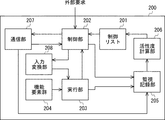
- the service control apparatus 200 includes a control list 201, a control unit 202, an execution unit 203, a functional element group 204, a monitoring recording unit 205, an activity calculation unit 206, a communication unit 207, and an input conversion unit 208.
- the control list 201 holds a plan for combination of functional elements.
- the control list 201 also holds information on whether or not input conversion by the input conversion unit 208 is necessary.
- the control list 201 also holds information on whether or not to execute the functional element on its own node. The plan for the combination of functional elements held in the control list 201 will be described in detail later.
- the control unit 202 receives an external request and a function element execution result by the execution unit 203.
- the external request includes an external request generated in the node having the service control apparatus 200 and an external request received from the communication unit 207.
- the external request may be a function element execution request from the outside or a service execution request made up of a plurality of function elements from the outside.
- the received external request and the execution result of the functional element by the execution unit 203 are referred to as an input signal to the control unit 202.
- control unit 202 refers to the control list 201 and determines a functional element to be executed next for an input signal to the control unit 202.
- control unit 202 refers to the control list 201 and determines whether input conversion is necessary for the input to the functional element to be executed next. The input conversion will be described in detail later. Then, the control unit 202 supplies an instruction of a functional element to be executed next, an input signal to the control unit 202, and an instruction as to whether or not input conversion is necessary to the input conversion unit 208.
- control unit 202 refers to the control list 201 and determines whether or not the next functional element is executed in another node. In addition, when it is determined that the next functional element is executed in another node, the control unit 202 generates an external request for requesting execution of the functional element. Then, the generated external request and information indicating a node that executes the next functional element are supplied to the communication unit 207.
- the input conversion unit 208 receives from the control unit 202 an instruction of a functional element to be executed next, an input signal to the control unit 202, and an instruction whether input conversion is necessary. Further, the input conversion unit 208 learns the relationship of input signals to the control unit 202 when input conversion is not necessary. The learning of the relationship of the input signals will be described in detail later.
- the input conversion unit 208 next executes the received input signal to the control unit 202 using the relationship of the input signal to the control unit 202 obtained from the past learning. Convert the input signal to the functional element.
- the input conversion unit 208 supplies an instruction of a functional element to be executed next to the execution unit 203. Further, when the input conversion unit 208 performs input conversion, the input conversion unit 208 supplies an input signal to the functional element to be executed next to the execution unit 203 together with an instruction of the functional element to be executed next.
- the execution unit 203 receives an instruction of a functional element to be executed next from the input conversion unit 208.
- the functional element group 204 holds a plurality of functional elements.
- the execution unit 203 selects the functional element to be executed next from the functional element group 204 based on the instruction of the functional element to be executed next.
- the execution unit 203 executes the selected functional element. Further, when the execution unit 203 receives an input signal to the functional element to be executed next from the input conversion unit 208, the execution unit 203 executes the selected functional element using the input signal. Further, the execution unit 203 outputs the execution result of the functional element to the control unit 202.
- the communication unit 207 receives an external request generated at another node. Then, the communication unit 207 outputs the received external request to the control unit 202. Further, the communication unit 207 receives an external request generated by the control unit 202 and information indicating a node that executes the next functional element. Then, the communication unit 207 transmits the external request received from the control unit 202 to a node that executes the next functional element.
- the monitoring recording unit 205 monitors the time taken for communication by the communication unit 207, the power consumption for execution of the functional element by the execution unit 203 and communication by the communication unit 207, in addition to the execution status of the functional elements by the execution unit 203. Record. Then, the monitoring recording unit 205 outputs the recorded execution status of the functional element, the time required for communication, and the power consumption required for execution and communication of the functional element to the activity calculation unit 206.
- the activity calculation unit 206 receives from the monitoring recording unit 205 the execution status of the functional elements, the time required for communication, and the power consumption required for execution and communication of the functional elements.
- the activity level calculation unit 206 calculates the activity level of the functional element based on the execution status of the functional element.
- the activity calculation unit 206 calculates, for example, the execution frequency of a specific function element as the activity of the function element.
- the calculation method of the execution frequency is the same as that in the first embodiment.
- the activity level calculation unit 206 determines whether or not to update the control list 201 based on the calculated activity level of the functional element. Whether or not to update the control list 201 is calculated by, for example, calculating the average execution time of the plan of the combination of functional elements using the execution time of the functional elements including the activity level of the functional elements and the communication time. It may be performed by determining whether or not the average execution time is shortened by updating 201. In addition, the average power consumption of the functional element combination plan is calculated using the activity level of the functional elements and the power consumption for execution and communication of the functional elements, and whether the average power consumption is reduced by updating the control list 201 or not. You may carry out by determining. Further, it may be determined that the control list 201 is updated when the average execution time becomes short and the average power consumption becomes small.
- the activity calculation unit 206 determines to update the control list 201
- the activity calculation unit 206 updates the control list 201. That is, the plan of the combination of functional elements held in the control list 201 is changed. The processing of the activity calculation unit 206 will be described in detail later.
- the control list 201 holds a functional element combination plan indicating which functional element is to be executed in response to an external request or a functional element execution result.
- the control list 201 holds a plan in which the functional elements a, b, and c ′ are arranged in series as indicated by solid line arrows in FIG. 6.
- This plan is called plan 3.
- it is determined whether the functional element c ′ is executed in the own node or another node.
- the plan 3 is the same as the plan 1 of the first embodiment.
- the separate node is an edge node or server other than the edge node on which the functional elements a and b are executed.
- the activity calculation unit 206 can update the control list 201.
- the output of the functional element a can be changed to a plan for inputting to the functional element c ′ via the input conversion 209 as indicated by a dotted arrow in FIG. This changed plan is called plan 4.
- control unit 202 When the control unit 202 receives an execution request for the functional element a from the outside or a service execution request made up of the functional elements a, b, and c ′ from the outside as an external request, the control unit 202 refers to the control list 201, and The functional element to be executed is determined as the functional element a. Then, the control unit 202 supplies an instruction to the function element a to be executed next and an instruction indicating that input conversion is not necessary to the input conversion unit 208. When the control unit 202 receives the execution result of the functional element a, the control unit 202 refers to the control list 201 and determines the functional element to be executed next as the functional element b.
- the control unit 202 supplies the input conversion unit 208 with an instruction for the functional element b to be executed next, an execution result of the functional element a, and an instruction indicating that input conversion is not necessary.
- the control unit 202 receives a Yes result from the functional element b, the control unit 202 refers to the control list 201 and determines the functional element to be executed next as the functional element c ′. Also, the control unit 202 refers to the control list 201 and determines whether or not the functional element c ′ is executed in another node.
- the control unit 202 determines that the functional element c ′ is executed in another node, the control unit 202 generates an external request for requesting execution of the functional element c ′.
- the generated external request and information indicating a node that executes the functional element c ′ are supplied to the communication unit 207.
- the control unit 202 determines that the functional element c ′ is executed in its own node, not in another node, the instruction of the functional element c ′ to be executed next, the execution result of the functional element b, and the input An instruction indicating that conversion is not necessary is supplied to the input conversion unit 208.
- control unit 202 receives an execution request for the functional element a from the outside or a service execution request made up of the functional elements a, b, and c ′ from the outside as an external request, the control unit 202 refers to the control list 201, and The functional element to be executed is determined as the functional element a. Then, the control unit 202 supplies an instruction to the function element a to be executed next and an instruction indicating that input conversion is not necessary to the input conversion unit 208. Further, when the execution result of the functional element a is received, the control unit 202 refers to the control list 201 and determines the functional element to be executed next as the functional element c ′.
- control unit 202 refers to the control list 201 and determines whether or not the functional element c ′ is executed in another node.
- the control unit 202 determines that the functional element c ′ is executed in another node, the control unit 202 generates an external request for requesting execution of the functional element c ′. Then, the generated external request and information indicating a node that executes the functional element c ′ are supplied to the communication unit 207.
- the control unit 202 determines that the functional element c ′ is executed in its own node, it is necessary to convert the instruction of the functional element c ′ to be executed next, the execution result of the functional element a, and input. An instruction indicating this is supplied to the input conversion unit 208.
- the control unit 202 when the control unit 202 receives an external request for the functional element c ′ from the communication unit 207, the control unit 202 refers to the control list 201 and determines the functional element to be executed next as the functional element c ′. To decide. In this case, it is determined that the functional element c ′ is executed by the own node.
- the input conversion unit 208 includes the execution result of the functional element a. And an instruction indicating that input conversion is not required, and then an instruction indicating that the execution result of the functional element b and input conversion are not required.
- the input conversion unit 208 learns the relationship between the execution result of the functional element a and the execution result of the functional element b from the supplied information.
- input conversion is performed so that the input to the functional element c ', that is, the output of the functional element b in the solid line arrow, and the output of the input conversion 209 in the dotted line arrow have the same contents.
- input conversion is performed using the learned relationship described above. For example, when the input of the execution result of the first functional element is directly input to the last functional element among the combination of two or more functional elements starting from the input of the execution result of the functional element, the relationship learned in the past is used. Thus, the input of the execution result of the first functional element is converted into the input to the corresponding last functional element.
- the input conversion unit 208 uses the relationship between the execution result of the functional element a and the execution result of the functional element b learned in the past to convert the execution result of the functional element a into the execution result of the functional element b. Convert. Then, the execution result of the converted functional element b is used as an input signal of the functional element c ′.
- the activity level calculation unit 206 changes the plan based on the activity level of the functional element c ′.
- the activity calculation unit 206 calculates, for example, the execution frequency of the function element c ′ as the activity of the function element c ′. Then, the activity calculation unit 206 determines whether to change from the plan 3 to the plan 4 based on the execution frequency of the functional element c ′.
- the activity calculation unit 206 uses the execution frequency of the functional element c ′ and the execution times of the functional elements b and c ′ to plan 3 And the average execution time for executing the plan 4 with the probability of x is calculated.
- the probability of x is the execution frequency of the functional element c ′.
- the probability of x can be said to be the probability that the functional element b outputs Yes.
- the average execution time for executing the plan 4 with the probability of x is the average execution time when the plan 3 is executed with the probability of 1 ⁇ x and the plan 4 is executed with the probability of x.
- the plan 3 is changed to the plan 4. Note that the average execution time of the plan when the functional element c ′ is executed by the own node can be calculated in the same manner as in the first embodiment.
- the activity calculation unit 206 executes the functional element c ′ including the execution frequency of the functional element c ′, the execution time of the functional element b, and the communication time. Using the time, the average execution time of the plan 3 and the average execution time for executing the plan 4 with the probability of x are calculated. Further, when the functional element c ′ is executed in another node, the activity calculation unit 206 takes the frequency of executing the functional element c ′, the power necessary for executing the functional element b, and the communication of the functional element c ′. Using the power consumption, the average power consumption of the plan 3 and the average power consumption for executing the plan 4 with the probability of x are calculated.
- the average execution time for executing the plan 4 with the probability of x is shorter than the average execution time of the plan 3, and the average power consumption for executing the plan 4 with the probability of x is smaller than the average power consumption of the plan 3 If so, the plan 3 is changed to the plan 4. Further, the plan 3 may be changed to the plan 4 when either the average execution time condition or the average power consumption condition is satisfied.
- the average execution time and average power consumption when the functional element c ′ in FIG. 6 is executed by another node will be described.
- the average execution time of plan 3 is T3, the average execution time of executing plan 4 with the probability of x is T4, the average power consumption of plan 3 is P3, the average power of execution of plan 4 with the probability of x is P4, functional elements
- the execution time of b is T_b
- the execution time of the functional element c ′ including the communication time is T_c ′
- the power consumption required for the execution of the functional element b is P_b
- the power consumption required for the communication of the functional element c ′ is P_c ′.
- T3, T4, P3, and P4 can be calculated by the following equations, respectively.
- T3> T4 is satisfied.
- x> 1-T_b / T_c ' This is the case. That is, when x exceeds the threshold of 1 ⁇ T_b / T_c ′, the average execution time for executing the plan 4 with the probability of x is shorter than the average execution time of the plan 3.
- the activity calculation unit 206 determines that x exceeds the threshold of 1-T_b / T_c ′ and / or x exceeds the threshold of 1-Pb / P_c ′. When is satisfied, the plan 3 is changed to the plan 4. Thereby, at least one of average execution time and average power consumption can be reduced.
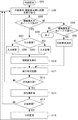
- an external execution request for a functional element or an external execution request for a service composed of a plurality of functional elements is generated (S201).
- control unit 202 receives the external request or the execution result of the functional element (S202).
- S202 when it is performed following S201, an external request is received.
- step S202 if it is performed after the execution of the functional element, the execution result of the functional element is received.
- control unit 202 refers to the control list 201 and determines whether or not to execute the next functional element on its own node (S203). If it is determined in S203 that the next functional element is not to be executed in the own node, it is determined whether or not the next functional element is to be executed in another node (S204). If it is determined by S204 that the next functional element is not to be executed by another node, the execution of the service including a plurality of functional elements starting from the external request is terminated (S205).
- the execution result of the functional element c ′ in FIG. 6 is received, or the execution result of the functional element b is No. It is.
- control unit 202 When it is determined in S203 that the next functional element is to be executed by the own node, the control unit 202 refers to the control list 201 and determines whether or not input conversion to the next functional element is necessary (S207). . If it is determined in S207 that input conversion is necessary, the input conversion unit 208 performs input conversion (S208). If it is determined in S207 that input conversion is not necessary, the input conversion unit 208 learns the relationship of the input signals to the control unit 202 (S209).
- the execution unit 203 executes the next functional element (S210). Execution of the functional element by the execution unit 203 is performed by receiving an instruction of the functional element to be executed next from the input conversion unit 208. The instruction of the functional element to be executed next is performed by the control unit 202 referring to the control list 201 to determine the functional element to be executed next.
- the execution unit 203 executes the functional element using the input signal to the functional element to be executed next received from the input conversion unit 208. Further, the execution unit 203 outputs the execution result of the functional element to the control unit 202.
- the monitoring recording unit 205 displays the execution status of the functional elements by the execution unit 203, the time taken for communication by the communication unit 207, and the power consumption for execution of the functional elements by the execution unit 203 and communication by the communication unit 207.
- Monitoring and recording S211.
- S ⁇ b> 211 when performed following S ⁇ b> 210, the execution status of the functional elements by the execution unit 203 and the power consumption required for the execution of the functional elements by the execution unit 203 are monitored and recorded.
- S211 when it is performed following S206, the time required for communication by the communication unit 207 and the power consumption required for communication by the communication unit 207 are monitored and recorded.
- the activity level calculation unit 206 determines whether to calculate the activity level based on the execution status of the functional element (S212).
- the degree of activity may be calculated every time one functional element is executed, but may be calculated every time a certain number of functional elements are executed or every predetermined time.
- the activity calculation unit 206 calculates the activity of the functional element based on the execution status of the functional element (S213). For example, the execution frequency of the functional element c ′ is calculated as the activity of the functional element.
- the process returns to S202, and the control unit 202 performs processing based on the execution result of the functional element output from the execution unit 203 in S210.
- the activity level calculation unit 206 determines whether to change the plan of the combination of functional elements held in the control list 201 based on the activity level of the functional elements (S214). For example, when the functional element c ′ is executed in another node, the control is performed using the execution frequency of the functional element c ′, the execution time of the functional element b, and the execution time of the functional element c ′ including the communication time. The average execution time of the plan of the combination of functional elements held in the list 201 is calculated. Then, when the average execution time is shortened by changing the plan, it is determined that the plan is changed.
- the plan is to be changed when the average power consumption of the combination of functional elements held in the control list 201 is calculated and the average power consumption is reduced by changing the plan. Furthermore, it may be determined that the plan is changed when the average execution time is shortened and the average power consumption is reduced by changing the plan.
- the activity calculation unit 206 changes the functional element combination plan held in the control list 201 (S215). If it is determined in S214 that the functional element combination plan is not to be changed, the process returns to S202, and the control unit 202 performs processing based on the execution result of the functional element output from the execution unit 203 in S210.
- transmission of an external request generated by the communication unit 207 has been illustrated.
- the present invention is not limited to this, and the communication unit 207 converts the generated external request together with the generated external request by the input conversion unit 208.
- An input signal may be transmitted.
- an IoT device such as a sensor node has the service control apparatus 200 according to the present embodiment to detect an animal.
- the functional element a performs detection with low load and low accuracy using an infrared sensor or a vibration sensor.
- the functional element b is detected with a moderate load and accuracy by an acceleration sensor or the like.
- the function element b is determined and output up to the type of detection target.
- the functional element c ′ is detection using an image specialized for the input type.
- the output when the type of detection target can be determined by the functional element b is set as Yes, and the output when the type cannot be determined is set as No. If the output of the function element b is Yes, the function element c 'is executed. If the output of the function element b is No, the process ends without executing the function element c'. If the probability that the functional element b outputs Yes is higher than the threshold, the functional element combination is skipped without executing the functional element b and the functional element c ′ is executed next to the functional element a. Change the plan. In addition, the threshold value compared with the probability that the functional element b outputs Yes shall be calculated using the average execution time of a plan.
- the input conversion unit included in the IoT device learns the relationship between the detection result of the functional element a and the type determined by the functional element b when the functional element b is executed next to the functional element a.
- the input conversion unit converts the detection result of the functional element a into a type based on learning using a relationship obtained from past learning. Then, the type based on the learning after conversion is input to the functional element c ′.
- the plan is changed so as not to execute the functional element b. Processing time for the functional element b can be saved. Even if the functional element b is not executed, the detection result of the functional element a is converted into a type based on learning and input to the functional element c ′. The result can be obtained.
- the output when the determined type of detection target is a specific type can be set to Yes, and the other outputs can be set to No.
- the input conversion unit uses the relationship obtained from the past learning to convert the detection result of the functional element a to a specific type based on learning. Convert. Then, the specific type after conversion is input to the functional element c ′. This is effective when there are only certain types of infestations in the real environment.
- the functional element c ′ can be executed by another node such as a server.
- a threshold value to be compared with the probability that the functional element b outputs Yes may be calculated using the average power consumption of the plan.
- the functional element b may output compressed data after specifying the detection type and performing image compression specialized for the type.
- an input conversion unit included in the IoT device may convert the data into compressed data and output the compressed data.
- the amount of data transferred between nodes is preferably small, and there is a possibility that the data amount can be reduced by specifying the detection type and performing data compression specialized for the type.
- the activity level of the functional element is calculated based on the execution status of the functional element, and the control list 201 is updated based on the activity level.
- the average execution time of the functional element combination plan is calculated using the activity level of the functional elements and the execution time of the functional elements, and the control list 201 is updated when the average execution time is shortened by updating the control list 201 By doing so, the average execution time of the plan can be reduced.
- Plan changes can be made.
- the communication unit 207 and the input conversion unit 208 are configured by using hardware such as an IC (Integrated Circuit) or software, or both.
- the service control apparatuses 100 and 200 are configured using a general computer.
- FIG. 8 shows a hardware configuration example of a general computer 300.
- the computer 300 includes a processor 301, an interface 302, and a main memory 303 connected via a bus 304.
- the processor 301 executes a program stored in the main memory 303.
- the processor 301 inputs and outputs various types of information via the interface 302.
- the interface 302 is used for data exchange by data input / output means.
- the main memory 303 stores a program executed by the processor 301. In the stored program, a group of instructions for causing the processor 301 to process in order to execute processing of each functional unit is described.
- Each function unit of the service control devices 100 and 200 can be realized by the processor 301 executing a program for processing of each function unit.
- the control lists 101 and 201 and the functional element groups 104 and 204 are realized by the main memory 303.
- the control units 102 and 202, the execution units 103 and 203, the monitoring recording units 105 and 205, the activity calculation units 106 and 206, the communication unit 207, and the input conversion unit 208 are programs for processing of each functional unit. This can be realized by being executed in 301.
- Non-transitory computer readable media include various types of tangible storage media (tangible storage medium). Examples of non-transitory computer-readable media include magnetic recording media (eg flexible disks, magnetic tapes, hard disk drives), magneto-optical recording media (eg magneto-optical discs), CD-ROMs (Read Only Memory), CD-Rs, CD-R / W, semiconductor memory (for example, mask ROM, PROM (Programmable ROM), EPROM (Erasable ROM), flash ROM, RAM (Random Access Memory)) are included.
- the program may also be supplied to the computer by various types of temporary computer-readable media. Examples of transitory computer readable media include electrical signals, optical signals, and electromagnetic waves.
- the temporary computer-readable medium can supply the program to the computer via a wired communication path such as an electric wire and an optical fiber, or a wireless communication path.
- the present invention is not limited to the above-described embodiment, and can be appropriately changed without departing from the spirit of the present invention.
- the plan may be changed so that a functional element having a high degree of activity is preferentially executed.
- FIG. 9 shows an example of a combination plan composed of two functional elements d and e.
- the function element d is executed, and the function element d outputs a Yes / No judgment.
- the function element e ends without being executed.
- the functional element d is skipped without being executed, and the functional element e is directly executed.
- FIG. 10 shows an example of a combination plan composed of two functional elements d and e ′.
- input conversion is performed via the input conversion 210 in the plan indicated by the dotted arrow.
- the input conversion is performed by converting the input of the external request into the output of the functional element d using the relationship obtained from the past learning. That is, the input of the external request is converted into the input of the functional element e ′.
Landscapes
- Engineering & Computer Science (AREA)
- Physics & Mathematics (AREA)
- General Physics & Mathematics (AREA)
- Software Systems (AREA)
- Theoretical Computer Science (AREA)
- Automation & Control Theory (AREA)
- General Engineering & Computer Science (AREA)
- Debugging And Monitoring (AREA)
Abstract
Priority Applications (2)
| Application Number | Priority Date | Filing Date | Title |
|---|---|---|---|
| US15/577,820 US20180164765A1 (en) | 2015-06-11 | 2016-06-10 | Service control device, service control method and recording medium |
| JP2017523118A JP6809455B2 (ja) | 2015-06-11 | 2016-06-10 | サービス制御装置、サービス制御方法及びプログラム |
Applications Claiming Priority (2)
| Application Number | Priority Date | Filing Date | Title |
|---|---|---|---|
| JP2015118197 | 2015-06-11 | ||
| JP2015-118197 | 2015-06-11 |
Publications (1)
| Publication Number | Publication Date |
|---|---|
| WO2016199432A1 true WO2016199432A1 (fr) | 2016-12-15 |
Family
ID=57503331
Family Applications (1)
| Application Number | Title | Priority Date | Filing Date |
|---|---|---|---|
| PCT/JP2016/002815 Ceased WO2016199432A1 (fr) | 2015-06-11 | 2016-06-10 | Dispositif de commande de service, procédé de commande de service, et support d'enregistrement |
Country Status (3)
| Country | Link |
|---|---|
| US (1) | US20180164765A1 (fr) |
| JP (1) | JP6809455B2 (fr) |
| WO (1) | WO2016199432A1 (fr) |
Citations (3)
| Publication number | Priority date | Publication date | Assignee | Title |
|---|---|---|---|---|
| JP2010528359A (ja) * | 2007-05-19 | 2010-08-19 | ビデオテック・ソシエタ・ペル・アチオニ | 複数のセンサを協働させるための方法 |
| WO2010098268A1 (fr) * | 2009-02-24 | 2010-09-02 | 日本電気株式会社 | Dispositif d'allocation de ressources de calcul, système d'allocation de ressources de calcul et procédé et programme d'allocation de ressources de calcul |
| JP2012159913A (ja) * | 2011-01-31 | 2012-08-23 | Seiko Epson Corp | 信号処理を行うための方法及びコンピューターシステム |
-
2016
- 2016-06-10 WO PCT/JP2016/002815 patent/WO2016199432A1/fr not_active Ceased
- 2016-06-10 US US15/577,820 patent/US20180164765A1/en not_active Abandoned
- 2016-06-10 JP JP2017523118A patent/JP6809455B2/ja active Active
Patent Citations (3)
| Publication number | Priority date | Publication date | Assignee | Title |
|---|---|---|---|---|
| JP2010528359A (ja) * | 2007-05-19 | 2010-08-19 | ビデオテック・ソシエタ・ペル・アチオニ | 複数のセンサを協働させるための方法 |
| WO2010098268A1 (fr) * | 2009-02-24 | 2010-09-02 | 日本電気株式会社 | Dispositif d'allocation de ressources de calcul, système d'allocation de ressources de calcul et procédé et programme d'allocation de ressources de calcul |
| JP2012159913A (ja) * | 2011-01-31 | 2012-08-23 | Seiko Epson Corp | 信号処理を行うための方法及びコンピューターシステム |
Also Published As
| Publication number | Publication date |
|---|---|
| JPWO2016199432A1 (ja) | 2018-04-05 |
| JP6809455B2 (ja) | 2021-01-06 |
| US20180164765A1 (en) | 2018-06-14 |
Similar Documents
| Publication | Publication Date | Title |
|---|---|---|
| US20250234291A1 (en) | Control information transmission method and device | |
| KR102470712B1 (ko) | 피처 엔지니어링 오케스트레이션 방법 및 장치 | |
| US11019147B2 (en) | Method and apparatus for processing sensor information | |
| US10437581B1 (en) | Internet of things platform for handling firmware transfer on machine-to-machine devices | |
| CN110753112A (zh) | 云服务的弹性伸缩方法和装置 | |
| Al-Turjman | Impact of user's habits on smartphones' sensors: An overview | |
| US20130282869A1 (en) | Method, apparatus, and computer program product for scheduling file uploads | |
| US20190104173A1 (en) | Distributed process management system, distributed process management method, and information processing apparatus | |
| CN111158881B (zh) | 数据处理方法、装置、电子设备和计算机可读存储介质 | |
| US9716928B2 (en) | Communications apparatus, system, and communications method | |
| CN102170476B (zh) | 一种基于云节点自主学习的云计算方法和装置 | |
| JP6809455B2 (ja) | サービス制御装置、サービス制御方法及びプログラム | |
| JP2015201698A (ja) | 通信装置、通信方法、及び、プログラム | |
| TWI669015B (zh) | 用於無線感測網路之任務排程的方法 | |
| Ho et al. | Mobile intercloud system and objects transfer mechanism | |
| US10172021B2 (en) | Communication method, non-transitory computer-readable recording medium, and communication system | |
| JP2025507145A (ja) | 通信ネットワークにおけるデータ処理方法、ネットワーク側機器及び可読記憶媒体 | |
| US20150137995A1 (en) | Communication apparatus, system, and communication method | |
| US10917772B2 (en) | Information processing apparatus and non-transitory computer readable medium | |
| CN114285502B (zh) | 一种小区测量方法、终端及存储介质 | |
| CN114625581A (zh) | 功耗检测方法、装置、存储介质及电子设备 | |
| KR101658310B1 (ko) | 휴대폰 단말장치의 인터넷 네트워크 상태정보를 소켓서버와 실시간 동기화하는 시스템 및 방법 | |
| US20200304590A1 (en) | Data from a Source Device to a Data Requester | |
| CN111602410B (zh) | 适合性判定装置、适合性判定方法和存储介质 | |
| CN111602409B (zh) | 元数据生成装置、元数据生成方法和存储介质 |
Legal Events
| Date | Code | Title | Description |
|---|---|---|---|
| 121 | Ep: the epo has been informed by wipo that ep was designated in this application |
Ref document number: 16807139 Country of ref document: EP Kind code of ref document: A1 |
|
| ENP | Entry into the national phase |
Ref document number: 2017523118 Country of ref document: JP Kind code of ref document: A |
|
| WWE | Wipo information: entry into national phase |
Ref document number: 15577820 Country of ref document: US |
|
| NENP | Non-entry into the national phase |
Ref country code: DE |
|
| 122 | Ep: pct application non-entry in european phase |
Ref document number: 16807139 Country of ref document: EP Kind code of ref document: A1 |