WO2016199942A1 - Granule de résine contenant de la cellulose, procédé de fabrication de granule de résine contenant de la cellulose, composition de résine synthétique, procédé de fabrication de composition de résine synthétique, et dispositif de fabrication de granule de résine contenant de la cellulose - Google Patents
Granule de résine contenant de la cellulose, procédé de fabrication de granule de résine contenant de la cellulose, composition de résine synthétique, procédé de fabrication de composition de résine synthétique, et dispositif de fabrication de granule de résine contenant de la cellulose Download PDFInfo
- Publication number
- WO2016199942A1 WO2016199942A1 PCT/JP2016/067590 JP2016067590W WO2016199942A1 WO 2016199942 A1 WO2016199942 A1 WO 2016199942A1 JP 2016067590 W JP2016067590 W JP 2016067590W WO 2016199942 A1 WO2016199942 A1 WO 2016199942A1
- Authority
- WO
- WIPO (PCT)
- Prior art keywords
- cellulose
- resin
- paper
- pellet
- containing resin
- Prior art date
- Legal status (The legal status is an assumption and is not a legal conclusion. Google has not performed a legal analysis and makes no representation as to the accuracy of the status listed.)
- Ceased
Links
Images




Classifications
-
- B—PERFORMING OPERATIONS; TRANSPORTING
- B29—WORKING OF PLASTICS; WORKING OF SUBSTANCES IN A PLASTIC STATE IN GENERAL
- B29B—PREPARATION OR PRETREATMENT OF THE MATERIAL TO BE SHAPED; MAKING GRANULES OR PREFORMS; RECOVERY OF PLASTICS OR OTHER CONSTITUENTS OF WASTE MATERIAL CONTAINING PLASTICS
- B29B9/00—Making granules
- B29B9/02—Making granules by dividing preformed material
-
- B—PERFORMING OPERATIONS; TRANSPORTING
- B29—WORKING OF PLASTICS; WORKING OF SUBSTANCES IN A PLASTIC STATE IN GENERAL
- B29B—PREPARATION OR PRETREATMENT OF THE MATERIAL TO BE SHAPED; MAKING GRANULES OR PREFORMS; RECOVERY OF PLASTICS OR OTHER CONSTITUENTS OF WASTE MATERIAL CONTAINING PLASTICS
- B29B17/00—Recovery of plastics or other constituents of waste material containing plastics
-
- B—PERFORMING OPERATIONS; TRANSPORTING
- B29—WORKING OF PLASTICS; WORKING OF SUBSTANCES IN A PLASTIC STATE IN GENERAL
- B29B—PREPARATION OR PRETREATMENT OF THE MATERIAL TO BE SHAPED; MAKING GRANULES OR PREFORMS; RECOVERY OF PLASTICS OR OTHER CONSTITUENTS OF WASTE MATERIAL CONTAINING PLASTICS
- B29B17/00—Recovery of plastics or other constituents of waste material containing plastics
- B29B17/02—Separating plastics from other materials
-
- B—PERFORMING OPERATIONS; TRANSPORTING
- B29—WORKING OF PLASTICS; WORKING OF SUBSTANCES IN A PLASTIC STATE IN GENERAL
- B29B—PREPARATION OR PRETREATMENT OF THE MATERIAL TO BE SHAPED; MAKING GRANULES OR PREFORMS; RECOVERY OF PLASTICS OR OTHER CONSTITUENTS OF WASTE MATERIAL CONTAINING PLASTICS
- B29B17/00—Recovery of plastics or other constituents of waste material containing plastics
- B29B17/04—Disintegrating plastics, e.g. by milling
-
- Y—GENERAL TAGGING OF NEW TECHNOLOGICAL DEVELOPMENTS; GENERAL TAGGING OF CROSS-SECTIONAL TECHNOLOGIES SPANNING OVER SEVERAL SECTIONS OF THE IPC; TECHNICAL SUBJECTS COVERED BY FORMER USPC CROSS-REFERENCE ART COLLECTIONS [XRACs] AND DIGESTS
- Y02—TECHNOLOGIES OR APPLICATIONS FOR MITIGATION OR ADAPTATION AGAINST CLIMATE CHANGE
- Y02W—CLIMATE CHANGE MITIGATION TECHNOLOGIES RELATED TO WASTEWATER TREATMENT OR WASTE MANAGEMENT
- Y02W30/00—Technologies for solid waste management
- Y02W30/50—Reuse, recycling or recovery technologies
- Y02W30/52—Mechanical processing of waste for the recovery of materials, e.g. crushing, shredding, separation or disassembly
-
- Y—GENERAL TAGGING OF NEW TECHNOLOGICAL DEVELOPMENTS; GENERAL TAGGING OF CROSS-SECTIONAL TECHNOLOGIES SPANNING OVER SEVERAL SECTIONS OF THE IPC; TECHNICAL SUBJECTS COVERED BY FORMER USPC CROSS-REFERENCE ART COLLECTIONS [XRACs] AND DIGESTS
- Y02—TECHNOLOGIES OR APPLICATIONS FOR MITIGATION OR ADAPTATION AGAINST CLIMATE CHANGE
- Y02W—CLIMATE CHANGE MITIGATION TECHNOLOGIES RELATED TO WASTEWATER TREATMENT OR WASTE MANAGEMENT
- Y02W30/00—Technologies for solid waste management
- Y02W30/50—Reuse, recycling or recovery technologies
- Y02W30/62—Plastics recycling; Rubber recycling
Definitions
- the present invention relates to a cellulose-containing resin pellet and a production method thereof, a synthetic resin composition using the cellulose-containing resin pellet as a raw material, a production method thereof, and a cellulose-containing resin pellet production apparatus. It relates to what is implemented as part of it.
- a technique for increasing strength by dispersing glass fiber, carbon fiber, cellulose fiber, or the like in a plastic material is known (for example, Japanese Patent Publication No. 2011-116838).
- those using cellulose fibers are expected to be used in the future because used papers and the like can be used effectively.
- laminated paper laminate material
- a laminated resin layer made of a thin film layer made of, for example, a polyethylene synthetic resin component is bonded to one or both sides of a paper component layer (containing fibrous cellulose) such as kraft paper. It is a processed paper material.
- Laminated paper is superior in strength, water resistance and moisture resistance to ordinary kraft paper that has not been processed.
- laminated paper is widely used as a paper container for storing various foods including beverages such as milk, juice and yogurt, and seasonings such as soy sauce, noodle soup and sauce.
- beverages such as milk, juice and yogurt
- seasonings such as soy sauce, noodle soup and sauce.
- applications include packaging paper, milk packs, tea / coffee, cup noodle containers, and brick-type beverage packs.
- the laminated paper is often used in various fields such as plastic, steel, and metal industries. Note that “laminate paper” is sometimes referred to as “poly lami”, “PE lami”, “PE craft”, “craft lami”, and the like.
- Laminated kraft paper is mainly composed of virgin pulp, and long fibers of about 500 ⁇ m to 1500 ⁇ m are made of fibrous cellulose occupying 50% or more of the fibers.
- the resin component of the laminate resin is generally a resin with high fluidity such as low-odor and safe low-density polyethylene for food.
- a resin such as polyethylene that is, a material with the best material recycling is used.
- each constituent component constituting the laminated paper is a raw material excellent in material recycling, since it is a composite material, it is difficult to recycle or is unprofitable due to cost.
- Various techniques have been proposed so far for the technology for recycling the laminated paper.
- a method for returning the laminated paper to the original state a method for separating the paper component and the resin component, or a separation processing technique for the laminated paper other than the separation technique.
- a method is known in which the laminated paper is finely cut and molded as a composite material of resin and paper as it is.
- the laminated paper obtained by cutting or finely cutting the laminated paper is heat-melted and molded.
- the above-mentioned laminated paper recycling process has the following problems. That is, when the laminated paper is disassembled and then molded, a general plastic molding method is employed. However, if the paper component of the laminated paper is not made fine, the paper (fibrous cellulose) is strongly fuzzy and inhibits mixing with the resin. For this reason, the paper component must be as fine as possible.
- the fiber cellulose is all shortened to become powder, and the strength as a paper material is reduced. Therefore, the characteristic (strength) as a paper material deteriorates.
- a method of cutting the paper component is taken, but only by the method of making the paper finer, the recycled paper material can be obtained only with the resin component incidental to the paper component. Since it cannot be obtained, a method of separately forming a composite resin composition with paper by adding a resin component as a binder is also known.
- milk cartons (milk cartons), a type of laminated paper, are collected and recycled into toilet paper.
- the milk carton is developed and then put into a machine called a pulper, which has a structure like a large washing machine, and is used as a liquid disaggregation liquid.
- the disaggregation solution passes through the filter at the bottom of the machine, removes foreign matter, removes moisture, and hardens.
- the polyethylene resin applied to both sides of the milk carton is also removed.
- the polyethylene resin gets stuck in the strainer, it is necessary to repeat cleaning of the apparatus. For this reason, it is shunned because efficiency is lowered, and the recycling cost of the laminated paper increases, and many items are sent to incineration.
- the polyethylene of the laminated paper has a high calorie calorie and does not generate harmful combustion gas.
- a recycling method for used paper packs is disclosed (for example, Japanese Patent Publication No. 2003-235579).
- a paper pack formed on the surface portion of the paper component layer of a used paper pack for example, a fine cut line (cut) formed in a laminate layer made of a polyethylene-based synthetic resin layer
- a method is disclosed in which the laminate layer is peeled off in an aqueous solution, and only the paper component layer is recycled as a recycled paper material and molded by a suitable molding device.
- a method for obtaining a paper sheet to which a resin is adhered is disclosed.
- the paper component layer of the paper pack is to be reused as it is, but a process of making a cut or a cut in the paper pack is necessary, leading to an increase in cost.
- drawbacks There are drawbacks.
- a resin raw material for example, Japanese Patent Publication No. 2000-43037.
- the paper pack needs to be pulverized to a powder state, and the cost is similarly high.
- the present invention provides cellulose-containing resin pellets and cellulose capable of providing strength that can be used as a molding material by mixing laminated paper such as paper packs that are difficult to recycle and generate in large quantities with a simple technical configuration. It aims at providing the manufacturing method of a containing resin pellet, the synthetic resin composition using the cellulose containing resin pellet, the manufacturing method of a synthetic resin composition, and a cellulose containing resin pellet manufacturing apparatus.
- pellets suitable for the production of high-commercial synthetic resin compositions with antistatic properties that are less prone to static electricity and have a woody appearance are easily and efficiently manufactured at low cost.
- Another object of the present invention is to provide a method and apparatus for producing the synthetic resin composition efficiently, easily and inexpensively.
- the present invention is a cellulose-containing resin pellet characterized in that it is a granular body formed by condensing fibrous cellulose condensately, and a resin component is constrained to at least a part of the granular body. .
- the present invention recycles the laminated paper to produce the cellulose-containing resin pellets described above, without separating the paper component layer and the laminated layer constituting the laminated paper from each other.
- the present invention is a synthetic resin composition containing the cellulose-containing resin pellets.
- the present invention is a synthetic resin composition containing the pellets, and the pellets are mixed with the regenerated synthetic resin at a required weight ratio, and the required number of rotations (rpm) is mixed in a stirring and mixing device.
- a synthetic resin composition in which mixing processing is performed under an appropriate temperature condition in a stirring and mixing device in which a blade portion having a shape of a rotary blade not having a cutting blade portion is provided, and thereafter molding processing is performed. It is a manufacturing method of a thing.
- the basic technical configuration in the present invention provides a method for reprocessing laminated paper having a technical configuration completely different from the conventional laminated paper recycling technique.
- the clear technical difference from the conventional technical configuration in this case is that the paper component layer in the laminated paper is not finely cut, but the mixing force of the resin constituting the laminated layer by the blade of the mixer That is, the paper component layer is decomposed using viscosity.
- the separated cellulose-based fine, very fine fine fiber-like long fibers or a plurality of adjacent long fiber groups arranged adjacent to each other It is formed into a densely assembled state in a collective state, and it is transformed into a pellet-like lump having a fine particle size in harmony with the synthetic resin component contained therein, and further, the surface of the pellet-like lump Or the pellet of the state which the said resin affixed is formed in at least one part of the inside.
- the present invention it is possible to substantially eliminate the above-mentioned problems, and by simplifying the processing operation process, it is possible to improve production efficiency, manufacturing equipment costs, manufacturing costs, etc. Therefore, the overall cost is low, but there is strength as the synthetic resin composition, it has antistatic properties that are less likely to cause static electricity, has a woody appearance, and is lightweight. Therefore, it is possible to provide a synthetic resin composition having a high commercial value in which nails can be driven and a method for producing the same.
- the process of separating the laminated paper is not specially provided, the paper component layer and the resin component constituting the laminate layer are dispersed and uniformly blended with each other, and the fluidity is high even under high blending conditions of the paper component. A certain pellet and its manufacturing method are provided, and further, a high-quality synthetic resin composition incorporating the pellet and its manufacturing method are obtained.
- the paper component is impregnated and mixed with the resin component, thereby making it possible to use the laminated paper completely, and the impregnated and mixed pellets.
- the laminate paper is temporarily separated from the laminate by dry rather than wet, and the laminate component and paper component are mixed in an ideal shape without changing the initial mixing ratio, and then melted at a high temperature.
- the present invention provides an inexpensive long-fiber-mixed resin composition that does not carbonize the paper component, has no odor, and has a low water absorption rate compared to wood and is rich in mechanical strength.
- FIG. 1 is an explanatory diagram showing a cellulose-containing resin pellet manufacturing apparatus and a synthetic resin composition manufacturing apparatus according to the first embodiment of the present invention.
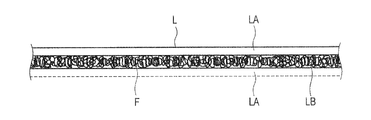
- FIG. 2 is a cross-sectional view schematically showing the structure of a laminated paper that is regenerated by the cellulose-containing resin pellet manufacturing apparatus.
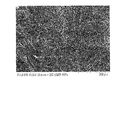
- Drawing 3 is an explanatory view expanding and showing the pellet manufactured with the cellulose content resin pellet manufacturing device.
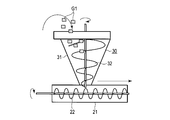
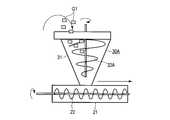
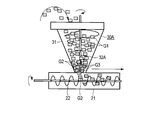
- FIG. 4 A is explanatory drawing which shows typically the principal part of the crushing apparatus integrated in the cellulose containing resin pellet manufacturing apparatus and the granulation apparatus.
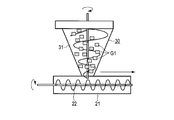
- FIG. 4B is an explanatory view schematically showing a main part of the crushing apparatus and the granulating apparatus incorporated in the cellulose-containing resin pellet manufacturing apparatus.
- FIG. 1 is an explanatory diagram showing a cellulose-containing resin pellet manufacturing apparatus and a synthetic resin composition manufacturing apparatus according to the first embodiment of the present invention.
- FIG. 2 is a cross-sectional view schematically showing the structure of a laminated paper that is re
- FIG. 4C is an explanatory view schematically showing a main part of the crushing apparatus and the granulating apparatus incorporated in the cellulose-containing resin pellet manufacturing apparatus.
- FIG. 4D is an explanatory view schematically showing main parts of a crushing device and a granulating device incorporated in the cellulose-containing resin pellet manufacturing apparatus.
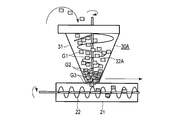
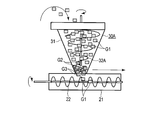
- FIG. 5A is an explanatory view schematically showing a main part of a crushing apparatus and a granulating apparatus incorporated in a cellulose-containing resin pellet manufacturing apparatus as a comparative example.
- FIG. 5B is an explanatory view schematically showing a main part of a crushing apparatus and a granulating apparatus incorporated in a cellulose-containing resin pellet manufacturing apparatus as a comparative example.
- FIG. 5C is an explanatory view schematically showing a main part of a crushing apparatus and a granulating apparatus incorporated in a cellulose-containing resin pellet manufacturing apparatus as a comparative example.
- FIG. 5D is an explanatory view schematically showing a main part of a crushing apparatus and a granulating apparatus incorporated in a cellulose-containing resin pellet manufacturing apparatus as a comparative example.
- FIG. 5E is an explanatory view schematically showing a main part of a crushing apparatus and a granulating apparatus incorporated in a cellulose-containing resin pellet manufacturing apparatus as a comparative example.
- FIG. 5C is an explanatory view schematically showing a main part of a crushing apparatus and a granulating apparatus incorporated in a cellulose-containing resin pellet manufacturing apparatus as a comparative example.
- FIG. 5F is an explanatory view schematically showing a main part of a crushing apparatus and a granulating apparatus incorporated in a cellulose-containing resin pellet manufacturing apparatus as a comparative example.
- FIG. 6 is an explanatory view showing a cellulose-containing resin pellet manufacturing apparatus according to the second embodiment of the present invention.
- resin here is a thermoplastic resin, for example, is an olefin resin.
- olefin resin polyethylene or polypropylene is generally used.
- FIG. 1 shows a cellulose-containing resin pellet manufacturing apparatus 10 and a synthetic resin composition manufacturing apparatus (regenerated synthetic resin composition) 50 according to an embodiment of the present invention.
- FIG. 2 is an explanatory view schematically showing a laminated paper L as a material of the cellulose-containing resin pellet P
- FIG. 3 is an explanatory view showing the cellulose-containing resin pellet P by an electron micrograph.
- the laminated paper L includes a paper component layer LB in which fibrous cellulose (fine fibers) F having a main fiber length of 500 to 1500 ⁇ m is formed in layers, and one surface or both sides of the paper component layer LB. It is composed of a laminate layer LA in which appropriate synthetic resin components are formed in layers or thin films on both sides. Of the fiber components in the laminated paper L, 50% or more by mass ratio is 500 to 1500 ⁇ m fibrous cellulose F.
- the laminated paper L has been used and collected for a predetermined purpose, and is subject to recycling processing. Note that the laminated paper L used in milk cartons and the like generally contains many fibrous cellulose fibers having a fiber length of 500 to 1500 ⁇ m.
- the mass of the fibrous cellulose F is about 30 to 70% of the mass of the laminated paper L, and the mass of the resin is 70 to 30%, which is the balance.
- Laminated paper L is used as a milk, juice, or yogurt container, and is used as a recycling target.
- edge material that is generated in large quantities as cutting waste may be used. Further, it may be used in various environments such as plastic, steel, and metal-related industries. In addition, any form that can be economically and efficiently reproduced regardless of the purpose can be widely used.
- the cellulose-containing resin pellet manufacturing apparatus 10 inputs a granulating apparatus 20, a compressing apparatus 30 provided on the upper part of the granulating apparatus 20, and a laminate paper L cut into a predetermined length into the compressing apparatus 30. And a supply device 80.
- the granulating apparatus 20 includes a cylindrical barrel 21 that is disposed with the axial direction being horizontal, a granulating screw 22 that is coaxially disposed within the barrel 21, and an electric motor that rotationally drives the granulating screw 22. 23.
- the compression device 30 includes a hopper 31 into which the cut laminated paper L is loaded, a hopper screw 32 that is coaxially disposed on the hopper 31 and compresses the loaded laminated paper L, and rotationally drives the hopper screw 32. And an electric motor 33.
- the tip of the hopper screw 32 is inserted to a position where it does not interfere with the granulation screw 22 in the barrel 21. More specifically, the tip of the hopper screw 32 is located inside the inner wall surface of the barrel 21 and outside the outer diameter of the granulation screw 22.
- the synthetic resin composition manufacturing apparatus 50 is disposed at the tip of the granulating apparatus 20, and includes an extrusion molding machine 60 that extrudes the cellulose-containing resin pellets P, and a mold apparatus 70 that forms the shape of the extruded cellulose-containing resin pellets P. It has.
- the mold apparatus 70 has a cavity for forming a synthetic resin composition such as a tile or a block material.
- the cellulose-containing resin pellet manufacturing apparatus 10 and the synthetic resin composition manufacturing apparatus 50 configured as described above produce cellulose-containing resin pellets P and manufacture a synthetic resin composition as follows.
- a material G1 is obtained by cutting the laminated paper L into an appropriate length and size.
- the raw material G2 is compressed from the raw material G1 and is in a high density state, and the raw material G3 is in a high density state that is further compressed from the raw material G2.
- the raw material G1 is supplied to the hopper 31 from the supply device 80.
- the raw material G1 is in an uncompressed state and is bulky. Therefore, the raw material G1 is sent under pressure while the hopper screw 32 is rotated.
- FIG. 4C when pressure is applied, raw material compression proceeds in the lower part of the hopper 31, and the raw material G1 becomes the raw material G2. Since the gap between the hopper screw 32 and the granulating screw 22 is narrow, the raw material G2 is sent to the granulating device 20 without the retention of the raw material G2 (bridge phenomenon) at the outlet of the hopper 31. As shown in FIG.
- the maximum portion of the raw material compression is the lowermost part of the hopper screw (immediately above the granulation screw), and the compressed raw material G3 is sent as it is by the granulation screw 22, so that the raw material conveyance speed is maintained. At this time, the temperature rises due to frictional heat, and unnecessary moisture evaporates.
- the raw material G1 is supplied from the supply device 80 to the hopper 31.
- the raw material G1 is in an uncompressed state and is bulky. Therefore, the raw material G1 is fed while applying pressure while rotating the hopper screw 32A. In this process, the raw material G1 is crushed and a twist, swivel, rotation, and frictional force are applied.
- the laminate layer LA and the paper component layer LB are separated, and are released from the laminate layer LA as a thermoplastic resin piece, and the fibrous cellulose F is released from the paper component layer LB. Furthermore, twisting, turning, rotation, and frictional force are applied to the fibrous cellulose F.
- FIG. 5A the raw material G1 is supplied from the supply device 80 to the hopper 31.
- the raw material G1 is in an uncompressed state and is bulky. Therefore, the raw material G1 is fed while applying pressure while rotating the hopper screw 32A. In this process, the raw material G1 is crushed and a twist, swivel, rotation, and frictional force are
- the raw material compression under the hopper 31 proceeds.
- the amount of the raw material G1 may not be large, and the raw materials G2 and G3 are smoothly fed to the granulation screw 22 with a small amount, and the fibrous cellulose F and the thermoplastic resin piece are kneaded and solidified.
- the maximum portion of the raw material compression is the lowermost portion of the hopper screw 32 ⁇ / b> A, and the compressed raw material G ⁇ b> 2 is easily accumulated in the hopper 31.
- the raw material conveying force to the granulator 20 decreases. As shown in FIG.
- the compression device 30 has a granulation amount of 200 kg / hour.
- the compression device 30A has a granulation amount of 20 to 30 kg / hour. Therefore, the configuration in which the tip of the hopper screw 32 is inserted into the barrel 21 increases the production efficiency by several to ten times.
- the raw material to be introduced is a soft and light material and has a high frictional resistance
- the hopper 31 outlet must be narrow in the granulation process
- the pushing pressure becomes weak and the bridge phenomenon occurs at the hopper 31 outlet. Occurs and the supply capacity of the raw material is extremely reduced.
- the hopper screw 32 is extended to a position where it does not hit the granulation screw 22, so that the pressing pressure is maintained and the smoothness to the granulation apparatus 20 is maintained. Supplying raw materials can improve production capacity.
- FIG. 3 shows the structure of the cellulose-containing resin pellet P produced in this way. That is, the fibrous cellulose F contained in the cellulose-containing resin pellet P is separated from the paper component layer LB of the laminated paper L.
- the resin component adhering to the fibrous cellulose F contained in the cellulose-containing resin pellet P is a synthetic resin component constituting the laminate layer LA of the laminate paper L.
- the cellulose-containing resin pellet P is a granular body formed by condensing the fibrous cellulose F, and the resin component is constrained to at least a part of the granular body.
- the fibrous cellulose F having a relatively long fiber length constituting the pellet P is formed by crushing a laminated paper L called a so-called used paper pack and then separating it from the paper component layer. .
- the cellulose-containing resin pellet P is composed of fibrous cellulose F having a fine fiber size and a relatively long fiber length. That is, the fibrous cellulose F has a fiber length of 500 to 1500 ⁇ m, and maintains a curved, bent or twisted form inside the cellulose-containing resin pellet P, and the synthetic cellulose F Dispersed and blended in the resin composition.
- the laminated paper L is regenerated to produce the cellulose-containing resin pellets P, the paper component layer LB and the laminated layer LA constituting the laminated paper L are not separated from each other.
- Cellulose-containing resin pellets P can be formed directly from the laminated paper L.
- the particle size of the cellulose-containing resin pellet P is not particularly limited, but it is a particle size that does not cause any obstacle in the injection molding process or the extrusion molding process in the subsequent molding process. It is desirable.
- the synthetic resin composition finally obtained is composed only of cellulose-containing resin pellets P, and therefore the basic raw materials are practically the same as the constituent materials of the paper pack.
- the strength was measured using a synthetic resin composition produced by the cellulose-containing resin pellet P according to the present embodiment and a wood pellet-containing resin pellet having a fiber length of less than 500 ⁇ m as a comparative example.
- the mass ratio between the paper component and the resin component was 50% each.
- Charpy impact strength of the cellulose-containing resin pellet P is 0.48 MPa / m 2, and has a sufficient strength than 0.28 ⁇ 0.34MPa / m 2 wood flour-containing resin pellets.
- the cellulose-containing resin pellet P is 32.1 MPa / m 2 , which is sufficiently stronger than 30.3 MPa / m 2 of the resin pellet containing wood flour.
- the fibrous cellulose F has a water absorption of about 0.8%, has conductivity, and has an antistatic function. This function is exhibited when the mass ratio of the fibrous cellulose F is 30% or more. In addition, when the mass ratio of the fibrous cellulose F exceeds 70%, solidification becomes difficult and the form cannot be maintained as pellets.
- the synthetic resin component may contain a synthetic resin or an additive other than the synthetic resin forming the laminate layer LA constituting the paper pack.
- the properties of the formed cellulose-containing resin pellets P and the synthetic resin composition can be controlled by synthetic resins and additives other than the synthetic resin forming the laminate layer LA.
- by mixing pumice or paint, cellulose-containing resin pellets P and synthetic resin compositions having a function suitable for the application can be generated.
- the laminate paper L is temporarily separated from the laminate paper L by a dry method instead of wet, and the laminate component and the paper component are formed in an ideal shape without changing the initial mixing ratio of the laminate component and the paper component. Even when melted at a high temperature, the paper component does not carbonize, has no odor, and has a low water absorption compared to wood, and has a high mechanical strength and an inexpensive long fiber mixed resin composition. .
- FIG. 6 is an explanatory view showing a cellulose-containing resin pellet manufacturing apparatus 110 according to the second embodiment of the present invention.
- the cellulose-containing resin pellet manufacturing apparatus 110 regenerates the laminated paper L to produce the cellulose-containing resin pellet P, the paper component layer LB and the laminated layer LA constituting the laminated paper L are separated from each other. Without this, the cellulose-containing resin pellets P are formed directly from the laminated paper L.
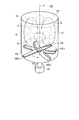
- the cellulose-containing resin pellet manufacturing apparatus (mixer) 110 includes a fixed processing tank (mixed layer) 101.
- a rotating shaft 103 is inserted into the bottom 102 of the fixed processing tank 101 and is driven to rotate by an electric motor 104.
- a blade 105 is provided on the rotating shaft 103.
- the blade 105 includes three rotary blades 105-1, 105-2, and 105-3.
- reference numeral 131 denotes a cut laminated paper L.
- the laminated paper L is put into the fixed processing tank 101, and the blade 105 is rotated at a high speed to generate frictional heat on the laminated paper L.
- the laminated resin layer LA of the laminated paper L and the paper component layer are generated by the frictional heat.
- a thermal expansion change is generated between the LB and at least a part of the interface between the laminate resin layer LA of the laminated paper L and the paper component layer LB is peeled and separated using the thermal expansion change.
- the laminate layer LA is released as a thermoplastic resin piece, and the fibrous cellulose F is released from the paper component layer LB.
- the blade 105 in the fixed treatment tank 101 rotates at 1300 rpm / 110 kW or more and 1500 rpm / 110 kW (E in FIG. 6), and generates a rising or descending airflow (G in FIG. 6) with a wind speed of 10 to 30 m / s.
- twisting, twisting, turning, rotation, and frictional force are applied to the fibrous cellulose F contained in the paper component layer LB.
- the fine cellulose F is condensed into a dense state, and the fibrous cellulose F and the thermoplastic resin piece are kneaded and solidified. Thereafter, the condensate is appropriately granulated and deformed into granules having an appropriate size.
- the blade 105 does not have a function of cutting or cutting the laminated paper L, but has a function of rotating while pressing the laminated paper L.
- the laminated synthetic resin material constituting the laminated layer LA separated from the laminated paper L is melted by the frictional heat and rotational force generated by the rotation of the blade 105, and the viscosity of the molten synthetic resin material is melted.
- the paper component layer LB is broken, and the fibrous cellulose F separated from the paper component layer LB by the breaking action is subjected to twisting action, folding, folding, or rotation / swirl action, and is densely integrated with each other.
- the molten synthetic resin component is infiltrated into at least a part of the fiber lump and acts as an adhesive as a whole. To be constrained.
- the paper component layer LB in the laminated paper L is not finely cut, but the kneading force, that is, the viscosity of the resin constituting the laminated layer LA is used by the blade 105 of the cellulose-containing resin pellet manufacturing apparatus 100.
- the paper component layer LB is decomposed. For this reason, the fibrous cellulose F having a relatively long fiber length (500-1500 ⁇ m) that has not been cut is twisted, bent, folded, pulled, pressed, swung / rotated, entangled in an appropriate direction with an appropriate external force.
- the separated fibrous cellulose F is formed into a densely aggregated state in a bundled state, and a pellet-like lump having a minute particle size in harmony with the synthetic resin component contained therein Transform into a body. Furthermore, the pellet of the state which the said resin affixed is formed in the surface of the said pellet-like lump, or at least one part of the inside.
- the laminate paper L is temporarily separated from the laminate paper L by a dry method instead of wet, and the laminate component and the paper component are formed in an ideal shape without changing the initial mixing ratio of the laminate component and the paper component. Even when melted at a high temperature, the paper component does not carbonize, has no odor, and has a low water absorption compared to wood, and has a high mechanical strength and an inexpensive long fiber mixed resin composition. .
- FIG. 3 is an electron micrograph obtained by partially enlarging a cellulose-containing resin pellet P formed from a used milk pack according to the method for producing the cellulose-containing resin pellet P according to the present invention. That is, FIG. 3 is an electron micrograph of a part of cellulose-containing resin pellets P, which is a fluid produced by the method for producing cellulose-containing resin pellets according to the present invention, taken from the surface.
- the ultrafine fibrous cellulose F is twisted and elongated, and is intertwined with each other and arranged in a concentrated manner.
- the polyethylene resin separated from the laminate layer is It is shown as the part which appears black, and it understands that they are melt
- this structure proves that the resin component is a principle that the fibrous cellulose F is further entangled in a complicated manner so that the fibrous cellulose F is made thinner and longer and folded into the resin.
- the fact that the interval between the fibrous cellulose F is narrower is the basis that the fibrous cellulose F is narrower than the paper and the strength is increased.
- the mixed state of the cellulose-containing resin pellet P will be described.
- the fibrous cellulose F in a paper state is twisted and elongated.
- the resin is a black portion, it is dissolved without any gap between the fibrous cellulose F, and the mechanism in which the fibrous cellulose F is further entangled in the resin component so as to be further thinned and folded into the resin to improve the strength. It is as it is.
- the resin laminated in the fixed processing tank 101 is frictionally heated by the blade 105, and the laminated paper L is temporarily separated into a polyethylene component and a paper component, but the paper component is then twisted and thinned by the rotational force. Then, since the polyethylene component melts and penetrates into the fibrous cellulose F or covers the fibrous cellulose F, uniform mixing is established.
- the fiber length can be secured because the pellet is not subjected to rotational force in the conventional method.
- the fibrous cellulose F does not become thin as in the case of the present invention. That is, it is clear that a mixing method using the cellulose-containing resin pellet manufacturing apparatus 110 is advantageous for reducing the surface area of the fibers and mixing with the resin. In the conventional method, since the resin is not evenly adhered to the fiber, an air layer is generated inside, which causes a quality problem.
- Cellulose-containing resin pellets in which paper fibers are uniformly mixed without shortening the paper and the manufacturing method thereof, and the synthetic resin composition having increased strength and the manufacturing method thereof, and cellulose-containing resin pellet manufacturing A device is obtained.
Landscapes
- Engineering & Computer Science (AREA)
- Mechanical Engineering (AREA)
- Environmental & Geological Engineering (AREA)
- Separation, Recovery Or Treatment Of Waste Materials Containing Plastics (AREA)
- Processing And Handling Of Plastics And Other Materials For Molding In General (AREA)
- Compositions Of Macromolecular Compounds (AREA)
Abstract
La présente invention concerne un dispositif de fabrication de granule de résine contenant de la cellulose, un matériau stratifié obtenu par stratification de papier et d'un film de résine qui est décomposé et malaxé et est ensuite solidifié. Le dispositif est pourvu de : une trémie 31 ayant une ouverture supérieure à travers laquelle le matériau stratifié est injecté une couverture inférieure depuis laquelle le matériau stratifié est injecté ; une vis de trémie 32 qui est disposée de façon coaxiale avec la trémie 31, délivre le matériau stratifié depuis l'ouverture supérieure vers l'ouverture inférieure, et comporte une extrémité distale faisant saillie vers l'extérieur à travers l'ouverture inférieure de la trémie ; un cylindre tubulaire 21 couplé à l'ouverture inférieure de la trémie 31 ; et une vis de granulation 22 qui est logée de façon coaxiale dans le cylindre 21, est disposée directement au-dessous de la vis de trémie 32, et malaxe et délivre le matériau stratifié. Le dispositif granule efficacement le matériau stratifié.
Priority Applications (2)
| Application Number | Priority Date | Filing Date | Title |
|---|---|---|---|
| JP2017523743A JPWO2016199942A1 (ja) | 2015-06-12 | 2016-06-13 | セルロース含有樹脂ペレット、セルロース含有樹脂ペレット製造方法、合成樹脂組成物、合成樹脂組成物の製造方法及びセルロース含有樹脂ペレット製造装置 |
| CN201680034299.XA CN107708950A (zh) | 2015-06-12 | 2016-06-13 | 含纤维素的树脂粒料、含纤维素的树脂粒料制法、合成树脂组合物、合成树脂组合物的制法及含纤维素的树脂粒料制造装置 |
Applications Claiming Priority (2)
| Application Number | Priority Date | Filing Date | Title |
|---|---|---|---|
| JP2015-118835 | 2015-06-12 | ||
| JP2015118835 | 2015-06-12 |
Publications (1)
| Publication Number | Publication Date |
|---|---|
| WO2016199942A1 true WO2016199942A1 (fr) | 2016-12-15 |
Family
ID=57503930
Family Applications (1)
| Application Number | Title | Priority Date | Filing Date |
|---|---|---|---|
| PCT/JP2016/067590 Ceased WO2016199942A1 (fr) | 2015-06-12 | 2016-06-13 | Granule de résine contenant de la cellulose, procédé de fabrication de granule de résine contenant de la cellulose, composition de résine synthétique, procédé de fabrication de composition de résine synthétique, et dispositif de fabrication de granule de résine contenant de la cellulose |
Country Status (3)
| Country | Link |
|---|---|
| JP (1) | JPWO2016199942A1 (fr) |
| CN (1) | CN107708950A (fr) |
| WO (1) | WO2016199942A1 (fr) |
Cited By (5)
| Publication number | Priority date | Publication date | Assignee | Title |
|---|---|---|---|---|
| WO2019038869A1 (fr) * | 2017-08-23 | 2019-02-28 | 古河電気工業株式会社 | Composite de résine de polyéthylène à dispersion de fibres de cellulose, corps moulé et pastilles l'utilisant, procédé de fabrication associé, et procédé de recyclage de fragments de film mince de polyéthylène comprenant des fibres de cellulose collées |
| WO2019038868A1 (fr) * | 2017-08-23 | 2019-02-28 | 古河電気工業株式会社 | Composite de résine de polyéthylène à dispersion de fibres de cellulose, corps moulé et pastilles utilisant un tel composite, leur procédé de fabrication, et procédé de recyclage pour fragments de film mince de polyéthylène avec des fibres de cellulose collées |
| US11390723B2 (en) | 2016-12-05 | 2022-07-19 | Furukawa Electric Co., Ltd. | Cellulose-aluminum-dispersing polyethylene resin composite material, pellet and formed body using same, and production method therefor |
| US11466145B2 (en) | 2017-08-23 | 2022-10-11 | Furukawa Electric Co., Ltd. | Cellulose-fiber-dispersing polyolefin resin composite material |
| US11597826B2 (en) | 2017-08-23 | 2023-03-07 | Furukawa Electric Co., Ltd. | Cellulose-fiber-dispersing polyolefin resin composite material, pellet and formed body using same, and production method for cellulose-fiber-dispersing polyolefin resin composite material |
Families Citing this family (1)
| Publication number | Priority date | Publication date | Assignee | Title |
|---|---|---|---|---|
| CN116533414A (zh) * | 2023-05-06 | 2023-08-04 | 威塑机械科技(上海)有限公司 | 一种高分子材料覆膜废料回收利用装置及生产方法 |
Citations (7)
| Publication number | Priority date | Publication date | Assignee | Title |
|---|---|---|---|---|
| JPH0780909A (ja) * | 1993-09-16 | 1995-03-28 | Kawaguchi Gosei Kk | 牛乳用紙パック及びフィルムラミネート紙の再利用方法 |
| JP2000052339A (ja) * | 1998-08-11 | 2000-02-22 | Trust:Kk | 成形用組成物の製造方法およびそれに用いる古紙ペレット |
| JP2001310326A (ja) * | 2000-04-28 | 2001-11-06 | Mitsubishi Paper Mills Ltd | プラスチックフィルムラミネート紙細断物、その製造方法及び該細断物を配合した合成樹脂組成物 |
| JP2006347031A (ja) * | 2005-06-16 | 2006-12-28 | Toa Kagaku Kogyo Kk | アルミ箔ラミネート紙を原料とする樹脂化ペレット製造方法 |
| JP2007260941A (ja) * | 2006-03-27 | 2007-10-11 | Hokuetsu Paper Mills Ltd | 紙配合熱可塑性樹脂組成物の製造方法及びそれに用いる紙ペレット |
| JP2011116838A (ja) * | 2009-12-02 | 2011-06-16 | Mitsubishi Paper Mills Ltd | セルロース含有熱可塑性樹脂の製造方法、セルロース含有熱可塑性樹脂およびその成形体 |
| JP2011190322A (ja) * | 2010-03-12 | 2011-09-29 | Mitsubishi Paper Mills Ltd | セルロース含有熱可塑性樹脂の製造方法、セルロース含有熱可塑性樹脂およびその成形体 |
-
2016
- 2016-06-13 CN CN201680034299.XA patent/CN107708950A/zh active Pending
- 2016-06-13 JP JP2017523743A patent/JPWO2016199942A1/ja active Pending
- 2016-06-13 WO PCT/JP2016/067590 patent/WO2016199942A1/fr not_active Ceased
Patent Citations (7)
| Publication number | Priority date | Publication date | Assignee | Title |
|---|---|---|---|---|
| JPH0780909A (ja) * | 1993-09-16 | 1995-03-28 | Kawaguchi Gosei Kk | 牛乳用紙パック及びフィルムラミネート紙の再利用方法 |
| JP2000052339A (ja) * | 1998-08-11 | 2000-02-22 | Trust:Kk | 成形用組成物の製造方法およびそれに用いる古紙ペレット |
| JP2001310326A (ja) * | 2000-04-28 | 2001-11-06 | Mitsubishi Paper Mills Ltd | プラスチックフィルムラミネート紙細断物、その製造方法及び該細断物を配合した合成樹脂組成物 |
| JP2006347031A (ja) * | 2005-06-16 | 2006-12-28 | Toa Kagaku Kogyo Kk | アルミ箔ラミネート紙を原料とする樹脂化ペレット製造方法 |
| JP2007260941A (ja) * | 2006-03-27 | 2007-10-11 | Hokuetsu Paper Mills Ltd | 紙配合熱可塑性樹脂組成物の製造方法及びそれに用いる紙ペレット |
| JP2011116838A (ja) * | 2009-12-02 | 2011-06-16 | Mitsubishi Paper Mills Ltd | セルロース含有熱可塑性樹脂の製造方法、セルロース含有熱可塑性樹脂およびその成形体 |
| JP2011190322A (ja) * | 2010-03-12 | 2011-09-29 | Mitsubishi Paper Mills Ltd | セルロース含有熱可塑性樹脂の製造方法、セルロース含有熱可塑性樹脂およびその成形体 |
Cited By (9)
| Publication number | Priority date | Publication date | Assignee | Title |
|---|---|---|---|---|
| US11390723B2 (en) | 2016-12-05 | 2022-07-19 | Furukawa Electric Co., Ltd. | Cellulose-aluminum-dispersing polyethylene resin composite material, pellet and formed body using same, and production method therefor |
| WO2019038869A1 (fr) * | 2017-08-23 | 2019-02-28 | 古河電気工業株式会社 | Composite de résine de polyéthylène à dispersion de fibres de cellulose, corps moulé et pastilles l'utilisant, procédé de fabrication associé, et procédé de recyclage de fragments de film mince de polyéthylène comprenant des fibres de cellulose collées |
| WO2019038868A1 (fr) * | 2017-08-23 | 2019-02-28 | 古河電気工業株式会社 | Composite de résine de polyéthylène à dispersion de fibres de cellulose, corps moulé et pastilles utilisant un tel composite, leur procédé de fabrication, et procédé de recyclage pour fragments de film mince de polyéthylène avec des fibres de cellulose collées |
| JPWO2019038868A1 (ja) * | 2017-08-23 | 2020-08-06 | 古河電気工業株式会社 | セルロース繊維分散ポリエチレン樹脂複合材、これを用いた成形体及びペレット、これらの製造方法、並びにセルロース繊維付着ポリエチレン薄膜片のリサイクル方法 |
| JPWO2019038869A1 (ja) * | 2017-08-23 | 2020-08-06 | 古河電気工業株式会社 | セルロース繊維分散ポリエチレン樹脂複合材、これを用いた成形体及びペレット、これらの製造方法、並びにセルロース繊維付着ポリエチレン薄膜片のリサイクル方法 |
| US11390724B2 (en) | 2017-08-23 | 2022-07-19 | Furukawa Electric Co., Ltd. | Cellulose-fiber dispersion polyethylene resin composite material, formed body and pellet using same, production method therefor, and recycling method for cellulose-fiber adhesion polyethylene thin film piece |
| US11466145B2 (en) | 2017-08-23 | 2022-10-11 | Furukawa Electric Co., Ltd. | Cellulose-fiber-dispersing polyolefin resin composite material |
| US11597826B2 (en) | 2017-08-23 | 2023-03-07 | Furukawa Electric Co., Ltd. | Cellulose-fiber-dispersing polyolefin resin composite material, pellet and formed body using same, and production method for cellulose-fiber-dispersing polyolefin resin composite material |
| US11667763B2 (en) | 2017-08-23 | 2023-06-06 | Furukawa Electric Co., Ltd. | Cellulose-fiber dispersion polyethylene resin composite material, formed body and pellet using same, production method therefor, and recycling method for cellulose-fiber adhesion polyethylene thin film piece |
Also Published As
| Publication number | Publication date |
|---|---|
| JPWO2016199942A1 (ja) | 2018-05-17 |
| CN107708950A (zh) | 2018-02-16 |
Similar Documents
| Publication | Publication Date | Title |
|---|---|---|
| JPWO2016199942A1 (ja) | セルロース含有樹脂ペレット、セルロース含有樹脂ペレット製造方法、合成樹脂組成物、合成樹脂組成物の製造方法及びセルロース含有樹脂ペレット製造装置 | |
| JP6210583B2 (ja) | セルロース繊維分散ポリエチレン樹脂複合材、それを用いた成形体及びペレット、並びに、セルロース繊維分散ポリエチレン樹脂複合材の製造方法 | |
| JP6210582B2 (ja) | セルロース繊維分散ポリエチレン樹脂複合材、それを用いた成形体及びペレット、並びに、セルロース繊維付着ポリエチレン薄膜片のリサイクル方法 | |
| CN108407142B (zh) | 用于制备塑性组合物的方法 | |
| MX2014004450A (es) | Dispositivo para procesar material plastico. | |
| CN108137826A (zh) | 用于生产木质纤维素塑料复合材料的方法 | |
| CN104602879B (zh) | 制造复合产品的方法和系统以及复合产品 | |
| JP6284672B2 (ja) | セルロース繊維分散ポリエチレン樹脂複合材の製造方法、及びセルロース繊維付着ポリエチレン薄膜片のリサイクル方法 | |
| CN104629152A (zh) | 回收利用废弃高密度聚乙烯塑料制备3d打印材料的方法 | |
| MX2014004455A (es) | Dispositivo para procesar material plastico. | |
| JP5028197B2 (ja) | ペレットの製造方法およびペレット製造装置 | |
| JPH08284084A (ja) | 故紙解砕粉の製造方法及び装置、前記故紙解砕粉を用いた故紙合成粉及びその製造方法並びに装置、前記故紙解砕粉を用いた故紙合成成形品及びその製造方法並びに装置、前記故紙合成粉を用いた故紙合成板及びその押出成形方法並びに装置 | |
| WO1999042230A1 (fr) | Procede de production d'article moule en matieres plastiques fondues melangees de differents types | |
| CN103946315B (zh) | 复合产品、其制造方法及其应用,材料组分及最终产品 | |
| JP6353691B2 (ja) | ガラスウール複合熱可塑性樹脂組成物及びその製造法、成形物。 | |
| CN112060529A (zh) | 一种废弃包装填充木塑成型方法 | |
| KR101276323B1 (ko) | 플라스틱 복합소재 폐기물을 이용한 재활용 칩의 제조방법 | |
| JP4695119B2 (ja) | 木質系コンパウンドの製造方法及び木質系コンパウンド | |
| JP3198742U (ja) | 生分解性複合樹脂ペレット製造装置 | |
| CN101245190B (zh) | 含有纤维素纤维的热塑性树脂组合物的制造方法 | |
| JPH1135734A (ja) | 再生ポリオレフィン樹脂組成物の製造方法 | |
| US20110109007A1 (en) | Recycled post-industrial waste for plastic industrial commercial and consumer products | |
| JP2019199009A (ja) | 竹粉複合樹脂の製造方法、竹粉樹脂混合溶融体の製造方法、竹粉樹脂混合溶融体及び竹粉複合樹脂 | |
| JP3810982B2 (ja) | プラスチックフィルムラミネート紙細断物、その製造方法及び該細断物を配合した合成樹脂組成物 | |
| KR20100111386A (ko) | 목분이 함유된 합성수지목분압출배관 및 그 제조방법 |
Legal Events
| Date | Code | Title | Description |
|---|---|---|---|
| 121 | Ep: the epo has been informed by wipo that ep was designated in this application |
Ref document number: 16807645 Country of ref document: EP Kind code of ref document: A1 |
|
| ENP | Entry into the national phase |
Ref document number: 2017523743 Country of ref document: JP Kind code of ref document: A |
|
| NENP | Non-entry into the national phase |
Ref country code: DE |
|
| 122 | Ep: pct application non-entry in european phase |
Ref document number: 16807645 Country of ref document: EP Kind code of ref document: A1 |