WO2016204020A1 - 重合性組成物及びそれを用いた光学異方体 - Google Patents
重合性組成物及びそれを用いた光学異方体 Download PDFInfo
- Publication number
- WO2016204020A1 WO2016204020A1 PCT/JP2016/066876 JP2016066876W WO2016204020A1 WO 2016204020 A1 WO2016204020 A1 WO 2016204020A1 JP 2016066876 W JP2016066876 W JP 2016066876W WO 2016204020 A1 WO2016204020 A1 WO 2016204020A1
- Authority
- WO
- WIPO (PCT)
- Prior art keywords
- group
- oco
- coo
- liquid crystal
- polymerizable liquid
- Prior art date
- Legal status (The legal status is an assumption and is not a legal conclusion. Google has not performed a legal analysis and makes no representation as to the accuracy of the status listed.)
- Ceased
Links
- 0 Cc1ccc(C)c(*)c1 Chemical compound Cc1ccc(C)c(*)c1 0.000 description 5
- KYLUHLJIAMFYKW-UHFFFAOYSA-N CC(CC1=C)OC1=O Chemical compound CC(CC1=C)OC1=O KYLUHLJIAMFYKW-UHFFFAOYSA-N 0.000 description 1
- BRSLTIJNCRRHFX-UHFFFAOYSA-N CCC(c1c(C)c(N)cc(C)c1)N Chemical compound CCC(c1c(C)c(N)cc(C)c1)N BRSLTIJNCRRHFX-UHFFFAOYSA-N 0.000 description 1
- RMAZRAQKPTXZNL-UHFFFAOYSA-N COC(C1C(C2)C=CC2C1)=O Chemical compound COC(C1C(C2)C=CC2C1)=O RMAZRAQKPTXZNL-UHFFFAOYSA-N 0.000 description 1
- JUBOISWHAUYTDY-UHFFFAOYSA-N COCC1CC2OC2CC1 Chemical compound COCC1CC2OC2CC1 JUBOISWHAUYTDY-UHFFFAOYSA-N 0.000 description 1
Classifications
-
- C—CHEMISTRY; METALLURGY
- C08—ORGANIC MACROMOLECULAR COMPOUNDS; THEIR PREPARATION OR CHEMICAL WORKING-UP; COMPOSITIONS BASED THEREON
- C08F—MACROMOLECULAR COMPOUNDS OBTAINED BY REACTIONS ONLY INVOLVING CARBON-TO-CARBON UNSATURATED BONDS
- C08F220/00—Copolymers of compounds having one or more unsaturated aliphatic radicals, each having only one carbon-to-carbon double bond, and only one being terminated by only one carboxyl radical or a salt, anhydride ester, amide, imide or nitrile thereof
- C08F220/02—Monocarboxylic acids having less than ten carbon atoms; Derivatives thereof
- C08F220/52—Amides or imides
- C08F220/54—Amides, e.g. N,N-dimethylacrylamide or N-isopropylacrylamide
- C08F220/60—Amides, e.g. N,N-dimethylacrylamide or N-isopropylacrylamide containing nitrogen in addition to the carbonamido nitrogen
-
- C—CHEMISTRY; METALLURGY
- C08—ORGANIC MACROMOLECULAR COMPOUNDS; THEIR PREPARATION OR CHEMICAL WORKING-UP; COMPOSITIONS BASED THEREON
- C08F—MACROMOLECULAR COMPOUNDS OBTAINED BY REACTIONS ONLY INVOLVING CARBON-TO-CARBON UNSATURATED BONDS
- C08F220/00—Copolymers of compounds having one or more unsaturated aliphatic radicals, each having only one carbon-to-carbon double bond, and only one being terminated by only one carboxyl radical or a salt, anhydride ester, amide, imide or nitrile thereof
- C08F220/62—Monocarboxylic acids having ten or more carbon atoms; Derivatives thereof
- C08F220/68—Esters
-
- C—CHEMISTRY; METALLURGY
- C09—DYES; PAINTS; POLISHES; NATURAL RESINS; ADHESIVES; COMPOSITIONS NOT OTHERWISE PROVIDED FOR; APPLICATIONS OF MATERIALS NOT OTHERWISE PROVIDED FOR
- C09K—MATERIALS FOR MISCELLANEOUS APPLICATIONS, NOT PROVIDED FOR ELSEWHERE
- C09K19/00—Liquid crystal materials
- C09K19/04—Liquid crystal materials characterised by the chemical structure of the liquid crystal components, e.g. by a specific unit
- C09K19/06—Non-steroidal liquid crystal compounds
- C09K19/08—Non-steroidal liquid crystal compounds containing at least two non-condensed rings
- C09K19/10—Non-steroidal liquid crystal compounds containing at least two non-condensed rings containing at least two benzene rings
- C09K19/12—Non-steroidal liquid crystal compounds containing at least two non-condensed rings containing at least two benzene rings at least two benzene rings directly linked, e.g. biphenyls
-
- C—CHEMISTRY; METALLURGY
- C09—DYES; PAINTS; POLISHES; NATURAL RESINS; ADHESIVES; COMPOSITIONS NOT OTHERWISE PROVIDED FOR; APPLICATIONS OF MATERIALS NOT OTHERWISE PROVIDED FOR
- C09K—MATERIALS FOR MISCELLANEOUS APPLICATIONS, NOT PROVIDED FOR ELSEWHERE
- C09K19/00—Liquid crystal materials
- C09K19/04—Liquid crystal materials characterised by the chemical structure of the liquid crystal components, e.g. by a specific unit
- C09K19/06—Non-steroidal liquid crystal compounds
- C09K19/08—Non-steroidal liquid crystal compounds containing at least two non-condensed rings
- C09K19/10—Non-steroidal liquid crystal compounds containing at least two non-condensed rings containing at least two benzene rings
- C09K19/14—Non-steroidal liquid crystal compounds containing at least two non-condensed rings containing at least two benzene rings linked by a carbon chain
- C09K19/18—Non-steroidal liquid crystal compounds containing at least two non-condensed rings containing at least two benzene rings linked by a carbon chain the chain containing carbon-to-carbon triple bonds, e.g. tolans
-
- C—CHEMISTRY; METALLURGY
- C09—DYES; PAINTS; POLISHES; NATURAL RESINS; ADHESIVES; COMPOSITIONS NOT OTHERWISE PROVIDED FOR; APPLICATIONS OF MATERIALS NOT OTHERWISE PROVIDED FOR
- C09K—MATERIALS FOR MISCELLANEOUS APPLICATIONS, NOT PROVIDED FOR ELSEWHERE
- C09K19/00—Liquid crystal materials
- C09K19/04—Liquid crystal materials characterised by the chemical structure of the liquid crystal components, e.g. by a specific unit
- C09K19/06—Non-steroidal liquid crystal compounds
- C09K19/08—Non-steroidal liquid crystal compounds containing at least two non-condensed rings
- C09K19/10—Non-steroidal liquid crystal compounds containing at least two non-condensed rings containing at least two benzene rings
- C09K19/20—Non-steroidal liquid crystal compounds containing at least two non-condensed rings containing at least two benzene rings linked by a chain containing carbon and oxygen atoms as chain links, e.g. esters or ethers
-
- C—CHEMISTRY; METALLURGY
- C09—DYES; PAINTS; POLISHES; NATURAL RESINS; ADHESIVES; COMPOSITIONS NOT OTHERWISE PROVIDED FOR; APPLICATIONS OF MATERIALS NOT OTHERWISE PROVIDED FOR
- C09K—MATERIALS FOR MISCELLANEOUS APPLICATIONS, NOT PROVIDED FOR ELSEWHERE
- C09K19/00—Liquid crystal materials
- C09K19/04—Liquid crystal materials characterised by the chemical structure of the liquid crystal components, e.g. by a specific unit
- C09K19/06—Non-steroidal liquid crystal compounds
- C09K19/08—Non-steroidal liquid crystal compounds containing at least two non-condensed rings
- C09K19/10—Non-steroidal liquid crystal compounds containing at least two non-condensed rings containing at least two benzene rings
- C09K19/22—Non-steroidal liquid crystal compounds containing at least two non-condensed rings containing at least two benzene rings linked by a chain containing carbon and nitrogen atoms as chain links, e.g. Schiff bases
-
- C—CHEMISTRY; METALLURGY
- C09—DYES; PAINTS; POLISHES; NATURAL RESINS; ADHESIVES; COMPOSITIONS NOT OTHERWISE PROVIDED FOR; APPLICATIONS OF MATERIALS NOT OTHERWISE PROVIDED FOR
- C09K—MATERIALS FOR MISCELLANEOUS APPLICATIONS, NOT PROVIDED FOR ELSEWHERE
- C09K19/00—Liquid crystal materials
- C09K19/04—Liquid crystal materials characterised by the chemical structure of the liquid crystal components, e.g. by a specific unit
- C09K19/06—Non-steroidal liquid crystal compounds
- C09K19/08—Non-steroidal liquid crystal compounds containing at least two non-condensed rings
- C09K19/30—Non-steroidal liquid crystal compounds containing at least two non-condensed rings containing saturated or unsaturated non-aromatic rings, e.g. cyclohexane rings
-
- C—CHEMISTRY; METALLURGY
- C09—DYES; PAINTS; POLISHES; NATURAL RESINS; ADHESIVES; COMPOSITIONS NOT OTHERWISE PROVIDED FOR; APPLICATIONS OF MATERIALS NOT OTHERWISE PROVIDED FOR
- C09K—MATERIALS FOR MISCELLANEOUS APPLICATIONS, NOT PROVIDED FOR ELSEWHERE
- C09K19/00—Liquid crystal materials
- C09K19/04—Liquid crystal materials characterised by the chemical structure of the liquid crystal components, e.g. by a specific unit
- C09K19/06—Non-steroidal liquid crystal compounds
- C09K19/32—Non-steroidal liquid crystal compounds containing condensed ring systems, i.e. fused, bridged or spiro ring systems
-
- C—CHEMISTRY; METALLURGY
- C09—DYES; PAINTS; POLISHES; NATURAL RESINS; ADHESIVES; COMPOSITIONS NOT OTHERWISE PROVIDED FOR; APPLICATIONS OF MATERIALS NOT OTHERWISE PROVIDED FOR
- C09K—MATERIALS FOR MISCELLANEOUS APPLICATIONS, NOT PROVIDED FOR ELSEWHERE
- C09K19/00—Liquid crystal materials
- C09K19/04—Liquid crystal materials characterised by the chemical structure of the liquid crystal components, e.g. by a specific unit
- C09K19/06—Non-steroidal liquid crystal compounds
- C09K19/34—Non-steroidal liquid crystal compounds containing at least one heterocyclic ring
-
- C—CHEMISTRY; METALLURGY
- C09—DYES; PAINTS; POLISHES; NATURAL RESINS; ADHESIVES; COMPOSITIONS NOT OTHERWISE PROVIDED FOR; APPLICATIONS OF MATERIALS NOT OTHERWISE PROVIDED FOR
- C09K—MATERIALS FOR MISCELLANEOUS APPLICATIONS, NOT PROVIDED FOR ELSEWHERE
- C09K19/00—Liquid crystal materials
- C09K19/04—Liquid crystal materials characterised by the chemical structure of the liquid crystal components, e.g. by a specific unit
- C09K19/38—Polymers
- C09K19/3833—Polymers with mesogenic groups in the side chain
- C09K19/3842—Polyvinyl derivatives
-
- C—CHEMISTRY; METALLURGY
- C09—DYES; PAINTS; POLISHES; NATURAL RESINS; ADHESIVES; COMPOSITIONS NOT OTHERWISE PROVIDED FOR; APPLICATIONS OF MATERIALS NOT OTHERWISE PROVIDED FOR
- C09K—MATERIALS FOR MISCELLANEOUS APPLICATIONS, NOT PROVIDED FOR ELSEWHERE
- C09K19/00—Liquid crystal materials
- C09K19/04—Liquid crystal materials characterised by the chemical structure of the liquid crystal components, e.g. by a specific unit
- C09K19/38—Polymers
- C09K19/3833—Polymers with mesogenic groups in the side chain
- C09K19/3895—Polymers with mesogenic groups in the side chain containing two or more mesogenic groups per monomer unit, e.g. polyitaconates, polymaleates
-
- G—PHYSICS
- G02—OPTICS
- G02B—OPTICAL ELEMENTS, SYSTEMS OR APPARATUS
- G02B1/00—Optical elements characterised by the material of which they are made; Optical coatings for optical elements
- G02B1/10—Optical coatings produced by application to, or surface treatment of, optical elements
- G02B1/11—Anti-reflection coatings
- G02B1/111—Anti-reflection coatings using layers comprising organic materials
-
- G—PHYSICS
- G02—OPTICS
- G02B—OPTICAL ELEMENTS, SYSTEMS OR APPARATUS
- G02B5/00—Optical elements other than lenses
- G02B5/30—Polarising elements
-
- G—PHYSICS
- G02—OPTICS
- G02B—OPTICAL ELEMENTS, SYSTEMS OR APPARATUS
- G02B5/00—Optical elements other than lenses
- G02B5/30—Polarising elements
- G02B5/3016—Polarising elements involving passive liquid crystal elements
-
- G—PHYSICS
- G02—OPTICS
- G02F—OPTICAL DEVICES OR ARRANGEMENTS FOR THE CONTROL OF LIGHT BY MODIFICATION OF THE OPTICAL PROPERTIES OF THE MEDIA OF THE ELEMENTS INVOLVED THEREIN; NON-LINEAR OPTICS; FREQUENCY-CHANGING OF LIGHT; OPTICAL LOGIC ELEMENTS; OPTICAL ANALOGUE/DIGITAL CONVERTERS
- G02F1/00—Devices or arrangements for the control of the intensity, colour, phase, polarisation or direction of light arriving from an independent light source, e.g. switching, gating or modulating; Non-linear optics
- G02F1/01—Devices or arrangements for the control of the intensity, colour, phase, polarisation or direction of light arriving from an independent light source, e.g. switching, gating or modulating; Non-linear optics for the control of the intensity, phase, polarisation or colour
- G02F1/13—Devices or arrangements for the control of the intensity, colour, phase, polarisation or direction of light arriving from an independent light source, e.g. switching, gating or modulating; Non-linear optics for the control of the intensity, phase, polarisation or colour based on liquid crystals, e.g. single liquid crystal display cells
- G02F1/133—Constructional arrangements; Operation of liquid crystal cells; Circuit arrangements
- G02F1/1333—Constructional arrangements; Manufacturing methods
- G02F1/133365—Cells in which the active layer comprises a liquid crystalline polymer
-
- G—PHYSICS
- G02—OPTICS
- G02F—OPTICAL DEVICES OR ARRANGEMENTS FOR THE CONTROL OF LIGHT BY MODIFICATION OF THE OPTICAL PROPERTIES OF THE MEDIA OF THE ELEMENTS INVOLVED THEREIN; NON-LINEAR OPTICS; FREQUENCY-CHANGING OF LIGHT; OPTICAL LOGIC ELEMENTS; OPTICAL ANALOGUE/DIGITAL CONVERTERS
- G02F1/00—Devices or arrangements for the control of the intensity, colour, phase, polarisation or direction of light arriving from an independent light source, e.g. switching, gating or modulating; Non-linear optics
- G02F1/01—Devices or arrangements for the control of the intensity, colour, phase, polarisation or direction of light arriving from an independent light source, e.g. switching, gating or modulating; Non-linear optics for the control of the intensity, phase, polarisation or colour
- G02F1/13—Devices or arrangements for the control of the intensity, colour, phase, polarisation or direction of light arriving from an independent light source, e.g. switching, gating or modulating; Non-linear optics for the control of the intensity, phase, polarisation or colour based on liquid crystals, e.g. single liquid crystal display cells
- G02F1/133—Constructional arrangements; Operation of liquid crystal cells; Circuit arrangements
- G02F1/1333—Constructional arrangements; Manufacturing methods
- G02F1/1335—Structural association of cells with optical devices, e.g. polarisers or reflectors
- G02F1/13363—Birefringent elements, e.g. for optical compensation
-
- C—CHEMISTRY; METALLURGY
- C08—ORGANIC MACROMOLECULAR COMPOUNDS; THEIR PREPARATION OR CHEMICAL WORKING-UP; COMPOSITIONS BASED THEREON
- C08F—MACROMOLECULAR COMPOUNDS OBTAINED BY REACTIONS ONLY INVOLVING CARBON-TO-CARBON UNSATURATED BONDS
- C08F222/00—Copolymers of compounds having one or more unsaturated aliphatic radicals, each having only one carbon-to-carbon double bond, and at least one being terminated by a carboxyl radical and containing at least one other carboxyl radical in the molecule; Salts, anhydrides, esters, amides, imides, or nitriles thereof
- C08F222/10—Esters
- C08F222/1006—Esters of polyhydric alcohols or polyhydric phenols
- C08F222/102—Esters of polyhydric alcohols or polyhydric phenols of dialcohols, e.g. ethylene glycol di(meth)acrylate or 1,4-butanediol dimethacrylate
- C08F222/1025—Esters of polyhydric alcohols or polyhydric phenols of dialcohols, e.g. ethylene glycol di(meth)acrylate or 1,4-butanediol dimethacrylate of aromatic dialcohols
-
- C—CHEMISTRY; METALLURGY
- C08—ORGANIC MACROMOLECULAR COMPOUNDS; THEIR PREPARATION OR CHEMICAL WORKING-UP; COMPOSITIONS BASED THEREON
- C08F—MACROMOLECULAR COMPOUNDS OBTAINED BY REACTIONS ONLY INVOLVING CARBON-TO-CARBON UNSATURATED BONDS
- C08F2800/00—Copolymer characterised by the proportions of the comonomers expressed
- C08F2800/20—Copolymer characterised by the proportions of the comonomers expressed as weight or mass percentages
-
- C—CHEMISTRY; METALLURGY
- C09—DYES; PAINTS; POLISHES; NATURAL RESINS; ADHESIVES; COMPOSITIONS NOT OTHERWISE PROVIDED FOR; APPLICATIONS OF MATERIALS NOT OTHERWISE PROVIDED FOR
- C09K—MATERIALS FOR MISCELLANEOUS APPLICATIONS, NOT PROVIDED FOR ELSEWHERE
- C09K19/00—Liquid crystal materials
- C09K19/04—Liquid crystal materials characterised by the chemical structure of the liquid crystal components, e.g. by a specific unit
- C09K2019/0444—Liquid crystal materials characterised by the chemical structure of the liquid crystal components, e.g. by a specific unit characterized by a linking chain between rings or ring systems, a bridging chain between extensive mesogenic moieties or an end chain group
- C09K2019/0448—Liquid crystal materials characterised by the chemical structure of the liquid crystal components, e.g. by a specific unit characterized by a linking chain between rings or ring systems, a bridging chain between extensive mesogenic moieties or an end chain group the end chain group being a polymerizable end group, e.g. -Sp-P or acrylate
Definitions
- the present invention relates to a polymerizable liquid crystal composition useful as a liquid crystal device, a display, an optical component, a colorant, a security marking, a member for laser emission, or a component of an optical anisotropic body used for optical compensation such as a liquid crystal display. And an optically anisotropic body, a retardation film, a viewing angle compensation film and an antireflection film comprising the composition.
- a liquid crystal compound having a polymerizable group (polymerizable liquid crystal compound) is used as a raw material for various films.
- polymerizable liquid crystal compound is used as a raw material for various films.
- the produced film can be used for a polarizing plate, a phase difference plate, etc. which are required for a display.
- a polymer having a homeotropic alignment (retardation plate) used for optical compensation such as an IPS (In-Plane Switching) type display has been conventionally produced using a polymer liquid crystal having a vertical alignment performance.
- the film must be oriented at a high temperature of 100 ° C. or higher, and the heat resistance of the film as the base material may be a problem.
- a method for solving the problem a method of applying a polymerizable liquid crystal composition containing a polymerizable liquid crystal compound to a substrate and then polymerizing to obtain a polymer having homeotropic alignment has been reported. A sufficient durability was not obtained (Patent Document 1).
- the polymerizable liquid crystal contained in the component of the polymerizable liquid crystal composition can be stored for a long time when the polymerizable liquid crystal composition before polymerization is prepared. It is important that the compound does not precipitate and that uniform homeotropic alignment is formed when the polymerizable liquid crystal composition is polymerized by electromagnetic waves to produce a film-like polymer.
- a non-uniformly oriented film is used for display viewing angle widening and polarization conversion, the brightness of the display may not be uniform, the color of the image may be unnatural, or the polarization axis may be misaligned. Depending on the viewing angle, light leakage may occur or color shift may occur, which may greatly degrade the quality of the display product.
- the problem to be solved by the present invention is to provide a polymerizable liquid crystal composition in which uniform homeotropic alignment is formed when a polymer obtained by polymerizing the polymerizable liquid crystal composition is produced. Furthermore, the present invention provides a polymer having good orientation, high durability (retardation retention ratio), low repellency, and optical anisotropic body using the polymer, obtained by polymerizing the polymerizable liquid crystal composition. It is to be.
- the present inventors have found that the polymerizable liquid crystal compound represented by the following general formula (II-1) and one or two or more types of polymerizable compounds.
- a polymerizable liquid crystal compound (II-2) having a functional group and / or a polymerizable liquid crystal compound having two or more polymerizable functional groups in a molecule represented by the general formula (I-1) came to the development of the polymeric liquid crystal composition containing 2 or more types. That is, the present invention relates to the general formula (I-1)
- each of P 11 and P 12 independently represents a polymerizable functional group
- each of Sp 11 and Sp 12 independently represents an alkylene group having 1 to 18 carbon atoms or a single bond
- one -CH 2 in the group - or nonadjacent two or more -CH 2 - are each independently -O -, - COO -, - OCO- or --OCO-O-substituted by
- one or more hydrogen atoms of the alkylene group may be substituted with a halogen atom or a CN group
- X 11 and X 12 are each independently —O—, —S—, — OCH 2 —, —CH 2 O—, —CO—, —COO—, —OCO—, —CO—S—, —S—CO—, —O—CO—O—, —CO—NH—, —NH -CO -, - SCH 2 -, - CH 2 S -,
- P 21 represents a polymerizable group
- Sp 21 represents a spacer group or a single bond.
- X 21 represents —O—, —S—, —OCH 2 —, —CH 2 O—, —CO—, —COO—, —OCO—, —CO—S—, —S—CO—, —O—CO.
- Z 21 represents —O—, —S—, —OCH 2 —, —CH 2 O—, —CH 2 CH 2 —, —CO—, —COO—, —OCO—, —CO—S—, —S—.
- the groups represented by formulas (A2-1) to (A2-9) may be unsubstituted or substituted with one or more substituents L 2 ,
- R represents a fluorine atom, a chlorine atom, a bromine atom, an iodine atom, a pentafluorosulfuranyl group, a cyano group, a nitro group, an isocyano group, a thioisocyano group, or a linear or branched alkyl group having 2 to 20 carbon atoms.
- Represents a group selected from Substituent L 2 is fluorine atom, chlorine atom, bromine atom, iodine atom, pentafluorosulfuranyl group, nitro group, cyano group, isocyano group, an amino group, a hydroxyl group, a mercapto group, methylamino group, dimethylamino group, Represents a diethylamino group, a diisopropylamino group, a trimethylsilyl group, a dimethylsilyl group, a thioisocyano group, or a linear or branched alkyl group having 2 to 20 carbon atoms, and one —CH 2 — or adjacent group in the alkyl group Two or more —CH 2 — groups independently represent —O—, —S—, —CO—, —COO—, —OCO—, —CO—S—, —S—CO—, —O —CO—O—O
- the use of the polymerizable liquid crystal composition of the present invention makes it possible to obtain an optically anisotropic body that is uniformly homeotropically aligned, and is thus useful for applications of optical materials such as retardation films.
- the “liquid crystal” of the polymerizable liquid crystal composition refers to an organic solvent after coating the polymerizable liquid crystal composition on a substrate. It is intended to show liquid crystal properties in the removed state.
- the “liquid crystal” of the polymerizable liquid crystal compound means a case where it is intended to show liquid crystal properties with only one type of polymerizable liquid crystal compound used, or a mixture with other liquid crystal compounds. It is intended to exhibit liquid crystal properties.
- the polymerizable liquid crystal composition can be polymerized (formed into a film) by performing a polymerization treatment by irradiation with light such as ultraviolet rays, heating, or a combination thereof.
- the polymerizable liquid crystal composition of the present invention contains a polymerizable liquid crystal compound that promotes homeotropic alignment.
- a polymerizable liquid crystal compound that promotes homeotropic alignment is used by adding it to the polymerizable liquid crystal composition.
- the polymerizable liquid crystal composition containing the compound is applied to a substrate and then polymerized, it is uniform.
- Specific examples of the polymerizable liquid crystal compound that promotes homeotropic alignment include the compound represented by the general formula (II-1).
- P 21 represents a polymerizable group
- P-20 the following formulas (P-1) to (P-20)
- these polymerizable groups are polymerized by radical polymerization, radical addition polymerization, cationic polymerization and anionic polymerization.
- the formula (P-1), formula (P-2), formula (P-3), formula (P-4), formula (P-5), formula (P ⁇ 7), formula (P-11), formula (P-13), formula (P-15) or formula (P-18) are preferred, and formula (P-1), formula (P-2), formula (P-18) P-7), formula (P-11) or formula (P-13) is more preferred, formula (P-1), formula (P-2) or formula (P-3) is more preferred, and formula (P- Particular preference is given to 1) or formula (P-2).
- k represents an integer of 0 to 10, preferably represents an integer of 0 to 5, more preferably represents an integer of 0 to 2, and particularly preferably represents 1. .
- Sp 21 represents a spacer group or a single bond, and when a plurality of Sp 21 are present, they may be the same or different.
- the spacer group may be unsubstituted or may be substituted with one or more substituents L 1 shown below.
- the spacer group, one -CH 2 - or nonadjacent two or more -CH 2 - are each independently -O -, - COO -, - OCO -, - OCO-O -, - CO It preferably represents an alkylene group having 1 to 20 carbon atoms which may be replaced by —NH—, —NH—CO—, —CH ⁇ CH— or —C ⁇ C—.
- Sp 21 may be the same or different when there are a plurality of Sp 21 from the viewpoints of availability of raw materials and ease of synthesis, and each is independently independent of one —CH 2 — or not adjacent to each other. It is more preferable that two or more —CH 2 — each independently represents an alkylene group having 1 to 14 carbon atoms or a single bond which may be independently replaced by —O—, —COO—, or —OCO—. More preferably, it represents an alkylene group having 1 to 14 atoms or a single bond, more preferably represents an alkylene group having 2 to 14 carbon atoms from the viewpoint of orientation, and represents an alkylene group having 4 to 12 carbon atoms. It is even more preferred that it represents an alkylene group having 6 to 10 carbon atoms.
- X 21 represents —O—, —S—, —OCH 2 —, —CH 2 O—, —CO—, —COO—, —OCO—, —CO—S—, —S.
- X 21 may be the same or different when there are a plurality of X 21 from the viewpoints of availability of raw materials and ease of synthesis, and each independently represents —O—, —S—, — OCH 2 —, —CH 2 O—, —COO—, —OCO—, —CO—S—, —S—CO—, —O—CO—O—, —CO—NH—, —NH—CO—, It preferably represents —COO—CH 2 CH 2 —, —OCO—CH 2 CH 2 —, —CH 2 CH 2 —COO—, —CH 2 CH 2 —OCO— or a single bond, and each independently represents —O —, —OCH 2 —, —CH 2 O—, —COO—, —OCO—, —COO—CH 2 CH 2 —, —OCO—CH 2 CH 2 —, —CH 2 CH 2 —COO—, —CH more preferably represents an 2 CH 2
- a 21 represents 1,4-phenylene group, 1,4-cyclohexylene group, pyridine-2,5-diyl group, pyrimidine-2,5-diyl group, naphthalene-2,6- Represents a diyl group, naphthalene-1,4-diyl group, tetrahydronaphthalene-2,6-diyl group, decahydronaphthalene-2,6-diyl group or 1,3-dioxane-2,5-diyl group, The group may be unsubstituted or substituted by one or more substituents L 1 , and when a plurality of A 21 are present, they may be the same or different.
- Substituent L 1 is a fluorine atom, chlorine atom, bromine atom, iodine atom, pentafluorosulfuranyl group, nitro group, cyano group, isocyano group, amino group, hydroxyl group, mercapto group, methylamino group, dimethylamino group, A diethylamino group, a diisopropylamino group, a trimethylsilyl group, a dimethylsilyl group, a thioisocyano group, or a linear or branched alkyl group having 1 to 20 carbon atoms, and one —CH 2 — or adjacent group in the alkyl group Two or more —CH 2 — groups independently represent —O—, —S—, —CO—, —COO—, —OCO—, —CO—S—, —S—CO—, —O —CO—O—, —CO—NH—, —NH—CO—,
- L 1 is a fluorine atom, chlorine atom, pentafluorosulfuranyl group, nitro group, cyano group, methylamino group, dimethylamino group, diethylamino group, diisopropylamino.
- a group or any hydrogen atom may be substituted with a fluorine atom, and one —CH 2 — or two or more non-adjacent —CH 2 — may each independently represent —O—, —S—.
- a fluorine atom, a chlorine atom, a cyano group, or an arbitrary hydrogen atom represents a linear or branched alkyl group or alkoxy group having 1 to 12 carbon atoms which may be substituted with a fluorine atom. More preferably, it represents a fluorine atom, a chlorine atom, a cyano group, or a linear alkoxy group having 2 to 8 carbon atoms, and more preferably represents a fluorine atom or a linear alkoxy group having 2 to 8 carbon atoms. It is even more preferred that it represents a fluorine atom.
- a 21 is unsubstituted or may be substituted with one or more substituents L 1 Group, 1,4-cyclohexylene group and naphthalene-2,6-diyl group are preferred, and each independently represents the following formulas (A1-1) to (A1-11)
- L 1 represents a previously defined the same groups as, they if L 1 there are a plurality may be the same or different.
- More may represent a group selected from More preferably, each independently represents a group selected from formula (A1-1) to formula (A1-8), and each independently selected from formula (A1-1) to formula (A1-4). It is particularly preferred to represent a group.
- Z 21 represents —O—, —S—, —OCH 2 —, —CH 2 O—, —CH 2 CH 2 —, —CO—, —COO—, —OCO—, — CO—S—, —S—CO—, —O—CO—O—, —CO—NH—, —NH—CO—, —OCO—NH—, —NH—COO—, —NH—CO—NH— , —NH—O—, —O—NH—, —SCH 2 —, —CH 2 S—, —CF 2 O—, —OCF 2 —, —CF 2 S—, —SCF 2 —, —CH ⁇ CH —COO—, —CH ⁇ CH—OCO—, —COO—CH ⁇ CH—, —OCO—CH ⁇ CH—, —COO—CH 2 CH 2 —, —OCO—CH 2 CH 2 —, —CH 2 CH 2 —, —CH 2 CH
- Z 21 represents —OCH 2 —, —CH 2 O—, —COO—, —OCO—, —CF from the viewpoint of liquid crystallinity of the compound, availability of raw materials and ease of synthesis, storage stability, haze, and unevenness.
- m represents an integer of 1 to 5, but m is preferably an integer of 1 to 4 from the viewpoint of liquid crystallinity, availability of raw materials and ease of synthesis. More preferably, it represents an integer of 3, more preferably 1 or 2 from the viewpoint of compatibility with other polymerizable liquid crystal compounds, and particularly preferably 2.
- terminal ring structure A 22 is represented by the following formulas (A2-1) to (A2-9)
- the groups represented by formulas (A2-1) to (A2-9) may be unsubstituted or substituted with one or more substituents L 2 ,
- R represents a fluorine atom, a chlorine atom, a bromine atom, an iodine atom, a pentafluorosulfuranyl group, a cyano group, a nitro group, an isocyano group, a thioisocyano group, or a linear or branched alkyl group having 2 to 20 carbon atoms.
- Two or more —CH 2 — are each independently —O—, —S—, —CO—, —COO—, —OCO—, —CO—S—, —S—CO—, —O—CO.
- R is a fluorine atom, a chlorine atom, a cyano group, a nitro group, or a straight chain having 2 to 20 carbon atoms from the viewpoints of liquid crystallinity, availability of raw materials and ease of synthesis, storage stability, haze, and unevenness.
- a branched alkyl group in which one —CH 2 — or two or more non-adjacent —CH 2 — are each independently —O—, —CO—, —COO—, —OCO—, —O—CO—O—, —CH ⁇ CH—, —CF ⁇ CF— or —C ⁇ C— may be substituted, and any hydrogen atom in the alkyl group may be substituted.
- a fluorine atom may be substituted with a fluorine atom, and more preferably represents a fluorine atom, a chlorine atom, a cyano group, or a linear alkyl group having 2 to 10 carbon atoms, and in the alkyl group, one —CH 2 - or adjacent have not more than one -CH 2 - are each independently -O-, -CO-, -COO-, -OCO-, -O-CO-O- may be substituted, and any hydrogen atom in the alkyl group may be substituted with a fluorine atom.
- it represents an atom, a chlorine atom, a cyano group, or a linear alkoxy group having 2 to 8 carbon atoms, and more preferably represents a fluorine atom or a linear alkoxy group having 2 to 8 carbon atoms. It is particularly preferable to represent a fluorine atom.
- R has lone electrons from the viewpoint of homeotropic alignment.
- the group is preferably a group having polarizability.
- L 2 is a fluorine atom, a chlorine atom, a pentafluorosulfuranyl group, a nitro group, a cyano group, a methylamino group, a dimethylamino group, a diethylamino group, diisopropyl from the viewpoints of liquid crystallinity, ease of synthesis, haze and unevenness.
- An amino group or any hydrogen atom may be substituted with a fluorine atom, and one —CH 2 — or two or more non-adjacent —CH 2 — may be independently —O—, —S May be substituted by a group selected from —, —CO—, —COO—, —OCO—, —O—CO—O—, —CH ⁇ CH—, —CF ⁇ CF— or —C ⁇ C—. It preferably represents a linear or branched alkyl group having 2 to 20 carbon atoms, and a fluorine atom, a chlorine atom, a cyano group, or an arbitrary hydrogen atom may be substituted with a fluorine atom.
- CH 2 -or not adjacent 2 or more —CH 2 — each independently represents a linear or branched alkyl having 2 to 12 carbon atoms which may be substituted with a group selected from —O—, —COO— or —OCO—. It is preferable to represent a group, and a fluorine atom, a chlorine atom, a cyano group, or an arbitrary hydrogen atom represents a linear or branched alkyl group or alkoxy group having 2 to 12 carbon atoms which may be substituted with a fluorine atom.
- it represents a fluorine atom, a chlorine atom, a cyano group, or a linear alkoxy group having 2 to 8 carbon atoms, and more preferably represents a fluorine atom or a linear alkoxy group having 2 to 8 carbon atoms. It is even more preferable to represent it, and it is particularly preferable to represent a fluorine atom.
- R and L 2 represent the same group.
- R and L 2 are fluorine atom, a chlorine atom, a cyano group, or preferably represent a straight-chain alkoxy group having a carbon number of 2 to 8, R and L 2 fluorine atoms or more preferably represents a linear alkoxy group having a carbon number of 2 to 8, R and L 2 and particularly preferably a fluorine atom.
- the polymerizable liquid crystal compound that promotes homeotropic alignment can be used alone or in combination of two or more, but preferably 1 to 5 types, more preferably 1 to 4 types.
- the total content of the polymerizable liquid crystal compound that promotes homeotropic alignment is preferably 5 to 60% by mass of the total amount of the polymerizable liquid crystal compound used in the polymerizable liquid crystal composition, and preferably 10 to 55% by mass. More preferably, the content is 20 to 50% by mass, particularly preferably 20 to 40% by mass.
- the lower limit is preferably 10% by mass or more, more preferably 20% by mass or more, and when the emphasis is on the curability of the resulting coating film Is preferably 60% by mass or less, and more preferably 40% by mass or less.
- compounds represented by the following formulas (II-1-1) to (II-1-58) are preferred as the compounds represented by the general formula (II-1).
- the compound of this invention can be manufactured with the following manufacturing methods.
- (Production method 1) Production of a compound represented by the following formula (S-6)
- the compound represented by the formula (S-1) is borated. As the borated method, a compound represented by the formula (S-1) is reacted with magnesium to prepare a Grignard reagent, reacted with a borate ester, and then hydrolyzed.
- Examples include a method of hydrolyzing a compound represented by lithiation, reacting with a borate ester, and the like.
- Examples of the boric acid ester include trimethyl borate and triisopropyl borate.
- the lithiating agent include butyl lithium, sec-butyl lithium, tert-butyl lithium, lithium diisopropylamide and the like.
- a compound represented by the formula (S-4) can be obtained by reacting a compound represented by the formula (S-2) with a compound represented by the formula (S-3). Examples of the reaction include a method of cross-coupling in the presence of a metal catalyst and a base.
- the compound represented by the formula (S-6) can be obtained by reacting the compound represented by the formula (S-4) with a compound represented by the formula (S-5).
- a reaction conditions for example, a method using a condensing agent or a compound represented by the formula (S-5) is converted to an acid chloride, mixed acid anhydride or carboxylic acid anhydride and then represented by the general formula (S-4). The method of making it react with a compound in base presence is mentioned.
- examples of the condensing agent include N, N′-dicyclohexylcarbodiimide, N, N′-diisopropylcarbodiimide, and 1-ethyl-3- (3-dimethylaminopropyl) carbodiimide hydrochloride.
- examples of the base include triethylamine and diisopropylethylamine.
- a compound represented by formula (S-10) is obtained in the same manner as in Production Method 1.
- the compound represented by the formula (S-11) is obtained by reacting the compound represented by the formula (S-10) with trifluoromethanesulfonic anhydride in the presence of a base. Examples of the base include pyridine and trimethylamine.
- the compound represented by the formula (S-14) is obtained by reacting the compound represented by the formula (S-12) with a compound represented by the formula (S-13) in the presence of a base.
- a base examples include potassium carbonate and cesium carbonate.
- the compound represented by the formula (S-16) is obtained by reacting the compound represented by the formula (S-14) with a compound represented by the formula (S-15) in the presence of a palladium catalyst and a base.
- the compound represented by the formula (S-17) can be obtained by reacting the compound represented by the formula (S-16) with the compound represented by the formula (S-11).
- Examples of the reaction include a method of cross-coupling in the presence of a metal catalyst and a base.
- Examples of the catalyst, base, and conditions include those described in Production Method 1.
- a compound represented by the formula (S-18) is obtained by acrylating the compound represented by the formula (S-17). (Production method 3) Production of a compound represented by the following formula (S-24)
- the compound represented by the formula (S-21) is obtained by reacting the compound represented by the formula (S-19) with the formula (S-20).
- a method using a condensing agent or a compound represented by the formula (S-19) is converted to an acid chloride, mixed acid anhydride or carboxylic acid anhydride and then represented by the general formula (S-20).
- the method of making it react with a compound in base presence is mentioned. Examples of the condensing agent and the base include those described in Production Method 1.
- the compound represented by the formula (S-22) is obtained by oxidizing the compound represented by the formula (S-21).
- Examples of the oxidation method include a method using sodium chlorite and hydrogen peroxide.
- the compound represented by the formula (S-24) is obtained by reacting the compound represented by the formula (S-22) with the formula (S-23).
- the reaction conditions for example, a method using a condensing agent or a compound represented by the formula (S-22) is converted into an acid chloride, mixed acid anhydride or carboxylic acid anhydride and then represented by the general formula (S-23).
- the method of making it react with a compound in base presence is mentioned.
- Examples of the condensing agent and the base include those described in Production Method 1.
- the polymerizable liquid crystal composition of the present invention preferably contains a polymerizable liquid crystal compound having two or more polymerizable functional groups in the molecule.
- a polymerizable liquid crystal composition comprising a polymerizable liquid crystal compound having two or more polymerizable functional groups in a molecule together with a polymerizable liquid crystal compound that promotes homeotropic alignment represented by the general formula (II-1).
- a uniform homeotropically oriented coating film excellent in durability can be obtained.
- Specific examples of the polymerizable liquid crystal compound having two or more polymerizable functional groups in the molecule include compounds represented by general formula (I-1) below.
- each of P 11 and P 12 independently represents a polymerizable functional group
- each of Sp 11 and Sp 12 independently represents an alkylene group having 1 to 18 carbon atoms or a single bond, and the alkylene group In which one —CH 2 — or two or more non-adjacent —CH 2 — may be each independently substituted by —O—, —COO—, —OCO— or —OCO—O—.
- one or more hydrogen atoms of the alkylene group may be substituted with a halogen atom (a fluorine atom, a chlorine atom, a bromine atom, an iodine atom) or a CN group
- P 11 and P 12 each independently preferably represent a substituent selected from a polymerizable group represented by the following formulas (P-2-1) to (P-2-20).
- MG 12 represents a mesogenic group and has the general formula (Ib)
- A1, A2 and A3 are each independently 1,4-phenylene group, 1,4-cyclohexylene group, 1,4-cyclohexenyl group, tetrahydropyran-2,5-diyl group, 1, 3-dioxane-2,5-diyl group, tetrahydrothiopyran-2,5-diyl group, 1,4-bicyclo (2,2,2) octylene group, decahydronaphthalene-2,6-diyl group, pyridine- 2,5-diyl group, pyrimidine-2,5-diyl group, pyrazine-2,5-diyl group, thiophene-2,5-diyl group-, 1,2,3,4-tetrahydronaphthalene-2,6- Diyl group, 2,6-naphthylene group, phenanthrene-2,7-diyl group, 9,10-dihydrophenant
- any one of A1, A2 and A3 has one or two-(X 12 -Sp 12 ) q2 -P 12 groups. ).
- A1, A2 and A3 each independently preferably represents a 1,4-phenylene group, a 1,4-cyclohexylene group or a 2,6-naphthylene group.
- (Bifunctional polymerizable liquid crystal compound) Examples of the polymerizable liquid crystal compound represented by the above general formula (I-1) having two or more polymerizable functional groups in the molecule include the following general formula (I-) having two polymerizable functional groups in the molecule. It is preferable to use a bifunctional polymerizable liquid crystal compound represented by 1-1).
- each of P 11 and P 12 independently represents a polymerizable functional group
- each of Sp 11 and Sp 12 independently represents an alkylene group having 1 to 18 carbon atoms or a single bond
- one -CH 2 in the group - or nonadjacent two or more -CH 2 - are each independently -O -, - COO -, - OCO- or --OCO-O-substituted by
- one or more hydrogen atoms of the alkylene group may be substituted by a halogen atom (fluorine atom, chlorine atom, bromine atom, iodine atom) or a CN group
- X 11 and X 12 are each Independently, —O—, —S—, —OCH 2 —, —CH 2 O—, —CO—, —COO—, —OCO—, —CO—S—, —S—CO—, —O— CO—O—, —CO—NH—
- each of P 11 and P 12 preferably independently represents a substituent selected from the polymerizable groups represented by the above formulas (P-2-1) to (P-2-20).
- the formulas (P-2-1), (P-2-2), (P-2-7), (P-2-12), ( P-2-13) is preferred, and formulas (P-2-1) and (P-2-2) are more preferred.
- each of Sp 11 and Sp 12 independently preferably represents an alkylene group having 1 to 15 carbon atoms, and one —CH 2 — in the alkylene group or two or more non-adjacent — CH 2 — may be each independently substituted by —O—, —COO—, —OCO— or —OCO—O—, and one or more hydrogen atoms of the alkylene group may be a halogen atom (Fluorine atom, chlorine atom, bromine atom, iodine atom) or a CN group may be substituted, and Sp 11 and Sp 12 each independently more preferably represent an alkylene group having 1 to 12 carbon atoms, In the alkylene group, one —CH 2 — or two or more non-adjacent —CH 2 — are each independently substituted by —O—, —COO—, —OCO— or —OCO—O—. Even There.
- X 11 and X 12 are each independently —O—, —OCH 2 —, —CH 2 O—, —CO—, —COO—, —OCO—, —O—CO—O—, —CO—NH. —, —NH—CO—, —CF 2 O—, —OCF 2 —, —CH ⁇ CH—COO—, —CH ⁇ CH—OCO—, —COO—CH ⁇ CH—, —OCO—CH ⁇ CH— , —COO—CH 2 CH 2 —, —OCO—CH 2 CH 2 —, —CH 2 CH 2 —COO—, —CH 2 CH 2 —OCO—, —COO—CH 2 —, —OCO—CH 2 —, -CH 2 -COO -, - CH 2 -OCO—, —COO—CH 2 —, —OCO—CH 2 — , -CH 2 -COO -, - CH 2
- MG 12 represents a mesogenic group and has the general formula (I-1-b)
- A1, A2 and A3 are each independently 1,4-phenylene group, 1,4-cyclohexylene group, 1,4-cyclohexenyl group, tetrahydropyran-2,5-diyl group, 1,3 -Dioxane-2,5-diyl group, tetrahydrothiopyran-2,5-diyl group, 1,4-bicyclo (2,2,2) octylene group, decahydronaphthalene-2,6-diyl group, pyridine-2 , 5-diyl group, pyrimidine-2,5-diyl group, pyrazine-2,5-diyl group, thiophene-2,5-diyl group-, 1,2,3,4-tetrahydronaphthalene-2,6-diyl Group, 2,6-naphthylene group, phenanthrene-2,7-diyl group, 9,10-dihydroph
- Examples of the general formula (I-1-1) include compounds represented by the following general formulas (I-1-1-1) to (I-1-1-4). The formula is not limited.
- each of P 11 , Sp 11 , X 11 , q 1, X 12 , Sp 12 , q 2, P 12 represents the same definition as in the general formula (I-1-1), A11, A12, A13, A2, and A3 represent the same definitions as A1 to A3 in the general formula (I-1-b), and may be the same or different.
- Z11, Z12, Z13, and Z2 represent the same definitions as Z1 and Z2 in the general formula (I-1-b), respectively, and may be the same or different.
- a compound having three or more ring structures in the compound is preferable because the orientation of the obtained optical anisotropic body is good, and the compound represented by the general formula (3) having three ring structures in the compound is preferable. It is particularly preferable to use a compound represented by I-1-1-2).
- the compounds represented by the above general formulas (I-1-1-1) to (I-1-1-4) include the following general formulas (I-1-1-1-1) to (I-1 Examples of the compound represented by 1-1-1-21) are not limited thereto.
- R d and R e each independently represent a hydrogen atom or a methyl group
- the cyclic group includes one or more F, Cl, CF 3 , OCF 3 , CN groups, an alkyl group having 1 to 8 carbon atoms, an alkoxy group having 1 to 8 carbon atoms, and 1 to 8 alkanoyl groups, alkanoyloxy groups having 1 to 8 carbon atoms, alkoxycarbonyl groups having 1 to 8 carbon atoms, alkenyl groups having 2 to 8 carbon atoms, alkenyloxy groups having 2 to 8 carbon atoms, carbon atoms May have an alkenoyl group having 2 to 8 carbon atoms and an alkenoyloxy group having 2 to 8 carbon atoms, m1 and m2 each independently represent an integer of 0 to 18, and n1, n2, n3, and n4 each independently represent 0 or 1.
- the liquid crystal compound having two polymerizable functional groups can be used singly or in combination of two or more, preferably 1 to 5 types, more preferably 2 to 5 types.
- the total content of the polymerizable liquid crystal compound having two polymerizable functional groups in the molecule is the polymerizable content used for the polymerizable liquid crystal composition including the polymerizable liquid crystal compound represented by the general formula (II-1).
- the total amount of the liquid crystal compound is preferably 10 to 90% by mass, more preferably 15 to 85% by mass, and particularly preferably 20 to 80% by mass.
- the lower limit is preferably 30% by mass or more, more preferably 50% by mass or more, and importance is attached to the adhesion of the resulting coating film to the substrate.
- Trifunctional polymerizable liquid crystal compound examples of the polymerizable liquid crystal compound represented by the above general formula (I-1) having two or more polymerizable functional groups in the molecule include the following general formula (I-) having three polymerizable functional groups in the molecule. It is preferable to use a trifunctional polymerizable liquid crystal compound represented by 1-2).
- P 12 to P 13 each independently represents a polymerizable functional group
- Sp 11 to S 13 each independently represents an alkylene group having 1 to 18 carbon atoms or a single bond
- one -CH 2 in the group - or nonadjacent two or more -CH 2 - are each independently -O -, - COO -, - OCO- or --OCO-O-substituted by
- one or more hydrogen atoms of the alkylene group may be substituted with a halogen atom (fluorine atom, chlorine atom, bromine atom, iodine atom) or a CN group
- X 11 to X 13 are each Independently, —O—, —S—, —OCH 2 —, —CH 2 O—, —CO—, —COO—, —OCO—, —CO—S—, —S—CO—, —O— CO—O—, —CO—NH—, —NH
- each of Sp 11 to Sp 13 preferably independently represents an alkylene group having 1 to 15 carbon atoms
- one —CH 2 — in the alkylene group or two or more non-adjacent — CH 2 — may be each independently substituted by —O—, —COO—, —OCO— or —OCO—O—
- one or more hydrogen atoms of the alkylene group may be a halogen atom (Fluorine atom, chlorine atom, bromine atom, iodine atom) or CN group may be substituted
- Sp 11 to Sp 13 each independently preferably represents an alkylene group having 1 to 12 carbon atoms
- one —CH 2 — or two or more non-adjacent —CH 2 — are each independently substituted by —O—, —COO—, —OCO— or —OCO—O—.
- X 11 to X 13 are each independently —O—, —OCH 2 —, —CH 2 O—, —CO—, —COO—, —OCO—, —O—CO—O—, —CO—NH.
- A1, A2 and A3 are each independently 1,4-phenylene group, 1,4-cyclohexylene group, 1,4-cyclohexenyl group, tetrahydropyran-2,5-diyl group, 1,3 -Dioxane-2,5-diyl group, tetrahydrothiopyran-2,5-diyl group, 1,4-bicyclo (2,2,2) octylene group, decahydronaphthalene-2,6-diyl group, pyridine-2 , 5-diyl group, pyrimidine-2,5-diyl group, pyrazine-2,5-diyl group, thiophene-2,5-diyl group-, 1,2,3,4-tetrahydronaphthalene-2,6-diyl Group, 2,6-naphthylene group, phenanthrene-2,7-diyl group, 9,10-dihydroph
- Z1 and Z2 are each independently —COO—, —OCO—, —CH 2 CH 2 —, —OCH 2 —, —CH 2 O—, —CH ⁇ CH—, —C ⁇ C—, —CH ⁇ CHCOO—, —OCOCH ⁇ CH—, —CH 2 CH 2 COO—, —CH 2 CH 2 OCO—, —COOCH 2 CH 2 —, —OCOCH 2 CH 2 —, —C ⁇ N—, —N ⁇ C— , —CONH—, —NHCO—, —C (CF 3 ) 2 —, a halogen atom (fluorine atom, chlorine atom, bromine atom, iodine atom) or an alkyl group having 2 to 10 carbon atoms or a single atom Z1 and Z2 each independently represent —COO—, —OCO—, —CH 2 CH 2 —, —OCH 2 —, —CH 2 O—, —
- A1, A2 and A3 each independently preferably represents a 1,4-phenylene group, a 1,4-cyclohexylene group or a 2,6-naphthylene group.
- Examples of the general formula (I-1-2) include compounds represented by the following general formulas (I-1-2-1) to (I-1-2-8). The formula is not limited.
- the general formula (I-1-2 ) Represents the same definition as A11, A12, A13, A2, and A3 each represent the same definition as A1 to A3 in the general formula (I-2-b), and may be the same or different, Z11, Z12, Z13, and Z2 each represent the same definition as Z1 and Z2 in the general formula (I-2-b), and may be the same or different.
- the compounds represented by the above general formulas (I-1-2-1) to (I-1-2-8) include the following general formulas (I-1-2-1-1) to (I-1 -2-1-6), but is not limited thereto.
- R f , R g, and R h each independently represent a hydrogen atom or a methyl group
- R i , R j, and R k are each independently a hydrogen atom, a halogen atom (a fluorine atom, a chlorine atom, A bromine atom, an iodine atom), an alkyl group having 1 to 6 carbon atoms, an alkoxy group having 1 to 6 carbon atoms, or a cyano group, and these groups are alkyl groups having 1 to 6 carbon atoms or 1 to 6 carbon atoms In the case of an alkoxy group, all may be unsubstituted or substituted by one or more halogen atoms (fluorine atom, chlorine atom, bromine atom, iodine atom), 1 or more F, Cl, CF 3 , OCF 3 , CN group, alkyl group having 1 to 8 carbon atoms, alkoxy group having 1 to 8 carbon atoms, al
- the polyfunctional polymerizable liquid crystal compound having three polymerizable functional groups can be used alone or in combination of two or more.
- the total content of the polyfunctional polymerizable liquid crystal compound having three polymerizable functional groups in the molecule is used for the polymerizable liquid crystal composition including the polymerizable liquid crystal compound represented by the general formula (II-1).
- the total amount of the polymerizable liquid crystal compound is preferably 0 to 40% by mass, more preferably 0 to 30% by mass, and particularly preferably 0 to 20% by mass.
- a monofunctional polymerizable liquid crystal compound having one polymerizable functional group in the molecule can be used.
- the polymerizable liquid crystal composition of the present invention when a polymerizable liquid crystal compound having two or more polymerizable functional groups in the molecule is used as an essential component, the polymerizable liquid crystal composition has one polymerizable functional group in the molecule.
- a monofunctional polymerizable liquid crystal compound can be used as an optional component.
- Specific examples of the monofunctional polymerizable liquid crystal compound include compounds represented by the following general formula (II-2) as compounds other than the compound represented by the above general formula (II-1).
- P 22 represents a polymerizable functional group
- Sp 22 represents an alkylene group having 1 to 18 carbon atoms or a single bond, and one —CH 2 — or two not adjacent to each other in the alkylene group.
- the above —CH 2 — may be each independently substituted by —O—, —COO—, —OCO— or —OCO—O—, and one or more hydrogen atoms of the alkylene group are ,
- a halogen atom (a fluorine atom, a chlorine atom, a bromine atom, an iodine atom) or a CN group
- X 22 represents —O—, —S—, —OCH 2 —, —CH 2 O—, —CO -, -COO-, -OCO-, -CO-S-, -S-CO-, -O-CO-O-, -CO-NH-, -NH-CO-, -SCH 2- , -
- Atom, iodine atom cyano group, straight from 1 to 12 carbon atoms
- P 22 preferably represents a substituent selected from the polymerizable groups represented by the following formulas (P-2-1) to (P-2-20).
- Sp 22 is preferably represents an alkylene group having 1 to 15 carbon atoms, one -CH 2 in the alkylene group - or nonadjacent two or more -CH 2 - are each independently
- One or more hydrogen atoms of the alkylene group which may be substituted by —O—, —COO—, —OCO— or —OCO—O— are a halogen atom (a fluorine atom, a chlorine atom, a bromine atom).
- Sp 22 preferably represents an alkylene group having 1 to 12 carbon atoms, and one —CH 2 — or adjacent group in the alkylene group Two or more —CH 2 — which are not present may be each independently replaced by —O—, —COO—, —OCO— or —OCO—O—.
- X 22 represents —O—, —OCH 2 —, —CH 2 O—, —CO—, —COO—, —OCO—, —O—CO—O—, —CO—NH—, —NH—CO—, —CF 2 O—, —OCF 2 —, —CH ⁇ CH—COO—, —CH ⁇ CH—OCO—, —COO—CH ⁇ CH—, —OCO—CH ⁇ CH—, —COO—CH 2 CH 2 —, —OCO—CH 2 CH 2 —, —CH 2 CH 2 —COO—, —CH 2 CH 2 —OCO—, —COO—CH 2 —, —OCO—CH 2 —, —CH 2 —COO—, It preferably represents —CH 2 —OCO—, —CH ⁇ CH—, —N ⁇ N—, —CH ⁇ N—N ⁇ CH—, —CF ⁇ CF—, —C ⁇ C— or a single bond
- A1 and A2 are each independently 1,4-phenylene group, 1,4-cyclohexylene group, 1,4-cyclohexenyl group, tetrahydropyran-2,5-diyl group, 1,3 -Dioxane-2,5-diyl group, tetrahydrothiopyran-2,5-diyl group, 1,4-bicyclo (2,2,2) octylene group, decahydronaphthalene-2,6-diyl group, pyridine-2 , 5-diyl group, pyrimidine-2,5-diyl group, pyrazine-2,5-diyl group, thiophene-2,5-diyl group-, 1,2,3,4-tetrahydronaphthalene-2,6-diyl Group, 2,6-naphthylene group, phenanthrene-2,7-diyl group, 9,10-dihydrophen
- Alkenyloxy group having 2 to 8 carbon atoms, 2 carbon atoms 8 may have an alkenoyl group and / or an alkenoyloxy group having 2 to 8 carbon atoms, and among them, A1 and A2 may each independently have the above substituents. It preferably represents a 1,4-phenylene group, a 1,4-cyclohexylene group, or a 2,6-naphthylene group.
- A3 represents 1,4-phenylene group, 1,4-cyclohexylene group, 1,4-cyclohexenyl group, tetrahydropyran-2,5-diyl group, 1,3-dioxane-2,5-diyl group, tetrahydro Thiopyran-2,5-diyl group, 1,4-bicyclo (2,2,2) octylene group, decahydronaphthalene-2,6-diyl group, pyridine-2,5-diyl group, pyrimidine-2,5 -Diyl group, pyrazine-2,5-diyl group, thiophene-2,5-diyl group-, 1,2,3,4-tetrahydronaphthalene-2,6-diyl group, 2,6-naphthylene group, phenanthrene- 2,7-diyl group, 9,10-dihydrophenanthrene-2,7-di
- the hydrogen atom bonded to the carbon atom adjacent to the carbon atom to which R 21 is linked is not substituted (for example, A3 is a 1,4-phenylene group). when referring may have a substituent at the site below L o, the portion below L n no substituent.).
- Z1 and Z2 are each independently —COO—, —OCO—, —CH 2 CH 2 —, —OCH 2 —, —CH 2 O—, —CH ⁇ CH—, —C ⁇ C—, —CH ⁇ CHCOO—, —OCOCH ⁇ CH—, —CH 2 CH 2 COO—, —CH 2 CH 2 OCO—, —COOCH 2 CH 2 —, —OCOCH 2 CH 2 —, —C ⁇ N—, —N ⁇ C— , —CONH—, —NHCO—, —C (CF 3 ) 2 —, a halogen atom (fluorine atom, chlorine atom, bromine atom, iodine atom) or an alkyl group having 2 to 10 carbon atoms or a single atom Z1 and Z2 each independently represent —COO—, —OCO—, —CH 2 CH 2 —, —OCH 2 —, —CH 2 O—, —
- Bromine atom, iodine atom) or It may be substituted by anode group, even each identical If a plurality substituted, may be different.
- Examples of the general formula (II-2) include compounds represented by the following general formulas (II-2-1) to (II-2-4), but are not limited to the following general formulas is not.
- each of P 22 , Sp 22 , X 22 , q 1, and R 21 represents the same as defined in the general formula (II-2), A11, A12, A13, A2, and A3 represent the same definitions as A1 to A3 in the general formula (II-2-b), and may be the same or different, Z11, Z12, Z13 and Z2 represent the same definitions as Z1 to Z3 in the general formula (II-2-b), and may be the same or different,
- the compounds represented by the general formulas (II-2-1) to (II-2-4) are represented by the following formulas (II-2-1-1) to (II-2-1-26). The compounds represented are exemplified, but not limited thereto.
- R c represents a hydrogen atom or a methyl group
- m represents an integer of 0 to 18
- n represents 0 or 1
- R 21 represents the above general formulas (II-2-1) to (II- 2-4) represents the same as defined above, but R 21 represents a hydrogen atom, a halogen atom (a fluorine atom, a chlorine atom, a bromine atom, an iodine atom), a cyano group, or one —CH 2 — represents —O—.
- the cyclic group includes one or more F, Cl, CF 3 , OCF 3 , CN groups, an alkyl group having 1 to 8 carbon atoms, an alkoxy group having 1 to 8 carbon atoms, and 1 to 8 alkanoyl groups, alkanoyloxy groups having 1 to 8 carbon atoms, alkoxycarbonyl groups having 1 to 8 carbon atoms, alkenyl groups having 2 to 8 carbon atoms, alkenyloxy groups having 2 to 8 carbon atoms, carbon atoms alkenoyl group having 2-8 may have a alkenoyloxy group having a carbon number of 2-8, but in the ring structure R 21 is connected, adjacent to the carbon atom of the ring structure R 21 are linked The hydrogen atom bonded to the carbon
- the total content of the monofunctional polymerizable liquid crystal compound represented by the above general formula (II-2) having one polymerizable functional group in the molecule is the polymerizability represented by the above general formula (II-1).
- the polymerizability represented by the above general formula (II-1) 0 to 60% by mass is preferable, 0 to 55% by mass is more preferable, and 0 to 50% by mass is preferable. It is particularly preferable to contain it.
- the lower limit is preferably 5% by mass or more, more preferably 10% by mass or more, and importance is given to the curability of the resulting coating film.
- the polymerizable liquid crystal composition of the present invention may contain a compound containing a mesogenic group having no polymerizable group, such as a normal liquid crystal device, for example, STN (super twisted nematic) liquid crystal, Examples thereof include compounds used for TN (twisted nematic) liquid crystal, TFT (thin film transistor) liquid crystal, and the like.
- the compound containing a mesogenic group having no polymerizable functional group is preferably a compound represented by the following general formula (5).
- the mesogenic group or mesogenic supporting group represented by MG3 has the general formula (5-b)
- A1 d , A2 d and A3 d are each independently 1,4-phenylene group, 1,4-cyclohexylene group, 1,4-cyclohexenyl group, tetrahydropyran-2,5-diyl group 1,3-dioxane-2,5-diyl group, tetrahydrothiopyran-2,5-diyl group, 1,4-bicyclo (2,2,2) octylene group, decahydronaphthalene-2,6-diyl group Pyridine-2,5-diyl group, pyrimidine-2,5-diyl group, pyrazine-2,5-diyl group, thiophene-2,5-diyl group-, 1,2,3,4-tetrahydronaphthalene-2 , 6-diyl group, 2,6-naphthylene group, phenanthrene-2,7-diyl group, 9,10-d
- one or more halogen atoms may be substituted by or CN, this is not one CH 2 group or adjacent present in group two or more CH 2
- the groups are independent of each other, and in such a form that oxygen atoms are not directly bonded to each other, —O—, —S—, —NH—, —N (CH 3 ) —, —CO—, —COO—, —OCO It may be replaced by —, —OCOO—, —SCO—, —COS— or —C ⁇ C—. ).
- Ra and Rb each independently represent a hydrogen atom, an alkyl group having 1 to 6 carbon atoms, an alkoxy group having 1 to 6 carbon atoms, an alkenyl group having 1 to 6 carbon atoms, or a cyano group.
- an alkyl group of ⁇ 6 or an alkoxy group of 1 to 6 carbon atoms all may be unsubstituted or substituted by one or more halogen atoms.
- the total content of the compound having a mesogenic group is preferably 0% by mass or more and 20% by mass or less with respect to the total amount of the polymerizable liquid crystal composition. It is preferably at least mass%, preferably at least 5 mass%, more preferably at most 15 mass%, preferably at most 10 mass%.
- An organic solvent may be added to the polymerizable liquid crystal composition in the present invention. Although there is no limitation in particular as an organic solvent to be used, the organic solvent in which a polymeric liquid crystal compound shows favorable solubility is preferable, and it is preferable that it is an organic solvent which can be dried at the temperature of 100 degrees C or less.
- solvents examples include aromatic hydrocarbons such as toluene, xylene, cumene, and mesitylene, ester solvents such as methyl acetate, ethyl acetate, propyl acetate, and butyl acetate, methyl ethyl ketone, methyl isobutyl ketone, cyclohexanone, cyclohexane, and the like.
- Ketone solvents such as pentanone, ether solvents such as tetrahydrofuran, 1,2-dimethoxyethane and anisole, amide solvents such as N, N-dimethylformamide and N-methyl-2-pyrrolidone, propylene glycol monomethyl ether acetate , Diethylene glycol monomethyl ether acetate, ⁇ -butyrolactone, chlorobenzene and the like.
- amide solvents such as N, N-dimethylformamide and N-methyl-2-pyrrolidone
- propylene glycol monomethyl ether acetate Diethylene glycol monomethyl ether acetate, ⁇ -butyrolactone, chlorobenzene and the like.
- amide solvents such as N, N-dimethylformamide and N-methyl-2-pyrrolidone
- propylene glycol monomethyl ether acetate Diethylene glycol monomethyl ether acetate, ⁇ -butyrolactone, chlorobenzene and the like.
- the composition used in the present invention can be applied to a substrate as an organic solvent solution, and the ratio of the organic solvent used in the polymerizable liquid crystal composition is not particularly limited as long as the applied state is not significantly impaired.
- the total amount of the organic solvent contained in the polymerizable liquid crystal composition is preferably 10 to 95% by mass, more preferably 12 to 90% by mass, and particularly preferably 15 to 85% by mass. preferable.
- the heating temperature at the time of heating and stirring may be appropriately adjusted in consideration of the solubility of the composition to be used in the organic solvent, but is preferably 15 ° C. to 110 ° C., more preferably 15 ° C. to 105 ° C. from the viewpoint of productivity. 15 to 100 ° C. is more preferable, and 20 to 90 ° C. is particularly preferable.
- dispersion stirrer when adding the solvent, it is preferable to stir and mix with a dispersion stirrer.
- the dispersion stirrer include a disperser having a stirring blade such as a disper, a propeller, and a turbine blade, a paint shaker, a planetary stirring device, a shaker, a shaker, or a rotary evaporator.
- an ultrasonic irradiation apparatus can be used.
- the number of rotations of stirring when adding the solvent is preferably adjusted appropriately depending on the stirring device used, but the number of rotations of stirring is preferably 10 rpm to 1000 rpm in order to obtain a uniform polymerizable liquid crystal composition solution, and 50 rpm to 800 rpm is more preferable, and 150 rpm to 600 rpm is particularly preferable.
- Polymerization inhibitor It is preferable to add a polymerization inhibitor to the polymerizable liquid crystal composition in the present invention.
- the polymerization inhibitor include phenol compounds, quinone compounds, amine compounds, thioether compounds, nitroso compounds, and the like.
- phenolic compounds include p-methoxyphenol, cresol, t-butylcatechol, 3.5-di-t-butyl-4-hydroxytoluene, 2.2'-methylenebis (4-methyl-6-t-butylphenol) 2.2′-methylenebis (4-ethyl-6-tert-butylphenol), 4.4′-thiobis (3-methyl-6-tert-butylphenol), 4-methoxy-1-naphthol, 4,4′- Dialkoxy-2,2′-bi-1-naphthol, and the like.
- quinone compounds include hydroquinone, methylhydroquinone, tert-butylhydroquinone, p-benzoquinone, methyl-p-benzoquinone, tert-butyl-p-benzoquinone, 2,5-diphenylbenzoquinone, 2-hydroxy-1,4-naphthoquinone 1,4-naphthoquinone, 2,3-dichloro-1,4-naphthoquinone, anthraquinone, diphenoquinone and the like.
- amine compounds include p-phenylenediamine, 4-aminodiphenylamine, N.I. N'-diphenyl-p-phenylenediamine, Ni-propyl-N'-phenyl-p-phenylenediamine, N- (1.3-dimethylbutyl) -N'-phenyl-p-phenylenediamine, N.I. N′-di-2-naphthyl-p-phenylenediamine, diphenylamine, N-phenyl- ⁇ -naphthylamine, 4.4′-dicumyl-diphenylamine, 4.4′-dioctyl-diphenylamine and the like.
- thioether compounds include phenothiazine and distearyl thiodipropionate.
- nitroso compounds include N-nitrosodiphenylamine, N-nitrosophenylnaphthylamine, N-nitrosodinaphthylamine, p-nitrosophenol, nitrosobenzene, p-nitrosodiphenylamine, ⁇ -nitroso- ⁇ -naphthol, N, N-dimethyl p-nitrosoaniline, p-nitrosodiphenylamine, p-nitronedimethylamine, p-nitrone-N, N-diethylamine, N-nitrosoethanolamine, N-nitrosodi-n-butylamine, N-nitroso-Nn-butyl- 4-butanolamine, N-nitroso-diisopropanolamine, N-nitroso-N-ethyl-4-butanolamine, 5-nitroso-8-hydroxyquinoline, N-nitrosomorpholine, N-nitroso-N-
- the addition amount of the polymerization inhibitor is preferably 0.01 to 1.0% by mass and more preferably 0.05 to 0.5% by mass with respect to the polymerizable liquid crystal composition.
- the polymerizable liquid crystal composition in the present invention preferably contains a photopolymerization initiator. It is preferable to contain at least one photopolymerization initiator. Specifically, “Irgacure 651”, “Irgacure 184”, “Irgacure 907”, “Irgacure 127”, “Irgacure 369”, “Irgacure 2959”, “Irgacure 1800”, “Irgacure 250” manufactured by BASF Japan Ltd.
- the amount of the photopolymerization initiator used is preferably 0.1 to 10% by mass, particularly preferably 0.5 to 7% by mass, based on the polymerizable liquid crystal composition. These can be used alone or in combination of two or more, and a sensitizer or the like may be added.
- a thermal polymerization initiator may be used in combination with a photopolymerization initiator. Specifically, “V-40” and “VF-096” manufactured by Wako Pure Chemical Industries, Ltd., “Perhexyl D” and “Perhexyl I” of Nippon Oil & Fats Co., Ltd. (currently Nippon Oil Co., Ltd.) Etc.
- the amount of the thermal polymerization initiator used is preferably from 0.1 to 10% by weight, particularly preferably from 0.5 to 5% by weight, based on the polymerizable liquid crystal composition. These can be used alone or in combination of two or more.
- the polymerizable liquid crystal composition in the present invention may contain at least one surfactant in order to reduce film thickness unevenness when an optical anisotropic body is used.
- Surfactants that can be included include alkyl carboxylates, alkyl phosphates, alkyl sulfonates, fluoroalkyl carboxylates, fluoroalkyl phosphates, fluoroalkyl sulfonates, polyoxyethylene derivatives, fluoro Examples thereof include alkylethylene oxide derivatives, polyethylene glycol derivatives, alkylammonium salts, fluoroalkylammonium salts and the like, and fluorine-containing surfactants are particularly preferable.
- the addition amount of the surfactant is preferably 0.01 to 2% by mass and more preferably 0.05 to 0.5% by mass with respect to the polymerizable composition.
- the tilt angle at the air interface can be effectively reduced.
- the polymerizable liquid crystal composition according to the present invention has the effect of effectively reducing the tilt angle of the air interface in the case of an optical anisotropic body, and is represented by the following general formula (7) except for the surfactant.
- examples thereof include compounds having a unit having a weight average molecular weight of 100 or more.
- each of R 11 , R 12 , R 13 and R 14 independently represents a hydrogen atom, a halogen atom or a hydrocarbon group having 1 to 20 carbon atoms, and one or more hydrogen atoms in the hydrocarbon group It may be substituted with a halogen atom.
- Examples of suitable compounds represented by the general formula (7) include polyethylene, polypropylene, polyisobutylene, paraffin, liquid paraffin, chlorinated polypropylene, chlorinated paraffin, and chlorinated liquid paraffin.
- the addition amount of the compound represented by the general formula (7) is preferably 0.01 to 1% by mass and more preferably 0.05 to 0.5% by mass with respect to the polymerizable liquid crystal composition.
- the polymerizable liquid crystal composition in the present invention preferably further includes a chain transfer agent in order to further improve the adhesion with the base material in the case of an optical anisotropic body.
- the chain transfer agent is preferably a thiol compound, more preferably a monothiol, dithiol, trithiol, or tetrathiol compound, and even more preferably a trithiol compound.
- compounds represented by the following general formulas (8-1) to (8-12) are preferable.
- R 65 represents an alkyl group having 2 to 18 carbon atoms, and the alkyl group may be linear or branched, and one or more methylene groups in the alkyl group are oxygen atoms.
- a sulfur atom that is not directly bonded to each other may be substituted with an oxygen atom, a sulfur atom, —CO—, —OCO—, —COO—, or —CH ⁇ CH—
- R 66 is a carbon atom Represents an alkylene group of 2 to 18, and one or more methylene groups in the alkylene group are oxygen atoms, sulfur atoms, —CO—, —OCO—, wherein oxygen atoms and sulfur atoms are not directly bonded to each other.
- —COO—, or —CH ⁇ CH— may be substituted.
- the addition amount of the chain transfer agent is preferably 0.5 to 10% by mass and more preferably 1.0 to 5.0% by mass with respect to the polymerizable liquid crystal composition.
- additives such as polymerizable compounds that do not have liquid crystallinity, thixotropic agents, ultraviolet absorbers, infrared absorbers, antioxidants, surface treatment agents, etc., do not significantly reduce the alignment ability of liquid crystals. To the extent that can be added.
- optical anisotropic body manufacturing method (Optical anisotropic)
- the optical anisotropic body produced using the polymerizable liquid crystal composition of the present invention is obtained by sequentially laminating a base material, if necessary, an alignment film, and a polymer of the polymerizable liquid crystal composition.
- Base material The substrate used for the optical anisotropic body of the present invention is a substrate that is usually used for liquid crystal devices, displays, optical components and optical films, and is heated during drying after the application of the polymerizable liquid crystal composition of the present invention. If it is the material which has heat resistance which can endure, there will be no restriction
- Examples of such a substrate include organic materials such as a glass substrate, a metal substrate, a ceramic substrate, and a plastic substrate.
- organic materials such as a glass substrate, a metal substrate, a ceramic substrate, and a plastic substrate.
- examples thereof include cellulose derivatives, polyolefins, polyesters, polycarbonates, polyacrylates (acrylic resins), polyarylate, polyether sulfone, polyimide, polyphenylene sulfide, polyphenylene ether, nylon, and polystyrene.
- plastic base materials such as polyester, polystyrene, polyacrylate, polyolefin, cellulose derivative, polyarylate, and polycarbonate are preferable, and base materials such as polyacrylate, polyolefin, and cellulose derivative are more preferable, and COP (cycloolefin polymer) is used as the polyolefin. It is particularly preferable to use TAC (triacetyl cellulose) as the cellulose derivative and PMMA (polymethyl methacrylate) as the polyacrylate.
- TAC triacetyl cellulose
- PMMA polymethyl methacrylate
- As a shape of a base material you may have a curved surface other than a flat plate.
- These base materials may have an electrode layer, an antireflection function, and a reflection function as needed.
- these substrates may be subjected to surface treatment.
- the surface treatment include ozone treatment, plasma treatment, corona treatment, silane coupling treatment, and the like.
- an organic thin film, an inorganic oxide thin film, a metal thin film, etc. are provided on the surface of the substrate by a method such as vapor deposition, or in order to add optical added value.
- the material may be a pickup lens, a rod lens, an optical disk, a retardation film, a light diffusion film, a color filter, or the like.
- a pickup lens, a retardation film, a light diffusion film, and a color filter that have higher added value are preferable.
- Orientation treatment In addition, as the substrate, a glass substrate alone or an alignment film is provided on the substrate so that the polymerizable liquid crystal composition is aligned when the polymerizable liquid crystal composition of the present invention is applied and dried. Also good.
- the alignment film a known and conventional alignment film is used.
- a hydrophilic polymer containing a hydroxyl group, a carboxylic acid group or a sulfonic acid group, or a hydrophilic inorganic compound can be used.
- hydrophilic polymer examples include polyvinyl alcohol, polyacrylic acid, polyacrylic acid soda, polymethacrylic acid, sodium polyalginate, polycarboxymethylcellulose soda salt, pullulan, and polystyrene sulfonic acid.
- hydrophilic inorganic compounds include oxides such as Si, Al, Mg, and Zr, and inorganic compounds such as fluoride.
- the hydrophilic base material is effective for orienting the optical axis of the optical anisotropic body almost parallel to the normal direction with respect to the base material. When the rubbing treatment is performed, it acts as a horizontal alignment film, so that the rubbing treatment adversely affects the orientation in the hydrophilic polymer layer.
- Application methods for obtaining the optical anisotropic body of the present invention include applicator method, bar coating method, spin coating method, roll coating method, direct gravure coating method, reverse gravure coating method, flexo coating method, ink jet method, and die coating.
- a publicly known method such as a method, a cap coating method, a dip coating method, or a slit coating method can be used. After applying the polymerizable liquid crystal composition, it is dried as necessary.
- the liquid crystal compound in the polymerizable liquid crystal composition is generally in a state in which it is horizontally aligned, vertically aligned, hybrid aligned, or cholesteric aligned (planar aligned) with respect to the substrate. It is performed by irradiation with light such as ultraviolet rays or by heating.
- irradiation with ultraviolet light specifically, irradiation with ultraviolet light of 390 nm or less is preferable, and irradiation with light having a wavelength of 250 to 370 nm is most preferable.
- the polymerizable liquid crystal composition causes decomposition or the like due to ultraviolet light of 390 nm or less, it may be preferable to perform polymerization treatment with ultraviolet light of 390 nm or more.
- This light is preferably diffused light and unpolarized light.
- Examples of the method for polymerizing the polymerizable liquid crystal composition of the present invention include a method of irradiating active energy rays and a thermal polymerization method. However, since the reaction proceeds at room temperature without requiring heating, active energy rays are used. A method of irradiating is preferable, and among them, a method of irradiating light such as ultraviolet rays is preferable because the operation is simple.
- the temperature at the time of irradiation is preferably set to 30 ° C. or less as much as possible in order to avoid the induction of thermal polymerization of the polymerizable liquid crystal composition so that the polymerizable liquid crystal composition of the present invention can maintain the liquid crystal phase.
- the liquid crystal composition usually has a liquid crystal phase within a range from the C (solid phase) -N (nematic) transition temperature (hereinafter abbreviated as the CN transition temperature) to the NI transition temperature in the temperature rising process. Indicates.
- the temperature lowering process since the thermodynamically non-equilibrium state is obtained, there is a case where the liquid crystal state is not solidified even at a temperature below the CN transition temperature.
- the liquid crystal composition in a supercooled state is also included in the state in which the liquid crystal phase is retained.
- irradiation with ultraviolet light of 390 nm or less is preferable, and irradiation with light having a wavelength of 250 to 370 nm is most preferable.
- the polymerizable composition causes decomposition or the like due to ultraviolet light of 390 nm or less
- This light is preferably diffused light and unpolarized light.
- Ultraviolet irradiation intensity in the range of 0.05kW / m 2 ⁇ 10kW / m 2 is preferred.
- the range of 0.2 kW / m 2 to 2 kW / m 2 is preferable.
- the ultraviolet intensity is less than 0.05 kW / m 2 , it takes a lot of time to complete the polymerization.
- the strength exceeds 2 kW / m 2 , liquid crystal molecules in the polymerizable liquid crystal composition tend to be photodegraded, or a large amount of polymerization heat is generated to increase the temperature during polymerization.
- the parameter may change, and the retardation of the film after polymerization may be distorted.
- the orientation state of the unpolymerized part is changed by applying an electric field, a magnetic field or temperature, and then the unpolymerized part is polymerized.
- An optical anisotropic body having a plurality of regions having orientation directions can also be obtained.
- the alignment was regulated in advance by applying an electric field, magnetic field or temperature to the unpolymerized polymerizable liquid crystal composition, and the state was maintained.
- An optical anisotropic body having a plurality of regions having different orientation directions can also be obtained by irradiating light from above the mask and polymerizing it.
- the optical anisotropic body obtained by polymerizing the polymerizable liquid crystal composition of the present invention can be peeled off from the substrate and used alone as an optical anisotropic body, or it can be used as an optical anisotropic body as it is without peeling off from the substrate. You can also In particular, since it is difficult to contaminate other members, it is useful when it is used as a laminated substrate or used by being attached to another substrate.
- the retardation film of the present invention is prepared in the same manner as the optical anisotropic body of the present invention. The retardation film can be used as a homeotropic liquid crystal film.
- a retardation film having birefringence obtained by adding the birefringence of the substrate and the birefringence of the retardation film of the present invention can be obtained.
- the birefringence of the base material and the birefringence of the retardation film may be in the same direction or different directions in the plane of the base material.
- the liquid crystal device, the display, the optical element, the optical component, the colorant, the marking for security, the member for laser emission, the optical film, and the compensation film are applied in a form suitable for the application. (Viewing angle compensation film)
- the viewing angle compensation film of the present invention is produced in the same manner as the optical anisotropic body of the present invention.
- the viewing angle compensation film which is a homeotropically aligned liquid crystal film, is incorporated in an IPS (In-Plane Switching) type liquid crystal display device, and the color tone and contrast of an image viewed when the liquid crystal display device is viewed from an oblique direction. Is used to reduce the problem of changing.
- IPS In-Plane Switching
- the antireflection film of the present invention is prepared in the same manner as the optical anisotropic body of the present invention.
- the circularly polarizing plate When a circularly polarizing plate in which a polarizing plate and a quarter-wave plate are laminated is applied to an organic EL element, the circularly polarizing plate functions ideally for incident light from a direction perpendicular to the circularly polarizing plate, With respect to incident light from an oblique direction, a deviation from a quarter wavelength occurs, and it does not function as an ideal circularly polarizing plate.
- the optically anisotropic body that is homeotropically aligned is used in a circularly polarizing plate for the purpose of preventing external light reflection, the viewing angle dependency in black display can be reduced even for incident light from an oblique direction.
- Tables 1 to 3 show formulas (A-1) to (A-8), formulas (B-1) to (B-7), and formulas (C-1) to (C-5).
- D-1), (E-1), (F-1) and organic solvent methyl isobutyl ketone (MIBK) (G- 1) were blended in the proportions (parts by mass) shown in Tables 1 to 4, respectively, to prepare polymerizable liquid crystal compositions (1) to (37).
- Tables 1 to 3 show specific compositions of the polymerizable liquid crystal compositions (1) to (31) and comparative polymerizable liquid crystal compositions (32) to (37) of the present invention.
- Example 1 Mega Fuck F-554 (D-1) Irgacure 907 (E-1) MEHQ (F-1) (Example 1) (Orientation)
- the prepared polymerizable liquid crystal composition (1) was coated on a glass substrate at room temperature using a bar coater # 4, dried at 60 ° C. for 2 minutes and left at 25 ° C. for 1 minute, and then a conveyor type high pressure mercury lamp.
- the thin film of Example 1 was obtained by irradiating UV light set so that the amount of light was 300 mJ / cm 2 .
- Double-circle There is no defect visually and there is no defect also by polarization microscope observation.
- A There are no defects visually, but a non-oriented portion exists in part by observation with a polarizing microscope.
- ⁇ There are no defects visually, but there are non-oriented portions as a whole by observation with a polarizing microscope.
- X Some defects are visually observed, and non-oriented portions are present as a whole by observation with a polarizing microscope.
- Durability The thin film obtained in the orientation evaluation test was held at 85 ° C. for 500 hours to obtain a thin film for durability measurement.
- ⁇ Phase difference change (rate) measurement> The phase difference Re after incident heating ⁇ 50 ° before and after the heating test was measured with a RETS-100 manufactured by Otsuka Electronics (wavelength is 550 nm), and the phase difference after heating when the phase difference before heating was 100%. The rate of change was evaluated.
- ⁇ Change of less than 3% ⁇ : Reduction of 3% to less than 7% ⁇ : Reduction of 7% to less than 10% ⁇ : Reduction of 10% or more (repel evaluation) The repellency of the coating film whose orientation was measured was visually observed. A: No repellency defects are observed on the coating surface. ⁇ : Slight repellency defects are observed on the coating film surface. (Triangle
- Examples 2 to 40, Comparative Examples 1 to 6 A thin film was prepared using the polymerizable liquid crystal compositions (2) to (37), and the orientation, durability, and repellency were measured. The results are shown in the above table as Examples 2 to 40 and Comparative Examples 1 to 6, respectively.
- Example 40 Comparative Example 1 and Comparative Example 5
- a glass substrate was used as a base material for evaluation of orientation, as in Example 1, and a polymerizable liquid crystal composition was used.
- the coating and curing conditions of the product were as follows: each polymerizable liquid crystal composition was coated at room temperature using a bar coater # 4, dried at 60 ° C. for 2 minutes and left at 25 ° C. for 1 minute, and then a conveyor type high pressure mercury. A lamp was used to irradiate UV light set so that the amount of light was 300 mJ / cm 2 .
- Examples 22 to 25, Examples 27 to 29, Examples 31 to 39, Comparative Example 2, Comparative Example 4, and Comparative Example 6 are formed on a COP (cycloolefin polymer) substrate.
- a layered silane coupling type vertical alignment film was used, and the coating and curing conditions of the polymerizable liquid crystal composition were as follows. Each polymerizable liquid crystal composition was applied at room temperature using a bar coater # 4, and 2 After partial drying, the sample was allowed to stand at 25 ° C. for 1 minute, and then a conveyor-type high-pressure mercury lamp was used to set the light amount to 300 mJ / cm 2 and irradiate with UV light.
- Example 26, Example 30, and Comparative Example 3 use a COP (cycloolefin polymer) substrate, and the coating and curing conditions of the polymerizable liquid crystal composition are as follows. 4 at room temperature, dried at 60 ° C. for 2 minutes, left at 25 ° C. for 1 minute, and then set using a conveyor-type high-pressure mercury lamp so that the light intensity is 300 mJ / cm 2. It was set as the conditions which irradiate UV light. In the phase difference change (rate) measurement, the front phase difference Re before and after the heating test was measured with RETS-100 manufactured by Otsuka Electronics (wavelength was 550 nm). The phase difference change rate after heating when the phase difference before heating was 100% was evaluated.
- COP cycloolefin polymer
- bifunctional polymerizable liquid crystal compounds represented by formulas (A-1) to (A-8) and monofunctional polymerizable liquid crystal compounds represented by formulas (B-1) to (B-7) The polymerizable liquid crystal compositions (Examples 1 to 40) containing the polymerizable liquid crystal compositions containing no monofunctional polymerizable liquid crystal compounds represented by formulas (B-1) to (B-7) Compared with (Comparative Examples 1 to 6), it is possible to obtain an optical anisotropic body having good homeotropic orientation, excellent durability, and few repelling defects.
- the polymerizable liquid crystal compositions not containing the monofunctional polymerizable liquid crystal compounds represented by the formulas (B-1) to (B-7) have poor alignment properties, and repellency. Since defects occur, it is impossible to obtain an optically anisotropic body having a good homeotropic alignment.
Landscapes
- Chemical & Material Sciences (AREA)
- Physics & Mathematics (AREA)
- Crystallography & Structural Chemistry (AREA)
- Organic Chemistry (AREA)
- Materials Engineering (AREA)
- Engineering & Computer Science (AREA)
- General Physics & Mathematics (AREA)
- Optics & Photonics (AREA)
- Nonlinear Science (AREA)
- Health & Medical Sciences (AREA)
- Chemical Kinetics & Catalysis (AREA)
- Medicinal Chemistry (AREA)
- Polymers & Plastics (AREA)
- Mathematical Physics (AREA)
- Polarising Elements (AREA)
- Liquid Crystal (AREA)
- Addition Polymer Or Copolymer, Post-Treatments, Or Chemical Modifications (AREA)
- Surface Treatment Of Optical Elements (AREA)
- Liquid Crystal Substances (AREA)
Abstract
本発明は、重合性液晶組成物を重合して得られる重合体を作製した際に均一なホメオトロピック配向が形成される重合性液晶組成物を提供することである。更に、当該重合性液晶組成物を重合させることで得られる配向性が良好で、耐久性(位相差保持率)が高く、ハジキが少ない重合体及び当該重合体を用いた光学異方体を提供することである。すなわち、一般式(II-1)で表される重合性液晶化合物と、1種または2種以上の1個の重合性官能基を有する重合性液晶化合物(II-2)及び/又は一般式(I-1)で表される分子内に2個又は3個以上の重合性官能基を有する重合性液晶化合物を1種または2種以上とを含有する重合性液晶組成物を提供する。
Description
本願発明は、液晶デバイス、ディスプレイ、光学部品、着色剤、セキュリティ用マーキング、レーザー発光用部材、又は、液晶ディスプレイ等の光学補償に用いられる光学異方体の構成部材として有用な重合性液晶組成物、及び該組成物からなる光学異方体、位相差膜、視野角補償膜及び反射防止膜に関する。
重合性基を有する液晶化合物(重合性液晶化合物)は種々のフィルムの原料として使用される。例えば、重合性液晶化合物を含む重合性液晶組成物を液晶状態で配列させた後、重合させることにより、均一な配向を有するフィルム状の重合体を作製することが可能である。このようにして作製したフィルムは、ディスプレイに必要な偏光板、位相差板等に使用することができる。
IPS(In-Plane Switching)型ディスプレイ等の光学補償用に使用されるホメオトロピック配向を有する重合体(位相差板)は、従来、垂直配向性能を有する高分子液晶を用いて作製されていたが、100℃以上の高温で配向させる必要があり、基材であるフィルムの耐熱性が問題となる場合があった。そこで、当該問題点を解決する方法として、重合性液晶化合物を含む重合性液晶組成物を基材に塗布し、その後重合してホメオトロピック配向を有する重合体を得る方法が報告されているが、耐久性は十分なものが得られていなかった(特許文献1)。また、液晶ディスプレイの光学補償用に使用される位相差板としては、重合前の重合性液晶組成物を調製した際に長時間保管しても重合性液晶組成物からその成分中の重合性液晶化合物が析出することが無いこと、そして、重合性液晶組成物を電磁波により重合させフィルム状の重合物を作製した際に、均一なホメオトロピック配向が形成されることが重要である。均一に配向していないフィルムを、ディスプレイの視野角拡大及び偏光変換の用途に使用した場合、ディスプレイの明るさが均一で無くなったり、映像の色味が不自然であったり、偏光軸のズレによって見る角度によって光漏れが生じたり、色ズレが生じてしまい、ディスプレイ製品の品質を大きく低下させてしまう可能性があった。
本発明が解決しようとする課題は、重合性液晶組成物を重合して得られる重合体を作製した際に均一なホメオトロピック配向が形成される重合性液晶組成物を提供することである。更に、当該重合性液晶組成物を重合させることで得られる配向性が良好で、耐久性(位相差保持率)が高く、ハジキが少ない重合体及び当該重合体を用いた光学異方体を提供することである。
本発明者らは、上記課題を解決すべく、鋭意研究を行った結果、下記一般式(II-1)で表される重合性液晶化合物と、1種または2種以上の1個の重合性官能基を有する重合性液晶化合物(II-2)及び/又は一般式(I-1)で表される分子内に2個又は3個以上の重合性官能基を有する重合性液晶化合物を1種または2種以上とを含有する重合性液晶組成物の開発に至った。すなわち、本願発明は一般式(I-1)

(式中、P11及びP12はそれぞれ独立して、重合性官能基を表し、Sp11及びSp12はそれぞれ独立して、炭素原子数1~18のアルキレン基又は単結合を表し、該アルキレン基中の1個の-CH2-又は隣接していない2個以上の-CH2-が各々独立して-O-、-COO-、-OCO-又は-OCO-O-によって置換されても良く、該アルキレン基の有する1個又は2個以上の水素原子は、ハロゲン原子又はCN基によって置換されても良く、X11及びX12はそれぞれ独立して、-O-、-S-、-OCH2-、-CH2O-、-CO-、-COO-、-OCO-、-CO-S-、-S-CO-、-O-CO-O-、-CO-NH-、-NH-CO-、-SCH2-、-CH2S-、-CF2O-、-OCF2-、-CF2S-、-SCF2-、-CH=CH-COO-、-CH=CH-OCO-、-COO-CH=CH-、-OCO-CH=CH-、-COO-CH2CH2-、-OCO-CH2CH2-、-CH2CH2-COO-、-CH2CH2-OCO-、-COO-CH2-、-OCO-CH2-、-CH2-COO-、-CH2-OCO-、-CH=CH-、-N=N-、-CH=N-N=CH-、-CF=CF-、-C≡C-又は単結合を表し(ただし、P11-Sp11、P12-Sp12、Sp11-X11及びSp12-X12において、ヘテロ原子同士の直接結合を含まない。)、q1及びq2はそれぞれ独立して0又は1を表し、q3は1、2又は3を表すが、X12、Sp12、P12が複数存在する場合、それらはそれぞれ同一であっても異なっていても良く、MG12はメソゲン基を表す。)で表される分子内に2個又は3個以上の重合性官能基を有する重合性液晶化合物を1種または2種以上、及び/又は、
1種または2種以上の1個の重合性官能基を有する重合性液晶化合物(II-2)(但し、下記一般式(II-1)で表される重合性液晶化合物を除く。)と、
一般式(II-1)
1種または2種以上の1個の重合性官能基を有する重合性液晶化合物(II-2)(但し、下記一般式(II-1)で表される重合性液晶化合物を除く。)と、
一般式(II-1)

(式中、P21は重合性基を表し、Sp21はスペーサー基又は単結合を表すが、Sp21が複数存在する場合それらは同一であっても異なっていても良く、
X21は-O-、-S-、-OCH2-、-CH2O-、-CO-、-COO-、-OCO-、-CO-S-、-S-CO-、-O-CO-O-、-CO-NH-、-NH-CO-、-SCH2-、-CH2S-、-CF2O-、-OCF2-、-CF2S-、-SCF2-、-CH=CH-COO-、-CH=CH-OCO-、-COO-CH=CH-、-OCO-CH=CH-、-COO-CH2CH2-、-OCO-CH2CH2-、-CH2CH2-COO-、-CH2CH2-OCO-、-COO-CH2-、-OCO-CH2-、-CH2-COO-、-CH2-OCO-、-CH=CH-、-N=N-、-CH=N-N=CH-、-CF=CF-、-C≡C-又は単結合を表すが、X21が複数存在する場合それらは同一であっても異なっていても良く、
kは0から10の整数を表し、
A21は1,4-フェニレン基、1,4-シクロヘキシレン基、ピリジン-2,5-ジイル基、ピリミジン-2,5-ジイル基、ナフタレン-2,6-ジイル基、ナフタレン-1,4-ジイル基、テトラヒドロナフタレン-2,6-ジイル基、デカヒドロナフタレン-2,6-ジイル基又は1,3-ジオキサン-2,5-ジイル基を表すが、当該基は無置換であるか又は1つ以上の置換基L1によって置換されても良く、A21が複数存在する場合それらは同一であっても異なっていても良く、
L1はフッ素原子、塩素原子、臭素原子、ヨウ素原子、ペンタフルオロスルフラニル基、ニトロ基、シアノ基、イソシアノ基、アミノ基、ヒドロキシル基、メルカプト基、メチルアミノ基、ジメチルアミノ基、ジエチルアミノ基、ジイソプロピルアミノ基、トリメチルシリル基、ジメチルシリル基、チオイソシアノ基又は炭素原子数1から20の直鎖状又は分岐状アルキル基を表すが、該アルキル基中、1個の-CH2-又は隣接していない2個以上の-CH2-が各々独立して-O-、-S-、-CO-、-COO-、-OCO-、-CO-S-、-S-CO-、-O-CO-O-、-CO-NH-、-NH-CO-、-OCO-NH-、-NH-COO-、-NH-CO-NH-、-NH-O-、-O-NH-、-CH=CH-COO-、-CH=CH-OCO-、-COO-CH=CH-、-OCO-CH=CH-、-CH=CH-、-N=N-、-CH=N-、-N=CH-、-CH=N-N=CH-、-CF=CF-又は-C≡C-によって置換されても良く、該アルキル基中の任意の水素原子がフッ素原子に置換されても良く、
Z21は-O-、-S-、-OCH2-、-CH2O-、-CH2CH2-、-CO-、-COO-、-OCO-、-CO-S-、-S-CO-、-O-CO-O-、-CO-NH-、-NH-CO-、-OCO-NH-、-NH-COO-、-NH-CO-NH-、-NH-O-、-O-NH-、-SCH2-、-CH2S-、-CF2O-、-OCF2-、-CF2S-、-SCF2-、-CH=CH-COO-、-CH=CH-OCO-、-COO-CH=CH-、-OCO-CH=CH-、-COO-CH2CH2-、-OCO-CH2CH2-、-CH2CH2-COO-、-CH2CH2-OCO-、-COO-CH2-、-OCO-CH2-、-CH2-COO-、-CH2-OCO-、-CH=CH-、-N=N-、-CH=N-、-N=CH-、-CH=N-N=CH-、-CF=CF-、-C≡C-又は単結合を表すが、Z21が複数存在する場合それらは同一であっても異なっていても良く、
mは1から5の整数を表し、
A22は下記の式(A2-1)から式(A2-9)

(式(A2-1)から式(A2-9)で表される基は無置換又は1つ以上の置換基L2によって置換されても良く、
Rはフッ素原子、塩素原子、臭素原子、ヨウ素原子、ペンタフルオロスルフラニル基、シアノ基、ニトロ基、イソシアノ基、チオイソシアノ基、又は炭素原子数2から20の直鎖状又は分岐状アルキル基を表すが、該アルキル基中、1個の-CH2-又は隣接していない2個以上の-CH2-が各々独立して-O-、-S-、-CO-、-COO-、-OCO-、-CO-S-、-S-CO-、-O-CO-O-、-CO-NH-、-NH-CO-、-OCO-NH-、-NH-COO-、-NH-CO-NH-、-NH-O-、-O-NH-、-CH=CH-COO-、-CH=CH-OCO-、-COO-CH=CH-、-OCO-CH=CH-、-CH=CH-、-N=N-、-CH=N-、-N=CH-、-CH=N-N=CH-、-CF=CF-又は-C≡C-によって置換されても良く、該アルキル基中の任意の水素原子がフッ素原子に置換されても良い。)から選ばれる基を表し、
置換基L2はフッ素原子、塩素原子、臭素原子、ヨウ素原子、ペンタフルオロスルフラニル基、ニトロ基、シアノ基、イソシアノ基、アミノ基、ヒドロキシル基、メルカプト基、メチルアミノ基、ジメチルアミノ基、ジエチルアミノ基、ジイソプロピルアミノ基、トリメチルシリル基、ジメチルシリル基、チオイソシアノ基、又は炭素原子数2から20の直鎖状又は分岐状アルキル基を表すが、該アルキル基中1個の-CH2-又は隣接していない2個以上の-CH2-が各々独立して-O-、-S-、-CO-、-COO-、-OCO-、-CO-S-、-S-CO-、-O-CO-O-、-CO-NH-、-NH-CO-、-OCO-NH-、-NH-COO-、-NH-CO-NH-、-NH-O-、-O-NH-、-CH=CH-COO-、-CH=CH-OCO-、-COO-CH=CH-、-OCO-CH=CH-、-CH=CH-、-N=N-、-CH=N-、-N=CH-、-CH=N-N=CH-、-CF=CF-又は-C≡C-によって置換されても良く、該アルキル基中の任意の水素原子はフッ素原子に置換されても良く、Hは水素原子を表し、化合物内に置換基L1及び/又はL2が複数存在する場合それらは同一であっても異なっていても良いが、一般式(II-1)中に、ヘテロ原子同士の直接結合を含まない。)で表される重合性液晶化合物を1種または2種以上と、を含有する重合性液晶組成物を提供し、当該重合性液晶組成物を重合させることにより得られる重合体及び当該重合体を用いた光学異方体を提供する。
本発明の重合性液晶組成物を用いることで、均一にホメオトロピック配向した光学異方体を得ることができることから、位相差膜等の光学材料の用途に有用である。
以下に本発明による重合性液晶組成物の最良の形態について説明するが、本発明において、重合性液晶組成物の「液晶」とは、重合性液晶組成物を基材に塗布後、有機溶剤を除去した状態において液晶性を示すことを意図する。また、本発明において、重合性液晶化合物の「液晶」とは、用いる重合性液晶化合物1種のみの化合物で液晶性を示すことを意図する場合や、その他の液晶化合物と混合し混合物とした場合に液晶性を示すことを意図する。なお、重合性液晶組成物を紫外線等の光照射、加熱又はそれらの併用によって重合処理を行うことでポリマー化(フィルム化)することができる。
(ホメオトロピック配向促進重合性液晶化合物)
本発明の重合性液晶組成物には、ホメオトロピック配向を促進する重合性液晶化合物を含有することを特徴とする。ホメオトロピック配向を促進する重合性液晶化合物とは、重合性液晶組成物中に添加することにより用いられ、当該化合物を含む重合性液晶組成物を基材に塗布し、その後重合した場合に、均一にホメオトロピック配向した重合体を得ることができる化合物を意味する。
前記ホメオトロピック配向を促進する重合性液晶化合物として具体的には、上記一般式(II-1)で表される化合物を挙げることができる。
(ホメオトロピック配向促進重合性液晶化合物)
本発明の重合性液晶組成物には、ホメオトロピック配向を促進する重合性液晶化合物を含有することを特徴とする。ホメオトロピック配向を促進する重合性液晶化合物とは、重合性液晶組成物中に添加することにより用いられ、当該化合物を含む重合性液晶組成物を基材に塗布し、その後重合した場合に、均一にホメオトロピック配向した重合体を得ることができる化合物を意味する。
前記ホメオトロピック配向を促進する重合性液晶化合物として具体的には、上記一般式(II-1)で表される化合物を挙げることができる。
一般式(II-1)においてP21は重合性基を表すが、下記の式(P-1)から式(P-20)
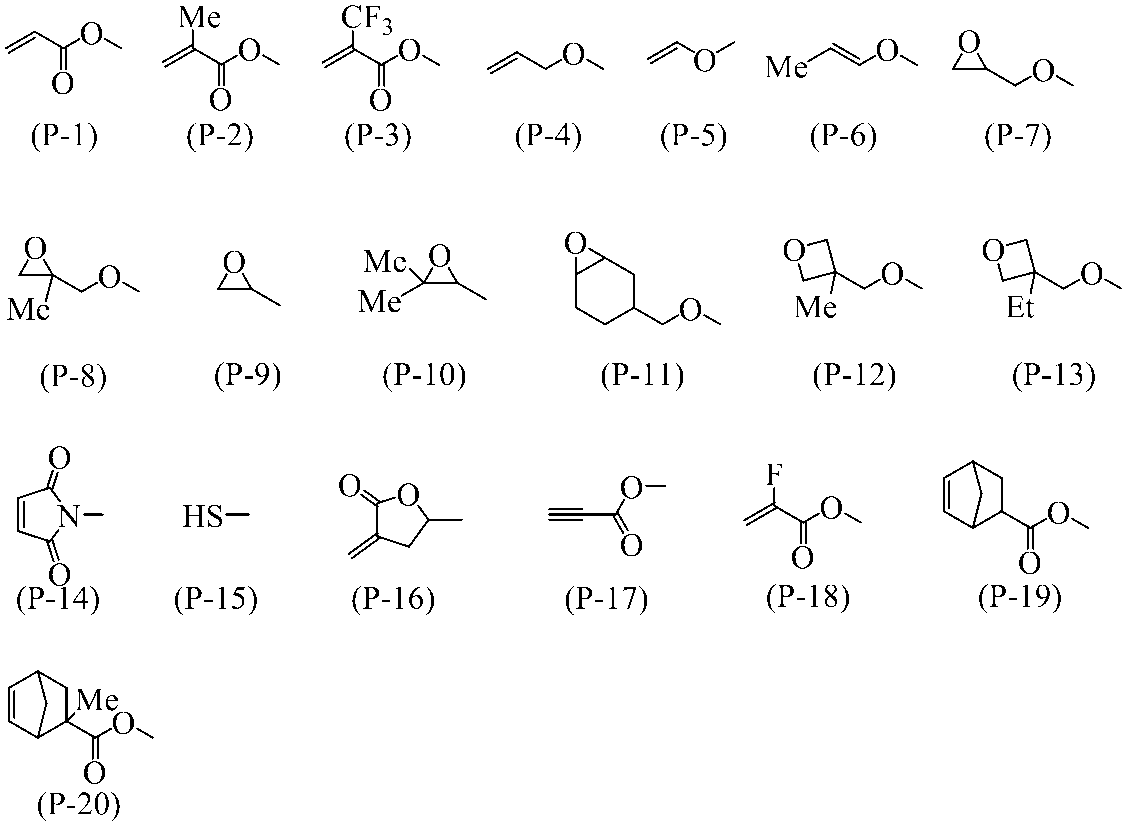
から選ばれる基を表すことが好ましく、これらの重合性基はラジカル重合、ラジカル付加重合、カチオン重合及びアニオン重合により重合する。特に重合方法として紫外線重合を行う場合には、式(P-1)、式(P-2)、式(P-3)、式(P-4)、式(P-5)、式(P-7)、式(P-11)、式(P-13)、式(P-15)又は式(P-18)が好ましく、式(P-1)、式(P-2)、式(P-7)、式(P-11)又は式(P-13)がより好ましく、式(P-1)、式(P-2)又は式(P-3)がさらに好ましく、式(P-1)又は式(P-2)が特に好ましい。
一般式(II-1)においてkは、0から10の整数を表すが、0から5の整数を表すことが好ましく、0から2の整数を表すことがより好ましく、1を表すことが特に好ましい。
一般式(II-1)においてSp21はスペーサー基又は単結合を表すが、Sp21が複数存在する場合それらは同一であっても異なっていても良い。また、当該スペーサー基は無置換であっても、1つ以上の下記に示す置換基L1によって置換されていても良い。スペーサー基としては、1個の-CH2-又は隣接していない2個以上の-CH2-が各々独立して-O-、-COO-、-OCO-、-OCO-O-、-CO-NH-、-NH-CO-、-CH=CH-又は-C≡C-に置き換えられても良い炭素原子数1から20のアルキレン基を表すことが好ましい。Sp21は原料の入手容易さ及び合成の容易さの観点から複数存在する場合は各々同一であっても異なっていても良く、各々独立して、1個の-CH2-又は隣接していない2個以上の-CH2-が各々独立して-O-、-COO-、-OCO-に置き換えられても良い炭素原子数1から14のアルキレン基又は単結合を表すことがより好ましく、炭素原子数1から14のアルキレン基又は単結合を表すことがさらに好ましく、配向性の観点から炭素原子数2から14のアルキレン基を表すことがより好ましく、炭素原子数4から12のアルキレン基を表すことがさらにより好ましく、炭素原子数6から10のアルキレン基を表すことが特に好ましい。
一般式(II-1)においてX21は-O-、-S-、-OCH2-、-CH2O-、-CO-、-COO-、-OCO-、-CO-S-、-S-CO-、-O-CO-O-、-CO-NH-、-NH-CO-、-SCH2-、-CH2S-、-CF2O-、-OCF2-、-CF2S-、-SCF2-、-CH=CH-COO-、-CH=CH-OCO-、-COO-CH=CH-、-OCO-CH=CH-、-COO-CH2CH2-、-OCO-CH2CH2-、-CH2CH2-COO-、-CH2CH2-OCO-、-COO-CH2-、-OCO-CH2-、-CH2-COO-、-CH2-OCO-、-CH=CH-、-N=N-、-CH=N-N=CH-、-CF=CF-、-C≡C-又は単結合を表すが、X21が複数存在する場合それらは同一であっても異なっていても良い(ただし、P21-(Sp21-X21)k-にはヘテロ原子同士の直接結合を含まない。なお本発明においてヘテロ原子とは炭素原子及び水素原子以外の原子を意図し、ヘテロ原子同士の直接結合とは、例えば-O-O-結合等を意図する。)。また、X21は、原料の入手容易さ及び合成の容易さの観点から、複数存在する場合は各々同一であっても異なっていても良く、各々独立して-O-、-S-、-OCH2-、-CH2O-、-COO-、-OCO-、-CO-S-、-S-CO-、-O-CO-O-、-CO-NH-、-NH-CO-、-COO-CH2CH2-、-OCO-CH2CH2-、-CH2CH2-COO-、-CH2CH2-OCO-又は単結合を表すことが好ましく、各々独立して-O-、-OCH2-、-CH2O-、-COO-、-OCO-、-COO-CH2CH2-、-OCO-CH2CH2-、-CH2CH2-COO-、-CH2CH2-OCO-又は単結合を表すことがより好ましく、-O-、-COO-、-OCO-又は単結合を表すことが特に好ましく、配向性の観点から-O-又は単結合を表すことがより特に好ましい。
一般式(II-1)においてA21は1,4-フェニレン基、1,4-シクロヘキシレン基、ピリジン-2,5-ジイル基、ピリミジン-2,5-ジイル基、ナフタレン-2,6-ジイル基、ナフタレン-1,4-ジイル基、テトラヒドロナフタレン-2,6-ジイル基、デカヒドロナフタレン-2,6-ジイル基又は1,3-ジオキサン-2,5-ジイル基を表すが、当該基は無置換であるか又は1つ以上の置換基L1によって置換されても良く、A21が複数存在する場合それらは同一であっても異なっていても良い。
置換基L1はフッ素原子、塩素原子、臭素原子、ヨウ素原子、ペンタフルオロスルフラニル基、ニトロ基、シアノ基、イソシアノ基、アミノ基、ヒドロキシル基、メルカプト基、メチルアミノ基、ジメチルアミノ基、ジエチルアミノ基、ジイソプロピルアミノ基、トリメチルシリル基、ジメチルシリル基、チオイソシアノ基又は炭素原子数1から20の直鎖状又は分岐状アルキル基を表すが、該アルキル基中、1個の-CH2-又は隣接していない2個以上の-CH2-が各々独立して-O-、-S-、-CO-、-COO-、-OCO-、-CO-S-、-S-CO-、-O-CO-O-、-CO-NH-、-NH-CO-、-OCO-NH-、-NH-COO-、-NH-CO-NH-、-NH-O-、-O-NH-、-CH=CH-COO-、-CH=CH-OCO-、-COO-CH=CH-、-OCO-CH=CH-、-CH=CH-、-N=N-、-CH=N-、-N=CH-、-CH=N-N=CH-、-CF=CF-又は-C≡C-によって置換されても良く、該アルキル基中の任意の水素原子がフッ素原子に置換されても良い。液晶性、合成の容易さ、ヘイズ及びムラの観点から、L1はフッ素原子、塩素原子、ペンタフルオロスルフラニル基、ニトロ基、シアノ基、メチルアミノ基、ジメチルアミノ基、ジエチルアミノ基、ジイソプロピルアミノ基、又は、任意の水素原子はフッ素原子に置換されても良く、1個の-CH2-又は隣接していない2個以上の-CH2-は各々独立して-O-、-S-、-CO-、-COO-、-OCO-、-O-CO-O-、-CH=CH-、-CF=CF-又は-C≡C-から選択される基によって置換されても良い炭素原子数1から20の直鎖状又は分岐状アルキル基を表すことが好ましく、フッ素原子、塩素原子、シアノ基、又は、任意の水素原子はフッ素原子に置換されても良く、1個の-CH2-又は隣接していない2個以上の-CH2-は各々独立して-O-、-COO-又は-OCO-から選択される基によって置換されても良い炭素原子数1から12の直鎖状又は分岐状アルキル基を表すことが好ましく、フッ素原子、塩素原子、シアノ基、又は、任意の水素原子はフッ素原子に置換されても良い炭素原子数1から12の直鎖状又は分岐状アルキル基若しくはアルコキシ基を表すことがより好ましく、フッ素原子、塩素原子、シアノ基、炭素原子数2から8の直鎖状アルコキシ基を表すことがさらに好ましく、フッ素原子、炭素原子数2から8の直鎖状アルコキシ基を表すことがさらにより好ましく、フッ素原子を表すことが特に好ましい。
原料の入手容易さ及び合成の容易さ、保存安定性、ヘイズ、ムラの観点から、A21は無置換であるか又は1つ以上の置換基L1によって置換されても良い1,4-フェニレン基、1,4-シクロヘキシレン基、ナフタレン-2,6-ジイル基を表すことが好ましく、各々独立して下記の式(A1-1)から式(A1-11)
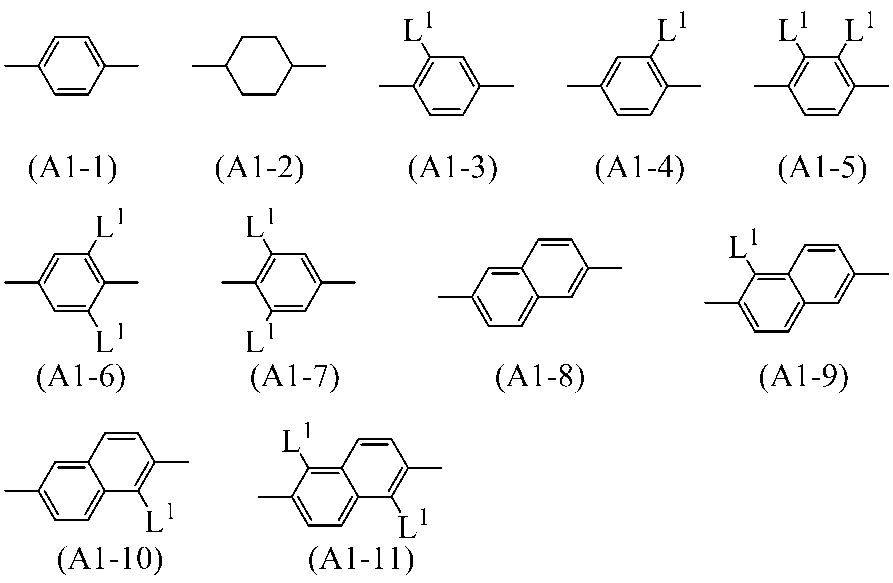
(式中、L1は、以前に定義した基と同一の基を表し、L1が複数存在する場合それらは同一であっても異なっていても良い。)から選ばれる基を表すことがより好ましく、各々独立して式(A1-1)から式(A1-8)から選ばれる基を表すことがさらに好ましく、各々独立して式(A1-1)から式(A1-4)から選ばれる基を表すことが特に好ましい。
一般式(II-1)においてZ21は-O-、-S-、-OCH2-、-CH2O-、-CH2CH2-、-CO-、-COO-、-OCO-、-CO-S-、-S-CO-、-O-CO-O-、-CO-NH-、-NH-CO-、-OCO-NH-、-NH-COO-、-NH-CO-NH-、-NH-O-、-O-NH-、-SCH2-、-CH2S-、-CF2O-、-OCF2-、-CF2S-、-SCF2-、-CH=CH-COO-、-CH=CH-OCO-、-COO-CH=CH-、-OCO-CH=CH-、-COO-CH2CH2-、-OCO-CH2CH2-、-CH2CH2-COO-、-CH2CH2-OCO-、-COO-CH2-、-OCO-CH2-、-CH2-COO-、-CH2-OCO-、-CH=CH-、-N=N-、-CH=N-、-N=CH-、-CH=N-N=CH-、-CF=CF-、-C≡C-又は単結合を表すが、Z21が複数存在する場合それらは同一であっても異なっていても良い。化合物の液晶性、原料の入手容易さ及び合成の容易さ、保存安定性、ヘイズ、ムラの観点からZ21は-OCH2-、-CH2O-、-COO-、-OCO-、-CF2O-、-OCF2-、-CH2CH2-、-CF2CF2-、-CH=CH-COO-、-CH=CH-OCO-、-COO-CH=CH-、-OCO-CH=CH-、-COO-CH2CH2-、-OCO-CH2CH2-、-CH2CH2-COO-、-CH2CH2-OCO-、-CH=CH-、-CF=CF-、-C≡C-又は単結合を表すことが好ましく、-OCH2-、-CH2O-、-CH2CH2-、-COO-、-OCO-、-COO-CH2CH2-、-OCO-CH2CH2-、-CH2CH2-COO-、-CH2CH2-OCO-、-CH=CH-、-C≡C-又は単結合を表すことがより好ましく、-CH2CH2-、-COO-、-OCO-、-COO-CH2CH2-、-OCO-CH2CH2-、-CH2CH2-COO-、-CH2CH2-OCO-又は単結合を表すことがさらに好ましく、各々独立して-COO-、-OCO-又は単結合を表すことが特に好ましい。なお、A22に直接連結するZ21は単結合を表し、mが2から4の整数を表す場合のその他のZ21は-COO-、-OCO-を表すことがその他の重合性液晶化合物との相溶性の観点から好ましい。
一般式(II-1)においてmは1から5の整数を表すが、液晶性、原料の入手容易さ及び合成の容易さの観点からmは1から4の整数を表すことが好ましく、1から3の整数を表すことがより好ましく、その他の重合性液晶化合物との相溶性の観点から1又は2を表すことがさらに好ましく、2を表すことが特に好ましい。
一般式(II-1)において末端環構造A22は下記の式(A2-1)から式(A2-9)
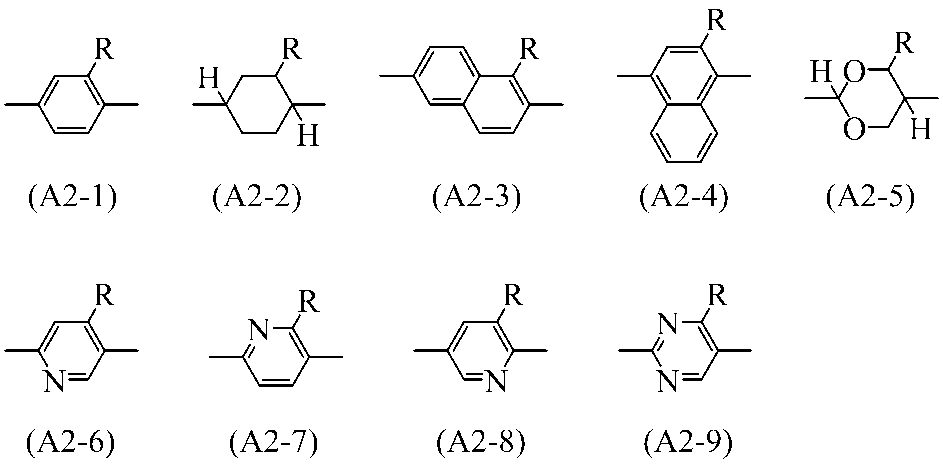
(式(A2-1)から式(A2-9)で表される基は無置換又は1つ以上の置換基L2によって置換されても良く、
Rはフッ素原子、塩素原子、臭素原子、ヨウ素原子、ペンタフルオロスルフラニル基、シアノ基、ニトロ基、イソシアノ基、チオイソシアノ基、又は炭素原子数2から20の直鎖状又は分岐状アルキル基を表すが、該アルキル基中1個の-CH2-又は隣接していない2個以上の-CH2-が各々独立して-O-、-S-、-CO-、-COO-、-OCO-、-CO-S-、-S-CO-、-O-CO-O-、-CO-NH-、-NH-CO-、-OCO-NH-、-NH-COO-、-NH-CO-NH-、-NH-O-、-O-NH-、-CH=CH-COO-、-CH=CH-OCO-、-COO-CH=CH-、-OCO-CH=CH-、-CH=CH-、-N=N-、-CH=N-、-N=CH-、-CH=N-N=CH-、-CF=CF-又は-C≡C-によって置換されても良く、該アルキル基中の任意の水素原子がフッ素原子に置換されても良く、
L2はフッ素原子、塩素原子、臭素原子、ヨウ素原子、ペンタフルオロスルフラニル基、ニトロ基、シアノ基、イソシアノ基、アミノ基、ヒドロキシル基、メルカプト基、メチルアミノ基、ジメチルアミノ基、ジエチルアミノ基、ジイソプロピルアミノ基、トリメチルシリル基、ジメチルシリル基、チオイソシアノ基又は炭素原子数2から20の直鎖状又は分岐状アルキル基を表すが、該アルキル基中、1個の-CH2-又は隣接していない2個以上の-CH2-が各々独立して-O-、-S-、-CO-、-COO-、-OCO-、-CO-S-、-S-CO-、-O-CO-O-、-CO-NH-、-NH-CO-、-OCO-NH-、-NH-COO-、-NH-CO-NH-、-NH-O-、-O-NH-、-CH=CH-COO-、-CH=CH-OCO-、-COO-CH=CH-、-OCO-CH=CH-、-CH=CH-、-N=N-、-CH=N-、-N=CH-、-CH=N-N=CH-、-CF=CF-又は-C≡C-によって置換されても良く、該アルキル基中の任意の水素原子がフッ素原子に置換されても良く、化合物内にL2が複数存在する場合それらは同一であっても異なっていても良い。)から選ばれる基を表す。原料の入手容易さ及び合成の容易さの観点からA22は下記の式(A2-1-1)から式(A2-1-3)
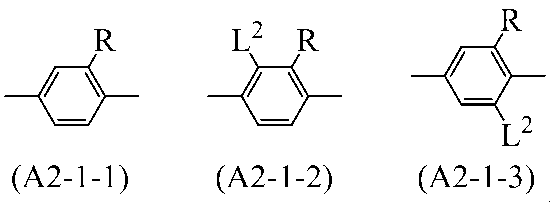
、下記の式(A2-2-1)又は式(A2-2-2)
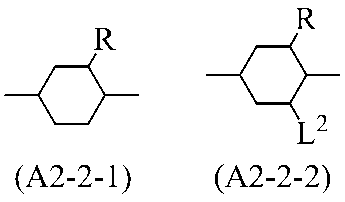
、下記の式(A2-3-1)から式(A2-3-3)

、下記の式(A2-4-1)から式(A2-4-3)
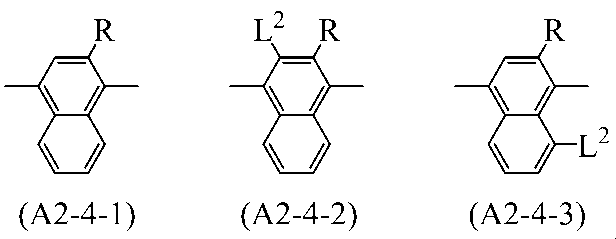
から選ばれる基を表すことがより好ましく、上記の式(A2-1-1)、式(A2-1-2)、式(A2-1-3)、式(A2-2-1)、式(A2-2-2)、式(A2-3-1)、式(A2-3-2)から選ばれる基を表すことがさらに好ましく、上記の式(A2-1-1)、式(A2-1-2)、式(A2-1-3)、式(A2-2-2)から選ばれる基を表すことがさらにより好ましく、上記の式(A2-1-3)、式(A2-2-2)で表される基を表すことが特に好ましく、式(A2-1-3)で表される基を表すことがより特に好ましい。
Rは液晶性、原料の入手容易さ及び合成の容易さ、保存安定性、ヘイズ、ムラの観点から、フッ素原子、塩素原子、シアノ基、ニトロ基、又は炭素原子数2から20の直鎖状又は分岐状アルキル基を表すことが好ましいが、該アルキル基中、1個の-CH2-又は隣接していない2個以上の-CH2-が各々独立して-O-、-CO-、-COO-、-OCO-、-O-CO-O-、-CH=CH-、-CF=CF-又は-C≡C-によって置換されても良く、該アルキル基中の任意の水素原子がフッ素原子に置換されても良く、フッ素原子、塩素原子、シアノ基、又は炭素原子数2から10の直鎖状アルキル基を表すことがより好ましいが、該アルキル基中、1個の-CH2-又は隣接していない2個以上の-CH2-が各々独立して-O-、-CO-、-COO-、-OCO-、-O-CO-O-によって置換されても良く、該アルキル基中の任意の水素原子がフッ素原子に置換されても良く、フッ素原子、塩素原子、シアノ基、又は炭素原子数2から8の直鎖状アルコキシ基を表すことがさらに好ましく、フッ素原子、又は炭素原子数2から8の直鎖状アルコキシ基を表すことがさらにより好ましく、フッ素原子を表すことが特に好ましい。
ホメオトロピック配向処理を行っていない基材に対して本願発明の化合物を含む組成物を塗布し、ホメオトロピック配向を有するフィルムを作製する場合、ホメオトロピック配向性の観点から、Rは孤立電子を有する基、分極性を有する基であることが好ましい。
L2は、液晶性、合成の容易さ、ヘイズ及びムラの観点から、フッ素原子、塩素原子、ペンタフルオロスルフラニル基、ニトロ基、シアノ基、メチルアミノ基、ジメチルアミノ基、ジエチルアミノ基、ジイソプロピルアミノ基、又は、任意の水素原子はフッ素原子に置換されても良く、1個の-CH2-又は隣接していない2個以上の-CH2-は各々独立して-O-、-S-、-CO-、-COO-、-OCO-、-O-CO-O-、-CH=CH-、-CF=CF-又は-C≡C-から選択される基によって置換されても良い炭素原子数2から20の直鎖状又は分岐状アルキル基を表すことが好ましく、フッ素原子、塩素原子、シアノ基、又は、任意の水素原子はフッ素原子に置換されても良く、1個の-CH2-又は隣接していない2個以上の-CH2-は各々独立して-O-、-COO-又は-OCO-から選択される基によって置換されても良い炭素原子数2から12の直鎖状又は分岐状アルキル基を表すことが好ましく、フッ素原子、塩素原子、シアノ基、又は、任意の水素原子はフッ素原子に置換されても良い炭素原子数2から12の直鎖状又は分岐状アルキル基若しくはアルコキシ基を表すことがより好ましく、フッ素原子、塩素原子、シアノ基、炭素原子数2から8の直鎖状アルコキシ基を表すことがさらに好ましく、フッ素原子、炭素原子数2から8の直鎖状アルコキシ基を表すことがさらにより好ましく、フッ素原子を表すことが特に好ましい。
また、上記の式(A2-1-3)で表される基において、R及びL2が同一の基を表すことが特に好ましい。さらに、ホメオトロピック配向性の観点から、R及びL2がフッ素原子、塩素原子、シアノ基、又は炭素原子数2から8の直鎖状アルコキシ基を表すことが好ましく、R及びL2がフッ素原子又は炭素原子数2から8の直鎖状アルコキシ基を表すことがより好ましく、R及びL2がフッ素原子を表すことが特に好ましい。
上記ホメオトロピック配向を促進する重合性液晶化合物は、1種又は2種以上用いることができるが、1種~5種が好ましく、1種~4種がより好ましい。
ホメオトロピック配向を促進する重合性液晶化合物の合計含有量は、重合性液晶組成物に用いる重合性液晶化合物の合計量のうち、5~60質量%含有することが好ましく、10~55質量%含有することがより好ましく、20~50質量%含有することが特に好ましく、20~40質量%含有することが最も好ましい。得られる塗膜のホメオトロピック配向性を重視する場合には下限値を10質量%以上にすることが好ましく、20質量%以上にすることがより好ましく、得られる塗膜の硬化性を重視する場合には上限値を60質量%以下とすることが好ましく、40質量%以下とすることがより好ましい。 一般式(II-1)で表される化合物として具体的には、下記の式(II-1-1)から式(II-1-58)で表される化合物が好ましい。


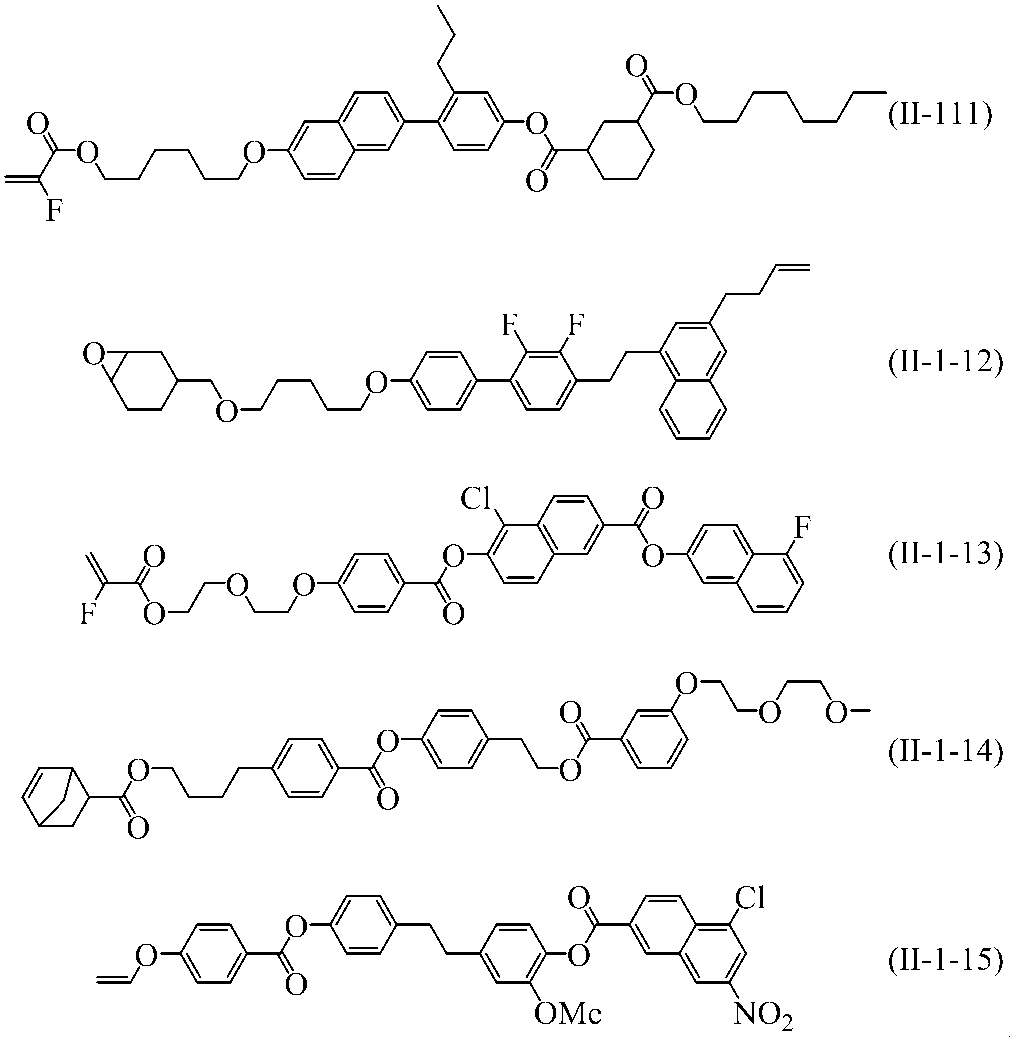
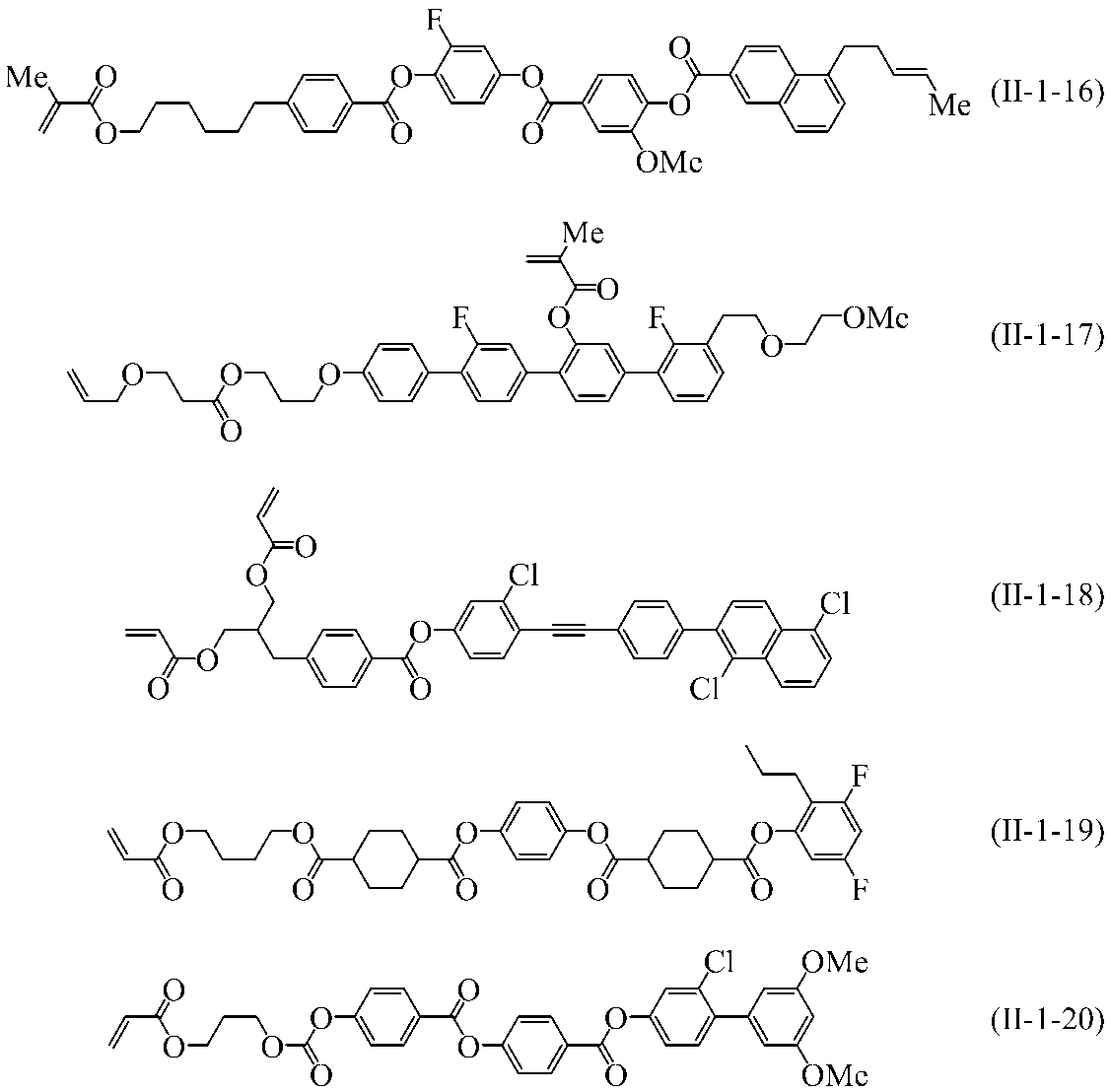
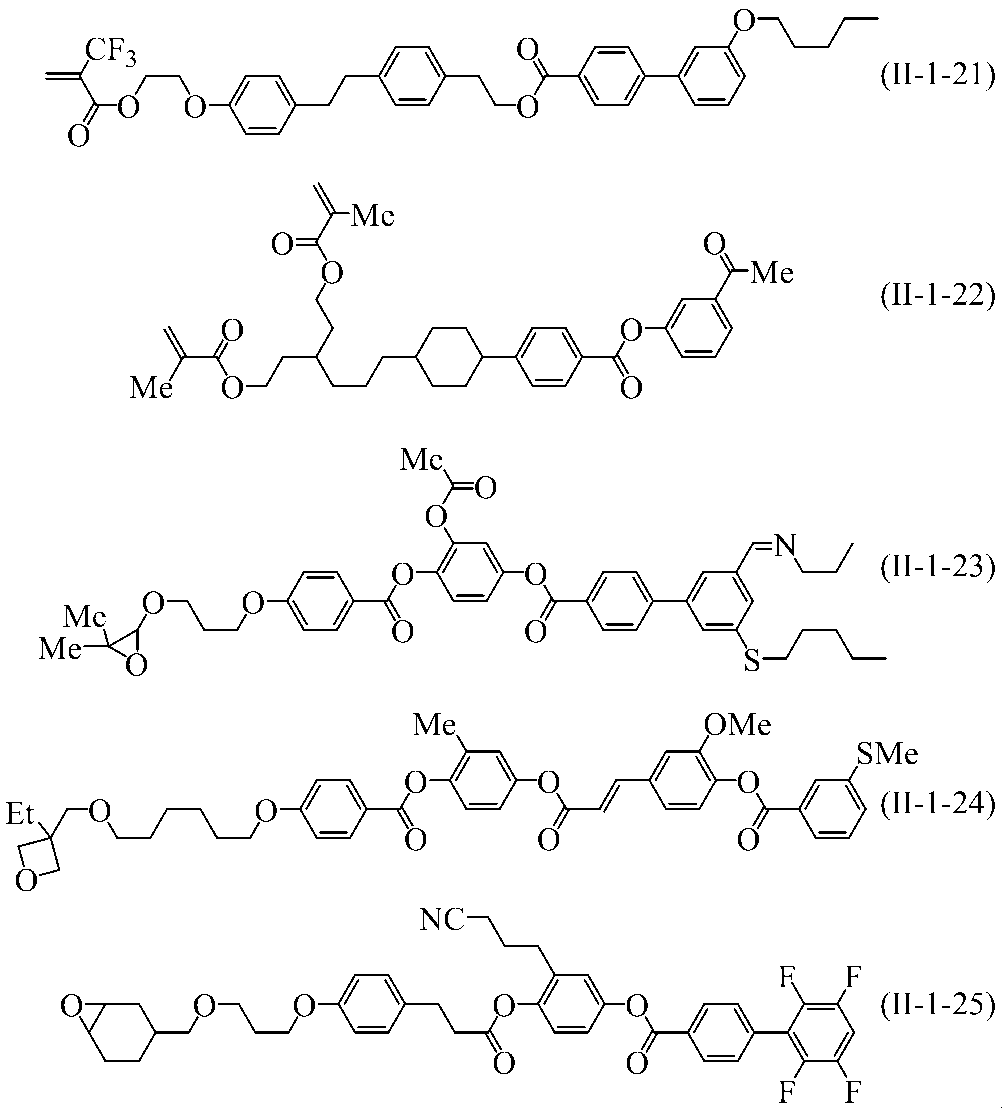
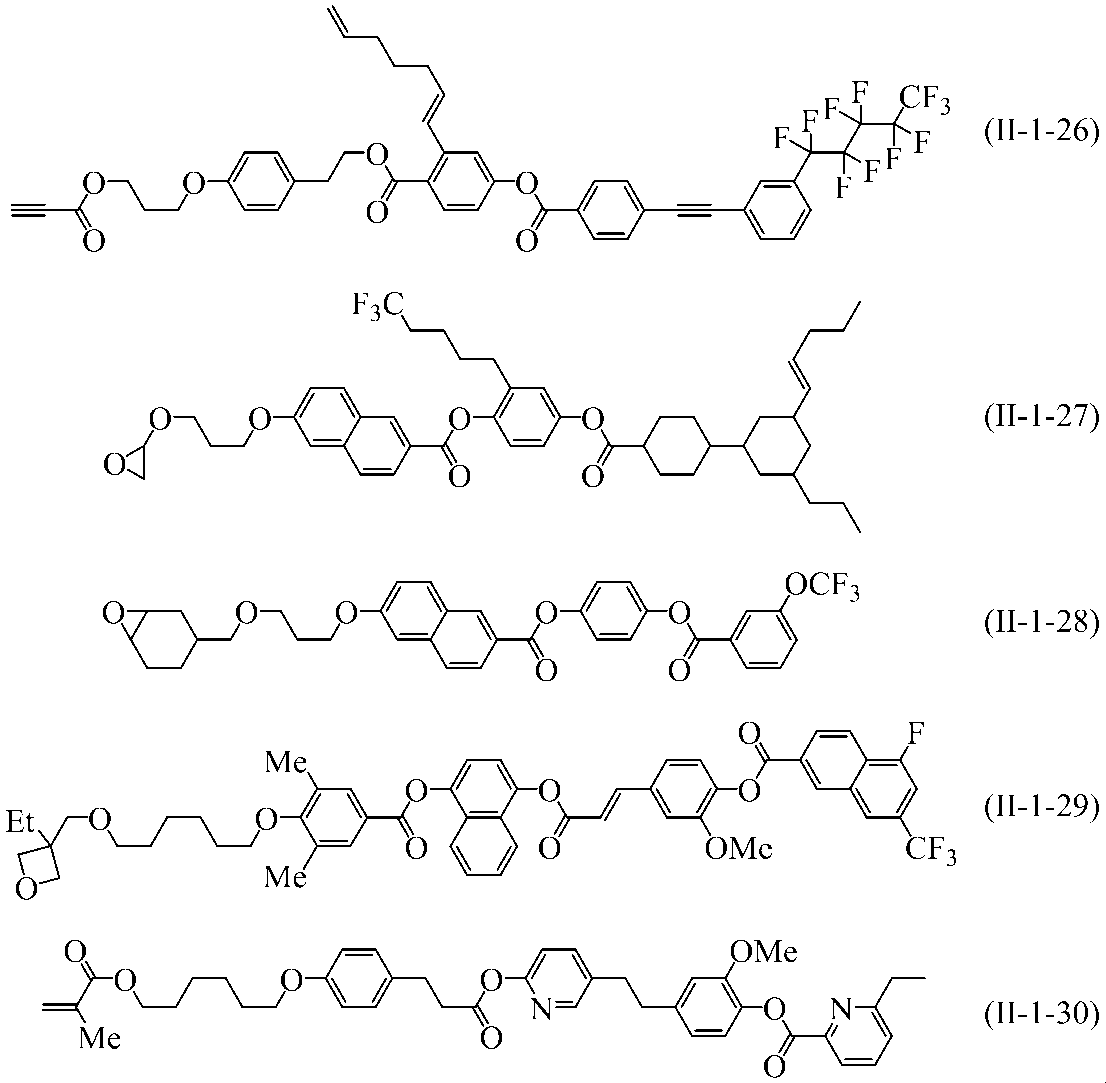

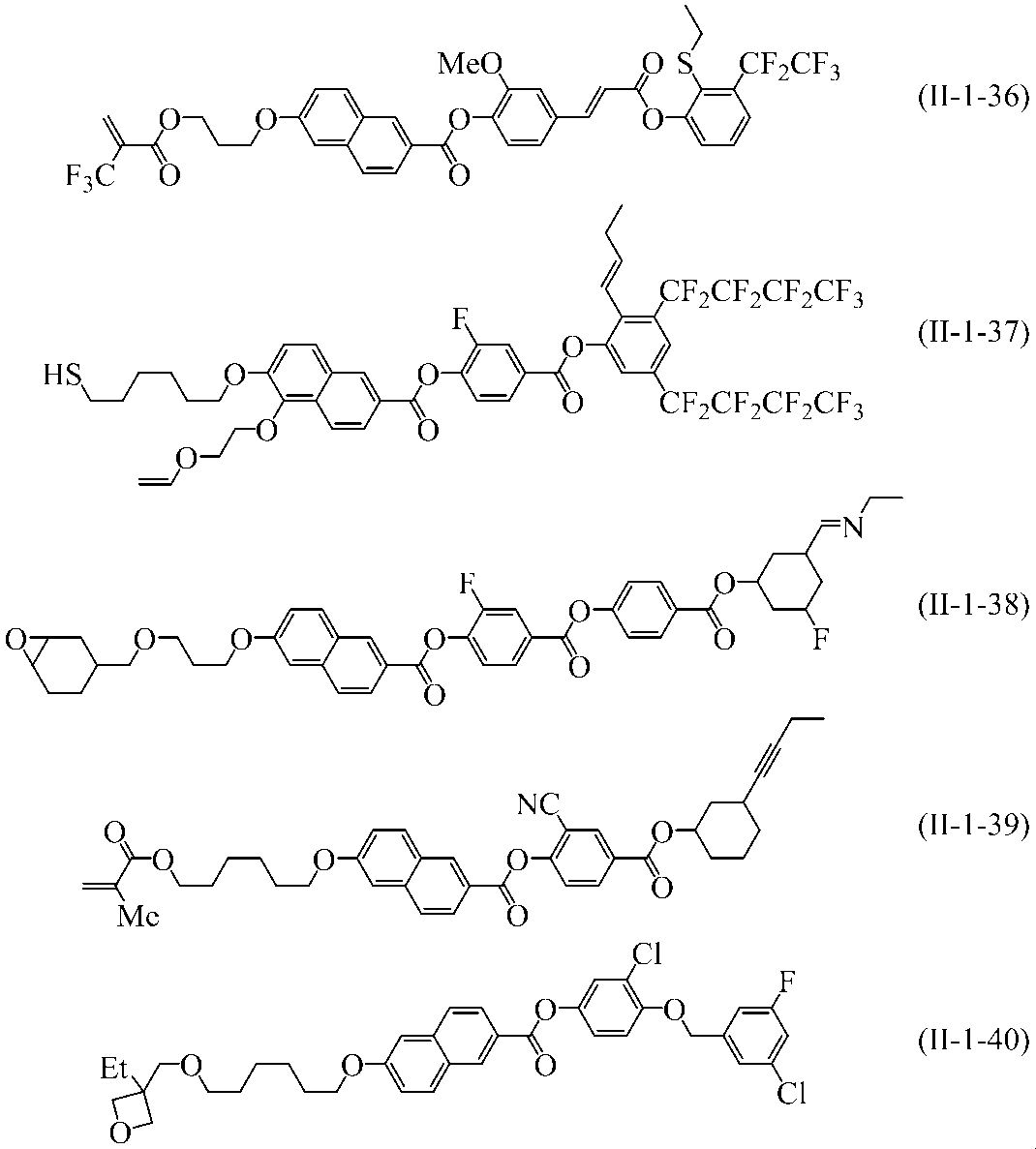


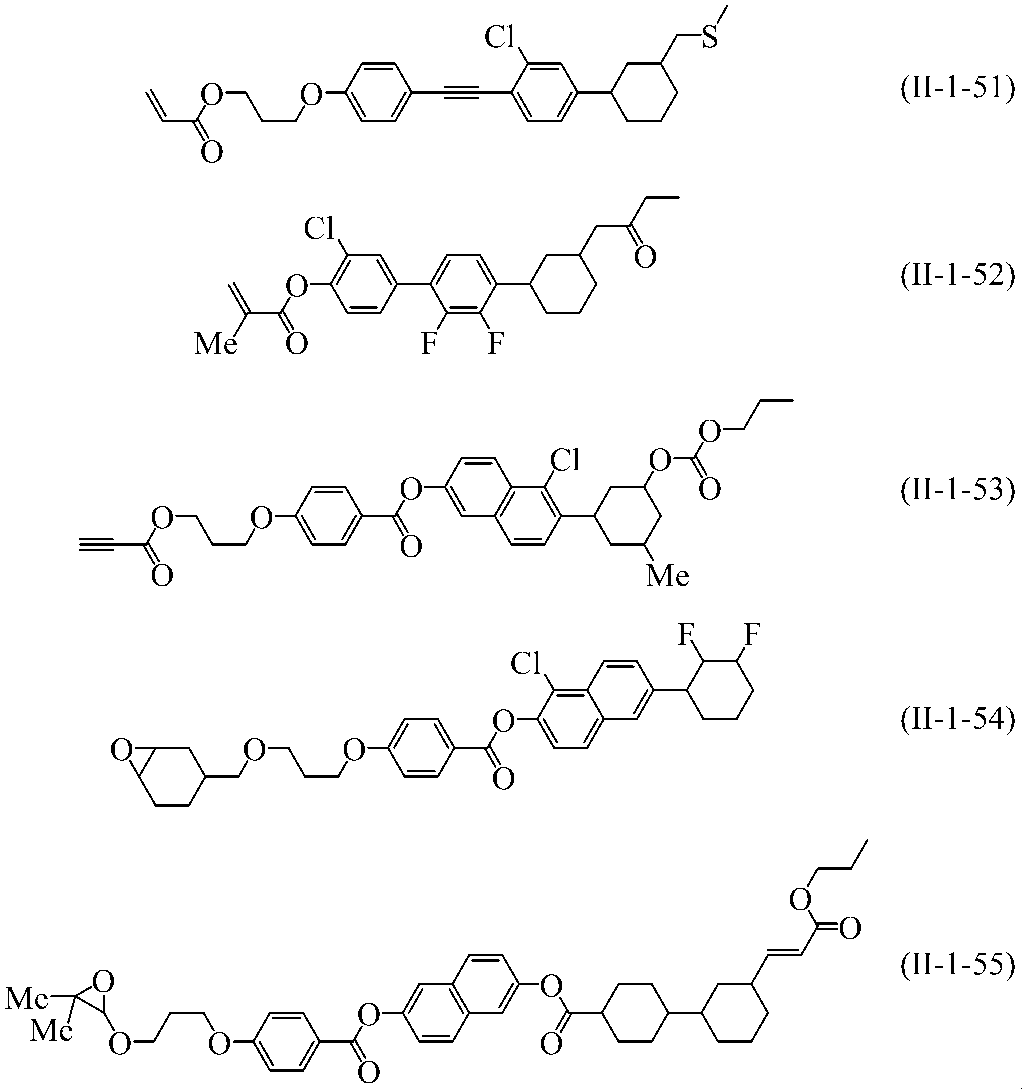
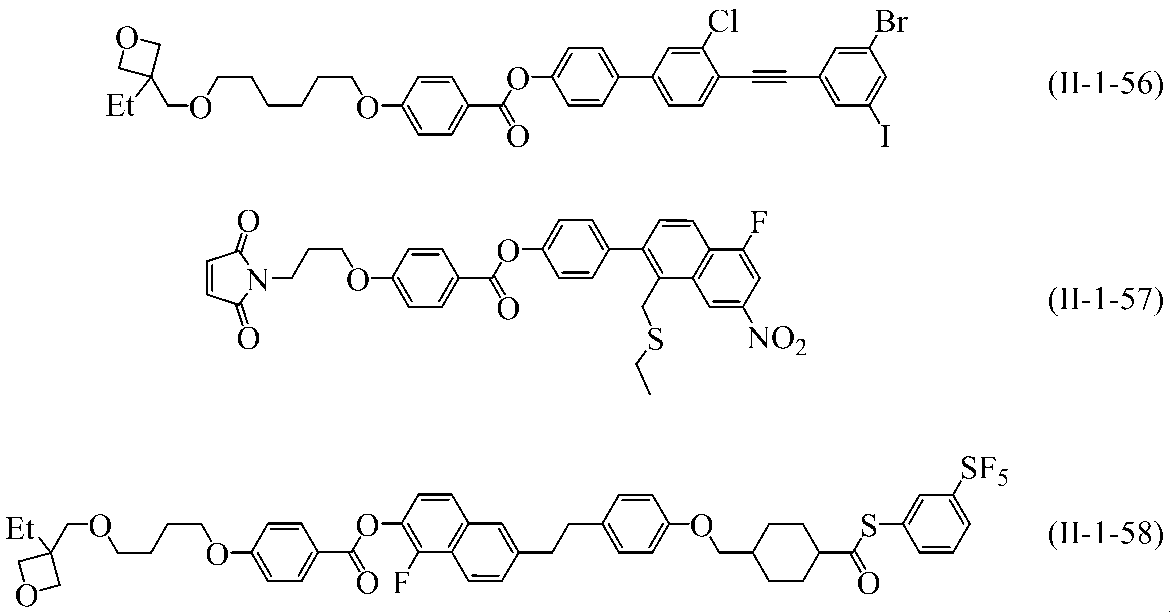
本願発明の化合物は以下の製法で製造することができる。
(製法1)下記式(S-6)で表される化合物の製造
(製法1)下記式(S-6)で表される化合物の製造
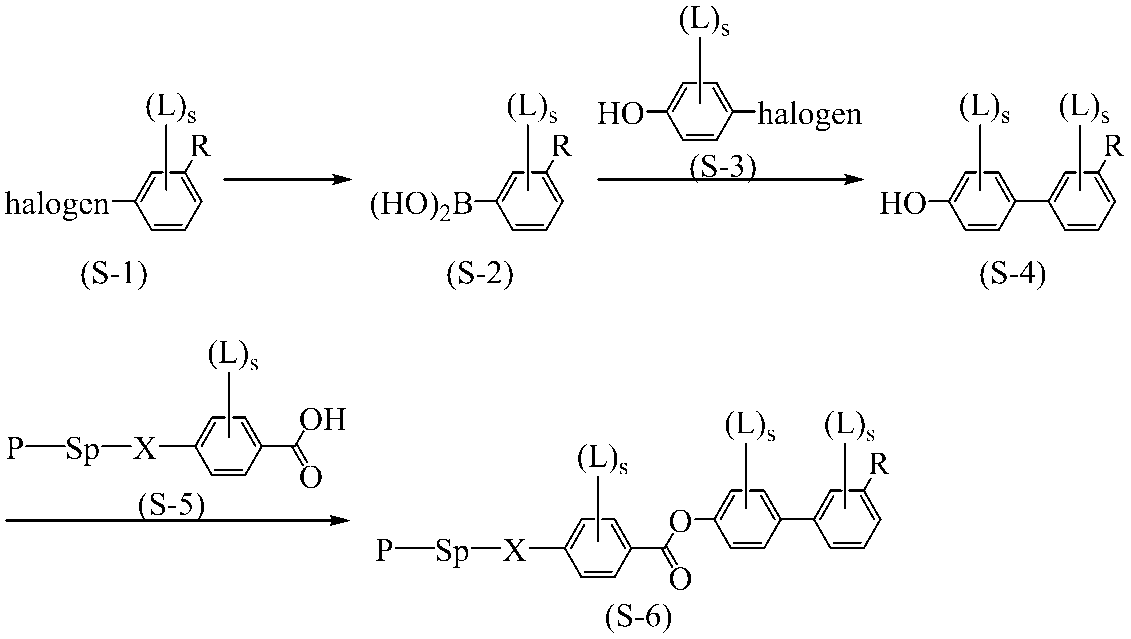
(式中、P、Sp、X、L、Rは各々独立して一般式(I)で定義されたものと同一のものを表し、sは各々独立して0から4の整数を表し、halogenはハロゲン原子又はハロゲン等価体を表す。)
式(S-1)で表される化合物をホウ酸化する。ホウ酸化の方法としては、式(S-1)で表される化合物をマグネシウムと反応させグリニャール試薬を調製し、ホウ酸エステルと反応させた後、加水分解する方法、式(S-1)で表される化合物をリチオ化し、ホウ酸エステルと反応させた後、加水分解する方法等が挙げられる。ホウ酸エステルとしては、ホウ酸トリメチル、ホウ酸トリイソプロピル等が挙げられる。リチオ化剤としては、ブチルリチウム、sec-ブチルリチウム、tert-ブチルリチウム、リチウムジイソプロピルアミド等が挙げられる。
式(S-1)で表される化合物をホウ酸化する。ホウ酸化の方法としては、式(S-1)で表される化合物をマグネシウムと反応させグリニャール試薬を調製し、ホウ酸エステルと反応させた後、加水分解する方法、式(S-1)で表される化合物をリチオ化し、ホウ酸エステルと反応させた後、加水分解する方法等が挙げられる。ホウ酸エステルとしては、ホウ酸トリメチル、ホウ酸トリイソプロピル等が挙げられる。リチオ化剤としては、ブチルリチウム、sec-ブチルリチウム、tert-ブチルリチウム、リチウムジイソプロピルアミド等が挙げられる。
式(S-2)で表される化合物を式(S-3)で表される化合物と反応させることによって、式(S-4)で表される化合物を得ることができる。反応例として例えば金属触媒及び塩基存在下、クロスカップリングさせる方法が挙げられる。
式(S-4)で表される化合物を式(S-5)で表される化合物と反応させることによって、式(S-6)で表される化合物を得ることができる。反応条件としては例えば縮合剤を用いる方法若しくは式(S-5)で表される化合物を酸クロリド、混合酸無水物又はカルボン酸無水物とした後、一般式(S-4)で表される化合物と塩基存在下反応させる方法が挙げられる。縮合剤を用いる場合、縮合剤として例えばN,N’-ジシクロヘキシルカルボジイミド、N,N’-ジイソプロピルカルボジイミド、1-エチル-3-(3-ジメチルアミノプロピル)カルボジイミド塩酸塩が挙げられる。塩基としては例えばトリエチルアミン、ジイソプロピルエチルアミン等が挙げられる。
(製法2)下記式(S-18)で表される化合物の製造
(製法2)下記式(S-18)で表される化合物の製造
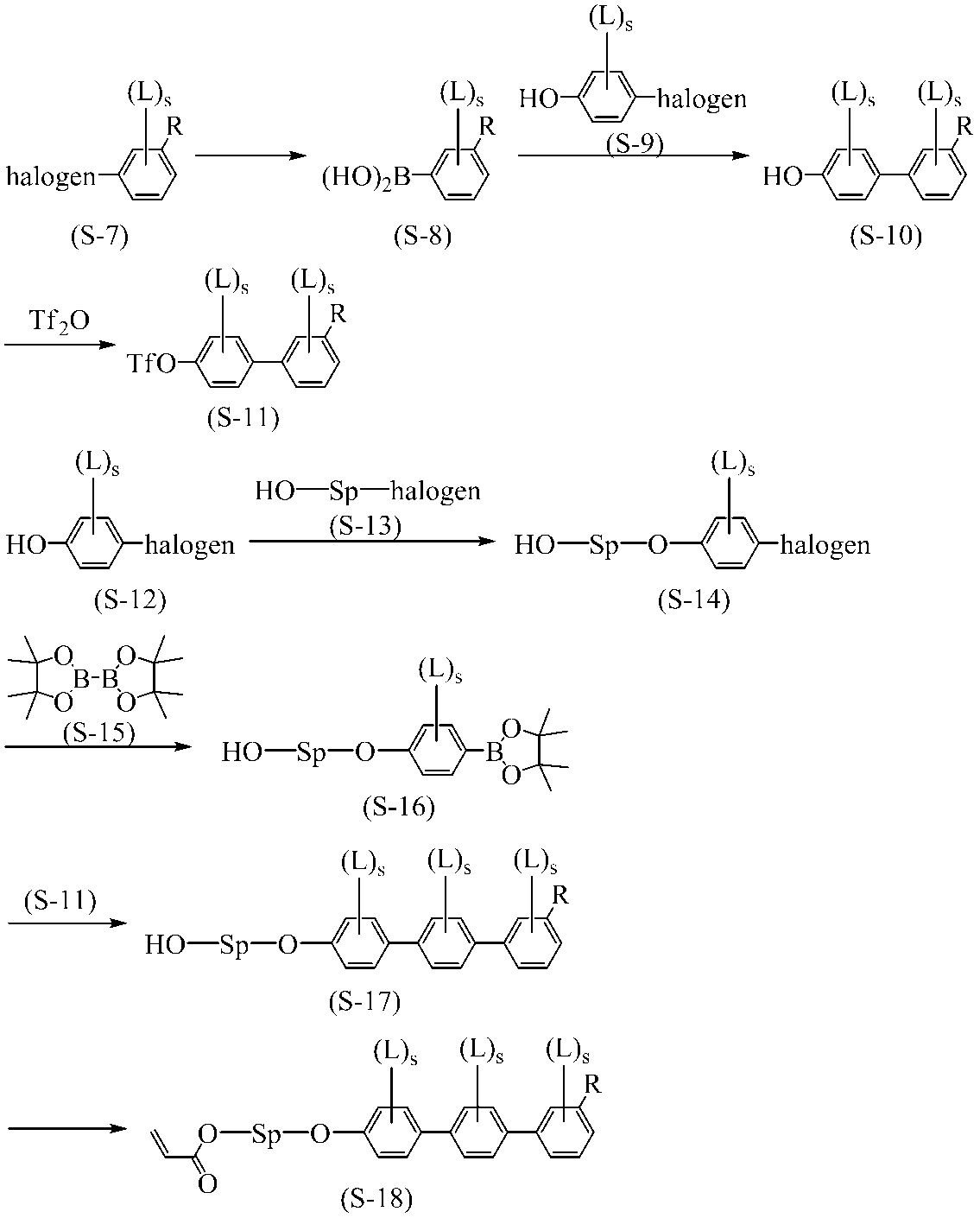
(式中、Sp、L、Rは各々独立して一般式(I)で定義されたものと同一のものを表し、sは各々独立して0から4の整数を表し、halogenはハロゲン原子又はハロゲン等価体を表す。)
製法1と同様の方法によって式(S-10)で表される化合物を得る。式(S-10)で表される化合物を塩基存在下、トリフルオロメタンスルホン酸無水物と反応させることによって式(S-11)で表される化合物を得る。塩基としては例えば、ピリジン、トリメチルアミン等が挙げられる。
製法1と同様の方法によって式(S-10)で表される化合物を得る。式(S-10)で表される化合物を塩基存在下、トリフルオロメタンスルホン酸無水物と反応させることによって式(S-11)で表される化合物を得る。塩基としては例えば、ピリジン、トリメチルアミン等が挙げられる。
式(S-12)で表される化合物を塩基存在下、式(S-13)で表される化合物と反応させることによって式(S-14)で表される化合物を得る。塩基としては例えば、炭酸カリウム、炭酸セシウム等が挙げられる。
式(S-14)で表される化合物をパラジウム触媒及び塩基存在下式(S-15)で表される化合物と反応させることによって式(S-16)で表される化合物を得る。
式(S-16)で表される化合物を式(S-11)で表される化合物と反応させることによって、式(S-17)で表される化合物を得ることができる。反応例として例えば金属触媒及び塩基存在下、クロスカップリングさせる方法が挙げられる。触媒、塩基、条件としては製法1に記載のものが挙げられる。
式(S-17)で表される化合物をアクリル化することによって式(S-18)で表される化合物を得る。
(製法3)下記式(S-24)で表される化合物の製造
(製法3)下記式(S-24)で表される化合物の製造
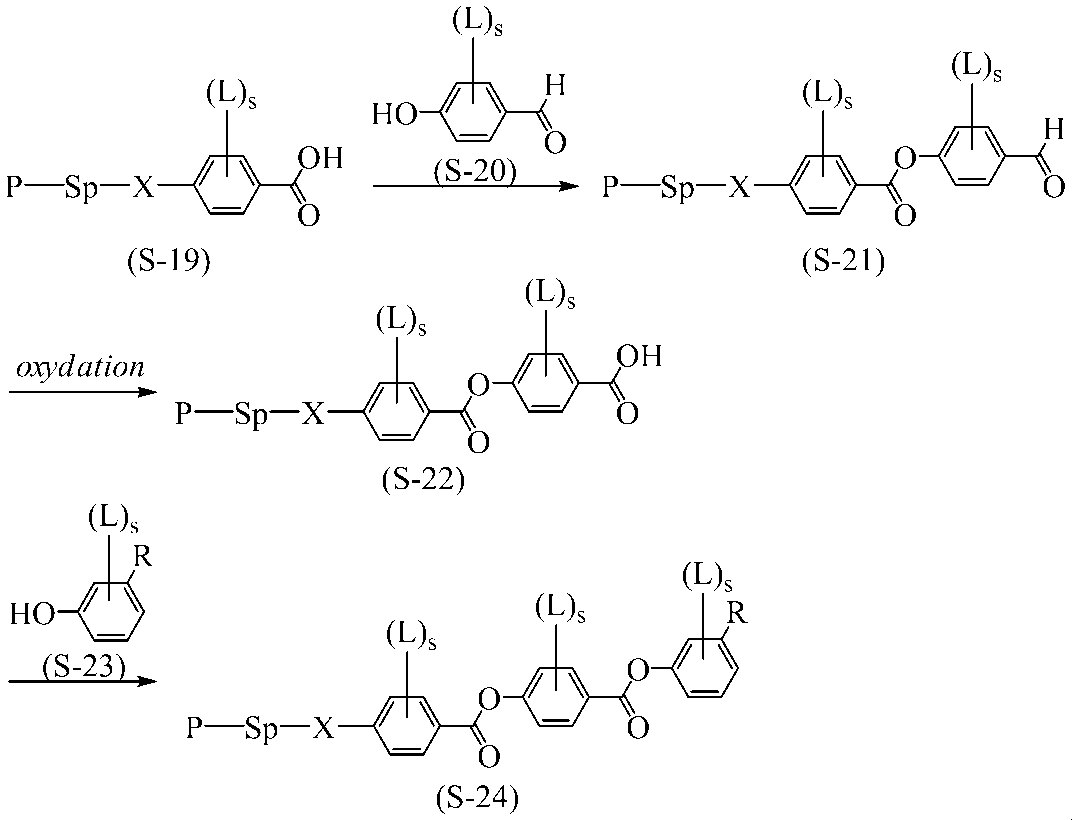
(式中、P、Sp、X、L、Rは各々独立して一般式(I)で定義されたものと同一のものを表し、sは各々独立して0から4の整数を表し、halogenはハロゲン原子又はハロゲン等価体を表す。)
式(S-19)で表される化合物を式(S-20)と反応させることによって式(S-21)で表される化合物を得る。反応条件としては例えば縮合剤を用いる方法若しくは式(S-19)で表される化合物を酸クロリド、混合酸無水物又はカルボン酸無水物とした後、一般式(S-20)で表される化合物と塩基存在下反応させる方法が挙げられる。縮合剤及び塩基としては製法1に記載のものが挙げられる。
式(S-19)で表される化合物を式(S-20)と反応させることによって式(S-21)で表される化合物を得る。反応条件としては例えば縮合剤を用いる方法若しくは式(S-19)で表される化合物を酸クロリド、混合酸無水物又はカルボン酸無水物とした後、一般式(S-20)で表される化合物と塩基存在下反応させる方法が挙げられる。縮合剤及び塩基としては製法1に記載のものが挙げられる。
式(S-21)で表される化合物を酸化することによって式(S-22)で表される化合物を得る。酸化の方法としては例えば、亜塩素酸ナトリウム及び過酸化水素を用いる方法が挙げられる。
式(S-22)で表される化合物を式(S-23)と反応させることによって式(S-24)で表される化合物を得る。反応条件としては例えば縮合剤を用いる方法若しくは式(S-22)で表される化合物を酸クロリド、混合酸無水物又はカルボン酸無水物とした後、一般式(S-23)で表される化合物と塩基存在下反応させる方法が挙げられる。縮合剤及び塩基としては製法1に記載のものが挙げられる。
(分子内に2個以上の重合性官能基を有する重合性液晶化合物)
本発明の重合性液晶組成物には、分子内に2個以上の重合性官能基を有する重合性液晶化合物を含有することが好ましい。前記一般式(II-1)で表されるホメオトロピック配向を促進する重合性液晶化合物と共に、分子内に2個以上の重合性官能基を有する重合性液晶化合物を併用した重合性液晶組成物を用いることにより、重合性液晶組成物を重合して得られる重合体を作製した際に耐久性に優れた均一なホメオトロピック配向した塗膜を得ることができる。前記分子内に2個以上の重合性官能基を有する重合性液晶化合物として具体的には、以下一般式(I-1)で表される化合物を挙げることができる。

式中、P11及びP12はそれぞれ独立して、重合性官能基を表し、Sp11及びSp12はそれぞれ独立して、炭素原子数1~18のアルキレン基又は単結合を表し、該アルキレン基中の1個の-CH2-又は隣接していない2個以上の-CH2-が各々独立して-O-、-COO-、-OCO-又は-OCO-O-によって置換されても良く、該アルキレン基の有する1個又は2個以上の水素原子は、ハロゲン原子(フッ素原子、塩素原子、臭素原子、ヨウ素原子)又はCN基によって置換されても良く、X11及びX12はそれぞれ独立して、-O-、-S-、-OCH2-、-CH2O-、-CO-、-COO-、-OCO-、-CO-S-、-S-CO-、-O-CO-O-、-CO-NH-、-NH-CO-、-SCH2-、-CH2S-、-CF2O-、-OCF2-、-CF2S-、-SCF2-、-CH=CH-COO-、-CH=CH-OCO-、-COO-CH=CH-、-OCO-CH=CH-、-COO-CH2CH2-、-OCO-CH2CH2-、-CH2CH2-COO-、-CH2CH2-OCO-、-COO-CH2-、-OCO-CH2-、-CH2-COO-、-CH2-OCO-、-CH=CH-、-N=N-、-CH=N-N=CH-、-CF=CF-、-C≡C-又は単結合を表し(ただし、P11-Sp11、P12-Sp12、Sp11-X11及びSp12-X12において、ヘテロ原子同士の直接結合を含まない。)、q1及びq2はそれぞれ独立して0又は1を表し、q3は1又は2を表し、MG12はメソゲン基を表す。
P11及びP12はそれぞれ独立して、下記式(P-2-1)から式(P-2-20)で表される重合性基から選ばれる置換基を表すのが好ましい。
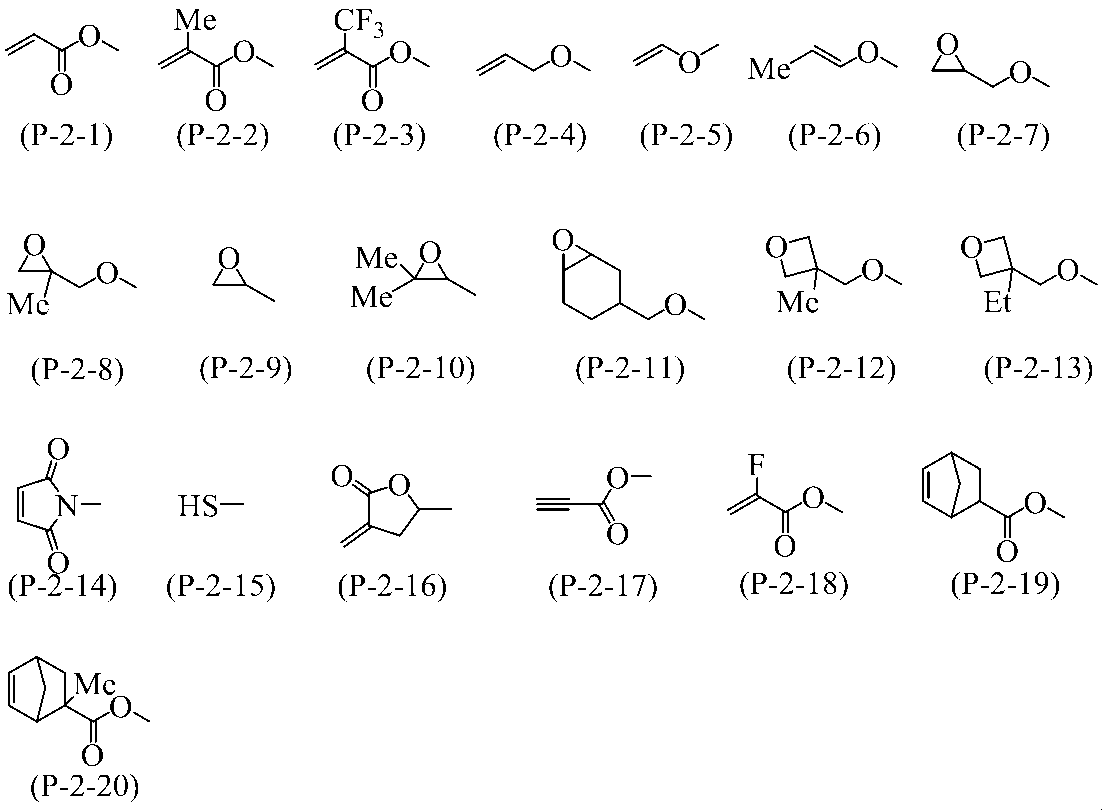
これらの重合性官能基のうち、重合性を高める観点から、式(P-2-1)、(P-2-2)、(P-2-7)、(P-2-12)、(P-2-13)が好ましく、式(P-2-1)、(P-2-2)がより好ましい。
MG12はメソゲン基を表し、一般式(I-b)

(式中、A1、A2及びA3はそれぞれ独立的に、1,4-フェニレン基、1,4-シクロヘキシレン基、1,4-シクロヘキセニル基、テトラヒドロピラン-2,5-ジイル基、1,3-ジオキサン-2,5-ジイル基、テトラヒドロチオピラン-2,5-ジイル基、1,4-ビシクロ(2,2,2)オクチレン基、デカヒドロナフタレン-2,6-ジイル基、ピリジン-2,5-ジイル基、ピリミジン-2,5-ジイル基、ピラジン-2,5-ジイル基、チオフェン-2,5-ジイル基-、1,2,3,4-テトラヒドロナフタレン-2,6-ジイル基、2,6-ナフチレン基、フェナントレン-2,7-ジイル基、9,10-ジヒドロフェナントレン-2,7-ジイル基、1,2,3,4,4a,9,10a-オクタヒドロフェナントレン-2,7-ジイル基、1,4-ナフチレン基、ベンゾ[1,2-b:4,5-b‘]ジチオフェン-2,6-ジイル基、ベンゾ[1,2-b:4,5-b‘]ジセレノフェン-2,6-ジイル基、[1]ベンゾチエノ[3,2-b]チオフェン-2,7-ジイル基、[1]ベンゾセレノフェノ[3,2-b]セレノフェン-2,7-ジイル基、又はフルオレン-2,7-ジイル基を表し、置換基として1個以上のF、Cl、CF3、OCF3、CN基、炭素原子数1~8のアルキル基、炭素原子数1~8のアルコキシ基、炭素原子数1~8のアルカノイル基、炭素原子数1~8のアルカノイルオキシ基、炭素原子数1~8のアルコキシカルボニル基、炭素原子数2~8のアルケニル基、炭素原子数2~8のアルケニルオキシ基、炭素原子数2~8のアルケノイル基、及び/又は、炭素原子数2~8のアルケノイルオキシ基を有していても良く、Z1及びZ2はそれぞれ独立して、-COO-、-OCO-、-CH2CH2-、-OCH2-、-CH2O-、-CH=CH-、-C≡C-、-CH=CHCOO-、-OCOCH=CH-、-CH2CH2COO-、-CH2CH2OCO-、-COOCH2CH2-、-OCOCH2CH2-、-C=N-、-N=C-、-CONH-、-NHCO-、-C(CF3)2-、ハロゲン原子(フッ素原子、塩素原子、臭素原子、ヨウ素原子)を有してもよい炭素原子数2~10のアルキル基又は単結合を表し、Z1及びZ2はそれぞれ独立して-COO-、-OCO-、-CH2CH2-、-OCH2-、-CH2O-、-CH=CH-、-C≡C-、-CH=CHCOO-、-OCOCH=CH-、-CH2CH2COO-、-CH2CH2OCO-、-COOCH2CH2-、-OCOCH2CH2-又は単結合であることが好ましく、-COO-、-OCO-、-OCH2-、-CH2O-、-CH2CH2O-、-CH2CH2OCO-、-COOCH2CH2-、-OCOCH2CH2-又は単結合であることがより好ましく、r1は0、1、2又は3を表し、A1、及びZ1が複数存在する場合は、それぞれ、同一であっても、異なっていても良いが、q3が2又は3を表す場合、A1、A2及びA3のいずれかに-(X12-Sp12)q2-P12基を1つ又は2つ有する。)で表される。このうち、A1、A2及びA3はそれぞれ独立的に、1,4-フェニレン基、1,4-シクロヘキシレン基、2,6-ナフチレン基を表すことが好ましい。
(2官能重合性液晶化合物)
分子内に2個以上の重合性官能基を有する上記一般式(I-1)で表される重合性液晶化合物としては、分子内に2個の重合性官能基を有する下記一般式(I-1-1)で表される2官能重合性液晶化合物を用いることが好ましい。
(2官能重合性液晶化合物)
分子内に2個以上の重合性官能基を有する上記一般式(I-1)で表される重合性液晶化合物としては、分子内に2個の重合性官能基を有する下記一般式(I-1-1)で表される2官能重合性液晶化合物を用いることが好ましい。

(式中、P11及びP12はそれぞれ独立して、重合性官能基を表し、Sp11及びSp12はそれぞれ独立して、炭素原子数1~18のアルキレン基又は単結合を表し、該アルキレン基中の1個の-CH2-又は隣接していない2個以上の-CH2-が各々独立して-O-、-COO-、-OCO-又は-OCO-O-によって置換されても良く、該アルキレン基の有する1個又は2個以上の水素原子は、ハロゲン原子(フッ素原子、塩素原子、臭素原子、ヨウ素原子)又はCN基によって置換されても良く、X11及びX12はそれぞれ独立して、-O-、-S-、-OCH2-、-CH2O-、-CO-、-COO-、-OCO-、-CO-S-、-S-CO-、-O-CO-O-、-CO-NH-、-NH-CO-、-SCH2-、-CH2S-、-CF2O-、-OCF2-、-CF2S-、-SCF2-、-CH=CH-COO-、-CH=CH-OCO-、-COO-CH=CH-、-OCO-CH=CH-、-COO-CH2CH2-、-OCO-CH2CH2-、-CH2CH2-COO-、-CH2CH2-OCO-、-COO-CH2-、-OCO-CH2-、-CH2-COO-、-CH2-OCO-、-CH=CH-、-N=N-、-CH=N-N=CH-、-CF=CF-、-C≡C-又は単結合を表し(ただし、P11-Sp11、P12-Sp12、Sp11-X11及びSp12-X12において、ヘテロ原子同士の直接結合を含まない。)、q1及びq2はそれぞれ独立して、0又は1を表し、MG12はメソゲン基を表す。)
ここで、P11及びP12はそれぞれ独立して、上述の式(P-2-1)から式(P-2-20)で表される重合性基から選ばれる置換基を表すのが好ましい。これらの重合性官能基のうち、重合性を高める観点から、式(P-2-1)、(P-2-2)、(P-2-7)、(P-2-12)、(P-2-13)が好ましく、式(P-2-1)、(P-2-2)がより好ましい。
ここで、P11及びP12はそれぞれ独立して、上述の式(P-2-1)から式(P-2-20)で表される重合性基から選ばれる置換基を表すのが好ましい。これらの重合性官能基のうち、重合性を高める観点から、式(P-2-1)、(P-2-2)、(P-2-7)、(P-2-12)、(P-2-13)が好ましく、式(P-2-1)、(P-2-2)がより好ましい。
また、Sp11及びSp12はそれぞれ独立して、炭素原子数1~15のアルキレン基を表すことが好ましく、該アルキレン基中の1個の-CH2-又は隣接していない2個以上の-CH2-が各々独立して-O-、-COO-、-OCO-又は-OCO-O-によって置換されても良く、該アルキレン基の有する1個又は2個以上の水素原子は、ハロゲン原子(フッ素原子、塩素原子、臭素原子、ヨウ素原子)又はCN基によって置換されても良く、Sp11及びSp12はそれぞれ独立して、炭素原子数1~12のアルキレン基を表すことがより好ましく、該アルキレン基中の1個の-CH2-又は隣接していない2個以上の-CH2-が各々独立して-O-、-COO-、-OCO-又は-OCO-O-によって置換されても良い。
X11及びX12はそれぞれ独立して、-O-、-OCH2-、-CH2O-、-CO-、-COO-、-OCO-、-O-CO-O-、-CO-NH-、-NH-CO-、-CF2O-、-OCF2-、-CH=CH-COO-、-CH=CH-OCO-、-COO-CH=CH-、-OCO-CH=CH-、-COO-CH2CH2-、-OCO-CH2CH2-、-CH2CH2-COO-、-CH2CH2-OCO-、-COO-CH2-、-OCO-CH2-、-CH2-COO-、-CH2-OCO-、-CH=CH-、-N=N-、-CH=N-N=CH-、-CF=CF-、-C≡C-又は単結合を表すことが好ましく、X11及びX12はそれぞれ独立して、-O-、-OCH2-、-CH2O-、-CO-、-COO-、-OCO-、-O-CO-O-、-CF2O-、-OCF2-、-CH=CH-COO-、-CH=CH-OCO-、-COO-CH=CH-、-OCO-CH=CH-、-COO-CH2CH2-、-OCO-CH2CH2-、-CH2CH2-COO-、-CH2CH2-OCO-、-COO-CH2-、-OCO-CH2-、-CH2-COO-、-CH2-OCO-、-CH=CH-、-CF=CF-、-C≡C-又は単結合を表すことがより好ましい。
MG12はメソゲン基を表し、一般式(I-1-b)
MG12はメソゲン基を表し、一般式(I-1-b)

式中、A1、A2及びA3はそれぞれ独立的に、1,4-フェニレン基、1,4-シクロヘキシレン基、1,4-シクロヘキセニル基、テトラヒドロピラン-2,5-ジイル基、1,3-ジオキサン-2,5-ジイル基、テトラヒドロチオピラン-2,5-ジイル基、1,4-ビシクロ(2,2,2)オクチレン基、デカヒドロナフタレン-2,6-ジイル基、ピリジン-2,5-ジイル基、ピリミジン-2,5-ジイル基、ピラジン-2,5-ジイル基、チオフェン-2,5-ジイル基-、1,2,3,4-テトラヒドロナフタレン-2,6-ジイル基、2,6-ナフチレン基、フェナントレン-2,7-ジイル基、9,10-ジヒドロフェナントレン-2,7-ジイル基、1,2,3,4,4a,9,10a-オクタヒドロフェナントレン-2,7-ジイル基、1,4-ナフチレン基、ベンゾ[1,2-b:4,5-b‘]ジチオフェン-2,6-ジイル基、ベンゾ[1,2-b:4,5-b‘]ジセレノフェン-2,6-ジイル基、[1]ベンゾチエノ[3,2-b]チオフェン-2,7-ジイル基、[1]ベンゾセレノフェノ[3,2-b]セレノフェン-2,7-ジイル基、又はフルオレン-2,7-ジイル基を表し、置換基として1個以上のF、Cl、CF3、OCF3、CN基、炭素原子数1~8のアルキル基、炭素原子数1~8のアルコキシ基、炭素原子数1~8のアルカノイル基、炭素原子数1~8のアルカノイルオキシ基、炭素原子数1~8のアルコキシカルボニル基、炭素原子数2~8のアルケニル基、炭素原子数2~8のアルケニルオキシ基、炭素原子数2~8のアルケノイル基、及び/又は、炭素原子数2~8のアルケノイルオキシ基を有していても良く、Z1及びZ2はそれぞれ独立して、-COO-、-OCO-、-CH2CH2-、-OCH2-、-CH2O-、-CH=CH-、-C≡C-、-CH=CHCOO-、-OCOCH=CH-、-CH2CH2COO-、-CH2CH2OCO-、-COOCH2CH2-、-OCOCH2CH2-、-C=N-、-N=C-、-CONH-、-NHCO-、-C(CF3)2-、ハロゲン原子(フッ素原子、塩素原子、臭素原子、ヨウ素原子)を有してもよい炭素原子数2~10のアルキル基又は単結合を表し、Z1及びZ2はそれぞれ独立して-COO-、-OCO-、-CH2CH2-、-OCH2-、-CH2O-、-CH=CH-、-C≡C-、-CH=CHCOO-、-OCOCH=CH-、-CH2CH2COO-、-CH2CH2OCO-、-COOCH2CH2-、-OCOCH2CH2-又は単結合であることが好ましく、-COO-、-OCO-、-OCH2-、-CH2O-、-CH2CH2O-、-CH2CH2OCO-、-COOCH2CH2-、-OCOCH2CH2-又は単結合であることがより好ましく、r1は0、1、2又は3を表し、A1、及びZ1が複数存在する場合は、それぞれ、同一であっても、異なっていても良い。このうち、A1、A2及びA3はそれぞれ独立的に、1,4-フェニレン基、1,4-シクロヘキシレン基、2,6-ナフチレン基を表すことが好ましい。
一般式(I-1-1)の例として、下記一般式(I-1-1-1)~(I-1-1-4)で表される化合物を挙げることができるが、下記の一般式に限定されるわけではない。
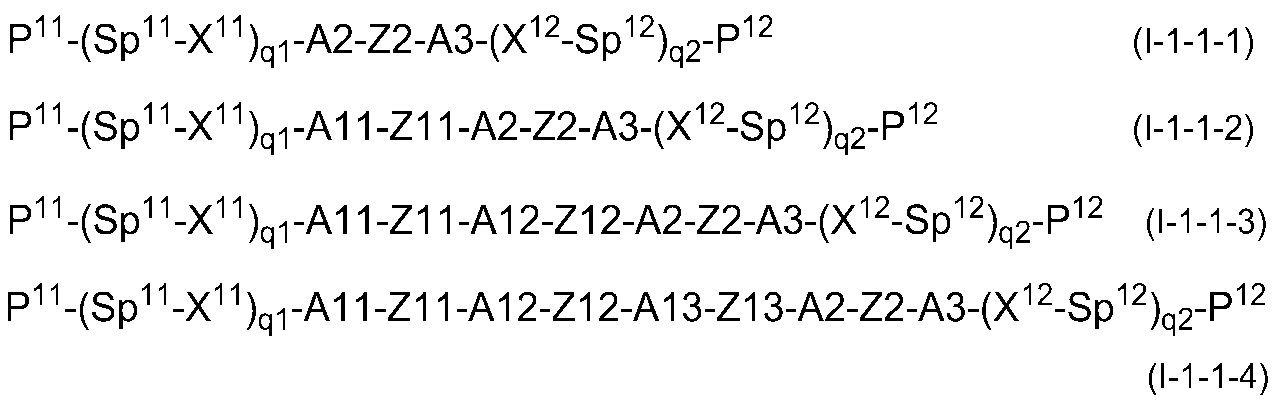
式中、P11、Sp11、X11、q1、X12、Sp12、q2、P12は、それぞれ、上記一般式(I-1-1)の定義と同じものを表し、
A11とA12とA13、A2、A3は、上記一般式(I-1-b)のA1~A3の定義と同じものを表し、それぞれ、同一であっても、異なっていても良く、
Z11とZ12とZ13、Z2は、それぞれ、上記一般式(I-1-b)のZ1、Z2の定義と同じものを表し、それぞれ、同一であっても、異なっていても良い。
A11とA12とA13、A2、A3は、上記一般式(I-1-b)のA1~A3の定義と同じものを表し、それぞれ、同一であっても、異なっていても良く、
Z11とZ12とZ13、Z2は、それぞれ、上記一般式(I-1-b)のZ1、Z2の定義と同じものを表し、それぞれ、同一であっても、異なっていても良い。
上記一般式(I-1-1-1)~(I-1-1-4)で表される化合物のうち、一般式(I-1-1-2)~(I-1-1-4)で表される、化合物中に3つ以上の環構造を有する化合物を用いると、得られる光学異方体の配向性が良好となるため好ましく、化合物中に3つの環構造を有する一般式(I-1-1-2)で表される化合物を用いることが特に好ましい。
上記一般式(I-1-1-1)~(I-1-1-4)で表される化合物としては、以下の一般式(I-1-1-1-1)~(I-1-1-1-21)で表される化合物を例示されるが、これらに限定される訳ではない。
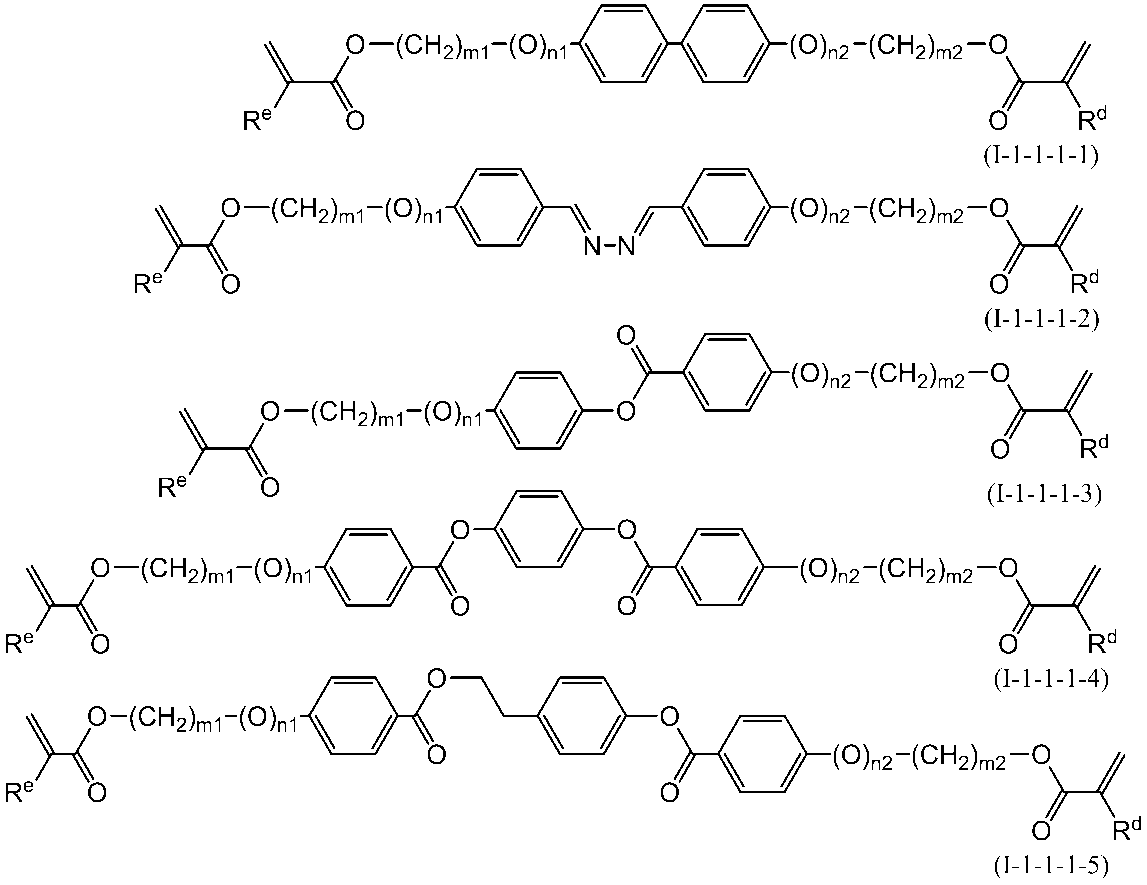
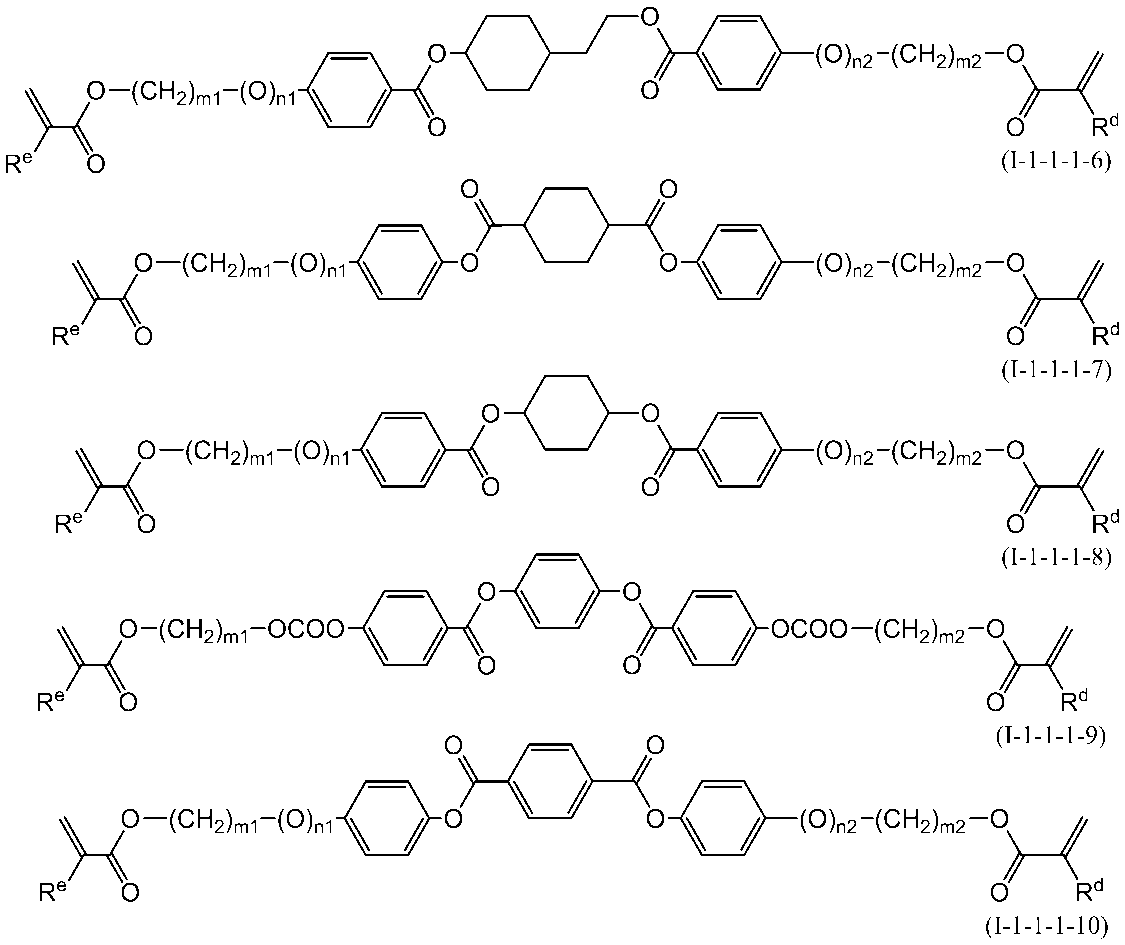
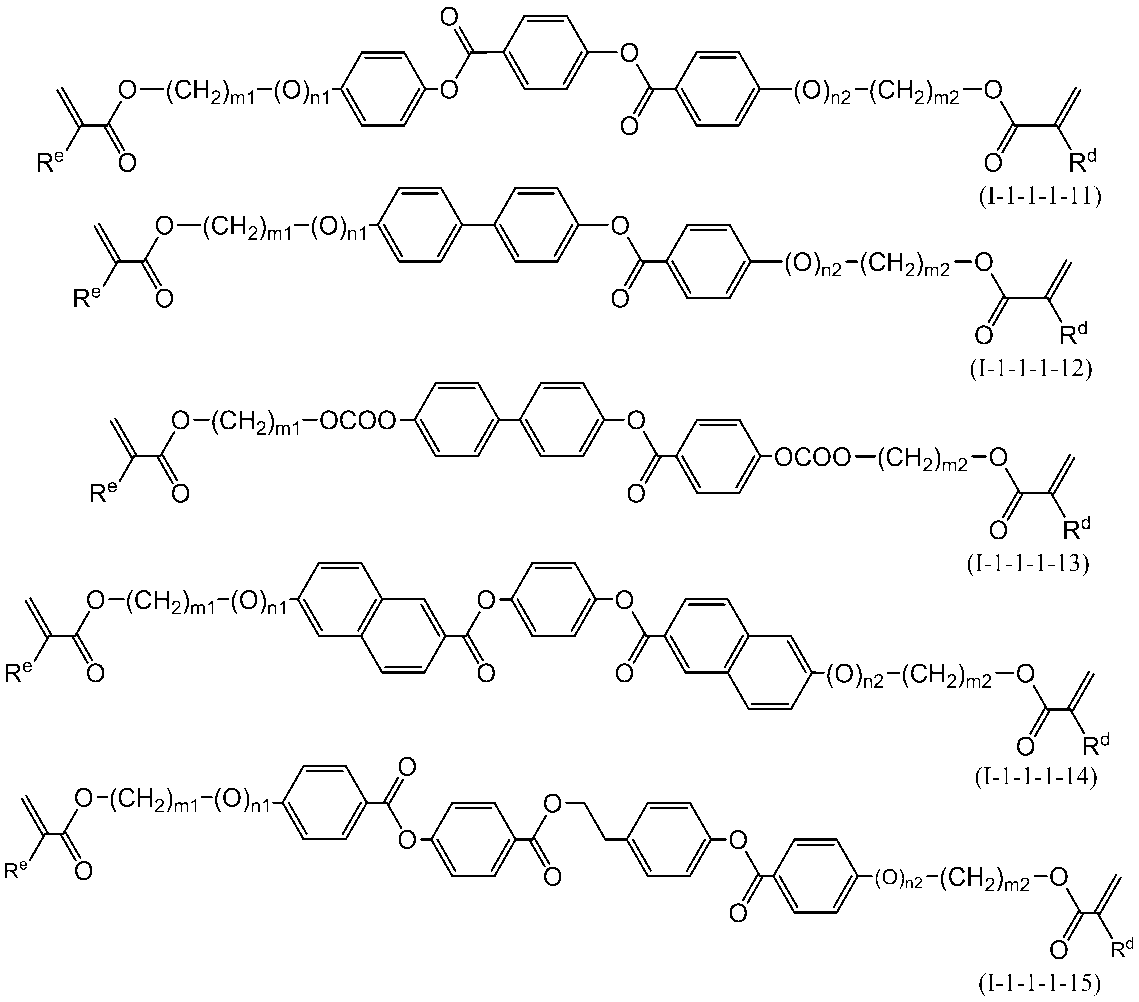
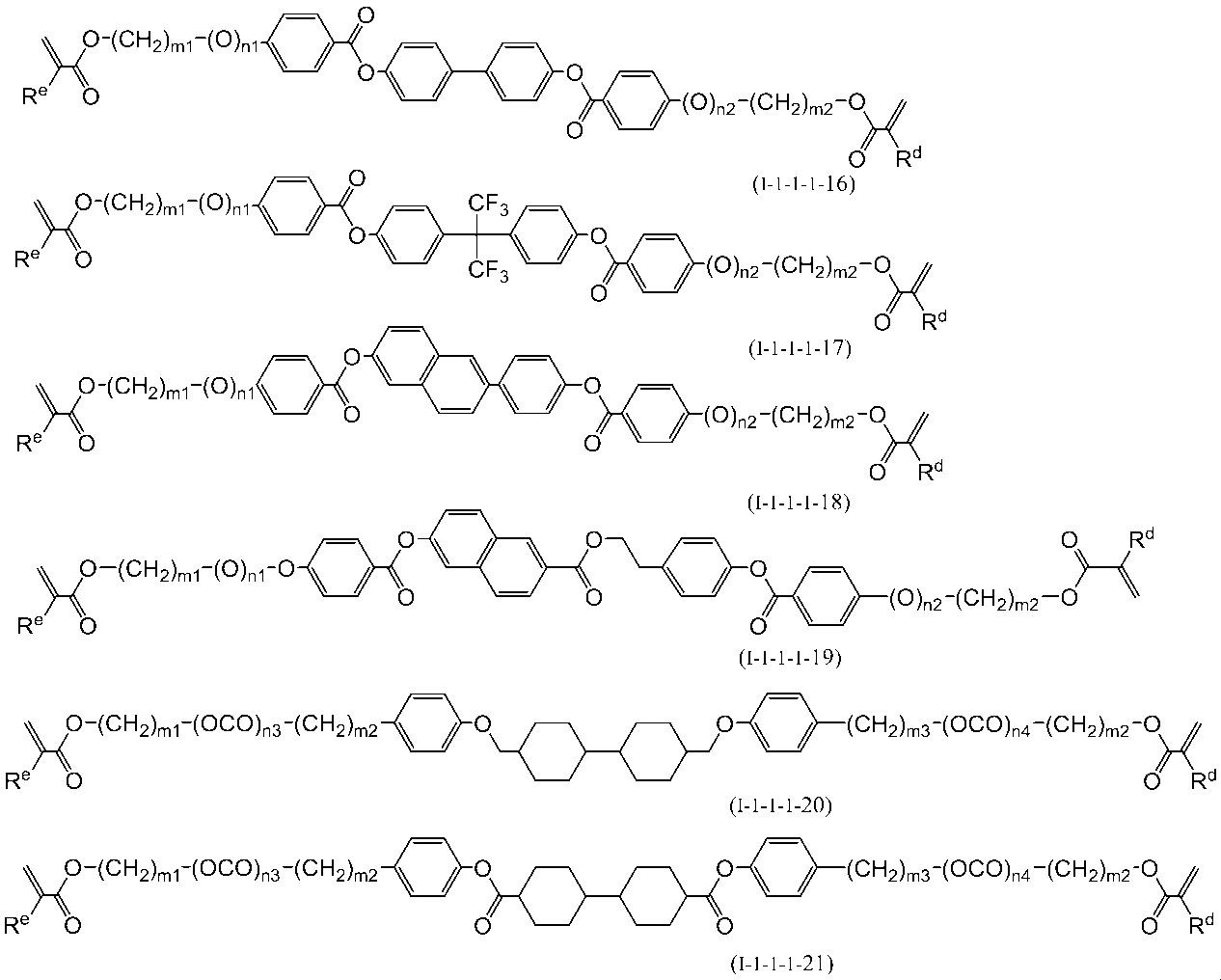
式中、Rd及びReは、それぞれ独立して水素原子又はメチル基を表し、
上記環状基は、置換基として1個以上のF、Cl、CF3、OCF3、CN基、炭素原子数1~8のアルキル基、炭素原子数1~8のアルコキシ基、炭素原子数1~8のアルカノイル基、炭素原子数1~8のアルカノイルオキシ基、炭素原子数1~8のアルコキシカルボニル基、炭素原子数2~8のアルケニル基、炭素原子数2~8のアルケニルオキシ基、炭素原子数2~8のアルケノイル基、炭素原子数2~8のアルケノイルオキシ基を有していても良く、
m1、m2は、それぞれ独立して0~18の整数を表し、n1、n2、n3、n4はそれぞれ独立して0又は1を表す。
上記環状基は、置換基として1個以上のF、Cl、CF3、OCF3、CN基、炭素原子数1~8のアルキル基、炭素原子数1~8のアルコキシ基、炭素原子数1~8のアルカノイル基、炭素原子数1~8のアルカノイルオキシ基、炭素原子数1~8のアルコキシカルボニル基、炭素原子数2~8のアルケニル基、炭素原子数2~8のアルケニルオキシ基、炭素原子数2~8のアルケノイル基、炭素原子数2~8のアルケノイルオキシ基を有していても良く、
m1、m2は、それぞれ独立して0~18の整数を表し、n1、n2、n3、n4はそれぞれ独立して0又は1を表す。
2つの重合性官能基を有する液晶化合物は、1種又は2種以上用いることができるが、1種~5種が好ましく、2種~5種がより好ましい。
分子内に2個の重合性官能基を有する重合性液晶化合物の合計含有量は、上記一般式(II-1)で表される重合性液晶化合物を含めた重合性液晶組成物に用いる重合性液晶化合物の合計量のうち、10~90質量%含有することが好ましく、15~85質量%含有することがより好ましく20~80質量%含有することが特に好ましい。得られる塗膜の硬化性を重視する場合には下限値を30質量%以上にすることが好ましく、50質量%以上にすることがより好ましく、得られる塗膜の基材との密着性を重視する場合には上限値を85質量%以下とすることが好ましく、80質量%以下とすることがより好ましい。
(3官能重合性液晶化合物)
分子内に2個以上の重合性官能基を有する上記一般式(I-1)で表される重合性液晶化合物としては、分子内に3個の重合性官能基を有する下記一般式(I-1-2)で表される3官能重合性液晶化合物を用いることが好ましい。
(3官能重合性液晶化合物)
分子内に2個以上の重合性官能基を有する上記一般式(I-1)で表される重合性液晶化合物としては、分子内に3個の重合性官能基を有する下記一般式(I-1-2)で表される3官能重合性液晶化合物を用いることが好ましい。

(式中、P12~P13はそれぞれ独立して、重合性官能基を表し、Sp11~S13はそれぞれ独立して、炭素原子数1~18のアルキレン基又は単結合を表し、該アルキレン基中の1個の-CH2-又は隣接していない2個以上の-CH2-が各々独立して-O-、-COO-、-OCO-又は-OCO-O-によって置換されても良く、該アルキレン基の有する1個又は2個以上の水素原子は、ハロゲン原子(フッ素原子、塩素原子、臭素原子、ヨウ素原子)又はCN基によって置換されても良く、X11~X13はそれぞれ独立して、-O-、-S-、-OCH2-、-CH2O-、-CO-、-COO-、-OCO-、-CO-S-、-S-CO-、-O-CO-O-、-CO-NH-、-NH-CO-、-SCH2-、-CH2S-、-CF2O-、-OCF2-、-CF2S-、-SCF2-、-CH=CH-COO-、-CH=CH-OCO-、-COO-CH=CH-、-OCO-CH=CH-、-COO-CH2CH2-、-OCO-CH2CH2-、-CH2CH2-COO-、-CH2CH2-OCO-、-COO-CH2-、-OCO-CH2-、-CH2-COO-、-CH2-OCO-、-CH=CH-、-N=N-、-CH=N-N=CH-、-CF=CF-、-C≡C-又は単結合を表し(ただし、P11-Sp11、P12-Sp12、Sp11-X11、Sp12-X12、Sp13-X13、及びSp13-X13において、ヘテロ原子同士の直接結合を含まない。)、q1、q2、q4、及びq5はそれぞれ独立して、0又は1を表し、MG12はメソゲン基を表す。)
ここで、P12~P13はそれぞれ独立して、下記の式(P-2-1)から式(P-2-20)で表される重合性基から選ばれる置換基を表すのが好ましい。
ここで、P12~P13はそれぞれ独立して、下記の式(P-2-1)から式(P-2-20)で表される重合性基から選ばれる置換基を表すのが好ましい。

これらの重合性官能基のうち、重合性を高める観点から、式(P-2-1)、(P-2-2)、(P-2-7)、(P-2-12)、(P-2-13)が好ましく、式(P-2-1)、(P-2-2)がより好ましい。
また、Sp11~Sp13はそれぞれ独立して、炭素原子数1~15のアルキレン基を表すことが好ましく、該アルキレン基中の1個の-CH2-又は隣接していない2個以上の-CH2-が各々独立して-O-、-COO-、-OCO-又は-OCO-O-によって置換されても良く、該アルキレン基の有する1個又は2個以上の水素原子は、ハロゲン原子(フッ素原子、塩素原子、臭素原子、ヨウ素原子)又はCN基によって置換されても良く、Sp11~Sp13はそれぞれ独立して、炭素原子数1~12のアルキレン基を表すことがより好ましく、該アルキレン基中の1個の-CH2-又は隣接していない2個以上の-CH2-が各々独立して-O-、-COO-、-OCO-又は-OCO-O-によって置換されても良い。X11~X13はそれぞれ独立して、-O-、-OCH2-、-CH2O-、-CO-、-COO-、-OCO-、-O-CO-O-、-CO-NH-、-NH-CO-、-CF2O-、-OCF2-、-CH=CH-COO-、-CH=CH-OCO-、-COO-CH=CH-、-OCO-CH=CH-、-COO-CH2CH2-、-OCO-CH2CH2-、-CH2CH2-COO-、-CH2CH2-OCO-、-COO-CH2-、-OCO-CH2-、-CH2-COO-、-CH2-OCO-、-CH=CH-、-N=N-、-CH=N-N=CH-、-CF=CF-、-C≡C-又は単結合を表すことが好ましく、X11~X13はそれぞれ独立して、-O-、-OCH2-、-CH2O-、-CO-、-COO-、-OCO-、-O-CO-O-、-CF2O-、-OCF2-、-CH=CH-COO-、-CH=CH-OCO-、-COO-CH=CH-、-OCO-CH=CH-、-COO-CH2CH2-、-OCO-CH2CH2-、-CH2CH2-COO-、-CH2CH2-OCO-、-COO-CH2-、-OCO-CH2-、-CH2-COO-、-CH2-OCO-、-CH=CH-、-CF=CF-、-C≡C-又は単結合を表すことがより好ましい。
MG12はメソゲン基を表し、一般式(I-2-b)
MG12はメソゲン基を表し、一般式(I-2-b)

式中、A1、A2及びA3はそれぞれ独立的に、1,4-フェニレン基、1,4-シクロヘキシレン基、1,4-シクロヘキセニル基、テトラヒドロピラン-2,5-ジイル基、1,3-ジオキサン-2,5-ジイル基、テトラヒドロチオピラン-2,5-ジイル基、1,4-ビシクロ(2,2,2)オクチレン基、デカヒドロナフタレン-2,6-ジイル基、ピリジン-2,5-ジイル基、ピリミジン-2,5-ジイル基、ピラジン-2,5-ジイル基、チオフェン-2,5-ジイル基-、1,2,3,4-テトラヒドロナフタレン-2,6-ジイル基、2,6-ナフチレン基、フェナントレン-2,7-ジイル基、9,10-ジヒドロフェナントレン-2,7-ジイル基、1,2,3,4,4a,9,10a-オクタヒドロフェナントレン-2,7-ジイル基、1,4-ナフチレン基、ベンゾ[1,2-b:4,5-b‘]ジチオフェン-2,6-ジイル基、ベンゾ[1,2-b:4,5-b‘]ジセレノフェン-2,6-ジイル基、[1]ベンゾチエノ[3,2-b]チオフェン-2,7-ジイル基、[1]ベンゾセレノフェノ[3,2-b]セレノフェン-2,7-ジイル基、又はフルオレン-2,7-ジイル基を表し、置換基として1個以上のF、Cl、CF3、OCF3、CN基、炭素原子数1~8のアルキル基、炭素原子数1~8のアルコキシ基、炭素原子数1~8のアルカノイル基、炭素原子数1~8のアルカノイルオキシ基、炭素原子数1~8のアルコキシカルボニル基、炭素原子数2~8のアルケニル基、炭素原子数2~8のアルケニルオキシ基、炭素原子数2~8のアルケノイル基、及び/又は、炭素原子数2~8のアルケノイルオキシ基を有していても良いが、存在するA1、A2及びA3のいずれかに-(X13)q5-(Sp13)q4-P13基を有する。Z1及びZ2はそれぞれ独立して、-COO-、-OCO-、-CH2CH2-、-OCH2-、-CH2O-、-CH=CH-、-C≡C-、-CH=CHCOO-、-OCOCH=CH-、-CH2CH2COO-、-CH2CH2OCO-、-COOCH2CH2-、-OCOCH2CH2-、-C=N-、-N=C-、-CONH-、-NHCO-、-C(CF3)2-、ハロゲン原子(フッ素原子、塩素原子、臭素原子、ヨウ素原子)を有してもよい炭素原子数2~10のアルキル基又は単結合を表し、Z1及びZ2はそれぞれ独立して-COO-、-OCO-、-CH2CH2-、-OCH2-、-CH2O-、-CH=CH-、-C≡C-、-CH=CHCOO-、-OCOCH=CH-、-CH2CH2COO-、-CH2CH2OCO-、-COOCH2CH2-、-OCOCH2CH2-又は単結合であることが好ましく、r1は0、1、2又は3を表し、A1、及びZ1が複数存在する場合は、それぞれ、同一であっても、異なっていても良い。)で表される。このうち、A1、A2及びA3はそれぞれ独立的に、1,4-フェニレン基、1,4-シクロヘキシレン基、2,6-ナフチレン基を表すことが好ましい。
一般式(I-1-2)の例として、下記一般式(I-1-2-1)~(I-1-2-8)で表される化合物を挙げることができるが、下記の一般式に限定されるわけではない。
一般式(I-1-2)の例として、下記一般式(I-1-2-1)~(I-1-2-8)で表される化合物を挙げることができるが、下記の一般式に限定されるわけではない。
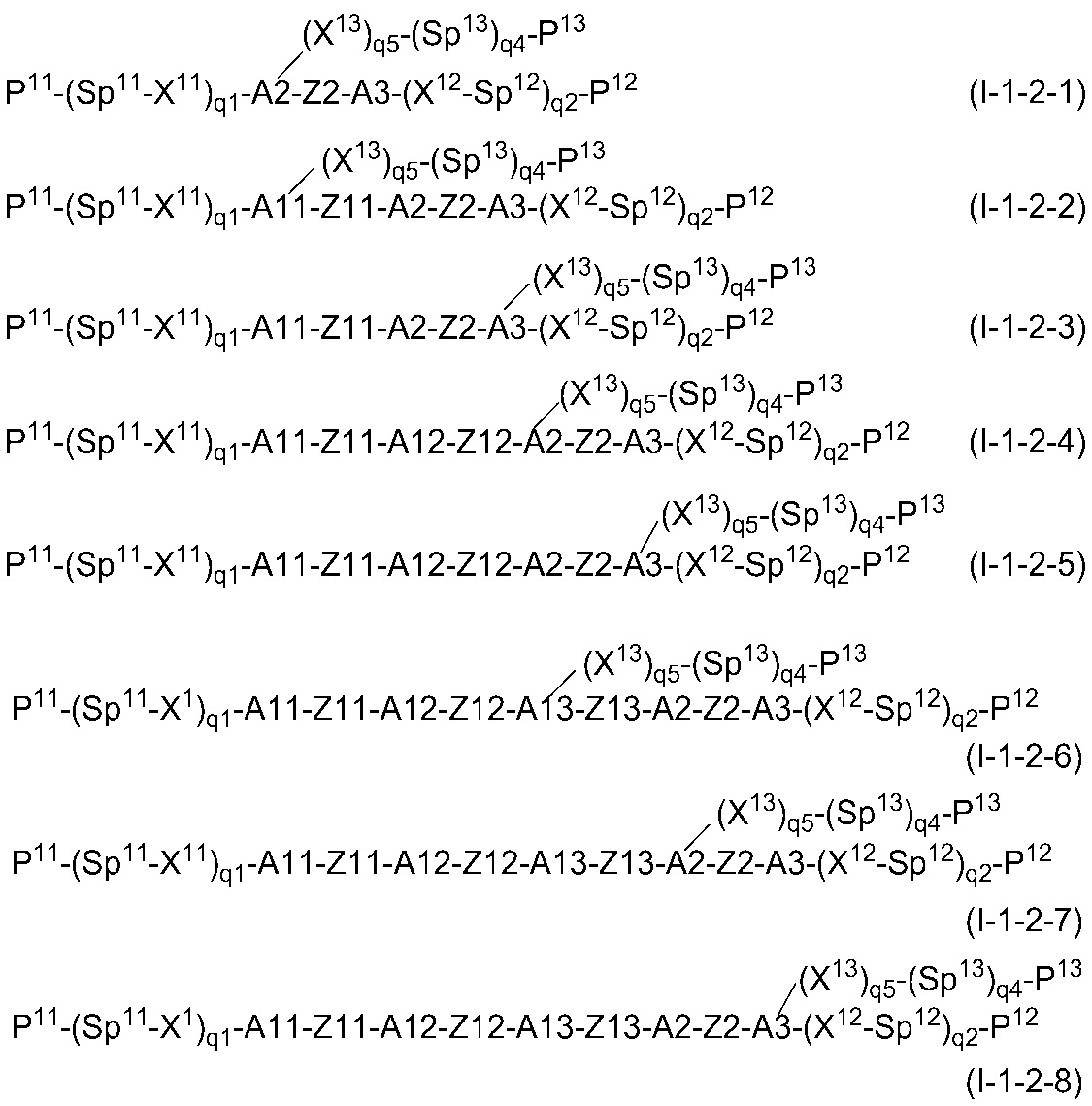
式中、P11、Sp11、X11、q1、X12、Sp12、q2、P12、X13、q5、Sp13、q4、P13は、それぞれ、上記一般式(I-1-2)の定義と同じものを表し、
A11とA12とA13、A2、A3は、それぞれ、上記一般式(I―2-b)のA1~A3の定義と同じものを表し、それぞれ、同一であっても、異なっていても良く、
Z11とZ12とZ13、Z2は、それぞれ、上記一般式(I―2-b)のZ1、Z2の定義と同じものを表し、それぞれ、同一であっても、異なっていても良い。
A11とA12とA13、A2、A3は、それぞれ、上記一般式(I―2-b)のA1~A3の定義と同じものを表し、それぞれ、同一であっても、異なっていても良く、
Z11とZ12とZ13、Z2は、それぞれ、上記一般式(I―2-b)のZ1、Z2の定義と同じものを表し、それぞれ、同一であっても、異なっていても良い。
上記一般式(I-1-2-1)~(I-1-2-8)で表される化合物としては、以下の一般式(I-1-2-1-1)~(I-1-2-1-6)で表される化合物を例示されるが、これらに限定される訳ではない。

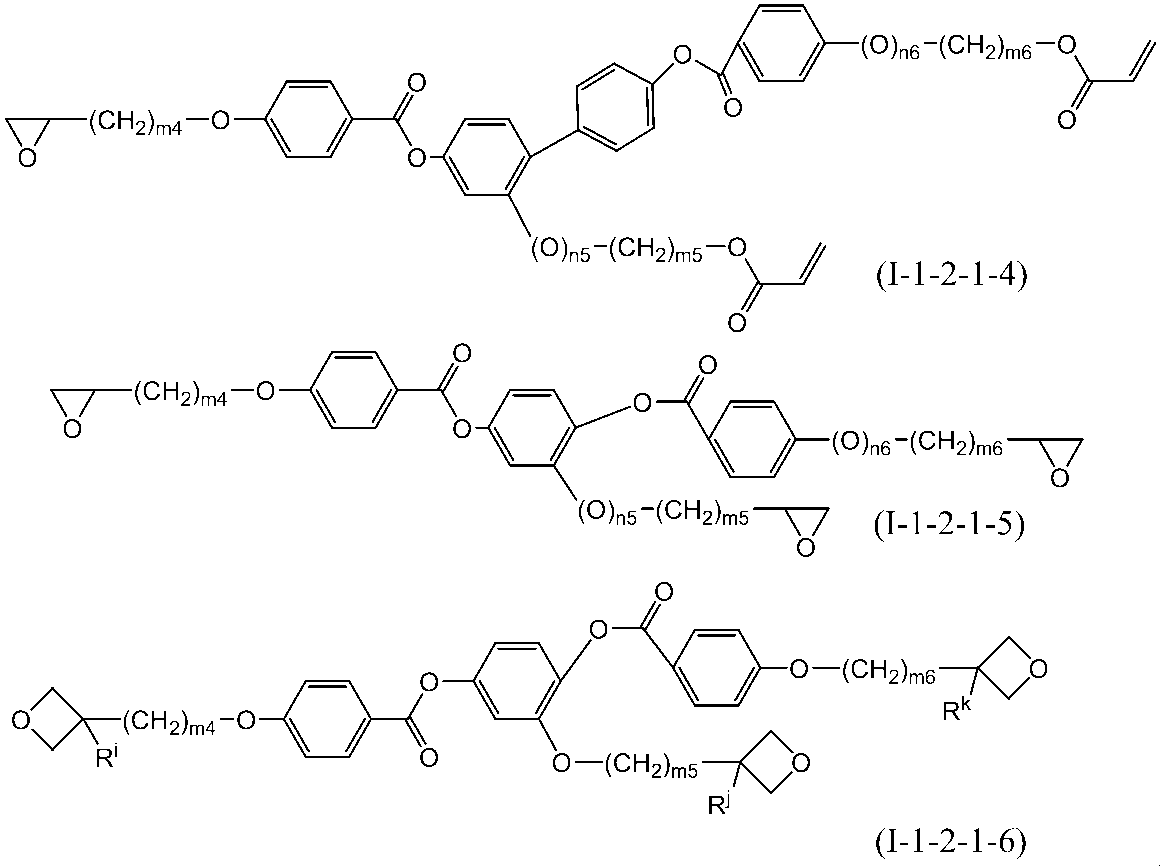
式中、Rf、Rg及びRhは、それぞれ独立して水素原子又はメチル基を表し、Ri、Rj及びRkはそれぞれ独立して水素原子、ハロゲン原子(フッ素原子、塩素原子、臭素原子、ヨウ素原子)、炭素数1~6のアルキル基、炭素数1~6のアルコキシ基、シアノ基を表し、これらの基が炭素数1~6のアルキル基、あるいは炭素数1~6のアルコキシ基の場合、全部が未置換であるか、あるいは1つまたは2つ以上のハロゲン原子(フッ素原子、塩素原子、臭素原子、ヨウ素原子)により置換されていてもよく、上記環状基は、置換基として1個以上のF、Cl、CF3、OCF3、CN基、炭素原子数1~8のアルキル基、炭素原子数1~8のアルコキシ基、炭素原子数1~8のアルカノイル基、炭素原子数1~8のアルカノイルオキシ基、炭素原子数1~8のアルコキシカルボニル基、炭素原子数2~8のアルケニル基、炭素原子数2~8のアルケニルオキシ基、炭素原子数2~8のアルケノイル基、炭素原子数2~8のアルケノイルオキシ基を有していても良い。
m4~m9はそれぞれ独立して0~18の整数を表し、n4~n10はそれぞれ独立して0又は1を表す。
m4~m9はそれぞれ独立して0~18の整数を表し、n4~n10はそれぞれ独立して0又は1を表す。
3個の重合性官能基を有する多官能重合性液晶化合物は、1種又は2種以上用いることができる。
分子内に3個の重合性官能基を有する多官能重合性液晶化合物の合計含有量は、上記一般式(II-1)で表される重合性液晶化合物を含めた重合性液晶組成物に用いる重合性液晶化合物の合計量のうち、0~40質量%含有することが好ましく、0~30質量%含有することがより好ましく、0~20質量%含有することが特に好ましい。
(単官能重合性液晶化合物)
本発明の重合性液晶組成物には、分子内に1個の重合性官能基を有する単官能重合性液晶化合物を用いることができる。なお、本発明の重合性液晶組成物において、上記分子内に2個以上の重合性官能基を有する重合性液晶化合物を必須成分として用いる場合、当該分子内に1個の重合性官能基を有する単官能重合性液晶化合物は任意成分として用いることができる。単官能重合性液晶化合物として具体的には、上記一般式(II-1)で表される化合物以外の化合物として、以下一般式(II-2)で表される化合物を挙げることができる。
(単官能重合性液晶化合物)
本発明の重合性液晶組成物には、分子内に1個の重合性官能基を有する単官能重合性液晶化合物を用いることができる。なお、本発明の重合性液晶組成物において、上記分子内に2個以上の重合性官能基を有する重合性液晶化合物を必須成分として用いる場合、当該分子内に1個の重合性官能基を有する単官能重合性液晶化合物は任意成分として用いることができる。単官能重合性液晶化合物として具体的には、上記一般式(II-1)で表される化合物以外の化合物として、以下一般式(II-2)で表される化合物を挙げることができる。

式中、P22は重合性官能基を表し、Sp22は炭素原子数1~18のアルキレン基又は単結合を表し、該アルキレン基中の1個の-CH2-又は隣接していない2個以上の-CH2-が各々独立して-O-、-COO-、-OCO-又は-OCO-O-によって置換されても良く、該アルキレン基の有する1個又は2個以上の水素原子は、ハロゲン原子(フッ素原子、塩素原子、臭素原子、ヨウ素原子)又はCN基によって置換されても良く、X22は-O-、-S-、-OCH2-、-CH2O-、-CO-、-COO-、-OCO-、-CO-S-、-S-CO-、-O-CO-O-、-CO-NH-、-NH-CO-、-SCH2-、-CH2S-、-CF2O-、-OCF2-、-CF2S-、-SCF2-、-CH=CH-COO-、-CH=CH-OCO-、-COO-CH=CH-、-OCO-CH=CH-、-COO-CH2CH2-、-OCO-CH2CH2-、-CH2CH2-COO-、-CH2CH2-OCO-、-COO-CH2-、-OCO-CH2-、-CH2-COO-、-CH2-OCO-、-CH=CH-、-N=N-、-CH=N-N=CH-、-CF=CF-、-C≡C-又は単結合を表し(ただし、P22-Sp22、及びSp22-X22において、C、H以外のヘテロ原子同士の直接結合を含まない。)、q6は0又は1を表し、MG22はメソゲン基を表し、R21は、水素原子、ハロゲン原子(フッ素原子、塩素原子、臭素原子、ヨウ素原子)、シアノ基、炭素原子数1から12の直鎖又は分岐アルキル基、炭素原子数1から12の直鎖又は分岐アルケニル基を表し、該アルキル基及びアルケニル基中の1個の-CH2-又は隣接していない2個以上の-CH2-が各々独立して-O-、-S-、-CO-、-COO-、-OCO-、-CO-S-、-S-CO-、-O-CO-O-、-CO-NH-、-NH-CO-、-NH-、-N(CH3)-、-CH=CH-COO-、-CH=CH-OCO-、-COO-CH=CH-、-OCO-CH=CH-、-CH=CH-、-CF=CF-又は-C≡C-によって置換されても良く、該アルキル基及び該アルケニル基の有する1個又は2個以上の水素原子はそれぞれ独立して、ハロゲン原子(フッ素原子、塩素原子、臭素原子、ヨウ素原子)又はシアノ基によって置換されても良く、複数置換されている場合それぞれ同一であっても、異なっていても良い。但し、一般式(II-2)で表される重合性液晶化合物には、上記一般式(II-1)で表される重合性液晶化合物を含まない。
ここで、P22は、下記の式(P-2-1)から式(P-2-20)で表される重合性基から選ばれる置換基を表すのが好ましい。
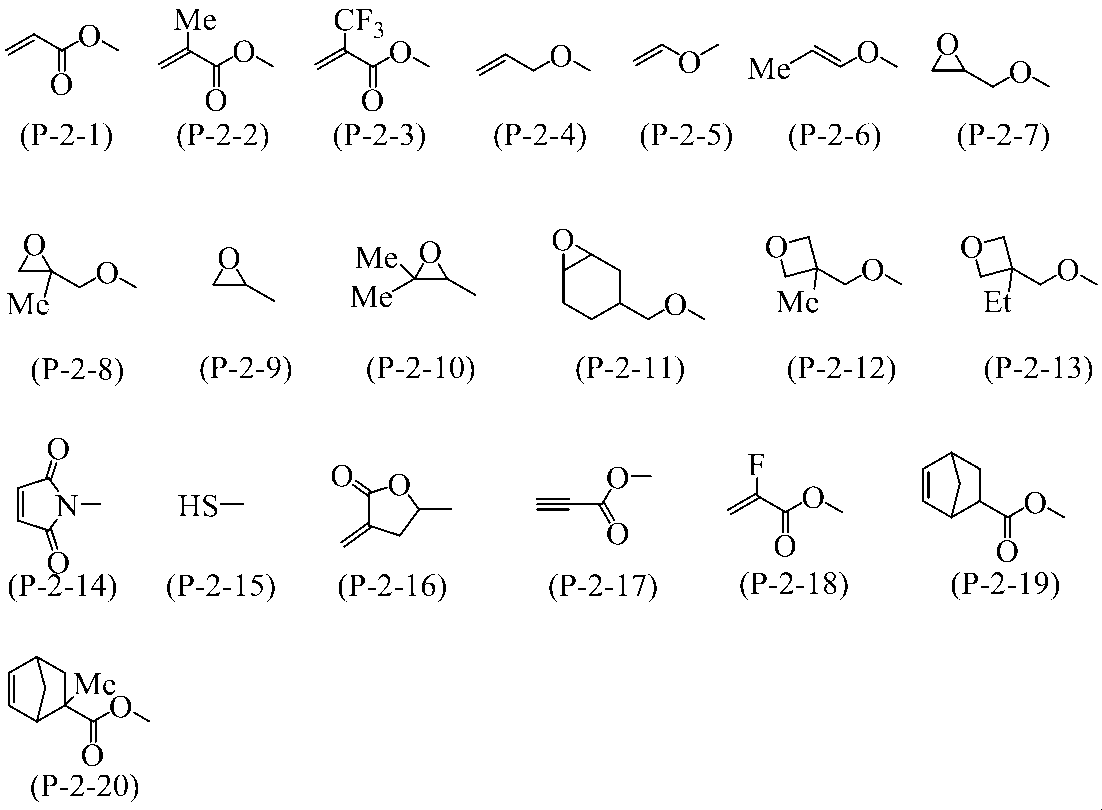
これらの重合性官能基のうち、重合性を高める観点から、式(P-2-1)、(P-2-2)、(P-2-7)、(P-2-12)、(P-2-13)が好ましく、式(P-2-1)、(P-2-2)がより好ましい。
また、Sp22は炭素原子数1~15のアルキレン基を表すことが好ましく、該アルキレン基中の1個の-CH2-又は隣接していない2個以上の-CH2-が各々独立して-O-、-COO-、-OCO-又は-OCO-O-によって置換されても良く、該アルキレン基の有する1個又は2個以上の水素原子は、ハロゲン原子(フッ素原子、塩素原子、臭素原子、ヨウ素原子)又はCN基によって置換されても良く、Sp22は炭素原子数1~12のアルキレン基を表すことがより好ましく、該アルキレン基中の1個の-CH2-又は隣接していない2個以上の-CH2-が各々独立して-O-、-COO-、-OCO-又は-OCO-O-によって置換されても良い。
X22は-O-、-OCH2-、-CH2O-、-CO-、-COO-、-OCO-、-O-CO-O-、-CO-NH-、-NH-CO-、-CF2O-、-OCF2-、-CH=CH-COO-、-CH=CH-OCO-、-COO-CH=CH-、-OCO-CH=CH-、-COO-CH2CH2-、-OCO-CH2CH2-、-CH2CH2-COO-、-CH2CH2-OCO-、-COO-CH2-、-OCO-CH2-、-CH2-COO-、-CH2-OCO-、-CH=CH-、-N=N-、-CH=N-N=CH-、-CF=CF-、-C≡C-又は単結合を表すことが好ましく、X22は-O-、-OCH2-、-CH2O-、-CO-、-COO-、-OCO-、-O-CO-O-、-CF2O-、-OCF2-、-CH=CH-COO-、-CH=CH-OCO-、-COO-CH=CH-、-OCO-CH=CH-、-COO-CH2CH2-、-OCO-CH2CH2-、-CH2CH2-COO-、-CH2CH2-OCO-、-COO-CH2-、-OCO-CH2-、-CH2-COO-、-CH2-OCO-、-CH=CH-、-CF=CF-、-C≡C-又は単結合を表すことがより好ましい。
MG22はメソゲン基を表し、一般式(II-2-b)
MG22はメソゲン基を表し、一般式(II-2-b)

(式中、A1、及びA2はそれぞれ独立的に、1,4-フェニレン基、1,4-シクロヘキシレン基、1,4-シクロヘキセニル基、テトラヒドロピラン-2,5-ジイル基、1,3-ジオキサン-2,5-ジイル基、テトラヒドロチオピラン-2,5-ジイル基、1,4-ビシクロ(2,2,2)オクチレン基、デカヒドロナフタレン-2,6-ジイル基、ピリジン-2,5-ジイル基、ピリミジン-2,5-ジイル基、ピラジン-2,5-ジイル基、チオフェン-2,5-ジイル基-、1,2,3,4-テトラヒドロナフタレン-2,6-ジイル基、2,6-ナフチレン基、フェナントレン-2,7-ジイル基、9,10-ジヒドロフェナントレン-2,7-ジイル基、1,2,3,4,4a,9,10a-オクタヒドロフェナントレン-2,7-ジイル基、1,4-ナフチレン基、ベンゾ[1,2-b:4,5-b‘]ジチオフェン-2,6-ジイル基、ベンゾ[1,2-b:4,5-b‘]ジセレノフェン-2,6-ジイル基、[1]ベンゾチエノ[3,2-b]チオフェン-2,7-ジイル基、[1]ベンゾセレノフェノ[3,2-b]セレノフェン-2,7-ジイル基、又はフルオレン-2,7-ジイル基を表し、置換基として1個以上のF、Cl、CF3、OCF3、CN基、炭素原子数1~8のアルキル基、炭素原子数1~8のアルコキシ基、炭素原子数1~8のアルカノイル基、炭素原子数1~8のアルカノイルオキシ基、炭素原子数1~8のアルコキシカルボニル基、炭素原子数2~8のアルケニル基、炭素原子数2~8のアルケニルオキシ基、炭素原子数2~8のアルケノイル基、及び/又は、炭素原子数2~8のアルケノイルオキシ基を有していても良く、このうち、A1及びA2はそれぞれ独立的に、上記置換基を有していても良い1,4-フェニレン基、1,4-シクロヘキシレン基、2,6-ナフチレン基を表すことが好ましい。
A3は、1,4-フェニレン基、1,4-シクロヘキシレン基、1,4-シクロヘキセニル基、テトラヒドロピラン-2,5-ジイル基、1,3-ジオキサン-2,5-ジイル基、テトラヒドロチオピラン-2,5-ジイル基、1,4-ビシクロ(2,2,2)オクチレン基、デカヒドロナフタレン-2,6-ジイル基、ピリジン-2,5-ジイル基、ピリミジン-2,5-ジイル基、ピラジン-2,5-ジイル基、チオフェン-2,5-ジイル基-、1,2,3,4-テトラヒドロナフタレン-2,6-ジイル基、2,6-ナフチレン基、フェナントレン-2,7-ジイル基、9,10-ジヒドロフェナントレン-2,7-ジイル基、1,2,3,4,4a,9,10a-オクタヒドロフェナントレン-2,7-ジイル基、1,4-ナフチレン基、ベンゾ[1,2-b:4,5-b‘]ジチオフェン-2,6-ジイル基、ベンゾ[1,2-b:4,5-b‘]ジセレノフェン-2,6-ジイル基、[1]ベンゾチエノ[3,2-b]チオフェン-2,7-ジイル基、[1]ベンゾセレノフェノ[3,2-b]セレノフェン-2,7-ジイル基、又はフルオレン-2,7-ジイル基を表し、A3環は、一方がZ2(Z2が単結合の場合、A2)に連結し、もう一方は、R21に連結するが、A3のうち、R21が連結する炭素原子に隣接しない炭素原子に結合する水素原子は、1個以上のF、Cl、CF3、OCF3、CN基、炭素原子数1~8のアルキル基、炭素原子数1~8のアルコキシ基、炭素原子数1~8のアルカノイル基、炭素原子数1~8のアルカノイルオキシ基、炭素原子数1~8のアルコキシカルボニル基、炭素原子数2~8のアルケニル基、炭素原子数2~8のアルケニルオキシ基、炭素原子数2~8のアルケノイル基、及び/又は、炭素原子数2~8のアルケノイルオキシ基に置換されていても良いが、R21が連結する炭素原子に隣接する炭素原子に結合する水素原子は置換されていない(例えばA3が、1,4-フェニレン基を表す場合、下記Loの部位に置換基を有することができ、下記Lnの部位には置換基を有さない。)。
A3は、1,4-フェニレン基、1,4-シクロヘキシレン基、1,4-シクロヘキセニル基、テトラヒドロピラン-2,5-ジイル基、1,3-ジオキサン-2,5-ジイル基、テトラヒドロチオピラン-2,5-ジイル基、1,4-ビシクロ(2,2,2)オクチレン基、デカヒドロナフタレン-2,6-ジイル基、ピリジン-2,5-ジイル基、ピリミジン-2,5-ジイル基、ピラジン-2,5-ジイル基、チオフェン-2,5-ジイル基-、1,2,3,4-テトラヒドロナフタレン-2,6-ジイル基、2,6-ナフチレン基、フェナントレン-2,7-ジイル基、9,10-ジヒドロフェナントレン-2,7-ジイル基、1,2,3,4,4a,9,10a-オクタヒドロフェナントレン-2,7-ジイル基、1,4-ナフチレン基、ベンゾ[1,2-b:4,5-b‘]ジチオフェン-2,6-ジイル基、ベンゾ[1,2-b:4,5-b‘]ジセレノフェン-2,6-ジイル基、[1]ベンゾチエノ[3,2-b]チオフェン-2,7-ジイル基、[1]ベンゾセレノフェノ[3,2-b]セレノフェン-2,7-ジイル基、又はフルオレン-2,7-ジイル基を表し、A3環は、一方がZ2(Z2が単結合の場合、A2)に連結し、もう一方は、R21に連結するが、A3のうち、R21が連結する炭素原子に隣接しない炭素原子に結合する水素原子は、1個以上のF、Cl、CF3、OCF3、CN基、炭素原子数1~8のアルキル基、炭素原子数1~8のアルコキシ基、炭素原子数1~8のアルカノイル基、炭素原子数1~8のアルカノイルオキシ基、炭素原子数1~8のアルコキシカルボニル基、炭素原子数2~8のアルケニル基、炭素原子数2~8のアルケニルオキシ基、炭素原子数2~8のアルケノイル基、及び/又は、炭素原子数2~8のアルケノイルオキシ基に置換されていても良いが、R21が連結する炭素原子に隣接する炭素原子に結合する水素原子は置換されていない(例えばA3が、1,4-フェニレン基を表す場合、下記Loの部位に置換基を有することができ、下記Lnの部位には置換基を有さない。)。
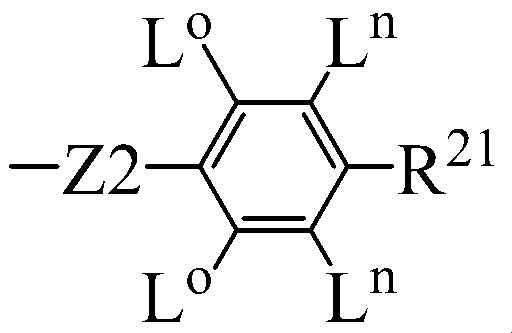
Z1及びZ2はそれぞれ独立して、-COO-、-OCO-、-CH2CH2-、-OCH2-、-CH2O-、-CH=CH-、-C≡C-、-CH=CHCOO-、-OCOCH=CH-、-CH2CH2COO-、-CH2CH2OCO-、-COOCH2CH2-、-OCOCH2CH2-、-C=N-、-N=C-、-CONH-、-NHCO-、-C(CF3)2-、ハロゲン原子(フッ素原子、塩素原子、臭素原子、ヨウ素原子)を有してもよい炭素原子数2~10のアルキル基又は単結合を表し、Z1及びZ2はそれぞれ独立して-COO-、-OCO-、-CH2CH2-、-OCH2-、-CH2O-、-CH=CH-、-C≡C-、-CH=CHCOO-、-OCOCH=CH-、-CH2CH2COO-、-CH2CH2OCO-、-COOCH2CH2-、-OCOCH2CH2-又は単結合であることが好ましい。r1は0、1、2又は3を表し、A1、及びZ1が複数存在する場合は、それぞれ、同一であっても、異なっていても良い。)で表される。
R21は、水素原子、ハロゲン原子(フッ素原子、塩素原子、臭素原子、ヨウ素原子)、シアノ基、炭素原子数1から8の直鎖又は分岐アルキル基、炭素原子数1から8の直鎖又は分岐アルケニル基を表すことがより好ましく、該アルキル基及びアルケニル基中の1個の-CH2-又は隣接していない2個以上の-CH2-が各々独立して-O-、-CO-、-COO-、-OCO-、-O-CO-O-、-CH=CH-COO-、-CH=CH-OCO-、-COO-CH=CH-、-OCO-CH=CH-、-CH=CH-、又は-C≡C-によって置換されても良く、該アルキル基及び該アルケニル基の有する1個又は2個以上の水素原子はそれぞれ独立して、ハロゲン原子(フッ素原子、塩素原子、臭素原子、ヨウ素原子)又はシアノ基によって置換されても良く、複数置換されている場合それぞれ同一であっても、異なっていても良い。
一般式(II-2)の例として、下記一般式(II-2-1)~(II-2-4)で表される化合物を挙げることができるが、下記の一般式に限定されるわけではない。
一般式(II-2)の例として、下記一般式(II-2-1)~(II-2-4)で表される化合物を挙げることができるが、下記の一般式に限定されるわけではない。
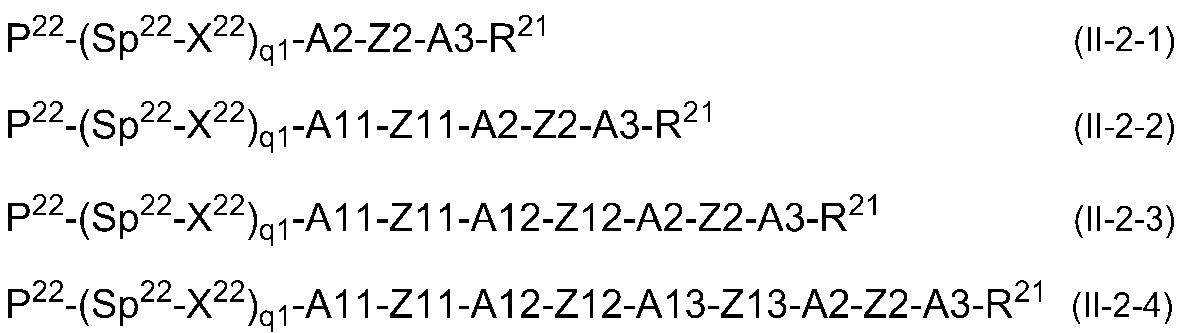
式中、P22、Sp22、X22、q1、及び、R21は、それぞれ、上記一般式(II-2)の定義と同じものを表し、
A11、A12、A13、A2、A3は、上記一般式(II-2-b)のA1~A3の定義と同じものを表し、それぞれ、同一であっても、異なっていても良く、
Z11、Z12、Z13、Z2は、上記一般式(II-2-b)のZ1~Z3の定義と同じものを表し、それぞれ、同一であっても、異なっていても良く、
上記一般式(II-2-1)~(II-2-4)で表される化合物としては、以下の式(II-2-1-1)~式(II-2-1-26)で表される化合物を例示されるが、これらに限定される訳ではない。
A11、A12、A13、A2、A3は、上記一般式(II-2-b)のA1~A3の定義と同じものを表し、それぞれ、同一であっても、異なっていても良く、
Z11、Z12、Z13、Z2は、上記一般式(II-2-b)のZ1~Z3の定義と同じものを表し、それぞれ、同一であっても、異なっていても良く、
上記一般式(II-2-1)~(II-2-4)で表される化合物としては、以下の式(II-2-1-1)~式(II-2-1-26)で表される化合物を例示されるが、これらに限定される訳ではない。


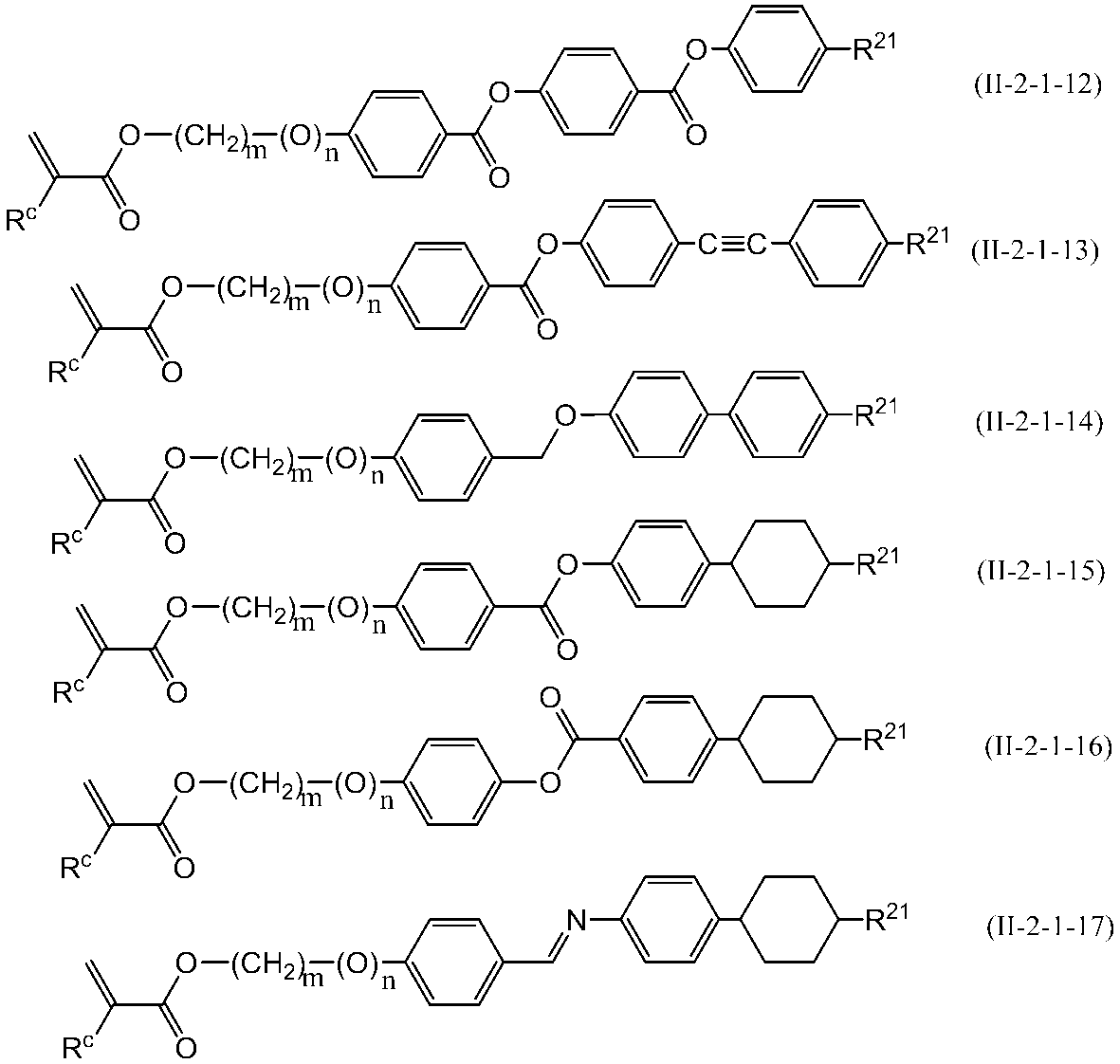

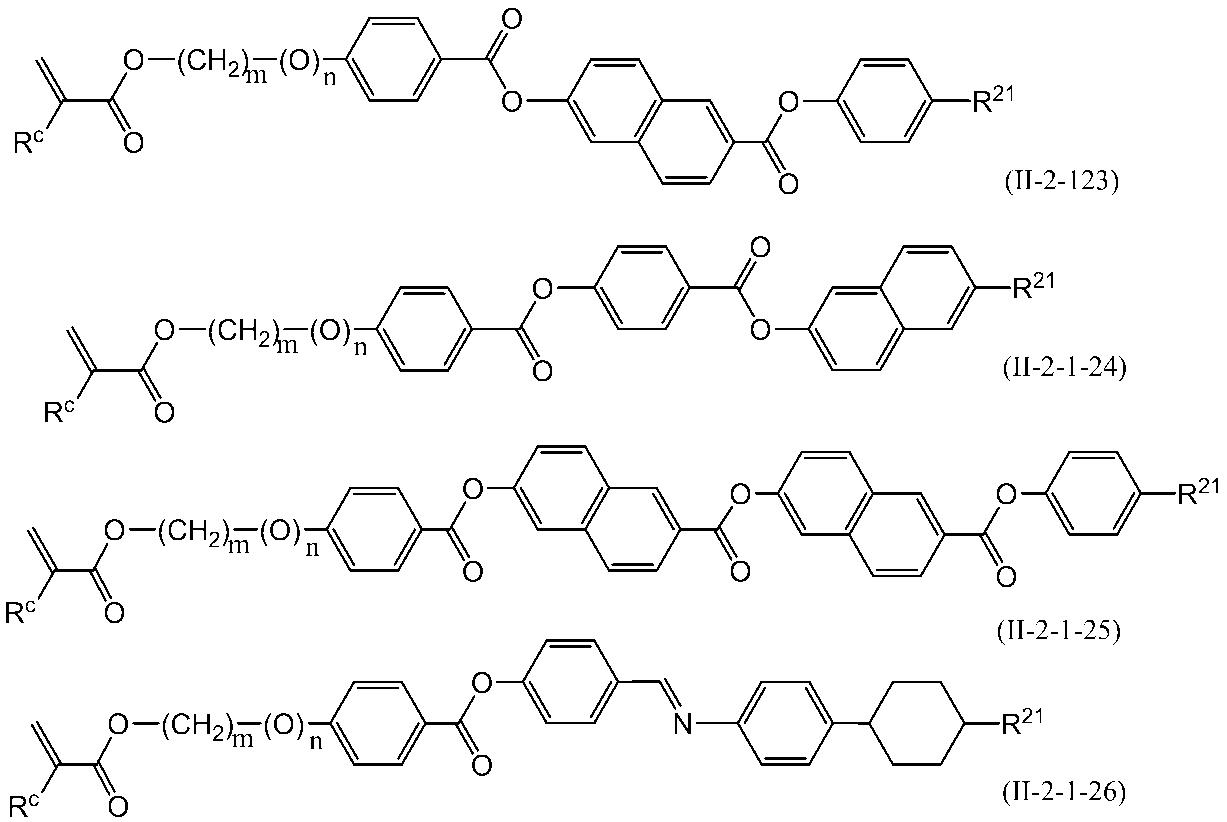
式中、Rcは水素原子又はメチル基を表し、mは0~18の整数を表し、nは0又は1を表し、R21は、上記一般式(II-2-1)~(II-2-4)の定義と同じものを表すが、R21は、水素原子、ハロゲン原子(フッ素原子、塩素原子、臭素原子、ヨウ素原子)、シアノ基、1個の-CH2-が-O-、-CO-、-COO-、-OCO-、によって置換されても良い、炭素原子数1から6の直鎖アルキル基又は炭素原子数1から6の直鎖アルケニル基を表すことが好ましい。
上記環状基は、置換基として1個以上のF、Cl、CF3、OCF3、CN基、炭素原子数1~8のアルキル基、炭素原子数1~8のアルコキシ基、炭素原子数1~8のアルカノイル基、炭素原子数1~8のアルカノイルオキシ基、炭素原子数1~8のアルコキシカルボニル基、炭素原子数2~8のアルケニル基、炭素原子数2~8のアルケニルオキシ基、炭素原子数2~8のアルケノイル基、炭素原子数2~8のアルケノイルオキシ基を有していても良いが、R21が連結する環構造において、R21が連結する当該環構造の炭素原子に隣接する炭素原子に結合する水素原子は置換されていない。
上記環状基は、置換基として1個以上のF、Cl、CF3、OCF3、CN基、炭素原子数1~8のアルキル基、炭素原子数1~8のアルコキシ基、炭素原子数1~8のアルカノイル基、炭素原子数1~8のアルカノイルオキシ基、炭素原子数1~8のアルコキシカルボニル基、炭素原子数2~8のアルケニル基、炭素原子数2~8のアルケニルオキシ基、炭素原子数2~8のアルケノイル基、炭素原子数2~8のアルケノイルオキシ基を有していても良いが、R21が連結する環構造において、R21が連結する当該環構造の炭素原子に隣接する炭素原子に結合する水素原子は置換されていない。
分子内に1個の重合性官能基を有する上記一般式(II-2)で表される単官能重合性液晶化合物の合計含有量は、上記一般式(II-1)で表される重合性液晶化合物を含めた重合性液晶組成物に用いる重合性液晶化合物の合計量のうち、0~60質量%含有することが好ましく、0~55質量%含有することがより好ましく、0~50質量%含有することが特に好ましい。得られる塗膜の基材との密着性を重視する場合には下限値を5質量%以上にすることが好ましく、10質量%以上にすることがより好ましく、得られる塗膜の硬化性を重視する場合には上限値を50質量%以下とすることが好ましく、40質量%以下とすることがより好ましい。
(その他の液晶化合物)
また、本発明の重合性液晶組成物には、重合性基を有さないメソゲン基を含有する化合物を添加しても良く、通常の液晶デバイス、例えばSTN(スーパー・ツイステッド・ネマチック)液晶や、TN(ツイステッド・ネマチック)液晶、TFT(薄膜トランジスター)液晶等に使用される化合物が挙げられる。
(その他の液晶化合物)
また、本発明の重合性液晶組成物には、重合性基を有さないメソゲン基を含有する化合物を添加しても良く、通常の液晶デバイス、例えばSTN(スーパー・ツイステッド・ネマチック)液晶や、TN(ツイステッド・ネマチック)液晶、TFT(薄膜トランジスター)液晶等に使用される化合物が挙げられる。
重合性官能基を有さないメソゲン基を含有する化合物は、具体的には以下の一般式(5)で表される化合物が好ましい。

MG3で表されるメソゲン基又はメソゲン性支持基は、一般式(5-b)

(式中、A1d、A2d及びA3dはそれぞれ独立的に、1,4-フェニレン基、1,4-シクロヘキシレン基、1,4-シクロヘキセニル基、テトラヒドロピラン-2,5-ジイル基、1,3-ジオキサン-2,5-ジイル基、テトラヒドロチオピラン-2,5-ジイル基、1,4-ビシクロ(2,2,2)オクチレン基、デカヒドロナフタレン-2,6-ジイル基、ピリジン-2,5-ジイル基、ピリミジン-2,5-ジイル基、ピラジン-2,5-ジイル基、チオフェン-2,5-ジイル基-、1,2,3,4-テトラヒドロナフタレン-2,6-ジイル基、2,6-ナフチレン基、フェナントレン-2,7-ジイル基、9,10-ジヒドロフェナントレン-2,7-ジイル基、1,2,3,4,4a,9,10a-オクタヒドロフェナントレン-2,7-ジイル基、1,4-ナフチレン基、ベンゾ[1,2-b:4,5-b‘]ジチオフェン-2,6-ジイル基、ベンゾ[1,2-b:4,5-b‘]ジセレノフェン-2,6-ジイル基、[1]ベンゾチエノ[3,2-b]チオフェン-2,7-ジイル基、[1]ベンゾセレノフェノ[3,2-b]セレノフェン-2,7-ジイル基、又はフルオレン-2,7-ジイル基を表し、置換基として1個以上のF、Cl、CF3、OCF3、CN基、炭素原子数1~8のアルキル基、アルコキシ基、アルカノイル基、アルカノイルオキシ基、炭素原子数2~8のアルケニル基、アルケニルオキシ基、アルケノイル基、アルケノイルオキシ基を有していても良く、
Z0d、Z1d、Z2d及びZ3dはそれぞれ独立して、-COO-、-OCO-、-CH2 CH2-、-OCH2-、-CH2O-、-CH=CH-、-C≡C-、-CH=CHCOO-、-OCOCH=CH-、-CH2CH2COO-、-CH2CH2OCO-、-COOCH2CH2-、-OCOCH2CH2-、-CONH-、-NHCO-、炭素数2~10のハロゲン原子(フッ素原子、塩素原子、臭素原子、ヨウ素原子)を有してもよいアルキレン基又は単結合を表し、
neは0、1又は2を表し、
R51及びR52はそれぞれ独立して水素原子、ハロゲン原子(フッ素原子、塩素原子、臭素原子、ヨウ素原子)、シアノ基又は炭素原子数1~18のアルキル基を表すが、該アルキル基は1つ以上のハロゲン原子(フッ素原子、塩素原子、臭素原子、ヨウ素原子)又はCNにより置換されていても良く、この基中に存在する1つのCH2基又は隣接していない2つ以上のCH2基はそれぞれ相互に独立して、酸素原子が相互に直接結合しない形で、-O-、-S-、-NH-、-N(CH3)-、-CO-、-COO-、-OCO-、-OCOO-、-SCO-、-COS-又は-C≡C-により置き換えられていても良い。)で表される化合物が挙げられる。
具体的には、以下に示されるが、これらに限定される訳ではない。
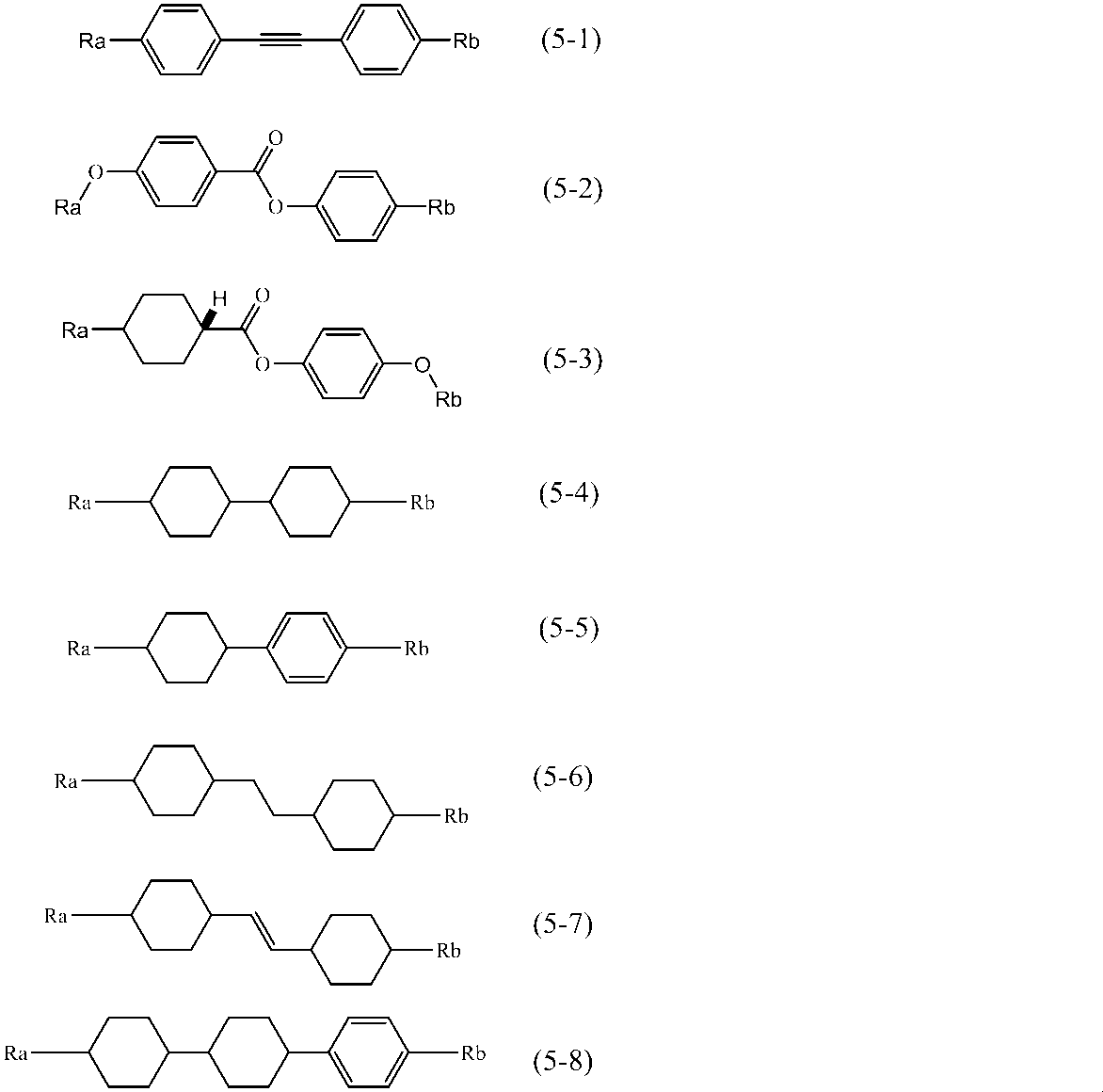
Ra及びRbはそれぞれ独立して水素原子、炭素数1~6のアルキル基、炭素数1~6のアルコキシ基、炭素数1~6のアルケニル基、シアノ基を表し、これらの基が炭素数1~6のアルキル基、あるいは炭素数1~6のアルコキシ基の場合、全部が未置換であるか、あるいは1つまたは2つ以上のハロゲン原子により置換されていてもよい。
メソゲン基を有する化合物の総含有量は、重合性液晶組成物の総量に対して0質量%以上20質量%以下であることが好ましく、用いる場合は、1質量%以上であることが好ましく、2質量%以上であることが好ましく、5質量%以上であることが好ましく、また、15質量%以下であることが好ましく、10質量%以下であることが好ましい。
(有機溶剤)
本発明における重合性液晶組成物に有機溶剤を添加してもよい。用いる有機溶剤としては特に限定はないが、重合性液晶化合物が良好な溶解性を示す有機溶剤が好ましく、100℃以下の温度で乾燥できる有機溶剤であることが好ましい。そのような溶剤としては、例えば、トルエン、キシレン、クメン、メシチレン等の芳香族系炭化水素、酢酸メチル、酢酸エチル、酢酸プロピル、酢酸ブチル等のエステル系溶剤、メチルエチルケトン、メチルイソブチルケトン、シクロヘキサノン、シクロペンタノン等のケトン系溶剤、テトラヒドロフラン、1,2-ジメトキシエタン、アニソール等のエーテル系溶剤、N,N-ジメチルホルムアミド、N-メチル-2-ピロリドン、等のアミド系溶剤、プロピレングリコールモノメチルエーテルアセテート、ジエチレングリコールモノメチルエーテルアセテート、γ-ブチロラクトン及びクロロベンゼン等が挙げられる。これらは、単独で使用することもできるし、2種類以上混合して使用することもできるが、ケトン系溶剤、エーテル系溶剤、エステル系溶剤及び芳香族炭化水素系溶剤のうちのいずれか1種類以上を用いることが溶液安定性の点から好ましい。
本発明に用いられる組成物は有機溶媒の溶液とすると基板に対して塗布することができ、重合性液晶組成物に用いる有機溶剤の比率は、塗布した状態を著しく損なわない限りは特に制限はないが、重合性液晶組成物中に含有する有機溶剤の合計量が10~95質量%であることが好ましく、12~90質量%であることが更に好ましく、15~85質量%であることが特に好ましい。
有機溶剤に重合性液晶組成物を溶解する際には、均一に溶解させるために、加熱攪拌することが好ましい。加熱攪拌時の加熱温度は、用いる組成物の有機溶剤に対する溶解性を考慮して適宜調節すればよいが、生産性の点から15℃~110℃が好ましく、15℃~105℃がより好ましく、15℃~100℃がさらに好ましく、20℃~90℃とするのが特に好ましい。
また、溶媒を添加する際には分散攪拌機により攪拌混合することが好ましい。分散攪拌機として具体的には、ディスパー、プロペラ、タービン翼等攪拌翼を有する分散機、ペイントシェイカー、遊星式攪拌装置、振とう機、シェーカー又はロータリーエバポレーター等が使用できる。その他には、超音波照射装置が使用できる。
溶媒を添加する際の攪拌回転数は、用いる攪拌装置により適宜調整することが好ましいが、均一な重合性液晶組成物溶液とするために攪拌回転数を10rpm~1000rpmとするのが好ましく、50rpm~800rpmとするのがより好ましく、150rpm~600rpmとするのが特に好ましい。
(重合禁止剤)
本発明における重合性液晶組成物には、重合禁止剤を添加することが好ましい。重合禁止剤としては、フェノール系化合物、キノン系化合物、アミン系化合物、チオエーテル系化合物、ニトロソ化合物、等が挙げられる。
(重合禁止剤)
本発明における重合性液晶組成物には、重合禁止剤を添加することが好ましい。重合禁止剤としては、フェノール系化合物、キノン系化合物、アミン系化合物、チオエーテル系化合物、ニトロソ化合物、等が挙げられる。
フェノール系化合物としては、p-メトキシフェノール、クレゾール、t-ブチルカテコール、3.5-ジ-t-ブチル-4-ヒドロキシトルエン、2.2'-メチレンビス(4-メチル-6-t-ブチルフェノール)、2.2'-メチレンビス(4-エチル-6-t-ブチルフェノール)、4.4'-チオビス(3-メチル-6-t-ブチルフェノール)、4-メトキシ-1-ナフトール、4,4’-ジアルコキシ-2,2’-ビ-1-ナフトール、等が挙げられる。
キノン系化合物としては、ヒドロキノン、メチルヒドロキノン、tert-ブチルヒドロキノン、p-ベンゾキノン、メチル-p-ベンゾキノン、tert-ブチル-p-ベンゾキノン、2,5-ジフェニルベンゾキノン、2-ヒドロキシ-1,4-ナフトキノン、1,4-ナフトキノン、2,3-ジクロロ-1,4-ナフトキノン、アントラキノン、ジフェノキノン等が挙げられる。
アミン系化合物としては、p-フェニレンジアミン、4-アミノジフェニルアミン、N.N'-ジフェニル-p-フェニレンジアミン、N-i-プロピル-N'-フェニル-p-フェニレンジアミン、N-(1.3-ジメチルブチル)-N'-フェニル-p-フェニレンジアミン、N.N'-ジ-2-ナフチル-p-フェニレンジアミン、ジフェニルアミン、N-フェニル-β-ナフチルアミン、4.4'-ジクミル-ジフェニルアミン、4.4'-ジオクチル-ジフェニルアミン等が挙げられる。
チオエーテル系化合物としては、フェノチアジン、ジステアリルチオジプロピオネート等が挙げられる。
ニトロソ系化合物としては、N-ニトロソジフェニルアミン、N-ニトロソフェニルナフチルアミン、N-ニトロソジナフチルアミン、p-ニトロソフェノール、ニトロソベンゼン、p-ニトロソジフェニルアミン、α-ニトロソ-β-ナフトール等、N、N-ジメチルp-ニトロソアニリン、p-ニトロソジフェニルアミン、p-ニトロンジメチルアミン、p-ニトロン-N、N-ジエチルアミン、N-ニトロソエタノールアミン、N-ニトロソジ-n-ブチルアミン、N-ニトロソ-N-n-ブチル-4-ブタノールアミン、N-ニトロソ-ジイソプロパノールアミン、N-ニトロソ-N-エチル-4-ブタノールアミン、5-ニトロソ-8-ヒドロキシキノリン、N-ニトロソモルホリン、N-二トロソーN-フェニルヒドロキシルアミンアンモニウム塩、二トロソベンゼン、2,4.6-トリーtert-ブチルニトロンベンゼン、N-ニトロソ-N-メチル-p-トルエンスルホンアミド、N-ニトロソ-N-エチルウレタン、N-ニトロソ-N-n-プロピルウレタン、1-ニトロソ-2-ナフトール、2-ニトロソー1-ナフトール、1-ニトロソ-2-ナフトール-3,6-スルホン酸ナトリウム、2-ニトロソ-1-ナフトール-4-スルホン酸ナトリウム、2-ニトロソ-5-メチルアミノフェノール塩酸塩、2-ニトロソ-5-メチルアミノフェノール塩酸塩等が挙げられる。
重合禁止剤の添加量は重合性液晶組成物に対して0.01~1.0質量%であることが好ましく、0.05~0.5質量%であることがより好ましい。
(光重合開始剤)
本発明における重合性液晶組成物は光重合開始剤を含有することが好ましい。光重合開始剤は少なくとも1種類以上含有することが好ましい。具体的には、BASFジャパン株式会社製の「イルガキュア651」、「イルガキュア184」、「イルガキュア907」、「イルガキュア127」、「イルガキュア369」、「イルガキュア2959」、「イルガキュア1800」、「イルガキュア250」、「イルガキュア754」、「ダロキュアMBF」、「ダロキュア1173」やLAMBSON社製の「エサキュア1001M」、「エサキュアKIP150」、「スピードキュアBEM」、「スピードキュアBMS」、「スピードキュアMBP」、「スピードキュアPBZ」、「スピードキュアITX」、「スピードキュアDETX」、「スピードキュアEBD」、「スピードキュアMBB」、「スピードキュアBP」や日本化薬株式会社製の「カヤキュアDMBI」、等が挙げられる。
光重合開始剤の使用量は重合性液晶組成物に対して0.1~10質量%が好ましく、0.5~7質量%が特に好ましい。これらは、単独で使用することもできるし、2種類以上混合して使用することもでき、また、増感剤等を添加しても良い。
(熱重合開始剤)
本発明における重合性液晶組成物には、光重合開始剤とともに、熱重合開始剤を併用してもよい。具体的には、和光純薬工業株式会社製の「V-40」、「VF-096」、日本油脂株式会社(現日油株式会社)の「パーへキシルD」、「パーへキシルI」等が挙げられる。
(熱重合開始剤)
本発明における重合性液晶組成物には、光重合開始剤とともに、熱重合開始剤を併用してもよい。具体的には、和光純薬工業株式会社製の「V-40」、「VF-096」、日本油脂株式会社(現日油株式会社)の「パーへキシルD」、「パーへキシルI」等が挙げられる。
熱重合開始剤の使用量は重合性液晶組成物に対して0.1~10質量%が好ましく、0.5~5質量%が特に好ましい。これらは、単独で使用することもできるし、2種類以上混合して使用することもできる。
(界面活性剤)
本発明における重合性液晶組成物は、光学異方体とした場合の膜厚むらを低減させるために界面活性剤を少なくとも1種類以上含有してもよい。含有することができる界面活性剤としては、アルキルカルボン酸塩、アルキルリン酸塩、アルキルスルホン酸塩、フルオロアルキルカルボン酸塩、フルオロアルキルリン酸塩、フルオロアルキルスルホン酸塩、ポリオキシエチレン誘導体、フルオロアルキルエチレンオキシド誘導体、ポリエチレングリコール誘導体、アルキルアンモニウム塩、フルオロアルキルアンモニウム塩類等をあげることができ、特に含フッ素界面活性剤が好ましい。
具体的には、「メガファック F-251」、「メガファック F-444」、「メガファック F-477」、「メガファック F-510」、「メガファック F-552」、「メガファック F-553」、「メガファック F-554」、「メガファック F-555」、「メガファック F-556」、「メガファック F-557」、「メガファック F-558」、「メガファック F-559」、「メガファック F-560」、「メガファック F-561」、「メガファック F-562」、「メガファック F-563」、「メガファック F-565」、「メガファック F-567」、「メガファック F-568」、「メガファック F-569」、「メガファック F-570」、「メガファック F-571」、「メガファック R-40」、「メガファック R-41」、「メガファック R-43」、「メガファック R-94」、「メガファック RS-72-K」、「メガファック RS-75」、「メガファック RS-76-E」、「メガファック RS-90」、(以上、DIC株式会社製)、
「フタージェント100」、「フタージェント100C」、「フタージェント110」、「フタージェント150」、「フタージェント150CH」、「フタージェントA」、「フタージェント100A-K」、「フタージェント501」、「フタージェント300」、「フタージェント310」、「フタージェント320」、「フタージェント400SW」、「FTX-400P」、「フタージェント251」、「フタージェント215M」、「フタージェント212MH」、「フタージェント250」、「フタージェント222F」、「フタージェント212D」、「FTX-218」、「FTX-209F」、「FTX-213F」、「FTX-233F」、「フタージェント245F」、「FTX-208G」、「FTX-240G」、「FTX-206D」、「FTX-220D」、「FTX-230D」、「FTX-240D」、「FTX-207S」、「FTX-211S」、「FTX-220S」、「FTX-230S」、「FTX-750FM」、「FTX-730FM」、「FTX-730FL」、「FTX-710FS」、「FTX-710FM」、「FTX-710FL」、「FTX-750LL」、「FTX-730LS」、「FTX-730LM」、「FTX-730LL」、「FTX-710LL」(以上、株式会社ネオス製)、
「BYK-300」、「BYK-302」、「BYK-306」、「BYK-307」、「BYK-310」、「BYK-315」、「BYK-320」、「BYK-322」、「BYK-323」、「BYK-325」、「BYK-330」、「BYK-331」、「BYK-333」、「BYK-337」、「BYK-340」、「BYK-344」、「BYK-370」、「BYK-375」、「BYK-377」、「BYK-350」、「BYK-352」、「BYK-354」、「BYK-355」、「BYK-356」、「BYK-358N」、「BYK-361N」、「BYK-357」、「BYK-390」、「BYK-392」、「BYK-UV3500」、「BYK-UV3510」、「BYK-UV3570」、「BYK-Silclean3700」(以上、ビックケミー・ジャパン社製)、
「TEGO Rad2100」、「TEGO Rad2200N」、「TEGO Rad2250」、「TEGO Rad2300」、「TEGO Rad2500」、「TEGO Rad2600」、「TEGO Rad2700」(以上、テゴ社製)
「N215」、「N535」、「N605K」、「N935」(以上、ソルベイソレクシス社製)等の例をあげることができる。
界面活性剤の添加量は重合性組成物に対して、0.01~2質量%であることが好ましく、0.05~0.5質量%であることがより好ましい。
また、上記界面活性剤を使用することで、本発明の重合性液晶組成物を光学異方体とした場合、空気界面のチルト角を効果的に減じることができる。
本発明における重合性液晶組成物は、光学異方体とした場合の空気界面のチルト角を効果的に減じる効果を持つ、上記界面活性剤以外として、下記一般式(7)で表される繰り返し単位を有する重量平均分子量が100以上である化合物が挙げられる。

式中、R11、R12、R13及びR14はそれぞれ独立的に水素原子、ハロゲン原子又は炭素原子数1~20の炭化水素基を表し、該炭化水素基中の水素原子は1つ以上のハロゲン原子で置換されていても良い。
一般式(7)で表される好適な化合物として、例えばポリエチレン、ポリプロピレン、ポリイソブチレン、パラフィン、流動パラフィン、塩素化ポリプロピレン、塩素化パラフィン、塩素化流動パラフィン等を挙げることができる。
一般式(7)で表される化合物の添加量は重合性液晶組成物に対して、0.01~1質量%であることが好ましく、0.05~0.5質量%であることがより好ましい。
(連鎖移動剤)
本発明における重合性液晶組成物は、光学異方体とした場合の基材との密着性をより向上させるため、連鎖移動剤を添加することも好ましい。連鎖移動剤としては、チオール化合物が好ましく、モノチオール、ジチオール、トリチオール、テトラチオール化合物がより好ましく、トリチオール化合物が更により好ましい。具体的には下記一般式(8-1)~(8-12)で表される化合物が好ましい。
(連鎖移動剤)
本発明における重合性液晶組成物は、光学異方体とした場合の基材との密着性をより向上させるため、連鎖移動剤を添加することも好ましい。連鎖移動剤としては、チオール化合物が好ましく、モノチオール、ジチオール、トリチオール、テトラチオール化合物がより好ましく、トリチオール化合物が更により好ましい。具体的には下記一般式(8-1)~(8-12)で表される化合物が好ましい。
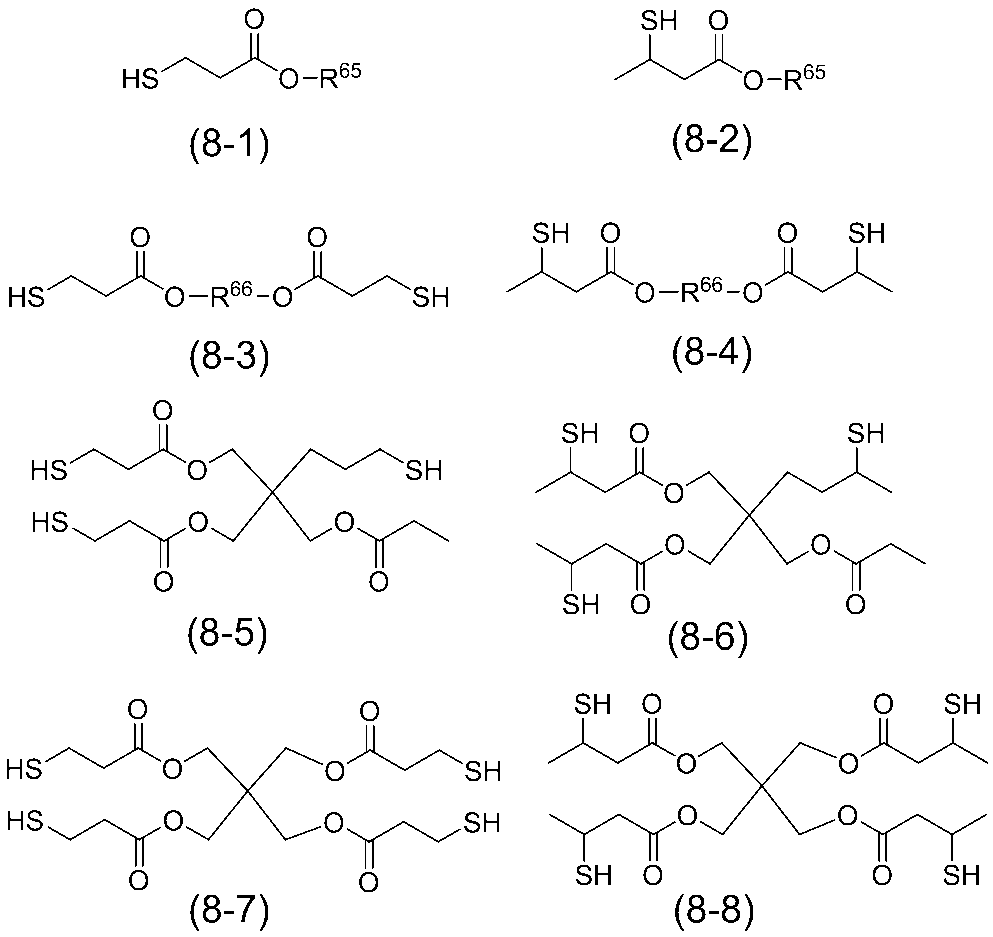
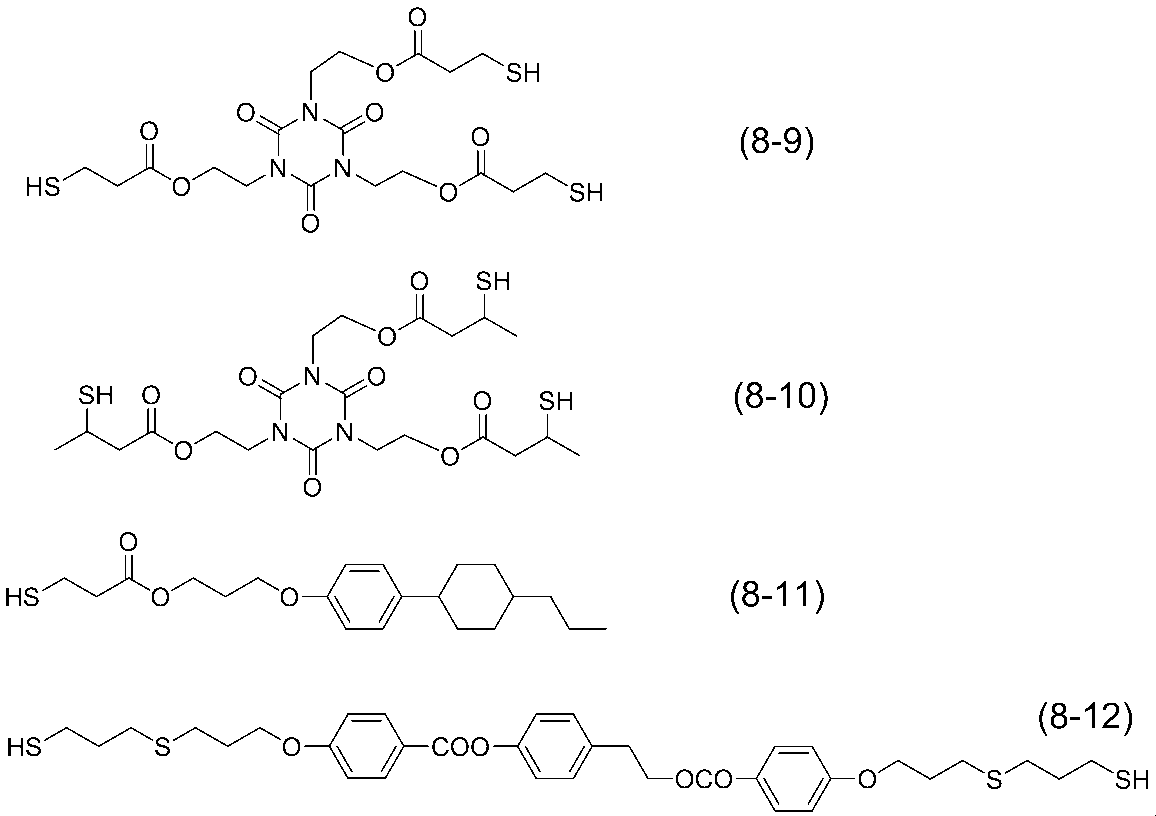
式中、R65は炭素原子数2~18のアルキル基を表し、該アルキル基は直鎖であっても分岐鎖であっても良く、該アルキル基中の1つ以上のメチレン基は酸素原子、及び硫黄原子が相互に直接結合しないものとして、酸素原子、硫黄原子、-CO-、-OCO-、-COO-、又は-CH=CH-で置換されていてもよく、R66は炭素原子数2~18のアルキレン基を表し、該アルキレン基中の1つ以上のメチレン基は酸素原子、及び硫黄原子が相互に直接結合しないものとして、酸素原子、硫黄原子、-CO-、-OCO-、-COO-、又は-CH=CH-で置換されていてもよい。
連鎖移動剤の添加量は重合性液晶組成物に対して、0.5~10質量%であることが好ましく、1.0~5.0質量%であることがより好ましい。
(その他の添加剤)
更に物性調整のため、目的に応じて、液晶性のない重合性化合物、チキソ剤、紫外線吸収剤、赤外線吸収剤、抗酸化剤、表面処理剤等の添加剤を液晶の配向能を著しく低下させない程度添加することができる。
(光学異方体の製造方法)
(光学異方体)
本発明の重合性液晶組成物を用いて作製した光学異方体は、基材、必要に応じて配向膜、及び、重合性液晶組成物の重合体を順次積層したものである。
(基材)
本発明の光学異方体に用いられる基材は、液晶デバイス、ディスプレイ、光学部品や光学フィルムに通常使用する基材であって、本発明の重合性液晶組成物の塗布後の乾燥時における加熱に耐えうる耐熱性を有する材料であれば、特に制限はない。そのような基材としては、ガラス基材、金属基材、セラミックス基材やプラスチック基材等の有機材料が挙げられる。特に基材が有機材料の場合、セルロース誘導体、ポリオレフィン、ポリエステル、ポリカーボネート、ポリアクリレート(アクリル樹脂)、ポリアリレート、ポリエーテルサルホン、ポリイミド、ポリフェニレンスルフィド、ポリフェニレンエーテル、ナイロン又はポリスチレン等が挙げられる。中でもポリエステル、ポリスチレン、ポリアクリレート、ポリオレフィン、セルロース誘導体、ポリアリレート、ポリカーボネート等のプラスチック基材が好ましく、ポリアクリレート、ポリオレフィン、セルロース誘導体等の基材がさらに好ましく、ポリオレフィンとしてCOP(シクロオレフィンポリマー)を用い、セルロース誘導体としてTAC(トリアセチルセルロース)を用い、ポリアクリレートとしてPMMA(ポリメチルメタクリレート)を用いることが特に好ましい。基材の形状としては、平板の他、曲面を有するものであっても良い。これらの基材は、必要に応じて、電極層、反射防止機能、反射機能を有していてもよい。
本発明の重合性液晶組成物の塗布性や接着性向上のために、これらの基材の表面処理を行っても良い。表面処理として、オゾン処理、プラズマ処理、コロナ処理、シランカップリング処理などが挙げられる。また、光の透過率や反射率を調節するために、基材表面に有機薄膜、無機酸化物薄膜や金属薄膜等を蒸着など方法によって設ける、あるいは、光学的な付加価値をつけるために、基材がピックアップレンズ、ロッドレンズ、光ディスク、位相差フィルム、光拡散フィルム、カラーフィルター、等であっても良い。中でも付加価値がより高くなるピックアップレンズ、位相差フィルム、光拡散フィルム、カラーフィルターは好ましい。
(配向処理)
また、上記基材としては、本発明の重合性液晶組成物を塗布乾燥した際に重合性液晶組成物が配向するように、ガラス基材単独、あるいは基材上に配向膜が設けられていても良い。配向膜を用いる場合、配向膜は公知慣用のものが用いられる。そのような配向膜としては、水酸基、カルボン酸基またはスルホン酸基を含有する親水性ポリマーや、また親水性の無機化合物を利用できる。親水性ポリマーとしては、ポリビニルアルコール、ポリアクリル酸、ポリアクリル酸ソーダ、ポリメタクリル酸、ポリアルギン酸ソーダ、ポリカルボキシメチルセルロースソーダ塩、プルラン、ポリスチレンスルホン酸が挙げられる。また、親水性の無機化合物としては、Si、Al、Mg、Zr等の酸化物やフッ化物等の無機化合物が上げられる。親水性の基材は光学異方体の光学軸を基材に対して法線方向にほぼ平行に配向させるために有効なものである。ラビング処理した場合には水平配向膜として作用するため、親水性ポリマー層においてはラビング処理は配向性に悪影響を及ぼすため好ましくない。
(塗布)
本発明の光学異方体を得るための塗布法としては、アプリケーター法、バーコーティング法、スピンコーティング法、ロールコーティング法、ダイレクトグラビアコーティング法、リバースグラビアコーティング法、フレキソコーティング法、インクジェット法、ダイコーティング法、キャップコーティング法、ディップコーティング法、スリットコーティング法等、公知慣用の方法を行うことができる。重合性液晶組成物を塗布後、必要に応じて乾燥させる。
(重合工程)
本発明の重合性液晶組成物の重合操作については、重合性液晶組成物中の液晶化合物が基材に対して水平配向、垂直配向、又はハイブリッド配向、あるいはコレステリック配向(平面配向)した状態で一般に紫外線等の光照射、あるいは加熱によって行われる。重合を光照射で行う場合は、具体的には390nm以下の紫外光を照射することが好ましく、250~370nmの波長の光を照射することが最も好ましい。但し、390nm以下の紫外光により重合性液晶組成物が分解などを引き起こす場合は、390nm以上の紫外光で重合処理を行ったほうが好ましい場合もある。この光は、拡散光で、かつ偏光していない光であることが好ましい。
(重合方法)
本発明の重合性液晶組成物を重合させる方法としては、活性エネルギー線を照射する方法や熱重合法等が挙げられるが、加熱を必要とせず、室温で反応が進行することから活性エネルギー線を照射する方法が好ましく、中でも、操作が簡便なことから、紫外線等の光を照射する方法が好ましい。
照射時の温度は、本発明の重合性液晶組成物が液晶相を保持できる温度とし、重合性液晶組成物の熱重合の誘起を避けるため、可能な限り30℃以下とすることが好ましい。尚、液晶組成物は、通常、昇温過程において、C(固相)-N(ネマチック)転移温度(以下、C-N転移温度と略す。)から、N-I転移温度範囲内で液晶相を示す。一方、降温過程においては、熱力学的に非平衡状態を取るため、C-N転移温度以下でも凝固せず液晶状態を保つ場合がある。この状態を過冷却状態という。本発明においては、過冷却状態にある液晶組成物も液晶相を保持している状態に含めるものとする。具体的には390nm以下の紫外光を照射することが好ましく、250~370nmの波長の光を照射することが最も好ましい。但し、390nm以下の紫外光により重合性組成物が分解などを引き起こす場合は、390nm以上の紫外光で重合処理を行ったほうが好ましい場合もある。この光は、拡散光で、かつ偏光していない光であることが好ましい。紫外線照射強度は、0.05kW/m2~10kW/m2の範囲が好ましい。特に、0.2kW/m2~2kW/m2の範囲が好ましい。紫外線強度が0.05kW/m2未満の場合、重合を完了させるのに多大な時間がかかる。一方、2kW/m2を超える強度では、重合性液晶組成物中の液晶分子が光分解する傾向にあることや、重合熱が多く発生して重合中の温度が上昇し、重合性液晶のオーダーパラメーターが変化して、重合後のフィルムのリタデーションに狂いが生じる可能性がある。
マスクを使用して特定の部分のみを紫外線照射で重合させた後、該未重合部分の配向状態を、電場、磁場又は温度等をかけて変化させ、その後該未重合部分を重合させると、異なる配向方向をもった複数の領域を有する光学異方体を得ることもできる。
また、マスクを使用して特定の部分のみを紫外線照射で重合させる際に、予め未重合状態の重合性液晶組成物に電場、磁場又は温度等をかけて配向を規制し、その状態を保ったままマスク上から光を照射して重合させることによっても、異なる配向方向をもった複数の領域を有する光学異方体を得ることができる。
本発明の重合性液晶組成物を重合させて得られる光学異方体は、基板から剥離して単体で光学異方体として使用することも、基板から剥離せずにそのまま光学異方体として使用することもできる。特に、他の部材を汚染し難いので、被積層基板として使用したり、他の基板に貼り合わせて使用したりするときに有用である。
(位相差膜)
本発明の位相差膜は、本発明の光学異方体と同様にして作成される。前記位相差膜は、ホメオトロピック液晶フィルムとして使用することができる。また、基材が位相差を有する場合には、基材の有する複屈折性、及び、本発明の位相差膜の複屈折性を加算した複屈折性を有する位相差膜が得られる。前記位相差膜は、基材の有する複屈折性と位相差膜の有する複屈折性が基材の面内で同じ方向の場合もあれば、異なる方向の場合もある。液晶デバイス、ディスプレイ、光学素子、光学部品、着色剤、セキュリティ用マーキング、レーザー発光用部材、光学フィルム、及び、補償フィルム等の用途に応じて、用途に適した形で適用される。
(視野角補償膜)
本発明の視野角補償膜は、本発明の光学異方体と同様にして作成される。ホメオトロピック配向した液晶フィルムである前記視野角補償膜は、IPS(In-PlaneSwitching)方式の液晶表示装置に組み込まれ、液晶表示装置を斜め方向から見た場合において視認される画像の色味やコントラストが変化する問題を低減する目的で使用される。
(反射防止膜)
本発明の反射防止膜は、本発明の光学異方体と同様にして作成される。偏光板と1/4波長板を積層した円偏光板を有機EL素子に適用した場合、円偏光板に対して垂直方向からの入射光に対して前記円偏光板は理想的に機能するが、斜め方向からの入射光に対しては、1/4波長からのズレが生じ、理想的な円偏光板として機能しない。ホメオトロピック配向した前記光学異方体を外光反射防止目的で円偏光板に使用した場合、斜め方向からの入射光に対しても黒表示における視野角依存性を低減できる。
以下に本発明を合成例、実施例、及び、比較例によって説明するが、もとより本発明はこれらに限定されるものではない。なお、特に断りのない限り、「部」及び「%」は質量基準である。
(重合性液晶組成物の調製)
表1~表3に示す式(A-1)~式(A-8)、式(B-1)~式(B-7)、式(C-1)~式(C-5)で表される化合物合計量100質量部に対し、(D-1)の化合物、(E-1)の化合物、(F-1)の化合物、及び、有機溶媒であるメチルイソブチルケトン(MIBK)(G-1)をそれぞれ、表1~表4に示す割合(質量部)で配合し重合性液晶組成物(1)~(37)を調製した。
(重合性液晶組成物(1)の調製)
表1に示す通り、式(A-4)で表される化合物40質量部、式(A-5)で表される化合物30質量部、式(B-1)で表される化合物30質量部の合計値100質量部に対して、重合開始剤(E-1)3質量部、p-メトキシフェノール(MEHQ)(F-1)0.1質量部、及び、有機溶媒であるMIBK(G-1)300質量部を用い、攪拌プロペラを有する攪拌装置を使用し、攪拌速度が500rpm、溶液温度が60℃の条件下で1時間攪拌後、0.2μmのメンブランフィルターで濾過して重合性液晶組成物(1)を得た。
(重合性液晶組成物(2)~(31)、比較用重合性液晶組成物(32)~(37)の調製)
本発明の重合性液晶組成物(1)の調製と同様に、表1に示す式(A-1)~式(A-8)、式(B-1)~式(B-7)、式(C-1)~式(C-5)、(D-1)の化合物、(E-1)の化合物、(F-1)の化合物、及び、有機溶媒であるメチルイソブチルケトン(MIBK)(G-1)の各化合物をそれぞれ表1~表4に示す割合に変更した以外は重合性液晶組成物(1)の調製と同一条件で、それぞれ、重合性液晶組成物(2)~(31)、比較用重合性液晶組成物(32)~(37)を得た。
表1~表3に、本発明の重合性液晶組成物(1)~(31)、比較用重合性液晶組成物(32)~(37)の具体的な組成を示す。
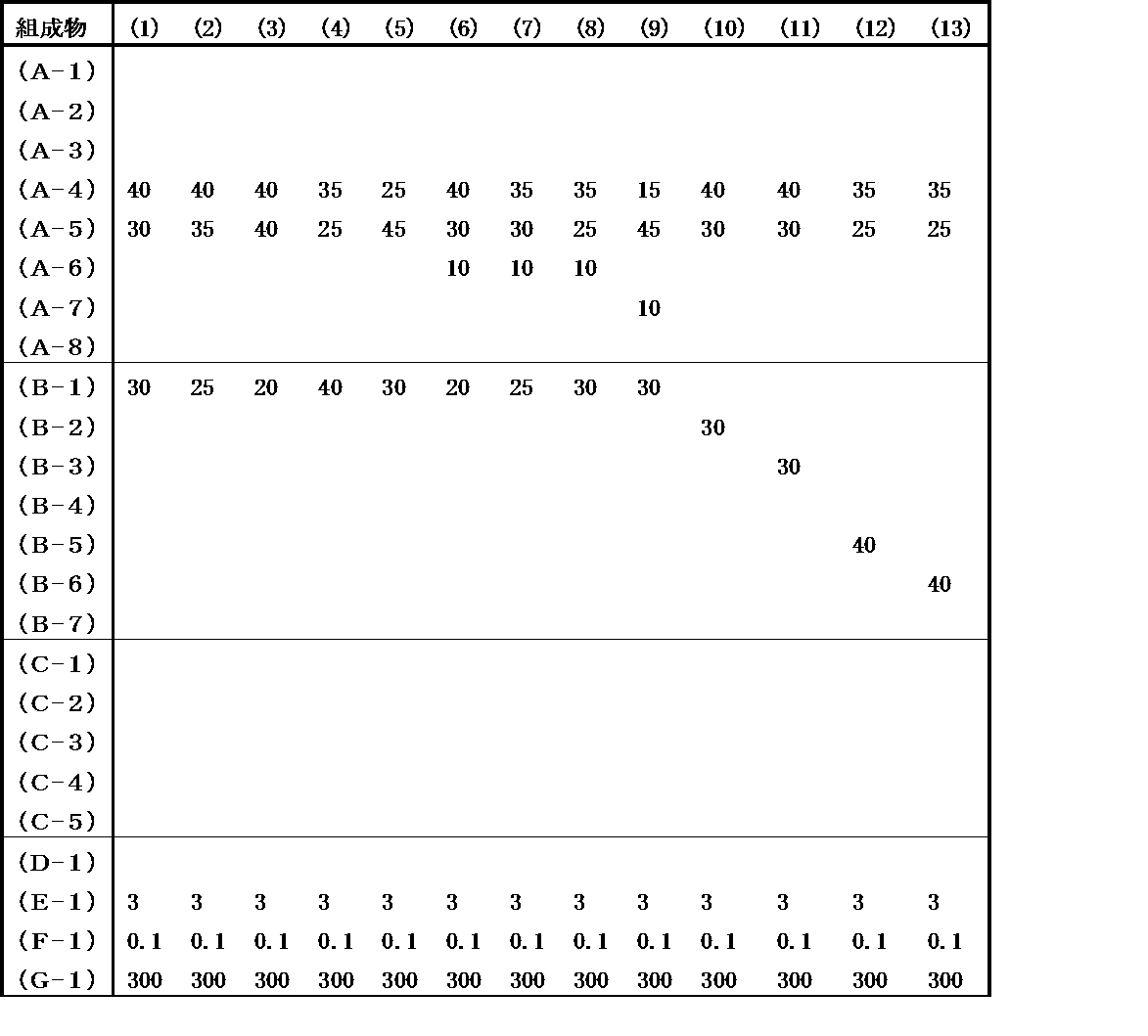
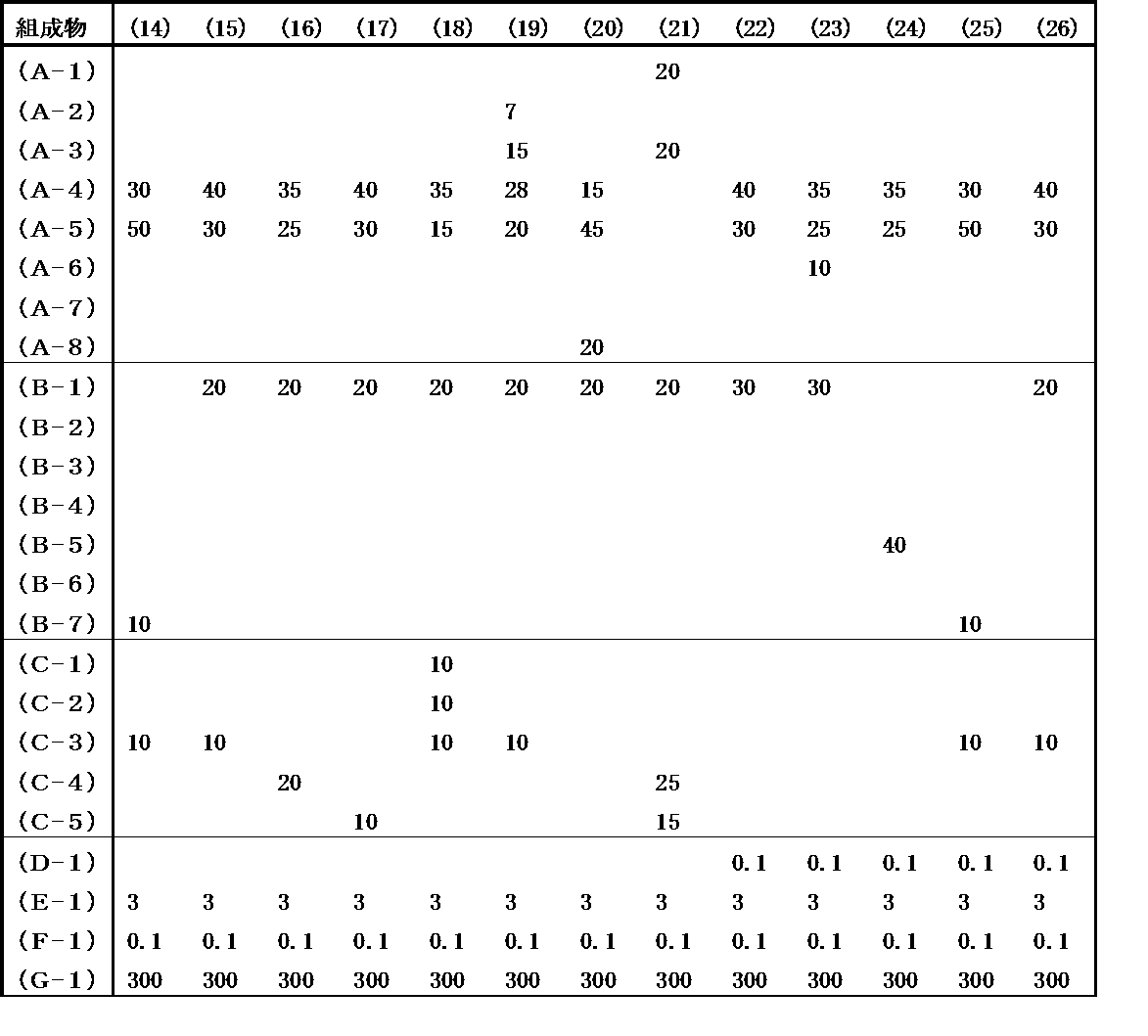
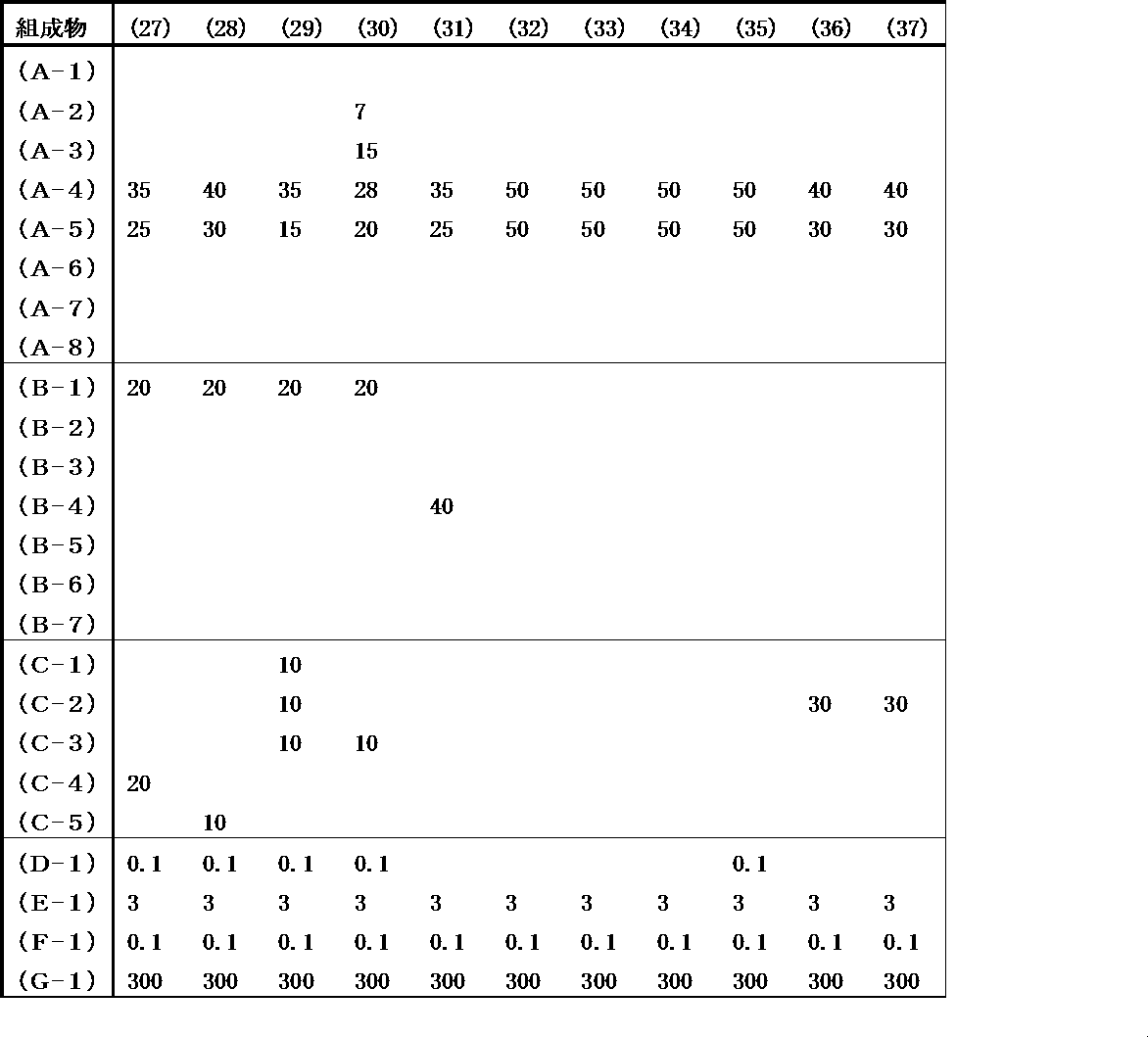
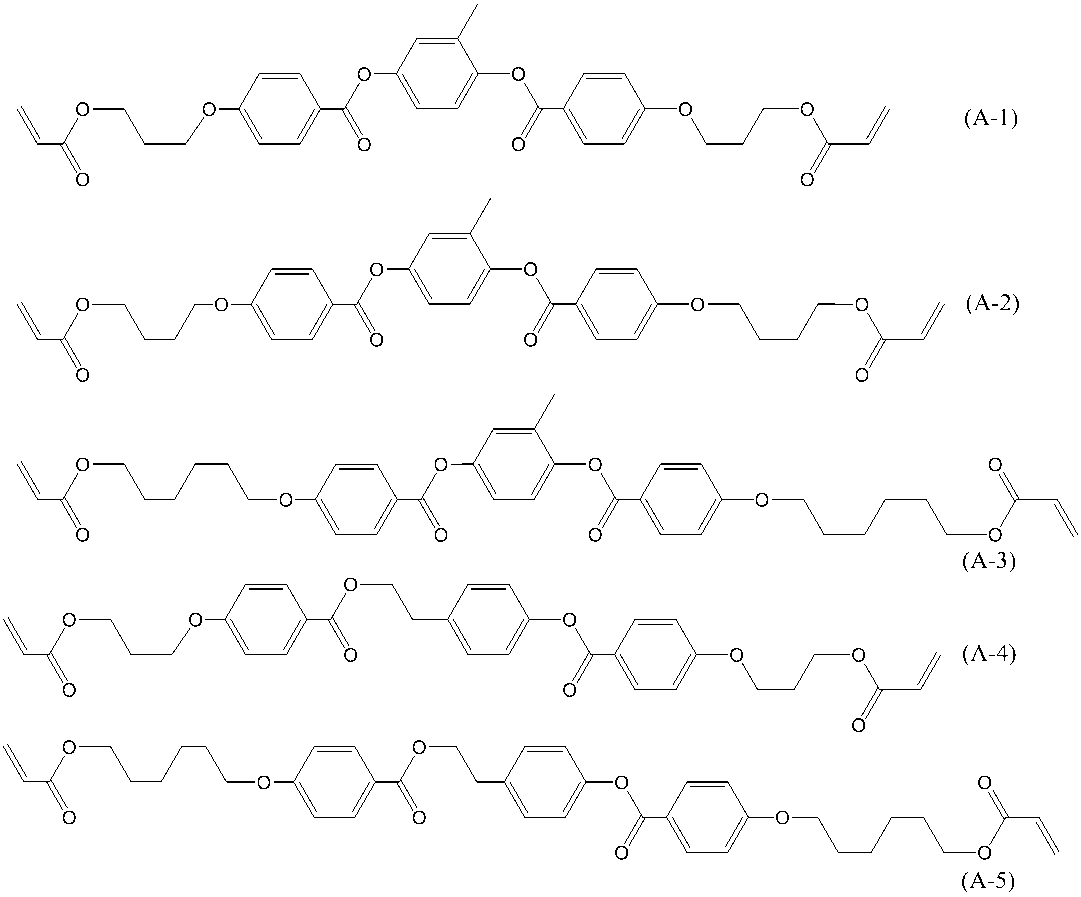
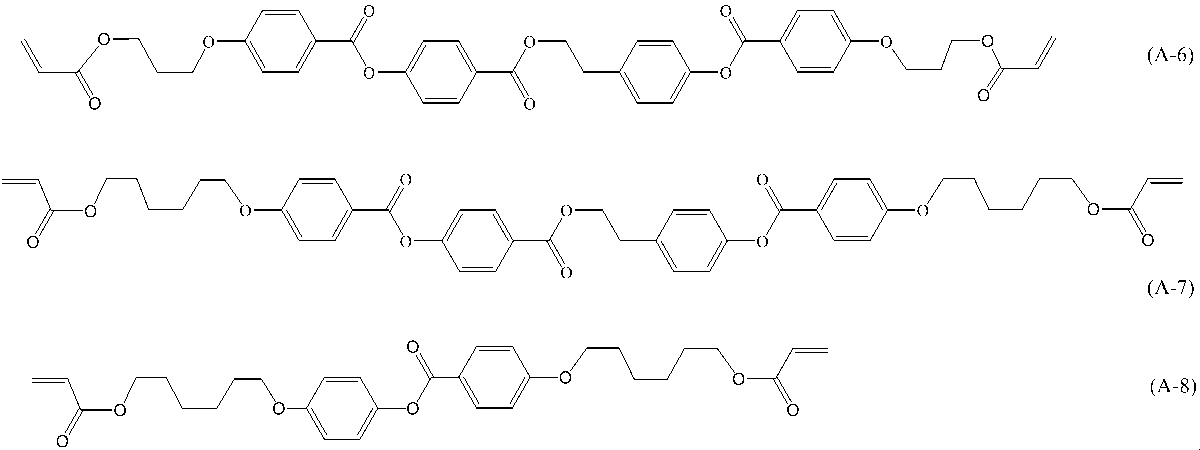
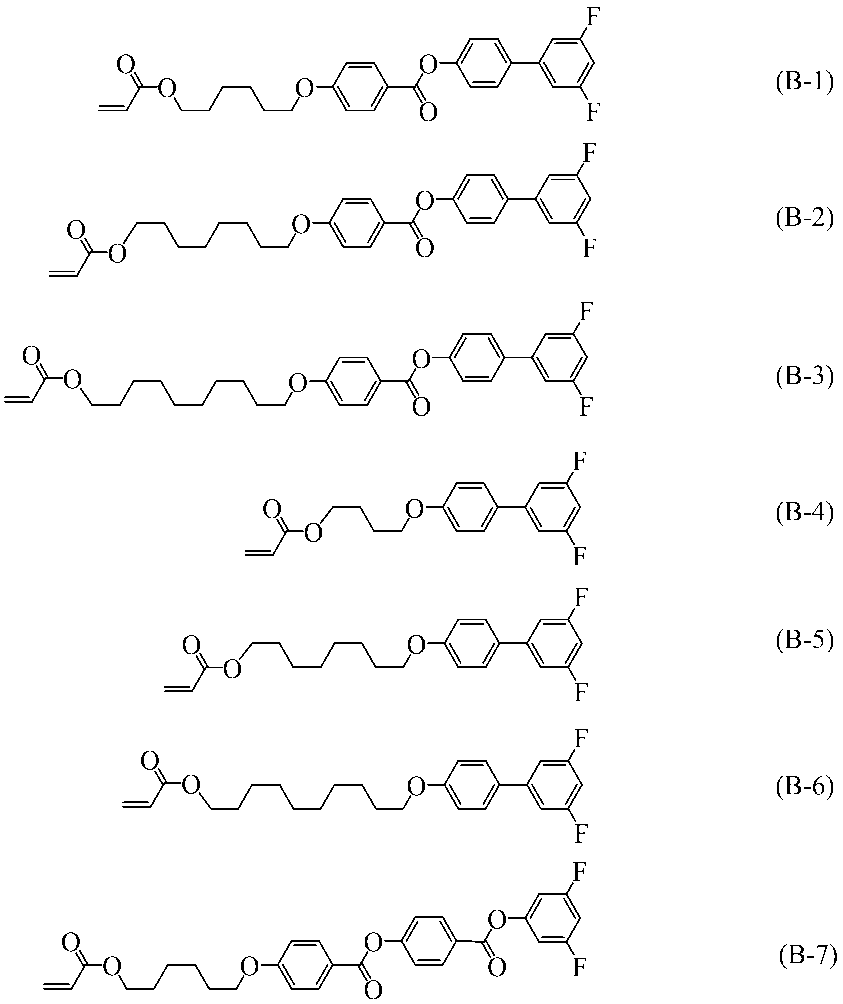

メガファック F-554(D-1)
イルガキュア907(E-1)
MEHQ(F-1)
(実施例1)
(配向性)
調製した重合性液晶組成物(1)をガラス基板上にバーコーター♯4を用いて室温で塗布し、60℃で2分乾燥後、25℃で1分放置した後に、コンベア式の高圧水銀ランプを使用して、光量が300mJ/cm2となるようにセットしたUV光を照射することにより、実施例1の薄膜を得た。
◎:目視で欠陥が全くなく、偏光顕微鏡観察でも欠陥が全くない。
〇:目視では欠陥がないが、偏光顕微鏡観察で一部に無配向部分が存在している。
△:目視では欠陥がないが、偏光顕微鏡観察で全体的に無配向部分が存在している。
×:目視で一部欠陥が生じており、偏光顕微鏡観察でも全体的に無配向部分が存在している。
(耐久性)
上記配向性評価試験において得られた薄膜を85℃で500時間保持して耐久性測定用薄膜を得た。
<位相差変化(率)測定>
上記加熱試験前後の入射光θ=50°の位相差Reを大塚電子製のRETS-100にて測定し(波長は550nm)、加熱前の位相差を100%とした場合の加熱後の位相差変化率を評価した。
◎:3%未満の変化
〇:3%以上~7%未満の低下
△:7%以上~10%未満の低下
×:10%以上の低下
(ハジキ評価)
上記配向性を測定した塗膜のハジキ具合を目視にて観察した。
◎:塗膜表面にハジキ欠陥が全く観察されない。
〇:塗膜表面にハジキ欠陥が極僅かに観察される。
△:塗膜表面にハジキ欠陥が少し観察される。
×:塗膜表面にハジキ欠陥が多数観察される。
得られた結果を以下の表に示す。
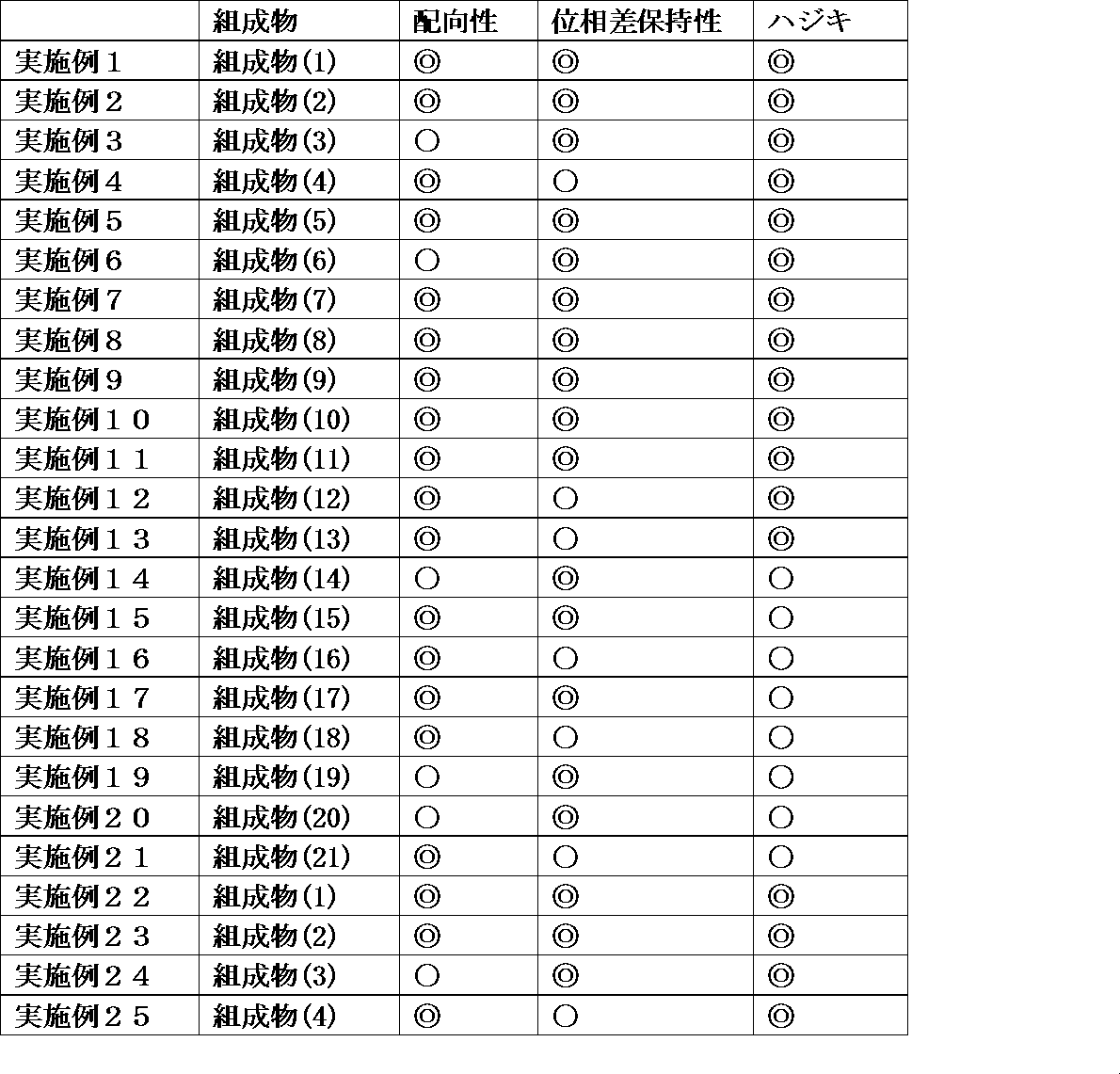
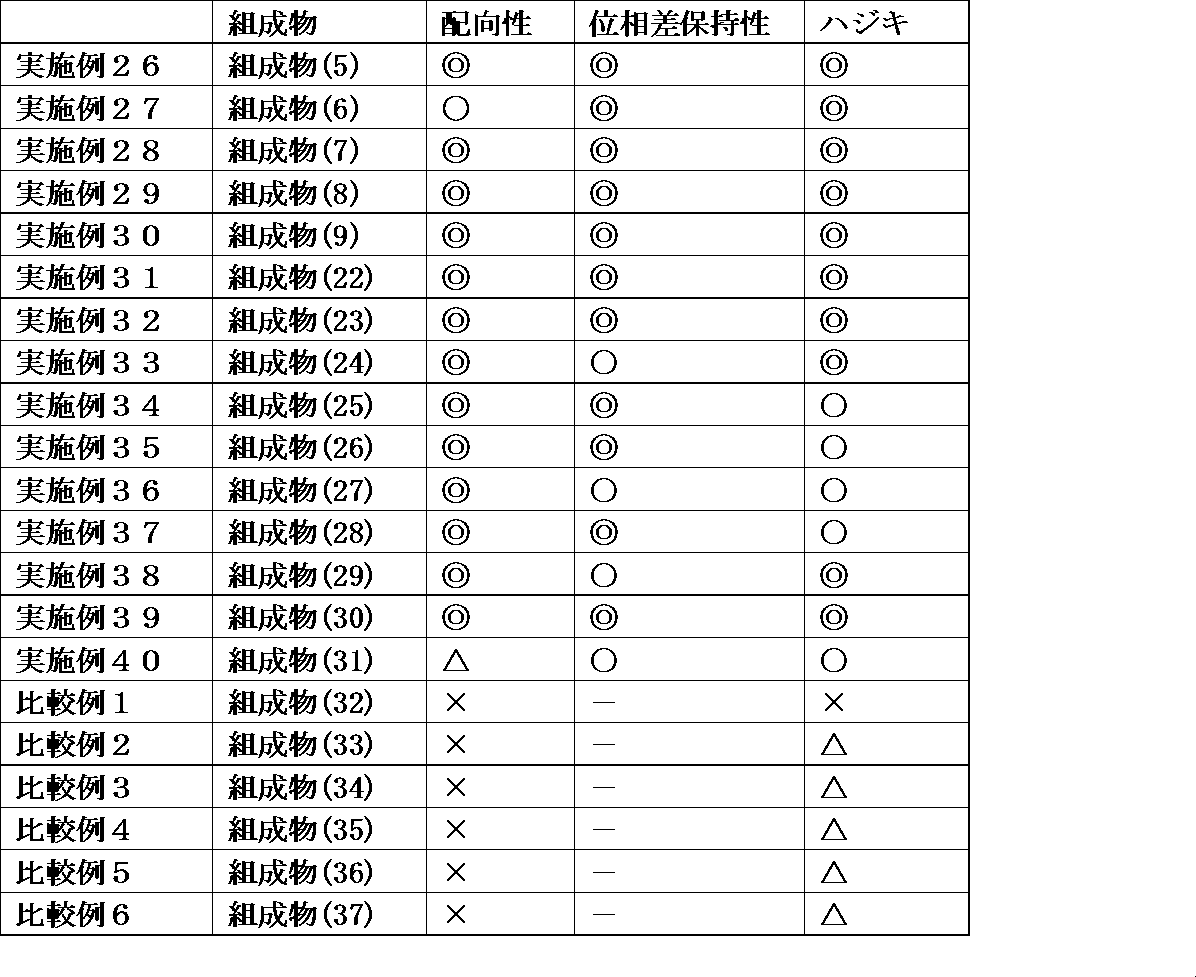
(実施例2~40、比較例1~6)
重合性液晶組成物(2)~(37)を用いて、薄膜を作製し、配向性、耐久性、ハジキを測定した。結果を、それぞれ、実施例2~40、比較例1~6とし、上記表に示す。
重合性液晶組成物(2)~(37)を用いて、薄膜を作製し、配向性、耐久性、ハジキを測定した。結果を、それぞれ、実施例2~40、比較例1~6とし、上記表に示す。
なお、実施例2~実施例21、実施例40、及び比較例1、比較例5では、配向性評価用等の基材として、実施例1と同様に、ガラス基板を用い、重合性液晶組成物の塗布・硬化条件は、各重合性液晶組成物を、バーコーター♯4を用いて室温で塗布し、60℃で2分乾燥後、25℃で1分放置した後に、コンベア式の高圧水銀ランプを使用して、光量が300mJ/cm2となるようにセットしたUV光を照射する条件とした。位相差変化(率)測定は、上記加熱試験前後の入射光θ=50°の位相差Reを大塚電子製のRETS-100にて測定し(波長は550nm)、加熱前の位相差を100%とした場合の加熱後の位相差変化率を評価した。
また、実施例22~実施例25、実施例27~実施例29、実施例31~実施例39、比較例2、比較例4、及び、比較例6は、COP(シクロオレフィンポリマー)基板上にシランカップリング系垂直配向膜を積層したものを用い、重合性液晶組成物の塗布・硬化条件は、各重合性液晶組成物を、バーコーター♯4を用いて室温で塗布し、60℃で2分乾燥後、25℃で1分放置した後に、コンベア式の高圧水銀ランプを使用して、光量が300mJ/cm2となるようにセットしてUV光を照射する条件とした。位相差変化(率)測定は、上記加熱試験前後の入射光θ=50°の位相差Reを大塚電子製のRETS-100にて測定し(波長は550nm)、加熱前の位相差を100%とした場合の加熱後の位相差変化率を評価した。
さらに、実施例26、実施例30、及び、比較例3は、COP(シクロオレフィンポリマー)基板を用い、重合性液晶組成物の塗布・硬化条件は、各重合性液晶組成物を、バーコーター♯4を用いて室温で塗布し、60℃で2分乾燥後、25℃で1分放置した後に、コンベア式の高圧水銀ランプを使用して、光量が300mJ/cm2となるようにセットしてUV光を照射する条件とした。位相差変化(率)測定は、上記加熱試験前後の正面位相差Reを大塚電子製のRETS-100にて測定し(波長は550nm)。加熱前の位相差を100%とした場合の加熱後の位相差変化率を評価した。
その結果、式(A-1)~(A-8)で表される2官能重合性液晶化合物及び、式(B-1)~式(B-7)で表される単官能重合性液晶化合物を含有する重合性液晶組成物(実施例1~実施例40)は、式(B-1)~式(B-7)で表される単官能重合性液晶化合物を含有しない重合性液晶組成物(比較例1~比較例6)に比べ、良好なホメオトロピック配向性を有し、耐久性に優れ、ハジキ欠陥が少ない光学異方体を得ることができる。一方、式(B-1)~式(B-7)で表される単官能重合性液晶化合物を含有しない重合性液晶組成物(比較例1~比較例6)は、配向性が悪く、ハジキ欠陥が生じることから良好なホメオトロピック配向した光学異方体を得ることができない。
特に、式(B-1)~式(B-7)で表される単官能重合性液晶化合物のうち、スペーサー長が6~10と長いスペーサーを有し、末端に直接結合した多環構造を有する式(B-1)~式(B-3)、式(B-5)、式(B-6)で表される化合物を用いた場合、配向性、耐久性、ハジキ欠陥性に優れるホメオトロピック配向した光学異方体を得ることができる。
Claims (12)
- 一般式(I-1)

1種または2種以上の1個の重合性官能基を有する重合性液晶化合物(II-2)(但し、下記一般式(II-1)で表される重合性液晶化合物を除く。)と、
一般式(II-1)

X21は-O-、-S-、-OCH2-、-CH2O-、-CO-、-COO-、-OCO-、-CO-S-、-S-CO-、-O-CO-O-、-CO-NH-、-NH-CO-、-SCH2-、-CH2S-、-CF2O-、-OCF2-、-CF2S-、-SCF2-、-CH=CH-COO-、-CH=CH-OCO-、-COO-CH=CH-、-OCO-CH=CH-、-COO-CH2CH2-、-OCO-CH2CH2-、-CH2CH2-COO-、-CH2CH2-OCO-、-COO-CH2-、-OCO-CH2-、-CH2-COO-、-CH2-OCO-、-CH=CH-、-N=N-、-CH=N-N=CH-、-CF=CF-、-C≡C-又は単結合を表すが、X21が複数存在する場合それらは同一であっても異なっていても良く、
kは0から10の整数を表し、
A21は1,4-フェニレン基、1,4-シクロヘキシレン基、ピリジン-2,5-ジイル基、ピリミジン-2,5-ジイル基、ナフタレン-2,6-ジイル基、ナフタレン-1,4-ジイル基、テトラヒドロナフタレン-2,6-ジイル基、デカヒドロナフタレン-2,6-ジイル基又は1,3-ジオキサン-2,5-ジイル基を表すが、当該基は無置換であるか又は1つ以上の置換基L1によって置換されても良く、A21が複数存在する場合それらは同一であっても異なっていても良く、
L1はフッ素原子、塩素原子、臭素原子、ヨウ素原子、ペンタフルオロスルフラニル基、ニトロ基、シアノ基、イソシアノ基、アミノ基、ヒドロキシル基、メルカプト基、メチルアミノ基、ジメチルアミノ基、ジエチルアミノ基、ジイソプロピルアミノ基、トリメチルシリル基、ジメチルシリル基、チオイソシアノ基又は炭素原子数1から20の直鎖状又は分岐状アルキル基を表すが、該アルキル基中、1個の-CH2-又は隣接していない2個以上の-CH2-が各々独立して-O-、-S-、-CO-、-COO-、-OCO-、-CO-S-、-S-CO-、-O-CO-O-、-CO-NH-、-NH-CO-、-OCO-NH-、-NH-COO-、-NH-CO-NH-、-NH-O-、-O-NH-、-CH=CH-COO-、-CH=CH-OCO-、-COO-CH=CH-、-OCO-CH=CH-、-CH=CH-、-N=N-、-CH=N-、-N=CH-、-CH=N-N=CH-、-CF=CF-又は-C≡C-によって置換されても良く、該アルキル基中の任意の水素原子がフッ素原子に置換されても良く、
Z21は-O-、-S-、-OCH2-、-CH2O-、-CH2CH2-、-CO-、-COO-、-OCO-、-CO-S-、-S-CO-、-O-CO-O-、-CO-NH-、-NH-CO-、-OCO-NH-、-NH-COO-、-NH-CO-NH-、-NH-O-、-O-NH-、-SCH2-、-CH2S-、-CF2O-、-OCF2-、-CF2S-、-SCF2-、-CH=CH-COO-、-CH=CH-OCO-、-COO-CH=CH-、-OCO-CH=CH-、-COO-CH2CH2-、-OCO-CH2CH2-、-CH2CH2-COO-、-CH2CH2-OCO-、-COO-CH2-、-OCO-CH2-、-CH2-COO-、-CH2-OCO-、-CH=CH-、-N=N-、-CH=N-、-N=CH-、-CH=N-N=CH-、-CF=CF-、-C≡C-又は単結合を表すが、Z21が複数存在する場合それらは同一であっても異なっていても良く、
mは1から5の整数を表し、
A22は下記の式(A2-1)から式(A2-9)
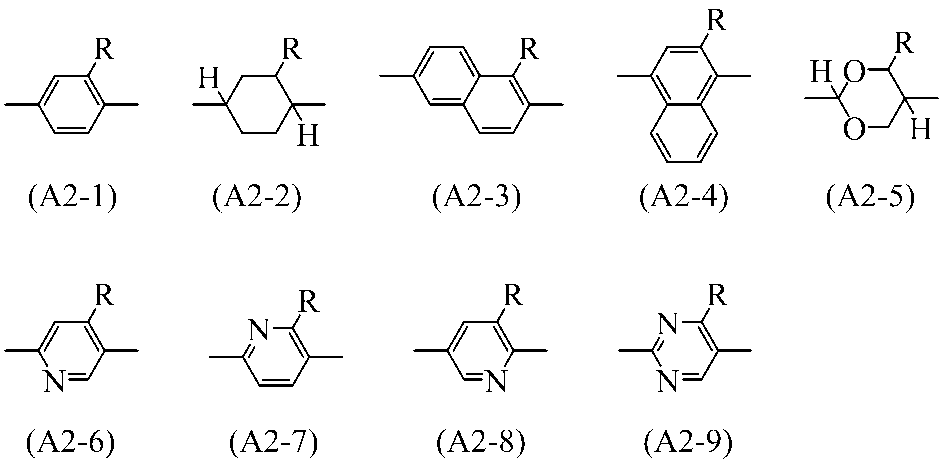
Rはフッ素原子、塩素原子、臭素原子、ヨウ素原子、ペンタフルオロスルフラニル基、シアノ基、ニトロ基、イソシアノ基、チオイソシアノ基、又は炭素原子数2から20の直鎖状又は分岐状アルキル基を表すが、該アルキル基中、1個の-CH2-又は隣接していない2個以上の-CH2-が各々独立して-O-、-S-、-CO-、-COO-、-OCO-、-CO-S-、-S-CO-、-O-CO-O-、-CO-NH-、-NH-CO-、-OCO-NH-、-NH-COO-、-NH-CO-NH-、-NH-O-、-O-NH-、-CH=CH-COO-、-CH=CH-OCO-、-COO-CH=CH-、-OCO-CH=CH-、-CH=CH-、-N=N-、-CH=N-、-N=CH-、-CH=N-N=CH-、-CF=CF-又は-C≡C-によって置換されても良く、該アルキル基中の任意の水素原子がフッ素原子に置換されても良い。)から選ばれる基を表し、
置換基L2はフッ素原子、塩素原子、臭素原子、ヨウ素原子、ペンタフルオロスルフラニル基、ニトロ基、シアノ基、イソシアノ基、アミノ基、ヒドロキシル基、メルカプト基、メチルアミノ基、ジメチルアミノ基、ジエチルアミノ基、ジイソプロピルアミノ基、トリメチルシリル基、ジメチルシリル基、チオイソシアノ基、又は炭素原子数2から20の直鎖状又は分岐状アルキル基を表すが、該アルキル基中1個の-CH2-又は隣接していない2個以上の-CH2-が各々独立して-O-、-S-、-CO-、-COO-、-OCO-、-CO-S-、-S-CO-、-O-CO-O-、-CO-NH-、-NH-CO-、-OCO-NH-、-NH-COO-、-NH-CO-NH-、-NH-O-、-O-NH-、-CH=CH-COO-、-CH=CH-OCO-、-COO-CH=CH-、-OCO-CH=CH-、-CH=CH-、-N=N-、-CH=N-、-N=CH-、-CH=N-N=CH-、-CF=CF-又は-C≡C-によって置換されても良く、該アルキル基中の任意の水素原子はフッ素原子に置換されても良く、Hは水素原子を表し、化合物内に置換基L1及び/又はL2が複数存在する場合それらは同一であっても異なっていても良いが、一般式(II-1)中に、ヘテロ原子同士の直接結合を含まない。)で表される重合性液晶化合物を1種または2種以上と、を含有する重合性液晶組成物。 - 一般式(II-1)において、P21が下記の式(P-1)から式(P-20)
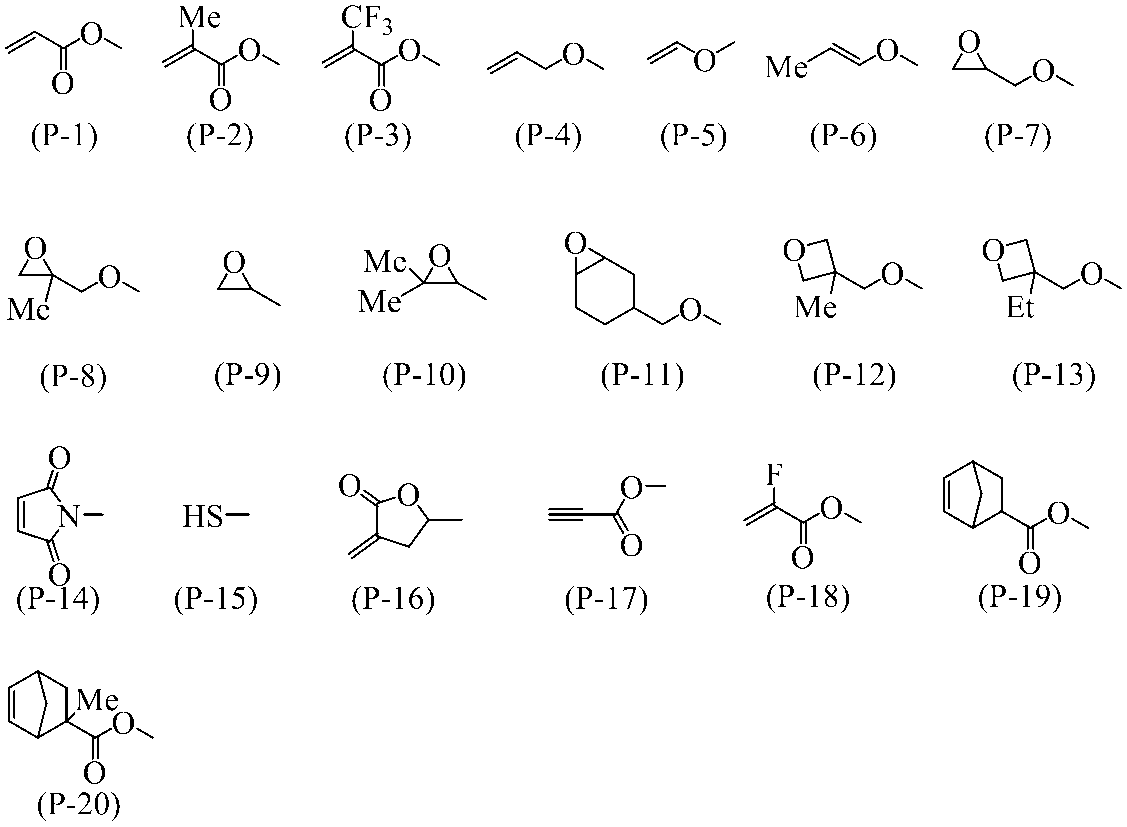
- 一般式(II-1)において、Sp21が各々独立して、1個の-CH2-又は隣接していない2個以上の-CH2-が各々独立して-O-、-COO-、-OCO-、-OCO-O-、-CO-NH-、-NH-CO-、-CH=CH-又は-C≡C-に置き換えられても良い炭素原子数1から20のアルキレン基を表す、請求項1又は請求項2に記載の重合性液晶組成物。
- 一般式(II-1)において、A21が各々独立して下記の式(A1-1)から式(A1-11)
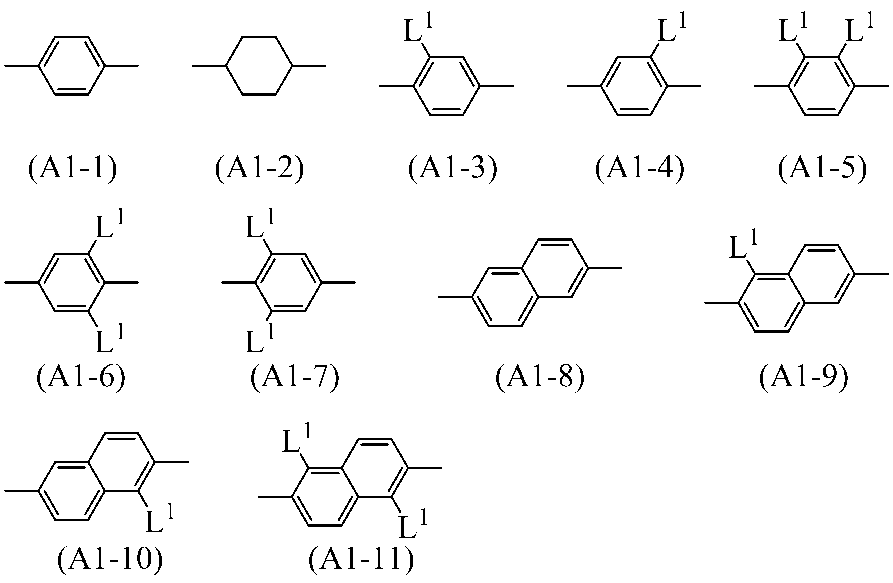
- 一般式(II-1)において、A22が下記の式(A2-1-1)から式(A2-1-3)
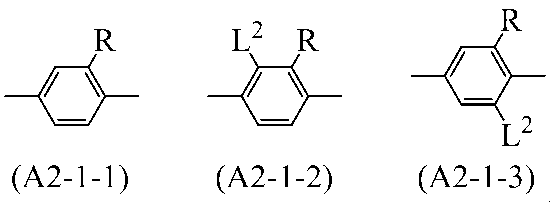


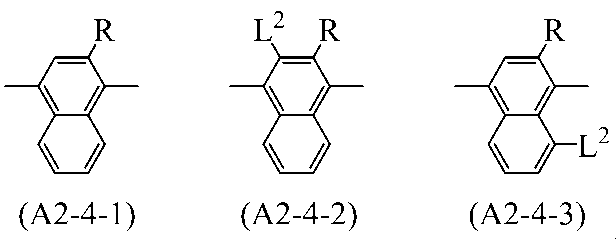
- 前記分子内に1個の重合性官能基を有する重合性液晶化合物(II-2)が一般式(II-2-1)

- 請求項1~請求項6のいずれか一項に記載の重合性液晶組成物を重合させることにより得られる重合体。
- 請求項1~請求項6のいずれか一項に記載の重合性液晶組成物を用いてなる光学異方体。
- 請求項1~請求項6のいずれか一項に記載の重合性液晶組成物を用いてなる位相差膜。
- 請求項1~請求項6のいずれか一項に記載の重合性液晶組成物を用いてなる視野角補償膜。
- 請求項1~請求項6のいずれか一項に記載の重合性液晶組成物を用いてなる反射防止膜。
- 請求項1~請求項6のいずれか一項に記載の重合性液晶組成物を用いてなる液晶表示素子。
Priority Applications (3)
| Application Number | Priority Date | Filing Date | Title |
|---|---|---|---|
| EP16811495.7A EP3312258A4 (en) | 2015-06-17 | 2016-06-07 | POLYMERIZABLE COMPOSITION AND OPTICAL ANISOTROPIC BODY USING THEREOF |
| JP2017525153A JP6288536B2 (ja) | 2015-06-17 | 2016-06-07 | 重合性組成物及びそれを用いた光学異方体 |
| US15/736,889 US20180362849A1 (en) | 2015-06-17 | 2016-06-07 | Polymerizable composition and optically anisotropic body using same |
Applications Claiming Priority (2)
| Application Number | Priority Date | Filing Date | Title |
|---|---|---|---|
| JP2015122038 | 2015-06-17 | ||
| JP2015-122038 | 2015-06-17 |
Publications (1)
| Publication Number | Publication Date |
|---|---|
| WO2016204020A1 true WO2016204020A1 (ja) | 2016-12-22 |
Family
ID=57545709
Family Applications (1)
| Application Number | Title | Priority Date | Filing Date |
|---|---|---|---|
| PCT/JP2016/066876 Ceased WO2016204020A1 (ja) | 2015-06-17 | 2016-06-07 | 重合性組成物及びそれを用いた光学異方体 |
Country Status (4)
| Country | Link |
|---|---|
| US (1) | US20180362849A1 (ja) |
| EP (1) | EP3312258A4 (ja) |
| JP (1) | JP6288536B2 (ja) |
| WO (1) | WO2016204020A1 (ja) |
Cited By (3)
| Publication number | Priority date | Publication date | Assignee | Title |
|---|---|---|---|---|
| WO2018003514A1 (ja) * | 2016-06-28 | 2018-01-04 | Dic株式会社 | 重合性液晶組成物 |
| WO2018003515A1 (ja) * | 2016-06-28 | 2018-01-04 | Dic株式会社 | 重合性液晶組成物 |
| WO2019039287A1 (ja) * | 2017-08-21 | 2019-02-28 | 住友化学株式会社 | フレキシブルディスプレイ用光学補償機能付き位相差板 |
Citations (2)
| Publication number | Priority date | Publication date | Assignee | Title |
|---|---|---|---|---|
| WO2008102838A1 (ja) * | 2007-02-23 | 2008-08-28 | Zeon Corporation | 液晶性化合物、液晶性組成物、光学フィルムおよび光学積層体 |
| JP2011225520A (ja) * | 2010-04-02 | 2011-11-10 | Jnc Corp | 重合性基を有する光学活性化合物ならびにその重合体 |
Family Cites Families (1)
| Publication number | Priority date | Publication date | Assignee | Title |
|---|---|---|---|---|
| JPH10186367A (ja) * | 1996-12-27 | 1998-07-14 | Sharp Corp | 液晶表示素子およびその製造方法 |
-
2016
- 2016-06-07 US US15/736,889 patent/US20180362849A1/en not_active Abandoned
- 2016-06-07 JP JP2017525153A patent/JP6288536B2/ja not_active Expired - Fee Related
- 2016-06-07 EP EP16811495.7A patent/EP3312258A4/en not_active Withdrawn
- 2016-06-07 WO PCT/JP2016/066876 patent/WO2016204020A1/ja not_active Ceased
Patent Citations (2)
| Publication number | Priority date | Publication date | Assignee | Title |
|---|---|---|---|---|
| WO2008102838A1 (ja) * | 2007-02-23 | 2008-08-28 | Zeon Corporation | 液晶性化合物、液晶性組成物、光学フィルムおよび光学積層体 |
| JP2011225520A (ja) * | 2010-04-02 | 2011-11-10 | Jnc Corp | 重合性基を有する光学活性化合物ならびにその重合体 |
Non-Patent Citations (2)
| Title |
|---|
| HUSSAIN Z. ET AL.: "Investigation ot reactive acrylic monomers for their effect on the temperature range and operating voltage of polymer-stabilised optically isotropic liquid crystal blue phases", LIQUID CRYSTALS, vol. 39, no. 11, 2012, pages 1345 - 1357, XP001579010, ISSN: 0267-8292 * |
| See also references of EP3312258A4 * |
Cited By (9)
| Publication number | Priority date | Publication date | Assignee | Title |
|---|---|---|---|---|
| WO2018003514A1 (ja) * | 2016-06-28 | 2018-01-04 | Dic株式会社 | 重合性液晶組成物 |
| WO2018003515A1 (ja) * | 2016-06-28 | 2018-01-04 | Dic株式会社 | 重合性液晶組成物 |
| JPWO2018003515A1 (ja) * | 2016-06-28 | 2018-12-20 | Dic株式会社 | 重合性液晶組成物 |
| JPWO2018003514A1 (ja) * | 2016-06-28 | 2018-12-27 | Dic株式会社 | 重合性液晶組成物 |
| WO2019039287A1 (ja) * | 2017-08-21 | 2019-02-28 | 住友化学株式会社 | フレキシブルディスプレイ用光学補償機能付き位相差板 |
| JP2019035952A (ja) * | 2017-08-21 | 2019-03-07 | 住友化学株式会社 | フレキシブルディスプレイ用光学補償機能付き位相差板 |
| KR20200036928A (ko) * | 2017-08-21 | 2020-04-07 | 스미또모 가가꾸 가부시끼가이샤 | 플렉시블 디스플레이용 광학 보상 기능 부착 위상차판 |
| JP7529378B2 (ja) | 2017-08-21 | 2024-08-06 | 住友化学株式会社 | フレキシブルディスプレイ用光学補償機能付き位相差板 |
| KR102695096B1 (ko) * | 2017-08-21 | 2024-08-13 | 스미또모 가가꾸 가부시끼가이샤 | 플렉시블 디스플레이용 광학 보상 기능 부착 위상차판 |
Also Published As
| Publication number | Publication date |
|---|---|
| US20180362849A1 (en) | 2018-12-20 |
| JP6288536B2 (ja) | 2018-03-07 |
| JPWO2016204020A1 (ja) | 2017-10-26 |
| EP3312258A1 (en) | 2018-04-25 |
| EP3312258A4 (en) | 2019-02-20 |
Similar Documents
| Publication | Publication Date | Title |
|---|---|---|
| US10253125B2 (en) | Polymerizable liquid crystal composition and optically anisotropic body, retardation film, and patterned retardation film using the same | |
| KR102552212B1 (ko) | 중합성 조성물 및 광학 이방체 | |
| KR102197550B1 (ko) | 중합성 액정 조성물 및 그것을 이용한 광학 필름 | |
| JP6156588B2 (ja) | 重合性組成物、及び、それを用いたフィルム | |
| KR102154219B1 (ko) | 중합성 조성물, 및 그것을 이용한 필름 | |
| JP5885049B2 (ja) | 重合性液晶組成物の製造方法 | |
| JP2018203945A (ja) | 重合性液晶組成物、及び、それを用いた光学異方体 | |
| JP6296135B2 (ja) | 重合性組成物、及び、それを用いたフィルム | |
| WO2018225579A1 (ja) | 重合性液晶組成物、それを用いた光学フィルム、及びその製造方法 | |
| JP6288536B2 (ja) | 重合性組成物及びそれを用いた光学異方体 | |
| WO2016114210A1 (ja) | 重合性液晶組成物及び該組成物を用いて作製した光学異方体、位相差膜、反射防止膜、液晶表示素子 | |
| JP6414367B2 (ja) | 重合性液晶組成物 | |
| JP6414368B2 (ja) | 重合性液晶組成物 |
Legal Events
| Date | Code | Title | Description |
|---|---|---|---|
| 121 | Ep: the epo has been informed by wipo that ep was designated in this application |
Ref document number: 16811495 Country of ref document: EP Kind code of ref document: A1 |
|
| ENP | Entry into the national phase |
Ref document number: 2017525153 Country of ref document: JP Kind code of ref document: A |
|
| NENP | Non-entry into the national phase |
Ref country code: DE |
|
| WWE | Wipo information: entry into national phase |
Ref document number: 2016811495 Country of ref document: EP |