WO2016204065A1 - 2液硬化型組成物、2液型接着剤、2液型コーティング剤、積層体 - Google Patents
2液硬化型組成物、2液型接着剤、2液型コーティング剤、積層体 Download PDFInfo
- Publication number
- WO2016204065A1 WO2016204065A1 PCT/JP2016/067216 JP2016067216W WO2016204065A1 WO 2016204065 A1 WO2016204065 A1 WO 2016204065A1 JP 2016067216 W JP2016067216 W JP 2016067216W WO 2016204065 A1 WO2016204065 A1 WO 2016204065A1
- Authority
- WO
- WIPO (PCT)
- Prior art keywords
- functional group
- agent
- monomer
- introducing
- adhesive
- Prior art date
- Legal status (The legal status is an assumption and is not a legal conclusion. Google has not performed a legal analysis and makes no representation as to the accuracy of the status listed.)
- Ceased
Links
Classifications
-
- C—CHEMISTRY; METALLURGY
- C09—DYES; PAINTS; POLISHES; NATURAL RESINS; ADHESIVES; COMPOSITIONS NOT OTHERWISE PROVIDED FOR; APPLICATIONS OF MATERIALS NOT OTHERWISE PROVIDED FOR
- C09J—ADHESIVES; NON-MECHANICAL ASPECTS OF ADHESIVE PROCESSES IN GENERAL; ADHESIVE PROCESSES NOT PROVIDED FOR ELSEWHERE; USE OF MATERIALS AS ADHESIVES
- C09J175/00—Adhesives based on polyureas or polyurethanes; Adhesives based on derivatives of such polymers
- C09J175/04—Polyurethanes
- C09J175/06—Polyurethanes from polyesters
-
- B—PERFORMING OPERATIONS; TRANSPORTING
- B32—LAYERED PRODUCTS
- B32B—LAYERED PRODUCTS, i.e. PRODUCTS BUILT-UP OF STRATA OF FLAT OR NON-FLAT, e.g. CELLULAR OR HONEYCOMB, FORM
- B32B27/00—Layered products comprising a layer of synthetic resin
- B32B27/40—Layered products comprising a layer of synthetic resin comprising polyurethanes
-
- B—PERFORMING OPERATIONS; TRANSPORTING
- B32—LAYERED PRODUCTS
- B32B—LAYERED PRODUCTS, i.e. PRODUCTS BUILT-UP OF STRATA OF FLAT OR NON-FLAT, e.g. CELLULAR OR HONEYCOMB, FORM
- B32B15/00—Layered products comprising a layer of metal
- B32B15/04—Layered products comprising a layer of metal comprising metal as the main or only constituent of a layer, which is next to another layer of the same or of a different material
-
- B—PERFORMING OPERATIONS; TRANSPORTING
- B32—LAYERED PRODUCTS
- B32B—LAYERED PRODUCTS, i.e. PRODUCTS BUILT-UP OF STRATA OF FLAT OR NON-FLAT, e.g. CELLULAR OR HONEYCOMB, FORM
- B32B15/00—Layered products comprising a layer of metal
- B32B15/04—Layered products comprising a layer of metal comprising metal as the main or only constituent of a layer, which is next to another layer of the same or of a different material
- B32B15/08—Layered products comprising a layer of metal comprising metal as the main or only constituent of a layer, which is next to another layer of the same or of a different material of synthetic resin
- B32B15/095—Layered products comprising a layer of metal comprising metal as the main or only constituent of a layer, which is next to another layer of the same or of a different material of synthetic resin comprising polyurethanes
-
- B—PERFORMING OPERATIONS; TRANSPORTING
- B32—LAYERED PRODUCTS
- B32B—LAYERED PRODUCTS, i.e. PRODUCTS BUILT-UP OF STRATA OF FLAT OR NON-FLAT, e.g. CELLULAR OR HONEYCOMB, FORM
- B32B27/00—Layered products comprising a layer of synthetic resin
-
- B—PERFORMING OPERATIONS; TRANSPORTING
- B32—LAYERED PRODUCTS
- B32B—LAYERED PRODUCTS, i.e. PRODUCTS BUILT-UP OF STRATA OF FLAT OR NON-FLAT, e.g. CELLULAR OR HONEYCOMB, FORM
- B32B27/00—Layered products comprising a layer of synthetic resin
- B32B27/06—Layered products comprising a layer of synthetic resin as the main or only constituent of a layer, which is next to another layer of the same or of a different material
- B32B27/08—Layered products comprising a layer of synthetic resin as the main or only constituent of a layer, which is next to another layer of the same or of a different material of synthetic resin
-
- B—PERFORMING OPERATIONS; TRANSPORTING
- B32—LAYERED PRODUCTS
- B32B—LAYERED PRODUCTS, i.e. PRODUCTS BUILT-UP OF STRATA OF FLAT OR NON-FLAT, e.g. CELLULAR OR HONEYCOMB, FORM
- B32B27/00—Layered products comprising a layer of synthetic resin
- B32B27/18—Layered products comprising a layer of synthetic resin characterised by the use of special additives
- B32B27/26—Layered products comprising a layer of synthetic resin characterised by the use of special additives using curing agents
-
- B—PERFORMING OPERATIONS; TRANSPORTING
- B32—LAYERED PRODUCTS
- B32B—LAYERED PRODUCTS, i.e. PRODUCTS BUILT-UP OF STRATA OF FLAT OR NON-FLAT, e.g. CELLULAR OR HONEYCOMB, FORM
- B32B27/00—Layered products comprising a layer of synthetic resin
- B32B27/28—Layered products comprising a layer of synthetic resin comprising synthetic resins not wholly covered by any one of the sub-groups B32B27/30 - B32B27/42
-
- B—PERFORMING OPERATIONS; TRANSPORTING
- B32—LAYERED PRODUCTS
- B32B—LAYERED PRODUCTS, i.e. PRODUCTS BUILT-UP OF STRATA OF FLAT OR NON-FLAT, e.g. CELLULAR OR HONEYCOMB, FORM
- B32B27/00—Layered products comprising a layer of synthetic resin
- B32B27/30—Layered products comprising a layer of synthetic resin comprising vinyl (co)polymers; comprising acrylic (co)polymers
- B32B27/302—Layered products comprising a layer of synthetic resin comprising vinyl (co)polymers; comprising acrylic (co)polymers comprising aromatic vinyl (co)polymers, e.g. styrenic (co)polymers
-
- B—PERFORMING OPERATIONS; TRANSPORTING
- B32—LAYERED PRODUCTS
- B32B—LAYERED PRODUCTS, i.e. PRODUCTS BUILT-UP OF STRATA OF FLAT OR NON-FLAT, e.g. CELLULAR OR HONEYCOMB, FORM
- B32B27/00—Layered products comprising a layer of synthetic resin
- B32B27/30—Layered products comprising a layer of synthetic resin comprising vinyl (co)polymers; comprising acrylic (co)polymers
- B32B27/304—Layered products comprising a layer of synthetic resin comprising vinyl (co)polymers; comprising acrylic (co)polymers comprising vinyl halide (co)polymers, e.g. PVC, PVDC, PVF, PVDF
-
- B—PERFORMING OPERATIONS; TRANSPORTING
- B32—LAYERED PRODUCTS
- B32B—LAYERED PRODUCTS, i.e. PRODUCTS BUILT-UP OF STRATA OF FLAT OR NON-FLAT, e.g. CELLULAR OR HONEYCOMB, FORM
- B32B27/00—Layered products comprising a layer of synthetic resin
- B32B27/30—Layered products comprising a layer of synthetic resin comprising vinyl (co)polymers; comprising acrylic (co)polymers
- B32B27/306—Layered products comprising a layer of synthetic resin comprising vinyl (co)polymers; comprising acrylic (co)polymers comprising vinyl acetate or vinyl alcohol (co)polymers
-
- B—PERFORMING OPERATIONS; TRANSPORTING
- B32—LAYERED PRODUCTS
- B32B—LAYERED PRODUCTS, i.e. PRODUCTS BUILT-UP OF STRATA OF FLAT OR NON-FLAT, e.g. CELLULAR OR HONEYCOMB, FORM
- B32B27/00—Layered products comprising a layer of synthetic resin
- B32B27/32—Layered products comprising a layer of synthetic resin comprising polyolefins
-
- B—PERFORMING OPERATIONS; TRANSPORTING
- B32—LAYERED PRODUCTS
- B32B—LAYERED PRODUCTS, i.e. PRODUCTS BUILT-UP OF STRATA OF FLAT OR NON-FLAT, e.g. CELLULAR OR HONEYCOMB, FORM
- B32B27/00—Layered products comprising a layer of synthetic resin
- B32B27/34—Layered products comprising a layer of synthetic resin comprising polyamides
-
- B—PERFORMING OPERATIONS; TRANSPORTING
- B32—LAYERED PRODUCTS
- B32B—LAYERED PRODUCTS, i.e. PRODUCTS BUILT-UP OF STRATA OF FLAT OR NON-FLAT, e.g. CELLULAR OR HONEYCOMB, FORM
- B32B27/00—Layered products comprising a layer of synthetic resin
- B32B27/36—Layered products comprising a layer of synthetic resin comprising polyesters
-
- B—PERFORMING OPERATIONS; TRANSPORTING
- B32—LAYERED PRODUCTS
- B32B—LAYERED PRODUCTS, i.e. PRODUCTS BUILT-UP OF STRATA OF FLAT OR NON-FLAT, e.g. CELLULAR OR HONEYCOMB, FORM
- B32B29/00—Layered products comprising a layer of paper or cardboard
- B32B29/002—Layered products comprising a layer of paper or cardboard as the main or only constituent of a layer, which is next to another layer of the same or of a different material
-
- B—PERFORMING OPERATIONS; TRANSPORTING
- B32—LAYERED PRODUCTS
- B32B—LAYERED PRODUCTS, i.e. PRODUCTS BUILT-UP OF STRATA OF FLAT OR NON-FLAT, e.g. CELLULAR OR HONEYCOMB, FORM
- B32B7/00—Layered products characterised by the relation between layers; Layered products characterised by the relative orientation of features between layers, or by the relative values of a measurable parameter between layers, i.e. products comprising layers having different physical, chemical or physicochemical properties; Layered products characterised by the interconnection of layers
- B32B7/04—Interconnection of layers
- B32B7/12—Interconnection of layers using interposed adhesives or interposed materials with bonding properties
-
- B—PERFORMING OPERATIONS; TRANSPORTING
- B32—LAYERED PRODUCTS
- B32B—LAYERED PRODUCTS, i.e. PRODUCTS BUILT-UP OF STRATA OF FLAT OR NON-FLAT, e.g. CELLULAR OR HONEYCOMB, FORM
- B32B7/00—Layered products characterised by the relation between layers; Layered products characterised by the relative orientation of features between layers, or by the relative values of a measurable parameter between layers, i.e. products comprising layers having different physical, chemical or physicochemical properties; Layered products characterised by the interconnection of layers
- B32B7/04—Interconnection of layers
- B32B7/12—Interconnection of layers using interposed adhesives or interposed materials with bonding properties
- B32B7/14—Interconnection of layers using interposed adhesives or interposed materials with bonding properties applied in spaced arrangements, e.g. in stripes
-
- B—PERFORMING OPERATIONS; TRANSPORTING
- B32—LAYERED PRODUCTS
- B32B—LAYERED PRODUCTS, i.e. PRODUCTS BUILT-UP OF STRATA OF FLAT OR NON-FLAT, e.g. CELLULAR OR HONEYCOMB, FORM
- B32B9/00—Layered products comprising a layer of a particular substance not covered by groups B32B11/00 - B32B29/00
-
- C—CHEMISTRY; METALLURGY
- C08—ORGANIC MACROMOLECULAR COMPOUNDS; THEIR PREPARATION OR CHEMICAL WORKING-UP; COMPOSITIONS BASED THEREON
- C08G—MACROMOLECULAR COMPOUNDS OBTAINED OTHERWISE THAN BY REACTIONS ONLY INVOLVING UNSATURATED CARBON-TO-CARBON BONDS
- C08G18/00—Polymeric products of isocyanates or isothiocyanates
- C08G18/06—Polymeric products of isocyanates or isothiocyanates with compounds having active hydrogen
- C08G18/28—Polymeric products of isocyanates or isothiocyanates with compounds having active hydrogen characterised by the compounds used containing active hydrogen
- C08G18/30—Low-molecular-weight compounds
- C08G18/32—Polyhydroxy compounds; Polyamines; Hydroxyamines
-
- C—CHEMISTRY; METALLURGY
- C08—ORGANIC MACROMOLECULAR COMPOUNDS; THEIR PREPARATION OR CHEMICAL WORKING-UP; COMPOSITIONS BASED THEREON
- C08G—MACROMOLECULAR COMPOUNDS OBTAINED OTHERWISE THAN BY REACTIONS ONLY INVOLVING UNSATURATED CARBON-TO-CARBON BONDS
- C08G18/00—Polymeric products of isocyanates or isothiocyanates
- C08G18/06—Polymeric products of isocyanates or isothiocyanates with compounds having active hydrogen
- C08G18/28—Polymeric products of isocyanates or isothiocyanates with compounds having active hydrogen characterised by the compounds used containing active hydrogen
- C08G18/40—High-molecular-weight compounds
- C08G18/42—Polycondensates having carboxylic or carbonic ester groups in the main chain
- C08G18/4205—Polycondensates having carboxylic or carbonic ester groups in the main chain containing cyclic groups
- C08G18/4208—Polycondensates having carboxylic or carbonic ester groups in the main chain containing cyclic groups containing aromatic groups
- C08G18/4211—Polycondensates having carboxylic or carbonic ester groups in the main chain containing cyclic groups containing aromatic groups derived from aromatic dicarboxylic acids and dialcohols
- C08G18/4219—Polycondensates having carboxylic or carbonic ester groups in the main chain containing cyclic groups containing aromatic groups derived from aromatic dicarboxylic acids and dialcohols from aromatic dicarboxylic acids and dialcohols in combination with polycarboxylic acids and/or polyhydroxy compounds which are at least trifunctional
-
- C—CHEMISTRY; METALLURGY
- C08—ORGANIC MACROMOLECULAR COMPOUNDS; THEIR PREPARATION OR CHEMICAL WORKING-UP; COMPOSITIONS BASED THEREON
- C08G—MACROMOLECULAR COMPOUNDS OBTAINED OTHERWISE THAN BY REACTIONS ONLY INVOLVING UNSATURATED CARBON-TO-CARBON BONDS
- C08G18/00—Polymeric products of isocyanates or isothiocyanates
- C08G18/06—Polymeric products of isocyanates or isothiocyanates with compounds having active hydrogen
- C08G18/28—Polymeric products of isocyanates or isothiocyanates with compounds having active hydrogen characterised by the compounds used containing active hydrogen
- C08G18/40—High-molecular-weight compounds
- C08G18/42—Polycondensates having carboxylic or carbonic ester groups in the main chain
- C08G18/4205—Polycondensates having carboxylic or carbonic ester groups in the main chain containing cyclic groups
- C08G18/423—Polycondensates having carboxylic or carbonic ester groups in the main chain containing cyclic groups containing cycloaliphatic groups
-
- C—CHEMISTRY; METALLURGY
- C08—ORGANIC MACROMOLECULAR COMPOUNDS; THEIR PREPARATION OR CHEMICAL WORKING-UP; COMPOSITIONS BASED THEREON
- C08G—MACROMOLECULAR COMPOUNDS OBTAINED OTHERWISE THAN BY REACTIONS ONLY INVOLVING UNSATURATED CARBON-TO-CARBON BONDS
- C08G18/00—Polymeric products of isocyanates or isothiocyanates
- C08G18/06—Polymeric products of isocyanates or isothiocyanates with compounds having active hydrogen
- C08G18/28—Polymeric products of isocyanates or isothiocyanates with compounds having active hydrogen characterised by the compounds used containing active hydrogen
- C08G18/40—High-molecular-weight compounds
- C08G18/42—Polycondensates having carboxylic or carbonic ester groups in the main chain
- C08G18/4236—Polycondensates having carboxylic or carbonic ester groups in the main chain containing only aliphatic groups
- C08G18/4238—Polycondensates having carboxylic or carbonic ester groups in the main chain containing only aliphatic groups derived from dicarboxylic acids and dialcohols
- C08G18/4241—Polycondensates having carboxylic or carbonic ester groups in the main chain containing only aliphatic groups derived from dicarboxylic acids and dialcohols from dicarboxylic acids and dialcohols in combination with polycarboxylic acids and/or polyhydroxy compounds which are at least trifunctional
-
- C—CHEMISTRY; METALLURGY
- C08—ORGANIC MACROMOLECULAR COMPOUNDS; THEIR PREPARATION OR CHEMICAL WORKING-UP; COMPOSITIONS BASED THEREON
- C08G—MACROMOLECULAR COMPOUNDS OBTAINED OTHERWISE THAN BY REACTIONS ONLY INVOLVING UNSATURATED CARBON-TO-CARBON BONDS
- C08G18/00—Polymeric products of isocyanates or isothiocyanates
- C08G18/06—Polymeric products of isocyanates or isothiocyanates with compounds having active hydrogen
- C08G18/28—Polymeric products of isocyanates or isothiocyanates with compounds having active hydrogen characterised by the compounds used containing active hydrogen
- C08G18/40—High-molecular-weight compounds
- C08G18/42—Polycondensates having carboxylic or carbonic ester groups in the main chain
- C08G18/4244—Polycondensates having carboxylic or carbonic ester groups in the main chain containing oxygen in the form of ether groups
- C08G18/4247—Polycondensates having carboxylic or carbonic ester groups in the main chain containing oxygen in the form of ether groups derived from polyols containing at least one ether group and polycarboxylic acids
- C08G18/425—Polycondensates having carboxylic or carbonic ester groups in the main chain containing oxygen in the form of ether groups derived from polyols containing at least one ether group and polycarboxylic acids the polyols containing one or two ether groups
-
- C—CHEMISTRY; METALLURGY
- C08—ORGANIC MACROMOLECULAR COMPOUNDS; THEIR PREPARATION OR CHEMICAL WORKING-UP; COMPOSITIONS BASED THEREON
- C08G—MACROMOLECULAR COMPOUNDS OBTAINED OTHERWISE THAN BY REACTIONS ONLY INVOLVING UNSATURATED CARBON-TO-CARBON BONDS
- C08G18/00—Polymeric products of isocyanates or isothiocyanates
- C08G18/06—Polymeric products of isocyanates or isothiocyanates with compounds having active hydrogen
- C08G18/28—Polymeric products of isocyanates or isothiocyanates with compounds having active hydrogen characterised by the compounds used containing active hydrogen
- C08G18/40—High-molecular-weight compounds
- C08G18/42—Polycondensates having carboxylic or carbonic ester groups in the main chain
- C08G18/46—Polycondensates having carboxylic or carbonic ester groups in the main chain having heteroatoms other than oxygen
- C08G18/4615—Polycondensates having carboxylic or carbonic ester groups in the main chain having heteroatoms other than oxygen containing nitrogen
- C08G18/4638—Polycondensates having carboxylic or carbonic ester groups in the main chain having heteroatoms other than oxygen containing nitrogen containing heterocyclic rings having at least one nitrogen atom in the ring
- C08G18/4661—Polycondensates having carboxylic or carbonic ester groups in the main chain having heteroatoms other than oxygen containing nitrogen containing heterocyclic rings having at least one nitrogen atom in the ring containing three nitrogen atoms in the ring
-
- C—CHEMISTRY; METALLURGY
- C08—ORGANIC MACROMOLECULAR COMPOUNDS; THEIR PREPARATION OR CHEMICAL WORKING-UP; COMPOSITIONS BASED THEREON
- C08G—MACROMOLECULAR COMPOUNDS OBTAINED OTHERWISE THAN BY REACTIONS ONLY INVOLVING UNSATURATED CARBON-TO-CARBON BONDS
- C08G18/00—Polymeric products of isocyanates or isothiocyanates
- C08G18/06—Polymeric products of isocyanates or isothiocyanates with compounds having active hydrogen
- C08G18/70—Polymeric products of isocyanates or isothiocyanates with compounds having active hydrogen characterised by the isocyanates or isothiocyanates used
- C08G18/72—Polyisocyanates or polyisothiocyanates
- C08G18/73—Polyisocyanates or polyisothiocyanates acyclic
-
- C—CHEMISTRY; METALLURGY
- C08—ORGANIC MACROMOLECULAR COMPOUNDS; THEIR PREPARATION OR CHEMICAL WORKING-UP; COMPOSITIONS BASED THEREON
- C08G—MACROMOLECULAR COMPOUNDS OBTAINED OTHERWISE THAN BY REACTIONS ONLY INVOLVING UNSATURATED CARBON-TO-CARBON BONDS
- C08G18/00—Polymeric products of isocyanates or isothiocyanates
- C08G18/06—Polymeric products of isocyanates or isothiocyanates with compounds having active hydrogen
- C08G18/70—Polymeric products of isocyanates or isothiocyanates with compounds having active hydrogen characterised by the isocyanates or isothiocyanates used
- C08G18/72—Polyisocyanates or polyisothiocyanates
- C08G18/74—Polyisocyanates or polyisothiocyanates cyclic
- C08G18/76—Polyisocyanates or polyisothiocyanates cyclic aromatic
- C08G18/7614—Polyisocyanates or polyisothiocyanates cyclic aromatic containing only one aromatic ring
- C08G18/7621—Polyisocyanates or polyisothiocyanates cyclic aromatic containing only one aromatic ring being toluene diisocyanate including isomer mixtures
-
- C—CHEMISTRY; METALLURGY
- C08—ORGANIC MACROMOLECULAR COMPOUNDS; THEIR PREPARATION OR CHEMICAL WORKING-UP; COMPOSITIONS BASED THEREON
- C08G—MACROMOLECULAR COMPOUNDS OBTAINED OTHERWISE THAN BY REACTIONS ONLY INVOLVING UNSATURATED CARBON-TO-CARBON BONDS
- C08G18/00—Polymeric products of isocyanates or isothiocyanates
- C08G18/06—Polymeric products of isocyanates or isothiocyanates with compounds having active hydrogen
- C08G18/70—Polymeric products of isocyanates or isothiocyanates with compounds having active hydrogen characterised by the isocyanates or isothiocyanates used
- C08G18/72—Polyisocyanates or polyisothiocyanates
- C08G18/74—Polyisocyanates or polyisothiocyanates cyclic
- C08G18/76—Polyisocyanates or polyisothiocyanates cyclic aromatic
- C08G18/7614—Polyisocyanates or polyisothiocyanates cyclic aromatic containing only one aromatic ring
- C08G18/7628—Polyisocyanates or polyisothiocyanates cyclic aromatic containing only one aromatic ring containing at least one isocyanate or isothiocyanate group linked to the aromatic ring by means of an aliphatic group
- C08G18/7642—Polyisocyanates or polyisothiocyanates cyclic aromatic containing only one aromatic ring containing at least one isocyanate or isothiocyanate group linked to the aromatic ring by means of an aliphatic group containing at least two isocyanate or isothiocyanate groups linked to the aromatic ring by means of an aliphatic group having a primary carbon atom next to the isocyanate or isothiocyanate groups, e.g. xylylene diisocyanate or homologues substituted on the aromatic ring
-
- C—CHEMISTRY; METALLURGY
- C08—ORGANIC MACROMOLECULAR COMPOUNDS; THEIR PREPARATION OR CHEMICAL WORKING-UP; COMPOSITIONS BASED THEREON
- C08G—MACROMOLECULAR COMPOUNDS OBTAINED OTHERWISE THAN BY REACTIONS ONLY INVOLVING UNSATURATED CARBON-TO-CARBON BONDS
- C08G18/00—Polymeric products of isocyanates or isothiocyanates
- C08G18/06—Polymeric products of isocyanates or isothiocyanates with compounds having active hydrogen
- C08G18/70—Polymeric products of isocyanates or isothiocyanates with compounds having active hydrogen characterised by the isocyanates or isothiocyanates used
- C08G18/72—Polyisocyanates or polyisothiocyanates
- C08G18/74—Polyisocyanates or polyisothiocyanates cyclic
- C08G18/76—Polyisocyanates or polyisothiocyanates cyclic aromatic
- C08G18/7657—Polyisocyanates or polyisothiocyanates cyclic aromatic containing two or more aromatic rings
- C08G18/7664—Polyisocyanates or polyisothiocyanates cyclic aromatic containing two or more aromatic rings containing alkylene polyphenyl groups
-
- C—CHEMISTRY; METALLURGY
- C08—ORGANIC MACROMOLECULAR COMPOUNDS; THEIR PREPARATION OR CHEMICAL WORKING-UP; COMPOSITIONS BASED THEREON
- C08G—MACROMOLECULAR COMPOUNDS OBTAINED OTHERWISE THAN BY REACTIONS ONLY INVOLVING UNSATURATED CARBON-TO-CARBON BONDS
- C08G18/00—Polymeric products of isocyanates or isothiocyanates
- C08G18/06—Polymeric products of isocyanates or isothiocyanates with compounds having active hydrogen
- C08G18/70—Polymeric products of isocyanates or isothiocyanates with compounds having active hydrogen characterised by the isocyanates or isothiocyanates used
- C08G18/72—Polyisocyanates or polyisothiocyanates
- C08G18/77—Polyisocyanates or polyisothiocyanates having heteroatoms in addition to the isocyanate or isothiocyanate nitrogen and oxygen or sulfur
- C08G18/78—Nitrogen
- C08G18/7806—Nitrogen containing -N-C=0 groups
- C08G18/7818—Nitrogen containing -N-C=0 groups containing ureum or ureum derivative groups
- C08G18/7831—Nitrogen containing -N-C=0 groups containing ureum or ureum derivative groups containing biuret groups
-
- C—CHEMISTRY; METALLURGY
- C08—ORGANIC MACROMOLECULAR COMPOUNDS; THEIR PREPARATION OR CHEMICAL WORKING-UP; COMPOSITIONS BASED THEREON
- C08G—MACROMOLECULAR COMPOUNDS OBTAINED OTHERWISE THAN BY REACTIONS ONLY INVOLVING UNSATURATED CARBON-TO-CARBON BONDS
- C08G18/00—Polymeric products of isocyanates or isothiocyanates
- C08G18/06—Polymeric products of isocyanates or isothiocyanates with compounds having active hydrogen
- C08G18/70—Polymeric products of isocyanates or isothiocyanates with compounds having active hydrogen characterised by the isocyanates or isothiocyanates used
- C08G18/72—Polyisocyanates or polyisothiocyanates
- C08G18/77—Polyisocyanates or polyisothiocyanates having heteroatoms in addition to the isocyanate or isothiocyanate nitrogen and oxygen or sulfur
- C08G18/78—Nitrogen
- C08G18/7806—Nitrogen containing -N-C=0 groups
- C08G18/7818—Nitrogen containing -N-C=0 groups containing ureum or ureum derivative groups
- C08G18/7837—Nitrogen containing -N-C=0 groups containing ureum or ureum derivative groups containing allophanate groups
-
- C—CHEMISTRY; METALLURGY
- C08—ORGANIC MACROMOLECULAR COMPOUNDS; THEIR PREPARATION OR CHEMICAL WORKING-UP; COMPOSITIONS BASED THEREON
- C08G—MACROMOLECULAR COMPOUNDS OBTAINED OTHERWISE THAN BY REACTIONS ONLY INVOLVING UNSATURATED CARBON-TO-CARBON BONDS
- C08G18/00—Polymeric products of isocyanates or isothiocyanates
- C08G18/06—Polymeric products of isocyanates or isothiocyanates with compounds having active hydrogen
- C08G18/70—Polymeric products of isocyanates or isothiocyanates with compounds having active hydrogen characterised by the isocyanates or isothiocyanates used
- C08G18/72—Polyisocyanates or polyisothiocyanates
- C08G18/80—Masked polyisocyanates
- C08G18/8003—Masked polyisocyanates masked with compounds having at least two groups containing active hydrogen
- C08G18/8006—Masked polyisocyanates masked with compounds having at least two groups containing active hydrogen with compounds of C08G18/32
- C08G18/8009—Masked polyisocyanates masked with compounds having at least two groups containing active hydrogen with compounds of C08G18/32 with compounds of C08G18/3203
- C08G18/8022—Masked polyisocyanates masked with compounds having at least two groups containing active hydrogen with compounds of C08G18/32 with compounds of C08G18/3203 with polyols having at least three hydroxy groups
- C08G18/8029—Masked aromatic polyisocyanates
-
- C—CHEMISTRY; METALLURGY
- C09—DYES; PAINTS; POLISHES; NATURAL RESINS; ADHESIVES; COMPOSITIONS NOT OTHERWISE PROVIDED FOR; APPLICATIONS OF MATERIALS NOT OTHERWISE PROVIDED FOR
- C09D—COATING COMPOSITIONS, e.g. PAINTS, VARNISHES OR LACQUERS; FILLING PASTES; CHEMICAL PAINT OR INK REMOVERS; INKS; CORRECTING FLUIDS; WOODSTAINS; PASTES OR SOLIDS FOR COLOURING OR PRINTING; USE OF MATERIALS THEREFOR
- C09D175/00—Coating compositions based on polyureas or polyurethanes; Coating compositions based on derivatives of such polymers
- C09D175/04—Polyurethanes
-
- C—CHEMISTRY; METALLURGY
- C09—DYES; PAINTS; POLISHES; NATURAL RESINS; ADHESIVES; COMPOSITIONS NOT OTHERWISE PROVIDED FOR; APPLICATIONS OF MATERIALS NOT OTHERWISE PROVIDED FOR
- C09D—COATING COMPOSITIONS, e.g. PAINTS, VARNISHES OR LACQUERS; FILLING PASTES; CHEMICAL PAINT OR INK REMOVERS; INKS; CORRECTING FLUIDS; WOODSTAINS; PASTES OR SOLIDS FOR COLOURING OR PRINTING; USE OF MATERIALS THEREFOR
- C09D175/00—Coating compositions based on polyureas or polyurethanes; Coating compositions based on derivatives of such polymers
- C09D175/04—Polyurethanes
- C09D175/06—Polyurethanes from polyesters
-
- C—CHEMISTRY; METALLURGY
- C09—DYES; PAINTS; POLISHES; NATURAL RESINS; ADHESIVES; COMPOSITIONS NOT OTHERWISE PROVIDED FOR; APPLICATIONS OF MATERIALS NOT OTHERWISE PROVIDED FOR
- C09D—COATING COMPOSITIONS, e.g. PAINTS, VARNISHES OR LACQUERS; FILLING PASTES; CHEMICAL PAINT OR INK REMOVERS; INKS; CORRECTING FLUIDS; WOODSTAINS; PASTES OR SOLIDS FOR COLOURING OR PRINTING; USE OF MATERIALS THEREFOR
- C09D201/00—Coating compositions based on unspecified macromolecular compounds
-
- C—CHEMISTRY; METALLURGY
- C09—DYES; PAINTS; POLISHES; NATURAL RESINS; ADHESIVES; COMPOSITIONS NOT OTHERWISE PROVIDED FOR; APPLICATIONS OF MATERIALS NOT OTHERWISE PROVIDED FOR
- C09J—ADHESIVES; NON-MECHANICAL ASPECTS OF ADHESIVE PROCESSES IN GENERAL; ADHESIVE PROCESSES NOT PROVIDED FOR ELSEWHERE; USE OF MATERIALS AS ADHESIVES
- C09J201/00—Adhesives based on unspecified macromolecular compounds
-
- B—PERFORMING OPERATIONS; TRANSPORTING
- B32—LAYERED PRODUCTS
- B32B—LAYERED PRODUCTS, i.e. PRODUCTS BUILT-UP OF STRATA OF FLAT OR NON-FLAT, e.g. CELLULAR OR HONEYCOMB, FORM
- B32B2250/00—Layers arrangement
- B32B2250/02—2 layers
-
- B—PERFORMING OPERATIONS; TRANSPORTING
- B32—LAYERED PRODUCTS
- B32B—LAYERED PRODUCTS, i.e. PRODUCTS BUILT-UP OF STRATA OF FLAT OR NON-FLAT, e.g. CELLULAR OR HONEYCOMB, FORM
- B32B2250/00—Layers arrangement
- B32B2250/03—3 layers
-
- B—PERFORMING OPERATIONS; TRANSPORTING
- B32—LAYERED PRODUCTS
- B32B—LAYERED PRODUCTS, i.e. PRODUCTS BUILT-UP OF STRATA OF FLAT OR NON-FLAT, e.g. CELLULAR OR HONEYCOMB, FORM
- B32B2250/00—Layers arrangement
- B32B2250/24—All layers being polymeric
-
- B—PERFORMING OPERATIONS; TRANSPORTING
- B32—LAYERED PRODUCTS
- B32B—LAYERED PRODUCTS, i.e. PRODUCTS BUILT-UP OF STRATA OF FLAT OR NON-FLAT, e.g. CELLULAR OR HONEYCOMB, FORM
- B32B2255/00—Coating on the layer surface
- B32B2255/10—Coating on the layer surface on synthetic resin layer or on natural or synthetic rubber layer
-
- B—PERFORMING OPERATIONS; TRANSPORTING
- B32—LAYERED PRODUCTS
- B32B—LAYERED PRODUCTS, i.e. PRODUCTS BUILT-UP OF STRATA OF FLAT OR NON-FLAT, e.g. CELLULAR OR HONEYCOMB, FORM
- B32B2255/00—Coating on the layer surface
- B32B2255/20—Inorganic coating
- B32B2255/205—Metallic coating
-
- B—PERFORMING OPERATIONS; TRANSPORTING
- B32—LAYERED PRODUCTS
- B32B—LAYERED PRODUCTS, i.e. PRODUCTS BUILT-UP OF STRATA OF FLAT OR NON-FLAT, e.g. CELLULAR OR HONEYCOMB, FORM
- B32B2255/00—Coating on the layer surface
- B32B2255/26—Polymeric coating
-
- B—PERFORMING OPERATIONS; TRANSPORTING
- B32—LAYERED PRODUCTS
- B32B—LAYERED PRODUCTS, i.e. PRODUCTS BUILT-UP OF STRATA OF FLAT OR NON-FLAT, e.g. CELLULAR OR HONEYCOMB, FORM
- B32B2307/00—Properties of the layers or laminate
- B32B2307/50—Properties of the layers or laminate having particular mechanical properties
- B32B2307/514—Oriented
-
- B—PERFORMING OPERATIONS; TRANSPORTING
- B32—LAYERED PRODUCTS
- B32B—LAYERED PRODUCTS, i.e. PRODUCTS BUILT-UP OF STRATA OF FLAT OR NON-FLAT, e.g. CELLULAR OR HONEYCOMB, FORM
- B32B2307/00—Properties of the layers or laminate
- B32B2307/50—Properties of the layers or laminate having particular mechanical properties
- B32B2307/584—Scratch resistance
-
- B—PERFORMING OPERATIONS; TRANSPORTING
- B32—LAYERED PRODUCTS
- B32B—LAYERED PRODUCTS, i.e. PRODUCTS BUILT-UP OF STRATA OF FLAT OR NON-FLAT, e.g. CELLULAR OR HONEYCOMB, FORM
- B32B2307/00—Properties of the layers or laminate
- B32B2307/70—Other properties
- B32B2307/724—Permeability to gases, adsorption
- B32B2307/7242—Non-permeable
- B32B2307/7244—Oxygen barrier
-
- B—PERFORMING OPERATIONS; TRANSPORTING
- B32—LAYERED PRODUCTS
- B32B—LAYERED PRODUCTS, i.e. PRODUCTS BUILT-UP OF STRATA OF FLAT OR NON-FLAT, e.g. CELLULAR OR HONEYCOMB, FORM
- B32B2307/00—Properties of the layers or laminate
- B32B2307/70—Other properties
- B32B2307/724—Permeability to gases, adsorption
- B32B2307/7242—Non-permeable
- B32B2307/7246—Water vapor barrier
-
- B—PERFORMING OPERATIONS; TRANSPORTING
- B32—LAYERED PRODUCTS
- B32B—LAYERED PRODUCTS, i.e. PRODUCTS BUILT-UP OF STRATA OF FLAT OR NON-FLAT, e.g. CELLULAR OR HONEYCOMB, FORM
- B32B2375/00—Polyureas; Polyurethanes
-
- B—PERFORMING OPERATIONS; TRANSPORTING
- B32—LAYERED PRODUCTS
- B32B—LAYERED PRODUCTS, i.e. PRODUCTS BUILT-UP OF STRATA OF FLAT OR NON-FLAT, e.g. CELLULAR OR HONEYCOMB, FORM
- B32B2439/00—Containers; Receptacles
- B32B2439/70—Food packaging
-
- B—PERFORMING OPERATIONS; TRANSPORTING
- B32—LAYERED PRODUCTS
- B32B—LAYERED PRODUCTS, i.e. PRODUCTS BUILT-UP OF STRATA OF FLAT OR NON-FLAT, e.g. CELLULAR OR HONEYCOMB, FORM
- B32B2457/00—Electrical equipment
-
- B—PERFORMING OPERATIONS; TRANSPORTING
- B32—LAYERED PRODUCTS
- B32B—LAYERED PRODUCTS, i.e. PRODUCTS BUILT-UP OF STRATA OF FLAT OR NON-FLAT, e.g. CELLULAR OR HONEYCOMB, FORM
- B32B2509/00—Household appliances
Definitions
- the present invention relates to a two-component curable composition, a two-component adhesive using the two-component curable composition, a two-component coating agent, a two-component adhesive, or a laminate obtained using the two-component coating agent.
- a two-component curable composition a two-component adhesive using the two-component curable composition
- a two-component coating agent a two-component adhesive
- a laminate obtained using the two-component coating agent.
- Two-component adhesives and two-component coating agents using a two-component curable composition are known in which a first agent and a second agent are mixed to react and cure.
- a two-component adhesive is used for various applications such as a sealing material, a general-purpose adhesive, and a structural adhesive.
- Two-component coating agents are used for improving scratch resistance and modifying surface properties of plastic products, electronic material parts, home appliances, woodwork products, films, and the like.
- Examples of such a two-component adhesive and a two-component coating agent include a first agent having a first functional group and a second agent having a second functional group capable of reacting with the first functional group.
- a resin having a hydroxyl group such as polyester polyol and polyether polyol is the first agent, and isocyanate.
- a polyurethane-based material using a compound as a second agent is known. Due to the high reactivity, the second agent is often more harmful than the first agent.
- the first agent and the second agent of the two-component adhesive or the two-component coating agent are in such a ratio that the equivalent ratio of the second functional group to the first functional group is excessive.
- Patent Document 1 describes that the use ratio of the copolyester polyol and the polyisocyanate is preferably such that the molar ratio of NCO groups to OH groups (NCO / OH) is 1.5 to 2.5. Has been.
- the ratio of hydroxyl groups attributed to polyol components such as polyester polyol and isocyanate groups attributed to polyisocyanate components is preferably 1: 1 to 1: 4, OH: NCO, and 1: 1 to 1 : 3 is more preferable, and any patent document recommends a mixing ratio in which the isocyanate group corresponding to the second agent is excessive.
- the second agent having a relatively high reactivity is consumed by reacting with a reactive substance other than the first agent present in the periphery, for example, water, oxygen, etc., when reacting with the first agent. This is to prevent the reaction (curing) with one agent from becoming insufficient. For this reason, an excessive second agent may remain in the cured adhesive or coating agent.
- a packaging film for food has a structure in which a plurality of substrates are bonded together with an adhesive, but in a polyurethane adhesive often used for such a packaging film, an excess isocyanate compound remains in the adhesive layer. It will be. The remaining isocyanate compound reacts with surrounding water to produce an amine compound and carbon dioxide, which may be extracted into food during the boil retort treatment. In addition, carbon dioxide gas cannot pass through the base material and stays between the base materials, which may cause bubbles. In order to reduce the amount of amine extracted from food and to suppress the generation of bubbles between the substrates, it is preferable to reduce the amount of the second agent used as much as possible.
- the amount of the second agent used is simply reduced in order to avoid such problems, the curing becomes insufficient as described above, and the function as an adhesive may not be sufficiently achieved.
- the adhesive strength is insufficient.
- the present invention has been made in order to solve at least a part of the above-described problems, and even when the equivalent ratio of the second functional group to the first functional group is lower than that in the conventional case, the curing is equivalent to the conventional case. It aims at providing the 2 liquid curable composition which shows property. In addition, even when the equivalent ratio of the second functional group to the first functional group is lower than the conventional one using the two-component curable composition, the two-component adhesive having the same adhesive strength as the conventional one, An object of the present invention is to provide a two-pack type coating agent having a curability equivalent to that of the above.
- An object of the present invention is to provide a laminate having little residual agent and little toxicity to human body and environment.
- the present invention can be realized as the following forms or application examples.
- Application example 1 The two-component curable composition according to this application example is a first agent obtained by reacting a monomer for introducing a branching unit into a molecule and a monomer for introducing a first functional group at the molecular end. And a second agent having a second functional group capable of reacting with the first functional group, wherein the first agent has a branching coefficient of 1 / f or more, and f introduces a branching unit in the molecule.
- the number of functional groups included in the monomer having the largest number of functional groups among the monomers for the second functional group included in the second agent is 2.5 or more, and the second functionality relative to the first functional group
- the group equivalent ratio is 0.15 or more and 0.6 or less, and the mixture is used.
- the two-component curable composition according to this application example is a first agent obtained by reacting a monomer for introducing a branching unit into a molecule and a monomer for introducing a first functional group at the molecular end. And a second agent having a second functional group capable of reacting with the first functional group, wherein the first agent has a branching coefficient of 1 / f or more, and f introduces a branching unit in the molecule.
- the second functional group contains 85% or more of a bifunctional compound having two second functional groups in terms of the second functional group content.
- the equivalent ratio of the second functional group to the first functional group is 0.6 to 0.95 and is used as a mixture.
- the branching coefficient of the first agent is preferably 1 / (f-1) or more.
- the branching coefficient of the first agent is preferably 0.6 or less.
- the two-component adhesive according to this application example uses the two-component curable composition according to the application example.
- the two-component coating agent according to this application example uses the two-component curable composition according to the application example.
- the laminate according to this application example includes a first base material, a second base material, and an adhesive layer that bonds the first base material and the second base material. Obtained by reacting a monomer for introducing a branching unit with a monomer for introducing a first functional group at the molecular end, the branching coefficient is 1 / f or more, and f is a branching unit in the molecule.
- the second agent having a number of groups of 2.5 or more is a mixture in which the equivalent ratio of the second functional group to the first functional group is 0.15 or more and 0.6 or less.
- the laminate according to this application example includes a first base material, a second base material, and an adhesive layer that bonds the first base material and the second base material. Obtained by reacting a monomer for introducing a branching unit with a monomer for introducing a first functional group at the molecular end, the branching coefficient is 1 / f or more, and f is a branching unit in the molecule.
- the second agent containing 85% or more in terms of the functional group content is mixed at an equivalent ratio of the second functional group to the first functional group of 0.6 or more and 0.95 or less.
- the first base material and the second base material have a metal oxide vapor-deposited layer disposed on the resin film, It is preferable that the vapor deposition layer of the 2nd base material is arrange
- the first agent having the first functional group and the second functional group capable of reacting with the first functional group are provided and are more reactive than the first agent. Even if a high second agent is mixed and used at a ratio in which the equivalent ratio of the second functional group to the first functional group is lower than that of the conventional one, the two-component curable composition showing the same curability as the conventional one It can be. According to the two-component adhesive using such a two-component curable composition, the equivalent ratio of the second functional group to the first functional group of the first agent and the second agent is lower than before. Even if it mixes and uses by a ratio, it can be set as the two-component adhesive which shows the adhesive strength equivalent to the past.
- the equivalent ratio of the second functional group to the first functional group of the first agent and the second agent is lower than before. Even if mixed and used at a ratio, a two-component coating agent exhibiting the same curability as the conventional one can be obtained. Furthermore, according to the two-component adhesive and the two-component coating agent of the present invention, there is almost no residual second agent in the adhesive layer and coating layer formed by these curing, and the adhesive has little toxicity to the human body and the environment. Agent and coating agent.
- the laminate of the present invention is a laminate in which the second agent hardly remains in the adhesive layer for bonding a plurality of substrates and the coating layer provided on the substrate, and the toxicity to the human body and the environment is low. be able to. Furthermore, the laminated body of the present invention has almost no bubbles due to the gas caused by the reaction between the surplus second agent and the surrounding water, and has an excellent appearance.
- the two-component curable composition of the present invention comprises a first agent obtained from a monomer for introducing a branching unit into a molecule, and a monomer for introducing a first functional group at the molecular end, A second agent having a second functional group capable of reacting with the functional group, wherein the branching coefficient of the first agent is 1 / f or more, and the equivalent ratio of the second functional group to the first functional group is The first functional group is used in a mixture at an excess ratio (the equivalent ratio of the second functional group to the first functional group is less than 1).
- f is the number of functional groups provided in the monomer having the largest number of functional groups among the monomers for introducing the branching unit into the molecule of the first agent.
- the equivalent ratio of the second functional group to the first functional group is hereinafter simply referred to as the (second functional group / first functional group) ratio.
- the two-component curable composition of the present invention the two-component adhesive using the same, the two-component coating agent, and the laminate will be described.
- a two-component curable composition that can be suitably used mainly for a two-component adhesive will be described as an example.
- the two-component curable composition suitable for the two-component coating agent will be described later.
- the first agent refers to an agent having a lower reactivity than the second agent described later.
- the first agent of the present invention has a first functional group at the end of the branched structure, has a branching coefficient ⁇ of 1 / f or more, and develops a desired adhesive force by reacting with the second agent described later. If it can be made, it will not be specifically limited.
- a resin having a polyester structure, a polyester polyurethane structure, a polyether structure, or a polyether polyol structure as a main skeleton and having a hydroxyl group at the terminal is preferably used.
- the hydroxyl group introduced at the terminal of the resin is an example of the first functional group in the claims.
- the structure represented by the above formula (4) includes three branching units (a structure derived from the above formula (3), for example, (a)).
- branching coefficient ⁇ is branched at both ends. It is defined as the ratio of the number of chains attached to the unit to the total number of chains. In other words, the branching coefficient ⁇ is the probability that a chain from one branching unit is connected to the next branching point.
- a chain in which both ends are bonded to a branching unit is represented by the following formula (5).
- n represents an integer of 0 or more.
- the ratio of X belonging to the branch unit among all functional groups X existing in the reaction system is ⁇
- the ratio of X not belonging to the branch unit (belonging to XX) is (1- ⁇ ).
- the probability that the functional group X reacts with the functional group Y is p X
- the probability that Y reacts with X is p Y
- the probability that the functional group Y reacts with the functional group X belonging to XX is p Y ( 1 ⁇ )
- the probability of reacting with X belonging to the branching unit is p Y ⁇ .
- ⁇ can be obtained by measuring p X or p Y.
- p X and p Y can be determined by measuring the remaining amount of the functional group X or Y present in the system.
- the functional group X is a carboxyl group
- the amount of the carboxyl group remaining in the system can be measured by the acid value measuring method described in JIS-K0070. Since the amount of the carboxyl group present before the reaction is known, the probability p COOH that the carboxyl group reacted with the functional group Y is represented by the following formula (9).
- a three-component system comprising a compound having two functional groups X in the molecule, a compound having two functional groups Y capable of reacting with the functional group X in the molecule, and a compound having four functional groups X in the molecule polymerization; A compound having two functional groups X in the molecule, a compound having two functional groups Y capable of reacting with the functional group X in the molecule, a compound having three functional groups X in the molecule, and a functional in the molecule Polymerization of compounds comprising three groups Y in a four-component system; Polymerization by other combinations; The branching coefficient can be obtained by the same method.
- the first agent of the present invention one having a branching coefficient ⁇ of 1 / f or more is used.
- f is the number of functional groups provided in the compound having the largest number of functional groups used when the first agent is synthesized.
- f is 3, so that the branching coefficient ⁇ is adjusted to be 0.33 or more.
- the compound having the most functional groups among the plurality of compounds is a tetravalent polycarboxylic acid.
- f is 4. Therefore, the first agent is adjusted so that the branching coefficient is 0.25 or more.
- the critical value ⁇ c of the branching coefficient is 0.5.
- the critical value ⁇ c of the branching coefficient is about 0.33.
- the critical value ⁇ c of the branching coefficient is a value theoretically considered to cause gelation of the polymer, but actually, the branching coefficient ⁇ at the gelation point is larger than the critical value ⁇ c.
- the upper limit of the branching coefficient ⁇ is not particularly limited and can be used without any problem as long as the first agent does not gel. However, it is preferably 0.6 or less as an example. Although there are exceptions, if the branching coefficient ⁇ of the first agent exceeds 0.6, gelation may occur or long-term storage stability may be reduced.
- the first agent of the present invention is a functional group having reactivity with a monomer (A) for introducing a branching unit in the molecule and a functional group (second functional group) provided in the second agent described later at the molecular end.
- the monomer (B) for introducing the (first functional group) is an essential component, and the monomer (C) for extending the chain between the branching units and between the branching units and the molecular ends is included as necessary. It is obtained by polymerizing the monomer mixture.
- the number of functional groups provided in the monomer (A) and the ratio of the monomers (A), (B), and (C) in the monomer mixture are appropriately adjusted so that the branching coefficient ⁇ of the first agent becomes a desired value.
- Examples of the monomer (A) for introducing a branching unit into the molecule include tri- or higher functional polyhydric alcohols, polyhydric carboxylic acids, polyhydric isocyanates, polyhydric amines, and the like.
- the monomer (B) has a hydroxyl group at at least one of its molecular ends, and may have a functional group capable of reacting with the monomer (A) or the monomer (C) at multiple ends, such as diol, amino alcohol, hydroxy acid, etc. Is mentioned.
- Examples of the monomer (C) include diol, dicarboxylic acid, dicarboxylic acid anhydride, diisocyanate and the like, and these are used in appropriate combination.
- the monomer (A) also functions as the monomer (B).
- monomer (B) also functions as monomer (C).
- a tri- or higher functional polycarboxylic acid is used as the monomer (A)
- a diol or hydroxy acid is used as the monomer (B)
- a diol, dicarboxylic acid or hydroxy is used as the monomer (C).
- Use of an acid, use of a trifunctional or higher polyhydric alcohol as the monomer (A), use of diol or hydroxy acid as the monomer (B), use of dicarboxylic acid, diol or hydroxy acid as the monomer (C) Conceivable.
- the monomer (A) also serves as the monomer (B).
- the diol or hydroxy acid also serves as the monomer (B) and the monomer (C).
- trifunctional polyvalent isocyanate is used as the monomer (A)
- diol is used as the monomer (B)
- diisocyanate and diol are used in combination as the monomer (C)
- A trihydric or higher polyhydric alcohol
- diol is used as the monomer (B)
- diisocyanate and a diol are used in combination as the monomer (C).
- Known monomers (A), (B), and (C) can be used without particular limitation.
- the tri- or higher functional polyhydric alcohol that can be used as the monomer (A) for introducing a branching unit into the molecule include glycerin, trimethylolpropane, trimethylolethane, tris (2-hydroxyethyl) isocyanurate, 1 Aliphatic polyhydric alcohols such as 1,2,4-butanetriol, 1,2,6-hexanetriol, pentaerythritol, diglycerin, dipentaerythritol, triglycerin, tripentaerythritol; Alicyclic polyhydric alcohols such as cyclohexanetriol; And sugars such as xylose, arabinose, ribulose, glucose, fructose, mannose, galactose, erythritol, trait, arabit, rivit, xylit, sorbit, mannitol, sucrose
- Examples of the tri- or higher functional polycarboxylic acid include aliphatic polycarboxylic acids such as 1,2,3-propanetricarboxylic acid and meso-butane-1,2,3,4-tetracarboxylic acid; Cycloaliphatic polycarboxylic acids such as cyclobutanetetracarboxylic acid, cyclopentanetetracarboxylic acid, cyclohexanetetracarboxylic acid and acid anhydrides thereof; And aromatic polycarboxylic acids such as pyromellitic acid, trimellitic acid, benzophenone tetracarboxylic acid, naphthalene tetracarboxylic acid, and anhydrides thereof.
- aliphatic polycarboxylic acids such as 1,2,3-propanetricarboxylic acid and meso-butane-1,2,3,4-tetracarboxylic acid
- Cycloaliphatic polycarboxylic acids such as cyclobutanet
- polyfunctional isocyanates having three or more functional groups an excess amount of a diisocyanate compound such as tetramethylene diisocyanate, hexamethylene diisocyanate, toluene diisocyanate, diphenylmethane diisocyanate, hydrogenated diphenylmethane diisocyanate, xylylene diisocyanate, hydrogenated xylylene diisocyanate, isophorone diisocyanate, Low molecular active hydrogen compounds such as trimethylolpropane, glycerol, pentaerythritol, erythritol, sorbitol, triethanolamine and their alkylene oxide adducts, various polyester resins, polyether polyols, high molecular active hydrogen compounds of polyamides Examples thereof include adduct bodies obtained by reaction.
- a diisocyanate compound such as tetramethylene diisocyanate, hexamethylene diisocyanate,
- the monomer (A) is a compound having three or more functional groups
- those functional groups may not be the same as the compounds exemplified above.
- a compound having three or more hydroxyl groups and carboxyl groups in the same molecule can be used.
- those exemplified above may be used alone or in combination of two or more.
- a diol that can be used as a monomer (B) for introducing a functional group (first functional group) having reactivity with a functional group (second functional group) provided in a second agent described later at the molecular end Is Polyalkylene glycols such as ethylene glycol, diethylene glycol, propylene glycol, dipropylene glycol, 1,2-butanediol, 1,3-butanediol, 1,4-butanediol, 2,3-butanediol, 3-methyl-1 , 5-pentanediol, neopentyl glycol, 2-methyl-2-propyl-1,3-propanediol, 1,5-pentanediol, 1,6-hexanediol, 2-methyl-2,4-pentanediol, 2,2,4-trimethyl-1,3-pentanediol, 2-ethyl-1,3-hexanediol, 2,
- amino alcohols include monoalkanolamines such as monoethanolamine, N, N-dimethylethanolamine, and N, N-diethylethanolamine.
- hydroxy acids include aliphatic hydroxy acids such as glycolic acid, lactic acid, and ricinoleic acid; and aromatic hydroxy acids such as o-hydroxybenzoic acid, m-hydroxybenzoic acid, p-hydroxybenzoic acid, phloretic acid, and coumaric acid.
- monomer (B) those exemplified above may be used alone or in combination of two or more.
- the monomer (B) exemplified above can also be used as a monomer (C) for extending a chain between branching units and between a branching unit and a molecular end.
- a monomer (C) the bifunctional compound provided with two of the same kind functional groups in the same molecule, such as dicarboxylic acid illustrated below and diisocyanate, can be used.
- dicarboxylic acid examples include aliphatic dicarboxylic acids such as succinic acid, glutaric acid, adipic acid, pimelic acid, suberic acid, azelaic acid, sebacic acid, decanedioic acid, and dodecanedioic acid; Unsaturated dicarboxylic acids containing maleic anhydride, maleic acid, fumaric acid and the like; Alicyclic polycarboxylic acids such as 1,3-cyclopentanedicarboxylic acid and 1,4-cyclohexanedicarboxylic acid; Fragrances such as orthophthalic acid, terephthalic acid, isophthalic acid, 1,4-naphthalenedicarboxylic acid, 2,5-naphthalenedicarboxylic acid, 2,6-naphthalenedicarboxylic acid, naphthalic acid, biphenyldicarboxylic acid, diphenic acid and their anhydrides Group dicarboxylic acid; and the like
- diisocyanate examples include tetramethylene diisocyanate, hexamethylene diisocyanate, toluene diisocyanate, diphenylmethane diisocyanate, hydrogenated diphenylmethane diisocyanate, xylylene diisocyanate, hydrogenated xylylene diisocyanate, and isophorone diisocyanate.
- the monomer (C) can be used by combining one or two or more of those exemplified above.
- the first agent when the first agent contains an aromatic skeleton, in particular, an ortho-coordinated phthalic acid skeleton and an alkyl linear compound having 4 or less carbon atoms as main components, it may impart gas barrier properties to the adhesive layer.
- the monomer (A) preferably used at this time include glycerin, trimethylolpropane, tris (2-hydroxyethyl) isocyanurate, pyromellitic acid, trimellitic acid, and acid anhydrides thereof.
- Monomers (B) include ethylene glycol, propylene glycol, 1,4-butanediol, 1,3-bishydroxyethylbenzene, 1,4-bishydroxyethylbenzene, monoethanolamine, glycolic acid, hydroquinone, resorcin, catechol Is exemplified.
- monomer (C) in addition to the compounds exemplified as the monomer (B), orthophthalic acid, terephthalic acid, isophthalic acid, 1,4-naphthalenedicarboxylic acid, 2,5-naphthalenedicarboxylic acid, 2,6-naphthalenedicarboxylic acid And succinic acid.
- the first agent obtained from such monomers (A), (B), (C) is used to give the adhesive layer a gas barrier property, the crosslinking point density is increased, a long-chain alkyl skeleton, an ether skeleton, etc.
- the elastic modulus of the adhesive layer tends to be high because there is no skeleton having the above flexibility, or the ratio is extremely small.
- the first agent and the second agent are mixed so that the ratio (second functional group / first functional group), for example, 1.5 to 2.5, is the same as that of the conventional two-component adhesive.
- the anchoring effect is weakened because the crosslinking density is too high, and the function as an adhesive may be impaired.
- the adhesive layer is The crosslinking point density resulting from the second agent can be lowered while reliably curing.
- the adhesive layer thus formed does not lose flexibility and has high adhesive strength and gas barrier properties.
- the acid value of the first agent is preferably 0.1 mgKOH / g or more and 20 mgKOH / g or less, and more preferably 0.5 mgKOH / g or more and 10 mgKOH / g or less.
- a resin is excellent in storage stability because there are few unreacted acid components that have not been esterified, and hydrolysis over time during solution storage is suppressed.
- the hydroxyl value is preferably 40 mgKOH / g or more and 500 mgKOH / g or less, and more preferably 50 mgKOH / g or more and 350 mgKOH / g or less.
- Such a resin is excellent in viscosity stability after mixing with the second agent.
- the number average molecular weight of the first agent is preferably 600 or more and 3000 or less, more preferably 600 or more and 2000 or less, and further preferably 700 or more and 1500 or less. Thereby, it becomes what was excellent in the solubility to a solvent, the coating suitability to a film, and the lamination suitability.
- the 1st agent can use together the well-known additive selected according to the kind.
- adhesion promoters such as silane coupling agents such as hydrolyzable alkoxysilane compounds, titanate coupling agents, aluminum coupling agents, and epoxy resins.
- various leveling agents may be added in order to smooth the coated surface during coating lamination.
- the second agent is an agent having higher reactivity than the first agent.
- the second agent used in the present invention is not particularly limited as long as it can react with the first agent, and a known compound can be used, and a polyfunctional isocyanate compound is preferably used.
- the isocyanate group is an example of a second functional group in the claims.
- isocyanate compound known compounds can be used without particular limitation, and examples thereof include aromatic and aliphatic isocyanate compounds, which may be either low molecular compounds or high molecular compounds.
- diisocyanate compound known compounds can be used without particular limitation, and examples thereof include aromatic and aliphatic isocyanate compounds, which may be either low molecular compounds or high molecular compounds.
- examples include general-purpose diisocyanate compounds such as tetramethylene diisocyanate, hexamethylene diisocyanate, toluene diisocyanate, diphenylmethane diisocyanate, hydrogenated diphenylmethane diisocyanate, xylylene diisocyanate, hydrogenated xylylene diisocyanate, isophorone diisocyanate, naphthalene diisocyanate, norbornene diisocyanate.
- Divalent activity such as ethylene glycol, propylene glycol, diethylene glycol, metaxylylene alcohol, 1,3-bishydroxyethylbenzene, 1,4-bishydroxyethylbenzene, ethylenediamine, monoethanolamine, etc.
- Examples thereof include a hydrogen compound, a compound reacted with a polyester diol, a polyol diol, and the like.
- Examples of the isocyanate compound having an average functional group number of 2.5 or more include polymeric diphenylmethane diisocyanate.
- Examples of isocyanate compounds having an average functional group number of 3.0 or more include tetramethylene diisocyanate, hexamethylene diisocyanate, toluene diisocyanate, diphenylmethane diisocyanate, hydrogenated diphenylmethane diisocyanate, xylylene diisocyanate, hydrogenated xylylene diisocyanate, isophorone diisocyanate, Trimers, excess amounts of these isocyanate compounds and, for example, ethylene glycol, propylene glycol, metaxylylene alcohol, 1,3-bishydroxyethylbenzene, 1,4-bishydroxyethylbenzene, trimethylolpropane, glycerol, pentaerythritol, erythritol Sorbitol, ethylenediamine
- blocked isocyanate may be used as the isocyanate compound.
- isocyanate blocking agents phenols such as phenol, thiophenol, methylthiophenol, ethylthiophenol, cresol, xylenol, resorcinol, nitrophenol, chlorophenol, oximes such as acetoxime, methylethyl ketoxime, cyclohexanone, methanol, ethanol, Alcohols such as propanol and butanol, halogen-substituted alcohols such as ethylene chlorohydrin and 1,3-dichloro-2-propanol, tertiary alcohols such as t-butanol and t-pentanol, ⁇ -caprolactam, ⁇ -Lactams such as valerolactam, ⁇ -butyrolactam, ⁇ -propylolactam, and the like, as well as dimethylpyrazole, aromatic amines, imides,
- the second agent used in the present invention is a compound as described above, which is a single compound or a mixture of a plurality of compounds.
- the average number of functional groups of the second functional group is 2.5 or more, more preferably 3.0 or more.
- an isocyanate compound having an average number of functional groups of 2.5 or more, or a simple substance or a mixture of trifunctional or more isocyanate compounds is preferably used. .
- the second agent containing 85% or more of the bifunctional compound in terms of the second functional group content a simple substance or a mixture of a diisocyanate compound is preferably used, and the crosslink point density of the adhesive layer is not too high.
- An isocyanate compound having an average functional group number of 2.5 or more or a trifunctional or more isocyanate compound may be used in combination.
- isocyanate compound having a molecular weight of 100 or more and 300 or less
- the bifunctional second agent When a relatively low molecular weight isocyanate compound having a molecular weight of 100 or more and 300 or less is used as the bifunctional second agent, it rapidly reacts with the first agent to increase the molecular weight by urethane extension, and during the adhesive laminating operation.
- the initial shear strength which is one of the necessary characteristics, can be increased. Thereby, the trouble of the tunneling at the time of bonding can be reduced.
- isocyanate compounds include toluene diisocyanate, diphenylmethane diisocyanate, hexamethylene diisocyanate, metaxylylene diisocyanate, isophorone diisocyanate, and naphthalene diisocyanate.
- hexamethylene diisocyanate and metaxylylene diisocyanate are preferably used.
- a linear isocyanate compound having a molecular weight of 300 or more is used as the second agent, the flexibility of the adhesive layer can be improved. Thereby, sealing strength and laminate strength can be increased.
- examples of such an isocyanate compound include a reaction product of an excess amount of diisocyanate and a diol such as polyol diol, polyester diol, polyurethane polyester diol, and polyamide polyester diol.
- an isocyanate compound having an aromatic ring such as toluene diisocyanate, diphenylmethane diisocyanate, or xylylene diisocyanate
- an isocyanate compound containing By using an isocyanate compound containing a metaxylene skeleton, gas barrier properties can be improved by ⁇ - ⁇ stacking of aromatic rings in addition to hydrogen bonding of urethane groups.
- Examples of the isocyanate compound containing a meta-xylene skeleton include xylene diisocyanate trimer, burette synthesized by reaction with amine, adduct formed by reaction with alcohol, and the like. Compared to trimers and burette bodies, it is more preferable to use an adduct body because the solubility of the polyisocyanate compound in the organic solvent used for the dry laminate adhesive is easily obtained.
- an adduct obtained by reacting with an alcohol appropriately selected from the above low molecular active hydrogen compounds can be used, and among them, an ethylene oxide adduct of trimethylolpropane, glycerol, triethanolamine, and metaxylenediamine.
- the adduct body is particularly preferable.
- the two-component adhesive of the present invention includes the first agent and the second agent as described above, and these are mixed so that the ratio of (second functional group / first functional group) is in the following range. Used.
- the ratio (second functional group / first functional group) is 0.15 or more and 0.6 or less are preferably used. If the (second functional group / first functional group) ratio is less than 0.15, sufficient adhesive strength may not be obtained. On the other hand, when the equivalent ratio exceeds 0.60, the crosslink density becomes too high and the adhesive strength may decrease. Since a suitable adhesive force can be maintained while suppressing the amount of the second agent used, the (second functional group / first functional group) ratio should be 0.15 or more and less than 0.50. Is more preferable.
- first agent and the second agent are within a very low range (second functional group / first functional group) ratio of 0.15 or more and 0.6 or less (more preferably 0.15 or more and less than 0.50).
- second functional group / first functional group ratio of 0.15 or more and 0.6 or less (more preferably 0.15 or more and less than 0.50).
- the average number of functional groups of the second functional group of the second agent is more preferably 3.0 or more.
- the ratio of (second functional group / first functional group) is It is preferable that these are mixed and used so that it may become 0.60 or more and 0.95 or less. If the (second functional group / first functional group) ratio is less than 0.60, sufficient adhesive strength may not be obtained. On the other hand, when the equivalent ratio exceeds 0.95, the crosslink density becomes too high and the adhesive strength may decrease. Since a suitable adhesive force can be maintained while suppressing the amount of the second agent to be used, the (second functional group / first functional group) ratio should be mixed and used at 0.65 or more and 0.8 or less. Is more preferable.
- the second agent contains a bifunctional compound containing the second functional group. More preferably 90% or more, more preferably 95% or more in terms of rate.
- the (second functional group / first functional group) ratio that is, the (NCO / OH) ratio is expressed by the following formula ( 11).
- OHV is the hydroxyl value of the polyol.
- the glass transition temperature of the cured coating film of the first agent and the second agent is ⁇ 30 ° C. or more and 80 ° C. or less, and is combined so that it is 0 ° C. or more and 70 ° C. or less. It is more preferable to use them, and it is more preferable to use them in combination so that the temperature is 25 ° C. or higher and 70 ° C. or lower.
- the glass transition temperature is higher than 80 ° C., the flexibility of the cured coating film near room temperature may be reduced, thereby reducing the adhesion to the substrate.
- the glass transition temperature is less than ⁇ 30 ° C., the molecular motion of the cured coating film near room temperature is intense and the cohesive force may be insufficient. In either case, there is a risk of reducing the adhesive strength.
- the adhesive of the present invention may be any of a solvent type, a solventless type, and an aqueous form.
- the solvent may be used as a reaction medium during the production of the first agent and / or the second agent. Furthermore, it is used as a diluent during coating.
- Examples of the solvent that can be used include esters such as ethyl acetate, butyl acetate, and cellosolve acetate, ketones such as acetone, methyl ethyl ketone, isobutyl ketone, and cyclohexanone, ethers such as tetrahydrofuran and dioxane, and aromatics such as toluene and xylene.
- esters such as ethyl acetate, butyl acetate, and cellosolve acetate
- ketones such as acetone, methyl ethyl ketone, isobutyl ketone, and cyclohexanone
- ethers such as tetrahydrofuran and dioxane
- aromatics such as toluene and xylene.
- Examples thereof include hydrocarbons, halogenated hydrocarbons such as methylene chloride and ethylene chloride, dimethyl sulfoxide,
- a suitable solvent may be selected according to the types of the first agent and the second agent, but ethyl acetate and methyl ethyl ketone are preferably used.
- a solventless type neither the first agent nor the second agent uses a low boiling point solvent. At this time, you may contain the high boiling-point solvent which does not use for reaction for coating viscosity suitability.
- an agent obtained by dispersing an emulsified compound as a first agent in a solvent mainly containing water, and an agent obtained by dispersing a blocked isocyanate in a solvent mainly containing water can be exemplified as the second agent. .
- the adhesive composition of the present invention may contain various additives as long as the adhesive strength is not impaired.
- Additives include inorganic fillers such as silica, alumina, aluminum flakes, glass flakes, stabilizers (antioxidants, heat stabilizers, UV absorbers, etc.), plasticizers, antistatic agents, lubricants, antiblocking agents, Examples include colorants, fillers, crystal nucleating agents, and the like.
- Acid anhydrides include phthalic anhydride, succinic anhydride, het acid anhydride, hymic acid anhydride, maleic acid anhydride, tetrahydrophthalic acid anhydride, hexahydraphthalic acid anhydride, tetrapromphthalic acid anhydride , Tetrachlorophthalic anhydride, trimellitic anhydride, pyromellitic anhydride, benzophenotetracarboxylic anhydride, 2,3,6,7-naphthalenetetracarboxylic dianhydride, 5- (2,5 -Oxotetrahydrofuryl) -3-methyl-3-cyclohexene-1,2-dicarboxylic anhydride, styrene maleic anhydride copolymer and the like.
- a tackifier such as a xylene resin, a terpene resin, a phenol resin, or a rosin resin may be added.
- a tackifier such as a xylene resin, a terpene resin, a phenol resin, or a rosin resin.
- the two-component adhesive of the present invention preferably contains at least one of a plate-like inorganic compound and a crystalline polyester.
- plate-like inorganic compounds include hydrous silicates (phyllosilicate minerals, etc.), kaolinite-serpentine viscosity minerals (halloysite, kaolinite, enderite, dickite, nacrite, antigolite, chrysotile, etc.), pyrophyllite -Talc (pyrophyllite, talc, kerolite, etc.), smectite group viscosity minerals (montmorillonite, beidellite, nontronite, saponite, hectorite, soconite, stevensite, etc.), vermiculite group viscous minerals (vermiculite, etc.), mica or mica Family viscosity minerals (Mica of muscovite, phlogopite, etc., margarite, t
- the addition amount of the plate-like inorganic compound is not particularly limited as long as the gas barrier ability is improved, but when the total mass of the first agent, the second agent, and the plate-like inorganic compound is 100 parts by mass, 5 parts by mass or more and 50 It is preferable to set it as a mass part or less.
- Crystalline polyesters satisfy such crystallinity conditions.
- the crystalline polyester is preferably added in the range of 2% by mass to 50% by mass of the total mass with the amorphous polyester used as the first agent, and in the range of 5% by mass to 40% by mass. More preferably, it is added. Thereby, improvement in gas barrier properties and coating suitability as a dry laminate adhesive can be achieved at the same time.
- the two-component curable composition described above can also be applied to a two-component coating agent.
- the number average molecular weight of the first agent is preferably 1000 or more and 50000 or less, more preferably 1200 or more and 40000 or less, and further preferably 1500 or more and 30000 or less.
- the ratio of (second functional group / first functional group) when mixing the first agent and the second agent is the same as that of the two-component adhesive described above.
- the coating agent of the present invention may be any of a solvent type, a solventless type, and an aqueous form.
- the solvent may be used as a reaction medium during the production of the first agent and / or the second agent. Furthermore, it is used as a diluent during coating.
- the solvent that can be used the same solvents as those used for the adhesive described above can be used.
- neither the first agent nor the second agent uses a low boiling point solvent. At this time, you may contain the high boiling-point solvent which does not use for reaction for coating viscosity suitability.
- an agent obtained by dispersing an emulsified compound as a first agent in a solvent mainly containing water, and an agent obtained by dispersing a blocked isocyanate in a solvent mainly containing water can be exemplified as the second agent.
- a hardening accelerator to the coating agent of this invention as needed.
- the hardening accelerator include cobalt naphthenate, zinc naphthenate, stannous chloride, tetra-n-butyltin, tri-n-butyltin acetate, n-butyltin trichloride, trimethyltin hydroxide, dimethyltin dichloride,
- the urethanization catalyst include dibutyltin acetate, dibutyltin dilaurate, and tin octenoate.
- a lubricant, an antiblocking agent, an ultraviolet absorber, a light stabilizer, an antistatic agent, an antifogging agent, a colorant, and the like may be added as appropriate.
- the two-component adhesive of the present invention can be used as an adhesive for various applications on film substrates, paper, metals and the like.
- the two-component coating agent of the present invention can be used as a coating agent for various applications on film substrates, paper, metals and the like.
- the case where the two-component adhesive of the present invention is used as an adhesive for film lamination will be described as an example.
- the film that can be used as a substrate for film lamination is not particularly limited, and a thermoplastic resin film can be appropriately selected depending on the application.
- a thermoplastic resin film can be appropriately selected depending on the application.
- PET film polystyrene film, polyamide film, polyacrylonitrile film
- polyethylene film LLDPE: low density polyethylene film
- HDPE high density polyethylene film
- polypropylene film CPP: unstretched polypropylene film
- OPP unstretched polypropylene film
- Biaxially oriented polypropylene film etc.
- polyvinyl alcohol film ethylene-vinyl alcohol copolymer film and the like. These may be subjected to stretching treatment.
- the stretching treatment method it is a one-sided manner to perform simultaneous biaxial stretching or sequential biaxial stretching after the resin is melt-extruded by extrusion film forming or the like to form a sheet. Further, in the case of sequential biaxial stretching, it is common to first perform longitudinal stretching and then perform lateral stretching. Specifically, a method of combining longitudinal stretching using a speed difference between rolls and transverse stretching using a tenter is often used.
- a film in which a vapor-deposited layer of a metal oxide such as aluminum or a metal oxide such as silica or alumina, a barrier film containing a gas barrier layer such as polyvinyl alcohol, ethylene / vinyl alcohol copolymer, or vinylidene chloride is used in combination. Also good.
- a gas barrier layer such as polyvinyl alcohol, ethylene / vinyl alcohol copolymer, or vinylidene chloride
- the film surface may be subjected to various surface treatments such as flame treatment and corona discharge treatment as necessary so that an adhesive layer free from defects such as film breakage and repellency is formed.
- a well-known method can be used.
- a coating method A well-known method can be used.
- a solvent type capable of adjusting the viscosity it is often applied by a gravure roll coating method.
- it is a useless type and has a high viscosity at room temperature and is not suitable for gravure roll coating, it can be coated with a roll coater while heating.
- it is preferable to coat the adhesive of the present invention while being heated from room temperature to about 120 ° C. so that the viscosity of the adhesive of the present invention is about 500 mPa ⁇ s to 2500 mPa ⁇ s.
- the adhesive of the present invention can be preferably used as an adhesive for laminated films formed by bonding a plurality of the same or different resin films.
- the resin film may be appropriately selected depending on the purpose, but for example, when used as a packaging material, A thermoplastic resin film selected from PET, OPP, and polyamide as the outermost layer, and a thermoplastic resin film selected from unstretched polypropylene (hereinafter abbreviated as CPP) and low-density polyethylene film (hereinafter abbreviated as LLDPE) as the innermost layer.
- CPP unstretched polypropylene
- LLDPE low-density polyethylene film
- thermoplastic resin film that forms the outermost layer selected from PET, polyamide, and OPP, and a thermoplastic resin film that forms an intermediate layer selected from OPP, PET, and polyamide, and the innermost layer selected from CPP and LLDPE are formed.
- a three-layer composite film using a thermoplastic resin film A thermoplastic resin film that forms an outermost layer selected from OPP, PET, and polyamide; a thermoplastic resin film that forms a first intermediate layer selected from PET and nylon; a second intermediate layer selected from PET and polyamide
- Such a laminated film can be obtained by applying the adhesive of the present invention to one of the thermoplastic resin films and then laminating the other thermoplastic resin film and laminating them.
- a lamination method known methods such as dry lamination, non-solvent lamination, extrusion lamination, and the like can be used.
- the adhesive of the present invention is applied to one of the base films by a gravure roll method, and the other base film is laminated and bonded.
- the temperature of the laminate roll is preferably about room temperature to 60 ° C.
- the adhesive of the present invention which has been heated to about room temperature to about 120 ° C. in advance, is applied to the base film with a roll such as a roll coater heated to about room temperature to about 120 ° C.
- a new film material is bonded to the surface to obtain a laminate film.
- the laminating pressure is preferably about 10 to 300 kg / cm 2 .
- the adhesive organic solvent solution of the present invention is applied to the base film as an adhesion aid (anchor coating agent) with a roll such as a gravure roll, and the solvent is dried and cured at room temperature to 140 ° C.
- a laminate film can be obtained by laminating a polymer material melted by an extruder.
- the polymer material to be melted is preferably a polyolefin resin such as a low density polyethylene resin, a linear low density polyethylene resin, or an ethylene-vinyl acetate copolymer resin.
- the laminated film thus prepared is preferably subjected to an aging treatment.
- aging conditions when a polyisocyanate compound is used as a curing agent are room temperature to 80 ° C. and 12 to 240 hours. During this time, the adhesive strength increases.
- the laminate produced using the two-component adhesive of the present invention exhibits the same adhesive strength as the laminate produced using the conventional two-component adhesive. Moreover, since the two-component adhesive of the present invention is used by being mixed with a (second functional group / first functional group) ratio of less than 1, it was prepared using the two-component adhesive of the present invention. Compared with the case where a conventional two-component adhesive is used, the laminate is less likely to leave an unreacted second agent having high reactivity in the cured adhesive layer, in other words, high toxicity. For this reason, when such a laminated body is used for the packaging of the food which needs boil retort processing, the elution of the toxic compound derived from the 2nd agent which remained can be suppressed.
- the gas barrier properties can be improved.
- a film obtained by laminating a metal oxide vapor deposition layer on a resin film cannot secure a sufficient gas barrier property by itself because a pin pole exists in the vapor deposition layer. For this reason, it is used by laminating a plurality of layers.
- vapor deposition is performed using a conventionally used two-component adhesive having a ratio (second functional group / first functional group) of 1.0 or more.
- the pinholes are connected to each other by bubbles due to the excess second agent, and satisfactory gas barrier properties cannot be ensured.
- the two-component adhesive of the present invention since such bubbles are hardly generated, a laminate having excellent gas barrier properties in addition to the appearance can be obtained.
- the laminate produced by bonding the gas barrier film with the two-component adhesive of the present invention using the material exhibiting the gas barrier property as the first agent and the second agent is oxygen, Furthermore, it can be provided with a further excellent barrier property against aroma and the like caused by alcohol, inert gas, and volatile organic solvent.
- the alcohol that can be blocked by the laminate as described above is a material classified as a general alcohol having a structure in which a hydroxyl group is bonded to an alkyl chain in at least one place.
- monohydric alcohol or polyhydric alcohol may be sufficient.
- the monohydric alcohol include methanol, ethanol, 1-propanol, 2-propanol, butanol, pentanol, neopentyl glycol, hexanol, benzyl alcohol, allyl alcohol, cyclohexanol and the like.
- the polyhydric alcohol include ethylene glycol, propanediol, butanediol, glycerin, and trimethylpropane.
- alcohol compounds containing ether groups such as diethylene glycol and triethylene glycol And so on.
- the laminate as described above can be particularly preferably used for alcohols in a gas to liquid state at room temperature.
- Examples of the inert gas that can be blocked by the laminate as described above include rare gases such as nitrogen, carbon dioxide, helium, neon, argon, krypton, xenon, and radon. Such inert gases are not susceptible to chemical changes and are not only inert to foods, but also can prevent oxygen and water vapor from coming into contact with foods. It is used for the purpose of retention and prevention of oxidation.
- Volatile organic compounds (fragrance) that can be blocked by the laminate as described above include cocoa, soy sauce, sauce, miso, coffee, lemonene, methyl salicylate, menthol, cheese, flavors, shampoo, rinse, detergent, Examples include sanitary fields containing scent components such as softeners and soaps, pet foods, insect repellents, fragrances, hair dyes, perfumes, and agricultural chemicals.
- the first agent was synthesized as in Synthesis Examples 1 to 14 below.
- the branching coefficient ⁇ determined from the composition ratio and acid value of this resin obtained from 13 C-NMR was 0.40.
- polyester polyol PE / EG / oPA 1/4/4 having a number average molecular weight of 837, an acid value of 25.0 mgKOH / g, and a hydroxyl value of 248 mgKOH / g. Got.
- the branching coefficient ⁇ determined from the composition ratio and acid value of this resin obtained from 13 C-NMR was 0.38.
- the branching coefficient ⁇ determined from the composition ratio and acid value of this resin obtained from 13 C-NMR was 0.50.
- the branching coefficient ⁇ determined from the composition ratio and acid value of this resin obtained from 13 C-NMR was 0.50.
- polyester polyol GLY / DEG / oPA 1.3 / 4 / 4.5 having a number average molecular weight of 1130, an acid value of 2.0 mgKOH / g, and a hydroxyl value of 150 mgKOH / g. Got.
- the branching coefficient ⁇ determined from the composition ratio and acid value of this resin obtained from 13 C-NMR was 0.50.
- polyester polyol GLY / EG / oPA 2.2 / 4 / 5.1 having a number average molecular weight of 1115, an acid value of 2.0 mgKOH / g, and a hydroxyl value of 196 mgKOH / g.
- the branching coefficient ⁇ determined from the composition ratio and acid value of this resin obtained from 13 C-NMR was 0.51.
- polyester polyol GLY / EG / HH 2.2 / 4 / 5.1 having a number average molecular weight of 1130, an acid value of 2.0 mgKOH / g, and a hydroxyl value of 201 mgKOH / g. Got.
- the branching coefficient ⁇ determined from the composition ratio and acid value of this resin obtained from 13 C-NMR was 0.51.
- polyester polyol GLY / EG / MA 2.2 / 4 / 5.1 having a number average molecular weight of 850, an acid value of 20.0 mgKOH / g, and a hydroxyl value of 210 mgKOH / g. Got.
- the branching coefficient ⁇ determined from the composition ratio and acid value of this resin obtained from 13 C-NMR was 0.46.
- the branching coefficient ⁇ determined from the composition ratio and acid value of this resin obtained from 13 C-NMR was 0.51.
- polyester polyol TMT / EG / oPA 1/6/3 having a number average molecular weight of 850, an acid value of 1.0 mgKOH / g, and a hydroxyl value of 198 mgKOH / g. Got.
- the branching coefficient ⁇ determined from the composition ratio and acid value of this resin obtained from 13 C-NMR was 0.50.
- the branching coefficient ⁇ determined from the composition ratio and acid value of this resin obtained from 13 C-NMR was 0.42.
- the branching coefficient ⁇ determined from the composition ratio and acid value of this resin obtained from 13 C-NMR was 0.50.
- polyester polyol EG / oPA 5.36 / 4.36 having a number average molecular weight of 900, an acid value of 1.0 mgKOH / g, and a hydroxyl value of 124.7 mgKOH / g. It was. Since this resin does not contain a branched structure as in the monomer composition ratio, the branching coefficient ⁇ is zero.
- Dick Dry LX-703VL manufactured by DIC Graphics, Inc .: polyester polyol, ethyl acetate, nonvolatile content / about 62%) is used as the first agent. The test was conducted. Since Dick Dry LX-703VL does not include a branched structure as a result of the composition analysis, the branching coefficient ⁇ is 0.
- the ratio of (second functional group / first functional group) between the first agent having a branching coefficient of 1 / f or more and the second agent having an average functional group number of 2.5 or more is as follows. Using the adhesive mixed in the range of 0.15 to 0.60, laminates of Examples 1 to 14 were obtained. (Example 1) The polyester polyol synthesized in Synthesis Example 1 is used as the first agent, and after dissolving with ethyl acetate in the composition shown in Table 1, HA-300 is used as the second agent so that the NCO / OH ratio is 0.15 or more and 0.60 or less. To make an adhesive.
- This adhesive was applied to the corona-treated surface of a PET film having a thickness of 12 ⁇ m using a bar coater # 8, and the diluted solvent was evaporated and dried with a dryer set at a temperature of 70 ° C. to obtain a composite film.
- This composite film and the corona surface of the unstretched polyethylene film were dry laminated at a temperature of 40 ° C., a pressure of 0.4 MPa, and a laminating speed of 40 m / min.
- This laminate was cured (aged) at 40 ° C./3 days to obtain a laminate of PET / adhesive / unstretched polyethylene.
- the diluting solvent was volatilized and dried with the dryer set to the temperature of 70 degreeC, and it was set as the composite film.
- This composite film and the transparent vapor-deposited surface of the transparent vapor-deposited PET film were dry-laminated at a temperature of 40 ° C., a pressure of 0.4 MPa, and a laminating speed of 40 m / min.
- This laminate was cured (aged) over 40 ° C./3 days to obtain a laminate in which the vapor deposition surfaces of transparent vapor-deposited PET / adhesive / transparent vapor-deposited PET were in contact with the adhesive layer.
- the NCO / OH ratio corresponds to the above (second functional group / first functional group) ratio.
- Example 2 to 14 PET / adhesive / unstretched polyethylene and transparent vapor-deposited PET / adhesive / in the same manner as in Example 1 except that the types and blending amounts of the first and second agents used are shown in Tables 1 to 3. Two types of laminates of transparent vapor deposited PET were obtained.
- Comparative Examples 1 to 6 were obtained as follows. (Comparative Examples 1 to 6) PET / adhesive / unstretched polyethylene and transparent vapor-deposited PET / adhesive / transparent vapor-deposited in the same manner as in Example 1 except that the types and blending amounts of the first and second agents used are shown in Table 4. Two types of laminates of PET were obtained.
- a first agent having a branching coefficient of 1 / f or more and a second agent containing 85% or more of a bifunctional compound in terms of functional group content as follows (second functional group / first
- the laminates of Examples 15 to 28 were obtained using an adhesive mixed with a functional group ratio of 0.6 to 0.95.
- Examples 15 to 28 PET / adhesive / unstretched polyethylene and transparent vapor-deposited PET / adhesive / in the same manner as in Example 1 except that the types and blending amounts of the first and second agents used are shown in Tables 5 to 7. Two types of laminates of transparent vapor deposited PET were obtained.
- Comparative Examples 1 to 6 were obtained as follows. (Comparative Examples 7 to 11) PET / adhesive / unstretched polyethylene and transparent vapor-deposited PET / adhesive / transparent vapor-deposited in the same manner as in Example 1 except that the types and blending amounts of the first and second agents used are shown in Table 8. Two types of laminates of PET were obtained.
- the second agent used in Examples and Comparative Examples is as follows.
- (Second agent having an average functional group number of 2.5 or more) (HA-300) It is an allophanate form of hexamethylene diisocyanate (HDI) manufactured by BASF Corporation. The average number of NCO functional groups is 3.0, the non-volatile component is 100%, and the NCO% is 17.5%.
- (HB-300) It is a buret body of hexamethylene diisocyanate (HDI) manufactured by BASF Corporation, with an average NCO functional group number of 3.0, non-volatile components of 100%, and NCO% of 17.5%.
- (L-75) This is an adduct of trimethylolpropane and 2,6-tolylene diisocyanate (TDI) manufactured by Sumika Bayer Urethane Co., Ltd., with an average NCO functional group number of 3.0, nonvolatile content of 75.0%, and NCO% of 13.4. %,
- the solvent is ethyl acetate.
- (D110N) A trimethylolpropane adduct of metaxylylene diisocyanate (XDI) manufactured by Mitsui Chemicals, Inc. with an average number of NCO functional groups of 3.0, non-volatile components of 75.0%, NCO% of 11.5%, and the solvent is acetic acid Ethyl.
- the polyester polyol of Synthesis Example 15 is used as a raw material, and both ends are polyisocyanates synthesized in Synthesis Example 16 and having TDI.
- the average number of NCO functional groups is 2.0, the non-volatile component is 80%, and the NCO% is 5%.
- the number average molecular weight is 1100.
- the number average molecular weight is 500.
- the films used in Examples and Comparative Examples are as follows.
- PET film “E-5100” manufactured by Toyobo Co., Ltd., having a thickness of 12 ⁇ m.
- Unstretched polyethylene film “TUX-HC” manufactured by Mitsui Chemicals, Inc., cello, thickness is 60 ⁇ m.
- Transparent deposition PET Barrier Rocks 1011HG (manufactured by Toray Film Processing Co., Ltd.), a thickness of 12 ⁇ m, and no overcoat layer.
- the unit of adhesive strength was N / 15 mm. If the heat seal strength is 35 N / 15 mm or more, it can be said that the strength is high.
- a PET / adhesive / unstretched polyethylene laminate was cut into a size of 5 cm ⁇ 10 cm. Fold this into two 5cm squares and wrap them so that the unstretched polyethylene film surface is on the inside.
- Use a heat sealer (Tester Sangyo Co., Ltd., TP-201-B) to heat-seal the bag. Produced. After injecting 3 g of water into the bag, the remaining one was heat-sealed with a heat sealer and hermetically sealed to produce a pouch in which water was enclosed. This was immersed in hot water at 95 ° C. for 30 minutes, boiled, and then taken out. When the state of the pouch taken out did not change from that before boiling, it was judged as ⁇ , and when an abnormality such as delamination had occurred, it was judged as ⁇ .
- the laminate obtained by the two-component adhesive of the present invention is excellent in laminate strength and sealing strength, and the appearance of the laminate in which transparent vapor deposited films are bonded to each other is excellent. became.
- a polyol having a branching coefficient ⁇ of 1 / f or more is used as a first agent
- an isocyanate compound having an average functional group number of 2.5 or more is used as a second agent
- an NCO / OH ratio is 0.15 or more and 0.6 or less. This is probably because the cross-linking density of the cured coating film was not excessively high and the cured film was maintained with flexibility by being mixed with polyisocyanate and cured.
- Comparative Examples 1 and 2 in the cured film obtained by mixing the first agent and the second agent at an NCO / OH ratio of less than 0.15, the amount of polyisocyanate was too small. It was not cured sufficiently, and in particular, the seal strength was less than 25 N / 15 mm, resulting in an insufficient result.
- Comparative Examples 3 and 4 in the cured film obtained by mixing the first agent and the second agent at a ratio where the NCO / OH ratio exceeds 0.6, the polyester polyol originally has a high crosslinking density. However, the cured film lost its flexibility, resulting in a low laminate strength of less than 2.0 N / 15 mm.
- the laminate obtained by the two-component adhesive of the present invention is excellent in laminate strength and seal strength, and the appearance of the laminate obtained by adhering the transparent vapor-deposited films is excellent.
- a polyol having a branching coefficient ⁇ of 1 / f or more is used as a first agent
- a polyisocyanate compound having an average functional group number of 2 is used as a second agent
- an NCO / OH ratio is 0.6 or more and 0.95 or less. This is probably because the cross-linking density of the cured coating film did not become excessively high and the cured film was maintained with flexibility.
- the two-component curable composition of the present invention can be suitably used for a two-component adhesive, a two-component coating agent, and the like.
- the two-component adhesive of the present invention includes adhesives for various uses such as solar cell protective films, electronic materials such as gas barrier substrates for display elements, building materials, industrial materials, in addition to adhesives for film laminates such as packaging materials, It can be suitably used for a sealing agent, a potting agent and the like.
- the two-component coating agent of the present invention can be suitably used for various applications such as improvement of scratch resistance of plastic products, electronic material parts, home appliances, woodwork products, films and the like.
Landscapes
- Chemical & Material Sciences (AREA)
- Organic Chemistry (AREA)
- Health & Medical Sciences (AREA)
- Chemical Kinetics & Catalysis (AREA)
- Medicinal Chemistry (AREA)
- Polymers & Plastics (AREA)
- Materials Engineering (AREA)
- Engineering & Computer Science (AREA)
- Life Sciences & Earth Sciences (AREA)
- Wood Science & Technology (AREA)
- Adhesives Or Adhesive Processes (AREA)
- Laminated Bodies (AREA)
- Polyurethanes Or Polyureas (AREA)
- Paints Or Removers (AREA)
- Polyesters Or Polycarbonates (AREA)
- Compositions Of Macromolecular Compounds (AREA)
Abstract
Description
このような2液型接着剤や2液型コーティング剤の一例としては、第1の官能基を備える第1剤、第1の官能基と反応可能な第2の官能基を備える第2剤のうち相対的に安定な方を第1剤とし、第1剤よりも反応性が高い他方を第2剤とすると、ポリエステルポリオール、ポリエーテルポリオール等のヒドロキシル基を有する樹脂を第1剤とし、イソシアネート化合物を第2剤とするポリウレタン系のものが知られている。反応性の高さに起因して、第1剤よりも第2剤の方が有害性が高いことが多い。
例えば、特許文献1には共重合ポリエステルポリオールとポリイソシアネートの使用割合は、NCO基とOH基のモル比(NCO/OH)が1.5~2.5となる範囲の量が好ましいことが記載されている。
特許文献2にはポリエステルポリオール等のポリオール成分に起因するヒドロキシル基と、ポリイソシアネート成分に起因するイソシアネート基の割合は、OH:NCOが、1:1~1:4が好ましく、1:1~1:3程度がより好ましいことが記載され、いずれの特許文献でも第2剤に相当するイソシアネート基が余剰である混合比率が推奨されている。
これは相対的に反応性の高い第2剤が、第1剤と反応させる際に周囲に存在する第1剤以外の反応性物質、例えば水、酸素等と反応して消費されてしまい、第1剤との反応(硬化)が不十分となってしまうのを防ぐためである。このため、硬化後の接着剤やコーティング剤には余剰の第2剤が残留する場合がある。
食品に抽出されるアミンの低減や、基材間における気泡の発生を抑制するためには第2剤の使用量は極力少なくすることが好ましい。しかしながらこのような不具合を避けるために単に第2剤の使用量を減らした場合は、上記で述べたように硬化が不十分となり、接着剤としての機能を充分に果たさなくなるおそれがある。特に、第2剤として2官能の化合物を用いた場合は接着強度不足が顕著となる。
(適用例1)
本適用例に係る2液硬化型組成物は、分子内に枝分かれ単位を導入するためのモノマーと、分子末端に第1の官能基を導入するためのモノマーとを反応させて得られる第1剤と、第1の官能基と反応可能な第2の官能基を備える第2剤と、を含み、第1剤の枝分かれ係数が1/f以上であり、fは分子内に枝分かれ単位を導入するためのモノマーのうち最も官能基数が大きいモノマーが備える官能基数であり、第2剤が備える第2の官能基の平均官能基数が2.5以上であり、第1の官能基に対する第2の官能基の当量比が0.15以上0.6以下で混合して用いられることを特徴とする。
本適用例に係る2液硬化型組成物は、分子内に枝分かれ単位を導入するためのモノマーと、分子末端に第1の官能基を導入するためのモノマーとを反応させて得られる第1剤と、第1の官能基と反応可能な第2の官能基を備える第2剤と、を含み、第1剤の枝分かれ係数が1/f以上であり、fは分子内に枝分かれ単位を導入するためのモノマーのうち最も官能基数が大きいモノマーが備える官能基数であり、第2剤が、第2の官能基を2つ備える2官能化合物を、第2の官能基含有率換算で85%以上含み、第1の官能基に対する第2の官能基の当量比が0.6以上0.95以下で混合して用いられることを特徴とする。
上記適用例に係る2液硬化型組成物において、第1剤の枝分かれ係数は、1/(f-1)以上であることが好ましい。
(適用例4)
上記適用例に係る2液硬化型組成物において、第1剤の枝分かれ係数は、0.6以下であることが好ましい。
本適用例に係る2液型接着剤は、上記適用例に係る2液硬化型組成物を用いたことを特徴とする。
本適用例に係る2液型コーティング剤は、上記適用例に係る2液硬化型組成物を用いたことを特徴とする。
本適用例に係る積層体は、第1の基材と、第2の基材と、第1の基材と第2の基材とを貼り合わせる接着層とを含み、接着層は、分子内に枝分かれ単位を導入するためのモノマーと、分子末端に第1の官能基を導入するためのモノマーとを反応させて得られ、枝分かれ係数が1/f以上であり、fは分子内に枝分かれ単位を導入するためのモノマーのうち最も官能基数が大きいモノマーが備える官能基数である第1剤と、第1の官能基と反応可能な第2の官能基を備え、第2の官能基の平均官能基数が2.5以上である第2剤とが、第1の官能基に対する第2の官能基の当量比が0.15以上0.6以下で混合されたものであることを特徴とする。
本適用例に係る積層体は、第1の基材と、第2の基材と、第1の基材と第2の基材とを貼り合わせる接着層とを含み、接着層は、分子内に枝分かれ単位を導入するためのモノマーと、分子末端に第1の官能基を導入するためのモノマーとを反応させて得られ、枝分かれ係数が1/f以上であり、fは分子内に枝分かれ単位を導入するためのモノマーのうち最も官能基数が大きいモノマーが備える官能基数である第1剤と、第1の官能基と反応可能な第2の官能基を2つ備える2官能化合物を、第2の官能基含有率換算で85%以上含む第2剤とが、第1の官能基に対する第2の官能基の当量比が0.6以上0.95以下で混合されたものであることを特徴とする。
上記適用例に係る積層体において、第1の基材と、第2の基材とは、樹脂フィルム上に配置された金属酸化物の蒸着層を有し、第1の基材の蒸着層と、第2の基材の蒸着層とが対向して配置されていることが好ましい。
このような2液硬化型組成物を用いた2液型接着剤によれば、第1剤と第2剤とを、第1の官能基に対する第2の官能基の当量比が従来よりも低い比率で混合して使用しても従来と同等の接着強度を示す2液型接着剤とすることができる。このような2液硬化型組成物を用いた2液型コーティング剤によれば、第1剤と第2剤とを、第1の官能基に対する第2の官能基の当量比が従来よりも低い比率で混合して使用したとしても従来と同等の硬化性を示す2液型コーティング剤とすることができる。さらに本発明の2液型接着剤、2液型コーティング剤によれば、これらの硬化により形成される接着層、コーティング層における第2剤の残留が殆ど無く、人体や環境への毒性が少ない接着剤、コーティング剤とすることができる。
また、本発明の積層体は、複数の基材を貼り合わせる接着層や基材上に設けられたコーティング層において第2剤の残留が殆ど無く、人体や環境への毒性が少ない積層体とすることができる。さらに本発明の積層体は、余剰の第2剤と周囲の水などとの反応によるガスに起因する気泡の発生が殆どなく、外観が優れたものとなる。
まず、主として2液型接着剤に好適に用いることができる2液硬化型組成物を例に挙げて説明する。2液型コーティング剤に適した2液硬化型組成物については後述する。
(第1剤)
本明細書において第1剤とは、後述する第2剤と比較して反応性が低い方の剤をいう。本発明の第1剤は、分岐構造の末端に第1の官能基を備え、枝分かれ係数αの値が1/f以上であって、後述する第2剤と反応して所望の接着力を発現させうるものであれば特に限定はされない。主骨格としてポリエステル構造、ポリエステルポリウレタン構造、ポリエーテル構造、ポリエーテルポリオール構造を有し、末端にヒドロキシル基を備える樹脂が好ましく用いられる。樹脂の末端に導入されたヒドロキシル基は、特許請求の範囲における第1の官能基の一例である。








分子内に官能基Xを2つ備える化合物と、分子内に官能基Xと反応可能な官能基Yを2つ備える化合物と、分子内に官能基Xを4つ備える化合物の3成分系での重合;
分子内に官能基Xを2つ備える化合物と、分子内に官能基Xと反応可能な官能基Yを2つ備える化合物と、分子内に官能基Xを3つ備える化合物と、分子内に官能基Yを3つ備える化合物の4成分系での重合;
その他の組み合わせによる重合;
についても同様の手法で枝分かれ係数を求めることができる。
例えば3官能の多価カルボン酸と2官能の多価アルコールとからポリエステルポリオールを得て第1剤とする場合fは3であるので、枝分かれ係数αは0.33以上となるよう調整して第1剤とする。また、4官能の多価カルボン酸と3官能の多価アルコールとを含む複数の化合物からポリエステルポリオール得る際に、複数の化合物中で最も多くの官能基を備える化合物が4価の多価カルボン酸である場合にはfは4である。よって枝分かれ係数が0.25以上となるよう調整して第1剤とする。
第1剤として枝分かれ係数αが1/f以上のものを用いることにより、後述する第2剤と反応させる際に(第2の官能基/第1の官能基)比を1未満としても、接着力に優れた接着剤とすることができる。

分子内に枝分かれ単位を導入するためのモノマー(A)として用いることができる3官能以上の多価アルコールとしては、グリセリン、トリメチロールプロパン、トリメチロールエタン、トリス(2-ヒドロキシエチル)イソシアヌレート、1,2,4-ブタントリオール、1,2,6-ヘキサントリオール、ペンタエリスリトール、ジグリセリン、ジペンタエリスリトール、トリグリセリン、トリペンタエリスリトール等の脂肪族多価アルコール;
シクロヘキサントリオール等の脂環族多価アルコール;
キシロース、アラビノース、リブロース、グルコース、フルクトース、マンノース、ガラクトース、エリトリット、トレイット、アラビット、リビット、キシリット、ソルビット、マンニット、シュクロース等の糖類;等が挙げられる。
シクロブタンテトラカルボン酸、シクロペンタンテトラカルボン酸、シクロヘキサンテトラカルボン酸及びこれらの酸無水物等の脂環族多価カルボン酸;
ピロメリット酸、トリメリット酸、ベンゾフェノンテトラカルボン酸、ナフタリンテトラカルボン酸及びこれらの無水物等の芳香族多価カルボン酸;等が挙げられる。
モノマー(A)は上記で例示したようなものを1種または2種以上組み合わせて用いることができる。
エチレングリコール、ジエチレングリコール、プロピレングリコール、ジプロピレングリコール等のポリアルキレングリコール、1,2-ブタンジオール、1,3-ブタンジオール、1,4-ブタンジオール、2,3-ブタンジオール、3-メチル-1,5-ペンタンジオール、ネオペンチルグリコール、2-メチル-2-プロピル-1,3-プロパンジオール、1,5-ペンタンジオール、1,6-ヘキサンジオール、2-メチル-2,4-ペンタンジオール、2,2,4-トリメチル-1,3-ペンタンジオール、2-エチル-1,3-ヘキサンジオール、2,5-ジメチル-2,5-ヘキサンジオール、1,8-オクタンジオール、1,9-ノナンジオール等の脂肪族ジオール;
1,2-シクロヘキサンジオール、1,2-シクロヘキサンジメタノール、1,3-シクロヘキサンジオール、1,3-シクロヘキサンジメタノール、1,4-シクロヘキサンジオール、1,4-シクロヘキサンジメタノール等の脂環族ジオール;
1,3-ビスヒドロキシエチルベンゼン、1,4-ビスヒドロキシエチルベンゼン、ヒドロキノン、レゾルシン、カテコール、4,4’-ジヒドロキシジフェニル、4,4’-ジヒドロキシベンゾフェノン、4,4’-ジヒドロキシジフェニルメタン、4,4’-ジヒドロキシジフェニルエタン、4,4’-ジヒドロキシジフェニルエーテル、2,2’-ビス(4-ヒドロキシフェニル)プロパン、4,4’-ヒドロキシジフェニルスルフォン、4,4’-ジヒドロキシジフェニルスルフィド、2,6-ジヒドロキシナフタレン、1,5-(ジ)ヒドロキシナフタレン等の芳香族ジオール;等が挙げられる。
ヒドロキシ酸としては、グリコール酸、乳酸、リシノール酸等の脂肪族ヒドロキシ酸;
o-ヒドロキシ安息香酸、m-ヒドロキシ安息香酸、p-ヒドロキシ安息香酸、フロレト酸、クマル酸等の芳香族ヒドロキシ酸;等が挙げられる。
モノマー(B)は上記で例示したようなものを1種または2種以上組み合わせて用いることができる。
ジカルボン酸としては、コハク酸、グルタル酸、アジピン酸、ピメリン酸、スベリン酸、アゼライン酸、セバシン酸、デカン二酸、ドデカン二酸等の脂肪族ジカルボン酸;
無水マレイン酸、マレイン酸、フマル酸等の不飽和結合含有ジカルボン酸;
1,3-シクロペンタンジカルボン酸、1,4-シクロヘキサンジカルボン酸等の脂環族多価カルボン酸;
オルトフタル酸、テレフタル酸、イソフタル酸、1,4-ナフタレンジカルボン酸、2,5-ナフタレンジカルボン酸、2,6-ナフタレンジカルボン酸、ナフタル酸、ビフェニルジカルボン酸、ジフェン酸およびこれらの無水物等の芳香族ジカルボン酸;等が挙げられる。
また、モノマー(C)は上記で例示したようなものを1種または2種以上組み合わせて用いることができる。
このとき好ましく用いられるモノマー(A)としては、グリセリン、トリメチロールプロパン、トリス(2-ヒドロキシエチル)イソシアヌレート、ピロメリット酸、トリメリット酸及びこれらの酸無水物が例示される。
モノマー(B)としては、エチレングリコール、プロピレングリコール、1,4-ブタンジオール、1,3-ビスヒドロキシエチルベンゼン、1,4-ビスヒドロキシエチルベンゼンのほか、モノエタノールアミン、グリコール酸、ヒドロキノン、レゾルシン、カテコールが例示される。
モノマー(C)としては、モノマー(B)として例示した化合物に加えてオルトフタル酸、テレフタル酸、イソフタル酸、1,4-ナフタレンジカルボン酸、2,5-ナフタレンジカルボン酸、2,6-ナフタレンジカルボン酸、コハク酸が例示される。
また、水酸基価は40mgKOH/g以上500mgKOH/g以下であることが好ましく、50mgKOH/g以上350mgKOH/g以下であることがより好ましい。このような樹脂は、第2剤と混合後の粘度安定性に優れたものとなる。
本明細書において第2剤とは、第1剤と比較して反応性が高い方の剤とする。本発明で使用する第2剤は、第1剤と反応しうるものであれば特に限定はなく公知の化合物を使用でき、多官能のイソシアネート化合物が好ましく用いられる。イソシアネート基は、特許請求の範囲における第2の官能基の一例である。
平均官能基数が3.0以上のイソシアネート化合物としては、テトラメチレンジイソシアネート、ヘキサメチレンジイソシアネート、トルエンジイソシアネート、ジフェニルメタンジイソシアネート、水素化ジフェニルメタンジイソシアネート、キシリレンジイソシアネート、水素化キシリレンジイソシアネート、イソホロンジイソシアネート、これらイソシアネート化合物の3量体、これらイソシアネート化合物の過剰量と、例えばエチレングリコール、プロピレングリコール、メタキシリレンアルコール、1,3-ビスヒドロキシエチルベンゼン、1,4-ビスヒドロキシエチルベンゼン、トリメチロールプロパン、グリセロール、ペンタエリスリトール、エリスリトール、ソルビトール、エチレンジアミン、モノエタノールアミン、ジエタノールアミン、トリエタノールアミン、メタキシリレンジアミン等の低分子活水素化合物およびそのアルキレンオキサイド付加物、各種ポリエステル樹脂類、ポリエーテルポリオール類、ポリアミド類の高分子活性水素化合物とを反応させて得られるアダクト体、ジイソシアネートの多量体であるイソシアヌレート、アロファネート体、アミンとの反応により得られるビューレット体等が挙げられる。
i)第2の官能基の平均官能基数が2.5以上の第2剤としては、平均官能基数が2.5以上のイソシアネート化合物や、3官能以上のイソシアネート化合物の単体または混合物が好ましく用いられる。
ii)2官能化合物を第2の官能基含有率換算で85%以上含む第2剤としては、ジイソシアネート化合物の単体または混合物が好ましく用いられ、さらに接着層の架橋点密度が高くなりすぎない範囲で平均官能基数が2.5以上のイソシアネート化合物や3官能以上のイソシアネート化合物を併用してもよい。
第2剤として、分子量が300以上の直鎖型のイソシアネート化合物を用いると、接着層の柔軟性を向上させることができる。これにより、シール強度、ラミネート強度を高くすることができる。このようなイソシアネート化合物としては過剰量のジイソシアネートと、ポリオールジオール、ポリエステルジオール、ポリウレタンポリエステルジオール、ポリアミドポリエステルジオールなどのジオールとの反応物が挙げられる。
(2液型接着剤)
本発明の2液型接着剤は、上述したような第1剤と、第2剤とを含み、(第2の官能基/第1の官能基)比が以下の範囲となるようこれらを混合して用いられる。
第2剤の使用量を抑制しつつ、好適な接着力を維持できることから、(第2の官能基/第1の官能基)比が0.15以上0.50未満で混合して用いられることがより好ましい。また、(第2の官能基/第1の官能基)比が0.15以上0.6以下(より好ましくは0.15以上0.50未満)という極めて低い範囲で第1剤と第2剤を混合して用いる場合には、第2剤の第2の官能基の平均官能基数は3.0以上とすることがより好ましい。
第2剤の使用量を抑制しつつ、好適な接着力を維持できることから、(第2の官能基/第1の官能基)比が0.65以上0.8以下で混合して用いられることがより好ましい。(第2の官能基/第1の官能基)比が0.60以上0.95以下となるようこれらを混合して用いる場合には、第2剤は2官能化合物を第2の官能基含有率換算で90%以上含むことがより好ましく、95%以上含むことがさらに好ましい。

本発明の接着剤は、溶剤型、無溶剤型、水性のいずれの形態であってもよい。溶剤型の場合は、溶剤は第1剤および/または第2剤の製造時に反応媒体として使用してもよい。さらに、塗工時に希釈剤として使用される。使用できる溶剤としては、一例として、酢酸エチル、酢酸ブチル、セロソルブアセテート等のエステル類、アセトン、メチルエチルケトン、イソブチルケトン、シクロヘキサノン等のケトン類、テトラヒドロフラン、ジオキサン等のエーテル類、トルエン、キシレン等の芳香族炭化水素類、メチレンクロリド、エチレンクロリド等のハロゲン化炭化水素類、ジメチルスルホキシド、ジメチルスルホアミド等が挙げられる。第1剤、第2剤の種類に応じて好適な溶剤を選択すればよいが、酢酸エチルやメチルエチルケトンが好適に用いられる。無溶剤型の場合は、第1剤、第2剤とも低沸点の溶媒を用いない。この時、塗工粘度適性化のために反応に供しない高沸点溶媒を含有していてもよい。水性の場合は第1剤としてエマルジョン化した化合物を水を主体とした溶媒に分散させた剤、第2剤としてはブロックイソシアネートを水を主体とした溶媒に分散させた剤を例示することができる。
本発明の接着剤組成物は、接着力を損なわない範囲で各種の添加剤を配合してもよい。添加剤としては、シリカ、アルミナ、アルミニウムフレーク、ガラスフレーク等の無機充填剤、安定剤(酸化防止剤、熱安定剤、紫外線吸収剤等)、可塑剤、帯電防止剤、滑剤、ブロッキング防止剤、着色剤、フィラー、結晶核剤等が例示できる。
板状無機化合物としては、含水ケイ酸塩(フィロケイ酸塩鉱物等)、カオリナイト-蛇紋族粘度鉱物(ハロイサイト、カオリナイト、エンデライト、ディッカイト、ナクライト、アンチゴライト、クリソタイル等)、パイロフィライト-タルク族(パイロフィライト、タルク、ケロライト等)、スメクタイト族粘度鉱物(モンモリロナイト、バイデライト、ノントロナイト、サポナイト、ヘクトライト、ソーコナイト、スチブンサイト等)、バーミキュライト族粘度鉱物(バーミキュライト等)、雲母またはマイカ族粘度鉱物(白雲母、金雲母等の雲母、マーガライト、テトラシリリックマイカ、テニオライト等)、緑泥石族(クッケアイト、スドーアイト、クリノクロア、シャモサイト、ニマイト等)、ハイドロタルサイト、板状硫酸バリウム、ベーマイト、ポリリン酸アルミニウム等が挙げられる。これらの鉱物は天然粘度鉱物であっても合成粘度鉱物であってもよい。板状無機化合物は単独でまたは二種以上組み合わせて用いられる。
結晶性ポリエステルは、第1剤として用いられる非晶性のポリエステルとの合計質量の2質量%以上50質量%以下の範囲で添加されることが好ましく、5質量%以上40質量%以下の範囲で添加されることがより好ましい。これにより、ガスバリア性の向上とドライラミネート接着剤としての塗工適性とを両立させることができる。
(2液型コーティング剤)
上述した2液硬化型組成物は、2液型コーティング剤に適用することもできる。コーティング剤として適用する場合は、第1剤の数平均分子量を1000以上50000以下とすることが好ましく、1200以上40000以下とすることがより好ましく、1500以上30000以下とすることがさらに好ましい。第1剤と第2剤とを混合する際の(第2の官能基/第1の官能基)比は上述した2液型接着剤と同様である。
本発明のコーティング剤は、溶剤型、無溶剤型、水性のいずれの形態であってもよい。溶剤型の場合は、溶剤は第1剤および/または第2剤の製造時に反応媒体として使用してもよい。さらに、塗工時に希釈剤として使用される。使用できる溶剤としては、上述した接着剤に用いられる溶剤と同様のものを用いることができる。無溶剤型の場合は、第1剤、第2剤とも低沸点の溶媒を用いない。この時、塗工粘度適性化のために反応に供しない高沸点溶媒を含有していてもよい。水性の場合は第1剤としてエマルジョン化した化合物を水を主体とした溶媒に分散させた剤、第2剤としてはブロックイソシアネートを水を主体とした溶媒に分散させた剤を例示することができる。
本発明のコーティング剤には、必要に応じて硬化促進剤を添加してもよい。硬化促進剤は、例えばナフテン酸コバルト、ナフテン酸亜鉛、塩化第一錫、テトラ-n-ブチル錫、トリ-n-ブチル錫アセテート、n-ブチル錫トリクロライド、トリメチル錫ハイドロオキサイド、ジメチル錫ジクロライド、ジブチル錫アセテート、ジブチル錫ジラウレート、オクテン酸錫等のウレタン化触媒が挙げられる。
また、滑剤、ブロッキング防止剤、紫外線吸収剤、光安定剤、帯電防止剤、防曇剤、着色剤等を適宜添加してもよい。
本発明の2液型接着剤は、フィルム基材、紙、金属等に対し、各種用途の接着剤として使用することができる。本発明の2液型コーティング剤は、フィルム基材、紙、金属等に対し、各種用途のコーティング剤として使用することができる。
以下、一例として本発明の2液型接着剤をフィルムラミネート用接着剤として使用する場合について説明する。
最外層をPET、OPP、ポリアミドから選ばれた熱可塑性樹脂フィルムを使用し、最内層を無延伸ポリプロピレン(以下CPPと略す)、低密度ポリエチレンフィルム(以下LLDPEと略す)から選ばれる熱可塑性樹脂フィルムを使用した2層からなる複合フィルム;
PET、ポリアミド、OPPから選ばれた最外層を形成する熱可塑性樹脂フィルムと、OPP、PET、ポリアミドから選ばれた中間層を形成する熱可塑性樹脂フィルム、CPP、LLDPEから選ばれた最内層を形成する熱可塑性樹脂フィルムを使用した3層からなる複合フィルム;
OPP、PET、ポリアミドから選ばれた最外層を形成する熱可塑性樹脂フィルムと、PET、ナイロンから選ばれた第1中間層を形成する熱可塑性樹脂フィルム、PET、ポリアミドから選ばれた第2中間層を形成する熱可塑性樹脂フィルム、LLDPE、CPPから選ばれた最内層を形成する熱可塑性樹脂フィルムを使用した4層からなる複合フィルム等が挙げられる。
ノンソルベントラミネーションの場合には、基材フィルムに、予め室温~120℃程度に加熱しておいた本発明の接着剤を、室温~120℃程度に加熱したロールコーター等のロールにより塗布した後、直ちにその表面に新たなフィルム材料を貼り合せることによりラミネートフィルムを得る。ラミネート圧力は10~300kg/cm2程度が好ましい。
また、本発明の2液型接着剤は、(第2の官能基/第1の官能基)比が1未満で混合されて用いられるため、本発明の2液型接着剤を用いて作成した積層体は従来型の2液型接着剤を用いた場合と比較して硬化後の接着層に反応性の高い、換言すれば毒性の高い未反応の第2剤が残留する可能性が少ない。このため、このような積層体をボイルレトルト処理が必要な食品の包装に用いた場合にも残留した第2剤に由来する有毒化合物の溶出を抑制することができる。
上記のような積層体は、室温領域で気体から液体の状態にあるアルコールに対し、特に好適に用いることができる。
以下の合成例1~14のようにして第1剤を合成した。なお、合成例1~11についてはX=OH、Y=COOHとして上記式(8)、(9)を用いて枝分かれ係数の算出を行った。また合成例12~14についてはX=COOH、Y=OHとして上記式(7)、(9)を用いて枝分かれ係数の算出を行った。
撹拌機、窒素ガス導入管等を備えたポリエステル反応容器に、無水フタル酸444.36部、トリメチロールプロパン134.17部、エチレングリコール195.52部及びチタニウムテトライソプロポキシドを仕込量合計量に対して100ppm仕込み、精留塔上部温度が100度を超えないように徐々に加熱して内温を220度に保存した。酸価が5mgKOH/g以下になったところでエステル化反応を終了し、数平均分子量710、酸価0.38mgKOH/g、水酸基価237mgKOH/gのポリエステルポリオールTMP/EG/oPA=1/3/3を得た。13C-NMRから得られたこの樹脂の組成比ならびに酸価から求められる枝分かれ係数αは0.40であった。
撹拌機、窒素ガス導入管等を備えたポリエステル反応容器に、無水フタル酸444.36部、トリスヒドロキシエチルイソシアヌレート261.23部、エチレングリコール195.52部及びチタニウムテトライソプロポキシドを仕込量合計量に対して100ppm仕込み、精留塔上部温度が100度を超えないように徐々に加熱して内温を220度に保存した。酸価が5mgKOH/g以下になったところでエステル化反応を終了し、数平均分子量837、酸価1.0mgKOH/g、水酸基価201mgKOH/gのポリエステルポリオールTHEI/EG/oPA=1/3/3を得た。13C-NMRから得られたこの樹脂の組成比ならびに酸価から求められる枝分かれ係数αは0.40であった。
撹拌機、窒素ガス導入管等を備えたポリエステル反応容器に、無水フタル酸592.48部、ペンタエリスリトール136.15部、エチレングリコール260.70部及びチタニウムテトライソプロポキシドを仕込量合計量に対して100ppm仕込み、精留塔上部温度が100度を超えないように徐々に加熱して内温を220度に保存した。酸価が30mgKOH/g以下になったところでエステル化反応を終了し、数平均分子量837、酸価25.0mgKOH/g、水酸基価248mgKOH/gのポリエステルポリオールPE/EG/oPA=1/4/4を得た。13C-NMRから得られたこの樹脂の組成比ならびに酸価から求められる枝分かれ係数αは0.38であった。
撹拌機、窒素ガス導入管等を備えたポリエステル反応容器に、無水フタル酸666.54部、精製グリセリン119.72部、エチレングリコール260.70部及びチタニウムテトライソプロポキシドを仕込量合計量に対して100ppm仕込み、精留塔上部温度が100度を超えないように徐々に加熱して内温を220度に保存した。酸価が3mgKOH/g以下になったところでエステル化反応を終了し、数平均分子量953、酸価2.0mgKOH/g、水酸基価195mgKOH/gのポリエステルポリオールGLY/EG/oPA=1.3/4/4.5を得た。13C-NMRから得られたこの樹脂の組成比ならびに酸価から求められる枝分かれ係数αは0.50であった。
撹拌機、窒素ガス導入管等を備えたポリエステル反応容器に、無水フタル酸666.54部、精製グリセリン119.72部、ヘキシルグリコール496.32部及びチタニウムテトライソプロポキシドを仕込量合計量に対して100ppm仕込み、精留塔上部温度が100度を超えないように徐々に加熱して内温を220度に保存した。酸価が30mgKOH/g以下になったところでエステル化反応を終了し、数平均分子量1177、酸価2.0mgKOH/g、水酸基価147mgKOH/gのポリエステルポリオールGLY/HG/oPA=1.3/4/4.5を得た。13C-NMRから得られたこの樹脂の組成比ならびに酸価から求められる枝分かれ係数αは0.49であった。
撹拌機、窒素ガス導入管等を備えたポリエステル反応容器に、アジピン酸531.40部、精製グリセリン119.72部、エチレングリコール260.70部及びチタニウムテトライソプロポキシドを仕込量合計量に対して100ppm仕込み、精留塔上部温度が100度を超えないように徐々に加熱して内温を220度に保存した。酸価が3mgKOH/g以下になったところでエステル化反応を終了し、数平均分子量737、酸価2.0mgKOH/g、水酸基価230mgKOH/gのポリエステルポリオールGLY/EG/AA=1.3/4/4.5を得た。13C-NMRから得られたこの樹脂の組成比ならびに酸価から求められる枝分かれ係数αは0.50であった。
撹拌機、窒素ガス導入管等を備えたポリエステル反応容器に、無水フタル酸666.54部、精製グリセリン119.72部、ジエチレングリコール432.96部及びチタニウムテトライソプロポキシドを仕込量合計量に対して100ppm仕込み、精留塔上部温度が100度を超えないように徐々に加熱して内温を220度に保存した。酸価が3mgKOH/g以下になったところでエステル化反応を終了し、数平均分子量1130、酸価2.0mgKOH/g、水酸基価150mgKOH/gのポリエステルポリオールGLY/DEG/oPA=1.3/4/4.5を得た。13C-NMRから得られたこの樹脂の組成比ならびに酸価から求められる枝分かれ係数αは0.50であった。
撹拌機、窒素ガス導入管等を備えたポリエステル反応容器に、無水フタル酸755.41部、精製グリセリン202.60部、エチレングリコール260.70部及びチタニウムテトライソプロポキシドを仕込量合計量に対して100ppm仕込み、精留塔上部温度が100度を超えないように徐々に加熱して内温を220度に保存した。酸価が3mgKOH/g以下になったところでエステル化反応を終了し、数平均分子量1115、酸価2.0mgKOH/g、水酸基価196mgKOH/gのポリエステルポリオールGLY/EG/oPA=2.2/4/5.1を得た。13C-NMRから得られたこの樹脂の組成比ならびに酸価から求められる枝分かれ係数αは0.51であった。
撹拌機、窒素ガス導入管等を備えたポリエステル反応容器に、無水ヘキサヒドロフタル酸786.21部、精製グリセリン202.60部、エチレングリコール260.70部及びチタニウムテトライソプロポキシドを仕込量合計量に対して100ppm仕込み、精留塔上部温度が100度を超えないように徐々に加熱して内温を220度に保存した。酸価が3mgKOH/g以下になったところでエステル化反応を終了し、数平均分子量1130、酸価2.0mgKOH/g、水酸基価201mgKOH/gのポリエステルポリオールGLY/EG/HH=2.2/4/5.1を得た。13C-NMRから得られたこの樹脂の組成比ならびに酸価から求められる枝分かれ係数αは0.51であった。
撹拌機、窒素ガス導入管等を備えたポリエステル反応容器に、無水マレイン酸500.10部、精製グリセリン202.60部、エチレングリコール260.70部及びチタニウムテトライソプロポキシドを仕込量合計量に対して100ppm仕込み、更にターシャリーブチルカテコールを仕込量合計量に対して500ppm仕込み、精留塔上部温度が100度を超えないように徐々に加熱して内温を200度に保存した。酸価が25mgKOH/g以下になったところでエステル化反応を終了し、数平均分子量850、酸価20.0mgKOH/g、水酸基価210mgKOH/gのポリエステルポリオールGLY/EG/MA=2.2/4/5.1を得た。13C-NMRから得られたこの樹脂の組成比ならびに酸価から求められる枝分かれ係数αは0.46であった。
撹拌機、窒素ガス導入管等を備えたポリエステル反応容器に、無水フタル酸755.41部、精製グリセリン202.60部、シクロヘキサンジメタノール588.37部及びチタニウムテトライソプロポキシドを仕込量合計量に対して100ppm仕込み、精留塔上部温度が100度を超えないように徐々に加熱して内温を220度に保存した。酸価が3mgKOH/g以下になったところでエステル化反応を終了し、数平均分子量1430、酸価1.0mgKOH/g、水酸基価196mgKOH/gのポリエステルポリオールGLY/CHDM/oPA=2.2/4/5.1を得た。13C-NMRから得られたこの樹脂の組成比ならびに酸価から求められる枝分かれ係数αは0.51であった。
撹拌機、窒素ガス導入管等を備えたポリエステル反応容器に、無水フタル酸444.36部、無水トリメリット酸192.13部、エチレングリコール391.05部及びチタニウムテトライソプロポキシドを仕込量合計量に対して100ppm仕込み、精留塔上部温度が100度を超えないように徐々に加熱して内温を220度に保存した。酸価が2mgKOH/g以下になったところでエステル化反応を終了し、数平均分子量850、酸価1.0mgKOH/g、水酸基価198mgKOH/gのポリエステルポリオールTMT/EG/oPA=1/6/3を得た。13C-NMRから得られたこの樹脂の組成比ならびに酸価から求められる枝分かれ係数αは0.50であった。
撹拌機、窒素ガス導入管等を備えたポリエステル反応容器に、無水フタル酸592.48部、無水ピロメリット酸218.12部、エチレングリコール521.40部及びチタニウムテトライソプロポキシドを仕込量合計量に対して100ppm仕込み、精留塔上部温度が100度を超えないように徐々に加熱して内温を220度に保存した。酸価が30mgKOH/g以下になったところでエステル化反応を終了し、数平均分子量1090、酸価26.0mgKOH/g、水酸基価154mgKOH/gのポリエステルポリオールPMT/EG/oPA=1/8/4を得た。13C-NMRから得られたこの樹脂の組成比ならびに酸価から求められる枝分かれ係数αは0.42であった。
撹拌機、窒素ガス導入管等を備えたポリエステル反応容器に、無水フタル酸444.36部、水添無水トリメリット酸198.17部、エチレングリコール391.05部及びチタニウムテトライソプロポキシドを仕込量合計量に対して100ppm仕込み、精留塔上部温度が100度を超えないように徐々に加熱して内温を220度に保存した。酸価が2mgKOH/g以下になったところでエステル化反応を終了し、数平均分子量853、酸価1.0mgKOH/g、水酸基価197mgKOH/gのポリエステルポリオールHTMT/EG/oPA=1/6/3を得た。13C-NMRから得られたこの樹脂の組成比ならびに酸価から求められる枝分かれ係数αは0.50であった。
撹拌機、窒素ガス導入管等を備えたポリエステル反応容器に、無水フタル酸648.50部、エチレングリコール359.31部及びチタニウムテトライソプロポキシドを仕込量合計量に対して100ppm仕込み、精留塔上部温度が100度を超えないように徐々に加熱して内温を220度に保存した。酸価が2mgKOH/g以下になったところでエステル化反応を終了し、数平均分子量900、酸価1.0mgKOH/g、水酸基価124.7mgKOH/gのポリエステルポリオールEG/oPA=5.36/4.36を得た。この樹脂はモノマー組成比の通り分岐構造を含んでいないため、枝分かれ係数αは0である。
(合成例16)2官能の末端イソシアネート樹脂組成物「(EGoPA)nTDI2」製造法
温度計、攪拌機、不活性ガス導入口、空気導入口及び環流冷却器を備えた四つ口フラスコに合成例15で得た2官能のポリエステルポリオールEP900の900部を入れ、酢酸エチル225部に溶解させてポリエステルポリオールの酢酸エチル溶液を得た。これにトルエンジイソシアネート(TDIと略す)188部と酢酸エチル235部を仕込み、窒素気流下75℃で3時間反応させた。NCO当量が630とほぼ理論当量値となったので、50℃まで冷却し、不揮発分80%・数平均分子量1276の設計官能末端2のイソシアネート組成物を得た。また、本化合物のNCO%は5.0であった。
以下のようにして、枝分かれ係数が1/f以上である第1剤と、平均官能基数が2.5以上である第2剤とを、(第2の官能基/第1の官能基)比を0.15以上0.60以下の範囲で混合した接着剤を用いて実施例1~14の積層体を得た。
(実施例1)
合成例1で合成したポリエステルポリオールを第1剤とし、表1の配合で酢酸エチルと溶解させた後、NCO/OH比が0.15以上0.60以下となるよう第2剤としてHA-300を添加して接着剤とした。この接着剤をバーコーター#8を用いて厚さ12μmのPETフィルムのコロナ処理面に塗布した後、温度70℃に設定したドライヤーで希釈溶剤を揮発乾燥させて複合フィルムとした。この複合フィルムと未延伸ポリエチレンフィルムのコロナ面とを温度40℃、圧力0.4MPa、ラミネート速度40m/minにてドライラミネートした。この積層体を40℃/3日間かけて硬化(エージング)させ、PET/接着剤/未延伸ポリエチレンの積層体を得た。
なお、NCO/OH比は、上記の(第2の官能基/第1の官能基)比に対応する。
用いる第1剤、第2剤の種類と配合量を表1~3に示すようにした以外は実施例1と同様にして、PET/接着剤/未延伸ポリエチレンと、透明蒸着PET/接着剤/透明蒸着PETの2種の積層体を得た。
(比較例1~6)
用いる第1剤、第2剤の種類と配合量を表4に示すようにした以外は実施例1と同様にして、PET/接着剤/未延伸ポリエチレンと、透明蒸着PET/接着剤/透明蒸着PETの2種の積層体を得た。
(実施例15~28)
用いる第1剤、第2剤の種類と配合量を表5~7に示すようにした以外は実施例1と同様にして、PET/接着剤/未延伸ポリエチレンと、透明蒸着PET/接着剤/透明蒸着PETの2種の積層体を得た。
(比較例7~11)
用いる第1剤、第2剤の種類と配合量を表8に示すようにした以外は実施例1と同様にして、PET/接着剤/未延伸ポリエチレンと、透明蒸着PET/接着剤/透明蒸着PETの2種の積層体を得た。
(平均官能基数が2.5以上である第2剤)
(HA-300)
BASF(株)製、ヘキサメチレンジイソシアネート(HDI)のアロファネート体であり、平均NCO官能基数は3.0、不揮発成分100%、NCO%は17.5%である。
(HB-300)
BASF(株)製、ヘキサメチレンジイソシアネート(HDI)のビューレット体であり、平均NCO官能基数は3.0、不揮発成分100%、NCO%は17.5%である。
(L-75)
住化バイエルウレタン社製、トリメチロールプロパンと2,6―トリレンジイソシアネート(TDI)とのアダクト体であり、平均NCO官能基数は3.0、不揮発分75.0%、NCO%は13.4%、溶媒は酢酸エチルである。
(D110N)
三井化学(株)製、メタキシリレンジイソシアネート(XDI)のトリメチロールプロパンアダクト体であり、平均NCO官能基数は3.0、不揮発成分75.0%、NCO%は11.5%、溶媒は酢酸エチルである。
(ルプラネートMB-5S)
BASF(株)製、ポリメリック4,4’-ジフェニルメタンジイソシアネートであり、平均NCO官能基数は2.6、不揮発成分100%、NCO%は30%である。
(KR-90)
DICグラフィックス(株)製、ヘキサメチレンジイソシアネートであり、平均NCO官能基数は3.0、不揮発成分90%、NCO%は30%、溶媒は酢酸エチルである。
(XDI)
三井化学(株)製、メタキシリレンジイソシアネート(XDI)、平均NCO官能基数は2.0、不揮発成分100%、NCO%は44%である。
(HDI)
旭化成(株)製、ヘキサメチレンジイソシアネート(HDI)、平均NCO官能基数は2.0、不揮発成分100%、NCO%は50%である。
((EGoPA)nTDI2)
合成例15のポリエステルポリオールを原料として、合成例16で合成した、両末端がTDIのポリイソシアネートである。平均NCO官能基数は2.0、不揮発成分80%、NCO%は5%である。また数平均分子量は1100である。
(D201)
旭化成(株)製、ヘキサメチレンジイソシアネート(HDI)末端ポリイソシアネート、平均NCO官能基数は2.0、不揮発成分100%、NCO%は20%である。また、数平均分子量は500である。
(PETフィルム)
東洋紡績(株)製「E-5100」、厚さ12μmである。
(未延伸ポリエチレンフィルム)
三井化学東セロ(株)製「TUX-HC」、厚さ60μmである。
(透明蒸着PET)
バリアロックス1011HG(東レフィルム加工(株)製)、厚さ12μmであり、オーバーコート層は無い。
エージングが終了した積層体を以下のようにして評価し、結果を表1~4にまとめた。
(ラミネート強度の測定方法)
PET/接着剤/未延伸ポリエチレンの積層体を塗工方向と平行に15mm幅に切断し、延伸フィルムと未延伸フィルムとの間を、(株)オリエンテック製テンシロン万能試験機を用いて、雰囲気温度25℃、剥離速度を300mm/分に設定し、180度剥離方法で剥離した際の引っ張り強度をラミネート強度とした。接着強度の単位はN/15mmとした。
PET/接着剤/未延伸ポリエチレンの積層体を未延伸ポリエチレンフィルム面が内側になるように重ね、ヒートシーラー(テスター産業(株)、TP-201-B)を用い、10mm幅のシールバーで0.1MPa、1秒、180℃の条件でヒートシールした。これを15mm幅に切断し、前記のラミネート強度測定と同条件、同試験装置を用いヒートシール部分を剥離した際の引っ張り強度をヒートシール強度とした。接着強度の単位はN/15mmとした。
ヒートシール強度が35N/15mm以上であれば、高強度であると言える。
透明蒸着PET/接着剤/透明蒸着PETの構成については、目視により均一透明な外観であれば○、気泡が積層体中にあり均一透明でないものを×と判定した。また、これらの中間状態であるものを△と判定した。
PET/接着剤/未延伸ポリエチレンの積層体5cm×10cmの大きさに切り出した。これを5cm角の大きさに二つ折りし、未延伸ポリエチレンフィルム面が内側になるように重ね、ヒートシーラー(テスター産業(株)、TP-201-B)を用い2方をヒートシールした袋を作製した。この袋に水を3g注入したのちヒートシーラーで残りの1方をヒートシールして密閉し、水が封入されたパウチを作製した。これを95℃の熱湯に30分間浸漬し、ボイルした後取り出した。取り出したパウチの状態が、ボイル前と変化無い場合は○、デラミネーションなどの異常が生じていた場合は×と判定した。
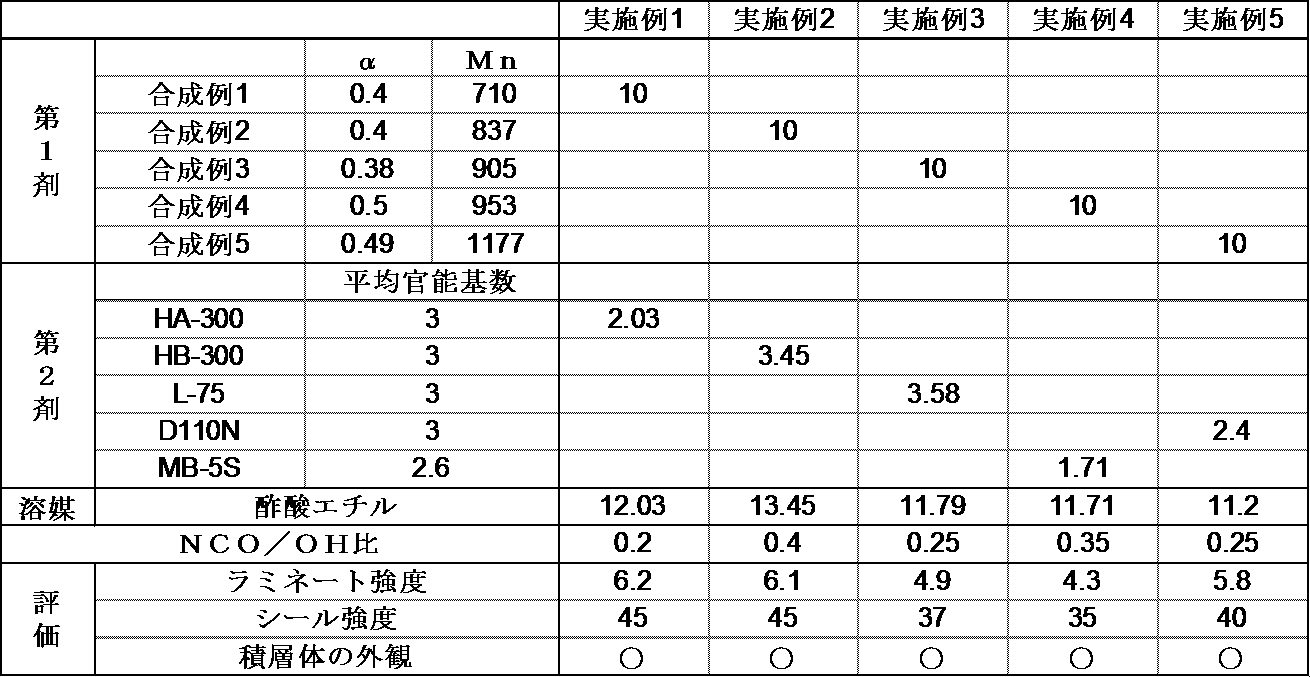
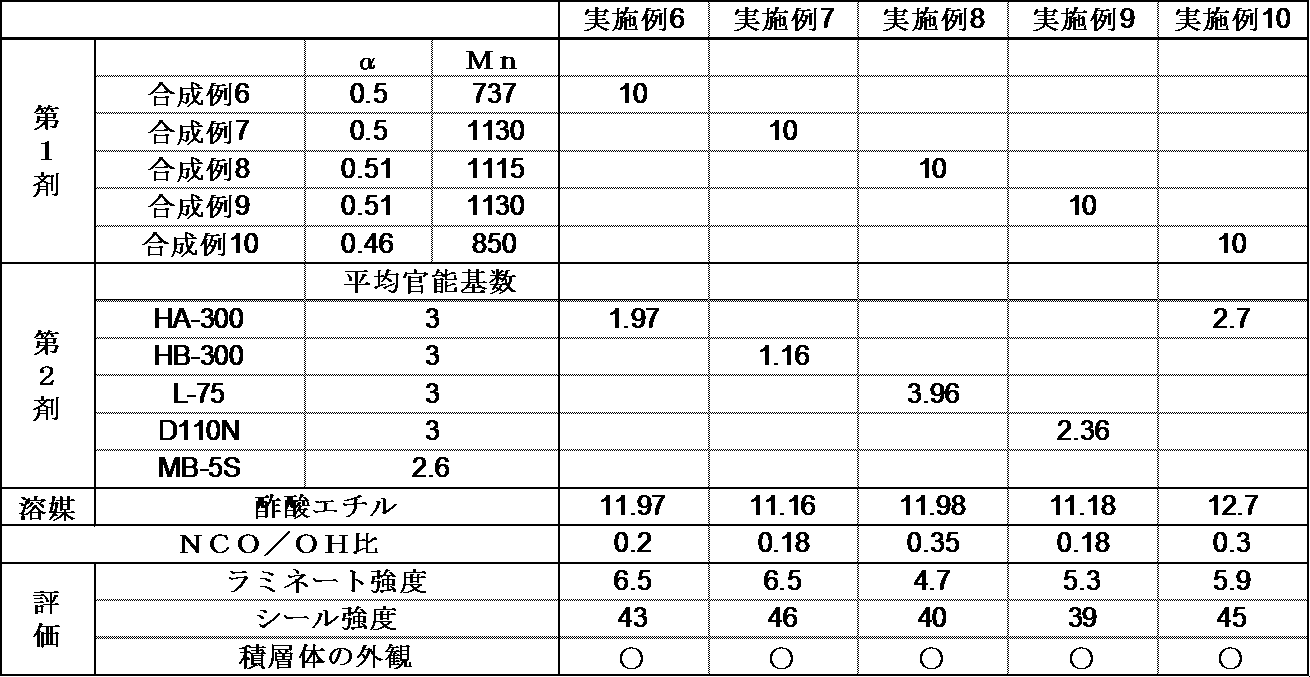
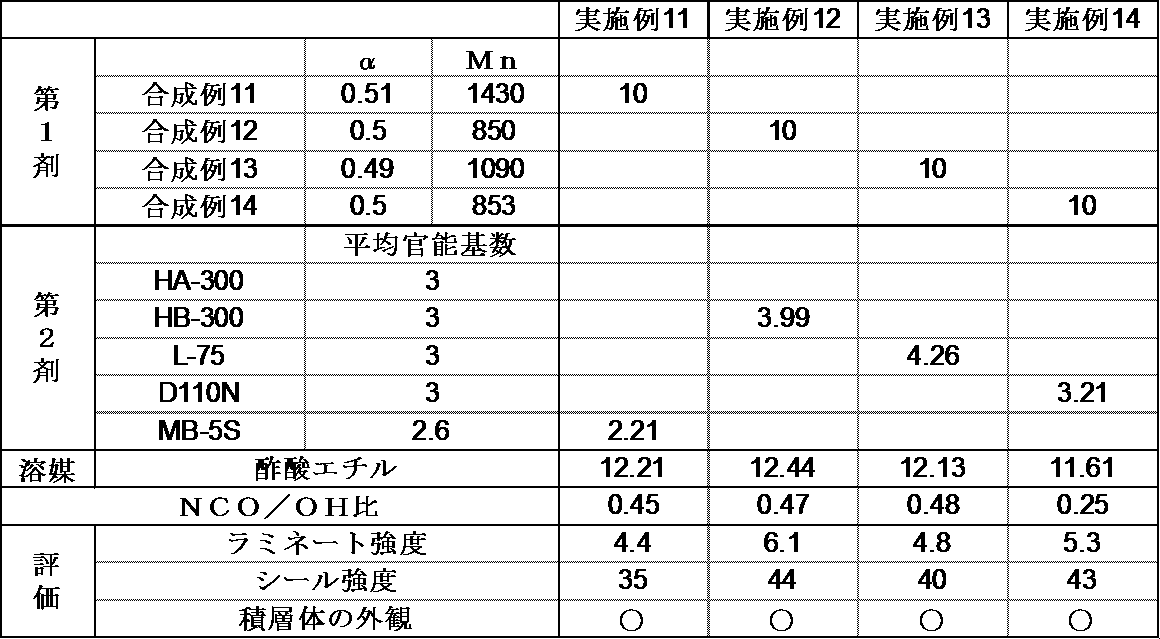
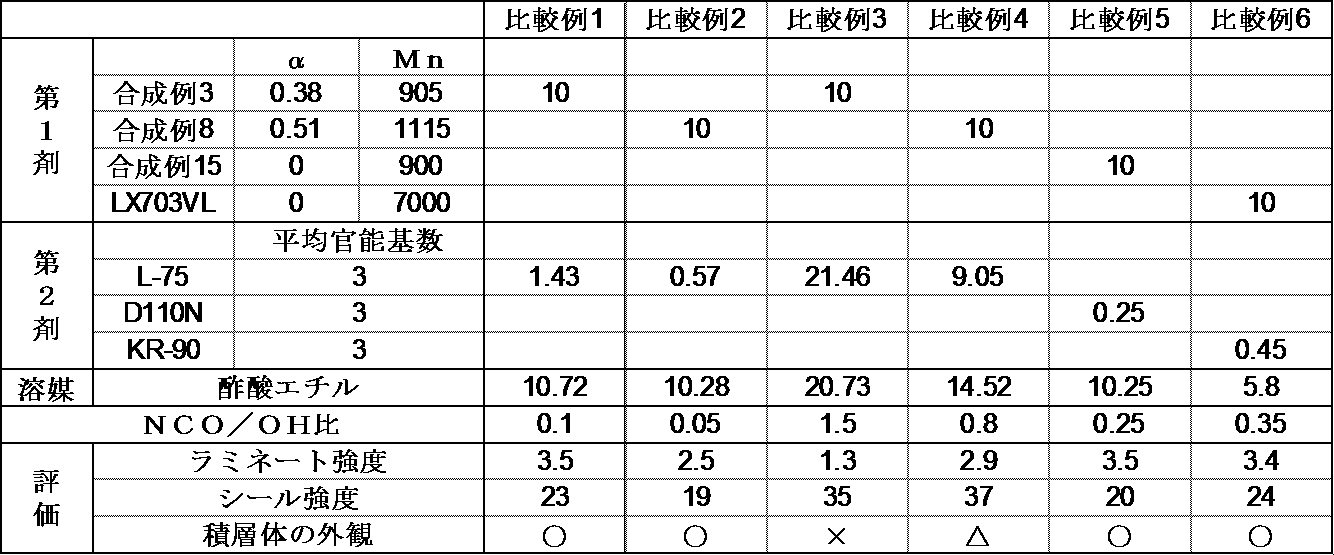
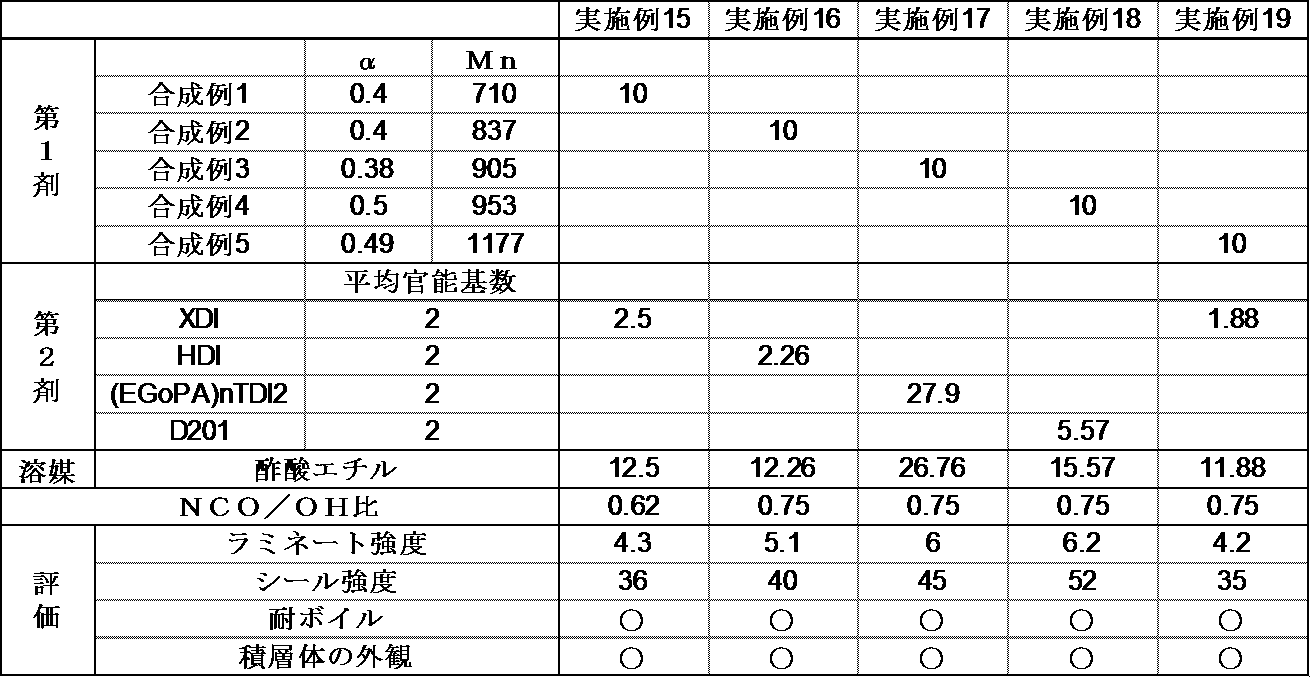

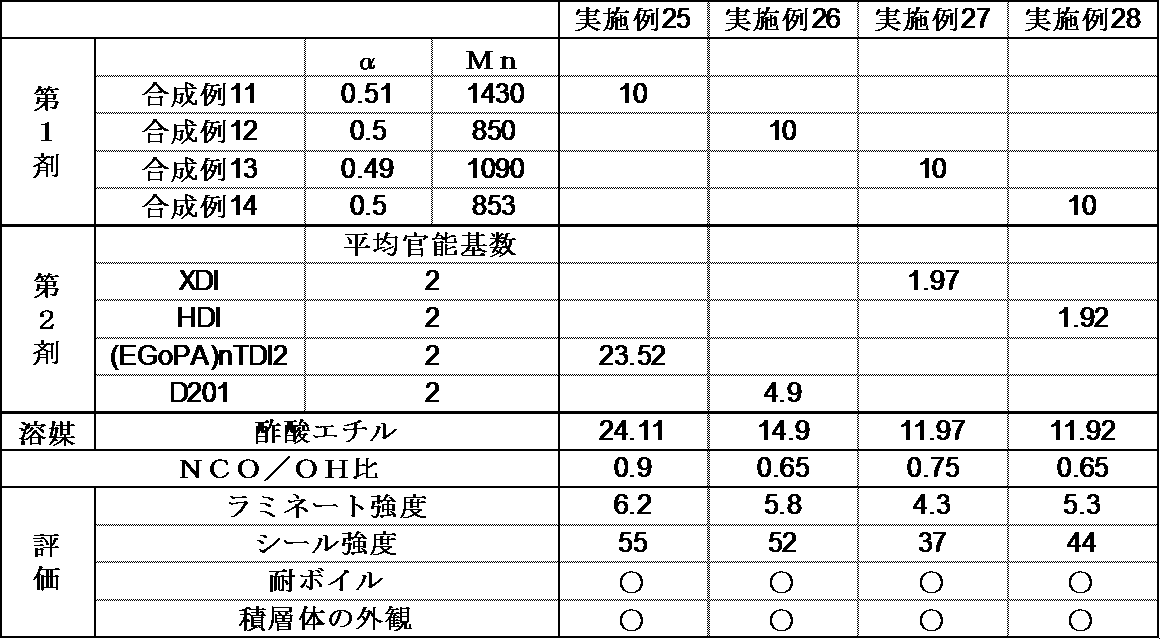
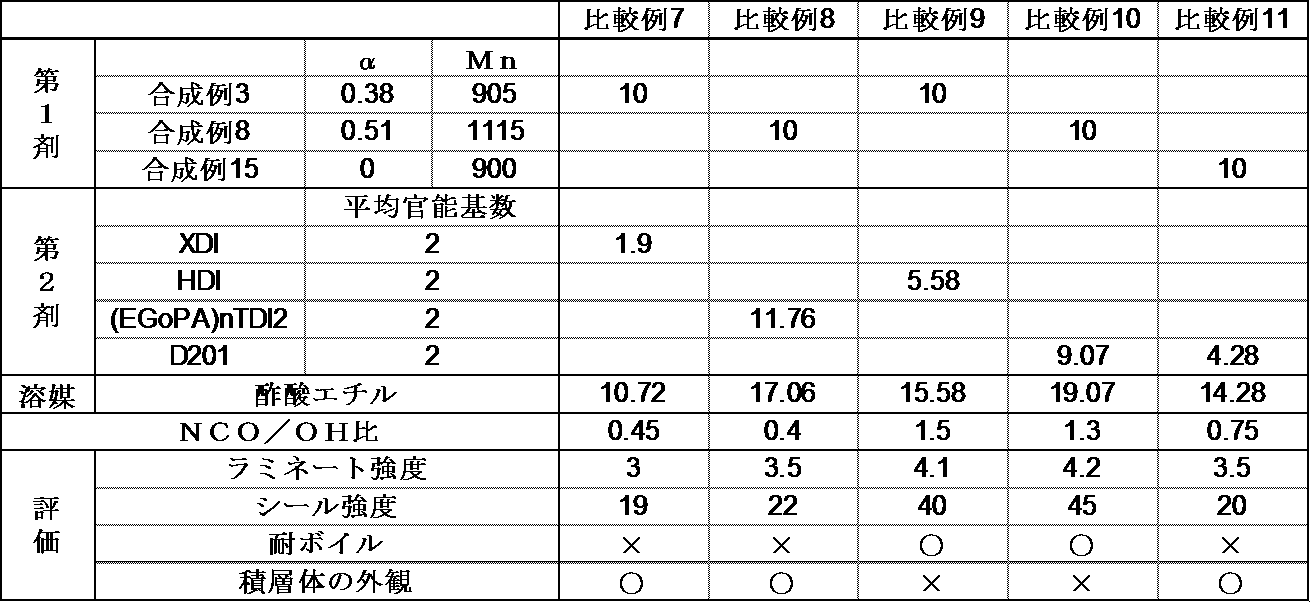
実施例1~14に示されるように、本発明の2液型接着剤により得られた積層体はラミネート強度及びシール強度に優れ、透明蒸着フィルム同士を接着させた積層体の外観が優れる結果となった。これは、枝分かれ係数αが1/f以上のポリオールを第1剤とし、平均官能基数が2.5以上であるイソシアネート化合物を第2剤とし、NCO/OH比が0.15以上0.6以下でポリイソシアネートと混合して硬化させたことにより、硬化塗膜の架橋密度が過剰に高くならず柔軟性を維持した硬化膜となったためと考えられる。
更に硬化膜中に過剰のポリイソシアネートが残存しないため、エージング工程で残存水分とポリイソシアネートとが反応し炭酸ガスが発生することがなく、バリア層同士から構成される積層体でも気泡の残存が見られず、良好な外観を持つハイバリアフィルムを製造できた。
また比較例3、4に示されるように、第1剤と第2剤とをNCO/OH比が0.6を超える割合で混合して得られた硬化膜では、元々架橋密度が高いポリエステルポリオールが更に高密度に架橋されたことにより硬化膜の柔軟性が失われ、ラミネート強度が2.0N/15mm未満と低い結果となった。加えて、透明蒸着フィルム同士の積層体の外観が劣る結果となった。
また比較例5、6に示されるように、枝分かれ係数αが0であるポリエステルポリオールを第1剤とし、NCO/OH比が0.15以上0.6以下で硬化させた場合には硬化が不十分となり、十分なシール強度を得られなかった。
更に硬化膜中に過剰のポリイソシアネートが残存しないため、エージング工程で残存水分とポリイソシアネートとが反応し炭酸ガスが発生することがなく、バリア層同士から構成される積層体でも気泡の残存が見られず、良好な外観を持つハイバリアフィルムを製造できた。さらに耐ボイル性も良好な結果を示した。
また比較例9、10に示されるように、第1剤と第2剤とをNCO/OH比が0.95を超える割合で混合して得られた硬化膜では、残存したイソシアネート化合物に起因する気泡が生じ、透明蒸着フィルム同士の積層体の外観が劣る結果となった。
また比較例11に示されるように、枝分かれ係数αが0であるポリエステルポリオールを第1剤とし、NCO/OH比が0.6以上0.95以下で硬化させた場合には硬化が不十分となり、十分なシール強度を得られなかった。さらに耐ボイル性も無かった。
本発明の2液型接着剤は、包装材等のフィルムラミネート用接着剤の他、太陽電池保護フィルム、表示素子用ガスバリア基板等の電子材料、建築材料、工業材料等、各種用途の接着剤、封止剤、ポッティング剤などに好適に用いることができる。本発明の2液型コーティング剤は、プラスチック製品、電子材料部品、家電製品、木工製品、フィルム等の耐傷性向上等の各種用途に好適に用いることができる。
Claims (9)
- 分子内に枝分かれ単位を導入するためのモノマーと、分子末端に第1の官能基を導入するためのモノマーとを反応させて得られる第1剤と、
前記第1の官能基と反応可能な第2の官能基を備える第2剤と、を含み、
前記第1剤の枝分かれ係数が1/f以上であり、
前記fは前記分子内に枝分かれ単位を導入するためのモノマーのうち最も官能基数が大きいモノマーが備える官能基数であり、
前記第2剤が備える前記第2の官能基の平均官能基数が2.5以上であり、
前記第1の官能基に対する前記第2の官能基の当量比が0.15以上0.6以下で混合して用いられることを特徴とする2液硬化型組成物。 - 分子内に枝分かれ単位を導入するためのモノマーと、分子末端に第1の官能基を導入するためのモノマーとを反応させて得られる第1剤と、
前記第1の官能基と反応可能な第2の官能基を備える第2剤と、を含み、
前記第1剤の枝分かれ係数が1/f以上であり、
前記fは前記分子内に枝分かれ単位を導入するためのモノマーのうち最も官能基数が大きいモノマーが備える官能基数であり、
前記第2剤が、前記第2の官能基を2つ備える2官能化合物を、前記第2の官能基含有率換算で85%以上含み、
前記第1の官能基に対する前記第2の官能基の当量比が0.6以上0.95以下で混合して用いられることを特徴とする2液硬化型組成物。 - 前記第1剤の枝分かれ係数は、1/(f-1)以上であることを特徴とする請求項1または2に記載の2液硬化型組成物。
- 前記第1剤の枝分かれ係数は、0.6以下であることを特徴とする請求項1乃至3のいずれか一項に記載の2液硬化型組成物。
- 請求項1乃至4のいずれか一項に記載の2液硬化型組成物を用いたことを特徴とする2液型接着剤。
- 請求項1乃至4のいずれか一項に記載の2液硬化型組成物を用いたことを特徴とする2液型コーティング剤。
- 第1の基材と、
第2の基材と、
前記第1の基材と前記第2の基材とを貼り合わせる接着層とを含み、
前記接着層は、分子内に枝分かれ単位を導入するためのモノマーと、分子末端に第1の官能基を導入するためのモノマーとを反応させて得られ、枝分かれ係数が1/f以上であり、前記fは前記分子内に枝分かれ単位を導入するためのモノマーのうち最も官能基数が大きいモノマーが備える官能基数である第1剤と、前記第1の官能基と反応可能な第2の官能基を備え、前記第2の官能基の平均官能基数が2.5以上である第2剤とが、前記第1の官能基に対する前記第2の官能基の当量比が0.15以上0.6以下で混合されたものであることを特徴とする積層体。 - 第1の基材と、
第2の基材と、
前記第1の基材と前記第2の基材とを貼り合わせる接着層とを含み、
前記接着層は、分子内に枝分かれ単位を導入するためのモノマーと、分子末端に第1の官能基を導入するためのモノマーとを反応させて得られ、枝分かれ係数が1/f以上であり、前記fは前記分子内に枝分かれ単位を導入するためのモノマーのうち最も官能基数が大きいモノマーが備える官能基数である第1剤と、前記第1の官能基と反応可能な第2の官能基を2つ備える2官能化合物を、第2の官能基含有率換算で85%以上含む第2剤とが、前記第1の官能基に対する前記第2の官能基の当量比が0.6以上0.95以下で混合されたものであることを特徴とする積層体。 - 前記第1の基材と、前記第2の基材とは、樹脂フィルム上に配置された金属酸化物の蒸着層を有し、前記第1の基材の蒸着層と、前記第2の基材の蒸着層とが対向して配置されていることを特徴とする請求項7または8に記載の積層体。
Priority Applications (4)
| Application Number | Priority Date | Filing Date | Title |
|---|---|---|---|
| JP2017525187A JP6269900B2 (ja) | 2015-06-18 | 2016-06-09 | 2液硬化型組成物、2液型接着剤、2液型コーティング剤、積層体 |
| EP16811540.0A EP3312208B1 (en) | 2015-06-18 | 2016-06-09 | Two-part curable composition, two-part-type adhesive agent, two-part-type coating agent, and laminate |
| US15/580,064 US20180297344A1 (en) | 2015-06-18 | 2016-06-09 | Two-component curable composition, two-component adhesive, two-component coating agent, and laminate |
| CN201680034145.0A CN107636035B (zh) | 2015-06-18 | 2016-06-09 | 双液固化型组合物、双液型粘合剂、双液型涂布剂、层压体 |
Applications Claiming Priority (4)
| Application Number | Priority Date | Filing Date | Title |
|---|---|---|---|
| JP2015122887 | 2015-06-18 | ||
| JP2015-122887 | 2015-06-18 | ||
| JP2015-132700 | 2015-07-01 | ||
| JP2015132700 | 2015-07-01 |
Publications (1)
| Publication Number | Publication Date |
|---|---|
| WO2016204065A1 true WO2016204065A1 (ja) | 2016-12-22 |
Family
ID=57545613
Family Applications (1)
| Application Number | Title | Priority Date | Filing Date |
|---|---|---|---|
| PCT/JP2016/067216 Ceased WO2016204065A1 (ja) | 2015-06-18 | 2016-06-09 | 2液硬化型組成物、2液型接着剤、2液型コーティング剤、積層体 |
Country Status (6)
| Country | Link |
|---|---|
| US (1) | US20180297344A1 (ja) |
| EP (1) | EP3312208B1 (ja) |
| JP (3) | JP6269900B2 (ja) |
| CN (1) | CN107636035B (ja) |
| TW (2) | TWI612069B (ja) |
| WO (1) | WO2016204065A1 (ja) |
Cited By (6)
| Publication number | Priority date | Publication date | Assignee | Title |
|---|---|---|---|---|
| CN108248151A (zh) * | 2016-12-28 | 2018-07-06 | 昭和电工包装株式会社 | 蓄电装置用外包装材料、蓄电装置用外包装壳体及蓄电装置 |
| WO2020213746A1 (ja) * | 2019-04-19 | 2020-10-22 | Dic株式会社 | 樹脂成形体 |
| WO2020213747A1 (ja) * | 2019-04-19 | 2020-10-22 | Dic株式会社 | ウレタン樹脂組成物及びフィルム |
| JP2022020772A (ja) * | 2016-12-28 | 2022-02-01 | 昭和電工パッケージング株式会社 | 蓄電デバイス用外装材 |
| WO2024048347A1 (ja) * | 2022-08-29 | 2024-03-07 | Toppanホールディングス株式会社 | 積層体、包装袋、及び積層体の製造方法 |
| JPWO2024135514A1 (ja) * | 2022-12-20 | 2024-06-27 |
Families Citing this family (4)
| Publication number | Priority date | Publication date | Assignee | Title |
|---|---|---|---|---|
| EP3603955A4 (en) * | 2017-03-31 | 2021-01-06 | Dai Nippon Printing Co., Ltd. | GAS BARRIER LAMINATE, AS WELL AS GAS BARRIER PACKAGING MATERIAL AND PILLOW PACKAGING BAG EACH FORMED LAMINATED |
| JP7443763B2 (ja) * | 2019-12-25 | 2024-03-06 | artience株式会社 | 接着剤組成物、及び積層体 |
| WO2025187755A1 (ja) * | 2024-03-07 | 2025-09-12 | 東洋製罐グループホールディングス株式会社 | 包装用積層体 |
| CN118165694B (zh) * | 2024-04-11 | 2024-08-30 | 佛山市鼎圣聚合物技术有限公司 | 一种双组分水性聚氨酯胶粘剂及其制备方法与应用 |
Citations (4)
| Publication number | Priority date | Publication date | Assignee | Title |
|---|---|---|---|---|
| DE19629161A1 (de) * | 1996-07-19 | 1998-01-22 | Basf Ag | Verfahren zur Herstellung thermostabiler Polyurethanweichschaumstoffe |
| JP2001011416A (ja) * | 1999-07-01 | 2001-01-16 | Daicel Chem Ind Ltd | 紫外線硬化性の粘着剤組成物 |
| WO2011089090A1 (en) * | 2010-01-21 | 2011-07-28 | Bayer Materialscience Ag | Urethanized polyesters |
| JP2013014722A (ja) * | 2011-07-06 | 2013-01-24 | Dic Corp | ガスバリア性ポリエステル樹脂組成物、及びガスバリア性フィルム |
Family Cites Families (10)
| Publication number | Priority date | Publication date | Assignee | Title |
|---|---|---|---|---|
| JPS5050445A (ja) * | 1973-09-05 | 1975-05-06 | ||
| US3886122A (en) * | 1974-03-11 | 1975-05-27 | Gen Tire & Rubber Co | Polyurethane adhesive composition with minimal moisture sensitivity |
| US7368171B2 (en) * | 2004-09-03 | 2008-05-06 | H.B. Fuller Licensing & Financing, Inc. | Laminating adhesive, laminate including the same, and method of making a laminate |
| JP5546799B2 (ja) * | 2009-06-04 | 2014-07-09 | ロックペイント株式会社 | 水分の影響を受け難い2液ラミネート用接着剤組成物 |
| TWI421320B (zh) * | 2011-01-21 | 2014-01-01 | Toyo Ink Sc Holdings Co Ltd | 接著劑組成物及積層體 |
| US20140228484A1 (en) * | 2011-06-21 | 2014-08-14 | Dsm Ip Asset B.V. | Polymer, process and use |
| WO2013005767A1 (ja) * | 2011-07-06 | 2013-01-10 | Dic株式会社 | ガスバリア性多層フィルム、接着剤、及びコーティング材 |
| JP5835615B2 (ja) * | 2011-12-21 | 2015-12-24 | Dic株式会社 | バリア性易開封ラミネートフィルム及びこれを用いる包装材 |
| US9777149B2 (en) * | 2012-12-26 | 2017-10-03 | Dic Corporation | Polyester resin composition, adhesive and film |
| TWI543996B (zh) * | 2013-09-27 | 2016-08-01 | 迪愛生股份有限公司 | 水蒸氣障壁用樹脂組成物、接著劑、及被覆劑 |
-
2016
- 2016-06-09 WO PCT/JP2016/067216 patent/WO2016204065A1/ja not_active Ceased
- 2016-06-09 EP EP16811540.0A patent/EP3312208B1/en active Active
- 2016-06-09 CN CN201680034145.0A patent/CN107636035B/zh active Active
- 2016-06-09 JP JP2017525187A patent/JP6269900B2/ja active Active
- 2016-06-09 US US15/580,064 patent/US20180297344A1/en not_active Abandoned
- 2016-06-17 TW TW105119048A patent/TWI612069B/zh active
- 2016-06-17 TW TW106118099A patent/TWI686418B/zh active
-
2017
- 2017-11-22 JP JP2017224629A patent/JP6369735B2/ja active Active
-
2018
- 2018-07-12 JP JP2018132371A patent/JP6544604B2/ja active Active
Patent Citations (4)
| Publication number | Priority date | Publication date | Assignee | Title |
|---|---|---|---|---|
| DE19629161A1 (de) * | 1996-07-19 | 1998-01-22 | Basf Ag | Verfahren zur Herstellung thermostabiler Polyurethanweichschaumstoffe |
| JP2001011416A (ja) * | 1999-07-01 | 2001-01-16 | Daicel Chem Ind Ltd | 紫外線硬化性の粘着剤組成物 |
| WO2011089090A1 (en) * | 2010-01-21 | 2011-07-28 | Bayer Materialscience Ag | Urethanized polyesters |
| JP2013014722A (ja) * | 2011-07-06 | 2013-01-24 | Dic Corp | ガスバリア性ポリエステル樹脂組成物、及びガスバリア性フィルム |
Non-Patent Citations (1)
| Title |
|---|
| See also references of EP3312208A4 * |
Cited By (15)
| Publication number | Priority date | Publication date | Assignee | Title |
|---|---|---|---|---|
| KR20240049789A (ko) * | 2016-12-28 | 2024-04-17 | 가부시키가이샤 레조낙·패키징 | 축전 디바이스용 외장재, 축전 디바이스용 외장 케이스 및 축전 디바이스 |
| JP7305728B2 (ja) | 2016-12-28 | 2023-07-10 | 株式会社レゾナック・パッケージング | 蓄電デバイス用外装材 |
| KR102793364B1 (ko) * | 2016-12-28 | 2025-04-14 | 가부시키가이샤 레조낙·패키징 | 축전 디바이스용 외장재, 축전 디바이스용 외장 케이스 및 축전 디바이스 |
| JP7635303B2 (ja) | 2016-12-28 | 2025-02-25 | 株式会社レゾナック・パッケージング | 蓄電デバイス用外装材 |
| JP2023130404A (ja) * | 2016-12-28 | 2023-09-20 | 株式会社レゾナック・パッケージング | 蓄電デバイス用外装材 |
| JP2022020772A (ja) * | 2016-12-28 | 2022-02-01 | 昭和電工パッケージング株式会社 | 蓄電デバイス用外装材 |
| CN108248151A (zh) * | 2016-12-28 | 2018-07-06 | 昭和电工包装株式会社 | 蓄电装置用外包装材料、蓄电装置用外包装壳体及蓄电装置 |
| JPWO2020213746A1 (ja) * | 2019-04-19 | 2021-06-10 | Dic株式会社 | 樹脂成形体 |
| WO2020213746A1 (ja) * | 2019-04-19 | 2020-10-22 | Dic株式会社 | 樹脂成形体 |
| JPWO2020213747A1 (ja) * | 2019-04-19 | 2021-05-20 | Dic株式会社 | ウレタン樹脂組成物及びフィルム |
| WO2020213747A1 (ja) * | 2019-04-19 | 2020-10-22 | Dic株式会社 | ウレタン樹脂組成物及びフィルム |
| WO2024048347A1 (ja) * | 2022-08-29 | 2024-03-07 | Toppanホールディングス株式会社 | 積層体、包装袋、及び積層体の製造方法 |
| JPWO2024135514A1 (ja) * | 2022-12-20 | 2024-06-27 | ||
| WO2024135514A1 (ja) * | 2022-12-20 | 2024-06-27 | Dic株式会社 | 2液硬化型接着剤、積層体、包装材 |
| JP7697594B2 (ja) | 2022-12-20 | 2025-06-24 | Dic株式会社 | 2液硬化型接着剤、積層体、包装材 |
Also Published As
| Publication number | Publication date |
|---|---|
| US20180297344A1 (en) | 2018-10-18 |
| EP3312208A4 (en) | 2019-02-20 |
| JP6369735B2 (ja) | 2018-08-08 |
| TW201738288A (zh) | 2017-11-01 |
| JPWO2016204065A1 (ja) | 2017-11-16 |
| TWI686418B (zh) | 2020-03-01 |
| CN107636035B (zh) | 2021-03-12 |
| JP6269900B2 (ja) | 2018-01-31 |
| JP2018087326A (ja) | 2018-06-07 |
| JP2018172694A (ja) | 2018-11-08 |
| EP3312208A1 (en) | 2018-04-25 |
| TWI612069B (zh) | 2018-01-21 |
| JP6544604B2 (ja) | 2019-07-17 |
| CN107636035A (zh) | 2018-01-26 |
| TW201708292A (zh) | 2017-03-01 |
| EP3312208B1 (en) | 2023-02-22 |
Similar Documents
| Publication | Publication Date | Title |
|---|---|---|
| JP6369735B2 (ja) | 2液硬化型組成物、2液型接着剤、2液型コーティング剤、積層体 | |
| JP6252711B2 (ja) | 積層体、及び積層体の製造方法 | |
| JP6065460B2 (ja) | アルミ蒸着層若しくはアルミ箔を含む層を有するガスバリア性多層フィルム | |
| JP6075623B2 (ja) | ガスバリア性ポリエステル樹脂組成物、及びガスバリア性フィルム | |
| JPWO2014103994A1 (ja) | ポリエステル樹脂組成物、接着剤、及びフィルム | |
| JP5831778B2 (ja) | 水蒸気バリア用樹脂組成物、接着剤、及びコーティング剤 | |
| JP5875023B2 (ja) | 保香用多層フィルム | |
| JP5273219B2 (ja) | 酸素バリア性接着剤用樹脂組成物、及び接着剤 | |
| JP5648855B2 (ja) | 水蒸気バリア性を有する接着剤用樹脂組成物、及び接着剤 | |
| WO2013005767A1 (ja) | ガスバリア性多層フィルム、接着剤、及びコーティング材 | |
| JP5982800B2 (ja) | 非石油由来成分を用いたガスバリア性接着剤、及びガスバリア性多層フィルム、容器、及びチューブ | |
| JP6002984B2 (ja) | ハイソリッド型接着剤用樹脂組成物、及び接着剤 | |
| JP5979433B2 (ja) | 透明蒸着層を含む層を有するガスバリア性多層フィルム | |
| JP5543408B2 (ja) | ガスバリア性ポリエステル樹脂組成物、及びガスバリア性フィルム | |
| JP6075515B1 (ja) | バリア材用ポリエステル樹脂組成物、及びバリアフィルム | |
| JP2016011324A (ja) | バリア材用ポリエステル樹脂組成物、及びバリアフィルム | |
| JP5761460B2 (ja) | 水蒸気バリア性接着剤用樹脂組成物、及び積層体 |
Legal Events
| Date | Code | Title | Description |
|---|---|---|---|
| 121 | Ep: the epo has been informed by wipo that ep was designated in this application |
Ref document number: 16811540 Country of ref document: EP Kind code of ref document: A1 |
|
| ENP | Entry into the national phase |
Ref document number: 2017525187 Country of ref document: JP Kind code of ref document: A |
|
| WWE | Wipo information: entry into national phase |
Ref document number: 15580064 Country of ref document: US |
|
| NENP | Non-entry into the national phase |
Ref country code: DE |
|
| WWE | Wipo information: entry into national phase |
Ref document number: 2016811540 Country of ref document: EP |