WO2016204232A1 - Composition de résine et produit moulé - Google Patents
Composition de résine et produit moulé Download PDFInfo
- Publication number
- WO2016204232A1 WO2016204232A1 PCT/JP2016/067947 JP2016067947W WO2016204232A1 WO 2016204232 A1 WO2016204232 A1 WO 2016204232A1 JP 2016067947 W JP2016067947 W JP 2016067947W WO 2016204232 A1 WO2016204232 A1 WO 2016204232A1
- Authority
- WO
- WIPO (PCT)
- Prior art keywords
- component
- acid
- resin composition
- meth
- heat storage
- Prior art date
- Legal status (The legal status is an assumption and is not a legal conclusion. Google has not performed a legal analysis and makes no representation as to the accuracy of the status listed.)
- Ceased
Links
Images

Classifications
-
- C—CHEMISTRY; METALLURGY
- C08—ORGANIC MACROMOLECULAR COMPOUNDS; THEIR PREPARATION OR CHEMICAL WORKING-UP; COMPOSITIONS BASED THEREON
- C08G—MACROMOLECULAR COMPOUNDS OBTAINED OTHERWISE THAN BY REACTIONS ONLY INVOLVING UNSATURATED CARBON-TO-CARBON BONDS
- C08G18/00—Polymeric products of isocyanates or isothiocyanates
- C08G18/06—Polymeric products of isocyanates or isothiocyanates with compounds having active hydrogen
- C08G18/08—Processes
Definitions
- the present invention relates to a resin composition capable of forming a molded body having excellent heat storage properties and excellent heat resistance and flexibility, and a molded body.
- Thermal storage technology is a technology that makes effective use of natural energy, such as solar heat and geothermal heat, and residual heat from air-conditioning equipment.For example, in homes, heat is stored using inexpensive nighttime power and used as a multipurpose heat source. It is used as a technology to reduce power consumption during the day.
- heat storage materials used in such heat storage technologies include sensible heat storage materials and latent heat storage materials. Especially, heat is stored when a substance changes phase from solid to liquid (heat storage), and phase change from liquid to solid. Organic latent heat storage materials utilizing the property of releasing (dissipating heat) when being used are widely adopted.
- Patent Document 1 attempts to improve heat resistance by introducing a flame retardant.
- Patent Document 1 a metal hydroxide is used as a flame retardant, and heat resistance can be ensured by introducing a large amount of such a compound, but heat storage performance is reduced, and It has been difficult to achieve both heat storage performance.
- the present invention has been intensively studied.
- the resin composition having an organic latent heat storage material, a polyol compound, and an isocyanate compound contains a metal salt hydrate, so that heat storage and heat resistance are achieved.
- the present inventors have found a resin composition capable of forming a molded article having excellent properties and flexibility, and have completed the present invention.
- the present invention has the following characteristics. 1. (A) an organic latent heat storage material, (b) a metal salt hydrate, (c-1) a polyol compound, and (c-2) an isocyanate compound, and (a) 100 parts by weight of the organic latent heat storage material, (B) A resin composition comprising 10 to 120 parts by weight of a metal salt hydrate. 2.
- the present invention is useful because it is possible to obtain a resin composition and a molded body that have excellent heat storage properties and can form a molded body having excellent heat resistance and flexibility.
- the resin composition of the present invention comprises an organic latent heat storage material (hereinafter also referred to as “component (a)”), a metal salt hydrate (hereinafter also referred to as “component (b)”), a polyol compound (hereinafter referred to as “component“ a ”).
- component (C-1) component ”) and an isocyanate compound (hereinafter also referred to as“ (c-2) component ”) and 10 parts by weight of component (b) with respect to 100 parts by weight of component (a). Part or more and 120 parts by weight or less.
- the resin composition of this invention can show the outstanding heat resistance, maintaining heat storage property by containing (b) component with (a) component.
- the thermal conductivity can be imparted, and heat can be efficiently stored in a short time. Furthermore, the strength (particularly at high temperatures), flexibility and the like of the molded body formed from the resin composition of the present invention can be increased. In addition, in the case of a metal compound such as a metal oxide, a metal hydroxide, a metal nitride, a metal carbide, or a metal phosphide instead of the component (b), the heat resistance is not sufficiently improved.
- the resin composition of the present invention includes (a) an organic latent heat storage material.
- an organic latent heat storage material By containing (a) component, the molded object which has the outstanding heat storage property can be obtained, and it is useful.
- the component (a) include aliphatic hydrocarbons, long-chain alcohols, long-chain fatty acids, long-chain fatty acid esters, polyether compounds, fatty acid triglycerides, etc., and one or more of these are used. be able to.
- aliphatic hydrocarbon for example, an aliphatic hydrocarbon having 8 to 36 carbon atoms can be used. Specifically, n-decane (melting point-30 ° C), n-undecane (melting point-25 ° C).
- N-dodecane (melting point -8 ° C), n-tridecane (melting point -5 ° C), pentadecane (melting point 6 ° C), n-tetradecane (melting point 8 ° C), n-hexadecane (melting point 17 ° C), n-heptadecane ( N-paraffin and paraffin composed of n-octadecane (melting point 28 ° C), n-nonadecane (melting point 32 ° C), eicosane (melting point 36 ° C), docosane (melting point 44 ° C), and mixtures thereof A wax etc. are mentioned.
- the long-chain alcohol for example, a long-chain alcohol having 8 to 36 carbon atoms can be used. Specifically, capryl alcohol (melting point: 7 ° C.), lauryl alcohol (melting point: 24 ° C.), myristyl alcohol (melting point: 38 ° C), stearyl alcohol (melting point: 58 ° C), and the like.
- the long chain fatty acid for example, a long chain fatty acid having 8 to 36 carbon atoms can be used. Specifically, octanoic acid (melting point: 17 ° C.), decanoic acid (melting point: 32 ° C.), dodecanoic acid (melting point: 44 ° C), fatty acids such as tetradecanoic acid (melting point 50 ° C), hexadecanoic acid (melting point 63 ° C), octadecanoic acid (melting point 70 ° C), and the like.
- octanoic acid melting point: 17 ° C.
- decanoic acid melting point: 32 ° C.
- dodecanoic acid melting point: 44 ° C
- fatty acids such as tetradecanoic acid (melting point 50 ° C), hexadecanoic acid (melting point 63 ° C), octadecanoic acid (melting point 70 °
- the long-chain fatty acid ester for example, a long-chain fatty acid ester having 8 to 36 carbon atoms can be used.
- palmitic acid examples include methyl acid (melting point: 30 ° C.), methyl stearate (melting point: 38 ° C.), butyl stearate (melting point: 25 ° C.), and methyl arachidate (melting point: 45 ° C.).
- polyether compound examples include diethylene glycol, triethylene glycol, tetraethylene glycol, triethylene glycol monomethyl ether, polypropylene glycol, polyethylene glycol, polypropylene glycol diacrylate, and ethylethylene glycol.
- fatty acid triglycerides examples include vegetable oils such as coconut oil and palm kernel oil, and medium-chain fatty acid triglycerides and long-chain fatty acid triglycerides that are refined processed products thereof.
- an aliphatic hydrocarbon having 8 to 36 carbon atoms in particular, an aliphatic hydrocarbon having 8 to 36 carbon atoms, a long chain alcohol having 8 to 36 carbon atoms, a long chain fatty acid having 8 to 36 carbon atoms, 8 to 36 carbon atoms. It is preferable to use the following long-chain fatty acid esters, and it is more preferable to use aliphatic hydrocarbons having 8 to 36 carbon atoms and long-chain fatty acid esters having 8 to 36 carbon atoms.
- a long chain fatty acid ester having 8 to 36 carbon atoms is preferable, a long chain fatty acid ester having 10 to 30 carbon atoms is more preferable, and a long chain fatty acid ester having 15 to 22 carbon atoms is more preferable.
- Such a long-chain fatty acid ester has a high latent heat and has a phase change temperature (melting point) in a practical temperature range, and thus is easy to use for various applications.
- the resin composition of the present invention includes (b) a metal salt hydrate.
- a metal salt hydrate By containing the component (b) together with the component (a), it is possible to obtain excellent heat resistance while maintaining the high heat storage property of the component (a), which is useful.
- the use of the component (b) is preferable because the strength of the obtained molded body can be improved.
- the hydrate of the metal salt of a metal and an acid is mentioned, for example.
- the metal include sodium, potassium, magnesium, calcium, strontium, titanium, zirconium, manganese, iron, cobalt, nickel, copper, zinc, and aluminum. Particularly, from sodium, potassium, magnesium, calcium, and aluminum. One or more selected are suitable.
- Examples of the acid include silicic acid, boric acid, phosphoric acid, hydrochloric acid, hydrosulfuric acid, sulfuric acid, nitric acid, carbonic acid, oxalic acid, benzoic acid, phthalic acid, maleic acid, succinic acid, salicylic acid, citric acid, and the like.
- boric acid, phosphoric acid, sulfuric acid and carbonic acid, and further one or more selected from boric acid and phosphoric acid are preferred.
- the metal salt hydrate is represented by a metal salt / n hydrate, and n is preferably an integer of 2 to 20, more preferably 3 to 17, and even more preferably 3 to 11.
- n is preferably an integer of 2 to 20, more preferably 3 to 17, and even more preferably 3 to 11.
- the particle size of the component (b) is not particularly limited, but is preferably 30 ⁇ m or more and 600 ⁇ m or less, more preferably 50 ⁇ m or more and 250 ⁇ m or less in terms of manifesting the effects of the present invention (particularly contributing to flexibility).
- the particle diameter is a value obtained by sieving using a metal mesh sieve defined in JIS Z8801-1: 2000.
- ⁇ Molded product (c) component The polyol compound (component (c-1)) used in the present invention is reacted with an isocyanate compound (component (c-2)) described later to form a molded product (hereinafter also referred to as “component (c)”). And (a) the component and (b) the component that supports and holds the component. Further, by using the component (c-1) and the component (c-2), the compatibility with the component (a) is excellent, which is a preferable embodiment.
- the component (c-1) and the component (c-2) react to form an appropriate three-dimensional crosslinked structure, and a large amount of the component (a), ( b)
- a molded body capable of supporting and holding the component can be obtained. Furthermore, the obtained molded body is excellent in flexibility and can suppress leakage of the component (a).
- the resin composition of the present invention comprises (c-1) a polyol compound.
- the component (c-1) include polyester polyol, acrylic polyol, polycarbonate polyol, polyolefin polyol, polyether polyol, polycaprolactone polyol, polytetramethylene glycol polyol, polybutadiene polyol, polyoxypropylene polyol, and polyoxypropylene ethylene polyol.
- it is particularly preferable to use a polyether polyol and it is more preferable to use a polyether polyol having glycerin as an initiator.
- polyester polyol examples include a condensation polymerization product of a polyhydric alcohol and a polycarboxylic acid; a ring-opening polymerization product of a cyclic ester (lactone); a reaction with three components of a polyhydric alcohol, a polycarboxylic acid, and a cyclic ester. Thing etc. are mentioned.
- polyhydric alcohol examples include ethylene glycol, diethylene glycol, propylene glycol, dipropylene glycol, trimethylene glycol, 1,3-butanediol, 1,4-butanediol, 2,3-butanediol, 1,3-tetracene.
- polyvalent carboxylic acid examples include aliphatic dicarboxylic acids such as malonic acid, maleic acid, maleic anhydride, succinic acid, glutaric acid, adipic acid, suberic acid, azelaic acid, sebacic acid, and dodecanedioic acid; Alicyclic dicarboxylic acids such as 1,4-cyclohexanedicarboxylic acid; Examples include terephthalic acid, isophthalic acid, orthophthalic acid, phthalic anhydride, terephthalic acid, 2,6-naphthalenedicarboxylic acid, paraphenylene dicarboxylic acid, aromatic dicarboxylic acid such as trimellitic acid, and the like.
- aliphatic dicarboxylic acids such as malonic acid, maleic acid, maleic anhydride, succinic acid, glutaric acid, adipic acid, suberic acid, azelaic acid, sebacic acid, and dodecanedioic acid
- examples of the cyclic ester include propiolactone, ⁇ -methyl- ⁇ -valerolactone, and ⁇ -caprolactone.
- examples of the reaction product of the three types of components those exemplified above can be used as the polyhydric alcohol, polycarboxylic acid, and cyclic ester.
- the polyester polyol is particularly preferably a condensation polymer of a polyhydric alcohol and a polycarboxylic acid.
- the polyhydric alcohol may be 2,4-diethyl-1,5-pentamethylenediol, 3-methyl
- adipic acid or the like as the polyvalent carboxylic acid such as 1,5-pentamethylenediol, 2-butyl-2-ethyl-1,3-propanediol and the like.
- the manufacturing method of polyester polyol can be performed by a conventional method, and a known curing agent, curing catalyst or the like may be used as necessary.
- the acrylic polyol can be obtained, for example, by homopolymerizing or copolymerizing an acrylic monomer having a hydroxyl group, or by copolymerizing another copolymerizable monomer.
- acrylic monomer having a hydroxyl group examples include (meth) acrylic acid-2-hydroxyethyl, (meth) acrylic acid-2-hydroxymethyl, (meth) acrylic acid-2-hydroxypropyl, and (meth) acrylic.
- (Meth) acrylic acid esters such as acid-3-hydroxypropyl, (meth) acrylic acid-2-hydroxybutyl, (meth) acrylic acid-4-hydroxybutyl;
- (Meth) acrylic acid monoesters of triols such as glycerin and trimethylolpropane;
- Monoethers of the above (meth) acrylic acid esters and polyether polyols such as polyethylene glycol, polypropylene glycol and polybutylene glycol;
- Adducts of glycidyl (meth) acrylate with monobasic acids such as acetic acid, propionic acid, p-tert-butylbenzoic acid;
- Carboxyl group-containing monomers such as (meth) acrylic acid, crotonic acid, maleic acid, itaconic acid, fumaric acid, isocrotonic acid, salicylic acid, cinnamic acid;
- Alkoxysilyl group-containing monomers such as (meth) acrylic acid trimethoxysilylpropyl and (meth) acrylic acid triethoxysilylpropyl; Hydrolyzable silyl group-containing monomers such as vinyltrimethoxysilane, vinylmethyldimethoxysilane, and ⁇ - (meth) acrylopropyltrimethoxysilane; Nitrile group-containing monomers such as acrylonitrile and methacrylonitrile; Methylol group-containing monomers such as N-methylol (meth) acrylamide; Oxazoline group-containing monomers such as vinyl oxazoline and 2-propenyl 2-oxazoline
- Vinylidene halide monomers such as vinylidene fluoride; Aromatic vinyl monomers such as styrene, 2-methylstyrene, vinyltoluene, t-butylstyrene, vinylanisole, vinylnaphthalene, divinylbenzene; Other monomers such as ethylene, propylene, isoprene, butadiene, vinyl acetate, vinyl ether, vinyl ketone, silicone macromer; Etc., and one or more of these can be used.
- the polymerization method is not particularly limited, and a known block polymerization, suspension polymerization, solution polymerization, dispersion polymerization, emulsion polymerization, oxidation-reduction polymerization, etc. may be used, and an initiator, a chain transfer agent, or the like, if necessary. These additives may be added.
- the monomer component can be obtained by solution polymerization in the presence of a known radical polymerization initiator such as a peroxide or an azo compound.
- polycarbonate polyol examples include a reaction product of a polyhydric alcohol and phosgene; a ring-opening polymer of a cyclic carbonate (alkylene carbonate, etc.), and the like.
- examples of the alkylene carbonate include ethylene carbonate, trimethylene carbonate, tetramethylene carbonate, hexamethylene carbonate, and the like.
- the polycarbonate polyol may be a compound having a carbonate bond in the molecule and having a terminal hydroxyl group, and may have an ester bond together with the carbonate bond.
- the polyolefin polyol is a polyol having an olefin as a component of the skeleton (or main chain) of the polymer or copolymer and having at least two hydroxyl groups in the molecule (particularly at the terminal), and having a number average molecular weight of 500 or more.
- the olefin may be an olefin having a carbon-carbon double bond at the terminal (for example, an ⁇ -olefin such as ethylene or propylene), or an olefin having a carbon-carbon double bond at a position other than the terminal.
- isobutene and the like and diene (for example, butadiene, isoprene and the like) may be used.
- polyether polyols examples include polyethylene glycol, polypropylene glycol, polytetramethylene glycol, polyethylene glycol monoalkyl ether, and polyalkylene glycols such as polypropylene glycol monoalkyl ether, as well as ethylene using polyvalent amine or polyhydric alcohol as an initiator. And a copolymer obtained by ring-opening addition of at least one of oxide and propylene oxide.
- a polyether polyol has particularly good compatibility with the components (a) and (b), and also has an effect of efficiently mixing and dispersing the components (a) and (b).
- polyvalent amine examples include ethylenediamine, trimethylenediamine, tetramethylenediamine, pentamethylenediamine, hexamethylenediamine, propylenediamine, butylenediamine, hexamethylenediamine, neopentyldiamine, diethylenetriamine, dipropylenetriamine, triethylenetetramine, Tetraethylenepentamine, monoethanolamine, diethanolamine, triethanolamine, 2,4-toluenediamine, 2,6-toluenediamine, diethyltoluenediamine, 4,4'-diaminodiphenylmethane, p-phenylenediamine, o-phenylenediamine And naphthalenediamine.
- polyhydric alcohol examples include those described above, ethylene glycol, propylene glycol, 1,4-butanediol, 1,3-butanediol, 1,6-hexanediol, neopentyl glycol, cyclohexylene glycol, Cyclohexanedimethanol, glycerin, diglycerin, trimethylolpropane, ditrimethylolpropane, trimethylolethane, bisphenols (such as bisphenol A), sugar alcohols (such as xylitol, sorbitol, sucrose), pentaerythritol, dipentaerythritol, 2 -Methylolpropanediol, ethoxylated trimethylolpropane and the like are preferably used.
- Cellulose and / or derivatives thereof include cellulose acetates such as cellulose, cellulose acetate, cellulose diacetate, and cellulose triacetate, and celluloses such as methylcellulose, ethylcellulose, cellulose acetate butyrate, cellulose acetate propionate, cellulose acetate phthalate, and cellulose nitrate.
- examples include esters, cellulose ethers such as ethyl cellulose, benzyl cellulose, cyanoethyl cellulose, hydroxymethyl cellulose, hydroxyethyl cellulose, hydroxypropyl cellulose, hydroxypropyl methyl cellulose, carboxymethyl cellulose, and the like.
- Cellulose and / or derivatives thereof have a hydroxyl group, but a portion of the hydroxyl group is preferably substituted with an alkoxyl group (for example, methoxy group, ethoxy group, propoxy group, butoxy group, etc.). .
- the substitution degree is preferably 1.8 or more and 2.8 or less, and more preferably 2.2 or more and 2.6 or less.
- the degree of substitution means a ratio in which three hydroxyl groups present in the glycolose unit constituting cellulose are substituted with alkoxyl groups and the like, and the degree of substitution is 3 when 100% substitution is performed.
- the degree of substitution By controlling the degree of substitution within such a range, interaction with the component (a) described later can be improved, and the component (a) can be retained in the porous body for a long period of time.
- the degree of substitution is less than 1.8, the interaction with the component (a) may be reduced, and the component (a) may not be sufficiently retained in the porous body.
- the ratio is larger than 2.8, the hydroxyl group in cellulose is decreased, and a three-dimensional crosslinked structure having sufficient strength may not be obtained.
- the resin composition of the present invention is characterized by containing (c-2) an isocyanate compound.
- the component (c-2) used in the present invention is not limited as long as it has two or more isocyanate groups in one molecule.
- aliphatic diisocyanate, alicyclic diisocyanate, aromatic diisocyanate, aromatic fat Diisocyanates, etc. and those derivatized by allohanation, biuretization, dimerization (uretidione), trimerization (isocyanurate), adduct formation, carbodiimide reaction, etc., and mixtures thereof, and copolymers thereof Examples thereof include copolymers with possible monomers.
- aliphatic diisocyanate examples include 1,3-trimethylene diisocyanate, 1,4-tetramethylene diisocyanate, 1,3-pentamethylene diisocyanate, 1,5-pentamethylene diisocyanate, 1,6-hexamethylene diisocyanate (HMDI).
- alicyclic diisocyanate examples include 1,3-cyclopentane diisocyanate, 1,4-cyclohexane diisocyanate, 1,3-cyclohexane diisocyanate, 3-isocyanate methyl-3,5,5-trimethylcyclohexyl isocyanate, 4,4 ′ -Methylene bis (cyclohexyl isocyanate), methyl-2,4-cyclohexane diisocyanate, methyl-2,6-cyclohexane diisocyanate, 1,3-bis (isocyanate methyl) cyclohexane, 1,4-bis (isocyanate methyl) cyclohexane, isophorone diisocyanate ( IPDI), norbornane diisocyanate, dicyclohexylmethane diisocyanate, hydrogenated diphenylmethane diisocyanate, hydrogenated xylylene diisocyanate Sulfonates, and the like
- aromatic diisocyanate examples include m-phenylene diisocyanate, p-phenylene diisocyanate, 2,4-tolylene diisocyanate (TDI), 2,6-tolylene diisocyanate (TDI), naphthylene-1,4-diisocyanate, naphthylene- 1,5-diisocyanate, 4,4'-diphenyl diisocyanate, 4,4'-diphenylmethane diisocyanate (MDI), 2,4'-diphenylmethane diisocyanate, 4,4'-diphenyl ether diisocyanate, 2-nitrodiphenyl-4 , 4′-diisocyanate, 2,2′-diphenylpropane-4,4′-diisocyanate, 3,3′-dimethyldiphenylmethane-4,4′-diisocyanate, 4,4′-diphenylpropane diisocyanate, 3, '- dimethoxy
- Examples of the araliphatic diisocyanate include 1,3-xylylene diisocyanate (XDI), 1,4-xylylene diisocyanate (XDI), ⁇ , ⁇ ′-diisocyanate-1,4-diethylbenzene, 1,3 -Bis (1-isocyanate-1-methylethyl) benzene, 1,4-bis (1-isocyanate-1-methylethyl) benzene, 1,3-bis ( ⁇ , ⁇ -dimethylisocyanatomethyl) benzene, etc. .
- aliphatic diisocyanates such as HMDI and derivatives thereof, aromatic diisocyanates such as MDI and derivatives thereof, and the like.
- aromatic diisocyanates such as MDI and derivatives thereof, and the like.
- an isocyanate compound is preferable because it is easy to adjust the pot life and the curing rate.
- the mixing amount of the component (a) of the present invention is preferably 30% by weight or more, more preferably 35% by weight or more, and further preferably 40% by weight or more and 90% by weight or less with respect to the total amount of the resin composition. By using 30% by weight or more of component (a), excellent heat storage properties can be obtained.
- the total mixing amount of the component (c-1) and the component (c-2) is 10 parts by weight or more and 300 parts by weight or less, further 20 parts by weight or more and 200 parts by weight with respect to 100 parts by weight of the component (a). Part or less.
- the mixing ratio of the component (c-1) and the component (c-2) is 0.5 or more and 8.0 or less, preferably more than 0.7 and 7.0 or less, more preferably 0.8 in terms of NCO / OH molar ratio. What is necessary is just to set in the range below 5.0 or less.
- the mixing ratio of the component (c-1) and the component (c-2) is 0.5 to 8.0 in terms of the NCO / OH molar ratio. Even if the content is high, (a) component has excellent holding power and moldability, has excellent heat storage performance and sustainability, and (a) component does not leak, flexibility, workability, workability It is possible to obtain a molded article excellent in the above.
- the amount of component (b) is 10 to 120 parts by weight, preferably 15 to 90 parts by weight, and more preferably 100 parts by weight of component (a). It is preferably 20 parts by weight or more and 60 parts by weight or less.
- component is included more than (b) component, and by containing (b) component together with (a) component, excellent heat resistance is exhibited while maintaining excellent heat storage, and A molded body that can exhibit excellent thermal conductivity can be obtained.
- amount of the component (b) is less than 10 parts by weight, the heat resistance may not be improved or the thermal conductivity may not be improved. If the amount of component (b) is more than 120 parts by weight, curing failure may occur.
- the organic latent heat storage material (a) used in the present invention is usually difficult to mix with a metal compound, and it is difficult to disperse both efficiently.
- the present invention uses (a) component organic latent heat storage material by using a metal salt hydrate (component (b)) as a metal compound and further combining a polyol compound (component (c-1)),
- the component (a) is compatible with the component (c-1), the component (a) is also compatible with the component (c-1), and as a result, the component (a) and the component (b) can be mixed efficiently. It seems that it became possible.
- the (c-1) component and the (c-2) component can be reaction-cured to form a molded product, so that the molded product has excellent heat storage and excellent heat resistance. You can get a body. Furthermore, it is possible to obtain a molded body having both heat conductivity and strength and flexibility.
- component (b) a metal compound such as a metal oxide other than a metal salt hydrate (component (b)), a metal hydroxide, a metal nitride, a metal carbide, or a metal phosphide is used as the metal compound, (a) Even when components are used, it may be difficult to efficiently disperse metal compounds other than the component (b), and it may be difficult to improve heat resistance.
- component (b) a metal compound such as a metal oxide other than a metal salt hydrate
- component (b) a metal hydroxide, a metal nitride, a metal carbide, or a metal phosphide
- the resin composition of the present invention preferably further uses a layered clay mineral (hereinafter also referred to as “component (d)”), particularly an organically treated layered clay mineral.
- component (d) is used by mixing with the component (a). By mixing the component (d) and the component (a), the component (a) enters between the layers of the component (d).
- the component (d) is an organically treated layered clay mineral
- the component (a) is easy to penetrate between layers of the component (d) because the component is organically treated, and the component (a) is (d )
- the structure is easy to be retained between the layers of components.
- the viscosity of the component (a) is increased, and the component (a) is supported and retained more in the component (c) described later. You can continue. Therefore, it is possible to prevent the component (a) from leaking to the outside of the molded body, and to obtain a molded body having excellent heat storage properties and excellent workability and workability.
- the component (d) hardly reacts with the component (a) and does not affect the melting point of the organic latent heat storage material and other various physical properties. Therefore, the performance of the component (a) as a heat storage material can be efficiently exhibited, and the phase change temperature (melting point) can be easily set.
- the component (d) has the effect of improving the dispersibility of the component (b), and the molded product formed from the resin composition containing the component (d) is more uniformly dispersed in the component (b).
- the effect of the component (b) can be further enhanced.
- an organically treated layered clay mineral is preferable, and examples of the layered clay mineral include smectite, vermiculite, kaolinite, allophane, mica, talc, halloysite, and sepiolite.
- swellable fluorine mica, swellable synthetic mica, and the like can be used.
- the organic treatment include ion exchange (intercalation) of a cation existing between layers of a layered clay mineral with a long-chain alkylammonium ion or the like.
- smectite and vermiculite are particularly preferably used because they are easily organically treated.
- montmorillonite is particularly preferably used, and in the present invention, organically treated montmorillonite can be particularly preferably used.
- organically treated montmorillonites include Hosung's Esben, Esben C, Esben E, Esben W, Esben P, Esben WX, Esben NX, Esven NZ, Esven N-400, Organite, Organite D , Organite-T (trade name), TIXOGEL MP, TIXOGEL VP, TIXOGEL VP, TIXOGEL MP, TIXOGEL EZ100, MP100, TIXOGELUN, TIXOGELDS, TIXOGELDS, TIXOGELDS, TIXOGELDS, manufactured by Zude Chemie Catalysts TIXOGEL MP 250, TIXOGEL MPZ (trade name), BENTONE made by Elementis Japan 34, 38, 52, 500, 1 000, 128, 27, SD-1, SD-3 (trade names) and the like.
- the mixing amount of component (d) is preferably 0.5 parts by weight or more and 50 parts by weight or less (more preferably 1 part by weight or more and 40 parts by weight or less, and further preferably 3 parts by weight with respect to 100 parts by weight of component (a).
- the amount may be about 30 parts by weight or less.
- Nonionic surfactant (e) having a hydrophilic / lipophilic balance (HLB value) of 10 or more The resin composition of the present invention preferably further uses a nonionic surfactant having a hydrophilic / lipophilic balance (HLB value) of 10 or more (hereinafter also referred to as “component (e)”).
- component (e) a nonionic surfactant having a hydrophilic / lipophilic balance
- the retention of component (a) is increased and the moldability is further improved.
- a molded article having excellent heat storage performance and sustainability and having no leakage of the component (a) and superior in flexibility, workability and workability can be obtained.
- component (e) for example, polyoxyethylene sorbitan monolaurate, polyoxyethylene sorbitan monopalmitate, polyoxyethylene sorbitan monostearate, polyoxyethylene sorbitan fatty acid ester such as polyoxyethylene sorbitan monooleate, Polyoxyethylene alkyl ethers such as polyoxyethylene lauryl ether, polyoxyethylene cetyl ether, polyoxyethylene stearyl ether, polyoxyethylene oleyl ether, polyoxyethylene octyldodecyl ether, Polyoxyethylene sorbitol fatty acid esters such as tetraoleic acid polyoxyethylene sorbit, Polyoxyethylene fatty acid esters such as polyethylene glycol monolaurate, polyethylene glycol monostearate, polyethylene glycol distearate, polyethylene glycol monooleate, Polyoxyethylene hydrogenated castor oil, polyoxyethylene coconut oil fatty acid sorbitan and the like can be mentioned, and in particular, polyoxyethylene sorbitan fatty acid
- the hydrophilic / lipophilic balance (HLB value) is 10 or more (preferably more than 10 and 20 or less, more preferably 11 or more and 19 or less, more preferably 12 or more and 18 or less, most preferably 13 or more. 17 or less) nonionic surfactants can be preferably used.
- HLB value is 10 or more (preferably more than 10 and 20 or less, more preferably 11 or more and 19 or less, more preferably 12 or more and 18 or less, most preferably 13 or more. 17 or less) nonionic surfactants can be preferably used.
- separation of component (a), component (c-1) and component (c-2) can be prevented, and component (a) can be uniformly distributed from the resin composition.
- a dispersed molded body can be formed.
- the mixing amount of component (e) is preferably about 0.01 to 30 parts by weight (more preferably 0.1 to 20 parts by weight) with respect to 100 parts by weight of component (a). Good. By being in such a range, it is possible to further prevent the separation of the component (a), the component (b), the component (c-1), and the component (c-2), and the component (a) is uniformly dispersed. A molded body can be obtained.
- a heat storage material having a long chain alkyl group having 8 to 36 carbon atoms is used as the component (a)
- an ionic surfactant it is preferable to use an ionic surfactant.
- the effects of the present invention can be enhanced by selecting those having a similar number of carbon atoms in the long chain alkyl groups of the component (a) and the component (e), or the similar ones.
- the resin composition of the present invention may further use a heat conductive substance (hereinafter also referred to as “component (f)”).
- component (f) a heat conductive substance
- the heat transfer in the resin composition or the molded body can be made smooth, the thermal efficiency of the heat storage material can be improved, and more excellent heat storage performance can be obtained.
- the component (f) examples include metals such as copper, iron, zinc, beryllium, magnesium, cobalt, nickel, titanium, zirconium, molybdenum, tungsten, boron, aluminum, gallium, silicon, germanium, tin, and alloys thereof. Or metal oxides containing these metals, metal nitrides, metal carbides, metal phosphides and other metal compounds, and scaly graphite, massive graphite, earth graphite, fibrous graphite, etc. One kind or a mixture of two or more kinds can be used.
- the component (b) is not included in the component (f).
- the mixing amount of component (f) is preferably 5 parts by weight or more and 200 parts by weight or less (more preferably 10 parts by weight or more and 80 parts by weight or less, more preferably 20 parts by weight or more and 60 parts by weight or less) with respect to 100 parts by weight of component (a). (Parts by weight or less).
- the resin composition of the present invention includes a compatibilizer, reaction accelerator, flame retardant, pigment, aggregate, viscosity modifier, plasticizer, buffer, dispersant, Cross-linking agent, pH adjuster, antiseptic agent, antifungal agent, antibacterial agent, algae inhibitor, wetting agent, antifoaming agent, foaming agent, leveling agent, pigment dispersant, anti-settling agent, anti-sagging agent, anti-freezing agent, Additives such as a lubricant, a dehydrating agent, a matting agent, an ultraviolet absorber, an antioxidant, a light stabilizer, fibers, a fragrance, a chemical substance adsorbent, a photocatalyst, a moisture absorbing / releasing powder, and the like can also be contained.
- a compatibilizer such as a lubricant, a dehydrating agent, a matting agent, an ultraviolet absorber, an antioxidant, a light stabilizer, fibers, a fragrance, a chemical substance adsorbent, a photocat
- the present invention is a resin composition containing the component (a), the component (b), the component (c-1), the component (c-2) and the like.
- the component (a), (b) The components (c-1) and (c-2) are mixed with the components (c-1) and (c-2) and the components (c-1) and (c-2) are reacted.
- Component hereinafter also referred to as “component (c)”
- a molded product containing the component (a), the component (b), and the like can be obtained.
- the component (a), the component (b), the component (c-1), the component (c-2), and other components as necessary are mixed, and the component (c-1) and the component (c-2)
- the components can be reacted to form a shaped body.
- the component (a), the component (b), the component (c-1), the component (c-2) are mixed, and the component (c-1) and the component (c-2) are reacted.
- Mixing, (a) component, (b) component, (c-1) component (or (c-2) component), and adding (c-2) component (or (c-1) component) The method of making it react by this is mentioned.
- reaction temperature is not specifically limited, It is preferable to set it as more than the phase change temperature of (a) component, and although it changes with kinds of (a) component to be used, Preferably it should just be 20 to 80 degreeC.
- the reaction time is preferably 0.2 or more and 5 hours or less.
- energy such as the said reaction accelerator and a heat
- component (e) When component (e) is included, component (a), component (b), component (e), component (c-1), component (c-2) are mixed, and component (a) is colloidally dispersed.
- a production method in which the component (c-1) and the component (c-2) are reacted is preferable. Specifically, component (a), component (b), component (e), component (c-1), component (c-2) are mixed, and component (c-1) and component (c-2) (A) component, (b) component, (e) component, (c-1) component (or (c-2) component) are mixed, and (c-2) component (or (c-) 1)
- the method of making it react by adding component) etc. are mentioned.
- a state in which the component (a) is dispersed in a fine colloidal form in the component (c-1) and / or the component (c-2) is produced.
- a molded product in which the component (a) is finely dispersed in the component (c) can be produced.
- the content rate of (a) component can be made higher.
- the component (a) since the component (a) is in a finely and uniformly dispersed state, there is no bias of the heat storage material even when fixed vertically, and the molded body itself due to a volume change accompanying a solid-liquid change of the component (a) Since a change in shape can also be reduced, it is preferable.
- the component (a) has a particle size of 10 ⁇ m or more and 1000 ⁇ m or less (preferably 50 ⁇ m or more and 900 ⁇ m or less, more preferably) in the state before the reaction. It is preferably in a state of being dispersed in a colloidal size of about 100 ⁇ m or more and 800 ⁇ m or less.
- a molded product in which the component (a) is finely dispersed can be obtained.
- the particle diameter is a value measured using an optical microscope (BHT-364M, manufactured by Olympus Optical Co., Ltd.).
- the resin composition of the present invention forms a molded body by the above-described method, and the shape of the molded body is not particularly limited, such as a sheet shape, a rod shape, a needle shape, a spherical shape, a square shape, a powder shape, and the like.
- the shape of the molded body is not particularly limited, such as a sheet shape, a rod shape, a needle shape, a spherical shape, a square shape, a powder shape, and the like.
- it is particularly preferable to use it as a sheet, and even if it is curved for excellent flexibility, the molded body does not break, even if it is cut, the component (a) does not leak from the cut surface, Since the component (a) does not leak out by nailing or the like, it is easy to use for various purposes.
- a sheet-like molded body can be laminated with various substrates on one side or both sides of the molded body according to the intended use. You can also get At this time, the forming method of the molded body is not particularly limited, and is applied by a known method such as extrusion molding, mold molding, or spray coating, roller coating, brush coating, trowel coating, pouring, etc. on various substrates. Can be formed.
- the thickness of the sheet-like molded body is not particularly limited, but is preferably about 1 mm or more and 100 mm or less.
- the resin composition of the present invention can be suitably used mainly as a material for interior / exterior materials such as wall materials, ceiling materials, floor materials, etc. of buildings such as houses. Furthermore, the resin composition of the present invention includes floor heating systems, air conditioning systems, interior materials such as vehicles, industrial products such as machinery and equipment, thermoelectric conversion systems, heat transfer media, refrigerators / freezers, bathtubs / bathrooms, cooler boxes, It can also be applied as a material used for heat insulation sheets, anti-condensation sheets, cooling sheets, electrical products, OA equipment, plants, tanks, clothing, curtains, carpets, bedding, daily necessities and the like.
- a latent heat storage material (organic latent heat storage material) can be appropriately set according to the application to be used.
- a latent heat storage material having a melting point of about 15 ° C. to 40 ° C. may be used.
- the latent heat storage material has a melting point of about 25 ° C to 40 ° C, and when used as clothing and bedding, the latent heat storage material has a melting point of 25 ° C to 35 ° C and is used as an interior material for vehicles, etc.
- the latent heat storage material has a melting point of about 15 ° C to 40 ° C, if it is used for a refrigerator, the melting point of the latent heat storage material is about -10 ° C to 5 ° C, and if used for a freezer, the melting point of the latent heat storage material Each having a temperature of -30 ° C to -10 ° C may be used.
- a heat insulator by laminating a heat insulator together with a molded body obtained from the resin composition of the present invention, it exhibits excellent heat storage and heat insulation properties, such as building wall materials, ceiling materials, floor materials, refrigerators / freezers, etc.
- heat storage and heat insulation properties such as building wall materials, ceiling materials, floor materials, refrigerators / freezers, etc.
- the temperature in the space can be kept at an optimum temperature against changes in the external temperature, and energy saving can be achieved.
- Examples of such a heat insulator include polystyrene foam, polyurethane foam, acrylic resin foam, phenol resin foam, polyethylene resin foam, foam rubber, glass wool, rock wool, foam ceramic, etc., or a composite thereof. Etc.
- the thermal conductivity of the heat insulator is less than 0.1 W / (m ⁇ K) (more preferably 0.08 W / (m ⁇ K) or less, and even more preferably 0.05 W / (m ⁇ K) or less). Is preferred.
- a thermal conductor having a thermal conductivity of 0.1 W / (m ⁇ K) or more can be laminated.
- the heat conductor include a resin board and a resin sheet such as a glass plate, acrylic resin, and vinyl resin, a metal plate such as copper, aluminum, iron, brass, zinc, magnesium, and nickel, or a resin board containing a metal material.
- a resin sheet, a slate board, a gypsum board, a calcium silicate board, an ALC board, a wood wool cement board, a plywood etc. are mentioned.
- a heat conductor By applying a heat conductor together with the molded body obtained from the resin composition of the present invention to show excellent heat storage and heat dissipation, it can be applied to building wall materials, ceiling materials, floor materials, etc.
- the cold and warm energy stored in the molded body can be efficiently transmitted into the space, the temperature in the space can be maintained at an optimum temperature, and energy saving can be achieved. It is also possible to obtain the effect of preventing condensation that is likely to occur in the heat conductor.
- fire resistance can be improved by laminating fireproof materials such as flame retardants, semi-incombustible materials, and non-combustible materials together with molded articles obtained from the resin composition of the present invention.
- the present invention can also be applied to a part that requires the property (for example, an interior material of a building).
- fireproof materials include concrete plates, glass plates, metal plates, wooden wool cement plates, plaster boards, flat plates such as calcium silicate plates, metal film, film molded products such as glass fibers, and foamable fireproof materials. And flame retardant-containing materials.
- a heating element together with a molded body obtained from the resin composition of the present invention, it can be applied to a floor heating system, a snow melting / icing roof material, a bathtub / bathroom, a heat insulation sheet and the like.
- a planar heating element, piping using hot water, or the like can be used as a heating element, and these heating elements can be combined with the molded body and flooring of the present invention. it can.
- a floor heating system can be stacked and installed by a known method.
- a floor heating system in which a heating element, a planar heating element, and a floor material are stacked can suppress the thickness, and Even if the thickness is suppressed, an excellent floor heating effect and an energy saving effect can be exhibited, and particularly, it can be suitably used for reforming and the like.
- the molded article of the present invention can maintain the optimum temperature, a comfortable environment can be obtained by combining with a material used for clothing, curtains, carpets, bedding and the like. Furthermore, since it is possible to suppress the influence of external temperature even in extremely cold areas such as Antarctica and Siberia, and in high-temperature environments such as a fire place, it is also effective for cold clothes and fire clothes.
- Examples of such materials include natural fibers such as cotton, hemp, wool, and silk; organic fibers such as nylon, tetron, acrylic, polyester, polyurethane, vinylon, rayon, aramid, and azole; inorganic fibers such as glass; Examples include fibers that have been flame retardant and water repellent.
- gum, etc. may be sufficient and it can use combining 1 type (s) or 2 or more types among these.
- Examples 1 to 26 and Comparative Examples 1 to 7 Using the raw materials shown in Table 1, the main ingredients were mixed in the blending amounts shown in Tables 2 and 3, and mixed and stirred at 1000 rpm with a stirring blade at a temperature of 50 ° C. Next, after adding a curing agent and stirring, it was poured into a 250 mm ⁇ 170 mm ⁇ 5 mm mold, cured at 50 ° C. for 30 minutes, and demolded to obtain a test specimen. In Comparative Example 7, curing failure occurred and no test specimen was obtained. The obtained specimens were subjected to the following heat resistance evaluations 1 to 3 and flexibility evaluation. The results are shown in Tables 2 and 3. Note that. The practical level of heat resistance is when the evaluation result is 3-5. The practical levels of flexibility are A and B.
- ⁇ Heat resistance evaluation 1> The surface state of the above-mentioned specimen after heating for 30 seconds with a flame of a propane gas burner (about 1000 ° C.) was visually confirmed and evaluated. The evaluation results are as follows. 5: When the heating was stopped, there was no flame. 4: The heating was stopped and the flame disappeared within 1 second. 3: The heating was stopped and the flame disappeared within 2 seconds. 2: The heating was stopped and the flame disappeared within 5 seconds. Disappeared 1: Heat was turned off and the flame did not disappear after 5 seconds
- Heat resistance evaluation 2 The surface state of the above-mentioned specimen after heating for 60 seconds with a flame of a propane gas burner (about 1000 ° C.) was visually confirmed and evaluated. The evaluation results are the same as in Heat resistance evaluation 1.
- Heat resistance evaluation 3> The test specimen was subjected to a total of 10 cycles of heating and cooling with 3 cycles at 10 ° C. followed by 3 hours at 50 ° C., and then the same test as in heat resistance evaluation 1 was performed. The evaluation results are the same as in Heat resistance evaluation 1.
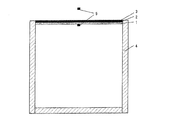
- a frame is assembled using expanded polystyrene foam (thickness 30 mm) so that the inner dimensions are 600 mm in height, 600 mm in width and 600 mm in depth.
- the test body box was prepared by placing it on the side. Calcium silicate when the specimen box is installed in a temperature-controlled room, the temperature in the temperature-controlled room is regarded as the outside temperature, and the temperature in the temperature-controlled room is changed under the conditions ((1) to (3)) shown in FIG.
- the plate surface temperature was measured.
- Condition (1) maintained at 30 ° C. for 6 hours, then cooled to 20 ° C. over 1 hour, then maintained at 20 ° C. for 3 hours, further heated to 30 ° C.
- Condition (2) maintained at 30 ° C. for 6 hours, then lowered to 25 ° C. over 1 hour, then maintained at 25 ° C. for 1 hour, and further 30 ° C. over 1 hour And finally maintained at 30 ° C. for 3 hours
- Condition (3) maintained at 30 ° C. for 6 hours, then lowered to 25 ° C. over 1 hour, then maintained at 25 ° C. for 3 hours, Increase the temperature to 30 ° C over 1 hour, and finally maintain at 30 ° C for 1 hour
- Example 13 Using the raw materials shown in Table 1, the main components were mixed in the blending amounts shown in Table 2, and mixed and stirred at 1000 rpm with a stirring blade at a temperature of 50 ° C. Next, after adding a curing agent and stirring, it was poured into a 600 mm ⁇ 600 mm ⁇ 5 mm mold, cured at 50 ° C. for 30 minutes, and demolded to obtain a molded body. A test body was obtained by laminating a calcium silicate plate having a thickness of 6 mm on one surface of the obtained molded body and an aluminum plate having a thickness of 0.3 mm on the other surface. About the obtained test body, the following heat storage evaluation was performed. The results are shown in Table 4. As shown in Table 4, Example 13 was able to store the cold sufficiently even when the period of 25 ° C. was short as in condition (2), resulting in efficient heat storage.
- Comparative Example 4 Using the raw materials shown in Table 1, test specimens were obtained in the same manner as in Example 13 with the compounding amounts shown in Table 3. About the obtained test body, thermal storage evaluation was performed. The results are shown in Table 4. As shown in Table 4, in Comparative Example 4, when the period of 25 ° C. was short as in the condition (2), the cold temperature could not be stored sufficiently, and the surface temperature increased.
- Comparative Example 5 Using the raw materials shown in Table 1, test specimens were obtained in the same manner as in Example 13 with the compounding amounts shown in Table 3. About the obtained test body, thermal storage evaluation was performed. The results are shown in Table 4. As shown in Table 4, in Comparative Example 5, when the period of 25 ° C. was short as in the condition (2), the cold temperature could not be sufficiently stored, and the surface temperature increased.
- Example 9 to 11, 14 to 17, 21 to 26, and Comparative Examples 6 and 7 Using the raw materials shown in Table 1, test specimens were obtained in the same manner as in Example 13 with the compounding amounts shown in Table 2 or Table 3. About the obtained test body, thermal storage evaluation was performed. The results are shown in Table 4.
Landscapes
- Chemical & Material Sciences (AREA)
- Health & Medical Sciences (AREA)
- Chemical Kinetics & Catalysis (AREA)
- Medicinal Chemistry (AREA)
- Polymers & Plastics (AREA)
- Organic Chemistry (AREA)
- Compositions Of Macromolecular Compounds (AREA)
- Polyurethanes Or Polyureas (AREA)
Abstract
La présente invention concerne : une composition de résine qui peut former un produit moulé qui, outre une excellente capacité de stockage thermique, présente d'excellentes résistance à la chaleur et flexibilité ; et un produit moulé. Cette composition de résine est caractérisée en ce qu'elle comprend : (a) un matériau organique de stockage thermique sous forme de chaleur latente, (b) un hydrate de métal, (c-1) un composé de polyol, et (c-2) un composé d'isocyanate ; et en ce qu'elle comprend pour 100 parties en poids de (a), le matériau organique de stockage thermique sous forme de chaleur latente, de 10 à 120 parties en poids de (b), l'hydrate de métal.
Applications Claiming Priority (6)
| Application Number | Priority Date | Filing Date | Title |
|---|---|---|---|
| JP2015124213 | 2015-06-19 | ||
| JP2015-124213 | 2015-06-19 | ||
| JP2016-025642 | 2016-02-15 | ||
| JP2016025642 | 2016-02-15 | ||
| JP2016-117647 | 2016-06-14 | ||
| JP2016117647A JP6055570B1 (ja) | 2015-06-19 | 2016-06-14 | 樹脂組成物、及び、成形体 |
Publications (1)
| Publication Number | Publication Date |
|---|---|
| WO2016204232A1 true WO2016204232A1 (fr) | 2016-12-22 |
Family
ID=57545262
Family Applications (1)
| Application Number | Title | Priority Date | Filing Date |
|---|---|---|---|
| PCT/JP2016/067947 Ceased WO2016204232A1 (fr) | 2015-06-19 | 2016-06-16 | Composition de résine et produit moulé |
Country Status (1)
| Country | Link |
|---|---|
| WO (1) | WO2016204232A1 (fr) |
Cited By (1)
| Publication number | Priority date | Publication date | Assignee | Title |
|---|---|---|---|---|
| WO2020175529A1 (fr) * | 2019-02-26 | 2020-09-03 | 国立大学法人京都大学 | Matériau de stockage de chaleur, matériau d'isolation contre le froid et réfrigérant |
Citations (4)
| Publication number | Priority date | Publication date | Assignee | Title |
|---|---|---|---|---|
| JP2007039634A (ja) * | 2005-06-28 | 2007-02-15 | Inoac Corp | ポリウレタン発泡体 |
| JP2009191171A (ja) * | 2008-02-14 | 2009-08-27 | Tosoh Corp | ポリウレタンフォーム用ポリオール組成物及びポリウレタンフォームの製造方法 |
| JP2013028734A (ja) * | 2011-07-29 | 2013-02-07 | Sanyo Chem Ind Ltd | ポリウレタンフォーム製造用ポリオール組成物 |
| JP2014152239A (ja) * | 2013-02-08 | 2014-08-25 | F Consultant:Kk | 樹脂組成物およびそれを用いた成形体 |
-
2016
- 2016-06-16 WO PCT/JP2016/067947 patent/WO2016204232A1/fr not_active Ceased
Patent Citations (4)
| Publication number | Priority date | Publication date | Assignee | Title |
|---|---|---|---|---|
| JP2007039634A (ja) * | 2005-06-28 | 2007-02-15 | Inoac Corp | ポリウレタン発泡体 |
| JP2009191171A (ja) * | 2008-02-14 | 2009-08-27 | Tosoh Corp | ポリウレタンフォーム用ポリオール組成物及びポリウレタンフォームの製造方法 |
| JP2013028734A (ja) * | 2011-07-29 | 2013-02-07 | Sanyo Chem Ind Ltd | ポリウレタンフォーム製造用ポリオール組成物 |
| JP2014152239A (ja) * | 2013-02-08 | 2014-08-25 | F Consultant:Kk | 樹脂組成物およびそれを用いた成形体 |
Cited By (1)
| Publication number | Priority date | Publication date | Assignee | Title |
|---|---|---|---|---|
| WO2020175529A1 (fr) * | 2019-02-26 | 2020-09-03 | 国立大学法人京都大学 | Matériau de stockage de chaleur, matériau d'isolation contre le froid et réfrigérant |
Similar Documents
| Publication | Publication Date | Title |
|---|---|---|
| JP5697237B2 (ja) | 蓄熱体及びその製造方法 | |
| US8045846B2 (en) | Composition for heat-storage object formation, heat-storage object, and process for producing heat-storage object | |
| JP4075924B2 (ja) | 蓄熱体の製造方法及び蓄熱体 | |
| JP4846210B2 (ja) | 蓄熱体 | |
| JP6055570B1 (ja) | 樹脂組成物、及び、成形体 | |
| JP5048926B2 (ja) | 蓄熱断熱体 | |
| Parameshwaran et al. | Experimental analysis of hybrid nanocomposite-phase change material embedded cement mortar for thermal energy storage | |
| JP5073035B2 (ja) | 床暖房構造体 | |
| JP6084477B2 (ja) | 樹脂組成物およびそれを用いた成形体 | |
| JP2020094202A (ja) | 蓄熱部材およびその製造方法 | |
| JP5048916B2 (ja) | 蓄熱体 | |
| JP2006152275A (ja) | 蓄熱断熱体 | |
| JP2008170098A (ja) | 床暖房構造体 | |
| JP5619470B2 (ja) | 積層体 | |
| JP4793804B2 (ja) | 床暖房構造体 | |
| JP5140448B2 (ja) | 機能性組成物及びその成形体 | |
| JP5086600B2 (ja) | 蓄熱材組成物、蓄熱体及び蓄熱積層体 | |
| JP7307839B2 (ja) | 樹脂組成物及び成形体 | |
| JP4656959B2 (ja) | 床暖房構造体 | |
| JP4914572B2 (ja) | 蓄熱積層体 | |
| JP5695834B2 (ja) | 積層体 | |
| JP4617106B2 (ja) | 蓄熱体 | |
| JP2015045497A (ja) | 構造体 |
Legal Events
| Date | Code | Title | Description |
|---|---|---|---|
| 121 | Ep: the epo has been informed by wipo that ep was designated in this application |
Ref document number: 16811706 Country of ref document: EP Kind code of ref document: A1 |
|
| NENP | Non-entry into the national phase |
Ref country code: DE |
|
| 122 | Ep: pct application non-entry in european phase |
Ref document number: 16811706 Country of ref document: EP Kind code of ref document: A1 |