WO2016208773A1 - オリゴヌクレオチド誘導体 - Google Patents
オリゴヌクレオチド誘導体 Download PDFInfo
- Publication number
- WO2016208773A1 WO2016208773A1 PCT/JP2016/069057 JP2016069057W WO2016208773A1 WO 2016208773 A1 WO2016208773 A1 WO 2016208773A1 JP 2016069057 W JP2016069057 W JP 2016069057W WO 2016208773 A1 WO2016208773 A1 WO 2016208773A1
- Authority
- WO
- WIPO (PCT)
- Prior art keywords
- compound
- same
- different
- salt
- formula
- Prior art date
- Legal status (The legal status is an assumption and is not a legal conclusion. Google has not performed a legal analysis and makes no representation as to the accuracy of the status listed.)
- Ceased
Links
- 0 C*C*CCOP(N(*)**)OCC(*)(*)COCS** Chemical compound C*C*CCOP(N(*)**)OCC(*)(*)COCS** 0.000 description 5
- WDMBQMIIXHLETH-KYBCKVEESA-N CCC(C)SSCOCC(COP(OC)(OC(C1)[C@@H](CO)O[C@H]1N(C=C(C)C(N1)=O)C1=O)=S)(C(OCC#C)=O)C(OCC#C)=O Chemical compound CCC(C)SSCOCC(COP(OC)(OC(C1)[C@@H](CO)O[C@H]1N(C=C(C)C(N1)=O)C1=O)=S)(C(OCC#C)=O)C(OCC#C)=O WDMBQMIIXHLETH-KYBCKVEESA-N 0.000 description 1
- PIHGDPFVWFKVHH-ZOMNGQQHSA-N CCCSSCOCC(COP(OC)(OC(C1)[C@@H](CO)O[C@H]1N(C=C(C)C(N1)=O)C1=O)=O)(C(OCC#C)=O)C(OCC#C)=O Chemical compound CCCSSCOCC(COP(OC)(OC(C1)[C@@H](CO)O[C@H]1N(C=C(C)C(N1)=O)C1=O)=O)(C(OCC#C)=O)C(OCC#C)=O PIHGDPFVWFKVHH-ZOMNGQQHSA-N 0.000 description 1
Images










Classifications
-
- A—HUMAN NECESSITIES
- A61—MEDICAL OR VETERINARY SCIENCE; HYGIENE
- A61K—PREPARATIONS FOR MEDICAL, DENTAL OR TOILETRY PURPOSES
- A61K31/00—Medicinal preparations containing organic active ingredients
- A61K31/70—Carbohydrates; Sugars; Derivatives thereof
- A61K31/7088—Compounds having three or more nucleosides or nucleotides
- A61K31/7125—Nucleic acids or oligonucleotides having modified internucleoside linkage, i.e. other than 3'-5' phosphodiesters
-
- A—HUMAN NECESSITIES
- A61—MEDICAL OR VETERINARY SCIENCE; HYGIENE
- A61K—PREPARATIONS FOR MEDICAL, DENTAL OR TOILETRY PURPOSES
- A61K31/00—Medicinal preparations containing organic active ingredients
- A61K31/70—Carbohydrates; Sugars; Derivatives thereof
- A61K31/7088—Compounds having three or more nucleosides or nucleotides
- A61K31/712—Nucleic acids or oligonucleotides having modified sugars, i.e. other than ribose or 2'-deoxyribose
-
- A—HUMAN NECESSITIES
- A61—MEDICAL OR VETERINARY SCIENCE; HYGIENE
- A61P—SPECIFIC THERAPEUTIC ACTIVITY OF CHEMICAL COMPOUNDS OR MEDICINAL PREPARATIONS
- A61P43/00—Drugs for specific purposes, not provided for in groups A61P1/00-A61P41/00
-
- C—CHEMISTRY; METALLURGY
- C07—ORGANIC CHEMISTRY
- C07H—SUGARS; DERIVATIVES THEREOF; NUCLEOSIDES; NUCLEOTIDES; NUCLEIC ACIDS
- C07H21/00—Compounds containing two or more mononucleotide units having separate phosphate or polyphosphate groups linked by saccharide radicals of nucleoside groups, e.g. nucleic acids
-
- C—CHEMISTRY; METALLURGY
- C12—BIOCHEMISTRY; BEER; SPIRITS; WINE; VINEGAR; MICROBIOLOGY; ENZYMOLOGY; MUTATION OR GENETIC ENGINEERING
- C12N—MICROORGANISMS OR ENZYMES; COMPOSITIONS THEREOF; PROPAGATING, PRESERVING, OR MAINTAINING MICROORGANISMS; MUTATION OR GENETIC ENGINEERING; CULTURE MEDIA
- C12N15/00—Mutation or genetic engineering; DNA or RNA concerning genetic engineering, vectors, e.g. plasmids, or their isolation, preparation or purification; Use of hosts therefor
- C12N15/09—Recombinant DNA-technology
- C12N15/11—DNA or RNA fragments; Modified forms thereof; Non-coding nucleic acids having a biological activity
- C12N15/113—Non-coding nucleic acids modulating the expression of genes, e.g. antisense oligonucleotides; Antisense DNA or RNA; Triplex- forming oligonucleotides; Catalytic nucleic acids, e.g. ribozymes; Nucleic acids used in co-suppression or gene silencing
-
- C—CHEMISTRY; METALLURGY
- C12—BIOCHEMISTRY; BEER; SPIRITS; WINE; VINEGAR; MICROBIOLOGY; ENZYMOLOGY; MUTATION OR GENETIC ENGINEERING
- C12N—MICROORGANISMS OR ENZYMES; COMPOSITIONS THEREOF; PROPAGATING, PRESERVING, OR MAINTAINING MICROORGANISMS; MUTATION OR GENETIC ENGINEERING; CULTURE MEDIA
- C12N2310/00—Structure or type of the nucleic acid
- C12N2310/10—Type of nucleic acid
- C12N2310/14—Type of nucleic acid interfering nucleic acids [NA]
Definitions
- the present invention relates to an oligonucleotide derivative or the like in which one or more phosphate groups of the oligonucleotide are modified.
- siRNA Short interfering RNA
- RNAi RNA interference
- siRNAi RNA interference
- mRNA messenger RNA
- SiRNA is usually incorporated into a complex called RNA-induced silencing complex (RISC) and expresses its function.
- RISC RNA-induced silencing complex
- the siRNA incorporated into RISC becomes a single strand consisting of only the antisense strand by cleaving the sense strand, and then binds to a target mRNA having complementarity with the antisense strand.
- AGO2 Argonaute2
- oligonucleotides such as siRNA and antisense oligonucleotide (ASO) are poor in lipid solubility, and are polyanion molecules having a plurality of phosphodiester sites, and therefore have poor cell membrane permeability.
- cell membrane permeability is improved by protecting the non-bridging oxygen atom of the phosphodiester site of siRNA or ASO with a protecting group (Patent Document 1 and Non-Patent Documents 1 to 3).
- the siRNA and ASO described in the above documents have a phosphodiester site that is required for RNAi activity or RNaseH knockdown activity after the protective group is removed, for example, by glutathione present in a high concentration in the cell. Since it is converted into a compound, it exhibits RNAi activity or RNaseH knockdown activity in cells (Patent Document 1 and Non-Patent Documents 1 to 3).
- An object of the present invention is to provide an oligonucleotide derivative or the like in which one or more phosphate groups of the oligonucleotide are modified.
- the present invention relates to the following (1) to (41).
- the oligonucleotide derivative or the salt thereof according to any one of (1) to (8) which has a base length of 5 to 100.
- the oligonucleotide derivative or the salt thereof according to any one of (1) to (8) which has a base length of 10 to 80.
- siRNA short interfering RNA
- R 1A represents an optionally substituted lower alkyl, an optionally substituted lower alkenyl, or an optionally substituted lower alkynyl
- R 2A and R 3A Are the same or different and each represents an electron-withdrawing group, or R 2A , R 3A and an adjacent carbon atom are taken together to form a compound of formula (II-0)
- R 4A and R 5A are the same or different and each represents an oxygen atom, CH 2 or NR 7A (wherein R 7A represents a hydrogen atom or lower alkyl), and R 6A represents a bond or CR 8A R 9A (wherein R 8A and R 9A are the same or different and each represents a hydrogen atom or lower alkyl)].
- Formula (III-0) (In the formula, Base 0 represents a nucleobase, M represents an oxygen atom or a sulfur atom, R 1A , R 2A and R 3A are as defined above, and R 11A represents a hydrogen atom, a fluorine atom or a lower alkoxy group.
- R 2A and R 3A are the same or different and each represents carboxy, optionally substituted aralkyloxycarbonyl, lower alkoxycarbonyl, lower alkenyloxycarbonyl or lower alkynyloxycarbonyl.
- (19) The oligonucleotide derivative or the salt thereof according to any one of (14) to (17), wherein R 2A and R 3A are the same or different and each is cyano, nitro, lower alkanoyl or lower alkylsulfonyl.
- (20) The oligonucleotide derivative or the salt thereof according to any one of (16) to (19), which contains only one structure represented by the formula (III-0).
- Base 1 represents a nucleobase
- M 1 represents an oxygen atom or a sulfur atom
- R 1B represents a lower alkyl optionally having a substituent, a lower alkenyl optionally having a substituent, or Represents an optionally substituted lower alkynyl
- R 2B and R 3B are the same or different and each represents an electron-withdrawing group, or R 2B , R 3B and an adjacent carbon atom together
- Formula (II-1) [Wherein R 4B and R 5B are the same or different and each represents an oxygen atom, CH 2 or NR 7B (wherein R 7B represents a hydrogen atom or lower alkyl), and R 6B represents a bond or CR 8B R 9B (wherein R 8B and R 9B are the same or different and each represents a hydrogen atom or lower alkyl), and R 11B represents a hydrogen atom, a fluorine atom or lower alkoxy ⁇
- R 2B and R 3B are the same or different and are each carboxy, optionally substituted aralkyloxycarbonyl, lower alkoxycarbonyl, lower alkenyloxycarbonyl or lower alkynyloxycarbonyl (21) or The oligonucleotide derivative or a salt thereof according to (22).
- siRNA short interfering RNA
- Base represents a nucleobase
- R 2 and R 3 are the same or different and each represents an electron-withdrawing group
- R 2 , R 3 and adjacent carbon atoms are combined to form a compound represented by the formula (II )
- R 4 and R 5 are the same or different and each represents an oxygen atom, CH 2 or NR 7 (wherein R 7 represents a hydrogen atom or lower alkyl), and R 6 represents a bond or CR 8 R 9 (wherein R 8 and R 9 are the same or different and each represents a hydrogen atom or lower alkyl)
- R 10 represents a protecting group for a hydroxyl group
- R 11 represents a hydrogen atom
- R 12 represents lower alkyl
- R 13 represents lower alkylthio or formula (V) [Wherein R 14 , R 15 and R 16 are the same or different and each represents a hydrogen atom, lower alkyl, lower alkoxy, or
- Base 0 represents a nucleobase
- R 2C and R 3C are the same or different and each represents an electron-withdrawing group, or R 2C , R 3C and an adjacent carbon atom are combined to form the formula ( II-2)
- R 4C and R 5C are the same or different and each represents an oxygen atom, CH 2 or NR 7C (wherein R 7C represents a hydrogen atom or lower alkyl), and R 6C represents a bond or CR 8C R 9C (wherein R 8C and R 9C are the same or different and each represents a hydrogen atom or lower alkyl)
- R 10C represents a protecting group for a hydroxyl group
- R 11C represents a hydrogen atom Represents a fluorine atom or a lower alkoxy
- R 12C represents a lower alkyl
- R 13C represents a lower alkylthio optionally having a substituent
- a lower alkenylthio optionally having a
- R 14C , R 15C and R 16C are the same or different and each represents a hydrogen atom, lower alkyl, lower alkoxy, or NR 17C R 18C (wherein R 17C and R 18C are the same or different; , Each representing lower alkyl), or a salt thereof.
- R 2C and R 3C are the same or different and each represents carboxy, optionally substituted aralkyloxycarbonyl, lower alkoxycarbonyl, lower alkenyloxycarbonyl or lower alkynyloxycarbonyl. Or a salt thereof.
- R 2D and R 3D are the same or different and each represents an electron-withdrawing group, or R 2D , R 3D and an adjacent carbon atom are combined to form a compound represented by formula (II-3)
- R 4D and R 5D are the same or different and each represents an oxygen atom, CH 2 or NR 7D (wherein R 7D represents a hydrogen atom or lower alkyl), and R 6D represents a bond or CR 8D R 9D (wherein R 8D and R 9D are the same or different and each represents a hydrogen atom or lower alkyl), R 12D represents lower alkyl, and R 13D has a substituent.
- R 14D , R 15D and R 16D are the same or different and each represents a hydrogen atom, lower alkyl, lower alkoxy, or NR 17D R 18D (wherein R 17D and R 18D are the same or different; R 13D1 represents cyano, nitro, carboxy, lower alkoxycarbonyl, lower alkylsulfonyl, or arylsulfonyl optionally having substituent (s) ⁇ Or its salt.
- R 2D and R 3D are the same or different and each represents carboxy, optionally substituted aralkyloxycarbonyl, lower alkoxycarbonyl, lower alkenyloxycarbonyl, or lower alkynyloxycarbonyl. Or a salt thereof.
- R 2 and R 3 are the same or different and each represents an electron-withdrawing group, or R 2 , R 3 and an adjacent carbon atom are combined to form formula (II)
- R 4 and R 5 are the same or different and each represents an oxygen atom, CH 2 or NR 7 (wherein R 7 represents a hydrogen atom or lower alkyl), and R 6 represents a bond or CR 8 R 9 (wherein R 8 and R 9 are the same or different and each represents a hydrogen atom or lower alkyl), and R 13 represents lower alkylthio or formula (V)
- R 14 , R 15 and R 16 are the same or different and each represents a hydrogen atom, lower alkyl, lower alkoxy, or NR 17 R 18 (wherein R 17 and R 18 are the same or different; , Each representing lower alkyl), or a salt thereof.
- R 2E and R 3E are the same or different and each represents carboxy, optionally substituted aralkyloxycarbonyl, lower alkoxycarbonyl, lower alkenyloxycarbonyl or lower alkynyloxycarbonyl. Or a salt thereof.
- (41) The compound or a salt thereof according to (39), wherein R 2E and R 3E are the same or different and each is cyano, nitro, lower alkanoyl or lower alkylsulfonyl.
- the present invention provides an oligonucleotide derivative or the like in which one or more of the phosphate groups of the oligonucleotide are modified.
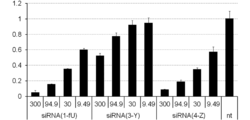
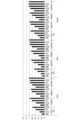
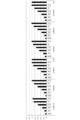
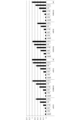
- FIG. 1 shows knockdown activity by hypoxanthine-guanine phosphoribosyltransferase 1 (HPRT1) target siRNA (1-fU), siRNA (3-Y) and siRNA (4-Z) in HepG2 cells.
- the horizontal axis in Figure 1 shows siRNA (1-fU), siRNA (3-Y), and siRNA (4-Z) concentrations of 300 pmol / L, 94.9 pmol / L, 30 pmol / L, and 9.49 pmol / L, respectively.
- 2 shows the test results of introduction into cultured cells using a transfection reagent, and nt shows the test results in the siRNA non-introduced group (negative control group).
- the vertical axis shows the relative percentage of the mRNA amount of HPRT1 in each siRNA-introduced sample as an average ⁇ standard deviation when the mRNA amount of HPRT1 in the siRNA non-introduced group (negative control group) is 1.
- siRNA (1-fU) is a positive control group
- siRNA (3-Y) is used as a negative control group.
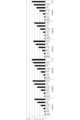
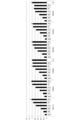
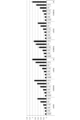
- FIG. 2 shows knockdown activity by HPRT1 target siRNA (1-fU), siRNA (3-Y) and siRNA (4-Z) in HeLa cells.
- 2 shows the concentrations of siRNA (1-fU), siRNA (3-Y) and siRNA (4-Z) at 300 pmol / L, 94.9 pmol / L, 30 pmol / L and 9.49 pmol / L, respectively.
- 2 shows the test results of introduction into cultured cells using a transfection reagent, and nt shows the test results in the siRNA non-introduced group (negative control group).
- the vertical axis shows the relative percentage of the mRNA amount of HPRT1 in each siRNA-introduced sample as an average ⁇ standard deviation when the mRNA amount of HPRT1 in the siRNA non-introduced group (negative control group) is 1. .
- siRNA (1-fU) is a positive control group, while siRNA (3-Y) is used as a negative control group.
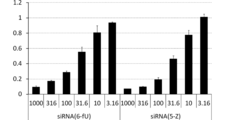
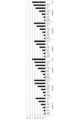
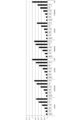
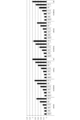
- FIG. 3 shows knockdown activity by HPRT1 target cholesterol-modified siRNA (6-fU) and siRNA (5-Y) in HeLa cells.
- the horizontal axis in FIG. 3 shows siRNA (6-fU) and siRNA (5-Y) at 1000 nmol / L, 316 nmol / L, 100 nmol / L, 31.6 nmol / L, 10 nmol / L, and 3.16 nmol /, respectively.
- concentration of L is shown.
- the vertical axis shows the relative percentage of the mRNA amount of HPRT1 in each siRNA-introduced sample as an average ⁇ standard deviation when the mRNA amount of HPRT1 in the siRNA non-introduced group (negative control group) is 1.
- siRNA (6-fU) is a positive control group, while siRNA (5-Y) is used as a negative control group.
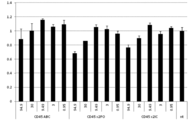
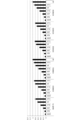
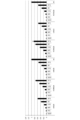
- FIG. 4 shows knockdown activity by CD45 ABC, CD45 x2PO and CD45 x2IC, which are CD45 target ASOs in THP-1 cells.
- FIG. 4 shows the introduction of CD45 ABC, CD45 x2PO and CD45 x2IC into cultured cells at concentrations of 94.9 nmol / L, 30.0 nmol / L, 9.49 nmol / L, 3.00 nmol / L and 0.95 nmol / L, respectively.
- the test results are shown, and nt is the test result in the ASO non-introduced group (negative control group).
- the vertical axis shows the relative percentage of the amount of CD45 mRNA in each of the ASO-introduced samples when the amount of amplified ACTB mRNA (nt) is 1, expressed as mean ⁇ standard deviation.
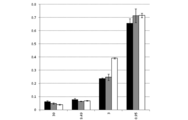
- FIG. 5 shows the knockdown activity by FGFR4 ⁇ PS (black), FGFR PO (grey) and FGFR4 IC (white) as FGFR4 target ASO in HepG2 cells.
- the horizontal axis in Fig. 5 shows the test results of introducing FGFR4 PS, FGFR PO, and FGFR4 IC into cultured cells at concentrations of 30.0 nmol / L, 9.49 nmol / L, 3.00 nmol / L, and 0.95 nmol / L, respectively. Show.
- the vertical axis indicates the relative ratio of the mRNA amount of FGFR4 in each ASO-introduced sample with the mean ⁇ standard deviation when the amount of ACTB mRNA amplification is 1.
- FIG. 6 shows knockdown activity by FGFR44PS (black), FGFR PO (grey) and FGFR4 IC (white) as FGFR4 target ASO in HuH-7 cells.
- the horizontal axis in Fig. 6 shows the test results of introducing FGFR4 PS, FGFR PO, and FGFR4 IC into cultured cells at concentrations of 30.0 mol nmol / L, 9.49 nmol / L, 3.00 nmol / L, and 0.95 nmol / L, respectively. Show.
- the vertical axis indicates the relative ratio of the mRNA amount of FGFR4 in each ASO-introduced sample with the mean ⁇ standard deviation when the amount of ACTB mRNA amplification is 1.
- Figure 7 shows knockdown by Phosphatase and Tensin Homolog Deleted from Chromosome 10 (PTEN) target ASO in HeLa cells with KON708 (black), wt KON708 (dark gray), KON715 (light gray) and wt KON715 (white) Shows activity.
- the horizontal axis in Fig. 7 shows the test results of introducing KON708, wt KON708, KON715, and wt KON715 into cultured cells at concentrations of 300 nmol / L, 94.9 nmol / L, 30.0 nmol / L, and 9.49 nmol / L, respectively. Indicates.
- the vertical axis shows the relative ratio of the amount of PTEN mRNA in each ASO-introduced sample when the amount of ACTB mRNA amplification is 1, expressed as mean ⁇ standard deviation.
- FIG. 8 shows knockdown activity by Ctrl (5 ′, 3 ′ dT), KON788 and KON789, which are HPRT1 target siRNAs in HeLa cells, HuH-7 cells and HepG2 cells.
- Ctrl (5 ′, 3 ′ dT), KON788 and KON789 are 1000 pmol / L, 316 pmol / L, 100 pmol / L, 31.6 pmol / L, 10 pmol / L and 3.16 pmol / L, respectively.
- the test results of introduction into cultured cells at the L concentration are shown, and nt shows the test results in the siRNA non-introduced group (negative control group).
- the vertical axis shows the relative percentage of the amount of HPRT1 mRNA in each siRNA-introduced sample as mean ⁇ standard deviation when the amount of HPRT1 mRNA in the siRNA non-introduced group (negative control group: nt) is 1. It is.
- Ctrl (5 ′, 3 ′ dT) is a positive control group, while KON788 is used as a siRNA introduction group and a negative control group.
- FIG. 9 shows knockdown activity by Ctrl (5 ′, 3 ′ dT), KON789, KON816 and KON788, which are HPRT1 target siRNAs in HeLa cells, HuH-7 cells and HepG2 cells.
- the horizontal axis in FIG. 9 indicates that Ctrl (5 ′, 3 ′ dT), KON789, KON816, and KON788 were applied to cultured cells at concentrations of 300 pmol / L, 94.9 pmol / L, 30 pmol / L, and 9.49 pmol / L, respectively.
- nt shows the test result in the siRNA non-introduced group (negative control group).
- the vertical axis shows the relative percentage of the amount of HPRT1 mRNA in each siRNA-introduced sample as mean ⁇ standard deviation when the amount of HPRT1 mRNA in the siRNA non-introduced group (negative control group: nt) is 1. It is.
- Ctrl (5 ′, 3 ′ dT) is a positive control group, while KON788 is used as a siRNA introduction group and a negative control group.
- the horizontal axis in FIG. 10 indicates that Ctrl (5 ′, 3 ′ dT), KON816, KON818, and KON788 were applied to cultured cells at concentrations of 300 pmol / L, 94.9 pmol / L, 30 pmol / L, and 9.49 pmol / L, respectively.
- the test result after introduction is shown, and nt shows the test result in the siRNA non-introduced group (negative control group).
- the vertical axis shows the relative percentage of the amount of HPRT1 mRNA in each siRNA-introduced sample as mean ⁇ standard deviation when the amount of HPRT1 mRNA in the siRNA non-introduced group (negative control group: nt) is 1. It is. Ctrl (5 ′, 3 ′ dT) is a positive control group, while KON788 is used as a siRNA introduction group and a negative control group.
- FIG. 11 shows knockdown activity by HPRT1 target siRNAs Ctrl (5 ′,) 3 ′ dT), KON818, KON788, KON857, KON840 and KON846 in HeLa cells.
- the vertical axis shows the relative percentage of the amount of HPRT1 mRNA in each siRNA-introduced sample as mean ⁇ standard deviation when the amount of HPRT1 mRNA in the siRNA non-introduced group (negative control group: nt) is 1. It is. Ctrl (5 ′, 3 ′ dT) is a positive control group, while KON788 is used as a siRNA introduction group and a negative control group.
- FIG. 12 shows the knockdown activity by HPRT1 target siRNAs Ctrl (5 ′, 3 ′ dT), KON818, KON788, KON857, KON840 and KON846 in HuH-7 cells.
- the vertical axis shows the relative percentage of the amount of HPRT1 mRNA in each siRNA-introduced sample as mean ⁇ standard deviation when the amount of HPRT1 mRNA in the siRNA non-introduced group (negative control group: nt) is 1. It is. Ctrl (5 ′, 3 ′ dT) is a positive control group, while KON788 is used as a siRNA introduction group and a negative control group.
- FIG. 13 shows knockdown activity by HPRT1 target siRNAs Ctrl (5 ′, 3 ′ dT), KON818, KON788, KON857, KON840 and KON846 in HepG2 cells.
- 13 is Ctrl (5 ', 3' dT), KON818, KON788, KON857, KON840 and KON846, 1000 pmol / L, 316 pmol / L, 100 pmol / L, 31.6 pmol / L, 10 pmol, respectively.
- the test results of introduction into cultured cells at concentrations of / L and 3.16 Pmol / L are shown, and nt shows the test results in the siRNA non-introduced group IV (negative control group).
- the vertical axis shows the relative percentage of the amount of HPRT1 mRNA in each siRNA-introduced sample as mean ⁇ standard deviation when the amount of HPRT1 mRNA in the siRNA non-introduced group (negative control group: nt) is 1. It is. Ctrl (5 ′, 3 ′ dT) is a positive control group, while KON788 is used as a siRNA introduction group and a negative control group.
- FIG. 14 shows knockdown activity by HPRT1 target siRNAs Ctrl (5′-F), KON880, KON881, KON882, KON883 and KON884 in HeLa cells.
- nt indicates the test result in the siRNA non-introduced group (negative control group).
- the vertical axis shows the relative percentage of the amount of HPRT1 mRNA in each siRNA-introduced sample as mean ⁇ standard deviation when the amount of HPRT1 mRNA in the siRNA non-introduced group (negative control group: nt) is 1. It is. Ctrl (5'-F) is used as a positive control group.
- FIG. 15 shows knockdown activity by HPRT1 target siRNAs Ctrl (5′-F), KON880, KON881, KON882, KON883 and KON884 in HuH-7 cells.
- the horizontal axis in Fig. 15 is Ctrl (5'-F), KON880, KON881, KON882, KON883 and KON884 respectively 1000 pmol / L, 316 pmol / L, 100 pmol / L, 31.6 pmol / L, 10 pmol / L
- nt indicates the test result in the siRNA non-introduced group (negative control group).
- the vertical axis shows the relative percentage of the amount of HPRT1 mRNA in each siRNA-introduced sample as mean ⁇ standard deviation when the amount of HPRT1 mRNA in the siRNA non-introduced group (negative control group: nt) is 1. It is. Ctrl (5'-F) is used as a positive control group.
- FIG. 16 shows knockdown activity by HPRT1 target siRNAs Ctrl (5′-F), KON880, KON881, KON882, KON883 and KON884 in HepG2 cells.
- 16 is Ctrl (5'-F), KON880, KON881, KON882, KON883 and KON884 respectively 1000 pmol / L, 316 pmol / L, 100 pmol / L, 31.6 pmol / L, 10 pmol / L 2 shows the test results of introduction into cultured cells at a concentration of 3.16 pmol / L, and nt shows the test results in the siRNA non-introduced group (negative control group).
- the vertical axis shows the relative percentage of the amount of HPRT1 mRNA in each siRNA-introduced sample as mean ⁇ standard deviation when the amount of HPRT1 mRNA in the siRNA non-introduced group (negative control group: nt) is 1.
- FIG. 17 shows the knockdown activity by HPRT1 target siRNAs Ctrl (5′-F), KON846, KON891, KON892, KON903, and KON905 in HeLa cells.
- 17 is Ctrl (5'-F), KON846, KON891, KON892, KON903, and KON905, respectively 1000 pmol / L, 316 pmol / L, 100 pmol / L, 31.6 pmol / L, 10 pmol / L 2 shows the test results of introduction into cultured cells at a concentration of 3.16 pmol / L, and nt shows the test results in the siRNA non-introduced group (negative control group).
- the vertical axis shows the relative percentage of the amount of HPRT1 mRNA in each siRNA-introduced sample as mean ⁇ standard deviation when the amount of HPRT1 mRNA in the siRNA non-introduced group (negative control group: nt) is 1.
- Ctrl (5'-F) is used as a positive control group.
- FIG. 18 shows knockdown activity by Ctrl (5′-F), KON846, KON891, KON892, KON903, and KON905, which are HPRT1 target siRNAs in HuH-7 cells.
- nt shows the test results in the siRNA non-introduced group (negative control group).
- the vertical axis shows the relative percentage of the amount of HPRT1 mRNA in each siRNA-introduced sample as mean ⁇ standard deviation when the amount of HPRT1 mRNA in the siRNA non-introduced group (negative control group: nt) is 1.
- FIG. 19 shows the knockdown activity by HPRT1 target siRNAs Ctrl (5′-F), KON846, KON891, KON892, KON903, and KON905 in HepG2 cells.
- nt shows the test results in the siRNA non-introduced group (negative control group).
- the vertical axis shows the relative percentage of the amount of HPRT1 mRNA in each siRNA-introduced sample as mean ⁇ standard deviation when the amount of HPRT1 mRNA in the siRNA non-introduced group (negative control group: nt) is 1.
- FIG. 20 shows knockdown activity by Ctrl (5 ′, RNA3 ′ dT), KON922, KON923, and KON788, which are HPRT1 target siRNAs in HeLa cells.
- the horizontal axis in FIG. 20 indicates that Ctrl (5 ′, 3 ′ dT), KON922, KON923, and KON788 were applied to cultured cells at concentrations of 1000 pmol / L, 316 pmol / L, 100 pmol / L, and 31.6 pmol / L, respectively.
- the test result after introduction is shown, and nt shows the test result in the siRNA non-introduced group (negative control group).
- the vertical axis shows the relative percentage of the amount of HPRT1 mRNA in each siRNA-introduced sample as mean ⁇ standard deviation when the amount of HPRT1 mRNA in the siRNA non-introduced group (negative control group: nt) is 1. It is. Ctrl (5 ′, 3 ′ dT) is a positive control group, while KON788 is used as a siRNA introduction group and a negative control group.
- FIG. 21 shows knockdown activity by HPRT1 target siRNAs Ctrl (5 ′, 3 ′ dT), KON922, KON923, and KON788 in HuH-7 cells.
- nt shows the test result in the siRNA non-introduced group (negative control group).
- the vertical axis shows the relative percentage of the amount of HPRT1 mRNA in each siRNA-introduced sample as mean ⁇ standard deviation when the amount of HPRT1 mRNA in the siRNA non-introduced group (negative control group: nt) is 1. It is.
- FIG. 22 shows knockdown activity by HPRT1 target siRNAs Ctrl (5 ′, 3 ′ dT), KON922, KON923, and KON788 in HepG2 cells.
- the horizontal axis in FIG. 22 shows that the control cells (5 ', 3' dT), KON922, KON923, and KON788 were applied to cultured cells at concentrations of 1000 pmol / L, 316 pmol / L, 100 pmol / L, and 31.6 pmol / L, respectively.
- nt shows the test result in the siRNA non-introduced group (negative control group).
- the vertical axis shows the relative percentage of the amount of HPRT1 mRNA in each siRNA-introduced sample as mean ⁇ standard deviation when the amount of HPRT1 mRNA in the siRNA non-introduced group (negative control group: nt) is 1. It is.
- Ctrl (5 ′, 3 ′ dT) is a positive control group, while KON788 is used as a siRNA introduction group and a negative control group.
- FIG. 23 shows the knockdown activity by wt924, KON924, wt925, KON925, wt926 and KON926, which are apolipoprotein B (ApoB) target siRNAs in HepG2 cells.
- the horizontal axis of FIG. 23 shows wt924, KON924, wt925, KON925, wt926 and KON926 at 1000Kpmol / L, 316 pmol / L, 100 pmol / L, 31.6 pmol / L, 10 pmol / L and 3.16 pmol / L, respectively.
- the test results of introduction into cultured cells at the concentration are shown, and nt shows the test results in the siRNA non-introduced group (negative control group).
- the vertical axis shows the relative percentage of the amount of ApoB mRNA in each siRNA-introduced sample as mean ⁇ standard deviation when the amount of ApoB mRNA in the siRNA non-introduced group (negative control group: nt) is 1. It is.
- FIG. 24 shows knockdown activity by ApoB target siRNA wt924, KON924, wt925, KON925, wt926 and KON926 in HuH-7 cells.
- nt shows the test results in the siRNA non-introduced group (negative control group).
- the vertical axis shows the relative percentage of the amount of ApoB mRNA in each siRNA-introduced sample as mean ⁇ standard deviation when the amount of ApoB mRNA in the siRNA non-introduced group (negative control group: nt) is 1.
- FIG. 25 shows knockdown activity by wt927, KON927, wt928, KON928, wt929, and KON929, which are siRNAs targeting luciferase, in luciferase-expressing heLa cells (HeLa-Luc) into which a luciferase expression vector has been introduced.
- the horizontal axis of FIG. 25 is 1000 pmol / L, 316 pmol / L, 100 pmol / L, 31.6 pmol / L, 10 pmol / L and 3.16 pmol / L for wt927, KON927, wt928, KON928, wt929 and KON929, respectively.
- FIG. 26 shows knockdown activity by GAPDH target siRNA wt930, KON930, wt931, KON931, wt932 and KON932 in HeLa cells.
- 26 is 1000 pmol / L, 316 pmol / L, 100 pmol / L, 31.6 pmol / L, 10 pmol / L and 3.16 pmol / L for wt930, KON930, wt931, KON931, wt932 and KON932, respectively.
- the test results of introduction into cultured cells at the concentration are shown, and nt shows the test results in the siRNA non-introduced group (negative control group).
- the vertical axis shows the relative percentage of the GAPDH mRNA amount of each of the above-mentioned siRNA-introduced samples as mean ⁇ standard deviation when the GAPDH mRNA amount of the siRNA non-introduced group (negative control group: nt) is 1. It is.
- FIG. 27 shows knockdown activity by wt930, KON930, wt931, KON931, wt932 and KON932, GAPDH target siRNAs in HuH-7 cells.
- 27 is 1000 930 pmol / L, 316 pmol / L, 100 pmol / L, 31.6 pmol / L, 10 pmol / L and 3.16 pmol / L for wt930, KON930, wt931, KON931, wt932 and KON932, respectively.
- the test results of introduction into cultured cells at the concentration are shown, and nt shows the test results in the siRNA non-introduced group (negative control group).
- the vertical axis shows the relative percentage of the GAPDH mRNA amount of each of the above-mentioned siRNA-introduced samples as mean ⁇ standard deviation when the GAPDH mRNA amount of the siRNA non-introduced group (negative control group: nt) is 1. It is.
- FIG. 28 shows knockdown activity by GAPDH target siRNA wt930, KON930, wt931, KON931, wt932 and KON932 in HepG2 cells.
- the test results of introduction into cultured cells at the concentration are shown, and nt shows the test results in the siRNA non-introduced group (negative control group).
- the vertical axis shows the relative percentage of the GAPDH mRNA amount of each of the above-mentioned siRNA-introduced samples as mean ⁇ standard deviation when the GAPDH mRNA amount of the siRNA non-introduced group (negative control group: nt) is 1. It is.
- oligonucleotide derivatives having a group represented by the formula (I) or the formula (I-0) on an oxygen atom of at least one phosphate group of the oligonucleotide are respectively referred to as a compound (I) and a compound (I-0).
- Oligonucleotide derivatives containing one or more structures represented by formula (III), formula (III-0) or formula (III-1) are referred to as compound (III), compound (III-0) and compound, respectively.
- Lower alkyl and lower alkyl moiety in lower alkoxy, lower alkoxycarbonyl, lower alkylsulfonyl and lower alkylthio include, for example, linear or branched alkyl having 1 to 12 carbon atoms. Specific examples include methyl, ethyl, propyl, isopropyl, butyl, isobutyl, sec-butyl, tert-butyl, pentyl, isopentyl, neopentyl, hexyl, heptyl, octyl, nonyl, decyl, undecyl, dodecyl and the like.
- lower alkanoyl examples include linear or branched alkanoyl having 1 to 12 carbon atoms. Specific examples include formyl, acetyl, propionyl, butyryl, isobutyryl, valeryl, isovaleryl, pivaloyl, hexanoyl, heptanoyl, octanoyl, nonanoyl, decanoyl, undecanoyl, dodecanoyl and the like.
- Lower alkenyl and lower alkenyl moiety in lower alkenyloxycarbonyl and lower alkenylthio include, for example, linear or branched alkenyl having 2 to 12 carbon atoms. Specific examples include vinyl, allyl, 1-propenyl, butenyl, pentenyl, hexenyl, heptenyl, octenyl, nonenyl, decenyl, undecenyl, dodecenyl and the like.
- the lower alkynyl and the lower alkynyl moiety in lower alkynyloxycarbonyl and lower alkynylthio include, for example, linear or branched alkynyl having 2 to 12 carbon atoms. Specific examples include ethynyl, 1-propynyl, propargyl, butynyl, pentynyl, hexynyl, heptynyl, octynyl, nonynyl, decynyl, undecynyl, dodecynyl and the like.
- aralkyl moiety in (v) aralkyloxycarbonyl examples include, for example, aralkyl having 7 to 16 carbon atoms, and more specifically, benzyl, phenethyl, phenylpropyl, phenylbutyl, phenylpentyl, phenylhexyl, phenylheptyl, phenyloctyl.
- Phenylnonyl phenyldecyl, naphthylmethyl, naphthylethyl, naphthylpropyl, naphthylbutyl, naphthylpentyl, naphthylhexyl, anthrylmethyl, anthrylethyl and the like.
- aryl moiety in arylsulfonyl examples include aryl having 6 to 14 carbon atoms, and more specifically, phenyl, naphthyl, azulenyl, anthryl and the like.
- Examples of the electron withdrawing group include carboxy, cyano, nitro, lower alkanoyl, lower alkoxycarbonyl, carbamoyl, lower alkylcarbamoyl, di-lower alkylcarbamoyl, lower alkylsulfinyl, lower alkylsulfonyl, sulfamoyl, and lower alkylsulfamoyl. And di-lower alkylsulfamoyl.
- hydroxyl-protecting group examples include trityl, 4-methoxytrityl, 4,4'-dimethoxytrityl and the like.
- Lower alkanoyl and lower alkoxycarbonyl shown as electron withdrawing groups have the same meanings as (ii) lower alkanoyl and (i) lower alkoxycarbonyl, respectively, and are lower alkyl carbamoyl, di-lower alkyl carbamoyl, lower alkyl sulfinyl, lower alkyl sulfonyl.
- Examples of the lower alkyl moiety in, lower alkyl sulfamoyl, and di-lower alkyl sulfamoyl include the groups exemplified in the above-mentioned (i) lower alkyl.
- the two lower alkyl moieties in the di-lower alkylcarbamoyl and di-lower alkylsulfamoyl may be the same or different.
- the lower alkenylthio which may have a substituent and the lower alkynylthio which may have a substituent are the same or different, for example, halogen, hydroxy, sulfanyl having 1 to 3 substituents, respectively.
- Aryl Examples of the substituent of the C 6-14 aryl optionally having substituent, for example, C 1-12 alkoxy, and the like) and the like], C 3-10 cycloalkoxy, C 6-14 Aryloxy, C 7-16 aralkyloxy, C 1-12 alkanoyloxy, C 7-15 aroyloxy, C 1-12 alkylsulfanyl, —NR X R Y (wherein R X and R Y are the same or different, Hydrogen atom, C 1-12 alkyl, C 3-10 cycloalkyl, C 6-14 aryl, aromatic heterocyclic group, C 7-16 aralkyl, C 1-12 alkanoyl, C 7-15 aroyl, C 1- 12 represents alkoxycarbonyl or C 7-16 aralkyloxycarbonyl), C 1-12 alkanoyl, C 7-15 aroyl, C 1-12 alkoxycarbonyl, C 6-14 aryloxycarbonyl, C 1-12 alkylcarbamo
- the arylsulfonyl which may have a substituent and the substituent in the aralkyloxycarbonyl which may have a substituent may be the same or different, for example, halogen, hydroxy, Sulfanyl, nitro, cyano, carboxy, carbamoyl, C 1-12 alkyl, C 2-12 alkenyl, C 2-12 alkynyl, trifluoromethyl, p-toluenesulfonyloxy, methanesulfonyloxy, trifluoromethanesulfonyloxy, C 3- 10 cycloalkyl, C 6-14 aryl, aliphatic heterocyclic group, aromatic heterocyclic group, C 1-12 alkoxy, C 3-10 cycloalkoxy, C 6-14 aryloxy, C 7-16 aralkyloxy, C 1-12 alkanoyloxy, C 7-15 aroyloxy, C 1-12 alkylsulfanyl, -NR Xa R
- C 1-12 alkyl as shown here and C 1-12 alkoxy, C 1-12 alkanoyloxy, C 1-12 alkylsulfanyl, C 1-12 alkoxycarbonyl, C 1-12 alkylcarbamoyl and diC 1-12 alkyl
- Examples of the C 1-12 alkyl moiety of carbamoyl include the groups listed above as examples of (i) lower alkyl.
- the two C 1-12 alkyls in the diC 1-12 alkylcarbamoyl may be the same or different.
- Examples of C 2-12 alkenyl include the groups exemplified in the above-mentioned (iii) lower alkenyl.
- Examples of C 2-12 alkynyl include the groups mentioned above as examples of (iv) lower alkynyl.
- Examples of C 1-12 alkanoyl include the groups mentioned above as examples of (ii) lower alkanoyl.
- C 3-10 cycloalkyl moiety of the cycloalkyl and C 3-10 cycloalkoxy for example, an cycloalkyl having 3 to 10 carbon atoms, more specifically, cyclopropyl, cyclobutyl, cyclopentyl, cyclohexyl, cycloheptyl, And cyclooctyl, cyclononyl, cyclodecanyl and the like.
- Examples of the aryl moiety of C 6-14 aryl and C 6-14 aryloxy, C 7-15 aroyl, C 7-15 aroyloxy and C 6-14 aryloxycarbonyl include, for example, the aryl moiety in the aforementioned (vi) arylsulfonyl
- the groups mentioned in the above are exemplified.
- Examples of the aryl moiety of C 7-16 aralkyloxy, C 7-16 aralkyl and C 7-16 aralkyloxycarbonyl include the groups exemplified in the examples of the aryl moiety in the above (vi) arylsulfonyl. Examples thereof include C 1-12 alkylene, and more specifically, a group in which one hydrogen atom has been removed from the above-mentioned examples of (i) lower alkyl.
- aliphatic heterocyclic group for example, a 5-membered or 6-membered monocyclic aliphatic heterocyclic group containing at least one atom selected from a nitrogen atom, an oxygen atom and a sulfur atom, and a 3- to 8-membered ring are condensed
- aromatic heterocyclic group for example, a 5-membered or 6-membered monocyclic aromatic heterocyclic group containing at least one atom selected from a nitrogen atom, an oxygen atom and a sulfur atom, and a 3- to 8-membered ring are condensed.
- the oligonucleotide derivative of the present invention means a polymer or oligomer consisting of nucleotide residues.
- the oligonucleotide derivatives of the present invention include both single-stranded oligonucleotides and double-stranded oligonucleotides.
- the base length of each oligonucleotide chain may be different.
- the double-stranded oligonucleotide may contain one or more mismatched base pairs.
- complexes formed by three or more oligonucleotides are also included in the oligonucleotide derivatives of the present invention.
- the oligonucleotide derivative of the present invention has a knockdown activity for, for example, mRNA encoding a protein involved in a disease.
- knockdown activity in the present specification means to suppress the expression of a gene encoding a protein or the like (target gene).
- double-stranded oligonucleotide examples include double-stranded RNA such as double-stranded DNA such as a structural gene, siRNA, miRNA, and the like, but the present invention is not limited thereto. Absent.
- single-stranded oligonucleotide examples include an antisense oligonucleotide, microRNA, aptamer, antagomer, single-stranded RNAi agent (siRNA having a hairpin structure, etc.), etc., but the present invention is not limited thereto. .
- the length of the oligonucleotide derivative of the present invention is preferably 5 to 100 bases, more preferably 10 to 80 bases, further preferably 10 to 50 bases, particularly preferably 20 to 50 bases, most preferably 20 to 30 bases. preferable.
- the oligonucleotide derivative of the present invention has a group represented by the formula (I) or the formula (I-0) on the oxygen atom of at least one phosphate group, and further has one or more nucleotide residues. It may be modified. The modification may be contained in any site of nucleobase, sugar, or phosphate.
- nucleobase examples include adenine, guanine, cytosine, thymine, uracil and the like, and may be protected by one or more protecting groups as necessary.
- the groups may be the same or different.
- protecting group examples include allyloxycarbonyl, benzoyl, benzyl, acetyl, phenoxyacetyl, tert-butylphenoxyacetyl, and isobutyryl, allyloxycarbonyl with respect to the 2-position amino of guanine, with respect to the 4-position amino of cytosine and the 6-position amino of adenine. Phenoxyacetyl, tert-butylphenoxyacetyl, and the like.
- nucleotides containing the modification at the nucleobase site include nucleotides having the nucleobase and nucleotide nucleobases (the nucleobase includes, for example, adenine, guanine, cytosine, thymine, uracil, etc.
- a part or all of the chemical structure is substituted with an arbitrary atom, and the like, specifically, for example, within a nucleobase (for example, adenine, guanine, cytosine, thymine,
- a nucleobase for example, adenine, guanine, cytosine, thymine
- the oxygen atom is substituted with a sulfur atom
- the hydrogen atom is substituted with an alkyl having 1 to 10 carbon atoms
- the methyl is substituted with a hydrogen atom or an alkyl having 2 to 10 carbon atoms
- amino is protected with a protecting group such as alkyl having 1 to 10 carbons or alkanoyl having 1 to 8 carbons.
- Nucleotides in which the modification is contained in the sugar moiety may be any nucleotide as long as the chemical structure of part or all of the nucleotide sugar is modified with an arbitrary substituent or substituted with an arbitrary atom.
- LNA Locked Nucleic Acid: Locked Nucleic Acid
- 2′-modified which represents a bicyclic ribonucleic acid in which the 2 ′ oxygen atom and 4 ′ carbon atom of the ribose ring are bridged via methylene
- examples thereof include nucleotides, and 2′-modified nucleotides are preferably used.
- 2′-modified nucleotides examples include 2′-OH of ribose as a hydrogen atom, —OR, —R, —SH, —SR, amino, —NHR, —NR 2 , N 3 (azido), cyano, and halogen.
- R is lower alkyl or aryl, halogen means each atom of fluorine, chlorine, bromine, and iodine; lower alkyl and aryl are as defined above, and —NR 2 2 R-modified nucleotides substituted with a substituent selected from the group consisting of two Rs may be the same or different.
- 2′-OH is a fluorine atom, methoxy, 2- (methoxy) ethoxy, 3-aminopropoxy, 2-[(N, N-dimethylamino) oxy] ethoxy, 3- (N, N— Dimethylamino) propoxy, 2- [2- (N, N-dimethylamino) ethoxy] ethoxy, 2- (methylamino) -2-oxoethoxy, 2- (N-methylcarbamoyl) ethoxy and 2-cyanoethoxy And 2′-modified nucleotides substituted with a substituent selected from the group.
- nucleotide containing the modification at the phosphate site a part or all of the chemical structure of the phosphodiester bond of the oligonucleotide is modified with any substituent other than the formula (I), or any Any substance substituted with an atom may be used, for example, a nucleotide in which a phosphodiester bond is substituted with an alkylphosphonate bond, or a structure in which oxygen atoms in the phosphate group are partially or entirely substituted with sulfur atoms. Examples include nucleotides having phosphorothioate.
- oligonucleotide derivative having knockdown activity for mRNA encoding a protein involved in a disease examples include a base sequence complementary to a partial base sequence of mRNA of a gene encoding a protein (target gene). And if it is an oligonucleotide derivative that suppresses the expression of the target gene, for example, a double-stranded oligonucleotide such as siRNA (short interference RNA), miRNA (micro RNA), shRNA (short hairpin RNA), antisense nucleic acid, ribozyme, etc. Any nucleic acid such as a single-stranded oligonucleotide may be used, but a double-stranded oligonucleotide is preferred.
- an oligonucleotide chain that contains a base sequence complementary to a part of the base sequence of the mRNA of the target gene is called an antisense strand
- an oligonucleotide that contains a base sequence complementary to the base sequence of the antisense strand is sensed. It is called a chain.
- the sense strand refers to an oligonucleotide capable of forming a double strand by pairing with an antisense strand, such as an oligonucleotide itself consisting of a partial base sequence of a target gene.
- the 5 ′ end of the oligonucleotide refers to the 5 ′ end of the antisense strand.
- the duplex forming part formed by pairing the antisense strand and the sense strand with the base is usually 15 to 27 base pairs, preferably 15 to 25 base pairs, -23 base pairs are more preferred, 15-21 base pairs are more preferred, and 15-19 base pairs are particularly preferred.
- the double strand forming part only needs to have the bases of the antisense strand and the sense strand facing each other, and may form a base pair or mismatch, but the 5 ′ end of the antisense strand
- the base of the sense strand and the base of the sense strand paired therewith are preferably adenine-uracil base pairs or mismatches.
- the antisense strand, the sense strand, or both of the oligonucleotides constituting the double-stranded oligonucleotide are additional nucleotides that do not form a duplex on the 3 ′ side or 5 ′ side following the duplex forming part. You may have.
- the part that does not form a double chain is also referred to as a protrusion (overhang).
- the double-stranded oligonucleotide having an overhang for example, one having an overhang consisting of 1 to 4 nucleotides, usually 1 to 3 nucleotides at the 3 ′ end or 5 ′ end of at least one strand is used.
- the overhang can have only the antisense strand, only the sense strand, and both the antisense strand and the sense strand, but a double-stranded nucleic acid having an overhang on both the antisense strand and the sense strand is preferably used.
- a sequence that partially or completely matches the base sequence of the target gene mRNA following the duplex formation portion, or a base sequence and a portion of the complementary strand of the target gene mRNA that follows the duplex formation portion may be used.
- a double-stranded oligonucleotide for example, a nucleic acid molecule (WO2005 / 089287) that generates the above-mentioned double-stranded oligonucleotide having the protruding portion by the action of a ribonuclease such as Dicer, 3 ′ end or 5 ′ end It is also possible to use a double-stranded oligonucleotide or the like that does not have a protruding portion.
- the sequence of at least the 2nd to 17th bases (nucleosides), preferably from the 5 ′ end to the 3 ′ end of the antisense strand, is continuous with the mRNA of the target gene.
- the antisense strand has a sequence of 2-19 bases from the 5 ′ end to the 3 ′ end, and the mRNA of the target gene Or a sequence of bases complementary to the sequence of 18 bases in sequence, or the sequence of bases 2 to 21 is a sequence of bases complementary to the sequence of 20 bases in sequence of the mRNA of the target gene,
- the sequence of the 2nd to 25th bases is a sequence of bases complementary to the sequence of 24 consecutive bases of the mRNA of the target gene.
- the base sequence at the 5 'end of the antisense strand may be complementary to or mismatched with the base sequence of the mRNA of the target gene.
- salt 0 examples include acid addition salts, metal salts, ammonium salts, organic amine addition salts, amino acid addition salts, and the like.
- acid addition salt examples include inorganic acid salts such as hydrochloride, sulfate, and phosphate, and organic acid salts such as acetate, maleate, fumarate, citrate, and methanesulfonate.
- metal salt examples include alkali metal salts such as sodium salt and potassium salt, alkaline earth metal salts such as magnesium salt and calcium salt, aluminum salt, zinc salt and the like.
- ammonium salts include ammonium and tetramethyl. Examples thereof include salts such as ammonium.
- organic amine addition salts include addition salts such as morpholine and piperidine.
- amino acid addition salts include addition salts such as lysine, glycine and phenylalanine.
- Compounds (I), (III), (I-0), (III-0), (III-1), (IV), (IV-0), (IV-1), (VI) and (VI- A part or all of each atom in 0) may be replaced by a corresponding isotope atom, and in the present invention, a compound replaced by these isotope atoms is used in the present invention.
- compounds (I), (III), (I-0), (III-0), (III-1), (IV), (IV-0), (IV-1), (VI) and ( Some or all of the hydrogen atoms in VI-0) may be hydrogen atoms having an atomic weight of 2 (deuterium atoms).
- a compound in which some or all of the hydrogen atoms in VI-0) are replaced with deuterium atoms is, for example, 1) a method of deuterating carboxylic acid under basic conditions using deuterium peroxide (US Patent No. 3849458), 2) A method of deuterating alcohol, carboxylic acid, etc. using iridium complex as a catalyst and deuterium as a deuterium source [Journal of American Chemical Society (J. Am. Chem. Soc.), Vol. 124, no.
- compounds (I), (III), (I-0), (III-0), (III-1), (IV), (IV-0), (IV-1), (VI) and (VI-0) can be purified as they are when they are obtained in the salt form, and when they are obtained in the free form, they are compound (I), (III), (I-0 ), (III-0), (III-1), (IV), (IV-0), (IV-1), (VI) and (VI-0) dissolved or suspended in a suitable solvent, Alternatively, it may be isolated and purified by adding a base to form a salt.
- compounds (I), (III), (I-0), (III-0), (III-1), (IV), (IV-0), (IV-1), (VI) and ( VI-0) may exist in the form of adducts with water or various solvents, and these adducts are also used in the present invention.
- Compounds (I), (III), (I-0), (III-0), (III-1), (IV), (IV-0), (IV-1), (IV) of the present invention The production methods of VI) and (VI-0) will be described.
- Compounds (I), (I-0), (III) and (III-0) can be produced, for example, by the following production method.
- Compounds (IV) and (IV-0) can be produced, for example, as compound (B-1) in production method 2 or compound (B-2) in production method 4.
- compound (IV-1) can be produced, for example, as compound (B-3) of production method 5.
- Compounds (VI) and (VI-0) can be produced, for example, as compound (R) in production method 2 or compound (X) in production method 4.
- R d represents lower alkyl
- R e represents a hydrogen atom or a substituent represented by the formula (C-1) [provided that the compound when the compound corresponding to R e in (G) (F) in the R c is, for example, a protecting group which can be removed by base treatment of 2-cyanoethyl and the like, R e represents a hydrogen atom, the compound (G) when the corresponding R c in the compound corresponding to R e (F) is a substituent represented by formula (C-1), R e represents a substituent represented by the formula (C-1) when the corresponding R c in the compound (F) which corresponds to R e in the compound (G) is a substituent represented by the formula (D-1), Table with R e is the formula (D-1) represents the will represent a substituent], R f is also a hydrogen atom
- the formula (I-1) (Wherein R 1A , R 2A and R 3A are as defined above) [wherein R e in
- the lower alkyl, the aryl, the lower alkoxy and the nucleobase are respectively synonymous with the lower alkyl, the aryl, the lower alkoxy and the nucleobase, and the three lower alkyls of the tri-lower alkylsilyl are: Are the same or different and each is synonymous with the lower alkyl ⁇
- Compound (C) is compound (A) in a solvent, preferably in the presence of 5 to 1000 equivalents of an additive, at a temperature between 0 ° C. and the boiling point of the solvent used, for 10 seconds to 30 minutes, preferably 5 to It can be produced by reacting with 1000 equivalents of compound (B).
- the solvent include dichloromethane, acetonitrile, toluene, ethyl acetate, tetrahydrofuran (THF), 1,4-dioxane, N, N-dimethylformamide (DMF), N-methylpyrrolidone (NMP), water, and the like. These can be used alone or in combination.
- Examples of the additive include 1H-tetrazole, 4,5-dicyanoimidazole, 5-ethylthiotetrazole, 5-benzylthiotetrazole and the like.
- Compound (A) is obtained, for example, as a commercial product.
- Compound (B) is obtained as a commercial product when R c is 2-cyanoethyl or the like, and when R c is a substituent represented by the formula (C-1), the compound (B-1 ). Further, it is preferable to perform the following step 1-1 after the above step 1, because it is possible to prevent the unreacted compound (A) from participating in the reaction when the steps 1 to 3 are repeated.
- Process 1-1 The crude product of compound (C) obtained in step 1 is subjected to an acylating reagent (preferably 5 to 1000 equivalents) in a solvent at a temperature between 0 ° C. and the boiling point of the solvent used for 10 seconds to 30 minutes.
- an acylating reagent preferably 5 to 1000 equivalents
- the 5 ′ hydroxyl group of the unreacted compound (A) can be protected.
- an appropriate additive can be added to promote the reaction.
- the acylating reagent include acetic anhydride and phenoxyacetic anhydride.
- Examples of the solvent include dichloromethane, acetonitrile, ethyl acetate, THF, 1,4-dioxane, DMF and the like, and these can be used alone or in combination.
- Examples of the base include pyridine and 2,6-lutidine.
- Examples of the additive include 4-dimethylaminopyridine, 1-methylimidazole and the like.
- Compound (D) is compound (C) in a solvent at a temperature between 0 ° C. and the boiling point of the solvent used for 10 seconds to 30 minutes, preferably in the presence of 5 to 1000 equivalents of base, preferably 1 to 10 It can be produced by reacting with an equivalent amount of oxidizing agent.
- the oxidizing agent include iodine, aqueous hydrogen peroxide, m-chloroperbenzoic acid, peracetic acid, tert-butyl hydroperoxide, (+)-camphorsulfonyloxaziridine (CSO), and the like. Used in or mixed.
- the base and solvent include those described in Step 1 above.
- Compound (D-1) is a compound (C) in a solvent at a temperature between 0 ° C. and the boiling point of the solvent used for 10 seconds to 30 minutes, preferably in the presence of 5 to 1000 equivalents of base, preferably 5 It can be produced by reacting with ⁇ 1000 equivalents of a sulfurizing agent.
- the sulfurizing agent include view cage reagent (3H-1,2-benzodithiol-3-one-1,1-dioxide), 3-((N, N-dimethylaminomethylidene) amino) -3H-1 2,4-dithiazole-5-thione (DDTT), phenylacetyl disulfide (PADS), etc., and these may be used alone or in combination.
- the solvent include THF, acetonitrile, pyridine, picoline and the like, and these are used alone or in combination.
- Compound (E) is produced by treating compound (D) in a solvent at a temperature between 0 ° C. and the boiling point of the solvent used for 10 seconds to 30 minutes, preferably with 5 to 1000 equivalents of acid. Can do.
- Compound (E-1) is treated with Compound (D-1) in a solvent at a temperature between 0 ° C. and the boiling point of the solvent used for 10 seconds to 30 minutes, preferably with 1 to 10 equivalents of acid.
- the acid include dichloroacetic acid, trichloroacetic acid, trifluoroacetic acid and the like.
- the solvent include dichloromethane and chloroform.
- Compound (F) can be produced by repeating steps 1, 2, 2-1 and 3 m times.
- Compound (G) can be produced by treating compound (F) in a solvent at a temperature between ⁇ 80 ° C. and 200 ° C. for 10 seconds to 72 hours, preferably with 5 to 1000 equivalents of base.
- the base include ammonia, methylamine, dimethylamine, ethylamine, diethylamine, isopropylamine, diisopropylamine, piperidine, triethylamine, ethylenediamine, 1,8-diazabicyclo [5.4.0] -7-undecene (DBU), potassium carbonate Etc.
- the solvent include water, methanol, ethanol, THF, and the like.
- Compound (I) is obtained by reacting Compound (G) with Compound (H) in a solvent at a temperature between 0 ° C. and the boiling point of the solvent used for 10 minutes to 24 hours, preferably 5 to 1000 equivalents.
- a solvent include acetate buffer, Tris buffer, citrate buffer, phosphate buffer, water, and the like, and these are used alone or in combination.
- Compound (H) can be produced by the following step 5-1.
- Process 5-1 (Wherein R 1 is as defined above, X ⁇ represents an anion corresponding to X 1 or X 2 , X 1 represents, for example, trifluoromethanesulfonyloxy, etc., and X 2 represents, for example, tetrafluoro Represents borate, hexafluorophosphate, etc.)
- Compound (H) is compound (J) in a solvent at a temperature between 0 ° C. and the boiling point of the solvent used, for 10 minutes to 48 hours, preferably 5 to 1000 equivalents of compound (K) or compound (L) It can manufacture by making it react.
- the solvent examples include dichloromethane, acetonitrile, toluene, ethyl acetate, THF, 1,4-dioxane, DMF, DMA, NMP and the like, and these can be used alone or in combination.
- the compound (K) examples include methyl triflate and ethyl triflate.
- examples of the compound (L) include triethyloxonium hexafluorophosphate, trimethyloxonium tetrafluoroborate, and triethyloxonium tetrafluoroborate. And the like.
- the above steps 1 to 5 and step 1-1 can also be performed using a nucleic acid synthesizer.
- the compound (B-1) in which R c is a substituent represented by the formula (C-1) can be produced by the following production method 2.
- Production method 2 Production method of compound (B-1) [Wherein, R 20 represents tri-lower alkylsilyl (the three lower alkyls of the tri-lower alkylsilyl are the same or different and each has the same meaning as the lower alkyl), and R 2 , R 3 , R 11A , R a , R d , B and Ar are as defined above, and MeS represents methylthio]
- Compound (M) is compound (L) in a solvent, preferably in the presence of 1 to 10 equivalents of a base, at a temperature between 0 ° C. and the boiling point of the solvent used, for 10 minutes to 3 days, preferably 1 to 10 days. It can be produced by reacting with an equivalent amount of silylating agent. If necessary, preferably 0.1 to 10 equivalents of an additive can be added to promote the reaction.
- the solvent include DMF, pyridine, dichloromethane, THF, ethyl acetate, 1,4-dioxane, NMP and the like, and these can be used alone or in combination.
- Examples of the base include pyridine, triethylamine, N-ethyl-N, N-diisopropylamine, 2,6-lutidine and the like.
- Examples of the silylating agent include tert-butyldimethylsilyl chloride, triisopropylsilyl chloride, tert-butyldimethylsilyl triflate and the like.
- Examples of the additive include 4-dimethylaminopyridine.
- Compound (L) is obtained, for example, as a commercial product.
- Compound (N) is a compound (M) in a solvent at a temperature between 0 ° C. and the boiling point of the solvent used, for 10 minutes to 3 days, preferably in the presence of 0.1 to 10 equivalents of an additive, preferably 1 to It can be produced by reacting with 10 equivalents of a methylthiomethylating agent.
- the solvent include acetic acid, acetic anhydride, dimethyl sulfoxide (DMSO) and the like.
- the methylthiomethylating agent include: i) DMSO and a combination of 1 to 10 equivalents of an activator, etc.
- MeSCH 2 X 3 (wherein X 3 represents a chlorine atom, bromine atom or iodine atom, MeS represents methylthio) and a combination of 1 to 10 equivalents of base to MeSCH 2 X 3 and the like.
- the activator include trifluoroacetic anhydride and acetic anhydride.
- the base include triethylamine, N, N-diisopropylethylamine and the like.
- Process 3 Compound (O) is produced by reacting compound (N) with a chlorinating agent in a solvent at a temperature between 0 ° C. and the boiling point of the solvent used for 10 minutes to 3 days, preferably 1 to 10 equivalents. can do.
- a chlorinating agent examples include sulfuryl chloride.
- Compound (Q) is compound (O) in a solvent, preferably in the presence of 1 to 10 equivalents of a base, at a temperature between ⁇ 20 ° C. and the boiling point of the solvent used, for 10 minutes to 24 hours, preferably 1 to It can be produced by reacting with 10 equivalents of compound (P).
- the solvent include dichloromethane, acetonitrile, toluene, ethyl acetate, THF, 1,4-dioxane, DMF, DMA, NMP and the like, and these can be used alone or in combination.
- Examples of the base include sodium hydride, DBU, triethylamine, N, N-diisopropylethylamine and the like, and these can be used alone or in combination.
- Compound (P) is obtained, for example, as a commercial product.
- Compound (R) is produced by reacting compound (Q) in a solvent at a temperature between 0 ° C. and the boiling point of the solvent used for 10 minutes to 10 days, preferably 1 to 10 equivalents of an additive.
- the solvent include dichloromethane, acetonitrile, toluene, ethyl acetate, THF, 1,4-dioxane, DMF, DMA, NMP and the like, and these can be used alone or in combination.
- the additive include tetrabutylammonium fluoride and triethylamine trifluoride.
- Compound (B-1) is preferably compound (R) in a solvent at a temperature between 0 ° C. and the boiling point of the solvent used for 10 minutes to 48 hours, preferably in the presence of 1 to 10 equivalents of an additive. It can be produced by reacting with 1 to 10 equivalents of compound (S).
- the solvent include dichloromethane, acetonitrile, toluene, ethyl acetate, THF, 1,4-dioxane, DMF, DMA, NMP and the like, and these can be used alone or in combination.
- Examples of the additive include 1H-tetrazole, 4,5-dicyanoimidazole, 5-ethylthiotetrazole, 5-benzylthiotetrazole and the like.
- Compound (S) can be produced, for example, by the method described in Chem. Commun., 2014, 50, 15063.
- Production method 3 Method for producing double-stranded oligonucleotide After reacting compound (I) with an equimolar amount of single-stranded oligonucleotide in a solvent at a temperature between 30 ° C. and 120 ° C. for 10 seconds to 72 hours.
- the double-stranded oligonucleotide can be produced by slowly cooling to room temperature while taking 10 minutes to 24 hours.
- the solvent include acetate buffer, Tris buffer, citrate buffer, phosphate buffer, water, and the like, and these are used alone or in combination.
- the single-stranded oligonucleotide to be reacted with compound (I) is an oligonucleotide complementary to compound (I), but may contain one or more mismatched base combinations.
- the base lengths may be different.
- a desired oligonucleotide can be obtained by variously changing the nucleobase, the reaction conditions of each step, and the like.
- R c is represented by the following formula (D-1)
- the compound (B-2) which is a substituent represented by the formula (wherein R 2C , R 3C and R 13X are as defined above) can be produced by the following production method 4.
- Production method 4 Production method of compound (B-2) Wherein, R 2C, R 3C, R 11A, R 13X, R 20, R a, R d and B are as defined above, respectively, R e may have a lower alkyl or a substituent Represents phenyl, and M represents a sodium atom or a potassium atom.
- the lower alkyl has the same meaning as described above
- the substituent in phenyl optionally having substituent (s) has the same meaning as the substituent in aryl optionally having substituent (s)]
- Process 1 Compound (U) is reacted with Compound (O-1) in a solvent at a temperature between 0 ° C. and the boiling point of the solvent used for 10 minutes to 3 days, preferably 1 to 10 equivalents of Compound (T). Can be manufactured. If necessary, preferably 0.1 to 10 equivalents of an additive can be added to promote the reaction. Examples of the solvent include acetone and THF, and these can be used alone or in combination. Examples of the additive include sodium iodide and tetrabutylammonium iodide. Compound (O-1) can be produced in the same manner as Compound (O) in Production Method 3. Compound (T) is obtained, for example, as a commercial product.
- Compound (W) is compound (U) in a solvent at a temperature between 0 ° C. and the boiling point of the solvent used, for 10 minutes to 3 days, preferably in the presence of 0.1 to 10 equivalents of a base agent, preferably 1 to It can be produced by reacting with 10 equivalents of compound (V).
- a base agent preferably 1 to It can be produced by reacting with 10 equivalents of compound (V).
- the solvent include DMF, dichloromethane, THF, ethyl acetate, 1,4-dioxane, NMP, dimethyl sulfoxide (DMSO) and the like.
- the base include pyridine, triethylamine, N-ethyl-N, N-diisopropylamine and the like.
- Compound (V) is obtained, for example, as a commercial product.
- Process 3 Compound (X) can be produced using compound (W) in the same manner as in production method 2, step 5.
- Compound (B-2) can be produced in the same manner as in production method 2, step 6 using compound (X).
- compound (B-3) in which R 13D1 is cyano can be produced by the following production method 5.
- Production method 5 Production method of compound (B-3) (Wherein, R 13C , R 2C , R 3C and R 12C are as defined above)
- Compound (B-3) is compound (X) in a solvent at a temperature between 0 ° C. and the boiling point of the solvent to be used, for 10 minutes to 3 days, preferably in the presence of 1 to 10 equivalents of a base, preferably 1 to 10 It can be produced by reacting an equivalent amount of compound (Y).
- the solvent include DMF, THF, dichloromethane and the like.
- Examples of the base include pyridine, triethylamine, N-ethyl-N, N-diisopropylamine and the like.
- Compound (X) can be produced in Step 3 of Production Method 4.
- Compound (I) or Compound (I-0) having a group represented by Formula (I) or Formula (I-0) on the oxygen atom of the phosphate group at the 5 ′ end of the oligonucleotide can be produced by the following production method 6.
- Production method 6 In Step 1 of Production Method 1, the desired compound (I) or compound (I-0) can be obtained by using compound (B-3) as compound (B).
- the target compound In the above production methods 1 to 6, when the defined group changes under the conditions of the production method or is inappropriate for carrying out the production method, introduction and removal of protecting groups commonly used in organic synthetic chemistry Use methods such as Protective Groups in Organic Synthesis, forth edition, TWGreene, John Wiley & Sons Inc. (2006), etc.]
- the target compound can be produced. Further, the order of reaction steps such as introduction of substituents can be changed as necessary.
- SEQ ID NO: 1 The sense strand (SEQ ID NO: 1) of siRNA (1-fU), (3-Y) and (4-Z) is, for example, Protocols for Oligonucleotides and Analogs: Synthesis and Properties (Methods in Molecular Biology: Volume 20, 1993) Etc. were synthesized according to the method described in the above.
- Reference Example 7 The antisense strand (SEQ ID NO: 2) of siRNA (1-fU) was synthesized according to the method described in, for example, Protocols for Oligonucleotides and Analogs: Synthesis and Properties (Methods in Molecular Biology: Volume 20, 1993).
- siRNA (1-fU) was obtained.
- A, G, C, T and U represent adenosine, guanosine, cytidine, thymidine and uridine, respectively; mA, mG, mC and mU represent 2'-O-methyladenosine and 2'-O, respectively.
- SiRNA (6-fU) targeting HPRT1 was synthesized according to Reference Examples 9 to 11 below.
- siRNA (5-Z) and (6-fU) are obtained using, for example, Protocols for Oligonucleotides and Cholesteryl-Teg-Phosphoramidite (Cat. Synthesis was performed according to the method described in Analogs: Synthesis and Properties (Methods in Molecular Biology: Volume 20, 1993).
- siRNA (6-fU) was obtained.
- A, G, C, T, and U represent adenosine, guanosine, cytidine, thymidine, and uridine, respectively, and mA, mG, mC, and mU represent 2′-O-methyladenosine, 2′-O, respectively.
- -Methylguanosine, 2'-O-methylcytidine and 2'-O-methyluridine, fU represents 2'-fluorouridine, and Ch-G represents the following formula (wherein Me represents methyl) Represents a residue corresponding to the represented compound]
- Process 2 Bis (4-ethynylbenzyl) 2,2-bis (hydroxymethyl) malonate (Compound 18B)
- Compound 18B (8.29 g) as a crude product was obtained using Compound 18A (5.35 g, 16.1 mmol) in the same manner as in Step 2 of Reference Example 17. The crude product was used in the next step as it was without purification.
- Process 3 Bis (4-ethynylbenzyl) 2-(((tert-butyldimethylsilyl) oxy) methyl) -2- (hydroxymethyl) malonate (Compound 18C) Using the crude product compound 18B (8.29 g) obtained in step 2, compound 18C (1.45 g, 2 steps 18%) was obtained in the same manner as in step 1 of Reference Example 1.
- A, G, C, T and U represent adenosine, guanosine, cytidine, thymidine and uridine, respectively.
- A, G, C, T and U represent adenosine, guanosine, cytidine, thymidine and uridine, respectively, and X 4 represents a residue corresponding to the compound represented by the following formula
- A, G, C, T and U represent adenosine, guanosine, cytidine, thymidine and uridine, respectively
- X 5 represents the following formula (wherein Me represents methyl, Et represents ethyl, N 3 Represents a residue corresponding to a compound represented by
- Reference Example 25 Process 1
- the sense strand (SEQ ID NO: 19) of Ctrl (5'-F) is, for example, Protocols for Oligonucleotides and Analogs: Synthesis was performed according to the method described in Synthesis and Properties (Methods in Molecular Biology: Volume 20, 1993).
- Process 2 The antisense strand (SEQ ID NO: 28) of Ctrl (5'-F) is, for example, Protocols for Oligonucleotides and Analogs: Synthesis was performed according to the method described in Synthesis and Properties (Methods in Molecular Biology: Volume 20, 1993).
- A, G, C, T and U represent adenosine, guanosine, cytidine, thymidine and uridine, respectively, and X 6 represents a residue corresponding to the compound represented by the following formula
- the antisense strand of wt925 (SEQ ID NO: 42) is, for example, Protocols for Oligonucleotides and Analogs: Synthesis was performed according to the method described in Synthesis and Properties (Methods in Molecular Biology: Volume 20, 1993).
- Process 2 Using the antisense strand and the sense strand of wt925 obtained in Step 1 and Step 1 of Reference Example 26, For example, wt925 was obtained according to the method described in Protocols for Oligonucleotides and Analogs: Synthesis and Properties (Methods in Molecular Biology: Volume 20, 1993).
- Reference Example 28 Process 1 The antisense strand of wt926 (SEQ ID NO: 43) was synthesized according to the method described in, for example, Protocols for Oligonucleotides and Analogs: Synthesis and Properties (Methods in Molecular Biology: Volume 20, 1993).
- Process 2 Using the sense strand and antisense strand of wt926 obtained in Step 1 and Step 1 of Reference Example 26, For example, wt926 was obtained according to the method described in Protocols for Oligonucleotides and Analogs: Synthesis and Properties (Methods in Molecular Biology: Volume 20, 1993).
- A, G, C, T and U represent adenosine, guanosine, cytidine, thymidine and uridine, s represents a phosphorothioate bond, and p represents a 5′-phosphate group
- the antisense strand of wt928 (SEQ ID NO: 49) is, for example, Protocols for Oligonucleotides and Analogs: Synthesis was performed according to the method described in Synthesis and Properties (Methods in Molecular Biology: Volume 20, 1993).
- Process 2 Using the antisense strand and sense strand of wt928 obtained in Step 1 and Step 1 of Reference Example 29 above, For example, wt928 was obtained according to the method described in Protocols for Oligonucleotides and Analogs: Synthesis and Properties (Methods in Molecular Biology: Volume 20, 1993).
- A, G, C, T and U represent adenosine, guanosine, cytidine, thymidine and uridine, s represents a phosphorothioate bond, and p represents a 5′-phosphate group
- the antisense strand of wt931 (SEQ ID NO: 56) is, for example, Protocols for Oligonucleotides and Analogs: Synthesis was performed according to the method described in Synthesis and Properties (Methods in Molecular Biology: Volume 20, 1993).
- Process 2 Using the antisense strand and sense strand of wt931 obtained in Step 1 and Step 1 of Reference Example 29, For example, wt931 was obtained according to the method described in Protocols for Oligonucleotides and Analogs: Synthesis and Properties (Methods in Molecular Biology: Volume 20, 1993).
- Reference Example 34 The antisense strand of wt932 (SEQ ID NO: 57) is, for example, Protocols for Oligonucleotides and Analogs: Synthesis was performed according to the method described in Synthesis and Properties (Methods in Molecular Biology: Volume 20, 1993).
- Process 2 Using the antisense strand and the sense strand of wt932 obtained in the above Step 1 and Step 1 of Reference Example 29, For example, wt932 was obtained according to the method described in Protocols for Oligonucleotides and Analogs: Synthesis and Properties (Methods in Molecular Biology: Volume 20, 1993).
- A, G, C, T and U represent adenosine, guanosine, cytidine, thymidine and uridine, s represents a phosphorothioate bond, and p represents a 5′-phosphate group
- A, G, C and T represent 2′-deoxyadenosine, 2′-deoxyguanosine, 2′-deoxycytidine and thymidine, respectively, and mA, mG, mC and mU are as defined above.
- S represents a phosphorothioate bond
- A, G, C and T represent 2'-deoxyadenosine, 2'-deoxyguanosine, 2'-deoxycytidine and thymidine, respectively, s is as defined above, and [] is Represents a nucleoside having a methoxy at the 2 ′ position of the nucleoside represented in [], and () represents a nucleoside in which the ribose moiety of the nucleoside represented in () is LNA ⁇
- T represents thymidine
- mC, mU, mT and s have the same meanings as described above
- dA, dG and dC respectively represent 2′-deoxyadenosine, 2′-deoxyguanosine and 2′-deoxy.
- Example 1 (Wherein Me represents methyl and Et represents ethyl) Diethyl 2- (hydroxymethyl) -2-((((2,4,6-trimethoxybenzyl) thio) methoxy) methyl) malonate (Compound 1F)
- Compound 1E (3.78 g, 6.74 mmol) obtained in Step 4 of Reference Example 1 was dissolved in THF (35 mL), triethylamine trifluoride (3.26 g, 20.2 mmol) was added, and the mixture was stirred at room temperature for 3 days. Stir. To the reaction solution were added 2 mol / L triethylamine acetate aqueous solution and water, and the mixture was extracted with ethyl acetate.
- Example 2 [Wherein, Me and Et are as defined above, iPr represents isopropyl, and DMTr represents di (p-methoxyphenyl) phenylmethyl] Diethyl-9-((2R, 3R, 4R, 5R) -2-((bis (4-methoxyphenyl) (phenyl) methoxy) methyl) -5- (2,4-dioxo-3,4-dihydropyrimidine- 1 (2H) -yl) -4-fluorotetrahydrofuran-3-yloxy) -10-isopropyl-11-methyl-1- (2,4,6-trimethoxyphenyl) -4,8-dioxa-2-thia- 10-aza-9-phosphadodecane-6,6-carboxylate (compound 1) Compound 1F (2.43 g, 5.44 mmol) obtained in Example 1 and compound 2B (5.51 g, 7.07 mmol) obtained in Reference Example 2 were dissolved in
- Example 3 Diethyl-9-((2R, 3R, 4R, 5R) -2-((bis (4-methoxyphenyl) (phenyl) methoxy) methyl) -5- (2,4-dioxo-3,4-dihydropyrimidine- 1 (2H) -yl) -4-methoxytetrahydrofuran-3-yloxy) -10-isopropyl-11-methyl-1- (2,4,6-trimethoxyphenyl) -4,8-dioxa-2-thia- 10-aza-9-phosphadodecane-6,6-carboxylate (compound 2) Using Compound 1F (0.498 g, 1.12 mmol) obtained in Example 1 and Compound 3B (0.970 g, 1.23 mmol) obtained in Reference Example 3, in the same manner as in Step 1 of Example 2, compound 2 ( 0.298 g, 24%) was obtained.
- Example 4 Diethyl-9-((2R, 3S, 5R) -2-((bis (4-methoxyphenyl) (phenyl) methoxy) methyl) -5- (5-methyl-2,4-dioxo-3,4-dihydro Pyrimidin-1 (2H) -yl) -tetrahydrofuran-3-yloxy) -10-isopropyl-11-methyl-1- (2,4,6-trimethoxyphenyl) -4,8-dioxa-2-thia-10 -Aza-9-phosphadodecane-6,6-carboxylate (compound 3) Using Compound 1F (0.400 g, 0.896 mmol) obtained in Example 1 and Compound 4B (0.902 g, 1.17 mmol) obtained in Reference Example 4, in the same manner as in Step 1 of Example 2, compound 3 ( 0.458 g, 46%).
- Example 5 SiRNA (3-Y) targeting HPRT1 was synthesized according to the following steps 1 and 2.
- Process 1 Using Compound 1 obtained in Example 2 and CPG 500 ⁇ , dT-Q-CPG (Glen Research) as a solid support, DMT-2′-O-TBDMS-rA (tac) amidite (SAFC-PROLIGO ), DMT-2'-O-TBDMS-rG (tac) amidite (SAFC-PROLIGO), DMT-2'-O-TBDMS-rC (tac) amidite (SAFC-PROLIGO), and DMT-2 ' -O-TBDMS-rU amidite (SAFC-PROLIGO) was prepared to be 0.1 mol / L acetonitrile solution, and phosphoramidite (Glen Research) was prepared to be 0.1 mol / L acetonitrile solution.
- Synthesis was performed using a nucleic acid synthesizer (manufactured by Nippon Techno Service Co., Ltd., hereinafter referred to as M-7) and 0.2 ⁇ mol of a solid support.
- Activator 42 SAFC-PROLIGO was used as the phosphoramidite activator, and the condensation time was 10 minutes each.
- a solution containing pyridine, THF, water, and iodine was used as an oxidizing agent for producing the phosphate ester, and the reaction was performed for 10 seconds.
- the product is trityl-off with trichloroacetic acid and then treated with diisopropylamine to deprotect the TBS (tert-butyldimethylsilyl) group with triethylamine trifluoride and reverse phase liquid chromatography (Waters, XBridge (R) C18, 4.6 mm x 250 mm, solution A: 0.1% triethylammonium acetate buffer, solution B: gradient with acetonitrile) and purified siRNA (3-Y) antisense strand (SEQ ID NO: 4) Obtained.
- ESI-MS Theoretical value 7196 Actual value 7196.
- siRNA (3-Y) antisense strand (SEQ ID NO: 4) and sense strand (SEQ ID NO: 1) were mixed in equal amounts, dissolved in PBS buffer, and allowed to stand at 85 ° C. for 5 minutes. The temperature was gradually lowered, and the reaction product was allowed to stand at 37 ° C. for 1 hour to obtain siRNA (3-Y).
- A, G, C, T, and U represent adenosine, guanosine, cytidine, thymidine, and uridine, respectively, mA, mG, mC, and mU are as defined above, and Y represents the following formula. (Wherein Me and Et each represent the same as defined above),
- Example 6 SiRNA (4-Z) targeting HPRT1 was synthesized according to the following steps 1 and 2.
- Process 1 Add siRNA (3-Y) antisense strand (150 ⁇ mol / L) to 200 mmol / L acetic acid buffer (pH 4) with dimethyl (methylthio) sulfonium tetrafluoroborate to a concentration of 30 mmol / L. Let stand for hours. Purification using reverse-phase liquid chromatography (Waters, XBridge® C18, 4.6 mm x 250 mm, solution A: 0.1% triethylammonium acetate buffer, solution B: gradient with acetonitrile), siRNA (4-Z) An antisense strand (SEQ ID NO: 5) was obtained.
- SiRNA (4-Z) was obtained from the antisense strand (SEQ ID NO: 5) and sense strand (SEQ ID NO: 1) of siRNA (4-Z) in the same manner as in Step 2 of Example 5.
- A, G, C, T and U represent adenosine, guanosine, cytidine, thymidine and uridine, respectively, mA, mG, mC and mU are as defined above, and Z represents the following formula ( In the formula, Me and Et are as defined above, respectively)
- Example 7 SiRNA (5-Z) targeting HPRT1 was synthesized according to the following steps 1 and 2.
- Process 1 In the same manner as in Step 1 of Example 5, the precursor of the antisense strand of siRNA (5-Z) having a residue corresponding to the structure represented by the following formula at the 5 ′ end (precursor of SEQ ID NO: 6) Got. ESI-MS Theoretical value 7203 Actual value 7202. (Wherein Me and Et are as defined above)
- Process 2 In the same manner as in Step 1 of Example 6, the siRNA (5-Z) antisense strand (SEQ ID NO: 7) was converted from the siRNA (5-Z) antisense strand precursor (precursor of SEQ ID NO: 6). Obtained.
- A, G, C, T and U represent adenosine, guanosine, cytidine, thymidine and uridine, respectively, and mA, mG, mC, mU, fU, Ch-G and Z have the same meanings as described above. is there)
- Example 8 (Wherein Et and iPr are as defined above) Diethyl 2- (hydroxymethyl) -2-(((isopropyldisulfanyl) methoxy) methyl) malonate (Compound 6) Compound 6 (0.286 g, 78%) was obtained in the same manner as in Step 1 of Example 1 using Compound 12B (0.489 g, 1.08 mmol).
- Example 9 (Wherein Me, Et, iPr and DMTr are as defined above) Diethyl 4-((2R, 3S, 5R) -2-((bis (4-methoxyphenyl) (phenyl) methoxy) methyl) -5- (5-methyl-2,4-dioxo-3,4-dihydropyrimidine -1 (2H) -yl) tetrahydrofuran-3-yloxy) -3-isopropyl-2,13-dimethyl-5,9-dioxa-11,12-dithia-3-aza-4-phosphatetradecane-7,7 -Dicarboxylate (Compound 7) Compound 8 (0.380 g, 62%) was obtained in the same manner as in Step 1 of Example 2 using Compound 4B (0.605 g, 0.701 mmol) and Compound 6 (0.205 g, 0.601 mmol).
- Example 12 (Wherein Me, Et, iPr and DMTr are as defined above) Diethyl 4-((2R, 3S, 5R) -2-((bis (4-methoxyphenyl) (phenyl) methoxy) methyl) -5- (5-methyl-2,4-dioxo-3,4-dihydropyrimidine -1 (2H) -yl) tetrahydrofuran-3-yloxy) -3-isopropyl-2-methyl-5,9-dioxa-11,12-dithia-3-aza-4-phosphaheptadeca-16-in- 7,7-Dicarboxylate (Compound 10) Compound 10 (44 mg, 28%) was obtained in the same manner as in Step 1 of Example 2 using Compound 4B (0.152 g, 0.196 mmol) and Compound 9 (55.0 mg, 0.151 mmol).
- Example 14 (Wherein Me, Et, iPr and DMTr are as defined above) Diethyl 2-((((((2R, 3S, 5R) -2-((bis (4-methoxyphenyl) (phenyl) methoxy) methyl) -5- (5-methyl-2,4-dioxo-3, 4-Dihydropyrimidin-1 (2H) -yl) tetrahydrofuran-3-yl) oxy) (diisopropylamino) phosphanyl) oxy) methyl) -2-((((3- (bis (4-methoxyphenyl) (phenyl) Methoxy) propyl) disulfanyl) methoxy) methyl) malonate (compound 12) Compound 12 (0.109 g, 42%) was obtained in the same manner as Example 2 using Compound 4B (0.199 g, 0.257 mmol) and Compound 11 (0.130 g, 0.197 mmol).
- Example 16 (Wherein, Et, iPr, DMTr and N 3 are as defined above) Diethyl 18-azido-4-((2R, 3R, 4R, 5R) -2-((bis (4-methoxyphenyl) (phenyl) methoxy) methyl) -5- (2,4-dioxo-3,4- Dihydropyrimidin-1 (2H) -yl) -4-fluorotetrahydrofuran-3-yloxy) -3-isopropyl-2-methyl-5,9-dioxa-11,12-dithia-3-aza-4-phosphaoctadecane -7,7-Dicarboxylate (Compound 14) Compound 14 (0.058 g, 11%) was obtained in the same manner as in Step 1 of Example 2 using Compound 2B (0.497 g, 0.638 mmol) and Compound 13 (0.208 g, 0.491 mmol).
- Example 18 (Wherein Me, Et, iPr and DMTr are as defined above) Diethyl 2-((((((2R, 3R, 4R, 5R) -2-((bis (4-methoxyphenyl) (phenyl) methoxy) methyl) -5- (2,4-dioxo-3,4- Dihydropyrimidin-1 (2H) -yl) -4-fluorotetrahydrofuranyl-3-yl) oxy) (diisopropylamino) phosphanyl) oxy) methyl) -2-((((dodecylsulfanyl) methoxy) methyl) malonate (compound 16 ) Compound 16 (62 mg, 22%) was obtained in the same manner as in Example 2 using Compound 2B (339 mg, 0.436 mmol) and Compound 15 (339 mg, 0.436 mmo).
- Example 19 (Wherein iPr has the same meaning as above) Di (prop-2-yn-1-yl) 2- (hydroxymethyl) -2-(((isopropyldisulfanyl) methoxy) methyl) malonate (Compound 17) Compound 17 (5.0 mg, 33%) was obtained in the same manner as Example 1 using Compound 17G (20.0 mg, 42.0 ⁇ mol).
- Example 20 Di (prop-2-yn-1-yl) 2-((((((2R, 3S, 5R) -2-((bis (4-methoxyphenyl) (phenyl) methoxy) methyl) -5- (5 -Methyl-2,4-dioxo-3,4-dihydropyrimidin-1 (2H) -yl) tetrahydrofuran-3-yl) oxy) (diisopropylamino) phosphanyl) oxy) methyl) -2-(((isopropyldisulfanyl ) Methoxy) methyl) malonate (Compound 18) Compound 18 (410 mg, 23%) was obtained in the same manner as in Example 2 using Compound 17 (63.0 mg, 175 ⁇ mol) and Compound 4B (176 mg, 227 ⁇ mol) obtained in Reference Example 4.
- Example 21 (Wherein iPr has the same meaning as above) Bis (4-ethynylbenzyl) 2- (hydroxymethyl) -2-(((isopropyldisulfanyl) methoxy) methyl) malonate (Compound 19) Compound 19 (0.951 g, 83%) was obtained in the same manner as Example 1 using Compound 18G (1.41 g, 2.25 mmol).
- Example 22 (Wherein Me, iPr and DMTr are as defined above) Bis (4-ethynylbenzyl) 2-((((((2R, 3S, 5R) -2-((bis (4-methoxyphenyl) (phenyl) methoxy) methyl) -5- (5-methyl-2, 4-Dioxo-3,4-dihydropyrimidin-1 (2H) -yl) tetrahydrofuran-3-yl) oxy) (diisopropylamino) phosphanyl) oxy) methyl) -2-((((isopropyldisulfanyl) methoxy) methyl) Malonate (Compound 20) Compound 20 (0.144 g, 42%) was obtained in the same manner as Example 2 using Compound 19 (0.150 g, 0.293 mmol) and Compound 4B (0.295 g, 0.380 mmol).
- Example 24 (Wherein, Me, Et, iPr and DMTr are as defined above) Ethyl 3-(((((2R, 3S, 5R) -2-((bis (4-methoxyphenyl) (phenyl) methoxy) methyl) -5- (5-methyl-2,4-dioxo-3,4 -Dihydropyrimidin-1 (2H) -yl) tetrahydrofuran-3-yl) oxy) (diisopropylamino) phosphanyl) oxy) -2-cyano-2-(((isopropyldisulfanyl) methoxy) methyl) propanate (compound 22) Compound 22 (0.420 g, 32%) was obtained in the same manner as in Example 2 using Compound 21 (0.400 g, 1.36 mmol) and Compound 4B (1.268 g, 1.636 mmol).
- Example 26 (In the formula, Et, iPr and DMTr are each as defined above) Ethyl 3-(((3- (bis (4-methoxyphenyl) (phenyl) methoxy) propyl) disulfanyl) methoxy) -2-cyano-2-((((2-cyanoethoxy) (diisopropylamino) phosphanyl) Oxy) methyl) propanate (Compound 24) Compound 23 (166 mg, 0.271 mmol) was dissolved in THF (2.7 mL) and N, N-diisopropylethylamine (0.237 mL, 1.36 mmol) and 3-((chloro (diisopropylamino) phosphanyl) oxy) propanenitrile (96.0 mg, 0.407 mmol) was added, and the mixture was stirred at room temperature for 30 minutes.
- Example 27 Diisoprop-2-ynyl 2- (hydroxymethyl) -2-(((pent-4-ynyldisulfanyl) methoxy) methyl) malonate (Compound 25)
- Compound 25A (138 mg, 47%) was obtained in the same manner as Example 1 using Compound 21A (329 mg, 0.593 mmol).
- Example 28 (In the formula, Me, iPr and DMTr are respectively synonymous with the previous term) Diisoprop-2-ynyl 4-((2R, 3S, 5R) -2-((bis (4-methoxyphenyl) (phenyl) methoxy) methyl) -5- (5-methyl-2,4-dioxo-3, 4-Dihydropyrimidin-1 (2H) -yl) tetrahydrofuran-3-yloxy) -3-isopropyl-2-methyl-5,9-dioxa-11,12-dithia-3-aza-4-phosphaheptadeca- 16-in-7,7-dicarboxylate (Compound 26) Compound 26 (175 mg, 58%) was obtained in the same manner as in Example 2 using Compound 4B (288 mg, 0.372 mmol) and Compound 25 (110 mg 0.286 mmol).
- Example 29 In the same manner as in Step 1 of Example 5 and Step 1 of Example 6, using compounds 2 and 3, an oligonucleotide CD45 x2IC (SEQ ID NO: 11) targeting CD45 was obtained. 3-((N, N-dimethylaminomethylidene) amino) -3H-1,2,4-dithiazole-5-thione (DDTT) was used as a sulfurizing agent in the production of phosphorothioate in a mixed solvent of pyridine and acetonitrile. For 5 minutes.
- DDTT 3-((N, N-dimethylaminomethylidene) amino) -3H-1,2,4-dithiazole-5-thione
- A, G, C and T represent 2′-deoxyadenosine, 2′-deoxyguanosine, 2′-deoxycytidine and thymidine, respectively, and mA, mG and mC are as defined above, and s Represents a phosphorothioate bond, and Y 1 and Z 1 each represent a divalent group represented by the following formula:
- Example 30 In the same manner as in Example 29, an oligonucleotide FGFR4 IC (SEQ ID NO: 14) targeting FGFR4 was obtained using compounds 2 and 3.
- A, G, C and T represent 2'-deoxyadenosine, 2'-deoxyguanosine, 2'-deoxycytidine and thymidine, respectively, Y 1 and s are as defined above, Represents a nucleoside having a methoxy at the 2 ′ position of the nucleoside represented in [], and () represents a nucleoside in which the ribose moiety of the nucleoside represented in () is LNA ⁇
- Example 31 In the same manner as in Example 29, an oligonucleotide KON708 (SEQ ID NO: 17) targeting PTEN was obtained using Compound 3.
- Example 32 In the same manner as in Step 1 of Example 5, Step 1 of Example 6, and Example 29, oligonucleotide KON715 (SEQ ID NO: 18) targeting PTEN was obtained using compound 3.
- T represents thymidine
- mC, mU, mT and s have the same meanings as described above
- dA, dG and dC represent 2′-deoxyadenosine, 2′-deoxyguanosine and 2′-deoxy, respectively.
- Example 35 Process 1 Using compound 7, an antisense strand (SEQ ID NO: 22) of KON789 was obtained in the same manner as in Step 1 of Example 5.
- ESI-MS Theoretical value 6959 Actual value 6959 Process 2 Using the antisense strand of KON789, KON789 was obtained in the same manner as in Step 2 of Example 5.
- A, G, C, T and U represent adenosine, guanosine, cytidine, thymidine and uridine, respectively, and Z 3 represents the following formula (wherein Me, Et and iPr are as defined above) Represents a residue corresponding to the compound represented by
- Example 36 Process 1 Using compound 28, an antisense strand (SEQ ID NO: 23) of KON816 was obtained in the same manner as in Step 1 of Example 5.
- ESI-MS Theoretical value 6945 Actual value 6944 Process 2 Using the antisense strand of KON816, KON816 was obtained in the same manner as in Step 2 of Example 5.
- A, G, C, T and U represent adenosine, guanosine, cytidine, thymidine and uridine, respectively, Y 4 represents the following formula (wherein Me represents methyl and Et represents ethyl) Represents a residue corresponding to the compound represented by
- Example 37 Process 1 Using compound 10, the antisense strand (SEQ ID NO: 24) of KON818 was obtained in the same manner as in Step 1 of Example 5.
- ESI-MS Theoretical value 6983 Actual value 6982 Process 2 Using the antisense strand of KON818, KON818 was obtained in the same manner as in Step 2 of Example 5.
- A, G, C, T and U represent adenosine, guanosine, cytidine, thymidine and uridine, respectively, Z 4 represents the following formula (wherein Me represents methyl and Et represents ethyl) Represents a residue corresponding to the compound represented by the formula:
- Example 38 Process 1 Using compound 18, the antisense strand (SEQ ID NO: 26) of KON846 was obtained in the same manner as in Step 1 of Example 5.
- ESI-MS Theoretical value 6980 Actual value 6979 Process 2 Using the antisense strand of KON846, KON846 was obtained in the same manner as in Step 2 of Example 5.
- Example 39 Process 1 Using compound 22, an antisense strand (SEQ ID NO: 27) of KON857 was obtained in the same manner as in Step 1 of Example 5.
- ESI-MS Theoretical value 6898 Actual value 6898 Process 2 Using the antisense strand of KON857, KON857 was obtained in the same manner as in Step 2 of Example 5.
- A, G, C, T and U represent adenosine, guanosine, cytidine, thymidine and uridine, respectively, Y 5 and Z 5 represent the following formulas (wherein Me and iPr are Represents a residue corresponding to the compound represented by
- Example 40 Process 1 Using compound 16, an antisense strand (SEQ ID NO: 29) of KON880 was obtained in the same manner as in Step 1 of Example 5.
- ESI-MS Theoretical value 7090 Actual value 7089 Process 2 Using the antisense strand of KON880, KON880 was obtained in the same manner as in Step 2 of Example 5.
- Example 41 Process 1 Using compound 8, an antisense strand (SEQ ID NO: 30) of KON881 was obtained in the same manner as in Step 1 of Example 5.
- ESI-MS Theoretical value 6963 Actual value 6962 Process 2 Using the antisense strand of KON881, KON881 was obtained in the same manner as in Step 2 of Example 5.
- Example 42 Process 1 Using compound 22, an antisense strand (SEQ ID NO: 31) of KON882 was obtained in the same manner as in Step 1 and Example 29 of Example 5.
- ESI-MS Theoretical value 6914 Actual value 6913 Process 2 Using the antisense strand of KON882, KON882 was obtained in the same manner as in Step 2 of Example 5.
- Example 43 Process 1 Using compound 24, an antisense strand (SEQ ID NO: 32) of KON883 was obtained in the same manner as in Step 1 of Example 5.
- ESI-MS Theoretical value 7012 Actual value 7011 Process 2 Using the antisense strand of KON883, KON883 was obtained in the same manner as in Step 2 of Example 5.
- Example 44 Process 1 Using compound 24, an antisense strand (SEQ ID NO: 33) of KON884 was obtained in the same manner as in Step 1 and Example 29 of Example 5.
- ESI-MS Theoretical 7028 Actual 7070 Process 2 Using the antisense strand of KON884, KON884 was obtained in the same manner as in Step 2 of Example 5.
- A, G, C, T and U represent adenosine, guanosine, cytidine, thymidine and uridine, respectively, and Y 6 , Z 6 , Y 7 , Z 7 and Y 8 represent the following formulas (formulas Me, Et and iPr are the same as defined above, respectively)
- Example 45 Process 1 Using compound 20, an antisense strand (SEQ ID NO: 34) of KON891 was obtained in the same manner as in Step 1 of Example 5. ESI-MS Theoretical value 7132 Actual value 7131 Process 2 Using the antisense strand of KON891, KON891 was obtained in the same manner as in Step 2 of Example 5.
- Example 46 Process 1 Using compound 12, the antisense strand (SEQ ID NO: 35) of KON892 was obtained in the same manner as in Step 1 of Example 5. ESI-MS Theoretical value 6976 Actual value 6975 Process 2 Using the antisense strand of KON892, KON892 was obtained in the same manner as in Step 2 of Example 5.
- Example 47 Process 1 Using compound 14, the antisense strand (SEQ ID NO: 36) of KON903 was obtained in the same manner as in Step 1 of Example 5.
- ESI-MS Theoretical value 7047 Measured value 7046 Process 2 Using the antisense strand of KON903, KON903 was obtained in the same manner as in Step 2 of Example 5.
- Example 48 Process 1 Using compound 18, an antisense strand (SEQ ID NO: 37) of KON905 was obtained in the same manner as in Step 1 and Example 29 of Example 5.
- ESI-MS Theoretical value 6996 Actual value 6995 Process 2 Using the antisense strand of KON905, KON905 was obtained in the same manner as in Step 2 of Example 5.
- A, G, C, T and U represent adenosine, guanosine, cytidine, thymidine and uridine, respectively, Z 8 , Y 9 , Z 9 and Y 10 represent the following formulas (Me, Et, iPr and N 3 are the same as defined above)
- Example 49 Process 1 Using compound 26, an antisense strand (SEQ ID NO: 38) of KON922 was obtained in the same manner as in Step 1 of Example 5.
- ESI-MS Theoretical value 7003 Actual value 7002 Process 2 Using the antisense strand of KON922, KON922 was obtained in the same manner as in Step 2 of Example 5.
- Example 50 Process 1 Using compound 26, an antisense strand (SEQ ID NO: 39) of KON923 was obtained in the same manner as in Step 1 and Example 29 of Example 5.
- ESI-MS Theoretical value 7019 Actual value 7019 Process 2 Using the antisense strand of KON923, KON923 was obtained in the same manner as in Step 2 of Example 5.
- Example 51 Process 1 Using compound 18, an antisense strand (SEQ ID NO: 44) of KON924 was obtained in the same manner as in Step 1 of Example 5.
- ESI-MS Theoretical value 7004 Actual value 7003 Process 2 Using the antisense strand of KON924, KON924 was obtained in the same manner as in Step 2 of Example 5.
- Example 52 Process 1 Using compound 18, the antisense strand (SEQ ID NO: 45) of KON925 was obtained in the same manner as in Step 1 and Example 29 of Example 5.
- ESI-MS Theoretical value 7020 Actual value 7018 Process 2 Using the antisense strand of KON925, KON925 was obtained in the same manner as in Step 2 of Example 5.
- Example 53 Process 1 Using compound 24, an antisense strand (SEQ ID NO: 46) of KON926 was obtained in the same manner as in Step 1 of Example 5.
- ESI-MS Theoretical value 7666 Actual value 7664 Process 2 Using the antisense strand of KON926, KON926 was obtained in the same manner as in Step 2 of Example 5.
- A, G, C, T and U represent adenosine, guanosine, cytidine, thymidine and uridine, respectively, Z 11 , Y 12 and Z 12 represent the following formulas (wherein Me, Et and iPr Are each as defined above]
- Example 54 Process 1 Using compound 18, an antisense strand (SEQ ID NO: 51) of KON927 was obtained in the same manner as in Step 1 of Example 5.
- ESI-MS Theoretical value 7682 Actual value 7681 Process 2 Using the antisense strand of KON927, KON927 was obtained in the same manner as in Step 2 of Example 5.
- Example 55 Process 1 Using compound 18, the antisense strand (SEQ ID NO: 52) of KON928 was obtained in the same manner as in Step 1 and Example 29 of Example 5.
- ESI-MS Theoretical value 7695 Actual value 7694 Process 2 Using the antisense strand of KON928, KON928 was obtained in the same manner as in Step 2 of Example 5.
- Example 56 Process 1 Using compound 24, an antisense strand (SEQ ID NO: 53) of KON929 was obtained in the same manner as in Step 1 of Example 5. ESI-MS Theoretical value 7111 Actual value 7110 Process 2 Using the antisense strand of KON929, KON929 was obtained in the same manner as in Step 2 of Example 5.
- A, G, C, T and U represent adenosine, guanosine, cytidine, thymidine and uridine, respectively, and Z 11 , Y 12 and Z 12 are as defined above.
- Example 57 Process 1 Using compound 18, the antisense strand (SEQ ID NO: 58) of KON930 was obtained in the same manner as in Step 1 of Example 5.
- ESI-MS Theoretical value 7027 Measured value 7027 Process 2 Using the antisense strand of KON930, KON930 was obtained in the same manner as in Step 2 of Example 5.
- Example 58 Process 1 Using compound 18, the antisense strand (SEQ ID NO: 59) of KON931 was obtained in the same manner as in Step 1 and Example 29 of Example 5.
- ESI-MS Theoretical value 7040 Actual value 7039 Process 2 Using the antisense strand of KON931, KON931 was obtained in the same manner as in Step 2 of Example 5.
- Example 59 Process 1 Using compound 24, an antisense strand (SEQ ID NO: 60) of KON932 was obtained in the same manner as in Step 1 of Example 5.
- ESI-MS Theoretical value 7171 Actual value 7170 Process 2 Using the antisense strand of KON932, KON932 was obtained in the same manner as in Step 2 of Example 5.
- A, G, C, T and U represent adenosine, guanosine, cytidine, thymidine and uridine, respectively, and Z 11 , Y 12 and Z 12 are as defined above.
- Test Example 1 Knockdown activity by hypoxanthine-guanine phosphoribosyltransferase 1 (HPRT1) target siRNA Human cervical cancer-derived HeLa cells (HeLa cells) containing 10% fetal bovine serum (RPMI1640 Medium, Life technologies, A10491-01), and 80 ⁇ L of the cell suspension was seeded in each well of a culture plate (Nunc 96 microwell plate, 167008) to 5000 cells per well. Suspend human liver cancer cell line (HepG2) in mem medium containing 10% fetal bovine serum (MEM Medium, Life technologies, 11095-080), and add 80 ⁇ L of cell suspension to 5000 cells per well.
- HPRT1 hypoxanthine-guanine phosphoribosyltransferase 1
- SiRNA targeting HPRT1 (1-fU), (3-Y) and (4-Z) siRNA and Lipofectamine RNAiMAX (Lipofectamine RNAiMAX, Life technologies, 13778-150) technologies, 31985-070).
- SiRNA (1-fU), (3-Y) and (4-Z) siRNA dilutions and Lipofectamine RNAi Max dilutions prepared above were mixed, respectively, and siRNA (1-fU), (3- A complex of each siRNA of Y) and (4-Z) and Lipofectamine RNAi Max (siRNA-Lipofectamine RNAi Max Complex) was formed.
- Superprep cell lysis (TOYOBO, SCQ-101) was used for the preparation of cell lysates containing RNA, and the instructions attached to the kit using the RT Kit for qPCR included with the kit. A reverse transcription reaction was performed according to the instructions to prepare cDNA.
- hypoxanthine-guanine phosphoribosyltransferase 1 (Hypoxanthine-guanine phosphoribosyltransferase, HPRT1, Genbank accession number NM_000194) by Taqman probe method using ABI7900HT Fast (Applied Biosystems) .2) and beta actin (ACTB, Genbank Accession No.NM_001101.3) gene as a control
- PCR reaction was performed to measure the mRNA amplification amount, and ACTB mRNA amplification amount was used as an internal control for HPRT1 mRNA. The semi-quantitative value of was calculated.
- Tackman probe Hs02800695_m1 (Applied Biosystems) was used for the measurement of HPRT1, and Hs01060665_g1 (Applied Biosystems) was used for the measurement of ACTB.
- the amount of HPRT1 mRNA and the amount of ACTB mRNA amplified were measured in the same manner, and the amount of ACTB mRNA amplified was used as an internal control to calculate the semi-quantitative value of HPRT1 mRNA.
- the target mRNA amount of the siRNA-introduced sample was expressed as a relative ratio when the mRNA amount of HPRT1 in the siRNA non-introduced group (negative control group) was 1. The results are shown in FIG. 1 and FIG.
- siRNA (4-Z) was found to exhibit knockdown activity equivalent to siRNA (1-fU). Moreover, it turned out that siRNA (4-Z) shows a knockdown activity higher than siRNA (3-Y). Furthermore, it was confirmed that similar results were observed in other cell lines. From the above, it was speculated that siRNA (4-Z) is metabolized into siRNA (1-fU) quantitatively in cells and exhibits knockdown activity.
- Test Example 2 Knockdown activity by HPRT1-targeted cholesterol-modified siRNA HeLa cells were suspended in RPMI1640 medium (RPMI1640 Medium, Life technologies, A10491-01) containing 10% fetal bovine serum, and 5000 cells per well. 100 ⁇ L of the cell suspension was seeded in each well of a culture plate (Nunc 96 microwell plate, 167008) and cultured under conditions of 37 ° C. and 5% CO 2 for 24 hours. SiRNAs (5-Z) and (6-fU) targeting HPRT1 were each diluted with Optimem (Life-Tech, 31985-070).
- cDNA was prepared from the cell lysate, this cDNA was used as a template for the PCR reaction, and HPRT1 was used as a control by Taqman probe method using ABI7900HT Fast (Applied Biosystems).
- the PCR amplification of ACTB was performed to measure the amount of mRNA amplification, and the quasi-quantitative value of HPRT1 mRNA was calculated using the amount of ACTB mRNA amplification as an internal control.
- the results are shown in Figure 3. As a result, it was found that siRNA (5-Z) showed knockdown activity equal to or higher than siRNA (6-fU).
- Test Example 1 is a siRNA introduction method using a transfection reagent
- Test Example 2 is a carrier-free siRNA introduction method
- the sequence of the antisense strand used in both experiments is Since the knockdown activity was observed in both methods, it was found that the knockdown activity can be obtained without using the siRNA introduction method.
- Test Example 3 Knockdown activity by CD45-targeted ASO Human acute monocytic leukemia cells (THP-1) were suspended in RPMI 1640 medium (RPMI1640 Medium, Life technologies, A10491-01) containing 10% fetal bovine serum. 80 ⁇ L of the cell suspension was seeded in each well of a culture plate (Nunc 96 microwell plate, 167008) so as to become turbid and 5000 cells per well.
- CD45 target ASOs CD45 ABC, CD45 x2PO and CD45 x2IC and Lipofectamine 3000 were each diluted with Optimem (Opti-MEM, Life technologies, 31985-070).
- the P3000 reagent included in the Lipofectamine 3000 kit was added to each of the above-mentioned CD45 ABC, CD45 ⁇ 2PO and CD45 ⁇ 2IC Optimem diluted solutions.
- the added solution and the above-mentioned Optimem solution of Lipofectamine 3000 were mixed to form a complex of each of CD45 target ASO (CD45 ABC, CD45 x2PO and CD45 x2IC) and Lipofectamine 3000 (CD45 target ASO-Lipofectamine 3000 complex).
- 20 ⁇ L of the CD45 target ASO-Lipofectamine 3000 complex prepared above was added to each well of the culture plate containing the cell suspension prepared above, and CD45 target ASO was introduced into THP-1.
- the cells after ASO introduction were cultured for 24 hours at 37 ° C. and 5% CO 2.
- cDNA was prepared from the cell lysate, this cDNA was used as a template for PCR reaction, and CD45 (PTPRC, PTPRC, Taqman probe) using ABI7900HT Fast (Applied Biosystems) was used.
- Protein tyrosine phosphatase receptor type C Genbank accession number NM_002838.4
- ACTB actin, Genbank accession number NM_001101.3
- the semi-quantitative value of PTPRC mRNA was calculated. The results are shown in FIG. As a result, it was found that CD45 x2IC showed knockdown activity equivalent to CD45 ABC and CD45 x2PO.
- Test Example 4 Fibroblast growth factor receptor 4 (FGFR4) target ASO knockdown activity Human hepatoma cell line (HepG2) in mem medium containing 10% fetal bovine serum (MEM Medium, Life technologies, 11095-080) The suspension was suspended, and 80 ⁇ L of the cell suspension was seeded in each well of a culture plate (Nunc 96 microwell plate, 167008) so that 5000 cells per well were obtained.
- FGFR4 Fibroblast growth factor receptor 4
- Cells after introduction of FGFR4 target ASO were cultured for 24 hours at 37 ° C. and 5% CO 2.
- cDNA was prepared from the cell lysate, this cDNA was used as a template for PCR reaction, and FGFR4 (Genbank) was used by Taqman probe method using ABI7900HT Fast (Applied Biosystems).
- Test Example 5 Phosphatase and Tensin Homolog Deleted from Chromosome 10 (PTEN) Knockdown activity of target ASO Human cervical cancer-derived HeLa cells (HeLa cells) containing 10% fetal bovine serum (RPMI1640 Medium, Life technologies, A10491-01) and inoculate 100 ⁇ L of the cell suspension to each well of a culture plate (Nunc 96 microwell plate, 167008) to 5000 cells per well at 37 ° C, 5% CO2. Cultured for 24 hours under conditions.
- Test Example 6 Knockdown activity by HPRT1-targeted siRNA Seeding of human cervical cancer-derived HeLa cells (HeLa cells) and human liver cancer-derived cell line (HepG2) was carried out in the same manner as in Test Example 1.
- DMEM High Glucose Medium Nacalai tesque, 08458-16
- Test Example 7 Knockdown activity by HPRT1 target siRNA Using siRNA targeting HPRT1 Ctrl (5 ', 3' dT), KON789, KON816 and KON788, in the same manner as in Test Example 1, each siRNA and lipofectamine By adding the above siRNA-lipofectamine RNAi Max complex prepared in each well containing the cell suspension to form a complex with RNAi Max, Ctrl (5 ', 3' dT), KON789, KON816 and KON788 Each was introduced into each of HeLa cells, HuH-7 cells and HepG2 cells.
- a negative control nt
- the results are shown in FIG.
- KON788, which is a negative control had a knockdown activity less than Ctrl (5 ', 3' dT), whereas KON789 and KON816 had Ctrl (5 ' , 3 'dT).
- Test Example 8 Knockdown activity by HPRT1 target siRNA Knockdown activity by Ctrl (5 ', 3' dT), KON816, KON818 and KON788, which are siRNAs targeting HPRT1, by the same method as Test Example 7 evaluated. The results are shown in FIG. As a result, KON788, which is a negative control in HeLa cells, HuH-7 cells and HepG2 cells, had a knockdown activity less than Ctrl (5 ', 3' dT), whereas KON816 and KON818 had Ctrl (5 ' , 3 'dT).
- Test Example 9 Knockdown activity by HPRT1 target siRNA Ctrl (5 ', 3' dT), KON818, KON788, KON857, KON840 and KON846, which are siRNAs targeting HPRT1, were used in the same manner as in Test Example 6. Knockdown activity was evaluated. The results are shown in FIG. 11 (HeLa cells), FIG. 12 (HuH-7 cells) and FIG. 13 (HepG2 cells).
- KON788 and KON840 which are negative controls in HeLa cells, HuH-7 cells, and HepG2 cells, had a decreased knockdown activity than Ctrl (5 ', 3' dT), whereas KON818, KON857 and KON846 It was found to show knockdown activity equivalent to Ctrl (5 ', 3' dT).
- Test Example 10 Knockdown activity by HPRT1 target siRNA Knockdown activity was evaluated in the same manner as in Test Example 6 using Ctrl (5′-F) and KON880 to KON884 which are siRNAs targeting HPRT1. The results are shown in FIG. 14 (HeLa cells), FIG. 15 (HuH-7 cells) and FIG. 16 (HepG2 cells). As a result, it was found that KON880 to KON884 showed knockdown activity equivalent to Ctrl (5′-F) in HeLa cells, HuH-7 cells and HepG2 cells.
- Test Example 11 Knockdown activity by HPRT1 target siRNA Knockdown by the same method as Test Example 6 using Ctrl (5'-F), KON846, KON891, KON892, KON903 and KO905 which are siRNAs targeting HPRT1 Activity was evaluated. The results are shown in FIG. 17 (HeLa cells), FIG. 18 (HuH-7 cells) and FIG. 19 (HepG2 cells). As a result, it was found that KON846, KON891, KON892, KON903, and KON905 showed knockdown activity equivalent to Ctrl (5′-F) in HeLa cells, HuH-7 cells, and HepG2 cells.
- KON922 and KON923 were found to exhibit knockdown activity equivalent to Ctrl (5 ′, 3 ′ dT) in HeLa cells, HuH-7 cells, and HepG2 cells.
- Test Example 13 Knockdown activity by apolipoprotein B (ApoB) target siRNA wt924, KON924, wt925, KON925, wt926 and KON926 which are siRNA targeting ApoB
- the knockdown activity was evaluated by the same method as in Test Example 6. The results are shown in FIG. 23 (HepG2 cells) and FIG. 24 (HuH-7 cells). As a result, it was found that KON924, KON925, and KON926 showed knockdown activity equivalent to the corresponding wt924, wt925, and wt926 in HepG2 cells and HuH-7 cells, respectively.
- Test Example 14 Knockdown activity by luciferase target siRNA Knockdown activity was evaluated using siRNA targeting luciferase wt927, KON927, wt928, KON928, wt929 and KON929 as follows.
- a luciferase-expressing HeLa cell (HeLa-Luc) in which a luciferase expression vector [pGL4.50 (luc2 / CMV / Hygro) Vector, Promega] is introduced into a human cervical cancer-derived HeLa cell (HeLa cell), Suspend in RMI (RPMI) medium (Invitrogen, 11875093) containing 80 ⁇ L of the cell suspension so that the number of cells per well is 7500 cells per culture well (Culture Plate 96, PerkinElmer, 9005680). Sowing.
- RPMI RMI
- the final concentration of siRNA is 1000 pmol / L, 316 pmol / L, 100 pmol / L, 31.6 pmol / L, 10 pmol / L and 3.16 pmol / L, and the nucleic acid solution is added to the cells using the same procedure as in Test Example 1.
- the cells were cultured for 48 hours at 37 ° C. and 5% CO 2 .
- Steady luciferase assay system (Steady-Glo Luciferase Assay System, Promega, E2520), a commercially available luciferase assay reagent, was added to each well after the culture according to the protocol attached to the assay reagent.
- the luminescence per second (cps) of each well was measured using ARVO (Perkin Elmer).
- ARVO Perkin Elmer
- the RNAi effect of the siRNA-introduced specimen is relative to the luminescence level in the siRNA non-introduced group (negative control group) as 1. Expressed as a percentage.
- the results are shown in FIG. As a result, it was found that KON927, KON928 and KON929 show knockdown activity equivalent to the corresponding wt927, wt928 and wt929, respectively.
- Test Example 15 Knock-down activity by glyceraldehyde 3-phosphate dehydrogenase (GAPDH) target siRNA
- GPDH glyceraldehyde 3-phosphate dehydrogenase
- the oligonucleotide derivative of the present invention is useful as a nucleic acid drug.
- SEQ ID NO: 1 shows the base sequence of the sense strand of siRNA (1-fU), (3-Y) and (4-Z).
- SEQ ID NO: 2 shows the base sequence of the antisense strand of siRNA (1-fU).
- SEQ ID NO: 4 shows the base sequence of the antisense strand of siRNA (3-Y).
- SEQ ID NO: 5 shows the base sequence of the antisense strand of siRNA (4-Z).
- Sequence number 6 shows the base sequences of the sense strands of siRNA (5-Z) and (6-fU).
- SEQ ID NO: 7 shows the base sequence of the antisense strand of siRNA (5-Z).
- SEQ ID NO: 8 shows the base sequence of the antisense strand of siRNA (6-fU).
- SEQ ID NO: 9 shows the nucleotide sequence of oligonucleotide CD45 ABC targeting CD45.
- SEQ ID NO: 10 shows the nucleotide sequence of an oligonucleotide CD45 x2PO targeting CD45.
- SEQ ID NO: 11 shows the nucleotide sequence of an oligonucleotide CD45 x2IC targeting CD45.
- SEQ ID NO: 12 shows the nucleotide sequence of an oligonucleotide FGFR4 PS that targets FGFR4.
- SEQ ID NO: 13 shows the base sequence of oligonucleotide FGFR4 PO targeting FGFR4.
- SEQ ID NO: 14 shows the nucleotide sequence of an oligonucleotide FGFR4 IC that targets CD45.
- SEQ ID NO: 15 shows the base sequence of oligonucleotide wtKON708 targeting PTEN.
- SEQ ID NO: 16 shows the nucleotide sequence of oligonucleotide wtKON715 targeting PTEN.
- SEQ ID NO: 17 shows the nucleotide sequence of oligonucleotide KON708 that targets PTEN.
- SEQ ID NO: 18 shows the nucleotide sequence of oligonucleotide KON715 that targets PTEN.
- SEQ ID NO: 19 shows the nucleotide sequence of the sense strand of Ctrl (5 ′, 3′dT).
- SEQ ID NO: 20 shows the base sequence of the antisense strand of Ctrl (5 ′, 3′dT).
- SEQ ID NO: 21 shows the nucleotide sequence of the antisense strand of KON788.
- SEQ ID NO: 22 shows the base sequence of the antisense strand of KON789.
- SEQ ID NO: 23 shows the base sequence of the antisense strand of KON816.
- SEQ ID NO: 24 shows the base sequence of the antisense strand of KON818.
- SEQ ID NO: 25 shows the base sequence of the antisense strand of KON840.
- SEQ ID NO: 26 shows the base sequence of the antisense strand of KON846.
- SEQ ID NO: 27 is the base sequence of the antisense strand of KON857.
- SEQ ID NO: 28 shows the base sequence of the antisense strand of Ctrl (5′-F).
- SEQ ID NO: 29 shows the base sequence of the antisense strand of KON880.
- SEQ ID NO: 30 shows the base sequence of the antisense strand of KON881.
- SEQ ID NO: 31 shows the base sequence of the antisense strand of KON882.
- SEQ ID NO: 32 shows the base sequence of the antisense strand of KON883.
- SEQ ID NO: 33 is the base sequence of the antisense strand of KON884.
- SEQ ID NO: 34 shows the base sequence of the antisense strand of KON891.
- SEQ ID NO: 35 is the base sequence of the antisense strand of KON892.
- SEQ ID NO: 36 is the base sequence of the antisense strand of KON903.
- SEQ ID NO: 37 shows the base sequence of the antisense strand of KON905.
- SEQ ID NO: 38 shows the base sequence of the antisense strand of KON922.
- SEQ ID NO: 39 is the base sequence of the antisense strand of KON923.
- SEQ ID NO: 40 is the base sequence of the sense strand of wt924.
- SEQ ID NO: 41 shows the nucleotide sequence of the antisense strand of wt924.
- SEQ ID NO: 42 shows the base sequence of the antisense strand of wt925.
- SEQ ID NO: 43 shows the nucleotide sequence of the antisense strand of wt926.
- SEQ ID NO: 44 is the base sequence of the antisense strand of KON924.
- SEQ ID NO: 45 shows the base sequence of the antisense strand of KON925.
- SEQ ID NO: 46 shows the base sequence of the antisense strand of KON926.
- SEQ ID NO: 47 shows the nucleotide sequence of the sense strand of wt927.
- SEQ ID NO: 48 shows the nucleotide sequence of the antisense strand of wt927.
- SEQ ID NO: 49 is the base sequence of the antisense strand of wt928.
- SEQ ID NO: 50 shows the nucleotide sequence of the antisense strand of wt929.
- SEQ ID NO: 51 is the base sequence of the antisense strand of KON 927.
- SEQ ID NO: 52 shows the nucleotide sequence of the antisense strand of KON 928.
- SEQ ID NO: 53 is the base sequence of the antisense strand of KON 929.
- SEQ ID NO: 54 shows the nucleotide sequence of the sense strand of wt930.
- SEQ ID NO: 55 shows the nucleotide sequence of the antisense strand of wt930.
- SEQ ID NO: 56 shows the nucleotide sequence of the antisense strand of wt931.
- SEQ ID NO: 57 shows the nucleotide sequence of the antisense strand of wt932.
- SEQ ID NO: 58 shows the base sequence of the antisense strand of KON930.
- SEQ ID NO: 59 shows the base sequence of the antisense strand of KON931.
- SEQ ID NO: 60 shows the base sequence of the antisense strand of KON932.
Landscapes
- Health & Medical Sciences (AREA)
- Life Sciences & Earth Sciences (AREA)
- Chemical & Material Sciences (AREA)
- Molecular Biology (AREA)
- Biochemistry (AREA)
- General Health & Medical Sciences (AREA)
- Engineering & Computer Science (AREA)
- Organic Chemistry (AREA)
- Genetics & Genomics (AREA)
- Public Health (AREA)
- Animal Behavior & Ethology (AREA)
- Veterinary Medicine (AREA)
- Pharmacology & Pharmacy (AREA)
- Medicinal Chemistry (AREA)
- Epidemiology (AREA)
- Biotechnology (AREA)
- Biomedical Technology (AREA)
- Bioinformatics & Cheminformatics (AREA)
- Zoology (AREA)
- Wood Science & Technology (AREA)
- General Engineering & Computer Science (AREA)
- Biophysics (AREA)
- Physics & Mathematics (AREA)
- Plant Pathology (AREA)
- Microbiology (AREA)
- Nuclear Medicine, Radiotherapy & Molecular Imaging (AREA)
- General Chemical & Material Sciences (AREA)
- Chemical Kinetics & Catalysis (AREA)
- Pharmaceuticals Containing Other Organic And Inorganic Compounds (AREA)
- Saccharide Compounds (AREA)
Priority Applications (3)
| Application Number | Priority Date | Filing Date | Title |
|---|---|---|---|
| EP16814541.5A EP3315507A4 (de) | 2015-06-26 | 2016-06-27 | Oligonukleotidderivat |
| JP2017525481A JPWO2016208773A1 (ja) | 2015-06-26 | 2016-06-27 | オリゴヌクレオチド誘導体 |
| US15/738,224 US20180207197A1 (en) | 2015-06-26 | 2016-06-27 | Oligonucleotide derivative |
Applications Claiming Priority (2)
| Application Number | Priority Date | Filing Date | Title |
|---|---|---|---|
| JP2015-128416 | 2015-06-26 | ||
| JP2015128416 | 2015-06-26 |
Publications (1)
| Publication Number | Publication Date |
|---|---|
| WO2016208773A1 true WO2016208773A1 (ja) | 2016-12-29 |
Family
ID=57585114
Family Applications (1)
| Application Number | Title | Priority Date | Filing Date |
|---|---|---|---|
| PCT/JP2016/069057 Ceased WO2016208773A1 (ja) | 2015-06-26 | 2016-06-27 | オリゴヌクレオチド誘導体 |
Country Status (4)
| Country | Link |
|---|---|
| US (1) | US20180207197A1 (de) |
| EP (1) | EP3315507A4 (de) |
| JP (1) | JPWO2016208773A1 (de) |
| WO (1) | WO2016208773A1 (de) |
Families Citing this family (3)
| Publication number | Priority date | Publication date | Assignee | Title |
|---|---|---|---|---|
| KR102677783B1 (ko) * | 2017-04-28 | 2024-06-21 | 쿄와 기린 가부시키가이샤 | 올리고뉴클레오티드 유도체 또는 그 염 |
| CN114031476B (zh) * | 2021-11-23 | 2023-12-08 | 北京中医药大学 | 一种将甲硫基亚甲基氧衍生物转化为羟基化合物的绿色方法 |
| WO2024093947A1 (zh) * | 2022-10-31 | 2024-05-10 | 大睿生物医药科技(上海)有限公司 | 向细胞内递送siRNA的前药 |
Citations (3)
| Publication number | Priority date | Publication date | Assignee | Title |
|---|---|---|---|---|
| JP2012532199A (ja) * | 2009-07-06 | 2012-12-13 | オントリー、インコーポレイテッド | 新規核酸プロドラッグおよびその使用方法 |
| JP2014522862A (ja) * | 2011-07-19 | 2014-09-08 | ウェイブ ライフ サイエンス プライベート リミテッド | 官能化核酸の合成のための方法 |
| WO2015069932A1 (en) * | 2013-11-06 | 2015-05-14 | Solstice Biologics, Ltd. | Polynucleotide constructs having disulfide groups |
-
2016
- 2016-06-27 JP JP2017525481A patent/JPWO2016208773A1/ja active Pending
- 2016-06-27 EP EP16814541.5A patent/EP3315507A4/de not_active Withdrawn
- 2016-06-27 US US15/738,224 patent/US20180207197A1/en not_active Abandoned
- 2016-06-27 WO PCT/JP2016/069057 patent/WO2016208773A1/ja not_active Ceased
Patent Citations (3)
| Publication number | Priority date | Publication date | Assignee | Title |
|---|---|---|---|---|
| JP2012532199A (ja) * | 2009-07-06 | 2012-12-13 | オントリー、インコーポレイテッド | 新規核酸プロドラッグおよびその使用方法 |
| JP2014522862A (ja) * | 2011-07-19 | 2014-09-08 | ウェイブ ライフ サイエンス プライベート リミテッド | 官能化核酸の合成のための方法 |
| WO2015069932A1 (en) * | 2013-11-06 | 2015-05-14 | Solstice Biologics, Ltd. | Polynucleotide constructs having disulfide groups |
Non-Patent Citations (3)
| Title |
|---|
| POIJAERVI,P. ET AL.: "2,2-Bis(ethoxycarbonyl)- and 2-(Alkylaminocarbonyl)-2-cyano-Substituted 3-(Pivaloyl-oxy)propyl Groups as Biodegradable Phosphate Protections of Oligonucleotides", BIOCONJUGATE CHEMISTRY, vol. 16, no. 6, 2005, pages 1564 - 1571, XP002519413 * |
| POIJAERVI,P. ET AL.: "Towards nucleotide prodrugs derived from 2,2-bis(hydroxymethyl)malonate and its congeners: hydrolytic cleavage of 2-cyano- 2-(hydroxymethyl)-3-methoxy-3-oxopropyl and 3- (alkylamino)-2-cyano-2-(hydroxymethyl)-3- oxopropyl protections from the internucleosidic phosphodiester and phosphorothioate link", HELVETICA CHIMICA ACTA, vol. 85, no. 7, 2002, pages 1869 - 1876, XP055340900 * |
| See also references of EP3315507A4 * |
Also Published As
| Publication number | Publication date |
|---|---|
| US20180207197A1 (en) | 2018-07-26 |
| EP3315507A4 (de) | 2019-02-27 |
| EP3315507A1 (de) | 2018-05-02 |
| JPWO2016208773A1 (ja) | 2018-04-12 |
Similar Documents
| Publication | Publication Date | Title |
|---|---|---|
| EP3109254B1 (de) | Vernetztes nukleosid und nukleotid | |
| EP2915815B1 (de) | Neue modifizierte nukleinsäure | |
| KR20180103166A (ko) | 핵산 복합체 | |
| CN119452084A (zh) | 寡核苷酸组合物及其方法 | |
| EP3643706B1 (de) | Modifizierte nukleinsäuremonomere und oligonukleinsäureanaloge mit hoher biologischer stabilität und zielgenausschaltung, zur verwendung in therapie und diagnose von krebs und viralen erkrankungen | |
| TWI772632B (zh) | 髮夾型單股rna分子之製造方法、單股寡rna分子及包含其之套組 | |
| CN118063533B (zh) | 修饰的核苷酸化合物、其寡聚核苷酸及其应用 | |
| CN113412268A (zh) | 5’位修饰核苷和使用其的核苷酸 | |
| JP6586078B2 (ja) | 5’末端に非天然ヌクレオチドを有するオリゴヌクレオチド | |
| WO2016208773A1 (ja) | オリゴヌクレオチド誘導体 | |
| CN113474353A (zh) | 5′位修饰核苷和使用其的核苷酸 | |
| US10378011B2 (en) | Oligonucleotide | |
| US12606589B2 (en) | Bridged nucleoside and nucleotide using same | |
| US20140330004A1 (en) | Oligonucleotide | |
| US20250368998A1 (en) | Nucleotide analogues, and preparation and application thereof | |
| WO2025157273A1 (en) | Two or more nucleic acid molecules connected by a linker | |
| WO2023241587A1 (zh) | 环膦酸酯修饰的核苷酸 | |
| WO2026082185A1 (zh) | 抑制HSD17B13表达的双链siRNA以及其缀合物 |
Legal Events
| Date | Code | Title | Description |
|---|---|---|---|
| 121 | Ep: the epo has been informed by wipo that ep was designated in this application |
Ref document number: 16814541 Country of ref document: EP Kind code of ref document: A1 |
|
| ENP | Entry into the national phase |
Ref document number: 2017525481 Country of ref document: JP Kind code of ref document: A |
|
| WWE | Wipo information: entry into national phase |
Ref document number: 15738224 Country of ref document: US |
|
| NENP | Non-entry into the national phase |
Ref country code: DE |