WO2017006409A1 - 希釈血漿を検査試料として用いる測定法への正確さの伝達方法 - Google Patents
希釈血漿を検査試料として用いる測定法への正確さの伝達方法 Download PDFInfo
- Publication number
- WO2017006409A1 WO2017006409A1 PCT/JP2015/069377 JP2015069377W WO2017006409A1 WO 2017006409 A1 WO2017006409 A1 WO 2017006409A1 JP 2015069377 W JP2015069377 W JP 2015069377W WO 2017006409 A1 WO2017006409 A1 WO 2017006409A1
- Authority
- WO
- WIPO (PCT)
- Prior art keywords
- blood
- diluted
- mmol
- plasma
- measurement
- Prior art date
- Legal status (The legal status is an assumption and is not a legal conclusion. Google has not performed a legal analysis and makes no representation as to the accuracy of the status listed.)
- Ceased
Links
Images

Classifications
-
- G—PHYSICS
- G01—MEASURING; TESTING
- G01N—INVESTIGATING OR ANALYSING MATERIALS BY DETERMINING THEIR CHEMICAL OR PHYSICAL PROPERTIES
- G01N33/00—Investigating or analysing materials by specific methods not covered by groups G01N1/00 - G01N31/00
- G01N33/48—Biological material, e.g. blood, urine; Haemocytometers
-
- G—PHYSICS
- G01—MEASURING; TESTING
- G01N—INVESTIGATING OR ANALYSING MATERIALS BY DETERMINING THEIR CHEMICAL OR PHYSICAL PROPERTIES
- G01N33/00—Investigating or analysing materials by specific methods not covered by groups G01N1/00 - G01N31/00
- G01N33/48—Biological material, e.g. blood, urine; Haemocytometers
- G01N33/483—Physical analysis of biological material
- G01N33/487—Physical analysis of biological material of liquid biological material
- G01N33/49—Blood
Definitions
- the present invention relates to a plasma sample component obtained by diluting a biological sample with a buffer solution having a specific composition in a biochemical / immunochemical test for measuring a component to be analyzed in a biological sample such as blood, and using the diluted sample as a test sample. And a method for transmitting the accuracy of measurement values when analyzing enzyme activity.
- various substances in the blood such as blood components and enzyme activities can be quantified, and the health status of the subject and the presence or absence of a disease can be determined from the obtained quantitative values.
- Such inspection is performed in various laboratories using various measurement systems, and in order to make an accurate determination, it is necessary to obtain the same accurate quantitative value in each measurement. For this reason, when the measured sample is calibrated using a sample that has been priced with the exact value of the substance to be tested as the primary calibration substance (calibrator), and the measurement is performed using that measurement method Ensuring accuracy is being done.
- the primary calibration substance is, for example, weighed a substance to be measured, priced by a specific reference measurement operation method (primary reference measurement operation method), and strictly controlled.
- the primary calibration substance cannot always be used in a manufacturer that manufactures a test reagent or a device or a laboratory that conducts a daily test. Therefore, calibrate the secondary standard measurement operation method as a reference using a primary calibration material with a price for which an accurate value is known, and price other calibration materials using the measurement operation method.
- the attached calibration material is used as a secondary calibration material. Further calibration of another reference measurement operation method (for example, recommended measurement operation method) is performed using the secondary calibration substance.
- the same process is repeated to prepare a manufacturer's practical calibration material such as control serum that can be obtained by the manufacturer of the test reagent or device, and the measurement method used by the manufacturer is calibrated.
- the price of the product calibration material used when the manufacturer manufactures the product is finalized, and finally the measurement calibration method used routinely by the end user such as the laboratory is performed using the product calibration material
- An actual specimen that is a daily test sample of a general subject is measured by the measurement operation method.
- the measurement is performed with the primary reference measurement method, which is the reference using the primary calibration substance, for the measurement when using the daily test sample by the measurement operation method used on a daily basis. The accuracy of the value is transmitted.
- test method using a test sample other than undiluted serum.
- a test sample other than undiluted serum.
- dilute a small amount of blood with a buffer solution containing an internal standard dilute a small amount of blood with a buffer solution containing an internal standard, separate the diluted plasma from the blood, and then use the dilution factor of the internal standard to determine the biochemistry /
- a method for quantifying the amount of an immunochemical component there is a method described in JP-A-2003-161729.
- a calibration substance for which the value of a specific test item has been determined can be determined using a standard reference measurement method. It is necessary to convey the accuracy of the measured values and to ensure the accuracy of the measurement values of biochemical / immunochemical quantification methods performed on a daily basis.
- Biochemical / immunochemical tests using diluted plasma have the advantage that they can be tested with a small amount of blood collected by hand.
- test values obtained by this method are used as screening tests for health conditions, by ensuring compatibility with the medical examination data obtained by measuring undiluted serum and plasma, Usefulness increases.
- the accuracy of the measurement value after dilution of plasma was measured by measuring a number of undiluted plasma values using a measurement method that was confirmed with a secondary calibration material (regular reference standard).
- a secondary calibration material regular reference standard.
- Measured conditions for biochemical and immunochemical tests for measuring undiluted serum and plasma are optimized for each commercially available measuring reagent. Under these conditions, a calibration substance that has been previously priced with the correct value of the item to be measured is transferred to each commercially available reagent. Attached, the accuracy of the measurement operation method is ensured. In this case, undiluted serum or plasma is used as a test sample and a calibration substance, which are actual samples of commercially available measurement reagents, and the properties of both are basically the same.
- the accuracy of the measurement calibrated using undiluted serum or plasma as the calibrator is the measurement operation using diluted plasma as the test sample. It is not communicated to the law. This is because, for example, the concentration of interfering factors that affect the measured value differs between undiluted serum and diluted serum.
- the accurately prepared primary calibration material used as the source is measured and priced by the reference primary standard measurement method, and the priced primary calibration material is used.
- a secondary calibration substance is measured and priced by the secondary reference measurement operation method, and a specific measurement operation method is calibrated using the priced secondary calibration substance.
- the rating value which is a measured value of a commonly used calibration substance, is a condition under which a commercially available reagent is used to measure an undiluted serum sample using a biochemical automatic analyzer or an immunochemical automatic analyzer. Because it is certified, it is necessary to establish a method for transmitting accuracy to diluted serum and plasma.
- An object of the present invention is to provide a method for transmitting uncorrected serum as a calibration substance and measuring the measurement accuracy when measured by a standard measurement operation method to measurement using diluted serum or plasma.
- the present inventors have developed a measurement operation method developed by the present inventors using diluted plasma as a test sample, and includes (i) an internal standard substance that is a substance that is not contained in blood. (Ii) Trace amount measurement method using internal standard substance, diluting with buffer solution, separating diluted plasma from blood, and quantifying the amount of biochemical / immunochemical components in diluted plasma from dilution factor of internal standard substance,
- the blood is diluted with a buffer solution that does not contain an external standard, which is a substance contained in the blood, and the diluted plasma is separated from the blood.
- the amount of biochemical and immunochemical components in the diluted plasma is determined from the dilution factor of the external standard.
- control serum can be obtained as a calibrated calibration material
- control serum is an undiluted serum, so use control serum and use the diluted plasma as a test sample. It was said that can not be transmitted.
- the present inventors dilute the control serum that has been transmitted with the accuracy of the measurement using the calibration substance whose accuracy has been certified, 3 to 5 times with the dilution buffer used in the above-mentioned measurement method, and dilute the control.
- the accuracy of the measurement using the control serum is transmitted to the measurement procedure.
- the present invention has been completed.
- the present invention is as follows.
- [1] A method for transmitting the accuracy of a measured value using a calibrated calibration material to a measured value obtained by a measuring method using diluted plasma as a test sample,
- (I) Measurements using diluted control serum or pooled serum 3 to 5 times, and the diluted serum as a calibrator, and diluted plasma as a test sample. Calibrate the method
- (Ii) A method comprising measuring a test sample by the calibrated measurement method.
- [2] The method according to [1], wherein the control serum or pooled serum to which the accuracy of the accurately-calibrated calibration material is transmitted is diluted three times and used as the calibration material.
- the measurement method using diluted plasma as a test sample is (i) diluting a small amount of blood with a buffer containing an internal standard substance that is not contained in the blood, and separating the diluted plasma from the blood, Measurement method using internal standard substance to quantify the amount of biochemical / immunochemical components in diluted plasma from dilution factor of internal standard substance, (ii) External standard substance that is a substance contained in blood A method of measuring using an external standard substance, which is diluted with a buffer solution not containing blood, separating diluted plasma from blood, and quantifying the amount of biochemical and immunochemical components in the diluted plasma from the dilution factor of the external standard substance, or ( iii) Dilute a small amount of blood with a buffer solution containing an internal standard that is not contained in the blood but not containing an external standard that is contained in the blood, and separating the diluted plasma from the blood, From dilution factor of internal standard and external standard Quantifying Biochemistry and immunochemical components interpretation in plasma, a measuring method using an
- a dilution buffer used for diluting diluted plasma is a hypertonic buffer prepared to prevent hemolysis of erythrocytes, and is a pH 6.5 to 8.0 buffer containing coenzymes [1] to [ 3] One of the methods.
- the dilution buffer used for diluting the diluted plasma has the following composition: pH 6.5 to pH 8.0, 1.5 to 2.5 mmol / L HEPES, 6 to 10 mmol / L EDTA-2Na, 2 to 4 mmol / L D-mannitol, 40 to 60 mmol / L K 2 HPO 4 , 0.025 to 0.075 mmol / L PALP (pyridoxal phosphate), 4-6 mmol / L glycerol-3-phosphate, 100-250 mmol / L NaCl, osmotic pressure 300-450 mOsm / Kg, or pH 6.5-pH 8.0, 30 ⁇ 100mmol / L HEPES, 30 ⁇ 100mmol / L 2-amino-2-methyl-1-propanol 0.2 ⁇ 1.0 mmol / L EDTA-2K, 2 ⁇ 4 mmol / L D-mannitol,
- a measuring operation method using diluted plasma as a test sample wherein (i) a small amount of blood is diluted with a buffer solution containing an internal standard substance that is not contained in blood, and diluted plasma is obtained from the blood. Separate and quantitate the amount of biochemical and immunochemical components in diluted plasma from the dilution factor of the internal standard, and use a measurement method that uses the internal standard, (ii) A trace amount of blood is a substance contained in the blood Measurement method using an external standard that dilutes with a buffer solution that does not contain an external standard, separates the diluted plasma from the blood, and quantifies the amount of biochemical and immunochemical components in the diluted plasma from the dilution factor of the external standard Or (iii) diluting a small amount of blood with a buffer solution containing an internal standard substance that is not contained in the blood but not containing an external standard substance that is contained in the blood.
- the dilution buffer used for diluting the diluted plasma is a buffer solution having a pH of 6.5 to 8.0 that is hypertonically prepared to prevent hemolysis of erythrocytes and that contains a coenzyme [6] or [ 7].
- the dilution buffer used for diluting the diluted plasma has the following composition: pH 6.5 to pH 8.0, 1.5 to 2.5 mmol / L HEPES, 6 to 10 mmol / L EDTA-2Na, 2 to 4 mmol / L D-mannitol, 40 to 60 mmol / L K 2 HPO 4 , 0.025 to 0.075 mmol / L PALP (pyridoxal phosphate), 4-6 mmol / L glycerol-3-phosphate, 100-250 mmol / L NaCl, osmotic pressure 300-450 mOsm / Kg11, or pH 6.5-pH 8.0, 30 ⁇ 100mmol / L HEPES, 30 ⁇ 100mmol / L 2-amino-2-methyl-1-propanol, 0.2 ⁇ 1.0 mmol / L EDTA-2K, 2 ⁇ 4 mmol / L D-mannito
- a measurement operation method using diluted plasma as a test sample wherein (i) a very small amount of blood is diluted with a buffer solution containing an internal standard substance that is not contained in blood, Separating diluted plasma and quantifying the amount of biochemical / immunochemical components in the diluted plasma from the dilution factor of the internal standard, measuring operation method using the internal standard, (ii) including a small amount of blood in the blood Dilute with a buffer solution that does not contain an external standard substance, separate the diluted plasma from the blood, and quantify the amount of biochemical and immunochemical components in the diluted plasma from the dilution factor of the external standard substance.
- the measurement operation method can perform a lot of tests such as 13 items of biochemical tests, tumor markers, and hepatitis tests using a small amount of blood (10 to 65 ⁇ L). Because this test method does not choose any time and place, it can detect unillnessed housewives and self-employed people who cannot receive medical checkups. In addition, since the accuracy of the inspection data can be ensured by the method of the present invention, compatibility with inspection data of medical institutions and medical checkups is increased for precise inspection, and the same inspection at medical institutions can be performed again. It becomes unnecessary and contributes to the reduction of national medical expenses.
- the present invention is a method for transmitting accuracy to a measurement method using diluted plasma as a test sample.
- a measurement operation method using diluted plasma as a test sample (i) diluting a small amount of blood with a buffer containing an internal standard substance that is not contained in the blood, and diluting from the blood
- a measurement operation method using an internal standard that separates plasma and quantifies the amount of biochemical and immunochemical components in the diluted plasma from the dilution factor of the internal standard (ii) contains a small amount of blood in the blood Use an external standard substance that is diluted with a buffer solution that does not contain an external standard substance, separates the diluted plasma from the blood, and quantifies the amount of biochemical and immunochemical components in the diluted plasma from the dilution factor of the external standard substance
- diluting a small amount of blood with a buffer solution containing an internal standard substance that is not contained in the blood but not containing an external standard substance that is contained in the blood (ii) diluting a small amount of blood with
- the blood separating device contains blood collecting means for containing collected blood, filtering means for separating blood cells and plasma in the blood, blood cell collecting means for containing the separated blood cells, and containing the separated plasma.
- Plasma collecting means and pressurizing means for pressurizing the blood stored in the blood collecting means and the filtering means has one end side communicating with the blood discharge part of the blood collecting means and the other end side being It has a thin tube communicated with the blood cell introduction part of the blood cell collecting means, and on the wall surface of the thin tube, a large number of through-holes having a size that allows passage of plasma and prevents passage of blood cells are formed.
- the blood in the blood collecting means is introduced into the filtering means by the pressurizing operation by the pressurizing means, and the plasma in the blood enters the plasma collecting means through the through hole of the filtering means. Configured to be housed separately And wherein the door.
- plasma is prepared by removing blood cells from blood, and a plasma dilution buffer is used at that time, so that the prepared plasma is diluted with the buffer.
- a plasma dilution buffer is used at that time, so that the prepared plasma is diluted with the buffer.
- an internal standard substance, an external standard substance, or a method using an internal standard substance and an external standard substance is used to calculate the dilution ratio of plasma, and biochemical / immunochemical components that are test items in a blood sample Quantify the amount.
- the internal standard substance is a substance that is not contained at all in the biological sample or is a very small amount if it is contained, and the internal standard substance is a predetermined buffer solution used for dilution of the biological sample. It is used by adding to a concentration of A substance that is stable even when stored for a long period of time in a state where it is added to a buffer is preferred.
- elements belonging to alkali metals or alkaline earth metals that are not naturally contained in biological samples are preferable.
- elements belonging to alkali metals include Li (lithium), Rb (rubidium), Cs (cesium), and Fr (francium).
- Elements belonging to alkaline earth metals include Sr (strontium), Ba (barium), and Ra. (Radium) is mentioned, and Li (lithium) is preferable among them.
- Glycerol-3-phosphate can also be used.
- the concentration of the internal standard substance added to the buffer used for diluting the biological sample is not limited as long as the concentration of the internal standard substance can be measured after dilution.
- lithium when used as the internal standard substance, lithium may be added at the above concentration to a buffer used for dilution of the biological sample.
- the amount of the buffer solution is VO, and the total amount V1 of plasma added to the buffer solution is V1.
- An external standard substance is contained in a biological sample and has high homeostasis, that is, a substance with a small physiological variation in the concentration in the biological sample, and a substance with a small difference in the concentration in the biological sample between human individuals.
- examples of such substances include sodium (Na + ), chlor (Cl ⁇ ), and protein.
- examples of the protein include albumin that is contained in blood and has high homeostasis, total serum protein, and the like. Among these, sodium is particularly preferable since it has high homeostasis and little variation between individuals.
- the normal value of sodium concentration in human plasma that is, the sodium concentration in healthy human plasma is about 138 to 145 mmol / L (mEq / L), and the median normal value is about 142 mmol / L.
- the dilution factor of the biological sample used as the specimen can be determined from the concentration of the external standard substance diluted with the buffer solution and the average value of the sodium concentration in the plasma of a healthy person.
- the dilution factor of plasma can be obtained by the following calculation method using the calculation formula (I) using the external standard substance.
- the absorbance of sodium When using sodium as an external standard substance, the absorbance of sodium may be obtained. As the absorbance of the normal median sodium concentration in plasma, an absorbance of 142 mmol / L of sodium may be used.
- the dilution factor can also be determined by using the above internal standard substance and external standard substance together.
- the dilution factor of plasma can be determined by the following three types of calculation methods using an internal standard substance and an external standard substance.
- a plasma sample obtained by diluting blood with a buffer solution for dilution to which an internal standard substance is added and filtering using a filter is used.
- Lithium is used as an internal standard substance and sodium is used as an external standard substance.
- diluted plasma refers to plasma obtained by diluting a blood sample with a dilution buffer and removing blood cells.
- the lithium concentration can be represented by, for example, the absorbance obtained when the lithium concentration is measured by a chelate colorimetric method or the like.
- the concentration of sodium can be expressed by absorbance when measured by an enzymatic measurement method or the like.
- the normal median value of plasma sodium concentration is the median value of healthy subjects, and the absorbance of the sodium median concentration of plasma in the normal median value may be an absorbance of 142 mmol / L of sodium. This value is a known value. The same applies to the calculation methods 2 and 3 below.
- the dilution factor X of plasma with a buffer solution can be determined by the following calculation formula (1) or calculation formula (2).
- Quantify the measured concentration and enzyme activity of the biochemical component, which is the analyte in the diluted plasma, and multiply the quantitative value by the dilution factor determined by the calculation formula (1) to quantify the analyte in the original plasma. can do.
- Quantify the measured concentration and enzyme activity of the biochemical component, which is the analyte in the diluted plasma, and multiply the quantitative value by the dilution factor determined by the calculation formula (3) to quantify the analyte in the original plasma. can do.
- the absorbance change amount correction value B ′ of the internal standard substance (for example, lithium) is determined by the following formula using the dilution factor of the external standard substance (for example, sodium).
- B ') (A x D) / C
- Quantify the measured concentration and enzyme activity of the biochemical component, which is the analyte in the diluted plasma, and multiply the quantitative value by the dilution factor determined by the calculation formula (4) to quantify the analyte in the original plasma. can do.
- a method using an internal standard is called an internal standard method
- a method using an external standard is called an external standard method
- a method using both an internal standard and an external standard is called a hybrid method.
- a buffer prepared to be hypertonic to prevent hemolysis of erythrocytes is used as a dilution buffer for diluting plasma.
- the osmotic pressure of the dilution buffer used is 300 to 450 mOsm / Kg, preferably 320 to 450 mOsm / Kg, more preferably 320 to 430 mOsm / Kg, while the osmotic pressure of blood is 285 mOsm / kg. More preferably, it is 350 to 430 ⁇ mOsm / Kg, more preferably 355 ⁇ mOsm / Kg or 426 ⁇ mOsm / Kg.
- the pH of the buffer is pH 6.5 to pH 8.0, preferably pH 7.0 to pH 7.5, more preferably pH 7.4, which is close to the pH of the biological sample.
- the buffer solution may contain a chelating agent, a surfactant, an antibacterial agent, a preservative, a coenzyme, a saccharide, an inhibitor and the like for the purpose of keeping the analysis target component stable.
- chelating agent include ethylenediaminetetraacetate (EDTA), citrate, and oxalate.
- the surfactant include a cationic surfactant, an anionic surfactant, an amphoteric surfactant, and a nonionic surfactant.
- the preservative include sodium azide and antibiotics.
- coenzymes include pyridoxal phosphate (PALP), magnesium, and zinc.
- saccharide examples include mannitol, dextrose, oligosaccharide and the like.
- mannitol and pyridoxal phosphate can stabilize blood cell membranes and enzymes, and the addition of 3-4 types of antibiotics and antibacterial agents can help prevent bacteria that are partially contaminated from the surface of the hand during hand blood sampling. Proliferation can be suppressed, and the degradation of biological components by bacteria can be stabilized.
- HEPES [4- (2-Hydoxyethyl) -1-piperazinyl] ethanesulfonic acid
- TES N-Tris (hydroxymethyl) methyl- 2- aminoethanesulfonic acid
- MOPS 3-Morpholinopropanesulfonic acid
- BES N, N-Bis (2-hydroxyethyl) -2-aminoethanesulfonic acid
- composition can be exemplified as a composition of such a buffer solution that uses an internal standard substance.
- buffers glycerol-3-phosphate is used as an internal standard substance.
- pH 6.5 to pH 8.0 1.5 to 2.5 mmol / L HEPES, 6 to 10 mmol / L EDTA-2Na, 2 to 4 mmol / L D-mannitol, 40 to 60 mmol / L K 2 HPO 4 , 0.025 to 0.075 mmol / L PALP (pyridoxal phosphate), 4-6 mmol / L glycerol-3-phosphate, 100-250 mmol / L NaCl, osmotic pressure 300-450 mOsm / Kg.
- composition can be exemplified.
- the buffer solution for diluting the biological sample does not contain the external standard substance or even if it is contained, after the biological sample is diluted It is necessary to use a buffer solution contained at a very small concentration that does not affect the measurement of the external standard substance in the mixture.
- a substance that interferes with the measurement of the external standard substance is not included, or even if it is included, a trace amount that does not affect the measurement of the external standard substance in the diluted solution after the biological sample is diluted. It is necessary to use a buffer that is included in the concentration.
- the buffer is substantially free of the substance.
- the sodium concentration in the dilution buffer used in the method of the present invention is 100 nmol / L or less.
- the biological sample dilution buffer does not contain sodium or chlor, or even if it is contained, it needs to be extremely small. Further, since sodium affects the determination of elements belonging to alkali metals or elements belonging to alkaline earth metals, even if sodium is not included in the dilution buffer for biological samples, It needs to be a trace amount.
- the dilution buffer for the biological sample is close to the pH of the biological sample, pH 6.5 to pH 8.0.
- the buffer solution should preferably be pH 7.0 to pH 7.5, more preferably pH 7.4.
- the buffer component since biological components in blood diluted with a buffer solution are measured, the buffer component must not affect the denaturation and stability of these biological components to be measured.
- Conventionally there has been no buffer solution that has a buffer capacity around pH 7.4 and does not contain sodium or chlor, so it has been impossible to use sodium or chlor as an external standard.
- a buffer solution having a buffer capacity around pH 7.4 and not containing sodium or chlor was newly developed, and sodium or chlor can be used as an external standard substance.
- alkaline substances that do not contain sodium, chlor, alkali metal elements and alkaline earth metal elements include 2-amino-2-methyl-1-propanol (AMP), 2-ethylaminoethanol, N- Good's buffer (good buffer) is a compound that shows acidity with amino alcohol compounds such as methyl-D-glucamine, diethanolamine, and triethanolamine.
- AMP 2-amino-2-methyl-1-propanol
- 2-ethylaminoethanol 2-ethylaminoethanol
- N- Good's buffer (good buffer) is a compound that shows acidity with amino alcohol compounds such as methyl-D-glucamine, diethanolamine, and triethanolamine.
- AMP 2-amino-2-methyl-1-propanol
- HEPES TES, MOPS or BES
- AMP 2-amino-2-methyl-1-propanol
- HEPES 2-amino-2-methyl-1-propanol
- amino alcohol and Good's buffer are mixed at a concentration ratio of 1: 2 to 2: 1, preferably 1: 1.5 to 1.5: 1, more preferably 1: 1. do it.
- concentration of the buffer is not limited, but the concentration of amino alcohol or Good's buffer is 0.1 to 1000 ⁇ mM / L, preferably 1 to 500 ⁇ mM / L, more preferably 10 to 100 ⁇ mM / L.
- composition can be exemplified as the composition of the buffer solution using the internal standard substance and the external standard substance.
- buffer solution glycerol-3-phosphate and lithium (Li) are used as internal standard substances.
- sodium or chlor contained in blood can be used as the external standard substance.
- the following buffers do not contain sodium and chlor.
- composition can be exemplified.
- the method for transmitting the accuracy of the present invention is preferably applied to the method for transmitting the accuracy to the measurement by the measurement method using the plasma dilution buffer.
- the accuracy of the measurement value of a test sample diluted with plasma has been confirmed by using a measurement procedure that has been confirmed to be accurate with a secondary calibration material (sometimes referred to as a standard reference material).
- the regression equation (relational expression) of the two measured values is obtained from the correlation plot between the measured plasma value and the value obtained by diluting the plasma, and from the slope and intercept of the regression expression (relational expression) It was done by a method of confirming accuracy.
- This method uses the calibrated substance valued by the measurement operation method, which has been transmitted with accuracy, diluted in the same way as the method using diluted plasma as the test sample. Since method equivalence is ensured, theoretically, this is a method in which accuracy is communicated. However, in this method, many steps are required for transmitting the accuracy, and thus there is a possibility that the accuracy cannot be sufficiently transmitted.
- a measurement operation method using an undiluted serum-based calibration material when the accurately prepared primary calibration material is measured by a primary reference measurement operation method as a reference, is used. From the measurement operation method in which the accuracy of measurement is transmitted, the accuracy is transmitted to the measurement operation method using the calibration material in which the serum-based calibration material is diluted 3 to 5 times.
- the diluted serum is used as a calibration substance, and a small amount of blood is diluted with a buffer solution containing an internal standard substance, and the diluted plasma is separated from the blood.
- an internal standard substance, an external standard substance, or an internal standard substance calibrate the measurement operation method to quantify the amount of biochemical and immunochemical components, which are the test items in the diluted plasma, from the dilution factor of the external standard substance.
- the diluted plasma as a test sample is measured.
- the accuracy of the measurement when the correctly calibrated primary calibration material is measured by the standard primary standard measurement operation method separates the diluted plasma from the blood, and the internal standard material, external standard material, or It is transmitted from the dilution factor of the internal standard substance and external standard substance to the measurement by the measurement operation method for quantifying the amount of biochemical / immunochemical components in the diluted plasma.
- Accurately priced primary calibration substance is measured as a serum-based calibration substance when the measurement accuracy when measured by the primary standard measurement operation method, and the accuracy of the measurement value of a specific test item is transmitted, Serum in which the content of the test item is displayed can be used.
- the accuracy of the measurement when the primary calibration substance is measured by the primary reference measurement operation method is transmitted via the secondary calibration substance. That is, calibrate the secondary reference measurement operation method using the primary calibration material, price the secondary calibration material using the secondary reference measurement operation method, and calibrate the recommended serum measurement operation method using the secondary calibration material. Serum whose serum has been priced by the recommended method for measuring serum can be used.
- Examples of the recommended serum measurement operation method include a measurement method using a commercially available reagent and a commercially available biochemical automatic analyzer. In this case, it can be said that the accuracy transmitted to the measurement using the secondary calibration substance was transmitted to the measurement using the above-mentioned serum through the recommended serum measurement operation method. Secondary calibration materials are sometimes referred to as common reference standards.
- the accuracy is transmitted to the measurement using the serum.
- Perform multiple measurements for example, quintuple measurement
- a secondary calibration substance according to the recommended serum measurement procedure calibrated using the above serum, and the average value is a predetermined rating concentration of the secondary calibration substance.
- the rated concentration tolerance is marked on the calibration material certificate. If it is within the rated concentration tolerance, it can be determined that the accuracy is transmitted to the measurement using the serum. On the other hand, if it is not within the rated concentration tolerance, the above-mentioned serum is corrected, and the same process is repeated to confirm that the accuracy is transmitted.
- control serum As the serum to which the accuracy of the measurement value is transmitted, commercially available control serum (control serum) in which the values of various test items are priced in advance can be used.
- Commercially available control serum includes lyophilized products, frozen products, and liquid products, and any of them can be used.
- control sera for biochemical tests and control sera for immune serum tests there are control sera for biochemical tests and control sera for immune serum tests, and necessary control sera may be used depending on the application.
- the commercially available control serum for example, various items in the standard measurement operation method calibrated using the original secondary calibration substance used to convey the accuracy of the measurement value to the commercially available control serum
- the human pool serum to which the accuracy of the measurement using the secondary calibration substance is transmitted can be used.
- the measurement operation method using pooled serum or commercially available control serum conveys the accuracy of measurement when the secondary calibration substance is measured by the standard measurement method.
- the secondary calibration substance is expensive, when using a commercial control serum that has been priced, it is possible to reduce the cost of obtaining the secondary calibration substance and performing calibration and pricing.
- the recommended diluted plasma measurement method is a measurement method using the above diluted plasma as a test sample.
- Measurement operation method using an external standard substance or (iii) a buffer solution containing a small amount of blood containing an internal standard substance that is not contained in the blood but not containing an external standard substance that is contained in the blood Diluted with blood and diluted plasma from blood Separated and quantified Biochemistry and immunochemical component in the diluted plasma from dilution of internal standards and external standards, a measurement operation method using an internal standard and an external standard. Subsequently, diluted serum obtained by diluting the above-mentioned control serum or pooled serum 3 to 5 times, preferably 3 times, is priced by the recommended dilution plasma measurement method. The diluted serum thus priced is called a diluted serum practical calibration substance.
- the accuracy of the control serum has already been communicated by the built-in calibration hierarchy. Therefore, by transmitting the accuracy from the control serum, it is possible to transmit the accuracy according to the constructed hierarchy even to the 3-5 times diluted serum.
- control serum or pooled serum diluted 3 to 5 times with the control serum is subjected to multiple measurement by the recommended serum measurement method calibrated using the control serum or pooled serum as a calibration substance. Confirm that the measured value of the control serum or pooled serum is equivalent to the measured value of the control serum or pooled serum diluted 3 to 5 times, that is, within the tolerance of the assessed concentration. It can be judged that the accuracy is transmitted to the measurement using the control serum or pooled serum diluted 3 to 5 times.
- the measurement may be performed by using a diluted serum routine measurement method using diluted plasma as a test sample by measurement using control serum or pooled serum diluted 3 to 5 times to which accuracy is transmitted.
- the diluted plasma daily measurement operation method is a measurement operation method using the above-mentioned diluted plasma as a test sample, and (i) a buffer containing an internal standard substance that is a substance not contained in blood, with a small amount of blood.
- Quantitative measurement operation method using an external standard substance or (iii) a small amount of blood containing an external standard substance that contains an internal standard substance that is not contained in blood but is contained in blood Not diluted with buffer and from blood Separating the interpretation plasma to quantify Biochemistry and immunochemical component in the diluted plasma from dilution of internal standards and external standards, a measurement operation method using an internal standard and an external standard.
- control serum or pooled serum diluted 3 to 5 times has different properties from the undiluted control serum or pooled serum and the measurement conditions are different. Therefore, according to conventional common sense, the control serum or pooled serum is used. Accuracy should not be transferred to control serum or pooled serum diluted 3-5 fold. Surprisingly, however, accuracy is reliably transmitted by using diluted serum diluted 3-5 times as a calibrator. If the dilution factor is smaller than 3 times, the concentration of the calibration substance is too high, the absorbance at the time of measurement exceeds the upper limit of measurement, and accuracy is not transmitted. And the accuracy is not communicated.
- Serum contains substances that interfere with biochemical and immunochemical tests.
- the accuracy can be conveyed because the contents of the interfering substance are not different from each other.
- the concentration of the interfering substance was decreased, so that there was a possibility that the measured value was different between the undiluted serum and the diluted serum.
- the method of the present invention it has become clear that there is no significant variation at a dilution of 3 to 5 times.
- diluted serum practical calibration substance (i) diluting a small amount of blood with a buffer solution containing an internal standard substance that is not contained in the blood, and separating the diluted plasma from the blood, the internal standard substance (Ii) A small amount of blood containing an external standard substance that is a substance contained in the blood, quantifying the amount of biochemical and immunochemical components in diluted plasma from the dilution factor of A measuring operation method using an external standard, or diluting with diluted buffer solution, separating diluted plasma from blood, and quantifying the amount of biochemical / immunochemical components in the diluted plasma from the dilution factor of the external standard, or (iii ) A small amount of blood is diluted with a buffer solution that contains an internal standard substance that is not contained in the blood but does not contain an external standard substance that is contained in the blood, and the diluted plasma is separated from the blood. Multiple dilution of standard and external standard Quantifying Biochemistry and immunochemical components et dilution in plasma, to
- a small amount of blood is diluted with a buffer containing an internal standard substance that is not contained in the blood, the diluted plasma is separated from the blood, and the diluted plasma is diluted with the dilution factor of the internal standard substance.
- Measurement method using internal standard substance to quantify the amount of biochemical / immunochemical components (ii) Diluting a small amount of blood with a buffer solution that does not contain external standard substance, which is a substance contained in blood Separating the diluted plasma from the sample, and quantifying the amount of biochemical / immunochemical components in the diluted plasma from the dilution factor of the external standard, or (iii) a small amount of blood in the blood.
- the primary calibration material priced by the primary standard measurement operation method is based on SI units defined by the International Metrology Committee (CIPM)
- CIPM International Metrology Committee
- a small amount of blood that has been transmitted with accuracy is used as a buffer solution containing an internal standard.
- the diluted plasma is separated from the blood, and the amount of biochemical and immunochemical components in the diluted plasma is determined from the internal standard substance, external standard substance, or the dilution factor of the internal standard substance and external standard substance. It can be traced back to SI units by metrological traceability.
- a measurement operation method using diluted plasma as a test sample wherein (i) a very small amount of blood is diluted with a buffer solution containing an internal standard substance that is not contained in blood, Separating diluted plasma and quantifying the amount of biochemical / immunochemical components in the diluted plasma from the dilution factor of the internal standard, measuring operation method using the internal standard, (ii) including a small amount of blood in the blood Dilute with a buffer solution that does not contain an external standard substance, separate the diluted plasma from the blood, and quantify the amount of biochemical and immunochemical components in the diluted plasma from the dilution factor of the external standard substance.
- Example 1 Transmission of accuracy to a measurement method using diluted plasma as a test sample Used to transfer the accuracy of measurement using a secondary calibration substance (common reference standard) to measurement using a diluted plasma sample
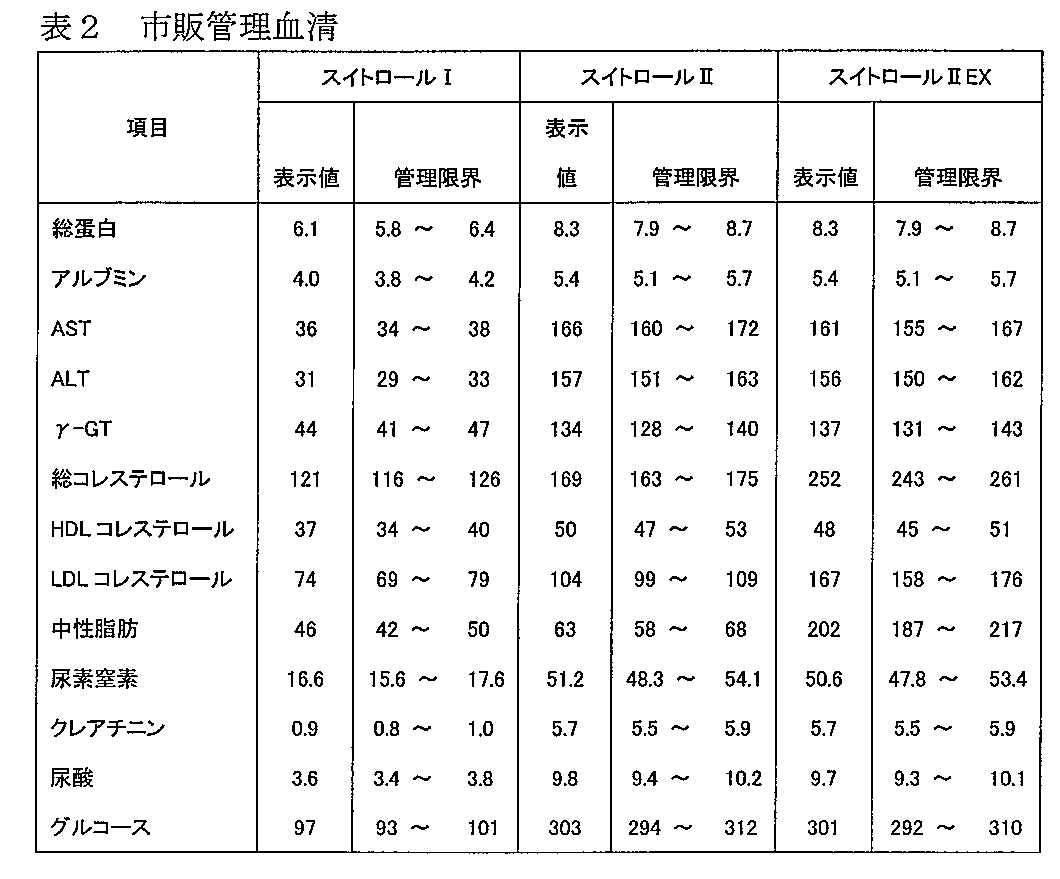
- Tables 1 and 2 show the compositions of “Secondary calibration substances (common reference standard substances)” (Japan Society for Laboratory Medicine (ReCCS)) and “Control Serum; Suitrol I, II, IIEX” (Nissui Pharmaceutical). It was shown to.
- the “extended uncertainty” in Table 1 corresponds to the allowable error range of the measured value.
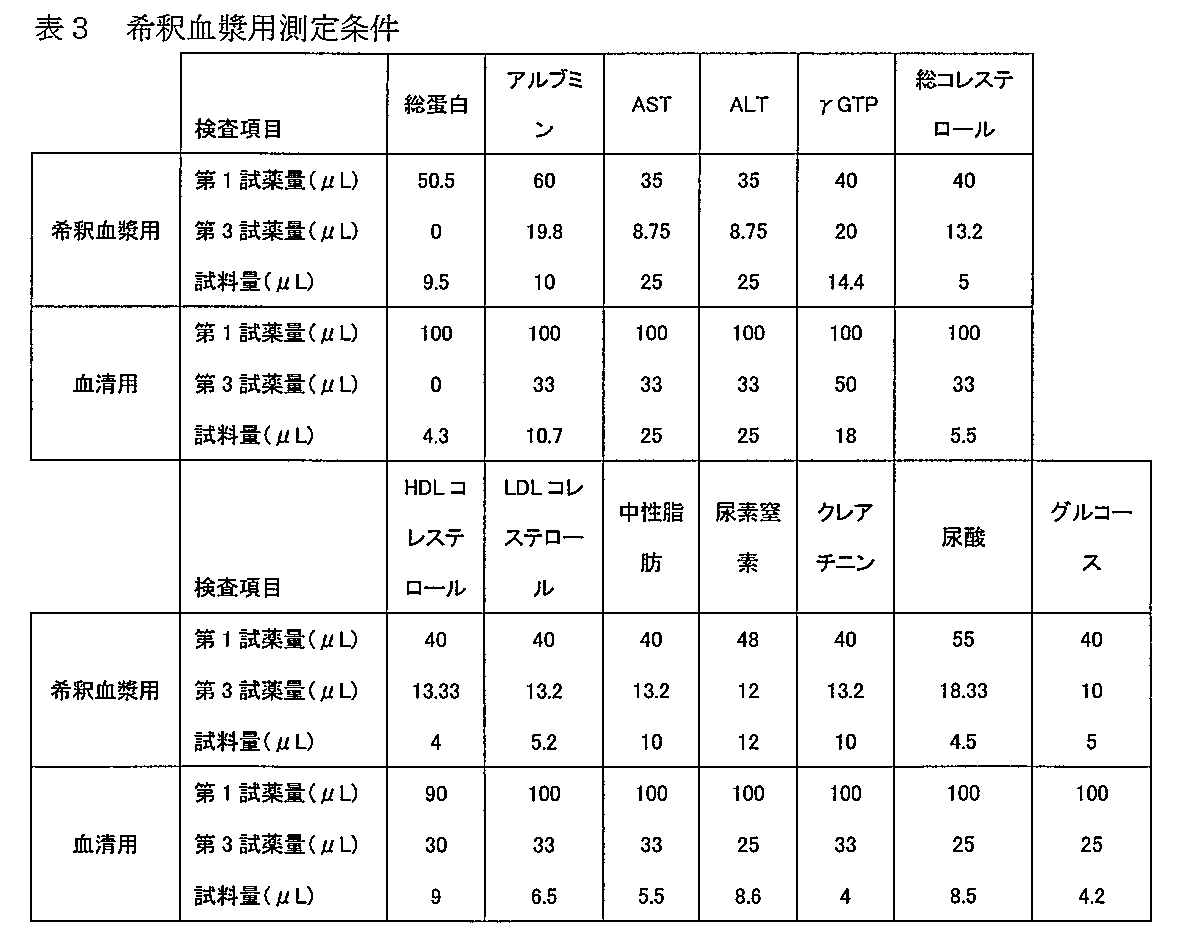
- JCA-BM6010 manufactured by JEOL Ltd. was used as the measuring device, and a commercially available biochemical test reagent was used as the measuring reagent. Serum was measured under the conditions specified by a commercially available reagent manufacturer. Table 3 shows the measurement conditions.
- JCA-BM6010 manufactured by JEOL Ltd. was used as the biochemical analyzer for the diluted plasma measurement method, and a commercially available biochemical test reagent was used as the measurement reagent.
- Table 3 shows the measurement conditions of the biochemical analyzer in the diluted plasma measurement.
- the control serum was diluted 3-fold with a dilution buffer to prepare a sample.
- the diluted plasma measurement method refers to a measurement method performed under measurement conditions suitable for measurement of diluted plasma.
- plasma was diluted with the following plasma dilution buffer containing antibiotics. pH7.40, 2 mmol / L HEPES, 8.06 mmol / L EDTA-2Na, 2.74 mmol / L D-mannitol, 50 mmol / L K 2 HPO 4 , 0.05 mmol / L PALP (pyridoxal phosphate), 4.857 mmol / L glycerol -3-phosphate, 170.8 mmol / L NaCl
- the osmotic pressure of this dilution buffer was 426 mOsm / Kg.
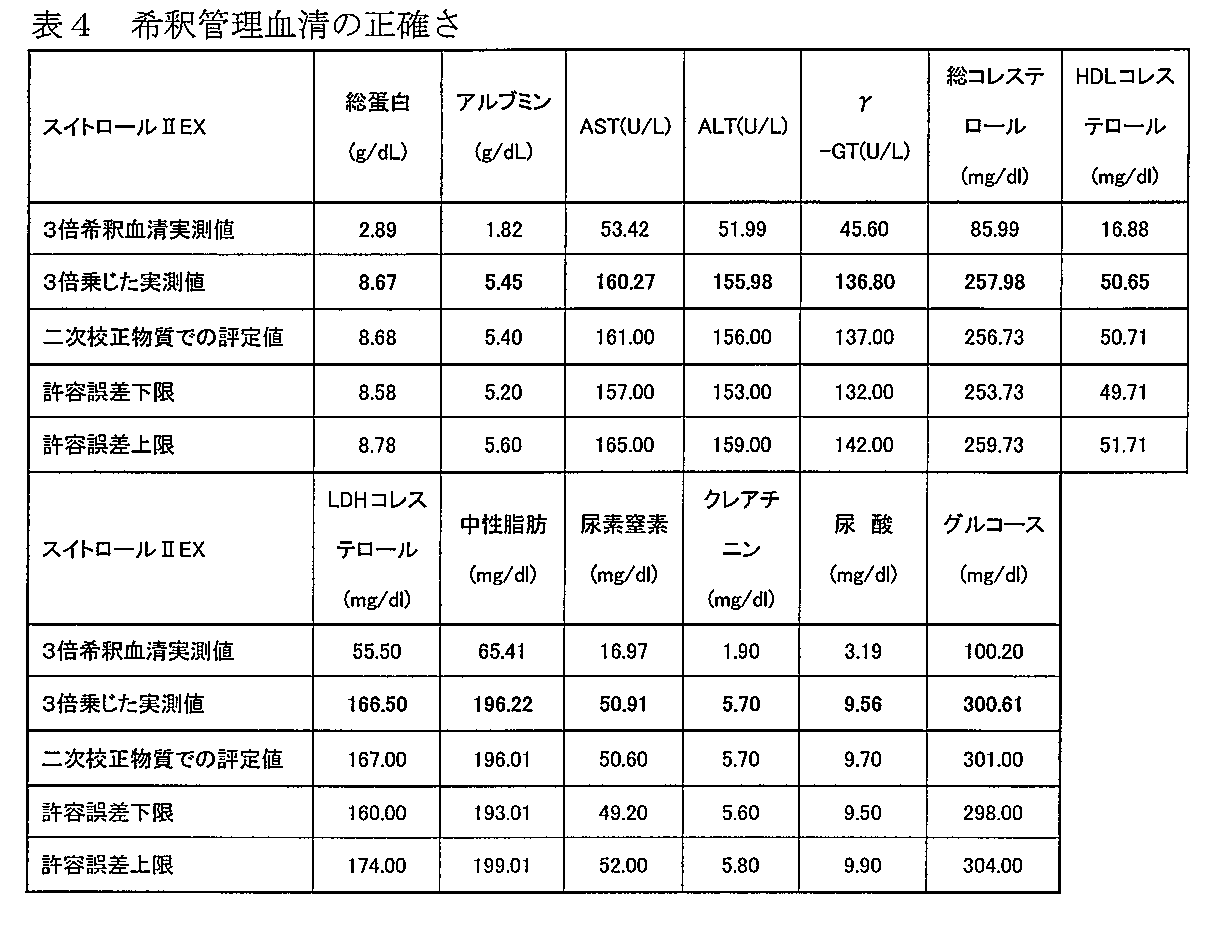
- Table 4 shows the results of confirming the displayed value of the control serum (Suitrol II EX) based on various secondary calibration substances. As shown in Table 4, the control serum (Suitrol II EX) was within the allowable error range and the value obtained by multiplying the evaluation value with the secondary calibration substance and the actual measurement value diluted 3-fold with the dilution buffer. This result shows that it can be used as a “diluted plasma practical calibration substance” which is a calibration substance for measurement using diluted plasma as a sample.
- the “diluted plasma practical calibration material” prepared by diluting the control serum that has been accurately transmitted from the secondary calibration material by a factor of 3 is used as a calibration material for measurement using diluted plasma samples. It was found that the measurement accuracy using serum can be transmitted.
- diluted plasma practical calibration substance is used as a calibration substance for measurement using a diluted plasma sample as a test sample, and a very small amount of blood described in JP-A-2003-161729 is diluted with a buffer containing an internal standard substance.
- the method for quantifying the amount of biochemical / immunochemical components present in unknown amounts in diluted plasma from the dilution factor of the internal standard was calibrated.
- the measured value was determined by multiplying the measured value of the diluted plasma sample by the plasma dilution factor determined from the internal standard.
- a correlation equation between the measured value and the measured value of the raw serum under the measurement conditions calibrated with the secondary calibration substance was derived.
- the measured value of the raw serum was determined by measurement under serum measurement conditions (designated by the manufacturer) calibrated with a secondary calibration substance.
- the measurement items of the obtained correlation formula 13 are shown in Table 5.
- Example 2 Assay of Plasma Dilution Buffer Two types of control serum-1 and the plasma dilution buffer used in Example 1 or a buffer obtained by removing PALP (pyridoxal phosphate) as a coenzyme from the plasma dilution buffer Control serum-2 was diluted 10 times. This diluted sample was stored at room temperature or 37 ° C. AST (aspartate aminotransferase) and ALT (alanine aminotransferase) were measured from immediately after dilution until 6 days after storage, and the stability of the measured values was confirmed over time.
- PALP pyridoxal phosphate
- FIGS. FIG. 1 shows the results when using a buffer solution not containing PALP
- FIG. 2 shows the results when using a buffer solution containing PALP.
- the measured value was stable at room temperature, but the measured value decreased at 37 ° C. On the other hand, when the buffer solution to which PALP was added was used, the measured value was stable even at 37 ° C.
- measurement accuracy can be transmitted to a measurement method using diluted plasma as a test sample, and an accurate biochemical test and immunochemical test are performed using the measurement method using diluted plasma as a test sample. be able to.
Landscapes
- Health & Medical Sciences (AREA)
- Life Sciences & Earth Sciences (AREA)
- Engineering & Computer Science (AREA)
- Chemical & Material Sciences (AREA)
- Biomedical Technology (AREA)
- Hematology (AREA)
- Physics & Mathematics (AREA)
- Molecular Biology (AREA)
- Food Science & Technology (AREA)
- Medicinal Chemistry (AREA)
- Urology & Nephrology (AREA)
- Analytical Chemistry (AREA)
- Biochemistry (AREA)
- General Health & Medical Sciences (AREA)
- General Physics & Mathematics (AREA)
- Immunology (AREA)
- Pathology (AREA)
- Ecology (AREA)
- Biophysics (AREA)
- Investigating Or Analysing Biological Materials (AREA)
Abstract
本発明の方法は、希釈血漿を検査試料として用いる測定方法による測定値に、正確に値付けされた校正物質を用いた測定値の正確さを伝達する方法であって、(i) 正確に値付けされた校正物質の正確さが伝達された管理血清又はプール血清を3~5倍に希釈し、希釈した血清を校正物質として用いて、希釈血漿を検査試料として用いる測定方法の校正を行い、(ii) 校正した前記測定方法により検査試料を測定することを含む方法であり、希釈していない血清を校正物質として用い、基準測定操作法で測定したときの測定の正確さを、希釈した血清又は血漿を用いた測定に伝達する方法の提供を目的とする。
Description
本発明は、血液等の生体試料中の分析対象成分を測定する生化学・免疫化学検査において、生体試料を特定組成を有する緩衝液で希釈し、希釈した試料を検査試料として用いて血漿試料成分や酵素活性を分析するときの測定値の正確さを伝達する方法に関する。
生化学検査や免疫化学検査において、血液中の成分や酵素活性等の血液中の種々の物質を定量し、得られた定量値により、被験者の健康状態や疾患の有無を判断することができる。このような検査は多数の検査室で種々の測定系を用いて行われており、正確な判断を行うために、それぞれの測定において同一の正確な定量値が得られる必要がある。このため、検査対象物質の正確な値がわかっている値付けされた試料を一次校正物質(calibrator)として、各測定操作方法の校正(calibration)を行い、その測定操作方法で測定を行った場合の正確さを確保することが行われている。一次校正物質は、例えば、測定対象物質を秤量し、特定の基準測定操作法(一次基準測定操作法)で値付けされ、厳密に管理される。しかしながら、検査試薬や装置を製造する製造業者や日常検査業務を行う検査室で、一次校正物質を常に利用することはできない。そこで、正確な値がわかっている値付けがされた一次校正物質を用いて基準となる二次基準測定操作法の校正を行い、該測定操作法により他の校正物質の値付けを行い、値付けられた校正物質を二次校正物質として用いることが行われている。二次校正物質を用いて、さらに他の基準測定操作法(例えば、推奨測定操作方法)の校正を行う。このような工程により、一次校正物質を用いた一次基準測定操作法による測定の正確さを、二次校正物質を用いた二次基準測定操作法による測定に伝達することができる。実際には、さらに同様の工程を繰り返し、検査試薬や装置の製造業者が入手可能な管理血清等の製造業者実用校正物質が調製され、その製造業者が用いている測定操作法の校正が行われ、製造業者が製品を製造する際に用いる製品校正物質の値付けがされ、最終的に製品校正物質を用いて検査室等の最終使用者が日常的に用いる測定操作法の校正が行われ、その測定操作法で一般の被験体の日常検査試料である実検体が測定される。上記の工程の階層段階を経ることにより、最終的には日常的に用いる測定操作法による日常検査試料を用いたときの測定に、一次校正物質を用いて基準となる一次基準測定操作法で測定したときの値の正確さが伝達される。最終的な測定が正確か否かは、上記の階層段階を遡ることによりわかり、これを日常検査測定値のトレーサビリティが確保されているという。このような検査測定値の正確さを伝達するためには、検査試料中の種々の妨害因子の存在により測定の変動を避けるために、各階層において用いる校正物質の性状は同等である必要があるとされている。実際には、校正物質として、希釈していない血清や血漿が用いられる。
一方、希釈していない血清以外の検査試料を用いる検査法も存在する。例えば、いつどこでも、血液の検査を行える方法として、微量の血液を内部標準物質を含む緩衝液で希釈し、血液から希釈血漿を分離し、内部標準物質の希釈倍数から希釈血漿中の生化学・免疫化学成分量を定量する方法として特開2003-161729号公報に記載の方法がある。
上記のように、一般の検査室等で日常的に行われる生化学・免疫化学成分量の定量において、特定の検査項目の値が決められている校正物質を、基準となる基準測定操作法で測定した値の正確さを伝達し、日常的に行われる生化学・免疫化学定量法の測定値の正確さを確保する必要がある。
希釈した血漿を用いた生化学・免疫化学検査は微量の手指採血試料で検査が可能である利点がある。この方法により得られた検査値は健康状態のスクリーニング検査として利用するとき、希釈していない血清や血漿を測定した健診データとの正確さについての互換性を確保することで、希釈血漿値の有用性が高まる。
従来は、血漿を希釈した測定値の正確さの確認は、二次校正物質(常用参照標準物質)で正確さを確認した測定法を用いて、多数例の希釈していない血漿値を測定した値とその血漿を希釈して測定した値の相関プロットから2つの測定値の回帰式(関係式)を求めて、その回帰式(関係式)の傾きと切片から正確さを確認する方法により、希釈していない血清や血漿を測定した健診データとの正確さについての互換性を確保していた。
希釈されていない血清や血漿を測定するための生化学・免疫化学検査の測定条件は各市販測定試薬ごとに最適化された条件が提示されている。この条件下において、あらかじめ測定対象項目の正確な値が値付けされた校正物質を、基準となる基準測定操作法で測定したときの値の正確さが伝達された校正物質がそれぞれの市販試薬に添付され、その測定操作法の正確さが確保されている。この場合、市販測定試薬の実検体である検査試料及び校正物質として、希釈されていない血清又は血漿が用いられ、両者の性状は同等であることが原則となる。
一方、これら正確さが伝達された市販測定試薬を用いて、希釈血漿を検査試料として用いて測定する場合、目的の検査試料は希釈されているので、希釈されていない血清又は血漿を測定するための条件では正確な測定値を得ることはできない。このため検査試料として希釈血漿を用いる場合、血清及び血漿測定とは異なる約10倍希釈血漿に最適な試料量、試薬量で測定する必要がある。従って、市販測定試薬を用いた測定に正確さを伝達するために用いる校正物質と希釈血漿の性状が異なるため、希釈されていない血清又は血漿を測定するための条件では正確な測定値を得ることはできない。すなわち、校正物質と性状が異なる希釈血漿を用い、異なる条件で測定するため、希釈されていない血清や血漿を校正物質として用いて校正した測定の正確さは、希釈血漿を検査試料として用いる測定操作法には伝達されない。これは、例えば、測定値に影響を及ぼす妨害因子の濃度が希釈していない血清と希釈血清では異なること等による。
上記のように、正確さを伝達するとき、起源として用いられる正確に調製された一次校正物質を基準となる一次基準測定操作法で測定し値付けし、値付けされた一次校正物質を用いて二次基準測定操作法の校正(calibration)を行う。次いで、該二次基準測定操作法で二次校正物質を測定し値付けし、値付けされた二次校正物質を用いて特定の測定操作法の校正を行う。このような、値付けと校正を繰り返すことにより、一般の検査室で前記の特定の測定操作法で検査試料を用いて検査を行う際の測定値の正確さが伝達される。通常は、各階層で用いられる校正物質と検査室で用いられる検査試料の性状は同等であり、希釈していない血清が用いられる。
このように、常用される校正物質の値付けされた測定値である評定値は市販試薬を生化学自動分析装置や免疫化学自動分析装置を用いて、希釈していない血清試料を測定する条件で認証しているため、希釈した血清や血漿への正確さの伝達方法を確立する必要がある。
本発明は、希釈していない血清を校正物質として用い、基準測定操作法で測定したときの測定の正確さを、希釈した血清又は血漿を用いた測定に伝達する方法の提供を目的とする。
本発明者らは、本発明者らが開発した、希釈血漿を検査試料として用いる測定操作方法であって、(i) 微量の血液を、血液中に含まれない物質である内部標準物質を含む緩衝液で希釈し、血液から希釈血漿を分離し、内部標準物質の希釈倍数から希釈血漿中の生化学・免疫化学成分量を定量する、内部標準物質を利用する測定操作方法、(ii) 微量の血液を、血液中に含まれる物質である外部標準物質を含まない緩衝液で希釈し、血液から希釈血漿を分離し、外部標準物質の希釈倍数から希釈血漿中の生化学・免疫化学成分量を定量する、外部標準物質を利用する測定操作方法、又は(iii) 微量の血液を、血液中に含まれない物質である内部標準物質を含むが血液中に含まれる物質である外部標準物質を含まない緩衝液で希釈し、血液から希釈血漿を分離し、内部標準物質と外部標準物質の希釈倍数から希釈血漿中の生化学・免疫化学成分を定量する、内部標準物質と外部標準物質を利用する測定操作方法において、値付けされた校正物質を用いて基準となる基準測定操作法で測定したときの測定の正確さを伝達する方法について鋭意検討を行った。
値付けされた校正物質として、管理血清等を入手することができるが、管理血清は希釈されていない血清であるので、管理血清を用いて、希釈血漿を検査試料として用いる測定操作法に正確さを伝達することはできないとされていた。
本発明者らは、正確さが認証された校正物質を用いた測定の正確さが伝達された管理血清を、前記の測定法で用いる希釈緩衝液で3~5倍に希釈し、希釈した管理血清を校正物質として用いて、希釈血漿を検査試料として用いる測定操作法の校正を行うことにより、該測定操作法に、管理血清を用いる測定が確保している正確さが伝達されることを見出し、本発明を完成させるに至った。
すなわち、本発明は以下のとおりである。
[1] 希釈血漿を検査試料として用いる測定方法による測定値に、正確に値付けされた校正物質を用いた測定値の正確さを伝達する方法であって、
(i) 正確に値付けされた校正物質の正確さが伝達された管理血清又はプール血清を3~5倍に希釈し、希釈した血清を校正物質として用いて、希釈血漿を検査試料として用いる測定方法の校正を行い、
(ii) 校正した前記測定方法により検査試料を測定することを含む方法。
[2] 正確に値付けされた校正物質の正確さが伝達された管理血清又はプール血清を3倍に希釈して、校正物質として用いる、[1]の方法。
[3] 希釈血漿を検査試料として用いる測定方法が、(i) 微量の血液を、血液中に含まれない物質である内部標準物質を含む緩衝液で希釈し、血液から希釈血漿を分離し、内部標準物質の希釈倍数から希釈血漿中の生化学・免疫化学成分量を定量する、内部標準物質を利用する測定方法、(ii) 微量の血液を、血液中に含まれる物質である外部標準物質を含まない緩衝液で希釈し、血液から希釈血漿を分離し、外部標準物質の希釈倍数から希釈血漿中の生化学・免疫化学成分量を定量する、外部標準物質を利用する測定方法、又は(iii) 微量の血液を、血液中に含まれない物質である内部標準物質を含むが血液中に含まれる物質である外部標準物質を含まない緩衝液で希釈し、血液から希釈血漿を分離し、内部標準物質と外部標準物質の希釈倍数から希釈血漿中の生化学・免疫化学成分を定量する、内部標準物質と外部標準物質を利用する測定方法である、[1]又は[2]の方法。
[4] 希釈血漿の希釈に用いる希釈緩衝液が、赤血球の溶血を防止するために高張に調製されており、かつ補酵素を含むpH6.5~8.0の緩衝液である、[1]~[3]のいずれかの方法。
[5] 希釈血漿の希釈に用いる希釈緩衝液が、以下の組成を有する、[4]の方法:
pH6.5~pH8.0、1.5~2.5 mmol/L HEPES, 6~10 mmol/L EDTA-2Na, 2~4 mmol/L D-mannitol, 40~60 mmol/L K2HPO4, 0.025~0.075 mmol/L PALP(ピリドキサールリン酸), 4~6 mmol/Lグリセロール-3-リン酸, 100~250 mmol/L NaCl、浸透圧300~450 mOsm/Kg、又は、pH6.5~pH8.0、30~100mmol/L HEPES, 30~100mmol/L 2-アミノ-2-メチル-1-プロパノール 0.2~1.0 mmol/L EDTA-2K, 2~4 mmol/L D-mannitol, 0.025~0.075 mmol/L PALP(ピリドキサールリン酸), 4~6 mmol/Lグリセロール-3-リン酸, 1~3 mmol/Lリチウム,浸透圧300~450 mOsm/Kg。
[6] 希釈血漿を検査試料として用いる測定操作方法であって、(i) 微量の血液を、血液中に含まれない物質である内部標準物質を含む緩衝液で希釈し、血液から希釈血漿を分離し、内部標準物質の希釈倍数から希釈血漿中の生化学・免疫化学成分量を定量する、内部標準物質を利用する測定方法、(ii) 微量の血液を、血液中に含まれる物質である外部標準物質を含まない緩衝液で希釈し、血液から希釈血漿を分離し、外部標準物質の希釈倍数から希釈血漿中の生化学・免疫化学成分量を定量する、外部標準物質を利用する測定方法、又は(iii) 微量の血液を、血液中に含まれない物質である内部標準物質を含むが血液中に含まれる物質である外部標準物質を含まない緩衝液で希釈し、血液から希釈血漿を分離し、内部標準物質と外部標準物質の希釈倍数から希釈血漿中の生化学・免疫化学成分を定量する、内部標準物質と外部標準物質を利用する測定方法に用いる測定装置を用いた測定の校正を行う方法であって、正確に値付けされた校正物質の正確さが伝達された管理血清又はプール血清を3~5倍に希釈し、希釈した血清を校正物質として用いて、前記測定の校正を行う方法。
[7] 正確に値付けされた校正物質の正確さが伝達された管理血清又はプール血清を3倍に希釈して、校正物質として用いる、[6]の方法。
[8] 希釈血漿の希釈に用いる希釈緩衝液が、赤血球の溶血を防止するために高張に調製されており、かつ補酵素を含むpH6.5~8.0の緩衝液である、[6]又は[7]の方法。
[9] 希釈血漿の希釈に用いる希釈緩衝液が、以下の組成を有する、[8]の方法:
pH6.5~pH8.0、1.5~2.5 mmol/L HEPES, 6~10 mmol/L EDTA-2Na, 2~4 mmol/L D-mannitol, 40~60 mmol/L K2HPO4, 0.025~0.075 mmol/L PALP(ピリドキサールリン酸), 4~6 mmol/Lグリセロール-3-リン酸, 100~250 mmol/L NaCl、浸透圧300~450 mOsm/Kg11、又は、pH6.5~pH8.0、30~100mmol/L HEPES, 30~100mmol/L 2-アミノ-2-メチル-1-プロパノール,0.2~1.0 mmol/L EDTA-2K, 2~4 mmol/L D-mannitol, 0.025~0.075 mmol/L PALP(ピリドキサールリン酸), 4~6 mmol/Lグリセロール-3-リン酸, 1~3 mmol/Lリチウム,浸透圧300~450 mOsm/Kg。
[1] 希釈血漿を検査試料として用いる測定方法による測定値に、正確に値付けされた校正物質を用いた測定値の正確さを伝達する方法であって、
(i) 正確に値付けされた校正物質の正確さが伝達された管理血清又はプール血清を3~5倍に希釈し、希釈した血清を校正物質として用いて、希釈血漿を検査試料として用いる測定方法の校正を行い、
(ii) 校正した前記測定方法により検査試料を測定することを含む方法。
[2] 正確に値付けされた校正物質の正確さが伝達された管理血清又はプール血清を3倍に希釈して、校正物質として用いる、[1]の方法。
[3] 希釈血漿を検査試料として用いる測定方法が、(i) 微量の血液を、血液中に含まれない物質である内部標準物質を含む緩衝液で希釈し、血液から希釈血漿を分離し、内部標準物質の希釈倍数から希釈血漿中の生化学・免疫化学成分量を定量する、内部標準物質を利用する測定方法、(ii) 微量の血液を、血液中に含まれる物質である外部標準物質を含まない緩衝液で希釈し、血液から希釈血漿を分離し、外部標準物質の希釈倍数から希釈血漿中の生化学・免疫化学成分量を定量する、外部標準物質を利用する測定方法、又は(iii) 微量の血液を、血液中に含まれない物質である内部標準物質を含むが血液中に含まれる物質である外部標準物質を含まない緩衝液で希釈し、血液から希釈血漿を分離し、内部標準物質と外部標準物質の希釈倍数から希釈血漿中の生化学・免疫化学成分を定量する、内部標準物質と外部標準物質を利用する測定方法である、[1]又は[2]の方法。
[4] 希釈血漿の希釈に用いる希釈緩衝液が、赤血球の溶血を防止するために高張に調製されており、かつ補酵素を含むpH6.5~8.0の緩衝液である、[1]~[3]のいずれかの方法。
[5] 希釈血漿の希釈に用いる希釈緩衝液が、以下の組成を有する、[4]の方法:
pH6.5~pH8.0、1.5~2.5 mmol/L HEPES, 6~10 mmol/L EDTA-2Na, 2~4 mmol/L D-mannitol, 40~60 mmol/L K2HPO4, 0.025~0.075 mmol/L PALP(ピリドキサールリン酸), 4~6 mmol/Lグリセロール-3-リン酸, 100~250 mmol/L NaCl、浸透圧300~450 mOsm/Kg、又は、pH6.5~pH8.0、30~100mmol/L HEPES, 30~100mmol/L 2-アミノ-2-メチル-1-プロパノール 0.2~1.0 mmol/L EDTA-2K, 2~4 mmol/L D-mannitol, 0.025~0.075 mmol/L PALP(ピリドキサールリン酸), 4~6 mmol/Lグリセロール-3-リン酸, 1~3 mmol/Lリチウム,浸透圧300~450 mOsm/Kg。
[6] 希釈血漿を検査試料として用いる測定操作方法であって、(i) 微量の血液を、血液中に含まれない物質である内部標準物質を含む緩衝液で希釈し、血液から希釈血漿を分離し、内部標準物質の希釈倍数から希釈血漿中の生化学・免疫化学成分量を定量する、内部標準物質を利用する測定方法、(ii) 微量の血液を、血液中に含まれる物質である外部標準物質を含まない緩衝液で希釈し、血液から希釈血漿を分離し、外部標準物質の希釈倍数から希釈血漿中の生化学・免疫化学成分量を定量する、外部標準物質を利用する測定方法、又は(iii) 微量の血液を、血液中に含まれない物質である内部標準物質を含むが血液中に含まれる物質である外部標準物質を含まない緩衝液で希釈し、血液から希釈血漿を分離し、内部標準物質と外部標準物質の希釈倍数から希釈血漿中の生化学・免疫化学成分を定量する、内部標準物質と外部標準物質を利用する測定方法に用いる測定装置を用いた測定の校正を行う方法であって、正確に値付けされた校正物質の正確さが伝達された管理血清又はプール血清を3~5倍に希釈し、希釈した血清を校正物質として用いて、前記測定の校正を行う方法。
[7] 正確に値付けされた校正物質の正確さが伝達された管理血清又はプール血清を3倍に希釈して、校正物質として用いる、[6]の方法。
[8] 希釈血漿の希釈に用いる希釈緩衝液が、赤血球の溶血を防止するために高張に調製されており、かつ補酵素を含むpH6.5~8.0の緩衝液である、[6]又は[7]の方法。
[9] 希釈血漿の希釈に用いる希釈緩衝液が、以下の組成を有する、[8]の方法:
pH6.5~pH8.0、1.5~2.5 mmol/L HEPES, 6~10 mmol/L EDTA-2Na, 2~4 mmol/L D-mannitol, 40~60 mmol/L K2HPO4, 0.025~0.075 mmol/L PALP(ピリドキサールリン酸), 4~6 mmol/Lグリセロール-3-リン酸, 100~250 mmol/L NaCl、浸透圧300~450 mOsm/Kg11、又は、pH6.5~pH8.0、30~100mmol/L HEPES, 30~100mmol/L 2-アミノ-2-メチル-1-プロパノール,0.2~1.0 mmol/L EDTA-2K, 2~4 mmol/L D-mannitol, 0.025~0.075 mmol/L PALP(ピリドキサールリン酸), 4~6 mmol/Lグリセロール-3-リン酸, 1~3 mmol/Lリチウム,浸透圧300~450 mOsm/Kg。
本発明の方法により、希釈血漿を検査試料として用いる測定操作方法であって、(i) 微量の血液を、血液中に含まれない物質である内部標準物質を含む緩衝液で希釈し、血液から希釈血漿を分離し、内部標準物質の希釈倍数から希釈血漿中の生化学・免疫化学成分量を定量する、内部標準物質を利用する測定操作方法、(ii) 微量の血液を、血液中に含まれる物質である外部標準物質を含まない緩衝液で希釈し、血液から希釈血漿を分離し、外部標準物質の希釈倍数から希釈血漿中の生化学・免疫化学成分量を定量する、外部標準物質を利用する測定操作方法、又は(iii) 微量の血液を、血液中に含まれない物質である内部標準物質を含むが血液中に含まれる物質である外部標準物質を含まない緩衝液で希釈し、血液から希釈血漿を分離し、内部標準物質と外部標準物質の希釈倍数から希釈血漿中の生化学・免疫化学成分を定量する、内部標準物質と外部標準物質を利用する測定操作方法に、一次校正物質を用いて測定したときの正確さを伝達させることができる。
該測定操作方法により、微量の血液(10~65μL)を用いて生化学検査13項目、腫瘍マーカー、肝炎検査など多くの検査ができる。この検査法は時間と場所を選ばないことから健診を受けられない主婦や自営業の人々の未病を発見できる。また、本発明の方法により、検査データの正確さを保証できるため、精密検査のために医療機関や人間ドックなどの検査データとの互換性も高まり、医療機関での同じ検査を再度実施することが不要になり国民医療費の節減にも貢献する。
本発明は、希釈血漿を検査試料として用いる測定法に、正確さを伝達する方法である。具体的には、希釈血漿を検査試料として用いる測定操作方法であって、(i) 微量の血液を、血液中に含まれない物質である内部標準物質を含む緩衝液で希釈し、血液から希釈血漿を分離し、内部標準物質の希釈倍数から希釈血漿中の生化学・免疫化学成分量を定量する、内部標準物質を利用する測定操作方法、(ii) 微量の血液を、血液中に含まれる物質である外部標準物質を含まない緩衝液で希釈し、血液から希釈血漿を分離し、外部標準物質の希釈倍数から希釈血漿中の生化学・免疫化学成分量を定量する、外部標準物質を利用する測定操作方法、又は(iii) 微量の血液を、血液中に含まれない物質である内部標準物質を含むが血液中に含まれる物質である外部標準物質を含まない緩衝液で希釈し、血液から希釈血漿を分離し、内部標準物質と外部標準物質の希釈倍数から希釈血漿中の生化学・免疫化学成分を定量する、内部標準物質と外部標準物質を利用する測定操作方法を用いて、希釈血漿中の検査対象項目を測定するときに、あらかじめ検査対象項目の値がわかっている値付けされた校正物質を、基準となる基準測定操作法で測定したときに得られる測定値の正確さを伝達する方法である。
希釈血漿を検査試料として用いる測定操作方法として、特開2003-161729号公報に記載の方法を例示することができる。この方法においては、微量の血液を希釈し、該希釈血液から血球を除去し、希釈血漿を分離して、希釈血漿を検査試料として用いる。この方法においては、血液分離器具を用いることが望ましい。該血液分離器具は、採取した血液を収容する血液採取手段と、前記血液中の血球と血漿とを分離する濾過手段と、分離された血球を収容する血球採取手段と、分離された血漿を収容する血漿採取手段と、前記血液採取手段内に収容された血液を加圧する加圧手段とを備えており、前記濾過手段は、一端側が前記血液採取手段の血液排出部に連通すると共に他端側が前記血球採取手段の血球導入部に連通された細管を有し、該細管の壁面には、血漿の通過を許容し、かつ血球の通過を阻止する大きさの多数の貫通孔が形成されており、前記加圧手段による加圧動作により、前記血液採取手段内の血液が前記濾過手段内に導入され、かつ該濾過手段の前記貫通孔を介して前記血液中の血漿が前記血漿採取手段内に分離収容されるように構成されたことを特徴とする。
該方法においては、血液から血球を除き血漿を調製し、その際に血漿希釈用緩衝液を用いるので、調製された血漿は前記の緩衝液で希釈されている。該方法においては、内部標準物質、外部標準物質、又は内部標準物質と外部標準物質を利用する方法を用いて血漿の希釈倍率を算出し、血液試料中の検査項目である生化学・免疫化学成分量を定量する。
ここで、内部標準物質とは、生体試料中に全く含まれないか、又は、含まれていたとしても極微量である物質であり、内部標準物質は、生体試料の希釈に用いる緩衝液に所定の濃度になるように添加して用いる。緩衝液に添加した状態で長期間保存しても安定な物質が好ましい。内部標準物質として用い得る物質として、分子量500以下の化学物質で分子内に硫酸イオン(-SO3-)、カルボキシルイオン(-COO-)、チオール基(-SH)、第4級アミン(-NH3+)などの置換基を持つ化合物で、マルトースなどの2単糖類、グルタミン酸、ロイシン、バリン、イソロイシン、4-ハイドロキシンベンゼン、ハイドロキシ酪酸、クレアチン、リンゴ酸、金属類(リチウム、ナトリウム、カリウム、クロール)、硫酸基を分子内に持つトリンダー試薬である(N-エチル-N-(2-ヒドロキシ-3-スルホプロピル)-3-メトキシアニリン)、ADPS(N-エチル-N-スルホプロピル-3-メトキシアニリン)、ALPS(N-エチル-N-スルホプロピルアニリン)、DAOS(N-エチル-N-(2-ヒドロキシ-3-スルホプロピル)-3,5-ジメトキシアニリン)、HDAOS(N-(2-ヒドロキシ-3-スルホプロピル)-3,5-ジメトキシアニリン)、MAOS(N-エチル-N-(2-ヒドロキシ-3-スルホプロピル)-3,5-ジメチルアニリン)、TOOS(N-エチル-N-(2-ヒドロキシ-3-スルホプロピル)-3-メトキシアニリン)、TOPS(N-エチル-N-スルホプロピル-3-メチルアニリン)等が挙げられる。これらの中でもアルカリ金属又はアルカリ土類金属に属する元素であって、天然において生体試料中に含まれないものが好ましい。アルカリ金属に属する元素として、Li(リチウム)、Rb(ルビジウム)、Cs(セシウム)、Fr(フランシウム)が挙げられ、アルカリ土類金属に属する元素として、Sr(ストロンチウム)、Ba(バリウム)、Ra(ラジウム)が挙げられ、この中でもLi(リチウム)が好ましい。また、グリセロール-3-リン酸を用いることもできる。内部標準物質の生体試料の希釈に用いる緩衝液への添加濃度は、希釈後に内部標準物質の濃度が測定できる濃度であれば、限定されない。例えば、0.1~1000mM/L、好ましくは0.1~100mM/L、さらに好ましくは0.5~10mM/Lの濃度で添加すればよい。例えば、リチウムを内部標準物質として用いる場合、生体試料の希釈に用いる緩衝液にリチウムを上記濃度で添加すればよい。
希釈緩衝液に内部標準物質が規定量溶解している場合、本来緩衝液中に存在するこの内部標準物質は、緩衝液及び血漿又は、血清中に分布することになり、希釈される。つまり、緩衝液中の内部標準物質の初期濃度(C0)は、血液が添加されることによって濃度(C1)へ変化する。このC0及びC1によって、血漿の希釈率(r1)=C0/(C0-C1)が算出される。緩衝液量をVO、血漿を緩衝液に添加した総量V1とする。ここで、本来血漿又は、血清に存在する血球膜を透過しない成分の希釈率は、血漿又は、血清の希釈率と等しいので、
r1=(V0+V1)/V1=C0/(C0-C1)
によって算出される。
r1=(V0+V1)/V1=C0/(C0-C1)
によって算出される。
外部標準物質は、生体試料中に含まれており、恒常性が高い物質、すなわち、生体試料中濃度の生理的変動が少ない物質であり、さらにヒト個体間で生体試料中濃度の差が少ない物質が好ましい。このような物質として、ナトリウム(Na+)、クロール(Cl-)、タンパク質が挙げられる。タンパク質としては、例えば血液中に含まれ恒常性が高いアルブミンや血清中総タンパク質等が挙げられる。この中でも、特に恒常性が高く、また、個体間の変動が少ないナトリウムが好ましい。ヒト血漿中のナトリウム濃度の正常値、すなわち健常人の血漿中のナトリウム濃度は、約138~145mmol/L(mEq/L)であり、正常中央値は約142mmol/Lである。緩衝液を用いて希釈した後の外部標準物質の濃度と健常人の血漿中ナトリウム濃度の平均値から、検体として用いる生体試料の希釈倍数を求めることができる。
外部標準物質を利用する場合、血漿の希釈倍数は、外部標準物質を用いて算出式(I)を用いた以下の算出方法により求めることができる。
算出方法1
A
X = --------- (I)
B
A:血漿中外部標準物質濃度の正常中央値の吸光度、
B:希釈血漿中の外部標準物質の吸光度、
X:血漿希釈倍数
A
X = --------- (I)
B
A:血漿中外部標準物質濃度の正常中央値の吸光度、
B:希釈血漿中の外部標準物質の吸光度、
X:血漿希釈倍数
外部標準物質としてナトリウムを用いる場合、ナトリウムの吸光度を求めればよい。血漿中ナトリウム濃度の正常中央値の吸光度としては、ナトリウム142 mmol/Lの吸光度を用いればよい。
さらに、上記の内部標準物質と外部標準物質を併用して希釈倍数を求めることもできる。
血漿の希釈倍数は、内部標準物質及び外部標準物質を用いて以下の3種類の算出方法により求めることができる。
以下に説明する方法においては、血液を内部標準物質が添加された希釈用緩衝液で希釈し、フィルターを用いてろ過し得られた血漿試料を用いる。、内部標準物質としてリチウムを用い、外部標準物質としてナトリウムを用いる。
算出方法1
A:内部標準物質を添加した緩衝液中の内部標準物質の吸光度
B:希釈血漿中の内部標準物質の吸光度
C:血漿中外部標準物質濃度の正常中央値の吸光度
D:希釈血漿中の外部標準物質の吸光度
X:血漿希釈倍数
A:内部標準物質を添加した緩衝液中の内部標準物質の吸光度
B:希釈血漿中の内部標準物質の吸光度
C:血漿中外部標準物質濃度の正常中央値の吸光度
D:希釈血漿中の外部標準物質の吸光度
X:血漿希釈倍数
ここで、希釈血漿とは、血液試料を希釈用緩衝液で希釈し、血球を除去して得られた血漿をいう。内部標準物質としてリチウムを用い、外部標準物質としてナトリウムを用いる場合、リチウムの濃度は、例えば、キレート比色法等でリチウム濃度を測定した場合に得られる吸光度で表すことができる。また、ナトリウムの濃度は、酵素的測定法等で測定した場合の吸光度で表すことができる。血漿中ナトリウム濃度の正常中央値は健常者の中央値であり、血漿中ナトリウム濃度の正常中央値の吸光度としては、ナトリウム142 mmol/Lの吸光度を用いればよい。該値は、既知の値である。以下の算出方法2及び3においても同様である。
緩衝液による血漿の希釈倍数Xは下の算出式(1)又は算出式(2)で求めることができる。
A + C
X = -------- (1)
B + D
X = -------- (1)
B + D
√(A2 + C2)
X = ---------------- (2)
√(B2 + D2)
X = ---------------- (2)
√(B2 + D2)
希釈血漿中の分析対象成分である生化学成分の測定濃度や酵素活性を定量し、該定量値に算出式(1)で求めた希釈倍数を乗じて、元の血漿中の分析対象成分を定量することができる。
算出方法2
B:希釈血漿中の内部標準物質の吸光度
D:希釈血漿中の外部標準物質の吸光度
X:血漿希釈倍数
血漿の希釈倍数は下の算出式(3)で求めることができる。
X= a × (B+D) ± b (3)
(a及びbは係数)
B:希釈血漿中の内部標準物質の吸光度
D:希釈血漿中の外部標準物質の吸光度
X:血漿希釈倍数
血漿の希釈倍数は下の算出式(3)で求めることができる。
X= a × (B+D) ± b (3)
(a及びbは係数)
算出方法2においては、あらかじめB+Dと希釈倍数のデータを取得し、X = a × (B+D) ± bで表される回帰直線を作成しておく。
希釈血漿中の分析対象成分である生化学成分の測定濃度や酵素活性を定量し、該定量値に算出式(3)で求めた希釈倍数を乗じて、元の血漿中の分析対象成分を定量することができる。
算出方法3
A:内部標準物質を添加した緩衝液中の内部標準物質の吸光度
B:希釈血漿中の内部標準物質の吸光度
C:血漿中外部標準物質濃度の正常中央値の吸光度、
D:希釈血漿中の外部標準物質の吸光度
B':外部標準物質の吸光度から算出した希釈倍数による、希釈血漿中の内部標準物質の吸光度の補正値
X:血漿希釈倍数
A:内部標準物質を添加した緩衝液中の内部標準物質の吸光度
B:希釈血漿中の内部標準物質の吸光度
C:血漿中外部標準物質濃度の正常中央値の吸光度、
D:希釈血漿中の外部標準物質の吸光度
B':外部標準物質の吸光度から算出した希釈倍数による、希釈血漿中の内部標準物質の吸光度の補正値
X:血漿希釈倍数
内部標準物質(例えば、リチウム)と外部標準物質(例えば、ナトリウム)の希釈倍数Xは同じと仮定すると、下記の式が得られる。
X = A/B = C/D
X = A/B = C/D
外部標準物質(例えば、ナトリウム)の希釈倍数により内部標準物質(例えば、リチウム)の吸光度変化量補正値B'を下の式で求める。
(B')=(A×D)/C
(B')=(A×D)/C
内部標準物質(例えば、リチウム)の吸光度変化量補正値B'でAを除することで外部標準物質(例えば、ナトリウム)補正による内部標準物質(例えば、リチウム)希釈倍数を求める。
X=A/B' (4)
X=A/B' (4)
希釈血漿中の分析対象成分である生化学成分の測定濃度や酵素活性を定量し、該定量値に算出式(4)で求めた希釈倍数を乗じて、元の血漿中の分析対象成分を定量することができる。
内部標準物質を利用する方法を内部標準法、外部標準物質を利用する方法を外部標準法、内部標準物質と外部標準物質の両方を併用する方法をハイブリッド法と呼ぶ。
血漿の希釈倍率はあらかじめ決めておく必要はないが、この方法により、血漿は約10倍に希釈される。
この方法においては、血漿を希釈するための希釈用緩衝液として、血液から血球を除き血漿を調製するため、赤血球の溶血を防止するために高張に調製された緩衝液を用いる。用いる希釈用緩衝液の浸透圧は、血液の浸透圧が285mOsm/kgであるのに対して、300~450 mOsm/Kg、好ましくは320~450 mOsm/Kg、さらに好ましくは320~430 mOsm/Kg、さらに好ましくは350~430 mOsm/Kg、さらに好ましくは355 mOsm/Kg若しくは426 mOsm/Kgである。緩衝液のpHは、生体試料のpHに近い、pH6.5~pH8.0、好ましくはpH7.0~pH7.5、さらに好ましくはpH7.4である。
緩衝液中には、分析対象成分を安定に保つことを目的にキレート剤、界面活性剤、抗菌剤、防腐剤、補酵素、糖類、阻害剤等が含有されてもよい。キレート剤としては、エチレンジアミン四酢酸塩(EDTA)、クエン酸塩、シュウ酸塩等が挙げられる。界面活性剤としては、例えば、陽イオン界面活性剤、陰イオン界面活性剤、両性界面活性剤又は非イオン界面活性剤が挙げられる。防腐剤としては、例えば、アジ化ナトリウムや抗生物質等が挙げられる。補酵素としては、ピリドキサールリン酸(PALP)、マグネシウム、亜鉛等が挙げられる。糖類としては、マンニトール、デキストロース、オリゴ糖等が挙げられる。特に、マンニトールとピリドキサールリン酸(PALP)の添加により血球膜や酵素を安定することができ、3~4種類の抗生物質や抗菌剤の添加により、手指採血時に手指表面から一部混入する細菌の増殖を抑えることができ、生体成分の細菌による分解の安定化を図ることができる。
緩衝液としては、好ましくはグッド緩衝液が用いられ、HEPES (2- [4- (2-Hydoxyethyl)-1-piperazinyl] ethanesulfonic acid)(pKa=7.55)、TES (N-Tris(hydroxymethyl)methyl-2- aminoethanesulfonic acid)(pKa=7.50)、MOPS(3-Morpholinopropanesulfonic acid)(pKa=7.20)又はBES(N,N-Bis(2-hydroxyethyl)-2-aminoethanesulfonic acid)(pKa=7.15)等が挙げられる。その中でもHEPES(2-[4-(2-ヒドロキシエチル)-1-ピペラジニル]エタンスルホン酸)が好ましい。
そのような緩衝液であって、内部標準物質を利用する緩衝液の組成として以下の組成が例示できる。以下の緩衝液では、グリセロール-3-リン酸を内部標準物質として用いている。
pH6.5~pH8.0、1.5~2.5 mmol/L HEPES, 6~10 mmol/L EDTA-2Na, 2~4 mmol/L D-mannitol, 40~60 mmol/L K2HPO4, 0.025~0.075 mmol/L PALP(ピリドキサールリン酸), 4~6 mmol/Lグリセロール-3-リン酸, 100~250 mmol/L NaCl、浸透圧300~450 mOsm/Kg。
具体的には以下の組成が例示できる。
pH7.40, 2 mmol/L HEPES, 0.8 mmol/L EDTA-2Na, 2.74 mmol/L D-mannitol, 50 mmol/L K2HPO4, 0.05 mmol/L PALP(ピリドキサールリン酸), 4.857 mmol/Lグリセロール-3-リン酸, 170.8 mmol/L NaCl、浸透圧426 mOsm/Kg。
外部標準物質として、生体試料中に含まれる物質を用いるため、生体試料を希釈する緩衝液としては、外部標準物質が含まれていないか、あるいは含まれていたとしても生体試料を希釈した後の混合物中の外部標準物質の測定に影響を及ぼさない程度の極微量の濃度で含まれる緩衝液を用いる必要がある。また、外部標準物質の測定を妨げる物質が含まれていないか、あるいは含まれていたとしても生体試料を希釈した後の希釈溶液中の外部標準物質の測定に影響を及ぼさない程度の極微量の濃度で含まれる緩衝液を用いる必要がある。これらの物質が含まれていないか、あるいは含まれていたとしても生体試料を希釈した後の混合物中の外部標準物質の測定に影響を及ぼさない程度の極微量の濃度で含まれる緩衝液を、前記物質を実質的に含まない緩衝液という。例えば、本発明の方法で用いる希釈用緩衝液中のナトリウム濃度は、100 nmol/L以下である。
例えば、外部標準物質として、ナトリウム又はクロールを用いる場合、生体試料の希釈用緩衝液にナトリウム又はクロールが含まれていないか、含まれていたとしても極微量である必要がある。さらに、ナトリウムはアルカリ金属類に属する元素又はアルカリ土類金属類に属する元素の定量に影響を及ぼすため、生体試料の希釈用緩衝液にナトリウムは含まれていないか、含まれていたとしても極微量である必要がある。また、生体試料中の目的分析対象物を測定するため、目的分析対象物の分解や変性を防ぐために、生体試料の希釈用緩衝液は、生体試料のpHに近い、pH6.5~pH8.0、好ましくはpH7.0~pH7.5、さらに好ましくはpH7.4の緩衝液である必要がある。さらに、本発明においては、緩衝液で希釈された血液中の生体成分を測定するため、緩衝液成分がこれら測定しようとする生体成分の変性や安定性に影響を及ぼしてはならない。従来は、pH7.4前後で緩衝能を有し、ナトリウムやクロールを含まない緩衝液は存在しなかったため、ナトリウムやクロールを外部標準物質として用いることは不可能であった。本発明においては、pH7.4前後で緩衝能を有し、ナトリウムやクロールを含まない緩衝液を新たに開発し、ナトリウムやクロールを外部標準物質として用いることを可能にした。
このようなナトリウム、クロール、アルカリ金属類の元素及びアルカリ土類金属類の元素を含まないアルカリ性物質として、2-アミノ-2-メチル-1-プロパノール(AMP)、2-エチルアミノエタノール、N-メチル-D-グルカミン、ジエタノールアミン、トリエタノールアミン等のアミノアルコール化合物類と酸性を示す化合物としてGood’s緩衝剤(グッドバッファー)があり、pKaがpH7.4付近の緩衝剤である、HEPES (2- [4- (2-Hydoxyethyl)-1-piperazinyl] ethanesulfonic acid)(pKa=7.55)、TES (N-Tris(hydroxymethyl)methyl-2- aminoethanesulfonic acid)(pKa=7.50)、MOPS(3-Morpholinopropanesulfonic acid)(pKa=7.20)又はBES(N,N-Bis(2-hydroxyethyl)-2-aminoethanesulfonic acid)(pKa=7.15)を組合せて混合した緩衝液が挙げられる。この中でも、2-アミノ-2-メチル-1-プロパノール(AMP)とHEPES、TES、MOPS又はBESの組合せが好ましく、さらに、2-アミノ-2-メチル-1-プロパノール(AMP)とHEPESの組合せが好ましい。
上記緩衝液を作製するためには、アミノアルコールとGood's緩衝剤を1:2~2:1、好ましくは1:1.5~1.5:1、さらに好ましくは1:1の濃度比で混合すればよい。緩衝液の濃度は限定されないが、アミノアルコール又はGood's緩衝剤の濃度は、0.1~1000 mM/L、好ましくは1~500 mM/L、さらに好ましくは10~100 mM/Lである。
内部標準物質と外部標準物質を利用する緩衝液の組成として以下の組成が例示できる。以下の緩衝液では、グリセロール-3-リン酸及びリチウム(Li)を内部標準物質として利用している。また、外部標準物質としては、血液中に含まれるナトリウム又はクロールを利用することができる。以下の緩衝液は、ナトリウム及びクロールを含まない。
pH6.5~pH8.0、30~100mmol/L HEPES, 30~100mmol/L 2-アミノ-2-メチル-1-プロパノール,0.2~1.0 mmol/L EDTA-2K, 2~4 mmol/L D-mannitol, 0.025~0.075 mmol/L PALP(ピリドキサールリン酸), 4~6 mmol/Lグリセロール-3-リン酸, 1~3 mmol/Lリチウム,浸透圧300~450 mOsm/Kg。
具体的には以下の組成が例示できる。
pH7.40、50mmol/L HEPES, 50mmol/L 2-アミノ-2-メチル-1-プロパノール,0.8 mmol/L EDTA-2K, 284 mmol/L D-mannitol, 0.05 mmol/L PALP(ピリドキサールリン酸), 4 mmol/Lグリセロール-3-リン酸, 1 mmol/Lリチウム,浸透圧355 mOsm/Kg。
本発明の正確さを伝達する方法は、好適には、上記の血漿希釈用緩衝液を用いる測定法による測定への正確さを伝達する方法へ適用される。
従来は、血漿を希釈した検査試料の測定値の正確さの確認は、二次校正物質(常用参照標準物質ということもある)で正確さを確認した測定操作法を用いて、多数例の希釈していない血漿値を測定した値とその血漿を希釈して測定した値の相関プロットから2つの測定値の回帰式(関係式)を求めて、その回帰式(関係式)の傾きと切片から正確さを確認する方法により行っていた。
この方法は、正確さが伝達された測定操作法により値付けされた校正物質を、希釈血漿を検査試料として用いる方法と同様に希釈して用いるという点で、校正物質と検査試料の性状や測定方法の同等性は確保されているので、理論上は正確さが伝達される方法である。しかしながら、この方法では、正確さの伝達に多くの工程を必要とするため、正確さが十分に伝達されないおそれがあった。
本発明の方法においては、最初に、希釈していない血清ベースの校正物質を用いる測定操作法であって、正確に調製された一次校正物質を基準となる一次基準測定操作法で測定したときの測定の正確さが伝達された測定操作方法から、該血清ベースの校正物質を3~5倍に希釈した校正物質を用いる測定操作法に正確さを伝達する。次いで、該希釈血清を校正物質として、日常的に行われる、微量の血液を内部標準物質入り緩衝液で希釈し、血液から希釈血漿を分離し、内部標準物質、外部標準物質、又は内部標準物質と外部標準物質の希釈倍数から希釈血漿中の検査対象項目である生化学・免疫化学成分量を定量する測定操作方法を校正する。この校正した方法で、検査試料である希釈血漿を測定する。この結果、正確に値付けされた一次校正物質を、基準となる一次基準測定操作法で測定したときの測定の正確さが、血液から希釈血漿を分離し、内部標準物質、外部標準物質、又は内部標準物質と外部標準物質の希釈倍数から希釈血漿中の生化学・免疫化学成分量を定量する測定操作方法による測定に伝達される。
正確に値付けされた一次校正物質を、一次基準測定操作法で測定したときの測定の正確さが伝達された血清ベースの校正物質として、特定の検査項目の測定値の正確さが伝達され、該検査項目の含有量が表示された血清を用いることができる。該血清を用いた測定には、二次校正物質を介在して、一次校正物質を一次基準測定操作法で測定したときの測定の正確さが伝達される。すなわち、一次校正物質を用いて二次基準測定操作法を校正し、二次次基準測定操作法で二次校正物質の値付けを行い、さらに二次校正物質で推奨血清測定操作法を校正し、推奨血清測定操作法で血清を値付けした血清を用いることができる。推奨血清測定操作法としては、例えば、市販試薬と市販の生化学自動分析装置を用いた測定法が挙げられる。この場合、二次校正物質を用いる測定に伝達された正確さが推奨血清測定操作法を介して、上記の血清を用いる測定に伝達されたということができる。二次校正物質を常用参照標準物質と呼ぶこともある。
ここで、上記の血清を用いた測定に、正確さが伝達されていることを確認することが望ましい。上記の血清を用いて校正された推奨血清測定操作法により、二次校正物質を用いて多重測定(例えば、5重測定)を行い、その平均値が二次校正物質のあらかじめ定められた評定濃度許容誤差内に入っているか確認する。評定濃度許容誤差は校正物質の認証書に標記されている。評定濃度許容誤差内に入っている場合、上記の血清を用いた測定に正確さが伝達されていると判断できる。一方、評定濃度許容誤差内に入っていない場合、上記の血清を補正し、同様の工程を繰り返して、正確さが伝達されていることを確認すればよい。
測定値の正確さが伝達された血清として、各種の検査項目の値があらかじめ値付けされている市販の管理血清(コントロール血清)を用いることができる。市販の管理血清は、凍結乾燥品、凍結品、液状品があるが、いずれも用いることができる。また、生化学検査用管理血清及び免疫血清検査用管理血清があり、用途に応じて必要な管理血清を用いればよい。
市販の管理血清として、L-スイトロールI, II, III, IIEX、L-トライロールEX、L-コンセーラIEX, IIEX(日水製薬、生化学検査用)、イムノーコンセーラI, II(日水製薬、免疫血清検査用)、イムノピアリ1, 2、QC-RE'栄研'(栄研化学)、QAPトロール(シスメックス社)等が挙げられる。
また、市販の管理血清の代りに、例えば、市販の管理血清に測定値の正確さを伝達するために用いられる元となる二次校正物質を用いて校正した基準となる測定操作方法で各種項目を値付けすることにより、二次校正物質を用いた測定の正確さが伝達されたヒトプール血清を用いてもよい。このように、プール血清や市販の管理血清を用いた測定操作法には、二次校正物質を基準測定法で測定したときの測定の正確さが伝達されている。現実的には、二次校正物質は高価であるので、値付けされた市販の管理血清を用いた場合、二次校正物質を入手して校正や値付けを行うコストを削減することができる。
上記の正確さが伝達された管理血清又はプール血清を用いて、推奨希釈血漿測定操作法を校正する。推奨希釈血漿測定操作法は、上記の希釈血漿を検査試料として用いる測定操作方法であって、(i) 微量の血液を、血液中に含まれない物質である内部標準物質を含む緩衝液で希釈し、血液から希釈血漿を分離し、内部標準物質の希釈倍数から希釈血漿中の生化学・免疫化学成分量を定量する、内部標準物質を利用する測定操作方法、(ii) 微量の血液を、血液中に含まれる物質である外部標準物質を含まない緩衝液で希釈し、血液から希釈血漿を分離し、外部標準物質の希釈倍数から希釈血漿中の生化学・免疫化学成分量を定量する、外部標準物質を利用する測定操作方法、又は(iii) 微量の血液を、血液中に含まれない物質である内部標準物質を含むが血液中に含まれる物質である外部標準物質を含まない緩衝液で希釈し、血液から希釈血漿を分離し、内部標準物質と外部標準物質の希釈倍数から希釈血漿中の生化学・免疫化学成分を定量する、内部標準物質と外部標準物質を利用する測定操作方法である。次いで、上記の管理血清又はプール血清を3~5倍、好ましくは3倍に希釈した希釈血清を推奨希釈血漿測定操作法により、値付けする。このようにして値付けした希釈血清を希釈血清実用校正物質と呼ぶ。
管理血清は、構築された校正の階層段階により既に正確さが伝達されている。従って、管理血清から正確さを伝達することにより、3~5倍希釈血清にも、構築された階層による正確さの伝達が可能になる。
この際、3~5倍に希釈された管理血清又はプール血清を用いた方法に正確さが伝達されたことを確認することが望ましい。管理血清と3~5倍希釈した管理血清又はプール血清を、管理血清又はプール血清を校正物質として用いて校正された推奨血清測定操作法で多重測定する。管理血清又はプール血清の測定値と3~5倍に希釈した管理血清又はプール血清の測定値が同等であること、すなわち評定濃度許容誤差内に入っていることを確認し、同等である場合、3~5倍に希釈した管理血清又はプール血清を用いる測定に正確さが伝達されていると判断することができる。
正確さが伝達された3~5倍に希釈された管理血清又はプール血清を用いた測定により、検査試料である希釈血漿を用いて希釈血漿日常測定操作法により測定を行えばよい。ここで、希釈血漿日常測定操作法は、上記の希釈血漿を検査試料として用いる測定操作方法であって、(i) 微量の血液を、血液中に含まれない物質である内部標準物質を含む緩衝液で希釈し、血液から希釈血漿を分離し、内部標準物質の希釈倍数から希釈血漿中の生化学・免疫化学成分量を定量する、内部標準物質を利用する測定操作方法、(ii) 微量の血液を、血液中に含まれる物質である外部標準物質を含まない緩衝液で希釈し、血液から希釈血漿を分離し、外部標準物質の希釈倍数から希釈血漿中の生化学・免疫化学成分量を定量する、外部標準物質を利用する測定操作方法、又は(iii) 微量の血液を、血液中に含まれない物質である内部標準物質を含むが血液中に含まれる物質である外部標準物質を含まない緩衝液で希釈し、血液から希釈血漿を分離し、内部標準物質と外部標準物質の希釈倍数から希釈血漿中の生化学・免疫化学成分を定量する、内部標準物質と外部標準物質を利用する測定操作方法である。
3~5倍希釈した管理血清又はプール血清は、希釈していない管理血清又はプール血清とは性状が異なり、また、測定条件も異なるため、従来の常識に従えば、管理血清又はプール血清を用いて測定したときの正確さは、3~5倍希釈した管理血清又はプール血清には伝達されないはずである。しかしながら、驚くべきことに、3~5倍に希釈した希釈血清を校正物質として用いることにより、確実に正確さが伝達される。3倍より希釈倍率が小さいと校正物質の濃度が高すぎ、測定時の吸光度が測定上限を超えてしまい、正確さが伝達されず、一方、5倍より希釈倍率が大きい場合も、性状の相違が多くなり正確さは伝達されない。
血清中には、生化学検査や免疫化学検査を妨害する物質が含まれている。例えば、血清を校正物質として用いて校正した測定操作法を用いて、血清を測定した場合、妨害物質の含有量に関して、両者は異ならないので、正確さが伝達され得る。一方、血清を希釈すると妨害物質の濃度が薄くなるので、希釈していない血清と希釈した血清では測定値が異なる可能性があった。しかし、本発明の方法において、3~5倍の希釈では大きく変動しないことが明らかになった。
上記の希釈血清実用校正物質を用いて、(i) 微量の血液を、血液中に含まれない物質である内部標準物質を含む緩衝液で希釈し、血液から希釈血漿を分離し、内部標準物質の希釈倍数から希釈血漿中の生化学・免疫化学成分量を定量する、内部標準物質を利用する測定操作方法、(ii) 微量の血液を、血液中に含まれる物質である外部標準物質を含まない緩衝液で希釈し、血液から希釈血漿を分離し、外部標準物質の希釈倍数から希釈血漿中の生化学・免疫化学成分量を定量する、外部標準物質を利用する測定操作方法、又は(iii) 微量の血液を、血液中に含まれない物質である内部標準物質を含むが血液中に含まれる物質である外部標準物質を含まない緩衝液で希釈し、血液から希釈血漿を分離し、内部標準物質と外部標準物質の希釈倍数から希釈血漿中の生化学・免疫化学成分を定量する、内部標準物質と外部標準物質を利用する測定操作方法の校正を行う。
この結果、(i) 微量の血液を、血液中に含まれない物質である内部標準物質を含む緩衝液で希釈し、血液から希釈血漿を分離し、内部標準物質の希釈倍数から希釈血漿中の生化学・免疫化学成分量を定量する、内部標準物質を利用する測定操作方法、(ii) 微量の血液を、血液中に含まれる物質である外部標準物質を含まない緩衝液で希釈し、血液から希釈血漿を分離し、外部標準物質の希釈倍数から希釈血漿中の生化学・免疫化学成分量を定量する、外部標準物質を利用する測定操作方法、又は(iii) 微量の血液を、血液中に含まれない物質である内部標準物質を含むが血液中に含まれる物質である外部標準物質を含まない緩衝液で希釈し、血液から希釈血漿を分離し、内部標準物質と外部標準物質の希釈倍数から希釈血漿中の生化学・免疫化学成分を定量する、内部標準物質と外部標準物質を利用する測定操作方法により、希釈血漿を検査試料として用いた生化学検査及び免疫化学検査の測定に正確さが伝達され、通常の日常の検査における、前記方法によって、正確に生化学・免疫化学成分量を定量することが可能になる。
一次基準測定操作法で値付けされた一次校正物質は、国際度量衡委員会(CIPM)により定義されたSI単位を基準とするため、正確さが伝達された微量の血液を内部標準物質入り緩衝液で希釈し、血液から希釈血漿を分離し、内部標準物質、外部標準物質、又は内部標準物質と外部標準物質の希釈倍数から希釈血漿中の生化学・免疫化学成分量を定量する方法による測定は、計量学的トレーサビリティによってSI単位にまで遡ることができる。
本発明の方法により、希釈血漿を検査試料として用いる測定操作方法であって、(i) 微量の血液を、血液中に含まれない物質である内部標準物質を含む緩衝液で希釈し、血液から希釈血漿を分離し、内部標準物質の希釈倍数から希釈血漿中の生化学・免疫化学成分量を定量する、内部標準物質を利用する測定操作方法、(ii) 微量の血液を、血液中に含まれる物質である外部標準物質を含まない緩衝液で希釈し、血液から希釈血漿を分離し、外部標準物質の希釈倍数から希釈血漿中の生化学・免疫化学成分量を定量する、外部標準物質を利用する測定操作方法、又は(iii) 微量の血液を、血液中に含まれない物質である内部標準物質を含むが血液中に含まれる物質である外部標準物質を含まない緩衝液で希釈し、血液から希釈血漿を分離し、内部標準物質と外部標準物質の希釈倍数から希釈血漿中の生化学・免疫化学成分を定量する、内部標準物質と外部標準物質を利用する測定操作方法に用いる測定装置の校正、及び該測定装置を用いた測定の校正を行うことができる。
実施例1 希釈血漿を検査試料として用いる測定法への正確さの伝達
二次校正物質(常用参照標準物質)を用いた測定の正確さを希釈血漿試料を用いた測定に伝達するために用いた「二次校正物質(常用参照標準物質)」(一般社団法人 検査医学標準物質機構(ReCCS))と「管理血清;スイトロールI、II、IIEX」(日水製薬)の組成を表1と表2に示した。表1中の「拡張不確かさ」は、測定値の許容誤差範囲に相当する。
二次校正物質(常用参照標準物質)を用いた測定の正確さを希釈血漿試料を用いた測定に伝達するために用いた「二次校正物質(常用参照標準物質)」(一般社団法人 検査医学標準物質機構(ReCCS))と「管理血清;スイトロールI、II、IIEX」(日水製薬)の組成を表1と表2に示した。表1中の「拡張不確かさ」は、測定値の許容誤差範囲に相当する。
測定装置は日本電子製JCA-BM6010を用い、測定用試薬は市販の生化学検査用試薬を用いた。血清の測定条件は市販試薬メーカーの指定条件で測定した。測定条件を表3に示す。
希釈血漿測定法での生化学分析装置は日本電子製JCA-BM6010を用い、測定用試薬は市販の生化学検査用試薬を用いた。希釈血漿測定における生化学分析装置の測定条件を表3に示す。
希釈血漿測定法においては、管理血清を希釈緩衝液で3倍に希釈して試料とした。なお、希釈血漿測定法は、希釈血漿の測定に適した測定条件で行う測定法をいう。希釈血漿測定法において、抗生物質を含む以下の血漿希釈緩衝液を用いて血漿を希釈した。
pH7.40, 2 mmol/L HEPES, 8.06 mmol/L EDTA-2Na, 2.74 mmol/L D-mannitol, 50 mmol/L K2HPO4, 0.05 mmol/L PALP(ピリドキサールリン酸), 4.857 mmol/Lグリセロール-3-リン酸, 170.8 mmol/L NaCl
pH7.40, 2 mmol/L HEPES, 8.06 mmol/L EDTA-2Na, 2.74 mmol/L D-mannitol, 50 mmol/L K2HPO4, 0.05 mmol/L PALP(ピリドキサールリン酸), 4.857 mmol/Lグリセロール-3-リン酸, 170.8 mmol/L NaCl
この希釈緩衝液の浸透圧は、426 mOsm/Kgであった。

各種二次校正物質を基準として管理血清(スイトロールII EX)の表示値を確認した結果を表4に示した。表4に示すように管理血清(スイトロールII EX)は二次校正物質での評定値と希釈緩衝液で3倍希釈した実測値に3倍乗じた値と許容誤差範囲内に収まっていた。この結果は、希釈した血漿を試料として用いる測定のための校正物質である「希釈血漿実用校正物質」として利用可能であることを示している。
この結果より、二次校正物質から正確さが伝達された管理血清を3倍に希釈して作製した「希釈血漿実用校正物質」を希釈血漿試料を用いる測定の校正物質として利用することで、管理血清を用いた測定の正確さの伝達が可能であることがわかった。
次いで、「希釈血漿実用校正物質」を、希釈血漿試料を検査試料として用いる測定の校正物質として利用し、特開2003-161729号公報に記載の微量の血液を内部標準物質入り緩衝液で希釈し、内部標準物質の希釈倍数から希釈血漿中の未知量の存在する生化学・免疫化学成分量を定量する方法の校正を行った。該方法により、希釈血漿試料測定値に内部標準から求めた血漿希釈倍数を乗じて測定値を求めた。この測定値と二次校正物質で校正した測定条件での原血清の測定値の相関関係式を導いた。原血清の測定値は、二次校正物質で校正した血清測定条件(メーカー指定)での測定により求めた。得られた相関関係式13の測定項目について表5に示した。
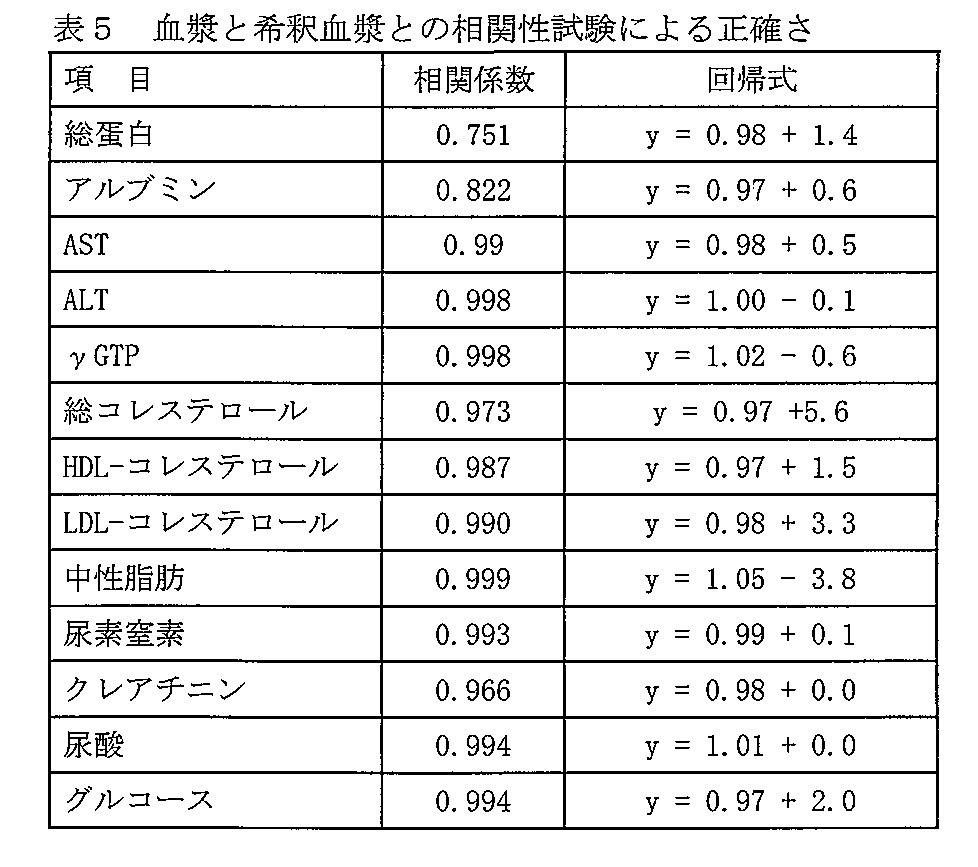
原血清の測定値と希釈血漿を用いる特開2003-161729号公報に記載の方法による測定値との相関関係式から各検査項目の比例系統誤差は±5%以下であり、その多くは±3%以内であり、原血清の測定値と特開2003-161729号公報に記載の方法による測定値の間に高い相関が得られた。
この結果は、本発明の方法により、二次校正物質を用いた正確な測定の正確さが、希釈血漿を検査試料として用いる特開2003-161729号公報に記載の方法による測定に伝達されたことを示す。
実施例2 血漿希釈緩衝液の検定
実施例1で用いた血漿希釈緩衝液又は該血漿希釈緩衝液から補酵素であるPALP(ピリドキサールリン酸)を除いた緩衝液で2種類の管理血清-1及び管理血清-2を10倍にそれぞれ希釈した。この希釈試料を室温又は37℃で保存した。希釈直後から保存後6日間までAST(アスパラギン酸アミノトランスフェラーゼ)及びALT(アラニンアミノトランスフェラーゼ)を測定し、測定値の安定性を経時的に確認した。
実施例1で用いた血漿希釈緩衝液又は該血漿希釈緩衝液から補酵素であるPALP(ピリドキサールリン酸)を除いた緩衝液で2種類の管理血清-1及び管理血清-2を10倍にそれぞれ希釈した。この希釈試料を室温又は37℃で保存した。希釈直後から保存後6日間までAST(アスパラギン酸アミノトランスフェラーゼ)及びALT(アラニンアミノトランスフェラーゼ)を測定し、測定値の安定性を経時的に確認した。
結果を図1及び2に示す。図1はPALPを含まない緩衝液を用いたときの結果を示し、図2はPALPを含む緩衝液を用いたときの結果を示す。
PALP無添加の緩衝液を用いた場合、室温では測定値は安定であったが、37℃では測定値が低下した。一方、PALPを添加した緩衝液を用いた場合、測定値は37℃でも安定であった。
この結果は、PALP無添加の緩衝液を用いて希釈した管理血清を用いて、希釈血漿を用いる測定操作法を校正しても、正確さの伝達ができないことを示している。すなわち、本実施例では、3~5倍の希釈管理血清を校正物質として用いた「推奨希釈血漿測定操作法」で測定している。PALPを含む緩衝液と含まない緩衝液を用いて測定したところ、PALPを含まない緩衝液を用いた場合は、正確に測定できなかった。この結果は、PALPを含まない緩衝液を用いた測定には、正確さが伝達されていないことを示している。校正に用いた校正物質と実際の検査試料(日常希釈血漿試料)の性状が同等であるべきであることを考慮すると、「希釈血漿日常測定操作法」を校正するときに用いる校正物質としては、PALPを含む干渉液で3~5倍希釈した管理血清を用いるべきである。
本発明の方法により、希釈血漿を検査試料として用いる測定法に、測定の正確さを伝達することができ、希釈血漿を検査試料として用いる測定法で正確な生化学検査及び免疫化学的検査を行うことができる。
Claims (9)
- 希釈血漿を検査試料として用いる測定方法による測定値に、正確に値付けされた校正物質を用いた測定値の正確さを伝達する方法であって、
(i) 正確に値付けされた校正物質の正確さが伝達された管理血清又はプール血清を3~5倍に希釈し、希釈した血清を校正物質として用いて、希釈血漿を検査試料として用いる測定方法の校正を行い、
(ii) 校正した前記測定方法により検査試料を測定することを含む方法。 - 正確に値付けされた校正物質の正確さが伝達された管理血清又はプール血清を3倍に希釈して、校正物質として用いる、請求項1記載の方法。
- 希釈血漿を検査試料として用いる測定方法が、(i) 微量の血液を、血液中に含まれない物質である内部標準物質を含む緩衝液で希釈し、血液から希釈血漿を分離し、内部標準物質の希釈倍数から希釈血漿中の生化学・免疫化学成分量を定量する、内部標準物質を利用する測定方法、(ii) 微量の血液を、血液中に含まれる物質である外部標準物質を含まない緩衝液で希釈し、血液から希釈血漿を分離し、外部標準物質の希釈倍数から希釈血漿中の生化学・免疫化学成分量を定量する、外部標準物質を利用する測定方法、又は(iii) 微量の血液を、血液中に含まれない物質である内部標準物質を含むが血液中に含まれる物質である外部標準物質を含まない緩衝液で希釈し、血液から希釈血漿を分離し、内部標準物質と外部標準物質の希釈倍数から希釈血漿中の生化学・免疫化学成分を定量する、内部標準物質と外部標準物質を利用する測定方法である、請求項1又は2に記載の方法。
- 希釈血漿の希釈に用いる希釈緩衝液が、赤血球の溶血を防止するために高張に調製されており、かつ補酵素を含むpH6.5~8.0の緩衝液である、請求項1~3のいずれか1項に記載の方法。
- 希釈血漿の希釈に用いる希釈緩衝液が、以下の組成を有する、請求項4記載の方法:
pH6.5~pH8.0、1.5~2.5 mmol/L HEPES, 6~10 mmol/L EDTA-2Na, 2~4 mmol/L D-mannitol, 40~60 mmol/L K2HPO4, 0.025~0.075 mmol/L PALP(ピリドキサールリン酸), 4~6 mmol/Lグリセロール-3-リン酸, 100~250 mmol/L NaCl、浸透圧300~450 mOsm/Kg、又は、pH6.5~pH8.0、30~100mmol/L HEPES, 30~100mmol/L 2-アミノ-2-メチル-1-プロパノール,0.2~1.0 mmol/L EDTA-2K, 2~4 mmol/L D-mannitol, 0.025~0.075 mmol/L PALP(ピリドキサールリン酸), 4~6 mmol/Lグリセロール-3-リン酸, 1~3 mmol/Lリチウム,浸透圧300~450 mOsm/Kg。 - 希釈血漿を検査試料として用いる測定操作方法であって、(i) 微量の血液を、血液中に含まれない物質である内部標準物質を含む緩衝液で希釈し、血液から希釈血漿を分離し、内部標準物質の希釈倍数から希釈血漿中の生化学・免疫化学成分量を定量する、内部標準物質を利用する測定方法、(ii) 微量の血液を、血液中に含まれる物質である外部標準物質を含まない緩衝液で希釈し、血液から希釈血漿を分離し、外部標準物質の希釈倍数から希釈血漿中の生化学・免疫化学成分量を定量する、外部標準物質を利用する測定方法、又は(iii) 微量の血液を、血液中に含まれない物質である内部標準物質を含むが血液中に含まれる物質である外部標準物質を含まない緩衝液で希釈し、血液から希釈血漿を分離し、内部標準物質と外部標準物質の希釈倍数から希釈血漿中の生化学・免疫化学成分を定量する、内部標準物質と外部標準物質を利用する測定方法に用いる測定装置を用いた測定の校正を行う方法であって、正確に値付けされた校正物質の正確さが伝達された管理血清又はプール血清を3~5倍に希釈し、希釈した血清を校正物質として用いて、前記測定の校正を行う方法。
- 正確に値付けされた校正物質の正確さが伝達された管理血清又はプール血清を3倍に希釈して、校正物質として用いる、請求項6記載の方法。
- 希釈血漿の希釈に用いる希釈緩衝液が、赤血球の溶血を防止するために高張に調製されており、かつ補酵素を含むpH6.5~8.0の緩衝液である、請求項6又は7に記載の方法。
- 希釈血漿の希釈に用いる希釈緩衝液が、以下の組成を有する、請求項8記載の方法:
pH6.5~pH8.0、1.5~2.5 mmol/L HEPES, 6~10 mmol/L EDTA-2Na, 2~4 mmol/L D-mannitol, 40~60 mmol/L K2HPO4, 0.025~0.075 mmol/L PALP(ピリドキサールリン酸), 4~6 mmol/Lグリセロール-3-リン酸, 100~250 mmol/L NaCl、浸透圧300~450 mOsm/Kg、又は、pH6.5~pH8.0、30~100mmol/L HEPES, 30~100mmol/L 2-アミノ-2-メチル-1-プロパノール,0.2~1.0 mmol/L EDTA-2K, 2~4 mmol/L D-mannitol, 0.025~0.075 mmol/L PALP(ピリドキサールリン酸), 4~6 mmol/Lグリセロール-3-リン酸, 1~3 mmol/Lリチウム,浸透圧300~450 mOsm/Kg。
Priority Applications (2)
| Application Number | Priority Date | Filing Date | Title |
|---|---|---|---|
| PCT/JP2015/069377 WO2017006409A1 (ja) | 2015-07-06 | 2015-07-06 | 希釈血漿を検査試料として用いる測定法への正確さの伝達方法 |
| JP2017526814A JPWO2017006409A1 (ja) | 2015-07-06 | 2015-07-06 | 希釈血漿を検査試料として用いる測定法への正確さの伝達方法 |
Applications Claiming Priority (1)
| Application Number | Priority Date | Filing Date | Title |
|---|---|---|---|
| PCT/JP2015/069377 WO2017006409A1 (ja) | 2015-07-06 | 2015-07-06 | 希釈血漿を検査試料として用いる測定法への正確さの伝達方法 |
Publications (1)
| Publication Number | Publication Date |
|---|---|
| WO2017006409A1 true WO2017006409A1 (ja) | 2017-01-12 |
Family
ID=57686195
Family Applications (1)
| Application Number | Title | Priority Date | Filing Date |
|---|---|---|---|
| PCT/JP2015/069377 Ceased WO2017006409A1 (ja) | 2015-07-06 | 2015-07-06 | 希釈血漿を検査試料として用いる測定法への正確さの伝達方法 |
Country Status (2)
| Country | Link |
|---|---|
| JP (1) | JPWO2017006409A1 (ja) |
| WO (1) | WO2017006409A1 (ja) |
Cited By (1)
| Publication number | Priority date | Publication date | Assignee | Title |
|---|---|---|---|---|
| JP2021515242A (ja) * | 2018-01-22 | 2021-06-17 | ウニベルシタ パルドゥビツェ | 体液のリピドミクス解析に基づいて癌を診断する方法 |
Citations (2)
| Publication number | Priority date | Publication date | Assignee | Title |
|---|---|---|---|---|
| JP2003161729A (ja) * | 2000-01-05 | 2003-06-06 | Leisure Inc | 生体試料調製方法、生体試料定量方法及び生体試料保存容器 |
| JP2011112451A (ja) * | 2009-11-25 | 2011-06-09 | Physical Screening Inc | 生体試料成分の分析方法 |
-
2015
- 2015-07-06 WO PCT/JP2015/069377 patent/WO2017006409A1/ja not_active Ceased
- 2015-07-06 JP JP2017526814A patent/JPWO2017006409A1/ja active Pending
Patent Citations (2)
| Publication number | Priority date | Publication date | Assignee | Title |
|---|---|---|---|---|
| JP2003161729A (ja) * | 2000-01-05 | 2003-06-06 | Leisure Inc | 生体試料調製方法、生体試料定量方法及び生体試料保存容器 |
| JP2011112451A (ja) * | 2009-11-25 | 2011-06-09 | Physical Screening Inc | 生体試料成分の分析方法 |
Non-Patent Citations (3)
| Title |
|---|
| SHIN'YA SUGIMOTO ET AL.: "Futatsu no Naibu Hyojun Kishakuho o Mochiita Seikagaku Komoku to Hematocrit no Sokutei", JOURNAL OF ANALYTICAL BIO- SCIENCE, vol. 35, no. 1, 10 February 2012 (2012-02-10), pages 85 * |
| SUSUMU OSAWA ET AL.: "Naibu Seido Kanriyo Shihan Kanri Kessei ni Okeru Seikakusa no Dentatsu Noryoku no Kento", JAPANESE JOURNAL OF CLINICAL LABORATORY AUTOMATION, vol. 29, no. 4, 1 September 2004 (2004-09-01), pages 539 * |
| YOSHIHISA ITO: "Men'eki Kagaku Sokuteikei deno Sokutei System", JOURNAL OF CLINICAL AND EXPERIMENTAL MEDICINE, vol. 184, no. 8, 21 February 1998 (1998-02-21), pages 669 - 672 * |
Cited By (2)
| Publication number | Priority date | Publication date | Assignee | Title |
|---|---|---|---|---|
| JP2021515242A (ja) * | 2018-01-22 | 2021-06-17 | ウニベルシタ パルドゥビツェ | 体液のリピドミクス解析に基づいて癌を診断する方法 |
| JP7086417B2 (ja) | 2018-01-22 | 2022-06-20 | ウニベルシタ パルドゥビツェ | 体液のリピドミクス解析に基づいて癌を診断する方法 |
Also Published As
| Publication number | Publication date |
|---|---|
| JPWO2017006409A1 (ja) | 2017-12-28 |
Similar Documents
| Publication | Publication Date | Title |
|---|---|---|
| US20240027480A1 (en) | Method of analyzing diluted biological sample component | |
| US8883439B2 (en) | Blood component measurement method utilizing hemolyzed whole blood, and kit for the method | |
| CN104198473B (zh) | 一种稳定的尿酸检测试剂盒 | |
| CN106198961A (zh) | 一种定量检测血清淀粉样蛋白a的乳胶增强免疫比浊试剂盒及其制备方法 | |
| CN104673879A (zh) | 一种小而密低密度脂蛋白胆固醇检测试剂盒及其制备 | |
| JP7484998B2 (ja) | 測定感度を改善した生体成分測定キット及び生体成分測定方法 | |
| EP2927683B1 (en) | Method for judging the concentration of lithium in biomaterial samples | |
| CN113092746B (zh) | 生化校准物质 | |
| CN104673880A (zh) | 一种小而密低密度脂蛋白胆固醇检测试方法 | |
| WO2017006409A1 (ja) | 希釈血漿を検査試料として用いる測定法への正確さの伝達方法 | |
| CN105838775A (zh) | 一种测定亮氨酰氨基肽酶的试剂盒及其制备方法 | |
| CN107015007A (zh) | 一种血红蛋白浓度测定用溶血剂 | |
| CN114214389B (zh) | 脂蛋白胆固醇检测方法和试剂盒 | |
| Shinya et al. | Development of an assay of seven biochemical items, HbA1c, and hematocrit using a small amount of blood collected from the fingertip | |
| EP3081934B1 (en) | Lithium reagent composition, and method and device for quantifying lithium ions using same | |
| CN108169222A (zh) | 一种检测尿液肌酐的试剂及其应用 | |
| JPWO2006054519A1 (ja) | リポ蛋白中成分の分別定量用標準品 | |
| CN104865386A (zh) | 一种人体血清中中性粒细胞明胶酶相关性脂质运载蛋白含量定量测定方法、试剂及试剂盒 | |
| Wentz et al. | Improved method for measurement of inorganic phosphate in serum with a centrifugal analyzer. | |
| JP2007240163A (ja) | 試料中のタンパク質の測定方法及び測定試薬 | |
| Capiau et al. | Daan Touw Christophe Stove Jan-Willem Alffenaar | |
| JP2001258594A (ja) | 赤血球の破壊割合測定用キット及び赤血球の破壊による影響を考慮した測定対象物質の測定法 | |
| JP2014043407A (ja) | 擬似便組成物 |
Legal Events
| Date | Code | Title | Description |
|---|---|---|---|
| 121 | Ep: the epo has been informed by wipo that ep was designated in this application |
Ref document number: 15897672 Country of ref document: EP Kind code of ref document: A1 |
|
| ENP | Entry into the national phase |
Ref document number: 2017526814 Country of ref document: JP Kind code of ref document: A |
|
| NENP | Non-entry into the national phase |
Ref country code: DE |
|
| 122 | Ep: pct application non-entry in european phase |
Ref document number: 15897672 Country of ref document: EP Kind code of ref document: A1 |