WO2017006531A1 - Composition d'assemblage et procédé d'assemblage - Google Patents
Composition d'assemblage et procédé d'assemblage Download PDFInfo
- Publication number
- WO2017006531A1 WO2017006531A1 PCT/JP2016/003031 JP2016003031W WO2017006531A1 WO 2017006531 A1 WO2017006531 A1 WO 2017006531A1 JP 2016003031 W JP2016003031 W JP 2016003031W WO 2017006531 A1 WO2017006531 A1 WO 2017006531A1
- Authority
- WO
- WIPO (PCT)
- Prior art keywords
- inorganic
- particles
- bonding
- temperature
- coarse particles
- Prior art date
- Legal status (The legal status is an assumption and is not a legal conclusion. Google has not performed a legal analysis and makes no representation as to the accuracy of the status listed.)
- Ceased
Links
Images
Classifications
-
- B—PERFORMING OPERATIONS; TRANSPORTING
- B22—CASTING; POWDER METALLURGY
- B22F—WORKING METALLIC POWDER; MANUFACTURE OF ARTICLES FROM METALLIC POWDER; MAKING METALLIC POWDER; APPARATUS OR DEVICES SPECIALLY ADAPTED FOR METALLIC POWDER
- B22F1/00—Metallic powder; Treatment of metallic powder, e.g. to facilitate working or to improve properties
-
- B—PERFORMING OPERATIONS; TRANSPORTING
- B22—CASTING; POWDER METALLURGY
- B22F—WORKING METALLIC POWDER; MANUFACTURE OF ARTICLES FROM METALLIC POWDER; MAKING METALLIC POWDER; APPARATUS OR DEVICES SPECIALLY ADAPTED FOR METALLIC POWDER
- B22F7/00—Manufacture of composite layers, workpieces, or articles, comprising metallic powder, by sintering the powder, with or without compacting wherein at least one part is obtained by sintering or compression
- B22F7/06—Manufacture of composite layers, workpieces, or articles, comprising metallic powder, by sintering the powder, with or without compacting wherein at least one part is obtained by sintering or compression of composite workpieces or articles from parts, e.g. to form tipped tools
- B22F7/08—Manufacture of composite layers, workpieces, or articles, comprising metallic powder, by sintering the powder, with or without compacting wherein at least one part is obtained by sintering or compression of composite workpieces or articles from parts, e.g. to form tipped tools with one or more parts not made from powder
-
- B—PERFORMING OPERATIONS; TRANSPORTING
- B23—MACHINE TOOLS; METAL-WORKING NOT OTHERWISE PROVIDED FOR
- B23K—SOLDERING OR UNSOLDERING; WELDING; CLADDING OR PLATING BY SOLDERING OR WELDING; CUTTING BY APPLYING HEAT LOCALLY, e.g. FLAME CUTTING; WORKING BY LASER BEAM
- B23K1/00—Soldering, e.g. brazing, or unsoldering
-
- C—CHEMISTRY; METALLURGY
- C04—CEMENTS; CONCRETE; ARTIFICIAL STONE; CERAMICS; REFRACTORIES
- C04B—LIME, MAGNESIA; SLAG; CEMENTS; COMPOSITIONS THEREOF, e.g. MORTARS, CONCRETE OR LIKE BUILDING MATERIALS; ARTIFICIAL STONE; CERAMICS; REFRACTORIES; TREATMENT OF NATURAL STONE
- C04B37/00—Joining burned ceramic articles with other burned ceramic articles or other articles by heating
-
- H—ELECTRICITY
- H01—ELECTRIC ELEMENTS
- H01B—CABLES; CONDUCTORS; INSULATORS; SELECTION OF MATERIALS FOR THEIR CONDUCTIVE, INSULATING OR DIELECTRIC PROPERTIES
- H01B1/00—Conductors or conductive bodies characterised by the conductive materials; Selection of materials as conductors
-
- H—ELECTRICITY
- H01—ELECTRIC ELEMENTS
- H01B—CABLES; CONDUCTORS; INSULATORS; SELECTION OF MATERIALS FOR THEIR CONDUCTIVE, INSULATING OR DIELECTRIC PROPERTIES
- H01B1/00—Conductors or conductive bodies characterised by the conductive materials; Selection of materials as conductors
- H01B1/20—Conductive material dispersed in non-conductive organic material
- H01B1/22—Conductive material dispersed in non-conductive organic material the conductive material comprising metals or alloys
-
- B—PERFORMING OPERATIONS; TRANSPORTING
- B22—CASTING; POWDER METALLURGY
- B22F—WORKING METALLIC POWDER; MANUFACTURE OF ARTICLES FROM METALLIC POWDER; MAKING METALLIC POWDER; APPARATUS OR DEVICES SPECIALLY ADAPTED FOR METALLIC POWDER
- B22F9/00—Making metallic powder or suspensions thereof
- B22F9/16—Making metallic powder or suspensions thereof using chemical processes
- B22F9/18—Making metallic powder or suspensions thereof using chemical processes with reduction of metal compounds
- B22F9/24—Making metallic powder or suspensions thereof using chemical processes with reduction of metal compounds starting from liquid metal compounds, e.g. solutions
Definitions
- the present invention relates to a bonding composition containing inorganic particles as a main component and an organic component as a minor component and a bonding method using the bonding composition, and more specifically, has a dense bonding layer and high bonding strength.
- the present invention relates to a bonding composition capable of obtaining a bonded body at a relatively low bonding temperature and a bonding method using the same.
- Solder is generally used as a bonding material for bonding various electronic components.
- toxic lead is contained in high-temperature solder used at high operating temperatures, and there is a strong demand for lead-free bonding materials from the viewpoint of environmental protection and RoHS regulations.
- the metal fine particles have low-temperature sintering properties
- the fired layer basically has a melting point equivalent to that of bulk silver, so it is expected as a lead-free bonding material that can be used in a high-temperature environment. ing.
- a bonding composition using low-temperature sinterability of metal fine particles, particularly silver fine particles, and a bonding method using the bonding composition have been attracting attention, and research and development have been actively promoted.
- Patent Document 1 Japanese Patent Application Laid-Open No. 2011-21255
- a composite nanometal paste characterized in that composite metal nanoparticles, metal nanofiller particles and metal filler particles are densely sintered when an organic coating layer is diffused by firing to form a metal layer. Yes.
- a dense fired film can be obtained by filling the voids formed by metal particles having a large particle size with metal particles having a small particle size.
- Patent Document 2 Japanese Patent Application Laid-Open No. 2011-71301
- a step of placing at least one spacer on the member a step of applying the paste on the first member so as to cover the spacer; and a step of obtaining a laminate by placing the second member on the paste
- the organic medium evaporates and the metal nanoparticles sinter while the laminate is heated at a temperature at which the dispersion medium evaporates but the organic substances do not evaporate, and the spacer is pressurized with a pressure that is plastically deformed.
- a joining method using metal nanoparticles characterized by comprising a step of further heating at a temperature.
- the thickness of the paste mainly composed of metal nanoparticles can be increased as much as necessary, and the metal nanoparticles are deformed in order to plastically deform the spacer. It is said that the paste mainly composed of can be pressed with a large pressing force, and densification can be enhanced.
- metal particles having a large difference in particle size were used by filling the voids formed by the metal particles having a large particle size with metal particles having a small particle size.
- a dense fired film can be obtained as compared with the case, relatively many defects remain in the fired film, and in order to obtain high bonding strength, it is indispensable to apply pressure at the time of bonding.
- an object of the present invention is to provide a bonding composition capable of obtaining a bonded body having a dense bonding layer and high bonding strength at a relatively low bonding temperature and no pressure, and the use thereof. It is to provide a bonding method.
- the present inventors have found that the use of inorganic particles having a large linear expansion coefficient, etc.
- the inventors have found that the present invention is extremely effective in achieving the above-described object, and have reached the present invention.
- the present invention is a bonding composition comprising inorganic particles and an organic component, and the inorganic particles irreversibly exceed the linear expansion coefficient of the inorganic substance constituting the inorganic particles as the temperature rises.
- a bonding composition is provided that expands.
- the inorganic particles include inorganic fine particles (micron particles) and inorganic coarse particles (nanoparticles), and the inorganic coarse particles become more inorganic as the temperature rises. It is preferable to irreversibly expand beyond the linear expansion coefficient of the inorganic substance constituting the particles.
- the particle size and combination of inorganic particles, inorganic fine particles and inorganic coarse particles are not particularly limited as long as the effects of the present invention are not impaired, and inorganic fine particles having low temperature sinterability and inorganic coarse particles having a large linear expansion coefficient are used. What is necessary is just to combine. Two or more kinds of inorganic fine particles and inorganic coarse particles may be combined.
- the inorganic particles or inorganic coarse particles irreversibly expand beyond the linear expansion coefficient of the inorganic substance constituting the inorganic coarse particles, thereby reducing the distance between the inorganic particles that are the main components of the bonding composition.
- densification proceeds very efficiently.
- a dense bonding layer can be obtained by the sintering progressing due to the low-temperature sinterability of the inorganic fine particles.
- a bonded body having high bonding strength can be obtained due to the dense bonding layer.
- the term “irreversible expansion” is a concept that includes not only completely irreversible expansion but also expansion that slightly contracts as the temperature decreases.
- the inorganic fine particles preferably have an average particle diameter of 1 nm to 1 ⁇ m.
- the average particle size of the inorganic fine particles By setting the average particle size of the inorganic fine particles to 1 nm or more, a decrease in the density of the bonding layer due to an increase in the volume ratio of the organic matter can be suppressed, and by setting the average particle size of the inorganic fine particles to 1 ⁇ m or less, The melting point of the fine particles is sufficiently lowered, and firing at a low temperature can be achieved.
- the expansion occurs due to internal foaming of the inorganic coarse particles.
- Inorganic coarse particles that irreversibly expand due to oxidation or density change inside the particles can also be used, but by using the inorganic coarse particles that foam internally, irreversible large heat is more reliably applied to the inorganic coarse particles. Swelling can be developed.
- the inorganic coarse particles have an average particle size of 1 ⁇ m to 50 ⁇ m.
- the average particle size of the inorganic coarse particles it is possible to ensure good dispersibility of the inorganic coarse particles and to sufficiently increase the average particle size difference from the inorganic fine particles. Can be densified. Moreover, it can prevent that a joining layer becomes too thick because the average particle diameter of an inorganic coarse particle shall be 50 micrometers or less.
- the inorganic coarse particles contain an organic substance. Due to the organic matter contained inside the inorganic coarse particles, the inorganic matter decomposes due to the temperature rise during the joining process and gas is generated (internal foaming), causing the irreversible large thermal expansion of the inorganic particles. be able to.
- the inorganic coarse particles are preferably reduced powder.
- the reduced powder can leave organic substances or the like inside depending on the manufacturing process conditions.
- the crystallite diameter is set to several tens of nanometers in order to impart low temperature sinterability, it is necessary to synthesize under unstable process conditions, and the remaining organic matter becomes remarkable. That is, it is assumed that by heating the reduced powder in which organic matter remains inside, it can be irreversibly expanded beyond the linear expansion coefficient of the inorganic substance constituting the reduced powder.
- the constituent elements of the inorganic particles are not particularly limited as long as the effects of the present invention are not impaired.
- gold, silver, copper, nickel, bismuth, tin, iron, and platinum group elements ruthenium, Rhodium, palladium, osmium, iridium and platinum.
- the constituent element is preferably at least one selected from the group consisting of gold, silver, copper, nickel, bismuth, tin, or a platinum group element, and further has a smaller ionization tendency than copper or copper ( It is preferably a noble metal, ie, at least one of gold, platinum, silver and copper, and most preferably silver. These elements may be used singly or in combination of two or more.
- the methods of using these elements in combination include the case of using alloy particles containing a plurality of metals, the metal having a core-shell structure or a multilayer structure. Particles may be used. However, it is preferable that the inorganic particles are silver particles. In addition, by using inorganic particles as silver particles, a good bonded body can be obtained under low-temperature and no-pressure bonding conditions.
- the inorganic coarse particles exceed the linear expansion coefficient of the inorganic substance constituting the inorganic coarse particles and irreversibly expand.
- the bonding temperature using the bonding composition of the present invention is a relatively low temperature of 150 to 250 ° C., and the inorganic coarse particles exhibit a large expansion within the temperature range, whereby a good bonded body can be obtained. it can.
- the bonding temperature in the process it may be 250 ° C. or higher.
- the present invention is a bonding method using the bonding composition of the present invention, Setting the joining temperature to a temperature equal to or higher than the temperature at which the internal foaming occurs, and lower than the temperature at which openings are formed in the inorganic coarse particles by the internal foaming; A bonding method characterized by the above is also provided.
- the bonding temperature By setting the bonding temperature to a temperature that is higher than the temperature at which internal foaming occurs in the inorganic coarse particles contained in the bonding composition and less than the temperature at which openings are formed in the inorganic coarse particles by the internal foaming, a good bonded body can be efficiently produced Can get to. More specifically, by setting the bonding temperature to be equal to or higher than the temperature at which internal foaming occurs in the inorganic coarse particles, the distance between the inorganic particles that are the main components of the bonding composition is reduced, and the bonding layer is highly densified. Can be advanced.
- the above-described internal foaming effect can be fully utilized, and defects (openings) are formed on the surface of the inorganic coarse particles. It is possible to suppress the densification of the bonding layer and the decrease in strength of the bonding layer.
- substantially the conditions may be set in which the gas generated inside the particles by foaming is not released into the bonding layer by penetration.
- the gas generated inside the particles by foaming is not released into the bonding layer by penetration.
- inorganic coarse particles penetrate at 220 ° C, but when mixed with inorganic fine particles, the penetration temperature shifts to the high temperature side due to the effect of inorganic fine particles fused to the surface of the inorganic coarse particles. Therefore, the temperature on the high temperature side may be sufficient.
- the temperature on the high temperature side may be used as long as it does not affect the peeling progress of the bonding layer even if it penetrates.
- the expansion behavior is time dependent and should be taken into account. In the examples described later, the bonding strength decreased after a short time and a long time. However, since the former did not progress to the proper range, the latter was excessively foamed and affected by penetration. This is thought to be due to the accident.
- the bonding method of the present invention it is preferable to perform bonding under no pressure condition.
- the material to be bonded may be damaged by the pressure.
- the rigidity of the material to be joined there are cases where it is difficult to apply a sufficiently uniform pressure.
- the bonding composition of the present invention provides sufficient bonding strength even under no pressure due to the large thermal expansion of the inorganic coarse particles, from the viewpoint of preventing damage to the materials to be bonded, under no pressure conditions. It is preferable to perform bonding.
- the bonding method of the present invention it is preferable to perform bonding in an atmosphere containing oxygen.
- organic matter is present inside the inorganic coarse particles contained in the bonding composition, internal foaming occurs due to an oxidation reaction between the organic matter and oxygen in the atmosphere, exceeding the linear expansion coefficient of the inorganic substance constituting the inorganic coarse particles.
- the inorganic coarse particles can be irreversibly expanded.
- a bonding composition capable of obtaining a bonded body having a dense bonding layer and high bonding strength at a relatively low bonding temperature and no pressure, and a bonding method using the same. it can.
- the bonding composition of the present embodiment includes inorganic particles and an organic component, and the inorganic particles include inorganic fine particles and inorganic coarse particles. These components will be described below.
- the average particle size of the inorganic fine particles in the bonding composition of the present embodiment is not particularly limited as long as it does not impair the effects of the present invention. It preferably has an average particle diameter, and may be, for example, 1 nm to 1 ⁇ m. Further, it is preferably 2 nm to 200 nm. If the average particle size of the inorganic fine particles is 1 nm or more, the inorganic fine particles have good low-temperature sinterability, and the production of the inorganic fine particles is practical and not expensive. Moreover, if it is 200 nm or less, the dispersibility of an inorganic fine particle does not change easily over time, and it is preferable.
- the particle size of the inorganic fine particles in the bonding composition of the present embodiment may not be constant.
- the bonding composition includes a dispersing agent, which will be described later, as an optional component, it may contain a metal particle component having an average particle size of more than 200 nm.
- a metal particle component having an average particle diameter of more than 200 nm may be included as long as the component is not significantly impaired.
- the particle size of the inorganic fine particles in the bonding composition of the present embodiment can be measured by a dynamic light scattering method, a small-angle X-ray scattering method, and a wide-angle X-ray diffraction method.
- the crystallite diameter determined by the wide-angle X-ray diffraction method is appropriate.
- RINT-UltimaIII manufactured by Rigaku Corporation can be used to measure 2 ⁇ in the range of 30 to 80 ° by the diffraction method.
- the sample may be measured by extending it thinly so that the surface becomes flat on a glass plate having a recess of about 0.1 to 1 mm in depth at the center.
- the crystallite diameter (D) calculated by substituting the half width of the obtained diffraction spectrum into the following Scherrer equation using JADE manufactured by Rigaku Corporation may be used as the particle diameter.
- D K ⁇ / Bcos ⁇
- K Scherrer constant (0.9)
- ⁇ wavelength of X-ray
- B half width of diffraction line
- ⁇ Bragg angle.
- constituent elements of the inorganic fine particles in the bonding composition of the present embodiment include gold, silver, copper, nickel, bismuth, tin, iron, and platinum group elements (ruthenium, rhodium, palladium, osmium, iridium, and platinum). At least one of them.
- the constituent element is preferably at least one selected from the group consisting of gold, silver, copper, nickel, bismuth, tin, or a platinum group element, and further has a smaller ionization tendency than copper or copper ( It is preferably a noble metal, ie, at least one of gold, platinum, silver and copper, and most preferably silver.
- These elements may be used singly or in combination of two or more.
- the methods of using these elements in combination include the case of using alloy particles containing a plurality of metals, the metal having a core-shell structure or a multilayer structure. Particles may be used.
- the conductivity of the adhesive layer formed using the bonding composition of the present embodiment is good, but it is made of silver and other metals in consideration of migration problems. By using the bonding composition, migration can be made difficult to occur.
- the “other metal” is preferably a metal in which the ionization column is more noble than hydrogen, that is, gold, copper, platinum, or palladium.
- an organic protective layer is preferably formed on at least a part of the surface of the inorganic fine particles, and at least one of the surfaces of the inorganic fine particles. It is more preferable that a short chain amine is attached to the part, and it is more preferable that an amine having 4 to 7 carbon atoms is attached to at least a part of the surface of the inorganic fine particles.
- a trace amount of organic matter contained as an impurity from the beginning a trace amount of organic matter mixed in the manufacturing process described later, a residual reducing agent that could not be removed in the cleaning process, a residual dispersant, etc.
- a trace amount of organic matter may be attached.
- an organic protective layer is required on at least a part of the surface of the inorganic particles.
- the amine can be suitably used as an organic protective layer because the functional group is adsorbed to the surface of the inorganic particles with an appropriate strength.
- the amine having 4 to 7 carbon atoms may be linear or branched as long as it has 4 to 7 carbon atoms, and may have a side chain.
- alkylamines such as butylamine, pentylamine, hexylamine and hexylamine (which may have a linear alkylamine or a side chain), cycloalkylamines such as cyclopentylamine and cyclohexylamine, and allylamines such as aniline
- secondary amines such as primary amines such as dipropylamine, dibutylamine, piperidine and hexamethyleneimine, and tertiary amines such as tripropylamine, dimethylpropanediamine, cyclohexyldimethylamine, pyridine and quinoline.
- the short chain amine may be a compound containing a functional group other than an amine, such as a hydroxyl group, a carboxyl group, an alkoxy group, a carbonyl group, an ester group, or a mercapto group. Moreover, the said amine may be used independently, respectively and may use 2 or more types together.
- the boiling point at normal temperature and pressure is preferably 300 ° C. or lower, more preferably 250 ° C. or lower.
- the amine is not particularly limited as long as the effects of the present invention can be obtained.
- An amine other than the short chain amine for example, a long chain amine such as alkoxyamine or dodecylamine is used for improving the dispersibility. May be.
- alkylamines such as oleylamine, butylamine, pentylamine, hexylamine, hexylamine (linear alkylamine, which may have a side chain), N- (3-methoxypropyl) propane-1,3 -Primary amines such as diamines, 2-methoxyethylamines, 3-methoxypropylamines, 3-ethoxypropylamines and other alkoxyamines, cyclopentylamines, cyclohexylamines and other cycloalkylamines, anilines and other primary amines, dipropylamines, Secondary amines such as dibutylamine, piperidine and hexamethyleneimine, tertiary amines such as tripropylamine, dimethylpropanediamine, cyclohexyldimethylamine, pyridine and quinoline, octylamine, etc. No It can be exemplified
- the inorganic fine particles in the bonding composition of the present embodiment may contain a carboxylic acid in addition to the short chain amine as long as the effects of the present invention are not impaired.
- the carboxyl group in one molecule of the carboxylic acid has a relatively high polarity and tends to cause an interaction due to a hydrogen bond, but a portion other than these functional groups has a relatively low polarity. Furthermore, the carboxyl group tends to exhibit acidic properties.
- the carboxylic acid is localized (attached) to at least a part of the surface of the inorganic fine particles (that is, when at least a part of the surface of the inorganic fine particles is coated), the solvent and the inorganic fine particles can sufficiently have an affinity. And aggregation of the inorganic fine particles can be prevented (dispersibility is improved).
- carboxylic acid compounds having at least one carboxyl group can be widely used, and examples thereof include formic acid, oxalic acid, acetic acid, hexanoic acid, acrylic acid, octylic acid, and oleic acid.
- a part of carboxyl groups of the carboxylic acid may form a salt with a metal ion.
- 2 or more types of metal ions may be contained.
- the carboxylic acid may be a compound containing a functional group other than a carboxyl group, such as an amino group, a hydroxyl group, an alkoxy group, a carbonyl group, an ester group, or a mercapto group.
- the number of carboxyl groups is preferably equal to or greater than the number of functional groups other than carboxyl groups.
- the said carboxylic acid may be used independently, respectively and may use 2 or more types together.
- the boiling point at normal pressure is preferably 300 ° C. or lower, more preferably 250 ° C. or lower.
- amines and carboxylic acids form amides. Since the amide group is also appropriately adsorbed on the surface of the inorganic fine particle, the amide group may be attached to the surface of the inorganic fine particle.
- the content of the organic component in the colloid is preferably 0.5 to 50% by mass. If the organic component content is 0.5% by mass or more, the storage stability of the resulting inorganic fine particle dispersion tends to be improved, and if it is 50% by mass or less, the bonding composition containing inorganic fine particles is heated. There exists a tendency for the electroconductivity of the sintered body obtained by this to be good.
- a more preferable content of the organic component is 1 to 30% by mass, and a more preferable content is 2 to 15% by mass.
- (1-3) Inorganic coarse particles The inorganic coarse particles in the bonding composition of the present embodiment expand irreversibly with the temperature rise exceeding the linear expansion coefficient of the inorganic substance constituting the inorganic coarse particles. It is. As described above, the inorganic coarse particles irreversibly expand beyond the linear expansion coefficient of the inorganic substance constituting the inorganic coarse particles, thereby reducing the distance between the inorganic particles that are the main components of the bonding composition. Thus, densification proceeds very efficiently.
- the large expansion of the inorganic coarse particles is preferably caused by internal foaming of the inorganic coarse particles.
- inorganic coarse particles that irreversibly expand due to oxidation, density changes inside the particles, etc.
- the use of inorganic foam particles that expand internally ensures more reliable and irreversible heat to the inorganic coarse particles. Swelling can be developed.
- the linear expansion coefficient of the inorganic coarse particles in the bonding composition of the present embodiment can be determined by, for example, TMA measurement.
- the linear expansion coefficient can be calculated by raising the temperature of the silver coarse particles to a predetermined temperature in the air or in an inert gas atmosphere and measuring the expansion / contraction behavior.
- the linear expansion coefficient obtained by the measurement exceeds the linear expansion coefficient of the inorganic substance constituting the inorganic coarse particles.
- the thermal expansion of the inorganic coarse particles is affected by plastic deformation and oxidation due to internal foaming, and becomes irreversible thermal expansion (so-called thermal expansion due to the effect of pure temperature increase is accompanied by the temperature decrease). Reversibly change).
- the inorganic coarse particles preferably expand irreversibly in the temperature range from 150 ° C. to 250 ° C., exceeding the linear expansion coefficient of the inorganic substance constituting the inorganic coarse particles.
- the bonding temperature using the bonding composition of the present invention is a relatively low temperature of 150 to 250 ° C., and the inorganic coarse particles exhibit a large expansion within the temperature range, whereby a good bonded body can be obtained. it can.
- the method for measuring the particle size of inorganic coarse particles will be described.
- D50 measured on a volume basis by the laser diffraction scattering method may be used as the average particle size.
- the arithmetic average value of the particle diameters of about 50 to 100 particles from an electron micrograph taken using a scanning electron microscope may be used as the particle diameter.
- the average particle diameter (P L ) of the inorganic particles can be measured by a dynamic light scattering method or a small angle X-ray scattering method.
- a dynamic light scattering method or a small angle X-ray scattering method.
- P L it can be measured from a photograph taken using a scanning electron microscope or a transmission electron microscope.
- the average particle diameter can be expressed by a volume-based median diameter (D50) measured by a dynamic light scattering particle size distribution measuring device LB-550 manufactured by Horiba, Ltd. Specifically, a few samples of the inorganic particle dispersion are dropped into 10 ml of the dispersion medium, and the sample for measurement is prepared by vibrating by hand or by ultrasonic dispersion. Next, 3 ml of the measurement sample is put into the cell of LB-550 and measured under the following conditions.
- D50 volume-based median diameter
- the particle diameter of the inorganic coarse particles is not particularly limited as long as it is larger than the particle diameter of the inorganic fine particles, but the average particle diameter is preferably 1 to 50 ⁇ m.
- the average particle size of the inorganic coarse particles is 1 ⁇ m or more, it is possible to ensure good dispersibility of the inorganic coarse particles and to sufficiently increase the average particle size difference from the inorganic fine particles. Can be densified. Moreover, it can prevent that a joining layer becomes too thick because the average particle diameter of an inorganic coarse particle shall be 50 micrometers or less.
- a more preferable particle size of the inorganic coarse particles is 1 to 5 ⁇ m.
- the inorganic coarse particles have a small crystallite size with respect to the particle size, and the crystallite size becomes large even when fired at a low temperature such as 250 to 300 ° C. Therefore, it is thought that inorganic coarse particles expand
- the inorganic coarse particles of reduced powder have a hydrophobic surface (because they are covered with a hydrophobic organic component), and thus have good affinity with amine-coated nanoparticles. It is considered that it exhibits good dispersibility and improves bonding characteristics.
- the mixing ratio of the inorganic coarse particles and the inorganic fine particles may be 30/70 to 70/30 (weight), and preferably 50/50 to 70/30 (weight). If the inorganic coarse particles are increased, the bonding interface and the contact surface between the particles are decreased, and there is a possibility that the bonding strength is lowered when bonding is performed without applying pressure. On the other hand, if the amount of inorganic fine particles increases too much, the interface and the contact surface between the particles increase, but since the specific surface area of the particles increases, the volatilized organic component tends to increase, and the volume shrinkage due to sintering also increases. There is a risk that voids frequently occur in the layer.
- the inorganic coarse particles in the bonding composition of the present embodiment contain an organic substance inside the inorganic coarse particles. Due to the organic matter contained inside the inorganic coarse particles, the inorganic matter decomposes due to the temperature rise during the joining process and gas is generated (internal foaming), causing the inorganic particles to exhibit large irreversible thermal expansion. be able to.
- the inorganic coarse particles in the bonding composition of the present embodiment are reduced powder.
- the reduced powder can leave organic substances or the like inside depending on the manufacturing process conditions.
- the crystallite diameter is set to several tens of nanometers in order to impart low temperature sinterability, it is necessary to synthesize under unstable process conditions, and the remaining organic matter becomes remarkable. That is, it is assumed that by heating the reduced powder in which organic matter remains inside, it can be irreversibly expanded beyond the linear expansion coefficient of the inorganic substance constituting the reduced powder.
- the reduced powder for example, silver coarse particles manufactured by Mitsui Metal Mining Co., Ltd. can be used as the reduced powder.
- Examples of the constituent elements of the inorganic coarse particles in the bonding composition of the present embodiment include gold, silver, copper, nickel, bismuth, tin, iron and platinum group elements (ruthenium, rhodium, palladium, osmium, iridium and platinum). At least one of them can be mentioned.
- the constituent element is preferably at least one selected from the group consisting of gold, silver, copper, nickel, bismuth, tin, or a platinum group element, and further has a smaller ionization tendency than copper or copper ( It is preferably a noble metal, ie, at least one of gold, platinum, silver and copper, and most preferably silver. These elements may be used singly or in combination of two or more. The methods of using these elements in combination include the case of using alloy particles containing a plurality of metals, the metal having a core-shell structure or a multilayer structure. Particles may be used.
- the conductivity of the adhesive layer formed using the bonding composition of the present embodiment is good, but silver and other metals are considered in consideration of migration problems.
- the bonding composition comprising: migration can be made difficult to occur.
- the “other metal” is preferably a metal in which the ionization column is more noble than hydrogen, that is, gold, copper, platinum, or palladium.
- the combination of the inorganic coarse particles and the inorganic fine particles in the bonding composition of the present embodiment is not particularly limited as long as the effects of the present invention are not impaired, and the inorganic fine particles having low temperature sinterability and a large linear expansion coefficient are used. What is necessary is just to combine with the inorganic coarse particle which has. Two or more kinds of inorganic fine particles and inorganic coarse particles may be combined.
- the bonding composition of the present embodiment has an appropriate viscosity, adhesiveness, and drying property in accordance with the intended use within a range not impairing the effects of the present invention.
- a dispersion medium for example, an oligomer component that serves as a binder, a resin component, and an organic solvent (a part of the solid content may be dissolved or dispersed. )
- Optional components such as surfactants, thickeners or surface tension modifiers may be added. Such optional components are not particularly limited.
- dispersion medium of the optional components various types can be used as long as the effects of the present invention are not impaired, and examples thereof include hydrocarbons and alcohols.
- hydrocarbon examples include aliphatic hydrocarbons, cyclic hydrocarbons, alicyclic hydrocarbons, unsaturated hydrocarbons, and the like, and each may be used alone or in combination of two or more.
- aliphatic hydrocarbon examples include saturated or unsaturated aliphatic hydrocarbons such as tetradecane, octadecane, heptamethylnonane, tetramethylpentadecane, hexane, heptane, octane, nonane, decane, tridecane, methylpentane, normal paraffin, and isoparaffin. Is mentioned.
- cyclic hydrocarbons examples include toluene and xylene.
- Examples of the alicyclic hydrocarbons include limonene, dipentene, terpinene, terpinene (also referred to as terpinene), nesol, sinene, orange flavor, terpinolene, terpinolene (also referred to as terpinolene), ferrandylene, mentadiene, teleben, cymene, Examples include dihydrocymene, mossene, kautssin, cajeptene, oilimene, pinene, turpentine, menthane, pinane, terpene, cyclohexane and the like.
- Examples of the unsaturated hydrocarbon include ethylene, acetylene, benzene, 1-hexene, 1-octene, 4-vinylcyclohexene, terpene alcohol, allyl alcohol, oleyl alcohol, 2-palmitoleic acid, petrothelic acid, oleic acid, and elaidin.
- Examples include acid, thianic acid, ricinoleic acid, linoleic acid, linoleic acid, linolenic acid, arachidonic acid, acrylic acid, methacrylic acid, gallic acid, and salicylic acid.
- unsaturated hydrocarbons having a hydroxyl group are preferred. Hydroxyl groups are easily coordinated on the surface of the inorganic particles, and aggregation of the inorganic particles can be suppressed.
- the unsaturated hydrocarbon having a hydroxyl group include terpene alcohol, allyl alcohol, oleyl alcohol, thianic acid, ricinoleic acid, gallic acid, and salicylic acid.
- it is an unsaturated fatty acid having a hydroxyl group, and examples thereof include thianic acid, ricinoleic acid, gallic acid and salicylic acid.
- the unsaturated hydrocarbon is preferably ricinoleic acid.
- Ricinoleic acid has a carboxyl group and a hydroxyl group and is adsorbed on the surface of the inorganic particles to uniformly disperse the inorganic particles and promote fusion of the inorganic particles.
- Alcohol is a compound containing one or more OH groups in the molecular structure, and examples thereof include aliphatic alcohols, cyclic alcohols and alicyclic alcohols, and each may be used alone or in combination of two or more. Also good. Moreover, a part of OH group may be induced
- aliphatic alcohol examples include heptanol, octanol (1-octanol, 2-octanol, 3-octanol, etc.), nonanol, decanol (1-decanol, etc.), lauryl alcohol, tetradecyl alcohol, cetyl alcohol, isotridecanol. And saturated or unsaturated C 6-30 aliphatic alcohols such as 2-ethyl-1-hexanol, octadecyl alcohol, hexadecenol and oleyl alcohol.
- cyclic alcohols examples include cresol and eugenol.
- alicyclic alcohol for example, cycloalkanol such as cyclohexanol, terpineol (including ⁇ , ⁇ , ⁇ isomers, or any mixture thereof), terpene alcohol such as dihydroterpineol (monoterpene alcohol etc. ), Dihydroterpineol, myrtenol, sobrerol, menthol, carveol, perillyl alcohol, pinocarveol, berbenol and the like.
- cycloalkanol such as cyclohexanol, terpineol (including ⁇ , ⁇ , ⁇ isomers, or any mixture thereof)
- terpene alcohol such as dihydroterpineol (monoterpene alcohol etc. ), Dihydroterpineol, myrtenol, sobrerol, menthol, carveol, perillyl alcohol, pinocarveol, berbenol and the like.
- the content when the dispersion medium is contained in the bonding composition of the present embodiment may be adjusted according to desired properties such as viscosity, and the content of the dispersion medium in the bonding composition is 1 to 30 masses. % Is preferred. When the content of the dispersion medium is 1 to 30% by mass, the effect of adjusting the viscosity can be obtained within a range that is easy to use as a bonding composition. A more preferable content of the dispersion medium is 1 to 20% by mass, and a more preferable content is 1 to 15% by mass.
- polymer dispersant a commercially available polymer dispersant can be used.
- examples of the commercially available polymer dispersant include, for example, Solsperse 11200, Solsperse 13940, Solsperse 16000, Solsperse 17000, Solsperse 18000, Solsperse 20000, Solsperse 24000, Solsperse 26000, Solsperse 27000, Solsperse.
- Dispersic (DISPERBYK) 142 Dispersic 184, Dispersic 190, Dispersic 2155 EFKA-46, EFKA-47, EFKA-48, EFKA-49 (manufactured by EFKA Chemical); polymer 100, polymer 120, polymer 150, polymer 400, polymer 401, polymer 402, polymer 403, polymer 450, polymer 451, polymer 452, polymer 453 (manufactured by EFKA Chemical); Ajisper PB711, Ajisper PA111, Ajisper PB811, Ajisper PW911 (manufactured by Ajinomoto Co.); Florene DOPA-15B, Florene DOPA-22, Florene DOPA- 17, Floren TG-730W, Floren G-700, Floren TG-720W (manufactured by Kyoeisha Chemical Industry Co., Ltd.), and the
- Solsperse 11200 From the viewpoints of low-temperature sinterability and dispersion stability, it is preferable to use Solsperse 11200, Solsperse 13940, Solsperse 16000, Solsperse 17000, Solsperse 18000, Solsperse 28000, Dispersic 142 or Dispersic 2155.
- the content of the polymer dispersant is preferably 0.1 to 15% by mass. If the content of the polymer dispersant is 0.1% or more, the dispersion stability of the resulting bonding composition is improved. However, if the content is too large, the bonding property is lowered. From such a viewpoint, the more preferable content of the polymer dispersant is 0.03 to 3% by mass, and still more preferable content is 0.05 to 2% by mass.
- the resin component examples include polyester resins, polyurethane resins such as blocked isocyanate, polyacrylate resins, polyacrylamide resins, polyether resins, melamine resins, and terpene resins. May be used alone or in combination of two or more.
- organic solvent other than those mentioned as the above dispersion medium examples include, for example, methyl alcohol, ethyl alcohol, n-propyl alcohol, 2-propyl alcohol, 1,3-propanediol, 1,2-propanediol, , 4-butanediol, 1,2,6-hexanetriol, 1-ethoxy-2-propanol, 2-butoxyethanol, ethylene glycol, diethylene glycol, triethylene glycol, weight average molecular weight in the range of 200 to 1,000 Polyethylene glycol, propylene glycol, dipropylene glycol, tripropylene glycol, polypropylene glycol having a weight average molecular weight in the range of 300 to 1,000, N, N-dimethylformamide, dimethyl sulfoxide, N Methyl-2-pyrrolidone, N, N- dimethylacetamide, glycerin, or acetone and the like may be used each of which alone or in combination of two or more.
- the thickener examples include clay minerals such as clay, bentonite or hectorite, for example, emulsions such as polyester emulsion resins, acrylic emulsion resins, polyurethane emulsion resins or blocked isocyanates, methyl cellulose, carboxymethyl cellulose, and hydroxyethyl cellulose. , Cellulose derivatives such as hydroxypropylcellulose and hydroxypropylmethylcellulose, polysaccharides such as xanthan gum and guar gum, and the like. These may be used alone or in combination of two or more.
- clay minerals such as clay, bentonite or hectorite
- emulsions such as polyester emulsion resins, acrylic emulsion resins, polyurethane emulsion resins or blocked isocyanates, methyl cellulose, carboxymethyl cellulose, and hydroxyethyl cellulose.
- Cellulose derivatives such as hydroxypropylcellulose and hydroxypropylmethylcellulose, polysacc
- a surfactant different from the above organic components may be added.
- the coating surface becomes rough and the solid content tends to be uneven due to the difference in volatilization rate during drying.
- the surfactant that can be used in the present embodiment is not particularly limited, and any of an anionic surfactant, a cationic surfactant, and a nonionic surfactant can be used, for example, an alkylbenzene sulfonate. A quaternary ammonium salt etc. are mentioned. Since the effect can be obtained with a small addition amount, a fluorosurfactant is preferable.
- heating can be performed with an oven or an evaporator, and may be performed under reduced pressure. When performed under normal pressure, it can be performed in air or in an inert atmosphere. Further, the amine (and carboxylic acid) can be added later for fine adjustment of the amount of organic components.
- the bonding composition of the present embodiment includes inorganic colloid particles in which inorganic fine particles are colloidal as a main component.
- an organic component is formed on a part of the surface of the inorganic particles.
- inorganic colloidal particles having inorganic particles as a core and the surface thereof being coated with an organic component are preferable.
- a person skilled in the art can appropriately prepare the inorganic colloidal particles having the above-described form using a well-known technique in this field.
- the bonding composition of the present embodiment is a fluid mainly composed of colloidal particles composed of inorganic fine particles and organic components, and inorganic coarse particles added thereto, and the organic particles constituting the inorganic fine particles and inorganic colloidal particles.
- an organic component that does not constitute the inorganic colloidal particles, a dispersion medium, a residual reducing agent, or the like may be included.
- this joining step it is possible to apply pressure in the direction in which the first member to be joined and the second member to be joined are opposed to each other, but in the joining method of this embodiment, no external pressure is applied. Is preferred. When external pressure is applied at the time of bonding, particularly when an electronic component or the like is bonded, the material to be bonded may be damaged by the pressure. Further, depending on the rigidity of the material to be joined, there are cases where it is difficult to apply a sufficiently uniform pressure.
- the bonding composition of the present embodiment provides sufficient bonding strength even under no pressure due to the large thermal expansion of the inorganic coarse particles, from the viewpoint of preventing damage to the materials to be bonded, no pressure condition It is preferable to perform the joining. In addition, when firing, the temperature can be raised or lowered stepwise. It is also possible to apply a surfactant or a surface activator to the surface of the member to be joined in advance.
- the bonding method of this embodiment it is preferable to perform bonding in an atmosphere containing oxygen.
- organic matter is present inside the inorganic coarse particles contained in the bonding composition, internal foaming occurs due to an oxidation reaction between the organic matter and oxygen in the atmosphere, exceeding the linear expansion coefficient of the inorganic substance constituting the inorganic coarse particles.
- the inorganic coarse particles can be irreversibly expanded.
- the inventor uses the above-described bonding composition of the present embodiment as the bonding composition in the bonding composition application step. It was found that the member to be joined can be more reliably joined with a high joining strength without applying external pressure at a relatively low joining temperature (a joined body can be obtained).
- dispersion medium of the bonding composition of the present invention various media can be used as long as the effects of the present invention are not impaired, and examples thereof include hydrocarbons and alcohols.
- aliphatic hydrocarbon examples include saturated or unsaturated aliphatic hydrocarbons such as tetradecane, octadecane, heptamethylnonane, tetramethylpentadecane, hexane, heptane, octane, nonane, decane, tridecane, methylpentane, normal paraffin, and isoparaffin. Is mentioned.
- Alcohol is a compound containing one or more OH groups in the molecular structure, and examples thereof include aliphatic alcohols, cyclic alcohols and alicyclic alcohols, and each may be used alone or in combination of two or more. Also good. Moreover, a part of OH group may be induced
- aliphatic alcohol examples include heptanol, octanol (1-octanol, 2-octanol, 3-octanol, etc.), decanol (1-decanol, etc.), lauryl alcohol, tetradecyl alcohol, cetyl alcohol, 2-ethyl-1- Examples thereof include saturated or unsaturated C6-30 aliphatic alcohols such as hexanol, octadecyl alcohol, hexadecenol and oleyl alcohol.
- “application” of the bonding composition of the present embodiment is a concept including both the case where the bonding composition is applied in a planar shape and the case where the bonding composition is applied (drawn) in a linear shape.
- the shape of the coating film made of the bonding composition in a state before being applied and fired by heating can be changed to a desired shape. Therefore, in the joined body of this embodiment after firing by heating, the joining composition is a concept that includes both a planar joining layer and a linear joining layer.
- the bonding layer may be continuous or discontinuous, and may include a continuous portion and a discontinuous portion.
- the first member to be bonded and the second member to be bonded that can be used in the present embodiment are not particularly limited as long as they can be bonded by applying a bonding composition and baking by heating. However, it is preferable that the member has a heat resistance that is not damaged by the temperature at the time of joining.
- Examples of the material constituting such a member to be joined include polyamide (PA), polyimide (PI), polyamideimide (PAI), polyethylene terephthalate (PET), polybutylene terephthalate (PBT), and polyethylene naphthalate (PEN).
- Examples thereof include polyester, polycarbonate (PC), polyethersulfone (PES), vinyl resin, fluororesin, liquid crystal polymer, ceramics, glass, metal and the like, and among them, a metal joined member is preferable.
- the metal member to be joined is preferable because it is excellent in heat resistance and in affinity with the bonding composition of the present invention in which the inorganic particles are metal.
- the member to be joined may have various shapes such as a plate shape or a strip shape, and may be rigid or flexible.
- the thickness of the substrate can also be selected as appropriate.
- a member on which a surface layer is formed or a member subjected to a surface treatment such as a hydrophilic treatment may be used.
- various methods can be used. As described above, for example, dipping, screen printing, spraying, bar coating, spin coating, and inkjet , Dispenser method, pin transfer method, stamping method, brush application method, casting method, flexo method, gravure method, offset method, transfer method, hydrophilic / hydrophobic pattern method, syringe method, etc. be able to.
- the coated film after coating as described above can be baked by heating to a temperature of 300 ° C. or less, for example, within a range that does not damage the member to be bonded, and a bonded body can be obtained.
- a bonding composition of the present embodiment is used, a bonding layer having excellent adhesion to a member to be bonded is obtained, and a strong bonding strength is more reliably ensured. can get.
- the binder component when the bonding composition includes a binder component, the binder component is also sintered from the viewpoint of improving the strength of the bonding layer and the bonding strength between the bonded members.
- the main purpose of the binder component is to adjust the viscosity of the bonding composition for application to various printing methods, and the binder condition may be controlled to remove all the binder component.
- the method for performing the baking is not particularly limited.
- the temperature of the bonding composition applied or drawn on a member to be bonded using a conventionally known oven or the like is, for example, 150 to 250 ° C. Can be joined by firing.
- the lower limit of the firing temperature is not necessarily limited, and is preferably a temperature at which the members to be joined can be joined and does not impair the effects of the present invention.
- the remaining amount of the organic matter is preferably small, but a part of the organic matter remains within the range not impairing the effect of the present invention. It does not matter.
- the organic substance is contained in the bonding composition of the present invention, it does not obtain the bonding strength after firing by the action of the organic substance, unlike the conventional one using thermosetting such as epoxy resin. As described above, sufficient bonding strength can be obtained by fusing the fused metal particles. For this reason, even after bonding, even if the remaining organic matter is deteriorated or decomposed / dissipated in a use environment higher than the bonding temperature, there is no risk of the bonding strength being lowered, and therefore the heat resistance is excellent. Yes.
- the bonding composition of the present embodiment it is possible to realize a bonding having a bonding layer that exhibits high conductivity even by firing at a low temperature of about 150 to 250 ° C., for example. Members can be joined together.
- the firing time is not particularly limited, and may be any firing time that can be bonded according to the firing temperature.
- the surface of the member to be bonded may be subjected to a surface treatment.
- the surface treatment method include a method of performing dry treatment such as corona treatment, plasma treatment, UV treatment, and electron beam treatment, and a method of previously providing a primer layer and a conductive paste receiving layer on a substrate.
- Example 1 8.0 g of 3-ethoxypropylamine (special grade reagent manufactured by Wako Pure Chemical Industries, Ltd.) and 0.40 g of dodecylamine (first grade reagent manufactured by Wako Pure Chemical Industries, Ltd.) are mixed and fully mixed with a magnetic stirrer. Stir. Here, 6.0 g of silver oxalate was added with stirring to increase the viscosity. The resulting viscous material was placed in a constant temperature bath at 120 ° C. and allowed to react for about 15 minutes. After stirring by adding 10 ml of methanol, silver nanoparticles were precipitated and separated by centrifugation, and the supernatant was discarded. This operation was repeated once more to obtain silver nanoparticles (inorganic fine particles).
- the bonding composition was applied to a silver-plated copper plate (20 mm square) in a 5 mm square using a metal mask, and a gold-plated Si chip (bottom area 5 mm ⁇ 5 mm) was laminated thereon. did.
- the obtained laminate was placed in a reflow furnace (manufactured by Thin Apex) and subjected to a firing treatment in the atmosphere. During the firing treatment, no pressure was applied and no pressure was applied.
- a bonding strength test was performed at room temperature using a bond tester (manufactured by Reska). Table 2 shows the bonding temperature, the bonding time, and the obtained bonding strength.
- Example 2 As silver coarse particles, 6 g of coarse silver particles (Mitsui Metal Mining Co., Ltd., SPN20J, D50: 2.5 ⁇ m) produced by the reduction method and coarse silver particles (Mitsui Metal Mining Co., Ltd.) produced by the reduction method ), MD30A, D50: 3.8 ⁇ m) 2 g, and 2 g of coarse silver particles (Mitsui Metal Mining Co., Ltd., MD40A, D50: 8.1 ⁇ m) produced by the reduction method. 1 was obtained in the same manner as in Example 1. Further, the silver coarse particles and the practical bonding composition 2 were evaluated in the same manner as in Example 1, and the obtained results are shown in Tables 1 and 2.
- Example 3 The joining composition was carried out in the same manner as in Example 1 except that 10 g of coarse silver particles (Mitsui Metal Mining Co., Ltd., MD30A, D50: 3.8 ⁇ m) produced by the reduction method was used as the coarse silver particles. 3 was obtained. Further, the silver coarse particles and the practical bonding composition 3 were evaluated in the same manner as in Example 1, and the obtained results are shown in Tables 1 and 2.
- Example 4 The bonding composition was carried out in the same manner as in Example 1 except that 10 g of silver coarse particles (Mitsui Metal Mining Co., Ltd., SL03, D50: 4.2 ⁇ m) produced by the reduction method was used as the silver coarse particles. 4 was obtained. Further, the silver coarse particles and the practical bonding composition 4 were evaluated in the same manner as in Example 1, and the obtained results are shown in Tables 1 and 2.
- Comparative example 2 As the silver coarse particles, 6 g of silver coarse particles (Fukuda Metal Foil Powder Co., Ltd., Ag-HWQ5, D50: 5.0 ⁇ m) manufactured by the atomizing method and silver coarse particles (Fukuda manufactured by the atomizing method). Comparative bonding composition 2 was obtained in the same manner as in Example 1 except that 4 g of Metal Foil Powder Industry Co., Ltd., Ag-HWQ10, D50: 10.0 ⁇ m) was used. Further, the silver coarse particles and the comparative bonding composition 2 were evaluated in the same manner as in Example 1, and the obtained results are shown in Tables 1 and 2.
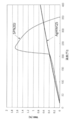
- the coarse silver particles produced by the reduction method used in the practical bonding compositions 1 to 4 as examples of the present invention have a linear expansion coefficient larger than that of silver. .
- Mitsui Mining & Mining Co., Ltd., SPN20J is 2096 at 230 ° C
- Mitsui Mining & Mining Co., Ltd. MD30A is 300 at 220 ° C
- Mitsui Mining & Mining Co., Ltd. MD40A is 1600 at 200 ° C, which is extremely high.
- the value is shown.
- the linear expansion coefficient of the coarse silver particles produced by the atomization method is about 20, which is a value equivalent to the linear expansion coefficient of silver.
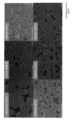
- FIG. 2 shows a scanning electron micrograph of a cross-section of a green coarse particle compact that has not been fired and is fired in the air.
- the coarse silver particles produced by the reduction method (Mitsui Mining & Smelting Co., Ltd., SPN20J) have no bubbles inside when unfired, but internal bubbles are generated by firing at 220 ° C. or higher.
- the silver coarse particles (Fukuda Metal Foil Powder Co., Ltd., Ag-HWQ5) produced by the atomizing method, no internal bubbles are generated even when firing at 250 ° C.
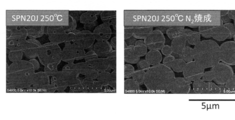
- FIG. 3 shows a scanning electron micrograph of the cross section of the coarse silver particle compact showing the influence of the firing atmosphere on the internal foaming.
- the coarse silver particles produced by the reduction method (Mitsui Mining & Smelting Co., Ltd., SPN20J) generate internal bubbles by firing at 220 ° C. or higher in the atmosphere, but the firing atmosphere is nitrogen. In this case, no internal bubbles are generated even when the temperature is raised to 250 ° C.
- the results show that in the coarse silver particles (Mitsui Metal Mining Co., Ltd., SPN20J) produced by the reduction method, internal foaming occurs due to oxidative decomposition of organic substances present inside the particles.
- the laminate obtained by using the practical bonding compositions 1 to 4 has a high bonding strength of 24 to 43 MPa even under non-pressurized and low-temperature bonding conditions. Moreover, the void ratio of the bonding layer is clearly reduced as compared with the bonding layers obtained using the comparative bonding compositions 5 and 6.
- the void ratio of the bonding layer was 20% and the bonding strength was relatively low at 25 MPa. This is probably because the opening was formed in the coarse particles.
- the strength of the laminate obtained by using the bonding composition 1 containing a large amount of Mitsui Metal Mining Co., Ltd. and SPN20J is high (43 MPa).
- SPN20J has an extremely high coefficient of linear expansion at 230 ° C. of 2096, so it is considered that the effects of the present invention were clearly expressed.
Landscapes
- Chemical & Material Sciences (AREA)
- Engineering & Computer Science (AREA)
- Ceramic Engineering (AREA)
- Materials Engineering (AREA)
- Mechanical Engineering (AREA)
- Spectroscopy & Molecular Physics (AREA)
- Physics & Mathematics (AREA)
- Dispersion Chemistry (AREA)
- Organic Chemistry (AREA)
- Composite Materials (AREA)
- Manufacturing & Machinery (AREA)
- Structural Engineering (AREA)
- Powder Metallurgy (AREA)
- Conductive Materials (AREA)
- Ceramic Products (AREA)
- Manufacture Of Metal Powder And Suspensions Thereof (AREA)
- Die Bonding (AREA)
Abstract
La présente invention concerne une composition d'assemblage et un procédé d'assemblage au moyen de la composition d'assemblage dans lesquels un corps d'assemblage ayant une couche d'assemblage dense et une résistance d'assemblage élevée peut être obtenu à une température d'assemblage relativement basse sans pression appliquée. Une composition d'assemblage contenant des particules inorganiques et un composant organique, la composition d'assemblage étant caractérisée en ce que les particules inorganiques comprennent des microparticules inorganiques et des particules grossières inorganiques, et les particules grossières inorganiques de dilatent de façon irréversible au-delà du coefficient de dilatation linéaire d'une substance inorganique constituant le les particules grossières inorganiques concomitamment avec une augmentation de température.
Priority Applications (1)
| Application Number | Priority Date | Filing Date | Title |
|---|---|---|---|
| JP2016542778A JPWO2017006531A1 (ja) | 2015-07-08 | 2016-06-23 | 接合用組成物及び接合方法 |
Applications Claiming Priority (2)
| Application Number | Priority Date | Filing Date | Title |
|---|---|---|---|
| JP2015136673 | 2015-07-08 | ||
| JP2015-136673 | 2015-07-08 |
Publications (1)
| Publication Number | Publication Date |
|---|---|
| WO2017006531A1 true WO2017006531A1 (fr) | 2017-01-12 |
Family
ID=57686174
Family Applications (1)
| Application Number | Title | Priority Date | Filing Date |
|---|---|---|---|
| PCT/JP2016/003031 Ceased WO2017006531A1 (fr) | 2015-07-08 | 2016-06-23 | Composition d'assemblage et procédé d'assemblage |
Country Status (2)
| Country | Link |
|---|---|
| JP (1) | JPWO2017006531A1 (fr) |
| WO (1) | WO2017006531A1 (fr) |
Cited By (4)
| Publication number | Priority date | Publication date | Assignee | Title |
|---|---|---|---|---|
| JP2018170226A (ja) * | 2017-03-30 | 2018-11-01 | 日立化成株式会社 | 導電性積層体及びその製造方法 |
| WO2019142633A1 (fr) * | 2018-01-22 | 2019-07-25 | バンドー化学株式会社 | Composition pour liaison |
| WO2020040184A1 (fr) * | 2018-08-23 | 2020-02-27 | バンドー化学株式会社 | Composition d'assemblage |
| JP2021038427A (ja) * | 2019-09-02 | 2021-03-11 | 株式会社大阪ソーダ | 銀粒子の焼結体 |
Citations (8)
| Publication number | Priority date | Publication date | Assignee | Title |
|---|---|---|---|---|
| WO2006126614A1 (fr) * | 2005-05-25 | 2006-11-30 | Nihon Handa Co., Ltd. | Composition d’argent sous forme de pâte, procédé de fabrication idoine, procédé de fabrication d’argent massif, argent massif, procédé de collage, et procédé de fabrication de carte à circuit |
| JP2009289745A (ja) * | 2008-05-01 | 2009-12-10 | Nippon Handa Kk | 加熱焼結性銀粒子の製造方法、ペースト状銀粒子組成物、固形状銀の製造方法、金属製部材の接合方法、プリント配線板の製造方法および電気回路接続用バンプの製造方法 |
| JP2010153118A (ja) * | 2008-12-24 | 2010-07-08 | Mitsuboshi Belting Ltd | 金属粒子ペースト及び導電性基材の製造方法 |
| JP2011094223A (ja) * | 2008-11-26 | 2011-05-12 | Mitsuboshi Belting Ltd | 無機素材用接合剤及び無機素材の接合体 |
| JP2011236494A (ja) * | 2010-04-12 | 2011-11-24 | Nippon Handa Kk | 金属製部材接合体の製造方法および金属製部材接合体 |
| JP2012052198A (ja) * | 2010-09-02 | 2012-03-15 | Nippon Handa Kk | ペースト状銀粒子組成物、金属製部材接合体の製造方法および金属製部材接合体 |
| JP2013216919A (ja) * | 2012-04-04 | 2013-10-24 | Nippon Handa Kk | 加熱焼結性銀粒子の製造方法、ペースト状銀粒子組成物、固形状銀の製造方法、金属製部材の接合方法、プリント配線板の製造方法および電気回路接続用バンプの製造方法 |
| WO2014185073A1 (fr) * | 2013-05-16 | 2014-11-20 | バンドー化学株式会社 | Composition pour la fixation de métal |
-
2016
- 2016-06-23 JP JP2016542778A patent/JPWO2017006531A1/ja active Pending
- 2016-06-23 WO PCT/JP2016/003031 patent/WO2017006531A1/fr not_active Ceased
Patent Citations (8)
| Publication number | Priority date | Publication date | Assignee | Title |
|---|---|---|---|---|
| WO2006126614A1 (fr) * | 2005-05-25 | 2006-11-30 | Nihon Handa Co., Ltd. | Composition d’argent sous forme de pâte, procédé de fabrication idoine, procédé de fabrication d’argent massif, argent massif, procédé de collage, et procédé de fabrication de carte à circuit |
| JP2009289745A (ja) * | 2008-05-01 | 2009-12-10 | Nippon Handa Kk | 加熱焼結性銀粒子の製造方法、ペースト状銀粒子組成物、固形状銀の製造方法、金属製部材の接合方法、プリント配線板の製造方法および電気回路接続用バンプの製造方法 |
| JP2011094223A (ja) * | 2008-11-26 | 2011-05-12 | Mitsuboshi Belting Ltd | 無機素材用接合剤及び無機素材の接合体 |
| JP2010153118A (ja) * | 2008-12-24 | 2010-07-08 | Mitsuboshi Belting Ltd | 金属粒子ペースト及び導電性基材の製造方法 |
| JP2011236494A (ja) * | 2010-04-12 | 2011-11-24 | Nippon Handa Kk | 金属製部材接合体の製造方法および金属製部材接合体 |
| JP2012052198A (ja) * | 2010-09-02 | 2012-03-15 | Nippon Handa Kk | ペースト状銀粒子組成物、金属製部材接合体の製造方法および金属製部材接合体 |
| JP2013216919A (ja) * | 2012-04-04 | 2013-10-24 | Nippon Handa Kk | 加熱焼結性銀粒子の製造方法、ペースト状銀粒子組成物、固形状銀の製造方法、金属製部材の接合方法、プリント配線板の製造方法および電気回路接続用バンプの製造方法 |
| WO2014185073A1 (fr) * | 2013-05-16 | 2014-11-20 | バンドー化学株式会社 | Composition pour la fixation de métal |
Cited By (8)
| Publication number | Priority date | Publication date | Assignee | Title |
|---|---|---|---|---|
| JP2018170226A (ja) * | 2017-03-30 | 2018-11-01 | 日立化成株式会社 | 導電性積層体及びその製造方法 |
| JP6996101B2 (ja) | 2017-03-30 | 2022-01-17 | 昭和電工マテリアルズ株式会社 | 導電性積層体及びその製造方法 |
| WO2019142633A1 (fr) * | 2018-01-22 | 2019-07-25 | バンドー化学株式会社 | Composition pour liaison |
| JPWO2019142633A1 (ja) * | 2018-01-22 | 2020-01-23 | バンドー化学株式会社 | 接合用組成物 |
| WO2020040184A1 (fr) * | 2018-08-23 | 2020-02-27 | バンドー化学株式会社 | Composition d'assemblage |
| JPWO2020040184A1 (ja) * | 2018-08-23 | 2020-09-10 | バンドー化学株式会社 | 接合用組成物 |
| JP2021038427A (ja) * | 2019-09-02 | 2021-03-11 | 株式会社大阪ソーダ | 銀粒子の焼結体 |
| JP7716173B2 (ja) | 2019-09-02 | 2025-07-31 | 株式会社大阪ソーダ | 銀粒子の焼結体 |
Also Published As
| Publication number | Publication date |
|---|---|
| JPWO2017006531A1 (ja) | 2017-07-20 |
Similar Documents
| Publication | Publication Date | Title |
|---|---|---|
| JP6349310B2 (ja) | 金属接合用組成物 | |
| JP6021816B2 (ja) | 接合用組成物 | |
| JP6262139B2 (ja) | 接合用組成物 | |
| JP6766160B2 (ja) | 金属接合用組成物 | |
| JP6659026B2 (ja) | 銅粒子を用いた低温接合方法 | |
| WO2015162881A1 (fr) | Composition d'assemblage et corps assemblé métallique mettant en oeuvre celle-ci | |
| JPWO2016067599A1 (ja) | 接合用組成物 | |
| JP6736782B2 (ja) | 接合用組成物 | |
| TWI744372B (zh) | 接合用組成物及其製造方法、接合體以及被覆銀奈米粒子 | |
| WO2017006531A1 (fr) | Composition d'assemblage et procédé d'assemblage | |
| JP6163616B1 (ja) | 接合用組成物 | |
| JP6467114B1 (ja) | 金属接合積層体の製造方法 | |
| JP6669420B2 (ja) | 接合用組成物 | |
| WO2015159480A1 (fr) | Composition de liaison et corps lié à un métal l'utilisant | |
| JP6267835B1 (ja) | 接合用組成物及びその製造方法 | |
| JP6085724B2 (ja) | 接合用組成物 |
Legal Events
| Date | Code | Title | Description |
|---|---|---|---|
| ENP | Entry into the national phase |
Ref document number: 2016542778 Country of ref document: JP Kind code of ref document: A |
|
| 121 | Ep: the epo has been informed by wipo that ep was designated in this application |
Ref document number: 16821010 Country of ref document: EP Kind code of ref document: A1 |
|
| NENP | Non-entry into the national phase |
Ref country code: DE |
|
| 122 | Ep: pct application non-entry in european phase |
Ref document number: 16821010 Country of ref document: EP Kind code of ref document: A1 |