WO2017010140A1 - Feuille adhésive sensible à la pression, son procédé de production, et élément de feuille adhésive sensible à la pression - Google Patents
Feuille adhésive sensible à la pression, son procédé de production, et élément de feuille adhésive sensible à la pression Download PDFInfo
- Publication number
- WO2017010140A1 WO2017010140A1 PCT/JP2016/062625 JP2016062625W WO2017010140A1 WO 2017010140 A1 WO2017010140 A1 WO 2017010140A1 JP 2016062625 W JP2016062625 W JP 2016062625W WO 2017010140 A1 WO2017010140 A1 WO 2017010140A1
- Authority
- WO
- WIPO (PCT)
- Prior art keywords
- pressure
- sensitive adhesive
- sheet
- adhesive
- silicone
- Prior art date
- Legal status (The legal status is an assumption and is not a legal conclusion. Google has not performed a legal analysis and makes no representation as to the accuracy of the status listed.)
- Ceased
Links
Images



Classifications
-
- B—PERFORMING OPERATIONS; TRANSPORTING
- B05—SPRAYING OR ATOMISING IN GENERAL; APPLYING FLUENT MATERIALS TO SURFACES, IN GENERAL
- B05D—PROCESSES FOR APPLYING FLUENT MATERIALS TO SURFACES, IN GENERAL
- B05D1/00—Processes for applying liquids or other fluent materials
- B05D1/36—Successively applying liquids or other fluent materials, e.g. without intermediate treatment
-
- B—PERFORMING OPERATIONS; TRANSPORTING
- B32—LAYERED PRODUCTS
- B32B—LAYERED PRODUCTS, i.e. PRODUCTS BUILT-UP OF STRATA OF FLAT OR NON-FLAT, e.g. CELLULAR OR HONEYCOMB, FORM
- B32B27/00—Layered products comprising a layer of synthetic resin
-
- B—PERFORMING OPERATIONS; TRANSPORTING
- B32—LAYERED PRODUCTS
- B32B—LAYERED PRODUCTS, i.e. PRODUCTS BUILT-UP OF STRATA OF FLAT OR NON-FLAT, e.g. CELLULAR OR HONEYCOMB, FORM
- B32B27/00—Layered products comprising a layer of synthetic resin
- B32B27/18—Layered products comprising a layer of synthetic resin characterised by the use of special additives
- B32B27/20—Layered products comprising a layer of synthetic resin characterised by the use of special additives using fillers, pigments, thixotroping agents
-
- C—CHEMISTRY; METALLURGY
- C09—DYES; PAINTS; POLISHES; NATURAL RESINS; ADHESIVES; COMPOSITIONS NOT OTHERWISE PROVIDED FOR; APPLICATIONS OF MATERIALS NOT OTHERWISE PROVIDED FOR
- C09J—ADHESIVES; NON-MECHANICAL ASPECTS OF ADHESIVE PROCESSES IN GENERAL; ADHESIVE PROCESSES NOT PROVIDED FOR ELSEWHERE; USE OF MATERIALS AS ADHESIVES
- C09J7/00—Adhesives in the form of films or foils
- C09J7/20—Adhesives in the form of films or foils characterised by their carriers
Definitions
- the present invention relates to a pressure-sensitive adhesive sheet, a manufacturing method thereof, and a pressure-sensitive adhesive sheet material.
- a pressure-sensitive adhesive sheet that can be bonded to an object to be pasted (hereinafter referred to as a pasting object) by positioning and temporarily attaching it, and then applying a strong pressure.
- the pressure-sensitive adhesive sheet has an adhesive performance corresponding to the applied pressure, and is provided with an adhesive on the surface of the sheet-like substrate, and various proposals have been made.
- Japanese Patent Laid-Open No. 8-325536 proposes a pressure-sensitive adhesive sheet in which a base material, an adhesive layer, and a release paper as a peelable support layer are laminated.
- the adhesive layer is disposed on the substrate, and non-adhesive fine particles having an average particle diameter of 10 to 60 ⁇ m are provided on the surface of the adhesive layer so as to be uniformly dispersed.
- the coverage of the fine particles with respect to the surface area of the adhesive layer is about 3 to 30%, and the fine particles are non-destructive under pressure.
- 58-013682 also describes a pressure-sensitive adhesive sheet in which a base material, an adhesive layer and a release paper are laminated, and fine particles are arranged on the surface or inside of the adhesive layer.
- the average particle size of the fine particles is most preferably 2 ⁇ m or less, whereby the fine particles are crushed or crushed under the pressure applied during pressure application to the object to be applied. I try not to do it.
- Japanese Patent Application Publication No. 2011-519977 describes a sheet in which a pressure-sensitive adhesive layer formed from a pressure-sensitive adhesive composition is provided on a part of one sheet surface.
- This adhesive layer is a non-adhesive micro-adhesive material that has adhesive properties for attaching sheets to each other in a pad on which a plurality of sheets are stacked, and for attaching a sheet peeled from the pad to another object at a pressure higher than a threshold pressure.
- the microsphere has an average particle size larger than the thickness of the adhesive layer, and is provided so as to protrude from the surface of the adhesive layer.
- 2003-140376 describes a laminate film having a pressure sensitive adhesive property, comprising a transparent base material and a transparent adhesive layer provided on one side of the base material.
- a release liner is provided on the pressure-sensitive adhesive layer, and the release liner is peeled off for use. Fine irregularities are provided on the surface of the pressure-sensitive adhesive layer, and the irregular structure disappears when the application to the object to be applied is completed.
- Some adhesive sheets are long, and there are adhesive sheets in which an adhesive layer is provided in the center in the width direction, and the side edges are thicker than the central adhesive layer (for example, Japanese Patent Application Laid-Open Nos. 2008-018614 and 2008-). No. 110614).
- the adhesive layer adheres to another in a state before use such as storage and / or transportation. Therefore, release paper is provided on the adhesive layer in order to prevent such adhesion. Similar to this release paper, the release liner described in Japanese Patent Application Laid-Open No. 2003-140376 also prevents the pressure-sensitive adhesive layer from sticking to other things before use.
- a release sheet such as release paper or release liner that is provided to prevent sticking and is peeled off at the time of use is troublesome to peel off when sticking to an object to be pasted, and hinders work efficiency. Further, the peeled release sheet requires post-treatment such as collection and / or disposal.
- the pressure-sensitive adhesive sheet provided with the release sheet is the thickness of the release sheet, and the space and / or weight in storage and / or transportation is increased. Therefore, from such a viewpoint, a sheet that does not stick to anything other than the object to be pasted before use is desired although a release sheet is unnecessary. Furthermore, in consideration of positioning to the object to be pasted and temporary fixing, a so-called pressure-sensitive adhesive sheet having adhesiveness is preferable to a pressure-sensitive adhesive sheet having adhesiveness.
- the laminate film disclosed in Japanese Patent Application Laid-Open No. 2003-140376 is a pressure-sensitive adhesive sheet having an adhesive layer. However, since the non-adhesiveness before use is insufficient, a release sheet is still provided.
- JP-A-2011-519977 since the pressure-sensitive adhesive layer of JP-A-2011-519977 also sticks when it comes into contact with other materials, a release sheet is necessary to distribute the sheet in an individual state.
- the long adhesive sheets described in JP 2008-018614 A and JP 2008-110614 A are also provided with a release sheet. Furthermore, in recent years, a pressure-sensitive adhesive sheet excellent in transparency has been desired.
- An object of the present invention is to provide a pressure-sensitive adhesive sheet that is a transparent pressure-sensitive adhesive sheet that does not require a release sheet, a method for producing the same, and a material for the pressure-sensitive adhesive sheet.
- the pressure-sensitive adhesive sheet of the present invention comprises a transparent sheet substrate, a first adhesive layer, and a second adhesive layer.
- the first adhesive layer is provided on the sheet base material and includes a first silicone-based adhesive.
- the second pressure-sensitive adhesive layer holds the first pressure-sensitive adhesive layer between the sheet base material and forms one sheet surface, and has a second silicone pressure-sensitive adhesive and a plurality of protrusions formed from a plurality of fine particles. .
- the fine particles have an average particle size in the range of 2 ⁇ m to 15 ⁇ m.
- the coverage with fine particles on one sheet surface is in the range of 10% to 70%.
- the adhesive force on the one sheet surface under a pressure of 1 N / cm 2 or less is 0 N / 25 mm.
- first adhesive layer does not contain fine particles.
- the first silicone adhesive and the second silicone adhesive are preferably polydimethylsiloxane.
- the refractive index difference between the fine particles and the second silicone-based pressure-sensitive adhesive is preferably in the range of more than 0 and 0.1 or less.
- the ratio T2 / T1 of the thickness T2 of the second adhesive layer to the thickness T1 of the first adhesive layer is preferably in the range of 0.1 to 3.
- a mixed layer in which the first silicone pressure-sensitive adhesive and the second silicone pressure-sensitive adhesive are mixed is provided between the first pressure-sensitive adhesive layer and the second pressure-sensitive adhesive layer.
- the thickness of the mixed layer is preferably at least 0.5 ⁇ m.
- the mass ratio of the first silicone pressure-sensitive adhesive in the mixed layer is preferably in the range of 10% by mass to 50% by mass.
- the pressure-sensitive adhesive sheet material of the present invention has a pressure-sensitive adhesive part and a pair of film thickness parts, and is long.
- the pressure-sensitive adhesive portion is provided at the center in the width direction and is formed from the pressure-sensitive adhesive sheet.
- a film thickness part is provided in the width direction side edge, and has a thickness larger than the thickness from said one sheet surface in a pressure-sensitive adhesion part to the boundary of a 1st adhesion part and a sheet
- the method for producing a pressure-sensitive adhesive sheet of the present invention includes an application step and a drying step.
- the coating step includes a first coating solution containing a first organopolysiloxane and a first organopolysiloxane solvent, a second organopolysiloxane and a second organopolysiloxane solvent, and an average particle size of 2 ⁇ m or more.
- a coating film in which the second coating liquid is superimposed on the first coating liquid is obtained by overlapping the flow of the second coating liquid containing a plurality of fine particles within a range of 15 ⁇ m or less and applying the flow onto a transparent sheet substrate. Form.
- the coating film is dried.
- the first organopolysiloxane and the second organopolysiloxane are curable polydimethylsiloxanes that are crosslinked by heating.
- the first organopolysiloxane and the second organopolysiloxane are heated by heating the coating film. It is preferable to include a cross-linking step of cross-linking each.
- the pressure-sensitive adhesive sheet and the pressure-sensitive adhesive sheet material of the present invention are excellent in transparency, and the pressure-sensitive adhesive sheet and the pressure-sensitive adhesive sheet material do not require a release sheet. Moreover, according to the manufacturing method of the pressure sensitive adhesive sheet of this invention, the pressure sensitive adhesive sheet which is excellent in transparency and does not require a peeling sheet is obtained.
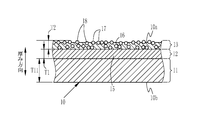
- a pressure-sensitive adhesive sheet 10 embodying the present invention includes a sheet substrate 11, a first adhesive layer 12 disposed on one surface of the sheet substrate 11 (hereinafter referred to as a substrate surface), And a second adhesive layer 13 provided in close contact with the first adhesive layer 12.
- This pressure-sensitive adhesive sheet 10 is cut out into a sheet form from a long pressure-sensitive adhesive sheet material 62 (see FIG. 5) described later.
- One sheet surface (hereinafter referred to as a first sheet surface) 10a configured by the second adhesive layer 13 is an adhesive surface for an object to be pasted (hereinafter referred to as a pasting object).
- the sheet base 11 forms the other sheet surface (hereinafter referred to as a second sheet surface) 10b, and the pressure-sensitive adhesive sheet 10 is pressed by applying pressure from the second sheet surface 10b side. Affixed to the object to be pasted.
- the pressure-sensitive adhesive sheet 10 is used for, for example, a cover film or a marking film of an analytical instrument.
- the antifouling treatment is applied in advance to the base material surface of the sheet base material 11 that becomes the second sheet surface 10 b of the pressure-sensitive adhesive sheet 10.
- printing is performed in advance on the base material surface of the sheet base material 11 which becomes the second sheet surface 10b of the pressure-sensitive adhesive sheet 10, or decoration is given in advance.
- the pressure-sensitive adhesive sheet 10 When the pressure applied in the thickness direction is 1 N / cm 2 or less, the pressure-sensitive adhesive sheet 10 has an adhesive force of 0 N / 25 mm and does not stick. In addition, all the pressures described below are pressures applied in the thickness direction. Hereinafter, the pressure of 1 N / cm 2 or less is referred to as a first pressure.
- the adhesive force is more preferably 0.4 N / 25 mm or less, further preferably 0.04 N / 25 mm or less. It is 0.00N / 25mm.
- the adhesive force is obtained as an effective value up to the second decimal place.
- the adhesive strength is “0 N / 25 mm” means that when the measurement limit for measuring the adhesive strength is not more than the first decimal place, the last digit required by the measuring method is rounded off to 0 N / 25 mm. Means when it comes to.
- Adhesive strength is determined based on Japanese Industrial Standards JIS Z0237, and the above-mentioned significant figures in this embodiment are based on measurement limits in this determination method.
- a sample for measurement is cut out from the pressure-sensitive adhesive sheet 10 to a size of 0.025 m ⁇ 0.1 m.
- a sample is placed on a table with the first sheet surface 10a facing upward, and a polypropylene having a thickness of 12 ⁇ m cut out on the first sheet surface 10a to a predetermined size (0.025 m ⁇ 0.13 m).
- Pressure-sensitive adhesive sheet 10 is in a range adhesion following large 5N / 25 mm from 0N / 25 mm when the pressure in the larger 7N / cm 2 the range from 1N / cm 2 is granted. Further, pressure-sensitive adhesive sheet 10 is in a range adhesion is less large 10 N / 25 mm than 5N / 25 mm when the pressure in the larger 20 N / cm 2 or less in the range from 7N / cm 2 is applied .
- the pressure in the larger 7N / cm 2 or less in the range from 1N / cm 2, or less referred to as second pressure
- the pressure in the larger 20 N / cm 2 or less in the range from 7N / cm 2, or less third This is called pressure.
- the second pressure and the third pressure are applied, the above-described adhesive forces are manifested by applying the second pressure and the third pressure, respectively, and after these pressures are released, respectively. Will also last.
- the sheet substrate 11 is a sheet body of the pressure-sensitive adhesive sheet 10 and is transparent.
- the sheet substrate 11 of the present embodiment is formed from polyethylene terephthalate (hereinafter referred to as PET) and may contain an additive. Examples of the additive include a plasticizer and / or an ultraviolet absorber.
- the material forming the sheet base 11 is not limited to PET.
- the sheet base material 11 may be formed of, for example, polyvinyl chloride (hereinafter referred to as PVC), polyethylene (hereinafter referred to as PE), or the like, and in this case, may include the various additives described above. .
- the thickness T11 of the sheet base material 11 is appropriately set according to the application and the like, and is not particularly limited.
- the thickness T11 when the sheet substrate 11 is formed from the above-described PET, PVC, PE, or the like is, for example, in the range of 12 ⁇ m to 350 ⁇ m, and is 40 ⁇ m in this embodiment.
- the first adhesive layer 12 and the second adhesive layer 13 have an adhesive function (including a so-called non-adhesive function that does not adhere) according to the scene where the pressure-sensitive adhesive sheet 10 is handled.
- handling scenes so-called pre-use scenes such as storage and / or transportation, preparation scenes such as temporary fixing and / or re-sticking to determine the pasting position for the pasting object, pasting to the determined mounting position
- the 1st adhesion layer 12 is for expressing the adhesion performance in a use scene among these handling scenes, and, specifically, it sticks quickly to a sticking object, and the purpose is the sticking state. It is for holding for a period.
- the first pressure-sensitive adhesive layer 12 is formed from the first silicone pressure-sensitive adhesive 15, and the pressure-sensitive pressure-sensitive adhesive sheet 10 when the third pressure is applied thereby cooperates with the second pressure-sensitive adhesive layer 13. Thus, it is surely within the range of 5N / 25mm to 10N / 25mm.
- the first pressure-sensitive adhesive layer 12 does not contain fine particles, so that the pressure-sensitive pressure-sensitive adhesive sheet 10 has a pressure-sensitive adhesive force of more than 5 N / 25 mm and less than 10 N / 25 mm when the third pressure is applied. .
- the first silicone adhesive 15 is transparent.
- an organopolysiloxane having an organic group attached to the siloxane bond, which is the main skeleton, is preferable, and polydimethylsiloxane is more preferable. More preferred is polydimethylsiloxane.
- the curable polydimethylsiloxane is obtained by crosslinking curable polydimethylsiloxane having a property of being crosslinked (cured) by heating.
- the curable polydimethylsiloxane is particularly preferably one of peroxide curable polydimethylsiloxane and addition reaction type polydimethylsiloxane, and in this embodiment, it is an addition reaction type silicone pressure sensitive adhesive.
- the peroxide curable dimethylsiloxane is obtained by heat-crosslinking a peroxide-curable polydimethylsiloxane, which will be described later, using a cross-linking agent such as benzoyl peroxide. It is above °C.
- the addition reaction type polydimethylsiloxane can be obtained by heat-crosslinking an after-mentioned addition reaction type polydimethylsiloxane using a catalyst such as platinum.
- the first silicone pressure-sensitive adhesive 15 and the second silicone pressure-sensitive adhesive 16 may be the same substance or different substances. However, from the viewpoint of further increasing the adhesion between the first adhesive layer 12 and the second adhesive layer 13 and from the viewpoint of further increasing the transparency of the pressure-sensitive adhesive sheet 10, the first silicone-based adhesive 15 and the first described later.
- the two silicone adhesives 16 are preferably the same substance.
- the difference in refractive index is preferably as small as possible. It is preferably within 0.1.
- the addition reaction type silicone pressure-sensitive adhesive preferably has an average molecular weight in the range of 3000 or more and 800,000 or less, and has peaks at two locations of 5000 and 500,000 in this embodiment.
- the terminal of polydimethylsiloxane as an organopolysiloxane is a vinyl group (H 2 C ⁇ CH—).
- the above average molecular weight is a weight average molecular weight, which is obtained in terms of polystyrene by GPC (Gel Permeation Chromatography) method (gel permeation chromatography method).
- GPC Gel Permeation Chromatography
- LF-804 830 mm ⁇ ⁇ 300 mm
- Showa Denko KK is used.
- the first pressure-sensitive adhesive layer 12 may contain other substances in addition to the first silicone-based pressure-sensitive adhesive 15, but is preferably composed of only the first silicone-based pressure-sensitive adhesive 15.
- the first silicone-based pressure-sensitive adhesive 15 is an addition-reaction type silicone-based pressure-sensitive adhesive obtained by crosslinking with a catalyst as in this embodiment, the catalyst is included as an accelerator for the curing reaction in the crosslinking. It does not matter.
- the thickness T1 of the first adhesive layer 12 is 20 ⁇ m in the present embodiment, but is not limited thereto.
- the thickness T1 of the first adhesive layer 12 is set according to the adhesive force required in the usage scene, and the required adhesive force is applied to the material and / or surface state of the object to be applied, for a long time. Consider the environment between.
- the 2nd adhesion layer 13 is for expressing the adhesion performance according to each scene in all these handling scenes before use and in preparation and use. Expresses adhesive performance. Specifically, it prevents sticking to objects other than the object to be pasted in the pre-use scene, sticks in a state where it can be pasted again on the target object in the preparation scene, and sticks to the target object in the use scene. On the other hand, it is for sticking quickly and maintaining the sticking state for a target period.
- the second adhesive layer 13 includes a second silicone adhesive 16 and a plurality of protrusions 17 formed on the first sheet surface 10a by the fine particles 18, and the second silicone adhesive 16 and the plurality of protrusions 17 are formed.
- the protrusion 17 forms the first sheet surface 10 a of the pressure-sensitive adhesive sheet 10.
- the pressure-sensitive adhesive sheet 10 reliably exhibits an adhesive force of 0 N / 25 mm at the first pressure, and more reliably exhibits an adhesive force within a range of greater than 0 N / 25 mm and not greater than 5 N / 25 mm at the second pressure. Under the third pressure, the adhesive force is greater than 5 N / 25 mm and less than 10 N / 25 mm in cooperation with the first adhesive layer 12.
- the 2nd silicone adhesive 16 has both the adhesive function with respect to a sticking target object, and the binder function holding the microparticles
- the plurality of fine particles 18 have an average particle diameter in the range of 2 ⁇ m to 15 ⁇ m.
- the fine particles 18 may be either primary particles or secondary particles in which the primary particles are aggregated. In the case of secondary particles, the average particle size of the secondary particles may be in the above range.
- the average particle size is more preferably in the range of 5 ⁇ m to 15 ⁇ m, and still more preferably in the range of 10 ⁇ m to 15 ⁇ m.
- the average particle diameter of the plurality of fine particles 18 is calculated by the following method. First, a part is cut out from the pressure-sensitive adhesive sheet 10, and the cut out sample is frozen (cryo-processed), and then a long and thin section is prepared by a microtome. The section of the prepared section was observed with an ultra-high resolution field emission scanning electron microscope (manufactured by Hitachi High-Technologies Corporation, S-5500), and the particle size was individually determined for 100 arbitrarily extracted fine particles. These average values are defined as the average particle diameter of the fine particles 18.
- the fine particles 18 are harder than the second silicone adhesive 16.
- the hardness here can be determined by quantifying the fine particles 18 and the second silicone pressure-sensitive adhesive 16 by measuring the pressure when each of them is compressed and plastically deformed. In this embodiment, measurement of compression and pressure is performed with a micro compression tester MCTM-500 manufactured by Shimadzu Corporation.
- the hardness of the fine particles 18 is HP (unit: MPa) and the hardness of the second silicone pressure-sensitive adhesive 16 is HA2 (unit: MPa)
- the difference in hardness obtained by HP-HA2 is at least 10 MPa. Preferably there is.
- is more preferable, and it is more preferably within a range of 0.01 or more and 0.07 or less, and further preferably within a range of 0.01 or more and 0.03 or less.
- the above addition reaction type silicone pressure sensitive adhesive (refractive index is 1.43) is used as the second silicone pressure sensitive adhesive 16, and fine particles made of silicone are used as the fine particles 18 (refractive index is 1.42). By using this, the refractive index difference is set to 0.01.
- the fine particles 18 are fine particles made of silicone as described above, and are secondary particles.
- the fine particles made of silicone include Tospearl (registered trademark) having a crosslinked silicone structure made of methylsilsesquioxane (CH 3 SiO 1.5 ) (manufactured by Momentive Performance Materials Japan GK), KMP-590. X-52-1621 (manufactured by Shin-Etsu Chemical Co., Ltd.) or the like is used.
- the material constituting the fine particles 18 is not limited to silicone, and the individual fine particles 18 may be composed of so-called composite materials which are materials composed of different substances. Examples of materials other than silicone include silica (silicon dioxide), acrylic resin, and glass.
- the fine particles 18 may be used in combination of a plurality of different materials.
- a part of the plurality of fine particles 18 forms the first sheet surface 10a together with the second silicone pressure sensitive adhesive 16, and the other fine particles 18 are embedded in the second silicone pressure sensitive adhesive 16 to be the second pressure sensitive adhesive layer. 13 are scattered.
- the mass of the fine particles 18 in the second adhesive layer 13 is preferably in the range of 10 or more and 50 or less when the total mass of the second adhesive layer 13 is 100.
- the mass of the fine particles 18 in the second adhesive layer 13 is preferably increased within the above range as the average particle size of the fine particles 18 is small, and is preferably decreased within the above range as the average particle size is large.
- the same silicone adhesive 16 as the first silicone adhesive 15 of the first adhesive layer 12 is used as the second silicone adhesive 16.
- the boundary between the first adhesive layer 12 and the second adhesive layer 13 is not visually recognized in the cross section as in FIG.
- the first adhesive layer 12 is recognized as a region where the fine particles 18 are included
- the second adhesive layer 13 is recognized as a region where the fine particles 18 are not included. Therefore, in FIG.
- the boundary between the adhesive layer 12 and the second adhesive layer 13 is shown.
- the boundary between the first pressure-sensitive adhesive layer 12 and the second pressure-sensitive adhesive layer 13 depends on the presence or absence of fine particles 18 in the thickness direction depending on the first silicone pressure-sensitive adhesive 15 and the second silicone pressure-sensitive adhesive 16 used. Judged at the boundary of the region.
- the second pressure-sensitive adhesive layer 13 may contain other substances in addition to the second silicone pressure-sensitive adhesive 16 and the fine particles 18, but is composed of only the second silicone-based pressure sensitive adhesive 16 and the fine particles 18. Is preferable.
- the second silicone pressure-sensitive adhesive 16 is an addition reaction type silicone pressure-sensitive adhesive obtained by crosslinking with a catalyst as in this embodiment, the catalyst promotes the curing reaction in the crosslinking. May be included.
- the thickness T2 of the second adhesive layer 13 is 20 ⁇ m in the present embodiment, but is not limited thereto.
- the sum of the thickness T1 of the first adhesive layer 12 and the thickness T2 of the second adhesive layer 13 is preferably in the range of 5 ⁇ m to 150 ⁇ m.
- the adhesive force due to the third pressure is 10 N / 25 mm or less compared to the case where the thickness is larger than 150 ⁇ m. Is surely suppressed.
- the ratio T2 / T1 of the thickness T2 of the second adhesive layer 13 to the thickness T1 of the first adhesive layer 12 is preferably in the range of 0.1 or more and 3 or less, and is 1 in this embodiment.
- the ratio T2 / T1 of the thickness T2 of the second adhesive layer 13 to the thickness T1 of the first adhesive layer 12 is more preferably in the range of 0.3 to 2.0, and more preferably 0.6 to 1.2. More preferably, it is within the following range.
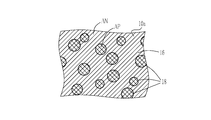
- the covered area AP of the first sheet surface 10a covered with the fine particles 18 is shown by cross-hatching, and is not covered except for the covered area AP.
- the area AN is indicated by hatching with parallel lines.
- the area of the coating region AP is the sum of the areas of the regions covered by each of the plurality of fine particles 18, and this is S1.
- the area of the uncovered region NP is S2.
- the coverage RC with the fine particles 18 on the first sheet surface 10a is obtained by (S1 / S2) ⁇ 100 and is in the range of 10% to 70%.
- the coverage RC is more preferably in the range of 30% to 70%, and further preferably in the range of 40% to 70%.
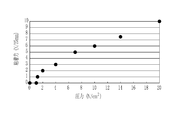
- the protrusion height H17 As shown in FIG. 3, on the first sheet surface 10a, the height from the first sheet surface 10a made of the second silicone adhesive 16 to the top of the protrusion 17 (hereinafter referred to as the protrusion height) H17 is It is assumed to be uniform. In addition, in FIG. 4 referred in the below-mentioned description, the inclination of the graph at the time of connecting a plot with a line becomes so small that projection height H17 is large.
- the pressure-sensitive adhesive sheet 10 has an adhesive strength of 0 N / 25 mm due to the first pressure. Sticking to things is suppressed. Moreover, since it is also suppressed that the pressure sensitive adhesive sheets 10 adhere to each other, for example, a predetermined number of sheets can be pulled out from a sheet group in which a plurality of pressure sensitive adhesive sheets 10 are laminated. Thus, even if the release sheet is not provided on the first sheet surface 10a, the pressure-sensitive adhesive sheet 10 is suppressed from being stuck to another particularly in a pre-use scene. Therefore, this pressure-sensitive adhesive sheet 10 does not require a release sheet. Note that the adhesive force data shown in FIG.
- the pressure-sensitive adhesive sheet 10 Since the pressure-sensitive adhesive sheet 10 has an adhesive force due to the second pressure in the range of greater than 0 N / 25 mm and less than or equal to 5 N / 25 mm, the workability in the above-described preparation scene among the handling scenes is good. Specifically, since the pressure-sensitive adhesive sheet 10 has an adhesive force due to the second pressure larger than 0 N / 25 mm, it is temporarily fixed by pressing with a light force from the second sheet surface 10b side. Moreover, since the adhesive force by 2nd pressure shall be in the range of 5 N / 25mm or less, the pressure-sensitive adhesive sheet 10 temporarily fixed can be peeled off with a light force, and can be reapplied.
- the pressure-sensitive adhesive sheet 10 has an adhesive force due to the third pressure within a range of greater than 5 N / 25 mm and less than or equal to 10 N / 25 mm, the second sheet surface 10 b is particularly used in the above-described use scene among handling scenes. Is firmly attached to the object to be applied by pressing with a force stronger than that for temporary fixing. Moreover, even if it cancels
- the adhesive force by the third pressure is 10 N / 25 mm or less, even if the pressure-sensitive adhesive sheet 10 is peeled off after a long pasting state, the first silicone adhesive 15 and the second silicone The adhesive 16 does not cause cohesive failure and does not remain on the object to be pasted.
- the protrusion 17 projecting on the first sheet surface 10a functions as a spacer between the second silicone-based adhesive 16 and another object that has touched the first sheet surface 10a, and the first sheet.
- the coverage RC of the fine particles 18 on the surface 10a is in the range of 10% to 70%. Since the protrusions 17 are formed and the coverage ratio RC is 10% or more, the second silicone-based adhesive 16 does not come into contact with other objects due to the spacer function of the protrusions 17 at the first pressure. Adhesive strength is developed with certainty. For this reason, even if there is no peeling sheet, the pressure-sensitive adhesive sheet 10 is difficult to stick to other objects, for example, objects other than the object to be pasted, in the scene before use.
- a part of the plurality of fine particles 18 is the second silicone pressure-sensitive adhesive 16 at the second pressure. Since the second silicone-based pressure-sensitive adhesive 16 on the first sheet surface 10a is partially in contact with the object to be pasted, and most of the plurality of fine particles 18 protrude from the first sheet surface 10a.
- the pressure-sensitive adhesive sheet 10 more reliably exhibits an adhesive force within a range of greater than 0 N / 25 mm and less than or equal to 5 N / 25 mm.
- the fine particles 18 and the second silicone-based adhesive 16 cooperate to stick the pressure-sensitive adhesive sheet 10 in a state where it can be re-applied to the object to be applied.
- the coverage ratio RC is 70% or less
- the third pressure most or all of the fine particles 18 forming the protrusions 17 are buried in the second silicone adhesive 16 and the second silicone adhesive is used. Since the adhesive 16 is in close contact with the object to be applied, the pressure-sensitive adhesive sheet 10 more reliably expresses an adhesive force in the range of 5 N / 25 mm to 10 N / 25 mm.
- the second silicone pressure-sensitive adhesive 16 Since the average particle diameter of the plurality of fine particles 18 is 2 ⁇ m or more, even when the first pressure is applied, the second silicone pressure-sensitive adhesive 16 is reliably prevented from coming into contact with other objects, and the adhesive strength is 0 N / It is suppressed to 25 mm.
- the second silicone-based adhesive 16 exposed on the first sheet surface 10a partially contacts the object to be pasted, and the adhesive force is greater than 0 N / 25 mm and 5 N. / 25 mm or less.
- the average particle diameter is 15 ⁇ m or less, the haze of the pressure-sensitive adhesive sheet 10 can be kept low.
- the fine particles 18 are harder than the second silicone pressure-sensitive adhesive 16, even if pressure is applied to the pressure-sensitive pressure-sensitive adhesive sheet 10 in the thickness direction, the fine particles 18 are embedded in the second silicone-based pressure sensitive adhesive 16 in a non-destructive manner. As a result, the fine particles 18 remain buried in the second silicone-based pressure-sensitive adhesive 16 under the second pressure, so that a decrease in the adhesive force that may occur due to the destruction of the fine particles 18 is prevented.
- the adhesive force at the third pressure is more surely within the range of 5 N / 25 mm to 10 N / 25 mm.
- the refractive index difference between the fine particles 18 and the second silicone-based pressure-sensitive adhesive 16 is in the range of greater than 0 and less than or equal to 0.1, the haze of the pressure-sensitive pressure-sensitive adhesive sheet 10 can be suppressed to be smaller. Transparency is better.
- the pressure-sensitive pressure-sensitive adhesive sheet 10 Since the fine particles 18 are scattered in the second pressure-sensitive adhesive layer 13, the pressure-sensitive pressure-sensitive adhesive sheet 10 is attached to the object to be pasted after long-term use, when the second pressure is applied, and the pressure-sensitive adhesive force is unlikely to be larger than 5 N / 25 mm.
- the first silicone pressure-sensitive adhesive 15 and the second silicone pressure-sensitive adhesive 16 are peeled off without remaining on the object to be pasted.
- the adhesive force by the third pressure is more reliably 5 N / 25 mm than when the thickness is less than 5 ⁇ m. It becomes larger, and it sticks to a sticking target object by sufficient adhesive force in a use scene by this. Further, since the sum of the thickness T1 of the first adhesive layer 12 and the thickness T2 of the second adhesive layer 13 is 150 ⁇ m or less, the adhesive force due to the third pressure is 10 N / 25 mm as compared with the case where it is larger than 150 ⁇ m. Therefore, even if the pressure-sensitive adhesive sheet 10 is peeled off after a long pasting state, it does not remain on the pasting object.
- the ratio T2 / T1 of the thickness T2 of the second adhesive layer 13 to the thickness T1 of the first adhesive layer 12 is preferably in the range of 0.1 to 3, and the ratio T2 / T1 is set within this range.
- the said adhesive force by each of a 1st pressure, a 2nd pressure, and a 3rd pressure expresses more reliably, and haze is suppressed and sufficient transparency expresses more reliably.
- T2 / T1 to be 0.1 or more, the adhesive force described above is expressed at the first pressure, the second pressure, and the third pressure, respectively, as compared with the case of less than 0.1.
- the difference in adhesive force between the first pressure and the second pressure and the difference in adhesive force between the second pressure and the third pressure are more reliably expressed. Moreover, by making T2 / T1 3 or less, compared with the case where it is larger than 3, haze is suppressed and sufficient transparency is expressed more reliably.
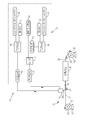
- the above-described long pressure-sensitive adhesive sheet material is manufactured by, for example, a pressure-sensitive adhesive sheet material manufacturing facility (hereinafter referred to as sheet material manufacturing facility) 30 shown in FIG.
- the sheet material manufacturing facility 30 includes a coating liquid preparation device 31, a delivery device 32, a coating device 33, a drying device 36, and a winding device 37 in order from the upstream side.
- the coating liquid preparation device 31 is for making the first coating liquid 41 and the second coating liquid 42.
- the first coating liquid 41 forms the first adhesive layer 12, and the second coating liquid 42 forms the second adhesive layer 13.
- the coating liquid preparation device 31 may be provided outside the sheet material manufacturing facility 30 instead of inside the sheet material manufacturing facility 30. In that case, the first coating liquid 41 and the second coating liquid 42 thus prepared are temporarily stored in a storage container or the like.
- the coating liquid preparation apparatus 31 includes a first dissolving unit 45, a second dissolving unit 46, a mixing unit 47, and the like.
- the first dissolving unit 45 performs heating and / or stirring on the first organopolysiloxane 48 and the first solvent 51 which is the solvent of the first organopolysiloxane 48. Thereby, the 1st coating liquid 41 in which the 1st organopolysiloxane 48 melt
- dissolved in the 1st solvent 51 is made.
- the second dissolving section 46 performs heating and / or stirring on the supplied second organopolysiloxane 49 and the second solvent 52 which is a solvent of the second organopolysiloxane 49. Thereby, the adhesive liquid 53 in which the second organopolysiloxane 49 is dissolved in the second solvent 52 is produced.
- the mixing unit 47 agitates the supplied fine particle dispersion 54 and the pressure-sensitive adhesive liquid 53 to produce the second coating liquid 42.
- the fine particle dispersion 54 is a liquid in which the fine particles 18 are dispersed in a dispersion medium.
- the first organopolysiloxane 48 and the second organopolysiloxane 49 are more preferably polydimethylsiloxane, and more preferably the aforementioned curable polydimethylsiloxane.
- peroxide-curable polydimethylsiloxane and addition-reactive polydimethylsiloxane are preferable, and in this embodiment, addition-reactive polydimethylsiloxane is used.
- the peroxide-curable polydimethylsiloxane is a substance that undergoes a condensation reaction by heating under the use of a crosslinking agent, and the above-described peroxide-curable polydimethylsiloxane is generated by this crosslinking.
- the crosslinking agent for example, benzoyl peroxide is preferable.
- Addition-reactive polydimethylsiloxane has vinylsilyl groups (Si—CH ⁇ CH 2 groups) and / or hydrosilyl groups (Si—H groups) in the molecule, and is crosslinked by heating using a catalyst.
- the above-mentioned addition reaction type polydimethylsiloxane is produced by this crosslinking.
- platinum is preferable as the catalyst, and platinum is also used in this embodiment.
- Peroxide-curable polydimethylsiloxane and addition-reactive polydimethylsiloxane are commercially available as adhesive materials, and examples of peroxide-curable polydimethylsiloxane include KR of Shin-Etsu Chemical Co., Ltd. -100, KR-130, KR-101-10, SH-4280 manufactured by Toray Dow Corning Co., Ltd. can be used.
- As the addition-reactive polydimethylsiloxane for example, KR-3700 and KR-3701 manufactured by Shin-Etsu Chemical Co., Ltd., SD4580 and SD4584 manufactured by Toray Dow Corning Co., Ltd. can be used. The company SD4584 is used.
- the solid content concentrations differ from each other. Is preferably as small as possible, and more preferably the same. In the present embodiment, the solid content concentrations of the first coating solution 41 and the second coating solution 42 are the same.
- the solid content is a substance that constitutes the pressure-sensitive adhesive sheet material 62 or a component that generates the substance among those constituting the first coating liquid 41 and the second coating liquid 42, respectively.
- the component to be generated is, for example, curable polydimethylsiloxane that generates curable polydimethylsiloxane.
- the first organopolysiloxane 48 and the second organopolysiloxane 49 are commercially available in the form of a solution dissolved in a solvent. In such a case, the first solvent 51 and the second solvent 52 are not used or the amounts of these are increased or decreased depending on the intended formulations of the first coating liquid 41 and the second coating liquid 42. You can do it.
- the first silicone adhesive 15 may be used as the first organopolysiloxane 48 and the second silicone adhesive 16 may be used as the second organopolysiloxane 49.
- the feeding device 32 is for continuously feeding the sheet base material 11 from the base material roll 57 around which the long sheet base material 11 is wound.
- the feeding device 32 feeds the sheet base material 11 by setting a base material roll 57 around which the sheet base material 11 is wound around a winding core 57a and rotating the winding core 57a in the circumferential direction.
- the feeding speed of the sheet base material 11 (which is the same as the conveying speed) is 10 m / min in the present embodiment, but is not limited thereto.
- the conveying speed of the sheet base material 11 is substantially the same as the sending speed.
- the coating device 33 includes a coating die 58 and a support roller 59.
- the support roller 59 supports the sheet base material 11 from below and is provided below the coating die 58.
- the coating die 58 is for continuously flowing out the first coating liquid 41 and the second coating liquid 42.
- the first coating liquid 41 and the second coating liquid 42 are independently supplied to the coating die 58.
- the coating die 58 superimposes the flow of the first coating liquid 41 and the flow of the second coating liquid 42 in layers by a flow path formed inside.
- the coating die 58 overlaps the flow of the first coating liquid 41 and the second coating liquid 42 so that the flow of the second coating liquid overlaps the downstream of the flow of the first coating liquid 41 in the conveying direction of the sheet base material 11.
- the first coating liquid 41 and the second coating liquid 42 flow out from the outlet 58 a in a state where these flows are overlapped, so that the first coating liquid 41 comes into contact with the sheet base material 11, and the second coating liquid 42. Is formed on the first coating solution 41 (coating step).
- the drying device 36 is for drying the coating film 61 to obtain the pressure-sensitive adhesive sheet material 62.
- the drying device 36 has a coating film. It is also used as a crosslinking device for crosslinking the addition-reactive polydimethylsiloxane by heating 61.
- the drying device 36 is provided with a plurality of rollers (not shown) that support the sheet base material 11 on which the coating film 61 is formed on its peripheral surface, and is supplied with dry gas (for example, dry air).
- the plurality of rollers include a driving roller that conveys the sheet base material 11 on which the coating film 61 is formed by being rotationally driven in the circumferential direction.
- the supplied dry gas is adjusted to a predetermined temperature and humidity. With this dry gas, the coating film 61 is dried while being transported to become a pressure-sensitive adhesive sheet material 62 (drying step).
- the dry gas is set to a temperature for heating the coating film 61, and the first organopolysiloxane 48 contained in the coating film 61 is cross-linked by this dry gas to form the first silicone pressure-sensitive adhesive 15. Then, the second organopolysiloxane 49 is crosslinked to form the second silicone pressure-sensitive adhesive 16 (crosslinking step).
- the dry gas is air at 100 ° C., but is not limited thereto, and the temperature and the type of the gas are the first organopolysiloxane 48, the second organopolysiloxane 49, and the fine particles 18. It is determined as appropriate depending on the type.
- the time for supplying the dry gas to the coating film 61 (the time for the drying process) is set to 3 minutes. However, the time is not limited to this, and the first organopolysiloxane 48 and the second organopolysiloxane are not limited thereto. It is determined appropriately according to the types of the siloxane 49 and the fine particles 18 and the amounts of the first solvent 51 and the second solvent.
- the winding device 37 winds the pressure-sensitive adhesive sheet material 62 around the winding core 63 to form a roll, whereby a pressure-sensitive adhesive sheet material roll 64 including the winding core 63 and the pressure-sensitive adhesive sheet material 62 is obtained. .
- the pressure-sensitive adhesive sheet material 62 is more preferably provided with the following film thickness portions at each side end in the width direction.
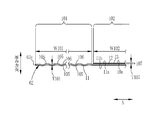
- the pressure-sensitive adhesive sheet material 62 includes knurlings 101 as examples of film thickness portions at both side ends in the width direction X. Since one side end and the other side end have the same configuration, only one side end side is shown in FIG.
- the pressure-sensitive adhesive sheet material 62 includes a pressure-sensitive adhesive part 102 in the center between both knurlings 101 in the width direction X.
- the pressure-sensitive adhesive portion 102 has the same configuration as the pressure-sensitive adhesive sheet 10 (see FIG. 1), that is, is formed from the pressure-sensitive adhesive sheet 10.
- hatching indicating a cross section is omitted in order to avoid complication of the drawing.
- the width of the pressure-sensitive adhesive sheet material 62 is not particularly limited, and is, for example, in the range of 100 mm to 1500 mm, and is 200 mm in the present embodiment.
- the length (hereinafter referred to as the knurling width) W101 of the knurling 101 in the width direction X is not particularly limited and is, for example, in the range of 5 mm to 50 mm, and is 25 mm in the present embodiment.
- the knurling width W101 is a distance from the side edge 62e of the pressure-sensitive adhesive sheet material 62 to the inner side edge of the knurling 101 in the width direction X.
- the length W102 of the pressure-sensitive adhesive portion 102 in the width direction X (hereinafter referred to as the pressure-sensitive adhesive portion width) W102 is not particularly limited and is, for example, in the range of 50 mm or more and 1000 mm or less, and is 120 mm in this embodiment.
- the pressure-sensitive adhesive portion width W102 is a distance from one side edge of the pressure-sensitive adhesive portion 102 in the width direction X to the other side edge.
- the knurling 101 is formed from the sheet base material 11 having a plurality of convex portions 105 on each of the one base material surface 11a and the other base material surface 11b.
- a concave portion between the convex portion 105 and the convex portion 105 is denoted by reference numeral 106.
- the sheet substrate 11 is a constituent member of both the knurling 101 and the pressure-sensitive adhesive portion 102, and is formed to have a larger width than the first adhesive layer 12 and the second adhesive layer 13.
- the convex portion 105 on the one base material surface 11a and the concave portion 106 on the other base material surface 11b are in a front-back relationship facing each other in the thickness direction, but the top portion of these convex portions 105 and the trough portion of the concave portion 106 have a width. It may be slightly deviated in at least one of the direction X and the longitudinal direction (the depth direction in FIG. 6).
- the convex portions 105 and the concave portions 106 have a truncated pyramid shape similar to the shapes of a first knurling roller 121 and a second knurling roller 122 described later.
- each shape of the convex part 105 and the concave part 106 is, for example, a truncated cone depending on the temperature of the first knurling roller 121 and the second knurling roller 122 and the pressing force by which the pressure-sensitive adhesive sheet material 62 is pressed. It is formed in a shape.
- the convex portion 105 and the concave portion 106 may have other shapes.
- the distance between the convex portion 105 and the convex portion 105 in the width direction X (hereinafter referred to as the convex portion pitch) is not particularly limited, and is generally constant at 1.5 mm in the present embodiment.
- the protrusion pitch is greatly exaggerated with respect to the thickness of the sheet base material 11 and the pressure-sensitive adhesive portion 102.
- a laminated portion from one surface of the pressure-sensitive adhesive portion 102 to the boundary between the first adhesive portion 12 and the sheet base material 11 is referred to as an adhesive laminated portion, and is denoted by reference numeral 107.
- the pressure-sensitive adhesive portion 102 is configured in the same manner as the pressure-sensitive adhesive sheet 10 (see FIG. 1) as described above, the “one surface” of the pressure-sensitive adhesive portion 102 is the first sheet of the pressure-sensitive adhesive sheet 10.
- the reference numeral 10a is also given in FIG.
- the distance in the thickness direction between the top of the convex portion 105 of the one base material surface 11a and the top of the convex portion 105 of the other base material surface 11b is defined as a thickness T101 of the knurling 101.
- the thickness T101 of the knurling 101 is larger than the thickness T107 of the adhesive laminate 107.
- the thickness T101 may be larger than 1.0 times the thickness T107, but is more preferably at least 1.5 times, that is, 1.5 times or more.
- the convex portion 105 formed on one base material surface 11a is formed so as to protrude from the one base material surface 11a in the pressure-sensitive adhesive portion 102, and is formed on the other base material surface 11a.
- the protruding portion 105 is formed so as to protrude from the other substrate surface 11b in the pressure-sensitive adhesive portion 102, but is not limited thereto.
- the convex portion 105 formed on one base material surface 11a may be formed at the same height as the one base material surface 11a in the pressure-sensitive adhesive portion 102, or formed on the other base material surface 11b.
- the projected portion 105 may be formed at the same height as the other base material surface 11 a in the pressure-sensitive adhesive portion 102.
- the convex part 105 is formed in both the base material surfaces 11a and 11b, it should just be formed in any one base material surface.
- the film thickness portion is not limited to the knurling 101, and is formed to have a thickness larger than the pressure-sensitive adhesive portion 107 of the pressure-sensitive adhesive portion 102, and the second adhesive layer 13 is not exposed on the surface, that is, is not exposed. Good.
- the film thickness part in which the tape material for providing thickness to each side edge of at least one base material surface 11a of the sheet base material 11 may be provided.
- the adhesion lamination part 107 is provided in the whole region in the width direction X of one base-material surface 11a, and the non-adhesive protective layer was provided on the 2nd adhesion layer 13 (refer FIG. 1) of each side end. It may be a film thickness portion.
- each film thickness portion including the knurling 101 is not limited to the pressure-sensitive adhesive sheet material 62 having a configuration in which the pressure-sensitive adhesive portion 102 includes the adhesive laminate portion 107, and an adhesive layer or an adhesive laminate portion that does not require a release sheet. It can be provided on the long pressure-sensitive pressure-sensitive adhesive sheet material provided, thereby preventing sticking between the sheet materials in a roll-like state even without a release sheet.
- the pressure-sensitive adhesive sheet material 62 having each film thickness portion such as the knurling 101 can be cut into a sheet shape from the pressure-sensitive adhesive portion 102 to form the pressure-sensitive adhesive sheet 10.
- the pressure-sensitive adhesive sheet material roll 64 it can be stored or transported because it does not stick to each other even without a release sheet. And at the time of use, it can cut out and use for the target size.
- the knurling 101 can be formed by a knurling device 120 as a film thickness increasing device shown in FIG.
- the knurling device 120 when manufacturing the pressure-sensitive adhesive sheet material 62 having the knurling 101, the knurling device 120 is provided between the drying device 36 (see FIG. 5) and the winding device 37 (see FIG. 5). It is manufactured by the manufactured sheet material manufacturing equipment.
- the coating device 33 does not form a coating film on both side ends of the long sheet base material 11, and is the center between one side end and the other side end in the width direction X (see FIG. 6). Form only on.
- the pressure sensitive adhesive sheet material 62 in which the knurling 101 is not formed is produced by the sheet material manufacturing facility 30 (see FIG.
- the pressure sensitive adhesive sheet material 62 is sent out from the pressure sensitive adhesive sheet material roll 64 obtained. May be fed to the knurling device 120 to give the knurling 101 to both side ends of the sheet base material 11. Also in this case, the coating film is formed only at the center between one side end and the other side end in the width direction X.
- the knurling 101 is applied to both side ends of the pressure-sensitive adhesive sheet material 62, so that the knurling device 120 includes a roller pair including a first knurling roller 121 and a second knurling roller 122 as shown in FIG. Two pairs are provided.
- the roller pair is arranged in a passing region through which each side end of the pressure-sensitive adhesive sheet material 62 passes in the conveyance path of the pressure-sensitive adhesive sheet material 62.
- the knurling device 120 includes a temperature control mechanism 125.
- the temperature control mechanism 125 controls the heaters (not shown) incorporated in the first knurling roller 121 and the second knurling roller 122, respectively.
- the temperature of the peripheral surface of the knurling roller 121 and the second knurling roller 122 is adjusted.
- the first knurling roller 121 and the second knurling roller 122 forming a pair are rotatably provided to face each other so that their rotation axes are parallel to each other. 62.
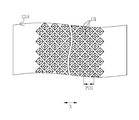
- the peripheral surface 121A of the first knurling roller 121 will be described in detail with reference to FIGS. Description of the peripheral surface of the roller 122 is omitted.
- a plurality of protrusions (knurling teeth) 131 are formed on the peripheral surface of the first knurling roller 121 in order to impart the knurling 101 to the pressure-sensitive adhesive sheet material 62.
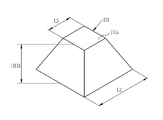
- the protrusion 131 has a truncated pyramid shape in this embodiment, more specifically, a truncated pyramid shape.
- the plurality of protrusions 131 are arranged in a matrix, a plurality of protrusions 131 may be arranged in a square arrangement.
- the protrusion groups whose number of rows in the width direction X is 15 and the protrusion groups whose number of rows is 16 are alternately arranged in the circumferential direction (up and down direction on the paper surface).
- the pitch P131 of the protrusions 131 in the width direction X is preferably in the range of 1.0 mm to 3.0 mm.
- the height 131 of the protrusion 131 is 0.5 mm
- L2 on one side of the bottom surface is 0.5 mm
- the length L3 on one side of the top surface 131a is 0.2 mm.
- the height H131 of the protrusion 131 is preferably in the range of 0.1 mm to 1.0 mm
- the length L2 is preferably in the range of 0.1 mm to 1.0 mm
- L3 is preferably in the range of 0.05 mm to 0.5 mm.
- the protrusion 131 is not limited to a truncated pyramid, and may be a truncated cone or other shapes.
- the first knurling roller 121 and the second knurling roller 122 are provided so that the protrusion 131 of the first knurling roller 121 and the recess between the protrusion 131 and the protrusion 131 of the second knurling roller 122 face each other.
- the first knurling roller 121 and the second knurling roller 122 are rotated by a motor (not shown) in a state where the pressure-sensitive adhesive sheet material 62 is sandwiched between the first knurling roller 121 and the second knurling roller 122.
- the rotation direction is the conveyance direction of the pressure-sensitive adhesive sheet material 62, that is, the first knurling roller 121 is counterclockwise in FIG.
- the second knurling roller 122 is clockwise in FIG.
- the first knurling roller 121 and the second knurling roller 122 press the pressure-sensitive adhesive sheet material 62 being conveyed in the thickness direction, thereby continuously forming the knurling 101 on the pressure-sensitive adhesive sheet material 62. (Knurling application process as a film thickness increasing process).
- the pressing force for pressing the pressure-sensitive adhesive sheet material 62 by the first knurling roller 121 and the second knurling roller 122 is 17 MPa in the present embodiment, but is not limited thereto, and depends on the thickness and temperature of the sheet substrate 11. And adjust as appropriate.
- Each peripheral surface temperature of the first knurling roller 121 and the second knurling roller 122 is adjusted to 90 ° C. in the present embodiment by the temperature control mechanism 125, but is not limited to this temperature. Within the range of °C or less is preferable.
- the film thickness forming step is performed after the coating step, but is not limited thereto, and may be performed before the coating step. That is, you may use for the application
- the pressure-sensitive adhesive sheet 70 includes a sheet base material 11, a first adhesive layer 12 disposed on one surface of the sheet base material 11, and a mixed layer 71 on the first adhesive layer 12. And a second adhesive layer 13 provided therebetween.
- the same members as those in FIG. 1 are denoted by the same reference numerals as those in FIG. 1, and description thereof is omitted.
- the pressure-sensitive adhesive sheet 70 is provided with the mixed layer 71 between the first adhesive layer 12 and the second adhesive layer 13.
- the mixed layer 71 is for further enhancing the adhesion between the first adhesive layer 12 and the second adhesive layer 13.
- the first silicone adhesive 15 and the second silicone adhesive 16 are mixed.
- the boundary between the mixed layer 71 and the second adhesive layer 13 is confirmed by the boundary of the presence or absence of the fine particles 18 in the thickness direction.
- the boundary between the mixed layer 71 and the second pressure-sensitive adhesive layer 13 is the presence or absence of fine particles as described above.
- TOF-SIMS Time-of-flight secondary ion mass spectrometer
- SEM-EDX Scanning Electron Microscope-Energy Dispersive X-ray Detector
- the boundary between the mixed layer 71 and the first adhesive layer 12 is colored by mixing a dye in one of the first coating liquid 41 and the second coating liquid 42 formed as described above, in this example,
- the pressure-sensitive adhesive sheet is produced by using the same method as in the case of the pressure-sensitive adhesive sheet 10 and is confirmed by observing the cross section.
- the boundary between the mixed layer 71 and the first pressure-sensitive adhesive layer 12 is defined by TOF-SIMS and SEM-EDX. It can also be confirmed by elemental analysis by means of scanning or observation by means of a scanning electron microscope (SEM, Scanning Electron Microscope) and a transmission electron microscope (TEM, Transmission Electron Microscope).
- TOF-SIMS irradiates a sample, which is an object to be analyzed, with a primary ion beam, and detects ions (secondary ions) emitted from the surface of the sample at that time (secondary ion mass spectrometry (SIMS)).
- SIMS secondary ion mass spectrometry
- the primary ions are irradiated onto the analysis surface exposed to the surface.
- a time-of-flight mass spectrometer (TOF-MS) is used as the mass spectrometer.
- TOF-MS time-of-flight mass spectrometer
- TOF-SIMS5 and Bi3 + primary ion gun manufactured by ION-TOF can be used.
- the first silicone adhesive 15 contained in the first coating solution 41 and the second silicone adhesive 16 contained in the second coating solution 42 diffuse in the coating film 61. Formed together. For this reason, the amount of the first silicone-based adhesive 15 in the mixed layer 71 gradually decreases from the first adhesive layer 12 toward the second adhesive layer 13, and this gradual decrease is continuous. Further, the amount of the second silicone adhesive 16 in the mixed layer 71 gradually increases from the first adhesive layer 12 toward the second adhesive layer 13, and this increase is continuous. Due to the distribution in the thickness direction of the first silicone pressure-sensitive adhesive 15 and the second silicone pressure-sensitive adhesive 16, the adhesion between the first pressure-sensitive adhesive layer 12 and the second pressure-sensitive adhesive layer 13 is more reliably increased. Yes.
- the thickness T71 of the mixed layer 71 is preferably at least 0.5 ⁇ m, and is 1.0 ⁇ m in this embodiment.
- the thickness T71 is more preferably in the range of 0.5 ⁇ m to 3.0 ⁇ m, more preferably in the range of 0.5 ⁇ m to 2.0 ⁇ m, and in the range of 0.5 ⁇ m to 1.5 ⁇ m. It is particularly preferred that
- the mass ratio of the 1st silicone adhesive 15 in the mixed layer 71 exists in the range of 10 mass% or more and 50 mass% or less.
- This mass ratio is a percentage obtained by (M15 / M71) ⁇ 100 when the mass of the mixed layer 71 is M71, the mass of the first silicone adhesive is M15, and the units of M71 and M15 are the same. is there.
- the mass ratio of the 1st silicone adhesive 15 in the mixed layer 71 is 10 mass% or more, and it is less than 10 mass%, the adhesive force of the 1st adhesion layer 12 and the 2nd adhesion layer 13 is shown. Is higher.
- the mass ratio of the 1st silicone adhesive 15 in the mixed layer 71 is 50 mass% or less, compared with the case where it is larger than 50 mass%, the 1st adhesion layer 12 and the 2nd adhesion layer 13 are compared. Higher adhesion.
- the pressure-sensitive adhesive sheet 70 is produced by cutting into a sheet form from a pressure-sensitive adhesive sheet material (not shown) manufactured in a long length using the sheet material manufacturing facility 30 described above.
- a difference is made between the ratio of the first solvent 51 in the first coating liquid 41 and the ratio of the second solvent 52 in the second coating liquid.
- the first organopolysiloxane 48 and the second organopolysiloxane 49 diffuse more reliably in the coating film 61.
- the difference between the ratio of the first solvent 51 in the first coating liquid 41 and the ratio of the second solvent 52 in the second coating liquid 42 is preferably in the range of more than 0% and less than 15%.
- the difference between the ratio of the first solvent 51 in the first coating liquid 41 and the ratio of the second solvent 52 in the second coating liquid 42 is more preferably in the range of 3% to less than 15%, more preferably 10% to 15%. More preferably, it is less than%.
- the ratio (unit:%) of the first solvent 51 in the first coating liquid 41 is determined by (M51 / M41) ⁇ 100, where M41 is the mass of the first coating liquid and M51 is the mass of the first solvent 51.
- the ratio (unit:%) of the second solvent 52 in the second coating liquid 42 is (M52 / M42) ⁇ 100 when the mass of the second coating liquid 42 is M42 and the mass of the second solvent 52 is M52. Ask for.
- the difference between the ratio of the first solvent 51 in the first coating liquid 41 and the ratio of the second solvent 52 in the second coating liquid 42 is obtained by
- the drying speed of the first half in the drying device 36 is smaller than the drying speed of the second half. Therefore, the first organopolysiloxane 48 and the second organopolysiloxane 49 are more reliably diffused in the coating film 61.
- the coating film is formed only in the center in the width direction X in this example, and the knurling 101 is applied to the side edge of the sheet base material 11.
- Example 1 to [Example 9]
- Nine types of pressure-sensitive adhesive sheet 62 having a coverage ratio RC shown in Table 1 are manufactured by using the fine particles 18 having an average particle diameter shown in Table 1 by the sheet material manufacturing facility 30, and each of them is cut into a rectangular shape and pressure-sensitive.
- a pressure-sensitive adhesive sheet 10 was obtained, and Examples 1 to 9 were obtained.
- toluene as the first solvent 51 was added to produce a first coating solution 41 having a solid content of 40% by mass.
- the fine particles 18 and toluene as the second solvent 52 are added to the first coating solution 41 so that the ratio of the fine particles 18 to the solid content is 25 mass%, and the solid content concentration is 40 mass%.
- a second coating solution 42 was prepared.
- the fine particles 18 fine particles made of silicone were used.
- the feeding speed of the sheet base material 11 was 10 m / min.
- the first coating liquid 41 and the second coating liquid 42 are used so that the thickness of the first pressure-sensitive adhesive layer 12 in the pressure-sensitive pressure-sensitive adhesive sheet 62 is 20 ⁇ m and the thickness of the second pressure-sensitive adhesive layer 12 is 20 ⁇ m.
- the temperature of the drying gas in the drying device 36 is set to 100 ° C. for each cross-linking of the first organopolysiloxane 48 and the second organopolysiloxane 49 and the evaporation of the first solvent 51 and the second solvent 52.
- the coating film 61 was dried and heated by passing through the drying device 36.
- Adhesive performance 1 Adhesive performance related to the scene before use (adhesive performance 1) A first pressure, i.e., a pressure of 1 N / cm ⁇ 2 >, was applied as the adhesive performance according to the pre-use scene, and the adhesive strength when this first pressure was applied was determined according to the above-described method and evaluated according to the following criteria. A to C are acceptable levels, and D is an unacceptable level. The evaluation results are shown in the “Adhesive performance 1” column of Table 1. A: Adhesive strength is 0.00 N / 25 mm.
- Adhesive strength is in the range of more than 0.00N / 25mm and 0.04N / 25mm or less.
- C Adhesive strength is in the range of greater than 0.04 N / 25 mm and less than or equal to 0.44 N / 25 mm.
- D Adhesive strength is greater than 0.44 N / 25 mm.
- Example 10 to [Example 15]
- the thicknesses of the first adhesive layer 12 and the second adhesive layer 13 of Example 7 were changed to the thicknesses shown in Table 2 to give Examples 10 and 11.
- the thicknesses of the first adhesive layer 12 and the second adhesive layer 13 of Example 8 were changed to the thicknesses shown in Table 2 to give Examples 12 and 13.
- the thicknesses of the first adhesive layer 12 and the second adhesive layer 13 of Example 9 were changed to the thicknesses shown in Table 2 to give Examples 14 and 15.
- the adhesive performance related to the preparation scene was evaluated according to the following criteria. Further, the pressure-sensitive adhesive sheets 10 obtained in Examples 7 to 9 were similarly evaluated for the adhesive performance according to the preparation scene. The evaluation results relating to the scene before use are shown in the “Adhesive performance 2” column of Table 2.
- Adhesive performance related to the preparation scene A pressure of 1.2 N / cm 2 corresponding to the second pressure was applied as the pressure-sensitive adhesive performance related to the preparation scene, and the pressure-sensitive adhesive strength in this case was determined according to the above-described method and evaluated according to the following criteria.
- A, B, and C are all acceptable levels, B is more preferable than C, and A is more preferable than B.
- A It is in the range of 1.00 N / 25 mm or more and 2.00 N / 25 mm or less.
- B It is in the range of larger than 2.00 N / 25mm and 3.00N / 25mm or less.
- C Greater than 3.00 N / 25 mm.
- Example 16 After forming the coating film 61 only at the center of the long sheet base material 11, the knurling apparatus 120 forms the knurlings 101 on both side ends of the sheet base material 11, thereby having pressure-sensitive adhesives having knurlings 101 having different thicknesses T101.
- An adhesive sheet material 62 was produced, and Examples 16 to 19 were obtained.
- the thickness T101 of each knurling 101 is shown in Table 3.
- the pressure-sensitive adhesive sheet material 62 has a width of 200 mm and a length of 50 m.
- the pressure-sensitive adhesive sheet material 62 was wound around a winding core 63 to form a pressure-sensitive adhesive sheet material roll 64. The other conditions until the pressure-sensitive adhesive sheet material 62 is obtained are the same as those in Example 1.
- the pressure-sensitive adhesive sheet material roll 64 was placed on the floor surface in a state where the width direction X was horizontal in an environment of a temperature of 25 ° C. and a relative humidity of 60%, and left for 2 days. After leaving, the pressure-sensitive adhesive sheet material roll 64 is unwound, and the 0.012 m sheet material region, which is the range of the pressure-sensitive adhesive sheet material 62 between 0.04 m and 0.052 m from the unwinding tip, is attached. The degree of attachment was evaluated. Evaluation is performed based on the following criteria, and the evaluation results are shown in Table 3. A to D are acceptable and E is unacceptable. A: There was no sticking to the sheet material region. B: Adhesion was confirmed in an area of less than 5% of the sheet material region.
- C Sticking was confirmed in an area of 5% or more and less than 25% of the sheet material region.
- D Adhesion was confirmed in an area of 25% or more and less than 50% of the sheet material region.
- E Sticking was confirmed in an area of 50% or more of the sheet material region.
Landscapes
- Chemical & Material Sciences (AREA)
- Organic Chemistry (AREA)
- Adhesives Or Adhesive Processes (AREA)
- Laminated Bodies (AREA)
- Adhesive Tapes (AREA)
Abstract
La présente invention concerne une feuille adhésive sensible à la pression de transparence élevée qui ne nécessite pas de feuille de libération, un élément de feuille adhésive sensible à la pression, et un procédé de production d'une feuille adhésive sensible à la pression. Une feuille adhésive sensible à la pression (10, 71) comprend un matériau de base (11) de feuille transparente, une première couche adhésive (12), et une seconde couche adhésive (13). La force adhésive due à une pression inférieure ou égale à 1 N/cm2 est de 0 N/25 mm. La première couche adhésive (12) comprend un premier adhésif (15) à base de silicone, et la seconde couche adhésive (13) comprend un second adhésif (16) à base de silicone et une pluralité de saillies (17) formées à partir d'une pluralité de particules fines (18). La première surface (10a) de la feuille est la surface appliquée sur l'objet à coller. La taille particulaire moyenne des particules fines (18) est de 2 à 15 µm, et la couverture de la première surface (10a) de la feuille par les particules fines (18) est de 10 à 70 %.
Priority Applications (1)
| Application Number | Priority Date | Filing Date | Title |
|---|---|---|---|
| US15/869,951 US20180134921A1 (en) | 2015-07-13 | 2018-01-12 | Pressure sensitive adhesive sheet, method for producing the same, and pressure sensitive adhesive sheet member |
Applications Claiming Priority (4)
| Application Number | Priority Date | Filing Date | Title |
|---|---|---|---|
| JP2015-139465 | 2015-07-13 | ||
| JP2015139465 | 2015-07-13 | ||
| JP2016-070694 | 2016-03-31 | ||
| JP2016070694A JP6427521B2 (ja) | 2015-07-13 | 2016-03-31 | 感圧粘着シート及びその製造方法、感圧粘着シート材、感圧粘着シート材ロール |
Related Child Applications (1)
| Application Number | Title | Priority Date | Filing Date |
|---|---|---|---|
| US15/869,951 Continuation US20180134921A1 (en) | 2015-07-13 | 2018-01-12 | Pressure sensitive adhesive sheet, method for producing the same, and pressure sensitive adhesive sheet member |
Publications (1)
| Publication Number | Publication Date |
|---|---|
| WO2017010140A1 true WO2017010140A1 (fr) | 2017-01-19 |
Family
ID=57757242
Family Applications (1)
| Application Number | Title | Priority Date | Filing Date |
|---|---|---|---|
| PCT/JP2016/062625 Ceased WO2017010140A1 (fr) | 2015-07-13 | 2016-04-21 | Feuille adhésive sensible à la pression, son procédé de production, et élément de feuille adhésive sensible à la pression |
Country Status (1)
| Country | Link |
|---|---|
| WO (1) | WO2017010140A1 (fr) |
Cited By (1)
| Publication number | Priority date | Publication date | Assignee | Title |
|---|---|---|---|---|
| WO2019188787A1 (fr) * | 2018-03-28 | 2019-10-03 | 東レ株式会社 | Film |
Citations (8)
| Publication number | Priority date | Publication date | Assignee | Title |
|---|---|---|---|---|
| JPS5813682A (ja) * | 1981-07-16 | 1983-01-26 | Nippon Carbide Ind Co Ltd | 感圧接着剤層 |
| JPH0572946U (ja) * | 1992-03-11 | 1993-10-05 | 日東電工株式会社 | 再剥離可能な粘着テープ又はシート |
| JP2005200505A (ja) * | 2004-01-14 | 2005-07-28 | Nitto Denko Corp | 加熱剥離型粘着シートおよび被着体の加工方法 |
| JP2006022181A (ja) * | 2004-07-07 | 2006-01-26 | Nitto Denko Corp | 粘着テープ又はシート |
| JP2010070585A (ja) * | 2008-09-16 | 2010-04-02 | Hitachi Chem Co Ltd | 両面粘着シートの製造方法及び両面粘着シート |
| JP2011175247A (ja) * | 2010-01-26 | 2011-09-08 | Nitto Denko Corp | 粘着型光学フィルムおよび画像表示装置 |
| JP2014040076A (ja) * | 2012-08-23 | 2014-03-06 | Fujimori Kogyo Co Ltd | アイコンシートの製造方法、アイコンシート及びそれを用いたタッチパネル |
| WO2014051106A1 (fr) * | 2012-09-28 | 2014-04-03 | リンテック株式会社 | Feuille adhésive et procédé de fabrication de feuille adhésive |
-
2016
- 2016-04-21 WO PCT/JP2016/062625 patent/WO2017010140A1/fr not_active Ceased
Patent Citations (8)
| Publication number | Priority date | Publication date | Assignee | Title |
|---|---|---|---|---|
| JPS5813682A (ja) * | 1981-07-16 | 1983-01-26 | Nippon Carbide Ind Co Ltd | 感圧接着剤層 |
| JPH0572946U (ja) * | 1992-03-11 | 1993-10-05 | 日東電工株式会社 | 再剥離可能な粘着テープ又はシート |
| JP2005200505A (ja) * | 2004-01-14 | 2005-07-28 | Nitto Denko Corp | 加熱剥離型粘着シートおよび被着体の加工方法 |
| JP2006022181A (ja) * | 2004-07-07 | 2006-01-26 | Nitto Denko Corp | 粘着テープ又はシート |
| JP2010070585A (ja) * | 2008-09-16 | 2010-04-02 | Hitachi Chem Co Ltd | 両面粘着シートの製造方法及び両面粘着シート |
| JP2011175247A (ja) * | 2010-01-26 | 2011-09-08 | Nitto Denko Corp | 粘着型光学フィルムおよび画像表示装置 |
| JP2014040076A (ja) * | 2012-08-23 | 2014-03-06 | Fujimori Kogyo Co Ltd | アイコンシートの製造方法、アイコンシート及びそれを用いたタッチパネル |
| WO2014051106A1 (fr) * | 2012-09-28 | 2014-04-03 | リンテック株式会社 | Feuille adhésive et procédé de fabrication de feuille adhésive |
Cited By (3)
| Publication number | Priority date | Publication date | Assignee | Title |
|---|---|---|---|---|
| WO2019188787A1 (fr) * | 2018-03-28 | 2019-10-03 | 東レ株式会社 | Film |
| JPWO2019188787A1 (ja) * | 2018-03-28 | 2021-02-12 | 東レ株式会社 | フィルム |
| JP7338466B2 (ja) | 2018-03-28 | 2023-09-05 | 東レ株式会社 | フィルム |
Similar Documents
| Publication | Publication Date | Title |
|---|---|---|
| JP5514817B2 (ja) | 再剥離性を有する粘着材 | |
| JP6427521B2 (ja) | 感圧粘着シート及びその製造方法、感圧粘着シート材、感圧粘着シート材ロール | |
| TWI765849B (zh) | 雙面黏著帶及其製造方法 | |
| KR102515861B1 (ko) | 첩부형 프로젝션 스크린 | |
| CN106463373A (zh) | 保护膜形成用复合片 | |
| CN106029815B (zh) | 粒状粘接剂 | |
| US20220228039A1 (en) | Repositionable adhesive sheets with pyramidal structures | |
| US10788414B2 (en) | Cover film for testing, testing member including cover film, and method of manufacturing cover film for testing | |
| CN105524565A (zh) | 各向异性粘着性片 | |
| JP4065602B2 (ja) | 粘着シート及び粘着シート接着構造体 | |
| JP5210700B2 (ja) | シリコーンゲルシートの製造方法 | |
| JPWO2008117677A1 (ja) | フォトマスク保護用粘着テープ | |
| JP6300788B2 (ja) | 両面粘着シート | |
| JP6626125B2 (ja) | 粘着剤組成物及び粘着テープ | |
| EP3240750B1 (fr) | Rouleaux enroulés en bande dotés d'un bord traité à micro-sphères et leurs procédés de fabrication | |
| WO2017010140A1 (fr) | Feuille adhésive sensible à la pression, son procédé de production, et élément de feuille adhésive sensible à la pression | |
| JP7037281B2 (ja) | 帯電防止性シリコーン粘着剤組成物および保護シート | |
| JPWO2009051059A1 (ja) | フォトマスク保護用粘着テープ | |
| JP6603795B2 (ja) | 感圧粘着フィルム | |
| JP7827104B2 (ja) | ロール体の製造方法およびロール体 | |
| JP6677812B2 (ja) | 感圧粘着シート | |
| JP2014174214A (ja) | 熱線制御シート | |
| CN106205359A (zh) | 一种防鼓包电子标签及其制作方法 | |
| JP2011153226A (ja) | フォトレジスト付着防止テープ | |
| TW202308849A (zh) | 機能性薄膜及其製造方法 |
Legal Events
| Date | Code | Title | Description |
|---|---|---|---|
| 121 | Ep: the epo has been informed by wipo that ep was designated in this application |
Ref document number: 16824121 Country of ref document: EP Kind code of ref document: A1 |
|
| NENP | Non-entry into the national phase |
Ref country code: DE |
|
| 122 | Ep: pct application non-entry in european phase |
Ref document number: 16824121 Country of ref document: EP Kind code of ref document: A1 |