WO2017010348A1 - 液晶組成物及びそれを使用した液晶表示素子 - Google Patents
液晶組成物及びそれを使用した液晶表示素子 Download PDFInfo
- Publication number
- WO2017010348A1 WO2017010348A1 PCT/JP2016/069872 JP2016069872W WO2017010348A1 WO 2017010348 A1 WO2017010348 A1 WO 2017010348A1 JP 2016069872 W JP2016069872 W JP 2016069872W WO 2017010348 A1 WO2017010348 A1 WO 2017010348A1
- Authority
- WO
- WIPO (PCT)
- Prior art keywords
- group
- liquid crystal
- formula
- general formula
- compound represented
- Prior art date
- Legal status (The legal status is an assumption and is not a legal conclusion. Google has not performed a legal analysis and makes no representation as to the accuracy of the status listed.)
- Ceased
Links
Images


Classifications
-
- C—CHEMISTRY; METALLURGY
- C09—DYES; PAINTS; POLISHES; NATURAL RESINS; ADHESIVES; COMPOSITIONS NOT OTHERWISE PROVIDED FOR; APPLICATIONS OF MATERIALS NOT OTHERWISE PROVIDED FOR
- C09K—MATERIALS FOR MISCELLANEOUS APPLICATIONS, NOT PROVIDED FOR ELSEWHERE
- C09K19/00—Liquid crystal materials
- C09K19/04—Liquid crystal materials characterised by the chemical structure of the liquid crystal components, e.g. by a specific unit
- C09K19/06—Non-steroidal liquid crystal compounds
- C09K19/08—Non-steroidal liquid crystal compounds containing at least two non-condensed rings
-
- C—CHEMISTRY; METALLURGY
- C09—DYES; PAINTS; POLISHES; NATURAL RESINS; ADHESIVES; COMPOSITIONS NOT OTHERWISE PROVIDED FOR; APPLICATIONS OF MATERIALS NOT OTHERWISE PROVIDED FOR
- C09K—MATERIALS FOR MISCELLANEOUS APPLICATIONS, NOT PROVIDED FOR ELSEWHERE
- C09K19/00—Liquid crystal materials
- C09K19/04—Liquid crystal materials characterised by the chemical structure of the liquid crystal components, e.g. by a specific unit
- C09K19/06—Non-steroidal liquid crystal compounds
- C09K19/32—Non-steroidal liquid crystal compounds containing condensed ring systems, i.e. fused, bridged or spiro ring systems
-
- G—PHYSICS
- G02—OPTICS
- G02F—OPTICAL DEVICES OR ARRANGEMENTS FOR THE CONTROL OF LIGHT BY MODIFICATION OF THE OPTICAL PROPERTIES OF THE MEDIA OF THE ELEMENTS INVOLVED THEREIN; NON-LINEAR OPTICS; FREQUENCY-CHANGING OF LIGHT; OPTICAL LOGIC ELEMENTS; OPTICAL ANALOGUE/DIGITAL CONVERTERS
- G02F1/00—Devices or arrangements for the control of the intensity, colour, phase, polarisation or direction of light arriving from an independent light source, e.g. switching, gating or modulating; Non-linear optics
- G02F1/01—Devices or arrangements for the control of the intensity, colour, phase, polarisation or direction of light arriving from an independent light source, e.g. switching, gating or modulating; Non-linear optics for the control of the intensity, phase, polarisation or colour
- G02F1/13—Devices or arrangements for the control of the intensity, colour, phase, polarisation or direction of light arriving from an independent light source, e.g. switching, gating or modulating; Non-linear optics for the control of the intensity, phase, polarisation or colour based on liquid crystals, e.g. single liquid crystal display cells
-
- G—PHYSICS
- G02—OPTICS
- G02F—OPTICAL DEVICES OR ARRANGEMENTS FOR THE CONTROL OF LIGHT BY MODIFICATION OF THE OPTICAL PROPERTIES OF THE MEDIA OF THE ELEMENTS INVOLVED THEREIN; NON-LINEAR OPTICS; FREQUENCY-CHANGING OF LIGHT; OPTICAL LOGIC ELEMENTS; OPTICAL ANALOGUE/DIGITAL CONVERTERS
- G02F1/00—Devices or arrangements for the control of the intensity, colour, phase, polarisation or direction of light arriving from an independent light source, e.g. switching, gating or modulating; Non-linear optics
- G02F1/01—Devices or arrangements for the control of the intensity, colour, phase, polarisation or direction of light arriving from an independent light source, e.g. switching, gating or modulating; Non-linear optics for the control of the intensity, phase, polarisation or colour
- G02F1/13—Devices or arrangements for the control of the intensity, colour, phase, polarisation or direction of light arriving from an independent light source, e.g. switching, gating or modulating; Non-linear optics for the control of the intensity, phase, polarisation or colour based on liquid crystals, e.g. single liquid crystal display cells
- G02F1/133—Constructional arrangements; Operation of liquid crystal cells; Circuit arrangements
- G02F1/1333—Constructional arrangements; Manufacturing methods
- G02F1/1343—Electrodes
-
- G—PHYSICS
- G02—OPTICS
- G02F—OPTICAL DEVICES OR ARRANGEMENTS FOR THE CONTROL OF LIGHT BY MODIFICATION OF THE OPTICAL PROPERTIES OF THE MEDIA OF THE ELEMENTS INVOLVED THEREIN; NON-LINEAR OPTICS; FREQUENCY-CHANGING OF LIGHT; OPTICAL LOGIC ELEMENTS; OPTICAL ANALOGUE/DIGITAL CONVERTERS
- G02F1/00—Devices or arrangements for the control of the intensity, colour, phase, polarisation or direction of light arriving from an independent light source, e.g. switching, gating or modulating; Non-linear optics
- G02F1/01—Devices or arrangements for the control of the intensity, colour, phase, polarisation or direction of light arriving from an independent light source, e.g. switching, gating or modulating; Non-linear optics for the control of the intensity, phase, polarisation or colour
- G02F1/13—Devices or arrangements for the control of the intensity, colour, phase, polarisation or direction of light arriving from an independent light source, e.g. switching, gating or modulating; Non-linear optics for the control of the intensity, phase, polarisation or colour based on liquid crystals, e.g. single liquid crystal display cells
- G02F1/133—Constructional arrangements; Operation of liquid crystal cells; Circuit arrangements
- G02F1/136—Liquid crystal cells structurally associated with a semi-conducting layer or substrate, e.g. cells forming part of an integrated circuit
- G02F1/1362—Active matrix addressed cells
- G02F1/1368—Active matrix addressed cells in which the switching element is a three-electrode device
Definitions
- the present invention relates to a liquid crystal composition and a liquid crystal display element that are useful as components for liquid crystal display devices and the like.
- Liquid crystal display elements are used in clocks, calculators, various household electrical devices, measuring devices, automotive panels, word processors, electronic notebooks, printers, computers, televisions, and the like.
- Typical liquid crystal display methods include TN (twisted nematic) mode, STN (super twisted nematic) mode, DS (dynamic light scattering) mode, GH (guest / host) mode, IPS (in-plane switching). Mode, FFS (fringe field switching) mode, OCB (optical compensation birefringence) mode, ECB (voltage controlled birefringence) mode, VA (vertical alignment) mode, CSH (color super homeotropic) mode, or FLC (ferroelectric) Liquid crystal).
- a high-quality and excellent IPS mode IPS mode and a kind of FFS mode liquid crystal display are widely used.
- the IPS mode and the FFS mode are transverse electric field modes using an electric field generated in the horizontal direction with respect to the substrate, and a liquid crystal material having a negative value of ⁇ can be used.
- a liquid crystal material having a negative ⁇ and a large absolute value for example, a liquid crystal composition using the following compound (A), compound (B), compound (C) and the like is known (see Patent Document 1).
- the problem to be solved by the present invention is that the viscosity ( ⁇ ) is sufficiently small without reducing the refractive index anisotropy ( ⁇ n) and the nematic phase-isotropic liquid phase transition temperature (Tni), and the rotational viscosity ( Using a liquid crystal composition having a sufficiently small negative dielectric anisotropy ( ⁇ ) with a sufficiently small ⁇ 1 ), a large elastic constant (K 33 ), and a large absolute value, it has high contrast and excellent display quality. Another object is to provide a liquid crystal display device.
- the present inventors have studied the configuration of various liquid crystal compositions, and can solve the above problems by using an FFS mode or IPS mode liquid crystal display element using a specific liquid crystal composition.
- the headline, the present invention has been completed.
- the present invention includes a first substrate and a second substrate disposed opposite to each other, a liquid crystal layer containing a liquid crystal composition sandwiched between the first substrate and the second substrate, and a first substrate And a second electrode provided on the first substrate and generating an electric field between the first electrode and the liquid crystal composition having the general formula (a)
- R a1 and R a2 each independently represents an alkyl group having 1 to 10 carbon atoms or an alkenyl group having 2 to 10 carbon atoms, and one —CH 2 — or Two or more non-adjacent —CH 2 — may be each independently substituted with —O— or —S—, and one or more hydrogen atoms present in the group are each May be independently substituted with a fluorine atom or a chlorine atom, M a1 and M a2 are each independently (b) a 1,4-phenylene group (one —CH ⁇ present in this group or two or more non-adjacent —CH ⁇ are replaced by —N ⁇ .
- a naphthalene-2,6-diyl group (one —CH ⁇ present in the group or two or more non-adjacent —CH ⁇ are replaced by —N ⁇ ). May be.)
- the group (b) and the group (c) are each independently substituted with a cyano group, a fluorine atom or a chlorine atom
- Z a1 and Z a2 are each independently a single bond, —CH ⁇ CH—, —C ⁇ C—, —CH 2 CH 2 —, — (CH 2 ) 4 —, —COO—, —OCO—, —OCH 2 —, —CH 2 O—, —OCF 2 — or —CF 2 O—, wherein one or more Z a1 represents —CH 2 CH 2 —, m a1 represents 1, 2 or 3, m a2 represents 0, 1 or 2, m a1 + m a2 is 1, 2 or 3, and when a plurality of M a1 and
- the liquid crystal display element of the present invention has a high contrast, an excellent display quality, and a fast response speed.
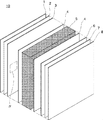
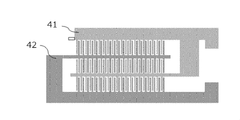
- FIG. 2 The figure which shows typically an example of a structure of the liquid crystal display element of this invention.
- FIG. 2 is a cross-sectional view of the liquid crystal display element shown in FIG. 1 taken along the line III-III in FIG.
- the liquid crystal composition of the present invention contains one or more compounds represented by the general formula (a).
- the compound represented by the general formula (a) is preferably a compound having a negative ⁇ and an absolute value larger than 3.
- R a1 is an alkyl group having 1 to 8 carbon atoms, an alkoxy group having 1 to 8 carbon atoms, an alkenyl group having 2 to 8 carbon atoms, or an alkenyloxy group having 2 to 8 carbon atoms.
- Preferred is an alkyl group having 1 to 5 carbon atoms, an alkoxy group having 1 to 5 carbon atoms, an alkenyl group having 2 to 5 carbon atoms, or an alkenyloxy group having 2 to 5 carbon atoms, and has 1 carbon atom.
- an alkyl group having 5 to 5 carbon atoms or an alkenyl group having 2 to 5 carbon atoms More preferably an alkyl group having 1 to 3 carbon atoms or an alkenyl group having 3 to 5 carbon atoms, and an alkyl group having 1 carbon atom ( Methyl group), an alkyl group having 2 carbon atoms (ethyl group), an alkyl group having 3 carbon atoms (propyl group), an alkenyl group having 4 carbon atoms (butenyl group), or an alkenyl group having 5 carbon atoms (pen Tenenyl group) is particularly preferable, and it is preferably linear.
- R a2 is preferably an alkyl group having 1 to 8 carbon atoms, an alkoxy group having 1 to 8 carbon atoms, an alkenyl group having 2 to 8 carbon atoms, or an alkenyloxy group having 2 to 8 carbon atoms.
- An alkyl group having 5 to 5 carbon atoms, an alkoxy group having 1 to 5 carbon atoms, an alkenyl group having 2 to 5 carbon atoms or an alkenyloxy group having 2 to 5 carbon atoms is preferable, and an alkoxy group having 1 to 4 carbon atoms is more preferable.
- it is linear.
- the alkenyl group is preferably selected from groups represented by any one of formulas (R1) to (R9), and particularly preferably formula (R8) or formula (R9).
- the black spot in each formula represents a carbon atom in the ring structure to which R a1 or R a2 is bonded.
- the alkenyloxy group is preferably selected from groups represented by any of the formulas (OR1) to (OR9), and particularly preferably the formula (OR8) or the formula (OR9).
- the black spot in each formula represents a carbon atom in the ring structure to which R a1 or R a2 is bonded.
- one or more Z a1 or Z a2 represents —CH 2 CH 2 —.
- a plurality of Z a1 preferably represents a single bond or —CH 2 CH 2 —, and one Z a1 represents —CH 2 CH 2 —, and the remaining one or It is preferable that two Z a1 represent a single bond.
- m a1 represents 2
- a plurality of Z a2 preferably represents a single bond or —CH 2 CH 2 —
- one Z a2 represents —CH 2 CH 2 —
- the remaining one Z a2 Preferably represents a single bond. More preferably, one or more Z a1 represents —CH 2 CH 2 —.
- M a1 or M a2 each independently represents a 1,4-phenylene group or a naphthalene-2,6-diyl group, and one hydrogen atom present in these groups is each independently a fluorine atom or chlorine When substituted by an atom, it preferably represents the following structure.
- M a1 or M a2 is preferably an unsubstituted 1,4-phenylene group or an unsubstituted naphthalene-2,6-diyl group, if M a1 or M a2 there are multiple More preferably, all M a1 or M a2 represent an unsubstituted 1,4-phenylene group or an unsubstituted naphthalene-2,6-diyl group. It is more preferable that represent one or more 1,4-phenylene group M a1 or M a2, M a1 or M a2 all M a1 or M a2 in the presence of two or more is 1,4 More preferably, it represents a phenylene group.
- m a1 preferably represents 1 or 2.
- m a2 preferably represents 0 or 1, and more preferably represents 0.
- the compound represented by the general formula (a) is preferably a compound represented by the following general formula (a1).
- X a1 and X a2 each independently represents a hydrogen atom or a fluorine atom, at least one of X a1 and X a2 represents a hydrogen atom, and R a1 , R a2 , Z a1 and m a1 Each independently represents the same meaning as R a1 , R a2 , Z a1 and m a1 in formula (a).
- X a1 and X a2 are more preferably hydrogen atoms.
- the compound represented by the general formula (a1) is preferably a compound represented by the general formula (a11).
- R a3 represents an alkyl group having 1 to 8 carbon atoms
- X a1 and X a2 each independently represent a hydrogen atom or a fluorine atom, but at least one of X a1 and X a2 is hydrogen.
- R a1 , Z a1 and m a1 each independently represent the same meaning as R a1 , Z a1 and m a1 in formula (a). It is preferable to contain 1 type, or 2 or more types of compounds represented by these.
- the compound represented by the general formula (a) is preferably a compound represented by the following general formula (a2).
- M a21 and M a22 each independently represent a 1,4-phenylene group or a naphthalene-2,6-diyl group, and one hydrogen atom present in the group is each independently fluorine.
- Z a2 is a single bond, —CH ⁇ CH—, —C ⁇ C—, —CH 2 CH 2 —, — (CH 2 ) 4 —, —COO—, —OCO -, -OCH 2- , -CH 2 O-, -OCF 2 -or -CF 2 O-,
- m i1 represents 0 or 1
- R a1 and R a2 each independently represent the general formula (a) Represents the same meaning as R a1 and R a2 in FIG .
- the compound represented by the general formula (a) preferably contains one or more compounds represented by the following general formulas (a-1) to (a-10).
- the liquid crystal composition of the present invention contains one or more compounds represented by the general formula (a), but preferably contains 2 to 10 compounds.
- the total amount of the compound represented by the general formula (a) is preferably 0.1% by mass or less (hereinafter,% in the composition represents% by mass) as a lower limit in the composition. 0.5% or more, preferably 1% or more, preferably 3% or more, preferably 4% or more, preferably 5% or more, 7% It is preferable to contain 10% or more, preferably 13% or more, preferably 15% or more, preferably 18% or more, and 20% or more. Preferably, it contains 23% or more, preferably contains 25% or more, preferably contains 28% or more, preferably contains 30% or more, contains 33% or more It is preferred, is preferably contained 35% or more, preferably it contains more than 38%, it is preferable to contain 40% or more.
- the upper limit is preferably 70% or less, preferably 68% or less, preferably 65% or less, preferably 63% or less, and preferably 60% or less. 55% or less, preferably 50% or less, preferably 40% or less, preferably 38% or less, preferably 35% or less, 33% or less Preferably 30% or less, preferably 28% or less, preferably 25% or less, preferably 23% or less, preferably 20% or less, It is preferable to contain 18% or less, preferably 15% or less, and preferably 10% or less.
- the liquid crystal composition of the present invention preferably further contains one or more compounds selected from the compound group represented by formulas (N-1) to (N-3).
- R N11 , R N12 , R N21 , R N22 , R N31 and R N32 each independently represents an alkyl group having 1 to 8 carbon atoms, and one or non-adjacent 2 in the alkyl group
- Two or more —CH 2 — may be each independently substituted by —CH ⁇ CH—, —C ⁇ C—, —O—, —CO—, —COO— or —OCO—
- a N11 , A N12 , A N21 , A N22 , A N31, and A N32 are each independently (a) a 1,4-cyclohexylene group (one —CH 2 — or adjacent to each other in this group).
- —CH 2 — may be replaced by —O—
- C Naphthalene-2,6-diyl group, 1,2,3,4-tetrahydronaphthalene-2,6-diyl group or decahydronaphthalene-2,6-diyl group (naphthalene-2,6- One —CH ⁇ present in a diyl group or 1,2,3,4-tetrahydronaphthalene-2,6-diyl group or two or more non-adjacent —CH ⁇ are replaced by —N ⁇ .
- the group (a), the group (b) and the group (c) may be each independently substituted with a cyano group, a fluorine atom or a chlorine atom
- R N11 , R N12 , R N21 , R N22 , R N31 and R N32 each independently represent 1 to 8 carbon atoms.
- An alkyl group having 1 to 8 carbon atoms, an alkenyl group having 2 to 8 carbon atoms, or an alkenyloxy group having 2 to 8 carbon atoms preferably an alkyl group having 1 to 5 carbon atoms
- An alkoxy group having 1 to 5 carbon atoms, an alkenyl group having 2 to 5 carbon atoms or an alkenyloxy group having 2 to 5 carbon atoms is preferable, and an alkyl group having 1 to 5 carbon atoms or an alkenyl group having 2 to 5 carbon atoms is preferable. More preferably, an alkyl group having 2 to 5 carbon atoms or an alkenyl group having 2 to 3 carbon atoms is more preferable, and an alkenyl group having 3 carbon atoms (propenyl group) is particularly preferable.
- the ring structure to which it is bonded is a phenyl group (aromatic)
- An alkenyl group having 4 to 5 atoms is preferable
- the ring structure to which the alkenyl group is bonded is a saturated ring structure such as cyclohexane, pyran and dioxane
- a straight-chain alkoxy group having 1 to 4 carbon atoms and a straight-chain alkenyl group having 2 to 5 carbon atoms are preferred.
- the total of carbon atoms and oxygen atoms, if present is preferably 5 or less, and is preferably linear.
- the alkenyl group is preferably selected from groups represented by any of the formulas (R1) to (R9). (The black dots in each formula represent carbon atoms in the ring structure.)
- a N11 , A N12 , A N21 , A N22 , A N31, and A N32 are preferably aromatic when it is required to increase ⁇ n independently, and in order to improve the response speed, fat
- fat Preferably a trans-1,4-cyclohexylene group, 1,4-phenylene group, 2-fluoro-1,4-phenylene group, 3-fluoro-1,4-phenylene group, 3,5 -Difluoro-1,4-phenylene group, 2,3-difluoro-1,4-phenylene group, 1,4-cyclohexenylene group, 1,4-bicyclo [2.2.2] octylene group, piperidine-1 , 4-diyl group, naphthalene-2,6-diyl group, decahydronaphthalene-2,6-diyl group or 1,2,3,4-tetrahydronaphthalene-2,6-diyl group Preferred, it is more preferable that represents the following
- it represents a trans-1,4-cyclohexylene group or a 1,4-phenylene group.
- Z N11, Z N12, Z N21 , Z N22, Z N31 and Z N32 -CH 2 each independently O -, - CF 2 O - , - CH 2 CH 2 -, - CF 2 CF 2 - or a single bond preferably represents an, -CH 2 O -, - CH 2 CH 2 - or a single bond is more preferable, -CH 2 O-or a single bond is particularly preferred.
- XN21 is preferably a fluorine atom.
- T N31 is preferably an oxygen atom.
- n N11 + n N12 , n N21 + n N22 and n N31 + n N32 are preferably 1 or 2, a combination in which n N11 is 1 and n N12 is 0, a combination in which n N11 is 2 and n N12 is 0, n A combination in which N11 is 1 and n N12 is 1, a combination in which n N11 is 2 and n N12 is 1, a combination in which n N21 is 1 and n N22 is 0, n N21 is 2 and n N22 is n A combination in which n N31 is 1 and n N32 is 0, and a combination in which n N31 is 2 and n N32 is 0 are preferable.
- the lower limit of the preferable content of the compound represented by the formula (N-1) with respect to the total amount of the composition of the present invention is 1%, 10%, 20%, 30% , 40%, 50%, 55%, 60%, 65%, 70%, 75%, and 80%.
- the upper limit of the preferred content is 95%, 85%, 75%, 65%, 55%, 45%, 35%, 25%, 20% It is.
- the lower limit of the preferable content of the compound represented by the formula (N-2) with respect to the total amount of the composition of the present invention is 1%, 10%, 20%, 30% , 40%, 50%, 55%, 60%, 65%, 70%, 75%, and 80%.
- the upper limit of the preferred content is 95%, 85%, 75%, 65%, 55%, 45%, 35%, 25%, 20% It is.
- the lower limit of the preferable content of the compound represented by the formula (N-3) with respect to the total amount of the composition of the present invention is 1%, 10%, 20%, 30% , 40%, 50%, 55%, 60%, 65%, 70%, 75%, and 80%.
- the upper limit of the preferred content is 95%, 85%, 75%, 65%, 55%, 45%, 35%, 25%, 20% It is.
- the total content of the compounds represented by the formulas (N-1) to (N-3) with respect to the total amount of the composition of the present invention is 3% by mass to 100% by mass in the liquid crystal composition.
- the lower limit of the preferable content of the compound selected from formula (N-1) to formula (N-3) with respect to the total amount of the composition of the present invention is 1%, %, 10%, 20%, 30%, 40%, 50%, 55%, 60%, 65%, 70%, 75 % And 80%.
- the upper limit of the preferred content is 95%, 85%, 75%, 65%, 55%, 50%, 45%, 35%, 25% And 20%.
- the above lower limit value is preferably low and the upper limit value is preferably low. Furthermore, when the composition of the present invention keeps Tni high and a composition having good temperature stability is required, the above lower limit value is preferably low and the upper limit value is preferably low. When it is desired to increase the dielectric anisotropy in order to keep the driving voltage low, it is preferable that the above lower limit value is increased and the upper limit value is high.
- the compound represented by the general formula (N-1) contains one or more compounds represented by the general formula (Ni).
- m Ni1 1 represents an integer of ⁇ 3
- m Ni @ 2 represents an integer of 0 ⁇ 3
- m Ni1 + m Ni2 is 1, 2 or 3 if a Ni1 and a Ni @ 2 there are a plurality, it is even al same May be different.
- m Ni1 is 1 or 2
- m Ni @ 2 represents 0 or 1
- m Ni1 + m Ni2 is preferably 1 or 2.
- the liquid crystal composition of the present invention preferably contains one or more compounds represented by the general formula (Ni).
- the compounds represented by the general formula (N-1) and the general formula (Ni) are compounds selected from the group of compounds represented by the general formulas (N-1-1) to (N-1-5). It is preferable.
- the compound represented by the general formula (N-1-1) is the following compound.
- R N111 and R N112 each independently represent the same meaning as R N11 and R N12 in formula (N-1)).
- R N111 is preferably an alkyl group having 1 to 5 carbon atoms or an alkenyl group having 2 to 5 carbon atoms, and preferably a propyl group or a pentyl group.
- RN112 is preferably an alkyl group having 1 to 5 carbon atoms, an alkenyl group having 4 to 5 carbon atoms, or an alkoxy group having 1 to 4 carbon atoms, and preferably an ethoxy group or a butoxy group.
- the compound represented by the general formula (N-1-1) can be used alone, or two or more compounds can be used in combination. There are no particular restrictions on the types of compounds that can be combined, but they are used in appropriate combinations according to the required properties such as solubility at low temperatures, transition temperatures, electrical reliability, and birefringence.
- the kind of the compound used is, for example, one kind as one embodiment of the present invention, two kinds, three kinds, four kinds, and five kinds or more.
- the lower limit of the preferable content of the compound represented by the formula (N-1-1) with respect to the total amount of the composition of the present invention is 5%, 10%, 13%, 15% 17%, 20%, 23%, 25%, 27%, 30%, 33%, 35%.
- the upper limit of the preferable content is 50%, 40%, 38%, 35%, 33%, 30%, and 28% with respect to the total amount of the composition of the present invention. %, 25%, 23%, 20%, 18%, 15%, 13%, 10%, 8%, 7%, 6% %, 5%, 3%.
- the compound represented by the general formula (N-1-1) is a compound selected from the group of compounds represented by the formula (N-1-1.1) to the formula (N-1-1.14).
- it is a compound represented by the formulas (N-1-1.1) to (N-1-1.4), and the formula (N-1-1.1) and the formula (N
- the compound represented by -1-1.3) is preferable.
- the compounds represented by the formulas (N-1-1.1) to (N-1-1.4) can be used alone or in combination.
- the lower limit of the preferred content of these compounds alone or with respect to the total amount is 5%, 10%, 13%, 15%, 17%, 20%, 23% 25% 27% 30% 33% 35%
- the upper limit of the preferable content is 50%, 40%, 38%, 35%, 33%, 30%, and 28% with respect to the total amount of the composition of the present invention. %, 25%, 23%, 20%, 18%, 15%, 13%, 10%, 8%, 7%, 6% %, 5%, 3%.
- the compound represented by the general formula (N-1-2) is the following compound.
- R N121 and R N122 each independently represent the same meaning as R N11 and R N12 in formula (N-1)).
- RN121 is preferably an alkyl group having 1 to 5 carbon atoms or an alkenyl group having 2 to 5 carbon atoms, and preferably an ethyl group, a propyl group, a butyl group or a pentyl group.
- RN122 is preferably an alkyl group having 1 to 5 carbon atoms, an alkenyl group having 4 to 5 carbon atoms, or an alkoxy group having 1 to 4 carbon atoms, and includes a methyl group, a propyl group, a methoxy group, an ethoxy group, or a propoxy group. preferable.
- the compound represented by the general formula (N-1-2) can be used alone, or two or more compounds can be used in combination. There are no particular restrictions on the types of compounds that can be combined, but they are used in appropriate combinations according to the required properties such as solubility at low temperatures, transition temperatures, electrical reliability, and birefringence.
- the kind of the compound used is, for example, one kind as one embodiment of the present invention, two kinds, three kinds, four kinds, and five kinds or more.
- the lower limit of the preferable content of the compound represented by the formula (N-1-2) with respect to the total amount of the composition of the present invention is 5%, 7%, 10%, 13% 15%, 17%, 20%, 23%, 25%, 27%, 30%, 33%, 35%, 37% 40% and 42%.
- the upper limit of the preferable content is 50%, 48%, 45%, 43%, 40%, 38%, and 35% with respect to the total amount of the composition of the present invention. %, 33%, 30%, 28%, 25%, 23%, 20%, 18%, 15%, 13%, 10% %, 8%, 7%, 6%, 5%.
- the compound represented by the general formula (N-1-2) is a compound selected from the group of compounds represented by the formula (N-1-2.1) to the formula (N-1-2.13).
- the compound represented by (N-1-2.13) is preferable, and when importance is placed on the improvement of ⁇ , the formula (N-1-2.3) to the formula (N-1-2.7) in the compounds represented, when emphasizing improvements in T NI formula (N-1-2.10), formula (N-1-2.11) and formula (N-1-2.13) It is preferable that it is a compound represented by these.
- the compounds represented by the formula (N-1-2.1) to the formula (N-1-2.13) can be used alone or in combination.
- the lower limit of the preferable content of these compounds alone or with respect to the total amount of is 5%, 10%, 13%, 15%, 17%, 20%, 23 %, 25%, 27%, 30%, 33%, and 35%.
- the upper limit of the preferable content is 50%, 40%, 38%, 35%, 33%, 30%, and 28% with respect to the total amount of the composition of the present invention. %, 25%, 23%, 20%, 18%, 15%, 13%, 10%, 8%, 7%, 6% %, 5%, 3%.
- the compound represented by the general formula (N-1-3) is the following compound.
- R N131 and R N132 each independently represent the same meaning as R N11 and R N12 in formula (N-1)).
- R N131 is preferably an alkyl group having 1 to 5 carbon atoms or an alkenyl group having 2 to 5 carbon atoms, and preferably an ethyl group, a propyl group or a butyl group.
- R N132 is preferably an alkyl group having 1 to 5 carbon atoms, an alkenyl group having 4 to 5 carbon atoms, or an alkoxy group having 1 to 4 carbon atoms, and preferably an ethoxy group, a propoxy group, or a butoxy group.
- the compound represented by the general formula (N-1-3) can be used alone, or two or more compounds can be used in combination. There are no particular restrictions on the types of compounds that can be combined, but they are used in appropriate combinations according to the required properties such as solubility at low temperatures, transition temperatures, electrical reliability, and birefringence.
- the kind of the compound used is, for example, one kind as one embodiment of the present invention, two kinds, three kinds, four kinds, and five kinds or more.
- the lower limit of the preferable content of the compound represented by the formula (N-1-3) with respect to the total amount of the composition of the present invention is 5%, 10%, 13%, 15% 17% and 20%.
- the upper limit of the preferable content is 35%, 30%, 28%, 25%, 23%, 20%, and 18% with respect to the total amount of the composition of the present invention. %, 15%, and 13%.
- the compound represented by the general formula (N-1-3) is a compound selected from the group of compounds represented by the formula (N-1-3.1) to the formula (N-1-3.11).
- it is a compound represented by the formulas (N-1-3.1) to (N-1-3.7), and the formula (N-1-3.1) and the formula (N -1-3.2), formula (N-1-3.3), formula (N-1-3.4) and compounds represented by formula (N-1-3.6) are preferred.
- the compounds represented by formula (N-1-3.1) to formula (N-1-3.4) and formula (N-1-3.6) may be used alone or in combination. Is possible, but the combination of formula (N-1-3.1) and formula (N-1-3.2), formula (N-1-3.3), formula (N-1-3.4) ) And a combination of two or three selected from formula (N-1-3.6) are preferred.
- the lower limit of the preferred content of these compounds alone or with respect to the total amount of the composition of the present invention is 5%, 10%, 13%, 15%, 17%, 20% %.
- the upper limit of the preferable content is 35%, 30%, 28%, 25%, 23%, 20%, and 18% with respect to the total amount of the composition of the present invention. %, 15%, and 13%.
- the compound represented by the general formula (N-1-4) is the following compound.
- R N141 and R N142 each independently represents the same meaning as R N11 and R N12 in the general formula (N-1).
- R N141 and R N142 are each independently an alkyl group having 1 to 5 carbon atoms, an alkenyl group or an alkoxy group having 1 to 4 carbon atoms carbon atoms 4-5 preferably a methyl group, a propyl group, an ethoxy Group or butoxy group is preferred.
- the compound represented by the general formula (N-1-4) can be used alone, or two or more compounds can be used in combination. There are no particular restrictions on the types of compounds that can be combined, but they are used in appropriate combinations according to the required properties such as solubility at low temperatures, transition temperatures, electrical reliability, and birefringence.
- the kind of the compound used is, for example, one kind as one embodiment of the present invention, two kinds, three kinds, four kinds, and five kinds or more.
- the lower limit of the preferable content of the compound represented by the formula (N-1-4) with respect to the total amount of the composition of the present invention is 3%, 5%, 7%, 10% 13%, 15%, 17%, 20%.
- the upper limit of the preferable content is 35%, 30%, 28%, 25%, 23%, 20%, and 18% with respect to the total amount of the composition of the present invention. %, 15%, 13%, 11%, 10%, and 8%.
- the compound represented by the general formula (N-1-4) is a compound selected from the group of compounds represented by the formula (N-1-4.1) to the formula (N-1-4.14).
- it is a compound represented by the formulas (N-1-4.1) to (N-1-4.4), and the formula (N-1-4.1) and the formula (N
- the compound represented by -1-4.2) is preferable.
- the compounds represented by formulas (N-1-4.1) to (N-1-4.4) can be used singly or in combination, but the compounds of the present invention
- the lower limit of the preferable content of these compounds alone or with respect to the total amount is 3%, 5%, 7%, 10%, 13%, 15%, 17% And 20%.
- the upper limit of the preferable content is 35%, 30%, 28%, 25%, 23%, 20%, and 18% with respect to the total amount of the composition of the present invention. %, 15%, 13%, 11%, 10%, and 8%.
- the compound represented by the general formula (N-1-5) is the following compound.
- R N151 and R N152 each independently represent the same meaning as R N11 and R N12 in formula (N-1).
- R N151 and R N152 are each independently an alkyl group having 1 to 5 carbon atoms, an alkenyl group having 4 to 5 carbon atoms, or an alkoxy group having 1 to 4 carbon atoms, and preferably an ethyl group, a propyl group, or a butyl group. Is preferred.
- the compound represented by the general formula (N-1-5) can be used alone, or two or more compounds can be used in combination. There are no particular restrictions on the types of compounds that can be combined, but they are used in appropriate combinations according to the required properties such as solubility at low temperatures, transition temperatures, electrical reliability, and birefringence.
- the kind of the compound used is, for example, one kind as one embodiment of the present invention, two kinds, three kinds, four kinds, and five kinds or more.
- the lower limit of the preferable content of the compound represented by the formula (N-1-5) with respect to the total amount of the composition of the present invention is 5%, 8%, 10%, 13% 15%, 17%, 20%.
- the upper limit of the preferable content is 35%, 33%, 30%, 28%, 25%, 23%, and 20% with respect to the total amount of the composition of the present invention. %, 18%, 15% and 13%.
- the compound represented by the general formula (N-1-5) is a compound selected from the group of compounds represented by the formula (N-1-5.1) to the formula (N-1-5.6). It is preferable that a compound represented by the formula (N-1-3.2 and the formula (N-1-3.4) is preferable.
- the compounds represented by formula (N-1-5.2) and formula (N-1-5.4) can be used alone or in combination, but the composition of the present invention
- the lower limit value of the preferred content of these compounds alone or with respect to the total amount of is 5%, 8%, 10%, 13%, 15%, 17%, 20% %.
- the upper limit of the preferable content is 35%, 33%, 30%, 28%, 25%, 23%, and 20% with respect to the total amount of the composition of the present invention. %, 18%, 15% and 13%.
- the compound represented by the general formula (N-1) contains one or more compounds represented by the general formula (N-ii).
- R Nii1 , R Nii2 and A Nii1 each independently represent the same meaning as R Nii1 , R Nii2 and A Nii1 in the general formula (N-1), and Z Nii1 represents —OCH 2 —, —CH 2 O -, - CF 2 O -, - OCF 2 -, - CH 2 CH 2 - or -CF 2 CF 2 - represents, Z Nii2 is -OCH 2 -, - CH 2 O -, - CF 2 O- , —OCF 2 —, —CH 2 CH 2 —, —CF 2 CF 2 — or a single bond, Z Nii2 directly bonded to R Nii1 represents a single bond, and m Nii1 represents an integer of 1 to 3.
- a Nii1 and A Nii2 may be the same or different when there are a plurality of A Nii1 and A Nii2 .
- the compounds represented by general formula (N-1) and general formula (N-ii) are compounds selected from the group of compounds represented by general formulas (N-1-10) to (N-1-17). It is preferable.
- the compound represented by the general formula (N-1-10) is the following compound.
- R N1101 and R N1102 each independently represent the same meaning as R N11 and R N12 in formula (N-1).
- R N1101 is preferably an alkyl group having 1 to 5 carbon atoms or an alkenyl group having 2 to 5 carbon atoms, and preferably an ethyl group, a propyl group or a butyl group.
- R N1102 is preferably an alkyl group having 1 to 5 carbon atoms, an alkenyl group having 4 to 5 carbon atoms, or an alkoxy group having 1 to 4 carbon atoms, and preferably an ethoxy group, a propoxy group, or a butoxy group.
- the compound represented by the general formula (N-1-10) can be used alone, or two or more compounds can be used in combination. There are no particular restrictions on the types of compounds that can be combined, but they are used in appropriate combinations according to the required properties such as solubility at low temperatures, transition temperatures, electrical reliability, and birefringence.
- the kind of the compound used is, for example, one kind as one embodiment of the present invention, two kinds, three kinds, four kinds, and five kinds or more.
- the lower limit of the preferable content of the compound represented by the formula (N-1-10) with respect to the total amount of the composition of the present invention is 5%, 10%, 13%, 15% 17% and 20%.
- the upper limit of the preferable content is 35%, 30%, 28%, 25%, 23%, 20%, and 18% with respect to the total amount of the composition of the present invention. %, 15%, and 13%.
- the compound represented by the general formula (N-1-10) is a compound selected from the group of compounds represented by the formula (N-1-10.1) to the formula (N-1-10.11).
- it is a compound represented by the formulas (N-1-10.1) to (N-1-10.5), and the formula (N-1-10.1) and the formula (N
- the compound represented by (1-10.2) is preferable.
- the compounds represented by the formula (N-1-10.1) and the formula (N-1-10.2) can be used alone or in combination.
- the lower limit of the preferable content of these compounds alone or with respect to the total amount is 5%, 10%, 13%, 15%, 17%, and 20%.
- the upper limit of the preferable content is 35%, 30%, 28%, 25%, 23%, 20%, and 18% with respect to the total amount of the composition of the present invention. %, 15%, and 13%.
- the compound represented by the general formula (N-1-11) is the following compound.
- R N1111 and R N1112 each independently represent the same meaning as R N11 and R N12 in formula (N-1).
- R N1111 is preferably an alkyl group having 1 to 5 carbon atoms or an alkenyl group having 2 to 5 carbon atoms, and preferably an ethyl group, a propyl group or a butyl group.
- R N1112 is preferably an alkyl group having 1 to 5 carbon atoms, an alkenyl group having 4 to 5 carbon atoms or an alkoxy group having 1 to 4 carbon atoms, and preferably an ethoxy group, a propoxy group or a butoxy group.
- the compound represented by the general formula (N-1-11) can be used alone, or two or more compounds can be used in combination. There are no particular restrictions on the types of compounds that can be combined, but they are used in appropriate combinations according to the required properties such as solubility at low temperatures, transition temperatures, electrical reliability, and birefringence.
- the kind of the compound used is, for example, one kind as one embodiment of the present invention, two kinds, three kinds, four kinds, and five kinds or more.
- the lower limit of the preferable content of the compound represented by the formula (N-1-11) with respect to the total amount of the composition of the present invention is 5%, 10%, 13%, 15% 17% and 20%.
- the upper limit of the preferable content is 35%, 30%, 28%, 25%, 23%, 20%, and 18% with respect to the total amount of the composition of the present invention. %, 15%, and 13%.
- the compound represented by the general formula (N-1-11) is a compound selected from the group of compounds represented by the formula (N-1-11.1) to the formula (N-1-11.15).
- it is a compound represented by the formulas (N-1-11.1) to (N-1-11.15), and is preferably a compound represented by the formula (N-1-11.2) or the formula (N-- The compound represented by 1-11.4) is preferable.
- the compounds represented by the formula (N-1-11.2) and the formula (N-1-11.4) can be used alone or in combination.
- the lower limit of the preferable content of these compounds alone or with respect to the total amount is 5%, 10%, 13%, 15%, 17%, and 20%.
- the upper limit of the preferable content is 35%, 30%, 28%, 25%, 23%, 20%, and 18% with respect to the total amount of the composition of the present invention. %, 15%, and 13%.
- the compound represented by the general formula (N-1-12) is the following compound.
- R N1121 and R N1122 each independently represent the same meaning as R N11 and R N12 in formula (N-1)).
- RN1121 is preferably an alkyl group having 1 to 5 carbon atoms or an alkenyl group having 2 to 5 carbon atoms, and preferably an ethyl group, a propyl group or a butyl group.
- RN1122 is preferably an alkyl group having 1 to 5 carbon atoms, an alkenyl group having 4 to 5 carbon atoms, or an alkoxy group having 1 to 4 carbon atoms, and preferably an ethoxy group, a propoxy group, or a butoxy group.
- the compound represented by the general formula (N-1-12) can be used alone, or two or more compounds can be used in combination. There are no particular restrictions on the types of compounds that can be combined, but they are used in appropriate combinations according to the required properties such as solubility at low temperatures, transition temperatures, electrical reliability, and birefringence.
- the kind of the compound used is, for example, one kind as one embodiment of the present invention, two kinds, three kinds, four kinds, and five kinds or more.
- the lower limit of the preferable content of the compound represented by the formula (N-1-12) with respect to the total amount of the composition of the present invention is 5%, 10%, 13%, 15% 17% and 20%.
- the upper limit of the preferable content is 35%, 30%, 28%, 25%, 23%, 20%, and 18% with respect to the total amount of the composition of the present invention. %, 15%, and 13%.
- the compound represented by the general formula (N-1-13) is the following compound.
- R N1131 and R N1132 each independently represent the same meaning as R N11 and R N12 in formula (N-1)).
- R N1131 is preferably an alkyl group having 1 to 5 carbon atoms or an alkenyl group having 2 to 5 carbon atoms, and preferably an ethyl group, a propyl group or a butyl group.
- R N1132 is preferably an alkyl group having 1 to 5 carbon atoms, an alkenyl group having 4 to 5 carbon atoms, or an alkoxy group having 1 to 4 carbon atoms, and preferably an ethoxy group, a propoxy group, or a butoxy group.
- the compound represented by the general formula (N-1-13) can be used alone, or two or more compounds can be used in combination. There are no particular restrictions on the types of compounds that can be combined, but they are used in appropriate combinations according to the required properties such as solubility at low temperatures, transition temperatures, electrical reliability, and birefringence.
- the kind of the compound used is, for example, one kind as one embodiment of the present invention, two kinds, three kinds, four kinds, and five kinds or more.
- the lower limit of the preferable content of the compound represented by the formula (N-1-13) with respect to the total amount of the composition of the present invention is 5%, 10%, 13%, 15% 17% and 20%.
- the upper limit of the preferable content is 35%, 30%, 28%, 25%, 23%, 20%, and 18% with respect to the total amount of the composition of the present invention. %, 15%, and 13%.
- the compound represented by the general formula (N-1-15) is the following compound.
- R N1151 and R N1152 each independently represent the same meaning as R N11 and R N12 in formula (N-1)).
- RN1151 is preferably an alkyl group having 1 to 5 carbon atoms or an alkenyl group having 2 to 5 carbon atoms, and preferably an ethyl group, a propyl group or a butyl group.
- R N1152 is preferably an alkyl group having 1 to 5 carbon atoms, an alkenyl group having 4 to 5 carbon atoms, or an alkoxy group having 1 to 4 carbon atoms, and preferably an ethoxy group, a propoxy group, or a butoxy group.
- the compound represented by the general formula (N-1-15) can be used alone, or two or more compounds can be used in combination. There are no particular restrictions on the types of compounds that can be combined, but they are used in appropriate combinations according to the required properties such as solubility at low temperatures, transition temperatures, electrical reliability, and birefringence.
- the kind of the compound used is, for example, one kind as one embodiment of the present invention, two kinds, three kinds, four kinds, and five kinds or more.
- the lower limit of the preferable content of the compound represented by the formula (N-1-15) with respect to the total amount of the composition of the present invention is 5%, 10%, 13%, 15% 17% and 20%.
- the upper limit of the preferable content is 35%, 30%, 28%, 25%, 23%, 20%, and 18% with respect to the total amount of the composition of the present invention. %, 15%, and 13%.
- the compound represented by the general formula (N-1-17) is the following compound.
- R N1171 and R N1172 each independently represent the same meaning as R N11 and R N12 in formula (N-1)).
- RN1171 is preferably an alkyl group having 1 to 5 carbon atoms or an alkenyl group having 2 to 5 carbon atoms, and preferably an ethyl group, a propyl group or a butyl group.
- R N1172 is preferably an alkyl group having 1 to 5 carbon atoms, an alkenyl group having 4 to 5 carbon atoms, or an alkoxy group having 1 to 4 carbon atoms, and preferably an ethoxy group, a propoxy group, or a butoxy group.
- the compound represented by the general formula (N-1-17) can be used alone, or two or more compounds can be used in combination. There are no particular restrictions on the types of compounds that can be combined, but they are used in appropriate combinations according to the required properties such as solubility at low temperatures, transition temperatures, electrical reliability, and birefringence.
- the kind of the compound used is, for example, one kind as one embodiment of the present invention, two kinds, three kinds, four kinds, and five kinds or more.
- the lower limit of the preferable content of the compound represented by the formula (N-1-17) with respect to the total amount of the composition of the present invention is 5%, 10%, 13%, 15% 17% and 20%.
- the upper limit of the preferable content is 35%, 30%, 28%, 25%, 23%, 20%, and 18% with respect to the total amount of the composition of the present invention. %, 15%, and 13%.
- the compound represented by the general formula (N-1) contains one or more compounds represented by the general formula (N-iii).
- R Nii1 , R Nii2 , A Nii1 , A Niii2 , Z Niii1 and Z Niii2 are each independently R Nii1 , R Nii2 , A Nii1 , A Nii1 , Z Niii1 , Z Z Niii2 represents the same meaning, m Niii1 represents an integer of 1 to 3, and when a plurality of A N11 and Z N11 are present, they may be the same or different.
- the compounds represented by general formula (N-1) and general formula (N-ii) are compounds selected from the group of compounds represented by general formulas (N-1-20) to (N-1-31). It is preferable.
- the compound represented by the general formula (N-1-20) is the following compound.
- R N1201 and R N1202 each independently represent the same meaning as R N11 and R N12 in formula (N-1).
- the compound represented by the general formula (N-1-21) is the following compound.
- R N1211 and R N1212 each independently represent the same meaning as R N11 and R N12 in formula (N-1).
- the compounds represented by general formula (N-1-22) to general formula (N-1-31) are the following compounds.
- R N11 and R N12 each independently represent the same meaning as R N11 and R N12 in formula (N-1)).
- the compound represented by the general formula (N-2) is preferably a compound selected from the group of compounds represented by the general formulas (N-2-1) to (N-2-3).
- the compound represented by the general formula (N-2-1) is the following compound.
- R N211 and R N212 each independently represents the same meaning as R N11 and R N12 in the general formula (N).
- the compound represented by the general formula (N-2-2) is the following compound.
- R N221 and R N222 each independently represents the same meaning as R N11 and R N12 in the general formula (N).
- the compound represented by the general formula (N-2-3) is the following compound.
- the compound represented by the general formula (N-3) is preferably a compound selected from the group of compounds represented by the general formulas (N-3-1) to (N-3-2).
- the compound represented by the general formula (N-3-1) is the following compound.
- R N311 and R N312 each independently represent the same meaning as R N11 and R N12 in formula (N).
- the compound represented by the general formula (N-3-2) is the following compound.
- the liquid crystal composition in the present invention preferably further contains one or more compounds represented by the general formula (L).
- the compound represented by the general formula (L) corresponds to a dielectrically neutral compound ( ⁇ value is ⁇ 2 to 2).
- R L1 and R L2 each independently represents an alkyl group having 1 to 8 carbon atoms, and one or two or more non-adjacent —CH 2 — in the alkyl group are each independently Optionally substituted by —CH ⁇ CH—, —C ⁇ C—, —O—, —CO—, —COO— or —OCO—, n L1 represents 0, 1, 2 or 3,
- a L1 , A L2 and A L3 each independently represent (a) a 1,4-cyclohexylene group (one —CH 2 — present in the group or two or more —CH 2 — not adjacent to each other).
- the group (a), the group (b) and the group (c) are each independently substituted with a cyano group, a fluorine atom or a chlorine atom
- a L2 and Z L3 may be the same or different.
- the compounds represented by the general formula (a), the general formula (N-1), the general formula (N-2), and the general formula (N-3) are excluded.
- the compound represented by general formula (L) may be used independently, it can also be used in combination.
- the types of compounds that can be combined but they are used in appropriate combinations according to desired properties such as solubility at low temperatures, transition temperatures, electrical reliability, and birefringence.
- the kind of the compound used is, for example, one kind as one embodiment of the present invention.
- the content of the compound represented by the general formula (L) is low-temperature solubility, transition temperature, electrical reliability, birefringence, process compatibility, dripping marks, image sticking, It is necessary to appropriately adjust according to required performance such as dielectric anisotropy.
- the content of the compound represented by the general formula (L) is preferably 0% by mass to 70% by mass in the liquid crystal composition.
- the lower limit of the preferable content of the compound represented by the formula (L) with respect to the total amount of the composition of the present invention is 1%, 10%, 20%, 30 %, 40%, 50%, 55%, 60%, 65%, 70%, 75%, and 80%.
- the upper limit of the preferable content is 95%, 85%, 75%, 65%, 55%, 45%, 35%, and 25%.
- the above lower limit value is preferably high and the upper limit value is preferably high. Furthermore, when the composition of the present invention maintains a high Tni and requires a composition having good temperature stability, the above lower limit value is preferably high and the upper limit value is preferably high. Further, when it is desired to increase the dielectric anisotropy in order to keep the driving voltage low, it is preferable that the above lower limit value is lowered and the upper limit value is low.
- R L1 and R L2 are preferably both alkyl groups, and when importance is placed on reducing the volatility of the compound, it is preferably an alkoxy group, and importance is placed on viscosity reduction. In this case, at least one is preferably an alkenyl group.
- R L1 and R L2 are each a linear alkyl group having 1 to 5 carbon atoms or a linear alkyl group having 1 to 4 carbon atoms when the ring structure to which R L1 is bonded is a phenyl group (aromatic).
- a phenyl group aromatic
- Alkyl groups, linear alkoxy groups having 1 to 4 carbon atoms and linear alkenyl groups having 2 to 5 carbon atoms are preferred.
- the total of carbon atoms and oxygen atoms, if present, is preferably 5 or less, and is preferably linear.
- the alkenyl group is preferably selected from groups represented by any of the formulas (R1) to (R9). (The black dots in each formula represent carbon atoms in the ring structure.)
- n L1 is preferably 0 when importance is attached to the response speed, 2 or 3 is preferred for improving the upper limit temperature of the nematic phase, and 1 is preferred for balancing these. In order to satisfy the properties required for the composition, it is preferable to combine compounds having different values.
- a L1 , A L2, and A L3 are preferably aromatic when it is required to increase ⁇ n, and are preferably aliphatic for improving the response speed, and are each independently trans- 1,4-cyclohexylene group, 1,4-phenylene group, 2-fluoro-1,4-phenylene group, 3-fluoro-1,4-phenylene group, 3,5-difluoro-1,4-phenylene group 1,4-cyclohexenylene group, 1,4-bicyclo [2.2.2] octylene group, piperidine-1,4-diyl group, naphthalene-2,6-diyl group, decahydronaphthalene-2,6 -It preferably represents a diyl group or a 1,2,3,4-tetrahydronaphthalene-2,6-diyl group, and more preferably represents the following structure:
- it represents a trans-1,4-cyclohexylene group or a 1,4-phenylene group.
- Z L1 and Z L2 are preferably single bonds when the response speed is important.
- the number of halogen atoms in the molecule is preferably 0 or 1.
- the compound represented by the general formula (L) is preferably a compound selected from the group of compounds represented by the general formulas (L-1) to (L-7).
- the compound represented by the general formula (L-1) is the following compound.
- R L11 and R L12 each independently represent the same meaning as R L1 and R L2 in the general formula (L).
- R L11 and R L12 are each independently a linear alkyl group having 1 to 5 carbon atoms or a linear alkyl group having 1 to 4 carbon atoms in order to reduce the viscosity.
- An alkoxy group and a linear alkenyl group having 2 to 5 carbon atoms are preferred.
- R L11 and R L12 is a linear alkenyl group having 2 to 5 carbon atoms. More preferably, one of R L11 and R L12 represents a linear alkenyl group having 2 to 5 carbon atoms, and the other represents a linear alkyl group having 1 to 5 carbon atoms.
- the compound represented by the general formula (L-1) can be used alone, or two or more compounds can be used in combination. There are no particular restrictions on the types of compounds that can be combined, but they are used in appropriate combinations according to the required properties such as solubility at low temperatures, transition temperatures, electrical reliability, and birefringence.
- the kind of the compound used is, for example, one kind as one embodiment of the present invention, two kinds, three kinds, four kinds, and five kinds or more.
- the lower limit of the preferable content is 1%, 2%, 3%, 5%, 7%, 10%, and 13% with respect to the total amount of the composition of the present invention.
- the upper limit of the preferable content is 95%, 90%, 85%, 80%, 75%, 70%, 65%, based on the total amount of the composition of the present invention. %, 60%, 55%, 50%, 45%, 40%, 35%, 30%, 25%.
- the above lower limit value is preferably high and the upper limit value is preferably high. Furthermore, when the composition of the present invention requires a high Tni and a composition having good temperature stability, it is preferable that the lower limit value is moderate and the upper limit value is moderate. When it is desired to increase the dielectric anisotropy in order to keep the driving voltage low, it is preferable that the lower limit value is low and the upper limit value is low.
- the compound represented by the general formula (L-1) is preferably a compound represented by the general formula (ii-1).
- R ii11 represents a hydrogen atom or a methyl group
- R ii2 represents the same meaning as R L21 in formula (L-1).
- the lower limit of the preferable content of the compound represented by the formula (ii-1) with respect to the total amount of the composition of the present invention is 1%, 5%, 10%, 15% 17%, 20%, 23%, 25%, 27%, 30%, 35%.
- the upper limit of the preferable content is 60%, 55%, 50%, 45%, 42%, 40%, and 38% with respect to the total amount of the composition of the present invention. %, 35%, 33%, and 30%.
- the compound represented by the general formula (ii-1) is preferably a compound selected from the group consisting of compounds represented by the formulas (ii-1.11) to (ii-1.13). -1.12) or a compound represented by formula (ii-1.13) is preferred, and a compound represented by formula (ii-1.13) is particularly preferred.
- the lower limit of the preferable content of the compound represented by the formula (ii-1.13) with respect to the total amount of the composition of the present invention is 1%, 2%, 3%, 5% 7%, 10% 13%, 15%.
- the upper limit of the preferable content is 30%, 25%, 20%, 15%, 13%, 10%, and 8% with respect to the total amount of the composition of the present invention. %, 7%, 6%, 5%, 3%.
- the compound represented by the general formula (ii-1) is preferably a compound selected from the group of compounds represented by the formulas (ii-1.21) to (ii-1.24).
- the compound represented by formula (ii-1.24) to (ii-1.22) is preferable.
- the compound represented by formula (ii-1.22) is preferable because the response speed of the composition of the present invention is particularly improved.
- the content of the compounds represented by formula (ii-1.23) and formula (ii-1.24) is not preferably 30% or more in order to improve solubility at low temperatures.
- the lower limit of the preferable content of the compound represented by formula (ii-1.22) with respect to the total amount of the composition of the present invention is 10%, 15%, 16%, 17% 18%, 20%, 21%, 22%, 23%, 25%, 27%, 30%, 33%, 35% 38% and 40%.
- the upper limit of the preferable content is 60%, 55%, 50%, 45%, 43%, 40%, and 38% with respect to the total amount of the composition of the present invention. %, 35%, 32%, 30%, 27%, 25%, and 22%.
- the compound represented by the general formula (ii-1) is preferably a compound selected from the compound group represented by the formula (ii-1.31) and the formula (ii-1.41).
- a compound represented by may contain at least one or more compounds R Ii11 represents a hydrogen atom in the general formula (ii-i) and R Ii11 of compounds represents a methyl group One or more of each may be contained. More specifically, in order to obtain a low viscosity or a low rotational viscosity, it is preferable that R ii11 contains more compounds in which a hydrogen atom is represented, and in order to obtain a large elastic constant, a compound in which R ii11 represents a methyl group. In order to obtain a liquid crystal display element having a high response speed, it is preferable to contain as much of these as possible.
- the composition of the present invention preferably contains a compound represented by the formula (ii-1.13) and a compound represented by the formula (ii-1.22), and is based on the total amount of the composition of the present invention.
- the lower limit value of the total content of all the compounds represented by the formula (ii-1.13) and the compound represented by the formula (ii-1.22) is 10%, 15%, 20%, 25%, 27%, 30%, 33%, 35%, 37%, and 40%.
- the upper limit of the preferable content is 60%, 55%, 50%, 45%, 43%, 40%, and 38% with respect to the total amount of the composition of the present invention. %, 35%, 32%, 30%, 27%, 25%, and 22%.
- the compound represented by the general formula (L-1) is preferably a compound selected from the group of compounds represented by the general formula (ii-2).
- R ii21 and R ii22 each independently represents an alkyl group having 1 to 8 carbon atoms or an alkoxy group having 1 to 8 carbon atoms
- R ii21 and R ii22 are preferably a linear alkyl group having 1 to 5 carbon atoms and a linear alkoxy group having 1 to 4 carbon atoms.
- the lower limit of the preferable content of the compound represented by the formula (ii-2) with respect to the total amount of the composition of the present invention is 1%, 5%, 10%, 13% 15%, 17%, 20%, 23%, 25%, 30%.
- the upper limit of the preferable content is 60%, 55%, 50%, 45%, 40%, 37%, and 35% with respect to the total amount of the composition of the present invention. %, 33%, 30%, 27%, 25%, 23%, 23%, 20%, 17%, 15%, 13%, 10% %.
- the compound represented by the general formula (ii-2) is preferably a compound selected from the group of compounds represented by the formula (ii-2.1) to the formula (ii-2.12)
- a compound represented by (ii-2.1), formula (ii-2.3) or formula (ii-2.4) is preferable.
- the compound represented by formula (ii-2.1) is preferable because the response speed of the composition of the present invention is particularly improved.
- Tni higher than the response speed it is expressed by the equations (ii-2.3), (ii-2.4), (ii-2.11), and (ii-2.12). It is preferable to use the compound.
- the total content of the compounds represented by formula (ii-2.3), formula (ii-2.4), formula (ii-2.11) and formula (ii-2.12) is It is not preferable to make it 20% or more in order to improve solubility.
- the lower limit of the preferable content of the compound represented by the formula (ii-2.1) with respect to the total amount of the composition of the present invention is 1%, 2%, 3%, 5% 7%, 10%, 13%, 15%, 18%, 20%.
- the upper limit of the preferable content is 20%, 17%, 15%, 13%, 10%, 8%, and 7% with respect to the total amount of the composition of the present invention. % And 6%.
- the compound represented by the general formula (L-1) is preferably a compound selected from the group of compounds represented by the general formula (ii-3) and / or (ii-4).
- R ii31 and R ii41 each independently represent the same meaning as R L12 in formula (L-1).
- R ii31 and R ii32 are preferably a linear alkyl group having 1 to 5 carbon atoms, a linear alkoxy group having 1 to 4 carbon atoms, and a linear alkenyl group having 2 to 5 carbon atoms. .
- the lower limit of the preferable content of the compound represented by the formula (ii-3) with respect to the total amount of the composition of the present invention is 1%, 5%, 10%, 13% 15%, 17%, and 20%.
- the upper limit of the preferable content is 25%, 23%, 20%, 17%, 15%, 13%, and 10% with respect to the total amount of the composition of the present invention. %.
- the lower limit of the preferable content of the compound represented by the formula (ii-4) with respect to the total amount of the composition of the present invention is 1%, 5%, 10%, 13% 15%, 17%, and 20%.
- the upper limit of the preferable content is 25%, 23%, 20%, 17%, 15%, 13%, and 10% with respect to the total amount of the composition of the present invention. %.
- the compounds represented by the general formulas (ii-3) and (ii-4) are compounds selected from the group of compounds represented by the formulas (ii-3.1) to (ii-4.3). Preferably, it is a compound represented by formula (ii-3.2) or formula (ii-4.2).
- the lower limit of the preferable content of the compound represented by the formula (ii-3.2) with respect to the total amount of the composition of the present invention is 1%, 2%, 3%, 5% 7%, 10%, 13%, 15%, 18%, 20%.
- the upper limit of the preferable content is 20%, 17%, 15%, 13%, 10%, 8%, and 7% with respect to the total amount of the composition of the present invention. % And 6%.
- Formula (ii-1.13), Formula (ii-1.22), Formula (ii-2.1), Formula (ii-2.3), Formula (ii-2.4), Formula (ii-2) .11) and two or more compounds selected from the compounds represented by formula (ii-2.12) are preferably combined, and the compounds represented by formula (ii-1.13), formula (ii-1.22), formula Combining two or more compounds selected from compounds represented by (ii-2.1), formula (ii-2.3), formula (ii-2.4) and formula (ii-3.2)
- the lower limit of the preferred content of the total content of these compounds is 1%, 2%, 3%, 5% with respect to the total amount of the composition of the present invention, 7%, 10%, 13%, 15%, 18%, 20%, 23%, 25%, 2% %, 30%, 33%, 35%, and the upper limit is 80%, 70%, 60%, and 50% with respect to the total amount of the composition of the present invention.
- the compound represented by the general formula (L-2) is the following compound.
- R L21 and R L22 each independently represent the same meaning as R L1 and R L2 in the general formula (L).
- R L21 is preferably an alkyl group having 1 to 5 carbon atoms or an alkenyl group having 2 to 5 carbon atoms
- R L22 is an alkyl group having 1 to 5 carbon atoms, an alkenyl group having 4 to 5 carbon atoms, or a carbon atom.
- An alkoxy group of 1 to 4 is preferable.
- the compound represented by the general formula (L-2) can be used alone, or two or more compounds can be used in combination. There are no particular restrictions on the types of compounds that can be combined, but they are used in appropriate combinations according to the required properties such as solubility at low temperatures, transition temperatures, electrical reliability, and birefringence.
- the kind of the compound used is, for example, one kind as one embodiment of the present invention, two kinds, three kinds, four kinds, and five kinds or more.
- the lower limit of the preferable content of the compound represented by the formula (L-2) with respect to the total amount of the composition of the present invention is 1%, 2%, 3%, 5% 7% and 10%.
- the upper limit of the preferable content is 20%, 15%, 13%, 10%, 8%, 7%, and 6% with respect to the total amount of the composition of the present invention. %, 5%, 3%.
- the compound represented by the general formula (L-2) is preferably a compound selected from the group of compounds represented by the formulas (L-2.1) to (L-2.6).
- a compound represented by formula (L-2.1), formula (L-2.3), formula (L-2.4) and formula (L-2.6) is preferred.
- the compound represented by the general formula (L-3) is the following compound.
- R L31 and R L32 each independently represent the same meaning as R L1 and R L2 in General Formula (L).
- R L31 and R L32 are each independently preferably an alkyl group having 1 to 5 carbon atoms, an alkenyl group having 4 to 5 carbon atoms, or an alkoxy group having 1 to 4 carbon atoms.
- the compound represented by the general formula (L-3) can be used alone, or two or more compounds can be used in combination. There are no particular restrictions on the types of compounds that can be combined, but they are used in appropriate combinations according to the required properties such as solubility at low temperatures, transition temperatures, electrical reliability, and birefringence.
- the kind of the compound used is, for example, one kind as one embodiment of the present invention, two kinds, three kinds, four kinds, and five kinds or more.
- the lower limit of the preferable content of the compound represented by the formula (L-3) with respect to the total amount of the composition of the present invention is 1%, 2%, 3%, 5% 7% and 10%.
- the upper limit of the preferable content is 20%, 15%, 13%, 10%, 8%, 7%, and 6% with respect to the total amount of the composition of the present invention. %, 5%, 3%.
- the effect is high when the content is set to be large.
- the effect is high when the content is set low.
- the compound represented by the general formula (L-3) is preferably a compound selected from the group of compounds represented by the formulas (L-3.1) to (L-3.9)
- a compound represented by formula (L-3.1) to formula (L-3.7) is preferred, and formula (L-3.1), formula (L-3.2), formula (L-3 .6) and (L-3.7) are preferred.
- the compound represented by the general formula (L-4) is the following compound.
- R L41 and R L42 each independently represent the same meaning as R L1 and R L2 in General Formula (L).
- R L41 is preferably an alkyl group having 1 to 5 carbon atoms or an alkenyl group having 2 to 5 carbon atoms
- R L42 is an alkyl group having 1 to 5 carbon atoms, an alkenyl group having 4 to 5 carbon atoms, or a carbon atom.
- An alkoxy group of 1 to 4 is preferable.
- the compound represented by the general formula (L-4) can be used alone, or two or more compounds can be used in combination.
- the kind of the compound used is, for example, one kind as one embodiment of the present invention, two kinds, three kinds, four kinds, and five kinds or more.
- the content of the compound represented by the general formula (L-4) is low-temperature solubility, transition temperature, electrical reliability, birefringence, process compatibility, dripping marks, It is necessary to adjust appropriately according to required performance such as image sticking and dielectric anisotropy.
- the lower limit of the preferable content of the compound represented by the formula (L-4) with respect to the total amount of the composition of the present invention is 1%, 2%, 3%, 5% 7%, 10%, 14%, 16%, 20%, 23%, 26%, 30%, 35%, 40% .
- the upper limit of the preferable content of the compound represented by the formula (L-4) with respect to the total amount of the composition of the present invention is 50%, 40%, 35%, and 30%. 20%, 15%, 10%, 5%.
- the compound represented by general formula (L-4) is preferably a compound represented by formula (L-4.1) to formula (L-4.3), for example.
- the lower limit of the preferable content of the compound represented by formula (L-4.1) or formula (L-4.2) with respect to the total amount of the composition of the present invention is 3%, Yes, 7%, 9%, 11%, 12%, 13%, 18%, 21%, and the preferred upper limit is 45, 40% , 35%, 30%, 25%, 23%, 20%, 18%, 15%, 13%, 10%, 8% .
- the amount of both compounds relative to the total amount of the composition of the present invention is The lower limit of the preferred content is 15%, 19%, 24%, and 30%, and the preferred upper limit is 45, 40%, 35%, and 30%. Yes, 25%, 23%, 20%, 18%, 15%, 13%.
- the compound represented by the general formula (L-4) is preferably, for example, a compound represented by the formula (L-4.4) to the formula (L-4.6). It is preferable that it is a compound represented by this.
- the formula (L -4.5) contains both the compound represented by formula (L-4.4) and the compound represented by formula (L-4.5). It may be.
- the lower limit of the preferable content of the compound represented by the formula (L-4.4) or the formula (L-4.5) with respect to the total amount of the composition of the present invention is 3%, Yes, 7%, 9%, 11%, 12%, 13%, 18%, 21%.
- Preferred upper limit values are 45, 40%, 35%, 30%, 25%, 23%, 20%, 18%, 15%, 13% %, 10%, and 8%.
- the amount of both compounds relative to the total amount of the composition of the present invention is The lower limit of the preferred content is 15%, 19%, 24%, and 30%, and the preferred upper limit is 45, 40%, 35%, and 30%. Yes, 25%, 23%, 20%, 18%, 15%, 13%.
- the compound represented by the general formula (L-4) is preferably a compound represented by the formula (L-4.7) to the formula (L-4.10), and particularly the formula (L-4.
- the compound represented by 9) is preferred.
- the compound represented by the general formula (L-5) is the following compound.
- R L51 and R L52 each independently represent the same meaning as R L1 and R L2 in the general formula (L).
- R L51 is preferably an alkyl group having 1 to 5 carbon atoms or an alkenyl group having 2 to 5 carbon atoms
- R L52 is an alkyl group having 1 to 5 carbon atoms, an alkenyl group having 4 to 5 carbon atoms, or a carbon atom.
- An alkoxy group of 1 to 4 is preferable.
- the compound represented by the general formula (L-5) can be used alone, or two or more compounds can be used in combination. There are no particular restrictions on the types of compounds that can be combined, but they are used in appropriate combinations according to the required properties such as solubility at low temperatures, transition temperatures, electrical reliability, and birefringence.
- the kind of the compound used is, for example, one kind as one embodiment of the present invention, two kinds, three kinds, four kinds, and five kinds or more.
- the content of the compound represented by the general formula (L-5) includes solubility at low temperature, transition temperature, electrical reliability, birefringence index, process suitability, dripping marks, It is necessary to adjust appropriately according to required performance such as image sticking and dielectric anisotropy.
- the lower limit of the preferable content of the compound represented by the formula (L-5) with respect to the total amount of the composition of the present invention is 1%, 2%, 3%, 5% 7%, 10%, 14%, 16%, 20%, 23%, 26%, 30%, 35%, 40% .
- the upper limit of the preferable content of the compound represented by the formula (L-5) with respect to the total amount of the composition of the present invention is 50%, 40%, 35%, and 30%. , 20%, 15%, 10%, 5%
- the compound represented by the general formula (L-5) is represented by the formula (L-5.1) or the formula (L-5.2).
- the compound represented by formula (L-5.1) is particularly desirable.
- the lower limit of the preferable content of these compounds with respect to the total amount of the composition of the present invention is 1%, 2%, 3%, 5%, and 7%.
- the upper limit of the preferable content of these compounds is 20%, 15%, 13%, 10%, and 9%.
- the compound represented by the general formula (L-5) is preferably a compound represented by the formula (L-5.3) or the formula (L-5.4).
- the lower limit of the preferable content of these compounds with respect to the total amount of the composition of the present invention is 1%, 2%, 3%, 5%, and 7%.
- the upper limit of the preferable content of these compounds is 20%, 15%, 13%, 10%, and 9%.
- the compound represented by the general formula (L-5) is preferably a compound selected from the group of compounds represented by the formulas (L-5.5) to (L-5.7).
- the compound represented by L-5.7) is preferred.
- the lower limit of the preferable content of these compounds with respect to the total amount of the composition of the present invention is 1%, 2%, 3%, 5%, and 7%.
- the upper limit of the preferable content of these compounds is 20%, 15%, 13%, 10%, and 9%.
- the compound represented by the general formula (L-6) is the following compound.
- R L61 and R L62 each independently represent the same meaning as R L1 and R L2 in the general formula (L), and X L61 and X L62 each independently represent a hydrogen atom or a fluorine atom.
- R L61 and R L62 are each independently preferably an alkyl group having 1 to 5 carbon atoms or an alkenyl group having 2 to 5 carbon atoms, and one of X L61 and X L62 is a fluorine atom and the other is a hydrogen atom. Is preferred.
- the compound represented by the general formula (L-6) can be used alone, or two or more compounds can be used in combination. There are no particular restrictions on the types of compounds that can be combined, but they are used in appropriate combinations according to the required properties such as solubility at low temperatures, transition temperatures, electrical reliability, and birefringence.
- the kind of the compound used is, for example, one kind as one embodiment of the present invention, two kinds, three kinds, four kinds, and five kinds or more.
- the lower limit of the preferable content of the compound represented by the formula (L-6) with respect to the total amount of the composition of the present invention is 1%, 2%, 3%, 5% 7%, 10%, 14%, 16%, 20%, 23%, 26%, 30%, 35%, 40% .
- the upper limit of the preferable content of the compound represented by the formula (L-6) with respect to the total amount of the composition of the present invention is 50%, 40%, 35%, and 30%. 20%, 15%, 10%, 5%.
- the compound represented by the general formula (L-6) is preferably a compound represented by the formula (L-6.1) to the formula (L-6.9).
- the compound represented by the general formula (L-6) is preferably, for example, a compound represented by the formula (L-6.10) to the formula (L-6.17).
- a compound represented by L-6.11) is preferable.
- the lower limit of the preferable content of these compounds with respect to the total amount of the composition of the present invention is 1%, 2%, 3%, 5%, and 7%.
- the upper limit of the preferable content of these compounds is 20%, 15%, 13%, 10%, and 9%.
- the compound represented by the general formula (L-7) is the following compound.
- R L71 and R L72 each independently represent the same meaning as R L1 and R L2 in Formula (L), A L71 and A L72 is A L2 and in the general formula (L) independently A L3 represents the same meaning, but the hydrogen atoms on A L71 and A L72 may be each independently substituted with a fluorine atom, Z L71 represents the same meaning as Z L2 in formula (L), X L71 and X L72 each independently represent a fluorine atom or a hydrogen atom.
- R L71 and R L72 are each independently preferably an alkyl group having 1 to 5 carbon atoms, an alkenyl group having 2 to 5 carbon atoms, or an alkoxy group having 1 to 4 carbon atoms, and
- a L71 and A L72 Are each independently preferably a 1,4-cyclohexylene group or a 1,4-phenylene group, the hydrogen atoms on A L71 and A L72 may be each independently substituted with a fluorine atom, and
- the kind of the compound used is, for example, one kind as one embodiment of the present invention, two kinds, three kinds, and four kinds.
- the content of the compound represented by the general formula (L-7) includes solubility at low temperature, transition temperature, electrical reliability, birefringence index, process suitability, dripping marks, It is necessary to adjust appropriately according to required performance such as image sticking and dielectric anisotropy.
- the lower limit of the preferable content of the compound represented by the formula (L-7) with respect to the total amount of the composition of the present invention is 1%, 2%, 3%, 5% 7%, 10%, 14%, 16%, 20%.
- the upper limit of the preferable content of the compound represented by the formula (L-7) with respect to the total amount of the composition of the present invention is 30%, 25%, 23%, and 20%. 18%, 15%, 10%, 5%.
- the content of the compound represented by formula (L-7) is preferably increased, and when an embodiment with low viscosity is desired, the content is It is preferable to reduce the amount.
- the compound represented by the general formula (L-7) is preferably a compound represented by the formula (L-7.1) to the formula (L-7.4), and the formula (L-7. It is preferable that it is a compound represented by 2).
- the compound represented by the general formula (L-7) is preferably a compound represented by the formula (L-7.11) to the formula (L-7.13). It is preferable that it is a compound represented by 11).
- the compound represented by the general formula (L-7) is a compound represented by the formula (L-7.21) to the formula (L-7.23).
- a compound represented by formula (L-7.21) is preferable.
- the compound represented by the general formula (L-7) is preferably a compound represented by the formula (L-7.31) to the formula (L-7.34), and the formula (L-7. 31) or / and a compound represented by the formula (L-7.32).
- the compound represented by the general formula (L-7) is preferably a compound represented by the formula (L-7.41) to the formula (L-7.44), and the formula (L-7. 41) or / and a compound represented by formula (L-7.42).
- the content of the compounds represented by general formula (a) and general formula (N-1) to general formula (N-3) is 5% or more as a lower limit in the composition. It is preferable to contain 10% or more, preferably 13% or more, preferably 15% or more, preferably 18% or more, and preferably 20% or more. 23% or more, preferably 25% or more, preferably 28% or more, preferably 30% or more, preferably 33% or more, 35% or more It is preferable to contain 38% or more, and 40% or more is preferable. Further, the upper limit value is preferably 100% or less, preferably 95% or less, preferably 90% or less, preferably 88% or less, and preferably 85% or less.
- the liquid crystal composition of the present invention preferably contains compounds represented by general formula (a) and general formula (Ni), and the total content of these compounds is the lower limit value in the composition. 5% or more, preferably 10% or more, preferably 13% or more, preferably 15% or more, preferably 18% or more, 20% or more It is preferable to contain, preferably 23% or more, preferably 25% or more, preferably 28% or more, preferably 30% or more, preferably 33% or more. , 35% or more, preferably 38% or more, and preferably 40% or more. Further, the upper limit is preferably 100% or less, preferably 99% or less, preferably 95% or less, preferably 90% or less, and preferably 85% or less.
- 50% or less preferably 40% or less, preferably 38% or less, preferably 35% or less, preferably 33% or less
- the liquid crystal composition of the present invention it is preferable to contain the compounds represented by the general formula (a) and the general formula (L), and the content of these compounds is 5% or more as a lower limit in the composition. It is preferable to contain 10% or more, preferably 13% or more, preferably 15% or more, preferably 18% or more, and preferably 20% or more. 23% or more, preferably 25% or more, preferably 28% or more, preferably 30% or more, preferably 33% or more, 35% or more It is preferable to contain 38% or more, and 40% or more is preferable. Further, the upper limit value is preferably 95% or less, preferably 90% or less, preferably 88% or less, preferably 85% or less, and preferably 83% or less.
- the liquid crystal composition of the present invention preferably contains the compounds represented by the general formula (a) and the general formula (L-1), and the total content of these compounds is the lower limit in the composition. It is preferable to contain 5% (% in the composition represents mass%) or more, preferably 10% or more, preferably 13% or more, and preferably 15% or more. 18% or more, preferably 20% or more, preferably 23% or more, preferably 25% or more, preferably 28% or more, preferably 30% or more It is preferable to contain 33% or more, preferably 35% or more, preferably 38% or more, and preferably 40% or more.
- the upper limit value is preferably 95% or less, preferably 90% or less, preferably 88% or less, preferably 85% or less, and preferably 83% or less. 80% or less, preferably 78% or less, preferably 75% or less, preferably 73% or less, preferably 70% or less, preferably 68% or less Preferably 65% or less, preferably 63% or less, preferably 60% or less, preferably 55% or less, preferably 50% or less, It is preferable to contain 40% or less.
- the lower limit is preferably 5% or more, preferably 80% or more, preferably 85% or more, preferably 88% or more, preferably 90% or more, It is preferable to contain 92% or more, preferably 95% or more, preferably 97% or more, preferably 98% or more, preferably 99% or more. It is preferable not to contain a compound.
- the upper limit is preferably 100% or less, preferably 90% or less, preferably 95% or less, preferably 98% or less, and preferably 99% or less. It is preferable that substantially no other compound is contained.
- substantially means that an unintentionally contained compound such as impurities inevitably generated during production is excluded.
- the total content of the compounds represented by the general formula (a), the general formula (N-1) and the general formula (L) is 5% or more as a lower limit in the composition. It is preferable to contain 80% or more, preferably 85% or more, preferably 88% or more, preferably 90% or more, and preferably 92% or more. 95% or more, preferably 97% or more, preferably 98% or more, preferably 99% or more, and substantially free of other compounds. Further, the upper limit value is preferably 90% or less, preferably 95% or less, preferably 98% or less, preferably 99% or less, and substantially contains other compounds. Preferably not.
- the liquid crystal composition of the present invention has a refractive index anisotropy ( ⁇ n) at 20 ° C. of 0.08 to 0.14, more preferably 0.09 to 0.13, and 0.09 to 0.12. Particularly preferred. More specifically, it is preferably 0.10 to 0.13 when dealing with a thin cell gap, and preferably 0.08 to 0.10 when dealing with a thick cell gap.
- the liquid crystal composition of the present invention has a viscosity ( ⁇ ) at 20 ° C. of 10 to 30 mPa ⁇ s, more preferably 10 to 25 mPa ⁇ s, and particularly preferably 10 to 22 mPa ⁇ s.
- the liquid crystal composition of the present invention has a rotational viscosity ( ⁇ 1 ) at 20 ° C. of 60 to 200 mPa ⁇ s, more preferably 60 to 120 mPa ⁇ s, and particularly preferably 60 to 100 mPa ⁇ s. .
- the liquid crystal composition of the present invention has a nematic phase-isotropic liquid phase transition temperature (T ni ) of 60 ° C. to 120 ° C., more preferably 70 ° C. to 100 ° C., and particularly preferably 70 ° C. to 85 ° C.
- T ni nematic phase-isotropic liquid phase transition temperature
- the liquid crystal composition of the present invention may contain a normal nematic liquid crystal, a smectic liquid crystal, a cholesteric liquid crystal, an antioxidant, an ultraviolet absorber, an infrared absorber, a polymerizable monomer, or a light stabilizer in addition to the above-described compounds. Good.
- the liquid crystal display element using the liquid crystal composition of the present invention is a display element in a transverse electric field mode that uses an electric field generated in a horizontal direction with respect to a substrate such as an FFS mode or an IPS mode.
- a transverse electric field mode that uses an electric field generated in a horizontal direction with respect to a substrate such as an FFS mode or an IPS mode.
- FIG. 1 is a diagram schematically showing a configuration of a liquid crystal display element.
- the liquid crystal display element 10 according to the present invention has a liquid crystal composition sandwiched between a first transparent insulating substrate 2 and a second transparent insulating substrate 7 that are arranged to face each other.
- the first transparent insulating substrate 2 has an electrode layer 3 formed on the surface on the liquid crystal layer 5 side.
- a pair of alignments that directly contact the liquid crystal composition constituting the liquid crystal layer 5 and induce homogeneous alignment between the liquid crystal layer 5 and the first transparent insulating substrate 2 and the second transparent insulating substrate 7.
- the film 4 is provided, and the liquid crystal molecules in the liquid crystal composition are aligned so as to be substantially parallel to the substrates 2 and 7 when no voltage is applied.
- the first substrate 2 and the second substrate 7 may be sandwiched between a pair of polarizing plates 1 and 8.
- a color filter 6 is provided between the second substrate 7 and the alignment film 4.
- the liquid crystal display element 10 includes a first polarizing plate 1, a first substrate 2, an electrode layer 3 including a thin film transistor, an alignment film 4, a liquid crystal layer 5 including a liquid crystal composition,
- the alignment film 4, the color filter 6, the second substrate 7, and the second polarizing plate 8 are sequentially stacked.
- the first substrate 2 and the second substrate 7 can be made of a transparent material having flexibility such as glass or plastic, and one of them can be an opaque material such as silicon.
- the two substrates 2 and 7 are bonded together by a sealing material and a sealing material such as an epoxy thermosetting composition disposed in the peripheral region, and in order to maintain the distance between the substrates, for example, Spacer columns made of resin formed by granular spacers such as glass particles, plastic particles, alumina particles, or a photolithography method may be arranged.
- FIG. 2 is an enlarged plan view of a region surrounded by the II line of the electrode layer 3 formed on the substrate 2 in FIG.
- FIG. 3 is a cross-sectional view of the liquid crystal display element shown in FIG. 1 cut along the line III-III in FIG.
- the electrode layer 3 including thin film transistors formed on the surface of the first substrate 2 includes a plurality of gate bus lines 26 for supplying scanning signals and a plurality of gate bus lines 26 for supplying display signals.
- Data bus lines 25 are arranged in a matrix so as to cross each other. In FIG. 2, only a pair of gate bus lines 25 and a pair of data bus lines 24 are shown.
- a unit pixel of the liquid crystal display device is formed by a region surrounded by the plurality of gate bus lines 26 and the plurality of data bus lines 25, and a pixel electrode 21 and a common electrode 22 are formed in the unit pixel. .
- a thin film transistor including a source electrode 27, a drain electrode 24, and a gate electrode 28 is provided in the vicinity of an intersection where the gate bus line 26 and the data bus line 25 intersect each other.
- the thin film transistor is connected to the pixel electrode 21 as a switch element that supplies a display signal to the pixel electrode 21.
- a common line 29 is provided in parallel with the gate bus line 26.
- the common line 29 is connected to the common electrode 22 in order to supply a common signal to the common electrode 22.
- a preferred embodiment of the structure of the thin film transistor is provided, for example, as shown in FIG. 3 so as to cover the gate electrode 11 formed on the surface of the substrate 2 and the gate electrode 11 and cover the substantially entire surface of the substrate 2.
- a protective film provided to cover a part of the surface of the gate insulating layer 12, the semiconductor layer 13 formed on the surface of the gate insulating layer 12 so as to face the gate electrode 11, and the semiconductor layer 17.
- a drain electrode 16 provided so as to cover one side end of the protective layer 14 and the semiconductor layer 13 and to be in contact with the gate insulating layer 12 formed on the surface of the substrate 2, and the protection
- a source electrode 17 which covers the film 14 and the other side end of the semiconductor layer 13 and is in contact with the gate insulating layer 12 formed on the surface of the substrate 2;
- Has an insulating protective layer 18 provided to cover the electrode 16 and the source electrode 17, a.
- An anodic oxide film (not shown) may be formed on the surface of the gate electrode 11 for reasons such as eliminating a step with the gate electrode.
- Amorphous silicon, polycrystalline polysilicon, or the like can be used for the semiconductor layer 13, but when a transparent semiconductor film such as ZnO, IGZO (In—Ga—Zn—O), ITO, or the like is used, it results from light absorption. It is also preferable from the viewpoint of suppressing the adverse effect of optical carriers and increasing the aperture ratio of the element.
- an ohmic contact layer 15 may be provided between the semiconductor layer 13 and the drain electrode 16 or the source electrode 17 for the purpose of reducing the width and height of the Schottky barrier.
- a material in which an impurity such as phosphorus such as n-type amorphous silicon or n-type polycrystalline polysilicon is added at a high concentration can be used.
- the gate bus line 26, the data bus line 25, and the common line 29 are preferably metal films, more preferably Al, Cu, Au, Ag, Cr, Ta, Ti, Mo, W, Ni, or an alloy thereof, Al or Cu
- the case of using the alloy wiring is particularly preferable.
- the insulating protective layer 18 is a layer having an insulating function, and is formed of silicon nitride, silicon dioxide, silicon oxynitride film, or the like.
- the common electrode 22 is a flat electrode formed on almost the entire surface of the gate insulating layer 12, while the pixel electrode 21 is an insulating protective layer 18 covering the common electrode 22. It is a comb-shaped electrode formed on the top. That is, the common electrode 22 is disposed at a position closer to the first substrate 2 than the pixel electrode 21, and these electrodes are disposed so as to overlap each other via the insulating protective layer 18.
- the pixel electrode 21 and the common electrode 22 are formed of a transparent conductive material such as ITO (Indium Tin Oxide), IZO (Indium Zinc Oxide), IZTO (Indium Zinc Tin Oxide), and the like. Since the pixel electrode 21 and the common electrode 22 are formed of a transparent conductive material, the area opened by the unit pixel area increases, and the aperture ratio and transmittance increase.
- the pixel electrode 21 and the common electrode 22 have a horizontal inter-electrode distance: R on the substrate between the pixel electrode 21 and the common electrode 22.
- the distance between 2 and the second substrate 7 is smaller than G.
- the distance between electrodes: R represents the distance in the horizontal direction on the substrate between the electrodes.
- the distance between the second substrate 7 and the second substrate 7 (ie, the cell gap) is smaller than G, so that a fringe electric field E is formed.
- the FFS type liquid crystal display element can utilize a horizontal electric field (lateral electric field) formed in a direction perpendicular to a line forming the comb shape of the pixel electrode 21 and a parabolic electric field.
- the electrode width of the comb-shaped portion of the pixel electrode 21: l and the width of the gap of the comb-shaped portion of the pixel electrode 21: m are such that all the liquid crystal molecules in the liquid crystal layer 5 can be driven by the generated electric field. It is preferable to form.
- the color filter 6 preferably forms a black matrix (not shown) in a portion corresponding to the thin film transistor and the storage capacitor 23 from the viewpoint of preventing light leakage.
- FIG. 4 is a diagram schematically showing the alignment direction of the liquid crystal induced by the alignment film 4.
- a liquid crystal composition having negative dielectric anisotropy is used.
- the angle ⁇ formed by the x-axis and the major axis direction of the liquid crystal molecules 30 is preferably approximately 0 to 45 °.
- the angle ⁇ formed by the x-axis and the major axis direction of the liquid crystal molecules 30 is approximately 0 ° is shown. The reason for inducing the alignment direction of the liquid crystal is to increase the maximum transmittance of the liquid crystal display device.
- the polarizing plate 1 and the polarizing plate 8 can be adjusted so that the viewing angle and the contrast are good by adjusting the polarizing axis of each polarizing plate, and the transmission axes thereof operate in the normally black mode.
- any one of the polarizing plate 1 and the polarizing plate 8 is preferably arranged so as to have a transmission axis parallel to the alignment direction of the liquid crystal molecules 30.
- a retardation film for widening the viewing angle can also be used.
- the FFS mode liquid crystal display device 10 configured as described above generates a fringe electric field between the pixel electrode 21 and the common electrode 22 by supplying an image signal (voltage) to the pixel electrode 21 through the thin film TFT.
- the liquid crystal is driven by this electric field. That is, in a state where no voltage is applied, the liquid crystal molecules 30 are arranged so that the major axis direction thereof is parallel to the alignment direction of the alignment film 4.
- an equipotential line of a parabolic electric field is formed between the pixel electrode 21 and the common electrode 22 up to the upper part of the pixel electrode 21 and the common electrode 22, and the liquid crystal molecules 30 in the liquid crystal layer 5 are formed.
- the liquid crystal layer 5 is rotated along the generated electric field.
- the major axis direction of the liquid crystal molecules 30 rotates so as to be perpendicular to the generated electric field direction.
- the liquid crystal molecules 30 located near the pixel electrode 21 are easily affected by the fringe electric field, the liquid crystal molecules 30 having a negative dielectric anisotropy have a polarization direction on the minor axis of the molecule, so Does not rotate in a direction perpendicular to the alignment film 4, and the major axis direction of all the liquid crystal molecules 30 in the liquid crystal layer 5 can be maintained parallel to the alignment film 4. Therefore, excellent transmittance characteristics can be obtained as compared with the FFS type liquid crystal display element using the liquid crystal molecules 30 having positive dielectric anisotropy.
- FIG. 5 is another example of a plan view in which the region surrounded by the II line of the electrode layer 3 formed on the substrate 2 in FIG. 1 is enlarged.
- the pixel electrode 21 may have a slit.
- the slit pattern may be formed to have an inclination angle with respect to the gate bus line 26 or the data bus line 25.
- FIG. 6 is another example of a cross-sectional view of the liquid crystal display element shown in FIG. 1 cut along the line III-III in FIG.
- FIG. 3 shows an example in which the common electrode 22 is formed on the gate insulating film 12.
- the common electrode 22 is formed on the first substrate 2,
- the pixel electrode 21 may be provided via the gate insulating film 12.
- the electrode width of the pixel electrode 21: l, the electrode width of the common electrode 22: n, and the interelectrode distance: R are appropriately adjusted to such a width that all liquid crystal molecules in the liquid crystal layer 5 can be driven by the generated electric field. It is preferable.
- the IPS mode liquid crystal display element is formed on the substrate between the pixel electrode and the common electrode so that the distance between electrodes in the horizontal direction: R is smaller than the distance between the first substrate and the second substrate facing each other: G. Is done. Therefore, in the liquid crystal display element of the IPS mode, the pixel electrode may be provided on the liquid crystal layer side from the common electrode as shown in FIG. 6, and the pixel electrode 41 and the common electrode 42 are on the same surface as shown in FIG. May be provided in a state of being engaged with each other.
- the contrast is improved.
- a liquid crystal composition having a negative ⁇ is applied to a horizontal electric field type liquid crystal display element
- the liquid crystal molecules are aligned so as to be parallel to the substrate surface using an alignment film or the like that induces homogeneous alignment.
- the fluctuation of the alignment of liquid crystal molecules is reduced. That is, when the liquid crystal composition of the present invention is used, the alignment order of the liquid crystal molecules is maintained, and as a result, the black color of the display element is excellent and the contrast is improved. This effect is presumed to be attributable to the inherently high elastic constant of the liquid crystal composition.
- the measured characteristics are as follows.
- Example 1-1 to 10 Liquid crystal compositions of Examples 1-1 to 10 and Comparative Examples 1 to 10 shown in Tables 1 to 9 below were prepared, and their physical properties were measured. The composition of the liquid crystal composition and the results of its physical property values are shown in Tables 1 to 9. Each liquid crystal composition was injected into the FFS mode liquid crystal display element panel shown in FIGS. 1 to 4 to produce an FFS mode liquid crystal display element, and the contrast was evaluated.
- IPS mode liquid crystal display elements were fabricated using the liquid crystal compositions used in Examples 1-1 to 1-9, and similar results were obtained.
- liquid crystal compositions of Examples 1-1 to 10 were more excellent in response and display defects than Comparative Examples 1-10.
Landscapes
- Physics & Mathematics (AREA)
- Chemical & Material Sciences (AREA)
- Nonlinear Science (AREA)
- Crystallography & Structural Chemistry (AREA)
- General Physics & Mathematics (AREA)
- Engineering & Computer Science (AREA)
- Optics & Photonics (AREA)
- Organic Chemistry (AREA)
- Mathematical Physics (AREA)
- Materials Engineering (AREA)
- Microelectronics & Electronic Packaging (AREA)
- Liquid Crystal Substances (AREA)
- Liquid Crystal (AREA)
Abstract
Description


Ma1及びMa2はそれぞれ独立して
(b) 1,4-フェニレン基(この基中に存在する1個の-CH=又は隣接していない2個以上の-CH=は-N=に置き換えられてもよい。)及び
(c) ナフタレン-2,6-ジイル基(この基中に存在する1個の-CH=又は隣接していない2個以上の-CH=は-N=に置き換えられてもよい。)
からなる群より選ばれる基を表し、上記の基(b)及び基(c)はそれぞれ独立してシアノ基、フッ素原子又は塩素原子で置換されていてもよく、
Za1及びZa2はそれぞれ独立して単結合、-CH=CH-、-C≡C-、-CH2CH2-、-(CH2)4-、-COO-、-OCO-、-OCH2-、-CH2O-、-OCF2-又は-CF2O-を表すが、1個又は2個以上のZa1は-CH2CH2-を表し、
ma1は1、2又は3を表し、ma2は0、1又は2を表し、ma1+ma2は1、2又は3であり、Ma1及びZa1が複数存在する場合は、それらは同一であっても異なっていてもよく、Ma2及びZa2が複数存在する場合は、それらは同一であっても異なっていてもよい。)
で表される化合物を1種又は2種以上含有する液晶表示素子を提供する。



Xa1及びXa2は水素原子であることがより好ましい。

で表される化合物を1種又は2種以上含有することが好ましい。

一般式(a)で表される化合物としてより具体的には、以下の一般式(a-1)~(a-10)で表される化合物を1種又は2種以上含有することが好ましい。


本発明の液晶組成物は、一般式(a)で表される化合物を1種又は2種以上含有するが、2種から10種含有することが好ましい。

AN11、AN12、AN21、AN22、AN31及びAN32はそれぞれ独立して
(a) 1,4-シクロヘキシレン基(この基中に存在する1個の-CH2-又は隣接していない2個以上の-CH2-は-O-に置き換えられてもよい。)及び
(b) 1,4-フェニレン基(この基中に存在する1個の-CH=又は隣接していない2個以上の-CH=は-N=に置き換えられてもよい。)
(c) (c)ナフタレン-2,6-ジイル基、1,2,3,4-テトラヒドロナフタレン-2,6-ジイル基又はデカヒドロナフタレン-2,6-ジイル基(ナフタレン-2,6-ジイル基又は1,2,3,4-テトラヒドロナフタレン-2,6-ジイル基中に存在する1個の-CH=又は隣接していない2個以上の-CH=は-N=に置き換えられても良い。)
からなる群より選ばれる基を表し、上記の基(a)、基(b)及び基(c)はそれぞれ独立してシアノ基、フッ素原子又は塩素原子で置換されていても良く、
ZN11及びZN12、はそれぞれ独立して単結合、-(CH2)4-、-OCH2-、-CH2O-、-COO-、-OCO-、-OCF2-、-CF2O-、-CH=N-N=CH-、-CH=CH-、-CF=CF-又は-C≡C-を表し、
ZN21、ZN22、ZN31及びZN32はそれぞれ独立して単結合、-CH2CH2-、-(CH2)4-、-OCH2-、-CH2O-、-COO-、-OCO-、-OCF2-、-CF2O-、-CH=N-N=CH-、-CH=CH-、-CF=CF-又は-C≡C-を表し、
XN21は水素原子又はフッ素原子を表し、
TN31は-CH2-又は酸素原子を表し、
nN11、nN12、nN21、nN22、nN31及びnN32はそれぞれ独立して0~3の整数を表すが、nN11+nN12、nN21+nN22及びnN31+nN32はそれぞれ独立して1、2又は3であり、AN11~AN32、ZN11~ZN32が複数存在する場合は、それらは同一であっても異なっていても良い。ただし、一般式(N-1)及び一般式(N-2)において、一般式(a)で表される化合物は除き、また、一般式(N-2)及び一般式(N-3)において一般式(N-1)で表される化合物は除き、更に一般式(N-3)において一般式(N-1)で表される化合物は除く。)
一般式(N-1)、(N-2)及び(N-3)中、RN11、RN12、RN21、RN22、RN31及びRN32はそれぞれ独立して、炭素原子数1~8のアルキル基、炭素原子数1~8のアルコキシ基、炭素原子数2~8のアルケニル基又は炭素原子数2~8のアルケニルオキシ基が好ましく、炭素原子数1~5のアルキル基、炭素原子数1~5のアルコキシ基、炭素原子数2~5のアルケニル基又は炭素原子数2~5のアルケニルオキシ基が好ましく、炭素原子数1~5のアルキル基又は炭素原子数2~5のアルケニル基が更に好ましく、炭素原子数2~5のアルキル基又は炭素原子数2~3のアルケニル基が更に好ましく、炭素原子数3のアルケニル基(プロペニル基)が特に好ましい。

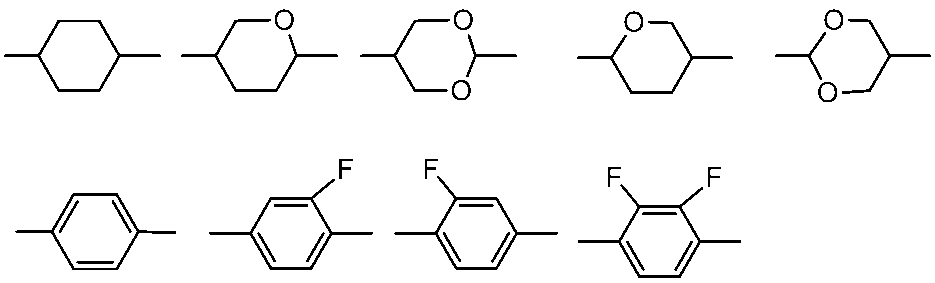

mNi1は1又は2を表し、mNi2は0又は1を表し、mNi1+mNi2は1又は2であることが好ましい。本発明の液晶組成物は、一般式(N-i)で表される化合物を1種又は2種以上含有することが好ましい。

RN111は炭素原子数1~5のアルキル基又は炭素原子数2~5のアルケニル基が好ましく、プロピル基又はペンチル基が好ましい。RN112は炭素原子数1~5のアルキル基、炭素原子数4~5のアルケニル基又は炭素原子数1~4のアルコキシ基が好ましく、エトキシ基又はブトキシ基が好ましい。


RN121は炭素原子数1~5のアルキル基又は炭素原子数2~5のアルケニル基が好ましく、エチル基、プロピル基、ブチル基又はペンチル基が好ましい。RN122は炭素原子数1~5のアルキル基、炭素原子数4~5のアルケニル基又は炭素原子数1~4のアルコキシ基が好ましく、メチル基、プロピル基、メトキシ基、エトキシ基又はプロポキシ基が好ましい。
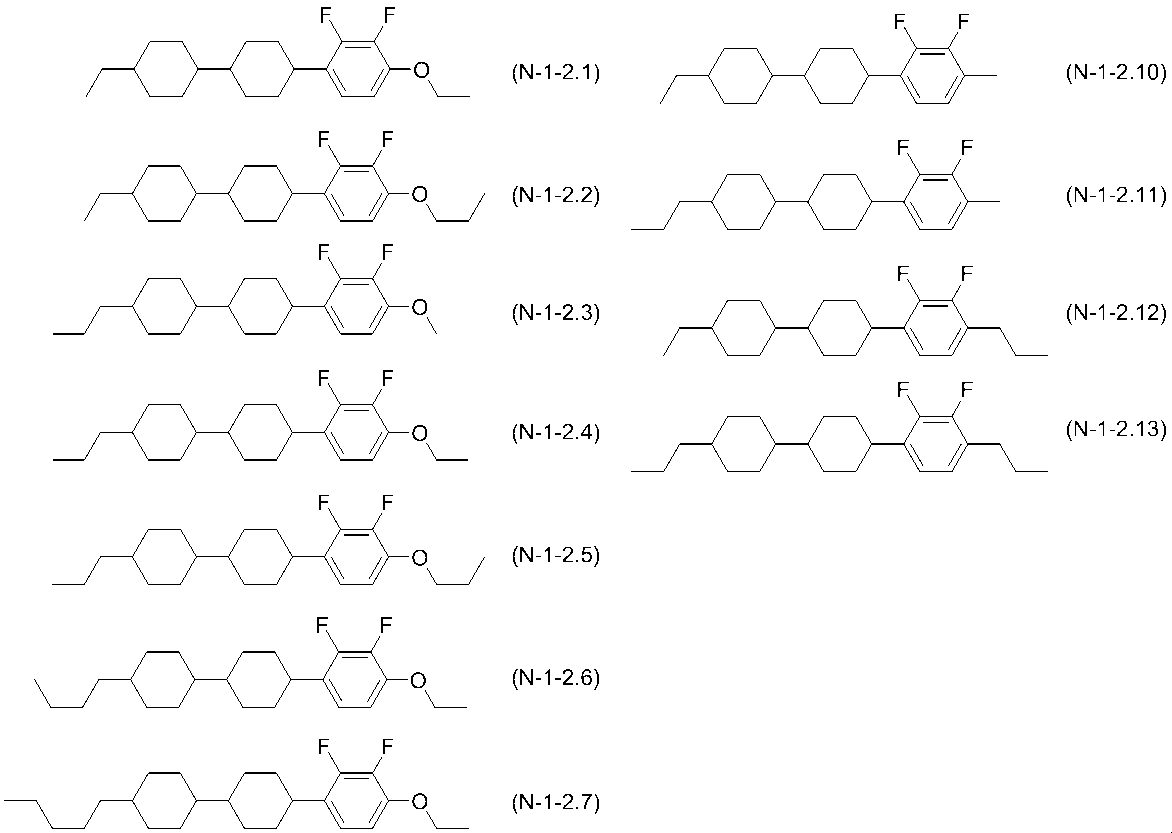

RN131は炭素原子数1~5のアルキル基又は炭素原子数2~5のアルケニル基が好ましく、エチル基、プロピル基又はブチル基が好ましい。RN132は炭素原子数1~5のアルキル基、炭素原子数4~5のアルケニル基又は炭素原子数1~4のアルコキシ基が好ましく、エトキシ基、プロポキシ基又はブトキシ基が好ましい。

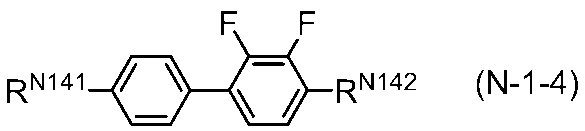
RN141及びRN142はそれぞれ独立して、炭素原子数1~5のアルキル基、炭素原子数4~5のアルケニル基又は炭素原子数1~4のアルコキシ基が好ましく、メチル基、プロピル基、エトキシ基又はブトキシ基が好ましい。


RN151及びRN152はそれぞれ独立して、炭素原子数1~5のアルキル基、炭素原子数4~5のアルケニル基又は炭素原子数1~4のアルコキシ基が好ましくエチル基、プロピル基又はブチル基が好ましい。
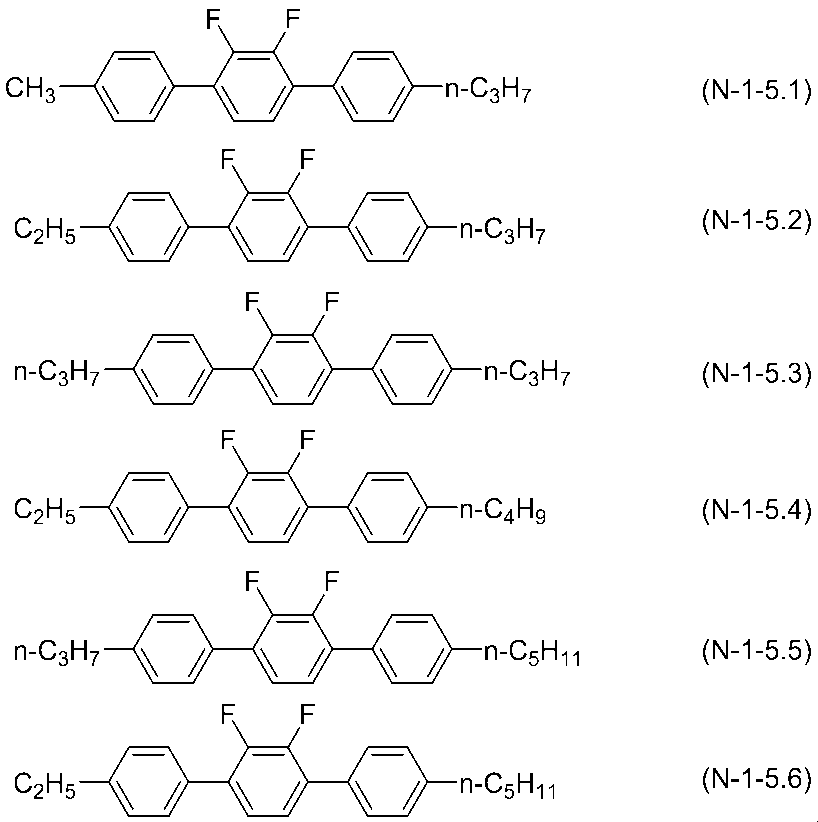

一般式(N-1)及び一般式(N-ii)で表される化合物は一般式(N-1-10)~(N-1-17)で表される化合物群から選ばれる化合物であることが好ましい。

RN1101は炭素原子数1~5のアルキル基又は炭素原子数2~5のアルケニル基が好ましく、エチル基、プロピル基又はブチル基が好ましい。RN1102は炭素原子数1~5のアルキル基、炭素原子数4~5のアルケニル基又は炭素原子数1~4のアルコキシ基が好ましく、エトキシ基、プロポキシ基又はブトキシ基が好ましい。


RN1111は炭素原子数1~5のアルキル基又は炭素原子数2~5のアルケニル基が好ましく、エチル基、プロピル基又はブチル基が好ましい。RN1112は炭素原子数1~5のアルキル基、炭素原子数4~5のアルケニル基又は炭素原子数1~4のアルコキシ基が好ましく、エトキシ基、プロポキシ基又はブトキシ基が好ましい。
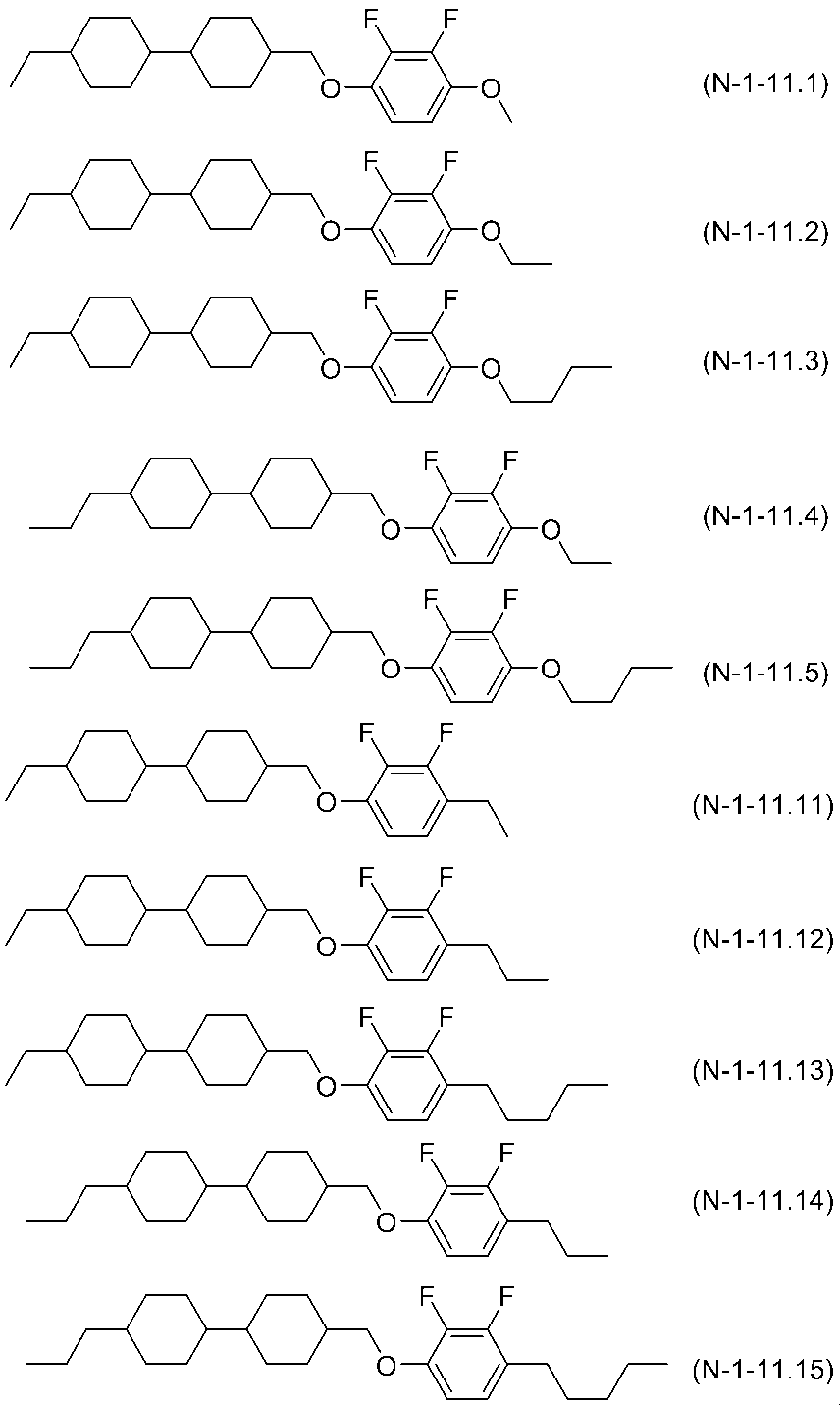

RN1121は炭素原子数1~5のアルキル基又は炭素原子数2~5のアルケニル基が好ましく、エチル基、プロピル基又はブチル基が好ましい。RN1122は炭素原子数1~5のアルキル基、炭素原子数4~5のアルケニル基又は炭素原子数1~4のアルコキシ基が好ましく、エトキシ基、プロポキシ基又はブトキシ基が好ましい。

RN1131は炭素原子数1~5のアルキル基又は炭素原子数2~5のアルケニル基が好ましく、エチル基、プロピル基又はブチル基が好ましい。RN1132は炭素原子数1~5のアルキル基、炭素原子数4~5のアルケニル基又は炭素原子数1~4のアルコキシ基が好ましく、エトキシ基、プロポキシ基又はブトキシ基が好ましい。

RN1151は炭素原子数1~5のアルキル基又は炭素原子数2~5のアルケニル基が好ましく、エチル基、プロピル基又はブチル基が好ましい。RN1152は炭素原子数1~5のアルキル基、炭素原子数4~5のアルケニル基又は炭素原子数1~4のアルコキシ基が好ましく、エトキシ基、プロポキシ基又はブトキシ基が好ましい。

RN1171は炭素原子数1~5のアルキル基又は炭素原子数2~5のアルケニル基が好ましく、エチル基、プロピル基又はブチル基が好ましい。RN1172は炭素原子数1~5のアルキル基、炭素原子数4~5のアルケニル基又は炭素原子数1~4のアルコキシ基が好ましく、エトキシ基、プロポキシ基又はブトキシ基が好ましい。

一般式(N-1)及び一般式(N-ii)で表される化合物は一般式(N-1-20)~(N-1-31)で表される化合物群から選ばれる化合物であることが好ましい。

一般式(N-1-21)で表される化合物は下記の化合物である。

一般式(N-1-22)~一般式(N-1-31)で表される化合物は下記の化合物である。

一般式(N-2)で表される化合物は一般式(N-2-1)~(N-2-3)で表される化合物群から選ばれる化合物であることが好ましい。

一般式(N-2-2)で表される化合物は下記の化合物である。

一般式(N-2-3)で表される化合物は下記の化合物である。

一般式(N-3)で表される化合物は一般式(N-3-1)~(N-3-2)で表される化合物群から選ばれる化合物であることが好ましい。

一般式(N-3-2)で表される化合物は下記の化合物である。

本発明における液晶組成物は、更に一般式(L)で表される化合物を1種類又は2種類以上含有することが好ましい。一般式(L)で表される化合物は誘電的にほぼ中性の化合物(Δεの値が-2~2)に該当する。

nL1は0、1、2又は3を表し、
AL1、AL2及びAL3はそれぞれ独立して
(a) 1,4-シクロヘキシレン基(この基中に存在する1個の-CH2-又は隣接していない2個以上の-CH2-は-O-に置き換えられてもよい。)
(b) 1,4-フェニレン基(この基中に存在する1個の-CH=又は隣接していない2個以上の-CH=は-N=に置き換えられてもよい。)及び
(c) ナフタレン-2,6-ジイル基、1,2,3,4-テトラヒドロナフタレン-2,6-ジイル基又はデカヒドロナフタレン-2,6-ジイル基(ナフタレン-2,6-ジイル基又は1,2,3,4-テトラヒドロナフタレン-2,6-ジイル基中に存在する1個の-CH=又は隣接していない2個以上の-CH=は-N=に置き換えられてもよい。)
からなる群より選ばれる基を表し、上記の基(a)、基(b)及び基(c)はそれぞれ独立してシアノ基、フッ素原子又は塩素原子で置換されていてもよく、
ZL1及びZL2はそれぞれ独立して単結合、-CH2CH2-、-(CH2)4-、-OCH2-、-CH2O-、-COO-、-OCO-、-OCF2-、-CF2O-、-CH=N-N=CH-、-CH=CH-、-CF=CF-又は-C≡C-を表し、
AL2及びZL3が複数存在する場合は、それらは同一であっても異なっていてもよい。ただし、一般式(L)において、一般式(a)、一般式(N-1)、一般式(N-2)及び一般式(N-3)で表される化合物は除く。)
一般式(L)で表される化合物は単独で用いてもよいが、組み合わせて使用することもできる。組み合わせることができる化合物の種類に特に制限は無いが、低温での溶解性、転移温度、電気的な信頼性、複屈折率などの所望の性能に応じて適宜組み合わせて使用する。使用する化合物の種類は、例えば本発明の一つの実施形態としては1種類である。あるいは本発明の別の実施形態では2種類であり、3種類であり、4種類であり、5種類であり、6種類であり、7種類であり、8種類であり、9種類であり、10種類以上である。


RL11及びRL12はそれぞれ独立して、粘度を低下させる為には直鎖状の炭素原子数直鎖状の炭素原子数1~5のアルキル基、直鎖状の炭素原子数1~4のアルコキシ基及び直鎖状の炭素原子数2~5のアルケニル基が好ましい。

本発明の組成物の総量に対しての式(ii-1)で表される化合物の好ましい含有量の下限値は、1%であり、5%であり、10%であり、15%であり、17%であり、20%であり、23%であり、25%であり、27%であり、30%であり、35%である。好ましい含有量の上限値は、本発明の組成物の総量に対して、60%であり、55%であり、50%であり、45%であり、42%であり、40%であり、38%であり、35%であり、33%であり、30%である。


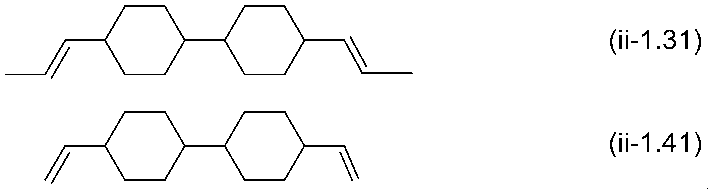

Rii21及びRii22は、直鎖状の炭素原子数1~5のアルキル基及び直鎖状の炭素原子数1~4のアルコキシ基が好ましい。


Rii31及びRii32は、直鎖状の炭素原子数1~5のアルキル基、直鎖状の炭素原子数1~4のアルコキシ基及び直鎖状の炭素原子数2~5のアルケニル基が好ましい。
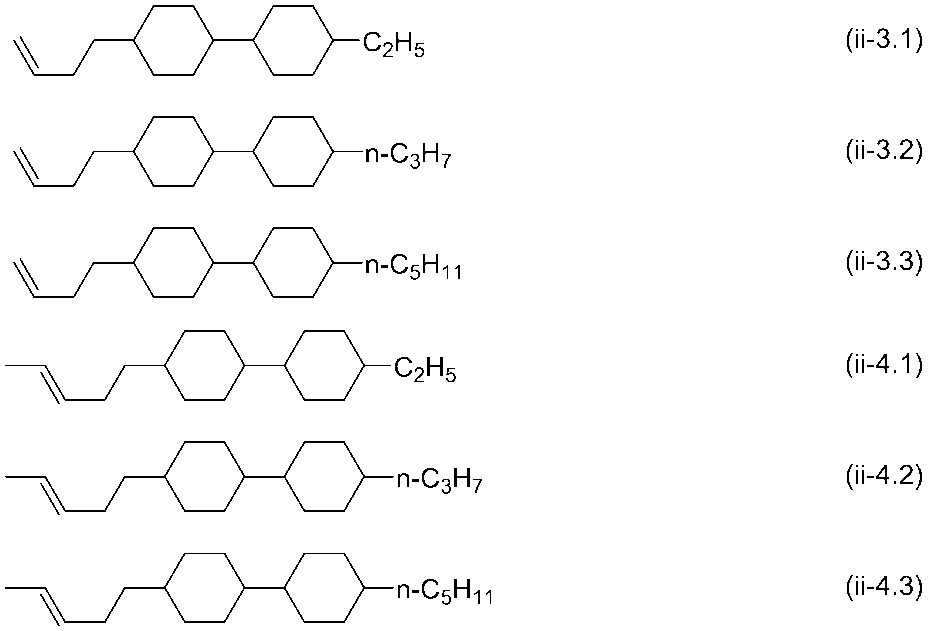

RL21は炭素原子数1~5のアルキル基又は炭素原子数2~5のアルケニル基が好ましく、RL22は炭素原子数1~5のアルキル基、炭素原子数4~5のアルケニル基又は炭素原子数1~4のアルコキシ基が好ましい。
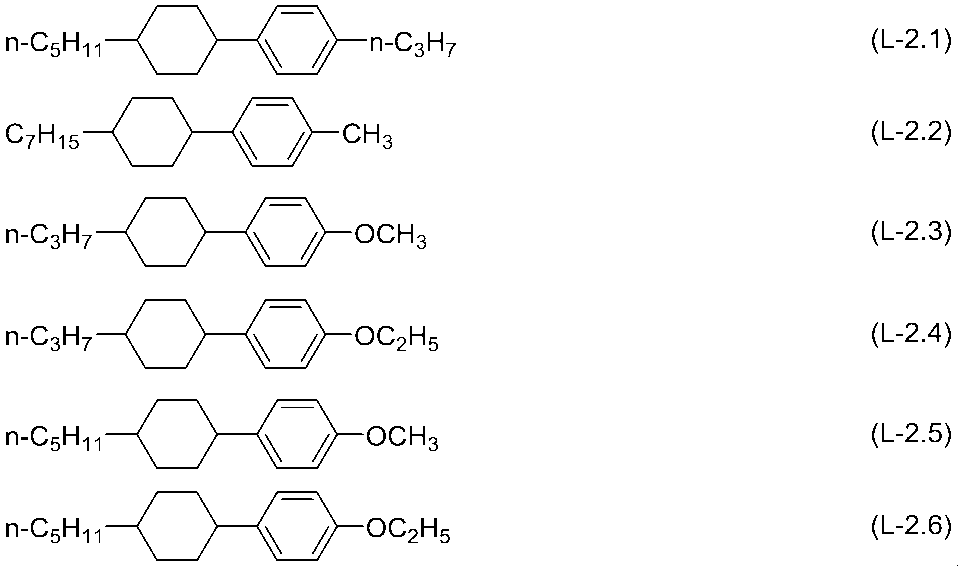

RL31及びRL32はそれぞれ独立して炭素原子数1~5のアルキル基、炭素原子数4~5のアルケニル基又は炭素原子数1~4のアルコキシ基が好ましい。


RL41は炭素原子数1~5のアルキル基又は炭素原子数2~5のアルケニル基が好ましく、RL42は炭素原子数1~5のアルキル基、炭素原子数4~5のアルケニル基又は炭素原子数1~4のアルコキシ基が好ましい。)
一般式(L-4)で表される化合物は単独で使用することもできるが、2以上の化合物を組み合わせて使用することもできる。組み合わせることができる化合物の種類に特に制限は無いが、低温での溶解性、転移温度、電気的な信頼性、複屈折率などの求められる性能に応じて適宜組み合わせて使用する。使用する化合物の種類は、例えば本発明の一つの実施形態としては1種類であり、2種類であり、3種類であり、4種類であり、5種類以上である。


RL51は炭素原子数1~5のアルキル基又は炭素原子数2~5のアルケニル基が好ましく、RL52は炭素原子数1~5のアルキル基、炭素原子数4~5のアルケニル基又は炭素原子数1~4のアルコキシ基が好ましい。
一般式(L-5)で表される化合物は、式(L-5.1)又は式(L-5.2)で表される化合物であることが好ましく、特に、式(L-5.1)で表される化合物であることが好ましい。




RL61及びRL62はそれぞれ独立して炭素原子数1~5のアルキル基又は炭素原子数2~5のアルケニル基が好ましく、XL61及びXL62のうち一方がフッ素原子他方が水素原子であることが好ましい。



式中、RL71及びRL72はそれぞれ独立して炭素原子数1~5のアルキル基、炭素原子数2~5のアルケニル基又は炭素原子数1~4のアルコキシ基が好ましく、AL71及びAL72はそれぞれ独立して1,4-シクロヘキシレン基又は1,4-フェニレン基が好ましく、AL71及びAL72上の水素原子はそれぞれ独立してフッ素原子によって置換されていてもよく、QL71は単結合又はCOO-が好ましく、単結合が好ましく、XL71及びXL72は水素原子が好ましい。

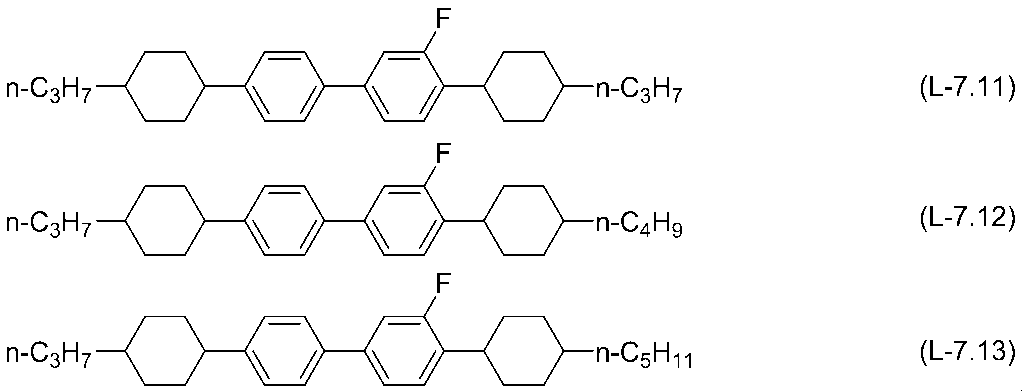


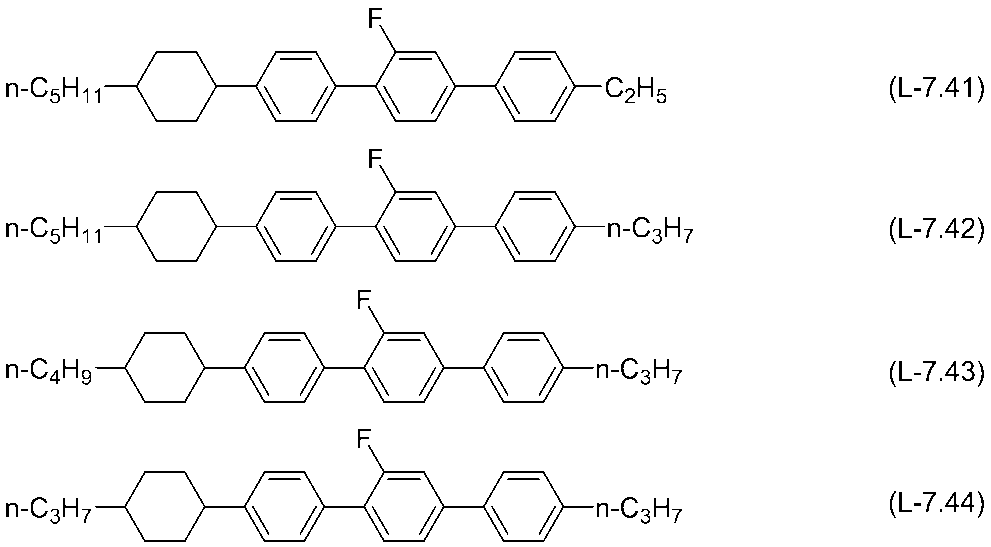
実施例において化合物の記載について以下の略号を用いる。なお、nは自然数を表す。
(側鎖)
-n -CnH2n+1 炭素原子数nの直鎖状のアルキル基
n- CnH2n+1- 炭素原子数nの直鎖状のアルキル基
-On -OCnH2n+1 炭素原子数nの直鎖状のアルコキシル基
nO- CnH2n+1O- 炭素原子数nの直鎖状のアルコキシル基
-V -CH=CH2
V- CH2=CH-
-V1 -CH=CH-CH3
1V- CH3-CH=CH-
-2V -CH2-CH2-CH=CH3
V2- CH2=CH-CH2-CH2-
-2V1 -CH2-CH2-CH=CH-CH3
1V2- CH3-CH=CH-CH2-CH2
(連結基)
-n- -CnH2n-
-nO- -CnH2n-O-
-On- -O-CnH2n-
-COO- -C(=O)-O-
-OCO- -O-C(=O)-
-CF2O- -CF2-O-
-OCF2- -O-CF2-
(環構造)

Δn :20℃における屈折率異方性
Δε :20℃における誘電率異方性
K11 :20℃における弾性定数K11(pN)
K33 :20℃における弾性定数K33(pN)
コントラスト評価:FFS型の液晶表示素子をオートロニック社製電気光学測定装置DMS703により電気光学特性を測定して、「最大輝度/最小輝度」をコントラストのパラメータとして算出した。得られたパラメータの数値を、以下のように4段階で評価した。
〇:1000以上 1200未満
△:800以上 1000未満
×:800未満
(実施例1-1~10、比較例1~10)
以下の表1~9に示す実施例1-1~10、比較例1~10の液晶組成物を調製し、その物性値を測定した。液晶組成物の構成とその物性値の結果は表1~9のとおりであった。また、各液晶組成物を、図1~図4に示すFFSモードの液晶表示素子用パネルに注入し、FFSモードの液晶表示素子を作製し、コントラスト評価を行った。


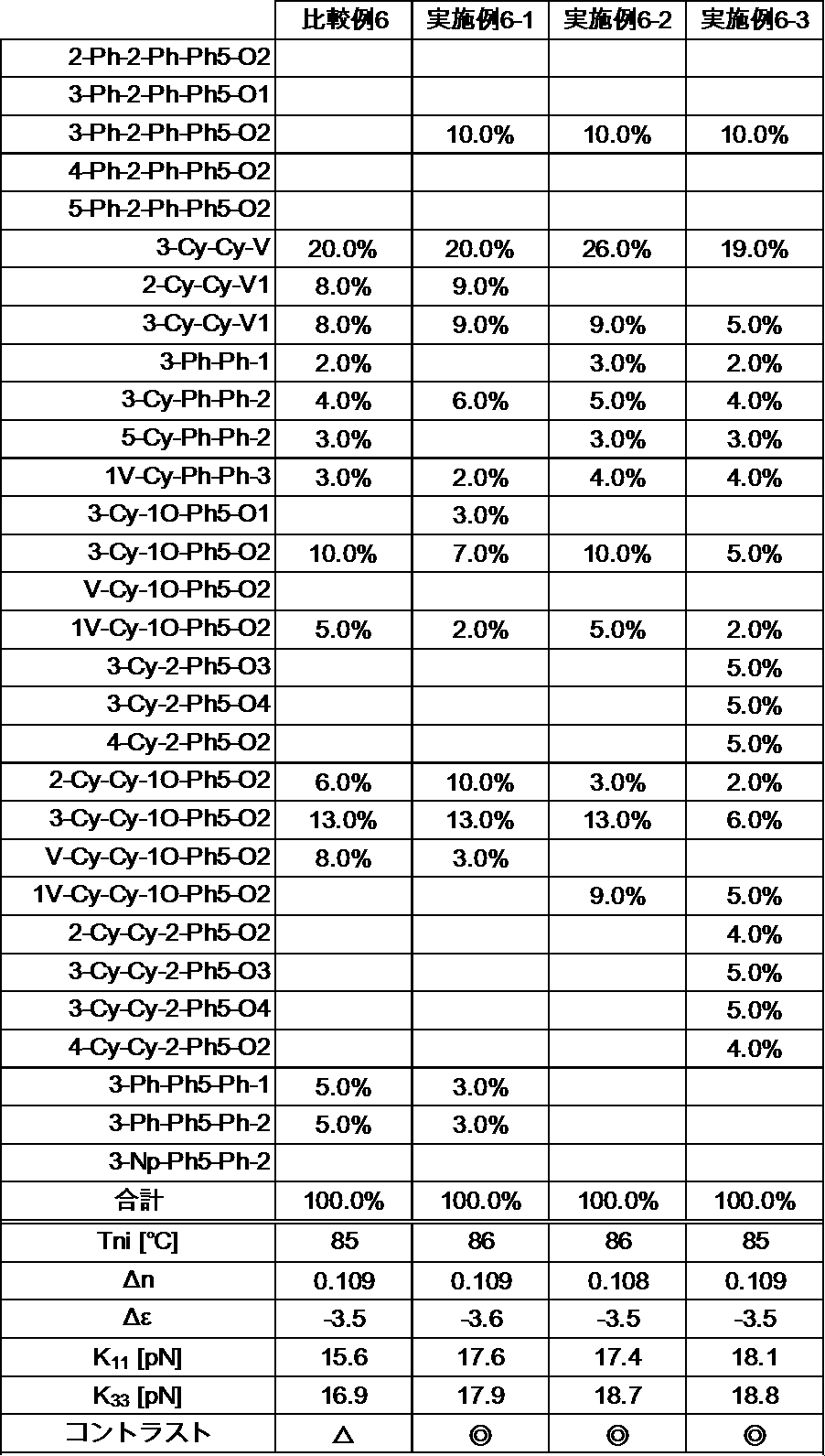
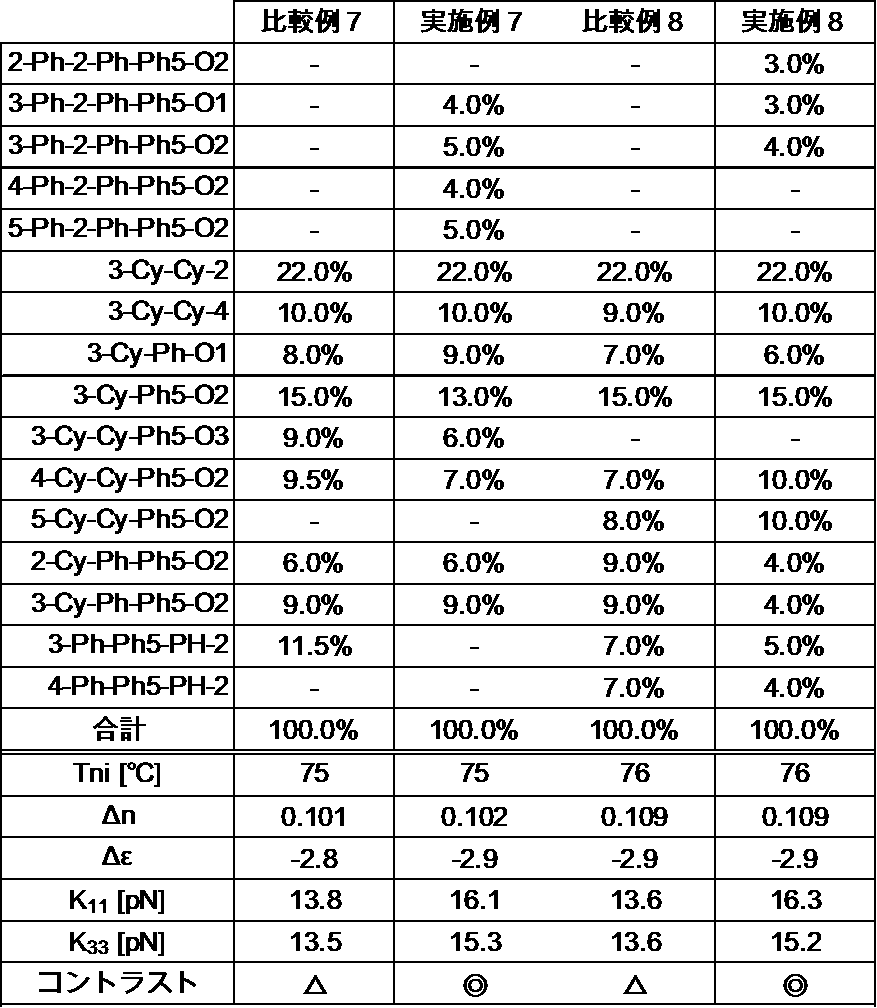

2 第一の基板
3 電極層
4 配向膜
5 液晶層
6 カラーフィルタ
7 第二の基板
11 ゲート電極
12 ゲート絶縁膜
13 半導体層
14 絶縁層
15 オーミック接触層
16 ドレイン電極
17 ソース電極
18 絶縁保護層
21 画素電極
22 共通電極
23 ストレイジキャパシタ
25 データバスライン
27 ソースバスライン
29 共通ライン
Claims (9)
- 対向に配置された第一の基板および第二の基板と、
前記第一の基板および第二の基板の間に挟持された液晶組成物を含有する液晶層と、
前記第一の基板上に設けられる第一の電極と、
前記第一の基板上に設けられ、前記第一の電極との間に電界を生じさせる第二の電極と、を有し、
前記液晶組成物が、
一般式(a)

Ma1及びMa2はそれぞれ独立して
(b) 1,4-フェニレン基(この基中に存在する1個の-CH=又は隣接していない2個以上の-CH=は-N=に置き換えられてもよい。)及び
(c) ナフタレン-2,6-ジイル基(この基中に存在する1個の-CH=又は隣接していない2個以上の-CH=は-N=に置き換えられてもよい。)
からなる群より選ばれる基を表し、上記の基(b)及び基(c)はそれぞれ独立してシアノ基、フッ素原子又は塩素原子で置換されていてもよく、
Za1及びZa2はそれぞれ独立して単結合、-CH=CH-、-C≡C-、-CH2CH2-、-(CH2)4-、-COO-、-OCO-、-OCH2-、-CH2O-、-OCF2-又は-CF2O-を表すが、1個又は2個以上のZa1は-CH2CH2-を表し、
ma1は1、2又は3を表し、ma2は0、1又は2を表し、ma1+ma2は1、2又は3であり、Ma1及びZa1が複数存在する場合は、それらは同一であっても異なっていてもよく、Ma2及びZa2が複数存在する場合は、それらは同一であっても異なっていてもよい。)
で表される化合物を1種又は2種以上含有する液晶表示素子。 - 前記液晶組成物が、更に、一般式(N-1)~一般式(N-3)

AN11、AN12、AN21、AN22、AN31及びAN32はそれぞれ独立して
(a) 1,4-シクロヘキシレン基(この基中に存在する1個の-CH2-又は隣接していない2個以上の-CH2-は-O-に置き換えられてもよい。)及び
(b) 1,4-フェニレン基(この基中に存在する1個の-CH=又は隣接していない2個以上の-CH=は-N=に置き換えられてもよい。)
(c) (c)ナフタレン-2,6-ジイル基、1,2,3,4-テトラヒドロナフタレン-2,6-ジイル基又はデカヒドロナフタレン-2,6-ジイル基(ナフタレン-2,6-ジイル基又は1,2,3,4-テトラヒドロナフタレン-2,6-ジイル基中に存在する1個の-CH=又は隣接していない2個以上の-CH=は-N=に置き換えられても良い。)
からなる群より選ばれる基を表し、上記の基(a)、基(b)及び基(c)はそれぞれ独立してシアノ基、フッ素原子又は塩素原子で置換されていても良く、
ZN11及びZN12、はそれぞれ独立して単結合、-(CH2)4-、-OCH2-、-CH2O-、-COO-、-OCO-、-OCF2-、-CF2O-、-CH=N-N=CH-、-CH=CH-、-CF=CF-又は-C≡C-を表し、ZN21、ZN22、ZN31及びZN32はそれぞれ独立して単結合、-CH2CH2-、-(CH2)4-、-OCH2-、-CH2O-、-COO-、-OCO-、-OCF2-、-CF2O-、-CH=N-N=CH-、-CH=CH-、-CF=CF-又は-C≡C-を表し、
XN21は水素原子又はフッ素原子を表し、
TN31は-CH2-又は酸素原子を表し、
nN11、nN12、nN21、nN22、nN31及びnN32はそれぞれ独立して0~3の整数を表すが、nN11+nN12、nN21+nN22及びnN31+nN32はそれぞれ独立して1、2又は3であり、AN11~AN32、ZN11~ZN32が複数存在する場合は、それらは同一であっても異なっていても良い。ただし、一般式(N-1)及び一般式(N-2)において、一般式(a)で表される化合物は除き、また、一般式(N-2)及び一般式(N-3)において一般式(N-1)で表される化合物は除き、更に一般式(N-3)において一般式(N-1)で表される化合物は除く。)
で表される化合物群から選ばれる化合物を1種又は2種以上含有する請求項1に記載の液晶表示素子。 - 前記液晶組成物が、更に、一般式(L)

nL1は0、1、2又は3を表し、
AL1、AL2及びAL3はそれぞれ独立して
(a) 1,4-シクロヘキシレン基(この基中に存在する1個の-CH2-又は隣接していない2個以上の-CH2-は-O-に置き換えられてもよい。)及び
(b) 1,4-フェニレン基(この基中に存在する1個の-CH=又は隣接していない2個以上の-CH=は-N=に置き換えられてもよい。)
(c) ナフタレン-2,6-ジイル基、1,2,3,4-テトラヒドロナフタレン-2,6-ジイル基又はデカヒドロナフタレン-2,6-ジイル基(ナフタレン-2,6-ジイル基又は1,2,3,4-テトラヒドロナフタレン-2,6-ジイル基中に存在する1個の-CH=又は隣接していない2個以上の-CH=は-N=に置き換えられてもよい。)
からなる群より選ばれる基を表し、上記の基(a)、基(b)及び基(c)はそれぞれ独立してシアノ基、フッ素原子又は塩素原子で置換されていてもよく、
ZL1及びZL2はそれぞれ独立して単結合、-CH2CH2-、-(CH2)4-、-OCH2-、-CH2O-、-COO-、-OCO-、-OCF2-、-CF2O-、-CH=N-N=CH-、-CH=CH-、-CF=CF-又は-C≡C-を表し、
AL2又はZL3が複数存在する場合は、それらは同一であっても異なっていてもよい。ただし、一般式(L)において、一般式(a)、一般式(N-1)、一般式(N-2)及び一般式(N-3)で表される化合物は除く。)
で表される化合物を1種又は2種以上含有する請求項1又は2に記載の液晶表示素子。 - 一般式(a)で表される化合物の含有量が液晶組成物において0.5質量%から35質量%である請求項1から3のいずれか一項に記載の液晶表示素子。
- 一般式(N-1)から(N-3)で表される化合物の含有量が液晶組成物において3質量%から100質量%である請求項1から3のいずれか一項に記載の液晶表示素子。
- 一般式(L)で表される化合物の含有量が液晶組成物において70質量%以下である請求項1から5のいずれか一項に記載の液晶表示素子。
- FFSモード用の請求項1から6のいずれか一項に記載の液晶表示素子。
- IPSモード用の請求項1から6のいずれか一項に記載の液晶表示素子。
- 請求項1から8のいずれか一項に記載の液晶組成物。
Priority Applications (3)
| Application Number | Priority Date | Filing Date | Title |
|---|---|---|---|
| CN201680028456.6A CN107615155B (zh) | 2015-07-14 | 2016-07-05 | 液晶组合物及使用其的液晶显示元件 |
| KR1020177032498A KR20180030464A (ko) | 2015-07-14 | 2016-07-05 | 액정 조성물 및 그것을 사용한 액정 표시 소자 |
| JP2017519589A JP6252707B2 (ja) | 2015-07-14 | 2016-07-05 | 液晶組成物及びそれを使用した液晶表示素子 |
Applications Claiming Priority (2)
| Application Number | Priority Date | Filing Date | Title |
|---|---|---|---|
| JP2015140509 | 2015-07-14 | ||
| JP2015-140509 | 2015-07-14 |
Publications (1)
| Publication Number | Publication Date |
|---|---|
| WO2017010348A1 true WO2017010348A1 (ja) | 2017-01-19 |
Family
ID=57756954
Family Applications (1)
| Application Number | Title | Priority Date | Filing Date |
|---|---|---|---|
| PCT/JP2016/069872 Ceased WO2017010348A1 (ja) | 2015-07-14 | 2016-07-05 | 液晶組成物及びそれを使用した液晶表示素子 |
Country Status (5)
| Country | Link |
|---|---|
| JP (1) | JP6252707B2 (ja) |
| KR (1) | KR20180030464A (ja) |
| CN (1) | CN107615155B (ja) |
| TW (1) | TW201718829A (ja) |
| WO (1) | WO2017010348A1 (ja) |
Cited By (2)
| Publication number | Priority date | Publication date | Assignee | Title |
|---|---|---|---|---|
| WO2018207247A1 (ja) * | 2017-05-09 | 2018-11-15 | Dic株式会社 | 液晶表示素子 |
| CN112368636A (zh) * | 2018-07-30 | 2021-02-12 | Dic株式会社 | 液晶显示元件 |
Families Citing this family (2)
| Publication number | Priority date | Publication date | Assignee | Title |
|---|---|---|---|---|
| KR102733058B1 (ko) | 2019-05-22 | 2024-11-21 | 엘지전자 주식회사 | 반도체 발광소자의 자가조립 장치 및 방법 |
| JP7716244B2 (ja) * | 2020-07-09 | 2025-07-31 | 石家庄▲誠▼志永▲華顕▼示材料有限公司 | 液晶組成物及び液晶表示素子 |
Citations (4)
| Publication number | Priority date | Publication date | Assignee | Title |
|---|---|---|---|---|
| WO1997036847A1 (en) * | 1996-04-02 | 1997-10-09 | Chisso Corporation | Liquid crystal compounds, liquid crystal compositions containing the compounds, and liquid crystal display devices made by using the compositions |
| JP2002031812A (ja) * | 2000-06-01 | 2002-01-31 | Hynix Semiconductor Inc | フリンジフィールドスイッチングモード液晶表示装置 |
| JP2015001705A (ja) * | 2013-06-18 | 2015-01-05 | Dic株式会社 | 液晶表示装置 |
| CN104591983A (zh) * | 2015-02-15 | 2015-05-06 | 石家庄诚志永华显示材料有限公司 | 一种液晶化合物及包含该化合物的液晶介质 |
Family Cites Families (3)
| Publication number | Priority date | Publication date | Assignee | Title |
|---|---|---|---|---|
| JP3255965B2 (ja) * | 1992-05-26 | 2002-02-12 | 昭和シェル石油株式会社 | 反強誘電性液晶化合物 |
| CN101981156A (zh) * | 2008-04-11 | 2011-02-23 | 智索株式会社 | 液晶组成物以及液晶显示元件 |
| CN107177360A (zh) * | 2015-02-15 | 2017-09-19 | 石家庄诚志永华显示材料有限公司 | 含有环丙基的负介电各向异性液晶介质及其应用 |
-
2016
- 2016-07-05 WO PCT/JP2016/069872 patent/WO2017010348A1/ja not_active Ceased
- 2016-07-05 CN CN201680028456.6A patent/CN107615155B/zh active Active
- 2016-07-05 JP JP2017519589A patent/JP6252707B2/ja active Active
- 2016-07-05 KR KR1020177032498A patent/KR20180030464A/ko not_active Withdrawn
- 2016-07-14 TW TW105122198A patent/TW201718829A/zh unknown
Patent Citations (4)
| Publication number | Priority date | Publication date | Assignee | Title |
|---|---|---|---|---|
| WO1997036847A1 (en) * | 1996-04-02 | 1997-10-09 | Chisso Corporation | Liquid crystal compounds, liquid crystal compositions containing the compounds, and liquid crystal display devices made by using the compositions |
| JP2002031812A (ja) * | 2000-06-01 | 2002-01-31 | Hynix Semiconductor Inc | フリンジフィールドスイッチングモード液晶表示装置 |
| JP2015001705A (ja) * | 2013-06-18 | 2015-01-05 | Dic株式会社 | 液晶表示装置 |
| CN104591983A (zh) * | 2015-02-15 | 2015-05-06 | 石家庄诚志永华显示材料有限公司 | 一种液晶化合物及包含该化合物的液晶介质 |
Cited By (3)
| Publication number | Priority date | Publication date | Assignee | Title |
|---|---|---|---|---|
| WO2018207247A1 (ja) * | 2017-05-09 | 2018-11-15 | Dic株式会社 | 液晶表示素子 |
| CN112368636A (zh) * | 2018-07-30 | 2021-02-12 | Dic株式会社 | 液晶显示元件 |
| CN112368636B (zh) * | 2018-07-30 | 2024-04-16 | Dic株式会社 | 液晶显示元件 |
Also Published As
| Publication number | Publication date |
|---|---|
| KR20180030464A (ko) | 2018-03-23 |
| CN107615155A (zh) | 2018-01-19 |
| CN107615155B (zh) | 2021-11-09 |
| JP6252707B2 (ja) | 2017-12-27 |
| TW201718829A (zh) | 2017-06-01 |
| JPWO2017010348A1 (ja) | 2017-07-27 |
Similar Documents
| Publication | Publication Date | Title |
|---|---|---|
| JP6338018B2 (ja) | 液晶組成物及びそれを使用した液晶表示素子 | |
| US10287501B2 (en) | Liquid crystal display element | |
| WO2016017569A1 (ja) | 液晶表示素子 | |
| JP6070897B2 (ja) | 液晶表示素子 | |
| WO2016017519A1 (ja) | 液晶表示素子 | |
| WO2014188612A1 (ja) | 液晶表示素子 | |
| WO2014188613A1 (ja) | 液晶表示素子 | |
| CN112368636B (zh) | 液晶显示元件 | |
| WO2016017520A1 (ja) | 液晶表示素子 | |
| JP6252707B2 (ja) | 液晶組成物及びそれを使用した液晶表示素子 | |
| WO2018105376A1 (ja) | 液晶組成物、液晶表示素子及び液晶ディスプレイ | |
| JP6565648B2 (ja) | 液晶表示素子 | |
| CN106967444A (zh) | 液晶组合物和使用其的液晶显示元件 | |
| WO2017010346A1 (ja) | 液晶組成物及びそれを使用した液晶表示素子 | |
| JP7271880B2 (ja) | 液晶表示素子 | |
| CN113913195B (zh) | 液晶组合物及液晶显示元件 | |
| WO2018105379A1 (ja) | 液晶組成物、液晶表示素子及び液晶ディスプレイ | |
| WO2018105378A1 (ja) | 液晶組成物、液晶表示素子及び液晶ディスプレイ | |
| WO2018105377A1 (ja) | 液晶組成物、液晶表示素子及び液晶ディスプレイ | |
| WO2018207247A1 (ja) | 液晶表示素子 |
Legal Events
| Date | Code | Title | Description |
|---|---|---|---|
| 121 | Ep: the epo has been informed by wipo that ep was designated in this application |
Ref document number: 16824328 Country of ref document: EP Kind code of ref document: A1 |
|
| ENP | Entry into the national phase |
Ref document number: 2017519589 Country of ref document: JP Kind code of ref document: A |
|
| ENP | Entry into the national phase |
Ref document number: 20177032498 Country of ref document: KR Kind code of ref document: A |
|
| NENP | Non-entry into the national phase |
Ref country code: DE |
|
| 122 | Ep: pct application non-entry in european phase |
Ref document number: 16824328 Country of ref document: EP Kind code of ref document: A1 |