WO2017010350A1 - Système d'analyse de logiciel, procédé d'analyse de logiciel et programme d'analyse de logiciel - Google Patents
Système d'analyse de logiciel, procédé d'analyse de logiciel et programme d'analyse de logiciel Download PDFInfo
- Publication number
- WO2017010350A1 WO2017010350A1 PCT/JP2016/069881 JP2016069881W WO2017010350A1 WO 2017010350 A1 WO2017010350 A1 WO 2017010350A1 JP 2016069881 W JP2016069881 W JP 2016069881W WO 2017010350 A1 WO2017010350 A1 WO 2017010350A1
- Authority
- WO
- WIPO (PCT)
- Prior art keywords
- application
- label
- text
- permission
- applications
- Prior art date
- Legal status (The legal status is an assumption and is not a legal conclusion. Google has not performed a legal analysis and makes no representation as to the accuracy of the status listed.)
- Ceased
Links
Images




Classifications
-
- G—PHYSICS
- G06—COMPUTING OR CALCULATING; COUNTING
- G06F—ELECTRIC DIGITAL DATA PROCESSING
- G06F21/00—Security arrangements for protecting computers, components thereof, programs or data against unauthorised activity
- G06F21/50—Monitoring users, programs or devices to maintain the integrity of platforms, e.g. of processors, firmware or operating systems
- G06F21/55—Detecting local intrusion or implementing counter-measures
- G06F21/56—Computer malware detection or handling, e.g. anti-virus arrangements
- G06F21/566—Dynamic detection, i.e. detection performed at run-time, e.g. emulation, suspicious activities
-
- G—PHYSICS
- G06—COMPUTING OR CALCULATING; COUNTING
- G06F—ELECTRIC DIGITAL DATA PROCESSING
- G06F21/00—Security arrangements for protecting computers, components thereof, programs or data against unauthorised activity
- G06F21/50—Monitoring users, programs or devices to maintain the integrity of platforms, e.g. of processors, firmware or operating systems
- G06F21/55—Detecting local intrusion or implementing counter-measures
- G06F21/56—Computer malware detection or handling, e.g. anti-virus arrangements
- G06F21/562—Static detection
- G06F21/563—Static detection by source code analysis
-
- G—PHYSICS
- G06—COMPUTING OR CALCULATING; COUNTING
- G06F—ELECTRIC DIGITAL DATA PROCESSING
- G06F21/00—Security arrangements for protecting computers, components thereof, programs or data against unauthorised activity
- G06F21/50—Monitoring users, programs or devices to maintain the integrity of platforms, e.g. of processors, firmware or operating systems
- G06F21/55—Detecting local intrusion or implementing counter-measures
- G06F21/56—Computer malware detection or handling, e.g. anti-virus arrangements
-
- G—PHYSICS
- G06—COMPUTING OR CALCULATING; COUNTING
- G06F—ELECTRIC DIGITAL DATA PROCESSING
- G06F21/00—Security arrangements for protecting computers, components thereof, programs or data against unauthorised activity
- G06F21/50—Monitoring users, programs or devices to maintain the integrity of platforms, e.g. of processors, firmware or operating systems
- G06F21/57—Certifying or maintaining trusted computer platforms, e.g. secure boots or power-downs, version controls, system software checks, secure updates or assessing vulnerabilities
- G06F21/577—Assessing vulnerabilities and evaluating computer system security
-
- G—PHYSICS
- G06—COMPUTING OR CALCULATING; COUNTING
- G06F—ELECTRIC DIGITAL DATA PROCESSING
- G06F21/00—Security arrangements for protecting computers, components thereof, programs or data against unauthorised activity
- G06F21/60—Protecting data
- G06F21/62—Protecting access to data via a platform, e.g. using keys or access control rules
-
- G—PHYSICS
- G06—COMPUTING OR CALCULATING; COUNTING
- G06F—ELECTRIC DIGITAL DATA PROCESSING
- G06F21/00—Security arrangements for protecting computers, components thereof, programs or data against unauthorised activity
- G06F21/60—Protecting data
- G06F21/62—Protecting access to data via a platform, e.g. using keys or access control rules
- G06F21/6218—Protecting access to data via a platform, e.g. using keys or access control rules to a system of files or objects, e.g. local or distributed file system or database
- G06F21/6245—Protecting personal data, e.g. for financial or medical purposes
-
- G—PHYSICS
- G06—COMPUTING OR CALCULATING; COUNTING
- G06F—ELECTRIC DIGITAL DATA PROCESSING
- G06F2221/00—Indexing scheme relating to security arrangements for protecting computers, components thereof, programs or data against unauthorised activity
- G06F2221/03—Indexing scheme relating to G06F21/50, monitoring users, programs or devices to maintain the integrity of platforms
- G06F2221/033—Test or assess software
Definitions
- the present invention relates to a software analysis system, a software analysis method, and a software analysis program.
- An application that runs on a mobile terminal equipped with Android (registered trademark), iOS (registered trademark), or the like often processes user privacy information.
- the user's privacy information is acquired by hardware such as a sensor built in the mobile terminal, or input by the user himself / herself into the mobile terminal.
- the privacy information is, for example, information associated with individual users such as user location information, individual identification numbers of mobile terminals, and address books.
- a permission is a function introduced to control access to privacy information.
- an application that uses location information asks the user for permission to use the location information permission when the application is installed on a mobile terminal.
- the application is installed on the mobile terminal. If the user does not allow the use of the permission, the application is not installed on the mobile terminal.
- the user can know in advance privacy information that the application may use.
- Non-Patent Documents 1 and 2 the information provided by the conventional permission function is often not noticed by the user (see Non-Patent Documents 1 and 2). Also, the information provided by the permission function is difficult to understand without specialized knowledge. Also, it is difficult for the user to intuitively grasp the information provided by the permission function. For this reason, it is also conceivable that an application acquires privacy information without the user's knowledge.
- Non-Patent Document 1 analyzes text of an explanatory text of an application of a mobile terminal (hereinafter also referred to as explanatory text or text), and which part of the text corresponds to access to privacy information, Suggests a technology to identify.
- Non-patent document 2 combines text analysis and application code analysis to extract applications that have inconsistencies when there is a contradiction between access to privacy information suggested by code analysis and descriptions in the text. The technology to do is proposed.
- Non-Patent Documents 1 and 2 humans read the explanatory text text of the application in advance and decipher whether or not there is a description to access specific privacy information. Then, a label is assigned to the application based on the decryption result.
- privacy information is diverse, and when trying to classify texts using statistical methods such as machine learning, a large amount of text is prepared and labels are assigned.
- manually attaching labels to data is expensive.
- the technique of manually assigning labels to large-scale data lacks scalability.
- the disclosed technology has been made in view of the above, and based on the code and description of the application, whether or not the application has accessed the privacy information of the user is automatically disclosed to the user. It is an object of the present invention to provide a software analysis system, a software analysis method, and a software analysis program that enable analysis.
- the disclosed software analysis system, software analysis method, and software analysis program determine whether or not the plurality of applications access predetermined privacy information by permission based on the codes of the plurality of applications. Then, the disclosed software analysis system, software analysis method, and software analysis program give a first label to an application that is determined to access predetermined privacy information, and to an application that is determined not to access predetermined privacy information. A second label different from the first label is applied.
- the disclosed software analysis system, software analysis method, and software analysis program are more often included in the description text of the application having the first label than in the description text of the application having the second label.
- the disclosed software analysis system, software analysis method, and software analysis program classify an application in which the extracted word is included in the explanatory text as an application that refers to the permission, and the extracted word is included in the explanatory text. It is characterized by classifying non-applications as applications that do not mention permissions.
- the disclosed software analysis system, software analysis method, and software analysis program automatically determine whether or not the application has disclosed to the user whether or not the user has access to the user's privacy information based on the code and description of the application. There is an effect that analysis is possible.
- FIG. 1 is a schematic diagram illustrating an example of a configuration of a software analysis system according to the embodiment.
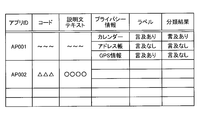
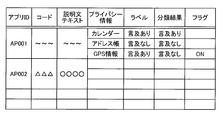
- FIG. 2 is a diagram for explaining an example of a configuration of information stored in the application information storage unit.
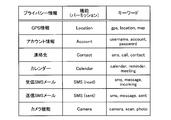
- FIG. 3 is a diagram for explaining an example of a configuration of information stored in the keyword list storage unit.
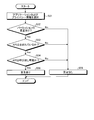
- FIG. 4 is a flowchart illustrating an example of a flow of processing executed by the software analysis system according to the embodiment.
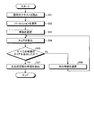
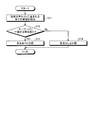
- FIG. 5 is a flowchart illustrating an example of a flow of label generation processing according to the embodiment.
- FIG. 6 is a flowchart illustrating an example of a flow of score calculation processing (keyword extraction processing) according to the embodiment.
- FIG. 7 is a flowchart illustrating an example of the flow of classification processing according to the embodiment.
- FIG. 1 is a schematic diagram illustrating an example of a configuration of a software analysis system according to the embodiment.
- FIG. 2 is a diagram for explaining an example of a configuration of information stored in the application information
- FIG. 8 is a sequence diagram for explaining an example of a flow of processing executed by the software analysis system according to the embodiment.
- FIG. 9 is a schematic diagram illustrating an example of a configuration of a software analysis system according to a modification.
- FIG. 10 is a diagram illustrating an example of a configuration of information stored in the application information storage unit according to the modification.
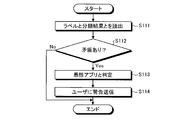
- FIG. 11 is a flowchart illustrating an example of a flow of processing executed by the software analysis system according to the modification.
- FIG. 12 is a diagram illustrating a computer that executes a software analysis program according to the embodiment.
- FIG. 1 is a schematic diagram illustrating an example of a configuration of a software analysis system 1 according to the embodiment.
- a software analysis system 1 shown in FIG. 1 is a server that performs application pre-examination, for example, operated by an operator of a download service that a user accesses to download an application to a mobile terminal.
- application is also referred to as “application”.
- the software analysis system 1 includes a storage unit 10, a label generation unit 20, a score calculation unit 30, and a classification unit 40.
- the storage unit 10 is, for example, a semiconductor memory element or a storage device.
- VRAM Video Random Access Memory
- RAM Random Access Memory
- ROM Read Only Memory
- flash memory or the like
- a storage device such as a hard disk or an optical disk can be used.
- the storage unit 10 stores information related to applications to be analyzed by the software analysis system 1. Further, the storage unit 10 stores information obtained as a result of analysis processing by the software analysis system 1.
- the storage unit 10 includes an application information storage unit 11 and a keyword list storage unit 12.
- FIG. 2 is a diagram for explaining an example of a configuration of information stored in the application information storage unit 11.
- FIG. 3 is a diagram for explaining an example of a configuration of information stored in the keyword list storage unit 12.
- the application information storage unit 11 associates “code”, “descriptive text”, “privacy information”, “label”, and “classification result” in association with “application ID”. And memorize.
- “Application ID” is an identifier for uniquely identifying an application to be analyzed by the software analysis system 1.
- Code is the code of the application. For example, application source code.
- the “description text” is the text of the description of the application.
- Primary information indicates the type of privacy information of the user who is permitted to access the application according to the permission. Examples of privacy information include GPS (Global Positioning System) information, a calendar, a camera function, an address book, and the like.
- Label is a label given to each application by the software analysis system 1 based on the result of code analysis by the software analysis system 1.
- the “label” is a provisional label indicating a determination result of whether or not the application accesses predetermined privacy information.
- the “classification result” indicates a result of classifying the application based on whether or not the keyword extracted by analyzing the explanation text by the software analysis system 1 is included in the explanation text of each application.
- the explanatory text “ ⁇ ⁇ ⁇ ” of the application and the corresponding code “ ⁇ ⁇ ⁇ ” are stored.
- a label indicating whether or not the application accesses each of the three types of privacy information and a classification result are stored in association with the application.
- “privacy information, calendar”, “label, with reference” is stored. This indicates that according to the code analysis, the application with the application ID “AP001” accesses the user's calendar.
- “privacy information, address book” and “classification result, no mention” are stored in association with the application ID “AP001”. This indicates that the keyword corresponding to the privacy information “address book” is not included in the explanatory text of the application identified by the application ID “AP001”.
- the keyword list storage unit 12 stores “privacy information”, “function (permission)”, and “keyword”.
- the “privacy information” is the same as the “privacy information” stored in the application information storage unit 11.
- “Function (permission)” is a name of a permission that permits access to the corresponding privacy information.
- the permission is, for example, “READ_CONTACTS” or “READ_CALENDER” defined for Android (registered trademark).
- the “keyword” is a keyword extracted from the explanatory text of the application by the software analysis system 1. Details of the keyword extracting process will be described later.
- “function (permission), location” and “keyword, gps, location, map” are stored in association with “privacy information, GPS information”. This indicates that the privacy information whose access is permitted by the function of the permission “Location” is GPS information.
- three words “gps, location, map” are extracted as keywords corresponding to the permission “Location”.
- three keywords are stored in association with each privacy information and function (permission).
- the number of keywords associated with each privacy information and function (permission) is not limited to three.
- the label generation unit 20 Based on the application information stored in the storage unit 10, the label generation unit 20 generates a label indicating whether or not each application has determined to access the user's privacy information as a result of code analysis.
- the score calculation unit 30 analyzes the explanatory text of the application using the label generated by the label generation unit 20, and calculates the score of each word included in the explanatory text. The score calculation unit 30 calculates the score of each word for each permission. The score calculation unit 30 uses the description text so that the score of words included in the description text of the application “labeled” is higher than the text of the description text of the application “labeled”. The score of each included word is calculated.
- the calculation method is not particularly limited, and for example, a method using an odds ratio or compatibility feedback can be applied.
- the score can be calculated based on the total number of applications including.
- the score calculation method calculated by the score calculation unit 30 is a word that frequently appears in the description text of the application with the label “with reference”, and hardly appears in the description text of the application with the label “without reference”. Set a higher value for words. In other words, the score calculation method is set so that the higher the appearance frequency of the description text of the application with the label “Mentioned” is higher than the appearance frequency of the description text of the application with the label “None”. . In addition, the score calculation method is a word that appears frequently in the description text of an application that uses API (Application Programming Interface), and the higher the value is for a word that does not appear in the description text of an application that does not use the API. Set to be.
- API Application Programming Interface
- the score calculation unit 30 extracts the top predetermined number of words as the keywords corresponding to the permission in descending order of the score in association with the permission.
- a keyword is a word expected to appear in the description text of an application that accesses the corresponding privacy information.
- the keywords extracted by the score calculation unit 30 are stored in the keyword list storage unit 12 in association with privacy information and permissions.
- the classification unit 40 determines whether the explanatory text of each application includes the extracted keyword. Then, the classification unit 40 classifies the application of the explanatory text including the keyword as an application “with reference”. Further, the classification unit 40 classifies the application of the explanatory text that does not include the keyword as a “no mention” application.
- the classification result by the classification unit 40 is stored in the application information storage unit 11 in association with each application and privacy information.
- FIG. 4 is a flowchart illustrating an example of a flow of processing executed by the software analysis system 1 according to the embodiment.
- the software analysis system 1 acquires information about a plurality of applications in advance and stores it in the application information storage unit 11 of the storage unit 10.
- the analysis processing by the software analysis system 1 includes label generation (code analysis) by the label generation unit 20 (step S21), score calculation by the score calculation unit 30 (keyword extraction) (step S22), and classification unit.
- category by 40 step S23
- the classification by the classification unit 40 is completed, the process ends.
- the flow of processing by each unit will be described.
- FIG. 5 is a flowchart illustrating an example of a flow of label generation processing according to the embodiment.
- the label generation unit 20 first selects one application and one privacy information as an analysis target (step S51). For example, the label generation unit 20 selects an application with the application ID “AP001”. Moreover, the label production
- the order of selecting the application and privacy information by the label generation unit 20 may be determined in advance and stored in the software analysis system 1, or the user may specify the application to be selected and the privacy information. .
- the label generation unit 20 reads the code of the selected application from the application information storage unit 11. If the source code can be acquired, the application code is acquired and stored in the application information storage unit 11. When the source code cannot be acquired, the code disassembled using a technique such as reverse engineering is stored in the application information storage unit 11.
- the label generation unit 20 determines whether or not a permission declaration is included in the read code (step S52). For example, in the case of an application using Android (registered trademark), the label generation unit 20 determines whether or not permission is declared in AndroidManifest.xml.
- the label generation unit 20 determines whether the API corresponding to the selected privacy information (ie, permission) is included in the code. (Step S53). Furthermore, when it is determined that the API is included (step S53, Yes), the label generation unit 20 analyzes the call graph and determines whether or not the API can actually be called (step S54). ). As a result of analyzing the call graph, when it is determined that the call can be made (step S54, Yes), the label generation unit 20 generates a label “with reference” for the application (step S55).
- the label generating unit 20 gives a label of “no mention” to the application (Step S56).
- the label generation unit 20 similarly applies a label of “no mention”. Generate. This completes the label generation process.
- the generated label is stored in the application information storage unit 11 in association with the application and privacy information.
- the label generation unit 20 generates labels corresponding to a plurality of applications and privacy information by repeatedly executing the process shown in FIG. 5 for each application and privacy information, and stores the labels in the application information storage unit 11.
- the reason why labels are assigned through three stages of determination is that the code may not actually access privacy information even if there is a permission declaration or corresponding API in the code. It is.
- the score calculation unit 30 extracts a keyword for specifying an application that accesses the privacy information based on the explanatory text using the application with the label and the privacy information.
- FIG. 6 is a flowchart illustrating an example of a flow of score calculation processing (keyword extraction processing) according to the embodiment.
- the score calculation unit 30 reads, from the application information storage unit 11, explanatory texts corresponding to a plurality of applications for which label generation processing has been completed (step S61). Then, the score calculation unit 30 selects a permission (Step S62). Furthermore, the score calculation unit 30 analyzes the read explanation text, and selects one word included in the explanation text (step S63).
- the score calculation part 30 calculates the score of the selected word (step S64).
- the score calculation unit 30 calculates a score using the following formula (1).
- Expression (1) calculates the total number N (N is a natural number) of applications, and calculates the score of the word w i included in the i-th application (i is a natural number of 1 to N). It is an expression to do.
- R is the total number of applications to which the label “with reference” is given
- r i is the total number of applications to which the word w i is included in the explanatory text and the label “with reference” is given. It is.
- N is the total number of applications to be analyzed
- n i is the total number of applications, including a word w i in the description text.
- 0.5 is added in order to avoid that a numerator and a denominator become zero.
- the value to be added is not limited to 0.5, and may be 0.1 or 0.6, for example.
- the score calculation unit 30 determines whether or not the scores of all words have been calculated (step S65). When it is determined that the scores of all the words have not been calculated (No at Step S65), the score calculation unit 30 selects a word to be processed next (Step S66). Then, the process returns to step S64. On the other hand, when it determines with having calculated the score of all the words (step S65, Yes), the score calculation part 30 sorts a word in the descending order of the score calculated for every permission, and extracts an upper predetermined number of words ( Step S67). For example, the score calculation unit 30 extracts the top three words.
- the reason why the number of words to be extracted is 3 is that, from the experimental results of the present inventors, when the number of words to be extracted is 3, finally good classification accuracy is obtained. .
- the number of words to be extracted may be set to other numbers. This completes the score calculation process (keyword extraction process).
- the method of calculating the score using the relevance weight was adopted.
- the formula for calculating the score is not limited to the above example.
- the expression for calculating the score only needs to be able to quantify the nature of the word, which is easily included in an application of a certain set and difficult to be included in an application of another set.
- the odds ratio can be used as the score. First, it is assumed that the probability that a predetermined word is included in the set of applications with the label “without mention” is p, and the probability that the predetermined word is included in the set of applications with the label “without mention” is q. Then, the odds ratio is calculated by dividing (p / (1-p)) by (q / (1-q)). As the calculated odds ratio is larger, it means that a predetermined word is more likely to be included in the set of applications with the label “with mention” and less likely to be included in the set of applications with the label “without mention”.
- the probability p that the word “SNS” is included in the set of applications with the label “referenced” is 0.9 and the probability q included in the set of applications with the label “without mention” is 0.1
- the odds ratio calculated based on the above equation is 81.
- the odds ratio is calculated for other words, and the odds ratio is used as a score.
- the words are ranked in order from the highest score.
- the keywords may be extracted as keywords that are more likely to be included in a set of applications “with mention” in order from the top word.
- the classification unit 40 classifies the application based on whether each application accesses the privacy information based on the keyword extracted by the score calculation unit 30 and the explanatory text of the application.
- FIG. 7 is a flowchart illustrating an example of the flow of classification processing according to the embodiment.
- the classification unit 40 reads the explanatory text of the application to be classified from the application information storage unit 11. And the classification
- the classification “with reference” indicates that the application is determined to be an application that accesses privacy information that is permitted to be accessed by the permission corresponding to the keyword.
- the classification unit 40 classifies the application as an application “not mentioned” in the permission corresponding to the keyword (step S74).
- the classification “no mention” indicates that it is determined that the application does not access the privacy information permitted to be accessed by the permission corresponding to the keyword. This completes the classification process.
- FIG. 8 is a sequence diagram for explaining an example of a flow of processing executed by the software analysis system 1 according to the embodiment.
- the process shown in FIG. 8 corresponds to the process flow described with reference to FIGS.
- the software analysis system 1 first, information on the application to be analyzed and explanatory text are prepared ((1) in FIG. 8). For example, the software analysis system 1 acquires application data via a network and stores the data in the storage unit 10.
- the label generation unit 20 refers to the application code stored in the storage unit 10 ((2) in FIG. 8) and executes the analysis of the code ((3) in FIG. 8).
- the label generation unit 20 generates a label based on the result of the code analysis and stores it in the storage unit 10 ((4) in FIG. 8).
- the score calculation unit 30 acquires the label together with the application information stored in the storage unit 10 ((5) in FIG. 8), and executes a score calculation process (keyword generation process) ((6) in FIG. 8). As a result of the processing of the score calculation unit 30, a keyword list is generated and stored in the storage unit 10. Next, the classification unit 40 acquires a keyword list from the storage unit 10 ((7) in FIG. 8). Further, the classification unit 40 acquires the explanatory text from the storage unit 10 ((8) in FIG. 8). The classification unit 40 performs text classification based on the acquired keyword list and explanatory text ((9) in FIG. 8). Then, the classification result obtained as a result of the processing of the classification unit 40 is stored in the storage unit 10 ((10) in FIG. 8).
- the software analysis system includes a label generation unit, a score calculation unit, and a classification unit. Then, the label generation unit determines whether or not the plurality of applications access predetermined privacy information with permission based on the codes of the plurality of applications. The label generation unit assigns a first label (“with reference”) to an application determined to access predetermined privacy information, and sets the first label to the application determined not to access predetermined privacy information. And a second label different from “No mention”.
- the score calculation unit includes a plurality of applications such that the scores of words included in the text of the application descriptive text given the first label are higher than the text of the application descriptive text given the second label.
- the score of each word included in the explanatory text is calculated, and a predetermined number of words with the calculated score from the top are extracted from the explanatory texts of a plurality of applications in association with the permission.
- the classification unit classifies an application in which the word extracted by the score calculation unit is included in the text of the explanatory text as an application that refers to the permission, and sets an application in which the word extracted by the score calculation unit is not included in the text of the explanatory text as the permission. Categorize as an application not mentioned.
- the software analysis system of the embodiment combines code analysis and explanatory text analysis to determine whether or not the application has access to privacy information and whether or not the application description has access to privacy information. It can be determined with high accuracy.
- the software analysis system of the embodiment can automate the text analysis of the explanatory text, and can improve the processing efficiency and cost of the text analysis.
- the software analysis system of the embodiment can automatically extract words characteristically included in the description of an application that accesses privacy information, and can improve processing efficiency and cost. As described above, according to the software analysis system of the embodiment, it is automatically analyzed whether or not the user's access to the user's privacy information is disclosed to the user based on the application code and the explanatory text. can do.
- the software analysis system 1 determines whether or not the application accesses predetermined privacy information based on the code of each application and the explanatory text. In addition, the software analysis system 1 of the above embodiment classifies whether each application discloses access to privacy information in the explanatory text based on the explanatory text.
- the software analysis system analyzes a newly detected application to acquire a classification result, and identifies a malignant application and a benign application based on the classification result.
- the modified software analysis system is also configured to alert the user if the newly detected application is a malicious application.
- FIG. 9 is a schematic diagram showing an example of the configuration of the software analysis system 1A according to the modification.
- the software analysis system 1A according to the modification includes a storage unit 10A, a label generation unit 20, a score calculation unit 30, a classification unit 40, a specification unit 50, and a transmission unit 60.
- the storage unit 10A includes an application information storage unit 11A and a keyword list storage unit 12.
- the label generation unit 20, the score calculation unit 30, and the classification unit 40 have the same configurations and functions as the label generation unit 20, the score calculation unit 30, and the classification unit 40 included in the software analysis system 1 of the above embodiment.
- the information stored in the keyword list storage unit 12 is the same as that in the software analysis system 1 of the above embodiment.
- the software analysis system 1A of the modification is different from the software analysis system 1 of the above-described embodiment in that the specifying unit 50 and the transmission unit 60 are provided, and information stored in the application information storage unit 11A.
- description of the same configuration and function as those of the software analysis system 1 of the above embodiment will be omitted, and differences will be described.
- the identification unit 50 compares the label generated by the label generation unit 20 with the classification result of the classification unit 40 and identifies contradictory applications. For example, in FIG. 2, among the information stored for the application with the application ID “AP001”, the label corresponding to “privacy information, GPS information” is “with reference”, and the classification result is “without reference”. This indicates that the application accesses the GPS information of the user according to the result of the code analysis of the application specified by the application ID “AP001”. Moreover, according to the analysis result of the explanatory text of the application, it is indicated that the explanatory text does not mention that the application accesses the user's GPS information.
- the specifying unit 50 specifies an application in which the “label” does not match the “classification result”.
- FIG. 10 is a diagram illustrating an example of a configuration of information stored in the application information storage unit 11A according to the modification.
- “flag, ON” is stored in association with “application ID, AP001”, “privacy information, GPS information”, “label, with mention”, “classification result, with no mention”. . This means that although the application with the application ID “AP001” accesses the GPS information, it is not described in the explanatory text and is presumed to be a malicious application.
- the transmitting unit 60 transmits a warning that the application is estimated to be a malicious application to the mobile terminal of the user. For example, the transmission unit 60 transmits a notification that the application is estimated to be a malicious application and privacy information accessed by the application.
- FIG. 11 is a flowchart showing an example of the flow of processing executed by the software analysis system 1A according to the modification.
- the identifying unit 50 reads the corresponding label and the classification result from the application information storage unit 11A (step S111). Then, the specifying unit 50 determines whether or not there is a contradiction between the read label and the classification result (step S112). For example, when the label is “referenced” and the classification result is “not mentioned”, the identifying unit 50 determines that there is a contradiction. If the label is “no mention” and the classification result is “no mention”, the identifying unit 50 determines that there is no contradiction.
- step S112 If it is determined that there is a contradiction (step S112, Yes), the identifying unit 50 determines that the application is a malicious application (step S113). Then, the identifying unit 50 turns on a flag indicating that the application is a malicious application in association with the application information stored in the application information storage unit 11A. On the other hand, when it determines with no contradiction (step S112, No), the specific
- the transmitting unit 60 transmits a warning to the user who has downloaded the application identified by the identifying unit 50 as a malicious application (step S114). Thereby, the process of the specific
- the software analysis system 1A is an application that has been assigned the first label (“with reference”) by the label generation unit and is classified as an application that does not mention the permission by the classification unit. Is further provided with a specifying unit that specifies a malicious application. For this reason, the software analysis system 1A can easily identify an application having a contradiction between the result of code analysis and the result of text analysis and extract it as a malignant application.
- the software analysis system 1A is an application that has been assigned the first label (“with reference”) by the label generation unit and is classified as an application that does not mention permission by the classification unit.
- the information processing apparatus When installed in the mobile terminal, the information processing apparatus further includes a transmission unit that transmits warning information. For this reason, it is possible to warn a user who downloads an application using a mobile terminal that there is a possibility of a malicious application.
- the software analysis system is configured to be connected to an information terminal or the like of an application creator who submits an application via a network, and to receive and analyze an application transmitted from the information terminal. Also good.
- the score calculation unit may not be configured to perform score calculation or keyword extraction. That is, the classification unit may perform classification of a new application using keywords already stored in the keyword list storage unit 12. With this configuration, it is not necessary to update the keyword list every time a new application is received, and the processing of the classification unit can be executed quickly.
- the software analysis system 1 may be configured to be connected to a server of one or more providers that provide application services via a network. Then, a new application may be appropriately sent from the server of the provider to the software analysis system 1 and may be configured to be analyzed.
- each component of each illustrated device is functionally conceptual and does not necessarily need to be physically configured as illustrated.
- the specific form of distribution / integration of each device is not limited to that shown in the figure, and all or a part thereof may be functionally or physically distributed or arbitrarily distributed in arbitrary units according to various loads or usage conditions.
- the keyword list storage unit 12 may be configured to be stored in a storage device external to the software analysis system 1 so that another server can identify a malignant application using the keyword.
- each processing function performed in each device may be realized by a CPU and a program analyzed and executed by the CPU, or may be realized as hardware by wired logic.
- program It is also possible to create a program in which the processing executed by the software analysis systems 1 and 1A described in the above embodiment is described in a language that can be executed by a computer.
- a program in which processing executed by the software analysis systems 1 and 1A according to the embodiment is described in a language that can be executed by a computer.
- the same effect as the above-described embodiment can be obtained by the computer executing the program.
- such a program may be recorded on a computer-readable recording medium, and the program recorded on the recording medium may be read by the computer and executed to execute the same processing as in the above embodiment.
- a computer that executes a program that realizes the same function as the software analysis systems 1 and 1A will be described.
- FIG. 12 is a diagram illustrating a computer 1000 that executes a software analysis program.
- the computer 1000 includes, for example, a memory 1010, a CPU (Central Processing Unit) 1020, a hard disk drive interface 1030, a disk drive interface 1040, a serial port interface 1050, a video adapter 1060, A network interface 1070, and these units are connected by a bus 1080.
- a memory 1010 a central processing unit
- CPU Central Processing Unit
- the memory 1010 includes a ROM (Read Only Memory) 1011 and a RAM (Random Access Memory) 1012 as illustrated in FIG.
- the ROM 1011 stores a boot program such as BIOS (Basic Input Output System).
- BIOS Basic Input Output System
- the hard disk drive interface 1030 is connected to the hard disk drive 1090 as illustrated in FIG.
- the disk drive interface 1040 is connected to the disk drive 1041 as illustrated in FIG.
- a removable storage medium such as a magnetic disk or an optical disk is inserted into the disk drive 1041.
- the serial port interface 1050 is connected to a mouse 1110 and a keyboard 1120, for example, as illustrated in FIG.
- the video adapter 1060 is connected to a display 1130, for example, as illustrated in FIG.
- the hard disk drive 1090 stores, for example, an OS (Operating System) 1091, an application program 1092, a program module 1093, and program data 1094. That is, the above program is stored in, for example, the hard disk drive 1090 as a program module in which a command to be executed by the computer 1000 is described.
- OS Operating System
- various data described in the above embodiment is stored as program data in, for example, the memory 1010 or the hard disk drive 1090.
- the CPU 1020 reads the program module 1093 and the program data 1094 stored in the memory 1010 and the hard disk drive 1090 to the RAM 1012 as necessary, and executes various processing procedures.
- the program module 1093 and the program data 1094 related to the program are not limited to being stored in the hard disk drive 1090, but may be stored in, for example, a removable storage medium and read out by the CPU 1020 via the disk drive or the like. .
- the program module 1093 and the program data 1094 related to the program are stored in another computer connected via a network (LAN (Local Area Network), WAN (Wide Area Network), etc.), and via the network interface 1070. It may be read by the CPU 1020.
- LAN Local Area Network
- WAN Wide Area Network
Landscapes
- Engineering & Computer Science (AREA)
- Computer Security & Cryptography (AREA)
- Theoretical Computer Science (AREA)
- Computer Hardware Design (AREA)
- General Engineering & Computer Science (AREA)
- Software Systems (AREA)
- Health & Medical Sciences (AREA)
- General Health & Medical Sciences (AREA)
- Physics & Mathematics (AREA)
- General Physics & Mathematics (AREA)
- Bioethics (AREA)
- Virology (AREA)
- Medical Informatics (AREA)
- Databases & Information Systems (AREA)
- Computing Systems (AREA)
- Management, Administration, Business Operations System, And Electronic Commerce (AREA)
- Information Retrieval, Db Structures And Fs Structures Therefor (AREA)
- Stored Programmes (AREA)
Abstract
Dans la présente invention, en fonction du code d'une pluralité d'applications, on détermine si la pluralité d'applications accède avec permission à des informations de confidentialité prescrites, et une première étiquette est attachée aux applications déterminées comme ayant accès, et une seconde étiquette est attachée aux applications déterminées comme n'ayant pas accès. Un score est calculé pour chaque article de vocabulaire, de telle sorte que le score est plus élevé pour des éléments de vocabulaire dont un plus grand nombre est inclus dans le texte explicatif des applications auquel la première étiquette est attachée que dans le texte explicatif des applications auquel la seconde étiquette est attachée. Un nombre prescrit d'éléments de vocabulaire est extrait à partir des éléments de vocabulaire ayant un score plus élevé. L'application dans laquelle les éléments de vocabulaire extraits sont compris dans le texte explicatif de celle-ci est classée comme l'application se référant à la permission.
Priority Applications (3)
| Application Number | Priority Date | Filing Date | Title |
|---|---|---|---|
| US15/574,199 US10366236B2 (en) | 2015-07-13 | 2016-07-05 | Software analysis system, software analysis method, and software analysis program |
| EP16824330.1A EP3293664B1 (fr) | 2015-07-13 | 2016-07-05 | Système d'analyse de logiciel, procédé d'analyse de logiciel et programme d'analyse de logiciel |
| CN201680039655.7A CN107735792B (zh) | 2015-07-13 | 2016-07-05 | 软件分析系统、软件分析方法和记录介质 |
Applications Claiming Priority (2)
| Application Number | Priority Date | Filing Date | Title |
|---|---|---|---|
| JP2015139910A JP6437892B2 (ja) | 2015-07-13 | 2015-07-13 | ソフトウェア解析システム、ソフトウェア解析方法およびソフトウェア解析プログラム |
| JP2015-139910 | 2015-07-13 |
Publications (1)
| Publication Number | Publication Date |
|---|---|
| WO2017010350A1 true WO2017010350A1 (fr) | 2017-01-19 |
Family
ID=57756989
Family Applications (1)
| Application Number | Title | Priority Date | Filing Date |
|---|---|---|---|
| PCT/JP2016/069881 Ceased WO2017010350A1 (fr) | 2015-07-13 | 2016-07-05 | Système d'analyse de logiciel, procédé d'analyse de logiciel et programme d'analyse de logiciel |
Country Status (5)
| Country | Link |
|---|---|
| US (1) | US10366236B2 (fr) |
| EP (1) | EP3293664B1 (fr) |
| JP (1) | JP6437892B2 (fr) |
| CN (1) | CN107735792B (fr) |
| WO (1) | WO2017010350A1 (fr) |
Families Citing this family (7)
| Publication number | Priority date | Publication date | Assignee | Title |
|---|---|---|---|---|
| US10891380B1 (en) * | 2017-03-21 | 2021-01-12 | Mcafee, Llc | Framework to quantify deviations in app permissions using application description |
| US20190156024A1 (en) * | 2017-11-20 | 2019-05-23 | Somansa Co., Ltd. | Method and apparatus for automatically classifying malignant code on basis of malignant behavior information |
| CN109241281B (zh) * | 2018-08-01 | 2022-09-23 | 百度在线网络技术(北京)有限公司 | 软件失效原因生成方法、装置及设备 |
| JP7062581B2 (ja) * | 2018-12-07 | 2022-05-06 | Kddi株式会社 | プライバシーポリシー検証装置、コンピュータプログラム及びプライバシーポリシー検証方法 |
| CN113886584A (zh) * | 2020-11-10 | 2022-01-04 | 支付宝(杭州)信息技术有限公司 | 一种应用程序的信息检测方法、装置及设备 |
| JP7651377B2 (ja) * | 2021-05-31 | 2025-03-26 | 株式会社日立製作所 | データ抽出システムおよびデータ抽出方法 |
| KR20230040158A (ko) | 2021-09-15 | 2023-03-22 | 삼성전자주식회사 | 설치 파일에 대한 권한을 분석하기 위한 전자 장치 및 그 동작 방법 |
Citations (1)
| Publication number | Priority date | Publication date | Assignee | Title |
|---|---|---|---|---|
| US20130333039A1 (en) * | 2012-06-07 | 2013-12-12 | Mcafee, Inc. | Evaluating Whether to Block or Allow Installation of a Software Application |
Family Cites Families (13)
| Publication number | Priority date | Publication date | Assignee | Title |
|---|---|---|---|---|
| US9043919B2 (en) * | 2008-10-21 | 2015-05-26 | Lookout, Inc. | Crawling multiple markets and correlating |
| JP5382651B2 (ja) * | 2009-09-09 | 2014-01-08 | 独立行政法人情報通信研究機構 | 単語対取得装置、単語対取得方法、およびプログラム |
| JP5452192B2 (ja) * | 2009-12-02 | 2014-03-26 | Kddi株式会社 | アクセス制御システム、アクセス制御方法およびプログラム |
| US9215548B2 (en) * | 2010-09-22 | 2015-12-15 | Ncc Group Security Services, Inc. | Methods and systems for rating privacy risk of applications for smart phones and other mobile platforms |
| CN103136472B (zh) * | 2011-11-29 | 2016-08-31 | 腾讯科技(深圳)有限公司 | 一种防应用程序窃取隐私的方法及移动设备 |
| CN102867143B (zh) * | 2012-08-22 | 2015-10-21 | 中国科学技术大学 | 一种恶意应用程序的快速过滤方法 |
| CN104346566A (zh) * | 2013-07-31 | 2015-02-11 | 腾讯科技(深圳)有限公司 | 检测隐私权限风险的方法、装置、终端、服务器及系统 |
| CN103793650A (zh) * | 2013-12-02 | 2014-05-14 | 北京邮电大学 | Android应用程序的静态分析方法及装置 |
| CN104462971B (zh) * | 2014-12-17 | 2017-10-03 | 北京奇虎科技有限公司 | 根据应用程序声明特征识别恶意应用程序的方法和装置 |
| CN104462970B (zh) * | 2014-12-17 | 2017-06-16 | 中国科学院软件研究所 | 一种基于进程通信的Android应用程序权限滥用检测方法 |
| CN104517054B (zh) * | 2014-12-25 | 2017-04-12 | 北京奇虎测腾科技有限公司 | 一种检测恶意apk的方法、装置、客户端和服务器 |
| CN104504337A (zh) * | 2014-12-31 | 2015-04-08 | 中国人民解放军理工大学 | 一种安卓数据泄露的恶意应用检测方法 |
| US20160335432A1 (en) * | 2015-05-17 | 2016-11-17 | Bitdefender IPR Management Ltd. | Cascading Classifiers For Computer Security Applications |
-
2015
- 2015-07-13 JP JP2015139910A patent/JP6437892B2/ja active Active
-
2016
- 2016-07-05 WO PCT/JP2016/069881 patent/WO2017010350A1/fr not_active Ceased
- 2016-07-05 CN CN201680039655.7A patent/CN107735792B/zh active Active
- 2016-07-05 EP EP16824330.1A patent/EP3293664B1/fr active Active
- 2016-07-05 US US15/574,199 patent/US10366236B2/en active Active
Patent Citations (1)
| Publication number | Priority date | Publication date | Assignee | Title |
|---|---|---|---|---|
| US20130333039A1 (en) * | 2012-06-07 | 2013-12-12 | Mcafee, Inc. | Evaluating Whether to Block or Allow Installation of a Software Application |
Non-Patent Citations (2)
| Title |
|---|
| See also references of EP3293664A4 * |
| TAKUYA WATANABE ET AL.: "Analyzing the Inconsistency between Words and Actions of Android Apps", CSS2014 COMPUTER SECURITY SYMPOSIUM 2014 RONBUNSHU IPSJ SYMPOSIUM SERIES, vol. 2014, no. 2, October 2014 (2014-10-01), pages 590 - 597, XP055348400 * |
Also Published As
| Publication number | Publication date |
|---|---|
| CN107735792A (zh) | 2018-02-23 |
| US20180137281A1 (en) | 2018-05-17 |
| US10366236B2 (en) | 2019-07-30 |
| JP2017021655A (ja) | 2017-01-26 |
| CN107735792B (zh) | 2020-12-29 |
| JP6437892B2 (ja) | 2018-12-12 |
| EP3293664A4 (fr) | 2019-01-02 |
| EP3293664B1 (fr) | 2019-06-12 |
| EP3293664A1 (fr) | 2018-03-14 |
Similar Documents
| Publication | Publication Date | Title |
|---|---|---|
| JP6437892B2 (ja) | ソフトウェア解析システム、ソフトウェア解析方法およびソフトウェア解析プログラム | |
| Zhang et al. | Enhancing state-of-the-art classifiers with api semantics to detect evolved android malware | |
| Wu et al. | Why an android app is classified as malware: Toward malware classification interpretation | |
| US9525706B2 (en) | Apparatus and method for diagnosing malicious applications | |
| CN109684047B (zh) | 事件处理方法、装置、设备和计算机存储介质 | |
| Cen et al. | A probabilistic discriminative model for android malware detection with decompiled source code | |
| Gao et al. | Android malware detection via graphlet sampling | |
| CN112136123B (zh) | 表征文件以进行相似性搜索 | |
| AU2016355767A1 (en) | Order clustering method and device, and malicious information rejecting method and device | |
| US12105756B2 (en) | Computer-implemented methods, systems comprising computer-readable media, and electronic devices for narrative representation of a network computing environment | |
| TWI682287B (zh) | 知識圖譜產生裝置、方法及其電腦程式產品 | |
| CN103473506A (zh) | 用于识别恶意apk文件的方法和装置 | |
| CN107615240B (zh) | 用于分析二进制文件的基于生物序列的方案 | |
| JPWO2013157603A1 (ja) | 検索クエリ分析装置、検索クエリ分析方法、及びプログラム | |
| CN111597422B (zh) | 埋点映射方法、装置、计算机设备和存储介质 | |
| US12282766B2 (en) | Software composition analysis on target source code | |
| KR20200073822A (ko) | 악성코드 분류 방법 및 그 장치 | |
| CN114385918A (zh) | 消息推送方法、装置、计算机设备及存储介质 | |
| CN112818228B (zh) | 向用户推荐对象的方法、装置、设备和介质 | |
| CN104937540A (zh) | 获取与类似代码相关联的应用生命周期管理实体的标识 | |
| US11080300B2 (en) | Using relation suggestions to build a relational database | |
| JP7509244B2 (ja) | 生成装置、生成方法および生成プログラム | |
| JP2018194900A (ja) | 情報処理装置、情報処理プログラムおよび情報処理方法 | |
| CN115147020B (zh) | 装修数据处理方法、装置、设备及存储介质 | |
| Coban et al. | Adapting text categorization for manifest based android malware detection |
Legal Events
| Date | Code | Title | Description |
|---|---|---|---|
| 121 | Ep: the epo has been informed by wipo that ep was designated in this application |
Ref document number: 16824330 Country of ref document: EP Kind code of ref document: A1 |
|
| WWE | Wipo information: entry into national phase |
Ref document number: 15574199 Country of ref document: US |
|
| WWE | Wipo information: entry into national phase |
Ref document number: 2016824330 Country of ref document: EP |
|
| NENP | Non-entry into the national phase |
Ref country code: DE |