WO2017013894A1 - フィルタリングシステム、管理装置、フィルタリング方法及び管理プログラム - Google Patents
フィルタリングシステム、管理装置、フィルタリング方法及び管理プログラム Download PDFInfo
- Publication number
- WO2017013894A1 WO2017013894A1 PCT/JP2016/057175 JP2016057175W WO2017013894A1 WO 2017013894 A1 WO2017013894 A1 WO 2017013894A1 JP 2016057175 W JP2016057175 W JP 2016057175W WO 2017013894 A1 WO2017013894 A1 WO 2017013894A1
- Authority
- WO
- WIPO (PCT)
- Prior art keywords
- filter
- distributed
- rule
- rules
- devices
- Prior art date
- Legal status (The legal status is an assumption and is not a legal conclusion. Google has not performed a legal analysis and makes no representation as to the accuracy of the status listed.)
- Ceased
Links
Images



Classifications
-
- H—ELECTRICITY
- H04—ELECTRIC COMMUNICATION TECHNIQUE
- H04L—TRANSMISSION OF DIGITAL INFORMATION, e.g. TELEGRAPHIC COMMUNICATION
- H04L63/00—Network architectures or network communication protocols for network security
- H04L63/02—Network architectures or network communication protocols for network security for separating internal from external traffic, e.g. firewalls
- H04L63/0227—Filtering policies
- H04L63/0263—Rule management
-
- H—ELECTRICITY
- H04—ELECTRIC COMMUNICATION TECHNIQUE
- H04L—TRANSMISSION OF DIGITAL INFORMATION, e.g. TELEGRAPHIC COMMUNICATION
- H04L12/00—Data switching networks
- H04L12/02—Details
- H04L12/22—Arrangements for preventing the taking of data from a data transmission channel without authorisation
-
- H—ELECTRICITY
- H04—ELECTRIC COMMUNICATION TECHNIQUE
- H04L—TRANSMISSION OF DIGITAL INFORMATION, e.g. TELEGRAPHIC COMMUNICATION
- H04L12/00—Data switching networks
- H04L12/66—Arrangements for connecting between networks having differing types of switching systems, e.g. gateways
-
- H—ELECTRICITY
- H04—ELECTRIC COMMUNICATION TECHNIQUE
- H04L—TRANSMISSION OF DIGITAL INFORMATION, e.g. TELEGRAPHIC COMMUNICATION
- H04L43/00—Arrangements for monitoring or testing data switching networks
- H04L43/12—Network monitoring probes
-
- H—ELECTRICITY
- H04—ELECTRIC COMMUNICATION TECHNIQUE
- H04L—TRANSMISSION OF DIGITAL INFORMATION, e.g. TELEGRAPHIC COMMUNICATION
- H04L63/00—Network architectures or network communication protocols for network security
- H04L63/02—Network architectures or network communication protocols for network security for separating internal from external traffic, e.g. firewalls
- H04L63/0209—Architectural arrangements, e.g. perimeter networks or demilitarized zones
- H04L63/0218—Distributed architectures, e.g. distributed firewalls
-
- H—ELECTRICITY
- H04—ELECTRIC COMMUNICATION TECHNIQUE
- H04L—TRANSMISSION OF DIGITAL INFORMATION, e.g. TELEGRAPHIC COMMUNICATION
- H04L63/00—Network architectures or network communication protocols for network security
- H04L63/02—Network architectures or network communication protocols for network security for separating internal from external traffic, e.g. firewalls
- H04L63/0227—Filtering policies
-
- H—ELECTRICITY
- H04—ELECTRIC COMMUNICATION TECHNIQUE
- H04L—TRANSMISSION OF DIGITAL INFORMATION, e.g. TELEGRAPHIC COMMUNICATION
- H04L63/00—Network architectures or network communication protocols for network security
- H04L63/14—Network architectures or network communication protocols for network security for detecting or protecting against malicious traffic
- H04L63/1408—Network architectures or network communication protocols for network security for detecting or protecting against malicious traffic by monitoring network traffic
- H04L63/1425—Traffic logging, e.g. anomaly detection
Definitions
- the present invention relates to a filtering system, a management device, a filtering method, and a management program for managing filter rules used during communication.
- the data to be communicated is monitored on a packet basis.
- the contents of the predetermined items such as the address, port number, and protocol type included in the header information of the packet to be monitored, and the predetermined items such as the packet address, port number, and protocol type stored in the database as a filter rule Compare with the pattern. Then, it is determined whether or not to allow the packet to be monitored to pass based on whether or not the contents of the two compared match.
- filter device When performing such filtering, in order to accurately and quickly determine all packets, processing sufficient for a device that performs filtering based on the set filter rule (hereinafter referred to as “filter device”). Ability is required. In other words, the performance of the filter device and the filtering ability are in a trade-off relationship. In addition, it is not always possible to prepare a filter device having sufficient processing capacity so as not to cause a problem under any circumstances.
- routers and firewalls include a packet filtering function. That is, the router and firewall operate as a filter device.
- the processing capacity of these routers there is a limit to the processing capacity of these routers. Therefore, even if no problems occur during normal use, if a large number of packets are received due to an unauthorized attack such as a Dos attack (Denial of Service attack), the processing load on the CPU (Central Processing Unit) As a result, the filtering function itself may stop.
- Dos attack Delivery of Service attack
- CPU Central Processing Unit
- a plurality of filter devices are installed in the external and internal networks, and filtering is performed on these multiple devices. There is a method of distributing the processing.
- Patent Document 1 An example of a technique for distributing the load is described in Patent Document 1.
- filter rules are set by being distributed to a plurality of filter devices.
- filter rules having different contents are set for a device installed in an external network and a device installed in an internal network.
- a filter rule with a light load is set for the filter device of the external network having a large number of packets to be monitored because the amount of traffic passing therethrough is large.
- a filter rule having a relatively small number of rules and a low update frequency is set.
- a filter rule with a heavy load is set for devices in the internal network with a small number of packets to be monitored because the amount of traffic passing through is small.
- filter rules for each subnet which tends to increase the number of rules, and filter rules with a high update frequency have a heavy load. Therefore, these filter rules are set in the filter device of the internal network.
- the management of information related to the setting of such filter rules and the setting of filter rules are managed by a dedicated filter management server.
- the filter management server distributes the filter rule in consideration of the number of packets to be monitored by each filter device, thereby distributing the load on each filter device. As a result, it ensures scalability against increased load.
- the filter rule may be changed frequently even after the filter rule is set once. On the other hand, there is a case where the filter is not changed so frequently.
- the present invention provides a filtering system capable of preventing all of the filter rules from flowing out or stopping the filter function of the entire network even if a problem occurs in the filter device or the like that performs filtering.
- An object is to provide a management device, a filtering method, and a management program.
- a filtering system comprising a plurality of devices that perform filtering of communication data based on a filter rule, and a management device that manages the filter rule.
- the management device When the first device connected without going through the device is in a predetermined state, the management device has a plurality of second devices connected to an external network through the first device. Based on a plurality of distributed filter rules received from the device, the distributed filter rule set in the first device is restored, the restored distributed filter rule is set in the plurality of second devices, and the distributed The filtering rule is distributed so that the filter rule can be restored without using all the distributed filter rules. It is provided.
- a management device that is communicably connected to a plurality of devices that perform filtering of communication data based on a filter rule, and that manages the filter rule.
- the distributed filter rule set in the first device is restored based on the distributed filter rule, and the restored distributed filter rule is set in the plurality of second devices.
- a management device characterized in that the filter rules are distributed so as to be restored without using any of the distributed filter rules.
- a filtering method performed by a system including a plurality of devices that perform filtering of communication data based on a filter rule, and a management device that manages the filter rule.
- the management device When the first device connected without going through the other device enters a predetermined state, the management device is connected to an external network through the first device.
- the distributed filter rules set in the first device are restored, and the restored distributed filter rules are set in the plurality of second devices.
- the distributed filter rule is distributed so that the filter rule can be restored without using all the distributed filter rules. Grayed method is provided.
- a management program that is communicably connected to a plurality of devices that perform filtering of communication data based on a filter rule, and that causes a computer to function as a management device that manages the filter rule.
- the distributed filter rules set in the first device are restored, and the restored distributed filter rules are set in the plurality of second devices.
- the distributed filter rule is a management device distributed so that the filter rule can be restored without using all the distributed filter rules.
- Management program for causing the computer to function is provided.
- the present invention even if a problem occurs in a filtering device or the like that performs filtering, it is possible to prevent all of the filter rules from being leaked or the filtering function of the entire network from being stopped.
- the filter device that is the target of the attack becomes incapable of service, and the filter is cut before communication is interrupted. Transfer some or all of the filter rules for a device to another filter device.
- the filter management server distributes the filter rules to be applied to the entire system using the “secret sharing method”. Then, the distributed filter rules are distributed and stored in each of the plurality of filter devices so that no file rules remain in the filter management server.
- the secret sharing method is a method for restoring all information before distribution based on a part of the distributed information. Specific contents of the secret sharing method will be described later.
- the file management server extracts a lost filter rule (a filter rule held by the attacked filter device) as a difference from the filter rule stored in the other filter device.
- the file management server sets the extracted and lost filter rule in another filter device located inside the filter device in which the filtering function is down. This automatically restores the filtering function throughout the system.
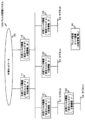
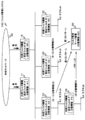
- a filter management system 100 includes an external filter device 11, an external filter device 12, an internal filter device 21, an internal filter device 22, an internal filter device 23, an internal filter device 24, and a filter management server. 30, an external network 40, a subnet 51, a subnet 52, a subnet 53, and a subnet 54.
- the filter management server 30 is a server device that distributes filter rules to be applied to the entire system and stores the filter rules after distribution in each filter device.
- Each filter device (external filter device 11, external filter device 12, internal filter device 21, internal filter device 22, internal filter device 23 and internal filter device 24) performs filtering based on the filter rule stored in the own filter device.
- Equipment Each of these filter devices is installed in a LAN provided in a company, for example.
- the external filter device 11 and the external filter device 12 are located at the contact point with the external network 40.
- the external network 40 is a network such as the Internet.
- each subnet is, for example, a network provided for each department.
- a communication terminal such as a personal computer or a server device is connected to each subnet. These communication terminals communicate with each other with other communication terminals connected to the subnet to which the communication terminal is connected, communication terminals connected to other subnets, and communication terminals connected to the external network 40. To do.
- the filter management server 30 is connected to each filter device via any subnet, external network 40, or other network not shown.
- the filter management server 30 can communicate with each filter device via these networks.
- the connection between the filter management server 30 and each filter device is not shown.
- the filter management server 30 includes a filter management unit 31 and a communication unit 34.
- the filter management unit 31 includes a calculation unit 32 and a storage unit 33.
- the filter management unit 31 is a part that controls the entire filter management server 30 and manages filter rules set in each filter device in the filter management system 100.
- the filter management unit 31 is realized by the calculation unit 32 and the storage unit 33.
- the calculation unit 32 is a calculation processing device such as a CPU (Central Processing Unit).
- the storage unit 33 is a main storage device such as a RAM (Random Access Memory) used by the calculation unit 32 and an auxiliary storage device such as an HDD (Hard Disk Drive).
- the storage unit 33 stores software unique to the present embodiment.
- the calculation unit 32 reads such software stored in the storage unit 33 and performs calculation processing based on this software.
- the filter management part 31 controls the hardware contained in the filter management server 30 based on the result of this arithmetic processing. That is, the filter management server 30 can be realized by cooperation of hardware and software.
- the communication unit 34 is a part for the filter management unit 31 to communicate with each filter device.
- the communication unit 34 communicates with each filter device via any subnet, external network 40, or the like.
- the filter management unit 31 generates a plurality of distributed filter rules by distributing filter rules to be applied to the filter management system 100 as secret information using the “secret sharing method”.
- the distributed filter rule is information obtained by distributing the pre-distributed filter rule, which is secret information. Therefore, in the following description, such a distributed filter rule is referred to as “distributed information” as appropriate.
- the filter management server 30 transmits each of the generated distributed information to each filter device, and does not leave the distributed information in the filter management server 30 after transmission. Note that the filter management server 30 stores which distributed information is transmitted to which filter device. As a result, it is assumed that which filter device of the filter management server 30 stores which shared information is stored.
- Each filter device sets a filter rule in its own filter device based on the distributed information stored in its own filter device, and performs filtering based on the set filter rule.
- the filter rules set in each filter device are unique filter rules.
- the filter rule A is set in the external filter device 11. Further, the external filter device 11 stores the filter rule A as the distributed information A.
- the filter rule B is set in the external filter device 12. Further, the filter rule B is stored as distributed information B.
- the filter rules are managed by the secret sharing method, so that efficient load distribution and security of the filter are improved.
- the secret sharing method the data information to be kept secret is divided into some (N pieces) shared information and managed. Of these, the minimum necessary number (K is assumed. In this embodiment, the relationship of K ⁇ N is satisfied in this embodiment) is collected, and the original secret data can be restored. The original secret data cannot be restored even if less than K pieces of shared information are collected.
- This secret sharing method is a method known as Shamir's (K, N) threshold method. Details of the Shamir (K, N) threshold method are described in Non-Patent Document 1 and Non-Patent Document 2, for example.
- the Shamir (K, N) threshold method is used, the filter rule is treated as secret data, and each of the plurality of distributed filter rules obtained by distributing the filter rules is distributed. Distributed management as information.
- the filter rule applied to the filter device whose load is increasing is restored with the shared information stored in the remaining devices. Then, by using the restored distributed information, the remaining device undertakes a replacement for the filter device having an increased load, thereby preventing a significant decrease in security in the network.
- the filter rules are not stored in a batch by the filter management server 30 but are distributed and stored in each filter device. Therefore, even if the filter management server 30 is directly accessed, It is possible to prevent the filter rule information from leaking.
- the external filter device 11 is an attack target such as a Dos attack.
- each filter device in the present embodiment constantly monitors the load applied to itself.
- the external filter device 11 detects that the load on the external filter device 11 itself has become a certain level or more due to an attack on the external filter device 11 (step S101 in FIG. 3)
- the other filter device Notify all or a part (step S103 in FIG. 3, (2-1) notification, (2-2) notification, and (2-3) notification in FIG. 4-1)].
- the three filter devices of the internal filter device 21, the internal filter device 22, and the internal filter device 23 that have received the notification of the load increase from the external filter device 11 use the distributed information held by themselves as the filter management server 30.
- Step S105 in FIG. 3 (3-1) shared information C, (3-2) shared information D, and (3-3) shared information E in FIG. 4A).
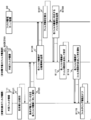
- the filter management server 30 that has received a total of K or more pieces of shared information from each filter device uses the secret sharing method to restore the filter rules that are the secret information from the received K pieces of shared information (FIG. 3).
- Step S107 of FIG. 4-1 (4) filter rule restoration).
- the filter rule that is the secret information is restored from the three pieces of shared information of shared information C, shared information D, and shared information E. With this restoration process, all filter rules including the filter rule A are restored.
- the filter management server 30 receives from the external filter device 11 that the load on the external filter device 11 has increased in step S103, or the filter device whose load has increased in step S105. Is received from the internal filter device 21, the internal filter device 22, and the internal filter device 23. As a result, it is assumed that the filter management server 30 knows that the filter device targeted for attack is the external filter device 11.
- the filter management server 30 sets the filter rule A, which is a filter rule corresponding to the external filter device 11, to the three filters of the internal filter device 21, the internal filter device 22, and the internal filter device 23 that provided shared information. Transmit to the device (step S109 in FIG. 3, (51) filter rule A, (52) filter rule A and (53) filter rule A in FIG. 4-2).
- the filter management server 30 if the filter management server 30 holds the restored filter rule, the filter rule may be leaked if the filter management server 30 is illegally accessed thereafter. Therefore, when the transmission in step S109 is executed, the filter management server 30 deletes the filter rule restored by the filter management server 30 itself from the filter management server 30.
- the filter rule from leaking from the filter management server 30.
- the distributed information stored in the filter management server 30 is described as “none”.
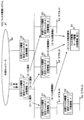
- the three filter devices of the internal filter device 21, the internal filter device 22, and the internal filter device 23 that have received the filter rule A newly add the received filter rule A to the filter rule that is currently set for itself. (Step S111 in FIG. 3).
- the three filter devices of the internal filter device 21, the internal filter device 22, and the internal filter device 23 add the received filter rule A to the distributed information stored by itself.
- the filter rule C and the filter rule A are set in the internal filter device 21, and the filter rule C and the filter rule A are stored as distributed information.
- the filter rule D and the filter rule A are set in the internal filter device 22, and the filter rule D and the filter rule A are stored as distributed information.
- the filter rule E and the filter rule A are set in the internal filter device 23, and the filter rule E and the filter rule A are stored as distributed information.
- the internal filter device 21, the internal filter device 22, and the internal filter device 23 continue filtering based on the filter rule set in the self filter device.
- the external filter device indicates that the filter rule A is newly added to itself. 11 (step S113 in FIG. 3, (6-1) notification, (6-2) notification, and (6-3) notification in FIG. 4-2).
- the external filter device 11 that has received the notification in step S113 from all the filter devices that have notified in step S103 invalidates its filtering function (step S115 in FIG. 3, FIG. 4-2 (7) filter invalidation). ).
- the external filter device 11 may store the filter rule A as shared information. However, there is a possibility that the attacker may gain unauthorized access to the external filter device 11 and obtain the shared information by the attack source. is there. Therefore, in step S115, the external filter device 11 may delete the shared information stored by itself. In order to express such a state, in FIG. 4B, the distributed information stored in the external filter device 11 and the filter rule set in the external filter device 11 are described as “none”.
- the first effect is that an inability to service due to communication interruption can be avoided.
- the filtering function can be distributed to other filter devices.
- the second effect is that the security of the internal network is not significantly reduced.
- the third effect is that even if the distributed information is acquired from the attacked filter device, the filter rules of the entire network are not leaked.
- the fourth effect is that even if a failure occurs in the filter management server itself, the filter rules of the entire network do not leak.
- the filter management server itself does not always hold the filter rule information, and only when any filter device detects an increase in load due to an attack or the like, the distributed information is sent from each filter device to the filter management server. This is because the filter rule is restored.
- the fifth effect is that it is possible to prevent the filter device targeted for attack from becoming inoperable.
- step S115 the filtering function of the attack target filter device is stopped in step S115.
- the following shows three modifications that take advantage of the characteristics of the secret sharing method.
- Each of the following modifications is the same as the above-described embodiment in basic configuration and operation. Therefore, in order to prevent duplication of explanation, hereinafter, configurations and operations unique to each modification will be described, and description of portions common to the above-described embodiments will be omitted.
- the filter management server 30 generates the shared information A to G by distributing the filter rules to be applied to the filter management system 100 as secret information using the “secret sharing method”. To do.
- the filter management server 30 stores the distributed information A to F in each filter device.
- the filter management server 30 itself stores the distributed information G.
- the filter management server 30 can also be a distribution target of distributed information, and it is possible to give a wide range of combinations of distribution of distributed information.
- the filter rule can be restored based on the distributed information stored in the internal filter device 21 and the internal filter device 22.
- the (2, 6) threshold method is used as the secret sharing method in this way, if the attacker acquires the shared information from the external filter device 11 and the internal filter device 21, the attacker side However, it becomes a problem because the filter rule can be restored.
- this modification it is possible to prevent such a problem from occurring.
- each piece of shared information is not weighted, and the distributed information is generated by always distributing the filter rules in a uniform distribution.
- filter rules are distributed by weighting each piece of distributed information.
- each shared information is identified and described by adding an alphabet as an identifier at the end of each shared information.
- each shared information is described as “shared information XY”.
- X is an alphabet
- Y is a number.
- each shared information is described as “shared information A1” or “shared information C2”.
- the alphabet X is an identifier for identifying each piece of distributed information as in the above embodiment.
- the number Y represents the weight of the distributed information.
- C2, D2, E2 and G2 have a large amount of information, such as C1, D2, E2 and G2 have twice the amount of information as A1, and F3 has three times the amount of information as A1.
- the quantity of shared information necessary for the filter management server 30 to restore the filter rule is determined by the weight of the shared information used for restoration. For example, if the (5, 7) threshold method is used as the restored secret sharing method, the shared information having a weight of 1, that is, if the shared information is X1, 5 (1 ⁇ 5 ⁇ 5) shared information is the filter rule. Necessary for restoration. If the shared information has a weight of 2, that is, shared information X2, three (2 ⁇ 3 ⁇ 5) shared information is required. Furthermore, in the case of shared information having a weight of 3, that is, shared information X3, two (3 ⁇ 2 ⁇ 5) shared information is required. In addition, the filter rule can be restored using the distribution information of different weights.
- the number of pieces of information that should be collected at least necessary for secret restoration differs depending on the amount of information that the distributed information has.
- the distributed information is also stored in the filter management server 30. That is, the example of FIG. 6 is an example in the case of combining the first modification and the second modification. Note that the second modification is not necessarily combined with the first modification.
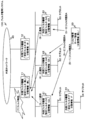
- the distributed information is stored in each filter device and the filter management server 30 as shown in FIG. Then, assume that the (5, 7) threshold method is used as the secret sharing method.
- the first pattern may be restored with an information amount corresponding to six weights including the three pieces of shared information C2, shared information D2, and shared information G2 (FIG. 6, (8- 1) shared information C2 and (8-2) shared information D2).
- the degree of freedom in arranging the filter rules can be increased. For example, if the filter management server 30 and the internal filter device are less likely to be attacked than the external filter device, the filter management server 30 and the internal filter device may store distributed information with a large amount of information. Good.
- the distributed information can be restored if the filter management server 30 and the internal filter devices are operating normally even if a small number. Even if an external filter device is attacked and some of the shared information is leaked, the amount of the distributed information that leaks is small, so the amount of information about the filter rules that can be leaked can be reduced. It is.
- the filter rule set for the certain filter device is divided into a plurality of filter rules.
- a plurality of divided filter rules are additionally set in different filter devices.
- the distributed information is also stored in the filter management server 30. Also, each distributed information is weighted. That is, the example of FIG. 7 is an example in the case of combining the first modification and the second modification with the third modification. It is not always necessary to combine the third modification with the first modification or the second modification.
- the internal filter device 21, the internal filter device 22, the internal filter device 23, and the like filter the distributed information stored in the self filter device. It transmits to the management server 30.
- the filter management server 30 restores the filter rule based on the distributed information. Then, a filter rule A that is a filter rule corresponding to the external filter device 11 is extracted from the restored filter rule.
- the extracted filter rule A is transmitted to the internal filter device 22 and the internal filter device 23 (FIG. 7, (10-1) filter rule A and (10-2) filter rule A).
- the internal filter device 22 and the internal filter device 23 set the filter rule A in its own filter device. Up to this point, the operation is the same as that of the above-described embodiment.
- the filter rule A is divided into a filter rule Aa and a filter rule Ab, and these are transmitted to the internal filter device 21 and the internal filter device 24 located inside the internal filter device 21.
- the filter rule Aa is transmitted to the internal filter device 21 (FIG. 7, filter rule Aa). Further, the filter rule Ab is transmitted to the internal filter device 24 (FIG. 7, filter rule Ab).
- the internal filter device 21 and the internal filter device 24 additionally set the received filter rule in its own filter device. Further, the internal filter device 21 and the internal filter device 24 additionally store the received filter rule as distributed information.
- the information amount of the shared information A is 1. And what divided shared information A is equivalent to shared information Aa and shared information Ab, and the amount of these information becomes 0.5. Therefore, in the figure, they are expressed as shared information A1, shared information Aa0.5, and shared information Ab0.5.
- the number of shared information and the number of filter devices have a one-to-one relationship.
- This may be modified to have a one-to-many relationship.
- the filter rule is distributed into five pieces of distributed information. Then, the same shared information is transmitted to the external filter device 11 and the external filter device 12. Thereby, the same filter rule is applied to the external filter device 11 and the external filter device 12. Then, the remaining four pieces of distributed information are transmitted to the internal filter device 21 to the internal filter device 24. By doing so, even if both the external filter device 11 and the external filter device 12 are attacked and shared information leaks from both, it is possible to reduce the number of shared information leaked to one. Become.
- the filter rule corresponding to the filter device under attack is transmitted to the filter device that provided the distributed information.
- the filter device corresponding to the filter device under attack is also included in the filter device. Send rules. And it is good to make it set the filter rule transmitted to this filter apparatus.
- each of the filter management server and the filter device included in the above-described filter management system can be realized by hardware, software, or a combination thereof.
- the filter management method performed by the filter management server and the filter device included in the filter management system described above can also be realized by hardware, software, or a combination thereof.
- “realized by software” means realized by a computer reading and executing a program.
- Non-transitory computer readable media include various types of tangible storage media.
- Examples of non-transitory computer readable media include magnetic recording media (eg, flexible disk, magnetic tape, hard disk drive), magneto-optical recording media (eg, magneto-optical disc), CD-ROM (Read Only Memory), CD- R, CD-R / W, semiconductor memory (for example, mask ROM, PROM (Programmable ROM), EPROM (Erasable ROM), flash ROM, RAM (random access memory)).
- a filtering system comprising a plurality of devices that perform filtering of communication data based on a filter rule, and a management device that manages the filter rule,
- the management device is connected to the external network via the first device when the first device connected to the external network without passing the other device enters a predetermined state.
- the distributed filter rules set in the first device are restored, and the restored distributed filter rules are transferred to the plurality of second devices.
- the filtering system wherein the distributed filter rules are distributed so that the filter rules can be restored without using all the distributed filter rules.
- Supplementary note 5 Any one of Supplementary notes 1 to 4, wherein the management device deletes the pre-distribution filter rule and the distributed filter rule from its own management device when the distributed filter rule is set in each device. 2.
- the filtering system according to 1.
- the said management apparatus makes the distributed filter rule set to the said 1st apparatus different from the distributed filter rule set to the said 2nd apparatus, Any one of Additional remark 1 thru
- the management apparatus restores the filter rule before distribution based on the distributed filter rule received from each of the plurality of second devices, and redistributes the filter rule after the restoration to distribute the first filter rule.
- the filtering system according to any one of appendices 1 to 7, wherein the distributed filter rule corresponding to the device is restored.
- a management device that is communicably connected to a plurality of devices that perform filtering of communication data based on a filter rule, and manages the filter rule,
- a plurality of second devices connected to the external network through the first device Restoring the distributed filter rule set in the first device based on a plurality of distributed filter rules received from the device, and setting the restored distributed filter rule in the plurality of second devices;
- the management apparatus wherein the distributed filter rules are distributed so that the filter rules can be restored without using all the distributed filter rules.
- a filtering method performed by a system including a plurality of devices that perform filtering of communication data based on a filter rule, and a management device that manages the filter rule,
- the management device is connected to the external network via the first device when the first device connected to the external network without passing the other device enters a predetermined state.
- the distributed filter rules set in the first device are restored, and the restored distributed filter rules are transferred to the plurality of second devices.
- the filtering method wherein the distributed filter rule is distributed such that the filter rule can be restored without using all the distributed filter rules.
- a management program that is communicably connected to a plurality of devices that perform filtering of communication data based on a filter rule, and that causes a computer to function as a management device that manages the filter rule,
- a management device that manages the filter rule
- the first device connected to the external network without going through the other device enters a predetermined state
- a plurality of second devices connected to the external network through the first device Restoring the distributed filter rule set in the first device based on a plurality of distributed filter rules received from the device, and setting the restored distributed filter rule in the plurality of second devices
- a management program that causes the computer to function as a management device in which the distributed filter rule is distributed so that the distributed filter rule can be restored without using all the distributed filter rules.
- Filter management means for generating a plurality of post-distribution filter rules by distributing filter rules used for filtering communication data; Transmitting means for transmitting the plurality of post-distribution filter rules to a plurality of devices that perform the filtering; The filter management apparatus, wherein the filter management means performs the distribution so that the filter rule before the distribution can be restored if a predetermined number or more of the filter rules after the distribution are used.
- the filter management device according to supplementary note 14, wherein the first device is a device in which a load of a predetermined weight or more is applied to the device itself.
- the first device is a device connected to an external network without any other device, and the second device is connected to the external network via the first device.
- Item 15 The filter management device according to appendix 14, wherein the filter management device is a device that is configured.
- the transmission means transmits the distributed filter rule, the pre-distribution filter rule and the post-distribution filter rule are deleted from the own filter management device.
- the filter management device according to any one of 16.
- a filter management system including the filter management device according to any one of supplementary notes 12 to 17, and the device, When the device receives the distributed filter rule from the filter management device, the device executes the filtering based on the received filter rule.
- the device When the device detects that its own device is loaded with a predetermined weight or more, it notifies other devices, The other device that has received the notification transmits the distributed filter rule stored in the own device to the filter management device, The filter management device receives the predetermined number or more of the distributed filter rules from the other device, and restores the pre-distributed filter rules using the received predetermined number of filter rules.
- the filter management system according to appendix 18.
- the present invention is widely suitable for filtering applications in a network without questioning the type of communication device or the type of network.
Landscapes
- Engineering & Computer Science (AREA)
- Computer Networks & Wireless Communication (AREA)
- Signal Processing (AREA)
- Computer Security & Cryptography (AREA)
- Computer Hardware Design (AREA)
- Computing Systems (AREA)
- General Engineering & Computer Science (AREA)
- Business, Economics & Management (AREA)
- General Business, Economics & Management (AREA)
- Data Exchanges In Wide-Area Networks (AREA)
- Computer And Data Communications (AREA)
Priority Applications (6)
| Application Number | Priority Date | Filing Date | Title |
|---|---|---|---|
| US15/307,194 US10135787B2 (en) | 2015-07-23 | 2016-03-08 | Filtering system, management device, filtering method and management program |
| AU2016247229A AU2016247229A1 (en) | 2015-07-23 | 2016-03-08 | Filtering system, management device, filtering method and management program |
| EP16781040.7A EP3148123B1 (de) | 2015-07-23 | 2016-03-08 | Gegen schad-software angriffe gerüstete filtrierungstechnik |
| CN201680001156.9A CN106550616B (zh) | 2015-07-23 | 2016-03-08 | 过滤系统、管理装置、过滤方法和计算机可读介质 |
| CA2947097A CA2947097C (en) | 2015-07-23 | 2016-03-08 | Filtering system, management device, filtering method and management program |
| AU2018202434A AU2018202434B2 (en) | 2015-07-23 | 2018-04-06 | Filtering system, management device, filtering method and management program |
Applications Claiming Priority (2)
| Application Number | Priority Date | Filing Date | Title |
|---|---|---|---|
| JP2015145636A JP5967739B1 (ja) | 2015-07-23 | 2015-07-23 | フィルタリングシステム、管理装置、フィルタリング方法及び管理プログラム |
| JP2015-145636 | 2015-07-23 |
Publications (1)
| Publication Number | Publication Date |
|---|---|
| WO2017013894A1 true WO2017013894A1 (ja) | 2017-01-26 |
Family
ID=56689561
Family Applications (1)
| Application Number | Title | Priority Date | Filing Date |
|---|---|---|---|
| PCT/JP2016/057175 Ceased WO2017013894A1 (ja) | 2015-07-23 | 2016-03-08 | フィルタリングシステム、管理装置、フィルタリング方法及び管理プログラム |
Country Status (7)
| Country | Link |
|---|---|
| US (1) | US10135787B2 (de) |
| EP (1) | EP3148123B1 (de) |
| JP (1) | JP5967739B1 (de) |
| CN (1) | CN106550616B (de) |
| AU (2) | AU2016247229A1 (de) |
| CA (1) | CA2947097C (de) |
| WO (1) | WO2017013894A1 (de) |
Families Citing this family (2)
| Publication number | Priority date | Publication date | Assignee | Title |
|---|---|---|---|---|
| JP5967739B1 (ja) | 2015-07-23 | 2016-08-10 | Necプラットフォームズ株式会社 | フィルタリングシステム、管理装置、フィルタリング方法及び管理プログラム |
| EP3530711B1 (de) | 2016-10-24 | 2022-08-17 | Ajinomoto Co., Inc. | Gelzusammensetzung |
Citations (3)
| Publication number | Priority date | Publication date | Assignee | Title |
|---|---|---|---|---|
| JP2001249866A (ja) * | 2000-03-06 | 2001-09-14 | Fujitsu Ltd | ファイアウォール機能を分散させたネットワーク、ファイアウォール分散機能を有するファイアウォールサーバ、及びファイアウォール機能を有するエッジノード |
| JP2003244247A (ja) | 2002-02-15 | 2003-08-29 | Nippon Telegr & Teleph Corp <Ntt> | パケットフィルタ分散方法及び分散化パケットフィルタシステム |
| JP2011172126A (ja) * | 2010-02-22 | 2011-09-01 | Mitsubishi Electric Corp | パケットフィルタシステム及びパケットフィルタ装置及びプログラム |
Family Cites Families (10)
| Publication number | Priority date | Publication date | Assignee | Title |
|---|---|---|---|---|
| JP2006525729A (ja) * | 2003-05-01 | 2006-11-09 | コーニンクレッカ フィリップス エレクトロニクス エヌ ヴィ | アドホックネットワーク、ネットワーク装置及びそのコンフィギュレーション管理方法 |
| WO2005076518A1 (en) * | 2004-02-10 | 2005-08-18 | Ntt Communications Corporation | Secret information management scheme based on secret sharing scheme |
| JP4771942B2 (ja) | 2004-04-23 | 2011-09-14 | パナソニック株式会社 | 個人情報管理装置、分散鍵記憶装置、個人情報管理システム、個人情報管理方法、コンピュータプログラム、記録媒体及び集積回路 |
| US20060026680A1 (en) | 2004-07-29 | 2006-02-02 | Zakas Phillip H | System and method of characterizing and managing electronic traffic |
| CA2594020C (en) * | 2004-12-22 | 2014-12-09 | Wake Forest University | Method, systems, and computer program products for implementing function-parallel network firewall |
| JP4304215B2 (ja) | 2007-03-23 | 2009-07-29 | 株式会社東芝 | 秘密分散装置、方法及びプログラム |
| US8548956B2 (en) * | 2008-02-28 | 2013-10-01 | Mcafee, Inc. | Automated computing appliance cloning or migration |
| US20110119730A1 (en) | 2009-05-07 | 2011-05-19 | Rotem Eldar | Enforcing Centralized Communication Policies |
| US9130901B2 (en) * | 2013-02-26 | 2015-09-08 | Zentera Systems, Inc. | Peripheral firewall system for application protection in cloud computing environments |
| JP5967739B1 (ja) | 2015-07-23 | 2016-08-10 | Necプラットフォームズ株式会社 | フィルタリングシステム、管理装置、フィルタリング方法及び管理プログラム |
-
2015
- 2015-07-23 JP JP2015145636A patent/JP5967739B1/ja active Active
-
2016
- 2016-03-08 AU AU2016247229A patent/AU2016247229A1/en not_active Abandoned
- 2016-03-08 EP EP16781040.7A patent/EP3148123B1/de active Active
- 2016-03-08 CN CN201680001156.9A patent/CN106550616B/zh active Active
- 2016-03-08 CA CA2947097A patent/CA2947097C/en active Active
- 2016-03-08 WO PCT/JP2016/057175 patent/WO2017013894A1/ja not_active Ceased
- 2016-03-08 US US15/307,194 patent/US10135787B2/en active Active
-
2018
- 2018-04-06 AU AU2018202434A patent/AU2018202434B2/en active Active
Patent Citations (3)
| Publication number | Priority date | Publication date | Assignee | Title |
|---|---|---|---|---|
| JP2001249866A (ja) * | 2000-03-06 | 2001-09-14 | Fujitsu Ltd | ファイアウォール機能を分散させたネットワーク、ファイアウォール分散機能を有するファイアウォールサーバ、及びファイアウォール機能を有するエッジノード |
| JP2003244247A (ja) | 2002-02-15 | 2003-08-29 | Nippon Telegr & Teleph Corp <Ntt> | パケットフィルタ分散方法及び分散化パケットフィルタシステム |
| JP2011172126A (ja) * | 2010-02-22 | 2011-09-01 | Mitsubishi Electric Corp | パケットフィルタシステム及びパケットフィルタ装置及びプログラム |
Non-Patent Citations (3)
| Title |
|---|
| HIROSHI: "Regarding Secret Sharing Schemes and Application Thereof", vol. 4, November 2013 (2013-11-01), Retrieved from the Internet <URL:www.iisec.ac.jp/proc/vol0004/doi.pdf>> |
| IWAMOTO, MITSUGI, SECRET SHARING SCHEMES, 30 June 2016 (2016-06-30), Retrieved from the Internet <URL:http://ohta-lab.jp/users/mitsugu/research/SSS/main.html> |
| See also references of EP3148123A4 |
Also Published As
| Publication number | Publication date |
|---|---|
| CA2947097C (en) | 2017-04-04 |
| EP3148123B1 (de) | 2019-05-29 |
| CN106550616B (zh) | 2018-12-04 |
| AU2018202434B2 (en) | 2018-11-08 |
| CN106550616A (zh) | 2017-03-29 |
| US20170171155A1 (en) | 2017-06-15 |
| AU2016247229A1 (en) | 2017-02-09 |
| JP2017028516A (ja) | 2017-02-02 |
| EP3148123A1 (de) | 2017-03-29 |
| US10135787B2 (en) | 2018-11-20 |
| AU2018202434A1 (en) | 2018-04-26 |
| JP5967739B1 (ja) | 2016-08-10 |
| EP3148123A4 (de) | 2017-11-08 |
| CA2947097A1 (en) | 2017-01-05 |
Similar Documents
| Publication | Publication Date | Title |
|---|---|---|
| KR101531472B1 (ko) | 방화벽 클러스터에서의 애플리케이션 상태 공유 | |
| JP5624526B2 (ja) | 鍵共有装置、鍵共有方法および鍵共有プログラム | |
| CN103959712B (zh) | 大型防火墙集群中的定时管理 | |
| US20160119294A1 (en) | Methods and systems for data traffic control and encryption | |
| CN105407099B (zh) | 防火墙群集中的验证共享 | |
| JP4636345B2 (ja) | セキュリティポリシー制御システム、セキュリティポリシー制御方法、及びプログラム | |
| JP6052692B1 (ja) | セキュリティ管理方法、プログラム、およびセキュリティ管理システム | |
| JP5967739B1 (ja) | フィルタリングシステム、管理装置、フィルタリング方法及び管理プログラム | |
| Mantur et al. | Centralized control signature-based firewall and statistical-based network intrusion detection system (NIDS) in software defined networks (SDN) | |
| US20200236031A1 (en) | Blockchain Routing Protocols | |
| KR20160115132A (ko) | 클라우드 시스템의 보안 서비스 제공방법 및 그 클라우드 시스템 | |
| EP4575862A1 (de) | Dezentralisierte sichere verteilung von softwareaktualisierungen an medizinische vorrichtungen | |
| JP6476034B2 (ja) | 制御装置及び制御方法 |
Legal Events
| Date | Code | Title | Description |
|---|---|---|---|
| REEP | Request for entry into the european phase |
Ref document number: 2016781040 Country of ref document: EP |
|
| WWE | Wipo information: entry into national phase |
Ref document number: 2016781040 Country of ref document: EP |
|
| WWE | Wipo information: entry into national phase |
Ref document number: 15307194 Country of ref document: US |
|
| WWE | Wipo information: entry into national phase |
Ref document number: 2947097 Country of ref document: CA |
|
| ENP | Entry into the national phase |
Ref document number: 2016247229 Country of ref document: AU Date of ref document: 20160308 Kind code of ref document: A |
|
| 121 | Ep: the epo has been informed by wipo that ep was designated in this application |
Ref document number: 16781040 Country of ref document: EP Kind code of ref document: A1 |
|
| NENP | Non-entry into the national phase |
Ref country code: DE |