WO2017017964A1 - Nouveau polymère réticulé d'acide acrylique et son utilisation - Google Patents
Nouveau polymère réticulé d'acide acrylique et son utilisation Download PDFInfo
- Publication number
- WO2017017964A1 WO2017017964A1 PCT/JP2016/003524 JP2016003524W WO2017017964A1 WO 2017017964 A1 WO2017017964 A1 WO 2017017964A1 JP 2016003524 W JP2016003524 W JP 2016003524W WO 2017017964 A1 WO2017017964 A1 WO 2017017964A1
- Authority
- WO
- WIPO (PCT)
- Prior art keywords
- water
- acrylic acid
- polymer
- viscosity
- weight
- Prior art date
- Legal status (The legal status is an assumption and is not a legal conclusion. Google has not performed a legal analysis and makes no representation as to the accuracy of the status listed.)
- Ceased
Links
Images





Classifications
-
- C—CHEMISTRY; METALLURGY
- C09—DYES; PAINTS; POLISHES; NATURAL RESINS; ADHESIVES; COMPOSITIONS NOT OTHERWISE PROVIDED FOR; APPLICATIONS OF MATERIALS NOT OTHERWISE PROVIDED FOR
- C09K—MATERIALS FOR MISCELLANEOUS APPLICATIONS, NOT PROVIDED FOR ELSEWHERE
- C09K8/00—Compositions for drilling of boreholes or wells; Compositions for treating boreholes or wells, e.g. for completion or for remedial operations
- C09K8/60—Compositions for stimulating production by acting on the underground formation
- C09K8/62—Compositions for forming crevices or fractures
- C09K8/66—Compositions based on water or polar solvents
- C09K8/68—Compositions based on water or polar solvents containing organic compounds
- C09K8/685—Compositions based on water or polar solvents containing organic compounds containing cross-linking agents
-
- C—CHEMISTRY; METALLURGY
- C08—ORGANIC MACROMOLECULAR COMPOUNDS; THEIR PREPARATION OR CHEMICAL WORKING-UP; COMPOSITIONS BASED THEREON
- C08F—MACROMOLECULAR COMPOUNDS OBTAINED BY REACTIONS ONLY INVOLVING CARBON-TO-CARBON UNSATURATED BONDS
- C08F220/00—Copolymers of compounds having one or more unsaturated aliphatic radicals, each having only one carbon-to-carbon double bond, and only one being terminated by only one carboxyl radical or a salt, anhydride ester, amide, imide or nitrile thereof
- C08F220/02—Monocarboxylic acids having less than ten carbon atoms; Derivatives thereof
- C08F220/04—Acids; Metal salts or ammonium salts thereof
- C08F220/06—Acrylic acid; Methacrylic acid; Metal salts or ammonium salts thereof
-
- C—CHEMISTRY; METALLURGY
- C09—DYES; PAINTS; POLISHES; NATURAL RESINS; ADHESIVES; COMPOSITIONS NOT OTHERWISE PROVIDED FOR; APPLICATIONS OF MATERIALS NOT OTHERWISE PROVIDED FOR
- C09K—MATERIALS FOR MISCELLANEOUS APPLICATIONS, NOT PROVIDED FOR ELSEWHERE
- C09K8/00—Compositions for drilling of boreholes or wells; Compositions for treating boreholes or wells, e.g. for completion or for remedial operations
- C09K8/60—Compositions for stimulating production by acting on the underground formation
- C09K8/84—Compositions based on water or polar solvents
- C09K8/86—Compositions based on water or polar solvents containing organic compounds
- C09K8/88—Compositions based on water or polar solvents containing organic compounds macromolecular compounds
- C09K8/882—Compositions based on water or polar solvents containing organic compounds macromolecular compounds obtained by reactions only involving carbon-to-carbon unsaturated bonds
-
- C—CHEMISTRY; METALLURGY
- C09—DYES; PAINTS; POLISHES; NATURAL RESINS; ADHESIVES; COMPOSITIONS NOT OTHERWISE PROVIDED FOR; APPLICATIONS OF MATERIALS NOT OTHERWISE PROVIDED FOR
- C09K—MATERIALS FOR MISCELLANEOUS APPLICATIONS, NOT PROVIDED FOR ELSEWHERE
- C09K8/00—Compositions for drilling of boreholes or wells; Compositions for treating boreholes or wells, e.g. for completion or for remedial operations
- C09K8/60—Compositions for stimulating production by acting on the underground formation
- C09K8/84—Compositions based on water or polar solvents
- C09K8/86—Compositions based on water or polar solvents containing organic compounds
- C09K8/88—Compositions based on water or polar solvents containing organic compounds macromolecular compounds
- C09K8/887—Compositions based on water or polar solvents containing organic compounds macromolecular compounds containing cross-linking agents
-
- E—FIXED CONSTRUCTIONS
- E21—EARTH OR ROCK DRILLING; MINING
- E21B—EARTH OR ROCK DRILLING; OBTAINING OIL, GAS, WATER, SOLUBLE OR MELTABLE MATERIALS OR A SLURRY OF MINERALS FROM WELLS
- E21B43/00—Methods or apparatus for obtaining oil, gas, water, soluble or meltable materials or a slurry of minerals from wells
- E21B43/25—Methods for stimulating production
- E21B43/26—Methods for stimulating production by forming crevices or fractures
-
- G—PHYSICS
- G01—MEASURING; TESTING
- G01N—INVESTIGATING OR ANALYSING MATERIALS BY DETERMINING THEIR CHEMICAL OR PHYSICAL PROPERTIES
- G01N33/00—Investigating or analysing materials by specific methods not covered by groups G01N1/00 - G01N31/00
- G01N33/44—Resins; Plastics; Rubber; Leather
- G01N33/442—Resins; Plastics
-
- G—PHYSICS
- G01—MEASURING; TESTING
- G01N—INVESTIGATING OR ANALYSING MATERIALS BY DETERMINING THEIR CHEMICAL OR PHYSICAL PROPERTIES
- G01N11/00—Investigating flow properties of materials, e.g. viscosity, plasticity; Analysing materials by determining flow properties
Definitions
- the present invention relates to a novel acrylic acid crosslinked polymer and its use in a fluid (fracturing fluid) used for hydraulic fracturing of the formation.
- the present invention also relates to a method for determining a water-absorbing material suitable as a fracturing fluid for a hydraulic fracturing method.
- Patent Documents 1 to 4 discloses the use of a water-absorbing resin as a fracturing fluid.
- Patent Document 5 International Publication No. 2008/126793 discloses a particulate water-absorbing agent mainly composed of a polyacrylate water-absorbing resin having a high water absorption ratio.
- the present inventors have found a novel acrylic acid cross-linked polymer, and have found that this polymer exhibits excellent thickening behavior.
- the present invention has a performance necessary when applying a water-absorbing resin to a gelling system of a fracturing fluid used under pressure, such as a high water absorption ratio, a low soluble content, a water absorption capacity under pressure, a high gel strength, etc. While it was thought that the performance was similar to that required for water-absorbing resins used in general sanitary materials, surprisingly, the water-absorbing resin with high solubility was not a water-absorbing capacity under pressure.
- the acrylic acid cross-linked polymer of the present invention as a fracturing fluid, a required chemical substance can be reduced and a break can be easily made as compared with a conventionally used guar gum-based gelling system.
- the effect of facilitating treatment of the flow-back water can be achieved or enhanced.
- the present invention significantly improves salt resistance. Since the water used for the fracturing fluid is usually so-called salt water, such as lake water and river water, it is necessary to use salt-resistant water in order to make it usable in wells in various locations. Where a fracturing fluid with properties is desirable, this requirement is also met.
- an appropriate fracturing fluid can be selected, manufactured and used in consideration of heat resistance.
- a fracturing fluid having improved heat resistance can be provided.
- Fracturing fluids can be used in deep layers, and the temperature in the ground increases as the depth increases.
- the average earth temperature gradient to a depth of more than about 10,000 m is about 2.5-3 ° C./100 m, with a depth of 2,000 m
- the temperature is 65 to 75 ° C., the depth is 95 to 105 ° C. at a depth of 3,000 m, and the temperature increases to the same extent up to 2,000 to 3000 m deep.
- the present invention provides a method for determining a water-absorbing material suitable as a fracturing fluid for a hydraulic fracturing method that can be used even under such high temperature conditions.
- the present invention also provides the following items.
- At least one selected from the soluble content, the weight average molecular weight of the soluble content, the water absorption rate in physiological saline, and the water absorption rate in pure water is larger than 300 ⁇ m, and from 425 ⁇ m
- the acrylic acid cross-linked polymer according to any one of the above items, which is a value related to a small acrylic acid cross-linked polymer.
- the viscosity when the dispersion is 0.12 wt% in pure water is 100 mPa ⁇ s or more and / or the viscosity when the dispersion is 0.72 wt% in physiological saline is 20 mPa ⁇ s.
- the acrylic acid cross-linked polymer according to any one of the above items which is s or more.
- Item 8A A water-absorbing agent for a fracturing fluid in a hydraulic fracturing method, comprising the acrylic acid crosslinked polymer according to any one of the above items.
- (Item 9A) The water absorbing agent for a fracturing fluid in a hydraulic fracturing method according to any one of the above items, wherein the neutralization rate of the acrylic acid crosslinked polymer is higher than 75 mol%.
- (Item 10A) Additive for water absorbing agent for fracturing fluid of hydraulic fracturing method, including chelating agent.
- (Item 11A) An additive for a water-absorbing agent for a fracturing fluid in a hydraulic fracturing method, comprising a raw material for the acrylic acid cross-linked polymer and a cross-linking agent.
- (Item 12A) A kit for a water absorbing agent for a fracturing fluid of a hydraulic fracturing method, comprising the chelating agent and the acrylic acid crosslinked polymer according to any one of the above items.
- (Item 13A) The additive according to any one of the above items or the kit according to any one of the above items, wherein the chelating agent is selected from diethylenetriaminepentaacetic acid or a salt thereof.
- the cross-linking agent is triallyl isocyanurate.
- a method for determining an appropriate water-absorbing material as a fracturing fluid in a hydraulic fracturing method 1) measuring the relationship between the amount of polymer used in the material and the viscosity of the polymer in a fluid medium at room temperature; 2) determining the amount of the polymer that has a predetermined viscosity or higher; 3) adding a variable amount of a chelating agent to a predetermined amount of the polymer satisfying the condition determined in 2) under a predetermined high temperature condition, and measuring a change in viscosity with time in the fluid medium; 4) determining the amount of chelating agent that the viscosity measured in 3) stabilizes over time; 5) When the viscosity determined in 3) in the case of stabilizing in 4) is a viscosity capable of maintaining suspension, a certain amount of the polymer and the amount of the chelating agent in 4) are employed to maintain suspension.
- (Item 6) Item 6. The method according to any one of Items 1 to 5, wherein the polymer is a water absorbent resin.
- (Item 7) Item 7. The method according to Item 6, wherein the water absorbent resin is an acrylic acid crosslinked polymer.
- (Item 8) Item 8. The method according to Item 7, wherein the acrylic acid crosslinked polymer is a crosslinked polymer comprising polyacrylic acid, sodium polyacrylate, or polyacrylamide and / or a mixture thereof.
- (Item 9) Item 1) -8) and / or 6) step described in any one of Items 1-8, and 7) a step of producing a fracturing fluid using the predetermined amount of polymer and the amount of chelating agent.
- a method for producing a fracturing fluid for hydraulic fracturing Item 10) Item 1) -9) 1) -5) and / or 6) described in any one of items 1 and / or 7) described in item 9, and said certain amount of polymer and said amount of chelating agent Or a hydraulic fracturing method comprising the step of hydraulic fracturing using the fracturing fluid.
- Item 12 Item 12. The acrylic acid crosslinked polymer according to item 11, wherein the soluble component has a weight average molecular weight of 1,000,000 daltons or more.
- Item 13 Item 13.
- At least one selected from the soluble amount, the weight-average molecular weight of the soluble component, the water absorption rate in physiological saline, and the water absorption rate in ion-exchanged water has a particle size larger than 300 ⁇ m and smaller than 425 ⁇ m. 14.
- the viscosity when the dispersion is 0.12% by weight in ion-exchanged water is 100 mPa ⁇ s or more and / or the viscosity when the dispersion is 0.72% by weight in physiological saline is 20 mPa ⁇ s or more.
- Item 15 The acrylic acid crosslinked polymer according to any one of Items 11 to 14.
- Item 16 Item 16. The acrylic acid crosslinked polymer according to any one of Items 11 to 15, wherein the polymer is a particle having an average particle diameter (D50) of 10 ⁇ m or more.
- a gelling thickener comprising the acrylic acid crosslinked polymer according to any one of items 11 to 16.
- (Item 18) A water-absorbing agent for a fracturing fluid in a hydraulic crushing method, comprising the acrylic acid crosslinked polymer according to any one of items 11 to 16.
- (Item 19) Item 19.
- (Item 20) Item 20.
- (Item 21) Item 21.
- (Item 22) Additive for water absorbing agent for fracturing fluid of hydraulic fracturing method, including chelating agent.
- (Item 23) Item 17.
- An additive for a water-absorbing agent for a fracturing fluid in a hydraulic fracturing method comprising the raw material for the acrylic acid crosslinked polymer according to any one of Items 11 to 16 and a crosslinking agent.
- (Item 24) A kit for a water absorbing agent for a fracturing fluid of a hydraulic fracturing method, comprising an acrylic acid crosslinked polymer and / or a chelating agent and an acrylic acid crosslinked polymer.
- (Item 25) Item 25.
- the acrylic acid crosslinked polymer comprises the acrylic acid crosslinked polymer according to any one of Items 11 to 16.
- the chelating agent is selected from diethylenetriaminepentaacetic acid or a salt thereof.
- Item 28 27.
- Item 29 Item 24.
- a hydraulic fracturing method including a step of hydraulic fracturing using a water absorbing agent for a fracturing fluid, comprising the acrylic acid crosslinked polymer according to any one of items 11 to 16.
- the hydraulic fracturing method according to Item 30 wherein the neutralization rate of the acrylic acid crosslinked polymer is higher than 75 mol%.
- Item 33 Item 33.
- the hydraulic fracturing method according to any one of Items 30 to 32, wherein 0.1% by weight or more of a chelating agent is used.
- the hydraulic crushing method including the process of carrying out the hydraulic fracturing using the additive for water absorbing agents for fracturing fluid containing a chelating agent.
- a hydraulic fracturing method comprising a step of hydraulic fracturing using an additive for a water-absorbing agent for a fracturing fluid, comprising the raw material for the acrylic acid cross-linked polymer according to any one of items 11 to 16 and a cross-linking agent.
- a hydraulic fracturing method comprising a step of hydraulic fracturing using a water-absorbing agent kit for a fracturing fluid comprising a cross-linked acrylic acid polymer and / or a chelating agent and a cross-linked acrylic acid polymer.
- Item 37 Item 37.
- the hydraulic crushing method according to Item 36, wherein the acrylic acid crosslinked polymer comprises the acrylic acid crosslinked polymer according to any one of Items 11 to 16.
- the chelating agent is selected from diethylenetriaminepentaacetic acid or a salt thereof.
- the cross-linked polymer of the present invention has a greater thickening effect on water having a wider range of hardness than polymers used in conventionally known water-absorbing resins, so that it can be advantageously used in fracturing fluids and the like. Moreover, since the kind and amount of the additive in the fracturing fluid composition can be reduced, the environmental load can be reduced.
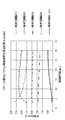
- FIG. 1 is a graph of measurement time vs. viscosity in each test example of an acrylic acid crosslinked polymer (addition amount 0.72 wt%) in physiological saline.
- FIG. 2 is a graph of measurement time vs. viscosity in each test example of an acrylic acid crosslinked polymer (added amount: 0.12 wt%) in ion-exchanged water.
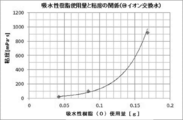
- FIG. 3 shows the relationship between the amount of water-absorbing resin (0) used in ion-exchanged water and the viscosity (viscosity after 30 minutes).
- FIG. 4 shows the relationship between the amount of water-absorbing resin (0) used in physiological saline and the viscosity (viscosity after 30 minutes).
- FIG. 1 is a graph of measurement time vs. viscosity in each test example of an acrylic acid crosslinked polymer (addition amount 0.72 wt%) in physiological saline.
- FIG. 2 is a graph of measurement time vs. viscosity
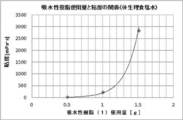
- FIG. 5 shows the relationship between the amount of water-absorbent resin (1) used in ion-exchanged water and the viscosity (viscosity after 30 minutes).
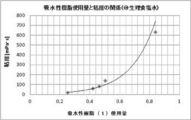
- FIG. 6 shows the relationship between the amount of water-absorbent resin (1) used in physiological saline and the viscosity (viscosity after 30 minutes).
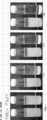
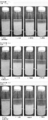
- FIG. 7 shows a sand (sea sand) dispersion and sedimentation test of the water absorbent resin (1) and the non-crosslinked polymer (6).
- FIG. 8 shows a sand (sea sand) dispersion and sedimentation test at a viscosity of 139 mPa ⁇ s, 81 mPa ⁇ s, and 59 mPa ⁇ s of the water absorbent resin (1).
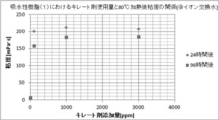
- FIG. 9 shows the relationship between the amount of the chelating agent of the water-absorbent resin (1) in ion-exchanged water and the viscosity after the 80 ° C. heat resistance test (2-minute stable value).
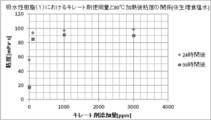
- FIG. 10 shows the relationship between the amount of the chelating agent of the water-absorbent resin (1) in physiological saline and the viscosity after the 80 ° C. heat resistance test (2-minute stable value).
- FIG. 9 shows the relationship between the amount of the chelating agent of the water-absorbent resin (1) in physiological saline and the viscosity after the 80 ° C. heat resistance test (2-minute stable value).
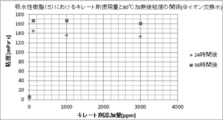
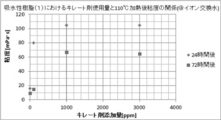
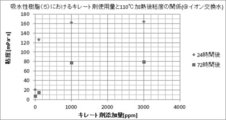
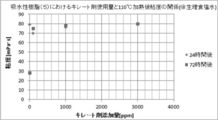
- FIG. 11 shows the relationship between the amount of the chelating agent of the water-absorbent resin (5) in ion-exchanged water and the viscosity after the 80 ° C. heat resistance test (2-minute stable value).
- FIG. 12 shows the relationship between the amount of the chelating agent of the water-absorbent resin (5) in physiological saline and the viscosity after the 80 ° C. heat resistance test (2-minute stable value).
- FIG. 13 shows the relationship between the amount of the chelating agent of the water-absorbent resin (1) in ion-exchanged water and the viscosity after the 110 ° C. heat resistance test (2-minute stable value).
- FIG. 14 shows the relationship between the amount of the chelating agent of the water-absorbent resin (1) in physiological saline and the viscosity after the 110 ° C. heat resistance test (2-minute stable value).
- FIG. 15 shows the relationship between the amount of the chelating agent of the water-absorbent resin (5) in ion-exchanged water and the viscosity after the 110 ° C. heat resistance test (2-minute stable value).
- FIG. 16 shows the relationship between the amount of the chelating agent of the water-absorbent resin (5) in physiological saline and the viscosity after the 110 ° C. heat resistance test (2-minute stable value).
- FIG. 15 shows the relationship between the amount of the chelating agent of the water-absorbent resin (5) in ion-exchanged water and the viscosity after the 110 ° C. heat resistance test (2-minute stable value).
- FIG. 16 shows the relationship between the amount of the chelating agent of the water-absorbent resin
- FIG. 17 shows the relationship between the water absorption magnification and the concentration when the liquid to be absorbed is a NaCl aqueous solution.
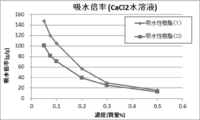
- FIG. 18 shows the relationship between the water absorption magnification and the concentration when the liquid to be absorbed is a CaCl 2 aqueous solution.
- the “acrylic acid crosslinked polymer” in the present invention is a polymer containing, as a main component, a structural unit derived from a repeating unit of acrylic acid (salt) and a crosslinking agent (hereinafter also referred to as “internal crosslinking agent”). Point to.
- the acrylic acid crosslinked polymer can be used as a water-absorbing resin.
- the “water-absorbent resin” in the present invention refers to a water-swellable, water-insoluble polymer gelling agent and satisfies the following physical properties. That is, as a “water swellability”, a physical property having a CRC specified by ERT441.2-02 of 60 g / g or more and a “water-insoluble” having an Ext specified by ERT470.2-02 of 40% by weight or more. It refers to a polymer gelling agent that satisfies the above.
- the polymer of the present invention can be used as a water absorbent resin.
- the water absorbent resin can be used as a water absorbent material.
- the above water-absorbing resin can be designed as appropriate according to its use. Moreover, the whole amount (100 weight%) is not limited to the form which is a polymer, The water absorbing resin composition containing the additive etc. may be sufficient in the range which satisfies the said physical property (CRC, Ext).
- the water-absorbent resin in the present invention is not limited to the final product, but may refer to an intermediate in the manufacturing process of the water-absorbent resin (for example, a hydrogel crosslinked polymer after polymerization, a dried polymer after drying, etc.).
- a hydrogel crosslinked polymer after polymerization for example, a hydrogel crosslinked polymer after polymerization, a dried polymer after drying, etc.
- all of these are collectively referred to as “water-absorbent resin”.
- the shape of the water-absorbing resin include a sheet shape, a fiber shape, a film shape, a particle shape, and a gel shape.
- Water-absorbing material refers to any water-absorbing material suitable for use in a fracturing fluid of a hydraulic fracturing method including a polymer and a chelating agent.
- a “polymer” may also be a substance referred to in the art as a “thickener”.
- the water-absorbing material include a water-absorbing resin and a water-absorbing crosslinked polymer.
- Specific embodiments of the water-absorbing material that can be used in the present invention include crosslinked polymers such as homopolymers and copolymers such as polyacrylic acid, sodium polyacrylate, and polyacrylamide, and mixtures thereof.
- the water-absorbing agent in the present invention refers to a water-swelling, water-insoluble polymer gelling agent used for a fracturing fluid in a hydraulic fracturing method, and satisfies the following physical properties. That is, as a “water swellability”, a physical property having a CRC specified by ERT441.2-02 of 60 g / g or more and a “water-insoluble” having an Ext specified by ERT470.2-02 of 40% by weight or more. It refers to a polymer gelling agent that satisfies the above.
- the raw material for the acrylic acid crosslinked polymer of the present invention is acrylic acid and / or a salt thereof (hereinafter referred to as a monomer) from the viewpoint of physical properties and productivity of the resulting acrylic acid crosslinked polymer.
- a monomer acrylic acid and / or a salt thereof
- the above-mentioned “acrylic acid” may be a known acrylic acid, preferably methoxyphenols, more preferably p-methoxyphenol as a polymerization inhibitor, from the viewpoint of acrylic acid polymerizability and water-absorbing resin color tone. It may contain 200 ppm or less, more preferably 10 to 160 ppm, still more preferably 20 to 100 ppm.
- compounds described in US Patent Application Publication No. 2008/0161512 are also applicable to impurities in acrylic acid.
- the “acrylic acid salt” is obtained by neutralizing the acrylic acid with the following basic composition, and as the acrylic acid salt, a commercially available acrylate salt (for example, sodium acrylate) may be used. What was obtained by neutralizing in the manufacturing plant of a water absorbing resin may be used.
- a commercially available acrylate salt for example, sodium acrylate
- the “basic composition” refers to a composition containing a basic compound, such as a commercially available sodium hydroxide aqueous solution.
- the basic compound examples include alkali metal carbonates and hydrogen carbonates, alkali metal hydroxides, ammonia, and organic amines.
- strong basicity is desired from the viewpoint of the physical properties of the obtained water-absorbent resin. That is, hydroxides of alkali metals such as sodium hydroxide, potassium hydroxide and lithium hydroxide are preferable, and sodium hydroxide is more preferable.
- neutralization As neutralization, either neutralization to acrylic acid (before polymerization) or neutralization (after polymerization) to a hydrogel crosslinked polymer obtained by crosslinking polymerization of acrylic acid (hereinafter referred to as “post-neutralization”) can be selected or used in combination.
- post-neutralization a hydrogel crosslinked polymer obtained by crosslinking polymerization of acrylic acid
- These neutralizations may be continuous or batch-type, and are not particularly limited, but are preferably continuous from the viewpoint of production efficiency and the like.
- the neutralization rate is preferably 10 to 100 mol%, more preferably 40 to 98 mol%, still more preferably 50 to 95 mol%, particularly preferably 60 to 90 mol%, based on the acid groups of the monomer. is there.
- the neutralization rate is less than 10 mol%, the water absorption ratio may be significantly reduced.
- the neutralization rate is high and the pH is high, the durability of the water-absorbent resin is improved, but when it exceeds 100 mol%, the internal cross-linking agent described later has an ester structure. If you have it, it may be hydrolyzed.
- the above neutralization rate is the same even in the case of post-neutralization. Moreover, the said neutralization rate is applied also about the neutralization rate of the water absorbing resin as a final product.
- the neutralization rate of 75 mol% means a mixture of 25 mol% acrylic acid and 75 mol% acrylate. Moreover, this mixture may be called an acrylic acid partial neutralized material.
- the “other monomer” refers to a monomer other than the above acrylic acid (salt), and can be used in combination with acrylic acid (salt) to produce a water absorbent material such as a water absorbent resin.
- the other monomer includes a water-soluble or hydrophobic unsaturated monomer.
- the compounds described in US Patent Application Publication No. 2005/0215734 (excluding acrylic acid) are also applicable.
- Internal crosslinking agent As internal cross-linking agents used, the compounds described in US Pat. No. 6,241,928 are also applicable to the present invention. From these, one or more compounds are selected in consideration of reactivity.
- Examples of such a polymerizable crosslinking agent include N, N′-methylenebisacrylamide, (poly) ethylene glycol di (meth) acrylate, (polyoxyethylene) trimethylolpropane tri (meth) acrylate, and triallyl cyanide.
- Examples thereof include compounds having at least two polymerizable double bonds in the molecule, such as nurate, triallyl isocyanurate, triallyl phosphate, triallylamine, and poly (meth) allyloxyalkane.
- the reactive cross-linking agent examples include polyglycidyl ethers such as ethylene glycol diglycidyl ether; covalent cross-linking agents such as polyhydric alcohols such as propanediol, glycerin and sorbitol, and polyvalent metal compounds such as aluminum salts. And the like.
- a polymerizable crosslinking agent with acrylic acid is more preferable, and acrylate-based, allyl-based, and acrylamide-based polymerizable crosslinking agents are particularly preferable.
- These internal cross-linking agents may be used alone or in combination of two or more.
- the mixing ratio is preferably 10: 1 to 1:10.
- the amount of the internal crosslinking agent used varies depending on the concentration of the aqueous monomer solution, but is preferably 0.0001 to 0.1 mol%, more preferably 0.0005 to 0.05 mol, based on the entire monomer. %, More preferably 0.001 to 0.03.
- a desired water-absorbing resin can be obtained by setting the amount used within the above range.
- the amount used is too small, the gel strength is lowered and the swollen gel can no longer maintain the particle shape, and when the amount used is too large, the water absorption ratio tends to decrease, which is not preferable.
- a method in which a predetermined amount of an internal cross-linking agent is previously added to the aqueous monomer solution and a cross-linking reaction is performed simultaneously with the polymerization is preferably applied.
- a method of adding an internal cross-linking agent during or after polymerization and post-crosslinking a method of radical cross-linking using a radical polymerization initiator, radiation using active energy rays such as electron beams and ultraviolet rays
- a method of crosslinking and the like can also be employed. Moreover, these methods can also be used together.
- hydrophilic polymer such as starch, starch derivative, cellulose, cellulose derivative, polyvinyl alcohol, polyacrylic acid (salt), polyacrylic acid (salt) cross-linked product, preferably 50% by weight or less, more preferably Is added in an amount of 20% by weight or less, more preferably 10% by weight or less, particularly preferably 5% by weight or less (the lower limit is 0% by weight), foaming agents such as carbonates, azo compounds and bubbles, surfactants, chelating agents.
- An agent, a chain transfer agent and the like are preferably added at 5% by weight or less, more preferably 1% by weight or less, still more preferably 0.5% by weight or less (the lower limit is 0% by weight).
- the above substances may be added not only in the form added to the monomer aqueous solution, but also in the form added during polymerization, or these forms may be used in combination.
- a water-soluble resin or a water-absorbing resin is used as the hydrophilic polymer
- a graft polymer or a water-absorbing resin composition eg, starch-acrylic acid polymer, PVA-acrylic acid polymer, etc.
- these polymers and water-absorbing resin compositions are also within the scope of the present invention.
- each of the above substances is added when preparing an aqueous monomer solution.
- concentration of the monomer component in the aqueous monomer solution is not particularly limited, but is preferably 10 to 80% by weight, more preferably 20 to 75% by weight, and still more preferably 30 from the viewpoint of physical properties of the water absorbent resin. It is ⁇ 70% by weight, particularly preferably 40 to 60% by weight.
- solvents other than water can also be used together as needed.
- the type of solvent is not particularly limited.
- the “monomer component concentration” is a value obtained by the following formula (1).
- the weight of the monomer aqueous solution includes the hydrophobicity in the graft component, the water-absorbing resin, and the reverse phase suspension polymerization. Solvent weight is not included.
- Formula (1) (Concentration of monomer component (% by weight)) (Weight of monomer component) / (Weight of monomer aqueous solution) ⁇ 100
- chelating agent As the chelating agent, specifically, compounds disclosed in “[2] chelating agent” of WO 2011/040530 and the amount used thereof are applied to the present invention. Among these, diethylenetriaminepentaacetic acid, triethylenetetraaminehexaacetic acid, and salts thereof are preferably used.
- chelating agents can be used to stabilize the aging of the viscosity of the water-absorbing material in the fluid medium at high temperatures.
- the chelating agent may be added to the water-absorbing material or may be included in the liquid to be absorbed.
- Inorganic reducing agent It is preferable to add an inorganic reducing agent from the viewpoint of color tone (coloring prevention), deterioration prevention, residual monomer reduction, and the like of the water-absorbing resin obtained.
- an inorganic reducing agent specifically, compounds disclosed in “[3] Inorganic reducing agent” of WO 2011/040530 and the amount used thereof are applied to the present invention.
- ⁇ -hydroxycarboxylic acid compound From the viewpoint of the color tone (coloring prevention) of the resulting water-absorbent resin, it is preferable to add ⁇ -hydroxycarboxylic acid.
- the “ ⁇ -hydroxycarboxylic acid compound” is a carboxylic acid having a hydroxyl group in the molecule or a salt thereof, and is a hydroxycarboxylic acid having a hydroxyl group at the ⁇ -position.
- ⁇ -hydroxycarboxylic acid compound specifically, compounds disclosed in “[6] ⁇ -hydroxycarboxylic acid compound” of International Publication No. 2011/040530 and the amount used thereof are applied to the present invention. .
- EDANA European Disposables and Nonwovens Associations
- ERT is an abbreviation for a method of measuring water-absorbent resin of the European standard (almost the world standard) (EDANA Recommended Test Methods).
- water-absorbing resins are widely used for hygiene materials, the present invention also has physical properties of water-absorbing materials such as water-absorbing resins in accordance with the original ERT (revised in 2002 / known literature) unless otherwise specified. Measure.
- CRC Centrifugation Retention Capacity (centrifugal retention capacity), and means a water absorption capacity under non-pressure of a water absorbent material such as a water absorbent resin (sometimes referred to as “water absorption capacity”).
- AAP is an abbreviation for Absorption Against Pressure, and means the water absorption capacity under pressure of a water absorbent material such as a water absorbent resin.
- 0.9 g of a water-absorbing material such as a water-absorbing resin is applied to a large excess of 0.9 wt% sodium chloride aqueous solution for 1 hour under a load of 2.06 kPa (21 g / cm 2, 0.3 psi).
- the water absorption capacity after swelling (unit: g / g).
- the load condition is changed to 4.83 kPa (49 g / cm 2, 0.7 psi).
- ERT442.2-02 describes “Absorption Under Pressure”, but has substantially the same content.
- PSD is an abbreviation for Particle Size Distribution, and means a particle size distribution of a water-absorbing material such as a water-absorbing resin, which is measured by sieving classification.
- the weight average particle diameter (D50) and the logarithmic standard deviation ( ⁇ ) of the particle size distribution are described in US Pat. No. 7,638,570, “(3) Mass-Average Particle Diameter (D50) and Logical Standard Deviation ( ⁇ ) of”. It measures by the method similar to "Particle Diameter Distribution.”
- Ext is an abbreviation for Extractables and means a water-soluble component (water-soluble component amount) of a water-absorbing material such as a water-absorbing resin.
- a water-absorbing material such as a water-absorbing resin is added to 200 ml of a 0.9 wt% sodium chloride aqueous solution and stirred for 16 hours at 500 rpm. Say. The amount of dissolved polymer is measured using pH titration.
- the water absorption ratio means that the water-absorbing resin is immersed freely in an excessive amount of ion-exchanged water or an aqueous solution containing a predetermined salt content for 30 minutes and then freely swelled.
- 250G is a water absorption ratio (unit: g / g) after draining.
- the specific measurement procedure is performed according to the measurement procedure of the water absorption magnification of the test example. The case where a 0.9 wt% sodium chloride aqueous solution is used as the aqueous solution containing the predetermined salt content corresponds to CRC.
- X to Y indicating a range means “X or more and Y or less”.
- t (ton) as a unit of weight means “Metric ton”
- ppm means “weight ppm” or “mass ppm”.
- weight and “mass”, “part by weight” and “part by mass”, “% by weight” and “% by mass” are treated as synonyms.
- ⁇ acid (salt) means “ ⁇ acid and / or salt thereof”
- (meth) acryl means “acryl and / or methacryl”.
- “PassA ⁇ m / OnB ⁇ m” particle size means that when a sieve having a mesh size of A ⁇ m> B ⁇ m is used, the mesh passes through a sieve with A ⁇ m and the mesh does not pass through a sieve with B ⁇ m. Means.
- “liter” may be described as “l” or “L”, and “wt%” may be described as “wt%” for convenience.
- This step is a step of preparing an aqueous solution containing acrylic acid (salt) as a main component (hereinafter referred to as “monomer aqueous solution”).
- monomer aqueous solution an aqueous solution containing acrylic acid (salt) as a main component
- the slurry liquid of a monomer can also be used in the range in which the water absorption performance of water absorbent materials, such as the water absorbent resin obtained, does not fall, in this section, monomer aqueous solution is demonstrated for convenience.
- main component means that the amount of acrylic acid (salt) used (content) is the monomer (excluding the internal cross-linking agent) used for the polymerization reaction of a water-absorbing material such as a water-absorbing resin. Is usually 50 mol% or more, preferably 70 mol% or more, more preferably 90 mol% or more (the upper limit is 100 mol%).
- An acrylic acid cross-linked polymer having a soluble content of 40% by weight or more which is one embodiment of the present invention, requires an amount of a cross-linking agent, etc., referring to specific requirements such as test examples based on the description of this specification. It can be manufactured by changing as appropriate. While not wishing to be bound by theory, the amount of solubles decreases, for example, as the amount of crosslinker increases.
- Acrylic acid crosslinked polymer having a weight average molecular weight of 1 million daltons or more for soluble components requires the amount of crosslinking agent or monomer or the reaction time with reference to specific requirements such as test examples based on the description in this specification. Manufacture is possible by changing as appropriate. While not wishing to be bound by theory, the weight average molecular weight of the solubles decreases, for example, as the cross-linking agent increases or as the amount of monomer decreases.
- An acrylic acid cross-linked polymer having a water absorption rate in physiological saline of 60 g / g or more and / or a water absorption rate in ion-exchanged water of 600 g / g or more is based on the description of the present specification. It can be produced by appropriately changing the amount of the crosslinking agent as necessary with reference to specific requirements. While not wishing to be bound by theory, for example, as the amount of cross-linking agent increases, the water absorption factor decreases.
- the viscosity when the dispersion is 0.12% by weight in ion-exchanged water is 100 mPa ⁇ s or more and / or the viscosity when the dispersion is 0.72% by weight in physiological saline is 20 mPa ⁇ s or more.
- the acrylic acid cross-linked polymer can be produced by appropriately changing the amount of the cross-linking agent as necessary with reference to specific requirements such as test examples based on the description of the present specification.
- the polymerization initiator to be used is not particularly limited because it is appropriately selected depending on the polymerization form and the like.
- the thermal decomposition polymerization initiator, the photodecomposition polymerization initiator, or the decomposition of these polymerization initiators is promoted.
- examples thereof include a redox polymerization initiator combined with a reducing agent.
- one or more of the polymerization initiators disclosed in US Pat. No. 7,265,190 are used.
- a peroxide or an azo compound preferably a peroxide, and still more preferably a persulfate is used.
- the amount of the polymerization initiator used is preferably 0.001 to 1 mol%, more preferably 0.001 to 0.5 mol%, based on the monomer.
- the amount of the reducing agent used is preferably 0.0001 to 0.02 mol% with respect to the monomer.
- the polymerization initiator may replace with the said polymerization initiator and may irradiate active energy rays, such as a radiation, an electron beam, and an ultraviolet-ray, and may implement a polymerization reaction, and these active energy rays and a polymerization initiator may be used together.
- active energy rays such as a radiation, an electron beam, and an ultraviolet-ray
- the polymerization form to be applied is not particularly limited, but from the viewpoint of water absorption characteristics and ease of polymerization control, preferably spray droplet polymerization, aqueous solution polymerization, reverse phase suspension polymerization, more preferably aqueous solution polymerization, reverse phase. Suspension polymerization, more preferably aqueous solution polymerization is mentioned. Among these, continuous aqueous solution polymerization is particularly preferable, and either continuous belt polymerization or continuous kneader polymerization is applied.
- continuous belt polymerization is disclosed in U.S. Pat. Nos. 4,893,999 and 6,241,928 and U.S. Patent Application Publication No. 2005/215734
- continuous kneader polymerization is disclosed in U.S. Pat. Nos. 6,987,151 and 6,710,141. , Respectively.
- “high temperature initiation polymerization” and “high concentration polymerization” can be mentioned.
- “High temperature initiation polymerization” means that the temperature of the aqueous monomer solution is preferably 30 ° C. or higher, more preferably 35 ° C. or higher, still more preferably 40 ° C. or higher, particularly preferably 50 ° C. or higher (the upper limit is the boiling point).
- “High concentration polymerization” means that the monomer concentration is preferably 30% by weight or more, more preferably 35% by weight or more, still more preferably 40% by weight or more, and particularly preferably 45% by weight or more. The upper limit is a saturation concentration.
- the polymerization can be performed in an air atmosphere, it is preferable to perform the polymerization in an inert gas atmosphere such as nitrogen or argon from the viewpoint of the color tone of the water-absorbing material such as the water-absorbing resin to be obtained.
- an inert gas atmosphere such as nitrogen or argon
- the oxygen concentration is preferably controlled to 1% by volume or less.
- the dissolved oxygen in the monomer aqueous solution is also preferably replaced with an inert gas (for example, dissolved oxygen; less than 1 mg / l).
- foam polymerization in which bubbles (particularly the above inert gas etc.) are dispersed in an aqueous monomer solution for polymerization can be used.
- the solid content increase degree is defined by the following formula (2) as an index of such solid content increase.
- a raise degree of this solid content concentration Preferably it is 1 weight% or more, More preferably, it is 2 weight% or more.
- Formula (2) (Solid content rise (wt%)) (Solid content concentration of water-containing gel after polymerization (wt%)) ⁇ (Solid content concentration of monomer aqueous solution (wt%))
- the solid content concentration of the monomer aqueous solution is a value obtained by the following formula (3), and the components in the polymerization system include the monomer aqueous solution and the graft component, a water absorbent material such as a water absorbent resin, and the like. It is a solid (for example, water-insoluble fine particles) and does not include a hydrophobic solvent in reverse phase suspension polymerization.
- This step is a step of obtaining a dry polymer by drying the particulate hydrogel obtained in the polymerization step and / or the gel grinding step to a desired resin solid content.
- the resin solid content is determined from loss on drying (weight change when 1 g of a water-absorbing material such as a water-absorbing resin is heated at 180 ° C. for 3 hours), preferably 80% by weight or more, more preferably 85 to 99% by weight. More preferably, it is 90 to 98% by weight, particularly preferably 92 to 97% by weight.
- the method for drying the particulate hydrous gel is not particularly limited.
- heat drying, hot air drying, reduced pressure drying, fluidized bed drying, infrared drying, microwave drying, drum dryer drying, azeotropy with a hydrophobic organic solvent examples include drying by dehydration and high-humidity drying using high-temperature steam.
- hot air drying is preferable from the viewpoint of drying efficiency, and band drying in which hot air drying is performed on a ventilation belt is more preferable.
- the drying temperature (hot air temperature) in the hot air drying is preferably 120 to 250 ° C., more preferably 150 to 200 ° C. from the viewpoint of the color tone of the water absorbent material such as a water absorbent resin and the drying efficiency.
- the drying conditions other than the drying temperature such as the speed of the hot air and the drying time, may be set as appropriate according to the moisture content and total weight of the particulate hydrous gel to be dried and the desired resin solid content, When performing band drying, various conditions described in International Publication Nos. 2006/100300, 2011/025012, 2011/025013, 2011/111657 and the like are appropriately applied.
- the CRC (water absorption ratio) of the water-absorbing material such as the water-absorbing resin obtained can be within a desired range (see [3] below).
- the dry polymer obtained in the drying step is pulverized (pulverization step), adjusted to a predetermined particle size (classification step), This is a step of obtaining a water-absorbing material powder (a powdery water-absorbing resin before surface cross-linking is referred to as “water-absorbing resin powder” for convenience).
- Acrylic acid cross-linked polymer having an average particle size (D50) of 10 ⁇ m or more is obtained by appropriately changing the sieve opening or the like as necessary with reference to specific requirements such as test examples based on the description in this specification. It can be manufactured. Although not wishing to be bound theoretically, the average particle size (D50) increases, for example, as the area of the sieve aperture increases.
- Examples of the equipment used in the pulverization step include a high-speed rotary pulverizer such as a roll mill, a hammer mill, a screw mill, and a pin mill, a vibration mill, a knuckle type pulverizer, and a cylindrical mixer. .
- the particle size adjustment method in the classification step is not particularly limited, and examples thereof include sieve classification using JIS standard sieve (JIS Z8801-1 (2000)) and airflow classification.
- the particle size adjustment of the water-absorbing material such as a water-absorbing resin is not limited to the above pulverization step and classification step, but a polymerization step (especially reverse phase suspension polymerization or spray droplet polymerization), other steps (for example, granulation) Step, fine powder recovery step).
- the obtained water-absorbing material powder such as water-absorbing resin has a weight average particle diameter (D50) of preferably 10 to 800 ⁇ m, more preferably 100 to 800 ⁇ m, still more preferably 150 to 700 ⁇ m, particularly preferably 200 to 600 ⁇ m, most preferably The thickness is preferably 200 to 400 ⁇ m.
- the ratio of particles having a particle diameter of less than 150 ⁇ m is preferably 10% by weight or less, and the ratio of particles having a particle diameter of 850 ⁇ m or more is preferably 5% by weight or less, more preferably 3% by weight or less, and further preferably 1 % By weight or less.
- the lower limit of the ratio of these particles is preferably as small as possible in any case, and is preferably 0% by weight, but may be about 0.1% by weight.
- the logarithmic standard deviation ( ⁇ ) of the particle size distribution is preferably 0.20 to 0.50, more preferably 0.25 to 0.40, and still more preferably 0.27 to 0.35.
- the above-mentioned particle size is applied not only to the water-absorbing resin after surface crosslinking (hereinafter sometimes referred to as “water-absorbing resin particles” for convenience) but also to a water-absorbing material such as a water-absorbing resin as a final product.
- This step is performed on the surface layer of water-absorbing material particles such as water-absorbing resin obtained through the above-described steps (part of several tens of ⁇ m from the surface of water-absorbing material powder such as water-absorbing resin). Further, this is a step of providing a portion having a higher crosslink density, and comprises a mixing step, a heat treatment step and a cooling step.
- a water-absorbing material such as a water-absorbing resin surface-crosslinked by radical cross-linking or surface polymerization on the surface of the water-absorbing material powder such as a water-absorbing resin or a cross-linking reaction with a surface cross-linking agent
- the water-absorbing material particles can be obtained, and therefore, the water-absorbing material particles may be appropriately implemented depending on the performance required of the water-absorbing material such as a water-absorbing resin.
- a water-absorbing material such as a water-absorbing resin is mainly used as a gelling agent for the purpose of thickening a liquid, the necessity for surface cross-linking will be reduced.
- surface cross-linking agent Although it does not specifically limit as a surface crosslinking agent used, An organic or inorganic surface crosslinking agent is mentioned. Among these, an organic surface cross-linking agent that reacts with a carboxyl group is preferable from the viewpoint of physical properties of a water-absorbing material such as a water-absorbing resin and handleability of a surface cross-linking agent. Examples thereof include one or more surface cross-linking agents disclosed in US Pat. No. 7,183,456.
- polyhydric alcohol compounds epoxy compounds, haloepoxy compounds, polyvalent amine compounds or condensates thereof, oxazoline compounds, oxazolidinone compounds, polyvalent metal salts, alkylene carbonate compounds, cyclic urea compounds, etc.
- epoxy compounds epoxy compounds, haloepoxy compounds, polyvalent amine compounds or condensates thereof, oxazoline compounds, oxazolidinone compounds, polyvalent metal salts, alkylene carbonate compounds, cyclic urea compounds, etc.
- the amount of the surface cross-linking agent used (the total amount used in the case of multiple use) is preferably 0.01 to 10 parts by weight, more preferably 0. 0 parts by weight with respect to 100 parts by weight of the water absorbent material powder such as a water absorbent resin. 01 to 5 parts by weight.
- the surface cross-linking agent is preferably added as an aqueous solution.
- the amount of water used is preferably 0.1 to 20 parts by weight with respect to 100 parts by weight of the water-absorbing material powder such as a water-absorbing resin. More preferably, it is 0.5 to 10 parts by weight.
- the amount used is preferably 10 parts by weight or less, more preferably 5 parts by weight or less, with respect to 100 parts by weight of the water absorbent material powder such as a water absorbent resin. It is.
- each additive added in the “rehumidification step” described later is added to the surface cross-linking agent (aqueous solution) within a range of 5 parts by weight or less, or added separately in the main mixing step. You can also.
- This step is a step of mixing a water absorbent material powder such as a water absorbent resin and the surface cross-linking agent.
- the method for mixing the surface cross-linking agent is not particularly limited, but a surface cross-linking agent solution is prepared in advance, and the liquid is preferably sprayed or dropped on a water absorbent material powder such as a water absorbent resin. More preferred is a method of spraying and mixing.
- the apparatus for performing the mixing is not particularly limited, but a high-speed stirring type mixer is preferable, and a high-speed stirring type continuous mixer is more preferable.
- Heat treatment process In this step, heat is applied to the mixture discharged from the mixing step to cause a crosslinking reaction on the surface of the water absorbent material powder such as a water absorbent resin.
- the apparatus for performing the crosslinking reaction is not particularly limited, but preferably includes a paddle dryer.
- the reaction temperature in the crosslinking reaction is appropriately set depending on the type of the surface crosslinking agent used, but is preferably 50 to 300 ° C, more preferably 100 to 200 ° C.
- This process is a process installed as needed after the heat treatment process.
- the apparatus for performing the cooling is not particularly limited, but is preferably an apparatus having the same specifications as the apparatus used in the heat treatment step, and more preferably a paddle dryer. It is because it can be used as a cooling device by changing the heat medium to a refrigerant.
- the water-absorbing material particles such as the water-absorbing resin obtained in the heat treatment step are forcibly cooled as necessary, preferably at 40 to 80 ° C., more preferably at 50 to 70 ° C. in the cooling step. .
- Optional re-humidification step In this step, the following polyvalent metal salt compound, cationic polymer, chelating agent, inorganic reduction are added to the water-absorbing material particles such as the water-absorbing resin obtained in the surface cross-linking step. And at least one additive selected from the group consisting of an agent and an ⁇ -hydroxycarboxylic acid compound.
- the additive since the said additive is added with aqueous solution or slurry liquid, water-absorbing material particles, such as a water-absorbing resin, swell again with water. For this reason, this process is referred to as a “rehumidification process”. Further, as described above, the additive can be mixed with a water-absorbing material powder such as a water-absorbing resin simultaneously with the surface cross-linking agent (aqueous solution).
- Polyvalent metal salt and / or cationic polymer It is preferable to add a polyvalent metal salt and / or a cationic polymer from the viewpoint of improving the water absorption rate, liquid permeability, hygroscopic fluidity, etc. of the water absorbent material such as the water absorbent resin obtained.
- polyvalent metal salt and / or cationic polymer specifically, compounds disclosed in “[7] Polyvalent metal salt and / or cationic polymer” of International Publication No. 2011/040530 and the amount of use thereof Applies to the present invention.
- Additives other than the above-mentioned additives are added to add various functions such as caking resistance and low dust generation to a water absorbent material such as a water absorbent resin.
- the additive include surfactants, compounds having phosphorus atoms, oxidizing agents, organic reducing agents, water-insoluble inorganic fine particles, organic powders such as metal soaps, deodorants, antibacterial agents, and the like.
- the surfactant is a compound disclosed in International Publication No. 2005/077500, and the water-insoluble inorganic fine particles are disclosed in International Publication No. 2011/040530 “[5] Water-insoluble inorganic fine particles”. Each applied compound is applied.
- the use amount (addition amount) of the additive is not particularly limited because it is appropriately determined according to the use, but is preferably 3 parts by weight or less with respect to 100 parts by weight of the water absorbent material powder such as a water absorbent resin. More preferably, it is 1 part by weight or less.
- this additive can also be added at a process different from the said process.
- a water absorbent material such as the water absorbent resin of the present invention
- a known gelling agent can be added.
- highly water-soluble polymers such as natural polysaccharides, polyacrylamide, polyacrylamide copolymers, polyvinyl alcohol, polyvinyl pyrrolidone, polyalkylene oxide, 2-acrylamido-2-methylpropane sulfonic acid, acrylic acid and its salts.
- examples include molecular compounds.
- the natural polysaccharide is not particularly limited, but preferably guar gum, sodium carboxymethyl guar, hydroxyethyl guar, hydroxypropyl guar, carboxymethylhydroxypropyl guar, xanthan gum, locust bean gum, galactomannan, glucomannan, carboxymethyl gum, Examples include karaya gum, sodium hydroxymethyl cellulose, sodium carboxymethyl hydroxyethyl cellulose, hydroxymethyl cellulose, hydroxyethyl cellulose, and hydroxypropyl starch.
- guar, glucomannan, galactomannan and their derivatives are particularly preferred, which can improve the viscosity of a fluid by adding a relatively small amount to a water absorbent material such as a water absorbent resin.
- the polysaccharide coexists with a water-absorbing material such as a water-absorbing resin.
- a known crosslinking agent such as sodium tetraborate or zirconium lactate is not used. It would be possible to hold the proppant effectively.
- a granulation step, a sizing step, a fine powder removal step, a fine powder reuse step, and the like can be provided as necessary.
- the “granulating step” includes a fine powder removing step after the surface cross-linking step and a step of classifying and crushing when the water-absorbing material such as a water-absorbing resin aggregates and exceeds a desired size.
- the “fine powder reuse step” is added to any of the steps for producing a water-absorbing material such as a water-absorbent resin in the form of adding a fine powder as it is as in the present invention, as well as a large hydrous gel. Process.
- the acrylic acid crosslinked polymer obtained by the production method according to one embodiment of the present invention is one of the physical properties listed in the following (3-1) to (3-4): It is desired to control at least one or more, preferably two or more including AAP, more preferably three or more including AAP, and most preferably all physical properties within a desired range.
- the acrylic acid cross-linked polymer obtained by the production method according to one embodiment of the present invention is not particularly limited with respect to its shape, but is preferably in the form of particles.
- a water-absorbing material such as a particulate water-absorbing resin which is a preferred embodiment will be described.
- the following physical property was measured based on EDANA method unless there is particular notice.
- the water absorption capacity without pressure of the water-absorbing material such as the acrylic acid crosslinked polymer of the present invention is preferably 300 g / g or more in ion-exchanged water and 40 g / g in physiological saline. g or more, more preferably 600 g / g or more in ion-exchanged water, and 60 g / g or more in physiological saline.
- the water absorption capacity without pressure can be controlled by an internal cross-linking agent, a surface cross-linking agent, or the like.
- AAP Water absorption capacity under pressure
- the AAP (water absorption capacity under pressure) of the water absorbent material such as the water absorbent resin of the present invention is preferably 25 g / g or less.
- AAP can be controlled by particle size, surface cross-linking agent, and the like.
- the particle size (particle size distribution, weight average particle size (D50), logarithmic standard deviation of particle size distribution ( ⁇ )) of the water-absorbing material such as the water-absorbing resin of the present invention is the water-absorbing property of the water-absorbing resin before surface crosslinking. It is controlled to be the same as the particle size of the material powder.
- the Ext (water soluble content) of the water absorbent material such as the water absorbent resin of the present invention is 10% by weight or more, preferably 15% by weight or more, 20% by weight or more, 25% by weight or more, 30% by weight or more. 35% by weight or more, 40% by weight or more, 45% by weight or more, 50% by weight or more, 55% by weight or more, and 60% by weight or more.
- the upper limit is less than 95% by weight, less than 90% by weight, less than 85% by weight, and less than 80% by weight.
- Ext can be controlled with an internal cross-linking agent or the like.
- Normal temperature is a temperature at a location where mining is performed, and usually refers to a temperature range of 5 to 40 ° C.
- the “high temperature condition” in the present invention indicates a temperature at a location where a hydraulic fracturing method such as a shale layer is applied, and includes a temperature deep in the ground. In the determination method of the present invention, it is usually higher than “normal temperature”, for example, 60 to 150 ° C., for example, 60 ° C., 65 ° C., 70 ° C., 75 ° C., 80 ° C., 85 ° C., 90 ° C., 95 ° C.
- the temperature is 65 ° C. to 75 ° C., and the temperature under about 3,000 m is about 95 ° C. to 105 ° C.
- Fluid medium refers to a fluid medium for using the raw material of the water-absorbing material as a fracturing fluid. Also called absorbed liquid. Usually, it is water such as lake water or river water of the land. Usually contains minerals. Therefore, as a specific example of the fluid medium, one in which the hardness is matched with the hardness of the groundwater of the land can be mentioned.
- viscosity stabilizes over time indicates that the amount of change in viscosity over time is not more than a certain value. It indicates that the amount of variation is within an acceptable range when used as a fracturing fluid. For example, when ion-exchanged water is used as the fluid medium, the amount of change from a viscosity after 24 hours to a viscosity after 96 hours in a heat resistance test at 80 ° C. is 15% or less, 10% or less, or 5%. The following cases apply.
- the amount of change from the viscosity after 24 hours to the viscosity after 96 hours in a heat resistance test at 80 ° C. is 15% or less, 10% or less, or This is the case when it is 5% or less.
- the variation from the viscosity after 24 hours to the viscosity after 72 hours is 15% or less, 10% or less, or 5% or less.
- the variation from the viscosity after 24 hours to the viscosity after 72 hours is 15% or less, 10% or less, or 5% or less To do.
- the “suspension-sustainable viscosity” in the present invention refers to a viscosity when the viscosity measured under high temperature conditions is stable over time, and is a viscosity suitable as a fracturing fluid.
- Appropriate viscosities include a viscosity of 100 mPa ⁇ s or higher when 0.12 wt% dispersion in ion exchange water and / or a viscosity of 0.72 wt% dispersion in physiological saline. The case is 20 mPa ⁇ s or more.
- suitable viscosity is 200 mPa ⁇ s or more, 300 mPa ⁇ s or more, 400 mPa ⁇ s or more, 500 mPa ⁇ s or more, 600 mPa ⁇ s or more, 700 mPa when the 0.12 wt% dispersion in ion-exchanged water is used.
- 50 mPa ⁇ s or more 60 mPa ⁇ s or more, 70 mPa ⁇ s or more, 80 mPa ⁇ s or more, 90 mPa ⁇ s or more, 100 mPa ⁇ s or more, 200 mPa ⁇ s or more, 300 mPa ⁇ s or more, 400 mPa ⁇ s or more, 500 mPa ⁇ s or more 600 mPa ⁇ s or more, 700 mPa ⁇ s or more, 800 mPa ⁇ s or more, 00mPa ⁇ s or more, and 1000mPa ⁇ s or more.
- Propant “Propant” in the present invention means a sand-like substance for supporting the fracture formed in the hydraulic fracturing of the formation, and is used as a support material in the fracture.
- the proppant supports the fracture after completion of the press-fitting and prevents the complete closing, so that a gas flow path from the reservoir can be secured.
- a ceramic etc. are mentioned.
- a break agent In order to decompose a water-absorbing material such as a water-absorbing resin pressed into the fracture, a material called a break agent can be used.
- the “breaking agent” in the present invention means a material capable of decomposing (liquefying) a water-absorbing material such as a water-absorbing resin that is press-fitted in hydraulic crushing of the formation.
- the break agent is injected into the fracture after the fracture is formed, the water absorbent material such as the water absorbent resin in the fracture can be decomposed, liquefied or deteriorated.
- the hydraulic fracturing technology is to pressurize the fluid filling the well at high pressure to artificially destroy the reservoir rock near the well, This is a technology that secures fluid flow paths by artificially forming and extending fractures.
- the generated fractures (cracks) can improve the permeability (fluidity of fluid flow) in the vicinity of the well, expand the effective inflow cross section to the well, and improve the productivity of the well.
- An exemplary procedure for the hydraulic fracturing technique is as follows. 1. A highly viscous fluid (gel) is press-fitted from the perforated part, and the rock as the reservoir is crushed to form a fracture. 2. Continue to press-fit the gel and increase the length and width of the fracture. 3. In order to support the formed fracture semipermanently, sand granular material called proppant is gradually mixed and pressed into the gel. 4). Increase the concentration of proppant gradually. 5. When the specified amount of proppant has been sent, stop the press-fit pump. 6). Since the injected gel is decomposed by heat and penetrates into the reservoir, the formed fracture tends to close gradually. However, since the proppant supports the fracture and prevents it from closing completely, a gas flow path is ensured.
- gel highly viscous fluid
- Fluid efficiency (fracture volume when sealed) / (pressurization amount of crushing (fracturing) fluid)
- a technology that installs a three-dimensional seismometer in a nearby well or a well that has been subjected to hydraulic fracturing, investigates the sound source of AE, and investigates the spread of fractures is also used.
- the choice of proppant material and particle size is important.
- the diameter of the proppant should be about 1/4 or less of the generated fracture width, and the possibility of screen-out (excluded from the fracture) becomes larger.
- Fracturing fluid is roughly classified into the following three types. 1. Dissolved polymer in water (medium viscosity) 2. Dissolved polymer in water and cross-linked (high viscosity) 3. Water-oil emulsion.
- the main characteristics to be provided as a fracturing fluid are the following four points. 1. 1. Create a fracture in the formation conditions and have viscosity to carry the support material. Appropriate fluid efficiency (less leak-off) 3. 3. Compatibility with formation or formation water Decomposes rapidly after processing
- Acid treatment is usually performed as a pretreatment for hydraulic fracturing. Perforation cleaning is also performed. It is also effective to confirm that the crushing pressure is not significantly different from the expected value in the latter half of the cleaning process.
- the press-in operation starts with a low viscosity acid (15% hydrochloric acid) or brine (2% potassium chloride) as a prepad.
- the fracturing fluid (without supporting material) that is subsequently press-fitted is called a pad, and this amount greatly affects the work results.
- the pad always enters the deepest part of the crack and destroys the formation with the pressure transmitted from the following.
- the pad is consumed due to leak-off or the like, the development of the crack stops and the sand of the support material settles in the well, causing the operation to be stopped.
- at least 20% of the predetermined amount of fracture fluid should be used as a pad.
- the ratio of pads increases. It is also important to improve the conductivity in the vicinity of the well and to reduce the loss due to the sand buried in the formation.
- the present invention provides an acrylic acid crosslinked polymer having a soluble content of 40% by weight or more.
- a soluble content is 45% or more, 50% or more, 55% or more, 60% or more, 65% or more, 70% or more, 75% or more, 80% or more, 85% or more 90 wt% or more, 95 wt% or more, 99 wt% or more, and less than 100 wt%.
- the soluble content is measured for an acrylic acid crosslinked polymer having a particle size larger than 300 ⁇ m and smaller than 425 ⁇ m (Pass 425 ⁇ m / On 300 ⁇ m).
- the soluble content of the acrylic acid crosslinked polymer of one embodiment of the present invention is 40% by weight, 45% by weight, 50% by weight, 55% by weight, 60% by weight. % Or more, 65% or more, 70% or more, 75% or more, 80% or more, 85% or more, 90% or more, 95% or more, 99% or more, or less than 100% by weight.
- the value of the soluble content when the particle size is larger than 300 ⁇ m and smaller than 425 ⁇ m Pass 425 ⁇ m / On 300 ⁇ m
- the value at Pass 425 ⁇ m / On 300 ⁇ m can be used in the same manner as the measured value of the whole particle.
- the soluble component has a weight average molecular weight of 1 million daltons or more. Although it is not desired to be theoretically constrained, this makes it possible to exhibit excellent thickening behavior when used as a water absorbent material such as a water absorbent resin.
- the weight-average molecular weight of the soluble component is 1.2 million daltons or more, 1.4 million daltons or more, 1.6 million daltons or more, 1.8 million daltons or more, 2 million daltons or more, 2.5 million daltons or more, 3 million daltons or more, 4 million daltons or more , Over 5 million Daltons.
- the weight-average molecular weight of the soluble component is measured for an acrylic acid crosslinked polymer having a particle size larger than 300 ⁇ m and smaller than 425 ⁇ m (Pass 425 ⁇ m / On 300 ⁇ m).
- the soluble content of the acrylic acid crosslinked polymer of one embodiment of the present invention is such that the weight average molecular weight of the soluble content is 1 million daltons or more, 1.2 million daltons or more, 1.4 million daltons.
- weight average molecular weight can be practically used in the same way as the measured value of the whole particle, Pass 425 ⁇ m / On 300 ⁇ m.
- the water absorption in physiological saline is 40 g / g or more, preferably 60 g / g or more and / or the water absorption in ion exchange water is 300 g / g or more, preferably 600 g / g or more. It is.
- the water absorption rate in physiological saline is 40 g / g or more, 45 g / g or more, 50 g / g or more, 55 g / g or more, 60 g / g or more, 65 g / g or more, 70 g / g or more, 75 g / g or more.
- the water absorption capacity in a physiological saline solution is measured for an acrylic acid crosslinked polymer having a particle size larger than 300 ⁇ m and smaller than 425 ⁇ m (Pass 425 ⁇ m / On 300 ⁇ m).
- the water absorption capacity of the acrylic acid crosslinked polymer of one embodiment of the present invention in physiological saline is 40 g / g or more, 45 g / g or more, 50 g / g or more, 55 g / g.
- 60 g / g or more, 65 g / g or more, 70 g / g or more, 75 g / g or more, 80 g / g or more, 85 g / g or more, 90 g / g or more, 100 g / g or more, 110 g / g or more, 120 g / g Or more, 130 g / g or more, 140 g / g or more, 150 g / g or more, 200 g / g or more and / or water absorption in ion-exchanged water is 300 g / g or more, 400 g / g or more, 500 g / g or more, 600 g / g or more, 700 g / g or more, 800 g / g or more, 900 g / g or more, 1000 g / g or more, 1100 g / g or more, 1200 g
- the viscosity when the dispersion is 0.12% by weight in ion-exchanged water is 100 mPa ⁇ s or more and / or the viscosity when the dispersion is 0.72% by weight in physiological saline. 20 mPa ⁇ s or more.
- the viscosity when the dispersion is 0.12% by weight in ion-exchanged water is 200 mPa ⁇ s or more, 300 mPa ⁇ s or more, 400 mPa ⁇ s or more, 500 mPa ⁇ s or more, 600 mPa ⁇ s or more, 700 mPa ⁇ s or more, 800 mPa ⁇ s.
- S or more, 900 mPa ⁇ s or more, 1000 mPa ⁇ s or more, and / or a viscosity of 0.72% by weight dispersion in physiological saline is 30 mPa ⁇ s or more, 40 mPa ⁇ s or more, 50 mPa ⁇ s or more 60 mPa ⁇ s or more, 70 mPa ⁇ s or more, 80 mPa ⁇ s or more, 90 mPa ⁇ s or more, 100 mPa ⁇ s or more, 200 mPa ⁇ s or more, 300 mPa ⁇ s or more, 400 mPa ⁇ s or more, 500 mPa ⁇ s or more, 600 mPa ⁇ s or more 700 mPa ⁇ s or more, 800 mPa ⁇ s or more, 900 mPa ⁇ s Or more, and 1000mPa ⁇
- the polymer is a particle having an average particle diameter (D50) of 10 ⁇ m or more.
- D50 average particle diameter
- the average particle diameter (D50) of the polymer is not limited to this value, for example, but is 10 ⁇ m, 20 ⁇ m, 30 ⁇ m, 40 ⁇ m, 50 ⁇ m, 60 ⁇ m, 70 ⁇ m, 80 ⁇ m, 90 ⁇ m, 100 ⁇ m, 150 ⁇ m, 200 ⁇ m, 250 ⁇ m, 300 ⁇ m or more, and 800 ⁇ m, 750 ⁇ m, 700 ⁇ m, 650 ⁇ m, 600 ⁇ m, 550 ⁇ m, or 500 ⁇ m or less.
- the present invention provides a gelling thickener containing the acrylic acid crosslinked polymer.
- the present invention provides a water-absorbing agent for a fracturing fluid in a hydraulic fracturing method, comprising the acrylic acid crosslinked polymer.
- the neutralization rate of the acrylic acid crosslinked polymer is higher than 75 mol%.
- the neutralization rate of the acrylic acid crosslinked polymer is higher than 80 mol%, higher than 85 mol%, higher than 90 mol%, higher than 95 mol%, higher than 99 mol%, higher than 100 mol%.
- the present invention provides an additive for a water absorbing agent for a fracturing fluid in a hydraulic fracturing method, which includes a chelating agent.
- the chelating agent is 0.01% by weight or more based on the water absorbing agent.
- a chelating agent is 0.1 weight% or more.
- the chelating agent is 0.01% by weight or more, 0.02% by weight or more, 0.03% by weight or more, 0.04% by weight or more, 0.05% by weight or more, 0.06% by weight or more, 0. 07% or more, 0.08% or more, 0.09% or more, 0.1% or more, 0.2% or more, 0.3% or more, 0.4% or more, 0.5 % By weight or more, 0.6% by weight or more, 0.7% by weight or more, 0.8% by weight or more, 0.9% by weight or more, and 1% by weight or more.
- the upper limit may be set as appropriate based on the relationship with other components of the fracturing fluid, and one guideline is 200% by weight or less.
- the present invention provides an additive for a water-absorbing agent for a fracturing fluid in a hydraulic fracturing method, which includes a raw material for the acrylic acid cross-linked polymer and a cross-linking agent.
- the present invention provides a kit for a water absorbing agent for a fracturing fluid of a hydraulic fracturing method, which includes an acrylic acid crosslinked polymer containing a chelating agent and / or a chelating agent and an acrylic acid crosslinked polymer.
- the acrylic acid crosslinked polymer may be any one and preferably has the characteristics defined in the specification.
- the acrylic acid crosslinked polymer has an average particle diameter (D50) of 150 to 1000 ⁇ m.
- the chelating agent is selected from diethylenetriaminepentaacetic acid or a salt thereof.
- the cross-linking agent is triallyl isocyanurate. Although it is not desired to be theoretically constrained, the heat resistance is increased because the crosslinking point cannot be cut by heat.
- the present invention provides a hydraulic fracturing method including a step of hydraulic fracturing using a water absorbing agent for a fracturing fluid containing the acrylic acid crosslinked polymer.
- the neutralization rate of the acrylic acid crosslinked polymer is higher than 75 mol%.
- the neutralization rate of the acrylic acid crosslinked polymer is higher than 80 mol%, higher than 85 mol%, higher than 90 mol%, higher than 95 mol%, higher than 99 mol%, higher than 100 mol%.
- the present invention provides a hydraulic fracturing method including a step of hydraulic fracturing using an additive for a water absorbing agent for a fracturing fluid containing a chelating agent.
- the chelating agent is 0.01% by weight or more based on the water absorbing agent.
- a chelating agent is 0.1 weight% or more.
- the chelating agent is 0.01% by weight or more, 0.02% by weight or more, 0.03% by weight or more, 0.04% by weight or more, 0.05% by weight or more, 0.06% by weight or more, 0. 07% or more, 0.08% or more, 0.09% or more, 0.1% or more, 0.2% or more, 0.3% or more, 0.4% or more, 0.5 % By weight or more, 0.6% by weight or more, 0.7% by weight or more, 0.8% by weight or more, 0.9% by weight or more, and 1% by weight or more.
- the upper limit may be set as appropriate from the relationship with other components of the fracturing fluid, and one guideline is 200% by weight or less.
- the present invention provides a hydraulic fracturing method including a step of hydraulic fracturing using an additive for a water absorbing agent for a fracturing fluid, which includes a raw material of the acrylic acid cross-linked polymer and a cross-linking agent.
- the present invention includes a step of hydraulically crushing using an acrylic acid cross-linked polymer containing a chelating agent and / or a water absorbing agent kit for a fracturing fluid containing a chelating agent and an acrylic acid cross-linked polymer.
- a hydraulic fracturing method is provided.
- the acrylic acid crosslinked polymer may be any and preferably has the characteristics defined in the specification.
- the chelating agent is selected from diethylenetriaminepentaacetic acid or a salt thereof.
- the cross-linking agent is triallyl isocyanurate.
- a method for adjusting the viscosity of a fracturing fluid in a hydraulic fracturing process is provided.
- the type and / or amount of the polymer is determined based on the soluble content.
- the weight average molecular weight of the soluble part of the polymer is further taken into consideration.
- the viscosity is further adjusted using a chelating agent.
- the present invention provides a method for determining a water-absorbing material suitable as a fracturing fluid for a hydraulic fracturing method. Fracturing fluid is affected by various factors, and in order to satisfy the required properties, it is necessary to determine an appropriate water-absorbing material.
- the present invention for determining a water-absorbing material suitable as a fracturing fluid for the hydraulic fracturing method is as follows. 1) The relationship between the amount of the polymer of the material and the viscosity of the polymer in the fluid medium is measured at room temperature.
- the viscosity determined in step 3) is a suspension-sustainable viscosity
- a certain amount of the polymer and the amount of the chelating agent in 4) should be adopted, and the suspension-sustainable viscosity must be obtained. And a process not employed.
- the water-absorbing material suitable as the fracturing fluid for the hydraulic fracturing method may be any material having the properties required for the fracturing fluid for the hydraulic fracturing method. Any material or polymer can be used since the material having the required properties and the polymer used therein can be determined by the present invention.
- water-absorbing resin, thickener, water-absorbing crosslinked polymer and the like can be mentioned. Specific examples include cross-linked polymers such as polyacrylic acid, sodium polyacrylate, and polyacrylamide.
- the normal temperature in the present invention is a temperature at a location where mining is performed, and a person skilled in the art can appropriately set according to the surrounding situation to which the hydraulic fracturing method is applied.
- the mining site for resources such as shale gas is outdoors, and the temperature at the mining site varies depending on various factors such as latitude, altitude, season, weather, and sunshine hours.
- the temperature range is usually 5 to 40 ° C. Since the viscosity required for the fracturing fluid of the hydraulic fracturing method can vary depending on the temperature, it is preferable to determine the water-absorbing material at room temperature where mining is performed.
- the method of the present invention measures the relationship between the amount of polymer and viscosity under normal temperature conditions, and measures the amount by which a change in viscosity over time is stabilized by adding a chelating agent under high temperature conditions as a fracturing fluid. Since the amount of polymer is determined at room temperature and the amount of chelating agent required for stability under high temperature conditions can be easily determined, it is easy to determine a suitable water-absorbing material as a fracturing fluid for hydraulic fracturing can do.
- the fluid medium in the present invention is a fluid medium for making the polymer of the water-absorbing material a fracturing fluid
- any fluid typically water
- water such as lake water and river water is usually used.
- the viscosity required for the fracturing fluid of the hydraulic fracturing process can vary depending on components such as the salinity of the fluid medium used, it is necessary to determine the water absorbing material using the fluid medium used.
- the fluid medium is water used in the hydraulic fracturing method or water having a hardness equivalent to that of the water.
- saline may be used, but is not limited to this.
- the predetermined viscosity required at room temperature can be easily set in consideration of use as a fracturing fluid. It may be the same as or different from the viscosity required under high temperature conditions. As long as it can be stabilized at a required viscosity under high temperature conditions, it can be arbitrarily set in consideration of operability and the like.
- the predetermined viscosity required at room temperature is set to the viscosity required under high temperature conditions. In one embodiment, the predetermined viscosity required at room temperature is set to a higher viscosity than required under high temperature conditions. In one embodiment, the predetermined viscosity required at room temperature is set to a viscosity lower than that required under high temperature conditions.
- the high temperature in the present invention is a temperature at a location where a hydraulic fracturing method such as a shale layer is applied, and can be appropriately set by those skilled in the art.
- the high temperature does not necessarily need to be exactly the same temperature as the mining site, and a proximal temperature (for example, ⁇ 10 ° C., ⁇ 5 ° C., etc.) can be used as appropriate.
- a proximal temperature for example, ⁇ 10 ° C., ⁇ 5 ° C., etc.
- the temperature is 65 ° C. to 75 ° C.
- the temperature under about 3,000 m is about 95 ° C. to 105 ° C.
- the required high temperature condition varies depending on the location where resources such as shale gas exist.
- the chelating agent can be used to stabilize the change with time of the viscosity of the water-absorbing material in the fluid medium at a high temperature.
- the chelating agent may be added to the water-absorbing material or may be included in the liquid to be absorbed.
- the measurement of the change in viscosity with time can be performed by measuring the viscosity at two or more arbitrary times.
- the time may be within a range used as a fracturing fluid, and a certain time may be set for convenience of determination. For example, 1 hour, 3 hours, 5 hours, 10 hours, 12 hours, 24 hours, 36 hours, 48 hours, 60 hours, 72 hours, 96 hours, etc. can be used, but not limited thereto.
- the viscosity at two arbitrary points is determined. When three or more points are measured, any two points may be selected and determined.
- a suitable viscosity as a fracturing fluid is a viscosity of 100 mPa ⁇ s or more and / or 0.72% by weight in physiological saline as a 0.12% by weight dispersion in ion exchange water.
- the viscosity of the dispersion is 20 mPa ⁇ s or more.
- the viscosity when the dispersion is 0.12% by weight in ion-exchanged water is 200 mPa ⁇ s or more, 300 mPa ⁇ s or more, 400 mPa ⁇ s or more, 500 mPa ⁇ s or more, 600 mPa ⁇ s or more, 700 mPa ⁇ s or more, 800 mPa ⁇ s.
- S or more, 900 mPa ⁇ s or more, 1000 mPa ⁇ s or more, and / or a viscosity of 0.72% by weight dispersion in physiological saline is 30 mPa ⁇ s or more, 40 mPa ⁇ s or more, 50 mPa ⁇ s or more 60 mPa ⁇ s or more, 70 mPa ⁇ s or more, 80 mPa ⁇ s or more, 90 mPa ⁇ s or more, 100 mPa ⁇ s or more, 200 mPa ⁇ s or more, 300 mPa ⁇ s or more, 400 mPa ⁇ s or more, 500 mPa ⁇ s or more, 600 mPa ⁇ s or more 700 mPa ⁇ s or more, 800 mPa ⁇ s or more, 900 mPa ⁇ s Or more, and 1000mPa ⁇
- the above method includes the step of repeating 3) to 5) in 6) 5) above when the viscosity determined in 3) above is not a suspension-sustainable viscosity.
- the present invention includes a step of measuring or selecting the water absorption rate of the water absorbent resin.
- the water absorption capacity of the water absorbent resin can affect the viscosity of the fracturing fluid.
- the present invention further includes a step of performing a sedimentation test using proppant particles. It can be confirmed that it can be used as a fracturing fluid.
- the chelating agent used in the method for determining a water-absorbing material suitable as a fracturing fluid is 0.01% by weight or more based on the polymer in the water-absorbing material.
- a chelating agent is 0.1 weight% or more.
- the chelating agent is 0.01% by weight or more, 0.02% by weight or more, 0.03% by weight or more, 0.04% by weight or more, 0.05% by weight or more, 0.06% by weight or more, 0.
- the upper limit may be set as appropriate based on the relationship with other components of the fracturing fluid, and one guideline is 200% by weight or less.
- the chelating agent of the present invention a polymer compound or a non-polymer compound, particularly a non-polymer compound is preferable from the viewpoint of effects, and specifically, an amino polyvalent carboxylic acid, an organic polyvalent phosphoric acid, an inorganic polyvalent phosphoric acid. A compound selected from aminopolyphosphoric acid is preferred.
- the chelating agent preferably has a molecular weight of 100 to 5,000, more preferably 200 to 1,000.
- polyvalent has a plurality of the functional groups in one molecule, preferably 2 to 30, more preferably 3 to 20, and 4 to 10 functional groups.
- chelating agents are preferably water-soluble chelating agents, specifically, water-soluble chelating agents that dissolve in 1 g or more, more preferably 10 g or more, in 100 g (25 ° C.) of water.
- amino polycarboxylic acid examples include iminodiacetic acid, hydroxyethyliminodiacetic acid, nitrilotriacetic acid, nitrilotripropionic acid, ethylenediaminetetraacetic acid, diethylenetriaminepentaacetic acid, triethylenetetraminehexaacetic acid, trans-1,2-diaminocyclohexane.
- organic polyvalent phosphoric acid examples include nitriloacetic acid-di (methylenephosphinic acid), nitriloacetic acid- (methylenephosphinic acid), nitriloacetic acid- ⁇ -propionic acid-methylenephosphonic acid, nitrilotris (methylenephosphonic acid), 1-hydroxy Examples thereof include ethylidene diphosphonic acid, and examples of the inorganic polyvalent phosphoric acid include pyrophosphoric acid, tripolyphosphoric acid and salts thereof.
- the amino polyvalent phosphoric acid includes ethylenediamine-N, N′-di (methylenephosphinic acid), ethylenediaminetetra (methylenephosphinic acid), cyclohexanediaminetetra (methylenephosphonic acid), ethylenediamine-N, N′-diacetic acid.
- the salt include monovalent salts, particularly alkali metal salts such as sodium salts and potassium salts, ammonium salts, and amine salts.
- the present invention provides a method for producing a fracturing fluid for hydraulic fracturing.
- This method includes steps 1) to 5) or 1) to 6) in the method for determining a suitable water-absorbing material as a fracturing fluid in the above hydraulic fracturing method, and 7) the above-mentioned fixed amount of polymer and the above-mentioned amount of chelate.
- Producing a fracturing fluid using an agent Fracturing fluids with viscosities stabilized over time under high temperature conditions can be produced. Once a suitable fracturing fluid is determined, the fracturing fluid can be similarly manufactured and used repeatedly.
- the present invention provides a hydraulic fracturing method including a step of performing hydraulic fracturing using the fracturing fluid. Once an appropriate fracturing fluid is determined by the above determination method, hydraulic fracturing can be performed using the fracturing fluid of the component.
- the electric equipment including the physical property measurement of water absorbing materials, such as a water absorbing resin
- the power supply used the power supply of 200V or 100V.
- the physical properties of the water absorbent material such as the water absorbent resin of the present invention were measured under conditions of room temperature (20 to 25 ° C.) and relative humidity of 40% ⁇ 10% RH unless otherwise noted.
- liter may be expressed as “l” or “L” and “wt%” as “wt%” for convenience. Further, in the measurement of trace components, the value below the detection limit is expressed as “ND” (Non Detected). [Measurement of physical properties of water-absorbing materials such as water-absorbing resins]
- AAP water absorption magnification under pressure
- the AAP water absorption capacity under pressure of the water absorbent material such as the water absorbent resin of the present invention was measured according to the EDANA method (ERT442.2-02).
- the apparatus is an apparatus composed of size exclusion chromatography, a refractive index detector, a light scattering detector, and a capillary viscometer.
- the measuring device and measurement conditions were as follows.
- the differential refractive index (dn / dc) of the polymer to be analyzed is 0.00. Measurement was carried out as 12. In the case of a copolymer water-absorbing resin having a monomer content other than acrylic acid (salt) of 1 mol% or more, the differential refractive index (dn / dc) in a solvent specific to the polymer is measured. , And measured using the numerical value. Furthermore, data collection and analysis of refractive index, light scattering intensity, and viscosity were performed with Viscotek OmniSEC 3.1 (registered trademark) software. The weight average molecular weight (Mw) was calculated from the data obtained from the refractive index and the light scattering intensity.
- Viscosity in ion exchange water 0.084 g of a water-absorbing material such as a water-absorbing resin was added to 70 g of ion-exchanged water and stirred and dispersed with a homodisper, and then the entire amount of the dispersion solution was transferred to a viscometer. Starting from the time when the resin was added to ion-exchanged water, the viscosity until 30 minutes was measured.
- the viscosity measuring apparatus and measurement conditions were as follows. Viscometer: HAAKE (Model number: VT550) Viscometer jig: MV3 Shear rate: 100s -1 Temperature: 25 ⁇ 0.3 ° C
- Test Example 1 A solution obtained by dissolving 0.24 g of polyethylene glycol diacrylate (average added mole number of ethylene oxide 9, molecular weight 523) as an internal crosslinking agent in 332.4 g of acrylic acid, and 10.0 wt% diethylenetriaminepentaacetic acid / trisodium aqueous solution 12.
- a water-soluble unsaturated monomer aqueous solution was prepared by mixing 35.3 g of 285.3 g of a 48.5 wt% aqueous solution of sodium hydroxide and 301 g of deionized water all at once. The temperature of the aqueous monomer solution at this time was 96 ° C.
- Polymerization started soon after the monomer aqueous solution was poured into the vat. The polymerization proceeded while generating water vapor and expanding and foaming up and down and left and right, and then contracted to a size slightly larger than the stainless steel bat-type container. This expansion and contraction was completed within about 1 minute, and after 3 minutes, the hydropolymer (hydrogel) was taken out. These series of operations were performed in a system open to the atmosphere.
- hydrogel crosslinked polymer (hydrogel) was solved with a meat chopper (Made by Iizuka Kogyo Co., Ltd., MEAT-CHOPER TYPE: 12VR-400KSOX, die hole diameter: 7.5 mm, hole number: 24, die thickness 8 mm).
- the hydrated gel-like crosslinked polymer was obtained by crushing. At this time, the amount of water-containing gel was about 350 g / min, and pulverization was performed while adding deionized water adjusted to 90 ° C. at 50 g / min in parallel with the water-containing gel.
- the finely divided hydrogel crosslinked polymer was spread on a stainless steel wire mesh having an opening of 850 ⁇ m and dried with hot air at 190 ° C. for 30 minutes.
- the dried product obtained by the drying was pulverized using a roll mill (manufactured by Inoguchi Giken Co., Ltd., WML type roll pulverizer), and then classified using a JIS standard sieve having an opening of 850 ⁇ m and an opening of 45 ⁇ m.
- amorphous crushed water-absorbent resin particles having a solid content of 97% by weight, a weight average particle size (D50) of 210 ⁇ m, and a logarithmic standard deviation ( ⁇ ) of 0.39 in the particle size distribution were obtained. Further, 0.5 parts by mass of fumed silica AEROSIL (registered trademark) 200 manufactured by Nippon Aerosil Co., Ltd. was added to 100 parts by mass of the water-absorbing resin and mixed uniformly to finally obtain water-absorbing resin particles (1). .
- fumed silica AEROSIL registered trademark
- Test Example 2 When the dried product of Test Example 1 was pulverized using a roll mill (WML roll pulverizer manufactured by Inoguchi Giken Co., Ltd.), the roll mill was adjusted so that the particle size of the pulverized product obtained was increased, The same procedure as in Test Example 1 was carried out except that no silica was added, and an irregular crush having a solid content of 97% by weight, a weight average particle size (D50) of 410 ⁇ m, and a logarithmic standard deviation of particle size distribution ( ⁇ ) of 0.37 Water-absorbent resin particles (2) were obtained.
- WML roll pulverizer manufactured by Inoguchi Giken Co., Ltd. the roll mill was adjusted so that the particle size of the pulverized product obtained was increased.
- the same procedure as in Test Example 1 was carried out except that no silica was added, and an irregular crush having a solid content of 97% by weight, a weight average particle size (D50) of 410 ⁇ m, and a logarithmic standard deviation of
- the obtained reaction liquid was immediately transferred to the following reaction container substituted with nitrogen gas using a syringe and allowed to stand in a dryer at 60 ° C. for 15 hours to obtain a disk-shaped gel.
- the reaction vessel is obtained by sandwiching silicon rubber having a circular hole between two glass plates and fastening the periphery with a clip.
- the obtained gel was cut into several millimeters with scissors and placed in a stainless steel bat-type container, put into a vacuum dryer preheated to 150 ° C., and heated at normal pressure. Two hours after the gel was charged, the inside of the dryer was reduced from normal pressure to reduced pressure and further dried for 5 hours. Thereafter, heating of the dryer was stopped, and the oven was left still for 12 hours or more while maintaining the reduced pressure state in the dryer.
- the dried product obtained by the drying was pulverized using a roll mill (manufactured by Inoguchi Giken Co., Ltd., WML type roll pulverizer), and then classified using a JIS standard sieve having an opening of 850 ⁇ m and an opening of 45 ⁇ m.
- amorphous crushed water-absorbing resin particles (3) having a solid content of 97% by weight, a weight average particle size (D50) of 410 ⁇ m, and a logarithmic standard deviation ( ⁇ ) of 0.37 of the particle size distribution were obtained.
- Test Example 4 Except having changed the quantity of the substance used for superposition
- a polypropylene container manufactured by Tokyo Glass Instrument Co., Ltd.
- the water absorbent resin particles (4) were in an irregularly crushed shape having a solid content of 97% by weight, a weight average particle size (D50) of 410 ⁇ m, and a logarithmic standard deviation of particle size distribution ( ⁇ ) of 0.37.
- the obtained hydrogel polymer was subdivided into particles of about 1 to 5 mm. This finely divided hydrogel polymer was spread on a 50 mesh (mesh size 300 ⁇ m) wire net and dried in hot air at 180 ° C. for 45 minutes to obtain a dried product.
- the dried product is pulverized with a roll mill (manufactured by Inoguchi Giken Co., Ltd., WML type roll pulverizer), further classified with a wire mesh having openings of 600 ⁇ m and 45 ⁇ m, and an irregularly crushed shape having a weight average particle diameter (D50) of 210 ⁇ m.
- the water-absorbent resin was obtained.
- 0.3 parts by weight of fumed silica AEROSIL (registered trademark) 200 manufactured by Nippon Aerosil Co., Ltd. and 0.22 g of a 45.0% by weight diethylenetriaminepentaacetic acid / trisodium aqueous solution were added to 100 parts by weight of the obtained water absorbent resin particles.
- the obtained hydrogel polymer was subdivided into particles of about 1 to 5 mm. This finely divided hydrogel polymer was spread on a 50 mesh (mesh size 300 ⁇ m) wire net and dried in hot air at 180 ° C. for 45 minutes to obtain a dried product.
- the dried product was pulverized with a roll mill (manufactured by Inoguchi Giken Co., Ltd., WML type roll pulverizer), and further classified with a wire mesh having an opening of 850 ⁇ m and 45 ⁇ m to obtain irregularly crushed water-absorbent resin particles.
- the CRC of the water-absorbing resin particles in physiological saline was 54 [g / g], and the weight average particle diameter (D50) was 410 ⁇ m.
- Test Example 7 The same as Test Example 5 except that 0.3 part by mass of AEROSIL (registered trademark) 200 was mixed without the addition of diethylenetriaminepentaacetic acid / trisodium aqueous solution as the chelating agent of Test Example 5 (water absorbent resin (5)). Operation was performed to obtain a water absorbent resin (7).
- AEROSIL registered trademark
- Table 1 below shows the water absorption ratio, the water absorption ratio under pressure, the amount of water-soluble components, the weight-average molecular weight, the measurement results of the viscosity, and the amount of the chelating agent for those obtained in each of the above test examples. *) Value measured for particles having a particle size of Pass 425 ⁇ m / On 300 ⁇ m
- the non-crosslinked polymer (6) corresponds to Aquaric (registered trademark) FH-G manufactured by Nippon Shokubai Co., Ltd.
- the water absorbent resin (1) and the non-crosslinked polymer (6) were subjected to sand (sea sand) dispersion and sedimentation tests. The results are shown in FIG. 7 and FIG.
- the sand (sea sand) used was sea sand manufactured by Wako Pure Chemical Industries, Ltd., 300 to 600 ⁇ m (30 to 50 mesh).
- 0.5 ppa (4.2 g) of sand was added and the container was shaken well for 10 seconds to mix (24 ° C.).
- FIG. 7 shows that the water-absorbent resin (1) maintains dispersion even after 3 hours, whereas the non-crosslinked polymer (6) cannot maintain dispersion.
- FIG. 7 shows that the water-absorbent resin (1) maintains dispersion even after 3 hours, whereas the non-crosslinked polymer (6) cannot maintain dispersion.
- FIG. 7 shows that the water-absorbent resin (1) maintains dispersion even after 3 hours, whereas the non-crosslinked polymer (6)
- Heat resistance test method ⁇ Test at 80 ° C.> In the same manner as the viscosity measurement described in the above (viscosity in ion-exchanged water) and (viscosity in physiological saline solution), water-absorbing material such as a water-absorbing resin is dispersed in ion-exchanged water or physiological saline. It put in the screw tube (model number No. 8) by a Marumu company, and was covered, and it heated at 80 degreeC for the predetermined time in the hot air dryer.
- a water-absorbing material such as a water-absorbing resin is dispersed in ion-exchanged water or physiological saline. Put in a 100 ml Big Boy wide mouth (Teflon (registered trademark) Super PFA bottle), cover, and heat at 110 ° C for a specified time in an autoclave for physics and chemistry (model: MCS-3032S) manufactured by Alp Co., Ltd. did.
- the container containing the sample had four holes of about 1 mm as vent holes.
- ion exchange water was added so as to be in a state before the heating, and when the weight was increased, the viscosity was measured as it was.
- the relationship between the amount of chelating agent and the viscosity after the 80 ° C. heat resistance test is as follows.
- the test of chelating agent amount other than the chelating agent amount of water-absorbing resin (1) and (5) it is for the test which does not add the diethylenetriamine pentaacetic acid and the trisodium aqueous solution of Test example (1) and (5).
- a sample (water-absorbing resin) was prepared, and a condition amount of chelating agent was added to the liquid to be absorbed.
- the relationship between the concentration of the liquid to be absorbed (NaCl aqueous solution, CaCl 2 aqueous solution), that is, the salt concentration of the liquid to be absorbed and the water absorption ratio is as follows. These results are shown in FIG. 17 and FIG. As understood from the above experimental results, the viscosity after 30 minutes of the water-absorbent resin varies depending on the water absorption capacity of the water-absorbent resin used and the fluid medium used (for example, the water-absorption capacity, ions of Tables 1 to 4). Exchange water, saline).
- the water absorption ratio of the water absorbent resin itself varies depending on the components in the fluid medium used (for example, the NaCl aqueous solution and the CaCl 2 aqueous solution in Tables 5 and 6).
- the viscosity of the water-absorbing resin can also vary depending on the temperature (for example, the viscosity after 30 minutes (room temperature) in Tables 1 to 4, the viscosity after the 80 ° C. heat test, the viscosity after the 110 ° C. heat test). It is difficult to predict an appropriate water-absorbing material in advance for the fracturing fluid of the hydraulic fracturing method that normally uses water such as lake water or river water of the land due to such various factors.
- the present invention provides a method for determining a water-absorbing material that allows the proppant particles to be stably dispersed (suspended) in the fracturing fluid. Moreover, heat resistance can be improved by use of a chelating agent.
- the present invention provides a fracturing fluid suitable for hydraulic fracturing methods.
- the inventors have found a novel acrylic acid cross-linked polymer and its use in a fluid (fracturing fluid) used for hydraulic fracturing of the formation. Therefore, the present invention is effective in the field of formation hydraulic crushing.
Landscapes
- Chemical & Material Sciences (AREA)
- Life Sciences & Earth Sciences (AREA)
- Engineering & Computer Science (AREA)
- Organic Chemistry (AREA)
- General Life Sciences & Earth Sciences (AREA)
- Health & Medical Sciences (AREA)
- Materials Engineering (AREA)
- Medicinal Chemistry (AREA)
- Physics & Mathematics (AREA)
- Mining & Mineral Resources (AREA)
- Geology (AREA)
- Chemical Kinetics & Catalysis (AREA)
- Pathology (AREA)
- Immunology (AREA)
- Polymers & Plastics (AREA)
- General Physics & Mathematics (AREA)
- General Health & Medical Sciences (AREA)
- Biochemistry (AREA)
- Analytical Chemistry (AREA)
- Fluid Mechanics (AREA)
- Environmental & Geological Engineering (AREA)
- Food Science & Technology (AREA)
- Geochemistry & Mineralogy (AREA)
- Solid-Sorbent Or Filter-Aiding Compositions (AREA)
- Addition Polymer Or Copolymer, Post-Treatments, Or Chemical Modifications (AREA)
- Compositions Of Macromolecular Compounds (AREA)
Abstract
Priority Applications (2)
| Application Number | Priority Date | Filing Date | Title |
|---|---|---|---|
| US15/748,266 US10696895B2 (en) | 2015-07-29 | 2016-07-29 | Acrylic acid crosslinked polymer and use thereof |
| CA2994064A CA2994064C (fr) | 2015-07-29 | 2016-07-29 | Polymere reticule a l'acide acrylique et agents hydroabsorbants, additifs, trousses et methodes l'utilisant |
Applications Claiming Priority (2)
| Application Number | Priority Date | Filing Date | Title |
|---|---|---|---|
| JP2015-149654 | 2015-07-29 | ||
| JP2015149654A JP2018145210A (ja) | 2015-07-29 | 2015-07-29 | 新規アクリル酸架橋重合体およびその使用 |
Publications (1)
| Publication Number | Publication Date |
|---|---|
| WO2017017964A1 true WO2017017964A1 (fr) | 2017-02-02 |
Family
ID=57884285
Family Applications (1)
| Application Number | Title | Priority Date | Filing Date |
|---|---|---|---|
| PCT/JP2016/003524 Ceased WO2017017964A1 (fr) | 2015-07-29 | 2016-07-29 | Nouveau polymère réticulé d'acide acrylique et son utilisation |
Country Status (4)
| Country | Link |
|---|---|
| US (1) | US10696895B2 (fr) |
| JP (1) | JP2018145210A (fr) |
| CA (1) | CA2994064C (fr) |
| WO (1) | WO2017017964A1 (fr) |
Cited By (4)
| Publication number | Priority date | Publication date | Assignee | Title |
|---|---|---|---|---|
| WO2021006149A1 (fr) * | 2019-07-05 | 2021-01-14 | 住友精化株式会社 | Procédé de production de particules de polymère réticulé et gel de polymère réticulé |
| WO2021132026A1 (fr) * | 2019-12-23 | 2021-07-01 | 住友精化株式会社 | Procédé de production de particules de résine absorbant l'eau |
| EP3696199A4 (fr) * | 2017-10-12 | 2021-07-14 | Sumitomo Seika Chemicals Co., Ltd. | Résine absorbant l'eau et article absorbant |
| WO2023027726A1 (fr) * | 2021-08-27 | 2023-03-02 | Halliburton Energy Services, Inc. | Détection d'agents polymères d'encapsulation de schiste dans un fluide de puits de forage |
Families Citing this family (4)
| Publication number | Priority date | Publication date | Assignee | Title |
|---|---|---|---|---|
| CN109630065B (zh) * | 2018-12-07 | 2020-12-08 | 西安石油大学 | 一种利用高吸水性树脂进行暂堵憋压造分支缝方法 |
| CN114096606A (zh) * | 2019-07-05 | 2022-02-25 | 住友精化株式会社 | 交联聚合物凝胶及其制造方法、单体组合物以及交联聚合物颗粒的制造方法 |
| JPWO2021187326A1 (fr) * | 2020-03-18 | 2021-09-23 | ||
| CN116854857B (zh) * | 2023-07-10 | 2024-07-23 | 山东诺尔生物科技有限公司 | 制备吸水树脂纤维的组合物、吸水树脂纤维及其制备方法 |
Citations (10)
| Publication number | Priority date | Publication date | Assignee | Title |
|---|---|---|---|---|
| JPS5815511A (ja) * | 1981-07-22 | 1983-01-28 | Showa Denko Kk | 架橋共重合体の製造方法 |
| JPH01165610A (ja) * | 1987-11-17 | 1989-06-29 | Rohm & Haas Co | 超吸収性重合体組成物 |
| JPH05247221A (ja) * | 1992-03-03 | 1993-09-24 | Nippon Shokubai Co Ltd | 水膨潤性架橋重合体の可溶化方法 |
| JPH0641534A (ja) * | 1992-07-23 | 1994-02-15 | Nippon Synthetic Chem Ind Co Ltd:The | 土質固化剤 |
| JPH0857310A (ja) * | 1994-06-14 | 1996-03-05 | Nippon Shokubai Co Ltd | 吸水剤およびその製造方法並びに吸水剤を含む吸収性物品 |
| US20060041028A1 (en) * | 2004-06-07 | 2006-02-23 | Crews James B | Metal-mediated viscosity reduction of fluids gelled with viscoelastic surfactants |
| US20060205605A1 (en) * | 2005-03-08 | 2006-09-14 | Dessinges Marie N | Well treatment composition crosslinkers and uses thereof |
| JP2009520834A (ja) * | 2005-12-22 | 2009-05-28 | 株式会社日本触媒 | 吸水性樹脂組成物およびその製造方法、吸収性物品 |
| US20130213657A1 (en) * | 2012-02-22 | 2013-08-22 | Texas United Chemical Company, Llc | Hybrid Aqueous-Based Suspensions for Hydraulic Fracturing Operations |
| US20130288934A1 (en) * | 2012-04-30 | 2013-10-31 | Trican Well Service, Ltd. | Composite Solids System to Prepare Polymer Solutions for Hydraulic Fracturing Treatments |
Family Cites Families (5)
| Publication number | Priority date | Publication date | Assignee | Title |
|---|---|---|---|---|
| DE69524928T2 (de) | 1994-06-13 | 2002-08-29 | Nippon Shokubai Co. Ltd., Osaka | Wasser-absorbent, verfahren zu dessen herstellung und den enthaltender absorbent-gegenstand |
| US8822373B2 (en) * | 2006-08-31 | 2014-09-02 | Nippon Shokubai Co., Ltd | Particulate water absorbing agent and production method thereof |
| WO2011040530A1 (fr) | 2009-09-30 | 2011-04-07 | 株式会社日本触媒 | Agent hydroabsorbant particulaire et procédé de fabrication de celui-ci |
| US20160060506A1 (en) | 2013-04-05 | 2016-03-03 | Showa Denko K.K. | Injection material for fracturing and fluid for fracturing |
| US20160251565A1 (en) | 2013-11-05 | 2016-09-01 | Kaneka Corporation | Method for producing hydrocarbon fluid from hydrocarbon fluid-rich shale |
-
2015
- 2015-07-29 JP JP2015149654A patent/JP2018145210A/ja active Pending
-
2016
- 2016-07-29 US US15/748,266 patent/US10696895B2/en active Active
- 2016-07-29 CA CA2994064A patent/CA2994064C/fr active Active
- 2016-07-29 WO PCT/JP2016/003524 patent/WO2017017964A1/fr not_active Ceased
Patent Citations (10)
| Publication number | Priority date | Publication date | Assignee | Title |
|---|---|---|---|---|
| JPS5815511A (ja) * | 1981-07-22 | 1983-01-28 | Showa Denko Kk | 架橋共重合体の製造方法 |
| JPH01165610A (ja) * | 1987-11-17 | 1989-06-29 | Rohm & Haas Co | 超吸収性重合体組成物 |
| JPH05247221A (ja) * | 1992-03-03 | 1993-09-24 | Nippon Shokubai Co Ltd | 水膨潤性架橋重合体の可溶化方法 |
| JPH0641534A (ja) * | 1992-07-23 | 1994-02-15 | Nippon Synthetic Chem Ind Co Ltd:The | 土質固化剤 |
| JPH0857310A (ja) * | 1994-06-14 | 1996-03-05 | Nippon Shokubai Co Ltd | 吸水剤およびその製造方法並びに吸水剤を含む吸収性物品 |
| US20060041028A1 (en) * | 2004-06-07 | 2006-02-23 | Crews James B | Metal-mediated viscosity reduction of fluids gelled with viscoelastic surfactants |
| US20060205605A1 (en) * | 2005-03-08 | 2006-09-14 | Dessinges Marie N | Well treatment composition crosslinkers and uses thereof |
| JP2009520834A (ja) * | 2005-12-22 | 2009-05-28 | 株式会社日本触媒 | 吸水性樹脂組成物およびその製造方法、吸収性物品 |
| US20130213657A1 (en) * | 2012-02-22 | 2013-08-22 | Texas United Chemical Company, Llc | Hybrid Aqueous-Based Suspensions for Hydraulic Fracturing Operations |
| US20130288934A1 (en) * | 2012-04-30 | 2013-10-31 | Trican Well Service, Ltd. | Composite Solids System to Prepare Polymer Solutions for Hydraulic Fracturing Treatments |
Cited By (6)
| Publication number | Priority date | Publication date | Assignee | Title |
|---|---|---|---|---|
| EP3696199A4 (fr) * | 2017-10-12 | 2021-07-14 | Sumitomo Seika Chemicals Co., Ltd. | Résine absorbant l'eau et article absorbant |
| US11401357B2 (en) | 2017-10-12 | 2022-08-02 | Sumitomo Seika Chemicals Co., Ltd. | Water-absorbent resin and absorbent article |
| WO2021006149A1 (fr) * | 2019-07-05 | 2021-01-14 | 住友精化株式会社 | Procédé de production de particules de polymère réticulé et gel de polymère réticulé |
| WO2021132026A1 (fr) * | 2019-12-23 | 2021-07-01 | 住友精化株式会社 | Procédé de production de particules de résine absorbant l'eau |
| WO2023027726A1 (fr) * | 2021-08-27 | 2023-03-02 | Halliburton Energy Services, Inc. | Détection d'agents polymères d'encapsulation de schiste dans un fluide de puits de forage |
| GB2623223A (en) * | 2021-08-27 | 2024-04-10 | Halliburton Energy Services Inc | Detection of polymer shale encapsulators in wellbore fluid |
Also Published As
| Publication number | Publication date |
|---|---|
| JP2018145210A (ja) | 2018-09-20 |
| US20180215993A1 (en) | 2018-08-02 |
| CA2994064A1 (fr) | 2017-02-02 |
| US10696895B2 (en) | 2020-06-30 |
| CA2994064C (fr) | 2024-07-02 |
Similar Documents
| Publication | Publication Date | Title |
|---|---|---|
| WO2017017964A1 (fr) | Nouveau polymère réticulé d'acide acrylique et son utilisation | |
| Lenji et al. | Experimental study of swelling and rheological behavior of preformed particle gel used in water shutoff treatment | |
| Xiong et al. | Mechanism of polyacrylamide hydrogel instability on high-temperature conditions | |
| RU2540068C2 (ru) | Набухаемый полимер с анионными участками | |
| CN105392805B (zh) | 超吸收性聚合物 | |
| CN111433260B (zh) | 超吸收性聚合物组合物及其制备方法 | |
| CA2802799C (fr) | Agents de gelification a action retard | |
| JP6013414B2 (ja) | ポリアクリル酸系吸水性樹脂粉末およびその製造方法 | |
| CN105837725B (zh) | 吸水性树脂及其制备方法 | |
| WO2016051777A1 (fr) | Procédé de liquéfaction d'une résine absorbant l'eau à l'état contenant de l'eau et procédé de contraction de celle-ci | |
| KR102226473B1 (ko) | 입자상 흡수제 및 그의 제조 방법 | |
| CN112585194B (zh) | 超吸收性聚合物组合物及用于制备其的方法 | |
| Hassani et al. | Swelling Behavior of Carboxymethylchitosan-Based Nanocomposite Hydrogels in Response to Different Stimuli (Salinity, pH, and Temperature) and the Gels’ Microfluidic Capability for Water Shut-Off Applications | |
| NO20181279A1 (en) | Using borated galactomannan to enhance swelling of superabsorbents for fracturing applications | |
| WO2020096003A1 (fr) | Procédé de production d'un absorbant particulaire d'eau et absorbant particulaire d'eau | |
| KR102752740B1 (ko) | 고흡수성 수지의 제조 방법 | |
| JP2017206570A (ja) | 含水状態の吸水性樹脂を収縮させる方法 | |
| JP2017206569A (ja) | 含水状態の吸水性樹脂を液状化する方法 | |
| JP2015066164A (ja) | 徐放剤用吸水性剤及びその製造方法 | |
| Zhu et al. | Experimental study of the swelling and rheological properties of a high-strength preformed particle gel lost circulation material | |
| CN105838009A (zh) | 吸水性树脂及其制备方法 | |
| JP2015062893A (ja) | 徐放剤用吸水性剤及びその製造方法 | |
| CN105218744B (zh) | 一种调剖剂及其合成方法与应用 | |
| WO2009048157A1 (fr) | Procédé de traitement de surface pour résine qui absorbe l'eau | |
| CN105273127B (zh) | 一种调剖剂及其合成方法与应用 |
Legal Events
| Date | Code | Title | Description |
|---|---|---|---|
| 121 | Ep: the epo has been informed by wipo that ep was designated in this application |
Ref document number: 16830069 Country of ref document: EP Kind code of ref document: A1 |
|
| ENP | Entry into the national phase |
Ref document number: 2994064 Country of ref document: CA |
|
| WWE | Wipo information: entry into national phase |
Ref document number: 15748266 Country of ref document: US |
|
| NENP | Non-entry into the national phase |
Ref country code: DE |
|
| NENP | Non-entry into the national phase |
Ref country code: JP |
|
| 122 | Ep: pct application non-entry in european phase |
Ref document number: 16830069 Country of ref document: EP Kind code of ref document: A1 |