WO2017018359A1 - Procédé de production de particules d'argent, particules d'argent et pâte d'argent - Google Patents
Procédé de production de particules d'argent, particules d'argent et pâte d'argent Download PDFInfo
- Publication number
- WO2017018359A1 WO2017018359A1 PCT/JP2016/071627 JP2016071627W WO2017018359A1 WO 2017018359 A1 WO2017018359 A1 WO 2017018359A1 JP 2016071627 W JP2016071627 W JP 2016071627W WO 2017018359 A1 WO2017018359 A1 WO 2017018359A1
- Authority
- WO
- WIPO (PCT)
- Prior art keywords
- silver
- silver particles
- particle
- sheet
- particles
- Prior art date
- Legal status (The legal status is an assumption and is not a legal conclusion. Google has not performed a legal analysis and makes no representation as to the accuracy of the status listed.)
- Ceased
Links
Images






Classifications
-
- B—PERFORMING OPERATIONS; TRANSPORTING
- B22—CASTING; POWDER METALLURGY
- B22F—WORKING METALLIC POWDER; MANUFACTURE OF ARTICLES FROM METALLIC POWDER; MAKING METALLIC POWDER; APPARATUS OR DEVICES SPECIALLY ADAPTED FOR METALLIC POWDER
- B22F9/00—Making metallic powder or suspensions thereof
- B22F9/16—Making metallic powder or suspensions thereof using chemical processes
- B22F9/18—Making metallic powder or suspensions thereof using chemical processes with reduction of metal compounds
- B22F9/24—Making metallic powder or suspensions thereof using chemical processes with reduction of metal compounds starting from liquid metal compounds, e.g. solutions
-
- B—PERFORMING OPERATIONS; TRANSPORTING
- B22—CASTING; POWDER METALLURGY
- B22F—WORKING METALLIC POWDER; MANUFACTURE OF ARTICLES FROM METALLIC POWDER; MAKING METALLIC POWDER; APPARATUS OR DEVICES SPECIALLY ADAPTED FOR METALLIC POWDER
- B22F1/00—Metallic powder; Treatment of metallic powder, e.g. to facilitate working or to improve properties
- B22F1/05—Metallic powder characterised by the size or surface area of the particles
- B22F1/054—Nanosized particles
- B22F1/0545—Dispersions or suspensions of nanosized particles
-
- B—PERFORMING OPERATIONS; TRANSPORTING
- B22—CASTING; POWDER METALLURGY
- B22F—WORKING METALLIC POWDER; MANUFACTURE OF ARTICLES FROM METALLIC POWDER; MAKING METALLIC POWDER; APPARATUS OR DEVICES SPECIALLY ADAPTED FOR METALLIC POWDER
- B22F1/00—Metallic powder; Treatment of metallic powder, e.g. to facilitate working or to improve properties
- B22F1/05—Metallic powder characterised by the size or surface area of the particles
- B22F1/054—Nanosized particles
- B22F1/0551—Flake form nanoparticles
-
- B—PERFORMING OPERATIONS; TRANSPORTING
- B22—CASTING; POWDER METALLURGY
- B22F—WORKING METALLIC POWDER; MANUFACTURE OF ARTICLES FROM METALLIC POWDER; MAKING METALLIC POWDER; APPARATUS OR DEVICES SPECIALLY ADAPTED FOR METALLIC POWDER
- B22F1/00—Metallic powder; Treatment of metallic powder, e.g. to facilitate working or to improve properties
- B22F1/05—Metallic powder characterised by the size or surface area of the particles
- B22F1/054—Nanosized particles
- B22F1/0553—Complex form nanoparticles, e.g. prism, pyramid, octahedron
-
- B—PERFORMING OPERATIONS; TRANSPORTING
- B22—CASTING; POWDER METALLURGY
- B22F—WORKING METALLIC POWDER; MANUFACTURE OF ARTICLES FROM METALLIC POWDER; MAKING METALLIC POWDER; APPARATUS OR DEVICES SPECIALLY ADAPTED FOR METALLIC POWDER
- B22F1/00—Metallic powder; Treatment of metallic powder, e.g. to facilitate working or to improve properties
- B22F1/05—Metallic powder characterised by the size or surface area of the particles
- B22F1/054—Nanosized particles
- B22F1/056—Submicron particles having a size above 100 nm up to 300 nm
-
- B—PERFORMING OPERATIONS; TRANSPORTING
- B22—CASTING; POWDER METALLURGY
- B22F—WORKING METALLIC POWDER; MANUFACTURE OF ARTICLES FROM METALLIC POWDER; MAKING METALLIC POWDER; APPARATUS OR DEVICES SPECIALLY ADAPTED FOR METALLIC POWDER
- B22F1/00—Metallic powder; Treatment of metallic powder, e.g. to facilitate working or to improve properties
- B22F1/06—Metallic powder characterised by the shape of the particles
- B22F1/065—Spherical particles
-
- B—PERFORMING OPERATIONS; TRANSPORTING
- B22—CASTING; POWDER METALLURGY
- B22F—WORKING METALLIC POWDER; MANUFACTURE OF ARTICLES FROM METALLIC POWDER; MAKING METALLIC POWDER; APPARATUS OR DEVICES SPECIALLY ADAPTED FOR METALLIC POWDER
- B22F1/00—Metallic powder; Treatment of metallic powder, e.g. to facilitate working or to improve properties
- B22F1/07—Metallic powder characterised by particles having a nanoscale microstructure
-
- B—PERFORMING OPERATIONS; TRANSPORTING
- B82—NANOTECHNOLOGY
- B82Y—SPECIFIC USES OR APPLICATIONS OF NANOSTRUCTURES; MEASUREMENT OR ANALYSIS OF NANOSTRUCTURES; MANUFACTURE OR TREATMENT OF NANOSTRUCTURES
- B82Y30/00—Nanotechnology for materials or surface science, e.g. nanocomposites
-
- B—PERFORMING OPERATIONS; TRANSPORTING
- B82—NANOTECHNOLOGY
- B82Y—SPECIFIC USES OR APPLICATIONS OF NANOSTRUCTURES; MEASUREMENT OR ANALYSIS OF NANOSTRUCTURES; MANUFACTURE OR TREATMENT OF NANOSTRUCTURES
- B82Y40/00—Manufacture or treatment of nanostructures
-
- C—CHEMISTRY; METALLURGY
- C09—DYES; PAINTS; POLISHES; NATURAL RESINS; ADHESIVES; COMPOSITIONS NOT OTHERWISE PROVIDED FOR; APPLICATIONS OF MATERIALS NOT OTHERWISE PROVIDED FOR
- C09J—ADHESIVES; NON-MECHANICAL ASPECTS OF ADHESIVE PROCESSES IN GENERAL; ADHESIVE PROCESSES NOT PROVIDED FOR ELSEWHERE; USE OF MATERIALS AS ADHESIVES
- C09J1/00—Adhesives based on inorganic constituents
-
- C—CHEMISTRY; METALLURGY
- C09—DYES; PAINTS; POLISHES; NATURAL RESINS; ADHESIVES; COMPOSITIONS NOT OTHERWISE PROVIDED FOR; APPLICATIONS OF MATERIALS NOT OTHERWISE PROVIDED FOR
- C09J—ADHESIVES; NON-MECHANICAL ASPECTS OF ADHESIVE PROCESSES IN GENERAL; ADHESIVE PROCESSES NOT PROVIDED FOR ELSEWHERE; USE OF MATERIALS AS ADHESIVES
- C09J9/00—Adhesives characterised by their physical nature or the effects produced, e.g. glue sticks
- C09J9/02—Electrically-conducting adhesives
-
- H—ELECTRICITY
- H01—ELECTRIC ELEMENTS
- H01B—CABLES; CONDUCTORS; INSULATORS; SELECTION OF MATERIALS FOR THEIR CONDUCTIVE, INSULATING OR DIELECTRIC PROPERTIES
- H01B1/00—Conductors or conductive bodies characterised by the conductive materials; Selection of materials as conductors
- H01B1/02—Conductors or conductive bodies characterised by the conductive materials; Selection of materials as conductors mainly consisting of metals or alloys
-
- H—ELECTRICITY
- H01—ELECTRIC ELEMENTS
- H01B—CABLES; CONDUCTORS; INSULATORS; SELECTION OF MATERIALS FOR THEIR CONDUCTIVE, INSULATING OR DIELECTRIC PROPERTIES
- H01B1/00—Conductors or conductive bodies characterised by the conductive materials; Selection of materials as conductors
- H01B1/20—Conductive material dispersed in non-conductive organic material
- H01B1/22—Conductive material dispersed in non-conductive organic material the conductive material comprising metals or alloys
-
- H—ELECTRICITY
- H01—ELECTRIC ELEMENTS
- H01B—CABLES; CONDUCTORS; INSULATORS; SELECTION OF MATERIALS FOR THEIR CONDUCTIVE, INSULATING OR DIELECTRIC PROPERTIES
- H01B13/00—Apparatus or processes specially adapted for manufacturing conductors or cables
-
- H—ELECTRICITY
- H01—ELECTRIC ELEMENTS
- H01B—CABLES; CONDUCTORS; INSULATORS; SELECTION OF MATERIALS FOR THEIR CONDUCTIVE, INSULATING OR DIELECTRIC PROPERTIES
- H01B5/00—Non-insulated conductors or conductive bodies characterised by their form
-
- B—PERFORMING OPERATIONS; TRANSPORTING
- B22—CASTING; POWDER METALLURGY
- B22F—WORKING METALLIC POWDER; MANUFACTURE OF ARTICLES FROM METALLIC POWDER; MAKING METALLIC POWDER; APPARATUS OR DEVICES SPECIALLY ADAPTED FOR METALLIC POWDER
- B22F1/00—Metallic powder; Treatment of metallic powder, e.g. to facilitate working or to improve properties
- B22F1/05—Metallic powder characterised by the size or surface area of the particles
- B22F1/054—Nanosized particles
-
- B—PERFORMING OPERATIONS; TRANSPORTING
- B22—CASTING; POWDER METALLURGY
- B22F—WORKING METALLIC POWDER; MANUFACTURE OF ARTICLES FROM METALLIC POWDER; MAKING METALLIC POWDER; APPARATUS OR DEVICES SPECIALLY ADAPTED FOR METALLIC POWDER
- B22F2301/00—Metallic composition of the powder or its coating
- B22F2301/25—Noble metals, i.e. Ag Au, Ir, Os, Pd, Pt, Rh, Ru
- B22F2301/255—Silver or gold
Definitions
- the present invention relates to a method for producing silver particles, silver particles, and a silver paste.
- silver paste As a bonding material for electronic parts and a material for printed wiring, a silver paste in which silver microparticles (silver particles having a particle size on the order of micrometers) are dispersed in an organic solvent has been put into practical use. Silver microparticles function as a conductor material in the silver paste.
- the organic solvent is typically an alcohol.
- sinter a silver paste containing only silver microparticles, a high temperature of 250 ° C. or higher and pressure (pressurization) are required. For this reason, the silver paste containing a silver microparticle cannot be used for a low heat resistant electronic component and a wiring board.
- spherical silver nanoparticles do not have sufficient packing properties (packing density of silver particles). For this reason, only a low bonding strength can be obtained with a silver paste containing only spherical silver nanoparticles.
- the present invention has been made in view of the above problems, and a first object thereof is to provide a silver particle production method capable of producing silver particles that can easily improve packing properties. Moreover, the 2nd objective is to provide the silver particle which is easy to improve packing property, and the 3rd objective is to provide the silver paste containing the silver particle which is easy to improve packing property.
- the method for producing silver particles of the present invention comprises a step of obtaining a mixed liquid in which at least a silver compound, a reducing agent, and a dispersing agent are mixed, and heating the mixed liquid to react the silver compound with the reducing agent, thereby forming a sheet Alternatively, it has a plate-like first silver particle and a shape close to a sphere compared to the first silver particle or a spherical shape, and the particle diameter is larger than the maximum value of the length of one side of the first silver particle. Producing small second silver particles.
- the silver compound and the reducing agent are reacted under the condition that the liquid mixture maintains a liquid phase.
- the reducing agent is N, N-dimethylformamide.
- the mixed solution further contains pure water.
- the silver compound and the reducing agent are reacted under atmospheric pressure.
- the silver particle of the present invention has a sheet-like or plate-like first silver particle having a polygonal outer shape, a shape close to a sphere or a spherical shape as compared with the first silver particle, and the first silver particle 2nd silver particle with a small particle diameter compared with the maximum value of the length of one side.
- the average value of the length of one side of the first silver particles is 100 nm or more and 800 nm or less
- the average value of the particle diameter of the second silver particles is 10 nm or more and 100 nm or less.
- the length of one side of the first silver particles is 10 nm or more and 800 nm or less.
- the outer shape of the first silver particle is a triangle or a hexagon.
- the maximum value of the length of one side of the first silver particle having a triangular outer shape is 50 nm or more.
- the maximum value of the length of one side of the first silver particle having a hexagonal outer shape is 30 nm or more.
- the particle diameter of the second silver particles is 20 nm or more and 300 nm or less.
- the particle diameter of the second silver particles is 150 nm or less.
- the thickness of the first silver particles is 10 nm or more and 100 nm or less.
- the thickness of the first silver particles is 30 nm or less.
- the silver paste of the present invention contains silver particles produced by the above production method or the above silver particles.
- silver particles that can easily improve packing properties can be produced. Moreover, according to the silver particle of this invention, it becomes easy to improve the packing property of silver particle. Moreover, according to the silver paste of this invention, the silver particle which is easy to improve packing property can be included.
- (A) is a photograph which shows the SEM image of Example 16 of this invention
- (b) is a photograph which expands and shows a part of Fig.18 (a).
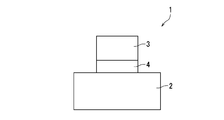
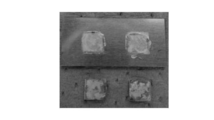
- It is a schematic diagram of the joining sample used by the shear strength test of Example 17 of this invention. It is a photograph which shows the image which image
- FIG. 1 is a flowchart showing a silver particle manufacturing method according to this embodiment.
- the silver particle manufacturing method according to the present embodiment includes a mixing treatment step S1 and a heat treatment step S2.
- a mixed solution M in which pure water W, a silver compound C, a reducing agent R, and a dispersing agent D are mixed is generated.
- a reducing agent R that can be a solvent is used.
- the addition order of each component of the liquid mixture M can be determined arbitrarily. Further, it is preferable to carry out the heat treatment step S2 after the liquid mixture M is stirred and the components of the liquid mixture M are appropriately mixed so that the silver compound C and the reducing agent R can easily react.
- the mixed liquid M is heated to react the silver compound C and the reducing agent R (liquid phase reduction treatment).
- the reaction temperature is preferably set to a temperature at which the liquid mixture M can maintain the liquid phase in the heat treatment step S2.
- the rotation speed [rpm] can be arbitrarily determined.
- Silver particles P are generated (deposited) by the heat treatment step S2.
- the silver particles P include sheet-like or plate-like silver particles P1 (first silver particles) and spherical silver particles P2 (second silver particles).
- sheet shape or plate shape is referred to as “sheet shape”.
- Spherical silver particles P2 (hereinafter sometimes referred to as spherical silver particles P2) are nearly spherical compared to sheet-like silver particles P1 (hereinafter sometimes referred to as sheet-like silver particles P1). It has a shape or a spherical shape.
- the particle diameter of the spherical silver particles P2 is smaller than the maximum value of the length of one side of the sheet-like silver particles P1.
- sheet-like silver particles (sheet-like silver particles P1) and spherical silver particles having a particle diameter smaller than the maximum value of the length of one side of the sheet-like silver particles. (Spherical silver particles P2) can be produced. Therefore, silver particles P with improved packing properties can be produced. Packing properties are improved by sheet-shaped silver particles (sheet-shaped silver particles P1) and spherical silver particles (spherical silver particles P2) having a particle diameter smaller than the maximum value of the length of one side of the sheet-shaped silver particles. This is because the gap between the sheet-like silver particles can be filled with spherical silver particles.
- the amount (ratio) of pure water W present in the reaction system is set because the optimum amount varies depending on the amount of other components constituting the liquid mixture M and the reaction temperature. What is necessary is just to determine beforehand according to the conditions which met.
- the amount (ratio) of pure water W the smaller the size of the sheet-like silver particles P1. Therefore, the amount of pure water W is preferably 40 parts by weight or more and less than 100 parts by weight with respect to 100 parts by weight of the mixed liquid M in the reaction system, for example, in order to make the size of the sheet-like silver particles P1 moderate. More preferably, it is at least 80 parts by weight.
- the silver compound C is not particularly limited, and typical examples are silver nitrate, silver acetate, and silver carboxylate. Two or more silver compounds may be used in combination.
- the amount (ratio) of the silver compound C present in the reaction system also varies depending on the amount of other components constituting the mixed solution M and the conditions such as the reaction temperature, and therefore is determined in advance according to the set conditions. That's fine. Generally, it is preferably 0.1 part by weight or more and 20 parts by weight or less, and more preferably 0.5 part by weight or more and 10 parts by weight or less with respect to 100 parts by weight of the mixed solution M in the reaction system.
- the reducing agent R is not particularly limited as long as the silver compound C can be reduced. Typical examples are N, N-dimethylformamide (DMF), ethylene glycol, propylene glycol, 1,3-propanediol, 1,4-butanediol, glycerin, ethanol, glucose, ascorbic acid, NaBH 4. Hydrazine.
- DMF N, N-dimethylformamide
- ethylene glycol propylene glycol
- 1,3-propanediol 1,4-butanediol
- glycerin glycerin
- ethanol glucose
- glucose ascorbic acid
- NaBH 4 Hydrazine ethanol
- two or more reducing agents may be used in combination.
- the amount (ratio) of the reducing agent R present in the reaction system is also determined in advance according to the set conditions because the optimum amount varies depending on the amount of other components constituting the mixed solution M and the reaction temperature. That's fine.
- the amount is preferably 10 parts by weight or more and less than 100 parts by weight, and more preferably 20 parts by weight or more and 80 parts by weight or less, with respect to 100 parts by weight of the mixed solution M in the reaction system.
- Dispersant D is not particularly limited. Typical examples are polyvinylpyrrolidone (PVP), polyethylene glycol (PEG), and cetyltrimethylammonium bromide (CTAB). As the dispersant D, two or more dispersants may be used in combination.
- the amount (ratio) of the dispersant D present in the reaction system is also determined in advance according to the set conditions because the optimum amount varies depending on the amount of other components constituting the mixed solution M and the reaction temperature. That's fine. In general, the larger the amount (ratio) of the dispersant D, the higher the production yield of the silver particles P, while the smaller the size of the sheet-like silver particles P1.
- the amount of the dispersant D is preferably 0.1 parts by weight or more and 20 parts by weight or less with respect to 100 parts by weight of the mixed liquid M in the reaction system, for example, in order to make the size of the sheet-like silver particles P1 moderate. More preferably, it is 0.5 parts by weight or more and 10 parts by weight or less.
- the environment in which the method for producing silver particles according to the present embodiment is performed is not particularly limited, and can be performed, for example, under an atmospheric pressure atmosphere and at room temperature.
- the optimal temperature also changes with conditions, such as the quantity (ratio) of each component of the liquid mixture M, environment, etc., what is necessary is just to determine beforehand according to the set conditions.
- the higher the reaction temperature the higher the production yield of the silver particles P, while the thickness of the sheet-like silver particles P1 and the particle diameter of the spherical silver particles P2 tend to increase.
- the reaction temperature is preferably 100 ° C. or higher.
- the reaction temperature is lower than 100 ° C., depending on the amount (ratio) of each component of the mixed solution M and the time for heating the mixed solution M (hereinafter sometimes referred to as reaction time), the desired size may be set. It may not be possible to generate the sheet-like silver particles P1 that are included.
- reaction temperature is lower than 150 degreeC. This is because the sheet-like silver particles P1 may not be controlled to a desired size depending on the amount (ratio) of each component of the mixed liquid M and the reaction time.
- the reaction temperature is 150 ° C.
- the sheet-like silver particles P1 may not be generated or may be generated in a small amount.
- the reaction temperature is generally set higher than when the mixed solution M contains the pure water W. This is because the sheet-like silver particles P1 may not be generated depending on the amount (ratio) of each component of the liquid mixture M and the reaction time.
- the reaction temperature can be set to 150 ° C. or higher, for example.
- the reaction time is not particularly limited, and can be arbitrarily set according to the amount (ratio) of each component of the mixed solution M, the reaction temperature, and the like. However, too long a reaction time leads to a decrease in production efficiency, so the reaction time is preferably within 3 hours, for example.
- the silver particles P (sheet-like silver particles P1 and spherical silver particles P2) produced by the silver particle production method according to the present embodiment can be observed using, for example, a scanning electron microscope (SEM). it can.
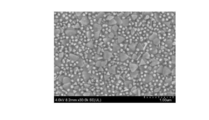
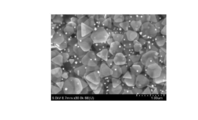
- FIG. 2 shows an example of an SEM image of the produced silver particles P (sheet-like silver particles P1 and spherical silver particles P2).
- the produced silver particles P include sheet-like silver particles P1 and spherical silver particles P2 having a particle diameter smaller than the maximum value of the length of one side of the sheet-like silver particles P1.
- the spherical silver particle P2 has a shape close to a sphere or a spherical shape as compared with the sheet-like silver particle P1.
- the sheet-like silver particles P1 mainly have a triangular or hexagonal outer shape.
- the external shape of the triangle or hexagon includes a shape that approximates the triangle or hexagon.
- each side may be an arc (curve) instead of a straight line, and a portion (so-called vertex) where each side intersects may be rounded (may be a curve).
- the ratio between the sheet-like silver particles P1 having a triangular outer shape and the sheet-like silver particles P1 having a hexagonal outer shape can be controlled by the amount of the dispersant D added. Specifically, the greater the amount of dispersant D added, the higher the proportion of sheet-like silver particles P1 having a triangular outer shape, and the smaller the amount of dispersant D added, the more sheet-like silver having a hexagonal outer shape. The proportion of particles P1 increases.
- the length of one side of the sheet-like silver particles P1 (when each side is an arc, the length of a straight line connecting the ends of one side) is the amount (ratio) of each component of the mixed liquid M, and It can be controlled by adjusting the reaction temperature. For example, as the amount (ratio) of pure water W increases, the length of one side of the sheet-like silver particle P1 tends to increase. Moreover, there exists a tendency for the length of one side of the sheet-like silver particle P1 to become large, so that reaction temperature is high. In the present embodiment, the length of one side of the sheet-like silver particle P1 is 10 nm or more and 800 nm or less.
- the maximum value of the length of one side of the sheet-like silver particles P1 having a triangular outer shape is preferably 50 nm or more, and more preferably 300 nm or more. Further, the maximum value of the length of one side of the sheet-like silver particles P1 having a hexagonal outer shape is preferably 30 nm or more, and more preferably 100 nm or more. Moreover, it is preferable that the average value of the length of one side of the sheet-like silver particle P1 is 100 nm or more and 800 nm or less.
- the average value of the length of one side of the sheet-like silver particle P1 having a triangular outer shape is preferably 100 nm or more and 600 nm or less, and the average value of the length of one side of the sheet-like silver particle P1 having a hexagonal outer shape. Is preferably 100 nm or more and 300 nm or less.
- the thickness of the sheet-like silver particles P1 can also be controlled by adjusting the amount (ratio) of each component of the mixed liquid M and the reaction temperature.
- the thickness of the sheet-like silver particles P1 tends to increase as the reaction temperature increases.
- the thickness of the sheet-like silver particles P1 is preferably 10 nm or more and 100 nm or less, and more preferably 10 nm or more and 30 nm or less.
- the sheet-like silver particles P1 are easier to be fired (sintered) as the thickness is smaller. Therefore, the thinner the sheet-like silver particles P1 are, the lower the firing temperature (sintering temperature) of the silver paste containing the silver particles P can be.
- the particle diameter of the spherical silver particles P2 can also be controlled by adjusting the amount (ratio) of each component of the mixed liquid M and the reaction temperature. For example, the higher the reaction temperature, the larger the particle diameter of the spherical silver particles P2.
- the spherical silver particles P2 preferably have a particle diameter of 20 nm to 300 nm, more preferably 20 nm to 150 nm.
- the average particle diameter of the spherical silver particles P2 is preferably 10 nm or more and 100 nm or less. Since the spherical silver particles P2 are also easily fired as the particle diameter is smaller, the firing temperature (sintering temperature) of the silver paste containing the silver particles P can be lowered as the particle diameter of the spherical silver particles P2 is smaller.
- the amount (ratio) of pure water W, silver compound C, reducing agent R, and dispersing agent D, or silver compound C, reducing agent R, and dispersing agent D By adjusting the amount (ratio), the shape and production yield of the silver particles P to be produced can be controlled. Moreover, the shape and production yield of the silver particles P to be produced can be controlled by adjusting the reaction temperature. Specifically, sheet-like silver particles (sheet-like silver particles P1) and spherical silver particles (spherical silver particles P2) having a particle diameter smaller than the maximum value of the length of one side of the sheet-like silver particles are obtained. Can be manufactured. Therefore, the silver particle P which is easy to improve packing property can be manufactured.
- the silver particle manufacturing method which concerns on this embodiment, by adjusting the quantity (ratio) of each component of the liquid mixture M, and reaction temperature, the length of one side of the sheet-like silver particle P1, and spherical silver
- the particle diameter of the particle P2 can be controlled.
- the sizes of the sheet-like silver particles P1 and the spherical silver particles P2 can be controlled. Therefore, the packing property of the manufactured silver particles can be improved.
- the silver particle P containing the sheet-like silver particle P1 and the spherical silver particle P2 can be manufactured, without providing a pressure. Therefore, the silver particle P containing the sheet-like silver particle P1 and the spherical silver particle P2 can be manufactured easily.
- silver particles P including sheet-like silver particles P1 and spherical silver particles P2 can be produced at a relatively low reaction temperature of 150 ° C. or lower. Therefore, the silver particle P containing the sheet-like silver particle P1 and the spherical silver particle P2 can be manufactured easily.
- the silver particle P can be manufactured at room temperature under an atmospheric condition. Therefore, the silver particle P containing the sheet-like silver particle P1 and the spherical silver particle P2 can be manufactured easily.
- the sheet-like silver particles P1 and the spherical silver particles P2 can be precipitated (synthesized) by one reaction treatment (heat treatment). That is, the sheet-like silver particles P1 and the spherical silver particles P2 can be precipitated in one container. Therefore, it is possible to obtain silver particles P with good dispersibility between the sheet-like silver particles P1 and the spherical silver particles P2.
- the mixed solution M preferably contains pure water W. This is because when the mixed solution M contains the pure water W, the production yield of the silver particles P is improved as compared with the case where the mixed solution M does not contain the pure water W. Furthermore, when the mixed solution M contains pure water W, the length of one side of the sheet-like silver particles P1 can be appropriately increased at a lower reaction temperature than when the mixed solution M does not contain pure water W. it can. In other words, it becomes possible to produce sheet-like silver particles P1 having an appropriate size at a low reaction temperature (for example, about 100 ° C.).
- the length of one side of the sheet-like silver particles P1 (that is, the size of the sheet-like silver particles P1) can be controlled by adjusting the amount of the pure water W. Therefore, the size of the sheet-like silver particles P1 can be easily controlled.
- the silver particle P with improved packing property can be manufactured. Therefore, a silver paste having a low firing temperature (sintering temperature) can be obtained by using the silver particles P according to this embodiment. Furthermore, by using silver particles P with improved packing properties, a silver paste having a low resistivity after firing (sintering) can be obtained. Specifically, a volume resistivity of the order of 10 ⁇ 5 ⁇ ⁇ cm or less can be realized.
- the bonding strength of the silver paste used as the bonding material can be increased.
- the silver particles P according to the present embodiment can be used not only for wiring silver paste but also for die attach silver paste.
- the manufacturing method of the silver paste which concerns on this embodiment further includes the process of mixing the silver particle P and the organic solvent following the process of the silver particle manufacturing method mentioned above.
- the manufacturing method of the silver paste which concerns on this embodiment further includes the process of mixing the silver particle P and the organic solvent following the process of the silver particle manufacturing method mentioned above.
- silver particles P precipitated by the above-described silver particle production method are isolated by a centrifugal separator, they are washed three or four times with water or ethanol. Then, the washed silver particles P are dispersed in an organic solvent (for example, alcohol such as ethanol).
- a silver paste can be manufactured through such a procedure.
- the manufactured silver paste can be used as, for example, a wiring material or a bonding material.
- the ratio of silver particles P to alcohol contained in the silver paste is, for example, 4: 1 to 16: 1, preferably 6: 1 to 12: silver particles P: alcohol by weight. 1, more preferably 8: 1 to 10: 1.
- the alcohol is preferably a lower alcohol or a lower alcohol having one or more substituents selected from the group consisting of lower alkoxy, amino and halogen.
- the lower alcohol include those containing an alkyl group having 1 to 6 carbon atoms and 1 to 3, preferably 1 to 2 hydroxyl groups.
- Examples of the lower alkyl group include a methyl group, ethyl group, n-propyl group, i-propyl group, n-butyl group, i-butyl group, sec-butyl group, t-butyl group, n-pentyl group, i -Pentyl group, sec-pentyl group, t-pentyl group, 2-methylbutyl group, n-hexyl group, 1-methylpentyl group, 2-methylpentyl group, 3-methylpentyl group, 4-methylpentyl group, 1- Linear or branched, such as ethylbutyl, 2-ethylbutyl, 1,1-dimethylbutyl, 2,2-dimethylbutyl, 3,3-dimethylbutyl, and 1-ethyl-1-methylpropyl -Like alkyl groups.
- Examples of the lower alcohol having an alkyl group having 1 to 6 carbon atoms and 1 to 3 hydroxyl groups include methanol, ethanol, ethylene glycol, n-propanol, i-propanol, triethylene glycol, n-butanol, and i-butanol.
- the substituents are as follows.
- lower alkoxy include groups in which —O— is substituted on a lower alkyl group.
- lower alkoxy include methoxy, ethoxy, n-propoxy, i-propoxy, n-butoxy, i-butoxy, sec-butoxy, t-butoxy, n-pentyloxy and the like.
- Halogen includes fluorine, bromine, chlorine and iodine.
- Examples of the lower alcohol having one or more substituents selected from the group consisting of lower alkoxy, amino and halogen include methoxymethanol, 2-methoxyethanol, 2-ethoxyethanol, 2-chloroethanol, ethanolamine and the like.
- Examples 1 to 3 and Comparative Example 1 0.05 g of PVP shown in Table 1, a predetermined amount of pure water (including 0 g), 0.2 g of silver nitrate, and a predetermined amount of DMF were charged into a container to prepare a mixed solution M. Next, the mixture M was heated to a reaction temperature of 100 ° C., and then reacted for 2 hours while stirring at a rotational speed of 400 rpm. After the reaction, the mixture was cooled to room temperature, and the precipitate was isolated using a centrifuge. Next, the isolated precipitate was washed 3 or 4 times with water to obtain silver particles.
- Table 1 shows the measurement results of the size of the obtained silver particles.
- particle diameter indicates the particle diameter of spherical silver particles
- sheet side length indicates one side length of sheet-like silver particles
- hexagonal sheet indicates the length of one side of the sheet-like silver particles having an outer diameter of hexagon
- “Length of one side of the triangular sheet” indicates the length of one side of the sheet-like silver particles having a triangular outer diameter.
- sheet thickness indicates the thickness of the sheet-like silver particles.
- Particle diameter and “length of one side of sheet” were measured using an SEM image.
- Sheet thickness was measured using SEM.
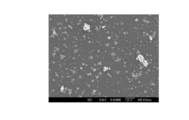
- FIGS. 2 shows the SEM image of Example 1
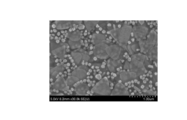
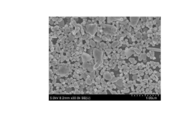
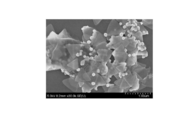
- FIG. 3 shows the SEM image of Example 2
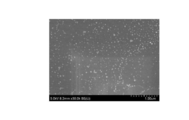
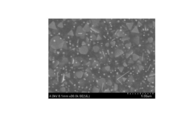
- FIG. 4 shows the SEM image of Example 3
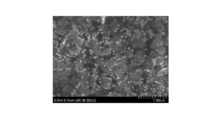
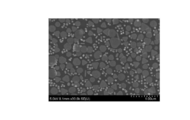
- FIG. 5 shows the SEM image of Comparative Example 1.
- Examples 1 to 3 were carried out under the same conditions except that the ratio (amount) of pure water and DMF was different.
- FIGS. 2 to 4 Examples 1 to 3
- FIG. 5 Comparative Example 1
- pure water when pure water was not used, only spherical silver particles were precipitated at a reaction temperature of 100 ° C., and sheet-like silver particles could not be obtained.
- the particle diameter of the spherical silver particles and the length of one side of the sheet-like silver particles were obtained. Specifically, when the proportion of pure water was increased, the particle diameter of spherical silver particles and the length of one side of sheet-like silver particles tended to increase. On the other hand, the thickness of the sheet-like silver particles was not affected by the change in the ratio (amount) of pure water and DMF.
- Examples 4 and 5 Example 4 and 5 were carried out under the same conditions as in Examples 2 and 3 except that the amount of PVP was different. Specifically, as shown in Table 2, 0.2 g of PVP was added to the mixed solution M. The measurement results of the size of the obtained silver particles are also shown in Table 2. Moreover, the SEM image of the obtained silver particle is shown in FIG. 6, FIG. 6 shows an SEM image of Example 4, and FIG. 7 shows an SEM image of Example 5.
- the length of one side of the sheet-like silver particles could be controlled by adjusting the amount of PVP. Specifically, when the amount of PVP was increased, the length of one side of the sheet-like silver particles tended to be shortened. On the other hand, the particle diameter of the spherical silver particles and the thickness of the sheet-like silver particles were not affected by the change in the amount of PVP.
- Example 6 and Comparative Example 2 Under conditions where pure water was not used, a predetermined amount of PVP shown in Table 3, 0.2 g of silver nitrate, and 30 g of DMF were charged into the container to prepare a mixed solution M. Next, the mixture M was heated to a reaction temperature of 150 ° C. The subsequent processing was performed in the same manner as in Examples 1 to 3. The results of measuring the size of the obtained silver particles are also shown in Table 3. Moreover, the SEM image of the obtained silver particle is shown in FIG. 8, FIG. 8 shows an SEM image of Example 6, and FIG. 9 shows an SEM image of Comparative Example 2.
- spherical silver particles and sheet-like silver particles could be obtained by setting the reaction temperature to 150 ° C. even when pure water was not used.
- the result that the external shape of a sheet-like silver particle was controllable was obtained by adjusting the quantity of PVP.
- the amount of PVP is large (Example 6), as shown in FIG. 8, more sheet-like silver particles having a triangular outer shape are precipitated than the sheet-like silver particles having a hexagonal outer shape.
- the amount of PVP was small (Comparative Example 2), as shown in FIG. 9, more sheet-like silver particles having a hexagonal outer shape were precipitated than sheet-like silver particles having a triangular outer shape.
- the particle diameter of the spherical silver particles and the length of one side of the sheet-like silver particles having a triangular outer shape were not affected by the change in the amount of PVP.
- the length of one side of the hexagonal sheet-like silver particles tended to decrease as the amount of PVP decreased.
- the thickness of the sheet-like silver particles tended to increase as the amount of PVP decreased.
- the maximum value of the thickness of the sheet-like silver particles was larger than the maximum value of the particle diameter of the spherical silver particles.
- Example 7 was carried out under the same conditions as Example 3 except that the reaction temperature was different. Specifically, as shown in Table 4, the reaction was performed at a reaction temperature of 150 ° C. The results of measuring the size of the obtained silver particles are also shown in Table 4. Moreover, the SEM image of the obtained silver particle is shown in FIG.
- the result was that the particle diameter of the spherical silver particles and the thickness of the sheet-like silver particles could be controlled by controlling the reaction temperature. Specifically, when the reaction temperature was increased, the particle diameter of the spherical silver particles and the thickness of the sheet-like silver particles tended to increase.
- Examples 8 and 9 and Comparative Example 3 PVP 0.2g shown in Table 5, pure water 20g, silver nitrate 0.2g, and DMF30g were prepared in the container, and the liquid mixture M was adjusted. Next, the temperature of the mixed liquid M was raised to a predetermined reaction temperature. The subsequent processing was performed in the same manner as in Examples 1 to 3. The results of measuring the size of the obtained silver particles are also shown in Table 5. In addition, SEM images of the obtained silver particles are shown in FIGS. 11 shows the SEM image of Example 8, FIG. 12 shows the SEM image of Example 9, and FIG. 13 shows the SEM image of Comparative Example 3.
- Examples 8 and 9 and Comparative Example 3 were performed under the same conditions except that the reaction temperatures were different. As shown in FIGS. 11 to 13, spherical silver particles and sheet-like silver particles could be obtained at any reaction temperature.
- Examples 10 and 11 A mixed liquid M was prepared by charging 0.25 g of PVP shown in Table 6, a predetermined amount of pure water, 1.1 g of silver nitrate, and a predetermined amount of DMF into the container. Next, the mixture M was heated to a reaction temperature of 100 ° C. The subsequent processing was performed in the same manner as in Examples 1 to 3. The measurement results of the size of the obtained silver particles are also shown in Table 6. Moreover, the SEM image of the obtained silver particle is shown in FIG. 14, FIG. FIG. 14 shows an SEM image of Example 10, and FIG. 15 shows an SEM image of Example 11.
- the amount of silver nitrate was increased as compared with other Examples 1 to 9. Further, the amount of PVP or the like was appropriately increased in accordance with the increase in the amount of silver nitrate. As shown in FIGS. 14 and 15, even when the amount of silver nitrate was increased, sheet-like silver particles could be obtained together with the spherical silver particles. Further, by increasing the amount of silver nitrate, a large amount of silver particles (sheet-like silver particles and spherical silver particles) were synthesized at one time.
- FIG. 16B is an enlarged view of a part of FIG.
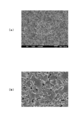
- an SEM image (Example 15) of a silver paste baked at a baking temperature of 180 ° C. is shown in FIG. 17A
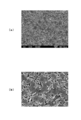
- an SEM image (Example 16) of a silver paste baked at a baking temperature of 200 ° C. is shown in FIG. Shown in a).
- FIG. 17B shows an enlarged part of FIG. 17A
- FIG. 18B shows an enlarged part of FIG.
- Example 17 PVP 0.25g shown in Table 9, pure water 150g, silver nitrate 1.1g, and DMF100g were prepared in the container, and the liquid mixture M was adjusted. Next, the mixture M was heated to a reaction temperature of 100 ° C., and then reacted for 2 hours while stirring at a rotational speed of 400 rpm. After the reaction, the mixture was cooled to room temperature, and the precipitate was isolated using a centrifuge. Next, the isolated precipitate was washed 3 or 4 times with water and then dispersed in ethanol to obtain a silver paste. Next, a shear strength test of the obtained silver paste was performed to examine the bonding strength of the silver paste.
- FIG. 19 is a schematic diagram of the bonding sample 1 used in the shear strength test of Example 17.
- the bonding sample 1 includes a silver-plated copper substrate 2, a silver-plated copper substrate 3, and a silver paste 4.
- Silver paste 4 joins copper substrate 2 and copper substrate 3 together.
- the silver paste 4 was printed on the 8 mm ⁇ 8 mm copper substrate 2 using a 0.1 ⁇ m mask, and then the 4 mm ⁇ 4 mm copper substrate 3 was placed on the printed silver paste 4.
- the copper substrate 2 and the copper substrate 3 were heated at a temperature of 200 ° C. for 60 minutes in an air atmosphere to fire (sinter) the silver paste 4, and the copper substrate 2 and the copper substrate 3 were joined.
- a shearing force was applied to the bonded copper substrates 2 and 3 to measure the shear strength. As a result, a shear strength of 20.1 MPa was obtained.
- FIG. 20 shows an image obtained by photographing the copper substrates 2 and 3 after the shear strength measurement (after the shear strength test) from the side where the silver paste 4 is applied
- FIG. 21 shows an SEM image of the silver paste after the shear strength measurement. Indicates. As shown in FIG. 21, the silver particles contained in the silver paste 4 became a dense film by firing. This is presumably because the silver particles contained in the silver paste 4 before firing had good packing properties. Moreover, it is guessed that the shear strength of 15 MPa or more was able to be achieved because silver particles became a dense film.
- the present invention can be applied to, for example, a wiring material printed on a wiring board or a bonding material for die attach.
Landscapes
- Chemical & Material Sciences (AREA)
- Engineering & Computer Science (AREA)
- Nanotechnology (AREA)
- Inorganic Chemistry (AREA)
- Dispersion Chemistry (AREA)
- Physics & Mathematics (AREA)
- Chemical Kinetics & Catalysis (AREA)
- General Chemical & Material Sciences (AREA)
- Crystallography & Structural Chemistry (AREA)
- Organic Chemistry (AREA)
- Spectroscopy & Molecular Physics (AREA)
- Manufacturing & Machinery (AREA)
- General Physics & Mathematics (AREA)
- Condensed Matter Physics & Semiconductors (AREA)
- Composite Materials (AREA)
- Materials Engineering (AREA)
- Manufacture Of Metal Powder And Suspensions Thereof (AREA)
- Powder Metallurgy (AREA)
- Non-Insulated Conductors (AREA)
- Conductive Materials (AREA)
Abstract
Une solution mixte, dans laquelle sont mélangés au moins un composé d'argent, un agent réducteur et un agent dispersant, est obtenue en premier lieu (S1). Après cela, des premières particules d'argent stratiformes ou lamellaires et des secondes particules d'argent de forme sphérique ou de forme plus proche d'une sphère que les premières particules d'argent, et dont le diamètre de particule est inférieur à la longueur latérale maximale des premières particules d'argent, sont produites en chauffant la solution mixte, amenant ainsi le composé d'argent et l'agent réducteur à réagir l'un avec l'autre (S2).
Priority Applications (4)
| Application Number | Priority Date | Filing Date | Title |
|---|---|---|---|
| KR1020187004988A KR20180032614A (ko) | 2015-07-24 | 2016-07-22 | 은입자 제조방법, 은입자, 및 은페이스트 |
| EP16830464.0A EP3326740B1 (fr) | 2015-07-24 | 2016-07-22 | Procédé de production de particules d'argent et de pâte d'argent |
| US15/746,902 US10875097B2 (en) | 2015-07-24 | 2016-07-22 | Silver particle producing method, silver particles, and silver paste |
| CN201680043197.4A CN107848037B (zh) | 2015-07-24 | 2016-07-22 | 银颗粒制造方法、银颗粒及银膏 |
Applications Claiming Priority (2)
| Application Number | Priority Date | Filing Date | Title |
|---|---|---|---|
| JP2015146958A JP6628351B2 (ja) | 2015-07-24 | 2015-07-24 | 銀粒子製造方法 |
| JP2015-146958 | 2015-07-24 |
Publications (1)
| Publication Number | Publication Date |
|---|---|
| WO2017018359A1 true WO2017018359A1 (fr) | 2017-02-02 |
Family
ID=57884349
Family Applications (1)
| Application Number | Title | Priority Date | Filing Date |
|---|---|---|---|
| PCT/JP2016/071627 Ceased WO2017018359A1 (fr) | 2015-07-24 | 2016-07-22 | Procédé de production de particules d'argent, particules d'argent et pâte d'argent |
Country Status (6)
| Country | Link |
|---|---|
| US (1) | US10875097B2 (fr) |
| EP (1) | EP3326740B1 (fr) |
| JP (1) | JP6628351B2 (fr) |
| KR (1) | KR20180032614A (fr) |
| CN (1) | CN107848037B (fr) |
| WO (1) | WO2017018359A1 (fr) |
Cited By (2)
| Publication number | Priority date | Publication date | Assignee | Title |
|---|---|---|---|---|
| CN111843287A (zh) * | 2020-07-27 | 2020-10-30 | 中国科学院深圳先进技术研究院 | 纳米银焊膏及其制备方法和应用 |
| CN112475662A (zh) * | 2020-11-18 | 2021-03-12 | 中国科学院深圳先进技术研究院 | 纳米银焊膏及其制备方法和在芯片封装互连结构中的应用 |
Families Citing this family (5)
| Publication number | Priority date | Publication date | Assignee | Title |
|---|---|---|---|---|
| CN111403078B (zh) * | 2020-03-26 | 2021-08-24 | 湖南省国银新材料有限公司 | 一种滤波器用导电银浆及其制备方法和烧结方法 |
| CN112658529B (zh) * | 2020-12-25 | 2022-11-15 | 深圳先进电子材料国际创新研究院 | 一种焊膏及其应用 |
| CN113972025B (zh) * | 2021-10-27 | 2024-04-16 | 广东工业大学 | 一种多尺寸微纳混合银膏的制备及互连工艺 |
| CN115502394B (zh) * | 2022-09-23 | 2024-06-28 | 昆明贵研新材料科技有限公司 | 一种镀银铜微米片的制备方法 |
| CN117324632B (zh) * | 2023-09-25 | 2024-08-27 | 深圳市哈深智材科技有限公司 | 一种片状和球状混合银粉及其制备方法和应用 |
Citations (7)
| Publication number | Priority date | Publication date | Assignee | Title |
|---|---|---|---|---|
| JPH06172822A (ja) * | 1992-12-07 | 1994-06-21 | Sumitomo Metal Mining Co Ltd | 銀微粉の製造方法 |
| JP2004183010A (ja) * | 2002-11-29 | 2004-07-02 | Mitsui Mining & Smelting Co Ltd | 極薄板状銀粒子からなる銀粉、その製造方法及び導電性ペースト |
| JP2005105376A (ja) * | 2003-09-30 | 2005-04-21 | Sumitomo Osaka Cement Co Ltd | 銀微粒子及びその製造方法 |
| JP2007138249A (ja) * | 2005-11-18 | 2007-06-07 | Mitsubishi Materials Corp | 銀粒子の製造方法及び得られた該銀粒子を含有する銀粒子含有組成物並びにその用途 |
| JP2007138250A (ja) * | 2005-11-18 | 2007-06-07 | Mitsubishi Materials Corp | 銀粒子の製造方法及び得られた該銀粒子を含有する銀粒子含有組成物並びにその用途 |
| JP2009144188A (ja) * | 2007-12-12 | 2009-07-02 | Fujifilm Corp | 平板状金属粒子及びその製造方法、並びに平板状金属粒子含有組成物、及び赤外線吸収材料 |
| JP2012052198A (ja) * | 2010-09-02 | 2012-03-15 | Nippon Handa Kk | ペースト状銀粒子組成物、金属製部材接合体の製造方法および金属製部材接合体 |
Family Cites Families (10)
| Publication number | Priority date | Publication date | Assignee | Title |
|---|---|---|---|---|
| KR20060132076A (ko) * | 2005-06-17 | 2006-12-21 | 한국과학기술연구원 | 화학적 침전법을 이용한 나노 분말의 제조 방법 |
| JP5207728B2 (ja) * | 2006-12-21 | 2013-06-12 | 富士フイルム株式会社 | 導電膜およびその製造方法 |
| JP5207281B2 (ja) | 2008-01-17 | 2013-06-12 | 国立大学法人大阪大学 | 導電性ペースト |
| CN101497135B (zh) * | 2009-03-12 | 2010-09-22 | 宁波大学 | 一种球状银纳米颗粒的制备方法 |
| JP5574761B2 (ja) | 2009-04-17 | 2014-08-20 | 国立大学法人山形大学 | 被覆銀超微粒子とその製造方法 |
| JP5297344B2 (ja) * | 2009-11-04 | 2013-09-25 | 京都エレックス株式会社 | 加熱硬化型導電性ペースト組成物 |
| TWI530963B (zh) * | 2011-04-28 | 2016-04-21 | 同和電子科技股份有限公司 | Sheet-like silver microparticles and methods for producing the same, and a paste using the same and a paste |
| US20130202909A1 (en) * | 2012-02-06 | 2013-08-08 | Lg Chem, Ltd. | Method of producing metal nanoparticles |
| CN104174864B (zh) * | 2013-05-21 | 2016-06-01 | 中国科学院理化技术研究所 | 一种纳米或亚微米级银颗粒粉的制备方法 |
| CN103639419B (zh) * | 2013-11-25 | 2015-09-09 | 景德镇陶瓷学院 | 一种单分散六角形银纳米粒子的制备方法 |
-
2015
- 2015-07-24 JP JP2015146958A patent/JP6628351B2/ja active Active
-
2016
- 2016-07-22 US US15/746,902 patent/US10875097B2/en active Active
- 2016-07-22 WO PCT/JP2016/071627 patent/WO2017018359A1/fr not_active Ceased
- 2016-07-22 KR KR1020187004988A patent/KR20180032614A/ko not_active Withdrawn
- 2016-07-22 EP EP16830464.0A patent/EP3326740B1/fr active Active
- 2016-07-22 CN CN201680043197.4A patent/CN107848037B/zh active Active
Patent Citations (7)
| Publication number | Priority date | Publication date | Assignee | Title |
|---|---|---|---|---|
| JPH06172822A (ja) * | 1992-12-07 | 1994-06-21 | Sumitomo Metal Mining Co Ltd | 銀微粉の製造方法 |
| JP2004183010A (ja) * | 2002-11-29 | 2004-07-02 | Mitsui Mining & Smelting Co Ltd | 極薄板状銀粒子からなる銀粉、その製造方法及び導電性ペースト |
| JP2005105376A (ja) * | 2003-09-30 | 2005-04-21 | Sumitomo Osaka Cement Co Ltd | 銀微粒子及びその製造方法 |
| JP2007138249A (ja) * | 2005-11-18 | 2007-06-07 | Mitsubishi Materials Corp | 銀粒子の製造方法及び得られた該銀粒子を含有する銀粒子含有組成物並びにその用途 |
| JP2007138250A (ja) * | 2005-11-18 | 2007-06-07 | Mitsubishi Materials Corp | 銀粒子の製造方法及び得られた該銀粒子を含有する銀粒子含有組成物並びにその用途 |
| JP2009144188A (ja) * | 2007-12-12 | 2009-07-02 | Fujifilm Corp | 平板状金属粒子及びその製造方法、並びに平板状金属粒子含有組成物、及び赤外線吸収材料 |
| JP2012052198A (ja) * | 2010-09-02 | 2012-03-15 | Nippon Handa Kk | ペースト状銀粒子組成物、金属製部材接合体の製造方法および金属製部材接合体 |
Non-Patent Citations (1)
| Title |
|---|
| PASTORIZA-SANTOS, ISABEL ET AL.: "Synthesis of silver nanoprisms in DMF", NANO LETTERS, vol. 2, no. 8, 19 July 2002 (2002-07-19), pages 903 - 905, XP055349409 * |
Cited By (2)
| Publication number | Priority date | Publication date | Assignee | Title |
|---|---|---|---|---|
| CN111843287A (zh) * | 2020-07-27 | 2020-10-30 | 中国科学院深圳先进技术研究院 | 纳米银焊膏及其制备方法和应用 |
| CN112475662A (zh) * | 2020-11-18 | 2021-03-12 | 中国科学院深圳先进技术研究院 | 纳米银焊膏及其制备方法和在芯片封装互连结构中的应用 |
Also Published As
| Publication number | Publication date |
|---|---|
| US10875097B2 (en) | 2020-12-29 |
| US20200086391A1 (en) | 2020-03-19 |
| JP2017025391A (ja) | 2017-02-02 |
| EP3326740A4 (fr) | 2019-04-10 |
| CN107848037B (zh) | 2021-05-28 |
| CN107848037A (zh) | 2018-03-27 |
| KR20180032614A (ko) | 2018-03-30 |
| JP6628351B2 (ja) | 2020-01-08 |
| EP3326740B1 (fr) | 2023-10-11 |
| EP3326740A1 (fr) | 2018-05-30 |
Similar Documents
| Publication | Publication Date | Title |
|---|---|---|
| JP6628351B2 (ja) | 銀粒子製造方法 | |
| TWI653347B (zh) | 銀粒子的合成方法、銀粒子、導電性糊的製造方法以及導電性糊 | |
| CN112752627B (zh) | 银粉及其制造方法以及导电浆料 | |
| CN109789482B (zh) | 接合材料及使用该接合材料的接合方法 | |
| JP5738464B1 (ja) | 銀微粒子分散液 | |
| JPWO2018190246A1 (ja) | 銅粒子混合物及びその製造方法、銅粒子混合物分散液、銅粒子混合物含有インク、銅粒子混合物の保存方法及び銅粒子混合物の焼結方法 | |
| JP7480947B2 (ja) | 広分布な粒度分布を持つ銀ナノ粒子の製造方法及び銀ナノ粒子 | |
| TW202346609A (zh) | 球狀銀粉、球狀銀粉的製造方法、球狀銀粉的製造裝置及導電性膏 | |
| JP7283703B2 (ja) | 広分布な粒度分布を持つ銀ナノ粒子の製造方法及び銀ナノ粒子 | |
| TWI682007B (zh) | 銀微粒子分散液 | |
| WO2023210663A1 (fr) | Poudre d'argent sphérique, procédé de production d'une poudre d'argent sphérique, appareil de production d'une poudre d'argent sphérique et pâte conductrice | |
| TWI758588B (zh) | 金屬粒子凝聚物及其之製造方法以及膏狀金屬粒子凝聚物組成物及使用此之接合體之製造方法 | |
| Luo et al. | Low-Temperature Sintering of Nanosilver Paste on a Gold Film Surface. | |
| WO2025249332A1 (fr) | Poudre d'argent sphérique, procédé de production de la poudre d'argent sphérique et pâte conductrice | |
| JPWO2018198810A1 (ja) | 広分布な粒度分布を持つ銀ナノ粒子の製造方法及び銀ナノ粒子 | |
| TW202605169A (zh) | 球狀銀粉及球狀銀粉之製造方法、以及導電性糊 | |
| WO2025249331A1 (fr) | Poudre d'argent sphérique, procédé de production de poudre d'argent sphérique et pâte électroconductrice | |
| WO2025089418A1 (fr) | Poudre d'argent et pâte électroconductrice durcissable par résine | |
| JP2021051913A (ja) | 接合材、接合材の製造方法、接合方法及び半導体装置 |
Legal Events
| Date | Code | Title | Description |
|---|---|---|---|
| 121 | Ep: the epo has been informed by wipo that ep was designated in this application |
Ref document number: 16830464 Country of ref document: EP Kind code of ref document: A1 |
|
| DPE1 | Request for preliminary examination filed after expiration of 19th month from priority date (pct application filed from 20040101) | ||
| DPE1 | Request for preliminary examination filed after expiration of 19th month from priority date (pct application filed from 20040101) | ||
| NENP | Non-entry into the national phase |
Ref country code: DE |
|
| ENP | Entry into the national phase |
Ref document number: 20187004988 Country of ref document: KR Kind code of ref document: A |
|
| WWE | Wipo information: entry into national phase |
Ref document number: 2016830464 Country of ref document: EP |