WO2017018407A1 - Method for producing iron-based oxide magnetic particle powder - Google Patents
Method for producing iron-based oxide magnetic particle powder Download PDFInfo
- Publication number
- WO2017018407A1 WO2017018407A1 PCT/JP2016/071830 JP2016071830W WO2017018407A1 WO 2017018407 A1 WO2017018407 A1 WO 2017018407A1 JP 2016071830 W JP2016071830 W JP 2016071830W WO 2017018407 A1 WO2017018407 A1 WO 2017018407A1
- Authority
- WO
- WIPO (PCT)
- Prior art keywords
- iron
- less
- based oxide
- particle powder
- magnetic particle
- Prior art date
- Legal status (The legal status is an assumption and is not a legal conclusion. Google has not performed a legal analysis and makes no representation as to the accuracy of the status listed.)
- Ceased
Links
Images




Classifications
-
- C—CHEMISTRY; METALLURGY
- C01—INORGANIC CHEMISTRY
- C01G—COMPOUNDS CONTAINING METALS NOT COVERED BY SUBCLASSES C01D OR C01F
- C01G49/00—Compounds of iron
-
- C—CHEMISTRY; METALLURGY
- C01—INORGANIC CHEMISTRY
- C01G—COMPOUNDS CONTAINING METALS NOT COVERED BY SUBCLASSES C01D OR C01F
- C01G49/00—Compounds of iron
- C01G49/02—Oxides; Hydroxides
- C01G49/06—Ferric oxide [Fe2O3]
-
- G—PHYSICS
- G11—INFORMATION STORAGE
- G11B—INFORMATION STORAGE BASED ON RELATIVE MOVEMENT BETWEEN RECORD CARRIER AND TRANSDUCER
- G11B5/00—Recording by magnetisation or demagnetisation of a record carrier; Reproducing by magnetic means; Record carriers therefor
- G11B5/62—Record carriers characterised by the selection of the material
- G11B5/68—Record carriers characterised by the selection of the material comprising one or more layers of magnetisable material homogeneously mixed with a bonding agent
- G11B5/70—Record carriers characterised by the selection of the material comprising one or more layers of magnetisable material homogeneously mixed with a bonding agent on a base layer
- G11B5/706—Record carriers characterised by the selection of the material comprising one or more layers of magnetisable material homogeneously mixed with a bonding agent on a base layer characterised by the composition of the magnetic material
- G11B5/70626—Record carriers characterised by the selection of the material comprising one or more layers of magnetisable material homogeneously mixed with a bonding agent on a base layer characterised by the composition of the magnetic material containing non-metallic substances
- G11B5/70642—Record carriers characterised by the selection of the material comprising one or more layers of magnetisable material homogeneously mixed with a bonding agent on a base layer characterised by the composition of the magnetic material containing non-metallic substances iron oxides
-
- G—PHYSICS
- G11—INFORMATION STORAGE
- G11B—INFORMATION STORAGE BASED ON RELATIVE MOVEMENT BETWEEN RECORD CARRIER AND TRANSDUCER
- G11B5/00—Recording by magnetisation or demagnetisation of a record carrier; Reproducing by magnetic means; Record carriers therefor
- G11B5/62—Record carriers characterised by the selection of the material
- G11B5/68—Record carriers characterised by the selection of the material comprising one or more layers of magnetisable material homogeneously mixed with a bonding agent
- G11B5/70—Record carriers characterised by the selection of the material comprising one or more layers of magnetisable material homogeneously mixed with a bonding agent on a base layer
- G11B5/714—Record carriers characterised by the selection of the material comprising one or more layers of magnetisable material homogeneously mixed with a bonding agent on a base layer characterised by the dimension of the magnetic particles
-
- H—ELECTRICITY
- H01—ELECTRIC ELEMENTS
- H01F—MAGNETS; INDUCTANCES; TRANSFORMERS; SELECTION OF MATERIALS FOR THEIR MAGNETIC PROPERTIES
- H01F1/00—Magnets or magnetic bodies characterised by the magnetic materials therefor; Selection of materials for their magnetic properties
- H01F1/01—Magnets or magnetic bodies characterised by the magnetic materials therefor; Selection of materials for their magnetic properties of inorganic materials
- H01F1/03—Magnets or magnetic bodies characterised by the magnetic materials therefor; Selection of materials for their magnetic properties of inorganic materials characterised by their coercivity
- H01F1/032—Magnets or magnetic bodies characterised by the magnetic materials therefor; Selection of materials for their magnetic properties of inorganic materials characterised by their coercivity of hard-magnetic materials
- H01F1/10—Magnets or magnetic bodies characterised by the magnetic materials therefor; Selection of materials for their magnetic properties of inorganic materials characterised by their coercivity of hard-magnetic materials non-metallic substances, e.g. ferrites, e.g. [(Ba,Sr)O(Fe2O3)6] ferrites with hexagonal structure
- H01F1/11—Magnets or magnetic bodies characterised by the magnetic materials therefor; Selection of materials for their magnetic properties of inorganic materials characterised by their coercivity of hard-magnetic materials non-metallic substances, e.g. ferrites, e.g. [(Ba,Sr)O(Fe2O3)6] ferrites with hexagonal structure in the form of particles
-
- C—CHEMISTRY; METALLURGY
- C01—INORGANIC CHEMISTRY
- C01P—INDEXING SCHEME RELATING TO STRUCTURAL AND PHYSICAL ASPECTS OF SOLID INORGANIC COMPOUNDS
- C01P2002/00—Crystal-structural characteristics
- C01P2002/50—Solid solutions
-
- C—CHEMISTRY; METALLURGY
- C01—INORGANIC CHEMISTRY
- C01P—INDEXING SCHEME RELATING TO STRUCTURAL AND PHYSICAL ASPECTS OF SOLID INORGANIC COMPOUNDS
- C01P2002/00—Crystal-structural characteristics
- C01P2002/50—Solid solutions
- C01P2002/52—Solid solutions containing elements as dopants
-
- C—CHEMISTRY; METALLURGY
- C01—INORGANIC CHEMISTRY
- C01P—INDEXING SCHEME RELATING TO STRUCTURAL AND PHYSICAL ASPECTS OF SOLID INORGANIC COMPOUNDS
- C01P2002/00—Crystal-structural characteristics
- C01P2002/70—Crystal-structural characteristics defined by measured X-ray, neutron or electron diffraction data
- C01P2002/72—Crystal-structural characteristics defined by measured X-ray, neutron or electron diffraction data by d-values or two theta-values, e.g. as X-ray diagram
-
- C—CHEMISTRY; METALLURGY
- C01—INORGANIC CHEMISTRY
- C01P—INDEXING SCHEME RELATING TO STRUCTURAL AND PHYSICAL ASPECTS OF SOLID INORGANIC COMPOUNDS
- C01P2004/00—Particle morphology
- C01P2004/01—Particle morphology depicted by an image
- C01P2004/04—Particle morphology depicted by an image obtained by TEM, STEM, STM or AFM
-
- C—CHEMISTRY; METALLURGY
- C01—INORGANIC CHEMISTRY
- C01P—INDEXING SCHEME RELATING TO STRUCTURAL AND PHYSICAL ASPECTS OF SOLID INORGANIC COMPOUNDS
- C01P2004/00—Particle morphology
- C01P2004/60—Particles characterised by their size
- C01P2004/64—Nanometer sized, i.e. from 1-100 nanometer
-
- C—CHEMISTRY; METALLURGY
- C01—INORGANIC CHEMISTRY
- C01P—INDEXING SCHEME RELATING TO STRUCTURAL AND PHYSICAL ASPECTS OF SOLID INORGANIC COMPOUNDS
- C01P2006/00—Physical properties of inorganic compounds
- C01P2006/42—Magnetic properties
Definitions
- the present invention relates to a method for producing an iron-based oxide magnetic particle powder suitable for a high-density magnetic recording medium, a radio wave absorber, and the like, particularly a particle powder having an average particle diameter of nanometer order.
- ⁇ -Fe 2 O 3 is an extremely rare phase among iron oxides, but at room temperature, particles with a nanometer order size have a huge coercive force (Hc) of about 20 kOe (1.59 ⁇ 10 6 A / m).
- Hc coercive force
- the coercive force is also adjusted by substituting a part of the metal with a trivalent metal such as Al, Ga, In, etc., and the relationship between the coercive force and the radio wave absorption characteristics has been investigated (Patent Document 2). ).
- ⁇ -Fe 2 O 3 a part of the Fe site, by substituting other metals having excellent heat resistance, the general formula ⁇ -a x B y Fe 2 -x-y O 3 or ⁇ -a x B y C z Fe 2-x -Yz O 3 (where A is a divalent metal element such as Co, Ni, Mn, Zn, B is a tetravalent metal element such as Ti, and C is a trivalent metal such as In, Ga, Al, etc.) Elemental), various partial ⁇ -Fe 2 O 3 substitutes have been developed that have a reduced particle size, variable coercive force, and excellent environmental stability and thermal stability. (Patent Document 3).
- ⁇ -Fe 2 O 3 is not a thermodynamic stable phase, its production requires a special method.
- ⁇ -Fe is prepared by using a fine crystal of iron oxyhydroxide generated by a liquid phase method as a precursor, and coating the silicon oxide on the precursor by a sol-gel method, followed by heat treatment.
- a method for producing 2 O 3 is disclosed, and as a liquid phase method, a reverse micelle method using an organic solvent as a reaction medium and a method using only an aqueous solution as a reaction medium are disclosed.
- JP 2008-174405 A International Publication No. 2008/029861 International Publication No. 2008/149785
- ⁇ -Fe 2 O 3 or ⁇ -type iron-based oxides partially substituted by Fe manufactured by the conventional manufacturing methods disclosed in Patent Documents 1 to 3 described above have excellent magnetic properties. However, depending on the manufacturing conditions, variation in coercive force distribution may be observed. As a result of intensive studies by the present inventors, ⁇ -Fe 2 O 3 produced by a conventional method or ⁇ -type iron-based oxide partially substituted with Fe has a wide particle size distribution and is compared with the average particle size. Thus, it has been found that the fine particles contain a large amount of fine particles, and the fine particles have a small coercive force and do not contribute to increase the recording density when used in a magnetic recording medium.
- differential BH curves there are two curves (hereinafter referred to as differential BH curves) obtained by numerically differentiating the magnetic hysteresis curve (BH curve) measured for the magnetic powder obtained by the conventional method.
- a peak is observed.
- the peak appearing at a position where the applied magnetic field is high that is, the magnetic powder corresponding to the high Hc component contributes to magnetic recording
- the peak appearing at the position where the applied magnetic field is low ie, the magnetic powder corresponding to the low Hc component.
- the technical problem to be solved in the present invention is that the particle size distribution is narrow, in particular, the content of fine particles as the low Hc component is small, and as a result, the coercive force distribution is narrow and the recording density of the magnetic recording medium is increased It is providing the manufacturing method of the iron-type oxide magnetic particle powder suitable for.
- iron oxyhydroxide (including a partially substituted product) is a precursor of an ⁇ -type iron-based oxide in which ⁇ -Fe 2 O 3 or Fe is partially substituted.
- a production method a method using an organic solvent and a method using only water as a reaction solvent are disclosed, but from an economical viewpoint, a precursor is synthesized in an aqueous solution system without using an expensive organic solvent. It is preferable.
- the precursor iron oxyhydroxide (including a partially substituted material) is coated with silicon oxide and heat-treated.
- the precursor is placed in a kind of restrained state, and free deformation of the crystal lattice during heat treatment is prevented, thereby creating a thermodynamically unstable phase. Therefore, the crystal structure of the finally obtained ⁇ -Fe 2 O 3 particles is considered to be affected by the crystal structure of the precursor particles.
- the inventors have examined and found that the particle size distribution of the precursor particles narrows once through the state of the Fe 3+ hydroxide colloid when the precursor is produced.
- the molar ratio of the trivalent iron ion and hydroxycarboxylic acid, which are starting materials in the reaction solution, or the total amount of the trivalent iron ion and the metal M ion that partially substitutes the Fe site, and hydroxy Changing the molar ratio of the carboxylic acid changes the dispersion state of the slurry containing the precursor produced by the neutralization reaction. Further, when the precursor formation reaction is performed at a low temperature, it is different from that for the ⁇ -type iron-based oxide. It was also found that the production of ⁇ -type oxides is suppressed.
- the precursor contains iron oxyhydroxide having the same crystal structure as ferrihydrite (Fe 5 O 7 (OH) ⁇ 4H 2 O), or a partial substitute of the Fe element
- Fe 5 O 7 (OH) ⁇ 4H 2 O ferrihydrite
- the present inventors have completed the present invention described below. Note that the composition of ferrihydrite shown in the parentheses above is ideal and actually has a certain degree of composition fluctuation.
- ⁇ -Fe 2 O 3 having an average particle diameter of 10 nm or more and 30 nm or less measured by a transmission electron microscope, or an iron-based oxide in which a part of the Fe site of ⁇ -Fe 2 O 3 is substituted with another metal element M It is a magnetic particle powder, and the value of I L / I H calculated using I L and I H according to the following definition is 0.7 or less, and ⁇ s / ⁇ s is 0.5 or less, preferably Provides a method for producing iron-based oxide magnetic particle powder of 0.1 or less.
- I H is measured under the conditions of an applied magnetic field of 1035 kA / m (13 kOe), an M measurement range of 0.005 A ⁇ m 2 (5 emu), a step bit of 80 bits, a time constant of 0.03 sec, and a wait time of 0.1 sec.
- This is the intensity of the peak appearing on the high magnetic field side in the differential BH curve obtained by numerically differentiating the obtained BH curve.
- the I L is the intensity of the intercept of the vertical axis at a zero magnetic field of the differential B-H curve.
- ⁇ s is the maximum value of the diffraction intensity excluding the background when X-ray diffraction measurement is performed when 2 ⁇ is 27.2 ° or more and 29.7 ° or less, and ⁇ s is 2 ⁇ of 42 ° or more and 44 ° or less. Is the maximum value of the diffraction intensity excluding the background when X-ray diffraction measurement is performed.
- the production method uses, as a starting material, an aqueous solution containing trivalent iron ions, or trivalent iron ions and ions of metal M that partially substitutes the Fe site, and preferably 60 ° C. or less.
- an alkali is added to the aqueous solution to neutralize the pH from pH 1.0 to 3.0, and then at least one selected from hydroxycarboxylic acid D, preferably tartaric acid, citric acid and malic acid.
- hydroxycarboxylic acid D preferably tartaric acid, citric acid and malic acid.
- the substituted metal ion is not included, the molar ratio to the amount of trivalent iron ion (denoted as D / Fe) is combined.
- the substituted metal ion is included, the trivalent iron ion and the metal M ion are combined.
- the molar ratio to the amount (denoted as D / (Fe + M)) is added in an amount of 0.125 or more and 1.0 or less, respectively, and an alkali is added to adjust the pH to 7.0 or more and 10.0 or less.
- Iron-based oxide magnetism to obtain iron oxide coated with silicon oxide or iron oxide containing substituted metal element by coating iron oxyhydroxide or iron oxyhydroxide containing substituted metal element with silicon oxide and heating A method for producing particulate powder is provided.
- said 1st neutralization process, hydroxycarboxylic acid addition process, and 2nd neutralization process are 5 degreeC or more.
- a method for producing iron-based oxide magnetic particle powder while maintaining a temperature of 25 ° C. or lower is provided. In the above manufacturing method, iron-based oxide magnetic particle powder coated with silicon oxide is obtained, but the silicon oxide coating may be removed depending on the application.
- This iron-based oxide is composed of ⁇ -A x B y C z Fe 2-xyz O 3 (where A is one or more divalent metal elements selected from Co, Ni, Mn, and Zn) , B is one or more tetravalent metal elements selected from Ti and Sn, C is one or more trivalent metal elements selected from In, Ga and Al, and 0 ⁇ x, y, z ⁇ 1) is preferable. When all of x, y, and z are 0, it is ⁇ -Fe 2 O 3 that does not contain a substitution element.
- the particle size distribution is narrow, especially the content of fine particles that do not contribute to the improvement of magnetic recording characteristics is small, and as a result, the coercive force distribution is narrow and suitable for increasing the recording density of magnetic recording media.
- Iron-based oxide magnetic particle powder can be obtained.
- Example 2 is an X-ray diffraction pattern of the precursor of Example 1.
- 2 is a TEM photograph of iron-based oxide magnetic particle powder obtained in Example 1.
- FIG. It is an X-ray-diffraction pattern about the iron-type oxide magnetic particle powder obtained in Example 1, Example 4, the comparative example 1, and the comparative example 2.
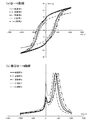
- FIG. (A) BH curve and (b) differential BH curve for iron-based oxide magnetic particle powders obtained in Example 1, Example 2, Example 3, Comparative Example 1, and Comparative Example 2.
- . 7 is a TEM photograph of iron-based oxide magnetic particle powder obtained in Example 7.
- FIG. 4 shows (a) BH curve and (b) differential BH curve for the iron-based oxide magnetic particle powders obtained in Example 2, Example 7, and Example 8.
- the production method of the present invention is for producing iron-based oxide magnetic particle powder in which a part of the Fe site of ⁇ -Fe 2 O 3 or ⁇ -Fe 2 O 3 is substituted with another metal element.
- a case where a heterogeneous phase (mainly ⁇ -Fe 2 O 3 ) inevitable in the production is mixed is included.
- a partially substituted product obtained by substituting a part of the Fe site of ⁇ -Fe 2 O 3 with another metal element has an ⁇ structure, X-ray diffraction (XRD), high-energy electron diffraction (HEED), etc. It is possible to confirm using
- a method for manufacturing the ⁇ -Fe 2 O 3 or a part thereof capable of producing substitutions of the present invention include the following.
- Those represented by the general formula ⁇ -C z Fe 2 -z O 3 (where C is one or more trivalent metal elements selected from In, Ga and Al).
- General formula ⁇ -A x B y Fe 2-xy O 3 (where A is one or more divalent metal elements selected from Co, Ni, Mn and Zn, and B is selected from Ti and Sn)
- A is one or more divalent metal elements selected from Co, Ni, Mn and Zn, and B is selected from Ti and Sn)
- One or more tetravalent metal elements One or more tetravalent metal elements).
- the type substituted only with the C element has an advantage that the coercive force of the magnetic particles can be arbitrarily controlled and has the advantage that it is easy to obtain the same space group as that of ⁇ -Fe 2 O 3. Since it is inferior, it is preferable to substitute simultaneously with A or B element.
- the type substituted with the two elements A and B has excellent thermal stability and can maintain high coercivity of the magnetic particles at room temperature, but a single phase in the same space group as ⁇ -Fe 2 O 3 is somewhat difficult to obtain. .
- a three-element substitution type of A, B, and C is the most preferable because it has the best balance of the above-mentioned characteristics, and is excellent in heat resistance, ease of obtaining a single phase, and controllability of coercive force.
- the production method of the present invention can be applied to ⁇ -Fe 2 O 3 containing no substitution element and any substitution type iron-based oxide magnetic particles.
- z is preferably 0.15 ⁇ z ⁇ 0.60
- y In order to maintain a high saturation magnetization ⁇ s, 0 ⁇ y ⁇ 0.1 is preferable, and 0.001 ⁇ y ⁇ 0.1 is more preferable.
- B elements in a three-element substitution body plus A element, by adding the A element to the extent that does not deteriorate the I L / I H, it is possible to further improve the saturation magnetization ⁇ s preferable.
- the preferred ranges of the substitution amounts x, y and z of the three-element substitution product are as follows.
- x and y can take arbitrary ranges of 0 ⁇ x ⁇ 1 and 0 ⁇ y ⁇ 1, but considering the magnetic recording application, the coercive force of the magnetic particles of the three-element substituted body is not changed. Since it is necessary to change to some extent from that of ⁇ -Fe 2 O 3 , it is preferable to satisfy 0.01 ⁇ x ⁇ 0.2 and 0.01 ⁇ y ⁇ 0.2.
- z may be in the range of 0 ⁇ z ⁇ 1, but from the viewpoint of coercive force control and ease of obtaining a single phase, 0 ⁇ z ⁇ 0.5 may be set. preferable.
- the magnetic particles obtained by substituting a part of the Fe site obtained by the production method of the present invention can maintain a high coercive force at room temperature by appropriately adjusting the values of y or x and y.
- the coercive force can be controlled to a desired value by adjusting x, y, and z.
- the magnetic particles obtained by the production method of the present invention are preferably fine enough that each particle has a single magnetic domain structure.
- the average particle size measured with the transmission electron microscope is preferably 30 nm or less, more preferably 20 nm or less. However, if the average particle size becomes too small, the proportion of fine particles that do not contribute to the above-described improvement in magnetic properties increases, and the magnetic properties per unit weight of the magnetic particle powder deteriorate, so it is preferably 10 nm or more.
- an acidic aqueous solution containing a trivalent iron ion or a trivalent iron ion and a metal ion of a metal element that finally replaces the Fe site as a starting material of the iron-based oxide magnetic particle powder ( Hereinafter referred to as a raw material solution).
- a raw material solution As a supply source of these iron ions or metal ions of substitution elements, it is preferable to use water-soluble inorganic acid salts such as nitrates, sulfates, and chlorides from the viewpoint of availability and cost. When these metal salts are dissolved in water, metal ions are dissociated and the aqueous solution becomes acidic.
- iron oxyhydroxide When neutralization is performed by adding an alkali to this acidic aqueous solution containing metal ions, iron oxyhydroxide, a mixture of iron oxyhydroxide and a hydroxide of a substitution element, or a part of Fe site with another metal element. A substituted iron oxyhydroxide is obtained.
- these iron oxyhydroxides, a mixture of iron oxyhydroxide and a hydroxide of a substitution element, or iron oxyhydroxide in which a part of Fe site is substituted with another metal element Is used as a precursor of iron-based oxide magnetic particle powder.
- the total metal ion concentration in the raw material solution is not particularly defined in the present invention, but is preferably 0.01 mol / L or more and 0.5 mol / L or less. If it is less than 0.01 mol / L, the amount of the iron-based oxide magnetic particle powder obtained by one reaction is small, which is economically undesirable. If the total metal ion concentration exceeds 0.5 mol / L, it is not preferable because the reaction solution is likely to gel due to rapid hydroxide precipitation.
- ferrihydrite is a hexagonal close-packed array of O 2 ⁇ and OH 2 ⁇
- ferrihydrite is a hexagonal close-packed array of O 2 ⁇ and OH 2 ⁇
- Ferrihydrite has two structures called 6Line (6L) and 2Line (2L), and the 2L structure ferrihydrite changes to an ⁇ -type iron-based oxide rather than the 6L structure. easy.
- an alkali is added to the raw material solution and neutralized until the pH becomes 1.0 or more and 3.0 or less.
- the alkali used for neutralization may be any of alkali metal or alkaline earth hydroxides, ammonia water, ammonium salts such as ammonium hydrogen carbonate, but finally heat treated to produce ⁇ -type iron-based oxidation. It is preferable to use ammonia water or ammonium hydrogen carbonate, in which impurities do not easily remain.
- These alkalis may be added in solid form to the aqueous solution of the starting material, but are preferably added in the form of an aqueous solution from the viewpoint of ensuring the uniformity of the reaction.
- an iron-based oxide magnetic particle powder having a narrow average particle size distribution is obtained because the dispersibility of the iron hydroxide colloid produced in this step depends on the water before peptization. This is thought to be due to the fact that it is better than that of oxide precipitation.
- the pH after neutralization is less than 1.0, the iron hydroxide colloid is further dissolved as soluble iron ions, which is not preferable. If the pH after neutralization exceeds 3.0, precipitation of iron hydroxide tends to remain, which is also not preferable.
- iron hydroxide can take the form of oxyhydroxide or hydroxide depending on the pH of the system, etc., but in this specification, the term hydroxide is used to refer to oxyhydroxide. Use as a concept to include.
- the reaction temperature during the neutralization treatment is not particularly limited, but is preferably 60 ° C. or lower.
- the reaction temperature exceeds 60 ° C., ferrihydrite 6L is generated and a different phase ( ⁇ phase) is easily generated, which is not preferable.
- ⁇ phase a different phase
- the reaction temperature from the first neutralization step to the second neutralization step is set to 60 ° C. or less.
- ⁇ s / ⁇ s described later can be controlled to 0.5 or less.
- a more preferable range of the reaction temperature is 5 ° C. or more and 25 ° C. or less. When the reaction is carried out in this temperature range, a magnetic particle powder containing ⁇ s / ⁇ s described below and containing almost no heterogeneous phase is obtained. .
- reaction temperature is less than 5 ° C., it takes a long time to peptize the hydroxide precipitate. The reason why ⁇ -type oxides are likely to be formed when the reaction temperature is high is not clear at present, but it is presumed that part of the ferrihydrite structure changes.
- reaction temperature when controlling reaction temperature to 5 degreeC or more and 25 degrees C or less, if neutralization reaction is performed in the 1st and 2nd neutralization process, the heat of neutralization will generate
- the temperature of the reaction solution exceeds 25 ° C., it is possible to suppress the generation of ⁇ -type oxides by cooling the reaction solution to 25 ° C. or less within 5 minutes.
- the pH value described in this specification was measured using a glass electrode based on JIS Z8802.
- the pH standard solution refers to a value measured by a pH meter calibrated using an appropriate buffer solution corresponding to the pH range to be measured.
- the pH described in the present specification is a value obtained by directly reading a measured value indicated by a pH meter compensated by a temperature compensation electrode under reaction temperature conditions.
- Hydroxycarboxylic acid addition step In the production method of the present invention, the hydroxycarboxylic acid is subsequently added to the reaction solution that has been clarified by holding the raw material solution after neutralization.
- Hydroxycarboxylic acid is a carboxylic acid having an OH group in the molecule and acts as a complexing agent for iron ions.
- the hydroxycarboxylic acid forms a complex with trivalent iron ions dissolved in the reaction solution, and delays the hydroxide formation reaction of iron when the second neutralization treatment is performed in the next step. This is considered to have an effect of narrowing the distribution of the average particle diameter of the resulting precursor fine particles containing iron oxyhydroxide.
- the hydroxycarboxylic acid is considered to form a partial complex with the metal ion of the substitution element.
- hydroxycarboxylic acids such as glycolic acid, lactic acid, various hydroxybutyric acids, glyceric acid, malic acid, tartaric acid, citric acid, and mevalonic acid.
- the group hydroxycarboxylic acids are preferred, and tartaric acid, citric acid or malic acid is more preferred from the viewpoint of cost and availability.
- the amount of the hydroxycarboxylic acid added is such that the molar ratio (D / Fe) to the amount of trivalent iron ions contained in the reaction solution when the substituted metal ions are not included, or the trivalent iron when the substituted metal ions are included.
- the slurry contains the precursor produced in the second neutralization step, which is the next step Becomes an agglomerated system, and a uniform silicon oxide coating cannot be obtained in the subsequent silicon oxide coating process.
- D / Fe or D / (Fe + M) exceeds 1.0, the metal ions form a soluble complex, so there is a difference between the charge ratio of the metal ions to the raw material solution and the amount of metal ion substitution of the resulting oxide. It is not preferable because it is generated and the effect of delaying the above-described hydroxide formation reaction becomes excessive.
- the hydroxycarboxylic acid is presumed to have an action of adsorbing on the surface of the iron hydroxide colloid in the reaction solution and stabilizing the dispersion of the hydroxide colloid.
- Hydroxycarboxylic acid may be added in the state of mechanical stirring without particularly changing the reaction temperature in the first neutralization step, which is the previous step. Although it may be added to the reaction solution as a solid, it is preferably added in the form of an aqueous solution from the viewpoint of ensuring the uniformity of the reaction.
- ferrihydrite is likely to be formed as a precursor of iron oxyhydroxide or an iron oxyhydroxide containing a substitution element by the production process of the present invention has not been clarified at present. It is considered that both the formation nuclei and the reaction through which the hydroxycarboxylic acid coordinated to the trivalent iron ion replaces the OH ⁇ ion contribute.
- the reaction temperature during the neutralization treatment is not particularly limited, but is preferably 60 ° C. or lower. When the reaction temperature exceeds 60 ° C., ferrihydrite 6L is generated and a different phase ( ⁇ phase) is easily generated, which is not preferable.
- reaction temperature from the first neutralization step to the second neutralization step By setting the reaction temperature from the first neutralization step to the second neutralization step to 60 ° C. or less, ⁇ s / ⁇ s described later can be controlled to 0.5 or less.
- a more preferable range of the reaction temperature is 5 ° C. or more and 25 ° C. or less. When the reaction is carried out in this temperature range, a magnetic particle powder containing ⁇ s / ⁇ s described below and containing almost no heterogeneous phase is obtained. .
- it is preferable to adjust the reaction conditions so that the reaction time is about 60 minutes or more and 480 minutes or less.
- the precursor iron oxyhydroxide generated in the above steps or the iron oxyhydroxide containing a substitution element is converted into an ⁇ -type iron-based oxide even if it is heat-treated as it is. Since the phase does not easily change, a silicon oxide coating is applied to iron oxyhydroxide or iron oxyhydroxide crystals containing a substitution element prior to heat treatment.
- a silicon oxide coating method a sol-gel method is preferably applied.
- the silicon oxide includes not only a stoichiometric composition but also a non-stoichiometric composition such as a silanol derivative described later.
- the slurry containing iron oxyhydroxide or iron oxyhydroxide containing a substitution element obtained in the second neutralization step includes the inorganic acid salt ions contained in the raw material solution and the first and second mediums. Although the alkali added in the summing step is included, this step can be performed without washing the slurry.
- a hydrolyzed silicon compound such as tetraethoxysilane (TEOS), tetramethoxysilane (TMOS) or the like is added to an aqueous solution of iron oxyhydroxide crystals containing dispersed substitution elements after the precursor reaction.
- a silane compound such as various silane coupling agents is added to cause a hydrolysis reaction under stirring, and the surface of the iron oxyhydroxide crystal is coated with the produced silanol derivative.
- an acid catalyst or an alkali catalyst may be added. It is preferable to add it in consideration of the treatment time.
- the acid catalyst is hydrochloric acid
- the alkali catalyst is ammonia.
- inorganic silicon compound sodium silicate water glass.
- the specific method for coating the silicon oxide can be the same as the sol-gel method in a known process.
- the reaction temperature of the silicon oxide coating by the sol-gel method is 20 ° C. or more and 60 ° C. or less, and the reaction time is about 1 hour or more and 20 hours or less.
- solid-liquid separation and drying treatment are performed to obtain a sample before the heating step.
- a flocculant may be added for solid-liquid separation.
- the precursor iron oxyhydroxide coated with silicon oxide or iron oxyhydroxide containing a substitution element is heat-treated to obtain an ⁇ -type iron-based oxide.
- washing and drying steps may be provided.
- the heat treatment is performed in an oxidizing atmosphere, but the oxidizing atmosphere may be an air atmosphere.
- the heat treatment temperature varies depending on the coating amount of silicon oxide, it is not general, but the heating can be performed in a range of approximately 700 ° C. to 1300 ° C. When the heating temperature is too low, a compound having a different phase or insufficient phase transformation tends to be mixed.
- the particle size of the resulting product may be reduced, resulting in variations in magnetic properties, making it difficult to use in high-density magnetic recording applications that require uniform magnetic properties as a whole. .
- the lower limit of the heating temperature is set to 700 ° C. or higher, the ⁇ -type iron oxide which is the object of the present invention can be obtained selectively and stably. As a result, it is possible to suppress the formation of a compound having a different phase or phase transformation, so that a magnetic powder having uniform magnetic properties and suitable for high-density magnetic recording can be obtained.
- ⁇ -Fe 2 O 3 which is a thermodynamically stable phase (impurity from ⁇ -Fe 2 O 3 ) is likely to be generated, and is preferably 900 ° C. or higher and 1200 ° C. or lower, more preferably 950 Heat treatment is performed at a temperature of from °C to 1150 °C.
- the heat treatment time can be adjusted in the range of about 0.5 hours to 10 hours, but good results are easily obtained in the range of 2 hours to 5 hours.
- the presence of a silicon-containing substance covering the particles is considered to have an advantageous effect in causing a phase change to an ⁇ -type iron-based oxide rather than a phase change to an ⁇ -type iron-based oxide.
- the silicon oxide coating has an effect of preventing sintering during heat treatment of iron oxyhydroxide crystals or iron oxyhydroxide crystals containing a substitution element.
- the ⁇ -Fe 2 O 3 crystals are replaced with metal elements for substituting the trivalent iron ions and iron sites for the raw material solution.
- it can be obtained in a state where a partially substituted ⁇ -Fe 2 O 3 crystal is covered with silicon oxide.
- the powder obtained after the heat treatment may contain ⁇ -type iron-based oxide, ⁇ -type iron-based oxide, and Fe 3 O 4 crystal as impurities in addition to the ⁇ -type iron-based oxide crystal. These are called iron-based oxide magnetic particle powders.
- the iron-based oxide magnetic particle powder obtained by the production method of the present invention can be used in a state where it is coated with silicon oxide. It is also possible to use it in the removed state.
- the powder after heat treatment is immersed in an aqueous solution in which a strong alkali such as NaOH or KOH is dissolved and dissolved and removed by stirring. it can.
- a strong alkali such as NaOH or KOH
- the aqueous alkali solution may be heated.
- alkali such as NaOH
- the temperature of the aqueous solution is 60 ° C. or higher and 70 ° C. or lower and the powder is stirred, silicon oxide is dissolved well. Can do.
- the degree of silicon oxide coating removal is appropriately adjusted according to the purpose. After removal, in order to ensure good dispersibility in the next step, it is necessary to wash unnecessary ions with water until the electrical conductivity of the filtrate reaches ⁇ 50 mS / m.
- TEM observation The TEM observation of the iron-based oxide magnetic particle powder obtained by the production method of the present invention was performed under the following conditions. JEM-1011 manufactured by JEOL Ltd. was used for TEM observation. For the particle observation, a TEM photograph was used which was photographed at a magnification of 10,000 times and a magnification of 100,000 times and then stretched 3 times during development. Digitization was used for evaluation of average particle diameter and particle size distribution (variation coefficient (%)), and the distance between two points of the most distant one particle was measured. About 300 pieces or more were measured. (Use after removing the silicon oxide coating).
- ⁇ s is the maximum value of the diffraction intensity excluding the background when X-ray diffraction measurement is performed when 2 ⁇ is 27.2 ° or more and 29.7 ° or less (of the ⁇ phase not overlapping the diffraction peak of the ⁇ phase).
- Diffraction peak position) and ⁇ s is the maximum value of diffraction intensity excluding the background when X-ray diffraction measurement is performed when 2 ⁇ is 42 ° or more and 44 ° or less (the diffraction of the ⁇ phase that does not overlap with the diffraction peak of the ⁇ phase) Peak position).
- the calculation method of the background is an average value of diffraction intensities in the range of 27.1 ° to 27.2 ° and 29.7 ° to 29.8 ° in the range of 27.2 ° to 29.7 °.
- the average value of diffraction intensities at 39.9 ° to 40.0 ° and 44.0 ° to 44.1 ° was used.
- the peak height ratio ⁇ s / ⁇ s was calculated using this value.
- ⁇ s (maximum value of X-ray diffraction intensity of 27.2 ° to 29.7 °) ⁇ (X-ray diffraction intensity of 27.1 to 27.2 ° and 29.7 ° to 29.8 °) X-ray diffraction intensity average value)
- ⁇ s (maximum value of X-ray diffraction intensity from 42 ° to 44 °) ⁇ (X-ray diffraction intensity from 39.9 ° to 40.0 ° and X-ray from 44.0 ° to 44.1 ° Average value of diffraction intensity)
- the non-magnetic ⁇ -type oxide is an impurity that does not contribute to magnetic recording, so the value of the peak height ratio ⁇ s / ⁇ s The lower the value, the fewer particles that do not contribute to magnetic recording and the higher the recording density.
- Composition analysis by high frequency inductively coupled plasma optical emission spectrometry Composition analysis was performed with ICP-720ES manufactured by Agilent Technologies.
- the measurement wavelength (nm) was Fe: 259.940 nm, Ga: 294.363 nm, Co: 230.786 nm, Ti: 336.122 nm, Si: 288.158 nm.
- the component on the low Hc side is a component that does not contribute to increasing the recording density when the iron-based oxide magnetic particle powder is used in a magnetic recording medium. If the proportion of particles that are much finer than the average particle size contained in the iron-based oxide magnetic particle powder is reduced by means such as changing the production conditions or classification, the lower Hc side of the differential BH curve From the observation that the peak height decreases, it can be seen that the fine particles have a low Hc component.
- iron-based oxide magnetic particle powder is used for a magnetic recording medium now, the intercept of the vertical axis in the zero magnetic field of the differential BH curve is I L , and the peak height on the high Hc side is I H.
- the peak height ratio I L / I H is lower, the number of particles that do not contribute to magnetic recording decreases and the recording density increases.
- an iron-based oxide magnetic particle powder having an I L / I H value of 0.7 or less, preferably 0.53 or less is obtained.
- the value obtained by dividing the half-width of the peak on the high Hc side by Hc is a value corresponding to SFD (Switching Field Distribution). Narrow.
- SFD Switching Field Distribution
- a magnetic powder having good dispersibility and orientation so as to increase SQx is required.
- SQx and OR are greatly improved, and a magnetic sheet (magnetic recording medium) exhibiting excellent characteristics can be obtained.
- the primary particle size of the iron oxyhydroxide containing the substitution element is as small as a single nano-size, and no aggregates are observed. Was spread in two dimensions and the dispersibility was good.
- the dried powder After drying the precipitate (gel SiO 2 -coated precursor) obtained in the procedure 2, the dried powder was subjected to a heat treatment at 1070 ° C. for 4 hours in a furnace in an air atmosphere to obtain silicon oxide. An iron-based oxide magnetic particle powder coated with bismuth was obtained. The silanol derivative changes to an oxide when it is heat-treated in an air atmosphere (Procedure 3).
- the heat-treated powder obtained in the procedure 3 is stirred in a 20 mass% NaOH aqueous solution at about 70 ° C. for 24 hours to remove the silicon oxide on the particle surface.
- the cleaning slurry was washed to a conductivity of ⁇ 15 mS / m and dried, it was subjected to chemical analysis of the composition, XRD measurement, TEM observation, measurement of magnetic properties, and the like.
- the measurement results are shown in Table 1.
- the chemical composition of the obtained iron-based oxide magnetic particle powder was slightly higher in Fe and lower in Ga, but was almost the same as the composition at the time of preparation.
- FIG. 2 shows a TEM photograph of the iron-based oxide magnetic particle powder obtained in this example, and Table 1 shows the measurement results of the preparation ratio of metal ions and the average particle diameter.
- the length of the white bar shown on the left side of the TEM photograph indicates 50 nm (the same applies to the following TEM photographs).
- FIG. 3 the X-ray-diffraction pattern about the iron-type oxide magnetic particle powder obtained in the present Example is shown. An enlarged view around a diffraction angle of 28 ° and an enlarged view around a diffraction angle of 42 ° are shown, respectively, and showed the same crystal structure as ⁇ -Fe 2 O 3 .
- FIG. 3 also shows the results obtained for Example 4, Comparative Example 1 and Comparative Example 2.
- FIG. 1 shows the results obtained for Example 4, Comparative Example 1 and Comparative Example 2.
- FIG. 4 shows the (a) BH curve and (b) differential BH curve for the iron-based oxide magnetic particle powder obtained in this example, and the measurement results such as coercive force are also shown in Table 1.
- Show. 4B is normalized so that the peaks on the high Hc side have the same height except for the reference example, and the vertical axis (dB / dH) is an arbitrary intensity.
- the average particle diameter of the iron-based oxide magnetic particle powder obtained in this example was 16.6 nm, and the coefficient of variation (CV value) was 40.2%.
- Two peaks are clearly observed in the differential BH curve, the SFD obtained from the half-value width of the peak of the high Hc component is 0.89, the ratio I L / I H of the low Hc component is 0.50, ⁇ The s / ⁇ s was 0.12.
- the value of SFD and the value of I L / I H are superior to those of the iron-based oxide magnetic particle powder obtained in Comparative Example 1 described later.
- ⁇ s / ⁇ s in this example was better than that in Comparative Example 2, but this included a precursor due to an increase in the amount of hydroxycarboxylic acid (in this case citric acid) added. This is probably due to the improved dispersibility of the slurry.
- hydroxycarboxylic acid in this case citric acid
- Example 2 D / (Fe + M) was set to 0.2 (Example 2) and 0.3 (Example 3), and for Example 3, iron was processed in the same procedure as Example 1 except that the firing temperature of the oxide was set to 1055 ° C.
- a system oxide magnetic particle powder was obtained.
- FIG. 4 shows (a) a BH curve and (b) a differential BH curve for the iron-based oxide magnetic particle powder obtained in this example, and the iron-based oxide obtained in this example.
- the measurement results such as the average particle diameter of the magnetic particle powder are also shown in Table 1.
- Example 7 shows an X-ray diffraction pattern of the iron-based oxide magnetic particle powder obtained in Example 2, and an enlarged view around a diffraction angle of 28 ° and a diffraction angle of 42 °. It showed the same crystal structure as Fe 2 O 3 .
- the average particle diameter of the iron-based oxide magnetic particle powder obtained in Example 2 is 17.0 nm, the coefficient of variation (CV value) is 41.1%, and the SFD obtained from the half width of the peak of the high Hc component is The low Hc component ratio I L / I H is 0.43, ⁇ s / ⁇ s is 0.14, and the average particle diameter of the iron-based oxide magnetic particle powder obtained in Example 3 is 15.5 nm, coefficient of variation (CV value) is 34.1%, SFD obtained from the half-value width of the peak of the high Hc component is 0.90, and the ratio I L / I H of the low Hc component is 0.48, ⁇ s / ⁇ s was 0.14.
- the oxide firing temperature was changed in order to align the particle size and BET surface area of the finally obtained iron-based oxide magnetic particle powder, and had little effect on other physical properties. Have confirmed.
- Example 4 The reaction temperature from the first neutralization step to the second neutralization step was 20 ° C., and D / (Fe + M) was 0.15 (Example 4; the same conditions as in Example 1) 0.2 (Example 5) The same conditions as in Example 2) and 0.3 (Example 6; the same conditions as in Example 3).
- Example 6 was the same as Example 1 except that the firing temperature of the oxide was set to 1055 ° C.
- An iron-based oxide magnetic particle powder was obtained.
- the measurement results such as the average particle diameter of the iron-based oxide magnetic particle powder obtained in this example are also shown in Table 1.
- the iron oxyhydroxide crystal surface was coated with a silanol derivative formed by hydrolysis of tetraethoxysilane. Subsequent procedures other than the firing temperature of 1058 ° C. are the same as in Example 1. This procedure is based on that described in Patent Document 1.
- the measurement results such as the average particle diameter of the iron-based oxide magnetic particle powder obtained in this comparative example are also shown in Table 1.
- FIG. 4 shows a BH curve and a differential BH curve for the iron-based oxide magnetic particle powder obtained in this comparative example, and Table 1 also shows measurement results such as coercive force.
- the average particle diameter of the iron-based oxide magnetic particle powder obtained in this comparative example was 15.7 nm, and the coefficient of variation (CV value) was 49.6%.
- Comparative Example 2 An iron-based oxide magnetic particle powder was obtained by the same procedure as in Example 1 except that D / (Fe + M) was 0.1 and the firing temperature was 1055 ° C.
- the iron-based oxide magnetic particle powder obtained in Comparative Example 2 had an SFD of 0.87 and I L / I H of 0.42, but ⁇ s / ⁇ s was 0.52, It included a lot.
- the solution was kept under stirring at a temperature of 40 ° C. for 1 hour, and the iron oxyhydroxide containing the precursor substitution element as an intermediate product was added. Crystals were formed (Procedure 1).
- the molar ratio D / (Fe + M) to the combined amount of trivalent iron ions and metal ions M that partially substitute the Fe sites is 0.20.
- a TEM photograph of the iron oxyhydroxide crystal containing the substitution element obtained in this example is not shown here, the primary particle size of the iron oxyhydroxide containing the substitution element is a single nanoparticle as in Examples 1 to 6. The size was as small as possible, no agglomerates were observed, and the particles spread in two dimensions, and the dispersibility was good.
- the amount of Fe + M contained in the partially substituted ⁇ -Fe 2 O 3 in the precursor slurry obtained in the procedure 1 is added to the precursor slurry obtained in the procedure 1 while stirring at 40 ° C. in the atmosphere (included in the raw material solution). 833.44 g corresponding to about 700 mass% is added in 35 minutes to (approximately equal to the amount of Fe + M).
- the molar ratio Si / (Fe + M) of silicon to the combined amount of trivalent iron ions and metal ions M that partially replace the Fe sites is 2.58.
- Stirring was continued for about 1 day, and the product was coated with a silanol derivative produced by hydrolysis. Thereafter, the obtained solution is washed and solid-liquid separated and recovered as a cake (procedure 2).
- the dried powder was subjected to a heat treatment at 1065 ° C. for 4 hours in a furnace in an air atmosphere to obtain silicon oxide.
- An iron-based oxide magnetic particle powder coated with bismuth was obtained.
- the silanol derivative changes to an oxide when it is heat-treated in an air atmosphere (Procedure 3).
- the heat-treated powder obtained in the procedure 3 is stirred in a 20 mass% NaOH aqueous solution at about 70 ° C. for 24 hours to remove the silicon oxide on the particle surface.
- the cleaning slurry was washed to a conductivity of ⁇ 15 mS / m and dried, it was subjected to chemical analysis of the composition, XRD measurement, TEM observation, measurement of magnetic properties, and the like.
- FIG. 6 shows a TEM photograph of the iron-based oxide magnetic particle powder obtained in the present example, and Table 1 also shows the measurement results such as the charged ratio of metal ions and the average particle diameter.
- Figure 7 X-ray diffraction pattern of the obtained iron oxide magnetic particles powder in the present embodiment, and, although shown together an enlarged view of the vicinity of the diffraction angle of 42 ° and the diffraction angle of 28 °, ⁇ -Fe 2 It showed the same crystal structure as O 3 .
- FIG. 6 shows a TEM photograph of the iron-based oxide magnetic particle powder obtained in the present example
- Table 1 also shows the measurement results such as the charged ratio of metal ions and the average particle diameter.
- Figure 7 X-ray diffraction pattern of the obtained iron oxide magnetic particles powder in the present embodiment, and, although shown together an enlarged view of the vicinity of the diffraction angle of 42 ° and the diffraction angle of 28 °, ⁇ -Fe 2 It showed the same crystal structure as O 3 .
- FIG. 8 shows (a) a BH curve and (b) a normalized differential BH curve for the iron-based oxide magnetic particle powder obtained in this example, and shows measurement results such as coercive force. Also shown in FIG. In addition, in FIG. 8, the result about the iron-type oxide magnetic particle powder obtained in Example 2 is shown again for the comparison.
- the average particle diameter of the iron-based oxide magnetic particle powder obtained in this example was 16.7 nm, and the coefficient of variation (CV value) was 41.4%.
- Two peaks are clearly observed in the differential BH curve, the SFD obtained from the half width of the peak of the high Hc component is 1.06, the ratio I L / I H of the low Hc component is 0.55, ⁇ The s / ⁇ s was 0.05.
- the value of SFD and the value of I L / I H are superior to those of the iron-based oxide magnetic particle powder obtained in Comparative Example 1 described later. By performing the neutralization treatment in two stages, It can be seen that the value of SFD and the value of I L / I H are improved.
- ⁇ s / ⁇ s in this example was better than that in Comparative Example 2, but this included a precursor due to an increase in the amount of hydroxycarboxylic acid (in this case citric acid) added. This is probably due to the improved dispersibility of the slurry.
- hydroxycarboxylic acid in this case citric acid
- Example 8 Using the same conditions as in Example 7, the amount of tetraethoxysilane in the precursor slurry obtained in Procedure 1 is half the amount of ⁇ -Fe 2 O 3 partially substituted as compared with Examples 1 to 6.
- Iron-based oxide magnetic particle powder was obtained in the same procedure as in Example 7, except that 416.89 g corresponding to about 350 mass% was added in 35 minutes, and the firing temperature of the oxide was 1008 ° C.
- the molar ratio Si / (Fe + M) of silicon with respect to the total amount of trivalent iron ions and metal ions M that partially replace the Fe sites is 1.29.
- the X-ray diffraction pattern of the iron-based oxide magnetic particle powder obtained in this example is shown in FIG.
- Example 5 Using the iron-based oxide magnetic particle powder obtained in Example 2, Example 5 and Comparative Example 1, a magnetic tape was prepared by the above-described procedure, and the magnetic properties of the tape were measured. In addition, the dispersion time at the time of tape preparation was 60 minutes, and it dried in the magnetic field with the orientation magnetic field 5.5kOe (438kA / m). The measurement results are shown in Table 2. When it is made into a paint and made into a medium, it is understood that SQx and OR, which are used as an index of orientation that is important in magnetic tape characteristics, exhibit excellent characteristics, and it is possible to increase the recording density of the magnetic recording medium.
- SQx and OR which are used as an index of orientation that is important in magnetic tape characteristics, exhibit excellent characteristics, and it is possible to increase the recording density of the magnetic recording medium.
Landscapes
- Chemical & Material Sciences (AREA)
- Organic Chemistry (AREA)
- Inorganic Chemistry (AREA)
- Engineering & Computer Science (AREA)
- Power Engineering (AREA)
- Compounds Of Iron (AREA)
- Hard Magnetic Materials (AREA)
- Inorganic Compounds Of Heavy Metals (AREA)
- Magnetic Record Carriers (AREA)
- Manufacturing Of Magnetic Record Carriers (AREA)
Abstract
Description
本発明は、高密度磁気記録媒体、電波吸収体等に好適な鉄系酸化物磁性粒子粉、特に、粒子の平均粒子径がナノメートルオーダーの粒子粉の製造方法に関する。 The present invention relates to a method for producing an iron-based oxide magnetic particle powder suitable for a high-density magnetic recording medium, a radio wave absorber, and the like, particularly a particle powder having an average particle diameter of nanometer order.
ε-Fe2O3は酸化鉄の中でも極めて稀な相であるが、室温において、ナノメートルオーダーのサイズの粒子が20kOe(1.59×10⁶A/m)程度の巨大な保磁力(Hc)を示すため、ε-Fe2O3を単相で合成する製造方法の検討が従来よりなされてきている(特許文献1)。また、ε-Fe2O3を磁気記録媒体に用いた場合、現時点ではそれに対応する、高レベルの飽和磁束密度を有する磁気ヘッド用の材料が存在しないため、ε-Fe2O3のFeサイトの一部をAl、Ga、In等の3価の金属で置換することにより、保磁力を調整することも行われており、保磁力と電波吸収特性の関係も調べられている(特許文献2)。 ε-Fe 2 O 3 is an extremely rare phase among iron oxides, but at room temperature, particles with a nanometer order size have a huge coercive force (Hc) of about 20 kOe (1.59 × 10 6 A / m). In the past, studies have been made on production methods for synthesizing ε-Fe 2 O 3 in a single phase (Patent Document 1). Further, when ε-Fe 2 O 3 is used for a magnetic recording medium, there is no corresponding material for a magnetic head having a high saturation magnetic flux density at the present time. Therefore, the Fe site of ε-Fe 2 O 3 The coercive force is also adjusted by substituting a part of the metal with a trivalent metal such as Al, Ga, In, etc., and the relationship between the coercive force and the radio wave absorption characteristics has been investigated (Patent Document 2). ).
一方、磁気記録の分野では、再生信号レベルと粒子性ノイズの比(C/N比:Carrier to Noise Ratio)の高い磁気記録媒体の開発が行われており、記録の高密度化のために、磁気記録層を構成する磁性粒子の微細化が求められている。しかし、一般に、磁性粒子の微細化はその耐環境安定性、熱安定性の劣化を招き易く、使用もしくは保存環境下における磁性粒子の磁気特性低下が懸念されるので、ε-Fe2O3のFeサイトの一部を、耐熱性に優れた他の金属で置換することにより、一般式ε-AxByFe2-x-yO3またはε-AxByCzFe2-x-y-zO3(ここでAはCo、Ni、Mn、Zn等の2価の金属元素、BはTi等の4価の金属元素、CはIn、Ga、Al等の3価の金属元素)で表される、粒子サイズを低下させ、保磁力を可変とするとともに、耐環境安定性、熱安定性にも優れた各種のε-Fe2O3の一部置換体が開発されている(特許文献3)。 On the other hand, in the field of magnetic recording, a magnetic recording medium having a high reproduction signal level and particulate noise ratio (C / N ratio: Carrier to Noise Ratio) has been developed. There is a demand for miniaturization of magnetic particles constituting the magnetic recording layer. However, in general, miniaturization of magnetic particles is likely to cause deterioration of the environmental stability and thermal stability of the magnetic particles, and there is a concern that the magnetic properties of the magnetic particles may be deteriorated under use or storage environment. Therefore, ε-Fe 2 O 3 a part of the Fe site, by substituting other metals having excellent heat resistance, the general formula ε-a x B y Fe 2 -x-y O 3 or ε-a x B y C z Fe 2-x -Yz O 3 (where A is a divalent metal element such as Co, Ni, Mn, Zn, B is a tetravalent metal element such as Ti, and C is a trivalent metal such as In, Ga, Al, etc.) Elemental), various partial ε-Fe 2 O 3 substitutes have been developed that have a reduced particle size, variable coercive force, and excellent environmental stability and thermal stability. (Patent Document 3).
ε-Fe2O3は熱力学的な安定相ではないため、その製造には特殊な方法を必要とする。上述の特許文献1~3には、液相法で生成したオキシ水酸化鉄の微細結晶を前駆体として用い、その前駆体にゾル-ゲル法によりシリコン酸化物を被覆した後に熱処理するε-Fe2O3の製造方法が開示されており、液相法としては反応媒体として有機溶媒を用いる逆ミセル法と、反応媒体として水溶液のみを用いる方法がそれぞれ開示されている。
Since ε-Fe 2 O 3 is not a thermodynamic stable phase, its production requires a special method. In the above-mentioned
上述の特許文献1~3に開示された従来の製造方法により製造されたε-Fe2O3もしくはFeを一部置換したεタイプの鉄系酸化物は、優れた磁気特性を有するものであるが、製造条件によっては、保磁力分布にバラツキが観察される場合があった。本発明者等が鋭意研究を行ったところ、従来法により製造されたε-Fe2O3もしくはFeを一部置換したεタイプの鉄系酸化物は粒度分布が広く、その平均粒径と比較して非常に微細な粒子を多量に含むものであり、この微細粒子は保磁力が小さく、磁気記録媒体に使用した場合、記録密度を高めることに寄与しないものであることが判明した。
Ε-Fe 2 O 3 or ε-type iron-based oxides partially substituted by Fe manufactured by the conventional manufacturing methods disclosed in
具体的には、従来法により得られた磁性粉について測定した磁気ヒステリシス曲線(B-H曲線)を数値微分して得られる曲線(以下、微分B-H曲線と呼ぶ。)には、二つのピークが観察される。これらのピークのうち、印加磁場が高い位置に現れるピーク、すなわち高Hc成分に対応する磁性粉は磁気記録に寄与するが、印加磁場が低い位置に現れるピーク、すなわち低Hc成分に対応する磁性粉は磁気記録に寄与しないものであると考えられる。本発明者等の検討により、前記の微細粒子の含有量が減少すると、微分B-H曲線の低Hc成分のピークが低下することが確認されている。 Specifically, there are two curves (hereinafter referred to as differential BH curves) obtained by numerically differentiating the magnetic hysteresis curve (BH curve) measured for the magnetic powder obtained by the conventional method. A peak is observed. Among these peaks, the peak appearing at a position where the applied magnetic field is high, that is, the magnetic powder corresponding to the high Hc component contributes to magnetic recording, but the peak appearing at the position where the applied magnetic field is low, ie, the magnetic powder corresponding to the low Hc component. Is considered not to contribute to magnetic recording. As a result of studies by the present inventors, it has been confirmed that when the content of the fine particles is reduced, the peak of the low Hc component of the differential BH curve is lowered.
この微細粒子のHcが低い理由については、現在のところ不明であるが、αタイプの鉄系酸化物やγタイプの鉄系酸化物等の様な、εタイプの鉄系酸化物にとっての異相を含むためか、粒子径が小さいため超常磁性を示すためか、いずれかであろうと推定される。
いずれにしても、前記の微細粒子は鉄系酸化物磁性粒子粉の磁気特性向上に寄与しないものなので、その含有量を減少させる必要があることが判明した。すなわち、本発明において解決すべき技術課題とは、粒度分布が狭く、特に前記低Hc成分となる微細粒子の含有量が少なく、その結果として保磁力分布が狭く、磁気記録媒体の高記録密度化に適した鉄系酸化物磁性粒子粉の製造方法を提供することである。
The reason why the Hc of the fine particles is low is unknown at present, but there are different phases for ε-type iron-based oxides such as α-type iron-based oxides and γ-type iron-based oxides. It is presumed that either it is contained or because the particle diameter is small, it exhibits superparamagnetism.
In any case, since the fine particles do not contribute to the improvement of the magnetic properties of the iron-based oxide magnetic particle powder, it has been found that the content thereof needs to be reduced. That is, the technical problem to be solved in the present invention is that the particle size distribution is narrow, in particular, the content of fine particles as the low Hc component is small, and as a result, the coercive force distribution is narrow and the recording density of the magnetic recording medium is increased It is providing the manufacturing method of the iron-type oxide magnetic particle powder suitable for.
上述したように、特許文献1~3には、ε-Fe2O3もしくはFeを一部置換したεタイプの鉄系酸化物の前駆体であるオキシ水酸化鉄(一部置換体を含む)の製造方法として、有機溶媒を用いる方法と水のみを反応溶媒とする方法が開示されているが、経済的な観点からは、高価な有機溶媒を使用せず、水溶液系で前駆体を合成することが好ましい。Fe3+イオンを出発物質として水溶液中で酸化鉄、オキシ水酸化鉄を合成する場合、例えば「共沈法によるシュベルトマナイトと各種陰イオン置換体の合成-FeOOH鉱物の生成における陰イオンの役割-」,井上厚行,八田珠郎,粘土科学,第45巻,第4号,250-265(2006)に記載されているように、共存するアニオン種によりその結晶系が変化することが知られている。
As described above, in
ε-Fe2O3もしくはFeを一部置換したεタイプの鉄系酸化物の製造方法において、前駆体のオキシ水酸化鉄(一部置換体を含む)をシリコン酸化物で被覆して熱処理するのは、前駆体を一種の拘束状態に置き、熱処理時の結晶格子の自由変形を妨げることにより、熱力学的な不安定相を作り出すものである。したがって、最終的に得られるε-Fe2O3粒子の結晶構造は、前駆体粒子の結晶構造の影響を受けるものと考えられる。
その考えに基づき、発明者等が検討を行ったところ、前駆体生成に際して、一度Fe3+の水酸化物コロイドの状態を経由すると、前駆体粒子の粒度分布が狭くなり、その効果は水酸化物コロイドを安定化するヒドロキシカルボン酸の存在により強められることが判明した。また、反応溶液中における出発物質である3価の鉄イオンとヒドロキシカルボン酸のモル比、または、3価の鉄イオンと前記Feサイトを一部置換する金属Mのイオンとを合わせた量とヒドロキシカルボン酸のモル比を変化させると、中和反応により生成した前駆体を含むスラリーの分散状態が変化すること、さらに、前駆体形成反応を低温で行うと、εタイプの鉄系酸化物にとって異相であるαタイプの酸化物の生成が抑制されることも判明した。なお、前駆体としてフェリハイドライト(ferrihydrite、Fe5O7(OH)・4H2O)と同じ結晶構造を有するオキシ水酸化鉄、または、そのFe元素の一部置換体を含んでいると、最終的に得られる鉄系酸化物磁性粒子粉の保磁力分布が狭くなることも判明している。
以上の知見を基に、本発明者等は、以下に述べる本発明を完成させた。
なお、上記括弧中に示したフェリハイドライトの組成は理想的なもので、実際にはある程度の組成の揺らぎを持っている。
In a method for producing an ε-type iron-based oxide in which ε-Fe 2 O 3 or Fe is partially substituted, the precursor iron oxyhydroxide (including a partially substituted material) is coated with silicon oxide and heat-treated. In this method, the precursor is placed in a kind of restrained state, and free deformation of the crystal lattice during heat treatment is prevented, thereby creating a thermodynamically unstable phase. Therefore, the crystal structure of the finally obtained ε-Fe 2 O 3 particles is considered to be affected by the crystal structure of the precursor particles.
Based on this idea, the inventors have examined and found that the particle size distribution of the precursor particles narrows once through the state of the Fe 3+ hydroxide colloid when the precursor is produced. It has been found that it is enhanced by the presence of hydroxycarboxylic acids that stabilize the colloid. Further, the molar ratio of the trivalent iron ion and hydroxycarboxylic acid, which are starting materials in the reaction solution, or the total amount of the trivalent iron ion and the metal M ion that partially substitutes the Fe site, and hydroxy Changing the molar ratio of the carboxylic acid changes the dispersion state of the slurry containing the precursor produced by the neutralization reaction. Further, when the precursor formation reaction is performed at a low temperature, it is different from that for the ε-type iron-based oxide. It was also found that the production of α-type oxides is suppressed. When the precursor contains iron oxyhydroxide having the same crystal structure as ferrihydrite (Fe 5 O 7 (OH) · 4H 2 O), or a partial substitute of the Fe element, It has also been found that the finally obtained iron-based oxide magnetic particle powder has a narrow coercive force distribution.
Based on the above findings, the present inventors have completed the present invention described below.
Note that the composition of ferrihydrite shown in the parentheses above is ideal and actually has a certain degree of composition fluctuation.
上記の課題を解決するために、本発明においては、
透過電子顕微鏡で測定した平均粒子径が10nm以上30nm以下であるε-Fe2O3、もしくは、ε-Fe2O3のFeサイトの一部を他の金属元素Mで置換した鉄系酸化物磁性粒子粉であって、下記の定義に従うILおよびIHを用いて算出されるIL/IHの値が0.7以下であり、かつαs/εsが0.5以下、好ましくは0.1以下の鉄系酸化物磁性粒子粉の製造方法が提供される。
ここでIHは、印加磁界1035kA/m(13kOe)、M測定レンジ0.005A・m2(5emu)、ステップビット80bit、時定数0.03sec、ウエイトタイム0.1secの条件下で測定して得られたB-H曲線を数値微分して得られる微分B-H曲線において高磁場側に現れるピークの強度である。またILは、前記微分B-H曲線のゼロ磁場における縦軸の切片の強度である。
またαsは2θが27.2°以上29.7°以下においてX線回折測定を行った際のバックグラウンドを除いた回折強度の最大値であり、εsは2θが42°以上44°以下においてX線回折測定を行った際のバックグラウンドを除いた回折強度の最大値である。
前記の製造方法は、具体的には、出発物質として3価の鉄イオン、または3価の鉄イオンと前記Feサイトを一部置換する金属Mのイオンを含む水溶液を用い、好ましくは60℃以下の温度に保ちながらその水溶液にアルカリを加えてpHをpH1.0以上3.0以下まで中和した後、ヒドロキシカルボン酸D、好ましくは酒石酸、クエン酸、リンゴ酸から選択される1種以上を、置換金属イオンを含まない場合には3価の鉄イオン量に対するモル比(D/Feと表記する)が、置換金属イオンを含む場合には3価の鉄イオンと前記金属Mのイオンを合わせた量に対するモル比(D/(Fe+M)と表記する)が、それぞれで0.125以上1.0以下の量を添加し、さらにアルカリを添加してpHをpH7.0以上10.0以下まで中和した後、当該オキシ水酸化鉄または置換金属元素を含むオキシ水酸化鉄にシリコン酸化物を被覆して加熱することにより、シリコン酸化物を被覆した酸化鉄または置換金属元素を含む酸化鉄を得る鉄系酸化物磁性粒子粉の製造方法が提供される。
また、本発明においては、αs/εsを0.1以下に制御するために、前記の第一の中和工程、ヒドロキシカルボン酸添加工程、および第二の中和工程を、5℃以上25℃以下の温度に保ちながら行う鉄系酸化物磁性粒子粉の製造方法が提供される。
以上の製造方法では、シリコン酸化物を被覆した鉄系酸化物磁性粒子粉が得られるが、用途によっては、シリコン酸化物被覆を除去しても構わない。
この鉄系酸化物は、ε-AxByCzFe2-x-y-zO3(ただし、AはCo、Ni、Mn、Znから選択される1種以上の2価の金属元素、BはTi、Snから選択される1種以上の4価の金属元素、CはIn、Ga、Alから選択される1種以上の3価の金属元素で、0≦x、y、z<1)であることが好ましい。なお、x、yおよびzの全てが0の場合は、置換元素を含まないε-Fe2O3である。
In order to solve the above problems, in the present invention,
Ε-Fe 2 O 3 having an average particle diameter of 10 nm or more and 30 nm or less measured by a transmission electron microscope, or an iron-based oxide in which a part of the Fe site of ε-Fe 2 O 3 is substituted with another metal element M It is a magnetic particle powder, and the value of I L / I H calculated using I L and I H according to the following definition is 0.7 or less, and α s / ε s is 0.5 or less, preferably Provides a method for producing iron-based oxide magnetic particle powder of 0.1 or less.
Here, I H is measured under the conditions of an applied magnetic field of 1035 kA / m (13 kOe), an M measurement range of 0.005 A · m 2 (5 emu), a step bit of 80 bits, a time constant of 0.03 sec, and a wait time of 0.1 sec. This is the intensity of the peak appearing on the high magnetic field side in the differential BH curve obtained by numerically differentiating the obtained BH curve. The I L is the intensity of the intercept of the vertical axis at a zero magnetic field of the differential B-H curve.
Α s is the maximum value of the diffraction intensity excluding the background when X-ray diffraction measurement is performed when 2θ is 27.2 ° or more and 29.7 ° or less, and ε s is 2θ of 42 ° or more and 44 ° or less. Is the maximum value of the diffraction intensity excluding the background when X-ray diffraction measurement is performed.
Specifically, the production method uses, as a starting material, an aqueous solution containing trivalent iron ions, or trivalent iron ions and ions of metal M that partially substitutes the Fe site, and preferably 60 ° C. or less. While maintaining the temperature of the aqueous solution, an alkali is added to the aqueous solution to neutralize the pH from pH 1.0 to 3.0, and then at least one selected from hydroxycarboxylic acid D, preferably tartaric acid, citric acid and malic acid. When the substituted metal ion is not included, the molar ratio to the amount of trivalent iron ion (denoted as D / Fe) is combined. When the substituted metal ion is included, the trivalent iron ion and the metal M ion are combined. The molar ratio to the amount (denoted as D / (Fe + M)) is added in an amount of 0.125 or more and 1.0 or less, respectively, and an alkali is added to adjust the pH to 7.0 or more and 10.0 or less. After neutralization, Iron-based oxide magnetism to obtain iron oxide coated with silicon oxide or iron oxide containing substituted metal element by coating iron oxyhydroxide or iron oxyhydroxide containing substituted metal element with silicon oxide and heating A method for producing particulate powder is provided.
Moreover, in this invention, in order to control (alpha) s / (epsilon) s to 0.1 or less, said 1st neutralization process, hydroxycarboxylic acid addition process, and 2nd neutralization process are 5 degreeC or more. A method for producing iron-based oxide magnetic particle powder while maintaining a temperature of 25 ° C. or lower is provided.
In the above manufacturing method, iron-based oxide magnetic particle powder coated with silicon oxide is obtained, but the silicon oxide coating may be removed depending on the application.
This iron-based oxide is composed of ε-A x B y C z Fe 2-xyz O 3 (where A is one or more divalent metal elements selected from Co, Ni, Mn, and Zn) , B is one or more tetravalent metal elements selected from Ti and Sn, C is one or more trivalent metal elements selected from In, Ga and Al, and 0 ≦ x, y, z < 1) is preferable. When all of x, y, and z are 0, it is ε-Fe 2 O 3 that does not contain a substitution element.
本発明の製造方法を用いることにより、粒度分布が狭く、特に磁気記録特性向上に寄与しない微細粒子の含有量が少なく、その結果として保磁力分布が狭く、磁気記録媒体の高記録密度化に適した鉄系酸化物磁性粒子粉を得ることができる。 By using the production method of the present invention, the particle size distribution is narrow, especially the content of fine particles that do not contribute to the improvement of magnetic recording characteristics is small, and as a result, the coercive force distribution is narrow and suitable for increasing the recording density of magnetic recording media. Iron-based oxide magnetic particle powder can be obtained.
[鉄系酸化物磁性粒子]
本発明の製造方法は、ε-Fe2O3、もしくは、ε-Fe2O3のFeサイトの一部を他の金属元素で置換した鉄系酸化物磁性粒子粉を製造するためのものであり、当該磁性粒子以外に、その製造上不可避的な異相(主としてα-Fe2O3)が混在する場合を含む。
ε-Fe2O3のFeサイトの一部を他の金属元素で置換した一部置換体がε構造を有するかどうかについては、X線回折法(XRD)、高速電子回折法(HEED)等を用いて確認することが可能である。
[Iron-based oxide magnetic particles]
The production method of the present invention is for producing iron-based oxide magnetic particle powder in which a part of the Fe site of ε-Fe 2 O 3 or ε-Fe 2 O 3 is substituted with another metal element. In addition to the magnetic particles, a case where a heterogeneous phase (mainly α-Fe 2 O 3 ) inevitable in the production is mixed is included.
Whether a partially substituted product obtained by substituting a part of the Fe site of ε-Fe 2 O 3 with another metal element has an ε structure, X-ray diffraction (XRD), high-energy electron diffraction (HEED), etc. It is possible to confirm using
本発明の製造方法により製造が可能なε-Fe2O3もしくはその一部置換体については、以下が挙げられる。
一般式ε-Fe2O3で表される、置換元素を含まないもの。
一般式ε-CzFe2-zO3(ここでCはIn、Ga、Alから選択される1種以上の3価の金属元素)で表されるもの。
一般式ε-AxByFe2-x-yO3(ここでAはCo、Ni、Mn、Znから選択される1種以上の2価の金属元素、BはTi、Snから選択される1種以上の4価の金属元素)で表されるもの。
一般式ε-AxCzFe2-x-zO3(ここでAはCo、Ni、Mn、Znから選択される1種以上の2価の金属元素、CはIn、Ga、Alから選択される1種以上の3価の金属元素)で表されるもの。
一般式ε-ByCzFe2-y-zO3(ここでBはTi、Snから選択される1種以上の4価の金属元素、CはIn、Ga、Alから選択される1種以上の3価の金属元素)で表されるもの。
一般式ε-AxByCzFe2-x-y-zO3(ここでAはCo、Ni、Mn、Znから選択される1種以上の2価の金属元素、BはTi、Snから選択される1種以上の4価の金属元素、CはIn、Ga、Alから選択される1種以上の3価の金属元素)で表されるもの。
A method for manufacturing the ε-Fe 2 O 3 or a part thereof capable of producing substitutions of the present invention include the following.
A compound represented by the general formula ε-Fe 2 O 3 and containing no substitution element.
Those represented by the general formula ε-C z Fe 2 -z O 3 (where C is one or more trivalent metal elements selected from In, Ga and Al).
General formula ε-A x B y Fe 2-xy O 3 (where A is one or more divalent metal elements selected from Co, Ni, Mn and Zn, and B is selected from Ti and Sn) One or more tetravalent metal elements).
General formula ε-A x C z Fe 2-xz O 3 (where A is one or more divalent metal elements selected from Co, Ni, Mn, and Zn, and C is In, Ga, Al) One or more selected trivalent metal elements).
General formula ε-B y C z Fe 2-yz O 3 (where B is one or more tetravalent metal elements selected from Ti and Sn, C is 1 selected from In, Ga and Al) A trivalent metal element of a species or higher).
General formula ε-A x B y C z Fe 2-xyz O 3 (where A is one or more divalent metal elements selected from Co, Ni, Mn, Zn, B is Ti, One or more tetravalent metal elements selected from Sn, and C is one or more trivalent metal elements selected from In, Ga, and Al).
ここでC元素のみで置換したタイプは、磁性粒子の保磁力を任意に制御出来ることに加え、ε-Fe2O3と同じ空間群を得易いという利点を有するが、熱的安定性にやや劣るので、AまたはB元素で同時に置換することが好ましい。
AおよびBの2元素で置換したタイプは、熱的安定性に優れ、磁性粒子の常温における保磁力を高く維持出来るが、ε-Fe2O3と同じ空間群の単一相がやや得にくい。
A、BおよびCの三元素置換タイプは、上述の特性のバランスが最も良く取れたもので、耐熱性、単一相の得易さ、保磁力の制御性に優れるものであり、最も好ましい。本発明の製造方法は、上述したように、置換元素を含まないε-Fe2O3および、いずれの置換タイプの鉄系酸化物磁性粒子についても適用可能である。
The type substituted only with the C element has an advantage that the coercive force of the magnetic particles can be arbitrarily controlled and has the advantage that it is easy to obtain the same space group as that of ε-Fe 2 O 3. Since it is inferior, it is preferable to substitute simultaneously with A or B element.
The type substituted with the two elements A and B has excellent thermal stability and can maintain high coercivity of the magnetic particles at room temperature, but a single phase in the same space group as ε-Fe 2 O 3 is somewhat difficult to obtain. .
A three-element substitution type of A, B, and C is the most preferable because it has the best balance of the above-mentioned characteristics, and is excellent in heat resistance, ease of obtaining a single phase, and controllability of coercive force. As described above, the production method of the present invention can be applied to ε-Fe 2 O 3 containing no substitution element and any substitution type iron-based oxide magnetic particles.
C元素のみを置換する場合には0<z<1の値を取ることが可能であるが、既存、および近い将来の磁気ヘッドの書き込み能力を考えると、保磁力の調整が必要となり0.15≦z≦0.60とすることが好ましい。
C元素とともにAまたはB元素を置換する場合には、現時点で機構は不明であるが、B元素を同時に置換した方がIL/IHの値が低くなり好ましい。その場合、0<y<1、0<z<1の値を取ることが可能であるが、上述と同じ理由によりzについては0.15≦z≦0.60とすることが好ましく、yについては高い飽和磁化σsを維持するために0<y≦0.1とすることが好ましく、0.001≦y≦0.1とすることがより好ましい。
さらに、C元素、B元素に加え、A元素を加えた三元素置換体においては、IL/IHを悪化させない程度にA元素を加えることで、飽和磁化σsをより改善することが可能となり好ましい。
When only the C element is replaced, it is possible to take a value of 0 <z <1, but considering the writing ability of existing and near future magnetic heads, it is necessary to adjust the coercive force to be 0.15. It is preferable to satisfy ≦ z ≦ 0.60.
When substituting A or B element together with C element, the mechanism is unknown at present, but it is preferable to substitute B element at the same time because the value of I L / I H is lowered. In that case, it is possible to take values of 0 <y <1, 0 <z <1, but for the same reason as described above, z is preferably 0.15 ≦ z ≦ 0.60, and y In order to maintain a high saturation magnetization σs, 0 <y ≦ 0.1 is preferable, and 0.001 ≦ y ≦ 0.1 is more preferable.
Furthermore, in addition to the element C, B elements, in a three-element substitution body plus A element, by adding the A element to the extent that does not deteriorate the I L / I H, it is possible to further improve the saturation magnetization σs preferable.
三元素置換体の置換量x、yおよびzの好適な範囲は、以下の通りである。
xおよびyは、0<x<1、0<y<1の任意の範囲を取ることが可能であるが、磁気記録用途を考えると、三元素置換体の磁性粒子の保磁力を無置換のε-Fe2O3のそれとはある程度変化させる必要があるので、0.01≦x≦0.2、0.01≦y≦0.2とすることが好ましい。zも、x、yと同様に0<z<1の範囲であれば良いが、保磁力制御および単一相の得易さの観点から、0<z≦0.5の範囲とすることが好ましい。
The preferred ranges of the substitution amounts x, y and z of the three-element substitution product are as follows.
x and y can take arbitrary ranges of 0 <x <1 and 0 <y <1, but considering the magnetic recording application, the coercive force of the magnetic particles of the three-element substituted body is not changed. Since it is necessary to change to some extent from that of ε-Fe 2 O 3 , it is preferable to satisfy 0.01 ≦ x ≦ 0.2 and 0.01 ≦ y ≦ 0.2. Similarly to x and y, z may be in the range of 0 <z <1, but from the viewpoint of coercive force control and ease of obtaining a single phase, 0 <z ≦ 0.5 may be set. preferable.
本発明の製造方法により得られるFeサイトの一部を置換した磁性粒子は、yまたはxおよびyの値を適度に調整することにより常温で高い保磁力を維持することが可能であり、さらに、x、yおよびzを調整することにより保磁力を所望の値に制御することが可能である。 The magnetic particles obtained by substituting a part of the Fe site obtained by the production method of the present invention can maintain a high coercive force at room temperature by appropriately adjusting the values of y or x and y. The coercive force can be controlled to a desired value by adjusting x, y, and z.
[平均粒子径]
本発明の製造方法により得られる磁性粒子は、各粒子が単磁区構造となる程度に微細であることが好ましい。その透過電子顕微鏡で測定した平均粒子径が30nm以下であることが好ましく、より好ましくは20nm以下である。しかし、平均粒子径が小さくなり過ぎると、上述した磁気特性向上に寄与しない微細粒子の存在割合が増大し、磁性粒子粉単位重量当たりの磁気特性が劣化するので、10nm以上であることが好ましい。
[Average particle size]
The magnetic particles obtained by the production method of the present invention are preferably fine enough that each particle has a single magnetic domain structure. The average particle size measured with the transmission electron microscope is preferably 30 nm or less, more preferably 20 nm or less. However, if the average particle size becomes too small, the proportion of fine particles that do not contribute to the above-described improvement in magnetic properties increases, and the magnetic properties per unit weight of the magnetic particle powder deteriorate, so it is preferably 10 nm or more.
[出発物質および前駆体]
本発明の製造方法においては、鉄系酸化物磁性粒子粉の出発物質として3価の鉄イオンまたは3価の鉄イオンと最終的にFeサイトを置換する金属元素の金属イオンを含む酸性の水溶液(以下、原料溶液と言う。)を用いる。これらの鉄イオンもしくは置換元素の金属イオンの供給源としては、入手の容易さおよび価格の面から、硝酸塩、硫酸塩、塩化物の様な水溶性の無機酸塩を用いることが好ましい。これらの金属塩を水に溶解すると、金属イオンが解離し、水溶液は酸性を呈する。この金属イオンを含む酸性水溶液にアルカリを添加して中和すると、オキシ水酸化鉄、もしくはオキシ水酸化鉄と置換元素の水酸化物の混合物、または、Feサイトの一部を他の金属元素で置換されたオキシ水酸化鉄が得られる。本発明の製造方法においては、これらのオキシ水酸化鉄、もしくはオキシ水酸化鉄と置換元素の水酸化物の混合物、または、Feサイトの一部を他の金属元素で置換されたオキシ水酸化鉄を鉄系酸化物磁性粒子粉の前駆体として用いる。
[Starting materials and precursors]
In the production method of the present invention, an acidic aqueous solution containing a trivalent iron ion or a trivalent iron ion and a metal ion of a metal element that finally replaces the Fe site as a starting material of the iron-based oxide magnetic particle powder ( Hereinafter referred to as a raw material solution). As a supply source of these iron ions or metal ions of substitution elements, it is preferable to use water-soluble inorganic acid salts such as nitrates, sulfates, and chlorides from the viewpoint of availability and cost. When these metal salts are dissolved in water, metal ions are dissociated and the aqueous solution becomes acidic. When neutralization is performed by adding an alkali to this acidic aqueous solution containing metal ions, iron oxyhydroxide, a mixture of iron oxyhydroxide and a hydroxide of a substitution element, or a part of Fe site with another metal element. A substituted iron oxyhydroxide is obtained. In the production method of the present invention, these iron oxyhydroxides, a mixture of iron oxyhydroxide and a hydroxide of a substitution element, or iron oxyhydroxide in which a part of Fe site is substituted with another metal element Is used as a precursor of iron-based oxide magnetic particle powder.
原料溶液中の全金属イオン濃度は、本発明では特に規定するものではないが、0.01mol/L以上0.5mol/L以下が好ましい。0.01mol/L未満では1回の反応で得られる鉄系酸化物磁性粒子粉の量が少なく、経済的に好ましくない。全金属イオン濃度が0.5mol/Lを超えると、急速な水酸化物の沈澱発生により、反応溶液がゲル化しやすくなるので好ましくない。 The total metal ion concentration in the raw material solution is not particularly defined in the present invention, but is preferably 0.01 mol / L or more and 0.5 mol / L or less. If it is less than 0.01 mol / L, the amount of the iron-based oxide magnetic particle powder obtained by one reaction is small, which is economically undesirable. If the total metal ion concentration exceeds 0.5 mol / L, it is not preferable because the reaction solution is likely to gel due to rapid hydroxide precipitation.
一般に、液相法により生成するオキシ水酸化鉄の結晶構造は、水溶液中で共存するアニオン種および中和条件により変化することが知られている。本発明者等の検討によると、鉄系酸化物磁性粒子粉の前駆体のオキシ水酸化鉄として、フェリハイドライト構造のものを含むと、最終的にεタイプの鉄系酸化物が得易いことが判明した。 Generally, it is known that the crystal structure of iron oxyhydroxide produced by the liquid phase method changes depending on the anion species coexisting in the aqueous solution and the neutralization conditions. According to the study by the present inventors, when iron oxyhydroxide as a precursor of iron-based oxide magnetic particle powder includes a ferrihydrite structure, it is easy to finally obtain an ε-type iron-based oxide. There was found.
フェリハイドライト構造のオキシ水酸化物を経由するとεタイプの鉄系酸化物が得易い理由は現在のところ不明であるが、フェリハイドライトは、O2-とOH-の六方最密充填配列と立方最密充填配列をなす層が不規則に積層し、Fe八面体の一部が欠落した欠陥の多い構造であり、これにシリコン酸化物を被覆して拘束条件下で熱処理した際に、εタイプの鉄系酸化物に変化し易いものと推定される。さらに、ε-Fe2O3のFeサイトの一部を他の金属元素で置換するために、Fe以外の他元素を加えた際にも、Feと共沈し易くフェリハイドライト以外の異相が生成し難く、組成均一性、粒子均一性という観点からも好ましいと推定される。 The reason why it is easy to obtain ε-type iron-based oxides through ferrihydrite structure oxyhydroxide is currently unknown, but ferrihydrite is a hexagonal close-packed array of O 2− and OH 2 − When a layer having a cubic close-packed arrangement is irregularly laminated and a part of Fe octahedron is missing, it has a defect-rich structure, and when this is covered with silicon oxide and heat-treated under restraint conditions, ε It is estimated that it is easy to change to a type of iron-based oxide. Furthermore, in order to replace a part of the Fe site of ε-Fe 2 O 3 with another metal element, even when an element other than Fe is added, a foreign phase other than ferrihydrite is easily coprecipitated with Fe. It is difficult to produce and is presumed to be preferable from the viewpoint of composition uniformity and particle uniformity.
なお、フェリハイドライトには、6Line(6L)および2Line(2L)と呼ばれる二つの構造があり、2L構造のフェリハイドライトの方が6L構造のものよりもεタイプの鉄系酸化物に変化し易い。 Ferrihydrite has two structures called 6Line (6L) and 2Line (2L), and the 2L structure ferrihydrite changes to an ε-type iron-based oxide rather than the 6L structure. easy.
[第一の中和工程]
本発明の製造方法においては、原料溶液にアルカリを添加し、そのpHがpH1.0以上3.0以下になるまで中和する。中和に用いるアルカリとしては、アルカリ金属またはアルカリ土類の水酸化物、アンモニア水、炭酸水素アンモニウムなどのアンモニウム塩のいずれであっても良いが、最終的に熱処理してεタイプの鉄系酸化物とした時に不純物が残りにくいアンモニア水や炭酸水素アンモニウムを用いることが好ましい。これらのアルカリは、出発物質の水溶液に固体で添加しても構わないが、反応の均一性を確保する観点からは、水溶液の状態で添加することが好ましい。
[First neutralization step]
In the production method of the present invention, an alkali is added to the raw material solution and neutralized until the pH becomes 1.0 or more and 3.0 or less. The alkali used for neutralization may be any of alkali metal or alkaline earth hydroxides, ammonia water, ammonium salts such as ammonium hydrogen carbonate, but finally heat treated to produce ε-type iron-based oxidation. It is preferable to use ammonia water or ammonium hydrogen carbonate, in which impurities do not easily remain. These alkalis may be added in solid form to the aqueous solution of the starting material, but are preferably added in the form of an aqueous solution from the viewpoint of ensuring the uniformity of the reaction.
原料溶液にアルカリを添加してpHを前記の領域まで上昇させると、3価の鉄の水酸化物の沈澱が析出するので、中和処理中は反応溶液を公知の機械的手段により撹拌する。この沈澱生成は一種のオーバーシュート状態なので、反応溶液を撹拌しながらそのpHで保持していると沈澱は解膠し、反応溶液は清澄になる。この保持に必要な時間は、原料溶液の金属イオン濃度や、アルカリの添加速度に依存して変化するが、反応溶液が清澄な状態になるまで保持する。この状態では、反応溶液中の鉄の一部は水酸化物コロイドを形成し、残りは可溶性の鉄イオンとして溶解しており、この鉄の水酸化物コロイドが、第二の中和工程における前駆体生成の核になるものと推定される。
なお、本発明の製造方法において、平均粒子径の分布の狭い鉄系酸化物磁性粒子粉が得られるのは、本工程において生成した鉄の水酸化物コロイドの分散性が、解膠以前の水酸化物の沈澱のそれよりも良好であることに起因するものと考えられる。
本工程において、中和後のpHが1.0未満では、鉄の水酸化物コロイドがさらに可溶性の鉄イオンとして溶解してしまうので好ましくない。中和後のpHが3.0を超えると、鉄の水酸化物の沈澱が残存し易くなるので、やはり好ましくない。
ここで鉄の水酸化物は、系のpH等に依存してオキシ水酸化物や水酸化物の形態を取り得るが、本明細書においては、水酸化物という言葉を、オキシ水酸化物を含む概念として使用する。
When alkali is added to the raw material solution and the pH is raised to the above range, a precipitate of trivalent iron hydroxide precipitates. Therefore, the reaction solution is stirred by a known mechanical means during the neutralization treatment. Since this precipitation is a kind of overshoot, if the reaction solution is kept at that pH while stirring, the precipitate is peptized and the reaction solution becomes clear. The time required for this holding varies depending on the metal ion concentration of the raw material solution and the alkali addition rate, but is held until the reaction solution becomes clear. In this state, a part of iron in the reaction solution forms a hydroxide colloid and the rest is dissolved as a soluble iron ion, and this iron hydroxide colloid becomes a precursor in the second neutralization step. Presumed to be the core of body generation.
In the production method of the present invention, an iron-based oxide magnetic particle powder having a narrow average particle size distribution is obtained because the dispersibility of the iron hydroxide colloid produced in this step depends on the water before peptization. This is thought to be due to the fact that it is better than that of oxide precipitation.
In this step, if the pH after neutralization is less than 1.0, the iron hydroxide colloid is further dissolved as soluble iron ions, which is not preferable. If the pH after neutralization exceeds 3.0, precipitation of iron hydroxide tends to remain, which is also not preferable.
Here, iron hydroxide can take the form of oxyhydroxide or hydroxide depending on the pH of the system, etc., but in this specification, the term hydroxide is used to refer to oxyhydroxide. Use as a concept to include.
本発明の製造方法においては、中和処理時の反応温度は特に限定しないが、60℃以下とすることが好ましい。反応温度が60℃を超えるとフェリハイドライト6Lが生成し、異相(α相)が生成し易いので好ましくない。第一の中和工程から第二の中和工程までの反応温度を60℃以下とすることにより、後述するαs/εsを0.5以下に制御することが可能になる。反応温度のより好ましい範囲は5℃以上25℃以下であり、この温度範囲で反応を行うと、後述するαs/εsが0.1以下の、異相をほとんど含まない磁性粒子粉が得られる。反応温度が5℃未満では水酸化物沈澱の解膠に要する時間が長くなるので好ましくない。反応温度が高くなるとαタイプの酸化物が生成し易くなる理由については現在のところ明らかではないが、フェリハイドライトの構造の一部が変化するためと推定される。
なお、反応温度を5℃以上25℃以下に制御する場合、第一および第二の中和工程で中和反応を行うと、中和熱が発生し、反応溶液の温度が上昇することがある。反応溶液の温度が25℃を超えた場合には、反応溶液を5分以内に25℃以下に冷却すればαタイプの酸化物の発生を抑制することが可能である。
In the production method of the present invention, the reaction temperature during the neutralization treatment is not particularly limited, but is preferably 60 ° C. or lower. When the reaction temperature exceeds 60 ° C., ferrihydrite 6L is generated and a different phase (α phase) is easily generated, which is not preferable. By setting the reaction temperature from the first neutralization step to the second neutralization step to 60 ° C. or less, α s / ε s described later can be controlled to 0.5 or less. A more preferable range of the reaction temperature is 5 ° C. or more and 25 ° C. or less. When the reaction is carried out in this temperature range, a magnetic particle powder containing α s / ε s described below and containing almost no heterogeneous phase is obtained. . If the reaction temperature is less than 5 ° C., it takes a long time to peptize the hydroxide precipitate. The reason why α-type oxides are likely to be formed when the reaction temperature is high is not clear at present, but it is presumed that part of the ferrihydrite structure changes.
In addition, when controlling reaction temperature to 5 degreeC or more and 25 degrees C or less, if neutralization reaction is performed in the 1st and 2nd neutralization process, the heat of neutralization will generate | occur | produce and the temperature of a reaction solution may rise. . When the temperature of the reaction solution exceeds 25 ° C., it is possible to suppress the generation of α-type oxides by cooling the reaction solution to 25 ° C. or less within 5 minutes.
本明細書に記載のpHの値は、JIS Z8802に基づき、ガラス電極を用いて測定した。pH標準液は、測定するpH領域に応じた適切な緩衝液を用いて校正したpH計により測定した値をいう。また、本明細書に記載のpHは、温度補償電極により補償されたpH計の示す測定値を、反応温度条件下で直接読み取った値である。 The pH value described in this specification was measured using a glass electrode based on JIS Z8802. The pH standard solution refers to a value measured by a pH meter calibrated using an appropriate buffer solution corresponding to the pH range to be measured. The pH described in the present specification is a value obtained by directly reading a measured value indicated by a pH meter compensated by a temperature compensation electrode under reaction temperature conditions.
[ヒドロキシカルボン酸添加工程]
本発明の製造方法においては、前述した、原料溶液を中和した後保持することにより清澄となった反応溶液に、引き続きヒドロキシカルボン酸を添加する。ヒドロキシカルボン酸とは、分子内にOH基を有するカルボン酸であり、鉄イオンの錯化剤として作用する。ここで、ヒドロキシカルボン酸は、反応溶液中に溶解している3価の鉄イオンと錯体を形成し、次工程で第二の中和処理を行った際の鉄の水酸化物形成反応を遅延させ、結果として生成するオキシ水酸化鉄を含む前駆体微粒子の平均粒子径の分布を狭くする効果を有すると考えられる。なお、ヒドロキシカルボン酸は、置換元素の金属イオンとも一部錯体を形成するものと考えられる。
[Hydroxycarboxylic acid addition step]
In the production method of the present invention, the hydroxycarboxylic acid is subsequently added to the reaction solution that has been clarified by holding the raw material solution after neutralization. Hydroxycarboxylic acid is a carboxylic acid having an OH group in the molecule and acts as a complexing agent for iron ions. Here, the hydroxycarboxylic acid forms a complex with trivalent iron ions dissolved in the reaction solution, and delays the hydroxide formation reaction of iron when the second neutralization treatment is performed in the next step. This is considered to have an effect of narrowing the distribution of the average particle diameter of the resulting precursor fine particles containing iron oxyhydroxide. The hydroxycarboxylic acid is considered to form a partial complex with the metal ion of the substitution element.
ヒドロキシカルボン酸には、グリコール酸、乳酸、各種のヒドロキシ酪酸、グリセリン酸、リンゴ酸、酒石酸、クエン酸、メバロン酸等、多種類のものが存在するが、錯化能力の観点から多価の脂肪族ヒドロキシカルボン酸が好ましく、価格および入手の容易さから酒石酸、クエン酸またはリンゴ酸がより好ましい。
ヒドロキシカルボン酸の添加量は、置換金属イオンを含まない場合には反応溶液に含まれる3価の鉄イオン量に対するモル比(D/Fe)が、置換金属イオンを含む場合には3価の鉄イオンと前記金属Mのイオンを合わせた量に対するモル比(D/(Fe+M))が、それぞれ0.125未満であると、次工程である第二の中和工程で生成する前駆体を含むスラリーが凝集系となり、引き続くシリコン酸化物被覆工程で均一なシリコン酸化物被覆が得られない。D/FeもしくはD/(Fe+M)が1.0を超えると、金属イオンが可溶性錯体を形成するために、原料溶液への金属イオンの仕込み比と得られる酸化物の金属イオン置換量に差異が発生するとともに、前述の水酸化物形成反応を遅延させる効果が過大になるので好ましくない。なお、ヒドロキシカルボン酸は、反応溶液中の鉄の水酸化物コロイドの表面に吸着し、水酸化物コロイドの分散を安定化させる作用も有するものと推定される。
ヒドロキシカルボン酸は、前工程である第一の中和工程の反応温度を特に変化させることなく、機械的撹拌の状態で添加すればよい。反応溶液に固体で添加しても構わないが、反応の均一性を確保する観点からは、水溶液の状態で添加することが好ましい。
There are many types of hydroxycarboxylic acids such as glycolic acid, lactic acid, various hydroxybutyric acids, glyceric acid, malic acid, tartaric acid, citric acid, and mevalonic acid. The group hydroxycarboxylic acids are preferred, and tartaric acid, citric acid or malic acid is more preferred from the viewpoint of cost and availability.
The amount of the hydroxycarboxylic acid added is such that the molar ratio (D / Fe) to the amount of trivalent iron ions contained in the reaction solution when the substituted metal ions are not included, or the trivalent iron when the substituted metal ions are included. If the molar ratio (D / (Fe + M)) to the total amount of ions and ions of the metal M is less than 0.125, the slurry contains the precursor produced in the second neutralization step, which is the next step Becomes an agglomerated system, and a uniform silicon oxide coating cannot be obtained in the subsequent silicon oxide coating process. If D / Fe or D / (Fe + M) exceeds 1.0, the metal ions form a soluble complex, so there is a difference between the charge ratio of the metal ions to the raw material solution and the amount of metal ion substitution of the resulting oxide. It is not preferable because it is generated and the effect of delaying the above-described hydroxide formation reaction becomes excessive. The hydroxycarboxylic acid is presumed to have an action of adsorbing on the surface of the iron hydroxide colloid in the reaction solution and stabilizing the dispersion of the hydroxide colloid.
Hydroxycarboxylic acid may be added in the state of mechanical stirring without particularly changing the reaction temperature in the first neutralization step, which is the previous step. Although it may be added to the reaction solution as a solid, it is preferably added in the form of an aqueous solution from the viewpoint of ensuring the uniformity of the reaction.
[第二の中和工程]
本発明の製造方法においては、前記のヒドロキシカルボン酸添加後の反応溶液にアルカリをさらに添加し、そのpH7.0以上10.0以下になるまで中和する。添加するアルカリについては、前記の第一の中和工程と同一である。本工程により、第一の中和工程にて生成したεタイプの鉄系酸化物の前駆体であるオキシ水酸化鉄の核が成長し最終的な前駆体結晶ができる。
[Second neutralization step]
In the production method of the present invention, an alkali is further added to the reaction solution after the addition of the hydroxycarboxylic acid, and neutralized until the pH is 7.0 or more and 10.0 or less. About the alkali to add, it is the same as said 1st neutralization process. By this step, the core of iron oxyhydroxide, which is a precursor of the ε-type iron-based oxide generated in the first neutralization step, grows to form a final precursor crystal.
本工程においては、アルカリの添加により、反応溶液中に存在する3価の鉄イオンがOH-イオンと反応し、オキシ水酸化鉄が生成するが、その際、分散性に優れた鉄の水酸化物コロイドを析出の核とするため、置換元素を含む場合には、反応の起こる場所による置換元素を含むオキシ水酸化鉄の不均一な成長が起こらず、平均粒子径の分布の狭い前駆体が得られるものと考えられる。また、反応溶液中に存在する3価の鉄イオンがヒドロキシカルボン酸と錯体を形成しているため、3価の鉄イオンとOH-イオンとの反応が緩やかに起こるため、結晶成長する個々の置換元素を含むオキシ水酸化鉄微粒子間でもサイズ的に不均一な成長になりにくいものと推定される。 In this step, by adding an alkali, trivalent iron ions present in the reaction solution react with OH − ions to produce iron oxyhydroxide. At this time, iron hydroxide with excellent dispersibility is produced. Since the colloidal material is the core of precipitation, when a substitution element is included, the iron oxyhydroxide containing the substitution element does not grow unevenly depending on the place where the reaction occurs, and a precursor with a narrow average particle size distribution is produced. It is considered to be obtained. In addition, since the trivalent iron ions existing in the reaction solution form a complex with the hydroxycarboxylic acid, the reaction between the trivalent iron ions and the OH − ions occurs slowly. It is presumed that even in the iron oxyhydroxide fine particles containing the element, it is difficult to grow unevenly in size.
本発明の製造工程により、前駆体のオキシ水酸化鉄または置換元素を含むオキシ水酸化鉄としてフェリハイドライトが生成し易い理由については、現在のところ明確になっていないが、水酸化鉄コロイドを生成核とすることと、3価の鉄イオンに配位したヒドロキシカルボン酸がOH-イオンと置換する反応を経由することの双方が寄与しているものと考えられる。 The reason why ferrihydrite is likely to be formed as a precursor of iron oxyhydroxide or an iron oxyhydroxide containing a substitution element by the production process of the present invention has not been clarified at present. It is considered that both the formation nuclei and the reaction through which the hydroxycarboxylic acid coordinated to the trivalent iron ion replaces the OH − ion contribute.
本工程において、中和後のpHが7.0未満では、置換元素を含む場合には、第一の中和工程にて完全に中和されなかった置換元素、例えばCoがそのままイオンとして溶液に残留し組成ずれが発生してしまい、また、Coが無駄になってしまうため経済性でも好ましくない。中和後のpHが10.0を超えると、中和の効果が飽和するので、それぞれ好ましくない。
本発明の製造方法においては、中和処理時の反応温度は特に限定しないが、60℃以下とすることが好ましい。反応温度が60℃を超えるとフェリハイドライト6Lが生成し、異相(α相)が生成し易いので好ましくない。第一の中和工程から第二の中和工程までの反応温度を60℃以下とすることにより、後述するαs/εsを0.5以下に制御することが可能になる。反応温度のより好ましい範囲は5℃以上25℃以下であり、この温度範囲で反応を行うと、後述するαs/εsが0.1以下の、異相をほとんど含まない磁性粒子粉が得られる。
反応時間はオキシ水酸化鉄の成長速度と経済性の兼ね合いを考慮し、60分以上480分以下程度になる様に反応条件を調整するのが好ましい。
In this step, when the pH after neutralization is less than 7.0, when a substitutional element is included, the substitutional element that has not been completely neutralized in the first neutralization step, such as Co, is directly ionized into the solution. Residual composition shift occurs and Co is wasted, which is not preferable in terms of economy. If the pH after neutralization exceeds 10.0, the neutralization effect is saturated, which is not preferable.
In the production method of the present invention, the reaction temperature during the neutralization treatment is not particularly limited, but is preferably 60 ° C. or lower. When the reaction temperature exceeds 60 ° C., ferrihydrite 6L is generated and a different phase (α phase) is easily generated, which is not preferable. By setting the reaction temperature from the first neutralization step to the second neutralization step to 60 ° C. or less, α s / ε s described later can be controlled to 0.5 or less. A more preferable range of the reaction temperature is 5 ° C. or more and 25 ° C. or less. When the reaction is carried out in this temperature range, a magnetic particle powder containing α s / ε s described below and containing almost no heterogeneous phase is obtained. .
In consideration of the balance between the growth rate of iron oxyhydroxide and the economy, it is preferable to adjust the reaction conditions so that the reaction time is about 60 minutes or more and 480 minutes or less.
[シリコン酸化物による被覆工程]
本発明の製造方法においては、前記までの工程で生成した前駆体のオキシ水酸化鉄または置換元素を含むオキシ水酸化鉄は、そのままの状態で熱処理を施してもεタイプの鉄系酸化物に相変化しにくいので、熱処理に先立ってオキシ水酸化鉄または置換元素を含むオキシ水酸化鉄結晶にシリコン酸化物被覆を施す。シリコン酸化物の被覆法としては、ゾル-ゲル法を適用することが好ましい。なお、ここでシリコン酸化物とは、化学量論組成のものだけではなく、後述するシラノール誘導体等の非量論組成のものも含む。なお、前記の第二の中和工程で得られるオキシ水酸化鉄または置換元素を含むオキシ水酸化鉄を含むスラリーには、原料溶液に含まれる無機酸塩のイオンや第一ならびに第二の中和工程で添加したアルカリが含まれているが、本工程は当該スラリーを洗浄することなく行うことが可能である。
[Coating process with silicon oxide]
In the production method of the present invention, the precursor iron oxyhydroxide generated in the above steps or the iron oxyhydroxide containing a substitution element is converted into an ε-type iron-based oxide even if it is heat-treated as it is. Since the phase does not easily change, a silicon oxide coating is applied to iron oxyhydroxide or iron oxyhydroxide crystals containing a substitution element prior to heat treatment. As a silicon oxide coating method, a sol-gel method is preferably applied. Here, the silicon oxide includes not only a stoichiometric composition but also a non-stoichiometric composition such as a silanol derivative described later. Note that the slurry containing iron oxyhydroxide or iron oxyhydroxide containing a substitution element obtained in the second neutralization step includes the inorganic acid salt ions contained in the raw material solution and the first and second mediums. Although the alkali added in the summing step is included, this step can be performed without washing the slurry.
ゾル-ゲル法の場合、前駆体反応後の分散した置換元素を含むオキシ水酸化鉄結晶の水溶液に、加水分解基を持つシリコン化合物、例えばテトラエトキシシラン(TEOS)、テトラメトキシシラン(TMOS)や、各種のシランカップリング剤等のシラン化合物を添加して撹拌下で加水分解反応を生起させ、生成したシラノール誘導体によりオキシ水酸化鉄結晶表面を被覆する。また、酸触媒、アルカリ触媒を添加しても構わない。処理時間を考慮すると添加することが好ましい。代表的な例として酸触媒では塩酸、アルカリ触媒ではアンモニアとなる。酸触媒を使用する場合は、置換元素を含むオキシ水酸化鉄粒子が溶解しない量の添加に留める必要がある。その他、無機のシリコン化合物珪酸ソーダ(水ガラス)を使用することも可能である。 In the case of the sol-gel method, a hydrolyzed silicon compound such as tetraethoxysilane (TEOS), tetramethoxysilane (TMOS) or the like is added to an aqueous solution of iron oxyhydroxide crystals containing dispersed substitution elements after the precursor reaction. A silane compound such as various silane coupling agents is added to cause a hydrolysis reaction under stirring, and the surface of the iron oxyhydroxide crystal is coated with the produced silanol derivative. Further, an acid catalyst or an alkali catalyst may be added. It is preferable to add it in consideration of the treatment time. As a typical example, the acid catalyst is hydrochloric acid, and the alkali catalyst is ammonia. In the case of using an acid catalyst, it is necessary to limit the addition so that the iron oxyhydroxide particles containing the substitution element do not dissolve. In addition, it is also possible to use inorganic silicon compound sodium silicate (water glass).
なお、シリコン酸化物の被覆についての具体的手法は、公知プロセスにおけるゾル-ゲル法と同様とすることができる。例えば、ゾル-ゲル法によるシリコン酸化物被覆の反応温度としては20℃以上60℃以下、反応時間としては1時間以上20時間以下程度である。シリコン酸化物による被覆処理の後、固液分離、乾燥処理を行い、加熱工程前試料となる。ここで、被覆処理の後、固液分離の前に水洗を行ってもよい。またここで、固液分離時には、凝集剤を添加し固液分離しても構わない。 It should be noted that the specific method for coating the silicon oxide can be the same as the sol-gel method in a known process. For example, the reaction temperature of the silicon oxide coating by the sol-gel method is 20 ° C. or more and 60 ° C. or less, and the reaction time is about 1 hour or more and 20 hours or less. After the coating treatment with silicon oxide, solid-liquid separation and drying treatment are performed to obtain a sample before the heating step. Here, you may wash with water after a coating process and before solid-liquid separation. Here, at the time of solid-liquid separation, a flocculant may be added for solid-liquid separation.
[加熱工程]
本発明の製造方法においては、前記のシリコン酸化物で被覆した前駆体のオキシ水酸化鉄または置換元素を含むオキシ水酸化鉄を加熱処理してεタイプの鉄系酸化物を得る。加熱処理前に、洗浄、乾燥の工程を設けても良い。加熱処理は酸化雰囲気中で行われるが、酸化雰囲気としては大気雰囲気で構わない。加熱処理温度はシリコン酸化物の被覆量により変化するため一概ではないが、加熱は概ね700℃以上1300℃以下の範囲で行うことができる。加熱温度が低過ぎる場合には、異相もしくは相変態が十分でない化合物が混在し易くなる。また、得られる生成物の粒径が小さくなることもあり、その結果磁気特性がばらつくので、全体として均一な磁気特性が要求される高密度磁気記録用途には用いられがたいものになってしまう。これは、本願発明の趣旨から乖離したものであり、一方で、上記の加熱温度の下限を700℃以上にすれば、本発明の目的であるεタイプの酸化鉄を選択的に安定して得ることが出来、ひいては異相もしくは相変態が十分でない化合物の生成を抑制することが出来るので、そろった磁気特性を有し、高密度磁気記録に適した磁性粉末が得られるようになる。加熱温度が高いと熱力学安定相であるα-Fe2O3(ε-Fe2O3からすると不純物である)が生成し易くなるので、好ましくは900℃以上1200℃以下、より好ましくは950℃以上1150℃以下で加熱処理を行う。熱処理時間は0.5時間以上10時間以下程度の範囲で調整可能であるが、2時間以上5時間以下の範囲で良好な結果が得られやすい。なお、粒子を覆うシリコン含有物質の存在がαタイプの鉄系酸化物への相変化ではなくεタイプの鉄系酸化物への相変化を引き起こす上で有利に作用するものと考えられる。またシリコン酸化物被覆は、オキシ水酸化鉄または置換元素を含むオキシ水酸化鉄結晶同士の加熱処理時の焼結を防止する作用を有する。
[Heating process]
In the production method of the present invention, the precursor iron oxyhydroxide coated with silicon oxide or iron oxyhydroxide containing a substitution element is heat-treated to obtain an ε-type iron-based oxide. Before the heat treatment, washing and drying steps may be provided. The heat treatment is performed in an oxidizing atmosphere, but the oxidizing atmosphere may be an air atmosphere. Although the heat treatment temperature varies depending on the coating amount of silicon oxide, it is not general, but the heating can be performed in a range of approximately 700 ° C. to 1300 ° C. When the heating temperature is too low, a compound having a different phase or insufficient phase transformation tends to be mixed. Also, the particle size of the resulting product may be reduced, resulting in variations in magnetic properties, making it difficult to use in high-density magnetic recording applications that require uniform magnetic properties as a whole. . This is a departure from the spirit of the present invention. On the other hand, if the lower limit of the heating temperature is set to 700 ° C. or higher, the ε-type iron oxide which is the object of the present invention can be obtained selectively and stably. As a result, it is possible to suppress the formation of a compound having a different phase or phase transformation, so that a magnetic powder having uniform magnetic properties and suitable for high-density magnetic recording can be obtained. When the heating temperature is high, α-Fe 2 O 3 which is a thermodynamically stable phase (impurity from ε-Fe 2 O 3 ) is likely to be generated, and is preferably 900 ° C. or higher and 1200 ° C. or lower, more preferably 950 Heat treatment is performed at a temperature of from ℃ to 1150 ℃. The heat treatment time can be adjusted in the range of about 0.5 hours to 10 hours, but good results are easily obtained in the range of 2 hours to 5 hours. The presence of a silicon-containing substance covering the particles is considered to have an advantageous effect in causing a phase change to an ε-type iron-based oxide rather than a phase change to an α-type iron-based oxide. Further, the silicon oxide coating has an effect of preventing sintering during heat treatment of iron oxyhydroxide crystals or iron oxyhydroxide crystals containing a substitution element.
以上の工程により、原料溶液が金属イオンとして3価の鉄イオンのみを含む場合にはε-Fe2O3結晶が、原料溶液が3価の鉄イオンと鉄サイトを置換するための金属元素を含む場合には一部置換型のε-Fe2O3結晶がシリコン酸化物を被覆した状態で得られる。加熱処理後に得られる粉末には、εタイプの鉄系酸化物結晶以外に、不純物としてαタイプの鉄系酸化物、γタイプの鉄系酸化物、Fe3O4結晶が存在する場合もあるが、それらを含めて鉄系酸化物磁性粒子粉と呼ぶ。
本発明の製造方法により得られる鉄系酸化物磁性粒子粉は、シリコン酸化物を被覆した状態で用いることも可能であるが、用途によっては表面を被覆しているシリコン酸化物を後述の工程により除去した状態で用いることも可能である。
Through the above steps, when the raw material solution contains only trivalent iron ions as metal ions, the ε-Fe 2 O 3 crystals are replaced with metal elements for substituting the trivalent iron ions and iron sites for the raw material solution. When it is included, it can be obtained in a state where a partially substituted ε-Fe 2 O 3 crystal is covered with silicon oxide. The powder obtained after the heat treatment may contain α-type iron-based oxide, γ-type iron-based oxide, and Fe 3 O 4 crystal as impurities in addition to the ε-type iron-based oxide crystal. These are called iron-based oxide magnetic particle powders.
The iron-based oxide magnetic particle powder obtained by the production method of the present invention can be used in a state where it is coated with silicon oxide. It is also possible to use it in the removed state.
[シリコン酸化物被覆除去工程]
鉄系酸化物磁性粒子粉がシリコン酸化物による被覆を必要としない場合、または、鉄系酸化物磁性粒子粉の磁気記録特性向上のために分級を行う場合はそれに先立って、ε-Fe2O3結晶または一部置換型のε-Fe2O3結晶を被覆しているシリコン酸化物を除去する。塗布型磁気記録媒体用途においては、テープに塗布された磁性粒子に磁場配向処理を行う必要があること、また、シリコン酸化物を被覆した状態では、非磁性成分であるシリコン酸化物が増えてしまうためテープ単位面積当たりの磁化量が落ちてしまうため(テープからの信号が弱くなってしまう。)、被覆しているシリコン酸化物を後述の工程により除去した状態にすることが好ましい。具体的な方法としては、シリコン酸化物は、アルカリ性の水溶液に可溶なので、加熱処理後の粉末をNaOHやKOHなどの強アルカリを溶解させた水溶液中に浸漬し、撹拌することにより溶解・除去できる。溶解速度を上げる場合は、アルカリ水溶液を加温するとよい。代表的には、NaOHなどのアルカリをシリコン酸化物に対して3倍モル以上添加し、水溶液温度が60℃以上70℃以下の状態で、粉末を撹拌すると、シリコン酸化物を良好に溶解することができる。シリコン酸化物被覆除去の程度は、目的に応じて適宜調整する。
除去後は、次工程における良好な分散性を確保するため、濾液の電気伝導率が≦50mS/mになるまで不要イオンを水洗する必要がある。
[Silicon oxide coating removal process]
When the iron-based oxide magnetic particle powder does not require coating with silicon oxide, or when classification is performed to improve the magnetic recording characteristics of the iron-based oxide magnetic particle powder, ε-Fe 2 O is preceded. The silicon oxide covering the three crystals or the partially substituted ε-Fe 2 O 3 crystal is removed. In coating-type magnetic recording medium applications, it is necessary to perform magnetic field orientation treatment on magnetic particles coated on a tape, and silicon oxide, which is a nonmagnetic component, increases in a state where silicon oxide is coated. For this reason, the amount of magnetization per unit area of the tape drops (the signal from the tape becomes weak), so that it is preferable to remove the silicon oxide that has been covered by a process described later. As a specific method, since silicon oxide is soluble in an alkaline aqueous solution, the powder after heat treatment is immersed in an aqueous solution in which a strong alkali such as NaOH or KOH is dissolved and dissolved and removed by stirring. it can. In order to increase the dissolution rate, the aqueous alkali solution may be heated. Typically, when alkali such as NaOH is added 3 times mol or more with respect to silicon oxide and the temperature of the aqueous solution is 60 ° C. or higher and 70 ° C. or lower and the powder is stirred, silicon oxide is dissolved well. Can do. The degree of silicon oxide coating removal is appropriately adjusted according to the purpose.
After removal, in order to ensure good dispersibility in the next step, it is necessary to wash unnecessary ions with water until the electrical conductivity of the filtrate reaches ≦ 50 mS / m.
[透過電子顕微鏡(TEM)観察]
本発明の製造法により得られた鉄系酸化物磁性粒子粉のTEM観察は、以下の条件で行った。
TEM観察には日本電子株式会社製JEM-1011を使用した。粒子観察については、倍率10,000倍、倍率100,000倍で撮影した後、現像時に3倍引き伸ばしたTEM写真を用いた。
平均粒子径、粒度分布評価(変動係数(%))にはデジタイズを使用し、1つの粒子の最も距離の離れた2点間の距離を計測した。個数については300個以上を測定した。(シリコン酸化物被覆を除去後のものを使用)。
[Transmission electron microscope (TEM) observation]
The TEM observation of the iron-based oxide magnetic particle powder obtained by the production method of the present invention was performed under the following conditions.
JEM-1011 manufactured by JEOL Ltd. was used for TEM observation. For the particle observation, a TEM photograph was used which was photographed at a magnification of 10,000 times and a magnification of 100,000 times and then stretched 3 times during development.
Digitization was used for evaluation of average particle diameter and particle size distribution (variation coefficient (%)), and the distance between two points of the most distant one particle was measured. About 300 pieces or more were measured. (Use after removing the silicon oxide coating).
[X線回折(XRD)パターンの測定]
得られた試料を粉末X線回折(XRD:リガク社製RINT2000、線源CoKα線、電圧40kV、電流30mA、2θ=10°以上~80°以下)に供した。本測定により、前駆体相確認、ε相生成確認、および、異相確認を行った。
αsとεsを以下の手順で求め、得られた値からピーク高さの比αs/εsを算出した。
αsは2θが27.2°以上29.7°以下においてX線回折測定を行った際のバックグラウンドを除いた回折強度の最大値であり(ε相の回折ピークと重なっていないα相の回折ピーク位置)、εsは2θが42°以上44°以下においてX線回折測定を行った際のバックグラウンドを除いた回折強度の最大値(α相の回折ピークと重なっていないε相の回折ピーク位置)である。バックグラウンドの算出方法は、27.2°以上29.7°以下においては、27.1°以上27.2°以下および29.7°以上29.8°以下における回折強度の平均値とし、42°以上44°以下においては、39.9°以上40.0°以下および44.0°以上44.1°以下における回折強度の平均値とした。ピーク高さの比αs/εsはこの値を用いて算出した。
αs=(27.2°以上29.7°以下のX線回折強度の最大値)-(27.1以上27.2°以下のX線回折強度と29.7°以上29.8°以下のX線回折強度の平均値)
εs=(42°以上44°以下のX線回折強度の最大値)-(39.9°以上40.0°以下のX線回折強度と44.0°以上44.1°以下のX線回折強度の平均値)
今、鉄系酸化物磁性粒子粉を磁気記録媒体に使用することを考えると、非磁性のαタイプの酸化物は磁気記録に寄与しない不純物なので、ピーク高さの比αs/εsの値が低いほど、磁気記録に寄与しない粒子が減り、記録密度が増大することになる。本発明の製造方法を用いると、αs/εsの値が0.5以下の鉄系酸化物磁性粒子粉が得られる。
[Measurement of X-ray diffraction (XRD) pattern]
The obtained sample was subjected to powder X-ray diffraction (XRD: RINT2000 manufactured by Rigaku Corporation, radiation source CoKα ray,
α s and ε s were obtained by the following procedure, and the peak height ratio α s / ε s was calculated from the obtained value.
α s is the maximum value of the diffraction intensity excluding the background when X-ray diffraction measurement is performed when 2θ is 27.2 ° or more and 29.7 ° or less (of the α phase not overlapping the diffraction peak of the ε phase). Diffraction peak position), and ε s is the maximum value of diffraction intensity excluding the background when X-ray diffraction measurement is performed when 2θ is 42 ° or more and 44 ° or less (the diffraction of the ε phase that does not overlap with the diffraction peak of the α phase) Peak position). The calculation method of the background is an average value of diffraction intensities in the range of 27.1 ° to 27.2 ° and 29.7 ° to 29.8 ° in the range of 27.2 ° to 29.7 °. When the angle was not less than 44 ° and not more than 44 °, the average value of diffraction intensities at 39.9 ° to 40.0 ° and 44.0 ° to 44.1 ° was used. The peak height ratio α s / ε s was calculated using this value.
α s = (maximum value of X-ray diffraction intensity of 27.2 ° to 29.7 °) − (X-ray diffraction intensity of 27.1 to 27.2 ° and 29.7 ° to 29.8 °) X-ray diffraction intensity average value)
ε s = (maximum value of X-ray diffraction intensity from 42 ° to 44 °) − (X-ray diffraction intensity from 39.9 ° to 40.0 ° and X-ray from 44.0 ° to 44.1 ° Average value of diffraction intensity)
Considering the use of iron-based oxide magnetic particle powder as a magnetic recording medium, the non-magnetic α-type oxide is an impurity that does not contribute to magnetic recording, so the value of the peak height ratio α s / ε s The lower the value, the fewer particles that do not contribute to magnetic recording and the higher the recording density. When the production method of the present invention is used, iron-based oxide magnetic particle powder having a value of α s / ε s of 0.5 or less can be obtained.
[高周波誘導結合プラズマ発光分光分析法(ICP)による組成分析]
アジレントテクノロジー製ICP-720ESにより組成分析を行った。測定波長(nm)についてはFe;259.940nm、Ga;294.363nm、Co;230.786nm、Ti;336.122nm、Si;288.158nmにて行った。
[Composition analysis by high frequency inductively coupled plasma optical emission spectrometry (ICP)]
Composition analysis was performed with ICP-720ES manufactured by Agilent Technologies. The measurement wavelength (nm) was Fe: 259.940 nm, Ga: 294.363 nm, Co: 230.786 nm, Ti: 336.122 nm, Si: 288.158 nm.
[磁気ヒステリシス曲線(B-H曲線)の測定]
振動試料型磁力計(VSM)(東英工業社製VSM-5)を用い、印加磁場1035kA/m(13kOe)、M測定レンジ0.005A・m2(5emu)、ステップビット80bit、時定数0.03sec、ウエイトタイム0.1secで磁気特性を測定した。B-H曲線により、保磁力Hc、飽和磁化σs、SFDについて評価を行い、微分B-H曲線により、磁気記録に寄与しない低Hc成分評価を実施した。また、本測定、評価には東英工業社製付属ソフト(Ver.2.1)を使用した。
本明細書においては、通常の磁気特性以外に、前記の微分B-H曲線の算出を行い、得られた鉄系酸化物磁性粒子粉の磁気特性をさらに詳細に解析した。具体的な解析方法を、以下に説明する(後述の図4参照)。
[Measurement of magnetic hysteresis curve (BH curve)]
Using a vibrating sample magnetometer (VSM) (VSM-5 manufactured by Toei Kogyo Co., Ltd.), applied magnetic field 1035 kA / m (13 kOe), M measurement range 0.005 A · m 2 (5 emu),
In this specification, in addition to the normal magnetic properties, the differential BH curve was calculated, and the magnetic properties of the obtained iron-based oxide magnetic particle powder were analyzed in more detail. A specific analysis method will be described below (see FIG. 4 described later).
液相法により生成したε-Fe2O3結晶またはε-Fe2O3の一部置換体を含む鉄系酸化物磁性粒子粉についてB-H曲線を測定する際、減磁を終了して外部磁場を増加させて行くと、ゼロ磁場付近にて磁束密度の増加曲線に小さなショルダー(凹み)が存在する。そのため、このB-H曲線を数値微分して得られる微分B-H曲線には、二つのピークが観察される。このことは、鉄系酸化物磁性粒子粉について測定されたB-H曲線が、保磁力Hcの異なる二つのB-H曲線の合成されたものであり、鉄系酸化物磁性粒子粉が磁気特性の異なる二つの成分を含有していることを意味する。
ここで低Hc側の成分は、鉄系酸化物磁性粒子粉を磁気記録媒体に使用した際に、記録密度を高めることに寄与しない成分である。製造条件を変更や分級等の手段により、鉄系酸化物磁性粒子粉中に含まれる平均粒径よりも非常に微細な粒子の存在割合を減少させると、微分B-H曲線の低Hc側のピークの高さが減少することが観察されることから、その微細粒子が低Hc成分であることが判る。
When measuring the B-H curves for iron oxide magnetic particles powder containing some substitutions of produced ε-Fe 2 O 3 crystal or ε-Fe 2 O 3 by a liquid phase method, and ends the demagnetization When the external magnetic field is increased, there is a small shoulder (dent) in the increase curve of the magnetic flux density near the zero magnetic field. Therefore, two peaks are observed in the differential BH curve obtained by numerically differentiating this BH curve. This is because the BH curve measured for the iron-based oxide magnetic particle powder is a combination of two BH curves with different coercive forces Hc, and the iron-based oxide magnetic particle powder has magnetic properties. Means that it contains two different components.
Here, the component on the low Hc side is a component that does not contribute to increasing the recording density when the iron-based oxide magnetic particle powder is used in a magnetic recording medium. If the proportion of particles that are much finer than the average particle size contained in the iron-based oxide magnetic particle powder is reduced by means such as changing the production conditions or classification, the lower Hc side of the differential BH curve From the observation that the peak height decreases, it can be seen that the fine particles have a low Hc component.
今、鉄系酸化物磁性粒子粉を磁気記録媒体に使用することを考えると、微分B-H曲線の0磁場における縦軸の切片をIL、高Hc側のピーク高さをIHとした時、ピーク高さの比IL/IHの値が低いほど、磁気記録に寄与しない粒子が減り、記録密度が増大することになる。本発明の製造方法を用いると、IL/IHの値が0.7以下、好ましくは0.53以下の鉄系酸化物磁性粒子粉が得られる。 Considering that iron-based oxide magnetic particle powder is used for a magnetic recording medium now, the intercept of the vertical axis in the zero magnetic field of the differential BH curve is I L , and the peak height on the high Hc side is I H. When the peak height ratio I L / I H is lower, the number of particles that do not contribute to magnetic recording decreases and the recording density increases. When the production method of the present invention is used, an iron-based oxide magnetic particle powder having an I L / I H value of 0.7 or less, preferably 0.53 or less is obtained.
また、高Hc側のピークの半値幅をHcで割った値は、SFD(Switching Field Distribution)に対応する値であり、半値幅が小さくなる程、鉄系酸化物磁性粒子粉の保磁力分布が狭くなる。本発明の製造方法を用いると、従来の製造方法と比較して、高Hc側のピークの半値幅の小さく、SFDが1.3以下の鉄系酸化物磁性粒子粉が得られる。 In addition, the value obtained by dividing the half-width of the peak on the high Hc side by Hc is a value corresponding to SFD (Switching Field Distribution). Narrow. When the production method of the present invention is used, an iron-based oxide magnetic particle powder having a small half-value width of the peak on the high Hc side and an SFD of 1.3 or less is obtained as compared with the conventional production method.
[磁性塗料の調整]
試料粉末0.31gを秤量し、これをステンレスポット(内径45mm、深さ13mm)に入れる。フタを開けた状態で10分間放置する。次にビヒクル[アセチルアセトン0.25gと、ステアリン酸n-ブチル0.25g、シクロヘキサン97.9mLとの混合溶媒へ、ウレタン樹脂(東洋紡社製UR-8200)34.9gと、塩化ビニル樹脂(日本ゼオン社製MR-555)15.8gとを溶解したもの]をマイクロピペットで1.11mL採取し、これを前記のポットに添加する。その後直ちにスチールボール(2mm径)30g、ナイロンボール(8mm径)10個をポットに加え、蓋を閉じ10分間静置する。その後、このポットを遠心式ボールミル(FRITSCH P-6)にセットし、5秒間でディスク回転数を600rpmに上昇させた後に、ディスク回転数600rpmで、60分間分散処理を行う。遠心式ボールミルが停止した後、ポットを取り出し、マイクロピペットを使用し、あらかじめ、MEKとトルエンを1:1で混合しておいた調整液を0.70mL添加する。再度遠心式ボールミルにこのポットをセットし、ディスク回転数600rpmで5分間分散処理することにより、塗料を調製する。
[Adjustment of magnetic paint]
Weigh out 0.31 g of the sample powder and place it in a stainless steel pot (
[磁気シートの作成]
前記の分散を終了した後に、ポットの蓋を開け、ナイロンボールを取り除き、調製された塗料をスチールボールごとアプリケーター(隙間250μm)に入れ、支持フィルム(東レ株式会社製ポリエチレンフィルム:商品名ルミラー)対して塗布を行う。塗布後5秒以内に、磁束密度0.55Tの配向器のコイルの中心に置き、磁場配向させ、そのまま放置し乾燥させる。
[Create magnetic sheet]
After finishing the above dispersion, the pot lid is opened, the nylon balls are removed, the prepared paint is put together with the steel balls into an applicator (gap 250 μm), and the support film (polyethylene film manufactured by Toray Industries, Inc .: trade name Lumirror) Apply. Within 5 seconds after application, the film is placed in the center of the coil of an orienter having a magnetic flux density of 0.55T, oriented in a magnetic field, left as it is and dried.
[磁気ヒステリシス曲線(シートB-H曲線)の測定]
フィルムの磁場配向方向がわかるようにプラスチック板を貼り付けて、ポンチなどで打ち抜いた10mm角の測定ピースを、配向方向と印加磁場方向を合わせてセットし、東英工業株式会社製のVSM装置(VSM-P7)を使用して、外部磁場795.8kA/m(10kOe)で、飽和磁束密度Bs(Gauss)、残留磁束密度Br(Gauss)を測定し、磁場配向方向のSQx(=Br/Bs)を求めた。さらに、磁場配向方向に対し垂直方向のSQy(=Br/Bs)を測定し、OR(SQx/SQy)を求めた。
塗布型磁気記録媒体の分野では、記録するシステムに適した媒体という観点から、テープ特性として磁場配向方向(x方向と呼ぶ)の角形比(SQx)が大きいことが要求される。その角形比(SQx=Br/Bs)は,磁場配向方向に磁場を印加した際のテープの飽和磁束密度Bsに対するテープの残留磁束密度Brの比であり,配向性の指標として用いられる数値である。このSQxが高いと出力が向上するので、高性能な塗布型記録媒体を作るためには、SQxが高くなるような分散性、配向性の良い磁性粉が求められている。また、オリエンテションレシオ(OR=SQx/SQy)は、配向方向の角形比SQxを、それと直角方向の角形比SQyで割ったもので、こちらも配向性の指標として用いられる数値であり、高くできる粉が求められている。
本発明の鉄系酸化物磁性粒子粉を塗料化し、媒体化するとSQx、ORが大幅に改善し、優れた特性を示す磁気シート(磁気記録媒体)を得ることが可能である。
[Measurement of magnetic hysteresis curve (sheet BH curve)]
A plastic plate is attached so that the magnetic field orientation direction of the film can be understood, and a measurement piece of 10 mm square punched out with a punch or the like is set in accordance with the orientation direction and the applied magnetic field direction. Using a VSM-P7), the saturation magnetic flux density Bs (Gauss) and the residual magnetic flux density Br (Gauss) are measured with an external magnetic field of 795.8 kA / m (10 kOe), and the SQx (= Br / Bs) in the magnetic field orientation direction is measured. ) Further, SQy (= Br / Bs) in the direction perpendicular to the magnetic field orientation direction was measured to obtain OR (SQx / SQy).
In the field of the coating type magnetic recording medium, from the viewpoint of a medium suitable for a recording system, the tape characteristic requires a large squareness ratio (SQx) of the magnetic field orientation direction (referred to as x direction). The squareness ratio (SQx = Br / Bs) is a ratio of the residual magnetic flux density Br of the tape to the saturated magnetic flux density Bs of the tape when a magnetic field is applied in the magnetic field orientation direction, and is a numerical value used as an index of orientation. . When this SQx is high, the output is improved. Therefore, in order to produce a high-performance coating type recording medium, a magnetic powder having good dispersibility and orientation so as to increase SQx is required. The orientation ratio (OR = SQx / SQy) is obtained by dividing the squareness ratio SQx in the orientation direction by the squareness ratio SQy in the direction perpendicular thereto, which is also a numerical value used as an index of orientation and can be increased. Powder is sought.
When the iron-based oxide magnetic particle powder of the present invention is made into a paint and made into a medium, SQx and OR are greatly improved, and a magnetic sheet (magnetic recording medium) exhibiting excellent characteristics can be obtained.
[実施例1]
5L反応槽にて、純水3214.78gに、純度99.4%硝酸第二鉄(III)9水和物291.32g、Ga濃度10.1%の硝酸Ga(III)溶液80.18g、純度97%硝酸コバルト(II)6水和物6.58g、Ti濃度14.7%の硫酸チタン(IV)n水和物7.14gを大気雰囲気中、40℃の条件下で、撹拌羽根により機械的に撹拌しながら溶解する。この仕込み溶液中の金属イオンのモル比は、Fe:Ga:Co:Ti=1.635:0.265:0.050:0.050である。なお、試薬名の後の括弧内の数字は、金属元素の価数を表している。
大気雰囲気中、40℃で、撹拌羽根により機械的に撹拌しながら、中和後pHがpH1.0以上3.0以下となるように21.2%のアンモニア溶液166.29gを一挙添加し、2時間撹拌を続ける。添加初期は茶色で濁った液であったが、2時間後には透明感のある茶色の反応液となり、そのpHは1.96であった。
次にクエン酸濃度10mass%のクエン酸溶液252.66gを、40℃の条件下で、1時間かけて連続添加した後、pH7.0以上10.0以下となるように10mass%のアンモニア溶液を200g一挙添加し、pHを8.47にした後、温度40℃の条件下、1時間撹拌しながら保持し、中間生成物である前駆体の置換元素を含むオキシ水酸化鉄の結晶を生成した(手順1)。なお、本実施例における3価の鉄イオンと前記Feサイトを一部置換する金属のイオンMを合わせた量に対するモル比D/(Fe+M)は0.15である。
図1に、本実施例において得られた置換元素を含むオキシ水酸化鉄結晶のX線回折パターンを示す。X線回折パターンは、オキシ水酸化鉄がフェリハイドライト構造であることを示す。
本実施例において得られた置換元素を含むオキシ水酸化鉄結晶をTEMで観察した結果、置換元素を含むオキシ水酸化鉄の一次粒子サイズはシングルナノサイズ程度と小さく、凝集体は見られず粒子が二次元に広がっており、分散性が良好であった。
[Example 1]
In a 5 L reaction vessel, pure water 3214.78 g, purity 99.4% ferric nitrate (III) 9hydrate 291.32 g, Ga concentration 10.1% Ga (III) nitrate solution 80.18 g, Purity 97% cobalt nitrate (II) hexahydrate 6.58 g, Ti (14.7%) titanium sulfate (IV) n hydrate 7.14 g in an air atmosphere at 40 ° C. with a stirring blade Dissolve with mechanical stirring. The molar ratio of metal ions in this charged solution is Fe: Ga: Co: Ti = 1.635: 0.265: 0.050: 0.050. The number in parentheses after the reagent name represents the valence of the metal element.
While being mechanically stirred with a stirring blade at 40 ° C. in an air atmosphere, 166.29 g of a 21.2% ammonia solution was added all at once so that the pH after neutralization was pH 1.0 or more and 3.0 or less. Continue stirring for 2 hours. At the beginning of addition, the solution was a brown and cloudy solution, but after 2 hours, the reaction solution became a transparent brown solution with a pH of 1.96.
Next, 252.66 g of a citric acid solution having a citric acid concentration of 10 mass% was continuously added over 1 hour under the condition of 40 ° C., and then a 10 mass% ammonia solution was added so that the pH was 7.0 or more and 10.0 or less. After adding 200 g at a time and adjusting the pH to 8.47, the mixture was held for 1 hour with stirring at a temperature of 40 ° C. to produce crystals of iron oxyhydroxide containing a precursor substitution element as an intermediate product. (Procedure 1). In this example, the molar ratio D / (Fe + M) to the combined amount of trivalent iron ions and metal ions M that partially substitute the Fe sites is 0.15.
In FIG. 1, the X-ray-diffraction pattern of the iron oxyhydroxide crystal | crystallization containing the substitution element obtained in the present Example is shown. The X-ray diffraction pattern shows that the iron oxyhydroxide has a ferrihydrite structure.
As a result of observing the iron oxyhydroxide crystal containing the substitution element obtained in this example with a TEM, the primary particle size of the iron oxyhydroxide containing the substitution element is as small as a single nano-size, and no aggregates are observed. Was spread in two dimensions and the dispersibility was good.
その後、大気雰囲気中、30℃で、撹拌しながら、手順1で得られた前駆体スラリーにテトラエトキシシラン488.13gを35分で添加する。30℃を保持して約1日そのまま撹拌し続け、加水分解により生成したシラノール誘導体で被覆した。その後、純水300gに硫酸アンモニウム194.7gを溶解した溶液を添加し、得られた溶液を洗浄・固液分離し、ケーキとして回収する(手順2)。
Thereafter, 488.13 g of tetraethoxysilane is added to the precursor slurry obtained in the
手順2で得られた沈殿物(ゲル状SiO2コートされた前駆体)を乾燥した後、その乾燥粉に対し、大気雰囲気の炉内で、1070℃で4時間の熱処理を施し、シリコン酸化物で被覆された鉄系酸化物磁性粒子粉を得た。なお、前記のシラノール誘導体は、大気雰囲気で熱処理した際に、酸化物に変化する(手順3)。
After drying the precipitate (gel SiO 2 -coated precursor) obtained in the
手順3で得られた熱処理粉を20mass%NaOH水溶液中で約70℃、24時間撹拌し、粒子表面のシリコン酸化物の除去処理を行う。次いで、洗浄スラリーの導電率が≦15mS/mまで洗浄し、乾燥した後に、組成の化学分析、XRD測定、TEM観察、および磁気特性の測定等に供した。測定結果を、表1に示す。
得られた鉄系酸化物磁性粒子粉の化学組成は、Feがやや高く、Gaがやや低くなったが、仕込み時の組成とほぼ同一であった。
The heat-treated powder obtained in the procedure 3 is stirred in a 20 mass% NaOH aqueous solution at about 70 ° C. for 24 hours to remove the silicon oxide on the particle surface. Next, after the cleaning slurry was washed to a conductivity of ≦ 15 mS / m and dried, it was subjected to chemical analysis of the composition, XRD measurement, TEM observation, measurement of magnetic properties, and the like. The measurement results are shown in Table 1.
The chemical composition of the obtained iron-based oxide magnetic particle powder was slightly higher in Fe and lower in Ga, but was almost the same as the composition at the time of preparation.
図2に、本実施例において得られた鉄系酸化物磁性粒子粉のTEM写真を示し、金属イオンの仕込み比と平均粒径等の測定結果を表1に示す。なお、TEM写真の左側に示す白いバーの長さが50nmを示す(以下のTEM写真で同じ)。
図3に、本実施例において得られた鉄系酸化物磁性粒子粉についてのX線回折パターンを示す。なお、回折角28°付近の拡大図、および、回折角42°付近の拡大図をそれぞれ示すが、ε-Fe2O3と同一の結晶構造を示した。また、図3には実施例4、比較例1および比較例2について得られた結果も併せて載せてある。
図4に、本実施例において得られた鉄系酸化物磁性粒子粉についての(a)B-H曲線および(b)微分B-H曲線を示し、保磁力等の測定結果を表1に併せて示す。なお、図4(b)は参考例を除き、高Hc側のピークが同一の高さになるように規格化しており、縦軸(dB/dH)は任意強度である。
FIG. 2 shows a TEM photograph of the iron-based oxide magnetic particle powder obtained in this example, and Table 1 shows the measurement results of the preparation ratio of metal ions and the average particle diameter. In addition, the length of the white bar shown on the left side of the TEM photograph indicates 50 nm (the same applies to the following TEM photographs).
In FIG. 3, the X-ray-diffraction pattern about the iron-type oxide magnetic particle powder obtained in the present Example is shown. An enlarged view around a diffraction angle of 28 ° and an enlarged view around a diffraction angle of 42 ° are shown, respectively, and showed the same crystal structure as ε-Fe 2 O 3 . FIG. 3 also shows the results obtained for Example 4, Comparative Example 1 and Comparative Example 2.
FIG. 4 shows the (a) BH curve and (b) differential BH curve for the iron-based oxide magnetic particle powder obtained in this example, and the measurement results such as coercive force are also shown in Table 1. Show. 4B is normalized so that the peaks on the high Hc side have the same height except for the reference example, and the vertical axis (dB / dH) is an arbitrary intensity.
本実施例により得られた鉄系酸化物磁性粒子粉の平均粒径は16.6nm、変動係数(CV値)は40.2%であった。微分B-H曲線には2本のピークが明瞭に観察され、高Hc成分のピークの半値幅より求めたSFDは0.89、低Hc成分の比率IL/IHは0.50、αs/εsは0.12であった。SFDの値およびIL/IHの値は後述する比較例1により得られた鉄系酸化物磁性粒子粉についてのそれよりも優れたものであり、中和処理を二段階で行うことにより、SFDの値およびIL/IHの値が向上することが判る。また、本実施例のαs/εsの値は比較例2のそれよりも良好となったが、これはヒドロキシカルボン酸(この場合はクエン酸)の添加量の増加により、前駆体を含むスラリーの分散性が良くなったことによる効果と考えられる。 The average particle diameter of the iron-based oxide magnetic particle powder obtained in this example was 16.6 nm, and the coefficient of variation (CV value) was 40.2%. Two peaks are clearly observed in the differential BH curve, the SFD obtained from the half-value width of the peak of the high Hc component is 0.89, the ratio I L / I H of the low Hc component is 0.50, α The s / ε s was 0.12. The value of SFD and the value of I L / I H are superior to those of the iron-based oxide magnetic particle powder obtained in Comparative Example 1 described later. By performing the neutralization treatment in two stages, It can be seen that the value of SFD and the value of I L / I H are improved. Further, the value of α s / ε s in this example was better than that in Comparative Example 2, but this included a precursor due to an increase in the amount of hydroxycarboxylic acid (in this case citric acid) added. This is probably due to the improved dispersibility of the slurry.
[実施例2および3]
D/(Fe+M)を0.2(実施例2)および0.3(実施例3)とし、実施例3については酸化物の焼成温度を1055℃とした以外は実施例1と同じ手順で鉄系酸化物磁性粒子粉を得た。
図4に、本実施例において得られた鉄系酸化物磁性粒子粉についての(a)B-H曲線および(b)微分B-H曲線を示し、本実施例において得られた鉄系酸化物磁性粒子粉の平均粒径等の測定結果を表1に併せて示す。また、図7に、実施例2において得られた鉄系酸化物磁性粒子粉についてのX線回折パターン、および、回折角28°付近と回折角42°付近の拡大図をそれぞれ示すが、ε-Fe2O3と同一の結晶構造を示した。
実施例2により得られた鉄系酸化物磁性粒子粉の平均粒径は17.0nm、変動係数(CV値)は41.1%であり、高Hc成分のピークの半値幅より求めたSFDは0.81、低Hc成分の比率IL/IHは0.43、αs/εsは0.14であり、実施例3により得られた鉄系酸化物磁性粒子粉の平均粒径は15.5nm、変動係数(CV値)は34.1%であり、高Hc成分のピークの半値幅より求めたSFDは0.90、低Hc成分の比率IL/IHは0.48、αs/εsは0.14であった。これらの実施例においても、上述の実施例1と同じ効果が得られている。
なお、酸化物の焼成温度を変更したのは、最終的に得られる鉄系酸化物磁性粒子粉の粒子サイズ、BET表面積を揃えるためであり、他の物理的特性にはほとんど影響を与えないことを確認している。
[Examples 2 and 3]
D / (Fe + M) was set to 0.2 (Example 2) and 0.3 (Example 3), and for Example 3, iron was processed in the same procedure as Example 1 except that the firing temperature of the oxide was set to 1055 ° C. A system oxide magnetic particle powder was obtained.
FIG. 4 shows (a) a BH curve and (b) a differential BH curve for the iron-based oxide magnetic particle powder obtained in this example, and the iron-based oxide obtained in this example. The measurement results such as the average particle diameter of the magnetic particle powder are also shown in Table 1. FIG. 7 shows an X-ray diffraction pattern of the iron-based oxide magnetic particle powder obtained in Example 2, and an enlarged view around a diffraction angle of 28 ° and a diffraction angle of 42 °. It showed the same crystal structure as Fe 2 O 3 .
The average particle diameter of the iron-based oxide magnetic particle powder obtained in Example 2 is 17.0 nm, the coefficient of variation (CV value) is 41.1%, and the SFD obtained from the half width of the peak of the high Hc component is The low Hc component ratio I L / I H is 0.43, α s / ε s is 0.14, and the average particle diameter of the iron-based oxide magnetic particle powder obtained in Example 3 is 15.5 nm, coefficient of variation (CV value) is 34.1%, SFD obtained from the half-value width of the peak of the high Hc component is 0.90, and the ratio I L / I H of the low Hc component is 0.48, α s / ε s was 0.14. In these embodiments, the same effects as those of the first embodiment are obtained.
The oxide firing temperature was changed in order to align the particle size and BET surface area of the finally obtained iron-based oxide magnetic particle powder, and had little effect on other physical properties. Have confirmed.
[実施例4~6]
第一の中和工程から第二の中和工程までの反応温度を20℃とし、D/(Fe+M)を0.15(実施例4;実施例1と同じ条件)0.2(実施例5;実施例2と同じ条件)および0.3(実施例6;実施例3と同じ条件)とし、実施例6については酸化物の焼成温度を1055℃とした以外は実施例1と同じ手順で鉄系酸化物磁性粒子粉を得た。本実施例において得られた鉄系酸化物磁性粒子粉の平均粒径等の測定結果を表1に併せて示す。反応温度を20℃に低下させた場合、SFDとIL/IHについては顕著な改善効果は観察されないが、αs/εsは0.04(実施例4)、0.05(実施例5)、0.05(実施例6)と、それぞれ0.10以下の値となった。
[Examples 4 to 6]
The reaction temperature from the first neutralization step to the second neutralization step was 20 ° C., and D / (Fe + M) was 0.15 (Example 4; the same conditions as in Example 1) 0.2 (Example 5) The same conditions as in Example 2) and 0.3 (Example 6; the same conditions as in Example 3). Example 6 was the same as Example 1 except that the firing temperature of the oxide was set to 1055 ° C. An iron-based oxide magnetic particle powder was obtained. The measurement results such as the average particle diameter of the iron-based oxide magnetic particle powder obtained in this example are also shown in Table 1. When the reaction temperature is lowered to 20 ° C., no remarkable improvement effect is observed for SFD and I L / I H , but α s / ε s is 0.04 (Example 4), 0.05 (Example) 5) and 0.05 (Example 6), which were values of 0.10 or less, respectively.
[比較例1]
反応槽にて、純水20308.86gに、純度99.2mass%硝酸第二鉄(III)9水和物3296.53g、Ga濃度10.70mass%の硝酸Ga(III)溶液854.72g、純度97mass%硝酸コバルト(II)6水和物74.27g、Ti濃度15.2mass%の硫酸チタン(IV)n水和物77.96gを大気雰囲気中、30℃の条件下で、撹拌羽根により機械的に撹拌しながら溶解する。この仕込み溶液中の金属イオンのモル比は、Fe:Ga:Co:Ti=1.635:0.265:0.050:0.050である。
この原料溶液に、温度30℃の条件下、濃度22.35mass%のアンモニア水2766.67gを添加し、pHが8.0以上9.0以下になった段階で30分間撹拌した。この場合、中和は1段階で行い、クエン酸は添加しなかった。この場合、中間体のオキシ水酸化鉄としてフェリハイドライトと同一の結晶形態をもつ結晶が析出した。引き続き、生成したオキシ水酸化鉄結晶を水洗することなく、反応溶液に直接テトラエトキシシラン5646.15gを35分間かけて滴下させ、添加後、30℃を保持して約1日撹拌を継続し、オキシ水酸化鉄結晶表面をテトラエトキシシランの加水分解により生成したシラノール誘導体で被覆した。焼成温度を1058℃とした以外のそれ以降の手順は、実施例1と同じである。なお、この手順は、特許文献1に記載されたものに準ずるものである。
本比較例において得られた鉄系酸化物磁性粒子粉の平均粒径等の測定結果を表1に併せて示す。
図4に、本比較例において得られた鉄系酸化物磁性粒子粉についてのB-H曲線および微分B-H曲線を併せて示し、保磁力等の測定結果を表1に併せて示す。
本比較例により得られた鉄系酸化物磁性粒子粉の平均粒径は15.7nm、変動係数(CV値)は49.6%であった。中和処理を1段階で行い、クエン酸を添加しなかった本比較例の場合、本発明の実施例と比較して、粒度分布が悪いことが判る。
本比較例1により得られた鉄系酸化物磁性粒子粉のSFDは1.69、低Hc成分の比率IL/IHは0.76であり、本発明の実施例で得られた鉄系酸化物磁性粒子粉よりも保磁力分布が広く、磁気記録性能の劣ったものであった。
[Comparative Example 1]
In a reaction tank, pure water 20308.86 g, purity 99.2 mass% ferric nitrate (III) 9hydrate 3296.53 g, Ga concentration 10.70 mass% Ga (III) nitrate solution 854.72 g, purity 97 mass% cobalt nitrate (II) hexahydrate (74.27 g) and Ti concentration 15.2 mass% titanium sulfate (IV) n hydrate (77.96 g) were stirred with a stirring blade in an air atmosphere at 30 ° C. Dissolve with stirring. The molar ratio of metal ions in this charged solution is Fe: Ga: Co: Ti = 1.635: 0.265: 0.050: 0.050.
To this raw material solution, 2766.67 g of ammonia water having a concentration of 22.35 mass% was added under the condition of a temperature of 30 ° C., and the mixture was stirred for 30 minutes when the pH became 8.0 or more and 9.0 or less. In this case, neutralization was performed in one step and no citric acid was added. In this case, crystals having the same crystal form as ferrihydrite were precipitated as intermediate iron oxyhydroxide. Subsequently, without washing the produced iron oxyhydroxide crystals with water, 5646.15 g of tetraethoxysilane was dropped directly into the reaction solution over 35 minutes, and after the addition, stirring was continued for about 1 day while maintaining 30 ° C. The iron oxyhydroxide crystal surface was coated with a silanol derivative formed by hydrolysis of tetraethoxysilane. Subsequent procedures other than the firing temperature of 1058 ° C. are the same as in Example 1. This procedure is based on that described in
The measurement results such as the average particle diameter of the iron-based oxide magnetic particle powder obtained in this comparative example are also shown in Table 1.
FIG. 4 shows a BH curve and a differential BH curve for the iron-based oxide magnetic particle powder obtained in this comparative example, and Table 1 also shows measurement results such as coercive force.
The average particle diameter of the iron-based oxide magnetic particle powder obtained in this comparative example was 15.7 nm, and the coefficient of variation (CV value) was 49.6%. In the case of this comparative example in which the neutralization treatment was performed in one stage and citric acid was not added, it can be seen that the particle size distribution was poor compared to the examples of the present invention.
SFD of the iron obtained by Comparative Example 1 oxide magnetic particles powder 1.69, the ratio I L / I H low Hc component is 0.76, ferrous obtained in Examples of the present invention The coercive force distribution was wider than that of the oxide magnetic particle powder, and the magnetic recording performance was inferior.
[比較例2]
D/(Fe+M)を0.1、焼成温度を1055℃とした以外は実施例1と同じ手順で鉄系酸化物磁性粒子粉を得た。
本比較例2により得られた鉄系酸化物磁性粒子粉のSFDは0.87、IL/IHは0.42であったが、αs/εsが0.52であり、異相を多く含むものであった。
[Comparative Example 2]
An iron-based oxide magnetic particle powder was obtained by the same procedure as in Example 1 except that D / (Fe + M) was 0.1 and the firing temperature was 1055 ° C.
The iron-based oxide magnetic particle powder obtained in Comparative Example 2 had an SFD of 0.87 and I L / I H of 0.42, but α s / ε s was 0.52, It included a lot.

[実施例7]
5L反応槽にて、純水2453.58gに、純度99.7%硝酸第二鉄(III)9水和物465.93g、Ga濃度12.0%の硝酸Ga(III)溶液152.80g、純度97%硝酸コバルト(II)6水和物15.78g、Ti濃度15.1%の硫酸チタン(IV)11.91gを大気雰囲気中、40℃の条件下で、撹拌羽根により機械的に撹拌しながら溶解する。この仕込み溶液中の金属イオンのモル比は、Fe:Ga:Co:Ti=1.530:0.350:0.070:0.050である。
大気雰囲気中、40℃で、撹拌羽根により機械的に撹拌しながら、中和後pHがpH1.0以上3.0以下となるように22.43%のアンモニア溶液268.52gを一挙添加し、2時間撹拌を続ける。添加初期は茶色で濁った液であったが、2時間後には透明感のある茶色の反応液となり、そのpHは1.91であった。
次にクエン酸濃度20mass%のクエン酸溶液288.75gを、40℃の条件下で、1時間かけて連続添加した後、pH7.0以上10.0以下となるように22.43%のアンモニア溶液を152.86g一挙添加し、pHを8.55にした後、温度40℃の条件下、1時間撹拌しながら保持し、中間生成物である前駆体の置換元素を含むオキシ水酸化鉄の結晶を生成した(手順1)。なお、本実施例における3価の鉄イオンと前記Feサイトを一部置換する金属のイオンMを合わせた量に対するモル比D/(Fe+M)は0.20である。
本実施例において得られた置換元素を含むオキシ水酸化鉄結晶のTEM写真をここでは示さないが、実施例1~6と同様に、置換元素を含むオキシ水酸化鉄の一次粒子サイズはシングルナノサイズ程度と小さく、凝集体は見られず粒子が二次元に広がっており、分散性が良好であった。
[Example 7]
In a 5 L reactor, 2453.58 g of pure water, 465.93 g of ferric nitrate (III) nitrate 9hydrate with a purity of 95.9%, and 152.80 g of Ga (III) nitrate solution with a Ga concentration of 12.0%, Purity 97% Cobalt nitrate (II) hexahydrate 15.78g, Ti concentration 15.1% Titanium (IV) sulfate 11.91g mechanically stirred with stirring blade in air atmosphere at 40 ° C While dissolving. The molar ratio of metal ions in this charged solution is Fe: Ga: Co: Ti = 1.530: 0.350: 0.070: 0.050.
While being mechanically stirred with a stirring blade at 40 ° C. in an air atmosphere, 26.52 g of 22.43% ammonia solution was added all at once so that the pH after neutralization was pH 1.0 or more and 3.0 or less, Continue stirring for 2 hours. At the beginning of addition, the liquid was brown and cloudy, but after 2 hours, it became a transparent brown reaction liquid with a pH of 1.91.
Next, 288.75 g of citric acid solution having a citric acid concentration of 20 mass% was continuously added over 1 hour under the condition of 40 ° C., and then 22.43% ammonia was added so that the pH would be 7.0 or more and 10.0 or less. After 152.86 g of the solution was added at once and the pH was adjusted to 8.55, the solution was kept under stirring at a temperature of 40 ° C. for 1 hour, and the iron oxyhydroxide containing the precursor substitution element as an intermediate product was added. Crystals were formed (Procedure 1). In this example, the molar ratio D / (Fe + M) to the combined amount of trivalent iron ions and metal ions M that partially substitute the Fe sites is 0.20.
Although a TEM photograph of the iron oxyhydroxide crystal containing the substitution element obtained in this example is not shown here, the primary particle size of the iron oxyhydroxide containing the substitution element is a single nanoparticle as in Examples 1 to 6. The size was as small as possible, no agglomerates were observed, and the particles spread in two dimensions, and the dispersibility was good.
その後、大気雰囲気中、40℃で、撹拌しながら、手順1で得られた前駆体スラリーにテトラエトキシシランをε-Fe2O3の一部置換体に含まれるFe+M量(原料溶液に含まれるFe+M量にほぼ等しい)に対して約700mass%に相当する833.44gを35分で添加する。なお、本実施例における3価の鉄イオンと前記Feサイトを一部置換する金属のイオンMを合わせた量に対するシリコンのモル比Si/(Fe+M)は2.58である。約1日そのまま撹拌し続け、加水分解により生成したシラノール誘導体で被覆した。その後、得られた溶液を洗浄・固液分離し、ケーキとして回収する(手順2)。
Thereafter, the amount of Fe + M contained in the partially substituted ε-Fe 2 O 3 in the precursor slurry obtained in the
手順2で得られた沈殿物(ゲル状SiO2コートされた前駆体)を乾燥した後、その乾燥粉に対し、大気雰囲気の炉内で、1065℃で4時間の熱処理を施し、シリコン酸化物で被覆された鉄系酸化物磁性粒子粉を得た。なお、前記のシラノール誘導体は、大気雰囲気で熱処理した際に、酸化物に変化する(手順3)。
手順3で得られた熱処理粉を20mass%NaOH水溶液中で約70℃、24時間撹拌し、粒子表面のシリコン酸化物の除去処理を行う。次いで、洗浄スラリーの導電率が≦15mS/mまで洗浄し、乾燥した後に、組成の化学分析、XRD測定、TEM観察、および磁気特性の測定等に供した。
After drying the precipitate (gel-like SiO 2 -coated precursor) obtained in
The heat-treated powder obtained in the procedure 3 is stirred in a 20 mass% NaOH aqueous solution at about 70 ° C. for 24 hours to remove the silicon oxide on the particle surface. Next, after the cleaning slurry was washed to a conductivity of ≦ 15 mS / m and dried, it was subjected to chemical analysis of the composition, XRD measurement, TEM observation, measurement of magnetic properties, and the like.
得られた鉄系酸化物磁性粒子粉の化学組成は、Feがやや高く、Gaがやや低くなったが、仕込み時の組成とほぼ同一であった。
図6に、本実施例において得られた鉄系酸化物磁性粒子粉のTEM写真を示し、金属イオンの仕込み比と平均粒径等の測定結果を表1に併せて示す。
図7に、本実施例において得られた鉄系酸化物磁性粒子粉についてのX線回折パターン、および、回折角28°と回折角42°付近の拡大図を併せて示すが、ε-Fe2O3と同一の結晶構造を示した。
図8に、本実施例において得られた鉄系酸化物磁性粒子粉についての(a)B-H曲線および(b)規格化した微分B-H曲線を示し、保磁力等の測定結果を表1に併せて示す。なお、図8には、比較のために、実施例2において得られた鉄系酸化物磁性粒子粉についての結果も再度示してある。
The chemical composition of the obtained iron-based oxide magnetic particle powder was slightly higher in Fe and lower in Ga, but was almost the same as the composition at the time of preparation.
FIG. 6 shows a TEM photograph of the iron-based oxide magnetic particle powder obtained in the present example, and Table 1 also shows the measurement results such as the charged ratio of metal ions and the average particle diameter.
Figure 7, X-ray diffraction pattern of the obtained iron oxide magnetic particles powder in the present embodiment, and, although shown together an enlarged view of the vicinity of the diffraction angle of 42 ° and the diffraction angle of 28 °, ε-Fe 2 It showed the same crystal structure as O 3 .
FIG. 8 shows (a) a BH curve and (b) a normalized differential BH curve for the iron-based oxide magnetic particle powder obtained in this example, and shows measurement results such as coercive force. Also shown in FIG. In addition, in FIG. 8, the result about the iron-type oxide magnetic particle powder obtained in Example 2 is shown again for the comparison.
本実施例により得られた鉄系酸化物磁性粒子粉の平均粒径は16.7nm、変動係数(CV値)は 41.4%であった。微分B-H曲線には2本のピークが明瞭に観察され、高Hc成分のピークの半値幅より求めたSFDは1.06、低Hc成分の比率IL/IHは0.55、αs/εsは0.05であった。SFDの値およびIL/IHの値は後述する比較例1により得られた鉄系酸化物磁性粒子粉についてのそれよりも優れたものであり、中和処理を二段階で行うことにより、SFDの値およびIL/IHの値が向上することが判る。また、本実施例のαs/εsの値は比較例2のそれよりも良好となったが、これはヒドロキシカルボン酸(この場合はクエン酸)の添加量の増加により、前駆体を含むスラリーの分散性が良くなったことによる効果と考えられる。 The average particle diameter of the iron-based oxide magnetic particle powder obtained in this example was 16.7 nm, and the coefficient of variation (CV value) was 41.4%. Two peaks are clearly observed in the differential BH curve, the SFD obtained from the half width of the peak of the high Hc component is 1.06, the ratio I L / I H of the low Hc component is 0.55, α The s / ε s was 0.05. The value of SFD and the value of I L / I H are superior to those of the iron-based oxide magnetic particle powder obtained in Comparative Example 1 described later. By performing the neutralization treatment in two stages, It can be seen that the value of SFD and the value of I L / I H are improved. Further, the value of α s / ε s in this example was better than that in Comparative Example 2, but this included a precursor due to an increase in the amount of hydroxycarboxylic acid (in this case citric acid) added. This is probably due to the improved dispersibility of the slurry.
[実施例8]
実施例7と同一の条件を用い、手順1で得られた前駆体スラリーにテトラエトキシシランをε-Fe2O3の一部置換体に対して、実施例1~6と比較し半量である約350mass%に相当する416.89gを35分で添加し、酸化物の焼成温度を1008℃とした以外は実施例7と同じ手順で鉄系酸化物磁性粒子粉を得た。なお、本実施例における3価の鉄イオンと前記Feサイトを一部置換する金属のイオンMを合わせた量に対するシリコンのモル比Si/(Fe+M)は1.29である。
本実施例において得られた鉄系酸化物磁性粒子粉についてのX線回折パターンを図7に、(a)B-H曲線および(b)微分B-H曲線を図8に併せて示し、本実施例において得られた鉄系酸化物磁性粒子粉の平均粒径等の測定結果を表1に併せて示す。
実施例8により得られた鉄系酸化物磁性粒子粉の平均粒径は17.8nm、変動係数(CV値)は39.4%であり、高Hc成分のピークの半値幅より求めたSFDは0.89、低Hc成分の比率IL/IHは0.53、αs/εsは0.04であった。本実施例においても、上述の実施例1~6と同じ効果が得られている。
また、本実施例と実施例7の微分B-H曲線を比較すると、モル比Si/(Fe+M)を小さくすると、明らかに高Hc成分のピークの半値幅は狭くなり、SFD(保磁力分布)が改善することが判明した。
[Example 8]
Using the same conditions as in Example 7, the amount of tetraethoxysilane in the precursor slurry obtained in
The X-ray diffraction pattern of the iron-based oxide magnetic particle powder obtained in this example is shown in FIG. 7, and (a) BH curve and (b) differential BH curve are shown in FIG. The measurement results such as the average particle diameter of the iron-based oxide magnetic particle powder obtained in the examples are also shown in Table 1.
The average particle diameter of the iron-based oxide magnetic particle powder obtained in Example 8 is 17.8 nm, the coefficient of variation (CV value) is 39.4%, and the SFD obtained from the half width of the peak of the high Hc component is The ratio of low Hc component I L / I H was 0.53, and α s / ε s was 0.04. In this embodiment, the same effects as those of the first to sixth embodiments are obtained.
Further, comparing the differential BH curves of this example and Example 7, when the molar ratio Si / (Fe + M) is reduced, the half width of the peak of the high Hc component is clearly narrowed, and the SFD (coercivity distribution). Turned out to improve.
実施例2、実施例5および比較例1で得られた鉄系酸化物磁性粒子粉を用いて、上述の手順で磁気テープを作成し、テープの磁気特性を測定した。なお、テープ作成時の分散時間は60分で、配向磁場5.5kOe(438kA/m)で磁場中乾燥した。測定結果を表2に示す。
塗料化し、媒体化すると、磁気テープ特性において重要な配向性の指標として用いられるSQx、ORは優れた特性を示し、磁気記録媒体の高記録密度化が可能であることが判る。
Using the iron-based oxide magnetic particle powder obtained in Example 2, Example 5 and Comparative Example 1, a magnetic tape was prepared by the above-described procedure, and the magnetic properties of the tape were measured. In addition, the dispersion time at the time of tape preparation was 60 minutes, and it dried in the magnetic field with the orientation magnetic field 5.5kOe (438kA / m). The measurement results are shown in Table 2.
When it is made into a paint and made into a medium, it is understood that SQx and OR, which are used as an index of orientation that is important in magnetic tape characteristics, exhibit excellent characteristics, and it is possible to increase the recording density of the magnetic recording medium.

Claims (7)
3価の鉄イオンまたは3価の鉄イオンと前記Feサイトを一部置換する金属Mのイオンを含む水溶液をpH1.0以上3.0以下まで中和する第一の中和工程と、
前記の中和後の水溶液にヒドロキシカルボン酸Dを、置換金属イオンを含まない場合には3価の鉄イオン量に対するモル比D/Feが、置換金属イオンを含む場合には3価の鉄イオンと前記金属Mのイオンを合わせた量に対するモル比D/(Fe+M)が、それぞれ0.125以上1.0以下の量を添加する工程と、
前記のヒドロキシカルボン酸を添加した水溶液をpH7.0以上10.0以下まで中和する第二の中和工程と、
前記の第二の中和工程において生成したオキシ水酸化鉄または置換金属元素を含むオキシ水酸化鉄にシリコン酸化物を被覆する工程と、
前記のシリコン酸化物を被覆したオキシ水酸化鉄または置換金属元素を含むオキシ水酸化鉄を加熱し、シリコン酸化物を被覆した酸化鉄または置換金属元素を含む酸化鉄とする工程、
を含む鉄系酸化物磁性粒子粉の製造方法。
ここでIHは、印加磁界1035kA/m(13kOe)、M測定レンジ0.005A・m2(5emu)、ステップビット80bit、時定数0.03sec、ウエイトタイム0.1secの条件下で測定して得られたB-H曲線を数値微分して得られる微分B-H曲線において高磁場側に現れるピークの強度である。またILは、前記微分B-H曲線のゼロ磁場における縦軸の切片の強度である。
またαsは2θが27.2°以上29.7°以下においてX線回折測定を行った際のバックグラウンドを除いた回折強度の最大値であり、εsは2θが42°以上44°以下においてX線回折測定を行った際のバックグラウンドを除いた回折強度の最大値である。 Iron-based oxide magnetic particles in which part of Fe sites of ε-Fe 2 O 3 or ε-Fe 2 O 3 having an average particle diameter of 10 nm or more and 30 nm or less measured with a transmission electron microscope is substituted with another metal element M A method for producing an iron-based oxide magnetic particle powder, wherein the value of I L / I H defined below is 0.7 or less and α s / ε s is 0.5 or less,
A first neutralization step of neutralizing an aqueous solution containing trivalent iron ions or trivalent iron ions and metal M ions partially replacing the Fe site to pH 1.0 or more and 3.0 or less;
When the neutralized aqueous solution contains hydroxycarboxylic acid D, the molar ratio D / Fe to the amount of trivalent iron ions when no substituted metal ions are contained, the trivalent iron ions when substituted metal ions are contained. And a step of adding a molar ratio D / (Fe + M) to the combined amount of ions of the metal M and 0.125 or more and 1.0 or less, respectively.
A second neutralization step of neutralizing the aqueous solution to which the hydroxycarboxylic acid is added to pH 7.0 or more and 10.0 or less;
Coating iron oxide oxyhydroxide produced in the second neutralization step or iron oxyhydroxide containing a substituted metal element with silicon oxide;
Heating iron oxyhydroxide coated with silicon oxide or iron oxyhydroxide containing a substituted metal element to form iron oxide coated with silicon oxide or iron oxide containing a substituted metal element;
The manufacturing method of the iron-type oxide magnetic particle powder containing this.
Here, I H is measured under the conditions of an applied magnetic field of 1035 kA / m (13 kOe), an M measurement range of 0.005 A · m 2 (5 emu), a step bit of 80 bits, a time constant of 0.03 sec, and a wait time of 0.1 sec. This is the intensity of the peak appearing on the high magnetic field side in the differential BH curve obtained by numerically differentiating the obtained BH curve. The I L is the intensity of the intercept of the vertical axis at a zero magnetic field of the differential B-H curve.
Α s is the maximum value of the diffraction intensity excluding the background when X-ray diffraction measurement is performed when 2θ is 27.2 ° or more and 29.7 ° or less, and ε s is 2θ of 42 ° or more and 44 ° or less. Is the maximum value of the diffraction intensity excluding the background when X-ray diffraction measurement is performed.
3価の鉄イオンと前記Feサイトを一部置換する金属のイオンを含む水溶液を5℃以上25℃以下の温度に保ちながらpH1.0以上3.0以下まで中和する第一の中和工程と、 前記の中和後の水溶液を5℃以上25℃以下の温度に保ちながら、ヒドロキシカルボン酸Dを、置換金属イオンを含まない場合には3価の鉄イオン量に対するモル比D/Feが、置換金属イオンを含む場合には3価の鉄イオンと前記金属Mのイオンを合わせた量に対するモル比D/(Fe+M)が、それぞれ0.125以上1.0以下の量を添加する工程と、
前記のヒドロキシカルボン酸を添加した水溶液を5℃以上25℃以下の温度に保ちながら、pH7.0以上10.0以下まで中和する第二の中和工程と、
前記の第二の中和工程において生成したオキシ水酸化鉄または置換金属元素を含むオキシ水酸化鉄にシリコン酸化物を被覆する工程と、
前記のシリコン酸化物を被覆したオキシ水酸化鉄または置換金属元素を含むオキシ水酸化鉄を加熱し、シリコン酸化物を被覆した酸化鉄または置換金属元素を含む酸化鉄とする工程、
を含む鉄系酸化物磁性粒子粉の製造方法。
ここでIHは、印加磁界1035kA/m(13kOe)、M測定レンジ0.005A・m2(5emu)、ステップビット80bit、時定数0.03sec、ウエイトタイム0.1secの条件下で測定して得られたB-H曲線を数値微分して得られる微分B-H曲線において高磁場側に現れるピークの強度である。またILは、前記微分B-H曲線のゼロ磁場における縦軸の切片の強度である。
またαsは2θが27.2°以上29.7°以下においてX線回折測定を行った際のバックグラウンドを除いた回折強度の最大値であり、εsは2θが42°以上44°以下においてX線回折測定を行った際のバックグラウンドを除いた回折強度の最大値である。 Iron-based oxide magnetic particles in which part of Fe sites of ε-Fe 2 O 3 or ε-Fe 2 O 3 having an average particle diameter of 10 nm or more and 30 nm or less measured with a transmission electron microscope is substituted with another metal element M A method for producing an iron-based oxide magnetic particle powder, wherein the value of I L / I H defined below is 0.7 or less and α s / ε s is 0.1 or less,
A first neutralization step of neutralizing an aqueous solution containing trivalent iron ions and metal ions partially replacing the Fe site to a pH of 1.0 to 3.0 while maintaining a temperature of 5 ° C. to 25 ° C. And while maintaining the neutralized aqueous solution at a temperature of 5 ° C. or more and 25 ° C. or less, when the hydroxycarboxylic acid D does not contain a substituted metal ion, the molar ratio D / Fe to the amount of trivalent iron ions is In the case where a substituted metal ion is included, a step of adding an amount in which the molar ratio D / (Fe + M) to the combined amount of the trivalent iron ion and the metal M is 0.125 or more and 1.0 or less, respectively. ,
A second neutralization step of neutralizing to pH 7.0 or more and 10.0 or less while maintaining the aqueous solution to which the hydroxycarboxylic acid is added at a temperature of 5 ° C. or more and 25 ° C. or less;
Coating iron oxide oxyhydroxide produced in the second neutralization step or iron oxyhydroxide containing a substituted metal element with silicon oxide;
Heating iron oxyhydroxide coated with silicon oxide or iron oxyhydroxide containing a substituted metal element to form iron oxide coated with silicon oxide or iron oxide containing a substituted metal element;
The manufacturing method of the iron-type oxide magnetic particle powder containing this.
Here, I H is measured under the conditions of an applied magnetic field of 1035 kA / m (13 kOe), an M measurement range of 0.005 A · m 2 (5 emu), a step bit of 80 bits, a time constant of 0.03 sec, and a wait time of 0.1 sec. This is the intensity of the peak appearing on the high magnetic field side in the differential BH curve obtained by numerically differentiating the obtained BH curve. The I L is the intensity of the intercept of the vertical axis at a zero magnetic field of the differential B-H curve.
Α s is the maximum value of the diffraction intensity excluding the background when X-ray diffraction measurement is performed when 2θ is 27.2 ° or more and 29.7 ° or less, and ε s is 2θ of 42 ° or more and 44 ° or less. Is the maximum value of the diffraction intensity excluding the background when X-ray diffraction measurement is performed.
Priority Applications (1)
| Application Number | Priority Date | Filing Date | Title |
|---|---|---|---|
| US15/746,459 US10919778B2 (en) | 2015-07-27 | 2016-07-26 | Method for producing iron-based oxide magnetic particle powder |
Applications Claiming Priority (2)
| Application Number | Priority Date | Filing Date | Title |
|---|---|---|---|
| JP2015-147381 | 2015-07-27 | ||
| JP2015147381 | 2015-07-27 |
Publications (1)
| Publication Number | Publication Date |
|---|---|
| WO2017018407A1 true WO2017018407A1 (en) | 2017-02-02 |
Family
ID=57884554
Family Applications (1)
| Application Number | Title | Priority Date | Filing Date |
|---|---|---|---|
| PCT/JP2016/071830 Ceased WO2017018407A1 (en) | 2015-07-27 | 2016-07-26 | Method for producing iron-based oxide magnetic particle powder |
Country Status (3)
| Country | Link |
|---|---|
| US (1) | US10919778B2 (en) |
| JP (1) | JP6676493B2 (en) |
| WO (1) | WO2017018407A1 (en) |
Cited By (2)
| Publication number | Priority date | Publication date | Assignee | Title |
|---|---|---|---|---|
| JP2018108919A (en) * | 2017-01-05 | 2018-07-12 | 富士フイルム株式会社 | ε-IRON OXIDE TYPE FERROMAGNETIC POWDER |
| WO2020162443A1 (en) * | 2019-02-05 | 2020-08-13 | 国立大学法人 東京大学 | Iron-based oxide magnetic powder and production method therefor |
Families Citing this family (26)
| Publication number | Priority date | Publication date | Assignee | Title |
|---|---|---|---|---|
| US10861487B2 (en) * | 2017-06-05 | 2020-12-08 | Maxell Holdings, Ltd. | High recording density magnetic recording medium and recording/reproduction mechanism for the same |
| JP6745759B2 (en) * | 2017-06-09 | 2020-08-26 | 富士フイルム株式会社 | Magnetic recording medium |
| JP6802759B2 (en) * | 2017-06-09 | 2020-12-16 | 富士フイルム株式会社 | Magnetic powder, method for producing magnetic powder, and magnetic recording medium |
| JP6776185B2 (en) * | 2017-06-09 | 2020-10-28 | 富士フイルム株式会社 | Magnetic powder, method for producing magnetic powder, and magnetic recording medium |
| JP7201417B2 (en) * | 2018-01-17 | 2023-01-10 | Dowaエレクトロニクス株式会社 | SILICON OXIDE-COATED IRON POWDER AND ITS MANUFACTURING METHOD AND INDUCTOR MOLDED BODY AND INDUCTOR USING THE SAME |
| JP6932103B2 (en) | 2018-03-29 | 2021-09-08 | 富士フイルム株式会社 | Method for producing particles of magnetic recording medium, epsilon-type iron oxide compound, and method for producing magnetic recording medium |
| EP3780023A4 (en) * | 2018-03-29 | 2022-04-20 | The University of Tokyo | MAGNETIC IRON OXIDE POWDER AND METHOD OF PRODUCTION |
| JP7207399B2 (en) * | 2018-03-30 | 2023-01-18 | ソニーグループ株式会社 | Method for manufacturing magnetic powder and method for manufacturing magnetic recording medium |
| WO2020044706A1 (en) | 2018-08-28 | 2020-03-05 | 富士フイルム株式会社 | Magnetoplumbite-type hexagonal ferrite powder, production method therefor, and radio wave absorber |
| JP7023250B2 (en) * | 2019-02-28 | 2022-02-21 | 富士フイルム株式会社 | A method for producing a magnetic recording medium, an epsilon-type iron oxide particle, and a method for producing a magnetic recording medium. |
| EP3937194A4 (en) * | 2019-03-05 | 2022-12-14 | DOWA Electronics Materials Co., Ltd. | Substitution-type epsilon-iron oxide magnetic particle powder, method for producing substitution-type epsilon-iron oxide magnetic particle powder, green compact, method for producing green compact, and electromagnetic wave absorber |
| JP7509524B2 (en) * | 2019-03-05 | 2024-07-02 | Dowaエレクトロニクス株式会社 | Substituted ε-iron oxide magnetic particles, method for producing substituted ε-iron oxide magnetic particles, compact, method for producing compact, and radio wave absorber |
| EP3950598A4 (en) * | 2019-03-28 | 2023-01-11 | DOWA Electronics Materials Co., Ltd. | Substituted epsilon-iron oxide magnetic particle powder, production method for substituted epsilon-iron oxide magnetic particle powder, green compact, production method for green compact, and electromagnetic wave absorber |
| JP2020167365A (en) * | 2019-03-28 | 2020-10-08 | Dowaエレクトロニクス株式会社 | Substitution type ε iron oxide magnetic particle powder, substitution type ε iron oxide magnetic particle powder production method, green compact, green compact manufacturing method and radio wave absorber |
| EP3972402B1 (en) * | 2019-05-14 | 2025-04-09 | FUJIFILM Corporation | Radio wave absorber |
| JP7496816B2 (en) | 2019-05-14 | 2024-06-07 | 富士フイルム株式会社 | Wave absorbers and compounds |
| WO2020230680A1 (en) | 2019-05-14 | 2020-11-19 | 富士フイルム株式会社 | Radio wave absorber |
| CN113812043B (en) | 2019-05-14 | 2023-12-01 | 富士胶片株式会社 | radio wave absorber |
| CN114271041B (en) | 2019-08-09 | 2024-08-13 | 富士胶片株式会社 | Radio wave absorbing composition and radio wave absorber |
| JP7575904B2 (en) | 2019-09-30 | 2024-10-30 | 国立大学法人 東京大学 | Iron oxide magnetic powder and its manufacturing method |
| JP7561557B2 (en) * | 2019-09-30 | 2024-10-04 | Dowaエレクトロニクス株式会社 | Iron oxide magnetic powder and its manufacturing method |
| US12187459B2 (en) * | 2019-11-05 | 2025-01-07 | Institute For Q-Shu Pioneers Of Space, Inc. | Spacecraft |
| JP7303768B2 (en) * | 2020-03-13 | 2023-07-05 | 富士フイルム株式会社 | Magnetic tapes, magnetic tape cartridges and magnetic recording/playback devices |
| JP7656287B2 (en) * | 2020-05-26 | 2025-04-03 | 国立大学法人東北大学 | Iron oxide magnetic powder and its manufacturing method |
| JP7497258B2 (en) | 2020-09-08 | 2024-06-10 | Dowaエレクトロニクス株式会社 | Substituted ε-iron oxide magnetic particles and method for producing the same |
| JP7026758B2 (en) * | 2020-11-27 | 2022-02-28 | 富士フイルム株式会社 | Magnetic powder, method for manufacturing magnetic powder, and magnetic recording medium |
Citations (9)
| Publication number | Priority date | Publication date | Assignee | Title |
|---|---|---|---|---|
| JP2006306707A (en) * | 2005-03-30 | 2006-11-09 | Toyota Central Res & Dev Lab Inc | Oxide composite and method for producing the same |
| WO2007114455A1 (en) * | 2006-03-31 | 2007-10-11 | The University Of Tokyo | Magnetic material |
| JP2009206476A (en) * | 2008-01-31 | 2009-09-10 | Univ Of Tokyo | Magnetic material slurry and manufacturing method thereof, magnetic thin film, and magnetic body |
| JP2009224414A (en) * | 2008-02-20 | 2009-10-01 | Univ Of Tokyo | Radio wave absorption material, radio wave absorber using the same, and electromagnetic wave absorption rate measurement method |
| JP2014216034A (en) * | 2013-04-23 | 2014-11-17 | 富士フイルム株式会社 | Magnetic particle for magnetic recording, and method for producing the same |
| JP2014224027A (en) * | 2013-04-26 | 2014-12-04 | 国立大学法人 東京大学 | Iron oxide nano magnetic particle powder, method for producing the same, iron oxide nano magnetic particle thin film comprising the iron oxide nano magnetic particle powder, and method for producing the same |
| JP2015032760A (en) * | 2013-08-06 | 2015-02-16 | 日立化成株式会社 | Composite magnetic material, manufacturing method thereof, and raw material set of composite magnetic material |
| WO2016047559A1 (en) * | 2014-09-24 | 2016-03-31 | Dowaエレクトロニクス株式会社 | Iron-based oxide magnetic particle powder and method for producing iron-based oxide magnetic particle powder |
| WO2016111224A1 (en) * | 2015-01-09 | 2016-07-14 | Dowaエレクトロニクス株式会社 | Iron-based oxide magnetic particle powder, method for producing same, coating, and magnetic recording medium |
Family Cites Families (5)
| Publication number | Priority date | Publication date | Assignee | Title |
|---|---|---|---|---|
| JP4859791B2 (en) | 2006-09-01 | 2012-01-25 | 国立大学法人 東京大学 | Magnetic crystals and radio wave absorbers for radio wave absorbing materials |
| JP5142354B2 (en) | 2007-01-16 | 2013-02-13 | 国立大学法人 東京大学 | ε-Fe2O3 crystal manufacturing method |
| JP5445843B2 (en) | 2007-05-31 | 2014-03-19 | 国立大学法人 東京大学 | Magnetic iron oxide particles, magnetic material, and electromagnetic wave absorber |
| JP5966064B1 (en) * | 2014-09-24 | 2016-08-10 | Dowaエレクトロニクス株式会社 | Iron-based oxide magnetic particle powder and method for producing iron-based oxide magnetic particle powder |
| JP6010181B2 (en) * | 2015-01-09 | 2016-10-19 | Dowaエレクトロニクス株式会社 | Iron-based oxide magnetic particle powder, method for producing the same, paint, and magnetic recording medium |
-
2016
- 2016-07-26 WO PCT/JP2016/071830 patent/WO2017018407A1/en not_active Ceased
- 2016-07-26 US US15/746,459 patent/US10919778B2/en active Active
- 2016-07-26 JP JP2016146117A patent/JP6676493B2/en active Active
Patent Citations (9)
| Publication number | Priority date | Publication date | Assignee | Title |
|---|---|---|---|---|
| JP2006306707A (en) * | 2005-03-30 | 2006-11-09 | Toyota Central Res & Dev Lab Inc | Oxide composite and method for producing the same |
| WO2007114455A1 (en) * | 2006-03-31 | 2007-10-11 | The University Of Tokyo | Magnetic material |
| JP2009206476A (en) * | 2008-01-31 | 2009-09-10 | Univ Of Tokyo | Magnetic material slurry and manufacturing method thereof, magnetic thin film, and magnetic body |
| JP2009224414A (en) * | 2008-02-20 | 2009-10-01 | Univ Of Tokyo | Radio wave absorption material, radio wave absorber using the same, and electromagnetic wave absorption rate measurement method |
| JP2014216034A (en) * | 2013-04-23 | 2014-11-17 | 富士フイルム株式会社 | Magnetic particle for magnetic recording, and method for producing the same |
| JP2014224027A (en) * | 2013-04-26 | 2014-12-04 | 国立大学法人 東京大学 | Iron oxide nano magnetic particle powder, method for producing the same, iron oxide nano magnetic particle thin film comprising the iron oxide nano magnetic particle powder, and method for producing the same |
| JP2015032760A (en) * | 2013-08-06 | 2015-02-16 | 日立化成株式会社 | Composite magnetic material, manufacturing method thereof, and raw material set of composite magnetic material |
| WO2016047559A1 (en) * | 2014-09-24 | 2016-03-31 | Dowaエレクトロニクス株式会社 | Iron-based oxide magnetic particle powder and method for producing iron-based oxide magnetic particle powder |
| WO2016111224A1 (en) * | 2015-01-09 | 2016-07-14 | Dowaエレクトロニクス株式会社 | Iron-based oxide magnetic particle powder, method for producing same, coating, and magnetic recording medium |
Cited By (3)
| Publication number | Priority date | Publication date | Assignee | Title |
|---|---|---|---|---|
| JP2018108919A (en) * | 2017-01-05 | 2018-07-12 | 富士フイルム株式会社 | ε-IRON OXIDE TYPE FERROMAGNETIC POWDER |
| WO2020162443A1 (en) * | 2019-02-05 | 2020-08-13 | 国立大学法人 東京大学 | Iron-based oxide magnetic powder and production method therefor |
| JP2020126942A (en) * | 2019-02-05 | 2020-08-20 | 国立大学法人 東京大学 | Iron-based oxide magnetic powder and method for producing the same |
Also Published As
| Publication number | Publication date |
|---|---|
| US20180208479A1 (en) | 2018-07-26 |
| US10919778B2 (en) | 2021-02-16 |
| JP6676493B2 (en) | 2020-04-08 |
| JP2017024981A (en) | 2017-02-02 |
Similar Documents
| Publication | Publication Date | Title |
|---|---|---|
| JP6676493B2 (en) | Method for producing iron-based oxide magnetic particle powder | |
| JP6010181B2 (en) | Iron-based oxide magnetic particle powder, method for producing the same, paint, and magnetic recording medium | |
| JP5966064B1 (en) | Iron-based oxide magnetic particle powder and method for producing iron-based oxide magnetic particle powder | |
| WO2016047559A1 (en) | Iron-based oxide magnetic particle powder and method for producing iron-based oxide magnetic particle powder | |
| JP7575904B2 (en) | Iron oxide magnetic powder and its manufacturing method | |
| WO2016111224A1 (en) | Iron-based oxide magnetic particle powder, method for producing same, coating, and magnetic recording medium | |
| JP6714524B2 (en) | Surface-modified iron-based oxide magnetic particle powder and method for producing the same | |
| JP6480715B2 (en) | Precursor of iron-based oxide magnetic particle powder and method for producing iron-based oxide magnetic particle powder using the same | |
| JP5105503B2 (en) | ε Iron oxide production method | |
| EP3780023A1 (en) | Iron-based oxide magnetic powder and method for producing same | |
| JP2018182301A (en) | Composite magnetic material and motor | |
| JP7561557B2 (en) | Iron oxide magnetic powder and its manufacturing method | |
| JP2020126942A (en) | Iron-based oxide magnetic powder and method for producing the same | |
| TWI768299B (en) | SUBSTITUTION TYPE ε IRON OXIDE MAGNETIC PARTICLE POWDER, METHOD FOR MANUFACTURING SUBSTITUTION TYPE ε IRON OXIDE MAGNETIC PARTICLE POWDER, GREEN COMPACT, METHOD FOR MANUFACTURING GREEN COMPACT AND ELECTROMAGNETIC WAVE ABSORBER | |
| JP7497258B2 (en) | Substituted ε-iron oxide magnetic particles and method for producing the same | |
| JP2020167365A (en) | Substitution type ε iron oxide magnetic particle powder, substitution type ε iron oxide magnetic particle powder production method, green compact, green compact manufacturing method and radio wave absorber | |
| KR20110109677A (en) | Barium aluminum ferrite nano powder manufacturing method of high magnetic force and barium aluminum ferrite nano powder produced thereby | |
| WO2021187329A1 (en) | Method for producing iron-based oxide magnetic powder | |
| WO2020179659A1 (en) | SUBSTITUTION-TYPE ε-IRON OXIDE MAGNETIC PARTICLE POWDER, METHOD FOR PRODUCING SUBSTITUTION-TYPE ε-IRON OXIDE MAGNETIC PARTICLE POWDER, GREEN COMPACT, METHOD FOR PRODUCING GREEN COMPACT, AND ELECTROMAGNETIC WAVE ABSORBER | |
| WO2020195990A1 (en) | SUBSTITUTED ε-IRON OXIDE MAGNETIC PARTICLE POWDER, PRODUCTION METHOD FOR SUBSTITUTED ε-IRON OXIDE MAGNETIC PARTICLE POWDER, GREEN COMPACT, PRODUCTION METHOD FOR GREEN COMPACT, AND ELECTROMAGNETIC WAVE ABSORBER | |
| JPH0377642B2 (en) | ||
| JPH04211102A (en) | Production of hexagonal ba ferrite fine particle powder for magnetic recording |
Legal Events
| Date | Code | Title | Description |
|---|---|---|---|
| 121 | Ep: the epo has been informed by wipo that ep was designated in this application |
Ref document number: 16830512 Country of ref document: EP Kind code of ref document: A1 |
|
| WWE | Wipo information: entry into national phase |
Ref document number: 15746459 Country of ref document: US |
|
| NENP | Non-entry into the national phase |
Ref country code: DE |
|
| 122 | Ep: pct application non-entry in european phase |
Ref document number: 16830512 Country of ref document: EP Kind code of ref document: A1 |