WO2017018486A1 - 組成物 - Google Patents
組成物 Download PDFInfo
- Publication number
- WO2017018486A1 WO2017018486A1 PCT/JP2016/072175 JP2016072175W WO2017018486A1 WO 2017018486 A1 WO2017018486 A1 WO 2017018486A1 JP 2016072175 W JP2016072175 W JP 2016072175W WO 2017018486 A1 WO2017018486 A1 WO 2017018486A1
- Authority
- WO
- WIPO (PCT)
- Prior art keywords
- parts
- mass
- meth
- general formula
- elastomer
- Prior art date
- Legal status (The legal status is an assumption and is not a legal conclusion. Google has not performed a legal analysis and makes no representation as to the accuracy of the status listed.)
- Ceased
Links
Classifications
-
- C—CHEMISTRY; METALLURGY
- C09—DYES; PAINTS; POLISHES; NATURAL RESINS; ADHESIVES; COMPOSITIONS NOT OTHERWISE PROVIDED FOR; APPLICATIONS OF MATERIALS NOT OTHERWISE PROVIDED FOR
- C09J—ADHESIVES; NON-MECHANICAL ASPECTS OF ADHESIVE PROCESSES IN GENERAL; ADHESIVE PROCESSES NOT PROVIDED FOR ELSEWHERE; USE OF MATERIALS AS ADHESIVES
- C09J133/00—Adhesives based on homopolymers or copolymers of compounds having one or more unsaturated aliphatic radicals, each having only one carbon-to-carbon double bond, and at least one being terminated by only one carboxyl radical, or of salts, anhydrides, esters, amides, imides, or nitriles thereof; Adhesives based on derivatives of such polymers
- C09J133/04—Homopolymers or copolymers of esters
- C09J133/06—Homopolymers or copolymers of esters of esters containing only carbon, hydrogen and oxygen, the oxygen atom being present only as part of the carboxyl radical
- C09J133/062—Copolymers with monomers not covered by C09J133/06
- C09J133/066—Copolymers with monomers not covered by C09J133/06 containing -OH groups
-
- C—CHEMISTRY; METALLURGY
- C09—DYES; PAINTS; POLISHES; NATURAL RESINS; ADHESIVES; COMPOSITIONS NOT OTHERWISE PROVIDED FOR; APPLICATIONS OF MATERIALS NOT OTHERWISE PROVIDED FOR
- C09J—ADHESIVES; NON-MECHANICAL ASPECTS OF ADHESIVE PROCESSES IN GENERAL; ADHESIVE PROCESSES NOT PROVIDED FOR ELSEWHERE; USE OF MATERIALS AS ADHESIVES
- C09J4/00—Adhesives based on organic non-macromolecular compounds having at least one polymerisable carbon-to-carbon unsaturated bond ; adhesives, based on monomers of macromolecular compounds of groups C09J183/00 - C09J183/16
- C09J4/06—Organic non-macromolecular compounds having at least one polymerisable carbon-to-carbon unsaturated bond in combination with a macromolecular compound other than an unsaturated polymer of groups C09J159/00 - C09J187/00
-
- C—CHEMISTRY; METALLURGY
- C08—ORGANIC MACROMOLECULAR COMPOUNDS; THEIR PREPARATION OR CHEMICAL WORKING-UP; COMPOSITIONS BASED THEREON
- C08F—MACROMOLECULAR COMPOUNDS OBTAINED BY REACTIONS ONLY INVOLVING CARBON-TO-CARBON UNSATURATED BONDS
- C08F2/00—Processes of polymerisation
- C08F2/44—Polymerisation in the presence of compounding ingredients, e.g. plasticisers, dyestuffs, fillers
-
- C—CHEMISTRY; METALLURGY
- C08—ORGANIC MACROMOLECULAR COMPOUNDS; THEIR PREPARATION OR CHEMICAL WORKING-UP; COMPOSITIONS BASED THEREON
- C08F—MACROMOLECULAR COMPOUNDS OBTAINED BY REACTIONS ONLY INVOLVING CARBON-TO-CARBON UNSATURATED BONDS
- C08F279/00—Macromolecular compounds obtained by polymerising monomers on to polymers of monomers having two or more carbon-to-carbon double bonds as defined in group C08F36/00
- C08F279/02—Macromolecular compounds obtained by polymerising monomers on to polymers of monomers having two or more carbon-to-carbon double bonds as defined in group C08F36/00 on to polymers of conjugated dienes
-
- C—CHEMISTRY; METALLURGY
- C08—ORGANIC MACROMOLECULAR COMPOUNDS; THEIR PREPARATION OR CHEMICAL WORKING-UP; COMPOSITIONS BASED THEREON
- C08F—MACROMOLECULAR COMPOUNDS OBTAINED BY REACTIONS ONLY INVOLVING CARBON-TO-CARBON UNSATURATED BONDS
- C08F290/00—Macromolecular compounds obtained by polymerising monomers on to polymers modified by introduction of aliphatic unsaturated end or side groups
- C08F290/02—Macromolecular compounds obtained by polymerising monomers on to polymers modified by introduction of aliphatic unsaturated end or side groups on to polymers modified by introduction of unsaturated end groups
- C08F290/04—Polymers provided for in subclasses C08C or C08F
- C08F290/048—Polymers of monomers having two or more carbon-to-carbon double bonds as defined in group C08F36/00
-
- C—CHEMISTRY; METALLURGY
- C09—DYES; PAINTS; POLISHES; NATURAL RESINS; ADHESIVES; COMPOSITIONS NOT OTHERWISE PROVIDED FOR; APPLICATIONS OF MATERIALS NOT OTHERWISE PROVIDED FOR
- C09J—ADHESIVES; NON-MECHANICAL ASPECTS OF ADHESIVE PROCESSES IN GENERAL; ADHESIVE PROCESSES NOT PROVIDED FOR ELSEWHERE; USE OF MATERIALS AS ADHESIVES
- C09J109/00—Adhesives based on homopolymers or copolymers of conjugated diene hydrocarbons
- C09J109/02—Copolymers with acrylonitrile
-
- C—CHEMISTRY; METALLURGY
- C09—DYES; PAINTS; POLISHES; NATURAL RESINS; ADHESIVES; COMPOSITIONS NOT OTHERWISE PROVIDED FOR; APPLICATIONS OF MATERIALS NOT OTHERWISE PROVIDED FOR
- C09J—ADHESIVES; NON-MECHANICAL ASPECTS OF ADHESIVE PROCESSES IN GENERAL; ADHESIVE PROCESSES NOT PROVIDED FOR ELSEWHERE; USE OF MATERIALS AS ADHESIVES
- C09J11/00—Features of adhesives not provided for in group C09J9/00, e.g. additives
-
- C—CHEMISTRY; METALLURGY
- C09—DYES; PAINTS; POLISHES; NATURAL RESINS; ADHESIVES; COMPOSITIONS NOT OTHERWISE PROVIDED FOR; APPLICATIONS OF MATERIALS NOT OTHERWISE PROVIDED FOR
- C09J—ADHESIVES; NON-MECHANICAL ASPECTS OF ADHESIVE PROCESSES IN GENERAL; ADHESIVE PROCESSES NOT PROVIDED FOR ELSEWHERE; USE OF MATERIALS AS ADHESIVES
- C09J157/00—Adhesives based on unspecified polymers obtained by reactions only involving carbon-to-carbon unsaturated bonds
- C09J157/04—Copolymers in which only the monomer in minority is defined
-
- C—CHEMISTRY; METALLURGY
- C09—DYES; PAINTS; POLISHES; NATURAL RESINS; ADHESIVES; COMPOSITIONS NOT OTHERWISE PROVIDED FOR; APPLICATIONS OF MATERIALS NOT OTHERWISE PROVIDED FOR
- C09J—ADHESIVES; NON-MECHANICAL ASPECTS OF ADHESIVE PROCESSES IN GENERAL; ADHESIVE PROCESSES NOT PROVIDED FOR ELSEWHERE; USE OF MATERIALS AS ADHESIVES
- C09J5/00—Adhesive processes in general; Adhesive processes not provided for elsewhere, e.g. relating to primers
-
- C—CHEMISTRY; METALLURGY
- C09—DYES; PAINTS; POLISHES; NATURAL RESINS; ADHESIVES; COMPOSITIONS NOT OTHERWISE PROVIDED FOR; APPLICATIONS OF MATERIALS NOT OTHERWISE PROVIDED FOR
- C09J—ADHESIVES; NON-MECHANICAL ASPECTS OF ADHESIVE PROCESSES IN GENERAL; ADHESIVE PROCESSES NOT PROVIDED FOR ELSEWHERE; USE OF MATERIALS AS ADHESIVES
- C09J2451/00—Presence of graft polymer
Definitions
- the present invention relates to a (meth) acrylic adhesive composition having good adhesive strength even at low temperatures, for example.
- room-temperature fast-curing adhesive composition is used as an adhesive that bonds at room temperature in a short time.
- room-temperature fast-curing adhesive compositions include two-part fast-curing epoxy adhesive compositions, anaerobic adhesive compositions, instantaneous adhesive compositions, and second-generation acrylic adhesive compositions (SGA). )It has been known.
- the two-component fast-curing epoxy adhesive is one in which a main agent and a curing agent are measured, mixed, applied to an adherend, and cured by a reaction between the main agent and the curing agent.
- the two-part type fast-curing epoxy adhesive is required to have higher peel strength and impact strength.
- the anaerobic adhesive is cured by pressure-bonding the adhesive composition between adherends to block air.
- the anaerobic adhesive composition is required to have a property of curing even if the part of the adhesive composition comes out of the adherend when it is pressure-bonded, even if the part of the adhesive composition comes into contact with air. .
- a property of curing even when the clearance between adherends is large is required.
- SGA is a two-part acrylic adhesive, it does not require accurate metering of the two agents, and even if metering or mixing is incomplete, it can be cured at room temperature for several minutes to several tens of minutes by just contacting the two agents. In addition, it has excellent workability, high peel strength, high impact strength, and good curing of the exposed portion, so it is widely used from the electrical / electronic parts field to the civil engineering / architecture field. Recently, SGA with reduced odor has come out, and it is possible to work even in places where ventilation facilities are insufficient.
- the cured adhesive becomes brittle, the adhesive strength is lowered, and peeling may occur.
- Patent Document 1 discloses a method for improving the peel strength at a low temperature with a liquid elastomer. However, there is no description that a composition having low odor and low volatility can be obtained by not containing methyl methacrylate.
- Patent Document 2 discloses a low odor and low volatility composition. However, there is no description about (meth) acrylonitrile content.
- An object of the present invention is, for example, to provide a two-component (meth) acrylic adhesive having excellent peel strength at low temperatures and low odor.
- composition comprising the following (1) to (4): (1) Polymerizable vinyl monomer containing (1-1) to (1-4) (1-1) Compound of general formula (A) General formula (A) Z—O— (R 2 O) p—R 1 [Wherein, Z represents a (meth) acryloyl group, and R 1 represents a phenyl group or a phenyl group having an alkyl group having 1 to 3 carbon atoms.
- R 2 represents —C 2 H 4 —, —C 3 H 6 —, —CH 2 CH (CH 3 ) —, —C 4 H 8 — or —C 6 H 12 —, and p is an integer of 1 to 10 Represents.
- the first agent contains at least (2) a polymerization initiator, A two-component composition comprising at least (3) a reducing agent in two agents, a curable resin composition comprising the composition, and comprising the curable resin composition
- An adhesive composition comprising: a bonded body formed by bonding an adherend using the adhesive composition; and an adhesive method formed by bonding the adherend using the adhesive composition. is there.
- composition comprising the following (1) to (5): (1) Polymerizable vinyl monomer containing (1-1) to (1-4) (1-1) Compound of general formula (A) General formula (A) Z—O— (R 2 O) p—R 1 [Wherein, Z represents a (meth) acryloyl group, and R 1 represents a phenyl group or a phenyl group having an alkyl group having 1 to 3 carbon atoms.
- R 2 represents —C 2 H 4 —, —C 3 H 6 —, —CH 2 CH (CH 3 ) —, —C 4 H 8 — or —C 6 H 12 —, and p is an integer of 1 to 10 Represents.
- the composition is (5) the composition in which the elastomer having no polymerizable unsaturated double bond at the terminal is a diene copolymer, and the first agent contains at least (2) a polymerization initiator.
- a two-component composition comprising at least (3) a reducing agent in the second agent, an adhesive composition comprising the curable resin composition, and the adhesive composition It is a bonded body formed by bonding an adherend using an object, and an adhesive method formed by bonding the adherend using the adhesive composition.
- the present invention can provide, for example, a (meth) acrylic adhesive composition that improves peel strength at low temperatures and has low odor.
- An embodiment of the present invention is a composition comprising the following (1) to (4).
- Compound of general formula (A) General formula (A) Z—O— (R 2 O) p—R 1 [Wherein, Z represents a (meth) acryloyl group, and R 1 represents a phenyl group or a phenyl group having an alkyl group having 1 to 3 carbon atoms.
- R 2 represents —C 2 H 4 —, —C 3 H 6 —, —CH 2 CH (CH 3 ) —, —C 4 H 8 — or —C 6 H 12 —, and p is an integer of 1 to 10 Represents.
- (1-2) Compound of General Formula (B) General Formula (B) Z—O— (R 2 O) p—H [Wherein, Z, R 2 and p are as defined above. ]
- the polymerizable vinyl monomer (1-1) , (1-2), (1-3) and (1-4).
- the polymerizable vinyl monomer only needs to be capable of radical polymerization.
- the polymerizable vinyl monomer is more preferably a polymerizable (meth) acrylic acid derivative.
- the polymerizable (meth) acrylic acid derivative is preferably 70 parts by weight or more, and all the polymerizable vinyl monomers are more preferably polymerizable (meth) acrylic acid derivatives.
- (1) in 100 parts by mass of the polymerizable vinyl monomer is preferably in a total of 100 parts by mass of (1-1), (1-2), (1-3) and (1-4). .
- the compound of (1-1) general formula (A) used in the present embodiment has the following structure.
- Formula (A) Z—O— (R 2 O) p—R 1 [Wherein, Z represents a (meth) acryloyl group, and R 1 represents a phenyl group or a phenyl group having an alkyl group having 1 to 3 carbon atoms.
- R 2 represents —C 2 H 4 —, —C 3 H 6 —, —CH 2 CH (CH 3 ) —, —C 4 H 8 — or —C 6 H 12 —, and p is an integer of 1 to 10 Represents.
- p is an integer of 1 to 10 Represents.
- Examples of the compound of the general formula (A) include phenoxyethyl (meth) acrylate, phenoxydiethylene glycol (meth) acrylate, phenoxypolyethylene glycol (meth) acrylate, phenoxypropyl (meth) acrylate, phenoxydipropylene glycol (meth) ) Acrylate and phenoxy polypropylene glycol (meth) acrylate.
- phenoxyethyl (meth) acrylate is preferable in terms of adhesiveness.
- the amount of the compound of the general formula (A) used is preferably 10 to 60 parts by mass and more preferably 20 to 50 parts by mass in 100 parts by mass of (1) the polymerizable vinyl monomer. If it is less than 10 parts by mass, the adhesiveness may be reduced, and if it exceeds 60 parts by mass, the adhesiveness may be reduced.
- the compound of (1-2) general formula (B) used in the present embodiment has the following structure.
- Examples of the compound of the general formula (B) include 2-hydroxyethyl (meth) acrylate, 2-hydroxypropyl (meth) acrylate, hydroxyalkyl (meth) acrylate such as 2-hydroxybutyl (meth) acrylate, Examples include diethylene glycol mono (meth) acrylate and polypropylene glycol (meth) acrylate. Among these, hydroxyalkyl (meth) acrylate is preferable in terms of adhesion and moisture resistance.
- hydroxyalkyl (meth) acrylates 2-hydroxyethyl (meth) acrylate and / or 2-hydroxypropyl (meth) acrylate is preferable, and 2-hydroxyethyl (meth) acrylate is more preferable.
- the amount of the compound of the general formula (B) used is preferably 10 to 70 parts by mass, more preferably 20 to 60 parts by mass in 100 parts by mass of the (1) polymerizable vinyl monomer. If it is less than 10 parts by mass, the adhesion may be reduced, and if it exceeds 70 parts by mass, the moisture resistance may be reduced.
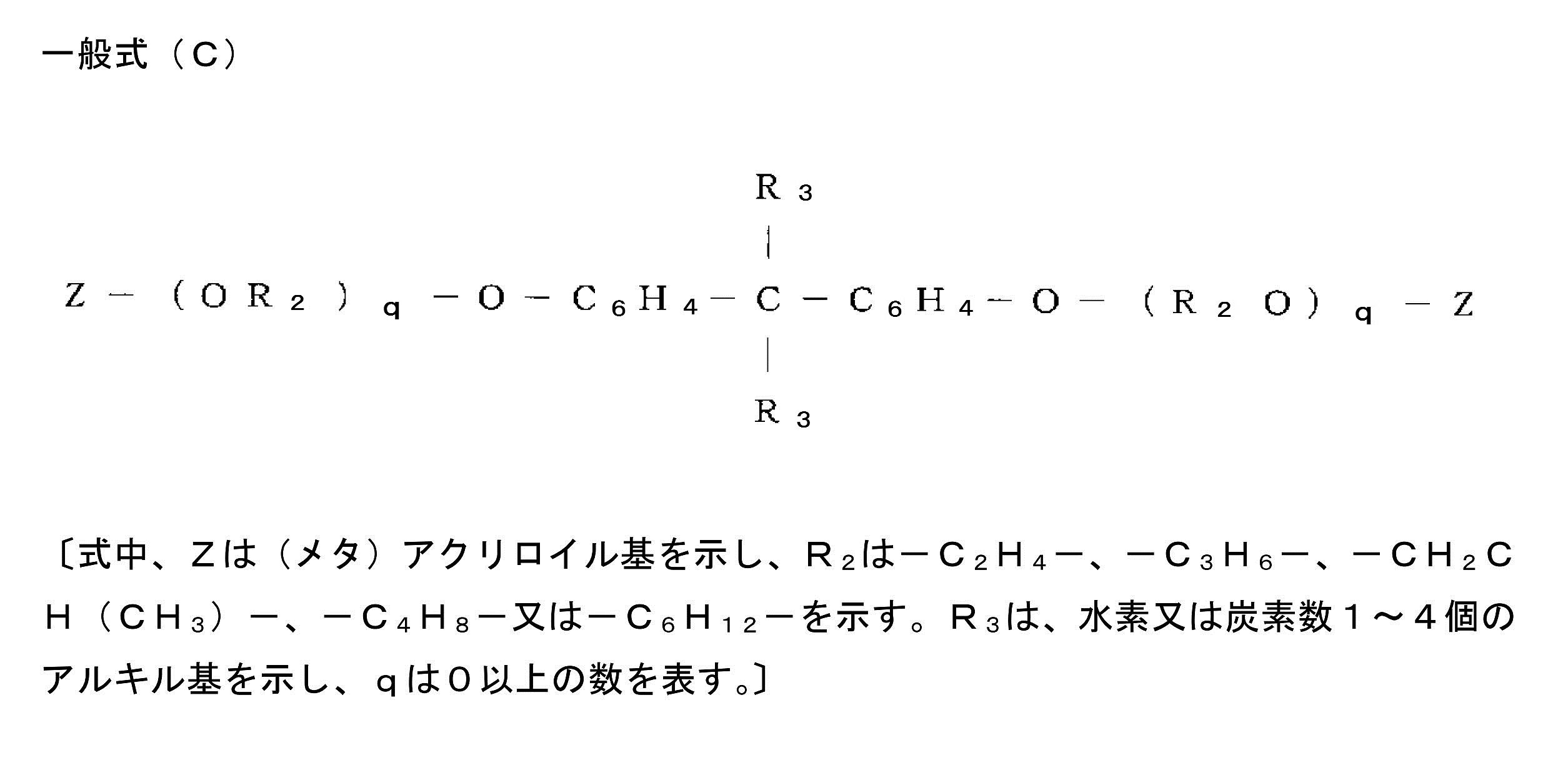
- the compound represented by (1-3) general formula (C) used in the present embodiment has the following structure.
- Such (meth) acrylic monomers include 2,2-bis (4- (meth) acryloxyphenyl) propane, 2,2-bis (4- (meth) acryloxyethoxyphenyl) propane, 2,2 -Bis (4- (meth) acryloxydiethoxyphenyl) propane, 2,2-bis (4- (meth) acryloxypropoxyphenyl) propane, 2,2-bis (4- (meth) acryloxytetraethoxyphenyl) ) Propane and 2,2-bis (4- (meth) acryloxypolyethoxyphenyl) propane.
- 2,2-bis (4- (meth) acryloxypolyethoxyphenyl) propane is preferable in terms of adhesiveness.
- Q is a number of 0 or more. q is preferably 1 or more, and more preferably 3 or more. q is preferably 15 or less, more preferably 10 or less, and most preferably 8 or less. More preferably, q is 5.
- the amount of the compound of the general formula (C) used is preferably 1 to 30 parts by mass, more preferably 3 to 20 parts by mass in 100 parts by mass of the (1) polymerizable vinyl monomer. If it is less than 1 part by mass, the adhesion may be reduced, and if it exceeds 30 parts by mass, the moisture resistance may be reduced.
- the compound of (1-4) general formula (D) used in the present embodiment has the following structure.
- Formula (D) Z—O—R 4 [Wherein Z represents a (meth) acryloyl group, and R 4 represents an alkyl group having 3 to 16 carbon atoms. ]
- Compounds of general formula (D) include butyl (meth) acrylate, 2-ethylhexyl (meth) acrylate, isodecyl (meth) acrylate, n-lauryl (meth) acrylate and tridecyl (meth) acrylate Etc.
- 2-ethylhexyl (meth) acrylate is preferable from the viewpoint of adhesion and moisture resistance.
- R 4 has preferably 3 to 16 carbon atoms, and more preferably 4 to 13 carbon atoms. If it is less than 3, the moisture resistance may be reduced, and if it exceeds 16, the adhesion may be reduced.
- the amount of the compound of the general formula (D) used is preferably 5 to 40 parts by weight, more preferably 7 to 35 parts by weight, more preferably 10 to 30 parts by weight in 100 parts by weight of the polymerizable vinyl monomer (1) Part is most preferred. If it is less than 5 parts by mass, the moisture resistance may be reduced, and if it exceeds 40 parts by mass, the adhesiveness, particularly the tensile shear strength against iron, may be reduced.
- a thermal radical polymerization initiator is preferable.
- organic peroxides are preferable.
- the organic peroxide include cumene hydroperoxide, paramentane hydroperoxide, tertiary butyl hydroperoxide, diisopropylbenzene dihydroperoxide, methyl ethyl ketone peroxide, benzoyl peroxide, and tertiary butyl peroxybenzoate. . These 1 type (s) or 2 or more types can be used. Among these, cumene hydroperoxide is preferable in terms of reactivity.
- the amount of the polymerization initiator used is preferably 0.5 to 10 parts by mass and more preferably 1 to 7 parts by mass with respect to (1) 100 parts by mass of the polymerizable vinyl monomer. If it is less than 0.5 parts by mass, the curing rate may be slow, and if it exceeds 10 parts by mass, the storage stability may be deteriorated.
- the (3) reducing agent used in the present embodiment can be any known reducing agent that reacts with the polymerization initiator and generates radicals.
- Representative reducing agents include, for example, tertiary amines, thiourea derivatives and transition metal salts.
- Examples of the tertiary amine include triethylamine, tripropylamine, tributylamine, and N, N-dimethylparatoluidine.
- Examples of the thiourea derivative include 2-mercaptobenzimidazole, methylthiourea, dibutylthiourea, tetramethylthiourea, and ethylenethiourea.
- Examples of the transition metal salt include cobalt naphthenate, copper naphthenate, and vanadyl acetylacetonate. Among these, in terms of reactivity, transition metal salts are preferable, and vanadyl acetylacetonate is more preferable.
- the reducing agent is used in an amount of preferably 0.01 to 5 parts by weight, more preferably 0.05 to 1 part by weight, based on 100 parts by weight of the (1) polymerizable vinyl monomer. If it is less than 0.01 parts by mass, the curing rate may be slow, and if it exceeds 5 parts by mass, the storage stability may be reduced.
- an elastomer having no polymerizable unsaturated double bond at the terminal and having a (meth) acrylonitrile content of 10 to 30 mol% is used.
- (meth) acrylonitrile-butadiene- (meth) acrylic acid copolymer examples thereof include diene copolymers such as polymers, (meth) acrylonitrile-butadiene-methyl (meth) acrylate copolymers, (meth) acrylonitrile-butadiene copolymers, styrene-butadiene copolymers, and the like.
- Examples of the elastomer having no polymerizable unsaturated double bond at the terminal and having a (meth) acrylonitrile content of 10 to 30 mol% include (1) an elastomer soluble in a polymerizable vinyl monomer. preferable.
- a diene copolymer is preferable in terms of solubility and adhesiveness.
- the diene copolymers (meth) acrylonitrile-butadiene- (meth) acrylic acid copolymers and / or (meth) acrylonitrile-butadiene copolymers are preferable, and (meth) acrylonitrile-butadiene copolymers are more preferable. preferable.
- the (meth) acrylonitrile content is excellent in peel strength at low temperatures. From the viewpoint of withstanding a strong impact, it is preferably 10 to 30 mol%, more preferably 15 to 25 mol%, most preferably 13 to 20 mol%.
- the (meth) acrylonitrile content is 10 mol% or more, the effect of the present invention is easily obtained, and when it is 30 mol% or less, corrosion is unlikely to occur even when a metal such as copper is an object to be deposited.
- the amount of elastomer that does not have a polymerizable unsaturated double bond at the end and has a (meth) acrylonitrile content of 10 to 30 mol% is (1) 100 parts by mass of the polymerizable vinyl monomer. On the other hand, it is preferably 5 to 35 parts by mass, more preferably 10 to 30 parts by mass, and most preferably 15 to 20 parts by mass. If it is less than 5 parts by mass, the peel strength and impact resistance at low temperatures may be small, and if it exceeds 35 parts by mass, the viscosity will increase, the workability will deteriorate, and the curability may be insufficient.
- the composition in the present embodiment can use various paraffins in order to quickly cure the portion in contact with air.
- paraffins include paraffin, microcrystalline wax, carnauba wax, beeswax, lanolin, spermaceti, ceresin and candelilla wax. Of these, paraffin is preferred.
- the melting point of paraffins is preferably 40 to 100 ° C.
- the amount of paraffin used is preferably 0.1 to 5 parts by mass with respect to (1) 100 parts by mass of the polymerizable vinyl monomer. If it is less than 0.1 parts by mass, the portion in contact with air may be hardened, and if it exceeds 5 parts by mass, the adhesive strength may be reduced.
- antioxidants including a polymerization inhibitor can be used for the purpose of improving storage stability.
- a phosphate it is preferable to use a phosphate in order to improve adhesiveness and increase the curing rate.
- plasticizers such as plasticizers, fillers, colorants, and rust inhibitors may be used as desired.
- the adhesive composition As an embodiment of the present invention, it is preferably used as an adhesive composition.
- a two-component adhesive composition can be mentioned.
- the adhesive composition is divided into a first agent and a second agent, at least (2) a polymerization initiator in the first agent, and at least ( 3) Including a reducing agent and phosphate if necessary, store separately.
- it can be used as a two-component adhesive composition by applying both agents simultaneously or separately to contact and cure.
- first agent and the second agent are preliminarily incorporated with a polymerizable vinyl monomer and other optional components, and are mixed together at the time of curing, whereby one-component adhesive It can be used as an agent composition.
- a to-be-adhered body is joined with the hardening body of curable resin composition, and a joined body is produced.
- adherend there are no restrictions on the various materials of the adherend, such as paper, wood, ceramic, glass, ceramics, rubber, plastic, mortar, concrete, and metal, but it is better when the adherend is metal, especially iron or stainless steel. Show good adhesion.
- An embodiment of the present invention is a composition comprising the following (1) to (5).
- Compound of general formula (A) General formula (A) Z—O— (R 2 O) p—R 1 [Wherein, Z represents a (meth) acryloyl group, and R 1 represents a phenyl group or a phenyl group having an alkyl group having 1 to 3 carbon atoms.
- R 2 represents —C 2 H 4 —, —C 3 H 6 —, —CH 2 CH (CH 3 ) —, —C 4 H 8 — or —C 6 H 12 —, and p is an integer of 1 to 10 Represents.
- (1-2) Compound of General Formula (B) General Formula (B) ZO— (R 2 O) pH [wherein Z, R 2 and p are as described above.
- (1-3) Compound of general formula (C)
- (1-4) Compound of general formula (D) Z—O—R 4 [Wherein Z represents a (meth) acryloyl group, and R 4 represents an alkyl group having 3 to 16 carbon atoms.
- the elastomer used in this embodiment (4) having a polymerizable unsaturated double bond at the terminal and having a (meth) acrylonitrile content of 10 to 30 mol% is a rubber, and has a rubber component at the terminal. It is a compound having a polymerizable unsaturated double bond. Among (4), a compound having a polymerizable unsaturated double bond at both ends of the rubber component is preferable.
- the polymerizable unsaturated double bond is preferably a (meth) acryloyl group and / or a vinyl group, and more preferably a (meth) acryloyl group in terms of good reactivity.
- the rubber component is preferably a diene (co) polymer.
- the diene (co) polymer include butadiene- (meth) acrylonitrile rubber and (meth) acrylonitrile-butadiene- (meth) acrylic acid rubber.
- diene-based (co) polymers butadiene- (meth) acrylonitrile rubber is preferable, and butadiene-acrylonitrile rubber is more preferable in terms of good flexibility and good compatibility with the monomer.
- the content of (meth) acrylonitrile is preferably 10 to 30 mol%, more preferably 15 to 25 mol%, and most preferably 13 to 20 mol% from the viewpoint of excellent peel strength at low temperatures and withstands strong impacts.
- the (meth) acrylonitrile content is 10 mol% or more, the effect of the present invention is easily obtained, and when it is 30 mol% or less, corrosion is unlikely to occur even when a metal such as copper is an object to be deposited.
- glycidyl (meth) acrylate is reacted with the carboxyl groups.
- a method of dehydrating the carboxyl group and hydroxy (meth) acrylate may be reacted in advance and reacted with a liquid rubber having a reactive hydroxyl group at the terminal.
- rubbers obtained by introducing carboxyl groups at both ends of the rubber component and then reacting the carboxyl groups with glycidyl (meth) acrylate are preferred.
- a rubber obtained by using (meth) acrylonitrile rubber as a rubber component, introducing a carboxyl group at both ends of the rubber component, and then reacting the carboxyl group with glycidyl methacrylate is manufactured by An Emerald Performance material " Hypro 1300X33LC VTBNX "and the like.
- the rubber having a polymerizable unsaturated double bond at the terminal and having a (meth) acrylonitrile content of 10 to 30% by mass is preferably a liquid rubber.
- Liquid rubber refers to rubber that is liquid at normal temperature (23 ° C.).
- the number average molecular weight of the rubber having a polymerizable unsaturated double bond at the terminal (4) and having a (meth) acrylonitrile content of 10 to 30% by mass is preferably 1,000 to 1,000,000, and 2,000 to 500,000. More preferred. If it is less than 1000, the peel strength at low temperature may be affected, and if it exceeds 1000000, the fluidity may be lost.
- the number average molecular weight of polystyrene conversion measured by GPC was used. Specifically, the average molecular weight was determined by preparing a calibration curve with commercially available standard polystyrene using GPC system (SC-8010 manufactured by Tosoh Corporation) using tetrahydrofuran as a solvent under the following conditions. .
- the amount of rubber having a polymerizable unsaturated double bond at the terminal and having a (meth) acrylonitrile content of 10 to 30% by mass is based on (1) 100 parts by mass of the polymerizable vinyl monomer. 1 to 50 parts by mass is preferable, 5 to 30 parts by mass is more preferable, and 10 to 20 parts by mass is most preferable. If it is less than 1 part by mass, the peel strength and impact resistance at low temperatures may be small, and if it exceeds 50 parts by mass, the viscosity will increase, workability will deteriorate, and curability may be insufficient.
- Examples of the elastomer having no polymerizable unsaturated double bond at the terminal include (meth) acrylonitrile-butadiene- (meth) acrylic acid copolymer, (meth) acrylonitrile-butadiene-methyl (meth) acrylate copolymer Diene copolymers such as (meth) acrylonitrile-butadiene copolymer and styrene-butadiene copolymer, styrene thermoplastic elastomers such as chlorosulfonated polyethylene and styrene-polybutadiene-styrene synthetic rubber, urethane elastomers, etc. Can be mentioned.
- (1) an elastomer soluble in a polymerizable vinyl monomer is preferable.
- a diene copolymer is preferable in terms of solubility and adhesiveness.
- the diene copolymers (meth) acrylonitrile-butadiene- (meth) acrylic acid copolymers and / or (meth) acrylonitrile-butadiene copolymers are preferable, and (meth) acrylonitrile-butadiene copolymers are more preferable. preferable.
- the elastomer having no polymerizable unsaturated double bond at the end preferably has a (meth) acrylonitrile structure.
- the (meth) acrylonitrile content is preferably 10 to 30 mol%, more preferably 15 to 25 mol% in terms of excellent peel strength at low temperatures and withstanding strong impacts. Most preferred is 13 to 20 mol%.
- the (meth) acrylonitrile content is 10 mol% or more, the effect of the present invention is easily obtained, and when it is 30 mol% or less, corrosion is unlikely to occur even when a metal such as copper is an object to be deposited.
- the amount of the elastomer having no polymerizable unsaturated double bond at the terminal is preferably (1) 5-35 parts by mass, more preferably 7-33 parts by mass with respect to 100 parts by mass of the polymerizable vinyl monomer. Preferably, 10 to 30 parts by mass is most preferable.
- antioxidants including a polymerization inhibitor can be used for the purpose of improving storage stability.
- a phosphate it is preferable to use a phosphate in order to improve adhesiveness and increase the curing rate.
- plasticizers such as plasticizers, fillers, colorants, and rust inhibitors may be used as desired.
- the adhesive composition As an embodiment of the present invention, it is preferably used as an adhesive composition.
- a two-component adhesive composition can be mentioned.
- the adhesive composition is divided into a first agent and a second agent, at least (2) a polymerization initiator in the first agent, and at least ( 3) Including a reducing agent and phosphate if necessary, store separately.
- it can be used as a two-component adhesive composition by applying both agents simultaneously or separately to contact and cure.
- first agent and the second agent are preliminarily incorporated with a polymerizable vinyl monomer and other optional components, and are mixed together at the time of curing, whereby one-component adhesive It can be used as an agent composition.
- a to-be-adhered body is joined with the hardening body of curable resin composition, and a joined body is produced.
- adherend there are no restrictions on the various materials of the adherend, such as paper, wood, ceramic, glass, ceramics, rubber, plastic, mortar, concrete, and metal, but it is better when the adherend is metal, especially iron or stainless steel. Show good adhesion.
- Acrylonitrile-butadiene rubber Acrylonitrile-butadiene copolymer AN not having a polymerizable unsaturated double bond at the end AN content: Acrylonitrile content contained in acrylonitrile-butadiene rubber (mol%)
- T peel strength 50% and T peel strength at a tensile rate of 50 mm / min in an environment at a temperature of ⁇ 20 ° C. as confirmation of low temperature characteristics did.
- the rupture distance of peeling in an environment at a temperature of ⁇ 20 ° C. was also compared.
- the breaking distance of peeling was measured by the following method. Using a sample for measuring T peel strength, setting the gap between chucks to 1 cm, fixing the upper end and lower end of the above test piece, and moving the test piece up and down at a temperature of ⁇ 20 ° C. and a tensile speed of 50 mm / min. Tensile distances leading to tension and breaking were measured. The greater the breaking distance, the greater the peel strength.
- a SUS304 waste wiping treatment panel having a panel 2000 ⁇ 500 ⁇ 1.5 mm and a reinforcing material 1800 ⁇ 20 ⁇ 1.5 mm SPCC-D wiping treatment plate were used.
- the first agent was applied to the center position of the panel, and the second agent was applied to the reinforcing material.
- the coated surfaces were superposed and bonded together. Thereafter, it was cured at room temperature for 24 hours, and this was used as a sample for impact resistance test measurement.
- the panel with the reinforcing material on the back side was leveled, and both ends were fixed with support.
- Peeling rate of reinforcing material (Area where reinforcing material was peeled) / (Area of adhesive application surface where adhesive was applied) ⁇ 100 (%)
- the odor intensity of each curable resin composition was as follows. A cured product having a diameter of 10 mm and a thickness of 1 mm was prepared using the resin composition, the cured product was put in a glass bottle, sealed, and allowed to stand for 1 hour, and then the odor was measured using an odor sensor (Calmore). . The measured value in the tested room was 360. The larger the value, the stronger the odor.
- the numerical value of odor is preferably 1000 or less, more preferably 600 or less, and most preferably 500 or less.
- Liquid NBR Liquid acrylonitrile rubber having a polymerizable unsaturated double bond at the terminal (manufactured by An Emerald Performance material, Hypro 1300X33LC VTBNX, liquid, number average molecular weight 3900)
- NBR Acrylonitrile-butadiene copolymer, elastomer that does not have a polymerizable unsaturated double bond at the end (commercially available)
- AN amount Content of acrylonitrile (mol%) contained in liquid NBR or acrylonitrile-butadiene copolymer having a reactive unsaturated double bond at the terminal
- Experimental Example 14 achieves low odor and low volatility because the amount of (4) and (5) is large and the content ratio of (meth) acrylate consisting of (1-1) to (1-4) is small. it can. Since Experimental Example 10 contains (4), the peel strength is higher than that of Experimental Example 11. However, since Experimental Example 10 has a large acrylonitrile content of (5), the impact resistance is small. (1-1) Instead of (1-3), Experimental Example 9 using methyl methacrylate has a large odor and does not have the effect of the present invention.
- a two-component (meth) acrylic adhesive composition having a low odor and a high peel strength at low temperatures can be obtained. Therefore, it is possible to work in a place where ventilation is insufficient, and it is possible to obtain an adhesive having a wide adaptable environment in which the cured adhesive is not peeled even in a cold region. Furthermore, since a two-component (meth) acrylic adhesive that can withstand strong impacts can be provided, not only the working environment is improved, but it can be applied to various industrial fields, which is beneficial.
Landscapes
- Chemical & Material Sciences (AREA)
- Organic Chemistry (AREA)
- Chemical Kinetics & Catalysis (AREA)
- Health & Medical Sciences (AREA)
- Medicinal Chemistry (AREA)
- Polymers & Plastics (AREA)
- Adhesives Or Adhesive Processes (AREA)
- Macromonomer-Based Addition Polymer (AREA)
- Addition Polymer Or Copolymer, Post-Treatments, Or Chemical Modifications (AREA)
- Polymerisation Methods In General (AREA)
- Graft Or Block Polymers (AREA)
Abstract
Description
下記(1)~(4)を含有してなる組成物であり、
(1)(1-1)~(1-4)を含有する重合性ビニルモノマー
(1-1)一般式(A)の化合物
一般式(A) Z-O-(R2O)p-R1
〔式中、Zは(メタ)アクリロイル基を示し、R1はフェニル基又は炭素数1~3個のアルキル基を有するフェニル基を示す。R2は-C2H4-、-C3H6-、-CH2CH(CH3)-、-C4H8-又は-C6H12-を示し、pは1~10の整数を表す。〕
(1-2)一般式(B)の化合物
一般式(B) Z-O-(R2O)p-H
〔式中、Z、R2及びpは前述の通りである。〕
(1-3)一般式(C)の化合物

一般式(D) Z-O-R4
〔式中、Zは(メタ)アクリロイル基を示し、R4は炭素数3~16個のアルキル基を表す。〕
(2)重合開始剤、
(3)還元剤、
(4)末端に重合性不飽和二重結合を有さず、かつ、(メタ)アクリロニトリル含有量が10~30モル%であるエラストマー
(4)末端に重合性不飽和二重結合を有さず、かつ、(メタ)アクリロニトリル含有量が10~30モル%であるエラストマーがジエン系共重合体である該組成物であり、第一剤に少なくとも(2)重合開始剤を含有してなり、第二剤に少なくとも(3)還元剤を含有してなる二剤型の該組成物であり、該組成物を含有してなる硬化性樹脂組成物であり、該硬化性樹脂組成物を含有してなる接着剤組成物であり、該接着剤組成物を使用して被着体を接着してなる接合体であり、該接着剤組成物を使用して被着体を接着してなる接着方法である。
下記(1)~(5)を含有してなる組成物であり、
(1)(1-1)~(1-4)を含有する重合性ビニルモノマー
(1-1)一般式(A)の化合物
一般式(A) Z-O-(R2O)p-R1
〔式中、Zは(メタ)アクリロイル基を示し、R1はフェニル基又は炭素数1~3個のアルキル基を有するフェニル基を示す。R2は-C2H4-、-C3H6-、-CH2CH(CH3)-、-C4H8-又は-C6H12-を示し、pは1~10の整数を表す。〕
(1-2)一般式(B)の化合物
一般式(B) Z-O-(R2O)p-H〔式中、Z、R2及びpは前述の通りである。〕
(1-3)一般式(C)の化合物

一般式(D) Z-O-R4
〔式中、Zは(メタ)アクリロイル基を示し、R4は炭素数3~16個のアルキル基を表す。〕
(2)重合開始剤、
(3)還元剤、
(4)末端に重合性不飽和二重結合を有し、かつ、(メタ)アクリロニトリル含有量が10~30モル%であるエラストマー、
(5)末端に重合性不飽和二重結合を有しないエラストマー
(5)末端に重合性不飽和二重結合を有しないエラストマーが、(メタ)アクリロニトリル含有量が10~30モル%のエラストマーである該組成物であり、(5)末端に重合性不飽和二重結合を有しないエラストマーがジエン系共重合体である該組成物であり、第一剤に少なくとも(2)重合開始剤を含有してなり、第二剤に少なくとも(3)還元剤を含有してなる二剤型の該組成物であり、該硬化性樹脂組成物を含有してなる接着剤組成物であり、該接着剤組成物を使用して被着体を接着してなる接合体であり、該接着剤組成物を使用して被着体を接着してなる接着方法である。
本発明の一実施形態においては、下記(1)~(4)を含有してなる組成物である。
(1)(1-1)~(1-4)を含有する重合性ビニルモノマー
(1-1)一般式(A)の化合物
一般式(A) Z-O-(R2O)p-R1
〔式中、Zは(メタ)アクリロイル基を示し、R1はフェニル基又は炭素数1~3個のアルキル基を有するフェニル基を示す。R2は-C2H4-、-C3H6-、-CH2CH(CH3)-、-C4H8-又は-C6H12-を示し、pは1~10の整数を表す。〕
(1-2)一般式(B)の化合物
一般式(B) Z-O-(R2O)p-H
〔式中、Z、R2及びpは前述の通りである。〕
(1-3)一般式(C)の化合物

一般式(D) Z-O-R4
〔式中、Zは(メタ)アクリロイル基を示し、R4は炭素数3~16個のアルキル基を表す。〕
(2)重合開始剤、
(3)還元剤、
(4)末端に重合性不飽和二重結合を有さず、かつ、(メタ)アクリロニトリル含有量が10~30モル%であるエラストマー
本実施形態では、重合性ビニルモノマーとして、(1-1)、(1-2)、(1-3)及び(1-4)を含有する。(1)重合性ビニルモノマーは、ラジカル重合可能であれば良い。中でも硬化速度等の点から、重合性ビニルモノマーが、重合性(メタ)アクリル酸誘導体であることがより好ましい。重合性ビニルモノマー100質量部中、重合性(メタ)アクリル酸誘導体が70質量部以上であることが好ましく、重合性ビニルモノマーが全て重合性(メタ)アクリル酸誘導体であることがより好ましい。以下、(1)重合性ビニルモノマー100質量部中とは、(1-1)、(1-2)、(1-3)及び(1-4)の合計100質量部中であることが好ましい。
〔式中、Zは(メタ)アクリロイル基を示し、R1はフェニル基又は炭素数1~3個のアルキル基を有するフェニル基を示す。R2は-C2H4-、-C3H6-、-CH2CH(CH3)-、-C4H8-又は-C6H12-を示し、pは1~10の整数を表す。〕
〔式中、Z、R2及びpは前述の通りである。〕

〔式中、Zは(メタ)アクリロイル基を示し、R4は炭素数3~16個のアルキル基を表す。〕
本発明の一実施形態においては、下記(1)~(5)を含有してなる組成物である。
(1)(1-1)~(1-4)を含有する重合性ビニルモノマー
(1-1)一般式(A)の化合物
一般式(A) Z-O-(R2O)p-R1
〔式中、Zは(メタ)アクリロイル基を示し、R1はフェニル基又は炭素数1~3個のアルキル基を有するフェニル基を示す。R2は-C2H4-、-C3H6-、-CH2CH(CH3)-、-C4H8-又は-C6H12-を示し、pは1~10の整数を表す。〕
(1-2)一般式(B)の化合物
一般式(B) Z-O-(R2O)p-H〔式中、Z、R2及びpは前述の通りである。〕
(1-3)一般式(C)の化合物

一般式(D) Z-O-R4
〔式中、Zは(メタ)アクリロイル基を示し、R4は炭素数3~16個のアルキル基を表す。〕
(2)重合開始剤、
(3)還元剤、
(4)末端に重合性不飽和二重結合を有し、かつ、(メタ)アクリロニトリル含有量が10~30モル%であるエラストマー、
(5)末端に重合性不飽和二重結合を有しないエラストマー
本実施形態の(1)(1-1)~(1-4)を含有する重合性ビニルモノマー、(2)重合開始剤、(3)還元剤、パラフィン類の詳細(例えば、具体例と使用量)は、第1の発明に記載した通りである。
例えば、ゴム成分として(メタ)アクリロニトリルゴムを用い、ゴム成分の両末端にカルボキシル基を導入したあと、該カルボキシル基にグリシジルメタクリレートを反応させることにより得られるゴムとしては、An Emerald Performance material社製「Hypro 1300X33LC VTBNX」等が挙げられる。
設定温度:40℃
カラム構成:東ソー社製「TSK guardcolumn MP(×L)」6.0mmID×4.0cm1本、及び東ソー社製「TSK-GELMULTIPOREHXL-M」7.8mmID×30.0cm(理論段数16,000段)2本、計3本(全体として理論段数32,000段)、
サンプル注入量:100μl(試料液濃度1mg/ml)
送液圧力:39kg/cm2
検出器:RI検出器
(実験例A)
表1に示す組成からなる接着剤組成物を調製し、各種物性を測定した。結果を表1に示す。各物質の使用量の単位は質量部で示す。各物質について2,2-ビス(4-メタクリロキシポリエトキシフェニル)プロパンはq=5のものを用い、パラフィン類としては、融点40~100℃のパラフィンを用い、各種物性については、以下のようにして測定した。
アクリロニトリル-ブタジエンゴム:末端に重合性不飽和二重結合を有さない、アクリロニトリル-ブタジエン共重合体
AN量:アクリロニトリル-ブタジエンゴムに含まれるアクリロニトリル含有量(モル%)
剥離の破断距離は、以下の方法により測定した。T剥離強度測定用試料を用い、チャック間を1cmに設定し、上記の試験片の上端部と下端部を固定し、-20℃の温度で引張速度50mm/分の速度で試験片を上下に引張り、破断に至る引張り距離を測定した。破断距離が大きいほど、剥離強度が大きい。
下記式により補強材の剥離率を算出した。
補強材の剥離率(%)=(補強材が剥がれた面積)/(接着剤を塗布した接着剤塗布面の面積)×100(%)
樹脂組成物を使用して直径10mm×厚さ1mmの硬化物を作製し、ガラス瓶に硬化物を入れて密栓し、1時間放置後、臭いセンサー(カルモア社製)を使用して臭気を測定した。尚、試験をした室内の測定値360であった。数値が大きいほど、臭気が強いことを表している。臭気の数値は、1000以下が好ましく、600以下がより好ましく、500以下が最も好ましい。

(実験例B)
表2に示す組成からなる接着剤組成物を調製し、各種物性を測定した。結果を表2に示す。
各物質の使用量の単位は質量部で示す。各物質について2,2-ビス(4-メタクリロキシポリエトキシフェニル)プロパンはq=5のものを用い、パラフィン類としては、融点40~100℃のパラフィンを用い、各種物性については、実験例Aと同様にして測定した。
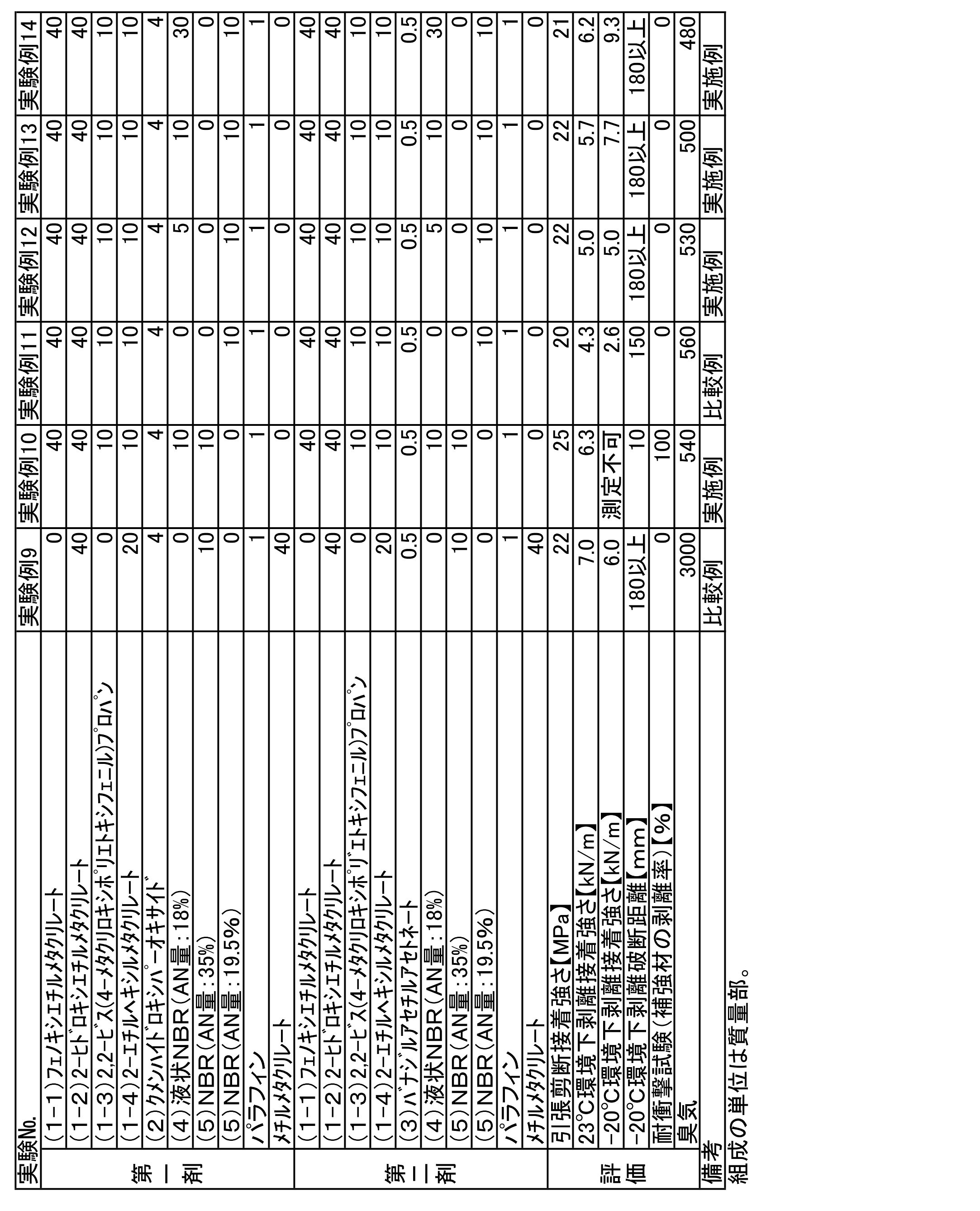
液状NBR:末端に重合性不飽和二重結合を有する液状アクリロニトリルゴム(An Emerald Performance material社製、Hypro 1300X33LC VTBNX、液状、数平均分子量3900)
NBR:アクリロニトリル-ブタジエン共重合体、末端に重合性不飽和二重結合を有しないエラストマー(市販品)
AN量:末端に反応性不飽和二重結合を有する液状NBRやアクリロニトリル-ブタジエン共重合体に含まれるアクリロニトリル含有量(モル%)
Claims (22)
- 下記(1)~(4)を含有してなる組成物。
(1)(1-1)~(1-4)を含有する重合性ビニルモノマー
(1-1)一般式(A)の化合物
一般式(A) Z-O-(R2O)p-R1
〔式中、Zは(メタ)アクリロイル基を示し、R1はフェニル基又は炭素数1~3個のアルキル基を有するフェニル基を示す。R2は-C2H4-、-C3H6-、-CH2CH(CH3)-、-C4H8-又は-C6H12-を示し、pは1~10の整数を表す。〕
(1-2)一般式(B)の化合物
一般式(B) Z-O-(R2O)p-H
〔式中、Z、R2及びpは前述の通りである。〕
(1-3)一般式(C)の化合物
一般式(D) Z-O-R4
〔式中、Zは(メタ)アクリロイル基を示し、R4は炭素数3~16個のアルキル基を表す。〕
(2)重合開始剤、
(3)還元剤、
(4)末端に重合性不飽和二重結合を有さず、かつ、(メタ)アクリロニトリル含有量が10~30モル%であるエラストマー - (4)末端に重合性不飽和二重結合を有さず、かつ、(メタ)アクリロニトリル含有量が10~30モル%であるエラストマーがジエン系共重合体である請求項1記載の組成物。
- (4)末端に重合性不飽和二重結合を有さず、かつ、(メタ)アクリロニトリル含有量が10~30モル%であるエラストマーの使用量が、(1)重合性ビニルモノマー100質量部に対して、5~35質量部である請求項1又は2記載の組成物。
- (1-1)一般式(A)の化合物の使用量が、(1)重合性ビニルモノマー100質量部中、10~60質量部であり、(1-2)一般式(B)の化合物の使用量が、(1)重合性ビニルモノマー100質量部中、10~70質量部であり、(1-3)一般式(C)の化合物の使用量が、(1)重合性ビニルモノマー100質量部中、1~30質量部であり、(1-4)一般式(D)の化合物の使用量が、(1)重合性ビニルモノマー100質量部中、5~40質量部であり、(4)末端に重合性不飽和二重結合を有さず、かつ、(メタ)アクリロニトリル含有量が10~30モル%であるエラストマーの使用量が、(1)重合性ビニルモノマー100質量部に対して、5~35質量部である請求項1~3のいずれか1項記載の組成物。
- 更に、パラフィン類を含有してなる請求項1~4のいずれか1項記載の組成物。
- 第一剤に少なくとも(2)重合開始剤を含有してなり、第二剤に少なくとも(3)還元剤を含有してなる二剤型の請求項1~5のいずれか1項記載の組成物。
- 請求項1~6のいずれか1項記載の組成物を含有してなる硬化性樹脂組成物。
- 請求項7記載の硬化性樹脂組成物を含有してなる接着剤組成物。
- 請求項8記載の接着剤組成物を使用して被着体を接着してなる接合体。
- 請求項8記載の接着剤組成物を使用して被着体を接着してなる接着方法。
- 下記(1)~(5)を含有してなる組成物。
(1)(1-1)~(1-4)を含有する重合性ビニルモノマー
(1-1)一般式(A)の化合物
一般式(A) Z-O-(R2O)p-R1
〔式中、Zは(メタ)アクリロイル基を示し、R1はフェニル基又は炭素数1~3個のアルキル基を有するフェニル基を示す。R2は-C2H4-、-C3H6-、-CH2CH(CH3)-、-C4H8-又は-C6H12-を示し、pは1~10の整数を表す。〕
(1-2)一般式(B)の化合物
一般式(B) Z-O-(R2O)p-H〔式中、Z、R2及びpは前述の通りである。〕
(1-3)一般式(C)の化合物

一般式(D) Z-O-R4
〔式中、Zは(メタ)アクリロイル基を示し、R4は炭素数3~16個のアルキル基を表す。〕
(2)重合開始剤、
(3)還元剤、
(4)末端に重合性不飽和二重結合を有し、かつ、(メタ)アクリロニトリル含有量が10~30モル%であるエラストマー、
(5)末端に重合性不飽和二重結合を有しないエラストマー - (5)末端に重合性不飽和二重結合を有しないエラストマーが、(メタ)アクリロニトリル含有量が10~30モル%のエラストマーである請求項11記載の組成物。
- (5)末端に重合性不飽和二重結合を有しないエラストマーがジエン系共重合体である請求項11又は12記載の組成物。
- (4)末端に重合性不飽和二重結合を有し、かつ、(メタ)アクリロニトリル含有量が10~30モル%であるエラストマーと(5)末端に重合性不飽和二重結合を有しないエラストマーの含有割合が、(4)と(5)の合計100質量部中、質量比で、(4):(5)=10~90:90~10である請求項11~13のいずれか1項記載の組成物。
- (4)末端に重合性不飽和二重結合を有し、かつ、(メタ)アクリロニトリル含有量が10~30モル%であるエラストマーの使用量が、(1)重合性ビニルモノマー100質量部に対して、1~50質量部であり、(5)末端に重合性不飽和二重結合を有しないエラストマーの使用量が、(1)重合性ビニルモノマー100質量部に対して、5~35質量部である請求項11~14のいずれか1項記載の組成物。
- (1-1)一般式(A)の化合物の使用量が、(1)重合性ビニルモノマー100質量部中、10~60質量部であり、(1-2)一般式(B)の化合物の使用量が、(1)重合性ビニルモノマー100質量部中、10~70質量部であり、(1-3)一般式(C)の化合物の使用量が、(1)重合性ビニルモノマー100質量部中、1~30質量部であり、(1-4)一般式(D)の化合物の使用量が、(1)重合性ビニルモノマー100質量部中、5~40質量部であり、(4)末端に重合性不飽和二重結合を有し、かつ、(メタ)アクリロニトリル含有量が10~30モル%であるエラストマーの使用量が、(1)重合性ビニルモノマー100質量部に対して、1~50質量部であり、(5)末端に重合性不飽和二重結合を有しないエラストマーの使用量が、(1)重合性ビニルモノマー100質量部に対して、5~35質量部である請求項11~15のいずれか1項記載の組成物。
- 更に、パラフィン類を含有してなる請求項11~16のいずれか1項記載の組成物。
- 第一剤に少なくとも(2)重合開始剤を含有してなり、第二剤に少なくとも(3)還元剤を含有してなる二剤型の請求項11~17のいずれか1項記載の組成物。
- 請求項11~18のいずれか1項記載の組成物を含有してなる硬化性樹脂組成物。
- 請求項19記載の硬化性樹脂組成物を含有してなる接着剤組成物。
- 請求項20記載の接着剤組成物を使用して被着体を接着してなる接合体。
- 請求項20記載の接着剤組成物を使用して被着体を接着してなる接着方法。
Priority Applications (5)
| Application Number | Priority Date | Filing Date | Title |
|---|---|---|---|
| US15/748,071 US10647889B2 (en) | 2015-07-30 | 2016-07-28 | Adhesive composition |
| JP2017530925A JP6684800B2 (ja) | 2015-07-30 | 2016-07-28 | 組成物 |
| KR1020187001761A KR102604119B1 (ko) | 2015-07-30 | 2016-07-28 | 조성물 |
| EP16830591.0A EP3323837A4 (en) | 2015-07-30 | 2016-07-28 | Composition |
| CN201680044663.0A CN107922520B (zh) | 2015-07-30 | 2016-07-28 | 组合物 |
Applications Claiming Priority (4)
| Application Number | Priority Date | Filing Date | Title |
|---|---|---|---|
| JP2015150268 | 2015-07-30 | ||
| JP2015150269 | 2015-07-30 | ||
| JP2015-150269 | 2015-07-30 | ||
| JP2015-150268 | 2015-07-30 |
Publications (1)
| Publication Number | Publication Date |
|---|---|
| WO2017018486A1 true WO2017018486A1 (ja) | 2017-02-02 |
Family
ID=57884552
Family Applications (1)
| Application Number | Title | Priority Date | Filing Date |
|---|---|---|---|
| PCT/JP2016/072175 Ceased WO2017018486A1 (ja) | 2015-07-30 | 2016-07-28 | 組成物 |
Country Status (7)
| Country | Link |
|---|---|
| US (1) | US10647889B2 (ja) |
| EP (1) | EP3323837A4 (ja) |
| JP (1) | JP6684800B2 (ja) |
| KR (1) | KR102604119B1 (ja) |
| CN (1) | CN107922520B (ja) |
| TW (1) | TWI680170B (ja) |
| WO (1) | WO2017018486A1 (ja) |
Cited By (7)
| Publication number | Priority date | Publication date | Assignee | Title |
|---|---|---|---|---|
| JP2017031261A (ja) * | 2015-07-30 | 2017-02-09 | デンカ株式会社 | 組成物 |
| JP2017031260A (ja) * | 2015-07-30 | 2017-02-09 | デンカ株式会社 | 組成物 |
| JP2017031262A (ja) * | 2015-07-30 | 2017-02-09 | デンカ株式会社 | 組成物 |
| JP2017031259A (ja) * | 2015-07-30 | 2017-02-09 | デンカ株式会社 | 組成物 |
| JPWO2021166861A1 (ja) * | 2020-02-19 | 2021-08-26 | ||
| JP2024054183A (ja) * | 2018-12-20 | 2024-04-16 | ハンツマン・アドヴァンスト・マテリアルズ・ライセンシング・(スイッツランド)・ゲーエムベーハー | 遅延添加剤を含む接着剤組成物 |
| WO2025074954A1 (ja) * | 2023-10-02 | 2025-04-10 | セメダイン株式会社 | 接着剤組成物 |
Families Citing this family (2)
| Publication number | Priority date | Publication date | Assignee | Title |
|---|---|---|---|---|
| DE102019200736A1 (de) * | 2019-01-22 | 2020-07-23 | Tesa Se | Reaktives 2-Komponentenklebesystem in Filmform auf Basis von geruchsneutralen Acrylmonomeren |
| WO2022210166A1 (ja) * | 2021-03-31 | 2022-10-06 | デンカ株式会社 | 接着剤組成物、接合体および接着剤組成物の製造方法 |
Citations (11)
| Publication number | Priority date | Publication date | Assignee | Title |
|---|---|---|---|---|
| JPH107753A (ja) * | 1996-04-18 | 1998-01-13 | Denki Kagaku Kogyo Kk | 硬化性樹脂組成物 |
| JP2001055422A (ja) * | 1999-06-10 | 2001-02-27 | Denki Kagaku Kogyo Kk | 硬化性樹脂組成物、接着剤組成物、接合体及び接着方法 |
| JP2001055420A (ja) * | 1999-06-10 | 2001-02-27 | Denki Kagaku Kogyo Kk | 硬化性樹脂組成物、接着剤組成物、接合体及び接着方法 |
| JP2001055423A (ja) * | 1999-06-10 | 2001-02-27 | Denki Kagaku Kogyo Kk | 硬化性樹脂組成物、接着剤組成物、接合体及び接着方法 |
| JP2002265509A (ja) * | 2001-03-08 | 2002-09-18 | Denki Kagaku Kogyo Kk | 難燃硬化性樹脂組成物及び難燃硬化性接着剤組成物 |
| JP2002308944A (ja) * | 2001-04-18 | 2002-10-23 | Denki Kagaku Kogyo Kk | 硬化性樹脂組成物、接着剤組成物及び接着方法 |
| WO2009041248A1 (ja) * | 2007-09-26 | 2009-04-02 | Denki Kagaku Kogyo Kabushiki Kaisha | 接着剤組成物及び接合方法 |
| JP2011089055A (ja) * | 2009-10-23 | 2011-05-06 | Denki Kagaku Kogyo Kk | 仮固定用接着剤組成物 |
| WO2011102341A1 (ja) * | 2010-02-16 | 2011-08-25 | 電気化学工業株式会社 | 半導体ブロック接着装置、半導体ブロック接着方法及び半導体ウエハの製造方法 |
| WO2012161221A1 (ja) * | 2011-05-24 | 2012-11-29 | 電気化学工業株式会社 | 仮固定用接着剤組成物 |
| WO2013021945A1 (ja) * | 2011-08-05 | 2013-02-14 | 電気化学工業株式会社 | 仮固定用接着剤組成物 |
Family Cites Families (3)
| Publication number | Priority date | Publication date | Assignee | Title |
|---|---|---|---|---|
| TW353666B (en) * | 1996-04-18 | 1999-03-01 | Denki Kagaku Kogyo Kk | Curable resin composition |
| JPH11147921A (ja) | 1997-11-17 | 1999-06-02 | Denki Kagaku Kogyo Kk | 硬化体、硬化性樹脂組成物、接着剤組成物、接合体、ドア構造体、及び接着方法 |
| TWI595037B (zh) * | 2009-04-30 | 2017-08-11 | 電化股份有限公司 | 硬化性樹脂組成物、接著劑組成物、硬化體或複合體 |
-
2016
- 2016-07-28 WO PCT/JP2016/072175 patent/WO2017018486A1/ja not_active Ceased
- 2016-07-28 KR KR1020187001761A patent/KR102604119B1/ko active Active
- 2016-07-28 EP EP16830591.0A patent/EP3323837A4/en not_active Withdrawn
- 2016-07-28 US US15/748,071 patent/US10647889B2/en active Active
- 2016-07-28 JP JP2017530925A patent/JP6684800B2/ja active Active
- 2016-07-28 CN CN201680044663.0A patent/CN107922520B/zh active Active
- 2016-07-29 TW TW105124224A patent/TWI680170B/zh active
Patent Citations (11)
| Publication number | Priority date | Publication date | Assignee | Title |
|---|---|---|---|---|
| JPH107753A (ja) * | 1996-04-18 | 1998-01-13 | Denki Kagaku Kogyo Kk | 硬化性樹脂組成物 |
| JP2001055422A (ja) * | 1999-06-10 | 2001-02-27 | Denki Kagaku Kogyo Kk | 硬化性樹脂組成物、接着剤組成物、接合体及び接着方法 |
| JP2001055420A (ja) * | 1999-06-10 | 2001-02-27 | Denki Kagaku Kogyo Kk | 硬化性樹脂組成物、接着剤組成物、接合体及び接着方法 |
| JP2001055423A (ja) * | 1999-06-10 | 2001-02-27 | Denki Kagaku Kogyo Kk | 硬化性樹脂組成物、接着剤組成物、接合体及び接着方法 |
| JP2002265509A (ja) * | 2001-03-08 | 2002-09-18 | Denki Kagaku Kogyo Kk | 難燃硬化性樹脂組成物及び難燃硬化性接着剤組成物 |
| JP2002308944A (ja) * | 2001-04-18 | 2002-10-23 | Denki Kagaku Kogyo Kk | 硬化性樹脂組成物、接着剤組成物及び接着方法 |
| WO2009041248A1 (ja) * | 2007-09-26 | 2009-04-02 | Denki Kagaku Kogyo Kabushiki Kaisha | 接着剤組成物及び接合方法 |
| JP2011089055A (ja) * | 2009-10-23 | 2011-05-06 | Denki Kagaku Kogyo Kk | 仮固定用接着剤組成物 |
| WO2011102341A1 (ja) * | 2010-02-16 | 2011-08-25 | 電気化学工業株式会社 | 半導体ブロック接着装置、半導体ブロック接着方法及び半導体ウエハの製造方法 |
| WO2012161221A1 (ja) * | 2011-05-24 | 2012-11-29 | 電気化学工業株式会社 | 仮固定用接着剤組成物 |
| WO2013021945A1 (ja) * | 2011-08-05 | 2013-02-14 | 電気化学工業株式会社 | 仮固定用接着剤組成物 |
Non-Patent Citations (1)
| Title |
|---|
| See also references of EP3323837A4 * |
Cited By (8)
| Publication number | Priority date | Publication date | Assignee | Title |
|---|---|---|---|---|
| JP2017031261A (ja) * | 2015-07-30 | 2017-02-09 | デンカ株式会社 | 組成物 |
| JP2017031260A (ja) * | 2015-07-30 | 2017-02-09 | デンカ株式会社 | 組成物 |
| JP2017031262A (ja) * | 2015-07-30 | 2017-02-09 | デンカ株式会社 | 組成物 |
| JP2017031259A (ja) * | 2015-07-30 | 2017-02-09 | デンカ株式会社 | 組成物 |
| JP2024054183A (ja) * | 2018-12-20 | 2024-04-16 | ハンツマン・アドヴァンスト・マテリアルズ・ライセンシング・(スイッツランド)・ゲーエムベーハー | 遅延添加剤を含む接着剤組成物 |
| JPWO2021166861A1 (ja) * | 2020-02-19 | 2021-08-26 | ||
| JP7798022B2 (ja) | 2020-02-19 | 2026-01-14 | 日本ゼオン株式会社 | 自己吸着性発泡シート用組成物および自己吸着性発泡積層シート |
| WO2025074954A1 (ja) * | 2023-10-02 | 2025-04-10 | セメダイン株式会社 | 接着剤組成物 |
Also Published As
| Publication number | Publication date |
|---|---|
| CN107922520A (zh) | 2018-04-17 |
| KR102604119B1 (ko) | 2023-11-20 |
| TW201710424A (zh) | 2017-03-16 |
| CN107922520B (zh) | 2020-08-04 |
| EP3323837A1 (en) | 2018-05-23 |
| TWI680170B (zh) | 2019-12-21 |
| JPWO2017018486A1 (ja) | 2018-05-17 |
| EP3323837A4 (en) | 2018-07-04 |
| JP6684800B2 (ja) | 2020-04-22 |
| US20180215954A1 (en) | 2018-08-02 |
| US10647889B2 (en) | 2020-05-12 |
| KR20180034406A (ko) | 2018-04-04 |
Similar Documents
| Publication | Publication Date | Title |
|---|---|---|
| JP6684800B2 (ja) | 組成物 | |
| JP7097305B2 (ja) | 組成物 | |
| JP6887258B2 (ja) | 組成物 | |
| JP6579613B2 (ja) | 組成物 | |
| JP6681898B2 (ja) | 組成物及び接着剤組成物 | |
| JP6579611B2 (ja) | 組成物 | |
| JP6579610B2 (ja) | 組成物 | |
| JP6894713B2 (ja) | 組成物 | |
| JP6579612B2 (ja) | 組成物 | |
| JP6823475B2 (ja) | 組成物 | |
| JP2017031266A (ja) | 組成物 | |
| JP2017031265A (ja) | 組成物 | |
| JP6842936B2 (ja) | 組成物 | |
| JP6970509B2 (ja) | 組成物 | |
| JP6845700B2 (ja) | 組成物 | |
| JP6857502B2 (ja) | 組成物 | |
| JP6823474B2 (ja) | 組成物 | |
| JP2017031263A (ja) | 組成物 | |
| JP2017031264A (ja) | 組成物 |
Legal Events
| Date | Code | Title | Description |
|---|---|---|---|
| 121 | Ep: the epo has been informed by wipo that ep was designated in this application |
Ref document number: 16830591 Country of ref document: EP Kind code of ref document: A1 |
|
| ENP | Entry into the national phase |
Ref document number: 2017530925 Country of ref document: JP Kind code of ref document: A |
|
| ENP | Entry into the national phase |
Ref document number: 20187001761 Country of ref document: KR Kind code of ref document: A |
|
| WWE | Wipo information: entry into national phase |
Ref document number: 15748071 Country of ref document: US |
|
| NENP | Non-entry into the national phase |
Ref country code: DE |
|
| WWE | Wipo information: entry into national phase |
Ref document number: 2016830591 Country of ref document: EP |