WO2017018486A1 - Composition - Google Patents
Composition Download PDFInfo
- Publication number
- WO2017018486A1 WO2017018486A1 PCT/JP2016/072175 JP2016072175W WO2017018486A1 WO 2017018486 A1 WO2017018486 A1 WO 2017018486A1 JP 2016072175 W JP2016072175 W JP 2016072175W WO 2017018486 A1 WO2017018486 A1 WO 2017018486A1
- Authority
- WO
- WIPO (PCT)
- Prior art keywords
- parts
- mass
- meth
- general formula
- elastomer
- Prior art date
- Legal status (The legal status is an assumption and is not a legal conclusion. Google has not performed a legal analysis and makes no representation as to the accuracy of the status listed.)
- Ceased
Links
Classifications
-
- C—CHEMISTRY; METALLURGY
- C09—DYES; PAINTS; POLISHES; NATURAL RESINS; ADHESIVES; COMPOSITIONS NOT OTHERWISE PROVIDED FOR; APPLICATIONS OF MATERIALS NOT OTHERWISE PROVIDED FOR
- C09J—ADHESIVES; NON-MECHANICAL ASPECTS OF ADHESIVE PROCESSES IN GENERAL; ADHESIVE PROCESSES NOT PROVIDED FOR ELSEWHERE; USE OF MATERIALS AS ADHESIVES
- C09J133/00—Adhesives based on homopolymers or copolymers of compounds having one or more unsaturated aliphatic radicals, each having only one carbon-to-carbon double bond, and at least one being terminated by only one carboxyl radical, or of salts, anhydrides, esters, amides, imides, or nitriles thereof; Adhesives based on derivatives of such polymers
- C09J133/04—Homopolymers or copolymers of esters
- C09J133/06—Homopolymers or copolymers of esters of esters containing only carbon, hydrogen and oxygen, the oxygen atom being present only as part of the carboxyl radical
- C09J133/062—Copolymers with monomers not covered by C09J133/06
- C09J133/066—Copolymers with monomers not covered by C09J133/06 containing -OH groups
-
- C—CHEMISTRY; METALLURGY
- C09—DYES; PAINTS; POLISHES; NATURAL RESINS; ADHESIVES; COMPOSITIONS NOT OTHERWISE PROVIDED FOR; APPLICATIONS OF MATERIALS NOT OTHERWISE PROVIDED FOR
- C09J—ADHESIVES; NON-MECHANICAL ASPECTS OF ADHESIVE PROCESSES IN GENERAL; ADHESIVE PROCESSES NOT PROVIDED FOR ELSEWHERE; USE OF MATERIALS AS ADHESIVES
- C09J4/00—Adhesives based on organic non-macromolecular compounds having at least one polymerisable carbon-to-carbon unsaturated bond ; adhesives, based on monomers of macromolecular compounds of groups C09J183/00 - C09J183/16
- C09J4/06—Organic non-macromolecular compounds having at least one polymerisable carbon-to-carbon unsaturated bond in combination with a macromolecular compound other than an unsaturated polymer of groups C09J159/00 - C09J187/00
-
- C—CHEMISTRY; METALLURGY
- C08—ORGANIC MACROMOLECULAR COMPOUNDS; THEIR PREPARATION OR CHEMICAL WORKING-UP; COMPOSITIONS BASED THEREON
- C08F—MACROMOLECULAR COMPOUNDS OBTAINED BY REACTIONS ONLY INVOLVING CARBON-TO-CARBON UNSATURATED BONDS
- C08F2/00—Processes of polymerisation
- C08F2/44—Polymerisation in the presence of compounding ingredients, e.g. plasticisers, dyestuffs, fillers
-
- C—CHEMISTRY; METALLURGY
- C08—ORGANIC MACROMOLECULAR COMPOUNDS; THEIR PREPARATION OR CHEMICAL WORKING-UP; COMPOSITIONS BASED THEREON
- C08F—MACROMOLECULAR COMPOUNDS OBTAINED BY REACTIONS ONLY INVOLVING CARBON-TO-CARBON UNSATURATED BONDS
- C08F279/00—Macromolecular compounds obtained by polymerising monomers on to polymers of monomers having two or more carbon-to-carbon double bonds as defined in group C08F36/00
- C08F279/02—Macromolecular compounds obtained by polymerising monomers on to polymers of monomers having two or more carbon-to-carbon double bonds as defined in group C08F36/00 on to polymers of conjugated dienes
-
- C—CHEMISTRY; METALLURGY
- C08—ORGANIC MACROMOLECULAR COMPOUNDS; THEIR PREPARATION OR CHEMICAL WORKING-UP; COMPOSITIONS BASED THEREON
- C08F—MACROMOLECULAR COMPOUNDS OBTAINED BY REACTIONS ONLY INVOLVING CARBON-TO-CARBON UNSATURATED BONDS
- C08F290/00—Macromolecular compounds obtained by polymerising monomers on to polymers modified by introduction of aliphatic unsaturated end or side groups
- C08F290/02—Macromolecular compounds obtained by polymerising monomers on to polymers modified by introduction of aliphatic unsaturated end or side groups on to polymers modified by introduction of unsaturated end groups
- C08F290/04—Polymers provided for in subclasses C08C or C08F
- C08F290/048—Polymers of monomers having two or more carbon-to-carbon double bonds as defined in group C08F36/00
-
- C—CHEMISTRY; METALLURGY
- C09—DYES; PAINTS; POLISHES; NATURAL RESINS; ADHESIVES; COMPOSITIONS NOT OTHERWISE PROVIDED FOR; APPLICATIONS OF MATERIALS NOT OTHERWISE PROVIDED FOR
- C09J—ADHESIVES; NON-MECHANICAL ASPECTS OF ADHESIVE PROCESSES IN GENERAL; ADHESIVE PROCESSES NOT PROVIDED FOR ELSEWHERE; USE OF MATERIALS AS ADHESIVES
- C09J109/00—Adhesives based on homopolymers or copolymers of conjugated diene hydrocarbons
- C09J109/02—Copolymers with acrylonitrile
-
- C—CHEMISTRY; METALLURGY
- C09—DYES; PAINTS; POLISHES; NATURAL RESINS; ADHESIVES; COMPOSITIONS NOT OTHERWISE PROVIDED FOR; APPLICATIONS OF MATERIALS NOT OTHERWISE PROVIDED FOR
- C09J—ADHESIVES; NON-MECHANICAL ASPECTS OF ADHESIVE PROCESSES IN GENERAL; ADHESIVE PROCESSES NOT PROVIDED FOR ELSEWHERE; USE OF MATERIALS AS ADHESIVES
- C09J11/00—Features of adhesives not provided for in group C09J9/00, e.g. additives
-
- C—CHEMISTRY; METALLURGY
- C09—DYES; PAINTS; POLISHES; NATURAL RESINS; ADHESIVES; COMPOSITIONS NOT OTHERWISE PROVIDED FOR; APPLICATIONS OF MATERIALS NOT OTHERWISE PROVIDED FOR
- C09J—ADHESIVES; NON-MECHANICAL ASPECTS OF ADHESIVE PROCESSES IN GENERAL; ADHESIVE PROCESSES NOT PROVIDED FOR ELSEWHERE; USE OF MATERIALS AS ADHESIVES
- C09J157/00—Adhesives based on unspecified polymers obtained by reactions only involving carbon-to-carbon unsaturated bonds
- C09J157/04—Copolymers in which only the monomer in minority is defined
-
- C—CHEMISTRY; METALLURGY
- C09—DYES; PAINTS; POLISHES; NATURAL RESINS; ADHESIVES; COMPOSITIONS NOT OTHERWISE PROVIDED FOR; APPLICATIONS OF MATERIALS NOT OTHERWISE PROVIDED FOR
- C09J—ADHESIVES; NON-MECHANICAL ASPECTS OF ADHESIVE PROCESSES IN GENERAL; ADHESIVE PROCESSES NOT PROVIDED FOR ELSEWHERE; USE OF MATERIALS AS ADHESIVES
- C09J5/00—Adhesive processes in general; Adhesive processes not provided for elsewhere, e.g. relating to primers
-
- C—CHEMISTRY; METALLURGY
- C09—DYES; PAINTS; POLISHES; NATURAL RESINS; ADHESIVES; COMPOSITIONS NOT OTHERWISE PROVIDED FOR; APPLICATIONS OF MATERIALS NOT OTHERWISE PROVIDED FOR
- C09J—ADHESIVES; NON-MECHANICAL ASPECTS OF ADHESIVE PROCESSES IN GENERAL; ADHESIVE PROCESSES NOT PROVIDED FOR ELSEWHERE; USE OF MATERIALS AS ADHESIVES
- C09J2451/00—Presence of graft polymer
Definitions
- the present invention relates to a (meth) acrylic adhesive composition having good adhesive strength even at low temperatures, for example.
- room-temperature fast-curing adhesive composition is used as an adhesive that bonds at room temperature in a short time.
- room-temperature fast-curing adhesive compositions include two-part fast-curing epoxy adhesive compositions, anaerobic adhesive compositions, instantaneous adhesive compositions, and second-generation acrylic adhesive compositions (SGA). )It has been known.
- the two-component fast-curing epoxy adhesive is one in which a main agent and a curing agent are measured, mixed, applied to an adherend, and cured by a reaction between the main agent and the curing agent.
- the two-part type fast-curing epoxy adhesive is required to have higher peel strength and impact strength.
- the anaerobic adhesive is cured by pressure-bonding the adhesive composition between adherends to block air.
- the anaerobic adhesive composition is required to have a property of curing even if the part of the adhesive composition comes out of the adherend when it is pressure-bonded, even if the part of the adhesive composition comes into contact with air. .
- a property of curing even when the clearance between adherends is large is required.
- SGA is a two-part acrylic adhesive, it does not require accurate metering of the two agents, and even if metering or mixing is incomplete, it can be cured at room temperature for several minutes to several tens of minutes by just contacting the two agents. In addition, it has excellent workability, high peel strength, high impact strength, and good curing of the exposed portion, so it is widely used from the electrical / electronic parts field to the civil engineering / architecture field. Recently, SGA with reduced odor has come out, and it is possible to work even in places where ventilation facilities are insufficient.
- the cured adhesive becomes brittle, the adhesive strength is lowered, and peeling may occur.
- Patent Document 1 discloses a method for improving the peel strength at a low temperature with a liquid elastomer. However, there is no description that a composition having low odor and low volatility can be obtained by not containing methyl methacrylate.
- Patent Document 2 discloses a low odor and low volatility composition. However, there is no description about (meth) acrylonitrile content.
- An object of the present invention is, for example, to provide a two-component (meth) acrylic adhesive having excellent peel strength at low temperatures and low odor.
- composition comprising the following (1) to (4): (1) Polymerizable vinyl monomer containing (1-1) to (1-4) (1-1) Compound of general formula (A) General formula (A) Z—O— (R 2 O) p—R 1 [Wherein, Z represents a (meth) acryloyl group, and R 1 represents a phenyl group or a phenyl group having an alkyl group having 1 to 3 carbon atoms.
- R 2 represents —C 2 H 4 —, —C 3 H 6 —, —CH 2 CH (CH 3 ) —, —C 4 H 8 — or —C 6 H 12 —, and p is an integer of 1 to 10 Represents.
- the first agent contains at least (2) a polymerization initiator, A two-component composition comprising at least (3) a reducing agent in two agents, a curable resin composition comprising the composition, and comprising the curable resin composition
- An adhesive composition comprising: a bonded body formed by bonding an adherend using the adhesive composition; and an adhesive method formed by bonding the adherend using the adhesive composition. is there.
- composition comprising the following (1) to (5): (1) Polymerizable vinyl monomer containing (1-1) to (1-4) (1-1) Compound of general formula (A) General formula (A) Z—O— (R 2 O) p—R 1 [Wherein, Z represents a (meth) acryloyl group, and R 1 represents a phenyl group or a phenyl group having an alkyl group having 1 to 3 carbon atoms.
- R 2 represents —C 2 H 4 —, —C 3 H 6 —, —CH 2 CH (CH 3 ) —, —C 4 H 8 — or —C 6 H 12 —, and p is an integer of 1 to 10 Represents.
- the composition is (5) the composition in which the elastomer having no polymerizable unsaturated double bond at the terminal is a diene copolymer, and the first agent contains at least (2) a polymerization initiator.
- a two-component composition comprising at least (3) a reducing agent in the second agent, an adhesive composition comprising the curable resin composition, and the adhesive composition It is a bonded body formed by bonding an adherend using an object, and an adhesive method formed by bonding the adherend using the adhesive composition.
- the present invention can provide, for example, a (meth) acrylic adhesive composition that improves peel strength at low temperatures and has low odor.
- An embodiment of the present invention is a composition comprising the following (1) to (4).
- Compound of general formula (A) General formula (A) Z—O— (R 2 O) p—R 1 [Wherein, Z represents a (meth) acryloyl group, and R 1 represents a phenyl group or a phenyl group having an alkyl group having 1 to 3 carbon atoms.
- R 2 represents —C 2 H 4 —, —C 3 H 6 —, —CH 2 CH (CH 3 ) —, —C 4 H 8 — or —C 6 H 12 —, and p is an integer of 1 to 10 Represents.
- (1-2) Compound of General Formula (B) General Formula (B) Z—O— (R 2 O) p—H [Wherein, Z, R 2 and p are as defined above. ]
- the polymerizable vinyl monomer (1-1) , (1-2), (1-3) and (1-4).
- the polymerizable vinyl monomer only needs to be capable of radical polymerization.
- the polymerizable vinyl monomer is more preferably a polymerizable (meth) acrylic acid derivative.
- the polymerizable (meth) acrylic acid derivative is preferably 70 parts by weight or more, and all the polymerizable vinyl monomers are more preferably polymerizable (meth) acrylic acid derivatives.
- (1) in 100 parts by mass of the polymerizable vinyl monomer is preferably in a total of 100 parts by mass of (1-1), (1-2), (1-3) and (1-4). .
- the compound of (1-1) general formula (A) used in the present embodiment has the following structure.
- Formula (A) Z—O— (R 2 O) p—R 1 [Wherein, Z represents a (meth) acryloyl group, and R 1 represents a phenyl group or a phenyl group having an alkyl group having 1 to 3 carbon atoms.
- R 2 represents —C 2 H 4 —, —C 3 H 6 —, —CH 2 CH (CH 3 ) —, —C 4 H 8 — or —C 6 H 12 —, and p is an integer of 1 to 10 Represents.
- p is an integer of 1 to 10 Represents.
- Examples of the compound of the general formula (A) include phenoxyethyl (meth) acrylate, phenoxydiethylene glycol (meth) acrylate, phenoxypolyethylene glycol (meth) acrylate, phenoxypropyl (meth) acrylate, phenoxydipropylene glycol (meth) ) Acrylate and phenoxy polypropylene glycol (meth) acrylate.
- phenoxyethyl (meth) acrylate is preferable in terms of adhesiveness.
- the amount of the compound of the general formula (A) used is preferably 10 to 60 parts by mass and more preferably 20 to 50 parts by mass in 100 parts by mass of (1) the polymerizable vinyl monomer. If it is less than 10 parts by mass, the adhesiveness may be reduced, and if it exceeds 60 parts by mass, the adhesiveness may be reduced.
- the compound of (1-2) general formula (B) used in the present embodiment has the following structure.
- Examples of the compound of the general formula (B) include 2-hydroxyethyl (meth) acrylate, 2-hydroxypropyl (meth) acrylate, hydroxyalkyl (meth) acrylate such as 2-hydroxybutyl (meth) acrylate, Examples include diethylene glycol mono (meth) acrylate and polypropylene glycol (meth) acrylate. Among these, hydroxyalkyl (meth) acrylate is preferable in terms of adhesion and moisture resistance.
- hydroxyalkyl (meth) acrylates 2-hydroxyethyl (meth) acrylate and / or 2-hydroxypropyl (meth) acrylate is preferable, and 2-hydroxyethyl (meth) acrylate is more preferable.
- the amount of the compound of the general formula (B) used is preferably 10 to 70 parts by mass, more preferably 20 to 60 parts by mass in 100 parts by mass of the (1) polymerizable vinyl monomer. If it is less than 10 parts by mass, the adhesion may be reduced, and if it exceeds 70 parts by mass, the moisture resistance may be reduced.
- the compound represented by (1-3) general formula (C) used in the present embodiment has the following structure.
- Such (meth) acrylic monomers include 2,2-bis (4- (meth) acryloxyphenyl) propane, 2,2-bis (4- (meth) acryloxyethoxyphenyl) propane, 2,2 -Bis (4- (meth) acryloxydiethoxyphenyl) propane, 2,2-bis (4- (meth) acryloxypropoxyphenyl) propane, 2,2-bis (4- (meth) acryloxytetraethoxyphenyl) ) Propane and 2,2-bis (4- (meth) acryloxypolyethoxyphenyl) propane.
- 2,2-bis (4- (meth) acryloxypolyethoxyphenyl) propane is preferable in terms of adhesiveness.
- Q is a number of 0 or more. q is preferably 1 or more, and more preferably 3 or more. q is preferably 15 or less, more preferably 10 or less, and most preferably 8 or less. More preferably, q is 5.
- the amount of the compound of the general formula (C) used is preferably 1 to 30 parts by mass, more preferably 3 to 20 parts by mass in 100 parts by mass of the (1) polymerizable vinyl monomer. If it is less than 1 part by mass, the adhesion may be reduced, and if it exceeds 30 parts by mass, the moisture resistance may be reduced.
- the compound of (1-4) general formula (D) used in the present embodiment has the following structure.
- Formula (D) Z—O—R 4 [Wherein Z represents a (meth) acryloyl group, and R 4 represents an alkyl group having 3 to 16 carbon atoms. ]
- Compounds of general formula (D) include butyl (meth) acrylate, 2-ethylhexyl (meth) acrylate, isodecyl (meth) acrylate, n-lauryl (meth) acrylate and tridecyl (meth) acrylate Etc.
- 2-ethylhexyl (meth) acrylate is preferable from the viewpoint of adhesion and moisture resistance.
- R 4 has preferably 3 to 16 carbon atoms, and more preferably 4 to 13 carbon atoms. If it is less than 3, the moisture resistance may be reduced, and if it exceeds 16, the adhesion may be reduced.
- the amount of the compound of the general formula (D) used is preferably 5 to 40 parts by weight, more preferably 7 to 35 parts by weight, more preferably 10 to 30 parts by weight in 100 parts by weight of the polymerizable vinyl monomer (1) Part is most preferred. If it is less than 5 parts by mass, the moisture resistance may be reduced, and if it exceeds 40 parts by mass, the adhesiveness, particularly the tensile shear strength against iron, may be reduced.
- a thermal radical polymerization initiator is preferable.
- organic peroxides are preferable.
- the organic peroxide include cumene hydroperoxide, paramentane hydroperoxide, tertiary butyl hydroperoxide, diisopropylbenzene dihydroperoxide, methyl ethyl ketone peroxide, benzoyl peroxide, and tertiary butyl peroxybenzoate. . These 1 type (s) or 2 or more types can be used. Among these, cumene hydroperoxide is preferable in terms of reactivity.
- the amount of the polymerization initiator used is preferably 0.5 to 10 parts by mass and more preferably 1 to 7 parts by mass with respect to (1) 100 parts by mass of the polymerizable vinyl monomer. If it is less than 0.5 parts by mass, the curing rate may be slow, and if it exceeds 10 parts by mass, the storage stability may be deteriorated.
- the (3) reducing agent used in the present embodiment can be any known reducing agent that reacts with the polymerization initiator and generates radicals.
- Representative reducing agents include, for example, tertiary amines, thiourea derivatives and transition metal salts.
- Examples of the tertiary amine include triethylamine, tripropylamine, tributylamine, and N, N-dimethylparatoluidine.
- Examples of the thiourea derivative include 2-mercaptobenzimidazole, methylthiourea, dibutylthiourea, tetramethylthiourea, and ethylenethiourea.
- Examples of the transition metal salt include cobalt naphthenate, copper naphthenate, and vanadyl acetylacetonate. Among these, in terms of reactivity, transition metal salts are preferable, and vanadyl acetylacetonate is more preferable.
- the reducing agent is used in an amount of preferably 0.01 to 5 parts by weight, more preferably 0.05 to 1 part by weight, based on 100 parts by weight of the (1) polymerizable vinyl monomer. If it is less than 0.01 parts by mass, the curing rate may be slow, and if it exceeds 5 parts by mass, the storage stability may be reduced.
- an elastomer having no polymerizable unsaturated double bond at the terminal and having a (meth) acrylonitrile content of 10 to 30 mol% is used.
- (meth) acrylonitrile-butadiene- (meth) acrylic acid copolymer examples thereof include diene copolymers such as polymers, (meth) acrylonitrile-butadiene-methyl (meth) acrylate copolymers, (meth) acrylonitrile-butadiene copolymers, styrene-butadiene copolymers, and the like.
- Examples of the elastomer having no polymerizable unsaturated double bond at the terminal and having a (meth) acrylonitrile content of 10 to 30 mol% include (1) an elastomer soluble in a polymerizable vinyl monomer. preferable.
- a diene copolymer is preferable in terms of solubility and adhesiveness.
- the diene copolymers (meth) acrylonitrile-butadiene- (meth) acrylic acid copolymers and / or (meth) acrylonitrile-butadiene copolymers are preferable, and (meth) acrylonitrile-butadiene copolymers are more preferable. preferable.
- the (meth) acrylonitrile content is excellent in peel strength at low temperatures. From the viewpoint of withstanding a strong impact, it is preferably 10 to 30 mol%, more preferably 15 to 25 mol%, most preferably 13 to 20 mol%.
- the (meth) acrylonitrile content is 10 mol% or more, the effect of the present invention is easily obtained, and when it is 30 mol% or less, corrosion is unlikely to occur even when a metal such as copper is an object to be deposited.
- the amount of elastomer that does not have a polymerizable unsaturated double bond at the end and has a (meth) acrylonitrile content of 10 to 30 mol% is (1) 100 parts by mass of the polymerizable vinyl monomer. On the other hand, it is preferably 5 to 35 parts by mass, more preferably 10 to 30 parts by mass, and most preferably 15 to 20 parts by mass. If it is less than 5 parts by mass, the peel strength and impact resistance at low temperatures may be small, and if it exceeds 35 parts by mass, the viscosity will increase, the workability will deteriorate, and the curability may be insufficient.
- the composition in the present embodiment can use various paraffins in order to quickly cure the portion in contact with air.
- paraffins include paraffin, microcrystalline wax, carnauba wax, beeswax, lanolin, spermaceti, ceresin and candelilla wax. Of these, paraffin is preferred.
- the melting point of paraffins is preferably 40 to 100 ° C.
- the amount of paraffin used is preferably 0.1 to 5 parts by mass with respect to (1) 100 parts by mass of the polymerizable vinyl monomer. If it is less than 0.1 parts by mass, the portion in contact with air may be hardened, and if it exceeds 5 parts by mass, the adhesive strength may be reduced.
- antioxidants including a polymerization inhibitor can be used for the purpose of improving storage stability.
- a phosphate it is preferable to use a phosphate in order to improve adhesiveness and increase the curing rate.
- plasticizers such as plasticizers, fillers, colorants, and rust inhibitors may be used as desired.
- the adhesive composition As an embodiment of the present invention, it is preferably used as an adhesive composition.
- a two-component adhesive composition can be mentioned.
- the adhesive composition is divided into a first agent and a second agent, at least (2) a polymerization initiator in the first agent, and at least ( 3) Including a reducing agent and phosphate if necessary, store separately.
- it can be used as a two-component adhesive composition by applying both agents simultaneously or separately to contact and cure.
- first agent and the second agent are preliminarily incorporated with a polymerizable vinyl monomer and other optional components, and are mixed together at the time of curing, whereby one-component adhesive It can be used as an agent composition.
- a to-be-adhered body is joined with the hardening body of curable resin composition, and a joined body is produced.
- adherend there are no restrictions on the various materials of the adherend, such as paper, wood, ceramic, glass, ceramics, rubber, plastic, mortar, concrete, and metal, but it is better when the adherend is metal, especially iron or stainless steel. Show good adhesion.
- An embodiment of the present invention is a composition comprising the following (1) to (5).
- Compound of general formula (A) General formula (A) Z—O— (R 2 O) p—R 1 [Wherein, Z represents a (meth) acryloyl group, and R 1 represents a phenyl group or a phenyl group having an alkyl group having 1 to 3 carbon atoms.
- R 2 represents —C 2 H 4 —, —C 3 H 6 —, —CH 2 CH (CH 3 ) —, —C 4 H 8 — or —C 6 H 12 —, and p is an integer of 1 to 10 Represents.
- (1-2) Compound of General Formula (B) General Formula (B) ZO— (R 2 O) pH [wherein Z, R 2 and p are as described above.
- (1-3) Compound of general formula (C)
- (1-4) Compound of general formula (D) Z—O—R 4 [Wherein Z represents a (meth) acryloyl group, and R 4 represents an alkyl group having 3 to 16 carbon atoms.
- the elastomer used in this embodiment (4) having a polymerizable unsaturated double bond at the terminal and having a (meth) acrylonitrile content of 10 to 30 mol% is a rubber, and has a rubber component at the terminal. It is a compound having a polymerizable unsaturated double bond. Among (4), a compound having a polymerizable unsaturated double bond at both ends of the rubber component is preferable.
- the polymerizable unsaturated double bond is preferably a (meth) acryloyl group and / or a vinyl group, and more preferably a (meth) acryloyl group in terms of good reactivity.
- the rubber component is preferably a diene (co) polymer.
- the diene (co) polymer include butadiene- (meth) acrylonitrile rubber and (meth) acrylonitrile-butadiene- (meth) acrylic acid rubber.
- diene-based (co) polymers butadiene- (meth) acrylonitrile rubber is preferable, and butadiene-acrylonitrile rubber is more preferable in terms of good flexibility and good compatibility with the monomer.
- the content of (meth) acrylonitrile is preferably 10 to 30 mol%, more preferably 15 to 25 mol%, and most preferably 13 to 20 mol% from the viewpoint of excellent peel strength at low temperatures and withstands strong impacts.
- the (meth) acrylonitrile content is 10 mol% or more, the effect of the present invention is easily obtained, and when it is 30 mol% or less, corrosion is unlikely to occur even when a metal such as copper is an object to be deposited.
- glycidyl (meth) acrylate is reacted with the carboxyl groups.
- a method of dehydrating the carboxyl group and hydroxy (meth) acrylate may be reacted in advance and reacted with a liquid rubber having a reactive hydroxyl group at the terminal.
- rubbers obtained by introducing carboxyl groups at both ends of the rubber component and then reacting the carboxyl groups with glycidyl (meth) acrylate are preferred.
- a rubber obtained by using (meth) acrylonitrile rubber as a rubber component, introducing a carboxyl group at both ends of the rubber component, and then reacting the carboxyl group with glycidyl methacrylate is manufactured by An Emerald Performance material " Hypro 1300X33LC VTBNX "and the like.
- the rubber having a polymerizable unsaturated double bond at the terminal and having a (meth) acrylonitrile content of 10 to 30% by mass is preferably a liquid rubber.
- Liquid rubber refers to rubber that is liquid at normal temperature (23 ° C.).
- the number average molecular weight of the rubber having a polymerizable unsaturated double bond at the terminal (4) and having a (meth) acrylonitrile content of 10 to 30% by mass is preferably 1,000 to 1,000,000, and 2,000 to 500,000. More preferred. If it is less than 1000, the peel strength at low temperature may be affected, and if it exceeds 1000000, the fluidity may be lost.
- the number average molecular weight of polystyrene conversion measured by GPC was used. Specifically, the average molecular weight was determined by preparing a calibration curve with commercially available standard polystyrene using GPC system (SC-8010 manufactured by Tosoh Corporation) using tetrahydrofuran as a solvent under the following conditions. .
- the amount of rubber having a polymerizable unsaturated double bond at the terminal and having a (meth) acrylonitrile content of 10 to 30% by mass is based on (1) 100 parts by mass of the polymerizable vinyl monomer. 1 to 50 parts by mass is preferable, 5 to 30 parts by mass is more preferable, and 10 to 20 parts by mass is most preferable. If it is less than 1 part by mass, the peel strength and impact resistance at low temperatures may be small, and if it exceeds 50 parts by mass, the viscosity will increase, workability will deteriorate, and curability may be insufficient.
- Examples of the elastomer having no polymerizable unsaturated double bond at the terminal include (meth) acrylonitrile-butadiene- (meth) acrylic acid copolymer, (meth) acrylonitrile-butadiene-methyl (meth) acrylate copolymer Diene copolymers such as (meth) acrylonitrile-butadiene copolymer and styrene-butadiene copolymer, styrene thermoplastic elastomers such as chlorosulfonated polyethylene and styrene-polybutadiene-styrene synthetic rubber, urethane elastomers, etc. Can be mentioned.
- (1) an elastomer soluble in a polymerizable vinyl monomer is preferable.
- a diene copolymer is preferable in terms of solubility and adhesiveness.
- the diene copolymers (meth) acrylonitrile-butadiene- (meth) acrylic acid copolymers and / or (meth) acrylonitrile-butadiene copolymers are preferable, and (meth) acrylonitrile-butadiene copolymers are more preferable. preferable.
- the elastomer having no polymerizable unsaturated double bond at the end preferably has a (meth) acrylonitrile structure.
- the (meth) acrylonitrile content is preferably 10 to 30 mol%, more preferably 15 to 25 mol% in terms of excellent peel strength at low temperatures and withstanding strong impacts. Most preferred is 13 to 20 mol%.
- the (meth) acrylonitrile content is 10 mol% or more, the effect of the present invention is easily obtained, and when it is 30 mol% or less, corrosion is unlikely to occur even when a metal such as copper is an object to be deposited.
- the amount of the elastomer having no polymerizable unsaturated double bond at the terminal is preferably (1) 5-35 parts by mass, more preferably 7-33 parts by mass with respect to 100 parts by mass of the polymerizable vinyl monomer. Preferably, 10 to 30 parts by mass is most preferable.
- antioxidants including a polymerization inhibitor can be used for the purpose of improving storage stability.
- a phosphate it is preferable to use a phosphate in order to improve adhesiveness and increase the curing rate.
- plasticizers such as plasticizers, fillers, colorants, and rust inhibitors may be used as desired.
- the adhesive composition As an embodiment of the present invention, it is preferably used as an adhesive composition.
- a two-component adhesive composition can be mentioned.
- the adhesive composition is divided into a first agent and a second agent, at least (2) a polymerization initiator in the first agent, and at least ( 3) Including a reducing agent and phosphate if necessary, store separately.
- it can be used as a two-component adhesive composition by applying both agents simultaneously or separately to contact and cure.
- first agent and the second agent are preliminarily incorporated with a polymerizable vinyl monomer and other optional components, and are mixed together at the time of curing, whereby one-component adhesive It can be used as an agent composition.
- a to-be-adhered body is joined with the hardening body of curable resin composition, and a joined body is produced.
- adherend there are no restrictions on the various materials of the adherend, such as paper, wood, ceramic, glass, ceramics, rubber, plastic, mortar, concrete, and metal, but it is better when the adherend is metal, especially iron or stainless steel. Show good adhesion.
- Acrylonitrile-butadiene rubber Acrylonitrile-butadiene copolymer AN not having a polymerizable unsaturated double bond at the end AN content: Acrylonitrile content contained in acrylonitrile-butadiene rubber (mol%)
- T peel strength 50% and T peel strength at a tensile rate of 50 mm / min in an environment at a temperature of ⁇ 20 ° C. as confirmation of low temperature characteristics did.
- the rupture distance of peeling in an environment at a temperature of ⁇ 20 ° C. was also compared.
- the breaking distance of peeling was measured by the following method. Using a sample for measuring T peel strength, setting the gap between chucks to 1 cm, fixing the upper end and lower end of the above test piece, and moving the test piece up and down at a temperature of ⁇ 20 ° C. and a tensile speed of 50 mm / min. Tensile distances leading to tension and breaking were measured. The greater the breaking distance, the greater the peel strength.
- a SUS304 waste wiping treatment panel having a panel 2000 ⁇ 500 ⁇ 1.5 mm and a reinforcing material 1800 ⁇ 20 ⁇ 1.5 mm SPCC-D wiping treatment plate were used.
- the first agent was applied to the center position of the panel, and the second agent was applied to the reinforcing material.
- the coated surfaces were superposed and bonded together. Thereafter, it was cured at room temperature for 24 hours, and this was used as a sample for impact resistance test measurement.
- the panel with the reinforcing material on the back side was leveled, and both ends were fixed with support.
- Peeling rate of reinforcing material (Area where reinforcing material was peeled) / (Area of adhesive application surface where adhesive was applied) ⁇ 100 (%)
- the odor intensity of each curable resin composition was as follows. A cured product having a diameter of 10 mm and a thickness of 1 mm was prepared using the resin composition, the cured product was put in a glass bottle, sealed, and allowed to stand for 1 hour, and then the odor was measured using an odor sensor (Calmore). . The measured value in the tested room was 360. The larger the value, the stronger the odor.
- the numerical value of odor is preferably 1000 or less, more preferably 600 or less, and most preferably 500 or less.
- Liquid NBR Liquid acrylonitrile rubber having a polymerizable unsaturated double bond at the terminal (manufactured by An Emerald Performance material, Hypro 1300X33LC VTBNX, liquid, number average molecular weight 3900)
- NBR Acrylonitrile-butadiene copolymer, elastomer that does not have a polymerizable unsaturated double bond at the end (commercially available)
- AN amount Content of acrylonitrile (mol%) contained in liquid NBR or acrylonitrile-butadiene copolymer having a reactive unsaturated double bond at the terminal
- Experimental Example 14 achieves low odor and low volatility because the amount of (4) and (5) is large and the content ratio of (meth) acrylate consisting of (1-1) to (1-4) is small. it can. Since Experimental Example 10 contains (4), the peel strength is higher than that of Experimental Example 11. However, since Experimental Example 10 has a large acrylonitrile content of (5), the impact resistance is small. (1-1) Instead of (1-3), Experimental Example 9 using methyl methacrylate has a large odor and does not have the effect of the present invention.
- a two-component (meth) acrylic adhesive composition having a low odor and a high peel strength at low temperatures can be obtained. Therefore, it is possible to work in a place where ventilation is insufficient, and it is possible to obtain an adhesive having a wide adaptable environment in which the cured adhesive is not peeled even in a cold region. Furthermore, since a two-component (meth) acrylic adhesive that can withstand strong impacts can be provided, not only the working environment is improved, but it can be applied to various industrial fields, which is beneficial.
Landscapes
- Chemical & Material Sciences (AREA)
- Organic Chemistry (AREA)
- Chemical Kinetics & Catalysis (AREA)
- Health & Medical Sciences (AREA)
- Medicinal Chemistry (AREA)
- Polymers & Plastics (AREA)
- Adhesives Or Adhesive Processes (AREA)
- Macromonomer-Based Addition Polymer (AREA)
- Addition Polymer Or Copolymer, Post-Treatments, Or Chemical Modifications (AREA)
- Polymerisation Methods In General (AREA)
- Graft Or Block Polymers (AREA)
Abstract
Description
本発明は、例えば、低温でも接着強度が良好である(メタ)アクリル系接着剤組成物に関する。 The present invention relates to a (meth) acrylic adhesive composition having good adhesive strength even at low temperatures, for example.
省力化、省資源及び省エネルギーの点で、常温下、短時間で接着する接着剤として、常温速硬化型接着剤組成物が使用されている。従来、常温速硬化型接着剤組成物としては、二剤型速硬化エポキシ系接着剤組成物、嫌気性接着剤組成物、瞬間接着剤組成物及び第二世代のアクリル系接着剤組成物(SGA)が知られている。 From the viewpoint of labor saving, resource saving, and energy saving, a room-temperature fast-curing adhesive composition is used as an adhesive that bonds at room temperature in a short time. Conventionally, room-temperature fast-curing adhesive compositions include two-part fast-curing epoxy adhesive compositions, anaerobic adhesive compositions, instantaneous adhesive compositions, and second-generation acrylic adhesive compositions (SGA). )It has been known.
二剤型速硬化エポキシ系接着剤は、主剤と硬化剤を計量、混合して被着体に塗布し、主剤と硬化剤の反応により硬化するものである。しかしながら、二剤型速硬化エポキシ系接着剤はより高い剥離強度と衝撃強度が要求されている。 The two-component fast-curing epoxy adhesive is one in which a main agent and a curing agent are measured, mixed, applied to an adherend, and cured by a reaction between the main agent and the curing agent. However, the two-part type fast-curing epoxy adhesive is required to have higher peel strength and impact strength.
嫌気性接着剤は、被着体間において接着剤組成物を圧着して空気を遮断することにより硬化するものである。しかしながら、嫌気性接着剤組成物は、圧着する際に接着剤組成物の一部が被着体からハミ出した場合、ハミ出した部分が空気に接触しても硬化する性質が要求されている。又、被着体間のクリアランスが大きい場合にも硬化する性質が要求されている。 The anaerobic adhesive is cured by pressure-bonding the adhesive composition between adherends to block air. However, the anaerobic adhesive composition is required to have a property of curing even if the part of the adhesive composition comes out of the adherend when it is pressure-bonded, even if the part of the adhesive composition comes into contact with air. . In addition, a property of curing even when the clearance between adherends is large is required.
瞬間接着剤は通常シアノアクリレートを主成分とし、作業性に優れている。しかしながら、より高い剥離強度や衝撃強度が要求されている。 Instant adhesives usually have cyanoacrylate as the main component and are excellent in workability. However, higher peel strength and impact strength are required.
SGAは二剤型アクリル系接着剤であるが、二剤の正確な計量を必要とせず、計量や混合が不完全でも二剤の接触だけで、常温で数分~数十分で硬化するために、作業性に優れ、しかも剥離強度や衝撃強度が高く、ハミ出し部分の硬化も良好であるために、電気・電子部品分野から土木・建築分野に至るまで幅広く用いられている。最近では、臭気を抑えたSGAも出てきており、換気設備の不十分な場所においても作業が可能である。 Although SGA is a two-part acrylic adhesive, it does not require accurate metering of the two agents, and even if metering or mixing is incomplete, it can be cured at room temperature for several minutes to several tens of minutes by just contacting the two agents. In addition, it has excellent workability, high peel strength, high impact strength, and good curing of the exposed portion, so it is widely used from the electrical / electronic parts field to the civil engineering / architecture field. Recently, SGA with reduced odor has come out, and it is possible to work even in places where ventilation facilities are insufficient.
各種要求特性の中には、低温環境下での特性が求められてきており、接着剤硬化物も氷点下の環境に晒される。 Among various required characteristics, characteristics under a low temperature environment have been required, and the cured adhesive is also exposed to an environment below freezing point.
低温条件では、接着剤硬化物が脆くなり、接着強度が低下し、剥離が生じることがある。 Under low temperature conditions, the cured adhesive becomes brittle, the adhesive strength is lowered, and peeling may occur.
低温での剥離強度を液状エラストマーにより改良する方法が特許文献1に開示されている。しかしながら、メタクリル酸メチルを含有しないことにより、低臭気、低揮発性の組成物が得られることについて、記載がない。低臭気、低揮発性の組成物が特許文献2に開示されている。しかしながら、(メタ)アクリロニトリル含有量について記載がない。 Patent Document 1 discloses a method for improving the peel strength at a low temperature with a liquid elastomer. However, there is no description that a composition having low odor and low volatility can be obtained by not containing methyl methacrylate. Patent Document 2 discloses a low odor and low volatility composition. However, there is no description about (meth) acrylonitrile content.
本発明は、例えば、低温における剥離強度に優れ、且つ低臭気である二剤型(メタ)アクリル系接着剤を提供することを目的とする。 An object of the present invention is, for example, to provide a two-component (meth) acrylic adhesive having excellent peel strength at low temperatures and low odor.
発明者等は、特定の組成の重合性ビニルモノマーと、重合開始剤と、還元剤と、(メタ)アクリロニトリル含有量が特定の範囲にあるエラストマーと、を含有する組成物を用いた場合に、低温における剥離強度に優れ、且つ低臭気である二剤型(メタ)アクリル系接着剤を提供できることを見出した。 When the inventors used a composition containing a polymerizable vinyl monomer having a specific composition, a polymerization initiator, a reducing agent, and an elastomer having a (meth) acrylonitrile content in a specific range, It has been found that a two-component (meth) acrylic adhesive having excellent peel strength at low temperatures and low odor can be provided.
即ち、本発明は、
下記(1)~(4)を含有してなる組成物であり、
(1)(1-1)~(1-4)を含有する重合性ビニルモノマー
(1-1)一般式(A)の化合物
一般式(A) Z-O-(R2O)p-R1
〔式中、Zは(メタ)アクリロイル基を示し、R1はフェニル基又は炭素数1~3個のアルキル基を有するフェニル基を示す。R2は-C2H4-、-C3H6-、-CH2CH(CH3)-、-C4H8-又は-C6H12-を示し、pは1~10の整数を表す。〕
(1-2)一般式(B)の化合物
一般式(B) Z-O-(R2O)p-H
〔式中、Z、R2及びpは前述の通りである。〕
(1-3)一般式(C)の化合物

一般式(D) Z-O-R4
〔式中、Zは(メタ)アクリロイル基を示し、R4は炭素数3~16個のアルキル基を表す。〕
(2)重合開始剤、
(3)還元剤、
(4)末端に重合性不飽和二重結合を有さず、かつ、(メタ)アクリロニトリル含有量が10~30モル%であるエラストマー
(4)末端に重合性不飽和二重結合を有さず、かつ、(メタ)アクリロニトリル含有量が10~30モル%であるエラストマーがジエン系共重合体である該組成物であり、第一剤に少なくとも(2)重合開始剤を含有してなり、第二剤に少なくとも(3)還元剤を含有してなる二剤型の該組成物であり、該組成物を含有してなる硬化性樹脂組成物であり、該硬化性樹脂組成物を含有してなる接着剤組成物であり、該接着剤組成物を使用して被着体を接着してなる接合体であり、該接着剤組成物を使用して被着体を接着してなる接着方法である。
That is, the present invention
A composition comprising the following (1) to (4):
(1) Polymerizable vinyl monomer containing (1-1) to (1-4) (1-1) Compound of general formula (A) General formula (A) Z—O— (R 2 O) p—R 1
[Wherein, Z represents a (meth) acryloyl group, and R 1 represents a phenyl group or a phenyl group having an alkyl group having 1 to 3 carbon atoms. R 2 represents —C 2 H 4 —, —C 3 H 6 —, —CH 2 CH (CH 3 ) —, —C 4 H 8 — or —C 6 H 12 —, and p is an integer of 1 to 10 Represents. ]
(1-2) Compound of General Formula (B) General Formula (B) Z—O— (R 2 O) p—H
[Wherein, Z, R 2 and p are as defined above. ]
(1-3) Compound of general formula (C)
[Wherein Z represents a (meth) acryloyl group, and R 4 represents an alkyl group having 3 to 16 carbon atoms. ]
(2) a polymerization initiator,
(3) reducing agent,
(4) An elastomer having no polymerizable unsaturated double bond at the end and an elastomer having a (meth) acrylonitrile content of 10 to 30 mol% (4) No polymerizable unsaturated double bond at the end And the elastomer having a (meth) acrylonitrile content of 10 to 30 mol% is a diene copolymer, and the first agent contains at least (2) a polymerization initiator, A two-component composition comprising at least (3) a reducing agent in two agents, a curable resin composition comprising the composition, and comprising the curable resin composition An adhesive composition comprising: a bonded body formed by bonding an adherend using the adhesive composition; and an adhesive method formed by bonding the adherend using the adhesive composition. is there.
即ち、本発明は、
下記(1)~(5)を含有してなる組成物であり、
(1)(1-1)~(1-4)を含有する重合性ビニルモノマー
(1-1)一般式(A)の化合物
一般式(A) Z-O-(R2O)p-R1
〔式中、Zは(メタ)アクリロイル基を示し、R1はフェニル基又は炭素数1~3個のアルキル基を有するフェニル基を示す。R2は-C2H4-、-C3H6-、-CH2CH(CH3)-、-C4H8-又は-C6H12-を示し、pは1~10の整数を表す。〕
(1-2)一般式(B)の化合物
一般式(B) Z-O-(R2O)p-H〔式中、Z、R2及びpは前述の通りである。〕
(1-3)一般式(C)の化合物

一般式(D) Z-O-R4
〔式中、Zは(メタ)アクリロイル基を示し、R4は炭素数3~16個のアルキル基を表す。〕
(2)重合開始剤、
(3)還元剤、
(4)末端に重合性不飽和二重結合を有し、かつ、(メタ)アクリロニトリル含有量が10~30モル%であるエラストマー、
(5)末端に重合性不飽和二重結合を有しないエラストマー
(5)末端に重合性不飽和二重結合を有しないエラストマーが、(メタ)アクリロニトリル含有量が10~30モル%のエラストマーである該組成物であり、(5)末端に重合性不飽和二重結合を有しないエラストマーがジエン系共重合体である該組成物であり、第一剤に少なくとも(2)重合開始剤を含有してなり、第二剤に少なくとも(3)還元剤を含有してなる二剤型の該組成物であり、該硬化性樹脂組成物を含有してなる接着剤組成物であり、該接着剤組成物を使用して被着体を接着してなる接合体であり、該接着剤組成物を使用して被着体を接着してなる接着方法である。
That is, the present invention
A composition comprising the following (1) to (5):
(1) Polymerizable vinyl monomer containing (1-1) to (1-4) (1-1) Compound of general formula (A) General formula (A) Z—O— (R 2 O) p—R 1
[Wherein, Z represents a (meth) acryloyl group, and R 1 represents a phenyl group or a phenyl group having an alkyl group having 1 to 3 carbon atoms. R 2 represents —C 2 H 4 —, —C 3 H 6 —, —CH 2 CH (CH 3 ) —, —C 4 H 8 — or —C 6 H 12 —, and p is an integer of 1 to 10 Represents. ]
(1-2) Compound of General Formula (B) General Formula (B) ZO— (R 2 O) pH [wherein Z, R 2 and p are as described above. ]
(1-3) Compound of general formula (C)
[Wherein Z represents a (meth) acryloyl group, and R 4 represents an alkyl group having 3 to 16 carbon atoms. ]
(2) a polymerization initiator,
(3) reducing agent,
(4) an elastomer having a polymerizable unsaturated double bond at the terminal and a (meth) acrylonitrile content of 10 to 30 mol%,
(5) Elastomer having no polymerizable unsaturated double bond at the terminal (5) The elastomer having no polymerizable unsaturated double bond at the terminal is an elastomer having a (meth) acrylonitrile content of 10 to 30 mol%. The composition is (5) the composition in which the elastomer having no polymerizable unsaturated double bond at the terminal is a diene copolymer, and the first agent contains at least (2) a polymerization initiator. A two-component composition comprising at least (3) a reducing agent in the second agent, an adhesive composition comprising the curable resin composition, and the adhesive composition It is a bonded body formed by bonding an adherend using an object, and an adhesive method formed by bonding the adherend using the adhesive composition.
本発明は、例えば、低温における剥離強度を向上させ、且つ低臭気である(メタ)アクリル系接着剤組成物を提供できる。 The present invention can provide, for example, a (meth) acrylic adhesive composition that improves peel strength at low temperatures and has low odor.
以下、本発明の実施形態について詳細に説明する。 Hereinafter, embodiments of the present invention will be described in detail.
<第1の実施形態>
本発明の一実施形態においては、下記(1)~(4)を含有してなる組成物である。
(1)(1-1)~(1-4)を含有する重合性ビニルモノマー
(1-1)一般式(A)の化合物
一般式(A) Z-O-(R2O)p-R1
〔式中、Zは(メタ)アクリロイル基を示し、R1はフェニル基又は炭素数1~3個のアルキル基を有するフェニル基を示す。R2は-C2H4-、-C3H6-、-CH2CH(CH3)-、-C4H8-又は-C6H12-を示し、pは1~10の整数を表す。〕
(1-2)一般式(B)の化合物
一般式(B) Z-O-(R2O)p-H
〔式中、Z、R2及びpは前述の通りである。〕
(1-3)一般式(C)の化合物

一般式(D) Z-O-R4
〔式中、Zは(メタ)アクリロイル基を示し、R4は炭素数3~16個のアルキル基を表す。〕
(2)重合開始剤、
(3)還元剤、
(4)末端に重合性不飽和二重結合を有さず、かつ、(メタ)アクリロニトリル含有量が10~30モル%であるエラストマー
本実施形態では、重合性ビニルモノマーとして、(1-1)、(1-2)、(1-3)及び(1-4)を含有する。(1)重合性ビニルモノマーは、ラジカル重合可能であれば良い。中でも硬化速度等の点から、重合性ビニルモノマーが、重合性(メタ)アクリル酸誘導体であることがより好ましい。重合性ビニルモノマー100質量部中、重合性(メタ)アクリル酸誘導体が70質量部以上であることが好ましく、重合性ビニルモノマーが全て重合性(メタ)アクリル酸誘導体であることがより好ましい。以下、(1)重合性ビニルモノマー100質量部中とは、(1-1)、(1-2)、(1-3)及び(1-4)の合計100質量部中であることが好ましい。
<First Embodiment>
An embodiment of the present invention is a composition comprising the following (1) to (4).
(1) Polymerizable vinyl monomer containing (1-1) to (1-4) (1-1) Compound of general formula (A) General formula (A) Z—O— (R 2 O) p—R 1
[Wherein, Z represents a (meth) acryloyl group, and R 1 represents a phenyl group or a phenyl group having an alkyl group having 1 to 3 carbon atoms. R 2 represents —C 2 H 4 —, —C 3 H 6 —, —CH 2 CH (CH 3 ) —, —C 4 H 8 — or —C 6 H 12 —, and p is an integer of 1 to 10 Represents. ]
(1-2) Compound of General Formula (B) General Formula (B) Z—O— (R 2 O) p—H
[Wherein, Z, R 2 and p are as defined above. ]
(1-3) Compound of general formula (C)
[Wherein Z represents a (meth) acryloyl group, and R 4 represents an alkyl group having 3 to 16 carbon atoms. ]
(2) a polymerization initiator,
(3) reducing agent,
(4) Elastomer having no polymerizable unsaturated double bond at the end and having a (meth) acrylonitrile content of 10 to 30 mol% In this embodiment, as the polymerizable vinyl monomer, (1-1) , (1-2), (1-3) and (1-4). (1) The polymerizable vinyl monomer only needs to be capable of radical polymerization. Among these, from the viewpoint of curing speed and the like, the polymerizable vinyl monomer is more preferably a polymerizable (meth) acrylic acid derivative. In 100 parts by weight of the polymerizable vinyl monomer, the polymerizable (meth) acrylic acid derivative is preferably 70 parts by weight or more, and all the polymerizable vinyl monomers are more preferably polymerizable (meth) acrylic acid derivatives. Hereinafter, (1) in 100 parts by mass of the polymerizable vinyl monomer is preferably in a total of 100 parts by mass of (1-1), (1-2), (1-3) and (1-4). .
本実施形態で使用する(1-1)一般式(A)の化合物とは以下の構造をいう。 The compound of (1-1) general formula (A) used in the present embodiment has the following structure.
一般式(A) Z-O-(R2O)p-R1
〔式中、Zは(メタ)アクリロイル基を示し、R1はフェニル基又は炭素数1~3個のアルキル基を有するフェニル基を示す。R2は-C2H4-、-C3H6-、-CH2CH(CH3)-、-C4H8-又は-C6H12-を示し、pは1~10の整数を表す。〕
Formula (A) Z—O— (R 2 O) p—R 1
[Wherein, Z represents a (meth) acryloyl group, and R 1 represents a phenyl group or a phenyl group having an alkyl group having 1 to 3 carbon atoms. R 2 represents —C 2 H 4 —, —C 3 H 6 —, —CH 2 CH (CH 3 ) —, —C 4 H 8 — or —C 6 H 12 —, and p is an integer of 1 to 10 Represents. ]
(1-1)一般式(A)の化合物としては、フェノキシエチル(メタ)アクリレート、フェノキシジエチレングリコール(メタ)アクリレート、フェノキシポリエチレングリコール(メタ)アクリレート、フェノキシプロピル(メタ)アクリレート、フェノキシジプロピレングリコール(メタ)アクリレート及びフェノキシポリプロピレングリコール(メタ)アクリレート等が挙げられる。これらの中では、接着性の点で、フェノキシエチル(メタ)アクリレートが好ましい。 (1-1) Examples of the compound of the general formula (A) include phenoxyethyl (meth) acrylate, phenoxydiethylene glycol (meth) acrylate, phenoxypolyethylene glycol (meth) acrylate, phenoxypropyl (meth) acrylate, phenoxydipropylene glycol (meth) ) Acrylate and phenoxy polypropylene glycol (meth) acrylate. Among these, phenoxyethyl (meth) acrylate is preferable in terms of adhesiveness.
(1-1)一般式(A)の化合物の使用量は、(1)重合性ビニルモノマー100質量部中、10~60質量部が好ましく、20~50質量部がより好ましい。10質量部未満だと接着性が低下するおそれがあり、60質量部を越えても接着性が低下するおそれがある。 (1-1) The amount of the compound of the general formula (A) used is preferably 10 to 60 parts by mass and more preferably 20 to 50 parts by mass in 100 parts by mass of (1) the polymerizable vinyl monomer. If it is less than 10 parts by mass, the adhesiveness may be reduced, and if it exceeds 60 parts by mass, the adhesiveness may be reduced.
本実施形態で使用する(1-2)一般式(B)の化合物とは以下の構造をいう。 The compound of (1-2) general formula (B) used in the present embodiment has the following structure.
一般式(B) Z-O-(R2O)p-H
〔式中、Z、R2及びpは前述の通りである。〕
Formula (B) Z—O— (R 2 O) p—H
[Wherein, Z, R 2 and p are as defined above. ]
(1-2)一般式(B)の化合物としては、2-ヒドロキシエチル(メタ)アクリレート、2-ヒドロキシプロピル(メタ)アクリレート、2-ヒドロキシブチル(メタ)アクリレート等のヒドロキシアルキル(メタ)アクリレート、ジエチレングリコールモノ(メタ)アクリレート及びポリプロピレングリコール(メタ)アクリレート等が挙げられる。これらの中では、接着性や耐湿性の点で、ヒドロキシアルキル(メタ)アクリレートが好ましい。ヒドロキシアルキル(メタ)アクリレートの中では、2-ヒドロキシエチル(メタ)アクリレート及び/又は2-ヒドロキシプロピル(メタ)アクリレートが好ましく、2-ヒドロキシエチル(メタ)アクリレートがより好ましい。 (1-2) Examples of the compound of the general formula (B) include 2-hydroxyethyl (meth) acrylate, 2-hydroxypropyl (meth) acrylate, hydroxyalkyl (meth) acrylate such as 2-hydroxybutyl (meth) acrylate, Examples include diethylene glycol mono (meth) acrylate and polypropylene glycol (meth) acrylate. Among these, hydroxyalkyl (meth) acrylate is preferable in terms of adhesion and moisture resistance. Among the hydroxyalkyl (meth) acrylates, 2-hydroxyethyl (meth) acrylate and / or 2-hydroxypropyl (meth) acrylate is preferable, and 2-hydroxyethyl (meth) acrylate is more preferable.
(1-2)一般式(B)の化合物の使用量は、(1)重合性ビニルモノマー100質量部中、10~70質量部が好ましく、20~60質量部がより好ましい。10質量部未満だと接着性が低下するおそれがあり、70質量部を越えると耐湿性が低下するおそれがある。 (1-2) The amount of the compound of the general formula (B) used is preferably 10 to 70 parts by mass, more preferably 20 to 60 parts by mass in 100 parts by mass of the (1) polymerizable vinyl monomer. If it is less than 10 parts by mass, the adhesion may be reduced, and if it exceeds 70 parts by mass, the moisture resistance may be reduced.
本実施形態で使用する(1-3)一般式(C)の化合物とは以下の構造をいう。 The compound represented by (1-3) general formula (C) used in the present embodiment has the following structure.

このような(メタ)アクリル系モノマーとしては、2,2-ビス(4-(メタ)アクリロキシフェニル)プロパン、2,2-ビス(4-(メタ)アクリロキシエトキシフェニル)プロパン、2,2-ビス(4-(メタ)アクリロキシジエトキシフェニル)プロパン、2,2-ビス(4-(メタ)アクリロキシプロポキシフェニル)プロパン、2,2-ビス(4-(メタ)アクリロキシテトラエトキシフェニル)プロパン及び2,2-ビス(4-(メタ)アクリロキシポリエトキシフェニル)プロパン等が挙げられる。これらの中では、接着性の点で、2,2-ビス(4-(メタ)アクリロキシポリエトキシフェニル)プロパンが好ましい。 Such (meth) acrylic monomers include 2,2-bis (4- (meth) acryloxyphenyl) propane, 2,2-bis (4- (meth) acryloxyethoxyphenyl) propane, 2,2 -Bis (4- (meth) acryloxydiethoxyphenyl) propane, 2,2-bis (4- (meth) acryloxypropoxyphenyl) propane, 2,2-bis (4- (meth) acryloxytetraethoxyphenyl) ) Propane and 2,2-bis (4- (meth) acryloxypolyethoxyphenyl) propane. Among these, 2,2-bis (4- (meth) acryloxypolyethoxyphenyl) propane is preferable in terms of adhesiveness.
又、qは0以上の数である。qは1以上が好ましく、3以上がより好ましい。qは15以下が好ましく、10以下がより好ましく、8以下が最も好ましい。qは5が尚更好ましい。 Q is a number of 0 or more. q is preferably 1 or more, and more preferably 3 or more. q is preferably 15 or less, more preferably 10 or less, and most preferably 8 or less. More preferably, q is 5.
(1-3)一般式(C)の化合物の使用量は、(1)重合性ビニルモノマー100質量部中、1~30質量部が好ましく、3~20質量部がより好ましい。1質量部未満だと接着性が低下するおそれがあり、30質量部を越えると耐湿性が低下するおそれがある。 (1-3) The amount of the compound of the general formula (C) used is preferably 1 to 30 parts by mass, more preferably 3 to 20 parts by mass in 100 parts by mass of the (1) polymerizable vinyl monomer. If it is less than 1 part by mass, the adhesion may be reduced, and if it exceeds 30 parts by mass, the moisture resistance may be reduced.
本実施形態で使用する(1-4)一般式(D)の化合物とは以下の構造をいう。 The compound of (1-4) general formula (D) used in the present embodiment has the following structure.
一般式(D) Z-O-R4
〔式中、Zは(メタ)アクリロイル基を示し、R4は炭素数3~16個のアルキル基を表す。〕
Formula (D) Z—O—R 4
[Wherein Z represents a (meth) acryloyl group, and R 4 represents an alkyl group having 3 to 16 carbon atoms. ]
(1-4)一般式(D)の化合物としては、ブチル(メタ)アクリレート、2-エチルへキシル(メタ)アクリレート、イソデシル(メタ)アクリレート、n-ラウリル(メタ)アクリレート及びトリデシル(メタ)アクリレート等が挙げられる。これらの中では接着性や耐湿性の点で、2-エチルへキシル(メタ)アクリレートが好ましい。 (1-4) Compounds of general formula (D) include butyl (meth) acrylate, 2-ethylhexyl (meth) acrylate, isodecyl (meth) acrylate, n-lauryl (meth) acrylate and tridecyl (meth) acrylate Etc. Of these, 2-ethylhexyl (meth) acrylate is preferable from the viewpoint of adhesion and moisture resistance.
式中、R4の炭素数は3~16個が好ましく、4~13個がより好ましい。3個未満だと耐湿性が低下するおそれがあり、16個を越えると接着性が低下するおそれがある。 In the formula, R 4 has preferably 3 to 16 carbon atoms, and more preferably 4 to 13 carbon atoms. If it is less than 3, the moisture resistance may be reduced, and if it exceeds 16, the adhesion may be reduced.
(1-4)一般式(D)の化合物の使用量は、(1)重合性ビニルモノマー100質量部中、5~40質量部が好ましく、7~35質量部がより好ましく、10~30質量部が最も好ましい。5質量部未満だと耐湿性が低下するおそれがあり、40質量部を越えると接着性、特に鉄に対する引張剪断強度が低下するおそれがある。 (1-4) The amount of the compound of the general formula (D) used is preferably 5 to 40 parts by weight, more preferably 7 to 35 parts by weight, more preferably 10 to 30 parts by weight in 100 parts by weight of the polymerizable vinyl monomer (1) Part is most preferred. If it is less than 5 parts by mass, the moisture resistance may be reduced, and if it exceeds 40 parts by mass, the adhesiveness, particularly the tensile shear strength against iron, may be reduced.
本実施形態で使用する(2)重合開始剤としては、熱ラジカル重合開始剤が好ましい。熱ラジカル重合開始剤の中では、有機過酸化物が好ましい。有機過酸化物としては、クメンハイドロパーオキサイド、パラメンタンハイドロパーオキサイド、ターシャリーブチルハイドロパーオキサイド、ジイソプロピルベンゼンジハイドロパーオキサイド、メチルエチルケトンパーオキサイド、ベンゾイルパーオキサイド及びターシャリーブチルパーオキシベンゾエート等が挙げられる。これらの1種又は2種以上が使用できる。これらの中では反応性の点で、クメンハイドロパーオキサイドが好ましい。 As the polymerization initiator (2) used in this embodiment, a thermal radical polymerization initiator is preferable. Among the thermal radical polymerization initiators, organic peroxides are preferable. Examples of the organic peroxide include cumene hydroperoxide, paramentane hydroperoxide, tertiary butyl hydroperoxide, diisopropylbenzene dihydroperoxide, methyl ethyl ketone peroxide, benzoyl peroxide, and tertiary butyl peroxybenzoate. . These 1 type (s) or 2 or more types can be used. Among these, cumene hydroperoxide is preferable in terms of reactivity.
(2)重合開始剤の使用量は、(1)重合性ビニルモノマー100質量部に対して、0.5~10質量部が好ましく、1~7質量部がより好ましい。0.5質量部未満だと硬化速度が遅いおそれがあり、10質量部を越えると貯蔵安定性が悪くなるおそれがある。 (2) The amount of the polymerization initiator used is preferably 0.5 to 10 parts by mass and more preferably 1 to 7 parts by mass with respect to (1) 100 parts by mass of the polymerizable vinyl monomer. If it is less than 0.5 parts by mass, the curing rate may be slow, and if it exceeds 10 parts by mass, the storage stability may be deteriorated.
本実施形態で使用する(3)還元剤は、前記重合開始剤と反応し、ラジカルを発生する公知の還元剤であれば使用できる。代表的な還元剤としては例えば、第3級アミン、チオ尿素誘導体及び遷移金属塩等が挙げられる。 The (3) reducing agent used in the present embodiment can be any known reducing agent that reacts with the polymerization initiator and generates radicals. Representative reducing agents include, for example, tertiary amines, thiourea derivatives and transition metal salts.
第3級アミンとしては例えば、トリエチルアミン、トリプロピルアミン、トリブチルアミン及びN,N-ジメチルパラトルイジン等が挙げられる。チオ尿素誘導体としては例えば、2-メルカプトベンズイミダゾール、メチルチオ尿素、ジブチルチオ尿素、テトラメチルチオ尿素及びエチレンチオ尿素等が挙げられる。遷移金属塩としては、例えば、ナフテン酸コバルト、ナフテン酸銅及びバナジルアセチルアセトネート等が挙げられる。これらの中では、反応性の点で、遷移金属塩が好ましく、バナジルアセチルアセトネートがより好ましい。 Examples of the tertiary amine include triethylamine, tripropylamine, tributylamine, and N, N-dimethylparatoluidine. Examples of the thiourea derivative include 2-mercaptobenzimidazole, methylthiourea, dibutylthiourea, tetramethylthiourea, and ethylenethiourea. Examples of the transition metal salt include cobalt naphthenate, copper naphthenate, and vanadyl acetylacetonate. Among these, in terms of reactivity, transition metal salts are preferable, and vanadyl acetylacetonate is more preferable.
(3)還元剤の使用量は(1)重合性ビニルモノマー100質量部に対して、0.01~5質量部が好ましく、0.05~1質量部がより好ましい。0.01質量部未満だと硬化速度が遅いおそれがあり、5質量部を越えると貯蔵安定性が低下するおそれがある。 (3) The reducing agent is used in an amount of preferably 0.01 to 5 parts by weight, more preferably 0.05 to 1 part by weight, based on 100 parts by weight of the (1) polymerizable vinyl monomer. If it is less than 0.01 parts by mass, the curing rate may be slow, and if it exceeds 5 parts by mass, the storage stability may be reduced.
本実施形態では、(4)末端に重合性不飽和二重結合を有さず、かつ、(メタ)アクリロニトリル含有量が10~30モル%であるエラストマーを使用する。 In the present embodiment, (4) an elastomer having no polymerizable unsaturated double bond at the terminal and having a (meth) acrylonitrile content of 10 to 30 mol% is used.
(4)末端に重合性不飽和二重結合を有さず、かつ、(メタ)アクリロニトリル含有量が10~30モル%であるエラストマーとしては、(メタ)アクリロニトリル-ブタジエン-(メタ)アクリル酸共重合体、(メタ)アクリロニトリル-ブタジエン-メチル(メタ)アクリレート共重合体、(メタ)アクリロニトリル-ブタジエン共重合体、スチレン-ブタジエン共重合体等といったジエン系共重合体等が挙げられる。 (4) As an elastomer having no polymerizable unsaturated double bond at the terminal and having a (meth) acrylonitrile content of 10 to 30 mol%, (meth) acrylonitrile-butadiene- (meth) acrylic acid copolymer Examples thereof include diene copolymers such as polymers, (meth) acrylonitrile-butadiene-methyl (meth) acrylate copolymers, (meth) acrylonitrile-butadiene copolymers, styrene-butadiene copolymers, and the like.
(4)末端に重合性不飽和二重結合を有さず、かつ、(メタ)アクリロニトリル含有量が10~30モル%であるエラストマーとしては、(1)重合性ビニルモノマーに可溶なエラストマーが好ましい。 (4) Examples of the elastomer having no polymerizable unsaturated double bond at the terminal and having a (meth) acrylonitrile content of 10 to 30 mol% include (1) an elastomer soluble in a polymerizable vinyl monomer. preferable.
これらの中では、溶解性及び接着性の点で、ジエン系共重合体が好ましい。ジエン系共重合体の中では、(メタ)アクリロニトリル-ブタジエン-(メタ)アクリル酸共重合体及び/又は(メタ)アクリロニトリル-ブタジエン共重合体が好ましく、(メタ)アクリロニトリル-ブタジエン共重合体がより好ましい。 Among these, a diene copolymer is preferable in terms of solubility and adhesiveness. Among the diene copolymers, (meth) acrylonitrile-butadiene- (meth) acrylic acid copolymers and / or (meth) acrylonitrile-butadiene copolymers are preferable, and (meth) acrylonitrile-butadiene copolymers are more preferable. preferable.
(4)末端に重合性不飽和二重結合を有さず、かつ、(メタ)アクリロニトリル含有量が10~30モル%であるエラストマーにおいて、(メタ)アクリロニトリル含有量は、低温における剥離強度に優れ、強い衝撃にも耐えられる点で、10~30モル%が好ましく、15~25モル%がより好ましく、13~20モル%が最も好ましい。(メタ)アクリロニトリル含有量が10モル%以上であると本発明の効果が得られやすく、30モル%以下であると銅等の金属が被着対象である場合にも腐食を生じにくい。 (4) In an elastomer having no polymerizable unsaturated double bond at the end and a (meth) acrylonitrile content of 10 to 30 mol%, the (meth) acrylonitrile content is excellent in peel strength at low temperatures. From the viewpoint of withstanding a strong impact, it is preferably 10 to 30 mol%, more preferably 15 to 25 mol%, most preferably 13 to 20 mol%. When the (meth) acrylonitrile content is 10 mol% or more, the effect of the present invention is easily obtained, and when it is 30 mol% or less, corrosion is unlikely to occur even when a metal such as copper is an object to be deposited.
(4)末端に重合性不飽和二重結合を有さず、かつ、(メタ)アクリロニトリル含有量が10~30モル%であるエラストマーの使用量は、(1)重合性ビニルモノマー100質量部に対して、5~35質量部が好ましく、10~30質量部がより好ましく、15~20質量部が最も好ましい。5質量部未満だと低温での剥離強度や耐衝撃性が小さいおそれがあり、35質量部を超えると、粘度が上昇し、作業性が悪くなり、硬化性が不十分であるおそれがある。 (4) The amount of elastomer that does not have a polymerizable unsaturated double bond at the end and has a (meth) acrylonitrile content of 10 to 30 mol% is (1) 100 parts by mass of the polymerizable vinyl monomer. On the other hand, it is preferably 5 to 35 parts by mass, more preferably 10 to 30 parts by mass, and most preferably 15 to 20 parts by mass. If it is less than 5 parts by mass, the peel strength and impact resistance at low temperatures may be small, and if it exceeds 35 parts by mass, the viscosity will increase, the workability will deteriorate, and the curability may be insufficient.
本実施形態における組成物は空気に接している部分の硬化を迅速にするために各種パラフィン類を使用することができる。パラフィン類としては例えば、パラフィン、マイクロクリスタリンワックス、カルナバろう、蜜ろう、ラノリン、鯨ろう、セレシン及びカンデリラろう等が挙げられる。これらの中では、パラフィンが好ましい。パラフィン類の融点は40~100℃が好ましい。 The composition in the present embodiment can use various paraffins in order to quickly cure the portion in contact with air. Examples of paraffins include paraffin, microcrystalline wax, carnauba wax, beeswax, lanolin, spermaceti, ceresin and candelilla wax. Of these, paraffin is preferred. The melting point of paraffins is preferably 40 to 100 ° C.
パラフィン類の使用量は、(1)重合性ビニルモノマー100質量部に対して、0.1~5質量部が好ましい。0.1質量部未満だと空気に接している部分の硬化が悪くなるおそれがあり、5質量部を越えると接着強度が低下するおそれがある。 The amount of paraffin used is preferably 0.1 to 5 parts by mass with respect to (1) 100 parts by mass of the polymerizable vinyl monomer. If it is less than 0.1 parts by mass, the portion in contact with air may be hardened, and if it exceeds 5 parts by mass, the adhesive strength may be reduced.
更に、貯蔵安定性を改良する目的で重合禁止剤を含む各種の酸化防止剤等を使用することができる。 Furthermore, various antioxidants including a polymerization inhibitor can be used for the purpose of improving storage stability.
更に、本実施形態では接着性を向上させ、硬化速度を速くするために、リン酸塩を使用することが好ましい。 Furthermore, in this embodiment, it is preferable to use a phosphate in order to improve adhesiveness and increase the curing rate.
尚、これらの他にも所望により可塑剤、充填剤、着色剤及び防錆剤等の既に知られている物質を使用することもできる。 In addition to these, known substances such as plasticizers, fillers, colorants, and rust inhibitors may be used as desired.
以上、本実施形態で使用する成分について説明したが、更に上記(1-1)、(1-2)、(1-3)及び(1-4)以外の臭気の少ない化合物を使用してもよい。 The components used in the present embodiment have been described above. However, compounds having a low odor other than the above (1-1), (1-2), (1-3) and (1-4) may be used. Good.
本発明の実施態様としては、接着剤組成物として使用することが好ましい。この場合には例えば、二剤型の接着剤組成物として使用することが挙げられる。二剤型については、成分全てを貯蔵中は混合せず、接着剤組成物を第一剤及び第二剤に分け、第一剤に少なくとも(2)重合開始剤を、第二剤に少なくとも(3)還元剤と必要に応じてリン酸塩を含有させ、別々に貯蔵する。この場合、両剤を同時に又は別々に塗布して接触、硬化することによって、二剤型の接着剤組成物として使用できる。 As an embodiment of the present invention, it is preferably used as an adhesive composition. In this case, for example, use as a two-component adhesive composition can be mentioned. For the two-component type, all the components are not mixed during storage, the adhesive composition is divided into a first agent and a second agent, at least (2) a polymerization initiator in the first agent, and at least ( 3) Including a reducing agent and phosphate if necessary, store separately. In this case, it can be used as a two-component adhesive composition by applying both agents simultaneously or separately to contact and cure.
別の実施態様としては、第一剤及び第二剤のいずれか一方又は両方に重合性ビニルモノマー及びその他の任意の成分を予め含有せしめ、硬化時に両者を混合することによって、一剤型の接着剤組成物として使用できる。 In another embodiment, one or both of the first agent and the second agent are preliminarily incorporated with a polymerizable vinyl monomer and other optional components, and are mixed together at the time of curing, whereby one-component adhesive It can be used as an agent composition.
これらの実施態様の中では、貯蔵安定性に優れる点で、二剤型の接着剤組成物として使用することが好ましい。 In these embodiments, it is preferable to use it as a two-part adhesive composition in terms of excellent storage stability.
本発明では、硬化性樹脂組成物の硬化体により、被着体を接合して接合体を作製する。被着体の各種材料については、紙、木材、セラミック、ガラス、陶磁器、ゴム、プラスチック、モルタル、コンクリート及び金属等制限はないが、被着体が金属の場合、特に鉄やステンレスの場合により優れた接着性を示す。 In this invention, a to-be-adhered body is joined with the hardening body of curable resin composition, and a joined body is produced. There are no restrictions on the various materials of the adherend, such as paper, wood, ceramic, glass, ceramics, rubber, plastic, mortar, concrete, and metal, but it is better when the adherend is metal, especially iron or stainless steel. Show good adhesion.
<第2の実施形態>
本発明の一実施形態においては、下記(1)~(5)を含有してなる組成物である。
(1)(1-1)~(1-4)を含有する重合性ビニルモノマー
(1-1)一般式(A)の化合物
一般式(A) Z-O-(R2O)p-R1
〔式中、Zは(メタ)アクリロイル基を示し、R1はフェニル基又は炭素数1~3個のアルキル基を有するフェニル基を示す。R2は-C2H4-、-C3H6-、-CH2CH(CH3)-、-C4H8-又は-C6H12-を示し、pは1~10の整数を表す。〕
(1-2)一般式(B)の化合物
一般式(B) Z-O-(R2O)p-H〔式中、Z、R2及びpは前述の通りである。〕
(1-3)一般式(C)の化合物

一般式(D) Z-O-R4
〔式中、Zは(メタ)アクリロイル基を示し、R4は炭素数3~16個のアルキル基を表す。〕
(2)重合開始剤、
(3)還元剤、
(4)末端に重合性不飽和二重結合を有し、かつ、(メタ)アクリロニトリル含有量が10~30モル%であるエラストマー、
(5)末端に重合性不飽和二重結合を有しないエラストマー
本実施形態の(1)(1-1)~(1-4)を含有する重合性ビニルモノマー、(2)重合開始剤、(3)還元剤、パラフィン類の詳細(例えば、具体例と使用量)は、第1の発明に記載した通りである。
<Second Embodiment>
An embodiment of the present invention is a composition comprising the following (1) to (5).
(1) Polymerizable vinyl monomer containing (1-1) to (1-4) (1-1) Compound of general formula (A) General formula (A) Z—O— (R 2 O) p—R 1
[Wherein, Z represents a (meth) acryloyl group, and R 1 represents a phenyl group or a phenyl group having an alkyl group having 1 to 3 carbon atoms. R 2 represents —C 2 H 4 —, —C 3 H 6 —, —CH 2 CH (CH 3 ) —, —C 4 H 8 — or —C 6 H 12 —, and p is an integer of 1 to 10 Represents. ]
(1-2) Compound of General Formula (B) General Formula (B) ZO— (R 2 O) pH [wherein Z, R 2 and p are as described above. ]
(1-3) Compound of general formula (C)
[Wherein Z represents a (meth) acryloyl group, and R 4 represents an alkyl group having 3 to 16 carbon atoms. ]
(2) a polymerization initiator,
(3) reducing agent,
(4) an elastomer having a polymerizable unsaturated double bond at the terminal and a (meth) acrylonitrile content of 10 to 30 mol%,
(5) Elastomer having no polymerizable unsaturated double bond at the terminal (1) A polymerizable vinyl monomer containing (1-1) to (1-4) of this embodiment, (2) a polymerization initiator, 3) Details of the reducing agent and paraffin (for example, specific examples and amounts used) are as described in the first invention.
本実施形態で使用する(4)末端に重合性不飽和二重結合を有し、かつ、(メタ)アクリロニトリル含有量が10~30モル%であるエラストマーは、ゴムであり、ゴム成分の末端に重合性不飽和二重結合を有する化合物である。(4)の中では、ゴム成分の両末端に重合性不飽和二重結合を有する化合物が好ましい。 The elastomer used in this embodiment (4) having a polymerizable unsaturated double bond at the terminal and having a (meth) acrylonitrile content of 10 to 30 mol% is a rubber, and has a rubber component at the terminal. It is a compound having a polymerizable unsaturated double bond. Among (4), a compound having a polymerizable unsaturated double bond at both ends of the rubber component is preferable.
重合性不飽和二重結合としては、反応性が良好である点で、(メタ)アクリロイル基及び/又はビニル基が好ましく、(メタ)アクリロイル基がより好ましい。 The polymerizable unsaturated double bond is preferably a (meth) acryloyl group and / or a vinyl group, and more preferably a (meth) acryloyl group in terms of good reactivity.
ゴム成分としては、ジエン系(共)重合体が好ましい。ジエン系(共)重合体としては、ブタジエン-(メタ)アクリロニトリルゴム、(メタ)アクリロニトリル-ブタジエン-(メタ)アクリル酸ゴム等が挙げられる。ジエン系(共)重合体の中では、可撓性が良好で、上記モノマーとの相溶性が良好な点から、ブタジエン-(メタ)アクリロニトリルゴムが好ましく、ブタジエン-アクリロニトリルゴムがより好ましい。 The rubber component is preferably a diene (co) polymer. Examples of the diene (co) polymer include butadiene- (meth) acrylonitrile rubber and (meth) acrylonitrile-butadiene- (meth) acrylic acid rubber. Among diene-based (co) polymers, butadiene- (meth) acrylonitrile rubber is preferable, and butadiene-acrylonitrile rubber is more preferable in terms of good flexibility and good compatibility with the monomer.
(メタ)アクリロニトリル含有量は、低温における剥離強度に優れ、強い衝撃にも耐えられる点で、10~30モル%が好ましく、15~25モル%がより好ましく、13~20モル%が最も好ましい。(メタ)アクリロニトリル含有量が10モル%以上であると本発明の効果が得られやすく、30モル%以下であると銅等の金属が被着対象である場合にも腐食を生じにくい。 The content of (meth) acrylonitrile is preferably 10 to 30 mol%, more preferably 15 to 25 mol%, and most preferably 13 to 20 mol% from the viewpoint of excellent peel strength at low temperatures and withstands strong impacts. When the (meth) acrylonitrile content is 10 mol% or more, the effect of the present invention is easily obtained, and when it is 30 mol% or less, corrosion is unlikely to occur even when a metal such as copper is an object to be deposited.
上記ゴム成分の分子鎖の両末端に重合性不飽和二重結合を導入する方法としては、例えば、ゴム成分の両末端にカルボキシル基を導入したあと、該カルボキシル基にグリシジル(メタ)アクリレートを反応させるか、又は、該カルボキシル基とヒドロキシ(メタ)アクリレートを脱水反応させる方法が挙げられる。又、予め、ジイソシアネートとヒドロキシ(メタ)アクリレートを反応させ、これを末端に反応性水酸基を有する液状ゴムと反応させても良い。 As a method for introducing a polymerizable unsaturated double bond at both ends of the molecular chain of the rubber component, for example, after introducing carboxyl groups at both ends of the rubber component, glycidyl (meth) acrylate is reacted with the carboxyl groups. Or a method of dehydrating the carboxyl group and hydroxy (meth) acrylate. Alternatively, diisocyanate and hydroxy (meth) acrylate may be reacted in advance and reacted with a liquid rubber having a reactive hydroxyl group at the terminal.
これらの中では、ゴム成分の両末端にカルボキシル基を導入したあと、該カルボキシル基にグリシジル(メタ)アクリレートを反応させることにより得られるゴムが好ましい。
例えば、ゴム成分として(メタ)アクリロニトリルゴムを用い、ゴム成分の両末端にカルボキシル基を導入したあと、該カルボキシル基にグリシジルメタクリレートを反応させることにより得られるゴムとしては、An Emerald Performance material社製「Hypro 1300X33LC VTBNX」等が挙げられる。
Among these, rubbers obtained by introducing carboxyl groups at both ends of the rubber component and then reacting the carboxyl groups with glycidyl (meth) acrylate are preferred.
For example, a rubber obtained by using (meth) acrylonitrile rubber as a rubber component, introducing a carboxyl group at both ends of the rubber component, and then reacting the carboxyl group with glycidyl methacrylate, is manufactured by An Emerald Performance material " Hypro 1300X33LC VTBNX "and the like.
(4)末端に重合性不飽和二重結合を有し、かつ、(メタ)アクリロニトリル含有量が10~30質量%であるゴムは、液状のゴムが好ましい。液状のゴムとは、常温(23℃)で液状のゴムをいう。 (4) The rubber having a polymerizable unsaturated double bond at the terminal and having a (meth) acrylonitrile content of 10 to 30% by mass is preferably a liquid rubber. Liquid rubber refers to rubber that is liquid at normal temperature (23 ° C.).
これら(4)末端に重合性不飽和二重結合を有し、かつ、(メタ)アクリロニトリル含有量が10~30質量%であるゴムの数平均分子量は、1000~1000000が好ましく、2000~500000がより好ましい。1000未満であると、低温での剥離強度に影響があるおそれがあり、1000000を超えると、流動性がなくなるおそれがある。 The number average molecular weight of the rubber having a polymerizable unsaturated double bond at the terminal (4) and having a (meth) acrylonitrile content of 10 to 30% by mass is preferably 1,000 to 1,000,000, and 2,000 to 500,000. More preferred. If it is less than 1000, the peel strength at low temperature may be affected, and if it exceeds 1000000, the fluidity may be lost.
本発明の実施例では、GPC(ゲルパーミエーションクロマトグラフィー)により測定した、ポリスチレン換算の数平均分子量を使用した。具体的には、平均分子量は、下記の条件にて、溶剤としてテトラヒドロフランを用い、GPCシステム(東ソ-社製SC-8010)を使用し、市販の標準ポリスチレンで検量線を作成して求めた。 In the Example of this invention, the number average molecular weight of polystyrene conversion measured by GPC (gel permeation chromatography) was used. Specifically, the average molecular weight was determined by preparing a calibration curve with commercially available standard polystyrene using GPC system (SC-8010 manufactured by Tosoh Corporation) using tetrahydrofuran as a solvent under the following conditions. .
流速:1.0ml/min
設定温度:40℃
カラム構成:東ソー社製「TSK guardcolumn MP(×L)」6.0mmID×4.0cm1本、及び東ソー社製「TSK-GELMULTIPOREHXL-M」7.8mmID×30.0cm(理論段数16,000段)2本、計3本(全体として理論段数32,000段)、
サンプル注入量:100μl(試料液濃度1mg/ml)
送液圧力:39kg/cm2
検出器:RI検出器
Flow rate: 1.0 ml / min
Set temperature: 40 ° C
Column configuration: “TSK guardcolumn MP (× L)” manufactured by Tosoh Corp. 6.0 mm ID × 4.0 cm 1 and “TSK-GELMULTIPOREHXL-M” 7.8 mm ID × 30.0 cm (16,000 theoretical plates) manufactured by Tosoh Corp. 2, 3 in total (32,000 theoretical plates as a whole)
Sample injection volume: 100 μl (sample solution concentration 1 mg / ml)
Liquid feeding pressure: 39 kg / cm 2
Detector: RI detector
(4)末端に重合性不飽和二重結合を有し、かつ、(メタ)アクリロニトリル含有量が10~30質量%であるゴムの使用量は、(1)重合性ビニルモノマー100質量部に対して、1~50質量部が好ましく、5~30質量部がより好ましく、10~20質量部が最も好ましい。1質量部未満だと低温での剥離強度や耐衝撃性が小さいおそれがあり、50質量部を超えると、粘度が上昇し、作業性が悪くなり、硬化性が不十分であるおそれがある。 (4) The amount of rubber having a polymerizable unsaturated double bond at the terminal and having a (meth) acrylonitrile content of 10 to 30% by mass is based on (1) 100 parts by mass of the polymerizable vinyl monomer. 1 to 50 parts by mass is preferable, 5 to 30 parts by mass is more preferable, and 10 to 20 parts by mass is most preferable. If it is less than 1 part by mass, the peel strength and impact resistance at low temperatures may be small, and if it exceeds 50 parts by mass, the viscosity will increase, workability will deteriorate, and curability may be insufficient.
本実施形態では、(5)末端に重合性不飽和二重結合を有しないエラストマーを使用する。 In the present embodiment, (5) an elastomer having no polymerizable unsaturated double bond at the terminal is used.
(5)末端に重合性不飽和二重結合を有しないエラストマーとしては、(メタ)アクリロニトリル-ブタジエン-(メタ)アクリル酸共重合体、(メタ)アクリロニトリル-ブタジエン-メチル(メタ)アクリレート共重合体、(メタ)アクリロニトリル-ブタジエン共重合体、スチレン-ブタジエン共重合体等といったジエン系共重合体、クロロスルホン化ポリエチレン、スチレン-ポリブタジエン-スチレン系合成ゴムといったスチレン系熱可塑性エラストマー、ウレタン系エラストマー等が挙げられる。(5)末端に重合性不飽和二重結合を有しないエラストマーとしては、(1)重合性ビニルモノマーに可溶なエラストマーが好ましい。 (5) Examples of the elastomer having no polymerizable unsaturated double bond at the terminal include (meth) acrylonitrile-butadiene- (meth) acrylic acid copolymer, (meth) acrylonitrile-butadiene-methyl (meth) acrylate copolymer Diene copolymers such as (meth) acrylonitrile-butadiene copolymer and styrene-butadiene copolymer, styrene thermoplastic elastomers such as chlorosulfonated polyethylene and styrene-polybutadiene-styrene synthetic rubber, urethane elastomers, etc. Can be mentioned. (5) As an elastomer having no polymerizable unsaturated double bond at the terminal, (1) an elastomer soluble in a polymerizable vinyl monomer is preferable.
これらの中では、溶解性及び接着性の点で、ジエン系共重合体が好ましい。ジエン系共重合体の中では、(メタ)アクリロニトリル-ブタジエン-(メタ)アクリル酸共重合体及び/又は(メタ)アクリロニトリル-ブタジエン共重合体が好ましく、(メタ)アクリロニトリル-ブタジエン共重合体がより好ましい。 Among these, a diene copolymer is preferable in terms of solubility and adhesiveness. Among the diene copolymers, (meth) acrylonitrile-butadiene- (meth) acrylic acid copolymers and / or (meth) acrylonitrile-butadiene copolymers are preferable, and (meth) acrylonitrile-butadiene copolymers are more preferable. preferable.
(5)末端に重合性不飽和二重結合を有しないエラストマーは、(メタ)アクリロニトリル構造を有することが好ましい。(メタ)アクリロニトリル構造を有する場合、(メタ)アクリロニトリル含有量は、低温における剥離強度に優れ、強い衝撃にも耐えられる点で、10~30モル%が好ましく、15~25モル%がより好ましく、13~20モル%が最も好ましい。(メタ)アクリロニトリル含有量が10モル%以上であると本発明の効果が得られやすく、30モル%以下であると銅等の金属が被着対象である場合にも腐食を生じにくい。 (5) The elastomer having no polymerizable unsaturated double bond at the end preferably has a (meth) acrylonitrile structure. In the case of having a (meth) acrylonitrile structure, the (meth) acrylonitrile content is preferably 10 to 30 mol%, more preferably 15 to 25 mol% in terms of excellent peel strength at low temperatures and withstanding strong impacts. Most preferred is 13 to 20 mol%. When the (meth) acrylonitrile content is 10 mol% or more, the effect of the present invention is easily obtained, and when it is 30 mol% or less, corrosion is unlikely to occur even when a metal such as copper is an object to be deposited.
(5)末端に重合性不飽和二重結合を有しないエラストマーの使用量は、(1)重合性ビニルモノマー100質量部に対して、5~35質量部が好ましく、7~33質量部がより好ましく、10~30質量部が最も好ましい。 (5) The amount of the elastomer having no polymerizable unsaturated double bond at the terminal is preferably (1) 5-35 parts by mass, more preferably 7-33 parts by mass with respect to 100 parts by mass of the polymerizable vinyl monomer. Preferably, 10 to 30 parts by mass is most preferable.
(4)末端に重合性不飽和二重結合を有し、かつ、(メタ)アクリロニトリル含有量が10~30質量%であるゴムと(5)末端に重合性不飽和二重結合を有しないエラストマーを併用する場合、その含有割合は、(4)と(5)の合計100質量部中、質量比で、(4):(5)=10~90:90~10が好ましく、30~70:70~30がより好ましく、40~60:60~40が最も好ましい。 (4) Rubber having a polymerizable unsaturated double bond at the terminal and having a (meth) acrylonitrile content of 10 to 30% by mass and (5) Elastomer having no polymerizable unsaturated double bond at the terminal When used in combination, the content ratio is preferably (4) :( 5) = 10 to 90:90 to 10 in a total mass ratio of 100 parts by mass of (4) and (5), preferably 30 to 70: 70 to 30 is more preferable, and 40 to 60:60 to 40 is most preferable.
更に、貯蔵安定性を改良する目的で重合禁止剤を含む各種の酸化防止剤等を使用することができる。 Furthermore, various antioxidants including a polymerization inhibitor can be used for the purpose of improving storage stability.
更に、本実施形態では接着性を向上させ、硬化速度を速くするために、リン酸塩を使用することが好ましい。 Furthermore, in this embodiment, it is preferable to use a phosphate in order to improve adhesiveness and increase the curing rate.
尚、これらの他にも所望により可塑剤、充填剤、着色剤及び防錆剤等の既に知られている物質を使用することもできる。 In addition to these, known substances such as plasticizers, fillers, colorants, and rust inhibitors may be used as desired.
以上、本実施形態で使用する成分について説明したが、更に上記(1-1)、(1-2)、(1-3)及び(1-4)以外の臭気の少ない化合物を使用してもよい。 The components used in the present embodiment have been described above. However, compounds having a low odor other than the above (1-1), (1-2), (1-3) and (1-4) may be used. Good.
本発明の実施態様としては、接着剤組成物として使用することが好ましい。この場合には例えば、二剤型の接着剤組成物として使用することが挙げられる。二剤型については、成分全てを貯蔵中は混合せず、接着剤組成物を第一剤及び第二剤に分け、第一剤に少なくとも(2)重合開始剤を、第二剤に少なくとも(3)還元剤と必要に応じてリン酸塩を含有させ、別々に貯蔵する。この場合、両剤を同時に又は別々に塗布して接触、硬化することによって、二剤型の接着剤組成物として使用できる。 As an embodiment of the present invention, it is preferably used as an adhesive composition. In this case, for example, use as a two-component adhesive composition can be mentioned. For the two-component type, all the components are not mixed during storage, the adhesive composition is divided into a first agent and a second agent, at least (2) a polymerization initiator in the first agent, and at least ( 3) Including a reducing agent and phosphate if necessary, store separately. In this case, it can be used as a two-component adhesive composition by applying both agents simultaneously or separately to contact and cure.
別の実施態様としては、第一剤及び第二剤のいずれか一方又は両方に重合性ビニルモノマー及びその他の任意の成分を予め含有せしめ、硬化時に両者を混合することによって、一剤型の接着剤組成物として使用できる。 In another embodiment, one or both of the first agent and the second agent are preliminarily incorporated with a polymerizable vinyl monomer and other optional components, and are mixed together at the time of curing, whereby one-component adhesive It can be used as an agent composition.
これらの実施態様の中では、貯蔵安定性に優れる点で、二剤型の接着剤組成物として使用することが好ましい。 In these embodiments, it is preferable to use it as a two-part adhesive composition in terms of excellent storage stability.
本発明では、硬化性樹脂組成物の硬化体により、被着体を接合して接合体を作製する。被着体の各種材料については、紙、木材、セラミック、ガラス、陶磁器、ゴム、プラスチック、モルタル、コンクリート及び金属等制限はないが、被着体が金属の場合、特に鉄やステンレスの場合により優れた接着性を示す。 In this invention, a to-be-adhered body is joined with the hardening body of curable resin composition, and a joined body is produced. There are no restrictions on the various materials of the adherend, such as paper, wood, ceramic, glass, ceramics, rubber, plastic, mortar, concrete, and metal, but it is better when the adherend is metal, especially iron or stainless steel. Show good adhesion.
以下実験例により本発明を更に詳細に説明する。
(実験例A)
表1に示す組成からなる接着剤組成物を調製し、各種物性を測定した。結果を表1に示す。各物質の使用量の単位は質量部で示す。各物質について2,2-ビス(4-メタクリロキシポリエトキシフェニル)プロパンはq=5のものを用い、パラフィン類としては、融点40~100℃のパラフィンを用い、各種物性については、以下のようにして測定した。
Hereinafter, the present invention will be described in more detail with reference to experimental examples.
(Experimental example A)
An adhesive composition having the composition shown in Table 1 was prepared, and various physical properties were measured. The results are shown in Table 1. The unit of the amount used of each substance is shown in parts by mass. For each substance, 2,2-bis (4-methacryloxypolyethoxyphenyl) propane having q = 5 is used, paraffins having a melting point of 40 to 100 ° C. are used, and various physical properties are as follows. And measured.
表中に記載した各物質については、次のような略号を使用した。
アクリロニトリル-ブタジエンゴム:末端に重合性不飽和二重結合を有さない、アクリロニトリル-ブタジエン共重合体
AN量:アクリロニトリル-ブタジエンゴムに含まれるアクリロニトリル含有量(モル%)
For each substance described in the table, the following abbreviations were used.
Acrylonitrile-butadiene rubber: Acrylonitrile-butadiene copolymer AN not having a polymerizable unsaturated double bond at the end AN content: Acrylonitrile content contained in acrylonitrile-butadiene rubber (mol%)
〔引張剪断強度(引張剪断接着強さ)〕試験片として100×25×1.6mmのSPCC-Dのウエス拭き処理鋼板を用いた。温度23℃、湿度50%の環境下でJIS K-6850に従い、一枚の試験片の片面に第一剤を塗布し、もう一枚の試験片に第二剤を塗布した。その後直ちに塗布面同士を重ね合わせて貼り合わせた。こののち、室温で24時間養生し、これを引張剪断強度測定用試料とした。試料の引張剪断強度(単位:MPa)は、温度23℃、湿度50%の環境下で引張速度10mm/分で測定した。 [Tensile Shear Strength (Tensile Shear Adhesive Strength)] As a test piece, a SPCC-D wiped steel plate of 100 × 25 × 1.6 mm was used. In accordance with JIS K-6850 in an environment of a temperature of 23 ° C. and a humidity of 50%, the first agent was applied to one side of one test piece, and the second agent was applied to the other test piece. Immediately thereafter, the coated surfaces were superposed and bonded together. Thereafter, it was cured at room temperature for 24 hours, and this was used as a sample for measuring tensile shear strength. The tensile shear strength (unit: MPa) of the sample was measured in an environment of a temperature of 23 ° C. and a humidity of 50% at a tensile speed of 10 mm / min.
〔剥離強度(剥離接着強さ)〕試験片として200×25×1.6mmのSPCC-Dのウエス拭き処理鋼板と200×25×1.5mmのSUS304のウエス拭き処理鋼板を用いた。温度23℃、湿度50%の環境下でJIS K-6854に従い、一枚の試験片の片面に第一剤を塗布し、もう一枚の試験片の片面に第二剤を塗布した。その後直ちに塗布面同士を重ね合わせて貼り合わせた。こののち、室温で24時間養生し、これをT剥離強度測定用試料とした。低温特性の確認として、温度23℃、湿度50%の環境下、引張速度50mm/分でのT剥離強度と、温度-20℃の環境下、引張速度50mm/分でのT剥離強度とを比較した。又、温度-20℃の環境下での剥離の破断距離も比較した。
剥離の破断距離は、以下の方法により測定した。T剥離強度測定用試料を用い、チャック間を1cmに設定し、上記の試験片の上端部と下端部を固定し、-20℃の温度で引張速度50mm/分の速度で試験片を上下に引張り、破断に至る引張り距離を測定した。破断距離が大きいほど、剥離強度が大きい。
[Peel Strength (Peel Adhesive Strength)] 200 × 25 × 1.6 mm SPCC-D wiped steel plate and 200 × 25 × 1.5 mm SUS304 waste wiped steel plate were used as test pieces. In accordance with JIS K-6854 in an environment of a temperature of 23 ° C. and a humidity of 50%, the first agent was applied to one side of one test piece, and the second agent was applied to one side of the other test piece. Immediately thereafter, the coated surfaces were superposed and bonded together. After that, it was cured at room temperature for 24 hours, and this was used as a sample for measuring T peel strength. Comparison of T peel strength at a tensile rate of 50 mm / min in an environment of 23 ° C. and humidity 50% and T peel strength at a tensile rate of 50 mm / min in an environment at a temperature of −20 ° C. as confirmation of low temperature characteristics did. Also, the rupture distance of peeling in an environment at a temperature of −20 ° C. was also compared.
The breaking distance of peeling was measured by the following method. Using a sample for measuring T peel strength, setting the gap between chucks to 1 cm, fixing the upper end and lower end of the above test piece, and moving the test piece up and down at a temperature of −20 ° C. and a tensile speed of 50 mm / min. Tensile distances leading to tension and breaking were measured. The greater the breaking distance, the greater the peel strength.
〔耐衝撃試験〕試験片としてパネル2000×500×1.5mmのSUS304のウエス拭き処理板と補強材1800×20×1.5mmのSPCC-Dのウエス拭き処理板を用いた。温度23℃、湿度50%の環境下でパネルの中央部の位置に第一剤を塗布し、補強材に第二剤を塗布した。その後直ちに塗布面同士を重ね合わせて貼り合わせた。この後、室温で24時間養生し、これを耐衝撃試験測定用試料とした。耐衝撃試験は補強材を裏側にしたパネルを水平にして、両端部を支持持ちで固定した。パネルの表面から800mmの高さ、パネルの端部から1000mmの位置に45kgの鉄球を吊り下げた。鉄球を自然落下してパネルに衝撃を加え、裏面にある補強材がパネルから剥離する状況を観察した。
下記式により補強材の剥離率を算出した。
補強材の剥離率(%)=(補強材が剥がれた面積)/(接着剤を塗布した接着剤塗布面の面積)×100(%)
[Impact resistance test] As a test piece, a SUS304 waste wiping treatment panel having a panel 2000 × 500 × 1.5 mm and a reinforcing material 1800 × 20 × 1.5 mm SPCC-D wiping treatment plate were used. In an environment of a temperature of 23 ° C. and a humidity of 50%, the first agent was applied to the center position of the panel, and the second agent was applied to the reinforcing material. Immediately thereafter, the coated surfaces were superposed and bonded together. Thereafter, it was cured at room temperature for 24 hours, and this was used as a sample for impact resistance test measurement. In the impact resistance test, the panel with the reinforcing material on the back side was leveled, and both ends were fixed with support. A 45 kg iron ball was suspended at a height of 800 mm from the surface of the panel and a position of 1000 mm from the edge of the panel. The steel ball was naturally dropped and an impact was applied to the panel, and the situation where the reinforcing material on the back surface peeled from the panel was observed.
The peeling rate of the reinforcing material was calculated from the following formula.
Peeling rate of reinforcing material (%) = (Area where reinforcing material was peeled) / (Area of adhesive application surface where adhesive was applied) × 100 (%)
〔臭気〕各硬化性樹脂組成物の臭気の強さを次のようにした。
樹脂組成物を使用して直径10mm×厚さ1mmの硬化物を作製し、ガラス瓶に硬化物を入れて密栓し、1時間放置後、臭いセンサー(カルモア社製)を使用して臭気を測定した。尚、試験をした室内の測定値360であった。数値が大きいほど、臭気が強いことを表している。臭気の数値は、1000以下が好ましく、600以下がより好ましく、500以下が最も好ましい。
[Odor] The odor intensity of each curable resin composition was as follows.
A cured product having a diameter of 10 mm and a thickness of 1 mm was prepared using the resin composition, the cured product was put in a glass bottle, sealed, and allowed to stand for 1 hour, and then the odor was measured using an odor sensor (Calmore). . The measured value in the tested room was 360. The larger the value, the stronger the odor. The numerical value of odor is preferably 1000 or less, more preferably 600 or less, and most preferably 500 or less.

表1から以下のことが認められる。本発明は、(4)を使用するので、低温における剥離強度が高く、耐衝撃性が大きい。実験例6は、(4)の量が多い分、(1-1)~(1-4)からなる(メタ)アクリレートの含有割合が少ないので、低臭気、低揮発性を達成できる。アクリロニトリルを含有しないブタジエンゴムを使用した実験例3は、ブタジエンゴムが溶解せず、評価ができない。アクリロニトリル含有量が大きい実験例2は、低温における剥離強度が低く、耐衝撃性が小さい。(1-1)(1-3)の代わりに、メチルメタクリレートを使用した実験例1は、臭気が大きく、本発明の効果を有しない。
(実験例B)
表2に示す組成からなる接着剤組成物を調製し、各種物性を測定した。結果を表2に示す。
各物質の使用量の単位は質量部で示す。各物質について2,2-ビス(4-メタクリロキシポリエトキシフェニル)プロパンはq=5のものを用い、パラフィン類としては、融点40~100℃のパラフィンを用い、各種物性については、実験例Aと同様にして測定した。
From Table 1, the following can be observed. Since the present invention uses (4), the peel strength at low temperature is high and the impact resistance is large. In Experimental Example 6, the amount of (meth) acrylate composed of (1-1) to (1-4) is small because the amount of (4) is large, so that low odor and low volatility can be achieved. Experimental example 3 using butadiene rubber containing no acrylonitrile cannot be evaluated because butadiene rubber does not dissolve. Experimental Example 2 having a high acrylonitrile content has low peel strength at low temperatures and low impact resistance. (1-1) Instead of (1-3), Experimental Example 1 using methyl methacrylate has a large odor and does not have the effect of the present invention.
(Experiment B)
An adhesive composition having the composition shown in Table 2 was prepared, and various physical properties were measured. The results are shown in Table 2.
The unit of the amount used of each substance is shown in parts by mass. For each substance, 2,2-bis (4-methacryloxypolyethoxyphenyl) propane having q = 5 is used, and paraffins having a melting point of 40 to 100 ° C. are used. Measured in the same manner as above.
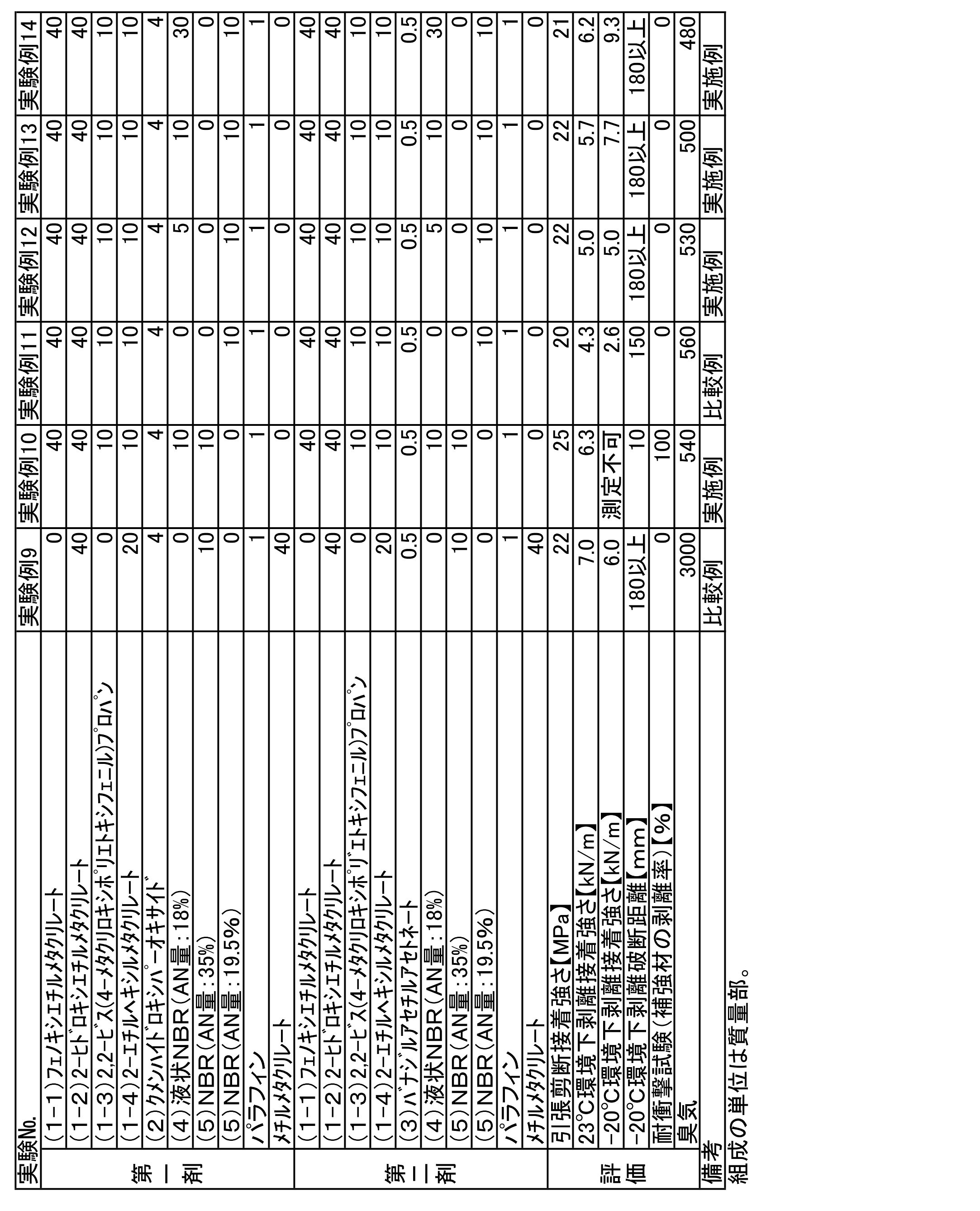
表中に記載した各物質については、次のような略号を使用した。
液状NBR:末端に重合性不飽和二重結合を有する液状アクリロニトリルゴム(An Emerald Performance material社製、Hypro 1300X33LC VTBNX、液状、数平均分子量3900)
NBR:アクリロニトリル-ブタジエン共重合体、末端に重合性不飽和二重結合を有しないエラストマー(市販品)
AN量:末端に反応性不飽和二重結合を有する液状NBRやアクリロニトリル-ブタジエン共重合体に含まれるアクリロニトリル含有量(モル%)
For each substance described in the table, the following abbreviations were used.
Liquid NBR: Liquid acrylonitrile rubber having a polymerizable unsaturated double bond at the terminal (manufactured by An Emerald Performance material, Hypro 1300X33LC VTBNX, liquid, number average molecular weight 3900)
NBR: Acrylonitrile-butadiene copolymer, elastomer that does not have a polymerizable unsaturated double bond at the end (commercially available)
AN amount: Content of acrylonitrile (mol%) contained in liquid NBR or acrylonitrile-butadiene copolymer having a reactive unsaturated double bond at the terminal
表2から以下のことが認められる。本発明は、(4)の量が増えるに連れて低温における剥離強度が高く、耐衝撃性が大きい。実験例14は、(4)と(5)の量が多い分、(1-1)~(1-4)からなる(メタ)アクリレートの含有割合が少ないので、低臭気、低揮発性を達成できる。実験例10は、(4)を含有するので、実験例11より剥離強度が高い。しかしながら、実験例10は、(5)のアクリロニトリル含有量が大きいので、耐衝撃性が小さい。(1-1)(1-3)の代わりに、メチルメタクリレートを使用した実験例9は、臭気が大きく、本発明の効果を有しない。 From Table 2, the following can be observed. In the present invention, as the amount of (4) increases, the peel strength at a low temperature increases and the impact resistance increases. Experimental Example 14 achieves low odor and low volatility because the amount of (4) and (5) is large and the content ratio of (meth) acrylate consisting of (1-1) to (1-4) is small. it can. Since Experimental Example 10 contains (4), the peel strength is higher than that of Experimental Example 11. However, since Experimental Example 10 has a large acrylonitrile content of (5), the impact resistance is small. (1-1) Instead of (1-3), Experimental Example 9 using methyl methacrylate has a large odor and does not have the effect of the present invention.
本発明の接着剤組成物により、低臭気かつ低温における剥離強度が高い二剤型(メタ)アクリル系接着剤組成物が得られる。そのため、換気が不十分な場所でも作業が可能であり、接着剤硬化物が寒冷地域においても剥離しない、適応環境が広がった接着剤が得られる。更に、強い衝撃にも耐えられる二剤型(メタ)アクリル系接着剤を提供することができるので、作業環境の改善だけでなく、様々な産業分野に適用することができ、有益である。 With the adhesive composition of the present invention, a two-component (meth) acrylic adhesive composition having a low odor and a high peel strength at low temperatures can be obtained. Therefore, it is possible to work in a place where ventilation is insufficient, and it is possible to obtain an adhesive having a wide adaptable environment in which the cured adhesive is not peeled even in a cold region. Furthermore, since a two-component (meth) acrylic adhesive that can withstand strong impacts can be provided, not only the working environment is improved, but it can be applied to various industrial fields, which is beneficial.
Claims (22)
(1)(1-1)~(1-4)を含有する重合性ビニルモノマー
(1-1)一般式(A)の化合物
一般式(A) Z-O-(R2O)p-R1
〔式中、Zは(メタ)アクリロイル基を示し、R1はフェニル基又は炭素数1~3個のアルキル基を有するフェニル基を示す。R2は-C2H4-、-C3H6-、-CH2CH(CH3)-、-C4H8-又は-C6H12-を示し、pは1~10の整数を表す。〕
(1-2)一般式(B)の化合物
一般式(B) Z-O-(R2O)p-H
〔式中、Z、R2及びpは前述の通りである。〕
(1-3)一般式(C)の化合物
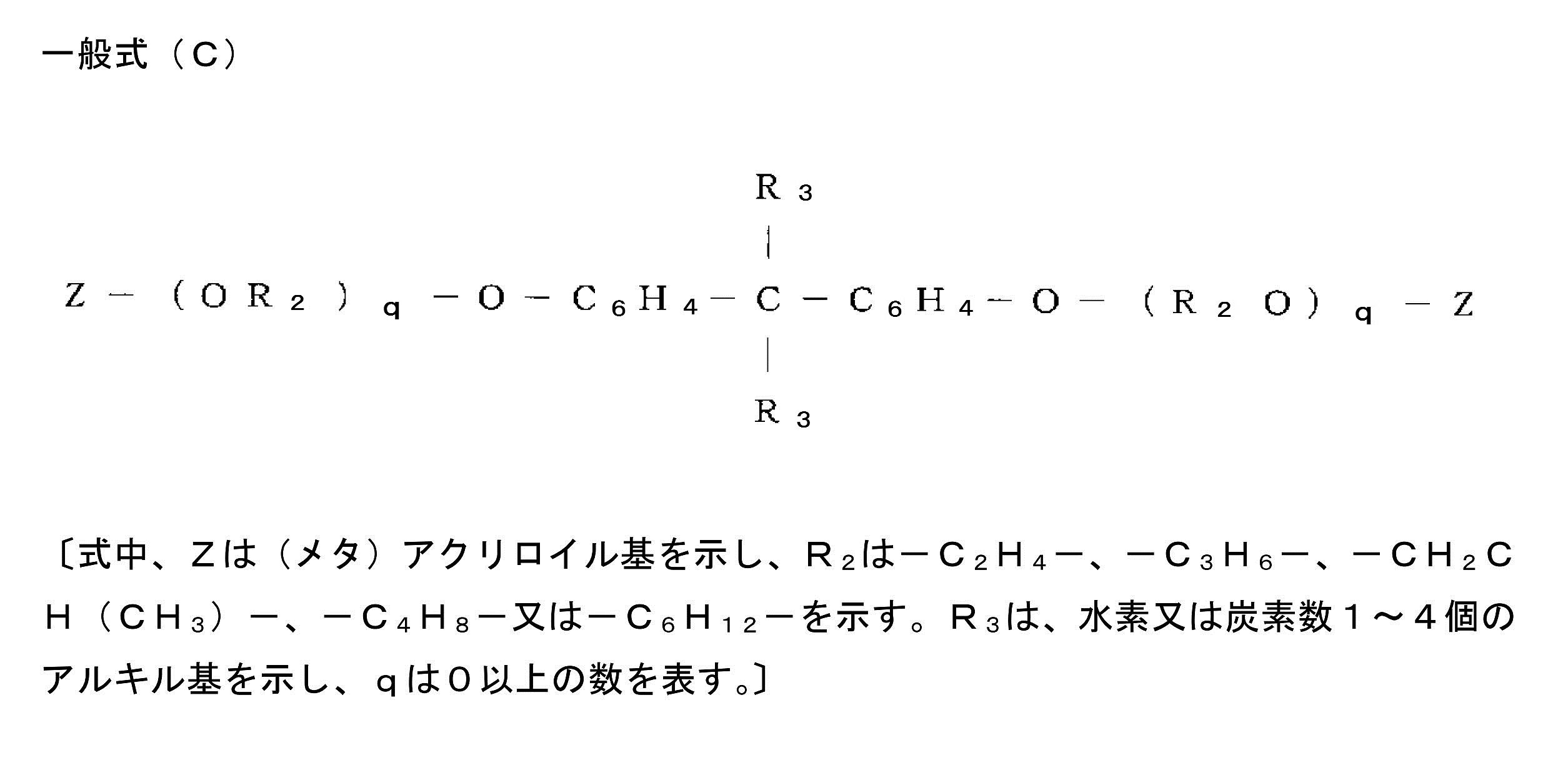
一般式(D) Z-O-R4
〔式中、Zは(メタ)アクリロイル基を示し、R4は炭素数3~16個のアルキル基を表す。〕
(2)重合開始剤、
(3)還元剤、
(4)末端に重合性不飽和二重結合を有さず、かつ、(メタ)アクリロニトリル含有量が10~30モル%であるエラストマー A composition comprising the following (1) to (4):
(1) Polymerizable vinyl monomer containing (1-1) to (1-4) (1-1) Compound of general formula (A) General formula (A) Z—O— (R 2 O) p—R 1
[Wherein, Z represents a (meth) acryloyl group, and R 1 represents a phenyl group or a phenyl group having an alkyl group having 1 to 3 carbon atoms. R 2 represents —C 2 H 4 —, —C 3 H 6 —, —CH 2 CH (CH 3 ) —, —C 4 H 8 — or —C 6 H 12 —, and p is an integer of 1 to 10 Represents. ]
(1-2) Compound of General Formula (B) General Formula (B) Z—O— (R 2 O) p—H
[Wherein, Z, R 2 and p are as defined above. ]
(1-3) Compound of general formula (C)
[Wherein Z represents a (meth) acryloyl group, and R 4 represents an alkyl group having 3 to 16 carbon atoms. ]
(2) a polymerization initiator,
(3) reducing agent,
(4) An elastomer having no polymerizable unsaturated double bond at the terminal and having a (meth) acrylonitrile content of 10 to 30 mol%
(1)(1-1)~(1-4)を含有する重合性ビニルモノマー
(1-1)一般式(A)の化合物
一般式(A) Z-O-(R2O)p-R1
〔式中、Zは(メタ)アクリロイル基を示し、R1はフェニル基又は炭素数1~3個のアルキル基を有するフェニル基を示す。R2は-C2H4-、-C3H6-、-CH2CH(CH3)-、-C4H8-又は-C6H12-を示し、pは1~10の整数を表す。〕
(1-2)一般式(B)の化合物
一般式(B) Z-O-(R2O)p-H〔式中、Z、R2及びpは前述の通りである。〕
(1-3)一般式(C)の化合物

一般式(D) Z-O-R4
〔式中、Zは(メタ)アクリロイル基を示し、R4は炭素数3~16個のアルキル基を表す。〕
(2)重合開始剤、
(3)還元剤、
(4)末端に重合性不飽和二重結合を有し、かつ、(メタ)アクリロニトリル含有量が10~30モル%であるエラストマー、
(5)末端に重合性不飽和二重結合を有しないエラストマー A composition comprising the following (1) to (5).
(1) Polymerizable vinyl monomer containing (1-1) to (1-4) (1-1) Compound of general formula (A) General formula (A) Z—O— (R 2 O) p—R 1
[Wherein, Z represents a (meth) acryloyl group, and R 1 represents a phenyl group or a phenyl group having an alkyl group having 1 to 3 carbon atoms. R 2 represents —C 2 H 4 —, —C 3 H 6 —, —CH 2 CH (CH 3 ) —, —C 4 H 8 — or —C 6 H 12 —, and p is an integer of 1 to 10 Represents. ]
(1-2) Compound of General Formula (B) General Formula (B) ZO— (R 2 O) pH [wherein Z, R 2 and p are as described above. ]
(1-3) Compound of general formula (C)
[Wherein Z represents a (meth) acryloyl group, and R 4 represents an alkyl group having 3 to 16 carbon atoms. ]
(2) a polymerization initiator,
(3) reducing agent,
(4) an elastomer having a polymerizable unsaturated double bond at the terminal and a (meth) acrylonitrile content of 10 to 30 mol%,
(5) Elastomer having no polymerizable unsaturated double bond at the terminal
Priority Applications (5)
| Application Number | Priority Date | Filing Date | Title |
|---|---|---|---|
| US15/748,071 US10647889B2 (en) | 2015-07-30 | 2016-07-28 | Adhesive composition |
| JP2017530925A JP6684800B2 (en) | 2015-07-30 | 2016-07-28 | Composition |
| KR1020187001761A KR102604119B1 (en) | 2015-07-30 | 2016-07-28 | composition |
| EP16830591.0A EP3323837A4 (en) | 2015-07-30 | 2016-07-28 | Composition |
| CN201680044663.0A CN107922520B (en) | 2015-07-30 | 2016-07-28 | combination |
Applications Claiming Priority (4)
| Application Number | Priority Date | Filing Date | Title |
|---|---|---|---|
| JP2015150268 | 2015-07-30 | ||
| JP2015150269 | 2015-07-30 | ||
| JP2015-150269 | 2015-07-30 | ||
| JP2015-150268 | 2015-07-30 |
Publications (1)
| Publication Number | Publication Date |
|---|---|
| WO2017018486A1 true WO2017018486A1 (en) | 2017-02-02 |
Family
ID=57884552
Family Applications (1)
| Application Number | Title | Priority Date | Filing Date |
|---|---|---|---|
| PCT/JP2016/072175 Ceased WO2017018486A1 (en) | 2015-07-30 | 2016-07-28 | Composition |
Country Status (7)
| Country | Link |
|---|---|
| US (1) | US10647889B2 (en) |
| EP (1) | EP3323837A4 (en) |
| JP (1) | JP6684800B2 (en) |
| KR (1) | KR102604119B1 (en) |
| CN (1) | CN107922520B (en) |
| TW (1) | TWI680170B (en) |
| WO (1) | WO2017018486A1 (en) |
Cited By (7)
| Publication number | Priority date | Publication date | Assignee | Title |
|---|---|---|---|---|
| JP2017031261A (en) * | 2015-07-30 | 2017-02-09 | デンカ株式会社 | Composition |
| JP2017031260A (en) * | 2015-07-30 | 2017-02-09 | デンカ株式会社 | Composition |
| JP2017031262A (en) * | 2015-07-30 | 2017-02-09 | デンカ株式会社 | Composition |
| JP2017031259A (en) * | 2015-07-30 | 2017-02-09 | デンカ株式会社 | Composition |
| JPWO2021166861A1 (en) * | 2020-02-19 | 2021-08-26 | ||
| JP2024054183A (en) * | 2018-12-20 | 2024-04-16 | ハンツマン・アドヴァンスト・マテリアルズ・ライセンシング・(スイッツランド)・ゲーエムベーハー | Adhesive Compositions Containing Retardation Additives - Patent application |
| WO2025074954A1 (en) * | 2023-10-02 | 2025-04-10 | セメダイン株式会社 | Adhesive composition |
Families Citing this family (2)
| Publication number | Priority date | Publication date | Assignee | Title |
|---|---|---|---|---|
| DE102019200736A1 (en) * | 2019-01-22 | 2020-07-23 | Tesa Se | Reactive 2-component adhesive system in film form based on odorless acrylic monomers |
| WO2022210166A1 (en) * | 2021-03-31 | 2022-10-06 | デンカ株式会社 | Adhesive composition, bonded body and method for producing adhesive composition |
Citations (11)
| Publication number | Priority date | Publication date | Assignee | Title |
|---|---|---|---|---|
| JPH107753A (en) * | 1996-04-18 | 1998-01-13 | Denki Kagaku Kogyo Kk | Curable resin composition |
| JP2001055422A (en) * | 1999-06-10 | 2001-02-27 | Denki Kagaku Kogyo Kk | Curable resin composition, adhesive composition, bonded material and bonding method |
| JP2001055420A (en) * | 1999-06-10 | 2001-02-27 | Denki Kagaku Kogyo Kk | Curable resin composition, adhesive composition, bonded material and bonding method |
| JP2001055423A (en) * | 1999-06-10 | 2001-02-27 | Denki Kagaku Kogyo Kk | Curable resin composition, adhesive composition, bonded material and bonding method |
| JP2002265509A (en) * | 2001-03-08 | 2002-09-18 | Denki Kagaku Kogyo Kk | Flame-retardant curable resin composition and flame-retardant curable adhesive composition |
| JP2002308944A (en) * | 2001-04-18 | 2002-10-23 | Denki Kagaku Kogyo Kk | Curable resin composition, adhesive composition and bonding method |
| WO2009041248A1 (en) * | 2007-09-26 | 2009-04-02 | Denki Kagaku Kogyo Kabushiki Kaisha | Adhesive compositions and jointing method |
| JP2011089055A (en) * | 2009-10-23 | 2011-05-06 | Denki Kagaku Kogyo Kk | Adhesive composition for temporary fixation |
| WO2011102341A1 (en) * | 2010-02-16 | 2011-08-25 | 電気化学工業株式会社 | Semiconductor block bonding apparatus, semiconductor block bonding method, and semiconductor wafer manufacturing method |
| WO2012161221A1 (en) * | 2011-05-24 | 2012-11-29 | 電気化学工業株式会社 | Adhesive agent composition for temporary fixing purposes |
| WO2013021945A1 (en) * | 2011-08-05 | 2013-02-14 | 電気化学工業株式会社 | Adhesive composition for temporary fixing |
Family Cites Families (3)
| Publication number | Priority date | Publication date | Assignee | Title |
|---|---|---|---|---|
| TW353666B (en) * | 1996-04-18 | 1999-03-01 | Denki Kagaku Kogyo Kk | Curable resin composition |
| JPH11147921A (en) | 1997-11-17 | 1999-06-02 | Denki Kagaku Kogyo Kk | Cured object, curable resin composition, adhesion composition, bonded object, door structure and bonding method |
| TWI595037B (en) * | 2009-04-30 | 2017-08-11 | 電化股份有限公司 | Curable resin composition, adhesive composition, cured article or complex |
-
2016
- 2016-07-28 WO PCT/JP2016/072175 patent/WO2017018486A1/en not_active Ceased
- 2016-07-28 KR KR1020187001761A patent/KR102604119B1/en active Active
- 2016-07-28 EP EP16830591.0A patent/EP3323837A4/en not_active Withdrawn
- 2016-07-28 US US15/748,071 patent/US10647889B2/en active Active
- 2016-07-28 JP JP2017530925A patent/JP6684800B2/en active Active
- 2016-07-28 CN CN201680044663.0A patent/CN107922520B/en active Active
- 2016-07-29 TW TW105124224A patent/TWI680170B/en active
Patent Citations (11)
| Publication number | Priority date | Publication date | Assignee | Title |
|---|---|---|---|---|
| JPH107753A (en) * | 1996-04-18 | 1998-01-13 | Denki Kagaku Kogyo Kk | Curable resin composition |
| JP2001055422A (en) * | 1999-06-10 | 2001-02-27 | Denki Kagaku Kogyo Kk | Curable resin composition, adhesive composition, bonded material and bonding method |
| JP2001055420A (en) * | 1999-06-10 | 2001-02-27 | Denki Kagaku Kogyo Kk | Curable resin composition, adhesive composition, bonded material and bonding method |
| JP2001055423A (en) * | 1999-06-10 | 2001-02-27 | Denki Kagaku Kogyo Kk | Curable resin composition, adhesive composition, bonded material and bonding method |
| JP2002265509A (en) * | 2001-03-08 | 2002-09-18 | Denki Kagaku Kogyo Kk | Flame-retardant curable resin composition and flame-retardant curable adhesive composition |
| JP2002308944A (en) * | 2001-04-18 | 2002-10-23 | Denki Kagaku Kogyo Kk | Curable resin composition, adhesive composition and bonding method |
| WO2009041248A1 (en) * | 2007-09-26 | 2009-04-02 | Denki Kagaku Kogyo Kabushiki Kaisha | Adhesive compositions and jointing method |
| JP2011089055A (en) * | 2009-10-23 | 2011-05-06 | Denki Kagaku Kogyo Kk | Adhesive composition for temporary fixation |
| WO2011102341A1 (en) * | 2010-02-16 | 2011-08-25 | 電気化学工業株式会社 | Semiconductor block bonding apparatus, semiconductor block bonding method, and semiconductor wafer manufacturing method |
| WO2012161221A1 (en) * | 2011-05-24 | 2012-11-29 | 電気化学工業株式会社 | Adhesive agent composition for temporary fixing purposes |
| WO2013021945A1 (en) * | 2011-08-05 | 2013-02-14 | 電気化学工業株式会社 | Adhesive composition for temporary fixing |
Non-Patent Citations (1)
| Title |
|---|
| See also references of EP3323837A4 * |
Cited By (8)
| Publication number | Priority date | Publication date | Assignee | Title |
|---|---|---|---|---|
| JP2017031261A (en) * | 2015-07-30 | 2017-02-09 | デンカ株式会社 | Composition |
| JP2017031260A (en) * | 2015-07-30 | 2017-02-09 | デンカ株式会社 | Composition |
| JP2017031262A (en) * | 2015-07-30 | 2017-02-09 | デンカ株式会社 | Composition |
| JP2017031259A (en) * | 2015-07-30 | 2017-02-09 | デンカ株式会社 | Composition |
| JP2024054183A (en) * | 2018-12-20 | 2024-04-16 | ハンツマン・アドヴァンスト・マテリアルズ・ライセンシング・(スイッツランド)・ゲーエムベーハー | Adhesive Compositions Containing Retardation Additives - Patent application |
| JPWO2021166861A1 (en) * | 2020-02-19 | 2021-08-26 | ||
| JP7798022B2 (en) | 2020-02-19 | 2026-01-14 | 日本ゼオン株式会社 | Composition for self-adhesive foam sheet and self-adhesive foam laminate sheet |
| WO2025074954A1 (en) * | 2023-10-02 | 2025-04-10 | セメダイン株式会社 | Adhesive composition |
Also Published As
| Publication number | Publication date |
|---|---|
| CN107922520A (en) | 2018-04-17 |
| KR102604119B1 (en) | 2023-11-20 |
| TW201710424A (en) | 2017-03-16 |
| CN107922520B (en) | 2020-08-04 |
| EP3323837A1 (en) | 2018-05-23 |
| TWI680170B (en) | 2019-12-21 |
| JPWO2017018486A1 (en) | 2018-05-17 |
| EP3323837A4 (en) | 2018-07-04 |
| JP6684800B2 (en) | 2020-04-22 |
| US20180215954A1 (en) | 2018-08-02 |
| US10647889B2 (en) | 2020-05-12 |
| KR20180034406A (en) | 2018-04-04 |
Similar Documents
| Publication | Publication Date | Title |
|---|---|---|
| JP6684800B2 (en) | Composition | |
| JP7097305B2 (en) | Composition | |
| JP6887258B2 (en) | Composition | |
| JP6579613B2 (en) | Composition | |
| JP6681898B2 (en) | Composition and adhesive composition | |
| JP6579611B2 (en) | Composition | |
| JP6579610B2 (en) | Composition | |
| JP6894713B2 (en) | Composition | |
| JP6579612B2 (en) | Composition | |
| JP6823475B2 (en) | Composition | |
| JP2017031266A (en) | Composition | |
| JP2017031265A (en) | Composition | |
| JP6842936B2 (en) | Composition | |
| JP6970509B2 (en) | Composition | |
| JP6845700B2 (en) | Composition | |
| JP6857502B2 (en) | Composition | |
| JP6823474B2 (en) | Composition | |
| JP2017031263A (en) | Composition | |
| JP2017031264A (en) | Composition |
Legal Events
| Date | Code | Title | Description |
|---|---|---|---|
| 121 | Ep: the epo has been informed by wipo that ep was designated in this application |
Ref document number: 16830591 Country of ref document: EP Kind code of ref document: A1 |
|
| ENP | Entry into the national phase |
Ref document number: 2017530925 Country of ref document: JP Kind code of ref document: A |
|
| ENP | Entry into the national phase |
Ref document number: 20187001761 Country of ref document: KR Kind code of ref document: A |
|
| WWE | Wipo information: entry into national phase |
Ref document number: 15748071 Country of ref document: US |
|
| NENP | Non-entry into the national phase |
Ref country code: DE |
|
| WWE | Wipo information: entry into national phase |
Ref document number: 2016830591 Country of ref document: EP |